


Abstract
Most studies on household energy consumption focus on formal factors like income, prices, and technology, while paying little attention to whether informal institutions such as culture have a genuine causal impact. Using 2015 CHFS data, we examine the effect of traditional culture on household energy intensity and find that treated households show 29.7% lower per capita carbon emissions in log points relative to controls. To trace how this effect works, we look at five behavioral channels: stronger green awareness that encourages everyday conservation, a shift from private cars to low-carbon transport, movement in consumption patterns from goods toward services, less plastic use in daily routines, and a higher saving propensity that reduces immediate spending. Together, these pathways translate cultural norms into actual energy savings. We then test for moderating effects. Central Environmental Inspection, local government spending on environmental protection and publicity, and household income and education all positively moderate the cultural effect, suggesting that formal regulations and informal cultural norms reinforce each other rather than operate in isolation. These findings point to a concrete way of turning cultural heritage into practical tools for energy governance, offering micro-level evidence that can inform the ongoing effort to decouple economic growth from carbon emissions.
1. Introduction
Household energy consumption has become a major component of global energy demand and greenhouse-gas emissions. According to the International Energy Agency (National Energy Administration, 2024), the residential sector accounts for more than 20% of final energy consumption in OECD (Organisation for Economic Co-operation and Development) economies, and its share continues to rise in developing economies. Significant achievements have been made in China’s energy transition and development—the National Energy Administration’s interpretation of the white paper “China’s Energy Transition” shows that rapid urbanization and improvement in living standards in China have significantly increased household energy consumption, with residential electricity consumption doubling in the past decade. Against the backdrop of China’s commitments to peak carbon emissions before 2030 and achieve carbon neutrality before 2060, understanding the driving factors of household energy consumption and determining effective energy-saving and emission reduction strategies cannot be ignored.
Culture is a deep-seated force that shapes individual behavioral decisions. Just as scholars have famously pointed out (Geertz & Darnton, 1973) famously puts it, man is “an animal suspended in webs of significance he himself has spun,” implying that individual decision-making can only be comprehended within this cultural web of meaning (National Energy Administration, 2024). In Chinese traditional cultures, the ethic of diligence and frugality; the collectivist belief that ordinary individuals bear responsibility for national welfare; and values such as seeking truth from facts, hard struggle, and consideration of the overall interest constitute informal institutions that constrain and guide consumption behavior (North, 2018). Through intergenerational transmission and socialization, these cultural values are internalized as behavioral norms (Barni et al., 2013) and can subtly influence household energy-consumption patterns (Stephenson et al., 2015). As ecological civilization has become an integral part of China’s overall national development strategy (Central Committee of the Communist Party of China & State Council, 2015), changes in lifestyle and restraint of energy-driven desires are crucial to achieving energy sustainability (Rosen, 2009).
The Opinions of the Central Committee and the State Council on Accelerating the Construction of Ecological Civilization emphasizes the cultivation of green lifestyles and advocates frugal consumption (Central Committee of the Communist Party of China & State Council, 2015). It calls for broad-based green-life campaigns that accelerate the shift toward frugal, low-carbon, civilized, and healthy modes of living in clothing, food, housing, mobility, and tourism. Sustainability science, moreover, requires a cross-disciplinary approach that highlights the linkages between the natural sciences and the humanities (Kates et al., 2001). Rather than treating sustainability as a set of isolated dimensions, research should focus on solving problems arising from human–nature interactions (Lyon, 2023). In this context, it is important to ask whether and how culture guides individual behavior in ways that align with national development objectives and become collective action consistent with state goals. Accordingly, this study asks: Can culture affect household energy consumption, and through what mechanisms does it do so?
This paper systematically examines the impact of culture on household energy consumption. We operationalize culture using a unique quasi-natural experimental setting based on the historical route of the Long March. During the Agrarian Revolutionary War, the main forces of the Chinese Workers’ and Peasants’ Red Army evacuated the Soviet areas north and south of the Yangtze River and carried out a strategic relocation that lasted for two years before reaching the Shaanxi-Gansu Soviet Area. As a pivotal event in modern Chinese history, the Long March concentrated and disseminated core values such as collectivism, self-sacrifice, seeking truth from facts, consideration of the overall interest, and hard struggle (Xi, 2016). Because historical memory and intergenerational transmission are more salient along the Long March route (T. Chen et al., 2020), these values are likely to have been preserved more strongly in these areas.
2. Literature Review
The value orientations embedded in Chinese traditional culture, such as national supremacy, willingness to sacrifice, practicality, consideration of overall interests, and hard work, influence family energy consumption decisions through paths such as internalization of values, shaping of behavioral norms, and cognitive reconstruction (Steg & Vlek, 2009). This paper constructs a theoretical framework between Chinese traditional culture, intermediary mechanisms, and family energy consumption and explores the mechanism of the influence of traditional culture on family energy consumption from the following five paths.
One strand of the literature examines how traditional culture affects the energy consumption of micro-level actors. Long March culture is a representative form of modern Chinese cultural memory, and such regional cultural memory can profoundly influence individual decision-making. Residents in Long March areas have been exposed since childhood to historical sites and narratives associated with the Long March, making them more likely to identify with its cultural connotations and to attach importance to collective interests (Y. Wu et al., 2023). The collectivist values of unity, cooperation, and consideration of the overall interest advocated by the Long March spirit may help reduce household energy consumption. Its ethics of hard struggle and self-sacrifice (W. Wu & Hong, 2024; Fazal et al., 2023) may also be internalized as a sense of responsibility through intergenerational transmission or community education, leading households in areas with stronger Long March culture to connect the traditional virtue of frugality with environmental cost control and to reduce high-carbon consumption.
A related strand investigates the influence of red culture on household energy consumption. Red culture can confer political legitimacy on environmental policies and improve household acceptance of emission reduction measures. Government financing can promote the clean-energy transition through clean-energy supply, technological diffusion, knowledge dissemination, and the alleviation of financial constraints (Zhu & Zhang, 2024), while also strengthening households’ initiative and sense of the overall interest, thereby reducing carbon emissions. In addition, grassroots party organizations have promoted social green culture by embedding “green” principles in production and business processes (Wan, 2020), encouraging cleaner products and further reducing household energy consumption.
Another strand shows that outstanding traditional Chinese traditional cultures, such as Confucian culture, can restrain self-interest and promote green behavior (Gu, 2015; X. Xu et al., 2020; C. Zhang et al., 2022). The modern transformation of cultural symbols can also reduce the cost of green governance (Niu et al., 2023). Firms located in regions with stronger Confucian culture exhibit lower energy consumption per unit of output (Gu, 2015). In addition, individualism and collectivism are important antecedents of perceived consumer effectiveness and environmental attitudes, with horizontal collectivism and vertical individualism offering distinct forms of support (Cho et al., 2013).
Although prior studies have extensively discussed the meanings of different cultural forms and their behavioral consequences, few have directly examined how the spirit embedded in Chinese traditional cultures affects household energy consumption. China’s dual-carbon commitments have stimulated broad research interest in the country’s carbon-emission problem (Pan et al., 2020; B. Wang et al., 2024; F. Zhou & Wang, 2022). Within this agenda, household energy consumption has become an increasingly important focus (Fan et al., 2021; Y. Zhang et al., 2023; M. Li et al., 2025). Because households are organizations whose decisions are shaped by internal members, particularly the household head, it is necessary to examine the guiding role of informal institutions such as cultural traditions.
3. Theoretical Analysis and Hypotheses
Chinese traditional cultures embody values such as national priority, willingness to sacrifice, practical orientation, consideration of the overall interest, and hard struggle. These values may influence household energy-consumption decisions through value internalization, behavioral-norm formation, and cognitive reconstruction. This section develops a theoretical framework linking Chinese traditional culture, mediating mechanisms, and household energy consumption and discusses five pathways through which culture may affect household energy behavior. This study focuses on these five values because they are rooted in classical Chinese thought, and each bears clear theoretical links to household energy consumption: National interest fosters responsibility; sacrifice reduces resistance. Pragmatism values effectiveness; holism reconciles individual and collective interests, and perseverance internalizes frugality. Other values are either subsumed under these five or have weaker relevance to household energy decisions. Ecological notions like “harmony with nature,” though related to resource use, lean toward environmental ethics rather than behavioral decision-making and are thus excluded from our framework.
3.1. National Priority and Green Cognition
The national-priority orientation of Chinese traditional culture strengthens residents’ sense of responsibility for public environmental problems and improves green cognition. Under the idea that the overall interest takes precedence over local or private interests, residents may more rationally evaluate the applicability of clean-energy technologies, participate in low-carbon community governance, reduce transition costs through neighborhood demonstration effects, and optimize household energy structures. Energy structure is a key determinant of energy consumption (G. Xu et al., 2006; Rong et al., 2021). Coal-to-electricity substitution can significantly reduce carbon emissions from transport, heating, and cooking (T. Yang et al., 2023), and coal-to-gas substitution in kitchens is also a major source of emission reduction (A. Yang & Wang, 2023). We therefore propose the following:
H1.
The national-priority component of Chinese traditional culture reduces household energy consumption by strengthening green cognition.
3.2. Willingness to Sacrifice and Low-Carbon Transport
The willingness-to-sacrifice component of Chinese traditional culture can motivate residents to overcome the private costs of green transition and connect individual behavior with the long-term ecological benefits of carbon neutrality (X. Wang et al., 2024). This may encourage substitution from fuel vehicles to public transit, cycling, or new-energy vehicles (Sun & Song, 2022). Although low-carbon transport may require more time and provide less convenience (Q. Zhang et al., 2013), willingness to sacrifice can create social recognition for low-carbon behavior and activate group-level coordination. Prior evidence also shows a positive relationship between self-sacrifice and pro-environmental behavior (Bolderdijk et al., 2013). We therefore propose the following:
H2.
The willingness-to-sacrifice component of Chinese traditional culture reduces household energy consumption by promoting low-carbon transport.
3.3. Practical Orientation and Consumption Structure
The principle of seeking truth from facts guides residents to evaluate consumption from the perspective of utility maximization, suppressing unnecessary material comparison and impulsive purchases and fostering the perception that green consumption is a form of self-discipline. Consumers and producers are the main components of all economies: consumer demand and producer supply jointly determine market equilibrium; demographic characteristics are essential features of consumers, and carbon emissions are byproducts of production. Chinese traditional culture may promote a service-oriented and green upgrading of consumption structure. Although energy-use diversification does not necessarily generate higher emissions, traditional biomass-energy patterns do produce more emissions; optimizing consumption structure can help reduce household energy consumption (W. Wu et al., 2017) and facilitate the replacement of old consumption demand with new low-carbon demand. We therefore propose the following:
H3.
The practical-orientation component of Chinese traditional culture reduces household energy consumption by optimizing consumption structure.
3.4. Consideration of the Overall Interest and Plastic-Reduction Effects
The overall-interest orientation of Chinese traditional culture reshapes residents’ cognition of public environmental responsibility. Under this value, residents may connect their individual behavior with collective environmental goals and actively avoid the long-term ecological damage caused by short-term convenience consumption. In daily life, this may be reflected in using reusable shopping bags instead of supermarket plastic bags or reducing waste from takeout packaging. Through social-norm pressure and neighborhood demonstration effects (Yan et al., 2024), collectivist culture can amplify the synergy of collective action. Reducing one ton of plastic use may reduce approximately 1.8 to 3.5 tons of CO2-equivalent emissions (Ren et al., 2020). Because bringing reusable bags is visible and imitable, it can also generate a community-level low-carbon consumption network that further magnifies the reduction in household energy consumption. We therefore propose the following:
H4.
The overall-interest component of Chinese traditional culture reduces household energy consumption by strengthening plastic-reduction behavior.
3.5. Hard Struggle and the Propensity to Save
The hard-struggle component of Chinese traditional culture promotes frugality, preparedness, and identification with the carbon-neutrality goal. In the field of consumption, it encourages reasonable and moderate consumption behavior and gradually forms a conservation-oriented consumption pattern consistent with national conditions (C. Li, 2008). Residents may evaluate the necessity of consumption more rationally, restrain non-essential purchases, reduce the replacement of durable and non-durable goods, and increase the household saving rate, thereby lowering household carbon emissions (Pan et al., 2020). By reconstructing the frugality ethic transmitted across generations, Chinese traditional culture can reduce annual household carbon-emission intensity and cultivate active environmental citizenship, transforming passive emission reduction into value-based self-awareness and providing a broad social-cognitive foundation and spiritual motivation for achieving carbon neutrality. We therefore propose the following:
H5.
The hard-struggle component of Chinese traditional culture reduces household energy consumption by strengthening the propensity to save.
4. Research Design
The theoretical framework of this study follows a sequential logic of cultural values, mediating mechanisms, and energy consumption. First, the five core values of traditional Chinese culture, namely national priority, willingness to sacrifice, pragmatism, consideration of the overall interest, and hard work and perseverance, constitute the value foundation for household decision-making. Through the process of value internalization, these values shape individuals’ fundamental attitudes and behavioral propensities regarding resource use. Second, these value orientations are further translated into five specific behavioral mechanisms: green cognition, low-carbon transport, consumption structure, plastic-reduction behavior, and saving propensity. Each of these mechanisms directly embodies particular values in consumption decisions. Finally, these five mechanisms jointly influence household energy consumption, thereby contributing to carbon emission reduction.
4.1. Variables
4.1.1. Dependent Variable
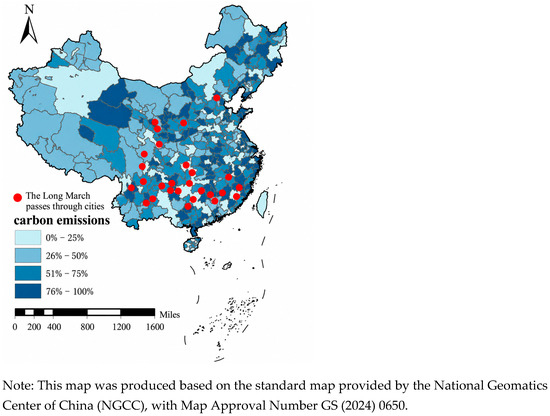
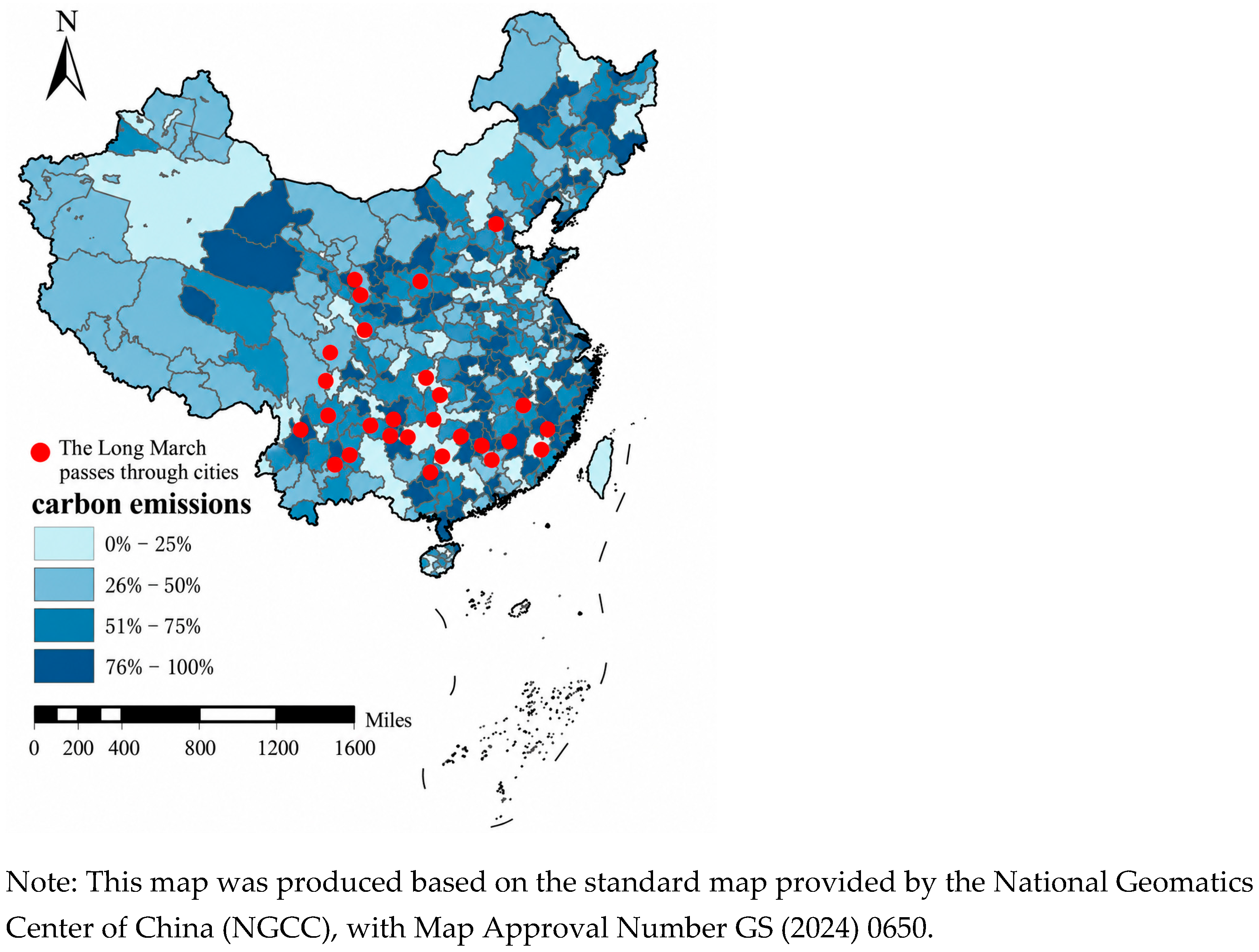
Prior research shows that growing household carbon emissions substantially increase residential energy consumption and treats the two as positively related variables. This study therefore used per capita household carbon emissions as a proxy for household energy consumption. Existing studies have measured urban residents’ carbon emissions from electricity, gas, transport, and heating (F. Ding & Lu, 2020), while other research uses per capita consumption-based carbon emissions and consumption carbon intensity to capture low-carbon transformation in household consumption (J. Zhang & Wei, 2023). Such indicators can account for both scale and structural features. Accordingly, this paper used the logarithm of per capita household carbon emissions, denoted Pre_Co2, as the dependent variable to measure household consumption-based carbon emissions, calculated as the ratio of total household carbon emissions (CO2) to household size (Size), as shown in Equation (1). Total household carbon emissions were calculated by multiplying the carbon intensity of each expenditure category (CI) by household expenditure in that category (C), as shown in Equation (2). Following the Classification of Household Consumption Expenditure, household consumption was divided into eight categories. The carbon-emission coefficient for each category was approximated using existing estimates (Q. Wang, 2015), as reported in Table 1. Figure 1 maps the city-level average household carbon emissions calculated from these data.
Pre_Co2i = ln (Co2/Size),
Co2 = CI × C,
Table 1.
Household consumption carbon-emission coefficients.
Figure 1.
City-level average household carbon emissions (National Geomatics Center of China, 2024).
4.1.2. Explanatory Variable
Culture is an abstract informal institution and is therefore difficult to observe and quantify directly. To identify the causal effect of traditional culture on household energy consumption, an exogenous and operational proxy is required. The historical event of the Long March provides an ideal identification setting. The Long March spirit embodies values such as national priority, willingness to sacrifice, practical orientation, consideration of the overall interest, and hard struggle, making cities along the Long March route a suitable setting for examining the transmission of traditional cultural values.
This study used the interaction between whether a household head resides in a prefecture-level city along the Red Army’s Long March route and a birth-cohort dummy for the household head as the proxy for the Long March spirit (Cohort). Cohort equaled one of the household head resides in a Long March city and was born before 1965, that is, before the Cultural Revolution, and zero otherwise. The sample contained 4115 households whose heads were born before 1965, with average per capita carbon emissions of 7.447, and 33,035 households whose heads were born after 1965, with average per capita carbon emissions of 7.778. The lower per capita consumption-based carbon emissions among pre-1965 households provided preliminary support for the conjecture. Existing studies show that the Cultural Revolution had profound effects on ideology and cultural atmosphere and underscores the importance of cultural capital (Andreas, 2002). In the later period of the Cultural Revolution, limited reopening of universities also offered some sent-down youth opportunities to improve education and social status, and the sent-down experience may have shaped distinctive life perspectives, persistence, and risk-taking attitudes (X. Zhou & Hou, 1999). The Long March route was also a route of political and cultural dissemination. Regional historical memory and culture exert long-lasting influence on local generations (Gu, 2015), and areas along the Long March route may still respond more strongly to calls to carry forward the Long March spirit. In addition, because Beijing is China’s political center and is strongly influenced by Chinese traditional cultures, it was included among the treated cities. The final treatment list contains 27 prefecture-level cities.
4.1.3. Control Variables
Following the prior literature (Andersson et al., 2014; Streimikiene & Volochovic, 2011; Büchs & Schnepf, 2013), this study controlled for a range of factors that may affect household energy consumption at the household-head, household, and regional levels. These variables included household size (Size), the logarithm of regional per capita GDP (ln_Gdp), marital status (Married), and the logarithm of total household income (ln_Inc). In addition, increases in household expenditure and changes in consumption structure affect household carbon emissions (Kerkhof et al., 2009). Population aging also significantly influences energy use and carbon emissions, with stronger effects in developing than in developed countries (Shi, 2003). We therefore included the share of children under 18 (children_ratio), the share of elderly members aged 65 and above (old1_ratio), and the share of elderly members aged 70 and above (old2_ratio) as controls. Definitions and descriptive statistics for the main variables are shown in Table 2 and Table 3.
Table 2.
Variable definitions.
Table 3.
Descriptive statistics.
4.1.4. Mediating Variables
Based on prior research, this study constructed five mediating variables to explore how Chinese traditional culture affects household energy consumption. The propensity to save is a key factor affecting household carbon emissions. Household surveys show that a strong saving propensity significantly reduces carbon emissions (Tan et al., 2025), thereby reducing household energy consumption. Consumption structure (Dev) follows previous scholars (Yu et al., 2022): household consumption is divided into survival consumption (food, clothing, and housing), development consumption (education, health care, transport, and communication), and enjoyment consumption (entertainment, luxury goods, and tourism). Dev is measured as the share of enjoyment consumption in total consumption, with each component calculated from annual consumption in the CHFS questionnaire. Green cognition (Green) is coded as one of the household head answers yes to whether the respondent or family members are willing to pay a higher price for otherwise comparable products with green labels and zero otherwise. Low-carbon transport practice (Nas) is coded from the respondent’s travel-mode choice; walking, cycling, motorcycles/electric bikes/tricycles, public transit, and taxi/private car are coded as one, while other modes are coded as zero. Plastic-reduction behavior (Pub) equals one if the respondent usually brings a shopping bag when shopping and zero otherwise. Saving propensity (Save) is measured as the ratio of household deposits to total assets, where deposits equal the sum of current and fixed deposits and total assets are obtained from the CHFS asset module.
4.1.5. Moderating Variables
Following prior work (Y. Ding et al., 2016), this study examined whether formal institutions and household characteristics moderate the effect of informal institutions on green behavior. Six moderating variables were constructed: Central Environmental Inspection (Vise), government environmental-protection expenditure (Invest), and regional environmental publicity intensity (Epcio) as formal institutional variables and household fiscal deficit (Def), household income (Income), and education level (Edu) as household-characteristic variables. Vise was coded as one if a region has been inspected and investigated by the Central Environmental Inspection team according to the State Council’s published lists and zero otherwise. Invest measured government funding for environmental protection. Epcio was based on the frequency of environment-related terms in prefecture-level government work reports (Deng & Yang, 2019). Def equaled one if household consumption exceeded income and zero otherwise. Income was measured by per capita household income. Edu equaled one if the household head held a bachelor’s degree or above and zero otherwise.
4.2. Data Sources
Household-level data came from the third wave of the China Household Finance Survey (CHFS), conducted nationwide by Southwestern University of Finance and Economics in 2015. The CHFS is a nationally representative and comprehensive household tracking survey. It uses households as the sampling unit; covers a broad range of data and questionnaire modules; and includes 29 provinces, 174 prefecture-level cities, and 351 counties or districts, excluding Hong Kong, Macao, Taiwan, Xinjiang, and Tibet. This study used multidimensional information on household demographics; household economy; education; and consumption expenditures related to clothing, food, housing, transport, and energy. After data cleaning, the final micro-level sample contained 37,150 households. Regional-level data were drawn from the China City Statistical Yearbook and the China Energy Statistical Yearbook. Environmental vocabulary counts were obtained from prefecture-level government work reports.
4.3. Model Specification
Because the data are cross-sectional for 2015, this study used the CHFS 2015 data for three main reasons. First, this wave is publicly available with complete documentation, covering 29 provinces and 37,289 households, and offers strong representativeness and mature supporting materials. Second, 2015 predates the introduction of China’s “dual-carbon” goals, so household energy consumption had not yet been significantly affected by recent intensive policy interventions, which facilitates the identification of the net effect of cultural values. Third, using the same baseline data as prior studies in this field (Tan et al., 2025) enhances comparability and cumulative evidence. This study follows and constructs a cross-sectional difference-in-differences (DID) identification strategy using variation across prefecture-level cities along the Red Army’s Long March route and variation across birth cohorts (Y. Chen et al., 2020). DID identification requires two dimensions of variation: in this study, the first dimension was the household head’s birth cohort, and the second was whether the city lay along the Long March route. Householders born before 1965 experienced political mobilization such as the Red Guard movement and the sent-down youth movement more fully, and their values were more deeply shaped by revolutionary-tradition education. After curriculum reforms during the Cultural Revolution, history courses were replaced by courses such as Basic Knowledge of Industry and Basic Knowledge of Agriculture. Cities along the Long March route possess carriers of Chinese traditional culture and may therefore generate persistent cultural influence. Regional historical memory and culture exert long-term effects on local generations. Accordingly, residents along the Long March route may experience Chinese traditional cultures more intensely and respond more strongly to calls to carry forward such culture (W. Wu & Hong, 2024). The baseline DID model is specified as follows:
where denotes household energy consumption, measured by log per capita carbon emissions and is the proxy for Chinese traditional culture based on the Long March spirit. Control denotes the vector of control variables; denotes city fixed effects, and is the error term. The coefficient of interest is.
Pre_Co2i = α + βCohorti,c + φControli,c + μc + εi,
To further test the channels through which Chinese traditional culture affects household energy consumption, we followed the mechanism-testing approach in two-step and estimate the following mediation models:
Mi = α + βCohorti,c + φControli,c + μc + εi,
Pre_Co2i = α + γMi + φControli,c + μc + εi,
5. Empirical Results
5.1. Baseline Regression
Table 4 reports the baseline ordinary least squares estimates. After controlling for a series of household and regional characteristics, Column (4) shows that the estimated coefficient on Cohort is −0.297 and is statistically significant at the 1% level. This indicates that households in Long March cities whose heads were born before 1965 exhibit substantially lower per capita carbon emissions than other households. In other words, Chinese traditional culture significantly reduces household energy consumption, supporting the baseline hypothesis.
Table 4.
Baseline regression results.
5.2. Robustness Tests
5.2.1. Counterfactual Tests
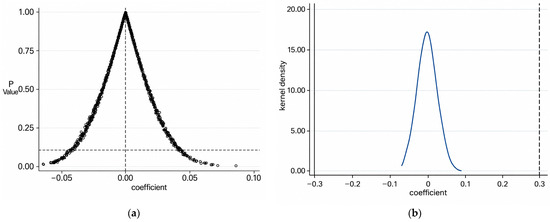
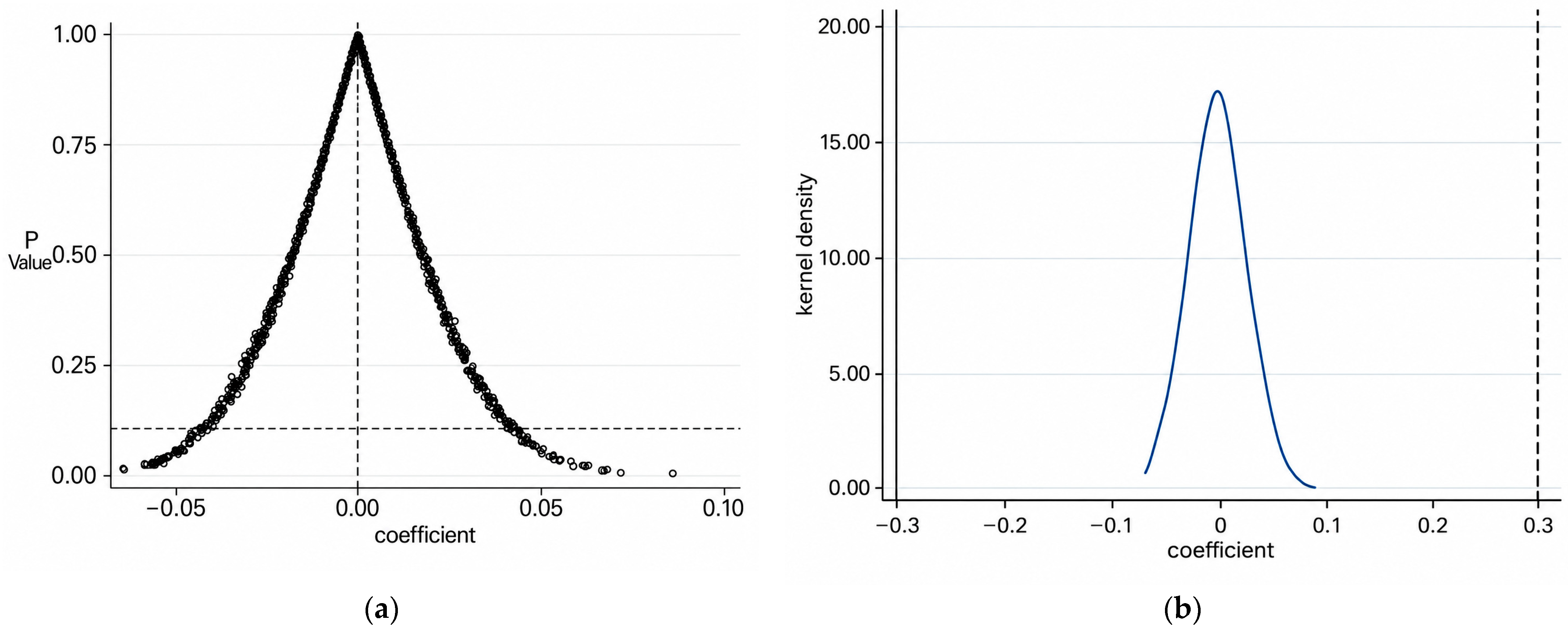
To assess the reliability of the baseline results and rule out potential omitted variables or spurious correlations, we conduct counterfactual tests. First, we randomly select 27 non-Long March prefecture-level cities as pseudo-Long March cities and construct the corresponding placebo treatment variable. We then re-estimate the baseline model and examine the significance of the placebo coefficient. Second, we keep the true spatial distribution of Long March cities unchanged but randomly assign household heads to birth cohorts, reconstruct the treatment variable, and re-estimate the model. The results are shown in Figure 2. The p-values from the placebo estimates are generally greater than 0.1, and the true coefficient (−0.297) lies far outside the simulated distribution. These results help rule out interference from unobservable factors or the data-generating process and further support the causal relationship between Chinese traditional culture and household energy consumption.
Figure 2.
(a) Counterfactual test: p-values; (b) counterfactual test: coefficients.
5.2.2. Additional Robustness Tests
This subsection conducts additional robustness tests to strengthen the credibility of the baseline regression. Because Chinese traditional culture was formed long before modern household energy-consumption issues and operates through non-market channels such as intergenerational transmission, reverse causality is unlikely. Moreover, the study uses the historical Long March event as a natural experimental setting; households did not actively choose entry into the treatment group, which mitigates selection bias. On this basis, we further test potential biases related to measurement error, outliers, and omitted variables.
First, Column (1) of Table 5 removes Beijing from the list of Long March cities. The results remain consistent in sign and statistically significant at the 1% level; Cohort3 denotes the interaction between the city list excluding Beijing and the birth-cohort variable. Second, Column (2) uses prefecture-level revolutionary base areas as an alternative proxy for Chinese traditional culture. Revolutionary base areas were consolidated after the Long March, overlap strongly with the Long March route, are identified on the basis of pre-1949 historical documents, and have no direct connection with sample-period economic behavior. Their county-level coverage also allows more precise measurement. Third, because the dependent variable Pre_Co2 may contain extreme observations arising from differences in industrialization, Column (3) trims the top and bottom 5% of Pre_Co2 observations. Finally, the National Development and Reform Commission approved 87 low-carbon pilot cities in 2010 and 2012, which may systematically affect household energy consumption through related channels and confound the estimates. Column (4) adds a control for low-carbon pilot cities to absorb this contemporaneous policy influence.
Table 5.
Robustness tests.
6. Further Analysis
The theoretical analysis suggests that Chinese traditional culture affects household energy consumption by shaping human behavior. The baseline results confirm that traditional cultural values significantly suppress household energy-consumption intensity. To further investigate the underlying mechanisms and heterogeneous effects across different subjects, this section conducts mediation and moderation analyses.
6.1. Mediation Analysis
This study systematically tests the mediating mechanisms through which Chinese traditional culture affects household energy consumption, as shown in Table 6. First, along the green-cognition pathway, the coefficient on Chinese traditional culture is 0.055 and significant at the 1% level. This suggests that the national-priority collectivist orientation strengthens residents’ environmental responsibility and carbon-footprint awareness, encourages households to purchase energy-saving appliances, and reduces high-carbon consumption expenditure, forming a mechanism of value internalization, cognitive reconstruction, and green choice. Second, along the low-carbon transport pathway, the coefficient is 0.030 and significant at the 1% level. The willingness-to-sacrifice component motivates residents to overcome private cost constraints and prefer public transit and new-energy vehicles, thereby lowering direct transport energy consumption and generating a behavioral-substitution mechanism in which short-term convenience is sacrificed for long-term ecological benefits. Third, in the consumption-structure pathway, the coefficient is −0.025 and significant at the 5% level. The practical principle of seeking truth from facts restrains enjoyment-oriented consumption (Yu et al., 2022), optimizes consumption structure, and forms a structural-upgrading mechanism of rational evaluation, reduced extravagance, and low-carbon upgrading. Fourth, along the plastic-reduction pathway, the coefficient is 0.029 and significant at the 10% level. The overall-interest orientation reshapes cognition of public environmental responsibility, reduces the use of disposable plastics, and pushes supply-chain emission reductions, reflecting a linkage mechanism of collective-interest orientation, daily plastic reduction, and coordinated supply–demand decarbonization. Finally, along the saving-propensity pathway, the coefficient is 0.007 and significant at the 10% level. The value of hard struggle strengthens long-term resource allocation through intergenerational transmission and reduces household energy consumption by increasing saving rates, revealing an intertemporal-allocation mechanism of frugality ethics, delayed gratification, and consumption compression. Overall, Chinese traditional culture reduces household energy consumption through five channels: green cognition, low-carbon transport, optimized consumption structure, plastic-reduction behavior, and stronger saving propensity.
Table 6.
Mediation tests.
Chinese traditional cultures embody values such as national priority, willingness to sacrifice, practical orientation, consideration of the overall interest, and hard struggle. These values may influence household energy-consumption decisions through value internalization, behavioral-norm formation, and cognitive reconstruction. This section develops a theoretical framework linking Chinese traditional culture, mediating mechanisms, and household energy consumption and discusses five pathways through which culture may affect household energy behavior.
6.2. Moderation Analysis
To analyze heterogeneous effects across regional and household characteristics, this study examines moderating variables in the relationship between Chinese traditional culture and household energy consumption. These moderators include formal institutions, such as Central Environmental Inspection, government environmental-protection expenditure, and environmental publicity intensity, and household characteristics, such as fiscal deficit status, income level, and education level. The purpose is to reveal the boundary conditions and micro-level response mechanisms of low-carbon transformation. The moderation model is specified as follows, where γ_ic denotes a moderating variable, including Central Environmental Inspection (Vise), government environmental expenditure (Invest), and environmental publicity intensity (Epcio).
Pre_Co2i = α + βCohorti,c × γi,c + φControli,c + μc + εi,
6.2.1. Moderating Effects of Formal Institutions
To further examine how Chinese traditional culture as an informal institution affects household energy consumption under different formal institutional settings, we follow prior studies and classify formal institutions into command-and-control, incentive-based, and voluntary instruments (X. Li et al., 2020). Command-and-control instruments are measured by whether Central Environmental Inspection entered the region. Incentive-based instruments are measured by government environmental-protection expenditure. Voluntary instruments are measured by regional environmental publicity intensity. Table 7 reports the moderating effects of these three types of formal institutions.
Table 7.
Moderating effects of formal institutions.
The moderation tests in Table 7 show that all three formal institutions significantly strengthen the negative effect of Chinese traditional culture on household energy consumption. In Column (1), the interaction coefficient for Central Environmental Inspection is −0.271 and significant at the 1% level. Command-and-control regulation resonates with traditional Chinese discipline and collectivism through mandatory supervision, encouraging the public to shift from passive compliance to active adherence. In Column (2), the coefficient for government environmental expenditure is −0.026 and significant at the 1% level. Incentive-based instruments, such as fiscal subsidies, complement the optimism and dedication embedded in Chinese traditional culture and enhance residents’ sense of responsibility for active emission reduction. In Column (3), the coefficient for environmental publicity intensity is −0.425 and significant at the 1% level. Voluntary instruments break through the value-behavior gap through education and communication, transforming collectivist spirit into concrete emission reduction action (Jing & Rasiah, 2025). Therefore, command-and-control, incentive-based, and voluntary formal institutions generate synergistic effects with informal institutions through supply-side constraints, demand-side economic incentives, and cognitive flexibility, respectively.
6.2.2. Moderating Effects of Household Characteristics
Gendered cultural schemas of devotion to work and devotion to family not only shape financial literacy and retirement planning but also illustrate the broader mechanism by which cultural models influence household-level economic behaviors (Green & Herbst-Debby, 2026), including energy consumption and carbon emissions. To examine how the effect of Chinese traditional culture on household energy consumption varies across households, this study selects household fiscal status, income level, and education level as core dimensions. Financial constraints constitute the primary barrier to household energy transition, with high upfront investment costs and long payback periods significantly impeding the adoption of renewable energy technologies (Szymańska et al., 2023). Households’ level of economic awareness—encompassing knowledge of electricity tariffs, bill components, and actual consumption—exhibits a significant positive correlation with the frequency of their energy-saving behaviors (Gajdzik et al., 2024). Systemic lifestyle changes—such as forgoing private car use, shifting dietary patterns, and installing photovoltaics—yield substantially greater emission reduction benefits than the cumulative effect of daily “minor habits” (Widera, 2024). The theoretical logic is rooted in a subject-response-capacity framework for low-carbon transition. Table 8 reports the moderating effects of household characteristics on household energy consumption.
Table 8.
Moderating effects of household characteristics.
The moderation tests in Table 8 indicate that household fiscal status, income, and education play differentiated roles in the relationship between Chinese traditional culture and household energy consumption. In Column (1), the coefficient for fiscal-deficit households is 0.235 and significant at the 1% level, suggesting that liquidity constraints induced by deficits create survival-first decision biases and crowd out environmental investment, thereby weakening the emission reduction effect of Chinese traditional culture (Banerjee & Duflo, 2007). In Column (2), the coefficient for household income is −0.080 and significant at the 10% level. Income is a key factor affecting household energy consumption: high-income households generally have higher energy consumption, but they also have greater capacity to adopt green technologies (Y. Ding et al., 2016). In Column (3), the coefficient for education is −0.288 and significant at the 1% level. Highly educated households have stronger environmental awareness and knowledge, resonate more readily with Chinese cultural values, and are more likely to practice low-carbon lifestyles and generate social demonstration effects, thereby strengthening the reduction in household energy consumption (X. Xu et al., 2020). In summary, fiscal deficit weakens, whereas high income and higher education strengthen, the inhibitory effect of Chinese traditional culture on household energy consumption. Culture constitutes a measurable and economically significant force, yet its economic impact is often unevenly distributed across sectors and actors, with broader implications for understanding how cultural factors interact with economic outcomes, including environmental and consumption-related behaviors (Barandiaran-Irastorza et al., 2020).
6.2.3. Moderating Effects of City Characteristics
Differences in economic development, climate conditions, and electricity production structures across regions may affect the estimation results of the Long March Spirit on the transition to a green lifestyle. We conduct heterogeneity analysis based on city location and city type. The results are presented in Table 9. First, for the eastern and central regions, the coefficient is −0.1239, while for the western region, it is −0.2329, both significant at the 1% level, indicating that the Long March Spirit has a stronger inhibitory effect on household carbon emissions in the western region. Second, we divide the sample into three groups by city carbon emission levels. The coefficients are −0.4184 for high-carbon cities, −0.0685 for medium-carbon cities, and −0.1013 for low-carbon cities, all significant at the 1% level, indicating that the effect is strongest in high-carbon cities. Third, for high-carbon electricity cities, the coefficient is −0.4551, compared to −0.1458 for other cities, both significant at the 1% level, indicating that the effect is stronger in high-carbon electricity cities.
Table 9.
Moderating effects of city characteristics.
7. Conclusions and Policy Implications
Using data from the China Household Finance Survey, this study constructs a difference-in-differences model and a mechanism-testing framework to systematically examine the effect of Chinese traditional culture on household energy consumption and its channels. The empirical results show that the values of national priority, willingness to sacrifice, practical orientation, consideration of the overall interest, and hard struggle reduce per capita household carbon emissions through five core mechanisms: enhancing green cognition, promoting low-carbon transport, optimizing consumption structure, strengthening plastic-reduction behavior, and increasing the propensity to save. The mediation results confirm that cultural values can systematically reduce high-carbon consumption by reshaping the logic of individual decision-making, extending beyond a conventional governance model that relies only on policy regulation.
The moderation results indicate that this effect is strengthened by command-and-control, incentive-based, and voluntary formal institutions and is also stronger among high-income and highly educated households. The study demonstrates that informal institutions represented by red culture can form a frugality ethic through intergenerational transmission, reconstruct consumption preferences and cognitive structures, and transform low-carbon choices from external constraints into internalized value consciousness. This finding moves beyond the single reliance on formal institutions and technological pathways in environmental economics and provides micro-level evidence for the informal institutional mechanism of ideological internalization, behavioral-motivation reshaping, and emission reduction realization.
The findings suggest several implications. First, environmental governance theories should incorporate informal institutions, advancing the analytical framework toward institutional–cultural synergy. Second, attention should be paid to the endogenous logic of cultural emission reduction, examining its triggering conditions and transmission differences across groups to uncover the sources of heterogeneity. Third, the intergenerational transmission and long-term evolution of cultural effects merit sustained investigation through cross-temporal comparisons or tracking designs, providing forward-looking evidence on the sustainability of culture-driven emission reduction. This study is situated in the Chinese context, and its core finding—that cultural values influence household energy consumption through value internalization—is rooted in China’s unique cultural traditions and institutional environment. We acknowledge that the transmission intensity and boundary conditions of this effect may vary across countries with different institutional traditions. Accordingly, we have explicitly delimited the research context in the abstract, introduction, and conclusion, defining the scope of our conclusions as primarily applicable to China and societies with similar cultural traditions so as to avoid overgeneralization. At the same time, we consider that the theoretical mechanism—the logic whereby cultural values reshape individual behavioral preferences through cognitive transformation—is not necessarily confined to a particular social system; it may manifest in different forms in more liberal societies as well.
Author Contributions
Conceptualization, H.X.; methodology, R.L.; software, R.L.; validation, X.T., and Z.Q.; formal analysis, H.X., and R.L.; investigation, R.L.; re-sources, H.X.; data curation, R.L.; writing—original draft preparation, H.X., and R.L.; writing—review and editing, X.T., and Z.Q.; visualization, R.L.; supervision, X.T., and Z.Q.; project administration, H.X.; funding acquisition, H.X. All authors have read and agreed to the published version of the manuscript.
Funding
This work was supported by the [2025 Jiangxi Provincial Humanities and Social Sciences Research Project for Universities (Red Culture Education Research) (Project Title: Research on the Empowerment of High-Quality Development in Old Revolutionary Base Areas by Red Culture) #1] under Grant [number HSWH25003]; [National Natural Science Foundation of China #2] under Grant [number 72364014]; and [Jiangxi Provincial Social Science Fund #3] under Grant [number 2025XYJG107].
Institutional Review Board Statement
Not applicable.
Informed Consent Statement
Not applicable.
Data Availability Statement
The raw data supporting the conclusions of this article will be made available by the authors on request.
Acknowledgments
The authors thank the China Household Finance Survey (CHFS) team at Southwestern University of Finance and Economics for their data collection efforts and for providing access to the survey data.
Conflicts of Interest
The authors declare no conflicts of interest.
References
- Andersson, D., Nässén, J., Larsson, J., & Holmberg, J. (2014). Greenhouse gas emissions and subjective well-being: An analysis of Swedish households. Ecological Economics, 102, 75–82. [Google Scholar] [CrossRef] [Scilit]
- Andreas, J. (2002). Battling over political and cultural power during the Chinese cultural revolution. Theory and Society, 31(4), 463–519. [Google Scholar] [CrossRef] [Scilit]
- Banerjee, A. V., & Duflo, E. (2007). The economic lives of the poor. Journal of Economic Perspectives, 21(1), 141–167. [Google Scholar] [CrossRef] [Scilit] [PubMed]
- Barandiaran-Irastorza, X., Peña-Fernández, S., & Unceta-Satrústegui, A. (2020). The archipelago of cultural and creative industries: A case study of the Basque country. Economies, 8(1), 21. [Google Scholar] [CrossRef] [Scilit]
- Barni, D., Rosnati, R., & Ranieri, S. (2013). Value transmission between parents and their adolescent children: The process and its outcomes. A psycho-social perspective. In Intergenerational relations (pp. 101–118). Policy Press. [Google Scholar]
- Bolderdijk, J. W., Gorsira, M., Keizer, K., & Steg, L. (2013). Values determine the (in) effectiveness of informational interventions in promoting pro-environmental behavior. PLoS ONE, 8(12), e83911. [Google Scholar] [CrossRef] [Scilit] [PubMed]
- Büchs, M., & Schnepf, S. V. (2013). Who emits most? Associations between socio-economic factors and UK households’ home energy, transport, indirect and total CO2 emissions. Ecological Economics, 90, 114–123. [Google Scholar] [CrossRef] [Scilit]
- Central Committee of the Communist Party of China & State Council. (2015). Opinions of the central committee of the communist party of China and the state council on accelerating the construction of ecological civilization. Available online: http://www.gov.cn/gongbao/content/2015/content_2864050.htm (accessed on 8 September 2026).
- Chen, T., Kung, J. K. S., & Ma, C. (2020). Long live Keju! The persistent effects of China’s civil examination system. The Economic Journal, 130(631), 2030–2064. [Google Scholar] [CrossRef] [Scilit]
- Chen, Y., Fan, Z., Gu, X., & Zhou, L. A. (2020). Arrival of young talent: The send-down movement and rural education in China. American Economic Review, 110(11), 3393–3430. [Google Scholar] [CrossRef] [Scilit]
- Cho, Y. N., Thyroff, A., Rapert, M. I., Park, S. Y., & Lee, H. J. (2013). To be or not to be green: Exploring individualism and collectivism as antecedents of environmental behavior. Journal of Business Research, 66(8), 1052–1059. [Google Scholar] [CrossRef] [Scilit]
- Deng, H., & Yang, L. (2019). Haze governance and local green transformation. China Industrial Economics, 36(10), 118–136. (In Chinese) [Google Scholar] [CrossRef]
- Ding, F., & Lu, J. (2020). Estimation and spatial correlation of carbon emissions from urban residential energy consumption: Evidence from 287 prefecture-level cities. Inquiry into Economic Issues, 42(2), 93–102. Available online: https://kns.cnki.net/kcms2/article/abstract?v=AnfjKog0mmzVB4x9NHpDiUWKmIzDc7nnyf-sGHhvLbUsw_TC5SSgfb1bBlMGoajrnrW0_YiHiFoCjq3wni7QCSfzSfrykCX7SkakBgz_v6qO2LyNeDxy-ilRzAkljMinHT3CX0ij01--pZ7kA9g0UQOf8Wh-emMocP_ObQA0A4TMY4Cnyl8TMQ==&uniplatform=NZKPT&language=CHS (accessed on 8 September 2026). (In Chinese)
- Ding, Y., Qu, W., Niu, S., Liang, M., Qiang, W., & Hong, Z. (2016). Factors influencing the spatial difference in household energy consumption in China. Sustainability, 8(12), 1285. [Google Scholar] [CrossRef] [Scilit]
- Fan, J., Zhou, L., Zhang, Y., Shao, S., & Ma, M. (2021). How does population aging affect household carbon emissions? Evidence from Chinese urban and rural areas. Energy Economics, 100, 105356. [Google Scholar] [CrossRef] [Scilit]
- Fazal, S. A., Hayat, N., & Al Mamun, A. (2023). Renewable energy and sustainable development—Investigating intention and consumption among low-income households in an emerging economy. Sustainability, 15(21), 15387. [Google Scholar] [CrossRef] [Scilit]
- Gajdzik, B., Jaciow, M., Hoffmann-Burdzińska, K., Wolny, R., Wolniak, R., & Grebski, W. W. (2024). Impact of economic awareness on sustainable energy consumption: Results of research in a segment of Polish households. Energies, 17(11), 2483. [Google Scholar] [CrossRef] [Scilit]
- Geertz, C., & Darnton, R. (1973). The interpretation of cultures (Vol. 5019). Basic Books. [Google Scholar]
- Green, L.-N., & Herbst-Debby, A. (2026). Financial literacy and the retirement gender gap: The role of cultural schemas. Economies, 14(3), 75. [Google Scholar] [CrossRef] [Scilit]
- Gu, Z. (2015). Confucian ethics and agency costs in the context of globalization. Management World, 31(3), 113–123. (In Chinese) [Google Scholar] [CrossRef]
- Jing, H., & Rasiah, R. (2025). Evaluation of the moderating effect of cultural values on low-carbon consumption intentions among residents of Shanxi province. Cleaner and Responsible Consumption, 18, 100296. [Google Scholar] [CrossRef] [Scilit]
- Kates, R. W., Clark, W. C., Corell, R., Hall, J. M., Jaeger, C. C., Lowe, I., McCarthy, J. J., Schellnhuber, H. J., Bolin, B., Dickson, N. M., Faucheux, S., Gallopin, G. C., Grübler, A., Huntley, B., Jäger, J., Jodha, N. S., Kasperson, R. E., Mabogunje, A., Matson, P., … Svedin, U. (2001). Sustainability science. Science, 292(5517), 641–642. [Google Scholar] [CrossRef] [Scilit] [PubMed]
- Kerkhof, A. C., Nonhebel, S., & Moll, H. C. (2009). Relating the environmental impact of consumption to household expenditures: An output analysis. Ecological Economics, 68(4), 1160–1170. [Google Scholar] [CrossRef] [Scilit]
- Li, C. (2008). Traditional virtues and fine traditions in contemporary society: Frugality consciousness and hard struggle. Social Scientist, (1), 122–123+129. Available online: https://kns.cnki.net/kcms2/article/abstract?v=AnfjKog0mmxaL9Wlg8DgYRoratWfkk0ZNPZt1bht3_TkorIQ4h-l-_WicUuLCvPcoe4jWpxbYVjFC-iNnxU_y0kIUeVH9wbKCkbqdnUVzQDLQO4TWH3wI09GUo0ON57hL2xIkrXR_rmt-EEvNMAcf082gPNmAxrjxzaLL3CoGSOif0MpbHmexw==&uniplatform=NZKPT&language=CHS (accessed on 8 September 2026). (In Chinese)
- Li, M., Li, C., & Li, Q. (2025). From tradition to transition: The effect of clan culture on energy poverty. Energy Policy, 206, 114777. [Google Scholar] [CrossRef] [Scilit]
- Li, X., Yu, D., & Yu, J. (2020). Spatial spillover effects of heterogeneous environmental regulation on carbon productivity: Evidence from a spatial Durbin model. China Soft Science, 35(4), 82–96. Available online: https://kns.cnki.net/kcms2/article/abstract?v=AnfjKog0mmzYhBfbooAnsxTeJlSOF51k2DmObSFmzkCv5l0TGJxAhaPArxqq7LwJFV0qweW1nr3jWfxA1AImhvQEyDIhCTq1R9CDRpPLK7LsyWmxEaAZVJVi-5ksFy1S7RonokUi-KigvtCLbNPvlHyz0tYYOWiTlzLCbkZSDlLSgCXai9sIsg==&uniplatform=NZKPT&language=CHS (accessed on 8 September 2026). (In Chinese)
- Lyon, S. W. (2023). A cross-disciplinary approach needs to be at the core of sustainability. Sustainability, 15(22), 15954. [Google Scholar] [CrossRef] [Scilit]
- National Energy Administration. (2024). China’s energy transition achieves new leaps and breakthroughs. Available online: http://www.nea.gov.cn/2024-09/06/c_1310785868.htm (accessed on 8 September 2026).
- National Geomatics Center of China. (2024). National fundamental geographic information database. Available online: https://www.ngcc.cn/dlxxzy/gjjcdlxxsjk/ (accessed on 8 September 2026).
- Niu, Q., Yang, J., & Liu, C. (2023). Coordinating reform, technology, and culture to accelerate green urbanization. Forum on Science and Technology in China, 4(7), 10–12. (In Chinese) [Google Scholar] [CrossRef]
- North, D. C. (2018). Institutions, institutional change and economic performance. Cambridge University Press. [Google Scholar]
- Pan, X., Chen, W., Zhou, S., Wang, L., Dai, J., Zhang, Q., Zheng, X., & Wang, H. (2020). Implications of near-term mitigation on China’s long-term energy transitions for aligning with the Paris goals. Energy Economics, 90, 104865. [Google Scholar] [CrossRef] [Scilit] [PubMed]
- Ren, Y., Shi, L., Bardow, A., Geyer, R., & Suh, S. (2020). Life-cycle environmental implications of China’s ban on post-consumer plastics import. Resources, Conservation and Recycling, 156, 104699. [Google Scholar] [CrossRef] [Scilit]
- Rong, Y., Jia, J., Ju, M., Chen, C., Zhou, Y., & Zhong, Y. (2021). Multi-perspective analysis of household carbon dioxide emissions from direct energy consumption by the methods of logarithmic mean divisia index and σ convergence in central China. Sustainability, 13(16), 9285. [Google Scholar] [CrossRef] [Scilit]
- Rosen, M. A. (2009). Energy sustainability: A pragmatic approach and illustrations. Sustainability, 1(1), 55–80. [Google Scholar] [CrossRef] [Scilit]
- Shi, A. (2003). The impact of population pressure on global carbon dioxide emissions, 1975–1996: Evidence from pooled cross-country data. Ecological Economics, 44(1), 29–42. [Google Scholar] [CrossRef] [Scilit]
- Steg, L., & Vlek, C. (2009). Encouraging pro-environmental behaviour: An integrative review and research agenda. Journal of Environmental Psychology, 29(3), 309–317. [Google Scholar] [CrossRef] [Scilit]
- Stephenson, J., Barton, B., Carrington, G., Doering, A., Ford, R., Hopkins, D., Lawson, R., McCarthy, A., Rees, D., Scott, M., Thorsnes, P., Walton, S., Williams, J., & Wooliscroft, B. (2015). The energy cultures framework: Exploring the role of norms, practices and material culture in shaping energy behaviour in New Zealand. Energy Research & Social Science, 7, 117–123. [Google Scholar] [CrossRef] [Scilit]
- Streimikiene, D., & Volochovic, A. (2011). The impact of household behavioral changes on GHG emission reduction in Lithuania. Renewable and Sustainable Energy Reviews, 15(8), 4118–4124. [Google Scholar] [CrossRef] [Scilit]
- Sun, Z., & Song, F. (2022). Can changes in urban transportation modes reduce carbon emissions? Evidence from a difference-in-differences model. Journal of Arid Land Resources and Environment, 36(8), 1–8. (In Chinese) [Google Scholar] [CrossRef]
- Szymańska, E. J., Kubacka, M., & Polaszczyk, J. (2023). Households’ energy transformation in the face of the energy crisis. Energies, 16(1), 466. [Google Scholar] [CrossRef] [Scilit]
- Tan, X., Xie, H., Yang, C., & Li, J. (2025). Does culture matter for household carbon emissions? Evidence from “confucian” households in China. Applied Economics, 57(26), 3489–3502. [Google Scholar] [CrossRef] [Scilit]
- Wan, P. (2020). The function of social governance of the grass-root party system: A perspective of corporate social responsibility. Economic Review, (3), 3–20. [Google Scholar] [CrossRef]
- Wang, B., Lu, D., Xing, J., Leiserowitz, A., Carman, J., Chen, R., & Ding, M. (2024). Chinese public awareness, support, and confidence in China’s carbon neutrality goal. Environment: Science and Policy for Sustainable Development, 66(6), 25–36. [Google Scholar] [CrossRef] [Scilit]
- Wang, Q. (2015). The impact of household size on energy consumption and carbon emissions in China. Resources Science, 37(2), 299–307. Available online: https://kns.cnki.net/kcms2/article/abstract?v=AnfjKog0mmwuYpAaqtjXRWNCtFE9slZAOeZcaci7VlL8sY2AoKecRGBS9nwyaN_udNe5f9UwliUXDBQAdR5vYQIdK3NsQrZtvVIdvMzaVcswqS2_-i19LbzsrgZUxwufg4FVxftqzzCYocZKVyW408WUePuxNAZaTrb4pbvlT2I=&uniplatform=NZKPT&language=CHS (accessed on 8 September 2026). (In Chinese)
- Wang, X., Zhou, Y., & Shi, X. (2024). Informal institutions and corporate innovation: A Perspective from red culture. Heliyon, 10(11), e32049. [Google Scholar] [CrossRef] [Scilit] [PubMed]
- Widera, B. (2024). Energy and carbon savings in European households resulting from behavioral changes. Energies, 17(16), 3888. [Google Scholar] [CrossRef] [Scilit]
- Wu, W., & Hong, Z. (2024). The contemporary value of revolutionary culture: Evidence from the long march spirit and corporate misconduct. The Journal of World Economy, 47(3), 3–29. (In Chinese) [Google Scholar] [CrossRef]
- Wu, W., Zhu, H., Qu, Y., & Xu, K. (2017). Regional disparities in emissions of rural household energy consumption: A case study of northwest China. Sustainability, 9(5), 726. [Google Scholar] [CrossRef] [Scilit]
- Wu, Y., Zhang, Z., & Zhang, W. (2023). Regional cultural memory and cost stickiness: Evidence from long march culture. Accounting Research, 11, 50–63. Available online: https://kns.cnki.net/kcms2/article/abstract?v=AnfjKog0mmx7_ewW1PC13vqz1oQKtRri3QmcVxNMhHoLKucvsymHabumqLuyUgXk8vnllJNf9Gl_Qv2fYT2AnPRNyONj_V-ij28OtoMvcvKGpx5T9wUqZbrapQMQgWy-M9_B52FHUc2Q34x_7jCXIBu4tLZSmXJcnffjJc_U00Y=&uniplatform=NZKPT&language=CHS (accessed on 8 September 2026). (In Chinese)
- Xi, J. (2016, October 22). Speech at the 80th annual general meeting for commemorating the victory of the long march. People’s Daily. (In Chinese)
- Xu, G., Liu, Z., & Jiang, Z. (2006). Factor decomposition model and empirical analysis of China’s carbon emissions, 1995–2004. China Population, Resources and Environment, 30(6), 158–161. Available online: https://kns.cnki.net/kcms2/article/abstract?v=AnfjKog0mmzjDHhiGode5pC0yofdp0WsryDLIayF-dQ998y8AkjXMYv37WQVaJJcJnf9Ij5ZerTGknD4uRE0O-2Zhb93GG4XdebwCkr90XuGsym3hbsOG2HKCulH1K40rqtbJETDjL_k53KCc1lZwSeGfB_pwekgqW0lWsBOblh_MYc2_zGgGQ==&uniplatform=NZKPT&language=CHS (accessed on 8 September 2026). (In Chinese)
- Xu, X., Li, W., & Chen, X. (2020). Confucian culture and stock price crash risk. Accounting Research, (04), 143–150. Available online: https://kns.cnki.net/kcms2/article/abstract?v=AnfjKog0mmy4TPx7BHw9VN1rQe9D3-GS79zkAhaPx3Uwo4-mkvdT55olFzxx5fMajem-nKCyZEb58mwgaL6Bnh30d8NsgpQTpYlquCKHexZODkyKwn-PwTmQAipXzVCmEUx253Rj2MjN7wAFmC8C2TV1lop_U0W7AlZG0H5157vvLbHVA4D42A==&uniplatform=NZKPT&language=CHS (accessed on 8 September 2026). (In Chinese)
- Yan, R., Zhang, J., & Zhou, R. (2024). Red culture and corporate green innovation: Evidence based on geographic-location data of national martyr memorial facilities. R&D Management, 36(2), 37–49. (In Chinese) [Google Scholar] [CrossRef]
- Yang, A., & Wang, Y. (2023). Transition of household cooking energy in China since the 1980s. Energy, 270, 126925. [Google Scholar] [CrossRef] [Scilit]
- Yang, T., Shu, Y., Zhang, S., Wang, H., Zhu, J., & Wang, F. (2023). Impacts of end-use electrification on air quality and CO2 emissions in China’s northern cities in 2030. Energy, 278, 127899. [Google Scholar] [CrossRef] [Scilit]
- Yu, C., Jia, N., Li, W., & Wu, R. (2022). Digital inclusive finance and rural consumption structure–Evidence from Peking university digital inclusive financial index and China household finance survey. China Agricultural Economic Review, 14(1), 165–183. [Google Scholar] [CrossRef] [Scilit]
- Zhang, C., Liu, L., & Xiao, Q. (2022). The influence of Taoism on employee low-carbon behavior in China: The mediating role of perceived value and guanxi. Psychology Research and Behavior Management, 15, 2169–2181. [Google Scholar] [CrossRef] [Scilit] [PubMed]
- Zhang, J., & Wei, Z. (2023). Can the digital economy drive the low-carbon transformation of household consumption? Empirical evidence based on CFPS. Modern Finance and Economics, 43(9), 3–19. (In Chinese) [Google Scholar] [CrossRef]
- Zhang, Q., Tao, X., & Yang, P. (2013). Residents’ travel-mode choice and low-carbon passenger transport. China Population, Resources and Environment, 23(06), 21–28. Available online: https://kns.cnki.net/kcms2/article/abstract?v=AnfjKog0mmyj3bv_TQ0JEUPV5hIVvLtV1ttZvkDN-w1fFDigng5IKqLURuPyWZsdIRB_2w9kpgCc6cnigY-I1FJ_MuUx5x_1CLOyErYsXl2LaVGcuXw_fB9tiwEo3JEpKxUFH7dH4ycNQyP5i01ZTZTgxtXrEBIsuLTUF0xKFapbifbWR0yLcg==&uniplatform=NZKPT&language=CHS (accessed on 8 September 2026). (In Chinese)
- Zhang, Y., Wang, F., & Zhang, B. (2023). The impacts of household structure transitions on household carbon emissions in China. Ecological Economics, 206, 107734. [Google Scholar] [CrossRef] [Scilit]
- Zhou, F., & Wang, X. (2022). The carbon emissions trading scheme and green technology innovation in China: A new structural economics perspective. Economic Analysis and Policy, 74, 365–381. [Google Scholar] [CrossRef] [Scilit]
- Zhou, X., & Hou, L. (1999). Children of the cultural revolution: The state and the life course in the People’s Republic of China. American Sociological Review, 64(1), 12–36. [Google Scholar] [CrossRef] [Scilit]
- Zhu, W., & Zhang, Y. (2024). Household energy clean transition mechanisms under market failures: A government financing perspective. Sustainability, 16(13), 5771. [Google Scholar] [CrossRef] [Scilit]

Disclaimer/Publisher’s Note: The statements, opinions and data contained in all publications are solely those of the individual author(s) and contributor(s) and not of MDPI and/or the editor(s). MDPI and/or the editor(s) disclaim responsibility for any injury to people or property resulting from any ideas, methods, instructions or products referred to in the content. |
© 2026 by the authors. Licensee MDPI, Basel, Switzerland. This article is an open access article distributed under the terms and conditions of the Creative Commons Attribution (CC BY) license.