


Abstract
Oil-exporting economies are notoriously sensitive to external shocks, but the importance of current oil revenue absorption for macroeconomic shock transmission has not been explored thoroughly. This paper constructs a stylized DSGE model to analyze how macroeconomic shock propagation differs under alternative degrees of current oil revenue absorption. The model combines calibration to resemble Kazakhstan with Bayesian estimation. Six absorption rates are chosen that form three pairwise comparisons: 10% vs. 90%, 20% vs. 80%, and 40% vs. 60%. The model is analyzed under external oil demand, oil price, foreign output, total factor productivity, labor preference, and monetary policy shocks. Simulation impulse responses indicate that increased current absorption dramatically magnifies shocks that impact oil export income directly. External oil demand and oil price shocks exhibit strong responsiveness to changes in the absorption rate, while impulse responses to productivity, labor preference, monetary policy, and foreign output shocks display relatively little sensitivity to the absorption regime. For example, under the 10–90% comparison, the first period output response to an external oil demand shock increases from 3.195 to 19.481, while associated responses to a productivity shock cluster closely together with uncertainty bands that overlap extensively. Intermediate absorption comparisons maintain the same shock-specific conclusion while differences between regimes diminish as absorption rates get closer. This evidence suggests that the macroeconomic vulnerability of oil-exporting economies is a function not only of whether a shock is external, but also if it affects oil export income and has the capacity to interact with the oil revenue smoothing mechanism. These results lend support to intertemporal smoothing as a possible method to alleviate oil-income shock exposure in the short-run, but do not suggest an optimal level of current absorption.
1. Introduction
Oil-exporting countries are vulnerable to external shocks since government spending, exports and domestic activity are largely determined by developments in international commodity markets. Fluctuations in oil prices induce volatile changes in fiscal revenues, aggregate demand, exchange rates and inflation. Absorbing these shocks and maintaining macroeconomic stability thus constitutes an ongoing policy concern in resource-dependent economies. While commodity booms create the fiscal space for accelerating development, they also raise macroeconomic risks by exposing the economy to large external fluctuations. If fiscal policy amplifies external shocks to domestic activity, macroeconomic vulnerability rises.
A key aspect of fiscal policy that determines macroeconomic vulnerability is how oil revenues are allocated between current spending needs and intertemporal fiscal saving. By smoothing resource-related fluctuations in government spending over time, sovereign wealth funds and fiscal stabilization mechanisms can insulate resource-dependent economies from adverse external developments. In practice, however, the share of oil revenues being used to finance current domestic expenditures differs substantially across countries and over time. If oil windfalls are spent instead of saved, this could help stabilize the economy by providing a cushion to aggregate demand. Alternatively, current spending may amplify macroeconomic fluctuations if it crowds out more stable private sector demand.
Kazakhstan represents a particularly interesting case in this regard. As oil exports account for a large share of exports, government revenues and foreign exchange receipts, global oil price swings have an important impact on macroeconomic stability in Kazakhstan. Fiscal policy has attempted to balance the competing demands of current expenditures and intergenerational savings since the National Fund of the Republic of Kazakhstan was set up in 2000. Nevertheless, the volume of assets transferred from the National Fund Kazakh into the state budget has changed considerably across episodes of economic boom and bust, corresponding to periods of high and low current oil revenue absorption. Thus, Kazakhstan’s fiscal policy provides a suitable environment to study how different approaches to spending oil revenues influence macroeconomic stability.
Although there exists a large literature on oil price shocks, fiscal policy, sovereign wealth funds, and DSGE modelling, the link between current oil revenue absorption and macroeconomic shock absorption has received relatively little attention thus far. For instance, existing studies typically focus on oil price shocks, fiscal rules, or oil stabilization funds in isolation from each other. In contrast, much less is known about how alternative degrees of oil revenue absorption affect the transmission of both external and domestic shocks in a general equilibrium setting.
This paper aims to close this gap in the literature by analysing how current oil revenue absorption influences the transmission of structural shocks in a stylized small open oil-exporting economy. Using a DSGE model calibrated to Kazakhstan, we analyse how different oil revenue allocation regimes impact macroeconomic stability. More precisely, we consider two policy regimes that only differ with respect to the share of oil revenues that is absorbed by current domestic spending. The impulse responses of output, consumption, inflation, exchange rates, and external balances are compared under both regimes following seven different structural shocks: oil price shocks, external demand shocks, foreign output shocks, total factor productivity shocks, preference shocks, and monetary policy shocks.
This paper makes four contributions to the existing literature. First, we highlight current oil revenue absorption as the key nexus between fiscal policy and macroeconomic vulnerability, while most related studies focus either on fiscal rules or sovereign wealth funds instead.
Second, we analyse different oil revenue allocation regimes within the same DSGE framework. This allows us to comprehensively assess how fiscal allocation rules influence the transmission of different structural shocks.
Third, in contrast to most existing studies, we distinguish between oil price shocks (i.e., external shocks that are specific to oil-exporting economies) and all other domestic shocks. In doing so, we can better understand when fiscal policy matters for macroeconomic stabilization.
Last but not least, this paper provides novel results for Kazakhstan, where oil revenues and the National Fund constitute key pillars of fiscal policy but macroeconomic analyses along these lines are lacking.
The remainder of this paper is structured as follows. Section 2 discusses the related literature and develops the research hypotheses. Section 3 introduces the data, model, calibration strategy and simulation design. Section 4 presents and discusses the impulse response results under different oil revenue allocation regimes. Section 5 concludes the study.
2. Literature Review and Research Hypotheses
2.1. Oil Revenues, Fiscal Institutions and Macroeconomic Stabilization
The macroeconomic implications of natural resource abundance have attracted considerable attention in the literature over the last three decades. Early contributions typically focus on documenting evidence in support of the resource curse hypothesis and argue that economies endowed with natural resources tend to experience lower long-run growth, greater macroeconomic volatility, weaker institutions and less economic diversification compared to similar non-resource intensive economies. More recent studies point out that resource abundance per se is not the main driver of macroeconomic outcomes and show that bad economic performance hinges critically on fiscal institutions that govern the extraction and allocation of resource revenues.
Research has since shifted from analyzing countries’ natural resource endowments towards studying fiscal institutions. In particular, an emerging literature stresses the importance of sovereign wealth funds, fiscal rules, and stabilization schemes to mitigate macroeconomic volatility by smoothing the public spend over commodity-price cycles and containing procyclical fiscal policy (Collier et al., 2010; van der Ploeg & Venables, 2011; Kitano & Takaku, 2023; Hasse et al., 2024). Together, these studies make a convincing argument that macroeconomic fluctuations are closely linked with the degree to which public spending fluctuates over the business cycle, and that fiscal institutions such as sovereign wealth funds can partially stabilize macroeconomic dynamics by insulating government budgets from temporary fluctuations in resource revenues.
Existing studies predominantly evaluate fiscal rules or sovereign wealth funds as alternative institutional arrangements. In contrast, much less attention has been paid to how large a share of oil revenues is spent within the current period. As a result, the macroeconomic implications of alternative oil revenue allocation regimes are not well-understood.
2.2. Oil Revenue Absorption as a Macroeconomic Transmission Mechanism
While government expenditure, sovereign wealth fund withdrawals, fiscal transfers, and oil revenue absorption are closely linked concepts, they capture different mechanisms through which oil revenues affect an economy.
First, government expenditure describes actual public spending on goods, services, transfers, and public investment. Second, fiscal savings refer to the share of resource revenues that is saved for future periods, which is closely linked with sovereign wealth funds or other fiscal stabilization instruments. Third, oil revenue absorption denotes the share of oil revenues spent within the current period.
Oil revenue absorption matters because countries with identical levels of fiscal expenditure can differ widely in how much of contemporaneous oil revenues are used for domestic spending within the same period. Therefore, changes in oil revenue absorption capture changes in the strength of commodity revenues on short-run macroeconomic dynamics rather than changes in the overall level of fiscal expenditure.
To the best of our knowledge, this paper provides the first systematic analysis of oil revenue absorption in the context of DSGE modeling. Prior contributions mostly study sovereign wealth funds, fiscal rules, or government expenditure separately but do not consider oil revenue absorption explicitly as an independent macroeconomic transmission mechanism that links external commodity-price shocks to domestic macroeconomic fluctuations.
2.3. Oil Price Shocks and DSGE Models of Oil-Exporting Economies
Second, several studies analyze the macroeconomic consequences of oil price shocks using DSGE models. Kilian (2009) shows that oil-price shocks can originate from several different sources—including supply-driven disruptions, global demand, or oil-specific demand shocks—which all have different macroeconomic implications. Building on this result, a number of studies find that oil-exporting economies respond asymmetrically to the nature of the shock and existing domestic institutions (Cashin et al., 2014; Peersman & Van Robays, 2012; Bodenstein et al., 2011).
DSGE models have become increasingly popular in policy circles and the academic literature to study these transmission channels because they can naturally incorporate forward-looking behavior, nominal rigidities, and policy interactions. Early examples include Christiano et al. (2005), Smets and Wouters (2007), Galí and Monacelli (2005), and Adolfson et al. (2007), which build multipliers for studying monetary policy and fiscal policy in small open economies.
Building on these advances, several studies have developed extensions for resource-dependent economies. In particular, Kormilitsina (2011), Hou et al. (2016), Delpachitra et al. (2020), Omotosho (2022), and Omotosho and Yang (2024) introduce oil production, commodity-price shocks, and fiscal policy into their DSGE models. They show that oil-price shocks interact with fiscal policy to generate long-lasting macroeconomic fluctuations. Bergholt et al. (2019) arrive at similar conclusions by showing that business cycle fluctuations in oil-exporting economies are conditioned on prevailing oil-market conditions.
While these contributions advance our understanding of transmission mechanisms in oil-exporting economies, they typically assume a given fiscal regime. Empirically, this implies that they provide little evidence on how alternative degrees of oil revenue absorption alter the propagation of structural shocks.
2.4. Kazakhstan in the Existing Literature
Third, Kazakhstan represents a particularly interesting case because it features both high oil dependency alongside one of the world’s largest sovereign wealth funds among emerging economies. Past research shows that oil export led growth in Kazakhstan is associated with Dutch disease, exchange-rate appreciation, and higher macroeconomic volatility (Kutan & Wyzan, 2005; Égert & Leonard, 2008).
Recent advances in DSGE modeling have helped to better understand business-cycle fluctuations in Kazakhstan. Konebayev (2023) estimates a medium-scale DSGE model for Kazakhstan and concludes that oil-sector-specific disturbances are an important source of business-cycle fluctuations. Similarly, Bibi (2024) shows that oil revenues play an important role for Kazakhstan’s external balance and fiscal sustainability.
Like much of the existing literature on DSGE modeling, however, these studies do not analyze how changes in fiscal regime interact with structural shocks. Instead, they focus on estimating macroeconomic models or identifying shocks under either a given fiscal rule or unique degree of oil revenue absorption.
2.5. Research Gap and Hypothesis Development
The preceding literature review established three important findings. First, fiscal institutions critically affect macroeconomic stabilization in resource-rich economies. Second, DSGE models constitute an appropriate framework for studying oil-exports, fiscal-policy, and macroeconomic fluctuations. Third, many oil-exporting economies are subject to oil price shocks that drive business-cycle fluctuations.
Despite these advances, prior research leaves an important question open: How do changes in oil revenue absorption affect the transmission of shocks in resource-dependent economies? Empirically, previous studies do not typically analyze current oil revenue absorption as an independent channel through which structural shocks are transmitted. Instead, they commonly assume fixed fiscal rules, use sovereign wealth funds as the main policy instrument, or abstract from fiscal policy by focusing on overall government expenditure.
This thesis develops and estimates a stylized DSGE model for Kazakhstan. It calibrates the model to match alternative oil revenue allocation regimes that are differentiated by their degree of current oil revenue absorption. Unlike previous studies, we explicitly analyze how changes in fiscal allocation moderate the transmission of six major structural shocks.
Two hypotheses can be derived from this discussion.
H1.
A higher share of oil revenues entering current domestic absorption increases both the peak magnitude and the persistence of the responses of output, consumption, inflation, the real exchange rate, and net exports to oil price and external oil demand shocks.
H2.
The transmission of foreign output, total factor productivity, labor preference, and monetary policy shocks is relatively insensitive to changes in current oil revenue absorption.
3. Materials and Methods
3.1. Data Sources and Sample Period
The baseline empirical analysis draws on a DSGE model, but we supplement the parameter choice and contextualize the interpretation of results using aggregate macroeconomic data for Kazakhstan and crude oil markets. In what follows, we document the sources and provide descriptive statistics for the empirical series.
We selected the 2001–2024 period to take advantage of institutional continuity and maximum data availability. In particular, 2001 was chosen because it corresponds to when the National Fund began operating with significant volumes and marks the beginning of a sufficiently long set of consistently measured oil-market, fiscal, and macroeconomic time series for Kazakhstan. The year 2024 is the last full year of available data at the time of writing. Additionally, the selected sample period features a number of major episodes that may affect an oil-exporting economy: the global financial crisis of 2008–2009, a substantial decline in oil prices between 2014 and 2016, the negative demand shock induced by the COVID-19 pandemic in 2020, and a significant disruption in commodity markets in 2022. Altogether, the chosen sample should provide enough variation to reliably calibrate shock persistence parameters, as well as to gauge the economic significance of simulated responses.
Empirical time series are used to estimate selected model parameters, calculate several steady-state parameter values, inform the remaining calibration choices, and assess the economic plausibility of the simulated impulse responses. The complete structural parameter vector is not estimated jointly. Table 1 reports the definitions, units of measurement, frequencies, periods, sources, and roles of the macroeconomic and oil-market variables used in the analysis. The DSGE model is solved at quarterly frequency. Monthly series are converted into quarterly averages, while annual data are used primarily for data-based calibration, descriptive analysis, and interpretation of the results.
Table 1.
Macroeconomic and oil-market series used for calibration and contextualization.
Monthly observations for Brent oil prices and global oil demand were aggregated into quarterly variables using arithmetic averages. Annual fiscal and macroeconomic series were retained at their original frequency and were used primarily for data-based calibration and economic interpretation. Quarterly observations for real GDP, the nominal interest rate, the real effective exchange rate, terms of trade, inflation, and real wages were used to estimate selected parameters. The remaining structural parameters were assigned using established values from the DSGE literature. Thus, the parameterization combines Kazakhstan-specific estimation, direct data-based calculations, and literature-based calibration.
All empirical series were screened for missing observations, data coding inconsistencies, and influential extreme values prior to use for calibration and contextualization. Potential outliers were flagged from two complementary statistics: z-scores with an absolute value greater than 3, and observations lying below the first quartile less 1.5 times the interquartile range or above the third quartile plus 1.5 times the interquartile range. Observations flagged as potential outliers via either criteria were manually inspected using data published by the corresponding official source.
Reviewing the data against original sources revealed several extreme movements in oil prices, global oil demand, and other series around the time of the global financial crisis in 2008–2009, the oil price collapse in 2014–2016, the COVID-19 demand shock in 2020, and commodity-market disruptions in 2022. No errors were found in the official sources, so these observations were not treated as coding or measurement errors. These outliers are economically meaningful changes central to an oil-exporting economy’s response to negative external shocks. As such, no flagged observations were removed from the sample, winsorized, or otherwise modified.
3.2. The Model
We follow standard practice in the small open economy literature and build our model on extensions of the canonical small open economy DSGE framework (Galí & Monacelli, 2005; Adolfson et al., 2007). In line with Christiano et al. (2005), we assume that households have habit persistence in consumption. Nominal rigidities follow Smets and Wouters (2007). Oil revenues are represented in the model by a simplified oil revenue allocation mechanism parameterized with the fiscal absorption parameter δ. Instead of modeling the government budget constraint or operations of the National Fund in detail, we allow for alternative degrees of absorption of current oil revenue to study how different absorption regimes may alter macroeconomic transmission mechanisms (Bems & De Carvalho Filho, 2011; López-Martín et al., 2019). Monetary policy follows a standard Taylor-type interest rate feedback rule (Justiniano & Preston, 2010).
The fiscal absorption parameter δ governs the share of oil revenues directed toward current expenditures. The model’s equilibrium conditions are log-linearized around the deterministic steady state and solved using first-order approximation.
3.2.1. Households
Households optimize over sequences of consumption and labor to maximize expected lifetime utility (1):
where β is the household discount factor, is consumption, is labor supply, h is the habit formation parameter, σ is the inverse of the intertemporal elasticity of substitution of consumption, φ is the inverse of the elasticity of labor supply with respect to wages, is a labor preference shock that directly affects the supply of labor, and is the rational expectations operator conditional on information available in period t. They are subject to the following flow-of-funds constraint (2):
where denotes the payoff from financial securities carried into period t, is the corresponding stochastic discount factor used to value securities paying in period t + 1, is the consumer price index, is nominal labor income, and and denote profits received from final-goods production and oil production respectively.
From the first-order conditions of the household problem we obtain the following Euler Equation (3):
and labor supply is determined by Equation (4):
where is the nominal wage rate.
3.2.2. Production
The production function is specified by Formula (5):
where is total factor productivity, is the output of firm , is the amount of labor used, is the amount of oil used, and is a production parameter.
Oil production is determined from the optimization task (6) and (7):
subject to
where is the price of oil, is the supply of oil, is the amount of labor used in the oil sector, is the productivity coefficient in the oil sector, and is the labor elasticity of oil production.
3.2.3. Oil Revenue Allocation Mechanism
Total real income is defined as sum (8):
where denotes total real income available for current domestic absorption, is income generated by domestic final-goods production, is income from oil exports, and is the share of contemporaneous oil export income incorporated into current domestic resources and demand. The complementary share, , is withheld from current domestic use.
This identity provides the transmission link between oil export income and current domestic absorption. An oil price or external oil demand shock changes , while the parameter determines the proportion of that change incorporated into and therefore into the resources available for current domestic demand. The complementary share is excluded from contemporaneous absorption and does not generate an immediate domestic demand impulse. Consequently, changes in directly condition shocks affecting oil export income, whereas shocks transmitted primarily through productivity, labor supply, monetary policy, or general foreign demand are affected only indirectly.
Operationally, current oil revenue absorption is represented by the parameter , where . In the model, denotes the proportion of contemporaneous oil export income that enters the domestic economy and affects current aggregate resources and demand. Accordingly, denotes the proportion that does not enter current domestic absorption and is treated as being retained for future use. Thus, a higher value of represents greater immediate exposure of domestic economic activity to fluctuations in oil revenues, whereas a lower value represents stronger intertemporal smoothing. The term “absorption” does not refer to the physical domestic consumption of oil; it describes the contemporaneous macroeconomic use of income generated by oil exports.
It is important to distinguish oil revenue absorption from public expenditure and fiscal saving. In conventional macroeconomic terms, domestic absorption refers to total domestic expenditure, commonly represented as the sum of private consumption, investment, and government expenditure. Public expenditure is therefore only one potential channel through which oil income may enter domestic absorption; it is not synonymous with absorption itself. Fiscal saving, by contrast, refers to the portion of resource revenue that is not used to finance contemporaneous expenditure and may instead be accumulated in financial assets or stabilization funds to support future expenditure and consumption smoothing (Collier et al., 2010; Bems & De Carvalho Filho, 2011; van der Ploeg & Venables, 2011).
Because the present model does not include an explicit government budget constraint or the balance sheet of the National Fund, the complementary share should be interpreted as deferred domestic absorption rather than as a direct empirical measure of government saving or National Fund accumulation. Public expenditure may constitute an institutional channel of absorption in practice, but the parameter represents a broader stylized macroeconomic allocation mechanism.
3.2.4. Log-Linear Representation
The principal equilibrium conditions are presented in log-linear form around the deterministic steady state. The New Keynesian Phillips curve is given by Equation (9):
Equation (10) defines the dynamic IS curve:
Monetary policy follows the rule given by Formula (11):
Here, denotes the steady-state quarterly nominal interest rate, is the interest-rate smoothing coefficient, and measure the policy responses to producer-price inflation and the output gap, respectively, and is the monetary policy shock. is the inflation rate based on the producer price index. It is related to the inflation rate , based on the consumer price index, by .
Furthermore, is the output deviation from its flexible-price value, while is the deviation of the terms of trade under nominal price rigidity from its corresponding flexible-price value.
The coefficients , , , , , and are composite coefficients determined by the structural parameters and steady-state ratios of the model; they are not calibrated independently.
3.2.5. Structural Shocks and Alternative Allocation Regimes
The economy is subject to both external and domestic shocks, which jointly determine macroeconomic dynamics in a small open oil-exporting framework. This study considers the effects of shocks to total factor productivity, labor preferences, external oil demand, oil prices, rest-of-world output, and monetary policy. These shocks affect key macroeconomic variables, including output, consumption, inflation, interest rates, exchange rates, and net exports.
Each structural disturbance is represented by a first-order autoregressive process of the form (12):
where denotes the relevant shock process, is its persistence parameter, and is a mean-zero innovation. The index refers to total factor productivity, labor preference, external oil demand, oil price, rest-of-world output, and monetary policy shocks. In each experiment, one innovation is introduced while the remaining shocks are held at their steady-state values. The innovation size and all calibrated parameters other than are held constant across the alternative absorption regimes. Consequently, differences between the corresponding impulse responses can be attributed to changes in the oil revenue absorption parameter rather than to differences in shock size or persistence.
Alternative oil revenue allocation regimes are represented by different values of the fiscal allocation parameter . Differences in impulse response functions across these regimes reflect how alternative degrees of current oil revenue absorption influence macroeconomic adjustment following structural shocks.
Six values of the oil revenue absorption parameter are simulated. The benchmark comparison contrasts with , representing low and high contemporaneous absorption. Two additional comparisons, versus and versus , are used to evaluate the sensitivity of the results to intermediate allocation rates. The same structural shocks, parameter values, simulation procedure, and adjustment horizon are applied to every value of . Consequently, differences between the impulse responses arise only from the proportion of contemporaneous oil export income entering current domestic absorption.
3.2.6. Simulation-Based Uncertainty Bands
To assess the robustness of the differences between the alternative oil revenue absorption regimes, simulation-based uncertainty bands are constructed for all impulse responses using repeated simulations of the calibrated DSGE model. For each structural shock, uncertainty is introduced into the persistence coefficient of the corresponding first-order autoregressive process. Because this coefficient is bounded between zero and one, its variation is represented by a Beta distribution. The shock-specific Beta-distribution parameters used in the simulation-based uncertainty analysis are reported in Table 2.
Table 2.
Beta-distribution parameters used in the simulation-based uncertainty analysis.
The number of replications was set at 500 based on a preliminary convergence assessment. The mean impulse responses and the widths of the simulation-based uncertainty bands stabilized after approximately 100 replications. Further increases in the number of simulations produced no appreciable changes in the response trajectories, the relative ordering of the absorption regimes, the degree of overlap between the uncertainty bands, or the substantive conclusions. Nevertheless, 500 replications were retained as a conservative margin to reduce Monte Carlo variation further and ensure stable and comparable results across all structural shocks and absorption scenarios. The same number of replications was applied throughout the analysis.
For each variable and simulation period, the mean impulse response and its cross-simulation standard deviation are calculated from the 500 replications. The lower and upper bounds are then constructed symmetrically around the mean response using the observed cross-simulation variation.
The simulation procedure is applied separately to each structural shock and each of the six values of the oil revenue absorption parameter. The resulting bands reflect uncertainty associated with variation in shock persistence rather than uncertainty derived from likelihood-based or Bayesian estimation of the complete structural parameter vector. They should therefore be interpreted as descriptive simulation-based uncertainty bands rather than formal econometric confidence intervals. Comparisons across the absorption regimes focus on the relative positions of the mean impulse responses, the degree of overlap between the uncertainty bands, and the speed at which the responses converge toward the steady state.
3.2.7. Numerical Solution and Model Verification
The model was implemented in MATLAB R2024b using Dynare. The deterministic steady state was computed numerically, after which the equilibrium conditions were log-linearized and solved using a first-order perturbation method. This solution method is appropriate because the analysis focuses on local impulse responses to relatively small structural innovations around the deterministic steady state. All simulations were conducted at quarterly frequency, and the impulse responses were reported over a ten-quarter horizon.
Before generating the impulse response functions, the residuals of the steady-state equations were checked to ensure that they were numerically close to zero. Local stability and determinacy were assessed using the Blanchard–Kahn conditions. For each value of the oil revenue absorption parameter, the number of unstable generalized eigenvalues was compared with the number of forward-looking variables. The conditions for a unique locally stable solution were satisfied under all six absorption scenarios. The same model equations, steady-state assumptions, shock normalization, and numerical solution procedure were applied in every scenario; only the value of was changed.
3.3. Calibration and Parameter Justification
The model employs a mixed parameterization strategy that combines econometric estimation, direct calculations from Kazakhstan-specific data, and literature-based calibration. Selected parameters are estimated using macroeconomic data for Kazakhstan covering 2001–2024, while parameters that cannot be reliably identified from the available sample are assigned values commonly used in the DSGE literature. Several parameters are also calculated directly from steady-state relationships and observed macroeconomic ratios. This approach is appropriate given the limited length and structural instability of the available time series.
The model contains 48 parameters, although not all of them are independent because several composite coefficients are derived from the key structural parameters. The final values reported in Table 3 therefore fall into three categories: parameters estimated from Kazakhstan-specific data, parameters calculated from observed steady-state relationships, and parameters calibrated using published DSGE studies.
Table 3.
Benchmark parameter values, estimation methods, and sources.
Estimates of the parameter and the standard deviation can be obtained by econometric modeling of the relationship between time series of real GDP and labor costs. The time series is calculated as the difference between . Since the time series of logarithms of total factor productivity is non-stationary, the parameter can be estimated from their stationary first differences using an autoregressive equation of the following form (13):
The coefficient of in the estimated regression equation is significant at the 1% level. It turns out to be equal to 0.885, and the standard deviation is equal to 0.048.
Some model parameters can be estimated using the values of the model variables in a steady state. To determine the discount factor β, one can use the ratio . Here, is the steady-state value of the quarterly interest rate. Monthly values of the nominal interest rate on loans in the Kazakh economy for a term of up to 3 months and the inflation rate were used (National Bank of Kazakhstan, 2025). Based on these, the values of the real quarterly interest rate were calculated. Its average value for the period from January 2001 to December 2024, excluding the crisis periods of 2008–2009, 2015–2016, 2020–2022, turned out to be equal to 1.411 percent. Therefore, the estimate of the discount factor was equal to This is close to the value β = 0.99, which is usually accepted in studies on DSGE models (Smets & Wouters, 2002; Komunjer & Ng, 2011; Mikusheva, 2012).
The habit formation parameter is set at h = 0.5, consistent with empirical DSGE studies that document significant persistence in consumption dynamics (Christiano et al., 2005). Habit formation plays an important role in generating realistic responses of consumption to income shocks and helps reproduce the gradual adjustment of household behavior observed in macroeconomic data.
Nominal rigidities are introduced through Calvo price stickiness. The probability of not adjusting prices in a given quarter is set at θ = 0.7, implying that firms adjust prices on average once per year (Galí & Monacelli, 2005). This assumption also creates more realistic inflation dynamics. It is therefore employed in the majority of New Keynesian DSGE models.
The values of the parameters —the coefficient for the inflation rate in the Taylor rule and —the coefficient for the variable of deviation of output at fixed prices from output at flexible prices are specified in the model following the study by Justiniano and Preston (2010): Then, if output deviates from the potential level by 1% or if inflation exceeds the target level by 1%, the interest rate increases by 0.5 percentage points. It should only be taken into account that the model is constructed on the basis of quarterly data, and the interest rate is used in annual terms.
The interest-rate smoothing coefficient is set to , as specified in the baseline calibration used for the simulations. This value introduces gradual adjustment of the policy rate and prevents an unrealistically abrupt monetary policy response.
These parameters can be varied to reveal the consequences of changes in the National Bank’s monetary policy (Galí & Gertler, 1999; Drobyshevsky & Kozlovskaya, 2002; Vdovichenko & Voronina, 2006; Mukhamediyev, 2007).
The parameter φ, the reciprocal of the wage elasticity of labor supply, takes on values over a wide range in the studies of a number of authors. In Blanchard and Galí (2007) φ takes the value of 1, in Smets and Wouters (2002), Smets and Wouters (2007), Christoffel et al. (2008) it is assumed to be equal to 2, and in Galí and Monacelli (2005) it is chosen to be equal to 3. At the same time, different values of this parameter, as noted in Galí and Monacelli (2005), do not affect the direction of the response of the model variables to shocks. Therefore, in this study, φ was chosen as an initial value of 3 and then refined through Bayesian estimation.
The persistence parameters used for structural shocks are reported in Table 3. External oil demand and oil price shocks are assigned persistence coefficients of 0.86 and 0.80, respectively. The coefficient is 0.885 for the total factor productivity shock, 0.70 for the labor preference shock, 0.50 for the monetary policy shock, and 0.64 for the rest-of-world output shock. These benchmark values are varied only within the simulation-based uncertainty exercise described in Section 3.2.6.
Because only a subset of the parameters is estimated, the model should not be interpreted as a fully estimated DSGE model. The impulse responses are conditional on a parameterization combining posterior estimates, data-based calculations, and literature-based calibration. Moreover, the reported uncertainty bands reflect variation in shock persistence and are not posterior credible intervals or confidence intervals derived from estimation of the complete structural parameter vector.
The parameter ζ characterizes the energy intensity of domestic production. By definition, it is equal to the ratio of domestic oil consumption to the number of people employed in the economy, excluding those employed in oil production. Due to the high variability of this ratio, the average value over the five years from 2020 to 2024 was chosen as the estimate. This value is equal to 1.504; the standard deviation for this sample is 0.115.
The parameter α indicates the degree of openness of the economy. As a first approximation, it can be taken as equal to the ratio of consumer imports to final household consumption. As can be seen from the Bureau of National Statistics of the Agency for Strategic Planning and Reforms of the Republic of Kazakhstan (2025), the ratio of consumer imports to final household consumption is unstable. Also, for periods excluding crises, this ratio is equal to 0.55. Therefore, this value of 0.55 was adopted as the initial estimate of the parameter α, with the aim of refining it later using the Bayesian method in the next subsection. Similarly, estimates for some other model parameters were obtained using data from the Kazakh economy.
Then, to achieve a more complete fit with Kazakhstan’s economic data, the selected model parameter estimates were recalculated using the Metropolis–Hastings algorithm (Hastings, 1970). Quarterly data for 2001–2024 were used: real GDP, nominal interest rate, effective real exchange rate, terms of trade, inflation rate, real wages, and other data.
4. Results
This section presents the impulse response analysis of key macroeconomic variables across six alternative oil revenue absorption rates organized into three pairwise comparisons. Impulse responses are reported for output (y), total income (yc), consumption (c), interest rate (i), inflation (π), wages (wp), the real effective exchange rate (q), terms of trade (s), and net exports (nx).
For each structural shock, three pairs of oil revenue absorption rates are compared: 10% versus 90%, 20% versus 80%, and 40% versus 60%. The solid and dashed lines represent the mean impulse responses under the lower and higher absorption rates within each pair, respectively. The thinner lines show the corresponding simulation-based uncertainty bounds. For visual clarity, the uncertainty band associated with the lower absorption rate is additionally shown as a blue shaded area, whereas the band for the higher absorption rate is not shaded.
The uncertainty bands reflect variation generated through repeated simulations of the calibrated model. They should therefore be interpreted as simulation-based robustness bands rather than as confidence intervals derived from econometric parameter estimation. Particular attention is paid to the initial direction and magnitude of each response, the degree of separation between the alternative absorption rates, and the speed at which the variables return toward their steady-state values.
To complement the graphical analysis with a concise quantitative comparison, Table 4 and Table 5 report the complete ten-period output paths for two deliberately contrasting shocks. The external oil demand shock represents the case in which the responses are most strongly conditioned by the absorption parameter, whereas the total factor productivity shock represents a disturbance with limited regime sensitivity. These contrasting cases allow for the peak response, the magnitude of separation between absorption regimes, the overlap of the simulation-based uncertainty bands, and the speed of convergence toward the steady state to be assessed quantitatively. Equivalent tables for every variable, shock, and absorption rate would be excessively voluminous; the complete response patterns are therefore presented graphically in Figure 1, Figure 2, Figure 3, Figure 4, Figure 5, Figure 6, Figure 7, Figure 8, Figure 9, Figure 10, Figure 11, Figure 12, Figure 13, Figure 14, Figure 15, Figure 16, Figure 17 and Figure 18.
4.1. External Oil Demand Shock
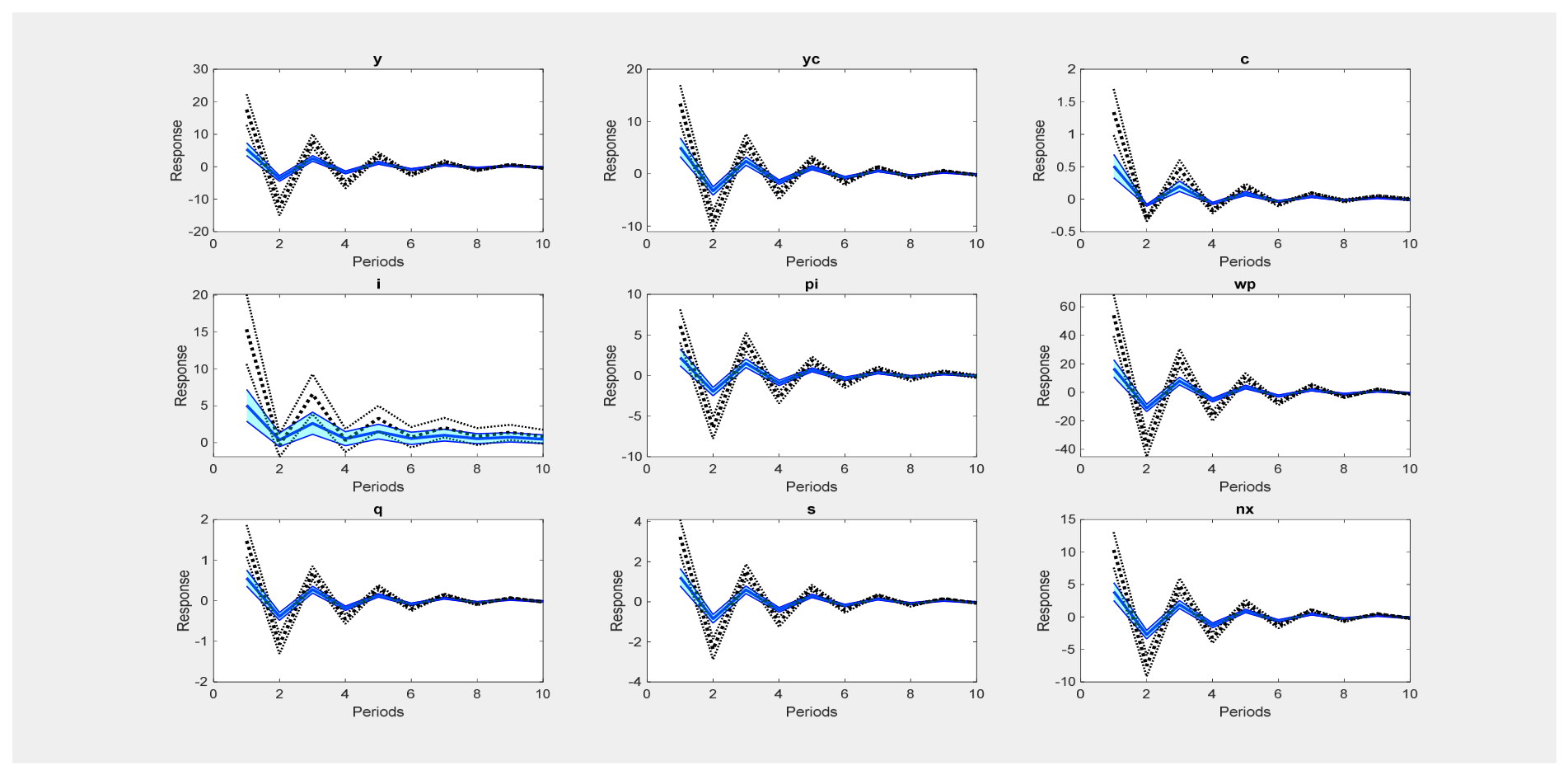
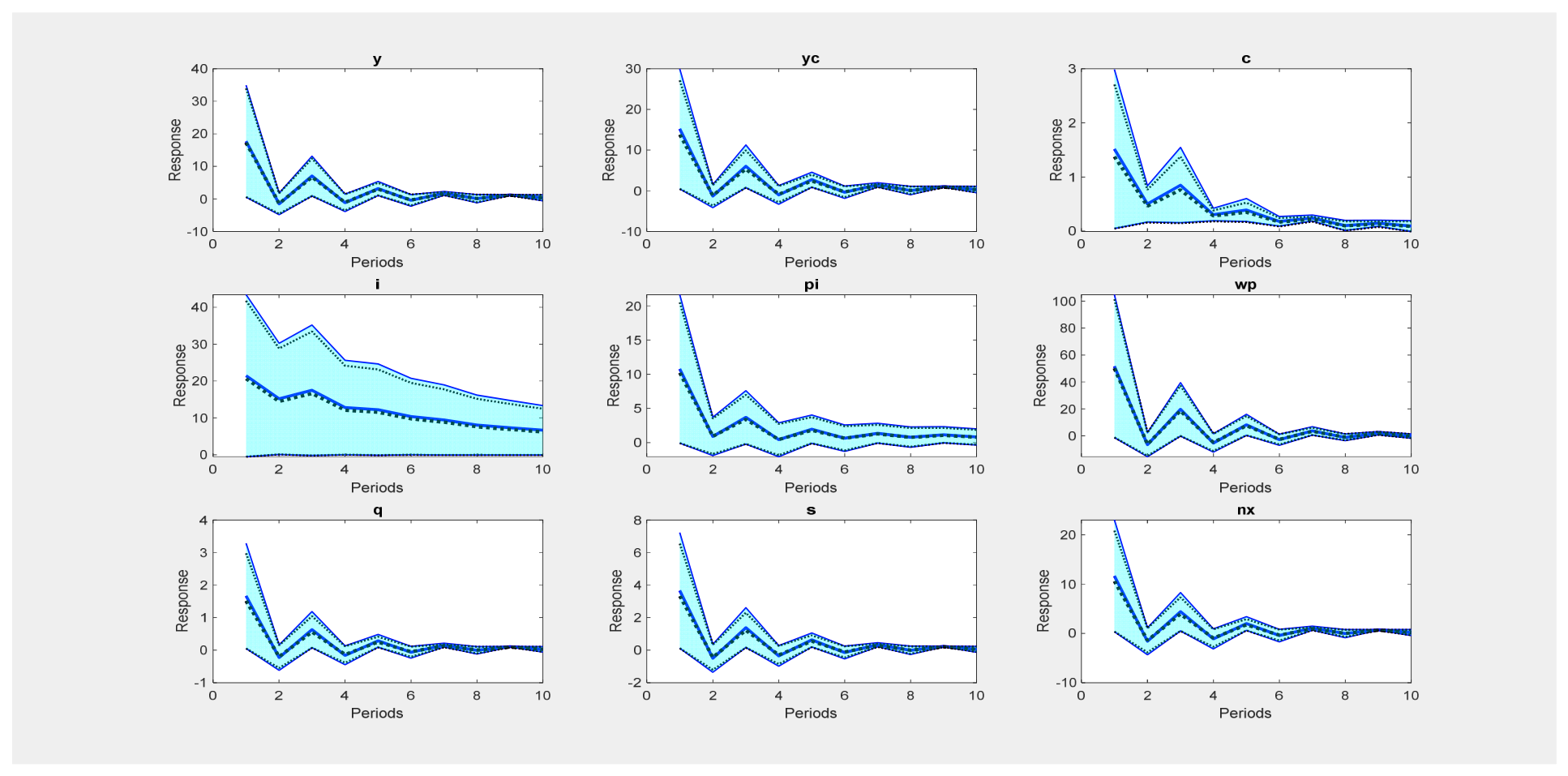
Figure 1, Figure 2 and Figure 3 present the responses to an external oil demand shock under the three pairs of oil revenue absorption rates. The shock initially increases oil export income and produces positive responses in output, total income, consumption, inflation, wages, the real exchange rate, the terms of trade, and net exports. The initial expansion is followed by a reversal in the second period and then by damped oscillations around the steady state. Most responses become relatively small by the later periods of the simulation horizon.
The comparison between absorption rates of 10% and 90% in Figure 1 reveals the largest difference between the two regimes. When 90% of contemporaneous oil income enters domestic absorption, the initial responses of output, total income, consumption, inflation, wages, and net exports are substantially larger than under the 10% regime. The subsequent negative corrections are also deeper, indicating that high current absorption amplifies both the expansionary phase and the following adjustment.
Figure 1.
Impulse response functions to an external oil demand shock under oil revenue absorption rates of 10% and 90%.
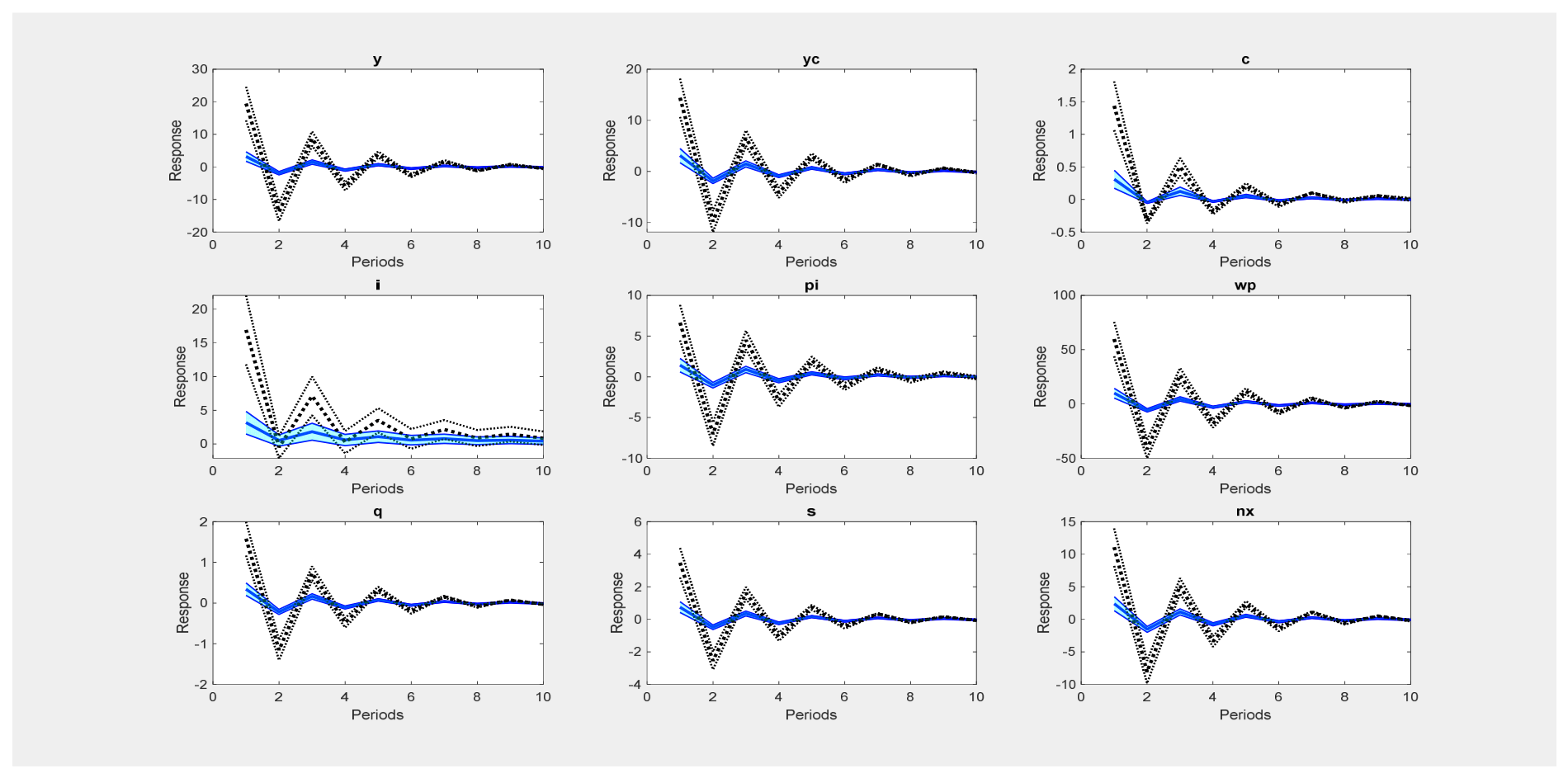
Figure 2 shows that the same ordering is preserved when the absorption rates are set at 20% and 80%. The high-absorption regime continues to produce larger responses, although the difference is smaller than in the 10–90% comparison.
Figure 2.
Impulse response functions to an external oil demand shock under oil revenue absorption rates of 20% and 80%.
In Figure 3, where the rates are 40% and 60%, the mean impulse responses and their uncertainty bands move considerably closer together. Thus, the difference between regimes declines systematically as the distance between the two values of narrows.
Figure 3.
Impulse response functions to an external oil demand shock under oil revenue absorption rates of 40% and 60%.
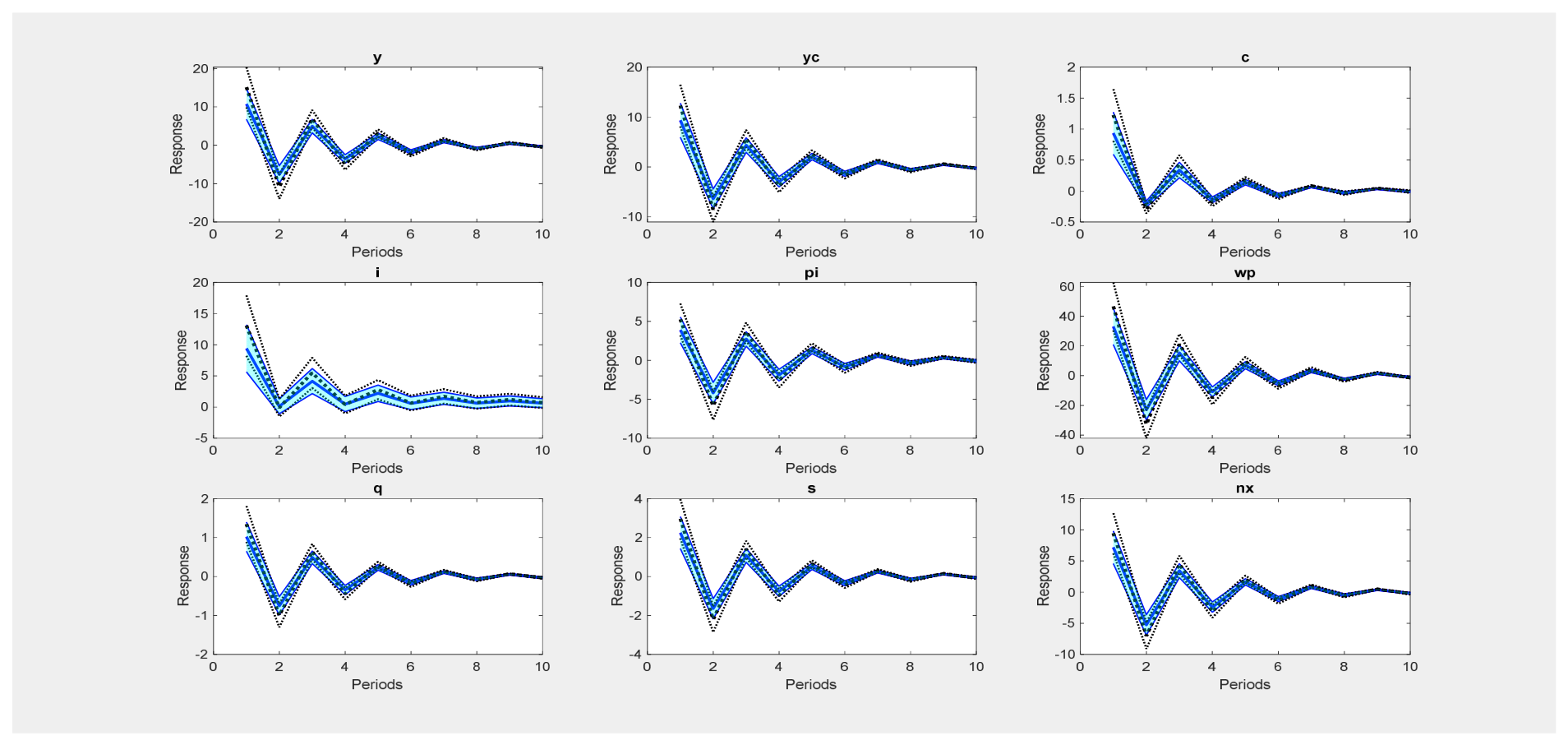
Across Figure 1, Figure 2 and Figure 3, the largest regime-dependent effects are observed during the first several periods. The results show that the degree of current oil revenue absorption affects not only the initial magnitude of the responses but also the size of the subsequent adjustment. Higher absorption produces larger deviations from the steady state, whereas lower absorption dampens the domestic transmission of the external oil demand shock.
To complement the graphical comparison in Figure 1, Figure 2 and Figure 3, Table 4 reports the mean impulse response of output and the corresponding simulation-based uncertainty bounds over ten periods. The table focuses on the 10–90% comparison, which represents the greatest difference between the absorption regimes, and the 40–60% comparison, in which the two regimes are relatively close.
Table 4.
Mean output responses and simulation-based uncertainty bounds following an external oil demand shock.
Table 4 confirms quantitatively that current oil revenue absorption strongly conditions the output response to an external oil demand shock. In the first period, the mean output response equals 19.481 under the 90% absorption regime, compared with 3.195 under the 10% regime. Thus, the initial response under 90% absorption is approximately 6.097 times larger, with an absolute difference of 16.286 response units. The corresponding uncertainty bands, [14.309, 24.654] and [1.767, 4.622], do not overlap. Non-overlapping intervals are also observed in the remaining periods of the 10–90% comparison, indicating persistent separation between the two regimes throughout the reported horizon.
The response alternates between positive and negative values while gradually converging toward the steady state. Under the 90% regime, the mean response changes from 19.481 in the first period to −13.815 in the second and 8.706 in the third. Its absolute magnitude falls below one-half of the initial response by the third period and below approximately one-tenth by the seventh period. A comparable pattern of damped oscillation is observed under the 10% regime.
When the absorption rates are closer, the difference becomes substantially smaller. In the first period, the mean response equals 14.674 under 60% absorption and 10.400 under 40% absorption, implying a ratio of 1.411 and an absolute difference of 4.274. Moreover, the uncertainty bands for the 40% and 60% regimes overlap in every period. This result shows that the amplification effect becomes less distinguishable when the difference between the two absorption rates narrows.
4.2. Oil Price Shock
Figure 4, Figure 5 and Figure 6 report the responses to an oil price shock. The qualitative adjustment pattern is similar to that generated by the external oil demand shock. An increase in the value of oil exports initially raises output, total income, consumption, inflation, wages, the real exchange rate, the terms of trade, and net exports. These initial movements are followed by negative corrections and damped oscillations as the economy returns toward equilibrium.
Figure 4 shows a pronounced difference between the 10% and 90% absorption regimes. The 90% regime generates substantially larger initial responses in almost all reported variables. Output and total income respond particularly strongly because a larger proportion of the increase in oil export income is incorporated into current domestic resources. Consumption and inflation also display greater deviations, prompting a stronger interest-rate response. The external variables exhibit larger initial movements and subsequent reversals under the high-absorption regime.
Figure 4.
Impulse response functions to an oil price shock under oil revenue absorption rates of 10% and 90%.
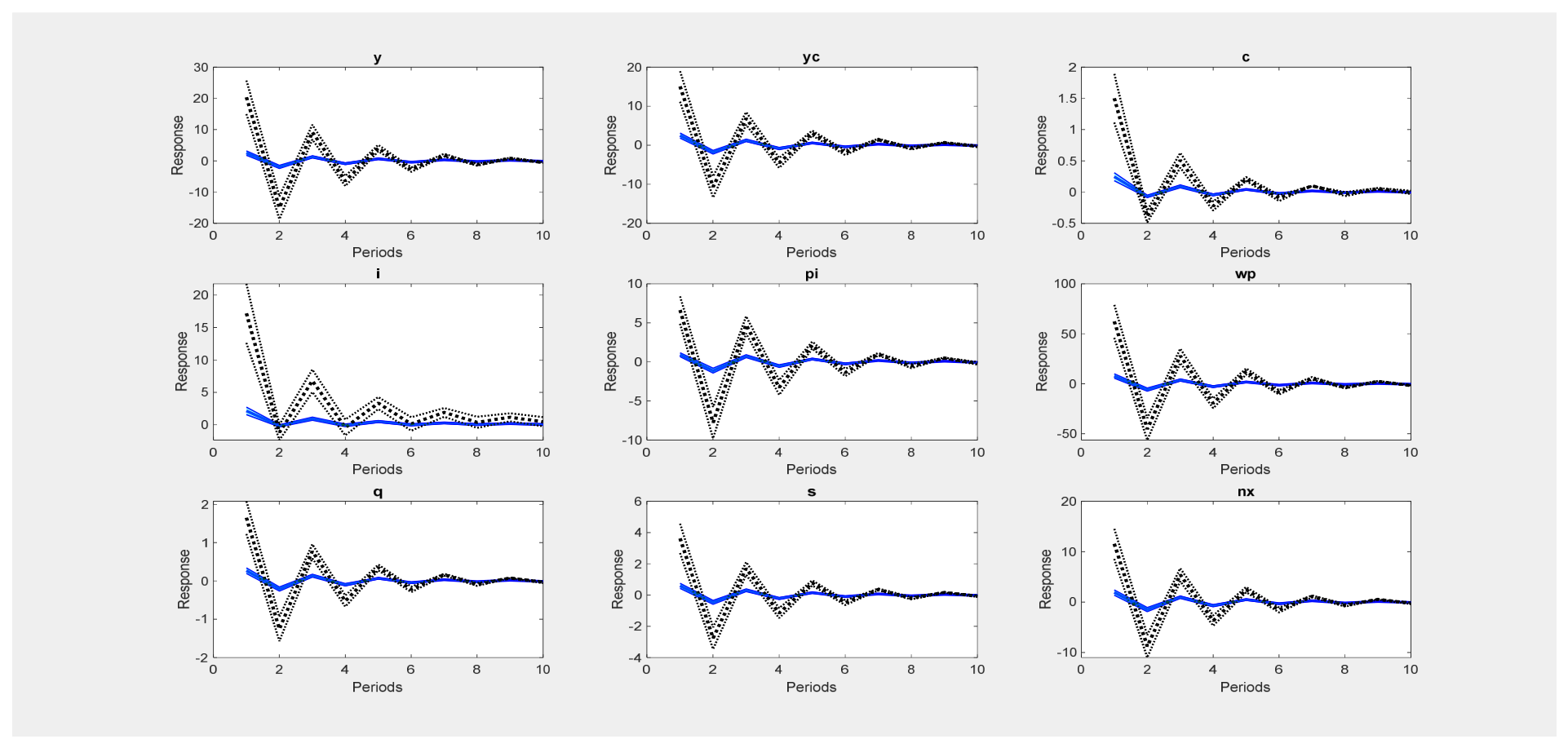
The differences remain visible in Figure 5 for the 20% and 80% pair, but their magnitude is smaller than in Figure 4.
Figure 5.
Impulse response functions to an oil price shock under oil revenue absorption rates of 20% and 80%.
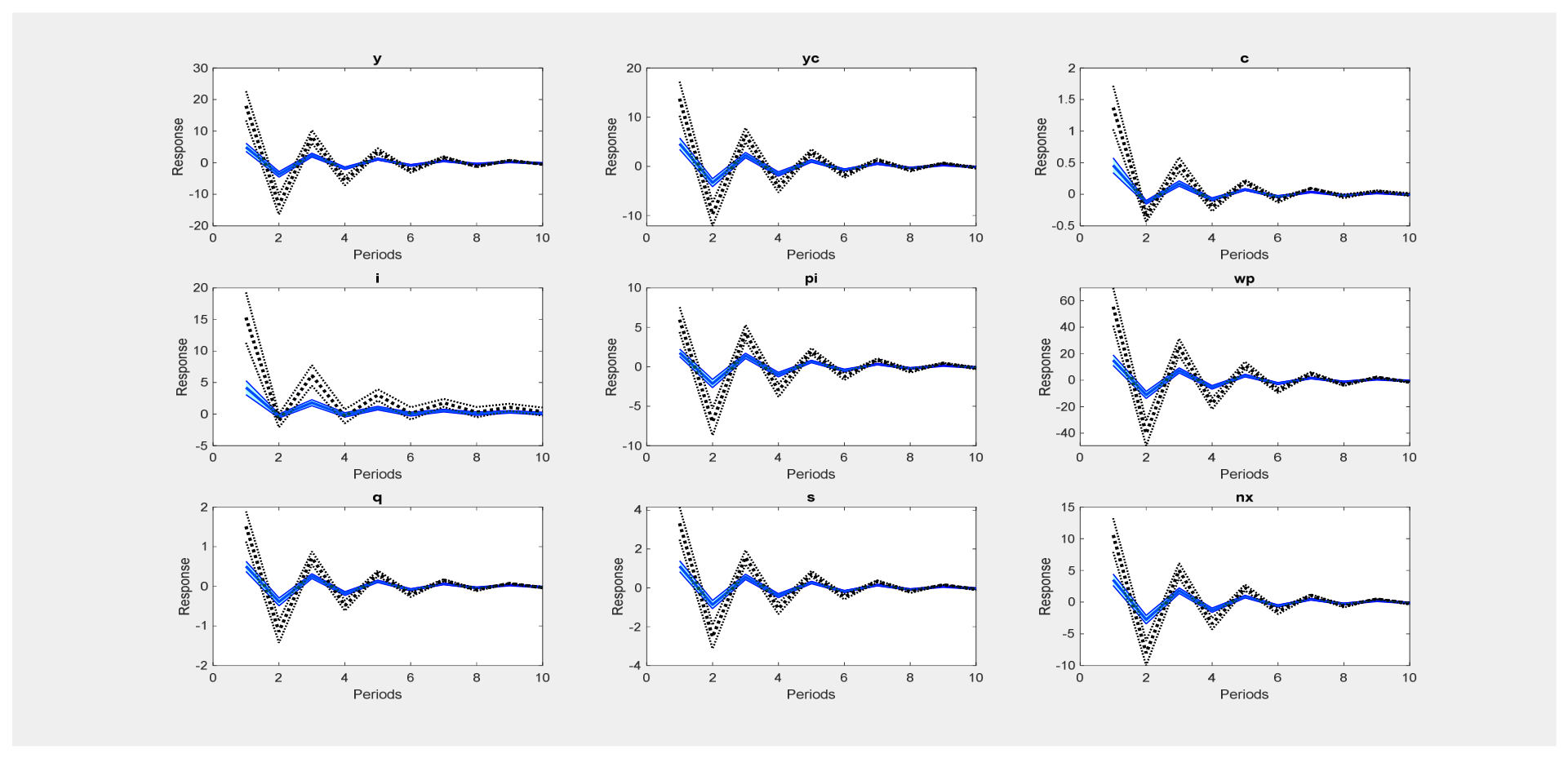
Figure 6 shows a further convergence of the responses under absorption rates of 40% and 60%. The mean impulse responses become close, and the corresponding uncertainty bands overlap to a much greater extent.
Figure 6.
Impulse response functions to an oil price shock under oil revenue absorption rates of 40% and 60%.
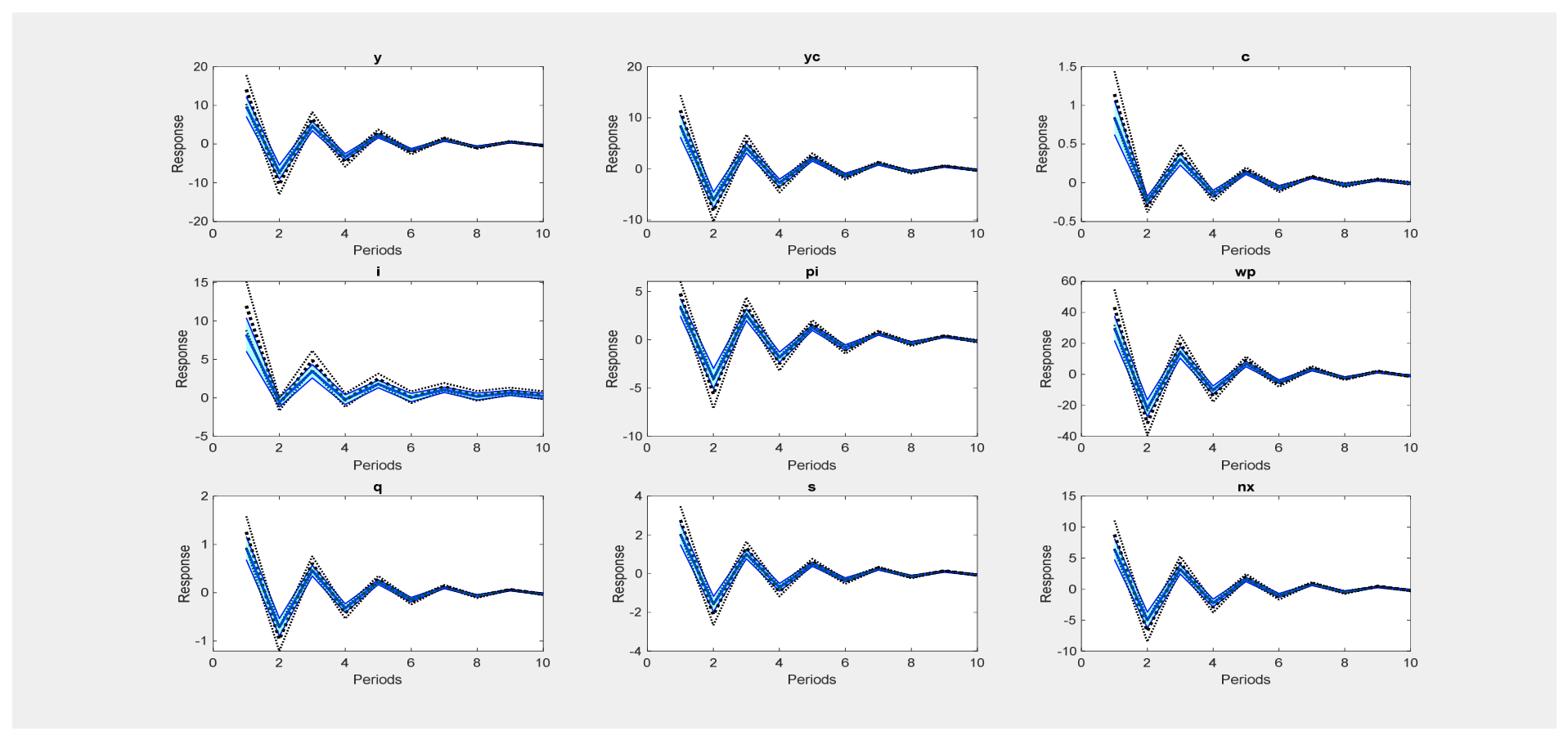
The consistent ordering across Figure 4, Figure 5 and Figure 6 indicates that the amplification effect is not confined to the two most extreme values of . Intermediate simulations reproduce the same qualitative pattern: responses become progressively larger as the absorption rate rises. However, the most substantial contrast is observed when the difference between the two absorption regimes is greatest.
Taken together, Figure 1, Figure 2, Figure 3, Figure 4, Figure 5 and Figure 6 show that external oil demand and oil price shocks are the shocks most strongly conditioned by the oil revenue allocation parameter. Higher current absorption magnifies the initial macroeconomic expansion, the subsequent correction, and the oscillations during the adjustment process.
4.3. Total Factor Productivity Shock
Figure 7, Figure 8 and Figure 9 present the responses to a total factor productivity shock. The shock generates an immediate expansion in output, total income, consumption, wages, and net exports. The initial responses are followed by alternating adjustments that gradually decline over the simulation horizon. Inflation, the interest rate, the real exchange rate, and the terms of trade also respond, reflecting the interaction of production, demand, and monetary-policy channels.
Unlike the oil-related shocks, the productivity shock produces very similar mean responses across the alternative oil revenue absorption rates. Figure 7 shows that even the comparison between 10% and 90% absorption results in only limited separation between the two regimes. The direction, timing, and persistence of the responses remain nearly unchanged.
Figure 7.
Impulse response functions to a total factor productivity (TFP) shock under oil revenue absorption rates of 10% and 90%.
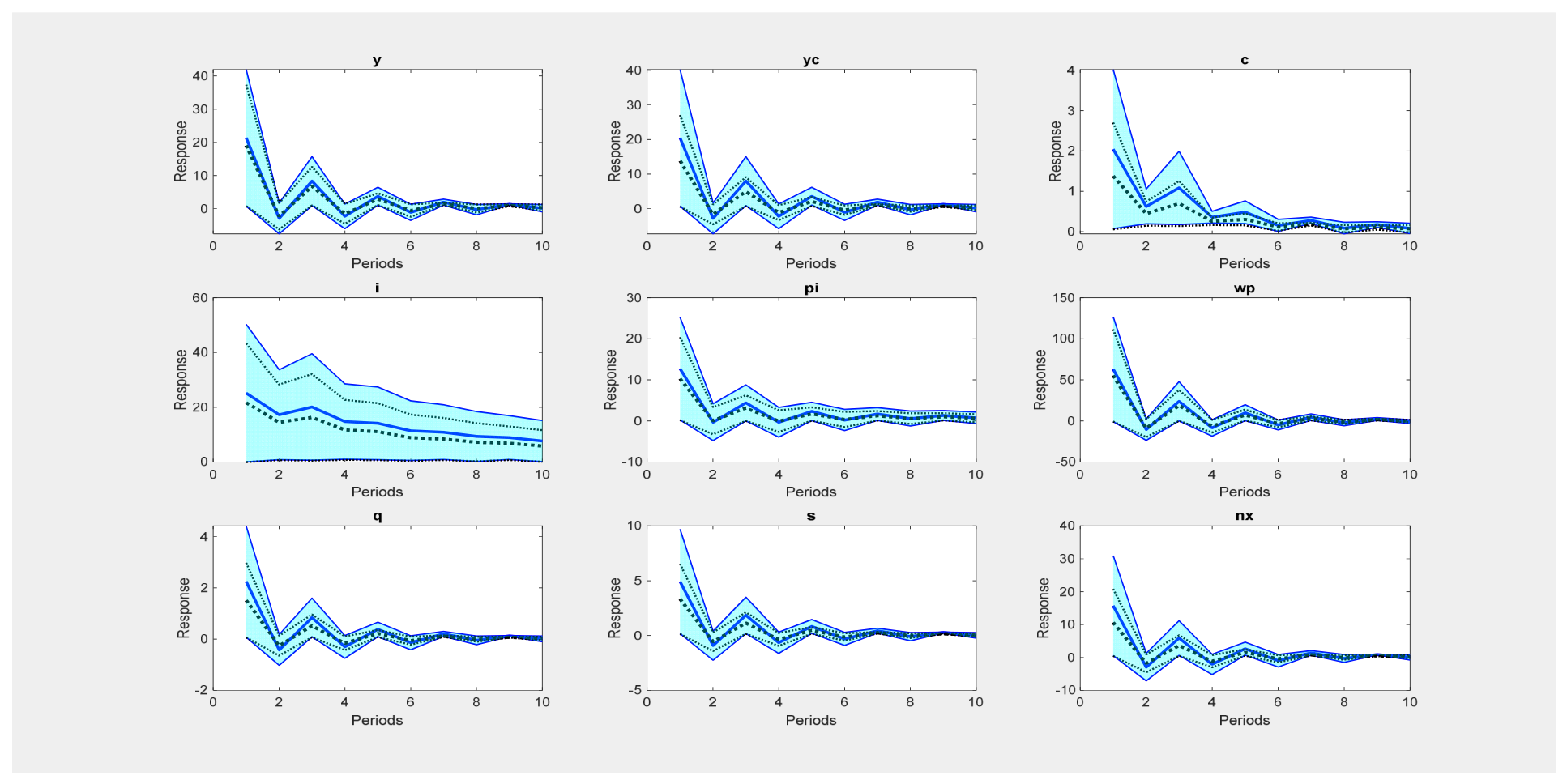
The same pattern is evident in Figure 8 and Figure 9. As the difference between the paired absorption rates narrows, the impulse responses become virtually indistinguishable. The uncertainty bands overlap across most variables and periods.
Figure 8.
Impulse response functions to a total factor productivity (TFP) shock under oil revenue absorption rates of 20% and 80%.
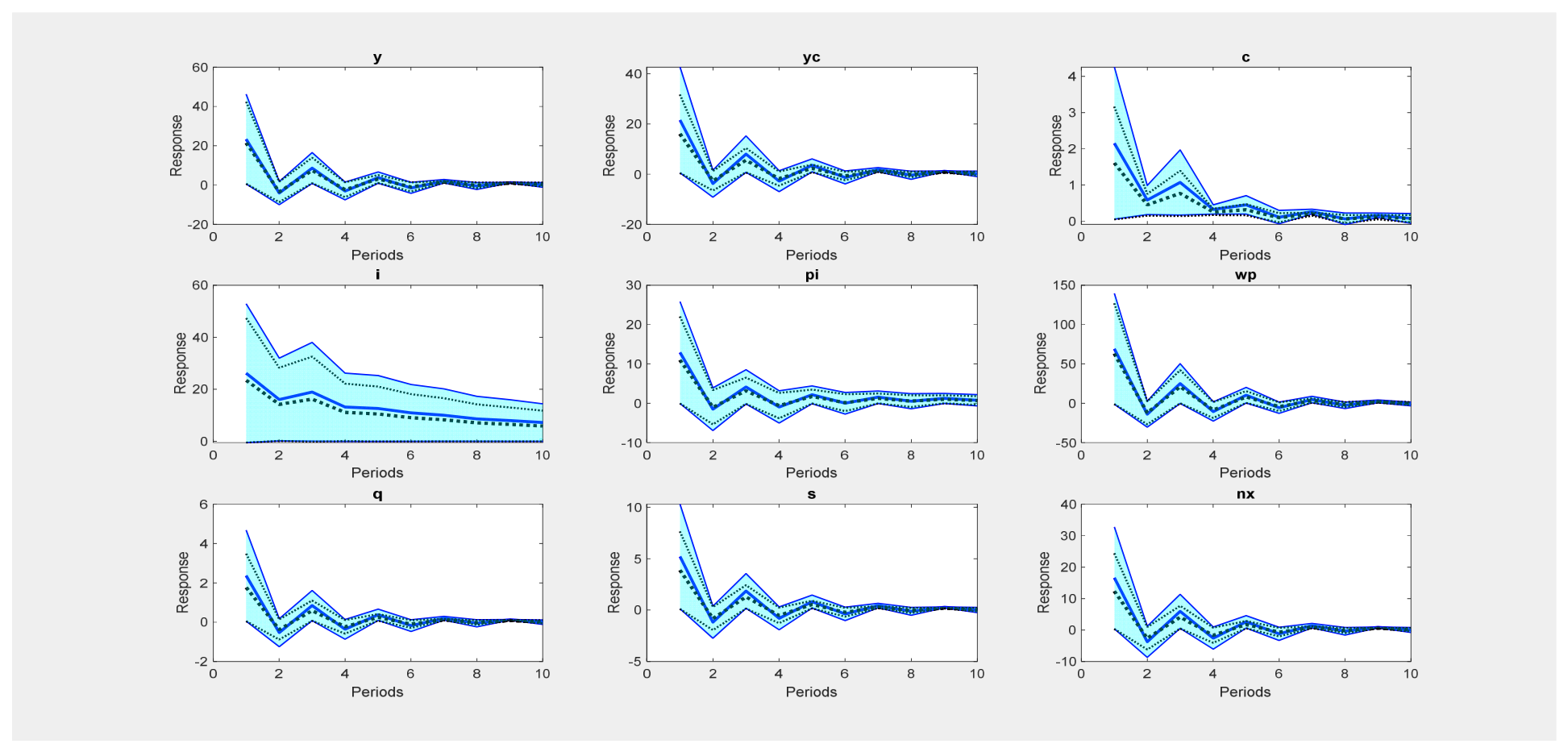
Some variables, particularly the interest rate and wages, have relatively wide simulation-based intervals, but these intervals do not reveal a systematic separation between the allocation regimes.
Figure 9.
Impulse response functions to a total factor productivity (TFP) shock under oil revenue absorption rates of 40% and 60%.
These results indicate that a productivity shock is transmitted mainly through domestic production, labor-income, price-setting, and monetary-policy mechanisms. Changing the share of oil revenues entering current domestic absorption has little influence on either the direction or the persistence of the responses to this shock.
Table 5 provides the corresponding quantitative results for the output response to a total factor productivity shock. As in Table 4, the mean impulse responses and their simulation-based uncertainty bounds are reported for the 10–90% and 40–60% absorption-rate comparisons.
Table 5.
Mean output responses and simulation-based uncertainty bounds following a total factor productivity shock.
The results in Table 5 differ markedly from those obtained for the external oil demand shock. In the first period, the mean output response equals 22.051 under the 10% absorption regime and 19.694 under the 90% regime. Although the 10% response is 2.357 units larger, the corresponding uncertainty bands overlap extensively: [0.568, 43.534] for the 10% regime and [0.634, 38.754] for the 90% regime. The difference in the mean responses therefore does not represent a clear or systematic amplification effect associated with higher oil revenue absorption.
The same conclusion follows from the 40–60% comparison. The first-period mean responses equal 12.974 under the 40% regime and 12.618 under the 60% regime, a difference of only 0.356 response units. Their uncertainty bands, [0.593, 25.354] and [0.610, 24.626], are almost completely overlapping. Substantial overlap remains visible throughout all ten periods.
For all four absorption rates, the maximum absolute output response occurs in the first period and is followed by damped oscillations. However, neither the magnitude nor the adjustment pattern is systematically ordered by the absorption rate. This quantitative evidence confirms the graphical results in Figure 7, Figure 8 and Figure 9: productivity shocks are transmitted primarily through domestic production mechanisms and are only weakly affected by the oil revenue allocation parameter.
4.4. Labor Preference Shock
Figure 10, Figure 11 and Figure 12 show the responses to a labor preference shock. The shock initially reduces labor supply and produces negative responses in output, total income, consumption, inflation, wages, and the nominal interest rate. The real exchange rate, terms of trade, and net exports also decline initially. These movements are followed by partial reversals and damped oscillations toward the steady state.
The impulse responses under absorption rates of 10% and 90% are already close in Figure 10.
Figure 10.
Impulse response functions to a labor preference shock under oil revenue absorption rates of 10% and 90%.
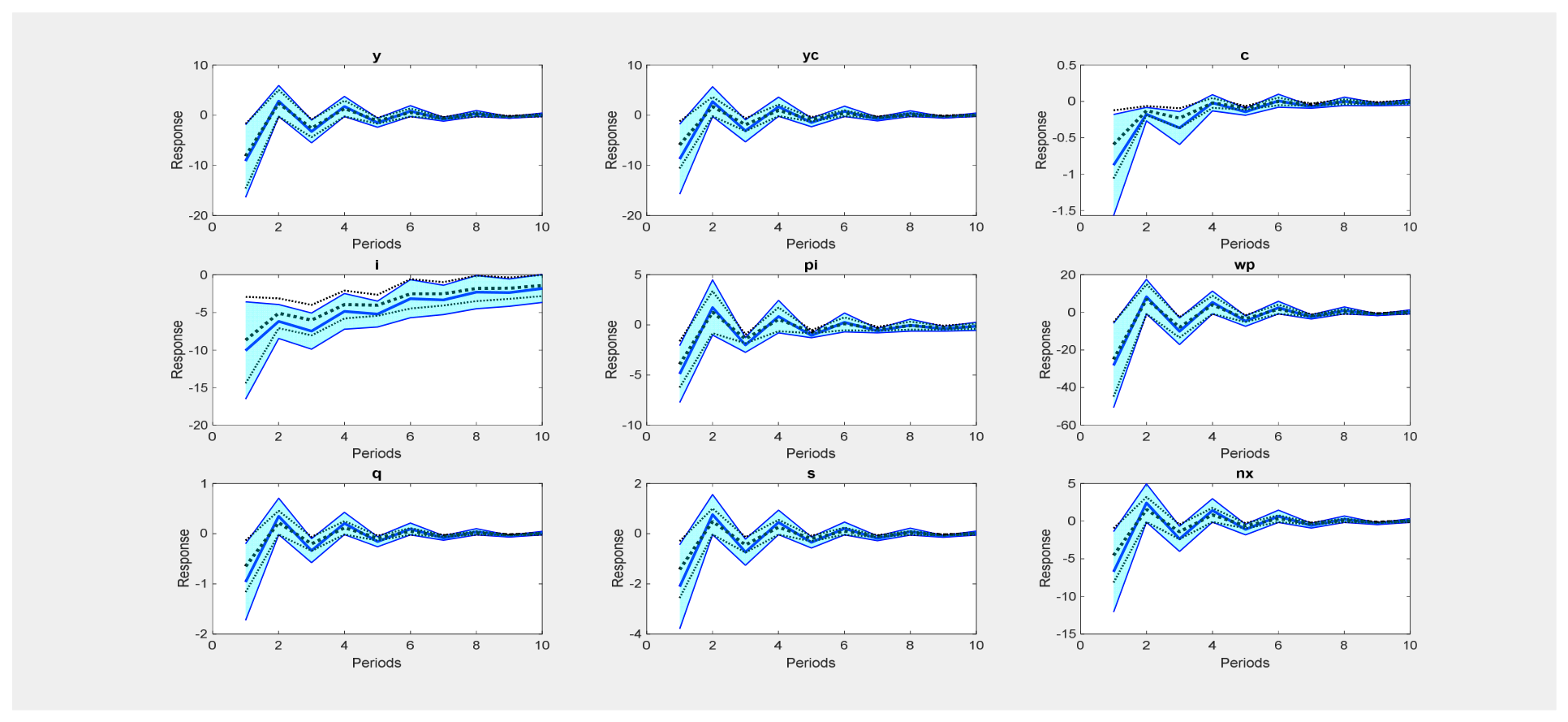
The differences become still smaller for the 20–80% and 40–60% comparisons shown in Figure 11 and Figure 12. In nearly all panels, the mean responses follow the same trajectory, while the simulation-based uncertainty bands overlap throughout most or all of the adjustment horizon.
Figure 11.
Impulse response functions to a labor preference shock under oil revenue absorption rates of 20% and 80%.
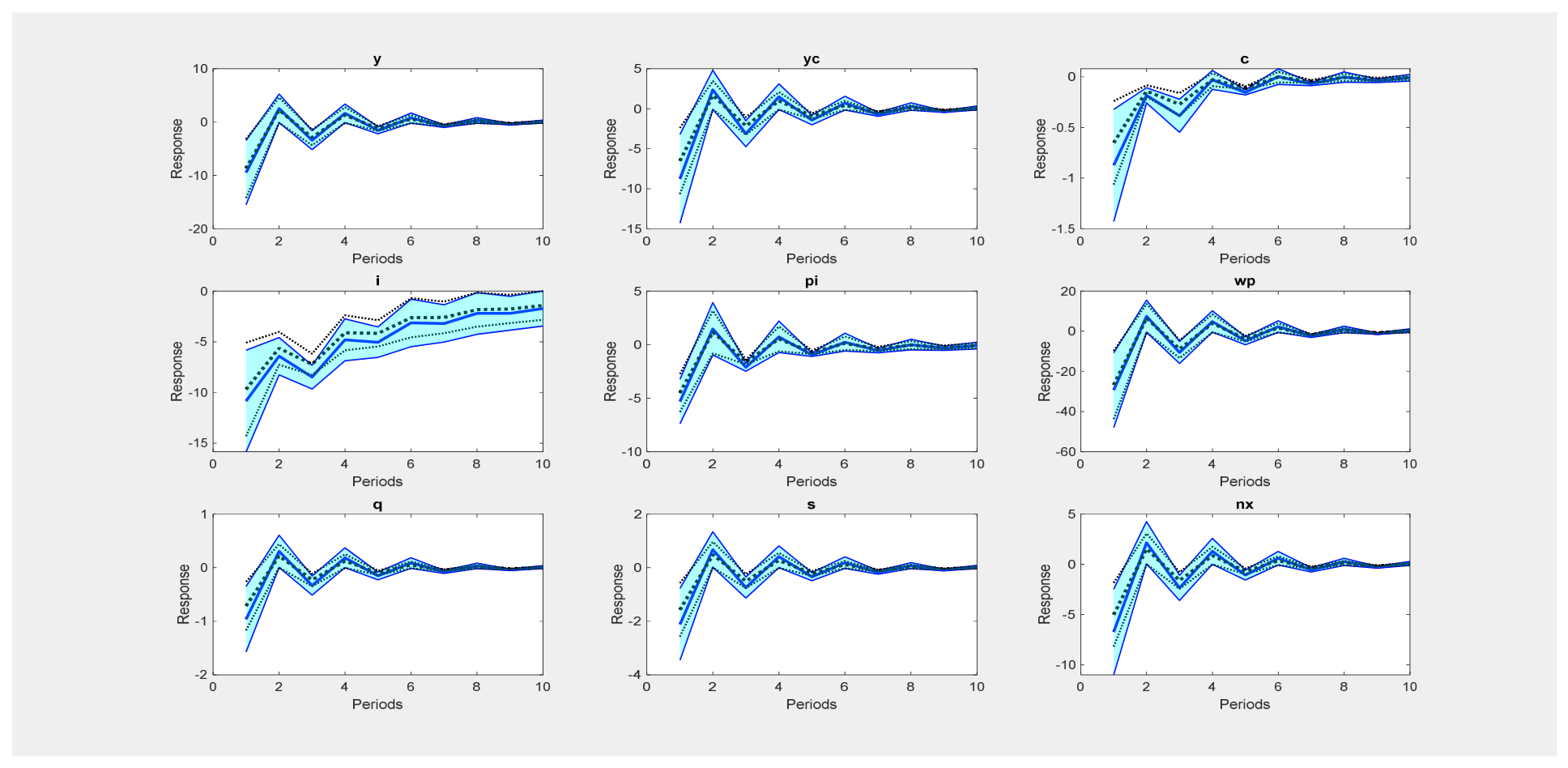
Figure 12.
Impulse response functions to a labor preference shock under oil revenue absorption rates of 40% and 60%.
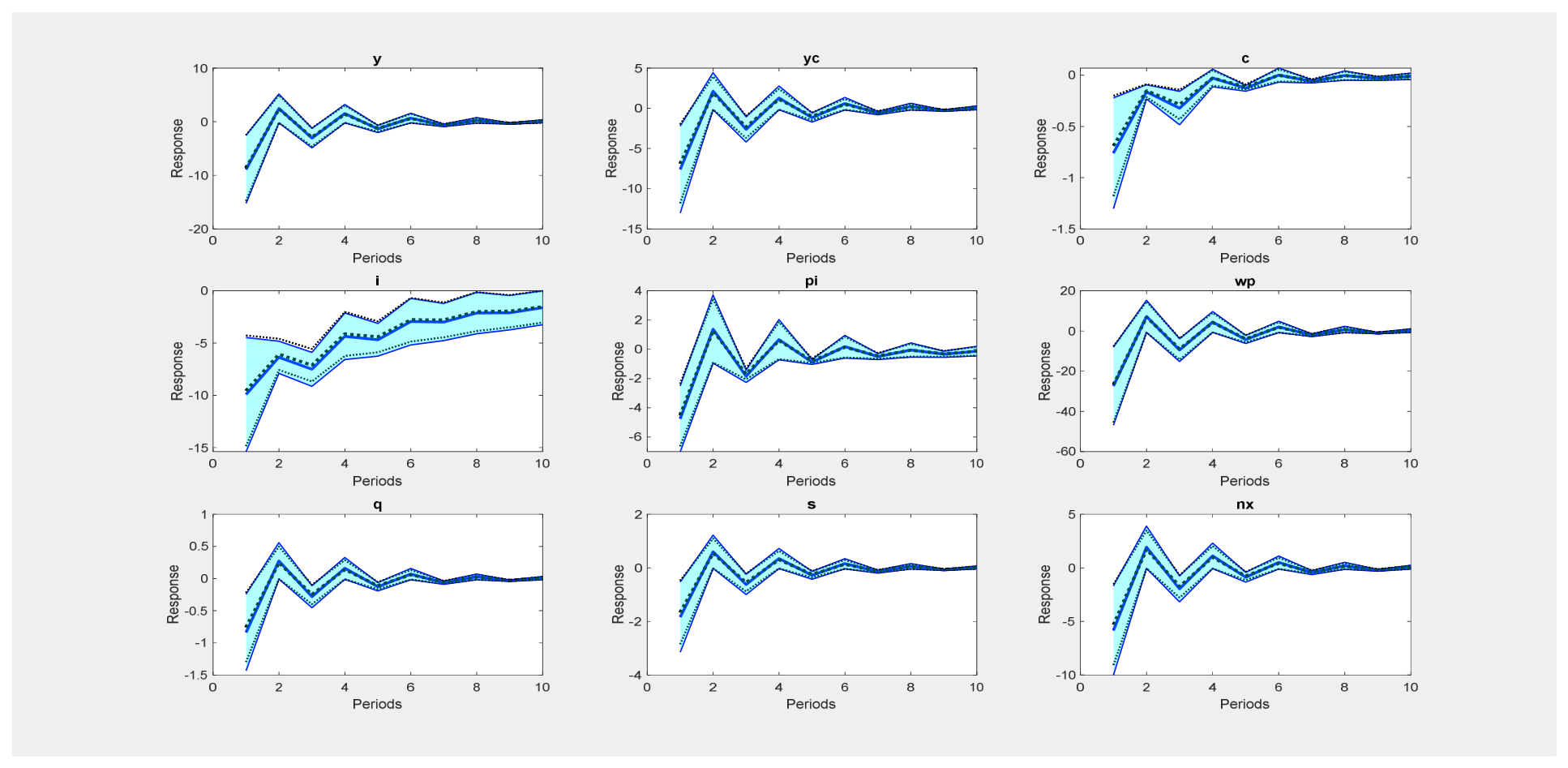
The absence of systematic separation indicates that the oil revenue allocation parameter does not materially alter the transmission of labor preference disturbances. The responses are determined mainly by labor supply, wage, consumption, and monetary-policy adjustments. Consequently, the three pairs of absorption rates produce almost identical macroeconomic dynamics.
4.5. Monetary Policy Shock
Figure 13, Figure 14 and Figure 15 report the responses to a contractionary monetary policy shock. The nominal interest rate increases immediately, while output, total income, consumption, inflation, and wages decline. The real exchange rate, terms of trade, and net exports also display an initial negative response, followed by partial reversals. The effects gradually diminish as the interest rate returns toward its steady-state value.
The comparison between the 10% and 90% absorption regimes in Figure 13 shows only small differences in the magnitude of the responses.
Figure 13.
Impulse response functions to a monetary policy shock under oil revenue absorption rates of 10% and 90%.
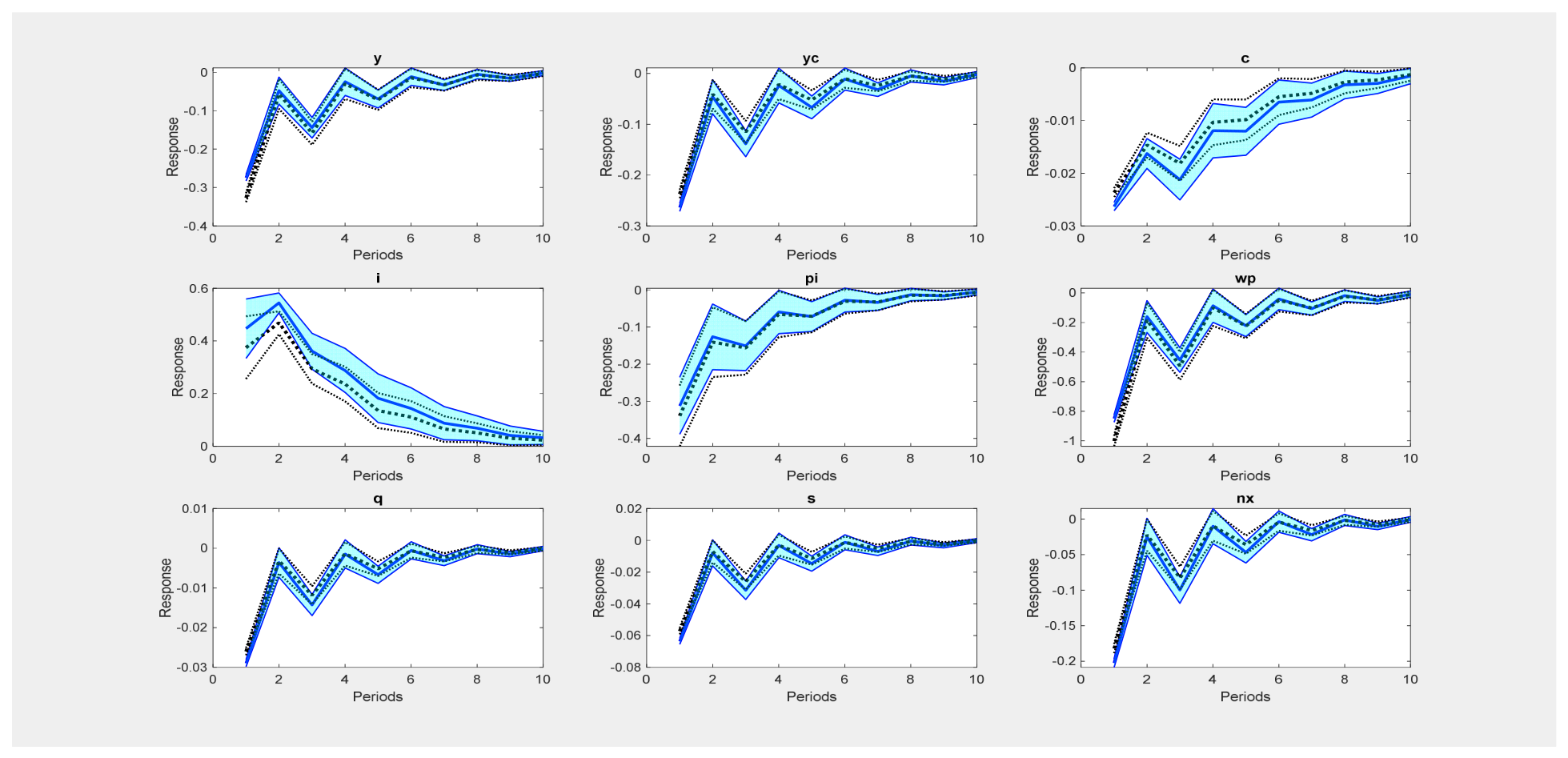
Importantly, the direction and timing of the responses remain unchanged. Figure 14 and Figure 15 provide the same conclusion for the 20–80% and 40–60% pairs. The mean impulse responses are closely aligned, and their uncertainty bands overlap across nearly the entire simulation horizon.
Figure 14.
Impulse response functions to a monetary policy shock under oil revenue absorption rates of 20% and 80%.
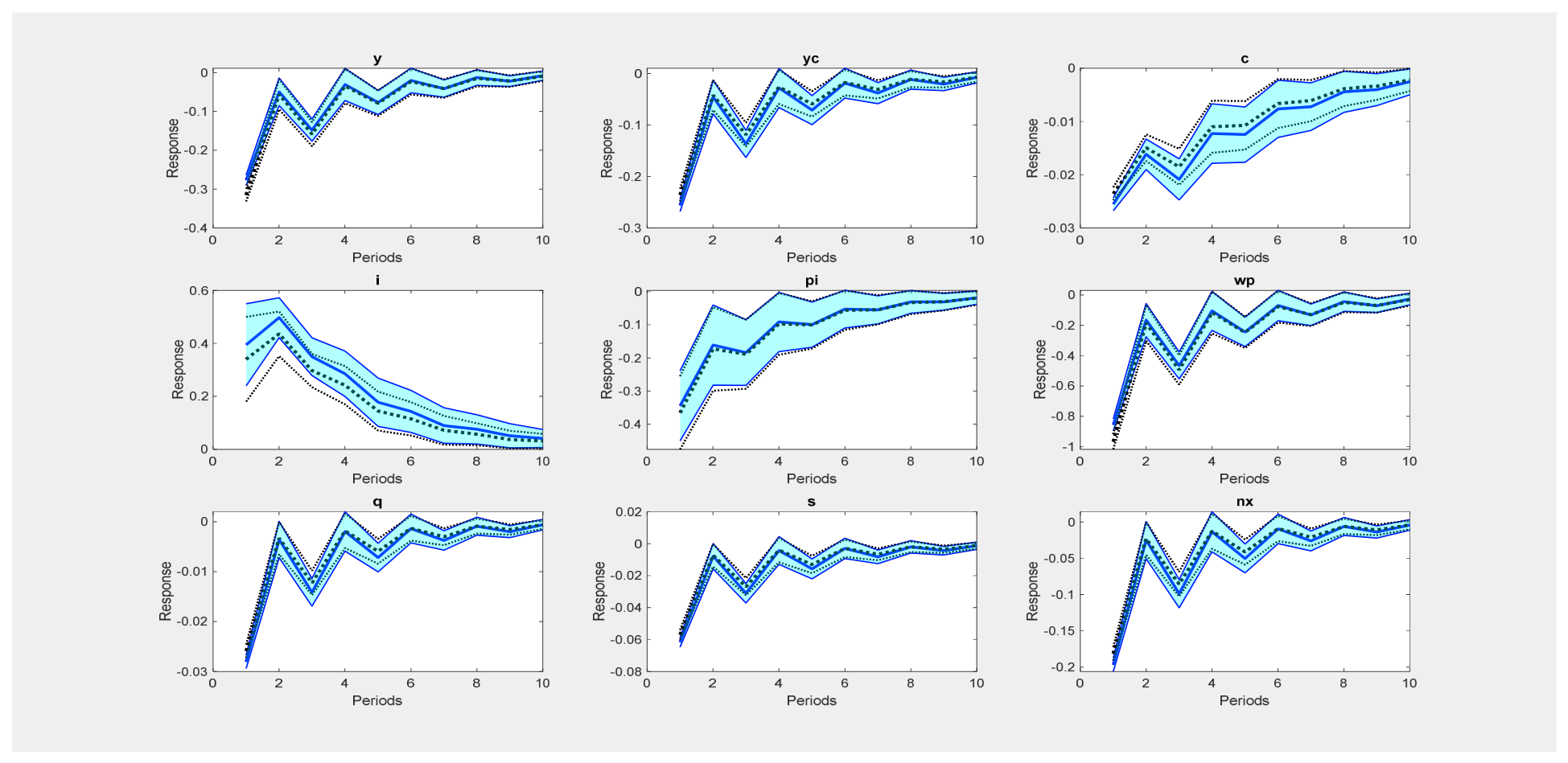
Figure 15.
Impulse response functions to a monetary policy shock under oil revenue absorption rates of 40% and 60%.
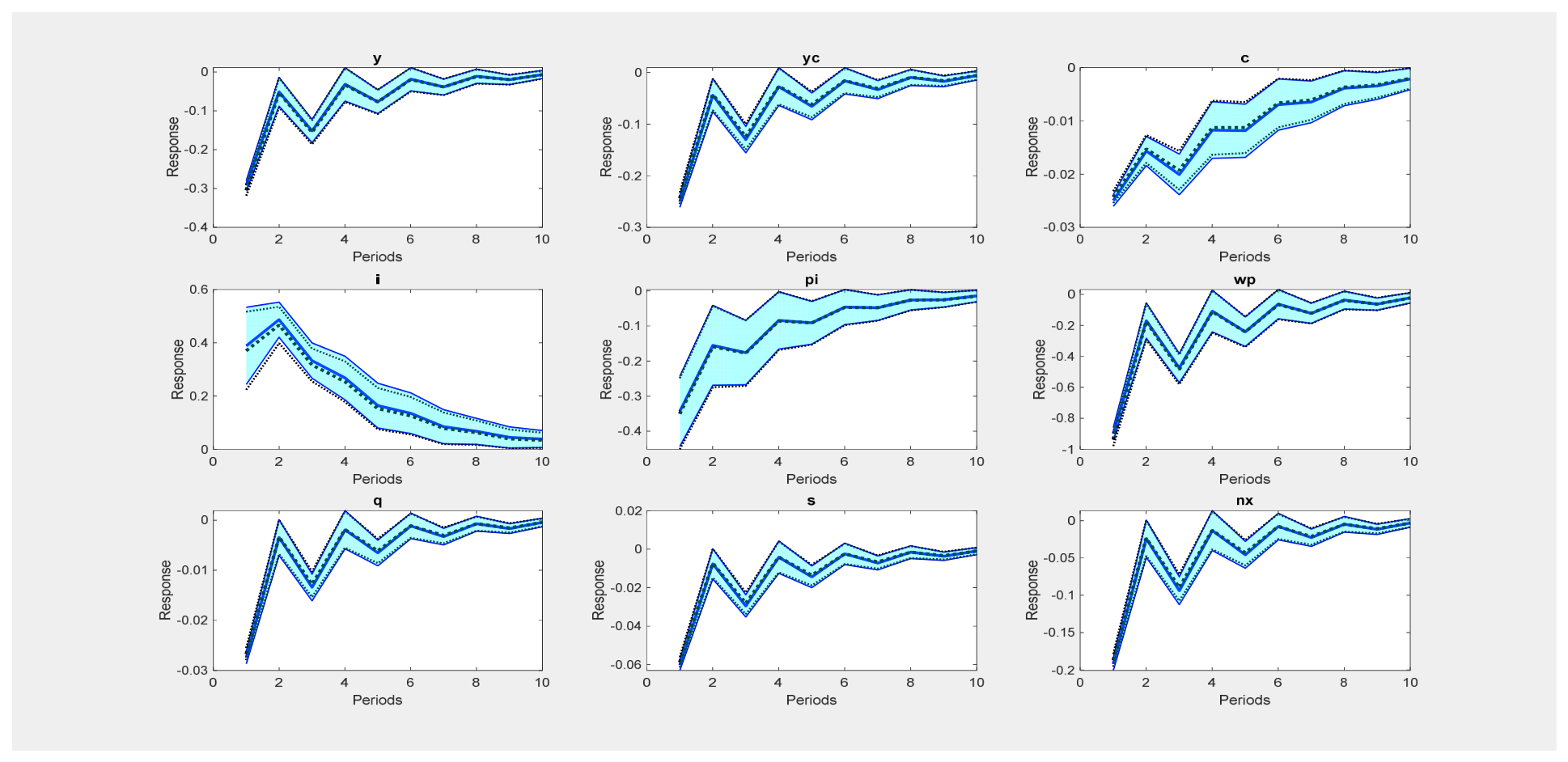
The results demonstrate that the monetary transmission mechanism remains broadly stable across the alternative oil revenue absorption rates. Interest-rate changes affect consumption, output, inflation, exchange-rate dynamics, and the external balance primarily through the standard monetary-policy channel rather than through the contemporaneous allocation of oil income.
4.6. Foreign Output Shock
Figure 16, Figure 17 and Figure 18 present the responses to a foreign output shock. Unlike the oil-specific shocks, the foreign output disturbance affects the domestic economy through broader trade and external-demand channels. The responses are strongly oscillatory: output, total income, consumption, the interest rate, inflation, wages, the real exchange rate, the terms of trade, and net exports initially move away from equilibrium, reverse direction in the following period, and subsequently converge through damped oscillations.
Despite the relatively large responses of several variables, Figure 16 shows little separation between the 10% and 90% absorption regimes. The mean responses are closely aligned, and the uncertainty bands overlap across the simulation horizon.
Figure 16.
Impulse response functions to a foreign output shock under oil revenue absorption rates of 10% and 90%.
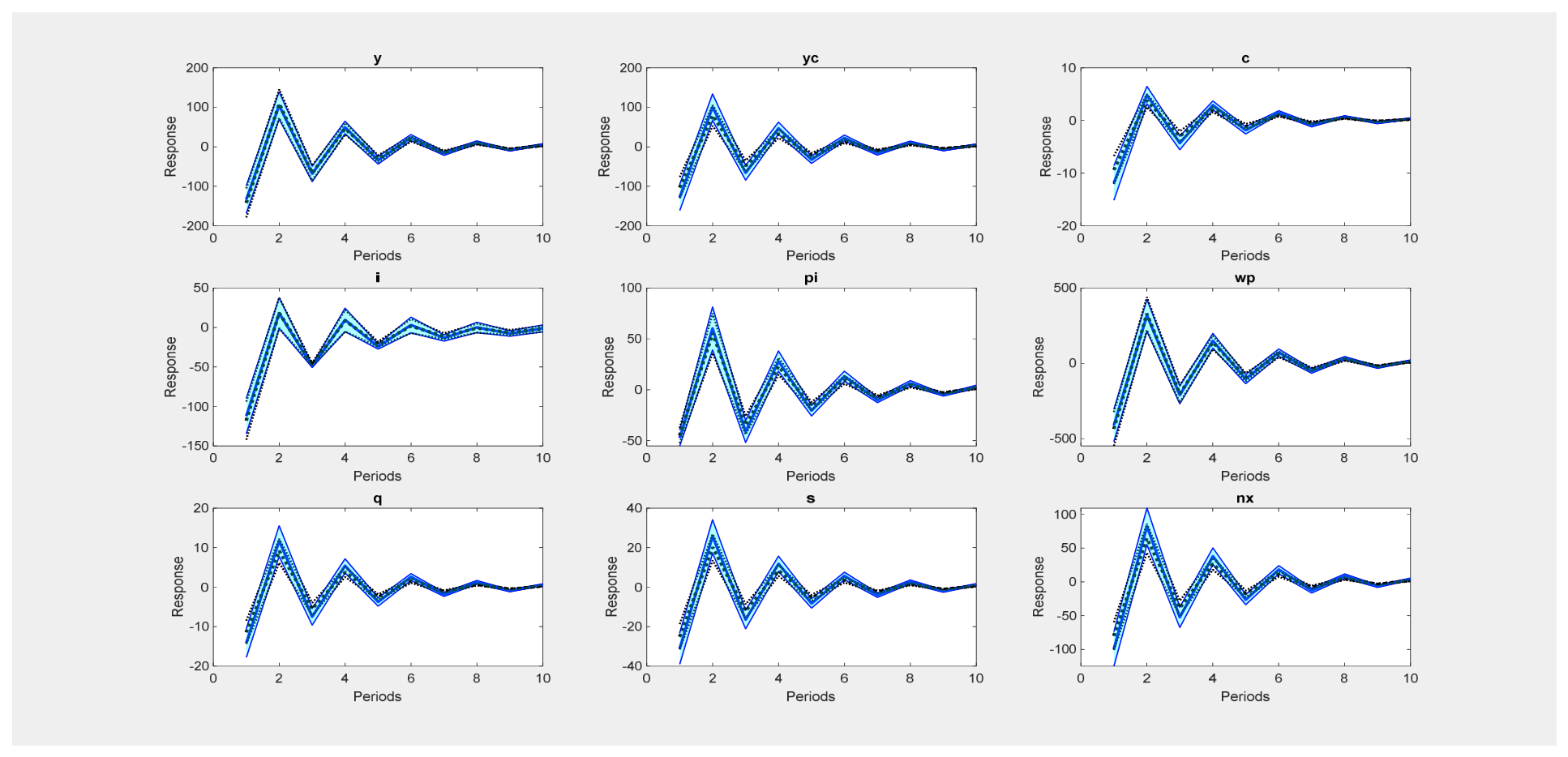
Figure 17.
Impulse response functions to a foreign output shock under oil revenue absorption rates of 20% and 80%.
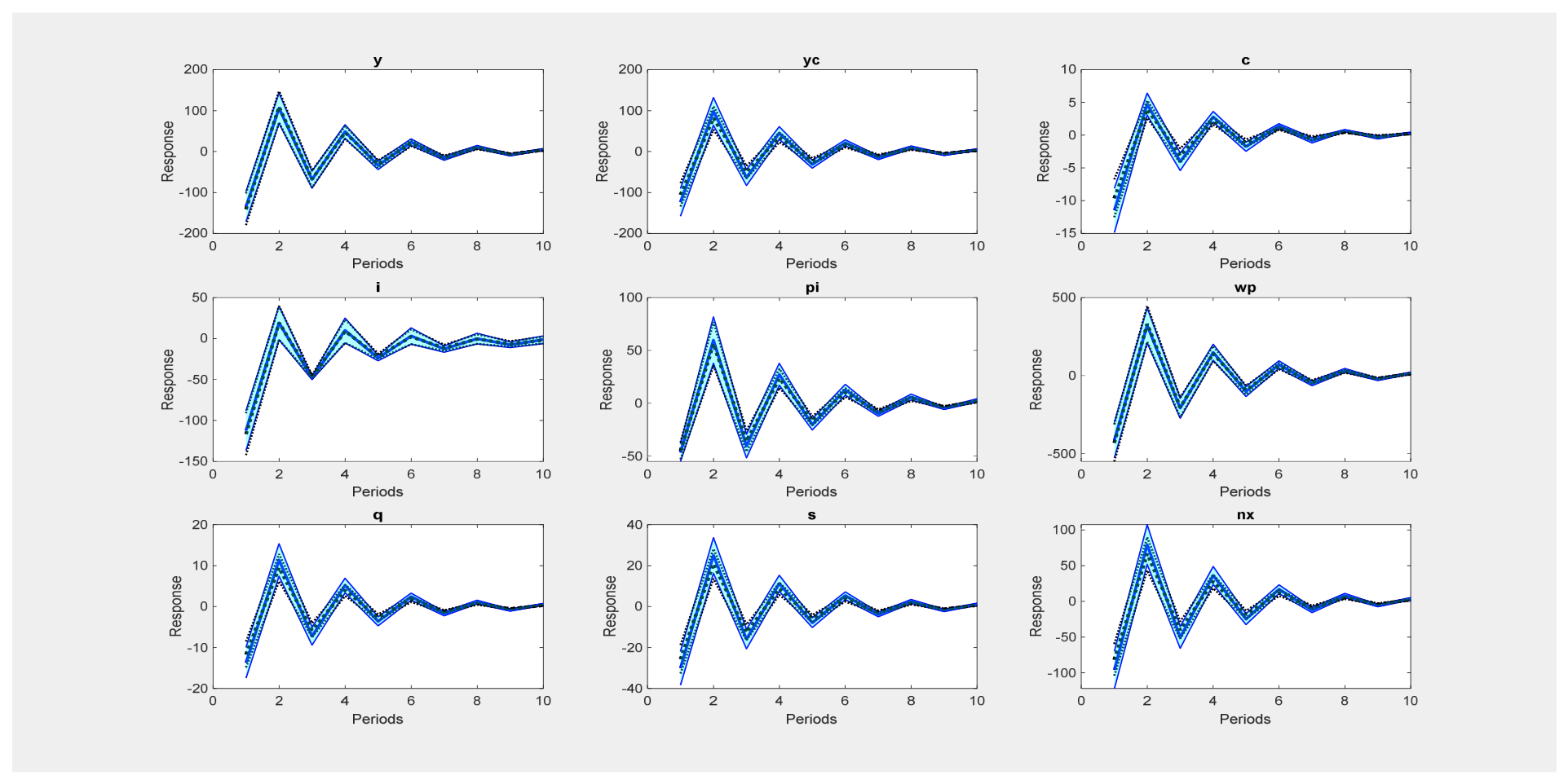
Figure 18.
Impulse response functions to a foreign output shock under oil revenue absorption rates of 40% and 60%.
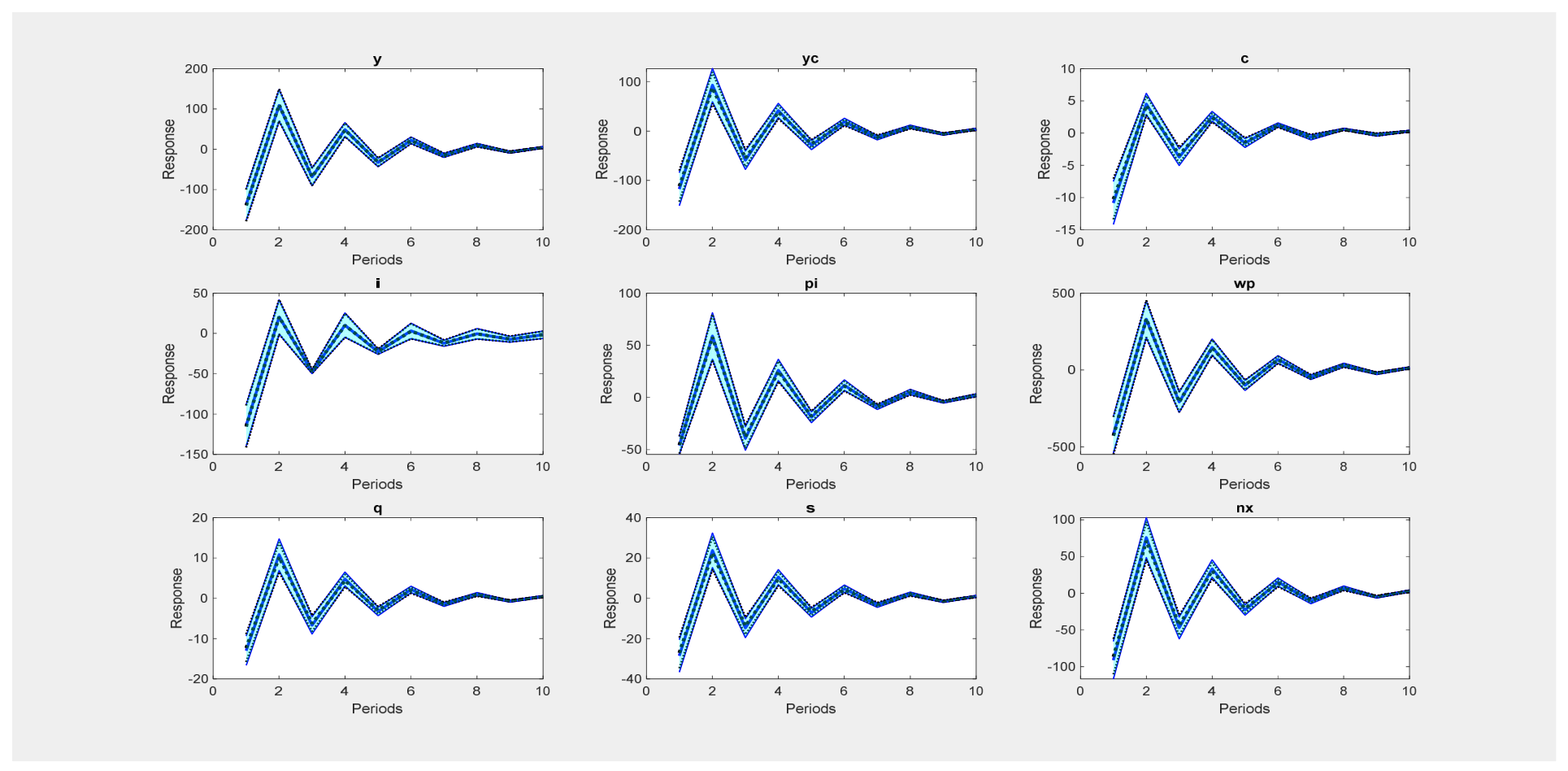
The small differences between the regimes indicate that the transmission of a general foreign output shock is much less dependent on the oil revenue allocation parameter than the transmission of an external oil demand or oil price shock. Although foreign activity affects exports, income, and domestic demand, it does not directly alter oil export income to the same extent as the two oil-specific disturbances considered above.
The foreign output shock therefore occupies an intermediate conceptual position. It is external in origin and produces substantial responses in domestic and external variables, but the difference between the alternative absorption regimes remains limited and is closer to that observed for domestic and monetary disturbances than for oil-related shocks.
4.7. Cross-Shock Comparison and Hypothesis Assessment
The comparison across all 18 figures reveals a clear shock-specific asymmetry. External oil demand and oil price shocks produce the largest differences between the alternative oil revenue absorption regimes. For both shocks, higher absorption increases the initial magnitude of the responses and produces larger subsequent deviations during the adjustment process. The differences are most pronounced for the 10–90% comparison, remain visible for the 20–80% pair, and become considerably smaller for the 40–60% pair.
By contrast, total factor productivity, labor preference, and monetary policy shocks produce broadly similar impulse responses across all three pairs of absorption rates. Foreign output shocks generate large macroeconomic movements but only limited differences between the allocation regimes. This shows that the external origin of a shock alone is insufficient to produce strong regime dependence. The decisive factor is whether the shock directly changes oil export income and therefore interacts with the parameter .
The larger and more persistent deviations generated by oil-related shocks under higher absorption provide support for H1. A greater share of oil income entering current domestic absorption increases the peak magnitude of the responses and prolongs the adjustment of several macroeconomic variables. The marked differences in regime sensitivity across the six shock categories also support H2. The allocation parameter strongly conditions oil price and external oil demand shocks but has only a limited effect on productivity, labor preference, monetary policy, and foreign output disturbances.
Overall, the intermediate simulations reinforce the conclusions obtained from the benchmark 10% and 90% regimes. The responses for the 20–80% and 40–60% pairs preserve the same ordering, while the distance between the regimes narrows progressively. The findings are therefore not driven exclusively by the two extreme benchmark values of .
Sensitivity analysis using intermediate values shows that the qualitative conclusions remain unchanged. For the external oil demand and oil price shocks, the IRF plots, along with the simulation-based uncertainty bands, converge but do not intersect as the parameter δ increases to a certain level. This is illustrated in Figure 1, Figure 2, Figure 3, Figure 4, Figure 5 and Figure 6. At δ = 0.4, that is, for 40% and 60% oil revenue utilization, the simulation-based uncertainty bands already overlap, at least in the first period.
5. Discussion
The results provide a clear answer to the central question of this study: the macroeconomic consequences of oil revenue absorption are strongly shock-dependent. Differences across absorption regimes become economically substantial when a structural disturbance directly changes oil export income, whereas they remain comparatively small when shocks operate primarily through production, labor supply, monetary policy, or broader foreign-demand channels. This distinction refines the conventional separation between external and domestic shocks. What matters for fiscal amplification is not the external origin of a disturbance per se, but the extent to which the disturbance enters the economy through oil export revenues and therefore interacts directly with the oil revenue absorption mechanism.
This result follows directly from the structure of the model. The absorption parameter determines the proportion of contemporaneous oil export income that enters resources available for current domestic use. When an external oil demand or oil price shock increases oil export income, a higher absorption rate transmits a larger proportion of that income immediately into the domestic economy. The resulting increase in current resources strengthens the response of aggregate demand and propagates through consumption, production, prices, wages, the exchange rate, and external balances. Conversely, when a larger share of oil income is withheld from contemporaneous absorption, the immediate connection between external oil-market conditions and domestic demand becomes weaker. Lower absorption therefore operates as an intertemporal smoothing mechanism rather than simply as a reduction in government expenditure.
The magnitude of this mechanism is particularly evident for the external oil demand shock. Under the benchmark comparison, the first-period output response is 19.481 under 90% absorption but only 3.195 under 10% absorption, with non-overlapping simulation-based uncertainty bands. By contrast, following a productivity shock, the corresponding output responses are 19.694 and 22.051, respectively, and their uncertainty bands overlap extensively. Thus, the economically important result is not that lower absorption uniformly reduces macroeconomic responses. Rather, lower absorption selectively attenuates shocks whose transmission operates directly through contemporaneous oil income. This shock-specific pattern is also visible in the intermediate comparisons: the difference remains apparent for the 20–80% regimes and becomes considerably smaller as the rates converge toward 40% and 60%. The sensitivity analysis therefore indicates that the main finding is not an artifact of comparing only the extreme 10% and 90% scenarios.
The responses to productivity and labor preference shocks provide an important counterpoint. These shocks primarily affect productive capacity, labor supply, wages, household decisions, and firms’ price-setting behavior. Because their initial transmission does not operate through changes in oil export income, altering the share of oil revenue entering current domestic absorption has little influence on their propagation. The close alignment of impulse responses across the alternative absorption regimes is therefore economically consistent with the structure of the model rather than evidence that the fiscal allocation mechanism is generally ineffective.
A similar interpretation applies to monetary policy shocks. Their principal transmission mechanism operates through interest rates, intertemporal consumption decisions, aggregate demand, and prices. The oil revenue allocation mechanism is secondary to this conventional monetary transmission channel. The near coincidence of the impulse responses and the extensive overlap of the simulation-based uncertainty bands across the alternative absorption regimes confirm that changing current oil revenue absorption does not materially alter the propagation of a monetary policy disturbance. This result is important because it suggests that the fiscal mechanism examined here should not be interpreted as a general-purpose stabilizer for all macroeconomic disturbances.
The foreign output shock provides an especially useful test of the proposed mechanism. Although it is an external shock and generates substantial movements in domestic macroeconomic variables, the responses remain relatively similar across absorption regimes. This finding shows that the external-versus-domestic classification alone cannot explain regime sensitivity. Foreign economic activity affects exports and domestic income through broader trade and external-demand channels, but its effect on contemporaneous oil export income is less direct than that of an oil price or external oil demand shock. Consequently, changing the oil revenue absorption parameter produces only limited differences in its transmission. This finding strengthens the interpretation that oil-income exposure, rather than external exposure in general, is the key mechanism underlying the results.
Taken together, these findings support both hypotheses developed in Section 2. H1 is supported by the substantially larger responses generated by oil price and external oil demand shocks under higher current absorption. For these disturbances, increasing the proportion of oil income entering the domestic economy raises the magnitude of macroeconomic responses and, for several variables, prolongs the subsequent adjustment. H2 is also supported: the propagation of total factor productivity, labor preference, monetary policy, and foreign output shocks is comparatively insensitive to alternative absorption rates. The results therefore identify a conditional rather than universal stabilization role for oil revenue allocation.
These findings are consistent with, but extend, the existing literature on macroeconomic fluctuations in oil-exporting economies. Previous DSGE studies show that oil-market disturbances can generate substantial and persistent fluctuations in resource-dependent economies (Hou et al., 2016; Bergholt et al., 2019; Omotosho, 2022; Omotosho & Yang, 2024). The results are also consistent with evidence for Kazakhstan indicating that oil-sector disturbances represent an important source of business-cycle fluctuations (Konebayev, 2023). However, the present analysis adds a fiscal transmission dimension to this literature. The domestic effect of an oil-market shock is shown to depend not only on the magnitude and persistence of the shock itself but also on how much of the resulting oil income is allowed to enter current domestic absorption.
The results also complement the distinction between different sources of oil-market disturbances emphasized by Kilian (2009) and subsequent studies such as Cashin et al. (2014). That literature demonstrates that the macroeconomic consequences of oil-price movements depend on the underlying source of the disturbance. The present analysis adds a second dimension to this argument: even for a given oil-related disturbance, its domestic effects can depend on the fiscal mechanism governing the contemporaneous use of oil income. Macroeconomic vulnerability in an oil-exporting economy is therefore jointly determined by the source of the shock and the degree of domestic absorption of the resulting oil revenue.
This interpretation also connects the results with the literature on sovereign wealth funds and fiscal stabilization. Studies such as Collier et al. (2010), van der Ploeg and Venables (2011), Kitano and Takaku (2023), and Hasse et al. (2024) emphasize that fiscal institutions can reduce commodity-related volatility by separating current public expenditure from temporary movements in resource revenues. The present findings provide a structural interpretation of this argument. When current domestic absorption responds strongly to contemporaneous oil income, international oil-market disturbances are transmitted more intensively into domestic macroeconomic variables. By contrast, intertemporal smoothing weakens this immediate transmission channel.
The policy implications for Kazakhstan are particularly relevant because transfers from the National Fund provide an institutional channel through which accumulated resource revenues can enter the domestic economy. The model does not replicate the National Fund’s institutional structure, and the absorption parameter should therefore not be interpreted mechanically as the observed ratio of National Fund transfers to oil revenues. Nevertheless, the simulations illustrate a broader policy trade-off. Greater current use of oil-related income can support domestic demand in the short run, but it also increases the sensitivity of domestic activity to fluctuations originating in international oil markets. More gradual absorption reduces this short-run sensitivity and therefore strengthens intertemporal stabilization.
This finding should not be interpreted as implying that the lowest possible absorption rate is necessarily optimal. Oil revenues can finance public investment, social expenditure, infrastructure, human capital formation, and other expenditures capable of increasing long-run productive capacity and welfare. These potential benefits are not explicitly modeled here. The results instead identify a narrower but important stabilization trade-off: holding the remaining structure of the model constant, greater contemporaneous absorption increases short-run exposure to oil-income shocks, whereas more gradual absorption reduces that exposure. Thus, the policy issue is not whether oil revenues should be used domestically, but how their use should be distributed over time.
This distinction has direct implications for the design of fiscal rules in resource-rich economies. A stabilization-oriented framework should avoid allowing temporary increases in oil revenues to translate mechanically into equally large increases in current domestic absorption. During oil booms, part of the additional income can be accumulated in financial assets or otherwise deferred, limiting demand pressures and reducing the subsequent adjustment when oil-market conditions reverse. During adverse oil shocks, previously accumulated assets can in principle support smoother expenditure paths. In this sense, the model supports fiscal arrangements that delink current domestic absorption from short-run oil-income fluctuations rather than permanently restricting the domestic use of resource wealth.
At the same time, the policy interpretation must remain consistent with the stylized nature of the model. The absorption parameter represents the proportion of contemporaneous oil export income entering current domestic resources; it is not an explicit National Fund transfer rule. The model does not contain a detailed government budget constraint, an endogenous sovereign wealth fund balance sheet, public debt dynamics, or separate government consumption, transfer, and investment components. At the same time, several structural parameters are calibrated using values from the literature and Kazakhstan-specific macroeconomic ratios; the remaining parameters are estimated using Bayesian methods and quarterly data for 2001–2024, with posterior distributions obtained through the Metropolis–Hastings algorithm. Accordingly, the results identify and quantify a macroeconomic transmission mechanism within the calibrated model, but they do not identify a statistically estimated causal effect of National Fund transfers or an optimal numerical absorption rate.
These limitations also suggest a natural direction for further research. An extended model could introduce an explicit government budget constraint and National Fund block, distinguish government consumption from public investment and social transfers, model accumulation and decumulation of foreign assets, and incorporate public debt dynamics. Estimating such a model using quarterly Kazakhstan data, potentially within a Bayesian DSGE framework, would make it possible to evaluate explicit fiscal rules and derive welfare-based optimal paths for resource-revenue absorption. A further extension could allow the absorption rate itself to respond endogenously to oil prices, the output gap, fiscal conditions, or National Fund assets rather than treating it as an exogenous policy parameter. These extensions would permit the present transmission analysis to be developed into a more comprehensive assessment of countercyclical fiscal policy in an oil-exporting economy.
6. Conclusions
This study examined how alternative degrees of current oil revenue absorption shape macroeconomic vulnerability in a small open oil-exporting economy. Using a stylized DSGE model parameterized with reference to Kazakhstan, the analysis compared six absorption rates organized into three pairs: 10% versus 90%, 20% versus 80%, and 40% versus 60%. The model was subjected to six structural disturbances: external oil demand, oil price, foreign output, total factor productivity, labor preference, and monetary policy shocks.
The main finding is that the macroeconomic consequences of oil revenue absorption are strongly shock-specific. Higher current absorption substantially amplifies the responses to shocks that directly affect oil export income, particularly external oil demand and oil price shocks. By contrast, the propagation of productivity, labor preference, monetary policy, and foreign output shocks changes only modestly across alternative absorption regimes. Thus, the relevant distinction is not simply between external and domestic disturbances. What matters is whether the shock directly alters oil export income and therefore interacts with the oil revenue allocation mechanism.
The benchmark and intermediate simulations provide consistent evidence for this mechanism. The largest differences occur between the 10% and 90% absorption regimes, remain visible for the 20–80% comparison, and narrow considerably as the absorption rates converge toward 40% and 60%. The sensitivity analysis therefore indicates that the results are not driven solely by the use of two extreme scenarios.
These findings support both hypotheses developed in the study. H1 is supported because higher current oil revenue absorption increases the magnitude and, for several variables, the persistence of macroeconomic responses to oil-related shocks. H2 is supported because the effects of productivity, labor preference, monetary policy, and foreign output disturbances remain comparatively insensitive to changes in the absorption parameter. The evidence therefore points to a conditional rather than universal role for oil revenue allocation in macroeconomic stabilization.
The results contribute to the literature in two principal ways. First, they identify current oil revenue absorption as a distinct transmission mechanism linking external oil-market shocks to domestic macroeconomic fluctuations. Second, they show that the impact of a given external shock depends not only on its size and persistence but also on the degree to which the resulting oil income is incorporated into current domestic absorption. This extends earlier DSGE evidence on oil-exporting economies and complements the literature emphasizing the importance of distinguishing among different sources of oil-market shocks.
For Kazakhstan, the results underscore the relevance of intertemporal smoothing in an economy where oil revenues and the National Fund play a central role in fiscal management. A stronger contemporaneous link between oil income and domestic absorption increases the sensitivity of output, consumption, inflation, and external-sector variables to international oil-market disturbances. More gradual absorption weakens this short-run transmission channel and produces smoother adjustment dynamics. This interpretation is consistent with the broader literature on sovereign wealth funds and fiscal stabilization mechanisms, which emphasizes the role of intertemporal smoothing in reducing procyclical exposure to temporary commodity-revenue fluctuations.
These policy implications should, however, be interpreted cautiously. The model does not identify an optimal absorption rate and should not be read as implying that lower current absorption is always preferable. Oil revenues may finance public investment, infrastructure, education, health care, or other expenditures that improve long-run welfare and productive capacity, none of which are modeled explicitly here. The results instead identify a narrower stabilization trade-off: holding the rest of the model constant, higher contemporaneous absorption increases short-run exposure to oil-income shocks, whereas more gradual absorption reduces that exposure.
Several limitations remain. The oil revenue allocation mechanism is stylized and does not include an explicit government budget constraint, an endogenous National Fund balance sheet, public debt dynamics, or separate categories of government expenditure. While several structural parameters are calibrated using values from the literature and Kazakhstan-specific macroeconomic ratios, the remaining parameters are estimated using Bayesian methods and quarterly data for 2001–2024, with posterior distributions obtained through the Metropolis–Hastings algorithm. Accordingly, the results should be interpreted as evidence about a structural transmission mechanism within the model rather than as a causal estimate of the effects of actual National Fund transfers.
Future research can extend the framework in several directions. An explicit government and sovereign wealth fund block would allow the model to distinguish among current expenditure, public investment, transfers, foreign asset accumulation, and debt repayment. Further extensions could make the absorption rate endogenous and allow it to respond to oil prices, the output gap, fiscal conditions, or the stock of National Fund assets. Such developments would make it possible to move from the present analysis of transmission mechanisms toward the design of optimal countercyclical fiscal rules for oil-exporting economies.
Author Contributions
Conceptualization, B.M. and Z.T.; methodology, B.M. and A.M.; software, B.M.; validation, B.M., A.M. and A.K.; formal analysis, A.K.; investigation, A.M.; resources, A.K. and A.S.; data curation, A.M. and A.S.; writing—original draft preparation, B.M.; writing—review and editing, Z.T. and A.M.; visualization, A.K.; supervision, B.M.; project administration, B.M.; funding acquisition, B.M. All authors have read and agreed to the published version of the manuscript.
Funding
This research was funded by the Science Committee of the Ministry of Science and Higher Education of the Republic of Kazakhstan (Grant No. AP23488218).
Institutional Review Board Statement
Not applicable.
Informed Consent Statement
Not applicable.
Data Availability Statement
The raw data supporting the conclusions of this article will be made available by the authors on request.
Acknowledgments
We used AI-assisted language tools (OpenAI, GPT-5.6 Sol) solely to improve the clarity, grammar, readability, and academic style of the manuscript, as well as to assist in editing and refining responses to the reviewers. AI was not used to generate the research idea, study design, methodology, mathematical model, data analysis, results, interpretations, or conclusions. All scientific content, model development, analyses, and final decisions regarding the manuscript were developed, verified, and approved by the authors, who take full responsibility for the accuracy and integrity of the work.
Conflicts of Interest
The authors declare no conflicts of interest.
References
- Adolfson, M., Laséen, S., Lindé, J., & Villani, M. (2007). Bayesian estimation of an open economy DSGE model with incomplete pass-through. Journal of International Economics, 72(2), 481–511. [Google Scholar] [CrossRef] [Scilit]
- Bems, R., & De Carvalho Filho, I. (2011). The current account and precautionary savings for exporters of exhaustible resources. Journal of International Economics, 84(1), 48–64. [Google Scholar] [CrossRef] [Scilit][Green Version]
- Bergholt, D., Larsen, V. H., & Seneca, M. (2019). Business cycles in an oil economy. Journal of International Money and Finance, 96, 283–303. [Google Scholar] [CrossRef] [Scilit]
- Bibi, S. (2024). Oil revenues, FDI and balance of payment dynamics: The case of Kazakhstan. Resources Policy, 90, 104789. [Google Scholar] [CrossRef] [Scilit]
- Blanchard, O., & Galí, J. (2007). Real wage rigidities and the New Keynesian model. Journal of Money, Credit and Banking, 39, 35–65. [Google Scholar] [CrossRef] [Scilit]
- Bodenstein, M., Erceg, C. J., & Guerrieri, L. (2011). Oil shocks and external adjustment. Journal of International Economics, 83(2), 168–184. [Google Scholar] [CrossRef] [Scilit]
- Bureau of National Statistics of the Agency for Strategic Planning and Reforms of the Republic of Kazakhstan. (2025). Foreign trade turnover of the Republic of Kazakhstan (January–December 2024). Available online: https://stat.gov.kz/en/industries/economy/foreign-market/publications/315588/ (accessed on 23 December 2025).
- Cashin, P., Mohaddes, K., & Raissi, M. (2014). The differential effects of oil demand and supply shocks on the global economy. Energy Economics, 44, 113–134. [Google Scholar] [CrossRef] [Scilit]
- Christiano, L. J., Eichenbaum, M., & Evans, C. L. (2005). Nominal rigidities and the dynamic effects of a shock to monetary policy. Journal of Political Economy, 113(1), 1–45. [Google Scholar] [CrossRef] [Scilit] [PubMed]
- Christoffel, K., Coenen, G., & Warne, A. (2008). The new area-wide model of the euro area: A micro-founded open-economy model for forecasting and policy analysis (Working paper series No. 944). European Central Bank. Available online: https://www.ecb.europa.eu/pub/pdf/scpwps/ecbwp944.pdf (accessed on 10 February 2026).
- Collier, P., van der Ploeg, R., Spence, M., & Venables, A. J. (2010). Managing resource revenues in developing economies. IMF Economic Review, 57(1), 84–118. [Google Scholar] [CrossRef] [Scilit]
- Delpachitra, S., Hou, K., & Cottrell, S. (2020). The impact of oil price shocks in the Canadian economy. Energy Economics, 91, 104846. [Google Scholar] [CrossRef] [Scilit]
- Drobyshevsky, S., & Kozlovskaya, A. (2002). Vnutrennie aspekty denezhno-kreditnoi politiki Rossii [Domestic aspects of Russia’s monetary policy] (Working paper series No. 45R). Institute for the Economy in Transition. Available online: https://www.iep.ru/files/text/working_papers/45.pdf (accessed on 15 February 2026).
- Égert, B., & Leonard, C. S. (2008). Dutch disease scare in Kazakhstan: Is it real? Open Economies Review, 19(2), 147–165. [Google Scholar] [CrossRef] [Scilit]
- Galí, J., & Gertler, M. (1999). Inflation dynamics: A structural econometric analysis. Journal of Monetary Economics, 44(2), 195–222. [Google Scholar] [CrossRef] [Scilit]
- Galí, J., & Monacelli, T. (2005). Monetary policy and exchange rate volatility in a small open economy. Review of Economic Studies, 72(3), 707–734. [Google Scholar] [CrossRef] [Scilit]
- Hasse, J.-B., Lecourt, C., & Siagh, S. (2024). Setting up a sovereign wealth fund to reduce currency crises. Emerging Markets Review, 62, 101191. [Google Scholar] [CrossRef] [Scilit]
- Hastings, W. (1970). Monte Carlo sampling methods using Markov chains and their application. Biometrika, 57, 97–109. [Google Scholar] [CrossRef]
- Hou, K., Mountain, D. C., & Wu, T. (2016). Oil price shocks and their transmission mechanism in an oil-exporting economy. Journal of International Money and Finance, 68, 21–49. [Google Scholar] [CrossRef] [Scilit]
- Justiniano, A., & Preston, B. (2010). Monetary policy and uncertainty in an empirical small open-economy model. Journal of Applied Econometrics, 25(1), 93–128. [Google Scholar] [CrossRef] [Scilit]
- Kilian, L. (2009). Not all oil price shocks are alike: Disentangling demand and supply shocks in the crude oil market. American Economic Review, 99(3), 1053–1069. [Google Scholar] [CrossRef] [Scilit]
- Kitano, S., & Takaku, K. (2023). Effect of sovereign wealth funds in commodity-exporting economies when commodity prices affect interest spreads. Asian Economic Journal, 37(3), 267–292. [Google Scholar] [CrossRef] [Scilit]
- Komunjer, I., & Ng, S. (2011). Dynamic identification of dynamic stochastic general equilibrium models. Econometrica, 79(6), 1995–2032. [Google Scholar] [CrossRef] [Scilit]
- Konebayev, E. (2023). Estimation of a small open economy DSGE model for Kazakhstan. Post-Communist Economies, 35(7), 670–707. [Google Scholar] [CrossRef] [Scilit]
- Kormilitsina, A. (2011). Oil price shocks and the optimality of monetary policy. Review of Economic Dynamics, 14(1), 199–223. [Google Scholar] [CrossRef] [Scilit]
- Kutan, A. M., & Wyzan, M. L. (2005). Explaining the real exchange rate in Kazakhstan, 1996–2003: Is Kazakhstan vulnerable to the Dutch disease? Economic Systems, 29(2), 242–255. [Google Scholar] [CrossRef] [Scilit]
- López-Martín, B., Leal, J., & Martínez Fritscher, A. (2019). Commodity price risk management and fiscal policy in a sovereign default model. Journal of International Money and Finance, 96, 304–323. [Google Scholar] [CrossRef] [Scilit]
- Mikusheva, A. (2012). One-dimensional inference in autoregressive models with the potential presence of a unit root. Econometrica, 80(1), 173–212. [Google Scholar] [CrossRef] [Scilit]
- Mukhamediyev, B. (2007). Pravila denezhno-kreditnoi politiki Natsional’nogo banka Kazakhstana [Monetary policy rules of the National Bank of Kazakhstan]. Quantile, 3, 91–106. [Google Scholar]
- National Bank of Kazakhstan. (2025). NBK statistical bulletin. Available online: https://nationalbank.kz/en/news/statisticheskiy-byulleten (accessed on 20 December 2025).
- Omotosho, B. S. (2022). Oil price shocks and monetary policy in resource-rich economies. Journal of Economic Dynamics and Control, 143, 104479. [Google Scholar] [CrossRef] [Scilit]
- Omotosho, B. S., & Yang, B. (2024). Oil price shocks and macroeconomic dynamics in resource-rich emerging economies. Journal of International Money and Finance, 144, 103082. [Google Scholar] [CrossRef] [Scilit]
- Peersman, G., & Van Robays, I. (2012). Cross-country differences in the effects of oil shocks. Energy Economics, 34(5), 1532–1547. [Google Scholar] [CrossRef] [Scilit]
- Smets, F., & Wouters, R. (2002). An estimated stochastic dynamic general equilibrium model of the euro area (Working paper series No. 171). European Central Bank. Available online: https://www.ecb.europa.eu/pub/pdf/scpwps/ecbwp171.pdf (accessed on 30 January 2026).
- Smets, F., & Wouters, R. (2007). Shocks and frictions in US business cycles: A Bayesian DSGE approach. American Economic Review, 97(3), 586–606. [Google Scholar] [CrossRef] [Scilit]
- van der Ploeg, F., & Venables, A. J. (2011). Harnessing windfall revenues: Optimal policies for resource-rich developing economies. Economic Journal, 121(551), 1–30. [Google Scholar] [CrossRef] [Scilit]
- Vdovichenko, A. G., & Voronina, V. G. (2006). Monetary policy rules and their application in Russia. Research in International Business and Finance, 20(2), 145–162. [Google Scholar] [CrossRef] [Scilit]
Disclaimer/Publisher’s Note: The statements, opinions and data contained in all publications are solely those of the individual author(s) and contributor(s) and not of MDPI and/or the editor(s). MDPI and/or the editor(s) disclaim responsibility for any injury to people or property resulting from any ideas, methods, instructions or products referred to in the content. |
© 2026 by the authors. Licensee MDPI, Basel, Switzerland. This article is an open access article distributed under the terms and conditions of the Creative Commons Attribution (CC BY) license.