


Abstract
This study aims to examine the innovation efforts approach through long-term panel data and its impact on innovation outputs, in contrast to the majority of innovation studies that rely on short-term panel data with limited samples. It also addresses the debate and disparity in previous studies concerning the effects of R&D on innovation output. The data source is the Technological Innovation Panel (PITEC) of Spain’s Ministry of Economy and Competitiveness. The results show that internal and external innovation efforts in all of Spain and the other regions of Spain had the most positive effect on innovation output among the regions, while Cataluña, Madrid, and Andalucía exhibited the lowest positive effects. The study recommends establishing coordination between research and training centers with an emphasis on the participation of the national and regional levels, to formulate innovation policies adapted to a business environment.
1. Introduction
Innovation initiatives and collective efforts encompass the strategic inputs, investments, and actions that an organization undertakes, including financial expenditure, employee training, and the enhancement of skills and tasks. Innovation outputs refer to the tangible and intangible results created from investments and organized by organizations, including patents, new products, and improvements in processes. No one denies the significance of innovation in most sectors and firms all over the world; however, this study will shed light on the importance of innovation in Spanish regions, firms, and businesses in particular.
With regard to the current article, it is worth mentioning that Spain excels at training investments and resources in “innovation efforts”. Spanish companies in general seek to enhance and advance their innovative levels not only to consolidate their local position in Spain, but also to strengthen their competitiveness throughout Europe. While the country ranks relatively low in indicators related to input spending, it nevertheless s performs remarkably well, ranking 24th globally in the sub- index for knowledge and technology outputs. However, according to the study carried out by Maqdliyan and Setiawan (2023), based on the increased global competition among Spanish organizations, there is more pressure for such companies to be successful in gaining new markets. Meanwhile, Del-Aguila-Arcentales et al. (2023) stated that the Spanish companies’ success among others, according to the increased global competition, attributed to having items that can rival newly arrived goods from other nations that may have cheaper pricing or stand out from the competition. For that reason, organizations strive to innovate to enhance their ability to meet new demands with innovation in products, services, and processes as suggested by Rajapathirana and Hui (2018). Moreover, it is believed that the optimal use of materials ensures their sustainability, reduces waste, and conserves resources for future generations, which is another obvious function that plays a role in the organization’s optimum use of the resources available to the company (Zhang et al., 2019). Plus, reducing labor expenditure frees up funds for investments in innovation products and technologies (Pylypenko et al., 2023).
Therefore, according to Har et al. (2022) and Pylypenko et al. (2023) innovation is crucial to the survival of businesses as it supports organizational elements; thus, and for this specific reason, there is a need for efficient investment in innovation to obtain optimal results and, in turn, to achieve improvements in the organization of the company, as well as efficiency in management, and above all, to obtain competitive advantages that generate consolidation in the market, as discussed by Aguirre-Campoverde et al. (2021). So, if a firm carries out a higher number of activities related to the internal organization or the external collaboration for innovation, then it reaches higher productivity (Rumanti et al., 2023). A positive effect is bigger when a firm collaborates with universities and/or technology centers and employs recent college graduates, especially those with degrees in science, engineering, or technology (Sánchez-Sellero et al., 2015).
This research study seeks to and aims to address the boundaries and limitations of previous studies by suggesting strategies for the practical application of innovation in Spanish companies and organizations to ensure their long-term success. The study is well-organized into the subsequent sections: The Section 1 includes the introduction (covering the research problem, research aim, and importance), the study’s background, the literature review, the research gap, and hypotheses. The Section 2 outlines the methodology (covering data sources, variables, and the study framework). The Section 3 contains the results, and the Section 4 features a discussion on them.
1.1. Background and Literature Review
Spain is considered one of the most important European countries, which is known and distinguished for its innovation index in the medium category, in addition to its geographical and demographic advantages as the southern main gateway to Europe. It also commits to fostering innovation, which is expected to positively impact its economy in line with the European Union policies.
The Spanish case plays an important role in innovation research and in innovation practice and applications by offering a distinct platform for testing innovation. Nevertheless, the case study has included the Spanish regions due to the ongoing impracticality of innovation changes concerning long-term implementation. In addition, Spain is viewed and regarded as a significant example in the present research due to its crucial standing in Europe, and its vital and essential role in enhancing enterprises and companies across various sectors.
The present study aims to highlight the weak aspects of such impracticalities, and will also propose some methods for implementing and practicing innovation more effectively.
After reviewing the research papers related to the topic of this case study, it was found that the related previous studies discussed the importance of innovation and its efforts in Spanish organizations; however, the studies lacked a focus on the relationship between innovation inputs and outputs at a parallel level, in addition to the institutional efforts and the effects of these efforts on the overall institutional process innovation. Therefore, the author focused on the importance of innovation efforts and their results for institutions and different organizations in Spain, and the extent to which these institutions drive as a means of development and progress.
In order to address the gap in previous studies comparing them with the current one, it is important to note that the earlier research has indicated that although innovation is crucial for organizational advancement, challenges exist in its implementation and practice. In addition, uncertainty remains concerning the link between R&D and innovation, as increased R&D does not consistently lead to the needed enhanced innovation within the organization (Vrontis & Christofi, 2021).
Another study conducted by Acuna-Opazo and Castillo-Vergara (2018) demonstrated that employing innovation to generate advantages for the company, the industry, and the country at larger scale is somewhat an essential point. While the study carried out by Nawrocki and Jonek-Kowalska (2023) found that innovation, when embraced and implemented effectively, will positively influence economic growth in various and multiple ways.
There is widespread agreement in the literature review and in the related studies that innovation initiatives are a crucial factor impacting the economic growth of nations and areas. As mentioned in the study by López-Bazo and Motellón (2018), the European Commission in 2014 affirmed that enhancing innovation efforts in businesses is a priority for organizations that seek to foster growth and sustainable development in the region. Particularly after the advent of the “national innovation system” in science, which depicts innovation as an ongoing cycle comprising multiple phases, from the inception of a creative idea to the dissemination, assimilation, and utilization of new products (Pylypenko et al., 2023).
Moreover, another additional research done by Papanastassiou et al. (2020) indicated that the R&D activity which is performed by global companies significantly impacts the domestic business networks as well as the innovation systems at the national or regional levels of the host nation. Although examining innovation systems is easier at the regional level, this approach entails certain limitations (Ponsiglione et al., 2018).
On the other hand, in order to address the regional differences, and differentiations, the place-based policy approach—specifically the one advocating for leveraging local expertise as well as fostering enhanced learning in the region’s policy—proposes that those same regions create and execute policies informed by their understanding of the area, particularly where a regional innovation policy is absent. This is all added to the regional administrations’ variation in their approach to this degree of policy intricacy as mentioned in the study by Morisson and Doussineau (2019).
Moreover, it is worth highlighting that various factors can influence, and impact the process innovation generally, including external territorial determinants reflected in the existing organizational infrastructure, the legal environment, and industrial zones. As discussed in the research study by Lin et al. (2021), the presence of academic technological clusters, and research organizations has been exemplified by educational areas. It is important to recognize that the influence of these external elements should be assessed thoroughly based on the organization’s innovation performance instead of the regional statistics. All the internal and external factors noted collaborate to generate innovation results at the regional scale (López-Bazo & Motellón, 2018).
Conversely, Schot and Steinmueller (2018) support the idea concerning the impact of innovation efforts on innovation outcomes. Establishing a knowledge-driven economy necessitates a focus on the development and movement of human resources along with the seamless transition of skilled individuals between academic institutions, corporations and businesses, as it is widely believed that the collaboration between universities and businesses fosters and orients the creation, dissemination, and utilization of the existing and the proposed knowledge within the innovation ecosystem. In this scope, it is worth saying that the initial national plan was approved in 1986, resulting in a number of numerous transformations: the systematic implementation of new planning instruments, the modification of research, development, and innovation strategies, and the identification of the unique requirements of the Spanish science, technology, and innovation framework (Álvarez et al., 2018). Thus, Soto-Acosta et al. (2016) believe that the capacity to innovate arises from the joint capability of workers to exchange knowledge among themselves and with clients.
Based on the findings presented and examined in the literature review, the authors intend to advance the research and propose several recommendations that would differentiate the current study’s results from those of prior studies, which in turn would facilitate the more thorough and practical application of innovation within organizations across various regions in Spain.
The Conceptual and Empirical Complexity of the Innovation Output
No one denies that various methods, such as technological, organizational, administrative, human, and productive ones, add to the confusion regarding the idea of innovation (Lee & Trimi, 2018). It is regarded as a transition of fresh insights and concepts into new products and/or services, advanced technologies, improved processes (Soto-Acosta et al., 2016), developing and launching new products (Reddy & Sasidharan, 2023), and boosting the abilities of companies (Le & Le, 2023), yet there exists a connection between innovation initiatives and productivity enhancement (Morris, 2018) observable in outcomes (Larios-Francia & Ferasso, 2023). Firms learn from internal processes and from external sources of knowledge, including partnerships, cooperative R&D and international exposure (Crespo et al., 2026).
The aim of innovation policies is to promote the development of new ideas and technologies that enhance and raise productivity and value while decreasing input, expenses, and limitations even in Spain. For example, Soto-Acosta et al. (2016) stated that innovation, technological progress, and economic growth are highly interconnected. Giménez-Medina et al. (2023) believe that the launch of the new products and services demonstrates this kind of technological and economic growth connection. Innovation frequently leads to patent filings, yet not all inventions appear in a company’s documentation. This phenomenon is common in Spain. Eurostat’s New Cronos data provides patent details specifically for Spanish companies, indicating a considerable increase in the patenting rates of Spanish companies in the late 1990s. Cataluña was the leading province in patents (1995–2001), with Madrid in second place, followed by Valencia, while La Rioja finished last (Cabrer-Borras & Serrano-Domingo, 2007).
Other studies indicate that the effect of R&D on patents differs based on the quality of the patent; substantial investment in research and development typically leads to high-quality patents, while the quality of a patent serves as a “filter” that influences how research and development efforts are converted into outputs that have a measurable impact. Likewise, the quantity of patents that companies have acquired previously significantly influences their productivity effects. Consequently, companies that initiate the innovation process sooner will acquire more patents and be more adept at incorporating new ideas.
According to Acuna-Opazo and Castillo-Vergara (2018), innovation mainly propels enhanced results, and the quantity of patents is closely related to the capacity to innovate and create appropriately. The primary benefit of patents is the extensive dissemination of the innovations they represent, which fosters the spread of innovation and enhances the effect of that innovation on the productivity of various businesses and the overall economy.
It has been mentioned that the sources of the innovation output were the European Intellectual Property Office, as defined by Miguelez and Moreno (2018), and the International Patent Classification, which encompasses the European Patent Classification. As more effort was put into innovation by Spanish companies, as seen in the R&D expenditure, external cooperation, numbers of personnel employed on research work, external funding, and FDI, a corresponding increase was seen from 2003 to 2016 in applications for patents and in process and product innovations, in the investigated businesses (Sánchez-Sellero & Bataineh, 2024).
It is thought that process innovations can lower production costs by enhancing the productivity of capital and/or labor. The creation and application of process innovations are crucial in the connection between R&D activities and productivity increase. The company’s size also affects the rise in productivity; small enterprises frequently experience an immediate productivity boost when new practices are implemented, occasionally even within their first year. In contrast, sizable companies might have to wait as long as two years post-implementation of the new process to observe a boost in productivity (Acuna-Opazo & Castillo-Vergara, 2018).
To modify, simplify, and exemplify the concepts covered in this chapter, an example is provided showcasing how the Basque Country has enhanced and supported corporate competitiveness and fostered innovation. The protectionist measures and the liberalization of the Spanish economy resulted in a severe industrial crisis in the Basque economy. In 2006, the Basque government encouraged innovation, and improved competitiveness in the region. Moreover, in 2016, the Basque government held the top position in Spain and Southern Europe for the innovation output among European regions. Also, in 2012, there was a decrease in innovation metrics in the Basque Country. The decrease is a result of inadequate restructuring (Morisson & Doussineau, 2019).
Due to the policies of the Basque government, which emphasize, concentrate, and support technology and innovation, business development, internationalization, and the enhancement of the innovative capacities of industrial companies and research centers through patents and innovations, it has kept a strong standing relative to the European average, with innovative small and medium-sized enterprises (SMEs) increasing to 45.4%, the share of SMEs launching product innovations rising to 27.4%, and the percentage of SMEs implementing process innovations climbing to 35.1%. Moreover, the portion of sales from new or enhanced products by innovative SMEs hit 11.4%, and the rate of entrepreneurial activity stood at 6.0%, both demonstrating an increase compared to earlier years. Innovation and entrepreneurship are witnessing favorable expansion. Additionally, the area surpasses the European average regarding the percentage of patents generated through cooperation (Franco & Wilson, 2025).
According to Acuna-Opazo and Castillo-Vergara (2018), due to the implementation of the Basque government’s policies aimed at fostering technology and innovation, supporting business growth, enhancing internationalization, and bolstering industrial companies and research institutions to improve their innovative potential via patents and innovations, it has retained a significant standing relative to the European average. In addition, the share of innovative small and medium-sized enterprises (SMEs) has increased to 45.4%, along with the proportion of SMEs launching product innovations (to 27.4%) and the fraction of SMEs implementing process innovations (to 35.1%), driven by the policies that have helped implement innovation, improve the firms’ practices, and place them in their perfect position. Moreover, the proportion of sales from new or enhanced products by innovative SMEs hit 11.4%, while the rate of entrepreneurial activity was 6.0%, with both indicators demonstrating an increase compared to prior years. Innovation and entrepreneurship are witnessing favorable expansion.
Moreover, the area exceeds the European average regarding the percentage of patents generated via collaboration (Franco & Wilson, 2025). Morris (2018) suggests that patents serve as the primary measure of innovation results. Patents will be employed in the current study.
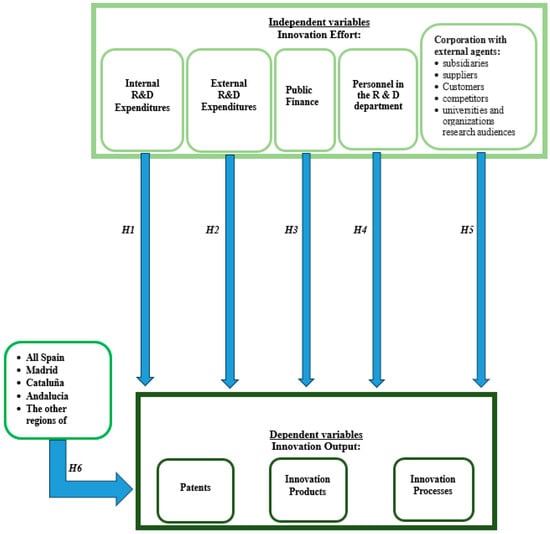
As mentioned above, Figure 1 is a prototype summarizing the literature review.
Figure 1.
Study prototype. Source: own elaboration depending on previous studies regarding the study subject.
1.2. Research Gap
As mentioned earlier in the previous section, there is a gap between previous studies and the current one, in which the latter suggests the differentiations that a company or firm should have when applying innovation correctly and efficiently. There are many effects and inputs used to introduce new avenues for wealth creation from resources (Michalak & Wolniak, 2023); thus, the significance of focusing on the management of innovation efforts within organizations through the development of intellectual capital suited to the organization’s context (Idris & Durmuşoğlu, 2021) is an essential aspect for organizations; the influence of innovation on society and infrastructure must not be overlooked (Zhang et al., 2019). Although the influence of R&D on innovation is uncertain, the ambiguity lies in the fact that heightened R&D does not automatically equate to enhanced innovation within the organization (Vrontis & Christofi, 2021). From a different debate angle, research and studies have highlighted the importance of internal over external organizational factors, indicating that internal organizational elements are more critical and engaging (Carboni & Medda, 2021).
An integrated approach is necessary to grasp the dynamics of place-specific knowledge and the importance of entrepreneurship within the local innovation system for identifying entrepreneurs, by focusing on how to empower participants in innovation processes to mobilize stakeholders’ implicit knowledge and incorporate it into decision-making (Rissola et al., 2017).
This paper examines the impact of innovation effort on innovation output from both a firm and regional viewpoint, focusing on the Spanish context. The primary innovation of this research lies in its contribution to the current discussion regarding how particular firm-level elements affect innovation results, varying by region, to comprehend why innovation occurs in some locations and not others. Additionally, this study utilizes an extensive panel dataset and encompasses a longer timeframe to attain more nuanced and precise findings specifically relevant to the Spanish context, in contrast to most innovation research that depends on cross-sectional data, time series data, or short-term panel data with restricted samples. This method enables the identification of dynamic interactions among the exploratory variables, offering a more profound insight into their advantages and disadvantages than research depending on cross-sectional data, time series data, or short-term panel data with restricted samples. Ultimately, the study aims to enhance, support and give a more efficient atmosphere for encouraging innovation in Spain.
1.3. Research Idea and Study Hypotheses
Hypothesis 1.
The internal innovation effort of companies positively influences the overall innovation output.
The companies’ investment in internal R&D is one of their advantages in generating creative ideas and improving their capacity to perceive, comprehend, and use knowledge. Also, it enhances one’s capacity to absorb innovation’s effects (Aguirre-Campoverde et al., 2021), because entrepreneurship and creativity are the cornerstones of innovation. They are the inspiration behind the development of fresh concepts into novel goods and services (Nawrocki & Jonek-Kowalska, 2023).
In the study by Bataineh et al. (2024), it is stated that a company’s organizational structure, lack of resources, and experience can all be considered internal barriers to innovation that keep them safe from actively implementing changes; therefore, it is crucial to prepare the internal infrastructure (Kushnir et al., 2020).
Internal organizational determinants achieve results in supporting diversity and social interactions, encouraging group learning and co-evolution and implicit knowledge of innovation performance, enhancing innovation policies, building strong trusting relationships, investing in a superior and unique knowledge base, and ensuring that innovation policies are a crucial component of the local context and focus on regional specifics (Lopes et al., 2021). Therefore, industrial zones are built on promoting knowledge, and connecting science to creative activity in organizations (Boschma, 2022).
The first Spanish law on science and technology (Ley 13/1986) includes the organization of the innovation strategy in Andalucía. This legislation establishes the foundation for a national innovation strategy and acknowledges that Spain’s 17 autonomous communities (Comunidades Autonomas) possess the legal authority and autonomy to create their regional innovations, provided they align with European and Spanish innovation policies (Álvarez et al., 2018).
By the late 1980s, innovation emphasis was placed on regional integration and the convergence process through consistent education levels, uniform productive structures, and technological advancement in Andalucía, due to the European perception of Spanish regions as technologically peripheral. Through the European Structural Funds, the nation has raised its R&D spending relative to the EU average, aligning this investment with a regional strategy designed to decrease technological gaps. Despite these measures, the technology gap continues to exist, mainly because of the lengthy process of knowledge creation and the continuous growth of intellectual capital for different organizations. This requires the use of various knowledge processes, especially emphasizing different areas. The innovation processes in Spain align with European standards, being consistent and part of the holistic perspective of the Euro 2020 Strategy (Solov’eva et al., 2018).
Andalucía has established a number of multiple innovation strategies that all contribute to helping the companies enhance innovation outcomes and boost overall employee performance. They are as follows: the initial was the steering plan for innovation and technological advancement 2001–2003, the third research plan in Andalucía 2000–2003, and the research, development, and innovation plan 2007–2013. Finally, Andalucía implemented the development and innovation plan (PAIDI 2014–2020). R&D should become the main instrument for planning, coordinating, promoting, and evaluating R&D and innovation in the region, with the formulation of regional PAIDI aimed at laying a solid foundation for a new paradigm based on knowledge, innovation, and the use of material and human resources for job creation, as well as sustainable development and social cohesion. PAIDI concentrates on various sectors recognized as a strategy for regional development, including Information and Communication Technology (ICT), energy, food, industry, and any other key sectors that enhance technological advancement, alongside the incorporation of high-quality competitive research intended to boost science, technology, and innovation metrics at the regional scale (Álvarez et al., 2018).
Hypothesis 2.
The external innovation effort of companies positively influences overall innovation output.
There exists a difference in viewpoints regarding the influence of R&D on innovation (López-Bazo & Motellón, 2018). Nonetheless, practical research has demonstrated that innovation influences regional knowledge (Miguelez & Moreno, 2018). This, in turn, positively affects innovation results in companies, encourages R&D, and implements fresh concepts in the development of new industries and the gradual growth of operations (Morris, 2018).
The European Union’s innovation policy revolves around the idea of smart specialization for regions: regions should concentrate on their specific advantages, which may include robust transportation networks or vital seaports that serve as assets for particular projects (Song & Wen, 2023). Innovation that is geographically concentrated, or spatial innovation, arises from the region’s inherent capacity for innovation (Papanastassiou et al., 2020). Álvarez et al. (2018) supported this idea by stating that the regional innovation system relies on the interplay of actors within the region, their connections with outside entities at both the national and global scales, and the integration of various knowledge sources, including scientific organizations.
Spatial and temporal factors are well attributing to and considered in assessing the diffusion of innovation across regions; geographical closeness to innovation producers, the presence, accessibility, and transfer of knowledge via electronic means (Yan et al., 2022), and the regional dynamics of knowledge exchange highlight that proximity to innovative zones facilitates innovation, significantly influencing the spread of a knowledge culture that fosters innovation in neighboring regions (Chaminade et al., 2021).
Hypothesis 3.
The public financing of companies positively influences innovation output.
The substantial funding for R&D projects may result from both internal and external sources. Internal finance encompasses assets, reserves, and equity. External funding includes different sources like loans, grants from both national and international organizations, as well as partnerships, and government assistance for research and development (Sánchez-Sellero & Bataineh, 2022). In this scope, it is worth noting that the main element driving Spain’s innovation achievements is the support from the government for R&D in businesses, as mentioned in the study carried out by Giménez-Medina et al. (2023). R&D intensity helps improve firm capabilities by encouraging innovative ideas, the adoption of new technology and simultaneously integrating external knowledge (Bataineh & Sánchez-Sellero, 2025).
However, the focus at the European Union level was specific to regions, and in 2018, the European Commission carried out the work of the European Cohesion Policy to direct the majority of its budget towards the Smart Specialization Strategy (S3); a policy approach that attracts a high number of agents’ attention, and which aids and emphasizes regions in essential innovation and technology sectors by promoting leadership exploration and the idea of the regional innovation system (RIS), founded on a systematic analytical method to explore innovation across regions. It has been determined that there is no universal innovative policy applicable to all, as regional data shows significant variability along with diverse innovative potential and industrial foundations within regions. The locality must be regarded as a feature of innovation, and the responses of companies should be considered due to the distinctiveness of the locale stemming from its varied institutions, ability to attract funding, and quality of services offered (Morisson & Doussineau, 2019).
Hypothesis 4.
The personnel in the R&D departments of companies positively influence innovation output.
Different companies and businesses need skilled individuals and well-qualified personnel who can adjust to shifts in their workplace setting (Martínez-Sánchez et al., 2020). Consequently, a geographical region should correspond with the current availability of skilled workforce, the necessary space, and the demand for resources and business inputs. This alignment can influence the concentration of specific types of activities in confined regions, resulting in a sense of satisfaction in the company in particular and thus in the whole area in general (Klimek, 2018).
Numerous researchers and scholars, such as Vincenzi and da Cunha (2021), view R&D and internal competencies as significant and crucial for producing innovation outcomes. Consequently, people committed to R&D act as an important source of concepts that can improve overall capabilities (Aguirre-Campoverde et al., 2021).
Additionally, hiring individuals in a corporate environment with expertise in R&D (Acuna-Opazo & Castillo-Vergara, 2018) and keeping skilled employees (Rosell-Martínez & Sánchez-Sellero, 2012) are critical drivers for innovation performance.
Hypothesis 5.
Cooperation with external agents positively influences the company’s innovation output.
This hypothesis states that cooperation and collaboration with outside entities significantly and favorably impacts innovation results. By addressing internal resource deficiencies, these partnerships enhance a firm’s ability to produce product and process innovations, boost the originality of their offerings, and deliver significant commercial advantages.
It is worth mentioning that businesses and different types of companies recognize the importance of establishing R&D collaborative connections when they participate in innovation activities with different economic entities, including affiliates, clients, vendors, representatives, organizations, and others. Organizations undertake this process to produce results that cannot be realized internally. By forming cooperation agreements or alliances with external economic agents, companies can tap into diverse resources and share assets, including cost and risk sharing, in addition to dividing the labor involved in the innovation process (Aguirre-Campoverde et al., 2021). Working together offers various advantages for companies’ innovation initiatives, such as shortening the innovation timeline, accelerating product commercialization, pooling costs and risks, obtaining complementary or similar resources, and accessing external expertise (Radicic et al., 2019). Moreover, innovation strategies tend to succeed more when businesses can acquire, modify, and apply external knowledge (Carrasco-Carvajal et al., 2023).
Moreover, utilizing specialized local suppliers for outsourcing facilitates adaptable and streamlined production, along with straightforward access to consulting services. Agglomeration benefits and proximity to clients enable visibility and collaboration in vertical connections, such as those involving businesses, clients, and suppliers. Conversely, rivalry among companies within the same industry fosters diversity and productivity (Li et al., 2019).
Current vertical connections with suppliers, customers, and competitors are vital, along with the necessary elements of collaboration partners and external information resources. Collaboration with universities and organizations is defined as a process of working together with suppliers and client/supplier relationships. Universities provide organizations with creative concepts for efficient operations, whereas university students act as possible or current clients, offering insights into competitors and their most effective results. Attempting to surpass them or match their pace at work serves as one of the driving forces for the innovation process (Ikeuchi, 2015).
Hypothesis 6.
The innovation efforts of companies in different regions of Spain have a different influence on innovation output.
Regardless of the specific initiatives and the results they generate, the innovation efforts undertaken by companies in different regions of Spain have a significant impact on overall innovation performance.
In this context, it is important to highlight that the European Union considers innovation as the foundation of sustainable, knowledge-driven economic growth, promoting social welfare. Despite the many efforts implemented to boost innovation (Brodny et al., 2023), challenges remain.
In this field of discussion, it is worth pointing to the innovation policy of the European Union as an important example, where innovation is founded on the idea of smart regional specialization. These areas must focus on their distinct advantages, whether it involves utilizing their location or having strong transportation networks or harbors that enhance their capabilities, based on the specific project involved. Although being close to trade is important for innovation, it is not the only factor involved. Regional development aims to enhance the efficiency of R&D policies while creating them in conjunction with other policies that target the enhancement of social, economic, and structural factors influencing regional innovation performance (Vakhovych et al., 2021).
To be more specific, innovation focused on a specific area, commonly referred to as spatial innovation, arises from the local ability to innovate in a certain region, the spread of knowledge within a specific locale, and the transition to various policies that facilitate knowledge accessibility in that area, significantly influencing innovation processes.
The impact of geographical space on the spread of technological knowledge, both inside and across regions, extends beyond mere geographical proximity to encompass the technological accessibility of knowledge. As stated by Papanastassiou et al. (2020), the role that geographical space can play in disseminating technological knowledge, both within and between regions, cannot be limited to geographical proximity, but rather to the technological availability of knowledge. According to these authors, Papanastassiou et al. (2020), the regional innovation system relies on the collaboration of entities within the region, its connections with outside parties at state and global levels, factoring in the region’s industrial structure and small and medium enterprises, while integrating various knowledge sources such as academic and scientific institutions to ensure a high level of diversity (Álvarez et al., 2018), along with the advantages offered by government regulations (Tania et al., 2022).
2. Data, Model, and Methodology
2.1. Data
The study methodology is based on a descriptive-analytical approach, facilitating an illustration of the innovation effort through the researchers’ input, the employment of experiments from different nations, and the use of analytical techniques to examine the data collected from the study group. This procedure ultimately leads to the use of comparative methods to pinpoint the similarities and differences across Spain’s regions.
Using the data provided by the Technological Innovation Panel (PITEC) of the Ministry of Economy and Competitiveness of Spain, PITEC is the finest dataset to track innovation activity over time in Spanish businesses (Díez-Vial & Fernández-Olmos, 2015). We conduct the analysis using panel data from 12,849 Spanish organizations from 2003 to 2016, as the PITEC only includes data from this period. This allows us to investigate the impact of innovation inputs on outputs by examining independent and dependent variables. Consequently, we propose models using econometric statistical methodologies on the data, as shown in Appendix A. The companies are divided into four categories: Madrid, Cataluña, Andalucía, and the other regions of Spain, which work in around 50 fields.
2.2. Model and Methodology
This research benefits from a thorough panel dataset across an extended timeframe to generate more precise and detailed findings through the regression model, as regression analysis examines the impact of variables, while also enabling predictions and causal relationships. In binary classifications, the logistic function is a solid option. It can transform any real number into a probability value ranging from 0 to 1.
The research on panel data has conventionally concentrated on extending these to various latent factor models that are equivalent to the low-rank factorizations (Athey & Imbens, 2019). The following models represent a production function that incorporates the impact of innovation effort on innovation output by distinguishing geographical areas in Spain (Madrid, Cataluña, Andalucía, and other Spanish regions). This research employs logistic regression to efficiently categorize data into separate groups by uncovering connections within a specific set of labeled data. The choice to employ the logistic function for binary classifications is well-justified. It has the distinct capability to convert any real number into a probability value ranging from 0 to 1. Logistic regression utilizes these datasets to create strong predictive models (Zaidi & Al Luhayb, 2023).
The study models were estimated by following three regressions:
PATit = α + β1 ∗ (IRDE)it + β2 ∗ (ERDE)it + β3 ∗ (PRDF)it + β4 ∗ (ERDD)it + β5 ∗ (CRDSS)it + β6 ∗ (CRDSR)it + β7 ∗ (CRDCL)it + β8 ∗ (CRDCO)it + β9 ∗ (CRDPR)it + Tt + Ƹit
INPRODit = α + β1 ∗ (IRDE)it + β2 ∗ (ERDE)it + β3 ∗ (PRDF)it + β4 ∗ (ERDD)it + β5 ∗ (CRDSS)it + β6 ∗ (CRDSR)it + β7 ∗ (CRDCL)it + β8 ∗ (CRDCO)it + β9 ∗ (CRDPR)it + Tt + Ƹit
INPROCit = α + β1 ∗ (IRDE)it + β2 ∗ (ERDE)it + β3 ∗ (PRDF)it + β4 ∗ (ERDD)it + β5 ∗ (CRDSS)it + β6 ∗ (CRDSR)it + β7 ∗ (CRDCL)it + β8 ∗ (CRDCO)it + β9 ∗ (CRDPR)it + Tt + Ƹit
The following are details for the variables in the model of the effects of the innovation effort on the innovation output.
i: firm.
t: year.
a: constant coefficient.
β: regression coefficient.
Tt: year coefficient.
Ƹit: error term.
The following explains more:
PAT: Patent takes a value of 1 if it applies for a patent, 0 if it does not.
INPROD: Product innovation takes a value of 1 if it produces a product innovation (incorporation of new materials, incorporation of new components or intermediate products, incorporation of new designs and presentation, and incorporation of new functions into the product), 0 if it does not.
INPROC: Process innovation takes a value of 1 if it makes process innovation (introduction of new machinery, or new methods of organizing production), 0 if it does not.
IRDE: Internal R&D expenditure takes a value of 1 if it undertakes internal R&D expenditures, 0 if it does not.
ERDE: External R&D expenditure takes a value of 1 if it undertakes external R&D expenditures, 0 if it does not.
ERDD: The ratio of the number of employees working in the R&D department in relation to the total number of employees.
PRDF: Amount of public R&D funding divided by total R&D costs.
CRDSS: Collaborates in R&D with subsidiaries, takes a value of 1 if it collaborates in R&D with subsidiaries, 0 if it does not.
CRDSR: Collaborates in R&D with suppliers, takes a value of 1 if it collaborates in R&D with suppliers, 0 if it does not.
CRDCL: Collaborates in R&D with clients, takes a value of 1 if it collaborates in R&D with clients, 0 if it does not.
CRDCO: Collaborates in R&D with competitors, takes a value of 1 if it collaborates in R&D with competitors, 0 if it does not.
CRDPR: Collaborates in R&D with public research organizations, take a value of 1 if it collaborates in R&D with public research organizations, 0 if it does not.
Table 1 and Table 2 give the descriptive statistics (mean, standard deviation, minimum, and maximum) and correlation matrix for the independent and dependent variables of expression (1) to facilitate the interpretation of the regression output, in addition to the analysis of the variance inflation factor (VIF).
Table 1.
Descriptive statistics.
Table 1 presents the average to give a summary of the common values that the data is clustered and gathered around. In addition, the standard deviation and (highest and lowest values) assess variability and reliability. The previously mentioned points enable the detection of mistakes that may impact the validity of the analysis prior to moving on to the subsequent phase.
The table indicates that there is a direct relationship between the common values and the data needed.
Table 2 explains the degree of correlation and VIF value among variables:
Table 2.
Correlation matrix and VIF value.
Table 2 clearly shows that the variables do not overlap, repeat, or intersect with another variable. The analysis results show that each variable is in its highest possible location compared to other variables. Table 3, Table 4 and Table 5 show the effect of the study variables.
Table 3.
Explanatory factors for the creation of patents in companies in Spanish regions (dependent variable: PAT).
Table 4.
Explanatory factors of product innovation in companies in Spanish regions (dependent variable: INPROD).
Table 5.
Explanatory factors of process innovation in companies in Spanish regions (dependent variable: INPROC).
Table 2 additionally presents the variance inflation factors (VIF), which employ a statistical method to determine if multicollinearity is present among the independent variables. Nonetheless, the findings show strong associations among the independent variables, and there is not a high correlation between any two; all have VIF values below 10. The analysis shows that every independent variable affects the dependent variable. This aligns with the VIF analysis since it factors in all study variables without omitting any. Those researching this topic ought to incorporate all study variables because of their influence on the dependent variable. Considering the variation in its effect on the dependent variable, the influence of innovation efforts and its effect on patents is evident.
3. Estimation Results
The authors conducted the analysis and showcased the findings of the study. The estimators were all acquired using Stata 14 and are presented in Table 3, Table 4 and Table 5. Their columns document the assessments of innovation effort regarding innovation output by geographical regions in Spain.
These findings indicate that internal R&D expenditures influence patents in Spanish companies, with a high likelihood observed across all regions studied except in Andalucía, where the effect was minimal. Furthermore, the impact of external R&D expenditures on patents in Spanish companies. Additionally, the ratio of the number of employees working in the R&D department in relation to the total number of employees on patents in Spanish companies. Along with the impact of public R&D funding in relation to total R&D expenditures on patents in Spanish companies, as previously noted, showed a high likelihood across all study areas. R&D expenditures fundamentally drive patent generation by fueling the input side of the innovation lifecycle.
Furthermore, the influence of collaborations in R&D with subsidiaries on patent generation in the Spanish companies was moderate in other areas of Spain and Madrid, with no impact observed across all research regions. Additionally, there is an influence of collaborating with clients in R&D on patents within Spanish companies, exhibiting a high likelihood throughout Spain, a weak presence in Madrid, and no impact in other studied regions. Moreover, collaboration in R&D with rivals concerning patents was observed in Spanish companies, and the likelihood of this occurrence was moderate in Cataluña, with no impact in other areas studied. Additionally, the influence of collaborations in R&D with public research entities on patents in Spanish companies was significant in other study regions, except for Andalucía, where it was moderate.
The coefficient for the year variable is positive and statistically significant, suggesting a general rise in patents during the study duration. Notably, all of Spain recorded the highest observations, whereas Andalucía had the fewest, and the lowest ones.
These findings indicate an influence of internal R&D expenditures on product innovations in Spanish companies, with a high likelihood across all regions examined. Moreover, the influence of external R&D costs on product innovations in Spanish companies, as well as the likelihood of occurrence, was significant across all study areas, except for Andalucía, where it was moderate. In addition the ratio of the number of employees working in the R&D department in relation to the total number of employees on product innovations in Spanish companies was elevated in all regions studied except Andalucía, where it was not. Moreover, the influence of public R&D funding as a proportion of total R&D expenditure on product innovations was significant in all study regions, except for Madrid, where it was moderate. Additionally, the influence of collaborations in R&D with subsidiaries on product innovations in Spanish companies was significant across all study areas except in Andalucía, where no impact was observed. Additionally, the influence of collaboration in R&D with clients on product innovations in Spanish companies was significant across all study areas, except for Madrid, where it was minimal. Moreover, the influence of partnerships in R&D with rivals on product innovation in Spanish companies was significant across all of Spain, moderate in various regions, weak in Madrid, and absent in Cataluña and Andalucía. Additionally, the impact of collaborations in R&D with public research institutions on product innovation in Spanish companies was significant across all studied regions.
The coefficient for the year variable is positive and statistically substantial, suggesting a general rise in product innovations during the study timeframe. Notably, Spain recorded the highest number of observations, whereas Andalucía had the lowest.
When companies dedicate financial resources to internal research and apply the standards through tables, they directly build the foundation for new effective inventions with better innovation.
These findings indicate that internal R&D spending influences the process innovation in Spanish companies, with a high likelihood of occurrence in all regions studied. Moreover, the influence of external R&D expenditures on the process innovation in Spanish companies and the likelihood of occurrence were significant across all study areas. In addition, the ratio of the number of employees working in the R&D department in relation to the total number of employees on process innovation is significant in all of Spain and the other regions of Spain, while having no impact in Madrid, Cataluña, and Andalucía. Moreover, the impact of public R&D funding in relation to total R&D expenditures on the process innovation was significant in all study areas except Madrid, where it was not. Furthermore, the impact of collaboration in R&D with subsidiaries on the process innovation in Spanish companies was significant, and the likelihood of occurrence was low in all areas studied except Andalucía. Collaboration with suppliers in R&D significantly influences process innovations in Spanish companies, with a high likelihood observed across all study regions. Moreover, the influence of collaboration in R&D with clients on the process innovation in Spanish companies was significant throughout all of Spain and its other regions, showing no impact in other researched areas. In addition, the impact of collaborations with competitors in R&D on the process innovation within Spanish companies showed a high likelihood across all of Spain, moderate in Andalucía, weak in other regions, and no effect observed in Madrid and Cataluña. Additionally, the influence of collaborations in R&D with public research institutions on the process innovation in Spanish companies was significant in all study areas, though in Madrid it was moderate.
According to the table above, it is important to note that process innovation in Spanish companies is influenced not just by the R&D system, but also by the process innovations they implement and utilize to enhance the overall performance of the company.
The coefficient for the year variable is positive and statistically significant, suggesting a general rise in the process innovation over the study duration. Interestingly, all of Spain had the highest number of observations, whereas Andalucía had the fewest and the lowest.
4. Discussion
This section utilizes the findings presented in Section 4, from which intriguing insights and interpretations regarding the influence of innovation inputs on innovation outputs using long-term data are discussed as follows:
Unlike most innovation studies that depend on cross-sectional data, time series data, or short-term panel data with restricted samples, this research utilized an extensive panel dataset covering a longer timeframe and from various sources. This method enabled us to grasp the dynamic connections among the exploratory variables. As a result, the logit model for panel data turned out to be the most suitable statistical approach for our analysis.
It is essential to recognize that innovation is a complex and systematic process, and that environmental differences are a key factor influencing it. This is why there is much debate among authors about the evidence or contradictions of indicators and why innovation in one area is not necessarily a success in others.
4.1. Effecting the Internal and External Innovation Effort of Companies on Overall Innovation Output
Increasingly, the Spanish companies focus on internal and external (R&D) spending; this focus comes from the understanding that R&D investment directly impacts the quality of their work. Improved work quality subsequently raises the likelihood of generating innovative results that fulfill the needs of the fiercely competitive market landscape. Nonetheless, there is a gap in the R&D expenditures of Andalucía and Cataluña relative to other areas. Although the progress in Andalucía is praiseworthy, ongoing focus is essential; therefore, H1 and H2 are confirmed. Moreover, public funding influences the innovation results of Spanish companies; this conclusion corresponds with the European Commission’s choice to designate the biggest part of its 2018 budget to the Smart Specialization Strategy (S3) initiative. The S3 initiative recognizes and promotes regional priorities in essential technology and innovation fields via a leadership exploration method. It further highlights the idea of regional innovation systems (RIS). This framework employs a systematic analysis approach to explore the dynamics of innovation in particular regions (Morisson & Doussineau, 2019).
4.2. Effecting the Public Financing of Companies on Innovation Output
This result corresponds with the research by Giménez-Medina et al. (2023), which recognized government support for R&D in companies as the main element affecting innovation success in Spain. This involves raising both internal and external expenditures on employee training and development, particularly designating a greater share of the budget for this purpose. Thus, it is essential to take into account the proportion of employees in the R&D department compared to the overall employee count. Bringing additional staff to these areas is crucial because of their function in producing groundbreaking innovations; therefore, H3 is confirmed. This outcome corresponds with the results of Aguirre-Campoverde et al. (2021), who recognized a firm’s commitment to internal R&D as a significant advantage. This type of investment promotes innovative idea development and enhances a firm’s capacity to recognize, comprehend, and leverage knowledge.
4.3. Effecting the Personnel in the R&D Departments of Companies on Innovation Output
Companies require qualified personnel who can adapt to evolving work environments because the personnel in the R&D departments of companies positively influence innovation output. Thus, H4 is validated; this result aligns with a study by Martínez-Sánchez et al. (2020). Additionally, this result supports the findings of Solov’eva et al. (2018), which emphasized the importance of utilizing diverse knowledge processes, with a particular focus on knowledge specific to different regions. Also, the ratio of employees working in the R&D department in relation to the total number of employees can affect their innovation output. In other words, the relative size of an R&D department compared to the total workforce can influence the company’s ability to generate new ideas and products. Therefore, recruiting highly skilled personnel and fostering the talents of university graduates, especially those with diverse backgrounds and thinking styles, can be beneficial for the innovation process. This finding aligns with the study of Martínez-Sánchez et al. (2020), which identified individuals seeking R&D as valuable sources of ideas.
4.4. Effecting Cooperation with External Agents on the Company’s Innovation Output
Working with external agents positively impacts the innovation output of the company; collaboration with the external environment is vital for Spanish companies, and engaging with various parties is highlighted for its influence on innovation results. External collaboration varied among companies. This indicates that Spanish companies ought to share responsibilities in the innovation process by establishing collaborative agreements or partnerships with economic stakeholders. Consequently, H5 is confirmed, which is consistent with the results of Aguirre-Campoverde et al. (2021), who confirmed the necessity to establish R&D collaboration links when they participate in innovation activities with different economic entities, including subsidiaries, clients, suppliers, agents, organizations, and more. Businesses and companies participate in this process to produce results that cannot be attained internally.
4.5. Different Effecting the Innovation Efforts of Companies in Different Regions of Spain on Innovation Output
The research identified that variations in innovation efforts affect results across Spanish regions. This is attributable to various factors, including the characteristics of the region itself. Areas that possess skilled human resources, educational facilities, and research institutions dedicated to cultivating a talented workforce usually experience a larger effect from innovation. Moreover, the current kinds of enterprises in an area have an influence. For instance, the flourishing tourism sector in Andalucía draws investment towards tourism-related endeavors and trade, resulting in a reduced focus on industrial growth. Thus, H6 is confirmed, which corresponds with Vakhovych et al.’s (2021) research on regional development aimed at enhancing the efficiency of R&D policies. Moreover, R&D policies must be formulated alongside other policies addressing the social, economic, and structural factors influencing regional innovation performance. This finding aligns with the research by Álvarez et al. (2018), which emphasized the importance of considering regional structure and incorporating diverse sources of knowledge, including academic and scientific institutions, to achieve a significant level of diversity.
Success in one domain does not ensure achievement in others due to significant differences in contexts, user requirements, and ecosystem interdependencies. A significant advancement in one area frequently does not succeed in another due to incompatible problem–solution alignments, varying regulatory or cultural environments, and insufficient supporting infrastructure. For the majority of individuals, innovation is not an innate ability. Innovation should be approached in a manner distinct from other roles within an organization. Accompanying this are difficulties and setbacks.
5. Conclusions and Policy Implications
The analysis from the earlier sections enables the formulation of several relevant conclusions:
The innovation initiative is a cohesive process that relies on a mix of internal and external elements. It results from numerous factors that shape it, starting with overall culture and concluding with geographical location, considering R&D, scientific expertise, and intellectual resources, along with agreement at the governmental level in implementing suitable measures to enhance efforts toward innovation processes in various areas that influence the dissemination of current knowledge to those engaged in this field and to gain insights into diverse experiences through collaboration with public or private research and training institutes, focusing on the involvement of all societal groups in the development of innovation strategies by every social group at either the national or regional level. Thus, this research reinforces the notion that highlights the significance of both internal and external factors of the organization on innovation outcomes, as simultaneously, there can be no competitive innovation without backing from external elements. Moreover, there will be no advancement in competition without backing internal elements, even if the organization has a solid relationship with valuable external insights.
R&D is vital and highly important for developing an environment that promotes innovation. The rise in productivity can be largely linked to R&D. Enhanced productivity may also serve as a driver for innovation, as it sometimes leads to reduced production durations. R&D is an essential element required to attain successful innovative solutions. Consequently, this research reinforces the notion that highlights the beneficial impact of R&D on innovation results.
Internal and external elements significantly influence the innovation results in Spanish companies, highlighting the beneficial effect of outside factors on innovation output and the crucial role of R&D in promoting innovation and leveraging new concepts to create new sectors.
External innovation initiatives across all of Spain and its various regions had the most beneficial impact on innovation output, while lower positive effects were noted in Cataluña, Madrid, and Andalucía. This outcome was expected, as all regions in Spain were aggregated and analyzed collectively, referred to as all of Spain (which comprises 14 regions, including País Vasco, Cantabria, Galicia, Comunidad Valenciana, Aragón, La Rioja, Murcia, etc., alongside Cataluña, Madrid, and Andalucía).
Although the influence of the independent variables on the dependent variables varied, the overall effect on Spain as a whole was beneficial. Andalucía and Cataluña need to reconsider their approach by enhancing patent promotion through collaboration with various research institutions and developing organizations that assist individuals offering innovative services in the industrial or service sectors. Creating a culture that promotes innovation efforts is essential, relying on the timing and understanding of action potential, as well as the capability to produce innovative results, while simultaneously including all social groups in the formulation of innovative policies at the state or regional scale.
In conclusion, the enduring relationship between R&D investment and innovation outputs reveals a clear pattern: Spanish companies consistently outperform expectations, producing a significant amount of innovation results (patents and new processes) compared to their initial financial and infrastructural contributions. Furthermore, the application of innovation across various companies and businesses in Spain is essential and significant; it is necessary for companies to thrive and endure, as it serves as the main catalyst for sustainable growth, enabling businesses to adjust to changing markets, reduce operational expenditures, and establish an enduring competitive advantage over competitors. It is a fundamental aspect for benefits for companies, and a lasting achievement for the businesses overall.
Author Contributions
Conceptualization, K.H.S.A.-M., P.S.-S. and Ó.R.-M.; Methodology, K.H.S.A.-M., P.S.-S. and Ó.R.-M.; Software, K.H.S.A.-M., P.S.-S. and Ó.R.-M.; Validation, K.H.S.A.-M., P.S.-S. and Ó.R.-M.; Formal analysis, K.H.S.A.-M., P.S.-S. and Ó.R.-M.; Investigation, K.H.S.A.-M., P.S.-S. and Ó.R.-M.; Resources, K.H.S.A.-M., P.S.-S. and Ó.R.-M.; Data curation, K.H.S.A.-M., P.S.-S. and Ó.R.-M.; Writing—original draft, K.H.S.A.-M., P.S.-S. and Ó.R.-M.; Writing—review and editing, K.H.S.A.-M., P.S.-S. and Ó.R.-M.; Visualization, K.H.S.A.-M., P.S.-S. and Ó.R.-M.; Supervision, K.H.S.A.-M., P.S.-S. and Ó.R.-M.; Project administration, K.H.S.A.-M., P.S.-S. and Ó.R.-M.; Funding acquisition, K.H.S.A.-M., P.S.-S. and Ó.R.-M. All authors have read and agreed to the published version of the manuscript.
Funding
This research was funded by MCIN/AEI/10.13039/501100011033 and “ERDF A way of making Europe” grant number PID2021-123154NB-I00 and by Government of Aragón (Spain) and ERDF grant number COMPETE (S52_23R) research group. It was also funded by Xunta de Galicia grant number ICEDE research group and Galician Competitive Research Group ED431C 2022/25.
Institutional Review Board Statement
Not applicable.
Informed Consent Statement
Not applicable.
Data Availability Statement
PITEC dataset is available at the website https://www.ine.es/dyngs/INEbase/es/operacion.htm?c=Estadistica_C&cid=1254736176755&menu=resultados&secc=1254736195616&idp=1254735576669#_tabs-1254736195616, accessed on 2 March 2026.
Acknowledgments
This work was supported by the grant PID2021-123154NB-I00 funded by MCIN/AEI/10.13039/501100011033 and “ERDF A way of making Europe”, and by the COMPETE (S52_23R) research group funded by Government of Aragón (Spain) and ERDF. It was also supported by the ICEDE research group, to which Ó.R.-M. belongs, Galician Competitive Research Group ED431C 2022/25 financed by Xunta de Galicia.
Conflicts of Interest
The authors declare no conflicts of interest.
Appendix A
Table A1.
The field of industry organizations. Source: own calculations from PITEC.
References
- Acuna-Opazo, C., & Castillo-Vergara, M. (2018). Barriers to non-technological innovation: Impact on business performance in an emerging economy. Contaduría y Administración, 63(3), 32–33. [Google Scholar]
- Aguirre-Campoverde, M. A., Sánchez-Sellero, P., & Mendoza-Vargas, E. Y. (2021). Determinantes del resultado de la innovación en empresas españolas. Revista de Ciencias Sociales, 27(3), 181–192. [Google Scholar]
- Athey, S., & Imbens, G. W. (2019). Machine learning methods that economists should know about. Annual Review of Economics, 11, 685–725. [Google Scholar]
- Álvarez, I., Juan, M., & Torrecillas, C. (2018). Specificity and pervasiveness of dialogues in science, technology, and innovation policies in Spain. Science and Public Policy, 45(3), 329–337. [Google Scholar] [CrossRef] [Scilit]
- Bataineh, M. J., & Sánchez-Sellero, P. (2025). Export intensity, intellectual property and technology development as drivers for green innovations. European Journal of International Management, 26(2), 334–363. [Google Scholar] [CrossRef] [Scilit]
- Bataineh, M. J., Sánchez-Sellero, P., & Ayad, F. (2024). The role of organizational innovation in the development of green innovations in Spanish firms. European Management Journal, 42(4), 527–538. [Google Scholar]
- Boschma, R. (2022). Global value chains from an evolutionary economic geography perspective: A research agenda. Area Development and Policy, 7(2), 123–146. [Google Scholar] [CrossRef] [Scilit]
- Brodny, J., Tutak, M., Grebski, W., & Bindzár, P. (2023). Assessing the level of innovativeness of EU-27 countries and its relationship to economic, environmental, energy and social parameters. Journal of Open Innovation: Technology, Market, and Complexity, 9(2), 100073. [Google Scholar] [CrossRef] [Scilit]
- Cabrer-Borras, B., & Serrano-Domingo, G. (2007). Innovation and R&D spillover effects in Spanish regions: A spatial approach. Research Policy, 36(9), 1357–1371. [Google Scholar]
- Carboni, O. A., & Medda, G. (2021). External R&D and product innovation: Is over-outsourcing an issue? Economic Modelling, 103, 105601. [Google Scholar] [CrossRef] [Scilit]
- Carrasco-Carvajal, O., García-Pérez-de-Lema, D., & Castillo-Vergara, M. (2023). Impact of innovation strategy, absorptive capacity, and open innovation on SME performance: A Chilean case study. Journal of Open Innovation: Technology, Market, and Complexity, 9(2), 100065. [Google Scholar] [CrossRef] [Scilit]
- Chaminade, C., Bellandi, M., Plechero, M., & Santini, E. (2021). Understanding processes of path renewal and creation in thick specialized regional innovation systems. Evidence from two textile districts in Italy and Sweden. In Rethinking clusters (pp. 100–116). Routledge. [Google Scholar]
- Crespo, N. F., Al-Deaja, A. A., & Sanchez-Sellero, P. (2026). Configurations for green innovation: Assessing the impact of supply, demand, and institutional factors in domestic and exporting companies. International Business Review, 35(5), 102614. [Google Scholar] [CrossRef] [Scilit]
- Del-Aguila-Arcentales, S., Alvarez-Risco, A., & Yáñez, J. A. (2023). Innovation and its effects on compliance with sustainable development goals and competitiveness in European Union countries. Journal of Open Innovation: Technology, Market, and Complexity, 9(3), 100127. [Google Scholar]
- Díez-Vial, I., & Fernández-Olmos, M. (2015). Knowledge spillovers in science and technology parks: How can firms benefit most? The Journal of Technology Transfer, 40, 70–84. [Google Scholar]
- Franco, S., & Wilson, J. R. (2025). 2025 Basque country competitiveness report: International connectivity, a driver for industry. Orkestra-Instituto Vasco de Competitividad. [Google Scholar]
- Giménez-Medina, M., Enríquez, J. G., Olivero, M. A., & Domínguez-Mayo, F. J. (2023). The innovation challenge in Spain: A Delphi study. Expert Systems with Applications, 230, 120611. [Google Scholar] [CrossRef] [Scilit]
- Har, L. L., Rashid, U. K., Te Chuan, L., Sen, S. C., & Xia, L. Y. (2022). Revolution of the retail industry: From perspective of retail 1.0 to 4.0. Procedia Computer Science, 200, 1615–1625. [Google Scholar] [CrossRef] [Scilit]
- Idris, M. C., & Durmuşoğlu, A. (2021). Innovation management systems and standards: A systematic literature review and guidance for future research. Sustainability, 13(15), 8151. [Google Scholar] [CrossRef] [Scilit]
- Ikeuchi, K. (2015). Empirical studies on the sources of agglomeration economies [Doctoral dissertation, Hitotsubashi University]. [Google Scholar]
- Klimek, A. (2018). Agglomeration economies and foreign direct investment in advanced business services in Poland. International Journal of Management and Economics, 54(1), 69–79. [Google Scholar]
- Kushnir, D., Hansen, T., Vogl, V., & Åhman, M. (2020). Adopting hydrogen direct reduction for the Swedish steel industry: A technological innovation system (TIS) study. Journal of Cleaner Production, 242, 118185. [Google Scholar] [CrossRef] [Scilit]
- Larios-Francia, R. P., & Ferasso, M. (2023). The relationship between innovation and performance in MSMEs: The case of the wearing apparel sector in emerging countries. Journal of Open Innovation: Technology, Market, and Complexity, 9(1), 100018. [Google Scholar] [CrossRef] [Scilit]
- Le, T. T., & Le, P. B. (2023). High-involvement HRM practices stimulate incremental and radical innovation: The roles of knowledge sharing and market turbulence. Journal of Open Innovation: Technology, Market, and Complexity, 9(1), 100006. [Google Scholar]
- Lee, S. M., & Trimi, S. (2018). Innovation for creating a smart future. Journal of Innovation & Knowledge, 3(1), 1–8. [Google Scholar] [CrossRef] [Scilit]
- Li, J., Webster, D., Cai, J., & Muller, L. (2019). Innovation clusters revisited: On dimensions of agglomeration, institution, and built-environment. Sustainability, 11(12), 3338. [Google Scholar] [CrossRef] [Scilit]
- Lin, S., Chen, Z., & He, Z. (2021). Intra-city industrial collaborative agglomeration, inter-city network connectivity, and green technology innovation. Sustainability, 13(16), 8835. [Google Scholar]
- Lopes, J. M., Gomes, S., Oliveira, J., & Oliveira, M. (2021). The role of open innovation, and the performance of European Union regions. Journal of Open Innovation: Technology, Market, and Complexity, 7(2), 120. [Google Scholar] [CrossRef] [Scilit]
- López-Bazo, E., & Motellón, E. (2018). Innovation, heterogeneous firms and the region: Evidence from Spain. Regional Studies, 52(5), 673–687. [Google Scholar] [CrossRef] [Scilit]
- Maqdliyan, R., & Setiawan, D. (2023). Antecedents and consequences of public sector organizational innovation. Journal of Open Innovation: Technology, Market, and Complexity, 9(2), 100042. [Google Scholar]
- Martínez-Sánchez, A., Vicente-Oliva, S., & Pérez-Pérez, M. (2020). The relationship between R&D, the absorptive capacity of knowledge, human resource flexibility and innovation: Mediator effects on industrial firms. Journal of Business Research, 118, 431–440. [Google Scholar] [CrossRef] [Scilit]
- Michalak, A., & Wolniak, R. (2023). The innovativeness of the country and the renewables and non-renewables in the energy mix on the example of European Union. Journal of Open Innovation: Technology, Market, and Complexity, 9(2), 100061. [Google Scholar] [CrossRef] [Scilit]
- Miguelez, E., & Moreno, R. (2018). Relatedness, external linkages and regional innovation in Europe. Regional Studies, 52(5), 688–701. [Google Scholar] [CrossRef] [Scilit]
- Morisson, A., & Doussineau, M. (2019). Regional innovation governance and place-based policies: Design, implementation, and implications. Regional Studies, Regional Science, 6(1), 101–116. [Google Scholar] [CrossRef] [Scilit]
- Morris, D. M. (2018). Innovation and productivity among heterogeneous firms. Research Policy, 47(10), 1918–1932. [Google Scholar] [CrossRef] [Scilit]
- Nawrocki, T. L., & Jonek-Kowalska, I. (2023). Innovativeness in energy companies in developing economies: Determinants, evaluation and comparative analysis using the example of Poland. Journal of Open Innovation: Technology, Market, and Complexity, 9(1), 100030. [Google Scholar] [CrossRef] [Scilit]
- Papanastassiou, M., Pearce, R., & Zanfei, A. (2020). Changing perspectives on the internationalization of R&D and innovation by multinational enterprises: A review of the literature. Journal of International Business Studies, 51(4), 623–664. [Google Scholar] [CrossRef] [Scilit]
- Ponsiglione, C., Quinto, I., & Zollo, G. (2018). Regional innovation systems as complex adaptive systems: The case of lagging European regions. Sustainability, 10(8), 2862. [Google Scholar] [CrossRef] [Scilit]
- Pylypenko, H. M., Pylypenko, Y. I., Dubiei, Y. V., Solianyk, L. G., Pazynich, Y. M., Buketov, V., Smoliński, A., & Magdziarczyk, M. (2023). Social capital as a factor of innovative development. Journal of Open Innovation: Technology, Market, and Complexity, 9(3), 100118. [Google Scholar] [CrossRef] [Scilit]
- Radicic, D., Douglas, D., Pugh, G., & Jackson, I. (2019). Cooperation for innovation and its impact on technological and non-technological innovations: Empirical evidence for European SMEs in traditional manufacturing industries. International Journal of Innovation Management, 23(05), 1950046. [Google Scholar] [CrossRef] [Scilit]
- Rajapathirana, R. J., & Hui, Y. (2018). Relationship between innovation capability, innovation type, and firm performance. Journal of Innovation & Knowledge, 3(1), 44–55. [Google Scholar] [CrossRef] [Scilit]
- Reddy, K., & Sasidharan, S. (2023). Innovative efforts and export market survival: Evidence from an emerging economy. Technological Forecasting and Social Change, 186, 122109. [Google Scholar] [CrossRef] [Scilit]
- Rissola, G., Hervas, F., Slavcheva, M., & Jonkers, K. (2017). Place-based innovation ecosystems: Espoo innovation garden and Aalto University (Finland) (No. JRC106122). Joint Research Centre (Seville Site). [Google Scholar]
- Rosell-Martínez, J., & Sánchez-Sellero, P. (2012). Foreign direct investment and technical progress in Spanish manufacturing. Applied Economics, 44(19), 2473–2489. [Google Scholar] [CrossRef] [Scilit]
- Rumanti, A. A., Rizana, A. F., & Achmad, F. (2023). Exploring the role of organizational creativity and open innovation in enhancing SMEs performance. Journal of Open Innovation: Technology, Market, and Complexity, 9(2), 100045. [Google Scholar] [CrossRef] [Scilit]
- Sánchez-Sellero, P., & Bataineh, M. J. (2022). How R&D cooperation, R&D expenditures, public funds, and R&D intensity affect green innovation? Technology Analysis & Strategic Management, 34(9), 1095–1108. [Google Scholar] [CrossRef] [Scilit]
- Sánchez-Sellero, P., & Bataineh, M. J. (2024). Efforts to innovate favouring the absorption of foreign direct investment so as to achieve beneficial outcomes from innovation. Systems, 12(4), 116. [Google Scholar] [CrossRef] [Scilit]
- Sánchez-Sellero, P., Sánchez-Sellero, M. C., Sánchez-Sellero, F. J., & Cruz-González, M. M. (2015). Effects of innovation on technical progress in Spanish manufacturing firms. Science Technology and Society, 20(1), 44–59. [Google Scholar] [CrossRef] [Scilit]
- Schot, J., & Steinmueller, W. E. (2018). Three frames for innovation policy: R&D, systems of innovation, and transformative change. Research Policy, 47(9), 1554–1567. [Google Scholar] [CrossRef] [Scilit]
- Solov’eva, T. Y. S., Popov, A. V., Caro-Gonzalez, A., & Hua, L. (2018). Social innovation in Spain, China, and Russia: Key aspects of development. Economic and Social Changes: Facts, Trends, Forecast, 11(2), 52–68. [Google Scholar] [CrossRef] [Scilit]
- Song, L., & Wen, Y. (2023). Financial subsidies, tax incentives and technological innovation in China’s integrated circuit industry. Journal of Innovation & Knowledge, 8(3), 100406. [Google Scholar] [CrossRef] [Scilit]
- Soto-Acosta, P., Popa, S., & Palacios-Marqués, D. (2016). E-business, organizational innovation and firm performance in manufacturing SMEs: An empirical study in Spain. Technological and Economic Development of Economy, 22(6), 885–904. [Google Scholar] [CrossRef] [Scilit]
- Tania, F. G., Vicente, L., Blanca, P. G., & Fernando, R. M. (2022). Measuring the territorial effort in research, development, and innovation from a multiple criteria approach: Application to the Spanish regions case. Technology in Society, 70, 101975. [Google Scholar] [CrossRef] [Scilit]
- Vakhovych, I., Satyvaldieva, B., Dooranov, A., Slynko, M., Marchenko, O., & Salivonchyk, I. (2021). Smart specialization of the region as a tool for modernizing innovative development. Studies of Applied Economics, 39(5), 1133–3197. [Google Scholar] [CrossRef] [Scilit]
- Vincenzi, T. B. D., & da Cunha, J. C. (2021). Open innovation and performance in the service sector. Innovation & Management Review, 18(4), 382–399. [Google Scholar] [CrossRef] [Scilit]
- Vrontis, D., & Christofi, M. (2021). R&D internationalization and innovation: A systematic review, integrative framework, and future research directions. Journal of Business Research, 128, 812–823. [Google Scholar] [CrossRef] [Scilit]
- Yan, Y., Jiang, L., He, X., Hu, Y., & Li, J. (2022). Spatio-temporal evolution and influencing factors of scientific and technological innovation level: A multidimensional proximity perspective. Frontiers in Psychology, 13, 920033. [Google Scholar] [CrossRef] [Scilit]
- Zaidi, A., & Al Luhayb, A. S. M. (2023). Two statistical approaches to justify the use of the logistic function in binary logistic regression. Mathematical Problems in Engineering, 2023, 5525675. [Google Scholar] [CrossRef] [Scilit]
- Zhang, Y., Khan, U., Lee, S., & Salik, M. (2019). The influence of management innovation and technological innovation on organization performance. A mediating role of sustainability. Sustainability, 11(2), 495. [Google Scholar] [CrossRef] [Scilit]

Disclaimer/Publisher’s Note: The statements, opinions and data contained in all publications are solely those of the individual author(s) and contributor(s) and not of MDPI and/or the editor(s). MDPI and/or the editor(s) disclaim responsibility for any injury to people or property resulting from any ideas, methods, instructions or products referred to in the content. |
© 2026 by the authors. Licensee MDPI, Basel, Switzerland. This article is an open access article distributed under the terms and conditions of the Creative Commons Attribution (CC BY) license.