


Abstract
This study investigates the relationship between public healthcare funding and healthcare infrastructure development in a universalistic (Beveridge-type) healthcare system. Focusing on Italy over the period 2000–2023, the analysis compares the public and accredited private healthcare sectors by examining annual changes in the number of hospitals and available beds, used as indicators of healthcare infrastructure capacity. A robust Seemingly Unrelated Regression (SUR) model is employed, together with a dummy variable capturing the effects of the COVID-19 pandemic. Given the observational nature of the data, the empirical analysis is intended to identify statistical associations rather than establish causal effects. The findings indicate that increases in public funding are positively associated with changes in the number of public hospitals, whereas no statistically significant relationship emerges between public funding and changes in the number of accredited private hospitals. These results suggest that public funding is more closely associated with healthcare infrastructure development in the public sector than in the accredited private sector. Furthermore, the COVID-19 pandemic is significantly associated with changes in public healthcare infrastructure, reflecting the exceptional pressures placed on healthcare systems during the emergency period. Although the estimated relationships should be interpreted as descriptive associations rather than causal effects, the findings provide evidence that public healthcare funding is systematically related to key indicators of healthcare infrastructure development within the Italian National Health Service. Overall, the results highlight the importance of examining not only the amount of public resources allocated to healthcare but also the mechanisms through which those resources are distributed and utilized. Strengthening monitoring and evaluation mechanisms may therefore contribute to improving the effectiveness, transparency, and accountability of public resource allocation across healthcare providers.
1. Introduction
Public healthcare systems require adequate and stable funding to maintain service provision, ensure accessibility and respond to changing population needs. In countries adopting a Beveridge-type healthcare model, such as Italy, public funding represents the primary financial mechanism through which healthcare services are delivered and healthcare infrastructure is maintained. Consequently, understanding how variations in public funding relate to the development of healthcare systems is of considerable relevance for both policymakers and health economists (Sunny, 2013).
The Italian National Health Service (Servizio Sanitario Nazionale, SSN), established in 1978, guarantees universal access to healthcare and is primarily financed through general taxation. Alongside public providers, accredited private hospitals also contribute to service delivery within the system, creating a mixed institutional framework in which public resources may indirectly influence both sectors. Despite the central role of public financing, Italy has experienced a long-term reduction in the number of hospitals and available beds, while public healthcare expenditure has generally increased over time. This apparent divergence raises important questions regarding the relationship between public funding and healthcare system development (Krzeczewski, 2016). The existing literature has extensively examined hospital financial performance, liquidity management, financial distress, and the consequences of the COVID-19 pandemic on healthcare organizations. However, relatively limited attention has been devoted to the relationship between public healthcare funding and structural indicators of healthcare system development within universalistic healthcare systems. Moreover, previous studies have largely focused on hospital-level financial outcomes rather than on the evolution of healthcare infrastructure at the national level (Waleed et al., 2016).
This study investigates whether variations in public funding are associated with changes in the development of the Italian healthcare system between 2000 and 2023. Following OECD healthcare infrastructure indicators, healthcare system development is proxied by changes in the number of hospitals and available hospital beds in both the public and accredited private sectors (Upadhyay & Smith, 2016). The analysis further examines whether the relationship differs between public and private providers and whether the COVID-19 pandemic altered these dynamics.
Using annual data provided by the Italian Ministry of Health, the study estimates a system of equations through a robust Seemingly Unrelated Regression (SUR) framework (OECD, 2022). Although the analysis does not establish causal effects, it provides evidence on the extent to which changes in public funding are associated with changes in key indicators of healthcare infrastructure development within a Beveridge-type healthcare system.
The paper contributes to the health economics literature in three ways. First, it focuses on the Italian healthcare system, one of the largest Beveridge-type systems in Europe. Second, it examines public and accredited private providers simultaneously, allowing a comparison of their responses to changes in public funding. Third, it provides empirical evidence on the relationship between healthcare expenditure and healthcare infrastructure development during a period that includes the COVID-19 pandemic and its aftermath.
2. The Literature Review
Maintaining adequate liquidity buffers is a fundamental objective of sound financial management. In the healthcare sector, organizations require sufficient financial resources to ensure the continuity of service provision and to remain flexible in responding to changing market conditions and healthcare needs. In this regard, Fijałkowska argues that “monitoring the health care entity’s liquidity is the most important aspect of financial management”, given that healthcare institutions absorb a substantial share of public resources to meet societal health needs (Fijałkowska, 2017). Despite the importance of liquidity in healthcare management, relatively few studies have examined the relationship between funding and healthcare system development. Much of the existing literature focuses on the financial performance and sustainability of hospitals rather than on the broader development of healthcare systems. For example, Kim analyzed the determinants of financial distress among nonprofit hospitals between 1998 and 2001 and found that a decrease in occupancy rates and an increase in Medicaid payer mix were associated with a higher likelihood of financial distress among urban hospitals, while increases in both Medicare and Medicaid payer mix were associated with a greater likelihood of financial distress among rural hospitals (Kim, 2010). Similarly, Maślach et al. emphasized that maintaining liquidity in healthcare organizations is essential for ensuring the continuity of healthcare services and safeguarding public health (Maślach et al., 2019). Choi et al. examined a sample of 98 hospitals in Korea and investigated the effects of organizational characteristics, including ownership, hospital type, location, bed capacity, years of operation, and leverage, on liquidity indicators such as the current ratio and quick ratio. Their findings suggest that short-term debt-to-total-asset ratios, fixed asset ratios, and business risk significantly affect liquidity measures (Choi et al., 2002).
At the firm level, Batrancea analyzed 34 healthcare companies listed on the New York Stock Exchange and found that liquidity and solvency indicators, including the current ratio, quick ratio and debt-to-equity ratio, significantly influence firm performance as measured by return on assets, gross margin, operating margin and EBITDA (Batrancea, 2021). More recently, Beauvais et al. examined 3121 U.S. hospitals to identify the structural and operational factors associated with hospital bankruptcy. Their results indicate that several variables, including liquidity and leverage, significantly contribute to predicting bankruptcy outcomes (Beauvais et al., 2023). Likewise, Neves and Carolina analyzed 256 Portuguese hospitals between 2015 and 2021 and found that changes in the sign and significance of explanatory variables affect the composition of short, medium and long-term indebtedness (Neves & Carolina, 2025).
The COVID-19 pandemic further highlighted the importance of liquidity management during periods of extraordinary stress. In effect, the pandemic provided an opportunity to assess the resilience of hospitals under severe financial pressure. Hu et al. investigated the impact of the pandemic on the finances of public hospitals in the United States and found that adequate liquidity buffers enhanced the confidence of managers and healthcare professionals in delivering healthcare services during the crisis (Hu et al., 2022). Similarly, Khullar et al. demonstrated that hospitals with limited liquid assets were less capable of absorbing major financial shocks, even when asset liquidation was considered as a potential response strategy (Khullar et al., 2020). Jalilian et al. examined hospital performance before and during the COVID-19 pandemic in Iran and concluded that the outbreak negatively affected hospitals’ financial performance due to restrictions on service provision. Their findings suggest that additional financial resources were necessary to offset losses resulting from reduced elective and outpatient activity (Jalilian et al., 2023).
Overall, the available literature provides important insights into the relationship between liquidity, financial performance and organizational resilience in healthcare institutions. However, it remains limited in explaining how public funding influences the development of healthcare systems, particularly in Beveridge-type healthcare systems that rely primarily on public financing. Most existing studies focus on hospital-level financial outcomes, liquidity cycles, or the determinants of financial distress, while relatively little attention has been devoted to the systemic relationship between public funding and healthcare infrastructure development.
This study seeks to address this gap by examining the relationship between public funding and healthcare system development in Italy. The Italian healthcare system represents a particularly relevant case because it is predominantly organized according to the Beveridge model, although some Bismarckian elements remain. As Beveridge systems rely heavily on public financing, changes in government funding may be expected to influence the development of healthcare infrastructure more directly than in systems that depend primarily on private contributions. According to Mapelli, the Italian healthcare system is financed approximately 81% through taxation and 19% through private revenues, while healthcare services are delivered through a combination of public institutions (51%) and private providers and self-employed physicians (49%) (Mapelli, 2012).
3. Theoretical Framework of the Financing System to the Italian Health Service
The Italian National Health Service (Servizio Sanitario Nazionale, SSN) is based on the principle of universal and equitable access to healthcare services and is therefore generally classified as a Beveridge-type healthcare system (Ministry of Health, 2025b). In contrast, healthcare systems such as the German model are primarily based on social health insurance mechanisms, following the insurance principle whereby healthcare coverage is provided through contributions paid by employers and employees, often on a mandatory basis (Shishkin & Sheiman, 2023). The Beveridge model guarantees access to healthcare services regardless of income, employment status, or social class, as healthcare is considered a fundamental right. In Italy, this principle is enshrined in Article 32 of the Constitution, which states that “the Republic safeguards health as a fundamental right of the individual and as a collective interest, and guarantees free medical care to the indigent”. Although the Italian healthcare system is generally considered a Beveridge model, it retains some features inherited from the previous Bismarckian system, which remained in place until the 1970s (Toth, 2016).
Under the former Bismarck system, healthcare coverage was linked to employment status and financed through insurance contributions. Benefits varied across occupational categories in terms of both quantity and quality, and uninsured individuals were excluded from comprehensive coverage. Nevertheless, local municipalities provided assistance to disadvantaged citizens through social welfare mechanisms, including the “domicile of assistance” established under Article 72 of Law No. 6972 of 17 July 1890. This legislation also regulated public assistance and charitable institutions, replacing the religious “Congregations of Charity.” A major reform occurred in 1978 with the enactment of Law No. 833, which established the SSN and fully embraced the universalistic principles embodied in Article 32 of the Constitution. Healthcare financing was shifted from occupation-based insurance contributions to general taxation, thereby extending healthcare coverage to the entire population. The reform introduced the Essential Levels of Care (LEA), designed to guarantee a minimum and homogeneous standard of healthcare services across all Italian regions.
Despite its universalistic nature, the Italian healthcare system has faced several challenges. High levels of tax evasion have historically reduced the resources available to support publicly funded healthcare services. Furthermore, the coexistence of public provision and private expenditure has created tensions regarding the allocation of healthcare costs and the sustainability of the system (Leite et al., 2022). As a result, both the central government and regional administrations have introduced several reforms aimed at improving efficiency, sustainability and equity within the SSN. Nevertheless, according to the Euro Health Consumer Index 2025, Italy ranked twentieth among thirty-five European countries in terms of healthcare system performance (World Population Review, 2025). The ranking highlights persistent regional disparities and operational inefficiencies within the SSN. By contrast, countries operating under Bismarck-type systems, such as Germany, often occupy higher positions. Germany, for example, has one of the largest hospital networks in Western Europe, with 8.3 hospital beds per 1000 inhabitants compared with the OECD average of 4.8 (Moretti, 2023).
The performance of healthcare systems is influenced not only by organizational arrangements but also by the underlying financing model. Healthcare systems are generally financed through four broad mechanisms: direct market provision, voluntary private insurance, compulsory social health insurance, and universal tax-funded systems. Each model presents specific advantages and disadvantages in terms of accessibility, efficiency, equity, and financial sustainability. The market model provides maximum freedom of choice but may limit access for lower-income individuals. Voluntary insurance systems reduce direct healthcare expenditures at the point of use but may generate inequalities through risk-based premiums and moral hazard. Social health insurance systems, such as the Bismarck model, are financed through employer and employee contributions but may generate disparities across occupational groups. Conversely, universal tax-funded systems, such as the Beveridge model, ensure universal coverage and redistribute healthcare costs according to individuals’ ability to pay. However, they may also be affected by bureaucratic rigidities, fiscal constraints, and tax evasion (Toth, 2009).
Given the central role of public financing in Beveridge systems, the choice of financing model is a key determinant of healthcare system sustainability and development. Public funding represents the primary source of financial resources for healthcare providers and directly affects the capacity of healthcare systems to maintain infrastructure, expand service provision, and respond to changing healthcare needs. Consequently, examining the relationship between public funding and healthcare system development is particularly relevant in the Italian context.
4. Evidence of the Funding System to the Development of the Italian Health Service
The financing model plays a crucial role in determining the level of resources available to healthcare systems and, consequently, their capacity to maintain infrastructure, provide healthcare services, and support long-term development. As discussed in the previous section, the Italian National Health Service (SSN) is predominantly financed through public resources. However, despite the substantial public funding allocated to the healthcare sector, international rankings such as the Euro Health Consumer Index suggest that the performance of the Italian healthcare system does not always correspond to the level of resources employed. This raises an important question regarding the relationship between public funding and the development of the healthcare system. Accordingly, this section investigates whether variations in public funding are associated with changes in key indicators of healthcare system development in Italy.
The analysis begins with a descriptive examination of the evolution of public healthcare funding over time. Subsequently, inferential statistical methods are employed to investigate the relationship between public funding and healthcare system development through regression analysis. The empirical investigation compares the public and accredited private healthcare sectors over the period 2000–2023. In addition, a COVID-19 dummy variable is included to assess whether the pandemic was associated with significant changes in healthcare system development during the period under investigation.
The empirical methodology is based on the Seemingly Unrelated Regression (SUR) framework. This approach allows the joint estimation of multiple equations while accounting for potential correlations among the error terms, thereby improving estimation efficiency relative to separate ordinary least squares regressions (Yerdelen Tatoğlu, 2020). The analysis is implemented in R using the robustsur package version 4.6.1 developed by Saraceno et al. (2021). The estimation procedure first applies robust regression techniques to each individual equation, then estimates the residual covariance matrix through a two-step generalized S-estimator, and finally performs weighted least squares estimation on the entire system to obtain the final coefficient estimates (Saraceno et al., 2021).
4.1. Data Collection, Sample, and Descriptive Statistics
The data are obtained from the Statistical Yearbook of the National Health Service published by the Italian Ministry of Health. The analysis focuses on public and accredited private healthcare facilities providing both inpatient hospitalizations and day-hospital services. Annual observations are available for the period 2000–2023, resulting in a time series of 24 observations for each variable. The descriptive analysis examines the evolution of public healthcare funding, the number of public and accredited private hospitals, and the number of available hospital beds in both sectors.
Following the literature and OECD healthcare infrastructure indicators, these variables are used as proxies for healthcare system capacity and infrastructure development.
The variables are defined as follows:
Table 1 presents the variables used to examine the relationship between public funding and healthcare infrastructure development in a Beveridge-type healthcare system such as Italy. Specifically, the analysis considers the number of public and accredited private hospitals, as well as the number of available beds in each sector, as indicators of healthcare infrastructure capacity and development.
Table 1.
Variables of the Analysis.
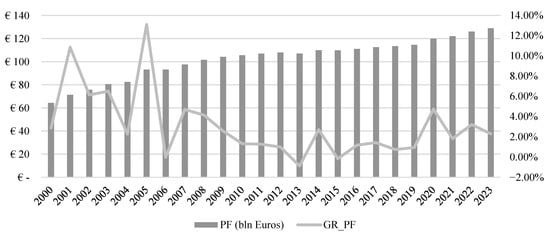
Regarding public funding, Italy increased the annual resources allocated to the National Health Service (SSN) by approximately 3.11% per year over the study period, rising from €64 billion in 2000 to €129 billion in 2023. Figure 1 illustrates both the annual stock of public funding and its annual growth rate. As shown, a particularly significant increase occurred in 2020, when public funding rose by approximately 4.73% in response to the extraordinary financial requirements generated by the COVID-19 pandemic. Public healthcare expenditure continued to increase between 2021 and 2023, with an average annual growth rate of approximately 2.44%. Although this rate exceeded the average growth recorded during the previous decade (1.89%), it remained below the average growth rate observed over the entire 2000–2023 period (Ministry of Health, 2025a).
Figure 1.
Public Financing to the Italy’s Healthcare Industry.
Figure 1 illustrates the evolution of public funding allocated annually to the Italian National Health Service (SSN) over the study period. The figure also reports the annual growth rate of public funding, highlighting periods of increased resource allocation in response to extraordinary circumstances, most notably the COVID-19 pandemic.
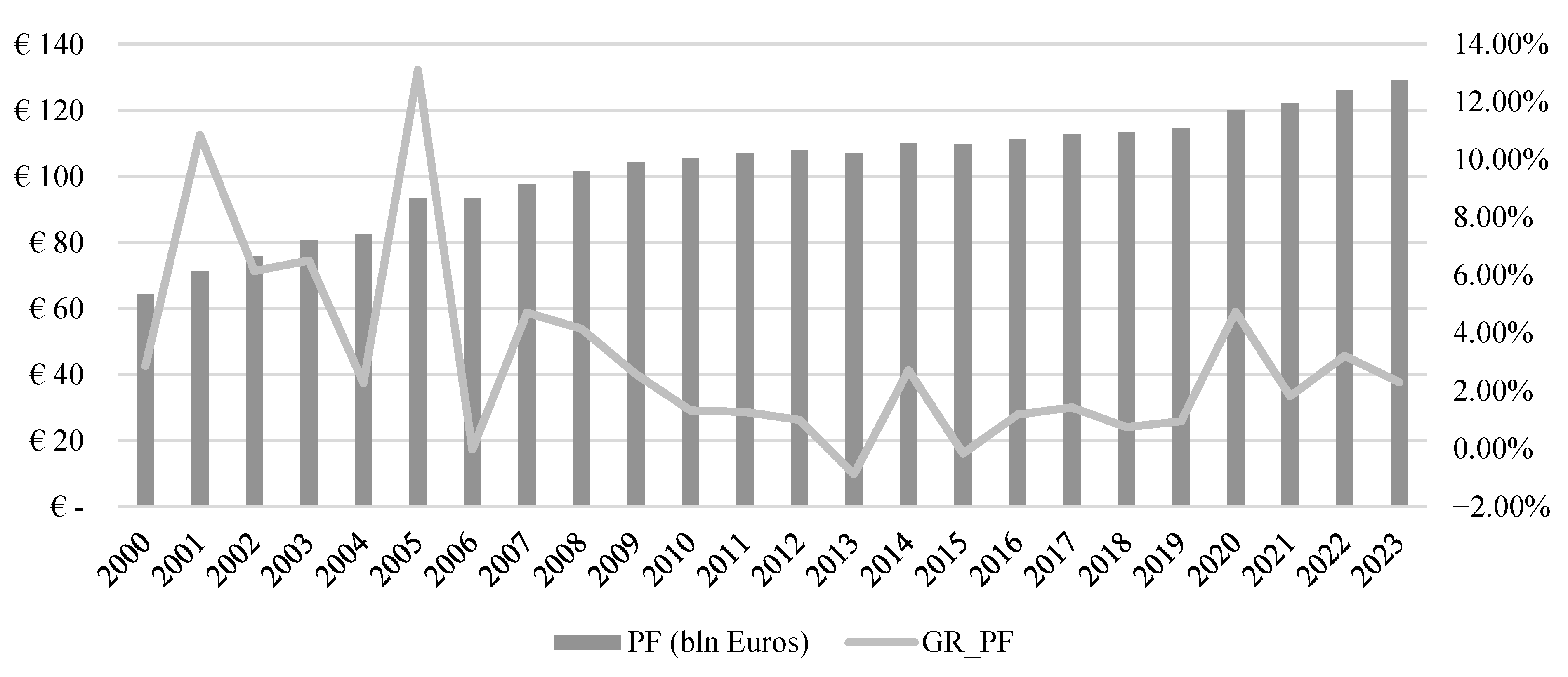
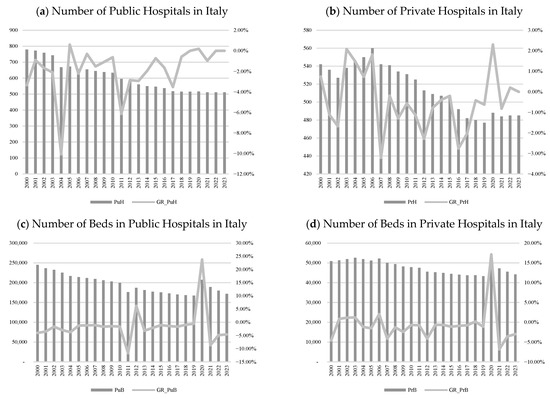
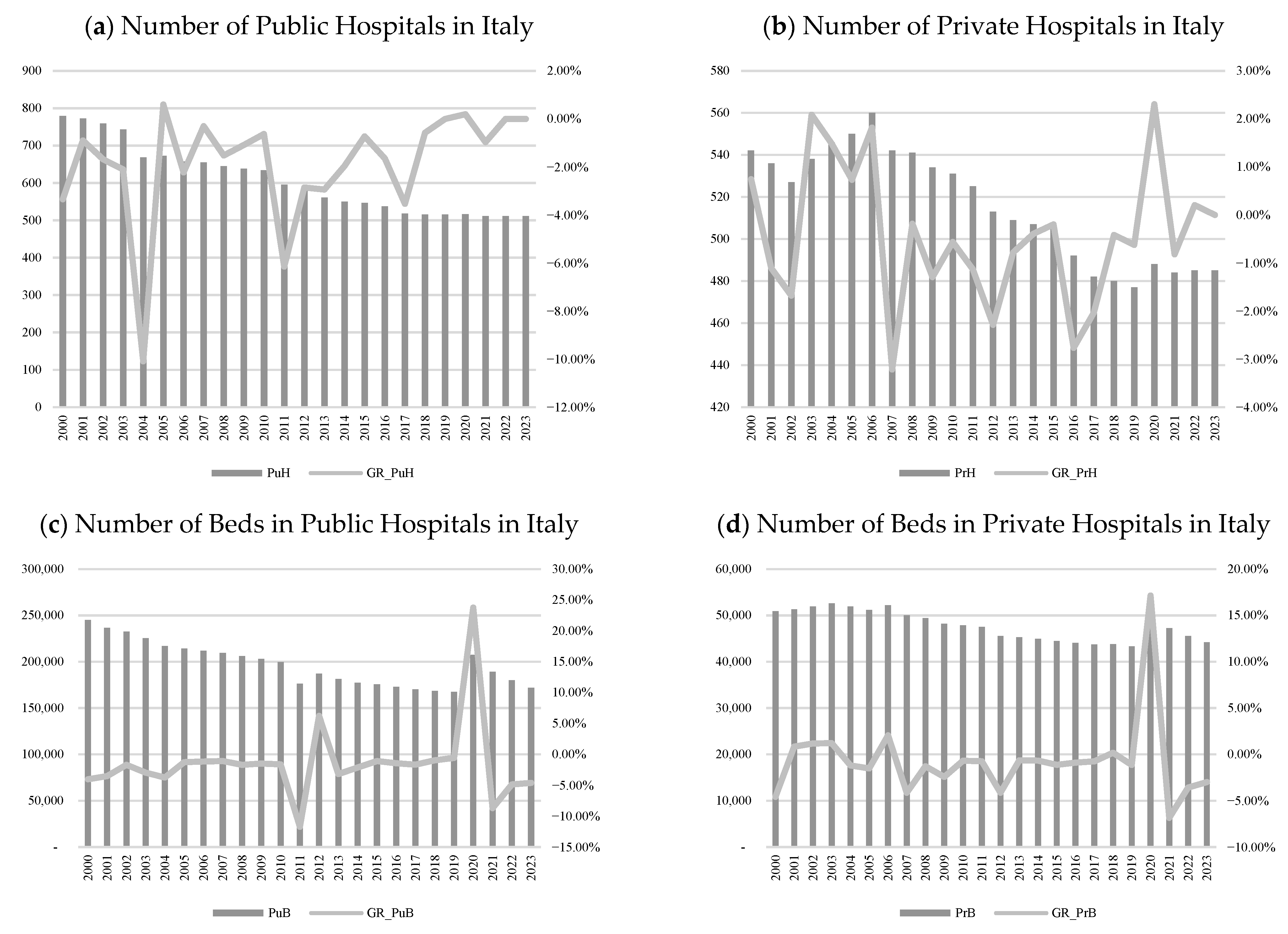
With regard to healthcare infrastructure, Italy experienced a persistent decline in both the number of hospitals and the number of available beds in the public and accredited private sectors over the study period. This trend is evident not only in the number of healthcare facilities but also in the evolution of hospital bed capacity.
Specifically, between 2000 and 2023, the number of public hospitals and public hospital beds decreased by approximately 1.85% and 1.47% per year, respectively. In the accredited private sector, the number of hospitals and beds declined by approximately 0.42% and 0.70% per year, respectively, over the same period. These trends suggest that increases in public funding were not accompanied by a corresponding expansion of healthcare infrastructure, as measured by the number of hospitals and available beds. A significant contribution to healthcare investment was provided through the European resources allocated to Mission 6 of the National Recovery and Resilience Plan (NRRP), which aimed to support economic recovery following the COVID-19 pandemic while strengthening national healthcare systems through investments in digitalization, telemedicine, and healthcare infrastructure (OECD, 2021).
The COVID-19 pandemic also generated an immediate need to expand healthcare capacity, particularly in terms of hospital facilities and bed availability. Consequently, temporary increases in healthcare infrastructure were observed during the emergency period, with some effects extending into subsequent years.
Figure 2 illustrates the evolution of the main healthcare infrastructure indicators considered in the analysis. Panel (a) reports the number of public hospitals in Italy and its annual growth rate. Panel (b) presents the number of accredited private hospitals and the corresponding annual growth rate. Panel (c) shows the number of available beds in public hospitals and its annual growth rate, while Panel (d) reports the number of available beds in accredited private hospitals and the corresponding annual growth rate. Overall, the figures indicate a long-term decline in both the number of hospitals and the number of available beds between 2000 and 2023. An exception is observed during the COVID-19 pandemic (2020–2022), when healthcare infrastructure capacity temporarily increased in response to the extraordinary demands placed on the healthcare system.
Figure 2.
Number of Hospitals and Available Beds in Italy.
Between 2000 and 2023, the Italian National Health Service (SSN) received average annual public funding of approximately €102.47 billion. Over the same period, public healthcare funding increased at an average annual rate of around 3.11%, while the number of available beds in the public sector declined by approximately 1.47% per year. Similar patterns emerge in the accredited private sector, although the reduction in bed capacity was less pronounced, averaging approximately 0.70% per year.
Table 2 reports the main descriptive statistics for the variables included in the analysis.
Table 2.
Descriptive Statistics of the Sample.
Table 2 summarizes the main descriptive statistics of the sample. The dataset consists of 24 annual observations covering the period from 2000 to 2023. Public funding (PF) is measured in billions of euros, whereas all growth rate (GR) variables are expressed as annual percentage changes.
Table 3 presents the correlation matrix for the annual growth rates of public healthcare funding, the number of public and accredited private hospitals, and the number of available beds in both sectors. The results indicate a positive and statistically significant correlation between the growth rate of the number of accredited private hospitals and the growth rate of private hospital beds (46.51%, significant at the 5% level). An even stronger relationship emerges between the growth rates of public and private hospital beds, with a correlation coefficient of 78.67%, significant at the 1% level. These findings suggest that changes in bed capacity are closely associated with changes in the number of hospitals in the accredited private sector.
Table 3.
Correlation Matrix.
By contrast, the relationship appears weaker in the public sector, where the correlation between the growth rates of public hospitals and public hospital beds is positive but not statistically significant (28.92%).
Furthermore, the strong positive correlation between the growth rates of public and private hospital beds suggests that capacity adjustments in the two sectors tend to evolve in a similar manner over time, potentially reflecting common trends in healthcare planning, demographic dynamics, or healthcare demand.
Table 3 presents the correlation matrix for the annual growth rates of public funding, the number of public and accredited private hospitals, and the number of available beds in the public and accredited private healthcare sectors. The correlation coefficients are calculated using 24 annual observations covering the period 2000–2023. The two-tailed critical values for statistical significance are 0.4044 at the 5% level (**) and 0.5151 at the 1% level (*).
Table 3 highlights significant correlations between several indicators of healthcare infrastructure in the public and accredited private sectors. However, no statistically significant correlations emerge between public funding growth and the healthcare infrastructure variables considered in the analysis. While these preliminary findings suggest that simple bivariate relationships between public funding and healthcare infrastructure development may be weak, correlation analysis alone does not permit causal inference. The absence of significant correlations is somewhat surprising given the existing literature, which generally emphasizes the importance of financial resources in supporting healthcare systems. Public funding represents the primary source of financing for the Italian healthcare system, while contributions from patients and private insurance remain comparatively limited (Mapelli, 2012). Previous studies have also highlighted the importance of adequate financial resources and liquidity in supporting healthcare organizations and ensuring their operational sustainability (Fijałkowska, 2017; Khullar et al., 2020). At the same time, these studies stress the importance of allocating and monitoring financial resources effectively.
Although the literature extensively examines the relationship between financial resources, liquidity and organizational performance, relatively little attention has been devoted to the relationship between public funding and the development of healthcare infrastructure at the system level. From a theoretical perspective, the allocation of financial resources should play a critical role in determining the capacity of healthcare systems to maintain and develop healthcare infrastructure. In Italy, public resources are transferred from the central government to regional authorities, which subsequently allocate funding to public and accredited private healthcare providers according to regulatory criteria, including healthcare activity and Diagnosis-Related Groups (DRGs). This multilevel financing structure aims to ensure the provision of the Essential Levels of Care (LEA) while allowing regions to finance additional healthcare services according to their available resources.
Nevertheless, the extent to which public funding contributes to the development of healthcare infrastructure in the public and accredited private sectors remains unclear. This issue is particularly relevant given the complexity of the Italian healthcare financing system and the coexistence of public and accredited private providers within the same institutional framework.
4.2. Robust Seemingly Unrelated Regression (SUR) Analysis
Understanding the relationship between public funding and healthcare infrastructure development is particularly important in the Italian context, where public resources represent the primary source of healthcare financing. The complexity of the multilevel funding system makes it difficult to determine whether changes in public funding are associated with changes in healthcare infrastructure in the public sector, the accredited private sector, or both.
To investigate this relationship, a robust Seemingly Unrelated Regression (SUR) model is estimated using the robustsur package developed by Saraceno et al. (2021). The SUR framework allows the joint estimation of multiple regression equations while accounting for potential correlations among the error terms, thereby improving estimation efficiency relative to separate equation estimation (Saraceno et al., 2021). Following Zellner (1962), the model is specified as follows:
and are the dependent variables, while are the independent variables. are the regressors’ coefficients, while are the residuals. In accordance with the SUR methodology, the properties of the residuals are E() = Σij for i ≠ j, while Σ is the variance–covariance matrix of the residuals.
Equations (1) and (2) are designed to estimate the relationship between the explanatory variables and the growth rate of the number of hospitals in the public and accredited private sectors, respectively. Particular attention is devoted to the significance and magnitude of the coefficient associated with the growth rate of public funding, holding all other variables constant. In addition, the inclusion of the COVID-19 dummy variable allows the analysis to assess whether the pandemic was significantly associated with changes in healthcare infrastructure development during the period under investigation.
Table 4 reports both the variance–covariance matrix and the correlation matrix of the residuals. Within the SUR framework, the presence of cross-equation correlations among residuals provides empirical support for estimating the equations jointly rather than separately. To mitigate the potential influence of outliers and violations of standard regression assumptions, the model is estimated using the robust SUR procedure implemented in the robustsur package for R (Saraceno et al., 2021)
Table 4.
Variance–covariance and Correlation Matrixes for Residuals.
Table 4 reports the variance–covariance matrix (Panel a) and the correlation matrix (Panel b) of the residuals. The residual correlation matrix provides information on the degree of contemporaneous association between the error terms of the two equations and supports the assessment of whether joint estimation through the Seemingly Unrelated Regression (SUR) framework is appropriate. Although residual correlation is modest, SUR was retained because it allows joint estimation and may provide efficiency gains when error terms are contemporaneously related.
The main estimation results for Equation (1), which examines the growth rate of the number of public hospitals, are reported in Table 5. Specifically, Panel (a) presents the results obtained using an Ordinary Least Squares (OLS) regression estimated with the estimatr package in R, which provides heteroskedasticity-robust standard errors and is particularly suitable when standard regression assumptions may be violated. Panel (b) reports the results obtained using the robust Seemingly Unrelated Regression (SUR) model described in the previous section.
Table 5.
Regression Equation (1).
The comparison between the OLS and robust SUR estimations allows an assessment of the robustness of the results and the extent to which accounting for cross-equation correlations affects the estimated coefficients and their statistical significance. Although residual correlation is modest, SUR was retained because it allows joint estimation and provides efficiency gains when error terms may be contemporaneously related.
Table 5 reports the estimated coefficients for the growth rate of public hospitals on an annual basis. Panel (a) presents the results obtained from Equation (1) using a robust Ordinary Least Squares (OLS) estimator, whereas Panel (b) reports the results obtained from Equation (1) using a robust Seemingly Unrelated Regression (SUR) model. Both specifications indicate a positive association between the growth rate of public funding and changes in the number of public hospitals. Furthermore, the SUR specification provides a better fit to the data and may improve estimation efficiency by accounting for potential correlations between the error terms of the equations.
The estimation results for Equation (1), reported in Table 5, indicate that the signs of the estimated coefficients are generally consistent with theoretical expectations. The growth rate of public hospital beds GR_PuB is positively associated with the growth rate of public hospitals, suggesting that increases in healthcare capacity tend to be accompanied by increases in the number of public healthcare facilities. Conversely, the coefficient associated with the growth rate of private hospital beds GR_PrB is negative, indicating an inverse relationship between changes in private-sector capacity and the growth rate of public hospitals. With regard to statistical significance, GR_PuB appears significant at the 1% level, while the COVID-19 dummy variable is significant at the 10% level. The coefficient associated with public funding GR_PF is positive, suggesting that increases in public funding are associated with increases in the growth rate of public hospitals, ceteris paribus. However, the magnitude of this coefficient should be interpreted with caution given the limited sample size and the aggregate nature of the data.
The results obtained from the robust OLS model reported in Panel (a) indicate a relatively limited overall model significance. By contrast, the robust SUR model presented in Panel (b) produces stronger statistical results, with GR_PuB, GR_PrB, and the COVID-19 dummy emerging as significant predictors of the growth rate of public hospitals. In particular, the negative coefficient associated with GR_PrB suggests that increases in private-sector bed capacity are associated with lower growth rates of public hospitals, holding other factors constant. Furthermore, the coefficient of determination is higher in the robust SUR specification than in the robust OLS model, indicating an improved fit to the observed data. This finding suggests that accounting for the correlation of residuals across equations provides additional explanatory power and supports the use of the SUR framework in this context. Nevertheless, given the relatively small sample size and the observational nature of the data, the results should be interpreted as evidence of statistical associations rather than causal effects.
The estimation results for Equation (2), which examines the growth rate of accredited private hospitals, are reported in Table 6.
Table 6.
Regression Equation (2).
Table 6 reports the estimated coefficients for the growth rate of accredited private hospitals on an annual basis. Panel (a) presents the results obtained from Equation (2) using a robust Ordinary Least Squares (OLS) estimator, whereas Panel (b) reports the results obtained from Equation (2) using a robust Seemingly Unrelated Regression (SUR) model. Overall, neither specification appears to provide strong explanatory power for variations in the growth rate of accredited private hospitals. In Panel (a), the COVID-19 dummy variable is statistically significant, suggesting that the pandemic was associated with changes in the growth rate of accredited private hospitals during the study period. In Panel (b), only the growth rate of private hospital beds is statistically significant, and only at the 10% significance level, indicating a positive association between changes in bed capacity and changes in the number of accredited private hospitals.
While the results reported in Table 5 are broadly consistent with theoretical expectations and the existing literature, the findings presented in Table 6 reveal some noteworthy differences. In the OLS specification reported in Panel (a), only the growth rate of private hospital beds GR_PrBt and the COVID-19 dummy variable appear statistically significant at the 5% level. This result is plausible, as changes in private-sector bed capacity and the extraordinary circumstances associated with the pandemic may have influenced the evolution of accredited private hospitals.
By contrast, the coefficient associated with the growth rate of public funding GR_PF is not statistically significant. Unlike the results obtained for the public sector, this finding suggests that changes in public funding are not significantly associated with changes in the number of accredited private hospitals during the period under investigation.
The results obtained from the robust SUR model, reported in Panel (b), provide further evidence of the limited explanatory power of the model in the private sector. In this specification, only the growth rate of private hospital beds remains statistically significant, and only at the 10% significance level. Overall, neither the OLS nor the SUR specification appears particularly strong in explaining variations in the growth rate of accredited private hospitals, as indicated by the relatively low values of the F-statistic and the coefficient of determination.
These findings should be interpreted with caution given the limited sample size of 24 annual observations. Previous research suggests that larger samples may improve the reliability and statistical power of regression estimates (Okay Toprak, 2025). Nevertheless, despite these limitations, the results provide preliminary evidence that variations in healthcare infrastructure capacity, as measured by private hospital beds, are more closely associated with changes in the number of accredited private hospitals than variations in public funding.
4.3. Methodological Limitations and Interpretation of the Empirical Evidence
Several methodological considerations should be acknowledged when interpreting the empirical findings of this study.
First, the analysis is based on annual observations for Italy covering the period 2000–2023. Although this dataset represents the complete time series currently available from the Italian Ministry of Health for the variables considered, the relatively limited number of observations inevitably constrains statistical power and the complexity of the econometric specifications that can be reliably estimated. Consequently, the empirical analysis should be regarded as exploratory evidence based on national time-series data rather than as definitive causal inference. Second, the estimated relationships may be affected by endogeneity. Public healthcare funding, the number of hospitals, and hospital bed capacity are likely to evolve simultaneously within the institutional framework of the Italian National Health Service. For example, increases in public funding may support the expansion or preservation of healthcare infrastructure, while changes in healthcare capacity or emerging healthcare needs may themselves influence subsequent governmental funding decisions. Furthermore, both variables may be jointly affected by broader demographic, political, macroeconomic, or institutional factors that are not explicitly modelled in the present analysis. Third, the robust Seemingly Unrelated Regression (SUR) framework adopted in this study was selected because it allows the joint estimation of multiple related equations while accounting for potential contemporaneous correlations among the disturbance terms. This approach improves the efficiency of coefficient estimation when the equations are interconnected. However, it does not eliminate potential simultaneity, omitted-variable bias, or reverse causality. Accordingly, the SUR methodology should not be interpreted as providing causal identification but rather as offering a statistically efficient framework for examining associations among the variables of interest.
For these reasons, the estimated coefficients are interpreted throughout this study as conditional associations rather than causal effects. The findings therefore provide empirical evidence that variations in public healthcare funding are systematically associated with changes in indicators of healthcare infrastructure development within the Italian National Health Service, while acknowledging that the underlying causal mechanisms cannot be conclusively established using the available observational data.
Despite these limitations, the analysis remains informative for both researchers and policymakers. The Italian National Health Service constitutes one of the largest Beveridge-type healthcare systems in Europe, and understanding the empirical association between public funding and healthcare infrastructure contributes to the broader literature on healthcare financing and public sector development. Rather than establishing causality, the present study identifies statistically significant patterns that may guide future research employing richer datasets and more advanced identification strategies. Future research could extend the present analysis by exploiting regional panel data, quasi-experimental research designs, instrumental-variable approaches, or other causal inference methodologies capable of addressing endogeneity more directly. Such approaches would allow a more rigorous assessment of the causal impact of public healthcare funding on the long-term development of healthcare systems.
5. Conclusions
This study investigates the relationship between public healthcare funding and healthcare infrastructure development in Italy between 2000 and 2023. Healthcare system development is proxied by changes in the number of hospitals and available beds in both the public and accredited private sectors. The analysis also considers the potential effects of the COVID-19 pandemic through the inclusion of a dummy variable and compares the results obtained from robust OLS and robust Seemingly Unrelated Regression (SUR) models.
The empirical findings suggest that public funding is positively associated with the growth rate of public hospitals, whereas no statistically significant relationship emerges between public funding and the growth rate of accredited private hospitals. These results indicate that changes in public funding appear to be more closely associated with developments in the public healthcare sector than in the accredited private sector. Furthermore, the COVID-19 dummy variable is positively associated with the growth rate of public hospitals, suggesting that the pandemic was accompanied by an expansion of healthcare infrastructure within the public system. The absence of a significant relationship between public funding and the growth rate of accredited private hospitals may reflect the complexity of the Italian healthcare financing framework, in which public resources are allocated through regional authorities and coexist with other sources of financing, including private payments and insurance reimbursements. Consequently, the development of accredited private healthcare providers may depend on a broader set of institutional, regulatory, and market factors that are not directly captured by the present analysis.
More generally, the findings highlight that increases in public healthcare expenditure do not necessarily translate into proportional changes in healthcare infrastructure across all segments of the healthcare system. This observation underscores the importance of understanding not only the amount of public resources allocated to healthcare, but also the mechanisms through which such resources are distributed and utilized.
The study contributes to the literature by providing empirical evidence on the relationship between public funding and healthcare infrastructure development within a Beveridge-type healthcare system. However, several limitations should be acknowledged. First, the analysis is based on a relatively small sample of annual observations. Second, healthcare system development is measured through infrastructure indicators, namely hospitals and beds, which do not fully capture healthcare quality, efficiency, or health outcomes. Third, the adopted empirical framework identifies statistical associations rather than causal effects.
Finally, the findings should be interpreted in light of several methodological limitations. The analysis is based on annual observations of a single country over the period 2000–2023 and therefore does not permit causal inference. Although the robust SUR framework improves estimation efficiency by accounting for contemporaneous correlations across equations, it does not resolve potential endogeneity, reverse causality, or omitted-variable bias. Consequently, the reported relationships should be interpreted as descriptive associations rather than causal effects. Future research employing regional panel data, quasi-experimental designs, or instrumental-variable approaches could provide more robust evidence on the causal relationship between public healthcare funding and healthcare infrastructure development.
Future research could also extend the analysis by incorporating additional indicators of healthcare system performance, such as healthcare outcomes, waiting times, accessibility measures, or quality indicators. Comparative studies examining Beveridge and Bismarck healthcare systems may also provide further insights into how different financing arrangements influence healthcare infrastructure development and system performance.
Author Contributions
Conceptualization, M.F., G.A.V., E.G. and D.F.; methodology, M.F.; software, M.F.; validation, G.A.V.; formal analysis, D.F.; investigation, M.F.; resources, M.F.; data curation, M.F.; writing—original draft preparation, M.F.; writing—review and editing, E.G.; visualization, E.G.; supervision, G.A.V.; project administration, M.F. All authors have read and agreed to the published version of the manuscript.
Funding
This research received no external funding.
Institutional Review Board Statement
Not applicable.
Informed Consent Statement
Not applicable.
Data Availability Statement
Data are available from the corresponding author upon reasonable request.
Conflicts of Interest
The authors declare no conflict of interest.
References
- Batrancea, L. (2021). The influence of liquidity and solvency on performance within the healthcare industry: Evidence from publicly listed companies. Mathematics, 9(18), 2231. [Google Scholar] [CrossRef] [Scilit]
- Beauvais, B., Ramamonjiarivelo, Z., Betancourt, J., Cruz, J., & Fulton, L. (2023). The predictive factors of hospital bankruptcy—An exploratory study. Healthcare, 11(2), 165. [Google Scholar] [CrossRef] [Scilit] [PubMed]
- Choi, M., Lee, Y. S., & Lee, Y. H. (2002). Liquidity determinants of private hospitals in korea. Health Policy and Management, 12(4), 1–17. [Google Scholar] [CrossRef] [Scilit]
- Fijałkowska, B. (2017). Financial health index as a thermometer in healthcare entities. Finance, Financial Markets, Insurance, 521–529. [Google Scholar] [CrossRef] [Scilit] [PubMed]
- Hu, X., Jin, W., Yang, A., & Hu, Z. (2022). Management of capital liquidity in public hospitals under the epidemic situation of COVID-19. Frontiers in Public Health, 10, 977221. [Google Scholar] [CrossRef] [Scilit] [PubMed]
- Jalilian, H., Mohammad Riahi, S., Heydari, S., & Taji, M. (2023). Performance analysis of hospitals before and during the COVID-19 in iran: A cross-sectional study. PLoS ONE, 18(6), e0286943. [Google Scholar] [CrossRef] [Scilit] [PubMed]
- Khullar, D., Bond, A., & Schpero, W. (2020). COVID-19 and the financial health of US hospitals. JAMA, 323(21), 2127–2128. [Google Scholar] [CrossRef] [Scilit] [PubMed]
- Kim, T. H. (2010). Factors associated with financial distress of nonprofit hospitals. The Health Care Manager, 29(1), 52–62. [Google Scholar] [CrossRef] [Scilit] [PubMed]
- Krzeczewski, B. (2016, December 9–10). The problem of liquidity management in hospital and its impact on profitability. 18th International Scientific Conference on Economic and Social Development—“Building Resilient Society”, Zagreb, Croatia. Available online: https://www.esd-conference.com/upload/book_of_abstracts/Book_of_Abstracts_Zagreb_2016_Online.pdf (accessed on 15 December 2025).
- Leite, A., De Almeida Leite, E., Ribeiro, H., Alves, S., & Sardinha, L. (2022). From bismarck to beveridge: Contributions for the understanding of different social security models. In Economic and social development: Book of proceedings (pp. 255–264). VADEA. Available online: https://www.researchgate.net/publication/359513371_from_bismarck_to_beveridge_contributions_for_the_understanding_of_different_social_security_models (accessed on 18 December 2025).
- Mapelli, V. (2012). Pubblico e privato nella sanità italiana. Pharmacoeconomics, Italian Research Articles, 14, 11–20. [Google Scholar]
- Maślach, D., Markiewicz, J., Warelis, A., & Krzyżak, M. (2019). Importance of financial liquidity in hospital management. Przegląd Epidemiologiczny, 73(3), 369–381. [Google Scholar] [CrossRef] [Scilit] [PubMed]
- Ministry of Health. (2025a). Il finanziamento del servizio sanitario nazionale. Available online: https://www.salute.gov.it/new/it/tema/programmazione-e-finanziamento-del-ssn/il-finanziamento-del-servizio-sanitario-nazionale/ (accessed on 12 April 2026).
- Ministry of Health. (2025b). SSN: Principi e organizzazione. Livelli Essenziali di Assistenza—LEA. Available online: https://www.salute.gov.it/portale/lea/dettaglioContenutiLea.jsp?id=5073&area=Lea&menu=vuoto (accessed on 20 May 2026).
- Moretti, M. (2023). La germania è pronta a lanciare la riforma del sistema sanitario: Si punterà più sulla qualità che sulla quantità delle prestazioni. INNLIFES. Available online: https://www.innlifes.com/policy/germania-riforma-sistema-sanitario/ (accessed on 15 December 2025).
- Neves, M., & Carolina, A. (2025). Financial challenges in portuguese hospitals: Debt influences. International Journal of Health Governance, 30, 72–88. [Google Scholar] [CrossRef] [Scilit]
- OECD. (2021). COVID ha mostrato che spesa sanitaria è un investimento per proteggere cittadini ed economia. Available online: https://www.quotidianosanita.it/studi-e-analisi/articolo.php?approfondimento_id=16508 (accessed on 5 November 2025).
- OECD. (2022). Hospital beds. Available online: https://www.oecd.org/en/data/indicators/hospital-beds.html (accessed on 12 February 2026).
- Okay Toprak, A. (2025). Evaluation of the impact of women’s employment on GDP using seemingly unrelated regression. Hitit Journal of Social Sciences, 18(1), 170–186. [Google Scholar] [CrossRef] [Scilit]
- Saraceno, G., Alqallaf, F., & Agostinelli, C. (2021). A robust seemingly unrelated regressions for row-wise and cell-wise contamination. Available online: https://cran.r-project.org/web/packages/robustsur/robustsur.pdf (accessed on 23 September 2025).
- Shishkin, S., & Sheiman, I. (2023). The hard way from the beveridge to the bismarck model of health finance: Expectations and reality in russia. Frontiers in Public Health, 11, 1104209. [Google Scholar] [CrossRef] [Scilit] [PubMed]
- Sunny, I. (2013). The impact of liquidity management on the profitability of banks in nigeria. Journal of Finance and Bank Management, 1(1), 37–48. [Google Scholar]
- Toth, F. (2009). Le politiche sanitarie. modelli a confronto. Laterza. [Google Scholar]
- Toth, F. (2016). Non solo bismarck contro beveridge: Sette modelli di sistema sanitario. Rivista Italiana di Politiche Pubbliche. Available online: https://researchgate.net/publication/307415826_Non_solo_Bismarck_contro_Beveridge_sette_modelli_di_sistema_sanitario (accessed on 5 May 2025).
- Upadhyay, S., & Smith, G. (2016). Hospital liquidity and cash conversion cycle: A study of washington hospitals. Journal of Health Care Finance, 43, 148–57. Available online: https://www.healthfinancejournal.com/index_php/johcf/article/download/107/111.pdf (accessed on 15 May 2025).
- Waleed, A., Pasha, A., & Akhtar, A. (2016). Exploring the impact of liquidity on profitability: Evidence from banking sector of pakistan. Journal of Internet Banking and Commerce, 21(3), 1–12. [Google Scholar] [CrossRef] [Scilit]
- World Population Review. (2025). Euro health consumer index by country 2025. Available online: https://worldpopulationreview.com/country-rankings/euro-health-consumer-index-by-country (accessed on 10 April 2026).
- Yerdelen Tatoğlu, F. (2020). İleri panel veri analizi. Beta Basım Yayım Dağıtım. Available online: https://avesis.istanbul.edu.tr/publication/details/d6463a9e-ff79-41c1-a5c6-cb8b2c93ea2c/ileri-panel-veri-analizi-birinci-baski-2012 (accessed on 21 October 2025).
- Zellner, A. (1962). An efficient method of estimating seemingly unrelated regressions and tests for aggregation bias. Journal of the American Statistical Association, 57, 348–368. [Google Scholar] [CrossRef] [Scilit]

Disclaimer/Publisher’s Note: The statements, opinions and data contained in all publications are solely those of the individual author(s) and contributor(s) and not of MDPI and/or the editor(s). MDPI and/or the editor(s) disclaim responsibility for any injury to people or property resulting from any ideas, methods, instructions or products referred to in the content. |
© 2026 by the authors. Licensee MDPI, Basel, Switzerland. This article is an open access article distributed under the terms and conditions of the Creative Commons Attribution (CC BY) license.