


Abstract
Despite the rapid financial expansion over the past two decades, South Africa’s economic growth has remained sluggish, raising concerns about the disconnect between financial sector development and overall economic performance. This study aims to investigate the relationship between financialization and economic growth in South Africa using three proxy variables, finance, insurance, real estate, and business services as a percentage of GDP; money supply (M3) as a percentage of GDP; and credit to the private sector as a percentage of GDP, alongside a composite financialization indicator. Using quarterly time-series data from 1994Q1 to 2025Q2, this study employs the autoregressive distributed lag (ARDL) approach to examine both short- and long-term dynamics and cointegration between financialization and economic growth. The empirical findings reveal that financialization exerts a positive and statistically significant influence on South Africa’s economic growth. Meanwhile, the estimation results reveal that financialization has a positive and highly significant impact on economic growth in South Africa, demonstrating the need for policies that promote and enhance its effects.
1. Introduction
Differences in opinion among economists have necessitated an ongoing debate on the ways in which the financial system contributes to the real economy. Some economists assert that since financial institutions have relatively small shares of real assets on their balance sheets, they have very little direct impact on the economy. This view is reinforced by the monetarist school of thought, which posits a separation of monetary and real sectors of the economy in the famed classical dichotomy (Fields, 2015). However, the link between interest rates and monetary variables such as the quantity of money with variables in the macroeconomy (e.g., the level of employment, price level, and Gross Domestic Product) seems to suggest that the financial sector plays a greater role in the real economy, as noted by (Beires, 2015) in a study that investigated the role of governments in a recession. This mechanism is widely supported by its widespread use in monetary policy by several central banks globally in the often-cited transmission mechanism.
In addition to its broader global relevance, the financialization phenomenon seems to be manifesting in South Africa at unprecedented levels (Ashman et al., 2013). Many studies have associated financialization with economic development, and this is more prevalent in industrialized countries. An example is (Brychko et al., 2021), who notes that the development of a financial system through financial intermediation has a critical role to play in the redistribution and mobilization of financial resources aiding productive activities, fostering the growth of a country’s economy. In that case, policies that seek to develop the financial industry are expected to boost economic growth. According to Khatatbeh and Moosa (2022) financialization refers to the increasing dominance of the financial sector over the real economy, whereby financial motives, financial markets, and financial institutions shape economic outcomes in ways that redirect resources away from productive investment toward speculative and rent-seeking activities. Financial development refers to the improvement and expansion of financial institutions, markets, and instruments in ways that enhance the efficient allocation of savings to productive investment (Hein, 2014). Furthermore, financial development’s positive effects on the economy are further supported by (Ncanywa & Mabusela, 2019), who found that, for selected countries, there are both short- and a long-term relationships between financial development and economic growth. In the long run, liquid liabilities and bank credit to the private sector positively influence economic growth. As noted above by (Brychko et al., 2021), some economists posit that financial intermediation boosts the economy by improving the allocation of resources and investment opportunities. Therefore, financialization indirectly bolsters economic growth.
The increasing financialization of the South African economy is evident in a variety of areas and includes the banking sector incurrence of financial liabilities having increased from 2000 to 2010, the increase in the percentage share in gross value added (GVA) of the broader finance sector from 23% in 2000 to 31.2% in 2016 (IHS Global Insight) in Johannesburg, the financial hub of South Africa, and the credit extended by all monetary institutions as a proportion of Gross Domestic Product (GDP) having drastically increased between 2000 and 2010 (SARB, 2022). However, economic growth in the South African economy has not responded to this growing financialization as anticipated. From 2003 to 2016, economic growth initially stagnated and later declined, settling at less than 1% in 2016. In fact, since the commodities boom of 1999 to 2003, high growth rates have become difficult to come by. The situation further deteriorated after the global financial crisis of 2008/9, and since then, economic growth has remained tepid in spite of the fledgling financial sector. Considering the scenarios above, the question arises as to why financialization has failed to have the desired effect on economic growth in South Africa, a country with a deep financial system that many have credited with resilience to the 2008 financial crisis. Consequently, the developments in South Africa regarding financialization and economic growth must be studied in greater depth.
This study’s contribution lies in its holistic examination of financialization. Similar studies (Ndikumana & Allen, 1998; Sunde, 2012; Ziramba, 2016) that analyzed the financialization–economic growth nexus in South Africa previously relied on narrow proxies for financialization. For instance, Ziramba (2016) and Sunde (2012) included money supply and credit to private sector as percentages of GDP as proxies for financialization. These studies covered the liquidity and credit channels of financialization relationships. However, they did not show the overall effect (Ndikumana & Allen, 1998). While (Ndikumana & Allen, 1998) used a composite index of financialization, they did not disaggregate the liquidity and credit channels, and therefore the results are prone to the fallacy of composition (e.g., what is true for the whole is not necessarily true for the parts). Furthermore, critical events such as the global financial crisis have overtaken the relationship examined by Ndikumana and Allen (1998). As such, in this study, we have taken a more holistic approach by combining all three scenarios: overall, liquidity, and credit channels. To achieve this, three models (the overall, liquidity, and credit) were estimated and compared to facilitate a deeper examination of the financialization–economic growth relationship in South Africa. As such, this study attempts to provide further information on this topic as well as proposing possible measures for enhancing the effects of financialization on economic growth based on a more holistic econometric examination.
2. Literature Review
2.1. Theoretical Literature Review
The model used in this study takes its theoretical roots from the famed Solow (1956) and Swan (1956) growth accounting-based Neo-Classical model of economic growth. In their specification, an economy’s output, , at the time is fundamentally a function of two variables: labour force, , and capital stock, , according to the following Cobb–Douglas production function (Durlauf & Blume, 2010).
where exhibits constant returns to scale and diminishing marginal returns to inputs properties. and measure the elasticities of growth in response to changes in labour and capital, respectively. A is a measure of the economy’s total factor productivity (TFP). Taking GDP as an economy’s output, considering the variables in growth rates, and expressing (1) in logarithm form, results in the following Equation:
Equation (2) states that the economic growth in a given economy is a function of the growth in the labour force and capital stock, together with its productivity. The economy’s TFP is usually a function of a vector of other variables which affect economic growth, . In light of this, the economic growth model becomes:
where are the other variables affecting economic growth and is a measure of the elasticity of economic growth to changes in variable . The economic growth model in (3) is exogenous because it assumes a closed economy. In the interest of endogenous growth models, an economy is open to international trade (Sunge & Ngepah, 2020b), as is the case in South Africa. Accordingly, to capture the impact of international trade on economic growth in South Africa, two variables—trade openness () and real effective exchange rate ()—were included in the model. On one hand, trade may positively affect growth by increasing productive efficiency and productivity growth through technology transfer, competition and resource allocation (Sunge & Ngepah, 2020a, 2020b). On the other hand, trade may stunt growth by destroying local production, leading to the exportation of raw materials, and creating imperfect international knowledge spillovers (Hye & Lau, 2015). REER can also affect growth in either direction through the country’s balance and terms of trade.
In line with the themes of this study, the impact of financialization on economic growth is informed by a hypothesis originally by Schumpeter (1911) and further refined by McKinnon (1973). According to their hypothesis, in this relationship, financialization mainly affects economic growth by prompting technological innovation (Sibindi, 2014). In addition, the literature has identified four key channels connecting financialization to economic growth. Financialization is key to (1) information provision and capital allocation, (2) risk management improvement, (3) savings mobilization, and (4) facilitation of local and international trade (Ahadu, 2019; Batuo et al., 2018). However, financialization may also have adverse effects on economic growth (Kapaya, 2021). To account for the effects that financialization has on economic growth, three variables are used as proxies: (1) finance, insurance, real estate, and business services GDP as a share of GDP (), (2) money supply (M3) as a share of GDP (), and (3) credit to the private sector as a share of GDP ().
The major policy frameworks in South Africa are fiscal and monetary, and these cannot be ignored when explaining its growth trajectory. To account for the impact of fiscal policy in the relationship, budget deficits () were included. On a positive note, the budget deficit, from a governmental perspective, is expected to spur economic growth through its expansionary effects on aggregate demand (Kryeziu & Hoxha, 2021). However, budget deficits may negatively impact economic growth, especially if their financing crowds out local investment (Idris et al., 2017). Two variables related to inflation represent monetary policy () and interest rates. Inflation is included because it is considered a monetary phenomenon (Sunge & Makamba, 2020). Conventionally, inflation is expected to have a negative impact on growth. Interest rates are also a key monetary policy instrument. The common perspective is that lower interest rates facilitate economic growth (Shaukat et al., 2019); however, this is not true in all instances (Lee & Werner, 2022).
Considering all these variables, the model to be estimated in this study was
In (4), represent economic growth, employment index (for labour), and gross fixed capital formation (for capital).
2.2. Empirical Literature Review
The empirical literature on the finance growth nexus in South Africa has increasingly shifted from a narrow focus on financial development to a broader consideration of financialisation, particularly following the structural transformation of the South African economy after 1994. Financialisation is commonly understood as the increasing dominance of financial markets, financial institutions, and financial motives in shaping macroeconomic outcomes, often beyond their traditional intermediation role (Epstein, 2005; Stockhammer, 2015b). In the South African context, this phenomenon is reflected in the rising share of the financial sector in GDP, rapid expansion of credit markets, and deep integration into global financial flows.
A growing body of empirical studies suggests that financialisation has a complex and often non-linear relationship with economic growth. Early work grounded in the financialisation growth hypothesis, such as Levine (2005), argues that financial deepening promotes growth through improved capital allocation and reduced transaction costs. In South Africa, this perspective is supported by evidence showing that financial sector development can stimulate short-run growth through credit expansion and improved liquidity conditions. For instance, studies using macroeconomic time-series data find that private sector credit and financial intermediation are positively associated with GDP growth, particularly in the short run (Ngcobo et al., 2025).
However, more recent empirical literature increasingly challenges the linear finance growth relationship, emphasising the adverse effects of excessive financialisation. Using South African data over long-run periods, several studies find that while financialisation initially supports growth, beyond a certain threshold it may exert diminishing or even negative effects on economic performance. This is consistent with the “too much finance” hypothesis, which argues that excessive expansion of the financial sector can lead to resource misallocation, speculative activity, and reduced productive investment (Arcand et al., 2015). In South Africa, this concern is reinforced by evidence of strong financial sector growth that is not always matched by commensurate expansion in the real economy.
Empirical evidence specific to South Africa further highlights the differentiated effects of financialisation across growth regimes. Mabeba (2024), using quantile regression techniques, shows that financialisation, measured through financial sector value added, has a statistically significant positive effect on GDP across different growth quantiles, with stronger effects at higher growth levels. The results suggest that financialisation may reinforce growth when the economy is already performing well, but its capacity to stimulate low-growth regimes remains limited. Moreover, the finding is consistent with asymmetric growth effects observed in emerging markets, where financial deepening benefits are contingent on macroeconomic stability and institutional quality.
Other empirical studies focusing on South Africa’s financial structure also highlight the role of financial market capitalisation and banking sector development in shaping growth dynamics. Ngcobo et al. (2025) find that financial market capitalisation has a measurable impact on economic growth and unemployment, although the magnitude and direction of effects depend on structural conditions within the labour and product markets. Similarly, ARDL-based studies of the financialisation and economic growth nexus suggest that long-run cointegration between financial indicators and GDP, but with mixed short-run dynamics depending on monetary and fiscal conditions (McHardy, 2022).
While the concept of financialization and financial development overlap, the study conceptualises financial development as the deepening, efficiency, and access of financial intermediation, whereas financialisation is understood as the rising dominance of financial motives, actors, and activities relative to the real economy (Krippner, 2005; Epstein, 2005). Consequently, the empirical proxies used in the study are interpreted not merely as indicators of financialisation, but as capturing specific dimensions of financialisation, as elaborated below.
The financial sector value added as a ratio of GDP is employed as a structural (flow-based) measure of financialisation, capturing the expansion and macroeconomic dominance of the financial sector. As noted by Mabeba (2024), FVA reflects the contribution of finance to GDP, thereby providing a direct indication of the relative size and economic weight of financial activities. This aligns with the financialisation literature, where an increasing share of finance in total value added is interpreted as a shift away from productive accumulation towards financial accumulation (Assa, 2012; Karwowski & Stockhammer, 2017). In this sense, FVA captures the macro-structural transformation of the economy, a core feature of financialisation. Other studies that employed financial sectors share of GDP in examining impact of financialisation to economic growth are (Chipangila, 2019; Bonizzi, 2013; Kungwane, 2020).
Moreover, the credit-to-GDP ratio is employed to capture the financial deepening and leverage dimension of financialisation, particularly the growing dependence of the real economy on credit and financial intermediation. While CGR is traditionally viewed as a financial development indicator, within a financialisation framework it reflects the extent to which economic activity is increasingly mediated through debt relations. High and rising credit ratios are associated with heightened financial fragility and increased exposure of the real sector to financial cycles (Denk & Cournède, 2015), consistent with post-Keynesian and regulationist interpretations of financialisation. Thus, CGR captures the penetration of finance into productive and household activities, rather than merely improved access to finance.
Lastly, variables such as broad money supply (M3) are interpreted as capturing the liquidity and financial expansion dimension of financialisation, reflecting the growth of financial assets and monetary aggregates relative to real economic activity. In a financialised economy, increases in liquidity are not necessarily channelled into productive investment but may instead support asset price inflation and speculative activities, a phenomenon widely discussed in the financialisation literature (Stockhammer, 2004; Dumenil & Levy, 2004). Hence, money supply is used here as a proxy for the expansion of financial claims and liquidity-driven accumulation.
Importantly, the study follows a multi-dimensional measurement approach, consistent with prior empirical work. Financialisation is not captured by a single indicator but rather through a combination of structural (FVA), flow (credit), and liquidity (money supply) measures, reflecting its complex and multifaceted nature (Krippner, 2005; Karwowski et al., 2015). Similar approaches have been adopted in both cross-country and country-specific studies, including Assa (2012) and Chipangila (2019), where financial sector value added and related ratios are used to capture the reallocation of economic activity toward finance
3. Methodology
This section unpacks the estimation process, which employs an autoregressive distributed lag (ARDL) model to examine the short- and long-term effects of financialization on economic growth in South Africa over the period 1994Q1 to 2025Q2. The ARDL framework is particularly suitable in this context, as it accommodates both endogenous and exogenous integrated variables of orders I(0) and I(1).
3.1. Data Sources
Table 1 below illustrates both the endogenous and exogenous variables sourced from the South African Reserve Bank (SARB) and Statistics South Africa (StatsSA) that are utilized in the study. Quarterly measurements were obtained for the period 1994Q1–2025Q2. The endogenous variable is economic growth, which measures aggregate economic activity in South Africa (Thore & Tarverdyan, 2021). The exogenous variables are the employment index, gross fixed capital formation as a percentage of GDP, money supply as a percentage of GDP, trade openness, budget deficit as a percentage of GDP, the lending interest rate, the real effective exchange rate, the inflation rate, and finance, insurance, real estate, and business services GDP as a percentage of GDP as a proxy for financialization.
Table 1.
Variable description/measurement.
A key methodological consideration in this study relates to the operationalisation of financialization, particularly in light of its conceptual distinction from financial development. While financial development is traditionally associated with improvements in the efficiency, depth, and access of financial systems, financialization refers more broadly to the growing dominance of financial motives, institutions, and markets in shaping economic outcomes (Epstein, 2005; Stockhammer, 2004). In empirical applications, however, this distinction is often blurred due to data limitations and the overlapping nature of measurable indicators.
In this study, variables such as money supply as a share of GDP, credit to the private sector, and the contribution of finance-related sectors to GDP are employed as proxies for financialization. Although these indicators are commonly used in the financial development literature, their interpretation here extends beyond financial deepening to capture the increasing scale and systemic importance of financial activities relative to the real economy. Specifically, the expansion of credit and liquidity may reflect not only improved financial intermediation but also the intensification of financial accumulation processes and the prioritisation of financial returns, which are central characteristics of financialization (Stockhammer et al., 2021; Lapavitsas, 2013).
Moreover, the study acknowledges the growing body of literature suggesting that the relationship between financial expansion and economic outcomes is non-linear, with excessive financialisation potentially exerting adverse effects on growth, inequality, and macroeconomic stability (Arcand et al., 2015; Cecchetti & Kharroubi, 2012). As such, the selected proxies are interpreted within a broader framework that recognises both the developmental and potentially distortive dimensions of financial sector expansion. While this approach is constrained by the availability of aggregate macroeconomic data, it provides a pragmatic and theoretically informed means of capturing financialization dynamics in the context of South Africa.
The composite variable for finance, insurance, real estate, and business services (FIRB) is derived from sectoral national accounts data obtained from Statistics South Africa. It captures the aggregate contribution of the financial sector and related services to overall economic activity and is measured as the sum of value added across the finance, insurance, real estate, and business services industries. Formally, the variable is expressed as:
where , , , and denote value added in finance, insurance, real estate, and business services, respectively, at the time . To account for scale effects and ensure comparability over time, the composite variable is normalised by total output and expressed as a share of gross domestic product (GDP):
3.2. ARDL Estimation
Informed by results from the ADF unit root tests, the ARDL approach was used to estimate the parameters in (4). The ARDL approach was initially popularized by Davidson et al. (1978) and was developed further by Pesaran and Shin (1995) and Pesaran et al. (1999). Recently, long-run and cointegration calculations have been more frequently performed using ARDL instead of other methods, such as Vector Error Correction (VECM) and Vector Auto-Regressive (VAR), for various good reasons. According to Nkoro and Uko (2016) and Sunge and Makamba (2020), ARDL can be used for variables integrated at different levels, which has huge potential in relation to time series data. Hence, when using ARDL, unit root tests are performed to confirm that no variables are stationary after the second difference I(2), for which ARDL is inefficient (Paul, 2014). Additionally, ARDL is superior for small samples (Pesaran et al., 2001), reduces the risk of spurious results (Ghouse et al., 2018), and combines both short- and long-term estimates; it executes the cointegration test using the bound-testing approach.
In general, the ARDL considers the effect of the lags of both dependent () and independent () variables on the dependent variable. According to Pesaran et al. (1999), the ARDL (p, q) model therefore takes the form:
where is the endogenous/dependent variable, represents a vector of exogenous variables, is a parameter vector, is the scalar vector and is the stochastic. In error correction terms, (5) becomes:
Here, ; ; ; .
Simplifying (6) gives:
In (7), shows the long-term elasticities of on . is the speed of adjustment or the error correction term. It measures the speed with which returns to long-term equilibrium following disturbances in (Sek et al., 2015). A significantly negative indicates convergence and stability in the long-term relationship (Ghouse et al., 2018). Short-term elasticities of the endogenous and exogenous variables are represented by their respective lagged differences, and , respectively. Applying (7) to the theoretical model (4) leads to:
The estimates in (8) are sensitive to the number of lags chosen for each variable, and the optimum lag length should be chosen. In light of this, the Bayesian Information Criterion (BIC) was used to select the optimum lag(s) for each variable. This is the default lag selector in the ARDL system (Kripfganz & Schneider, 2023).
4. Results and Discussion
4.1. Descriptive Statistical Analysis
The descriptive statistics for the variables used in the analysis are shown in Table 2. The data spanned 1994Q1–2025Q2, providing 126 time series observations. The discussion on the descriptive statistics is centred on the dependent variable () and the three proxies of financialization (1) finance, insurance, real estate, and business services GDP as a share of GDP (), (2) broad money supply (), and (3) credit to the private sector ().
Table 2.
Descriptive statistics.
On average, quarter-on-quarter GDP grew by 0.7% over the period under investigation, with a minimum of −1.530% recorded during the first quarter of 2009 and a maximum of 1.837% recorded during the second quarter of 1996. It is not surprising that the lowest growth in quarterly GDP was recorded in the first quarter of 2009. This was the time in which the adverse effects of the global financial crisis, which started in the USA in 2008, were felt most strongly in South Africa, as was also the case in other economies globally. Following the shock, most economies were hit hard, and given South Africa’s advanced global integration, the decline in economic growth could not be avoided. The adverse effects began to manifest in 2008Q4, with growth falling to −0.48% before tapering to 0.30% in 2009Q2. We found that 2008Q4–2009Q2 was the longest stretch of negative economic growth within the period studied. The highest economic growth rate was recorded at a time when the economy was gaining momentum in its transition from the apartheid era. During this period, the government adopted key macroeconomic blueprints which were successful in stirring economic growth. A standard deviation of 0.59 is wide enough to show that, over the period studied, economic growth deviated significantly from its means. Such variation in economic growth can justify its elasticity to changes in the independent variables.
The trend in the financialization variables is somewhat similar. For fin, the mean ratio over the period was 12.67%, while the lowest (3.72%) and highest (24.38%) results were recorded in 1994Q1 and 2025Q2, respectively. The standard deviation of 6.164% is significant enough to have a meaningful impact on economic growth. The trend in shows that the contribution of the finance and services sector to GDP is still on the increase. This can be attributed to continuous measures that have been implemented by the National Treasury and South African Reserve Bank to increase the resilience of the financial sector. For instance, after gaining a new appreciation of the importance of the financial sector after the GFC, the government directed its policy frameworks towards building an even stronger sector to ensure sustainable economic growth. (Gordhan, 2011). Similar trends are reflected in M3 and CDT, whose values are similar. The minimum and maximum values were recorded in 1994Q1 and 2025Q2, depicting a continuously increasing trend. The growth in money supply, and therefore credit to the private sector, showcases the government’s efforts to increase liquidity in the economy, in a way which considers the positive investment and economic growth effects.
4.2. Stationarity and Unit Root Testing: Results
Augmented Dickey–Fuller (ADF) unit root tests were performed across three stationarity models: (1) without trend and drift, (2) with trend and no drift, and (3) with drift and no trend. According to Table 3, the results from the three stationarity models were in sync. Across all of the models, four variables (economic growth, nominal effective exchange rate, credit to the private sector as a share of GDP, and inflation) had stationary levels (I(0)). For these variables, the t-statistics are all greater than the 1% critical values for each model. This implies that the null hypothesis of a unit root is firmly rejected. For the remaining variables, the null hypothesis of non-stationarity could not be rejected at the expected levels. At first difference, the t-statistics were large and significant (1%) enough to reject the unit root test claim. Since the variables were of mixed order I(1) and I(0), the ARDL model was estimated.
Table 3.
ADF unit root tests.
4.3. ARDL Bound Testing for Cointegration
Pesaran et al.’s (2001) ARDL bound test results for the three models are shown in Table 4. Across all three models, the null hypothesis of no cointegration was strongly rejected at the 1% level of significance across the two test statistics (F and t). According to the F-statistic, the values of 10.184, 8.503, and 8.269 were all greater than the 1% upper-bound Kripfganz and Schneider (2023) critical value of 4.476. The strong rejection of the null hypothesis of no cointegration entails that there is a long-term association between all of the independent variables and economic growth.
Table 4.
ARDL bound test for cointegration results.
4.4. ARDL Estimation Results
Table 5 shows estimation results from three financialization models, each representing a different proxy. In the first model, financialization is measured by gross value from finance as a percentage of GDP. In model two, financialization is captured by money supply (M3) as a percentage of GDP. Lastly, in model three, it is represented by credit to the private sector as a percentage of GDP. For each model, the results are separated into two panels, A (long-term estimates) and B (short-term estimates). As seen in Table 5, the ARDL(1, 2, 0, 0, 2, 0, 0, 1, 0) was chosen according to the Bayesian Information Criteria. A dummy variable was included in the all models to account for structural shocks however it was removed as it was statistically insignificant.
Table 5.
ARDL short- and long-term estimation results.
4.4.1. Model 1
Our analysis focused on the three financialization variables. Estimates from Model 1 represent the overall financialization–growth nexus, while the other two models relate to the liquidity channel in the relationship. Starting with Model 1, the results show that financialization has a positive (0.238) and highly significant (1%) impact on economic growth. Intuitively, the estimates suggest that during the period under study, a 1% increase in the gross value added of finance, insurance, and real estate and business services was associated with a 0.238% increase in economic growth. The for this model is 57.24%. This suggests that 57% of the variation in economic growth during the period 1994Q1–2025Q2 could be accounted for by the behaviour of the variables included in the model. While the R2 may be higher than this, the frequency of the data made it difficult to include other relevant variables. Nonetheless, the Ramsey test for omitted variables confirmed that the factors included in the model are sufficient to explain variations in economic growth.
The statistical significance of this impact shows that the financial services sector is critical for explaining economic growth in South Africa. This finding is in the interest of the majority of theoretical frameworks connecting financialization to economic growth. This finding could also support Levine (1997, 2005)’s four key channels connecting financialization to economic growth. Financialization has been found to be key to (1) information provision and capital allocation, (2) risk management improvement, (3) savings mobilization, and (4) facilitation of local and international trade. This is entirely possible considering the growth in this sector in South Africa. Data from the SARB (2022) shows that the sector contributed an average of 12.6% of GDP over the period under study. This contribution has risen significantly, increasing from just 3.7% in 1990 to 24% in 2017. As the financial services sector is growing, so is its ability to provide much-needed support for the growth process in South Africa.
The increasing importance of the finance‚ real estate, and business services (FRB) industry can be reflected in its role when the economy experiences shocks. Firstly, the sector emerged from the global financial crisis (GFC) relatively unharmed. After the crisis, its employment share was 3.9%, while it contributed about 15% of corporate income tax (Gordhan, 2011). Following the GFC, the FRB sector has been recognized as the foundation upon which future shock mitigation can be built. Secondly, the sector has been key in helping the South African economy to recover from the recession in 2018. After the economy shrank by 2.7% and 0.5% in the first and second quarters, the FRB sector was the biggest contributor to recovery (Stats SA, 2022). With the sector registering growth of 1.8% that year, which translates into 0.4 overall economic growth percentage points, the economy rebounded to record a positive growth of 0.8% by year end.
Thirdly, the sector also played a key role in the aftermath of the COVID-19 pandemic. When the pandemic struck, the shock was significant enough to retard growth by 1.8% in the first quarter of 2020. It could have been worse had it not been for the resilience of the FRB, which posted growth of 3.7%. At the height of the pandemic, the effect on this sector was significant, registering −28.9%, with the overall economy recording −5.1%. However, the sector increased to 16.5% in 2020Q3, with overall growth rising to a massive 66.16% by the end of the year. It can be deduced, then, that the estimation results are in tandem with the developments in the relationship between financialization and economic growth in South Africa. On the empirical front, the current findings are in line with evidence within and outside South Africa, with Sibindi (2014), Mandiefe (2015), and Sunde (2012) all confirming the positive impact of financial sector development on economic growth in the latter. Elsewhere, Sulemana and Dramani (2020) presented the same results for Sub-Saharan Africa, Ductor and Grechyna (2015) for 101 developed and developing countries. However, this relationship is not always positive, as shown by Kapaya (2021) in the context of Tanzania.
4.4.2. Model 2 and Model 3
The second and third models examine the financialization growth analysis through the liquidity channel. As shown in Table 2, the ratio of money supply to GDP exerts a small but positive and weakly significant effect on economic growth, while the share of credit in GDP remains positive but statistically insignificant. Specifically, a 1% rise in money supply relative to GDP is associated with a modest 0.019% increase in economic growth, whereas a similar increase in credit contributes 0.016%, although insignificantly. Given the weak statistical relevance of credit, the liquidity discussion primarily centres on the role of money supply. The positive relationship between money supply and growth aligns with the Money in the Utility (MIU) and Money in the Production (MIP) frameworks, which posit that real money balances enhance productivity and transaction efficiency. In this context, an expansion in money stock can reduce transaction costs, ease borrowing constraints through lower interest rates, stimulate investment, and, through the multiplier effect, foster aggregate output growth, thereby contradicting the money neutrality hypothesis in South Africa (Handa, 2009).
Nevertheless, the positive association remains modest, suggesting a nuanced relationship consistent with the classical dichotomy and money neutrality theory, which argues that monetary expansion affects only nominal, not real, variables (Issaoui & Boufateh, 2015). The weak significance of the money supply coefficient may therefore represent a compromise between the monetarist and classical perspectives, implying that while money “matters,” its effect on real growth is limited. This finding resonates with trends in South Africa, where the share of money supply in GDP increased markedly from 28% in 1994Q1 to 223% in 2025Q2, while real GDP growth remained largely inelastic, averaging only 0.7% over the same period (SARB, 2022). Empirically, these results correspond with prior evidence published by Issaoui and Boufateh (2015) for the USA; and Omodero (2019) for Nigeria and Ghana, who also found that money non-neutrality is country-specific, holding in some economies but not others.
4.4.3. Error Correction (ECT) and Short-Term Dynamics
The results reveal that the ECT in all three models is negative and statistically significant at the 1% level, confirming the existence of a long-term equilibrium relationship between the dependent and independent variables. The ECT coefficients, which are relatively close across models, indicate a strong speed of adjustment toward equilibrium, with Model 1 correcting approximately 79.7% of disequilibrium each period, and Models 2 and 3 adjusting by 75% and 75.6%, respectively. In the short term, as shown in Panel B of Table 4, the lag structure determined by the BIC indicates two lags for capital formation and trade and one for the real effective exchange rate. The results from Model 1 show that the first lag of capital formation is positive but insignificant, whereas the second lag is positive and significant at the 1% level, implying that the growth effects of investment materialize after roughly two quarters. Similarly, TO exhibits positive and highly significant effects across both lags, suggesting that greater trade integration enhances economic growth over subsequent quarters. The REER is also positive and significant, implying that currency depreciation modestly boosts growth. Overall, the significant short-term dynamics indicate the need for capital formation, trade, and exchange rate policies as effective short-term instruments for stimulating economic recovery and mitigating shocks (Ajose & Oyedokun, 2018).
4.5. Post-Estimation Diagnostic Tests
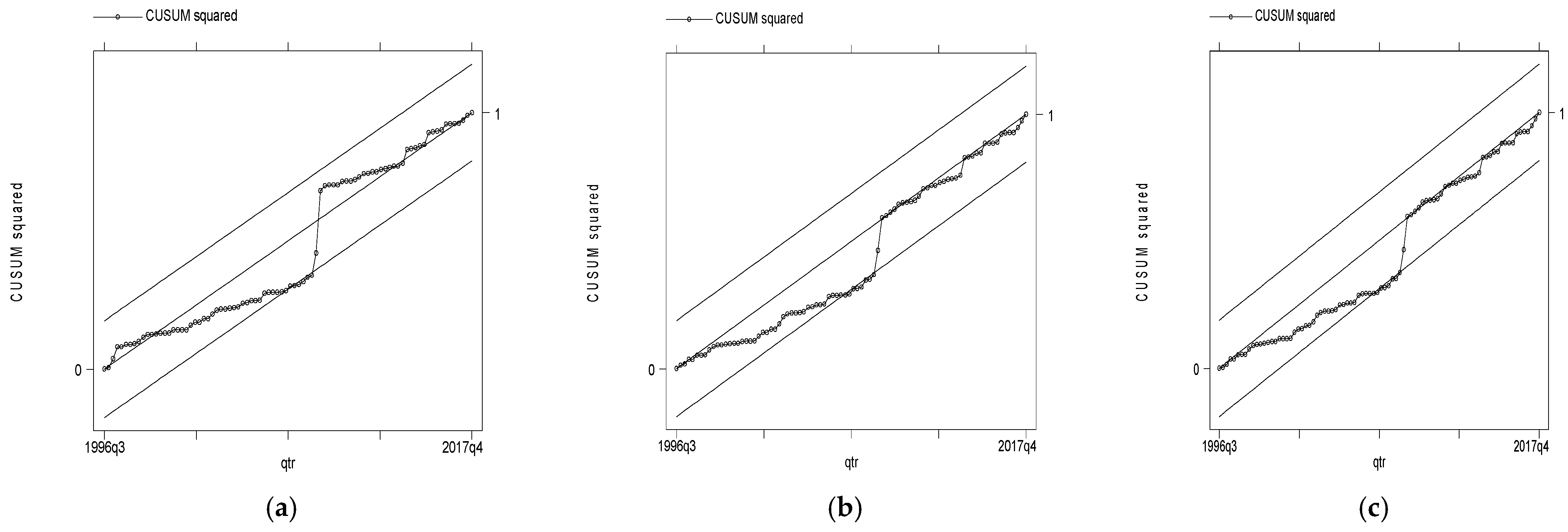
To ensure that the estimated results are robust, major post-estimation tests were carried out and the results are presented in Table 6 and Figure 1. The results of the Durbin–Watson and Breusch–Godfrey tests for serial auto correlation show that the results are free from the problem. Across the three models, the DW test statistics (2.068; 1.998; 1.997) are close to 2, as is desirable. According to the Breusch–Godfrey test, the probability values are all greater than the standard 0.05 value. This means that there is insufficient evidence to reject the null hypothesis of serial independence.
Table 6.
Post-estimation diagnostic test results.
Figure 1.
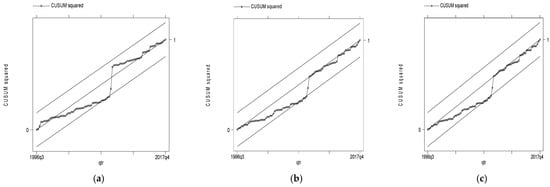
Cusum squared stability test results. Source: Authors’ illustration based on estimation results. (a) Financial insurance, real estate and business services GDP; (b) money supply as a percentage of GDP; (c) credit to private sector as a percentage of GDP.
With regard to heteroscedasticity, the results of the LM and Breusch–Pagan tests imply that the error terms for all the models are homoscedastic. This can be inferred from the p-values, which are all greater than 0.05. At such values, the null hypothesis of homoscedasticity cannot be rejected. Given the lack of availability of some data on key variables explaining economic growth variables on a quarterly basis, there was risk of the results being weakened due omitted variables. However, the Ramsey RESET results proved otherwise. For the three tests, the probability values were all higher than 0.05. As such, the null hypothesis of no omitted variables is accepted. Therefore, despite other variables being excluded, those which are included are sufficiently important to explain the economic growth in South Africa over the period 1994Q1–2025Q2. The stability of the results was checked for all the models using the Cusum stability test. Figure 1 shows that for all three models, the Cusum squared values lie within the 95% confidence intervals, and thus the models’ estimates are all stable.
In Table A1 and Table A2, unidirectional causality from economic growth to M3 supports the demand-following hypothesis, while FIRB exhibits unidirectional causality towards growth, aligning with the literature that financialization stimulate economic activity, but with varying causal directions across financial indicators (Nguyen et al., 2022). In contrast, in Table A3, the Granger causality results show no significant causal relationship between CDT and economic growth, suggesting weak monetary transmission and limited endogeneity, consistent with evidence that money aggregates often have weak predictive power for growth in emerging markets (Andersson et al., 2016).
Although Granger causality tests indicate how financialization and economic growth predict one another, they fail to prove a definitive causal link. These outcomes ought to be viewed as signs of correlation, given that issues like endogeneity, feedback loops, and missing variables could impact the data. Furthermore, using time-series techniques involves constraints regarding how models are defined, the choice of lags, and assumptions of stability. As a result, the conclusions are more indicative than final, requiring a careful reading.
5. Conclusions
The study examined the relationship between economic growth and financialisation in South Africa through alternative proxies to capture their multidimensional nature. The findings reveal a heterogeneous relationship rather than a homogenous effect. In particular, the FIRE variable exhibits a positive and statistically significant impact on economic growth, highlighting the importance of sector-specific financial expansion in shaping growth dynamics. By contrast, the effects of money supply are positive but weak, while credit to the private sector remains statistically insignificant, suggesting that traditional measures of financial depth do not consistently translate into growth in the South African context. These results imply that the growth-enhancing effects of financialisation are concentrated within specific segments of the financial sector rather than being broad-based. Therefore, policy conclusions should be interpreted with caution. Instead of advocating general financial sector expansion, the findings point to the need for policies that improve the efficiency, regulation, and productive orientation of financial intermediation, particularly within the FIRE sector, while ensuring stronger linkages with the real economy. Moreover, the weak and insignificant effects associated with money supply and credit indicate that conventional financial development strategies may have limited growth payoffs in isolation, reinforcing the importance of aligning financial sector development with broader macroeconomic and structural objectives such as investment, employment creation, and inclusive growth. Consistent with Thomson and Dutta (2018), policy interventions should also take into account the distributional consequences of financialisation to ensure that its benefits extend beyond the financial sector to households and the wider economy, while future research could further refine these findings by employing alternative measures of financialisation and exploring potential non-linearities and threshold effects in the finance and growth nexus.
Author Contributions
Conceptualization, E.C. and L.S.N.; methodology, E.C.; software, L.S.N.; validation, E.C. and L.S.N.; formal analysis, E.C.; investigation, L.S.N.; resources, E.C.; data curation, L.S.N.; writing—original draft preparation, E.C.; writing—review and editing, L.S.N.; visualization, L.S.N.; supervision, E.C.; project administration, E.C. All authors have read and agreed to the published version of the manuscript.
Funding
This research received no external funding.
Institutional Review Board Statement
Not applicable.
Informed Consent Statement
Not applicable.
Data Availability Statement
Data is available upon request from the corresponding author.
Conflicts of Interest
The authors declare no conflict of interest.
Appendix A. Estimation Results
Table A1.
Model 1 Granger Causality Tests.
Table A2.
Model 2 Granger Causality Tests.
Table A3.
Model 3 Granger Causality Tests.
References
- Ahadu, E. (2019). Linkages between financial market development and economic growth in Ethiopia. Research Journal of Finance and Accounting, 10, 13–20. [Google Scholar] [CrossRef] [Scilit]
- Ajose, K., & Oyedokun, G. E. (2018). Capital formation and economic growth in Nigeria. International Journal of Finance & Banking Studies, 7, 44–65. [Google Scholar] [CrossRef] [Scilit]
- Andersson, F. N., Burzynska, K., & Opper, S. (2016). Lending for growth? A granger causality analysis of China’s finance–growth nexus. Empirical Economics, 51(3), 897–920. [Google Scholar]
- Arcand, J. L., Berkes, E., & Panizza, U. (2015). Too much finance? Journal of Economic Growth, 20(2), 105–148. [Google Scholar] [CrossRef] [Scilit]
- Ashman, S., Mohamed, S., & Newman, S. (2013). Financialization of the South African economy: Impact on the economic growth path and employment [Discussion Paper]. United Nations Department of Economic and Social Affairs. [Google Scholar]
- Assa, J. (2012). Financialization and its consequences: The OECD experience. Finance Research, 1(1), 35–39. [Google Scholar]
- Batuo, M., Mlambo, K., & Asongu, S. (2018). Linkages between financial development, financial instability, financial liberalisation and economic growth in Africa. Research in International Business and Finance, 45, 168–179. [Google Scholar] [CrossRef] [Scilit]
- Beires, L. (2015). What is the role of government during recessionary times and what can we learn from past recessions? KwaZulu-Natal Economic Development Department: Research and Development Unit. [Google Scholar]
- Bonizzi, B. (2013). Financialization in developing and emerging countries: A survey. International Journal of Political Economy, 42(4), 83–107. [Google Scholar] [CrossRef] [Scilit]
- Brychko, M., Yuriy, B., Lyeonov, S., & Mentel, G. (2021). Trust crisis in the financial sector and macroeconomic stability: A structural equation modelling approach. Economic Research-Ekonomska Istraživanja, 34(1), 828–855. [Google Scholar] [CrossRef] [Scilit]
- Cecchetti, S. G., & Kharroubi, E. (2012). Reassessing the impact of finance on growth (No. 381). Bank for International Settlements. [Google Scholar]
- Chipangila, C. J. (2019). The effects of financialisation on development in South Africa [Master’s thesis, Faculty of Commerce, Graduate School of Business (GSB)]. [Google Scholar]
- Davidson, J. E., Hendry, D. F., Srba, F., & Yeo, S. (1978). Econometric modelling of the aggregate time-series relationship between consumers’ expenditure and income in the United Kingdom. The Economic Journal, 88(352), 661–692. [Google Scholar] [CrossRef] [Scilit]
- Denk, O., & Cournède, B. (2015). Finance and income inequality in OECD countries. Available online: https://papers.ssrn.com/sol3/papers.cfm?abstract_id=2649944 (accessed on 22 April 2026).
- Ductor, L., & Grechyna, D. (2015). Financial development, real sector, and economic growth. International Review of Economics and Finance, 37, 393–405. [Google Scholar] [CrossRef] [Scilit]
- Duménil, G., & Lévy, D. (2004). The real and financial components of profitability (United States, 1952–2000). Review of Radical Political Economics, 36(1), 82–110. [Google Scholar] [CrossRef] [Scilit]
- Durlauf, S., & Blume, E. L. (Eds.). (2010). Economic growth (2nd ed.). Macmillan Publishers Ltd. [Google Scholar]
- Epstein, G. A. (Ed.). (2005). Financialization and the world economy. Edward Elgar Publishing. [Google Scholar]
- Fields, D. M. (2015). Classical dichotomy. University of Utah. [Google Scholar]
- Ghouse, G., Khan, S. A., & Rehman, A. U. (2018). ARDL model as a remedy for spurious regression: Problems, performance and prospect. Munich Personal RePEc Archive. [Google Scholar]
- Gordhan, P. J. (2011). A safer financial sector to serve South Africa better. National Treasury.
- Handa, J. (2009). Monetary economics (2nd ed.). Routledge, Taylor & Francis. [Google Scholar]
- Hein, E. (2014). Distribution and growth after keynes: A post-keynesian guide. Edward Elgar Publishing. [Google Scholar]
- Hye, Q. M. A., & Lau, W. Y. (2015). Trade openness and economic growth: Empirical evidence from India. Journal of Business Economics and Management, 16(1), 188–205. [Google Scholar] [CrossRef] [Scilit]
- Idris, M., Bakar, R., & Ahmad, T. S. T. (2017). The effects of fiscal deficits in developing countries: Implications on the economic growth of Nigeria. International Journal of Social Science and Economic Research, 2(9), 4497–4520. [Google Scholar]
- Issaoui, F., & Boufateh, T. (2015). Money neutrality: Rethinking the myth. Panoeconomicus, 62(3), 287–320. [Google Scholar] [CrossRef] [Scilit]
- Kapaya, S. M. (2021). Financial development and economic growth in Tanzania: An ARDL and bound testing approach. Asian Journal of Economics and Banking, 5(1), 46–65. [Google Scholar] [CrossRef] [Scilit]
- Karwowski, E., Shabani, M., & Stockhammer, E. (2015). Financialisation: Dimensions and determinants. A cross-country study. In Conference on economic theory and policy at Meiji University in Tokyo. Meiji University in Tokyo. [Google Scholar]
- Karwowski, E., & Stockhammer, E. (2017). Financialisation in emerging economies: A systematic overview and comparison with Anglo-Saxon economies. Economic and Political Studies, 5(1), 60–86. [Google Scholar] [CrossRef] [Scilit]
- Khatatbeh, I. N., & Moosa, I. A. (2022). Financialization and income inequality: An extreme bounds analysis. The Journal of International Trade & Economic Development, 31(5), 692–707. [Google Scholar]
- Kripfganz, S., & Schneider, D. C. (2023). ardl: Estimating autoregressive distributed lag and equilibrium correction models. The Stata Journal, 23(4), 983–1019. [Google Scholar] [CrossRef] [Scilit]
- Krippner, G. R. (2005). The financialization of the American economy. Socio-Economic Review, 3(2), 173–208. [Google Scholar] [CrossRef] [Scilit]
- Kryeziu, N. H., & Hoxha, E. (2021). Fiscal deficit and its effects on economic growth. International Journal of Finance & Banking Studies (2147-4486), 10(1), 62–70. [Google Scholar] [CrossRef] [Scilit]
- Kungwane, R. (2020). Financialisation and economic growth in Africa [Master’s thesis, Faculty of Commerce, Graduate School of Business (GSB)]. [Google Scholar]
- Lapavitsas, C. (2013). The financialization of capitalism: ‘Profiting without producing’. City, 17(6), 792–805. [Google Scholar] [CrossRef] [Scilit]
- Lee, K. S., & Werner, R. A. (2022). Are lower interest rates really associated with higher growth? New empirical evidence on the interest rate thesis from 19 countries. International Journal of Finance and Economics, 28(4), 3960–3975. [Google Scholar] [CrossRef] [Scilit]
- Levine, R. (1997). Financial development and economic growth: Views and agenda. Journal of Economic Literature, 35(2), 688–726. [Google Scholar]
- Levine, R. (2005). Chapter 12 finance and growth: Theory and evidence. In P. Aghion, & S. N. Durlauf (Eds.), Handbook of economic growth (Vol. 1, pp. 865–934). Elsevier. [Google Scholar] [CrossRef] [Scilit]
- Mabeba, M. (2024). The Effect of financial market depth on economic growth in developing countries with large financial sectors. Social Science Studies, 4(2), 66–81. [Google Scholar] [CrossRef] [Scilit]
- Mandiefe, S. P. (2015). The impact of financial sector development on economic growth: Analysis of the financial development gap between Cameroon and South Africa. Available online: https://mpra.ub.uni-muenchen.de/65763/ (accessed on 1 January 2026).
- McHardy, G. (2022). The finance-growth nexus in South Africa [Master’s thesis, Faculty of Commerce, Graduate School of Business (GSB)]. [Google Scholar]
- McKinnon, R. I. (1973). The order of economic liberalization: Financial control in the transition to a market economy. JHU Press. [Google Scholar]
- Ncanywa, T., & Mabusela, K. (2019). Can financial development influence economic growth: The sub-Saharan analysis? Journal of Economic and Financial Sciences, 12(1), 1–13. [Google Scholar] [CrossRef] [Scilit]
- Ndikumana, L., & Allen, S. D. (1998). Financial intermediation and economic growth in Southern Africa [Working Paper 1998-004B]. FRB of St Louis. Available online: http://research.stlouisfed.org/wp/1998/98-004.pdf (accessed on 1 January 2026).
- Ngcobo, W. A., Zhou, S., & Pillay, S. S. (2025). The effect of financial market capitalisation on economic growth and unemployment in South Africa. Economies, 13(3), 57. [Google Scholar] [CrossRef] [Scilit]
- Nguyen, H. M., Le, Q. T. T., Ho, C. M., Nguyen, T. C., & Vo, D. H. (2022). Does financial development matter for economic growth in the emerging markets? Borsa Istanbul Review, 22(4), 688–698. [Google Scholar] [CrossRef] [Scilit]
- Nkoro, E., & Uko, A. K. (2016). Autoregressive distributed lag (ARDL) cointegration technique: Application and interpretation. Journal of Statistical and Econometric Methods, 5(4), 63–91. [Google Scholar]
- Omodero, C. O. (2019). Effect of money supply on economic growth: A comparative study of Nigeria and Ghana. International Journal of Social Science Studies, 7(3), 16–23. [Google Scholar] [CrossRef] [Scilit]
- Paul, B. P. (2014). Testing export-led growth in Bangladesh: An ARDL bounds test approach. International Journal of Trade, Economics and Finance, 5(1), 1–5. [Google Scholar] [CrossRef] [Scilit]
- Pesaran, M. H., & Shin, Y. (1995, March 3–5). Autoregressive distributed lag modeling approach to cointegration analysis [Paper presentation]. Symposium, Norwegian Academy of Science and Letters, Oslo, Norway. [Google Scholar]
- Pesaran, M. H., Shin, Y., & Smith, R. J. (2001). Bounds testing approaches to the analysis of level relationships. Journal of Applied Econometrics, 16(3), 289–326. [Google Scholar] [CrossRef] [Scilit]
- Pesaran, M. H., Shin, Y., & Smith, R. P. (1999). Pooled mean group estimation of dynamic heterogeneous panels. Journal of American Statistical Association, 94(446), 621–634. [Google Scholar] [CrossRef]
- Schumpeter, J. (1911). The theory of economic development: An inquiry into profits, capital, credit, interest and business cycle. Harvard University Press. [Google Scholar]
- Sek, S. K., Teo, X. Q., & Wong, Y. N. (2015). A comparative study on the effects of oil price changes on inflation. Procedia Economics and Finance, 26, 630–636. [Google Scholar] [CrossRef] [Scilit]
- Shaukat, B., Zhu, Q., & Khan, M. I. (2019). Real interest rate and economic growth: A statistical exploration for transitory economies. Physica A: Statistical Mechanics and Its Applications, 534, 122193. [Google Scholar] [CrossRef] [Scilit]
- Sibindi, A. B. (2014). Life insurance, financial development and economic growth in South Africa. Risk Governance & Control: Financial Markets & Institutions, 4(3), 7–15. [Google Scholar]
- Solow, R. M. (1956). A contribution to the theory of economic growth. Quarterly Journal of Economics, 70(1), 65–94. [Google Scholar]
- South African Reserve Bank. (2022). Quarterly bulletin. South African Reserve Bank. Available online: https://www.resbank.co.za/en/home/publications/publication-detail-pages/quarterly-bulletins/quarterly-bulletin-publications/2022/FullQuarterlyBulletinNo304June2022 (accessed on 1 January 2026).
- Statistics South Africa. (2022). Gross domestic product, quarterly estimates (Statistical release P0441). Statistics South Africa. Available online: https://www.statssa.gov.za/publications/P0441/P04411stQuarter2022.pdf (accessed on 1 January 2026).
- Stockhammer, E. (2004). Financialisation and the slowdown of accumulation. Cambridge Journal of Economics, 28(5), 719–741. [Google Scholar] [CrossRef] [Scilit]
- Stockhammer, E. (2015b). Neoliberal growth models, monetary union and the Euro crisis. A Post-Keynesian perspective. Post Keynesian Economics Study Group Working Paper 1510. Post Keynesian Economics Study Group. [Google Scholar]
- Stockhammer, E., Sgambati, S., & Nesvetailova, A. (2021). Financialisation: Continuity and change—Introduction to the special issue. Review of Evolutionary Political Economy, 2(3), 389–401. [Google Scholar] [CrossRef] [Scilit]
- Sulemana, M., & Dramani, J. B. (2020). Effect of financial sector development and institutions on economic growth in SSA. Does the peculiarities of regional blocs matter? Journal of Sustainable Finance & Investment, 12(4), 1102–1124. [Google Scholar] [CrossRef] [Scilit]
- Sunde, T. (2012). Financial sector development and economic growth nexus in South Africa. International Journal of Monetary Economics and Finance, 5, 64–75. [Google Scholar] [CrossRef] [Scilit]
- Sunge, R., & Makamba, S. B. (2020). Testing the quantity theory of money in Zimbabwe under the multiple currency regime: An ARDL bound testing approach. African Journal of Economic Review, 8(1), 65–88. [Google Scholar]
- Sunge, R., & Ngepah, N. (2020a). Agricultural trade liberalization, regional trade agreements and agricultural technical efficiency in Africa. Outlook on Agriculture, 49(1), 66–76. [Google Scholar] [CrossRef] [Scilit]
- Sunge, R., & Ngepah, N. (2020b). The impact of agricultural trade liberalization on agricultural total factor productivity growth in Africa. International Economic Journal, 34, 571–598. [Google Scholar] [CrossRef] [Scilit]
- Swan, T. W. (1956). Economic growth and capital accumulation. Economic Record, 32(2), 334–361. [Google Scholar] [CrossRef] [Scilit]
- Thomson, F., & Dutta, S. J. (2018). Financialisation: A primer. Available online: https://research.gold.ac.uk/id/eprint/25949/1/Thompson%20%26%20Dutta%20%5B2018%5D%20-%20Financialisation%20Primer%202nd%20edition.pdf (accessed on 1 January 2026).
- Thore, S., & Tarverdyan, R. (2021). Measuring sustainable development goals performance. Elsevier. [Google Scholar]
- Ziramba, D. (2016). The impact of financial market development and financialization on economic growth in South Africa [Master’s dissertation, Zululand University]. [Google Scholar]

Disclaimer/Publisher’s Note: The statements, opinions and data contained in all publications are solely those of the individual author(s) and contributor(s) and not of MDPI and/or the editor(s). MDPI and/or the editor(s) disclaim responsibility for any injury to people or property resulting from any ideas, methods, instructions or products referred to in the content. |
© 2026 by the authors. Licensee MDPI, Basel, Switzerland. This article is an open access article distributed under the terms and conditions of the Creative Commons Attribution (CC BY) license.