


Abstract
To address the inheritance dilemma of Danzhou Diaosheng, a national intangible cultural heritage, a dedicated dancing robot was developed, and in-depth research on its mechanical structure and motion analysis was conducted for accurate reproduction of the folk art’s typical dance movements. Based on the decomposition and measurement of dance movements, a coupled mechanism system integrating crank-slider and crank-rocker mechanisms was constructed using the concise design concept of mechanism coupling, single drive and trajectory constraint. A practical prototype was developed and exhibited, which has attracted nearly 10 million visits to date. An optical motion capture system was applied to verify the robot’s motion accuracy, and the motion errors of its trunk, hand and joints were maintained at a low level (RMSE ≤ 1.47 mm). The mechanical technology and intangible cultural heritage protection were organically integrated in this research, which provided a replicable technical solution for traditional folk-art inheritance and a feasible design reference for cultural and artistic robots.
1. Introduction
As the crystallization of a nation’s wisdom and the carrier of its cultural genes, intangible cultural heritage (ICH) embodies the collective memory of thousands of years of civilization [1,2]. It has now been two decades since UNESCO’s Convention for the Safeguarding of the Intangible Cultural Heritage was adopted. A ground-breaking treaty, the convention brings recognition of heritage as a living, breathing element of human existence [3]. ICH plays a pivotal role in sustainable development by fostering social cohesion, economic growth, and environmental stewardship [4]. The connection between ICH and discourses around urban resilience is a relatively recent development, with academic research on this theme experiencing exponential growth starting from 2017 [5]. In particular, traditional skills and crafts have practical functions and bear symbolic significance [6]. China has developed a systematic four-tier ICH inventory system, encompassing the national, provincial, municipal, and county levels [7]. To date, the total number of representative ICH items at all levels amounts to over 100,000, of which 1557 are national-level entries [8,9]. Notably, 44 of these items have been inscribed on UNESCO’s Representative List of the Intangible Cultural Heritage of Humanity, securing China the top position globally in terms of the number of inscribed items [10]. However, this splendid cultural treasure trove is facing severe challenges: amid the processes of industrialization and urbanization, the traditional living soil (i.e., the cultural and social environment) is shrinking. Statistical data indicate that 37% of traditional dance heritage and 35% of traditional opera genres have been lost over the last 20 years, posing severe challenges to the sustainable inheritance of ICH [11,12]. Artificial intelligence and machine learning are transforming manual inspections and expert evaluations for the conservation of cultural heritage structures [13,14]. Fortunately, technological innovation provides a way to alleviate the inheritance difficulty of ICH. The rise of embodied intelligence has transformed robots from industrial tools into cultural carriers [15,16]. Unitree G1, a humanoid robot developed by Unitree Technology, has performed dances on various occasions [17,18]. Its ability to ‘speak and act’ enables the creation of immersive ICH experiences, realizing in-depth integration of technology and culture. The millimeter-level scanning and monitoring of ancient architecture by Lenovo’s hexapod dog demonstrates the unique advantages of robots in cultural heritage protection [19]. Disney and global science exhibition centers have developed linkage-driven animatronic puppets capable of performing independent motions (walking, running, simulated swimming, etc.). Nevertheless, such linkage animatronics are mostly designed for single-character independent display. Separate driving and control systems are configured for each puppet, which brings high costs and serious synchronization deviations when arranging multiple puppets to perform group dance simultaneously. These explorations reveal that robot technology can break the temporal and spatial limitations of traditional communication, transform abstract ICH techniques into tangible and interactive physical displays.
The Danzhou Diaosheng in Hainan is a typical microcosm of this predicament [20]. Originating in the Western Han Dynasty, this folk art, with its graceful melodies composed of pentatonic scales, dialect lyrics, and passionate dance movements such as hand-holding, shoulder-hooking, and waist-swaying, has become a living heritage carrying the local customs and traditions of Danzhou. However, under the impact of modern culture, its inheritance situation is worrying: the inheritors are mainly middle-aged and elderly people, young audiences show little interest, traditional dissemination relies only on limited scenarios such as festivals and celebrations, new media dissemination lags behind, and the unique dance skills are at risk of being lost [21]. This vicious circle of ‘single promotion—insufficient attention—inheritance breakage’ is precisely the common fate of many ICH projects [22].
Focusing on the dance inheritance of Danzhou Diaosheng, a dedicated dance robot was developed to reproduce its signature movements through high-precision motion control technology. This robot can construct interactive exhibition scenarios in exhibition centers, allowing audiences to intuitively experience the rhythmic beauty of Diaosheng dance. Further, it realizes the digital preservation of the craft through standardized motion recording [23]. This combination of technology and physical exhibition makes up for the limitations of traditional oral instruction and hands-on teaching [24], attracts public attention with a youthful and technological expression, and provides a technical path for the digital inheritance of ICH. It is expected that a replicable technical solution will enable more ICH projects to break free from the predicament of inheritance (such as Bench Dragon [25], Sega Tambour [26], Bharatanatyam), benefitting from technological power and regaining their glory in exhibition venues and cultural spaces of the new era.
This study introduces distinct methodological and analytical innovations for cultural heritage robots. A novel coupled mechanism paradigm is proposed that combines crank-slider and crank-rocker mechanisms with cam trajectory constraints, realizing coordinated dance motions using only one actuator. A closed-form kinematic model is established using vector projection and geometric constraints to derive full-body motion parameters. A data-driven optimization strategy is applied to minimize motion errors by tuning link lengths against motion capture data. A quantitative three-party error evaluation framework (human, model, and prototype) is adopted to validate accuracy. This study focuses on reproducing the standard dance trajectories of Danzhou Diaosheng, so kinematic analysis is the core part of the research. We have fully analyzed the displacement, velocity and acceleration of each component, which can comprehensively reflect the robot’s motion characteristics, movement rhythm and performance effect. These methods form a complete, replicable technical pipeline that advances mechanism design for artistic robots and supports ICH inheritance.
2. Methodology
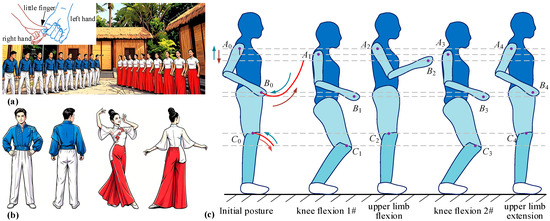
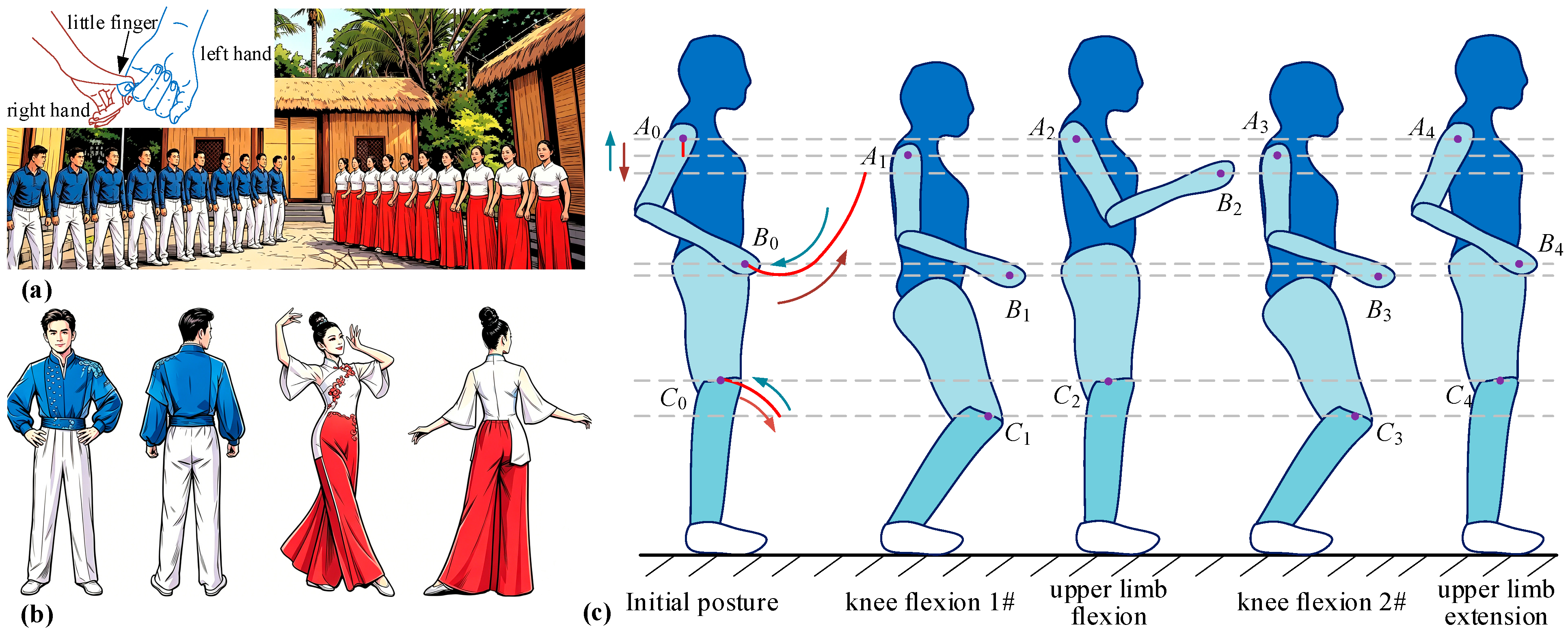
Danzhou Diaosheng originated in the Western Han Dynasty of China and has developed into the most representative traditional ethnic music performance form in the northwestern part of Hainan Province. It mainly takes place during slack farming seasons or festivals, when young men and women gather in the mountains and fields to sing while dancing. The annual Mid-Autumn Festival Song Gathering is particularly lively. Danzhou Diaosheng has been included in the First Batch of the National Intangible Cultural Heritage List (Item No. II-14) since 2006 [20]. It adopts the form of group antiphonal singing between young men and women, where performers must wear costumes with ethnic characteristics. They stand facing each other, arranged in two rows or a circle, hook their little fingers together and hold hands to complete dance movements. Doubao V13.4, an AI tool, is used to create the scenes and costumes for the male–female duet of Danzhou Diaosheng, as shown in Figure 1a,b. Their hands and bodies swing in rhythm with the singing, showing regular upper limb swings and knee flexions, thus realizing the organic unity of vocal performance and body movements. Its dance movements are concise, highly stylized and naturally periodic, matching the rhythm of folk music. There are no complicated variable gestures, and the movements are easy to master for people of all ages.
Figure 1.
Dance movement of Danzhou Diaosheng. (a) Male–female duet scene. (b) Ethnic costumes. (c) Decomposition of dance movement. (Figure 1a,b are generated by the AI tool Doubao on 25 May 2026. https://www.doubao.com).
Although conventional multi-joint humanoid robots can reproduce a single set of Danzhou Diaosheng dance movements, they are not applicable to its group performance characteristics. Using multiple independent humanoid robots for group dance leads to inconsistent movements, excessive cost, low reliability and large space occupation. To solve these practical technical problems, this work adopts a single-drive coupled mechanism. It can synchronously drive a plurality of puppets to realize unified dance actions, featuring low cost, high stability and small overall size, which well matches the group exhibition and inheritance demands of Danzhou Diaosheng.
2.1. Decomposition and Measurement of Dance Movement
To facilitate the analysis of dance movements, a simplified human model is created, with points A, B, and C marking the centers of the shoulder joint, hand, and knee joint, respectively. The subscripts of marker points represent the serial numbers of typical dance postures (Figure 1c). In the initial state, the performer stands upright with upper limbs extended backward, fists clenched and placed in front of the waist. Then, the knees flex, the upper limbs extend further backward, and the trunk and hands lower to the lowest position. In the second posture: the knees extend, the upper limbs flex forward, the trunk remains upright, and the hands reach the highest position. In the third one: the knees flex again, the upper limbs extend backward, and the trunk and hands lower to the lowest position once more. After that, the movement continues until returning to the initial state. Red lines in Figure 1c depict the movement trajectories of the marker points. The entire dance consists of two knee bends and one arm swing. The tempo of the movements is synchronized with the rhythm of Diaosheng songs, and these dance motions repeat periodically.
2.2. Kinematic Analysis of Danzhou Diaosheng
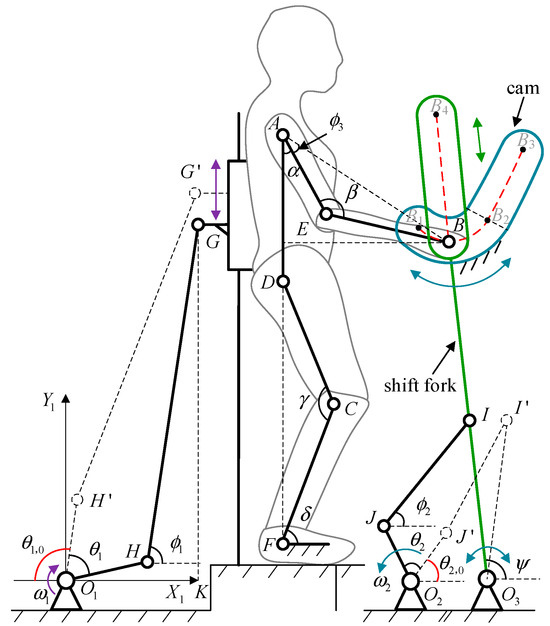
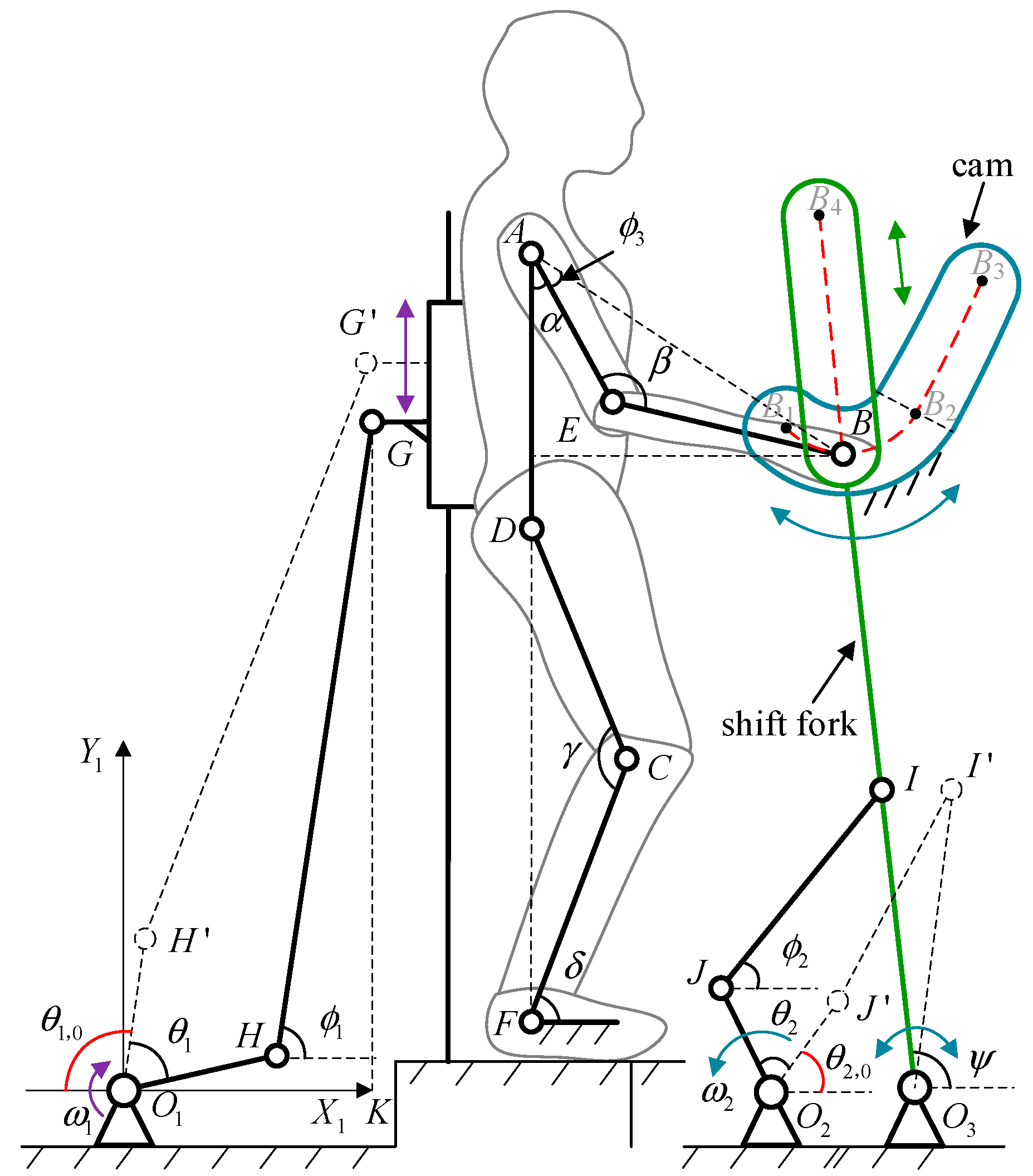
From the perspective of mechanism theory, the sole of the foot is equivalent to a fixed frame at the standing position [27]. The vertical movements of the shoulder joint and trunk promote the flexion movement of the knee joint, while the hand moves along a predetermined trajectory. Driven by the shoulder and hand, the elbow joint performs flexion/extension movements. Therefore, the trunk and human joints can be regarded as connecting rods and hinges [28]. The human body can be equivalent to a planar mechanism in the sagittal plane [29,30], with the movements of the trunk and hand serving as driving components, as shown in Figure 2 (symbols A–J represent rotation centers). A crank-slider mechanism is adopted to achieve the vertical movement of the trunk [31]. The line segment AD between shoulder A and hip joint D serves as the trunk, and the crank O1H drives the slider (trunk AD) through the connecting rod GH. The trunk AD drives the thigh CD and lower leg CF to rotate around the hip joint D and ankle joint F, respectively, realizing the flexion/extension of the knee. A cam is added to constrain the movement trajectory of hand B. The coupled movement of shoulder A and hand B actuates the upper arm AE and forearm BE, and further drives elbow joint E. Then, a crank-rocker mechanism is adopted to push the hand along the predetermined trajectory [32]. The fork is used as a rocker, forcing hand B to move along the inner groove of the cam. A single actuator is used to rotate the crank-rocker mechanism. Through a gear transmission (ratio 1:2), the speed is increased and transmitted to the crank-slider mechanism, realizing two knee flexions and one arm swing in a single dance movement [33].
Figure 2.
Kinematic diagram of dancing robot.
For subsequent kinematic analysis, a coordinate system XiOiYi (i = 1, 2, 3) is established. Cranks O1H and O1H are rotated by angles θ1 and θ2 from their initial position (standing posture), and the relationship between them is as follows:
θ1 = 2θ2
Meanwhile, the initial angle between O1H and the axis O1X1 is θ1,0, and θ2,0 is the initial angle of θ2 (Figure 2). The kinematic analysis of all transmission mechanisms in the dancing robot can be performed with θ1 as the sole variable, facilitating the solution of displacements, velocities and accelerations of the trunk, shoulders, elbows and knees.
- Trunk
The trunk AD is connected to the slider G, and the vector method is used to solve the vertical displacement of slider G:
The projections of the aforementioned vectors on the axes O1X1 and O1X1 are as follows:
where φ1 is an intermediate variable.
By simplifying Equation (3), the variable φ1 can be eliminated, and a mathematical model between the vector KG and θ1 can be established, thereby enabling the calculation of the trunk position when the crank O1H is at any angle.
The variation range of the modulus lKG of |KG| is the displacement Strunk of trunk AD:
where lKG,0 is the initial value at the standing posture.
Furthermore, the velocity vtrunk and acceleration atrunk are calculated by:
where and are the first-order and second-order derivatives of the trunk displacement .
- Hand
Within the coordinate system X2O2Y2, the model of vector O2I is established:
Similarly, the projections of the aforementioned vectors on the axes O2X2 and O2Y2 are as follows:
where φ2 is also an intermediate variable that can be eliminated, Ψ is the angle between shift fork O3B and O3X3. Furthermore, the mapping relationship of Ψ and θ2 can be established.
The shift fork O3B forms an intersection point B with the predetermined trajectory of the hand. In the coordinate system X1O1Y1, a ray ffork(x1, y1) starting from O3 and parallel to O3B is established:
where the coordinate of O3 in X1O1Y1 is (xo,3, yo,3).
The predetermined trajectory of the hand consists of a semicircular arc and a straight-line segment , whose mathematical expression is as follows:
where the center coordinate of the arc segment is (xarc, yarc), xleft and xright are respectively the left and right boundary coordinates of the hand trajectory, and xtang is the tangent point coordinate of the arc segment and the straight-line segment.
is a slope of the straight-line segment .
By simultaneously solving Equations (8) and (9) to acquire the coordinates (xB, yB) of point B, we can obtain the hand displacement Dhand.
The instantaneous velocity vhand and acceleration ahand are acquired by:
- Elbow
Based on the known vector KG, the coordinate (xA, yA) of shoulder A in X1O1Y1 can be obtained by the vector method:
The included angle formed by AE and AB can be solved according to the known coordinates of A and B, and lengths of vectors AE and AB. Then, the display expression of the shoulder angle α is derived:
Similarly, the display expression of the elbow angle β can be established:
Based on the shoulder angle α, the direction of vector AE can be obtained, and then the coordinates (xE, yE) of the elbow joint E can be calculated. Further, the corresponding displacement Dhand, velocity vhand, and acceleration ahand can all be determined.
- Knee
The coordinate (xD, yD) of hip joint D in X1O1Y1 can be calculated by a vector model:
Based on the known coordinates (xF, yF) of ankle F, the kinematic parameters are acquired. In addition, the knee angle γ formed by the thigh CD and calf CF is yielded by the display expression:
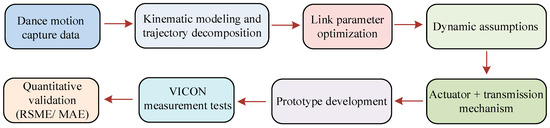
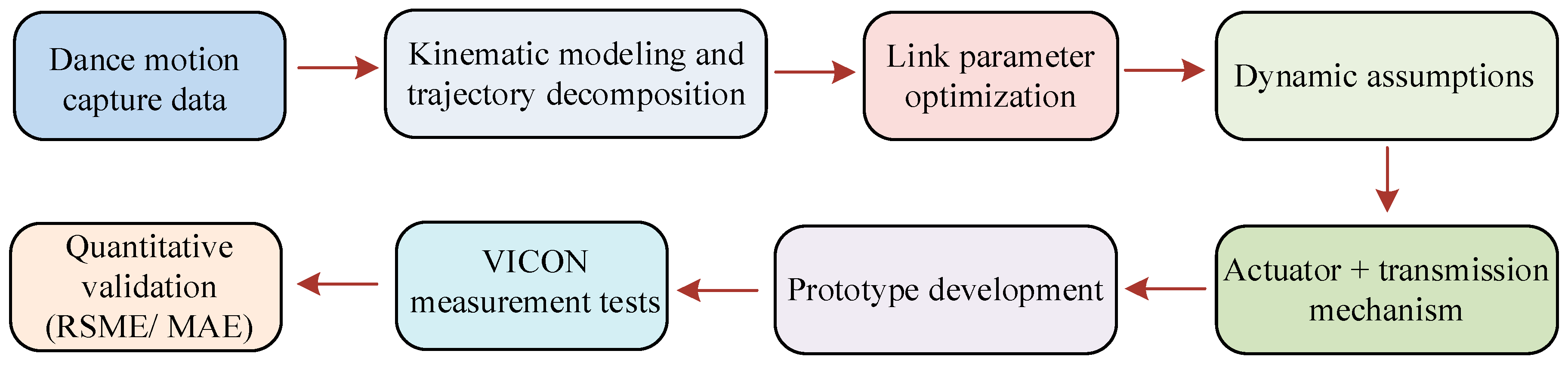
To clearly define the system-level architecture, a complete operational flow is established, as illustrated in Figure 3. The system starts with dance motion capture data as input. Then, kinematic modeling and trajectory decomposition are conducted to extract key motion features, followed by link parameter optimization to minimize motion errors. The control logic adopts a single actuator with a 1:2 gear transmission to drive the entire mechanism. The actuation module integrates a crank-slider mechanism, a crank-rocker mechanism, and a cam-guided mechanism to realize trunk lifting, hand-swinging, and trajectory constraint simultaneously. Finally, coordinated dance motions with two knee flexions and one arm swing are generated, and the motion accuracy is verified using RMSE and MAE metrics.
Figure 3.
System-level architecture and operational flow of the dancing robot.
Based on the length ratio of human limbs, a scale-down puppet is fabricated (scale ratio 1:8), and the measured motion trajectories of the hand, trunk, and knee joint are scaled down to obtain the ideal kinematic curves. Taking the rod lengths in the slider-crank and crank-rocker mechanisms as the parameters to be optimized, the trajectories, velocities, and accelerations of the hand, torso, and knee joint under different parameters are solved. Since the motion trajectory of the puppet is preset, the lengths of some rods can be derived. The curve alignment is performed using a custom interpolation function in MATLAB R2024a (MathWorks, Natick, MA, USA), followed by a curve subtraction. The optimal lengths of the remaining rods are then determined by minimizing the absolute error between the theoretical velocity and the limb velocity, as shown in Table 1.
Table 1.
Rod lengths of dancing robot.
For the drive mechanism, a quasi-static dynamic model is established according to the robot’s low-speed and lightweight operating features. The inertial force and dynamic torque can be ignored in normal working conditions. Power is transmitted via a reducer and gear pairs to drive the coupled linkages and cam mechanism. The drive system bears a steady load during continuous operation, and the mechanical structure guarantees stable dynamic output and periodic dance motions.
2.3. Structure of Dancing Robot
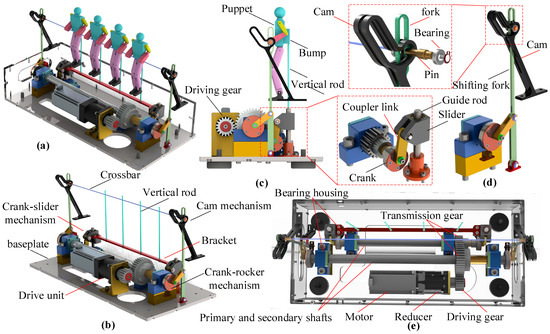
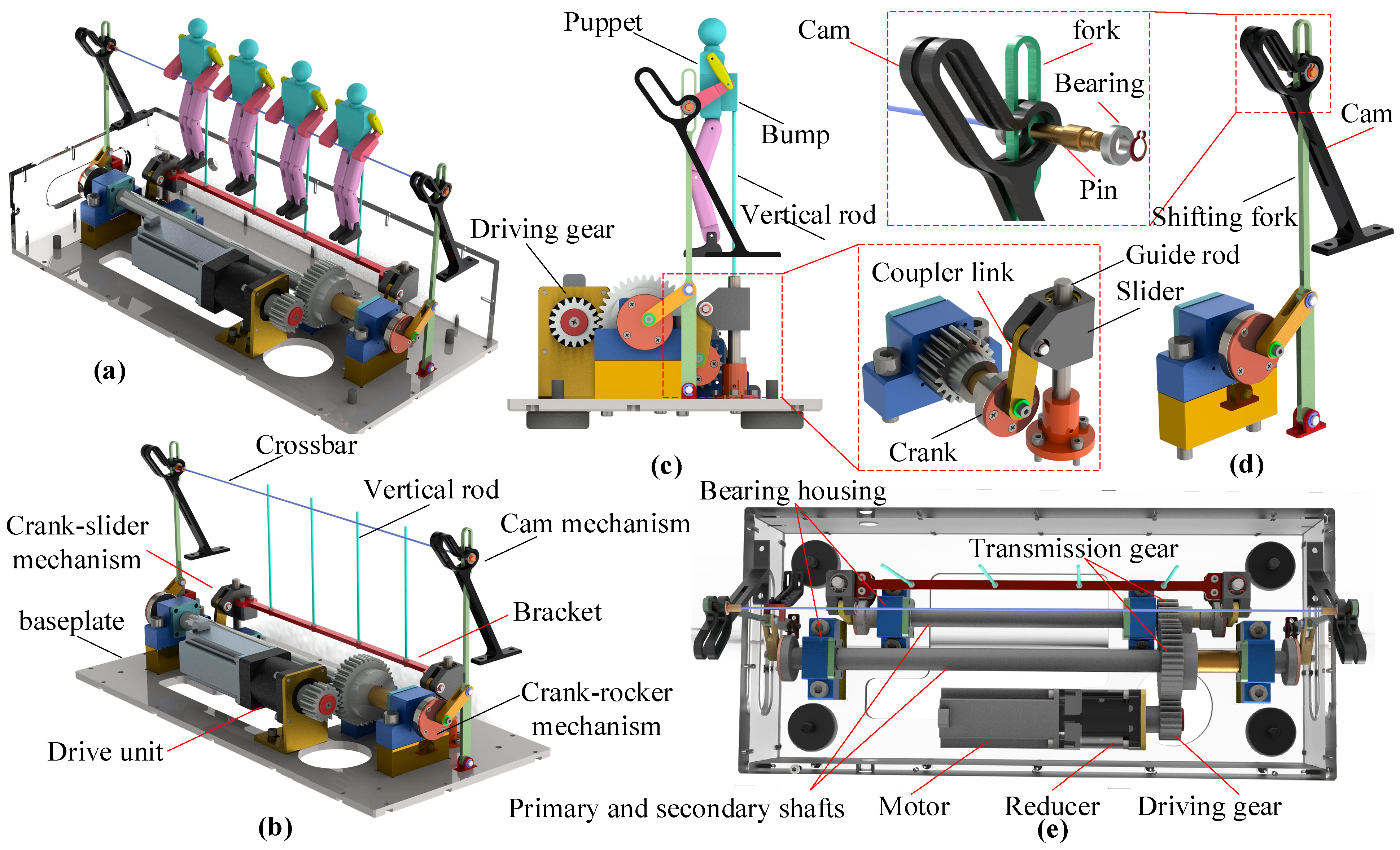
Based on the length of each rod and the relative positions of fixed hinges, the detailed structure of the dancing robot is designed, as shown in Figure 4a,b. To reflect the ethnic customs of Danzhou Diaosheng (a traditional folk singing and dancing art unique to Danzhou City, Hainan Province), four puppets are grouped together and arranged in a row to complete consistent dance movements. A bump is attached to the back of each puppet, through which a vertical rod is inserted. The trunk of the puppet is driven by this rod mounted on a bracket. The initial standing posture of the puppet can be adjusted using the upper and lower locknuts of this rod. All hands of the puppets are connected and penetrated by a crossbar. On the basis of the scaled hand trajectory, a cam guiding mechanism is developed, where a shifting fork forces the roller to move along the inner groove of the cam [34]. The roller is composed of a pin and two bearings, so that the movement resistance can be effectively reduced. Guiding mechanisms are arranged on both sides of the puppet to support the crossbar together, which passes through the two pins in sequence. Fasteners are installed at both ends of the crossbar to restrict its axial movement. In order to make the audience focus more on the dancing movements of the puppets, the driving mechanism is placed inside a cabinet.
Figure 4.
Design and development of dancing robot. (a) Render model. (b) Drive mechanism. (c) Crank slider mechanism. (d) Crank rocker mechanism. (e) Actuator transmission details.
Four vertical rods are mounted on a single bracket collectively. Both ends of the bracket are supported by two sets of crank-slider mechanisms, and the bracket is installed on the sliders, with which it moves up and down synchronously (Figure 4c). The cranks are mounted at both ends of the primary transmission shaft, which is supported by two bearing housings and blocks. Coupler links connect the cranks and sliders, and the sliders move along the guide rods. Standard linear bearings are adopted between the sliders and guide rods. The shifting forks serve as the rockers of the crank-rocker mechanisms (Figure 4d) [32]. The secondary transmission shaft drives the cranks, and the reciprocating motion of the shifting forks drives the rollers and crossbar to move along the cam grooves. In the rotating hinges, both ends of the pin shafts are fixed by shaft circlips. The primary and secondary transmission shafts are engaged through gears, with a transmission ratio of 2:1. The stepper motor (BYD 57, SYNTRON, China) of the driving unit is connected to a reducer, and the driving gear is mounted at the end of the reducer (Figure 4e). All components are installed on the base plate. The driving gear meshes with the gear on the primary transmission shaft to transmit power to each mechanism. The robot adopts a gear transmission system with a fixed transmission ratio. By adjusting the rotating speed of the driving motor, the robot can adapt to slow, medium and fast dance tempos of Danzhou Diaosheng.
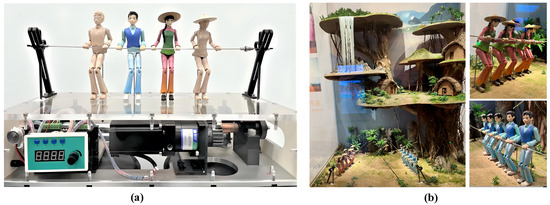
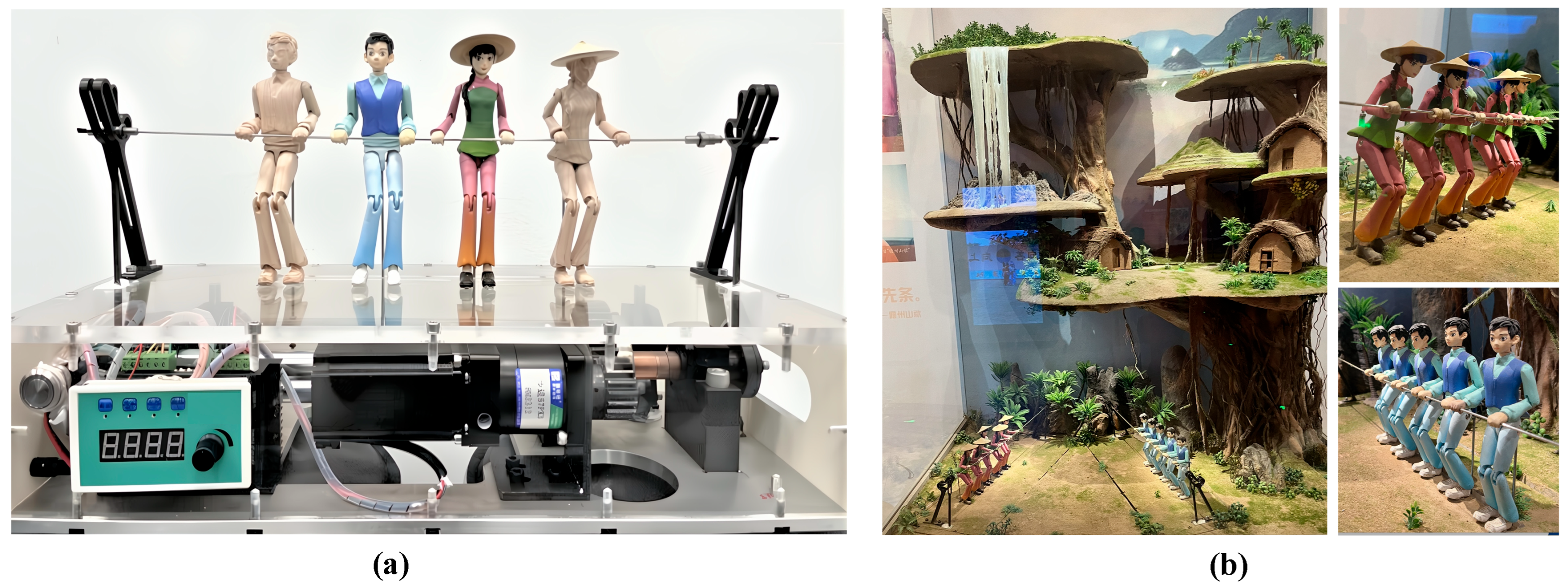
Based on the detailed structure of the dancing robot, a prototype has been developed (Figure 5a). A stepper motor with a rated power of 100 W and a planetary reducer (ratio 4:1) are used to drive the coupled mechanisms. The prototype mainly adopts stainless steel, aluminum alloy, and acrylic plates to enhance corrosion resistance and achieve a lightweight design. The proposed dance robot adopts a single-drive mechanical coupling scheme. All dance trajectories are predefined and constrained by linkages and cam mechanisms. The stepper motor works at a constant speed to drive the entire system. The movement frequency and dance tempo are adjusted by changing the motor rotational speed. Through kinematic tests, the effective integration of ICH and mechanism is realized perfectly. The technical parameters of the prototype are presented in Table 2.
Figure 5.
Development of dancing robot. (a) Prototype. (b) Scene of male-female antiphonal singing.
Table 2.
Technical parameters of dancing robot.
On this basis, two sets of 5-puppet versions have been developed—one group for male puppets and the other for female puppets—forming a scene of male–female antiphonal singing beside mountain forests (Figure 5b). These prototypes are exhibited at the Hainan Provincial Intangible Cultural Heritage Exhibition Center. The dancing robots move along with Danzhou Minor Tune. Over the past two years, they have received a total of nearly 10 million visits, which has greatly improved the dissemination efficiency and reach of Danzhou Diaosheng.
The dance puppets are made of wood with lightweight and small structural size, leading to a very low moment of inertia of the moving parts. The robot works at a low and stable speed following a fixed dance rhythm. In this case, the inertial effect, dynamic torque and additional structural load are negligible. The overall inertia of the system mainly originates from the equipment base and transmission assemblies. The structure is rigid and operates gently, so structural stress and vibration are far within the safe range of the material.
2.4. Dance Movement Measurement
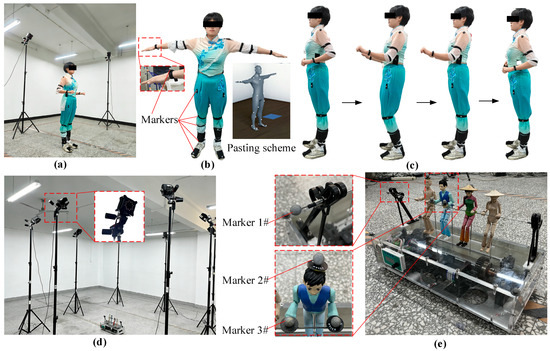
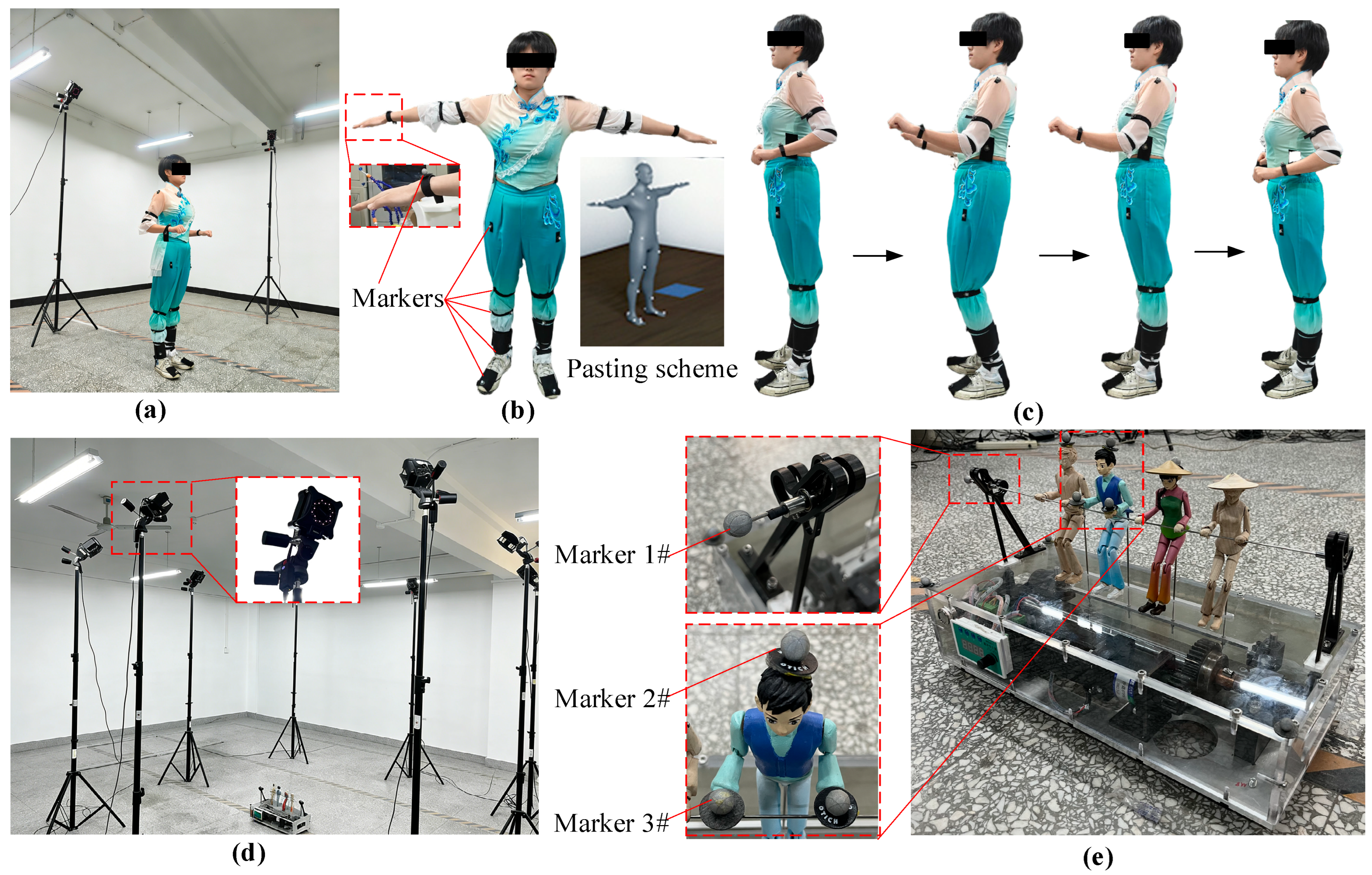
An optical motion capture system (VICON, Oxford Metrics Ltd., Oxford, UK) was used to record the dance movements of a professional inheritor of Danzhou Diaosheng (age 22, height 160 cm, weight 52 kg) [35]. After centuries of inheritance, this folk dance had established unified and standardized movements and rhythms. The dance gestures demonstrated by professional inheritors were recognized as the canonical form of Danzhou Diaosheng, with negligible individual differences. Thus, the acquired motion trajectories could serve as the authoritative benchmark for robot reproduction.
According to the 28-marker placement protocol, reflective markers were attached to anatomical locations including the shoulder joints, trunk, palms, thighs, and insteps to construct a human skeletal model. The performer repeated the typical dance movements of Danzhou Diaosheng continuously. The spatial positions of each reflective marker were measured and recorded. The trajectories, velocities, and accelerations of the markers were obtained with the help of data processing software BodyBuilder(Version 3.6.4) and Nexus (Version 2.20). Meanwhile, the kinematic data of the knee joints could also be acquired.
The 4-puppet prototype was placed in the capture area of VICON, and markers were affixed to both ends of the crossbar and the head of the puppet, as illustrated in Figure 6. Additionally, three markers were attached to the cabinet to establish a local coordinate system. The dancing robot performed cyclic movements, while the VICON system continuously collected motion data. Since the head and trunk of the puppet were integrated as a single unit, the kinematic characteristics of the markers on the head could be equivalent to those of the trunk and shoulder joints. Similarly, the kinematic information of the markers on the crossbar could be used as that of the hands. Based on the data of the trunk and hands, the kinematic trajectories of the elbow, knee, and ankle could be derived.
Figure 6.
Motion measurements of dancer and puppet. (a) Dancer under the motion capture system. (b) Marker attachment protocol. (c) Dance movements. (d) Dancing robot. (e) Distribution of markers.
To guarantee data reliability, repeated sampling and tests were carried out for multiple rounds. By comparing the kinematic trajectories of the dancer, theoretical model, and prototype, the accuracy of the dancing robot in reproducing dance movements was verified, and the errors between the three were calculated simultaneously. Three independent evaluation indicators, including displacement, velocity and acceleration of the trunk, hand, elbow and knee joints, are extracted from the motion capture data of dancer, theoretical kinematic model and physical prototype, respectively. Root mean square error (RMSE) and mean absolute error (MAE) are adopted as unified quantitative metrics to quantify trajectory deviation between different subjects. Three types of error indices are defined: e1 represents the trajectory error between the real dancer and the theoretical model, which reflects the modeling fitting accuracy; e2 denotes the deviation between the theoretical model and the fabricated prototype, characterizing the manufacturing and assembly error of mechanical structure; e3 is the direct error between the real dancer and the robot prototype, which intuitively evaluates the overall dance reproduction performance of the proposed coupled mechanism robot. Multiple repeated sampling tests are carried out to eliminate random measurement noise. The averaged RMSE and MAE values of cyclic dance movements are adopted as the final evaluation results to guarantee the reliability of experimental verification.
3. Results
3.1. Trunk
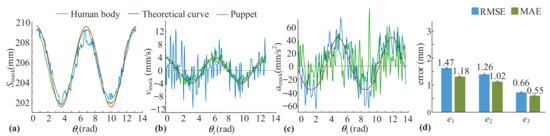
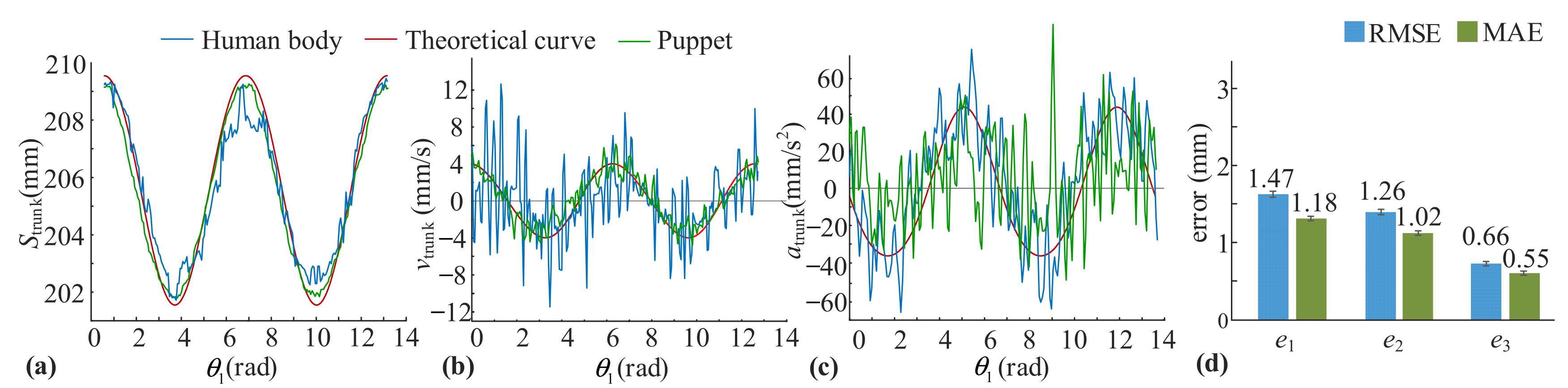
Through the measurement of dance movements, the trunk Strunk underwent a sinusoidal motion in the vertical direction with a distinct periodicity, as shown in Figure 7a. With the optimal link lengths adopted, the slider in the crank-slider mechanism and the puppet’s trunk can closely approximate the trajectory of the dancer. To analyze the kinematic performance more clearly, the velocity vtrunk and acceleration atrunk of the trunk were measured and calculated separately (Figure 7b,c). The theoretical vtrunk could track that of the dancer with good fidelity. Due to the slender structure and low strength of the vertical rod and bracket, the puppet exhibited considerable vibration and positional deviation when moving along the theoretical curve. Interestingly, the errors in velocities and accelerations were hardly noticeable to observers. Owing to the individual differences among dancers, the large number of joints and bodily elasticity, the motion error e1 between the theoretical and dancer trajectories was acceptable (RSME 1.47 mm, MAE 1.18 mm), as shown in Figure 7d. The puppet moved along the theoretical curve, and the error e2 showed a certain reduction, which verified that the manufacturing accuracy and stiffness of the puppet robot could meet the requirements for motion reproduction. Fortunately, the motion trajectory of the puppet could better approximate that of the dancer (RSME 0.66 mm, MAE 1.18 mm).
Figure 7.
Trunk kinematics of (a) displacement Strunk, (b) velocity vtrunk, (c) acceleration atrunk, and (d) motion errors.
3.2. Hand
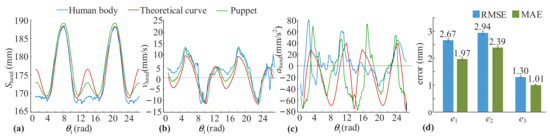
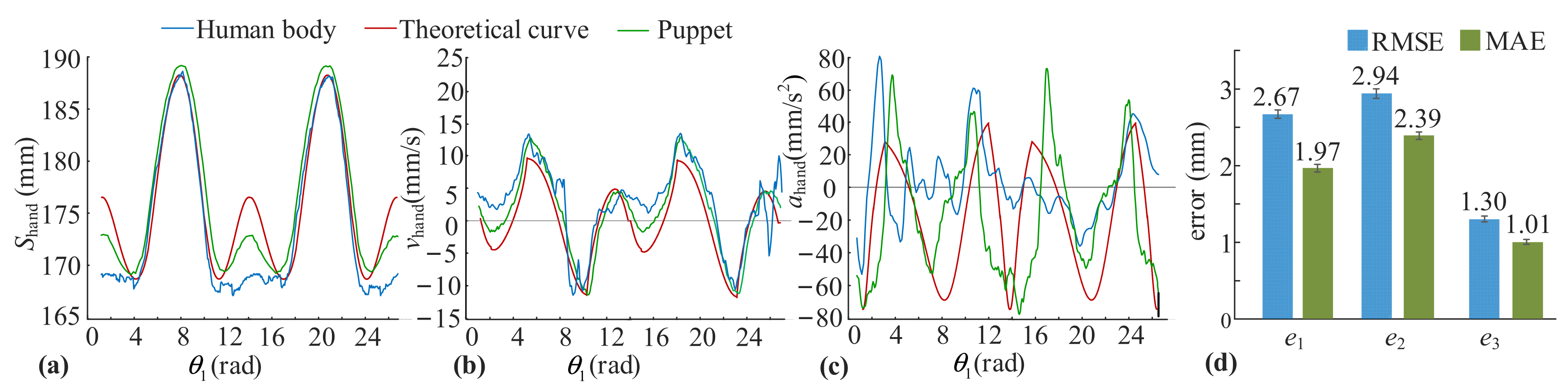
Each dance cycle consisted of one arm swing and two knee flexions, with the palm passing through the lowest, highest and lowest points in sequence before returning to the initial position. The hand displacement Shand over two cycles was depicted in Figure 8a. By means of the mechanism combination method, the crossbar and the hand could move along complex trajectories to mimic dance movements as closely as possible. The hand velocities of the theoretical calculation and puppet were in good agreement with that of the dance movements, and the passion of the dance could thus be well reproduced (Figure 8b). The three types of acceleration exhibited similar variation trends. The puppet acceleration was in good agreement with the theoretical one, yet it was difficult to precisely match that of the dance movements (Figure 8c). Compared with the trunk, the hand had a larger motion range, and the slender structure of the crossbar resulted in greater absolute motion accuracy deviation and vibration of the puppet hand [36]. The error e3 between the dancer and the puppet was the smallest (RMSE 1.30 mm, MAE 1.01 mm), accounting for about 5.50% of the total motion range.
Figure 8.
Hand kinematics of (a) displacement Shand, (b) velocity vhand and (c) acceleration ahand, and (d) motion errors.
3.3. Elbow and Knee
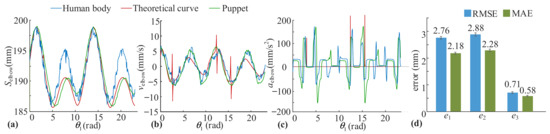
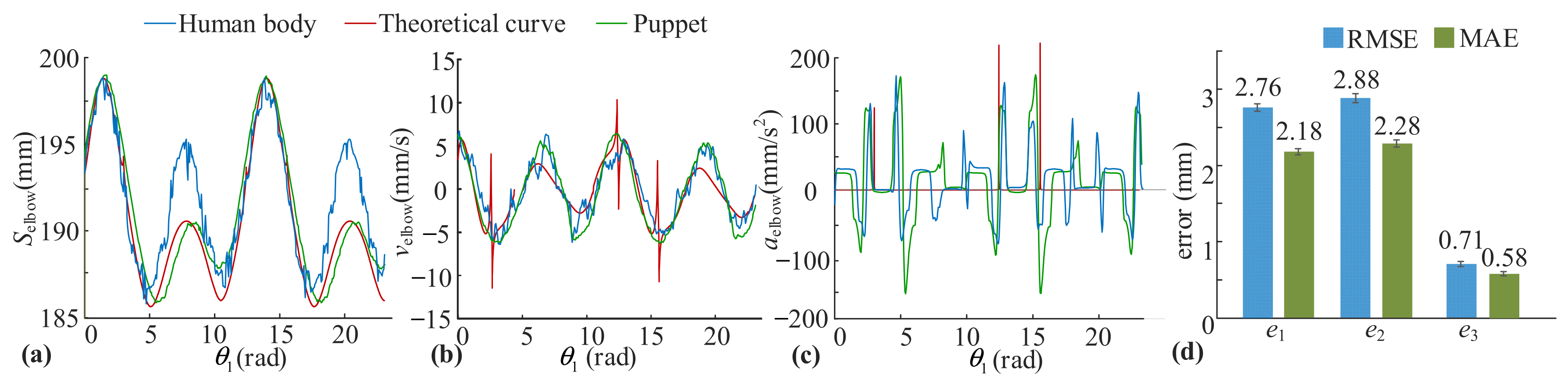
The elbow and the palm exhibited similar positional variation, and the displacement Selbow of the elbow was jointly determined by the shoulder, the hand, and the lengths of the upper arm and forearm, as shown in Figure 9a. The three velocities velbow demonstrated a good agreement in accuracy, although the theoretical one exhibited an abrupt change caused by the direction shift of the shoulder joint (Figure 9b). Interestingly, the three accelerations aelbow showed the highest consistency among all human joints (Figure 9c). The positional errors of the elbow were also affected by the shoulder and hand, and the errors remained at a low level (RSME ≤ 2.88 mm, MAE ≤ 2.28 mm).
Figure 9.
Elbow kinematics of (a) displacement Selbow, (b) velocity velbow, (c) acceleration aelbow, and (d) motion errors.
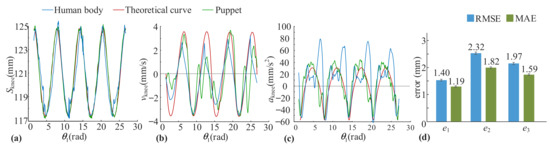
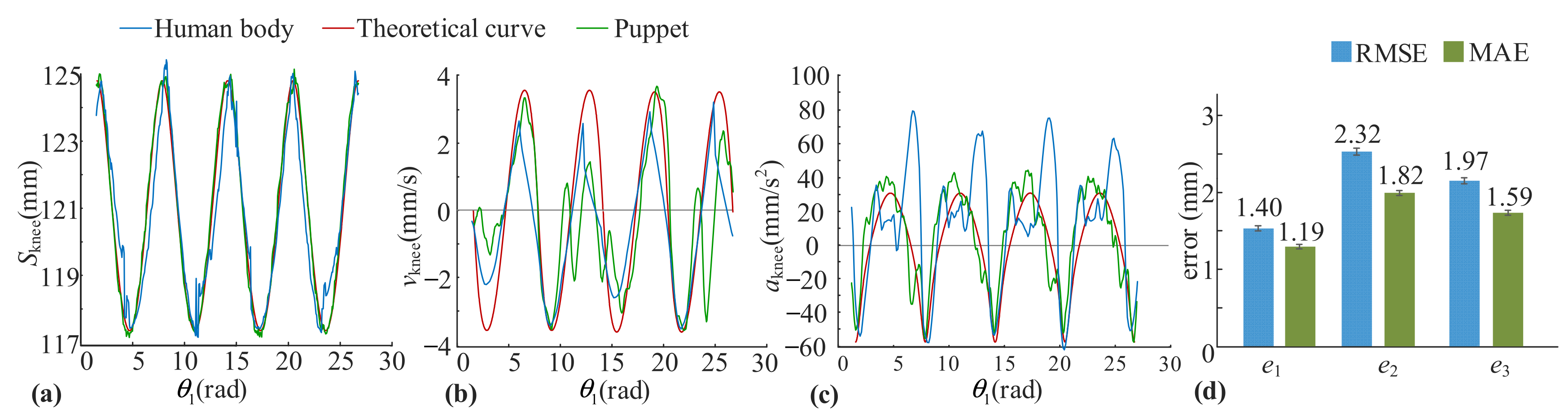
The position of the knee joint was determined by the trunk and approximated a sinusoidal motion, with the three displacements Sknee being nearly coincident (Figure 10a). Owing to the certain elasticity of both the dancer and the puppet, the theoretical velocity vknee was higher than that of the former two (Figure 10b). The three accelerations aknee exhibited similar variation trends (Figure 10c). The three types of motion possessed similar motion errors (RSME ≤ 2.32 mm, MAE ≤ 1.82 mm), which indicated a good consistency between the kinematic model and the dancing robot (Figure 10d).
Figure 10.
Knee kinematics of (a) displacement Sknee, (b) velocity vknee, (c) acceleration aknee, and (d) motion errors.
3.4. Rotation of Shoulder, Elbow, and Knee
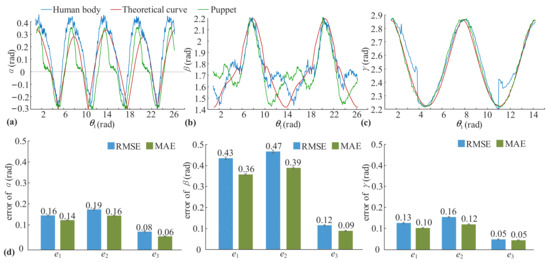
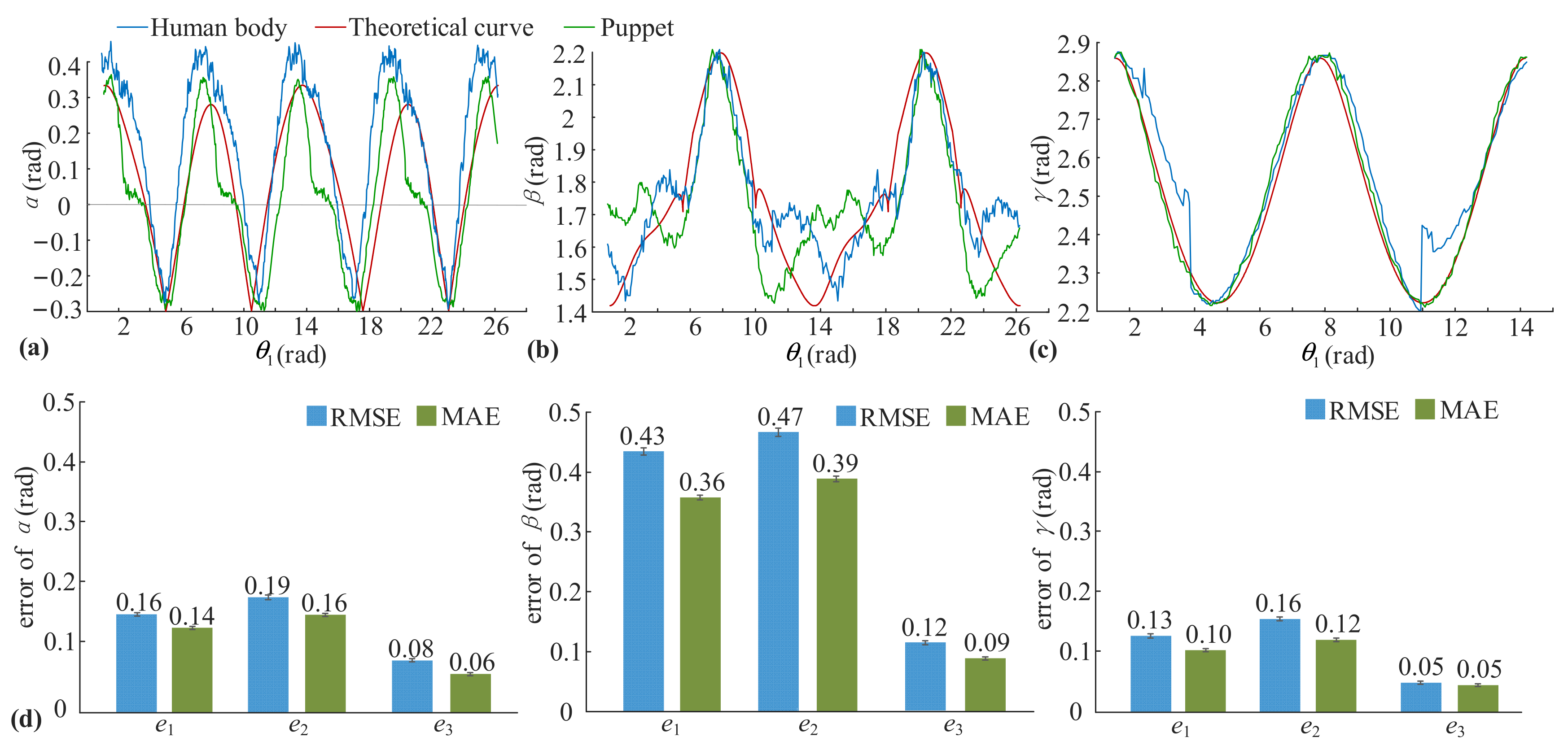
To further investigate the kinematic performance of the shoulder, elbow and knee joints, the kinematic data of the theoretical model, dancer and puppet for the three joints were presented, with the corresponding errors calculated, as shown in Figure 11. The shoulder angle α varied approximately along a sinusoidal curve. However, when the upper arm extended backward to the maximum position, the angle α reversed its velocity direction in an extremely short time with a certain abrupt change (Figure 11a), which resulted in intense local vibration of the elbow at this position as well. The theoretical elbow angle β was in good agreement with that of the dancer (Figure 11b). However, the insufficient rigidity of the vertical rod and the bracket led to a large variation in the angle β. Three curves of the knee angle γ showed good consistency (Figure 11c). The motion accuracy e3 of α between the theoretical model and the puppet was the highest (RSME 0.084 rad, MAE 0.062 rad) as indicated by the error data (Figure 11d), which verified that the device featured high manufacturing precision. The former errors e1 and e2 between the dancer and the puppet as well as the theoretical model had nearly doubled. The positional errors of the shoulder and hand were both accumulated in the elbow angle β, resulting in the maximum motion error of the latter (RSME ≤ 0.466 rad, MAE ≤ 0.389 rad). The knee angle γ exhibited favorable motion accuracy (RSME ≤ 0.157 rad, MAE ≤ 0.122 rad).
Figure 11.
Angles of (a) shoulder, (b) elbow, and (c) knee. (d) Errors of each angle.
The velocity and acceleration are critical indicators to reflect the dynamic performance of the dancing robot. Within a single periodic movement, the velocity and acceleration of each component present regular cyclic changes, which match the rhythm characteristics of Danzhou Diaosheng dance. Minor fluctuations on the curves are mainly caused by mechanical friction, assembly clearance and the limited stiffness of slender links. Combined with the RMSE and MAE of velocity and acceleration, the dynamic tracking accuracy between the prototype and standard dance movements is quantitatively evaluated, which proves the stable dynamic performance of the robot.
4. Discussions
This study delivers three distinct contributions in mechanism design, kinematic optimization and ICH engineering application. First, it pioneers the integrated application of mechanical engineering technologies to the protection of ICH. The innovative design method of mechanism science is the core technical support for the dancing robot to realize realistic dance movements with a concise structure [37,38]. Then, abandoning the complex multi-drive control system, the typical dance movements of Danzhou Diaosheng are decomposed into vertical trunk movement, hand trajectory movement and joint flexion-extension movement [20]. Through gear transmission with a 2:1 transmission ratio, a single actuator drives the whole mechanism to realize the coordinated movement of two knee bends and one arm swing in a single dance cycle. The cam guiding mechanism constrains the hand to move along the preset trajectory composed of a semicircular arc and a straight-line segment. The reasonable design of rod lengths, optimized by minimizing the absolute error of the theoretical and actual velocity, ensures the accuracy of movement reproduction [25]. Last but not least, this concise design concept lowers the robot’s manufacturing and maintenance costs while enhancing motion stability, offering a feasible design reference for the development of cultural and artistic robots grounded in mechanism theory [14,23]. This low-cost mechanical design avoids the high hardware and maintenance costs of multi-joint humanoid robots for exhibition, which greatly reduces the threshold of physical display for dance ICH. In addition, the established kinematic optimization framework can be transplanted to other group folk dance heritage projects for rapid mechanical prototype development.
A research method of comparing the theoretical kinematic model with prototype motion measurement is adopted to evaluate the motion errors of the dancing robot and provide an objective basis for mechanism optimization. By using the VICON system, the kinematic data of professional Danzhou Diaosheng dancers, the theoretical model and the physical prototype were collected respectively [19]. Three types of errors were defined to evaluate the approximation accuracy, manufacturing accuracy and reproduction accuracy of the robot. The calculation results of RMSE and MAE showed that the motion errors of the trunk, hand, elbow and knee joints were all at a low level, and the knee joint trajectory even achieved nearly coincident performance. The error analysis verified that the optimized mechanism parameters could meet the requirements of ICH movement reproduction [36,39,40]. The main sources of motion uncertainty include machining tolerances, assembly clearance, mechanism friction, and low structural rigidity of slender rods. These factors lead to minor trajectory deviations, but all errors are controlled within a reasonable range for folk dance reproduction. The quantitative comparison via RMSE and MAE can separately quantify the contribution degree of modeling error and mechanical manufacturing error to the overall motion deviation. Compared with a single binary comparison between model and prototype, the triple-subject comparison scheme realizes a more systematic and rigorous experimental verification of motion reproduction accuracy.
The residual motion errors observed in the trunk, hand and joint trajectories can be fully interpreted from the intrinsic mechanical characteristics of the proposed single-drive coupled mechanism. Manufacturing tolerances of each connecting rod lead to deviations between actual rod lengths and theoretical optimized values in Table 1, which directly shifts the kinematic equilibrium position and generates a static trajectory offset. The periodic position jitter during reciprocating dance motion is generated by the gear meshing clearance and hinge assembly clearance of the transmission system. The sliding friction between shifting forks and cam grooves creates hysteresis loss that cannot be fully eliminated under quasi-static operation conditions. In addition, thin vertical support rods and crossbars exhibit obvious structural compliance (low stiffness), resulting in elastic deformation under small alternating loads, especially for the hand part with a large motion range, which causes the relatively higher error e3 of hand trajectory. The cam profile limits the hand’s moving track within a fixed arc-line composite path. The slight contact separation between the roller and the cam groove at extreme positions further amplifies transient tracking error. All mechanical factors mentioned above jointly contribute to the final RMSE and MAE values.
To further enhance the analytical depth, a sensitivity analysis of key structural parameters is conducted. The influences of link lengths, installation positions, and transmission ratios on motion trajectory and stability are evaluated. The results show that this system maintains good motion stability within a reasonable parameter variation range. Compared with traditional multi-motor cultural robots, the proposed single-actuator coupled mechanism achieves a more compact structure, lower cost, and higher reliability while ensuring satisfactory motion accuracy (RMSE ≤ 1.47 mm). The design avoids complex control systems and provides better stability for long-term exhibition scenarios. According to long-cycle repeated tests, the mechanical structure maintains stable motion accuracy and weak vibration during continuous operation. It possesses good robustness and durability, fully satisfying the demand of long-term continuous exhibition in cultural venues.
Different from modern robots equipped with advanced intelligent control systems, this prototype adopts a full mechanical driving and constraint scheme. Considering the characteristics of Danzhou Diaosheng dance, complex motion planning, adaptive control and AI algorithms will increase system complexity, cost and failure risk unnecessarily. The proposed coupled mechanism and cam structure can physically constrain the movement track, which guarantees high motion accuracy and long-term operation stability. This technical route is more suitable for fixed-scene exhibition in cultural venues. Meanwhile, we also point out the follow-up development directions: based on the existing mechanical platform, closed-loop feedback control and reinforcement learning algorithms can be integrated in future research to expand the application scope of the robot. In future research, the proposed design method will be adopted to develop single- and multi-character dancing robots for other ethnic folk dances.
5. Conclusions
By designing a dedicated dancing robot and conducting a corresponding kinematic analysis, this work integrates mechanical technology with the inheritance of Danzhou Diaosheng. The adopted single-drive coupled mechanism design, kinematic analysis and motion accuracy test method are able to provide practical references for the development of similar dance robots and the reproduction of traditional folk dance movements. This research offers new ideas for applying mechanical engineering to the protection of traditional folk arts.
Author Contributions
Conceptualization, L.Z. and Z.L.; methodology, L.Z.; software, Z.L.; validation, Y.W.; formal analysis, L.Z.; investigation, L.Z.; resources, Z.L.; data curation, Y.W.; writing—original draft preparation, Z.L.; writing—review and editing, L.Z.; visualization, L.Z.; supervision, L.Z.; project administration, X.G.; funding acquisition, X.G. All authors have read and agreed to the published version of the manuscript.
Funding
This work was supported in part by projects of National Natural Science Foundation of China (No. 52375279 and No. U25A20187), Natural Science Foundation of Beijing, China (No. 3252002), and the National Key R&D Program of China under Grant (No. 2025YFF0523600).
Institutional Review Board Statement
Ethical review and approval were waived for this study due to the non-invasive and harmless nature of the human motion test. No medical intervention, biological sample collection, or risky operations were involved in this study.
Informed Consent Statement
The volunteer was informed about the measurement procedures in advance and signed an informed consent form.
Data Availability Statement
Data will be made available on request.
Acknowledgments
The authors wish to express their sincere gratitude to the anonymous reviewers for their insightful comments and valuable suggestions. Special thanks are also extended to the volunteer who participated in this study. We acknowledge the use of the AI product Doubao for designing scenes and costumes of the male–female duet of Danzhou Diaosheng.
Conflicts of Interest
The authors declare no conflict of interest.
References
- Zabulis, X.; Partarakis, N.; Zidianakis, E.; Kaplanidi, D. A Critical Review of the Function of Intangible Cultural Heritage as a Driver for Social Resilience and Cohesion. Encyclopedia 2025, 5, 189. [Google Scholar] [CrossRef] [Scilit]
- Kurin, R. Safeguarding Intangible Cultural Heritage in the 2003 UNESCO Convention: A Critical Appraisal. Mus. Int. 2004, 56, 66–77. [Google Scholar] [CrossRef] [Scilit]
- McDermott, P.; Craith, M.N. Intangible Cultural Heritage and Climate Change: Sustainability and Adaptability in a Time of Crisis? Anthropol. J. Eur. Cult. 2024, 33, 1–10. [Google Scholar] [CrossRef] [Scilit]
- ElShandidy, M.Z.E. The Power of Intangible Heritage in Sustainable Development. Int. J. Adv. Stud. World Archaeol. 2023, 6, 92–97. [Google Scholar] [CrossRef] [Scilit]
- Tavares, D.S.; Alves, F.B.; Vásquez, I.B. The Relationship between Intangible Cultural Heritage and Urban Resilience: A Systematic Literature Review. Sustainability 2021, 13, 12921. [Google Scholar] [CrossRef] [Scilit]
- Polec, W.; Mankowski, P.; Wylezalek, J. Institutional Forms of Support for the Intergenerational Transmission of Traditional Skills as an Intangible Cultural Heritage. New Educ. Rev. 2024, 78, 28–38. [Google Scholar] [CrossRef] [Scilit]
- Zhou, Y.; Sun, J.; Huang, Y. The Digital Preservation of Intangible Cultural Heritage in China: A Survey. Microform Digit. Rev. 2019, 48, 95–103. [Google Scholar] [CrossRef] [Scilit]
- Cui, X.; Song, Z.; Tang, X. Reviving the Past in the Present: Tourists’ Non-Daily and Non-Modern Experiences Through Hanfu Costume Tourism in China. Heritage 2026, 9, 153. [Google Scholar] [CrossRef] [Scilit]
- Guo, X.; Pikas, B.; Lee, T. Study of Intangible Chinese Cultural Heritage Protection and Tourism Development the Case of Intangible Cultural Heritage Protection of the Hezhe Nationality. J. Mark. Dev. Compet. 2017, 11, 39–45. [Google Scholar]
- Shi, Y.; Hao, J.; Sun, S. The Digital Protection of Intangible Cultural Heritage—The Construction of Digital Museum. In Proceedings of the 2008 9th International Conference on Computer-Aided Industrial Design and Conceptual Design, Kunming, China, 22–25 November 2008; IEEE: New York, NY, USA, 2008; pp. 1196–1199. [Google Scholar]
- Cao, H. Exploring the Promotion of Musical Intangible Cultural Heritage under TikTok Short Videos. Sci. Rep. 2025, 15, 21772. [Google Scholar] [CrossRef] [Scilit] [PubMed]
- National Office for the Census of Local Opera Genres. National Census Report on Opera Genres; Oriental Press: Beijing, China, 2020. Available online: https://zhuanti.mct.gov.cn/whzypc2023/dxal/detail_1/4941.html (accessed on 25 May 2026).
- Yanan, F.; Ke, S.; Le, X. Artificial Intelligence and Machine Learning in the Preservation and Innovation of Intangible Cultural Heritage: Ethical Considerations and Design Frameworks. Digit. Scholarsh. Humanit. 2025, 2, 2. [Google Scholar] [CrossRef] [Scilit]
- Marchello, G.; Giovanelli, R.; Fontana, E.; Cannella, F.; Traviglia, A. Cultural Heritage Digital Preservation through AI-driven Robotics. Int. Arch. Photogramm. Remote. Sens. Spat. Inf. Sci. 2023, 48, 995–1000. [Google Scholar] [CrossRef] [Scilit]
- Guo, D.; Yang, D.; Zhang, H.; Song, J.; Wang, P.; Zhu, O.; Xu, R.; Zhang, R.; Ma, S.; Bi, M.; et al. DeepSeek-R1 incentivizes reasoning in LLMs through reinforcement learning. Nature 2025, 645, 633–638. [Google Scholar] [CrossRef] [Scilit] [PubMed]
- Wallace, B.; Glette, K.; Szorkovszky, A. How Can We Make Robot Dance Expressive and Responsive? A Survey of Methods and Future Directions. Front. Comput. Sci. 2025, 7, 1575667. [Google Scholar] [CrossRef] [Scilit]
- Pan, Y.; Qiao, R.; Chen, L.; Chitta, K.; Pan, L.; Mai, H.; Bu, Q.; Zhao, H.; Zheng, C.; Luo, P.; et al. Agility Meets Stability: Versatile Humanoid Control with Heterogeneous Data. arXiv 2026, arXiv:2511.17373. [Google Scholar]
- Kovalev, V.; Shkromada, A.; Ouerdane, H.; Osinenko, P. Combining Model-predictive Control and Predictive Reinforcement Learning for Stable Quadrupedal Robot Locomotion. arXiv 2026, arXiv:2307.07752. [Google Scholar]
- Carbone, G.; Tedeschi, F.; Gallozzi, A.; Cigola, M. A Robotic Mobile Platform for Service Tasks in Cultural Heritage. Int. J. Adv. Robot. Syst. 2015, 12, 88. [Google Scholar] [CrossRef] [Scilit]
- Olikkal, P.; Dollo, C.; Ajendla, A.; Clemmensen, A.S.; Vinjamuri, R. Reconstructing Hand Gestures with Synergies Extracted from Dance Movements. Sci. Rep. 2025, 15, 41670. [Google Scholar] [CrossRef] [Scilit] [PubMed]
- Gustafsson, C.; Ripp, M. Introduction: Innovative Heritage-based Post-crisis Urban Recovery Strategies. Built Herit. 2023, 7, 15. [Google Scholar] [CrossRef] [Scilit]
- Dang, Q.; Luo, Z.; Ouyang, C.; Wang, L.; Xie, M. Intangible Cultural Heritage in China: A Visual Analysis of Research Hotspots, Frontiers, and Trends Using CiteSpace. Sustainability 2021, 13, 9865. [Google Scholar] [CrossRef] [Scilit]
- Twomey, P.; Varma, V.; Bush, L.L.; Trkov, M. Collider-based Movement Detection and Control of Wearable Soft Robots for Visually Augmenting Dance Performance. Front. Robot. AI 2024, 11, 1450177. [Google Scholar] [CrossRef] [Scilit] [PubMed]
- Zhang, L.; Chang, Y.; Zhang, F.; Li, J. A Review on Combined Strategy of Non-invasive Brain Stimulation and Robotic Therapy. Chin. J. Mech. Eng. 2024, 37, 113. [Google Scholar] [CrossRef] [Scilit]
- Liu, M.; Hu, J.; Zhou, W.; Wang, X. Cyber–Physical Revitalization of Intangible Cultural Heritage: Geometric–Numerical Framework for Archimedean Spiral Trajectories in Autonomous Robotic Systems Performing the Traditional Dance Named Bench Dragon. Symmetry 2025, 17, 524. [Google Scholar] [CrossRef] [Scilit]
- Chen, X. Sega Tambour of Rodrigues Island. In Encyclopedia of China Publishing House; China Publishing Group: Beijing, China, 2023. [Google Scholar]
- Wang, W.; Ren, H.; Ci, Z.; Yuan, X.; Zhang, P.; Wang, C. Control Method of Upper Limb Rehabilitation Exoskeleton for Better Assistance: A Comprehensive Review. J. Field Robot. 2025, 42, 1373–1387. [Google Scholar]
- Liu, H.; Yang, Y.; Wang, T.; Yin, J.; Wang, H. Bioinspired Growable Humanoid Robot with bone-mimetic linkages for versatile mobility. Sci. Adv. 2026, 12, eaea2831. [Google Scholar] [CrossRef] [Scilit] [PubMed]
- Zhang, L.; Yu, Z.; Su, P.; Li, J.; Ge, R. Design of a Parallel Wrist Rehabilitation Robot and Analysis of Physiological Effect on Training. IEEE/ASME Trans. Mechatron. 2024, 29, 3401–3414. [Google Scholar] [CrossRef] [Scilit]
- Zhang, L.; Li, J.; Cui, Y.; Dong, M.; Fang, B.; Zhang, P. Design and Performance Analysis of a Parallel Wrist Rehabilitation Robot (PWRR). Robot. Auton. Syst. 2020, 125, 103390. [Google Scholar] [CrossRef] [Scilit]
- Urbaś, A.; Stadnicki, J. Applications of Dynamics Metamodels of an Eccentric Crank-slider Mechanism in the Initial Phase of Their Design. Mech. Mach. Theory 2025, 205, 105886. [Google Scholar] [CrossRef] [Scilit]
- Urbaś, A.; Stadnicki, J. A Concept of the Metamodel Based on the Dynamics Analysis Results of the Eccentric Crank-rocker Mechanism. Mech. Mach. Theory 2026, 219, 106333. [Google Scholar] [CrossRef] [Scilit]
- Wang, J.; Zhou, H. Simplified Dynamic Modeling Methodology for Parallel Shaft Gear Transmission System. Mech. Ind. 2025, 26, 28. [Google Scholar] [CrossRef] [Scilit]
- Hejma, P.; Svoboda, M.; Kampo, J.; Soukup, J. Analytic Analysis of a Cam Mechanism. Procedia Eng. 2017, 177, 3–10. [Google Scholar] [CrossRef] [Scilit]
- Merriaux, P.; Dupuis, Y.; Boutteau, R.; Vasseur, P.; Savatier, X. A Study of VICON system Positioning Performance. Sensors 2017, 17, 1591. [Google Scholar] [CrossRef] [Scilit] [PubMed]
- Zhu, Y.; Guo, X.; Wang, J.; Cao, D.; Zhang, L. Acoustic Black Hole–enhanced Tuned Particle Dampers for Broadband Control. Int. J. Mech. Sci. 2025, 310, 111127. [Google Scholar] [CrossRef] [Scilit]
- Zibetti, E.; Mercader, A.; Duval, H.; Levillain, F.; Rochette, A.; St-Onge, D. Shaping Expressiveness in Robotics: The Role of Design Tools in Crafting Embodied Robot Movements. In Proceedings of the 2025 34th IEEE International Conference on Robot and Human Interactive Communication (RO-MAN); IEEE: New York, NY, USA, 2025; pp. 755–761. [Google Scholar]
- Rogel, A.; Savery, R.; Yang, N.; Weinberg, G. Robogroove: Creating Fluid Motion for Dancing Robotic Arms. In Proceedings of the 8th International Conference on Movement and Computing, Chicago, IL, USA, 22–24 June 2022; pp. 1–9. [Google Scholar]
- Ding, H.; Dowell, E.H.; Chen, L.Q. Transmissibility of Bending Vibration of an Elastic Beam. J. Vib. Acoust. 2018, 140, 031007. [Google Scholar] [CrossRef] [Scilit]
- Dymarek, A.; Dzitkowski, T. Reduction Vibration of Mechanical Systems. Appl. Mech. Mater. 2013, 307, 257–260. [Google Scholar]

Disclaimer/Publisher’s Note: The statements, opinions and data contained in all publications are solely those of the individual author(s) and contributor(s) and not of MDPI and/or the editor(s). MDPI and/or the editor(s) disclaim responsibility for any injury to people or property resulting from any ideas, methods, instructions or products referred to in the content. |
© 2026 by the authors. Licensee MDPI, Basel, Switzerland. This article is an open access article distributed under the terms and conditions of the Creative Commons Attribution (CC BY) license.