


Abstract
Behavioral continuous authentication can update a user’s profile during operation, but accepted-only adaptation links access errors to future model states. Prior biometric work established separate authentication and update thresholds and quantified erroneous impostor inclusion and genuine-update misses. We examine their coupled security and adaptation consequences in score-level mobile authentication using frozen HMOG long short-term memory scores, a synthetic feature-space shift, and an independent two-day McGill Gait protocol. Poisoning samples were separated from future impostor probes. The strongest benchmark assumed access to claimant scores and presented up to eight initially accepted samples ranked near the authentication boundary; reconnaissance and candidate screening were not counted. At the reference operating points, blind exponential moving-average (EMA) updating increased post-poison attack success rate from 22.92% to 53.96% on HMOG and from 12.37% to 32.09% on McGill. An enrollment-anchored Guarded EMA condition kept the reference-point result close to Frozen. This direction did not persist across recalibrated policies. Under the nominal-1% calibration condition, the mean Blind-minus-Frozen effect was negative on both datasets for the tested boundary strategy. On the same HMOG conditional cohort, Blind EMA reduced attack success by 0.447 percentage points but increased false rejection by 6.89 points and the half-total-error rate by 3.22 points. Full-cohort false rejection at this strict condition was 80.79% on HMOG and 90.25% on McGill. The Guarded rule added no update margin when the current authentication threshold reached or exceeded the enrollment mean. In separate temporal evaluations, Guarded did not improve late genuine acceptance relative to Frozen. A label-aware, non-deployable Oracle-all diagnostic changed profile trajectories and reduced false rejection, but increased false acceptance. The results show that poisoning effects, genuine rejection, update-gate activity, calibration transfer, and attack feasibility depend on the operating point and should be evaluated together.
1. Introduction
Initial login verifies the operator at one moment. Continuous behavioral authentication instead estimates identity throughout a device session from signals such as touch, keystroke, gait, and hand motion [1,2,3]. Smartphone studies have shown that interaction and inertial measurements can provide repeated identity evidence without requiring an explicit biometric action for every decision [4,5,6]. The same evidence varies across sessions, activities, device placement, acquisition conditions, and time. A profile fixed at enrollment may therefore become less representative of its user.
Online updating can follow this variation, but it must obtain trustworthy update labels. Unsupervised biometric systems commonly infer them from the current matcher [7,8]. An accepted impostor can then alter the profile used for later decisions, a risk already demonstrated in adaptive face and fingerprint systems [9,10,11,12]. Requiring acceptance before learning also removes rejected genuine observations from the adaptive stream. During a downward genuine-score shift, the updater retains higher-scoring samples and loses observations that indicate a need for recovery. In selective-label settings, prior decisions determine which outcomes become observable; in confidence-based self-training, the current model preferentially retains samples that already agree with it [13,14,15]. Accepted-only biometric updating creates an analogous truncation of the genuine evidence stream, although the deployed updater still does not observe genuine/impostor labels. Prior biometric work measures missed genuine updates directly [16]. We use selective-update bias caused by accepted-only feedback censoring as a scoped name for this authentication-specific mechanism and later treat the Oracle-all result as evidence consistent with, rather than a standalone causal isolation of, that mechanism.
Separate authentication and update thresholds, erroneous impostor inclusion, and missed genuine updates have been studied directly in behavioral template update [16,17,18]. Deliberate poisoning of self-updating biometrics is also an established prior art [9,10,11,12]. The open question addressed here is their coupled, operating-point-dependent effect in mobile behavioral authentication: how admitted malicious samples affect unused future probes, how conservative update eligibility changes genuine evidence, and whether these relationships persist under recalibration and a second dataset. Reviews of adaptive biometrics report limited continuous-mobile and longitudinal evaluation, while our prior systematic review found limited standardized adversarial and longitudinal evidence within its searched corpus [19,20]. The study is therefore positioned as a bounded mechanism analysis rather than a new two-threshold algorithm, a new update-error metric family, or a first biometric poisoning attack.
The present work studies malicious inclusion and genuine-evidence censoring in one experimental framework. Our previous HMOG study used a fixed long short-term memory (LSTM) score generator and an accepted-only exponential moving average (EMA) profile; EMA did not improve the half-total-error rate over a frozen threshold, and its label-blind update path could admit an accepted impostor [21]. That study did not run a dedicated poisoning experiment. Here, random and score-informed boundary attacks use poisoning observations separated from held-out future probes. The boundary benchmark assumes claimant-score access and ranks samples accepted near the initial threshold. Its budget counts selected poisoning presentations, not reconnaissance or screening, so it is not an eight-query or binary-feedback-only attack.
This design asks whether state change affects observations that were not used to choose the attack. It also keeps access evaluation separate from learning eligibility, allowing malicious incorporation, genuine update availability, and later error rates to be reported as distinct quantities.
We compare Frozen, Blind EMA, an enrollment-anchored Guarded EMA update condition, and label-aware Oracle controls. Guarded retains the access-decision rule form but changes update eligibility; its update history can therefore change later state, thresholds, and decisions. Oracle-all admits every ground-truth genuine adaptation observation to diagnose the information removed by accepted-only updating. It is not deployable or a formal performance upper bound. HMOG temporal experiments use a controlled synthetic feature-space shift with adaptation observations separated from evaluation checkpoints. A two-day McGill Gait protocol provides independent cross-day corroboration, although day separation does not isolate behavioral drift from acquisition and model-transfer effects [22].
Machine learning models for mobile behavioral authentication range from feature-based statistical classifiers for touch, gait, and inertial signals to recurrent, multimodal, and other deep sequence models [4,5,6,23,24]. These systems primarily establish recognition, fusion, or representation performance. The narrower gap addressed here is how a fixed score generator interacts with online profile updating: malicious inclusion, rejected-genuine evidence, future held-out probes, and operating-point calibration are evaluated together rather than treating classifier accuracy or adaptation utility in isolation.
The study makes three contributions:
- It pairs fixed-score profile updating on separated poisoning and future-probe observations, with explicit update eligibility and diagnostic temporal controls.
- It quantifies operating-point-specific changes in attack effect, feasible paths, gate activity, genuine rejection, and calibration transfer.
- It tests whether these coupled relationships recur under the documented McGill policy and explains a local EMA boundary transition, while limiting generalization to the evaluated protocols.
The recovery-state and quantile-profile branches test alternative explanations but are not headline methods. TQ-EMA v1 reached outer evaluation without meeting its recovery criterion. TQ-EMA v2 and the Quantile branch failed their validation gates, and their outer outcomes were not loaded. Reporting these stops preserves the development evidence without treating unsuccessful variants as contributions.
The historical HMOG reference threshold was approximately equal-error, while McGill used minimum Day-1 half total error. Sensitivity conditions targeted 5% and 1% calibration false acceptance, not guaranteed held-out rates or deployment standards. Recalibration changed the initial threshold, its associated profile coefficient, the selected boundary candidates, and the feasible attack cohort. Accordingly, neither guarded performance at the reference points nor a negative mean attack-success effect at the strict point establishes general security. Recovery and quantile branches are retained as supporting negative probes rather than algorithmic contributions.
2. Related Work
2.1. Mobile Behavioral Authentication
Continuous mobile authentication has used touch and swipe dynamics, keystroke behavior, gait, hand motion, contextual signals, and multimodal combinations [1,2,3]. Touchalytics reported distinct intra-session, inter-session, and delayed behavior [4]. SilentSense combined touch with device movement, while HMOG derived hand-movement, orientation, and grasp features from inertial and interaction data [5,25]. Recent systems combine motion, touch, and usage context or learn identity from inertial streams [6,23,24]. These studies establish that mobile behavior carries identity information and that its availability and distribution vary with context.
Modalities also differ in when they produce evidence. Touch and keystroke observations depend on particular actions, whereas inertial streams can reflect gait, posture, or device handling over a broader set of activities. Multimodal systems can compensate for missing signals but introduce fusion, calibration, and resource decisions [23,26]. These differences matter for adaptation because an update policy observes only the modalities and contexts present at that moment.
The primary dataset in this study is HMOG. McGill supplies a different temporal setting: its official archive contains smartphone gait recordings from 20 individuals on two collection days [22,27]. McGill and HMOG differ in population, sensors, activity, classifier, and chronology, so their absolute error rates are not treated as benchmark comparisons. McGill is used to test whether the reference mechanisms recur after Day-1 development and Day-2 evaluation.
Other gait studies provide attack and unconstrained-collection context rather than interchangeable baselines. Live imitation has been studied against smartphone gait authentication, and whuGAIT was developed for less constrained smartphone collection [28,29]. The archive inspected for this project did not preserve the chronology needed for the unified temporal protocol, so it was not used as an experimental dataset.
2.2. Adaptive Profiles and Poisoning
Template update addresses aging and intra-class variation by revising a biometric reference after enrollment. Supervised methods use externally verified labels; semi-supervised and unsupervised methods reuse matcher decisions [7,8]. Behavioral work has applied adaptation to multi-session keystrokes and accelerometer streams [17,30]. Giot et al. used separate acceptance and update thresholds and later formalized two complementary self-update errors: the Impostor Update Selection Rate, , and the Genuine Update Miss Rate, , in a multi-gallery keystroke updater [16]. Their evaluation work further showed that temporal aggregation choices can change the interpretation of the same adaptive score sequence [18]. Thus, separating access from learning and measuring impostor inclusion or genuine-update omission are an established prior art. The Guarded condition here is an experimental intervention for measuring those consequences under held-out poisoning and temporal change.
The source of trust separates these approaches. Supervised update assumes a verified genuine identity. Self-update treats matcher confidence as a proxy label, sometimes requiring a higher threshold or accumulating a batch before changing the reference. Those choices affect both erroneous inclusion and the range of genuine samples visible to the updater. A recent review organizes confidence gates, query acceptance, retraining, and structural adaptation while noting limited continuous-mobile and large-scale longitudinal evidence [19].
Self-update transfers recognition errors into future state. Giot et al. evaluated mixed genuine/impostor streams and update-selection errors rather than attacker-ranked poisoning followed by evaluation on an unused probe pool [16]. Biggio et al. formalized deliberate poisoning in adaptive biometrics and evaluated face-template compromise [9,10]. Lovisotto et al. constructed intermediate face samples that exploited unsupervised update, and Xue et al. attacked online self-updating fingerprint authentication [11,12]. These studies are direct precedents. The present attack is narrower: it does not modify classifier weights, enrollment data, sensor firmware, or raw templates. It presents impostor observations to a score-profile updater and measures later acceptance on unused probes after the state is frozen. The score-informed boundary strategy is a strong benchmark, not a demonstrated binary-feedback search procedure.
Presentation and imitation attacks address a different point in the pipeline. Smartphone gait, for example, has been tested against live mimicry at decision time [28]. Such work evaluates whether an input evades a matcher immediately. Profile poisoning asks whether an accepted input changes state and affects later observations. Broader template-security surveys cover update-related and non-update threats, but the direct poisoning claims here rely on the adaptive face and fingerprint studies above [31,32].
General online-learning work also studies sequential contamination [33]. Its learners and attacker interfaces differ from biometric authentication, so it provides conceptual context rather than direct evidence for the present score profile.
Prior poisoning studies often optimize a sequence for a particular template or matcher. The boundary benchmark here instead selects already accepted scores near the initial profile threshold and then freezes the resulting state before future evaluation. This simpler construction supports matched analysis of update policy and operating point, while leaving stronger adaptive or query-limited attackers untested.
2.3. Decision-Conditioned Feedback
Adaptive-biometric research has already recognized both erroneous inclusion and failure to select genuine observations for update [16]. Selective-label research studies decisions that determine which outcomes become observable; pseudo-labeling research shows how model-assigned labels can reinforce error; performative-prediction theory considers deployed decisions that alter later data [13,14,15]. Accepted-only authentication differs from each setting. The genuine/impostor label is unavailable to the deployed updater, and the access result controls update eligibility rather than the claimant’s underlying behavior. The term selective-update bias caused by accepted-only feedback censoring is therefore used here as a scoped description of the observed trajectory mechanism, not as a claim that genuine-update omission was first identified here.
Oracle-all is designed to reveal this information difference. It retains the authentication decision-rule form while authorizing updates from every ground-truth genuine adaptation observation. The resulting state and threshold can change subsequent decisions. Oracle-all is label-aware and non-deployable, and its result does not identify a safe recovery mechanism.
This diagnostic also differs from supervised template update. Ground-truth labels are supplied retrospectively by the experiment, not by an operational identity-verification channel. Oracle-all therefore measures sensitivity to information availability while bypassing the central trust problem that a deployable updater must solve.
2.4. Position of This Study
Adaptive template poisoning, confidence-based updating, separate update thresholds, and attempt-normalized update-error rates all predate this work. Reviews nevertheless report limited continuous-mobile and longitudinal evaluation of adaptive biometrics [19]. Our prior systematic review also found limited standardized adversarial and longitudinal evidence within its searched corpus [20]. The residual contribution is a paired fixed-score protocol for mobile behavioral authentication that separates poisoning observations from future probes, exposes update eligibility and diagnostic temporal controls, and jointly reports operating-point calibration, feasibility, genuine rejection, and profile trajectories. MUR is an attack-specific counterpart of Giot et al.’s IUSR, and GUR equals only when observation sets, units, update definitions, and aggregation coincide; neither is claimed as a new universal metric [16].
This framing separates profile update from risk-sensitive access control. Progressive and context-aware authentication can invoke explicit fallback or step-up authentication when passive evidence is insufficient [34,35,36]. Multimodal corroboration can provide additional identity evidence [26]. Such mechanisms may supply trusted recovery information, but they are not evaluated here. The present study asks what can be inferred from the tested score-profile rules before proposing a deployable recovery architecture.
Threshold movement also has asymmetric operational costs: reducing false rejection can increase false acceptance, and a balanced aggregate can hide the direction of that exchange [37,38]. This study therefore reports ASR or FAR, FRR, update rates, and state movement separately instead of using HTER as the sole criterion.
3. Methods
3.1. Study Design and Evidence Status
The study examined score-level online adaptation through held-out poisoning and clean temporal protocols. HMOG was the primary mechanistic dataset [5]. Its fixed LSTM scores supported the Blind EMA poisoning analysis, Guarded update authorization, synthetic temporal experiments, Oracle diagnostics, and prespecified recovery probes. A separately frozen McGill Gait protocol used Day 1 for development and Day 2 for evaluation [22]. Score generators remained fixed within every method comparison.
Frozen supplied the no-update baseline. Blind EMA represented the inherited accepted-only updater. Guarded EMA retained the authentication-rule form but imposed a separate confidence condition on learning. The malicious-update-blocking Oracle and Oracle-all used labels only in explicitly diagnostic update-eligibility roles. Attack experiments presented malicious observations and then froze state before evaluation; clean temporal experiments interleaved adaptation candidates with disjoint evaluation checkpoints. These protocols were analyzed separately rather than combined into a drift-plus-attack stream.
The HMOG branches were developed sequentially on the same outer score caches. The attack and Guarded analyses are therefore exploratory mechanism evidence, and Guarded was carried forward from an exploratory HMOG sweep. TQ-EMA v2 and the Adaptive Quantile Profile stopped at validation without loading outer outcomes. The McGill protocol transferred before Day-2 scores were accessed. Operating-point sensitivity was prospectively specified after the reference caches had already been inspected. A full chronology and evidence-status table appears in Supplementary Methods S1.
Figure 1 summarizes the executed score-profile workflow. Authentication and update authorization are separate decisions. The Oracle-all path is label-aware and diagnostic; it is not available to a deployed updater.
Figure 1.
Execution schematic for the evaluated score-profile methods. Authentication determines access, whereas a method-specific rule separately determines whether the production profile is updated. Oracle-all uses ground-truth labels only as a non-deployable diagnostic. Poisoning and clean temporal evaluations use separated observations and endpoints.
Three reporting contrasts organize the analysis. The historical security contrast is HMOG reference boundary , Blind minus Frozen post-poison ASR. The operating-point sensitivity primary is the corresponding HMOG nominal-1% contrast and does not replace the historical analysis. The clean temporal comparison uses Guarded versus Frozen late FRR in claimant-only . Oracle-all and the recovery branches have diagnostic or branch-specific roles rather than sharing one confirmatory family.
The security and temporal contrasts answer different questions. The poisoning analysis estimates whether profile updating changes acceptance of unused impostor probes after a specified malicious sequence. The clean analysis estimates whether updating changes genuine rejection at later chronological checkpoints while tracking the corresponding impostor acceptance. Neither contrast alone establishes a secure adaptive system. Interpretation therefore retains the direction of ASR or FAR, FRR, HTER, update eligibility, and state movement instead of treating one aggregate as the sole endpoint.
3.2. Datasets and Score Generation
HMOG contributed 100 enrolled identities in a closed-set, session-disjoint design; it did not test unseen-subject generalization. The canonical pipeline retained 2392 usable sessions and 4784 sequences. For each session, it discarded the first 500 sensor samples and retained the next 20 non-overlapping 100-sample windows from the physical accelerometer and gyroscope axes. The previous study capped retention at 20 windows to equalize session contributions and bound computation; the available source does not document a scientific rationale for the initial 500-sample offset. Six statistics per axis produced a 36-dimensional window representation, and ten adjacent windows formed a non-overlapping sequence.
The pipeline assumed HMOG’s nominal 100 Hz sampling rate and did not estimate realized rate. Accelerometer and gyroscope rows were paired by acquisition order after truncation to the shorter file, without timestamp resampling. The six window statistics were mean, standard deviation, minimum, maximum, root mean square, and skewness. Two sequences were retained per usable session and did not cross session boundaries.
Five outer folds assigned sessions by . One group was test, the next was validation/calibration, and the remaining three were used for fitting. Every subject appeared in each partition through different sessions. A StandardScaler was fitted only on fitting sequences and then held fixed. The two-layer, 64-unit LSTM used 64 hidden units per layer, layer normalization, a 32-unit ReLU layer, dropout, and a 100-class softmax. Claimant u’s score was its probability for class u. The HMOG preprocessing and model-training procedure followed our previous study [21]. A separate Paper 3 cache-generation run trained one model per fold under that procedure, after which the resulting per-fold scores were held fixed across all present method comparisons. Supplementary Methods S2 gives optimizer, stopping, scheduler, cache provenance, and exclusion details.
The model was trained with cross-entropy and Adam, with early stopping on the validation partition. Neither the LSTM nor the fitting-only scaler was updated during poisoning or temporal adaptation. All adaptive methods operated on the same cached scalar claimant probabilities within a fold.
McGill contained raw smartphone recordings from 20 participants on two collection days. The replication used the archive-supplied accelerometer fields and gravity-adjusted magnitude field in non-overlapping 128-sample windows, approximately 5.12 s at the recorded median interval. The executed pipeline did not recompute magnitude. Day 1 supplied model fitting, early-stopping validation, enrollment, normalization, and threshold calibration; Day 2 remained held out for poisoning and temporal evaluation. Within each identity, Day-1 windows were divided chronologically into 60% fitting, 20% validation, and 20% enrollment/calibration. A fitting-only per-channel normalization and one-layer 64-unit LSTM produced 20-class claimant probabilities. McGill used accelerometer-derived inputs only, whereas HMOG used accelerometer and gyroscope. Supplementary Methods S5 provides field definitions, recorded counts, optimizer, viability-gate, and preprocessing details.
The McGill run had to pass a prespecified viability gate before Day-2 scores were loaded: finite training, at least 16 validation classes, validation top-1 accuracy of at least 20%, and successful protocol checks. This gate assessed whether the frozen classifier was usable for the planned mechanism study; it was not a performance-selection search on Day 2.
3.3. Profile State, Authentication, and Update Eligibility
For claimant u, enrollment or validation genuine scores initialized mean and second raw moment . The canonical HMOG state was
with . The claimant-specific initial threshold was the approximate equal-error threshold on validation scores, and
made the derived threshold equal to that calibration. McGill used minimum HTER on Day-1 enrollment scores and then computed from the same identity, but its executed decision threshold was the unclipped expression
Thus, the two datasets shared the moment state, sigma floor, claimant-specific , and comparator, but not the HMOG zero lower clamp. This implementation difference was not presented as a planned intervention. Each method applied the rule to its own current state and dataset-specific threshold. Different update histories could therefore produce different later thresholds and decisions. Here, equals 1 when condition A holds and 0 otherwise.
The reference thresholds served as mechanistic operating points rather than deployment targets. In particular, HMOG’s validation-calibrated approximate-EER rule admitted a substantial fraction of held-out impostor observations. Frozen comparisons measure changes attributable to online state updating within that operating point and feasible cohort; they do not certify the underlying classifier or threshold for deployment.
Frozen retained its initial profile. Blind EMA updated after an accepted observation with :
The update was label-blind. Writing for the applicable dataset-specific authentication threshold, Guarded EMA used the same access-rule form and added an update condition
Thus
and, for the evaluated , the additional margin was
The gate added no restriction beyond authentication when . This equation describes the executed update gate: no separate margin floor or clipping was added. Authentication-threshold clipping remained dataset-specific as stated above.
For one permitted canonical EMA update, when the variance floor is inactive both before and after the transition, direct substitution in Equation (4) gives the unfloored variance identity
If lies exactly on the current raw boundary , is fixed, and neither sigma flooring nor threshold clipping is active before or after the transition, then
For and , this local change is negative for , positive for , and zero for . This conditional identity does not predict an arbitrary accepted update or an eight-step ASR effect: attack candidates were ranked around the initial, not the evolving, boundary; margins were nonzero; Guarded could reject updates; and operating-point cohorts differed. Supplementary Methods S3 gives the derivation and assumptions.
Guarded was evaluated at in an exploratory HMOG sweep. No confirmatory validation-based hyperparameter competition was performed. The condition was the Blind-equivalence sanity check; , the smallest positive grid value, was retained as a low-strength exploratory carry-forward rather than an estimated optimum. Larger values were sensitivity conditions. The same was transferred to McGill before Day-2 access, without a McGill sweep. Complete boundary- sweep outcomes are reported in Supplementary Table S5.
Two Oracle controls had different roles. During malicious-only poisoning, the malicious-update-blocking Oracle applied the authentication rule to an unchanged profile and blocked all known-impostor updates. It therefore coincided with Frozen in that phase. Blind and Guarded could acquire different states and subsequent decisions. In clean temporal streams, Oracle-all applied the same decision-rule form to its own state but made every ground-truth genuine adaptation candidate update-eligible, including rejected candidates. Oracle-all was label-aware and non-deployable.
3.4. Poisoning Protocol and Endpoints
The protected object was the claimant’s online score-profile state and its derived threshold. The attack objective was to change that state so that unused impostor probes would be accepted more often. The evaluated attacker did not modify LSTM weights, enrollment data, validation data, raw sensor files, firmware, or operating-system code. Replay, sensor injection, collusion, model extraction, and gradient attacks were outside scope.
For each HMOG fold, victim, and repeat, whole (source identity, session) groups were assigned before attack selection to either poisoning or held-out probe pools, with approximately half reserved for probes. No source-session group crossed pools, although source identities could. Dataset identity labels were used offline to define claimant, impostor, poison, and probe sets, but were not exposed to the Blind or Guarded online updater. Random attack sequences were sampled without replacement. The boundary strategy assumed claimant-score access, retained candidates accepted at the initial threshold, and ranked them by smallest non-negative margin ; ranking used scores and margins, not model gradients or ground-truth genuineness labels. Its budget counted nested selected attempts presented to the updater; reconnaissance, candidate screening, and total query cost were unmeasured. It is therefore a score-informed benchmark rather than a demonstrated binary-feedback attack. Ground-truth labels were exposed online only to the explicitly diagnostic Oracle controls.
Compared methods received the same poison sequence and probes within a path. After K presentations, profile state was frozen before future impostor and genuine evaluation. Post-poison attack success rate (ASR) was held-out impostor acceptance. Post-poison false rejection rate (FRR) used held-out genuine observations; . Malicious update rate (MUR) was the fraction of presented malicious observations incorporated. It is an attack-oriented counterpart of the previously defined Impostor Update Selection Rate, not a new metric family [16]. A separate genuine replay measured genuine update rate (GUR) without altering the poisoning endpoints. Under identical observation units and denominators, corresponds to the Genuine Update Miss Rate; those equivalences need not hold across differently aggregated protocols.
A planned HMOG path was one fold–victim–repeat combination: five folds, 100 victims, and 100 repeats gave 50,000 planned paths. McGill had 20 victims and 100 repeats, giving 2000 planned victim–repeat paths. A feasible boundary path contained at least eight candidates accepted at the initial threshold. The historical HMOG reference curves retained the same 49,889 feasible paths for both strategies, all methods, and every nested budget; 111 paths were excluded. McGill reference boundary curves retained 1456 feasible paths across 18 victims, whereas random curves used all 2000 paths across 20 victims. McGill poison/probe sources were identity-disjoint; only the first temporal half of poison-source Day-2 windows supplied candidates and the second half of probe-source windows supplied future probes. Supplementary Methods S3 and Supplementary Table S6 distinguish planned paths, condition-specific feasible cohorts, and exclusions.
HMOG used master seed 4242 for attack partitions and sequences. The common maximum-budget feasibility rule made all methods and nested budgets comparable within a path. It also conditions the reference effect on victims and repeats with sufficient initially accepted impostor candidates. Sensitivity conditions recomputed this eligibility rather than carrying infeasible reference paths forward.
The poisoning comparison included Frozen, Blind, malicious-update-blocking Oracle, and Guarded on HMOG; McGill included Frozen, Blind, and Guarded. GUR was obtained by replaying genuine observations on a copy of the post-poison state. This replay could not change the already recorded post-poison endpoints, so it measured update availability rather than longitudinal recovery.
The unit called a poisoning attempt was a selected score-bearing observation presented to the online rule. Candidate generation and ranking occurred before those presentations and were not counted as queries. Poison acceptance and malicious updating were distinct: an observation could satisfy the access rule yet fail the Guarded update condition. Likewise, post-poison ASR described decisions on the held-out probe pool and was not the acceptance rate of the poisoning candidates themselves. These distinctions were preserved in the saved path-level outputs.
3.5. Operating-Point Sensitivity
The sensitivity analysis reused frozen HMOG and McGill scores and compared each reference threshold with nominal 5% and 1% pooled calibration-FAR constraints. HMOG reference was the canonical approximate-EER threshold; McGill reference minimized Day-1 enrollment HTER. HMOG calibration used its validation partition, while McGill used Day-1 enrollment/calibration only. No test or Day-2 observation selected a threshold. For each claimant, the smallest threshold no lower than reference that met the target calibration FAR was chosen, with equal scores kept on the same side of the decision boundary. Exact float64 and tie handling is specified in Supplementary Methods S3. Nominal targets were calibration constraints, not held-out guarantees or deployment standards.
Enrollment moments remained fixed. For each new , was recomputed using Equation (2), including negative values. EMA , Guarded , pool assignments, attack budgets, and split semantics remained fixed. Boundary candidates were reselected relative to the condition-specific . Recalibration therefore changed , associated , candidate composition, and feasible paths; it was not an isolated intervention on one threshold.
Methods were paired within each condition on the same eligible paths, poisoning sequences, and probe pools. Each boundary curve used its own common -feasible cohort at every displayed budget, so operating-point rows were not strictly paired causal contrasts. Sensitivity random summaries used all 50,000 structurally valid HMOG paths or 2000 McGill paths, including at reference; historical HMOG reference curves instead retained their common 49,889-path cohort. The sensitivity primary contrast was HMOG nominal 1%, boundary , Blind minus Frozen post-poison ASR; it did not replace the historical-reference contrast.
Pool assignments, master attack seed 4242, 100 repeats, and nested budgets were fixed. Random orders were threshold-independent. Boundary candidates were reselected within each condition using and initial margin, with deterministic index tie-breaking. Profiles were frozen after poisoning before future ASR and FRR were evaluated.
Calibration summaries and held-out outcomes used different observations and aggregation. The reported achieved calibration FAR is an unweighted mean of claimant-profile pooled-observation rates. The full held-out Frozen results use all structurally valid random- paths and hierarchical victim-macro aggregation. Conditional boundary effects use only paths feasible at . These denominators were retained separately in all tables.
3.6. Clean Temporal Protocols and Oracle Diagnostic
HMOG clean adaptation used synthetic standardized-feature shifts . For public folds 1–5, seeds 42–46 generated one normalized 36-dimensional Gaussian direction per fold using . Within each subject and fold, all standardized test sequences—not only later adaptation candidates—were ordered by numeric session and within-session start. Sequence j of n received displacement , identically at each of its ten time steps. Only after score caching were within=0 and within=10 selected. The magnitudes were not calibrated to natural behavioral change, and the nonlinear score response need not have been identical across subjects. In the global scenario, claimant and impostor scores came from the same D; in the primary claimant-only scenario, genuine adaptation and checkpoints used the selected D, while impostor probes came from the cache. Supplementary Methods S2 records indexing, counts, and provenance.
Sessions were ordered by their recorded numeric identifiers. Within each retained session, the sequence beginning at within=0 was an adaptation candidate and the disjoint sequence beginning at within=10 was an evaluation-only checkpoint. The checkpoints never updated state. At least four complete session pairs were required. The first two checkpoints defined early endpoints and the last two defined late endpoints; an available middle checkpoint was retained only for trajectories. Impostor FAR used other identities at the matched session number and within=10, measured at the same profile state and macro-averaged across source identities. Late HTER combined temporally matched late FRR and FAR. The available source confirms this replay order but does not independently validate numeric session identifiers as natural behavioral chronology.
The temporal comparison included Frozen, Blind, Guarded, and Oracle-all. Outputs included early and late FRR/FAR, late HTER, GUR, update counts, and changes in mean, scale, and threshold. Adaptation gain was Frozen late FRR minus method late FRR. HMOG provided only four or five permitted adaptation opportunities per included victim–fold path. With canonical , the initial mean retains coefficient : , and the coefficient first falls below one-half after 14 permitted updates. This is an algebraic property of the mean recurrence, not wall-clock recovery time, threshold convergence, or a statement about bounded alternatives; accepted-only methods can update fewer times. The HMOG experiment is therefore a short replay, and lack of late-FRR improvement is not evidence that a method can never recover.
McGill selected 160 approximately equally spaced Day-2 windows per subject and formed 80 ordered adaptation-checkpoint pairs; the first and last 20 pairs defined early and late endpoints. Matched impostor checkpoints never updated a profile. Day separation reflects cross-day change but does not isolate behavior from placement, context, acquisition, or model-transfer effects. Oracle-all changes both the composition of update observations and the number and frequency of permitted updates. The comparison is therefore diagnostic evidence about the combined availability intervention, not a count-matched isolation of censoring composition.
3.7. Aggregation and Uncertainty
Rate differences are reported in percentage points. The historical security contrast was HMOG reference boundary , Blind minus Frozen post-poison ASR. Eligible repeats were averaged within each victim–fold unit, then the five fold means were averaged within each victim. A paired difference was calculated for each of the 100 victims. The sensitivity analysis used the same aggregation order, averaging only contributing folds within each victim when eligibility removed a whole victim–fold unit. Hierarchical aggregation therefore preceded a single-level paired victim bootstrap; folds, repeats, and probe windows were not independently resampled.
The sensitivity primary used the same hierarchical victim estimand at HMOG nominal 1%. Table rows at other conditions and datasets are secondary. The clean temporal primary compared Guarded with Frozen late FRR in claimant-only . TQ-v1 retained its branch-specific success criterion. Random attacks, other budgets, lambda values, drift levels, and stopped branches were exploratory or descriptive; no post-result multiplicity correction was introduced.
For clean HMOG streams, endpoints were averaged across each subject’s available folds before calculating paired subject differences. A 99-subject complete-five-fold analysis checked the TQ-v1 decision against its 100-subject primary analysis. For McGill poisoning, eligible repeats were averaged within victims before forming paired differences. McGill clean temporal endpoints came from each victim’s single 80-pair adaptation–checkpoint stream, with early and late rates calculated over the designated 20 checkpoints; this analysis had no temporal Monte Carlo repeats.
For each reported condition and contrast, the vector of within-victim differences was sampled with replacement in 10,000 draws, retaining the number of included victims. The 2.5th and 97.5th percentiles of the resampled mean differences formed the interval. Resampling paired differences preserved the method comparison; methods were not bootstrapped independently for these contrasts. The historical HMOG analysis used direct seed 4242, while the sensitivity and McGill packages used deterministic condition- and contrast-specific streams. These streams need not share draw indices across contrasts or operating points. Historical and sensitivity reference intervals retain their respective frozen streams; their small differences reflect Monte Carlo resampling, not different cohorts or victim effects. Full seed reconciliation is in Supplementary Methods S4.
For the reference ASR curves, the shaded region at each method, strategy, and budget is a descriptive fold-level band computed as from the five fold summaries. Because those folds have overlapping fitting partitions, the band is not an inferential confidence interval from independent replicates. The primary boundary- uncertainty is instead the paired victim-bootstrap interval reported in the text. The 10,000 bootstrap draws are Monte Carlo resamples, not 10,000 independent observations.
The absolute endpoint bars and pointwise trajectory bands instead resampled subject values separately for each method and endpoint or checkpoint, after available-fold aggregation. These marginal intervals are distinct from the paired-difference intervals reported in the text. The trajectory bands are pointwise, not simultaneous bands. Rates were aggregated within victims before resampling rather than pooling probe windows.
A secondary victim-by-impostor-source bootstrap was available for HMOG nominal 1%, boundary , and a separate source sensitivity assessed TQ-v1 clean temporal late FAR; Supplementary Methods S4 specifies their different source-weighting procedures. Primary intervals condition on fixed trained models and observed pools, without model refitting or deployment-population uncertainty. HMOG fitting partitions overlap, so fold summaries and their t-bands are descriptive. No null-hypothesis test was added.
Accordingly, boundary effects estimate post-poison differences conditional on maximum-budget feasibility at the stated operating point. The 9088 HMOG and 1001 McGill paths are the nominal-1% feasible cohorts, not all planned opportunities or the reference cohorts. Paths lacking eight initially accepted candidates were excluded from every method and nested budget of that condition’s boundary analysis; no zero ASR or zero effect was imputed. Full-cohort Frozen calibration-transfer summaries and clean temporal recovery estimates use separate populations. Planned-path counts, feasible-path counts, victim counts, and victim–fold counts are reported separately.
3.8. Supporting Probes and Reproducibility
TQ-EMA v1 admitted temporally consistent rejected near-boundary evidence through an isolated, bounded recovery path. Its primary endpoint was late-FRR gain over Frozen in claimant-only , subject to fixed FAR and HTER constraints. TQ-EMA v2 added a recovery episode that suppressed trusted proposals moving state upward. The Adaptive Quantile Profile replaced EMA moments with exponentially weighted and . TQ-v2 and Quantile used fail-closed validation: outer scores remained unopened if any fold had no feasible configuration. Complete state machines, grids, equations, and criteria are in Supplementary Methods S6–S10.
TQ-v1 required a paired late-FRR-gain CI lower bound above zero, mean late-FAR increase no greater than +1.0 points, HTER degradation no greater than +0.5 points, and the same conclusion in the 99-subject complete-five-fold cohort. The FAR and HTER limits were branch-specific experimental constraints rather than deployment standards. TQ-v1 was evaluated only on clean temporal streams and was not combined with poisoning.
Frozen packages record seeds, exclusions, configurations, source and cache hashes, and whether outer data were loaded. The method, McGill, and operating-point freezes are tagged paper3-method-freeze-2026-10-02, paper3-external-mcgill-v1-2026-10-03, and paper3-operating-point-sensitivity-v1-2026-10-04. Supplementary Methods S4 and S5 provide the package registry, recorded revisions and hashes, principal schemas, invariant checks, and external-protocol details; they also state where historical provenance is incomplete.
The recorded protocol suites covered no-update behavior, malicious-update-blocking Oracle/Frozen equivalence in malicious-only streams, nested budgets, partition disjointness, gate behavior, bounded recovery transitions, and deterministic aggregation. The reported outcomes and checks are those retained in the frozen packages.
4. Results
4.1. Reference-Point Poisoning and Guarded Updating
At the HMOG reference point, boundary poisoning increased post-poison ASR from 22.92% for Frozen to 53.96% for Blind EMA at . The paired Blind-minus-Frozen effect was +31.04 percentage points (historical 95% CI [+26.95, +35.20]) across 100 victims, 500 victim–fold units, and 49,889 eligible paths. Blind ASR increased with the nested boundary budget from 22.92% at to 27.50%, 33.68%, 44.31%, and 53.96% at . The corresponding random curve reached 27.55% at , making the boundary benchmark the stronger reference attack (Figure 2).
Figure 2.
HMOG reference-point post-poison ASR on held-out impostor probes across nested numbers of presented poisoning attempts K. Poison and probe source-session groups were disjoint, but source identities were not necessarily disjoint; the profile was frozen before probe evaluation. Both strategies, all methods, and all displayed budgets use the historical common cohort of 49,889 of 50,000 planned paths (111 exclusions), with at least eight initially accepted boundary candidates per included path. Lines are victim-macro fold summaries for Frozen, Blind EMA, and Guarded EMA (). Shading is the descriptive five-fold band , not a confidence interval from independent folds because fitting partitions overlap. The paired victim-bootstrap interval for the primary boundary contrast is reported in the text.
The 22.92% Frozen baseline reflects the validation-calibrated approximate-EER operating point. The paired contrast estimates additional acceptance after Blind updating within this feasible cohort. It does not imply that the unpoisoned classifier met a deployment security target.
Guarded EMA with produced 22.93% post-poison ASR and 1.63% MUR at boundary , compared with Blind MUR of 100%. This metric-level proximity to Frozen indicates suppression of the additional Blind amplification at the reference point, not equivalence of states or deployment security. The exploratory sweep reduced boundary- MUR from 100.00% at to 0.13% at , while genuine update availability in a separate replay fell from 85.96% to 41.78%. Guarded reproduced Blind exactly as a consistency check.
4.2. Operating-Point Sensitivity, Feasibility, and Gate Activity
Nominal calibration targets did not determine held-out FAR (Table 1). Under the nominal-1% condition, the mean achieved calibration FAR was 0.91% on HMOG and 0.79% on McGill, whereas the full-cohort held-out Frozen FAR was 1.04% and 2.14%. Full-cohort Frozen FRR was 80.79% and 90.25%, respectively. These values describe all structurally valid held-out paths and are not baselines for the conditional boundary effects.
Table 1.
Calibration and full-cohort held-out Frozen performance. Calibration values are unweighted means of claimant-profile pooled-observation rates. Held-out values use all 50,000 structurally valid HMOG paths (100 victims; 500 victim–fold units) or 2000 McGill paths (20 victims) at every condition, using random- outcomes and victim-macro aggregation without boundary-feasibility conditioning. Nominal targets are calibration constraints, not held-out guarantees.
The boundary- Blind-minus-Frozen effect decreased from +31.04 to +2.49 and then −0.447 points across HMOG reference, nominal-5%, and nominal-1% conditions (Table 2; Figure 3). McGill showed +19.72, +0.20, and −0.354 points; the nominal-5% CI included zero. Guarded-minus-Blind was strongly negative at reference, smaller at nominal 5%, and near zero at nominal 1%. Cross-target rows are not strictly paired because recalibration changed , claimant-specific k, selected candidates, and feasible paths.
Table 2.
Conditional boundary- paired post-poison ASR effects. Each condition uses its own common feasible cohort and a 10,000-draw paired victim bootstrap. The 9088 HMOG and 1001 McGill path counts belong only to nominal 1%; reference cohorts contain 49,889 and 1456 paths, respectively. Infeasible paths are excluded rather than assigned zero ASR. The reference rows use the sensitivity package’s retained random streams; historical-reference intervals remain in Section 4.1 and the McGill corroboration. Three decimals preserve near-zero effects.
Figure 3.
Operating-point dependence of boundary- post-poison ASR effects. Points are Blind EMA minus Frozen and Guarded EMA minus Blind EMA with paired victim-bootstrap 95% intervals. Each point uses the condition-specific eight-candidate feasible cohort in Table 2; excluded paths contribute no ASR value. Operating points are not connected because their feasible cohorts can differ. Source: frozen boundary_k8_effects artifact.
The visibly wide McGill reference-point intervals reflect between-victim heterogeneity in a small eligible cohort of 18 victims; the bootstrap resamples victims and deliberately does not treat repeated paths or windows as independent observations. Condition-specific feasibility also changes the eligible cohort across operating points. The paired design, exact denominator reporting, and victim-level bootstrap expose this uncertainty but do not remove the small-sample limitation. McGill is therefore interpreted as directional mechanism corroboration rather than a precise effect-size estimate.
For the sensitivity primary, a secondary victim-by-impostor-source bootstrap gave −0.447 points [−0.515, −0.383] for Blind minus Frozen and −0.009 points [−0.022, −0.001] for Guarded minus Blind. It covered 100 victims, 9088 paths, and 100 observed impostor sources only in HMOG nominal 1%, boundary ; it did not add training or population uncertainty.
The negative strict-point ASR effect did not indicate harmless updating. On the same 9088-path HMOG nominal-1% cohort, Frozen ASR/FRR/HTER were 0.826%/80.18%/40.50%, while Blind values were 0.379%/87.07%/43.73%. Blind increased FRR by 6.89 points (95% CI [+5.63, +8.27]) and HTER by 3.22 points (95% CI [+2.59, +3.91]). The experiment did not specify a separate availability-oriented attacker, so this result is not presented as a demonstrated denial-of-service attack.
Strict calibration also reduced feasibility. HMOG nominal 1% retained 9088 of 50,000 planned boundary paths across 100 victims and 302 of 500 victim–fold units; McGill retained 1001 of 2000 paths across 17 victims. Excluded paths lacked eight initially accepted candidates and were not assigned zero ASR. At this condition the Guarded gate exceeded authentication in 19.22% of 72,704 HMOG poisoning states and 13.49% of 8008 McGill states. Initial occurred in 443 of all 500 HMOG claimant-fold profiles and 15 of all 20 McGill profiles, a different denominator. The sign of k alone does not explain the aggregate reversal. On McGill nominal 1%, Blind and Guarded had equal aggregate ASR but MURs of 69.36% and 62.32%; equal endpoints did not imply equal updates or trajectories.
The gate percentages are state-weighted diagnostics, while the paired ASR effects are victim-macro estimates and the negative-k values use all calibration profiles. They are presented together to describe the mechanism but should not be read as interchangeable sampling units.
4.3. Clean Temporal Behavior and Oracle Diagnostic
Under the primary claimant-only HMOG synthetic shift at , Frozen late FRR/FAR/HTER were 32.53%/22.86%/27.70%. Guarded values were 34.60%/21.73%/28.16%, corresponding to a late-FRR gain of −2.07 points (95% CI [−3.53, −0.63]) relative to Frozen. Blind late FRR was 32.20%, with a gain of +0.33 points (95% CI [−1.20, +1.93]). Neither accepted-only method showed a clear improvement in the prespecified late-FRR endpoint (Figure 4).
Figure 4.
HMOG late FAR–FRR operating points under claimant-only synthetic shift . Points are subject-macro estimates for Frozen, Blind EMA, Guarded EMA (), Oracle-all, and TQ-EMA v1. Bars are 95% subject-bootstrap percentile intervals for each method’s absolute late FAR (horizontal) and late FRR (vertical), after subject-level fold aggregation; paired intervals for between-method differences are reported in the text. Lower values on both axes are preferable.
Blind late FAR changed by +0.93 points (95% CI [−0.58, +2.64]) and its HTER gain was −0.30 points (95% CI [−1.02, +0.40]). Guarded late FAR changed by −1.14 points (95% CI [−2.29, +0.12]), while its HTER gain was −0.46 points (95% CI [−1.16, +0.21]). Guarded’s lower FAR point estimate was accompanied by higher FRR rather than a free improvement.
Oracle-all made every ground-truth genuine adaptation candidate update-eligible. At , its late-FRR gain over Frozen was +6.60 points (95% CI [+4.90, +8.40]), accompanied by a +6.08-point late-FAR change (95% CI [+4.20, +8.16]). At , it already lowered late FRR by 4.73 points and raised late FAR by 5.51 points. Its result therefore reflects operating-point movement as well as response to synthetic shift. Guarded mean and threshold moved upward across the five retained checkpoints, while the Oracle-all state moved downward; the Guarded update rate fell from 63.47% to 51.68%, and Oracle-all update eligibility remained 100% (Figure 5). These trajectories are consistent with accepted-only feedback censoring contributing to weak recovery, but Oracle-all changes update composition, number, and timing and is not a count-matched causal isolation of censoring.
Figure 5.
HMOG profile trajectories under claimant-only synthetic shift . Panels show change from enrollment in profile mean and authentication threshold, plus genuine update rate, across five evaluation checkpoints for Guarded EMA and Oracle-all. Lines average subject-level available-fold means. Shaded bands are pointwise 95% subject-bootstrap percentile intervals for each method and checkpoint, not simultaneous trajectory bands or intervals for paired method differences. Oracle-all is label-aware and non-deployable.
The Oracle-all HTER gains relative to Frozen were −0.39, −0.28, and +0.26 points at , and all three CIs included zero. The opposing FRR and FAR changes therefore produced little balanced-error improvement. Complete intermediate-level effects are reported in Supplementary Results S5.
4.4. McGill Cross-Day Corroboration
The frozen Day-1 McGill classifier attained 58.12% validation top-1 accuracy and passed its prespecified 20% viability gate before Day-2 scores were loaded. At reference boundary , ASR was 12.37% for Frozen, 32.09% for Blind, and 12.48% for Guarded (Table 3). The paired Blind-minus-Frozen effect was +19.72 points (historical 95% CI [+5.58, +37.34]); Guarded-minus-Blind was −19.62 points (95% CI [−37.17, −5.60]). Blind MUR was 100%, and Guarded MUR was 32.22%. The eligible cohort contained 1456 of 2000 paths across 18 victims; 544 paths lacked eight accepted candidates. The random- Blind effect was +1.51 points across all 20 subjects, with a CI [−0.09, +4.43] that included zero.
Table 3.
McGill reference poisoning and cross-day temporal evidence. Boundary poisoning uses 1456 of 2000 planned paths across 18 victims (544 excluded); temporal results use all 20 subjects and their single streams. Poisoning effects average eligible repeats within victims before bootstrapping paired victim differences. Temporal endpoints are subject-macro rates over the last 20 of 80 adaptation-checkpoint pairs. Oracle-all uses labels only for update eligibility and is not deployable.
In the Day-2 temporal stream, Guarded late FRR was 81.00% versus 78.00% for Frozen, while Oracle-all FRR was 12.75%. Oracle-all FAR reached 75.05%, compared with 11.46% for Frozen and 10.29% for Guarded. The results reproduce the reference-point directions under a difficult cross-day setting but do not establish comparable absolute performance or isolate behavioral drift. The Frozen McGill figures are retained in Supplementary Results S6.
The McGill implementation used the actual unclipped decision threshold . The subject-macro Oracle-all threshold in Figure S6 became negative because individual Oracle-all profiles were permitted to move below zero under that executed rule. The plotted line averages saved individual thresholds after each adaptation step; it is not reconstructed from aggregated moments. No clipped counterfactual was run, and the McGill results are interpreted under this documented dataset-specific policy.
Guarded-minus-Frozen late FRR was +3.00 points (95% CI [0.00, +7.00]). Oracle-all-minus-Frozen FRR was −65.25 points (95% CI [−83.75, −45.50]), while Oracle-all-minus-Guarded FAR was +64.76 points (95% CI [+48.93, +79.24]). These large opposing changes explain why the three late HTER values were much closer than their separate FAR and FRR components.
4.5. Supporting Recovery and State Probes
TQ-EMA v1 reached outer evaluation but did not meet its recovery criterion. In claimant-only , late-FRR gain was −0.90 points (95% CI [−1.80, 0.00]); late FAR changed by −1.94 points, and HTER gain was +0.52 points. The event audit recorded 1404 trusted and 49 recovery updates. TQ-EMA v2 then failed its validation gate because fold 4 had no configuration satisfying both safety constraints. No Adaptive Quantile setting was feasible in all folds. The latter branches have outer_test_loaded=false and no outer estimates. Their complete specifications and validation outcomes appear in Supplementary Methods S6–S10 and Supplementary Results S1–S3.
TQ-v1’s complete-five-fold sensitivity did not reverse the stopping decision. TQ-v2 had feasible selections in four folds, but all selected late-FRR gains were negative; fold 4 triggered the fail-closed rule. These validation values are documented in the Supplement and are not presented as outer performance.
5. Discussion
5.1. Coupled Feedback Effects and Operating-Point Scope
Accepted-only updating linked two forms of evidence selection in the evaluated systems. An accepted impostor could enter the profile and alter later decisions, while a rejected claimant observation could not inform adaptation. At the reference operating points, the first pathway produced large Blind-minus-Frozen ASR increases on HMOG and McGill. The sensitivity analysis set an important boundary around this result. Amplification was much smaller at nominal 5%, the McGill interval included zero, and the mean effect was negative at nominal 1% for the tested boundary strategy.
Poison and probe observations were separated before selection, and state was frozen before future probes were scored. The reference increase therefore concerns acceptance of unused impostor observations after profile change. During the malicious-only phase, the blocking Oracle retained Frozen’s state and outcomes, while Blind could update. This matched control supports profile modification as the experimental difference at reference without extending the result to every attacker or operating point.
The reversal cannot be attributed to threshold movement alone. For a permitted update exactly on the current unclipped boundary, the local EMA identity in Section 3.3 predicts opposite threshold directions for positive and negative k. The experiment is more complex: recalibration changed the initial threshold and its associated k, then changed which boundary samples were selected and which paths contained eight eligible candidates. Candidates were ranked around the initial rather than evolving boundary, margins were nonzero, Guarded could reject updates, and cohorts differed. Negative k was common at nominal 1%, but its sign does not determine an eight-step aggregate endpoint. Candidate ranking was not re-optimized for all possible strict-point adversaries. The sensitivity results therefore describe recalibrated policies and their condition-specific feasible paths.
A smaller ASR effect also did not imply benign state change. On the matched HMOG nominal-1% cohort, Blind reduced future impostor acceptance but increased FRR and HTER. This genuine-rejection cost was observed under an integrity-oriented boundary attack; the experiment did not design or test a separate denial-of-service objective. Full-cohort held-out FAR, conditional boundary ASR, calibration FRR, and clean-temporal FRR remain distinct endpoints. The strict calibration conditions also had high full-cohort FRR, limiting their practical interpretation.
HTER is useful for summarizing balanced error, but opposing FAR and FRR movements can leave it nearly unchanged while altering operational risk. Security and usability costs are not necessarily symmetric. The separate endpoints in this study are therefore more informative than selecting a method from HTER alone.
5.2. State-Dependent Update Authorization
Guarded EMA tested a known design principle: access permission and update eligibility can use different criteria. Its reference-point results show that this intervention can suppress additional contamination under the studied state. The effective added margin was , so it disappeared whenever the authentication threshold reached or exceeded the enrollment mean. This state was common after nominal-1% recalibration, and the additional Guarded ASR effect became very small.
The common access-rule form should not be confused with common realized decisions. Blind and Guarded acquire different update histories, which can produce different later means, thresholds, and accept/reject outcomes. The same distinction applies when an aggregate endpoint coincides. The McGill nominal-1% Blind and Guarded ASR estimates were equal, but their MURs differed. MUR is itself incomplete because update identity and state displacement affect later outcomes as well as the number incorporated.
The Guarded result supports auditing an authorization rule over its reachable state space. A separately named update threshold may supply no extra restriction in some states, and stronger gating may remove legitimate update opportunities. The exploratory lambda sweep illustrated this tradeoff but did not identify a universally optimal value.
5.3. Oracle and Recovery Probes
The clean temporal controls examined the other side of accepted-only feedback. Under the claimant-only synthetic shift, Guarded retained a higher-scoring subset of genuine candidates and its mean and threshold moved upward. Oracle-all made rejected genuine candidates update-eligible and produced a downward trajectory with lower FRR and higher FAR. These patterns are consistent with feedback availability contributing to weak recovery. Oracle-all retains the authentication rule form, but its altered state can change subsequent thresholds and decisions.
Oracle-all does not define a secure or optimal trajectory. It requires ground-truth labels during operation, and its FAR increase offset much of the FRR improvement. It changes three coupled aspects of adaptation: which genuine scores enter the update stream (composition), how many updates occur (count), and at which chronological positions they occur (timing). Matching total count alone would not control composition or timing. Because EMA state affects subsequent acceptance and EMA gives greater weight to more recently incorporated observations, these distinctions can affect the trajectory.
A count-matched control would therefore need an explicit rule for selecting genuine observations and scheduling them relative to the accepted-only stream. Matching final counts, matching every checkpoint, or selecting an order-preserving subset would answer different questions; choosing among them after observing the results would add an exploratory design choice. Such an analysis is possible, but the frozen protocol did not specify that choice, and no new control was added in this revision. We instead restrict the inference: Oracle-all is evidence consistent with accepted-only feedback censoring under a combined composition/count/timing intervention, not a standalone causal isolation. The effect also shows ordinary operating-point movement rather than recovery unique to synthetic shift, and the nonlinear score response to feature perturbation need not be identical across subjects.
The recovery probes did not resolve this tradeoff within their frozen designs and short replay. TQ-EMA v1 admitted temporally consistent rejected evidence but applied only 49 recovery updates against 1404 trusted updates and did not improve late FRR. TQ-EMA v2 addressed this imbalance but failed the validation gate, and the Quantile branch had no feasible setting in any fold. These outcomes apply to the specified controllers, grids, constraints, and horizon. They do not establish that quarantine or distributional tracking cannot recover over longer streams, and no outer claim is available for the validation-stopped branches.
5.4. External Corroboration and Practical Implications
McGill changed the dataset, classifier, modalities, temporal split, and threshold implementation. The reference-point Blind amplification, Guarded suppression, and Oracle trajectory direction recurred under McGill’s documented unclipped policy, which strengthens the bounded mechanism interpretation but is not an algorithm-identical replication of HMOG’s zero-clipped threshold. The small cohort and severe Day-2 degradation limit effect-size generalization. Day separation can combine behavior, activity, placement, acquisition, and model-transfer changes; it is not an isolated measure of natural behavioral drift.
The attacker model also constrains application. Boundary selection assumed access to claimant scores and a pool large enough to screen initially accepted samples. K counted presented poisons after this screening. Deployments that hide scores, limit queries, or aggregate decisions differently may change both feasibility and effect. The nominal-1% exclusions already show that an operating point can alter which attack paths enter the conditional estimate.
Calibration transfer creates a related deployment issue. A nominal constraint estimated on validation or Day-1 enrollment data did not guarantee the same held-out FAR, especially under McGill’s cross-day shift. Tightening calibration also increased genuine rejection and reduced the set of feasible boundary paths. Reporting the target without these held-out and feasibility outcomes would conceal the population on which the attack estimate is conditional.
For similar systems, security and adaptation should be assessed through multiple endpoints at stated operating points. Post-update ASR or FAR should be accompanied by FRR, update composition, calibration transfer, gate activity, and attack feasibility. Recovery evidence partly independent of the current biometric threshold, such as verified step-up authentication or temporally separated corroboration, may help escape accepted-only censoring. Such evidence would still require bounded and auditable state changes.
The results also separate mechanism corroboration from benchmark comparison. McGill was not used to rank its classifier against the HMOG model: the subject set, input channels, windowing, calibration data, and temporal split all differed. Its value is that the same directional relationships recurred under a protocol fixed before Day-2 access. Absolute FAR, FRR, and ASR differences between datasets should therefore not be attributed to one method component.
The update rate alone is insufficient as a security outcome. Guarded incorporated a larger malicious fraction on McGill than on HMOG at reference, yet both post-poison ASR estimates remained close to their corresponding Frozen baselines. State displacement depends on which observations are admitted and on the current profile, not only on the count. Evaluation should therefore retain MUR together with threshold, location, and scale changes.
5.5. Limitations and Future Directions
The HMOG study was closed-set: every enrolled identity appeared in fitting, validation, and test through separate sessions, so unseen-subject generalization was not tested. The inherited preprocessing discarded the first 500 samples without a documented scientific rationale, assumed the nominal 100 Hz rate rather than estimating realized sampling, and paired accelerometer and gyroscope rows by acquisition order after truncation without timestamp resampling. These choices limit claims about early-session behavior, sensor-rate variation, and cross-sensor timing mismatch.
The main HMOG temporal evidence used synthetic standardized-feature shifts whose magnitudes were not calibrated to natural change. Numeric session identifiers defined the replay order, but the available source does not independently validate them as a behavioral chronology. Each eligible victim–fold replay contained only four or five adaptation opportunities, so conclusions concern late FRR within that short horizon rather than long-term recovery. HMOG methods were developed sequentially on previously inspected outer caches. The operating-point analysis was prospectively specified, but it reused those caches and is a sensitivity study rather than untouched confirmation.
HMOG poison and probe pools guaranteed source-session-group separation, not impostor-identity separation: the same source identity could contribute through different sessions to both pools. Boundary estimates were conditional on paths containing eight initially accepted candidates, and infeasible paths were excluded rather than assigned zero ASR. The five HMOG folds also share fitting data. Victim-bootstrap intervals condition on fixed trained models and observed pools and therefore do not include model-refitting or broader population uncertainty. The 10,000 bootstrap draws are Monte Carlo resamples, not independent observations.
McGill contributed only 20 subjects, with 17 or 18 in strict or reference boundary cohorts, and its percentile interval endpoints have limited small-sample stability. Its severe Day-2 degradation combines possible behavioral, activity, placement, acquisition, and model-transfer changes; day separation does not isolate natural behavioral drift. McGill is used only for directional mechanism corroboration and should not be interpreted as a practically successful authentication deployment, a precise effect-size estimate, or a benchmark comparison with HMOG.
The two datasets cover a narrow range of activities, devices, and sensing configurations. All online policies acted on cached scores from fixed classifiers. This design isolates score-profile updating and permits exact pairing, but it leaves interactions with representation learning, sensor adaptation, classifier retraining, and unseen-device transfer unresolved.
The boundary and temporal studies were separate. TQ-v1 was not tested in a combined drift-plus-poisoning stream, and the stopped branches supplied no outer evidence. The study also did not evaluate a binary-feedback boundary search, replay, sensor injection, production latency, memory, energy, step-up frequency, or user burden. The manuscript consequently supports a joint evaluation requirement within the tested protocols, not a claim that one policy satisfies both deployment security and recovery objectives.
Larger multi-day studies should retain natural chronology, support victim- and impostor-source uncertainty, and evaluate legitimate change together with adversarial contamination. Future methods could test independently trusted recovery evidence or richer adaptive representations under parameters fixed before outer evaluation.
Within project BR28713099, future work may examine how trustworthy continuous-authentication evidence can support secure personalized credit services intended to strengthen citizens’ financial resilience and reduce economic inequality.
The tested state was limited to scalar score location and scale. Feature normalization, embedding adaptation, uncertainty-aware state models, or explicit change detection may respond differently, but they would inherit the same need for trusted update evidence and held-out adversarial evaluation. Field studies should also report how often recovery invokes explicit authentication and whether rollback or rate limits create unacceptable friction.
6. Conclusions
Within the evaluated protocols and operating points, accepted-only online adaptation couples access decisions to the evidence available for future learning. Prior biometric work established erroneous impostor inclusion, genuine-update misses, and separate update thresholds; this study evaluated their coupled consequences in paired fixed-score mobile-authentication protocols. At the historical-reference operating points, score-informed boundary poisoning produced large Blind EMA increases in held-out attack success on HMOG and McGill. Guarded EMA used a separate update-authorization condition and kept the reference-point aggregate ASR close to Frozen.
These effects were not invariant under recalibration. Blind amplification narrowed at nominal 5%, and its mean nominal-1% effect was negative on both datasets for the tested boundary strategy. On the matched strict HMOG cohort, however, Blind increased FRR by 6.89 percentage points and HTER by 3.22 points. Lower attack success therefore did not establish harmless updating or general poisoning resistance. Recalibration changed the initial threshold, its associated k, boundary candidates, and feasible paths. The Guarded margin was also state dependent: it added no restriction when the authentication threshold reached or exceeded the enrollment mean.
The temporal experiments provided no deployable recovery solution within the evaluated horizons. Guarded did not improve the primary late-FRR endpoint in the short HMOG replay, while label-aware Oracle-all changed both update composition and update frequency, lowered FRR, and raised FAR. Its trajectories are consistent with accepted-only feedback censoring but do not isolate censoring composition from update number or timing. TQ-EMA v1 missed its recovery criterion, and TQ-EMA v2 and Quantile stopped at validation without outer estimates. Under these protocols, adaptive authentication should be evaluated through joint reporting of post-update ASR or FAR, FRR, calibration transfer, update composition, gate activity, and attack feasibility. The findings motivate testing bounded recovery mechanisms that obtain trusted evidence partly independently of the current access decision.
Supplementary Materials
The following supporting information can be downloaded at: https://www.mdpi.com/article/10.3390/technologies14120787/s1. It contains Supplementary Methods S1–S10 and Supplementary Results S1–S6, with the following tables and figures: Table S1: Fold-specific TQ-v1 validation selections; Table S2: TQ-v2 validation-gate results; Table S3: Evaluation status of supporting recovery and state probes; Table S4: Recorded partition and temporal-observation counts; Table S5: Exploratory HMOG Guarded sweep under the score-informed boundary strategy at ; Table S6: Boundary cohort accounting at ; Figure S1: Achieved calibration FAR and full-cohort held-out Frozen FAR at reference, nominal-5%, and nominal-1% conditions; Figure S2: Per-budget boundary feasibility across operating points; Figure S3: Guarded gate diagnostics for boundary ; Figure S4: McGill reference-point post-poison ASR across nested random and score-informed boundary budgets; Figure S5: McGill Day-2 late FAR-FRR operating points for Frozen, Guarded EMA, and Oracle-all; Figure S6: McGill Day-2 trajectories across 80 adaptation-checkpoint pairs.
Author Contributions
Conceptualization, M.G., V.S., A.K., and Y.C.; methodology, M.G., V.S., and A.K.; software, M.G.; validation, M.G., A.T., and Y.C.; formal analysis, M.G.; investigation, M.G.; data curation, M.G.; writing—original draft preparation, M.G.; writing—review and editing, V.S., A.K., A.T., B.A., S.N., and Y.C.; visualization, M.G.; supervision, V.S., A.K., B.A., S.N., and Y.C.; project administration, B.A. and S.N.; funding acquisition, B.A. and S.N. All authors have read and agreed to the published version of the manuscript.
Funding
This work was supported by the Committee of Science of the Ministry of Science and Higher Education of the Republic of Kazakhstan under Grant BR28713099.
Institutional Review Board Statement
Not applicable. This study performed secondary analysis of previously collected, anonymized datasets and did not recruit participants or collect new human-subject data.
Informed Consent Statement
Not applicable. No new participants were recruited and no new data were collected for this study; use of the existing datasets was governed by the original providers’ access terms.
Data Availability Statement
The H-MOG dataset is available from the provider at https://hmog-dataset.github.io/hmog/ (accessed on 16 November 2026), subject to its terms of use and redistribution restrictions. The McGill Gait dataset is available at https://www.cs.mcgill.ca/~jfrank8/data/gait-dataset.html (accessed on 16 November 2026). Raw data are not redistributed with this article. The frozen analysis code, protocol specifications, and derived results are maintained at https://github.com/madigali/profile-poisoning-online-authentication/tree/paper3-technologies-submission-2026-10-21 (accessed on 16 November 2026). The tagged repository is publicly accessible.
Acknowledgments
The authors thank the providers of the H-MOG and McGill Gait datasets. During the preparation of this manuscript, the authors used OpenAI Codex (GPT-6.1 Sol; desktop application version 26.1103.41825 at final proofreading) for language editing, LaTeX formatting, and consistency checks. The authors reviewed and edited all AI-assisted output and take full responsibility for the content of the publication.
Conflicts of Interest
The authors declare no conflicts of interest.
References
- Mahfouz, A.; Mahmoud, T.M.; Eldin, A.S. A Survey on Behavioral Biometric Authentication on Smartphones. J. Inf. Secur. Appl. 2017, 37, 28–37. [Google Scholar] [CrossRef] [Scilit]
- Abuhamad, M.; Abusnaina, A.; Nyang, D.; Mohaisen, D. Sensor-Based Continuous Authentication of Smartphones’ Users Using Behavioral Biometrics: A Contemporary Survey. IEEE Internet Things J. 2021, 8, 65–84. [Google Scholar] [CrossRef] [Scilit]
- Stylios, I.; Kokolakis, S.; Thanou, O.; Chatzis, S. Behavioral Biometrics and Continuous User Authentication on Mobile Devices: A Survey. Inf. Fusion 2021, 66, 76–99. [Google Scholar] [CrossRef] [Scilit]
- Frank, M.; Biedert, R.; Ma, E.; Martinovic, I.; Song, D. Touchalytics: On the Applicability of Touchscreen Input as a Behavioral Biometric for Continuous Authentication. IEEE Trans. Inf. Forensics Secur. 2013, 8, 136–148. [Google Scholar] [CrossRef] [Scilit]
- Sitova, Z.; Sedenka, J.; Yang, Q.; Peng, G.; Zhou, G.; Gasti, P.; Balagani, K.S. HMOG: New Behavioral Biometric Features for Continuous Authentication of Smartphone Users. IEEE Trans. Inf. Forensics Secur. 2016, 11, 877–892. [Google Scholar] [CrossRef] [Scilit]
- Fereidooni, H.; Koenig, J.; Rieger, P.; Chilese, M.; Goekbakan, B.; Finke, M.; Dmitrienko, A.; Sadeghi, A.R. AuthentiSense: A Scalable Behavioral Biometrics Authentication Scheme Using Few-Shot Learning for Mobile Platforms. In Proceedings of the Network and Distributed System Security Symposium, San Diego, CA, USA, 27 February–3 March 2023. [Google Scholar] [CrossRef] [Scilit]
- Rattani, A.; Freni, B.; Marcialis, G.L.; Roli, F. Template Update Methods in Adaptive Biometric Systems: A Critical Review. In Proceedings of the Advances in Biometrics; Springer: Berlin/Heidelberg, Germany, 2009; pp. 847–856. [Google Scholar] [CrossRef] [Scilit]
- Didaci, L.; Marcialis, G.L.; Roli, F. Analysis of Unsupervised Template Update in Biometric Recognition Systems. Pattern Recognit. Lett. 2014, 37, 151–160. [Google Scholar] [CrossRef] [Scilit]
- Biggio, B.; Fumera, G.; Roli, F.; Didaci, L. Poisoning Adaptive Biometric Systems. In Proceedings of the Structural, Syntactic, and Statistical Pattern Recognition; Springer: Berlin/Heidelberg, Germany, 2012; pp. 417–425. [Google Scholar] [CrossRef] [Scilit]
- Biggio, B.; Didaci, L.; Fumera, G.; Roli, F. Poisoning Attacks to Compromise Face Templates. In Proceedings of the 2013 International Conference on Biometrics; IEEE: Piscataway, NJ, USA, 2013; pp. 1–7. [Google Scholar] [CrossRef] [Scilit]
- Lovisotto, G.; Eberz, S.; Martinovic, I. Biometric Backdoors: A Poisoning Attack Against Unsupervised Template Updating. In Proceedings of the 2020 IEEE European Symposium on Security and Privacy; IEEE: Piscataway, NJ, USA, 2020; pp. 184–197. [Google Scholar] [CrossRef] [Scilit]
- Xue, M.; He, C.; Wang, J.; Liu, W. LOPA: A Linear Offset Based Poisoning Attack Method Against Adaptive Fingerprint Authentication System. Comput. Secur. 2020, 99, 102046. [Google Scholar] [CrossRef] [Scilit]
- Lakkaraju, H.; Kleinberg, J.; Leskovec, J.; Ludwig, J.; Mullainathan, S. The Selective Labels Problem: Evaluating Algorithmic Predictions in the Presence of Unobservables. In Proceedings of the 23rd ACM SIGKDD International Conference on Knowledge Discovery and Data Mining; ACM: New York, NY, USA, 2017; pp. 275–284. [Google Scholar] [CrossRef] [Scilit]
- Arazo, E.; Ortego, D.; Albert, P.; O’Connor, N.E.; McGuinness, K. Pseudo-Labeling and Confirmation Bias in Deep Semi-Supervised Learning. In Proceedings of the 2020 International Joint Conference on Neural Networks; IEEE: Piscataway, NJ, USA, 2020; pp. 1–8. [Google Scholar] [CrossRef] [Scilit]
- Perdomo, J.C.; Zrnic, T.; Mendler-Duenner, C.; Hardt, M. Performative Prediction. In Proceedings of the 37th International Conference on Machine Learning; PMLR: Cambridge, MA, USA, 2020; Volume 119, pp. 7599–7609. [Google Scholar]
- Giot, R.; Rosenberger, C.; Dorizzi, B. Hybrid Template Update System for Unimodal Biometric Systems. In Proceedings of the 2012 IEEE Fifth International Conference on Biometrics: Theory, Applications and Systems (BTAS); IEEE: Piscataway, NJ, USA, 2012; pp. 1–7. [Google Scholar] [CrossRef] [Scilit]
- Giot, R.; Dorizzi, B.; Rosenberger, C. Analysis of Template Update Strategies for Keystroke Dynamics. In Proceedings of the 2011 IEEE Workshop on Computational Intelligence in Biometrics and Identity Management; IEEE: Piscataway, NJ, USA, 2011; pp. 21–28. [Google Scholar] [CrossRef] [Scilit]
- Giot, R.; Rosenberger, C.; Dorizzi, B. Performance Evaluation of Biometric Template Update. In Proceedings of the International Biometric Performance Testing Conference 2012 (IBPC 2012), Gaithersburg, MD, USA, 5–9 March 2012; pp. 1–6. [Google Scholar] [CrossRef] [Scilit]
- Ryu, R.; Yeom, S.; Herbert, D.; Dermoudy, J. The Design and Evaluation of Adaptive Biometric Authentication Systems: Current Status, Challenges and Future Direction. ICT Express 2023, 9, 1183–1197. [Google Scholar] [CrossRef] [Scilit]
- Gali, M.; Kassenkhan, A.; Chinibayev, Y.; Abshukirova, A.; Serbin, V. Behavioral Biometric Continuous Authentication for Mobile Devices with an Intelligent Personal Agent: A Systematic Review. Technologies 2026, 14, 451. [Google Scholar] [CrossRef] [Scilit]
- Serbin, V.; Gali, M.; Iavich, M. Continuous Behavioral Authentication for Mobile Devices Using an Adaptive LSTM-Based Intelligent Agent. Procedia Comput. Sci. 2026, in press. [Google Scholar] [CrossRef] [Scilit]
- Frank, J.; Mannor, S.; Precup, D. Data Sets: Mobile Phone Gait Recognition Data. McGill University School of Computer Science. 2010. Available online: https://www.cs.mcgill.ca/~jfrank8/data/gait-dataset.html (accessed on 3 October 2026).
- Shen, Z.; Li, S.; Zhao, X.; Zou, J. MMAuth: A Continuous Authentication Framework on Smartphones Using Multiple Modalities. IEEE Trans. Inf. Forensics Secur. 2022, 17, 1450–1465. [Google Scholar] [CrossRef] [Scilit]
- Jiang, Y.; Zhu, H.; Chang, S.; Li, B. MAUTH: Continuous User Authentication Based on Subtle Intrinsic Muscular Tremors. IEEE Trans. Mob. Comput. 2024, 23, 1930–1941. [Google Scholar] [CrossRef] [Scilit]
- Bo, C.; Zhang, L.; Li, X.Y.; Huang, Q.; Wang, Y. SilentSense: Silent User Identification via Touch and Movement Behavioral Biometrics. In Proceedings of the 19th Annual International Conference on Mobile Computing & Networking; ACM: New York, NY, USA, 2013; pp. 187–190. [Google Scholar] [CrossRef] [Scilit]
- Ross, A.; Jain, A.K. Information Fusion in Biometrics. Pattern Recognit. Lett. 2003, 24, 2115–2125. [Google Scholar] [CrossRef] [Scilit]
- Frank, J.; Mannor, S.; Precup, D. Activity and Gait Recognition with Time-Delay Embeddings. Proc. AAAI Conf. Artif. Intell. 2010, 24, 1581–1586. [Google Scholar] [CrossRef] [Scilit]
- Muaaz, M.; Mayrhofer, R. Smartphone-Based Gait Recognition: From Authentication to Imitation. IEEE Trans. Mob. Comput. 2017, 16, 3209–3221. [Google Scholar] [CrossRef] [Scilit]
- Zou, Q.; Wang, Y.; Wang, Q.; Zhao, Y.; Li, Q. Deep Learning-Based Gait Recognition Using Smartphones in the Wild. IEEE Trans. Inf. Forensics Secur. 2020, 15, 3197–3212. [Google Scholar] [CrossRef] [Scilit]
- Pisani, P.H.; Lorena, A.C.; de Carvalho, A.C.P.L.F. Adaptive Algorithms Applied to Accelerometer Biometrics in a Data Stream Context. Intell. Data Anal. 2017, 21, 353–370. [Google Scholar] [CrossRef] [Scilit]
- Baaqeel, H.; Olatunji, S.O. Spoofing Detection on Adaptive Authentication System—A Survey. IET Biom. 2022, 11, 87–96. [Google Scholar] [CrossRef] [Scilit]
- Abdullahi, S.M.; Sun, S.; Wang, B.; Wei, N.; Wang, H. Biometric Template Attacks and Recent Protection Mechanisms: A Survey. Inf. Fusion 2024, 103, 102144. [Google Scholar] [CrossRef] [Scilit]
- Zhang, X.; Zhu, X.; Lessard, L. Online Data Poisoning Attacks. In Proceedings of the 2nd Conference on Learning for Dynamics and Control; PMLR: Cambridge, MA, USA, 2020; Volume 120, pp. 201–210. [Google Scholar]
- Riva, O.; Qin, C.; Strauss, K.; Lymberopoulos, D. Progressive Authentication: Deciding When to Authenticate on Mobile Phones. In Proceedings of the 21st USENIX Security Symposium; USENIX Association: Berkeley, CA, USA, 2012; pp. 301–316. [Google Scholar]
- Hayashi, E.; Das, S.; Amini, S.; Hong, J.; Oakley, I. CASA: Context-Aware Scalable Authentication. In Proceedings of the Ninth Symposium on Usable Privacy and Security; ACM: New York, NY, USA, 2013; pp. 1–10. [Google Scholar] [CrossRef] [Scilit]
- Crawford, H.; Renaud, K.; Storer, T. A Framework for Continuous, Transparent Mobile Device Authentication. Comput. Secur. 2013, 39, 127–136. [Google Scholar] [CrossRef] [Scilit]
- Jain, A.K.; Ross, A.; Prabhakar, S. An Introduction to Biometric Recognition. IEEE Trans. Circuits Syst. Video Technol. 2004, 14, 4–20. [Google Scholar] [CrossRef] [Scilit]
- Joshi, V.B.; Raval, M.S. Adaptive Threshold for Fingerprint Recognition System Based on Threat Level and System Load. Procedia Comput. Sci. 2020, 171, 498–507. [Google Scholar] [CrossRef] [Scilit]
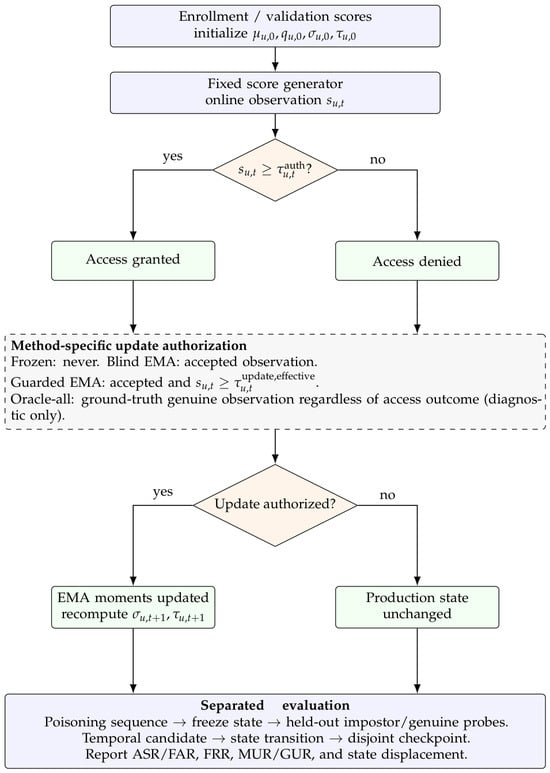
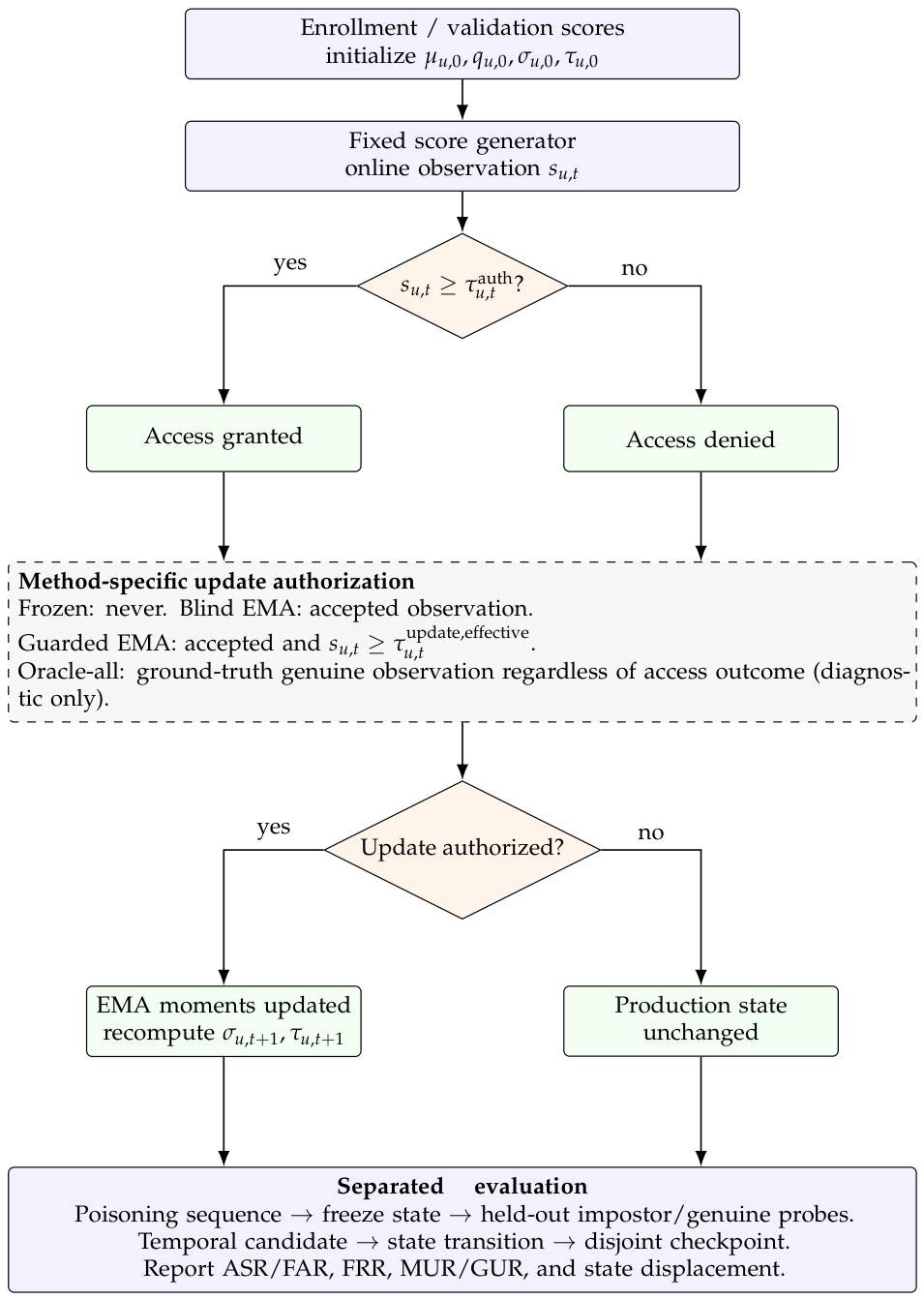
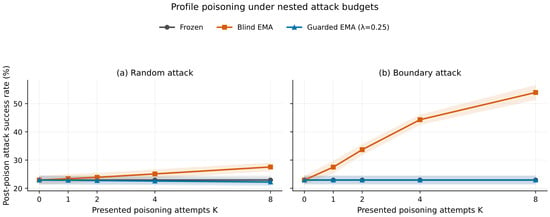
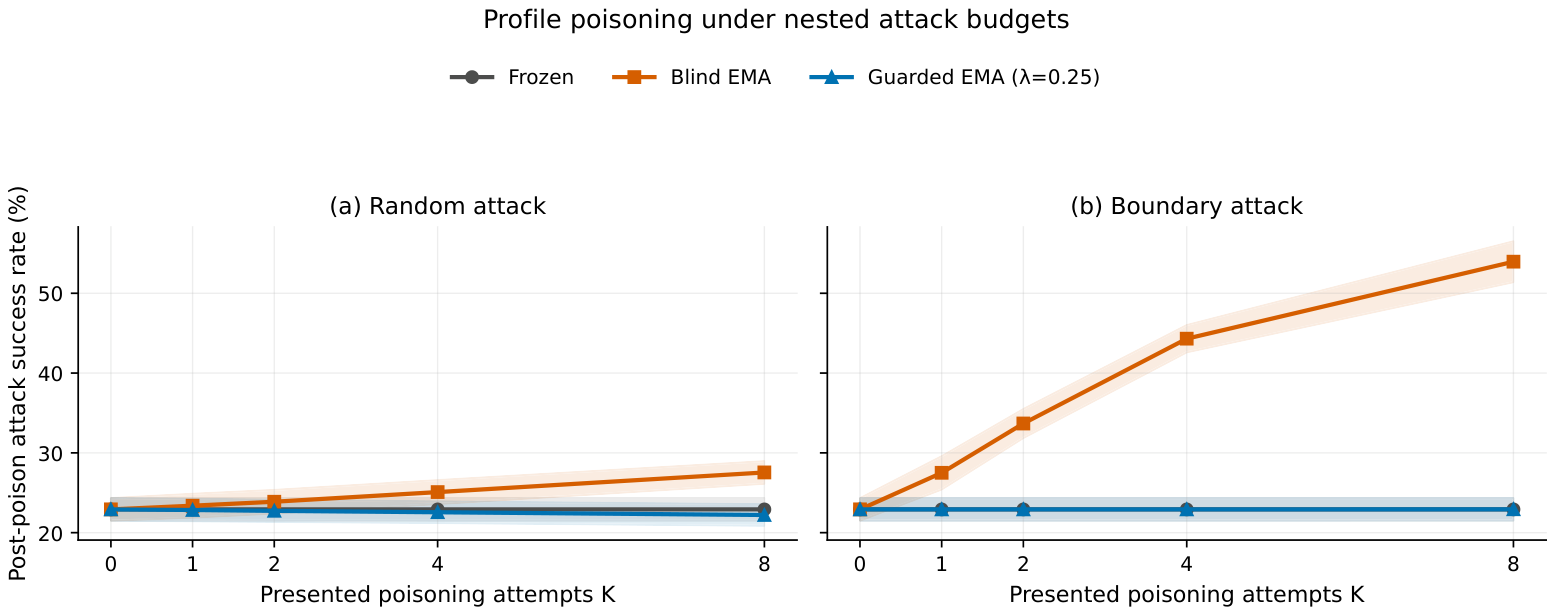
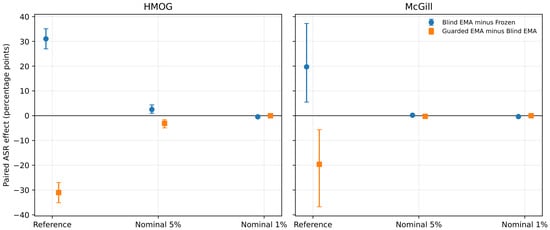
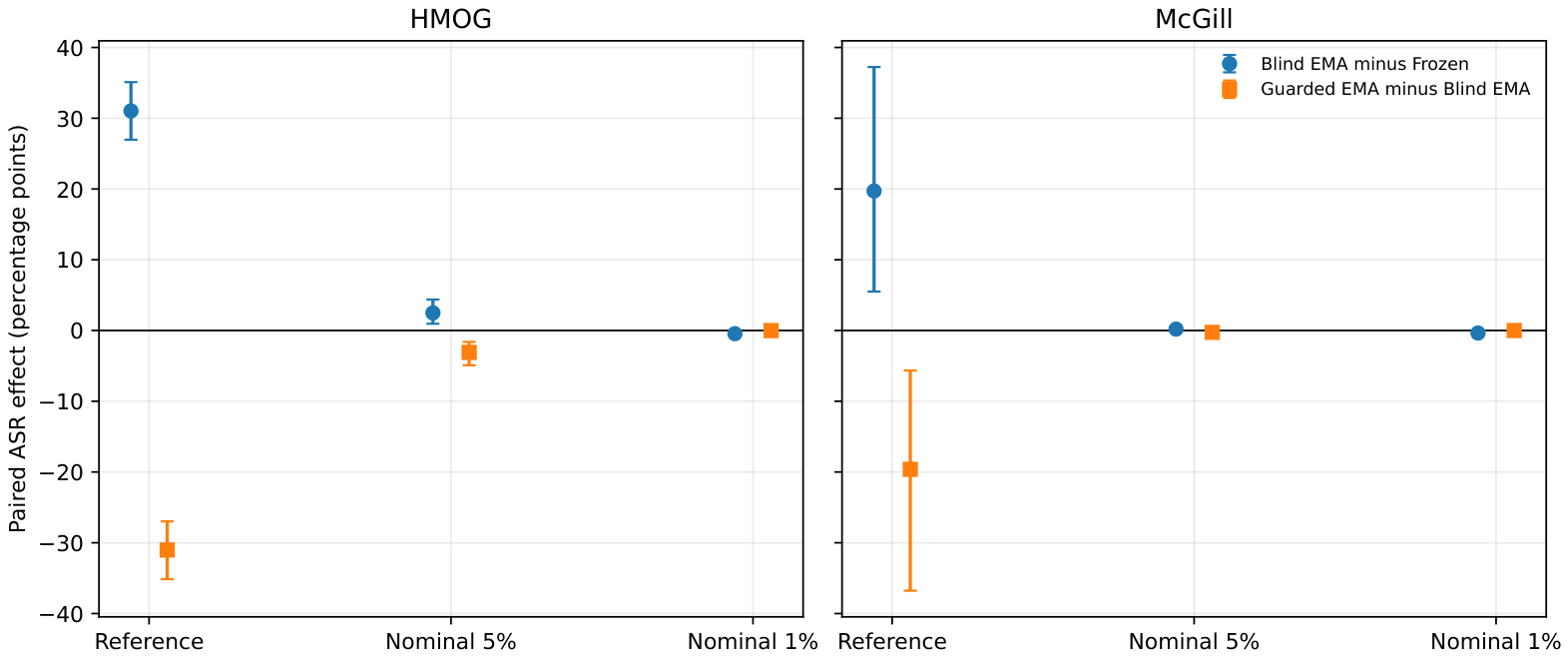
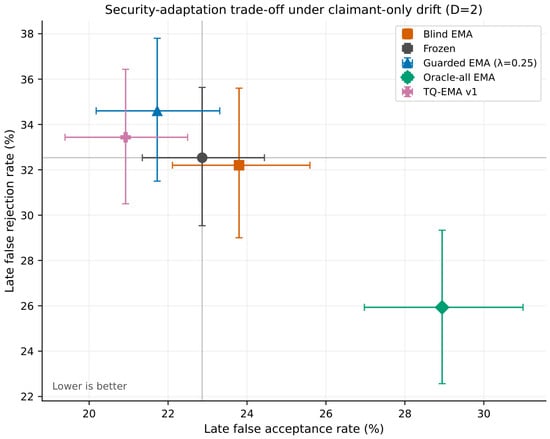
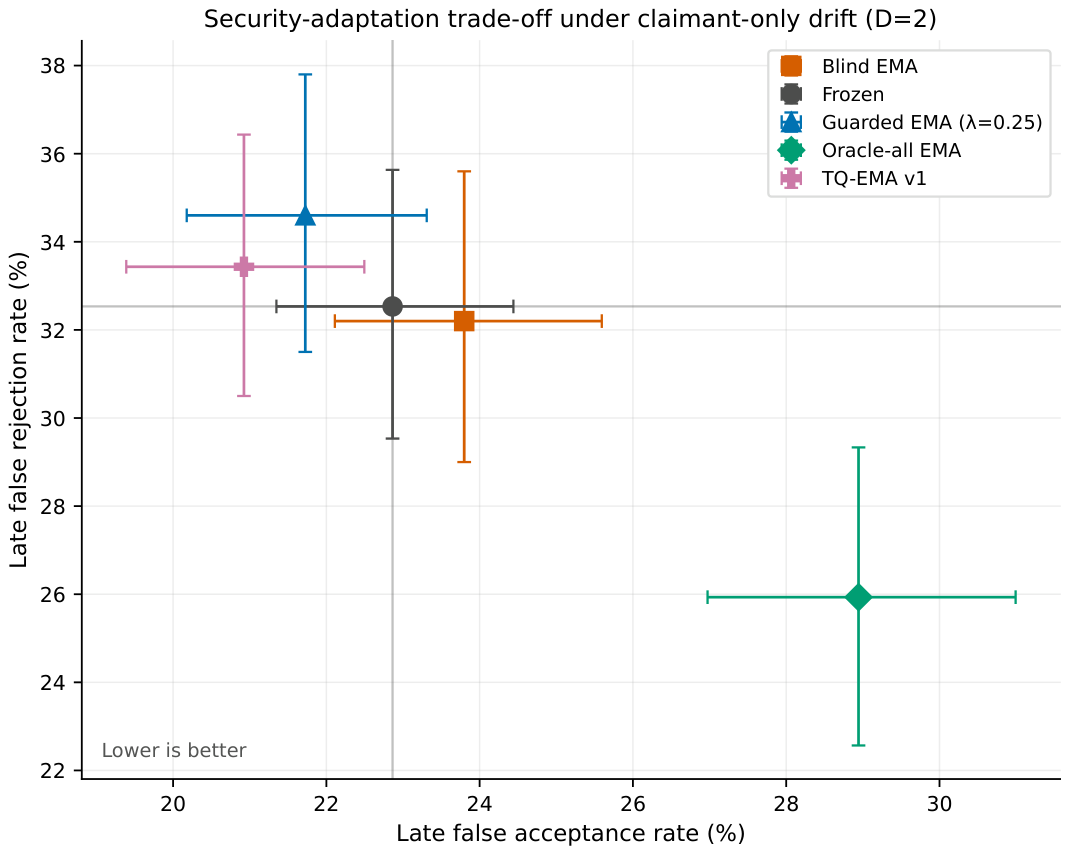
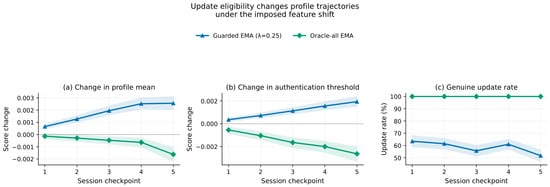
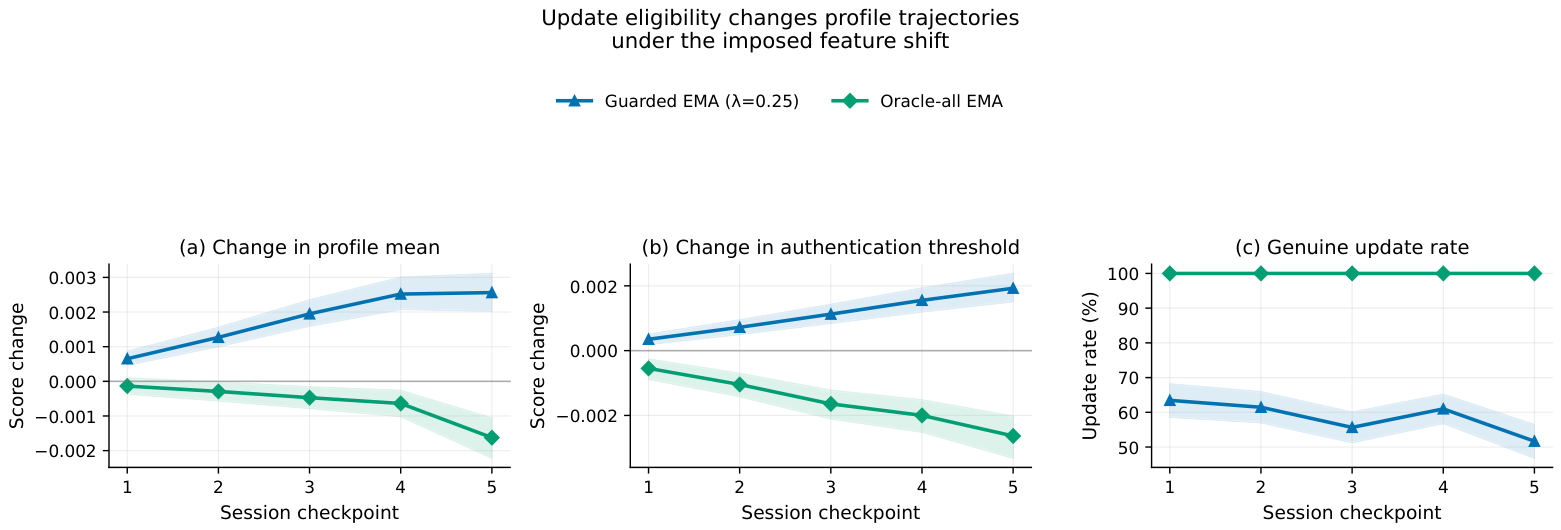

Disclaimer/Publisher’s Note: The statements, opinions and data contained in all publications are solely those of the individual author(s) and contributor(s) and not of MDPI and/or the editor(s). MDPI and/or the editor(s) disclaim responsibility for any injury to people or property resulting from any ideas, methods, instructions or products referred to in the content. |
© 2026 by the authors. Licensee MDPI, Basel, Switzerland. This article is an open access article distributed under the terms and conditions of the Creative Commons Attribution (CC BY) license.