


Abstract
NiTi shape memory alloys (SMAs) are increasingly considered for seismic energy-dissipating devices embedded in reinforced concrete, where passive film stability under simultaneous mechanical and chemical attack remains poorly understood. This study examines the electrochemical and mechanical degradation of NiTi under sustained tensile loading (40% UTS) in carbonated concrete pore solution (CCPS, pH 9.0–9.5), with and without combined 0.5 M NaCl and anodic polarization (Eapp = Ecorr + 200 mV). Open-circuit potential measurements show that stressed specimens in chloride-free CCPS stabilize near −0.29 V vs. SCE, approximately 60 mV more negative than unstressed controls, reflecting persistent repassivation instability rather than steady-state film growth; in the presence of NaCl, the stressed OCP shifts further to −0.31 V. Electrochemical impedance spectroscopy reveals a stress-induced transition from a single-barrier to a dual-layer response, with the corrosion-product resistance (Rcp) declining 61% from 8321 ± 1264 Ω·cm2 to 3261 ± 518 Ω·cm2 over 48 h; the CPE exponent n falls to 0.61, indicating severe interfacial disorder. Mott–Schottky analysis confirms that the passive film is an n-type TiO2-based semiconductor whose total ionized-donor density (ND) increases by approximately 69%, from (8.3 ± 0.4) × 1016 cm−3 to (1.4 ± 0.1) × 1017 cm−3, under load. This elevation is consistent with stress-driven accumulation of point defects and, as one plausible contributing pathway, localized near-surface B2 → B19′ transformation at stress concentrations, though Mott–Schottky analysis alone does not identify the specific donor species. XPS depth profiling corroborates this picture structurally: stressed films display a broadened oxide–metal transition zone, an anomalous spatial distribution of metallic nickel inconsistent with the sharp compositional boundary expected beneath a well-passivated surface, and a premature onset of the metallic Ti signal—collectively indicative of a structurally compromised interface. Slow-strain-rate testing quantifies the mechanical toll: fracture strain drops from 10.2 ± 0.6% in air 6.1 ± 0.4% in CCPS and 4.5 ± 0.5% under combined chloride and anodic polarization (approximately 56% total reduction vs. air), whereas UTS declines by only approximately 15%, a disproportionate diagnostic of localized SCC. The susceptibility index ISCC(UTS) rises from 0.11 in CCPS at OCP to 0.15 under the combined chloride–anodic condition, consistent with progressive passive-film degradation driven by the superposition of mechanical, chemical, and electrochemical attack. These results reframe passive film degradation as a defect-engineering process in which mechanical load restructures the TiO2 point-defect population, converting a protective barrier into a mechanochemical gateway for stress corrosion cracking.
1. Introduction
NiTi shape-memory alloys (SMAs) command an exceptional standing in structural and civil engineering, not due to marginal performance gains over conventional metals, but by intrinsically harnessing a distinct mechanical paradigm. The reversible, diffusionless martensitic transformation between the austenitic B2 and monoclinic B19′ phases yields superelastic strains of 6–8% alongside an intrinsic energy-dissipation capacity that no ferrous alloy can replicate [1,2]. In seismic engineering, this distinction is consequential: NiTi bars, tendons, and bracing elements embedded in reinforced concrete frames measurably suppress residual inter-story drift after strong ground motion, because the alloy recovers its geometry instead of locking in plastic strain [3,4,5,6]. The same transformation stability underpins their use in bridge expansion joints, post-tensioning tendons, and active column-confinement systems [7,8]. Nevertheless, this exceptional performance relies entirely on a critical, nanometer-scale bulwark—the self-generated, TiO2-enriched passive film. While this film remains electronically lean and structurally continuous, the alloy is effectively isolated from its surroundings. The moment that condition erodes, the door to corrosion and environmentally assisted fracture swings open [1,9,10,11].
The electrochemical environment inside concrete is neither benign nor constant. Fresh concrete pore solution is strongly alkaline (pH 12.5–13.5), and NiTi passivates readily under those conditions [9,10,11,12,13,14,15]. Carbonation, the gradual neutralization of portlandite and calcium silicate hydrate by atmospheric CO2, depresses pore-solution pH to roughly 8.5–9.5, a window in which the thermodynamic stability field of the native TiO2 film contracts appreciably [1,13,14]. At reduced pH, competitive OH− adsorption at the oxide surface diminishes, repassivation kinetics slow, and incomplete oxide regrowth follows transient film-rupture events [12,15]. Chloride ions, whether from deicing salts, marine aerosols, or contaminated aggregate, compound the situation by displacing hydroxyl ions at oxygen-vacancy sites within the TiO2 lattice, destabilizing the space-charge layer and seeding pit nucleation [11,14,15,16,17]. The carbonated concrete pore solution (CCPS) at pH 9.0–9.5 is therefore not simply a diluted variant of fresh-concrete chemistry; it is a marginal-stability environment where mechanical loading can tip the passive film from functional protection toward irreversible breakdown [1,10].
This tipping mechanism operates on two distinct scales. Macroscopically, tensile stress ruptures the passive film at slip bands and dislocation pile-ups; whether repassivation or sustained anodic dissolution follows is decided by the kinetic race between metal oxidation and oxide regrowth [16,17,18,19,20]. At the point-defect scale, elastic and plastic strain fields perturb TiO2 lattice chemistry more subtly: stress-induced oxygen vacancies () elevate the n-type donor density (ND), shift the flat-band potential (Efb) cathodically, and amplify both ionic and electronic conductivity—all without macroscopically destroying the film [11,19]. That conductivity gain simultaneously accelerates anodic dissolution and cathodic hydrogen evolution at the film–metal interface, rendering hydrogen-assisted cracking (HAC) a mechanistically plausible concurrent pathway [17,21]. The deeper implication is that SCC susceptibility in NiTi may be governed not by the disappearance of the passive film, but by the silent accumulation of defects within a film that appears nominally intact yet is functionally compromised—a distinction that polarization curves and gravimetric measurements are structurally incapable of resolving [1].
Prior investigations have built the electrochemical vocabulary for this problem. Mott–Schottky analyses on NiTi in chloride and physiological solutions confirmed the n-type semiconducting character of the surface oxide and its sensitivity to solution chemistry and surface Ni content [18,19,22]. XPS depth profiling resolved a TiO2-rich outer layer over a mixed Ti/Ni inner oxide, with mechanical deformation accelerating Ni2+ release into solution [23,24]. EIS studies consistently identified two time constants under aggressive conditions, attributed to a bilayer architecture of outer hydroxide over inner compact oxide [15,25]. Application of the Point Defect Model (PDM) to NiTi passive films identified cation-vacancy transport as the rate-controlling step in film growth and dissolution [26]. In concrete-specific environments, the transition from robust passivity in fresh concrete to marginal stability under carbonation has been documented, though the effect of sustained stress on film defect structure was not addressed [12]. More recently, passive-film destabilization in CCPS under combined reduced-pH and chloride exposure was characterized on NiTi, establishing the electrochemical baseline upon which the present study builds [1]. Taken together, these contributions confirm that film defect structure is mechanistically decisive. Yet no single investigation has combined sustained tensile loading, Mott–Schottky characterization, EIS, XPS depth profiling, and SSRT within a unified alloy–environment framework.
What is notably absent from the existing body of work, however, is a quantitative account of SCC susceptibility in NiTi under static mechanical load within concrete-relevant environments. Studies addressing passive film behavior in alkaline and carbonated solutions, including those establishing the n-type semiconducting character of the surface oxide [9,11], documenting pH-driven destabilization of the TiO2 layer [14], and mapping point-defect transport through Mott–Schottky analysis [10,26], have each been conducted under unstressed or freely corroding conditions. Where mechanical loading has been introduced, as in work on hydrogen-assisted degradation [27] and stress-aging precipitate effects on corrosion [28], the electrochemical characterization of the passive film itself was not the primary focus. No study to date has reported fracture-strain reduction ratios, SCC index values, or defect-density shifts for NiTi exposed to carbonated pore solution under simultaneous sustained tensile load, leaving a measurable gap between what the electrochemical literature describes and what structural applications actually demand. The present work addresses this gap directly, using SSRT-derived susceptibility indices alongside Mott–Schottky and XPS data to establish, for the first time, a quantitative link between passive film defect density and SCC propensity under conditions representative of in-service concrete exposure [1,12,14,29].
This study provides the critical integration of electrochemical and mechanical analysis necessary to advance the reliability of smart, sustainable infrastructure. The central question addressed herein is of paramount importance for the life-cycle integrity of resilient cities: when a NiTi seismic damper operates under design stress within carbonated, chloride-contaminated concrete, does its failure stem from the macroscopic consumption of the passive film, or from a functionally compromised, defect-enriched barrier that facilitates sub-threshold dissolution and hydrogen ingress? By interrogating NiTi wire specimens in CCPS (pH 9.0–9.5) under sustained loading (40% UTS), we demonstrate that stress-induced oxygen-vacancy generation serves as the primary mechanochemical gateway to stress corrosion cracking (SCC). This process triggers a 61% collapse in corrosion-product resistance (Rcp) and a dramatic ~55% reduction in fracture strain, even while bulk tensile strength remains largely unaffected. The fundamental novelty of this work lies in establishing passive-film defect density, quantified through Mott–Schottky analysis and corroborated by XPS depth profiling, as a robust, predictive metric for SCC susceptibility rather than a mere post-mortem observation. Ultimately, these results provide a strategic roadmap for the qualification of shape-memory alloys in sustainable concrete infrastructure, asserting that point-defect characterization under representative service loads is a vital, yet currently missing, variable in the global transition toward durable and low-carbon civil engineering.
2. Materials and Methods
2.1. Material Preparation and Specimen Geometry
Nickel–titanium (NiTi) shape memory alloy specimens were obtained commercially with a nominal composition of 55.8 wt.% Ni and 44.2 wt.% Ti, as confirmed by the material certificate. This composition corresponds to approximately 50.7 at.% Ni and 49.3 at.% Ti. Prior to all experiments, specimens were solution-annealed at 850 °C for 30 min under a flowing argon atmosphere and subsequently water-quenched to achieve a homogeneous, reproducible microstructure free of residual thermal stresses [2,30]. Tensile specimens were machined in conformity with ASTM E8, with a gauge length of 25 mm and a cross-sectional area of approximately 5 mm2. Surfaces were ground through successive SiC papers to 1200 grit and then polished to a mirror finish using a 0.05 µm alumina suspension. All specimens were ultrasonically cleaned in acetone and ethanol for 15 min each, rinsed with deionized water, and dried under a high-purity nitrogen stream immediately before testing.
2.2. Simulated Carbonated Concrete Pore Solution
Two electrolytes were prepared to replicate the electrochemical environment encountered by NiTi components embedded in carbonated concrete [14]. The baseline alkaline simulated concrete pore solution (SCPS) was formulated from saturated Ca(OH)2 (~0.02 M) supplemented with 0.1 M KOH and 0.1 M NaOH, bringing the initial pH to approximately 13.2. Carbonation was induced by continuously purging 99.9%-pure CO2 through the SCPS until the pH stabilized between 9.0 and 9.5, yielding the carbonated concrete pore solution (CCPS) representative of the most corrosion-susceptible zone in field-carbonated structures. A chloride-enriched variant was prepared by dissolving 0.5 M NaCl into the CCPS to represent conditions prevailing near concrete surfaces contaminated by deicing salts or marine-derived chlorides; this chloride addition substantially intensifies passive-film degradation by promoting pit initiation and undermining the stability of the native oxide layer. All reagents were of analytical grade; deionized water (resistivity ≥ 18.2 MΩ·cm) was used throughout, and all solutions were thermostated at 25 ± 1 °C. Solution pH was monitored continuously with a calibrated glass electrode.
2.3. Electrochemical Characterization of the Passive Film
All electrochemical measurements were carried out in a conventional three-electrode flat cell (Metrohm Autolab, Utrecht, The Netherlands). A platinum-mesh electrode served as the counter electrode, a saturated calomel electrode (SCE, +0.241 V vs. SHE) as the reference electrode, and the NiTi specimen—mounted in an epoxy holder exposing 1 cm2—as the working electrode. All potentials reported herein are referenced to the SCE. Before each measurement, the open-circuit potential (OCP) was recorded for 1800 s until the drift fell below 0.5 mV min−1. Electrochemical impedance spectroscopy (EIS, Metrohm Autolab, Utrecht, The Netherlands) was performed at the stabilized OCP over a frequency range of 105 to 10−2 Hz with a sinusoidal perturbation of 10 mV (rms). Spectra were fitted using ZSimpWin (v3.60) with equivalent circuits incorporating constant-phase elements (CPEs) to represent the non-ideal capacitive response of the passive oxide film, Equation (1) [14,31]:
where Y0 is the CPE admittance coefficient (S·sn·cm−2), ω is the angular frequency (rad s−1), and n is the ideality exponent (0 ≤ n ≤ 1); n = 1 corresponds to a pure capacitor and lower values reflect surface heterogeneity of the film. Mott–Schottky analysis was conducted at a fixed frequency of 1 kHz by stepping the applied potential from +0.8 V to −0.8 V vs. SCE in 20 mV decrements at a scan rate of 20 mV s−1. The flat-band potential (Efb) and carrier density (ND or NA) were extracted from the linear regions of the vs. Eplot via Equation (2) [32]:
where ε = 12 for the TiO2-based passive film, ε0 is the permittivity of free space, e is the elementary charge, and kBT/e ≈ 26 mV at 25 °C. It should be noted that Mott–Schottky analysis at a single frequency (1 kHz in this work) carries an inherent methodological limitation when applied to disordered passive films. As indicated by the CPE ideality exponent (n < 1) obtained from the EIS fitting in this study, the TiO2-based film exhibits non-ideal capacitive behavior reflecting surface heterogeneity. Under such conditions, the extracted donor density (ND) and flat-band potential (Efb) may exhibit frequency dependence, since contributions from surface states and dielectric relaxation processes vary across the measurement frequency spectrum. Consequently, the values reported here should be interpreted as frequency-specific estimates at 1 kHz rather than frequency-independent material constants. Multi-frequency Mott–Schottky analysis, which enables extrapolation to the frequency-independent regime, is recommended for future investigations to validate the magnitude of stress-induced changes in donor density observed in the present work.
2.4. In Situ EIS and Mott–Schottky Analysis Under Applied Tensile Stress
To isolate the mechanical contribution to passive-film degradation from any confounding chemical effect of chloride, EIS and Mott–Schottky measurements under static tensile loading were performed exclusively in chloride-free CCPS (pH 9.0–9.5). Specimens were mounted in a custom-built in situ straining jig integrated directly into the three-electrode electrochemical cell, allowing a constant uniaxial tensile stress to be maintained throughout the measurement without interrupting the electrical circuit. A stress level of 40% UTS, determined from preliminary tensile tests conducted in air, was selected to represent a realistic service load within the superelastic regime. Load was applied through a calibrated screw-driven mechanism, and stress relaxation over the 48 h test window was confirmed to remain below 3%. Although real seismic loading involves cyclic strain histories with strain amplitudes that can reach several percent and involve repeated austenite–martensite cycling [4,5], the static constant-load protocol adopted here was deliberately chosen to isolate the time-dependent electrochemical response of the passive film from the mechanical energy dissipation and microstructural evolution associated with cyclic loading [6,27]. This limitation is acknowledged: cyclic loading would be expected to accelerate passive-film breakdown through repeated mechanochemical straining and produce higher SCC susceptibility than the static scenario reported here [17,20]. EIS spectra were acquired at 1 h, 24 h, and 48 h of continuous immersion under constant load to track the time-dependent evolution of passive-film integrity. The same frequency range (105–10−2 Hz), perturbation amplitude (10 mV rms), and circuit-fitting criteria described in Section 2.3 were applied. The independent variable in this series was mechanical stress alone; the electrolyte composition was held constant and chloride-free throughout.
2.5. Slow Strain Rate Testing for SCC Susceptibility
Susceptibility to stress corrosion cracking (SCC) was assessed by slow strain rate testing (SSRT, SANTAM, Tehran, Iran) following ASTM G129, using a custom apparatus equipped with a hermetically sealed electrochemical cell that maintained full electrochemical control during mechanical loading. While it is recognized that SCC susceptibility indices derived from SSRT are sensitive to the imposed strain rate, a constant strain rate of s−1 was deliberately employed here to ensure a controlled, reproducible baseline for comparing the three environmental conditions.
Three environmental conditions were examined: (i) air, as the inert mechanical baseline with no electrochemical involvement; (ii) chloride-free CCPS at OCP, targeting the effect of carbonation-induced film degradation under free-corrosion conditions in the complete absence of chloride; and (iii) CCPS + 0.5 M NaCl under anodic polarization at Eapp = Ecorr + 200 mV, representing the most aggressive scenario encountered in practice—carbonated concrete contaminated by deicing or marine-derived chlorides, where pit initiation and an oxidizing driving force operate in concert. The progression from condition (i) to (iii) was designed as a mechanistic ladder: from a purely mechanical reference, through isolated carbonation, to fully coupled mechanochemical attack. Conditions (i) and (ii) can be compared directly to isolate the carbonation contribution at equivalent potential (OCP); however, because NaCl and anodic polarization were both introduced simultaneously in condition (iii), the independent effects of chloride concentration and applied potential cannot be resolved from this dataset. Separating these two variables would require a factorial experimental design and is identified as a direction for future work. SCC susceptibility indices were calculated from the reduction in area (RA) and ultimate tensile strength (UTS) measured in each environment, using Equations (3) and (4) [29]:
The same normalized-loss formula was applied to fracture strain (εf) as a third index:
where higher values indicate greater ductility loss under environmental exposure. Values approaching unity denote severe SCC susceptibility.
2.6. Surface and Microstructural Characterization
Post-exposure surface morphology and fracture features were examined by field-emission scanning electron microscopy (FE-SEM, Tescan MIRA3, Brno, Czech Republic) at 15 kV. The phase evolution of the near-surface regions was characterized using Grazing Incidence X-ray Diffraction (GIXRD, Malvern Panalytical, Malvern, UK) with CuKα radiation (λ = 1.5406 Å). To ensure high surface sensitivity and minimize substrate interference, the incident angle (ω) was fixed at 5°, with a scanning range of 2θ from 10° to 80° and a step size of 0.02°. The chemical composition, oxidation states, and electronic structure of passive films formed on NiTi specimens before and after SCC testing were characterized by X-ray photoelectron spectroscopy (XPS, PHI VersaProbe III, Physical Electronics, Chanhassen, MN, USA) using a monochromatic AlKα source (hν = 1486.6 eV). To determine passive-film thickness and to resolve the depth distribution of oxide species was performed by sequential Ar+ ion sputtering at 2 keV with approximately 0.15 nm min−1. XPS depth profiling was used to qualitatively compare the depth-dependent evolution of the detected Ti chemical-state signals and the Ni and O signals in specimens immersed in carbonated concrete pore solution (CCPS) for 1, 24, and 48 h under unstressed and stressed (40% UTS) conditions. The profiles were examined to assess differences in the distribution of the detected species from the outer surface toward the underlying substrate.
2.7. Statistical Analysis
All mechanical and electrochemical data are presented as mean ± standard deviation from a minimum of three independent experiments. Statistical significance between test groups was evaluated using one-way analysis of variance (ANOVA) with a significance level set at p < 0.05.
3. Results and Discussion
3.1. Electrochemical Characterization and SCC Susceptibility of NiTi in Simulated Concrete Pore Solution
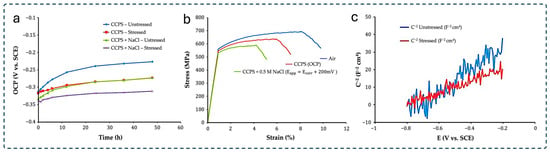
The temporal evolution of the open-circuit potential (EOCP) presented in Figure 1a captures the dynamic competition between passive film growth and its environmentally driven degradation.
Figure 1.
Electrochemical and mechanical response of NiTi alloy: (a) open-circuit potential (EOCP) evolution over time; (b) engineering stress–strain curves obtained from SSRT tests in air, carbonated concrete pore solution (CCPS), and CCPS + 0.5 M NaCl under anodic polarization (Eapp = Ecorr + 200 mV); (c) Mott–Schottky plots recorded under unstressed and stressed (40% UTS) conditions.
In the chloride-free carbonated solution (CCPS), the unstressed NiTi specimen displays a characteristic anodic shift, rising from approximately −0.30 V to −0.23 V vs. SCE over 48 h. This stabilization is classically attributed to the field-assisted thickening of the TiO2-dominated passive layer, where ionic transport kinetics progressively attenuate as the film reaches a critical dielectric thickness [14,23]. Conversely, under a 40% UTS tensile load, the EOCP trajectory plateaus near −0.29 V. This 60 mV depression is not merely a surface effect; it serves as a macroscopic manifestation of repeated transient rupture at slip-band intersections, where the underlying metal is intermittently exposed to the electrolyte before repassivation [27]. The introduction of 0.5 M NaCl induces a persistent cathodic shift, with the stressed specimen stabilizing at −0.31 V. This downward potential drift confirms that Cl− ions do not merely adsorb, but actively infiltrate oxygen vacancy sites within the TiO2 lattice, effectively disrupting the stoichiometric transition of the oxide. This sustained potential depression signifies that mechanical strain energy lowers the activation barrier for localized ion transport, creating a “leaky” oxide barrier that fails to achieve true dielectric equilibrium, thereby establishing a self-propagating loop of anodic dissolution even before macroscopic crack initiation occurs [9,10].
The SSRT results (Figure 1b) quantify the mechanical toll of the combined aggressive environment across the three experimental conditions. The air-tested baseline exhibits robust superelastic behavior with failure at ~10% strain. Immersion in CCPS truncates this ductility to ~6%, a reduction primarily driven by surface corrosion. However, the CCPS + NaCl environment drives fracture strain down to 4.5%, a loss captured by , placing this condition firmly in the high-susceptibility range. The accompanying UTS reduction is comparatively modest, with ISCC(UTS) ≈ 0.15. Crucially, the disparity between the modest decrease in UTS (15%) and the profound collapse in post-plateau ductility (55%) provides vital mechanistic insight. This imbalance indicates that SCC in NiTi is not a purely dissolution-governed process. Rather, it reveals that the passive film’s mechanical instability, exacerbated by chloride infiltration, creates localized regions of high hydrogen fugacity. The hydrogen atoms, once adsorbed, diffuse into the stress-concentrated regions at the crack tip, inducing lattice-level softening. This disparity is consistent with a hydrogen-assisted decohesion mechanism, wherein hydrogen atoms generated at cathodic defect sites diffuse into stress-concentrated regions and induce localized lattice softening, operating in concert with anodic dissolution at the crack tip. While direct hydrogen measurements were not performed in this study, the disproportionate ductility loss relative to UTS reduction represents a well-documented mechanical signature of hydrogen participation in titanium-based alloys under comparable environmental conditions [9,21,23,27,28], and we therefore propose hydrogen-assisted processes as a plausible contributing pathway that warrants further investigation through direct hydrogen detection techniques, a characteristic signature of stress-accelerated environmental degradation [9,23,28].
It should be emphasized that the present study does not include direct hydrogen detection experiments, such as thermal desorption spectroscopy, hydrogen microprint techniques, or electrochemical permeation analysis, and the potential contribution of hydrogen-assisted processes is therefore inferred from indirect electrochemical and mechanical evidence rather than measured hydrogen uptake or subsurface concentration profiles. Specifically, the disproportionate collapse in fracture strain (~55%) relative to the modest UTS reduction (~15%) represents a well-established mechanical signature of hydrogen-assisted decohesion in titanium-based alloys [21,27], while the elevated donor density recorded in the Mott–Schottky analysis (Figure 1c) is consistent with an increased cathodic driving force for hydrogen evolution at defect sites within the passive film [10,26]. The Mott–Schottky plots (Figure 1c) identify the TiO2 layer as an n-type semiconductor, where electron transport is mediated by shallow donor defects. The significantly reduced slope for the stressed specimen quantitatively confirms an elevated donor density (ND), a measure of the total concentration of ionized donors within the space-charge layer, which reflects a higher density of point defects introduced by mechanical loading [27]. Quantitative extraction from the linear region of the C−2–E curves (Table 1) reveals that mechanical loading drives ND from (8.3 ± 0.4) × 1016 cm−3 in the unstressed condition to (1.4 ± 0.1) × 1017 cm−3 under stress—a roughly 69% increase. While the Mott–Schottky technique does not distinguish between different donor species, oxygen vacancies () are widely established as the predominant shallow donor in TiO2-based films on NiTi, particularly under conditions of mechanical stress, reduced pH, and chloride exposure [10,23,26]. The observed ND elevation is therefore consistent with stress-assisted oxygen-vacancy accumulation, though contributions from other ionized defects (e.g., interstitial Ti3+) cannot be ruled out on the basis of Mott–Schottky data alone. Concurrently, Efb shift by approximately 50 mV (from −0.81 ± 0.02 V to −0.86 ± 0.02 V vs. SCE) indicates that the space-charge layer narrows and the band-bending energy available to sustain passivity decreases. Taken together, the ND elevation and the cathodic Efb shift provide a quantitative electrochemical basis for the mechanochemical gateway hypothesis: films with elevated ionized-defect density and reduced band-bending energy are inherently more susceptible to charge-transfer-mediated degradation processes, including anodic Ni2+ dissolution through the oxide–metal transition zone and cathodic hydrogen evolution at buried defect sites. While these infer that oxygen vacancies are the dominant contributor to the measured ND, based on the established defect chemistry of TiO2 [23,26]. This electronic disorder, regardless of its precise defect-level origin, represents the fundamental electrochemical link between mechanical stress and environmental susceptibility.
Table 1.
Mott–Schottky parameters extracted from C−2–E plots of NiTi passive films formed in carbonated concrete pore solution (CCPS), at 1 kHz, after 48 h immersion.
By quantifying the Mott–Schottky parameters, we demonstrate that mechanical strain does more than physically rupture the film; it modifies the film’s electronic architecture by increasing the density of mobile charge carriers. This heightened donor density facilitates localized charge transfer at the oxide/electrolyte interface, which thermodynamically accelerates the hydrogen evolution reaction (HER) at the cathodic sites. The slight negative shift in the flat-band potential (Efb) for the stressed condition further suggests that the space-charge layer is fundamentally altered, narrowing the potential window for passive stability and thereby lowering the threshold for SCC initiation. This confluence of indirect evidence, OCP instability, disproportionate ductility collapse, elevated donor density, and cathodic flat-band shift is consistent with a mechanochemical degradation model in which stress-driven defect accumulation within the passive film facilitates charge-transfer processes that may include both anodic dissolution and cathodic hydrogen generation at buried defect sites. While the present data do not conclusively establish hydrogen ingress as the dominant embrittlement pathway, they provide a coherent electrochemical and mechanical basis for proposing hydrogen-assisted decohesion as one plausible contributing mechanism [9,10,21,27]. Summary of SSRT mechanical parameters and SCC susceptibility indices for NiTi tested in air, carbonated concrete pore solution (CCPS) at open-circuit potential, and CCPS + 0.5 M NaCl under anodic polarization (Eapp = Ecorr + 200 mV) are presented in Table 2.
Table 2.
Summary of SSRT mechanical parameters and SCC susceptibility indices for NiTi tested in air, carbonated concrete pore solution (CCPS) at open-circuit potential, and CCPS + 0.5 M NaCl under anodic polarization (Eapp = Ecorr + 200 mV). * ISCC calculated as: ISCC(P) = (Pair − Penv)/Pair, where P denotes the respective mechanical property (UTS, εf, or RA).
A direct comparison with previously published NiTi data situates the present findings and helps explain where the numbers agree with the literature and where they diverge. Figueira et al. [9] examined NiTi corrosion in phosphate-buffered physiological solutions (pH ~7.4) and reported ISCC values spanning 0.10–0.18 under SSRT conditions comparable to those used here, with fracture-strain losses attributed mainly to anodic dissolution of the Ni-rich substrate. The ISCC(UTS) of 0.15 in CCPS + NaCl falls within that range, yet the proportional imbalance between the 55% ductility loss and the 15% UTS reduction points toward a damage mode that dissolution alone cannot fully account for—a distinction that reflects the reduced pH imposed by carbonation (9.0–9.5 here vs. ~7.4 in physiological solution), since the narrower TiO2 stability window at lower pH amplifies stress-driven vacancy accumulation and shifts the mechanistic balance toward hydrogen participation [21,27]. Turning to donor density: Shabalovskaya et al. [23] showed that TiO2-rich films on mechanically disrupted Nitinol in alkaline media. So, ND values span 1019–1021 cm−3 for heavily disrupted or surface-modified Nitinol in aggressive alkaline media. The lower values recovered here—(8.3 ± 0.4) × 1016 cm−3 and (1.4 ± 0.1) × 1017 cm−3—are physically consistent with the mild perturbation of a static 40% UTS load in moderate pH (9.0–9.5), which sustains a more stoichiometrically coherent TiO2 film than the heavily deformed surfaces in that study. The ~69% stress-driven elevation nonetheless aligns directionally with the defect-accumulation model proposed there. Liu et al. [26] provided the complementary transport perspective, demonstrating that accelerated cation-vacancy diffusivity in NiTi passive films can sustain apparent film growth even as dielectric integrity deteriorates—a decoupling visible here in the XPS profiles at 48 h, where physical thickness increases while the oxide–metal transition zone broadens and compositional sharpness is lost. For passive film degradation more specifically, Farrokhi et al. [14] traced the decline of Rct and film stoichiometry across a pH 9–12 corridor in concrete-analog solutions and found the steepest deterioration precisely in the 9–10 range where the present CCPS sits, offering a continuous benchmark against which the 61% Rcp collapse recorded under stress here represents an extreme point within an already unfavorable pH regime. Radi et al. [28] independently documented accelerated Ni2+ release and film thinning in stress-aged NiTi exposed to chloride, an observation the present EIS data reproduce for specimens under live tensile loading. The recurring theme across these studies is that discrepancies in reported SCC susceptibility, donor density, and impedance magnitude trace back, in large part, to solution pH and the degree of chloride competition for oxygen vacancy sites: studies performed above pH 11 in non-carbonated alkaline solutions consistently report lower ISCC and higher Rct [9,23], reflecting the more stable TiO2 stoichiometry that the carbonated environment of the present study cannot sustain.
It should be noted that the experimental design of the SSRT matrix intentionally coupled chloride addition with anodic polarization in condition (iii), representing the combined aggressive environment characteristic of carbonated concrete exposed to deicing or marine chlorides—a scenario of direct practical relevance for structural NiTi components [9,14]. As a result, the observed reduction in fracture strain from 6.1 ± 0.4% (CCPS, OCP) to 4.5 ± 0.5% (CCPS + 0.5 M NaCl, Eapp = Ecorr + 200 mV), accompanied by and ISCC(RA) = 0.55 (Table 2), reflects the response to this combined aggressive environment rather than to either variable in isolation. The Mott–Schottky analysis shows an increase in total donor density ND from (8.3 ± 0.4) × 1016 cm−3 to (1.4 ± 0.1) × 1017 cm−3 (~69%) under tensile stress in chloride-free CCPS, consistent with stress-assisted accumulation of donor-type defects (including oxygen vacancies) within the passive TiO2 film. Since these measurements were conducted without chloride, they reflect the mechanical contribution alone and do not independently establish Cl−-specific vacancy occupation [10,33]. The persistent cathodic shift in EOCP observed for the stressed specimen in the chloride-containing electrolyte (Figure 1a), stabilizing near −0.31 V vs. SCE, further corroborates that chloride-driven film perturbation precedes and sustains the mechanical damage process, consistent with the Point Defect Model framework applied here [34,35]. Deconvolution of the individual contributions of anion concentration and applied potential to SCC susceptibility remains a priority for future work employing a full-factorial SSRT design.
3.2. Electrochemical Impedance Spectroscopy (EIS) Analysis: Passive Film Response and Phase-Structural Behavior
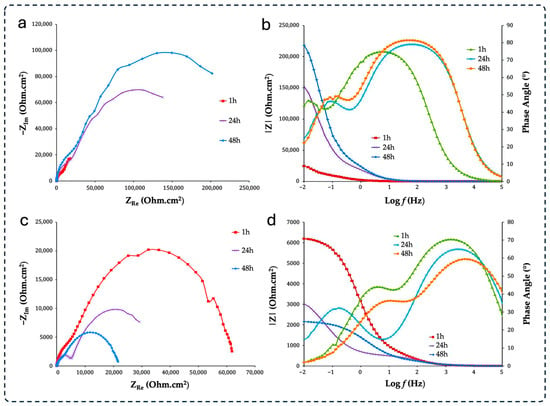
The Nyquist plots in Figure 2a capture a clear and consistent story for the unstressed NiTi specimens: the passive film grows stronger, not weaker, over 48 h in carbonated solution. At 1 h, the capacitive arc is the smallest of the three, consistent with a film in its early formation stage. By 24 h and 48 h the arcs expand substantially, with the real-axis intercept climbing from approximately 133 kΩ·cm2 at 1 h to roughly 1.68 MΩ·cm2 and 2.23 MΩ·cm2 at the later time points—values computed directly from the fitted parameters in Table 3 (Rs + Rcp + Rct). This progressive enlargement reflects field-assisted oxide thickening, wherein the ionic transport rate through the growing TiO2-dominated film decelerates as the film reaches a critical dielectric thickness [14,23]. Throughout this period, the interface maintains a single semicircular geometry, confirming that a single coupled relaxation process, the resistive–capacitive response of the passive oxide and its adjacent double layer, governs the electrochemical interface. The gradual drop in the CPE exponent ndl from 0.82 to 0.75 does point to some increase in surface heterogeneity as the film chemically restructures in the mildly alkaline carbonated environment, but this does not reverse the dominant trend of improving barrier quality [36,37].
Figure 2.
Electrochemical impedance spectroscopy (EIS) response of NiTi shape memory alloy in carbonated concrete pore solution (CCPS, pH 9.0) after 1 h, 24 h, and 48 h of immersion: (a) Nyquist plots; (b) Bode magnitude and phase-angle plots for unstressed specimens; (c) Nyquist plots; (d) Bode magnitude and phase-angle plots for specimens subjected to 40% UTS tensile stress.
Table 3.
EIS equivalent circuit parameters for NiTi in carbonated concrete pore solution (CCPS) under unstressed and stressed (40% UTS) conditions at 1 h, 24 h, and 48 h of immersion. Rs, Rct, and Rcorr are related to the solution resistance, charge transfer resistance and corrosion product resistance respectively. CPEdl and CPEcorr are related to the electrical double layer capacitance and corrosion product capacitance, and n is a measure of the heterogeneity or surface roughness.
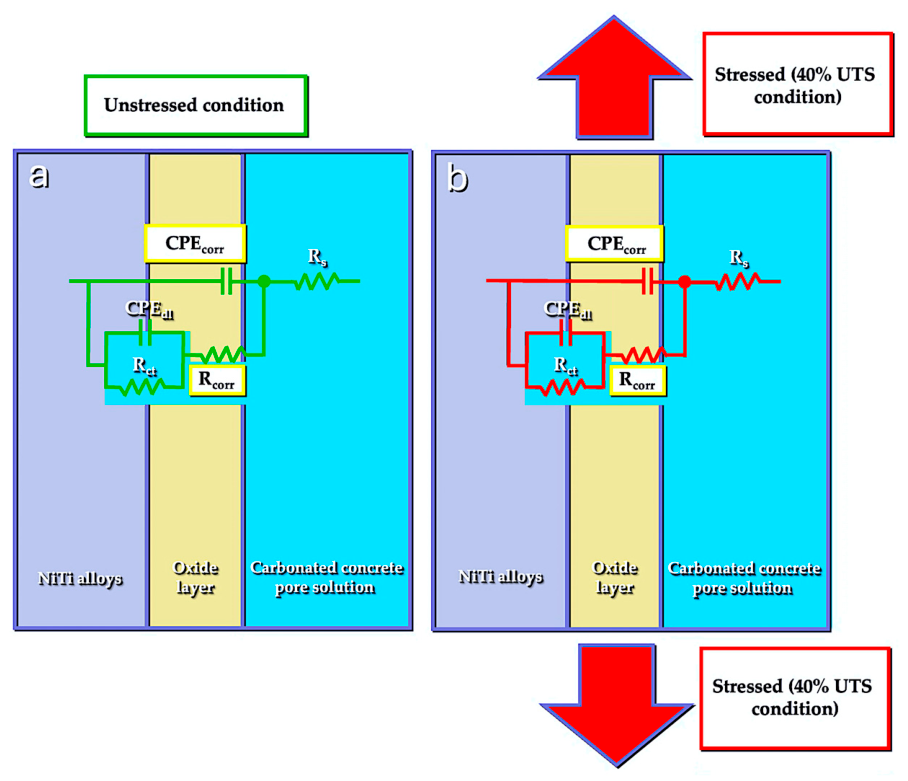
The Bode plots in Figure 2b reinforce this picture. The impedance modulus |Z| rises monotonically at low frequencies with immersion time, directly tracking the Rct growth documented in Table 3. The phase-angle spectra each display a single, broad maximum that persists throughout the 48 h window. The slight shift in peak position and the maintenance of a peak amplitude close to 70–75° reflect the film’s evolving dielectric character—not dissolution or thinning, but a reorganization toward a denser, more resistive oxide matrix [36,37]. Although the equivalent circuit contains two (R ∥ CPE) elements, Rs(CPEcp ∥ Rcp)(CPEdl ∥ Rct), the absence of any secondary shoulder confirms that the outer corrosion-product impedance (Rcp, CPEcp) and the charge-transfer/double-layer response (Rct, CPEdl) overlap so strongly within the measured frequency window that they produce one unified relaxation feature. In the unstressed state, the passive film and its adjacent double layer behave as a single coherent electrochemical barrier [36,37].
The situation changes fundamentally once a 40% UTS tensile load is applied. The Nyquist plots in Figure 2c show a systematic contraction of arc diameters with immersion time, starting from a real-axis intercept near 63 kΩ·cm2 at 1 h and falling to approximately 22 kΩ·cm2 at 48 h, in close agreement with the fitted Rs + Rcp + Rct sums in Table 3. Alongside this overall shrinkage, the arc geometry develops a pronounced mid-frequency shoulder—the electrochemical signature of two overlapping but partially resolved time constants [14,33]. Mechanical stress has done more than weaken the oxide; it has reconfigured the interface from a single-barrier system into a structurally heterogeneous bilayer.
The Bode representations in Figure 2d confirm this restructuring unambiguously. Unlike the unstressed data, the stressed specimens exhibit two distinct phase-angle maxima, or a primary peak accompanied by a pronounced low-frequency shoulder, separated by roughly one to two frequency decades. The high-frequency peak (101–102 Hz) belongs to the dielectric response of the outer, porous corrosion-product layer (CPEcp ∥ Rcp), while the low-frequency feature (10−1–100 Hz) captures charge-transfer and double-layer processes at the oxide–metal interface (CPEdl ∥ Rct) [28,33]. The low-frequency modulus |Z| decreases with immersion time—a straightforward electrochemical marker of progressive barrier degradation, in direct agreement with the declining Rct(54.6 → 18.7 kΩ·cm2) and Rcp(8321 → 3261 Ω·cm2) values of Table 3. Although the same two-element equivalent circuit topology describes both conditions, what that circuit represents physically shifts completely: in the unstressed state the two (R ∥ CPE) blocks capture a single merged interfacial process; under stress they correspond to two spatially distinct layers with measurably different relaxation kinetics. That distinction matters mechanistically—stress-driven SCC in NiTi is not simply a question of oxide removal, but a mechanochemical reorganization of the film’s internal architecture.
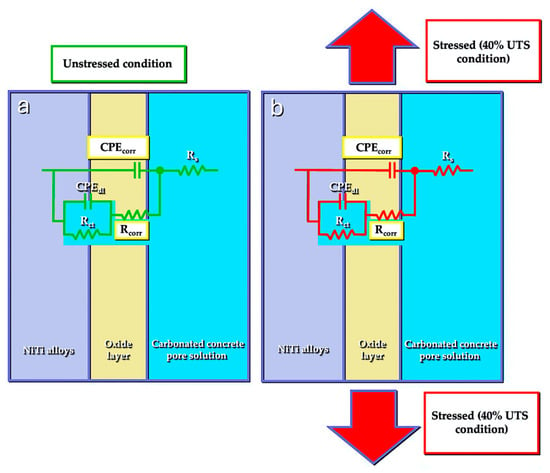
The two-time-constant circuit Rs(CPEcp ∥ Rcp)(CPEdl ∥ Rct) (Figure 3) converged with high fidelity across all datasets, yielding χ2 values within the 2.1 × 10⁻⁴ to 7.8 × 10⁻⁴ range (Table 3).
Figure 3.
Equivalent circuit models used to fit EIS data: (a) for unstressed NiTi specimens; (b) for stressed NiTi specimens.
For unstressed NiTi, Rct climbs from 120.9 kΩ·cm2 at 1 h to 2187.2 kΩ·cm2 at 48 h—a rise fully consistent with the expanding Nyquist arcs in Figure 2a and reflecting ongoing densification of the inner oxide sub-layer as the system approaches a quasi-steady passive state. Concurrently, Rcp increases from 12,368 Ω·cm2 to 41,752 Ω·cm2, indicating that the outer corrosion-product deposit also consolidates with time. Under stress, every trend reverses. Rcp falls from 8321 Ω·cm2 to 3261 Ω·cm2, confirming that sustained tensile loading drives progressive mechanical disruption, rather than simple chemical dissolution, of the outer layer. The CPEdl values follow a non-monotonic path, peaking at 86.21 μF ⋅ cm−2 ⋅ sn−1 at 24 h before retreating at 48 h. This transient maximum is consistent with a stress-driven cycle in which microcrack propagation at 24 h briefly exposes fresh metal, followed by partial re-passivation or pore-blocking at 48 h [9,23,38,39]. Finally, the reduction of ndl to 0.61 at 48 h underscores the heightened geometric and chemical inhomogeneity of the interface. It should be noted that the EIS data in this section document the heterogeneous, defect-rich character of the stressed films directly and independently of the Mott–Schottky analysis. CPE exponents falling to 0.61 ± 0.06, overlapping relaxation processes spanning nearly two frequency decades, and a mechanically fragmented outer layer with time-varying dielectric properties collectively confirm that these films are neither structurally homogeneous nor ideal capacitors. In disordered films of this kind, the Mott–Schottky slope carries a measurable frequency dependence because different frequencies probe different depth ranges within the space-charge layer [10,26]. The 1 kHz measurement frequency used here falls within the purely capacitive region of the Bode-phase spectra, minimizing resistive artefacts and ensuring that the extracted donor density primarily reflects double-layer capacitance [36,37]. Within that constraint, the trends reported, most importantly the stress-induced elevation of ND and the cathodic shift of Efb, are internally consistent and directionally robust. Nevertheless, a full multi-frequency Mott–Schottky protocol, in which ND and Efb are tracked across a discrete frequency range and tested for convergence, would place these values on a more rigorous quantitative footing and is recommended as a priority for future work.
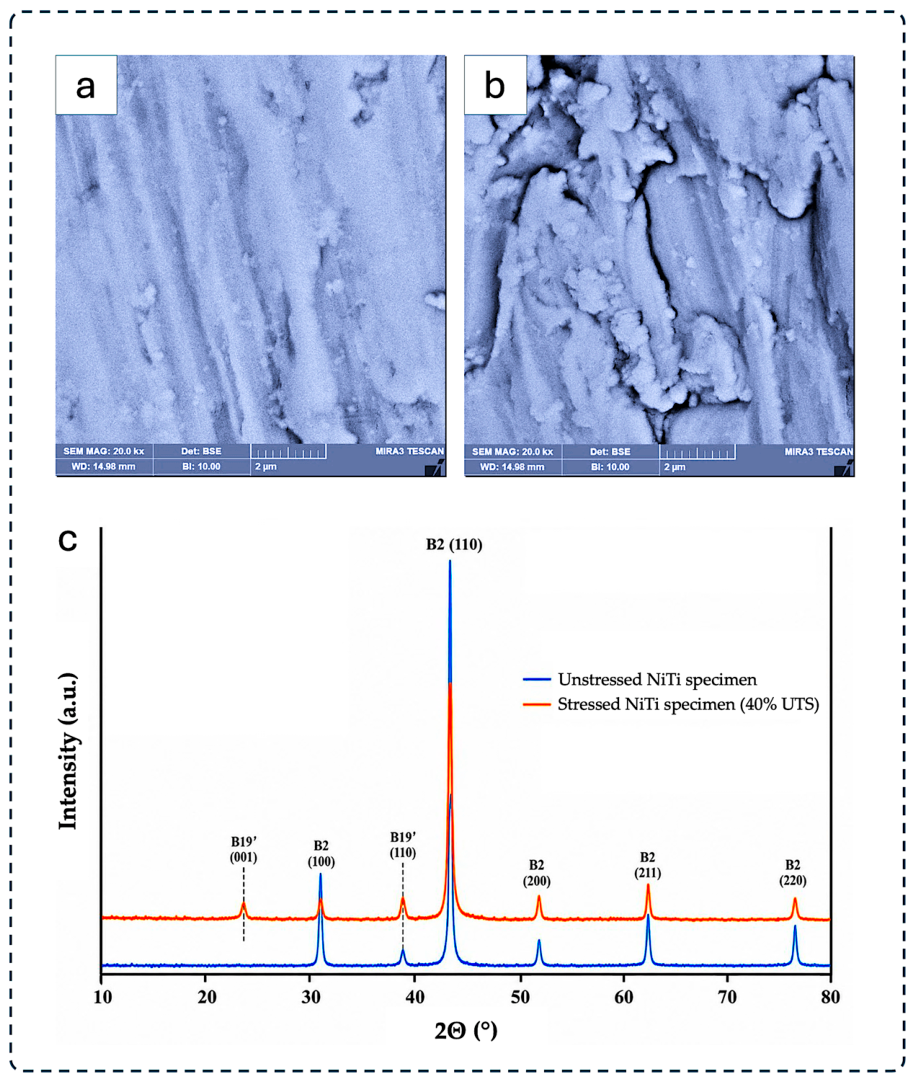
The surface topography of NiTi after 48 h of exposure to the carbonated concrete pore solution reveals a notable difference between the equilibrium and loaded states. As shown in Figure 4a, the unstressed specimen maintains a largely passivated and coherent surface, characterized by a smooth morphology with only a few isolated cathodic sites or minor oxide precipitates.
Figure 4.
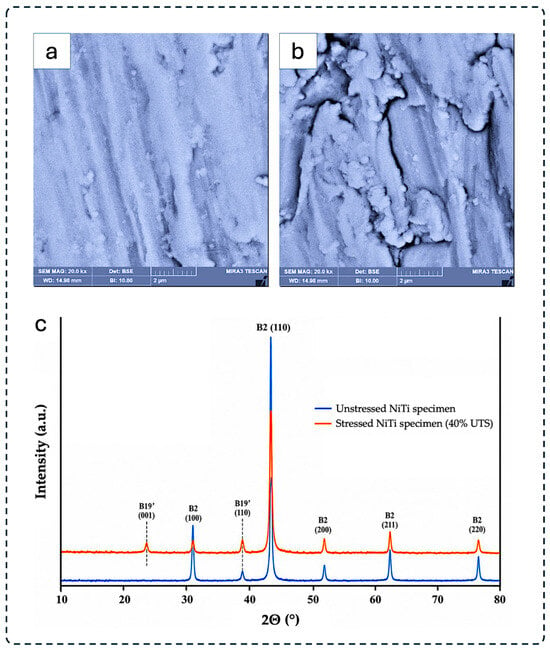
FE-SEM micrographs (15 kV, 20 kx) of NiTi after 48 h immersion in carbonated concrete solution: (a) unstressed NiTi surface; (b) 40% UTS stressed NiTi surface; (c) GIXRD patterns of NiTi specimens.
This stability is consistent with the high impedance values and the noble OCP trend previously observed, indicating that the TiO2-based passive film remains an effective barrier in the alkaline environment. Conversely, the application of a 40% UTS load, below the bulk transformation threshold yet sufficient to drive localized strain concentration at surface defects, leads to a substantial loss of film integrity. The micrograph in Figure 4b displays a network of micro-fractures and voluminous, porous corrosion products. This degradation is consistent with mechanical rupture of the passive layer, where the strain-induced phase mismatch at the film-substrate interface creates “active” pathways. These sites then undergo accelerated anodic dissolution, a process that correlates with the sharp rise in donor density (ND) found in our Mott-Schottky analysis.
To understand the crystallographic drivers behind this localized failure, GIXRD patterns were analyzed as shown in Figure 4c. The unstressed specimen is dominated by the B2 austenite phase, with its characteristic high-intensity reflections. In contrast, the 40% UTS specimen exhibits emergent features near 25° and 39°, positions consistent with monoclinic B19′ (001) and (110) reflections. While these features are suggestive of localized stress-induced martensitic transformation in the near-surface region sampled by GIXRD (ω = 5°, penetration depth ~50–100 nm), their low intensity relative to the dominant B2 austenite peaks and the absence of quantitative phase-fraction analysis preclude definitive phase identification. Alternative origins, including strain-induced B2 lattice distortion or textured oxide phases, cannot be excluded on the basis of the present GIXRD data alone. If present, such a transformation would occur at a nominal far-field stress (40% UTS) below the bulk transformation threshold (~52% UTS), an observation that would be consistent with localized stress amplification at passive-film defects, grain boundaries, and electrochemically active sites—regions where the local stress state may transiently exceed the macroscopic yield or transformation stress [14,27,28]. The shallow penetration depth of the GIXRD beam (ω = 5°, sampling depth ~50–100 nm) ensures that the detected phase signature originates predominantly from the surface and sub-surface layers where mechanochemical coupling is most intense. The concurrent broadening of the primary B2 (110) peak indicates significant lattice distortion and localized strain accumulation. Taken together, these convergent observations from FE-SEM (Figure 4b: micro-fractures and porous corrosion products), EIS (61% collapse in Rcp, Table 3), and XPS (broadened oxide–metal transition, Figure 5) document severe passive-film degradation under stress. One plausible contributing mechanism is localized B2→B19′ transformation at stress concentrations, whose accompanying ~3–4% volume expansion would impose additional tensile stress on the overlying brittle TiO2 film, promoting micro-fracture and accelerated anodic dissolution. While GIXRD and XPS provide convergent evidence for this localized transformation mechanism, more spatially resolved techniques, such as synchrotron-based micro-diffraction or in situ transmission electron microscopy, would further refine our understanding of the transformation kinetics and spatial distribution at individual defect sites. The mechanochemical coupling between stress-driven phase transformation and passive-film degradation defines the SCC susceptibility of NiTi under these simulated service conditions.
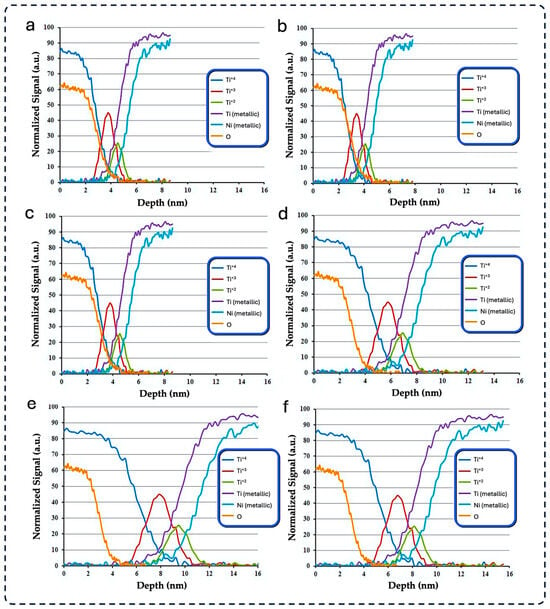
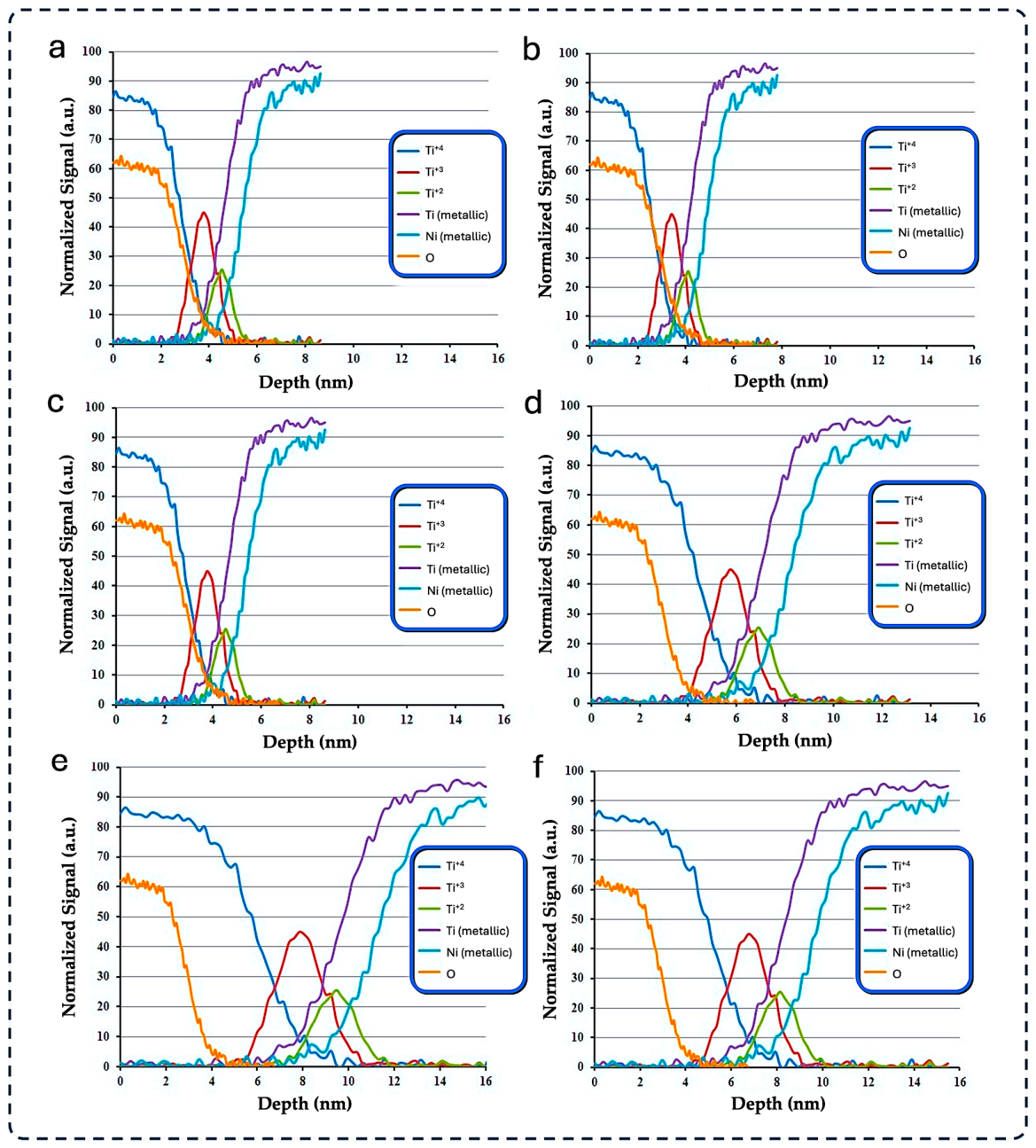
Figure 5.
XPS depth profiles of the passive film formed on NiTi alloy after immersion in CCPS for 1, 24, and 48 h under unstressed (a,c,e); and stressed (40% UTS) (b,d,f) conditions. The profiles are presented for qualitative comparison of depth-dependent signal changes.
The XPS depth profile analysis of NiTi alloy surfaces after immersion in carbonated concrete pore solution (CCPS, pH ≈ 9.0–9.5) provides a qualitative comparison of the depth-dependent XPS signals in the passive films under different immersion times and mechanical conditions (Figure 5).
In the unstressed state at 1 h (Figure 5a), the ~5 nm oxide layer exhibits a well-defined compositional gradient, from an outer Ti4+-dominated (TiO2) region to a narrow transition zone displaying apparent Ti3+ and Ti2+ features before reaching the metallic substrate, consistent with the progressive reduction in oxygen stoichiometry expected at the oxide–metal interface of passivated NiTi in mildly alkaline media [14,23]. It should be noted, however, that Ar+ sputtering at 2 keV, while minimizing beam damage relative to higher-energy protocols, can still induce preferential oxygen removal from TiO2, artificially broadening the apparent Ti3+/Ti2+ transition zone and elevating the signal intensity of reduced Ti species relative to their concentration in the native, unsputtered film [9,23,40]. Accordingly, the Ti3+ and Ti2+ assignments reported here should be understood as apparent oxidation states that may encompass both native substoichiometry, arising from oxygen-vacancy accumulation during film growth, and sputter-induced reduction. The distinction is difficult to resolve definitively from XPS alone, though the consistent protocol applied across all specimens ensures that any beam-induced artefact affects stressed and unstressed samples equally, preserving the validity of comparative depth metrics. Extended exposure to 24 h and 48 h (Figure 5c,e) drives a controlled thickening to ~10 nm, accompanied by a moderate intensification of the apparent Ti3+ shoulder, which we interpret, albeit cautiously, as reflective of oxygen-vacancy flux during solid-state film maturation [40]. Throughout this period, metallic Ni remains efficiently sequestered at the substrate–oxide interface, a hallmark of effective passivation that minimizes the electrochemical driving force for Ni2+ dissolution and limits cytotoxic ion release into the surrounding environment [23,38,39,40].
By contrast, the application of a 40% UTS tensile load alters the depth-dependent structure of the passive film. At equivalent immersion times, the stressed specimens exhibit a 1–2 nm increase in apparent film thickness, but this increase is not accompanied by improved electrochemical protection. Instead, the XPS depth profiles show a broader oxide–metal transition zone and an earlier appearance of the metallic Ti signal at shallower sputtering depths. At 48 h, the transition-zone width, assessed from the sputtering time required for the metallic Ti 2p component to reach 50% of its plateau intensity, is approximately 40% greater in the stressed specimen than in the unstressed counterpart (Figure 5e,f). Although Ar+ sputtering can affect the apparent oxidation states and depth distribution of individual species, the consistently applied protocol allows a comparative assessment of the observed interfacial changes. The profiles also reveal an anomalous depth distribution of metallic nickel in the stressed films. This observation is inconsistent with the sharp compositional boundary expected for a well-defined oxide–metal interface and further supports the presence of interfacial heterogeneity. However, XPS depth profiling alone cannot determine whether this distribution results from actual nickel migration, local compositional variations, sputtering-related effects, or a combination of these factors. Accordingly, the XPS results are interpreted here as evidence of a structurally altered and less sharply defined interface, rather than as direct proof of Ni2+ migration or a specific cation-transport mechanism. Taken together, the broader transition zone, the earlier appearance of the metallic Ti signal, and the altered nickel depth distribution are consistent with stress-associated degradation of the passive-film interface.
The electronic changes associated with this interfacial degradation are independently assessed by Mott–Schottky analysis (Figure 1c, Table 1), which shows an approximately 69% increase in donor density (ND) under stress, from (8.3 ± 0.4) × 1016 cm−3 to (1.4 ± 0.1) × 1017 cm−3, together with an approximately 50 mV cathodic shift in the flat-band potential (Efb). These findings are consistent with the broader oxide–metal transition zone and altered depth distribution of metallic nickel observed by XPS. However, the two techniques provide complementary but distinct information: Mott–Schottky analysis characterizes the electronic properties of the passive film, whereas XPS depth profiling reveals changes in its depth-dependent chemical composition. Neither measurement, as performed here, independently establishes a specific nickel-migration pathway. The combined EIS, Mott–Schottky, and XPS results nevertheless support the conclusion that sustained tensile loading is associated with increased interfacial heterogeneity, a higher measured donor density, and a deterioration in passive-film barrier performance. These changes provide a plausible basis for the increased susceptibility to localized corrosion and stress corrosion cracking, while the precise defect species and transport mechanisms remain to be established.
3.3. Mechanochemical Coupling Between Passive Film Degradation and Stress-Driven Defect Accumulation
The corrosion behavior of NiTi in carbonated concrete pore solution cannot be disentangled from the mechanical state of the alloy. Under quasi-static conditions, the passive TiO2-enriched film that forms on NiTi in CCPS provides a degree of electrochemical protection—albeit marginal, given the reduced pH of 9.0–9.5 and the thermodynamic constraints this imposes on oxide stability.
The introduction of sustained tensile loading at 40% UTS disrupts this equilibrium through a dual mechanism: (i) stress-assisted oxygen-vacancy generation within the passive film, consistent with point-defect models, and (ii) localized stress-induced martensitic transformation at passive film defects, grain boundaries, and electrochemically active sites where the local stress state exceeds the bulk transformation threshold. While the far-field applied stress (40% UTS) remains below the ~52% UTS threshold for macroscopic austenite-to-martensite conversion, localized stress amplification at oxide rupture zones may drive B2 → B19′ transformation in surface-adjacent grains—a hypothesis consistent with, though not definitively confirmed by, the emergent GIXRD features near 25° and 39° (Figure 4c). This transformation is accompanied by a ~3–4% volume expansion that mechanically fractures the overlying TiO2-based film, creating fresh anodic sites and promoting local disruption of the oxide–metal interface. Stress fields may promote oxygen-vacancy () formation at slip bands and dislocation pile-ups, raising ND and shifting Efb cathodically. The observed 69% increase in ND (from (8.3 ± 0.4) × 1016 cm−3 to (1.4 ± 0.1) × 1017 cm−3) and the concurrent 50 mV cathodic shift in Efb are consistent with stress-assisted vacancy generation, though it must be emphasized that Mott–Schottky measurements quantify the total ionized-donor density within the space-charge layer rather than the concentration of any single defect species [10,14,25]. EIS quantifies this structural degradation: Rcp collapsed from 8321 Ω·cm2 to 3261 Ω·cm2 within 48 h under stress, a 61% reduction reflecting a mechanically fragmented, porous corrosion-product layer rather than a compact protective barrier. However, XPS depth profiles further reveal a broader oxide–metal transition zone, an earlier appearance of the metallic Ti signal, and an altered depth distribution of metallic nickel. These observations indicate that the compositional boundary becomes less sharply defined under stress, although they do not establish the direction or mechanism of nickel transport. The increase in donor density is consistent with stress-associated changes in the population of ionized defects, but Mott–Schottky analysis cannot identify the individual defect species responsible. Oxygen vacancies therefore remain a plausible contributor rather than an experimentally isolated defect population. Taken together, the electrochemical and surface-characterization results support a mechanochemical interpretation in which sustained loading is associated with increased interfacial disorder and reduced passive-film effectiveness.
The seismic loading scenario represents a mechanistic extrapolation from the present static data rather than a direct experimental observation, and it is presented here as such. Under earthquake-induced superelastic cycling, a NiTi damper or tendon would traverse the martensitic transformation plateau repeatedly, subjecting the passive film to cyclic rupture and repassivation events at strain rates well beyond the kinetic window for complete oxide regrowth in a carbonated, chloride-bearing environment [10,38]. While this study does not replicate dynamic loading, the SSRT and EIS results provide a mechanistic basis for this projection: the measured elevation in donor density (ND) and the monotonic decline of Rct under sustained tensile stress demonstrate that even a single loading episode drives progressive defect accumulation within the oxide. Under cyclic conditions, each incomplete repassivation cycle would be expected to leave a higher surface density of oxygen vacancies and a locally thinner, more defective film—a ratcheting degradation pathway inferred by analogy to cyclic studies on related alloy systems [3,5,10], though direct verification under seismic cycling was beyond the scope of the present static-load investigation.
The SSRT data (Table 2) capture the terminal mechanical expression of stress-driven passive-film degradation under quasi-static loading in the combined aggressive environment. Fracture strain fell by 56% () and reduction in area by 55% (ISCC(RA) = 0.55), while UTS declined by only 15% (ISCC(UTC) = 0.15), a pronounced disparity that points unambiguously to localized damage initiation at passive-film defects, pit nucleation sites, and martensitic transformation zones rather than uniform section loss or bulk material degradation, consistent with observations by Gamaoun et al. [27] and Birnbaum et al. [21] for hydrogen-assisted mechanisms in NiTi and related alloys. Chloride adsorption at sites is a mechanistically plausible explanation, consistent with established literature on halide–oxide interactions in titanium-based passive films [11,14,15,16], though the present design does not permit isolation of this effect from the concurrent anodic driving force. Taken together, the SSRT and EIS results leave a clear picture: SCC susceptibility in NiTi structural components is dictated by the progressive, stress-driven accumulation of electronic and ionic defects, rendering the film functionally compromised long before any conventional metric would flag it as damaged [10,33,34,35].
4. Conclusions and Future Prospects
This study provides a comprehensive mechanochemical framework for understanding the stress corrosion cracking (SCC) susceptibility of NiTi shape memory alloys in carbonated concrete environments. By integrating in situ electrochemical techniques with high-resolution surface analysis, the research shifts the paradigm from viewing the passive film as a static barrier to a dynamic, stress-responsive semiconducting system. The key findings are summarized as follows:
- Defect-driven remodeling of the passive film: Mott–Schottky analysis performed at 1 kHz, a frequency confirmed to fall within the capacitive plateau of the EIS spectra and therefore dominated by space-charge layer capacitance, reveals that sustaining a 40% UTS tensile load raises the total ionized-donor density of the TiO2-based film from (8.3 ± 0.4) × 1016 cm−3 to (1.4 ± 0.1) × 1017 cm−3, a roughly 69% increase. Concurrently, the flat-band potential shifts cathodically by approximately 50 mV, narrowing the potential window available to sustain passivity. Although Mott–Schottky analysis does not distinguish between donor species, the measured elevation in ND is consistent with stress-assisted oxygen-vacancy generation at slip bands and dislocation pile-ups, an assignment supported by the established defect chemistry of n-type TiO2 and by the convergent XPS and EIS evidence described below. Contributions from other ionized defects, such as interstitial Ti3+, cannot be excluded on the basis of these data alone.
- Structural and compositional deterioration of the oxide–metal interface: EIS measurements reveal a stress-associated deterioration in passive-film performance, including a 61% decrease in corrosion-product resistance (Rcp), from 8321 ± 1264 Ω·cm2 to 3261 ± 518 Ω·cm2, and a reduction in the CPE exponent ndl to 0.61 ± 0.06. XPS depth profiling provides complementary structural evidence: under tensile loading, the oxide–metal transition zone is approximately 40% broader than in the unstressed condition at 48 h, and the metallic Ti signal appears at shallower sputtering depths. The depth distribution of metallic nickel also differs from that observed in the unstressed specimens. Together, these features indicate a less sharply defined and more heterogeneous oxide–metal interface. However, the XPS results do not independently establish Ni2+ migration or identify a specific cation-transport mechanism. The observed interfacial changes, considered alongside the EIS and Mott–Schottky results, support the conclusion that sustained mechanical loading compromises the structural and electrochemical integrity of the passive film.
- Phase-transformation-mediated film fracture: GIXRD patterns recorded at a shallow incidence angle (ω = 5°, sampling depth ~50–100 nm) reveal emergent reflections near 25° and 39° in specimens loaded to 40% UTS—positions indexing to monoclinic B19′ (001) and (110) planes and consistent with the possibility of localized stress-induced martensitic transformation within the near-surface region. At such depths, stress amplification at passive-film defects, grain boundaries, and electrochemically active sites may transiently elevate the local stress state above the bulk transformation threshold (~52% UTS), even though the far-field applied load remains well below it. That said, these reflections are comparatively weak against the dominant B2 austenite background, no quantitative phase-fraction analysis was undertaken, and alternative origins, including strain-induced broadening of the B2 lattice or diffraction from textured oxide phases, cannot be excluded on the basis of the present GIXRD dataset alone. Accordingly, this interpretation is advanced as a plausible mechanistic hypothesis consistent with the observed diffraction features and with the convergent FE-SEM, EIS, and XPS evidence for mechanically driven film degradation, rather than as a conclusion fully established by the data at hand. Were such localized transformation to occur, the attendant ~3–4% volume expansion would impose additional tensile loading on the inherently brittle TiO2 film, driving micro-fracture events, exposing the Ni-rich substrate to the carbonated electrolyte, and generating fresh anodic sites—an outcome reflected in the elevated donor density recovered from Mott–Schottky analysis. This pathway, while mechanistically plausible and supported by convergent EIS and XPS evidence, is presented as a proposed mechanism requiring validation by higher-resolution, spatially resolved techniques such as synchrotron micro-diffraction or in situ TEM.
- Mechanical fingerprint of localized SCC: Slow-strain-rate testing in the combined aggressive environment (CCPS + 0.5 M NaCl, Eapp = Ecorr + 200 mV) produces a pronounced and diagnostically informative disparity: fracture strain collapses by ~56% () and reduction in area by ~55% (ISCC(RA) = 0.55), while UTS declines by only ~15% (ISCC(UTS) = 0.15). This imbalance is characteristic of damage that initiates at discrete passive-film defects, pit-nucleation sites, and martensitic transformation zones rather than proceeding by uniform section loss or generalized dissolution. The susceptibility index ISCC(UTS) rises from 0.11 in CCPS at OCP to 0.15 under the combined chloride–anodic condition, consistent with progressive passive-film degradation driven by the superposition of mechanical, chemical, and electrochemical attack. The disproportionate ductility loss is consistent with a hydrogen-assisted decohesion contribution operating alongside anodic dissolution—a mechanism inferred from the well-established mechanical signature of hydrogen participation in titanium-based alloys and supported here by the elevated donor density, which implies an increased cathodic driving force for hydrogen evolution at defect sites within the passive film. Direct hydrogen detection via thermal desorption spectroscopy, hydrogen microprint techniques, or electrochemical permeation analysis was not performed in this study; confirming or quantifying hydrogen ingress therefore remains an explicit objective for subsequent work.
This research establishes a strategic roadmap for enhancing the durability of NiTi shape memory alloys (SMAs) in sustainable infrastructure, identifying several critical research trajectories. Future efforts must prioritize surface nanostructuring to suppress stress-driven defect accumulation and the development of ternary alloys that optimize repassivation kinetics to ensure TiO2 lattice stability. Furthermore, it is imperative to investigate seismic ratcheting phenomena, where cyclic loading prevents the establishment of steady-state protective films, and to employ atomistic modeling to resolve the complex interplay between localized anodic dissolution and hydrogen-enhanced localized plasticity (HELP) in alkaline concrete environments. Ultimately, the successful integration of NiTi SMAs into high-performance civil engineering demands a paradigm shift toward “passivity-by-design,” wherein the defect population of the passive film is managed as a fundamental structural variable rather than a secondary concern.
Author Contributions
Conceptualization, A.F., A.S. (Ali Shanaghi) and A.S. (Ali Shamsipur); validation, A.F., A.S. (Ali Shanaghi), A.S. (Ali Shamsipur) and A.O.; investigation, A.F., A.S. (Ali Shanaghi) and A.S. (Ali Shamsipur); writing—original draft preparation, A.F., A.S. (Ali Shanaghi), A.S. (Ali Shamsipur), Y.Z. and A.O.; writing—review and editing, A.F., A.S. (Ali Shanaghi), A.S. (Ali Shamsipur), Y.Z. and A.O.; project administration, A.F., A.S. (Ali Shanaghi) and A.O.; funding acquisition, A.F., A.S. (Ali Shanaghi) and A.O. All authors have read and agreed to the published version of the manuscript.
Funding
The study was funded by the Russian Science Foundation (Project No. 25-29-01514, Grant recipient: Artem Okulov).
Institutional Review Board Statement
Not applicable.
Informed Consent Statement
Not applicable.
Data Availability Statement
Data will be made available upon request.
Acknowledgments
The authors gratefully acknowledge the financial support provided by the Research Grant No. 1401 of Malayer University and Tehran Urban Research and Planning Center (TURPC).
Conflicts of Interest
The authors declare no conflicts of interest.
References
- Frenck, J.-M.; Müller, R.; Niendorf, T. Susceptibility of a Fe-Mn-Al-Ni-Cr shape memory alloy to environment-assisted corrosion cracking. Eng. Fail. Anal. 2024, 163, 108582. [Google Scholar] [CrossRef] [Scilit]
- Huang, W.M.; Ding, Z.; Wang, C.C.; Wei, J.; Zhao, Y.; Purnawali, H. Shape memory materials. Mater. Today 2010, 13, 54–61. [Google Scholar] [CrossRef] [Scilit]
- Dolce, M.; Cardone, D. Mechanical behaviour of shape memory alloys for seismic applications 2. Austenite NiTi wires subjected to tension. Int. J. Mech. Sci. 2001, 43, 2657–2677. [Google Scholar] [CrossRef] [Scilit]
- Zhu, M.; Yam, M.C.H.; Ke, K.; Jiao, Z. A study of cyclic behaviour of superelastic Ni-Ti shape memory alloy angles for seismic applications. Thin-Walled Struct. 2026, 219, 114147. [Google Scholar] [CrossRef] [Scilit]
- Cao, S.; Ozbulut, O.E. Experimental response characterization and comparative seismic performance assessment of a long-stroke shape memory alloy bridge restrainer. Eng. Struct. 2024, 315, 118450. [Google Scholar] [CrossRef] [Scilit]
- Cisse, C.; Zaki, W.; Ben Zineb, T. A review of constitutive models and modeling techniques for shape memory alloys. Int. J. Plast. 2016, 76, 244–284. [Google Scholar] [CrossRef] [Scilit]
- Pelton, A.R.; Duerig, T.W.; Stöckel, D. A guide to shape memory and superelasticity in Nitinol medical devices. Minim. Invasive Ther. Allied Technol. 2004, 13, 218–221. [Google Scholar] [CrossRef] [Scilit] [PubMed]
- Speicher, M.; Hodgson, D.E.; DesRoches, R.; Leon, R.T. Shape memory alloy tension/compression device for seismic retrofit of buildings. J. Mater. Eng. Perform. 2009, 18, 746–753. [Google Scholar] [CrossRef] [Scilit]
- Figueira, N.; Silva, T.M.; Carmezim, M.J.; Fernandes, J.C.S. Corrosion behaviour of NiTi alloy. Electrochim. Acta 2009, 54, 921–926. [Google Scholar] [CrossRef] [Scilit]
- Macdonald, D.D. The point defect model for the passive state. J. Electrochem. Soc. 1992, 139, 3434–3449. [Google Scholar] [CrossRef] [Scilit]
- Pound, B.G. Comparison of the Passive Behavior of NiTi and CoNiCrMo in Simulated Physiological Solutions. Corros. Mater. Degrad. 2025, 6, 4. [Google Scholar] [CrossRef] [Scilit]
- Soltan, A.A.M.; Esen, İ.; Kara, S.A.; Ahlatçı, H. Examination of the Corrosion Behavior of Shape Memory NiTi Material for Biomedical Applications. Materials 2023, 16, 3951. [Google Scholar] [CrossRef] [Scilit] [PubMed]
- Siauciunas, R.; Smigelskyte, A.; Aliukonyte, N. Factors Influencing the Carbonation Kinetics of Calcium Silicate-Based Binders—An Overview. Sustainability 2025, 17, 4191. [Google Scholar] [CrossRef] [Scilit]
- Farrokhi, A.; Shanaghi, A. pH-dependent passive film stability of nitinol in concrete-analog environments: Electrochemical, chemical, and nanomechanical perspectives. J. Mater. Res. Technol. 2026, 42, 4302–4310. [Google Scholar] [CrossRef] [Scilit]
- Rondelli, G.; Vicentini, B. Effect of copper on the localized corrosion resistance of Ni–Ti shape memory alloy. Biomaterials 2002, 23, 639–644. [Google Scholar] [CrossRef] [Scilit] [PubMed]
- Lynch, S.P. Hydrogen embrittlement (HE) phenomena and mechanisms. In Stress Corrosion Cracking; Raja, V.S., Shoji, T., Eds.; Woodhead Publishing: Cambridge, UK, 2011; pp. 90–130. [Google Scholar] [CrossRef] [Scilit]
- Zhang, Y.; Chen, P.; Zhai, J.; Zha, X. Corrosion fatigue crack growth behavior of high-strength titanium alloy TA31 in 3.5%NaCl aqueous solution: Effect of stress ratio. Corros. Sci. 2026, 271, 114157. [Google Scholar] [CrossRef] [Scilit]
- Trépanier, C.; Tabrizian, M.; Yahia, L.H.; Bilodeau, L.; Piron, D.L. Effect of modification of oxide layer on NiTi stent corrosion resistance. J. Biomed. Mater. Res. 1998, 43, 433–440, Erratum in J. Biomed. Mater. Res. 1999, 48, 96–97. [Google Scholar] [CrossRef] [Scilit]
- Miao, W.; Mi, X.; Xu, G.; Li, H. Effect of surface preparation on corrosion properties and nickel release of a NiTi alloy. Rare Met. 2006, 25, 243–245. [Google Scholar] [CrossRef] [Scilit]
- Gong, K.; Sun, D.; Liu, X.; Li, J.; Wu, M.; Hu, M. Effects of hydrogen and strain rate on stress corrosion cracking mechanism of high strength pipeline steel. Mater. Today Commun. 2025, 44, 112172. [Google Scholar] [CrossRef] [Scilit]
- Birnbaum, H.K.; Sofronis, P. Hydrogen-enhanced localized plasticity—A mechanism for hydrogen-related fracture. Mater. Sci. Eng. A 1994, 176, 191–202. [Google Scholar] [CrossRef] [Scilit]
- Zhang, L.; Ren, D.; Ji, H.; Ma, A.; Daniel, E.F.; Li, S.; Jin, W.; Zheng, Y. Study on the corrosion behavior of NiTi shape memory alloys fabricated by electron beam melting. npj Mater. Degrad. 2022, 6, 79. [Google Scholar] [CrossRef] [Scilit]
- Shabalovskaya, S.; Anderegg, J.; Van Humbeeck, J. Critical overview of Nitinol surfaces and their modifications for medical applications. Acta Biomater. 2008, 4, 447–467. [Google Scholar] [CrossRef] [Scilit] [PubMed]
- Huang, H.H. Surface characterizations and corrosion resistance of nickel-titanium orthodontic archwires in artificial saliva of various degrees of acidity. J. Biomed. Mater. Res. Part A 2005, 74, 629–639. [Google Scholar] [CrossRef] [Scilit] [PubMed]
- Soriano Carranza, A.G.; Sánchez, L.A.; Roncagliolo, P.; Espinoza Vázquez, A.; Ramos, C.; Lara, G.A.; González, G.; Rodríguez Gómez, F.J.; Figueroa, I.A. Effect of Ti Content on Passive Film Formation and Growth Kinetics in Ni50Nb50−xTix Metallic Glasses. Metals 2026, 16, 768. [Google Scholar] [CrossRef] [Scilit]
- Liu, K.-T.; Duh, J.-G. Determination of the Diffusivity of Point Defects in Passive Films on NiTi and NiTiAl Alloys. J. Phase Equilib. Diffus. 2010, 31, 223–232. [Google Scholar] [CrossRef] [Scilit]
- Gamaoun, F.; Ltaief, M.; Bouraoui, T.; Ben Zineb, T. Effect of hydrogen on the tensile strength of aged Ni–Ti superelastic alloy. J. Intell. Mater. Syst. Struct. 2011, 22, 2053–2059. [Google Scholar] [CrossRef] [Scilit]
- Radi, A.; Khalil-Allafi, J.; Heidarzadeh, A.; Yapici, G.G.; Etminanfar, M.R.; Mozafari, S.Z.; Rezaei-Moghadam, B. Effect of stress aging induced precipitates on corrosion behavior of NiTi shape memory alloys. Met. Mater. Int. 2021, 27, 3968–3974. [Google Scholar] [CrossRef] [Scilit]
- ASTM G129-00(2013); Standard Practice for Slow Strain Rate Testing to Evaluate the Susceptibility of Metallic Materials to Environmentally Assisted Cracking. ASTM International: West Conshohocken, PA, USA, 2013. [Google Scholar] [CrossRef] [Scilit]
- Pelton, A.R.; Dicello, J.; Miyazaki, S. Optimisation of processing and properties of medical grade Nitinol wire. Minim. Invasive Ther. Allied Technol. 2000, 9, 107–118. [Google Scholar] [CrossRef] [Scilit]
- Shanaghi, A.; Mehrjou, B.; Moradjoui Hamedani, A.; Souri, A.R.; Qasim, A.M.; Chu, P.K. Advanced hydroxyapatite-DLC bilayer coatings for improved performance of NiTi biomedical alloys. Ceram. Int. 2025, 51, 28935–28953. [Google Scholar] [CrossRef] [Scilit]
- Brocklebank, M.; Feltham, H.; Noël, J.J.; Goncharova, L.V. Mechanism of titanium electrochemical oxidation via isotopic labeling, high resolution ion depth profiling, and impedance spectroscopy. Electrochim. Acta 2022, 435, 141342. [Google Scholar] [CrossRef] [Scilit]
- Zhang, Y.; Attarilar, S.; Wang, L.; Lu, W.; Yang, J.; Fu, Y. A Review on Design and Mechanical Properties of Additively Manufactured NiTi Implants for Orthopedic Applications. Int. J. Bioprint. 2021, 7, 340. [Google Scholar] [CrossRef] [Scilit] [PubMed]
- Li, Z.; Yuan, H.; Li, W.; Brizi, D.; Monorchio, A. A Novel Energy-Selective Surface Endowed with High Shielding Effectiveness by Using a Shape Memory Alloy. Technologies 2026, 14, 242. [Google Scholar] [CrossRef] [Scilit]
- Kannan, A.R.; Shanmugam, N.S.; Rajkumar, V.; Vishnukumar, M.; Channabasavanna, S.G.; Oh, J.; Dat, T.T.K.; Yoon, J. Microstructure, Mechanical Properties and Corrosion Performance of Laser-Welded NiTi Shape Memory Alloy in Simulated Body Fluid. Materials 2024, 17, 4801. [Google Scholar] [CrossRef] [Scilit] [PubMed]
- Orazem, M.E.; Tribollet, B. Electrochemical Impedance Spectroscopy, 2nd ed.; John Wiley & Sons: Hoboken, NJ, USA, 2017. [Google Scholar] [CrossRef] [Scilit]
- Jorcin, J.-B.; Orazem, M.E.; Pébère, N.; Tribollet, B. CPE analysis by local electrochemical impedance spectroscopy. Electrochim. Acta 2006, 51, 1473–1479. [Google Scholar] [CrossRef] [Scilit]
- Shanaghi, A.; Mehrjou, B.; Ahmadian, Z.; Souri, A.R.; Chu, P.K. Enhanced corrosion resistance, antibacterial properties, and biocompatibility by hierarchical hydroxyapatite/ciprofloxacin-calcium phosphate coating on nitrided NiTi alloy. Mater. Sci. Eng. C 2021, 118, 111524. [Google Scholar] [CrossRef] [Scilit] [PubMed]
- Kazemi, M.; Ahangarani, S.; Esmailian, M.; Shanaghi, A. Investigating the corrosion performance of Ti-6Al-4V biomaterial alloy with hydroxyapatite coating by artificial neural network. Mater. Sci. Eng. B 2022, 278, 115644. [Google Scholar] [CrossRef] [Scilit]
- Fu, Y.; Du, H.; Zhang, S.; Huang, W. XPS characterization of surface and interfacial structure of sputtered TiNi films on Si substrate. Mater. Sci. Eng. A 2005, 403, 25–31. [Google Scholar] [CrossRef] [Scilit]

Disclaimer/Publisher’s Note: The statements, opinions and data contained in all publications are solely those of the individual author(s) and contributor(s) and not of MDPI and/or the editor(s). MDPI and/or the editor(s) disclaim responsibility for any injury to people or property resulting from any ideas, methods, instructions or products referred to in the content. |
© 2026 by the authors. Licensee MDPI, Basel, Switzerland. This article is an open access article distributed under the terms and conditions of the Creative Commons Attribution (CC BY) license.