


Abstract
Snoring is a common sleep-related phenomenon and is relevant to research on sleep-disordered breathing. Automatic snoring recognition may provide useful acoustic information for sleep breathing monitoring.
In this study, sleep breathing sounds were recorded using a bone-conduction microphone attached to the skin over the throat.
The recordings were manually annotated using Praat with five acoustic labels: snoring, breathing, apnea, speech, and noise. Segments labeled as speech or noise were excluded from the classification experiment, which focused on snoring, breathing, and apnea.
Mel-frequency cepstral coefficients (MFCCs) were extracted from the retained recordings, and a hidden Markov model (HMM) implemented using the Hidden Markov Toolkit (HTK) was used to recognize sequences of breathing, snoring, and apnea labels.
Using MFCC feature vectors with 24 dimensions and an HMM with 10 states, the exploratory analysis yielded 89.47% HTK word correctness and 28.95% HTK word accuracy on the same test data used for parameter selection.
These exploratory results describe recognition of manually annotated acoustic categories in selected recordings. Further independent evaluation is required to assess generalizability and practical reliability.
1. Introduction
Snoring is generated by vibration of tissues in the upper airway during sleep, and its acoustic characteristics can vary with body position, sleep stage, and breathing pattern [1]. A population-based survey in Guangxi, China, reported a habitual snoring prevalence of 11.5% among respondents aged 14 years or older [2]. Acoustic analysis of snoring and other sleep breathing sounds is relevant to research on obstructive sleep apnea hypopnea syndrome (OSAHS) and sleep monitoring.
Previous studies have investigated sleep breathing sounds through monitoring systems, acoustic characterization, and classification. An apnea-monitoring system combined snoring detection with blood oxygen saturation [3]. Other studies examined snoring spectra in relation to upper airway obstruction [4], classification using convolutional neural networks [5], and feature representations based on feature fusion [6]. Associations between snoring duration, intensity, and obstructive sleep apnea severity have also been investigated [7].
Against this background, several studies have examined non-invasive sensing and machine-learning strategies for sleep-disordered breathing and respiratory sound analysis. Chao et al. developed a neck-wearable piezoelectric sensing system combined with deep learning to distinguish severe sleep apnea from habitual snoring [8]. Xie et al. proposed a multi-modal multi-task deep neural network that integrated cardiac and audio signals for sleep-disordered breathing assessment [9]. Seidaliyeva et al. synthesized research on artificial-intelligence-based respiratory sound analysis, including digital auscultation technologies, public datasets, signal-processing methods, and deep learning approaches [10]. Taken together, these studies demonstrate the potential of non-invasive acoustic and neck-adjacent sensing for sleep-breathing assessment and provide a relevant context for the bone-conduction microphone approach investigated in this study.
Bone-conduction microphones detect mechanical vibrations transmitted through the body, whereas conventional air-conduction microphones primarily detect airborne sound. In this study, the bone-conduction microphone was attached to the neck to collect sleep breathing sounds. The resulting recordings were used for subsequent feature extraction and HMM-based recognition and classification.
The present study addresses the need to evaluate acoustic label-sequence recognition using sleep breathing recordings acquired with a bone-conduction microphone at the neck. Its contribution comprises the acquisition and manual annotation of these recordings and the evaluation of recognition of breathing, snoring, and the acoustic class labeled apnea on the selected data. Bone-conduction sensing provides the data acquisition modality, while MFCC feature extraction and HMM modeling provide the established recognition framework. The objective is to characterize recognition performance and its limitations as a basis for further research on sleep breathing monitoring.
2. Materials and Methods
2.1. Energy Analysis of Respiratory State
Analysis of sleep breathing sounds can provide acoustic information relevant to snoring and sleep-disordered breathing. In this study, signal energy and waveform patterns are used to assist annotation and sound classification. Within the annotation scheme, snoring and breathing are characterized by their acoustic patterns, and the class labeled as apnea is associated with low-energy intervals. The recordings may also contain environmental noise.
2.2. Snoring Data Acquisition
The experiment carried out in this paper is in cooperation with the Respiratory Department of the First Affiliated Hospital of Tianjin University of Traditional Chinese Medicine. The hospital has provided a professional sleep monitoring ward, multi-channel sleep monitor and other professional equipment for the experimental monitoring, which is convenient for the corresponding sleep breathing monitoring of the subjects.
A total of 10 subjects (5 male and 5 female) were selected. The subjects included individuals with common snoring and OSAHS. Each subject underwent approximately 8 h of monitoring in a specialized sleep observation ward, and the data selected for analysis exhibited a high contrast in snoring signals with minimal noise interference. The subject information is shown in Table 1.
Table 1.
Basic information of examinees.
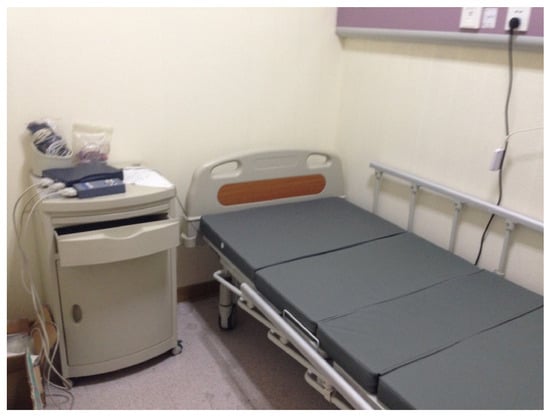
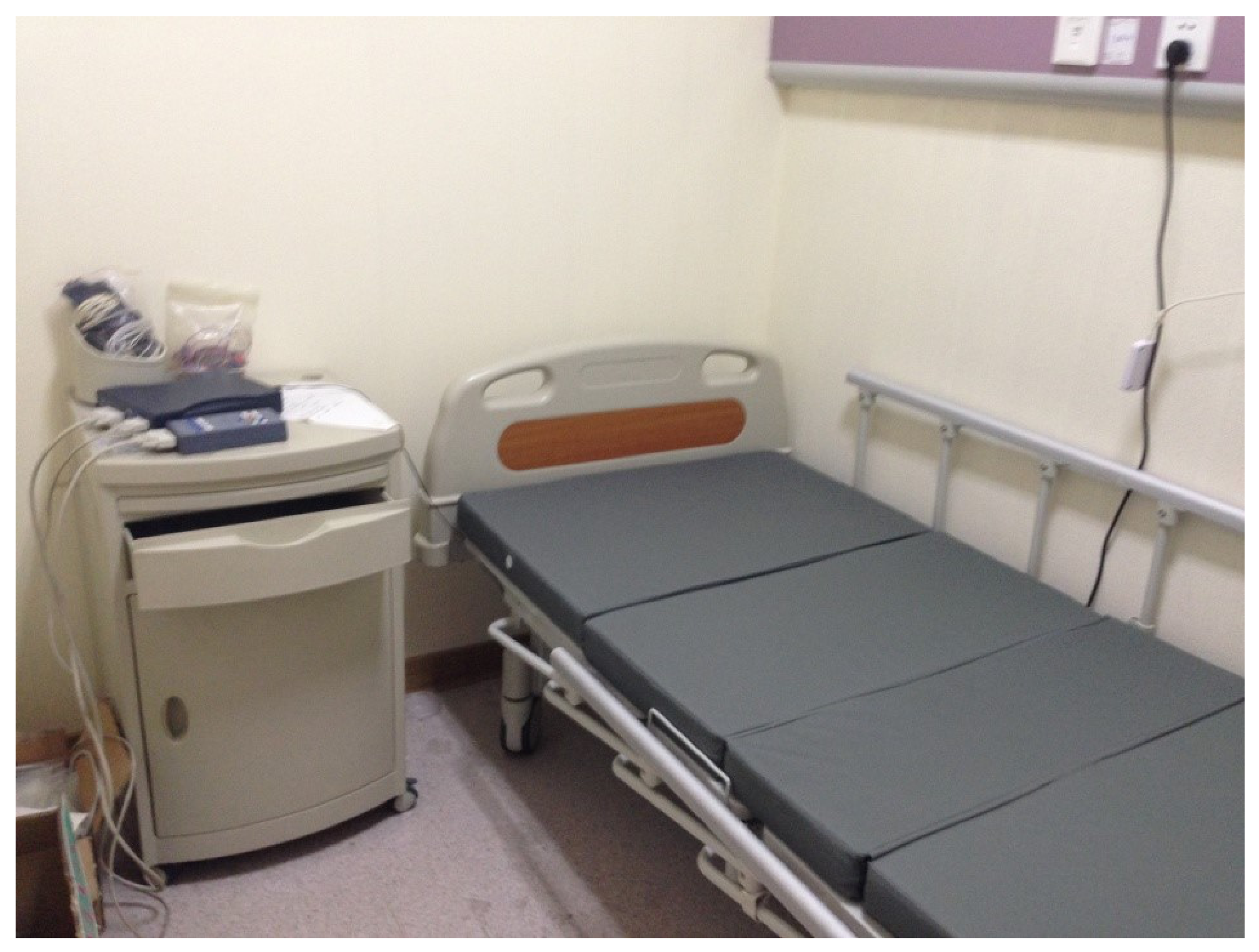
The specific environment is shown in Figure 1. The collection time was the natural sleeping time of patients (generally from 22:00 of the monitoring night to 6:00 of the following day). The self-developed bone-conduction microphone was attached to the skin over the throat to record the subjects’ sleep breathing sounds. The audio extension cable was used to connect the bone-conduction microphone to the 3.5 mm audio port of tablet TPad X80h, and the data was transferred to the snoring collection software installed on the tablet to complete the recording of sleep breathing sound. The recorded data is in mono mode, with a sampling rate of 16,000 S/s and a quantization accuracy of 16 bit.
Figure 1.
Professional sleep monitoring ward.
The recording durations listed in Table 1 sum to 81 h across the 10 subjects. The final analysis set comprised 525 selected audio segments, each lasting 1–3 s. Segments with clearly identifiable respiratory or snoring signals and limited environmental interference were selected to support manual annotation and sound classification. All recordings were coded and de-identified before MFCC extraction and HMM training. Access to the raw recordings was restricted to authorized researchers, and only aggregated results were reported. The recognition results reported here are based on the selected recording segments.
2.3. Snoring Data Labeling
The sleep breathing recordings were manually annotated in Praat using five acoustic classes: snoring, breathing, apnea, speech, and noise. Table 2 lists the class names and corresponding label codes.
Table 2.
Acoustic annotation classes and label codes.
These five categories constitute the annotation scheme for the original recordings. The subsequent classification experiment focused on three target categories: snoring, breathing, and apnea. Speech and noise labels were used to identify non-target segments for exclusion during data preparation.
According to the characteristics of the above acoustic classes, the following marking specifications are adopted:
- Snoring annotation: snoring segments were annotated based on their relatively high acoustic energy and recurring pattern within the respiratory cycle;
- Breathing annotation: breathing segments were annotated based on their recurring respiratory pattern and acoustic energy, which was lower than snoring but higher than intervals labeled apnea;
- Apnea annotation: intervals with lower acoustic energy than breathing were manually assigned to the class labeled apnea based on visual inspection of the waveform in Praat. In this annotation scheme, apnea is an operational acoustic label and does not by itself establish a clinically scored apnea or hypopnea event;
- Speech annotation: speech segments in the original recordings were manually labeled as speech (spk);
- Noise annotation: the waveform of noise has pronounced characteristics, and irregular sudden changes will occur. The noise can be marked when sudden changes are found in the waveform.
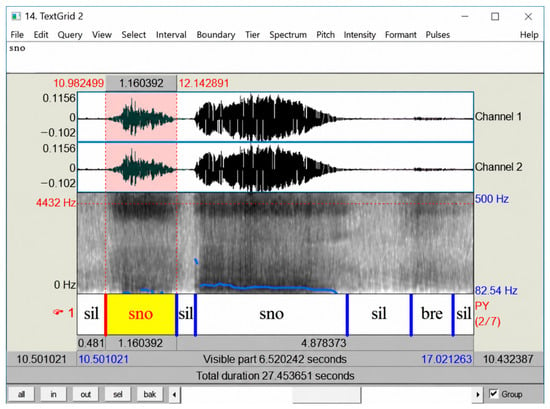
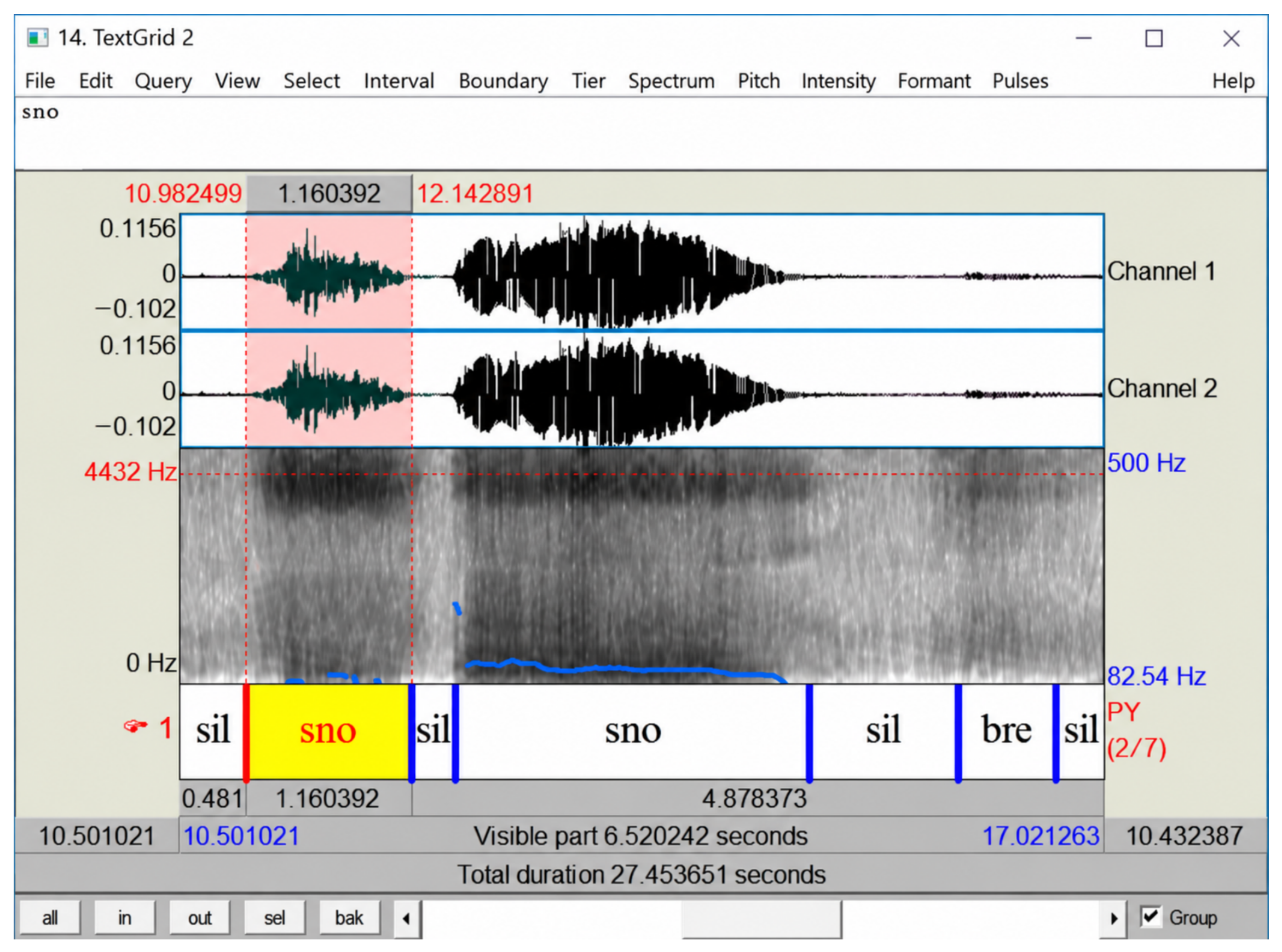
Sleep breathing sounds were manually annotated by one annotator using Praat according to the labeling criteria described above. The annotations were saved as TextGrid files. Figure 2 illustrates an example of the manual annotation.
Figure 2.
Example of manual annotation of sleep breathing sounds.
2.4. HTK
The Hidden Markov Toolkit (HTK) is a toolkit for building hidden Markov models [11]. HTK is mainly used to build speech processing tools based on hidden Markov models, especially to build recognizers. HTK is not only used in the field of speech recognition but is also widely used in speech synthesis, character recognition, DNA sequence arrangement, and other tasks. HTK tool set can realize text and voice annotation, voice recording, HMM training, testing and recognition and other functions. HTK tools can be roughly divided into four processes, including data preparation tools, training tools, identification tools and analysis tools.
2.5. Data Preparation
The dataset comprised 525 short audio segments selected from recordings of 10 subjects. Each segment was stored in .wav format and had a duration of 1–3 s. Multiple segments originated from the same subject; therefore, the 525 segments should not be regarded as 525 independent observations.
The dataset was partitioned at the subject level, with eight subjects assigned to training and the remaining two to testing. All segments from a given subject were assigned to the same subset, so no subject contributed data to both training and testing. The training set contained 449 segments: 124 breathing, 133 apnea, and 192 snoring segments. The test set comprised 76 segments, including 18 breathing, 30 apnea, and 28 snoring segments.
The classification experiment focused on snoring, breathing, and apnea as the three target categories. Segments annotated as speech (spk) or noise (a) were treated as non-target segments and excluded before the training and test sets were constructed. This selection was based on the manual annotations. Consequently, speech and noise were not included as target classes in the training or test data.
First of all, four tasks need to be carried out in the data preparation stage:
Step1: Define the recognition grammar and target acoustic label set.
Step2: Define a data dictionary containing the target labels used in the retained training and test annotations for the classification experiment.
Step 3: The Praat TextGrid annotations were converted into HTK label files.
Step4: Extract feature parameters.
For the three-category classification experiment, the target label set comprised snoring (sno), breathing (bre), and apnea (sil). The HTK dictionary and recognition network were configured for these target categories.
The selected sleep breathing recordings were converted into sequences of MFCC feature vectors for HMM recognition [12,13].
Recent respiratory sound classification research has also employed MFCC-based representations together with deep neural architectures, demonstrating the continuing relevance of spectral-temporal acoustic features in automated respiratory sound analysis [14]. In the present study, MFCC features were selected because they provide a compact representation of short-time acoustic signals and can be combined with HMMs to model temporal variations in snoring-related sounds.
3. Results
3.1. Construction and Recognition of Hidden Markov Model
The HMM was used to recognize sleep breathing sounds from sequences of MFCC feature vectors. The model was implemented using HTK, with the training and recognition procedures described below. Each target acoustic class was modeled using a 10-state left-to-right HMM, comprising eight emitting states and two non-emitting entry and exit states under the HTK convention. The emitting states model temporal progression within the same acoustic class. The models were initialized from a flat-start prototype using HCompV and iteratively re-estimated using the embedded Baum–Welch procedure in HERest. Recognition was performed using HVite with Viterbi decoding [11].
The selected 24-dimensional MFCC feature vector comprised 12 static cepstral coefficients, including , and their 12 first-order delta coefficients; acceleration coefficients were not included. HCopy feature extraction used 26 Mel filterbank channels, a 63 ms Hamming window, a 1 ms frame shift, a pre-emphasis coefficient of 0.97, and a cepstral lifter of 22. The number of Mel filterbank channels is distinct from the dimensionality of the resulting feature vector.
Frame shifts of 25, 20, 15, 10, 5, and 1 ms were compared, with 1 ms yielding the highest HTK word correctness in this comparison. Frame lengths of 60, 63, and 80 ms yielded the same word correctness. A frame length of 63 ms and a frame shift of 1 ms were retained for the subsequent comparisons of MFCC dimensionality and HMM state count. MFCC dimensionalities of 13, 24, 26, and 39 were compared, as shown in Table 3. The 24-dimensional representation yielded the highest word correctness of 88.16% in this comparison and was retained.
Table 3.
HTK word correctness for different MFCC dimensionalities.
With MFCC dimensionality fixed at 24, HMMs with 6, 7, 8, 9, 10, and 11 states were compared, as shown in Table 4. The model with 10 states yielded the highest HTK word correctness of 89.47% in this comparison and was selected.
Table 4.
HTK word correctness for different HMM state counts.
3.2. Evaluation Results
The evaluation in this section concerns the three target categories retained after the selection described in Section 2.5: breathing (bre), apnea (sil), and snoring (sno).
Recognition performance was evaluated by aligning the acoustic label sequences produced by HVite with the reference annotations using dynamic programming in HResults [11]. Let H denote the number of correctly matched labels, D deletions, S substitutions, I insertions, and the total number of reference labels. HTK word correctness () and word accuracy () were calculated as
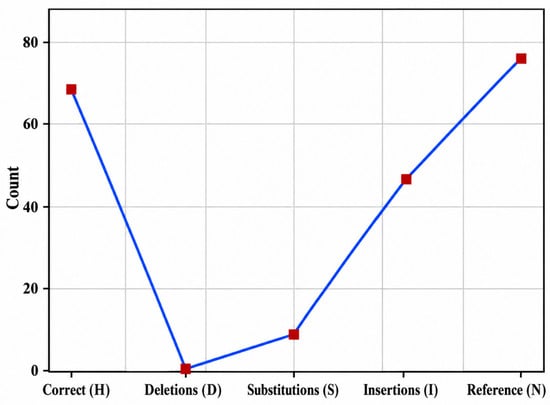
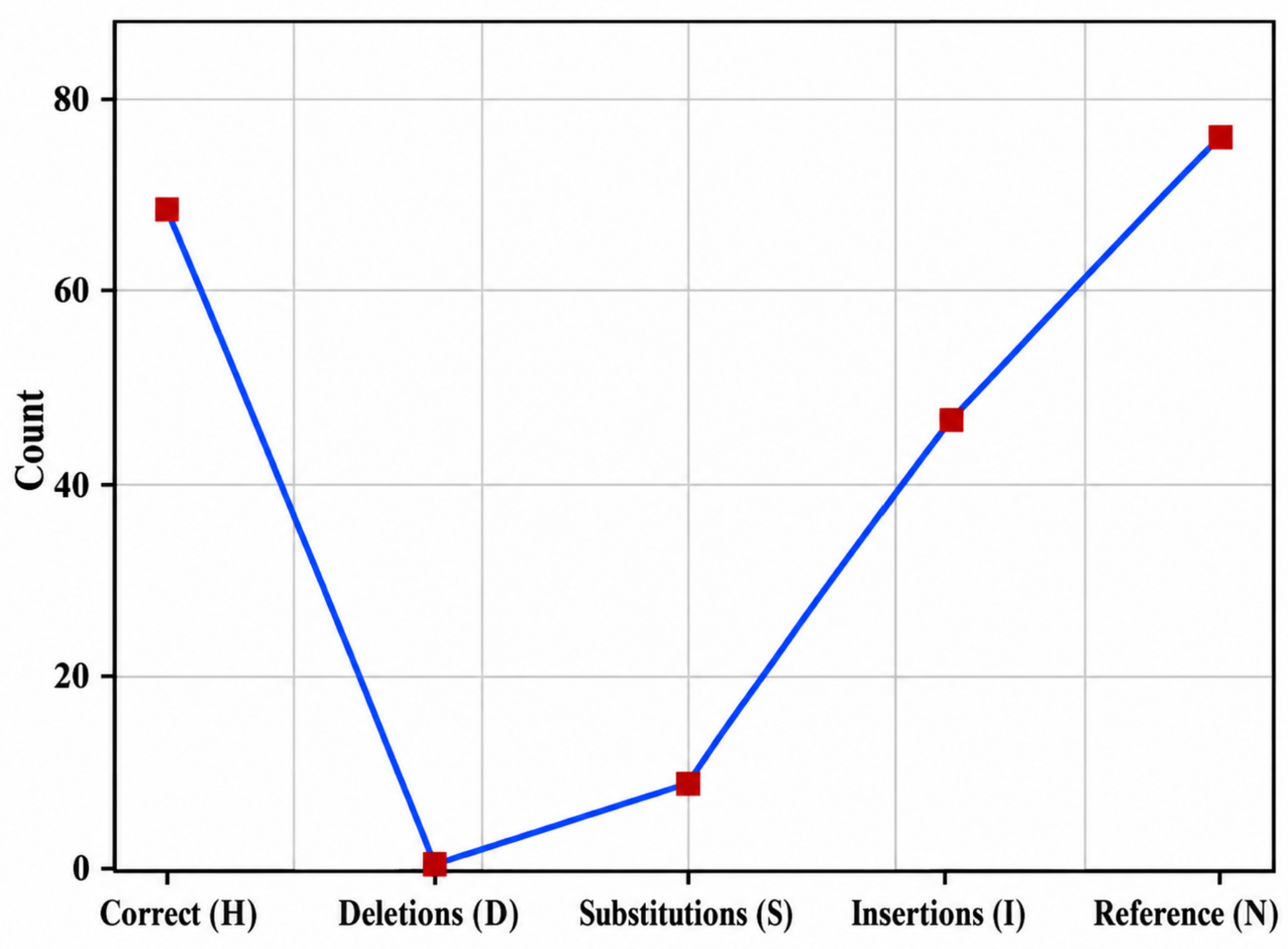
The evaluation yielded , , , , and . Accordingly, word correctness was , and HTK word accuracy was . The scoring counts are shown in Figure 3. Word correctness measures the proportion of reference labels correctly matched, whereas word accuracy also penalizes additional labels introduced by insertion errors.
Figure 3.
Recognition evaluation counts obtained using HResults. Red squares indicate the counts, and the blue line connects the points for visual guidance.
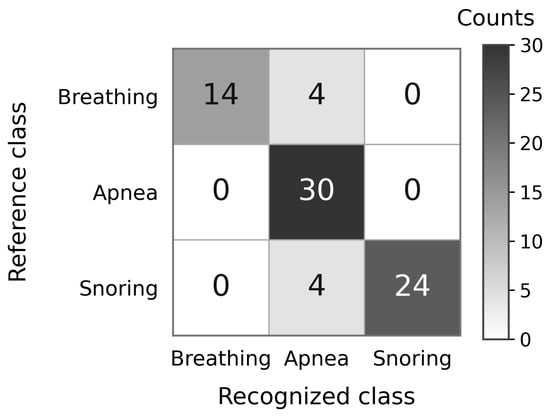
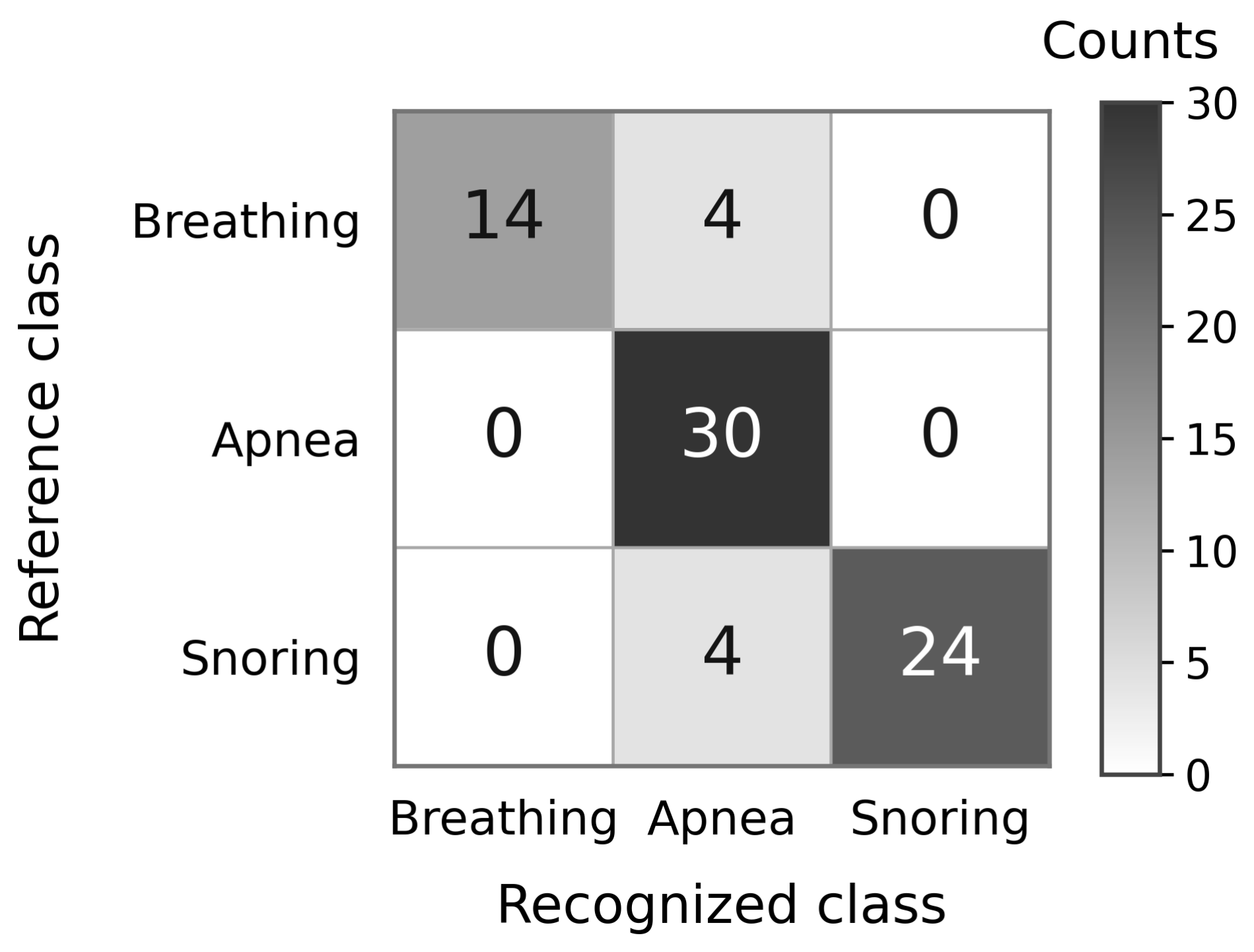
Figure 4 shows the HResults label-count matrix, with reference classes in rows and recognized classes in columns. Apnea denotes the acoustic label sil, rather than a clinically confirmed respiratory event. The matrix excludes insertions, which are additional recognized labels without corresponding reference labels. The 46 insertions comprised 4 breathing, 40 apnea, and 2 snoring labels. The counts for each acoustic class and the HTK scores were derived from the same HResults sequence alignment. Diagonal entries in Figure 4 represent true positives; each substitution contributes one false positive to the recognized class and one false negative to the reference class, and each insertion contributes one false positive to the inserted class. With no deletions, the totals across classes are 68 true positives (H), 54 false positives (), and 8 false negatives (). There were 14 true positives, 4 false positives, and 4 false negatives for breathing; 30 true positives, 48 false positives, and no false negatives for apnea; and 24 true positives, 2 false positives, and 4 false negatives for snoring. Precision, recall, and F1-score were respectively 77.78%, 77.78%, and 77.78% for breathing; 38.46%, 100.00%, and 55.56% for apnea; and 92.31%, 85.71%, and 88.89% for snoring. These scores evaluate acoustic label recognition.
Figure 4.
Confusion matrix for breathing, apnea, and snoring.
4. Discussion
The MFCC–HMM evaluation yielded 89.47% word correctness and 28.95% word accuracy. The 46 insertions, including 40 apnea labels, indicate frequent additional predictions despite the high proportion of correctly matched reference labels. Possible contributors include repeated labels permitted by the recognition network and insufficient penalties for additional labels during decoding [11]. HMM transition probabilities and frame resolution may also affect modeled durations and label boundaries, while weak breathing or low-energy gaps may be assigned to the acoustic apnea class. These possible mechanisms require controlled evaluation. Word correctness alone therefore does not establish reliable performance for continuous sleep monitoring. Further experiments should examine network constraints, decoding penalties, and model settings using word accuracy and class-specific metrics alongside word correctness.
Previous studies have approached snore detection through different acoustic representations and classifiers. Xie et al. combined convolutional and recurrent neural networks to learn spectral and temporal information [15], whereas Sun et al. investigated Fisher Ratio-based feature selection with XGBoost [16]. Gonzalez-Martinez et al. explored harmonic/percussive source separation with convolutional neural networks under limited training data [17]. The present study instead applies conventional MFCC features and HMM sequence modeling to neck-mounted bone-conduction recordings. Differences in datasets, class definitions, recording modalities, evaluation metrics, and validation protocols preclude direct ranking of these approaches using their reported percentages. These studies provide methodological context, while the relative performance of the HMM approach remains to be evaluated through baseline comparisons using the same dataset and evaluation protocol.
A matched comparison with air conduction recordings and a baseline classifier evaluated on the same dataset were not included in the present evaluation. The results therefore do not establish superior recognition performance or noise robustness of bone-conduction sensing over conventional recording methods. Selection of segments with clearly identifiable respiratory sounds and limited environmental interference may favor easier recognition conditions. Consequently, the respective contributions of the sensing modality, segment selection, and the MFCC–HMM framework cannot be isolated by the present experimental design. The reported results concern manually selected target data and do not evaluate automatic rejection of speech and noise in unfiltered whole-night recordings. Comparisons under matched recording and evaluation conditions are needed to assess these contributions.
The scale and structure of the dataset also affect the interpretation of the findings. The 525 short audio segments originated from ten subjects, and segments from the same subject should not be treated as independent observations. At the feature level, a 63 ms frame length and a 1 ms frame shift produce 62 ms of shared waveform, or approximately 98.41% overlap, between adjacent frames. This dense framing introduces redundancy and temporal dependence without increasing the number of participants or the recording duration. Neither the frame count nor the overlap percentage alone determines the effective number of independent observations. The aggregate class counts do not show how segments were distributed among individual subjects or how many segments were excluded during preprocessing, limiting assessment of participant contributions and data selection. All annotations were produced by one annotator, and agreement between annotators was not assessed. The recognition metrics therefore reflect agreement with a single set of manual annotations, without quantifying variation between annotators. Class frequencies differed modestly, with no single class accounting for a large majority of either set. Aggregate recognition scores were considered alongside the reference label matching results for each class. The evaluation was based on a single partition of the data by subject, with only two subjects in the test set. Cross validation with each subject held out for testing in turn was not performed. The use of the same test data for model selection and performance assessment may lead to optimistic estimates. The results should therefore be interpreted as exploratory findings for the present data partition; their generalizability requires further evaluation with model selection separated from final testing.
The relationship between acoustic recognition and clinical assessment requires particular care for the apnea class. In this study, apnea is an operational label based on manual acoustic annotation. Low acoustic energy may also reflect weak breathing, poor microphone contact, sensor displacement, movement-related changes, environmental silence, or other low-energy conditions. Agreement with this annotation therefore does not by itself establish detection of a clinically confirmed apnea or hypopnea event. The present evaluation used manual acoustic annotations as the reference and did not include comparison with events scored from polysomnography (PSG) or another independent respiratory reference. These exploratory findings are limited to recognition of manually annotated acoustic categories in selected recordings. Independent validation is needed to assess the method’s performance in clinical apnea detection and continuous overnight monitoring.
Author Contributions
Formal analysis, K.K.; writing—original draft preparation, C.Z.; conceptualization, investigation, and writing—original draft preparation, W.T.; supervision, D.J.; supervision, J.W. All authors have read and agreed to the published version of the manuscript.
Funding
This research was funded by the National Natural Science Foundation of China, grant number 62261045.
Institutional Review Board Statement
The study obtained ethical approval from the Ethics Committee of the School of Intelligence Science and Engineering, Qinghai Minzu University, on 23 June 2025. All procedures involving human participants were conducted in accordance with the Declaration of Helsinki and its later amendments or comparable ethical standards.
Informed Consent Statement
Oral informed consent was obtained on site from all participants. Participation was voluntary, and individuals who declined were not enrolled.
Data Availability Statement
Requests for de-identified data, including representative audio excerpts, may be directed to the corresponding author. Access is subject to participant consent and permission from the data custodian.
Conflicts of Interest
The authors declare no conflicts of interest.
References
- Pevernagie, D.; Aarts, R.M.; De Meyer, M. The acoustics of snoring. Sleep Med. Rev. 2010, 14, 131–144. [Google Scholar] [CrossRef] [Scilit] [PubMed]
- Liu, J.; Wei, C.; Huang, L.; Wang, W.; Liang, D.; Lei, Z.; Wang, F.; Wang, X.; Hou, X.; Tang, X. Prevalence of signs and symptoms suggestive of obstructive sleep apnea syndrome in Guangxi, China. Sleep Breath 2014, 18, 375–382. [Google Scholar] [CrossRef] [Scilit] [PubMed]
- Xie, Y.Q.; Li, H.; Wu, Y.B.; Xie, J.J. Design of an apnea monitoring system by combining blood oxygen saturation and snoring detection. J. Ningbo Univ. (Nat. Sci. Eng. Ed.) 2021, 34, 9–16. [Google Scholar]
- Xu, H.; Huang, W.; Yu, L.; Chen, L. Sound spectral analysis of snoring sound and site of obstruction in obstructive sleep apnea syndrome. Acta Oto-Laryngol. 2010, 130, 1175–1179. [Google Scholar] [CrossRef] [Scilit] [PubMed]
- Hou, L.M.; Liu, H.C.; Zhang, X.P. Classification for different pathologies snoring sounds based on convolutional neural network. J. Fudan Univ. (Nat. Sci.) 2021, 60, 367–374. [Google Scholar]
- Wei, X. Deep Spectrum Feature Based on Feature Fusion for Snore Sound Classification. Master’s Thesis, Tianjin University, Tianjin, China, 2020. [Google Scholar]
- Kallel, S.; Kchaou, K.; Jameleddine, A.; Sellami, M.; Mnejja, M.; Charfeddine, I. Snoring time versus snoring intensity: Which parameter correlates better with severity of obstructive sleep apnea syndrome? Lung India Off. Organ Indian Chest Soc. 2020, 37, 300–303. [Google Scholar] [CrossRef] [Scilit] [PubMed]
- Chao, Y.P.; Chuang, H.H.; Lee, Z.H.; Huang, S.Y.; Zhan, W.T.; Shyu, L.Y.; Lo, Y.L.; Lee, G.S.; Li, H.Y.; Lee, L.A. Distinguishing severe sleep apnea from habitual snoring using a neck-wearable piezoelectric sensor and deep learning: A pilot study. Comput. Biol. Med. 2025, 190, 110070. [Google Scholar] [CrossRef] [Scilit]
- Xie, J.; Fonseca, P.; van Dijk, J.P.; Overeem, S.; Long, X. Multi-modal multi-task deep neural networks for sleep disordered breathing assessment using cardiac and audio signals. Int. J. Med. Inform. 2025, 201, 105932. [Google Scholar] [CrossRef] [Scilit] [PubMed]
- Seidaliyeva, U.; Akylzhan, P.; Ilipbayeva, L.; Taissariyeva, K.; Nazarova, A.; Mambetaliyeva, A.; Smailov, N.; Zhekambayeva, M.; Yussupova, G.; Bauyrzhankyzy, D. Artificial Intelligence-Based Respiratory Sound Analysis: A Scoping Review of Digital Auscultation Technologies, Public Datasets, Signal Processing, and Deep Learning Methods. Technologies 2026, 14, 486. [Google Scholar] [CrossRef] [Scilit]
- Young, S.; Evermann, G.; Gales, M.; Hain, T.; Kershaw, D.; Liu, X.; Moore, G.; Odell, J.; Ollason, D.; Povey, D.; et al. The HTK Book (for HTK Version 3.4); Cambridge University Engineering Department: Cambridge, UK, 2009. [Google Scholar]
- Hu, L. Research of Speech Recognition Technology Based on Hidden Markov Model. Ph.D. Thesis, Wuhan University of Technology, Wuhan, China, 2007. [Google Scholar]
- Gong, X.M.; Wang, H.Y. MFCC feature extraction in noisy environments. Microcomput. Inf. 2007, 23, 247–249. [Google Scholar]
- Bouzammour, B.; Zaz, G.; Alami Marktani, M.; Touhafi, A.; El Ouali, A.; Jorio, M. End-to-End Acoustic Classification of Respiratory Sounds Using Multi-Architecture Deep Neural Networks. Technologies 2026, 14, 178. [Google Scholar] [CrossRef] [Scilit]
- Xie, J.; Aubert, X.; Long, X.; van Dijk, J.; Arsenali, B.; Fonseca, P.; Overeem, S. Audio-based snore detection using deep neural networks. Comput. Methods Programs Biomed. 2021, 200, 105917. [Google Scholar] [CrossRef] [Scilit] [PubMed]
- Sun, X.; Peng, J.; Zhang, X.; Song, L. Effective feature selection based on Fisher Ratio for snoring recognition using different validation methods. Appl. Acoust. 2022, 185, 108429. [Google Scholar] [CrossRef] [Scilit]
- Gonzalez-Martinez, F.D.; Carabias-Orti, J.J.; Canadas-Quesada, F.J.; Ruiz-Reyes, N.; Martinez-Munoz, D.; Garcia-Galan, S. Improving snore detection under limited dataset through harmonic/percussive source separation and convolutional neural networks. Appl. Acoust. 2024, 216, 109811. [Google Scholar] [CrossRef] [Scilit]

Disclaimer/Publisher’s Note: The statements, opinions and data contained in all publications are solely those of the individual author(s) and contributor(s) and not of MDPI and/or the editor(s). MDPI and/or the editor(s) disclaim responsibility for any injury to people or property resulting from any ideas, methods, instructions or products referred to in the content. |
© 2026 by the authors. Licensee MDPI, Basel, Switzerland. This article is an open access article distributed under the terms and conditions of the Creative Commons Attribution (CC BY) license.