


Abstract
This study develops an integrated conceptual framework to examine the association between investors’ subjective perception of being targeted by investment fraud and their adoption of protective coping behaviors. Drawing on the transactional model of stress and coping, the paper proposes that perceived fraud targeting acts as a stressor that increases fraud-related worry, which in turn motivates behavioral responses. Using merged data from the 2024 FINRA Investor Survey and the National Financial Capability Study (N = 2198), the study employs mediation analysis with OLS and Poisson regression models. The results show that perceived fraud targeting significantly increases both fraud worry and protective behaviors, with worry partially mediating this relationship. Additional findings indicate that investor identity reduces worry, while family financial socialization and market trust promote protective actions. Heterogeneity analyses reveal that objective investment knowledge moderates these pathways. The study highlights the importance of subjective risk perception in shaping proactive fraud prevention behaviors and offers implications for policymakers, educators, and financial advisors.
1. Introduction
The continuous innovation of financial products and the expansion of online environments have created greater investment opportunities while simultaneously exposing investors to escalating risks of investment fraud. Unlike traditional fraud schemes relying on telemarketing or email, modern investment fraud has taken on increasingly complex forms, such as using social media to post false information or advertisements, generating false social media accounts, voice cloning, and forging identity information (NASAA, 2025; FINRA, 2025). All of these have significantly increased the difficulty for investors to identify fraud. According to the Federal Trade Commission (2025), investment fraud caused losses exceeding $5.7 billion in 2024, more than any other fraud category, underscoring its critical relevance in contemporary financial markets. This trend indicates that investment fraud has become an important issue that cannot be ignored in the current financial market and has made more investors vigilant about potential fraud. However, whether this subjective perception of fraud threats can effectively translate into protective behaviors to reduce the risk of victimization remains lacking in systematic empirical research.
Most existing literature focuses on objective victimization and its consequences, including the demographic and psychological profiles of fraud victims. Studies consistently identify male gender, older age, higher income, overconfidence, lower financial literacy, and higher education as risk factors for objective victimization (X. Xiao et al., 2022; Deliema et al., 2020; S. J. Lee et al., 2019; Lokanan & Liu, 2021; Singh & Misra, 2023). However, existing research has not fully explored whether subjective perceptions of investment fraud, like objective victimization experiences, influence individual behavior through specific mechanisms. J. J. Xiao et al. (2023) have preliminarily examined the relationship between investment fraud worry and behavior, finding that concerns may simultaneously promote protective and risky behaviors, but the specific mechanisms remain unclear. Based on this, this paper aims to fill the above research gap, focusing on whether investors’ ability to identify or their vigilance towards investment fraud affects the occurrence of protective behaviors through worry. By distinguishing different behavioral response mechanisms, this study helps to emphasize the understanding of investors’ vigilance against fraud in the decision-making process in complex financial environments.
2. Theoretical Framework and Conceptual Background
Theoretical grounding for this inquiry is provided by Lazarus and Folkman’s (1984) Transactional Model of Stress and Coping, which frames stress as arising not from an event itself but from an individual’s cognitive appraisal of that event relative to their personal resources. The model identifies two key stages, namely primary appraisal, in which individuals evaluate whether an event constitutes a threat to their well-being, and secondary appraisal, in which they assess available coping resources and select strategies. Coping behaviors are broadly categorized as problem-focused (directly addressing the threat) or emotion-focused (managing the resulting negative emotions). Meanwhile, Lazarus and Folkman emphasize that the stress coping process is a dynamic and interactive one. That is, the effectiveness of coping strategies leads to a re-evaluation of the stress event, thereby resetting the impact of the stressor on the individual. Although the cross-sectional data used in this study cannot capture this full dynamic cycle, the model provides a robust framework for understanding how perceived fraud targeting functions as a stressor, how fraud worry emerges as the resulting stress response, and how protective coping behaviors represent the behavioral outcomes of that process.
Investment fraud is a widespread financial risk, often presented as high-yield opportunities promising excessive returns. Research confirms that multiple behavioral and contextual factors shape objective fraud exposure. In terms of contact channels, fraudsters reach potential targets through social media, phone calls, emails, and TV advertisements (Barnes, 2017; Kuo & Tsang, 2024; Lacey et al., 2020), and individuals who respond to unverified investment information through these channels significantly increase their risk of being targeted. Frequent trading, remote trading, and susceptibility to sales pitches further elevate exposure risk (Deliema et al., 2020). Certain asset classes also carry heightened vulnerability. In cryptocurrency markets, fraudsters exploit the complexity of the market and investors’ limited understanding of its mechanics to promote exaggerated return claims on social media (Kerr et al., 2023; Siu et al., 2022). At the individual level, demographic characteristics such as being male, older, having a higher income, and having a higher education are associated with greater victimization risk (Deliema et al., 2020; S. J. Lee et al., 2019; Lokanan & Liu, 2021; Singh & Misra, 2023). Psychologically, overconfident investors are more likely to act on fraudulent information while disregarding its authenticity (X. Xiao et al., 2022), whereas conscientious individuals tend to deliberate carefully and assess outcomes before acting (Judges et al., 2017; Van de Weijer & Leukfeldt, 2017). Extraverted individuals, who more readily engage with strangers on social media, and open-minded individuals, who are more willing to explore novel investment opportunities, may also face elevated susceptibility (Cawvey et al., 2018).
While the foregoing literature addresses objective fraud exposure, the subjective perception of being targeted by fraud has received comparatively little empirical attention. Importantly, objective exposure risk does not always correspond to an individual’s subjective threat perception. Individual differences in financial literacy, vigilance, and investment caution all shape how people subjectively assess fraud threats (Mohd Padil et al., 2022; Pelawi et al., 2025; Judges et al., 2017; Van de Weijer & Leukfeldt, 2017), meaning that the same objective environment may produce markedly different appraisals across individuals. According to the stress-coping theory (Lazarus & Folkman, 1984), it is not the external event itself but the individual’s cognitive assessment of that event that determines whether a threat is perceived. In the context of investment fraud, when investors subjectively believe that they have been targeted by fraud, this cognitive judgment itself constitutes a specific threat assessment and thus becomes a stressor that triggers emotional reactions and coping behaviors. Therefore, compared to objective fraud exposure, the subjective perception of being targeted by fraud by investors may be a more direct antecedent variable that drives their subsequent concerns and protective behaviors.
Under the stress-coping framework, when investors appraise potential fraud targeting as a threat to their financial security and future well-being, they are likely to experience worry as an emotional stress response. Investment fraud constitutes a particularly powerful stressor because its consequences are multidimensional. It can directly generate economic losses that exacerbate hardship, weaken financial confidence, and damage personal financial well-being (Golladay & Snyder, 2023). Knüpfer et al. (2024) found that Ponzi scheme victims typically exhibit more precarious economic and family conditions, including lower income, higher debt burdens, and elevated divorce risk. Beyond financial consequences, fraud experiences are consistently accompanied by significant psychological distress, including anxiety, depression, anger, and shame (Kassem, 2024), and victims frequently report intense self-blame, persistent pressure, and depressive outcomes (Freshman, 2012). Thus, investment fraud poses a dual threat to both financial stability and psychological well-being, making it a potent source of worry.
The intensity of an individual’s stress response to the same perceived threat, however, may vary depending on available social resources and self-efficacy. This study focuses specifically on the buffering roles of family financial socialization and investor identity. Family financial socialization, the intergenerational transmission of financial knowledge, norms, and behaviors, equips individuals with the cognitive tools to understand investment markets and identify potential risks (Curran et al., 2018). This socialization process is continuous, extending its influence beyond adolescence into adulthood (Bucciol & Veronesi, 2014; Kim & Chatterjee, 2013), and Legenzova and Leckė (2025) found that ongoing family financial conversations during adulthood significantly enhance investment skills and the capacity for rational decision-making in risky scenarios. Accordingly, individuals with greater family financial socialization may possess stronger cognitive buffering capabilities when confronting fraud threats and may be less likely to experience heightened worry in response to perceived targeting. Similarly, investor identity, the degree to which one identifies as an investor, may shape threat appraisal through the lens of social identity theory (Tajfel & Turner, 2004): those who strongly identify as investors may interpret and respond to fraud threats in ways that align with that identity, potentially buffering the stress response and influencing subsequent behavioral choices.
When individuals do experience worry in response to perceived fraud threats, the stress-coping model predicts that they will adopt coping behaviors to alleviate that stress. Existing research has predominantly documented avoidance-oriented, emotion-focused responses. Following the Madoff Ponzi scheme, investors in affected communities, even those not directly victimized, withdrew assets from investment advisors and transferred them to banks, exhibiting pronounced risk aversion (Gurun et al., 2018). Gurun et al. (2018) attributed this pattern to diminished trust in financial institutions, which elevated perceived re-victimization risk and prompted reduced market participation or reallocation toward lower-risk assets. Consistent with this, long-term stock market participation declines significantly among fraud-affected households (Giannetti & Wang, 2016), and cryptocurrency fraud victims withdraw from digital markets in large numbers, with professional investors showing the most pronounced withdrawal (Lourie et al., 2023).
However, the literature has largely overlooked a complementary coping pathway, that is, whether fraud worry prompts proactive, problem-focused behaviors aimed at reducing future vulnerability. Rather than simply exiting the market, investors may respond to perceived threats by actively seeking information and strengthening verification practices. Also, while diminished market trust has been associated with market withdrawal, greater market trust may be associated with continued market participation through the adoption of protective coping behaviors. In this study, protective coping behaviors are operationalized as pre-investment actions including carefully reading disclosure documents, verifying the credentials and background of financial advisors, and actively seeking professional guidance. These behaviors are consistent with protective actions recommended by federal and self-regulatory financial authorities to reduce investors’ vulnerability to fraud. The Office of the Comptroller of the Currency (n.d.) reports that the absence of proper documentation, such as an investment prospectus or disclosure statement, is a common warning sign of investment fraud, and investors should verify the legitimacy of financial professionals and firms before investing. The U.S. Securities and Exchange Commission et al. (2025) also mentioned that designating a trusted contact person allows a brokerage firm to identify potential investment fraud behaviors on an account. FINRA advises investors to discuss investment decisions with a trusted family member, friend, or investment professional before committing funds, particularly when facing an unsolicited or high-pressure sales pitch (FINRA, n.d.). These behaviors constitute direct problem-focused responses to the threat source. Theoretically, their efficacy is grounded in the role of information asymmetry. Specifically, fraudsters routinely exploit informational gaps to project false authority and credibility, and when such asymmetry exists, individuals are more likely to worry about deceptive intent and counterparty trustworthiness (Mavlanova et al., 2016). Consequently, behaviors that enhance information transparency, reading disclosures, conducting advisor background checks, and consulting professionals effectively reduce the informational advantage of fraudsters, thereby lowering investors’ vulnerability to misleading claims.
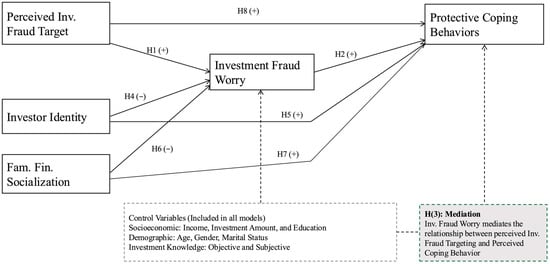
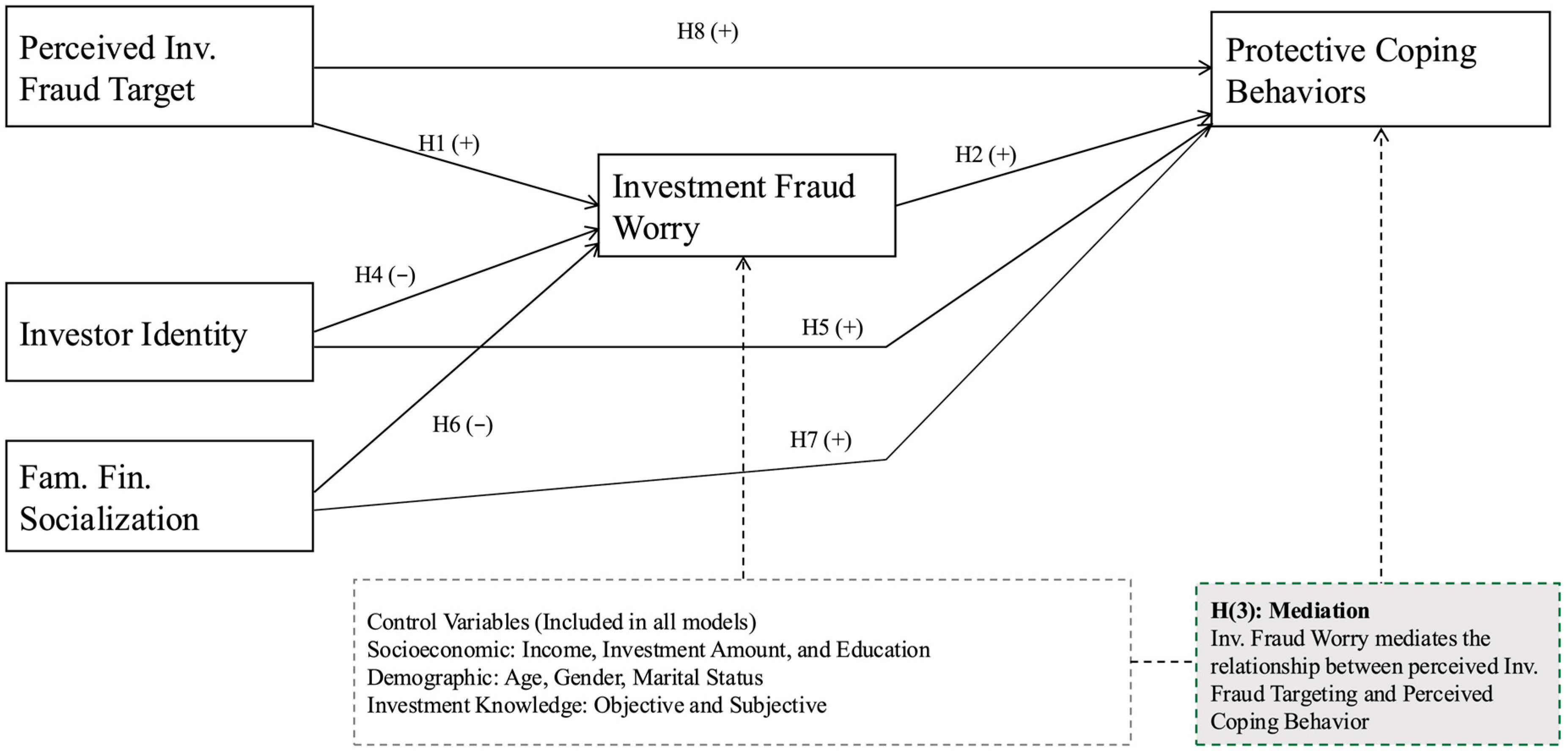
In sum, this study integrates insights from the fraud victimization literature and stress-coping theory to examine how investors’ subjective perceptions of fraud targeting influence protective behaviors, with fraud worry serving as a key mediating mechanism, and further considers the roles of investor identity, family financial socialization, and market trust in this process. Based on the above theoretical background, the conceptual framework of this study is shown in Figure 1.
Figure 1.
Conceptual Framework. Note. Perceived Inv. Fraud Target = Perceived investment fraud targeting, Fam. Fin. Socialization = Family financial socialization.
The following hypotheses are proposed:
H1.
Perceived investment fraud targeting is positively related to fraud worry.
H2.
Fraud worry is positively related to protective coping behaviors.
H3.
Fraud worry mediates the relationship between perceived fraud targeting and protective coping behaviors.
H4.
Investor identity is negatively related to fraud worry.
H5.
Investor identity is positively related to protective coping behaviors.
H6.
Family financial socialization is negatively related to fraud worry.
H7.
Family financial socialization is positively related to protective coping behaviors.
H8.
Perceived investment fraud targeting is positively related to protective coping behaviors.
3. Method
3.1. Data and Sample
The study used the data from the 2024 FINRA Investor Survey and the 2024 FINRA Foundation-funded National Financial Capability Study (NFCS) survey data. The NFCS Investor Survey, initiated in 2009 and conducted every three years, examines the investing behavior of U.S. adults who have investments outside of retirement accounts. It also provides information about investment fraud, investment behaviors, financial knowledge, and demographics of U.S. adults aged 18 and older. This dataset covers the respondents who reported they have investments outside of their retirement accounts in the NFCS survey. In order to explore or expand upon more possible influencing factors and control variables, the Investor Survey data is merged with the NFCS dataset by respondent ID. There were 2861 respondents in the 2024 Investor Survey. Consistent with prior studies using the NFCS dataset, responses of “Don’t know” and “Prefer not to say” were treated as non-substantive responses and excluded from the analytical sample (Chatterjee & Chang, 2025; Chen et al., 2023; Y. G. Lee et al., 2023; Magwegwe et al., 2023; Zhang, 2024). After deleting the respondents who answered “don’t know” and “wouldn’t say” in the selected variables used in the model, the final sample size was reduced to 2198.
3.2. Variables
Perceived fraud targeting. Based on the discussion in the literature review, this study regards perceived fraud targeting as the stressful event that triggers worry about fraud. This variable was operationalized as a binary variable based on the question, “Do you believe you were targeted in an investment fraud or scam in the past year?”. A response of “Yes” was coded as 1, and other responses were coded as 0.
Fraud worry. The concern over fraud is regarded as a stress emotion triggered by stressful events. As a moderating factor in the fraud stress coping model, it regulates the influence of the perception of investment fraud on coping behavior. Fraud worry was measured using a single question from the NFCS dataset, which captures respondents’ level of concern on a 7-point Likert scale: “How strongly do you agree or disagree with the following statement?—I am worried about losing money due to investment fraud?”. Respondents who selected “Don’t know” or “Prefer not to say” were excluded from the analysis.
Protective coping behavior. Drawing on the conceptual framework discussed above, this study operationalizes protective coping behaviors as a composite measure reflecting the number of distinct protective actions adopted by investors to reduce their vulnerability to investment fraud. These behaviors are conceptualized as actions that help investors narrow information asymmetries and limit opportunities for fraudulent actors to exploit a lack of information or oversight, including: checking the background of financial professionals, reading investment disclosure documents, seeking paid professional investment advice, and setting trusted contacts in the investment account. Three of these behaviors were each measured using a single observed item: “Have you ever checked with a state or federal regulator regarding the background, registration, or license of a financial professional?”, “Do you pay any of the following types of fees for investing in your non-retirement accounts?—Fees for investment advice”, and “Have you authorized a trusted contact for any of your investment accounts?”. The three behavioral variables mentioned above are all encoded as dummy variables. Responses of “yes” are recorded as 1, while other responses are recorded as 0. The behavior of reading investment disclosure documents is measured by two items together. It is encoded as 1 only when the respondents report both receiving the investment disclosure documents and actually reading them, and all other response situations are encoded as 0. Finally, the protective coping behavior variable is obtained by summing up the above four binary indicators, with a value range of 0 to 4. The higher the value, the more protective investment coping behaviors the individual adopts, reflecting the number of distinct protective behaviors adopted.
Family financial socialization. To further examine the role of family background in the process of coping with investment fraud stress, this study incorporates family financial socialization as an explanatory variable into the model. Given the study’s focus on investment fraud, family financial socialization is operationalized specifically in terms of investment-related socialization, capturing both family communication about investing and parental investment behavior. It was measured using two items: “Did your parents or other family members ever talk to you about investing?” and “Did/do your parents have investments in stocks, bonds, mutual funds, or other securities?”. Affirmative responses were coded as 1 and others as 0, with the two indicators summed to form a composite index ranging from 0 to 2.
Investor identity. This study incorporated investor identity as an additional variable to examine its role in the stress-coping process. It was measured by the item “People like me are usually not investors” on a 7-point Likert scale, and responses were reverse-coded so that higher scores indicate stronger investor identity. Respondents who selected “Don’t know” or “Prefer not to say” were excluded from the analysis.
Market trust. Trust in financial markets was measured by a single question from NFCS, which is “How strongly do you agree or disagree with the following statement?—U.S. financial markets are fair to all investors”. This question was also measured using a 7-point Likert scale, with the response range from 1 (“Strongly Disagree”) to 7 (“Strongly Agree”). Respondents who chose “Don’t know” or “Prefer not to say” were excluded from the analysis sample.
Demographic characteristic variables. Based on previous studies, the following variables related to demographic characteristics were used as control variables in this study: objective investment knowledge, subjective investment knowledge, investment value, investment experience, race, gender, age, education, and income.
Objective investment knowledge is measured using 11 multiple-choice questions on investment-related topics and concepts in the questionnaire: Corporate stocks, Corporate bonds, Asset priority, Risk-Return Tradeoff, Market efficiency, long-term performance of assets, index funds, municipal bonds, Stock value calculation, Selling short, and Options. Respondents can choose the correct answer, the wrong answer, or “don’t know.” To calculate an overall investment literacy index, each question is encoded as a binary variable. If the answer is correct, the variable is assigned a value of 1; otherwise, it is assigned a value of 0. If the respondent selects “don’t know”, the response is treated as incorrect, and the variable is also assigned to 0. All the questions were added together to generate an objective investment literacy score, ranging from 0 to 11, where 11 represents all correct answers, and 0 represents all incorrect answers. Before recoding and adding all question variables to obtain the Financial Knowledge Index, all variables underwent a reliability test. The reliability analysis results showed that the Cronbach’s Alpha coefficient of the scale was 0.81, indicating good internal consistency.
Subjective investment knowledge is derived directly from the survey’s self-assessment questions on investment knowledge: (G2) “How to rate your knowledge of investing” (rated on a scale of 1 to 7, from very low to very high). The responses of “don’t know” and “don’t want to say” have been eliminated.
Investment amount was measured using the original survey question asking respondents to report the approximate total value of all investments in non-retirement accounts, with responses recorded on an 11-point ordinal scale (1 = less than $500 to 11 = $1,000,000 or more). The original variable was recoded using dummy coding into two indicator variables based on investment portfolio size: $25,000 to $99,999 and $100,000 or above, with the below $25,000 category serving as the reference group.
Investment experience was recoded using dummy coding into two indicator variables based on years of investment experience: 5 to 10 years and more than 10 years, with the less than 5 years category serving as the reference group.
Other control variables included in this study comprised gender, race/ethnicity, household income, age, and marital status. These variables were included because of their significant association with financial decision making and investment behavior in the previous literature (Y. G. Lee et al., 2023; Sun & Chatterjee, 2026; Zhang, 2024). All other control variables are recoded. For gender variables, the value is 1 if the respondent answered female and 0 otherwise. The race variable is also a dummy variable, which equals 1 if the response is white and 0 otherwise. Regarding education level, if the response is “College or more”, it would be recoded as 1, and 0 otherwise. Household income was recoded using dummy coding into two indicator variables, including $50,000 to $99,999 and $100,000 or above, with the below $50,000 category serving as the reference group. Respondents aged under 45 were grouped into the younger group, whereas those aged 45 and above were classified into the older group. Marital status is also a binary variable: 1 indicates married, and single, separated, divorced, and widowed/widower are recoded as 0. Non-married people were the reference group.
3.3. Statistical Analysis
To better examine the role of the stress coping framework in the path of investment fraud behavior and to align with the model characteristics of this study, this research employs a mediation effect analysis. The outcome variable captures the number of protective coping behaviors adopted by each participant, ranging from 0 to 4. Although ordinal outcomes can also be coded using ordered integers, ordinal models do not assume equal distances between adjacent categories (Bürkner & Vuorre, 2019). In other words, a larger numerical value indicates a higher position in the ordering, but does not necessarily represent a greater amount or quantity of the underlying outcome. In contrast, the values of the outcome in this study represent actual counts: a value of 2 indicates that two protective behaviors were adopted, whereas a value of 4 indicates that four were adopted. Higher values therefore indicate that investors engaged in a greater number of protective behaviors, reflecting a greater level of protective coping against investment fraud. As a discrete, non-negative integer count, Poisson regression was therefore used to model this outcome (Gardner et al., 1995). The dispersion ratio is 0.826, indicating no overdispersion and supporting the use of the standard Poisson model. The mediation equation is estimated using ordinary least squares regression (OLS). Because the mediator model (OLS) and the outcome model (Poisson) are of different functional forms, the indirect and direct effects (ACME and ADE, respectively) cannot be recovered through simple coefficient multiplication. In this case, mediation quantities were estimated using the simulation-based causal mediation approach of Imai et al. (2010), implemented via the mediation package (Tingley et al., 2014) in R. And, the indirect effect is tested through 1000 non-parametric Bootstrap resampling to obtain a robust confidence interval estimate. Additionally, to investigate the heterogeneity of the coping mechanism in different groups with varying levels of investment knowledge, we divided the sample into two subgroups: the high objective investment knowledge group (higher than the median of the sample’s objective knowledge levels) and the low objective investment knowledge group (lower than the median of the sample’s objective knowledge levels) to examine the stability of the mediation model results and the differences in generational mechanisms.
4. Results
4.1. Descriptive Statistics
Table 1 presents the descriptive statistics of the sample in this study. The results show that only 4.55% of the respondents believed they had ever encountered investment fraud or scams. The average level of concern about investment fraud in the sample was slightly above the midpoint of the 7-point Likert scale (3.76). In terms of protective coping behaviors, the most common ones were reading investment disclosure documents and setting up trusted contacts, but neither reached half of the sample. In contrast, the least adopted behaviors were checking the background of investment advisors and paying for investment advice, accounting for 16.15% and 19.97% of the total sample, respectively. Additionally, approximately 52% of the respondents indicated that their parents owned stocks, bonds, mutual funds, or other securities, and about 42% had discussed investment-related topics with their parents or other family members. The sample also showed a high level of investor identity, with an average score of 4.70 out of 7. At the same time, the level of trust in market fairness was relatively high, with an average of 4.24 out of 7. Regarding financial knowledge, the subjective financial knowledge level of the sample was above the midpoint of the scale (average = 4.69), while the objective investment knowledge level was slightly below the midpoint (average = 5.33). In terms of investment characteristics, more than half of the respondents had investment assets exceeding $100,000 (52.32%), but the majority had less than five years of investment experience (75.84%). From a demographic perspective, 80.66% of the respondents were 45 years old or older, and nearly half had an annual income of $100,000 or more (47.18%). Moreover, the majority of the respondents had a relatively high level of education, with 68.06% having a college degree or higher. Finally, 78.34% of the respondents were white, and approximately 39.26% were female.
Table 1.
Descriptive Statistics of the Sample.
4.2. Mediation Analysis Results
The results of the mediation analysis are presented in Table 2, which reports the OLS regression results for the first-stage path, the Poisson regression results for the second-stage path, and the estimated mediation effects. All models controlled for demographic characteristics. First, the OLS regression results indicate that perceived fraud targeting risk was positively associated with fraud worry (), suggesting that respondents who believed they had been targeted by investment fraud reported significantly higher levels of fraud worry. And besides, subjective and objective investment knowledge demonstrated opposite effects. Specifically, subjective investment knowledge was positively related to fraud worry (), whereas objective investment knowledge was negatively associated with fraud worry (). Even though, contrary to expectation, the family financial socialization had a positive effect on fraud worry (), the investor identity was negatively associated with fraud worry (). Additionally, market trust is also negatively related to fraud worry (). Among the demographic controls, only race showed significant results. White respondents reported significantly lower levels of fraud worry compared to respondents from other racial groups ().
Table 2.
Mediation Analysis of Fraud Worry.
Turning to the Poisson regression results, several variables exhibited different effect directions and significance levels compared to the first-stage OLS model. Specifically, both perceived fraud targeting and fraud worry were positively associated with protective coping behaviors (). Unlike the first-stage model, objective investment knowledge did not show a statistically significant association with protective coping behaviors. Although subjective investment knowledge was positively related to fraud worry in the OLS model, it also demonstrated a significant positive relationship with protective coping behaviors in the Poisson model (). A similar pattern emerged for family financial socialization, which was positively associated with both fraud worry and protective coping behaviors (). This suggests that individuals with stronger family-based investment socialization may be more likely to take concrete protective actions. In the second-stage model, investor identity was not significantly associated with protective coping behaviors, whereas trust in market fairness showed a significant positive relationship with protective coping behaviors (). In addition, investment amount was significantly related to protective coping behaviors (), indicating that more financially engaged individuals tend to adopt more active protective strategies.
These two models showed a good fit. The first-stage OLS model demonstrated acceptable explanatory power, with an adjusted R-squared of 0.126, indicating that the predictors explained approximately 12.6% of the variance in fraud worry. The second-stage Poisson model also showed reasonable model fit (AIC = 6029.8; residual deviance = 2169), suggesting that the included predictors captured meaningful variation in protective coping behaviors.
The mediation analysis results provide support for the proposed investment fraud stress coping mechanism. The average causal mediation effect was positive and statistically significant (ACME = 0.066, p < 0.001), indicating that being targeted by investment fraud indirectly related to protective coping behaviors through heightened fraud worry. The average direct effect also remained significant (ADE = 0.425, p < 0.001), suggesting that fraud worry only partially explains the relationship between fraud targeting and protective coping behaviors. The average proportion mediated was 13.4% (p < 0.001), indicating that approximately 13% of the total effect of fraud targeting on coping behaviors operated through fraud worry.
4.3. Subgroup Analysis by Objective Financial Knowledge
This study also divided the sample into a low-objective investment knowledge group (n = 1383) and a high- objective investment knowledge group (n = 815) based on the objective investment knowledge scores, and estimated the impact of perceived investment fraud targets on fraud worry and protective coping behaviors separately, and the mediation mechanism difference across different levels of objective investment knowledge.
Table 3 omitted the results of control variables that did not reach statistical significance in both the main analysis and subgroup analysis. The results showed that in the low- objective investment knowledge group, perceived investment fraud target was significantly and positively associated with the level of fraud worry (), and fraud worry was significantly and directly linked to protective coping behaviors (). This result was consistent with the high objective investment knowledge level group. However, in the high objective investment knowledge group, the perceived investment fraud target had no direct significant relationship with protective coping behaviors. Fraud worry still significantly correlated with protective coping behaviors in this group (). Apart from the core variables, some covariates also showed differentiated results in the two groups. In the low objective investment knowledge subgroup, subjective investment knowledge showed an effect pattern consistent with the main mediation analysis (. In contrast, among respondents with high objective investment knowledge, the significant association between subjective investment knowledge and fraud worry disappeared. It only had a significant relationship with protective coping behavior (). For family financial socialization, the low investment knowledge group exhibited a significant positive association with protective response behaviors (). In the high investment knowledge group, family financial socialization did not show a significant correlation with protective response behaviors. The differences in the effects between the two groups were also reflected in the relationship between trust in the market and response behaviors. Only in the low investment knowledge group, trust in the market was significantly associated with a higher occurrence of protective coping behaviors (). The effects of other variables did not show significant differences between the two groups.
Table 3.
Subgroup Mediation Analysis by Objective Financial Knowledge.
The results of the mediation analysis for the two groups are also presented in Table 3. The results show that in the low-knowledge group, the average indirect effect (ACME = 0.043, p < 0.01) reached a statistically significant level. The average direct effect (ADE = 0.539, p < 0.001) and the total effect (Total effect = 0.582, p < 0.001) were also significantly positive. The mediation effect accounted for 7.4% of the total effect and reached a statistically significant level. However, in the high-knowledge group (n = 815), the average indirect effect was also significant (ACME = 0.061, p < 0.05), and the effect value was higher than that of the low-knowledge group. However, the average direct effect (ADE = 0.071) and the total effect (Total effect = 0.132) did not reach a statistically significant level. The mediation effect accounted for 46.3% of the total effect.
5. Robustness Check
5.1. Sensitivity to the Protective Coping Behavior Measure
Although this study measures the number of different protective coping behaviors adopted by investors by using an additive approach, rather than treating these behaviors as interchangeable indicators reflecting the same latent construct, considering that paid investment advice may be influenced by other economic factors, in order to test whether the research results are dependent on including this behavior in the protective coping measure, this study estimated additional results excluding this item, re-constructed the variables, and conducted a sensitivity analysis. Specifically, this study compared the model results using the original four behaviors with those using three behaviors after excluding paid investment advice (see Table A1). The results under the two measurement methods are generally consistent, indicating that the main findings of this study are not driven by whether the paid investment advice behavior is included in the protective coping behavior indicators.
5.2. Assessment of Sample Exclusion Bias
During the analysis process of this study, the observations with missing or invalid responses for the research variables were excluded, resulting in a reduction in the final analysis sample from 2861 individuals to 2198 individuals. This study further compared the differences in key demographic characteristics and investment-related characteristics between the final analysis sample and the excluded samples. The specific results are presented in Table A2. Notably, excluded respondents had lower objective investment knowledge scores and included a higher percentage of females and individuals without a college degree or higher.
5.3. Ordinal Specification of Fraud Worry
In the main analysis, the first-stage model was estimated using OLS, treating the seven-point fraud worry measure as a continuous outcome. To assess the robustness of the first-stage results to this modeling choice, the model was re-estimated using ordered logistic regression, treating fraud worry as an ordinal outcome. The results were largely consistent with those obtained from the OLS model (see Table A3). Perceived fraud targeting remained positively and significantly associated with fraud worry. Family investment socialization also remained positively associated with fraud worry, whereas investor identity and objective investment knowledge remained negatively associated with fraud worry, with all three relationships retaining statistical significance. The estimated directions of the remaining covariates were also generally consistent across the two specifications. The only notable difference was subjective investment knowledge, which was statistically significant at the 5% level in the OLS model but became marginally significant in the ordered logit model (p = 0.057). Overall, the ordered logit results provide further evidence that the first-stage findings are robust to the alternative ordinal specification of fraud worry.
5.4. Interaction Effects of Objective Investment Knowledge
The subgroup analyses showed different estimated patterns across respondents with relatively high and low objective investment knowledge. To further assess whether these differences reflect moderation, additional interaction models were estimated using the full sample. The interaction between perceived fraud targeting and objective investment knowledge was not statistically significant (see Table A4). Similarly, the interaction between fraud worry and objective investment knowledge was not statistically significant (see Table A4). These results do not provide evidence of statistically significant moderation by objective investment knowledge. Accordingly, the subgroup results are interpreted as differences in estimated patterns across the two knowledge groups rather than as evidence of moderation.
6. Conclusions and Implications
This study examines the direct and indirect pathways through which perceived investment fraud exposure and fraud worry influence investors’ protective coping behaviors. Unlike prior studies that have primarily focused on actual experiences of investment fraud exposure or the effects of fraud worry on general investment behaviors, this study extends the research perspective to the impact of the perceived fraud target on emotional response and protective coping behaviors, addressing a gap in the existing literature in this area.
The findings indicate that perceived investment fraud exposure was not only indirectly linked to protective coping behaviors through increased investment fraud worry but also exerted a significant direct effect on such behaviors. This suggests that individuals’ subjective perceptions of fraud exposure can independently influence both emotional responses and behavioral decision-making. Consistent with Stress and Coping Theory (Lazarus & Folkman, 1984), investment fraud worry arises from individuals’ subjective appraisal of external stressors and, in turn, motivates coping behaviors aimed at managing perceived threats.
Prior research has demonstrated that fraud-related worry can encourage protective actions (J. J. Xiao et al., 2023). However, our findings suggest that perceived investment fraud exposure itself may be a more influential driver of protective behavior than fraud worry. This finding suggests that individuals who perceive greater exposure to investment fraud may adopt protective coping behaviors not only through increased fraud-related worry but also as a direct response to the perceived threat itself.
In addition, this study further extends the model by incorporating the roles of family financial socialization and investor identity. The results show that an investor who has a strong investor identity can significantly reduce fraud worry. However, investor identity did not directly predict coping behavior, suggesting that its protective role operates exclusively through emotional regulation, rather than directly motivating behavioral responses. At the same time, the findings suggest that family financial socialization may increase individuals’ awareness of risk prevention. Investors with higher levels of family financial socialization are more likely to experience greater worry about the potential harm caused by investment fraud and, in turn, are also more likely to engage in protective coping behaviors. This finding aligns with prior research demonstrating that family financial socialization enhances individuals’ sensitivity to financial risks and capacity for informed decision-making (Curran et al., 2018; Legenzova & Leckė, 2025), suggesting that greater exposure to family financial discussions equips investors to more readily recognize and respond to potential threats.
Existing studies have found that investors who actually experience fraud often suffer a loss of trust in the market or regulatory institutions (Gurun et al., 2018). This study examines the role of market trust during the earlier stages of fraud perception and response. The results show that trust in the market not only reduces fraud worry but also promotes the adoption of protective coping behaviors. This may be because investors who trust the market are more likely to believe that the accessible information provided by the market is authentic and effective. As a result, they are more likely to use a series of information channels to track market dynamics, ultimately reducing their concerns about fraudulent activities in the market.
Furthermore, the level of investment knowledge significantly moderates the above pathways. For investors with low investment knowledge, perceived fraud exposure can both directly trigger coping behaviors and indirectly induce them through worry, reflecting a partial mediation structure. In contrast, investors with high investment knowledge exhibit a distinctly different pattern. For these investors, the perception of investment fraud does not directly trigger coping behaviors, but instead indirectly leads to coping behaviors through worry about investment fraud. This suggests that investors with higher levels of investment knowledge usually do not immediately take coping actions simply because they perceive fraud exposure. Instead, they tend to first evaluate the authenticity of the fraud risk and the potential loss that could happen. Only when this evaluation generates substantial worry do they proceed to take coping measures.
The findings of this study provide important implications for regulators, financial advisors, families, and investment educators. First, regulators should recognize that maintaining investor trust is an important component of fraud prevention. Efforts to improve the transparency and credibility of market information may help reduce fraud-related worry and encourage protective coping behaviors among investors. They should also establish a regulatory framework for investment promotional content on social media platforms, with review and reporting mechanisms for unregistered investment advice and emerging high-risk products on platforms such as YouTube and TikTok, thereby limiting the space for fraud to spread at the source of information. Financial advisors should also view trust-building as a key element of fraud prevention. Transparent communication and investor education may help clients better assess fraud-related risks and respond more effectively when confronted with potential threats.
For families, the findings highlight the long-term importance of investment socialization. Early exposure to investment-related discussions and experiences may shape individuals’ emotional responses and coping behaviors later in life. At the same time, fostering self-efficacy and a stronger investor identity may help individuals respond proactively to fraud exposure rather than relying primarily on emotional reactions.
Finally, investment educators should focus not only on improving objective investment knowledge but also on strengthening investors’ confidence in their ability to evaluate investment opportunities and manage potential risks. Such efforts may contribute to more effective protective coping behaviors when individuals encounter fraud-related threats.
This study still has some limitations. First, from a data perspective, several limitations should be acknowledged. This study relies on secondary, cross-sectional data, which cannot capture the dynamic stress-coping cycle underlying investors’ responses to perceived fraud risk over time. Hence, the possibility of some reverse causality and endogeneity could not be eliminated. Therefore, the results were reported as associations instead of as causal relationships. Future studies should focus on examining these associations with panel data, when possible, to examine the causal relationships across time. Some original variables designed by the NFCS dataset, such as fraud worry, investor identity, and market trust, were each measured using a single Likert-type item. Hence, reliability could not be measured for these single-item measures. In addition, several key constructs in this study rely on individuals’ subjective assessments of their experiences, attitudes, and behaviors. Future studies should try to extend this line of research further by developing observed measures of experiences, attitudes, and behaviors when possible in order to reduce the possibility of some common-method bias, which may exist in subjective assessments.
Additionally, from a research design perspective, only 4.55% of the respondents reported having perceived investment fraud targeting. As a result, caution should be applied when interpreting the estimation results beyond the significantly associated relationships. Future studies need to examine these associations with a larger sample of respondents who may have experienced investment fraud. However, this study further adopted robustness tests such as 5000 bootstrap replications, and the overall results remained stable. Similarly, the results estimated in the subgroup-specific results should also be interpreted with appropriate caution. The generalizability of the findings is also limited by the study sample, which is restricted to investors who hold non-retirement investment accounts.
Author Contributions
Conceptualization, X.S., Y.Z. and S.C.; Methodology, X.S., Y.Z. and S.C.; Software, X.S.; Validation, X.S., Y.Z. and S.C.; Formal analysis, X.S. and Y.Z.; Investigation, X.S.; Resources, X.S.; Data curation, X.S.; Writing—original draft, X.S., Y.Z. and S.C.; Writing—review and editing, X.S., Y.Z. and S.C.; Visualization, X.S.; Supervision, Y.Z. and S.C.; Project administration, X.S. and S.C. All authors have read and agreed to the published version of the manuscript.
Funding
This research received no external funding.
Institutional Review Board Statement
Not applicable.
Informed Consent Statement
Not applicable.
Data Availability Statement
The original data presented in the study are openly available in the FINRA NFCS Dataset at https://www.finrafoundation.org/national-financial-capability-study (accessed on 18 December 2025).
Acknowledgments
During the preparation of this manuscript, the authors used Grammarly plug-in (version 1.191.0.0) solely for text editing, including grammar, spelling, and punctuation. The authors have reviewed and edited the output and take full responsibility for the content of this publication.
Conflicts of Interest
The authors declare no conflicts of interest.
Appendix A
Table A1.
Sensitivity Analysis Excluding the Paid Advice Item from the Protective Coping Behavior Measure.
Table A2.
Comparison of Excluded and Analytic Sample Characteristics.
Table A3.
Ordered Logistic Regression of Fraud Worry.
Table A4.
Moderation Effect of Objective Investment Knowledge.
References
- Barnes, P. (2017). Stock market scams, shell companies, penny shares, boiler rooms and cold calling: The UK experience. International Journal of Law, Crime and Justice, 48, 50–64. [Google Scholar] [CrossRef] [Scilit]
- Bucciol, A., & Veronesi, M. (2014). Teaching children to save: What is the best strategy for lifetime savings? Journal of Economic Psychology, 45, 1–17. [Google Scholar] [CrossRef] [Scilit]
- Bürkner, P.-C., & Vuorre, M. (2019). Ordinal regression models in psychology: A tutorial. Advances in Methods and Practices in Psychological Science, 2(1), 77–101. [Google Scholar] [CrossRef] [Scilit]
- Cawvey, M., Hayes, M., Canache, D., & Mondak, J. J. (2018). Personality and victimization in the Americas. International Review of Victimology, 24(1), 123–139. [Google Scholar] [CrossRef] [Scilit]
- Chatterjee, S., & Chang, Y. (2025). Utilization of alternative financial services and the role of financial capability. Journal of Consumer Affairs, 59(1), e12614. [Google Scholar] [CrossRef] [Scilit]
- Chen, F., Yu, D., & Sun, Z. (2023). Investigating the associations of consumer financial knowledge and financial behaviors of credit card use. Heliyon, 9(1), e12713. [Google Scholar] [CrossRef] [Scilit] [PubMed]
- Curran, M. A., Parrott, E., Ahn, S. Y., Serido, J., & Shim, S. (2018). Young adults’ life outcomes and well-being: Perceived financial socialization from parents, the romantic partner, and young adults’ own financial behaviors. Journal of Family and Economic Issues, 39(3), 445–456. [Google Scholar] [CrossRef] [Scilit]
- Deliema, M., Shadel, D., & Pak, K. (2020). Profiling victims of investment fraud: Mindsets and risky behaviors. Journal of Consumer Research, 46(5), 904–914. [Google Scholar] [CrossRef] [Scilit]
- Federal Trade Commission. (2025). Consumer sentinel network data book 2024. Available online: https://www.ftc.gov/reports/consumer-sentinel-network-data-book-2024 (accessed on 15 April 2026).
- Financial Industry Regulatory Authority. (n.d.). Avoid fraud. Available online: https://www.finra.org/investors/protect-your-money/avoid-fraud (accessed on 15 April 2026).
- Financial Industry Regulatory Authority. (2025). 2025 annual regulatory oversight report. Available online: https://www.finra.org/sites/default/files/2025-01/2025-annual-regulatory-oversight-report.pdf (accessed on 15 April 2026).
- Freshman, A. (2012). Financial disaster as a risk factor for posttraumatic stress disorder: Internet survey of trauma in victims of the Madoff Ponzi scheme. Health & Social Work, 37(1), 39–48. [Google Scholar] [CrossRef] [Scilit] [PubMed]
- Gardner, W., Mulvey, E. P., & Shaw, E. C. (1995). Regression analyses of counts and rates: Poisson, overdispersed poisson, and negative binomial models. Psychological Bulletin, 118(3), 392–404. [Google Scholar] [CrossRef] [PubMed]
- Giannetti, M., & Wang, T. Y. (2016). Corporate scandals and household stock market participation. The Journal of Finance, 71(6), 2591–2636. [Google Scholar] [CrossRef] [Scilit]
- Golladay, K. A., & Snyder, J. A. (2023). Financial fraud victimization: An examination of distress and financial complications. Journal of Financial Crime, 30(6), 1606–1628. [Google Scholar] [CrossRef] [Scilit]
- Gurun, U. G., Stoffman, N., & Yonker, S. E. (2018). Trust busting: The effect of fraud on investor behavior. The Review of Financial Studies, 31(4), 1341–1376. [Google Scholar] [CrossRef] [Scilit]
- Imai, K., Keele, L., & Yamamoto, T. (2010). Identification, inference and sensitivity analysis for causal mediation effects. Statistical Science, 25(1), 51–71. [Google Scholar] [CrossRef] [Scilit]
- Judges, R. A., Gallant, S. N., Yang, L., & Lee, K. (2017). The role of cognition, personality, and trust in fraud victimization in older adults. Frontiers in Psychology, 8, 588. [Google Scholar] [CrossRef] [Scilit] [PubMed]
- Kassem, R. (2024). How fraud impacts individuals’ wellbeing: Academic insights and gaps. Journal of Financial Crime, 31(5), 1261–1268. [Google Scholar] [CrossRef] [Scilit]
- Kerr, D. S., Loveland, K. A., Smith, K. T., & Smith, L. M. (2023). Cryptocurrency risks, fraud cases, and financial performance. Risks, 11(3), 51. [Google Scholar] [CrossRef] [Scilit]
- Kim, J., & Chatterjee, S. (2013). Childhood financial socialization and young adults’ financial management. Journal of Financial Counseling and Planning, 24(1), 61–79. [Google Scholar]
- Knüpfer, S., Rantala, V., Vihriälä, E., & Vokata, P. (2024). Household responses to phantom riches (Fisher College of Business Working Paper No. 2021-03-008). Available online: https://ssrn.com/abstract=3850928 (accessed on 18 April 2026).
- Kuo, C., & Tsang, S.-S. (2024). Constructing an investment scam detection model based on emotional fluctuations throughout the investment scam life cycle. Deviant Behavior, 45(2), 204–225. [Google Scholar] [CrossRef] [Scilit]
- Lacey, D., Goode, S., Pawada, J., & Gibson, D. (2020). The application of scam compliance models to investment fraud offending. Journal of Criminological Research, Policy and Practice, 6(1), 65–81. [Google Scholar] [CrossRef] [Scilit]
- Lazarus, R. S., & Folkman, S. (1984). Stress, appraisal, and coping. Springer. [Google Scholar]
- Lee, S. J., Cummings, B. F., & Martin, J. (2019, February 19–21). Victim characteristics of investment fraud. 2019 Academic Research Colloquium for Financial Planning and Related Disciplines, Arlington, VA, USA. [Google Scholar]
- Lee, Y. G., Hales, E., & Kelley, H. H. (2023). Financial behaviors, government assistance, and financial satisfaction. Social Indicators Research, 166(1), 85–103. [Google Scholar] [CrossRef] [Scilit] [PubMed]
- Legenzova, R., & Leckė, G. (2025). The link between family financial socialization in adulthood and investment literacy of P2P investors. Journal of Family and Economic Issues, 46(2), 525–544. [Google Scholar] [CrossRef] [Scilit]
- Lokanan, M. E., & Liu, S. (2021). The demographic profile of victims of investment fraud: An update. Journal of Financial Crime, 28(3), 647–658. [Google Scholar] [CrossRef] [Scilit]
- Lourie, B., Nekrasov, A., Truong, P., & Zhu, C. (2023). Crypto fraud and investing behavior [Unpublished manuscript]. Available online: https://ssrn.com/abstract=4650849 (accessed on 18 April 2026).
- Magwegwe, F. M., MacDonald, M. M., Lim, H., & Heckman, S. J. (2023). Determinants of financial worry. Journal of Consumer Affairs, 57(1), 171–221. [Google Scholar] [CrossRef] [Scilit]
- Mavlanova, T., Benbunan-Fich, R., & Lang, G. (2016). The role of external and internal signals in E-commerce. Decision Support Systems, 87, 59–68. [Google Scholar] [CrossRef] [Scilit]
- Mohd Padil, H., Kasim, E. S., Muda, S., Ismail, N., & Md Zin, N. (2022). Financial literacy and awareness of investment scams among university students. Journal of Financial Crime, 29(1), 355–367. [Google Scholar] [CrossRef] [Scilit]
- North American Securities Administrators Association. (2025). NASAA highlights top investor threats for 2025. Available online: https://www.nasaa.org/75001/nasaa-highlights-top-investor-threats-for-2025/ (accessed on 15 April 2026).
- Office of the Comptroller of the Currency. (n.d.). Financial and investment fraud. Available online: https://www.occ.gov/topics/consumers-and-communities/consumer-protection/fraud-resources/financial-and-investment-fraud-.html (accessed on 15 April 2026).
- Pelawi, R. Y., Tandelilin, E., Lantara, I. W. N., & Junarsin, E. (2025). Empowered to detect: How vigilance and financial literacy shield us from the rising tide of financial frauds. Journal of Risk and Financial Management, 18(8), 425. [Google Scholar] [CrossRef] [Scilit]
- Singh, K. N., & Misra, G. (2023). Victimisation of investors from fraudulent investment schemes and their protection through financial education. Journal of Financial Crime, 30(5), 1305–1322. [Google Scholar] [CrossRef] [Scilit]
- Siu, G. A., Hutchings, A., Vasek, M., & Moore, T. (2022). “Invest in crypto!”: An analysis of investment scam advertisements found in Bitcointalk. In 2022 APWG symposium on electronic crime research (eCrime) (pp. 1–12). IEEE. [Google Scholar]
- Sun, X., & Chatterjee, S. (2026). From media exposure to trading behavior: Evidence from social media, traditional media and investor knowledge. International Journal of Bank Marketing, 1–22. [Google Scholar] [CrossRef] [Scilit]
- Tajfel, H., & Turner, J. C. (2004). The social identity theory of intergroup behavior. In J. T. Jost, & J. Sidanius (Eds.), Political psychology: Key readings (pp. 276–293). Psychology Press. [Google Scholar]
- Tingley, D., Yamamoto, T., Hirose, K., Keele, L., & Imai, K. (2014). Mediation: R package for causal mediation analysis. Journal of Statistical Software, 59(5), 1–38. [Google Scholar] [CrossRef] [Scilit]
- U.S. Securities and Exchange Commission, Financial Industry Regulatory Authority & North American Securities Administrators Association. (2025, August 25). Why you should consider adding a trusted contact to your account—Updated investor bulletin. Available online: https://www.investor.gov/introduction-investing/general-resources/news-alerts/alerts-bulletins/investor-bulletins-trusted-contact (accessed on 15 April 2026).
- Van de Weijer, S. G., & Leukfeldt, E. R. (2017). Big five personality traits of cybercrime victims. Cyberpsychology, Behavior, and Social Networking, 20(7), 407–412. [Google Scholar] [CrossRef] [Scilit] [PubMed]
- Xiao, J. J., Mascio, R., McDowell, J., & Mottola, G. (2023). Does it help to be concerned? Exploring the association between worry about investment fraud and investing behavior. Consumer Interests Annual, 69, 1–7. [Google Scholar]
- Xiao, X., Li, X., & Zhou, Y. (2022). Financial literacy overconfidence and investment fraud victimization. Economics Letters, 212, 110308. [Google Scholar] [CrossRef] [Scilit]
- Zhang, Y. (2024). ESG Perceptions: Investigating investor motivations and characteristics. Financial Services Review, 32(2), 29–52. [Google Scholar] [CrossRef] [Scilit]

Disclaimer/Publisher’s Note: The statements, opinions and data contained in all publications are solely those of the individual author(s) and contributor(s) and not of MDPI and/or the editor(s). MDPI and/or the editor(s) disclaim responsibility for any injury to people or property resulting from any ideas, methods, instructions or products referred to in the content. |
© 2026 by the authors. Licensee MDPI, Basel, Switzerland. This article is an open access article distributed under the terms and conditions of the Creative Commons Attribution (CC BY) license.