


Abstract
This study examines the moderating role of liquidity in the relationship between extreme capital structure and firm performance among listed firms in emerging markets. It is motivated by the need to better understand how financing constraints and liquidity management influence firm performance in environments characterised by high financial frictions and limited access to external capital. Extreme capital structure is defined as firms maintaining very low levels of debt, measured using thresholds of 1% (ultra-low debt) and 5% for both long-term debt and total debt. The analysis is based on a panel dataset of non-financial listed firms over the period 2006–2024 and employs a dynamic panel System Generalised Method of Moments (System GMM) complemented by a Random Effects model for robustness. Empirical results indicate that liquidity has a meaningful and predominantly positive moderating effect. This is observed when firms maintain extremely low long-term debt (1% threshold) and low long-term debt (5% threshold). Liquidity enhances firm performance. This effect is strongest for return on assets (ROA) and return on equity (ROE). The effect on Tobin’s Q is weaker but remains generally positive. These findings highlight the strategic importance of liquidity in improving profitability and financial resilience under conservative financing structures. However, the findings are limited to listed non-financial firms in emerging markets and may not be generalizable to SMEs or unlisted firms. Future research could explore the threshold at which liquidity ceases to generate benefits or begins to produce diminishing returns in ultra-low leverage contexts.
1. Introduction
Since the seminal work of Modigliani and Miller (1958), financial economics has continued to scrutinise the intricate dynamics of the complex systems governing firm value. At the core of these systems lie three critical variables: capital structure, liquidity risk, and financial performance. According to Mahrani and Soewarno (2018), the effectiveness and efficiency with which a firm generates profit and manages its assets and liabilities are directly attributed to the interests of its shareholders and broader stakeholders. While the long-term viability of a firm hinges on sustained financial performance, achieving this remains challenging as management must constantly navigate the inherent trade-off between risk and profitability. Central to this relationship is the determination of an optimal capital structure, the specific configuration of debt and equity utilised to finance both operational requirements and long-term capital investments. Inseparably related to capital structure is liquidity risk, which refers to the ability of a firm to meet its short-term obligations without incurring unacceptable losses (H. Chen et al., 2021). The study of Arhinful et al. (2025) emphasises that for firms to balance risk and return, which affects sustainability and profitability, an optimal capital structure should be adopted. Doing so reduces cost of capital and enhances performance. This underscores the importance of liquidity as a key component that interacts with both capital structure and firm performance, as it determines a firm’s ability to meet debt obligations while simultaneously maintaining sufficient liquid assets to support its operational needs (Al-Nimer et al., 2024).
Failure to meet short-term obligations can be costly, just as the inability to finance day-to-day operations can undermine firm performance. This typically arises from liquidity risk associated with volatile cash flows, restricted access to external financing, and inefficiencies in working capital management. Recent empirical evidence suggests that liquidity risk is particularly pronounced in emerging markets due to elevated financial constraints, underdeveloped capital markets, and heightened macroeconomic uncertainty, all of which limit firms’ ability to rely on external funding and increase dependence on internal liquidity reserves (Kayani et al., 2023; Yang, 2025). Consequently, liquidity plays a crucial role in sustaining firm performance in such environments by easing financing frictions and supporting operational stability. As a result, liquidity determination is critical, as it directly and indirectly influences capital structure and ultimately, firm performance. A key issue that arises is identifying the optimal level of liquidity that can sufficiently reduce default risk while enhancing performance, as firms strive to optimise their liquid asset holdings. However, as noted by Marozva (2019), gaps remain in the measurement of overall liquidity, making it difficult to accurately assess its impact on firm performance. The relationship between liquidity, capital structure, and firm performance has been widely studied; however, empirical findings remain inconclusive. Empirical evidence remains mixed, with some studies reporting negative effects and others reporting positive effects. For instance, studies by Nikhil et al. (2024), document negative effects, whereas Daryanto et al. (2018) and Källum and Sturesson (2017) report a positive relationship. The positive and negative effects of liquidity on firm performance have been linked to the levels of liquid assets firms maintain within their capital structure. Haris et al. (2024) found that liquidity risk can harm profitability when firms hold insufficient liquid assets, as this increases the likelihood of failing to meet obligations, leading to poorer performance. Additionally, Nassim et al. (2025) identified an inverted U-shaped relationship, showing that low liquidity levels result in shortages and reduced profitability, optimal levels achieved through disciplined liquidity management enhance performance, and excessive liquidity can be costly, ultimately reducing performance. Additionally, external factors such as global financial crises, macroeconomic conditions, institutional quality, and industry-specific dynamics have been shown to influence the level of liquid assets that firms maintain (Nowicki et al., 2024).
Consequently, in response to these external factors, researchers have noted an increasing number of firms adopting extreme capital structure strategies, relying less on debt and using liquid assets to finance their operations. For instance, Strebulaev and Yang (2013) found that firms with higher cash holdings and profitability are more likely to operate debt-free. Similarly, Bessler et al. (2013b) reported a positive relationship between retained earnings and zero leverage. In addition, R. R. Chen et al. (2018) indicated that both liquidity and profitability significantly increase the probability of a firm remaining unlevered. These findings have been described as the zero-leverage phenomenon, as they deviate from classical capital structure theories that emphasise the benefits of debt, particularly the tax advantages provided by the interest tax shield. Although financing through internally generated funds aligns with the pecking order theory (Myers & Majluf, 1984), which posits that firms prefer internal financing before resorting to debt or equity, and the adoption of a zero-debt policy overlooks the potential tax benefits that could be gained from utilising debt.
If firms opt for low levels of debt in their capital structure and rely on liquid assets to finance their operations, a central question arises regarding the moderating role of liquidity on the relationship between extreme capital structure and firm performance. Liquidity enhances financial flexibility by providing a buffer against unexpected shocks and by reducing reliance on debt, thereby preserving the firm’s capacity for future borrowing (Jahan & Ryu, 2026). The absence of debt financing removes interest obligations and improves a firm’s capacity to meet its financial obligations. Thus, liquidity not only influences capital structure but also drives the decision to avoid debt entirely. In this context, liquidity plays a crucial role in why some firm remain under leveraged. Research on extreme capital structure and its effects on firm performance is still in its early stages. The existing literature is predominantly concentrated in developed economies, resulting in limited empirical evidence from emerging markets. The study of extreme capital structure in emerging markets is essential, as institutional weaknesses and information asymmetry affect firms’ financing decisions and their capacity to sustain very low debt levels (Boubakri et al., 2021). Cross-country differences in institutional quality have been shown to significantly affect firms’ leverage choices and their speed of adjustment toward target capital structures (Gungoraydinoglu & Öztekin, 2011; Öztekin & Flannery, 2012). In such environments, firms may rely more heavily on internal resources and maintain higher liquidity levels to preserve financial flexibility and mitigate financing constraints associated with weaker institutions and underdeveloped financial systems (Çolak et al., 2018; Botta & Colombo, 2022). Therefore, examining extreme capital structure in emerging markets is important because institutional differences may affect how near-zero debt influences firm performance. Moreover, although prior studies have examined capital structure and liquidity separately, little is known about the moderating role of liquidity in the relationship between extreme capital structure and firm performance. This study addresses these gaps by investigating the effects of extreme capital structure and the moderating role of liquidity on firm performance in emerging markets.
The article is structured as follows: Section 2 reviews the theoretical foundations of extreme capital structure, liquidity, and firm performance. Section 3 outlines the methodological approach, including the study design, data sources, variable definitions, and the econometric model employed. Section 4 presents and interprets the empirical results, while Section 5 concludes the study and discusses its policy implications.
2. Literature Review
It is important to note that no single capital structure theory fully explains the relationship between capital structure and firm performance. The relationship between capital structure and firm performance has been extensively studied since the seminal work of Modigliani and Miller (1958). Subsequently, several capital structure theories have been developed to enhance understanding and provide a theoretical framework for financing decisions (Khan et al., 2020; Brunzell et al., 2013). Modigliani and Miller (1958) laid the foundation for capital-structure theory, arguing that financing decisions have only a limited impact on firm value under perfect market assumptions. Their argument was based on the idea that profitability depends on how efficiently firms use their assets, making capital structure irrelevant to their market value. Their work sparked decades of research, leading to alternative theories that address real-world market imperfections. These include trade-off theory (costs and benefits of debt) by Kraus and Litzenberger (1973), proposed that managers weigh the costs and benefits of different leverage options, aiming to maintain an optimal balance between the advantages and costs of debt in line with stakeholder preferences (Rasiah & Kim, 2011). Pecking order theory (information asymmetry and financing hierarchy), by Myers and Majluf (1984), suggest that firms do not target an optimal debt level but instead follow a financing hierarchy (Sunitha, 2024). Firms prefer internal funds first, and when these are insufficient, they turn to external financing favouring debt over equity (Myers & Majluf, 1984; Myers, 1984). Furthermore, the agency theory by Jensen and Meckling (1976) argues that the separation of ownership and control creates conflicts of interest between managers and shareholders, leading to agency problems, information asymmetry, and associated monitoring costs to align managerial actions with shareholder objectives. Three forms of agency conflicts are particularly relevant to capital structure decisions. First, conflicts between managers and shareholders may arise when managers pursue personal interests or invest excess cash in unprofitable projects. In this regard, debt can act as a disciplinary mechanism by reducing free cash flow available for managerial discretion (Jensen, 1986). Second, conflicts between shareholders and creditors may occur when shareholders undertake riskier projects after debt issuance, thereby transferring risk to creditors. Third, conflicts between majority and minority shareholders are especially important in emerging markets, where weaker institutional protections and concentrated ownership structures may expose minority shareholders to expropriation risks. Consequently, capital structure decisions in emerging markets are influenced not only by firms’ financing needs but also by the extent to which debt and equity choices help mitigate these agency conflicts. On the other hand, market signalling theory, first proposed by Spence (1973), suggests that managers possess superior information relative to investors and that capital structure decisions convey signals about a firm’s future prospects. Managers are more likely to issue debt when they are confident about future cash flows, whereas equity issuance may indicate different valuations of firm prospects (Stoiljković et al., 2024).
Several contemporary perspectives are provided by life cycle theory and market timing theory to further give insight into financing behaviour in emerging economies. Life cycle theory highlights that firms’ financing decisions depend on their stage of development, with younger and high-growth firms typically relying more on external financing, while mature firms generate sufficient internal resources and may therefore exhibit lower leverage (Berger & Udell, 1998). Collectively, these perspectives highlight that capital structure decisions in emerging markets are not solely driven by traditional trade-off considerations, but are also influenced by market conditions, institutional environments, and firm life cycle dynamics. In addition, market timing theory posits that firms tend to adjust their financing decisions based on prevailing market conditions, issuing equity or debt when they perceive favourable market valuations or lower financing costs, which is particularly relevant in emerging markets characterised by high volatility and fluctuating investor sentiment (Baker & Wurgler, 2002). Institutional theory further argues that capital structure choices are shaped by the broader regulatory, legal, and governance environment, where weaker institutional frameworks in emerging economies may constrain access to external finance and influence firms’ reliance on internal funding sources (North, 1990; La Porta et al., 1998).
However, despite explanations provided by classical capital structure theories, no single theory fully accounts for the zero-leverage phenomenon. In particular, the trade-off theory and the pecking order theory, which are closely associated with firms’ financing behaviour, remain the two main traditional frameworks relevant to understanding zero-debt policies (Bessler et al., 2013a). According to Miglo (2019), the trade-off and pecking order theories explain why some firms maintain zero debt, a trend also observed in the UK and US (Korteweg, 2010; Strebulaev & Yang, 2013) despite their capacity to borrow. According to Saona et al. (2023), there are two main hypotheses in the literature that help explain the zero-leverage puzzle: the financial flexibility hypothesis and the financial constraints hypothesis. The financial constraints hypothesis argues that firms face limited borrowing capacity due to factors like institutional quality and liquidity, which can restrict access to affordable external funds and lead to zero-leverage policies (Saona et al., 2023). In contrast, the financial flexibility hypothesis suggests that firms may deliberately maintain low or zero debt, with good institutional quality and high liquidity enabling them to choose between debt and equity financing, supporting a zero-debt strategy. In addition, financial flexibility theory suggests that firms strategically accumulate liquid assets to buffer against uncertainty and future financing constraints, thereby preserving the ability to respond to investment opportunities without increasing leverage (Bates et al., 2009). This role becomes particularly important in emerging markets, where weaker institutional environments amplify external financing costs and constrain access to capital. Accordingly, liquidity not only substitutes for debt but also strengthens firms’ ability to sustain near-zero leverage strategies, with important implications for firm performance under varying institutional conditions. It is evident from the theory discussion that capital structure decisions are shaped by a mix of trade-offs, information factors, and agency issues rather than a single principle. This study draws on trade-off theory, pecking order theory, financial flexibility, and financial constraints hypotheses as its theoretical foundation.
2.1. Liquidity and Firm Performance Hypothesis
Liquidity is widely recognised as a key determinant of firm performance, as it reflects a firm’s ability to meet short-term obligations and manage operational risks (N. H. P. Nguyen & Tuyen, 2024). Evidence shows that effective liquidity management enhances financial performance and operational stability. This aligns with pecking order theory, which posits that firms prefer internal funds over external financing and debt over equity (Myers & Majluf, 1984; Myers, 1984). Consequently, firms with higher liquidity are more likely to rely on internal funds, which can sometimes result in zero-leverage positions. Empirical studies support this view, showing that profitability, cash flow, and retained earnings are positively associated with a firm’s likelihood of being unlevered (Bessler et al., 2013a; Strebulaev & Yang, 2013; El Ghoul et al., 2011; and Byoun & Xu, 2013). High liquidity enables firms to minimise or avoid debt, while low liquidity may push firms toward greater debt usage, influencing capital structure choices and firm performance (Kurnia et al., 2020; Al-Slehat, 2020; Tamba & Purwanto, 2021). However, the impact of liquidity on performance is mixed. While higher liquidity can improve earnings and financial flexibility (Olatunji & Oladele, 2025), it may also negatively affect market value under certain conditions, such as firm size (Ishak & Selamat, 2024). Overall, the effect of liquidity on capital structure and firm performance depends on the level of liquidity maintained by the firm. Accordingly, we formulate and test the hypothesis:
H1:
Liquidity is positively associated with firm performance in emerging markets because it mitigates financing constraints and supports operational stability.
2.2. The Interaction Between Extreme Capital Structure and Liquidity
This study examines how liquidity affects firm performance, particularly in zero-leverage firms, a topic that has received limited attention. Firm performance is generally measured by profitability, which depends on sound financial management and an appropriate capital structure (Marozva, 2026). Maintaining sufficient liquidity allows firms to meet short-term obligations, signal financial health to investors, and support operational stability, while excessive liquidity can tie up capital and reduce profits (Fajaryani & Suryani, 2018). Firms with adequate internal funds can minimise or avoid debt, leading to zero-leverage policies that enhance profitability, consistent with the pecking order theory (Strebulaev & Yang, 2013). Effective liquidity management also enables firms to cover operating costs and seize investment opportunities (T. T. C. Nguyen et al., 2024). The impact of liquidity and corporate efficiency on profitability. Emerging Science Journal, 8(1), pp. 180–191), aligning with Jensen’s (1986) free cash flow theory, which highlights managers’ discretionary power over cash. However, holding excessive cash can reduce returns and create inefficiencies due to liquidity premiums and tax disadvantages (Abata & Migiro, 2016; Bordeleau & Graham, 2010). Empirical evidence shows both positive and negative relationships between liquidity and firm performance: optimal liquidity supports zero-debt policies and higher profitability, while insufficient or excessive liquidity can negatively impact performance (Yuliani, 2021). In summary, maintaining the right level of current assets enables firms to finance operations internally, adopt zero-leverage strategies, and achieve improved financial performance, highlighting liquidity’s critical role in capital structure and profitability (Ben-Caleb et al., 2013; T. T. C. Nguyen et al., 2024; and Strebulaev & Yang, 2013). Therefore, against this background, we formulate and test the following hypothesis:
H2:
The interaction between extreme capital structure and liquidity does affect firm performance.
2.3. Methodology
This study investigates the moderating effect of liquidity on firms with extreme capital structures (using low debt levels), and how it influences firm performance. Firm-level data were obtained from the IRESS financial database, whereas macroeconomic and institutional variables were sourced from the World Bank and the World Governance Indicators (WGIs), respectively. The analysis employs panel data techniques, which combine both cross-sectional (N) and time-series (T) dimensions, allowing variables to be observed across multiple entities (i = 1,…,N) over several time periods (t = 1,…,T) (Im et al., 2003). The study utilises annual data spanning the period from 2006 to 2024, a timeframe selected to align with the research objectives, particularly in capturing the effects of the COVID-19 pandemic on firms’ capital structure decisions, as well as ensuring sufficient data availability. The sample comprises non-financial firms listed in emerging markets. Using the IMF and MSCI, the study accounted for 23 countries classified as emerging markets in which data were captured from. Initially, the population was earmarked to be 23 countries multiplied by 40 companies, totalling 920 companies. However, after removing companies that did not have data over the period, we ended up with a sample of 831 companies, resulting in 15,789 observations. Furthermore, a sample of companies that met the threshold of 5% totalled to 114, while those that met a threshold of 1% totalled to 22, resulting in 2166 observations and 418 companies.
To enhance the validity and reliability of the dataset, several standard filtering criteria were applied. Firms operating in regulated industries, such as financials and utilities, were excluded due to their distinct regulatory environments. In addition, firms with incomplete data and those exhibiting extreme growth in sales or assets (exceeding 100%) were excluded. Macroeconomic variables, including inflation, interest rates, and gross domestic product (GDP), were sourced from the World Bank and incorporated as independent variables. Firm-specific variables such as firm size, growth, liquidity, capital expenditure (CAPEX), property, plant, and equipment (PPE), return on assets (ROA), return on equity (ROE), and Tobin’s Q were obtained from the IRESS database. Liquidity is measured using the current ratio (CR), defined as the ratio of current assets to current liabilities:
CR = Current Assets/Current Liabilities
Using the current ratio is consistent with studies such as Okphiabhele et al. (2022), and Mursalini et al. (2025). Table 1 presents a summary of variables.
Table 1.
Summary of variable descriptions.
Zero leverage, as a proxy for extreme capital structure, was operationalised using four percentile thresholds of ≤1% and ≤5% for both long-term debt and total debt ratios. This study classifies firms into four percentile-based leverage categories to capture varying degrees of extremely low debt usage. Specifically, Scenario 1 includes firms with long-term debt ratios of ≤1% or less, representing ultra-low leverage. Scenario 2 expands this threshold to firms with long-term debt ratios of ≤5% or less. Similarly, Scenario 3 categorises firms with total debt ratios of ≤1% or less, while Scenario 4 includes firms with total debt ratios of ≤5% or less. These four percentile thresholds allow for an examination of firm behaviour across different degrees of minimal leverage. Thresholds are consistent with other studies such as (Machokoto & Marozva, 2022; Dang, 2013; Strebulaev & Yang, 2013).
2.4. Model Specifications
The objective of the study was to investigate the moderating role of liquidity in the relationship between extreme capital structure and firm performance. Liquidity, which reflects a firm’s ability to meet its short-term obligations and withstand financial shocks, is expected to influence how capital structure decisions translate into performance outcomes. Firms with sufficient liquidity buffers are likely to be better positioned to mitigate the financial risks associated with extremely low leverage, whereas liquidity-constrained firms may experience intensified adverse effects. The study seeks to evaluate whether liquidity significantly alters the strength and/or direction of the relationship between extreme capital structure and firm performance. The study employs a panel data framework using both the System Generalised Method of Moments (System GMM) and a Random Effects (RE) model to ensure robustness and address potential econometric concerns. The empirical strategy is grounded in the capital structure dynamics literature, which conceptualises leverage as a persistent process that gradually converges toward a target adjustment path due to adjustment costs and market frictions (Flannery & Rangan, 2006; Lemmon et al., 2008). In this framework, firms do not adjust instantaneously to optimal capital structures, justifying the inclusion of lagged dependent variables in dynamic specifications. Furthermore, institutional quality is recognised as a key determinant of adjustment speeds, with weaker institutional environments associated with slower convergence toward target leverage (Öztekin & Flannery, 2012).
Consistent with this literature, System GMM is appropriate for the analysis as it accounts for endogeneity, unobserved heterogeneity, and simultaneity by using internal instruments derived from lagged values of the explanatory variables. This approach is particularly suitable for emerging markets, where financial frictions are more pronounced and leverage dynamics are likely to differ from those in developed economies. Recent studies in similar contexts further highlight the importance of institutional quality and financial constraints in shaping capital structure dynamics (Auret et al., 2020; Botta & Colombo, 2022). In addition, the Random Effects model was employed as a complementary benchmark, under the assumption that unobserved firm-specific effects are uncorrelated with the explanatory variables. The use of both estimators enhances the robustness of the empirical results and allows for comparison across different econometric frameworks, thereby strengthening the reliability and interpretation of the findings. Accordingly, the following model specifications were employed to test the moderating influence of liquidity:
Return on Assets (ROA) model—Moderating role of liquidity
Return on Equity (ROE) model—Moderating role of liquidity
Tobin’s Q model—Moderating role of liquidity
where is the firm i performance at time t, reflect accounting-based measures of internal profitability and managerial efficiency, is a constant, and and are posited as coefficients to be estimated. LIQ represent the liquidity level of the institution. X denotes a vector of lagged independent variables. respectively highlight the firm and time-fixed effects, and is the error term. ECS is the extreme capital structure, which is based on firms having 1% or 5% or less of long-term debt. Following the studies of Dang (2013) and Strebulaev and Yang (2013), the study defines zero or low leverage as events that follow the following scenarios: Scenario 1 assumes firms have 1% or less long-term debt, Scenario 2 is based on firms with 5% or less long-term debt, Scenario 3 applies to firms with a total debt of 1% or less, and Scenario 4 applies to firms with a total debt of 5% or less. Extremely low debt was defined as 1% or less long-term debt and total debt. It is important to use these four comprehensive definitions to determine the different threshold low debt, as they represent different forms of zero or low debt impact on the firm’s performance. Specifically, firm performance was hypothesised as a function of Extreme Capital structure (ECS)/Leverage (DR), sales growth (GROW), size (SIZE), capital expenditure (CAPEX), property plant and equipment (PPE), gross domestic product (GDP), Inflation (INF), Interest rates (INT), financial flexibility (FF), financial constraints (FC), corporate governance (CG), and liquidity (LIQ). The moderating roles of liquidity on capital structure and firm performance are described as .
3. Results: Descriptive Summary Statistics
Table 2 reports the descriptive statistics of the main variables in this paper, based on financial data from 2006 to 2024. Firm performance was measured using three indicators: return on equity (ROE), return on assets (ROA), and Tobin’s Q.
Table 2.
Descriptive summary statistics.
The results indicate an exceptionally high mean Tobin’s Q of 53.65, far exceeding typical values reported in the literature, such as 1.82, documented by Bessler et al. (2013b), suggesting that market valuations significantly surpass book values, potentially reflecting strong investor expectations or overvaluation. The mean ROA of 0.08% is slightly higher than the 0.06% reported by Machokoto and Marozva (2022), while ROE exceeds 0.15%, indicating relatively stronger returns to shareholders. The elevated ROE may partially explain the high Tobin’s Q, as increased profitability tends to enhance investor confidence. In terms of capital structure, the mean total debt ratio (TDR) is 26%, and the long-term debt ratio (LTDR) is 18%, implying that approximately 8% of assets are financed through short-term debt. This suggests a greater reliance on long-term debt relative to short-term debt. These findings are consistent with Anarfo (2015) for short-term debt, although the LTDR is lower than the 34% reported by Nyamita et al. (2014). Overall, with 74% of assets financed through equity, firms exhibit a strong preference for equity financing, supporting the notion of debt aversion and the presence of extreme capital structure behaviour. Liquidity, proxied by the current ratio, has a mean of 4.19 and a median of 1.41, indicating that while some firms maintain high liquidity buffers, the majority operate with relatively moderate liquidity levels. This contrasts with the higher mean liquidity ratio of 11.89 reported by Msomi (2022), suggesting comparatively tighter liquidity conditions in the sample. Firm size, measured by total assets, indicates large-scale operations, with a mean of 1630.89 and a median of 2254.05, while the average asset growth rate of 18% suggests moderate expansion. Macroeconomic conditions further contextualise these results: inflation (mean = 5.33%, SD = 6.79) and interest rates (mean = 5.38%, SD = 6.77) exhibit considerable volatility, while GDP growth averages 3.34% (SD = 3.98), indicating fluctuating economic conditions. Overall, the findings suggest that firms in emerging markets predominantly rely on equity financing, consistent with the extreme capital structure phenomenon. Table 3 presents correlation analysis results.
Table 3.
Correlation analysis: Pairwise correlations of the variables used, including ROA, ROE, Tobin’s Q, and control variables.
Tobin’s Q is weakly and negatively correlated with both return on assets (ROA) and return on equity (ROE), suggesting that higher market valuations are not necessarily associated with stronger current profitability. This pattern is consistent with a growth–value trade-off, where firms with higher market expectations may exhibit lower short-term accounting returns, while more profitable firms may be relatively undervalued by the market. In relation to capital structure, Tobin’s Q shows a positive correlation with both long-term debt (LTDR) and total debt (TD), indicating that leverage may be associated with growth-oriented financing and expansion activities, which are positively reflected in market valuation. However, the absence of a significant correlation between Tobin’s Q and liquidity suggests that short-term solvency positions do not appear to be a key driver of market valuation within the sample.
4. Empirical Descriptive Statistics
In order to enhance the robustness of the findings on the moderating role of liquidity, extreme capital structure, and firm performance, the estimation models were re-specified to include firms with long-term debt (LTD) and total debt (TD) ratios exceeding the ≤1% and ≤5% thresholds. This approach allows for a comparative analysis by incorporating firms that, while still operating with relatively low leverage, maintain higher debt levels than those classified under extreme capital structure in this study. Results indicating statistically insignificant relationships were retained and reported. This provides a more comprehensive and transparent account of the empirical findings, enabling a fuller contextual understanding of the associations among the key study variables. The tables for the results are presented in the Appendix A, Appendix B, Appendix C and Appendix D.
Table 4 presents the moderating effects of liquidity in the relationship between extreme capital structure (LTDR) at the ≤1% threshold and firm performance. The ≤1% LTDR specification identifies firms operating with ultra-low levels of long-term debt, reflecting a near-zero leverage position.
Table 4.
Moderating effects of liquidity on capital structure (LTDR) at the 1% threshold.
The inclusion of long-term debt (LTD) is particularly important, as it captures the strategic and structural components of a firm’s capital structure. Unlike short-term financing, long-term debt represents sustained financing commitments used to support investment and growth activities. It is therefore essential for analysing extreme leverage decisions and their implications for firm performance.
The findings indicate that liquidity plays a positive moderating role in the relationship between extreme capital structure (proxied by very low long-term debt at the ≤1% threshold) and firm performance. Overall, the results suggest that firms combining high liquidity with low long-term debt are better positioned to meet short-term obligations, support ongoing operations, and reduce financial distress risk, thereby enhancing the efficiency with which assets generate profits. These outcomes imply that internal financial buffers, such as liquidity, are particularly important in sustaining firm performance, especially in environments characterised by weak institutional quality. In such contexts, liquidity serves as a self-insurance mechanism, mitigating financial distress and supporting operational stability when firms adopt low-debt financing strategies. This is consistent with the trade-off theory, which posits that firms balance the benefits of debt against the costs of financial distress; maintaining higher liquidity alongside low debt can help offset these distress costs. Furthermore, the findings align with the pecking order theory, which suggests that firms in weak institutional environments place greater reliance on internal funds, as external financing may be more costly or less accessible. Supporting this view, Khoza (2025) found that liquidity plays a significant role in enhancing firm performance, particularly in the presence of leverage. Overall, the results highlight the importance of liquidity as a critical moderating factor in the relationship between extreme capital structure and firm performance.
Table 5 presents the moderating effects of liquidity in the relationship between extreme capital structure (LTDR) at the ≤5% threshold and firm performance. The ≤5% threshold for the long-term debt ratio (LTDR) represents firms with comparatively higher leverage than those classified under the ≤1% threshold.
Table 5.
Moderating effects of liquidity on capital structure (LTDR) at ≤5% threshold.
The results for firms operating under a ≤5% long-term debt threshold indicate that liquidity exerts a positive moderating effect on the relationship between capital structure and firm performance. These results are also the same as those for firms having ≤1% long-term debt. Thus, liquidity significantly enhances both return on equity (ROE) and return on assets (ROA), while its effect on Tobin’s Q remains positive but statistically insignificant. These findings suggest that liquidity improves the efficiency with which firms utilise their assets and generate shareholder returns; by providing internal financial buffers in the form of cash or liquid assets, liquidity reduces operational disruptions and mitigates risks associated with leverage. This evidence is consistent with pecking order theory, which emphasises the importance of internal financing. Supporting these findings, Marozva (2026), demonstrate that firms with high leverage and strong liquidity positions exhibit significantly improved ROA, while the effects on ROE and Tobin’s Q are generally weaker. Although their study focuses on highly leveraged firms, the results are broadly consistent with the present study, despite the latter’s focus on firms with extremely low debt levels. Similarly, Alarussi and Alhaderi (2018) find that liquidity enhances operational performance under high leverage, although its effects on ROE and Tobin’s Q tend to be weaker in environments with poor institutional quality. However, the findings of this study differ from some prior literature. Denis and McKeon (2022) report that liquidity positively influences all three performance measures (ROA, ROE, and Tobin’s Q) on a global scale, while Khoza (2025) find that liquidity has insignificant effects on ROA and ROE in high-leverage firms operating within weak institutional frameworks. Overall, the results suggest that liquidity serves as a critical internal mechanism for mitigating both operational and financial risks associated with leverage.
In summary, the moderation effect of liquidity on firm performance for firms operating under total debt thresholds of ≤1% and ≤5% indicates that liquidity exerts a negative and statistically insignificant moderating effect on firm performance, as measured by return on assets (ROA), return on equity (ROE), and Tobin’s Q. These findings suggest that liquidity does not enhance, and may potentially weaken, the relationship between capital structure and firm performance in this context. In particular, for firms with higher reliance on total debt within weak institutional environments, the presence of liquidity does not translate into improved operational efficiency, shareholder returns, or market valuation. Overall, the evidence implies that liquidity is not an effective moderating mechanism for firms with total debt at these thresholds and may have a limited or even adverse influence on the debt–performance relationship.
5. Conclusions
In extending the literature on zero-leveraged firms, where traditional capital structure theories offer limited explanation for the persistence of low debt levels, prior research suggests that financially flexible firms characterised by higher levels of liquid assets are more likely to maintain low levels of debt within their capital structures (Jiang et al., 2024). Within the context of capital structure and profitability, liquidity is not only regarded as an independent financial indicator but also as a moderating variable that can either strengthen or weaken the relationship between leverage and profitability (Dianti & Bawono, 2024). Previous studies on zero-leveraged firms have largely overlooked the moderating role of liquidity as a key factor influencing zero-leverage capital structure decisions. Accordingly, this study contributes to the literature by providing new empirical evidence on this relationship, particularly within emerging markets, where firms often face constrained access to debt financing. This study thus investigates the moderating role of liquidity on firm performance with respect to firms adopting low or extreme capital structures, defined by a threshold of ≤1% or ≤5% on long-term debt (LTD) and total debt (TD). A sample of listed emerging firms that met the threshold of 5% totalled to 114, while those that met a threshold of 1% accounted for 22, resulting in 2166 observations and 418 companies.
Empirical evidence indicates that liquidity plays a meaningful and predominantly positive moderating role when firms maintain extremely low levels of long-term debt (≤1% threshold) and low long-term debt (≤5% threshold). In these cases, liquidity enhances firm performance, particularly ROA and ROE, while its effect on Tobin’s Q is generally positive but weaker and often statistically insignificant. This suggests that liquidity improves internal efficiency and strengthens firms’ ability to generate accounting-based returns by reducing operational disruptions and mitigating financial distress risks associated with low-leverage financing strategies. The findings further show that firms combining high liquidity with low long-term debt are better positioned to sustain operations and preserve financial stability, particularly in environments characterised by weak institutional quality. This supports both trade-off theory and pecking order theory, highlighting liquidity as an important internal buffer that reduces reliance on external finance and offsets the costs associated with financial distress. However, the evidence also reveals that the moderating role of liquidity is not uniformly strong across all capital structure measures. When total debt thresholds (≤1% and ≤5%) are considered, liquidity exhibits a negative and statistically insignificant moderating effect on ROA, ROE, and Tobin’s Q. This suggests that in contexts where firms rely more broadly on total debt, liquidity does not enhance performance and may even weaken the capital structure performance relationship, particularly under weak institutional conditions. In conclusion, the study demonstrates that the effectiveness of liquidity as a moderating factor is contingent on the type of leverage measure used. While liquidity strengthens the performance effects of extreme low long-term debt, its role is limited or even adverse when total debt is considered. Overall, these findings underscore the importance of liquidity as an internal financial mechanism, but also highlight that its impact on firm performance depends on the structure and composition of firm debt as well as the institutional environment.
These results provide important implications for both corporate decision-making and investment analysis by clarifying the conditional role of liquidity in the relationship between capital structure and firm performance. With respect to firms, the evidence suggests that maintaining strong liquidity buffers is particularly beneficial when adopting extremely low long-term debt strategies, as it enhances profitability and reduces financial distress risk. However, liquidity on its own does not consistently improve performance in firms that rely more broadly on total debt, indicating that capital structure decisions should be carefully aligned with debt composition and the prevailing institutional environment. From an investment perspective, the findings assist in improving the assessment of firm quality by highlighting that high liquidity combined with low long-term debt is generally associated with stronger internal financial resilience and improved performance outcomes, particularly in emerging markets. Conversely, elevated liquidity in highly indebted firms does not necessarily translate into superior returns, emphasising the need for investors to evaluate liquidity and leverage jointly rather than in isolation when making investment decisions. The findings of this study are broadly consistent with prior empirical evidence that highlights the importance of liquidity in enhancing firm performance, particularly in environments characterised by financial constraints (e.g., Bordeleau & Graham, 2010; N. H. P. Nguyen & Tuyen, 2024). However, the results extend existing literature by showing that the effect of liquidity is more pronounced under extreme low-leverage conditions, suggesting that liquidity plays a complementary role in supporting firms that rely primarily on internal financing. This finding is particularly relevant in emerging markets, where external financing constraints and institutional inefficiencies amplify the importance of internal liquidity management. In contrast to some studies that report diminishing returns of liquidity at higher levels, this study finds that liquidity remains value-enhancing under ultra-low debt structures, thereby contributing to the ongoing debate on optimal liquidity management and capital structure interactions. Despite the valuable insights provided, this study has several limitations. The sample is restricted to listed non-financial firms, which may limit the generalisability of the findings to small and medium-sized enterprises or financial institutions. Additionally, the use of accounting-based measures of liquidity and performance may introduce measurement bias and may not fully capture market-based dynamics. Our findings should not be interpreted as implying that extremely low debt levels are universally optimal for firms operating in emerging economies. Rather, the results suggest that, within the institutional and economic contexts that characterise emerging markets, maintaining extremely low levels of leverage may be associated with enhanced firm performance when compared to firms with higher debt levels.
Future research should consider additional firm-specific determinants, such as firm size, when explaining conservative capital structure decisions, as firm size may play a significant role in influencing firms’ liquidity management, access to external financing, and their propensity to adopt low-leverage strategies.
Author Contributions
Conceptualisation, O.N. and G.M.; methodology, O.N.; software, G.M.; validation, O.N. and G.M.; formal analysis, O.N. and G.M.; investigation, O.N.; resources, O.N.; data curation, O.N.; writing—original draft preparation, O.N.; writing—review and editing, O.N.; visualisation, O.N.; supervision, G.M.; project administration, G.M.; funding acquisition, G.M. All authors have read and agreed to the published version of the manuscript.
Funding
This research received no external funding.
Institutional Review Board Statement
Not applicable.
Informed Consent Statement
Not applicable.
Data Availability Statement
The following public repositories contain the data that were utilised in this study. World Bank Databases: https://data.worldbank.org/, https://databank.worldbank.org/source/worldwide-governance-indicators, and https://databank.worldbank.org/source/world-development-indicators; and the Thomson Reuters Database: https://www.thomsonreuters.com/en-us/help/practice-cs/database (accessed on 26 June 2026).
Conflicts of Interest
The authors declare no conflicts of interest. The authors declare that they have no known competing financial interests or personal relationships that could have influenced the work reported in this paper.
Appendix A
Table A1: The moderating effects of liquidity on the relationship between capital structure (LTDR) and firm performance.
Table A1.
Moderating effects of liquidity on capital structure (LTDR).
Appendix B
Table A2: The moderating effects of liquidity on the relationship between capital structure (TDR) and firm performance.
Table A2.
Moderating effects of liquidity on capital structure (TDR).
Appendix C
Table A3: The moderating effects of liquidity on extreme capital structure (TDR) at the 1% threshold and firm performance.
Table A3.
Moderating effects of liquidity on capital structure (TDR) at the 1% threshold.
Appendix D
Table A4: The moderating effects of liquidity on extreme capital structure (TDR) at the 5% threshold and firm performance.
Table A4.
Moderating effects of liquidity on capital structure (TDR) at the 5% threshold.
Figure A1.
VIF—Long-term debt (LTDR) at 1%.
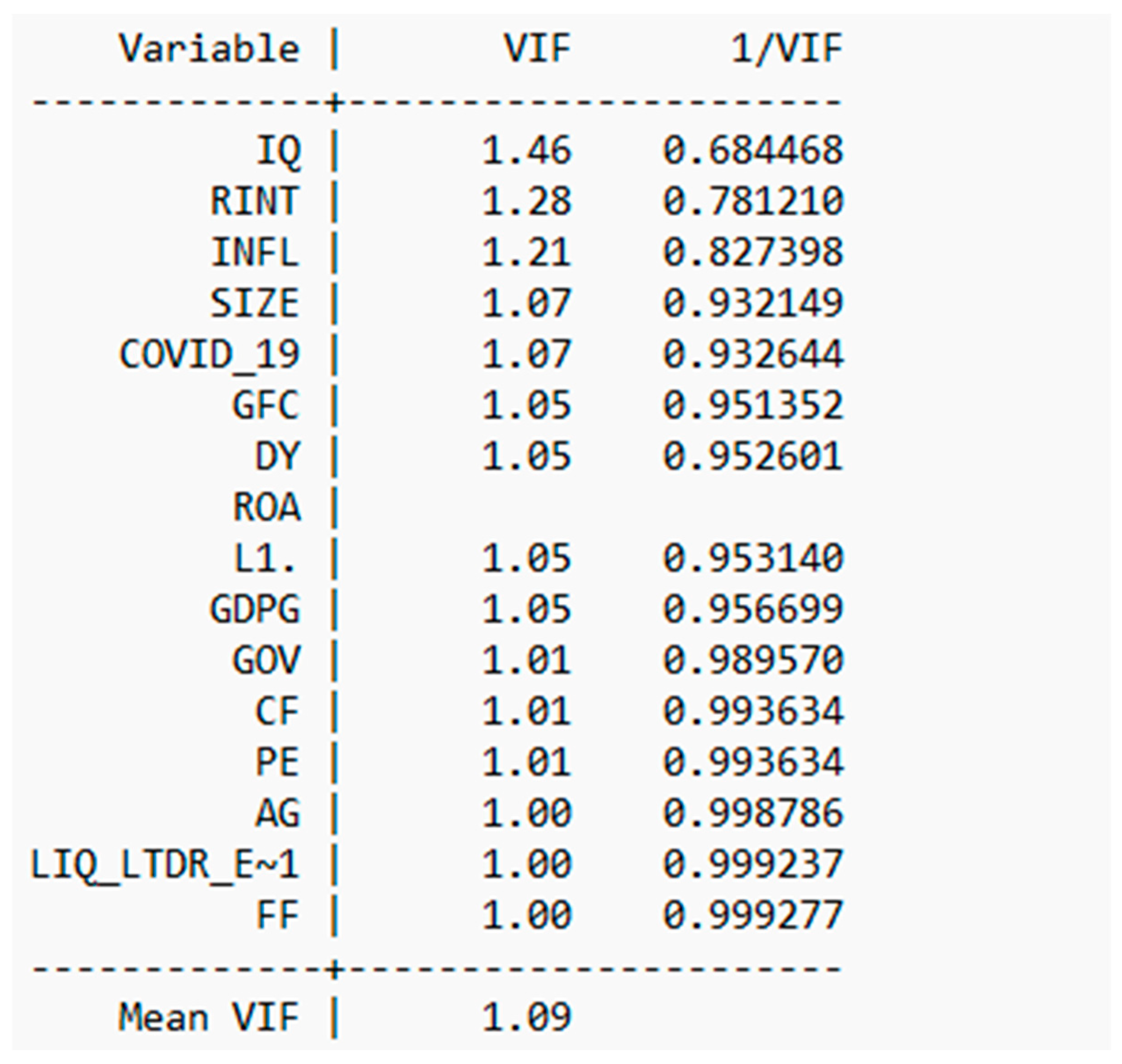
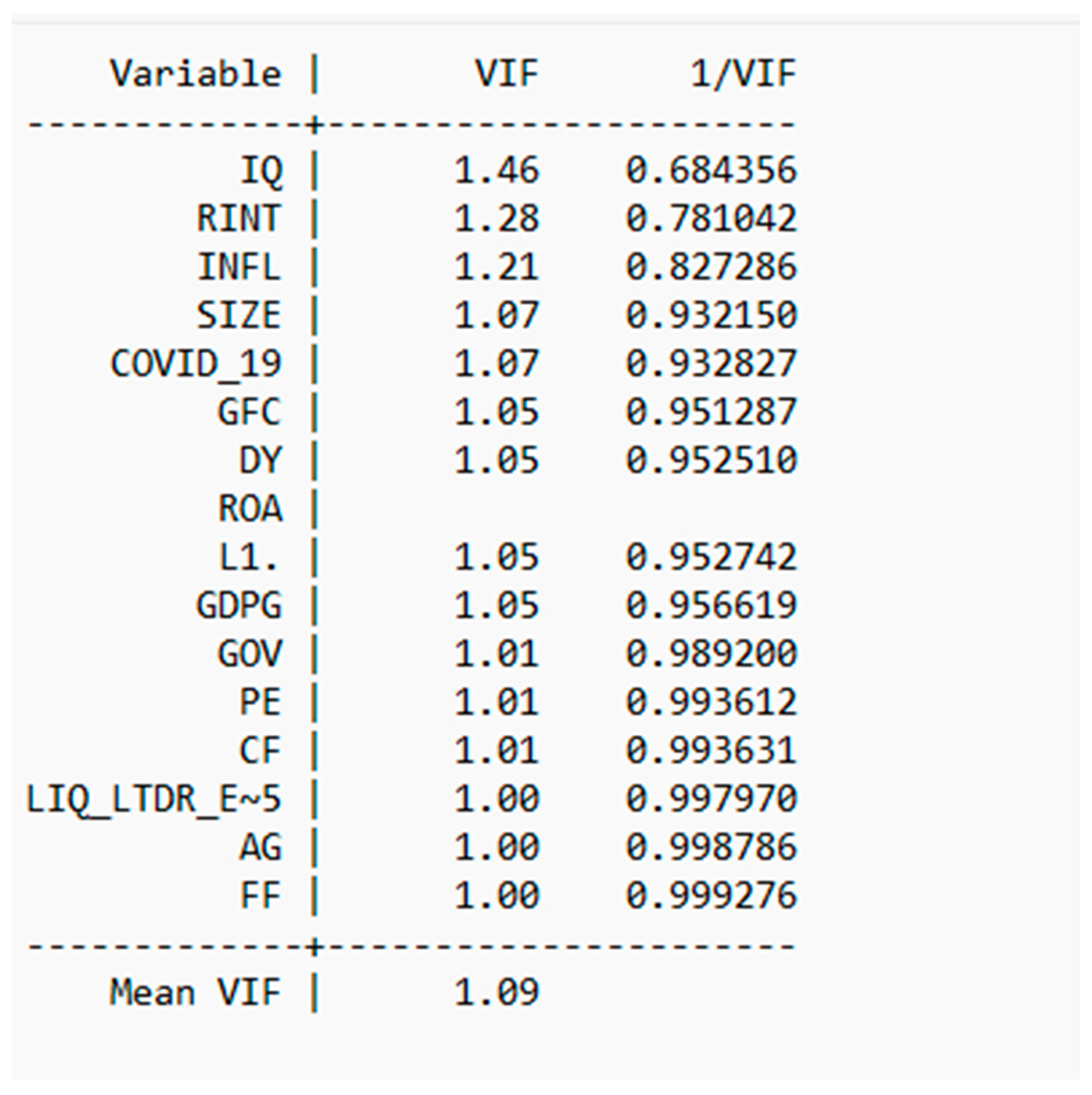
Figure A2.
VIF—Long-term debt (LTDR) at 5%.
References
- Abata, M. A., & Migiro, S. O. (2016). Does liquidity management affect profitability in selected Nigerian-quoted manufacturing firms? Journal of Economics and Behavioral Studies, 8(4(J)), 41–51. [Google Scholar] [CrossRef] [Scilit] [PubMed]
- Alarussi, A. S., & Alhaderi, S. M. (2018). Factors affecting profitability in Malaysia. Journal of Economic Studies, 45(3), 442–458. [Google Scholar] [CrossRef] [Scilit]
- Al-Nimer, M., Arabiat, O., & Taha, R. (2024). Liquidity risk mediation in the dynamics of capital structure and financial performance: Evidence from Jordanian banks. Journal of Risk and Financial Management, 17(8), 360. [Google Scholar] [CrossRef] [Scilit]
- Al-Slehat, Z. A. F. (2020). The impact of financial leverage on profitability in industrial companies listed on the Amman Stock Exchange. International Journal of Economics and Financial Issues, 10(2), 233–237. [Google Scholar] [CrossRef] [Scilit]
- Anarfo, E. B. (2015). Determinants of capital structure of banks: Evidence from Sub-Sahara Africa. Asian Economic and Financial Review, 5(4), 624–640. [Google Scholar] [CrossRef] [Scilit]
- Arhinful, R., Amin, H. I. M., Mensah, L., Gyamfi, B. A., & Obeng, H. A. (2025). Determining an optimal capital structure and its impact on financial performance: Insight from firms listed on the New York Stock Exchange. Cogent Economics & Finance, 13(1), 2571401. [Google Scholar] [CrossRef] [Scilit]
- Auret, C., Chipeta, C., & Krishna, S. (2020). Financial constraints and capital structure dynamics across the business cycle: Some evidence from the JSE. Studies in Economics and Econometrics, 37(1), 75–103. [Google Scholar] [CrossRef] [Scilit]
- Baker, M., & Wurgler, J. (2002). Market timing and capital structure. The Journal of Finance, 57(1), 1–32. [Google Scholar] [CrossRef] [Scilit]
- Bates, T. W., Kahle, K. M., & Stulz, R. M. (2009). Why do U.S. firms hold so much more cash than they used to? The Journal of Finance, 64(5), 1985–2021. [Google Scholar] [CrossRef] [Scilit]
- Ben-Caleb, E., Olubukunola, U., & Uwuigbe, U. (2013). Liquidity management and profitability of manufacturing companies in Nigeria. IOSR Journal of Business and Management, 9(1), 13–21. [Google Scholar] [CrossRef] [Scilit]
- Berger, A. N., & Udell, G. F. (1998). The economics of small business finance: The roles of private equity and debt markets in the financial growth cycle. Journal of Banking & Finance, 22(6–8), 613–673. [Google Scholar] [CrossRef] [Scilit]
- Bessler, W., Drobetz, W., & Haller, R. (2013a). The determinants of capital structure choices of firms around the world. Journal of Banking & Finance, 37(1), 103–118. [Google Scholar]
- Bessler, W., Drobetz, W., Haller, R., & Meier, I. (2013b). The international zero-leverage phenomenon. Journal of Corporate Finance, 23, 196–221. [Google Scholar] [CrossRef] [Scilit]
- Bordeleau, É., & Graham, C. (2010). The impact of liquidity on bank profitability (Bank of Canada Working Paper No. 2010-38). Bank of Canada. [Google Scholar]
- Botta, M., & Colombo, L. V. A. (2022). Non-linear capital structure dynamics. Journal of Business Finance & Accounting, 49(9–10), 1897–1928. [Google Scholar] [CrossRef] [Scilit]
- Boubakri, N., El Ghoul, S., Guedhami, O., & Wang, H. (2021). Corporate social responsibility in emerging market economies: Determinants, consequences, and future research directions. Emerging Markets Review, 46, 100752. [Google Scholar] [CrossRef] [Scilit]
- Brunzell, T., Liljeblom, E., Löflund, A., & Vaihekoski, M. (2013). Capital Structure Policy Decisions in Nordic Listed Firms. SSRN Electronic Journal. [Google Scholar] [CrossRef] [Scilit]
- Byoun, S., & Xu, Z. (2013). Why do some firms go debt free? Journal of Corporate Finance, 22, 1–18. [Google Scholar] [CrossRef] [Scilit]
- Chen, H., Xu, Y., & Yang, J. (2021). Systematic risk, debt maturity, and the term structure of credit spreads. Journal of Financial Economics, 139(3), 770–799. [Google Scholar] [CrossRef] [Scilit]
- Chen, R. R., El Ghoul, S., Guedhami, O., & Nash, R. (2018). State ownership and corporate cash holdings. Journal of Financial and Quantitative Analysis, 53(5), 2293–2334. [Google Scholar] [CrossRef] [Scilit]
- Çolak, G., Gungoraydinoglu, A., Öztekin, Ö., & Yilmaz, K. (2018). Global leverage adjustments, uncertainty, and country institutional strength. Journal of Financial Intermediation, 35, 41–56. [Google Scholar] [CrossRef] [Scilit]
- Dang, V. A. (2013). An empirical analysis of zero-leverage firms: New evidence from the UK. International Review of Financial Analysis, 30, 189–202. [Google Scholar] [CrossRef] [Scilit]
- Daryanto, W. M., Samidi, S., & Siregar, D. J. (2018). The impact of financial liquidity and leverage on financial performance: Evidence from property and real estate enterprises in Indonesia. Management Science Letters, 8(12), 1345–1352. [Google Scholar] [CrossRef] [Scilit]
- Denis, D. J., & McKeon, S. B. (2022). Rising intangibles, negative cash flows, and corporate funding practices. Journal of Applied Corporate Finance, 34(4), 42–50. [Google Scholar] [CrossRef] [Scilit]
- Dianti, P. M., & Bawono, A. D. B. (2024). The effect of capital structure, sales growth, working capital turnover, and liquidity on company profitability with firm size as a moderating variable. Enrichment: Journal of Management, 14(5), 875–883. [Google Scholar] [CrossRef]
- El Ghoul, S., Guedhami, O., Kwok, C. C. Y., & Mishra, D. R. (2011). Corporate environmental responsibility and the cost of capital: International evidence. Journal of Business Ethics, 149(2), 335–361. [Google Scholar] [CrossRef] [Scilit]
- Fajaryani, N. L. G. S., & Suryani, E. (2018). Capital structure, liquidity, and firm size on firm financial performance. Jurnal Riset Akuntansi Kontemporer, 10(2), 74–79. [Google Scholar] [CrossRef] [Scilit]
- Flannery, M. J., & Rangan, K. P. (2006). Partial adjustment toward target capital structures. Journal of Financial Economics, 79(3), 469–506. [Google Scholar] [CrossRef] [Scilit]
- Gungoraydinoglu, A., & Öztekin, Ö. (2011). Firm- and country-level determinants of corporate leverage: Some new international evidence. Journal of Corporate Finance, 17(5), 1457–1474. [Google Scholar] [CrossRef] [Scilit]
- Haris, M., Yao, H., & Fatima, H. (2024). The impact of liquidity risk and credit risk on bank profitability during COVID-19. PLoS ONE, 19(9). [Google Scholar] [CrossRef] [Scilit] [PubMed]
- Im, K. S., Pesaran, M. H., & Shin, Y. (2003). Testing for unit roots in heterogeneous panels. Journal of Econometrics, 115(1), 53–74. [Google Scholar] [CrossRef] [Scilit]
- Ishak, K., & Selamat, M. I. (2024). Liquidity and firm market value: The moderating role of firm size. Shirkah: Journal of Economics and Business, 10(1), 62–77. [Google Scholar] [CrossRef] [Scilit]
- Jahan, F., & Ryu, D. (2026). Corporate cash holdings under geopolitical risk: Global versus localized effects. Eurasian Business Review, 16, 651–676. [Google Scholar] [CrossRef] [Scilit]
- Jensen, M. C. (1986). Agency costs of free cash flow, corporate finance, and takeovers. American Economic Review, 76(2), 323–329. [Google Scholar]
- Jensen, M. C., & Meckling, W. H. (1976). Theory of the firm: Managerial behavior, agency costs and ownership structure. Journal of Financial Economics, 3(4), 305–360. [Google Scholar] [CrossRef] [Scilit]
- Jiang, W., Kang, J., & Kim, H. S. (2024). Is the zero-leverage policy value-enhancing? Quarterly Review of Economics and Finance, 93, 176–189. [Google Scholar] [CrossRef] [Scilit]
- Kayani, U. N., Gan, C., Choudhury, T., & Arslan, A. (2023). Working capital management and firm performance: Evidence from emerging African markets. International Journal of Emerging Markets, 20(4), 1530–1547. [Google Scholar] [CrossRef] [Scilit]
- Källum, M., & Sturesson, H. (2017). Financial leverage: The impact on Swedish companies’ financial performance [Bachelor’s thesis, Linnaeus University]. [Google Scholar]
- Khan, M. Y., Javeed, A., Cuong, L. K., & Pham, H. (2020). Corporate governance and cost of capital: Evidence from emerging market. Risks, 8(4), 104. [Google Scholar] [CrossRef] [Scilit]
- Khoza, F. (2025). The impact of liquidity and leverage on the financial performance of the Johannesburg Stock Exchange-listed consumer goods firms. Journal of Risk and Financial Management, 18(9), 510. [Google Scholar] [CrossRef] [Scilit]
- Korteweg, A. (2010). The net benefits to leverage. Journal of Finance, 65(6), 2137–2170. [Google Scholar] [CrossRef] [Scilit]
- Kraus, A., & Litzenberger, R. H. (1973). A state-preference model of optimal financial leverage. Journal of Finance, 28(4), 911–922. [Google Scholar] [CrossRef] [Scilit]
- Kurnia, R., Siregar, S. V., & Wardhani, R. (2020). The effect of corporate governance on capital structure: Evidence from Indonesia. Journal of Asian Finance, Economics and Business, 7(6), 271–280. [Google Scholar] [CrossRef] [Scilit]
- La Porta, R., Lopez-de-Silanes, F., & Shleifer, A. (1998). Law and finance. Journal of Political Economy, 106(6), 1113–1155. [Google Scholar] [CrossRef] [Scilit] [PubMed]
- Lemmon, M. L., Roberts, M. R., & Zender, J. F. (2008). Back to the beginning: Persistence and the cross-section of corporate capital structure. Journal of Finance, 63(4), 1575–1608. [Google Scholar] [CrossRef] [Scilit]
- Machokoto, M., & Marozva, G. (2022). Extreme changes in financing policies and firm value: Does institutional quality matter? SSRN Electronic Journal. [Google Scholar] [CrossRef] [Scilit]
- Mahrani, M., & Soewarno, N. (2018). The effect of good corporate governance mechanism and corporate social responsibility on financial performance with earnings management as mediating variable. Asian Journal of Accounting Research, 3(1), 41–60. [Google Scholar] [CrossRef] [Scilit]
- Marozva, G. (2019). Liquidity and stock returns: New evidence from the Johannesburg Stock Exchange. Journal of Developing Areas, 53(2), 79–90. [Google Scholar] [CrossRef] [Scilit]
- Marozva, G. (2026). Firm Performance, Liquidity and Capital Structure Nexus: Evidence from the PMG Panel-ARDL Approach. Risks, 14(3), 61. [Google Scholar] [CrossRef] [Scilit]
- Miglo, A. (2019). Capital structure in the modern world: Theory, evidence, and applications. Palgrave Macmillan. [Google Scholar]
- Modigliani, F., & Miller, M. H. (1958). The cost of capital, corporation finance and the theory of investment. The American Economic Review, 48(3), 261–297. [Google Scholar]
- Msomi, T. S. (2022). Evaluating the influence of leverage and liquidity on the financial performance of general insurance companies in Sub-Saharan Africa. Insurance Markets and Companies, 13(1), 36–46. [Google Scholar] [CrossRef] [Scilit]
- Mursalini, W. I., Nurhayati, & Azen, M. (2025). The effect of current ratio (CR) and debt to equity ratio (DER) on return on assets (ROA) in pharmaceutical subsector companies listed on the Indonesian Stock Exchange (BEI) period 2020–2023. Review of Global Economic Finance and Transformation, 1(1), 31–37. [Google Scholar] [CrossRef] [Scilit]
- Myers, S. C. (1984). The capital structure puzzle. The Journal of Finance, 39(3), 574–592. [Google Scholar] [CrossRef] [Scilit]
- Myers, S. C., & Majluf, N. S. (1984). Corporate financing and investment decisions when firms have information that investors do not have. Journal of Financial Economics, 13(2), 187–221. [Google Scholar] [CrossRef] [Scilit]
- Nassim, I., Nassim, S., & Moussa, A. (2025). Financial leverage and firm performance in Moroccan agricultural SMEs: Evidence of nonlinear dynamics. International Journal of Financial Studies, 13(3), 164. [Google Scholar] [CrossRef] [Scilit]
- Nguyen, N. H. P., & Tuyen, T. T. M. (2024). Impact of liquidity on capital structure and financial performance of non-financial-listed companies in the Vietnam stock market. Future Business Journal, 10(1), 12. [Google Scholar] [CrossRef] [Scilit]
- Nguyen, T. T. C., Le, A. T. H., & Nguyen, C. V. (2024). The impact of liquidity and corporate efficiency on profitability. Emerging Science Journal, 8(1), 180–191. [Google Scholar] [CrossRef] [Scilit]
- Nikhil, M. N., Shenoy, S. S., Chakraborty, S., & Lithin, B. M. (2024). Is the nexus between capital structure and firm performance asymmetric? An emerging market perspective. Cogent Economics & Finance, 12(1), 2296195. [Google Scholar] [CrossRef] [Scilit]
- North, D. C. (1990). Institutions, institutional change and economic performance. Cambridge University Press. [Google Scholar]
- Nowicki, J., Ratajczak, P., & Szutowski, D. (2024). Influence of macroeconomic factors on financial liquidity of companies: Evidence from Poland. Risks, 12(7), 114. [Google Scholar] [CrossRef] [Scilit]
- Nyamita, M. O., Garbharran, H. L., & Dorasamy, N. (2014). Factors influencing debt financing decisions of corporations: A theoretical and empirical literature review. Problems and Perspectives in Management, 12(4), 189–202. [Google Scholar]
- Okphiabhele, E., Ibitomi, T., Dada, D. A., & Micah, E. E. M. (2022). Working capital management and profitability of industrial goods sector in Nigeria. European Journal of Accounting, Auditing and Finance Research, 10(5), 74–90. [Google Scholar] [CrossRef] [Scilit]
- Olatunji, M. O., & Oladele, O. I. (2025). Corporate liquidity as a predictor variable of firm earnings in the Nigerian agricultural sector. International Journal of Financial, Accounting, and Management, 7(1), 2788. [Google Scholar] [CrossRef] [Scilit]
- Öztekin, Ö., & Flannery, M. J. (2012). Institutional determinants of capital structure adjustment speeds. Journal of Financial Economics, 103(1), 88–112. [Google Scholar] [CrossRef] [Scilit]
- Rasiah, D., & Kim, P. K. (2011). A theoretical review on the use of the static trade-off theory, the pecking order theory and the agency cost theory of capital structure. International Research Journal of Finance and Economics, 63, 150–159. [Google Scholar]
- Saona, P., Muro, L., & Gregoriou, A. (2023). The phenomenon of zero-leverage policy: A literature review. Research in International Business and Finance, 66, 102012. [Google Scholar] [CrossRef] [Scilit]
- Spence, M. (1973). Job market signaling. The Quarterly Journal of Economics, 87(3), 355–374. [Google Scholar] [CrossRef] [Scilit]
- Stoiljković, A., Tomić, S., Leković, B., Uzelac, O., & Ćurčić, N. V. (2024). The impact of capital structure on the performance of Serbian manufacturing companies: Application of agency cost theory. Sustainability, 16(2), 869. [Google Scholar] [CrossRef] [Scilit]
- Strebulaev, I. A., & Yang, B. (2013). The mystery of zero-leverage firms. Journal of Financial Economics, 109(1), 1–23. [Google Scholar] [CrossRef] [Scilit]
- Sunitha, K. (2024). Targeting behavior and capital structure theories: An empirical analysis of Gulf Cooperation Council countries. Journal of Behavioral and Experimental Finance, 43, 100944. [Google Scholar] [CrossRef] [Scilit]
- Tamba, A., & Purwanto, A. (2021). Determinants of capital structure and its impact on firm performance: Evidence from Indonesia. Journal of Asian Finance, Economics and Business, 8(3), 289–298. [Google Scholar] [CrossRef] [Scilit]
- Yang, J. (2025). Institutional differences, crisis shocks, and volatility structure: A by-window EGARCH/TGARCH analysis of ASEAN Stock Markets (SSRN Working Paper, 32p). Social Science Research Network. [Google Scholar]
- Yuliani, E. (2021). The effect of capital structure, liquidity, and sales growth on financial performance. Jurnal Ilmu Manajemen, 10(2), 111–122. [Google Scholar] [CrossRef] [Scilit]

Disclaimer/Publisher’s Note: The statements, opinions and data contained in all publications are solely those of the individual author(s) and contributor(s) and not of MDPI and/or the editor(s). MDPI and/or the editor(s) disclaim responsibility for any injury to people or property resulting from any ideas, methods, instructions or products referred to in the content. |
© 2026 by the authors. Licensee MDPI, Basel, Switzerland. This article is an open access article distributed under the terms and conditions of the Creative Commons Attribution (CC BY) license.