


Abstract
This study analyzes the relationship among insurance premium growth, underwriting risk, and insurer profitability, while also examining the mediating role of underwriting risk and the moderating role of reinsurance. The study utilizes an unbalanced panel dataset comprising 230 firm-year observations from 30 insurance companies operating in Vietnam over the period 2013–2023. The data were collected from the companies’ financial statements and annual reports. Observations with missing data or those that did not meet the requirements for empirical analysis were excluded from the final sample. The study employs two-step System GMM to control for model dynamics, endogeneity, and unobserved firm-specific heterogeneity. The results show that underwriting risk is persistent over time, whereas insurance premium growth has no statistically significant effect on underwriting risk, ROA, or ROE. Underwriting risk also has no significant effect on profitability. Therefore, its mediating role is not confirmed. Similarly, the interaction effect between premium growth and reinsurance is not statistically significant, providing no evidence of a moderating role for reinsurance. By contrast, the fixed asset ratio has a positive effect on both ROA and ROE, while ROE exhibits a negative adjustment pattern over time. The study indicates that premium growth alone is insufficient to improve profitability and highlights the importance of underwriting quality, efficient asset utilization, and risk management in insurance companies.
1. Introduction
Insurance plays an important role in the economy through its functions of providing financial protection, transferring risk, and mobilizing financial resources for investment activities. The development of the insurance market therefore matters not only to insurance companies themselves but is also closely linked to a country’s socioeconomic development. Demirci and Zeren (2017), examining 13 Organisation for Economic Co-operation and Development (OECD) countries, found evidence of a causal relationship from insurance premiums to economic growth in several countries. Similarly, Şenol et al. (2020), using data from 36 countries, identified a bidirectional causal relationship between life insurance and economic growth and also found causality running from economic growth to non-life insurance. These findings indicate that insurance activity is closely connected to a country’s economy and provide a basis for assessing insurer development not only in terms of scale but also in terms of efficiency and the system’s capacity to control risk.
At the firm level, growth is one of the key objectives of insurance companies. Choi (2010) shows that insurer growth is associated with characteristics such as firm size, age, input costs, and economies of scale. Nektarios (2010) approaches this issue from a dynamic perspective and argues that the growth process of the insurance industry is linked to simultaneous movements in assets, losses, inputs, and the level of insurance risk. This implies that the expansion of insurance operations not only generates revenue but also changes the firm’s risk structure. Accordingly, insurance premium growth should be examined in relation to underwriting quality and the ability to control losses arising from business operations.
From an economic perspective, premium growth can generate additional revenue and help firms improve profitability. However, the existing empirical evidence has not produced a consistent conclusion. Akotey et al. (2013) show that gross premium income is positively associated with underwriting profit among Ghanaian life insurers but negatively associated with investment income. Notably, the authors caution that excessive emphasis on premium growth without adequate underwriting and pricing quality may lead to overtrading and substantial underwriting losses. Olalekan (2018) also reports a positive but statistically insignificant effect of premium growth on the ROA of listed insurance companies in Nigeria. On the other hand, Pjanić et al. (2018) identify premium revenue growth as one of the important factors affecting the profitability of non-life insurance companies in Serbia.
Recent studies continue to show substantial differences in the effect of insurance premiums on profit. Riwayati and Natalia (2022) find that premium income has a positive and statistically significant effect on the profit of Indonesian insurance companies. Al-Zuhairi (2024) shows that total insurance premiums have a positive and significant effect on ROA, ROE, and the gross profit margin of insurance companies operating in Iraq. By contrast, Markonah et al. (2023) report a significant negative effect of premium income on profit. The authors explain that higher premiums may be accompanied by more claims, requiring a substantial portion of premium income to be used to pay losses and thereby reducing profit. These mixed findings suggest that insurance premium growth does not automatically translate into higher profitability; the quality of growth and the associated level of risk may play an important role in this process.
One mechanism that may explain these differences is underwriting risk. When a firm increases premium revenue by writing additional contracts, the scale of its insurance obligations and potential losses may also rise. If the firm does not price and select risks appropriately, the additional revenue may be offset by claims costs. Empirical evidence on the relationship between insurance risk and profitability is also not fully consistent. Mutua et al. (2023) show that insurance risk has a significant negative effect on the financial performance of Kenyan insurance companies. Olalekan (2018) reports a negative relationship between the claims ratio and ROA, although the relationship is not statistically significant. Berhe and Kaur (2017) finds no significant effect of the loss ratio on profitability in Ethiopia. In contrast, Morara and Sibindi (2021) report that insurance risk, measured by the combined ratio, is positively associated with the financial performance of the Kenyan insurance industry. These differences call for further examination of the mechanism linking growth, underwriting risk, and profitability rather than considering each direct relationship in isolation.
In addition to underwriting risk, reinsurance may play an important role as firms expand their operations. When premium growth increases the scale of insurance obligations, firms can use reinsurance to transfer part of the risk and adjust the amount of risk retained. Wu and Li (2021), in a study of property-liability insurance companies in China, develop an analytical framework for the effect of business structure on solvency through profitability and reinsurance behavior. The results show that the mediating channel through profitability is not confirmed, whereas the reinsurance channel exists; for foreign-invested insurers, reinsurance fully mediates the relationship between business structure and solvency. Mutua et al. (2023) also incorporate reinsurance risk into the analysis of financial performance and emphasize the need to maintain appropriate reinsurance for high-risk exposures. These findings suggest that reinsurance may be associated with the way business expansion and operating structure translate into the level of risk actually borne by the firm.
Although previous studies have provided extensive evidence on the determinants of insurer profitability, most focus on the direct effects of revenue or premium growth, insurance risk, size, leverage, and other financial characteristics. Alhassan et al. (2015) examine market structure, efficiency, and profitability. Owusu-Sekyere and Kotey (2019) consider the roles of assets, size, and debt in relation to ROA and ROE, while Zou et al. (2012) analyze the relationship between underwriting risk and investment risk. Research on mediating and moderating mechanisms in insurance remains limited. Makau and Okeyo (2021) show that crisis management may play a mediating role and that the regulatory framework may play a moderating role in the relationship between insurance operations and firm performance, while Wu and Li (2021) confirm the mediating role of reinsurance in the relationship between business structure and solvency.
This reveals a notable gap in the existing literature: the relationship among insurance premium growth, underwriting risk, and profitability has not been fully examined within an integrated framework, particularly when underwriting risk is considered a mediating mechanism and reinsurance is considered a factor that may alter the effect of premium growth on underwriting risk. Examining these relationships simultaneously is important because the same rate of premium growth may generate different financial outcomes depending on each firm’s underwriting quality and risk-transfer capacity.
Accordingly, this study examines the effect of insurance premium growth on underwriting risk and profitability, while analyzing the mediating role of underwriting risk in the relationship between premium growth and profitability as well as the moderating role of reinsurance in the relationship between premium growth and underwriting risk. This approach extends prior research from examining growth, risk, and profit separately to analyzing the mechanism linking the three factors, thereby helping clarify whether premium growth translates into financial performance and the role of risk management in that process.
The article is organized into five sections. Following the introduction, Section 2 presents the theoretical framework, reviews the relevant literature, and develops hypotheses concerning the relationships among insurance premium growth, underwriting risk, profitability, and reinsurance. Section 3 presents the research methodology, including the data and sample, variable measurement, research model, and System GMM estimation method. Section 4 presents and discusses the empirical results, including descriptive statistics, correlation analysis, multicollinearity tests, model adequacy tests, and estimates of the direct, mediating, and moderating relationships. Finally, Section 5 presents the conclusion, managerial implications, research limitations, and directions for future research.
2. Literature Review and Theoretical Framework
2.1. The Relationship Between Insurance Premium Growth and Insurers’ Underwriting Risk
Insurance premium growth reflects business expansion and the firm’s ability to increase the scale of its insurance portfolio. However, growth in the insurance industry is associated not only with revenue expansion but also with changes in losses, costs, and the level of risk borne by the firm. Nektarios (2010) argues that the growth process of the insurance industry is shaped by the relationship among assets, incurred losses, inputs, and the level of insurance risk. From this perspective, growth in insurance operations may change the firm’s risk level, particularly when the pace of business expansion is not aligned with its risk-management capacity.
This argument is reinforced by Akotey et al. (2013), who contend that excessive emphasis on insurance premium growth without adequate underwriting and pricing can lead to overtrading and substantial underwriting losses. This implies that pressure to expand premium revenue may increase risk if firms relax customer-selection standards or accept risks that are not commensurate with the premiums charged. Markonah et al. (2023) indicate that an increase in insurance premiums may be accompanied by a large number of claims, requiring a substantial portion of premium income to be used to pay losses. In addition, Choi (2010) shows that insurer growth differs according to size, age, and economies of scale, indicating that growth is a process influenced by firm-specific characteristics.
Thus, premium growth may create opportunities for business expansion while simultaneously changing the scale and structure of the risks accepted by the firm. Notably, previous studies have mainly examined premium growth in relation to profitability or firm growth, while direct evidence on the effect of premium growth on underwriting risk remains limited. Therefore, the study proposes:
Hypothesis 1 (H1).
Insurance premium growth affects insurers’ underwriting risk.
2.2. The Relationship Between Underwriting Risk and Insurer Profitability
Underwriting risk reflects the potential losses arising from contracts accepted by an insurance company. In economic terms, insurance operating performance depends on maintaining a balance between premiums received and related claims and expenses. When losses increase relative to premium income, underwriting performance may deteriorate and ultimately affect profitability. Jiang and Nieh (2012) show that underwriting profits in the insurance market are dynamic and fluctuate cyclically, reflecting the relationship among insurance pricing, risk acceptance, and underwriting performance.
The empirical evidence on this relationship is not entirely consistent. Mutua et al. (2023) show that insurance risk has a negative and statistically significant effect on the financial performance of Kenyan insurance companies. This finding indicates that higher levels of risk may reduce firms’ financial performance. Similarly, Olalekan (2018) reports a negative effect of the claims ratio on the ROA of Nigerian insurers, although the effect does not reach statistical significance. By contrast, Berhe and Kaur (2017) find no evidence of a significant effect of the loss ratio on the profitability of Ethiopian insurance companies. Morara and Sibindi (2021) even report that insurance risk, measured by the combined ratio, is positively associated with the financial performance of the Kenyan insurance industry.
The differences among these findings suggest that the relationship between underwriting risk and profitability may depend on market characteristics, measurement methods, and firms’ risk-management capabilities. Nevertheless, given the operating mechanism of insurance, higher losses increase the cost of fulfilling insurance obligations and may reduce underwriting performance. Therefore, the study expects underwriting risk to reduce profitability and proposes:
Hypothesis 2 (H2).
Underwriting risk has a negative effect on insurer profitability.
2.3. The Relationship Between Insurance Premium Growth and Insurer Profitability
Insurance premium growth may improve profitability by expanding revenue and the scale of operations. However, premium growth also creates additional insurance obligations, so the ultimate benefit depends on whether the firm can control claims and related costs. This helps explain why prior studies have not reached a consistent conclusion regarding the direction of the effect of premium growth on profitability.
Akotey et al. (2013) show that gross premium income is positively associated with underwriting profit but negatively associated with investment income among Ghanaian life insurance companies. Olalekan (2018) also finds a positive effect of premium growth on the ROA of Nigerian insurance companies, although the relationship is not statistically significant. On the other hand, Pjanić et al. (2018) identify premium revenue growth as one of the important factors explaining the profitability of non-life insurance companies in Serbia.
Other evidence provides stronger support for a positive relationship. Al-Zuhairi (2024) shows that total recorded insurance premiums have a positive and statistically significant effect on ROA, ROE, and the gross profit margin of insurance companies in Iraq. Similarly, Riwayati and Natalia (2022) report that premium income has a positive and significant effect on the profit of Indonesian insurance companies. However, Markonah et al. (2023) find a significant negative effect of premium income on profit and explain that higher premiums may be accompanied by more claims, requiring premium income to be used to pay losses.
These mixed findings indicate that premium growth does not automatically translate into higher profitability. The ultimate effect depends on the quality of the insurance portfolio and the costs and losses arising during the growth process. Therefore, the study does not specify the expected direction of the effect in advance and proposes:
Hypothesis 3 (H3).
Insurance premium growth affects insurer profitability.
2.4. Underwriting Risk Mediates the Relationship Between Insurance Premium Growth and Profitability
The relationship between insurance premium growth and profitability may occur not only through a direct effect but also through changes in underwriting risk. When a firm expands premium revenue, it simultaneously assumes additional insurance obligations. Therefore, the extent to which premium growth is converted into profit depends on the quality of the risks accepted and the losses incurred after underwriting.
Akotey et al. (2013) show that premium income can support underwriting profit while also warning that pursuing premium growth without appropriate underwriting and pricing can lead to substantial underwriting losses. Markonah et al. (2023) provide a similar argument by showing that higher premiums may be accompanied by more claims; in that case, the additional premium revenue must be used to pay losses and may reduce profit. At the next link in the transmission mechanism, Mutua et al. (2023) show that insurance risk has a significant negative effect on financial performance. The results obtained by Olalekan (2018), although not statistically significant, also show a negative sign for the claims ratio in relation to ROA.
Taken together, these lines of evidence provide a basis for a mechanism linking premium growth, underwriting risk, and profitability. In other words, premium growth may affect profitability partly through changes in the level of risk arising from the insurance portfolio. While previous studies have mainly examined the separate effects of premiums or risk on profit, direct evidence on underwriting risk as a mediating mechanism remains limited. Therefore, the study proposes:
Hypothesis 4 (H4).
Underwriting risk mediates the relationship between insurance premium growth and profitability.
2.5. Reinsurance Moderates the Relationship Between Insurance Premium Growth and Underwriting Risk
Technical reserves represent liabilities recognized by insurance companies to meet current and future obligations arising from insurance contracts. These reserves reflect financial commitments associated with underwriting activities and constitute an important component of insurers’ liability structures. Consequently, the relative magnitude of technical reserves may provide useful insights into the relationships among insurance obligations, asset structure, and underwriting risk.
The technical reserve ratio, calculated as total technical reserves divided by total assets, reflects the relative magnitude of insurance-related reserve liabilities within an insurer’s financial structure. A higher ratio indicates that liabilities associated with technical reserves represent a larger proportion of total assets. However, a higher technical reserve ratio does not necessarily indicate a greater capacity to meet financial obligations, a higher degree of reserve adequacy, or more effective risk management.
Insurance premium growth is typically associated with the expansion of underwriting activities and corresponding changes in insurers’ insurance obligations. However, the relationship between premium growth and underwriting risk may vary across insurers, depending on their liability structures, insurance portfolio characteristics, and underwriting policies. In particular, insurers with different technical reserve ratios may exhibit varying relationships between business expansion and underwriting risk, reflecting differences in the relative magnitude of recognized insurance obligations within their financial structures.
From this perspective, the technical reserve ratio may serve as a moderating variable in the relationship between insurance premium growth and underwriting risk. Nevertheless, the theoretical direction of this moderating effect remains ambiguous. On the one hand, a higher technical reserve ratio may reflect a greater concentration of insurance-related liabilities within an insurer’s financial structure, potentially strengthening the relationship between premium growth and underwriting risk. On the other hand, differences in technical reserve structures may be associated with more conservative underwriting practices or distinct insurance portfolio characteristics, potentially weakening this relationship.
It is important to emphasize that the technical reserve ratio is conceptually distinct from reinsurance. While reinsurance involves the transfer of a portion of insurance risk from an insurer to a reinsurer, technical reserves represent recognized liabilities associated with obligations arising from insurance contracts. Consequently, the technical reserve ratio does not directly measure reinsurance utilization, risk transfer capacity, or the adequacy of technical reserves.
Based on these theoretical arguments, this study examines whether the technical reserve ratio moderates the relationship between insurance premium growth and underwriting risk, without specifying the expected direction of the moderating effect. Examining this relationship may contribute to a better understanding of the role of insurance liability structures in business expansion and underwriting risk management Wu and Li (2021), Mutua et al. (2023).
Hypothesis 5 (H5).
The technical reserve ratio moderates the relationship between insurance premium growth and underwriting risk.
3. Research Methodology and Model
In this study, the System GMM method is selected because the model analyzing the relationship among insurance premium growth, underwriting risk, and profitability may be subject to endogeneity (Arellano & Bover, 1995; Blundell & Bond, 1998). For example, insurance premium growth may affect underwriting risk and profitability, while a firm’s decision to expand its business may simultaneously be influenced by performance and risk levels in previous periods. In addition, underwriting risk and profitability are dynamic and may be influenced by their past values. System GMM allows the use of lagged dependent variables, controls for endogeneity, limits bias arising from unobserved firm-specific factors, and uses appropriate lagged values as instruments. This provides a basis for obtaining more consistent and reliable estimates than conventional panel regression models.
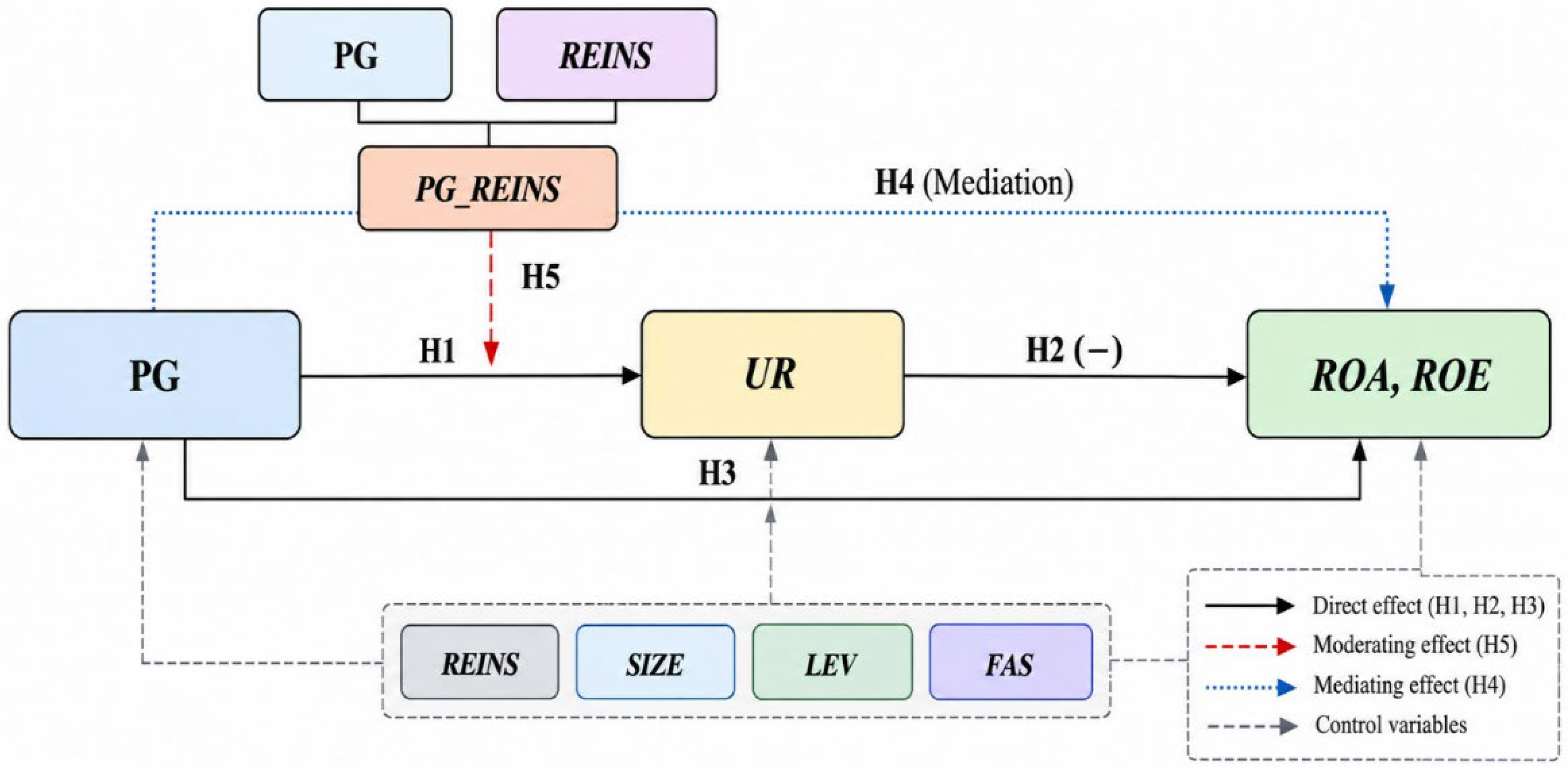
The research model is presented in Figure 1.
Figure 1.
Research Model. Note. Authors’ construction based on the theoretical framework.
The equations are specified as follows:
UR = α11URi(t−1) + β11PG + β12REINS+ β13 PG * REINS + β14Control + ε1it (Model 1)
ROA, ROE = α21 ROA, ROEi(t−1) + β21PG + β22UR+ β23Control + ε1it (Model 2a, 2b)
In the equation, Control = SIZE, FAS, LEV, REINS; t = 1, …, T and i = 1, …, N. T and N denote time periods and insurance companies, respectively. Underwriting risk (UR), Return on assets (ROA), Return on equity (ROE), Insurance premium growth (PG), Reinsurance (REINS), Interaction between insurance premium growth and reinsurance (PG * REINS), Fixed asset ratio (FAS), Financial leverage (LEV), and Firm size (SIZE). α and β are estimated coefficients. Cit is the control variable. εit is the random error term.
The research sample comprises 30 insurance companies operating in Vietnam during the period 2013–2023. Data were collected from the companies’ financial statements and annual reports. During the sample selection process, firm-year observations with missing or insufficient financial information required to construct the research variables were excluded to ensure data consistency and reliability. Furthermore, differences in the periods of operation and the availability of financial information across companies resulted in an unequal number of observations across years. Following the screening process, the final sample consists of 230 firm-year observations, forming an unbalanced panel dataset used for the empirical analysis.
The study applies System GMM to dynamic panel data to address model dynamics and potential endogeneity. To limit instrument proliferation, the study uses the collapse option and restricts the lag depth of the instruments (Roodman, 2009). This study utilizes panel data from 30 insurance companies operating in Vietnam during the period 2013–2023. The data were collected from the companies’ financial statements and annual reports and organized at the firm-year level. After excluding observations with missing data or those that did not meet the criteria for empirical analysis, the final sample comprises 230 firm-year observations, forming an unbalanced panel dataset.
Insurance companies may differ in their operational characteristics depending on whether they engage in life, non-life, or composite insurance business. These differences may be reflected in underwriting cycles, claims settlement periods, technical reserve structures, and risk profiles. Therefore, differences across insurance business types should be considered when analyzing and interpreting the empirical findings.
Model adequacy is further assessed using the AR(1) and AR(2) autocorrelation tests, the Hansen (1982) and Sargan (1958) tests, and the Difference-in-Hansen test. The results of these tests are presented in Table 1 and provide the basis for evaluating the validity of the moment conditions and the instrument set used in the System GMM model.
Table 1.
Description of Variables in the Research Model.
To mitigate the influence of outliers on the estimation results, this study applies two-tailed Winsorization at the 1st and 99th percentiles to all continuous variables. Specifically, observations below the 1st percentile are replaced with the corresponding 1st-percentile value, while observations above the 99th percentile are replaced with the corresponding 99th-percentile value. This procedure reduces the influence of extreme values while preserving the total number of observations in the dataset.
4. Empirical Results
Table 2 presents descriptive statistics on the distributional characteristics of the variables used in the research model, based on a total of 230 observations. The results show substantial differences in means, dispersion, and ranges across variables, reflecting heterogeneity in profitability, underwriting risk, insurance premium growth, reinsurance, and financial characteristics among the insurance companies in the sample.
Table 2.
Descriptive Statistics of the Research Variables.
Table 2 presents descriptive statistics for the variables used in the research model based on 230 observations. The mean values of ROA and ROE are 0.010 and 0.098, respectively, with ROE displaying greater variability. Underwriting risk (UR) has a mean of 0.494, while insurance premium growth (PG) has a mean of 0.192, indicating average premium growth of approximately 19.2%. The reinsurance variable (REINS) has a mean of 0.263, and the interaction variable PG_REINS has a mean of 0.032. Among the control variables, LEV and FAS have mean values of 0.019 and 0.014, respectively, while SIZE has a mean of 29.107. Overall, the variables exhibit different levels of dispersion, reflecting heterogeneity in profitability, underwriting risk, and financial characteristics across the insurance companies in the sample.
Table 3 presents the Pearson correlation coefficients among the research variables. ROA and ROE have a relatively high positive correlation (0.746), while UR is negatively correlated with both ROA and ROE. FAS is positively and statistically significantly correlated with ROA and ROE, whereas REINS has a significant negative correlation with UR. PG_REINS is positively correlated with PG and REINS but negatively correlated with UR. Overall, except for the correlation between ROA and ROE, the correlations among the explanatory variables are low to moderate and do not indicate serious multicollinearity.
Table 3.
Pearson Correlation Matrix.
Table 4 presents the multicollinearity test results for the research variables. VIF values range from 1.15 to 2.11, with a mean VIF of 1.64. REINS has the highest VIF (2.11), followed by FAS (2.05), while the remaining variables all have VIF values below 2. The results indicate that linear correlations among the explanatory variables are not high and there is no evidence of serious multicollinearity; therefore, the variables can continue to be used in the regression models.
Table 4.
Multicollinearity Test Results (VIF).
Table 5 presents the results of the model adequacy tests for the System GMM models. All three models use 14 instruments, fewer than the 30 groups, thereby limiting the risk of instrument proliferation. The AR(2) tests all have p-values greater than 0.05, indicating no evidence of second-order serial correlation. The Hansen and Difference-in-Hansen tests for all models have p-values greater than 0.05, supporting the validity of the instrument sets used. However, AR(1) is not statistically significant in any of the three models, and the Sargan test for the ROA model has a p-value of 0.000. Under two-step estimation with robust standard errors, the Hansen results are considered together with the Difference-in-Hansen and AR(2) tests when assessing the validity of the moment conditions. Overall, the test results provide a basis for continuing to use the System GMM models, while the AR(1) results and the Sargan test in the ROA model should be kept in mind when interpreting the empirical findings.
Table 5.
Results of Model Adequacy Tests.
The diagnostic test results presented in Table 5 indicate that the p-values for the first-order serial correlation test, AR(1), exceed 0.10 across all three models. Furthermore, the Sargan test for the ROA model yields a p-value of 0.000, leading to the rejection of the null hypothesis that the overidentifying restrictions are valid. These findings raise concerns about the specification of the dynamic panel models and the validity of the instrument set, warranting further investigation. In addition, alternative instrument specifications restricting instrument lags to the second and third periods (t − 2 and t − 3) are considered. The resulting estimates and diagnostic statistics are compared to evaluate the stability of the regression coefficients, the persistence of the dependent variables, and the validity of the System GMM specifications.
The diagnostic test results indicate that the null hypotheses of the AR(2), Hansen, and Difference-in-Hansen tests are not rejected in any of the three models. However, the AR(1) test is statistically insignificant across all models, while the Sargan test rejects the null hypothesis in the ROA model. These findings raise concerns about model specification and instrument validity. Therefore, the System GMM estimates should be interpreted with caution.
Table 6 shows that underwriting risk is persistent over time, as the lagged dependent variable in the UR model has a positive and statistically significant effect. In the profitability models, lagged ROE has a negative and significant effect, reflecting an adjustment pattern in return on equity across periods. Notably, FAS has a positive and statistically significant effect on both ROA and ROE, indicating a positive and consistent relationship between the asset factor and profitability. Meanwhile, PG, UR, REINS, the PG × REINS interaction term, LEV, and SIZE do not exhibit statistically significant effects in their respective models. The results also provide no empirical evidence of a moderating role for reinsurance in the relationship between premium growth and underwriting risk.
Table 6.
GMM Estimation Results.
- Model (1): Effects on Underwriting Risk (UR)
The regression results show that the lagged underwriting risk variable (L.UR) has a positive coefficient and is statistically significant at the 5% level (β = 0.6553; p < 0.05). This indicates that underwriting risk is persistent over time; that is, insurance companies with high underwriting risk in the previous period tend to continue exhibiting high risk in the current period. This finding implies that problems arising from underwriting activities may not be fully corrected within one period and may continue to affect subsequent periods.
Insurance premium growth (PG) has a positive coefficient (β = 0.0909) but is not statistically significant. The result provides no empirical evidence that insurance premium growth increases underwriting risk. In other words, expanding premium revenue does not necessarily lead to higher underwriting risk if the growth process is appropriately controlled.
The estimation results indicate that the interaction term between insurance premium growth and the technical reserve buffer has a positive coefficient (β = 0.3913), but the effect is not statistically significant. Therefore, the findings do not provide sufficient statistical evidence to support the moderating role of technical reserve ratio in the relationship between insurance premium growth and underwriting risk.
These findings should not be interpreted as evidence of the effects of reinsurance activities, as the REINS variable is measured using the ratio of technical reserves to total assets rather than reinsurance premiums or a direct measure of risk transfer to reinsurers.
Notably, the interaction between premium growth and reinsurance (PG × REINS) has a positive coefficient (β = 0.3913) but is not statistically significant. This result provides no evidence that reinsurance moderates the relationship between insurance premium growth and underwriting risk. Therefore, the hypothesis concerning the moderating role of reinsurance is not supported by the empirical results.
For the control variables, LEV has a negative coefficient (β = −0.5960), while FAS (β = 0.9102) and SIZE (β = 0.0176) have positive coefficients, but none is statistically significant. Thus, in this model, there is no evidence that financial leverage, the fixed asset ratio, or firm size has a significant effect on underwriting risk.
- Model (2a): Effects on Return on Assets (ROA)
The regression results show that the lagged ROA variable (L.ROA) has a positive coefficient (β = 0.0975) but is not statistically significant. This indicates that there is no evidence that return on assets in the previous period affects ROA in the current period.
Insurance premium growth (PG) has a positive coefficient (β = 0.0059) but is not statistically significant. This result provides no empirical evidence that insurance premium growth directly improves return on assets. It also implies that expanding premium revenue is insufficient to ensure profitability unless it is accompanied by cost control, underwriting quality, and efficient resource utilization.
Underwriting risk (UR) has a negative coefficient (β = −0.1534) but is not statistically significant. Although the direction of the effect is consistent with the argument that higher underwriting risk may reduce profitability, the empirical results do not provide sufficient evidence to conclude that UR affects ROA.
Reinsurance (REINS) also has a negative coefficient (β = −0.0515) but is not statistically significant. Thus, there is no evidence that the level of reinsurance has a direct effect on the ROA of the insurance companies in the sample.
Notably, FAS has a positive coefficient and is statistically significant at the 1% level (β = 1.7482; p < 0.01). The result shows that FAS has a positive effect on insurers’ return on assets. This is one of the study’s notable empirical findings and indicates that factors related to asset structure play a significant role in firms’ profitability.
Among the remaining control variables, LEV has a negative coefficient (β = −0.5320), while SIZE has a positive coefficient (β = 0.0183), but neither is statistically significant. Therefore, there is no evidence that financial leverage or firm size affects ROA in the research model.
- Model (2b): Effects on Return on Equity (ROE)
The regression results show that the lagged ROE variable (L.ROE) has a negative coefficient and is statistically significant at the 1% level (β = −0.3969; p < 0.01). This result indicates that return on equity tends to adjust in the opposite direction across periods. Specifically, a high ROE in the previous period tends to be followed by a downward adjustment in current-period ROE, reflecting an adjustment process or a tendency for profitability to revert toward equilibrium over time.
Insurance premium growth (PG) has a negative coefficient (β = −0.4419) but is not statistically significant. Therefore, there is no evidence that insurance premium growth affects ROE. Together with the ROA model, this result indicates that premium growth does not exhibit a statistically significant direct effect on insurer profitability under either ROA or ROE.
Underwriting risk (UR) has a positive coefficient (β = 0.1346) but is not statistically significant. Therefore, there is no empirical evidence that underwriting risk affects ROE. Notably, UR has a negative sign in the ROA model but a positive sign in the ROE model, and neither effect is statistically significant, indicating that the relationship between underwriting risk and profitability is not stable across the estimated models.
Reinsurance (REINS) has a negative coefficient (β = −0.3678) but is not statistically significant. Thus, there is no evidence that reinsurance directly changes return on equity. FAS again has a positive coefficient and is statistically significant at the 1% level (β = 24.3293; p < 0.01). This result is consistent with the ROA model, indicating that FAS is positively associated with insurer profitability under both ROA and ROE. The consistency in the sign and statistical significance of FAS across the two models makes this a notable finding and provides an important basis for managerial implications concerning asset structure and the efficiency of asset utilization.
For the remaining control variables, LEV has a positive coefficient (β = 2.2887) and SIZE has a positive coefficient (β = 0.0404), but neither is statistically significant. Therefore, there is no evidence that financial leverage or firm size affects ROE in the study sample.
Regarding Hypothesis 4 (H4), this study examines the mediating role of underwriting risk in the relationship between insurance premium growth and insurer profitability. Although the estimated models examine the relationships among premium growth, underwriting risk, and insurer profitability, this study does not formally estimate the indirect effect of premium growth on profitability through underwriting risk. Consequently, the findings do not provide sufficient evidence to confirm or reject the proposed mediating role of underwriting risk. This limitation should be addressed in future research using appropriate mediation analysis methods. Conceptually, this relationship comprises a direct effect of insurance premium growth on profitability and an indirect effect operating through underwriting risk. The estimation results indicate that the regression coefficients associated with these relationships are not statistically significant in the estimated models. Accordingly, the findings do not provide sufficient statistical evidence to support the hypothesized mediating role of underwriting risk. However, because the indirect effect was not formally tested, the absence of statistically significant individual coefficients should not be interpreted as conclusive evidence against mediation. Therefore, the findings should be interpreted with caution, and future research could employ formal mediation analysis to assess the direct, indirect, and total effects more comprehensively.
Across the three models, three findings stand out: underwriting risk is persistent over time; ROE exhibits a negative adjustment pattern across periods; and FAS has a positive and consistent effect on both ROA and ROE. By contrast, the study finds no statistical evidence of a direct effect of premium growth on underwriting risk or profitability, an effect of underwriting risk on ROA or ROE, or a moderating role of reinsurance in the relationship between premium growth and underwriting risk.
To address potential outliers, this study applies two-tailed Winsorization at the 1st and 99th percentiles to all continuous variables and subsequently re-estimates the empirical models. The resulting estimates are compared with the original estimates to assess the robustness of the regression coefficients and the extent to which extreme observations influence the empirical findings.
The empirical results indicate that hypotheses H1, H2, and H3 are not supported, as neither insurance premium growth nor underwriting risk has a statistically significant effect on the respective dependent variables. Regarding H4, the findings provide insufficient statistical evidence to support the mediating role of underwriting risk, although the indirect effect has not been formally tested. Similarly, H5 is not supported, as the interaction between insurance premium growth and insurance technical reserve ratio is not statistically significant. Overall, the findings suggest that the proposed relationships are not statistically supported within the study sample.
It is important to emphasize that statistically insignificant coefficients do not necessarily imply the absence of underlying economic relationships. Rather, such findings indicate that the empirical analysis does not provide sufficient statistical evidence to establish these relationships within the context of the sample and estimation methods employed. Therefore, statistically insignificant results should be interpreted with caution and should not be regarded as conclusive evidence of the absence of economic effects.
5. Policy Implications
The managerial and policy implications of this study are informed primarily by statistically significant empirical findings, while taking into account the limitations of the data and estimation methods employed. The results reveal a positive and statistically significant association between the fixed asset ratio and insurer profitability, suggesting that asset structure may be an important consideration in the financial management of insurance companies. However, this finding does not necessarily imply that increasing investment in fixed assets would lead to improved profitability. Furthermore, the empirical results do not provide sufficient statistical evidence to establish significant relationships between insurance premium growth, underwriting risk, and insurer profitability, or to support the moderating role of the technical reserve ratio in the relationship between insurance premium growth and underwriting risk. Accordingly, managerial and policy recommendations concerning these factors should be formulated cautiously, avoiding overly definitive or prescriptive conclusions. Moreover, the diagnostic limitations associated with the System GMM estimation should be considered when interpreting and applying these findings to managerial decision-making and policy formulation.
Based on the empirical findings, the authors propose the following measures:
First, establish a cyclical underwriting-risk treatment mechanism to limit the accumulation and transmission of risk across periods.
The first statistically meaningful result of the model is that underwriting risk in the previous period has a positive effect on underwriting risk in the current period. This finding indicates that the main concern lies not only in the level of risk at a particular point in time but also in the possibility that risk already embedded in the portfolio may persist into subsequent periods. Therefore, the solution should focus directly on reducing the persistence of underwriting risk.
Insurance companies should shift from managing risk on a year-by-year basis to managing it according to portfolio history. At the end of each period, lines of business, products, customer groups, and distribution channels should be classified based on underwriting performance and actual losses. Portfolios that recorded high risk in the previous period should not continue to be underwritten in the next period using the same premium rates, policy terms, and risk-acceptance standards. Instead, firms should adopt measures such as adjusting premiums, narrowing coverage, changing deductibles, limiting sums insured, tightening underwriting standards, or declining risks that no longer meet requirements.
A key requirement is to establish a mechanism of “prior-period risk—next-period underwriting decision.” Claims and loss outcomes should not serve only to evaluate past performance but must become input data for new underwriting activities. If a customer group consistently generates high losses, the firm should identify the causes and adjust its policy before continuing to expand that customer segment. If a product shows a rising risk trend, the firm should review the product design, premium rate, and insurance terms rather than continuing the existing policy unchanged.
In addition, firms should establish risk-warning thresholds for each line of business. When the risk level exceeds a threshold, the system should trigger a portfolio review rather than waiting until the end of the financial year. This approach is particularly important because the study’s results show that risk is persistent over time; if it is not addressed early, problems in one period may continue to affect the next period.
Thus, the direct implication of the lagged underwriting-risk coefficient is not simply to “strengthen risk management.” More specifically, firms must establish an interperiod risk-treatment mechanism that uses past risk outcomes as a basis for adjusting current underwriting policies. This is the solution that directly corresponds to the persistence of risk identified in the model.
Second, restructure assets to enhance profit-generating capacity across both total assets and equity.
The second notable empirical finding is that FAS has a positive and significant effect on both ROA and ROE. Unlike many variables in the model that are not statistically significant, the FAS result is consistent across both profitability measures. Therefore, it should be treated as a central focus within the group of measures aimed at improving profitability.
However, the recommendation should not be framed as simply “increasing fixed assets,” because a positive coefficient is insufficient to conclude that profit will rise whenever fixed assets increase. The managerial issue lies in asset structure and the efficiency of asset utilization. Insurance companies should identify the assets that genuinely support revenue generation, cost control, and higher operating productivity, and then prioritize resources for those assets.
Firms should begin by reviewing the entire portfolio of assets used in business operations and classifying them according to their contribution to core activities. Assets that can directly support underwriting, policy administration, loss assessment, claims handling, customer management, and data processing should be prioritized for use and investment. By contrast, assets with low utilization, high maintenance costs, or limited suitability for the firm’s current business model should be restructured.
In particular, asset investment must be linked to the ability to improve productivity. When a firm expands the number of contracts but staffing and processing procedures increase proportionally, the additional revenue may be absorbed by operating costs. Therefore, assets supporting underwriting automation, policy administration, data analytics, and claims processing should be directed toward helping the firm manage a larger scale of business without a corresponding increase in costs.
Firms also need to change how investment decisions are evaluated. Rather than considering only the need to purchase or expand assets, each investment should be assessed in terms of its ability to support revenue, reduce costs, shorten processing time, or improve the quality of risk control. After investment, actual utilization should continue to be assessed to avoid increasing asset holdings while maintaining low utilization efficiency.
Importantly, the study’s results show that FAS is associated with both ROA and ROE. Asset management should therefore aim not only to improve the efficiency of total asset utilization but also to enhance the efficiency with which shareholders’ capital is used. Financial resources should be allocated to assets capable of supporting core business operations and creating long-term value rather than being dispersed across assets that do not directly improve operating capacity.
Accordingly, the solution arising directly from the FAS coefficient is to restructure assets and improve asset-utilization efficiency according to their profit-generating capacity, rather than simply increasing asset scale. This is also the recommendation with the clearest empirical basis in the study because the result is observed simultaneously for both ROA and ROE.
Third, establish an interperiod ROE stabilization mechanism to limit reversals in profitability.
The next significant finding is that ROE in the previous period has an opposite-direction effect on current-period ROE. The important point is not merely that ROE “rises and then falls,” but that return on equity tends to adjust across periods. Therefore, the proposed measure should directly target lower volatility and greater sustainability of ROE.
Firms should first distinguish between a high ROE that is sustainable and a high ROE generated by temporary factors. If ROE rises strongly because core operating efficiency improves, asset productivity increases, and costs are controlled, this provides a favorable basis for sustaining profitability. Conversely, if ROE rises because of abnormal income, changes in the scale of equity, or other non-recurring factors, the firm should not use that result as the basis for setting a higher ROE target for the next period.
Accordingly, ROE planning should be developed over multi-year cycles rather than by setting independent targets for each year. When ROE fluctuates sharply, firms should analyze the portion of the variation arising from insurance operations, investment activities, costs, assets, and equity. Decomposing the sources of ROE helps firms distinguish between profit that can be sustained and profit that is temporary.
At the same time, firms should avoid using short-term decisions to cosmetically improve ROE. Delaying necessary investment, excessively cutting expenditures for risk management, or pursuing high-return but high-risk activities may raise ROE in one period but create downward pressure on profit in the next. This is precisely the issue that warrants attention when the empirical results show that ROE adjusts in the opposite direction across periods.
The recommendation should also be linked to the FAS result. When FAS has a positive effect on ROE while lagged ROE has an opposite-direction effect, firms should prioritize generating ROE through genuine improvements in resource-use efficiency rather than through short-term factors. This can increase current ROE while also providing a basis for sustaining profitability in subsequent periods.
Therefore, the recommendation corresponding to the lagged ROE coefficient is to establish an ROE management mechanism oriented toward interperiod stability, control the sources of profit generation, and prioritize profit-generating factors that can be sustained rather than maximizing ROE in each individual year.
To assess the consistency of the empirical findings, the estimated coefficients from the ROA and ROE models are compared. The results indicate that neither insurance premium growth nor underwriting risk has a statistically significant effect on either measure of profitability. In contrast, the fixed asset ratio (FAS) exhibits a positive and statistically significant association with both ROA and ROE. The consistency in the direction and statistical significance of these coefficients suggests that the main findings are broadly consistent across the two profitability measures. However, this consistency alone does not establish the robustness of the results to alternative model specifications.
Furthermore, the study covers the period from 2013 to 2023, including the years affected by the COVID-19 pandemic. The exceptional economic and financial disruptions during this period may have influenced underwriting activities, operating performance, and insurer profitability. Since additional estimations excluding the pandemic years or employing alternative lag structures were not conducted, the sensitivity of the estimated coefficients to these changes remains uncertain. Accordingly, this limitation should be considered when interpreting the empirical findings. Future research could address this issue by employing alternative lag specifications and excluding atypical periods to further assess the robustness and reliability of the results.
6. Conclusions
This study investigates the relationships among insurance premium growth, underwriting risk, and insurer profitability, with particular emphasis on the moderating role of insurance technical reserve ratio. Using System Generalized Method of Moments (System GMM), the findings indicate that underwriting risk exhibits persistence over time. However, insurance premium growth has no statistically significant effect on underwriting risk, return on assets (ROA), or return on equity (ROE). Furthermore, the results provide no statistically significant evidence that underwriting risk affects insurer profitability or that technical reserve ratio moderates the relationship between premium growth and underwriting risk. Notably, the fixed asset ratio (FAS) has a positive and statistically significant association with both ROA and ROE, while ROE exhibits a negative dynamic adjustment pattern across periods. Overall, the findings suggest that premium growth alone does not necessarily translate into improved profitability, highlighting the importance of effective asset utilization and prudent underwriting risk management.
This study is subject to several limitations related to its estimation methods and hypothesis testing. Specifically, the insignificant AR(1) test results and the rejection of the null hypothesis by the Sargan test for the ROA model raise concerns about the validity of the instrument specifications within the System GMM framework. Moreover, the absence of comprehensive comparisons across alternative instrument specifications and outlier treatment methods limits the assessment of the robustness of the estimation results. In addition, the indirect effect of insurance premium growth on insurer profitability through underwriting risk has not been formally tested, preventing definitive conclusions regarding the mediating role of underwriting risk. Accordingly, the empirical findings should be interpreted with caution. Future research should employ alternative instrument specifications, conduct additional robustness checks, and apply appropriate statistical methods to estimate indirect effects, thereby providing a more comprehensive assessment of the reliability of the empirical findings.
Author Contributions
Conceptualization, N.A.N. and T.V.H.; methodology, N.A.N. and T.V.H.; software, N.A.N. and T.V.H.; validation, N.A.N. and T.V.H.; formal analysis, N.A.N. and T.V.H.; investigation, N.A.N. and T.V.H.; resources, N.A.N. and T.V.H.; data curation, N.A.N. and T.V.H.; writing—original draft preparation, N.A.N., T.V.H.; writing—review and editing, N.A.N., T.V.H.; visualization, N.A.N., T.V.H.; supervision, N.A.N., T.V.H.; project administration, T.V.H.; funding acquisition, T.V.H. All authors have read and agreed to the published version of the manuscript.
Funding
This research received no external funding.
Institutional Review Board Statement
Not applicable.
Informed Consent Statement
Not applicable.
Data Availability Statement
The data presented in this study are available on request from the corresponding author due to privacy concerns.
Conflicts of Interest
The authors declare no conflicts of interest.
References
- Akotey, J. O., Sackey, F. G., Amoah, L., & Manso, R. F. (2013). The financial performance of life insurance companies in Ghana. The Journal of Risk Finance, 14(3), 286–302. [Google Scholar] [CrossRef] [Scilit]
- Alhassan, A. L., Addisson, G. K., & Asamoah, M. E. (2015). Market structure, efficiency and profitability of insurance companies in Ghana. International Journal of Emerging Markets, 10(4), 648–669. [Google Scholar] [CrossRef] [Scilit]
- Al-Zuhairi, A. K. H. (2024). Analysis of underwriting activity and its impact on the profitability ratios of the insurance companies listed in the Iraq stock exchange. Studia Universitatis “Vasile Goldis” Arad-Economics Series, 34(2), 1–31. [Google Scholar] [CrossRef] [Scilit]
- Arellano, M., & Bover, O. (1995). Another look at the instrumental variable estimation of error-components models. Journal of Econometrics, 68(1), 29–51. [Google Scholar] [CrossRef] [Scilit]
- Berhe, T. A., & Kaur, J. (2017). Determinants of insurance companies’ profitability: Analysis of insurance sector in Ethiopia. International Journal of Research in Finance and Marketing, 7(4), 124–137. [Google Scholar]
- Blundell, R., & Bond, S. (1998). Initial conditions and moment restrictions in dynamic panel data models. Journal of Econometrics, 87(1), 115–143. [Google Scholar] [CrossRef] [Scilit]
- Choi, B. P. (2010). The U.S. property and liability insurance industry: Firm growth, size, and age. Risk Management and Insurance Review, 13(2), 207–224. [Google Scholar] [CrossRef] [Scilit]
- Demirci, Ş. D., & Zeren, F. (2017). Insurance premium and economic growth: Evidence from OECD countries. The Journal of Business Science, 5(1), 1–11. [Google Scholar] [CrossRef] [Scilit]
- Hansen, L. P. (1982). Large sample properties of generalized method of moments estimators. Econometrica, 50(4), 1029–1054. [Google Scholar] [CrossRef] [Scilit]
- Jiang, S.-J., & Nieh, C.-C. (2012). Dynamics of underwriting profits: Evidence from the U.S. insurance market. International Review of Economics & Finance, 21(1), 1–15. [Google Scholar] [CrossRef] [Scilit]
- Makau, L., & Okeyo, W. (2021). Risk underwriting, crisis management, regulatory framework and performance of insurance companies in Kenya: A case of Sanlam general insurance company. Journal of Human Resource & Leadership, 5(3), 96–113. [Google Scholar] [CrossRef] [Scilit]
- Markonah, M., Riwayati, H. E., & Kumalasari, R. (2023). The effect of premium income, expenses claim, and underwriting on profitability of Indonesia joint enterprises insurance companies. Journal Siasat Bisnis, 27(2), 219–234. [Google Scholar] [CrossRef] [Scilit]
- Morara, K., & Sibindi, A. B. (2021). Assessing the solvency, underwriting risk and profitability of the Kenyan insurance sector. Acta Universitatis Danubius. Œconomica, 17(5). Available online: https://dj.univ-danubius.ro/index.php/AUDOE/article/view/1243 (accessed on 4 November 2026).
- Mutua, B. M., Wamugo, L., & Theuri, J. (2023). Insurance risks and financial performance of insurance companies in Kenya. Journal of Finance and Accounting, 7(2), 43–68. [Google Scholar] [CrossRef] [Scilit]
- Nektarios, M. (2010). A growth theory for the insurance industry. Risk Management and Insurance Review, 13(1), 45–60. [Google Scholar] [CrossRef] [Scilit]
- Olalekan, L. I. (2018). Effect of liquidity risk, premium growth on the performance of quoted insurance firms in Nigeria: A panel data analysis. American Finance & Banking Review, 2(1), 44–53. [Google Scholar] [CrossRef] [Scilit]
- Owusu-Sekyere, F., & Kotey, R. A. (2019). Profitability of insurance brokerage firms in Ghana. Academic Journal of Economic Studies, 5(2), 179–192. [Google Scholar]
- Pjanić, M., Milenković, N., Kalaš, B., & Mirović, V. (2018). Profitability determinants of non-life insurance companies in Serbia. Journal of Business Economics and Management, 19(3), 333–345. [Google Scholar] [CrossRef] [Scilit]
- Riwayati, H. E., & Natalia, S. (2022). Analysis of the effect of premium income, underwriting ratio, return on investment and return on equity on profit of insurance company. Management Research Studies Journal, 3(2), 49–57. [Google Scholar] [CrossRef] [Scilit]
- Roodman, D. (2009). How to do xtabond2: An introduction to difference and system GMM in Stata. Stata Journal, 9(1), 86–136. [Google Scholar] [CrossRef] [Scilit]
- Sargan, J. D. (1958). The estimation of economic relationships using instrumental variables. Econometrica, 26(3), 393–415. [Google Scholar] [CrossRef] [Scilit]
- Şenol, Z., Zeren, F., & Canakci, M. (2020). The relationship between insurance and economic growth. Montenegrin Journal of Economics, 16(4), 145–156. [Google Scholar] [CrossRef] [Scilit]
- Wu, S., & Li, Y. (2021). Impact of the business structure on solvency of property-liability insurance companies and its mediating effect. Discrete Dynamics in Nature and Society, 2021(1). [Google Scholar] [CrossRef] [Scilit]
- Zou, H., Wen, M.-M., Yang, C., & Wang, M. (2012). Underwriting and investment risks in the property-liability insurance industry: Evidence prior to the 9–11 event. Review of Quantitative Finance and Accounting, 38(1), 25–46. [Google Scholar] [CrossRef] [Scilit]

Disclaimer/Publisher’s Note: The statements, opinions and data contained in all publications are solely those of the individual author(s) and contributor(s) and not of MDPI and/or the editor(s). MDPI and/or the editor(s) disclaim responsibility for any injury to people or property resulting from any ideas, methods, instructions or products referred to in the content. |
© 2026 by the authors. Licensee MDPI, Basel, Switzerland. This article is an open access article distributed under the terms and conditions of the Creative Commons Attribution (CC BY) license.