


Abstract
Private sector credit is central to economic diversification in resource-rich economies, yet the joint informational role of institutional quality and digital connectivity remains insufficiently examined. This study analyzes the predictors of domestic credit to the private sector in Azerbaijan over 1995–2025 using elastic net regression, which selects informative predictors among correlated candidates. Seven institutional, digital, external-sector, and macro-financial predictors are considered. Internet usage and regulatory quality carry most of the predictive information, while government effectiveness and net FDI inflows are largely redundant given these two variables. The baseline model explains 79.8% of the in-sample variation in credit (RMSE = 4.35 percentage points of GDP). Time-respecting cross-validation selects a sparser lasso-type specification that retains the same two leading predictors. The results hold after linear detrending but weaken under quadratic detrending and in first differences, and persistence-based benchmarks outperform the model in one-year-ahead forecasting. Bounds tests indicate a long-run relationship between credit, internet usage, and regulatory quality. The findings therefore describe long-run co-movement in credit depth rather than short-run dynamics or causal effects. Results also suggest that digital and institutional conditions are jointly informative about credit development in Azerbaijan.
1. Introduction
1.1. Financial Depth, Economic Diversification, and the Azerbaijan Context
The proposition that financial depth contributes to structural economic transformation has long occupied a central position in development economics. Its relevance is particularly pronounced in economies where resource revenues can be generated with relatively limited reliance on domestic financial intermediation, while firms operating outside the extractive sector remain dependent on domestic credit to finance investment and expansion (Levine et al., 2000). Bank credit enables non-resource firms to finance fixed capital formation, maintain working capital, and expand production beyond the constraints imposed by internally generated cash flow. When credit markets remain shallow, therefore, productive investment may be constrained not by a lack of viable opportunities, but by limited access to the financial resources required to exploit them. Private-sector credit can consequently be viewed as an important transmission mechanism through which non-resource economic activity can be sustained as resource revenues weaken, fluctuate, or become increasingly uncertain. This issue is particularly relevant to Azerbaijan, a small oil-exporting economy in the South Caucasus that has inherited important institutional features of a centrally planned financial system while pursuing economic diversification as a sustained policy objective.
Existing evidence from Azerbaijan supports the broader economic importance of credit development. Bank credit has been shown to be positively associated with economic growth and money supply over the long run (F. J. Hasanov & Huseynov, 2013), while subsequent evidence identifies a more specific relationship between credit expansion, non-oil GDP, and output in non-oil tradable sectors. This distinction is economically important because the expansion of non-hydrocarbon tradable activities is central to reducing the economy’s dependence on the extractive sector. One estimate indicates that a 1% increase in bank credit is associated with approximately a 0.5% increase in non-oil GDP in the long run (Mukhtarov et al., 2019), suggesting that developments in credit markets may have substantial implications for the country’s diversification process. Complementary evidence indicates that financial development strengthens the positive effect of oil rents on non-oil growth, implying that financial deepening can operate as a complementary mechanism through which resource revenues are transformed into broader economic activity (F. J. Hasanov et al., 2023). The close relationship between credit aggregates and money-supply growth observed since the 2000s further suggests that credit conditions remain closely connected to broader monetary and financial dynamics in Azerbaijan (Zeynalova, 2024).
Nevertheless, the expansion of credit should not be interpreted as an automatic indication of improved financial intermediation. Azerbaijan’s financial system continues to exhibit structural constraints that may limit the effectiveness of credit as a mechanism for private-sector development. Evidence on the bank-lending channel suggests that monetary policy transmission remains relatively weak, with lending rates responding only modestly to changes in policy rates. At the same time, persistent excess liquidity appears to strengthen banks’ pricing power and contributes to relatively high commercial lending rates (Jamilov, 2015). These constraints are particularly relevant for small and medium-sized enterprises, which face a combination of high financing costs, information asymmetries, and stringent collateral requirements. Such barriers have been sufficiently persistent to motivate policy interventions, including partial credit-guarantee mechanisms intended to improve access to finance (Mammadov et al., 2023). The evidence therefore indicates that the volume of private credit cannot be understood solely through aggregate monetary or macroeconomic conditions. The supply and allocation of credit also depend on the institutional and informational environment in which financial institutions assess borrowers, price risk, and enforce repayment.
1.2. Institutional Quality and Digital Connectivity as Predictors of Private Credit
The theoretical background rests on the view that credit market development depends on reducing information asymmetries, transaction costs, and institutional risks that constrain effective financial intermediation. This perspective places institutional quality at the center of the analysis of credit-market development. From the perspective of financial intermediation, effective legal and regulatory institutions can reduce the uncertainty associated with lending by strengthening creditor protection, improving contract enforcement, and increasing the effectiveness of financial regulation. Cross-country evidence generally associates these institutional characteristics with deeper private-credit markets (Djankov et al., 2007; La Porta et al., 1997). The relationship, however, is not necessarily linear or universally positive. Evidence from the Middle East and North Africa shows that improvements in institutional quality may coincide with stronger economic growth while being associated with lower levels of private credit and private investment in some circumstances (Kandil, 2009). Other research suggests that institutional improvements may initially constrain capital formation until specific institutional or economic thresholds are reached (Ameer et al., 2020). Similarly, evidence from post-Soviet economies points to a nonlinear relationship between institutional quality and economic performance, indicating that the effect of institutional change cannot be adequately represented by a simple monotonic specification (Gasimov et al., 2023). These findings are particularly relevant for Azerbaijan, where institutional arrangements have evolved within a transition economy and where the economic effects of institutional improvement may depend on the broader financial and structural context. Consequently, the contribution of institutional quality to private-credit development remains an empirical question rather than an assumption that can be imposed a priori.
Digital connectivity represents another potentially important determinant of financial deepening. The rapid diffusion of internet-based technologies and fintech services has altered the mechanisms through which financial institutions identify, assess, and serve borrowers. Cross-country evidence associates greater fintech penetration and digital financial infrastructure with higher long-run financial depth (Aduba et al., 2023), building on earlier evidence that mobile technologies can promote financial inclusion and economic activity in developing economies (Andrianaivo & Kpodar, 2012). Digitalisation can affect credit markets through several channels. In particular, digital transactions and platform-based financial activity generate information on customers’ economic behavior that can partially compensate for the absence of conventional collateral and formal credit histories. This information can improve borrower screening and monitoring and thereby extend formal financial services to individuals and firms previously excluded from the banking system. Evidence from Kenya, for example, demonstrates how digital lending can expand access to finance among previously unbanked populations (Suri et al., 2021).
Digitalisation, however, does not necessarily translate into financial stability or broader financial inclusion without appropriate institutional capacity. Rapid technological adoption may create new risks when supervisory and regulatory frameworks fail to evolve at a comparable pace (Haoran et al., 2024). In Azerbaijan, the regulatory and supervisory framework governing digital banking remains an evolving area of financial policy (Musazade, 2025). Moreover, empirical assessments of banking-sector digitalisation indicate considerable variation across institutions, suggesting that digital transformation has not progressed uniformly throughout the financial system (Gazanfarli, 2025). Digital connectivity should therefore be considered not simply as a technological input into financial development, but as a factor whose economic effects depend partly on the institutional environment in which digital financial services operate.
The combined evidence from the institutional and digital-finance literature points towards a broader interpretation of private-credit development. Credit-market depth is unlikely to depend exclusively on either the quality of governance or the availability of digital infrastructure. Rather, both may influence the capacity of financial institutions to reduce information frictions, manage lending risks, and extend credit beyond established borrowers. Despite the relevance of these mechanisms, direct empirical evidence on the joint relationship between institutional quality, digital connectivity, and private-sector credit in Azerbaijan remains limited. Much of the existing literature relies on cross-country panels or evidence from other emerging and transition economies, with implications for Azerbaijan generally inferred by comparison. Such an approach provides useful theoretical and empirical benchmarks, but it does not establish whether the same determinants are relevant within Azerbaijan’s specific institutional, financial, and economic environment.
1.3. Research Gap, Empirical Strategy, and Contributions
No study has yet examined institutional quality and digital connectivity jointly as predictors of private-sector credit in Azerbaijan; existing country evidence considers credit only in relation to growth, money supply, or oil rents. Seven predictors are considered jointly: regulatory quality, government effectiveness, net FDI inflows, trade openness, internet usage, the real interest rate, and inflation. The choice of elastic net reflects the small annual sample and the potential correlation among explanatory variables, particularly the two institutional indicators. By combining the variable-selection property of the ℓ1 penalty with the stabilizing effect of the ℓ2 penalty, elastic net can identify informative predictors while reducing the instability associated with multicollinearity. Its application is also supported by previous machine-learning evidence from development finance, where elastic net and related methods identified mobile-phone penetration and institutional effectiveness as important predictors of financial-sector development (Ofori et al., 2021).
The study makes three contributions. First, it integrates institutional quality and digital connectivity within a common framework for analysing private-sector credit development. Second, it provides country-specific evidence for Azerbaijan, where the joint relationship between these factors and private credit remains insufficiently examined. Third, it demonstrates the usefulness of elastic net for predictor selection in a small-sample macro-financial setting characterized by correlated explanatory variables. The findings therefore provide more focused evidence on the factors associated with private-sector credit development and their relevance to Azerbaijan’s broader economic diversification process.
2. Literature Review
2.1. Institutional Quality and Private Sector Credit
The theoretical relationship between institutional quality and private credit is rooted in the economics of financial intermediation. In Diamond’s classic framework, financial intermediaries exist because delegated monitoring enables a single agent to reduce the costs that would otherwise arise if individual savers had to monitor borrowers separately, while diversification within the intermediary further lowers the marginal cost of monitoring (Diamond, 1984). A complementary theoretical perspective emphasizes the ability of informed creditors to intervene when a borrower’s project deteriorates. Such intervention can improve loan performance but may also increase the lender’s bargaining power over the financed firm, creating potentially ambiguous welfare effects (Rajan, 1992). Both perspectives imply that credit intermediation functions more effectively when institutions support monitoring, contract enforcement, and credible renegotiation. Institutional quality is therefore not external to the process of financial intermediation; it forms part of the institutional infrastructure that allows lending relationships to operate efficiently.
A substantial body of empirical evidence supports this theoretical relationship, although the strength and nature of the effect vary across institutional dimensions and economic settings. Cross-country evidence indicates that stronger creditor protection and more effective legal enforcement are associated with deeper and more developed banking systems (Levine, 1998). Firm-level evidence similarly shows that the quality of legal and financial institutions is associated with firm growth, with the relationship being particularly strong among smaller firms that rely more heavily on external finance than larger firms (Demirgüç-Kunt & Maksimovic, 1998). Information-sharing institutions provide another important mechanism. Credit registries and bureaus reduce information asymmetries between lenders and borrowers, and cross-country bank-level evidence indicates that improved credit information is associated with stronger credit-market performance independently of formal creditor-rights protections (Fosu, 2014). The relevance of individual governance dimensions also differs. Evidence on legislative and regulatory reforms suggests that government effectiveness plays a particularly important role in translating institutional improvements into higher domestic credit, with a more consistent effect than several other governance dimensions considered jointly (Stef et al., 2022). Institutional quality also influences financial stability beyond its effect on credit volumes. Economic policy uncertainty has been shown to affect bank stability through the strength of regulatory and supervisory institutions (Nguyen, 2021), while evidence on the sovereign–bank nexus in the Middle East and North Africa indicates that institutional quality shapes the transmission of sovereign risk to bank balance sheets (Faour & Saad, 2025).
The literature nevertheless does not establish a uniformly positive or linear relationship between institutional quality and private credit. Microfinance evidence, for example, suggests that institutional conditions can function as either “sand” or “grease” depending on the specific institutional dimension and context: stronger rule of law may support credit growth, whereas political stability can, under some circumstances, increase lender risk aversion and constrain credit supply (Tehulu, 2022). More broadly, the contribution of institutional quality to financial development appears to depend on the level of economic complexity already achieved, pointing to a conditional rather than universal relationship (Olaniyi & Odhiambo, 2023). Evidence from transition economies provides further support for this interpretation. Persistent credit shallowness has been associated with weak legal enforcement and inadequate borrower-information systems rather than simply with low aggregate measures of institutional quality (Tasić & Valev, 2010). Research on Central and Eastern Europe also shows that the effect of the rule of law on financial intermediation coexists with a persistent financial-development gap between former Soviet and non-Soviet transition economies, suggesting that institutional legacies may continue to matter beyond contemporaneous governance conditions (McNulty et al., 2007). State ownership can create an additional source of distortion. Evidence from China indicates that credit may be systematically directed towards state-linked borrowers when ownership structures weaken the allocative role that formal institutions would otherwise perform, regardless of headline governance indicators (Gao et al., 2023). For a post-Soviet and resource-dependent economy such as Azerbaijan, this evidence suggests that the relationship between institutional quality and private credit should be treated as an empirical question rather than assumed to be uniformly positive or linear.
2.2. Digital Connectivity and Credit Deepening
A parallel but increasingly interconnected literature examines digital connectivity as a determinant of financial deepening. Digital technologies can affect credit markets through several related channels: reducing the cost of borrower screening and monitoring, generating alternative sources of information where formal credit histories are limited, and lowering the transaction costs associated with loan origination and servicing. Importantly, the implications of digitalisation extend beyond the volume of credit supplied. Fintech diffusion may also improve underwriting and credit discipline by allowing lenders to assess borrower risk more efficiently rather than simply increasing the quantity of lending (Karaalioğlu, 2026).
The information channel is among the most extensively documented mechanisms. Evidence from large-scale digital consumer-credit systems shows that behavioral and transactional data can improve default prediction relative to conventional credit-scoring models based primarily on formal financial histories (Jiang et al., 2021). Evidence from China’s Sesame Credit system further demonstrates that digitally generated credit scores based on platform data can influence access to credit and, subsequently, household consumption decisions (Li et al., 2025). These findings suggest that digital footprints can partially substitute for conventional collateral and documentation, particularly where borrowers lack established credit histories. The cost-reduction mechanism is also supported by empirical evidence. Municipal-level evidence from Brazil shows that greater broadband access is associated with increased local credit availability, particularly among small businesses and individual borrowers that benefit from lower search and application costs (Norden & Ribeiro, 2025). Related evidence indicates that digital underwriting can substitute directly for traditional collateral in bank lending decisions rather than merely complementing existing collateral requirements (Hsueh et al., 2026). These mechanisms are especially relevant for small and medium-sized enterprises. Evidence from China indicates that digital inclusive finance improves SME access to credit by reducing information asymmetries between lenders and borrowers (Li et al., 2026), while cross-country evidence on mobile money identifies similar effects among informal-sector enterprises across Asia and Africa (Khan, 2025).
An important development in this literature is the recognition that digital connectivity may complement, rather than substitute for, institutional quality. This distinction has direct implications for understanding the determinants of private credit because the effectiveness of digital financial infrastructure may depend on the regulatory environment in which it operates. Evidence from OECD economies shows that fintech diffusion is positively associated with private-sector credit exposure, with the relationship becoming stronger where regulatory quality is higher (Gün et al., 2026). This finding supports a socio-technical interpretation of financial development in which digital infrastructure and institutional capacity jointly shape credit-market outcomes. Digital connectivity may therefore enhance the effectiveness of credit intermediation most strongly where institutions provide an environment conducive to secure transactions, effective supervision, and credible enforcement.
The potential benefits of digitalisation must nevertheless be considered alongside its associated risks. Evidence from Ethiopia indicates that greater internet and mobile-phone use may be associated with lower banking-system stability over the long run, suggesting that the expansion of digital access can generate financial fragility alongside improved access to finance (Hordofa, 2024). Digital transformation also introduces new operational and cybersecurity risks. Research on accounting and financial-reporting systems identifies measurable vulnerabilities associated with digitalisation, with risks increasing alongside the pace of technological adoption (Türegün, 2025). Bank-level evidence from China further indicates that the effect of digital transformation on credit risk depends on the pace and sequencing of adoption relative to banks’ internal risk-management capacity (Dong et al., 2026). Digital connectivity should therefore not be interpreted as an inherently positive determinant of credit deepening. Its contribution depends on the institutional and organizational capacity available to manage the opportunities and risks created by technological change.
2.3. Azerbaijan and Comparable Transition-Economy Evidence
Direct empirical evidence on the determinants of private-sector credit in Azerbaijan remains relatively limited, although existing research provides several important indications. Evidence from resource-rich economies, including former Soviet oil and gas exporters, suggests that credit dynamics reflect country-specific institutional and resource-related conditions alongside conventional financial-sector determinants (Kalyuzhnova & Nygaard, 2009). This broader evidence provides a useful comparative context for Azerbaijan, while leaving open the question of how these mechanisms operate within the country’s own institutional and economic environment.
The information constraints facing Azerbaijani firms provide particularly relevant evidence. Research on financial-reporting standardization shows that inconsistent and non-standardized reporting among small and medium-sized enterprises remains a significant obstacle to lender confidence, reinforcing the importance of reliable information in the credit-allocation process (Asgerov, 2026). This finding is consistent with broader evidence from less-developed economies showing that business and personal collateral requirements become more restrictive when formal information about borrowers is limited (Duarte et al., 2017). At the regional level, evidence further indicates that Central Asian and Caucasus economies became increasingly integrated into global financial markets while remaining vulnerable to external financial shocks, including those associated with the 2008 global financial crisis (Myant & Drahokoupil, 2012).
Taken together, the available evidence portrays Azerbaijan as a particularly relevant setting for examining the determinants of private-sector credit. Private credit is important for economic diversification, while institutional and informational constraints affecting firms are well documented. At the same time, the potential contribution of digital connectivity to overcoming information and transaction-cost barriers has received considerably less direct attention in the Azerbaijani context. More importantly, the joint role of institutional quality and digital connectivity in shaping private-sector credit has not been directly examined using country-specific evidence. This leaves an important empirical gap concerning which institutional, digital, and macro-financial factors are most closely associated with credit deepening in Azerbaijan.
2.4. Regularized Regression in Empirical Finance
The methodological literature on regularized regression is particularly relevant when the objective is to identify important predictors in settings characterized by a relatively small sample and correlated explanatory variables. Ridge regression was developed to address coefficient instability arising from correlated or non-orthogonal regressors, a problem that ordinary least squares may handle poorly because it imposes no penalty on coefficient magnitude beyond minimizing in-sample squared errors (Hoerl & Kennard, 1970). Lasso subsequently introduced an ℓ1 penalty that enables simultaneous shrinkage and variable selection by allowing some coefficients to become exactly zero. However, when predictors are strongly correlated, lasso may select one variable from a correlated group while excluding others, even when those variables contain relevant information (Tibshirani, 1996).
Elastic net was developed to address this limitation by combining the ℓ1 and ℓ2 penalties. It retains the variable-selection capability of lasso while providing greater stability among correlated predictors, allowing related variables to remain in the model rather than forcing an arbitrary choice between them (Zou & Hastie, 2005). This property is particularly relevant to the present study because regulatory quality and government effectiveness capture related dimensions of institutional performance and may therefore exhibit substantial empirical correlation. Elastic net consequently provides a suitable framework for distinguishing informative predictors while limiting coefficient instability in a constrained macro-financial sample.
Its application is also supported by evidence from development finance. A machine-learning study of financial-sector development across African economies applied elastic-net-type regularization to a broad set of covariates and identified mobile-phone penetration and institutional effectiveness among the most robust predictors surviving the selection process (Ofori et al., 2021). This finding is particularly relevant to the present analysis because it provides both methodological support for regularized regression and substantive evidence for considering digital connectivity and institutional quality jointly when examining financial development.
Table 1 summarizes representative studies across these strands of literature, organized eight themes, to situate the present study’s contribution.
Table 1.
Selected literature on institutional quality, digital connectivity and regularized regression.
3. Materials and Methods
3.1. Data, Sample, and Variables
The empirical analysis draws on an annual time series for the Republic of Azerbaijan spanning 1995–2025. The dependent variable is domestic credit to the private sector extended by banks, expressed as a percentage of GDP—a standard proxy for the depth of bank-based financial intermediation in the credit-development literature (King & Levine, 1993). Seven candidate predictors were selected to span the institutional, external-sector, digital-infrastructural, and macro-financial determinants of credit supply and demand identified in the literature reviewed above: regulatory quality and government effectiveness, drawn from the World Bank’s Worldwide Governance Indicators (Kaufmann et al., 2011); net FDI inflows, motivated by evidence that foreign investment interacts with the depth of local financial markets (Alfaro et al., 2004); trade openness, reflecting the historical association between external openness and financial-sector development (Rajan & Zingales, 2003); the share of individuals using the internet, capturing the digital-connectivity channel through which information technology lowers intermediation costs and broadens access to credit (Sassi & Goaied, 2013); and the real interest rate and consumer price inflation, capturing the standard macro-financial cost-of-credit channel (Voghouei et al., 2011). Full variable definitions, units of measurement, and data sources are reported in Table 2; all series are sourced from the World Bank (World Bank, 2025a, 2025b) and the State Statistical Committee of the Republic of Azerbaijan (State Statistical Committee of the Republic of Azerbaijan, 2025).
Table 2.
Variable definitions, measurement units, and data sources.
The WGI series begin in 1996 and were published biennially until 2002. Missing values were therefore linearly interpolated between adjacent observations (1997, 1999, and 2001 for both governance indicators; 2003–2004 for internet usage). Values at the sample boundaries were linearly extrapolated from the two nearest observations (1995 and 2025 for the governance indicators; 1995–1997 for the real interest rate). In total, 15 of 248 data points (6.0%), spread across 8 of the 31 years, are imputed.
Table 3 shows that private credit averaged 15.85% of GDP but varied widely (1.17% to 38.42%), while internet usage, FDI, and inflation display particularly large dispersion, with inflation’s range driven by the 1995 hyperinflation episode. The variance inflation factors exceed the conventional threshold of 10 for government effectiveness (35.31), internet usage (20.28), and regulatory quality (13.23), confirming severe multicollinearity among the institutional and digital predictors and justifying the use of the elastic net estimator.
Table 3.
Descriptive statistics and variance inflation factors (1995–2025, n = 31).
These variables motivate seven directional hypotheses, evaluated jointly rather than sequentially by the variable-selection procedure described below: regulatory quality (H1), government effectiveness (H2), net FDI inflows (H3), and trade openness (H4) are each hypothesized to be positively associated with private credit; internet usage (H5) is hypothesized to be positively associated with private credit through the digital-intermediation channel; and the real interest rate (H6) and inflation (H7) are each hypothesized to be negatively associated with it through a standard cost-of-borrowing and macroeconomic-uncertainty channel.
3.2. The Elastic Net Estimator
Because the seven candidate predictors include two conceptually and empirically correlated governance indicators, ordinary least squares is a poor basis for variable selection: near-collinear regressors inflate coefficient variance and make inference about which channel actually matters unreliable. The analysis therefore uses the elastic net (Zou & Hastie, 2005), a penalized regression estimator that nests ridge regression (Hoerl & Kennard, 1970) and the lasso (Tibshirani, 1996) as special cases and is designed specifically for settings with correlated predictors and a comparatively short time series. For a standardized predictor matrix X and dependent variable y, the elastic net chooses the coefficient vector β to solve the following minimization problem:
where n is the number of observations, ‖β‖2 and ‖β‖1 denote the ℓ2 (ridge) and ℓ1 (lasso) norms of β, respectively, λ ≥ 0 controls the overall intensity of shrinkage, and α ∈ [0, 1] controls the mixing between the two penalty types. Setting α = 0 recovers ridge regression, which shrinks correlated coefficients toward one another without setting any to zero; setting α = 1 recovers the lasso, which performs variable selection but is known to behave erratically among correlated regressors, arbitrarily retaining one member of a correlated group and discarding the rest. All predictors were standardized to zero mean and unit variance prior to estimation so that the magnitude of each fitted coefficient is directly comparable across variables measured in different original units.
3.3. Hyperparameter Selection and Cross-Validation
The pair (α, λ) was selected by k-fold cross-validation, minimizing out-of-sample mean squared error over a two-dimensional grid: for each candidate α, the cross-validated MSE was computed across a decreasing sequence of λ values, and the (α, λ) pair attaining the global minimum was retained for final estimation. Given the modest sample size (n = 31 annual observations), the number of folds was chosen to balance adequate training-fold size against the stability of the cross-validated error estimate, following standard practice for small time-series samples. Because annual observations are serially dependent, the baseline five-fold cross-validation (shuffled, 20 repetitions, seed = 1) was complemented by two time-respecting schemes: blocked five-fold cross-validation with contiguous, unshuffled folds, and rolling-origin cross-validation with one-step-ahead validation on an expanding window (minimum training window of 16 years). Although the elastic net does not rely on classical inferential assumptions, the risk of spurious association between trending series is a property of the data rather than the estimator. Shuffled k-fold validation interleaves training and validation years and may therefore overstate predictive performance. For this reason, time-respecting schemes are reported alongside the baseline.
4. Results
4.1. Hyperparameter Tuning and Model Selection
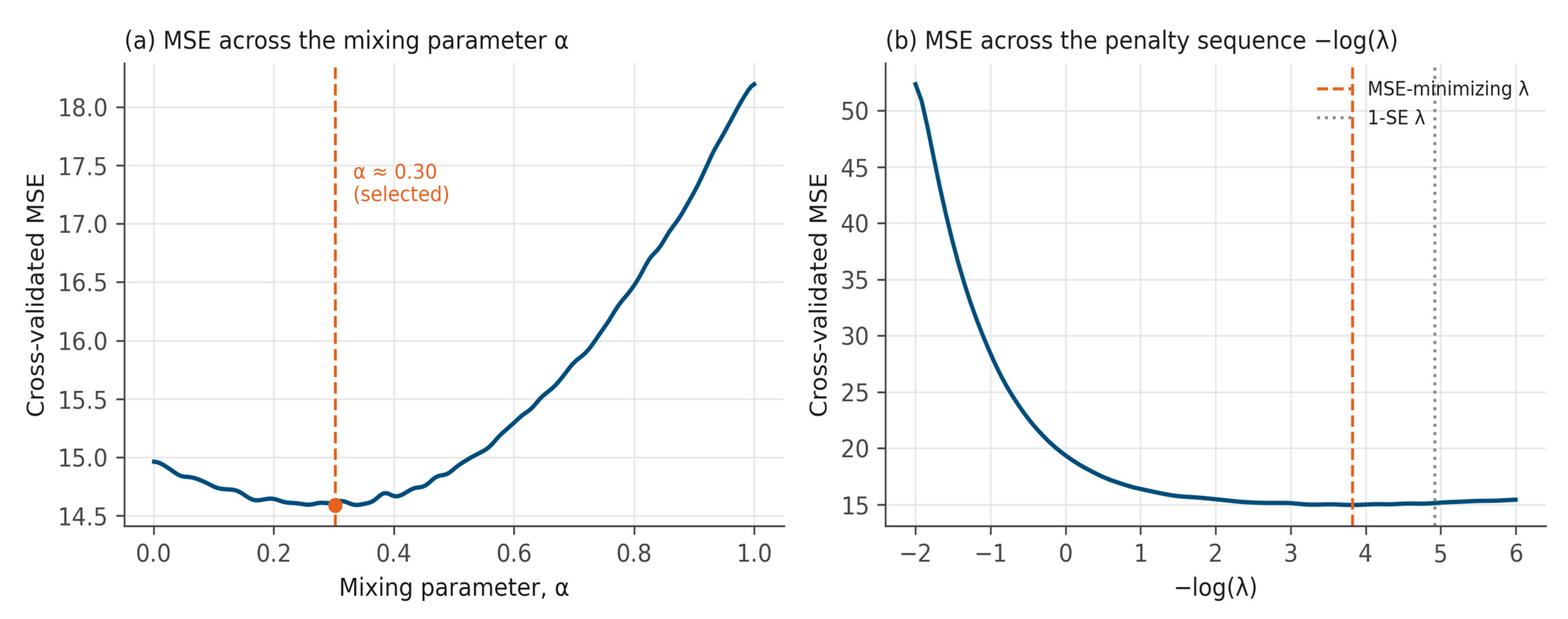
Cross-validated mean squared error was evaluated over a fine grid of α values spanning 0 (pure ridge) to 1 (pure lasso). Error falls sharply as α moves away from zero, reaches a shallow trough near α ≈ 0.3, and rises again as the penalty shifts toward a purely lasso-type specification. Neither extreme of the elastic net spectrum fits the data particularly well: pure ridge regression retains every candidate regressor without shrinking any to zero, while pure lasso selects more aggressively but at a measurable cost in cross-validated accuracy. A modest, ridge-leaning admixture of the ℓ1 penalty performs best—an outcome consistent with the presence of two correlated governance indicators among the predictors, where the ridge component stabilizes estimates under collinearity while the lasso component still allows redundant regressors to be dropped altogether. Cross-validated error is, however, nearly flat across penalized specifications, so α is only weakly identified. At the baseline α ≈ 0.3, the selected penalty is λ ≈ 0.29. All penalized estimators perform similarly and far better than OLS, whose cross-validated MSE exceeds 800 because of collinearity. The substantive conclusion therefore does not hinge on the precise α: both the elastic net and the lasso exclude government effectiveness and FDI, and ridge assigns its largest weights to internet usage and regulatory quality. The shuffled design is retained as the baseline for comparability with the first-stage results and because, with 31 observations, contiguous folds force validation across distinct regimes (e.g., 1995–2000 versus 2019–2025). Time-respecting schemes select α = 1.0 (the lasso). Under blocked validation, this specification retains the same leading predictors and excludes government effectiveness and FDI, so the choice of α affects sparsity more than the identity of the main predictors.
Conditional on the selected α, the penalty λ was chosen through cross-validation, minimizing out-of-sample MSE across a decreasing sequence of λ values. The cross-validated error curve traces the canonical U-shape: MSE falls steeply as λ decreases from the value at which every coefficient is shrunk to zero, reaches a broad and comparatively flat minimum, and rises only mildly as the penalty is relaxed further toward an unpenalized fit. The flatness of this minimum is itself informative, since it implies that a fairly wide band of shrinkage intensities yields statistically indistinguishable predictive accuracy—a signature of a data-generating process in which a small subset of regressors carries most of the explanatory signal while the rest contribute comparatively little.
Internet usage and regulatory quality remain among the top predictors under all validation designs (Table A4), but the ranking is not invariant. Under rolling-origin validation, which selects an almost unpenalized λ, government effectiveness receives 27% of relative importance with a negative sign, equal to regulatory quality. When 2014–2017 is excluded, regulatory quality (38%) overtakes internet usage (28%), and government effectiveness again enters with a negative sign. Because government effectiveness is collinear with regulatory quality (r = 0.94) and internet usage (r = 0.95), these negative coefficients most likely reflect weak penalization rather than genuine information. Its exclusion in the baseline therefore indicates redundancy given the other two predictors, not irrelevance.
At the baseline α, the one-standard-error solution retains internet usage (44%), regulatory quality (31%), and government effectiveness (24%), and shrinks the remaining predictors to zero. Cross-validated MSE rises from 26.7 (SE 8.9) at the minimizing λ to 33.8 (SE 11.7) at the one-standard-error λ, confirming that the error curve is flat. These errors come from the repeated five-fold design described in Section 3.3, which is used for all comparisons in Appendix B; the lower error levels in Figure 1 reflect the single fold assignment of the initial tuning run, so only the shape of the curves in Figure 1 should be compared with these values.
Figure 1.
Cross-validated tuning of the elastic net model. (a) Cross-validated MSE across the mixing parameter α ∈ [0, 1]; the marked point denotes the selected value (α ≈ 0.30). (b) Cross-validated MSE across the penalty sequence −log(λ); the dashed line marks the MSE-minimizing λ and the dotted line marks the one-standard-error λ.
4.2. Coefficient Estimates and Hypothesis Testing
Table 4 reports the estimated elastic net coefficients alongside the hypothesized sign and the resulting verdict for each of the seven hypotheses. Of the seven candidate predictors, five survive penalization with non-zero coefficients; government effectiveness (H2) and net FDI inflows (H3) are both shrunk exactly to zero and are effectively removed from the fitted model. Internet usage (H5) enters with the largest coefficient overall (4.7633), and regulatory quality (H1) enters with the second largest (3.6822); both carry the hypothesized positive sign, giving the strongest and least ambiguous support in the entire result set. The real interest rate (H6) and inflation (H7) are also retained, though with coefficients an order of magnitude smaller (0.9219 and −0.2103, respectively), and trade openness (H4) is retained with a small negative coefficient (−0.4967).
Table 4.
Hypothesis testing summary: elastic net coefficient estimates.
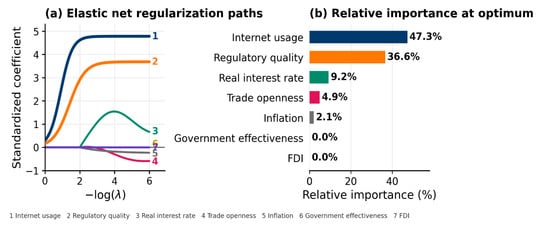
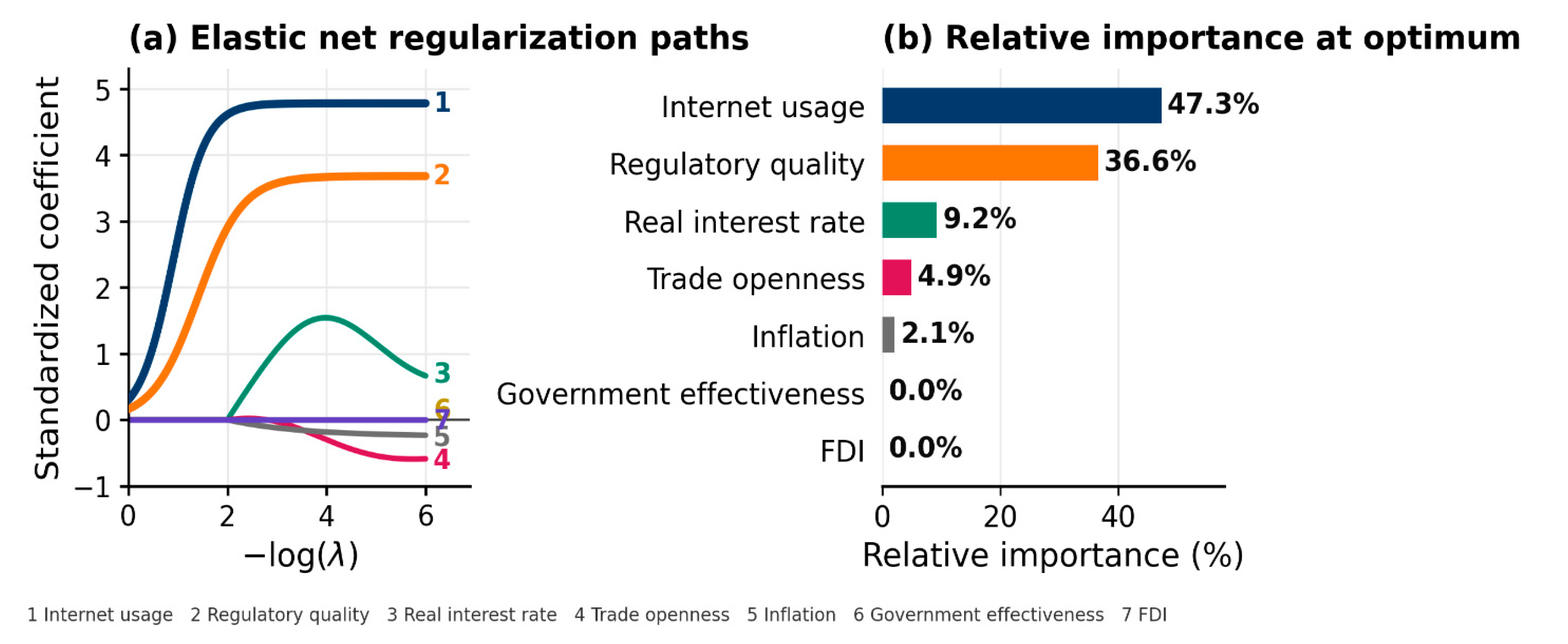
As the penalty is relaxed across the full regularization path, internet usage and regulatory quality are the first coefficients to depart from zero and grow monotonically thereafter, confirming that they enter the model at the most heavily penalized settings and are therefore the most robust to the precise choice of λ. Trade openness (negative) and the real interest rate (positive) enter later along the path and retain their signs, whereas inflation enters late and changes sign, consistent with its weak and unstable association with private credit. Government effectiveness and FDI, by contrast, remain pinned near zero across almost the entire sequence, departing from zero only at the least penalized end—a direct counterpart to their exclusion at the cross-validated optimum.
Two hypotheses are not supported by the sign of the estimated coefficient, and both merit substantive rather than purely statistical comment. Trade openness (H4) was hypothesized to raise private credit through the familiar channel of trade finance and working-capital lending, yet its retained coefficient is negative. Real interest rates (H6) were hypothesized to depress credit demand through a standard cost-of-borrowing channel, yet the retained coefficient is positive.
4.3. Relative Importance of Predictors
Table 5 converts the standardized coefficients into a relative importance ranking based on absolute magnitude. The distribution of importance is highly concentrated rather than diffuse: internet usage alone accounts for 47.28% of total absolute coefficient magnitude and regulatory quality contributes a further 36.55%, so that together the two variables absorb 83.83% of the explanatory weight assigned by the model. The remaining 16.17% is shared among the three other retained predictors—real interest rate (9.15%), trade openness (4.93%), and inflation (2.09%)—while government effectiveness and FDI, having been shrunk to exactly zero, contribute nothing to the decomposition. A drop-column check confirms this ranking: removing internet usage or regulatory quality raises cross-validated MSE (by 3.9 and 3.8, respectively), whereas removing any other predictor leaves it unchanged or slightly lower.
Table 5.
Relative importance of predictors in the final elastic net model.
This concentration carries an interpretation that extends beyond the statistics themselves. Over 1995–2025, the expansion of private-sector bank credit in Azerbaijan has been most closely associated with two factors operating on different margins—one institutional (the quality of business, contract, and regulatory enforcement captured by regulatory quality) and one infrastructural (the diffusion of internet access, and with it the digital delivery channels, credit-scoring technologies, and information flows that lower the cost of financial intermediation)—rather than with the macro-financial conditions or external-sector variables more commonly emphasized in cross-country credit-development studies.
Figure 2 illustrates the elastic net regularization paths of the explanatory variables (a) and their relative importance at the optimal model (b).
Figure 2.
Variable selection across the penalty path. (a) Elastic net regularization paths showing each standardized coefficient as a function of −log(λ); internet usage and regulatory quality are the first coefficients to depart from zero and grow monotonically thereafter, while government effectiveness and FDI remain pinned near zero across almost the entire sequence. (b) Absolute standardized coefficients at the cross-validated optimum, ranked by relative importance.
4.4. Predictive Performance
Table 6 summarizes in-sample fit. The model explains approximately 79.8% of the variation in private-sector credit (R2 = 0.798), with an RMSE of 4.35 percentage points of GDP and an MAE of 3.22 percentage points—a reasonably strong fit given the small annual sample and the regularized, deliberately conservative nature of the estimator. Given the strong residual autocorrelation (Appendix A.1), this in-sample R2 largely reflects shared trends and is descriptive; the cross-validated R2 is 0.72 under shuffled and 0.22 under blocked validation (Table A3). The mean absolute percentage error (36.68%) is, by contrast, considerably higher, but this figure should be read with caution rather than as evidence of poor fit: it is mechanically inflated by the very low absolute values of private credit-to-GDP recorded in the early part of the sample, where credit stood below 5% of GDP for much of the late 1990s and even small absolute errors correspond to large percentage deviations. RMSE and MAE, denominated in the same percentage-of-GDP units as the dependent variable, are accordingly the more reliable descriptors of fit magnitude for this series.
Table 6.
In-sample model fit statistics.
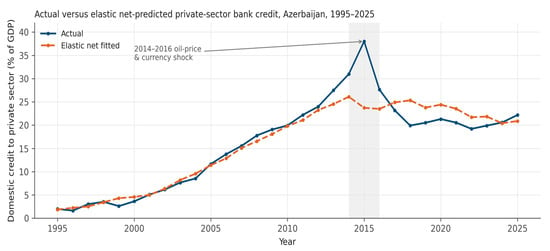
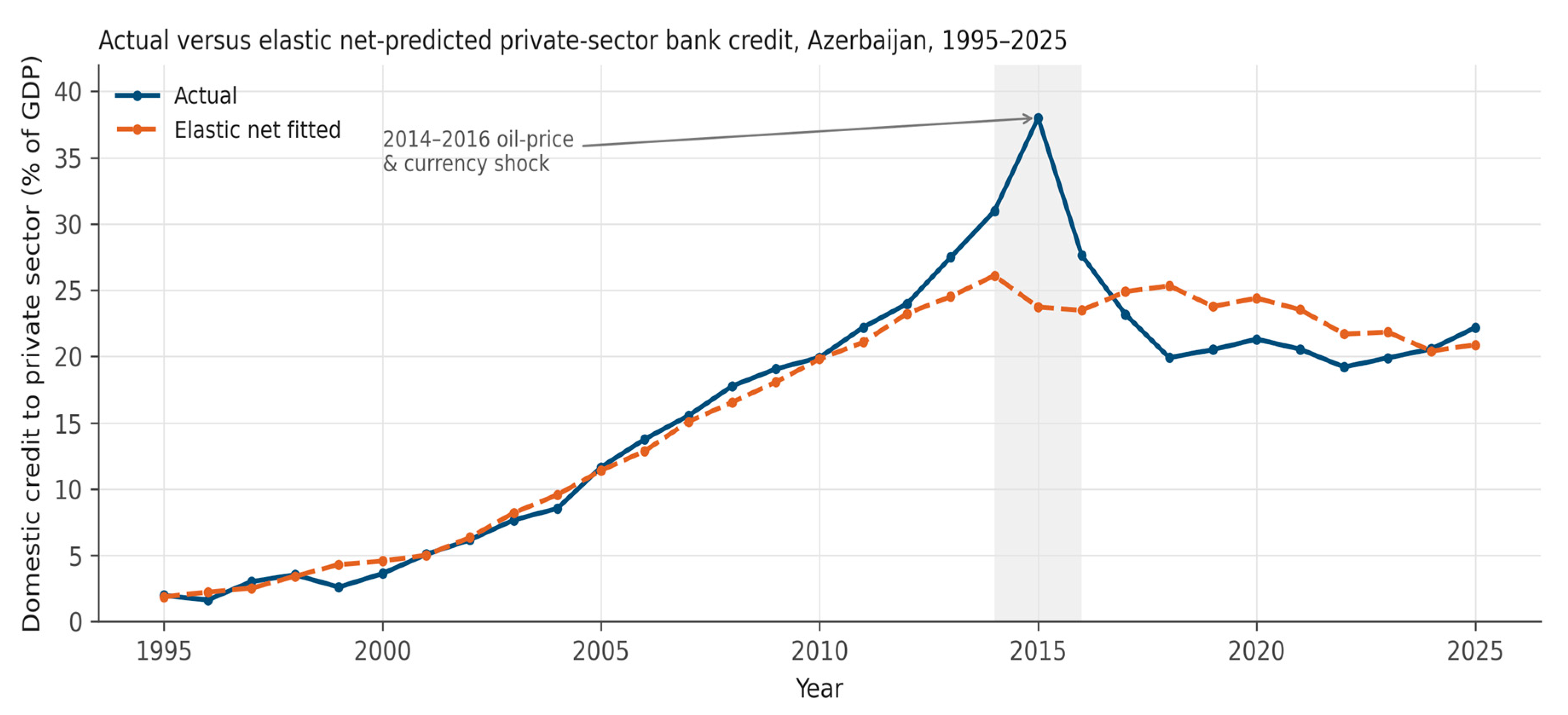
The fitted series tracks the actual series closely over roughly the first two-thirds of the sample, reproducing the gradual, near-monotonic expansion of bank credit from residual levels below 5% of GDP in the mid-1990s to just under 20% by the late 2000s. The two series diverge sharply, however, around 2014–2016: actual private credit spikes to its sample maximum of approximately 38% of GDP in 2015 before contracting to roughly 20% within three years, while the fitted series follows a markedly smoother trajectory that neither reaches the peak nor mirrors the abruptness of the subsequent contraction. This episode coincides with the collapse in global oil prices and the associated devaluation of the manat in 2015, followed by a period of balance-sheet repair in the domestic banking sector—a structural break that a linear, regularized model estimated over the full sample is not designed to capture without an explicit regime-switching or interaction term. From approximately 2018 onward the two series re-converge, with fitted values tracking the post-crisis recovery and subsequent fluctuation of private credit reasonably closely through the end of the sample in 2025.
A recursive pseudo-out-of-sample exercise (estimation from 1995–2012, one-step-ahead evaluation over 2013–2025) shows that persistence-based benchmarks dominate at the one-year horizon. The random walk yields an RMSE of 5.19, against 7.35 for the elastic net nowcast. Adding lagged credit to the elastic net closes most of the gap (RMSE 5.28). The model should therefore be read as a tool for identifying the structural correlates of the credit level, not as a short-horizon forecasting device.
Figure 3 shows the actual and elastic net-predicted private-sector bank credit in Azerbaijan as a percentage of GDP from 1995 to 2025.
Figure 3.
Actual versus elastic net–predicted private-sector bank credit (% of GDP), Azerbaijan, 1995–2025. Solid line: actual values; dashed line: fitted values. Predictor values for 1995–1997 and 2025 are partly extrapolated. The shaded band marks the 2014–2016 oil-price collapse and manat devaluation, during which the two series diverge most sharply.
The 2015 peak partly reflects a valuation effect: with a substantial share of loans denominated in foreign currency, the manat devaluation mechanically raised the domestic-currency value of credit, and later write-offs and transfers of impaired assets reduced it. The dependent variable is not adjusted for exchange-rate valuation, so the crisis dummies absorb both valuation effects and genuine credit dynamics. Controlling for the episode with unpenalized dummies for 2015–2016 and for the post-2015 regime strengthens the baseline pattern: internet usage (55%) and regulatory quality (36%) dominate, and government effectiveness is excluded. Excluding 2014–2017 altogether also leaves both predictors among the top two (Table A4).
5. Discussion
The elastic net results reveal a clear institutional-digital structure underlying private sector credit development in Azerbaijan. Among the seven candidate predictors, internet usage and regulatory quality are the dominant variables, accounting for 47.28% and 36.55% of relative predictive importance, respectively. This finding suggests that private credit development is closely associated with expanding digital connectivity and a supportive regulatory environment. It is consistent with the financial-development literature emphasizing the complementarity between digital technologies and institutional quality (Gün et al., 2026) and with machine-learning evidence highlighting the predictive relevance of institutional and digital factors when correlated determinants are jointly regularized (Ofori et al., 2021).
The selection of regulatory quality, while government effectiveness is reduced to zero, provides a more specific institutional interpretation. Regulatory quality appears to contain greater incremental predictive information for private credit once correlated governance indicators are considered jointly. This should not be interpreted as evidence that government effectiveness is irrelevant, but rather that regulatory quality provides more distinctive information within the selected model. This is consistent with credit-specific evidence that better credit information supports credit-market performance (Fosu, 2014). Related Azerbaijani evidence on tax compliance among foreign investment enterprises also points to the importance of regulatory enforcement for private-sector behavior, although it does not concern credit directly (Mammadli et al., 2026). Cross-country studies combining econometric and machine-learning methods likewise identify governance-related variables among the main predictors of financial development and access (Drago et al., 2025; Leogrande et al., 2026).
Internet usage is the strongest predictor, underscoring the role of digital connectivity in reducing informational and transaction frictions and facilitating access to financial services. In Azerbaijan, greater digital access may help overcome information and documentation constraints, particularly for smaller firms and borrowers with limited collateral (Asgerov, 2026; Jiang et al., 2021; Li et al., 2025). The joint importance of internet usage and regulatory quality indicates that institutional and digital conditions are jointly informative, with connectivity plausibly expanding the reach of intermediation, as suggested by broadband and collateral-substitution evidence (Hsueh et al., 2026; Norden & Ribeiro, 2025), while institutional quality supports its functioning. When an interaction between regulatory quality and internet usage is added to the candidate set, it is retained with a negative sign (24% of relative importance), so the data do not support complementarity in the strict sense.
The remaining predictors provide a more conditional macro-financial interpretation. FDI is excluded from the selected model, suggesting limited incremental predictive information after accounting for institutional, digital, and other macro-financial variables. This may partly reflect the concentration of FDI in Azerbaijan’s hydrocarbon sector, which does not necessarily translate into proportional increases in domestic private-sector lending. The negative association between trade openness and private credit may similarly reflect the structure of an oil-exporting economy, where trade dynamics are strongly influenced by hydrocarbon exports. The positive coefficient on the real interest rate should likewise be viewed as a conditional predictive association rather than evidence that higher borrowing costs increase credit demand, as interest rates may respond to broader macroeconomic and monetary conditions. The real interest rate is the World Bank series deflated by the GDP deflator throughout, which oil-price swings strongly affect. Its leading role in first differences (Table A3) suggests that it carries short-run rather than long-run information, as lending rates and credit respond jointly to monetary and exchange-rate conditions.
The model’s weaker predictive performance during 2014–2016 further highlights the importance of macro-financial shocks. The substantial divergence between observed and predicted credit coincides with the global oil-price collapse and the subsequent depreciation of the Azerbaijani manat. These developments generated liquidity, valuation, confidence, and balance-sheet effects that could not be fully captured by relatively persistent institutional and digital predictors. Although the model achieves a relatively high R2 of 0.798, the deterioration in performance during this episode suggests that private-credit dynamics may change considerably under conditions of external and exchange-rate stress. The findings are supported by R. I. Hasanov et al. (2025), who identify significant long-run relationships between oil prices, inflation, and bank deposits in Azerbaijan, with higher oil prices supporting deposits and inflation reducing them. Although their dependent variable differs from private credit, their findings further demonstrate the sensitivity of Azerbaijan’s financial sector to resource-price and macroeconomic conditions.
Future research could extend this framework in three directions: examining explicit interaction effects between institutional quality and digital connectivity, rather than inferring complementarity solely from their joint retention under regularization, consistent with recent developments in nonlinear digital-finance research (Phan & Tu, 2025); distinguishing between credit quantity, quality, and stability, as institutional and digital factors may affect these dimensions differently; and applying regime-switching or interaction-based models to capture the oil-price-related structural change identified in the analysis. As Azerbaijan advances its digital and institutional transformation, identifying the specific mechanisms that support private credit development, rather than treating financial deepening as a homogeneous objective, will be increasingly important for the country’s non-oil diversification process.
Private credit is highly persistent. When lagged credit is included as an unpenalized regressor, year-to-year dynamics are absorbed by persistence and the remaining predictors contribute little short-run information. The long-run role of internet usage nevertheless survives in the ARDL error-correction framework, which explicitly models persistence (long-run coefficient on internet usage 0.64, p < 0.01; Appendix B.5, Table A5). The elastic net results are therefore best interpreted as describing the long-run level of credit.
Overall, the findings indicate that the predictive structure of private credit is concentrated primarily in digital connectivity and regulatory quality, whereas FDI and government effectiveness provide limited incremental predictive information. At the same time, the 2014–2016 episode demonstrates that these relatively persistent predictors cannot fully explain credit dynamics during major external shocks. The results should therefore be interpreted as conditional predictive relationships rather than causal effects. The candidate set excludes oil prices, the exchange rate, and income per capita. Internet usage may therefore partly proxy for oil-driven income growth, and testing whether the digital signal survives such controls is a priority for future work. Linear detrending (specification S1, Table A3) removes a common deterministic development path, after which internet usage remains the leading predictor; it cannot, however, absorb oil-driven fluctuations around that path, so the proxy interpretation cannot be excluded.
6. Conclusions
This study examined the predictors of private sector credit development in Azerbaijan using an elastic net framework that jointly considers institutional, digital, external-sector, and macro-financial factors. The findings identify a clear institutional-digital pattern, with internet usage and regulatory quality emerging as the most informative predictors of private credit development. Their joint importance suggests that digital connectivity and institutional quality should be understood as jointly informative dimensions of financial intermediation rather than competing explanations. The evidence is asymmetric, however: the result for internet usage is robust, whereas the weight of regulatory quality falls when imputed or extrapolated years are excluded and under a quadratic trend. At the same time, the exclusion of some conventional predictors and the conditional nature of the retained macro-financial variables indicate that the predictors of private credit depend strongly on Azerbaijan’s specific economic and institutional context. The study contributes to the literature by providing country-specific evidence on the institutional and digital dimensions of private credit development in Azerbaijan, an area that has received comparatively limited empirical attention. It also demonstrates the applicability of elastic net regularization to small annual macro-financial datasets characterized by correlated and conceptually overlapping predictors. Importantly, the findings represent predictive associations rather than causal effects and should therefore be interpreted within the limits of the empirical framework. From a policy perspective, the results suggest that financial deepening could benefit from progress in digital connectivity and, more tentatively, in regulatory quality. Strengthening digital financial infrastructure, credit-information systems, regulatory predictability, enforcement, and financial-sector competition may create more favorable conditions for private-sector lending. The weaker model performance during the 2014–2016 oil-price and exchange-rate shock also highlights the importance of financial-sector resilience to external disturbances. Future research should examine institutional-digital complementarities through interaction and nonlinear models and assess whether the observed pattern extends to other energy-rich emerging economies.
Author Contributions
Conceptualization, R.I.H. and Z.Z.; methodology, R.I.H.; software, R.I.H.; validation, A.E., N.N. and E.R.S.-Z.; formal analysis, N.N. and B.E.; investigation, R.I.H. and Z.Z.; resources, Z.Z.; data curation, Z.Z. and R.I.H.; writing—original draft preparation, R.I.H. and Z.Z.; writing—review and editing, A.E., N.N., E.R.S.-Z. and B.E.; visualization, R.I.H.; supervision A.E., N.N. and E.R.S.-Z.; project administration, R.I.H. and Z.Z.; funding acquisition, E.R.S.-Z. All authors have read and agreed to the published version of the manuscript.
Funding
This research received no external funding.
Institutional Review Board Statement
Not applicable.
Informed Consent Statement
Not applicable.
Data Availability Statement
The original series are publicly available from the World Bank. The compiled dataset, with interpolated and extrapolated values flagged, and the estimation code are available from the corresponding authors upon reasonable request.
Acknowledgments
The authors used EViews (14), Stata (18), R (4.4.1), and Python (3.12) for data analysis, and Claude (Claude Opus 5.5) and ChatGPT (GPT-5); for technical and language improvements. The authors reviewed and edited the output and take full responsibility for the content of this publication.
Conflicts of Interest
The authors declare no conflicts of interest.
Appendix A. Diagnostic Analyses
Appendix A.1. Residual Diagnostics of Elastic Net Approach
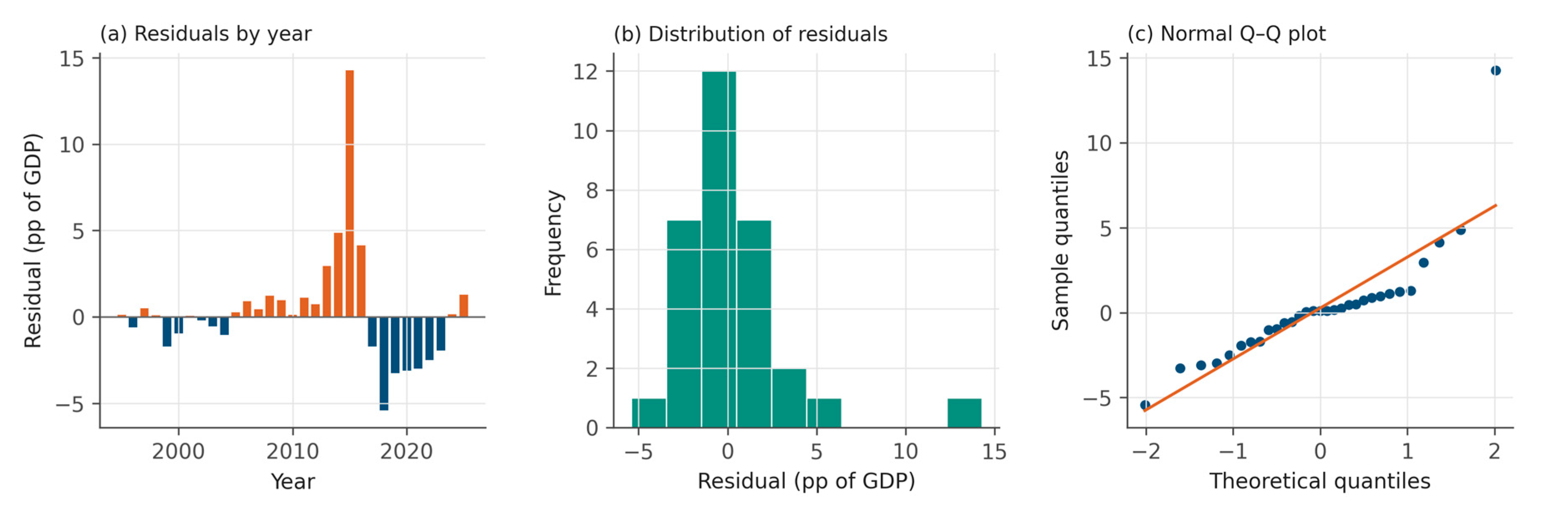
Figure A1 reports the evolution of the elastic net residuals over the sample period, their empirical distribution, and the corresponding normal quantile–quantile (Q–Q) plot. These diagnostics are descriptive. The residuals show strong positive autocorrelation (Durbin–Watson = 0.46; Ljung–Box Q(1) = 18.80, Q(4) = 26.57, both p < 0.001). This reduces the effective sample size and the reliability of cross-validated error estimates, which motivates the time-respecting validation in Table A4. The ARDL residuals, which model persistence explicitly, show no autocorrelation (Table A5).
Figure A1.
Residual diagnostics for the elastic net model. (a) Residuals by year; positive residuals (model under-prediction) are shown in orange and negative residuals (over-prediction) in blue. (b) Empirical distribution of residuals. (c) Normal quantile–quantile plot of residuals; the point departing furthest from the reference line in the upper-right corresponds to 2015.
Appendix A.2. Correlation Test of the Variables
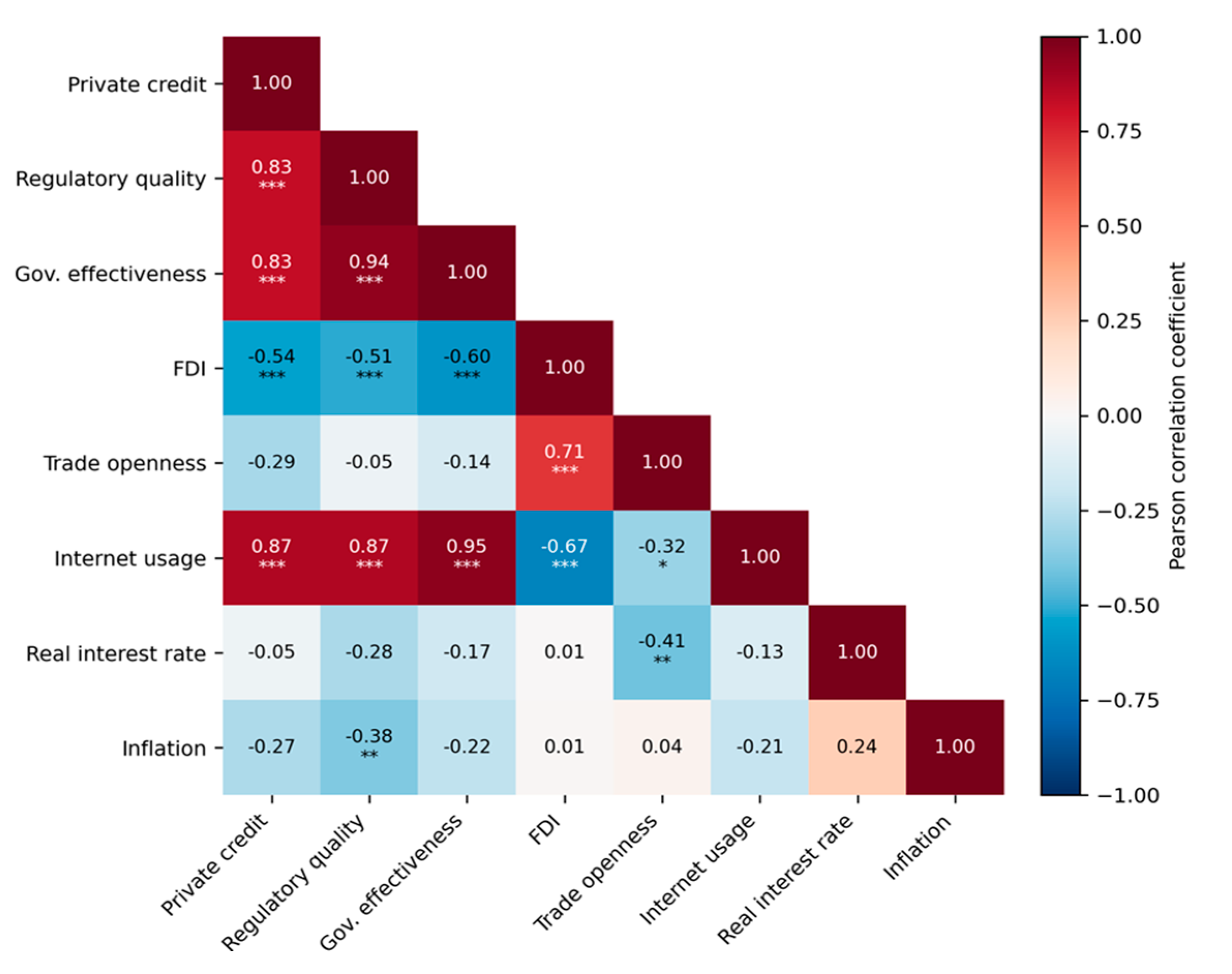
The pairwise correlations in Figure A2 confirm substantial collinearity among the predictors. Government effectiveness is almost perfectly correlated with regulatory quality (r = 0.94) and with internet usage (r = 0.95), and its variance inflation factor (VIF = 35.3) far exceeds conventional thresholds. Regulatory quality (VIF = 13.2) and internet usage (VIF = 20.3) also exceed these thresholds. This pattern supports the use of a regularized estimator rather than OLS.
Figure A2.
Pearson Correlation Matrix results. Note: *, **, *** denote significance at 10%, 5%, and 1%.
Appendix B. Time-Series Properties and Robustness Checks
Appendix B.1. Unit Root Test
Table A1 reveals that private credit, regulatory quality, trade openness, and internet usage are non-stationary in levels but stationary in first differences, and are therefore integrated of order one, I(1), whereas the real interest rate is stationary in levels, I(0). Government effectiveness, FDI, and inflation yield conflicting results across the ADF, PP, and KPSS tests, so the predictor set is of mixed integration order, which justifies the use of the ARDL bounds-testing approach to cointegration. For internet usage, the ADF test in first differences with AIC-selected lags (−1.61) does not reject a unit root, whereas the PP test does. With zero lags, however, the ADF statistic is −3.80 (p = 0.003). In second differences, all tests reject non-stationarity decisively (ADF −7.76, PP −10.88, KPSS 0.127), and the KPSS test does not reject stationarity of the first difference. Internet usage is therefore classified as I(1), and the I(2) case required to be excluded for the bounds test is ruled out. The conflicting ADF result reflects the S-shaped diffusion profile and the low power of the test in short samples.
Table A1.
Unit-root and stationarity tests.
Appendix B.2. Cointegration Test
Table A2 shows that with small-sample critical values, the null of no cointegration is rejected at 5% for the core system of credit, internet usage, and regulatory quality, and at 10% for the five-predictor system. The evidence supports a long-run relationship centered on the two leading predictors, but it is weaker for the full specification.
Table A2.
ARDL F-bounds cointegration test (Case IV: unrestricted intercept, restricted trend).
Appendix B.3. Robustness to Trend Specification
Table A3 shows that after linear detrending, internet usage and regulatory quality remain the leading predictors, jointly accounting for over 90% of relative importance. The results are less robust to more flexible trends: under a quadratic trend, internet usage still ranks first, but regulatory quality (15.6%) falls below trade openness (18.2%), and government effectiveness and FDI re-enter the model. In first differences, the cross-validated R2 is only 0.066, and the real interest rate becomes the leading predictor. The findings therefore concern long-run levels of credit rather than year-to-year dynamics.
Table A3.
Robustness to trend specification (standardized coefficients; relative importance in parentheses).
Appendix B.4. Additional Robustness Checks
Table A4 shows that internet usage ranks first or second in every specification, whereas the position of regulatory quality varies with the validation design, the sample, and the treatment of constructed data points (see Section 4.1). When imputed years are excluded, internet usage retains first place, but regulatory quality falls to 13%, and FDI (11%) and government effectiveness (6%) are retained. The prominence of regulatory quality is therefore partly sensitive to the interpolated governance values, which warrants caution in drawing regulatory-policy conclusions.
Table A4.
Additional robustness checks.
Appendix B.5. ARDL Error-Correction Estimates
Table A5 reports the error-correction model for the core system. The long-run coefficients on internet usage and regulatory quality are positive and significant once persistence and the trend are modeled explicitly, and the error-correction term confirms rapid adjustment towards the long-run relationship. The residuals show no autocorrelation.
Table A5.
ARDL error-correction estimates, core system ARDL(2,1,1), Case IV.
References
- Aduba, J. J., Asgari, B., & Izawa, H. (2023). Does FinTech penetration drive financial development? Evidence from panel analysis of emerging and developing economies. Borsa Istanbul Review, 23(5), 1078–1097. [Google Scholar] [CrossRef] [Scilit]
- Alfaro, L., Chanda, A., Kalemli-Ozcan, S., & Sayek, S. (2004). FDI and economic growth: The role of local financial markets. Journal of International Economics, 64(1), 89–112. [Google Scholar] [CrossRef] [Scilit]
- Ameer, W., Sohag, K., Xu, H., & Halwan, M. M. (2020). The impact of OFDI and institutional quality on domestic capital formation at the disaggregated level: Evidence for developed and emerging countries. Sustainability, 12(9), 3661. [Google Scholar] [CrossRef] [Scilit]
- Andrianaivo, M., & Kpodar, K. (2012). Mobile phones, financial inclusion, and growth. Review of Economics and Institutions, 3(2). [Google Scholar] [CrossRef] [Scilit]
- Asgerov, K. (2026). Standardization of financial reporting in SMEs in Azerbaijan: Current problems and international experience. Scientific Work, 20(126), 73–79. [Google Scholar] [CrossRef] [Scilit]
- Demirgüç-Kunt, A., & Maksimovic, V. (1998). Law, finance, and firm growth. The Journal of Finance, 53(6), 2107–2137. [Google Scholar] [CrossRef] [Scilit]
- Diamond, D. W. (1984). Financial intermediation and delegated monitoring. The Review of Economic Studies, 51(3), 393–414. [Google Scholar] [CrossRef] [Scilit]
- Djankov, S., McLiesh, C., & Shleifer, A. (2007). Private credit in 129 countries. Journal of Financial Economics, 84(2), 299–329. [Google Scholar] [CrossRef] [Scilit]
- Dong, Y., Yan, J., Vagnani, G., & Tan, S. (2026). How digital transformation affects credit risk: Evidence from Chinese commercial banks. Pacific-Basin Finance Journal, 100, 103348. [Google Scholar] [CrossRef] [Scilit]
- Drago, C., Costantiello, A., Arnone, M., & Leogrande, A. (2025). Bridging sustainability and inclusion: Financial access in the environmental, social, and governance landscape. Journal of Risk and Financial Management, 18(7), 375. [Google Scholar] [CrossRef] [Scilit]
- Duarte, F. D., Gama, A. P. M., & Esperança, J. P. (2017). Collateral-based in SME lending: The role of business collateral and personal collateral in less-developed countries. Research in International Business and Finance, 39(Part A), 406–418. [Google Scholar] [CrossRef] [Scilit]
- Faour, M., & Saad, K. (2025). Institutions and the sovereign-bank nexus in the MENA. Global Finance Journal, 66, 101129. [Google Scholar] [CrossRef] [Scilit]
- Fosu, S. (2014). Credit information, consolidation and credit market performance: Bank-level evidence from developing countries. International Review of Financial Analysis, 32, 23–36. [Google Scholar] [CrossRef] [Scilit]
- Gao, H., Li, J., Liu, F., & Wu, J. (2023). State ownership and credit rationing: Evidence from China. International Review of Economics & Finance, 88, 237–257. [Google Scholar] [CrossRef] [Scilit]
- Gasimov, I., Asgarzade, G., & Jabiyev, F. (2023). The impact of institutional quality on economic growth: Evidence from post-Soviet countries. Journal of International Studies, 16(1), 71–82. [Google Scholar] [CrossRef] [Scilit]
- Gazanfarli, M. K. (2025). A fuzzy approach to the assessment of digitalization level of the banking system: Evidence from Azerbaijan. In 16th international conference on applications of fuzzy systems, soft computing and artificial intelligence tools—ICAFS-2023. Lecture Notes in Networks and Systems. Springer. [Google Scholar] [CrossRef] [Scilit]
- Gün, M., Tutar, H., Karadag, H., & Güneş, H. (2026). Digital payment ecosystems as socio-technical systems: Digital-infrastructure-based fintech diffusion, regulatory coupling, and private-sector credit exposure in OECD economies. Systems, 14(8), 960. [Google Scholar] [CrossRef] [Scilit]
- Haoran, X., Wenlong, M., & Siyu, Z. (2024). Digital technology development and systemic financial risks: Evidence from 22 countries. Borsa Istanbul Review, 24, 1–9. [Google Scholar] [CrossRef] [Scilit]
- Hasanov, F. J., Aliyev, R., Taşkın, D., & Suleymanov, E. (2023). Oil rents and non-oil economic growth in CIS oil exporters: The role of financial development. Resources Policy, 82, 103523. [Google Scholar] [CrossRef] [Scilit]
- Hasanov, F. J., & Huseynov, F. (2013). Bank credits and non-oil economic growth: Evidence from Azerbaijan. International Review of Economics & Finance, 27, 597–610. [Google Scholar] [CrossRef] [Scilit]
- Hasanov, R. I., Vasa, L., Guliyeva, S., Giyasova, Z., & Shakaraliyeva, Z. (2025). Assessing the impact of oil prices and inflation on bank deposits in Azerbaijan. Banks and Bank Systems, 20(1), 11–22. [Google Scholar] [CrossRef] [Scilit]
- Hoerl, A. E., & Kennard, R. W. (1970). Ridge regression: Biased estimation for nonorthogonal problems. Technometrics, 12(1), 55–67. [Google Scholar] [CrossRef]
- Hordofa, D. F. (2024). Impact of digital transformation on financial stability in emerging markets: Evidence from Ethiopia. Discover Sustainability, 5, 309. [Google Scholar] [CrossRef] [Scilit]
- Hsueh, S.-C., Li, Y., & Zhang, S. (2026). Fintech, collateral and bank lending. Pacific-Basin Finance Journal, 100, 103332. [Google Scholar] [CrossRef] [Scilit]
- Jamilov, R. (2015). Lending rate pass-through and bank heterogeneity in a high interest rate environment: Evidence from Azerbaijan. International Finance Review, 16, 193–217. [Google Scholar] [CrossRef] [Scilit]
- Jiang, J., Liao, L., Lu, X., Wang, Z., & Xiang, H. (2021). Deciphering big data in consumer credit evaluation. Journal of Empirical Finance, 62, 28–45. [Google Scholar] [CrossRef] [Scilit]
- Kalyuzhnova, Y., & Nygaard, C. (2009). Resource nationalism and credit growth in FSU countries. Energy Policy, 37(11), 4700–4710. [Google Scholar] [CrossRef] [Scilit]
- Kandil, M. (2009). Determinants of institutional quality and their impact on economic growth in the MENA region. International Journal of Development Issues, 8(2), 134–167. [Google Scholar] [CrossRef] [Scilit]
- Karaalioğlu, H. (2026). Beyond credit expansion: FinTech, credit discipline, and financial deepening in emerging economies. Borsa Istanbul Review, 26, 100875. [Google Scholar] [CrossRef] [Scilit]
- Kaufmann, D., Kraay, A., & Mastruzzi, M. (2011). The worldwide governance indicators: Methodology and analytical issues. Hague Journal on the Rule of Law, 3(2), 220–246. [Google Scholar] [CrossRef] [Scilit]
- Khan, S. U. (2025). Mobile money and financial inclusion: International evidence from informal sector enterprises in Asia and Africa. Journal of Asian Economics, 101, 102033. [Google Scholar] [CrossRef] [Scilit]
- King, R. G., & Levine, R. (1993). Finance and growth: Schumpeter might be right. The Quarterly Journal of Economics, 108(3), 717–737. [Google Scholar] [CrossRef] [Scilit]
- La Porta, R., Lopez-de-Silanes, F., Shleifer, A., & Vishny, R. W. (1997). Legal determinants of external finance. The Journal of Finance, 52(3), 1131–1150. [Google Scholar] [CrossRef]
- Leogrande, A., Arnone, M., Costantiello, A., & Drago, C. (2026). ESG determinants of financial development: Integrating econometrics and machine-learning evidence. Journal of Risk and Financial Management, 19(4), 279. [Google Scholar] [CrossRef] [Scilit]
- Levine, R. (1998). The legal environment, banks, and long-run economic growth. Journal of Money, Credit and Banking, 30(3), 596–613. [Google Scholar] [CrossRef] [Scilit]
- Levine, R., Loayza, N., & Beck, T. (2000). Financial intermediation and growth: Causality and causes. Journal of Monetary Economics, 46(1), 31–77. [Google Scholar] [CrossRef] [Scilit]
- Li, J., Liao, K., & Dai, W. (2026). Does digital inclusive finance promote credit accessibility for small and medium-sized enterprises in emerging markets? Evidence from China. Applied Economics Letters, 33, 1–6. [Google Scholar] [CrossRef] [Scilit]
- Li, J., Zhou, W., Li, X., & Wu, Y. (2025). Digital credit scoring and household consumption: Evidence from Sesame Credit in China. Emerging Markets Review, 69, 101372. [Google Scholar] [CrossRef] [Scilit]
- Mammadli, M., Namazova, N., & Zeynalova, Z. (2026). From enforcement to capability: Tax planning capacity and corporate tax compliance in foreign investment enterprises in Azerbaijan. International Journal of Financial Studies, 14(5), 116. [Google Scholar] [CrossRef] [Scilit]
- Mammadov, E. M., Belov, A., & Svistun, L. (2023). Role of partial credit guarantee scheme in enabling growth of SME. In Proceedings of the 4th international conference on building innovations. ICBI 2022 (Vol. 299). Lecture Notes in Civil Engineering. Springer. [Google Scholar] [CrossRef] [Scilit]
- McNulty, J. E., Harper, J. T., & Pennathur, A. K. (2007). Financial intermediation and the rule of law in the transitional economies of Central and Eastern Europe. The Quarterly Review of Economics and Finance, 47(1), 55–68. [Google Scholar] [CrossRef] [Scilit]
- Mukhtarov, S., Humbatova, S., & Seyfullayev, İ. (2019). The impact of bank credits on non-oil GDP: Evidence from Azerbaijan. Banks and Bank Systems, 14(2), 120–127. [Google Scholar] [CrossRef] [Scilit]
- Musazade, K. (2025). State regulation of digital banking operations. Scientific Work, 19(124), 76–80. [Google Scholar]
- Myant, M., & Drahokoupil, J. (2012). Central Asian countries: Forms of international integration and the impact of the crisis of 2008. In J. Ahrens, & H. W. Hoen (Eds.), Institutional reform in Central Asia: Politico-economic challenges. Routledge. [Google Scholar] [CrossRef] [Scilit]
- Nguyen, T. C. (2021). Economic policy uncertainty and bank stability: Does bank regulation and supervision matter in major European economies? Journal of International Financial Markets, Institutions and Money, 74, 101387. [Google Scholar] [CrossRef] [Scilit]
- Norden, L., & Ribeiro, T. (2025). Local credit in Brazil: The role of digital connectivity and education. Emerging Markets Review, 65, 101265. [Google Scholar] [CrossRef] [Scilit]
- Ofori, I. K., Quaidoo, C., & Ofori, P. E. (2021). What drives financial sector development in Africa? Insights from machine learning. Applied Artificial Intelligence, 35(15), 2124–2156. [Google Scholar] [CrossRef] [Scilit]
- Olaniyi, C., & Odhiambo, N. M. (2023). Does institutional quality matter in the financial development–economic complexity nexus? Empirical insights from Africa. Research in Globalization, 6, 100173. [Google Scholar] [CrossRef] [Scilit]
- Phan, D. V., & Tu, T. T. (2025). Causal and nonlinear effects of digital financial inclusion on bank stability: Evidence from emerging and advanced economies. Banks and Bank Systems, 20(4), 153–171. [Google Scholar] [CrossRef] [Scilit]
- Rajan, R. G. (1992). Insiders and outsiders: The choice between informed and arm’s-length debt. The Journal of Finance, 47(4), 1367–1400. [Google Scholar] [CrossRef]
- Rajan, R. G., & Zingales, L. (2003). The great reversals: The politics of financial development in the twentieth century. Journal of Financial Economics, 69(1), 5–50. [Google Scholar] [CrossRef] [Scilit]
- Sassi, S., & Goaied, M. (2013). Financial development, ICT diffusion and economic growth: Lessons from the MENA region. Telecommunications Policy, 37(4–5), 252–261. [Google Scholar] [CrossRef] [Scilit]
- State Statistical Committee of the Republic of Azerbaijan. (2025). Statistical yearbook of Azerbaijan [Data set]. Available online: https://www.stat.gov.az (accessed on 16 July 2026).
- Stef, N., Soula, J.-L., & Pourchet, A. (2022). Legislative inflation and private credit. Revue d’Économie Politique, 132(6), 985–1010. [Google Scholar] [CrossRef] [Scilit]
- Suri, T., Bharadwaj, P., & Jack, W. (2021). Fintech and household resilience to shocks: Evidence from digital loans in Kenya. Journal of Development Economics, 153, 102697. [Google Scholar] [CrossRef] [Scilit]
- Tasić, N., & Valev, N. (2010). The provision of long-term financing in the transition economies. Journal of Comparative Economics, 38(2), 160–172. [Google Scholar] [CrossRef] [Scilit]
- Tehulu, T. A. (2022). Institutional quality and credit growth: “Sand” or “grease” effect? Evidence from microfinance institutions. Cogent Business & Management, 9(1), 2098637. [Google Scholar] [CrossRef] [Scilit]
- Tibshirani, R. (1996). Regression shrinkage and selection via the lasso. Journal of the Royal Statistical Society: Series B (Methodological), 58(1), 267–288. [Google Scholar] [CrossRef] [Scilit]
- Türegün, N. (2025). Digital transformation and cybersecurity risks. International Journal of Accounting Information Systems, 56, 100749. [Google Scholar] [CrossRef] [Scilit]
- Voghouei, H., Azali, M., & Law, S. H. (2011). A survey of the determinants of financial development. Asian-Pacific Economic Literature, 25(2), 1–20. [Google Scholar] [CrossRef] [Scilit]
- World Bank. (2025a). World development indicators [Data set]. Available online: https://databank.worldbank.org/source/world-development-indicators (accessed on 16 July 2026).
- World Bank. (2025b). Worldwide governance indicators [Data set]. Available online: https://databank.worldbank.org/source/worldwide-governance-indicators (accessed on 16 July 2026).
- Zeynalova, A. (2024). The impact of credit volume on money supply and economic growth in Azerbaijan: An econometric analysis. Multidisciplinary Science Journal, 6, e2024004. [Google Scholar] [CrossRef] [Scilit]
- Zou, H., & Hastie, T. (2005). Regularization and variable selection via the elastic net. Journal of the Royal Statistical Society: Series B (Statistical Methodology), 67(2), 301–320. [Google Scholar] [CrossRef] [Scilit]

Disclaimer/Publisher’s Note: The statements, opinions and data contained in all publications are solely those of the individual author(s) and contributor(s) and not of MDPI and/or the editor(s). MDPI and/or the editor(s) disclaim responsibility for any injury to people or property resulting from any ideas, methods, instructions or products referred to in the content. |
© 2026 by the authors. Licensee MDPI, Basel, Switzerland. This article is an open access article distributed under the terms and conditions of the Creative Commons Attribution (CC BY) license.