


Abstract
Background/Objectives: Benzodiazepines (BZDs) are used routinely in cases requiring sedation for anxiety, insomnia, and procedures that require pain management, and daily use of these agents may extend over several months; therefore, monitoring patients is essential to reduce the risk of developing dependence. However, the high patient volume in pain and palliative-care settings often limits physicians’ ability to both conduct consultations and perform comprehensive evaluations. In this context, the pharmacist plays a key role in supporting patient care by contributing professional activities that enhance patient well-being, such as conducting systematic reviews of electronic medical records. This pharmacist-led EMR assessment enables the identification of benzodiazepine dependence patterns and supports a more robust epidemiological evaluation within the institution. Methods: A descriptive observational study (January 2022–May 2025) using electronic medical records and prescription data was conducted. Consecutive adults with an active BZD prescription and a documented BDEPQ-MX (Benzodiazepine Dependence Questionnaire, Mexican version) were included. Outcomes were BDEPQ-MX categories (No dependence; Pleasurable effects; Perceived need; Dependence) and a binary endpoint was stablished as “any dependence” (either scored in Perceived need or Dependence category) vs. No dependence (either scored as No dependence or Pleasurable effects categories). Group comparisons used χ2, Student’s t, and one-way ANOVA. A logistic regression modeled any dependence; a general linear model (GLM) examined the BDEPQ-MX total score. Results: Of 181 complete cases, BDEPQ-MX categories were No dependence 33.2% (60/181), Pleasurable effects 7.2% (13/181), Perceived need 17.1% (31/181), and Dependence 42.5% (77/181); hence, 59.7% met “any dependence.” Women comprised 67.4% overall. Compared with No dependence, the any-dependence group had higher comorbidity (83.3% vs. 65.8%, p = 0.006) and markedly greater duration of BZD use (months) (22.6 ± 11.5 vs. 5.9 ± 4.9, p < 0.001), with no difference in daily dose (p = 0.6). Benzodiazepine medications shifted toward alprazolam in dependence (38.9% vs. 20.5%, p = 0.009) and away from clonazepam (43.5% vs. 58.9%, p = 0.042). In the adjusted model, the male sex was associated with lower odds of any dependence (aOR 0.29, 95% CI 0.11–0.76; p = 0.013), while the duration of BZD use (per month) increased the odds (aOR 1.32, 1.20–1.45; p < 0.001). In the GLM, the duration showed the largest effect on BDEPQ-MX total (F = 203.26; p < 0.001; partial η2 = 0.545). Conclusions: In this outpatient pain and palliative-care population, benzodiazepine-related dependence phenomena were common: 59.7% of patients met the criteria for dependence based on the pharmacist-led EMR review. The involvement of the pharmacist was essential, as this systematic evaluation would have been difficult to perform within routine medical consultations. The pharmacist’s contribution enabled a detailed epidemiological characterization, revealing that the exposure duration—more than daily dose—was the principal, modifiable correlate of dependence, and that alprazolam was disproportionately represented in the higher-dependence categories. These findings underscore the value of pharmacist-supported surveillance to identify and measure BZD dependance.
Keywords:
benzodiazepines; drug dependence; BDEPQ-MX; pharmacist; palliative-care; chronic pain; risk factors 1. Introduction
Benzodiazepines (BZDs) remain widely prescribed for anxiety and insomnia, yet long-term use is common despite guidance favoring short courses. Prolonged exposure is associated with daytime sedation, psychomotor slowing, cognitive impairment, falls, and clinically significant dependence—especially in older adults and women [1,2]. Real-world studies consistently show higher use in females and late-life patients, frequent chronic use beyond recommended durations, and a preference for a small subset of agents (e.g., alprazolam, lorazepam, clonazepam) [3,4]. In Latin America, population studies similarly document sustained BZD and Z-agent consumption with demographic gradients that align with international trends [5].
Patient perceptions and routine practice patterns help explain the persistence. Qualitative syntheses report that many long-term users view BZDs as essential for daily functioning, minimize or feel resigned to long-term risks, and anticipate physician-led guidance before reducing or stopping; psychological dependence and limited support for tapering further entrench continued use [6,7]. In outpatient samples, self-identified “dependence” often reflects the inability to down-titrate without discomfort, which users distinguish from “addiction/abuse,” complicating risk communication and deprescribing efforts [8]. At the system level, prescribing and dispensing studies highlight gaps in initiation/review processes (e.g., suboptimal documentation of indication and duration, limited planned discontinuation), which correlate with longer exposure and higher dependence risk [9,10].
Accurate measurement of BZD-related dependence phenomena is therefore central to clinical care and epidemiology. The Benzodiazepine Dependence Questionnaire (BDEPQ) was developed to quantify dependence on a continuum across three core dimensions—Perceived need, Pleasant effects, and general Dependence—complementing (but not replacing) the assessment of acute withdrawal [11]. In Mexico, the BDEPQ-MX (Mexican adaptation/validation of the Benzodiazepine Dependence Questionnaire) demonstrated a stable three-factor structure, excellent internal consistency, and strong diagnostic performance versus SCID-I, supporting a pragmatic cut-off for clinical screening in psychiatric outpatients [12]. However, data on BZD dependence in pain relief and palliative-care services—where anxiety, insomnia, and procedural sedation needs are common and daily BZD use may extend over months—remain sparse [13,14,15].
In pain and palliative-care settings, clinicians frequently work under significant time pressure, which limits their ability to conduct the comprehensive monitoring required for safe benzodiazepine use. Evidence shows that many physicians report needing more time than allotted to properly evaluate their patients, and that shortened consultations compromise the detection of treatment-related risks [16,17]. The objective of this study was to assess BZD dependence via an EMR review, which would allow us to demonstrate that, beyond the medical consultation, it is possible to identify and estimate the prevalence of different degrees of benzodiazepine dependence through a systematized review of validated questionnaires applied during medication dispensing. This approach would enable institutions to design strategies to support their patients and to train healthcare personnel accordingly.
2. Materials and Methods
We performed a descriptive observational study of outpatients seen at the Jalisco Institute for Pain Relief and Palliative Care (Zapopan, Mexico) between January 2022 and May 2025. The institute is a state public health facility providing multidisciplinary care for chronic pain and palliative-care patients.
Database elaboration: The questionnaire BDEPQ-MX was administered during BZD agents dispensing by the pharmacists in charge of the service to patients; the indications for which benzodiazepines were prescribed are listed as follows: insomnia, anxiety disorder, affective disorder, mixed anxiety–depressive disorder, and major depressive disorder. No patients in a palliative-care setting requiring these medications were identified at our center. The data were subsequently entered into the patient’s electronic medical record, the “Health Record System” (Sistema de Registro en Salud, SRS). Through a subsequent systematized review of patients with a history of benzodiazepine prescription, we screened consecutive outpatients with an active benzodiazepine (BZD) prescription documented in the electronic medical record (EMR) during the study window.
Inclusion criteria: (i) age ≥ 18 years; (ii) at least one follow-up visit during which the BDEPQ-MX was administered; (iii) available data on BZD drug and daily dose.
Exclusion criteria: (i) missing BDEPQ-MX total score; (ii) incomplete key covariates (sex or age); (iii) documented severe cognitive impairment precluding valid questionnaire completion. Of the screened patients, n = 181 met criteria and formed the analytic sample. For these patients, an Excel database was created using the information collected from the aforementioned electronic and manual records, which was then used for the corresponding analysis.
The BDEPQ-MX was selected because it was validated in Mexican patients with good psychometric performance versus a structured clinical interview; categorical interpretations followed the published validation framework [15]. Evidence from the brief/French adaptation supports stability of the underlying dimensions across settings [14].
Clinical and prescribing data were abstracted from the EMR and prescription registry using a standardized form. Our demographic and clinical covariates were as follows:
- Sex (female/male), age (years), employment (paid employment vs. not), comorbidities (any documented medical comorbidity; coded as present/absent for analyses).
- Primary BZD indication (insomnia; anxiety; affective disorder; mixed anxious–depressive), as recorded in the EMR.
- Prescribed BZD agents included alprazolam, clonazepam, and midazolam, which were the only benzodiazepines available at the institution. In rare instances, some patients were prescribed lorazepam; however, these cases were excluded due to its low frequency of use (n = 3).
- Daily dose (mg/day), taken from the prescription (“mg per 24 h”).
- Duration of BZD use (months), calculated from start date to the index BDEPQ-MX visit.
The BDEPQ-MX yields a total score (continuous) and categorical classifications reflecting the instrument’s four dimensions: No dependence, Pleasurable effects, Perceived need, and Dependence. In our first exploratory analysis, we dichotomized the scores into No dependence (both patients that scored “No dependence” and “Pleasurable effects”) and Any dependence (both patients that scored “Perceived need” and “Dependence”). In our second analysis, we explored differences between the four categories.
For regression analyses, we defined a binary endpoint “any dependence” (Perceived need or Dependence) versus No dependence (“No dependence” and “Pleasurable effects”); the continuous BDEPQ-MX total served as the outcome for the general linear model.
This was the census of eligible patients in the period; no a priori sample size calculation was performed. Missingness for model covariates was low; we used complete-case analysis. Sparse categories for BZD agents were combined into others to avoid quasi-separation.
We summarized continuous variables as mean ± SD and categorical variables as n (%). Group comparisons used the following:
- χ2 tests (or Fisher’s exact when appropriate) for categorical variables;
- Student’s t test for two-group comparisons of continuous variables;
- One-way ANOVA for comparisons across > 2 groups, followed by Tukey’s post hoc tests when indicated.
Effect sizes were reported as Cramer’s V (χ2) and partial η2 (ANOVA). Two multivariable models were specified a priori:
- Logistic regression with any dependence as the dependent variable and the following covariates: age, sex, employment, comorbidity (present/absent), duration of BZD use (months), daily dose (mg/day), and BZD drug. We present adjusted odds ratios (aORs) with 95% CIs.
- General linear model (GLM) with BDEPQ-MX total score as the dependent variable and the same covariates; given the clinical interest, we explored interaction terms (sex × employment, sex × comorbidity, employment × comorbidity, and sex × employment × comorbidity). We report F statistics, p values, and partial η2.
Model assumptions were checked: normality/homoscedasticity of residuals for the GLM; linearity of the logit for continuous predictors, influential observations, and multicollinearity (variance inflation factor < 5) for the logistic model. Two-sided α = 0.05 defined statistical significance. Analyses were conducted in SPSS v26 (IBM Corp., Armonk, NY, USA) with cross-checks in Python v3.10, (Python Software Foundation, Beaverton, OR, USA) for reproducibility.
3. Results
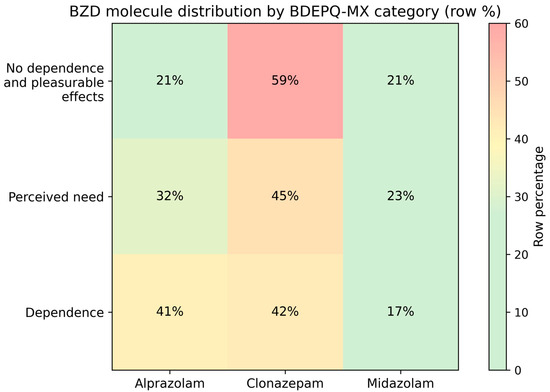
During the study period, 181 outpatients completed the BDEPQ-MX. The distribution of BDEPQ-MX categories is shown in Figure 1. Dependence was the most frequent category, followed by No dependence and Perceived need, with Pleasurable effects representing the smallest subgroup (Figure 1). For bivariate comparisons and multivariable models, complete-case analyses comprised 181 patients.
Figure 1.
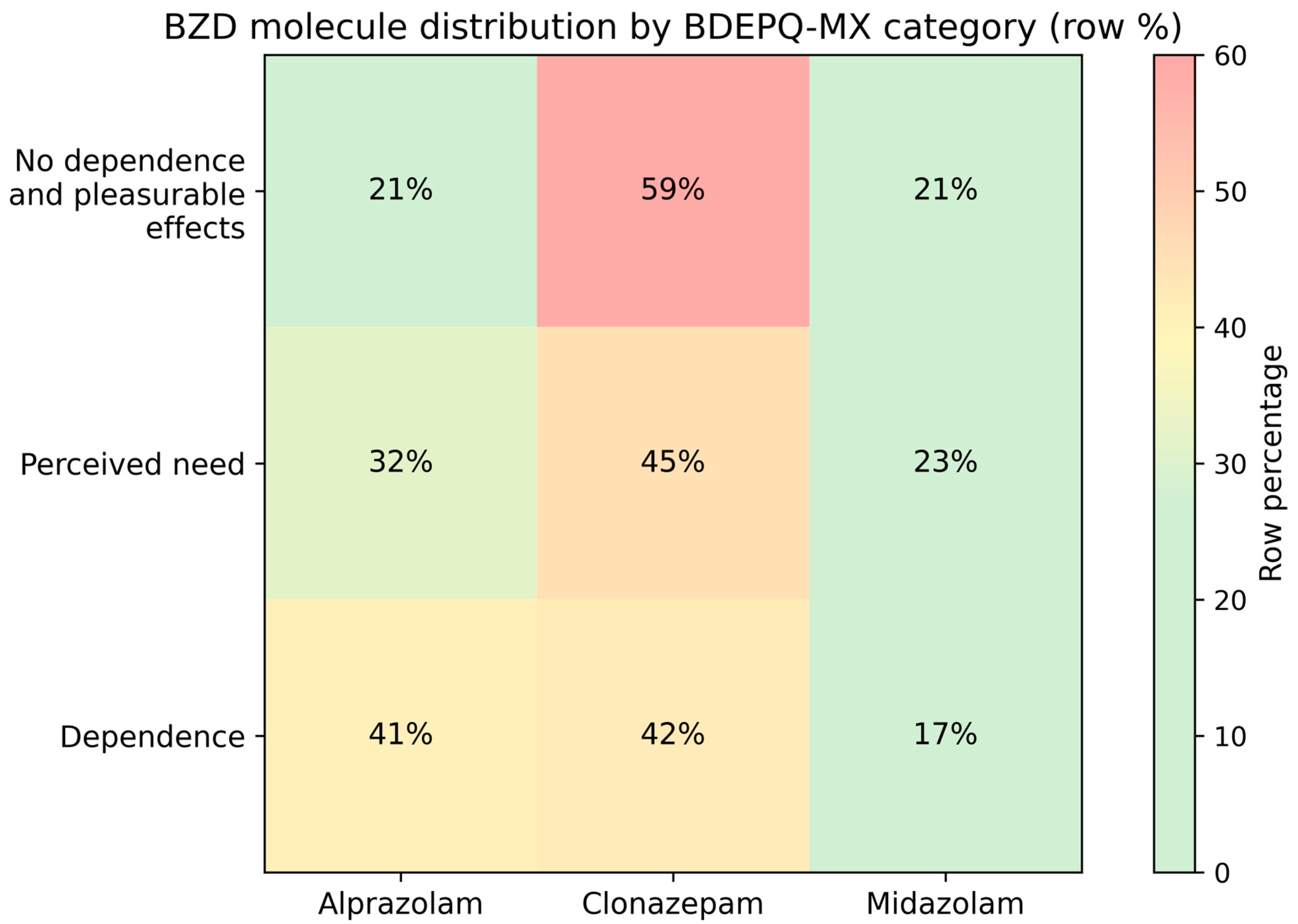
Heatmap of benzodiazepine drug by BDEPQ-MX category. Cells display the percentage of patients within each category receiving alprazolam, clonazepam, or midazolam; rows are normalized to 100% (minor rounding correction applied). Pastel green–yellow–red shading reflects lower-to-higher proportions. Categories: No dependence and Pleasurable effects (n = 73, both categories were unified due to the low sample in the pleasurable effects group), Perceived need (n = 31), Dependence (n = 77).
Compared with patients without any dependence, those with any BDEPQ-MX dependence were more often female and had a higher burden of comorbidities (both χ2, p < 0.001 and p = 0.006, respectively). Age, employment, and the distribution of clinical indications (insomnia, anxiety, affective, mixed anxious–depressive) did not differ significantly between groups (all p > 0.05). By contrast, duration of BZD use (months) showed a marked difference, with higher intake among those with any dependence (mean ± SD 22.6 ± 11.5 vs. 5.9 ± 4.9; p < 0.001). Daily dose (mg/day) did not differ between groups (p = 0.6). Regarding benzodiazepine medications, alprazolam was more frequent among patients with any dependence (38.9% vs. 20.5%; p = 0.009), whereas clonazepam was less frequent (43.5% vs. 58.9%; p ≈ 0.03); midazolam did not differ (p = 0.6) (Table 1).
Table 1.
Characteristics by any BDEPQ-MX dependence vs. No dependence.
3.1. Gradients Across BDEPQ-MX Categories
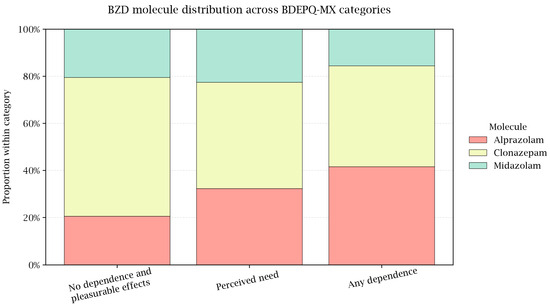
When the sample was stratified by ordered BDEPQ-MX categories, a clear exposure gradient emerged (Table 2). The proportion of women increased from the No dependence group and Pleasurable effects to Perceived need and Dependence (p < 0.001), and comorbidities became more prevalent across the same gradient (p = 0.015). Age, employment, and primary indication again showed no significant differences (all p > 0.05). The duration of BZD use (months) rose stepwise across categories (p < 0.001), whereas the daily dose did not vary (p = 0.7) (Table 2). Consistent with the two-group comparison, the drug mix shifted toward alprazolam in higher-dependence categories (p = 0.031), with a corresponding decrease in clonazepam (p ≈ 0.02), while midazolam remained similar (p = 0.5). These distributional patterns are visualized in row-percentage heatmap (Figure 2), which together show a higher share of alprazolam within Perceived need and Dependence and a lower share of clonazepam.
Table 2.
Characteristics by BDEPQ-MX category.
Figure 2.
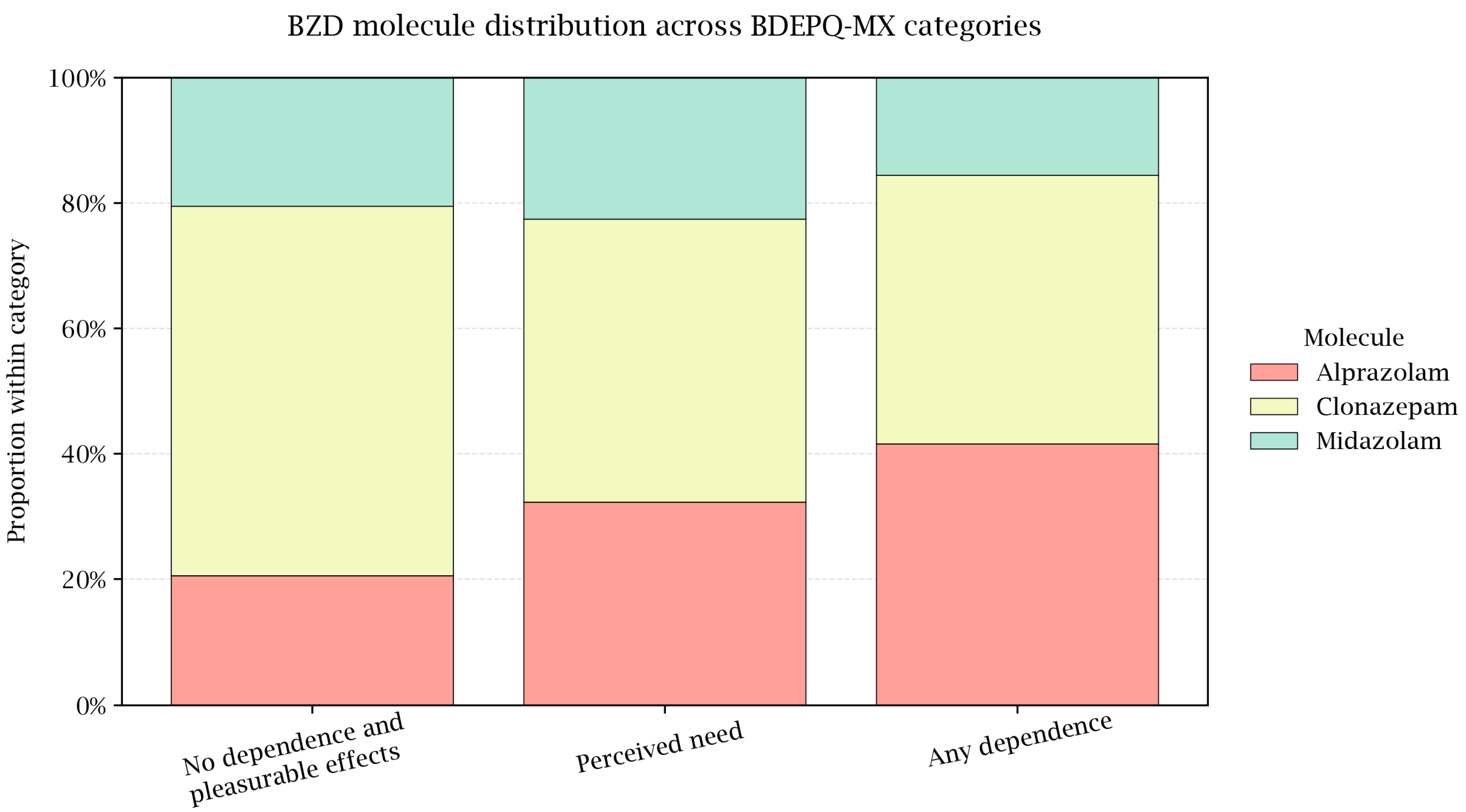
Benzodiazepine drug distribution across BDEPQ-MX categories (100% stacked bars). For each category—No dependence and Pleasurable effects (n = 73, both categories were unified due to the low sample in the pleasurable effects group), Perceived need (n = 31), Dependence (n = 77)—bars indicate the within-category proportion of alprazolam, clonazepam, and midazolam derived from Table 2 row percentages (normalized to 100% to address rounding). This plot visualizes the shift toward alprazolam in higher-dependence categories.
3.2. Multivariable Analyses
In the logistic regression for any dependence (Table 3), the male sex was independently associated with lower odds of dependence (aOR 0.29; 95% CI 0.11–0.76; p = 0.013), while the duration of BZD use (months) was strongly and positively associated with dependence (aOR 1.32 per month; 95% CI 1.20–1.45; p < 0.001). Age, employment, comorbidity, and daily dose were not significant predictors in the adjusted model (all p > 0.05).
Table 3.
Risk of any BDEPQ-MX dependence (Dependence or Perceived need).
In the general linear model with the continuous BDEPQ-MX total score as the outcome (Table 4), the duration of BZD use was again the dominant contributor (F = 203.26; p < 0.001; partial η2 = 0.545). No main effects were observed for age, daily dose, sex, employment, or comorbidity. Among interaction terms, only the sex × employment × comorbidity interaction reached statistical significance (F = 3.997; p = 0.047), with a small effect size (partial η2 = 0.023).
Table 4.
Linear regression model (ANOVA table for the GLM).
Overall, the results consistently indicate that longer exposure—rather than daily dose or nominal indication—is the key driver of BZP-related dependence phenomena in this outpatient pain and palliative-care population, with a sex effect favoring lower odds among men. Visualizations mirror the tabular contrasts, and multivariable models corroborate the central role of the duration of use.
4. Discussion
In our study, 59.7% of patients showed dependence on BZD agents with a mean use of 22.6 ± 11.5 months. Compared against the general population, BZD dependence levels are lower, between 6.6 and 6.8% [18]; however, in clinical settings where BZD agents are used to treat pain like our population, levels tend to be higher. Voyer P et al. screened BZD dependence levels in older adults in Quebec, observing a more similar prevalence to ours of 43% [19]. In another study performed in Spain in patients who reported using BZD for at least 1 month, De la Cuevas C. and Juan de la Fuente Emilio reported a dependence prevalence of 47% [20]. Only in one study, higher prevalence was reported: Kan C. et al. analyzed outpatient BZD users in the Netherlands, divided by users from the general practice and self-help patients; the first group have a prevalence of dependence of 40%, but in the second group, dependence levels reached up to 97% [21].
Factors associated with dependence we observed in our study were female sex, presence of chronic diseases, and length of usage (months). The female sex has been associated as a risk factor of dependence in other studies [20,22,23]. De la Cuevas C. and Juan de la Fuente Emilio also found that dependence was more prevalent in patients using BZD for more time [20]. Alongside Marriott S. and Tyrer P. also reported that longer therapies were risk factors associated with dependence [24]. An important risk factor commonly reported [25,26] that was not identified in our study was higher BZD dose; this could be due to the fact that all patients in our study were under a regime of a mean dose of 2 mg per day. It must be noted that emotional spectrum was not accounted for in our study as a risk factor, although it has been found to be a risk factor to BZD dependence by Kanopka A et al. which observed that introversion and adverse life events were risk factors [25], or the study performed by Ching-Fang Sun et al., where they observed that depressive disorder along with substance abuse were associated with BZD dependence [27].
The duration we observed in our study is similar to the broader literature. Systematic and cohort analyses identify persistence beyond 4–12 weeks as a key threshold after which dependence, tolerance, and withdrawal become increasingly likely, and a sizable fraction of new users transition to long-term use if treatment is not time-limited [28]. Current geriatric and safety guidelines, therefore, recommend restricting BZD courses to the short term, which can also be observed in our results, where shorter usage terms reflected less dependence prevalence [29].
Our drug-specific pattern—a higher share of alprazolam among dependence categories—has pharmacologic plausibility. Reviews note more severe and rapid-onset withdrawal with alprazolam than with many other BZDs, likely related to its short half-life/high potency and interdose withdrawal, which can reinforce continued use and dose-timing behaviors [30]. Notably, some cohorts link specific BZDs to transitioning into long-term use (e.g., nitrazepam, temazepam, lorazepam, clonazepam), underscoring that drug effects are context-dependent [31]. In our clinic, drug shifting was limited due to having only three BZD agents available at the pharmacy to prescribe.
Methodologically, strengths include the use of a validated instrument (BDEPQ-MX) to quantify dependence dimensions in a real-world population—in this case, patients with sleep and/or emotional disorders [15]—alongside the inclusion of a large number of patients using BZD for almost 2 years. Weaknesses in our study consider the lack of record regarding concomitant drugs used by the patient and low reliability of information due to use of EMR. Methodological limitations include the single-center nature of the study, the descriptive design, which does not allow causal inferences regarding BZD dependence, and the reliance on self-reported data obtained through the BDEPQ-MX questionnaire. Consequently, reporting bias may be present due to stigma, fear, or misunderstanding of the questionnaire items.
5. Conclusions
In this outpatient descriptive observational study conducted in a pain relief and palliative care institute, pharmacist-led BDEPQ-MX screening identified a substantial burden of benzodiazepine (BZD)-related dependence phenomena, with more than half of the evaluated patients meeting dependence criteria. The principal risk factor associated with dependence was the duration of BZD exposure, underscoring the importance of prioritizing treatment duration when assessing the dependence risk in clinical settings. The conduct of this study highlights an area for improvement within healthcare institutions, where the identification of conditions that place patients’ health at risk can be achieved through medical record review. Future research should focus on interventional and deprescribing programs for patients using benzodiazepines, led by pharmacists, thereby promoting the distribution of responsibilities within the multidisciplinary healthcare team.
Author Contributions
Conceptualization, C.E.E.-D.L.R. and R.E.-G.; methodology, D.O.S.-R. and R.E.-G.; software, F.A.A.-S. and D.O.S.-R.; validation, C.E.E.-D.L.R. and R.E.-G.; formal analysis, F.A.A.-S. and D.O.S.-R.; investigation, C.E.E.-D.L.R., D.O.S.-R. and R.E.-G.; resources, R.E.-G.; data curation, C.E.E.-D.L.R. and M.Z.-R.; writing—original draft preparation, F.A.A.-S. and D.O.S.-R.; writing—review and editing, F.A.A.-S., C.E.E.-D.L.R., C.R.C.-Á. and R.E.-G.; visualization, D.O.S.-R.; supervision, C.E.E.-D.L.R., C.R.C.-Á. and R.E.-G.; project administration, F.A.A.-S., R.E.-G., M.Z.-R. and C.E.E.-D.L.R. All authors have read and agreed to the published version of the manuscript.
Funding
This research received no external funding.
Institutional Review Board Statement
This study was authorized by the Jalisco Institute for Pain Relief and Palliative Care was approved by the Institutional Review Board (IRB) (PALIA-DESARROLLO. INST/185/2025; 14 October 2025). In accordance with the Mexican General Health Law, the project was classified as no-risk research. This research protocol followed the Ethical Principles for Medical Research Involving Human Subjects described in the Helsinki Declaration [32].
Informed Consent Statement
Informed consent was obtained from all subjects involved in the study.
Data Availability Statement
The data presented in this study are available on request from the corresponding author due to privacy and ethical restrictions on individual-level EMR data.
Conflicts of Interest
The authors declare no conflicts of interest.
Abbreviations
The following abbreviations were used in this manuscript:
| ANOVA | Analysis of variance |
| aOR | Adjusted odds ratio |
| AUC | Area under the ROC curve |
| BDEPQ | Benzodiazepine Dependence Questionnaire |
| BDEPQ-MX | Mexican adaptation/validation of the Benzodiazepine Dependence Questionnaire |
| BZD | Benzodiazepine |
| CI | Confidence interval |
| EMR | Electronic medical record |
| GLM | General linear model |
| IRB | Institutional Review Board |
| OR | Odds ratio |
| SCID-I | Structured Clinical Interview for DSM-IV Axis I Disorders |
| SD | Standard deviation |
| SPSS | Statistical Package for the Social Sciences |
| VIF | Variance inflation factor |
| χ2 | Chi-square test |
| η2 (partial η2) | (Partial) eta-squared, effect size |
References
- Zetsen, S.P.G.; Schellekens, A.F.A.; Paling, E.P.; Kan, C.C.; Kessels, R.P.C. Cognitive Functioning in Long-Term Benzodiazepine Users. Eur. Addict. Res. 2022, 28, 377–381. [Google Scholar] [CrossRef] [Scilit]
- Soyka, M.; Wild, I.; Caulet, B.; Leontiou, C.; Lugoboni, F.; Hajak, G. Long-Term Use of Benzodiazepines in Chronic Insomnia: A European Perspective. Front. Psychiatry 2023, 14, 1212028. [Google Scholar] [CrossRef] [Scilit]
- Maumus-Robert, S.; Jarne-Munoz, A.; Tournier, M.; Bégaud, B.; Pariente, A. Trajectories of Benzodiazepine Use among Older Adults from a Concordance-with-Guidelines Perspective: A Nationwide Cohort Study. Drugs Aging 2023, 40, 919–931. [Google Scholar] [CrossRef] [Scilit] [PubMed]
- Pétein, C.; Spinewine, A.; Henrard, S. Trends in Benzodiazepine Receptor Agonists Use and Associated Factors in the Belgian General Older Population: Analysis of the Belgian Health Interview Survey Data. Ther. Adv. Psychopharmacol. 2021, 11, 20451253211011874. [Google Scholar] [CrossRef] [Scilit]
- Freire, M.D.B.O.; Silva, B.G.C.D.; Bertoldi, A.D.; Fontanella, A.T.; Mengue, S.S.; Ramos, L.R.; Tavares, N.U.L.; Pizzol, T.D.S.D.; Arrais, P.S.D.; Farias, M.R.; et al. Utilização de Benzodiazepínicos Em Idosos Brasileiros: Um Estudo de Base Populacional. Rev. Saúde Pública 2022, 56, 10. [Google Scholar] [CrossRef] [Scilit] [PubMed]
- Kelley, C.J.; Niznik, J.D.; Ferreri, S.P.; Schlusser, C.; Armistead, L.T.; Hughes, T.D.; Henage, C.B.; Busby-Whitehead, J.; Roberts, E. Patient Perceptions of Opioids and Benzodiazepines and Attitudes Toward Deprescribing. Drugs Aging 2023, 40, 1113–1122. [Google Scholar] [CrossRef] [Scilit] [PubMed]
- Balon, R. Who’s Afraid of Benzodiazepines? Psychother. Psychosom. 2022, 91, 291–294. [Google Scholar] [CrossRef] [Scilit]
- Cooper, R.E.; Ashman, M.; Lomani, J.; Moncrieff, J.; Guy, A.; Davies, J.; Morant, N.; Horowitz, M. “Stabilise-Reduce, Stabilise-Reduce”: A Survey of the Common Practices of Deprescribing Services and Recommendations for Future Services. PLoS ONE 2023, 18, e0282988. [Google Scholar] [CrossRef] [Scilit]
- Ribeiro, P.R.D.S.; Schlindwein, A.D. Benzodiazepine Deprescription Strategies in Chronic Users: A Systematic Review. Fam. Pract. 2021, 38, 684–693. [Google Scholar] [CrossRef] [Scilit]
- McEvoy, A.M.; Langford, A.V.; Liau, S.J.; Goordeen, D.; Reeve, E.; Turner, J.P. Deprescribing Benzodiazepine Receptor Agonists in Older Adults and People With Cognitive Impairment: A Systematic Review. J. Am. Geriatr. Soc. 2025, 73, 2905–2913. [Google Scholar] [CrossRef] [Scilit]
- Anders, R.; Chapoutot, M.; Meloni, F.; Peter-Derex, L.; Gustin, M.-P.; Putois, B. The Benzodiazepine Dependence Questionnaire (BDEPQ): Development of a Brief Version and Validation of a French Adaptation. J. Behav. Cogn. Ther. 2024, 34, 100510. [Google Scholar] [CrossRef] [Scilit]
- Minaya, O.; Fresán, A.; Cortes-Lopez, J.L.; Nanni, R.; Ugalde, O. The Benzodiazepine Dependence Questionnaire (BDEPQ): Validity and Reliability in Mexican Psychiatric Patients. Addict. Behav. 2011, 36, 874–877. [Google Scholar] [CrossRef] [Scilit] [PubMed]
- Jessell, L.; Stanhope, V.; Manuel, J.I.; Mateu-Gelabert, P. Factors Associated with Benzodiazepine Prescribing in Community Mental Health Settings. J. Subst. Abuse Treat. 2020, 109, 56–60. [Google Scholar] [CrossRef] [Scilit] [PubMed]
- Brandt, J.; Bressi, J.; Lê, M.-L.; Neal, D.; Cadogan, C.; Witt-Doerring, J.; Witt-Doerring, M.; Wright, S. Prescribing and Deprescribing Guidance for Benzodiazepine and Benzodiazepine Receptor Agonist Use in Adults with Depression, Anxiety, and Insomnia: An International Scoping Review. eClinicalMedicine 2024, 70, 102507. [Google Scholar] [CrossRef] [Scilit]
- Capiau, A.; Huys, L.; Van Poelgeest, E.; Van Der Velde, N.; Petrovic, M.; Somers, A.; The EuGMS Task, Finish Group on FRIDs. Therapeutic Dilemmas with Benzodiazepines and Z-Drugs: Insomnia and Anxiety Disorders versus Increased Fall Risk: A Clinical Review. Eur. Geriatr. Med. 2022, 14, 697–708. [Google Scholar] [CrossRef] [Scilit]
- Lyzwinski, L.; Evéquoz, Y.; Rodondi, P.-Y. Managing Consultation Duration in Primary Care: A Systematic Review with Health Equity Insights. J. Fam. Med. Prim. Care 2025, 14, 3132–3158. [Google Scholar] [CrossRef] [Scilit]
- Prasad, K.; Poplau, S.; Brown, R.; Yale, S.; Grossman, E.; Varkey, A.B.; Williams, E.; Neprash, H.; Linzer, M. Time Pressure During Primary Care Office Visits: A Prospective Evaluation of Data from the Healthy Work Place Study. J. Gen. Intern. Med. 2020, 35, 465–472. [Google Scholar] [CrossRef] [Scilit]
- Maust, D.T.; Lin, L.A.; Blow, F.C. Benzodiazepine Use and Misuse Among Adults in the United States. Psychiatr. Serv. 2019, 70, 97–106. [Google Scholar] [CrossRef] [Scilit]
- Voyer, P.; Préville, M.; Cohen, D.; Berbiche, D.; Béland, S.-G. The Prevalence of Benzodiazepine Dependence among Community-Dwelling Older Adult Users in Quebec According to Typical and Atypical Criteria. Can. J. Aging Rev. Can. Vieil. 2010, 29, 205–213. [Google Scholar] [CrossRef] [Scilit]
- De Las Cuevas, C.; Sanz, E.; De La Fuente, J. Benzodiazepines: More “Behavioural” Addiction than Dependence. Psychopharmacology 2003, 167, 297–303. [Google Scholar] [CrossRef] [Scilit]
- Kan, C.C.; Breteler, M.H.M.; Zitman, F.G. High Prevalence of Benzodiazepine Dependence in Out-patient Users, Based on the DSM-III-R and ICD-10 Criteria. Acta Psychiatr. Scand. 1997, 96, 85–93. [Google Scholar] [CrossRef] [Scilit]
- Voyer, P.; Préville, M.; Roussel, M.-E.; Berbiche, D.; Béland, S.-G. Factors Associated With Benzodiazepine Dependence Among Community-Dwelling Seniors. J. Community Health Nurs. 2009, 26, 101–113. [Google Scholar] [CrossRef] [Scilit]
- Thomas, C.; Dondaine, T.; Caron, C.; Bastien, A.; Chérot, N.; Deheul, S.; Gautier, S.; Cottencin, O.; Moreau-Crépeaux, S.; Bordet, R.; et al. Factors Associated with the Use of Benzodiazepine and Opioid Prescription Drug in the Student Population: A Cross-Sectional Study. Sci. Rep. 2024, 14, 13040. [Google Scholar] [CrossRef] [Scilit]
- Marriott, S.; Tyrer, P. Benzodiazepine Dependence: Avoidance and Withdrawal. Drug Saf. 1993, 9, 93–103. [Google Scholar] [CrossRef] [Scilit]
- Konopka, A.; Pełka-Wysiecka, J.; Grzywacz, A.; Samochowiec, J. Psychosocial Characteristics of Benzodiazepine Addicts Compared to Not Addicted Benzodiazepine Users. Prog. Neuropsychopharmacol. Biol. Psychiatry 2013, 40, 229–235. [Google Scholar] [CrossRef] [Scilit] [PubMed]
- Kan, C.C.; Hilberink, S.R.; Breteler, M.H.M. Determination of the Main Risk Factors for Benzodiazepine Dependence Using a Multivariate and Multidimensional Approach. Compr. Psychiatry 2004, 45, 88–94. [Google Scholar] [CrossRef] [Scilit] [PubMed]
- Sun, C.-F.; Pola, A.S.; Su, K.-P.; Lin, B.Y.; Kablinger, A.S.; Trestman, R.L. Benzodiazepine Use for Anxiety Disorders Is Associated with Increased Long-Term Risk of Mood and Substance Use Disorders: A Large-Scale Retrospective Cohort Study. Drug Alcohol Depend. Rep. 2024, 12, 100270. [Google Scholar] [CrossRef] [Scilit]
- Kennedy, K.M.; O’Riordan, J. Prescribing Benzodiazepines in General Practice. Br. J. Gen. Pract. 2019, 69, 152–153. [Google Scholar] [CrossRef] [Scilit] [PubMed]
- By the 2023 American Geriatrics Society Beers Criteria® Update Expert Panel American Geriatrics Society 2023 Updated AGS Beers Criteria® for Potentially Inappropriate Medication Use in Older Adults. J. Am. Geriatr. Soc. 2023, 71, 2052–2081. [CrossRef] [Scilit]
- Ait-Daoud, N.; Hamby, A.S.; Sharma, S.; Blevins, D. A Review of Alprazolam Use, Misuse, and Withdrawal. J. Addict. Med. 2018, 12, 4–10. [Google Scholar] [CrossRef] [Scilit]
- Taipale, H.; Särkilä, H.; Tanskanen, A.; Kurko, T.; Taiminen, T.; Tiihonen, J.; Sund, R.; Tuulio-Henriksson, A.; Saastamoinen, L.; Hietala, J. Incidence of and Characteristics Associated With Long-Term Benzodiazepine Use in Finland. JAMA Netw. Open 2020, 3, e2019029. [Google Scholar] [CrossRef] [Scilit] [PubMed]
- World Medical Association. Declaration of Helsinki: Ethical Principles for Medical Research Involving Human Subjects. JAMA 2013, 310, 2191. [Google Scholar] [CrossRef] [Scilit] [PubMed]

Disclaimer/Publisher’s Note: The statements, opinions and data contained in all publications are solely those of the individual author(s) and contributor(s) and not of MDPI and/or the editor(s). MDPI and/or the editor(s) disclaim responsibility for any injury to people or property resulting from any ideas, methods, instructions or products referred to in the content. |
© 2026 by the authors. Licensee MDPI, Basel, Switzerland. This article is an open access article distributed under the terms and conditions of the Creative Commons Attribution (CC BY) license.