


Abstract
Two generally agreed upon characteristics of presuppositions are projection and backgroundedness. Yet, presuppositions sometimes fail to project. To derive the necessary local interpretations, standard semantic local accommodation accounts posit an operation that, inside the scope of an embedding operator, turns content lexically marked as presupposed into non-backgrounded content and conjoins it with the clause’s entailed content. Such accounts, as well as syntactic operator accounts descended from them, suggest that locally accommodated presuppositions might differ from projecting presuppositions in lacking not just projectivity, but also the second basic presuppositional property of backgroundedness. Recent pragmatic accounts arrive at a parallel, even stronger prediction of non-backgroundedness for locally accommodated content via their claim that all and only backgrounded material projects. To date, though, this idea, that non-projecting presuppositional content is also not backgrounded, has never been empirically tested, perhaps due to challenges in testing embedded material for backgroundedness directly. Using reduced cognitive salience as a measure of presuppositional backgroundedness, we present data from picture-matching and novel information-seeking tasks to indirectly evaluate the backgroundedness of locally accommodated presuppositions of also and continue. Baselines are provided by their explicit, non-backgrounded conjunction paraphrases and equivalent non-presuppositional elisions. Existing standard local accommodation accounts lead us to expect equivalence across all three, since they represent all three as non-backgrounded. However, our outcome measures indicate greater backgroundedness for locally interpreted presuppositions than equivalent explicit proffered content and elision controls (though to a lesser degree for the latter). We find similar patterns for global accommodation and for occurrences of also and continue that require no accommodation at all. These findings indicate that the interpretation of presuppositional content associated with lexical triggers should be modelled in a way that marks it as having a discourse status more backgrounded than that of main content in the same clause. Standard models accomplish this for globally accommodated and non-accommodated presuppositions by ensuring that the dynamic semantics includes their content in the context of interpretation of the clause in which the trigger occurs. However, such a direct solution is not available for locally accommodated presuppositions, as it fails to distinguish between the significantly backgrounded status we find for locally accommodated content and the non-backgrounding of identical content presented non-presuppositionally. We suggest augmenting standard representations of backgroundedness with variable givenness features in order to represent accurately the conventional backgroundedness marking of presuppositions.
1. Introduction
1.1. General Background
Presuppositions are generally assumed to have two key characteristics, namely that they project out of embedding environments and that they are taken for granted, or—as we will use the term—backgrounded. For instance, in (1), Sue has a dog, the presupposition triggered by the possessive her standardly projects out of the scope of negation, i.e., is taken to already be established in the global context, or common ground, for the utterance:
| (1) | Sue does not bring her dog to restaurants. |
If the fact that Sue has a dog is not previously entailed by the context of (1), cooperative hearers may add it by global accommodation (Lewis, 1979), i.e., the context can, in the right circumstances, be accordingly “adjusted quietly and without fuss” (von Fintel, 2008, p. 137). In addition, in cases in which presuppositional content cannot project to the global context, it can be locally accommodated (Heim, 1983): in (2), projection would be inconsistent with the speaker’s explicitly stated ignorance in the first clause, leading to local accommodation of the presupposition that Sue has a dog:
| (2) | I’m not sure whether Sue has a dog, but she definitely does not bring her dog to restaurants. |
While it is widely acknowledged that presuppositions sometimes fail to project, as in (2), the question of whether projection and backgroundedness are directly connected and, in particular, whether presuppositions that do not project are also not backgrounded, is underexplored, especially empirically. The present paper investigates this question experimentally.
1.2. Backgrounding and Related Notions
In order to ascertain whether locally accommodated presuppositions retain the general presuppositional property of backgroundedness, we must first establish what we mean by backgrounding and how it relates to two other related notions, givenness and not-at-issueness, which also are commonly alluded to in discussions of presuppositions. Unfortunately, the terminology in the literature is inconsistent and can be confusing, with the same term being used for different concepts, and the same concepts being associated with different labels. To clarify our usage of the term “backgrounded,” let us situate it in a brief review of its history.
The foundational papers by Stalnaker (1973) and Karttunen (1974) do not use the term “backgrounded,” alluding only to “background assumptions,” “background information,” and “background of common knowledge.” Stalnaker puts the notion of being “taken for granted” front and center but also clearly relates it to the term “background”: “To presuppose something is to take it for granted, or at least to act as if one takes it for granted, as background information” (Stalnaker, 2002, p. 701). Discussions in textbooks and much modern work commonly define backgrounding for presuppositions by saying that, in order to be felicitous, they must be entailed by the shared knowledge of the participants (Common Ground) against which the clause they appear in is interpreted (e.g., Chierchia & McConnell-Ginet, 1990; also see Potts, 2005, for the complementary notion of “antibackgrounding” of (what he calls) conventional implicatures). However, if backgrounding strictly required that the relevant information be already entailed by the Common Ground prior to the utterance, cases of accommodated presuppositions would, of course, not be considered backgrounded. But Stalnaker’s perspective crucially encompasses “acting as if one takes it for granted,” as the following discussion of accommodation (and its limits) makes clear (italics added to highlight the key part):
“Suppose φ is not something that the addressee will dispute, but that it is a noteworthy piece of information that the addressee might be expected to want to comment on. Then it might be inappropriate to convey the information in a way that keeps it in the background. An example of Kai von Fintel’s illustrates the point: A daughter informs her father that she is getting married by saying “O Dad, I forgot to tell you that my fiancé and I are moving to Seattle next week” (von Fintel, 2008, p. 36)” (Stalnaker, 2002, p. 710).
So Stalnaker considers it possible to introduce new information in a way that “keeps it in the background,” and, indeed, he later notes that “the pretense that new background information was old information will be a feature of some cases,” such that, in the just-mentioned example, “[t]he subtext may be something like, “You should know that we are engaged, but I don’t want to talk about it, so let’s pretend that it’s old news’” (Stalnaker, 2002, p. 715). In a similar vein, Geurts (2016, p. 184) highlights the compatibility of what he calls “given information” (his terminological choice for essentially the same notion as what we refer to as backgroundedness) with being new (italics added): “[P]resuppositions need not be given information. It is more accurate to say that presupposed information is presented as given [“backgrounded”, in our sense]: a speaker who presupposes something represents himself as supposing that the presupposition is already in the context. Just as one can present old stories as hot news, a speaker can present new information as if it were given.” In line with these authors, we consider accommodation, where the presupposed information is new relative to the pre-utterance context, to still involve backgrounding of that information, and we use the term “backgrounded” to encompass cases where the relevant information is merely “presented as old news” by the speaker. The main contribution of the present paper is to argue that this property of backgroundedness is also present for cases of local accommodation, where presuppositional information of an embedded clause that is new relative to its local context is nonetheless treated as if it were already established there, in contrast to the main point information of the clause, which is presented as new.1
Let us now briefly comment on various uses of givenness and not-at-issueness in the literature. Prince (1981) presents a taxonomy of interrelated and often co-occurring types of givenness, which she labels Predictability/Recoverablility (givennessp), Shared Knowledge (givennessk), and Saliency (givennesss). Givennessp has been prominently used in describing anaphoric reference as involving expressions requiring prior introduction of referents in the context (Prince, 1981; Ariel, 1990; Gundel et al., 1993), and givennessk is the defining property of the contents of the Common Ground. It is givennesss, the type tied to saliency, that Prince takes to apply most directly to presuppositional content, including that which must be accommodated.2 That is, Prince (1978, 1981) extends Chafe’s (1976) notion that given information must have been previously introduced, to include “any inferences [on the part of the speaker] so long as they could be deemed situationally appropriate” (Prince, 1981, p. 229). She makes use of this expanded definition of givenness to describe the accommodated presupposed content of a subject noun clause, as in (3)
| (3) | What my friend bought here was a beautiful scarf. (Prince’s (16a)) |
In (3), “it is appropriate for the [listener] to have in mind” that the speaker’s friend bought something at their present location (Prince, 1981, p. 230). We offer more discussion of the type of givenness tied to saliency in our sketch of a theoretical analysis in Section 7.2, where we extend Krifka (2008)’s established formalism for givenness theory to local contexts.
Turning to (not-)at-issueness, a term that has gained popularity following Potts (2005), the key notion is that at-issue information relates to the main point of an utterance, which presuppositions are generally not part of: “Since a [presupposition] is something which is taken for granted, of course it won’t be the main point of the utterance” (Kadmon, 2001, p. 12). But while presuppositions are generally taken to be not-at-issue, it is now common to distinguish different types of not-at-issue content. Most prominently, what Potts calls conventional implicatures (CIs) are not-at-issue content that behaves like presuppositions in the “family of sentences” tests in that they project through “holes” (Chierchia & McConnell-Ginet, 1990) but do not exhibit what we call backgroundedness: “CIs are another class of expressions that project beyond the holes […] However, they do not display the other main criteria for presuppositions: they need not […] be assumed by the speaker to be part of the common ground […] Thus, though the holes are useful for showing that a piece of meaning is not an at-issue entailment, further work must be done to determine where that meaning falls on the tree of meanings […] The holes might provide a necessary condition for presuppositionhood, but they do not provide a sufficient one” (Potts, 2005, p. 38).3
While we take our terminological choices and the corresponding conceptual divisions to be quite common, many questions remain about the typology of not-at-issue content, and various alternative perspectives exist. A full exploration of how the different notions of backgrounding, givenness, and not-at-issueness that have been identified in the literature relate to one another, and of how the conceptual space should be construed, is beyond the scope of this study. We simply aim to make explicit our use of “backgrounded” here as material presented as already in the relevant context. Thus, some content, such as an accommodated presupposition, can be treated as backgrounded relative to new/at-issue information in its clause, even if it, too, is actually new to the context. We will call information that is not backgrounded “proffered,” by which we mean “presented by the speaker as contributing to, even in an indirect or subordinate role, the at-issue content of their utterance.” We introduce “proffered” as a generalized version of “at-issue” because, in our study of local accommodation, we are largely interested in the content of embedded clauses, and embedded content often does not qualify as at-issue on its own:
| (4) | If the kids get sick, the party will be cancelled. |
In (4), for instance, the kids get sick is not the main point of the utterance, but it is put forward as a condition for the main point. Since we know of no standard way to refer to content of an embedded clause which, like “the kids get sick” in (4), would have been designated as at-issue if it had appeared as a matrix clause, we will continue to use “proffered” as necessary to refer to non-backgrounded content of matrix and embedded clauses that contributes truth-functionally to the main point of an utterance.
1.3. Theoretical Perspectives
With the notion of backgrounding as we use the term made explicit, let us turn to the question of how relevant prior theoretical accounts relate to our main question of whether or not locally accommodated presuppositions are backgrounded. This issue has not been directly addressed in the major theoretical perspectives on local accommodation. The standard dynamic semantic account of Heim (1983), which incorporates the Stalnakerian notion of context updates into the semantics, models presuppositions as definedness conditions on context updates. Accommodation a la Lewis (1979), where presupposed information is new relative to its context, is captured as an adjustment of the context relative to which the presupposition-containing clause is evaluated. To illustrate, we take the critical clause from (2) (repeated below) on its own as an example in (2′). Taking p to stand for Sue brings her dog to restaurants, q for Sue has a dog, and using subscript notation to track a given clause’s presupposition, (2′b) illustrates in dynamic semantic representation how negation removes those worlds in context c where the negated proposition in (2′a) holds.
| (2) | I’m not sure whether Sue has a dog, but she definitely does not bring her dog to restaurants. | |
| (2′) | a. | Sue doesn’t bring her dog to restaurants. |
| b. | c − (c + pq), defined iff q holds in all c-worlds | |
| c. | c+q − (c+q + pq) | |
(2′b) represents our rendering of the standard case in Heimian terms, where the update of c with pq is possible only if c entails q. (2′c) illustrates global accommodation, where the discourse participants “simply amend the context c to a slightly richer context” (Heim, 1983, p. 401), here rendered as c+q (updating Heim’s notation slightly) to track that q has been added to the original c “quietly and without fuss” in von Fintel’s terms.
While global accommodation involves an adjustment to assumptions about what the global context c is, Heim introduces local accommodation in a way that is usually taken as assigning the presupposition the status of ordinary asserted content, with no provision for special discourse properties, such as backgroundedness. This turns content lexically marked as presupposed into content that simply adds a further update to the local context, effectively conjoining it with the clause’s proffered content (see, e.g., the discussion and paraphrase in Kadmon’s (2001) textbook).4 The truth-functional meaning of (2) can then be accurately paraphrased as in (5a).
| (5) | a. | I’m not sure whether Sue has a dog, but it’s definitely not true that [Sue has a dog and she brings her dog to restaurants]. |
| b. | c − ((c + q) + pq) |
A global projection interpretation, as in (2′b), is not possible for (2), since the context of the presuppositional sentence (which includes the first clause) does not meet the definedness condition. Furthermore, global accommodation, as in (2′c), is not possible in such “Explicit Ignorance Contexts” (Simons, 2001; Abusch, 2010), since it would lead to inconsistency. In contrast, the local accommodation interpretation is possible, as shown in (5b), where q is added to c as a further conjunct (c + q), inside of the scope of negation along with p, with no special backgrounded status.
However, the status of accommodated presuppositions in terms of backgrounding warrants a closer examination. The general reception in the literature of Heim’s work aligns with Kadmon’s conjunctive paraphrase for local accommodation in (5b), drawing a contrast between global accommodation (backgrounded) and local accommodation (not backgrounded). We represent this contrast notationally by using c+q in (2′b) vs. c + q in (5b) to represent presuppositional content in context. Heim’s own discussion is brief and merely lays out the mechanics of context adjustments without commenting on any potential backgrounded status of either globally or locally accommodated presuppositions, although her reference to Lewis might suggest backgrounding for the global case. Her account therefore may not be incompatible with according a special information status to the presupposition even in local accommodation contexts. The idea would be that, like other presuppositions, it would have to be treated as already established in the context against which the asserted content of its clause is interpreted. As the name suggests, for local accommodation, accommodation would be relative to the local context, not the global Common Ground. (For some takes on recursive local contexts, see, e.g., Karttunen, 1973; Schlenker, 2009; Barker, 2022). While providing for backgrounding in local contexts may be a possible extension of the Heimian perspective, it certainly does not fall out from it as it stands.
Alternative formalisms in the subsequent literature more explicitly advance the notion of local accommodation turning presuppositional information into asserted information. A syntactic variant using an A-operator, by Beaver and Krahmer (2001), couched in a trivalent logic where presuppositional undefinedness is modeled with a third truth-value, builds on Bochvar (1939/1981). “Bochvar suggested that, apart from the normal mode of assertion, there was a second mode which we might term meta-assertion. The meta-assertion of φ, Aφ, is the proposition that φ is True” (Beaver & Krahmer, 2001, p. 153). The A-operator thereby eliminates the third truth value representing presuppositional undefinedness. Mapping the third truth value to plain falsity accomplishes a parallel effect of turning embedded presuppositions into regular proffered content. Inserting this assertoric A-operator at the appropriate embedded level, the analysis of the local accommodation interpretation of (2) then is as follows in (6) (Beaver & Krahmer, 2001):
| (6) | I’m not sure whether Sue has a dog, but it’s definitely not true that [A [she brings her dog to restaurants]]. |
Beaver and Krahmer (2001, p. 37) further expand on this approach: “There is no technical reason why the Bochvarian meta-assertion operator should be restricted in its occurrence to propositions directly under a negation. Link (1986) has proposed a model in which in principle any presupposition can be co-asserted, where co-assertion […] essentially amounts to embedding under the A-operator.” Both Link’s terminology of “co-assertion” alluded to here and Bochvar’s “meta-assertion,” as well as the very definition of the A-operator as eliminating the truth value representing presuppositional undefinedness, suggest a perspective in which local accommodation indeed turns presuppositional content into asserted material, which in turn produces a loss of backgroundedness.
From a rather different perspective, recent pragmatic accounts also directly predict that locally accommodated content is not backgrounded, though without endorsing the idea that local accommodation is even in play (Simons et al., 2010; Tonhauser et al., 2018).5 Such accounts aim to derive projection patterns from general pragmatic properties without assuming lexically encoded presuppositions as the general case. Central to these accounts is the claim that all and only not-at-issue material projects. From this, it follows as the contrapositive that cases of what we consider locally accommodated content, which by definition does not project, always involve at-issue information. Since, by definition, at-issue content expresses a main point and main points are not backgrounded, such pragmatic accounts predict that locally accommodated content is not backgrounded.
Finally, some less standard perspectives on local accommodation phenomena, such as von Fintel (2008), argue that local accommodation does not exist at all. In relevant cases, triggers in the scope of operators are seen as simply failing to give rise to presuppositions for various theoretical reasons. Thus, backgrounding of presuppositions in the scope of operators is unexpected on such a view, since there would be no presuppositions to be backgrounded.
Whether we find backgrounding in locally accommodated material has important implications for the nature of presupposition and could shed light on the nature of presupposition in general. First, if backgrounding is an essential, conventional property of lexical presupposition triggers, we would expect to observe presupposition-like backgrounding behavior associated with those triggers even within local accommodation contexts. If, on the other hand, presuppositional backgrounding is not an essential part of the lexical meanings of the triggers, but the result of contextual or pragmatic factors affecting the matrix sentence, there would be no general prediction of backgrounding of the presupposed content of triggers in embedded local accommodation contexts. Secondly, and relatedly, our question also crucially informs the relation between (non)-projection and backgroundedness, and in particular whether non-projecting content is not backgrounded. Finally, it bears on the relation between local and global contexts. Are local contexts actually distinguished from global ones in adding the presuppositional content of (locally accommodated) triggers as part of regular content? Or do both local and global contexts allow the content of lexical presupposition triggers to retain their backgrounded discourse status? The answers to these questions have important implications for the theoretical modeling of presuppositions and the properties of not-at-issue content more generally.
1.4. Testing Locally Accommodated Presuppositions for Backgroundedness
While various prior theoretical perspectives can be taken to implicitly assume or directly predict that locally accommodated material is not backgrounded, this issue has not been systematically tested empirically. One reason that researchers have not undertaken such testing may be the relative success of the accounts above: The conjunctive translations like the one in (5a) account well for the truth-conditional meaning of sentences like (2), independent of whether or not they correctly represent the effects of the discourse status of the presupposed material, which may be subtle. Another factor working against those who wish to adduce experimental evidence bearing on the discourse status of locally accommodated material is that directly testing material embedded under operators presents considerable challenges. One cannot, for instance, use conversational continuations, which target at-issue content (Simons, 2019), to test reliably whether a locally accommodated presupposition such as Sue has a dog in (2) is at-issue or not. Such a test works as expected when the possessive presupposition is in a position to project globally, as in (7). Both the B rejoinders in (7) would be taken as targeting the at-issue proposition that I’m obsessed with my dog and not the perfectly plausible and consistent possessive presupposition I have a dog. This indicates, as expected, that the presupposition is not-at-issue, consistent with its being backgrounded.
| (7) | A: | I’m obsessed with my dog |
| B: | Does your mother know that? | |
| B′: | That’s weird! |
However, when we apply the continuation test to the local accommodation context in (8A), the results are not so conclusive.
| (8) | A: | I don’t have a dog, so it’s not true that I’m obsessed with my dog |
| B: | Does your mother know that? | |
| B′: | That’s weird! |
The B responses here can target either the first clause (I don’t have a dog), the second clause (It’s not true that I’m obsessed with my dog), or the entire complex sentence in (8A). As in (7), the B responses in (8) cannot be taken as targeting the possessive presupposition that I have a dog. However, we cannot safely conclude from this that I have a dog is not-at-issue here, as we could in (7), because there is another reason, unrelated to discourse status, that a cooperative speaker would not target I have a dog with her response to (8A): I have a dog is inconsistent with the at-issue content of the first clause, I don’t have a dog, the very material that blocks projection of I have a dog and provokes local accommodation instead. Consequently, conversational continuation exchanges like those in (8) give us no opportunity to test conclusively the discourse status of locally accommodated presuppositions relative to that of the content of the embedded clause in which they occur.
Other tests for not-at-issueness, however, provide suggestive evidence that locally accommodated presuppositions are not-at-issue (as they should be if they are backgrounded in our sense). Presuppositional content can be locally accommodated only under operators such as negation, question, or if, and material embedded under such operators is typically unavailable to perform at-issue functions such as asking or responding to a question, making a proposal, or even serving as a coherence relation argument (Koev, 2018). In (9) and (10), we can see how utterances modeled on (2), but including two of these operators fail Tonhauser et al.’s (2018) asking-whether diagnostic for at-issueness. In each case, the answer is NO, since the question cannot target the locally accommodated existential presupposition of her:
| (9) | A: | I don’t even know for sure that Sue has a dog. Is her dog really aggressive? |
| Is A asking whether Sue has a dog? | ||
| (10) | A: | I don’t even know for sure that Sue has a dog, but can the kids go to her house to play if her dog is really aggressive? |
| Is A asking whether Sue has a dog? |
However, these judgments may be subtle, and the question remains how we can observe and measure backgrounding in local contexts more systematically. To be able to carry out such measurements, we need to identify an aspect of presuppositional backgrounding that is observable and measurable, no matter whether the presupposition is satisfied in the context or accommodated globally or locally. Intuitively, speakers judge that Sue has a dog, the locally accommodated material in (2), repeated below, seems backgrounded in a general sense, that is given “less attention or emphasis” (Merriam-Webster, n.d.), than its non-presuppositional paraphrase underlined in (11).
| (2) | I’m not sure whether Sue has a dog, but it’s definitely not true that she brings her dog to restaurants. |
| (11) | I’m not sure whether Sue has a dog, but it’s definitely not true that she has a dog and she brings her dog to restaurants |
To make use of this observation, we must find a way to measure rigorously to what degree speakers are giving content that is locally accommodated their attention, relative to at-issue or, more generally, proffered content. An empirical measure of salience would satisfy this requirement, since salient, in its general sense of “most noticeable or important” (Cambridge English Dictionary, n.d.) is an antonym of backgrounded. The less salient something is, the more backgrounded it is. Indeed, the general sense of backgrounding as reduced attention or emphasis has long been employed by linguists in distinguishing foregrounded and backgrounded discourse functions in narratives via a schema called a saliency hierarchy (Hopper & Thompson, 1980). This hierarchy predicts, for instance, low salience relative to the main narrative for descriptive passages. This prediction shows us that not all low salience material is backgrounded in our particular sense, since descriptive passages are not treated as if they are already in the relevant context of interpretation. Crucially, though, all material that is backgrounded in our sense is predicted to measure low in salience, as we have seen that it is not-at-issue, and not-at-issue material is, by definition, low in salience. Accordingly, we propose low cognitive salience as a measurable marker of presuppositional backgroundedness.
1.5. Previous Studies
There is empirical support for the hypothesis that the backgrounding of (non-embedded) presuppositions can be detected by measures confirming reduced cognitive salience in the course of completing a task: Schwarz (2016) and Bacovcin et al. (2018) have found that presupposed material registers lower in salience than parallel proffered material, measured by means of a picture-matching task. Schwarz (2016) offered novel experimental support for the position that the existence condition of definite descriptions is presuppositional and backgrounded: Participants were shown pictures related to accompanying sentences and asked to respond whether each sentence was True or False in the context of the visual stimuli. In some cases, the existence presupposition of a definite description in the sentence was not met in the picture, and in others, the proffered content of the same sentence was falsified. Slower response times were found for responding “false” when the presupposition was unmet in the picture than in cases where the proffered content was not supported visually. A parallel manipulation with indefinite descriptions provided crucial control conditions. In the condition from Bacovcin et al. (2018) most relevant for our purposes, participants were presented sentences such as “Henry came to town for the first time on Tuesday. On Wednesday, he went to the aquarium again,” and then had to choose between two pictures (presented as calendar strips with iconic representations of activities) that only partly matched the overall information conveyed. One picture choice was consistent with the proffered content (that Henry went to the aquarium on Wednesday), but inconsistent with the presupposition (that he went to the aquarium on Tuesday); the other was inconsistent with the proffered content, with the presupposition left open (the relevant calendar slots being occluded from view). The overwhelming majority of participants chose the former, where the proffered assertion was true, but the presupposition was not, suggesting that proffered material is most salient and important in formulating truth judgments, whereas the presupposition is relatively backgrounded in such a task. Taking inspiration from these approaches to testing backgroundedness experimentally for globally interpreted presuppositions, we adapt this general approach to locally accommodated presuppositions, while also comparing them to global ones.
1.6. Goals and Strategy
In the five experiments that we report on here, we aim to test the backgroundedness of locally accommodated presuppositions by building on the general idea of testing whether visually represented scenarios (Experiments 1, 4, and 5) and verbally laid out ones (Experiments 2 and 3) are seen as matching a given sentential description, even though they do not accurately depict all of the information expressed by the sentence. In particular, we seek to discover whether, in the course of performing the matching tasks, the missing aspects of the visual or verbal scenarios differ in salience according to whether or not they are presented as presuppositions that must be locally accommodated. Key points of comparison with constructions that include locally accommodated presuppositions will be the explicit, non-backgrounded conjunction paraphrases for such presuppositions posited by semantic/syntactic accounts following Heim (1983), as well as equivalent non-presuppositional elisions that more closely match local accommodation surface forms. These controls encode the same truth-conditional meaning as the tested presuppositional sentence, but the information that is expressed as a presupposition in the critical condition is introduced in them as straightforwardly and uncontroversially proffered content. Our experimental items include the additive trigger also and the change of state trigger continue. These were chosen both because they were well-suited to the construction of the visual and verbal items, respectively, and because they represent a wide range of trigger properties, such as part of speech, strength, focus-sensitivity, and anaphoricity.
All else being equal, local accommodation accounts that do not assign to the relevant content any special backgrounded status align with the Null Hypothesis that the particular way that information is introduced—by a presupposition trigger such as also or continue, a conjunctive paraphrase, or an equivalent elision—will not affect the extent to which partially matching pictures or written phrases are seen as accurate depictions of the provided situation. This is because this type of traditional perspective on local accommodation assumes that the information expressed has equivalent, non-backgrounded discourse status across all three constructions. In contrast, if locally accommodated content is backgrounded, we expect the failure of a picture or phrase to match the content introduced by the presupposition trigger to be less impactful than a similar failure when the same content is introduced as part of standard proffered content.
The central questions we address are
- Is presuppositional material embedded under operators still backgrounded, relative to parallel proffered content, even when it does not project and must be locally accommodated?
- If so, is this backgroundedness of embedded presuppositional material associated with particular lexical items, as opposed to being pragmatically derived from reasoning about the content itself?
- Does the backgroundedness of embedded presuppositions parallel that of projecting ones and those that are satisfied in context, indicating that local and global accommodation are part of a single presuppositional phenomenon characterized by a high level of backgroundedness? If so, what does this mean about how presuppositional backgroundedness should be represented?
The remaining sections of the paper are structured as follows:
Section 2 reports on Experiment 1, which employs a picture-matching task. We find that locally interpreted content contributed by the presupposition trigger also reflects greater presuppositional backgroundedness than equivalent explicit proffered content and, to a lesser degree, than more surface-similar elisions. These differences remain unaccounted-for in both standard and non-standard views of local accommodation phenomena. (Section 2 and Section 3 expand upon and revise Siegel and Schwarz (2023).) Section 3 reports on Experiment 2, whose items require global accommodation in place of the local accommodation of Experiment 1. Our results confirm that the picture-matching task assigned to participants in Experiment 1 elicits a similar pattern of responses with examples including global, rather than local, accommodation, supporting the idea that parallel notions of backgroundedness are in play across these cases.
Section 4 reports on Experiment 3, which tests the backgroundedness of the presuppositional content contributed by continue by means of a novel verbal information-seeking task. We find that the presuppositional content of continue, like that of also in Experiment 1, is more backgrounded than equivalent content when it is explicitly proffered or expressed via elision. Once again, patterns are similar with items including local and global accommodation. However, the rate of backgrounding of the accommodated content of continue is very near ceiling. This raises the question of whether participants perceived the highly backgrounded presuppositional content of continue in the context of our experimental items at all, or if they merely interpreted continues to VP as equivalent to VP’s now.
Section 5 describes Experiment 4, in which we tested whether the near-ceiling rate of backgrounding of the presupposed content of continue in Experiment 3 indicates that participants failed to take into account that content or that they were simply treating it as deeply backgrounded. To distinguish between these two possibilities in Experiment 4, we manipulated the task assigned in Experiment 3 so as to decrease the baseline backgroundedness of the presuppositional content triggered by continue. We found that, under such conditions, participants responded to items including continues to VP significantly differently from those that included only VP’s now, indicating that our experimental items reflect interpretation of the backgrounded presuppositional content of continue.
Section 6 reports on Experiment 5, a follow-up to Experiments 1 and 2 designed to compare the degree of backgrounding of also’s presupposed content when it has been locally or globally accommodated with the degree of backgrounding of the same presuppositional content when it is explicitly entailed by the relevant context. We found similar levels of backgrounding for accommodated and context-entailed presuppositions.
Section 7 concludes with a general summary and discussion of our findings, their theoretical implications, and a sketch of a suggested account in terms of givenness.
The main question each experiment addresses, the presuppositional trigger tested, and the experimental methodology employed are summarized in Table 1 below:
Table 1.
Summary of main questions, triggers, and methods for Experiments 1–5.
2. Experiment 1
2.1. General Design
Our presupposition trigger of choice for implementing Experiment 1 was also. While in the theoretical literature the notion that also does not allow local accommodation or at least strongly resists it is common (e.g., Abusch, 2010), prior experimental work has clearly established that such interpretations are perfectly possible for cross-linguistic cognates (e.g., Jayez et al., 2015; Grubic & Wierzba, 2019). That is, contextual factors can render accommodation felicitous even with so-called strong triggers like also (Göbel, 2020). One big advantage of also for our purposes is the relatively clear conceptual separation between presupposed and proffered content: E.g., in Paul also has chocolate syrup (from our stimulus in (12) below), the latter is Paul’s possession of chocolate syrup, whereas the former is that he has some other contextually salient item (ice cream, in (12)). This is crucial for implementation purposes, given that our sought-after measure of cognitive salience in terms of a participant’s willingness to accept illustrations that are missing the presupposed information requires both experimenters and participants to be able to distinguish in pictorial representations what corresponds to the explicit proffered content and what to the presupposed content. Only with this clear distinction will experimenters be able to solicit judgments from participants that hinge upon whether one type of content, namely the presupposed part, is missing from an illustration. For many other presupposition triggers, what is presupposed is too closely related to the accompanying proffered information for participants to be able to do this, at least in any straightforward way that we were able to come up with. It is very difficult, for instance, for experimenters to create and for participants to distinguish between pictures of someone both having a dog (presupposed information in the embedded clause of (1)) and taking a dog to restaurants (proffered information in the embedded clause of (1)) from those of someone merely taking a dog to restaurants (proffered information only). Proffered and presupposed content for definites and factives are similarly closely related; furthermore, it is often theoretically assumed that in these cases, the content introduced as a presupposition is simultaneously present in, and entailed by, the proffered content. Consequently, also lent itself as a first test case for our purposes, since its presupposition can be illustrated entirely independently of what is proffered in its sentence.
Another choice point for implementation concerned the embedding expressions relative to which the presupposition of also could be interpreted locally. We chose if clauses, i.e., the antecedent of conditionals, as our embedding environment because other possible embedding operators, such as negation and questions, often give rise to confounding scope ambiguities. Finally, we wanted to prevent participants, as much as possible, from simply ignoring the presuppositions triggered in our examples. This is a potential concern due to prior claims that, at least in some contexts of use, presuppositional content can be ignored (Domaneschi et al., 2014; Tiemann, 2014; Tiemann et al., 2014), although Bacovcin et al. (2018) argue against that interpretation of prior findings. Regardless, and to err on the side of caution, we made sure that the final consequent clauses of our items logically require the presupposition triggered in the second clause to hold (see Section 2.2 below).
2.2. Materials and Predictions
In light of the general considerations above, we aim to measure the relative cognitive salience (and thereby, the relative backgroundedness) of exactly the same information presented via local accommodation of the presupposition triggered by also, as illustrated in the sample item text in (12), its conjunctive paraphrase, illustrated in (13), and a non-presuppositional elision, illustrated in (14).
| (12) | This could be wrong, but I heard that Paul might have ice cream; if he also has chocolate syrup, we could have sundaes for dessert. |
| [ALSO condition] | |
| (13) | This could be wrong, but I heard that Paul might have ice cream; if he has ice cream and he has chocolate syrup, we could have sundaes for dessert. |
| [CONJ condition] | |
| (14) | This could be wrong, but I heard that Paul might have ice cream; if he does, and he has chocolate syrup, we could have sundaes for dessert. |
| [DOES condition] |
The piece of information of central interest, which is presupposed in the ALSO condition in (12), is that Paul has ice cream. A global interpretation of this presupposition is in conflict with the preceding context, where the speaker explicitly conveys their uncertainty with regards to whether or not this holds; this constitutes a version of the “Explicit Ignorance Contexts” of Simons (2001) and Abusch (2010). Consequently, the presupposition introduced by also can be interpreted only locally, inside the if clause, truth-conditionally conveying exactly what the standard paraphrase utilized in the CONJ condition in (13) conveys. Note that the consequent we could have sundaes for dessert was chosen so as to maximize the likelihood that participants indeed take the presuppositional content that Paul has ice cream into account across all conditions, rather than ignoring it, as Paul can serve sundaes for dessert only if he has ice cream.
Another potential issue is that the equivalence between the first two conditions (ALSO and CONJ) generated in standard conjunctive syntactic/semantic accounts holds only if all else is equal. But one obvious difference between (12) and (13) is that the latter contains the explicit additional wording “he has ice cream and.” While the truth-functional content expressed in (12) and (13) is clearly the same, the mere presence only in (13) of the relevant words in the portion of the sentence of interest—the antecedent of the conditional—could well give rise to a difference in the salience of the corresponding information in (12) as compared to (13). Such an effect would constitute a substantive confound for answering our main question, and also potentially be of independent theoretical interest as a comparison between explicit and non-explicit content. The DOES condition in (14) was included in order to test the effect of explicitness directly6: The does elision used in (14) shares the implicitness and anaphoricity of also but lacks also’s status as a presupposition trigger. Thus, if we were to find higher rates of acceptance for (12) (ALSO) than for (13) (CONJ) of illustrations that do not include a representation of “Paul has ice cream,” that could be due to the implicitness confound. However, if we also find higher rates for (12) (ALSO) than for (14) (DOES) of acceptance of illustrations that do not represent the content presupposed in the ALSO condition, such a difference is attributable to also’s presuppositional nature, beyond the implicitness in play in both (12) and (14).
In order to guide participants towards giving the relevant type of judgment, we provided them with an initial screen of instructions, which are shown in the format presented to the participants in (15).7
| (15) | Instructions |
| Please assume that the remark you will read on the next page was produced by our friend Francine in casual conversation. Francine’s remark contains a description of a hypothetical situation, which is highlighted in green, and it is followed by an illustration. Please read the whole of Francine’s remark, and then click on the answer you choose for each of the three questions that follow it. The questions will be revealed in order beneath Francine’s remark; after you answer one question, the next will appear. Please try to answer each question the best you can even if you are not completely confident about your answer. | |
 |
Subsequently, two new screens were shown, with a written version of an utterance in the form of one of the conditions (12)–(14), along with a question and (for Question A) a picture.
| (16) | Question A: |
| FRANCINE: | |
| This could be wrong, but I heard that Paul might have ice cream; if he also has chocolate syrup, we could have sundaes for dessert. | |
 | |
| QUESTION: | |
| Do you think that this illustration accurately depicts Francine’s description of the hypothetical situation highlighted in green? | |
  | |
| (17) | Question B: |
| FRANCINE: | |
| This could be wrong, but I heard that Paul might have ice cream; if he also has chocolate syrup, we could have sundaes for dessert. | |
| QUESTION: | |
| Now taking into account the entirety of what Francine says in her remark, does Paul definitely, in reality, have ice cream? | |
| |
Question A in (16) requires participants to judge whether the provided picture accurately depicts the description in the highlighted part of the relevant utterance. In the critical ALSO condition from (12), illustrated in (16), also in the antecedent of the conditional introduces the presuppositional content that Paul has ice cream, but projection is blocked by the explicit ignorance context in the first clause. The picture showing Paul holding a bottle of chocolate syrup represents the non-presuppositionally introduced information that Paul has chocolate syrup, but not the presuppositional content that he has ice cream. The two control conditions in (13) and (14) introduce Paul has ice cream as non-presuppositional content: (13) is the standard accounts’ conjunctive paraphrase of the local interpretation, differing from (12) in explicitly mentioning Paul’s having ice cream. (14) conveys Paul has ice cream implicitly but non-presuppositionally, using ellipsis.
Building on our definition of backgroundedness as entailing low salience, as well as on prior empirical work indicating that presuppositionally backgrounded status corresponds to a decreased level of cognitive salience in picture evaluation, we have the following expectation about responses to Question A: We expect participants to answer YES to Question A in the ALSO condition if the presuppositional content that Paul has ice cream is sufficiently low-salience (indicating that it is backgrounded) to them, that, in their judgment, it need not be represented in an illustration of the highlighted clause. Thus, we are able to gauge indirectly, from participants’ rate of YES answers to Question A, whether Paul’s having ice cream is more or less backgrounded for them in each condition.
Question B in (17) was included to provide a check on whether participants had been attentive to the intentionally emphatic initial explicit ignorance contexts and had, consequently, gotten the intended local interpretation of also: participants who answer NO to Question B show that they recognize that (12)–(14) in their entirety do not entail or implicate that Paul definitely, in reality, has ice cream. Thereby, for (12) in particular, with its presupposition trigger also, they indicate that they have not globally accommodated the presupposition triggered by also that Paul has ice cream. Participants who answer YES to Question B, in contrast, can safely be taken not to have properly digested the overall meaning of the presented text. It is thus hard to interpret their response to Question A, and we therefore exclude them from the relevant analyses.
But for participants who answered NO to Question B, our key prediction can be tested: If the information that Paul has ice cream is less salient in (12), where it is introduced through local accommodation, than in (13) and (14), where he has ice cream is introduced as a proffered conjunct (either explicitly or via ellipsis), we expect more frequent YES answers to Question A for (12) than for (13) and (14) (with possible differences between the latter two if explicitness has an independent effect). That is, if information is less salient when introduced by a presupposition trigger than when it is introduced in a proffered conjunct, participants should be more likely to accept as accurate the pictorial representation without the ice cream when it is introduced as in (12), than as in (13) or (14).
In addition to the ice cream sundae item above, we used two further item variants to guard against effects due to accidental specifics of a particular item. The additional items, in their ALSO conditions, are presented with their accompanying illustrations as examples (18) and (19).
| (18) | This could be wrong, but I heard that Diane might have the violin part for our new piece; if she also has the flute part, we could get together and practice the duet before the first official rehearsal. |
 | |
| (19) | This could be wrong, but I heard that the Halls might have a son who plays soccer; if they also have a daughter who plays soccer, their kids could join our new co-ed soccer league. |
 |
2.3. Participants and Procedure
In light of the nature of the overall task, and in particular the necessary attention check in Question B on whether or not participants had indeed adopted the appropriate local accommodation interpretation in the ALSO condition, it seemed highly likely that the first exposure to any item, along with Questions A and B, would already strongly sensitize participants to the issues at stake and to the purpose of the experiment. This presented a risk that data from repeated trials could include effects of participants’ strategically adjusting to perceived expectations about how they should act. We therefore decided to adopt a single-trial design, where each participant saw only a single item in one condition (with accordingly increased numbers of participants). Condition and item variants were varied randomly between subjects, and the picture was uniform across the three conditions for each of our three item variants. For example, a participant randomly assigned to the ALSO condition of the ice cream sundae variant we have illustrated here would see, in sequence, the three screens reproduced in (15), (16), and (17). For participants assigned to the CONJ or DOES conditions, screens (16) and (17) differed only in having (13) or (14) appear in place of (12).
We recruited 458 participants from the University of Pennsylvania’s subject pool to participate online via the PCIbex platform for course credit (Zehr & Schwarz, 2018).8 As noted above, we excluded from data analysis those participants who answered YES to Question B, thus indicating that they were not working with the required local interpretation. Participants who identified themselves as non-native speakers of English were removed as well. After removal, data from 401 participants were left for purposes of analysis.
2.4. Results
The proportion of YES answers to Question A exhibited the step-wise pattern in Figure 1, with the presuppositional ALSO (12) yielding the highest, the explicit conjunctive paraphrase CONJ (13) the lowest, and the elliptical DOES (14) in between. Statistical analysis via a simple logistic regression in R (version 5.4.2 (31 October 2025), using the glm function from the stats package, revealed these differences to be significant (DOES vs. ALSO: β = 0.90, SE = 0.25, p < 0.001; DOES vs. CONJ: β = −1.77, SE = 0.32, p < 0.001). The patterns were similar across the three item variants, ice cream sundaes, duet music, and co-ed soccer.
Figure 1.
Q(A) YES Proportion by Condition in Experiment 1 (n = 401).
The increased rate of YES answers to Question A for DOES relative to CONJ reveals that elision alone, without any change in discourse status otherwise, can reduce salience in a way that affects our task. However, since we find an even higher YES rate for Question A for ALSO than for DOES, our data confirm an independent effect of the presuppositional nature of the critical information when introduced by also that is independent of this elision effect. We see evidence of a further significant decrease in the apparent relevance of the presupposed content to judging the appropriateness of the picture, compared to the elliptical condition. This must be due to the presuppositional nature of also, separate from the decrease in salience due to implicitness.
2.5. Discussion
The results of Experiment 1 indicate that presuppositional content exhibits effects suggesting decreased cognitive salience even when the presupposition does not project and is locally accommodated instead. Taking this reduction in salience to indicate backgroundedness, we find that the locally accommodated presupposition of also shows significant backgrounding as a result of its presuppositional status, a result not predicted by standard theories in the literature. In other words, a locally accommodated presupposition displays the typical presuppositional property of backgroundedness, even though it does not project.
Our design broadly adapts prior paradigms whose results arguably indicate effects parallel to the ones we observe in Experiment 1 for presuppositions that are not locally accommodated: The successful use of similar tasks to measure presuppositional backgrounding in Schwarz (2016) and Bacovcin et al. (2018) suggests that reduced cognitive salience in a picture-matching task is indeed a reflection of general presuppositional backgrounding, whether locally accommodated or not. But we do not have a direct comparison at hand showing that the effect of backgroundedness in Experiment 1 is of the same general nature as the backgrounding of globally interpreted presuppositions, which are represented as backgrounded across the theories we have considered. In order to strengthen the interpretation of the results in Experiment 1, it would be helpful to demonstrate that the reduction in cognitive salience measured with our picture-matching task reflects presuppositional backgrounding in general, beyond local accommodation. To confirm that our task in particular reflects presuppositional backgrounding in embedded and globally interpreted clauses alike, we designed a second experiment to test items involving global rather than local accommodation.
3. Experiment 2
3.1. Design, Materials, and Predictions
The design and materials for Experiment 2 were the same as for Experiment 1, except that the text for each item variant was altered to allow participants to accommodate the presupposition of also globally, rather than locally. Thus, participants in the ice cream variant of Experiment 2 saw (20), (21), and (22) in place of Experiment 1’s (12), (13), or (14), and they were asked the minimally revised Questions A and B in (23) and (24), in place of Experiment 1’s critical Question A in (16) and the attention and screening Question B in (17). The accompanying picture of Paul holding chocolate syrup was unchanged from Experiment 1. The other two item variants underwent parallel changes.
| (20) | I called to find out whether Paul has ice cream; it turns out that he also has chocolate syrup, so we can have sundaes for dessert. |
| [ALSO condition, Exp. 2] | |
| (21) | I called to find out whether Paul has ice cream; it turns out that he has ice cream and he has chocolate syrup, so we can have sundaes for dessert. |
| [CONJ condition, Exp. 2] | |
| (22) | I called to find out whether Paul has ice cream; it turns out that he does, and he has chocolate syrup, so we can have sundaes for dessert. |
| [DOES condition, Exp. 2] | |
| (23) | Question A: |
| Do you think that this illustration accurately depicts Francine’s description of the situation highlighted in green? | |
| (24) | Question B: |
| Now taking into account the entirety of what Francine says in her remark, does Paul definitely have ice cream? |
Assuming the backgroundedness in play across the local and global accommodation variants is of the same type and associated with the same reflexes in measures of cognitive salience, we predict effects in Experiment 2 to be broadly parallel to those in Experiment 1. In particular, we anticipate a stepwise pattern of ALSO, DOES, and CONJ in Experiment 2 similar to that in Experiment 1. It is possible, of course, that the changes made to Experiment 1’s local accommodation examples ((12)–(14)) in order to create the global accommodation examples for Experiment 2 ((20)–(22)) independently alter the exact pattern of effects. Such potential differences in the extent of the effect notwithstanding, what is crucial in relation to supporting the interpretation we offered for the data in Experiment 1 is that we find an overall parallel pattern in terms of the directions of the effects.
3.2. Participants and Procedure
We recruited 636 participants from the University of Pennsylvania’s subject pool to participate online via the PCIbex platform for course credit.9 As in Experiment 1, participants saw only a single trial of one utterance and picture.10
We excluded from data analysis 20 participants who identified themselves as non-native speakers of English and 164 who answered NO to Question (B) in (24). In the context of the Global Accommodation items used, a NO answer to Question B indicated that the participant was not working with the required global interpretation.11 After removal, we were left with data from 452 participants.
3.3. Results
The results of Experiment 2 are displayed in Figure 2, with those for Experiment 1 repeated on the left, to facilitate comparison. As predicted, the responses to Question A in (23) in the Global Accommodation conditions of Experiment 2 exhibit a stepwise pattern parallel to Experiment 1’s. While the difference between DOES and CONJ again reaches the level of full statistical significance (β = −1.77, SE = 0.32, p < 0.001) (p’s < 0.001), the difference between DOES and ALSO, while going in the same direction, was numerically smaller than in Experiment 1 and only marginally significant (β = 0.42, SE = 0.23, p = 0.068). However, a pooled analysis of Experiments 1 and 2, including Accommodation Type and Condition as interacting predictors, found no significant interaction for ALSO vs DOES in the local and global variants (β = 0.48, SE = 0.34, p = 0.16), consistent with an overall parallel impact of backgroundedness for local and global accommodation, as measured by our task.
Figure 2.
Q(A) YES Proportion by Condition and Accommodation Type. (*** indicates high statistical significance (p’s < 0.001))
3.4. Discussion and Interim Conclusions
Experiments 1 and 2 support affirmative answers to the three central research questions described in Section 1: (Question I) We find that the presuppositional content introduced by also is less likely to play a role in judgments of picture appropriateness compared to its non-presuppositional, truth-conditionally equivalent counterparts in the proffered content control conditions; this is consistent with its being less cognitively salient, due to being backgrounded, even when interpreted locally. (Question II) Our results further indicate that such backgrounding of also’s presuppositional content must be lexically encoded in the entry of the presupposition trigger, as opposed to being pragmatically derived from reasoning about the content itself, since it does not emerge to the same degree when identical information is expressed by the content-equivalents of also in our DOES and CONJ conditions. (Question III) The results of Experiments 1 (with Local Accommodation) and 2 (with Global Accommodation) exhibit a qualitatively similar stepwise patterns, and we found no significant interaction of accommodation type with the ALSO/DOES/CONJ conditions, indicating that the backgrounding of presuppositions behaves similarly, no matter at what level they are accommodated. However, the contrast between ALSO and DOES in Experiment 2 was smaller, and only marginally significant, largely due to relatively lower YES proportions in the ALSO condition. While the statistical picture here is tentative at best, we submit that such a difference could be due to easier processing and accommodation of the focus-sensitive and anaphoric also in the Global ALSO condition, where it is not embedded under if, as it is in the Local ALSO condition of Experiment 1. There is a widely held belief that focus-sensitive triggers like also are subject to disruption of accommodation by structures or material that intervenes between trigger and antecedent (Kripke, 2009; Göbel, 2020); although Göbel (2020) does not test also in if clauses specifically, he provides experimental evidence that the accommodation of also becomes more difficult as the salience of its antecedent is reduced relative to a QUD, as we might expect to happen when also is embedded in the antecedent of a conditional.
As an additional finding along the way, our experiments produce new empirical evidence that elided content is not completely equivalent to full explicit versions of the same information, but rather less salient than corresponding full versions (though still more salient than the similarly implicit material associated with a presupposition trigger). This is consistent with similar findings reported in Simons (2019). By broadening the types of presuppositions tested, our studies also contribute methodologically to the literature supporting the use of cognitive salience in a picture-matching task to measure presuppositional backgroundedness.
Due to the challenges involved in testing embedded presuppositions for backgroundedness, our studies so far have included only one presupposition trigger, also, and one embedding operator, if. In order to assess the generality of our findings, we need to investigate other triggers and operators. In Experiments 3 and 4, we expand our repertoire of research items and methodologies for testing them.
4. Experiment 3
4.1. General Design
With a goal of working with a presupposition trigger and embedding operator maximally different from the additive particle also and the conditional if of Experiments 1 and 2, we employed the change-of-state verb continue in the scope of questions in constructing the critical items for Experiment 3.12 Continue contrasts with also in almost every possible presuppositional trigger property: Also is a focus-sensitive, anaphoric trigger classified as hard (in the sense of (Abusch, 2002)), whose presupposed and proffered meanings are easily distinguished pictorially, while continue is non-focus-sensitive, non-anaphoric, and typically classified as soft, and the two parts of its meaning are difficult to distinguish in pictures. That is, if we learn that Rob continues to smoke, we know both that he used to smoke (presupposed) and that he smokes now (proffered), but these distinct propositions look very similar in a static visual representation. In order to meet the challenges of testing embedded material not easily distinguished pictorially for salience to an experimental task, we introduce a novel methodology. Participants are given a task in which they must click to reveal concealed information presented in two labelled lists so that they can answer questions (in Local Accommodation conditions) or verify statements (in Global Accommodation conditions).
| (25) | 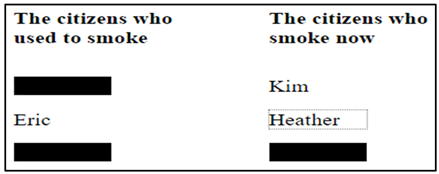 |
As in (25), one list of concealed information is labelled as addressing the presuppositional component of continue (used to VP), while the other is labelled as addressing the proffered component (VP’s now). The choices participants make with respect to which list to click in to obtain information relevant to their task will reflect the level of cognitive salience for them of that category of information. (In (25), three of the concealed boxes have been clicked to reveal the names of townspeople who are members of the set named in their column heading.)
A new challenge that arises in our novel information-retrieval design is that locally accommodating continue’s presupposition can be more difficult than also’s in an Explicit Ignorance Context. For instance, out of context, some speakers find discourses like (26) degraded.
This is because, in the first sentence, the speaker seems to disavow knowledge of whether Rob used to smoke, but she then immediately asks a question whose felicity depends upon the Common Ground’s entailing that Rob used to smoke.
| (26) | I have no idea whether Rob used to smoke. Is it the case that he continues to smoke now? |
To avoid this problem, we present our questions to the experimental participants as coming from fictional investigators who do not know anything about the townspeople like Rob, who are the subjects of the questions. Crucially, participants are made aware that the investigators’ questions are meant to be addressed to their subjects’ fellow townspeople, who do presumably know about the subjects of the questions. That is, the investigators can locally accommodate the presupposed component of continue on the strength of background knowledge they can reasonably attribute to their addressees. In comparison with (26), this change in perspective renders local accommodation much more natural in (27), where the investigator is asking Rob’s friends and neighbors about both the presupposed and proffered parts of the meaning of continue, since the investigator has no reason to know about either.13
| (27) | Outside Investigator to Rob’s fellow townspeople: |
| I’m looking into Rob’s health habits, and I have no idea whether he used to smoke. Is it the case that he continues to smoke now? |
In a final departure from our first two experiments, the trigger in Experiment 3, continue, is neither focus-sensitive nor anaphoric, unlike also. Thus, we can expect to avoid the accommodation-dampening effects that Göbel (2020) found for also as a focus-sensitive trigger, which may have caused the small asymmetry in responses between the Local and Global Accommodation ALSO conditions in Experiments 1 and 2 (Figure 2). In this new design for Experiment 3, we can expect that the reduced cognitive salience of backgrounded material will be reflected directly and uniformly in what aspects of the interpretation participants attend to in choosing what kind of information to uncover to help address the question from the fictional investigators. That is, participants are expected to uncover information that is backgrounded through presuppositional accommodation less often than the more foregrounded proffered information.
4.2. Materials and Predictions
As in Experiments 1 and 2, we measure the relative salience of identical information in the three conditions illustrated in (28)–(30).14
| (28) | I’m looking into Rob’s health habits, and I have no idea whether he used to smoke. Is it the case that he continues to smoke now? |
| [CONT condition] | |
| (29) | I’m looking into Rob’s health habits, and I have no idea whether he used to smoke. Is it the case that he used to smoke, and he smokes now? |
| [CONJ condition] | |
| (30) | I’m looking into Rob’s health habits, and I have no idea whether he used to smoke. Is it the case that he did, and he smokes now? |
| [DOES condition] |
In (28)–(30), the piece of information we are interested in is Rob used to smoke. It is represented in (28) by continue via local accommodation of its presuppositional content, which cannot project due to the Explicit Ignorance Context “I have no idea whether he used to smoke” (Simons, 2001; Abusch, 2010). In (29), it is represented by the explicit, non-backgrounded conjunction paraphrase representing the meaning of continue posited by traditional syntactic-semantic accounts (Heim, 1983), and in (30), by a non-presuppositional elision did as a further control more closely matching local accommodation surface forms. Since the does elisions are non-presuppositional but still resemble the accommodated presuppositions in being implicit, this last control will allow us to distinguish backgrounding effects of presupposition from any arising from implicitness alone, as before.
To confirm that our new information retrieval task measures presuppositional backgrounding in non-embedded, globally interpreted clauses as parallel to that found in Local Accommodation contexts, we tested Global Accommodation items corresponding to each Local Accommodation variant, as in (31)–(33):
| (31) | I’m looking into Rob’s health habits. I called to find out whether he used to smoke, and it turns out that he continues to smoke now. |
| [CONT condition] | |
| (32) | I’m looking into Rob’s health habits. I called to find out whether he used to smoke, and it turns out that he used to smoke, and he smokes now. |
| [CONJ condition] | |
| (33) | I’m looking into Rob’s health habits. I called to find out whether he used to smoke, and it turns out that he did, and he smokes now. |
| [DOES condition] |
We included six item variants in each Accommodation-type condition (both factors between subjects) and 21 fillers.
Participants were shown the instructions in (34) to familiarize them with the experimental context in which they were to imagine that they were helping town officials check on what the fictional outside investigators had been asking the townspeople. They were also given two practice items with explanations.
| (34) | 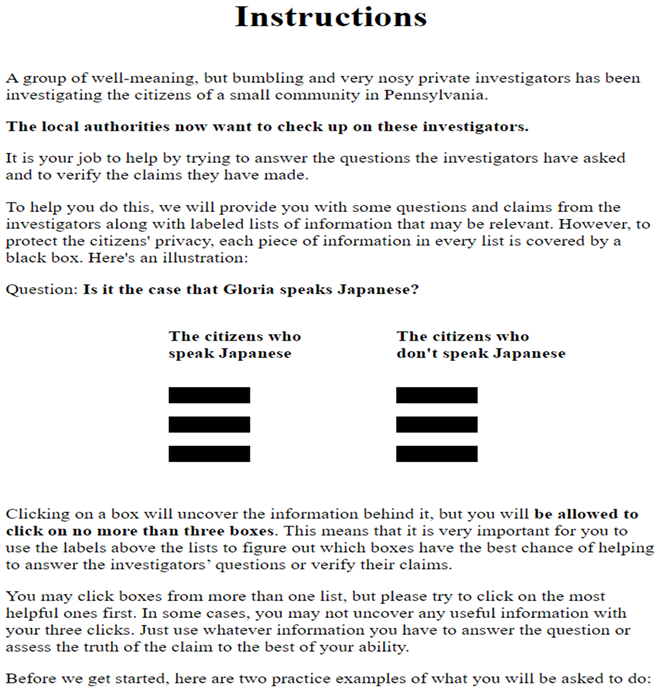 |
In order to be able to help the local authorities by answering the investigators’ questions or verifying their claims as the townspeople might have, participants had to try to gather relevant information about the person the investigator was interested in. To do this, participants sought information about Rob and other citizens by clicking to uncover up to three of the black boxes in either of two lists of names we provided as part of each item, as in (35):
| (35) | 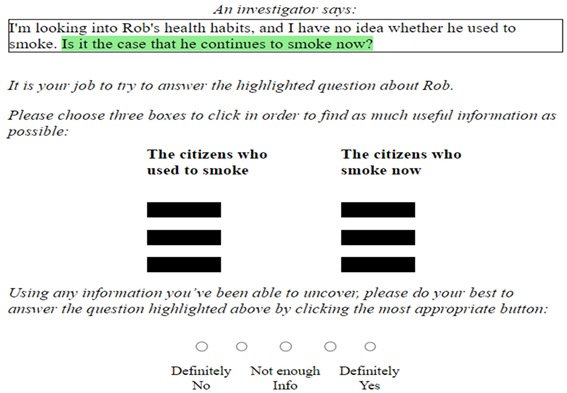 |
In all items, lists were labelled with the presupposed content of continue on the left and its proffered content on the right, as in (25), (34), and (35). If the information that Rob used to smoke is less salient in the CONT condition (28), where it is introduced presuppositionally through local accommodation, than in the CONJ condition (29), where it is introduced as an explicit conjunct, we expect more frequent clicks in the right-hand column in the CONT condition than in the CONJ condition. (30), the DOES condition, in which Rob used to smoke is neither presuppositional nor explicit, controls for any potential impact of implicitness independent of backgroundedness. Higher right-click rates for CONT than for DOES are thus attributable to continue’s presuppositional nature, beyond the implicitness also at play in the DOES condition. Global Accommodation items (31)–(33) provide a baseline for non-embedded presuppositional backgroundedness.
As they clicked to uncover boxes in our lists, participants never found the name of the person being asked about in either list in any critical item, though they did find the target name in the lists for many of the fillers. This arrangement was chosen in order to prevent new information from causing participants to stop clicking or to change their column choice for their next click before they completed their three-click task. The result was that, for the critical items, participants could only guess at the answers to the questions the investigators posed about the townspeoples’ habits, as we encouraged them to do in the instructions. This did not affect results, since our experimental metric was which of the two column(s) participants chose to click in, not how they ultimately answered the question.
4.3. Participants and Procedure
We recruited 155 native English-speaking participants from the University of Pennsylvania’s subject pool to participate online via the PCIbex platform for course credit (Zehr & Schwarz, 2018), aiming for a comparable number of data points per condition to those in Experiments 1 and 2.15 The present repeated measures design, with participants seeing six critical trials, allowed us to achieve that goal with fewer participants than in the previous experiments. We excluded from data analysis those participants failing to give the expected answer for five of six selected fillers.16 After removal, data from 134 participants were left for purposes of analysis. Each participant saw six critical items representing the six item variants, all in a single condition (CONT, CONJ, or DOES) and 21 fillers, in a randomized order.
4.4. Results
The number of right clicks from participants seeking names of those who satisfied the proffered information conveyed by continue exhibited the stepwise pattern in Figure 3, generally similar to the patterns in Experiments 1 and 2. The presuppositional CONT yielded the highest rate, nearly at ceiling for both Local and Global examples, the explicit conjunctive paraphrase CONJ the lowest, and the elliptical DOES in between. The CONJ and DOES rates of right clicks were near chance and not significantly different from each other. In a mixed-effect model analysis, the CONT condition differed significantly from both DOES (β = −4.81, SE = 0.94, p < 0.001) and CONJ (β = −5.84, SE = 0.83, p < 0.001), and these patterns were similar for Local and Global Accommodation, with no significant 2-way interactions (p’s > 0.2).
Figure 3.
Right clicks by Condition and Accommodation Type.
4.5. Discussion
With Experiment 3, we have expanded the range of methods available to measure backgroundedness as indicated by salience to a task, from picture-matching tasks to information-seeking ones. This novel kind of information-seeking task yields more general affirmative answers to our three central research questions about backgrounding, lexical marking, and the relation between local and global accommodation. We find that the presupposition of continue, like that of also, is more backgrounded—less salient—than its non-presuppositional, truth-functionally equivalent counterparts. In the context of the previous findings for also, this indicates that the relevant content introduced by presupposition triggers, whether change of state or additive, is lexically encoded as backgrounded in roughly the same pattern, whether interpreted locally or globally.
One difference between the continue and also results is that the asymmetry between the Local and Global ALSO conditions, shown in Figure 2 and discussed in Section 3.3, does not arise between the corresponding CONT conditions of Experiment 3 (Figure 3). This is consistent with our hypothesized explanation for the reduction in right clicks for Global, relative to Local, accommodation of also: also, as a context-sensitive, anaphoric trigger, is more prone to accommodation interference from discourse and structural factors than non-anaphoric, non-context-sensitive triggers like continue (Kripke, 2009; Göbel, 2020). Thus, participants in the ALSO Local condition, in which the trigger is embedded in the antecedent of a conditional, may have been less likely than those in the more straightforward Global condition to successfully accommodate the presupposed content of also, that Paul had ice cream, and therefore been more likely to accept the picture of Paul without ice cream as accurate. Thus, Experiment 3 provides evidence that, absent confounding discourse and structural factors disproportionately affecting context-sensitive triggers, presupposed material is lexically coded as equally backgrounded whether it is accommodated locally or globally.
The very clarity of the results for Experiment 3 in Figure 3 raises a new question: Why are right clicks in the CONT condition so near ceiling, at 94% and 96%, respectively, for both Local and Global Accommodation conditions? Why are there not more participants who, when called upon to determine whether an activity is continuing, want to know whether the person doing it has done it in the past? There are at least two kinds of answers to this. One is that the presupposition of continue is so low in salience, so deeply backgrounded relative to its proffered content, that speakers do not consider it important enough to warrant a click in the left-hand column. Under this explanation, we would expect that, if we could increase the salience of the presupposed content, participants would recognize it more overtly and make more use of our left-hand column. A second possible explanation is that, for some reason, participants do not take into account the traditional presuppositional content of continue as part of its meaning here, so they effectively interpret, for example, “Rob continues to smoke” as if it were “Rob smokes now,” with no role for Rob used to smoke. This might be because linguists have been wrong about the presuppositional meaning of continue in general or because participants could not make sense of the local accommodation context we presented and coped by ignoring the presupposition trigger continue entirely or using another repair strategy. Under this second type of explanation, all participants would be expected to click only in the right-hand VP’s now column because that would be the only way they could interpret “continues to VP now,” as if continue were not there. Since the left-hand column’s content, “used to VP,” would not be part of the meaning of continue for them in this context, no efforts to increase the salience of that presupposition should cause participants to differentiate between examples including continue and those without it.
It is important to ascertain which of these kinds of explanation is correct. The first, very low salience explanation is consistent with our hypothesis that accommodated presuppositions are backgrounded: The special circumstance in Experiment 3 is just that the accommodated presupposition of continue is so backgrounded that it seems to disappear or be ignored entirely in our experimental context. In contrast, the second type of explanation—that continue is not interpreted at all or not interpreted as having a presupposition in the context we tested—would render the results of Experiment 3 irrelevant to any hypothesis about presuppositions. In this view, participants did not find any used to VP content to interpret in our examples, so they had no reason to click in the left-hand column. Experiment 4 provides the necessary evidence to enable us to choose between these two types of explanation by testing whether increasing the salience of continue’s presupposition causes participants to start to behave as if they are taking it into account. If raising the salience of used to VP causes participants to behave as if they recognize it as part of the interpretation of continue, we can conclude that the presupposed content was merely deeply backgrounded, not missing from interpretation, in Experiment 3.
5. Experiment 4
5.1. General Design
In a two-part, single-trial experiment, we measured the change in attention paid to the presupposed content of continue before and after we manipulated the experimental context with pop-ups to increase the salience of the presupposed content. We measured this change by having participants answer the questions and verify the claims from the Local and Global CONT conditions of Experiment 3 (highlighted in (36)–(37)), respectively, at two different points in the trial, before and after a manipulation intended to increase the salience of continue’s presupposed content, used to VP. We compared these CONT conditions with parallel control conditions (NOCO), which consisted of exactly the same wording that appeared in the CONT conditions, but without any occurrence of continue. Half of the NOCO items were derived by excising continue from the CONT Local Accommodation condition, and half from the CONT Global Accommodation condition ((38) and (39)).
| (36) | I’m looking into Rob’s health habits, and I have no idea whether he used to smoke. Is it the case that he continues to smoke now? |
| [CONT condition, LOCAL] | |
| (37) | I’m looking into Rob’s health habits. I called to find out whether he used to smoke, and it turns out that he continues to smoke now. |
| [CONT condition, GLOBAL] | |
| (38) | I’m looking into Rob’s health habits, and I have no idea whether he used to smoke. Is it the case that he smokes now? |
| [NOCO condition, LOCAL-derived] | |
| (39) | I’m looking into Rob’s health habits. I called to find out whether he used to smoke, and it turns out that he smokes now. |
| [NOCO condition, GLOBAL-derived] |
The measure we are interested in is how many of the participants change their responses to the highlighted questions/claims between the first and second testing points; that is, before and after the presupposition is made more salient. If participants produced the ceiling rates of right clicks seen in Figure 3 by simply not including any trace of continue’s hypothesized presupposition in interpreting the CONT items, we would expect the patterns of responses in CONT and NOCO to be similar. That is, if participants are not interpreting the presupposition used to VP in either CONT or NOCO conditions, there should be very few changed answers after our salience-raising manipulation. Participants should always act as if he used to smoke is no more salient in the highlighted question in CONT (36) than it is in NOCO (38). On the other hand, if the ceiling rates of right clicks on continue’s proffered information in Figure 3 are merely the result of the extremely low salience of continue’s presuppositional content there, we would expect some participants to change their answers once used to VP is made more salient.
5.2. Materials and Predictions
The materials for Experiment 4 were closely based on those for Experiment 3, but they were modified to measure the effect of increasing the salience of the presuppositional content of continue. The first part of the single two-part trial that each participant saw was much like Experiment 3, except that we modified the instructions in (34) to require that all three of each participant’s clicks be in the same list of black boxes, either (left) “the citizens who used to VP” or (right) “the citizens who VP now,” whichever they thought more likely to yield information useful in answering the investigator’s question or verifying their claim. Based on the results of Experiment 3, we expected a large majority of participants to choose to click in the right-hand “VP’s now” list at this point. When participants tried to mix lists, the relevant box in the other list was not removed, and a pop-up reminded them that all their clicks had to be in one list; they were then allowed to return to their original list and finish clicking to reveal all three names. The great majority of participants used this first part of the trial to click in the right-hand list. Each of them found, in the second or third position in the “VP’s now” list, the target name of the person featured in the investigator’s question or claim. The target name was not found in the left-hand list, where relatively few participants clicked first. No responses were accepted from any participant until they had clicked all three boxes in their chosen list.
Once the first list of names had been exposed, participants were required to answer the highlighted question or verify the highlighted statement, as in (36)–(39), in order to proceed. Given the primacy of proffered information in previous experiments (94–98% of CONT participants in Experiment 3 clicked in the right-hand list first), we expected a high rate of right clicks in the CONT and NOCO conditions alike for the first three clicks, whether or not continue actually appeared in the item, and between 83% and 90% of participants did click Right first as expected.17 Those who used their first three clicks in the right-hand column are the participants we are interested in for this study, since their choice to click first on the proffered information puts them in a position from which they could be swayed (or not), in the second part of their two-part trial, by our planned manipulation to raise the salience of the presupposed information. The much smaller group of participants who clicked first on the left-hand “used to VP” column could not be moved to pay any more attention to the presupposed content, since they had already behaved as if it were maximally salient and gained access to the list of names there.
The salience-raising manipulation began after participants had given their responses to the investigators’ questions and claims based on the information revealed by their first three clicks. We told participants, in an attention-grabbing, red-framed News Flash pop-up (40) that we had now gained permission for them to see the names in whatever list they had not yet clicked in. (This was the left-hand “used to VP” list for the participants of interest to us here.)
| (40) | 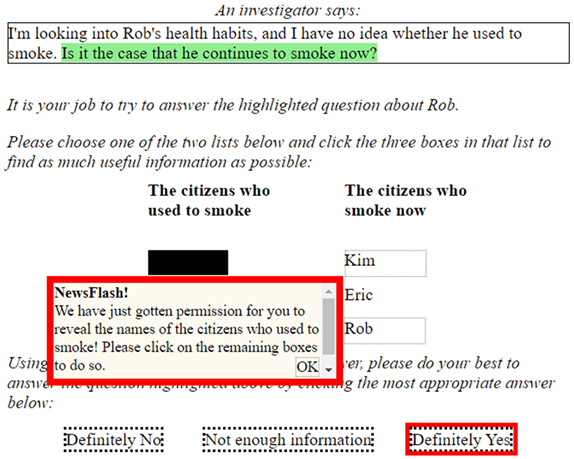 |
Once the participants had obeyed the News Flash directions and clicked three more times to expose all six names, they had access to all available information. They could see that, while the target name appeared in the right-hand “VP’s now” column, it did NOT appear in the left-hand “used to VP” column. At this point, participants saw a second pop-up News Flash, and their initial response lost its red frame. The second News Flash directed them to reread the whole question and answer it again, taking into account the new and newly salient information that the target citizen had not satisfied the presupposition of continue (41).
| (41) | 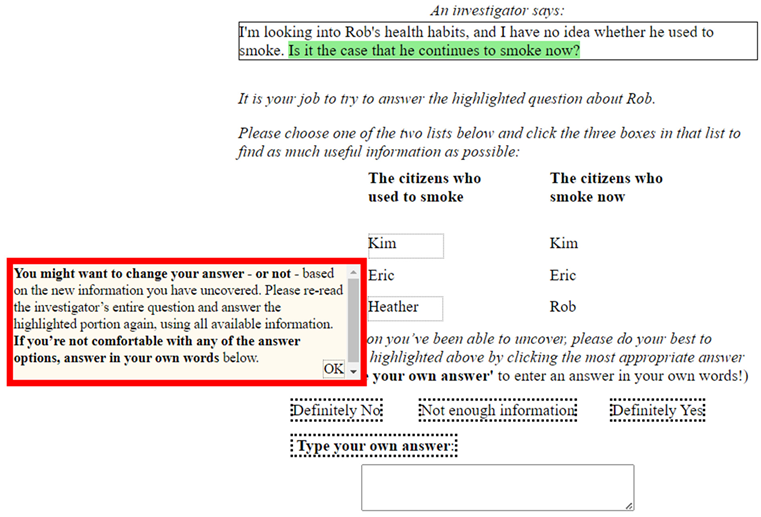 |
A new answer option, “Type your own answer,” was added for use after six clicks to allow participants to formulate their own answer, avoiding any confusion or reservation they might have about the other answer options. Almost 30% of participants made use of the Type-your-own box. While more than half of them merely entered (or repeated) one of the available scale answers, other participants’ custom answers provided evidence of their awareness of the presuppositional used to VP component of continue’s meaning.
After participants had had a chance to respond twice, before and after the presuppositional content of continue had been given a boost in salience, we compared the sets of responses to identify the rates and types of answer-switching and the conditions in which they occurred. We predicted that, if participants interpreted our items containing continue without the used to VP element from the left-hand list, the CONT and NOCO conditions should be equivalent. There should be little answer-switching in either one, since, without its presupposition, “continue to VP now” would mean just VP’s now, and there would be no used to VP to become more salient. On the other hand, if the presupposed content of continue is routinely interpreted in our items and has become more salient after our pop-up manipulation, we predict that more participants in CONT than in NOCO will switch their answers between the first (3-click) and second (6-click) parts of the trial, from Definitely Yes to one of the other answers indicative of an increased sensitivity to the used to VP component. That is, we would expect the following 3-click/6-click answer sequences to be more prevalent in the CONT conditions than in the NOCO conditions: Definitely Yes/Not Enough Information, Definitely Yes/Definitely No, and Definitely Yes/Own Write-in answer that indicates awareness of a used to VP component.
5.3. Participants and Procedure
We recruited 403 native English-speaking participants from the University of Pennsylvania’s subject pool to participate online via the PCIbex platform for course credit (Zehr & Schwarz, 2018).18 We excluded from analysis the approximately 15% of participants who clicked first on the left-hand “used to VP” column, as, having already chosen that column to reveal, they were not in a position to be influenced by the experimental intervention meant to raise the salience of the used to VP component of continue. The only participants excluded for inattention were the four in the NOCO condition who answered Definitely No, the subject does not VP now, after clicking on the right-hand column, which listed the subject of each question as someone who definitely does VP now. There were no other exclusions since there were no fillers to serve as attention tests and no other experimental questions with clear right or wrong answers, so we were left with 345 participants for analysis. Each participant saw one critical item twice in a single, two-part trial with no fillers. There were six item variants in a randomized order, in four conditions crossing CONT/NOCO and Local-derived/Global-derived, administered between subjects.
5.4. Results
5.4.1. Data Treatment
Given that participants could enter their own answers, these Own answers had to be manually categorized to determine whether they constituted a switch from an initial Definitely Yes answer to an answer that reflected a new awareness of the presupposition of continue. Any answers including explicit allusions to whether the individual mentioned in the sentence used to VP were labeled as UsedToEvidence.19 Simple rephrasings reiterating Definitely Yes, Not Enough Information, or Definitely No were collapsed with those answer choices. Own answers that did not map straightforwardly onto any of these categories were labeled as “Other.”20 This approach aimed to be conservative in estimating what counted as awareness of the used to component of continue in contrast to the NOCO condition, e.g., even when participants made no indication that the used-to column mattered for the answer in the NOCO condition, mere mention of used to was counted as “UsedToEvidence.” Furthermore, some of the combinations of Own answers and final exit comments like (42) below reveal that there were participants who were very much aware of continue’s presupposition, but still found it too backgrounded, even after our salience-raising intervention, to let it influence their responses.
| (42) | “It asks if she CONTINUES to roll. The word continues requires that she both used to roll and rolls through them now. Depending on your interpretation of the question, you could argue the answer is no since she isn’t on the list of citizens who used to roll through stop signs. Personally, I would still lean towards yes, just because the spirit of the highlighted question seems to be leaning towards whether she rolls through them now.”—participant comment |
As mentioned above, we take three types of answer sequences as indicative of participants considering used-to VP information in providing their second response, namely Definitely Yes answers after the first three clicks followed by an Own answer categorized as UsedToEvidence, or a Definitely Not or Not Enough Information scale answer, after six clicks. The distribution of the individual response sequences counted as evidence for considering used-to information, as well as their sum total, is summarized in Table 2.
Table 2.
Distribution of Used-to Evidence categories by Condition and Source Accommodation Type.
5.4.2. Data Analysis
Our dependent variable was prevalence of evidence of used-to VP awareness in the 3-click/6-click answer sequences, as laid out above, which we analyzed by condition and by the accommodation type from which the item was derived. We also inspected descriptive statistics for the distribution of responses after only three clicks, where we found no significant differences across conditions. However, after six clicks, following the salience manipulation of the pop-ups, there were significantly more answer changes that indicated awareness of the presupposed used to VP component in CONT than in NOCO, for both Local-derived and Global-derived items, as illustrated in Figure 4.
Figure 4.
Used-to Evidence by Condition and Accommodation Type.
Statistical analysis via a simple logistic regression in R, using the glm function from the stats package, revealed there to be a significant main effect of CONT vs. NOCO (β = 1.65, SE = 0.29, p < 0.001). There was no significant effect of accommodation type nor a significant interaction.
5.5. Discussion
The significant differences between the CONT and NOCO conditions in sequences of 3- and 6- click responses in Experiment 4 indicate that, when continue’s presupposition was made sufficiently salient, participants paid attention to whether or not it was satisfied and often gave responses that indicated their awareness of the used to VP component of continue. This is consistent with their being aware of the presupposition in the lower salience conditions of Experiment 3, but not placing high importance on its fulfillment. If they had, for instance, found the CONT examples deviant and thus resorted to interpreting them as though continue were not there, raising the salience of the used to VP list should not have had any effect. Experiments 3 and 4, then, allow us to conclude that continue’s presupposition, like that of also, is considered as part of interpretation in our task, and not merely ignored altogether. Rather, it is significantly backgrounded relative to equivalent proffered content when accommodated either locally or globally.
We have thus demonstrated that the accommodated presuppositional content of two very different presupposition triggers is significantly backgrounded. However, we have yet to investigate whether this backgrounding is associated only with presuppositional content that must be accommodated in order to be interpreted, or whether the backgrounding of accommodated presuppositions we have found is a special case of more general backgrounding associated by definition with all presuppositions. We address this question in Experiment 5.
6. Experiment 5
6.1. Design and Materials
Our goal was to test whether presuppositional content that is entailed by its local or global context exhibits the same pattern of experimental outcome measures reflecting low cognitive salience and indicating backgrounding as the accommodated presuppositions that we have studied in Experiments 1–4. To achieve this, it was necessary to modify one of our previous designs to ensure that the context would entail the presupposed material and ask participants the same questions as before. We chose the also Experiment 1 for this purpose for two reasons: (1) to avoid the need, with continue, to make special efforts to raise the salience of the presuppositional content to ensure that it was being interpreted, and (2) to be able to use a picture-matching task to measure salience, rather than the information-seeking task required with continue, which was not well-suited for testing items in which a presupposition was explicitly satisfied. If participants were told that the presupposition was satisfied by the context, it might seem unnatural to be asked to click in a list that would reveal whether or not it was true.
Accordingly, the materials used for Experiment 5 were the same as for the ALSO conditions of Experiments 1 and 2, except that the introductory Explicit Ignorance material in both the Local and Global accommodation items was replaced with a neutral clause and an assertion of the relevant presuppositional content (in (43) and (44), Paul has ice cream). This yielded items which were cognates of the Local and Global Accommodation items from previous experiments, but required no accommodation for interpretation:
| (43) | I think dinner will be fun. Paul has ice cream, and if he also has chocolate syrup, we could have sundaes for dessert. (based on previous Local Accommodation items, but with presupposition satisfied) |
| (44) | I think dinner will be fun. Paul has ice cream, and it turns out that he also has chocolate syrup, so we can have sundaes for dessert. (based on previous Global Accommodation items, but with presupposition satisfied) |
The instructions in (15), the presentation of trials and questions in (16), and the item variants in (9), (18), and (19) were taken from Experiments 1 and 2 with no change besides the adaptations illustrated in (43) and (44). Thus, participants were, once again, asked Question A in (16): Is an illustration of Paul holding chocolate syrup but no ice cream an accurate description of the highlighted parts of (43) and (44)? We would be able to compare responses to these new, satisfied-presupposition items with those participants gave to the parallel items in Experiment 1 and 2, in which the presuppositions had to be accommodated.
6.2. Predictions
We predict that, if satisfied presuppositions are not backgrounded by our measures like accommodated ones, the rate of Yes answers to Question A for items like (43) and (44) will be lower than it was for the parallel accommodation items in Experiments 1 and 2 ((12) and (20)). That is, if presuppositional backgrounding is not in play when the presuppositional content is entailed by the context, we would expect a Yes rate similar to those for non-presuppositional paraphrases like (13) and (21). If, however, presuppositions that are entailed by their context are substantially backgrounded relative to main proffered content, we predict that the rate of Yes answers to Question A will be similar to that found in the ALSO conditions in Experiments 1 and 2.
6.3. Participants and Procedure
We recruited 396 native English-speaking participants from the University of Pennsylvania’s subject pool to participate online via the PCIbex platform for course credit (Zehr & Schwarz, 2018), again aiming for a number of datapoints per condition similar to the original study.21 In contrast to our procedure in Experiments 1 and 2, where those who answered YES to Question B were excluded, here we excluded from data analysis the 95 participants answering NO to Question B, since such an answer could indicate a failure to process the critical fact that the provided context entailed the truth of the presupposition.22 Twelve participants who identified themselves as non-native speakers of English were removed as well. After removal, data from 289 participants were left for purposes of analysis. Each participant saw one critical item representing one of the three item variants adapted from either the Local or Global conditions from Experiments 1 and 2, and no fillers.
6.4. Results
Figure 5 shows that the rates of Yes answers in Experiment 5 (bars on left), where the presupposition of also was satisfied in the context, are overall descriptively similar to those for the ALSO conditions of Experiments 1 and 2 (bars on right), where the presuppositional content had to be accommodated (locally or globally) in order to be interpreted. In addition, the Experiment 5 Yes answer rates on the left in Figure 5 are markedly higher than Yes rates in the non-presuppositional conditions CONJ and DOES of Experiments 1 and 2 (shown in Figure 2), which fall below 12 and 48 percent, respectively. This suggests that, at least for the trigger also, presuppositional content in all contextual configurations, requiring accommodation (at any level) or not, is notably backgrounded relative to non-presuppositional content.
Figure 5.
Experiment 5 results graph (combining Yes proportion for loc- and glob-derived Satisfied also and Accommodated also from Experiments 1 and 2).
Thus, in Figure 5, we accomplish the primary purpose of Experiment 5, which was to establish that presuppositions in sentences like those in Experiments 1 and 2, but occurring in overall discourse contexts where the presupposition is satisfied, exhibit similar levels of backgroundedness to their accommodated counterparts, and that, furthermore, these levels are higher than those in the control conditions of the earlier experiments. Nonetheless, we conducted some exploratory analyses of the data displayed in Figure 5 to shed light on potential differences across conditions. A 2 × 2 interaction analysis with factors presupposition status (also satisfied vs. accommodated) and accommodation-sentence type (Local vs. Global) revealed no main effects, consistent with our descriptive observations.23 However, it did render a significant interaction (β = −0.82, SE = 0.36, p < 0.05). Post-hoc pairwise comparisons of the Local vs. Global comparisons within satisfied and accommodated levels, as well as Satisfied vs. Accommodated within the Local and Global levels, suggest that the interaction is driven by relatively lower Yes response rates for Global in the accommodated condition, compared to the satisfied condition. This difference was marginally significant (β = −0.57, SE = 0.25, p = 0.08, with Bonferroni adjustment for four comparisons). No other pairwise comparisons rendered significant effects. Thus, the interaction is due to a result for globally accommodated presuppositions already noted in the discussion of Experiment 2 (Section 3.4): Global accommodation is relatively easy for speakers, producing slightly lower Yes rates in our tasks. While this effect may be interesting to explore in future work, it does not bear on our present focus on whether satisfied presuppositions are backgrounded, as accommodated ones are, since the former exhibit even higher levels of backgroundedness than the latter.
7. Discussion and Conclusions
7.1. General Discussion of Results
The five experiments reported here provide evidence that backgrounding is even more persistent as a defining property of presupposition than projectivity. That is, it is widely accepted that presuppositions fail to project in local accommodation contexts, but we have yet to identify any presuppositional content that is not backgrounded according to our measures. Rather, we find that presuppositional content is backgrounded relative to proffered content, whether presuppositions are accommodated locally or globally (Experiments 1–4) or entailed by the context (Experiment 5). More specifically, we find that the presuppositional content introduced by also and continue in the ALSO and CONT conditions of Experiments 1–4 is less cognitively salient than the truth-conditionally equivalent, but non-presuppositional, content introduced in our control conditions, DOES and CONJ. The pattern of backgrounding in local accommodation contexts is similar to that in global accommodation ones. Such evidence that presuppositional meaning is predictably backgrounded, even when interpreted locally, indicates that, as Göbel and Schwarz (2023) suggest, local accommodation is more like the global kind than has commonly been assumed, and even explicitly argued (e.g., Beaver & Krahmer, 2001; von Fintel, 2008). Our results further indicate that the backgrounding of also’s and continue’s presuppositional content must be lexically encoded in the entry of the presupposition triggers, as opposed to being pragmatically derived from reasoning about the content itself. This conclusion follows from the fact that backgrounding does not emerge to the same degree when identical information is expressed by the non-presuppositional elision and full-conjunct constructions in our DOES and CONJ conditions. In addition, the DOES conditions of Experiments 1–3, whose measured levels of cognitive salience fall between those of presuppositional and non-presuppositional expressions of the same content, produce new empirical evidence that elided content is not completely equivalent to the full explicit versions of the same information (as in our CONJ conditions). Rather, it is less salient than the corresponding full versions, though still more salient than the similarly implicit material associated with the tested presupposition triggers. This is consistent with similar findings reported in Simons (2019).24 The studies reported here also contribute methodologically in two ways to the literature supporting the use of cognitive salience to measure presuppositional backgroundedness (Schwarz, 2016; Bacovcin et al., 2018). First, with our studies of also, we broaden the range of triggers whose presuppositional content has been tested for cognitive salience using a picture-matching task. Second, with our studies of continue, we introduce a novel type of information-seeking task using cognitive salience as a measure indicating backgroundedness, one which facilitates work with triggers like continue, whose meanings make picture-matching impractical.
7.2. Theoretical Implications and Givenness Analysis
Our finding that presuppositional content is backgrounded across the board has implications for several questions of theoretical interest. For instance, the backgrounding of also’s and continue’s presuppositions when locally accommodated seems to be an exception to the generalization, put forward in pragmatic accounts of presupposition (e.g., Simons et al., 2010; Tonhauser et al., 2018), that all and only not-at-issue material projects: Locally accommodated also and continue are backgrounded in a way that makes them not-at-issue but fail to project. Furthermore, the backgrounded status of our two locally accommodated triggers presents a challenge even within more traditional accounts of local accommodation, which interpret local—but not global—presuppositions as regular, non-backgrounded proffered content, either semantically, as in Heim (1983), or by means of a syntactic A-operator (Beaver & Krahmer, 2001). Such representations fail, as things stand, to capture the fact that locally interpreted presuppositions, like their globally interpreted counterparts, are backgrounded relative to proffered content. Consider (2) and its conjunctive paraphrase (5a), repeated below, where p stands for the final clause of (2) embedded under “definitely” and negation (Sue brings her dog to restaurants) and q stands for Sue has a dog, the presuppositional content associated with the trigger her in p.
| (2) | I’m not sure whether Sue has a dog, but she definitely does not bring her dog to restaurants. | |
| (5) | a. | I’m not sure whether Sue has a dog, but it’s definitely not true that [Sue has a dog and she brings her dog to restaurants]. |
| b. | c − ((c + q) + pq) | |
As described in Section 1, (5b) is a schema of the context-update representation for Sue definitely does not bring her dog to restaurants in (2), where the presupposition of her is locally accommodated under the scope of negation. However, (5b) is also the only available representation for the explicit conjunctive paraphrase of that local accommodation reading, as in (5a). Consequently, there is no way in this standard view to distinguish local accommodation readings from their conjunctive translations. This has not previously been regarded as a problem, since (2) and (5a) share truth conditions as determined compositionally. However, our results show that information presented presuppositionally differs crucially in its discourse status from equivalent non-presuppositional explicit content: presuppositional meanings are significantly more backgrounded than equivalent proffered material. This difference in discourse status produces a disparity in the extent to which speakers consider the truth conditions satisfied for presuppositional versus non-presuppositional expressions of the same information: in our picture-matching and information-seeking tasks, the lower cognitive salience of the backgrounded presuppositional meanings caused participants to behave as if the presupposed material in our ALSO and CONT conditions was not as critical for computing correct answers to our questions as the same material presented in explicit proffered conjuncts in our CONJ conditions. This was displayed, for instance, in Experiment 3, where participants who were asked to uncover information about whether x continued to VP chose to click almost exclusively on information bearing on the proffered content of continue, rather than investigating its presupposed content.
A further complication arises when we seek to include in our picture globally accommodated presuppositions, as in Experiments 2, 3, and 4, and those that are explicitly satisfied in their context, as in Experiment 5. For instance, (45a) below invites global accommodation of the fact that the speaker has a dog, while that presupposed content of my is entailed by the context in (45b).
| (45) | a. | I’m obsessed with my dog. |
| b. | I always own at least one dog and one cat, and I’m obsessed with my dog. | |
| c. | c + (c + pq), defined iff q (I have a dog) holds in all c-worlds |
Our version of a standard dynamic representation of the backgroundedness of such globally interpreted presupposed content appears in (45c). The possessive presupposition q (I have a dog) must be entailed by the global context of interpretation of the proffered proposition p (I’m obsessed with my dog) in order for p to have a defined truth value. Since we find that locally interpreted presuppositions are backgrounded to a similar degree and in parallel patterns to globally accommodated and context-satisfied ones like those in (45a) and (45b), one might imagine that traditional accounts of local accommodation could be amended to account for the backgrounded status of locally interpreted presuppositions in terms of their being entailed by the relevant local contexts; that is, by analogy to the globally interpreted ones. Indeed, there have been quite a few recent proposals describing the construction of local contexts in ways that assimilate them more to global ones, (e.g., Anvari & Blumberg, 2021; Barker, 2022; Kalomoiros, 2022; Mandelkern & Romoli, 2017; Schlenker, 2009). However, none of these to date has considered explicitly the possibility that locally accommodated material shares the backgrounded status of globally accommodated material. Nevertheless, our results suggest that, however the content of local contexts is derived, all accommodation should be modelled as adding information to the relevant context, global or local, in a way that retains the backgrounded discourse status that we have found to be typical of presuppositions.
Moreover, the degree of this presuppositional backgroundedness (in our ALSO and CONT conditions) has been shown to significantly exceed that of the same material when it is expressed as explicit, proffered conjuncts (as in our CONJ conditions). Thus, there is no way in standard dynamic frameworks alone to represent the clear differences in discourse status that we have measured between presuppositional meanings and their conjunctive paraphrases. Both will be represented as conjunctions of propositions, each of which is entered, in order, into the appropriate global or local context of interpretation for later material, as in (5b). What we need is a way to lexically mark the appropriate content originating in a presupposition trigger as somehow extra-backgrounded, relative to equivalent proffered content. This will require a dimension of meaning beyond the basic compositional variety since it involves a difference in discourse status between constituents that are truth-functionally equivalent. That is, the extra lexical backgrounding we have found associated with presupposition triggers is a matter of Krifka’s (2008) Common Ground Management, (“information packaging that responds to the immediate communicative needs of interlocutors” (Krifka, 2008, p. 13)), rather than Common Ground Content (shared knowledge and beliefs of interlocutors). A natural candidate for the job of representing the extra backgrounding associated with presupposition triggers is givenness (Chafe, 1974, 1976; Prince, 1981; Krifka, 2008; Rochemont, 2015), which Krifka (2008) identifies as a feature of Common Ground Management. As discussed in Section 1.2, Prince’s (1981) three interrelated and co-occurring varieties of givenness include givennesss, which hinges on the degree of cognitive salience in a given context of any sort of denotation. The experiments reported here establish that the backgrounding of presuppositional meaning is reflected as reduced cognitive salience of (some of) the meaning of particular lexical triggers like also and continue, so it is Prince’s salience type of givenness that is at play here.
Krifka (2008) defines givenness features for globally interpreted expressions in a way that provides not just the conventional lexical marking necessary for identifying the presuppositional content of triggers as backgrounded, but also for variable degrees of givenness, thus providing a mechanism for representing the extra-backgrounding of presuppositions relative to proffered content, both of which appear as parallel updates in standard dynamic accounts
| (46) | “A feature X of an expression α is a Givenness feature iff X indicates whether the denotation of α is present in the CG or not, and/or indicates the degree to which it is present in the immediate CG.” (Krifka, 2008, p. 37) |
To account for the parallel givenness marking of locally and globally interpreted presuppositions, this definition would just have to be extended to provide for varying degrees of givenness in terms of salience in local contexts as well as global ones, as in (47):
| (47) | A feature X of an expression α is a Givenness feature iff X indicates whether the denotation of α is present in the global or local context or not, and/or indicates the degree to which it is present in the immediate relevant context. |
Thus, a lexical entry for continue, for instance, could include the feature [GIVEN, n] to represent speakers’ knowledge that the presuppositional content of continue (y used to VP) is present in the CG or the local context of interpretation of an embedded clause in which it appears, and that such content is marked as having a value of salience n, where n < the salience value of associated proffered information (subject to contextual variation):
| (48) | y continues to VP = |
| y used to VP ∧ y VP’s now | |
| [GIVEN, n] |
The givenness features of presupposed content as in (48) would be in force throughout the interpretation process; however, the content is interpreted compositionally, consistent with Geurts (2016)’s arguments that presuppositions are characteristically presented as given. Thus, our example in (5) should be augmented as in (49c):
| (49) | a. I’m not sure whether Sue has a dog, but it’s definitely not true that |
| [[Sue has a dog] and she brings her dog to restaurants.] | |
| [GIVEN, n] | |
| b. c − (c + pq), defined iff q holds in all c-worlds | |
| c. c − ((c + q) + pq) | |
| [GIVEN, n] | |
This givenness requirement at the information structure level is distinct from the truth-conditional requirement in (49b). Further, (49b) says that, in order for a truth value to be assigned to the whole sentence, the presupposed content must hold in all worlds in the relevant context. In contrast, the givenness features contribute necessary subtleties of information structure as part of Krifka’s Common Ground Management, subtleties which we have seen affect the behavioral outcome measures in our experiments. They represent the fact that presupposed material is assigned significantly lower salience than the associated proffered material that appears parallel with it in dynamic updates of local contexts. Independently motivated for phenomena such as de-accenting, deletion, and the conventional marking of definites, givenness features have the effect of distinguishing the low salience of presupposed content from the higher salience of proffered content via the following process: Speakers recognize that some content, including, but not limited to, presuppositions, is marked as given. That is, it is recognized as being presented as taken for granted and assigned a salience index indicating the degree to which it is perceived to be entailed in the context. This means that, in order to be felicitous, clauses with presuppositions must have those presuppositions entailed by their preceding contexts at the specified level of salience. If the context prior to update with the current clause does not entail the content of a presupposition, the speaker will normally accommodate it; that is, repair the context, global or local (as needed to avoid contradiction at the global level), to include the given material. In terms of standard dynamic context updates, the result of this accommodation will be the same as when parallel non-presuppositional content is added. That is, the relevant parts of our examples (2) and (5a) will both look like (5b), once the local context for the second clause of (2) has been repaired to include q:
| (2) | I’m not sure whether Sue has a dog, but she definitely does not bring her dog to restaurants. | |
| (5) | a. | I’m not sure whether Sue has a dog, but it’s definitely not true that [Sue has a dog and she brings her dog to restaurants]. |
| b. | c − ((c + q) + pq) | |
Such an outcome correctly represents the fact that (2) and (5a) have the same truth conditions. However, it fails to represent the differences we found in backgrounding between presupposed content like q (Sue has a dog) in (2) and the same content introduced non-presuppositionally, within the brackets in (5a). These differences arise because q gets entered into the local context of the embedded presuppositional clause with “her” through a different route in each case. In 5a, q (“Sue has a dog”) appears as an explicit constituent within the brackets, so the context of interpretation for p has been automatically updated to include it. In the second clause of (2), however, there is no constituent “Sue has a dog,” so that content is added only when the givenness feature on her is encountered in the embedded clause, prompting speakers to supply that content to the local context by way of repair via accommodation. Thus, complete representations of (2) and (5a) will end up different, but only in how CG content is managed (as given, or not), not in what the actual content is. This is reflected in the relatively higher backgrounding ratings we found for all presuppositional content, since their lexically marked givenness is the only difference between them and our non-presuppositional controls. Since satisfied presuppositions show similar backgrounding to accommodated ones, it is not the repair process of accommodation that produces the backgrounded effect, but the requirement, expressed in givenness features, to recognize presupposed material as presented as taken for granted at a relatively low level of salience n.
Thus, presuppositions are required not only to hold in all c-worlds for the purposes of truth-value assignment as (49b) provides; they must also be marked as given with a low salience index at the level of information structure. This results in enough backgrounding for presupposed material that speakers give it relatively little weight in making truth value judgments and may even behave as if they are not aware of it at all, as in our Experiment 3.
7.3. Summary and Conclusions
To summarize, we review our answers to the three research questions identified in the Introduction in Section 1 and reprised below:
- Question I: Is presuppositional material embedded under operators still backgrounded, relative to parallel proffered content, even when it does not project and must be locally accommodated?
- Answer: Yes, locally accommodated presuppositional material is significantly backgrounded relative to the same content when it is expressed non-presuppositionally. We found this to be the case with two very different triggers, also and continue, and with two very different embedding operators, if and questions. Moreover, the differences in the triggers’ lexical properties necessitated the use of two different sorts of tasks in testing for the characteristic low cognitive salience of backgroundedness: the more established picture-matching task for also (Schwarz, 2016; Bacovcin et al., 2018) and, new in this study, an information-seeking task for continue. Results were broadly consistent across the items tested and the methods employed. This pervasive backgroundedness of presuppositional content, relative to equivalent proffered content, is not accounted for in standard dynamic accounts of local accommodation, since they treat locally accommodated content as equivalent to its explicit non-presuppositional conjunctive paraphrase, with no provision for adjustment in discourse status.
- Question II: Is this backgroundedness of embedded presuppositional material associated with particular lexical items, as opposed to being pragmatically derived from reasoning about the content itself?
- Answer: Yes, the low cognitive salience (high backgroundedness) of the presupposed content of the triggers studied is conventionally associated with the triggering items themselves. When other lexical items are used to create non-presuppositional expressions of the very same content, that content is significantly less backgrounded. This finding of lexically marked backgrounding runs counter to claims made in some pragmatic theories of presupposition and projection that individual lexical items are not, in general, marked for backgrounding or not-at-issueness.25 Rather, in such views, relative discourse prominence is determined pragmatically, taking into account the status of the content in the given context such that all and only the non-prominent material projects. Since we find that locally accommodated content is backgrounded and not-at-issue but does not project, our results are inconsistent with a general version of such a pragmatic account.
- Question III: Is the backgroundedness of embedded presuppositions enough like that of projecting ones and those that are satisfied in context to indicate that local and global accommodation are part of a unified presuppositional phenomenon characterized by a high level of backgroundedness? If so, what does this mean about how presuppositional backgroundedness should be represented?
- Answer: Yes, we find that the pattern and degree of backgroundedness is similar, whether presuppositions are locally accommodated (Experiments 1, 3, and 4), globally accommodated (Experiments 2, 3, and 4), or satisfied in the global context (Experiment 5). This indicates that backgroundedness is a persistent, defining feature of presupposition, so, ideally, presuppositional backgroundedness should be represented in a parallel way across the board. Since our answers to research questions I and II reveal that neither standard syntactic/semantic nor pragmatic accounts of local accommodation adequately represent the presuppositional backgrounding facts, we propose turning to a different dimension of meaning, discourse structure, specifically givenness. Givenness features as in Krifka (2008), allow us to mark (some of) the content of lexical presupposition triggers as given and less salient (more backgrounded) than parallel proffered content, while leaving untouched the expressions’ compositional semantics, which matches that of their non-presuppositional counterparts. Thus, we have an explanation for why the participants in our experiments were less likely to bring information to bear on the tasks we gave them when that information was associated with a lexical presupposition trigger than when the same information was proffered non-presuppositionally: Although speakers are generally aware at some level of the conventionally-designated presupposed content of our triggers (Experiment 4), the characteristic backgroundedness of such content, represented as a low-salience givenness feature, makes them less likely to access that information and make use of it when faced with a relevant task, as in our studies.
Supplementary Materials
The following supporting information can be downloaded at: https://www.mdpi.com/article/10.3390/languages11100208/s1, Data S1: Experiment 1; Data S2: Experiment 2; Data S3: Experiment 3; Data S4: Experiment 4; Data S5: Experiment 5.
Author Contributions
Conceptualization, M.S. and F.S.; methodology, M.S. and F.S.; software, F.S.; validation, M.S. and F.S.; formal analysis, M.S. and F.S.; investigation, M.S. and F.S.; resources, M.S. and F.S.; data curation, M.S. and F.S.; writing—original draft preparation, M.S. and F.S.; writing—review, supplementing and editing, M.S. and F.S.; visualization, M.S. and F.S.; supervision, M.S. and F.S.; project administration, M.S. and F.S. All authors have read and agreed to the published version of the manuscript.
Funding
This research received no external funding.
Institutional Review Board Statement
The study was conducted in accordance with the Declaration of Helsinki and approved by the Institutional Review Board (#08) of the University of Pennsylvania (protocol code 811457, approval date 3 January 2019).
Informed Consent Statement
Informed consent was obtained from all subjects involved in the study.
Data Availability Statement
The original contributions presented in this study are included in the article/Supplementary Material. Further inquiries can be addressed to the corresponding authors.
Acknowledgments
We are extremely grateful to Jeremy Zehr for his invaluable early contributions to our experimental design. We also thank Philippe Schlenker, Mandy Simons, Alex Göbel, audience members at Sinn und Bedeutung 27 (especially Mats Rooth, Benjamin Spector, Dorit Abusch, and Jad Wehbe), audience members at HHU Düsseldorf July 2025 (especially Patrick Elliott), and members of Florian Schwarz’s Experimental Study of Meaning lab, especially Alex Kalomoiros, for many helpful discussions. We acknowledge, also, the beneficial impact of ongoing and related work by Omri Doron and Jad Wehbe. Thanks, also, to Languages guest editor Masha Esipova, for raising important questions that helped us to improve the manuscript.
Conflicts of Interest
The authors declare no conflict of interest.
Notes
| 1 | Throughout this paper, we use the term “local context” to refer to a context of interpretation below the global level. Local contexts thus contrast with global contexts, as local accommodation contrasts with global accommodation. | ||||
| 2 | Givennesss has also been invoked in accounts of deaccenting (Schwarzschild, 1999; Krifka, 2008; Rochemont, 2015). | ||||
| 3 | Increasing the terminological confusion in this space, some authors (e.g., Levinson, 1983; Geurts, 2016) use the label “backgroundedness” for what we introduce here as not-at-issueness, contrasting it with “foregroundedness”. As Kadmon’s (2001, p. 12) review makes clear, such use also crucially alludes to the notion of main point (or message): “We can say that utterances divide into background and foreground parts, where what we mean by “foreground” is that the foreground part of the utterance is the main message. Only the foreground part calls for direct responses […] Levinson (1983) holds that the basic intuition about presuppositions is that a [presupposition] is backgrounded.” Geurts (2016, p. 195), also using “background” to refer to what we label not-at-issueness, makes a similar point and also highlights the diversity of the relevant type of content, in line with Potts’ quote: “Thus the notion of background is primarily a negative one: backgrounded information is what is left when we abstract out the speaker’s main point. It may well be, therefore, that it is impossible to provide a single positive description covering all ways of backgrounding.” | ||||
| 4 | “I think it is fair to say that the effect of local accommodation is that we interpret (i) as if it were (ii). (i) The King of France isn’t bald. (ii) It is not true that France has a King and the King of France is bald.” (Kadmon, 2001, p. 154) | ||||
| 5 | Part of the motivation for these types of account is the old observation by Karttunen (1974) that there are some cases of global accommodation where presuppositional material indeed seems to be at-issue, as it can constitute the main point in an answer to a question. In (i), for instance, A’s question serves as an explicit QUD, which B addresses with the presupposed factive complement of regret:
The extent to which this is an exception is part of the controversy between the relevant pragmatic accounts and more traditional perspectives on presupposition that assume backgroundedness to be a general feature of presuppositions (though perhaps with some exceptions, as in (i)). | ||||
| 6 | We thank Jeremy Zehr for pointing out the importance of including such a condition. | ||||
| 7 | The third question mentioned in the instructions in (10) aimed to provide another control. It is not discussed here, as it did not yield clearly interpretable results. | ||||
| 8 | Visit this Demonstration Link to see a variant of the experiment for illustration and access the experiment code and resources on PCIbex: https://farm.pcibex.net/r/owwCnn/ (Accessed on 13 September 2026). | ||||
| 9 | We recruited a relatively large number of participants for Experiment 2 (636) overall for two reasons. First, we anticipated having to exclude many of them for inattention based on a check of basic descriptives at an intermediate point in the data collection. Second, participant numbers had become unbalanced across conditions at that point (as sometimes happens with random assignment of participants to groups in online data collection), leaving the critical ALSO condition especially underrepresented. Since this happened close to the end of the semester, we added enough slots to ensure an adequately large n for each condition, roughly in line with Experiment 1. | ||||
| 10 | Visit this Demonstration Link to see a variant of the experiment for illustration and access the experiment code and resources on PCIbex: https://farm.pcibex.net/r/TLSOjo/ (Accessed on 13 September 2026). | ||||
| 11 | The rate of participants giving the unexpected NO answer to Question B in Experiment 2 (indicating that they did not subscribe to the global interpretation we were testing for) was relatively high at 26.6%, compared with Experiment 1, where only 10% of participants gave the unexpected YES answer. We hypothesize that participants may have been reluctant to agree that anything in the world of the experiment was “definitely” true, even if it was globally accommodatable in that world. Consistent with this hypothesis, the rate of NO answers to Question B for the contextually satisfied presuppositions of Experiment 5 were similarly high, at 24.7% (See note22). | ||||
| 12 | There was no risk that the questions would introduce confounding ambiguities in this experiment, as participants’ actual answers to the questions were not used for analysis. We were interested only in where they sought information about the subjects of the questions (see below). In addition, the questions ((27)–(30)) were uniformly wide scope, beginning “Is it the case that…” | ||||
| 13 | It appears that participants accepted items like (27) as felicitous under local accommodation. In Experiment 3, participants mentioned no problems with the naturalness of such questions when asked for comments and behaved as if they understood the questions as intended. Nevertheless, we took the precaution of performing Experiment 4 in Section 5 to make sure that participants were successful in locally accommodating the presupposed content of continue in contexts like (27). | ||||
| 14 | In reading (28)–(30), recall that such experimental items were rendered felicitous by means of a context that stipulated that the highlighted questions were addressed to associates of Rob’s who would have known more about him than the speaker-Investigator. See (27) and discussion above it for full details. | ||||
| 15 | Visit this Demonstration Link to see a variant of the experiment for illustration and access the experiment code and resources on PCIbex: https://farm.pcibex.net/r/SQbEkr/ (Accessed on 13 September 2026). | ||||
| 16 | Due to a coding error, self-reports of non-native English-speaking participants were not recorded for Experiments 3 and 4. It is very unlikely that this could have affected the results since the numbers of such reports for Experiments 1, 2, and 5, where they were recorded, were very low, and results across all experiments were consistent. All participants in all five experiments were enrolled in an elite English-speaking university and had been told that native English proficiency was required for participation. | ||||
| 17 | The proportions of participants who clicked right first in Experiment 4, while still very high, are lower than the 94–98% of right-first clickers we found in Experiment 3. This seems to be at least partly an artifact of Experiment 4’s one-trial design, as opposed to the 6 trials of Experiment 3. In the present experiment, our final results reflect only each participant’s first attempt at performing our unusual task, so these first tries may have been influenced by a left-to-right bias, which would favor left-clicks first. It is likely that participants would have corrected this in later trials, as they did in our 6-trial Experiment 3, where the right-first proportion rose from 90% on the first trial to 100% on the fifth. | ||||
| 18 | Visit this Demonstration Link to see a variant of the experiment for illustration and access the experiment code and resources on PCIbex: https://farm.pcibex.net/r/YnKJRw/ (Accessed on 13 September 2026). | ||||
| 19 | To avoid any coding bias in favor of our hypothesis, this category included cases (of which there were very few) of explicit mention in the NOCO condition of, e.g., Rob’s not having smoked before. | ||||
| 20 | For those participants who filled in the ‘Write your own answer’ box, their Own answers were always the last thing they entered, even when they left a previous answer choice selected on the response scale. Accordingly, the Own answers were taken to be these participants’ final word. In two cases, the Own answers were clearly partial, listing only the name of the individual who was the subject of the item. In these two cases, the selections on the response scale were counted as their answers, which, in both of these cases, were Definitely Yes. | ||||
| 21 | Visit this Demonstration Link to see a variant of the experiment for illustration and access the experiment code and resources on PCIbex: https://farm.pcibex.net/r/lSIKco/ (Accessed on 13 September 2026). | ||||
| 22 | As discussed in note 11 for Experiment 2, a possible reason for the relatively large proportion of participants who answered NO to question B (24.7%) is that they were reluctant to agree that anything in the world of the experiment was “definitely” true. | ||||
| 23 | A direct comparison between ALSO in satisfied contexts (Experiment 5) and DOES and CONJ in accommodation contexts (Experiments 1 and 2) is not warranted, since they differ on multiple dimensions. | ||||
| 24 | As Patrick Elliott, p.c., has pointed out, a further dimension of variation in types of implicitness will need to be explored in future work: The DOES and ALSO/CONT conditions are on par in that their relevant content is not separately expressed by phonologically realized material, but they still differ in the following respect: Ellipsis is standardly taken to involve LF-representations of a full phrase that introduces the relevant meaning syntactically, while the ALSO/CONT conditions introduce this only as part of the lexical entry, with no separate local clausal representation. Ideally, future work should try to tease out whether this difference bears on our measures of cognitive salience by looking at triggers whose presupposition is represented by a full separate clause, though identifying suitable candidates and implementing in our paradigm are by no means trivial. | ||||
| 25 | Tonhauser et al. (2018) mention the possibility that some content is conventionally specified as projective, but do not discuss the possibility of backgroundedness without projection, as in local accommodation. |
References
- Abusch, D. (2002). Lexical alternatives as a source of pragmatic presuppositions. In B. Jackson (Ed.), Proceedings of semantics and linguistic theory (Vol. 12, pp. 1–19). CLC Publications. [Google Scholar]
- Abusch, D. (2010). Presupposition triggering from alternatives. Journal of Semantics, 27, 37–80. [Google Scholar] [CrossRef] [Scilit]
- Anvari, A., & Blumberg, K. (2021). Subclausal local contexts. Journal of Semantics, 38, 393–414. [Google Scholar] [CrossRef] [Scilit]
- Ariel, M. (1990). Accessing noun-phrase antecedents. (Croom Helm linguistics series). Routledge, Taylor and Francis Group. [Google Scholar]
- Bacovcin, H. A., Zehr, J., & Schwarz, F. (2018). To accommodate or ignore?: The presuppositions of again and continue across contexts. Glossa: A Journal of General Linguistics, 3, 16. [Google Scholar] [CrossRef] [Scilit]
- Barker, C. (2022). Composing local contexts. Journal of Semantics, 39, 385–407. [Google Scholar] [CrossRef] [Scilit]
- Beaver, D., & Krahmer, E. (2001). A partial account of presupposition projection. Journal of Logic, Language and Information, 10, 147–182. [Google Scholar] [CrossRef] [Scilit]
- Bochvar, D. (1981). On a three-valued logical calculus and its applications to the analysis of the paradoxes of the classical extended functional calculus (M. Bergmann, Trans.). History and Philosophy of Logic, 2, 87–112, (Original work published 1939 in Russian). [Google Scholar]
- Cambridge English Dictionary. (n.d.). Salient. Dictionary.Cambridge.Org. Available online: https://dictionary.cambridge.org/us/dictionary/english/salient (accessed on 19 May 2026).
- Chafe, W. (1974). Language and consciousness. Language, 50, 111–133. [Google Scholar] [CrossRef] [Scilit] [PubMed]
- Chafe, W. (1976). Givenness, contrastiveness, definiteness, subjects, topics, and point of view. In C. Li (Ed.), Subject and topic (pp. 25–55). Academic Press. [Google Scholar]
- Chierchia, G., & McConnell-Ginet, S. (1990). Meaning and grammar: An introduction to semantics. MIT Press. [Google Scholar]
- Domaneschi, F., Carrea, E., Penco, C., & Greco, A. (2014). The cognitive load of presupposition triggers. Mandatory and optional repairs in presupposition failure. Language, Cognition and Neuroscience, 29, 136–146. [Google Scholar] [CrossRef] [Scilit]
- Geurts, B. (2016). Presupposition and givenness. In C. Féry, & S. Ishihara (Eds.), The Oxford handbook of information structure. Oxford University Press. [Google Scholar]
- Göbel, A. (2020). Representing context: Presupposition triggers and focus-sensitivity [Ph.D. thesis, University of Massachusetts]. [Google Scholar]
- Göbel, A., & Schwarz, F. (2023). Comparing global and local accommodation: Rating and response time data. In T. Knowlton, F. Schwarz, & A. Papafragou (Eds.), Proceedings of experiments in linguistic meaning (Vol. 2, pp. 95–103). Linguistic Society of America. [Google Scholar]
- Grubic, M., & Wierzba, M. (2019). Presupposition accommodation of the German additive particle auch (=“too”). Frontiers in Communication, 4, 15. [Google Scholar] [CrossRef] [Scilit]
- Gundel, J. K., Hedberg, N., & Zacharski, R. (1993). Cognitive status and the form of referring expressions in discourse. Language, 69, 274–307. [Google Scholar] [CrossRef] [Scilit] [PubMed]
- Heim, I. (1983). On the projection problem for presuppositions. In M. Barlow, D. P. Flickinger, & M. Westcoat (Eds.), Proceedings of the west coast conference on formal linguistics (Vol. 2, pp. 114–125). CSLI. [Google Scholar]
- Hopper, P., & Thompson, S. A. (1980). Transitivity in grammar and discourse. Language, 56(2), 251–299. [Google Scholar] [CrossRef] [Scilit] [PubMed]
- Jayez, J., Mongelli, V., Reboul, A., & Van der Henst, J.-B. (2015). Weak and strong triggers. In F. Schwarz (Ed.), Experimental perspectives on presuppositions (pp. 173–193). Springer International. [Google Scholar]
- Kadmon, N. (2001). Formal pragmatics. Blackwell Publishers. [Google Scholar]
- Kalomoiros, A. (2022). Deriving the (a)-symmetries of projection (limited symmetry). In Proceedings of NELS 52. GLSA. [Google Scholar]
- Karttunen, L. (1973). Presuppositions of compound sentences. Linguistic Inquiry, 4, 167–193. [Google Scholar]
- Karttunen, L. (1974). Presupposition and linguistic context. Theoretical Linguistics, 1, 181–194. [Google Scholar] [CrossRef] [Scilit]
- Koev, T. (2018). Notions of at-issueness. Language and Linguistics Compass, 12(12), e12306. [Google Scholar] [CrossRef] [Scilit]
- Krifka, M. (2008). Basic notions of information structure. Acta Linguistica Hungarica, 55, 243–276. [Google Scholar] [CrossRef] [Scilit]
- Kripke, S. (2009). Presupposition and anaphora: Remarks on the formulation of the projection problem. Linguistic Inquiry, 40(3), 367–386. [Google Scholar] [CrossRef] [Scilit]
- Levinson, S. C. (1983). Pragmatics. Cambridge University Press. [Google Scholar]
- Lewis, D. (1979). Scorekeeping in a language game. In R. Bäuerle, U. Egli, & A. von Stechow (Eds.), Semantics from different points of view (pp. 172–187). Springer. [Google Scholar]
- Link, G. (1986). Prespie in pragmatic wonderland or: The projection problem for presuppositions revisited. In J. A. G. Groenendijk, D. de Jongh, & M. J. B. Stokhof (Eds.), Foundations of pragmatics and lexical semantics (pp. 101–126). De Gruyter Mouton. [Google Scholar]
- Mandelkern, M., & Romoli, J. (2017). Parsing and presupposition in the calculation of local contexts. Semantics and Pragmatics, 10, 1–40. [Google Scholar] [CrossRef] [Scilit]
- Merriam-Webster. (n.d.). Background (verb). Merriam-Webster.com dictionary. Available online: https://www.merriam-webster.com/dictionary/background (accessed on 19 May 2026).
- Potts, C. (2005). The logic of conventional implicatures. Oxford University Press. [Google Scholar]
- Prince, E. (1978). A comparison of wh-clefts and it-clefts in discourse. Language, 54(4), 883–906. [Google Scholar] [CrossRef] [Scilit] [PubMed]
- Prince, E. (1981). Toward a taxonomy of given-new information. In P. Cole (Ed.), Radical pragmatics (pp. 223–256). Academic Press. [Google Scholar]
- Rochemont, M. (2015). Givenness. In C. Féry, & S. Ishihara (Eds.), The Oxford handbook of information structure. Oxford University Press. [Google Scholar]
- Schlenker, P. (2009). Local contexts. Semantics and Pragmatics, 2, 1–78. [Google Scholar]
- Schwarz, F. (2016). False but slow: Evaluating statements with non-referring definites. Journal of Semantics, 33, 177–214. [Google Scholar] [CrossRef] [Scilit]
- Schwarzschild, R. (1999). GIVENness, AvoidF and other constraints on the placement of accent. Natural Language Semantics, 7, 141–177. [Google Scholar] [CrossRef] [Scilit]
- Siegel, M., & Schwarz, F. (2023). Local accommodation is also backgrounded. In Proceedings of Sinn und Bedeutung 27, Prague, Czech Republic, September 14–16 (pp. 609–624). Faculty of Arts, Charles University. [Google Scholar]
- Simons, M. (2001). On the conversational basis of some presuppositions. In R. Hastings, B. Jackson, & Z. Zvolensky (Eds.), Proceedings of semantics and linguistic theory (Vol. 11, pp. 431–448). CLC Publications. [Google Scholar]
- Simons, M. (2019). The status of main point complement clauses. In C. Howers, J. Hough, & C. Kennington (Eds.), Proceedings of the 23rd workshop on the semantics and pragmatics of dialogue (pp. 1–9). SEMDIAL. [Google Scholar]
- Simons, M., Tonhauser, J., Beaver, D., & Roberts, C. (2010). What projects and why? In Proceedings of semantics and linguistic theory (Vol. 20, pp. 309–327). LSA. [Google Scholar]
- Stalnaker, R. (1973). Presuppositions. Journal of Philosophical Logic, 2, 447–457. [Google Scholar] [CrossRef] [Scilit]
- Stalnaker, R. (2002). Common ground. Linguistics and Philosophy, 25, 701–721. [Google Scholar] [CrossRef] [Scilit]
- Tiemann, S. (2014). The processing of ‘wieder’ (‘again’) and other presupposition triggers [Ph.D. thesis, Universität Tübingen]. [Google Scholar]
- Tiemann, S., Kirsten, M., Beck, S., Hertrich, I., & Rolke, B. (2014). Presupposition processing and accommodation: An experiment on wieder (‘again’) and consequences for other triggers. In F. Schwarz (Ed.), Experimental perspectives on presuppositions (Vol. 4, pp. 36–65). Springer International. [Google Scholar]
- Tonhauser, J., Beaver, D., & Degan, J. (2018). How projective is projective content? Gradience in projectivity. Journal of Semantics, 35, 495–542. [Google Scholar] [CrossRef] [Scilit]
- von Fintel, K. (2008). What is presupposition accommodation, again? Philosophical Perspectives, 22, 137–170. [Google Scholar] [CrossRef] [Scilit]
- Zehr, J., & Schwarz, F. (2018). Penncontroller for internet-based experiments (ibex). [Computer software]. [CrossRef]
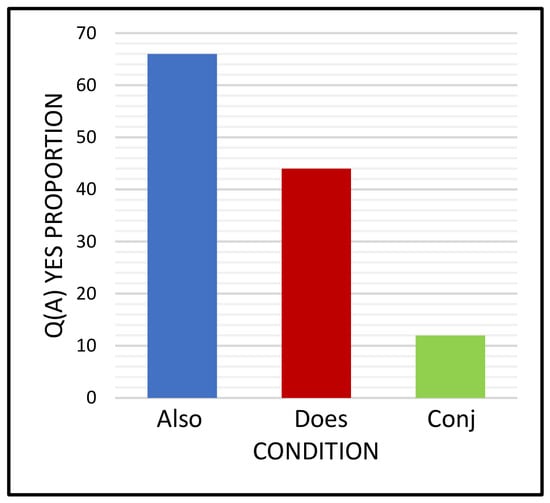
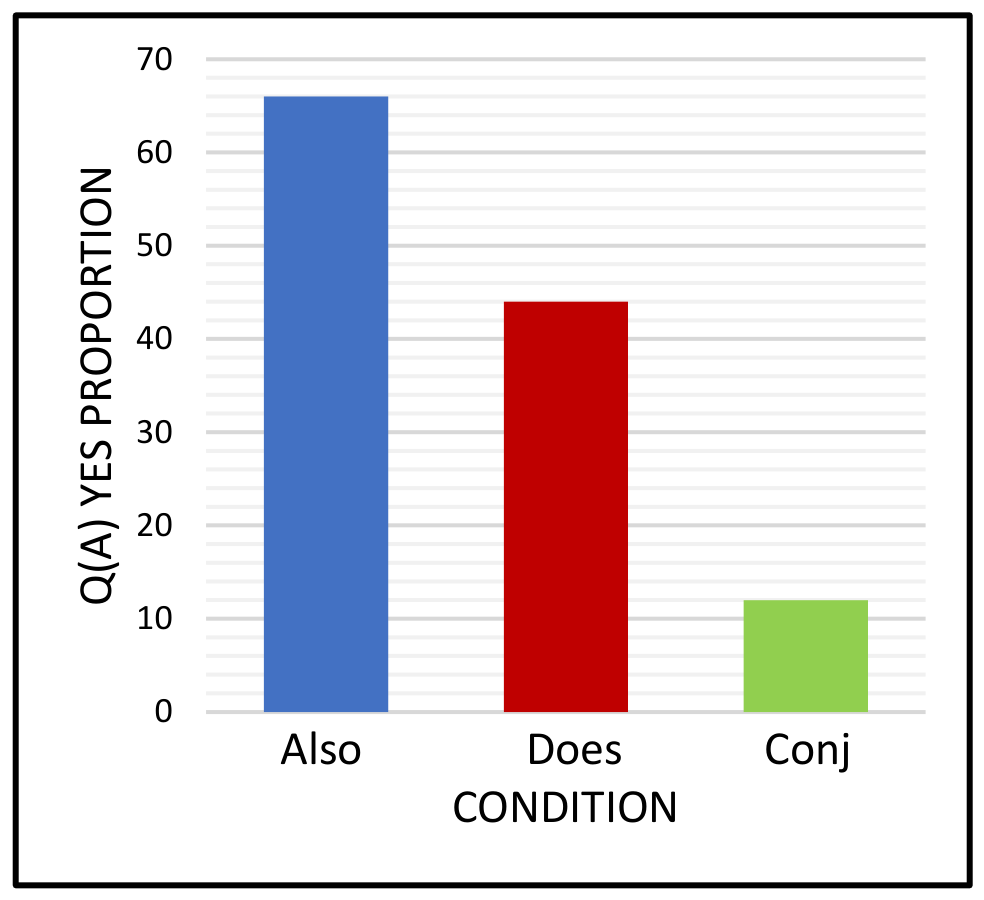
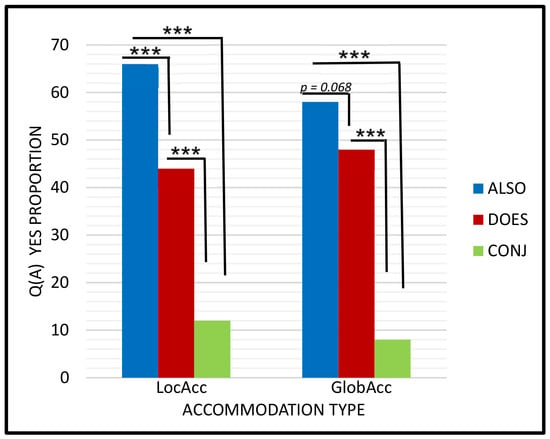
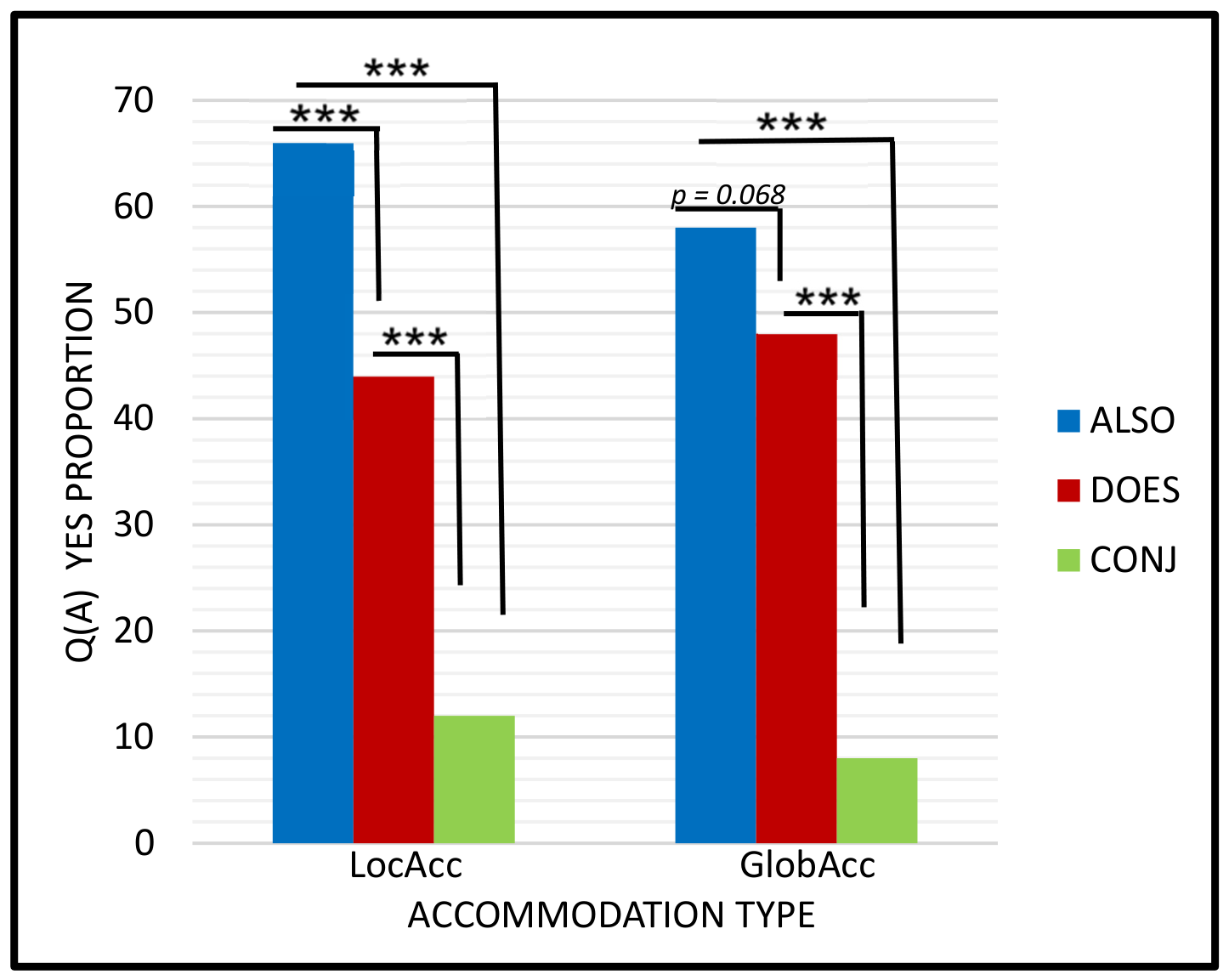
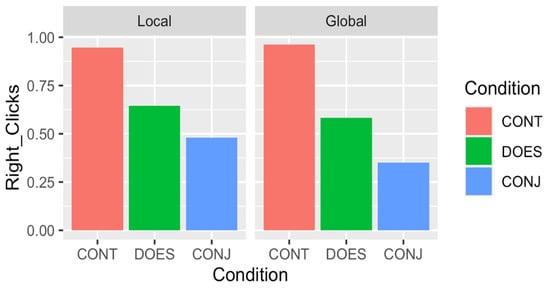
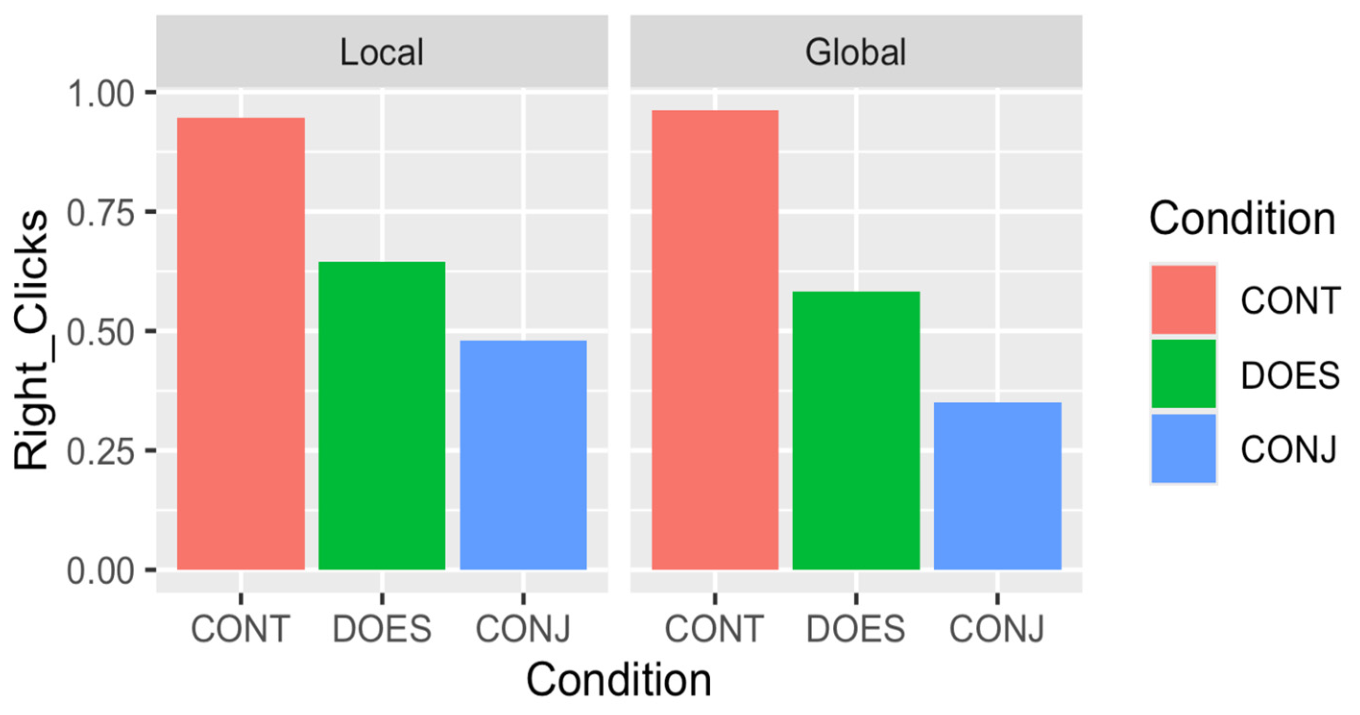
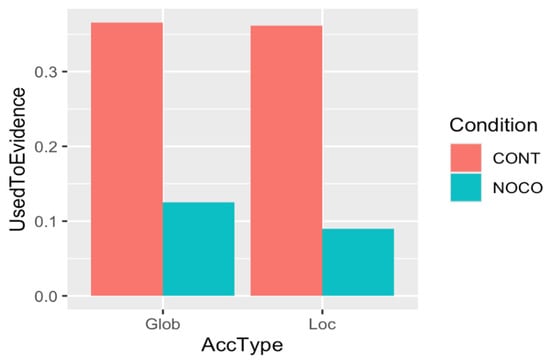
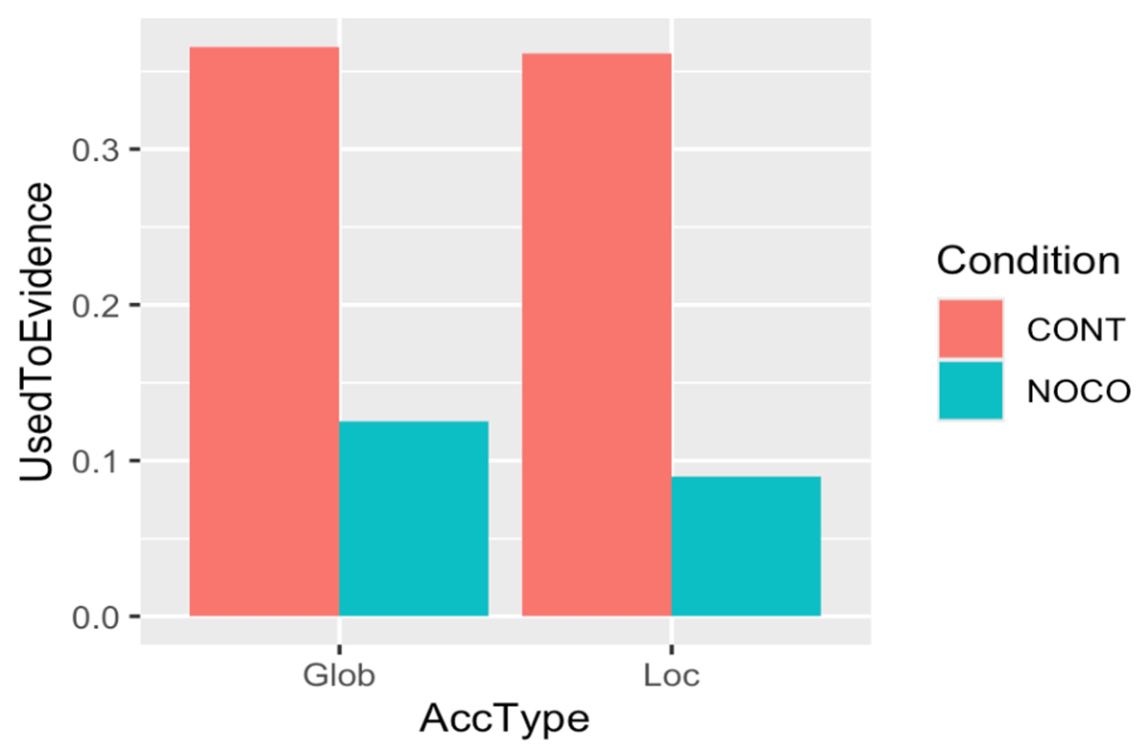
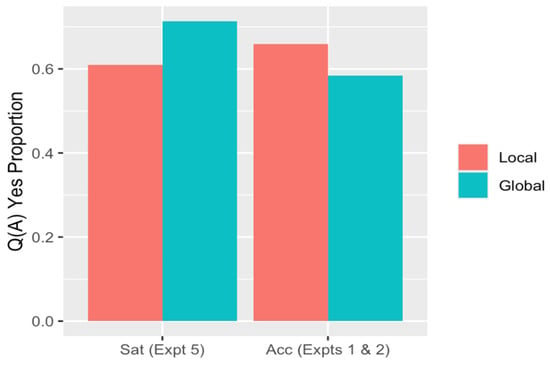
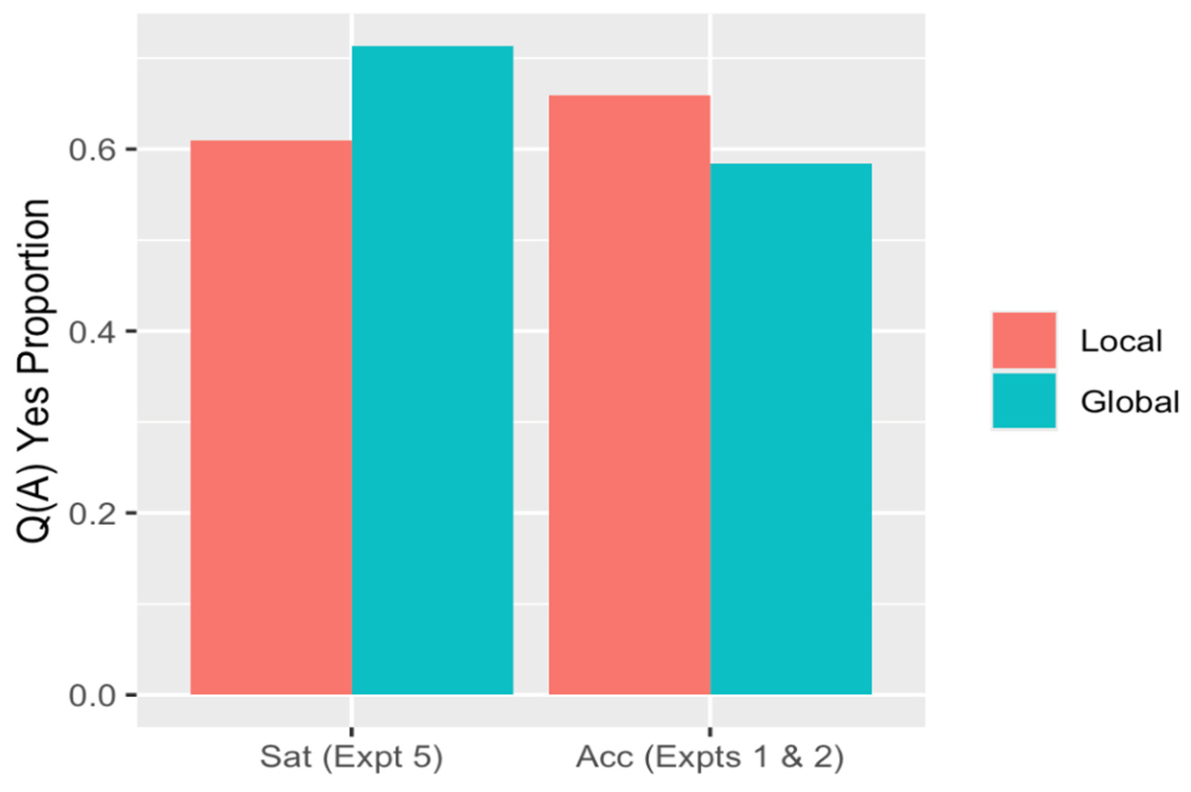

Disclaimer/Publisher’s Note: The statements, opinions and data contained in all publications are solely those of the individual author(s) and contributor(s) and not of MDPI and/or the editor(s). MDPI and/or the editor(s) disclaim responsibility for any injury to people or property resulting from any ideas, methods, instructions or products referred to in the content. |
© 2026 by the authors. Licensee MDPI, Basel, Switzerland. This article is an open access article distributed under the terms and conditions of the Creative Commons Attribution (CC BY) license.