


Abstract
The article provides an overview of the introduction of German loanwords into the Estonian language from the 13th to the 20th century, as well as their spread in Standard Estonian and dialects. German has functioned as a donor language in both its Low German and High German forms; however, Estonian has also had two written standards based on its major dialects—the Tallinn and Tartu literary languages, which were developed on the basis of the North Estonian and South Estonian main dialects. When comparing dialect areas and borrowing periods, a continuity of borrowing becomes evident, where a High German loanword appears either in place of or alongside an earlier Low German loanword. The widespread diffusion of Low German neologisms in Estonian dialects at the time is evidence that they entered the Estonian language predominantly through spoken communication. In comparison, a key difference in the case of High German loanwords is that these new terms were mainly added via the written language.
1. Introduction
Vocabulary enrichment and lexical borrowing have often been discussed in the context of innovations: other peoples are perceived as possessing something new and different that ought to be adopted, and usually this novelty enters usage together with its corresponding designation. This designation borrowed from another language may (a) remain unchanged, (b) be adapted to the phonological and morphological system of the receiving language, or (c) be translated into the recipient language. The adoption of necessary words from other languages into one’s own language is generally referred to as borrowing, and such words are called loanwords. Although these are (as it were) “borrowed,” no examples are known of any “returns”. If a new word fails to gain acceptance among speakers, it is simply discarded. At times, it has even been argued that borrowing has been excessive and that the language has acquired so-called unnecessary loanwords despite the availability of native equivalents (in the case of older written Estonian, see, for example, Liin, 1968, p. 60). Such developments have often been attributed to the translator’s insufficient command of the language, although the phenomenon is in fact more characteristic of natural redundancy than of a fully developed linguistic culture.
Over time, Estonian has accumulated several layers of loanwords, among which the largest later group consists of German loanwords. The aim of the present article is to provide an overview of the occurrence of Low and High German loanwords—the two principal donor languages—in written sources and of their distribution across the major Estonian dialects. Answers are sought to the following questions: Is there a relationship between the chronological layer of borrowing and the geographical distribution of loanwords? How are Low German loanwords distributed across the North Estonian and South Estonian dialects?
The source material for the article is fully comprehensive, consisting of 2600 entries from the author’s online dictionary of German Loanwords in Estonian (Viikberg, 2025). The original data presented in the study are openly available at https://arhiiv.eki.ee/dict/sls/ (accessed on 22 May 2026).
2. Background
2.1. Two Donor Languages and Borrowing Periods
The arrival of German loanwords into Estonian may broadly be divided into two periods. During the earlier period, from the 13th to the 17th centuries, vocabulary entered Estonian primarily from Low German. Later, from the 18th to the 20th centuries, borrowing took place mainly from High German. Each period has its own specific characteristics, reflected both in the adoption and in the distribution of German loanwords. Estonian borrowing relations were significantly shaped by contemporary historical and political circumstances.
When crusaders from northern Germany conquered Estonia in the 13th century, Low German became the administrative language of the Livonian Order State (1237–1562). It arrived in Estonian territory as the language of the rulers, establishing its dominant position alongside and above Estonian for four centuries. During this period, numerous loanwords entered Estonian, largely as a result of cultural contacts. Subsequently, with the decline of the Hanseatic League in the 17th century, as well as the widespread dissemination of Martin Luther’s Bible translation and the growing cultural influence of the German states, Low German was gradually replaced by High German. High German enriched the vocabulary of written Estonian mainly through cultural innovations during the 18th and 19th centuries. Both groups of loanwords are substantial: Low German loans in Standard Estonian have been estimated at 476–659 stems, while High German loans number approximately 356–506 stems (Prillop et al., 2020, pp. 359–360).
2.2. Two Main Estonian Dialects and Literary Languages
Estonian has been influenced by German through both Low German and High German varieties. It should be noted, however, that Estonian itself historically existed in two principal forms, based on the North Estonian and South Estonian dialect groups, especially after the arrival of Lutheranism in the 1520s brought with it the requirement that religious texts be available in the vernacular. What makes Estonian literary culture distinctive is the existence of two parallel written standards, the Tallinn and Tartu literary languages, named after their principal centres, Tallinn and Tartu.
The foundations of the North Estonian and South Estonian literary traditions were laid in 16th and 17th centuries. The emergence of two literary standards was made possible by the linguistic differences between the two major dialect groups, which themselves had developed from different Finnic tribal dialects. Political factors also played an important role, because the area inhabited by Estonians was divided into the Governorate of Estonia in the north and the Governorate of Livonia in the south. Had a single administrative unit existed, it is likely that only one literary language would have been adopted (as eventually occurred in the mid-nineteenth century).
The dialectal background of the earliest Estonian texts depended largely on the regional speech of their authors, and this is reflected in early written Estonian. The Tallinn literary language (North Estonian) developed primarily on the basis of the northern part Kingisepp of the Central Dialect. The Wanradt–Koell Catechism (1535) and the sermons of Pastor Georg Müller (1600–1606) (Habicht et al., 2000) reflected the language of Tallinn and its surrounding region. Heinrich Stahl, in his works (1632–1649), relied on the language of Järva and Viru counties, while Heinrich Göseken (1660), (Kingisepp et al., 2010), Johann Hornung (1693), and Anton Thor Helle (1732) demonstrated a thorough command of the North Estonian Central Dialect in their grammars. Consequently, the influence of an emerging supra-regional Central-Dialect-based standard can already be observed in the earliest North Estonian literary language. The grammatical structure of written North Estonian became more firmly established during the 18th century, aided by the publication of the Estonian Bible in 1739, the development of an Estonian-language school network, and the dissemination of educational literature (Kask, 1970, pp. 37, 97; Laanekask, 2004, p. 29; Saareste, 2006, pp. 159–161).
The Tartu literary language (South Estonian) was based primarily on the Tartu dialect. Although references to South Estonian written texts date from the 16th century, the oldest surviving work is the Catholic handbook Agenda Parva (1622), whose translation employed the dialect of southern Tartumaa and the western part of what later became Võrumaa (Kask, 1970, p. 59). Significant milestones in the development of the Tartu literary language include the grammar of Johannes Gutslaff, pastor of Urvaste (1648) (Gutslaff, 1998), and the Vastne Testament (New Testament) translated by Adrian Virginius, pastor of Puhja (1686). The close awareness of developments in the north among South Estonians is demonstrated by the ecclesiastical handbook of Joachim Rossihnius, pastor of Sangaste (1632), which shows the influence of North Estonian texts. The early South Estonian literary language appears to have been based on the language of Tartu and its surrounding region, although alongside characteristic Tartu dialect features it also contained elements associated with North Estonian. The differences between the Tallinn and Tartu literary languages were not so great as to create a mutual language barrier.
In the 17th century, contemporary writers regarded Tallinn and Tartu language as varieties of one Estonian language. However, the handbooks produced for language teaching and missionary purposes ultimately led to the emergence of two literary standards (Raag, 2008, pp. 28–31). During the 18th century, some ecclesiastical and educational literature continued to be published in Tartu language, including the notable grammar of Estonian compiled by August Wilhelm Hupel (1780), which presented South Estonian grammar and vocabulary alongside North Estonian. This was, however, the last such major work. During the 19th century, the nationally awakened Estonians adopted a single common literary language based on Tallinn language (North Estonian).
Given the long history of language contact, it is necessary in the following discussion to examine the occurrence and distribution of both Low and High German loanwords in both the Tallinn language of North Estonians and the Tartu language of South Estonians.
2.3. Previous Research
Research into German–Estonian borrowing relations has a long history. Its beginnings may be seen in the comparative word lists included in the earliest Estonian grammars (Heinrich Göseken 1660, (Kingisepp et al., 2010), Anton Thor Helle 1732, August Wilhelm Hupel 1780), followed by more specific observations in the writings of 19th-century scholars such as Johann Heinrich Rosenplänter and Eduard Ahrens. Since historical-comparative linguistics had not yet emerged as a discipline, the primary attention of these missionary linguists—mostly pastors—was directed at phonetic similarities between words, and thus older Germanic or Swedish-derived vocabulary could also be classified as German loans. More intensive and systematic research, focused particularly on Low German loans, began in the 20th century, when professional Estonian linguists such as Andrus Saareste, Paul Ariste, Erich Kobolt, among others entered the field. Numerous fundamental studies on lexical borrowing were published (e.g., Ariste, 1940, 1963, 1972; Liin, 1964, 1968; Hinderling, 1981; Raag, 1987). These efforts culminated in Helgi Liin’s monograph Low German Loanwords in 16th- and 17th-Century Written Estonian, defended as a doctoral dissertation in 1968. Following a period of relative inactivity, research resumed in the new century with Jüri Viikberg’s dictionaries Low German Loanwords in Estonian (Viikberg, 2016), High German Loanwords in Estonian (Viikberg, 2024), and the combined dictionary German Loanwords in Estonian (Viikberg, 2025). These online dictionaries, together with the major etymological dictionaries (Mägiste, 1982; Raun, 1982; Metsmägi, 2012), have served as important sources for the preparation of the present overview.
3. Earlier Period: Low German Loanwords in Estonian
The numerous Low German loanwords in Estonian (primarily from Middle Low German during this period) testify to the arrival of medieval European social organization in Estonia during the 13th–17th centuries. Most early loans probably entered Estonian through spoken language (Viikberg, 2014, p. 212). Since written Estonian is relatively young (its first printed book dates from 1525), written sources reflect the occurrence of loanwords in printed texts rather than the actual time of their entry into Estonian—that is, the true age of the loans. Therefore, when tracing the occurrence and spread of Low German loans in different regions, it is necessary to take into account both early written sources and dialect material derived from spoken language.
To compare the occurrence of Low German loanwords in the Tallinn and Tartu literary languages, this study relies on the 17th-century authors Heinrich Stahl1 (1637), (Stahl, 1976) and Heinrich Göseken2 (1660) (Kingisepp et al., 2010) in North Estonia, and Johannes Gutslaff3 (1648) (Gutslaff, 1998) in South Estonia. The aim is to determine to what extent the known Low German loanwords in Estonian overlap with (or differ in) the vocabulary usage of these three writers. The following lexical selection is based on the dictionary section of Gutslaff’s grammar, from which the Estonian equivalents of German headwords have been examined.
3.1. Low German Loanwords in Both Tallinn and Tartu Language Varieties
This group consists of loanwords added to the language (including Christian terminology, in which Low German played an important supporting and mediating role), either to fill conceptual gaps or simply to enrich Estonian vocabulary. Representative examples are grouped by semantic field.
- ▪
- Church and school: altar ‘altar’ < MLG altar (Göseken Altar, Gutslaff Altar); ingel ‘angel’ < MLG engel (Göseken Jngel, Gutslaff Engel); kool ‘school’ < MLG schole (Göseken Kohli, Gutslaff Kôli); kriit ‘chalk’ < MLG krite (Göseken Rijhti, Gutslaff Krîte); kroon ‘crown’ < MLG krône (Stahl krohn, Göseken Rooni, Gutslaff Krôni); mirr ‘myrrh’ < MLG mirre (Stahl myrrit, Göseken mijrrit, Gutslaff Mirra); munk ‘monk’ < MLG monk (Stahl munck, Göseken Munck, Gutslaff Munck); nunn ‘nun’ < MLG nunne (Göseken Nunne, Gutslaff Nunne); ohver ‘sacrifice/offering’ < MLG offer (Stahl Offer, Göseken opper, Gutslaff offri); orel ‘organ’ < MLG orgel (Göseken Orgel, Gutslaff Orgel); pekk ‘collection plate’ < MLG becken (Göseken Pecki, Gutslaff Bicken).
- ▪
- Occupations and tools: amet ‘profession’ < MLG am(m)et (Stahl Ammet, Göseken Ammet, Gutslaff Ammit); arst ‘doctor’ < MLG arste (Stahl Arst, Göseken Arst, Gutslaff Arst); höövel ‘plane (tool)’ < MLG hovel (Stahl höfel, Göseken Höwel, Gutslaff Höfli); mölder ‘miller’ < MLG moller (Göseken moller, Gutslaff Möller); saag ‘saw’ < MLG sage (Stahl Saij, Göseken Sai, Gutslaff Saje).
- ▪
- Buildings and living spaces: kants ‘fortification’ < MLG schanze (Stahl Kantz, Göseken Kantzi, Gutslaff Kantze); kelder ‘cellar’ < MLG keller (Stahl Keller, Göseken Keller, Gutslaff Keller); köök ‘kitchen’ < MLG kȫke (Göseken Köeck, Gutslaff Köki); müür ‘wall’ < MLG mǖr(e) (Stahl mühr, Göseken mühr, Gutslaff Müri); tall ‘stable’ < MLG stal (Stahl Tal, Göseken Tall, Gutslaff Talli); trepp ‘stairs’ < MLG treppe (Stahl Trep, Göseken Rep, Gutslaff Reppe); võlv ‘vault’ < MLG welwe (Stahl Wölw, Göseken wölw, Gutslaff Wölwi).
- ▪
- Household: klaas ‘glass’ < MLG glas (Stahl klahs, Göseken Laas, Gutslaff Klâsick); korv ‘basket’ < MLG korf (Stahl korw, Göseken Korw, Gutslaff Korw); käärid ‘scissors’ < MLG schere (Stahl kehr, Göseken Keer, Gutslaff Kêre); lamp ‘lamp’ < MLG lampe (Göseken Lampi, Gutslaff Lampe); laadik ‘box’ < MLG lade (Stahl Ladick, Göseken Ladick, Gutslaff Ladick); nöör ‘string’ < MLG snôr(e) (Göseken nöhr, Gutslaff Nörick); pann ‘pan’ < MLG panne (Stahl Pan, Göseken pann, Gutslaff Panni); pigi ‘pitch/tar’ < MLG pik (Göseken picki, Gutslaff Pick); ruun ‘castrated horse’ < MLG rūne (Stahl ruhn, Göseken Ruhn, Gutslaff Rûn); seep ‘soap’ < MLG sêpe (Stahl Seep, Göseken Seep, Gutslaff Sêpi); tekk ‘blanket’ < MLG decke (Stahl teck, Göseken Tecki, Gutslaff Tecki); vaat ‘barrel/tub’ < MLG vat (Stahl waht, Göseken Waahti, Gutslaff Wâti); äädikas ‘vinegar’ < MLG etik (Stahl Ettickas, Göseken Ettikas, Gutslaff Ettickas).
- ▪
- Clothing: krae ‘collar’ < MLG krage (Stahl kraj, Göseken Kraije, Gutslaff Kraje); kuub ‘coat/tunic’ < MLG schube (Stahl Kuhb, Göseken Kuhb, Gutslaff Kûb); mantel ‘cloak’ < MLG mantel (Göseken mantle, Gutslaff Mantel); müts ‘cap’ < MLG mütze (Göseken mütz, Gutslaff mütz); nööp ‘button’ < MLG knôp (Stahl nöhp, Göseken nöhp, Gutslaff Nôp); vammus ‘doublet/jacket’ < MLG wam(me)s (Göseken Wammus, Gutslaff Wammus).
This study’s sample allows us to make the observation that a large proportion of the Middle Low German loans found in Johannes Gutslaff’s dictionary do not differ from the vocabulary usage of the North Estonian authors.4 The greatest overlap is found with the Kullamaa pastor Göseken, probably because Göseken’s dictionary was several times larger than Gutslaff’s. Only four contemporary Low German loanwords found in Gutslaff’s grammar are absent from both Stahl and Göseken: klint (<MLG klint), lõõr ‘chimney flue’ (<MLG rȫre), võlsma ‘to falsify’ (<MLG valsch), and võlss ‘false’ (<MLG valsch).
3.2. Low German Loanwords in Tallinn Estonian, but Not in Tartu Estonian
Despite the considerable overlap of Low German loanwords in the sample material selected from the written Estonian of the 16th–17th centuries, it is striking that part of the vocabulary presented in the dictionary section “Nomenclator Germanico-Esthonicus” of Johannes Gutslaff’s grammar (1648) nevertheless differs from the selections made by his contemporaries Heinrich Stahl and Heinrich Göseken. At first glance, it even appears that although the 17th century may be regarded as a period of massive influx of loanwords, Gutslaff was not particularly eager to introduce new borrowings from German. Therefore, the following discussion examines how Gutslaff’s lexical usage differs from the dictionaries of Stahl and Göseken.
3.2.1. Preference for Loanwords or Native Vocabulary
Many Low German loanwords that entered the works of Stahl and Göseken are absent from the German–Estonian dictionary in Gutslaff’s grammar. Instead, he preferred to use either a native Estonian word, an earlier borrowing already accepted into the language, or a form he coined himself (Viikberg, 2013, pp. 243–253). Thus, loanwords often did not fill an empty lexical space but appeared alongside words already existing in the language, and they did not always spread across the entire language area but rather unevenly and regionally.
The following examples consist of more widely known dialect words used by Gutslaff where Stahl and/or Göseken used a loanword, e.g., hirs vs. palk ‘beam’ (Gutslaff Hirs, Stahl and Göseken palck < MLG balke); kalits vs. task ‘pocket’ (Gutslaff Kalliche ‘Tasche’, Göseken task < MLG taske); karv vs. värv ‘colour’ (Gutslaff Karw, Göseken warw < MLG verwe); koger vs. karus ‘quiver’ (Gutslaff Kogr, Göseken Karruhs < MLG karusche); komme vs. viis ‘custom, manner’ (Gutslaff Kombe, Göseken wijsi < MLG wise); lihunik vs. lahter ‘butcher’ (Gutslaff Lehaneck, Göseken Lachter < MLG slachter); mesileib vs. piparkook ‘gingerbread’ (Gutslaff Messileib, Göseken peperkohck < MLG pepper-koke); pada vs. pott ‘pot’ (Gutslaff padda, Göseken pott < MLG pot); pang vs. ämber ‘bucket’ (Gutslaff Panj, Stahl and Göseken ember < MLG emmer); parv vs. praam ‘ferry’ (Gutslaff parw, Göseken praam < MLG prâm); salv vs. kast ‘box, chest’ (Gutslaff Salv, cf. Göseken Kasti < MLG kaste); soon vs. aader ‘vein’ (Gutslaff Son, Stahl and Göseken aader < MLG âdere); surmarohi vs. kihvt ‘poison’ (Gutslaff Surmarocht, Göseken kihvt < MLG gift); tee vs. reis ‘journey’ (Gutslaff Teh, Göseken reis < MLG reise); tüli vs. lärm ‘noise, quarrel’ (Gutslaff Tüld, Göseken Lermi < MLG allerm); vaba vs. prii ‘free’ (Gutslaff wabba, Göseken Wry < MLG vrî).
When loanwords become a natural part of Estonian over a long period of time, it becomes increasingly difficult to determine which native word they replaced and what existed before. On the basis of the dictionaries of Göseken and Gutslaff, it is possible to provide examples of words beside which Low German borrowings later appeared (and eventually replaced them), although such borrowings are not yet recorded by these 17th-century authors. For example: ehitama ‘to build, decorate’ (Gutslaff ähhitama, Göseken ehhitama ‘to adorn’), later replaced by mukkima (<MLG smucken); emand ‘mistress, lady’ (Gutslaff and Göseken Emmand), later followed by proua (<MLG vrouwe); hõõruma ‘to rub’ (Gutslaff höhrema, Göseken höhrima), preceding the borrowing riivima (<MLG rîven); kõrb ‘brown’ (Gutslaff kerp, Göseken körb), later replaced by pruun (<MLG brûn); leem ‘broth’ (Gutslaff Lêm, Göseken Leend), followed by supp (<MLG supen); maitsma ‘to taste’ (Gutslaff maitzma), followed by mekkima (<MLG smecken); pärdik ‘monkey’ (Gutslaff Pertike, Göseken pertick), followed by ahv (<MLG affe); sile ‘smooth’ (Gutslaff Silli), followed by klatt (<MLG glat); taplus ‘battle’ (Gutslaff and Göseken Tapplus), followed by lahing (<MLG slachtinge); telg ‘axle’ (Gutslaff Telg), followed by ass (<MLG asse); veeretama ‘to roll’ (Gutslaff wêritama, Göseken weeretama), followed by rullima (<MLG rullen); võidma ‘to spread with butter’ (Gutslaff woidma, Göseken woidama), followed by määrima (<MLG smeren).
It should also be emphasized that new words often appeared alongside earlier ones rather than replacing them completely, becoming synonyms, such as supp and leem, määrima and võidma, taplus and lahing, although these later developed somewhat different meanings. Consequently, German loanwords did not necessarily fill existing lexical gaps. The introduction of a new lexical item could have resulted in the coexistence of synonymous items.
3.2.2. Dialect Vocabulary of More Limited Distribution
Gutslaff’s dictionary also contains dialect vocabulary originating from South Estonian dialects, especially the Võru dialect spoken in the Urvaste parish area. Examples include hank ‘hook’ (Gutslaff Hangk, Göseken haak < MLG hâke); kaltsad ‘trousers’ (Gutslaff Kalczi, Göseken püxit < MLG bükse, büxe); mõrsja ‘bride’ (Gutslaff Morsi, Göseken Pruhdt < MLG brût); rahu ‘kidney’ (Gutslaff Rahow, Stahl ne(h)r, Göseken neer < MLG nêre); sepp ‘yeast’ (Gutslaff Sepp, Göseken parm < MLG berme); valim ‘funnel’ (Gutslaff Wallim, Göseken trichtel < MLG trechter); vanik ‘wreath’ (Gutslaff Wannick, Stahl krantz, Göseken Rantzi < MLG kranz); vatsk ‘cake’ (Gutslaff Watsa, Stahl Kochk, Göseken Koock < MLG koke).
INTERIM SUMMARY. Among loanwords originating from Low German are numerous terms connected with innovations in social and economic life, religion, education, and urban culture, as well as names for newly introduced household items, occupations, tools, foods, and other objects. The broad occurrence and spread of these once-new words across Estonian dialects demonstrates that they entered Estonian predominantly through spoken language.
4. Later Period: High German Loanwords in Estonian
Whereas the study of Low German loanwords relies mainly on the German–Estonian glossaries found in 17th-century grammars, research on High German borrowings can rely chiefly on the German–Estonian–German dictionary of (1818) (Hupel, 1818) and the Estonian–German dictionary of Johann Ferdinand Wiedemann (1869) (Wiedemann, 1869). In both works, words are marked according to origin, respectively, r. (revalsche ‘Tallinn’) and d. (dörptsche ‘Tartu’).
From 1721 onward, Estonian territories belonged to the Russian Empire, though they remained divided into the Governorates of Estonia and Livonia. Despite the presence of the tsar and higher authorities in St Petersburg, actual power in the Baltic provinces was exercised by representatives of the Baltic German nobility. German remained the officially privileged language and continued to be the greatest influence on Estonian throughout the 19th century.
Compared with Low German loanwords, an important difference in the case of High German borrowings was that new words entered mainly through the written language. The continuous tradition of journalism beginning in the mid-19th century, together with educational, practical, translated, and literary works inspired by the National Awakening, directed the flow of new loanwords toward enriching the standard language. Consequently, many neologisms did not proliferate into dialectal variants. From the mid-19th century onward, the enrichment of literary Estonian became a conscious and systematic activity among leading writers such as Johann Voldemar Jannsen, Friedrich Reinhold Kreutzwald, and Carl Robert Jakobson.
Several characteristic tendencies nevertheless stand out:
- While German-derived month names (jaanuar, veebruar, etc.) became standard in printed calendars, dialects retained traditional folk names such as näärikuu ‘January’and hundikuu ‘January or February’.
- New vocabulary introduced through school literature was adopted in literary form and was not dialectalized, e.g., algebra, ellips ‘ellipse’, hüpotenuus ‘hypotenuse’, kuup ‘cube’, ovaal ‘oval’ in mathematics; alumiinium ‘aluminium’, kloor ‘chlorine’, naatrium ‘sodium’ in chemistry; akord ‘chord’, aktsent ‘accent’, intervall ‘interval’, okariin ‘ocarina’ in music education; antiloop ‘antelope’, emu, hai ‘shark’, hüään ‘hyena’, laava ‘lava’ in geography and biology.
- Differences between North and South Estonian appeared mainly in pronunciation, especially in everyday vocabulary, e.g., aadress (North Estonian) vs. adrõss (South Estonian); advokaat (ahukat) vs. ahvõkaat (ahvukaat); eeter vs. eedõr; kanevaa vs. kanõvaa; kapsel vs. kapsli. Some loanwords with particularly foreign phonological structures developed numerous adapted dialect variants, e.g., vundament ‘foundation’: vuldament, kundament, pundament, kundamunt, hundmänt, etc.; kartul ‘potato’: kardul, kardulas, karduhvel, kartles, tuhel, tuhlis, tohver, etc.; tikker ‘gooseberry’: tikerbär, tikenber, kikerber, tikerperä, pikõrperä, and so forth.
5. Continuity of Borrowing
The periods of Low German and High German borrowing cannot be viewed as sharply separated chronological phases, since the transition occurred gradually. The continuity of borrowing is especially evident. If Low German loanwords entered early written Estonian but did not remain in the literary language, they were often later replaced by High German borrowings. The earlier loanword kink ‘ham’ (<Low German schinke) was later replaced by sink ‘ham’ (<German Schinke). Similarly, vörpel ‘dice’ and vörst ‘prince’ (<Low German wörpel, vörste) preceded the later German loans vürfel ‘dice’ and vürst ‘prince’ (<German Würfel, Fürst); munster ‘pattern’ and klamp ‘clip, staple’ (<Low German munster, klampe) preceded muster ‘pattern’ and klamber ‘clip, staple’ (<German Muster, Klammer). Thus, borrowing may originally have begun from Low German, but later High German forms eventually prevailed, while earlier loans survived only as archaisms. This involved several phases of contact, in which one loanword was replaced by another.
There are also cases where the later High German borrowing did not replace the earlier Low German one, and both remained in use. Estonian has both kee and kett (‘chain’), one derived from Low German (kedene), the other from High German (Kette). Similar pairs include käsper (<Low German kersebere) and kirss ‘cherry’ (<German Kirsche), as well as leer (<Low German leger) and laager ‘camp’ (<German Lager) (Viikberg, 2014, pp. 213–214).
Some loanwords that once entered written Estonian survived only in dialects, for example aarnaadel ‘hairpin’ (<German Haarnadel). Other dialectal loanwords such as kape ‘cap’ (<German Kappe), kees ‘homemade cheese’ (<German Käse), knospe ‘flower bud’ (<German Knospe), virtel ‘quarter’ (<German Viertel), or veinaspuu ‘Christmas tree’ (<German Weihnachtsbaum) never appeared in literary Estonian at all but were borrowed through oral communication.
Repeated borrowing—whether in different regions or at different times—was also common. For example, the word kirss ‘cherry’ appears in several forms: in Stahl’s Järva County dictionary (1637) it occurs as Karsberi Marri (<Low German kersebere); Gutslaff’s grammar (1648) contains the form Wissila marri (<Russian вишня); and the Pärnu lexicon of Salomo Heinrich Vestring (1720–1730, as cited in Vestring, 1998) records Kirsimarri (<German Kirsche). Thus both the tree and its fruit were named differently across Estonian-speaking areas depending on the contact language. In literary Estonian, kirsimari and kirsipuu became established, while dialects preserved variants such as käsper and visnapuu.
6. Conclusions
The present study provides the first overview of Low German and High German loanwords in Estonian that systematically compares sources from the Tallinn and Tartu literary languages with data from the North and South Estonian dialects, while also analysing the chronological relationship between Low German and High German borrowings.
A comparison between the known corpus of Low German loanwords and the vocabulary used by Gutslaff reveals that, of the 214 words selected for analysis, Gutslaff employed Low German loanwords as Estonian equivalents for German headwords in nearly half of the cases (103 words). Many Low German loanwords that had entered Estonian and appeared in the works of 17th-century authors are absent from the German–Estonian glossary of Gutslaff’s grammar. Instead, he preferred to use either a native Estonian equivalent (often South Estonian), a word that had already been adopted through an earlier borrowing layer (Germanic, Baltic, or other), or a term that he himself coined.
In the context of the introduction and use of loanwords, several observations stand out:
- Low German words often did not fill a lexical gap, because the foreign term appeared alongside already existing Estonian words, e.g., pott ‘pot’ beside earlier katel and pada, palk ‘log, beam’ beside hirs, and puur ‘drill’ beside oherdi. At the same time, lexical change also reflected broader changes in everyday life, including new types of objects and work practices.
- A newly introduced foreign word (which subsequently became a loanword through nativization) did not always replace existing dialectal variants but frequently coexisted with them; compare task ‘pocket’ (<Low German tasche), tasku ‘pocket’ (<Swedish taska), kalits ‘pocket’ (<Russian калита), karman ‘pocket’ (<Russian карман), and (tengel)pung ‘wallet’ (<Low German bunge).
- By the 17th century, many Low German loanwords were already in use in North Estonian dialects or had spread throughout the country (e.g., kelm ‘rogue’, klatt ‘slovenly person’, neer ‘kidney’, pärm ‘yeast’), whereas a number of the equivalents provided by Gutslaff derived from South Estonian dialects with a more restricted geographical distribution (e.g., herits ‘rogue, swindler’, nilbe ‘slippery’, saibass ‘pole, picket’, tsagama ‘chop, hack’, val(l)im ‘funnel’).
- A single Low German source word could yield two different forms in Estonian, one on either side of the North–South dialect boundary; compare South Estonian võlss and North Estonian valsk (<Low German falsch ‘false’).
An analysis of the vocabulary found in the works of the 17th-century writers Heinrich Stahl, Heinrich Göseken, and Johannes Gutslaff demonstrates that considerably more Low German loanwords entered the Tallinn literary language than the Tartu literary language. This conclusion is also supported by the dialect material presented in the online dictionary Low German Loanwords in Estonian (Viikberg, 2016). Of the 950 Low German loanwords recorded in the dictionary, more than half (590) are established in both North Estonian and South Estonian dialects. Nearly one third (310) occur in North Estonian dialects but not in South Estonian ones, whereas only about twenty loanwords have been recorded exclusively from South Estonian dialects. Not a single one of these approximately twenty words is represented in Gutslaff’s glossary. Some of these words may indeed postdate Gutslaff’s time, such as karnapp ‘part of a threshing barn’ (<Low German karnap ‘dormer, projection’), pokad ‘smallpox’ (<Low German pocke ‘pox, smallpox’), or prook ‘breeches’ (<Low German brook ‘trousers; rope’). Others, however, may well have been in use already in the 17th century, for example kink ‘ham’ (<Low German schinke ‘ham’), lüht ‘candlestick; chandelier’ (<Low German lüchte ‘candlestick’), or maat ‘measure, model’ (<Low German mate ‘measure, model’). This confirms the natural fact that later scholarship supplements and refines earlier descriptions.
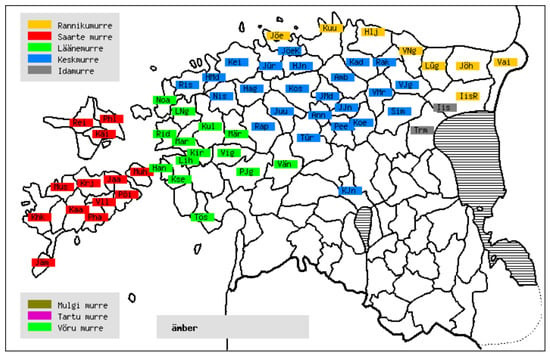
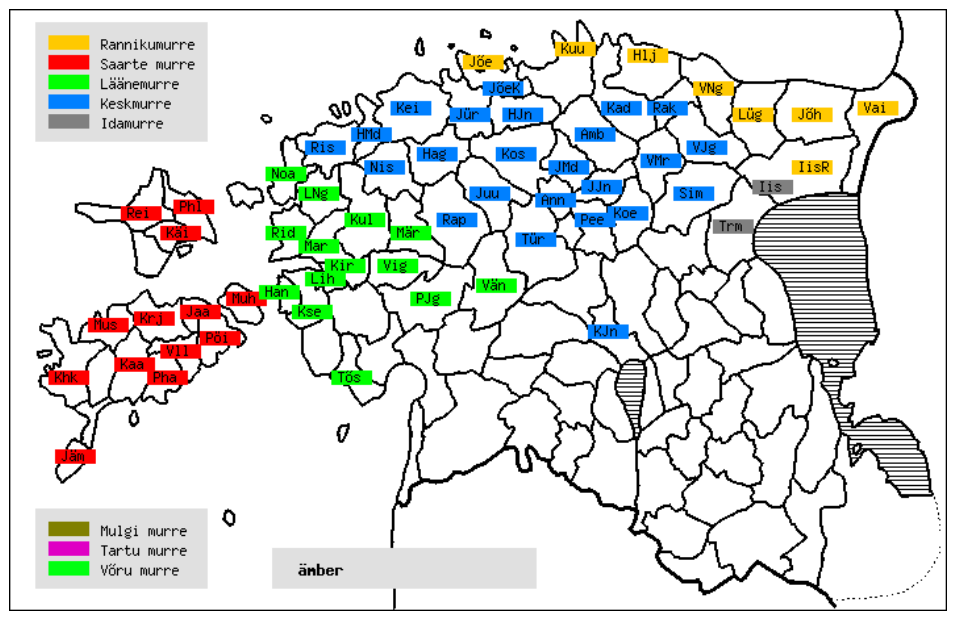
The long-held impression that substantially more Low German loanwords entered the Tallinn literary language than the Tartu literary language has thus become clearer and better substantiated. A characteristic example of the imprint left by Low German loanwords in Estonian dialects is the word ämber ‘bucket’ (Figure 1), whose distribution is illustrated in the dialect map published in the Small Dialect Dictionary (Pall, 1989).
Figure 1.
Distribution of the loanword ämber ‘bucket’ in North Estonian dialects.
The word ämber is known and used throughout North Estonia: yellow marks the Coastal Dialect, red the Insular Dialect, blue the Central Dialect, and black the Eastern Dialect. The dialect areas of South Estonia remain uncoloured, indicating that the corresponding lexical item there is pang ‘bucket’.
Funding
This study was supported by the institutional R&D funding of the Institute of the Estonian Language from the Estonian Ministry of Education and Research.
Institutional Review Board Statement
Not applicable.
Informed Consent Statement
Not applicable.
Data Availability Statement
No new data were created. The original data presented in the study are openly available in https://arhiiv.eki.ee/dict/sls/.
Conflicts of Interest
The author declares no conflict of interest.
Notes
| 1 | Heinrich Stahl (1600–1657)—a Baltic German clergyman and writer who authored the first Estonian language textbook with a dictionary, “Anführung zu der Estnischen Sprach” (1637). He served as a pastor in the Governorate of Estonia in Järva and Viru counties from 1623 to 1638, and as superintendent of Ingria and Alutaguse from 1641 to 1657. |
| 2 | Heinrich Göseken (1612–1681)—a German-born clergyman and writer, author of the Estonian grammar “Manuductio ad Linguam Oesthonicam” (1669). He was pastor of the Kullamaa parish in Lääne County, Governorate of Estonia, from 1641 to 1681. |
| 3 | Johannes Gutslaff—a German-born clergyman and writer who served as pastor of the Urvaste parish in Võru County, Governorate of Livonia, from 1641 to 1656. |
| 4 | This seems to indicate that, despite the differences between the Tallinn and Tartu varieties of Estonian, the linguistic boundary between the two main dialects did not constitute a significant language barrier at the time. |
References
- Ariste, P. (1940). Georg Mülleri saksa laensõnad (pp. 1–3). Acta et Commentationes Universitatis Tartuensis B 46. Tartu Ülikool. [Google Scholar]
- Ariste, P. (1963). Saksa laensõnad Heinrich Stahli eesti keeles (pp. 85–119). Emakeele Seltsi aastaraamat IX. Eesti NSV Teaduste Akadeemia. [Google Scholar]
- Ariste, P. (1972). Das Niederdeutsche im Estnischen. Coвemcкoe финнo-yгpoвeдeнue, VIII(2), 91–98. [Google Scholar]
- Gutslaff, J. (1998). Observationes grammaticae circa linguam esthonicam. Grammatilisi vaatlusi eesti keelest (J. Peebo, Ed.). Translated and Compiled by M. Lepajõe. Tartu Ülikooli eesti keele õppetooli toimetised, 10. Tartu Ülikool. [Google Scholar]
- Habicht, K., Kingisepp, V.-L., Pirso, U., & Prillop, K. (2000). Georg Mülleri jutluste sõnastik (Tartu Ülikooli eesti keele õppetooli toimetised 12). Tartu Ülikool. [Google Scholar]
- Hinderling, R. (1981). Die deutsch-estnischen Lehnwortbeziehungen im Rahmen einer europäischen Lehnwortgeographie. Otto Harrassowitz. [Google Scholar]
- Hupel, A. W. (1818). Ehstnische Sprachlehre für die beyden Hauptdialekte, den revalschen und den dörptschen (Zweyte durchgängig verbesserte und vermehrte Auflage). J. F. Steffenhagen und Sohn. [Google Scholar]
- Kask, A. (1970). Eesti kirjakeele ajalugu I–II. Tartu Ülikool. [Google Scholar]
- Kingisepp, V.-L., Ress, K., & Tafenau, K. (2010). Heinrich Gösekeni grammatika ja sõnastik 350. Tartu Ülikool. [Google Scholar]
- Laanekask, H. (2004). Eesti kirjakeele kujunemine ja kujundamine 16.-19. sajandil (Dissertationes philologiae estonicae Universitatis Tartuensis 14). Tartu Ülikool. [Google Scholar]
- Liin, H. (1964). Alamsaksa laensõnad eesti vanimas kirjakeeles (P. Palmeos, Ed.; pp. 32–74). Töid eesti filoloogia alalt I. Tartu Riikliku Ülikooli toimetised 162. Tartu Riiklik Ülikool. [Google Scholar]
- Liin, H. (1968). Alamsaksa laensõnadest 16. ja 17. sajandi eesti kirjakeeles (pp. 47–69). Emakeele Seltsi aastaraamat 13. Eesti Raamat. [Google Scholar]
- Mägiste, J. (1982). Estnisches etymologisches Wörterbuch I–XII. Finnisch-Ugrische Gesellschaft. [Google Scholar]
- Metsmägi, I. (Ed.). (2012). Eesti etümoloogiasõnaraamat (I. Metsmägi, M. Sedrik, & S.-E. Soosaar, Comp.). Eesti Keele Sihtasutus. [Google Scholar]
- Pall, V. (Ed.). (1989). Väike murdesõnastik I–II. Valgus. Available online: https://arhiiv.eki.ee/dict/vms/ (accessed on 12 June 2026).
- Prillop, K., Pajusalu, K., Saar, E., Soosaar, S.-E., & Viitso, T.-R. (2020). Eesti tüvevara päritolu. Eesti keele ajalugu (pp. 337–375). Eesti keele varamu VI. Tartu Ülikooli Kirjastus. [Google Scholar]
- Raag, R. (1987). Mittelniederdeutsche und skandinavische Lehnwörter im Estnischen und Livischen. Sprachkontakt in der Hanse. Aspekte des Sprachausgleichs im Ostsee- und Nordseeraum. In P. Sture (Ed.), Akten des 7. internationalen Symposions über Sprachkontakt in Europa, Lübeck 1986. Max Niemeyer Verlag. [Google Scholar]
- Raag, R. (2008). Talurahva keelest riigikeeleks. Atlex. [Google Scholar]
- Raun, A. (1982). Eesti etümoloogiline teatmik. Maarjamaa. [Google Scholar]
- Saareste, A. (2006). Kaunis emakeel. Eesti Keele Sihtasutus. [Google Scholar]
- Stahl, H. (1976). Anführung zu der Ehstnischen Sprach (H. Haarmann, Ed.). Die estnischen Grammatiken des 17. Jahrhunderts 1. Fenno-Ugrica 2. Helmut Buske Verlag. [Google Scholar]
- Vestring, S. H. (1998). Lexicon Esthonico Germanicum (E. Kaldjärv, Ed.). Eesti Kirjandusmuuseum. [Google Scholar]
- Viikberg, J. (2013). Alamsaksa laensõnadest Johannes Gutslaffi grammatika taustal. Eesti ja Soome-ugri keeleteaduse ajakiri = Journal of Estonian and Finno-Ugric Linguistics, 4(3), 205−231. [Google Scholar] [CrossRef] [Scilit]
- Viikberg, J. (2014). Pilguheit saksa laensõnadele eesti keeles. Oma Keel, 1, 3–11. [Google Scholar]
- Viikberg, J. (2016). Alamsaksa laensõnad eesti keeles. Veebisõnastik. Niederdeutsche Lehnwörter in der estnischen Sprache. Elektronisches Wörterbuch. Tallinn. Available online: https://eki.ee/dict/asl/ (accessed on 22 May 2026).
- Viikberg, J. (2024). Ülemsaksa laensõnad eesti keeles. Veebisõnastik. Hochdeutsche Lehnwörter in der estnischen Sprache. Elektronisches Wörterbuch. Tallinn. Available online: https://eki.ee/dict/ysl/ (accessed on 22 May 2026).
- Viikberg, J. (2025). Saksa laensõnad eesti keeles. Veebisõnastik. Deutsche Lehnwörter in der estnischen Sprache. Elektronisches Wörterbuch. Tallinn. Available online: https://eki.ee/dict/sls/ (accessed on 22 May 2026).
- Wiedemann, J. F. (1869). Ehstnisch-deutsches Wörterbuch. Buchdruckerei der Kaiserlichen Akademie der Wissenschaften. [Google Scholar]
Disclaimer/Publisher’s Note: The statements, opinions and data contained in all publications are solely those of the individual author(s) and contributor(s) and not of MDPI and/or the editor(s). MDPI and/or the editor(s) disclaim responsibility for any injury to people or property resulting from any ideas, methods, instructions or products referred to in the content. |
© 2026 by the author. Licensee MDPI, Basel, Switzerland. This article is an open access article distributed under the terms and conditions of the Creative Commons Attribution (CC BY) license.