


Abstract
This article investigates methodological questions of diatopic lexical variation in Modern German through a comparative study of empirical data sources. We contrast lexical frequency data from three written corpora on the DWDS corpus query platform—the ZDL-Regionalkorpus, the Webmonitor-Korpus, and the Regionalliteratur-Korpus—with linguistic maps from the Atlas zur deutschen Alltagssprache (AdA), a resource that documents speaker attitudes towards spoken German every-day language. Our goal is to determine to what extent regional distributions of lexical variants in the AdA compare to the DWDS corpora, and to analyse where these distributions converge and diverge based on data and text type. This is demonstrated through four empirical case studies examining synonyms for ‘Saturday’ (“Samstag”/“Sonnabend”), ‘comma’ (“Komma”/“Beistrich”), ‘bicycle’ (“Fahrrad”/“Radl”/“Velo”), and ‘lift’ (“Aufzug”/“Fahrstuhl”/“Lift”). The results indicate that the general regional distribution of lexical variants in the AdA is largely replicated in the DWDS corpora. Moreover, the corpus data typically show the co-occurrence of several variants in the same region, while speaker attitudes documented in the AdA tend to be more uniform. Finally, different text types represented in the corpora can yield different frequency ratios in specific regions, a finding explained by presumed differences in target audiences and the variable use of regiolectal or dialectal language.
1. Introduction
The online atlas of colloquial German Atlas zur deutschen Alltagssprache (AdA) (Elspaß & Möller, 2003ff; online available at https://www.atlas-alltagssprache.de, accessed on 9 December 2025) is an established reference for diatopic variation in Modern German. Its linguistic maps plot variation data from online surveys of speaker attitudes towards the spoken use of linguistic variants at their place of residence. A significant number of those variants are lexical ones. A more recent resource for investigating diatopic lexical variation in (non-dialectal) Modern German is the ZDL-Regionalkorpus (Nolda et al., 2023, 2024)—a large corpus of newspaper articles from local and regional sections of newspapers in Germany, Switzerland, and Austria. It is complemented by the Webmonitor-Korpus, a monitor corpus of online media and other websites from Germany, Switzerland, Austria, East Belgium, Luxembourg, Liechtenstein, and South Tyrol (Nolda et al., 2023). Both corpora can be queried on the corpus platform of the German online dictionary Digitales Wörterbuch der deutschen Sprache (DWDS) (Geyken et al., 2017; https://www.dwds.de/r, accessed on 7 July 2026), which, most recently, has also compiled a small corpus of regional fiction from Germany, Switzerland, Austria, and South Tyrol (the Regionalliteratur-Korpus).
Before we proceed, let us clarify some key terms. By diatopic lexical variation, we understand the property of synonymous lexical units of (varieties of) a language to differ in their regional distribution across the area where the language is used. In particular, diatopic lexical variation in Modern German involves divergent regional distributions of synonyms in current German varieties across the German-speaking area in Central Europe (the German Sprachraum). These varieties can be classified along various dimensions: written vs. spoken, standard vs. colloquial, etc. In the German-language variationist literature, spoken colloquial varieties tend to be subsumed under the label Alltagssprache (‘every-day language’), as opposed to the term Gebrauchsstandard (‘usage-based standard’) which, following Ammon (1995, p. 88), refers to an empirically determined set of linguistic standards as used by national media (in contrast to a standard variety specified by a normative codex, such as a reference dictionary). While the AdA obviously documents diatopic variation in spoken German Alltagssprache, the DWDS corpora are confined to written language, particularly—though not exclusively—to the German Gebrauchsstandard.
The existence of two complementary sets of data sources for investigating diatopic lexical variation in Modern German gives rise to a number of research questions:
- Can regional distributions of lexical variants in the AdA be replicated by suitable queries in DWDS corpora? Furthermore, how do these regional distributions compare: where do they converge and where do they diverge?
- To what extent do regional distributions vary with the data type (AdA surveys of speaker attitudes towards spoken language vs. written DWDS corpus data)?
- Do different text types in the corpora (newspaper articles, online media, regional fiction) yield differences in frequency ratios in specific areas?
In this paper, we aim to provide a sound empirical basis for answering these methodological questions. To this end, we have conducted several empirical case studies on diatopic lexical variation in Modern German where we have retrieved lexical frequency data from the DWDS corpora designed for diatopic research: the ZDL-Regionalkorpus, the Webmonitor-Korpus, and the Regionalliteratur-Korpus. The retrieved corpus data are then compared with survey data from corresponding AdA maps.
The structure of this article is as follows. In Section 2, we describe the compilation of the AdA maps from Internet questionaries and introduce the design of the above-mentioned DWDS corpora used as our empirical data sources. Drawing on these corpora, Section 3 provides four case studies illustrating the regional distribution of synonymous nouns in Modern German. For this, we use the DWDS corpus query system to create diatopic frequency maps. We then analyse these findings by comparing them with AdA maps for the corresponding lemmas, which serve as a tertium comparationis. Finally, Section 4 offers preliminary answers to the questions raised above based on the results of our case studies.
2. Empirical Sources
As mentioned in the introduction, the empirical data for our case studies come from three dedicated corpora for diatopic research on the DWDS corpus query platform: the ZDL-Regionalkorpus, the Webmonitor-Korpus, and the Regionalliteratur-Korpus. Data from these corpora will be contrasted with data on linguistic maps from the Atlas zur deutschen Alltagssprache (AdA), which is used as a reference in much work on variation in Modern German.
The Atlas zur deutschen Alltagssprache is an ongoing project, headed by Stephan Elspaß and Robert Möller, which collects data on diatopic variation in colloquial Modern German and presents the results in map form. The maps have been compiled from a series of Internet questionaries, eliciting linguistic attitudes towards the use of spoken language at their place of residence. Typical questions ask users to specify which linguistic variant(s) one would normally hear at the place where they live. The data referred to in the case studies in Section 3 below come from AdA data collections rounds 12 and 13. According to the documentation at https://www.atlas-alltagssprache.de/zwoelfte-runde/ and https://www.atlas-alltagssprache.de/runde-13/ (accessed on 28 January 2026), they involved ca. 24.000 and 30.000 participants, respectively. For each mentioned location, AdA maps plot the most frequently chosen variant (Erstmeldungen) on a map of the German Sprachraum by a colour-coded symbol. Smaller symbols on AdA maps represent the second most common variant (Zweitmeldungen), provided that its relative frequency exceeds 33% (Möller & Elspaß, 2015, p. 525). As noted by Pickl et al. (2019, p. 43), there may have been reported additional variants which, as a rule, are not mapped, but recorded for further research.
The DWDS corpora on which our case studies are based presuppose a common diatopic classification scheme for their metadata in terms of areas, meta-areas, and subareas, which is also used in DWDS dictionary entries. This scheme, documented at https://www.dwds.de/d/regionalangaben (accessed on 26 January 2026), was derived from classifications in the Variantenwörterbuch des Deutschen (Ammon et al., 2016) and the Variantengrammatik des Standarddeutschen (2018) and was further refined by reference to the dialect classification in Lameli (2013, p. 194) (for discussion, cf. Nolda et al., 2023, 2024). The scheme distinguishes the following areas in Germany, Switzerland, and Austria:
- ‘D-Nordwest’ (western part of northern Germany),
- ‘D-Nordost’ (eastern part of northern Germany),
- ‘D-Mittelwest’ (western part of central Germany),
- ‘D-Mittelost’ (eastern part of central Germany),
- ‘D-Südwest’ (western part of south Germany),
- ‘D-Südost’ (eastern part of south Germany),
- ‘CH’ (German-speaking part of Switzerland),
- ‘A’ (Austria).
Areas from Germany, Austria, or Switzerland can be combined with linguistically related areas in neighbouring countries into the following meta-areas:
- ‘D-Mittelwest + LUX + BELG’ (combines the western part of central Germany with Luxembourg and East Belgium),
- ‘CH + LIE’ (combines the German-speaking part of Switzerland with Liechtenstein),
- ‘A + STIR’ (combines Austria with South Tyrol).
Areas in turn are divided into subareas such as ‘D-Nordwest (Schleswig-Holstein)’, ‘CH-Ost’, or ‘A-West (Vorarlberg)’.
The ZDL-Regionalkorpus is publicly accessible at https://www.dwds.de/d/korpora/regional (accessed on 22 January 2026) for registered DWDS users. It is collectively hosted by the Zentrum für digitale Lexikographie der deutschen Sprache (ZDL) at the Berlin-Brandenburg Academy of Sciences and Humanities (BBAW) and by the Austrian Centre for Digital Humanities (ACDH) at the Austrian Academy of Sciences (ÖAW) and consists of newspaper data provided by GBI-Genios Deutsche Wirtschaftsdatenbank GmbH, the Dokumentations- und InformationsZentrum München GmbH, and the APA-Austria Presse Agentur eG from the Austrian Media Corpus. As of May 2026, the corpus comprises nearly 43 million articles from local and regional sections of 43 German-language newspapers in Germany, Switzerland, and Austria, distributed over eight diatopic areas with a total of 12.1 billion tokens; the corpus is updated monthly. In the metadata of the corpus, each hit is classified according to the diatopic area and subarea in which the newspaper is published (metadata attributes region and subregion). Since the digital archives of the newspaper resources contained in the ZDL-Regionalkorpus differ in date coverage, number of articles, and tokens, the corpus is neither diachronically nor diatopically balanced (cf. Nolda et al., 2023, Sections 3–5; Nolda et al., 2024). Therefore, the corpus query interface not only provides tables with absolute hit counts by area or newspaper, but also with relative hit frequencies normalised as parts per million tokens (PPM) in the corresponding area or newspaper. In addition, PPM values may be plotted on a map of the German Sprachraum as bar charts per newspaper or area.
The Webmonitor-Korpus, too, is publicly accessible at https://www.dwds.de/d/korpora/webmonitor (accessed on 22 January 2026) for registered DWDS users. It is a daily updated general monitor corpus of German-language online media and other websites from Germany, Switzerland, Austria, East Belgium, Luxembourg, Liechtenstein, and South Tyrol (cf. Nolda et al., 2023, Section 7). A subset of this corpus is classified in its metadata according to the imprint location in terms of the diatopic area and subarea (metadata attributes region and subregion). This subset of the Webmonitor-Korpus currently comprises more than 3 million articles with 1.2 billion tokens. In the corpus query interface, PPM values in this subset can be plotted on a map of the German Sprachraum as bar charts per (meta-)area (metadata attribute regioClass), partitioning the Sprachraum into areas ‘D-Nordwest’, ‘D-Nordost’, ‘D-Mittelost’, ‘D-Südost’, and ‘D-Südwest’ and meta-areas ‘D-Mittelwest + LUX + BELG’, ‘CH + LIE’, and ‘A + STIR’.
The Regionalliteratur-Korpus, documented at https://www.dwds.de/d/korpora/regiolit (accessed on 22 January 2026), is a corpus of regional fiction (mostly crime novels) from Germany, Switzerland, Austria, and South Tyrol. In order to be included, authors had to have a biographical connection to the region where the plot is set (i.e., they had to be born in this region or to be living there). Hits are classified according to the corresponding diatopic area (metadata attribute region). As in the Webmonitor-Korpus, PPM values can be plotted on a map as bar charts per (meta-)area, here partitioning the Sprachraum into areas ‘D-Nordwest’, ‘D-Nordost’, ‘D-Mittelwest’, ‘D-Mittelost’, ‘D-Südost’, ‘D-Südwest’, and ‘CH’ and meta-area ‘A+STIR’ (note that there are no data from East Belgium, Luxembourg, or Liechtenstein). In comparison to the ZDL-Regionalkorpus and the Webmonitor-Korpus, the Regionalliteratur-Korpus is significantly smaller in size with just over 420 novels and a total of 42 million tokens. Due to restrictions of the German Urheberrechtsgesetz (Copyright Act) in Section 60d UrhG, it is not publicly accessible.1
3. Case Studies
This section presents and discusses the findings of four empirical case studies on diatopic lexical variation in Modern German, drawing on evidence from the ZDL-Regionalkorpus, the Webmonitor-Korpus, and the Regionalliteratur-Korpus. Specifically, each case study focuses on analysing the regional distribution of the following synonymous nouns:
- “Samstag” and “Sonnabend” (meaning ‘Saturday’),
- “Komma” and “Beistrich” (meaning ‘comma’),
- “Fahrrad”, “Radl”, and “Velo” (meaning ‘bike’),
- “Aufzug”, “Fahrstuhl”, and “Lift” (meaning ‘lift’).
(We use double quotation marks to refer to lexical units, which are cited by their lemma and correspond to one or more word forms. Word forms and other syntactic expressions are written in italics.) The case studies have been selected in such a way that there is a corresponding linguistic map in the Atlas zur deutschen Alltagssprache based on the most recent data collection rounds 12 and 13 (with round 14 currently underway). The AdA maps covering the above lemmas are particularly well suited as a tertium comparationis because they show relatively sharp regional distributions.
In simple cases, corpus queries were straightforward, involving a single lemma each. More intricate queries2 were required in other cases, which will be examined later during the presentation of the results. The lexical frequency data retrieved by the queries are absolute hit counts and relative hit frequencies per noun, corpus, and unit. Units are individual newspapers or diatopic areas in the ZDL-Regionalkorpus, and (meta-)areas in the Webmonitor-Korpus and the Regionalliteratur-Korpus. Relative hit frequencies—normalised as parts per million tokens (PPM)—are visualised below as bars in diatopic frequency maps. This format is used because regional distributions are usually easier to identify on a map than in a table. The precise hit counts and PPM values can be found in the corresponding tables in Appendix A.
For generating the diatopic frequency maps, we took advantage of an advanced mapping toolkit developed at the ZDL for the DWDS. This DWDS mapping toolkit is used as a backend for the DWDS-Kartentool zur regionalen Verteilung, which was recently released at https://www.dwds.de/r/maptool (accessed on 7 July 2026) for registered DWDS users. In contrast to the corpus query interfaces of the ZDL-Regionalkorpus, the Webmonitor-Korpus, and the Regionalliteratur-Korpus, this toolkit allows to plot two or three queries within a corpus as stacked bar charts on a single map, with each query corresponding to one colour-coded bar segment. The stacked bar charts are a logical evolution of the standard DWDS maps featuring simple bar charts and occupy less horizontal space than pie charts. The possibility to plot up to three queries on a single map substantially decreases the total number of maps required and simultaneously highlights the ratios between related PPM values.
Consequently, the case studies have been limited to two or three lemmas each, disregarding any minor variants in the AdA maps. Nevertheless, the case studies were carefully selected to illustrate two scenarios with two variables and two scenarios with three variables (lemmas). They are also representative of both simple and more involved corpus queries.
For each of the case studies, four maps were generated:
- one map plotting PPM values by newspaper in the ZDL-Regionalkorpus (Figures 1, 6, 11 and 16);
- one map plotting PPM values by area in the ZDL-Regionalkorpus (Figures 2, 7, 12 and 17);
- one map plotting PPM values by (meta-)area in the Webmonitor-Korpus (Figures 3, 8, 13 and 18);
- one map plotting PPM values by (meta-)area in the Regionalliteratur-Korpus (Figures 4, 9, 14 and 19).
Base maps are partitioned into coloured areas; borderlines within Germany follow Lameli’s (2013, p. 194) boundaries which are dialectometrically determined through hierarchical clustering of a high-dimensional matrix of aggregate linguistic similarities. In maps plotting PPM values by newspaper in the ZDL-Regionalkorpus, there is one stacked bar per newspaper. Maps plotting PPM values by area in the ZDL-Regionalkorpus have one stacked bar per area, while dots indicate the location of sources; the same holds for maps plotting PPM values by (meta-)area in the Webmonitor-Korpus. Maps plotting PPM values by (meta-)area in the Regionalliteratur-Korpus contain stacked bars without further indication of the source locations.
Metadata for the maps is provided by the DWDS mapping toolkit in German language. Map headers provide a legend with colour-coded corpus queries and record the corpus name and the query date. A PPM scale is shown on the right-hand side of the maps. The scale values are formatted using German notation, featuring commas as decimal separators and dots as thousands separators, where applicable. Tooltips with precise PPM values are provided for bar segments in the SVG files available from Zenodo (https://zenodo.org/records/21236579, accessed on 7 July 2026). Map footers note that the maps were created using map data from www.regionalsprache.de (accessed on 17 June 2026), that—as mentioned above—borderlines within Germany follow the dialect boundaries in Lameli (2013, p. 194), and that the borders of the German-speaking Switzerland are based on data from the Bundesamt für Statistik (available at https://www.bfs.admin.ch/bfs/de/home/statistiken/bevoelkerung/sprachen-religionen/sprachen.assetdetail.16404823.html; accessed on 9 March 2026).
3.1. Case Study 1: Regional Distribution of “Samstag” and “Sonnabend”
For case study 1, a widely recognised diatopic lexical variation was chosen: the regional distribution of the nouns “Samstag” and “Sonnabend” (both meaning ‘Saturday’).3
3.1.1. Results
The maps in Figure 1, Figure 2, Figure 3 and Figure 4 visualise the lexical frequency data retrieved by the following corpus queries:
- Samstag #ASC_SIZE[10,] (retrieving any occurrence of a form of “Samstag” in a sentence with at least 10 tokens).
- Sonnabend #ASC_SIZE[10,] (retrieving any occurrence of a form of “Sonnabend” in a sentence with at least 10 tokens).
By the addition of #ASC_SIZE[10,], sentences containing these nouns are required to have a length of at least ten tokens. This heuristic is used to eliminate hits which consist of a formulaic date(-time) specification only, such as Sonnabend, 1. Januar 2022 (‘Saturday, 1 January 2022’), or Sonnabend, 12.30 Uhr (‘Saturday, 12.30 pm’). Formulaic date(-time) specifications of this kind can introduce a bias into the frequency data. In the comparatively small Regionalliteratur-Korpus, they are used repeatedly as chapter titles in individual sources. In a newspaper corpus like the ZDL-Regionalkorpus or a web corpus like the Webmonitor-Korpus, they may reflect in-house policies rather than the authors’ idiolects.
Figure 1.
Regional distribution of “Samstag” and “Sonnabend” by newspaper in the ZDL-Regionalkorpus4 (as of 5 May 2026), restricted to sentences with at least 10 tokens. (Map generated with the DWDS mapping toolkit; cf. the introduction to Section 3. For the underlying data, cf. Table A1 in Appendix A).
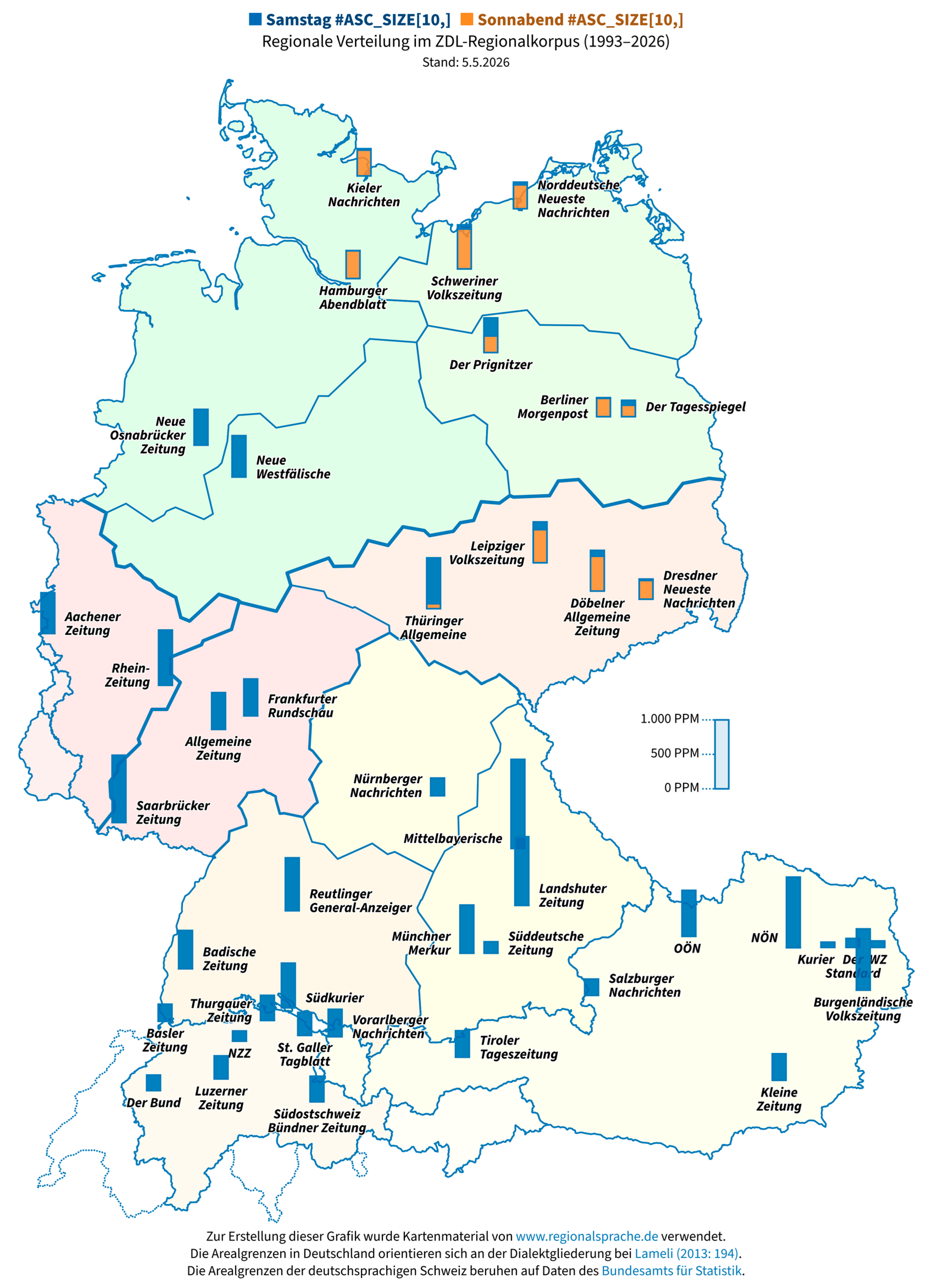
Figure 2.
Regional distribution of “Samstag” and “Sonnabend” by area in the ZDL-Regionalkorpus (as of 5 May 2026), restricted to sentences with at least 10 tokens. (Map generated with the DWDS mapping toolkit; cf. the introduction to Section 3. For the underlying data, cf. Table A2 in Appendix A).
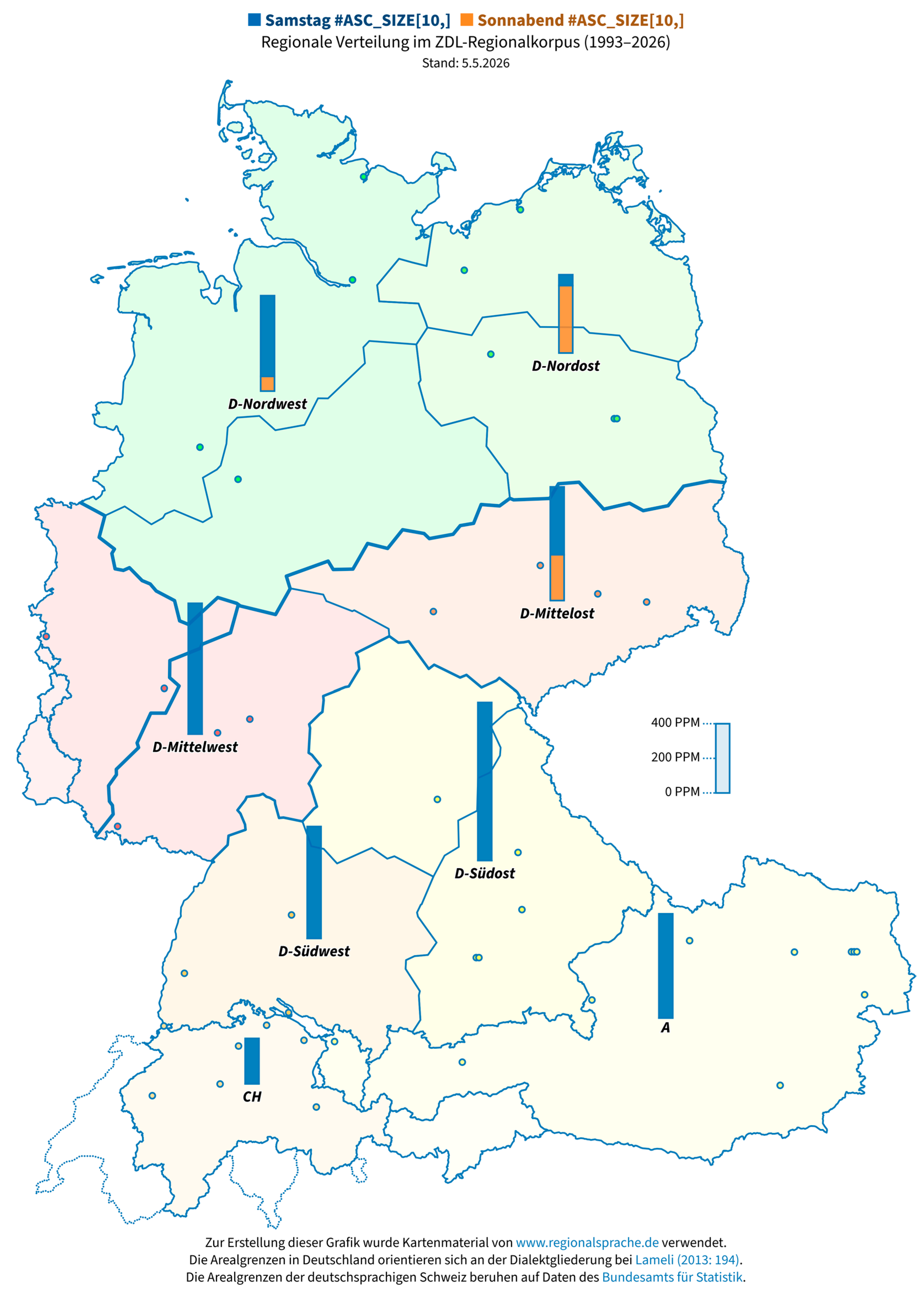
Figure 3.
Regional distribution of “Samstag” and “Sonnabend” by (meta-)area in the Webmonitor-Korpus (as of 5 May 2026), restricted to sentences with at least 10 tokens. (Map generated with the DWDS mapping toolkit; cf. the introduction to Section 3. For the underlying data, cf. Table A3 in Appendix A).
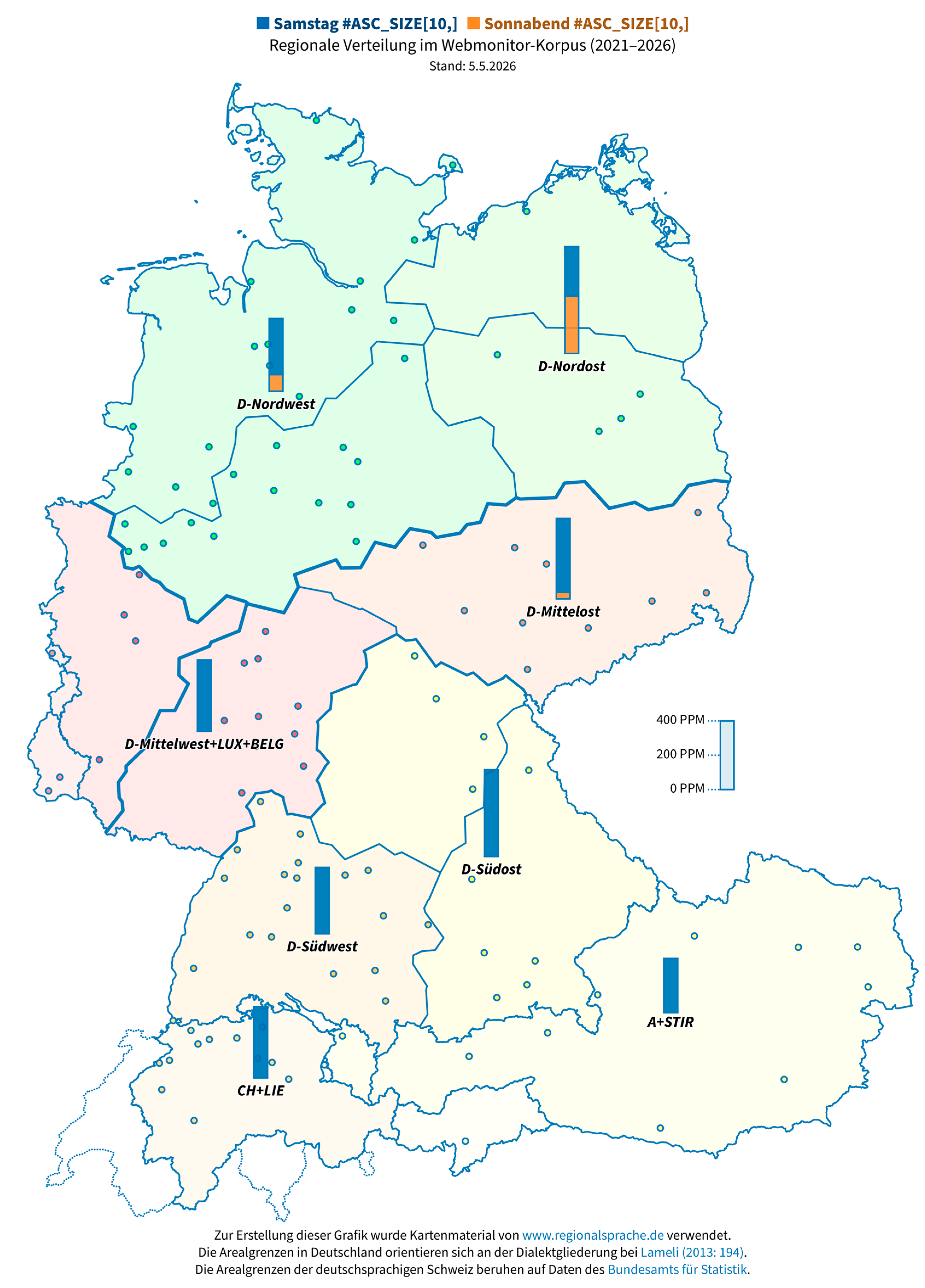
Figure 4.
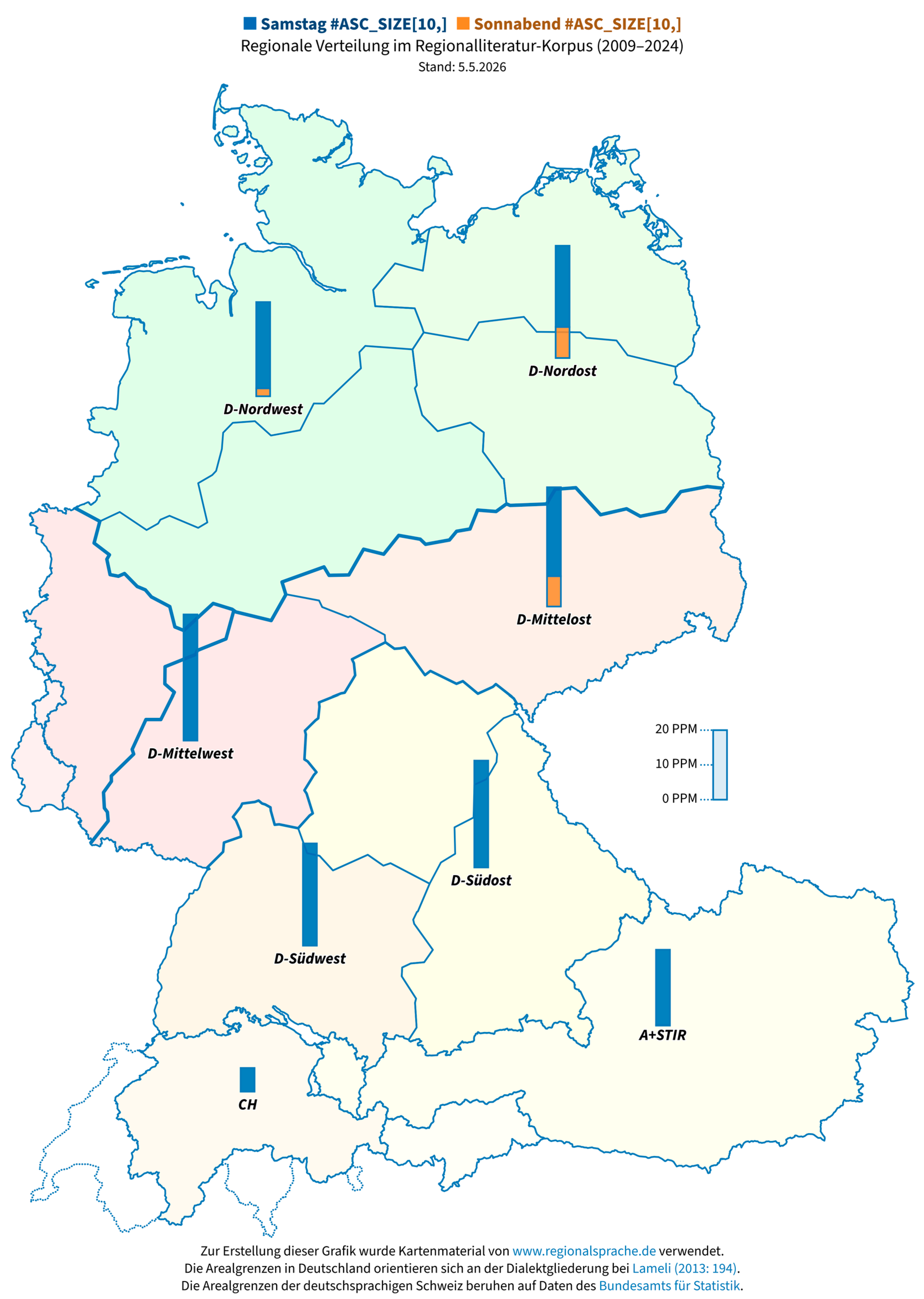
Regional distribution of “Samstag” and “Sonnabend” by (meta-)area in the Regionalliteratur-Korpus (as of 5 May 2026), restricted to sentences with at least 10 tokens. (Map generated with the DWDS mapping toolkit; cf. the introduction to Section 3. For the underlying data, cf. Table A4 in Appendix A).
3.1.2. Discussion
As shown in the AdA map in Figure 5, the use of “Sonnabend” is geographically restricted primarily to the eastern and northern parts of Germany. In their discussion of this map from 2023, Elspaß and Möller (2003ff) note that “Sonnabend” is the dominant variant only in certain areas of eastern Germany, while in the northwest, it was mostly recorded as a secondary variant, with “Samstag” being preferred. Furthermore, supplemental AdA maps (not cited here) indicate a generational shift: informants aged 30 or older reported using “Sonnabend” more frequently, whereas those under 30 mostly favoured “Samstag”, even within the region of the former GDR.5
Figure 5.
Regional distribution of “Samstag” and “Sonnabend” in the AdA (round 13, question 1l, 2023, reproduced with permission by Stefan Elspaß and Robert Möller).
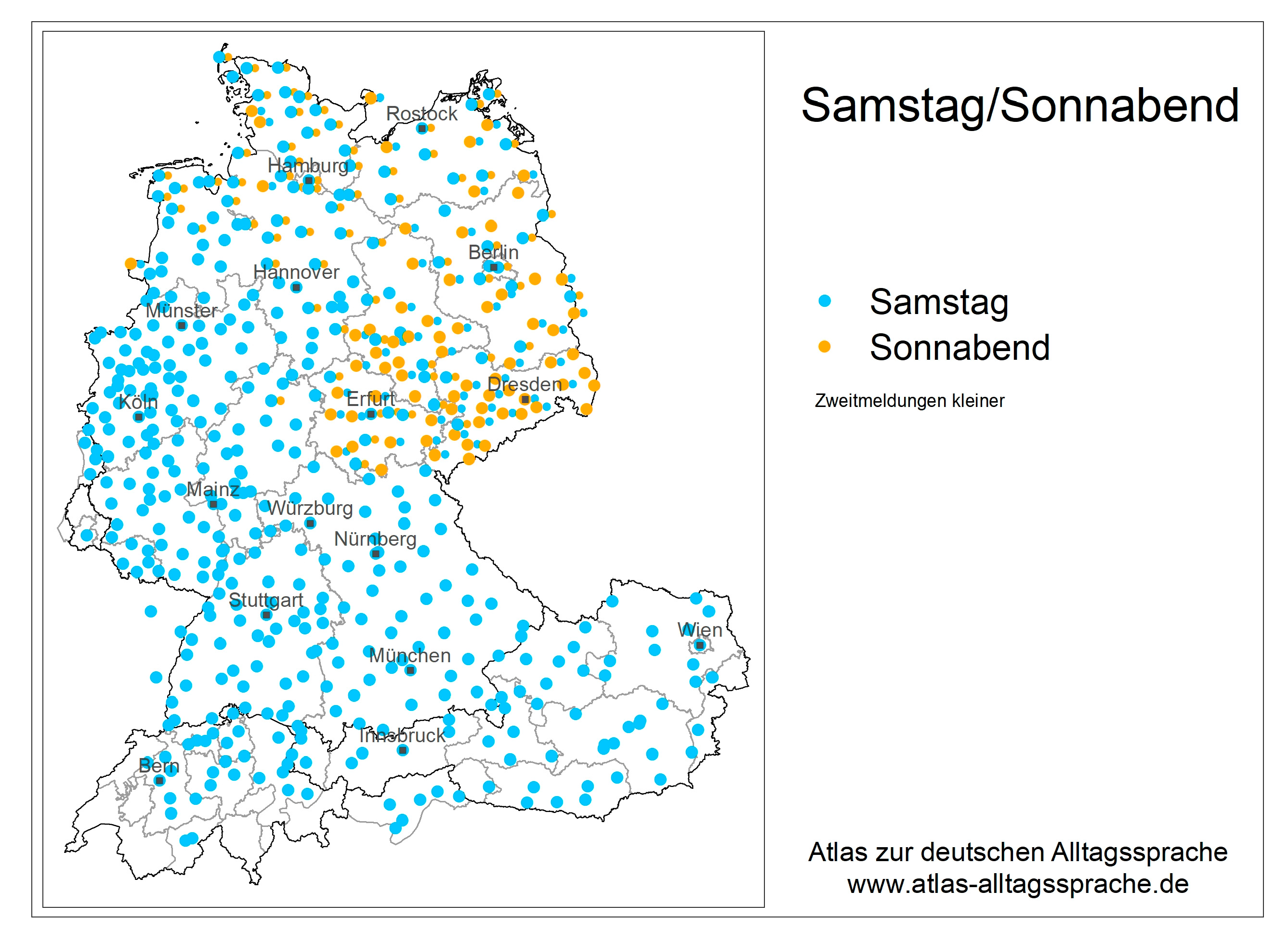
The maps in Figure 1 and Figure 2 plot the PPM values for the queries by newspaper and by area in the ZDL-Regionalkorpus. The maps in Figure 3 and Figure 4 plot them by (meta-)area in the Webmonitor-Korpus and the Regionalliteratur-Korpus. As indicated by the legend in the map header, blue bar segments represent relative frequencies of “Samstag” in the corresponding newspaper or (meta-)area, while orange bar segments represent those of “Sonnabend”.
As can be seen in Figure 2, Figure 3 and Figure 4, the term “Samstag” appears across the entire German Sprachraum in the analysed corpora. In contrast, “Sonnabend” is confined to the areas ‘D-Nordwest’, ‘D-Nordost’, and ‘D-Mittelwest’. “Sonnabend” is the dominant variant in the ‘D-Nordost’ area in the ZDL-Regionalkorpus and, to a lesser extent, in the Webmonitor-Korpus. Furthermore, the ZDL-Regionalkorpus indicates high usage of “Sonnabend” in the ‘D-Mittelost’ area, although “Samstag” remains more frequent there. This pattern is mirrored in the Regionalliteratur-Korpus for both the ‘D-Nordost’ and ‘D-Mittelost’ areas. Across all three corpora, the use of “Sonnabend” is relatively minor in the ‘D-Nordwest’ area.
A more fine-grained picture is provided by Figure 1, which plots the PPM values for these queries by newspaper in the ZDL-Regionalkorpus. According to this map, “Sonnabend” is the dominant variant in sources from the subareas6 ‘D-Nordwest (Schleswig-Holstein)’, ‘D-Nordwest (Hamburg)’, ‘D-Nordost (Mecklenburg-Vorpommern)’, ‘D-Nordost (Berlin)’, and ‘D-Mittelost (Sachsen)’; it is a strong second in subarea ’D-Nordost (Brandenburg)’ and a weak one in subarea ‘D-Mittelost (Thüringen)’. In the subareas ‘D-Nordwest (Westfalen-Nord)’ and ‘D-Nordwest (Westfalen-Süd)’, “Sonnabend” is hardly ever used.
Case study 1 shows that, in principle, the regional distribution of “Samstag” and “Sonnabend” documented in the AdA can indeed be replicated by queries in the ZDL-Regionalkorpus, the Webmonitor-Korpus, and the Regionalliteratur-Korpus. Still, there are notable differences between the corpora. The most distinct distribution of “Samstag” and “Sonnabend” is found in the ZDL-Regionalkorpus. Articles from local and regional newspaper sections appear to prefer either “Sonnabend” or “Samstag” across authors; this even holds although formulaic date(-time) specifications were excluded as noted above. A more varied use is attested in the Webmonitor-Korpus and the Regionalliteratur-Korpus, which can be explained as follows. In online media, authors potentially address audiences beyond local communities and therefore might to be more susceptible to the ongoing spread of “Samstag” observed by Elspaß (2005, pp. 11–13).7 The same holds for regional fiction, where regiolectal or dialectal language is often confined to direct or indirect speech.
3.2. Case Study 2: Regional Distribution of “Komma” and “Beistrich”
Case study 2 concerns the regional distribution of “Komma” (‘comma’) and its synonym “Beistrich”.
3.2.1. Results
Figure 6, Figure 7, Figure 8 and Figure 9 illustrate the lexical frequency data retrieved by the following corpus queries:
- "$p=/ART|KON/g Komma" (retrieving any occurrence of a form of “Komma” immediately preceded by a form of an article or a coordinating conjunction).
- "$p=/ART|KON/g Beistrich" (retrieving any occurrence of a form of “Beistrich” immediately preceded by a form of an article or a coordinating conjunction).
Prepending $p=/ART|KON/g to Komma and Beistrich restricts the part-of-speech categories of the immediately preceding tokens to article or coordinative conjunction. These are two of the three most frequent categories in this position in the corpora under discussion, the third being cardinal. By this restriction, hits with decimal constructions like eins Komma fünf Prozent (‘one point five per cent’) are eliminated. Since “Beistrich” cannot occur in such constructions, a bias would otherwise be introduced into the frequency data. As a side effect, this also reduces the number of false positives where “Komma” is used as a proper name, such as im Wörgler Veranstaltungszentrum Komma (‘at the Komma event centre in Wörgl’) or im Komma in Wörgl (‘at Komma in Wörgl’).
3.2.2. Discussion
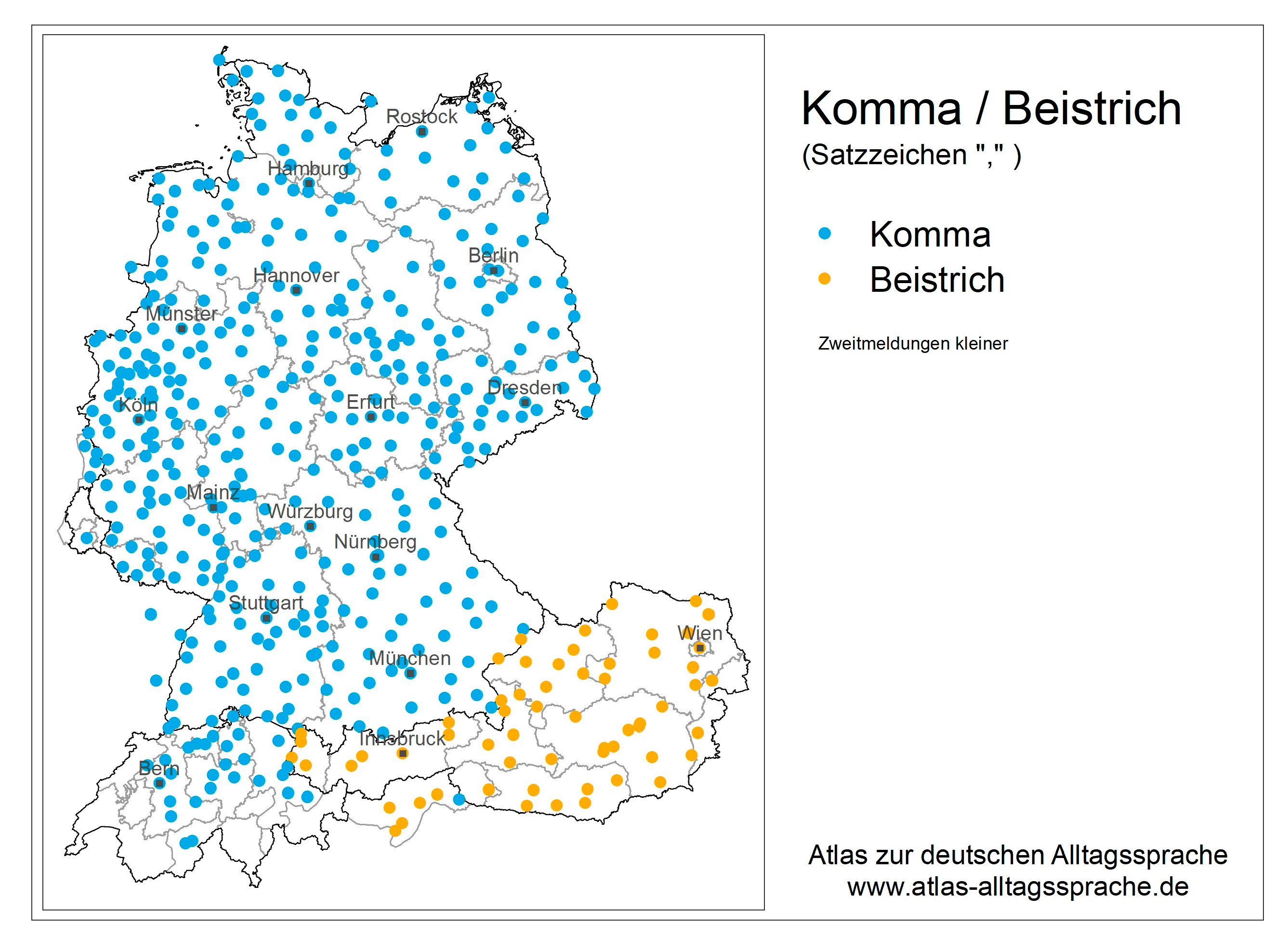
The AdA map in Figure 10 shows a clear partition of the German Sprachraum: “Beistrich” is exclusively used in Austria and South Tyrol, while “Komma” is used elsewhere. Except for two borderline cases in Vorarlberg and South Tyrol, there appear to be no overlaps.
Figure 6 and Figure 7 plot the PPM values for the corpus queries by newspaper and by area in the ZDL-Regionalkorpus; Figure 8 and Figure 9 plot them by (meta-)area in the Webmonitor-Korpus and in the Regionalliteratur-Korpus. The corpus data confirm that the noun “Beistrich” is indeed an Austrian variant (Austriazismus).8 Except for a few outliers (recorded in Table A5 and Table A6 in Appendix A), it is only attested in the ‘A’ area in the ZDL-Regionalkorpus. In the Webmonitor-Korpus and the Regionalliteratur-Korpus, there are no hits beyond meta-area ‘A + STIR’.
In contrast to the AdA map in Figure 10, however, all corpora show a considerable use of the noun “Komma” also in area ‘A’ (or meta-area ‘A + STIR’, for that matter). This suggests that the variant “Komma” is gemeindeutsch (supra-regional) in the text types under discussion: it is used across the whole German Sprachraum in newspaper articles, online media, and regional fiction—either exclusively or as an alternative to the Austrian variant “Beistrich”.
Figure 6.
Regional distribution of “Komma” and “Beistrich” by newspaper in the ZDL-Regionalkorpus (as of 5 May 2026), restricted to occurrences immediately preceded by a form of an article or a coordinating conjunction. (Map generated with the DWDS mapping toolkit; cf. the introduction to Section 3. For the underlying data, cf. Table A5 in Appendix A).
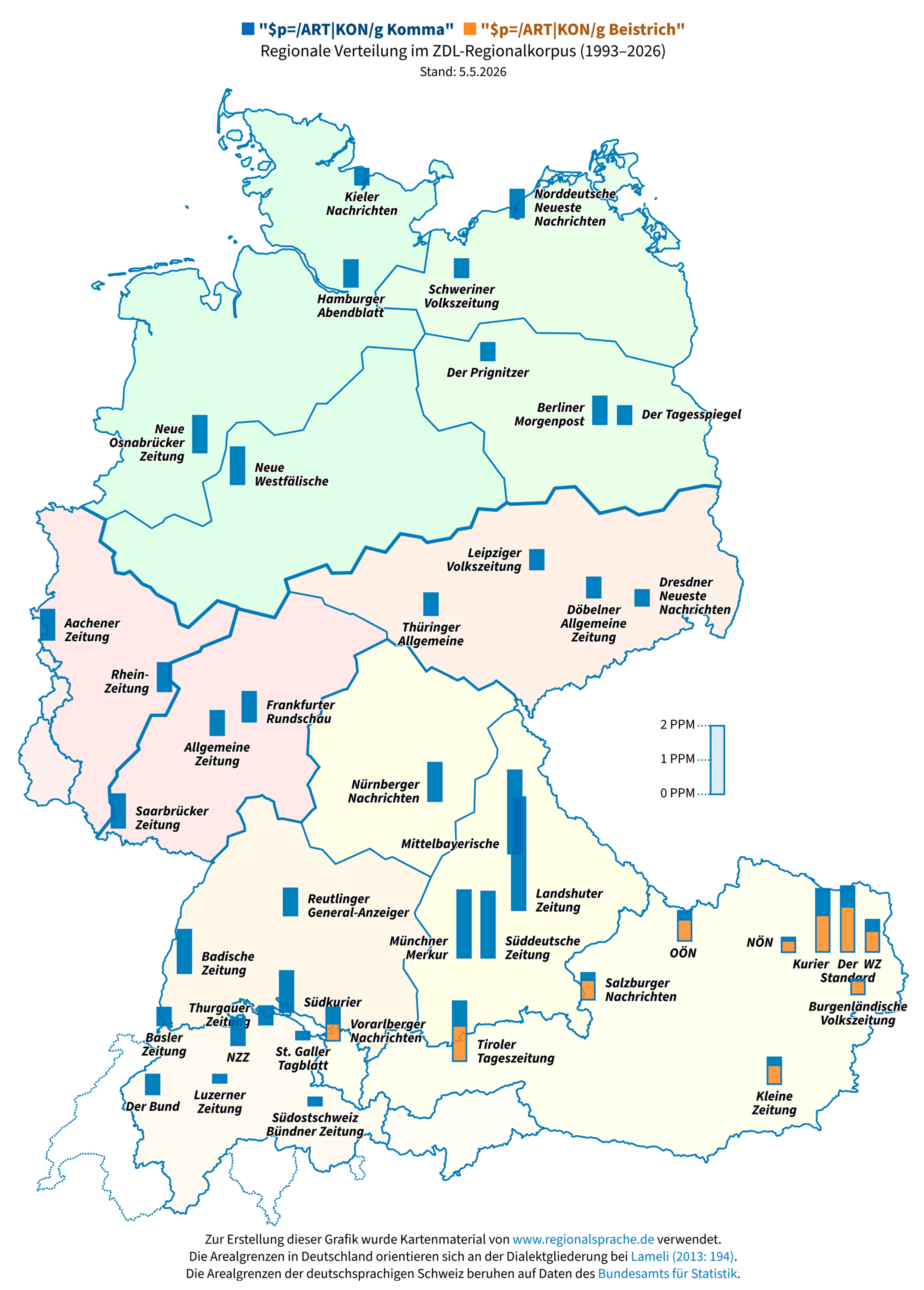
Figure 7.
Regional distribution of “Komma” and “Beistrich” by area in the ZDL-Regionalkorpus (as of 5 May 2026), restricted to occurrences immediately preceded by a form of an article or a coordinating conjunction. (Map generated with the DWDS mapping toolkit; cf. the introduction to Section 3. For the underlying data, cf. Table A6 in Appendix A).
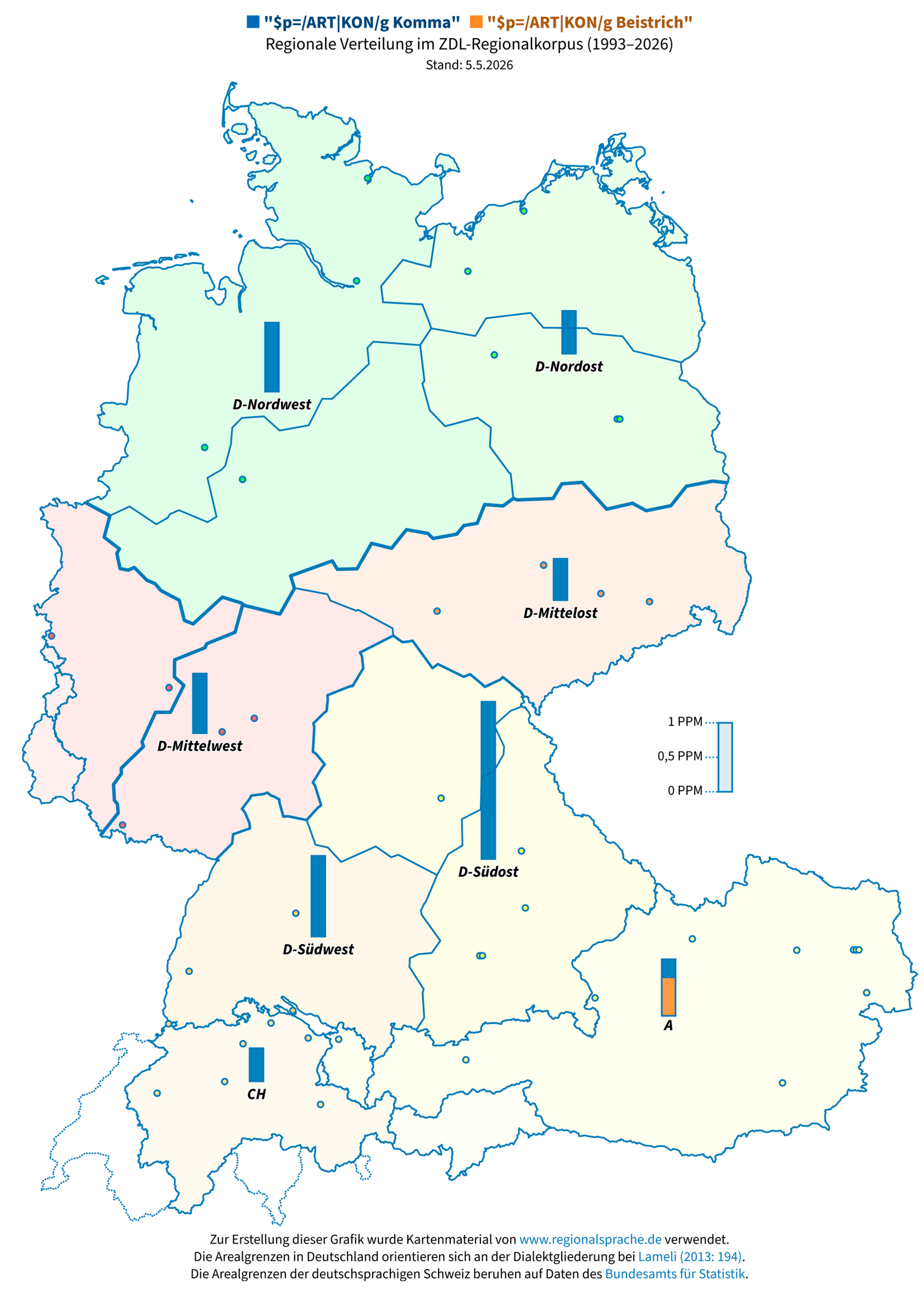
Figure 8.
Regional distribution of “Komma” and “Beistrich” by (meta-)area in the Webmonitor-Korpus (as of 5 May 2026), restricted to occurrences immediately preceded by a form of an article or a coordinating conjunction. (Map generated with the DWDS mapping toolkit; cf. the introduction to Section 3. For the underlying data, cf. Table A7 in Appendix A).
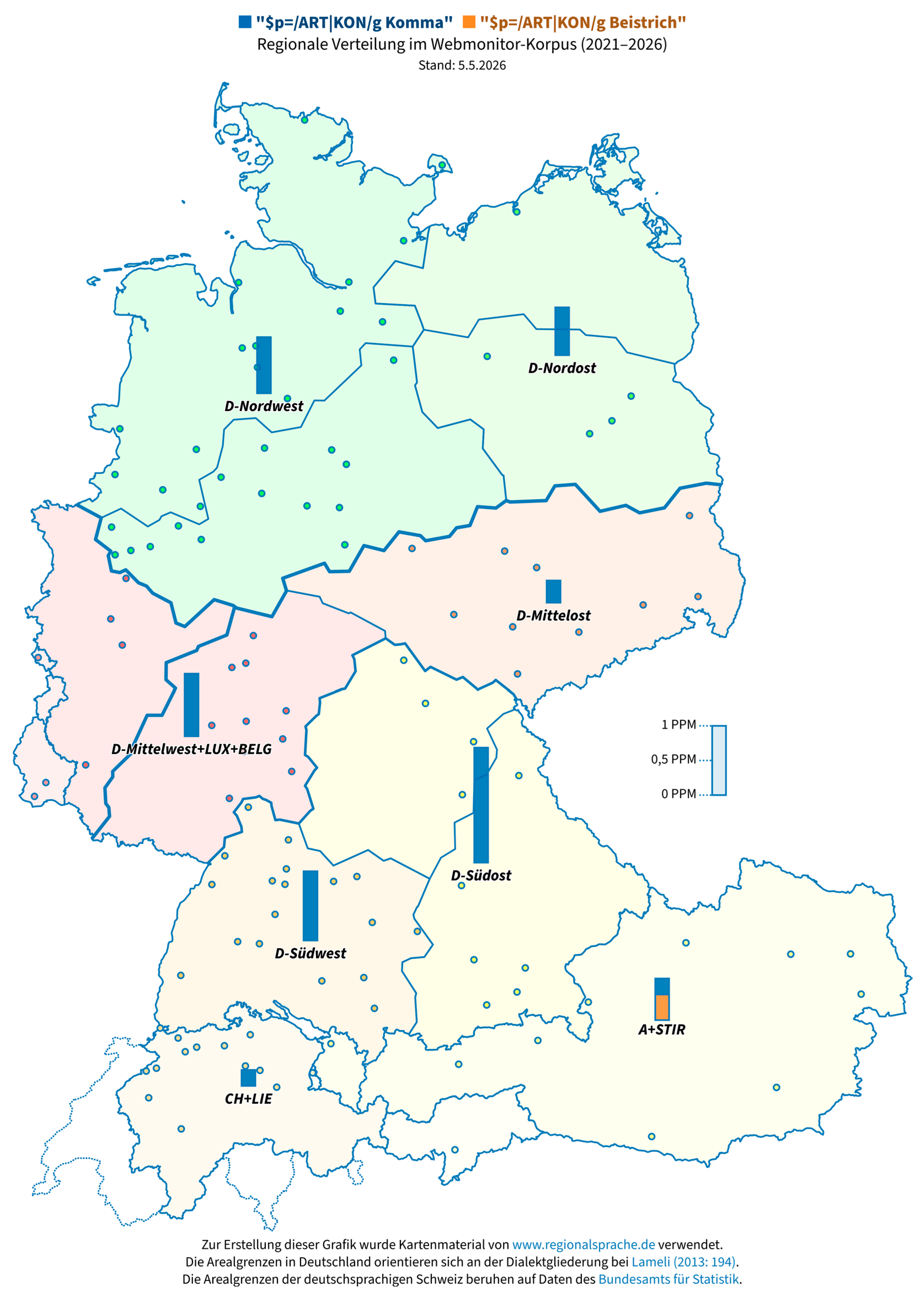
Figure 9.
Regional distribution of “Komma” and “Beistrich” by (meta-)area in the Regionalliteratur-Korpus (as of 5 May 2026), restricted to occurrences immediately preceded by a form of an article or a coordinating conjunction. (Map generated with the DWDS mapping toolkit; cf. the introduction to Section 3. For the underlying data, cf. Table A8 in Appendix A).
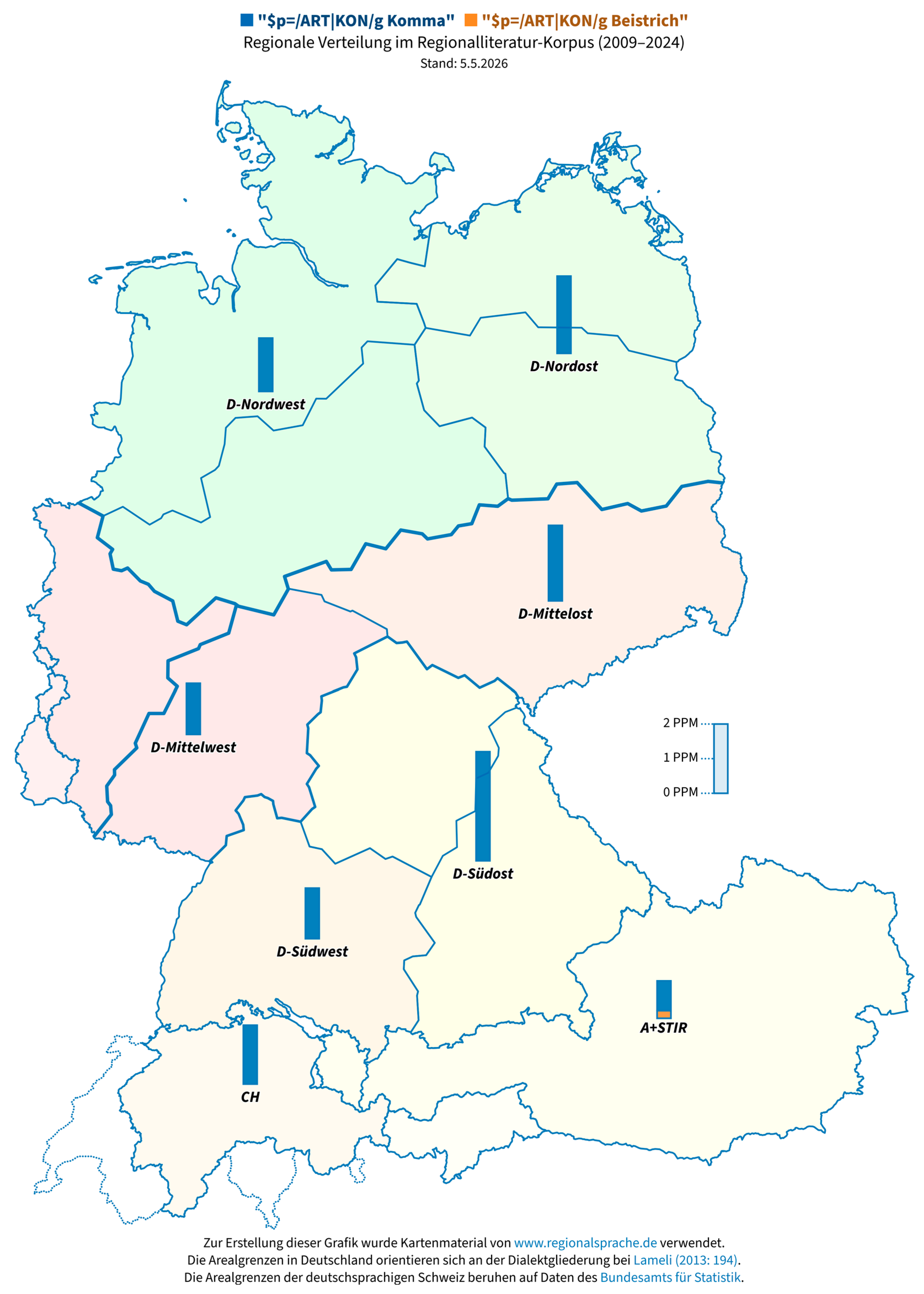
Figure 10.
Regional distribution of “Komma” and “Beistrich” in the AdA (round 13, question 1k, 2023, reproduced with permission by Stefan Elspaß and Robert Möller).
3.3. Case Study 3: Regional Distribution of “Fahrrad”, “Radl”, and “Velo”
Subject of case study 3 is the regional distribution of “Fahrrad” (‘bicycle’) and its synonyms “Radl” and “Velo”.
3.3.1. Results
Figure 11, Figure 12, Figure 13 and Figure 14 visualise the lexical frequency data retrieved by three simple lemma queries:
- Fahrrad (retrieving any occurrence of a form of “Fahrrad”).
- Radl (retrieving any occurrence of a form of “Radl”).
- Velo (retrieving any occurrence of a form of “Velo”).
3.3.2. Discussion
According to the AdA map in Figure 15, there is a clear-cut division of the German Sprachraum: in Germany, East Belgium, Austria, and South Tyrol, “Fahrrad”, its clipping “Rad”, and the diminutive “Radl” are the dominant variants; by contrast, in Switzerland, Liechtenstein, and Luxembourg, “Velo” is uniformly mapped as the only variant. The former area is further subdivided into the region where Bavarian dialects are spoken (i.e., the south-eastern parts of Bavaria, Austria without Vorarlberg, and South Tyrol) and the dialectal “Radl”9 is the sole mapped variant, as opposed to the remaining territory where “Fahrrad” is the primary variant and “Rad” a secondary one. Isolated minor variants are “Leeze” in Münster and “Fiets” along the border with the Netherlands.
In our corpus study, we focused on the three main variants “Fahrrad”, “Radl”, and “Velo”, while excluding the ambiguous noun “Rad” (with the additional, more general, meaning ‘wheel’) as well as the rare variants “Leeze” and “Fiets”. Figure 11 and Figure 12 plot the PPM values for the queries by newspaper and by area in the ZDL-Regionalkorpus, and Figure 13 and Figure 14 plot them by (meta-)area in the Webmonitor-Korpus and in the Regionalliteratur-Korpus. Blue, orange, and green bar segments represent the relative corpus frequencies of “Fahrrad”, “Radl”, and “Velo”, respectively.
Figure 11.
Regional distribution of “Fahrrad”, “Radl”, and “Velo” by newspaper in the ZDL-Regionalkorpus (as of 5 May 2026). (Map generated with the DWDS mapping toolkit; cf. the introduction to Section 3. For the underlying data, cf. Table A9 in Appendix A).
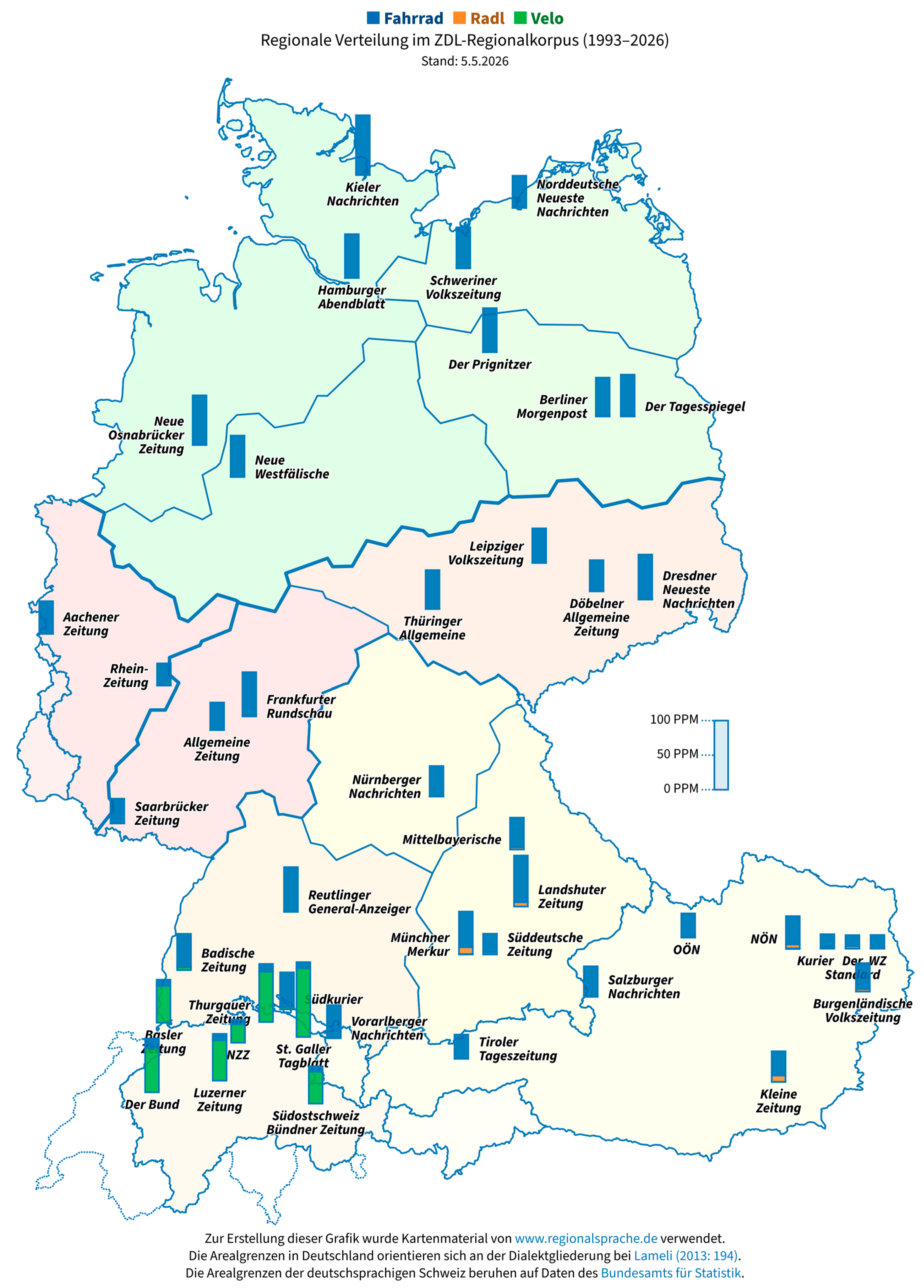
Figure 12.
Regional distribution of “Fahrrad”, “Radl”, and “Velo” by area in the ZDL-Regionalkorpus (as of 5 May 2026). (Map generated with the DWDS mapping toolkit; cf. the introduction to Section 3. For the underlying data, cf. Table A10 in Appendix A).
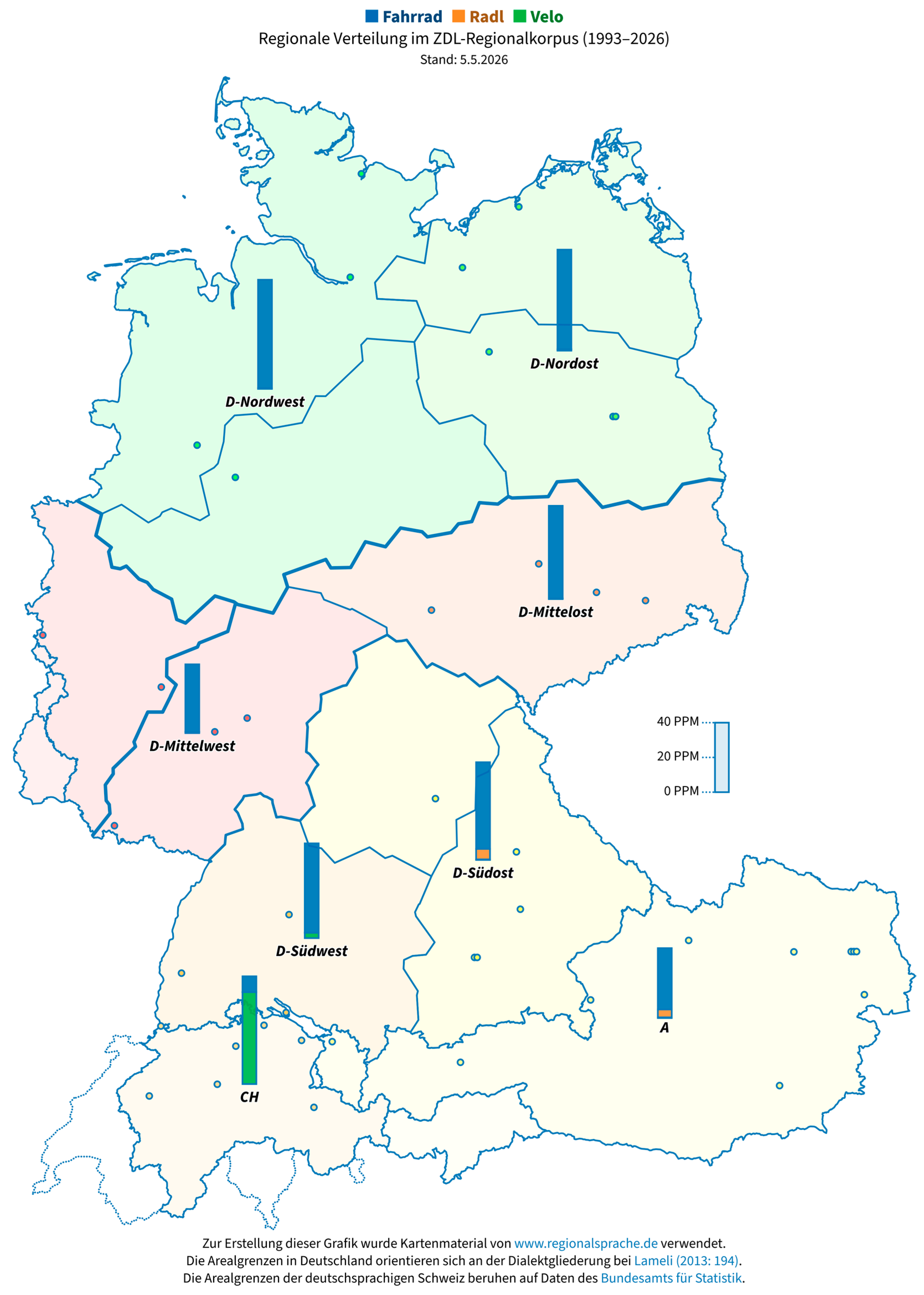
Figure 13.
Regional distribution of “Fahrrad”, “Radl”, and “Velo” by (meta-)area in the Webmonitor-Korpus (as of 5 May 2026). (Map generated with the DWDS mapping toolkit; cf. the introduction to Section 3. For the underlying data, cf. Table A11 in Appendix A).
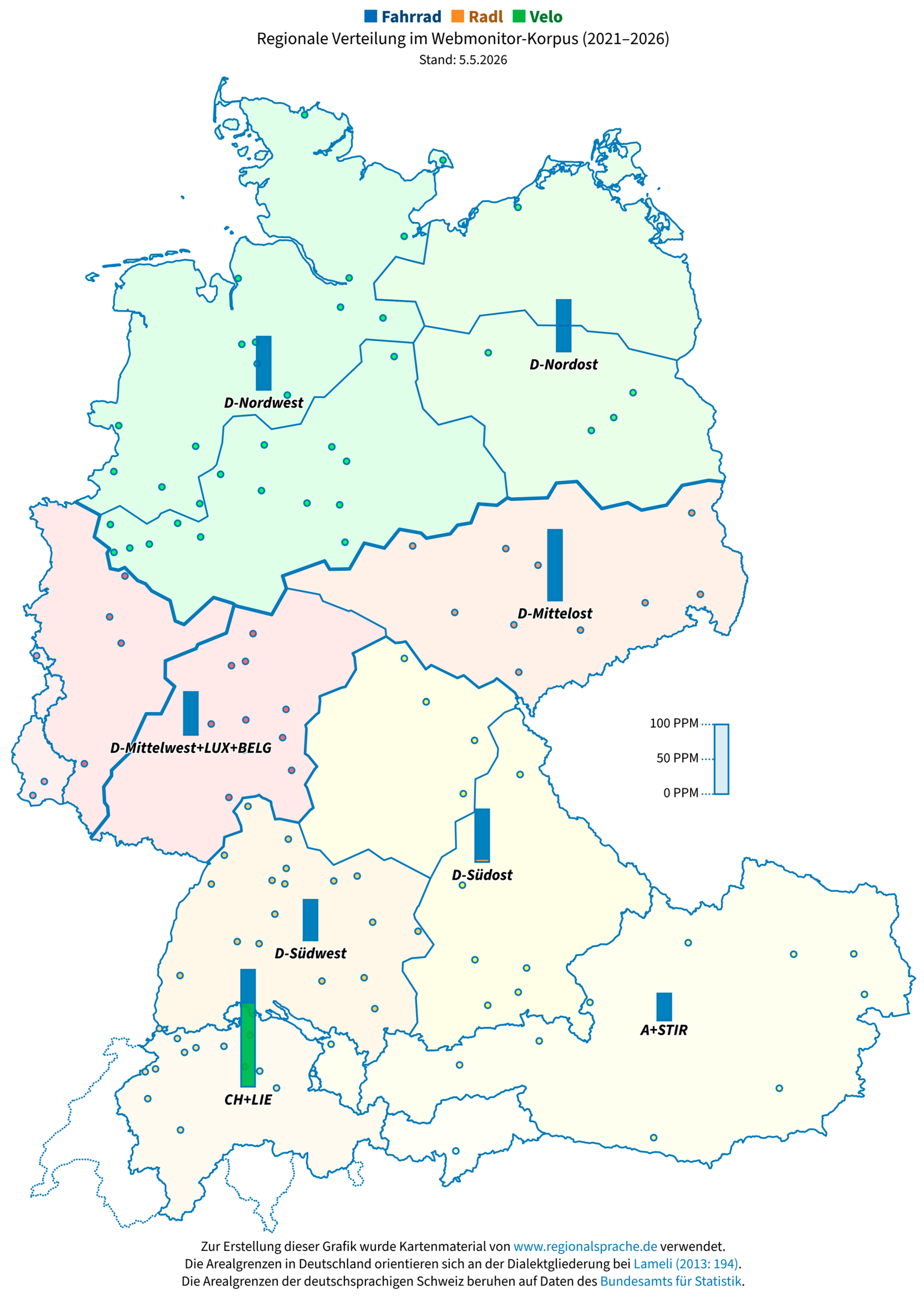
Figure 14.
Regional distribution of “Fahrrad”, “Radl”, and “Velo” by (meta-)area in the Regionalliteratur-Korpus (as of 5 May 2026). (Map generated with the DWDS mapping toolkit; cf. the introduction to Section 3. For the underlying data, cf. Table A12 in Appendix A).
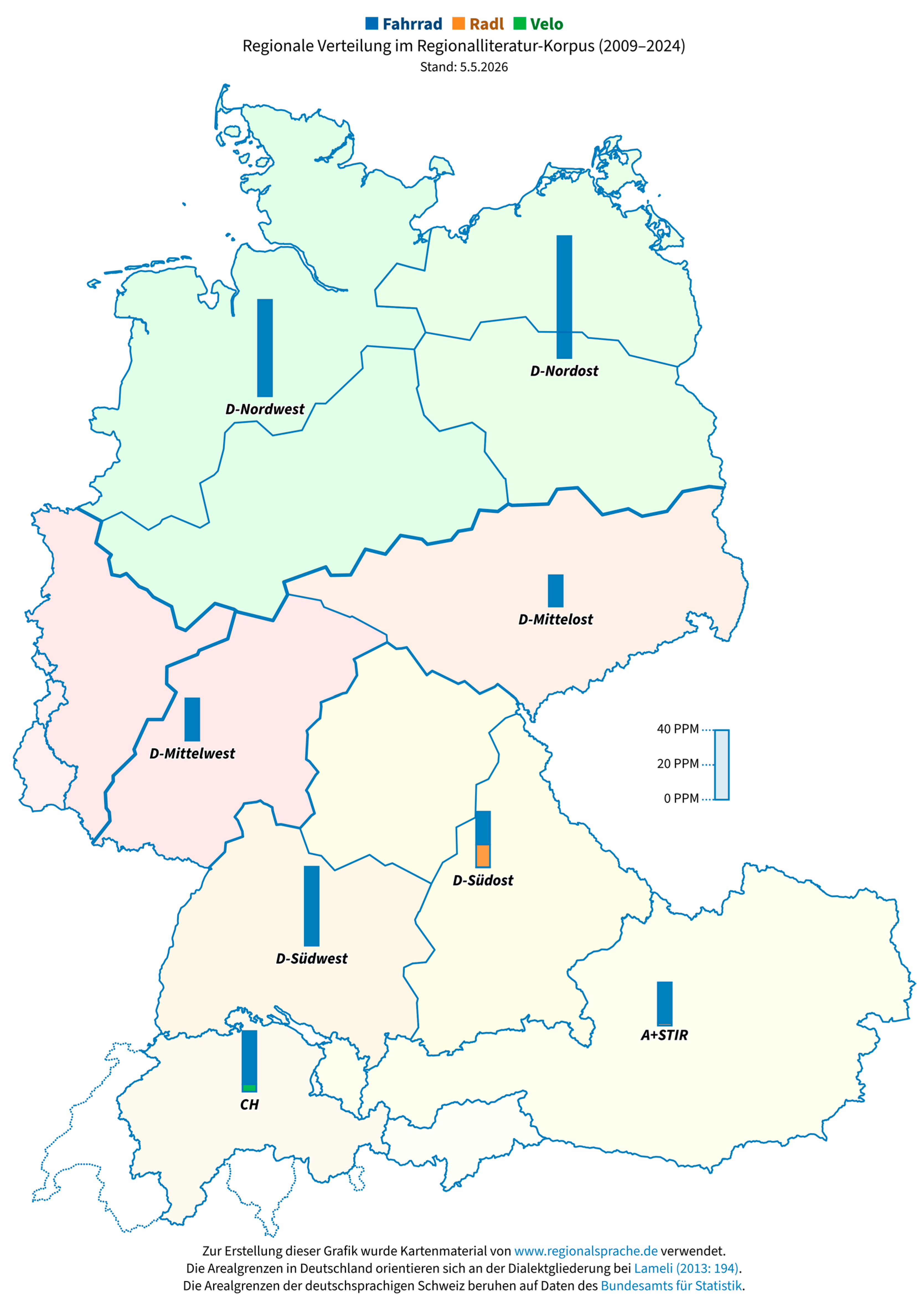
Figure 15.
Regional distribution of “Fahrrad”, “Velo”, and related words in the AdA (round 12, question 6c, 2021, reproduced with permission by Stefan Elspaß and Robert Möller).
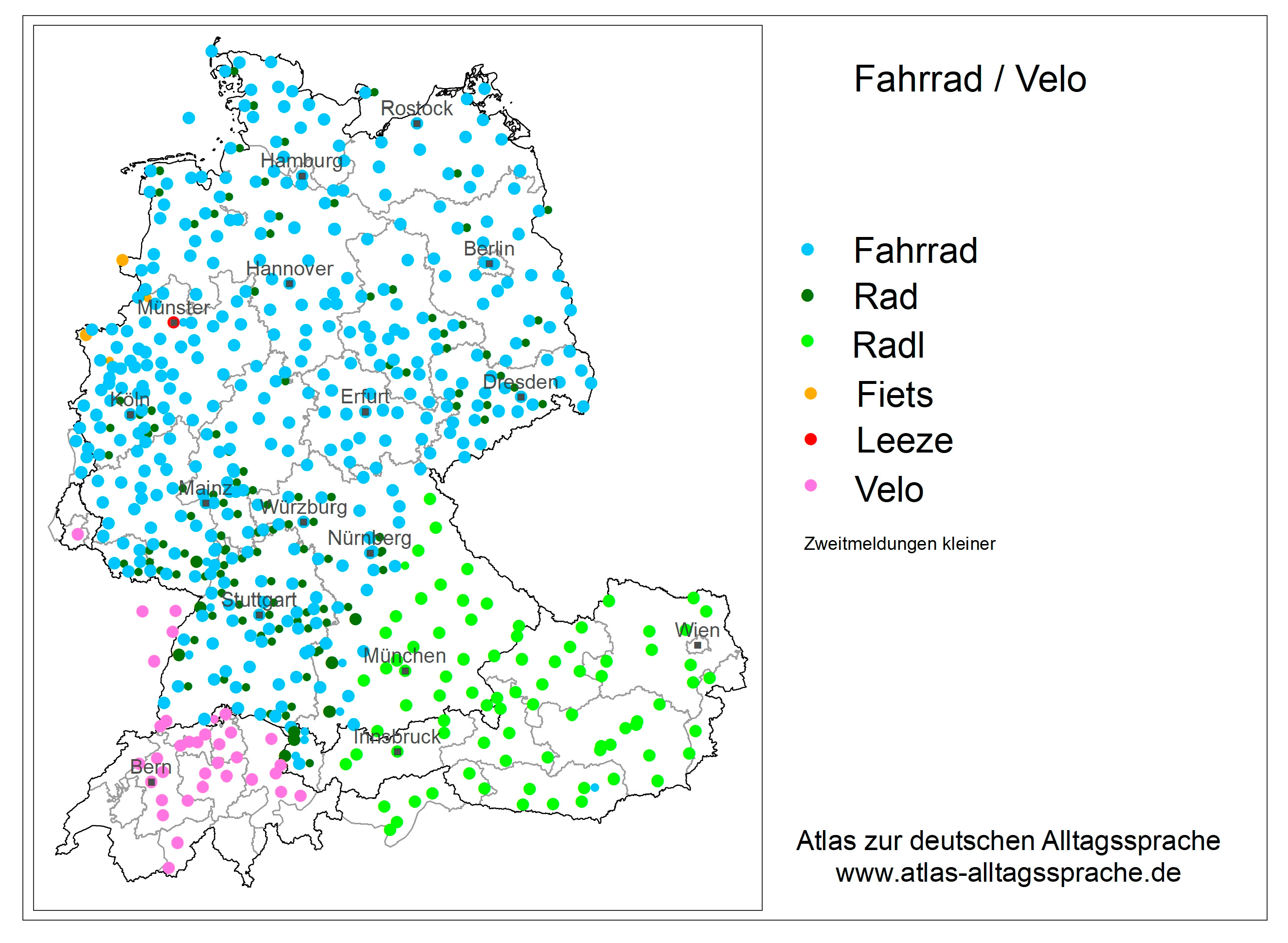
While the general distributions on these maps resemble that on the AdA map in Figure 15, there are several notable deviations. First, the variant “Fahrrad” turns out to be gemeindeutsch: in the corpus data, it is a dominant, secondary, or at least minor variant in any of the areas. Second, although “Velo” is the dominant variant in the ‘CH’ area in the ZDL-Regionalkorpus and in meta-area ‘CH+LIE’ in the Webmonitor-Korpus, it is only a minor one in the Regionalliteratur-Korpus. This observation may again be explained by the fact mentioned in Section 3.1.2 above that in regional fiction, regiolectal and dialectal language is often confined to direct or indirect speech. Third, “Radl” is just a minor variant in (meta-)areas ‘D-Südost’, ‘A’, and ‘A+STIR’ in the ZDL-Regionalkorpus and the Webmonitor-Korpus and a strong secondary one in the Regionalliteratur-Korpus. Presumably, this is related to the non-standard, dialectal, character of the diminutive, which is avoided in both traditional newspapers and online media as well as in regional fiction beyond direct or indirect speech.
3.4. Case Study 4: Regional Distribution of “Aufzug”, “Fahrstuhl”, and “Lift”
Case study 4 is about the regional distribution of “Aufzug” (‘lift’) and the synonyms “Fahrstuhl” and “Lift”.
3.4.1. Results
Figure 16, Figure 17, Figure 18 and Figure 19 illustrate the lexical frequency data retrieved by the following three queries:
- Aufzug (retrieving any occurrence of a form of “Aufzug”).
- Fahrstuhl (retrieving any occurrence of a form of “Fahrstuhl”).
- Lift && ! Ski* #SEP (retrieving any occurrence of a form of “Lift” in sentences that do not contain a word beginning with Ski).
Figure 16.
Regional distribution of “Fahrstuhl”, “Aufzug”, and “Lift” by newspaper in the ZDL-Regionalkorpus (as of 5 May 2026); occurrences of forms of “Lift” are restricted to sentences that do not contain a word beginning with Ski. (Map generated with the DWDS mapping toolkit; cf. the introduction to Section 3. For the underlying data, cf. Table A13 in Appendix A).
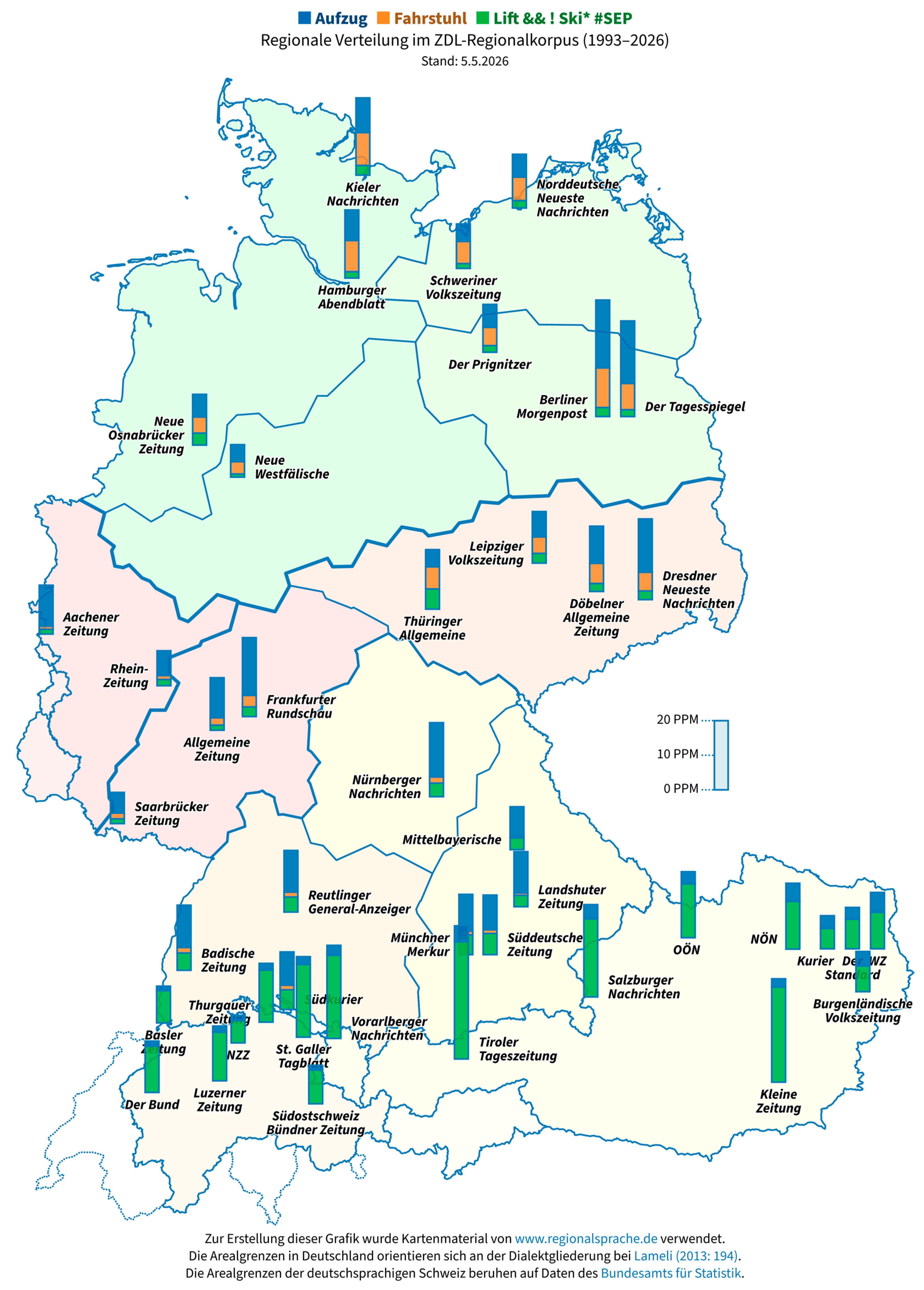
Figure 17.
Regional distribution of “Fahrstuhl”, “Aufzug”, and “Lift” by area in the ZDL-Regionalkorpus (as of 5 May 2026); occurrences of forms of “Lift” are restricted to sentences that do not contain a word beginning with Ski. (Map generated with the DWDS mapping toolkit; cf. the introduction to Section 3. For the underlying data, cf. Table A14 in Appendix A).
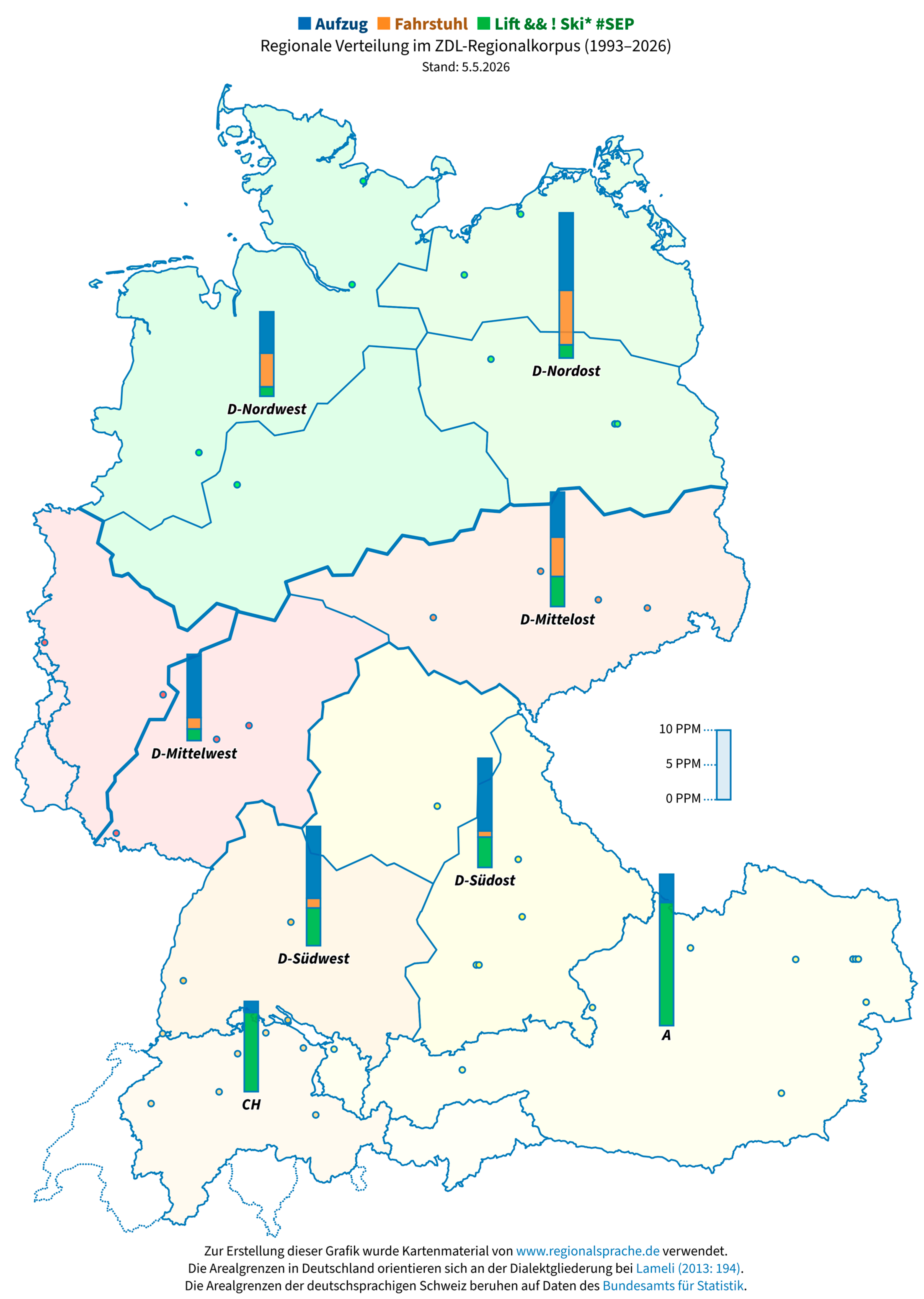
Figure 18.
Regional distribution of “Fahrstuhl”, “Aufzug”, and “Lift” by (meta-)area in the Webmonitor-Korpus (as of 5 May 2026); occurrences of forms of “Lift” are restricted to sentences that do not contain a word beginning with Ski. (Map generated with the DWDS mapping toolkit; cf. the introduction to Section 3. For the underlying data, cf. Table A15 in Appendix A).
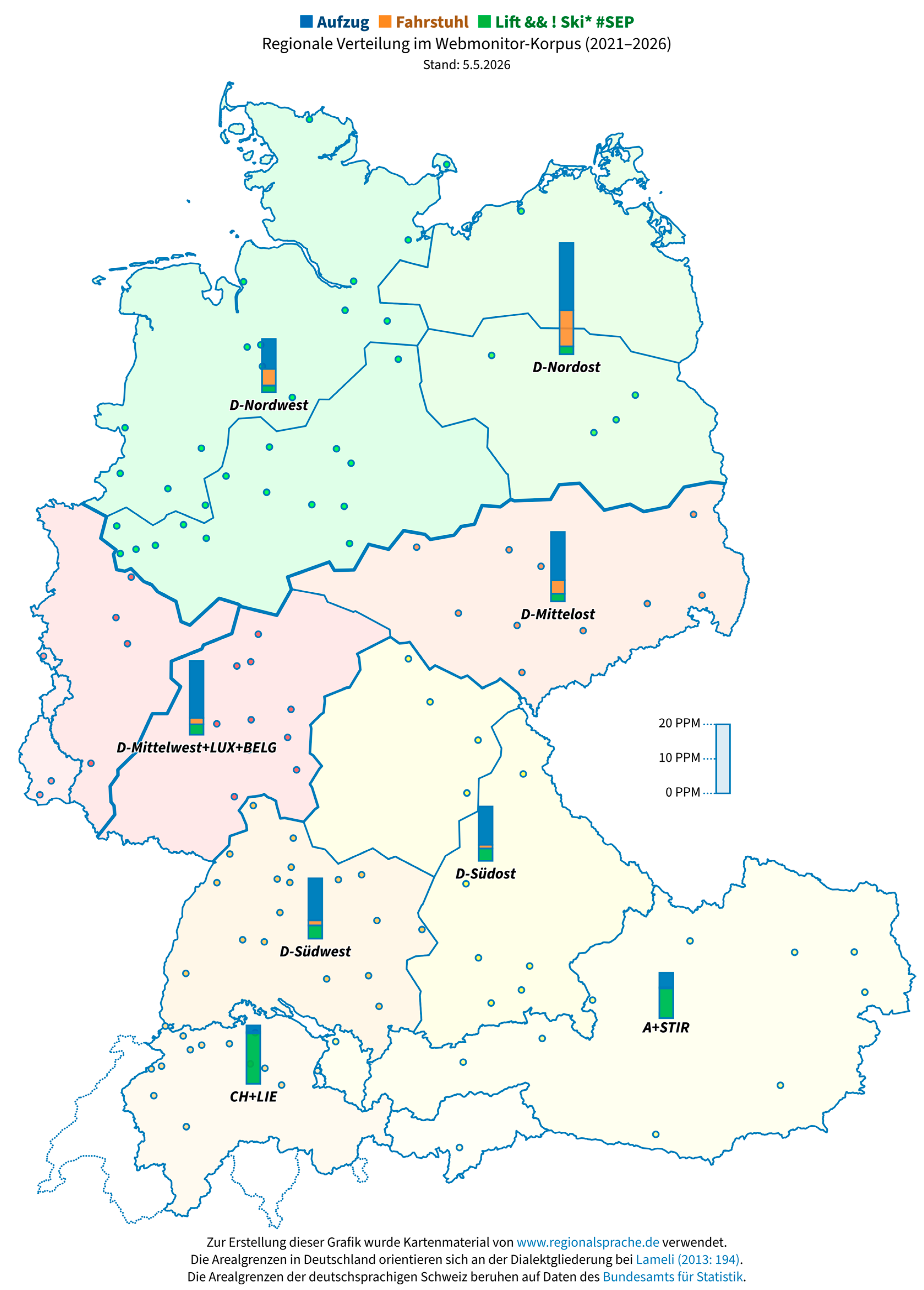
Figure 19.
Regional distribution of “Fahrstuhl”, “Aufzug”, and “Lift” by (meta-)area in the Regionalliteratur-Korpus (as of 5 May 2026); occurrences of forms of “Lift” are restricted to sentences that do not contain a word beginning with Ski. (Map generated with the DWDS mapping toolkit; cf. the introduction to Section 3. For the underlying data, cf. Table A16 in Appendix A).
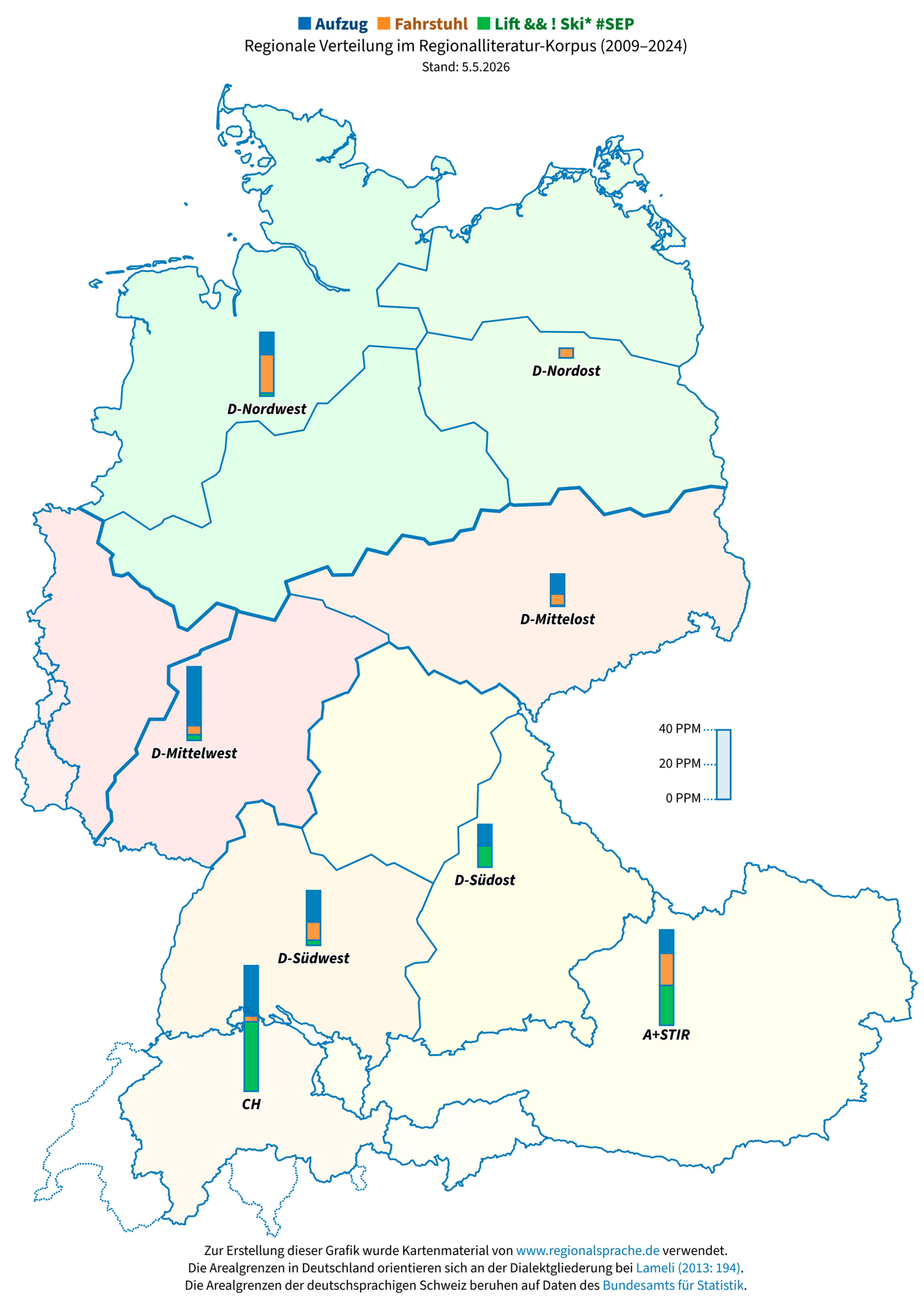
The addition of && ! Ski* #SEP to Lift in the third query helps to eliminate false positives where “Lift” is used in the reading ‘ski lift’—a reading which is available for neither “Aufzug” nor “Fahrstuhl”. The operator #SEP ensures that the query retrieves each match within the same sentence separately, which is the default for the other two queries without the Boolean operator &&.
3.4.2. Discussion
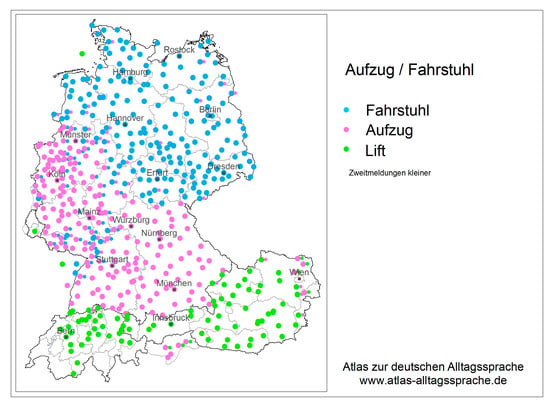
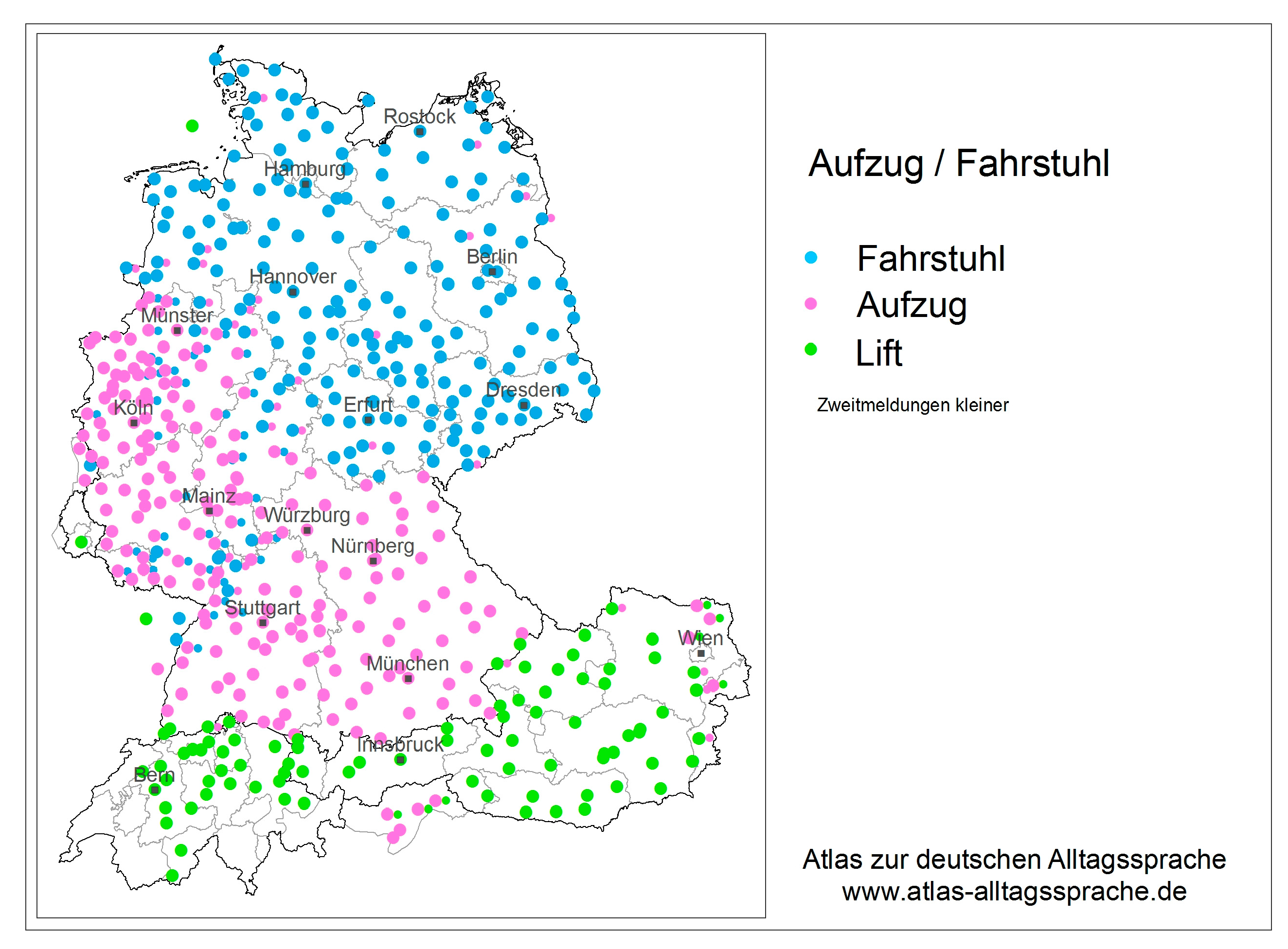
According to the AdA map in Figure 20, “Fahrstuhl” is the dominant variant in northern and eastern Germany, and “Lift” is the corresponding variant in Switzerland and Austria. In the remainder part of the German Sprachraum, “Aufzug” is the primary variant, with some reports for the competing variants in the western part of central Germany, in Luxembourg, and in South Tyrol.
Figure 20.
Regional distribution of “Aufzug”, “Fahrstuhl”, and “Lift” in the AdA (round 12, question 6g, 2021, reproduced with permission by Stefan Elspaß and Robert Möller).
The ZDL-Regionalkorpus data in Figure 16 and Figure 17 suggest that the noun “Aufzug” is in fact gemeindeutsch: it is the primary or secondary variant in all newspapers and across all areas. The same holds for the Webmonitor-Korpus (Figure 18) and, to some lesser extent, for the Regionalliteratur-Korpus (Figure 19, without hits for “Aufzug” in the ‘D-Nordost’ area and with comparatively few hits for it in (meta-)area ‘A + STIR’). The noun “Fahrstuhl” in turn is a secondary variant in areas ‘D-Nordwest’, ‘D-Nordost’, and ‘D-Mittelost’ in the ZDL-Regionalkorpus and the Webmonitor-Korpus. In the Regionalliteratur-Korpus, the distribution of “Fahrstuhl” is even more pronounced: it is the dominant variant in areas ‘D-Nordwest’ and ‘D-Nordost’ and a strong secondary one in the area ‘D-Mittelost’. “Lift”, finally, is the dominant variant in areas ‘CH’ and ‘A’ in the ZDL-Regionalkorpus and in (meta-)areas ‘CH+LIE’ and ‘A + STIR’ in the Webmonitor-Korpus. In the Regionalliteratur-Korpus, “Lift” also is the primary variant in the ‘CH’ area and in (meta-)area ‘A + STIR’, though less clearly than in the ZDL-Regionalkorpus and in the Webmonitor-Korpus.
As in the previous case studies, the overall regional distribution of the nouns “Aufzug”, “Fahrstuhl”, and “Lift” in the AdA can be replicated in the ZDL-Regionalkorpus, the Webmonitor-Korpus, and the Regionalliteratur-Korpus. In contrast to the AdA, however, “Aufzug” again turns out to be gemeindeutsch in these corpora.
4. Conclusions
With respect to the research questions raised in Section 1, the following preliminary conclusions can be drawn from the discussion of the empirical case studies in Section 3:
- In our case studies, the general regional distribution of lexical variants mapped in the Atlas zur deutschen Alltagssprache (AdA) could be replicated in our three DWDS corpora: the ZDL-Regionalkorpus, the Webmonitor-Korpus, and the Regionalliteratur-Korpus.
- More often than not, the written DWDS corpus data show that several variants co-occur in the same area, while speaker attitudes mapped in the AdA appear to be more uniform. As a consequence, variants can more readily be qualified as gemeindeutsch on the basis of the corpus data than by reference to the AdA. The extent to which this effect correlates with the distinction between German Alltagssprache (documented in the AdA) and Gebrauchsstandard (typically—though not exclusively—reflected in the DWDS corpora) remains an open question.
- Different text types represented in the corpora (newspaper articles, online media, regional fiction) could lead to different frequency ratios in specific areas. These observations were explained by presumed differences in target audiences and in the extent to which regiolectal or dialectal language is used.
The three conclusions presented above clarify essential findings of this investigation. Although the AdA and the DWDS corpora represent fundamentally different resources (with the AdA based on surveys of speaker attitudes and the DWDS evaluating corpus data), they show similar results regarding the regional distribution of standards. These findings thus represent far more than a mere replication of the AdA results; rather, they indicate that regional variation in spoken every-day language and the usage-based standard in written language strongly converge.
Furthermore, the corpus data reveal a specific methodological potential of the DWDS corpora that goes beyond the possibilities of the AdA: they can depict the simultaneous occurrence of several variants in an area, on the condition that these variants coexist in the corpora. In contrast, the AdA is limited to displaying the most frequently chosen variants (Erstmeldungen) and, possibly, the second most common variants (Zweitmeldungen)—a method which often conveys a more homogeneous image of linguistic reality than the corpus data suggest.
Last, but not least, the corpus-linguistic method proves to be significantly more efficient to implement: while AdA-style studies require complex survey rounds with thousands of participants, distributional patterns can be generated in real-time on the DWDS corpus query platform through simple corpus queries. This is also the most significant added value of the DWDS system for research: every user can formulate individual queries and thus conduct independent studies on the regional distribution of arbitrary lexical variants. The monthly updated ZDL-Regionalkorpus, the daily updated Webmonitor-Korpus, and the Regionalliteratur-Korpus are specifically designed for this diatopic research and provide data from different text types (newspaper articles, online media, and regional fiction). We are confident that these corpora on the DWDS corpus query platform will prove useful for future research on diatopic lexical variation in written Modern German.
Author Contributions
Conceptualization, A.N.; methodology, A.N. and A.G.; data curation, A.N.; software, A.N.; visualization, A.N.; investigation, A.N. and A.G.; writing—original draft preparation, A.N.; writing—review and editing, A.G.; project administration, A.G.; funding acquisition, A.G. All authors have read and agreed to the published version of the manuscript.
Funding
The ZDL is funded by the German Federal Ministry of Research, Technology, and Space (01UG2402A).
Institutional Review Board Statement
Not applicable.
Data Availability Statement
The lexical frequency maps in Figure 1, Figure 2, Figure 3, Figure 4, Figure 6, Figure 7, Figure 8, Figure 9, Figure 11, Figure 12, Figure 13, Figure 14, Figure 16, Figure 17, Figure 18 and Figure 19, as well as the underlying datasets are available from Zenodo (https://zenodo.org/records/21236579, accessed on 7 July 2026) in SVG and CSV format.
Acknowledgments
The DWDS corpus query interface was implemented by Bryan Jurish and Frank Wiegand. Hannes Pirker has curated the Austrian data of the ZDL-Regionalkorpus. The Webmonitor-Korpus was designed and compiled by Adrien Barbaresi.
Conflicts of Interest
The authors are employed at BBAW and work for the ZDL project. The funder had no role in the design of the study, in the data collection, data analyses, or interpretation of data, in the writing of the manuscript, or in the decision to publish the results.
Abbreviations and Notational Conventions
The following abbreviations are used in this manuscript:
| ACDH | Austrian Centre for Digital Humanities |
| AdA | Atlas zur deutschen Alltagssprache |
| BBAW | Berlin-Brandenburg Academy of Sciences and Humanities |
| DWDS | Digitales Wörterbuch der deutschen Sprache |
| ÖAW | Austrian Academy of Sciences |
| PPM | Parts per million tokens |
| UrhG | Urheberrechtsgesetz |
| ZDL | Zentrum für digitale Lexikographie der deutschen Sprache |
| The following notational conventions are used for linguistic units: | |
| “word” | a lexical unit, cited by its lemma and corresponding to one or more word forms |
| word | a word form or syntactic expression |
| word | a corpus query |
Appendix A
This appendix contains four datasets of lexical frequency data from DWDS corpora that were used to generate the maps in Figure 1, Figure 2, Figure 3, Figure 4, Figure 6, Figure 7, Figure 8, Figure 9, Figure 11, Figure 12, Figure 13, Figure 14, Figure 16, Figure 17, Figure 18 and Figure 19, discussed in the case studies in Section 3. In addition to relative hit frequencies, normalised as parts per million tokens (PPM) and plotted as stacked bar charts on the maps, the tables below also provide absolute hit counts. PPM values are calculated by dividing the hit count by the total number of tokens in the corresponding newspaper or area (not recorded here), and then multiplying the result by one million for readability. The datasets are also available from Zenodo (https://zenodo.org/records/21236579, accessed on 7 July 2026) in CSV format.
Appendix A.1. Dataset 1: Regional Distribution of “Samstag” and “Sonnabend”
Table A1, Table A2, Table A3 and Table A4 provide the lexical frequency data used to generate the maps in Figure 1, Figure 2, Figure 3 and Figure 4 (cf. Section 3.1.1).
Table A1.
Regional distribution of “Samstag” and “Sonnabend” by newspaper in the ZDL-Regionalkorpus (as of 5 May 2026), restricted to sentences with at least 10 tokens. The corresponding corpus queries were Samstag #ASC_SIZE[10,] and Sonnabend #ASC_SIZE[10,]; for discussion, cf. Section 3.1. The PPM values in the table below are plotted on the map in Figure 1.
Table A2.
Regional distribution of “Samstag” and “Sonnabend” by area in the ZDL-Regionalkorpus (as of 5 May 2026), restricted to sentences with at least 10 tokens. The corresponding corpus queries were Samstag #ASC_SIZE[10,] and Sonnabend #ASC_SIZE[10,]; for discussion, cf. Section 3.1. The PPM values in the table below are plotted on the map in Figure 2.
Table A3.
Regional distribution of “Samstag” and “Sonnabend” by area in the Webmonitor-Korpus (as of 5 May 2026), restricted to sentences with at least 10 tokens. The corresponding corpus queries were Samstag #ASC_SIZE[10,] and Sonnabend #ASC_SIZE[10,]; for discussion, cf. Section 3.1. The PPM values in the table below are plotted on the map in Figure 3.
Table A4.
Regional distribution of “Samstag” and “Sonnabend” by area in the Regionalliteratur-Korpus (as of 5 May 2026), restricted to sentences with at least 10 tokens. The corresponding corpus queries were Samstag #ASC_SIZE[10,] and Sonnabend #ASC_SIZE[10,]; for discussion, cf. Section 3.1. The PPM values in the table below are plotted on the map in Figure 4.
Appendix A.2. Dataset 2: Regional Distribution of “Komma” and “Beistrich”
Table A5, Table A6, Table A7 and Table A8 provide the lexical frequency data used to generate the maps in Figure 6, Figure 7, Figure 8 and Figure 9 (cf. Section 3.2.1).
Table A5.
Regional distribution of “Komma” and “Beistrich” by newspaper in the ZDL-Regionalkorpus (as of 5 May 2026), restricted to occurrences immediately preceded by a form of an article or a coordinating conjunction. The corresponding corpus queries were "$p=/ART|KON/g Komma" and "$p=/ART|KON/g Beistrich"; for discussion, cf. Section 3.2. The PPM values in the table below are plotted on the map in Figure 6.
Table A6.
Regional distribution of “Komma” and “Beistrich” by area in the ZDL-Regionalkorpus (as of 5 May 2026), restricted to occurrences immediately preceded by a form of an article or a coordinating conjunction. The corresponding corpus queries were "$p=/ART|KON/g Komma" and "$p=/ART|KON/g Beistrich"; for discussion, cf. Section 3.2. The PPM values in the table below are plotted on the map in Figure 7.
Table A7.
Regional distribution of “Komma” and “Beistrich” by area in the Webmonitor-Korpus (as of 5 May 2026), restricted to occurrences immediately preceded by a form of an article or a coordinating conjunction. The corresponding corpus queries were "$p=/ART|KON/g Komma" and "$p=/ART|KON/g Beistrich"; for discussion, cf. Section 3.2. The PPM values in the table below are plotted on the map in Figure 8.
Table A8.
Regional distribution of “Komma” and “Beistrich” by area in the Regionalliteratur-Korpus (as of 5 May 2026), restricted to occurrences immediately preceded by a form of an article or a coordinating conjunction. The corresponding corpus queries were "$p=/ART|KON/g Komma" and "$p=/ART|KON/g Beistrich"; for discussion, cf. Section 3.2. The PPM values in the table below are plotted on the map in Figure 9.
Appendix A.3. Dataset 3: Regional Distribution of “Fahrrad”, “Radl”, and “Velo”
Table A9, Table A10, Table A11 and Table A12 provide the lexical frequency data used to generate the maps in Figure 11, Figure 12, Figure 13 and Figure 14 (cf. Section 3.3.1).
Table A9.
Regional distribution of “Fahrrad”, “Radl”, and “Velo” by newspaper in the ZDL-Regionalkorpus (as of 5 May 2026). The corresponding corpus queries were Fahrrad, Radl, and Velo. The PPM values in the table below are plotted on the map in Figure 11.
Table A10.
Regional distribution of “Fahrrad”, “Radl”, and “Velo” by area in the ZDL-Regionalkorpus (as of 5 May 2026). The corresponding corpus queries were Fahrrad, Radl, and Velo. The PPM values in the table below are plotted on the map in Figure 12.
Table A11.
Regional distribution of “Fahrrad”, “Radl”, and “Velo” by area in the Webmonitor-Korpus (as of 5 May 2026). The corresponding corpus queries were Fahrrad, Radl, and Velo. The PPM values in the table below are plotted on the map in Figure 13.
Table A12.
Regional distribution of “Fahrrad”, “Radl”, and “Velo” by area in the Regionalliteratur-Korpus (as of 5 May 2026). The corresponding corpus queries were Fahrrad, Radl, and Velo. The PPM values in the table below are plotted on the map in Figure 14.
Appendix A.4. Dataset 4: Regional Distribution of “Aufzug”, “Fahrstuhl”, and “Lift”
Table A13, Table A14, Table A15 and Table A16 provide the lexical frequency data used to generate the maps in Figure 16, Figure 17, Figure 18 and Figure 19 (cf. Section 3.4.1).
Table A13.
Regional distribution of “Aufzug”, “Fahrstuhl”, and “Lift” by newspaper in the ZDL-Regionalkorpus (as of 5 May 2026); occurrences of forms of “Lift” are restricted to sentences that do not contain a word beginning with Ski. The corresponding corpus queries were Aufzug, Fahrstuhl, and Lift && ! Ski* #SEP; for discussion, cf. Section 3.4. The PPM values in the table below are plotted on the map in Figure 16.
Table A14.
Regional distribution of “Aufzug”, “Fahrstuhl”, and “Lift” by area in the ZDL-Regionalkorpus (as of 5 May 2026); occurrences of forms of “Lift” are restricted to sentences that do not contain a word beginning with Ski. The corresponding corpus queries were Aufzug, Fahrstuhl, and Lift && ! Ski* #SEP; for discussion, cf. Section 3.4. The PPM values in the table below are plotted on the map in Figure 17.
Table A15.
Regional distribution of “Aufzug”, “Fahrstuhl”, and “Lift” by area in the Webmonitor-Korpus (as of 5 May 2026); occurrences of forms of “Lift” are restricted to sentences that do not contain a word beginning with Ski. The corresponding corpus queries were Aufzug, Fahrstuhl, and Lift && ! Ski* #SEP; for discussion, cf. Section 3.4. The PPM values in the table below are plotted on the map in Figure 18.
Table A16.
Regional distribution of “Aufzug”, “Fahrstuhl”, and “Lift” by area in the Regionalliteratur-Korpus (as of 5 May 2026); occurrences of forms of “Lift” are restricted to sentences that do not contain a word beginning with Ski. The corresponding corpus queries were Aufzug, Fahrstuhl, and Lift && ! Ski* #SEP; for discussion, cf. Section 3.4. The PPM values in the table below are plotted on the map in Figure 19.
Notes
| 1 | Readers who wish to replicate our corpus queries in the Regionalliteratur-Korpus are invited to contact the DWDS team at https://www.dwds.de/kontakt (accessed on 22 January 2026). |
| 2 | The query language of the DWDS corpus query platform is documented at https://www.dwds.de/d/korpussuche (accessed on 22 January 2026). |
| 3 | For an early discussion of the regional distribution of “Samstag”, “Sonnabend”, and “Saterdag”, cf. Kretschmer (1918, pp. 460–467). |
| 4 | As mentioned in Section 2, the ZDL-Regionalkorpus is hosted at the Zentrum für digitale Lexikographie der deutschen Sprache (ZDL) at the Berlin-Brandenburg Academy of Sciences and Humanities (BBAW) and the Austrian Centre for Digital Humanities (ACDH) at the Austrian Academy of Sciences (ÖAW), with data provided by GBI-Genios Deutsche Wirtschaftsdatenbank GmbH, the Dokumentations- und InformationsZentrum München GmbH, and the APA-Austria Presse Agentur eG from the Austrian Media Corpus. |
| 5 | Elspaß (2005) contrasts a similar trend in data of a pilot study with data in Eichhoff (1977), where in map I-41, “Sonnabend” is the only variant in the GDR and the predominant one in northern FRG. |
| 6 | For the subarea classification of the ZDL-Regionalkorpus, cf. its documentation at https://www.dwds.de/d/korpora/regional (accessed on 22 January 2026). |
| 7 | An explanation cited by Elspaß (2005, p. 13) from Duden 9 (Dudenredaktion, 2001, p. 735) is the fact that the spread of “Samstag” allows for unambiguously abbreviating “Sonntag” (‘Sunday’) as “So.”. |
| 8 | As an anonymous reviewer suggested, the observed regional distribution of “Komma” and “Beistrich” may be influenced by orthographic reference works. Duden 1 (Dudenredaktion, 2017) and the Schweizer Schülerduden (Gallmann & Lindauer, 2006), for example, both use the term “Komma”, whereas the Austrian ÖWB (Pabst & Eybl, 2016) uses “Beistrich” to refer to the comma as a punctuation mark. |
| 9 | For a discussion of the dialectal -l diminutive, cf. Merkle’s (1975, pp. 106–109) Bavarian grammar. |
References
- Ammon, U. (1995). Die deutsche Sprache in Deutschland, Österreich und der Schweiz: Das Problem der nationalen Varietäten. De Gruyter. [Google Scholar]
- Ammon, U., Bickel, H., & Lenz, A. N. (Eds.). (2016). Variantenwörterbuch des Deutschen: Die Standardsprache in Österreich, der Schweiz und Deutschland, Liechtenstein, Luxemburg, Ostbelgien und Südtirol sowie Rumänien, Namibia und Mennonitensiedlungen (2nd ed.). De Gruyter. [Google Scholar]
- Dudenredaktion (Ed.). (2001). Duden: Richtiges und gutes Deutsch: Das Wörterbuch der sprachlichen Zweifelsfälle (7th ed., Duden, 9). Dudenverlag. [Google Scholar]
- Dudenredaktion (Ed.). (2017). Duden: Die deutsche Rechtschreibung (27th ed., Duden, 1). Dudenverlag. [Google Scholar]
- Eichhoff, J. (1977). Wortatlas der deutschen Umgangssprachen (Vol. 1). Francke. [Google Scholar]
- Elspaß, S. (2005). Zum Wandel im Gebrauch regionalsprachlicher Lexik: Ergebnisse einer Neuerhebung. Zeitschrift für Dialektologie und Linguistik, 72(1), 1–51. [Google Scholar]
- Elspaß, S., & Möller, R. (2003ff). Atlas zur deutschen Alltagssprache (AdA). Available online: https://www.atlas-alltagssprache.de (accessed on 9 December 2025).
- Gallmann, P., & Lindauer, T. (Eds.). (2006). Schweizer Schülerduden: Rechtschreibung (Neuausgabe). Dudenverlag. [Google Scholar]
- Geyken, A., Barbaresi, A., Didakowski, J., Jurish, B., Wiegand, F., & Lemnitzer, L. (2017). Die Korpusplattform des „Digitalen Wörterbuchs der deutschen Sprache“ (DWDS). Zeitschrift für germanistische Linguistik, 45(2), 327–344. [Google Scholar] [CrossRef] [Scilit]
- Kretschmer, P. (1918). Wortgeographie der hochdeutschen Umgangssprache. Vandenhoeck & Ruprecht. [Google Scholar]
- Lameli, A. (2013). Strukturen im Sprachraum: Analysen zur arealtypologischen Komplexität der Dialekte in Deutschland (Linguistik—Impulse & Tendenzen, 54). De Gruyter. [Google Scholar]
- Merkle, L. (1975). Bairische Grammatik. Hugendubel. [Google Scholar]
- Möller, R., & Elspaß, S. (2015). Atlas zur deutschen Alltagssprache (AdA). In R. Kehrein, A. Lameli, & S. Rabanus (Eds.), Regionale Variation des Deutschen: Projekte und Perspektiven (pp. 519–539). De Gruyter. [Google Scholar]
- Nolda, A., Barbaresi, A., & Geyken, A. (2023). Korpora für die lexikographische Beschreibung diatopischer Variation in der deutschen Standardsprache. In A. Deppermann, C. Fandrych, M. Kupietz, & T. Schmidt (Eds.), Korpora in der germanistischen Linguistik: Mündlich, schriftlich, multimedial (pp. 29–52). Institut für Deutsche Sprache: Jahrbuch, 2022. De Gruyter. [Google Scholar]
- Nolda, A., Barbaresi, A., & Geyken, A. (2024). A newspaper corpus for the investigation of diatopic variation in Standard German—The ZDL-Regionalkorpus. In P. Stöckle, & S. Wahl (Eds.), Lexicography and language variation (Wiener Arbeiten zur Linguistik, 8, pp. 31–47). V & R Unipress. [Google Scholar]
- Pabst, C. M., & Eybl, M. (2016). Österreichisches Wörterbuch (43rd ed.). Österreichischer Bundesverlag. [Google Scholar]
- Pickl, S., Pröll, S., Elspaß, S., & Möller, R. (2019). Räumliche Strukturen alltagssprachlicher Variation in Österreich anhand von Daten des „Atlas zur deutschen Alltagssprache (AdA)“. In L. Bülow, A. K. Fischer, & K. Herbert (Eds.), Dimensions of linguistic space/Dimensionen des sprachlichen Raums: Variation—multilingualism—conceptualisations/Variation—Mehrsprachigkeit—Konzeptualisierung (Schriften zur deutschen Sprache in Österreich, 45, pp. 39–59). Peter Lang. Available online: https://www.peterlang.com/view/title/68464 (accessed on 30 January 2026).
- Variantengrammatik des Standarddeutschen: Ein Online-Nachschlagewerk. (2018). Written by a team of authors led by C. Dürscheid, S. Elspaß, & A. Ziegler. Available online: https://mediawiki.ids-mannheim.de/VarGra/ (accessed on 26 January 2026).
Disclaimer/Publisher’s Note: The statements, opinions and data contained in all publications are solely those of the individual author(s) and contributor(s) and not of MDPI and/or the editor(s). MDPI and/or the editor(s) disclaim responsibility for any injury to people or property resulting from any ideas, methods, instructions or products referred to in the content. |
© 2026 by the authors. Licensee MDPI, Basel, Switzerland. This article is an open access article distributed under the terms and conditions of the Creative Commons Attribution (CC BY) license.