


Abstract
Generative linguistics typically treats grammaticality as a binary matter, attributing the gradient effects frequently observed in acceptability judgment experiments to performance factors rather than to the grammar. Yet no specific performance account has, to our knowledge, been offered for most such effects, which strengthens the case for gradient grammaticality. Gradient judgments, however, have received little systematic study in experimental syntax, and the frameworks built on existing findings are better characterized as blueprints than formalized grammars. This paper takes a step towards closing both gaps. Four acceptability judgment experiments, two in English and two in Polish, manipulated violations of two constraints: subject–verb agreement and syntactic selectional restrictions. The results show that violation costs are systematically gradient, differing by constraint and by predicate, and reliably cumulative in that two violations are generally worse than one. Crucially, however, they combine under-additively rather than by linear summation as commonly assumed. We then outline Gradient Model-Theoretic Dependency Grammar, a formally explicit, monostratal, constraint-based framework in which constraints are adorned with stochastic penalty weights and violations combine through an under-additive function. As a proof of concept, we apply it to one of our experiments to estimate weights from the judgment data and derive acceptability predictions.
1. Introduction
Generative linguistics has predominantly treated grammaticality as a binary notion: a string either belongs to the language or it does not, with nothing in between. Native speakers, however, rarely judge sentences in such absolute terms. Under controlled experimental conditions, judgments do not cluster solely at the scale’s endpoints; rather, many sentences land in the middle—neither clearly acceptable nor clearly unacceptable—and they do so systematically. Nor is this an artifact of the graded scale itself. Even in binary scales, the proportion of yes-responses tends to replicate the same effect (Bader & Häussler, 2010; Weskott & Fanselow, 2011). The binary assumption is thus at odds with exactly the evidence the field relies on most.
The standard response to this conflict appeals to the competence–performance distinction (e.g., Schütze, 2011, pp. 214–216; Haider, 2019). A judgment, on this account, is not a direct readout of the grammar. It reflects the grammar together with everything else at work when a speaker reads a sentence and evaluates it: memory limitations, plausibility, frequency, and so on (see Schütze, 1996, Chapter 6, and Francis, 2021, Chapter 1, for review). Intermediate ratings therefore arise from such extra-grammatical factors that sit on top of a strictly categorical grammar. Gradient acceptability, in short, does not imply gradient grammaticality.
The premise of this argument is sound: judgments inevitably conflate competence and performance, and they do so in both directions. A grammatical sentence may receive low ratings when it is hard to parse, as with garden-path and multiply center-embedded sentences; conversely, an ungrammatical one may receive high ratings when processing factors obscure the violation, as with agreement attraction (Wagers et al., 2009) and missing-VP illusions (Gibson & Thomas, 1999).
Granting the premise, however, does not deliver the conclusion. If performance is responsible for gradient acceptability, then there should be a plausible performance-related explanation for every gradient effect observed. However, to our knowledge, only one such explanation has been provided so far, namely, for island effects (e.g., Kluender & Kutas, 1993; Hofmeister & Sag, 2010), and this explanation remains highly contested (see Sprouse & Villata, 2021 for a review). The rest of the ledger is long. Intermediate ratings appear across a wide range of constructions for which no processing story has ever been proposed, and they persist in formal experiments that test a construction over many items and control for the extra-grammatical factors known to affect judgments (Watt, 1975; Keller, 2000; Featherston, 2005a; Sorace & Keller, 2005; Haegeman et al., 2014; An, 2020; Häussler & Juzek, 2020; Przepiórkowski et al., 2025). Until this debt is settled, it is premature to conclude that only acceptability is gradient; grammaticality may equally share this property.1
If gradience belongs to the grammar, two problems ensue, one theoretical and one empirical. The theoretical problem is that a grammar of this kind must represent degrees of well-formedness predicting speaker judgments, and no existing formalism does so satisfactorily. Linear Optimality Theory (Keller, 2000) and the Decathlon Model (Featherston, 2005a, 2019) were developed for precisely this purpose, but both state their constraints informally, over representations that are never made explicit. The formalisms that provide such explicit representations, in turn, admit no notion of a structure that is ill-formed by degrees. What is required is a single grammar that does both.2
The empirical problem is that gradient judgments have received very little systematic study in syntax.3 As a result, there are still multiple questions whose current answers are by no means decisive, and these questions bear directly on the design of a gradient grammar. So the two problems compound: there are no adequate grammar frameworks for gradience, and further development on the theoretical front is hampered by the shortcoming on the empirical side.
This paper therefore adopts gradient grammaticality as a working hypothesis and aims to address both problems. Section 2 reviews what is known about gradient judgments and points out multiple problems with the studies that led to these findings. Section 3 turns to the frameworks built on those studies and argues that they fail on two counts: they adopt questionable assumptions and they lack the formal precision required to state a grammar. Section 4 supplies the missing evidence, reporting four acceptability judgment experiments—two designs, each run in English and Polish—which show that violation costs are gradient and reliably cumulative, but combine under-additively rather than by linear summation. Section 5 develops the framework itself—a formally explicit, model-theoretic dependency grammar in which well-formedness is gradient—and demonstrates its application on actual experimental data. Section 6 discusses known limitations and provides directions for future work, and Section 7 concludes.
2. What We Know About Gradient Judgments
The empirical case for gradience in syntax rests largely on Keller (2000), whose cross-linguistic experiments established the properties that later work has taken as its starting point (see Sorace & Keller, 2005 for a review). Two findings are crucial.
The first is that grammatical violations differ in severity. A sentence does not simply degrade when a constraint is violated; how much it degrades depends on which constraint is violated. Compare the two extractions from the so-called “picture NPs” in (1), which were tested in Keller’s (2000) Experiment 4.
- (1)
- ??Which friend has Thomas painted the picture of?
- *Which friend has Thomas painted a picture of her?
Both are marked, but speakers do not treat them as equally marked. Native speakers rate (1a), where extraction crosses a definite picture NP, only somewhat below its indefinite counterpart, Which friend has Thomas painted a picture of?; (1b), where a resumptive pronoun fills the extraction site, they rate significantly lower. Keller takes this result (among others) to distinguish soft from hard constraints. Comparable asymmetries have also been reported for auxiliary selection (Sorace, 2000), word order (Keller & Alexopoulou, 2001), wh-constraints (Featherston, 2005b), extraposition (Walker, 2013), and the dative alternation (Bresnan, 2007).
The second finding is cumulativity. A sentence that violates two constraints is judged worse than one that violates either alone. The clearest demonstration is Hofmeister et al.’s (2014) factorial manipulation of subject–verb agreement and the that-trace effect, illustrated in (2).
- (2)
- I was shocked to see which manufacturers the consumer report indicated make reliable and safe automobiles.
- *I was shocked to see which manufacturers the consumer report indicated that make reliable and safe automobiles.
- *I was shocked to see which manufacturers the consumer report indicated makes reliable and safe automobiles.
- *I was shocked to see which manufacturers the consumer report indicated that makes reliable and safe automobiles.
Each violation lowers acceptability on its own, and (2d), which carries both, is rated significantly below either. Moreover, cumulativity extends to repeated violations of a single constraint. Keller’s Experiment 6 manipulated word order in German subordinate clauses, where nominative NPs must precede non-nominative ones and datives must precede accusatives (Uszkoreit, 1987; Müller, 1999), as in (3).
- (3)
- Ich glaube, dass der Produzent dem Regisseur den SchauspielerI believe that the.nom producer the.dat director the.acc actor
- vorschlägt.
- proposes
‘I believe that the producer will propose the actor to the director.’ - ?Ich glaube, dass dat nom acc vorschlägt.
- ??Ich glaube, dass dat acc nom vorschlägt.
In (3b) the nominative follows one non-nominative NP, and in (3c) it follows two, which Keller reads as the same constraint being violated once and then twice, respectively. Results show that acceptability drops incrementally across the three sentences. Accordingly, Keller (2000, pp. 252–253) concludes that such cumulative effects can be modeled through a linear summation of individual violation costs—the linearity hypothesis.4
Collectively, these findings are treated as the empirical foundation for gradient models of grammar. The foundation, however, is narrower than the treatment suggests, for three reasons.
First, the materials that carry these effects are, for the most part, not easy to process. Keller’s (2000) English items embed a filler–gap dependency, which locality-based theories of sentence processing take to be costly in proportion to the distance between filler and gap (Gibson, 1998, 2000); (2) adds an intervening clause and places both violations late, at or just before the point where the dependency resolves, when the parser is already under load. The inference from these materials to a claim about grammar is therefore potentially confounded by processing difficulty.
Second, the same-constraint result depends on being able to say how many violations a string incurs, and arriving at that number is not straightforward in all experimental designs. Featherston (2009) observes that under incremental processing, a speaker encountering (3b) may register two departures from expectation rather than one, since neither the dative nor the nominative occupies its canonical position. Nor is it obvious that a single constraint is at issue. Keller’s [+nom] ≺ [−nom] can be decomposed into [+nom] ≺ [+dat] and [+nom] ≺ [+acc] (Uszkoreit, 1987), and if speakers represent the atomic versions, the experiment tests cumulativity across distinct constraints and tells us nothing about the repetition of one. Earlier work is even more problematic. Chapman’s (1974) repeated “subcategorization” violations, for example, differ in whether the problematic dependency is one of modification or complementation, and in whether it is governed by a noun or a verb. Virtually every grammar would encode these distinctions in different constraints. The evidence for cumulativity of a single constraint is thus considerably weaker than it appears.
Third, the results come from a small literature (mostly Keller’s experiments) confined to a handful of Indo-European languages, and the studies themselves are likely underpowered. For instance, the experiment illustrated in (3) was run with 25 participants and the one in (2) with 24. Neither reports a power analysis, and samples of this size give little assurance that the reported effects are robust (see Vasishth & Gelman, 2021, Section 1.2) for a discussion of the problem of power in psycholinguistics).
Two questions follow, each bearing on how a gradient grammar should be built. Would intermediate ratings systematically persist in well-powered experiments using materials explicitly designed to minimize the impact of extra-grammatical factors? And when the number of violations is not in doubt, do their costs accumulate—and if so, do they simply sum? The last is particularly important, since a weighted-sum answer is already built into the frameworks currently available, and if that answer is wrong, so is every prediction they make. Section 3 examines those frameworks; Section 4 returns to the questions themselves.
3. Existing Frameworks
Two notable frameworks treat the findings just reviewed as properties of competence rather than of performance: Keller’s (2000) Linear Optimality Theory (LOT), with its precursor Harmonic Grammar (Legendre et al., 1990), and Featherston’s (2005a, 2019) Decathlon Model. Both hold that violation costs are continuous, cumulative, and survivable, in the sense that no single violation completely rules out a structure. While these frameworks offer crucial insights into violation costs and constraint interaction, neither constitutes a complete grammatical framework in itself. What they offer is a schema for combining violation costs, with no account of the objects over which those costs are incurred.
LOT retains the original Optimality Theory’s (Prince & Smolensky, 1993) violability and competition but replaces strict domination with numeric weights and a linear combination scheme. Given a constraint set C and a weight function w, a candidate structure S has a violation profile recording how many times S violates each . The well-formedness (i.e., harmony) of S is the negation of the weighted sum of those violations, as per the linearity hypothesis. Ranking reduces to relative weight, and the weights are to be extracted from observed acceptability differences by least-squares estimation. Ranking and cumulativity fall out in a single stroke.
What does not fall out is any linguistic structure. By stipulation, LOT alters only the evaluation and ranking components of an Optimality Theory grammar, leaving the input, the generation function, and the apparatus for representing candidates and constraints exactly as it found them. The consequence is that is an abstraction rather than a well-defined mathematical function. A violation profile is a function from a structure to a count, but neither term is explicitly defined. It is not clear what kind of object S is or how one determines, given S, which constraints it violates and how often; in practice, the profile is supposed to be supplied by the linguist, in the form of a familiar OT tableau.
One might expect the constraints to fill the gap, since a constraint formulated over structures must presuppose a vocabulary of structures, and stating one would declare, even if implicitly, what those structures are. But Keller’s (2000) constraints are stated in prose, and where they are notated at all, the notation abbreviates prose rather than expressing a formula; for example, Keller’s [+nom] ≺ [−nom] does not explicitly say what ≺ orders or what element(s) bear the feature. This results in an impasse: there is no representation language, and no constraint language from which one might recover it.
The Decathlon Model is no different in this respect. Comparing judgments and corpus frequencies for the same structures, Featherston (2005a) finds that two structures rated quite differently by speakers can both be absent from the corpus, so the corpus frequency stops discriminating where acceptability judgments still do. Based on this, he concludes that grammar and production system must be distinguished and proposes two modules: Constraint Application, which applies constraints blindly and outputs form–meaning pairs weighted by cumulative violation costs, and Output Selection, which is competitive and probabilistic and determines what is produced. Speaker judgments read out the first module; corpus frequencies reflect the second.
However, the Decathlon Model is a blueprint for an architecture, not a formalism. It specifies neither the constraint language nor how costs are assigned and combined, noting only, following Keller (2000), that they are cumulative. With no evaluation function there is nothing to compute and no prediction to check.
It might be objected that the formal gap is precisely what stochastic grammars fill. Probabilistic versions of essentially every generative formalism are available (e.g., Brew, 1995; Abney, 1997; Boersma & Hayes, 2001) and unlike LOT and the Decathlon Model they define their representations rigorously, assign a real number to every structure, and come with learning algorithms. Why not take one off the shelf?
The reason for rejecting such frameworks is that the number they assign is a probability, and a probability is fixed by, and answerable to, distributional data. As already mentioned, acceptability and corpus frequency coincide where evidence is dense, but they diverge where it is thin; a structure that is merely rare and one that is impossible are difficult to distinguish in a corpus of any size, whereas speakers can separate them reliably (Kempen & Harbusch, 2008; Bader & Häussler, 2010). It is exactly there, in the middle and lower zones of the scale, that acceptability judgments are informative. The mismatch runs the other way too, as structures that do occur are sometimes judged worse than structures that do not (Featherston, 2005a, Section 4.1). The objection is therefore not that probability is the wrong mathematics, but that a stochastic grammar answers a different question: what speakers produce, and how often, given the alternatives, rather than how ill-formed a structure is perceived to be, given a grammar. Nevertheless, as we will see in Section 5, our framework proposal imports some ideas from stochastic frameworks.
4. Experiments
To address the empirical shortcomings reviewed in Section 2, we conducted four acceptability judgment experiments: two in English and two in Polish. These experiments had three central aims: (i) to validate the claim that violation costs are gradient, in the sense that different constraints systematically exert distinct effects on acceptability when violated; (ii) to replicate Keller’s (2000) finding that the effects of syntactic constraint violations are cumulative; and (iii) to evaluate whether this cumulativity is linearly additive, as implemented in Linear Optimality Theory.
The hypothesis for gradient constraint violations is falsified if all violation types reduce acceptability uniformly to the same, low level. Cumulativity is falsified if multiple violations yield the same acceptability as a single violation, while the linearity prediction is challenged by systematic under- or super-additivity. Failing to falsify gradient violation costs and cumulativity would directly undermine the traditional view that gradient acceptability is an artifact of performance, particularly because our experimental materials were explicitly designed to minimize known performance factors.
The four experiments addressed these aims from different angles. English and Polish versions of Experiment 1 manipulated repeated violations of the same constraint, whereas two language versions of Experiment 2 investigated the joint effects of violations of different constraints. In all experiments the violations targeted two core grammatical domains: subject–verb agreement and syntactic selectional restrictions.
4.1. Experiment 1: English
4.1.1. Design & Materials
The experiment had two parallel sub-designs, one for subject–verb agreement and one for selectional restrictions. This let us compare a relatively hard constraint with a relatively soft one, and every participant saw both within a single survey.
To obtain two instances of the same agreement violation in one sentence, we coordinated two short independent clauses; in each, the violation targeted the verb of a relative clause agreeing with the matrix subject. An example item is shown in (4).
- (4)
- Grace, who is punctual, never misses a meeting, but James, who is often distracted, needs reminders.
- Grace, who are punctual, never misses a meeting, but James, who is often distracted, needs reminders.
- Grace, who is punctual, never misses a meeting, but James, who are often distracted, needs reminders.
- Grace, who are punctual, never misses a meeting, but James, who are often distracted, needs reminders.
(4a) is the fully grammatical control sentence. (4b) contains a single agreement violation in the left clause (Grace … are), (4c) contains the same violation in the right clause (James … are), and (4d) contains both violations simultaneously, one in each clause. The two single-violation conditions were included due to the less well-known effect that violations appearing later in a sentence may be perceived as less severe than earlier violations. Although evidence for this effect is limited to Marks (1967), including both positions allowed us to control for this potential confound. In all items the violating verb was be or have.5
The agreement sub-design was thus within-participants with a single four-level factor, violation location: none (i.e., (4a)), violation in the left clause (i.e., (4b)), violation in the right clause (i.e., (4c)), and violations in both clauses (i.e., (4d)). Overall, 16 items like (4) were constructed, which resulted in 16 × 4 = 64 stimuli when crossed with violation location levels. All items were strictly controlled for length in syllables.
The selectional restriction sub-design followed the same logic. In each item, both clauses contained the same verb, and in the violation condition, this verb, which is normally incompatible with a CP complement headed by that, was forced to combine directly with such a CP. An example item is illustrated in (5).
- (5)
- I depend [PP on the fact that I have worked hard to earn my place], and Beth depends [PP on the fact that her boyfriend is the regional manager].
- I depend [CP* that I have worked hard to earn my place], and Beth depends [PP on the fact that her boyfriend is the regional manager].
- I depend [PP on the fact that I have worked hard to earn my place], and Beth depends [CP* that her boyfriend is the regional manager].
- I depend [CP* that I have worked hard to earn my place], and Beth depends [CP* that her boyfriend is the regional manager].
We included four CP-phobic predicates: depend (on), speak (about), talk (about), and familiar (with). The sub-design therefore crossed two within-participants factors, predicate (4 levels) and violation location (4 levels). With 4 items per predicate, this gave items and stimuli, again length-controlled.
In total there were 32 experimental items (16 agreement, 16 selectional restriction). Each list also included 32 filler sentences: 15 standard items spanning the full acceptability range in 5 distinct levels (Gerbrich et al., 2019) and 17 resembling the experimental stimuli (9 clearly grammatical, 8 clearly ungrammatical, none word salad). Each list thus held 64 sentences for judgment, preceded by five practice items.
4.1.2. Procedure
Participants rated acceptability on a modified Thermometer scale (see Featherston, 2008 for the original version): a slider from 10 to 40 (step 1), with anchor sentences fixed at 20 (see (6a)) and 30 (see (6b)), visible throughout the experiment (Featherston, 2021, p. 53).
- (6)
- The father fetches the wholemeal bread them.
- The father fetches the children the wholemeal bread.
The 32 items were counterbalanced across four lists so that each participant saw every condition but only one version of each item. Presentation order was pseudo-randomized (Cowart, 1997, p. 51): each stimulus was followed by a filler, but the exact sequence of stimuli and fillers was randomized across participants.6
4.1.3. Participants
Eighty-one native speakers of English from the UK were recruited through Prolific and were remunerated according to Prolific recommendations.7 Nine were excluded (see exclusion criteria in Appendix A.1), leaving 72. All were at least 18 years old (mean age 46, SD = 13.8); 26 female, 45 male, 1 unspecified.
4.1.4. Results
The results of the subject–verb agreement sub-experiment are summarized in Figure 1, which shows the mean (by-participant) z-scores for the four variants of subject–verb agreement items: N (no violation), L (violation in the left clause), R (violation in the right clause), and LR (violations in both left and right clauses). These target items are presented next to the standard items that span five levels of acceptability (i.e., A–E).
Figure 1.
Mean z-scores (with 95% CIs) for the English subject–verb agreement items in Experiment 1, shown alongside standard items (A–B are grammatical; C is borderline but not necessarily ungrammatical; D–E are outright ungrammatical but semantically coherent).
To test our hypotheses, we fitted a Bayesian mixed-effects model to the subject–verb agreement data using the brms package (Version 2.23.0; Bürkner, 2017) in R (R Core Team, 2026), with participants and items treated as random effects. L and R were coded as binary predictors (1 = violation present, 0 = absent) and entered as fixed effects together with their interaction, which captures the LR condition. We specified weakly informative priors on all parameters and assessed convergence via the statistic and visual inspection of trace plots (see Appendix A.2 on further details about all English models). Additionally, we obtained posterior probabilities for specific comparisons directly from the model using the hypothesis() function in brms.
Judgments for the control condition were high ( = 33.8, 95% CrI [32.9, 34.8]). Both L and R substantially lowered responses (L: −11.7 [−13.2, −10.2]; R: −9.3 [−10.8, −7.7]), but the two violations did not combine linearly: their interaction was strongly positive ( = 7.9 [6.2, 9.5]), so the LR penalty was considerably smaller than the sum of the two single-violation penalties (cf. Figure 1). The two violations differed in severity. L was the harsher (), so the later, right-clause violation was judged less severe than the earlier one, consistent with the position effect reported in Marks (1967). Crucially, this under-additivity did not rule out cumulativity: LR was rated below both single conditions ( = and ). A second violation thus still reduced acceptability, even though its marginal cost was smaller than the first.
The results of the selectional restriction sub-experiment are shown in Figure 2, grouped by predicate. This experiment’s model additionally had predicate as a fixed effect (depend, speak, talk, familiar; depend reference), which was in interaction with L and R.
Figure 2.
Mean z-scores (with 95% CIs) for the English selectional restriction items in Experiment 1, shown alongside standard items (A–B are grammatical; C is borderline but not necessarily ungrammatical; D–E are outright ungrammatical but semantically coherent).
For depend, both violations again lowered acceptability from baseline (N: = 32.5 [31, 34]): L by −8.9 [−11.0, −6.6] and R by −5.6 [−7.5, −3.8], combining under-additively ( = 2.3 [−0.1, 4.8]). Predicates did not differ at baseline (all main-effect 95% CrIs spanning zero) but differed in violation cost: familiar attenuated both penalties (L: = +4.9 [0.9, 8.6]; R: = +3.4 [0.3, 6.5]), roughly halving them compared to depend, while the interaction terms for other predicates were null, indicating a similar under-additive pattern across predicates.
Cumulativity again held, but unevenly. LR was reliably worse than R for every predicate ( 0.96), except familiar (at ), but worse than the harsher L condition only for depend (); this comparison was suggestive for speak () and talk () and broke down for familiar (). Per-predicate under-additivity produced a similar pattern: reliable for depend () and talk (), weaker for familiar () and speak ().
4.2. Experiment 1: Polish
4.2.1. Design & Materials
The Polish experiment mirrored the English design: two sub-designs, agreement and selectional restriction, presented to every participant in a single survey, each item coordinating two independent clauses to host two violations of one constraint.
For agreement, violations targeted number agreement between a collective subject NP—syntactically strictly singular in Polish—and its verb. In the violation condition, the verb was deliberately marked as plural. An example item is provided in (7).
- (7)
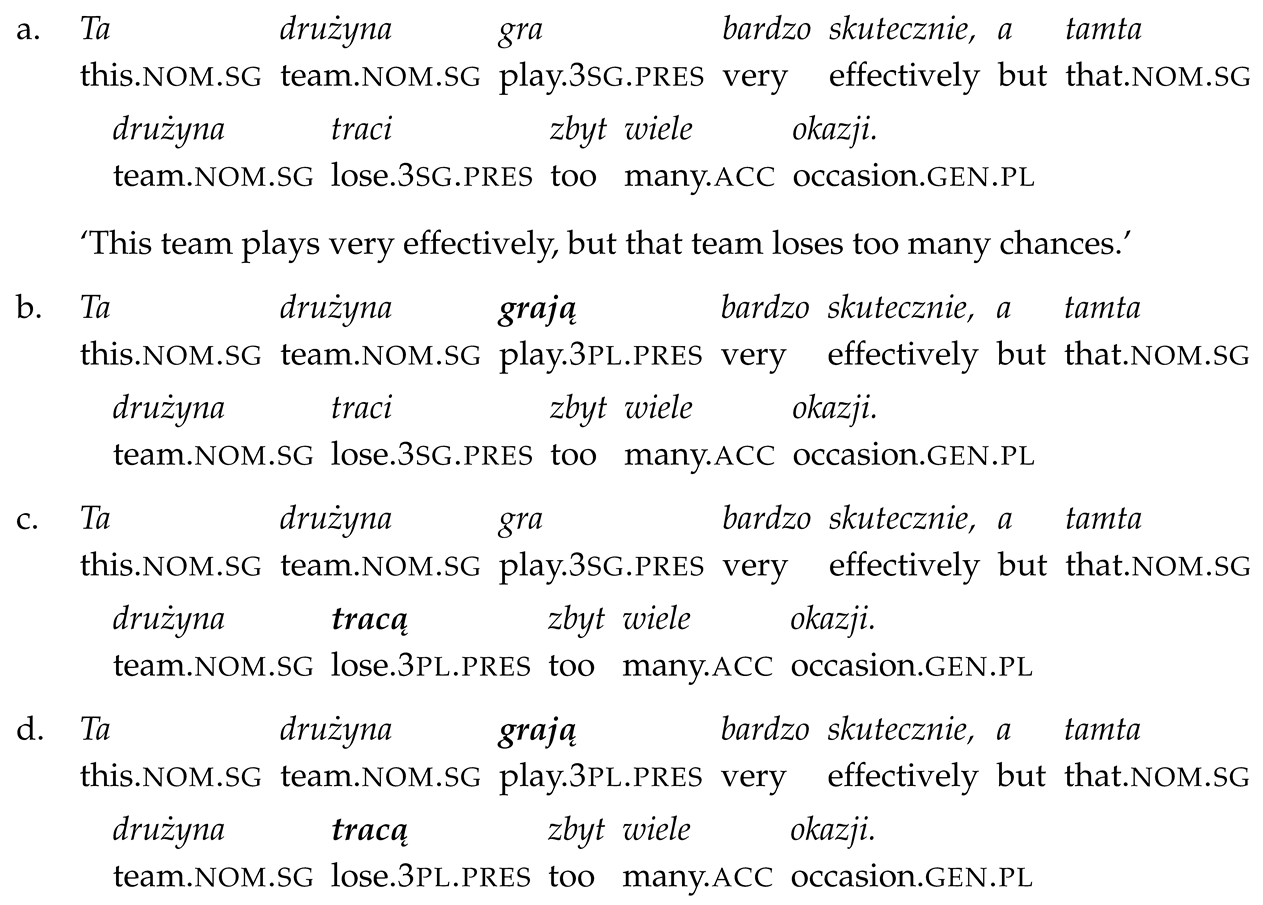
(7a) is the (grammatical) control sentence. (7b) contains a single agreement violation in the left clause (drużyna grają ‘team play’), (7c) contains the same violation in the right clause (drużyna tracą ‘team lose’), and (7d) contains both violations, one in each clause.
As in English, violation location had four levels: none (7a), violation in the left clause (7b), violation in the right clause (7c), and violations in both clauses (7d). In total, 16 items were constructed, yielding 16 × 4 = 64 stimuli. All items were controlled for length in syllables.
For selectional restrictions, both clauses again featured the same verb, forced in the violation conditions to take a bare że ‘that’-CP it does not normally select. An example item is shown in (8).
- (8)
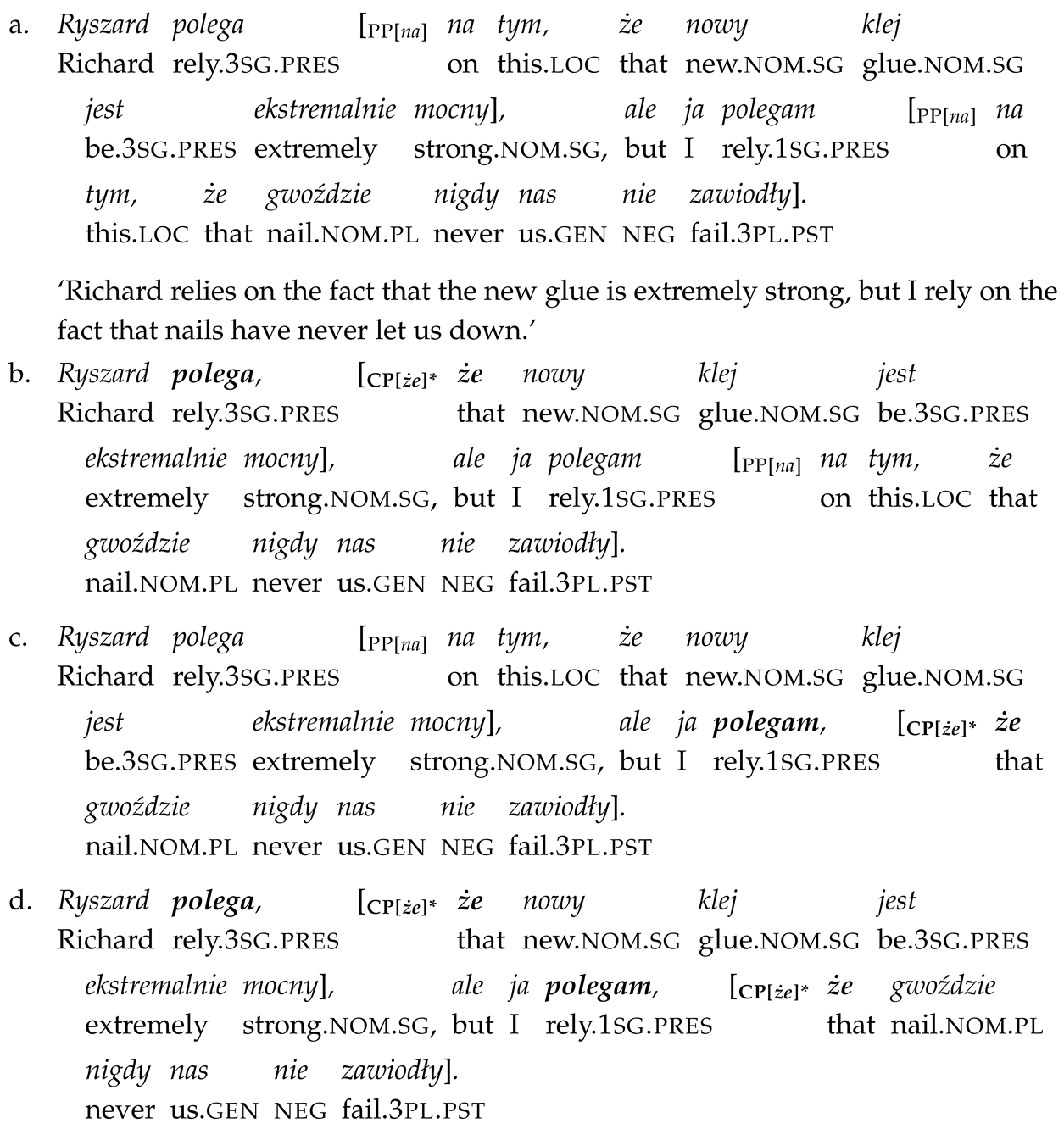
In the grammatical (8a), the verb polega ‘relies’ takes a PP headed by na ‘on’ whose complement is a CP introduced by na tym (lit. ‘on this’), parallel to English on the fact that; the violation (8b) drops this na tym bridge, combining polega directly with a CP headed by że ‘that’ and so rendering the clause ungrammatical. The right-clause (8c) and both-clause (8d) variants follow as in English.
The four CP-phobic predicates were polegać (na) ‘rely (on)’, koncentrować się (na) ‘focus (on)’, szykować się (do) ‘prepare (for)’, zmagać się (z) ‘struggle/cope (with)’. Crossing predicate (4 levels) with violation location (4 levels) gave 4 items per predicate, 4 × 4 = 16 items in total and stimuli. All items were length-controlled. These items were distributed across four lists by a Latin square. Each list also had 32 fillers: 15 Polish standard items spanning the whole acceptability range in 5 levels (Şenşekerci, 2026) and 17 resembling the experimental stimuli (9 grammatical, 8 ungrammatical, none word salad). Each list thus held 64 stimuli, as well as five practice items.
4.2.2. Procedure
Unlike the English Thermometer scale, acceptability here was rated on a 7-point Likert scale, since finding reliable Polish anchors at 20 and 30 requires a separate norming study. Following Goodall (2021, pp. 17–18), only the endpoints were labeled—“1” całkowicie nieakceptowalne ‘totally unacceptable’ and “7” całkowicie akceptowalne ‘totally acceptable’—with intermediate points left blank to encourage participants to treat successive points as equally spaced.8 The procedure was otherwise as in English: five randomized practice trials followed by a pseudo-randomized main task.
4.2.3. Participants
We recruited 60 Poland-based native Polish speakers via Prolific, compensated at standard rates; one was excluded (criteria in Appendix B.1), leaving 59 (mean age 31.8, SD = 7.9; 16 female, 43 male).
4.2.4. Results
The results of the subject–verb agreement sub-experiment are shown in Figure 3.
Figure 3.
Mean z-scores (with 95% CIs) for the Polish subject–verb agreement items in Experiment 1, shown alongside standard items (A–B are grammatical; C is borderline but not necessarily ungrammatical; D–E are outright ungrammatical but semantically coherent).
We again fitted a Bayesian mixed effects model (see Appendix B.2 on further details about all Polish models). Judgments for the control sentences were high (N: = 6.4 [6.1, 6.6]); both violations lowered them (L: = −3.2 [−3.6, −2.9]; R: = −3 [−3.4, −2.6]) and combined under-additively ( = 2.4 [2.1, 2.8], ). Unlike in English, however, the two single violations were not substantially different (), so the position effect did not reliably replicate. Cumulativity nonetheless held: LR fell below both single conditions (both vs. L and vs. R ).
The selectional restriction results are shown in Figure 4, grouped by predicate.
Figure 4.
Mean z-scores (with 95% CIs) for the Polish selectional restriction items in Experiment 1, shown alongside standard items (A–B are grammatical; C is borderline but not necessarily ungrammatical; D–E are outright ungrammatical but semantically coherent).
As in the English counterpart of this experiment, the model had predicate (polegać ‘rely’, koncentrować ‘focus’, szykować ‘prepare’, zmagać ‘struggle/cope’; with koncentrować as reference) in full interaction with L and R.
For koncentrować, both violations lowered acceptability from baseline (N: = 5.9 [5.5, 6.4]): L by −1.3 [−1.8, −0.7] and R by −0.8 [−1.3, −0.2]. For this predicate, however, the two did not combine clearly under-additively: the interaction was small and uncertain ( = 0.3 [−0.4, 1.0]). Predicates differed at baseline (polegać lower, = −0.8 [−1.4, −0.2]; others spanning zero) and in violation cost, from the more tolerant szykować (L: = +0.8 [0.1, 1.5]) to the least tolerant zmagać (L: = −0.8 [−1.5, −0.1]). The interaction terms for other predicates were comparable (i.e., null).
Cumulativity was largely robust: LR was reliably worse than R for every predicate (all ), and worse than the harsher L condition for koncentrować () and polegać (), though only suggestively for zmagać () and szykować (). Under-additivity, however, was established for no predicate: the posterior probabilities reached at most (polegać, zmagać), (koncentrować), and just for szykować.
4.3. Interim Summary
Experiment 1 yields three findings. First, the costs of selectional restriction violations are not uniform at the predicate level in both languages: the four CP-phobic predicates differed in their toleration of CP complements, with familiar and szykować ‘prepare’ among the most tolerant. Second, cumulativity was robust overall, though the LR condition was not judged lower than the harsher single violation for every predicate. Third, this cumulativity was predominantly under-additive. The exception, the Polish selectional restriction sub-experiment, was approximately additive, but the evidence there does not positively support linearity either.
4.4. Experiment 2: English
4.4.1. Design & Materials
Experiment 2 turned to violations of different constraints to test whether the same cumulative, under-additive profile holds. This experiment had a simpler design because both violations could be incurred in close proximity to each other without introducing any confounds. An example item is shown in (9).
- (9)
- Scott has talked [PP about the fact that NASA is planning a manned Mars mission].
- Scott has talked [CP* that NASA is planning a manned Mars mission].
- Scott have talked [PP about the fact that NASA is planning a manned Mars mission].
- Scott have talked [CP* that NASA is planning a manned Mars mission].
(9a) is the grammatical control sentence. In (9b), the verb talk (about), which normally rejects a CP[that] complement, is forced to take one. In (9c), the plural auxiliary have mismatches with the singular subject Scott. (9d) contains both violations at the same time.
We reused the same four CP-phobic predicates: depend (on), speak (about), talk (about), and familiar (with). Crossing predicate (4 levels) with violation type (4 levels: none, selectional restriction only, agreement only, both) gave a 2-factor within-participants design. With 8 items per predicate, this produced 32 items and stimuli, each controlled for length. The 32 items were distributed across four lists. Each list had 48 fillers: the same 15 standard items and 15 further candidates from Gerbrich et al. (2019), plus 18 resembling the experimental stimuli (9 grammatical, 9 ungrammatical, none word salad). Each list thus held 80 sentence stimuli in total, preceded by 5 practice items.
4.4.2. Procedure
The procedure was identical to the English Experiment 1: the same modified Thermometer scale and anchor sentences, instructions to judge relative to those anchors, five practice trials, then a main task in which items appeared one at a time, interspersed with fillers in a per-participant pseudo-randomized order.
4.4.3. Participants
We recruited 76 UK-based native English speakers via Prolific, compensated at standard rates. Thirteen were excluded based on the same criteria adopted in Experiment 1, leaving 63 (mean age 45.3, SD = 12.2; 27 female, 36 male).
4.4.4. Results
The results of the experiment are summarized in Figure 5, grouped by predicate.
Figure 5.
Mean z-scores (with 95% CIs) grouped by predicate in English Experiment 2, shown alongside standard items (A–B are grammatical; C is borderline but not necessarily ungrammatical; D–E are outright ungrammatical but semantically coherent).
The fitted model’s fixed effects included predicate (depend, speak, talk, familiar; depend reference) with the two violation factors, SEL (selectional restrictions) and AGR (subject–verb agreement).
For depend, both violations lowered acceptability from baseline (N: = 30.6 [29.6, 31.5]): SEL by −9.1 [−10.3, −7.8] and AGR by −7.2 [−8.4, −6], with SEL being the harsher one (). As in Experiment 1, they combined under-additively ( = 7.1 [5.7, 8.6]). Predicates differed at baseline (all higher than depend; e.g., familiar: = +3.0 [1.9, 4]) and, notably, in opposite directions for the two constraints: relative to depend, familiar attenuated the SEL penalty ( = +3.9 [2.3, 5.4]) but aggravated the AGR penalty ( = −3.5 [−4.9, −2]). Familiar also showed the only reliable negative interaction term ( = −3.5 [−5.6, −1.4]), i.e., weaker under-additivity compared to depend.
Cumulativity was observable across predicates: MIX was reliably worse than AGR for every predicate (all ), and worse than the SEL condition for speak, talk, and familiar (all )—but not for depend (), where adding the agreement violation to the SEL violation did not result in meaningful change. Under-additivity itself was robust for every predicate (all ).
4.5. Experiment 2: Polish
4.5.1. Design & Materials
The design of the Polish experiment was identical to the English one where both an agreement violation and a selectional restriction violation were present in the same clause in close proximity. An example item is given in (10).
- (10)

(10a) is the grammatical control. In (10b), the CP-phobic verb zmagać się ‘struggle (with)’ is forced to take a CP[że]. In (10c), the singular collective subject personel ‘staff’ fails to agree with the plural verb, zmagają. (10d) contains both violations at the same time.
We used four CP-phobic predicates: uporać się (z) ‘deal (with)’, koncentrować się (na) ‘focus (on)’, szykować się (do) ‘prepare (for)’, zmagać się (z) ‘struggle/cope (with)’. Crossing predicate (4 levels) with violation type (4 levels) yielded a 2-factor within-participants design. With 8 items per predicate, we had 32 items and stimuli, each controlled for length. With an additional 48 fillers (15 of them the same Polish standard items), 4 counterbalanced lists had 80 stimuli each in total.
4.5.2. Procedure
The procedure was the same as the Polish Experiment 1: the same 1–7 Likert scale, then a practice session followed by the main task in which items appeared one at a time, interspersed with fillers in a per-participant pseudo-randomized order.
4.5.3. Participants
We recruited 73 native speakers of Polish through Prolific. One was excluded based on the same criteria adopted in Experiment 1, leaving 72 participants (mean age 31.2, SD = 8; 28 female, 44 male).
4.5.4. Results
The results of the experiment are summarized in Figure 6, grouped by predicate.
Figure 6.
Mean z-scores (with 95% CIs) grouped by predicate in Polish Experiment 2, shown alongside standard items (A–B are grammatical; C is borderline but not necessarily ungrammatical; D–E are outright ungrammatical but semantically coherent).
The model was as in English Experiment 2, with predicate (uporać ‘deal’, koncentrować ‘focus’, szykować ‘prepare’, zmagać ‘struggle/cope’; with uporać as reference) crossed with SEL and AGR.
For uporać, both violations degraded acceptability compared to the baseline (N: = 5.6 [5.3, 5.9]): SEL by −2.7 [−3.0, −2.3] and AGR by −3.0 [−3.3, −2.6], with AGR being more severe (). As in English, they combined under-additively ( = 2.3 [1.9, 2.7]). Predicates differed slightly at baseline (all higher than uporać; e.g., zmagać: = +0.9 [0.5, 1.3]), but the predicate-related change in violation cost was confined to the SEL side: szykować attenuated the SEL penalty ( = +1.2 [0.7, 1.6]) while agreement penalties were essentially constant across predicates (all predicate × AGR 95% CrIs spanning zero). Szykować also showed the only reliable negative interaction ( = −1.4 [−2, −0.7]), i.e., weaker under-additivity.
Cumulativity was robust throughout: MIX was reliably worse than either single-violation condition for every predicate (vs. AGR: all ; vs. SEL: all )—a much cleaner pattern than in Polish Experiment 1, where the comparison broke down for some predicates. Under-additivity too was robust for every predicate (all ).
4.6. Discussion
Experiment 2 extends the findings from Experiment 1 to violations of different constraints. First, the CP-phobic predicates again differed in how costly a CP violation was, with familiar and szykować ‘prepare’ again the most tolerant, whereas the agreement violation was comparable across predicates. Second, cumulativity again was robust overall. In both languages, the two-violation condition was generally worse than either single violation, and here more cleanly than in Experiment 1. Third, this cumulativity was strongly under-additive in both languages. The under-additive profile therefore seems to generalize to violations of different constraints, and indeed emerged most consistently there.
This strong under-additivity invites an obvious objection, namely, that it merely reflects a floor effect, with the two-violation condition unable to fall much below the single-violation ones simply because the scale bottoms out. The data, however, make this explanation unlikely. The lowest-rated target conditions were well above both the scale minimum and the E-level standard items. Thus, there was ample room for further decline. Moreover, under-additivity is observable even for the more tolerant predicates, whose higher ratings put them furthest from any floor. Nonetheless, these observations do not entirely rule out a floor effect account, a point we briefly return to in Section 6.
Together with Experiment 1, these results challenge the traditional view that gradient judgments stem from performance factors. Moreover, pervasive under-additive cumulativity is difficult to reconcile with the strictly linear summation of violation penalties implemented in Linear Optimality Theory and directly informs the well-formedness calculation we propose in our framework, which we turn to now.
5. Gradient Model-Theoretic Dependency Grammar
The experiments leave us with a specific target to model: native speakers’ intermediate judgments, which appear to be systematically influenced by grammatical violations of varying severity that accumulate in an under-additive fashion. Before specifying the formal machinery, however, we must establish the underlying theoretical architecture, since not every grammatical framework can evaluate an ill-formed structure in the first place.
We have two requirements. The framework must (i) model gradient judgment data of the kind reported above, and (ii) align with what is known about human sentence processing, rather than hiding behind the strong competence–performance dichotomy that tends to insulate grammatical architecture from psycholinguistic findings (see Hawkins, 2004; Jackendoff, 2007). These two requirements substantially constrain the choice of architecture. The first favors a model-theoretic over a proof-theoretic formalism (the latter also called “generative-enumerative”; Pullum & Scholz, 2001). The second favors monostratal over multistratal representations and a dependency- over a phrase-structure-based syntax.
5.1. Desiderata
5.1.1. Model-Theoretic, Not Proof-Theoretic
A model-theoretic grammar is a set of logical constraints that jointly define models: structures that satisfy every constraint in the grammar. For instance, a model-theoretic grammar for English would include a constraint requiring a verb and its subject to share number, which the sentence Mary likes John satisfies and the sentence Mary like John violates, along with other constraints constituting the grammar, syntactic and semantic alike. A proof-theoretic grammar instead generates strings through sequential operations, such as phrase-structure rules or proof-theoretic derivations in categorial grammars. The same agreement fact is then enforced by a rule generating only strings in which the subject and the verb match, so that Mary like John is never generated at all.
The contrast here is decisive for gradient well-formedness. As Pullum and Scholz (2001, Section 3.1) observe, a proof-theoretic grammar defines a language as the set of strings it generates, so membership is all-or-nothing and there is no room for a sentence in between; and because such grammars run on multi-step derivations and modular interfaces, a single violation crashes the derivation, leaving no object behind to grade.9 A model-theoretic grammar faces no such obstacle. A structure can be evaluated against the grammar whether or not it satisfies it, constraints can accordingly be weighted or ranked, and gradient unacceptability emerges from the profile of constraints a structure violates. This already narrows the field: within the broadly generative tradition, Head-driven Phrase Structure Grammar (HPSG; Pollard & Sag, 1994) is currently the only full-fledged model-theoretic framework (Richter, 2004), while Minimalism (Chomsky, 1995) and essentially all other major frameworks are proof-theoretic, with Lexical-Functional Grammar (LFG; Kaplan & Bresnan, 1982; Dalrymple et al., 2019) occupying an ambiguous middle ground (Przepiórkowski, 2023).
5.1.2. Monostratal, Not Multistratal
The second desideratum—all the information about a linguistic sign, morphosyntactic and semantic alike, stated on a single level rather than distributed across modules linked by mapping rules—is motivated by our model-theoretic choice and well-established findings on online sentence processing. Online comprehension is incremental, opportunistic, and integrative: all available information, linguistic and non-linguistic, is leveraged immediately and in parallel, with distinct levels of representation mutually influencing one another.10 A grammar whose representations embody this integration is, we believe, more naturally aligned with such a processor (see Sag & Wasow, 2011, Section 4.1 and Wasow, 2024, Section 3.3 for similar arguments).11
Here too the field divides sharply: the Minimalist “Y-model” splits syntax, semantics, and phonology, making the latter two outputs of the first, and LFG likewise spreads information across autonomous, separately linked levels, whereas monostratal representation is among HPSG’s defining commitments.
5.1.3. Dependency, Not Phrase-Structure
The same processing aim motivates the third choice. Dependency representations encode syntactic structure via direct, asymmetric links between words, and it is at the level of word-to-word relations that some of the most robust psycholinguistic generalizations have been formulated. For instance, locality-based difficulty, which tracks the distance between a head and its dependent, and head-directionality effects both fall out naturally from a dependency geometry (Futrell et al., 2015; Futrell et al., 2020; Gibson, 2025, Chapters 4–5). Dependencies are also more portable across typologically diverse languages than phrase-structure representations, and violations considered in the experiments reported above are most naturally cast in these terms: both an agreement mismatch and a selectional-restriction violation are failures of a specific head–dependent relation.12
Major frameworks in the generative tradition differ in how deeply phrase structure is entrenched. In Minimalism it is the backbone of the theory, and in LFG it is one of the two core syntactic levels, constituency structure, with some dependency information present at the other syntactic level, functional structure. While HPSG is—true to its name—a phrase-structure theory, it has been occasionally noted that its underlying formalism is also compatible with dependency representations (e.g., Hudson, 2024, Section 6). In what follows, we briefly present a new framework, Model-Theoretic Dependency Grammar, which, however, is largely inspired by the model-theoretic logic of HPSG; see Przepiórkowski (2026) for a comprehensive introduction and complete formalization.
5.2. Model-Theoretic Dependency Grammar
In dependency approaches, it is common to represent utterances as labeled dependency trees, such as (12) for the sentence (11).
- (11)
- Marge still loves him.
- (12)
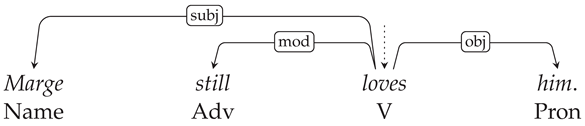
The nodes of such trees are said to be “words,” but in fact they must be understood as structured objects, containing word forms, their categories, and other kinds of information not explicitly shown in (12). In formal linguistics, such structured information is frequently represented via Attribute-Value Matrices (AVMs). Employing HPSG conventions, a possible AVM representation of the above tree is given in (13).
- (13)
There are four word objects in (13), each with five attributes: phon, representing the form of the word, cat, representing its category, rel, expressing the grammatical relation of that word in the utterance, gov, pointing at the governing word, and next, pointing at the immediately following word. (As in HPSG, boxed numbers are variables referring to model objects, here to certain word objects.) Where an attribute is irrelevant, it has the special value nil (in gray), as in the case of the last word, whose next value is nil, or in the case of the root of the tree, loves, which bears no grammatical relation and has no governor.
In model-theoretic linguistics, such structures—whether simple trees or more explicit AVM representations—correspond to models or their parts. Such models are understood as in logic, as sets of objects, their properties, and relations between them. For example, the AVM encoding (13) of the tree (12) corresponds to the model configuration in (14).
- (14)
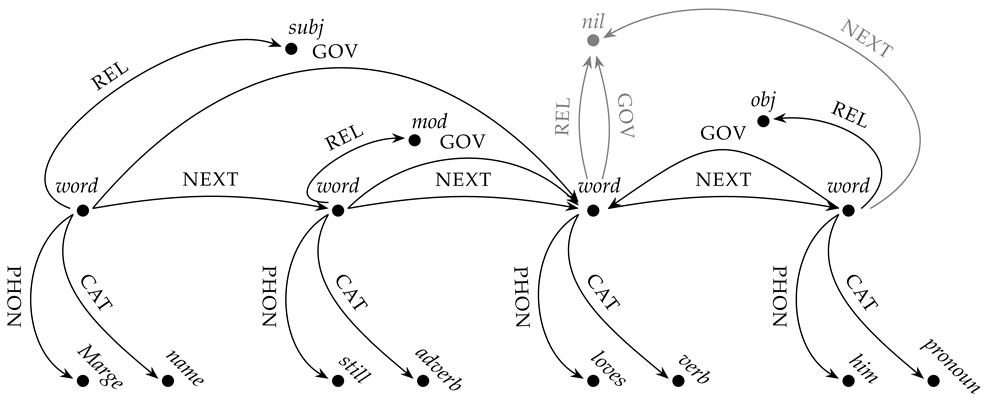
This configuration consists of 16 objects (the bullets), each of a certain sort (e.g., four of sort word, one of sort nil, etc.), as well as relations between them, encoding the attributes. In what follows, we will represent such models by AVMs, as in (13).
In model-theoretic linguistics, a grammar is a set of statements constraining such models, i.e., making sure that models only contain structures representing linguistic properties of possible utterances. Such statements are given in the language of an appropriate logic. While HPSG uses a specialized logic (King, 1989; Richter, 2004), we use a variant of first-order logic (FOL), with some syntactic sugar. However, in order to make these statements clear to linguists less fluent in the language of logic, we also provide them in prose and, where appropriate, in an AVM-based notation.
For example, two statements to the effect that subjects precede their governors and direct objects follow them are given in (15) and (16).13
- (15)
- Linearization of Subjects (ignoring subject-auxiliary inversion, etc.):
- ‘Subjects precede their governors.’
- (16)
- Linearization of Direct Objects (ignoring topicalization, etc.; to be replaced by (22)):
- ‘Direct objects follow their governors.’
The two constraints are formally defined in (15c) and (16c), given in the more readable AVM notation in (15b) and (16b), and in less precise prose in (15a) and (16a). Where the AVM notation uses the symbol “<” to indicate linear precedence, the FOL formalization invokes the binary relation defined recursively in (17); this definition is given in prose in (17a) and formalized in (17b).
- (17)
- ‘x precedes y iff both are words and either y immediately follows x or there is some z which immediately follows x and precedes y.’
So far, we have assumed that dependency structures only contain the kinds of information already present in the schematic tree (12). However, in order to express constraints on agreement and selectional restrictions, structures must also be specified for morphosyntactic information, including grammatical number, and valence information. With this information added, the fuller structure corresponding to (12) is given in (18), with nil-valued attributes omitted and with some extensions explained presently.
- (18)
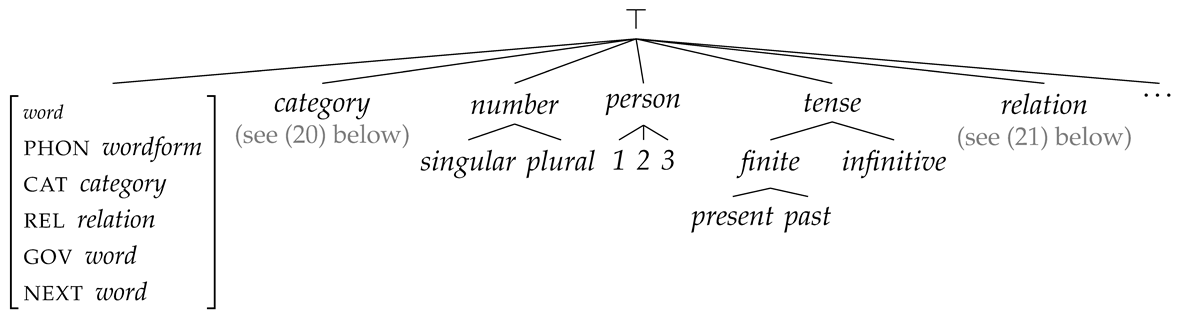
We assume that—just as in HPSG—sorts of model objects form sort hierarchies, which also define attributes appropriate for particular sorts. For example, according to the sort hierarchy in (19), whose parts are shown further in (20) and (21), there is a most general sort ⊤, and word is one of its immediate sorts. Attributes appropriate to word and their possible values are also defined in (19); for example, the attribute cat is appropriate for word and has values of sort category, defined in (20).
- (19)
- (20)
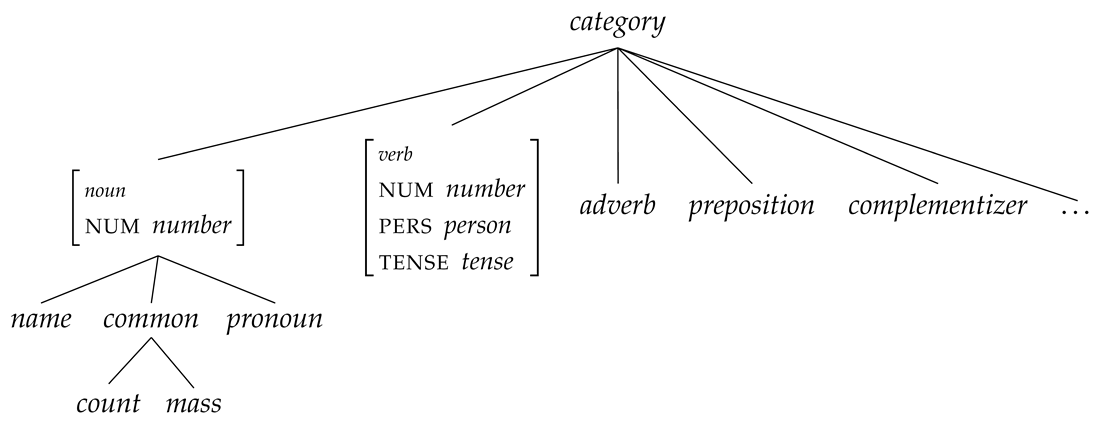
According to (20), one of the categories is noun, whose immediate subsorts are name, common (with subsorts count and mass), and pronoun. As noun introduces the number-valued attribute num, also objects of all these subsorts are assumed to have this attribute. This is illustrated in (18), where appropriate values of num are present within cat values of the name Marge and the pronoun him. Moreover, as will be illustrated in the following subsection, any constraint on objects of sort noun must be satisfied by objects of any of its subsorts, including name and pronoun.
Also grammatical relations—values of words’ rel attribute—are organized into a sort subhierarchy, as shown in (21).
- (21)
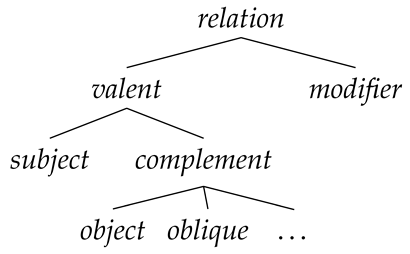
While modifiers may precede or follow their governors, subjects typically precede them, as already stated in (15) above, and various kinds of complements (direct and indirect objects, obliques, etc.) typically follow their governors. As the above constraint (16) only deals with direct objects, it could be naturally generalized to all kinds of complements:
- (22)
- Linearization of Complements (ignoring topicalization, etc.; replaces (16)):
- ‘Complements follow their governors.’
Given that object is a subsort of complement, this new constraint properly subsumes the previous constraint (16).
5.3. Agreement
According to the sort hierarchy in (19)–(21), the values of cat now represent not only syntactic categories, but also values of such morphosyntactic features as number, person, and tense. To this purpose, values of cat are not atomic anymore, but possibly structured; just as words have a fixed set of attributes, verbs now also have a number of attributes, namely, num, pers, and tense. Similarly, as mentioned above, the nominal category noun introduces the attribute num, so in particular all names and pronouns must have this attribute. On the other hand, as adverbs do not inflect, they remain atomic.
Given this extension, it is easy to formulate the number agreement constraint:
- (23)
- Subject–Verb Agreement (in number):
- ‘Finite verbs agree in number with their nominal subjects.’
- →
We assume that such agreement statements are fine-grained, limited to single morphosyntactic features (number, in the case of (23)), as violations of different kinds of agreement may carry different penalties. In structure (18), the antecedent within the above statement is only satisfied by the word (i.e., the name—subsort of noun—Marge), which also satisfies its consequent: its cat num value (i.e., sg) is the same as the cat num value of its governor (i.e., loves). Hence, the whole universally quantified statement is true. If the modeled utterance were Marge still love him, then this constraint would be violated once.
5.4. Selectional Restrictions
As is common in formal syntax, we assume that words lexically constrain categories of arguments they combine with. So, in order to model such selectional restrictions, we need to make some simplifying assumptions about the lexicon.
The simplest possible view of the lexicon is as a set of unrelated lexical entries. Such a view is sometimes adopted in HPSG and it is encoded at the AVM level of description as in (24) (Höhle, 1994, 2019; Richter, 2024, p. 101):14
- (24)
- Lexicon Constraint:
- ‘There are the following words: Marge (defined as in (25)), loves (as in (26)), …’
- word → (LEMarge ∨ LEloves ∨ …)
- (25)
- (26)
While in psycholinguistics the lexicon is normally taken to be a network of lexical items rather than an unstructured set, this simplified view will suffice for the purpose of illustrating how selectional restrictions may be encoded within Model-Theoretic Dependency Grammar.
Lexical entries such as (25) and (26) contain information about the form of the word, its category and morphosyntactic features, as well as its valence, i.e., its syntactic argument structure. Proper nouns such as Marge do not take any arguments, so their valence is nil. By contrast, transitive verbs such as loves take two nominal arguments: a subject and a direct object. Given that name and pronoun are subsorts of noun, Marge and him satisfy the categorial restrictions imposed on its arguments by loves in (26).
In order to model fine-grained violations of selectional restrictions, we take a slightly different approach here and assume that lexical entries only mention the number and grammatical functions of arguments, as in (26′) below, while selectional restrictions are expressed via separate constraints.
- (26′)
It is clear that the direct object of loves may be expressed by a nominal constituent (e.g., Marge loves Homer), but not by a prepositional constituent (e.g., *Marge loves of Homer); that is, such a prepositional direct object of loves would incur a large penalty. Assume further that this direct object may be expressed by a clause introduced by the complementizer that (e.g., Marge loves that Homer repaired the sink), but with a relatively small penalty. As penalties differ by category, there should be different constraints for different categories of objects of loves, e.g.,:
- (27)
- ‘The direct object of loves cannot be prepositional.’
- → ¬
- (28)
- ‘The direct object of loves cannot be clausal.’
- → ¬
If there is no constraint to the effect that the direct object of loves cannot be nominal, no penalty can be imposed on such nominal direct objects.
In the case of the CP-phobic predicates used in the experiments described above, we assume constraints fully analogous to (28), e.g., for depend:
- (29)
- ‘The complement of depend cannot be clausal.’
- → ¬
There will also be similar constraints on other categories, e.g., on nouns (cf. I depend [NP* the fact that I have worked hard to earn my place]), but not on prepositions, given that the predicates used in the experiments are fully acceptable with PPs.
However, if nothing else is said in the grammar, these predicates could combine with PPs headed by just any prepositions, e.g., I depend [PP *for the fact that I have worked hard to earn my place]. In order to specify the lexical selection of particular predicates for particular prepositions, more fine-grained constraints are needed on top of general categorial constraints such as (27)–(29), e.g., for depend (ignoring the possibility of upon):
- (30)
- ‘The prepositional complement of depend must be headed by on.’
- →
Unlike the relatively soft constraint in (29), which forbids CP complements of depend, we assume that the constraint in (30), which says that its PP complements must be headed by on, is relatively hard. (But future experiments are needed to confirm this intuitive weight difference.)
5.5. Constraint Weights
The literature reviewed in Section 2 suggests that not every violation costs the same, a finding corroborated by our own experiments. Like other gradient frameworks, we therefore attach a weight to each constraint formula.
A weight, on our account, is a number between 0 and 1, which represents the fraction of a sentence’s acceptability that a single violation of that constraint removes. This is similar to Linear Optimality Theory (LOT) in that weights denote only the cost of violating a constraint, and not any reward for satisfying it. Unlike LOT, however, our weights are bounded, which has a practical benefit: weights on a common, closed scale are easier to compare across constraints, and easier to interpret, than unbounded ones.
Moreover, like Stochastic Optimality Theory (Boersma & Hayes, 2001, pp. 47–50) and Noisy Harmonic Grammar (Boersma & Pater, 2016, Section 2)—but unlike LOT—we draw weights from distributions rather than using fixed values. However, unlike these frameworks, which apply uniform noise to every constraint, we allow the spread to differ by constraint. This is because a uniform spread makes the prediction that all constraints are equally variable, and this seems to be a strong assumption given available evidence, at least for syntactic phenomena. Sorace and Keller (2005, Section 2.4) find that weights of softer constraints can significantly drift depending on the context while harder ones remain stable. Syntactic satiation provides further counter-evidence, in that island constructions differ in how readily they satiate (Lu et al., 2024) in ways not always reducible to extra-grammatical factors (Chaves, 2022). Accordingly, we let the spread differ from constraint to constraint.
We take that distribution to be a Beta distribution, whose natural domain is the interval , and we describe it through two quantities: a mean , the average penalty a violation of a constraint incurs, and a concentration , which controls how tightly the weight clusters around that mean. Gradient Model-Theoretic Dependency Grammar thus has a set of ordered pairs, each pairing a constraint , such as the Subject–Verb agreement (in number) in (23c), with the distribution from which its weight is drawn. An evaluation event accordingly instantiates a weight vector by sampling once from each . Constraint ranking follows from this without further stipulation. Where LOT takes to outrank just in case , we take the two to stand in that relation to the degree .
What do the weight distributions represent? We believe that two readings are possible. On the interspeaker reading, each speaker has their own fixed weight and the distribution describes how those weights vary in a speaker community. On the intraspeaker reading, it is cognitive noise within a single speaker, perturbing the weight from one judgment event to the next. The spread of a weight distribution therefore quantifies disagreement between speaker weights on the first reading and cognitive instability within one speaker on the second reading. While we are sympathetic to the intraspeaker reading, it is hard to estimate it from acceptability judgments alone. A participant’s judgments vary from trial to trial for many reasons besides fluctuation in the weight. Items are differently lexicalized, attention wanders, and judgments satiate. Isolating the weight’s own contribution would require a substantially different methodology, most plausibly one supplementing offline judgments with online and neuroimaging measures, and we leave that to future work.15 We therefore estimate weights in the next section under the interspeaker reading.
5.6. Estimating Weights from Judgment Data
While one could estimate interspeaker and through different methods (e.g., Bayesian inference via Markov chain Monte Carlo, or mixed-effects regression with a Beta likelihood) here we estimate them through a rather simple, analytical procedure. We proceed in four steps.
First, judgments are placed on a scale with a zero. English responses were collected on a slider running from 10 to 40; we rescale each response y to , so that acceptability runs from 0 to 1 and a weight can be read as a proportion of it.16
Second, for a given participant we average their ratings of the grammatical control sentences, , and of the sentences violating the constraint in question single time, . Working within participants at this stage is what eliminates individual differences in scale use as much as possible: a lenient rater and a severe one who degrade by the same proportion on their scale will yield comparable weights.
Third, the weight is the proportion of the grammatical control acceptability that the violation removes:
- (31)
- .
Fourth, the resulting weights—one per participant, or one per participant and predicate—constitute the sample from which the constraint’s distribution is estimated. We take to be their mean and obtain using the method of moments, , where is the sample variance; the Beta shape parameters follow as and .
We followed this pipeline on our English Experiment 2 data. For the selectional restriction constraints, control and violation means were taken within predicate, so that each weight is measured against the baseline of the same predicate. For the agreement constraint they were pooled across predicates, since that constraint is not predicate-specific and its penalty did not substantially differ across predicates in the experiment.
The fourth step brought a complication. Depending on the violation, up to nine of the 63 participants yielded a weight at or below zero, having rated the violating items no worse than the grammatical controls. Measurement error may account for some of these, but most likely not all. They are most numerous for familiar, the constraint with the lowest weight overall, which is what one would expect if a violation of the softest constraint carries no cost at all for some speakers. We therefore squeezed these values to zero in order to preserve the grammar’s fundamental assumption that a violation never improves acceptability while acknowledging that for these speakers it does not degrade it either.17
For comparison we also estimated and on the trimmed sample (that excluded weights equal or smaller than zero), through method of moments and maximum-likelihood estimation. Table 1 reports all three. The two trimmed estimates agree closely and both differ from the squeezed estimates in the expected direction: dropping the weights at zero affects only the lower tail, so constraints appear slightly heavier and slightly tighter. The effect is largest for familiar ( , ) and virtually absent for depend, where nothing was squeezed. The ordering of the constraints is unaffected. Figure 7 shows the fitted distributions for the squeezed data.
Table 1.
Estimated mean () and concentration () parameters for constraints tested in English Experiment 2. The trimmed method-of-moments and maximum-likelihood estimates are both fitted to data that excluded speaker weights equal to or smaller than zero (i.e., ).
Figure 7.
Fitted weight distributions for the constraints tested in English Experiment 2, estimated through method of moments on the squeezed sample. Each ridgeline is the density of with the parameters in Table 1. Points mark means.
5.7. Computing Well-Formedness
We now need an equation on which violations combine under-additively. Just like we did for weights, we also confine acceptability predictions to the interval between 0 and 1. Here we depart from LOT and, arguably, from the Decathlon Model, on which a sufficiently long sentence with enough violations can receive an arbitrarily low score. Our experiments do not bear on this directly, but the assumption is a reasonable one: arbitrarily long sentences with unbounded numbers of violations are an idealization, and a bounded processing system will at some point stop registering further violations rather than continuing to penalize each one.
Like LOT, and unlike the original Harmonic Grammar (Legendre et al., 1990), we let only violations count towards well-formedness, not satisfactions. This is straightforward to formalize. As noted in Section 5.2, model-theoretic linguistics treats a structure as a set of objects together with their properties and the relations holding between them; this is the model , and is the set of all objects in it, such as the 16 objects in (14). Since each constraint in our grammar is a universally quantified first-order formula, , its denotation may be understood as the set of objects x in which make true. Violations are whatever falls outside that set, so counting them is simply a matter of cardinality, where is the set of objects satisfying the constraint (Şenşekerci, 2024):
- (32)
- .
Intuitively, this works because every constraint in the grammar is expressed in the AVM notation as a conditional: its antecedent picks out an object and its consequent imposes a requirement on it.18 An object that fails the antecedent satisfies the conditional vacuously and so remains inside , contributing nothing to the count. Only objects that are picked out and then fail the requirement fall outside it.
An example will make this concrete. Take the Subject–Verb agreement (in number) constraint in (23b), repeated as (33), and *Marge love him, whose model is given in (34) in terms of AVMs.
- (33)
- →
- (34)
Evaluating (33) against (34) proceeds as follows. The antecedent picks out any word object that is a nominal subject whose governor is finite; here this is , Marge, and nothing else. The consequent requires that object to share its governor’s number. It does not: is singular while its governor , love, is plural. So lies in but outside . The remaining objects do not satisfy the antecedent and so satisfy the constraint vacuously, leaving them inside the denotation set of the constraint. In this toy case, therefore gives us a singleton, {} and : one violation. The same procedure extends to structures with more than one violation. In *Marge love Homer, but she also resent him, the antecedent of (33) picks out two objects, Marge and she, and in both cases the consequent fails. The set difference is therefore of size two, and .19
Every constraint in the grammar is evaluated this way, each yielding its own count . Collectively, these counts constitute the violation profile of the structure, which tells us how often each constraint is violated. What remains is to turn that profile into a single number. Two things are needed: a way of converting a weight into a penalty, and a way of combining penalties that is under-additive to a degree we can control.
We start with the conversion. A weight is a proportion: a single violation of leaves a fraction of the sentence’s acceptability intact. Proportions multiply rather than add, so it is convenient to work on a scale where they do add. We therefore define the penalty of as
- (35)
- ,
which runs from 0 for an inert constraint to ∞ as approaches 1. Nothing new is assumed here; (35) is simply a change of scale. Penalties are then combined by
- (36)
- ,
where m is the total number of constraints in the grammar and is the cumulativity parameter, which tunes how penalties accumulate (we will discuss its behavior shortly). The equation is not novel. Variants of it, sometimes called “Minkowski summation/equation,” have been utilized in psychophysics, typically for modeling sensory integration in both behavioral and neuroimaging data (e.g., Quick, 1974; To et al., 2011; Billock et al., 2021).
We subsequently map the total penalty back to a bounded acceptability prediction score:
- (37)
- .
The score is 1 exactly when S has no violations, falls monotonically as the penalty grows, and approaches 0 without ever reaching it, which delivers the boundedness we assumed at the outset.
With both equations in place, the behavior of q can now be explained. At the score takes the multiplicative form : each violation retains a fixed proportion of what is left. As q rises, larger penalties begin to dominate smaller ones, so each additional violation adds less than the last. In the limit, only the worst violation counts, yielding something akin to Optimality Theory style strict domination. The cumulativity parameter is thus a dial: the higher it is set, the more the grammar discounts violations for being numerous, including numerous violations of the same constraint.
Crucially, if S violates a single constraint a single time, then , the same value for every q. This means that the cumulativity parameter never modifies the cost of a single violation; it governs only how violations combine. This matters for the estimation procedure of Section 5.6, which computes weights exclusively from single-violation conditions and is therefore unaffected by whatever value q subsequently takes.
Moreover, because the weights are drawn afresh at each evaluation, is not a scalar value but a random variable. We therefore summarize it by two quantities. Its mean gives the grammaticality of S,
- (38)
- ,
and its standard deviation in (39) gives either between-speaker disagreement or within-speaker cognitive noise, depending on how the weights are derived from the data.
- (39)
A sentence violating nothing receives on every draw, so its grammaticality is 1 and its disagreement 0; a sentence violating a low-concentration constraint will show a high . Both quantities can in principle be derived analytically when because—as noted above— factors into a product of powers of independent Beta variables, whose moments can be obtained from standard formulas (Johnson et al., 1995, pp. 256–257). However, we are not aware of closed-form solutions for other cases. Therefore, other cases can be estimated through a Monte Carlo simulation by drawing N weight vectors from and taking the sample mean and standard deviation of the resulting scores.
5.8. Estimating q
So far we have only said that q controls cumulativity, without fixing its value. To estimate it based on the same experimental data, we ran the pipeline above for q from 1 to 5, holding fixed the weights derived in Section 5.6. Table 2 gives the numeric results and Figure 8 visualizes them. At the grammar underpredicts acceptability for every predicate: penalties accumulate too steeply, and the double-violation condition is judged worse than participants actually rate it. Moving to closes most of that gap, and beyond it the predictions do not move substantially.
Table 2.
Observed acceptability of the double-violation condition relative to control, against model predictions at five settings of the cumulativity parameter. Observed values are the ratio of double-violation to control ratings, computed within each participant and then averaged. Predictions are Monte Carlo means over weights drawn from the reported Beta distributions.
Figure 8.
Predicted and observed acceptability of the double-violation condition, by predicate. Gray bars give the observed value (computed as in Table 2). Colored bars give the grammar’s prediction at five settings of q, estimated by Monte Carlo over weight vectors drawn from the Beta distributions of Table 1 and combined by (36).
Two deviations remain. First, predictions for depend stay below the observed value at every q. This predicate showed almost no cumulativity in the experiment, with the double violation barely worse than the single violations alone, and no moderate q can reproduce discounting that near-total. Second, predictions for familiar overshoot instead, once . Here the two penalties are the most unequal of the four, and high-q pooling increasingly discounts the smaller of them, driving the prediction toward the cost of the agreement violation alone. The data, however, show the weaker selectional restriction violation still contributing considerably.
In what follows we set as moving from to closes most of the gap between predicted and observed values, and beyond it we move into the overfitting territory, as Figure 8 shows.20 Naturally, our experiments were not designed to estimate q itself. They simply favor under-additive cumulativity over an additive one, and values around seem to produce reasonably close predictions, though finer discrimination among neighboring values would require designs built for the purpose. We leave this to future work and adopt as a justified working value.
Figure 9 shows the resulting model predictions, , for each violation condition. Because is a random variable rather than a scalar, each condition is a distribution. Its mean is the grammaticality and its spread the disagreement . The spread here reflects the concentration of the fitted Beta distributions, which is itself estimated from 63 participants; more participants could potentially yield tighter weight estimates and correspondingly tighter predictions if the actual disagreement in the population is less than the sample suggests.21
Figure 9.
Model predictions at for the two single-violation conditions and their combination (MIX), by predicate. Single violations are exactly Beta-distributed; MIX is estimated by Monte Carlo over weight draws. Points mark means.
In sum, representations and constraint satisfactions in our framework remain categorical; attributes and sorts are discrete, and constraints are either satisfied or violated. Gradience in our framework enters only via stochastic constraint weights and the grammaticality function that quantifies how closely a structure answers to the ideals of the grammar. In this respect, our conceptual approach aligns closely with work on gradience in the Optimality-theoretic tradition, particularly Linear Optimality Theory, and the Decathlon Model (cf. Aarts, 2004, 2007).
6. Limitations and Future Work
Our experiments tested two constraints, subject–verb agreement and syntactic selectional restrictions, both of which are violated locally, at a single head–dependent link. They were tested in two languages, both Indo-European, and no sentence had more than two violations. Whether the under-additive profile demonstrated here extends to non-local constraints such as islands, to word order, to sentences with three or more violations, and to typologically distant languages therefore remains an open question.
This restricted scope also limits what the data can say about the combination rule itself. With at most two violations per sentence, our experiments can discriminate under-additive cumulativity from a linear one, but not much more: they cannot reliably adjudicate among neighboring values of the cumulativity parameter in (36). As noted in Section 5, settling these questions requires designs built for the purpose: violation counts beyond two, which would reveal the shape of the cumulativity curve rather than just two points on it, and denser repetition per condition.
A further caveat concerns the interpretation of under-additivity. An obvious counter-argument would attribute it to the floor effect, and Section 4 presents evidence against this: the lowest-rated conditions sat well above both the scale minimum and the least acceptable standard items, and under-additivity persisted for the most tolerant predicates. Still, the possibility cannot be excluded entirely. It might be that (36) partly models response compression rather than how the grammar combines violation costs. The data favor the grammatical interpretation, but disentangling the two conclusively will require studies employing unbounded scales, on which there is no floor to compress against, and converging evidence from online and neuroimaging measures.
A related limitation concerns how we interpret the estimated weight distributions, and consequently . Since offline judgments alone cannot cleanly isolate within-speaker fluctuation, here we adopted the interspeaker reading. This reading entails that each speaker has their own weighted constraints and outputs the expected grammaticality of S across such speakers. The intraspeaker reading, on which would represent a single speaker’s grammar, is ultimately the more desirable one, but deriving intraspeaker weights would require a deeper understanding of how a single speaker arrives at a judgment, which we leave to future work.
Finally, it remains to be seen whether processing factors can explain the different violation costs and the under-additivity observed here, as the traditional account of gradient judgments would have it. We are not aware of any that do. Processing clearly affects judgments, and our results show one such effect, namely, that the severity of a given violation seems to depend on where the violation occurs in the sentence (consistent with Marks, 1967). Nonetheless, this, in itself, does not explain systematic differences between distinct violations and robust cumulativity. Other well-documented processing factors, such as structural complexity and length, are also unlikely candidates, since our stimuli were designed to minimize the effects of both.
7. Conclusions
The hypothesis that gradient acceptability arises solely from performance factors, rather than competence, implies that every gradient effect should ultimately be traceable to an extra-grammatical source. The effects reported here stem from straightforward violations within short and easy-to-parse sentences, and they are systematic: constraints differ in severity across experiments and languages, and a second violation lowers ratings further. Our results are therefore difficult to explain if grammaticality is binary and all gradience in judgments stems from extra-grammatical factors that can be identified independently. Gradient notion of grammaticality thus emerges as a compelling alternative to the binary view that underlies most generative frameworks.
The frameworks that already treat grammatical well-formedness as gradient, on the other hand, do not match the generative ones in formal rigor. Our findings concerning under-additivity compound the difficulty, since linear summation is not a peripheral assumption of these frameworks but the main mechanism by which they make any prediction at all. We have therefore proposed Gradient Model-Theoretic Dependency Grammar, in which constraints are first-order formulae over explicitly defined models, violations are counted as the objects that fail them, weights are bounded and stochastic, and penalties combine by an under-additive rule. The framework should be of particular use to linguists who want their analyses to reflect the full detail of their experimental data without giving up formal rigor.
Author Contributions
Conceptualization, B.Ş. and A.P.; methodology, B.Ş. and A.P.; software, B.Ş.; validation, B.Ş. and A.P.; formal analysis, B.Ş. and A.P.; investigation, B.Ş. and A.P.; resources, B.Ş.; data curation, B.Ş.; writing—original draft preparation, B.Ş. and A.P.; writing—review and editing, B.Ş. and A.P.; visualization, B.Ş.; supervision, A.P.; project administration, B.Ş. and A.P.; funding acquisition, B.Ş. and A.P. All authors have read and agreed to the published version of the manuscript.
Funding
This research was funded by the National Science Centre, Poland (NCN OPUS-25 grant 2023/49/B/HS2/02546 “Coordination: Symmetric or Asymmetric?”, awarded to A.P.), and by internal research funds from the Faculty of Philosophy, University of Warsaw.
Institutional Review Board Statement
The study received ethical approval from the Rector’s Committee for the Ethics of Research Involving Human Participants, University of Warsaw (378/2025; 13 March 2025).
Informed Consent Statement
Informed consent was obtained from all subjects involved in the study.
Data Availability Statement
All experiments were pre-registered on Open Science Framework (OSF). These preregistrations, as well as the data and the code reported in the study, are openly available under the following OSF project: “Towards gradient grammaticality: Experimental investigation of acceptability judgments” (https://osf.io/a948r/; accessed on 18 October 2026).
Acknowledgments
We thank the anonymous reviewers for their insightful and constructive feedback. We are grateful to the Laboratory of Experimental Philosophy ‘KogniLab’ at the University of Warsaw for technical support, and especially to Katarzyna Kuś, whose patience and assistance were invaluable to this study. We are also indebted to Monika Gurak, Marcin Opacki, and Sebastian Zawada for their detailed comments on the experimental materials. Any remaining errors are our own.
Conflicts of Interest
The authors declare no conflicts of interest.
Appendix A. English Experiments
Appendix A.1. Exclusion Criteria
- To be eligible for the study, a participant had to meet all of the following conditions:
- 1.
- be at least 18 years old;
- 2.
- be a native speaker of English;
- 3.
- be a resident of the UK;
- 4.
- be a UK national; and
- 5.
- not be a linguist or a student of linguistics.
After data collection, participants were excluded according to two criteria:- 1.
- Response time. Following Juzek (2015), participants whose median response time fell outside a fixed window were excluded. The lower bound was the mean of all participants’ median response times minus standard deviations of those medians, and the upper bound was the same mean plus 4 standard deviations.
- 2.
- Control-item direction. Participants were excluded if their mean rating for uncontroversially grammatical fillers fell below 25 (the midpoint of the 10–40 scale), or their mean rating for uncontroversially ungrammatical fillers exceeded 25; failing either was enough to exclude a participant.
Appendix A.2. Model Specification and Priors
- We used identical (weakly informative) priors tailored to the scale (i.e., 10–40 Thermometer scale) for all English models:
| Parameter Class | Prior |
| Intercept | normal(25, 10) |
| b | normal(0, 10) |
| sd | normal(0, 5) |
| sigma | normal(0, 10) |
| cor | LKJ(2) |
We fitted all the models with four chains of 4000 iterations each (2000 warmup), yielding 8000 post-warmup draws, with a fixed seed for reproducibility. Prior draws were kept (sample_prior = “yes”). All models converged ( and no divergent transitions), and convergence was additionally checked through a visual inspection of trace plots. The maximal model that converged for each experiment is given in Table A1.
Table A1.
Models fitted to the English data.
Appendix B. Polish Experiments
Appendix B.1. Exclusion Criteria
- To be eligible, a participant had to meet all of the following conditions:
- 1.
- be at least 18 years old;
- 2.
- be a native speaker of Polish;
- 3.
- be a resident of Poland;
- 4.
- be a Polish national; and
- 5.
- not be a linguist or a student of linguistics.
After data collection, participants were excluded according to two criteria:- 1.
- Response time. Same response time criterion adopted in the English experiments.
- 2.
- Control-item direction. Same control-item direction criterion adopted in the English experiments with threshold specified as 4 (the midpoint of the 1–7 scale).
Appendix B.2. Model Specification and Priors
We used identical (weakly informative) priors tailored to the scale (i.e., 1–7 Likert scale) for all Polish models:
| Parameter Class | Prior |
| Intercept | normal(4, 2) |
| b | normal(0, 2) |
| sd | normal(0, 1) |
| sigma | normal(0, 2) |
| cor | LKJ(2) |
Model fit specifications and convergence checks were identical to the English ones, with four chains of 4000 iterations each (2000 warmup), which yielded 8000 post-warmup draws. The maximal model that converged for each experiment is given in Table A2.
Table A2.
Models fitted to the Polish data.
Notes
| 1 | Gradient grammaticality was actually entertained as a plausible notion in the early days of generative linguistics (e.g., Bolinger, 1961; Chomsky, 1965, pp. 148–153; Ross, 1972; Lakoff, 1973). |
| 2 | Gradient versions of Property Grammar are other notable candidates. However, the one proposed in Blache et al. (2006) suffers from similar problems, while the explicitly formalized version in Torrens-Urrutia et al. (2023) does not target speaker judgments. The model-theoretic characterization of Property Grammars in Blache and Prost (2014) represents a promising starting point. |
| 3 | Gradient phenomena in phonology have received, and continue to receive, considerably more attention than their syntactic counterparts, with varieties of Harmonic Grammar primarily developed to model them (e.g., Goldsmith, 1993; Pater, 2009; Hsu, 2022). |
| 4 | In subsequent work, Keller (2003) reports that the same data may be better explained by a compressive power function than by a linear one. |
| 5 | We distributed violations across coordinated clauses rather than presenting them in a single clause like *Grace, who are punctual, never miss a meeting primarily for two reasons: (i) to avoid conflating distinct agreement types (relative pronoun and its verb vs. matrix subject and its verb), and (ii) to maintain a consistent design across constraints and languages. However, this naturally leaves open whether repeated violations of the same constraint within a single clause behave similarly. |
| 6 | All experiments were implemented in jsPsych (de Leeuw et al., 2023) and hosted on a JATOS server (Lange et al., 2015), with access restricted to one completion per browser. |
| 7 | For all experiments, the target sample size was estimated by simulation-based power analysis (Vasishth, 2023, Section 3.2) on their respective pilot data, targeting 80% power for single violations. |
| 8 | Because the two rating scales differ, we compare the English and Polish results only in terms of qualitative patterns. Nevertheless, scale choice is unlikely to confound the results given prior evidence that different rating scales correlate remarkably well (e.g., Langsford et al., 2018). |
| 9 | See, however, Moot (2023) for an attempt to reconcile proof-theoretic approaches with gradient grammaticality. The main idea of this attempt is that, for each kind of violation, a specific rule is added modeling this violation. An implementation of this idea would require a multiplication of grammatical rules; for example, for a rule combining an adjective with a noun in languages with rich nominal concord, apart from the grammatical rule encoding the identity of gender, number and case, there would have to be 7 rules—possibly with different weights—allowing an adjective and a noun to combine despite the lack of agreement in any non-empty subset of these three grammatical features. For other, more complex grammatical principles, the number of rules allowing for their violations would have to be even larger, and it is not clear to us how difficult it would be to construct a comprehensive set of such “violation” rules. In any case, we are not aware of any substantiation of Moot’s suggestion. |
| 10 | While early, strictly serial syntax-first models treated syntax as an initial, impenetrable module (e.g., Friederici, 2002), substantial empirical evidence has since challenged this view (see Steinhauer & Drury, 2012; Fromont et al., 2020; Sun et al., 2025). |
| 11 | Crucially, we do not claim that a processor could not rapidly integrate information from separate grammatical components; we simply acknowledge monostratality as the more direct design solution. |
| 12 | This is not to say that phrase-structure representations are psycholinguistically implausible. Rather, our preference for dependencies is driven by direct integration with mainstream psycholinguistic models, not by conceptual necessity. |
| 13 | Obviously, these statements are only the very first approximation of appropriate word order principles; in particular, they do not take into account subject–auxiliary inversion, topicalization, etc. |
| 14 | As constraints in this subsection are more complex, we only give them in the simpler AVM notation, as full FOL versions would take too much space and diminish the readability of the paper. |
| 15 | One could nonetheless obtain a bound. Computing the variability of each participant’s judgments across items violating a given constraint, then averaging across participants, gives a quantity that includes the weight’s fluctuation together with item and attentional variability, and so yields an upper bound on the former rather than an estimate of it. |
| 16 | For other bounded scales, such as Likert scales, the same rescaling should work theoretically. For unbounded scales like Magnitude Estimation, a different route is needed. Since the scale is unbounded and has no fixed endpoints, responses can first be log-transformed and then anchored within participants, for instance to each participant’s mean ratings of designed calibration items at the top and bottom of the acceptability range. |
| 17 | Clipping to zero would break a maximum-likelihood fit. To tackle this problem, one can pull boundary values just inside the interval using a compression method, such as the one proposed in Smithson and Verkuilen (2006). |
| 18 | Strictly speaking, the linear statements (15b), (16b), and (22b) are not conditionals, but they can be paraphrased as conditionals, e.g., (for (15b)):
|
| 19 | The formalism can determine the violation profile of a given structure through (32), but cannot by itself determine which constraints exist or how fine-grained they should be. Here we ground constraint individuation in incremental processing with basic linguistic primitives, such as subject and verb, combined with our specific experimental manipulations (e.g., subject–verb agreement violation in number). Ultimately, however, constraint individuation is an issue that needs to be settled experimentally (see An, 2020 for experiments showing that distinct agreement types behave differently). |
| 20 | Incidentally, is a common exponent in psychophysics models of sensory integration, where optimal values between 2 and 3 have been reported across different stimulus types (To et al., 2011). |
| 21 | We computed model predictions based on the trimmed weight estimates as well. Predicted mean acceptability decreased negligibly (by at most 0.015 at q = 2, and by 0.028 for familiar at q = 1) and prediction distributions became somewhat tighter, which is to be expected given the tighter trimmed weight distributions. |
References
- Aarts, B. (2004). Modelling linguistic gradience. Studies in Language, 28(1), 1–49. [Google Scholar] [CrossRef] [Scilit]
- Aarts, B. (2007). Syntactic gradience: The nature of grammatical indeterminacy. Oxford University Press. [Google Scholar]
- Abney, S. P. (1997). Stochastic attribute-value grammars. Computational Linguistics, 23(4), 597–618. [Google Scholar]
- An, A. (2020). Theoretical, empirical and computational approaches to agreement with coordination structures [Ph.D. thesis, Université Paris Cité]. [Google Scholar]
- Bader, M., & Häussler, J. (2010). Toward a model of grammaticality judgments. Journal of Linguistics, 46(2), 273–330. [Google Scholar] [CrossRef] [Scilit]
- Billock, V. A., Kinney, M. J., Schnupp, J. W. H., & Meredith, M. A. (2021). A simple vector-like law for perceptual information combination is also followed by a class of cortical multisensory bimodal neurons. iScience, 24(6), 102527. [Google Scholar] [CrossRef] [Scilit]
- Blache, P., Hemforth, B., & Rauzy, S. (2006). Acceptability prediction by means of grammaticality quantification. In N. Calzolari, C. Cardie, & P. Isabelle (Eds.), Proceedings of the 21st international conference on computational linguistics and 44th annual meeting of the association for computational linguistics (pp. 57–64). Association for Computational Linguistics. [Google Scholar] [CrossRef] [Scilit]
- Blache, P., & Prost, J.-P. (2014). Model-theoretic syntax: Property Grammar, status and directions. In P. Blache, H. Christiansen, V. Dahl, D. Duchier, & J. Villadsen (Eds.), Constraints and language (pp. 37–56). Cambridge Scholars Publishing. [Google Scholar]
- Boersma, P., & Hayes, B. (2001). Empirical tests of the gradual learning algorithm. Linguistic Inquiry, 32(1), 45–86. [Google Scholar] [CrossRef] [Scilit]
- Boersma, P., & Pater, J. (2016). Convergence properties of a gradual learning algorithm for Harmonic Grammar. In J. J. McCarthy, & J. Pater (Eds.), Harmonic Grammar and Harmonic Serialism (pp. 389–434). Equinox. [Google Scholar]
- Bolinger, D. (1961). Generality, gradience, and the all-or-none. Mouton. [Google Scholar]
- Bresnan, J. (2007). Is syntactic knowledge probabilistic? Experiments with the English dative alternation. In S. Featherston, & W. Sternefeld (Eds.), Roots (pp. 75–96). Mouton de Gruyter. [Google Scholar] [CrossRef] [Scilit]
- Brew, C. (1995). Stochastic HPSG. In Proceedings of the seventh conference on european chapter of the association for computational linguistics (pp. 83–89). Morgan Kaufmann Publishers Inc. [Google Scholar] [CrossRef] [Scilit]
- Bürkner, P.-C. (2017). brms: An R package for Bayesian multilevel models using Stan. Journal of Statistical Software, 80(1), 1–28. [Google Scholar] [CrossRef] [Scilit]
- Chapman, R. S. (1974). The interpretation of deviant sentences in English: A transformational approach. Mouton. [Google Scholar]
- Chaves, R. P. (2022). Sources of discreteness and gradience in island effects. Languages, 7(4), 245. [Google Scholar] [CrossRef] [Scilit]
- Chomsky, N. (1965). Aspects of the theory of syntax. MIT Press. [Google Scholar]
- Chomsky, N. (1995). The minimalist program. MIT Press. [Google Scholar]
- Cowart, W. (1997). Experimental syntax: Applying objective methods to sentence judgments. SAGE Publications. [Google Scholar]
- Dalrymple, M., Lowe, J. J., & Mycock, L. (2019). The Oxford reference guide to Lexical-Functional Grammar. Oxford University Press. [Google Scholar] [CrossRef] [Scilit]
- de Leeuw, J. R., Gilbert, R. A., & Luchterhandt, B. (2023). jsPsych: Enabling an open-source collaborative ecosystem of behavioral experiments. Journal of Open Source Software, 8(85), 5351. [Google Scholar] [CrossRef] [Scilit]
- Featherston, S. (2005a). The Decathlon Model of empirical syntax. In S. Kepser, & M. Reis (Eds.), Linguistic evidence: Empirical, theoretical and computational perspectives (pp. 187–208). De Gruyter Mouton. [Google Scholar] [CrossRef] [Scilit]
- Featherston, S. (2005b). Universals and grammaticality: Wh-constraints in German and English. Linguistics, 43(4), 667–711. [Google Scholar] [CrossRef] [Scilit]
- Featherston, S. (2008). Thermometer judgements as linguistic evidence. In C. M. Riehl, & A. Rothe (Eds.), Was ist linguistische Evidenz? (pp. 69–90). Shaker Verlag. [Google Scholar]
- Featherston, S. (2009). A scale for measuring well-formedness: Why syntax needs boiling and freezing points. In S. Featherston, & S. Winkler (Eds.), The fruits of empirical linguistics volume 1: Process (pp. 47–74). De Gruyter Mouton. [Google Scholar] [CrossRef] [Scilit]
- Featherston, S. (2019). The Decathlon Model. In A. Kertész, E. Moravcsik, & C. Rákosi (Eds.), Current approaches to syntax: A comparative handbook (pp. 155–186). De Gruyter Mouton. [Google Scholar] [CrossRef] [Scilit]
- Featherston, S. (2021). Response methods in acceptability experiments. In G. Goodall (Ed.), The Cambridge handbook of experimental syntax (pp. 39–61). Cambridge University Press. [Google Scholar] [CrossRef] [Scilit]
- Francis, E. J. (2021). Gradient acceptability and linguistic theory. Oxford University Press. [Google Scholar] [CrossRef] [Scilit]
- Friederici, A. D. (2002). Towards a neural basis of auditory sentence processing. Trends in Cognitive Sciences, 6(2), 78–84. [Google Scholar] [CrossRef] [Scilit]
- Fromont, L. A., Steinhauer, K., & Royle, P. (2020). Verbing nouns and nouning verbs: Using a balanced design provides ERP evidence against “syntax-first” approaches to sentence processing. PLoS ONE, 15(3), e0229169. [Google Scholar] [CrossRef] [Scilit]
- Futrell, R., Levy, R., & Gibson, E. (2020). Dependency locality as an explanatory principle for word order. Language, 96(2), 371–412. [Google Scholar] [CrossRef] [Scilit]
- Futrell, R., Mahowald, K., & Gibson, E. (2015). Large-scale evidence of dependency length minimization in 37 languages. Proceedings of the National Academy of Sciences, 112(33), 10336–10341. [Google Scholar] [CrossRef] [Scilit]
- Gerbrich, H., Schreier, V., & Featherston, S. (2019). Standard items for English judgment studies: Syntax and semantics. In S. Featherston, R. Hörnig, S. von Wietersheim, & S. Winkler (Eds.), Experiments in focus (pp. 305–328). De Gruyter. [Google Scholar] [CrossRef] [Scilit]
- Gibson, E. (1998). Linguistic complexity: Locality of syntactic dependencies. Cognition, 68(1), 1–76. [Google Scholar] [CrossRef] [Scilit]
- Gibson, E. (2000). The dependency locality theory: A distance-based theory of linguistic complexity. In A. Marantz, Y. Miyashita, & W. O’Neil (Eds.), Image, language, brain: Papers from the first mind articulation project symposium (pp. 94–126). MIT Press. [Google Scholar]
- Gibson, E. (2025). Syntax: A cognitive approach. MIT Press. [Google Scholar] [CrossRef] [Scilit]
- Gibson, E., & Thomas, J. (1999). Memory limitations and structural forgetting: The perception of complex ungrammatical sentences as grammatical. Language and Cognitive Processes, 14(3), 225–248. [Google Scholar] [CrossRef] [Scilit]
- Goldsmith, J. (1993). The last phonological rule: Reflections on constraints and derivations. University of Chicago Press. [Google Scholar]
- Goodall, G. (2021). Sentence acceptability experiments: What, how, and why. In G. Goodall (Ed.), The Cambridge handbook of experimental syntax (pp. 7–38). Cambridge University Press. [Google Scholar] [CrossRef] [Scilit]
- Haegeman, L., Jiménez-Fernández, Á. L., & Radford, A. (2014). Deconstructing the subject condition in terms of cumulative constraint violation. The Linguistic Review, 31(1), 73–150. [Google Scholar] [CrossRef] [Scilit]
- Haider, H. (2019). Grammatical rules are discrete, not weighted, and not vulnerable. In K. R. Christensen, H. Jørgensen, & J. Wood (Eds.), The sign of the V: Papers in honour of Sten Vikner (pp. 241–260). Aarhus University Press. [Google Scholar] [CrossRef] [Scilit]
- Hawkins, J. A. (2004). Efficiency and complexity in grammars. Oxford University Press. [Google Scholar] [CrossRef] [Scilit]
- Häussler, J., & Juzek, T. S. (2020). Linguistic intuitions and the puzzle of gradience. In S. Schindler, A. Drożdżowicz, & K. Brøcker (Eds.), Linguistic intuitions: Evidence and method. Oxford University Press. [Google Scholar] [CrossRef] [Scilit]
- Hofmeister, P., & Sag, I. A. (2010). Cognitive constraints and island effects. Language, 86(2), 366–415. [Google Scholar] [CrossRef] [Scilit]
- Hofmeister, P., Staum Casasanto, L., & Sag, I. A. (2014). Processing effects in linguistic judgment data: (Super-)additivity and reading span scores. Language and Cognition, 6(1), 111–145. [Google Scholar] [CrossRef] [Scilit]
- Höhle, T. N. (1994). Spurenlose Extraktion [Unpublished manuscript]. University of Tübingen. [Google Scholar]
- Höhle, T. N. (2019). Spurenlose Extraktion. In S. Müller, M. Reis, & F. Richter (Eds.), Beiträge zur deutschen Grammatik: Gesammelte Schriften von Tilman N. Höhle (2nd ed., pp. 499–537). Language Science Press. [Google Scholar] [CrossRef]
- Hsu, B. (2022). Gradient symbolic representations in Harmonic Grammar. Language and Linguistics Compass, 16(9), e12473. [Google Scholar] [CrossRef] [Scilit]
- Hudson, R. (2024). HPSG and dependency grammar. In S. Müller, A. Abeillé, R. D. Borsley, & J.-P. Koenig (Eds.), Head-driven Phrase Structure Grammar: The handbook (2nd revised ed., pp. 1531–1580). Language Science Press. [Google Scholar]
- Jackendoff, R. (2007). A parallel architecture perspective on language processing. Brain Research, 1146, 2–22. [Google Scholar] [CrossRef] [Scilit]
- Johnson, N. L., Kotz, S., & Balakrishnan, N. (1995). Continuous univariate distributions (2nd ed., Vol. 2). Wiley. [Google Scholar]
- Juzek, T. S. (2015). Acceptability judgement tasks and grammatical theory [Ph.D. thesis, University of Oxford]. [Google Scholar]
- Kaplan, R. M., & Bresnan, J. (1982). Lexical-Functional Grammar: A formal system for grammatical representation. In J. Bresnan (Ed.), The mental representation of grammatical relations (pp. 173–282). MIT Press. [Google Scholar]
- Keller, F. (2000). Gradience in grammar: Experimental and computational aspects of degrees of grammaticality [Ph.D. thesis, University of Edinburgh]. [Google Scholar]
- Keller, F. (2003). A psychophysical law for linguistic judgments. In R. Alterman, & D. Kirsh (Eds.), Proceedings of the 25th annual conference of the cognitive science society (pp. 652–657). Psychology Press. [Google Scholar]
- Keller, F., & Alexopoulou, T. (2001). Phonology competes with syntax: Experimental evidence for the interaction of word order and accent placement in the realization of information structure. Cognition, 79(3), 301–372. [Google Scholar] [CrossRef] [Scilit]
- Kempen, G., & Harbusch, K. (2008). Comparing linguistic judgments and corpus frequencies as windows on grammatical competence: A study of argument linearization in German clauses. In A. Steube (Ed.), The discourse potential of underspecified structures (pp. 179–192). de Gruyter. [Google Scholar]
- King, P. J. (1989). A logical formalism for Head-driven Phrase Structure Grammar [Ph.D. thesis, University of Manchester]. [Google Scholar]
- Kluender, R., & Kutas, M. (1993). Subjacency as a processing phenomenon. Language and Cognitive Processes, 8(4), 573–633. [Google Scholar] [CrossRef] [Scilit]
- Lakoff, G. (1973). Fuzzy grammar and the performance/competence terminology game. In C. Corum, T. C. Smith-Stark, & A. Weiser (Eds.), Papers from the ninth regional meeting of the Chicago Linguistic Society (pp. 271–291). Chicago Linguistic Society. [Google Scholar]
- Lange, K., Kühn, S., & Filevich, E. (2015). “Just Another Tool for Online Studies” (JATOS): An easy solution for setup and management of web servers supporting online studies. PLoS ONE, 10(6), e0130834. [Google Scholar] [CrossRef] [Scilit]
- Langsford, S., Perfors, A., Hendrickson, A. T., Kennedy, L. A., & Navarro, D. J. (2018). Quantifying sentence acceptability measures: Reliability, bias, and variability. Glossa: A Journal of General Linguistics, 3(1), 37. [Google Scholar] [CrossRef] [Scilit]
- Legendre, G., Miyata, Y., & Smolensky, P. (1990). Harmonic Grammar—A formal multi-level connectionist theory of linguistic well-formedness: Theoretical foundations (Technical report CU-CS-465-90). University of Colorado at Boulder, Department of Computer Science. [Google Scholar]
- Lu, J., Frank, M., & Degen, J. (2024). A meta-analysis of syntactic satiation in extraction from islands. Glossa Psycholinguistics, 3(1). [Google Scholar] [CrossRef] [Scilit]
- Marks, L. E. (1967). Judgments of grammaticalness of some English sentences and semi-sentences. The American Journal of Psychology, 80(2), 196–204. [Google Scholar] [CrossRef] [Scilit]
- Moot, R. (2023). Do model-theoretic grammars have fundamental advantages over proof-theoretic grammars? Available online: https://hal.science/lirmm-04285668/ (accessed on 9 October 2026).
- Müller, G. (1999). Optimality, markedness, and word order in German. Linguistics, 37(5), 777–818. [Google Scholar] [CrossRef] [Scilit]
- Pater, J. (2009). Weighted constraints in generative linguistics. Cognitive Science, 33(6), 999–1035. [Google Scholar] [CrossRef] [Scilit]
- Pollard, C., & Sag, I. A. (1994). Head-driven Phrase Structure Grammar. Chicago University Press/CSLI Publications. [Google Scholar]
- Prince, A., & Smolensky, P. (1993). Optimality theory: Constraint interaction in generative grammar (Technical report CU-CS-696-93). University of Colorado at Boulder, Department of Computer Science.
- Przepiórkowski, A. (2023). LFG and HPSG. In M. Dalrymple (Ed.), Handbook of lexical functional grammar (pp. 1861–1918). Language Science Press. [Google Scholar] [CrossRef]
- Przepiórkowski, A. (2026). Model-theoretic dependency grammar [Unpublished manuscript]. ICS Polish Academy of Sciences and University of Warsaw. Available online: https://ling.auf.net/lingbuzz/010221 (accessed on 9 October 2026).
- Przepiórkowski, A., Łukasiewicz-Pater, J., Kuś, K., & Maćkiewicz, B. (2025). Heterofunctional coordination in German. Journal of Comparative Germanic Linguistics, 28(3), 1–75. [Google Scholar] [CrossRef] [Scilit]
- Pullum, G. K., & Scholz, B. C. (2001). On the distinction between model-theoretic and generative-enumerative syntactic frameworks. In P. de Groote, G. Morrill, & C. Retoré (Eds.), Logical aspects of computational linguistics (pp. 17–43). Springer. [Google Scholar]
- Quick, R. F. (1974). A vector-magnitude model of contrast detection. Kybernetik, 16(2), 65–67. [Google Scholar] [CrossRef] [Scilit]
- R Core Team. (2026). R: A language and environment for statistical computing [Computer software]. R Foundation for Statistical Computing. [Google Scholar]
- Richter, F. (2004). A mathematical formalism for linguistic theories with an application in Head-driven Phrase Structure Grammar [Ph.D. thesis, Eberhard Karls Universität Tübingen]. [Google Scholar]
- Richter, F. (2024). Formal background. In S. Müller, A. Abeillé, R. D. Borsley, & J.-P. Koenig (Eds.), Head-driven Phrase Structure Grammar: The handbook (2nd ed., pp. 93–131). Language Science Press. [Google Scholar] [CrossRef]
- Ross, J. R. (1972). The category squish: Endstation Hauptwort. In P. M. Peranteau, J. N. Levi, & G. C. Phares (Eds.), Papers from the eighth regional meeting of the Chicago Linguistic Society (pp. 316–338). Chicago Linguistic Society. [Google Scholar]
- Sag, I. A., & Wasow, T. (2011). Performance-compatible competence grammar. In R. Borsley, & K. Börjars (Eds.), Non-transformational syntax (pp. 359–377). Wiley-Blackwell. [Google Scholar] [CrossRef] [Scilit]
- Schütze, C. T. (1996). The empirical base of linguistics. University of Chicago Press. [Google Scholar]
- Schütze, C. T. (2011). Linguistic evidence and grammatical theory. WIREs Cognitive Science, 2(2), 206–221. [Google Scholar] [CrossRef] [Scilit]
- Smithson, M., & Verkuilen, J. (2006). A better lemon squeezer? Maximum-likelihood regression with beta-distributed dependent variables. Psychological Methods, 11(1), 54–71. [Google Scholar] [CrossRef] [Scilit]
- Sorace, A. (2000). Gradients in auxiliary selection with intransitive verbs. Language, 76(4), 859–890. [Google Scholar] [CrossRef] [Scilit]
- Sorace, A., & Keller, F. (2005). Gradience in linguistic data. Lingua, 115(11), 1497–1524. [Google Scholar] [CrossRef] [Scilit]
- Sprouse, J., & Villata, S. (2021). Island effects. In G. Goodall (Ed.), The Cambridge handbook of experimental syntax (pp. 227–257). Cambridge University Press. [Google Scholar] [CrossRef] [Scilit]
- Steinhauer, K., & Drury, J. E. (2012). On the early left-anterior negativity (ELAN) in syntax studies. Brain and Language, 120(2), 135–162. [Google Scholar] [CrossRef] [Scilit]
- Sun, Z., Shi, Y., Hou, X., Xiang, D., & Yang, Y. (2025). Temporal dynamics of syntax and semantics during minimal hierarchical structure processing. Brain and Language, 268, 105608. [Google Scholar] [CrossRef] [Scilit]
- Şenşekerci, B. (2024). Gradient HPSG. In S. Müller, & R. Chaves (Eds.), Proceedings of the 31st international conference on Head-driven Phrase Structure Grammar (pp. 173–192). University Library. [Google Scholar] [CrossRef] [Scilit]
- Şenşekerci, B. (2026). Towards absolute interpretation of acceptability judgments: Standard items for Polish [Unpublished manuscript]. University of Warsaw. Available online: https://ling.auf.net/lingbuzz/010437 (accessed on 9 October 2026).
- To, M. P. S., Baddeley, R. J., Troscianko, T., & Tolhurst, D. J. (2011). A general rule for sensory cue summation: Evidence from photographic, musical, phonetic and cross-modal stimuli. Proceedings of the Royal Society B: Biological Sciences, 278(1710), 1365–1372. [Google Scholar] [CrossRef] [Scilit]
- Torrens-Urrutia, A., Novák, V., & Jiménez-López, M. D. (2023). Fuzzy Property Grammars for gradience in natural language. Mathematics, 11(3), 735. [Google Scholar] [CrossRef] [Scilit]
- Uszkoreit, H. (1987). Word order and constituent structure in German. CSLI Publications. [Google Scholar]
- Vasishth, S. (2023). Some right ways to analyze (psycho)linguistic data. Annual Review of Linguistics, 9(1), 273–291. [Google Scholar] [CrossRef] [Scilit]
- Vasishth, S., & Gelman, A. (2021). How to embrace variation and accept uncertainty in linguistic and psycholinguistic data analysis. Linguistics, 59(5), 1311–1342. [Google Scholar] [CrossRef] [Scilit]
- Wagers, M. W., Lau, E. F., & Phillips, C. (2009). Agreement attraction in comprehension: Representations and processes. Journal of Memory and Language, 61(2), 206–237. [Google Scholar] [CrossRef] [Scilit]
- Walker, H. (2013). Constraints on relative clause extraposition in English: An experimental investigation. In G. Webelhuth, M. Sailer, & H. Walker (Eds.), Rightward movement in a comparative perspective (pp. 145–172). John Benjamins Publishing Company. [Google Scholar] [CrossRef] [Scilit]
- Wasow, T. (2024). Processing. In S. Müller, A. Abeillé, R. D. Borsley, & J.-P. Koenig (Eds.), Head-driven Phrase Structure Grammar: The handbook (2nd revised ed., pp. 1153–1180). Language Science Press. [Google Scholar]
- Watt, W. C. (1975). The indiscreteness with which impenetrables are penetrated. Lingua, 37(2–3), 95–128. [Google Scholar] [CrossRef] [Scilit]
- Weskott, T., & Fanselow, G. (2011). On the informativity of different measures of linguistic acceptability. Language, 87(2), 249–273. [Google Scholar] [CrossRef] [Scilit]
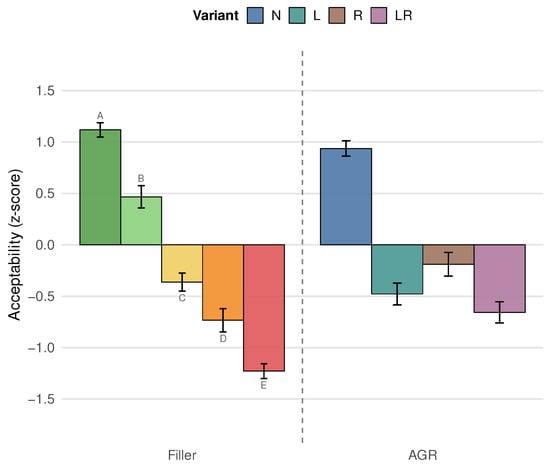
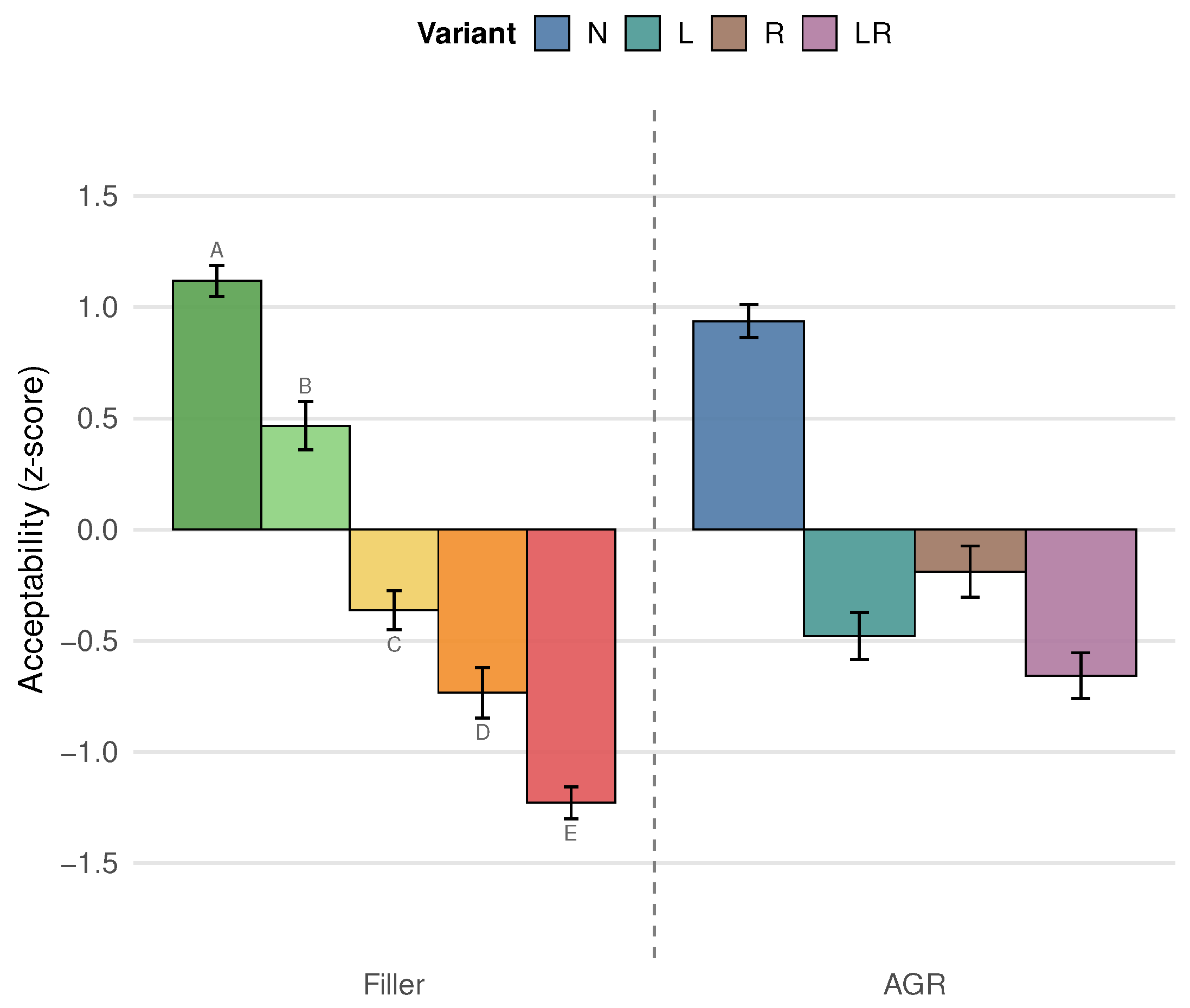
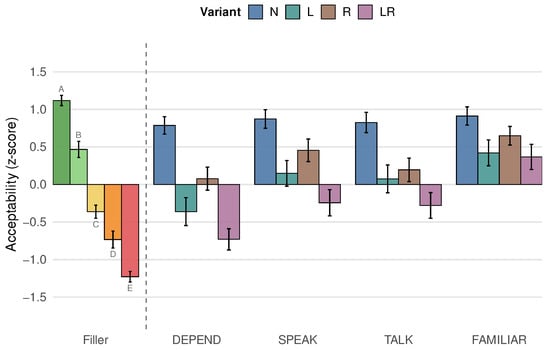
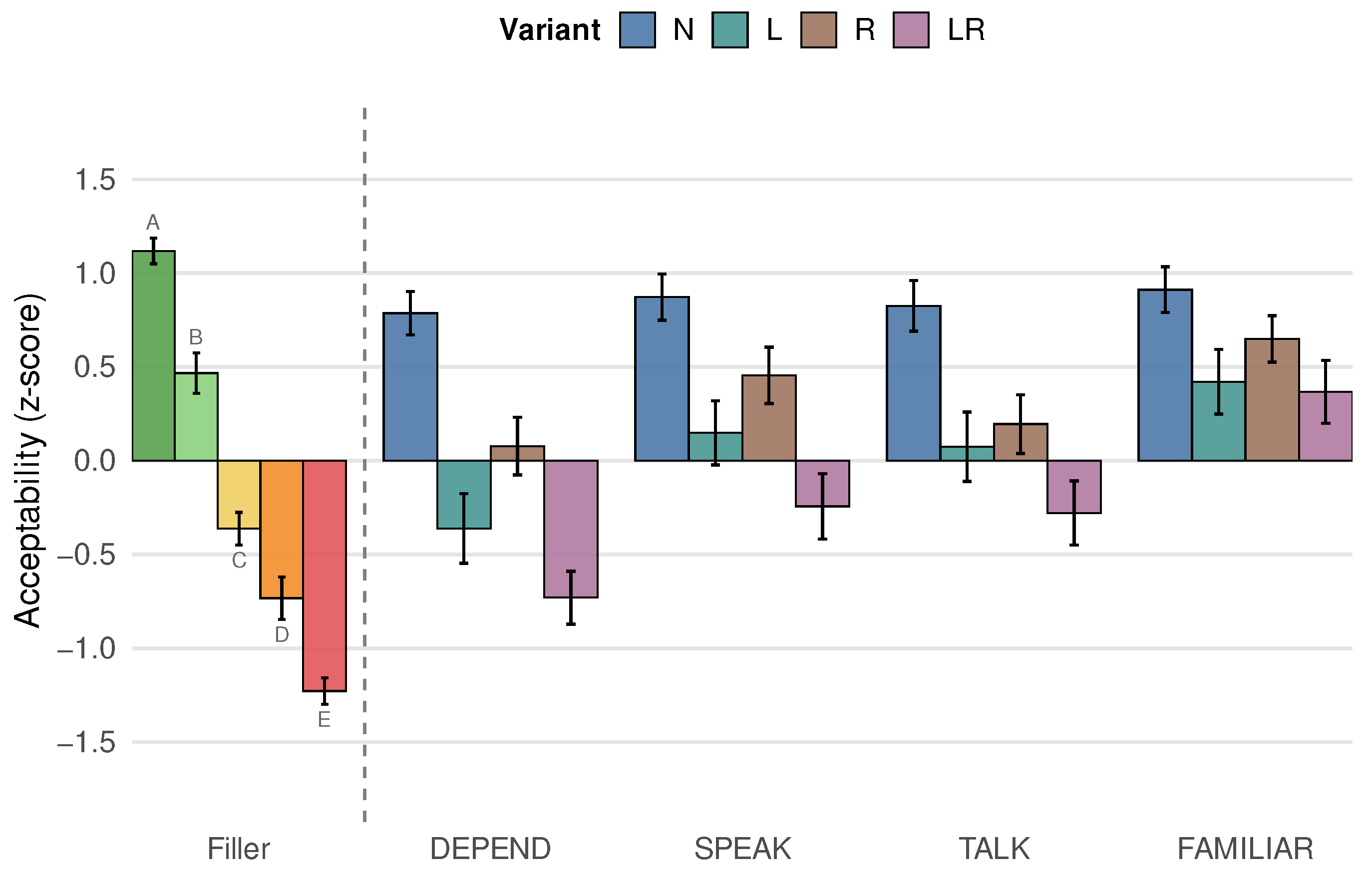
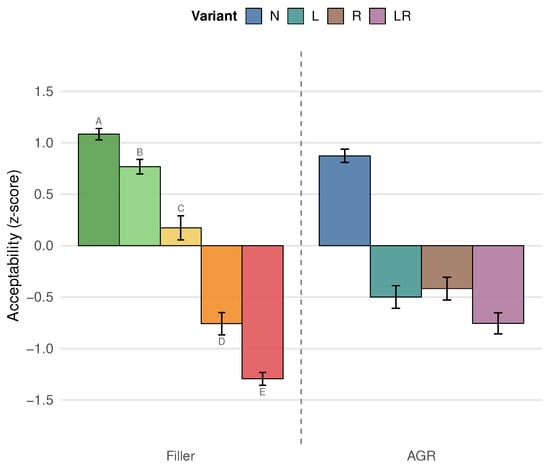
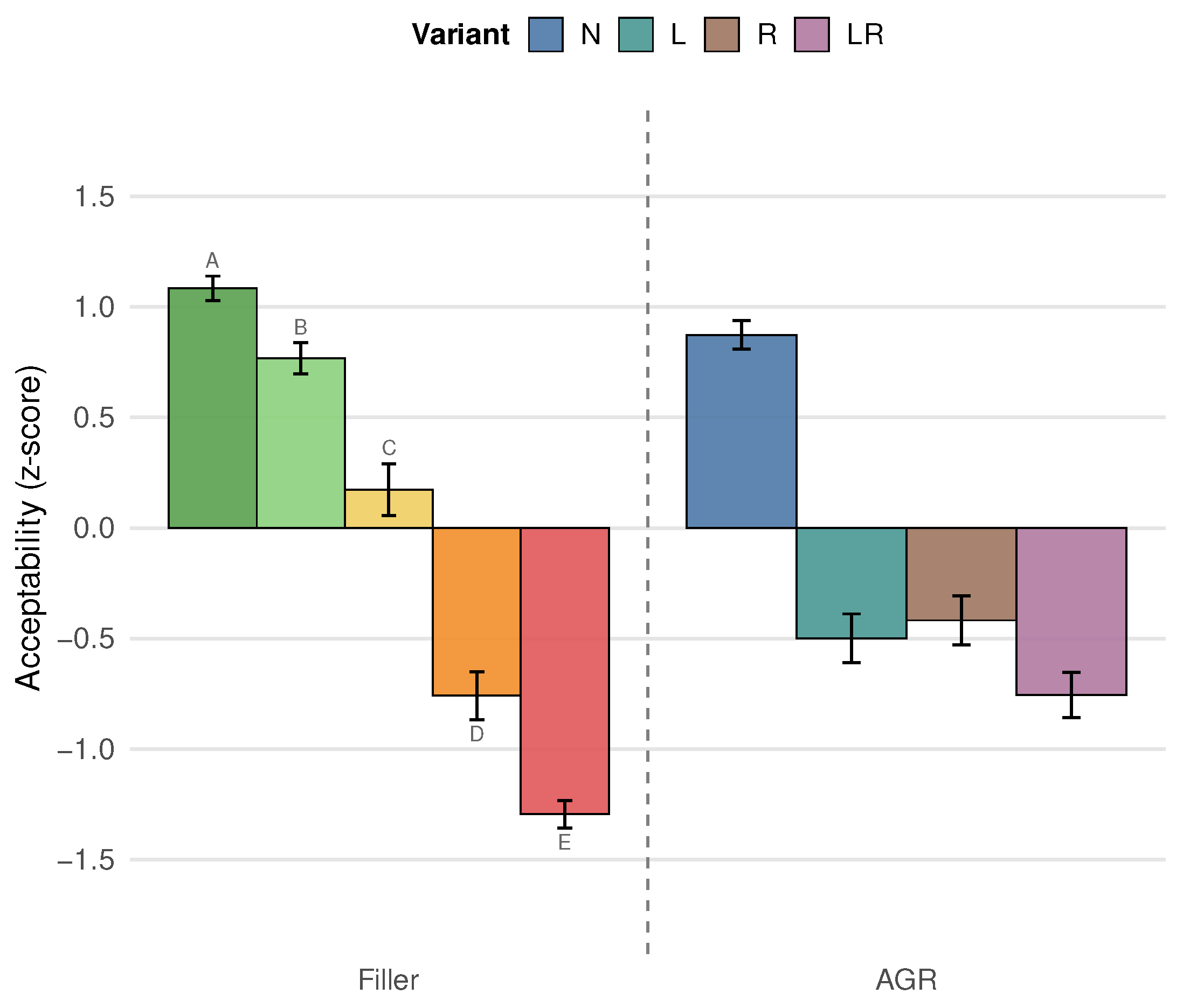
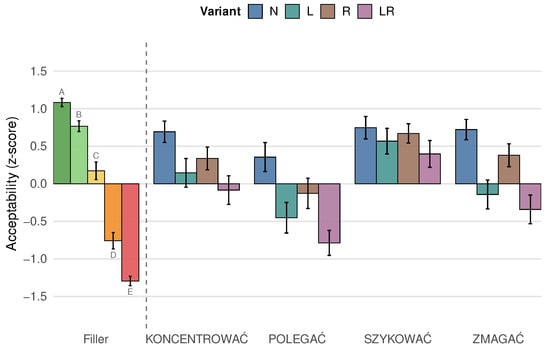
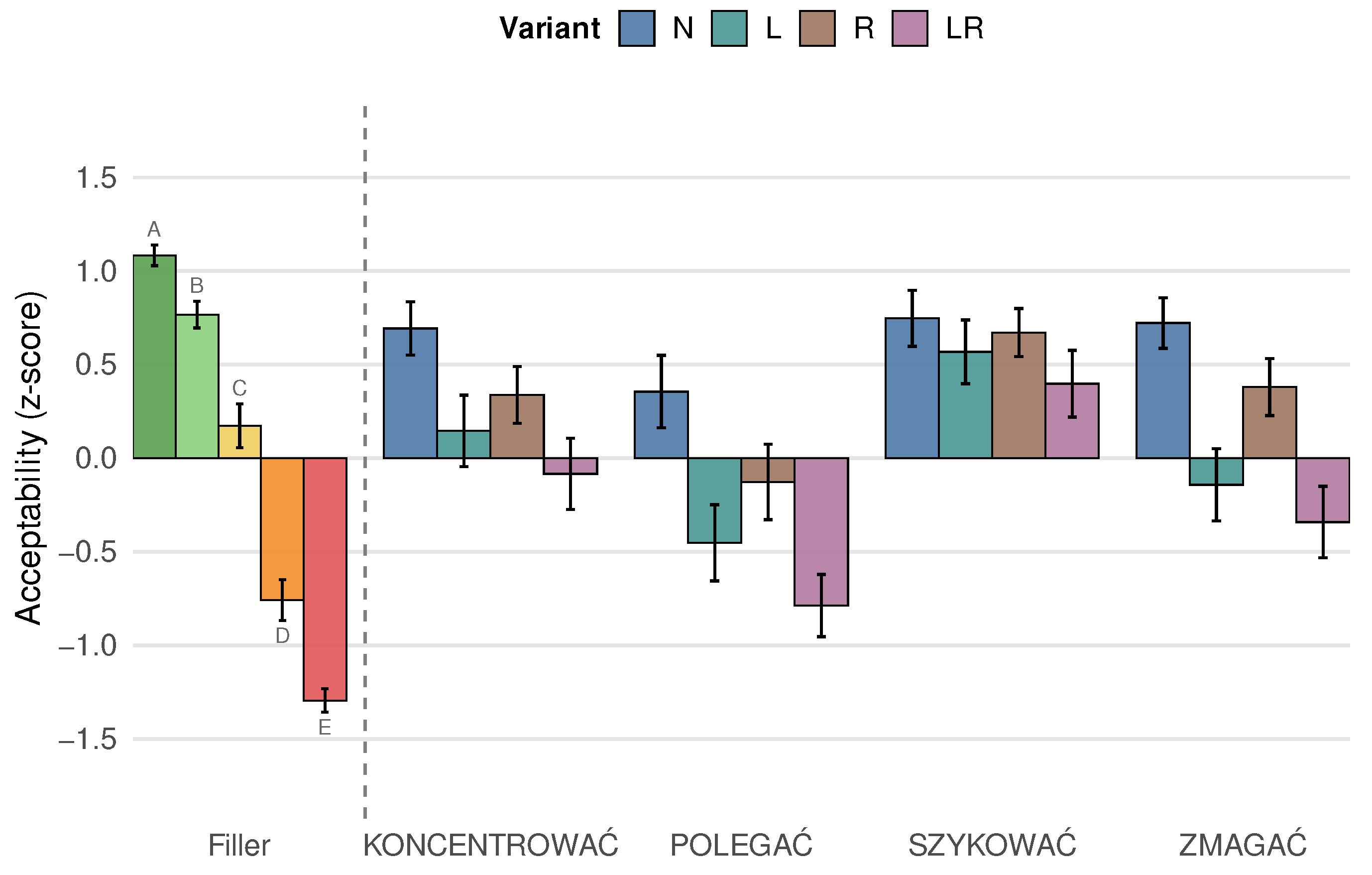
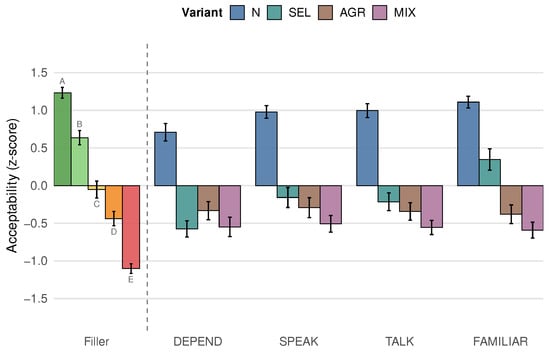
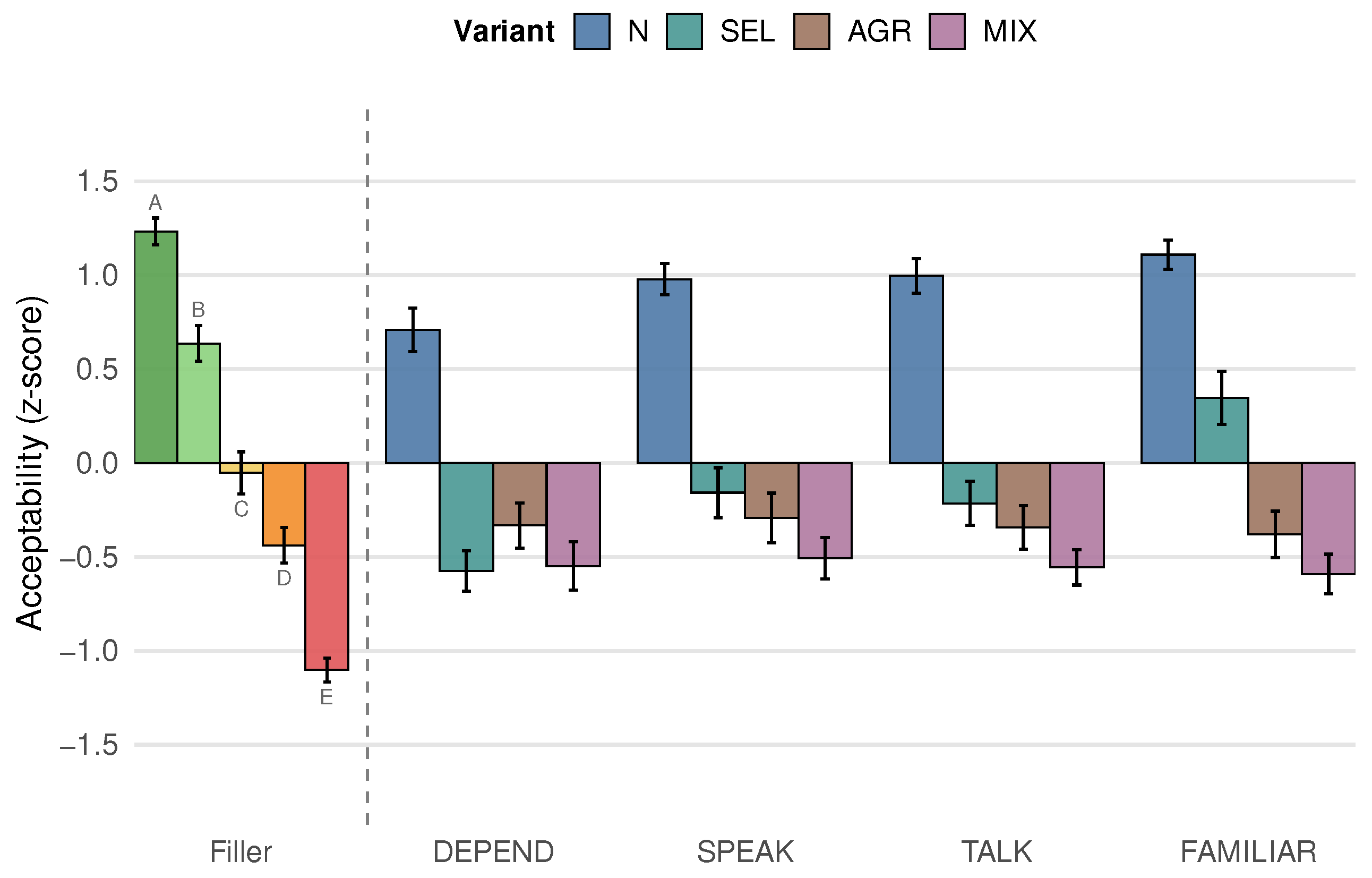
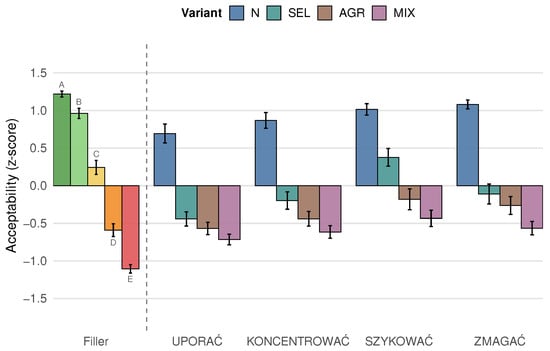
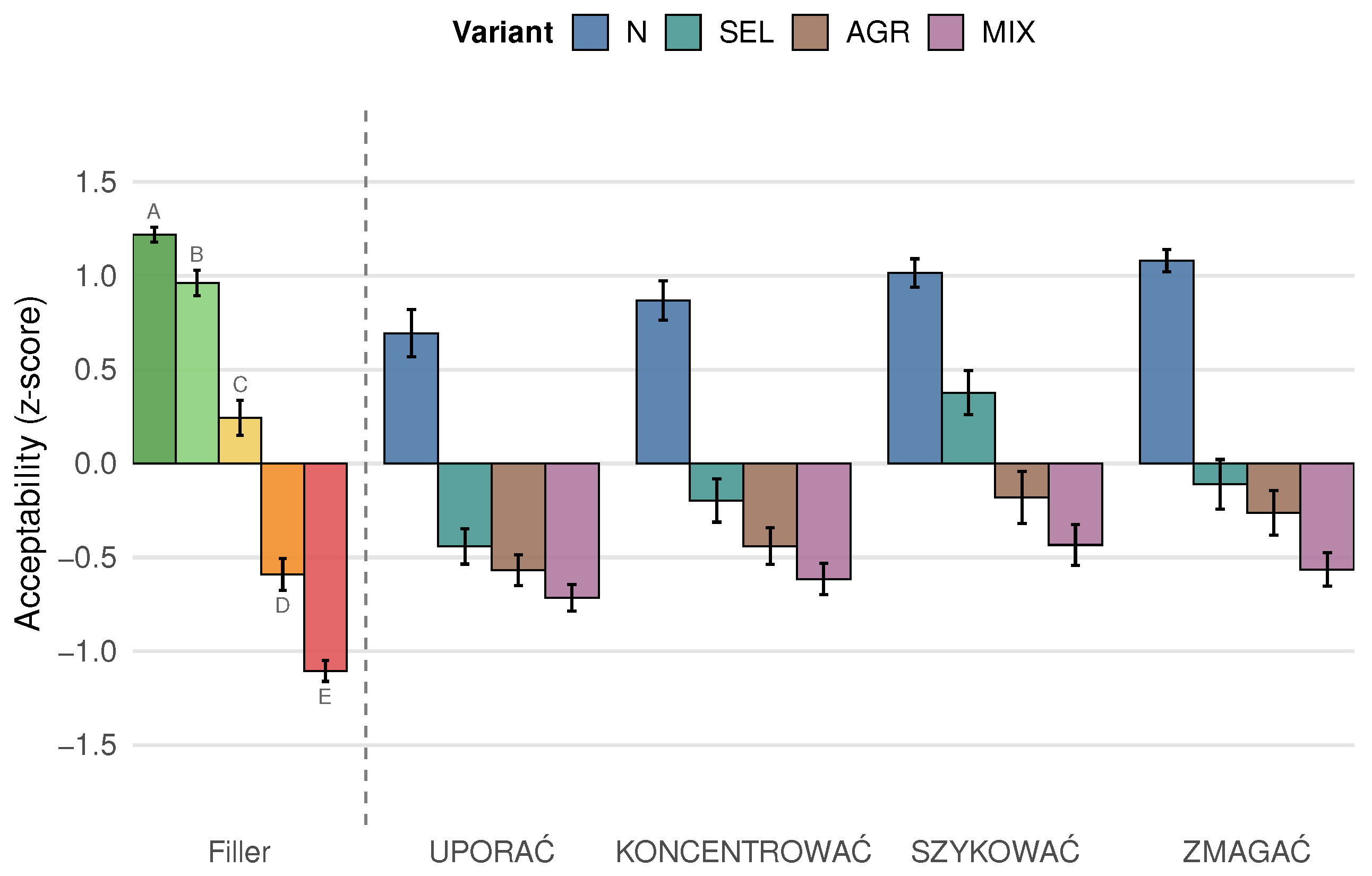
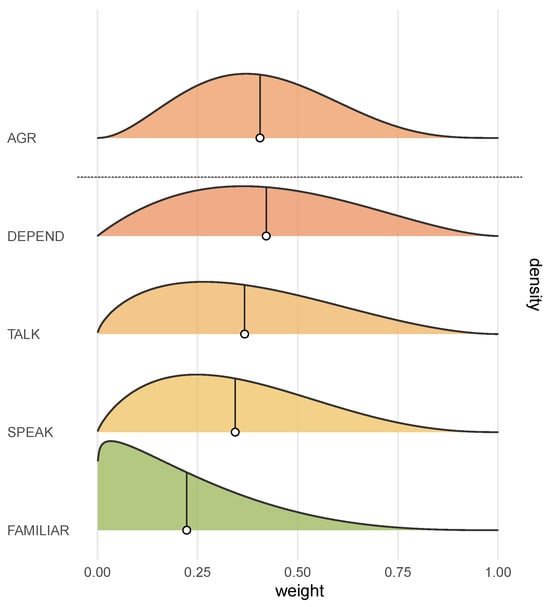
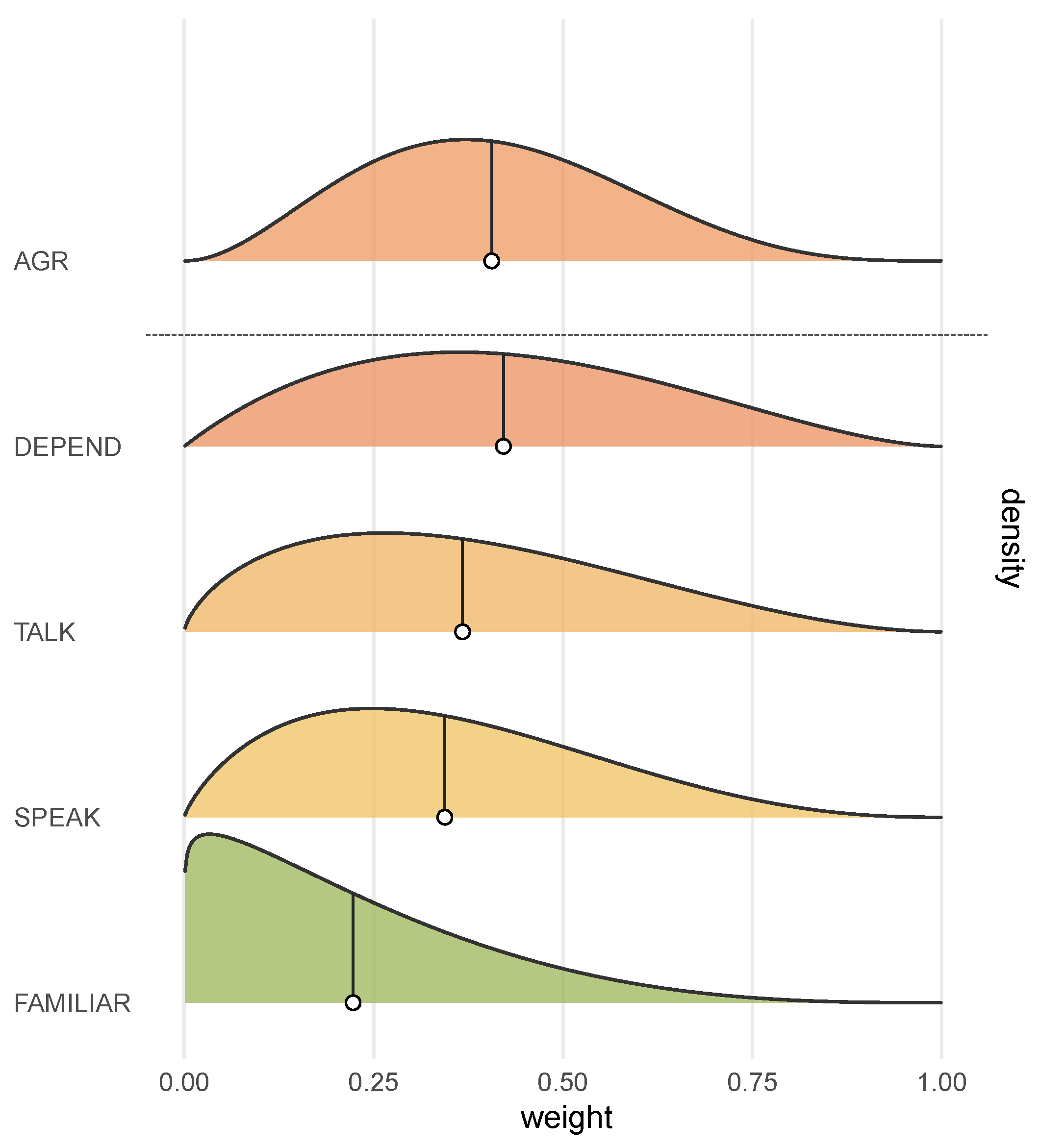
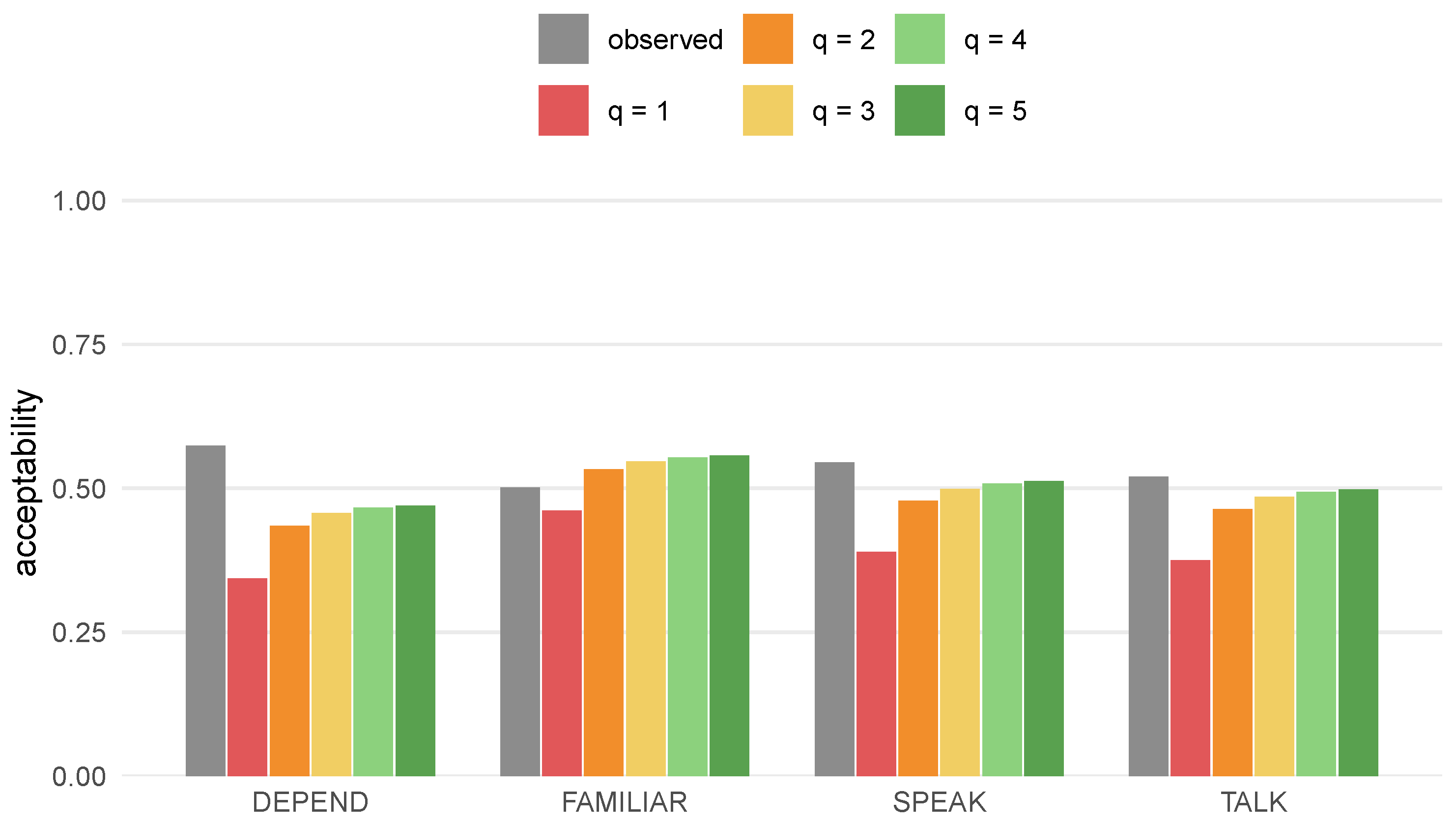
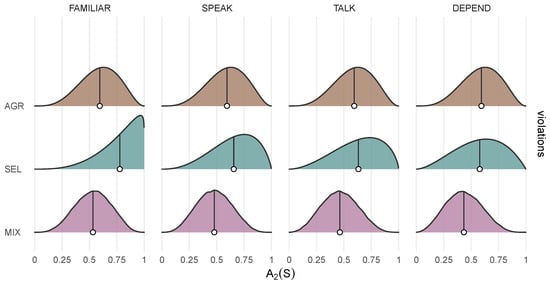
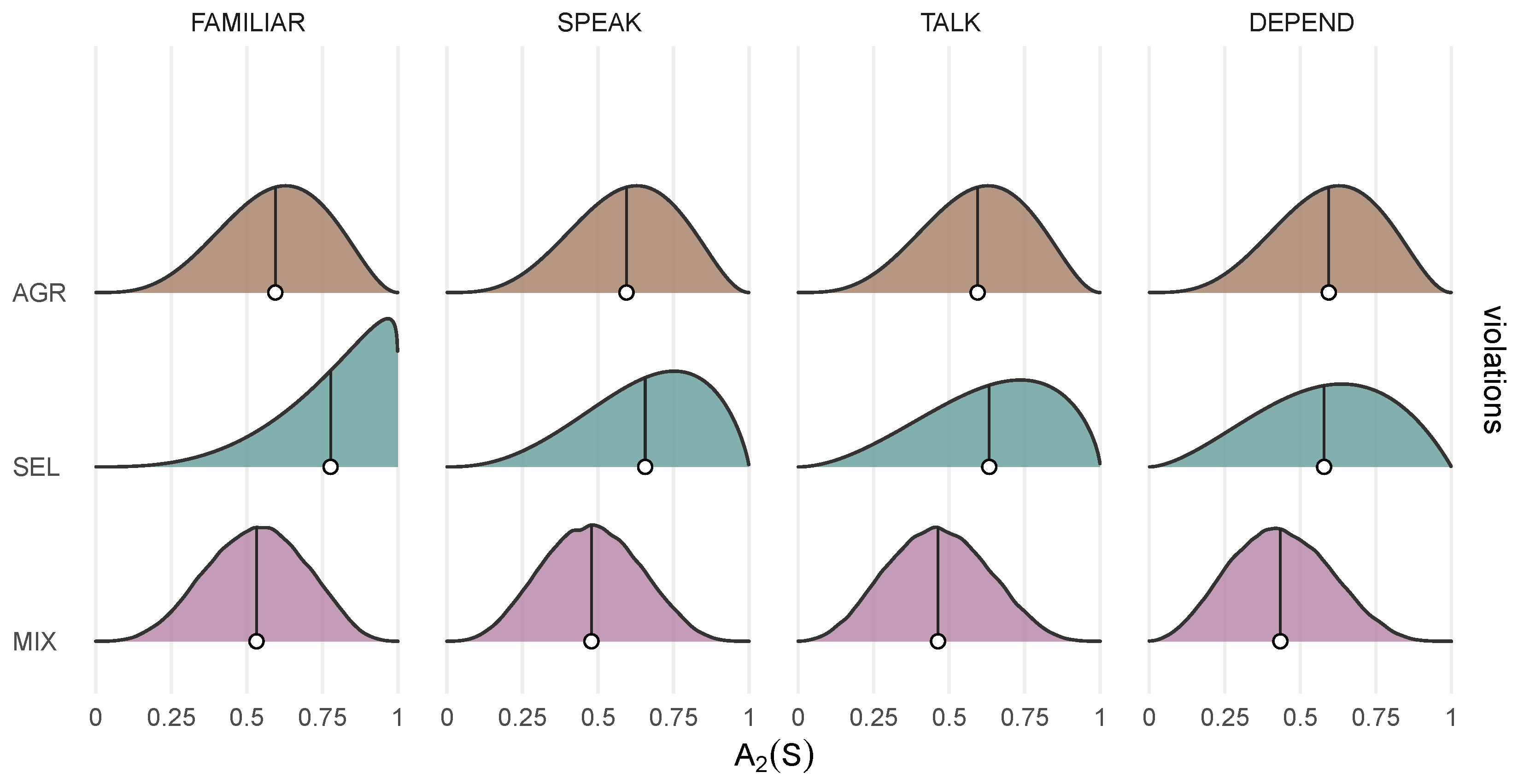

Disclaimer/Publisher’s Note: The statements, opinions and data contained in all publications are solely those of the individual author(s) and contributor(s) and not of MDPI and/or the editor(s). MDPI and/or the editor(s) disclaim responsibility for any injury to people or property resulting from any ideas, methods, instructions or products referred to in the content. |
© 2026 by the authors. Licensee MDPI, Basel, Switzerland. This article is an open access article distributed under the terms and conditions of the Creative Commons Attribution (CC BY) license.