


Abstract
This convergent mixed-methods study investigates international learners’ perceptions and academic outcomes associated with the strategic use of English as an instrumental language in Turkish as a foreign/second language (TFL) instruction. Combining a survey of 113 multinational learners with a 6-week quasi-experimental intervention at the B2 level (experimental group, n = 10; control group, n = 12), the study contrasts self-reported skill priorities with objective post-test performance. Survey findings indicate that learners prioritized instrumental language support primarily for grammar (M = 3.01) and vocabulary (M = 2.97), while viewing it as least necessary for writing and speaking. Conversely, post-intervention achievement comparisons revealed a skill-specific paradox: while no statistically significant differences emerged in grammar, vocabulary, reading, listening, or writing, the experimental group achieved significantly higher speaking scores (p = 0.007, r = 0.67) than the target-language-only control group. Qualitative responses suggest that instrumental language availability may function less as a metalinguistic grammar tool and more as an affective scaffold and psychological safety net, consistent with the possibility that it mitigates anxiety and facilitates communicative engagement, although these affective mechanisms were not directly measured. These preliminary findings support a judicious, skill-differentiated pedagogical model wherein Turkish remains the primary instructional medium while strategic cross-lingual resources are preserved for cognitively complex and emotionally demanding speaking tasks.
1. Introduction
In foreign language education, the choice of medium of instruction and classroom language policy has long been contested between rigid monolingual target-language-only paradigms and multilingual approaches leveraging learners’ existing linguistic repertoires (Turnbull & Dailey-O’Cain, 2009). In the context of teaching Turkish as a foreign/second language (TFL), this debate centers on balancing optimal exposure to the target language with the learners’ cognitive and affective demands. Traditionally, target-language-only instruction posits that maximum exposure accelerates second language (L2) acquisition. However, strictly monolingual policies often overlook the pedagogical potential of learners’ prior linguistic resources, potentially generating cognitive overload and affective barriers, particularly when processing abstract, typologically distant linguistic structures (Hall & Cook, 2012; Macaro, 2018).
To frame this debate, two operational concepts are central to this inquiry. First, instrumental language is operationally defined here as a shared non-target lingua franca (specifically English in multilingual TFL classrooms) deployed strategically by teachers or learners to mediate communication, clarify instructional tasks, and unpack complex target-language forms when learners do not share a common native language (L1) with the instructor (Jenkins, 2014; Macaro, 2018). Second, judicious use, following Macaro (2005) and recent pedagogical translanguaging frameworks (Cenoz & Gorter, 2022a), is defined as principled, selective, and goal-directed cross-linguistic support that serves as temporary scaffolding rather than persistent, unrestricted translation, ensuring that the target language remains the dominant medium of learning.
Recent empirical scholarship (2020–2025) across diverse multilingual settings has challenged the monolingual-bias assumption, providing substantial evidence that strategic cross-lingual practices and pedagogical translanguaging foster deeper comprehension, lexical expansion, and emotional safety without detracting from target-language acquisition (Cenoz & Gorter, 2022b; Wei, 2021). For instance, an empirical investigation by Galante (2020) demonstrated that pedagogical translanguaging and cross-linguistic scaffolding significantly reduced task-induced cognitive strain and communicative apprehension in plurilingual classrooms. Furthermore, recent classroom-based research on shared non-native linguistic resources (e.g., Fang et al., 2022; Paulsrud et al., 2021) reveals that learners actively leverage a shared lingua franca not to circumvent target-language engagement, but rather as an interactive bridge to sustain dialogue and coconstruct meaning during cognitively challenging tasks. Nevertheless, critical empirical gaps remain in the existing literature:
First, a substantial portion of studies on instrumental language and translanguaging have concentrated on receptive skills (reading and listening comprehension) or metalinguistic grammar awareness (Hall & Cook, 2012; Cenoz & Gorter, 2022a). Its direct, quantifiable impact on productive performance—specifically oral speaking proficiency under controlled conditions—remains largely underexplored. Speaking is cognitively demanding and emotionally high-stakes, as it requires spontaneous lexical retrieval, real-time syntactic assembly, and social vulnerability (Horwitz et al., 1986).
Second, prior research has rarely disentangled whether the benefits of instrumental language support stem primarily from cognitive pathways (e.g., alleviating processing demands of typologically complex grammar) or affective pathways (e.g., providing a psychological safety net that mitigates speaking anxiety).
To address these empirical and pedagogical gaps, the present study adopts a convergent mixed-methods quasi-experimental design. By combining large-scale learner perception surveys (N = 113), qualitative open-ended responses, and a 6-week quasi-experimental intervention (N = 22) in university-level TFL classrooms, this study investigates both how learners perceive instrumental language support across language skills and how its strategic implementation actually impacts academic performance, with special attention to speaking proficiency.
1.1. Language Choice in Foreign Language Teaching: From Monolingualism to Interlingualism
Approaches to language use in the classroom throughout the history of foreign language teaching are directly linked to methodological paradigms. The Direct Method, which emerged in the early 20th century, and the subsequent Audiolingual Method idealized a classroom environment where the target language was the sole valid means of communication (Howatt & Widdowson, 2004). Barın (2021) emphasizes that, specifically in the context of Turkish, learners can fully master the language through exposure to and engagement with it; therefore, the use of an instrumental language in classroom settings should be avoided. These approaches have positioned the learner’s native language as a cognitive interference or noise and excluded it from the learning process.
However, this rigid monolingualist perspective has been criticized, particularly in multilingual learning environments, and has given way to more flexible, learner-centered approaches. One of the most prominent manifestations of this shift is the translanguaging paradigm. Translanguaging refers to the use of all linguistic resources an individual possesses as a dynamic and holistic system (García & Wei, 2014). From this perspective, the learner’s native language and other languages they know are not obstacles to acquiring a new language; rather, they are cognitive tools that deepen understanding.
Furthermore, Cummins’s (2007) Common Underlying Proficiency hypothesis provides theoretical grounding for the idea that L1 use can support L2 development by positing cognitive-level transfer across languages. In this context, learners’ positioning of the instrumental language as a guarantee of understanding can be interpreted not merely as a practical choice but also as a strategic behavior that optimizes cognitive economy. Nation (2003), when evaluating the role of the native language or the instrumental language in the classroom, argues that this language serves as a strategic tool that makes complex structures transparent and helps the learner construct their cognitive map.
A terminological clarification is warranted here. Translanguaging, as developed by García and Wei (2014), refers to a learner’s fluid, integrated use of their entire linguistic repertoire and is typically studied in settings where the additional language is a learner’s own L1 or another language in their repertoire. The present study’s use of English as an instrumental language is a related but narrower phenomenon: for most participants, English is not a first language but an additional, shared language that functions as a lingua franca between instructor and learners (Section 1.4), deployed in a more circumscribed, teacher-mediated way than the learner-driven, holistic repertoire use that translanguaging scholarship typically describes. The theoretical and empirical literature on L1 use and translanguaging is drawn on here because it establishes the broader principle that departures from a target-language-only policy can be pedagogically productive rather than merely permissive; the specific mechanism examined in this study, however, is the narrower case of a shared additional language used instrumentally, and claims from the translanguaging literature are treated as relevant by analogy rather than as directly transferable findings.
1.2. The Affective Filter Hypothesis and Speaking Skills
Stephen Krashen’s Affective Filter Hypothesis has systematically explained the role of affective variables in language acquisition. Situated within Krashen’s broader Monitor Model, the hypothesis holds that comprehensible input is a necessary but not sufficient condition for acquisition: when anxiety is high or motivation and self-confidence are low, an internal affective filter rises and impedes otherwise comprehensible input from being processed for acquisition, regardless of its pedagogical quality (Krashen, 1982). According to this hypothesis, the learner’s anxiety level, motivation, and self-confidence directly influence the mechanisms through which language input is acquired (Krashen, 1982). A high anxiety level raises this filter in the learner’s mind, hindering the processing of input. Speaking, by its very nature, requires spontaneous production, involves the risk of mistakes, and requires being open to social evaluation; it is the skill area in which this filter is felt most intensely (Horwitz et al., 1986). Therefore, pedagogical interventions aimed at improving speaking performance must target not only the cognitive but also the affective dimension.
While traditional approaches argue that using learners’ first language or a shared instrumental language may reduce opportunities for target-language production, more recent studies challenge this assumption. For example, Brooks-Lewis (2009) demonstrated that using the first language can encourage target-language production by boosting learners’ confidence. Similarly, Levine (2011) found that strategic L1 use reduces classroom anxiety and increases interaction. Examining teachers’ own classroom practice, Copland and Neokleous (2011) further showed that teachers’ decisions to switch to the L1, particularly during grammar explanation, are often driven as much by intuitive affective and comprehension judgments in the moment as by any deliberate, pre-planned instructional strategy. Previous studies suggest that strategically using an instrumental language may facilitate speaking performance by reducing cognitive demands during oral production. These findings suggest that the use of an instrumental language should be viewed not as a ‘crutch’ but as a strategic pedagogical resource that may facilitate learners’ performance under cognitively demanding conditions.
1.3. Cognitive Scaffolding and Judicious Use
Within the sociocultural theory framework, learning is a dynamic process through which an individual continues their cognitive development via social interactions. The concept of the Zone of Proximal Development (ZPD), developed by Vygotsky (1978), posits that a learner can accomplish tasks they cannot perform on their own with appropriate support. This support mechanism is referred to as scaffolding in the educational literature (Wood et al., 1976).
In this context, the use of the instrumental language can be viewed as temporary, goal-oriented cognitive support. Macaro (2005) explains this situation using the concept of judicious use and notes that both the complete prohibition of the instrumental language and its unrestricted use pose pedagogical problems. According to him, effective instruction requires a conscious strategy that determines when, how, and for what purpose an instrumental language should be used. The research findings reveal that learners’ demand for the instrumental language—particularly in grammar and vocabulary—indicates that this language serves as a cognitive bridge for understanding abstract and complex structures. However, learners’ emphasis on context-dependent usage suggests that this support should be temporary rather than permanent. This finding aligns with the principle of measured use in the literature and underscores the need for balance in pedagogical design.
1.4. English: A Lingua Franca in Classroom Interaction
In globalizing educational environments, the coming together of learners with diverse linguistic backgrounds has increased the need for a common means of communication. In this context, English, as a Lingua Franca, serves as a bridge language between both teachers and learners in foreign language classrooms (Jenkins, 2014). Central to this perspective is a shift away from evaluating English use against a native-speaker norm and toward evaluating it in terms of mutual intelligibility among multilingual interlocutors, positioning English-as-lingua-franca users as legitimate, multicompetent communicators rather than deficient non-native speakers (Jenkins, 2014). In a TFL classroom where learners and, at times, the instructor do not share a common first language, English can therefore function not as a target language in its own right but as a shared communicative resource that keeps interaction moving forward while Turkish remains the object of instruction. Cook (2001) notes that the use of an instrumental language in multilingual classrooms enhances communicative efficiency, particularly in situations such as giving instructions, classroom management, and explaining complex tasks. This allows cognitive resources to be directed more toward target language production. Themes such as comfort, ease, and a guarantee of being understood that emerge in the qualitative data demonstrate that English is not merely a functional tool but also an affective regulator. In this regard, English creates a psychological safety zone for learners in the classroom and increases participation, particularly in high-stakes tasks such as speaking.
1.5. Toward an Integrated Conceptual Model
The theoretical perspectives reviewed above—translanguaging, Cummins’s Common Underlying Proficiency, Krashen’s Affective Filter Hypothesis, Vygotskian scaffolding, Macaro’s judicious use, and English as a lingua franca—are not competing explanations but complementary components of a single underlying process. To integrate them, the present study treats Vygotskian scaffolding as the central organizing framework: the instrumental language is conceptualized as a temporary, learner-external support that is withdrawn as competence develops, consistent with the Zone of Proximal Development. Translanguaging and Cummins’s Common Underlying Proficiency specify why such scaffolding is cognitively available to the learner in the first place, since the learner’s full linguistic repertoire, rather than the target language alone, constitutes the resource pool from which scaffolding is drawn. Macaro’s principle of judicious use specifies the boundary conditions under which this scaffold remains a support rather than a crutch: it must be strategic, purposeful, and reduced as proficiency increases.
On this basis, the study proposes the following conceptual pathway: strategic, judicious availability of an instrumental language → (a) reduced cognitive load during the processing of complex or abstract target-language input, drawing on the cross-linguistic transfer described by Common Underlying Proficiency, and (b) reduced affective filtering, in the sense described by Krashen’s Affective Filter Hypothesis, as the instrumental language lowers the perceived risk of communication breakdown → increased learner willingness to engage in spontaneous, socially evaluated production, particularly speaking → improved speaking performance. English’s status as a lingua franca (Section 1.4) is treated as a contextual facilitator of this pathway rather than a separate mechanism: because English functions as a shared bridge language for a linguistically heterogeneous classroom, its availability as an instrumental language is feasible for the great majority of learners in this setting, regardless of their first language.
This model generates testable expectations that are examined empirically in Section 3 and Section 4. If the pathway operates primarily through the cognitive/Common-Underlying-Proficiency route, instrumental language availability should be associated with gains in the specific content areas (grammar, vocabulary) where it was applied. If it operates primarily through the affective/scaffolding route, its effect should be more diffuse, appearing in performance domains such as speaking that depend heavily on learner confidence and willingness to communicate, even when instrumental language support was not directly targeted at that domain. Section 4.1 returns to this distinction when interpreting the study’s central finding.
Based on the theoretical framework and identified empirical gaps, this study is guided by the following four specific research questions:
- -
- RQ1 (Skill-Based Perceptions): Which language skills and instructional tasks do international learners perceive as benefiting most from instrumental English support in TFL classrooms?
- -
- RQ2 (Proficiency Differences): Do learners’ perceptions regarding the necessity of instrumental language use and attitudes toward Turkish-only instruction differ significantly according to their Turkish (TPL) or English (EPL) proficiency levels?
- -
- RQ3 (Learner Rationales): What cognitive, communicative, and affective rationales explain learners’ preference for either target-language exclusivity or conditional instrumental language use?
- -
- RQ4 (Instructional Intervention): Does the strategic and judicious use of English as an instrumental language during grammar and vocabulary instruction lead to statistically significant differences in learners’ post-intervention achievement across specific skill domains (listening, reading, writing, speaking, and grammar), particularly speaking performance?
2. Materials and Methods
2.1. Research Model
The present study employs a mixed-methods research design, combining quantitative and qualitative data collection and analysis techniques. The mixed-methods approach was chosen because it allows for the phenomenon to be explained through both statistical generalizations and in-depth insights (Creswell & Plano Clark, 2011). In the quantitative phase of the study, a survey design was used to determine learners’ perceptions, while the experimental component employed a quasi-experimental post-test control group design to examine the effects of instrumental language support on post-intervention language performance. Since a separate pre-intervention speaking test was not administered, participants’ standardized B1 proficiency examination scores, obtained immediately before the B2 instructional period, were used as baseline indicators of prior proficiency to examine the initial comparability of the experimental and control groups. In the qualitative phase, content analysis was conducted on open-ended responses—collected as part of the same 113-person survey, concurrently with the quantitative items—to identify learners’ unique perspectives on the language support provided through the instrumental language. Following Creswell and Plano Clark (2011), the study follows a convergent (parallel) mixed-methods design: the quantitative (survey and experimental) and qualitative (open-ended) strands were collected concurrently and analyzed separately, and were then merged at the interpretation stage, where quantitative results and qualitative themes are brought together in a joint display (Section 4.3) to examine where the two strands converge, diverge, or expand on one another.
2.2. Study Group
The study group for this research was determined using the criterion sampling technique, a purposive sampling method. In this context, the study involved two distinct groups:
- General Trend Group: The large-scale participant group of the study consists of 113 international students enrolled at the Turkish Teaching Application and Research Center (TÖMER) in Turkey, who completed the questionnaire in full and are at various language proficiency levels ranging from A1 to C1.
- Experimental Application Group: To test the direct effect of the use of the instrumental language on academic performance, 22 students with a homogeneous background studying at the B2 level were selected. Prior to group formation, all 22 students completed a survey assessing their English proficiency level; based on these results, participants were balanced across the two groups so that English proficiency was distributed as evenly as possible before assignment. Students were then randomly assigned within each proficiency band to an experimental (n = 10) and a control (n = 12) group by the researcher, who also served as the instructor for both groups; because the same person conducted the assignment and delivered the instruction, allocation was not concealed from the instructor. Each participant was anonymized with a code (e.g., P1, P2, …) for data recording and analysis. In addition to the English-proficiency balancing, participants’ scores on the standardized examination for the level immediately preceding the B2 instructional period were used as a pretest indicator of prior achievement. The demographic characteristics of the general trend group are presented in Table 1.Table 1. Demographic characteristics of the general trend group.
Of the 113 students participating in the study, 60.2% were female, and 39.8% were male. Although the participants’ ages ranged from 17 to 31, the average age was 23.16. Turkish proficiency level (TPL) was determined by participants’ most recently completed institutional course level, based on a standardized achievement examination prepared by TÖMER (not by the researcher) and administered to all students at that level; each exam is reviewed by subject-area specialists prior to administration. English proficiency level (EPL) was self-reported by participants. In the study, Turkish and English proficiency levels were treated as two independent variables. The distribution of participants’ Turkish language proficiency levels is as follows: 10.6% at the A1 level, 42.5% at the A2 level, 9.7% at the B1 level, 24.8% at the B2 level, and 12.4% at the C1 level. Additionally, 11.5% of the learners are at the A1 level, 14.2% at the A2 level, 23.9% at the B1 level, 13.3% at the B2 level, and 12.4% at the C1 level in English, while 23.9% do not know English.
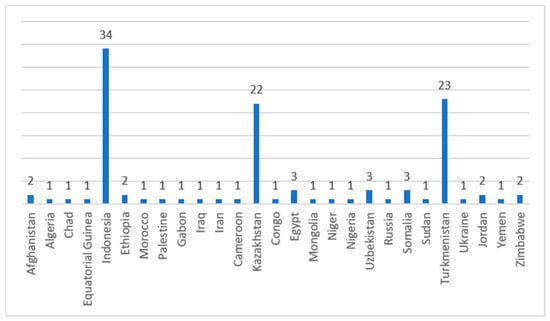
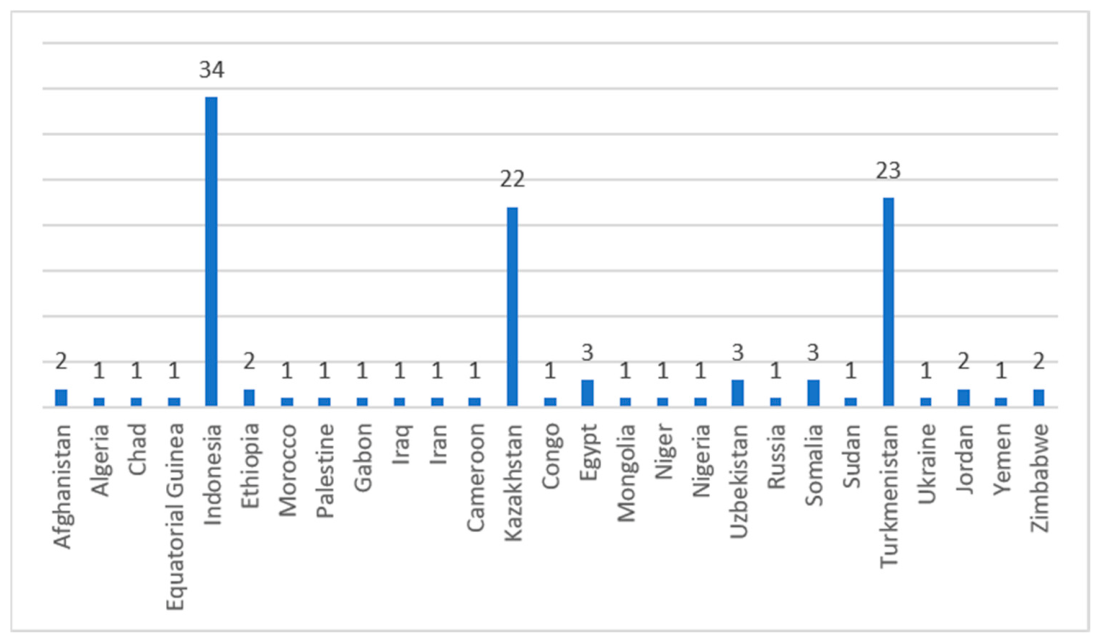
In addition to this information about the participants, Figure 1 provides details regarding their countries of origin. Learners from many different countries participated in the study. However, among the largest groups of participants, the majority are 34 Indonesian, 23 Turkmen, and 22 Kazakh learners. The demographic characteristics of the experimental and control groups are presented in Table 2.
Figure 1.
Countries in the General Trend Group (Note: The study involved learners from many different countries. However, among the largest groups of participants, the majority are 34 Indonesian, 23 Turkmen, and 22 Kazakh learners).
Table 2.
Demographic characteristics of the experimental group.
Of the 22 students included in the experimental study, 10 are in the experimental group, and 12 are in the control group. The experimental group consists of 40% female and 60% male students; the control group consists of 50% female and 50% male students. In the experimental group, 5 students are at the B1 level, 4 at the B2 level, and 1 at the C1 level; in the control group, 5 students are at the B1 level, 6 at the B2 level, and 1 at the C1 level in English.
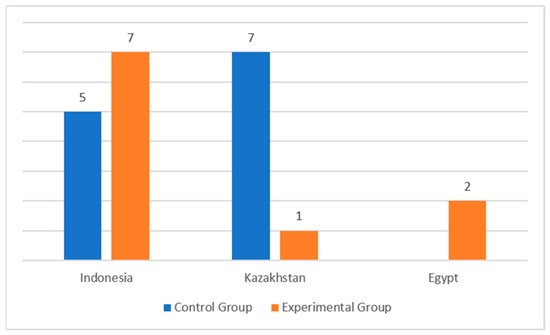
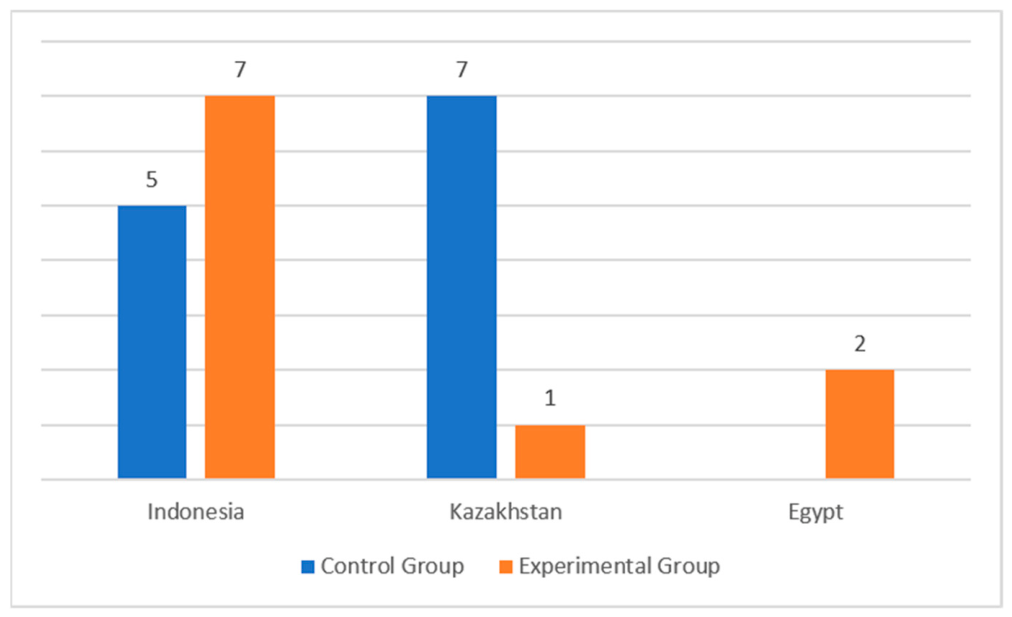
Before the six-week intervention, all students had successfully completed the institutional B1 Turkish course and taken the standardized B1 proficiency examination, which served as the end-of-level assessment. Since this examination was administered immediately before the B2 instructional period, the B1 scores were used as baseline indicators of participants’ prior proficiency. Baseline comparisons between the experimental and control groups were conducted to determine whether the groups differed significantly before the intervention. The countries of origin for the control and experimental groups are presented in Figure 2.
Figure 2.
Countries in the Control and Experimental Groups.
While the control group consists of students from Kazakhstan and Indonesia, the experimental group consists of students from Indonesia, Kazakhstan, and Egypt.
2.3. Data Collection Tool
To identify students’ general tendencies regarding the use of English as an instrumental language, the study utilized a survey and open-ended questions created using Microsoft Office Forms as its data collection tool. The first section of the survey consists of seven questions designed to determine participants’ demographic characteristics. In the second section, participants were presented with Likert-format questions organized into three main categories. The first set of questions was designed to assess instructors’ attitudes toward the use of English as an instrumental language in the classroom. This section included three items with the response options always, often, sometimes, rarely, and never. In the second question group, a two-item question was presented to determine learners’ expectations regarding the use of the instrumental language, with the options I definitely want it, I want it, I am undecided, I do not want it, and I definitely do not want it. The third set of questions aimed to understand participants’ views on the exclusive use of the target language in class and the instructor’s proficiency in English, with the options very important, important, undecided, not important, and not at all important. This instrument was not developed or validated as a psychometric scale; it was a researcher-constructed opinion survey intended solely to capture learners’ self-reported tendencies and views, and the resulting scores should be interpreted descriptively rather than as scores on an established construct. For example, two items from the third question group read: “Do you think it is important to speak only Turkish in Turkish lessons?” and “Do you think it is important for a Turkish teacher to know English?”, each rated on the five-point scale described above.
In the study, participants were asked to rank the following items in order of importance to determine which aspect they believed receiving assistance in the target language was most beneficial for: grammar, vocabulary, reading skills, writing skills, speaking skills, and listening skills.
Finally, two open-ended questions were included in the study. The first open-ended question was “If it is important for your teacher to know English, why is it important?”, and the second was “Please write down any other thoughts you have about receiving assistance in another language during Turkish language classes.”
During the experimental implementation phase, end-of-term achievement test results for the experimental and control groups were used to determine whether the process was effective. The examination is a standardized institutional achievement test routinely used to assess learners’ proficiency at the end of each instructional level, consisting of the sub-dimensions of listening, reading, writing, speaking, and grammar. The test includes 25 questions for listening, 15 for reading, and 10 for grammar, while speaking and writing skills are evaluated on a 25-point scale. Speaking performance was assessed using the same institutional speaking rubric that raters at this language center routinely use for end-of-level assessment; because this rubric was already familiar to the raters through their regular institutional duties, and joint-rating calibration sessions are held periodically as part of standard institutional practice, no additional calibration exercise was conducted specifically for this study. Two raters, who were blind to each student’s group assignment (experimental vs. control), independently scored each recorded speaking sample. When the two raters’ scores diverged, a third evaluator scored the recording independently, and this third score served as the final, deciding score; because audio recordings of all speaking assessments were retained, the researcher was able to review the final scores, although the researcher did not act as a primary or deciding rater in order to reduce the risk of bias given the researcher’s dual role as instructor. Formal inter-rater reliability statistics (e.g., Cohen’s kappa or intraclass correlation) were not computed; this is acknowledged as a limitation of the study.
In addition to the B2 end-of-term achievement examination, participants’ standardized B1 proficiency examination results were obtained from institutional records. The B1 examination was administered on 11 April 2025 and the B2 end-of-term achievement examination on 31 May 2025. Since the B1 examination had been completed immediately before the beginning of the B2 instructional period and was based on the same institutional assessment framework, these scores were used as baseline indicators of participants’ prior language proficiency. The B1 examination assessed the same language skill domains (listening, reading, grammar, writing, and speaking) as the B2 achievement examination, allowing baseline comparisons between the experimental and control groups before the intervention.
2.4. Data Collection Process
In this study, data identifying learners’ general tendencies were collected online via Microsoft Office Forms on a strictly voluntary basis. Given that language proficiency might influence learners’ perceptions of the target language, particular care was taken to ensure that participants included Turkish learners at varying proficiency levels. Data was collected from participants enrolled in the Turkish Language Teaching and Research Center (TÖMER) of a state university in Turkey; the institution’s name is withheld to preserve the anonymity of the double-blind review process, given the first author’s affiliation with it.
The experimental implementation process lasted a total of 6 weeks, from 21 April to 30 May 2025. In the experimental group, the instructor provided strategic English support in accordance with the principle of “judicious use,” particularly during the teaching of grammar topics with high cognitive load and abstract vocabulary. In the control group, within the same content and class hours, the teaching process was conducted using traditional methods and entirely in the target language (Turkish). At the end of the process, post-tests (achievement exams) were administered to both groups to collect data.
The same instructor—the researcher—delivered instruction to both the experimental and control groups; because the instructor also conducted the group assignment described in Section 2.2, the instructor was not blind to the condition. Core instructional materials, content, and class hours were identical across the two groups. The only material difference was that, in the experimental group, the instructor added English equivalents to grammar and vocabulary worksheets in addition to the shared base materials. Operationally, “strategic” English use consisted of providing Turkish–English equivalents both orally and in writing wherever an opportunity arose, an approach broadly comparable to a grammar-translation technique, rather than following a fixed protocol specifying particular activities or a set frequency.
2.5. Data Analysis
The data collected using the researcher-prepared data collection tool to identify learner tendencies were first transferred to an Excel file. The Likert-scale questions were scored and converted into quantitative data in Excel. The data was analyzed using SPSS 21. First, the data were examined to determine whether they followed a normal distribution.
In this study, quantitative data were analyzed using descriptive and inferential statistical techniques. For each questionnaire item, the distribution of participants’ responses by English proficiency level was examined, and the data were assessed for normality. To this end, skewness and kurtosis values, along with descriptive statistics, were used. The obtained values indicated that the data did not follow a normal distribution.
Since the data did not meet the assumptions of parametric tests, the Kruskal–Wallis H test was applied to determine whether there were significant differences between the groups. The qualitative data from open-ended questions were coded inductively, grouped into common themes, and supported by direct quotations. Coding was carried out by a single researcher; a second coder was not involved, and inter-coder agreement was therefore not calculated, which is acknowledged as a limitation of the qualitative analysis.
For the experimental component of the study, data analysis was conducted in two stages. First, participants’ B1 proficiency examination scores were compared using the Mann–Whitney U test to examine the baseline comparability of the experimental and control groups prior to the intervention. Subsequently, the same statistical procedure was applied to compare the B2 end-of-term achievement scores of the two groups following the six-week instructional period. The Mann–Whitney U test was preferred because the sample size was small (N = 22) and the data did not meet the assumptions required for parametric analyses. No family-wise correction (e.g., Bonferroni) was applied across the six skill-level comparisons in reported below since the study is exploratory and each skill represents a conceptually distinct outcome rather than repeated tests of the same hypothesis; however, this means the single significant result (speaking) should be interpreted with the possibility of a false positive in mind, particularly given the small sample. The Dunn–Bonferroni correction was applied specifically to the post-hoc pairwise comparisons following the one significant Kruskal–Wallis test among the perception-ranking analyses, where multiple pairwise comparisons within a single omnibus test made such a correction appropriate.
2.6. Ethical Considerations and Approvals
The study’s compliance with scientific ethical guidelines has been rigorously ensured. In this context, ethical approval regarding the applicability of the data collection tools was obtained from the Bartın University Social and Human Sciences Ethics Committee. Official institutional permission for the experimental application and data collection process was obtained from the Bartın University TÖMER Directorate. The purpose of the study was explained to all participants, and a “Voluntary Consent Form” was signed, committing that the data would be used solely for scientific purposes.
3. Results
3.1. Findings Regarding the Frequency with Which Instructors Provide English Equivalents for Turkish Words
Participants’ perceptions of how frequently their instructors provided English equivalents for words they encountered during the Turkish learning process were analyzed. The frequency (f) and percentage (%) distributions of learners’ statements on this topic across different language proficiency levels (A1–C1) are presented in Table 3.
Table 3.
The frequency with which instructors provide the English equivalents of Turkish words.
According to Table 3, at the A1 level, 50.00% of learners reported that their instructors “sometimes” provided English equivalents of Turkish words, 25.00% said “rarely,” 16.67% said “often,” 8.33% said “never,” and none (0.00%) reported “always.” At the A2 level, learners reported “rarely” (37.50%) most frequently, followed by “sometimes” (29.17%), “never” (16.67%), and “always” and “often” (8.33% each). At the B1 level, 63.64% of learners stated that their instructors never provided English equivalents for vocabulary, 27.27% said “rarely,” and 9.09% said “sometimes,” with no learners reporting “always” or “often.” At the B2 level, 39.29% reported “never,” 32.14% “sometimes,” 21.43% “rarely,” and 3.57% each for “always” and “often.” At the C1 level, 42.86% reported “sometimes,” 35.71% “never,” 14.29% “rarely,” 7.14% “often,” and none reported “always.” Overall, “rarely” (28.32%) and “sometimes” (31.86%) were the most common responses across the sample, while “always” was reported least often (4.42%).
3.2. Findings Regarding the Frequency with Which Instructors Provide English Equivalents for Turkish Grammar Topics
In this section of the study, student perceptions regarding how frequently instructors referred to English equivalents or explanations when explaining complex grammatical structures in Turkish were examined. The frequency (f) and percentage (%) values regarding participants’ perceptions of the frequency of this pedagogical practice are presented in Table 4.
Table 4.
Frequency of Instructors Providing English Equivalents for Turkish Grammar Topics.
An analysis of the data in Table 4 reveals that A1-level learners reported that their instructors rarely used English when explaining grammar topics (50.00%), sometimes (33.30%), never (0.00%), and frequently (8.33%). According to the learners’ statements, it was observed that instructors did not always use English when teaching grammar (0.00%). Among A2-level learners, 33.33% stated that their instructors rarely provided the English equivalents of grammar topics, while 27.08% reported that their instructors sometimes used English and never used it. Meanwhile, 6.25% of students indicated that instructors always or frequently used English. At the B1 level, no instructors were found to use English always, frequently, or rarely. While 18.18% of instructors used English when explaining grammar, 81.82% never did. According to student reports, the highest percentage at the B2 level 50.00% was among instructors who never used English, while 28.57% of instructors sometimes used English as an instrumental language. Students reported that 14.29% of instructors rarely relied on English, while 3.57% always or frequently did so. Finally, when examining the C1 level, it was observed that the frequency of instructors using English in grammar instruction was 0.00% in the “always” and “frequently” categories. While the use of English “sometimes” and “rarely” was 28.57%, the percentage of those who never used English was 42.86%. Overall, the proportion of instructors who never resort to English when explaining grammar is higher (38.05%).
3.3. Findings Regarding the Frequency of Instructors’ Communication with Learners in English
Participant surveys were analyzed to determine how frequently instructors communicated with learners in English outside the formal lesson content (e.g., explanations, instructions, or classroom management). The frequency (f) and percentage (%) distributions of the data obtained regarding these communication preferences are presented in detail in Table 5.
Table 5.
Frequency of Teachers’ Communication with Students in English.
According to Table 5, A1-level learners reported that when they were unable to communicate in Turkish, their instructors communicated with them in English as follows: 50.00% of the time; 25.00% of the time, never; and 8.33% of the time, communication in English occurred always, sometimes, or rarely. At the A2 level, the highest frequency is 33.33% for “rarely” communicating in English. This is followed by “never” at 31.25%. According to the learners, instructors communicate in English “sometimes” at 20.83%, “frequently” at 8.33%, and “always” at 6.25%. At the B1 level, while instructors who always or frequently communicate in English are not encountered, 9.09% of instructors rarely communicate in English, and 18.18% sometimes do. According to students, 72.73% of B1-level students never use English as a language of communication. 67.86% of students at the B2 level stated that their instructors never communicate with them in English. 14.29% said it happens sometimes, 7.14% said it happens rarely, and 3.57% said it happens frequently. In C1, 64.29% of learners reported that their instructors never communicated with them in English. While 21.43% said their instructors rarely did so, 7.14% said they sometimes did, and 7.14% said they frequently did; no instructors were found who always communicated in English. Overall, the percentage of students who reported that their instructors never communicated with them in English was the highest (47.79%).
The results of the chi-square analysis examining the frequency of instructors’ use of the instrumental language during lessons are presented in Table 6. According to the analysis results, no statistically significant relationship was found between the frequency with which instructors used English during vocabulary instruction (7.1) and grammar explanations (7.2) and the students’ language proficiency levels (p > 0.05). However, a statistically significant relationship was found between the frequency with which instructors switched to English when participants struggled to communicate in Turkish (7.3) and their language proficiency levels (p < 0.05). This finding indicates that instructors resorted to the instrumental language (English) more frequently to overcome communication crises with students at lower proficiency levels (A1–A2), and that this behavior decreased significantly as proficiency levels increased (B2–C1). It should be noted that, given the 5 (TPL) × 5 (response category) design of these tables, expected cell frequencies were low for all three chi-square tests (minimum expected count: 0.49 for vocabulary, 0.39 for grammar, and 0.58 for communication; 64–76% of cells were below the conventional threshold of 5), which formally violates the assumptions of the chi-square test. As a robustness check, Monte Carlo permutation tests (20,000 resamples per item) were conducted for all three items; these yielded p-values consistent with the asymptotic chi-square results (vocabulary: p = 0.105; grammar: p = 0.098; communication: p = 0.0006), supporting the conclusion that the communication item, but not vocabulary or grammar, shows a genuine association with proficiency level.
Table 6.
Chi-Square Analysis of the Frequency of Medium Language Use.
3.4. Findings Regarding Preferences for Language Support Tools by Language Skill
Descriptive statistical analyses were conducted to determine which language skills learners felt they needed more language support tools for during the Turkish language acquisition process, as well as the order of importance of these skills. The mean (M) and standard deviation (SD) values for the importance levels participants assigned to each language skill are presented in Table 7.
Table 7.
Language Support Tool Preferences by Language Skill.
To examine participants’ perceptions of the importance of different language skills, the mean, standard deviation, skewness, and kurtosis values for each skill were calculated (Table 7). The mean scores indicate that writing (M = 4.20, SD = 1.52) and listening (M = 3.90, SD = 1.58) skills are perceived as needing less instrumental language support than other skills. Skewness values generally range between −0.5 and +0.5, indicating that the distribution is largely symmetrical, though slight asymmetry was observed for writing (−0.46) and vocabulary (0.44). The negative kurtosis values (ranging from −1.24 to −0.79) indicate that the distribution is less peaked than a normal distribution. By conventional skewness/kurtosis thresholds (e.g., |skewness| < 2 and |kurtosis| < 7; Kim, 2013; Kline, 2005), these values alone would not rule out a parametric approach. However, a formal Shapiro–Wilk test indicated a statistically significant departure from normality for every skill (W ranging from 0.87 to 0.92, all p < 0.001). More fundamentally, participants were asked to produce a forced ranking of six skills, yielding discrete, bounded, ordinal values (1–6) rather than continuous interval-level measurements; such rank-based data are not appropriately analyzed with parametric tests regardless of their skewness or kurtosis. On the combined basis of the Shapiro–Wilk results and the ordinal nature of the ranking task, the non-parametric Kruskal–Wallis test was therefore judged appropriate.
3.5. Results of the Kruskal–Wallis Test on the Ranking of Skills by English Proficiency Level
The Kruskal–Wallis H test was used to determine whether there was a significant difference in participants’ skill-based priorities for language support tools needed during Turkish learning, depending on their English proficiency levels. The rank averages of learners at different English proficiency levels, along with the resulting statistical significance values, are presented in Table 8.
Table 8.
Priority Ranking of Skills According to the English Proficiency Level Variable.
Table 8 presents the results of the Kruskal–Wallis H test, which was conducted to determine differences in participants’ rankings of the importance they place on language skills by English proficiency level. The analysis revealed that there were no statistically significant differences in the importance rankings of grammar (χ2(5) = 1.769; p = 0.880), reading (χ2(5) = 3.594; p = 0.609), listening (χ2(5) = 3.997; p = 0.550), speaking (χ2(5) = 3.661; p = 0.599), and vocabulary (χ2(5) = 6.872; p = 0.230) skills across participants’ English language proficiency levels. In contrast, the importance ranking assigned to writing skills showed a statistically significant difference across participants’ English language proficiency levels (χ2(5) = 11.268; p = 0.046). As a result of pairwise comparisons (Dunn–Bonferroni) conducted to determine between which groups the significant difference existed, it was observed that the difference was concentrated between the A1 and A2, A1 and B1, A2 and B2, A2 and C1, B1 and C1, and C1 and non-English-speaking (“I do not know”) groups. Upon examining the rank averages, it was determined that the highest perceived importance for writing skills was observed among A1 (70.15) and non-English-speaking (65.81) participants, while the lowest was observed among participants at the A2 (42.38) level. As this result (p = 0.046) falls close to the conventional significance threshold and emerged from one of several skill-level comparisons in this section, it should be interpreted with some caution rather than as strong evidence of a proficiency-related difference in writing-support priorities.
3.6. Findings on the Importance of Speaking Only Turkish in Turkish Language Classes
The results of the Kruskal–Wallis H test, conducted to determine whether participants’ attitudes toward speaking only the target language (Turkish) in Turkish language classes differed by language proficiency level, are presented in Table 9.
Table 9.
The Importance of Speaking Only Turkish in Turkish Language Classes.
According to the analysis results, no statistically significant relationship was found between participants’ views on the importance of using only the target language (Turkish) in classes and either their Turkish language proficiency levels (χ2(4) = 2.539; p = 0.638) or their English language proficiency levels (χ2(5) = 1.921; p = 0.860). From the TPL Perspective: Students at the B2 level (64.45) had the highest mean rank on this issue, but overall, a similar level of awareness was observed across all levels. From the EPL Perspective: The relatively higher mean ranks of students with beginner-level English (A1–A2) indicate that this group also has a strong desire to remain in the target language.
3.7. Findings Regarding the Importance of the Instructor’s English Proficiency
A Kruskal–Wallis H test was conducted to determine whether students’ attitudes toward the instructor’s proficiency in the instrumental language differed across language levels. The analysis results and the groups’ rank averages are presented comparatively in Table 10.
Table 10.
The importance of the instructor’s knowledge of English.
When examining students’ perceptions regarding the instructor’s knowledge of English, no significant difference was found based on their Turkish (χ2(4) = 3.292; p = 0.510) or English (χ2(5) = 2.396; p = 0.792) language proficiency levels. Regardless of their proficiency in Turkish, students consider the instructor’s knowledge of the instrumental language equally important. It is particularly noteworthy that participants with a high level of English proficiency (C1) (66.67) assigned the highest mean rank to this item.
3.8. Findings Regarding the Importance of the Instructor’s Knowledge of English
3.8.1. Theme: Cognitive Facilitation and Guarantee of Understanding
Many students described viewing the instrumental language as a strategic tool to resolve ambiguities in the target language (Turkish). Participants described English as an aid for grasping lessons and topics more quickly (K5, K30, K58, K113). It was emphasized that English serves as a fallback when Turkish explanations fall short or when students fail to understand certain points (K87, K50, K105). In particular, it was noted that the instrumental language plays an instructional role in explaining grammar rules and abstract vocabulary (K101, K1230).
3.8.2. Theme: Global Lingua Franca and Communicative Necessity
Under this theme, the role of English as a bridge connecting the multicultural classroom is examined. The fact that English is the most widely spoken and recognized common language in the world is presented as the primary rationale for facilitating communication in the classroom (K23, K56, K97, K109). The need for “a language that enables two people to understand one another” was highlighted as essential for students from different nations to meet on common ground (K98, K102, K1290). It was noted that interaction between teachers and students becomes more fluid thanks to English proficiency (K1267).
3.8.3. Theme: Pedagogical Limitations and Conditional Use
Some students argue that the use of the instrumental language should not be constant but rather conditional (conditional use). It was stated that instrumental language is critical, particularly for beginner-level students (A1–A2) who lack basic Turkish knowledge (K1246, K1272). Some participants noted that the target language should be used only in “specific situations where it is needed” (K87) or “depending on the situation” (K1284), and that continuous use is not preferred.
3.9. Findings Regarding the Use of Another Language for Assistance in Turkish Language Classes
3.9.1. Topic: Scaffolding for Beginners
Learners note that the target language serves as a “bridge,” particularly in the early stages of language learning. The importance of receiving assistance when learning a language for the first time has been emphasized. It has been noted that for speakers of languages distant from Turkish, such as Indonesian, support in English during the beginner stage facilitates learning.
3.9.2. Theme: Cognitive Facilitation and Guaranteed Comprehension
The target language is viewed as a “safety net” against the risk that the lesson will not be understood if the teacher speaks only Turkish. Opinions such as “In some cases, students may not fully grasp the lesson” and “We understand the lesson better when the teacher explains it in English” stand out. It has been noted that points that cannot be explained or understood in Turkish must be clarified in English.
3.9.3. Theme: Communicative Comfort and Confidence
It is observed that the bridge language manages not only the transfer of information but also classroom communication. The teacher’s use of English explanations has been described as a “comforting” situation for students. It has been stated that English facilitates communication between teachers and students.
3.9.4. Theme: Opposing Views and Limitations
Some students raised significant objections regarding the idea that the target language should not always be used. It was noted that English should not always be spoken, and that this should be a matter of “choice.” It was emphasized that the importance of the target language “depends on the situation or the person.”
3.10. Baseline Comparison of the Experimental and Control Groups (B1 Proficiency Examination)
To determine whether the experimental and control groups were comparable prior to the intervention, participants’ B1 proficiency examination scores were analyzed. Since the B1 proficiency examination was administered immediately before the B2 instructional period, these scores were used as baseline indicators of participants’ prior language proficiency. The results of the baseline comparison are presented in Table 11.
Table 11.
Baseline comparison of the experimental and control groups based on the B1 proficiency examination.
As shown in Table 11, no statistically significant differences were detected between the experimental and control groups in any of the assessed language skills or in the overall B1 achievement scores (all p > 0.05). Given the small sample size (n = 10 and n = 12), this null result should be interpreted as an absence of detected difference rather than as evidence that the groups were equivalent in prior proficiency; the study is likely underpowered to detect moderate baseline differences. With this caveat in mind, the post-intervention comparisons presented in the following section can be interpreted with somewhat greater, though not complete, confidence, since no statistically significant baseline difference was detected.
3.11. Comparison of Exam Scores Following the Intervention
In the experimental phase of the study, the final exam scores of the experimental group (n = 10) and the control group (n = 12), both composed of B2-level students, were compared. While the experimental group received English as an instrumental language for grammar and vocabulary instruction, the control group’s educational process was conducted entirely in the target language (Turkish). Due to the small sample size (n < 30), the nonparametric Mann–Whitney U Test was used to assess group differences. The analysis results are presented in Table 12.
Table 12.
Results of the Mann–Whitney U Test for Achievement Scores by Group.
Upon examining Table 12, no statistically significant difference was found between the experimental and control groups in listening, reading, writing, grammar, or total achievement scores (all p > 0.05; rank-biserial effect sizes ranging from r = 0.12 to r = 0.41, indicating small-to-moderate effects). In contrast, a statistically significant difference with a large effect size was observed between the groups in speaking skill scores (p = 0.007, r = 0.67), with the experimental group scoring higher (M = 19.70, SD = 3.62) than the control group (M = 15.42, SD = 2.39).
4. Discussion
The prevailing traditional view in the literature on TFL instruction advocates that classes be conducted 100% in the target language (Turkish) and that the use of an instrumental language be strictly avoided. However, both the quantitative (N = 113 and N = 22) and qualitative findings of this study suggest that this rigid approach may not always align with learner needs and practical success.
4.1. The Target–Effect Paradox: Where Support Was Directed Versus Where the Effect Emerged
Rather than a simple discrepancy between learner attitudes and performance, the most striking finding of this study concerns the relationship between where instrumental language support was pedagogically directed and where its measurable effect actually emerged.
As described in Section 2.4, the experimental intervention deployed English support specifically during the teaching of grammar topics with high cognitive load and abstract vocabulary. This targeting was consistent with learners’ own stated priorities: the survey results (Table 7) show that grammar (M = 3.01) and vocabulary (M = 2.97) were the two skills for which learners most strongly sought instrumental language support, with speaking following closely in third position (M = 3.06). The intervention thus appears to have been aimed, both theoretically and empirically, at the areas learners themselves identified as most in need of support.
However, the post-intervention achievement results do not mirror this targeting. No statistically significant between-group differences were found for grammar (p = 0.418) or vocabulary, nor for reading (p = 0.674) or writing (p = 0.254). The only statistically significant difference emerged in speaking (p = 0.007, r = 0.67), a skill that was not the direct focus of the strategic English input.
This pattern—a targeted-but-null effect in grammar and vocabulary alongside an untargeted-but-substantial effect in speaking—constitutes a more precise and more consequential paradox than a simple mismatch between stated attitudes and observed performance. It suggests that whatever benefit instrumental language support conferred in this study did not operate primarily through the cognitive/Common-Underlying-Proficiency route of the pathway model proposed in Section 1.5, but rather through its affective/scaffolding route—consistent with Krashen’s Affective Filter Hypothesis and Vygotskian scaffolding—manifesting specifically in the oral, interactive skill of speaking. This interpretation is developed further in Section 4.2.
This oral-specific benefit is consistent with recent experimental findings on translanguaging and speaking performance: Ulum (2025), working with Turkish EFL learners, found that a translanguaging-based instructional intervention produced significant gains in speaking alongside reduced foreign language anxiety relative to a monolingual control condition, and Luo and Sun (2025), working with Chinese EFL learners, found that translanguaging during collaborative pre-task planning improved subsequent monologic speaking performance relative to an L2-only condition. Both studies point toward speaking as a skill that is particularly responsive to instrumental language availability, rather than to gains in discrete grammatical knowledge.
It should also be noted that learners’ survey-based prioritization of speaking (ranked third, M = 3.06) is broadly consistent with—rather than contradictory to—the direction of the experimental finding: learners did not rate speaking as a low-priority area. The paradox, in other words, lies less in the direction of learner attitudes and more in the mismatch between the instructional target of the intervention and the skill in which its effect was detected.
However, a critical limitation of the experimental design is the absence of a specific pre-intervention speaking test. Although baseline comparability was established using overall B1 proficiency examination scores, which included a standardized speaking component (as shown in Table 11, with no statistically significant differences, p = 0.500), the possibility that the experimental group possessed a higher baseline oral proficiency cannot be completely ruled out. Therefore, the post-intervention speaking differences should be interpreted with caution. Future research should include a dedicated pre-intervention oral assessment to isolate the impact of the instrumental language support more robustly.
4.2. Grammar and Cognitive Load Management
The fact that learners ranked instrumental language support as the most beneficial element, particularly in grammar and vocabulary (M = 3.01 and M = 2.97, respectively), may be related to the cognitive load imposed by Turkish’s agglutinative structure. In the qualitative data, participants’ statements regarding “clarifying complex topics” and “saving time” indicate that the instrumental language was perceived as a strategic instructional resource rather than a waste of instructional time. This finding is consistent with Cook’s (2001) thesis that the use of L1 (native language/instrumental language) helps students construct their cognitive map within the classroom. Accordingly, the findings support the view that the strategic use of an instrumental language may facilitate learners’ comprehension of cognitively demanding content. However, these findings should be interpreted within the scope of the present study and should not be taken to suggest that the instrumental language should replace Turkish as the primary language of instruction.
As discussed in Section 4.1, however, this cognitive-load explanation—the Common-Underlying-Proficiency route of the model proposed in Section 1.5—did not translate into measurable gains in grammar or vocabulary scores, suggesting that its role in this study, if any, may be indirect rather than a directly transferable performance benefit, with the affective/scaffolding route appearing to better account for the pattern of results. This lack of measurable post-intervention gains in discrete grammar scores mirrors the empirical patterns described by Copland and Neokleous (2011), who found that teachers’ use of learners’ first language during grammar explanation was driven as much by an intuitive sense of students’ affective and comprehension needs as by a deliberate instructional strategy—consistent with the possibility that such support operates partly through reassurance rather than through content transfer alone.
4.3. Integrating the Quantitative and Qualitative Findings: A Joint Display
To make the connection between the two strands explicit, Table 13 presents a joint display that aligns the study’s principal quantitative findings with the qualitative themes identified in Section 3.8 and Section 3.9, and characterizes each pairing as a point of convergence, divergence, or expansion.
Table 13.
Joint Display of Quantitative and Qualitative Findings.
Read together, the joint display suggests an interpretation that neither strand offers alone: instrumental language availability appears to function less as a direct instructional input into specific content areas, where learners’ stated priorities were not matched by measurable achievement gains, and more as a generalized affective and situational resource whose value is most visible in high-stakes, spontaneous performance (speaking) and at the lower end of the proficiency range. This integrated reading directly motivates the pathway model proposed in Section 1.5 and the interpretation developed in Section 4.1 and Section 4.2.
4.4. Pedagogical Expectation: The Ideal Balance
The fact that students view both the instruction of the course in Turkish and the teacher’s knowledge of English as equally important in Questions 9.1 and 9.2 indicates that the learner profile expects not a “language-as-a-tool-focused course” but rather an “expert who provides reassurance when needed (just-in-case).” This trend was observed independently of language proficiency levels (A1–C1). Taken together, these findings suggest that learners value the strategic availability of an instrumental language while still expecting Turkish to remain the primary language of instruction. Within the scope of this study, these findings may support the pedagogical value of the judicious use of an instrumental language in Turkish language teaching.
4.5. Limitations
This study is subject to several limitations, organized below into methodological, participant-population, cultural, and theoretical dimensions; each is paired with a corresponding direction for future research.
- -
- Methodological Limitations: The experimental component did not include a dedicated pre-intervention speaking assessment; overall B1 proficiency scores were used as a baseline proxy instead, so the possibility of a pre-existing group difference in oral proficiency cannot be fully excluded. The same person served as researcher, instructor, and the individual who assigned participants to groups, and although speaking recordings were independently scored by two raters, with a third evaluator deciding any cases of disagreement and the researcher reviewing but not deciding scores, formal inter-rater reliability statistics were not computed. The researcher-constructed opinion survey used to assess learner perceptions was not validated as a psychometric scale, and the experimental sample (n = 22) is small. Future research should employ a dedicated pre-/post-intervention speaking test, independent and blinded raters with reported inter-rater reliability (e.g., Cohen’s kappa or intraclass correlation), a validated perception instrument, and a larger, ideally multi-site, randomized sample.
- -
- Participant-Population Limitations: The general trend group, although international, was numerically dominated by learners from a small number of national backgrounds (notably Indonesia, Turkmenistan, and Kazakhstan; see Figure 1), and both the experimental and control groups were drawn from a single institution (TÖMER). Findings may therefore not generalize to TFL learners with different first-language backgrounds, educational traditions, or institutional contexts. Future research should replicate the design across multiple institutions and with a more linguistically and educationally diverse participant pool.
- -
- Cultural Limitations: Learners’ attitudes toward instrumental language use may be shaped by prior educational norms and classroom cultures in their home countries, a factor that was not measured or controlled for in the present design. In addition, because English also functions as a target foreign language for many participants rather than a shared first language, its role as an “instrumental language” in this context may differ from that of a true L1 in other bilingual or multilingual classrooms. Future research should treat learners’ educational and linguistic backgrounds as explicit variables and compare contexts in which the instrumental language is versus is not a learner’s own additional target language.
- -
- Theoretical Limitations: The affective and cognitive mechanisms proposed to explain the results, particularly reduced anxiety and cognitive load, were not directly measured and remain inferential. The study also draws on several theoretical perspectives (translanguaging, Common Underlying Proficiency, the Affective Filter Hypothesis, scaffolding, judicious use, and English as a lingua franca) without empirically testing a single integrated model. Future research should incorporate direct measures of anxiety and cognitive load and test an explicit, unified pathway model linking instrumental language availability to learning outcomes.
5. Conclusions
This study suggests that the strategic use of an instrumental language (English) in Turkish language instruction may support learners’ language performance under certain instructional conditions while also addressing learners’ perceptions regarding its pedagogical use. The key findings are as follows:
While the use of an instrumental language did not result in statistically significant differences in the overall B2 achievement scores, the experimental group obtained significantly higher post-intervention speaking scores than the control group. In terms of learner perceptions, students viewed the instrumental language as most beneficial for vocabulary, grammar, and speaking skills, in that order, while viewing it as less appropriate for reading, listening, and writing skills. The qualitative findings further suggest that the teacher’s proficiency in the instrumental language is perceived not only as a means of facilitating comprehension but also as a source of reassurance when learners encounter difficulties during the learning process. Notably, the expectation of maintaining Turkish as the primary language of instruction while retaining access to instrumental language support when needed was observed across learners at different proficiency levels (A1–C1).
These findings carry several pedagogical implications. Rather than adopting a strictly monolingual approach, teacher education programs may benefit from providing pedagogical guidance on when, how, and for what purposes an instrumental language can be used strategically, particularly during grammar instruction and the explanation of complex concepts. Given that the significant difference in the experimental study was observed only in speaking performance, teachers may consider providing limited and strategic instrumental language support during speaking activities, particularly when learners experience communication difficulties. Turkish teaching materials may also incorporate optional digital dictionaries or supplementary multilingual resources, particularly for grammar explanations and culturally complex content, while maintaining Turkish as the primary language of instruction. A detailed discussion of the study’s methodological, participant-population, cultural, and theoretical limitations is provided in Section 4.5; building on these, future research could employ a randomized controlled trial design with larger, multi-site samples and dedicated pre- and post-intervention speaking assessments, and could examine the role of instrumental language support at lower proficiency levels (particularly A1 and A2), where learner demand appears highest, to determine whether similar patterns emerge across instructional contexts.
Funding
This research received no external funding.
Institutional Review Board Statement
The study was conducted in accordance with the Declaration of Helsinki and approved by the Bartın University Social and Human Sciences Ethics Committee (Protocol code: 2024-SBB-1041, Date of approval: 8 January 2025 for the survey phase; Protocol code: 2025-SBB-0114, Date of approval: 12 March 2025 for the quasi-experimental intervention phase).
Informed Consent Statement
Informed consent was obtained from all subjects involved in the study.
Data Availability Statement
The data presented in this study are available on request from the corresponding author. The data are not publicly available due to institutional ethical restrictions and participant confidentiality agreements.
Acknowledgments
The author would like to thank all participating students and the administration of the language center for their cooperation during the data collection process.
Conflicts of Interest
The author declares no conflicts of interest.
Abbreviations
The following abbreviations are used in this manuscript:
| TÖMER | Turkish Language Teaching Application and Research Center (TÖMER) |
| TPL | Turkish Proficiency Level |
| EPL | English Proficiency Level |
| TFL | Turkish as a Foreign/Second Language |
| L1 | First Language |
| L2 | Second Language |
References
- Barın, E. (2021). Yabancı dil olarak Türkçe öğretiminin temelleri: Sınıf içi deneyimler. In Soru ve cevaplarla yabancı dil olarak Türkçe öğretimi el kitabı. Pegem Akademi. [Google Scholar]
- Brooks-Lewis, K. A. (2009). Adult learners’ perceptions of the incorporation of their L1 in foreign language teaching and learning. Applied Linguistics, 30(2), 216–235. [Google Scholar] [CrossRef] [Scilit]
- Cenoz, J., & Gorter, D. (2022a). Pedagogical translanguaging. Cambridge University Press. [Google Scholar] [CrossRef] [Scilit]
- Cenoz, J., & Gorter, D. (2022b). Pedagogical translanguaging and its application to language classes. RELC Journal, 53(2), 342–354. [Google Scholar] [CrossRef] [Scilit]
- Cook, V. (2001). Using the first language in the classroom. The Canadian Modern Language Review, 57(3), 402–423. [Google Scholar] [CrossRef] [Scilit]
- Copland, F., & Neokleous, G. (2011). L1 to teach L2: Complexities and contradictions. ELT Journal, 65(3), 270–280. [Google Scholar] [CrossRef] [Scilit]
- Creswell, J. W., & Plano Clark, V. L. (2011). Designing and conducting mixed methods research (2nd ed.). SAGE Publications. [Google Scholar]
- Cummins, J. (2007). Rethinking monolingual instructional strategies in multilingual classrooms. Canadian Journal of Applied Linguistics, 10(2), 221–240. [Google Scholar]
- Fang, F., Zhang, L. J., & Sah, P. K. (2022). Translanguaging in language teaching and learning: Current practices and future directions. RELC Journal, 53(2), 305–312. [Google Scholar] [CrossRef] [Scilit]
- Galante, A. (2020). Pedagogical translanguaging in a multilingual English program in Canada: Student and teacher perspectives of challenges. System, 92, 102274. [Google Scholar] [CrossRef] [Scilit]
- García, O., & Wei, L. (2014). Translanguaging: Language, bilingualism and education. Palgrave Macmillan. [Google Scholar] [CrossRef] [Scilit]
- Hall, G., & Cook, G. (2012). Own-language use in language teaching and learning. Language Teaching, 45(3), 271–308. [Google Scholar] [CrossRef] [Scilit]
- Horwitz, E. K., Horwitz, M. B., & Cope, J. (1986). Foreign language classroom anxiety. The Modern Language Journal, 70(2), 125–132. [Google Scholar] [CrossRef]
- Howatt, A. P. R., & Widdowson, H. G. (2004). A history of English language teaching (2nd ed.). Oxford University Press. [Google Scholar]
- Jenkins, J. (2014). Global Englishes: A resource book for students (3rd ed.). Routledge. [Google Scholar] [CrossRef] [Scilit]
- Kim, H. Y. (2013). Statistical notes for clinical researchers: Assessing normal distribution (2) using skewness and kurtosis. Restorative Dentistry & Endodontics, 38(1), 52–54. [Google Scholar] [CrossRef] [Scilit] [PubMed]
- Kline, R. B. (2005). Principles and practice of structural equation modeling (2nd ed.). The Guilford Press. [Google Scholar]
- Krashen, S. D. (1982). Principles and practice in second language acquisition. Pergamon Press. [Google Scholar]
- Levine, G. S. (2011). Code choice in the language classroom. Multilingual Matters. [Google Scholar] [CrossRef] [Scilit]
- Luo, X., & Sun, P. P. (2025). Greater complexity and higher efficiency: Effects of translanguaging during collaborative pre-task planning on EFL learners’ speaking performance. Language Teaching Research. [Google Scholar] [CrossRef] [Scilit]
- Macaro, E. (2005). Codeswitching in the L2 classroom: A communication and learning strategy. In E. Llurda (Ed.), Non-native language teachers: Perceptions, challenges, and contributions to the profession (pp. 63–84). Springer. [Google Scholar] [CrossRef] [Scilit]
- Macaro, E. (2018). English medium instruction: Language and content in policy and practice. Oxford University Press. [Google Scholar]
- Nation, I. S. P. (2003). The role of the first language in foreign language learning. Asian EFL Journal, 5(2), 1–8. [Google Scholar]
- Paulsrud, B., Tian, Z., & Toth, J. (Eds.). (2021). English-medium instruction and translanguaging. Multilingual Matters. [Google Scholar] [CrossRef] [Scilit]
- Turnbull, M., & Dailey-O’Cain, J. (Eds.). (2009). First language use in second and foreign language learning. Multilingual Matters. [Google Scholar] [CrossRef] [Scilit]
- Ulum, Ö. G. (2025). Overcoming language anxiety: The role of translanguaging strategy in reducing anxiety among English learners. Journal of Language Research, 9(2), 163–189. [Google Scholar] [CrossRef] [Scilit]
- Vygotsky, L. S. (1978). Mind in society: The development of higher psychological processes. Harvard University Press. [Google Scholar]
- Wei, L. (2021). Translanguaging as a political stance: Implications for English language education. ELT Journal, 76(2), 172–182, (Correction in 2022, ELT Journal, 76, 309). [Google Scholar] [CrossRef] [Scilit]
- Wood, D., Bruner, J. S., & Ross, G. (1976). The role of tutoring in problem solving. Journal of Child Psychology and Psychiatry, 17(2), 89–100. [Google Scholar] [CrossRef] [Scilit] [PubMed]

Disclaimer/Publisher’s Note: The statements, opinions and data contained in all publications are solely those of the individual author(s) and contributor(s) and not of MDPI and/or the editor(s). MDPI and/or the editor(s) disclaim responsibility for any injury to people or property resulting from any ideas, methods, instructions or products referred to in the content. |
© 2026 by the author. Licensee MDPI, Basel, Switzerland. This article is an open access article distributed under the terms and conditions of the Creative Commons Attribution (CC BY) license.