Article

Analysis of Brush Seal Performance in Cantilever Beam Models Based on Instantaneous Friction Coefficient Correction


1
Faculty of Mechanical and Electrical Engineering, Kunming University of Science and Technology, Kunming 650500, China
2
Faculty of Civil Aviation and Aeronautics, Kunming University of Science and Technology, Kunming 650500, China
*
Author to whom correspondence should be addressed.
Aerospace 2026, 13(6), 490; https://doi.org/10.3390/aerospace13060490 (registering DOI)
Submission received: 20 March 2026 / Revised: 15 May 2026 / Accepted: 21 May 2026 / Published: 23 May 2026

Abstract

Brush seals, as a fundamental dynamic sealing technology in the aerospace and energy propulsion industries, require performance enhancement through instantaneous adjustment of the friction coefficient and force analysis of brush filaments. This paper establishes an instantaneous friction coefficient correction method based on the open volume between bristles and the backing plate. The downstream section of the double-row brush wire (2.6 mm) was quantitatively identified as the maximum leakage point, and it was found that the vortex characteristic length in the downstream area is approximately 1–3 times the bristle gap, with an increasing pressure ratio enhancing downstream turbulence and reducing gas leakage. A cantilever beam structural model was developed to assess the motion, force, and hysteresis properties of a single filament. Additionally, a porous medium model was utilized to elucidate the flow field and temperature distribution within the seal. The results suggest that the lag angle increases linearly over the first one-third of the brush wire’s length from the free end to the fixed end and is directly proportional to the pressure difference ΔP, reaching a maximum of 10.18°. The viscous drag causes the radial force y-component Fxy to increase and then decrease near the free end. The rear baffle contact force, Fb, shows variable peaks at two-thirds of the filament length. The displacement at the brush filament’s free end, the deflection angle, and the bending moment are directly proportional to the pressure differential. As pressure increases, the deformed region propagates toward the fixed end, and the maximum displacement at the free end of the brush wire reaches 13.04 mm. The leakage rate increases nearly linearly with ΔP and its deformation, reaching a maximum of 0.00849 m2/s. The pressure gradient growth rates of 164%, 73%, and 29% at the front baffle corner demonstrate that adding pressure chambers on front and rear baffles is optimal for high-pressure scenarios (ΔP > 0.3 MPa), while the formation of vortices between bristles and rotor reduces tip friction force and front-row turbulent disturbance, providing design guidance for extending seal service life.

1. Introduction

Sealing technology, which underpins the reliable operation of mechanical equipment [1], has attracted substantial attention across sectors such as aerospace [2], automotive [3], and energy equipment [4]. Common sealing technologies are broadly categorized into contact seals and non-contact seals [5]. Brush seals, which are non-contact seals, are more effective at accommodating radial shaft runout by creating a blow-down effect. The porosity between filaments is altered as the tips of the brush filaments progressively approach the shaft during rotation, thereby closing the gap between the shaft and filaments. In contrast to conventional sealing technologies such as end face seals and labyrinth seals, brush seals diminish leakage by 10–20% and improve the self-sealing properties of the sealing assembly [6]. Consequently, they have been extensively utilized in fields such as turbomachinery and aero-engine manufacturing. Brush seals are composed of brush filaments, a backing plate, and a front plate [7]. The viscous drag from the ambient airflow, backing plate friction, and rotor contact forces accelerate the wear of brush filaments during rotational motion. This results in intricate flow patterns such as jets [8], vortices [9], and secondary flows [10], which further impair filament stiffness and longevity and lower operational efficiency [11]. Existing research primarily utilizes cantilever beam models and porous medium models to conduct CFD analyses of the wear characteristics and stiffness of brush filaments. When high-Reynolds-number airflow passes through the bristle gap, it generates intense separation, vortices, a wake, and other turbulent effects. Therefore, the k-ε model is adopted to capture the fully turbulent state of high Reynolds number. Hildebrandt et al. [12] have proved the validity of the k-ε model.
Porosity is a critical parameter in porous media models. The deformation and porosity of brush filaments were calculated by Ala et al. [13] using a porous media model. They then experimentally investigated the deformation results of brush filaments under various interference behaviors, thereby further optimizing the numerical model for porosity calculation. Jeong et al. [14] added characteristics including fence height, brush wire diameter, and thickness to the porosity computation in porous media models. Xu et al. [7] enhanced the cantilever beam model by incorporating parameters such as eccentricity and radial runout. They additionally incorporated a friction force to adjust the contact force between the brush filament tip and the rotor. Experimental validation demonstrated that the modified model achieves wear calculation accuracy within 0.01 mm. Yue et al. [15] formulated a cantilever beam model of brush filaments by incorporating the rotor’s eccentricity parameter to determine the filaments’ radial clearance and flow-field distribution, following experimental validation. The findings indicated that increasing the radial clearance of the brush filaments reduces hysteresis in brush seals. Chang et al. [16] improved the porous media model by using brush filament deformation data from fluid-structure interaction computations as boundary conditions. The theoretical results for flow field distribution and leakage characteristics of the brush seal demonstrated a 2% error margin relative to experimental data. Pugachev et al. [17] conducted experiments to give adjustment procedures for parameters such as the resistance coefficient, brush gap, and axial thickness of the brush bundle in porous media models of labyrinth and brush-type combination seals.
Wang et al. [18] analyzed the leakage flow characteristics of a novel two-stage brush seal with pressure-equalizing (PE) holes, demonstrating that an optimized PE hole diameter of 0.4 mm achieves the best inter-stage pressure drop balance ratio (closest to 1.0), effectively improving the uneven pressure drop distribution among stages and preventing early failure of second-stage bristles. Phan et al. [19] established response models for brush wire displacement relative to the shaft under both laden and unloaded conditions, demonstrating that the friction force of the back plate is the primary cause of brush wire hysteresis effects. Wei et al. [20] incorporated eccentricity into the cantilever beam model to develop a hysteresis model for brush wires subjected to uniform loading, and further examined the influence of brush wire hysteresis effects on rotor dynamic characteristics. Duran et al. [21] derived a brush tip force model that incorporates the rotor, brush filaments, adjacent filaments, and interactions between the filaments and the backing plate, forming a closed system. They conducted experimental tests to assess the impact of manufacturing tolerances on the deflection angle for brush tip forces, confirming the alignment between the model and experimental findings. Existing research indicates that when the airflow’s circumferential velocity is too high, the bristle tips undergo circumferential slippage, leading to instability [20]. Regarding the friction coefficient between the bristles and the rotor, the typical range is 0.1–0.35. This paper considers the adhesive force of the surrounding gas on the brush wire, further modifies the friction coefficient, and analyzes the range of instantaneous changes in the friction coefficient from the free end to the fixed end of the brush wire. When the pressure difference range is 0.1–0.4 MPa, the instantaneous friction coefficient reaches its maximum value of 0.1, 0.134, 0.212, and 0.215, respectively, at l = 14 mm.
The aforementioned cantilever beam model focuses on the rotor’s dynamic features, while neglecting the characterization of the motion attributes of individual brush filaments. The variation in the hysteresis angle [22,23] and contact force [24] of the brush filaments is associated with their instantaneous friction coefficient. This study introduces the instantaneous circumferential clearance from the free end to the fixed end of the bristle to quantify the mechanical properties of a single bristle, such as displacement, deflection angle, bending moment, and hysteresis effect, using the cantilever beam model. The friction coefficient of the brush filaments is further optimized based on the hysteresis characteristics noticed during their movement. The radial force component in the y-direction and the contact force exerted by the supporting plate on the brush filaments are subsequently calculated. The findings indicate that the hysteresis angle of the bristles is directly proportional to the pressure differential from the tip to one-third of the bristle length, increasing linearly. The radial force component of the brush filament in the y-direction counteracts the airflow, reaching its peak at the site of the highest brush filament hysteresis effect. This indicates that the radial force component of the brush filament is initially more affected by the airflow’s viscous force, and the contact force between the backing plate and the brush filament becomes predominant subsequently. The contact force between the backing plate and the brush filaments is greatest at the free end, and fluctuations decrease as the length of the brush filaments approaches the fixed end. This work establishes a theoretical foundation for further investigations into the wear and leaking properties of brush filaments during their motion. It provides guidance on the structural optimization of brush seals for various scenarios.

2. Structure and Working Principle of Brush Seals

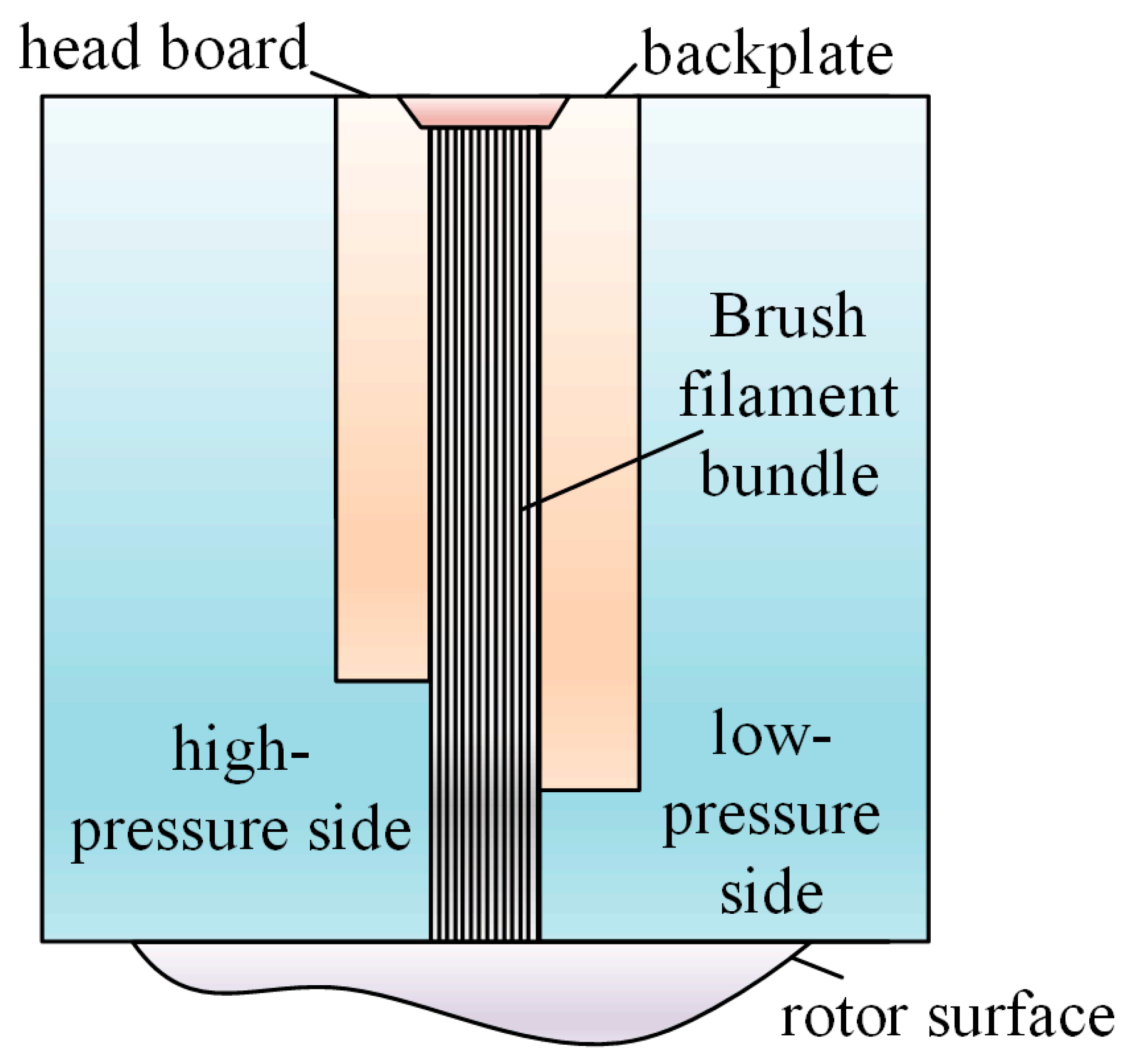
The primary structure of a brush seal is comprised of a front baffle, a rear baffle, and a bundle of brush filaments that are fixed between them, as illustrated in Figure 1. The front baffle is positioned on the high-pressure side of the airflow. In contrast, the rear baffle is situated on the low-pressure side. The brush filament bundle consists of a large number of elastic circular cross-section metal wires that are securely bonded together and have a specific circumferential inclination angle. The fixed end of the brush filament is securely positioned between the front and rear end plates, while the free end stays in contact with or very near the rotor’s surface. This distinctive structural design allows the brush seal to maintain superior sealing performance while accommodating minor radial movement and rotor vibration during operation.
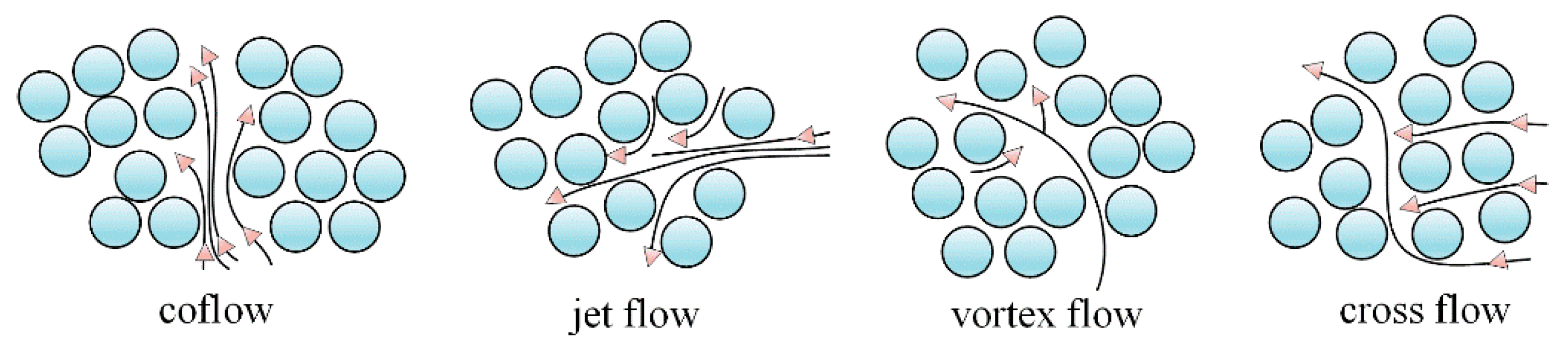
As illustrated in Figure 2, when airflow penetrates the brush filament bundle through the front baffle, the interaction between the filaments and the airflow produces a behavior akin to flow around a cylinder. The airflow pressure acting on one side of the bristles will induce bending, displacement, and deflection on the opposing back pressure surface, leading to irregular gaps between the bristle bundles and a progressive enlargement of the airflow channel gap. The airflow direction simultaneously alters, resulting in phenomena such as co-flow, cross-flow, jet flow, and vortex flow among the bristle bundles. The extent of deformation of brush filaments due to airflow is intricately linked to the pressure and velocity of the airflow, alongside the material characteristics and geometric factors of the filaments. Simultaneously, friction between the brush filaments and the rotor surface, as well as temperature fluctuations, influence the movement and deformation of the brush filaments.

3. Theoretical Model

The disturbance of the flow field caused by the deformation of the brush wire is approximately 5% of the flow field change caused by the pressure inlet condition. The viscous and inertial resistance coefficients in the porous model are calculated based on structural parameters, including the gap, arrangement, and installation method of the brush wire. Therefore, the single-brush-wire model and the porous-medium model can be regarded as scale-decoupled. That is, the single brush wire model is at the microscopic scale (brush wire diameter ~0.2 mm), and the fluid dynamic load is approximated by the deflection and pressure distribution of a single brush wire, controlled by the Euler–Bernoulli beam theory. The porous medium model is at the macroscopic scale (sealing section length ~10–50 mm), considering the brush-type sealing unit as an equivalent anisotropic porous zone for the flow. The flow field characteristics of the brush-type sealing unit were analyzed using porous media, and the mechanical properties of the brush filaments were studied using the cantilever beam model. Due to the approximately parallel arrangement of the brush wires, the nonlinear diagonal term of the resistance coefficient [25] is ignored. At the same time, the rotational speed of the rotor is 20.3 m/s, which is approximately in a low pre-twist state. Therefore, the cross-coupling terms in the stiffness matrix and damping matrix are also ignored.

3.1. Porous Media Model

The brush filament region is regarded as a porous medium, and the Navier–Stokes equations are used to describe the fluid flow within it. Its continuity equation is:
( ρ ε ) t + ρ ε v = 0
Introducing a source term into the momentum equation as shown in Equation (2).
ρ u i u j x i = P x i + τ i j x i + F i
The source term Fi is defined as:
F i = A i μ u i 1 2 B i ρ u u i
In Equation (3), A and B denote the coefficients of viscous and inertial resistance within the porous media, respectively:
A = d i a g a x , a y , a z
B = d i a g b x , b y , b z
Assuming the brush fibers are evenly dispersed cylindrical entities, the porosity ε may be precisely determined based on the diameter of the brush fibers, their arrangement, and the total dimensions of the brush fiber bundle [26]. Brush seal porosity is related to brush filament structural parameters, as shown in Equation (3), where n is the number of brush filaments, N is the density of brush filaments, d is the diameter of brush filaments, R1 is the rotor diameter, R3 is the radial height of brush filaments, t is the axial thickness of the brush filament bundle, and β is the tilt angle of the brush filament bundle (as shown in Table 1).
ε = 1 π N d 2 2 R 1 8 R 3 sin β t n = 1 2 π R 1 cos β 1.1 d N = n t 1.1 d cos β
Equation (4) shows the viscous resistance coefficients ax, ay, and az, as well as the inertial resistance coefficients bx, by, and bz, for the brush-type sealing porous media area, with the subscripts x, y, and z indicating the direction [27].
a x = a y = 66.67 1 ε 2 D 2 ε 2 a z = 0.4 ε 2 a x b x = b y = 2.33 1 ε 2 D ε 3 b z = 0

3.2. Cantilever Beam Model

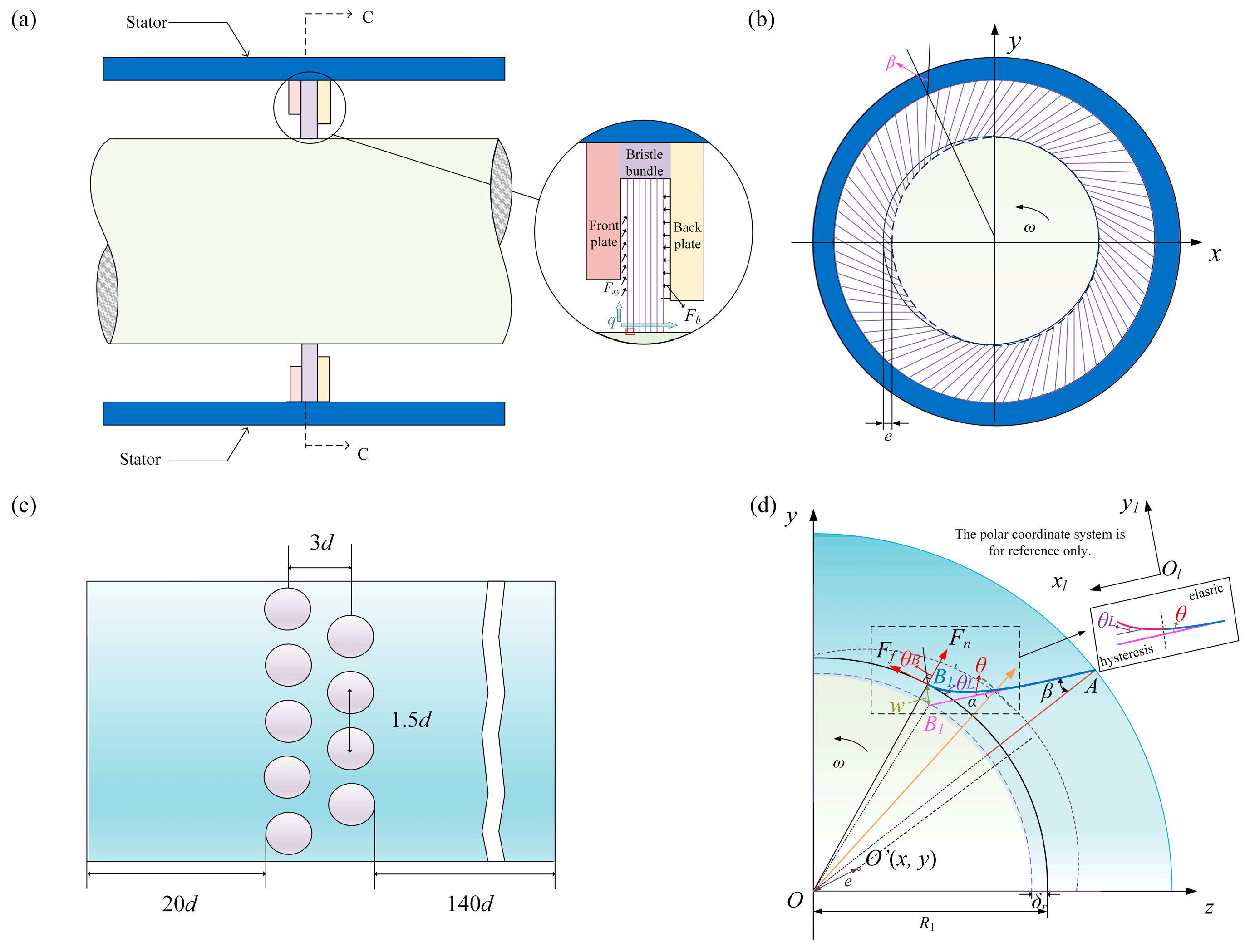
Figure 3 illustrates the deformation and lagging model of the wire brush during its movement along with the rotor. In the illustration, O(x,y) represents the initial center coordinates of the rotor, while O′ indicates the new center coordinates under the effect of eccentricity. The fixed end coordinate of the brush wire is Ol, and the free end is B. When the brush wire deforms, the free end shifts to B’. The brush wires, arranged in a circular pattern at an installation angle of 45°, are fixed on the outer ring. Under the given rotational speed of 6000 r/min, the range of eccentricity change is small [7], and it is set as a constant value (e = 0.05 mm). The airflow direction q is axial and radial. In one of the sealing units, during brush wire movement, the brush wires interact with the back plate. The supporting force Fb of the back plate on the brush wires is provided. After the brush wires move around the rotor for one cycle, the radial force component y of the airflow is Fxy. The brush wires are arranged in a fork pattern.
Figure 3a is a position view of the brush seal relative to the rotor. The front baffle, rear baffle, and brush wire bundle form the sealing unit distributed along the rotor’s circumferential direction. Its initial structure is axially symmetrically distributed. As the brush wire moves relative to the rotor, it exhibits a non-symmetrically distributed lag characteristic under the action of the friction force. Figure 3b is the C-C cross-sectional view of the brush seal, mainly presenting the structural diagram of the brush wire bundle area. The initial installation angle β of the brush wire is marked in the figure. Figure 3c represents the ideal two-dimensional tube bundle model for the brush wire. Due to the small diameter of the brush wire, when studying the flow characteristics of the fluid between the brush wires, the curvature variation of the cross-section of the brush wire can be ignored, and it can be approximately regarded as a circle. Considering the blow-down effect caused by the pressure drop, the first and second rows of brush wires downstream of the front baffle are selected as the research objects. Figure 3d is the deformation schematic diagram of a single brush wire in the y-z cross-section of the brush wire bundle area. Consider a single brush wire as a cantilever beam, with one end stationary and the other deformed by airflow force and friction. The green part represents the rotor area, and the blue part represents the brush wire area. The deformation angle at the contact part between the brush wire tip and the rotor is θB. The deformation angle generated by the elastic deformation area of the brush wire is θ, and the corresponding offset length is w. The irreversible deformation angle θL induced by the brush wire under the lag effect of the rotor movement is shown in the enlarged view on the right. Due to the deformation and lagging characteristics of the brush wire during its movement, its motion exhibits asymmetry and instantaneousness, and cannot be regarded as a completely symmetrical issue. Therefore, the mechanical properties of the brush wire are studied using the Cartesian coordinate system, with the polar coordinate system direction shown in the figure as a reference. The equation for the bending moment from the free to the fixed end is:
M x = q l x 2 2
In the equation, q denotes the uniformly distributed load on the brush filaments, comprising two components: the centrifugal force uniformly distributed load qc and the aerodynamic load qa [28].
q c = ρ π d 2 l 4 r m ω 2
where d = 0.102 mm represents the diameter of the brush filament, ρ is the density of the brush filament, and ω is the rotational speed of the rotor at 6000 r/min. In the (xl, yl) coordinate systems, the center of mass radius of the brush filament, rm, is determined by the tilt angle of the filament, β = 45°, and the initial radial clearance, δr0 = 0.25 mm, between the filament and the rotor
r m = δ r 0 + x / 2 s i n 45 °
Here, x represents the length coordinate of the brush filament, which ranges from 1 to 23.37 mm.
q a = Δ P d l
where ΔP stands for the pressure differential between the entrance and outflow of the brush filament, the deflection angle and deflection of the brush wire are, respectively, expressed as:
θ x = 0 l M x E I d x + c 1 w x = 0 l 0 l M x E I d x + c 1 d x + c 2
Here, c1 and c2 are constants, θ represents the angle through which the selected brush wire section rotates during the deformation process. w represents the deflection length corresponding to the rotation angle. The wire material is Haynes 25, E denotes the elastic modulus of the wire material (213.7 GPa), and I = πd2/64 signifies the moment of inertia of the wire cross-section [29]. Substituting the boundary condition of the fixed end position of the brush wire when x = 0, θx = 0, and w(x) = 0, we can derive the equations for the rotation angle θx and displacement w(x) of the brush wire as illustrated in Equations (13) and (14).
θ x = q x E I l 2 l x 2 + x 2 6
w x = q x 24 E I x 2 4 l x + 6 l 2
Incorporating the unit-length circumferential angle α of the brush wire into the displacement equation yields the instantaneous circumferential displacement (wa) and radial displacement (wr) [30] as follows:
w a = l sin α
w r = l l cos α
Figure 3 illustrates that the starting length of the bristle is OB 1 , whereas the length post-deformation is OB. The angle θB denotes the contact angle at the tip of the brush wire, e signifies the eccentricity, and δr indicates the radial distance. Consider the theory of small deformations (Appendix A), the circumferential angle (α) is corrected as follows:
α = r sin 45 ° + θ x x + r cos 45 ° + θ x
Force applied by the rotor on the brush filaments [31]:
f b = 3 π 64 E d 2 l 3 sin 2 α δ r
The corrected instantaneous clearance δr between the brush filament and the rotor is
δ r = w r e cos α
Here, e represents the eccentricity, and the initial value is 0.15 mm. Assuming the friction resistance experienced by the brush filaments is uniform, the friction force fbf acting on the brush filaments is [7]:
f b f = μ f b
The initial friction coefficient μ0 = 0.18. The instantaneous friction coefficient is adjusted as follows:
μ f = M x P m c × V o p e n
In evaluating the influence of ambient airflow on the brush filaments during their movement, the contact volume in the friction coefficient adjustment pertains to the open volume (Vopen) of the brush seal, namely, the air volume created between the brush filaments and the backing plate. Pmc = Kbristle × δr denotes the contact pressure between the brush filament and the rotor, where Kbristle signifies the stiffness coefficient of the brush filament.
K b r i s t l e = 0.001 × 3 I 64 E w 1 + w / d 1 cos 45 ° d 3 L 3 sin α
V o p e n = t l w 1 + 0.5 l R 1 + l δ r N π d 2 l 4 , 0 < l H V o p e n = t l H w 1 + 0.5 l H R 1 + l δ r N π d 2 l 4 , l > H
N signifies the quantity of bristles, while t indicates the thickness of the bristles. The rotor radius R1, brush wire length l, radial brush seal radius R3, and brush wire inclination angle β are shown in Table 1.
The backing plate support force Fb = [((Fn)2 + (Ft)2)0.5] of a brush seal is the vector sum of the tangential component Ft and the normal component Fn resulting from the interaction between the brush filaments and the backing plate [17]:
F n = q c + q a cos α A c o n t a c t
The contact area between the brush filament and the back plate, Acontact = BHd = Ld/cosθB, and BH is the free length of the brush filament.
F t = μ f F n
The μf was determined by substituting Formula (23) into Equation (21) for 0 < l < H.
Brush tip deformation angle θB:
θ B = O 0 B B = sin 1 l O B sin O 0 B B r = sin 1 r δ r cos r + δ r r
In Figure 3b, the lag angle θL characterizes the irreversible deformation of the brush filament during load-unload cycles [28]:
θ L = tan 1 δ r B H
The lag ratio is the ratio of the work produced by friction (wf) to the input work (wf + Ub):
H r = 2 W f W f + U b
where Ub is the elastic potential energy associated with the bending moment M of the brush filament:
U b = 0 L M x 2 2 E I d x
The work done by friction is:
W f = f b f l a 2
where la represents the axial projection of the brush filament.

4. Computational Model and Boundary Conditions

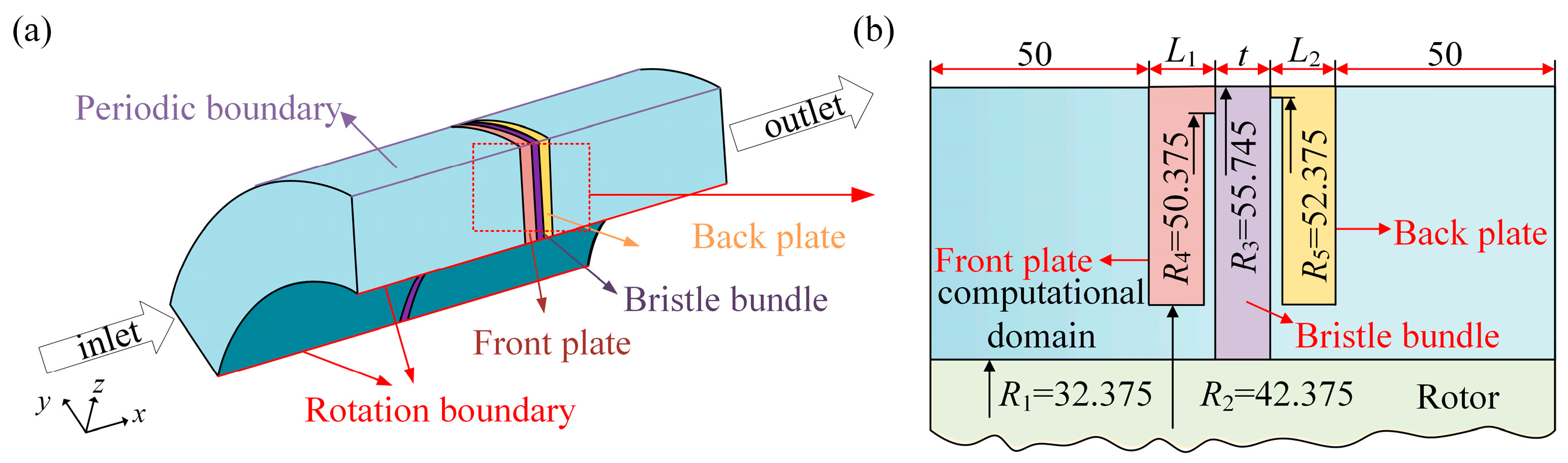
Figure 4 depicts the two-dimensional computational model of the brush seal, while Table 1 provides specific structural parameters. Figure 4a shows the three-dimensional model of the brush seal. The installation method of the brush wire is externally fixed and internally free. The two-dimensional cross-section of the air-brush-type seal is in the x-y plane (Figure 4b), with rotation along the z-axis. In Figure 4b, the red and yellow parts are solid components corresponding to the front and back plates, respectively. The purple and blue parts represent the porous medium and the computational fluid domain, respectively, while the green part represents the rotor.
The rotor surface is the rotational boundary condition, the upper wall surface is the periodic boundary condition, and the remaining wall surfaces are set with no-slip boundary conditions. The pressure and velocity distributions of the flow field are calculated within the porous medium model to determine the aerodynamic force and back plate contact force.

4.1. Computational Domain and Mesh Partitioning

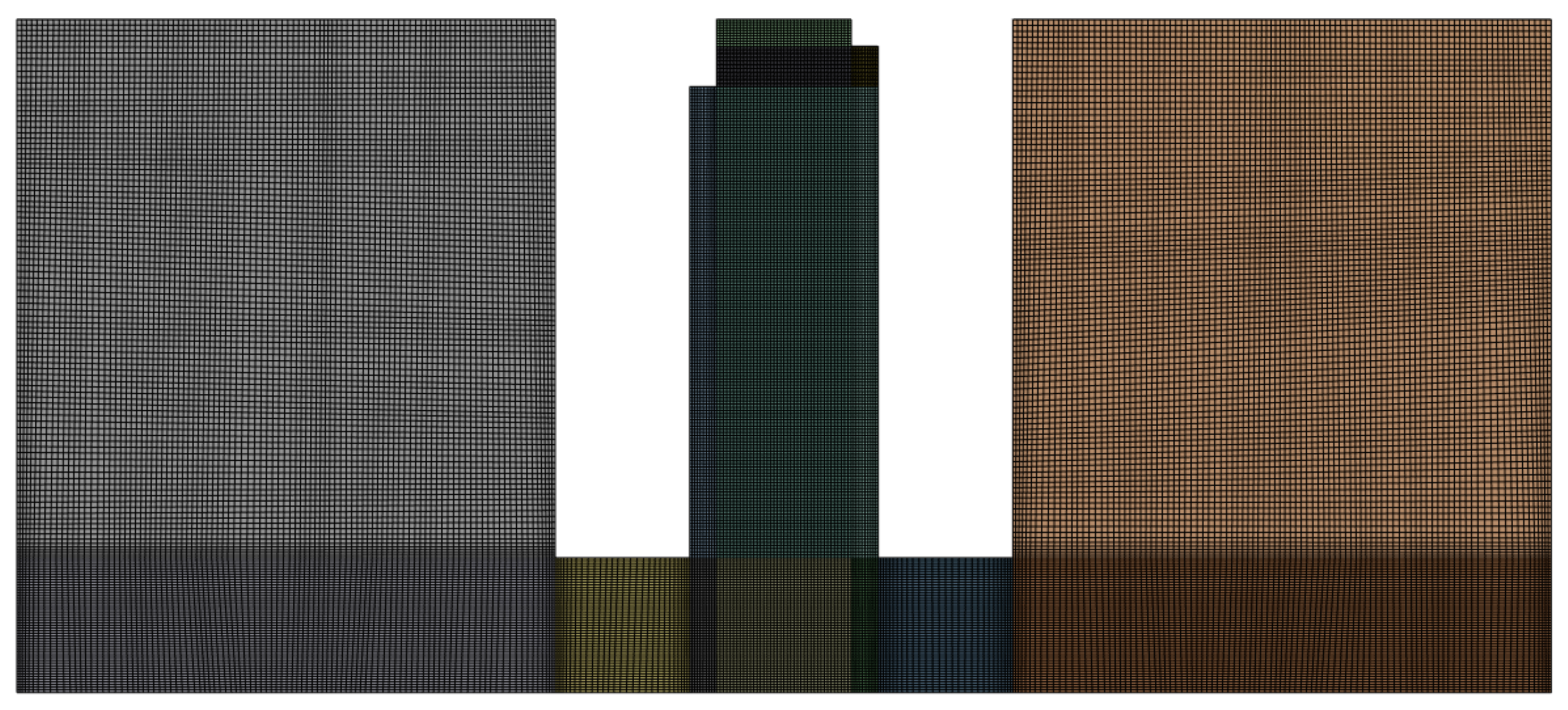
As illustrated in Figure 5, the computational domain is delineated to extend 50 mm both upstream and downstream, based on the actual structural dimensions of the brush seal. In the axial direction, it covers the entire area from the front baffle to the rear baffle; in the radial direction, it encompasses the gap between the brush filament bundle and the rotor, as well as a portion of the rotor area. The CFD calculation method based on the k-ε laminar flow model was used to calculate the fluid area of the unit brush-type seal. A tetrahedral grid was used to divide the fluid domain, and local densification was applied in regions with intense flow-field changes, such as the brush wire bundle, the front and rear plates, and the contact area between the free end of the brush wire and the rotor. The grid independence of the leakage calculation results for the brush seal has been verified, demonstrating the accuracy and reliability of the calculation.

4.2. Boundary Condition Settings and Grid-Independent Verification

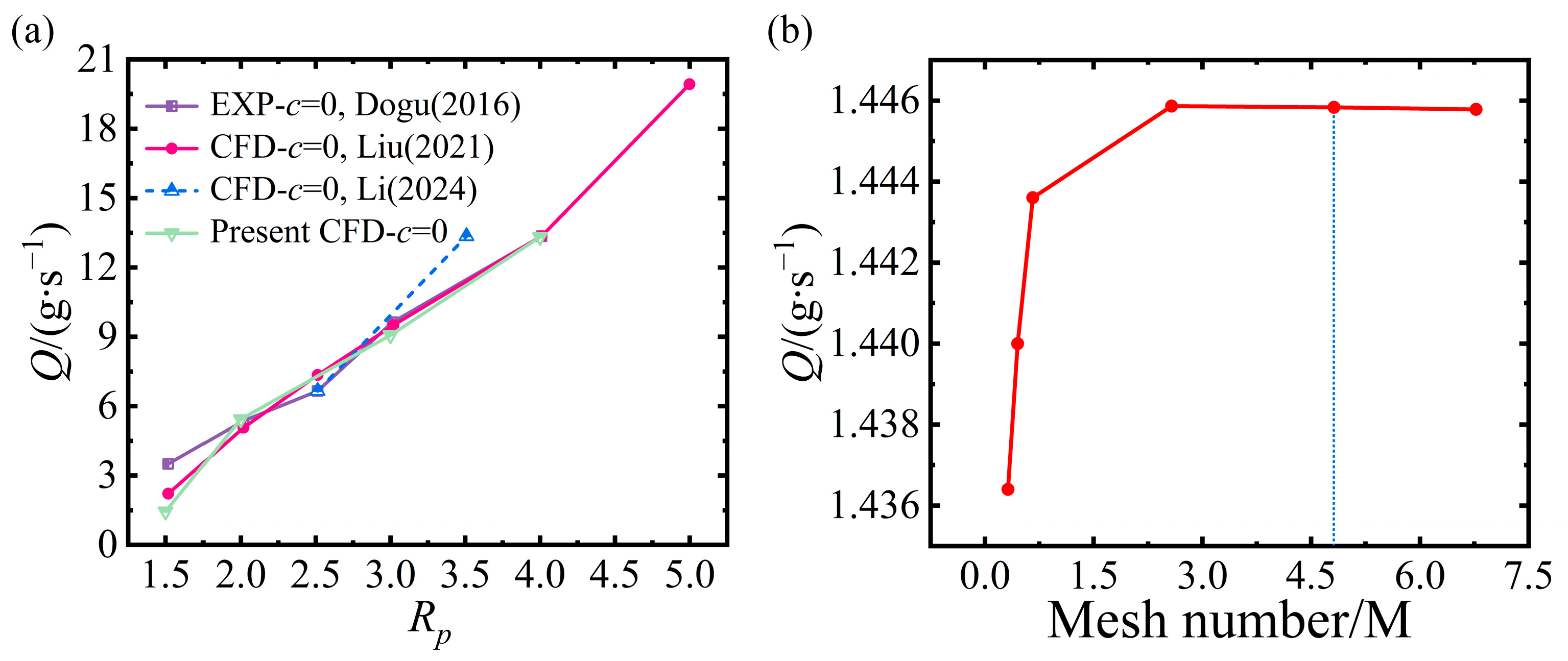
The boundary conditions were established as follows: inlet pressure 0.15–0.4 MPa, outlet pressure 0.1 MPa, inlet temperature 293 K, outlet temperature 300 K. The rotor surface is subject to a no-slip boundary condition, with a rotational speed of 6000 r/min. The gas medium is an ideal gas with a density of 1.1763 kg/m3 and a viscosity of 1.862 Pa·s. The solution model is the k-ε model, solved using the SIMPLE algorithm. The calculation results of c = 0 under the same boundary conditions were compared with those in references Dogu.2016 [32], Liu.2021 [33], Li.2024 [34] (Figure 6a). The maximum leakage volume error was no more than 7.2%. The calculation results in this paper were in good agreement with those in the literature, verifying the validity of the numerical calculation. Figure 6b illustrates that the maximum mass flow rate approaches 1.44 g/s as the number of grid cells varies from 1.5 × 10⁶ to 7.5 × 10⁶, and the mass flow rate fluctuation rate is 0.003% beyond 4.82 × 10⁶ cells. To improve efficiency and accuracy in iterative calculations, the grid is partitioned into 4.82 × 10⁶ cells.

5. Results and Discussion

5.1. Deformation Characteristics of Brush Filaments

The deformation of the brush filaments under varying inlet pressures was determined using numerical simulations. At low inlet pressure settings, brush filament deformation is minor, concentrating toward the free end and diminishing along the filament’s length. The deformation of the brush filaments increases significantly with increasing air pressure. The deformed area progressively extends toward the fixed end, in addition to the significant increase in deformation at the free end. The inertial forces and viscous friction generated as airflow traverses the cylindrical brush filaments are directly proportional to the pressure differential, resulting in greater filament deformation.
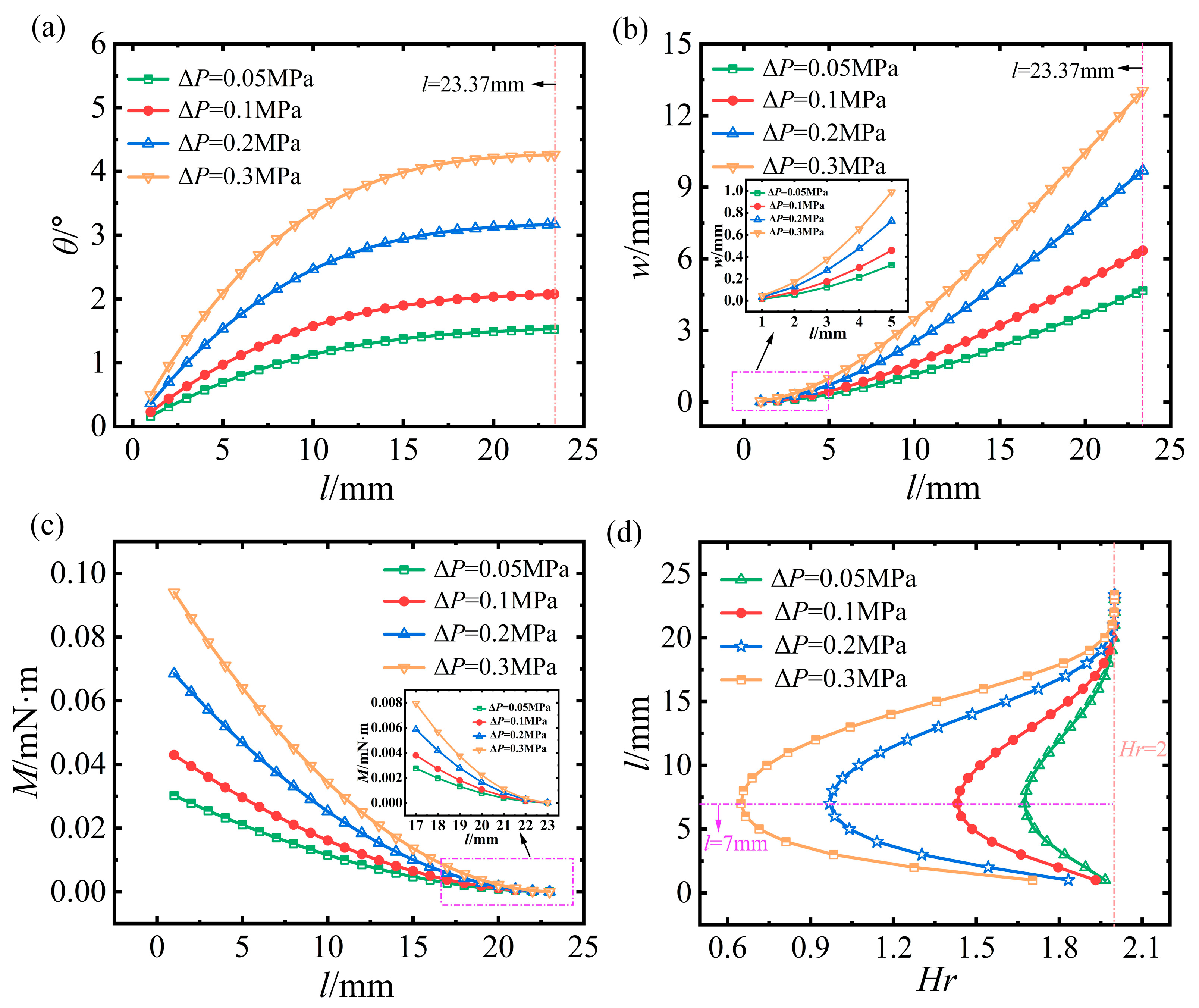
Figure 7a illustrates that when the pressure differential ΔP varies from 0.15 MPa to 0.4 MPa, the maximum deflection angles at the free ends of the brush filaments are 1.527°, 2.074°, 3.169°, and 4.264°, respectively, corroborating the results presented by Xu et al. [7]. These values are consistent with the findings of Phan et al. [19], who reported that brush seals with shallow lay angles exhibit reduced deflection sensitivity to pressure loading. In Figure 7b, the greatest displacements at the free ends of the brush filaments were 0.00467 m, 0.00634 m, 0.00969 m, and 0.01304 m, respectively. Comparatively, Li et al. [22] experimentally measured maximum bristle tip displacements of 0.0038–0.0112 m under similar pressure differentials (0.1–0.35 MPa) for low-hysteresis brush seals, with their results showing a linear displacement-pressure relationship (R2 = 0.967). The present simulation results exhibit a comparable linear trend. The maximum bending moments from the free end to the fixed end of the brush filament in Figure 7c are 0.03 mN·m, 0.043 mN·m, 0.069 mN·m, and 0.094 mN·m, respectively. Figure 7d illustrates that the circumferential hysteresis over the filament length first diminishes rapidly before slowly increasing, attaining a minimum at 7 mm, with corresponding values of 1.675, 1.431, 0.97, and 0.648. The circumferential hysteresis of the brush filaments defines the ratio of friction work to input power, with data demonstrating that increased pressure amplifies the circumferential hysteresis effect in the brush filaments. The offset angle, displacement, and bending moment of a brush filament are proportional to the gas flow velocity traversing it. The airflow through the brush filaments creates a blow-close effect, narrowing the gap between the filaments and the rotor surface and reducing fluid loss between them.
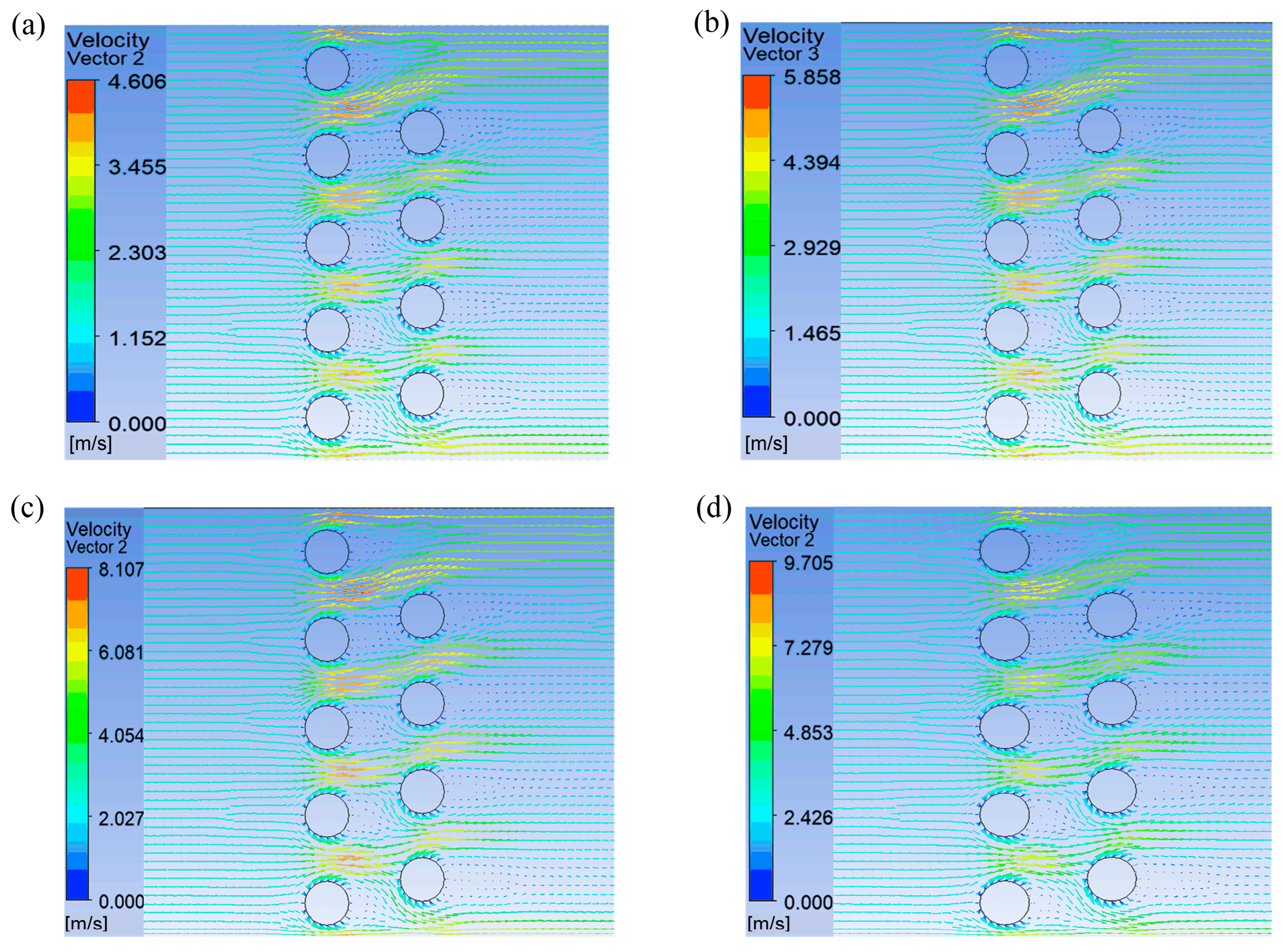
The clearance between the filaments and the rotor surface widens as the brush filaments deform, increasing seal leakage. Simultaneously, the deformation of the bristle bundle alters its pore structure, leading to changes in porosity and permeability that, in turn, affect fluid flow properties. Analysis of the leakage volume of sealing components at several degrees of deformation revealed that the leakage volume of the brush wire is directly related to the degree of deformation. Figure 8 shows that as the fluid traverses the interstice between neighboring brush wires, a pronounced vortex forms, with airflow leakage inversely proportional to the vortex’s characteristic size. The airflow velocity is converted to viscous energy as it traverses the crevices between the brush filaments. The leakage volume initially attains its peak in the interstices between the brush filaments, thereafter declining under the impact of vortices, in accordance with the findings of Braun et al. [9]. The jet flow recirculation between the two rows of brush filaments accelerates with increasing inlet pressure, accompanied by noticeable vortex shedding.
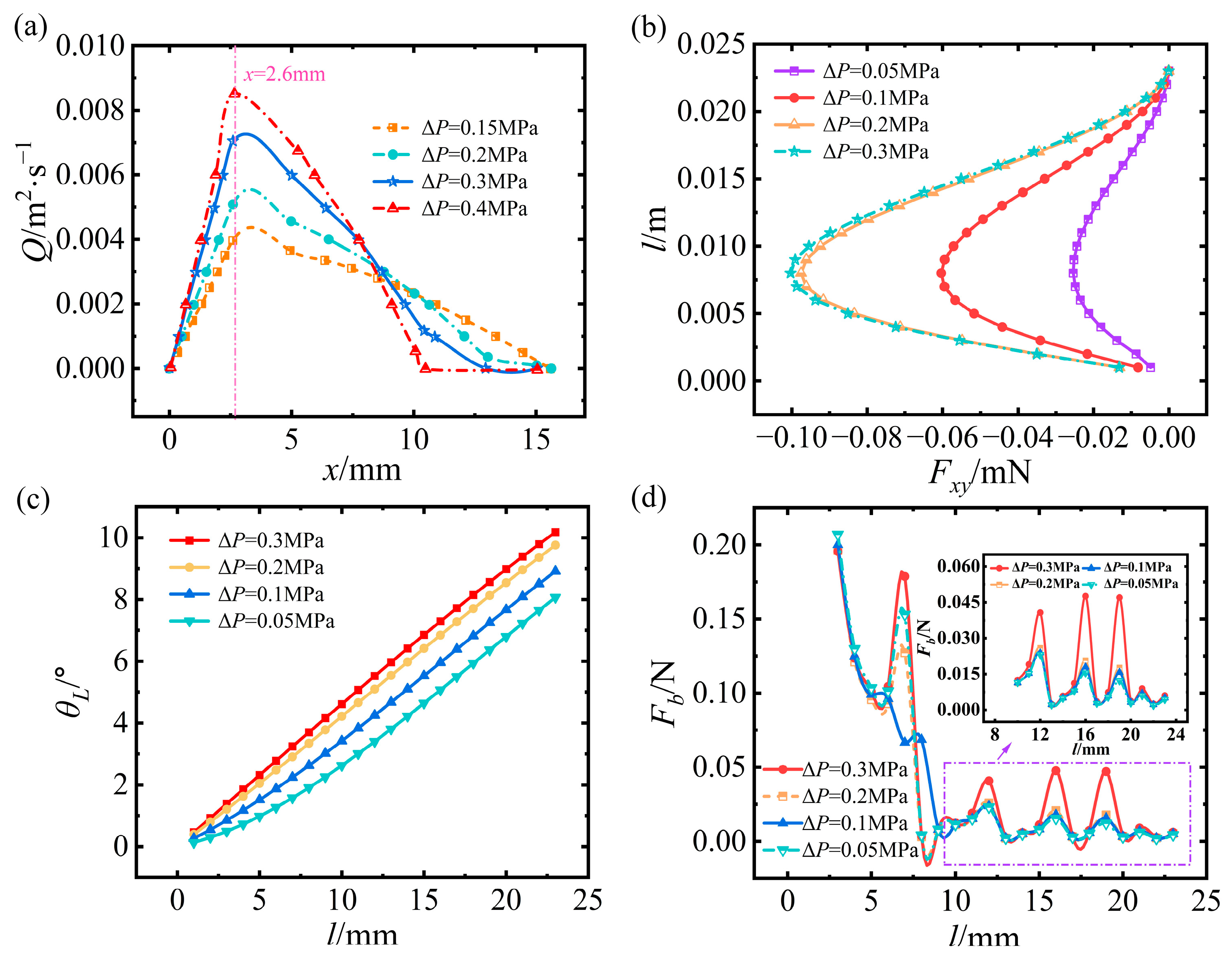
Figure 9a shows that when airflow passes through the dual-row brush filaments, the leakage volume reaches a maximum when it traverses the surface of the first cylindrical brush filament, which is proportional to the pressure differential. The x-axis represents the length distance of the airflow from the upstream pressure in-let, passing through the brush wire bundle inlet by 20 mm, and reaching the brush wire bundle outlet, as well as the distance of 140 mm from the downstream back plate. The peak leakage point of the dual-row brush filaments is 2.6 mm (the downstream area of the second row of bristles), with the maximum leakage volume escalating with pressure to 0.00396, 0.0051, 0.00709, and 0.00849 m2, respectively. The pressure-bearing capacity of the second row of brush fibers increases with the upstream-to-downstream pressure ratio. When the pressure difference reaches 0.4 MPa, the leakage volume in the downstream area of the second row rapidly rises to its maximum. At this stage, the vortex characteristic length in the downstream area is about 1 to 3 times the gap of the brush fibers. As the pressure ratio increases, downstream turbulence becomes stronger, reducing gas leakage. Finally, when the pressure difference is 0.4 MPa at x = 10 mm, the leakage volume quickly drops to zero. Upon traversing the second bristle surface, localized recirculation occurs, leading to the formation of vortices. The separation rate of the vortices accelerates as the flow velocity increases, while their characteristic length decreases.
Figure 9b depicts that the y-component of the radial airflow force Fxy and the contact force Fb affect the deformation of the brush filaments. The radial force is proportional to both the deformation of the brush filaments and the contact force between the filaments and the rotor, resulting in fluctuations in the filaments’ load and wear rate. The radial force component initially increases and then rapidly declines from the free end to one-third of the brush filament length, consistent with the lag effect induced by the airflow’s viscous resistance. This suggests that viscous resistance affects the distribution of airflow at lower pressure differences. As the pressure differential escalates, the contact force between the brush filaments and the rotor becomes substantial.
Figure 9c illustrates that at ΔP = 0.15–0.4 MPa, the highest lag angles θL resulting from the irreversible deformation of the brush wire after unloading relative to the initial installation position are 10.18°, 9.76°, 8.91°, and 8.06°, respectively. The linear distribution of the lag angle along the brush filament length is directly proportional to the pressure. Figure 9d demonstrates that the normal component of the air load on the brush filament, Fb, varies proportionally with the pressure differential between the fixed end and the 2/3 point of the filament, reaching a peak at the free end. At pressures of 0.15 MPa, 0.3 MPa, and 0.4 MPa, the contact force attains a considerable magnitude at l = 7 mm before progressively diminishing towards the free end; conversely, at 0.2 MPa, no notable amplitude is detected, paralleling the findings of Yue et al. [13]. This is the result of the dynamic eccentricity of the rotor, which impairs the blow-close effect and causes non-steady deformation of the brush filaments, which is accompanied by brush filament perturbation [35].

5.2. Analysis of Flow Field, Pressure Field, and Temperature Field

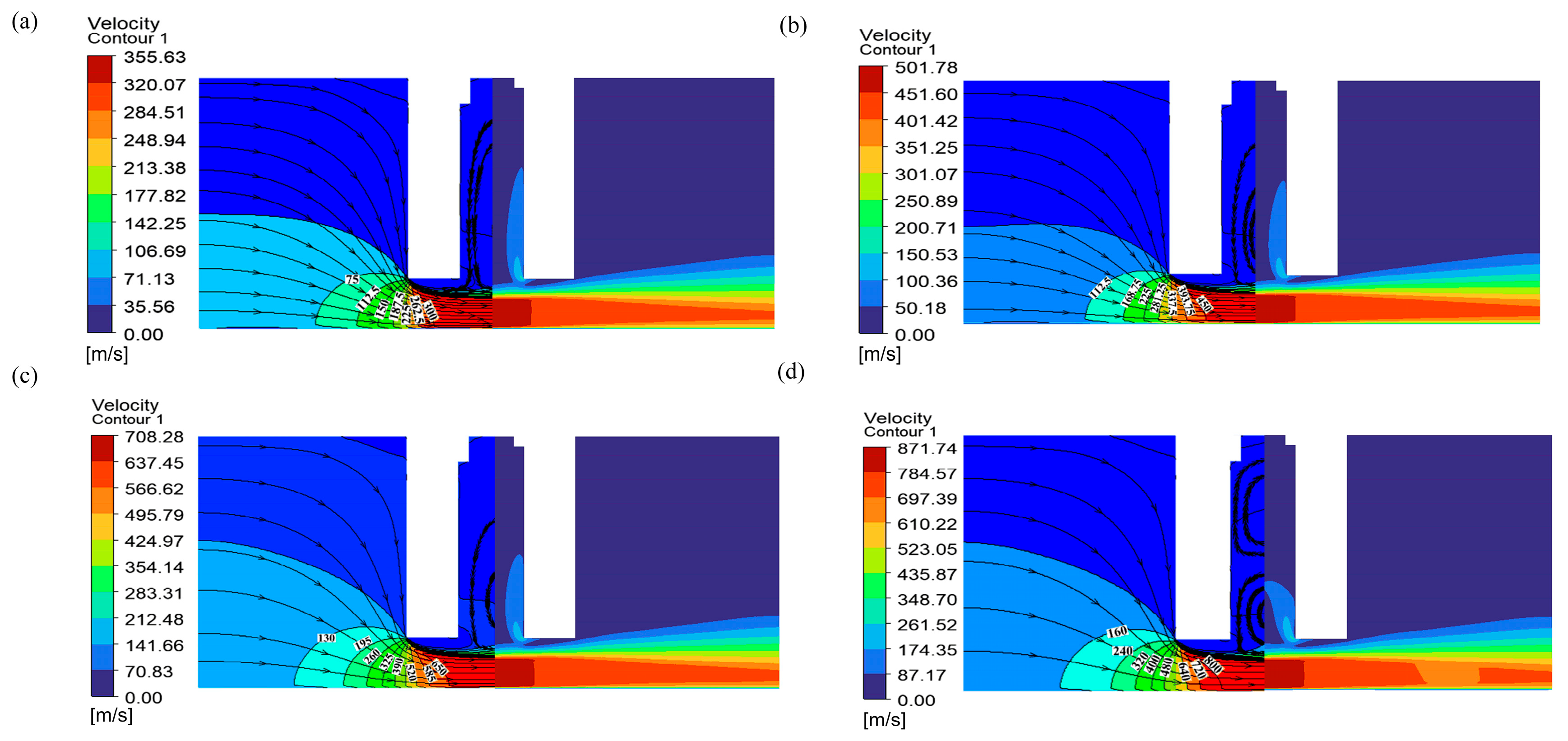
Within the brush seal, the velocity and pressure distribution of the flow field exhibit complex characteristics. As shown in Figure 10, when the inlet pressure gradually increases from 0.15 MPa (a) to 0.2 MPa (b), 0.3 MPa (c), and 0.4 MPa (d), the airflow velocity distribution in the upstream region of the brush filament bundle exhibits no significant variation, maintaining a stable state overall. When the airflow passes through the area where the brush filament bundle contacts the rear baffle, it flows downstream in a jet-like manner. At inlet pressures of 0.15–0.4 MPa, the maximum velocities were 355, 503, 708, and 871 m/s, respectively. Figure 10 shows the axial velocity streamline diagram and the overall velocity cloud diagram. As the pressure difference increases, the radial airflow strengthens. Consequently, the vortex center in the brush filament bundle gradually approaches the rotor, eventually forming a stable vortex pair (Figure 10d). Specifically, when the pressure difference is 0.1–0.4 MPa, the maximum axial flow velocity components are 350 m/s, 400 m/s, 650 m/s, and 800 m/s, respectively. Additionally, the velocity gradient growth rates are 50%, 54%, and 23%, respectively, indicating that the radial flow is proportional to the pressure difference. The high-pressure gas flow entered at low velocity through the upstream inlet, exhibiting turbulent axial motion throughout the entire flow path. As the airflow passes through the brush filament bundle, the gas flow channel is significantly reduced due to the extremely narrow axial clearance between the filaments.
Consequently, the gas velocity markedly increases after traversing the brush filament bundle region. Moreover, owing to the differing resistance coefficients of the brush filament bundles, the effluent flow from the brush filament bundle outlet is ejected in a jet form near the base surface of the rear baffle. Part of the pressure energy is converted into kinetic energy, resulting in reduced pressure and increased airflow velocity. The fluid passing through the brush seal area generates a radial velocity gradient within the gap between the rotor and the front plate. Due to viscosity, a jet forms downstream between the rotor and the fluid.
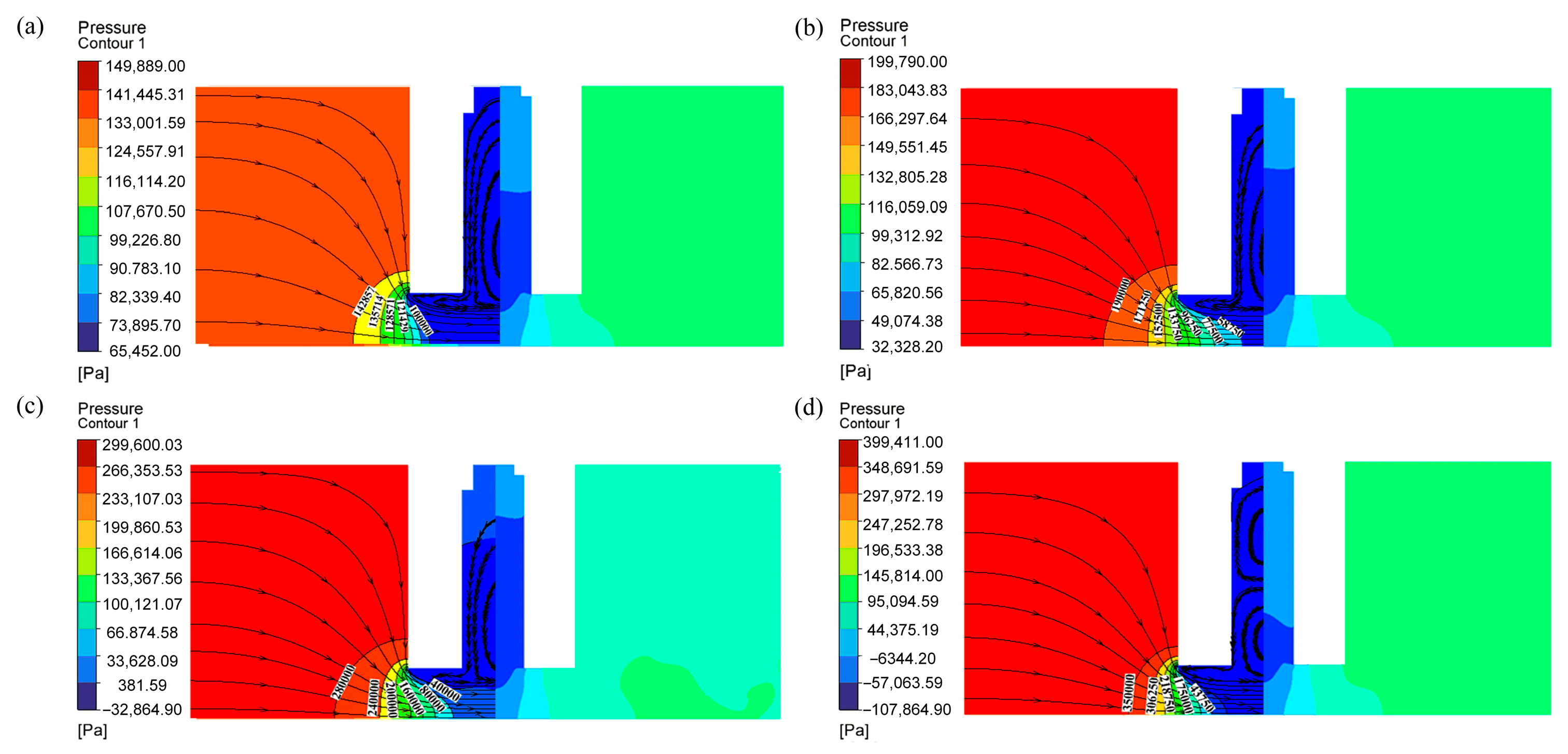
Pressure distributions for brush seals under various operating conditions were obtained through numerical simulation calculations. As shown in Figure 11, the pressure gradually decreases from the inlet to the outlet, with a marked pressure drop occurring in the brush filament bundle region. Near the rear baffle, the interaction between the backing plate and the brush filaments reduces the lag effect of the filaments, resulting in a relatively smaller pressure drop. The pressure drop trends of brush seals under four distinct inlet pressure conditions exhibit similarities. As the pressure ratio increases, the differential pressure ratio across the brush filament bundle region is proportional to the upstream-downstream pressure differential.
Figure 11 shows the pressure cloud and contour maps for the brush seal. Pressure chambers are added to the front and rear baffles, respectively, causing the pressure gradient variation of the brush seal to concentrate at the corner of the front baffle. The pressure gradient growth rates are 164%, 73%, and 29%, respectively. This indicates that adding pressure chambers on the front and rear baffles is more suitable for high-pressure scenarios. The formation of vortices between the brush wire and the rotor in the airflow can reduce friction at the brush wire tip and reduce the turbulent disturbance of the front-row brush wire. Concurrently, radial flow within the brush filament bundle increases while axial flow diminishes. The static pressure in the upstream region of the wire bundle remains largely stable, whilst the pressure within the bundle decreases progressively along the axial direction. Upon entering the downstream region, the pressure rapidly decreases and approaches the downstream pressure level at the corner of the backing plate. This process results in a significant radial pressure gradient forming downstream of the brush filament bundle. This gradient is the primary factor inducing deformation of the brush filaments, and further contributes to the generation of the ‘blow-close effect’. Upon wear or transient rotor displacement, the brush filaments alter their angle of inclination through inward radial flow generated by the radial pressure gradient within the brush bundle, thereby closing the gap.
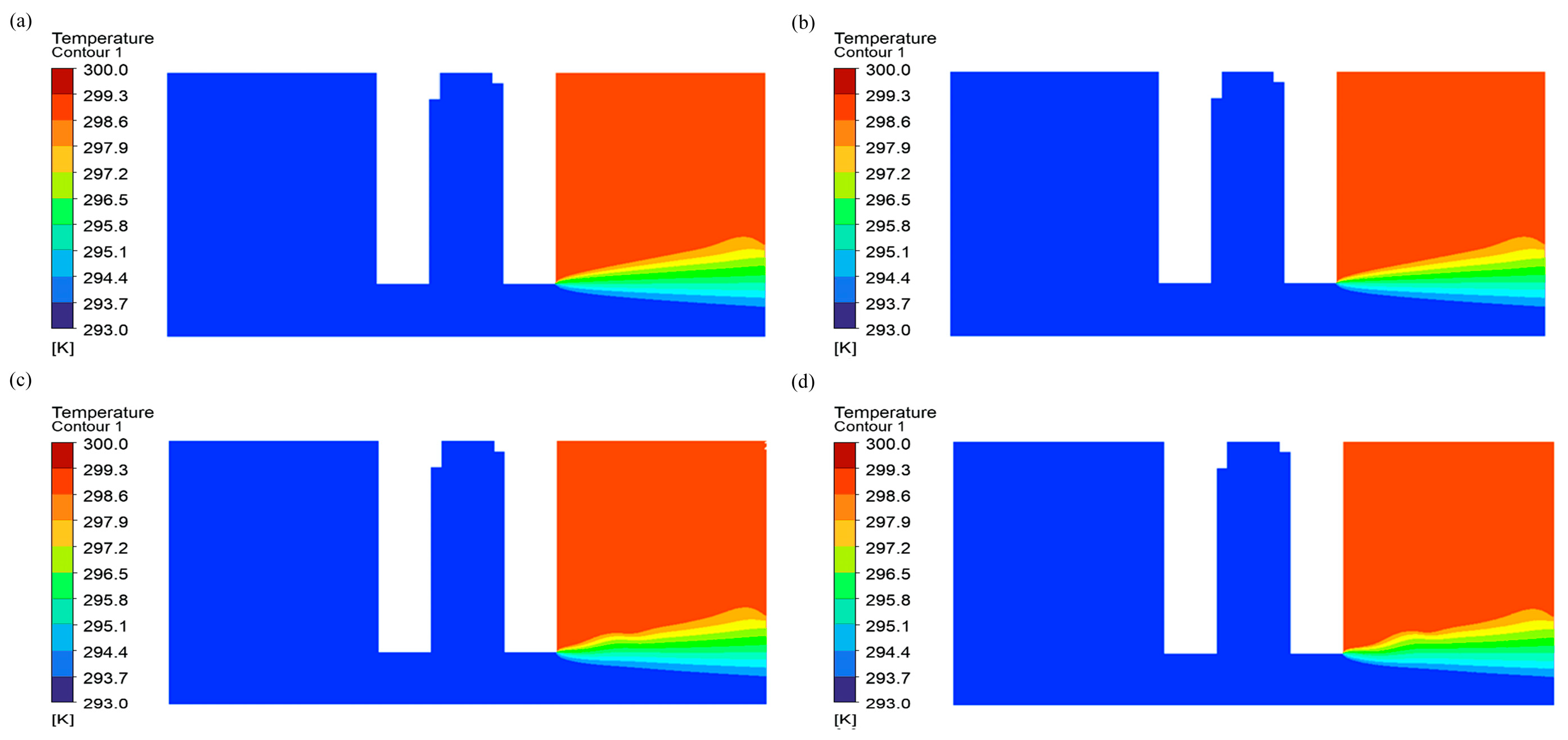
The heat generated by viscous dissipation during fluid flow and the work done by the friction between the brush filaments and the rotor surface are the primary sources of heat within a brush seal. The heat produced by viscous dissipation is proportional to the velocity gradient and viscosity of the fluid. Viscosity dissipation generates more heat in areas with a high velocity gradient, like the jet region in the vicinity of the rotor surface. The temperature distribution within the brush seal demonstrates significant non-uniformity. Figure 12 illustrates that, at designated intake and output temperature circumstances, the airflow forming a jet stream over the brush filament and back plate region exhibits pronounced temperature gradient fluctuations. The leakage volume of the airflow is directly proportional to the frictional heat that diffuses into the airflow between the rear plate and brush filaments [36].
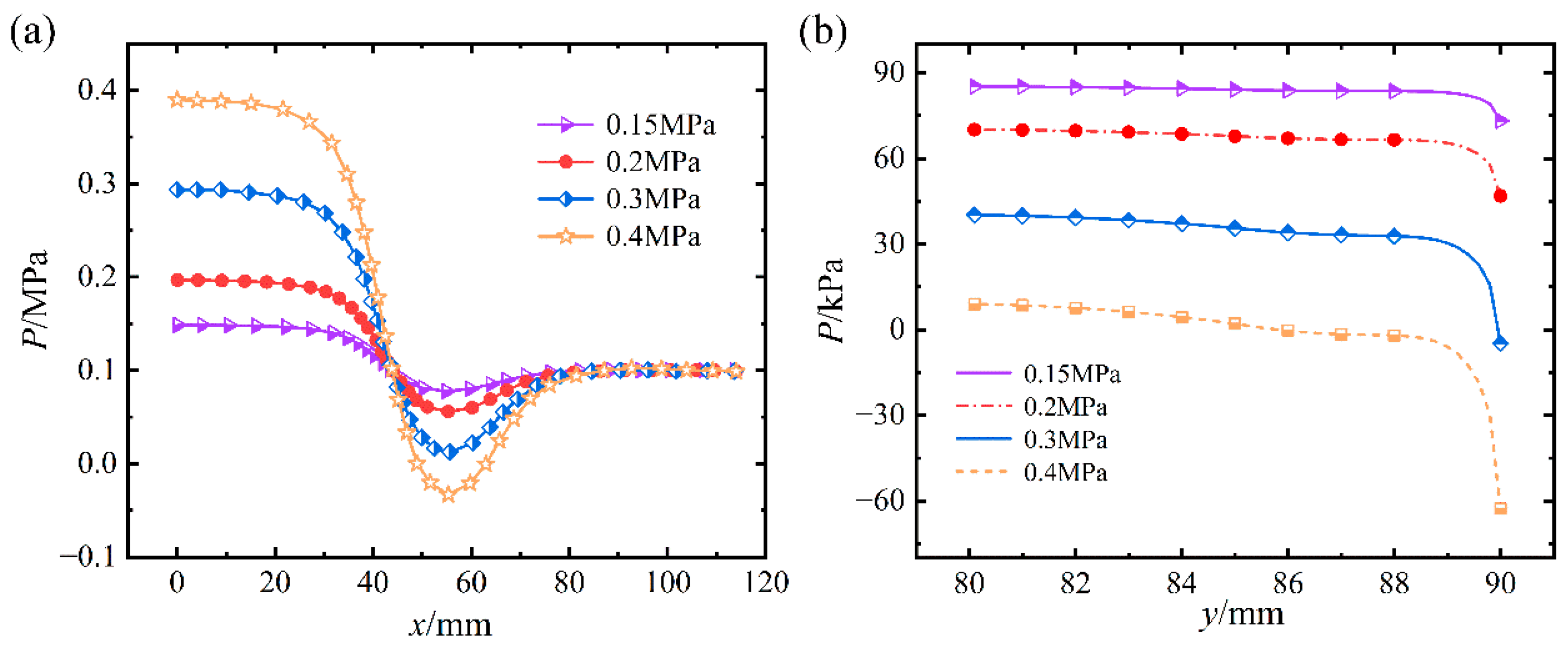
The axial pressure applied to the brush seal impacts the rotor’s eccentric motion and the clearance distribution between the rotor and brush filaments. In contrast, radial pressure controls the airflow movement among the brush filaments. Both elements influence the leakage rate of the brush seal. Figure 13a depicts the radial pressure distribution on the upstream and downstream sides of the brush filament bundle for a brush seal functioning at 6000 r/min under different pressure ratios. The radial pressure distribution across the brush seal decreases significantly from the front baffle to the brush filament bundle region, ultimately stabilizing in the area behind the rear baffle. The radial pressure distribution on the upstream surface of the brush filament bundle is comparatively uniform, and the axial pressure differential of the brush filament bundle is proportional to the pressure ratio. Figure 13b shows the radial pressure distribution curve on the downstream surface of the brush seal filament bundle when operating at a pressure ratio of 0.15–0.4 MPa and a rotational speed of 6000 r/min. Pressure in the rear baffle area declines from the top of the brush filaments to the rotor surface, with the pressure drop increasing in proportion to the pressure ratio. Increased radial pressure exerts a greater weight on the shaft [37]. The final row of bristles bends toward the back plate when the inclination angle of the bristles surpasses a particular threshold, intensifying bristle oscillation. This results in elevated porosity and leakage rates, consistent with experimental findings [38,39].

6. Conclusions

In this paper, through the porous medium model and the cantilever beam model, the mechanical properties of the brush wire and the flow field characteristics of the brush-type seal were studied, and the following conclusions were drawn:
1. The lag angle demonstrates linear progression for the initial one-third of the wire length from the free end (0–7 mm), with a slope of approximately 1.31°/mm, correlating directly with the pressure differential ΔP. At ΔP = 0.15 MPa, the maximum lag angle reaches 10.18°, decreasing to 8.06° at ΔP = 0.4 MPa due to the enhanced blow-close effect. The leakage rate escalates linearly with ΔP, reaching a maximum of 0.00849 m2/s at ΔP = 0.4 MPa. Fluid flow through the dual-row wires generates vortex shedding at 2.6 mm downstream of the second-row bristles. The vortex characteristic length in the downstream region is approximately 1–3 times the bristle gap, and increasing the pressure ratio from 1.5 to 4.0 enhances the downstream turbulent effect, causing the leakage volume to rapidly decrease to zero at x = 10 mm under ΔP = 0.4 MPa.
2. The radial force y-component Fxy exhibits a non-monotonic distribution along the bristle length, increasing to a peak at approximately one-third of the filament length (7 mm) and subsequently decreasing toward the free end due to viscous resistance. The backing plate contact force Fb demonstrates fluctuating peaks at roughly two-thirds of the wire length (15.58 mm), with peak values of 0.043 mN·m, 0.069 mN·m, and 0.094 mN·m corresponding to ΔP = 0.2, 0.3, and 0.4 MPa, respectively, indicating operational instability during brush wire movement.
3. The distortion of brush wires considerably affects sealing efficacy. Brush wire deformation increases proportionally with airflow pressure and rotational speed, resulting in heightened sealing leakage. The maximum free-end displacement reaches 13.04 mm at ΔP = 0.4 MPa, with deflection angle and bending moment proportional to ΔP. The deformation of the bristles concurrently modifies the pore structure of the bristle bundle, increasing porosity and hence influencing the fluid flow properties.
4. The velocity and pressure distribution in the internal flow field exhibits multi-scale characteristics, with axial velocity component maxima of 350 m/s, 400 m/s, 650 m/s, and 800 m/s at ΔP = 0.1–0.4 MPa, and velocity gradient growth rates of 50%, 54%, and 23%, respectively. The airflow creates a jet at the back plate with maximum velocities of 355, 503, 708, and 871 m/s under ΔP = 0.15–0.4 MPa. Leakage increases as the air pressure ratio rises. However, the rate of increase progressively slows (the leakage growth rate decreases from 28.8% at low ΔP to 19.8% at high ΔP), demonstrating the self-regulating effect of vortex structures on resistance. Adding pressure chambers on the front and rear baffles concentrates the pressure gradient variation at the front baffle corner, with pressure gradient growth rates of 164%, 73%, and 29% at successive pressure increments, making this configuration optimal for high-pressure scenarios (ΔP > 0.3 MPa).
5. The temperature distribution is highly non-uniform, with maximum temperature gradients localized adjacent to the brush filaments’ free ends and the rotor surface. Heat predominantly originates from viscous dissipation (proportional to velocity gradient and viscosity) and frictional heating. Higher temperatures hasten filament wear and increase temperature diffusion caused by jets in the backing plate area. When pressure chambers are added to the front and rear plates, the flow field results under low-pressure, normal-pressure, and high-pressure conditions demonstrate that the pressure gradient occurs at the corner of the front plate. As the pressure ratio increases, the radial flow of the brush seal increases, forming a vortex pair. The vortices formed by the free ends of the rotor and the brush wires can reduce friction between the rotor and the brush wires and reduce upstream turbulence.
Considering the instantaneous friction coefficient of the brush seal due to the effect of the surrounding airflow is conducive to more accurate prediction and control of the stability of the bristles in the brush seal, as well as the hysteresis and leakage of the brush seal, which is beneficial to maintaining the stability of the overall sealing device. For engineering applications: Double-row brush seals should prioritize optimizing the second-row bristle spacing at 2.6 mm to minimize vortex-induced leakage peaks. Pressure chamber design on rear baffles is recommended for operating conditions with ΔP > 0.3 MPa. The instantaneous friction coefficient correction method provides a theoretical basis for real-time wear monitoring and predictive maintenance. This method extends their operational lifespans and provides a theoretical framework and technical support for the enhanced optimization of brush seal designs. Future research may further examine factors such as fatigue life and wear of brush filaments, as well as interactions among multiple rows of filaments, to enhance the coupled model and more thoroughly assess the performance and reliability of brush seals in practical engineering applications.

Author Contributions

Conceptualization, M.L. and G.W.; methodology, M.L. and G.W.; software, M.L. and G.W.; validation, M.L. and G.W.; formal analysis, M.L. and G.W.; investigation, M.L. and G.W.; resources, M.L. and G.W.; data curation, M.L. and G.W.; writing—original draft preparation, M.L. and G.W.; writing—review and editing, J.L.; visualization, M.L. and G.W.; supervision, M.L. and J.L.; project administration, M.L. and J.L.; funding acquisition, M.L. All authors have read and agreed to the published version of the manuscript.

Funding

This study was supported by the 2025 Outstanding Innovative Talent Project for Postgraduates (Grant No. CA26005M086A). This study was supported by the Natural Science Research Fund of Kunming University of Science and Technology (Grant No. 241120250089). The subject project is the establishment of the fluid-solid-thermal coupling model of the brush seal and the dynamic research of the sealing system. Grant No. 51765024.

Data Availability Statement

The original contributions presented in this study are included in the article. Further inquiries can be directed to the corresponding author.

Acknowledgments

The authors thank the editors and reviewers for their comments and help. All the authors agree to submit this study for publication.

Conflicts of Interest

The authors declare no conflicts of interest.

Nomenclature

The following nomenclature is used in this manuscript:
FiAdditional resistance source term of the bristles to the fluid [N]
aViscous resistance coefficient
bInertial resistance coefficient
MBrush wire bending moment [N∙m]
qUniform load per unit length [N/m]
qcthe centrifugal force uniformly distributed load [N/m]
qaaerodynamic load [N/m]
rmcenter of mass radius of the brush filament
δr0initial radial clearance [mm]
θBristle rotation angle [°]
wThe displacement of bristle [mm]
αcircumference angle [°]
θLBristle lag angle [°]
θBBrush tip deformation angle [°]
fbThe contact force between the brush wire and the rotor [N]
δrInstantaneous radial clearance [mm]
fbfThe frictional force between the brush and the rotor [N]
μ0Initial friction coefficient
μfInstantaneous friction coefficient
VopenThe air volume between the brush filaments and the backing plate [mm3]
AconttactThe contact area between the brush filament and the backing plate [mm]
KbristleBrush wire stiffness
PmcThe contact pressure between the brush filament and the rotor [Pa]
HrLag ratio
WfFrictional work [W]
UbBrush wire elastic potential energy [W]
BHThe free length of the brush filament [m]
Subscript
ccircumference
rradial
aaxial
LLag angle abbreviation
BDeformation angle of the tip of the brush wire
bBack plate abbreviation
tTangential direction
nNormal direction

Appendix A

Small Deformation Incremental Analysis

Under normal operating conditions of the brush-type seal, the deformation of the brush wire typically satisfies the small-deformation assumption (δ/L < 0.05). When θ(x) = 1 rad and rr0, the first-order Taylor expansion of Equation (17) is carried out:
α = r 0 s i n 45 ° + r 0 c o s 45 ° θ x x + r 0 c o s 45 ° r 0 c o s 45 ° θ x   + O θ 2
(1)
Zero-order term (undistorted state, θ = 0):
α 0 = r 0 s i n 45 ° x + r 0 c o s 45 °
(2)
The physical meaning of the first-order correction term:
Δ α r 0 c o s 45 ° x + r 0 s i n 45 ° 1 + r 0 s i n 45 ° x + r 0 c o s 45 ° θ x = C α δ x
δ’(x) represents the local slope of the brush wire. This result indicates that Equation (17) is in first-order agreement with the linear result of the Euler–Bernoulli beam theory in the limit of small deformation, and at the same time, the geometric nonlinearity is retained through the coupling of r and θ(x).

References

  1. Wang, Y.; Niu, S.; Zhang, J.; Feng, C.; Wang, Y.; Shen, D.; Li, D.; Li, T.; Cao, P.; Zhang, Y. Development Status of Dynamic Sealing Technology and Discussion on Advanced Sealing Technologies. Lubricants 2025, 13, 11. [Google Scholar] [CrossRef]
  2. Yan, J.; Wang, B.; Guo, Z.; Dong, H.; Zhang, L.; Guo, X.; Zhu, J.; Zhou, H. Research on Thermal Sealing Technology in Aerospace Manufacturing. Int. J. New Dev. Eng. Soc. 2024, 8, 55–58. [Google Scholar] [CrossRef]
  3. Atkinson, S. The automotive industry’s reliance on efficient and precise application of sealing materials to vehicle parts. Seal. Technol. 2020, 1, 6–8. [Google Scholar] [CrossRef]
  4. Huang, W.; Feng, G.; He, H.; Chen, J.; Wang, J.; Zhao, Z. Development of an ultra-high-pressure rotary combined dynamic seal and experimental study on its sealing performance in deep energy mining conditions. Petrol. Sci. 2022, 19, 1305–1321. [Google Scholar] [CrossRef]
  5. Bowen, J.P.; Bird, J.J.; Cross, H.; Jenkins, M.R.; Bowsher, A.A.; Crudgington, P.F.; Sangan, C.A.; Scobie, J.A. Fluid dynamic behavior of conventional and pressure relieving brush seals. J. Eng. Gas Turbines Power 2024, 146, 061001. [Google Scholar] [CrossRef]
  6. Ma, Y.; Li, S.; Zhang, S.; Liao, H.; Sha, L. Study on the Influence of High Temperature and High Speed Working Conditions on the Leakage Characteristics of Flexible Bristle Brush Seal. IOP Conf. Ser. Mater. Sci. Eng. 2021, 1081, 012003. [Google Scholar] [CrossRef]
  7. Xu, Y.; Ma, T.; Kong, L.; Zhao, J.; Li, Y. Wear and leakage behaviors of brush seal considering eccentricity and radial deformation. Energies 2023, 16, 3394. [Google Scholar] [CrossRef]
  8. Braun, M.J.; Canacci, V.A.; Hendricks, R.C. Flow visualization and motion analysis for a series of four sequential brush seals. J. Propul. Power 1992, 8, 697–702. [Google Scholar] [CrossRef]
  9. Kudriavtsev, V.; Braun, M.J. Interstage Disk-Cavity/Brush Seal Numerical Flow Visualization Study. Int. J. Turbo Jet. Eng. 1996, 13, 75–90. [Google Scholar] [CrossRef]
  10. Dinc, S.; Demiroglu, M.; Turnquist, N.; Mortzheim, J.; Goetze, G.; Maupin, J.; Hopkins, J.; Wolfe, C.; Florin, M. Fundamental design issues of brush seals for industrial applications. J. Turbomach. 2002, 124, 293–300. [Google Scholar] [CrossRef]
  11. Dogu, Y.; Aksit, M.F. Effects of geometry on brush seal pressure and flow fields—Part I: Front plate configurations. J. Turbomach. 2006, 128, 367–378. [Google Scholar] [CrossRef]
  12. Hildebrandt, M.; Schwitzke, C.; Bauer, H.J. Analysis of heat flux distribution during brush seal rubbing using CFD with porous media approach. Energies 2021, 14, 1888. [Google Scholar] [CrossRef]
  13. Souissi, A.; Arghir, M.; Lasseux, D.; Amami, L.; Burlot, P. Leak-Rate Through Carbon Brush Seals: Experimental Tests Versus Predictions From a Porous Medium Approach. J. Fluids Eng. 2025, 147, 041203. [Google Scholar] [CrossRef]
  14. Kwon, J.W.; Ahn, J. Prediction of Leakage Flow Rate and Blow-Down in Brush Seals via 2D CFD Simulation with Porosity Correction. Appl. Sci. 2024, 14, 8821. [Google Scholar] [CrossRef]
  15. Yue, B.; Liu, Y.; Zhu, P.; Chen, H.; Liu, C. Experimental investigation of leakage performance and bristle mechanical characteristics of brush seals under rotational conditions. Phys. Fluids 2025, 37, 126135. [Google Scholar] [CrossRef]
  16. Yue, C.; Bi, T.; Lan, Z. Leakage performance predictions of a brush seal based on fluid–solid coupling method. Sci. Progess-UK 2020, 103, 1–17. [Google Scholar] [CrossRef]
  17. Pugachev, A.O.; Helm, P. Calibration of porous medium models for brush seals. Proc. Inst. Mech. Eng. Part A J. Power Energy 2009, 223, 83–91. [Google Scholar] [CrossRef]
  18. Wang, Y.; Li, S.; Zhang, S.; Liao, H.; Sha, L. Leakage Flow Characteristics of Novel Two-Stage Brush Seal with Pressure-Equalizing Hole. Lubricants 2025, 13, 190. [Google Scholar] [CrossRef]
  19. Phan, H.M.; Pekris, M.J.; Chew, J.W. Insights into frictional brush seal hysteresis. J. Eng. Gas Turbines Power 2024, 146, 081010. [Google Scholar] [CrossRef]
  20. Wei, Y.; Ran, X.; Xiong, B.; Liu, S. Influence of brush seal hysteresis effect on the nonlinear characteristics of rotor system. Commun. Nonlinear Sci. 2023, 121, 107239. [Google Scholar] [CrossRef]
  21. Duran, E.T. Brush seal contact force theory and correlation with tests. Alex. Eng. J. 2022, 61, 2925–2938. [Google Scholar] [CrossRef]
  22. Li, P.; Hu, Y.; Hou, Y.; Ji, H. Experimental Investigation on Leakage and Frictional Heat Generation Characteristics of Low Hysteresis Brush Seals. J. Eng. Gas Turbines Power 2025, 147, 021002. [Google Scholar] [CrossRef]
  23. Crudgington, P.; Bowsher, A. Brush seal pack hysteresis. In Proceedings of the 38th AIAA/ASME/SAE/ASEE Joint Propulsion Conference & Exhibit, Indianapolis, Indiana, 7–10 July 2002. AIAA 2002-3794. [Google Scholar] [CrossRef]
  24. Zhao, H.; Stango, R.J. Role of Distributed Interbristle Friction Force on Brush Seal Hysteresis. J. Tribol. 2007, 129, 199–204. [Google Scholar] [CrossRef]
  25. Gu, C.; Ma, Y.; Zhao, W.; Sui, X.; Hu, B.; Zhao, Q. A numerical study of the sealing and interstage pressure drop characteristics of a four-tooth three-stage brush combination seal. Appl. Sci. 2025, 15, 3899. [Google Scholar] [CrossRef]
  26. Xu, H.; Sun, D.; Hu, G.; Zhang, J.; Mu, W.; Wang, M.; Li, Y. Numerical study on leakage flow characteristics of carbon fiber brush seal between counter-rotating shafts. JASP 2025, 4, 20230829. [Google Scholar] [CrossRef]
  27. Chew, J.W.; Lapworth, B.L.; Millener, P.J. Mathematical modeling of brush seals. Int. J. Heat. Fluid 1995, 16, 493–500. [Google Scholar] [CrossRef]
  28. Sun, J.; Sun, D.; Zhang, J.; Wang, M.; Xu, H.; Yang, Y. Study on influences of the installation methods of inner and outer rotor bristles on leakage flow characteristics of rotating brush seal. JASP 2025, 41, 20250186. [Google Scholar] [CrossRef]
  29. Yang, Y.; Sun, D.; Zhao, H.; Hu, G.; Zhang, J.; Xu, H. Analysis of Influence Factors of Critical Closing Clearance of Carbon Fiber Brush Seal between Counter-Rotating Shafts. Tribology 2025, 45, 1718–1730. [Google Scholar] [CrossRef]
  30. Sun, J.; Sun, D.; Zhao, H.; Mu, W.; Zhang, J.; Wen, S. Numerical investigation on bristles buoyancy effect of brush seals with fluid-structure interaction. JASP 2024, 39, 20220182. [Google Scholar] [CrossRef]
  31. Kang, Y.; Liu, M.; Hu, X.; Kao-Walter, S.; Zhang, B. Theoretical and numerical investigation into brush seal hysteresis without pressure differential. Adv. Compos. Lett. 2019, 28, 096369351988538. [Google Scholar] [CrossRef]
  32. Dogu, Y.; Bahar, A.S.; Sertçakan, M.C.; Pişkin, A.; Arıcan, E.; Kocagül, M. Computational fluid dynamics investigation of brush seal leakage performance depending on geometric dimensions and operating conditions. J. Eng. Gas Turbines Power 2016, 138, 032506. [Google Scholar] [CrossRef]
  33. Liu, Y.; Yue, B.; Kong, X.; Chen, H.; Lu, H. Effects of front plate geometry on brush seal in highly swirling environments of gas turbine. Energies 2021, 14, 7768. [Google Scholar] [CrossRef]
  34. Li, C.; Liu, M.; Song, X.; Tang, J.; Xu, J. Effect of plate structure on leakage flow characteristics of brush seals. Lubr. Eng. 2024, 49, 115–122. [Google Scholar] [CrossRef]
  35. Hendricks, R.C.; Schlumberger, S.; Braun, M.J.; Choy, F.K.; Mullen, R.L. A bulk flow model of a brush seal system. In Turbo Expo: Power for Land, Sea, and Air; American Society of Mechanical Engineers: New York, NY, USA, 1991; Paper No. V001T01A099. [Google Scholar]
  36. Xu, Z.; Sun, D.; Wang, S.; Zhang, J.; Yang, Y.; Zhao, H. Numerical and Experimental Investigation of Influencing Factors on Blow-Down Effect in Brush Seals. J. Eng. Gas Turbines Power 2025, 147, 111023. [Google Scholar] [CrossRef]
  37. Dogu, Y.; Aksit, M.F. Brush Seal Temperature Distribution Analysis. J. Eng. Gas Turbines Power 2006, 128, 599–609. [Google Scholar] [CrossRef]
  38. Bayley, F.J.; Long, C.A. A Combined Experimental and Theoretical Study of Flow and Pressure Distributions in a Brush Seal. J. Eng. Gas Turbines Power 1993, 115, 404–410. [Google Scholar] [CrossRef]
  39. Schur, F.; Friedrichs, J.; Flegler, J.; Georgakis, C.; Polklas, T. Pressure Distributions Below Brush Seals at Varying Operating Conditions. In Proceedings of the ASME Turbo Expo 2018: Turbomachinery Technical Conference and Exposition, Oslo, Norway, 11–15 June 2018; ASME: New York, NY, USA, 2018; Paper No. V05BT15A024. [Google Scholar] [CrossRef]
Figure 1. Structure diagram of brush seal.
Aerospace 13 00490 g001
Figure 2. The airflow movement trajectory between the bristles.
Aerospace 13 00490 g002
Figure 3. View of brush-type sealing unit and rotor position (a), section view of the brushing wire bundle area C-C (b), ideal two-dimensional tube bundle model diagram (c), and cross-sectional view of the brush wire bundle area in the y-z plane (d).
Aerospace 13 00490 g003
Figure 4. Calculation model of brush seal (a) 3D model and (b) 2D model.
Aerospace 13 00490 g004
Figure 5. Calculation model of brush seal.
Aerospace 13 00490 g005
Figure 6. Leakage comparison (a) and (b) grid independence verification.
Aerospace 13 00490 g006
Figure 7. The offset angle (a), displacement (b), bending moment (c), and circumferential lag (d) of the bristles under different pressure inlets.
Aerospace 13 00490 g007
Figure 8. Distribution of flow field and leakage characteristics in the brush filament bundle area under different pressure inlets (a) 0.15 MPa, (b) 0.2 MPa, (c) 0.3 MPa, (d) 0.4 MPa.
Aerospace 13 00490 g008
Figure 9. Double-row brush wire leakage (a), brush wire component force (b), (c) hysteresis angle, (d) backing plate support force on brush wire.
Aerospace 13 00490 g009
Figure 10. The velocity distribution of the brush seal at different pressure inlets (a) 0.15 MPa; (b) 0.2 MPa; (c) 0.3 MPa; (d) 0.4 MPa.
Aerospace 13 00490 g010
Figure 11. The pressure distribution of the brush seal at different pressure inlets (a) 0.15 MPa, (b) 0.2 MPa, (c) 0.3 MPa, (d) 0.4 MPa.
Aerospace 13 00490 g011
Figure 12. The temperature distribution of the brush seal at different pressure inlets (a) 0.15 MPa, (b) 0.2 MPa, (c) 0.3 MPa, (d) 0.4 MPa.
Aerospace 13 00490 g012
Figure 13. T The axial (a) and radial (b) pressure distribution in the brush area under different inlet pressures.
Aerospace 13 00490 g013
Table 1. Parameters of Brush Seal Structure.
Structure ParameterQuantitative Value
Bristle diameter d/mm0.102
Rotor radius R1/mm32.375
Front panel width L1/mm2.032
Brush filament bundle thickness t/mm2.032
Rear panel width L2/mm2.032
Radial Height of Front and Rear Fender Enclosures R2/mm42.375
Brush Seal Radial Radius R3/mm55.745
Radial radius of the front decompression chamber R4/mm50.375
Radial radius of the rear decompression chamber R5/mm52.375
Brush wire lay angle β/(°)45
Disclaimer/Publisher’s Note: The statements, opinions and data contained in all publications are solely those of the individual author(s) and contributor(s) and not of MDPI and/or the editor(s). MDPI and/or the editor(s) disclaim responsibility for any injury to people or property resulting from any ideas, methods, instructions or products referred to in the content.