


Abstract
The renewed interest in long-duration human exploration missions to the Moon and Mars has highlighted the need for spacesuits capable of ensuring both physiological protection and operational performance. Operational extravehicular activity (EVA) spacesuits rely primarily on gas pressurization, which can impose mobility constraints, increase metabolic cost and contribute to fatigue and musculoskeletal injury risk. Mechanical counter-pressure (MCP) systems have therefore been investigated since the pioneering work of Annis and Webb in the 1970s. By applying compression directly to the body through close-fitting textiles, MCP garments may reduce some mobility-related constraints associated with conventional gas-pressurized suits. This review examines the physiological requirements governing spacesuit pressurization, the limitations of conventional EVA suits and the evolution of MCP technologies from early partial-pressure garments to BioSuit™ concepts. Hybrid architectures and active materials are also discussed as strategies for improving pressure control and garment performance. Attention is devoted to the available evidence, distinguishing between conceptual studies, numerical analyses, component-level demonstrations and human-subject validation. Although MCP systems show promising potential, their development remains constrained by pressure non-uniformity, garment fit, donning and doffing complexity, activation requirements, durability and limited validation under operationally representative conditions. Current evidence therefore supports MCP as a promising but not yet fully mature alternative, while hybrid architectures may represent a more realistic intermediate approach for future EVA systems.
1. Introduction
With the start of the Artemis program and the growing interest in long-term lunar settlements, increasing attention has been directed toward the ability of the human body to survive and operate outside the terrestrial environment [1,2]. The space environment is characterized by extreme conditions, including microgravity, cosmic radiation, extreme temperature variations and vacuum [3,4]. Among these factors, exposure to an environment lacking an adequately pressurized atmosphere represents one of the most critical challenges for human survival and physiological function. The human body is adapted to operate under Earth’s atmospheric pressure, whereas exposure to vacuum leads to severe physiological effects including ebullism, hypoxia and loss of consciousness [5,6].
For these reasons, systems capable of recreating Earth-like conditions are required to sustain human life in space [7]. Extravehicular mobility units (EMUs), commonly referred to as spacesuits, are designed to provide astronauts with a pressurized and controlled environment during extravehicular activities (EVAs) [8].
The development of modern spacesuits accelerated during the first Soviet and American human spaceflight missions, with early systems such as the Vostok SK-1 and the Mercury suit [9,10]. Since then, spacesuit technologies have progressively evolved in response to changing mission profiles and requirements [11].
Current suit architectures are based primarily on gas-pressurization systems, which provide a pressurized environment with an appropriate oxygen partial pressure required for physiological survival but introduce significant mobility limitations. In particular, the internal gas volume, together with the structural and geometric characteristics of the suit, increases resistance to body motion, resulting in a higher metabolic cost and reduced mobility [12]. To overcome these limitations, alternative pressurization strategies have been investigated. Among these, Mechanical Counter-Pressure (MCP) systems represent a promising, although not yet operationally mature, approach. MCP concepts aim to apply pressure directly to the body surface through tight-fitting and deformable textile structures, thereby reducing or partially eliminating the pressurized gas volume surrounding the body [13]. Although MCP concepts have shown promising results in selected experimental configurations, the extent to which these benefits can be maintained at the system level under dynamic, prolonged, and operationally representative EVA conditions remains to be fully established. In particular, the practical implementation of MCP systems presents several challenges, including the achievement of uniform pressure distribution, conformability to complex body geometries, maintenance of performance during movement, and the development of effective donning and doffing procedures. These limitations have motivated increasing interest in advanced functional materials capable of actively responding to external stimuli, as well as in hybrid gas–MCP architectures, which may offer a compromise between reliable pressure management and enhanced mobility.
This review examines the evolution of spacesuit pressure systems from conventional gas-pressurized architectures to mechanical counter-pressure (MCP) concepts, hybrid configurations, and systems incorporating active materials. It covers literature published from the 1970s to the present, with particular attention to research conducted at the Massachusetts Institute of Technology (MIT) on MCP and BioSuit technologies.
The review considers peer-reviewed journal articles, conference proceedings, and academic theses relevant to the design, development, and experimental validation of spacesuit pressure systems. Additional studies were identified by examining the references cited in the selected publications. Adopting a narrative rather than systematic review approach, this work critically compares the technological development and validation levels of different pressure architectures, from conceptual designs and numerical studies to component-level demonstrations and human-subject experiments. This analysis highlights the main advances, remaining limitations, and challenges to be addressed before MCP systems can be used in operational extravehicular activities.
2. Physiological Constraints of Space Vacuum Exposure and Implications for Spacesuit Design
The human organism is adapted to function at an atmospheric pressure of approximately 101 kPa [14], which ensures adequate gas exchange, tissue perfusion, and overall homeostasis [15,16]. Exposure of the human body to the vacuum of space causes a series of rapid and potentially fatal physiological effects. In the event of acute exposure to a severely hypobaric or vacuum environment, loss of consciousness may occur within 10–15 s because of cerebral hypoxia, while continued exposure without prompt re-pressurization may lead to severe cardiovascular and neurological damage [17].
Rapid exposure to vacuum also causes the expansion of gases trapped within body cavities according to Boyle’s law [18]. In the pulmonary system, insufficient exhalation during rapid depressurization may result in alveolar overexpansion, pulmonary barotrauma and pneumothorax [19,20]. These effects represent an additional major physiological hazard associated with exposure to rapid pressure reduction and hypobaric environments.
The near-total absence of pressure also induces a phenomenon known as ebullism [21]. This phenomenon consists of the spontaneous vaporization of water in tissues when ambient pressure falls below the Armstrong limit (approximately 6.3 kPa) [22], which may result in tissue swelling and severe physiological deterioration if exposure is prolonged [19]. However, a NASA study on vacuum exposure has demonstrated that survival is possible for extremely short periods, provided that immediate re-pressurization is initiated [6]. Nevertheless, these findings do not support the use of unpressurized exposure as a viable operational strategy and instead highlight the critical importance of reliable pressure protection during EVA.
An additional concern associated with the transition from a spacecraft or habitat atmosphere to the lower pressure of space is the risk of decompression sickness (DCS) [23]. DCS arises from the formation of inert gas bubbles, predominantly nitrogen, previously dissolved in body tissues [24]. The intravascular and extravascular accumulation of nitrogen bubbles may result in cutaneous manifestations, musculoskeletal pain, tissue injury and progressive neurological dysfunction [25,26]. To reduce this risk, NASA protocols include a period of pure oxygen pre-breathe prior to EVA in order to reduce the amount of nitrogen in body tissues [27]. However, long pre-breathe protocols may impose significant operational constraints on future Lunar and Martian missions. Alternative strategies have also been proposed to mitigate the risk of DCS: reducing the partial pressure of nitrogen within the habitat atmosphere by increasing the oxygen fraction and increasing the internal pressure of gas-pressurized spacesuits [28]. However, the first solution presents several drawbacks, including higher operational costs and an increased fire hazard associated with the greater flammability of oxygen-enriched environments [28]. The second approach may exacerbate the biomechanical limitations and discomfort associated with suit pressurization, aspects that will be discussed in the following section [28]. Thus, spacesuit pressurization represents a fundamental trade-off between physiological protection, DCS risk, mobility and biomechanical performance.
For these reasons, current research is increasingly focused on the development of next-generation spacesuits capable of maintaining adequate physiological protection while simultaneously improving astronaut mobility, comfort and operational performance.
It is important to distinguish between the different pressure parameters involved in spacesuit design. The suit operating pressure refers to the total pressure maintained within a gas-pressurized suit, whereas the oxygen partial pressure represents the contribution of oxygen to the total breathing-gas pressure. These parameters are also distinct from the mechanical counter-pressure applied directly to the body by an MCP garment, which provides mechanical support without requiring the surrounding gas volume. Furthermore, the pressure required for physiological protection should not be considered independently of decompression requirements, since the risk of decompression sickness depends on the pressure transition between the spacecraft or habitat and the suit environment, as well as on the breathing-gas composition and pre-breathe protocol.
3. Current EVA Spacesuits and Limitations of Gas Pressurization
Since the first extravehicular activity performed by Alexei Leonov in 1965, operational EVA spacesuits have relied on gas-pressurization systems to ensure astronaut survival in the vacuum of space [29]. Over the years, spacesuit technologies have progressively evolved from the early Mercury and Apollo suits; however, the fundamental operating principle of gas pressurization has remained essentially unchanged [30]. This principle consists of generating an artificial internal pressure compatible with human physiological survival.
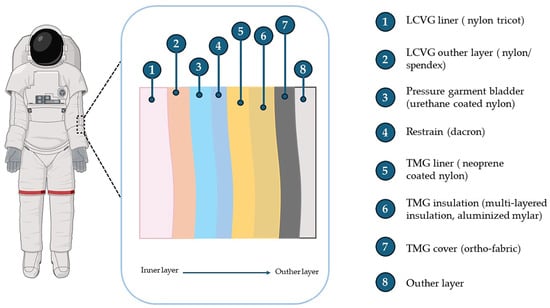
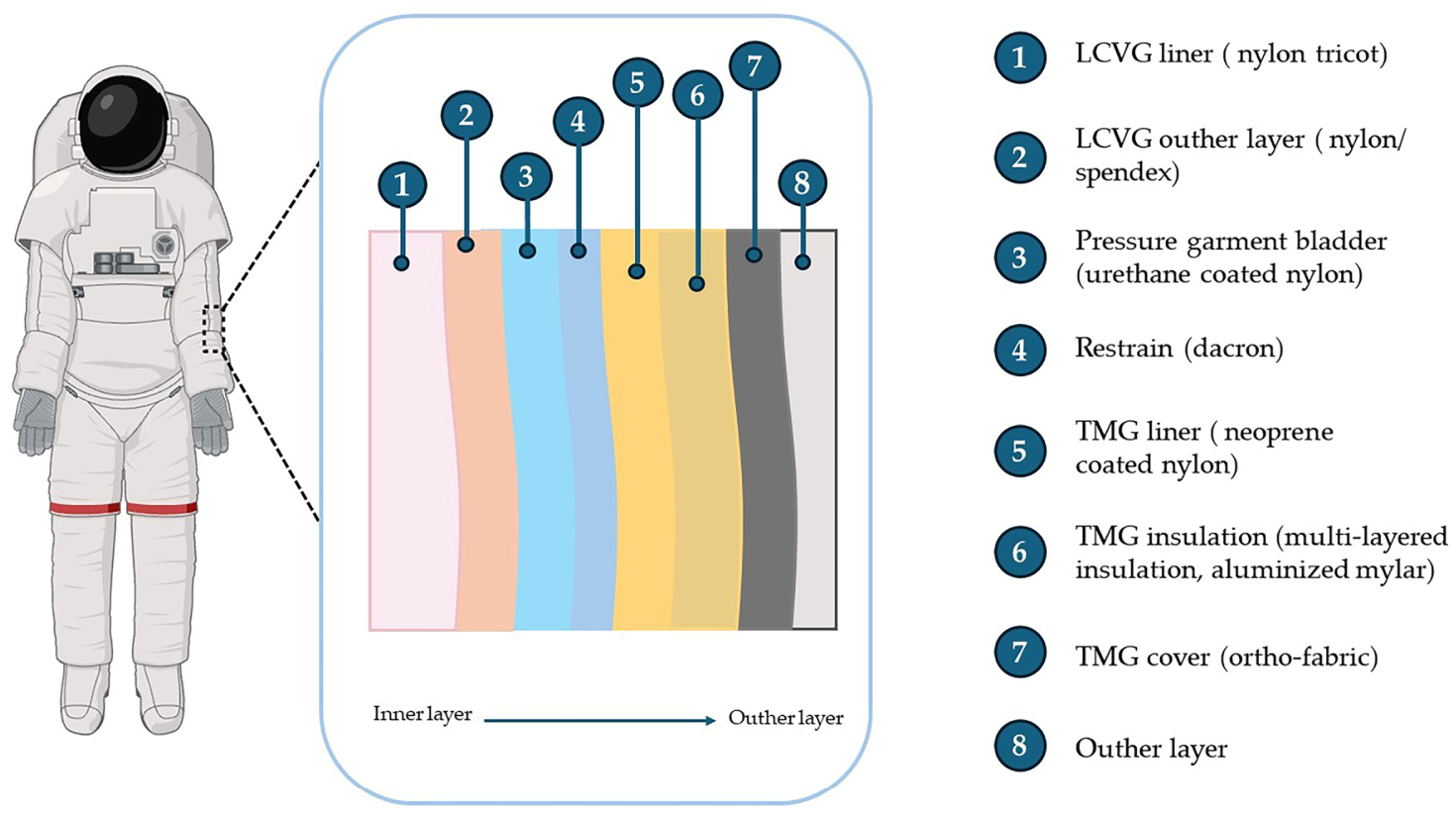
Modern EVA suits are based on complex multilayer architectures composed of materials with complementary mechanical and protective functions (Figure 1) [31]. In general, the external layers are designed to protect astronauts against abrasion, regolith interaction, electrostatic charging, and micrometeoroid penetration, while the inner layers are responsible for pressure retention, thermal insulation, impact mitigation, and partial radiation shielding [32].
Figure 1.
Schematic representation of the multilayer architecture of a conventional gas-pressurized extravehicular space suit, showing the main functional layers. LCVG, liquid cooling and ventilation garment; TMG, thermal micrometeoroid garment. Redraw based on the layer configuration reported in [33].
The current NASA EMU, designed for low Earth orbit operations and in service since 1983, operates at a pressure of 29.6 kPa (4.3 psi) using a pure oxygen atmosphere, allowing astronauts to conduct EVA operations for up to eight hours [34,35]. In parallel with the NASA EMU, Russian and Chinese EVA suit architectures have been developed, reflecting different engineering solutions for gas pressurization, mobility, and mission-specific constraints. The Russian Orlan suit operates at a nominal pressure of 40.7 kPa (5.8 psi) [36]. The Chinese Feitian suit, currently used aboard the Tiangong space station, operates at a similar pressure level of approximately 40 kPa (5.7 psi) [37].
Looking toward future exploration missions, NASA initially developed the Exploration Extravehicular Mobility Unit (xEMU) as a next-generation architecture for lunar surface operations. Under NASA’s commercial program, Axiom Space is currently developing the corresponding Axiom Extravehicular Mobility Unit (AxEMU), which remains a developmental system and has not yet been used in operational EVA. The AxEMU is designed as a gas-pressurized exploration suit, with a reported operating pressure of up to 56.5 kPa (8.2 psia) [28]. The progression toward these next-generation systems highlights that, despite advances in suit design, gas pressurization remains intrinsically associated with a trade-off between physiological protection, pressure level, and biomechanical performance.
As summarized in Table 1, the reported operating pressures provide an overview of the pressure levels adopted across current and emerging EVA suit architectures. Because these values may refer to different suit configurations and testing conditions, they should be regarded as indicative rather than directly comparable. Overall, gas pressurization remains the only approach with extensive operational heritage in human EVA.
Table 1.
Comparison of selected operational and developmental gas-pressurized EVA suit architectures of the major space agencies. All systems rely on gas pressurization for physiological protection. Reported values are indicative and may refer to different suit configurations and system boundaries; therefore, they should not be considered directly comparable. Design targets are distinguished from operationally demonstrated capabilities.
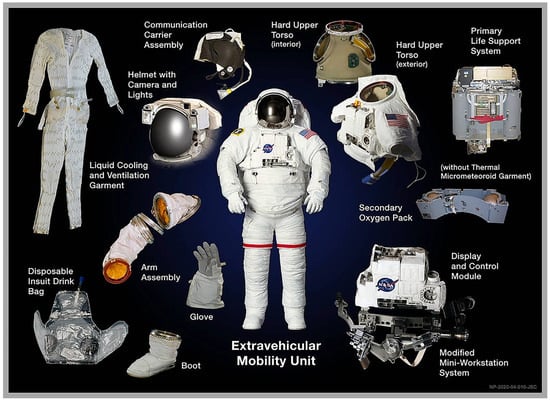
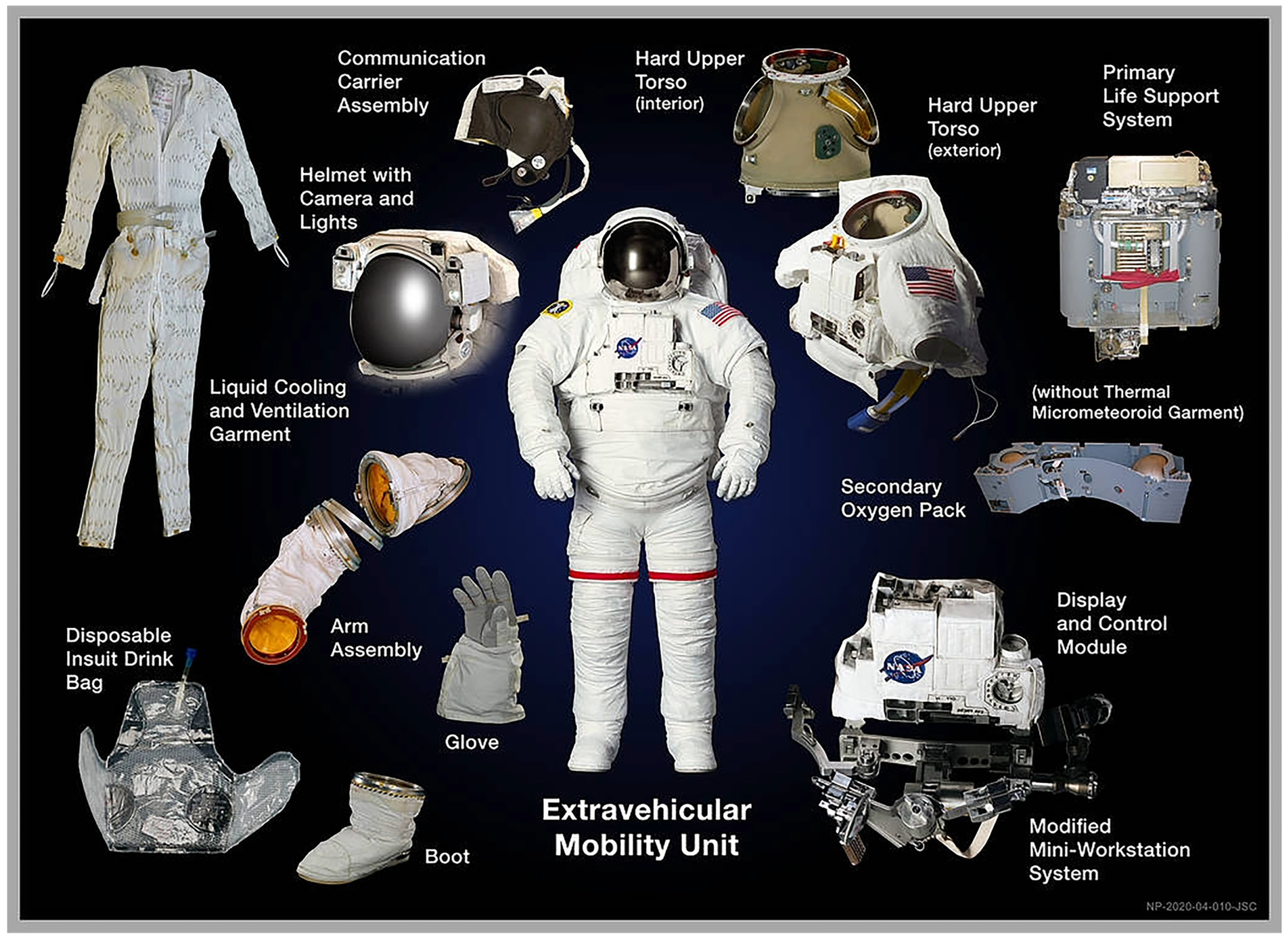
The EMU provides a useful reference for examining the architecture and design constraints of a gas-pressurized EVA suit. It consists primarily of the primary life support system and the pressurized garment assembly, which includes the upper torso, lower torso, arms, gloves and helmet (Figure 2) [7,43]. These components are available in multiple sizes in order to accommodate the anthropometric variability of the astronaut population; however, an optimal fit cannot always be achieved for every crew member [28].
Figure 2.
Schematic overview of the NASA EMU and its main structural and life-support subsystems. Image by NASA [44].
The combination of suboptimal suit fit and gas pressurization creates an environment that limits movement during EVA operations, increases astronaut fatigue and contributes to musculoskeletal injury risk [13,45].
Problems related to astronaut mobility during EVA were already identified during Apollo missions. In December 2005, the Space Medicine Division of NASA commissioned a study, the “Apollo medical operations project”, to investigate medical issues encountered during the Apollo program [46]. Approximately 64% of Apollo astronauts were interviewed to collect information relevant to future missions. Concerning EVA suits, the study highlighted the need to improve glove dexterity and suit flexibility and to reduce suit mass and internal pressure to limit astronaut fatigue [46].
Over the years, several studies have investigated the stiffness of spacesuits and the related challenges for astronauts.
In 2001, Schmidt attributed suit stiffness to two main factors: structural effect, related to the rigidity of materials composing the suit, and volumetric effect, associated with the energy required to displace the internal gas when the joint volume changes during movement [47]. In addition to these effects, Holschuh et al. [48], un 2009, introduced the pressure effect defined as the additional resistance to movement caused by the compression and expansion of the internal gas during joint motion. In particular, deviations from constant-volume joint behavior were shown to increase internal pressure, resulting in higher joint resistive torque during movement. These pressure-induced effects become especially significant at large flexion angles, where an additional torque contribution of up to approximately 6.6% was measured. This increase leads to greater joint loading, potentially increasing the risk of musculoskeletal injuries in astronauts [48]. However, these effects should not be interpreted as fully independent or equally important under all operating conditions. Their relative contribution depends on the joint considered, the range of motion, the suit configuration and the measurement method.
Therefore, the mechanical resistance generated by suit pressurization significantly affects astronaut strength and mobility.
In 1996, NASA conducted a study involving six subjects to quantitatively evaluate the reduction in joint strength caused by suit pressurization by comparing force measurements obtained with and without a pressurized suit. Analysis of shoulder, knee, elbow and wrist movements demonstrated a significant reduction in human biomechanical performance. The largest decreases were observed during shoulder and elbow extension, with available force reduced by 42% and 21% respectively [49].
In addition to reducing strength, gas pressurization also alters the functional workspace viable to astronauts during EVA. A study conducted by Schmidt et al. demonstrated that although astronauts may physically reach certain positions while wearing a pressurized EVA suit, the high resistive torques generated by the suit can make these movements excessively demanding and difficult to sustain [50]. This can induce fatigue, alter movement dynamics and reduce the volume in which useful work can be performed comfortably.
The adverse biomechanical effects of gas pressurization are further exacerbated by local body-suit interactions and imperfect suit fit.
Recent investigations have shown that contact patterns between the astronaut and the pressurized suit are highly non-uniform and may substantially influence movement efficiency and comfort during EVA operations [51].
In 2015, Anderson et al. investigated astronaut movement using a wearable sensor system called “The Polipo” to analyze astronaut-suit interaction and identify factors associated with injury risk. The study involved three experienced subjects performing different upper-body movements and functional tasks, each repeated 12 times. Their results showed that 54% of tested movements exhibited statistically significant biomechanical inconsistencies, indicating variations in movement strategies and load distribution across repetitions. Experienced astronauts continuously adapted their motor strategies and redistributed loads during motion, suggesting compensatory mechanisms that may indicate early discomfort and contribute to musculoskeletal injuries over repeated movements [52].
Several studies have directly associated gas-pressurized suits with musculoskeletal injuries and increased physiological workload. EVA suits have been linked to hand trauma, fingernail delamination, skin lesions, shoulder overuse injuries, and chronic fatigue during both training and operational activities [53,54,55]. By 2012, for example, a total of 25 shoulder surgeries were performed on astronauts, most of which were associated with spacesuit training activities [56].
The severity of these biomechanical limitations is strongly dependent on suit operating pressure and on the interaction between pressure, suit structure and human movement. Although increasing internal pressure improves physiological safety and reduces the risk of decompression sickness, it simultaneously increases joint stiffness, frictional resistance, and metabolic cost [57]. Spacesuit design therefore involves a fundamental trade-off between physiological safety and biomechanical performance [57].
Gas pressurization remains the most operationally mature approach, but its established physiological benefits are achieved at the cost of mobility, metabolic efficiency and human–suit compatibility. This trade-off has motivated the investigation of alternative suit architectures aimed at reducing the biomechanical penalties associated with conventional gas pressurization while preserving adequate physiological protection.
4. Mechanical Counter-Pressure (MCP) and Smart Materials for Next Generation Spacesuit
To address the inherent limitations of gas-pressurized suits, MCP has been proposed as an alternative approach to EVA suit design, aiming to provide physiological pressurization while improving mobility and reducing biomechanical constraints. Unlike traditional gas-pressurized EVA suits, which create an enclosed pressurized environment around the body, MCP systems generate the required pressure through the elastic tension of a skin-tight garment in direct contact with the skin [58]. Depending on the architecture, this garment may incorporate elastic textiles, inextensible structural elements, inflatable components or active actuators. However, the application of pressure directly to the body does not, by itself, guarantee adequate physiological performance. The effectiveness of an MCP garment depends on the spatial uniformity and temporal stability of the pressure, particularly during changes in posture, joint motion and prolonged wear.
4.1. Fundamental Principles and Early MCP Development
The physical principle underlying any MCP system can be expressed by the relationship:
where T is the tension per unit length in the garment fabric, p is the target counter-pressure, and K is the local radius of curvature of the body surface. Equation (1) assumes a thin, flexible membrane in continuous contact with the body and is most directly applicable to simplified, convex geometries such as a cylindrical surface. Its application to real MCP garments requires caution, as complex body geometries, anisotropic textile properties, and imperfect contact between the garment and the body, particularly in concave regions, can produce spatial variations in the delivered pressure. Consequently, maintaining a physiologically adequate pressure distribution requires the fabric tension to vary locally with body shape and posture, which represents a central engineering challenge for MCP design.
T = p × K
The energetic advantage of MCP over gas pressurization can be formalized by considering the total work required to deform a spacesuit during body movement, which can be expressed as:
where ΔWp is the work done against the internal gas pressure-volume change, ΔWb is the work required to bend the suit material, and ΔWs is the work required to stretch it [59]. In conventional gas-pressurized suits, the ΔWp term can represent a major contribution to joint resistance and metabolic cost during EVA. Purely MCP systems do not rely on a pressurized gas volume to provide mechanical counter-pressure and therefore avoid this contribution. In hybrid architectures, however, the magnitude of ΔWp depends on the gas-pressurized components retained in the system and is therefore reduced rather than necessarily eliminated. In both architectures, suit deformability also depends on the mechanical properties of the garment materials and the configuration of the pressure system.
ΔW = ΔWp + ΔWb + ΔWs
The origins of MCP garments can be traced back to high-altitude aviation research in the 1940s. James P. Henry developed one of the first operational partial-pressure garments, successfully tested in 1945–1946, which employed inflatable capstan tubes to mechanically compress the body through an inelastic garment [60].
Between 1968 and 1971, Webb and Annis extended the MCP concept to extravehicular activity through the development of the Space Activity Suit. The suit employed multilayer elastic textiles, including bobbinet and early spandex-based fabrics, to provide direct body compression instead of a fully pressurized gas environment [61]. Although the concept demonstrated improved mobility and lower metabolic cost compared with conventional gas suits, significant limitations emerged in terms of pressure uniformity, joint conformity, and donning complexity, with reported donning times reaching approximately 45–60 min [62].
These results demonstrated the potential of direct mechanical compression but also showed that improved mobility alone is insufficient to establish operational feasibility. Pressure uniformity, garment handling, physiological performance and long-duration wearability must be considered simultaneously.
These limitations led NASA to discontinue MCP suit development at the time; however, subsequent research continued to explore the concept on isolated anatomical regions, particularly the hand; gloves received particular attention due to their critical role in EVA performance and due to astronaut dexterity, comfort and tactile perception [63,64,65].
4.2. MCP Gloves and Hybrid Architectures
The hand represents one of the most demanding anatomical regions for spacesuit design because of its complex geometry and essential role in astronaut dexterity and tactile interaction.
In 1984, Clapp compared a lightweight MCP “skinsuit” glove made of elastic materials with the conventional NASA A7L-B gas-pressurized glove. The MCP-based design demonstrated substantial improvements in joint mobility, dexterity and tactile feedback, while also reducing fatigue accumulation during repetitive grasping tasks. Although both glove configurations allowed comparable initial grip strength, the conventional gas-pressurized glove produced a significantly faster decline in performance due to the resistance generated by the internal pressurized volume. In addition, the skinsuit glove provided markedly improved tactile perception without causing significant physiological discomfort under partial-vacuum conditions [66].
More recent developments by NASA and Honeywell demonstrated an MCP glove prototype with reported improved dexterity, tactility and flexibility compared to conventional shuttle EVA gloves. The MCP design enabled manipulation of small objects (~10 mm) that could not be grasped with standard gas-pressurized gloves. Although comfort and hand posture were improved under hypobaric conditions, a major limitation remained the increased donning time compared to conventional systems [67]. These results suggest that MCP may improve selected task-specific performance metrics, while still imposing operational penalties in garment handling.
A further investigation by Final Frontier Design, conducted as part of NASA’s High-Performance EVA Gloves project, developed an MCP glove architecture combining elastic containment layers with inflatable compression elements, demonstrating promising improvements in finger tactility and mobility alongside a significant reduction in glove size. However, the study also highlighted persistent challenges related to pressure uniformity during hand movement, wrist mobility, and donning/undressing procedures [68].
Taken together, these studies indicate that MCP gloves can improve selected aspects of dexterity and tactile performance, but their advantages remain subject to limitations in pressure control, wrist mobility and garment handling. Since these results cannot be directly extrapolated to a full-body suit, hybrid architectures combining MCP and gas pressurization were subsequently investigated as a possible compromise between mobility and pressure reliability.
A fundamental contribution to the development of hybrid space suit architectures is represented by the work of Korona and Akin (2002) [69], who designed and evaluated a hybrid EVA glove. The proposed system integrated a gas-pressurized air chamber with an external mechanical containment layer composed of elastic material, effectively replacing traditional bellows joints with elastic fabric sections. The evaluation involved 30 subjects and compared the hybrid glove with the standard 4000-series EMU glove under a pressure differential of 4.3 psid. Dexterity, joint range of motion, grip strength and perceived exertion were assessed. Experimental testing, conducted in both hyperbaric and partial vacuum environments, demonstrated that the hybrid configuration delivered tactile and mobility performance that was generally comparable to the conventional glove, although the results varied across the evaluated parameters, while offering potential benefits in terms of finger dexterity and fatigue reduction [69].
The transition from developing individual hybrid components to conceptualizing a full spacesuit architecture for Martian exploration achieved a major breakthrough with the work of Huerta et al. (2018) [70]. The authors proposed an innovative “fusion” model (GP-MCP), where the astronaut’s body is protected simultaneously by an MCP inner garment and a GP outer shell. A trade study based on mobility, mass, and DCS risk identified an optimal configuration at a total suit pressure of 8.3 psi with 30–40% of the total pressure provided by the MCP layer and the remaining 60–70% by the gas. Under the assumptions of the model, this configuration was predicted to reduce or potentially eliminate oxygen pre-breathe requirements while improving estimated mobility and reducing mass compared with a conventional all-gas suit [70]. Because these conclusions were derived from a trade study, they should be interpreted as model-based predictions rather than as experimentally demonstrated performance.
Four years later, Rudakov et al. [71] extended this analysis by introducing a distinction between layered and segmented hybrid architectures. In layered architectures, the MCP garment and the gas-pressurized layer cover the same body regions, whereas segmented architectures combine gas pressurization and MCP in different body regions. Their analysis identified a segmented configuration combining a gas-pressurized torso with elastic MCP limbs as one of the most feasible architectures for Martian EVA. In this configuration, the reported 60% refers to the approximate proportion of body coverage by MCP, rather than to the fraction of total pressure supplied mechanically [71,72]. However, these conclusions were primarily based on modeling and trade-space analyses rather than on integrated human-subject validation of a complete hybrid suit.
These studies suggest that hybrid architecture may offer a practical compromise between mobility and pressure reliability, but their predicted benefits remain dependent on the assumptions of the underlying models. They retain gas-related mechanical and depressurization risk and introduce additional interface, control and verification requirements, which must be assessed through integrated testing rather than through trade studies alone.
4.3. BioSuit Development and Active Materials for MCP Pressurization
A major and systematic contribution to the development of MCP suits was provided by Dava Newman’s research group at Massachusetts Institute of Technology (MIT), which helped move MCP concepts from theoretical studies towards experimentally evaluated prototype systems, particularly through the BioSuit™ program.
The BioSuit concept draws from Iberall’s theory of the Lines of Non-Extension (LoNE), which identifies specific lines on the skin surface that remain relatively undeformed during body movement [73]. Newman’s group at MIT built upon this framework by developing a systematic mapping of these lines across the body, using them as the structural template for anchoring the suit’s tension network and generating the required counter-pressure [59].
The first phase of BioSuit prototype development (2001–2006) focused on demonstrating MCP feasibility and characterizing the physiological requirements of the system.
Bethke (2005) [74] fabricated the first elastic-only prototype based on inextensible Kevlar fibers oriented along the body’s LoNE, demonstrating excellent leg mobility but without physiological validation under vacuum conditions [74].
The most significant experimental contribution of this phase was provided by Sim (2006) [75], who developed two elastic-only prototype concepts: detached bands and elastic bindings and conducted the first physiological validation of an elastic-only MCP garment on human subjects, focusing on the calf region [75]. The elastic bindings, which applied circumferential compression through a continuous elastic layer oriented along the LoNE, outperformed the detached bands in terms of pressure uniformity, comfort, and ease of donning. Physiological testing showed that the elastic bindings could mitigate selected cardiovascular responses when the calves of five subjects were exposed to a simulated under pressure of −30 kPa for over an hour. The average spatial pressure non-uniformity measured on the human calf was 8.7 kPa, exceeding the 1.6 kPa design target adopted in earlier BioSuit studies. This value should not be interpreted as a universally established physiological tolerance, since the acceptable pressure variation for MCP garments remains insufficiently characterized. Although temporary skin indentations were observed, no bruising, edema, or other adverse effects requiring medical treatment were reported [75].
The regional validation of passive MCP garments provided evidence of physiological feasibility but also highlighted the difficulty of maintaining uniform pressure over complex and deformable body geometries. These limitations motivated the integration of active materials into subsequent BioSuit architecture.
Many different types of active materials exist, including (but not limited to) shape memory alloys (SMAs), shape memory polymers (SMPs), dielectric elastomer actuators (DEAs), liquid crystal elastomers, ionic polymer/metal composites, ferroelectric polymers [76].
Each active material exhibits distinct characteristics, form factors, and activation mechanisms (thermal, electrical, magnetic, etc.). For wearable MCP applications, the ideal material should combine high force output and large actuation strain with ease of textile integration, minimal added mass, and a safe, practical activation method. However, these requirements are coupled: increasing force output may increase mass or energy consumption, while faster actuation may require higher power or more complex thermal management.
To identify the most suitable actuation for MCP garments, Holschuh et al. conducted a comparative analysis of three candidate material classes: SMAs, SMPs and DEAs [77]. SMAs are metallic materials capable of recovering their original shape through thermally or magnetically induced phase transformations [78]. SMPs exhibit a similar shape recovery behavior through molecular rearrangements within their polymer network [79], while DEAs generate large deformations when subjected to an electric field [80]. Based on this comparative analysis, SMAs were identified as the most suitable option for MCP garments due to their reliable actuation behavior and compatibility with textile manufacturing processes. In contrast, DEAs suffered from durability limitations and high voltage requirements, whereas SMPs exhibited viscoelastic and permanent deformation effects that reduced their effectiveness as actuators [81]. In particular, the research focused on the study of Nitinol (NiTi) as an actuator.
NiTi SMAs are already widely employed in biomedical engineering endovascular stents [82], and orthopedic implants [83], as well as in aerospace applications [84]. Their thermal actuation relies on Joule heating, whereby an applied electrical current triggers the reversible martensite-to-austenite phase transformation and produces the associated shape recovery [85]. This mechanism allows the garment to remain compliant and relatively easy to don in the martensitic state, while generating compression upon electrical activation. However, Joule-heating actuation introduces additional power and thermal-management requirements, particularly when the actuators are positioned close to the astronaut’s body. Localized overheating and excessive heat transfer to the skin represent potential safety concerns, as some SMA actuators may operate at temperatures unsuitable for direct proximity to the body [86,87]. Possible engineering strategies to mitigate these risks include thermal insulation between the actuator and the body, temperature monitoring and feedback control [88]. However, thermal insulation may increase system volume, while active cooling strategies may introduce additional power and integration requirements potentially limiting their suitability for wearable aerospace applications [86]. Building on these properties, a compression tourniquet incorporating low spring index NiTi coil actuators was developed and tested, demonstrating the feasibility of controllable, voltage-regulated counter-pressure production in a wearable garment architecture [89].
Subsequent testing of active compression garments incorporating SMA actuators showed that controllable pressure levels exceeding those required for EVA could be generated at the prototype level [81,89,90].
These results demonstrate the pressure-generation capability of SMA-based MCP components but do not by themselves establish their suitability for an integrated spacesuit. Important challenges remain, including pressure uniformity, actuator integration, thermal management, cyclic fatigue and acceptable donning procedures.
More recently, Kothakonda revisited shape memory polymers as an alternative actuation strategy within the BioSuit program [91]. The study focused on a crosslinked poly(cyclooctene)-based two-way shape memory polymer, selected for its reversible crystallization–melting behavior and relatively low activation temperature (45 °C) [92]. Unlike conventional SMP actuators, the proposed approach exploited thermally induced stress multiplication, allowing a modest manually applied force during donning to be amplified during activation and converted into garment pressurization. Experimental prototypes demonstrated pressure generation approaching those required for EVA under tested conditions, providing preliminary evidence of the concept’s feasibility [93]. In parallel, nonlinear finite element models of woven and knitted fabrics were developed to investigate the coupling between SMP actuation and textile deformation, providing a framework for future garment optimization [94]. However, long activation times, pressure non-uniformity, and the lack of validation on human subjects limited the current assessment of the technology [93].
To provide a more quantitative assessment of active-material actuation strategies for MCP garments, Table 2 compares the reported performance of SMA- and SMP-based prototypes. Th reported values were obtained under different experimental conditions and should therefore be interpreted as indicative of prototype-level capabilities rather than as a direct comparison of the two actuation strategies.
Table 2.
Reported performance of SMA- and SMP-based actuators for MCP applications.
As summarized in Table 2, the available studies report power requirements for individual SMA and SMP prototypes, but these values are insufficient to establish the total energy demand of an active MCP system over a typical 6–8 h EVA.
The main milestones of the MIT BioSuit program and the corresponding level of available evidence are summarized in Table 3.
Table 3.
Major milestones in the development of the MIT BioSuit program from passive elastic garments to actively pressurized systems. The table summarizes the evolution of pressure-generation strategies, the materials employed, the main contribution, the type of evidence available and the key limitation for each stage.
Table 3 highlights that the reported BioSuit™ developments correspond to different levels of validation, ranging from structural concepts and numerical modeling to laboratory prototypes and human-subject experiments on selected anatomical regions. These results should therefore not be interpreted as equivalent evidence of operational readiness. Overall, the studies demonstrate progressive advances in MCP pressure generation and control, but they do not yet establish the performance of a fully integrated suit under representative EVA conditions.
In addition to these limitations, the influence of the gravitational environment on MCP garment fit and pressure distribution deserves consideration. Anthropometric measurements collected during spaceflight have revealed changes in body dimensions [95]. Since MCP relies on direct contact between the garment and the body to generate counter-pressure, such changes could affect local contact conditions and pressure distribution. However, this remains a hypothesis, as the effects of microgravity and partial-gravity conditions on MCP performance have not yet been sufficiently investigated experimentally.
The main characteristics, potential advantages, limitations and available evidence for the principal spacesuit architecture discussed in this review are summarized in Table 4.
Table 4.
Critical comparison of gas-pressurized, passive MCP, active MCP and hybrid GP–MCP spacesuit architectures.
The comparison highlights a fundamental trade-off rather than a universally superior architecture. Gas-pressurized suits remain the most operationally mature solution, whereas passive and active MCP systems offer potential mobility benefits but still face challenges related to pressure uniformity, garment handling and system integration. Hybrid architecture may provide an intermediate solution by combining pressure reliability with reduced gas-related resistance, although their advantages remain to be demonstrated at the integrated-system level. Overall, the available evidence supports continued development of MCP technologies but does not yet establish their operational equivalence to conventional gas pressurized suits.
5. Conclusions
This review has examined the evolution of EVA spacesuit design from conventional gas-pressurization systems to emerging MCP architectures, with particular attention to the role of active materials in addressing long-standing limitations in MCP suit development.
Gas-pressurized spacesuits have enabled human space exploration for decades and remain the most operationally mature approach to providing physiological protection during EVA. However, their pressurized gas volume, structural stiffness, geometry and interaction with the wearer can impose significant biomechanical constraints including increased joint resistance, reduced mobility, higher metabolic demand, and limited operational dexterity. These limitations become increasingly relevant in the context of long-duration planetary exploration, where sustained physical performance and mobility are essential requirements.
MCP systems have been proposed as an alternative approach that applies pressure directly to the body through a close-fitting garment, thereby reducing or partially eliminating the need for a fully pressurized gas volume. In principle, this approach could reduce the mechanical effort associated with movement and improve selected aspects of mobility compared with conventional suits. However, the evidence reviewed indicates that these potential benefits remain dependent on the ability to maintain uniform and stable pressure over the complex and dynamic geometry of the human body. Results obtained from regional tests, component-level prototypes and modeling should therefore not be interpreted as equivalent to the validation of a complete operational MCP suit.
More recent research has focused on the integration of active materials as a potential means of improving pressure generation and control. Shape memory alloys and shape memory polymers, in particular, have been investigated for their ability to generate controllable mechanical compression within textile-based systems and to improve donning and pressurization strategies. Although these approaches have shown promising results at the prototype level, their benefits must still be assessed against requirements related to activation time, energy consumption, thermal management, pressure uniformity, durability and system integration.
Overall, current developments indicate that future MCP-based spacesuits may rely on the combined development of advanced materials, textile engineering and biomechanical design. However, no architecture currently provides a dominant solution across all relevant requirements: gas-pressurized suits remain the operational benchmark, while passive, active and hybrid MCP systems require further integrated validation. Continued progress will therefore be necessary to determine whether MCP concepts can evolve from regional and component-level demonstrations into reliable systems capable of supporting future lunar and Martian exploration missions.
Author Contributions
Conceptualization, S.L.; methodology, M.C., M.G.S. and S.L.; investigation, M.C.; writing—original draft preparation, M.C.; writing—review and editing, S.L. and M.G.S. All authors have read and agreed to the published version of the manuscript.
Funding
This study was carried out within the Space It Up project funded by the Italian Space Agency, ASI, and the Ministry of University and Research, MUR, under contract n. 2024-5-E.0-CUP n. I53D24000060005.
Data Availability Statement
No new data were created or analyzed in this study. Data sharing is not applicable to this article.
Conflicts of Interest
The authors declare no conflicts of interest.
Abbreviations
The following abbreviations are used in this manuscript:
| EVA | Extravehicular activity |
| MCP | Mechanical counter-pressure |
| EMU | Extravehicular mobility units |
| DCS | Decompression sickness |
| xEMU | Exploration extravehicular mobility unit |
| AxEMU | Axiom extravehicular mobility unit |
| LoNE | Lines of non-extension |
| MIT | Massachusetts Institute of Technology |
| SMA | Shape memory alloys |
| SMP | Shape memory polymers |
| DEA | Dielectric elastomer actuators |
| NiTi | Nitinol |
References
- Goswami, N.; White, O.; Blaber, A.; Evans, J.; van Loon, J.J.; Clement, G. Human physiology adaptation to altered gravity environments. Acta Astronaut. 2021, 189, 216–221. [Google Scholar] [CrossRef] [Scilit]
- Tomsia, M.; Cieśla, J.; Śmieszek, J.; Florek, S.; Macionga, A.; Michalczyk, K.; Stygar, D. Long-term space missions’ effects on the human organism: What we do know and what requires further research. Front. Physiol. 2024, 15, 1284644. [Google Scholar] [CrossRef] [Scilit] [PubMed]
- Bizzarri, M.; Gaudenzi, P.; Angeloni, A. The biomedical challenge associated with the Artemis space program. Acta Astronaut. 2023, 212, 14–28. [Google Scholar] [CrossRef] [Scilit]
- Krittanawong, C.; Singh, N.K.; Scheuring, R.A.; Urquieta, E.; Bershad, E.M.; Macaulay, T.R.; Kaplin, S.; Dunn, C.; Kry, S.F.; Russomano, T.; et al. Human Health during Space Travel: State-of-the-Art Review. Cells 2023, 12, 40. [Google Scholar] [CrossRef] [Scilit] [PubMed]
- Gelfan, S. Explosive decompression of Macaque monkeys to extreme altitudes and recompression at free-fall rates. J. Appl. Physiol. 1950, 3, 254–281. [Google Scholar] [CrossRef] [Scilit] [PubMed]
- Billingham, J. Survival After Decompression to a Vacuum; NASA: Washington, DC, USA, 1964.
- Jordan, N.C.; Saleh, J.H.; Newman, D.J. The extravehicular mobility unit: A review of environment, requirements, and design changes in the US spacesuit. Acta Astronaut. 2006, 59, 1135–1145. [Google Scholar] [CrossRef] [Scilit]
- Chang, E.Y.-W. Fashion styling and design aesthetics in spacesuit: An evolution review in 60 Years from 1960 to 2020. Acta Astronaut. 2021, 178, 117–128. [Google Scholar] [CrossRef] [Scilit]
- Skoog, Å.I.; Norberg, C. Space suits. In Human Spaceflight and Exploration; Springer: Berlin/Heidelberg, Germany, 2013; pp. 209–253. [Google Scholar]
- Jenkins, D.R. Dressing for Altitude: US Aviation Pressure Suits, Wiley Post to Space Shuttle; Government Printing Office: Washington, DC, USA, 2012; Volume 595.
- Sun, Y.; Li, Y.-Z.; Yuan, M. A Flexible Dynamic Reliability Simulation Approach for Predicting the Lifetime Consumption of Extravehicular Spacesuits during Uncertain Extravehicular Activities. Aerospace 2023, 10, 485. [Google Scholar] [CrossRef] [Scilit]
- Zhang, J.Y.; Anderson, A.P. Performance risks during surface extravehicular activity and potential mitigation using multimodal displays. Aerosp. Med. Hum. Perform. 2023, 94, 34–41. [Google Scholar] [CrossRef] [Scilit] [PubMed]
- McFarland, S.M.; Norcross, J.R. A novel method for characterizing spacesuit mobility through metabolic cost. In Proceedings of the International Conference on Environmental Systems (ICES), Tuscon, AZ, USA, 13–17 July 2014. [Google Scholar]
- Žunjić, A.; Yue, X.-G. Review of the effects of atmospheric pressure on health, perception, and work-an ergonomic view. IETI Trans. Ergon. Saf. 2024, 8, 21–28. [Google Scholar] [CrossRef]
- Ortiz-Prado, E.; Dunn, J.F.; Vasconez, J.; Castillo, D.; Viscor, G. Partial pressure of oxygen in the human body: A general review. Am. J. Blood Res. 2019, 9, 1–14. [Google Scholar] [PubMed]
- Kuzmenko, N.; Tsyrlin, V.; Pliss, M.; Galagudza, M. Health effects of atmospheric pressure fluctuations: A review of biometeorological research. Int. J. Biometeorol. 2025, 69, 2171–2187. [Google Scholar] [CrossRef] [Scilit] [PubMed]
- Bancroft, R.W.; Dunn, J.E., II. Experimental animal decompressions to a near vacuum environment. Aerosp. Med. 1965, 36, 720–725. [Google Scholar] [PubMed]
- Topliff, E. Mechanism of lung damage in explosive decompression. Aviat. Space Environ. Med. 1976, 47, 517–522. [Google Scholar] [PubMed]
- Murray, D.H.; Pilmanis, A.A.; Blue, R.S.; Pattarini, J.M.; Law, J.; Bayne, C.G.; Turney, M.W.; Clark, J.B. Pathophysiology, prevention, and treatment of ebullism. Aviat. Space Environ. Med. 2013, 84, 89–96. [Google Scholar] [CrossRef] [Scilit] [PubMed]
- Tlapák, J.; Oniščenko, B.; Došel, P.; Požár, P.; Chmátal, P.; Hájek, M. Rare pulmonary barotrauma after explosive decompression: A case report. BMC Pulm. Med. 2020, 20, 291. [Google Scholar] [CrossRef] [Scilit] [PubMed]
- Bolonkin, A. Man in outer space without a special space suit. Am. J. Eng. Appl. Sci. 2009, 2, 573–579. [Google Scholar] [CrossRef] [Scilit]
- Tarver, W.J.; Volner, K.; Cooper, J.S. Aerospace Pressure Effects. In StatPearls; StatPearls Publishing LLC.: Treasure Island, FL, USA, 2026. [Google Scholar]
- Katuntsev, V.P.; Osipov, Y.Y.; Filipenkov, S.N. Biomedical problems of EVA support during manned space flight to Mars. Acta Astronaut. 2009, 64, 682–687. [Google Scholar] [CrossRef] [Scilit]
- Foster, P.P.; Butler, B.D. Decompression to altitude: Assumptions, experimental evidence, and future directions. J. Appl. Physiol. 2009, 106, 678–690. [Google Scholar] [CrossRef] [Scilit] [PubMed]
- Belobrajdic, B.; Melone, K.; Diaz-Artiles, A. Planetary extravehicular activity (EVA) risk mitigation strategies for long-duration space missions. npj Microgravity 2021, 7, 16. [Google Scholar] [CrossRef] [Scilit] [PubMed]
- Mitchell, S.J. Decompression illness: A comprehensive overview. Diving Hyperb. Med. 2024, 54, 1–53. [Google Scholar] [CrossRef] [Scilit] [PubMed]
- Conkin, J. Preventing Decompression Sickness over Three Decades of Extravehicular Activity; NASA Johnson Space Center: Houston, TX, USA, 2011.
- Kluis, L.; Diaz-Artiles, A. Revisiting decompression sickness risk and mobility in the context of the SmartSuit, a hybrid planetary spacesuit. npj Microgravity 2021, 7, 46. [Google Scholar] [CrossRef] [Scilit] [PubMed]
- Skoog, A.I.; Abramov, I.P.; Stoklitsky, A.Y.; Doodnik, M.N. The Soviet-Russian space suits a historical overview of the 1960’s. Acta Astronaut. 2002, 51, 113–131. [Google Scholar] [CrossRef] [Scilit] [PubMed]
- Kostin, M. Conceptual Design for the Advancement of Mechanical Counterpressure Spacesuits. In Proceedings of the 52nd International Conference on Environmental Systems, Calgary, AB, Canada, 16–20 July 2023. [Google Scholar]
- Wilson, J.W.; Tweed, J.; Zeitlin, C.; Kim, M.-H.; Anderson, B.; Cucinotta, F.; Ware, J.; Persans, A. Shuttle spacesuit: Fabric/LCVG model validation. In Proceedings of the 31st International Conference on Environmental Systems, Orland, FL, USA, 9–12 July 2001. [Google Scholar]
- Weiss, P.; Mohamed, M.P.; Gobert, T.; Chouard, Y.; Singh, N.; Chalal, T.; Schmied, S.; Schweins, M.; Stegmaier, T.; Gresser, G.T. Advanced materials for future lunar extravehicular activity space suit. Adv. Mater. Technol. 2020, 5, 2000028. [Google Scholar] [CrossRef] [Scilit]
- Bayar, B.; Tuzcu, G.; Kaya, G. Space Suit Design: A Review of Current State and Perspectives on Requirements and Challenges. In Proceedings of the 12th Ankara International Aerospace Conference, Ankara, Turkey, 13–15 September 2023. [Google Scholar]
- Harris, G.L. The Origins and Technology of the Advanced Extravehicular Space Suit; American Astronautical Society: Springfield, VA, USA, 2001. [Google Scholar]
- Diaz, A.; Anderson, A.; Kracik, M.; Trotti, G.; Hoffman, J.; Newman, D. Development of a comprehensive astronaut spacesuit injury database. In Proceedings of the 63rd International Astronautical Congress, Naples, Italy, 1–5 October 2012. [Google Scholar]
- Seyed Mousavi, M.M.; Favetto, A.; Chen Chen, F.; Ambrosio, E.; Appendino, S.; Manfredi, D.; Pescarmona, F.; Somà, A. Spacesuits and EVA gloves evolution and future trends of extravehicular activity gloves. In Proceedings of the 41st International Conference on Environmental Systems, Portland, OR, USA, 17–21 July 2011; p. 5147. [Google Scholar]
- Mankame, K.; Song, S.; Williams, S.O.; Florio, N.; Muvvala, M. Critical Analysis of Mobility and Safety Challenges in Contemporary Space Suit Design. In Proceedings of the IAF Human Spaceflight Symposium, Milan, Italy, 14–18 October 2024. [Google Scholar]
- Hill, T.R. Exploration Space Suit Architecture and destination environmental-based technology development. In Proceedings of the 2011 Aerospace Conference, Big Sky, MT, USA, 5–12 March 2011; pp. 1–14. [Google Scholar]
- Ogilvie, R.; Miller, S.; Hetherington, R. Advanced Material Options for the Portable Life Support System (PLSS). In Proceedings of the 53rd International Conference on Environmental Systems (ICES 2024), Louisville, KY, USA, 21–25 July 2024. [Google Scholar]
- Axiom Space. Axiom Space, Prada Unveil Spacesuit Design for Moon Return. 2024. Available online: https://www.axiomspace.com/release/axiom-space-prada-unveil-spacesuit-design-for-moon-return (accessed on 3 November 2026).
- National Aeronautics and Space Administration. Reference Guide to the International Space Station; NASA: Washington, DC, USA, 2010.
- Li, X.; Xie, Y.; Tian, Y.; An, F. A Study on the Design and Implementation Technologies of EVA at the China Space Station. Aerospace 2024, 11, 264. [Google Scholar] [CrossRef] [Scilit]
- Lousada, J.; Kamaletdinova, G.; Patel, D.; Lakmal, Y.; Oluwafemi, F.; De La Torre, A.; Heshani, U.; Onevsky, M.; Skvortsov, S. Approaches and solutions for Martian spacesuit design. In Proceedings of the Proceedings of the International Astronautical Congress, IAC, Adelaide, Australia, 25–29 September 2017; pp. 228–241. [Google Scholar]
- Available online: https://www.nasa.gov/image-article/extravehicular-mobility-unit-emu (accessed on 20 September 2026).
- Kosmo, J.J.; Ross, A. Space suit mobility evaluations in Lunar/Mars gravity environments. In Proceedings of the 28th International Conference on Environmental Systems, Danvers, MA, USA, 13–16 July 1998. [Google Scholar]
- Scheuring, R.A.; Jones, J.A.; Novak, J.D.; Polk, J.D.; Gillis, D.B.; Schmid, J.; Duncan, J.M.; Davis, J.R. The Apollo Medical Operations Project: Recommendations to improve crew health and performance for future exploration missions and lunar surface operations. Acta Astronaut. 2008, 63, 980–987. [Google Scholar] [CrossRef] [Scilit]
- Schmidt, P.B. An Investigation of Space Suit Mobility with Applications to EVA Operations; Massachusetts Institute of Technology: Cambridge, MA, USA, 2001. [Google Scholar]
- Holschuh, B.; Waldie, J.; Hoffman, J.; Newman, D. Characterization of structural, volume and pressure components to space suit joint rigidity. In Proceedings of the International Conference on Environmental Systems, ICES, Savannah, GA, USA, 12–16 July 2009. [Google Scholar]
- Maida, J.C.; Demel, K.J.; Morgan, D.A.; Wilmington, R.P.; Pandya, A.K. Comparison of Extravehicular Mobility Unit (EMU) Suited and Unsuited Isolated Joint Strength Measurements; NASA: Washington, DC, USA, 1996.
- Schmidt, P.B.; Newman, D.J.; Hodgson, E. Modeling space suit mobility: Applications to design and operations. In Proceedings of the 31st International Conference on Environmental Systems, Orlando, FL, USA, 9–12 July 2001. [Google Scholar]
- Green, W.; Kim, H.; Benson, E.; Rajulu, S. Spacesuit contact with wearer: Analysis and visualization. Acta Astronaut. 2024, 222, 450–456. [Google Scholar] [CrossRef] [Scilit]
- Anderson, A.P.; Newman, D.J. Pressure sensing for in-suit measurement of space suited biomechanics. Acta Astronaut. 2015, 115, 218–225. [Google Scholar] [CrossRef] [Scilit]
- Scheuring, R.A.; Mathers, C.H.; Jones, J.A.; Wear, M.L. Musculoskeletal injuries and minor trauma in space: Incidence and injury mechanisms in US astronauts. Aviat. Space Environ. Med. 2009, 80, 117–124. [Google Scholar] [CrossRef] [Scilit] [PubMed]
- Anderson, A.P.; Newman, D.J.; Welsch, R.E. Statistical evaluation of causal factors associated with astronaut shoulder injury in space suits. Aerosp. Med. Hum. Perform. 2015, 86, 606–613. [Google Scholar] [CrossRef] [Scilit] [PubMed]
- Stirling, L.; Arezes, P.; Anderson, A. Implications of space suit injury risk for developing computational performance models. Aerosp. Med. Hum. Perform. 2019, 90, 553–565. [Google Scholar] [CrossRef] [Scilit] [PubMed]
- Scheuring, R.; McCulloch, P.; Van Baalen, M.; Watson, R.; Bowen, S.; Blatt, T. Shoulder injuries in US astronauts related to EVA suit design. In Proceedings of the 83rd Annual Aerospace Medical Association Meeting, Atlanta, GA, USA, 13–17 May 2012. [Google Scholar]
- Abramov, I.; Stoklitsky, A.; Barer, A.; Filipenkov, S. Essential Aspects of Space Suit Operating Pressure Trade-Off. In Proceedings of the International Conference On Environmental Systems, Friedrichshafen, Germany, 20–23 June 1994. [Google Scholar]
- Mcfarland, S. Mechanical counter-pressure EVA suits: Nasa outlook and development strategy in 2022. In Proceedings of the 51st International Conference on Environmental Systems, Saint Paul, MN, USA, 10–14 July 2022. [Google Scholar]
- Obropta, E.W.; Newman, D.J. A comparison of human skin strain fields of the elbow joint for mechanical counter pressure space suit development. In Proceedings of the 2015 IEEE Aerospace Conference, Big Sky, MT, USA, 7–14 March 2015; pp. 1–9. [Google Scholar]
- Hersch, M.H. High Fashion: The Women’s Undergarment Industry and the Foundations of American Spaceflight. Fash. Theory 2009, 13, 345–370. [Google Scholar] [CrossRef] [Scilit]
- Webb, P. The space activity suit: An elastic leotard for extravehicular activity. Aerosp. Med. 1968, 39, 376–383. [Google Scholar] [PubMed]
- Annis, J.F.; Webb, P. Development of a Space Activity Suit; NASA: Washington, DC, USA, 1971.
- Waldie, J.; Tanaka, K.; Tourbier, D.; Webb, P.; Jarvis, C.W.; Hargens, A.R. Compression under a mechanical counter pressure space suit glove. J. Gravitat. Physiol. 2002, 9, 93–97. [Google Scholar]
- Tanaka, K.; Danaher, P.; Webb, P.; Hargens, A.R. Mobility of the elastic counterpressure space suit glove. Aviat. Space Environ. Med. 2009, 80, 890–893. [Google Scholar] [CrossRef] [Scilit] [PubMed]
- Southern, T.; Roberts, D.P.; Moiseev, N.; Ross, A.; Kim, J.H. Space suit glove design with advanced metacarpal phalangeal joints and robotic hand evaluation. Aviat. Space Environ. Med. 2013, 84, 633–638. [Google Scholar] [CrossRef] [Scilit] [PubMed]
- Clapp, M. Design and testing of an advanced pressure suit glove. In Proceedings of the 22nd Aerospace Sciences Meeting, Reno, NV, USA, 9–12 January 1984; p. 67. [Google Scholar]
- Waldie, J.M. Mechanical counter pressure space suits: Advantages, limitations and concepts for martian exploration. In Proceedings of the Mars Society Convention, Boulder, Colorado, 11–14 August 2005; Available online: https://marspapers.org/paper/Waldie_2005.pdf#1#3#1 (accessed on 3 November 2026).
- Southern, T.; Moiseev, N. Novel mechanical counter pressure gloves. In Proceedings of the 47th International Conference on Environmental Systems, Charleston, SC, USA, 16–20 July 2017. [Google Scholar]
- Korona, F.A.; Akin, D.L. Evaluation of a hybrid elastic EVA glove. In Proceedings of the 32nd International Conference on Environmental Systems, San Antonio, TX, USA, 15–18 July 2002. [Google Scholar]
- Huerta, R.; Kerr, A.; Anderson, A. Mechanical counterpressure and gas-pressurized fusion spacesuit concept to enable martian planetary exploration. In Proceedings of the 48th International Conference on Environmental Systems, Albuquerque, NM, USA, 8–12 July 2018. [Google Scholar]
- Rudakov, A.; Clarke, J.; MacRae, B.; Waldie, J.; Padhye, R. Feasibility of MCP and hybrid GP/MCP architectures for martian EVA: A trade study perspective. In Proceedings of the International Conference on Environmental Systems, Saint Paul, MN, USA, 10–14 July 2022. [Google Scholar]
- Rudakov, A. Towards a Martian Mechanical Counter Pressure Spacesuit: Material Properties, Modelling and Pressure Application. Master’s Thesis, RMIT University, Melbourne, Australia, 2024. [Google Scholar]
- Iberall, A.S. The Use of Lines of Nonextension to Improve Mobility in Full-Pressure Suits. Technical Report AMRL-TR-64-118. AMRL-TR Aerosp. Med. Res. Lab. 1964, 1–35. Available online: https://www.semanticscholar.org/paper/THE-USE-OF-LINES-OF-NONEXTENSION-TO-IMPROVE-IN-Iberall/ab61a02b91ede4d9d3ee5b0bca1c7f98bc5af472 (accessed on 3 November 2026).
- Bethke, K.K.A. The Second Skin Approach: Skin Strain Field Analysis and Mechanical Counter Pressure Prototyping for Advanced Spacesuit Design; Massachusetts Institute of Technology: Cambridge, MA, USA, 2005. [Google Scholar]
- Sim, Z.L. Development of a Mechanical Counter Pressure Bio-Suit System for Planetary Exploration; Massachusetts Institute of Technology: Cambridge, MA, USA, 2006. [Google Scholar]
- Madden, J.D.; Vandesteeg, N.A.; Anquetil, P.A.; Madden, P.G.; Takshi, A.; Pytel, R.Z.; Lafontaine, S.R.; Wieringa, P.A.; Hunter, I.W. Artificial muscle technology: Physical principles and naval prospects. IEEE J. Ocean. Eng. 2004, 29, 706–728. [Google Scholar] [CrossRef] [Scilit]
- Holschuh, B.; Newman, D. Mechanical Counter-Pressure (MCP) Space Suit Design Using Active Materials; Massachusetts Institute of Technology: Cambridge, MA, USA, 2014. [Google Scholar]
- Lobo, P.S.; Almeida, J.; Guerreiro, L. Shape memory alloys behaviour: A review. Procedia Eng. 2015, 114, 776–783. [Google Scholar] [CrossRef] [Scilit]
- Behl, M.; Lendlein, A. Shape-memory polymers. Mater. Today 2007, 10, 20–28. [Google Scholar] [CrossRef] [Scilit]
- Gupta, U.; Qin, L.; Wang, Y.; Godaba, H.; Zhu, J. Soft robots based on dielectric elastomer actuators: A review. Smart Mater. Struct. 2019, 28, 103002. [Google Scholar] [CrossRef] [Scilit]
- Holschuh, B.; Obropta, E.; Buechley, L.; Newman, D. Materials and textile architecture analyses for mechanical counter-pressure space suits using active materials. In Proceedings of the AIAA Space 2012 Conference & Exposition, Pasadena, CA, USA, 11–13 September 2012; p. 5206. [Google Scholar]
- Wadood, A. Brief overview on nitinol as biomaterial. Adv. Mater. Sci. Eng. 2016, 2016, 4173138. [Google Scholar] [CrossRef] [Scilit]
- Bouchareb, N.; Fellah, M.; Hezil, N.; Guesmi, A.; Khezami, L. A Review of Nitinol Shape Memory Alloys for Biomedical Applications: Advancements and Biocompatibility: Bouchareb, Fellah, Hezil, Guesmi, and Khezami. JOM 2026, 78, 140–167. [Google Scholar] [CrossRef] [Scilit]
- Costanza, G.; Tata, M.E. Shape memory alloys for aerospace, recent developments, and new applications: A short review. Materials 2020, 13, 1856. [Google Scholar] [CrossRef] [Scilit] [PubMed]
- Patel, S.K.; Swain, B.; Roshan, R.; Sahu, N.K.; Behera, A. A brief review of shape memory effects and fabrication processes of NiTi shape memory alloys. Mater. Today Proc. 2020, 33, 5552–5556. [Google Scholar] [CrossRef] [Scilit]
- Granberry, R.M.; Santo Padula, I.; Eschen, K.; Abel, J.; Holschuh, B. Design and Control of Reduced Power Actuation for Active-Contracting Orthostatic Intolerance Garments. In Proceedings of the International Conference on Environmental Systems; ICES–2019-2044; American Institute of Aeronautics and Astronautics: Reston, VA, USA, 2019. [Google Scholar]
- Liu, Q.; Ghodrat, S.; Huisman, G.; Jansen, K.M. Shape memory alloy actuators for haptic wearables: A review. Mater. Des. 2023, 233, 112264. [Google Scholar] [CrossRef] [Scilit]
- Copaci, D.-S.; Blanco, D.; Martin-Clemente, A.; Moreno, L. Flexible shape memory alloy actuators for soft robotics: Modelling and control. Int. J. Adv. Robot. Syst. 2020, 17, 1–15. [Google Scholar] [CrossRef] [Scilit]
- Holschuh, B.; Obropta, E.; Newman, D. Low spring index NiTi coil actuators for use in active compression garments. IEEE/ASME Trans. Mechatron. 2014, 20, 1264–1277. [Google Scholar] [CrossRef] [Scilit]
- Holschuh, B.; Newman, D. Two-spring model for active compression textiles with integrated NiTi coil actuators. Smart Mater. Struct. 2015, 24, 035011. [Google Scholar] [CrossRef] [Scilit]
- Kothakonda, A.; Kluis, L.; Newman, D. System design for tensioning limb sections in a mechanical counter pressure spacesuit. In Proceedings of the 49th International Conference on Environmental Systems, Boston, MA, USA, 7–11 July 2019. [Google Scholar]
- Chung, T.; Romo-Uribe, A.; Mather, P.T. Two-way reversible shape memory in a semicrystalline network. Macromolecules 2008, 41, 184–192. [Google Scholar] [CrossRef] [Scilit]
- Kothakonda, A. Engineering Mechanical Counter Pressure Spacesuits and Compression Garments: Active Pressurization and Design for Mobility; Massachusetts Institute of Technology: Cambridge, MA, USA, 2024. [Google Scholar]
- Kothakonda, A.; Newman, D. Modeling of Fabrics and Pressurization for Actively Tensioned Mechanical Counter Pressure Spacesuit. In Proceedings of the 51st International Conference on Environmental Systems, Saint Paul, MN, USA, 10–14 July 2022. [Google Scholar]
- Young, K.S.; Kim, K.H.; Rajulu, S. Anthropometric changes in spaceflight. Hum. Factors 2023, 65, 977–987. [Google Scholar] [CrossRef] [Scilit] [PubMed]

Disclaimer/Publisher’s Note: The statements, opinions and data contained in all publications are solely those of the individual author(s) and contributor(s) and not of MDPI and/or the editor(s). MDPI and/or the editor(s) disclaim responsibility for any injury to people or property resulting from any ideas, methods, instructions or products referred to in the content. |
© 2026 by the authors. Licensee MDPI, Basel, Switzerland. This article is an open access article distributed under the terms and conditions of the Creative Commons Attribution (CC BY) license.