


Abstract
Cognitive biases influence investor decision-making and how media outlets frame and report news. This study investigates whether cognitive biases embedded in news data can serve as early warning indicators of shifts in market sentiment and systemic risk, and whether emotion adds analytical value. News data from three South African outlets were analyzed for the period from January 2025 to May 2026, alongside major events that materially affected systemic risk. The study establishes the relationship between cognitive biases and the economic cycle, defines key cognitive bias proxy measures covering herding, availability, overconfidence, and loss aversion, and connects these measures to sentiment, emotion, and systemic risk. Large language models are used to extract sentiment and emotion from the news data. A systemic risk index is derived from South African equity, bond, foreign exchange, and credit variables. It captures financial stress and is more responsive to shocks than macroeconomic-based indices. The study shows that cognitive bias variables help explain changes in sentiment and emotional intensity, which often precede structural breaks in market variables. Spillover risk analysis shows that exogenous shocks coincide with more negatively toned news articles and a sharp increase in systemic risk.
1. Introduction
In psychology, cognitive biases describe systematic errors in how individuals process and interpret information. They shape judgments and can lead to flawed or irrational decision-making. The Cognitive Bias Codex is an infographic depicting approximately 188 cognitive biases (Ellis, 2018). The principal biases affecting risk perception and investor sentiment include herding, confirmation bias, availability bias, price anchoring, loss aversion, representativeness bias, and overconfidence bias (Ahmad et al., 2025).
Recent studies have indicated the importance of considering emotion alongside sentiment and cognitive bias when analyzing investment decisions (Alzahrani et al., 2023; Bihari et al., 2025). Edmans et al. (2022) used the valence, or positivity, of the 200 most-streamed daily Spotify songs across 40 countries as a proxy for national mood, drawing on psychological research linking music preferences to individuals’ emotional states. They found a positive association between music sentiment and equity market returns during the same week.
The extensive reach of mainstream news media and the capacity for rapid information dissemination play a significant role in shaping public opinion and influencing investor sentiment. The rapid spread of digital content may encourage investors to rely more heavily on fast, intuitive judgments than on slower, analytical reasoning, thereby increasing their susceptibility to cognitive biases such as confirmation bias (Datta et al., 2021; Akoglan, 2024). Fake news can materially influence investor sentiment; French et al. (2025) showed that the principal cognitive biases prompting investors to act on false information are herding, framing, overconfidence, confirmation bias, and anchoring.
Subtle forms of media bias, such as the selective presentation of facts and the use of particular tones, can significantly shape public sentiment (J. S. Wang et al., 2025). People are more likely to consume and share news when headlines emphasize surprising topics or adopt a negative tone (Qiu & Golman, 2024; Watson et al., 2024).
Investor sentiment can increase contagion, or spillover, risk in both developed and emerging markets (Mensi et al., 2023; Gnagne et al., 2024). Sentiment spillovers intensify during economic downturns, with larger markets such as the United Kingdom, the United States, and Russia often acting as net transmitters of risk (Luong, 2025). Contagion may also spread across industries through supply-chain linkages or common shareholding relationships (Li et al., 2026; Wu et al., 2024).
Several studies have examined the relationship between behavioral biases and investment decisions (Mittal, 2022; Almansour et al., 2023), as well as the influence of these biases on news reporting (Cornelissen et al., 2019; Raza & Ding, 2022; J. S. Wang et al., 2025; Moon, 2025). However, limited attention has been devoted to identifying cognitive biases in news data and examining their relationship with systemic risk.
This study integrates insights from behavioral finance and news-based sentiment analysis to determine whether cognitive biases in news can serve as early warning signals of shifts in market sentiment, emotion, and systemic risk. Deriving cognitive bias variables through natural language processing extends prior studies that rely on survey and structured interview data (Ige & Onwubu, 2025; Sebastian & Seetharam, 2026).
The study explores methods for defining proxy measures of cognitive biases in news data and identifies the key biases present at each stage of the economic cycle. A spillover risk analysis considers the effects of exogenous shocks.
2. Literature Review
Several behavioral finance theories explain irrational market behavior, particularly during economic downturns. Bounded rationality theory, developed by Simon (1955), holds that individuals do not make perfectly rational decisions because of limitations in knowledge, cognitive capacity, and time. Heuristic theory proposes that individuals rely on mental shortcuts rather than analytical reasoning when making decisions (Tversky & Kahneman, 1974). Festinger developed cognitive dissonance theory to explain the relationship among an individual’s motivations, perceptions, and knowledge (Festinger, 1962). Cognitive dissonance arises when an individual experiences psychological discomfort upon encountering information that contradicts an existing belief, motivating the individual to reduce the inconsistency by changing their behavior or beliefs or by seeking new justifications. Cognitive biases are systematic mental shortcuts used to process information.
Cognitive dissonance has been documented in several areas of finance. Adikaram and Higgs (2024) found that auditors experience cognitive dissonance when pressures cause them to adjust their risk assessments more favorably, thereby adversely affecting audit quality. In sustainable investment, there is a trade-off between realizing short-term financial gains and securing longer-term environmental benefits (Gómez Sánchez & Tobon, 2025; Y. Wang et al., 2025; Gangineni et al., 2026). Cognitive dissonance can lead to irrational stock market investment decisions, but integrating artificial intelligence into decision-making may mitigate its effects (Dassani & Manda, 2022; Hoang et al., 2025).
Cognitive dissonance, cognitive biases, investor sentiment, and systemic risk are linked, although the nature and strength of these relationships vary across the phases of the economic cycle (Bordalo et al., 2022; Gaies et al., 2022; Sakariyahu et al., 2023; Akin & Akin, 2026). The economic cycle typically consists of four phases: expansion, peak, contraction (recession), and trough.
During periods of economic expansion, overconfidence may lead investors to underestimate default risk, thereby encouraging excessive borrowing and speculative investment. Market participants exhibit overconfidence bias when they place excessive confidence in their judgments relative to underlying market fundamentals (Lichtenstein et al., 1982). Confirmation bias encourages investors to focus on positive news while discounting warning signals such as weakening economic fundamentals (Ester et al., 2024; Dragomir-Constantin, 2025). Sustained periods of strong growth tend to reduce perceived recession risk.
Late in the expansionary cycle, as the economy approaches its peak, investors may be influenced by optimism and anchoring biases. They may anchor their expectations to high prices and delay unwinding their positions in anticipation of further growth. Price-anchoring bias is a form of availability bias. It refers to the tendency to rely disproportionately on the first price encountered, causing subsequent prices to be evaluated relative to that initial reference point rather than independently (Dragomir-Constantin, 2025). Availability bias occurs when investors assign disproportionate weight to recent, memorable, or highly publicized information rather than relying on statistically representative evidence (Tversky & Kahneman, 1974). Optimism bias refers to the expectation that future outcomes will be more favorable than they are likely to be (Weinstein, 1980; Van der Meer et al., 2023).
At the start of an economic contraction, negative news becomes more salient, leading investors to overreact and triggering a panic-driven sell-off of risky assets and a shift toward safe-haven assets. The dominant cognitive biases during this phase are loss aversion, availability bias, and panic-driven herding. The foundational papers on herding bias by Bikhchandani et al. (1992) and Banerjee (1992) define it as the tendency to follow the actions of a larger group rather than rely on one’s own information, judgment, or analysis. Herding often occurs when market sentiment becomes overly optimistic or pessimistic, making investors more likely to follow others’ opinions rather than conduct independent analyses. Herding behavior increases the risk of a sudden shock (Bashir et al., 2024; Singh et al., 2026). Representativeness bias occurs when people classify events based on stereotypes or superficial similarities rather than objective evidence. It encourages herding and overreaction to short-term performance (Kahneman & Tversky, 1972).
After an economic downturn, investors often become excessively cautious, reducing investment and consumption even as economic conditions begin to improve and, consequently, re-entering markets too late. The sunk-cost fallacy, first examined by Thaler (1980), suggests that investors may continue allocating resources to unsuccessful decisions because of prior investments rather than expected future value. Loss aversion is a central component of prospect theory, as defined by Kahneman and Tversky (1979), and refers to the tendency to place greater weight on potential losses than on equivalent gains. Investors typically become extremely risk-averse after a market crash (Şeker et al., 2025).
Cognitive biases affect not only market sentiment but also news coverage. Media coverage of events is shaped by political and ideological perspectives, target audiences, news outlet ownership, advertisers, and government influence (Hamborg et al., 2019; Nathan et al., 2025; J. S. Wang et al., 2025). Stocking and Gross (1989) examined how cognitive biases shape journalists’ perceptions. Journalists interpret events by categorizing them, which influences the theories they develop and the information they subsequently consider suitable for publication.
Subtle forms of media bias, such as selective fact presentation, framing, and tone, can meaningfully influence public sentiment (Cornelissen et al., 2019; Tversky & Kahneman, 1981; J. S. Wang et al., 2025; Raza & Ding, 2022). Moon (2025) conducted an informative empirical study of the framing effect by analyzing international media coverage of the 2018 Singapore Summit between the United States and North Korea. The study highlighted how the ways in which the media frame global events influence public opinion and foreign policy. In another study, Mokhberian et al. (2020) developed an approach to identify moral framing and ideological bias in news data and found systematic differences between liberal and conservative media.
Studies have shown that people are more likely to consume and share news when headlines are attention-grabbing or have a negative tone, potentially incentivizing journalists to produce more negatively toned articles (Qiu & Golman, 2024; Watson et al., 2024). This also increases the risk of clickbait, whereby news attracts attention through misleading or exaggerated headlines (Zhang et al., 2024).
Raza et al. (2024) considered approaches to mitigating biases in textual data without altering the news content. However, studies such as that by Kaeberlein and Alikhani (2025) cautioned that the use of generative AI tools in journalistic writing may introduce bias. They highlighted that large language models (LLMs) can make their statements appear more factual by using more polite language than human writers do and warned that this tendency could potentially be leveraged to spread misinformation.
In this study, approaches to identifying cognitive biases in news data are developed and applied to news content extracted from three South African media outlets. Cognitive biases in news text can be identified using a bag-of-words approach, in which key phrases are searched for in the text (Castillo-Campos et al., 2026; Singh et al., 2026), or by using LLMs to identify bias, circular reasoning, and hidden assumptions (Lemieux et al., 2025). In this study, a combination of bag-of-words and LLM approaches is used to derive proxy measures of cognitive bias.
Natural language processing (NLP) is commonly used to extract sentiment from news text. Sentiment derived from financial news and central bank announcements has been associated with economic outcomes related to systemic risk (Apergis & Pragidis, 2019; Stander, 2024).
A systemic risk index is derived from market variables covering the South African equity, bond, foreign exchange, and credit markets. It measures financial stress and responds more rapidly to shocks than systemic risk indices derived from macroeconomic variables (Adrian et al., 2023; Hennig et al., 2023; Tang et al., 2024).
This study examines whether cognitive biases in news can serve as early warning signals of structural breaks in market sentiment, emotion, and systemic risk. Structural breaks are changes in the mean, trend, variance, or autocorrelation structure of a time series. The timely identification of these breaks in market data is important because they affect forecasting, risk measurement, derivative pricing, capital allocation, and portfolio management (Tsuji, 2022; Fei, 2024; Glova & Barrios, 2025).
3. Data
Table 1 summarizes the data sources used in this study. News data were extracted using Python version 3.12.4 with the Selenium version 4.26.1 and Beautiful Soup version 4.12.3 libraries (Richardson, 2007; Raghavendra, 2021; Python Software Foundation, 2026). The news data for Business Day, Financial Mail, and the Daily Investor were extracted from December 2024 to May 2026, totaling 7716 articles. However, this study primarily focuses on events from January 2025 to May 2026. The focus was on sourcing financial, business, and economic news that cover South Africa. News articles from the United States were also included to examine the impact of contagion risk. Research shows that US market sentiment has a significant contagion impact on emerging market economies such as South Africa, especially during downturn periods (Mudiangombe & Muteba Mwamba, 2023; Zehri et al., 2024; Soni, 2026). The sample included only English-language articles, with duplicates removed.
Table 1.
Summary of the data sources used in this study.
Market data were used to derive the systemic index because they respond more quickly to shocks. Given the limited period of available news data, this approach was considered more appropriate than deriving the index from macroeconomic variables. The following variables were derived from the market data listed in Table 1:
- X1 = Daily percentage change in the ALSI40 closing price
- X2 = ALSI40 Daily High/ALSI40 Daily Low − 1
- X3 = ALSI40 volatility over the last 20 days derived from the closing price
- X4 = Daily percentage change in the ZARUSD closing price
- X5 = ZARUSD Daily High/ZARUSD Daily Low − 1
- X6 = Daily move in the CDS2Y
- X7 = CDS2Y Daily High/CDS2Y Daily Low − 1
- X8 = Daily move in the BOND10Y
- X9 = BOND10Y Daily High/BOND10Y Daily Low − 1
- X10 = Daily move in the BOND3M
- X11 = BOND3M Daily High/BOND3M Daily Low − 1
The high/low ratios were considered because they capture intraday volatility. The variables were all converted to Gaussian distributions before performing a principal component analysis (PCA) to derive the systemic index as (Stander, 2024):
where SIt denotes the systemic index, Zn,t denotes the Gaussian variables, λk the eigenvalue for the kth principal component (PC) and Λk = (βk,1,βk,2,⋯,βk,11) the eigenvector, λtot is the sum of the eigenvalues for the first m principal components included. The market variables were converted to Gaussian distributions using the probability integral transform on the empirical distribution function of each variable. The PCA was performed using the scikit-learn Python library (Pedregosa et al., 2011).
The systemic risk index SIt was derived from the daily market data from January 2025 to May 2026. The eigenvectors and eigenvalues used to derive the systemic index weights are shown in Table 2. The first six PCs were used to capture around 80% of the total variance. The first PC captures primarily the volatility-related variables, while the second PC reflects the effect of daily price returns. The remaining PCs capture interaction effects.
Table 2.
PCA eigenvalues and eigenvectors used to derive systemic index weights.
The trend column indicates the expected relationship between each variable and systemic risk. Stronger stock market growth is associated with lower systemic risk, which explains the negative trend. Currency depreciation, higher interest rates, wider credit default swap spreads, and increased volatility are all associated with elevated systemic risk. The final weights derived from the principal components are adjusted to reflect this trend and are shown in the final column.
4. Methodology
This section explores the methodologies used to extract sentiment, emotion, and cognitive bias from news data. LLMs are used for text summarization, topic extraction, sentiment analysis, and emotion detection.
4.1. Text Summarization
Text summarisation falls within the domain of NLP and refers to the use of algorithms to condense a large volume of text into a meaningful summary. There are two main approaches: extractive and abstractive summarisation. Extractive summarisation identifies and combines key sentences from the source text, whereas abstractive approaches use LLMs to paraphrase the content and generate a new, concise summary. Abstractive techniques are resource-intensive and more prone to hallucinations, whereas extractive approaches perform well on shorter, well-structured texts but may produce summaries that lack coherence (Yadav et al., 2023; Reche et al., 2026).
The BART (Bidirectional and Auto-Regressive Transformers) model was used to summarize the news text through an abstractive approach, using the bart-large-cnn algorithm available on Hugging Face (Lewis et al., 2020). BART was pre-trained in the English language using the CNN Daily Mail.
The summarisation was conducted by dividing each article into 100-character blocks and summarizing each block. The resulting block-level summaries were then consolidated to produce the final article summary.
Extractive summarization was performed using the sumy Python library version 0.12.0 (Belica, 2018). Two extractive approaches were used: latent semantic analysis (LSA) that considers the relationships between words, and the Luhn summarizer that ranks sentences based on the frequency of significant words.
4.2. Topic Extraction
Topics were extracted from the news text data using zero-shot classification based on pre-trained NLP models. Most NLP models are trained on labeled data, which require large volumes of annotations. The models are then calibrated to ensure that their outputs reflect the annotated outcomes as closely as possible. Zero-shot classification refers to the use of NLP models to perform tasks, such as topic extraction, for which they have not been explicitly trained. Large-scale models can learn broad patterns and relationships that can be generalized to new situations (Yin et al., 2019). In this study, the BART model, which had been trained on the Multi-Genre Natural Language Inference (MultiNLI) corpus, was used. The MultiNLI corpus is a dataset designed to support the development of models for sentence understanding (Williams et al., 2018).
The list of topics considered in this study is [Currency, Commodity, Trade, Inflation, Interest Rates, Technology, Electricity, Sovereign, Politics, Climate, Consumption, Real Estate, Stock Market, Mining, Health Care, Travel, Transport, Infrastructure, Agriculture, Corruption, Sport, Finance, Crime, Investment, Economic Growth]. For each article, the algorithm assigns a likelihood score to each topic and retains topics with scores exceeding 0.6. Consequently, an article may be assigned to multiple topics.
4.3. Sentiment Analysis
Sentiment analysis was performed using FinBERT, a Python library trained on financial data (Araci, 2019). FinBERT is a large language model based on BERT (Bidirectional Encoder Representations from Transformers). FinBERT produces a score in the range of [−1; 1] denoting very negative to very positive sentiment. Sentiment scores close to 0 are labeled neutral.
News data are typically unstructured and must be cleaned before applying NLP techniques. This cleaning process includes removing excessive whitespace, special characters, and stop words, as well as applying word stemming.
4.4. Detecting Emotion
The RoBERTa (Robustly Optimized BERT Pretraining Approach) model in Python was used to predict Ekman’s six basic emotions: anger, disgust, fear, joy, sadness and surprise or neutral if none of the others is viable, specifically the “j-hartmann/emotion-english-roberta-large fine-tuned” version (Liu et al., 2019; Hartmann, 2022; Ghoshal, 2024). The algorithm assigns a score to each emotion, with the highest score indicating the most likely emotion. The highest score is used as the ‘emotion score’ in the study.
4.5. Detecting Cognitive Bias in News Data
Approaches to detect cognitive biases in news data are explored in Table 3. The main cognitive biases that affect risk perception and investor sentiment are herding, availability, price anchoring, loss aversion, representative, overconfidence, optimism, and confirmation bias (Ahmad et al., 2025).
Table 3.
Summary of the cognitive biases most often detected in finance and approaches to identify them in news text data.
The events during the period under consideration triggered fears of economic contraction, where the dominant cognitive biases are loss aversion, availability bias, and herding. The variables employed in this study as proxies for these biases are defined as follows:
- The availability bias is captured by calculating the frequency of each topic Ftopic,t across all articles published on each day and is denoted asThis variable reflects the tendency of individuals to assign greater importance to events that are heavily publicized.AvailBiastopic,t = Ftopic,t
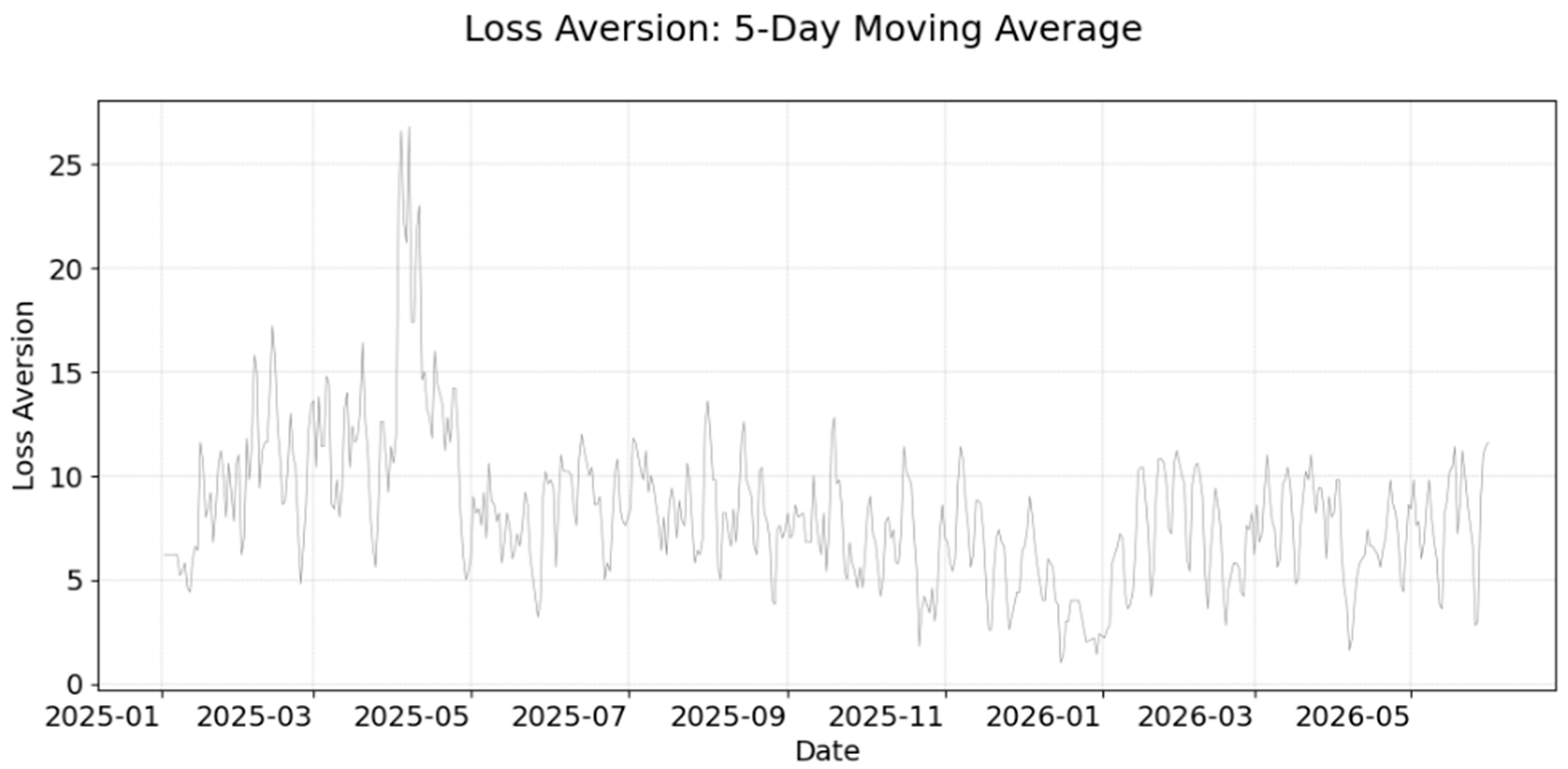
- Loss aversion is measured by using a bag-of-words approach to identify market panic words intended to identify narratives that signal heightened fear or instability, and defensive words that emphasize protecting against adverse outcomes. Loss aversion LossAversiont is derived for each date as the total number of panic words Fpanic,t and defensive words Fdefensive,t across all news articles published on that date:The market panic list contains words such as [freefall, crash, collapse, meltdown, crisis, deficit, turmoil, sell-off, shockwave, chaos, anxiety, stress]; the defensive word list contains words such as [safe haven, preservation, protection, de-risking, prevent, avoid, protect against, shield, cushion, diversify]. The bag-of-words dictionary was compiled by identifying phrases and terms associated with panic and defensive language, then expanding the list with synonyms from the Merriam-Webster Thesaurus. The LossAversiont variable was not normalized with the overall number of words, because empirical results show improved trends when using the raw frequency data (please refer to Figure 5).LossAversiont = Fpanic,t + Fdefensive,t
- A confidence ratio is defined to identify periods where overconfidence bias may be present in the news data. The confidence ratio is calculated as:where ConfRatiot denotes the confidence ratio derived from across all articles published on day t; FH denotes the number of high-confidence words; and FU denotes the number of uncertain words. The high confidence word list consists of words such as [advantage, definitely, certain, guaranteed, clearly]; and the uncertain word list consists of words such as [ambiguous, ambivalent, can, dubious, erratic, hesitant]. Initial lists were created by identifying key phrases that conveyed the intended meaning, then expanded with synonyms from the Merriam-Webster Thesaurus. The volatility in the confidence ratio is also considered and denoted as ConfRatioVolt. It is derived as the standard deviation of the ConfRatiot over a 20-day period.
- A herding variable is derived for each topic where there has been an abrupt increase in the frequency of articles. It is derived as an indicator-type variable that takes on the average emotion for the period of increased frequency:where Herdingtopic,t denotes the herding variable on day t across all the articles that cover the specific topic, Etopic,t denotes the average emotion associated with the articles that cover the topic, I(.) denotes and indicator variable that takes on the value of 1 if the argument is true or 0 otherwise. In this study, herding was identified as the periods where the frequency of the articles published on topic Ftopic,t was in the top 10th percentile.Herdingtopic,t = Etopic,t × I(Ftopic,t ≥ 90th percentile)
Representativeness bias is excluded from this study because of its close association with herding, while confirmation and optimism biases typically arise during sustained economic expansion and are therefore not relevant to the period examined. The sunk-cost fallacy is more relevant in an investment context.
4.6. Change Point Detection
Change point detection is used to identify structural breaks in time series data. The breaks manifest from shifts in mean, trend, volatility, frequency or correlation. The ruptures library version 1.1.10 in Python was used to detect possible breaks in the sentiment and market time series (Truong et al., 2020). The penalty function in the Pruned Exact Linear Time (PELT) was specified as 4σ2, where σ2 denotes the variance of the dataset evaluated for potential structural breaks. The ‘l2’ cost function was applied to identify shifts in the mean, while the ‘normal’ cost function was used to detect changes in both the mean and variance. The PELT results were compared with the bottom-up search algorithm to ensure broad alignment between methodologies in the change points identified. The bottom-up segmentation begins with highly granular segments and iteratively merges adjacent segments until the specified number of change points is reached.
4.7. Regression Analysis
A regression analysis was used to identify sentiment, emotion, and cognitive bias variables that may provide early warning signals for the systemic index.
A simulation study was performed where various combinations of the variables were considered in a linear regression model; only the models with the highest goodness-of-fit as measured by R2, stationary residuals measured by the Augmented Dicky-Fuller (ADF) test p-value below 5%; and no multicollinearity measured by a variance inflation factor below 5 were selected for inference.
5. Results
A series of analyses was conducted to evaluate whether cognitive biases embedded in news content may serve as early warning indicators of changes in market sentiment and systemic risk. Major events affecting the South African economy, including exogenous shocks, were identified to assess the potential for risk spillovers. The study further evaluated the effect of summarizing news articles before sentiment assignment and investigated whether variations across news outlets provided evidence of news framing.
5.1. Impact of News Summaries
Article-level sentiment was assessed using FinBERT to assign a sentiment score to each sentence and then averaging the scores to obtain an overall article-level score. This approach may weaken the measured sentiment when many sentences are neutral or contain no clear sentiment signal. To address this limitation, abstractive and extractive summaries were generated for each article, and sentiment scores were calculated from these summaries. This section compares the sentiment derived from the summaries with that derived from the full articles to determine whether the summaries preserve the articles’ overall sentiment.
Table 4 compares the Spearman rank correlation between sentiment extracted from the full Business Day articles and sentiment derived from the corresponding news summaries. The correlations were calculated across different 20-day periods to assess their stability over time.
Table 4.
Snapshot of the correlation between the sentiment from the full article and the news summary.
Overall, the correlations were relatively strong, with an average of about 77%, indicating that the summaries broadly retained article-level sentiment. Weaker correlations were mainly observed in periods where articles contained many neutral sentences. Performance also differed across the abstractive and extractive approaches, with no method consistently yielding the strongest correlation with the full article sentiment.
The abstractive summaries were used in the remaining analyses, because, generally the extractive approaches perform better on shorter texts.
5.2. Evidence of News Framing
News framing can be detected by examining the tone and emotional intensity of article titles. To test for news framing, sentiment and emotion were extracted from the title of each article in the sample and analyzed according to the identified topics.
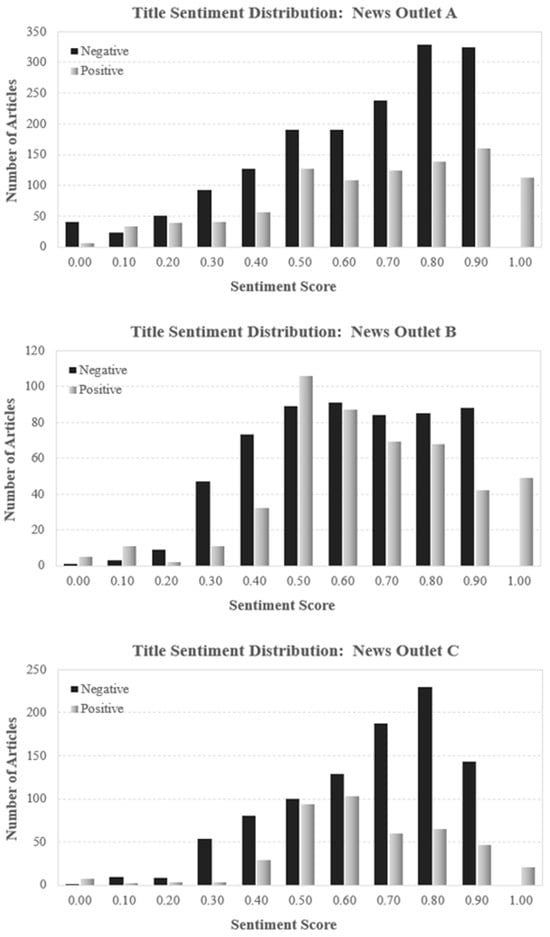
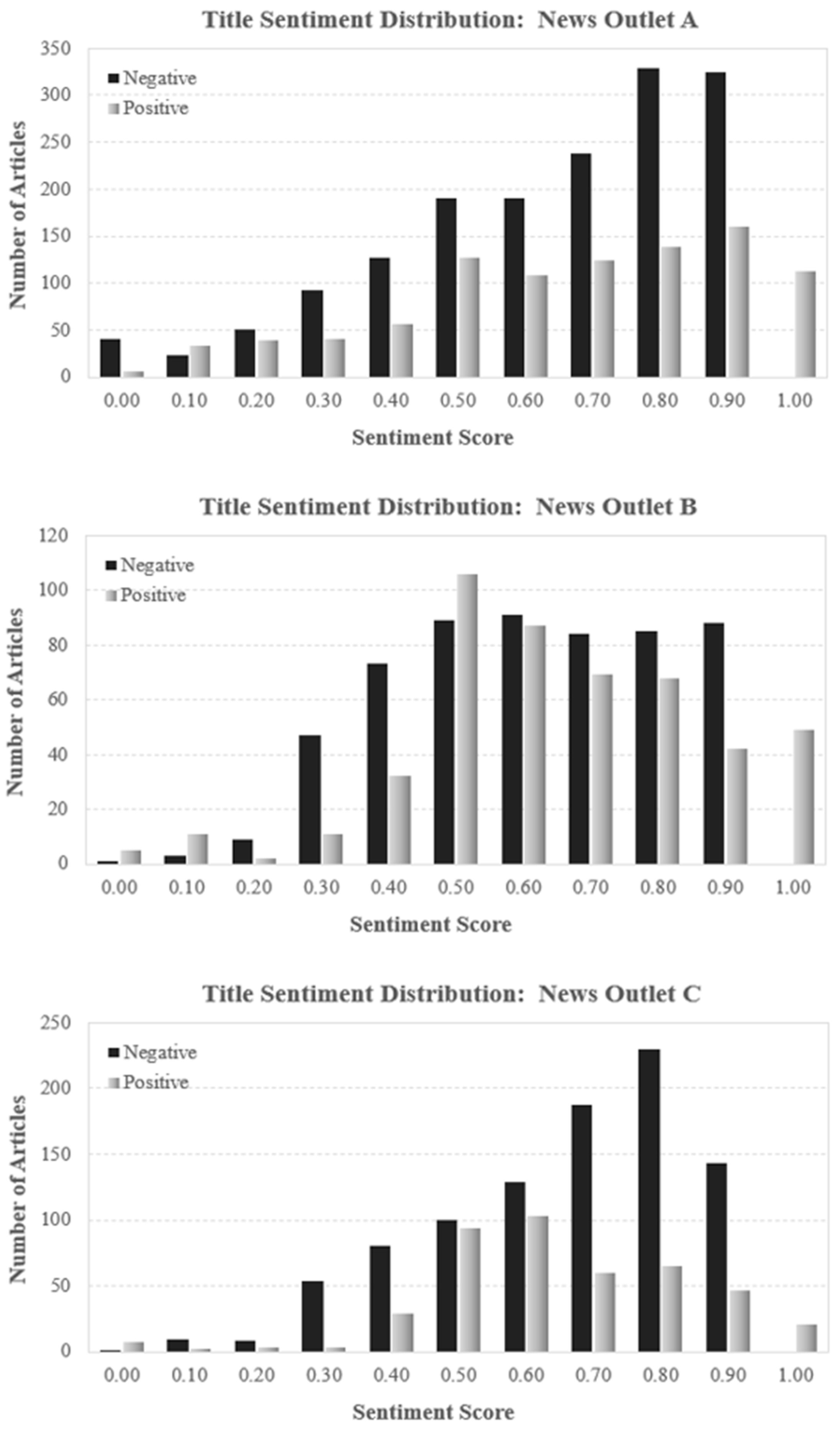
Figure 1 shows a comparison of the distributions of positive and negative sentiment extracted from the article titles. The article titles produced by news outlets A and C have a much stronger negative tone; news outlet B is more balanced. A comparison between the sentiment in the article text vs. the title reveals general agreement.
Figure 1.
A comparison of the distribution of positive and negative sentiment extracted from the article titles.
Table 5 shows the proportions of negative and positive news titles across different news outlets and topics. The results indicate a clear bias toward negatively toned article titles. This negative tone is understandable for topics such as crime and corruption; however, a strong negative bias is also evident in the titles of political articles. The main emotions detected by the NLP algorithms were fear, joy, sadness, and surprise.
Table 5.
A summary of the proportion of negatively toned article titles by topic and news outlet.
5.3. Contagion/Spillover Risk
Table 6 presents a timeline of major events affecting the South African economy from January 2025 to May 2026. These events were compared with trends in the news data to draw inferences about the impact of spillover risk from the United States.
Table 6.
Timeline of major news events affecting the South African economy during 2025 to early 2026.
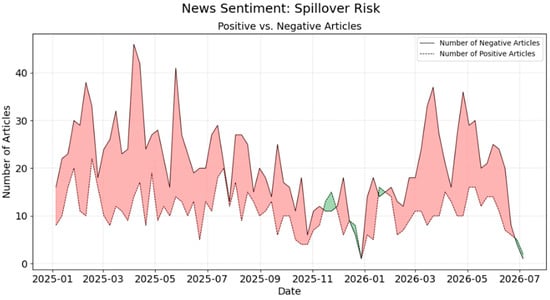
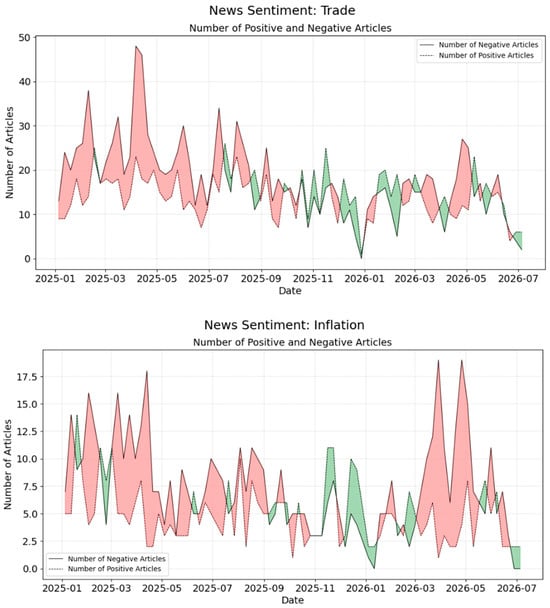
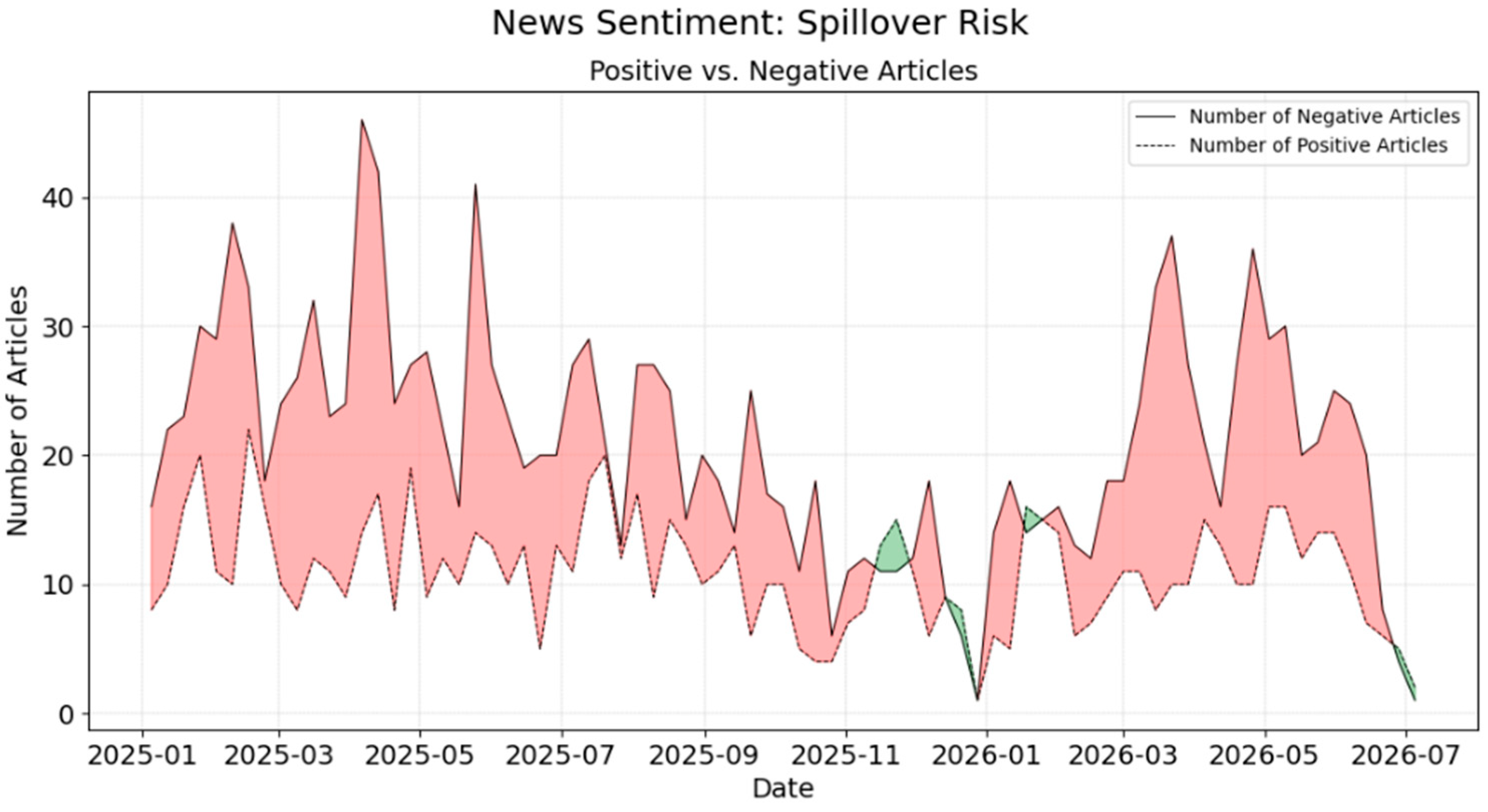
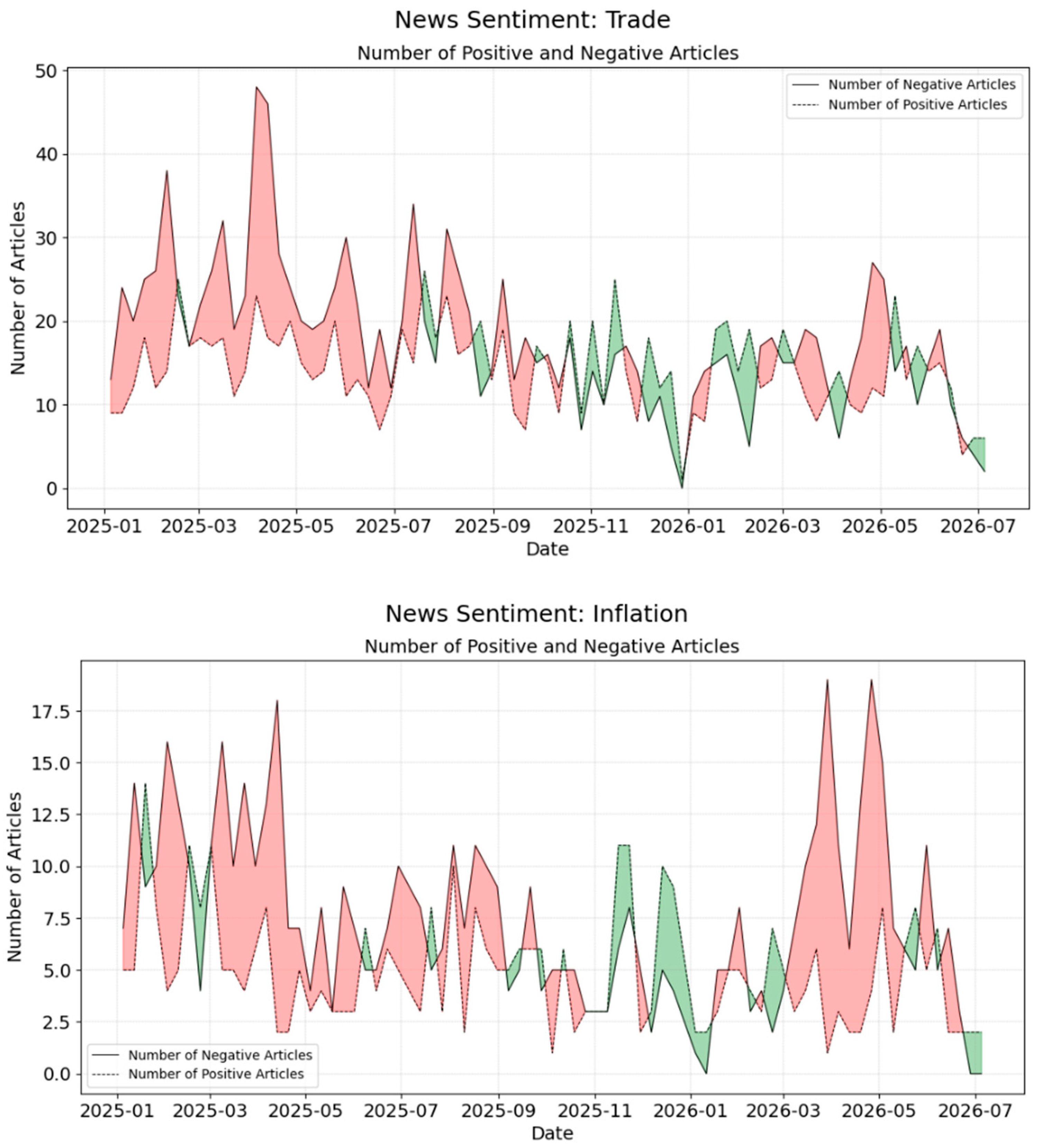
Figure 2 shows the numbers of positive and negative news articles across all news outlets for selected topics. To analyze spillover risk originating from the United States during the period, a bag-of-words approach was used. The article text was searched for specific terms, including {trump, middle east, iran, israel, united states, america, oil, military}. The red-shaded areas denote periods in which there were more negative than positive news articles on the relevant topic, while the green-shaded areas denote the opposite. The bag-of-words results depend heavily on the key phrases selected.
Figure 2.
Total number of positive and negative articles across all the news outlets on a given topic.
In 2025, the South African government prioritized economic growth and infrastructure investment, particularly through logistics reforms and improvements to the electricity and water supply. The US trade tariff increases imposed on South African goods in 2025 raised significant concerns about employment in sectors such as mining, automotive manufacturing, and agriculture, as well as broader risks to economic growth (South African Government, 2025; International Monetary Fund, 2025). These trade-related concerns are reflected in the higher volume of negatively toned news articles published during the first part of 2025.
During the latter part of 2025, sentiment became more optimistic, with positive and negative news articles appearing in more balanced proportions. By early 2026, the outlook for trade and inflation had also shifted toward a more positive tone. This shift was partly driven by South Africa’s removal from the Financial Action Task Force (FATF) greylist, which signaled progress in strengthening the country’s anti-money laundering and counter-terrorist financing framework. This development supported investor confidence, improved growth expectations, and enhanced access to international investment. In November 2025, South Africa adopted an updated monetary policy framework that reduced the inflation target to 3%, subject to a 1% tolerance band. During the same period, Standard and Poor’s upgraded South Africa’s sovereign credit rating. The rating upgrade strengthened investor confidence and helped to attract foreign capital inflows. These favorable developments were the key themes in the February 2026 State of the Nation Address, which reaffirmed continued infrastructure investment and a focus on stronger economic growth (Financial Action Task Force, 2025; National Treasury, 2025; S&P Global Ratings, 2025).
The outbreak of war in the Middle East at the end of February 2026 and the subsequent closure of the Strait of Hormuz significantly altered the economic outlook. Oil prices rose sharply, intensifying concerns about inflation. In response to this external economic shock, South Africa reduced the fuel levy to mitigate inflationary pressures. The resulting spillover risk was evident in the marked increase in negatively toned news articles (South African Reserve Bank, 2026; UN Trade and Development, 2026; National Treasury, 2026).
5.4. Clustering Around Selected Topics
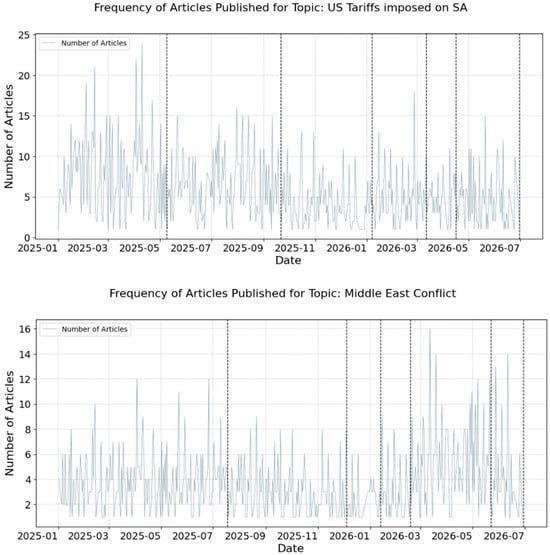
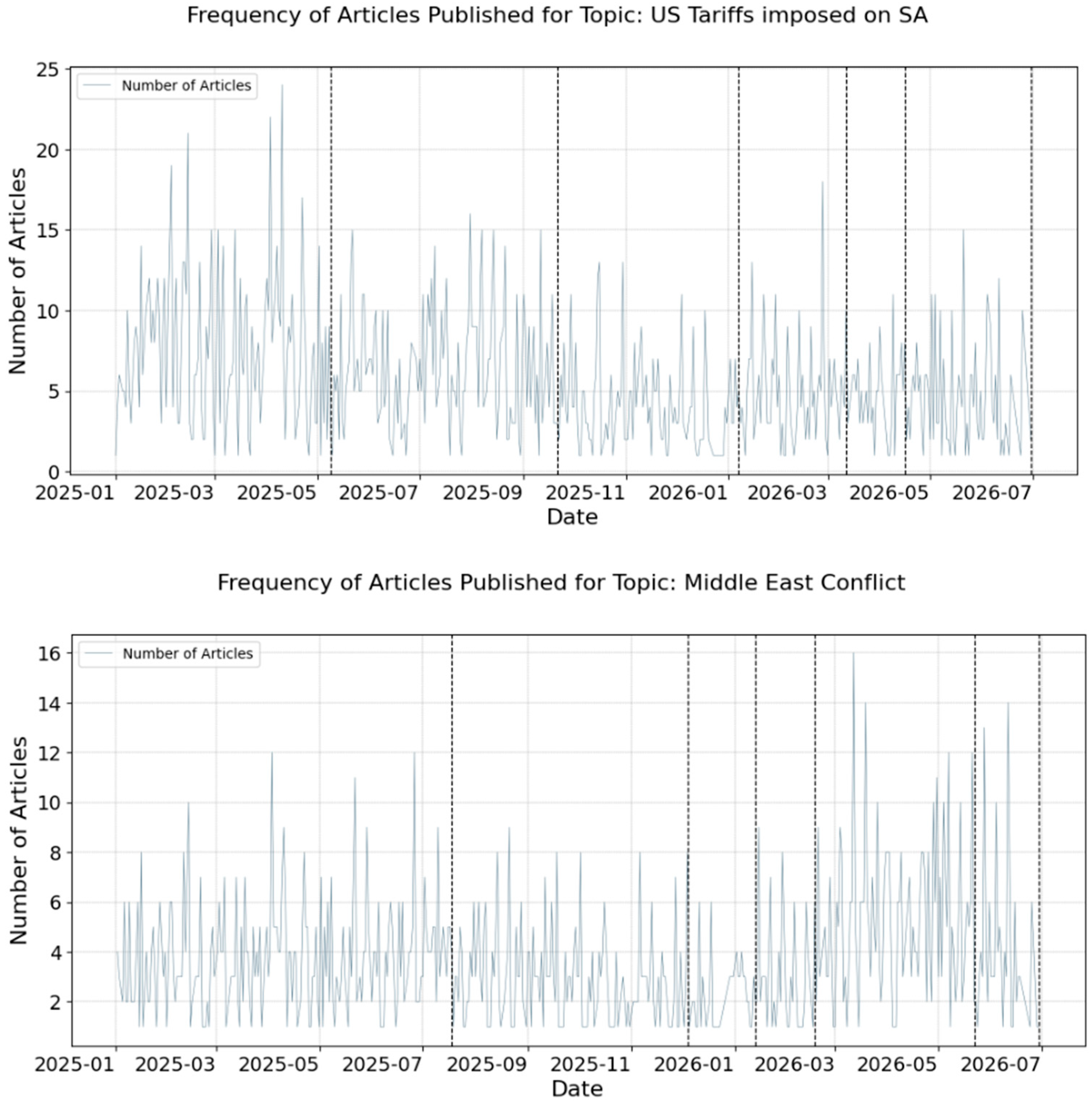
In news media, availability bias arises when coverage disproportionately emphasizes dramatic or recent events, potentially distorting public perceptions of risk. This bias reflects people’s tendency to assign greater importance to memorable or heavily publicized events. Figure 3 shows clear clustering (herding) around selected topics, broadly aligning with several major events summarized in Table 6. The vertical lines mark breaks in article frequency, suggesting possible shifts toward newly salient topics.
Figure 3.
Number of articles is clustered around certain main events.
Table 7 summarizes the average sentiment and emotion scores for the different periods where herding was observed, as highlighted in Figure 3. The average sentiment and emotion scores were more negative during these periods.
Table 7.
Average sentiment and emotion for the different periods where herding was observed.
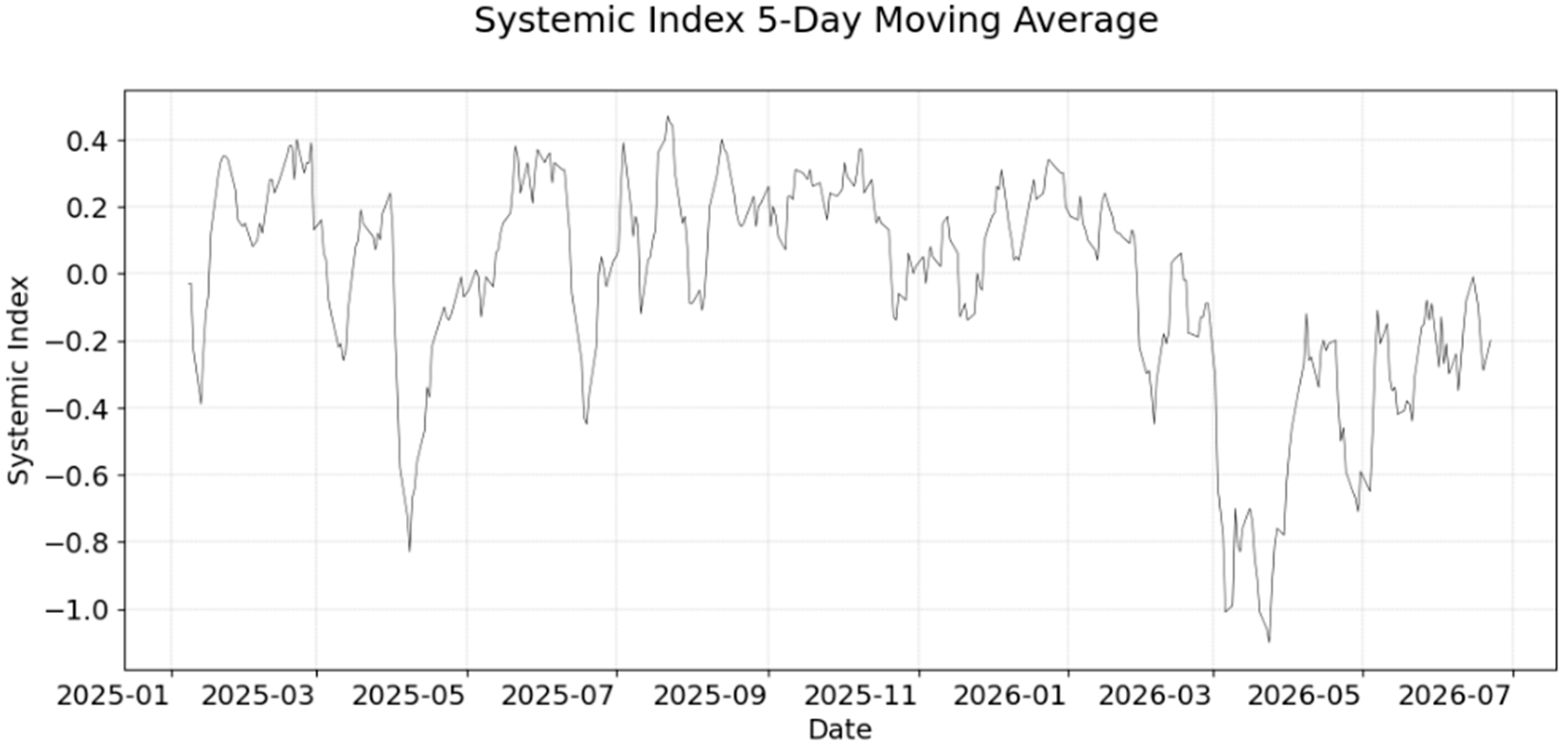
Figure 4 shows the five-day moving average of the systemic index SIt. The negated SIt is shown to ensure negative values indicate more negative economic outcomes (higher systemic risk). The observed herding behavior in Figure 3 around the trade tariffs early in 2025 preceded the sharp increase in systemic risk observed during April 2025. The next sharp drop observed in March to April 2026 corresponded with the herding behavior in the published news observed around the Middle East conflict.
Figure 4.
The five-day moving average of the systemic index.
Figure 5 illustrates the evolution of the loss aversion variable over time. The spike observed in April 2025 coincided with the lower sentiment and emotion scores and the higher systemic risk shown in Figure 4. Conversely, the exceptionally low level of loss aversion in January 2026 corresponded with the positive economic developments summarized in Table 6. Notably, news concerning the conflict in the Middle East had no discernible effect on the loss aversion observations.
Figure 5.
The five-day moving average of the loss aversion LossAversiont.
5.5. Emotional Intensity
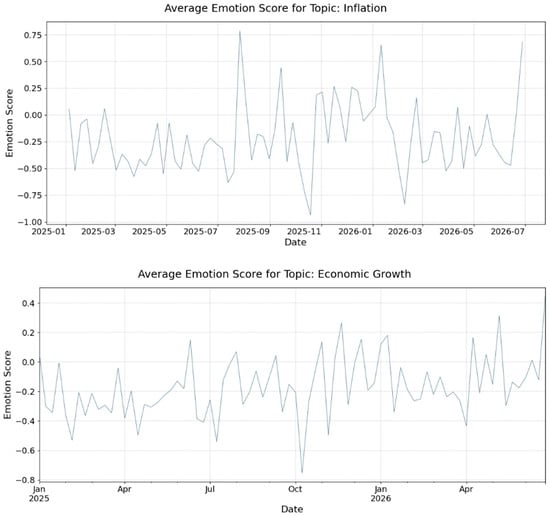
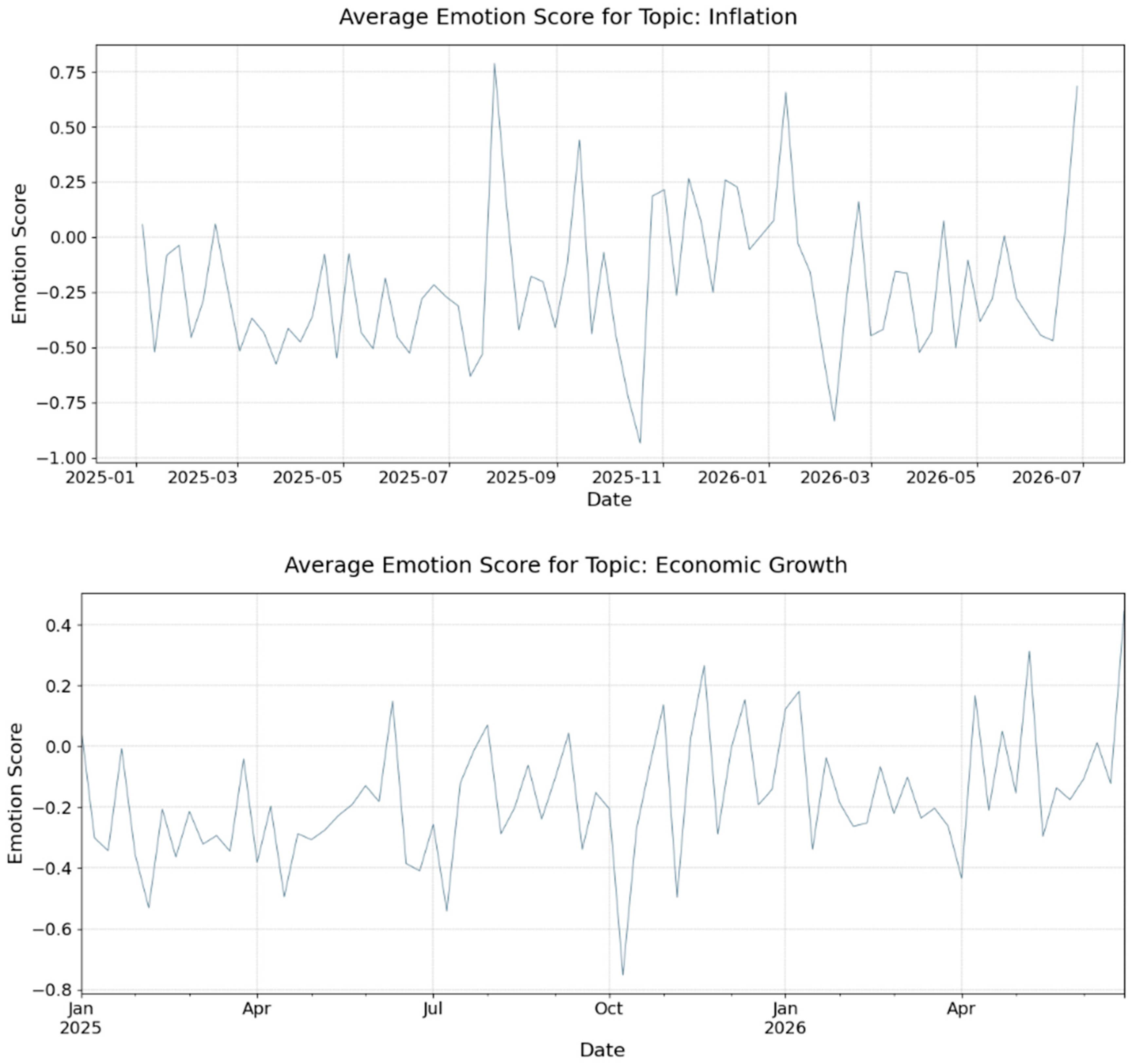
Emotional intensity in news can significantly affect market sentiment. Figure 6 shows the average weekly emotion score for articles covering inflation or economic growth. Around April, the level and volatility of emotion scores for inflation-related articles declined sharply. The dominant emotions during this period were fear, sadness, and surprise, coinciding with the period during which the United States imposed additional trade tariffs on South African products. Reduced volatility indicates greater emotional convergence during this period, potentially reflecting herding behavior. Herding behavior is typically observed during periods when market sentiment becomes excessively optimistic or pessimistic.
Figure 6.
Average emotion score over one-week periods for selected topics.
News data on inflation and economic growth exhibited greater volatility from approximately August 2025 to January 2026. This period coincided with positive developments in the South African economy, such as the country’s removal from the FATF greylist and an improvement in its sovereign credit rating. The dominant emotions during this period were sadness, surprise, and joy.
5.6. Do Sentiment and Emotion Lead Market Structural Breaks?
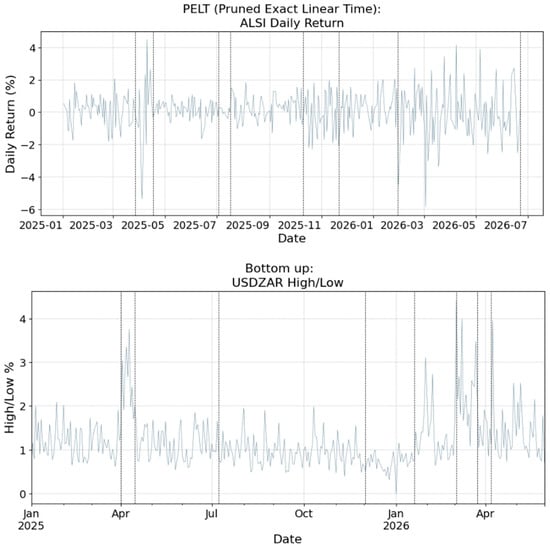
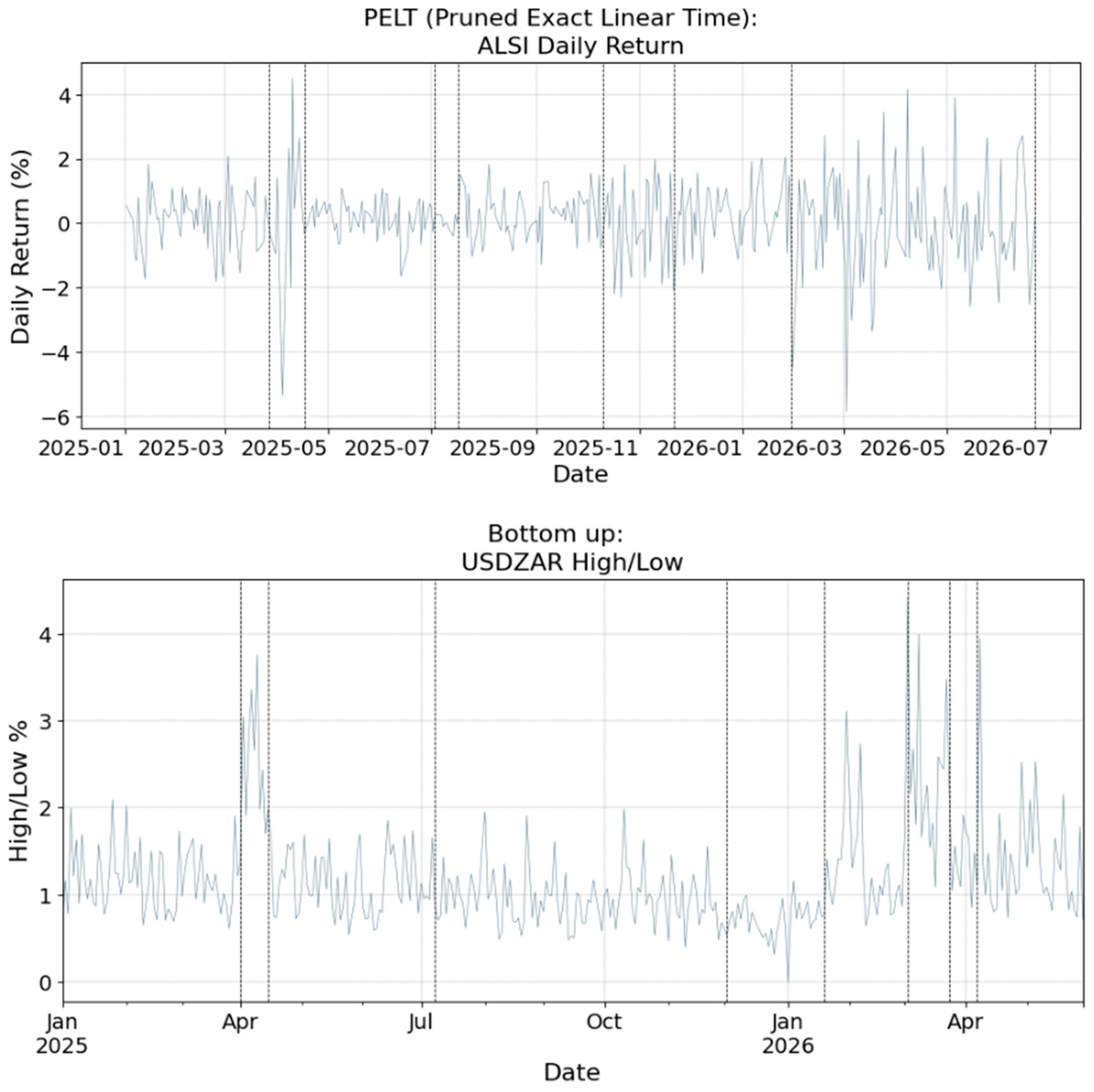
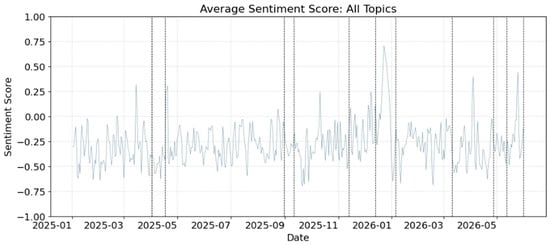
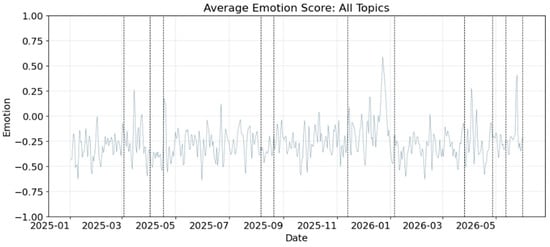
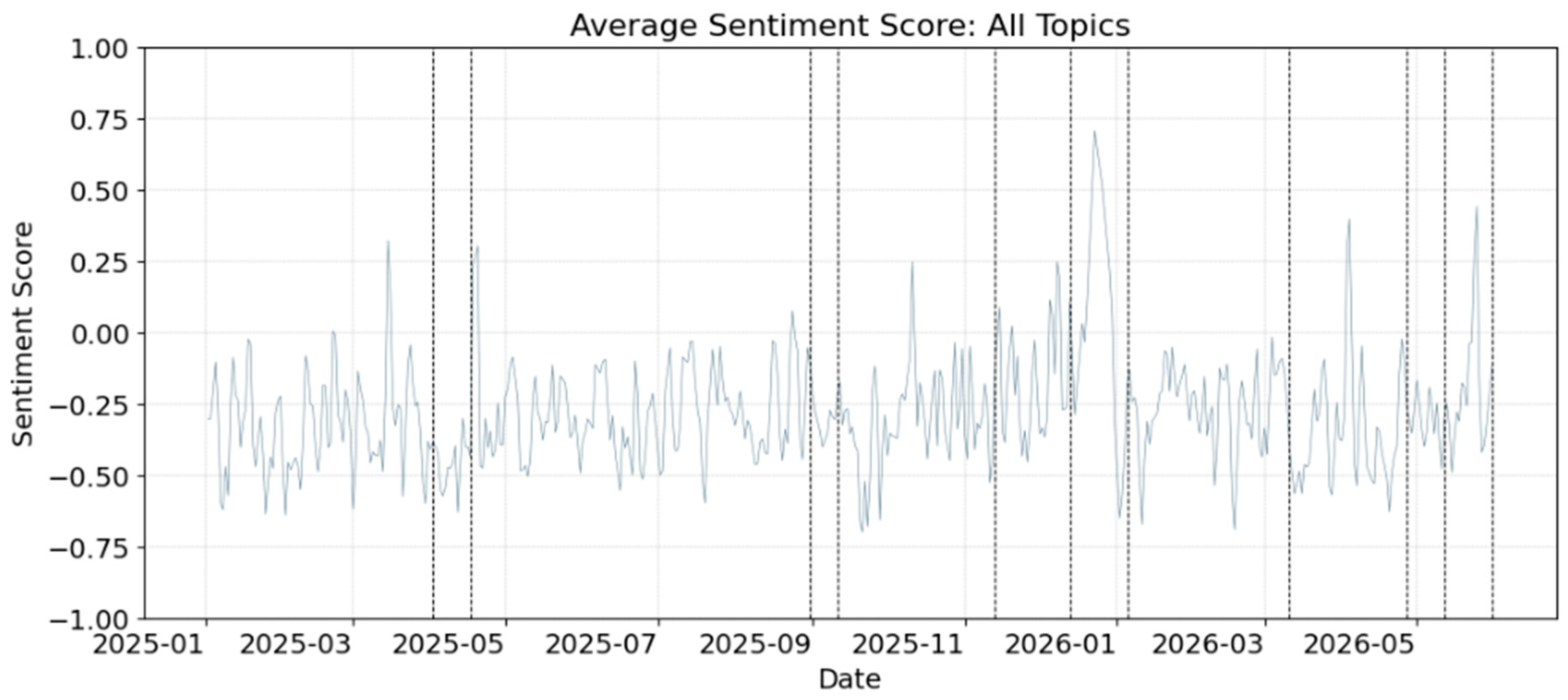
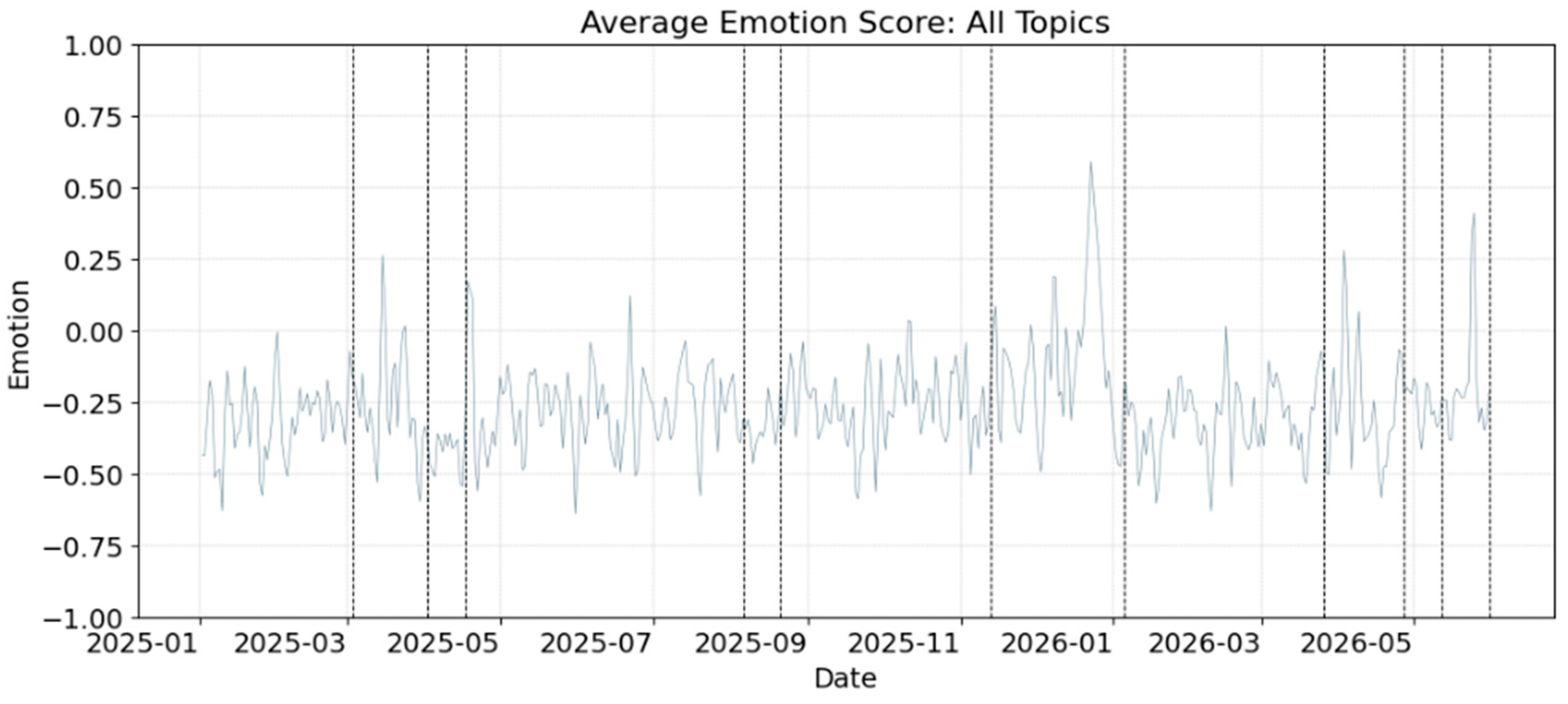
The structural breaks in the daily percentage change in the ALSI40 closing price X1 and the ZARUSD high/low price X5 are shown in Figure 7, together with the structural breaks in the average sentiment and emotion scores, derived across all topics in Figure 8. The structural breaks indicate changes in the trend, volatility or level. The analysis shows a structural break during March and April 2025 in the ALSI and ZARUSD with a big spike in the volatility. This was preceded by a downward trend in the average emotion score from the beginning of March 2025; during April 2025, the sentiment also decreased to a lower level.
Figure 7.
Structural breaks (vertical lines) in the historical ALSI40 and ZARUSD price data.
Figure 8.
Structural breaks (vertical lines) in the average sentiment and emotion derived across all topics.
In September 2025, there was a positive trend in sentiment, and at the beginning of November 2025, an increase in the level of emotion but with more volatile outcomes occurred, followed by an increase in ALSI volatility starting in mid-November 2025.
In January 2026, there was a sharp drop in the average level of emotion and sentiment, which was followed by higher volatility in the market variables.
The analysis indicates that structural breaks in market variables were generally preceded by changes in market sentiment or emotional intensity.
5.7. Early Warning Indicator of Systemic Risk
Regression analysis was used to identify sentiment, emotion, and cognitive bias proxies that may serve as early warning indicators of systemic risk. The variables outlined in Table 8 were considered for the regression analysis and are based on events during the 2025 to 2026 period, as outlined in Table 6. The specific variables considered are:
Table 8.
Summary of the variables considered in the regression model.
- The average sentiment scores derived from the article text St and the title text TSt. Higher sentiment scores denote more positive market sentiment and thus lower systemic risk (Muguto et al., 2022).
- The average emotion associated with trade, tariffs, and the Middle East conflict denoted by Etrade,t, Etariffs,t, Econflict,t, Einvestment,t. More negative emotion denotes negative market sentiment and thus higher systemic risk.
- Variables capturing availability bias derived using Equation (2) covering topics such as trade tariffs, the Middle East conflict, inflation, and economic growth: AvailBiastariffs,t, AvailBiasconflict,t, AvailBiasinflation,t, AvailBiasecogrowth,t. An increase in the coverage of certain topics is assumed to highlight a negative market event and thus higher systemic risk.
- Loss aversion derived using Equation (3) and denoted by LossAversiont. Higher loss aversion indicates higher systemic risk.
- The confidence ratio derived from Equation (4) and denoted by ConfRatiot. A higher confidence ratio indicates lower systemic risk. An increase in the volatility of the confidence ratio is expected to indicate higher systemic risk.
- Variables capturing herding behavior derived from Equation (4) covering the trade tariffs and the Middle East conflict: Herdingtariffs,t, Herdingconflict,t. Periods of herding with negative emotion denote negative market sentiment and higher systemic risk.
All variables were aggregated into weekly averages to reduce data noise and then transformed to a Gaussian distribution using the probability integral transform, ensuring a common scale. A correlation analysis was performed to determine the lag at which to include the variables in the regression model. The optimal lag was selected as the point at which the highest correlation was obtained. The negated SIt is used as the target variable to ensure lower values of SIt denote a more negative economic environment.
Table 9 summarizes some of the best models. The models were selected to illustrate the impact of different combinations of the variables.
Table 9.
Regression results with the systemic risk index SIt as the target variable.
The lags in the regression models indicate that the emotion variables signal changes in the systemic risk index up to six weeks before an event, whereas the sentiment variables tend to change concurrently with the index. Variables capturing availability bias are more strongly associated with the systemic risk index than those capturing loss aversion and overconfidence. The herding variable captures highly specific events and carries a relatively large weight in the model, but it tends to change concurrently with the systemic risk index.
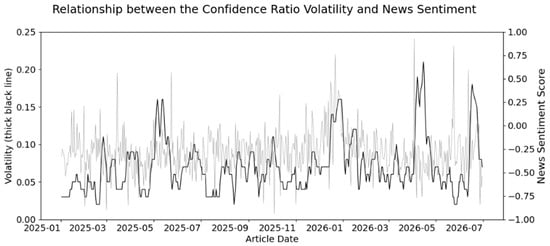
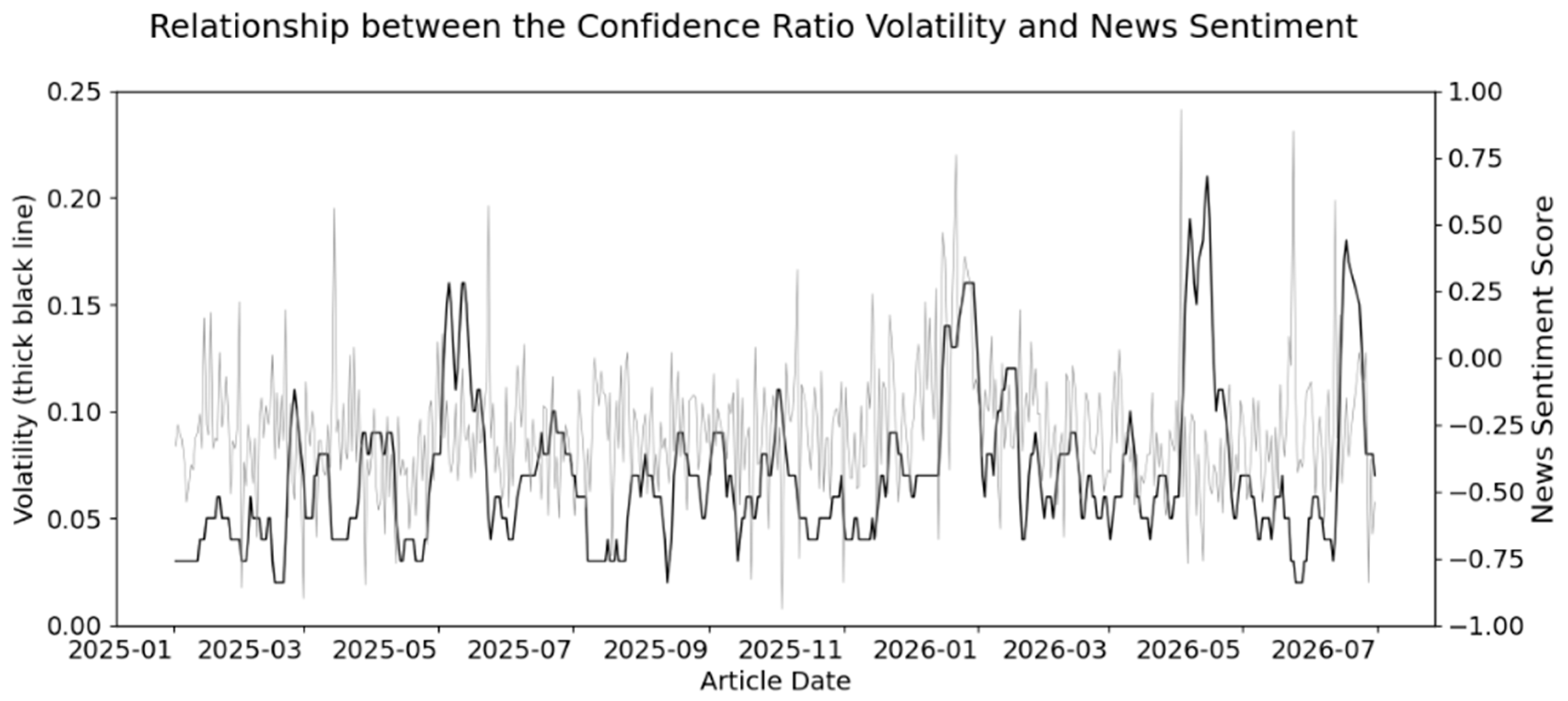
The confidence ratio and its volatility are either statistically insignificant or weak indicators of systemic risk. Figure 9 also shows no clear relationship between confidence ratio volatility and news sentiment. Periods of increased confidence ratio volatility exhibit no consistent pattern relative to sentiment.
Figure 9.
The relationship between the confidence ratio volatility and news sentiment. The black line corresponds to the 30-day confidence ratio volatility (left axis); the grey line corresponds to the news sentiment score (right axis).
6. Discussion
The robustness of the study’s analyses is supported by the accuracy of the NLP algorithms employed. The LLMs used for text summarization, topic allocation, sentiment analysis, and emotion detection provide a consistent and scalable methodological framework. Their inherent assumptions and limitations are considered when interpreting the findings. The bag-of-words results depend heavily on the selected key phrases.
Article-level sentiment was calculated as the mean FinBERT sentiment score across all sentences in each article. Because neutral sentences may dilute the overall sentiment signal, the articles were first condensed into concise, meaningful summaries using abstractive summarization before FinBERT scores were assigned. Sentiment scores derived from the full articles and their summaries had an average correlation of approximately 77%, indicating that the summaries generally preserved the sentiment conveyed in the original text. Lower correlations were observed for articles containing a high proportion of neutral sentences.
News framing was assessed by analyzing the tone and emotional intensity of the article titles. Sentiment and emotion scores indicate a clear negative bias across most topics, with the NLP algorithms primarily identifying fear, joy, sadness, and surprise. Studies have found that negatively toned news is consumed and disseminated more widely (Qiu & Golman, 2024; Watson et al., 2024). The distribution of positive and negative sentiment differed noticeably across news outlets, while the sentiment expressed in article text and titles was generally consistent.
Contagion risk was assessed by comparing major events affecting the South African economy between January 2025 and May 2026 with trends in news data. The analysis indicated that the outbreak of war in the Middle East at the end of February 2026 and the subsequent closure of the Strait of Hormuz led to a marked increase in negatively toned news articles and a sharp rise in systemic risk. This occurred despite the more positive sentiment observed from late 2025 to early 2026, supported by favorable developments such as South Africa’s removal from the FATF greylist and the sovereign credit rating upgrade. These results are consistent with studies such as Mudiangombe and Muteba Mwamba (2023), Zehri et al. (2024), and Soni (2026), which demonstrated the effects of US-originating contagion on emerging market economies such as South Africa.
Availability bias arises when news media coverage disproportionately emphasizes dramatic or recent events, potentially distorting public perceptions of risk. This bias reflects the tendency to assign greater importance to memorable or heavily publicized events. A frequency analysis indicated clear clustering (herding) around selected topics, broadly aligned with several major South African events. Herding behavior during negative events generally preceded a sharp rise in systemic risk, consistent with existing studies (Bashir et al., 2024; Singh et al., 2026).
Emotional intensity in news can significantly shape market sentiment. In this study, negative events had lower emotion scores and reduced volatility, with fear, sadness, and surprise being the most prominent emotions. Lower volatility suggests a greater degree of convergence in the emotions expressed by market participants, aligning with the herding behavior often seen when sentiment becomes overly optimistic or pessimistic. In contrast, positive news events exhibited higher volatility in the news-related emotional intensity.
An analysis was performed that assessed structural breaks in market data, specifically the ALSI40 and ZAR/USD exchange rate, and compared these periods with changes in news sentiment and emotional intensity. The results indicated that shifts in market sentiment or emotional intensity generally preceded structural breaks in market variables.
The study examined cognitive biases in news feeds to determine whether their detection in news data could provide early warning signals of changes in news sentiment and systemic risk. Proxy measures were used to define variables capturing availability bias, loss aversion, overconfidence, and herding. A simulation study used regression analyses with different variable combinations to examine the relationships among sentiment, emotion, cognitive bias variables, and the systemic risk index. The lags in the regression models indicated that the emotion variables signaled changes up to six weeks before systemic risk events, whereas the sentiment variables tended to change concurrently with the systemic risk index. Variables capturing availability bias were more strongly associated with the systemic risk index than those capturing loss aversion and overconfidence. Overconfidence is generally observed during periods of economic expansion, when default risk is underestimated, leading to excessive borrowing and speculative investment. The herding variable captured highly specific events and carried a relatively large weight in the model, but it tended to change concurrently with the systemic risk index.
The regression analysis provides a robust foundation for inference within the available sample period, while a longer time horizon would support more comprehensive lag specification and facilitate out-of-sample validation.
The findings are conditional on the proxy measures used to capture cognitive bias and the specification of the constructed systemic index. Market-based data were selected because they typically incorporate shocks more rapidly, whereas an index derived from macroeconomic variables would likely capture such effects with a longer transmission lag.
7. Conclusions
The study focuses on major events between January 2025 and May 2026 that influenced the South African economy. Although this period is relatively short, it encompasses several significant developments, including changes to US trade tariffs, South Africa’s removal from the FATF greylist, the adoption of a new inflation target range, an upgrade to the country’s sovereign credit rating, events surrounding the G20 summits, and the conflict in the Middle East.
Evidence of news framing was observed in the articles published during this period. Sentiment and emotion scores indicated a clear negative bias across most topics, with fear, joy, sadness, and surprise emerging as the dominant emotions. Research suggests that negatively toned news is more likely to be consumed and shared (Qiu & Golman, 2024; Watson et al., 2024). The distribution of positive and negative sentiment also varied noticeably across news outlets.
The study demonstrated that monitoring cognitive bias in news may provide early warning of structural shifts in market sentiment, emotion, and systemic risk. Structural breaks are important to identify because of their impact on pricing, risk management, economic forecasting, capital allocation, and portfolio management.
The lags in the regression model indicated that the emotion variables signaled changes in the systemic risk index up to six weeks before an event, whereas the sentiment variables tended to change concurrently with the index. Spillover risk led to a marked increase in negatively toned news articles and a sharp rise in systemic risk.
The period under consideration focused on improved economic growth and infrastructure investment in South Africa, which may explain why the overconfidence bias variables did not have a significant impact. Overconfidence bias is typically observed during periods of economic expansion.
Availability bias and herding behavior around key topics were associated with abrupt shocks to the systemic risk index, consistent with findings from prior studies (Bashir et al., 2024; Singh et al., 2026). Loss aversion bias did not have a consistent impact on sentiment or systemic risk during this period.
The study can be extended in several ways. The relationships among the cognitive bias variables could be examined over a longer time series using a regime-switching model that captures cognitive behavior across the different phases of the economic cycle. The limited news dataset used in this study is useful for illustrating the proposed ideas but does not span a full economic cycle, thereby constraining the assessment of cycle-wide effects. Future studies could examine how media tone shapes economic expectations and broaden the scope to include social media, radio, and television outlets.
Funding
This research received no external funding.
Data Availability Statement
Publicly available datasets were analyzed in this study, with sources as outlined in Table 1.
Conflicts of Interest
The author declares no conflicts of interest.
References
- Adikaram, R., & Higgs, J. (2024). Cognitive dissonance and auditor professional skepticism. Managerial Auditing Journal, 39(1), 71–110. [Google Scholar] [CrossRef] [Scilit]
- Adrian, T., DeHaven, M., Duarte, F., & Iyer, T. (2023). The market price of risk and macro-financial dynamics. IMF Working Papers, 2023, 19. [Google Scholar] [CrossRef] [Scilit]
- Africa News. (2026). South Africa to step aside from G20 during United States presidency. Available online: https://www.africanews.com/2026/01/23/south-africa-to-step-aside-from-g20-during-united-states-presidency/ (accessed on 23 July 2026).
- Ahmad, U., Van Keulen, M., Briassouli, A., & Saad, M. (2025). Cognitive biases, robo advisor and investment decision psychology: An investors perspective from New York Stock Exchange. Acta Psychologica, 256, 105048. [Google Scholar] [CrossRef] [Scilit]
- Akin, I., & Akin, M. (2026). Behavioral finance impacts on US stock market volatility: An analysis of market anomalies. Behavioural Public Policy, 10(2), 337–361. [Google Scholar] [CrossRef] [Scilit]
- Akoglan, C. (2024). The intuitive trap: Understanding cognitive bias in the digital age. Yeni Medya, 17, 345–364. [Google Scholar] [CrossRef] [Scilit]
- Almansour, B. Y., Elkrghli, S., & Almansour, A. Y. (2023). Behavioral finance factors and investment decisions: A mediating role of risk perception. Cogent Economics & Finance, 11(2), 2239032. [Google Scholar] [CrossRef] [Scilit]
- Alzahrani, A. I., Sarsam, S. M., Al-Samarraie, H., & Alblehai, F. (2023). Exploring the sentimental features of rumor messages and investors intentions to invest. International Review of Economics and Finance, 87, 433–444. [Google Scholar] [CrossRef] [Scilit]
- Apergis, N., & Pragidis, I. (2019). Stock price reactions to wire news from the European Central Bank: Evidence from changes in the sentiment tone and international market indexes. International Advances in Economic Research, 25(1), 91–112. [Google Scholar] [CrossRef] [Scilit]
- Araci, D. (2019). FinBERT: Financial sentiment analysis with pre-trained language models. arXiv. [Google Scholar] [CrossRef] [Scilit]
- Banerjee, A. V. (1992). A simple model of herd behavior. The Quarterly Journal of Economics, 107(3), 797–817. [Google Scholar] [CrossRef] [Scilit]
- Bashir, U., Kayani, U. N., Khan, S., Polat, A., Hussain, M., & Aysan, A. F. (2024). Investor sentiment and stock price crash risk: The mediating role of analyst herding. Computers in Human Behavior Reports, 13, 100371. [Google Scholar] [CrossRef] [Scilit]
- Belica, M. (2018). Sumy: Module for automatic summarization of text documents and HTML pages. Available online: https://github.com/miso-belica/sumy (accessed on 1 May 2026).
- Bihari, A., Dash, M., Muduli, K., Kumar, A., Mulat-Weldemeskel, E., & Luthra, S. (2025). Does cognitive biased knowledge influence investor decisions? An empirical investigation using machine learning and artificial neural network. VINE Journal of Information and Knowledge Management Systems, 55(2), 445–469. [Google Scholar] [CrossRef] [Scilit]
- Bikhchandani, S., Hirshleifer, D., & Welch, I. (1992). A theory of fads, fashion, custom, and cultural change as informational cascades. Journal of Political Economy, 100(5), 992–1026. [Google Scholar] [CrossRef] [Scilit]
- Bordalo, P., Gennaioli, N., & Shleifer, A. (2022). Overreaction and diagnostic expectations in macroeconomics. Journal of Economic Perspectives, 36(3), 223–244. [Google Scholar] [CrossRef] [Scilit]
- Castillo-Campos, M., Becerra-Alonso, D., & Boomgaarden, H. G. (2026). Automated detection of media bias using artificial intelligence and natural language processing: A systematic review. Social Science Computer Review, 44(3), 529–548. [Google Scholar] [CrossRef] [Scilit]
- Cornelissen, L. A., Daly, L. I., Sinandile, Q., de Lange, H., & Barnett, R. J. (2019, September 17–18). A computational analysis of news media bias: A South African case study. Conference of the South African Institute of Computer Scientists and Information Technologists 2019 (SAICSIT ’19), Skukuza, South Africa. Available online: https://dl.acm.org/doi/epdf/10.1145/3351108.3351134 (accessed on 1 May 2026).
- Dassani, P., & Manda, V. K. (2022). Cognitive dissonance bias among stock market investors. Review of Professional Management, 20(1), 76–85. [Google Scholar] [CrossRef] [Scilit]
- Datta, P., Whitmore, M., & Nwankpa, J. K. (2021). A perfect storm: Social media news, psychological biases, and AI. Digital Threats: Research and Practice, 2(2), 1–21. [Google Scholar] [CrossRef] [Scilit]
- Dragomir-Constantin, F. L. (2025). Thinking traps: How high-performance information systems correct cognitive biases in decision-making. New Trends in Psychology, 7(1), 99–108. [Google Scholar]
- Edmans, A., Fernandez-Perez, A., Garel, A., & Indriawan, I. (2022). Music sentiment and stock returns around the world. Journal of Financial Economics, 145(2), 234–254. [Google Scholar] [CrossRef] [Scilit]
- Ellis, G. (2018). So, what are cognitive biases? In G. Ellis (Ed.), Cognitive biases in visualizations. Springer. [Google Scholar] [CrossRef] [Scilit]
- Ester, F., Fuster, A., Pezone, V., & Zafar, B. (2024). Biases in information selection and processing: Survey evidence from the pandemic. The Review of Economics and Statistics, 106(3), 829–847. [Google Scholar] [CrossRef] [Scilit]
- Fei, Y. (2024). A joint test of predictability and structural break in predictive regressions. Empirical Economics, 67, 985–1013. [Google Scholar] [CrossRef] [Scilit]
- Festinger, L. (1962). A theory of cognitive dissonance. Stanford University Press. [Google Scholar]
- Financial Action Task Force. (2025). Jurisdictions under increased monitoring—24 October 2025. Available online: https://www.fatf-gafi.org/en/publications/High-risk-and-other-monitored-jurisdictions/increased-monitoring-october-2025.html (accessed on 1 May 2026).
- French, A. M., Storey, V. C., & Wallace, L. (2025). The impact of cognitive biases on the believability of fake news. European Journal of Information Systems, 34(1), 72–93. [Google Scholar] [CrossRef] [Scilit]
- Gaies, B., Nakhli, M. S., Ayadi, R., & Sahut, J.-M. (2022). Exploring the causal links between investor sentiment and financial instability: A dynamic macro-financial analysis. Journal of Economic Behavior & Organization, 204, 290–303. [Google Scholar] [CrossRef] [Scilit]
- Gangineni, R., Singh, K., Parayitam, S., Venkataramulu, P., Baddela, S., & Malepati, V. (2026). Role of behavioral finance in shaping sustainable investment portfolios: A bibliometric study. Journal of Risk and Financial Management, 19(6), 423. [Google Scholar] [CrossRef] [Scilit]
- Ghoshal, A. (2024). arpanghoshal/EmoRoBERTa. Huggingface library. Python. Available online: https://huggingface.co/arpanghoshal/EmoRoBERTa (accessed on 1 May 2026).
- Glova, A. M. G., & Barrios, E. B. (2025). Modelling mixed-frequency time series with structural change. Computational Economics, 65(6), 3237–3258. [Google Scholar] [CrossRef] [Scilit]
- Gnagne, P. X., Simo-Kengne, B. D., & Manguzvane, M. M. (2024). The spillover and contagion effects of sovereign risk on stock markets. Economic Modelling, 141, 106921. [Google Scholar] [CrossRef] [Scilit]
- Gómez Sánchez, L., & Tobon, S. (2025). Sustainable investing among young generations: Balancing ideals and financial realities. Discover Sustainability, 6(1), 275. [Google Scholar] [CrossRef] [Scilit]
- Hamborg, F., Donnay, K., & Gipp, B. (2019). Automated identification of media bias in news articles: An interdisciplinary literature review. International Journal on Digital Libraries, 20, 391–415. [Google Scholar] [CrossRef] [Scilit]
- Hartmann, J. (2022). Emotion English DistilRoBERTa-base. Available online: https://huggingface.co/j-hartmann/emotion-english-distilroberta-base/ (accessed on 1 May 2026).
- Hennig, T., Iossifov, M. P. K., & Varghese, M. R. (2023). Predicting financial crises: The role of asset prices. International Monetary Fund. Available online: https://www.imf.org/en/publications/wp/issues/2023/08/03/predicting-financial-crises-the-role-of-asset-prices-536491 (accessed on 8 October 2026).
- Hoang, S. D., Nguyen, T. H. H., Dey, S. K., & Thi Thu, H. D. (2025). Beyond the hype: AI advice and investor dissonance in crypto trading. Current Psychology, 44(5), 3313–3325. [Google Scholar] [CrossRef] [Scilit]
- Ige, B. O., & Onwubu, S. C. (2025). Understanding the influence of investors’ risk perception on investment decision-making in South Africa’s financial markets. International Journal of Research in Business and Social Science, 14(6), 108–120. [Google Scholar] [CrossRef] [Scilit]
- International Monetary Fund. (2025). South Africa: 2025 article IV consultation-press release; staff report; and statement by the executive director for South Africa. Available online: https://www.elibrary.imf.org/view/journals/002/2026/034/002.2026.issue-034-en.xml (accessed on 1 May 2026).
- Kaeberlein, A., & Alikhani, M. (2025). How LLMs influence perceived bias in journalism. In Proceedings of the 15th International Conference on Recent Advances in Natural Language Processing—Natural Language Processing in the Generative AI Era, Varna, Bulgaria, September 8–10 (pp. 501–510). INCOMA Ltd. Available online: https://aclanthology.org/2025.ranlp-1.59/ (accessed on 1 May 2026).
- Kahneman, D., & Tversky, A. (1972). Subjective probability: A judgment of representativeness. Cognitive Psychology, 3(3), 430–454. [Google Scholar] [CrossRef] [Scilit]
- Kahneman, D., & Tversky, A. (1979). Prospect theory: An analysis of decision under risk. Econometrica, 47(2), 263–291. [Google Scholar] [CrossRef] [Scilit]
- Lemieux, F., Behr, A., Kellermann-Bryant, C., & Mohammed, Z. (2025). Cognitive bias detection using advanced prompt engineering. arXiv. [Google Scholar] [CrossRef] [Scilit]
- Lewis, M., Liu, Y., Goyal, N., Ghazvininejad, M., Mohamed, A., Levy, O., Stoyanov, V., & Zettlemoyer, L. (2020). BART: Denoising sequence-to-sequence pre-training for natural language generation, translation, and comprehension. In Proceedings of the 58th Annual Meeting of the Association for Computational Linguistics (pp. 7871–7880). Association for Computational Linguistics. [Google Scholar] [CrossRef] [Scilit]
- Li, S., Zhang, S., He, J., & Ren, T. (2026). How does investor sentiment impact systemic risk contagion across industries? Evidence from the Chinese stock market. Applied Economics, 58(3), 517–539. [Google Scholar] [CrossRef] [Scilit]
- Lichtenstein, S., Fischhoff, B., & Phillips, L. D. (1982). Calibration of probabilities: The state of the art to 1980. In D. Kahneman, P. Slovic, & A. Tversky (Eds.), Judgment under uncertainty: Heuristics and biases (pp. 306–334). Cambridge University Press. [Google Scholar]
- Liu, Y., Ott, M., Goyal, N., Du, J., Joshi, M., Chen, D., Levy, O., Lewis, M., Zettlemoyer, L., & Stoyanov, V. (2019). RoBERTa: A robustly optimized BERT pretraining approach. arXiv, arXiv:1907.11692. [Google Scholar] [CrossRef] [Scilit]
- Luong, A. T. (2025). How does the asymmetric spillover of investor sentiment respond to economic policy uncertainty in G7 and BRICS countries? Review of Behavioral Finance, 17(2), 317–341. [Google Scholar] [CrossRef] [Scilit]
- Mensi, W., Gubareva, M., Teplova, T., & Kang, S. H. (2023). Spillover and connectedness among G7 real estate investment trusts: The effects of investor sentiment and global factors. The North American Journal of Economics and Finance, 66, 101919. [Google Scholar] [CrossRef] [Scilit]
- Mittal, S. K. (2022). Behavior biases and investment decision: Theoretical and research framework. Qualitative Research in Financial Markets, 14(2), 213–228. [Google Scholar] [CrossRef] [Scilit]
- Mokhberian, N., Abeliuk, A., Cummings, P., & Lerman, K. (2020). Moral framing and ideological bias of news. In International Conference on Social Informatics (pp. 206–219). Springer. [Google Scholar] [CrossRef] [Scilit]
- Moon, M. (2025). Framing the Trump–Kim Summit: A corpus-based comparative analysis of U.S. and U.K. news discourses. North Korean Review, 21(2), 20–39. [Google Scholar]
- Mudiangombe, B. M., & Muteba Mwamba, J. W. (2023). Impacts of U.S. stock market crash on South African top sector indices, volatility, and market linkages: Evidence of copula-based BEKK-GARCH models. International Journal of Financial Studies, 11(2), 77. [Google Scholar] [CrossRef] [Scilit]
- Muguto, H. T., Muguto, L., Bhayat, A., Ncalane, H., Jack, K. J., Abdullah, S., Nkosi, T. S., & Muzindutsi, P.-F. (2022). The impact of investor sentiment on sectoral returns and volatility: Evidence from the Johannesburg Stock Exchange. Cogent Economics & Finance, 10(1), 2158007. [Google Scholar] [CrossRef] [Scilit]
- Nardi, P. C. C., Ribeiro, E. M. S., Bueno, J. L. O., & Aggarwal, I. (2022). The influence of cognitive biases and financial factors on forecast accuracy of analysts. Frontiers in Psychology, 12, 773894. [Google Scholar] [CrossRef] [Scilit]
- Nathan, F., Rabbaanii, M. N. A., Hasani, M. F., & Maulina, A. (2025). Tracking political bias in US news media: A daily sentiment analysis of the 2024 presidential election using RoBERTa. Procedia Computer Science, 269, 289–298. [Google Scholar] [CrossRef] [Scilit]
- National Treasury. (2025). Announcement of the new inflation target for South Africa. Available online: https://www.treasury.gov.za/comm_media/press/2025/2025111201%20Announcement%20of%20the%20new%20inflation%20target%20for%20South%20Africa.pdf (accessed on 14 July 2026).
- National Treasury. (2026). Announcement by Minister Enoch Godongwana and Minister Gwede Mantashe on short-term relief measures to address fuel price increases. Joint Media Statement by National Treasury and Mineral & Petroleum Resources. Available online: https://www.treasury.gov.za/comm_media/press/2026/2026033101%20Media%20statement-%20Short%20term%20relief%20measures%20to%20address%20fuel%20price%20increases.pdf (accessed on 14 July 2026).
- Pedregosa, F., Varoquaux, G., Gramfort, A., Michel, V., Thirion, B., Grisel, O., Blondel, M., Prettenhofer, P., Weiss, R., Dubourg, V., & Vanderplas, J. (2011). Scikit-learn: Machine learning in Python. Journal of Machine Learning Research, 12, 2825–2830. [Google Scholar]
- Python Software Foundation. (2026). Python language reference (version 3.9.7). Available online: http://www.python.org (accessed on 1 May 2026).
- Qiu, J., & Golman, R. (2024). Curiosity in news consumption. Applied Cognitive Psychology, 38(2), e4195. [Google Scholar] [CrossRef] [Scilit]
- Raghavendra, S. (2021). Correction to: Introduction to Selenium. In Python testing with Selenium. Apress. [Google Scholar] [CrossRef] [Scilit]
- Raza, S., & Ding, C. (2022). News recommender system: A review of recent progress, challenges, and opportunities. Artificial Intelligence Review, 55(1), 749–800. [Google Scholar] [CrossRef] [Scilit]
- Raza, S., Reji, D. J., & Ding, C. (2024). Dbias: Detecting biases and ensuring fairness in news articles. International Journal of Data Science and Analytics, 17, 39–59. [Google Scholar] [CrossRef] [Scilit]
- Reche, N., Pontes, E. L., & Torres-Moreno, J.-M. (2026). Financial news summarization: Can extractive methods still offer a true alternative to LLMs? In L. Martínez-Villaseñor, R. A. Vázquez, & G. Ochoa-Ruiz (Eds.), Advances in soft computing. MICAI 2025. Lecture Notes in Computer Science (Vol. 16221). Springer. [Google Scholar] [CrossRef] [Scilit]
- Richardson, L. (2007, April). Beautiful Soup documentation. Available online: https://beautiful-soup-4.readthedocs.io/en/latest/ (accessed on 1 May 2026).
- Sakariyahu, R., Paterson, A., Chatzivgeri, E., & Lawal, R. (2023). Chasing noise in the stock market: An inquiry into the dynamics of investor sentiment and asset pricing. Review of Quantitative Finance and Accounting. Advance online publication. [Google Scholar] [CrossRef] [Scilit]
- Sebastian, A., & Seetharam, Y. (2026). Behavioural biases in sell-side equity analysts’ decision-making: A South African emerging market perspective. Qualitative Research in Financial Markets, 18(1), 66–84. [Google Scholar] [CrossRef] [Scilit]
- Simon, H. A. (1955). A behavioral model of rational choice. The Quarterly Journal of Economics, 69, 99–118. [Google Scholar] [CrossRef] [Scilit]
- Singh, L. H., Kumar, K., & Tanty, G. (2026). Modeling investor herding behavior through social media sentiment: A machine learning approach using YouTube Shorts. Journal of Behavioral Finance, 27(2), 307–319. [Google Scholar] [CrossRef] [Scilit]
- Soni, R. K. (2026). Modelling emotional contagious effect between US and BRICS-5. Journal of Economic Studies, 53(5), 924–939. [Google Scholar] [CrossRef] [Scilit]
- South African Government. (2025). President Cyril Ramaphosa: 2025 State of the nation address. Available online: https://www.gov.za/speeches/2025StateOfTheNation (accessed on 14 July 2026).
- South African Government. (2026). State of the nation address. Available online: https://www.gov.za/news/speeches/2026StateOfTheNation (accessed on 14 July 2026).
- South African Government News Agency. (2025). President notes US counterparts attempt to ban SA from G20. Available online: https://www.sanews.gov.za/south-africa/president-notes-us-counterparts-attempt-ban-sa-g20 (accessed on 23 July 2026).
- South African Reserve Bank. (2026, March). Quarterly bulletin. Available online: https://www.resbank.co.za/en/home/publications/publication-detail-pages/quarterly-bulletins/quarterly-bulletin-publications/2026/march (accessed on 14 July 2026).
- S&P Global Ratings. (2025). Various positive actions taken on South African government-related entities after sovereign upgrade. S&P Global. Available online: https://www.spglobal.com/ratings/en/regulatory/article/-/view/sourceId/101657953 (accessed on 14 July 2026).
- Stander, Y. S. (2024). A news sentiment index to inform International Financial Reporting Standard 9 impairments. Journal of Risk and Financial Management, 17(7), 282. [Google Scholar] [CrossRef] [Scilit]
- Stocking, S. H., & Gross, P. H. (1989). How do journalists think? A proposal for the study of cognitive bias in newsmaking. ERIC Clearinghouse on Reading and Communication Skills. Available online: https://files.eric.ed.gov/fulltext/ED309463.pdf (accessed on 1 May 2026).
- Şeker, Ş. E., İçke, B. T., Yanık, S., Sırma, İ., İçke, M. A., & Kozol, E. (2025). Artificial intelligence in behavioral finance: A global review of cognitive bias modeling in investor decision-making. SN Business & Economics, 5, 217. [Google Scholar] [CrossRef] [Scilit]
- Tait, V., Tanner, C., Allred, S., & Ballard, R. (2021). Do conservative beliefs predict rationality? An exploration of fallacious reasoning and political news sources. Journal of Behavioral & Social Sciences, 8(2), 153. [Google Scholar]
- Tang, P., Tang, T., & Lu, C. (2024). Predicting systemic financial risk with interpretable machine learning. The North American Journal of Economics and Finance, 71, 102088. [Google Scholar] [CrossRef] [Scilit]
- Thaler, R. (1980). Toward a positive theory of consumer choice. Journal of Economic Behavior & Organization, 1(1), 39–60. [Google Scholar] [CrossRef] [Scilit]
- The White House. (2025, January 20). The inaugural address. U.S. Capitol. Available online: https://www.whitehouse.gov/remarks/2025/01/the-inaugural-address/ (accessed on 14 July 2026).
- Truong, C., Oudre, L., & Vayatis, N. (2020). Selective review of offline change point detection methods. Signal Processing, 167, 107299. [Google Scholar] [CrossRef] [Scilit]
- Tsuji, C. (2022). The meaning of structural breaks for risk management: New evidence, mechanisms, and innovative views for the post-COVID-19. Quantitative Finance and Economics, 6(2), 270–302. [Google Scholar] [CrossRef] [Scilit]
- Tversky, A., & Kahneman, D. (1974). Judgment under uncertainty: Heuristics and biases. Science, 185(4157), 1124–1131. [Google Scholar] [CrossRef] [Scilit] [PubMed]
- Tversky, A., & Kahneman, D. (1981). The framing of decisions and the psychology of choice. Science, 211, 453–458. [Google Scholar] [CrossRef] [Scilit]
- United Nations Economic Commission for Africa. (2025). G20 South Africa summit: Leaders declaration. Available online: https://www.uneca.org/stories/g20-south-africa-summit-leaders%E2%80%99-declaration (accessed on 23 July 2026).
- UN Trade and Development. (2026). Strait of Hormuz disruptions: Implications for global trade and development. Available online: https://unctad.org/publication/strait-hormuz-disruptions-implications-global-trade-and-development (accessed on 1 July 2026).
- Van der Meer, T. G. L. A., Brosius, A., & Hameleers, M. (2023). The role of media use and misinformation perceptions in optimistic bias and third-person perceptions in times of high media dependency: Evidence from four countries in the first stage of the COVID-19 pandemic. Mass Communication and Society, 26(3), 438–462. [Google Scholar] [CrossRef] [Scilit]
- Wang, J. S., Haider, S., Tohidi, A., Gupta, A., Zhang, Y., Callison-Burch, C., Rothschild, D., & Watts, D. J. (2025). Media Bias Detector: Designing and implementing a tool for real-time selection and framing bias analysis in news coverage. In Proceedings of the 2025 CHI Conference on Human Factors in Computing Systems (CHI ’25), New York, NY, USA, April 26–May 1 (Article 790; pp. 1–27). Association for Computing Machinery. [Google Scholar] [CrossRef] [Scilit]
- Wang, Y., Zhao, X., & Shang, J. (2025). Dynamic risk spillover in green financial markets: A wavelet frequency analysis from China. Energy Economics, 143, 108301. [Google Scholar] [CrossRef] [Scilit]
- Watson, J., van der Linden, S., Watson, M., & Stillwell, D. (2024). Negative online news articles are shared more to social media. Scientific Reports, 14, 21592. [Google Scholar] [CrossRef] [Scilit]
- Weinstein, N. D. (1980). Unrealistic optimism about future life events. Journal of Personality and Social Psychology, 39(5), 806–820. [Google Scholar] [CrossRef]
- Williams, A., Nangia, N., & Bowman, S. (2018). A broad-coverage challenge corpus for sentence understanding through inference. In Proceedings of the 2018 Conference of the North American Chapter of the Association for Computational Linguistics: Human Language Technologies (Vol. 1, pp. 1112–1122). Association for Computational Linguistics. Available online: http://aclweb.org/anthology/N18-1101 (accessed on 1 May 2026).
- Wu, F., Ji, Q., Ma, Y. R., & Zhang, D. (2024). Investor sentiments and extreme risk spillovers from oil to stock markets: Evidence from Asian countries. Journal of the Asia Pacific Economy, 29(3), 1257–1283. [Google Scholar] [CrossRef] [Scilit]
- Yadav, A. K., Ranvijay, Yadav, R. S., & Maurya, A. K. (2023). State-of-the-art approach to extractive text summarization: A comprehensive review. Multimedia Tools and Applications, 82, 29135–29197. [Google Scholar] [CrossRef] [Scilit]
- Yin, W., Hay, J., & Roth, D. (2019). Benchmarking zero-shot text classification: Datasets, evaluation and entailment approach. In Proceedings of the 2019 Conference on Empirical Methods in Natural Language Processing and the 9th International Joint Conference on Natural Language Processing (EMNLP-IJCNLP) (pp. 3914–3923). Association for Computational Linguistics. [Google Scholar] [CrossRef] [Scilit]
- Zehri, C., Madjd-Sadjadi, Z., & Ammar, L. S. I. (2024). Asymmetric impacts of U.S. monetary policy on emerging markets: Contagion and macroeconomic determinants. The Journal of Economic Asymmetries, 29, e00354. [Google Scholar] [CrossRef] [Scilit]
- Zhang, M., Wu, H., Huang, Y., Han, R., Fu, X., Yuan, Z., & Liang, S. (2024). Negative news headlines are more attractive: Negativity bias in online news reading and sharing. Current Psychology, 43, 30156–30169. [Google Scholar] [CrossRef] [Scilit]

Disclaimer/Publisher’s Note: The statements, opinions and data contained in all publications are solely those of the individual author(s) and contributor(s) and not of MDPI and/or the editor(s). MDPI and/or the editor(s) disclaim responsibility for any injury to people or property resulting from any ideas, methods, instructions or products referred to in the content. |
© 2026 by the author. Licensee MDPI, Basel, Switzerland. This article is an open access article distributed under the terms and conditions of the Creative Commons Attribution (CC BY) license.