


Abstract
Human body static electricity is one of the major hazards in electrostatic-sensitive industrial environments. Existing noncontact measurement methods often rely on explicit physical modeling and generally require accurate prior knowledge of the sensor layout, target motion state, and scene geometry, which limits their applicability in complex dynamic scenarios. To address this issue, this paper proposes a neural network-based data-driven method for estimating human body electrostatic potential from noncontact electrostatic measurements. The proposed method uses four-channel noncontact electrostatic sensor signals as inputs and the synchronously measured reference body potential as the target output. Sixteen neural network architectures, including recurrent neural networks, convolutional neural networks, attention-based networks, and hybrid models, are systematically evaluated. The Gray Wolf Optimizer is further used to optimize key hyperparameters of each model. A 5 m × 5 m experimental scene is established, and 36 groups of synchronized time-series signals are collected from three subjects under two motion states. Training and validation datasets are constructed using a sliding time-window method, and the effects of model architecture, window length, and subject–motion condition on inversion performance are analyzed. The results show that the proposed method can effectively estimate human body electrostatic potential from noncontact measurements. Among the evaluated models, Trans-LSTM achieves the best performance. With a window length of 1 s, it obtains a validation normalized root-mean-square error of approximately 0.139 and a coefficient of determination of approximately 0.72. Compared with a representative existing method under the same coverage area and sensor layout, the proposed approach reduces the NRMSE from 0.22 to 0.139. These results demonstrate that the proposed method provides a feasible approach for remote, real-time, and noncontact monitoring of human body electrostatic potential in complex environments.
1. Introduction
In industrial environments such as electronics manufacturing, energy and chemical processing, and aerospace engineering, repeated contact–separation between the human body and the ground, equipment, or materials can generate and accumulate electrostatic charge and may even lead to electrostatic discharge (ESD). Human body static electricity can cause particle adsorption, dielectric breakdown of thin films, integrated-circuit damage and latent failure, and fire or explosion accidents in atmospheres containing flammable gases or combustible dust [1]. Therefore, it not only affects product quality and production efficiency but also poses safety risks and is regarded as one of the major electrostatic hazard sources in ESD-sensitive environments [2].
To mitigate human body electrostatic hazards, industrial sites commonly use grounding wrist straps, antistatic garments, conductive floors, ionizers, and humidity control [3]. These measures are effective at fixed workstations and under quasi-static operating conditions, but they remain insufficient for cross-area and highly dynamic activities [4]. On the one hand, their effectiveness depends strongly on user compliance and equipment maintenance, making long-term stable protection difficult to ensure. On the other hand, existing electrostatic monitoring methods are mostly contact-based or fixed-point measurements, making it difficult to achieve remote, real-time, continuous, and noncontact monitoring of personnel electrostatic potential. Consequently, in complex dynamic industrial environments, personnel-related electrostatic risks are difficult to perceive and warn against in a timely manner, and objective evidence for accident tracing and responsibility determination is often lacking [5]. Therefore, developing remote, noncontact, and real-time sensing methods for the electrostatic potential of moving human bodies is of great significance for improving the intelligence and dynamic response capability of electrostatic protection systems.
Electrical methods for noncontact electrostatic potential measurement are generally based on electrostatic induction. In such methods, the relative motion between a charged target and an induction electrode modulates the spatial electric field, which is then sensed by an electrostatic sensor. The induced signal is subsequently used to invert the electrostatic potential of the charged target. This approach has become a major technical route for noncontact measurement of human body electrostatic potential. A high-sensitivity electrostatic sensor was proposed in [6] for recognizing human motions and individual characteristics. A high-input-impedance, low-noise electric potential sensor (EPS) was developed in [7], and its commercial version, EPIC (Plessey PS25255), has been applied to respiration monitoring and indoor localization [8,9,10]. Closed-form solutions for localization using planar electrostatic sensor arrays were derived in [11,12], and compressive sensing was further combined with electrostatic measurements for indoor human localization. A physics-based noncontact electrostatic potential inversion method was proposed in [13], achieving normalized root-mean-square error (NRMSE) values of 0.07–0.16. In our previous work, we developed a high-sensitivity, low-noise electrostatic potential sensor and combined it with symbolic regression to automatically obtain a lightweight mathematical model for human body electrostatic potential inversion, with a median NRMSE range of 0.10–0.22 [5].
Related studies have further demonstrated that electrostatic sensing can provide rich information on human body potential and motion under noncontact conditions. Kurita demonstrated that the electric potential of the human body during stepping could be estimated from electrostatically induced current measured without physical contact, providing early evidence for noncontact human body-potential estimation [14]. Li et al. showed that the electrostatic field generated during foot–ground contact and separation contains distinct temporal characteristics that can be used to estimate gait parameters [15]. Kurita and Morinaga further demonstrated that walking-induced electrostatic signals contain subject-specific characteristics and that these characteristics can be extracted using convolutional neural networks, highlighting the potential of data-driven methods for analyzing human electrostatic signals [16]. From the sensing-system perspective, Fuketa and Morita developed an ultra-low-power human proximity sensor based on electrostatic induction and experimentally verified the relationship between human motion and the induced current, demonstrating the feasibility of compact and low-power noncontact electrostatic sensing systems [17]. More recently, Wang et al. systematically investigated electrostatic sensing for human presence and motion detection and showed that sensor location, environmental conditions, and differences among subjects can significantly affect the measured signals [18]. These studies demonstrate that human body electrostatic signals contain both electrical-state and motion-related information and can be effectively analyzed under noncontact conditions. At the same time, they also indicate that the measured signals are affected by subject characteristics, motion state, sensor configuration, and environmental conditions. This motivates the use of data-driven temporal models capable of learning the nonlinear relationship between multichannel electrostatic measurements and human body potential without requiring an explicit and highly scene-specific physical model.
Overall, existing noncontact inversion methods for human body electrostatic potential mostly rely on physical prior information such as spatial structure, sensor arrangement, and target motion state. These methods can achieve high accuracy under ideal laboratory conditions, but they often face difficulties in modeling and limited generalization in complex industrial sites. This is because the spatial layout, equipment distribution, and personnel activity states in practical industrial environments are usually complex and dynamically changing, making accurate and real-time physical modeling difficult. As a result, model universality may be insufficient, and measurement accuracy may decrease. In contrast, data-driven methods do not require explicit construction of an accurate physical model or complete scene prior information. Instead, they can learn the nonlinear mapping between electrostatic sensor signals and human body electrostatic potential from samples, and therefore have better adaptability and generalization potential under complex operating conditions.
However, data-driven modeling for electrostatic potential inversion of moving human bodies remains relatively limited. In particular, systematic comparisons of the modeling capability, generalization performance, and applicability of different temporal neural network models are still lacking. Based on this motivation, this paper conducts a data-driven modeling study for human body electrostatic potential inversion using a previously constructed in-field human body electrostatic signal dataset. Recurrent neural networks, convolutional neural networks, attention-based neural networks, and their hybrid models are systematically compared. Furthermore, the effects of data samples, network architecture, hyperparameters, and context on model performance are analyzed.
The main contributions of this paper are as follows.
- (1)
- A data-driven modeling method for human body electrostatic potential inversion is proposed. A neural network-based electrostatic signal inversion framework is constructed, enabling human body electrostatic potential prediction under different subjects and gait conditions without complex prior physical modeling.
- (2)
- Multiple temporal neural network models are systematically evaluated for human body electrostatic potential inversion. Considering the temporal characteristics of electrostatic signals, recurrent neural networks, convolutional neural networks, attention-based neural networks, and their hybrid models are compared and analyzed, providing a basis for model selection in related tasks.
- (3)
- The performance stability of the proposed method is analyzed across different subject–motion conditions within the present experimental domain. Experiments involving three subjects under walking and running conditions are used to evaluate cross-condition robustness and prediction performance on held-out signal groups.
2. Experimental Setup and Methods
2.1. Sensors and Experimental Design
Contact–separation between the human body and external objects can generate and accumulate electrostatic charge. During motion, variations in the equivalent capacitance between the human body and ground cause fluctuations in the human body electrostatic potential and alter the surrounding electrostatic field distribution. These changes induce current on the sensing electrode of an electrostatic sensor, as expressed in (1) [19]:
where denotes the total electrostatic charge carried by the human body, denotes the overall equivalent capacitance of the human body to ground, including the coupling capacitance between the human body and the floor and that between the human body and surrounding grounded objects, and denotes the equivalent capacitance between the human body and the sensing electrode. In (1), the first term represents the induced current caused by the variation in , which is mainly affected by the relative distance between the sensor and the human body. The second term represents the induced current caused by the variation in the amount of charge carried by the human body. The third term represents the induced current associated with the variation in , which is mainly related to the equivalent human–ground capacitance and the changing coupling relationship between the human body and surrounding grounded objects. Therefore, electrostatic induction signals generated by a moving human body exhibit strong subject dependence and environmental specificity. They are affected not only by subject-specific characteristics but also by the distribution of grounded objects in practical application environments.
An important consequence of Equation (1) is that a single instantaneous sensor measurement cannot, in general, uniquely distinguish a change in body electrical state from a change in position-dependent capacitive coupling. The present method mitigates this ambiguity by using four spatially distributed sensors simultaneously. Because the four sensors are located at different positions around the measurement area, subject–motion produces different coupling variations in the individual channels. Thus, even when two combinations of body potential and sensor distance produce similar amplitudes in one channel, their joint four-channel response patterns will generally provide additional constraints on the underlying coupling state. In this sense, the relative amplitudes and correlations among the four channels provide an implicit spatial representation of the subject–sensor coupling condition.
Detailed information on the noncontact electrostatic potential sensor used in this study can be found in our previous work [5,19,20]. For completeness, the sensor is briefly introduced here. The sensing electrode is a circular copper disk with a diameter of 1 cm fabricated using PCB technology. The induced electrostatic signal is amplified by a low-noise, high-sensitivity conditioning circuit that integrates three typical positive-feedback techniques: neutralization, bootstrapping, and active guarding [21]. The circuit provides a DC voltage gain of 34 dB over the frequency range of 0.1 Hz to 1 kHz, and its Gaussian white-noise level is [22].
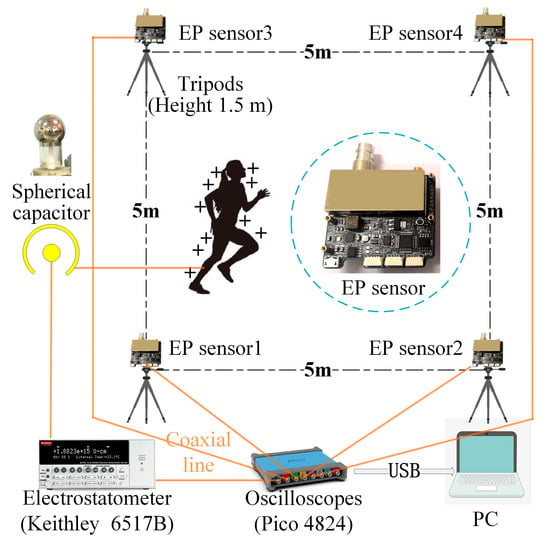
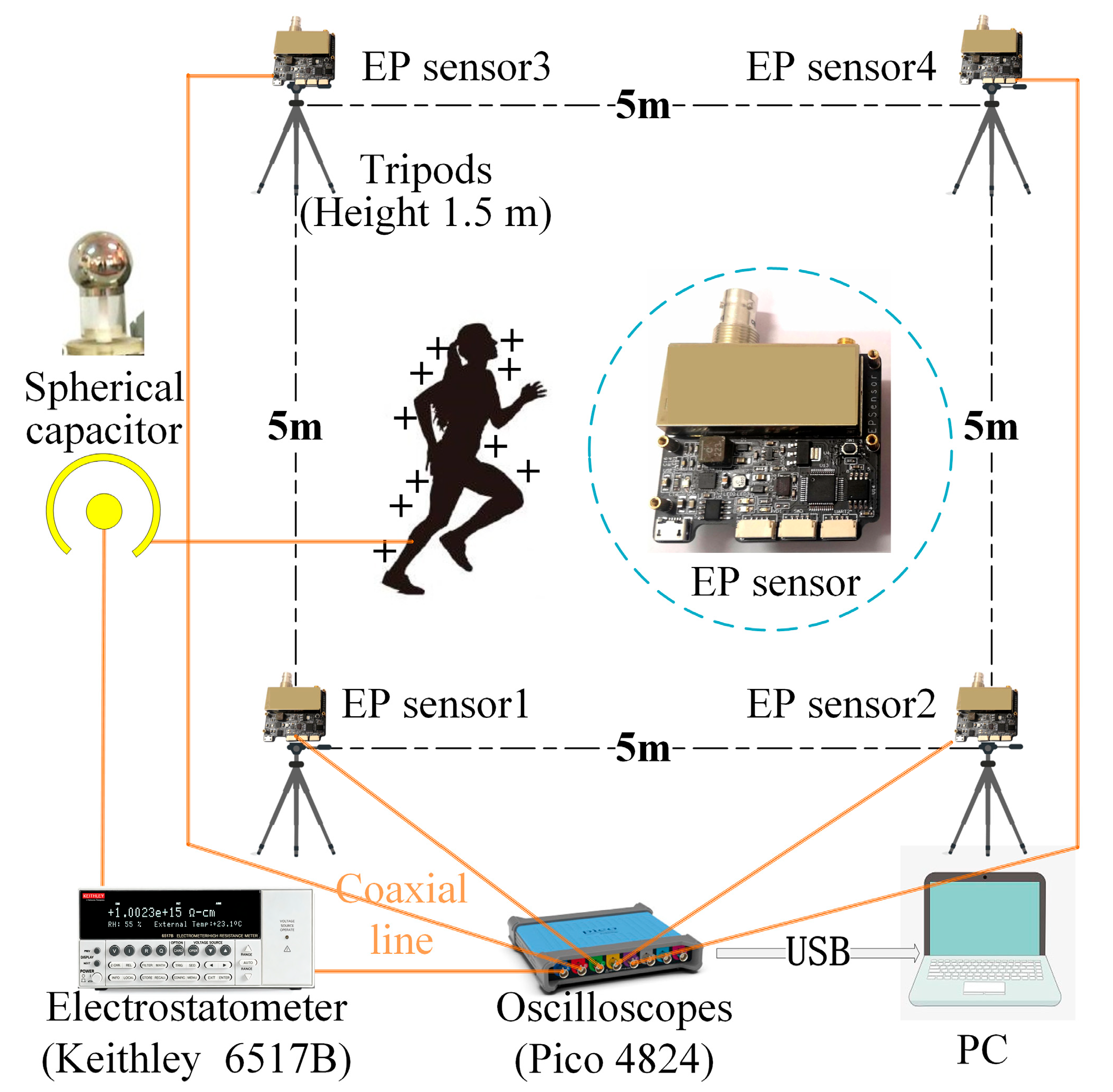
The experiments were conducted in a 12 m × 10 m indoor laboratory. A 5 m × 5 m square area with a tiled floor was selected as the test field. Four noncontact electrostatic sensors were placed at the four vertices of this area and connected to a digital oscilloscope (PicoScope 4824A; Pico Technology, St Neots, Cambridgeshire, UK) and a computer through coaxial cables for data acquisition and storage. Meanwhile, to obtain the reference value of the human body electrostatic potential, a contact measurement method based on [23] was adopted. A high-resistance electrometer (Keithley 6517B; Keithley Instruments, Solon, OH, USA) and a custom spherical capacitor with an equivalent capacitance of approximately 3 pF were used for capacitive voltage-division measurement. The analog output of this reference channel was also connected to the oscilloscope, enabling synchronous multichannel acquisition of the human body electrostatic potential and the four noncontact sensor signals. The experimental setup is shown in Figure 1. The ambient temperature and relative humidity were 21 °C and 45%, respectively.
Figure 1.
Schematic diagram of the experimental setup.
The reference measurement system was designed to minimize electrical loading on the subject. The high input resistance of the electrometer limits conductive current drawn from the body and therefore reduces measurement-induced charge leakage. Nevertheless, the spherical capacitor and the connecting wire inevitably introduce a finite additional capacitance and parasitic coupling to the body–ground system. Consequently, the measured reference potential may differ slightly from the absolute body potential of a completely uninstrumented subject. The nominal equivalent capacitance of the spherical capacitor was approximately 3 pF; however, the total loading also includes the parasitic capacitance associated with the connecting wire and was not independently quantified in the present study. Importantly, the same reference configuration was used throughout all walking and running trials, and the four noncontact sensor signals and the reference body-potential signal were acquired synchronously under the same measurement condition. Therefore, any limited and systematic loading introduced by the reference system was common to the model-development and independent-validation data and to all evaluated network architectures. This loading does not invalidate the internal consistency of the data-driven mapping or the fairness of the model-to-model comparison, although it represents a limitation when interpreting the measured reference value as the completely unperturbed free-body potential. During the motion trials, the connecting wire was maintained with sufficient slack to minimize tensile force and mechanical restriction on the participant, including during running.
Three adult participants took part in the experiments. Before participation, all participants were informed of the purpose and procedures of the study, the types of data to be collected, the intended use of the data for scientific research and publication, and their right to withdraw from the experiment. Verbal informed consent was obtained from all participants prior to the experiments. Participant identities were not reported in the study, and the experimental records were represented only by coded identifiers (P1–P3). All subjects wore sports shoes with rubber/ethylene-vinyl acetate copolymer composite soles. In each trial, one subject randomly selected a starting position within the test field and moved in either the slow walking mode or the fast running mode. Each motion mode was repeated six times for each subject, resulting in 36 raw signal groups in total. The signal groups are denoted as or , where i denotes the subject index and j denotes the trial index under the walking or running mode, respectively. Each signal group contains five synchronously acquired channels, including four output signals from the noncontact electrostatic sensors and one output signal from the contact measurement reference channel.
2.2. Dataset Construction
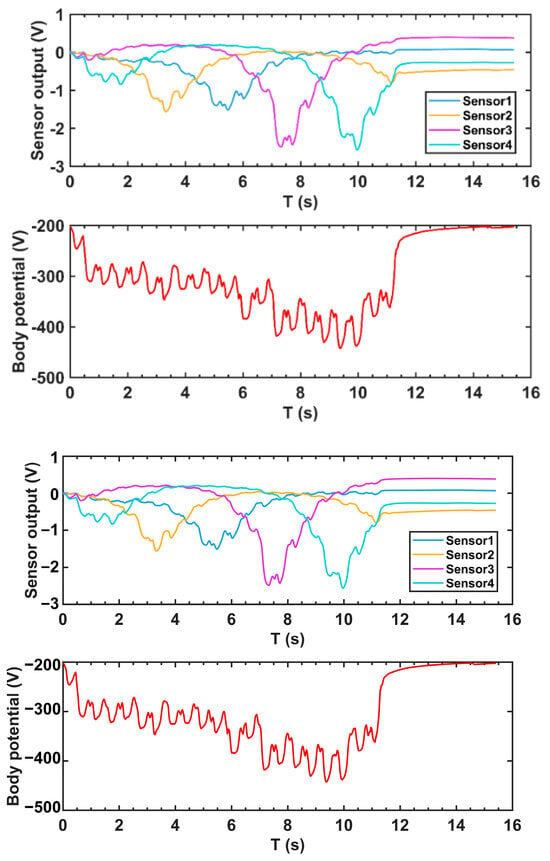
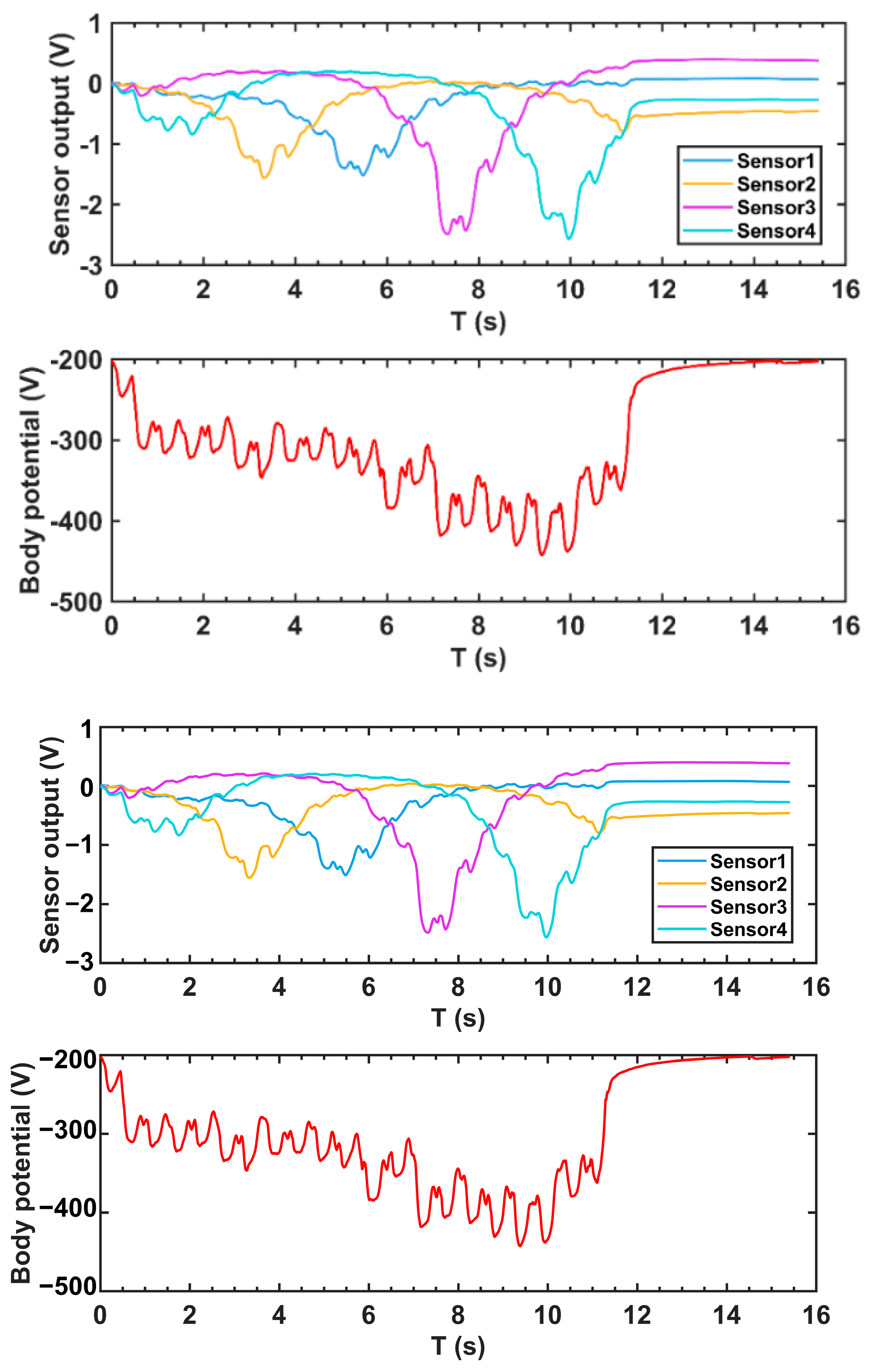
A representative group of cleaned signals is shown in Figure 2, where the upper panel presents the four-channel sensor signals and the lower panel presents the human body electrostatic potential signal.
Figure 2.
Measured human body electrostatic potential signals (upper: the four-channel sensor signals; lower: the human body electrostatic potential signal).
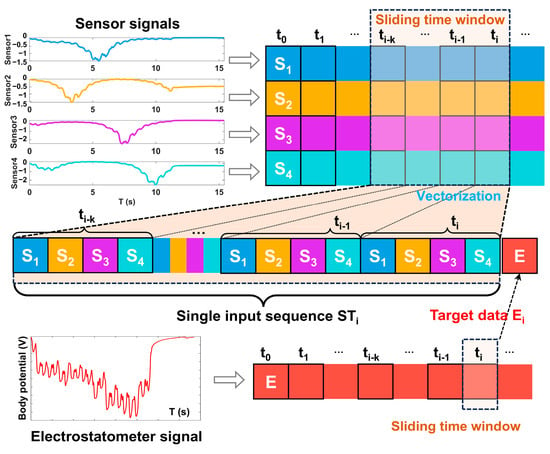
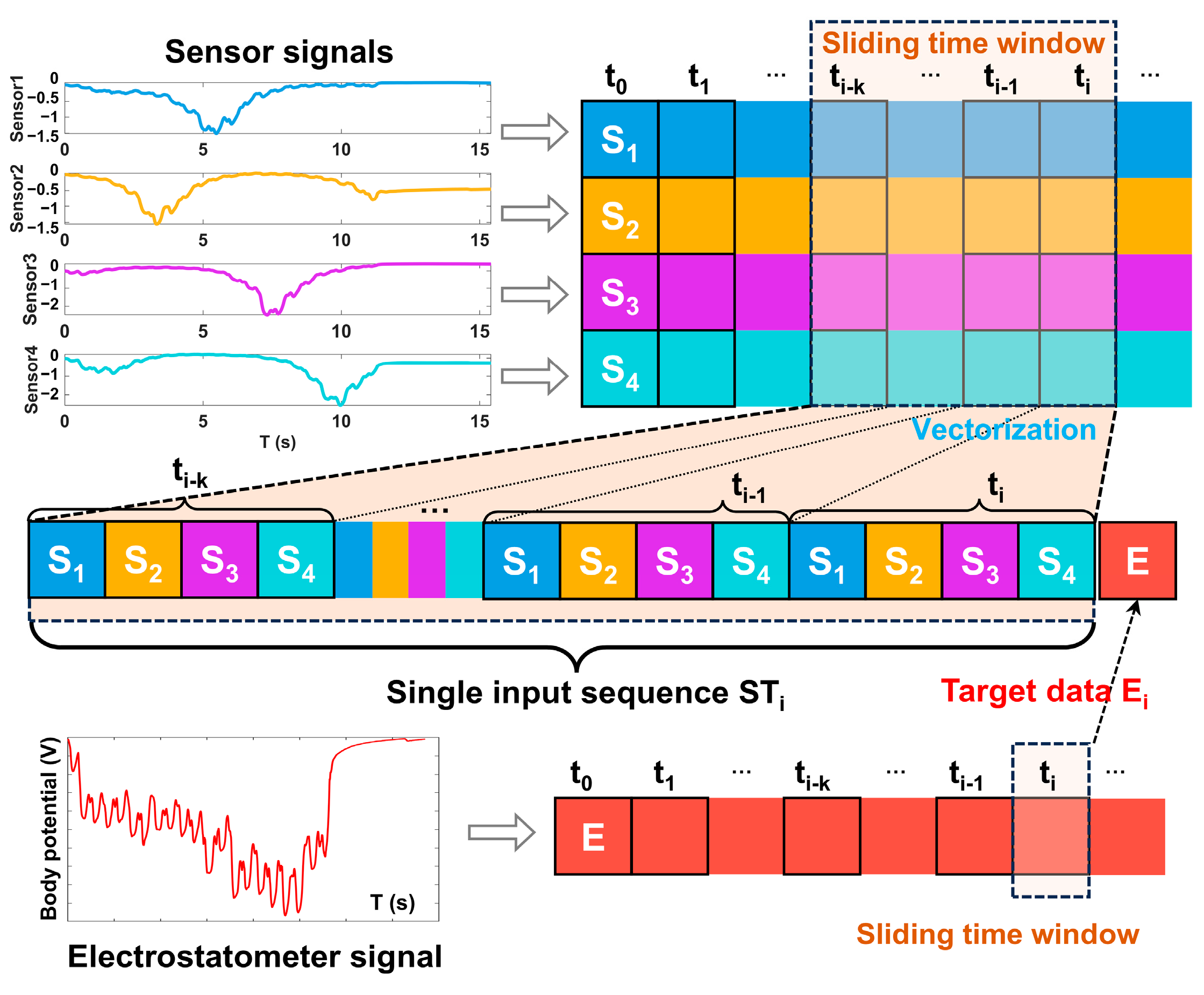
The five synchronously acquired channels, consisting of four noncontact electrostatic sensor signals and one contact-reference body-potential signal, were originally sampled at 50 ksps per channel using the PicoScope 4824. Because the body electrostatic potential varied mainly at a low frequency of approximately 1 Hz, the raw signals were first low-pass filtered to suppress 50 Hz power-line interference and other high-frequency environmental noise. Specifically, MATLAB (R2023b; MathWorks, Natick, MA, USA)’s lowpass() function was applied with a cutoff frequency of 1 Hz, a steepness of 0.9999, and a stopband attenuation of 1000 dB. The filtered signals were then downsampled to 100 Hz using MATLAB’s resample() function. The same preprocessing procedure was applied to all five channels to preserve their temporal correspondence. After resampling, the DC offset of each electrostatic signal was removed by subtracting the mean value of the first 100 samples, which represented the average body electrostatic potential before the participant began to move. The resulting filtered, downsampled, and de-offset signals were subsequently used for data alignment and model input construction, as illustrated in Figure 3. For input preprocessing, the four sensor channels and the reference body-potential target were not additionally normalized.
Figure 3.
Dataset construction using the sliding-window method.
To avoid information leakage caused by overlapping sliding windows, data partitioning was performed at the raw-signal-group level. The 36 signal groups were first divided into 18 groups for model development and 18 groups for independent validation. All window samples generated from the same raw signal group were retained in the same data subset.
At any time instant , the four sensor outputs form a four-dimensional observation vector . A sliding time window with a length of was used to scan the multichannel sequence along the temporal axis. The four-channel sensor data at consecutive time instants within the window were arranged in chronological order to form an input sample , and the corresponding true value of the human body electrostatic potential was used as the supervised label. Thus, each sample consists of a multichannel historical electrostatic induction signal sequence and its corresponding target potential value. The investigated window lengths were k = 10, 30, 50, 100, and 200, corresponding to temporal contexts of 0.1, 0.3, 0.5, 1.0, and 2.0 s, respectively.
In addition to providing temporal context for body-potential evolution, the multichannel sequence also contains the temporal variation in the position-dependent coupling pattern as the subject moves. Therefore, motion-related spatial information is implicitly represented in the network input even though the subject coordinates are not explicitly provided.
A total of 36 raw synchronized signal groups were obtained from three subjects under walking and running conditions. To analyze the influence of different temporal context lengths on inversion performance, was set to 10, 30, 50, 100, and 200, corresponding to historical durations of 0.1 s, 0.3 s, 0.5 s, 1.0 s, and 2.0 s, respectively.
To avoid information leakage caused by overlapping sliding windows, data partitioning was performed at the raw-signal-group level. Specifically, the 36 signal groups were first divided into 18 groups for model development and 18 held-out signal groups for independent validation. Then, only the model-development groups were used to construct sliding-window samples, which were further divided into a training subset, a hyperparameter-validation subset, and an internal test subset. The independent validation groups were not involved in model training or hyperparameter optimization and were used only for final performance evaluation. All window samples generated from the same raw signal group were always retained in the same data subset.
2.3. Neural Network Models
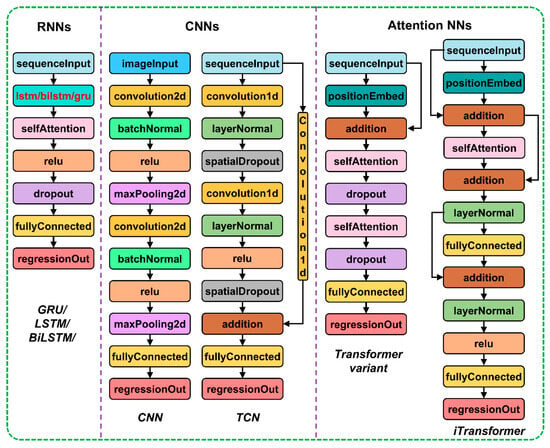
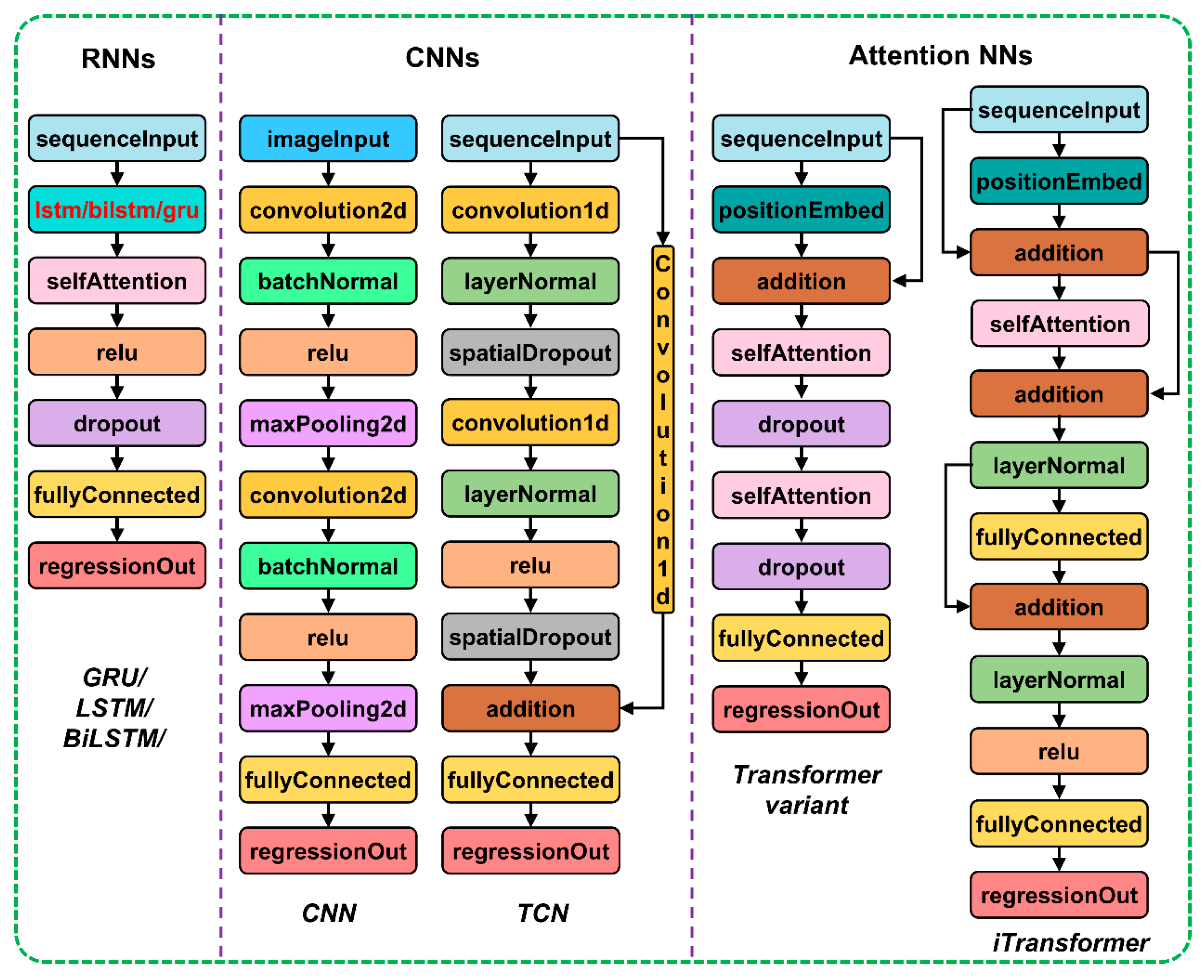
This study formulates human body electrostatic potential inversion as a time-series regression task. To compare the modeling capability of different network architectures for this task, three categories of representative temporal neural networks were selected as baseline models:
- (1)
- Recurrent neural network (RNN) models: LSTM, BiLSTM, and GRU;
- (2)
- Convolutional neural network (CNN)-based models: CNN and TCN;
- (3)
- Attention-based models: a Transformer variant and iTransformer.
The three categories of baseline neural network models selected in this study are shown in Figure 4.
Figure 4.
Three categories of baseline neural network models selected in this study.
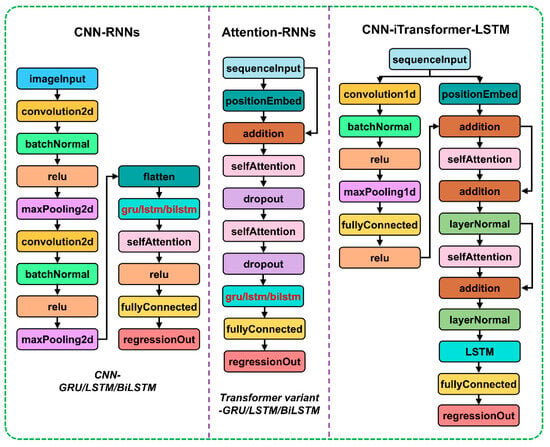
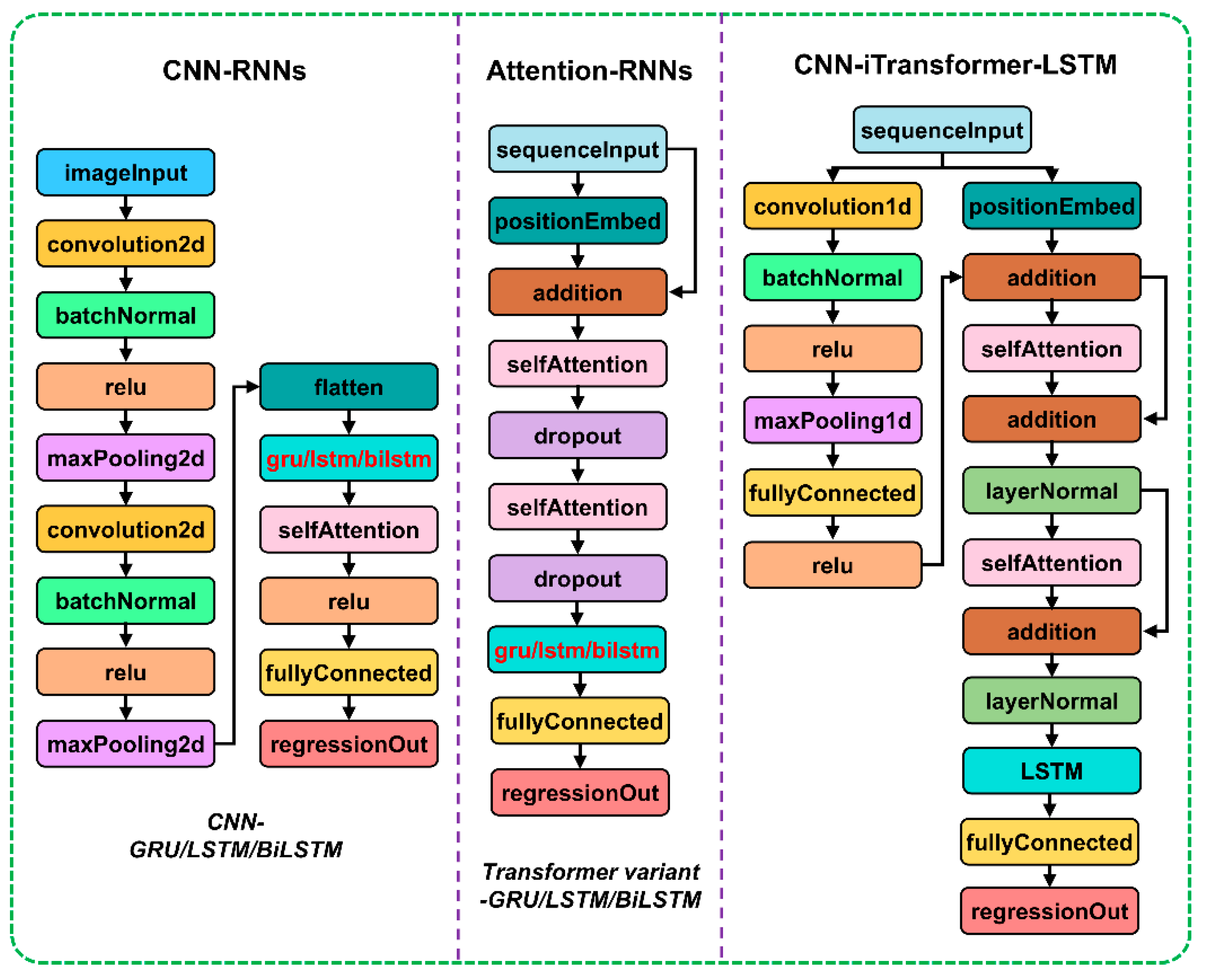
In addition, different types of network layers were further combined to construct nine hybrid models, including CNN-RNN models, Attention-RNN models, and a CNN-iTransformer-LSTM model, as shown in Figure 5.
Figure 5.
Three categories of hybrid neural network models selected in this study.
To improve reproducibility and make the architectural comparison explicit, the detailed layer compositions of all 16 evaluated models are summarized in Table 1. For each model, the table reports the ordered network layers, major layer dimensions, model-specific hyperparameters, and the total number of trainable parameters. The four noncontact electrostatic sensor channels were used as input features; The topology of each architecture was fixed, whereas model-specific structural parameters were selected according to the GWO optimization procedure described in Section 2.4.
Table 1.
Detailed architecture and trainable parameter count of the evaluated neural network models.
In summary, 16 neural network architectures were compared for the human body electrostatic potential inversion task. Model performance was evaluated based on the consistency between the predicted values and the reference values. The NRMSE and the coefficient of determination () were used as quantitative evaluation metrics.
2.4. Hyperparameter Optimization
The performance of neural network models depends strongly on hyperparameter settings. To fairly evaluate the performance of different network architectures on the present dataset, common hyperparameters, including learning rate, batch size, number of training epochs, optimization algorithm, and weight initialization strategy, were uniformly set for all models. For model-specific hyperparameters, as listed in Table 2, the Gray Wolf Optimizer (GWO) was used for optimization. Finally, each model was retrained using its optimal configuration, and performance was uniformly reported on the independent-validation set.
Table 2.
Hyperparameters of the neural network models.
To ensure a fair comparison, the common training settings listed in Table 3 were kept identical across all evaluated architectures.
Table 3.
Common training settings used for all evaluated models.
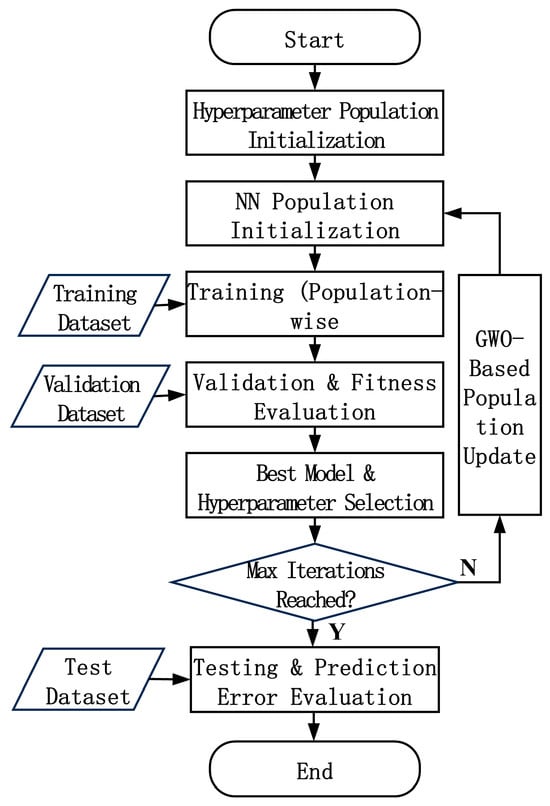
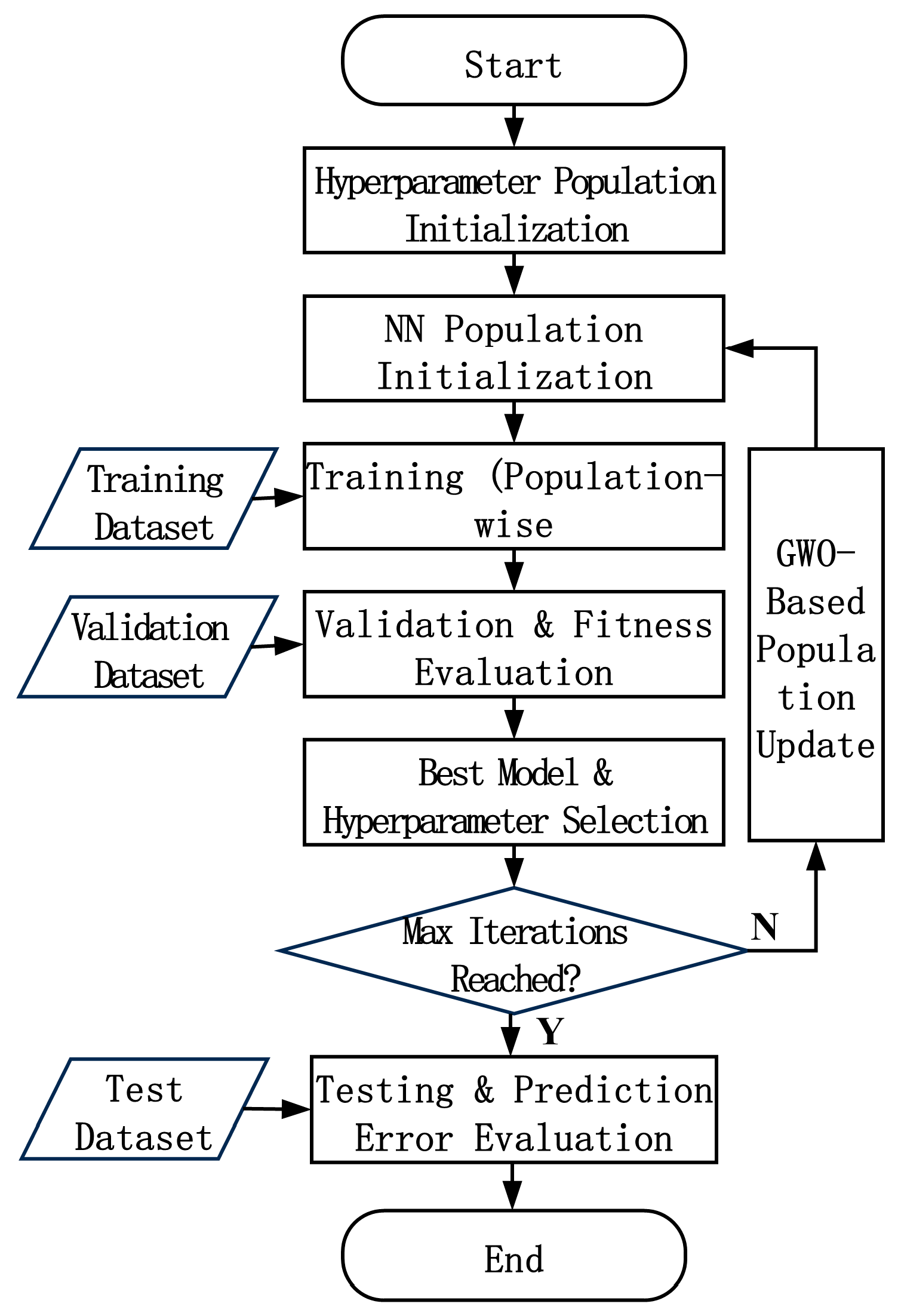
The GWO-based hyperparameter optimization workflow is shown in Figure 6. First, the population was randomly initialized according to the predefined hyperparameter search ranges, with the population size set to 5. Then, a neural network model was constructed according to the hyperparameter configuration represented by each individual and trained on the training subset. Next, the model performance was evaluated on the validation subset, and the NRMSE was used as the fitness function. The model and hyperparameter configuration with the best current fitness value, namely the minimum NRMSE, were selected as the current optimal solution. If the number of iterations reached the preset upper limit of 1000, the optimization process was terminated. Otherwise, the population was iteratively updated according to the GWO update mechanism, and the next search iteration was performed. After iterative optimization, the optimal hyperparameter combination for each network architecture was obtained.
Figure 6.
Hyperparameter optimization algorithm based on the Gray Wolf Optimizer.
The calculated budget is as follows: The maximum GWO iteration number was set to 1000, and the population size was 5. No convergence-based stopping criterion was applied; therefore, each optimization run was performed for the full 1000 iterations. Consequently, 5000 fitness evaluations were conducted for each architecture–window combination, with each fitness evaluation corresponding to the training and validation of one candidate neural network. For the complete experimental design comprising 16 network architectures and five sliding-window lengths, this setting corresponded to a total computational budget of 400,000 fitness evaluations. Each candidate network was trained for a maximum of 1000 epochs, and no training-level early stopping was employed. All experiments were implemented in MATLAB R2025b and executed using eight NVIDIA GeForce RTX 4090 (NVIDIA Corporation, Santa Clara, CA, USA) GPUs.
3. Results and Discussion
3.1. Representative Inversion Results
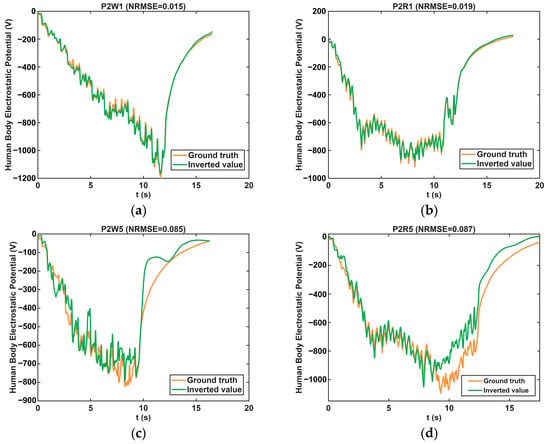
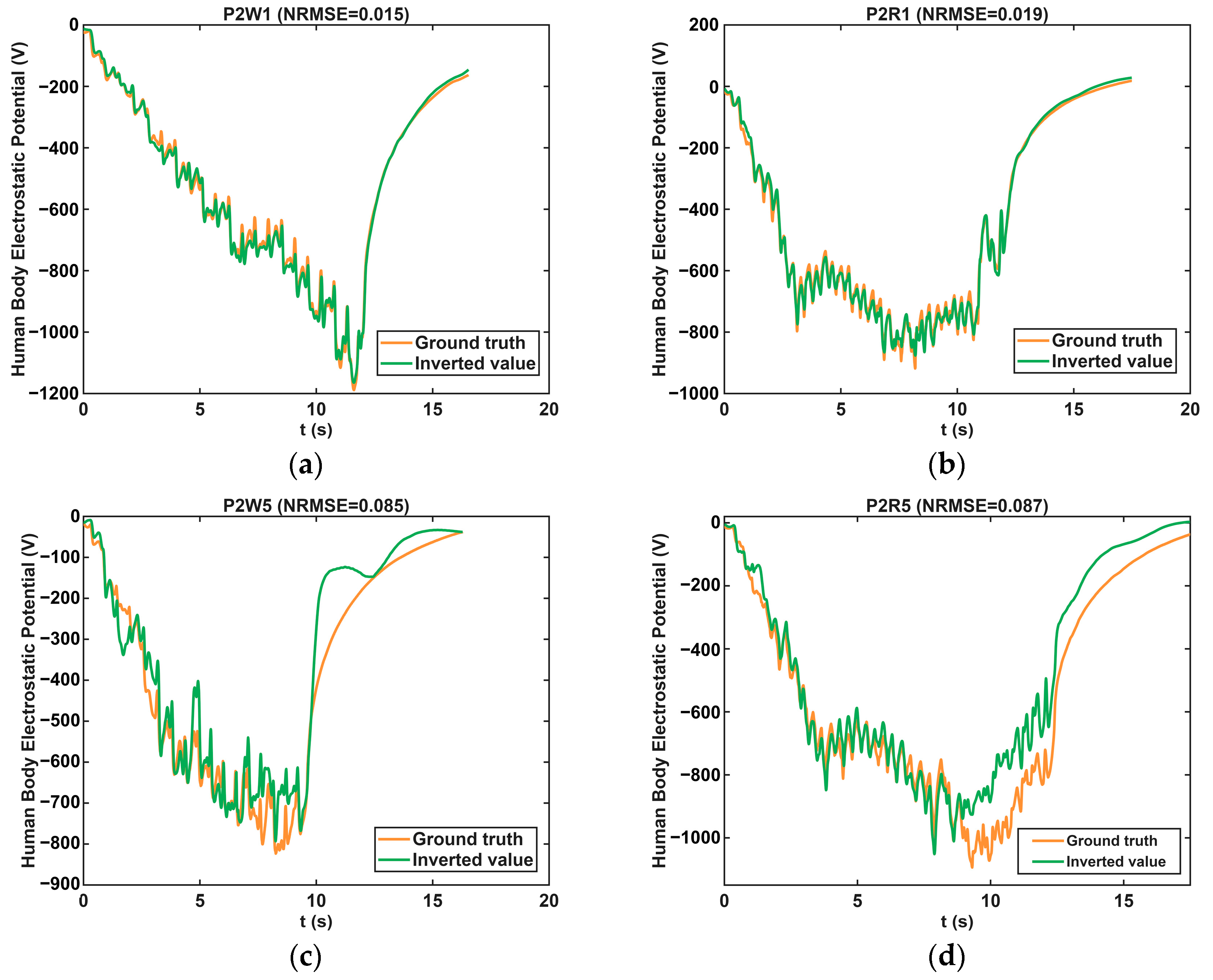
To illustrate the inversion capability of the neural network models, four representative signal groups from the same subject were selected: P2W1 and P2R1 from the model-development data, and P2W5 and P2R5 from the independent-validation data. The CNN-LSTM model is used as an example, and the corresponding inversion results are shown in Figure 7.
Figure 7.
Inversion results of the CNN-LSTM model on model-development data and independent-validation data: (a) Result on . (b) Result on . (c) Result on . (d) Result on .
Figure 7a,b show the inversion results for walk and run samples from the model-development set. The predicted curves generally follow the variation trend of the reference human body electrostatic potential and remain consistent with the reference values over most time intervals. The low-frequency components of the reference signal mainly originate from charge accumulation and dissipation on the human body, whereas the high-frequency components are primarily associated with rapid contact–separation between the shoe sole and the floor. Compared with walking, running produces stronger potential fluctuations and more complex temporal variations. Nevertheless, the model recovers the dominant variation patterns with reasonable accuracy, indicating that it learns an effective nonlinear mapping from sensor signals to human body electrostatic potential.
Figure 7c,d presents the corresponding results on the independent-validation data. The NRMSE values of these representative validation samples are both below 0.09. Compared with the error ranges reported in [5,13], the proposed method exhibits competitive accuracy on typical unseen samples, supporting the feasibility of the proposed data-driven inversion framework. It should be noted that the values below 0.09 are only the prediction errors of the two examples shown in Figure 7 and should not be interpreted as the overall performance of the model on the complete independent-validation set. The aggregate performance over all independent-validation groups is evaluated separately in Section 3.2.
Overall, the representative results show that neural networks can infer human body electrostatic potential from four-channel noncontact electrostatic measurements. The model-development results demonstrate fitting capability, whereas the independent-validation results indicate effectiveness on unseen signal groups. A systematic comparison of all 16 architectures using NRMSE and is presented next.
3.2. Performance Comparison of Different Neural Network Architectures
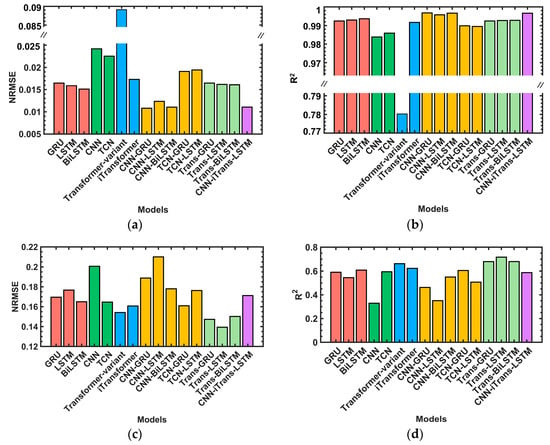
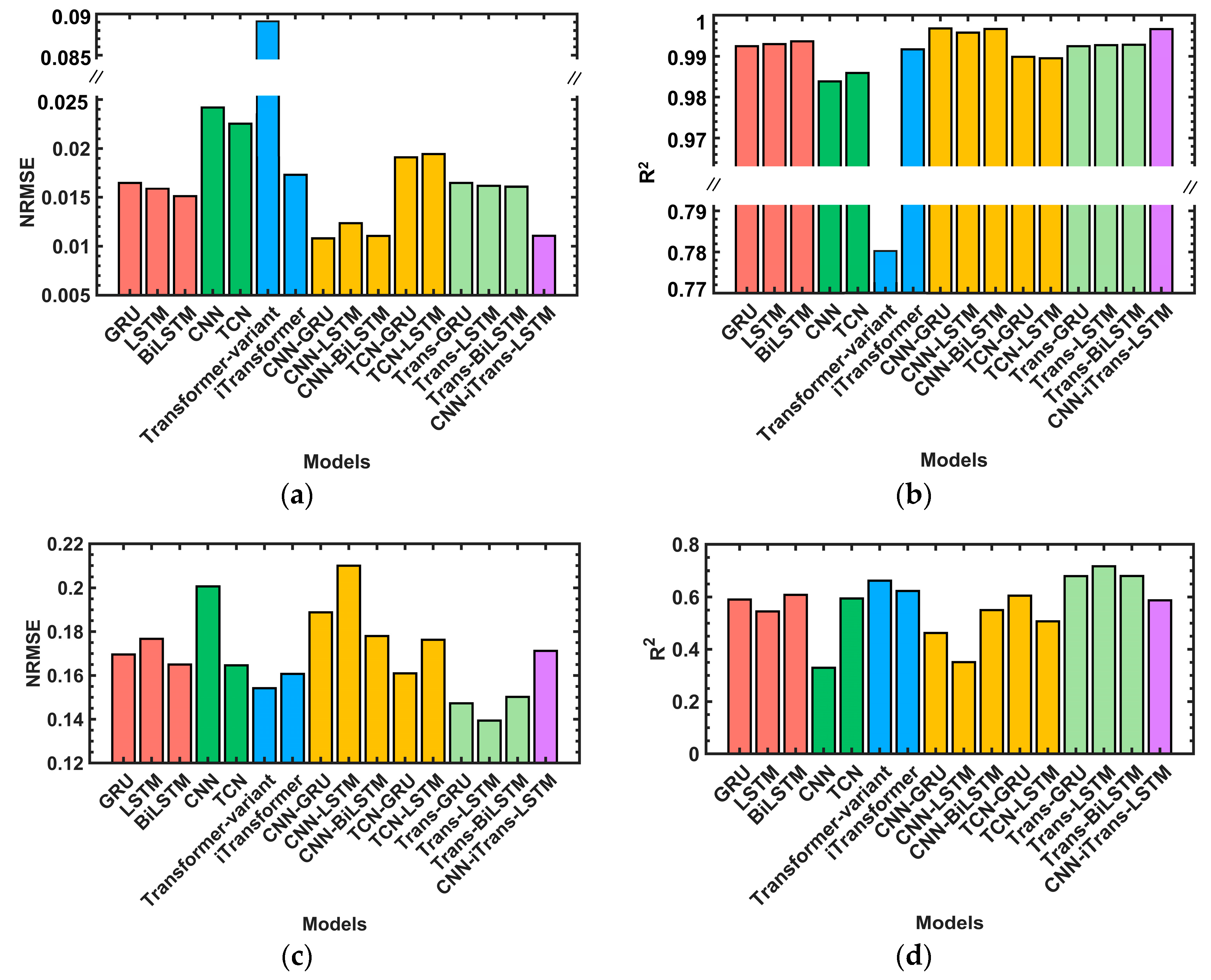
To evaluate the suitability of different architectures, the NRMSE and R2 of the 16 models were compared on the model-development data and the independent-validation data under a sliding-window length of 1 s (k = 100). The results are shown in Figure 8. Overall, all models exhibit strong fitting ability on the model-development data, whereas their performance differences become much larger on the independent-validation data, indicating that architecture selection has a pronounced effect on generalization.
Figure 8.
Inversion performance of all models on model-development and independent-validation data: (a) NRMSE on the model-development data. (b) on the model-development data. (c) NRMSE on the independent-validation data. (d) on the independent-validation data.
As shown in Figure 8a,b, all models achieve low NRMSE on the model-development data. Except for the Transformer-variant model, whose NRMSE is approximately 0.09, the remaining models have NRMSE values of approximately 0.011–0.024 and R2 values above 0.97. These results confirm that neural networks can capture the nonlinear relationship between electrostatic sensor signals and human body electrostatic potential. Among single-structure models, the RNN-based models (GRU, LSTM, and BiLSTM) show the strongest fitting performance, followed by the CNN-based models (CNN and TCN), whereas the Transformer-variant model is the weakest on the model-development data. Hybrid models generally outperform single-structure models. In particular, CNN-GRU, CNN-LSTM, CNN-BiLSTM, and CNN-iTrans-LSTM achieve the lowest NRMSE values, approximately 0.011–0.013, with values close to or above 0.99. This indicates that combining convolutional feature extraction with temporal modeling substantially improves representation of the development samples.
The independent-validation results are shown in Figure 8c,d. For the independent-validation evaluation, the NRMSE was first calculated separately for each of the 18 held-out signal groups, and the mean of the 18 group-level NRMSE values was then used as the overall validation NRMSE for each model. Therefore, the values reported in Figure 8c represent model-level aggregate performance over the complete independent-validation set rather than the error of any single signal group. Compared with the model-development data, the NRMSE values increase to approximately 0.139–0.211, and the differences among models become more pronounced. The Trans-LSTM model achieves the best overall validation performance, with the lowest NRMSE of approximately 0.139 and the highest of approximately 0.72. Trans-GRU and Trans-BiLSTM rank next and also maintain relatively low validation errors. In contrast, although CNN-LSTM achieves one of the lowest errors on the model-development data, its validation NRMSE increases to approximately 0.210, the worst among all models, indicating insufficient generalization. Among single-structure models, BiLSTM performs slightly better than GRU and LSTM. CNN yields the weakest validation performance, whereas TCN performs clearly better than CNN, suggesting that temporal convolution is more appropriate for this task than ordinary convolution. It is also noteworthy that the Transformer-variant model, despite underfitting the model-development data, outperforms most single-structure models on the independent-validation data, implying that attention-based global-dependency modeling can be beneficial for unseen samples.
Different fusion strategies therefore lead to markedly different behaviors. CNN-RNN hybrid models provide the strongest fitting capability on the model-development data, but Transformer-RNN hybrids achieve better accuracy and stability on the independent-validation data. For this nonlinear time-series regression problem, superior fitting performance on development samples does not necessarily imply better performance on unseen data. Hybrid structures that jointly model long-range dependencies and local temporal dynamics appear more robust. Among the compared models, Trans-LSTM provides the best balance between fitting ability and validation performance. Because model performance also depends on the amount of historical information in the input sequence, the influence of sliding-window length is analyzed next.
3.3. Effect of Sliding-Window Length on Model Performance
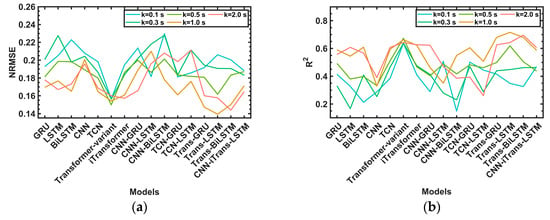
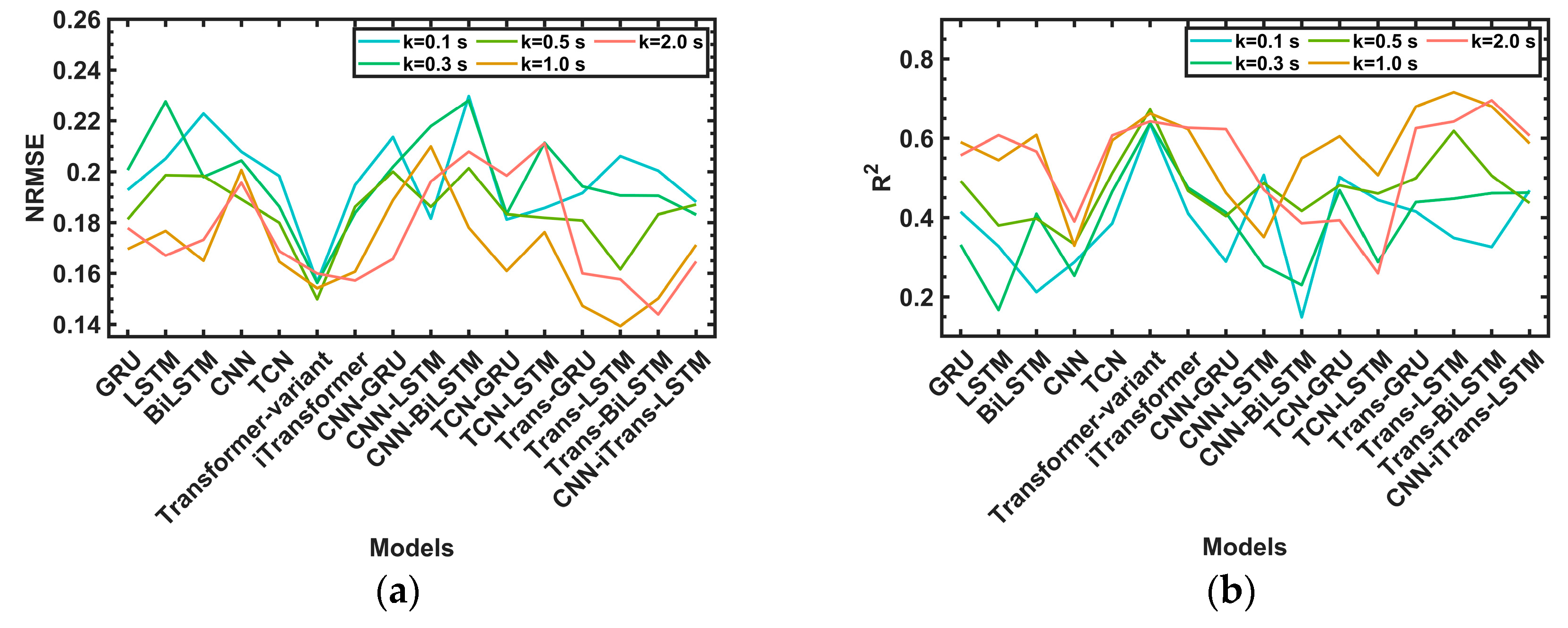
The sliding-window length determines the amount of historical information contained in each input sample and therefore directly affects inversion performance. Five window lengths—k = 10, 30, 50, 100, and 200, corresponding to 0.1 s, 0.3 s, 0.5 s, 1.0 s, and 2.0 s of historical data, respectively—were evaluated for all models. The results are shown in Figure 9. Window length has a significant influence on model performance, but no single value is uniformly optimal for all architectures. In general, the shortest window (0.1 s) produces the weakest overall performance, whereas medium-length windows, especially around 1.0 s, provide better results for most models. This suggests that an appropriate amount of temporal context improves inversion accuracy.
Figure 9.
Inversion performance under different sliding-window lengths: (a) NRMSE. (b) .
As shown in Figure 9a,b, NRMSE and exhibit consistent trends. Most models have relatively high NRMSE and low when k = 10, indicating that an excessively short window does not provide sufficient dynamic context. As k increases to 50 or 100, errors generally decrease, and values increase, indicating that richer historical sequences help the models characterize the temporal evolution of human body electrostatic potential. Trans-LSTM and Trans-BiLSTM achieve their best performance at k = 100, showing that medium-length windows are particularly beneficial for Transformer-RNN hybrid models. When k is further increased to 200, some models still maintain good performance, but no consistent improvement is observed, and several models degrade slightly, suggesting that the benefit of further extending the window is limited.
Model sensitivity to window length also differs across architectures. Single-structure RNN models (GRU, LSTM, and BiLSTM) fluctuate relatively little as k changes, indicating stable behavior. CNN-based models and their hybrids are more sensitive, especially under short-window conditions. Transformer-related models become more competitive with medium-length windows, suggesting that attention-based global-dependency modeling requires sufficient temporal context. Overall, window lengths of approximately 0.5–1.0 s provide better comprehensive performance. This finding indicates that human body electrostatic potential depends not only on the instantaneous induction signal, but also on the preceding dynamic process. Therefore, window length should be selected jointly with network architecture to balance inversion accuracy and generalization.
3.4. Performance Under Different Subjects and Motion Modes
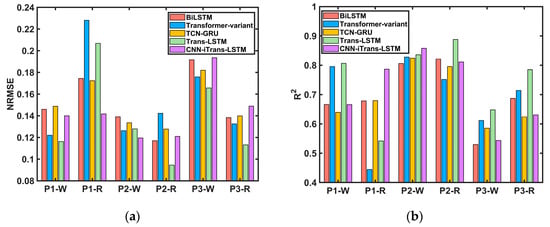
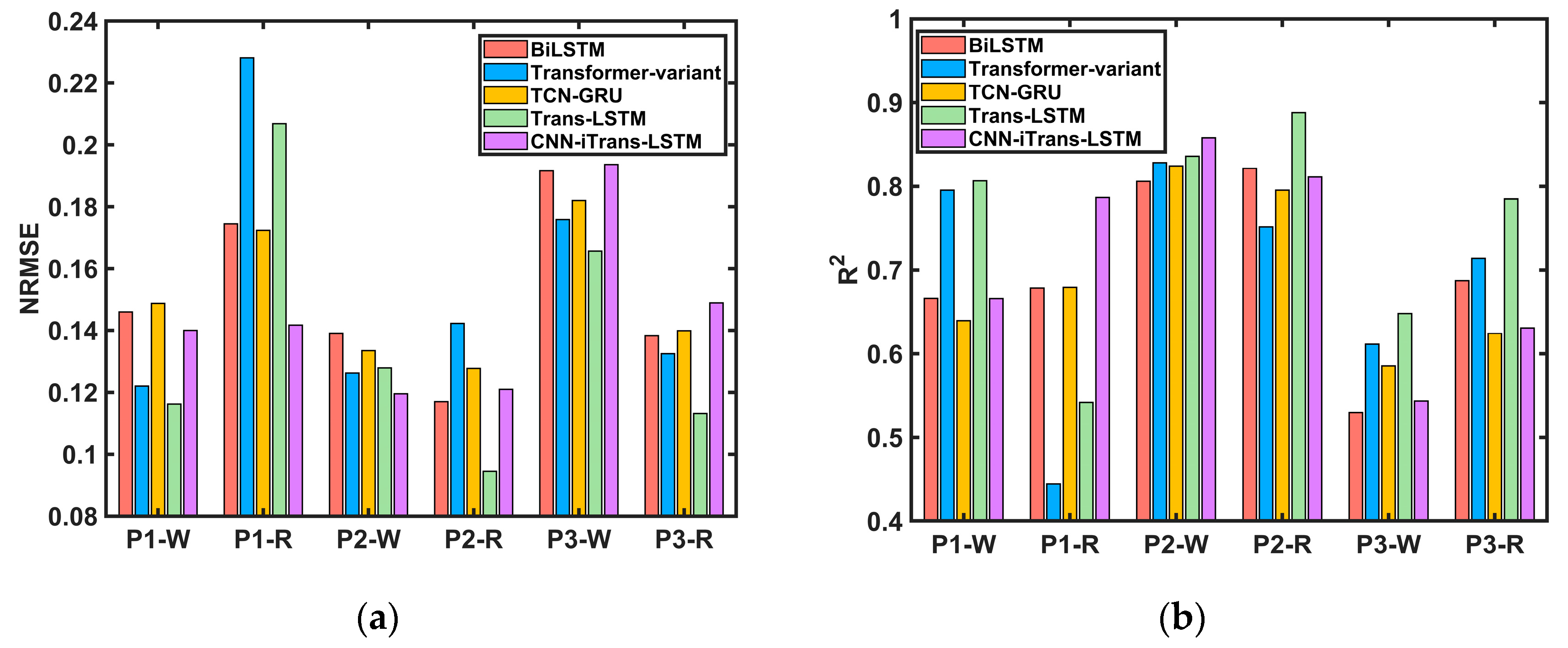
To further evaluate model robustness under different subjects and motion modes, five representative models were selected: BiLSTM, Transformer-variant, TCN-GRU, Trans-LSTM, and CNN-iTrans-LSTM. Their inversion results for different subject–motion combinations are shown in Figure 10.
Figure 10.
Inversion performance under different subjects and motion modes: (a) NRMSE. (b) .
As shown in Figure 10, model performance is affected by both subject variation and motion mode, with subject-related differences being more pronounced. Among the three subjects, P2 generally yields the best results: under both walk and run conditions, most models achieve low NRMSE and high . In contrast, P3, especially under the walk condition, is the most challenging case, with increased errors and reduced for all models. The influence of motion mode does not follow a uniform pattern. For P1, most models perform worse under the run condition, whereas for P2 and P3 the run condition is generally easier than walk. Thus, running does not necessarily degrade inversion performance; its effect depends on subject-specific charging behavior and signal dynamics. A key requirement is therefore the ability to accommodate temporal-feature variations jointly induced by subject differences and motion-mode changes.
Among the five representative models, Trans-LSTM shows the strongest overall generalization, achieving the lowest NRMSE in four of the six subject–motion combinations. CNN-iTrans-LSTM performs best under P1-R and P2-W, indicating that combining convolutional feature extraction with global-dependency modeling can be advantageous in some scenarios. However, its consistency across conditions is slightly weaker than that of Trans-LSTM. BiLSTM and TCN-GRU are comparatively stable but are inferior to the best model in most cases. The Transformer-variant model exhibits the largest fluctuations, suggesting that attention-only modeling is still limited in adapting to subject variation and motion-mode changes. These results indicate that subject variation has a stronger influence than motion mode in the present dataset. Overall, Trans-LSTM provides the most favorable balance between accuracy and cross-condition stability.
Only three subjects participated in the experiments, and all of them wore athletic shoes with similar rubber/EVA composite soles. Therefore, the present independent-validation results demonstrate prediction performance on held-out signal groups within the studied experimental domain, rather than broad population-level, unseen-subject, or footwear-independent generalization. Different footwear materials may alter triboelectric charge generation, charge retention, and charge dissipation during shoe–floor contact and separation, resulting in changes in body-potential amplitude and temporal dynamics. Differences in body size and geometry may also modify the effective body-to-ground capacitance and the capacitive coupling between the subject and the four spatially distributed sensors. In addition, individual gait characteristics, including step frequency, contact duration, and shoe–floor separation dynamics, can further affect the temporal signal patterns. Consequently, substantially different subjects or footwear may introduce a distribution shift relative to the current training data and may affect inversion accuracy. A larger and more diverse dataset, together with subject-independent evaluation such as leave-one-subject-out validation, will be required to establish broader generalization.
3.5. Comparison with Representative Noncontact Methods for Human Body Electrostatic Potential Measurement
To further assess the effectiveness of the proposed method, Table 4 compares the present results with representative studies on noncontact human body electrostatic potential measurement and inversion. The comparison considers sensor type, experimental setup, sensing coverage or test distance, and accuracy metric.
Table 4.
Comparison With Related Studies.
Table 4 shows that previous studies have demonstrated the feasibility of noncontact measurement and inversion of human body electrostatic potential. However, a trade-off remains between sensing coverage and inversion accuracy. Kurita [24] verified real-time noncontact measurement under controlled near-field conditions, with a test distance of approximately 0.3–0.5 m, but did not report a unified quantitative accuracy metric. Wen et al. [25] deployed 11 MEMS electric-field sensors in a portal structure with a test distance of 0.8 m and achieved an uncertainty below 5%. Grosse-Puppendahl et al. [13] extended the sensing area to 2 m × 2.5 m and achieved an NRMSE of 0.091 under relatively low sensor density. Our previous method [5] further expanded the sensing area to 5 m × 5 m and obtained an NRMSE of 0.22 using only four sensors. Under the same sensing coverage and sensor layout as [5], the proposed method reduces the NRMSE from 0.22 to 0.139, indicating improved performance under large-area and low-sensor-density conditions.
4. Conclusions
This paper presented a data-driven inversion method for estimating human body electrostatic potential from noncontact measurements. By learning the nonlinear mapping between four-channel electrostatic sensor signals and synchronously measured reference potential, the proposed method performs time-series estimation without strong dependence on explicit scene-specific physical modeling. Sixteen temporal neural network architectures were compared, and all were found capable of performing the inversion task, although their performance on unseen data differed substantially. Trans-LSTM achieved the best overall validation performance, with an NRMSE of approximately 0.139 and an of approximately 0.72.
The analysis of sliding-window length showed that temporal context is important for accurate inversion, and window lengths of approximately 0.5–1.0 s generally provided better overall performance. Cross-condition results further indicated that subject variation had a stronger influence than motion mode in the present dataset. Compared with a representative previous method using the same sensing area and sensor configuration, the proposed approach reduced the NRMSE from 0.22 to 0.139. These results demonstrate that combining multichannel noncontact electrostatic sensing with temporal deep learning is a promising route for remote, real-time, and large-area monitoring of human body electrostatic potential.
Several limitations of the present study should be noted. First, the dataset contains only three subjects wearing athletic shoes with similar rubber/EVA composite soles. Therefore, the current independent-validation results demonstrate generalization to held-out signal groups within the studied experimental domain rather than broad generalization to unseen populations, body characteristics, or footwear types. Second, although the multichannel temporal input reduces the ambiguity between body-potential variation and position-dependent capacitive coupling, the method does not provide a theoretically unique separation of these factors and is currently validated only under the fixed sensor geometry used in this study. Third, the wired contact-reference system introduces finite capacitive loading and may slightly perturb the absolute body potential compared with a completely uninstrumented condition. Future work will therefore expand the dataset to include more subjects, diverse body characteristics and footwear materials, investigate subject-independent validation and different sensing geometries, and develop reference measurement strategies with reduced physical loading.
Author Contributions
Conceptualization, M.M.; methodology, M.M. and B.W.; software, M.M.; validation, Y.C., E.C. and B.W.; formal analysis, G.M.; investigation, B.W.; resources, Y.C.; data curation, T.C.; writing—original draft preparation, M.M.; writing—review and editing, B.W.; visualization, T.C.; supervision, G.M.; project administration, Y.C.; funding acquisition, M.M. All authors have read and agreed to the published version of the manuscript.
Funding
This research was funded by the National Natural Science Foundation of China, grant number 62401623.
Informed Consent Statement
Verbal informed consent was obtained from all participants prior to participation, and the consent process was documented in the study records.
Data Availability Statement
The data presented in this study are openly available in the Science Data Bank at https://cstr.cn/31253.11.sciencedb.40499 (accessed on 23 June 2026), CSTR: 31253.11.sciencedb.40499. The dataset is titled Movement human body electrostatic potential dataset, Version 1, 2026.
Conflicts of Interest
The authors declare no conflicts of interest.
References
- Pan, Z.; Li, C.; Hao, W.; Li, X.; Wang, A. ESD Protection Designs: Topical Overview and Perspective. IEEE Trans. Device Mater. Reliab. 2022, 22, 356–370. [Google Scholar] [CrossRef] [Scilit]
- Smallwood, J.; Green, N.G.; Robinson, K. Evaluating the electrostatic discharge risk between small radius objects and charged planar insulating materials. J. Electrost. 2022, 115, 103680. [Google Scholar] [CrossRef] [Scilit]
- Holdstock, P. A review of electrostatic standards. J. Electrost. 2022, 115, 103652. [Google Scholar] [CrossRef] [Scilit]
- Ichikawa, N. Investigation of human body potential measured by a non-contact measuring system. Ind. Health 2016, 54, 542–549. [Google Scholar] [CrossRef] [Scilit][Green Version]
- Man, M.; Wei, M. Remote monitoring method for human body electrostatic potential based on symbolic regression machine learning. Meas. Sci. Technol. 2023, 34, 065116. [Google Scholar] [CrossRef] [Scilit]
- Kurita, K.; Morinaga, S. Noncontact Detection of Movements of Standing Up From and Sitting Down on a Chair Using Electrostatic Induction. IEEE Sens. J. 2019, 19, 8934–8939. [Google Scholar] [CrossRef] [Scilit]
- Prance, R.J.; Debray, A.; Clark, T.D.; Prance, H.; Nock, M.; Harland, C.J.; Clippingdale, A.J. An ultra-low-noise electrical-potential probe for human-body scanning. Meas. Sci. Technol. 2000, 11, 291–297. [Google Scholar] [CrossRef] [Scilit]
- Prance, H.; Watson, P.; Prance, R.J.; Beardsmore-Rust, S.T. Position and movement sensing at metre standoff distances using ambient electric field. Meas. Sci. Technol. 2012, 23, 115101. [Google Scholar] [CrossRef] [Scilit]
- Jocys, Z.; Pouryazdan, A.; Roggen, D. Multimodal fusion of IMUs and EPS body-worn sensors for scratch recognition. In PervasiveHealth ‘20: 14th EAI International Conference on Pervasive Computing Technologies for Healthcare, 2020; Association for Computing Machinery: New York, NY, USA, 2021. [Google Scholar]
- Tang, X.; Mandal, S. Indoor Occupancy Awareness and Localization Using Passive Electric Field Sensing. IEEE Trans. Instrum. Meas. 2019, 68, 4535–4549. [Google Scholar] [CrossRef] [Scilit]
- Hu, Y.; Wang, J.; Li, Y.; Yan, Y. Localization of charged objects using a planar electrostatic sensor array. IEEE Trans. Instrum. Meas. 2023, 72, 9514405. [Google Scholar] [CrossRef] [Scilit]
- Hu, Y.; Li, Y.; Wang, J.; Yan, Y. Indoor Human Localization Using Electrostatic Sensors and Compressive Sensing Techniques. In IEEE Transactions on Instrumentation and Measurement; IEEE: New York, NY, USA, 2025. [Google Scholar]
- Grosse-Puppendahl, T.; Dellangnol, X.; Hatzfeld, C.; Fu, B.; Gruteser, M. Platypus—Indoor Localization and Identification through Sensing Electric Potential Changes in Human Bodies. In Acm Mobisys; Association for Computing Machinery: New York, NY, USA, 2016. [Google Scholar]
- Kurita, K. New estimation method for the electric potential of the human body under perfect noncontact conditions. IEEJ Trans. Electr. Electron. Eng. 2009, 4, 309–311. [Google Scholar] [CrossRef] [Scilit]
- Li, M.; Li, P.; Tian, S.; Tang, K.; Chen, X. Estimation of Temporal Gait Parameters Using a Human Body Electrostatic Sensing-Based Method. Sensors 2018, 18, 1737. [Google Scholar] [CrossRef] [Scilit]
- Kurita, K.; Morinaga, S. Detection Technique of Individual Characteristic Appearing in Walking Motion. IEEE Access 2019, 7, 139226–139235. [Google Scholar] [CrossRef] [Scilit]
- Fuketa, H.; Morita, Y. Ultra-Low Power Human Proximity Sensor Using Electrostatic Induction. IEEE Sens. J. 2020, 20, 7819–7825. [Google Scholar] [CrossRef] [Scilit]
- Wang, L.; Yan, Y.; Chen, C.-Y.; Alessi, E.; Gubellini, L.; Passaniti, F. Human presence and motion detection through electrostatic sensing. Meas. Sens. 2025, 38, 101705. [Google Scholar] [CrossRef] [Scilit]
- Man, M.; Zhang, Y.; Ma, G.; Zhang, Z.; Wei, M. Indoor Localization Method of Personnel Movement Based on Non-Contact Electrostatic Potential Measurements. Sensors 2022, 22, 4698. [Google Scholar] [CrossRef] [Scilit]
- Man, M.; Chen, Y.; Cai, N.; Ma, G.; Wei, M. Bio-Inspired Electrostatic Detection Method for Threat Perception in Unmanned Platforms. IEEE Robot. Autom. Lett. 2025, 10, 3692–3699. [Google Scholar] [CrossRef] [Scilit]
- Yan, Y.; Hu, Y.; Wang, L.; Qian, X.; Zhang, W.; Reda, K.; Wu, J.; Zheng, G. Electrostatic sensors–Their principles and applications. Measurement 2021, 169, 108506. [Google Scholar] [CrossRef] [Scilit]
- Man, M.H.; Wei, M. A Field High Resolution Measurement Method for Irregular Surface Electrostatic Potential. IEEE Trans. Instrum. Meas. 2023, 72, 1500211. [Google Scholar] [CrossRef] [Scilit]
- Ficker, T. Electrification of human body by walking. J. Electrost. 2006, 64, 10–16. [Google Scholar] [CrossRef] [Scilit]
- Kurita, K. A Non-Contact and Real-Time Measurement Technique of Human Body Potential Using Electrostatic Induction Current Accompanied by Human Body Motion. Sensors 2022, 22, 7161. [Google Scholar] [CrossRef] [Scilit]
- Wen, X.; Peng, C.; Yang, P.; Chen, B.; Xia, S. Non-contact human body electrostatic voltmeter based on MEMS technology. J. Electron. Inf. Technol. 2017, 39, 1835–1840. (In Chinese) [Google Scholar]

Disclaimer/Publisher’s Note: The statements, opinions and data contained in all publications are solely those of the individual author(s) and contributor(s) and not of MDPI and/or the editor(s). MDPI and/or the editor(s) disclaim responsibility for any injury to people or property resulting from any ideas, methods, instructions or products referred to in the content. |
© 2026 by the authors. Licensee MDPI, Basel, Switzerland. This article is an open access article distributed under the terms and conditions of the Creative Commons Attribution (CC BY) license.