
Temporal Attentive Graph Networks for Financial Surveillance: An Incremental Multi-Scale Framework



Abstract
1. Introduction
- Structural Temporal Latency: Most models operate on static adjacency matrices, assuming invariant relationships between entities. However, financial linkages are inherently fluid; for instance, WinGNN (KDD 2024) pointed out that during periods of market turmoil, correlation networks drift dramatically, and static graph structures fail to accommodate these distributional shifts [4].
- Oversimplified Aggregation: Existing models frequently employ isotropic aggregation, which overlooks the heterogeneity of nodal influence. In supply chain or equity networks, systemic “hubs” (e.g., industry leaders) exert disproportionate influence compared to peripheral nodes. Uniform mean aggregation introduces significant noise, potentially obscuring the primary drivers of risk contagion [5].
- Insensitivity to Tail Risks: There remains a pervasive deficiency in predicting extreme volatility and long-tail events. Conventional deep learning architectures often suffer from over-smoothing, which diminishes their ability to detect the sparse, high-impact “black swan” signals that precede catastrophic losses.
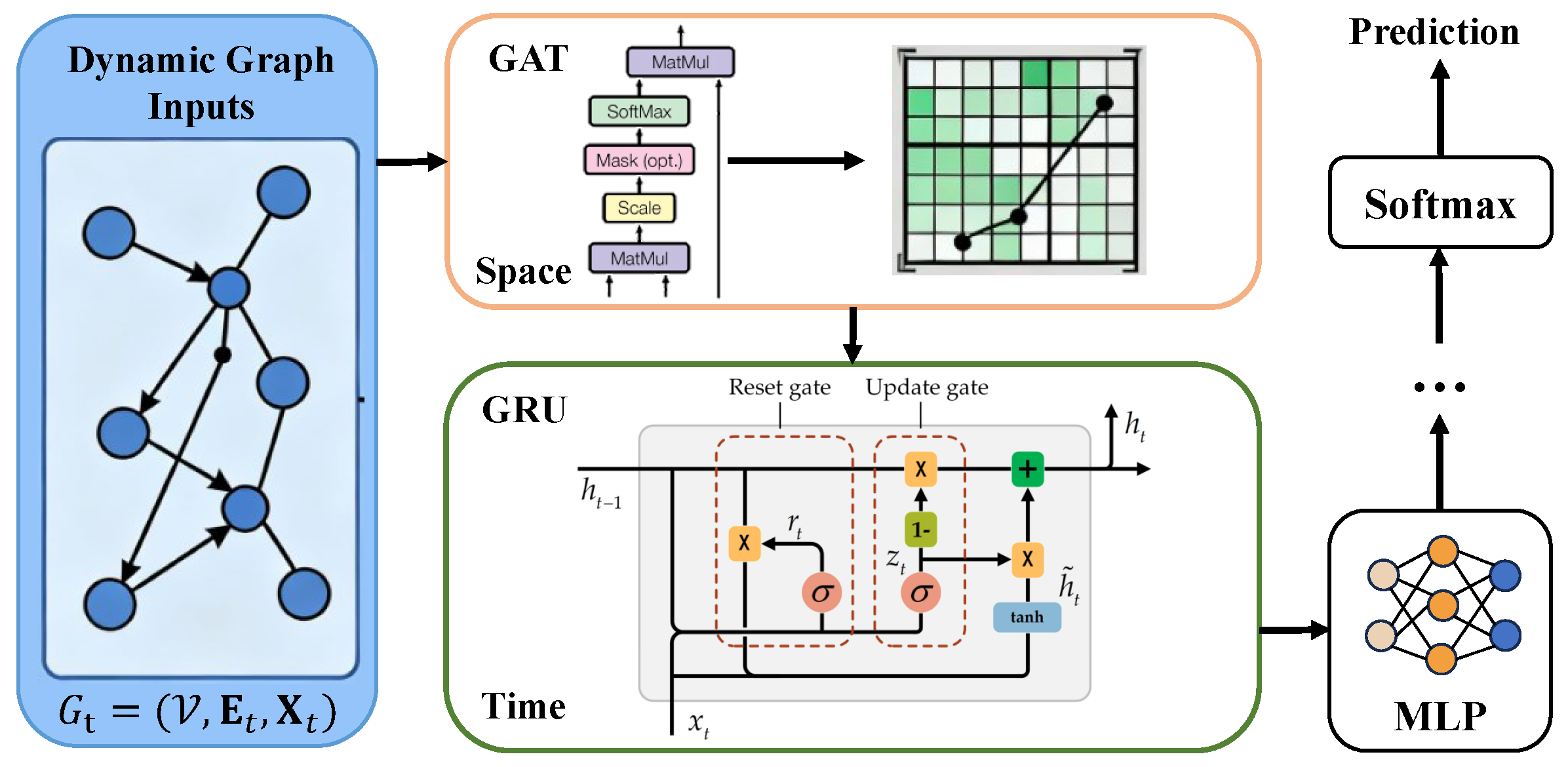
- Modeling dynamic and heterogeneous risk propagation: A deeply coupled GAT–GRU architecture is proposed. TAGN introduces the GRU to update node hidden states, enabling it to memorize the network’s evolutionary trajectory, and employs the GAT mechanism to dynamically compute attention coefficients. This design allows the model to adaptively assign higher weights to key risk sources based on the current market state, thereby accurately capturing heterogeneous risk contagion paths.
- Constructing an incremental multi-scale financial graph: An incremental multi-scale, multi-relational financial graph is constructed by fusing data from the micro (price and volume), meso (supply chain and holdings), and macro (news sentiment and economic indicators) levels. This resolves the challenge of topological alignment for multi-modal financial data and improves robustness under market regime shifts, as emphasized in recent studies such as DASF-Net [6].
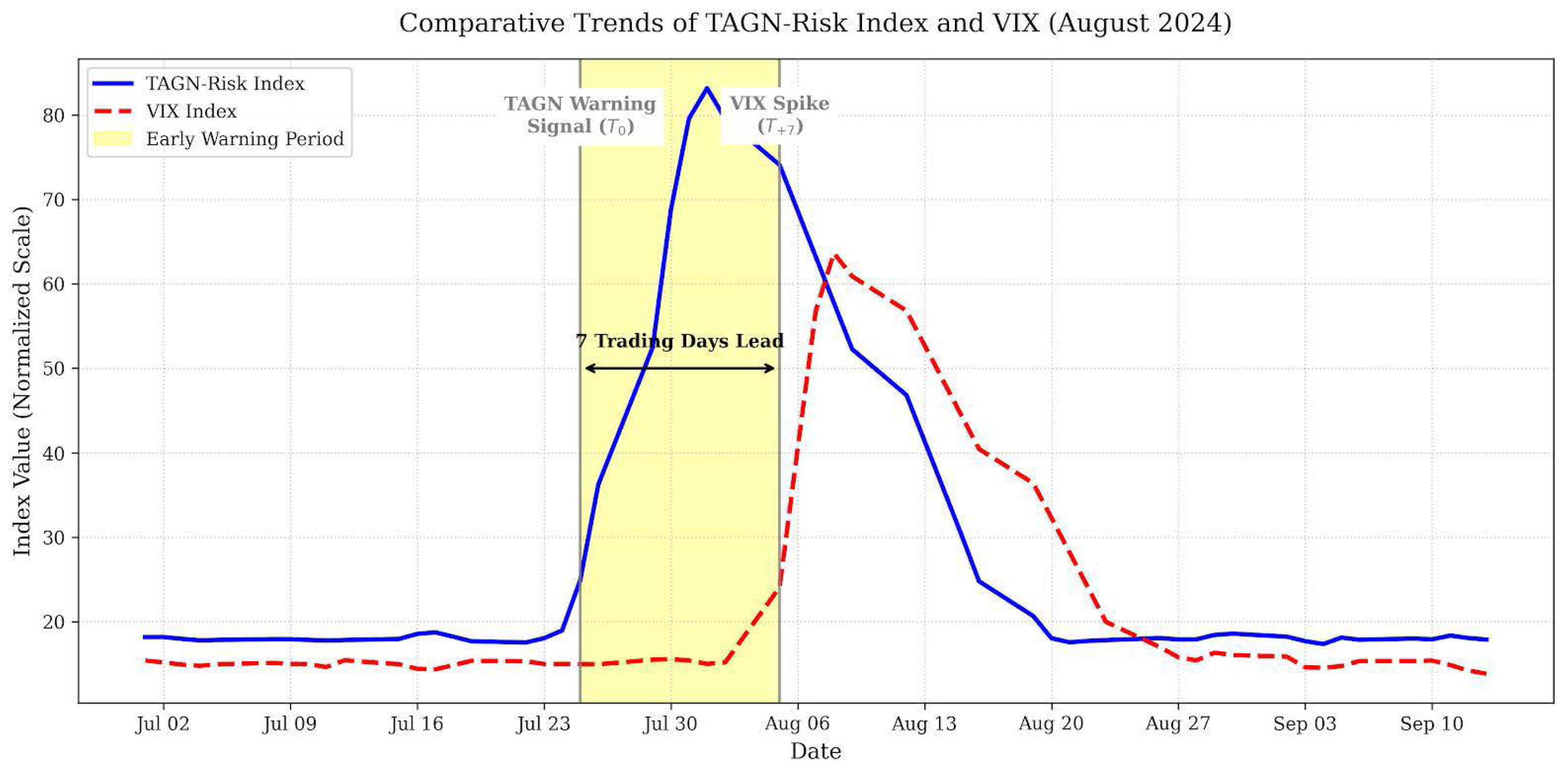
- Early warning of extreme volatility: The early warning capability for extreme risk is empirically validated. Experiments on the S&P 500 dataset demonstrate that TAGN significantly outperforms existing state-of-the-art models in predicting extreme volatility. A risk early-warning index constructed from the model outputs exhibits a predictive lead of 1–2 weeks over the VIX index during historical crisis periods.
2. Related Work
2.1. Literature Search Methodology
2.2. Traditional Time-Series and Volatility Modeling
2.3. Non-Graph Machine Learning Approaches
2.4. From Static Networks to Spatial Dependency
2.5. Dynamic Graph Neural Networks (DGNNs)
2.6. Positioning of the Proposed Method
3. Methodology
3.1. Multi-Scale Node Feature Extraction
- Micro-Scale (Market Microstructure): Beyond standard OHLCV data, we explicitly incorporate liquidity and volatility metrics to detect anomalous trading behaviors:
- (1)
- Amihud Illiquidity Ratio: Captures the price impact of order flow.
- (2)
- Realized Volatility (RV): computed over a 5 min high-frequency window.
- Sentiment-Scale (News Analytics): We employ FinBERT, a pre-trained NLP model for finance, to encode daily news headlines related to stock i. The semantic output is projected into a scalar sentiment score .
- Macro-Scale (Systemic Risk): Global indicators, including the VIX index and the Treasury yield curve slope, are processed via a Multilayer Perceptron (MLP) to generate a macro-embedding vector.
3.2. Dynamic Multi-Relational Graph Construction
3.3. TAGN Spatiotemporal Encoder
3.3.1. Spatial Aggregation (GAT Layer)
3.3.2. Temporal Evolution (Graph GRU)
3.4. Optimization Objective: Focal Loss
3.5. Algorithm Flow
| Algorithm 1 TAGN Training Procedure |
| Require:
Dynamic Graphs , Feature Matrices , Labels Ensure: Trained Model Parameters 1: Initialize parameters randomly 2: for each epoch to E do 3: for each time step to T do 4: Step 1: Graph Construction 5: Construct and load 6: Compute fused adjacency 7: Step 2: Spatial Aggregation (GAT) 8: for each node do 9: Compute attention weights 10: Aggregate neighbors: 11: end for 12: Step 3: Temporal Update (GRU) 13: Update hidden states: 14: end for 15: Step 4: Risk Prediction 16: Compute logits 17: Calculate Focal Loss 18: Update 19: end for |
3.6. Baseline Selection Justification
4. Data and Experimental Setup
4.1. Dataset and Labeling
- Training Set (2018–2022): Covers high-volatility periods including the COVID-19 crash (2020) and the “Meme Stock” phenomenon (2021), allowing the model to learn extreme pattern recognition.
- Validation Set (2023): Used for hyperparameter tuning and model checkpointing. Crucially, this period includes the Silicon Valley Bank (SVB) crisis, testing the model’s ability to adapt to structural breaks in the banking sector.
- Test Set (2024): Reserved for final evaluation, representing a period of persistent inflation and interest rate fluctuations.
4.2. Baseline Models
- Statistical and Tree-based ModelsGARCH-MIDAS: A classic econometric model incorporating macroeconomic variables for volatility forecasting.XGBoost: A widely used gradient boosting framework, serving as a strong non-deep learning baseline using only node features.
- Time-Series Deep Learning (SOTA)GRU: Standard Recurrent Neural Network without graph structure.PatchTST (ICLR 2023) [35]: A state-of-the-art Transformer-based model utilizing patching and channel-independence, proving highly effective for long-term forecasting.
- Static Graph Neural NetworksGCN-LSTM [36]: Combines Graph Convolutional Networks with LSTM, assuming a fixed adjacency matrix throughout the timeline.
- Dynamic Graph Neural Networks (SOTA)WinGNN (KDD 2024) [4]: Focuses on concept drift in dynamic graphs using a windowed gradient aggregation strategy.Graph-Mamba (ICASSP 2025) [11]: A novel architecture applying State Space Models (SSMs) to dynamic graphs for linear-time complexity sequence modeling.
4.3. Implementation Details
4.4. Evaluation Metrics
- Classification Performance:
- –
- AUC-ROC: Evaluates the global ranking capability of the model.
- –
- Macro F1-Score: The harmonic mean of precision and recall, ensuring the minority class (crashes) is not ignored.
- Practical Risk Management:
- –
- Precision@50 (P@50): The proportion of true crashes among the top-50 stocks predicted to have the highest risk probability on each day. This simulates a resource-constrained risk monitoring scenario.
- Investment Simulation:
- –
- Sharpe Ratio: We construct a Long–Short portfolio (Shorting the top 10% riskiest and Longing the bottom 10% safest) based on model predictions. The annualized Sharpe Ratio measures the risk-adjusted return of this strategy:where is the portfolio return and is the risk-free rate.
5. Results and Analysis
5.1. Overall Performance Comparison
- 1.
- Superiority over Time-Series SOTA: While PatchTST (AUC: 0.815) excels in long-term forecasting via channel independence, TAGN outperforms it by in AUC. This indicates that for crash prediction, explicit modeling of contagion paths via graph structures is more effective than implicit attention mechanisms.
- 2.
- Necessity of Dynamic Evolution: TAGN surpasses the static GCN-LSTM by in AUC. This performance gap confirms that assuming a fixed network structure fails to capture the rapid rewiring of risk channels during periods of market turmoil.
- 3.
- Financial Practicality: Crucially, TAGN achieves a Precision@50 (P@50) of , implying that nearly two-thirds of the stocks identified as “high risk” actually experienced crashes. Furthermore, the annualized Sharpe Ratio of for the TAGN-based Long–Short strategy demonstrates significant potential for real-world alpha generation.
5.2. Ablation Study
- Spatial Attention (Replace GAT with GCN): AUC drops to .
- Reasoning: Without the attention mechanism, the model aggregates neighbor information uniformly. It fails to distinguish between “benign” and “toxic” neighbors (e.g., a supplier in default), thereby diluting the risk signal.
- Temporal Memory (Remove GRU): AUC drops to (most significant drop).
- Reasoning: This confirms that financial risk is a cumulative process. The immediate graph snapshot alone is insufficient; the model must capture the “momentum” of deterioration from previous steps via the hidden state .
- Multi-Relational Graph (Only Price Correlation): AUC drops to .
- Reasoning: Relying solely on price correlation typically lags the market. Fundamental links such as supply chain and institutional holding graphs provide “early warning” channels before risk impacts become visible in price movements.
5.3. Network Topology Evolution Analysis
5.4. Case Study: Early Warning Capability (TAGN vs. VIX)
- Leading Lead–lag Relationship: The TAGN-Risk Index exhibited a distinct upward trend seven trading days prior to the significant spike in the VIX.
- Information Advantage Analysis: While the VIX is a reactive metric derived from option pricing, TAGN detected latent “smart money” outflows within the institutional holding graph () and early signs of stress in supply chain dependencies (). These signals emerged before the risk manifested in broad market volatility, thereby confirming TAGN’s capacity as a leading indicator for systemic risk.
6. Discussion
6.1. Theoretical and Regulatory Implications
6.2. Limitations and Future Challenges
- 1.
- Computational Complexity: The dynamic attention mechanism scales linearly with the number of edges, [48]. In a dense, full-market graph, the GPU memory consumption becomes a significant bottleneck [49]. This limitation, also discussed in the context of WinGNN’s gradient aggregation [4], suggests that future iterations must implement sparse matrix operations or graph sampling to maintain scalability for larger asset universes [50].
- 2.
- Data Latency and Reporting Lags: The institutional holding graph () depends on Form 13F filings [51]. Because these are reported quarterly with a 45-day lag [51], it creates a temporal “blind spot”, where the model may fail to capture high-frequency position adjustments by hedge funds during rapidly evolving crises [52].
- 3.
- Extreme Class Imbalance and Rare Events: Financial crashes are, by definition, “Black Swan” events [53]—rare, high-impact occurrences that are difficult to predict using traditional statistical methods. While the use of Focal Loss with [54] partially mitigates the scarcity of positive samples () [26], the model remains susceptible to overfitting stochastic noise in prolonged bull markets. Similarly to considerations in multimodal frameworks like DASF-Net [6], human expert validation remains essential for final high-stakes decision-making [55].
7. Conclusions and Future Work
- 1.
- LLM-Driven Causal Knowledge Graphs: We plan to leverage Large Language Models (LLMs) to extract explicit causal chains from unstructured financial news (e.g., Chip Shortage to Auto Production Cut) [7]. By replacing statistical correlation graphs with Causal Knowledge Graphs, we aim to filter out spurious connections and enhance the model’s interpretability.
- 2.
- Online Graph Learning for Non-Stationary Markets: To address the challenge of concept drift in volatile financial environments, we intend to develop online learning algorithms [56]. This will enable TAGN to update its parameters in real-time as data streams arrive, ensuring the model remains adaptive without requiring frequent and costly offline retraining.
- 3.
- Multiplex Network Modeling for Cross-Asset Spillovers: We aim to expand the model’s scope by constructing Multiplex Networks. By representing the interdependencies between stock, bond, and foreign exchange markets as distinct yet interacting layers, the framework can better capture complex cross-asset risk spillover effects and systemic contagion.
Author Contributions
Funding
Data Availability Statement
Conflicts of Interest
References
- Elliott, M.; Golub, B.; Jackson, M. Financial networks and contagion. Am. Econ. Rev. 2014, 104, 3115–3153. [Google Scholar] [CrossRef] [Scilit]
- Bollerslev, T. Generalized autoregressive conditional heteroskedasticity. J. Econom. 1986, 31, 307–327. [Google Scholar] [CrossRef] [Scilit]
- Petrosino, L.; Bacco, L.; Salvati, G.; Merone, M. A GARCH-temporal fusion transformer model for the volatility prediction of exchange traded funds. Neural Comput. Appl. 2025, 37, 21435–21458. [Google Scholar] [CrossRef] [Scilit]
- Zhu, Y.; Cong, F.; Zhang, D.; Gong, W.; Lin, Q.; Feng, W.; Dong, Y.; Tang, J. WinGNN: Dynamic Graph Neural Networks with Random Gradient Aggregation Window. In Proceedings of the 29th ACM SIGKDD Conference on Knowledge Discovery and Data Mining (KDD ’23), Long Beach, CA, USA, 6–10 August 2023; Association for Computing Machinery: New York, NY, USA, 2023; pp. 3650–3662. [Google Scholar]
- Guang, M.; Li, Z.; Yan, C.; Xu, Y.; Wang, J.; Cheng, D.; Jiang, C. Multi-Temporal Partitioned Graph Attention Networks for Financial Fraud Detection. IEEE Trans. Inf. Forensics Secur. 2025, 20, 142–157. [Google Scholar] [CrossRef] [Scilit]
- Nguyen, N.H.; Nguyen, T.T.; Ngo, Q.T. DASF-Net: A Multimodal Framework for Stock Price Forecasting with Diffusion-Based Graph Learning and Optimized Sentiment Fusion. J. Risk Financ. Manag. 2025, 18, 89. [Google Scholar] [CrossRef] [Scilit]
- Ning, K.; Pan, Z.; Liu, Y.; Jiang, Y.; Zhang, J.Y.; Rasul, K.; Schneider, A.; Ma, L.; Nevmyvaka, Y.; Song, D. TS-RAG: Retrieval-Augmented Generation based Time Series Foundation Models are Stronger Zero-Shot Forecaster. In Proceedings of the Advances in Neural Information Processing Systems (NeurIPS), San Diego, CA, USA, 30 November–7 December 2025. [Google Scholar]
- Mantegna, R. Hierarchical structure in financial markets. Eur. Phys. J. B-Condens. Matter Complex Syst. 1999, 11, 193–197. [Google Scholar] [CrossRef] [Scilit]
- Hsu, Y.L.; Tsai, Y.C.; Li, C.T. FinGAT: Financial Graph Attention Networks for Recommending Top-K Profitable Stocks. IEEE Trans. Knowl. Data Eng. 2025, 37, 1245–1259. [Google Scholar] [CrossRef] [Scilit]
- Duan, M.; Zheng, T.; Gao, Y.; Wang, G.; Feng, Z.; Wang, X. DGA-GNN: Dynamic Grouping Aggregation GNN for Fraud Detection. Proc. AAAI Conf. Artif. Intell. 2024, 38, 11820–11828. [Google Scholar] [CrossRef] [Scilit]
- Mehrabian, A.; Hoseinzade, E.; Mazloum, M.; Chen, X. Mamba Meets Financial Markets: A Graph-Mamba Approach for Stock Price Prediction. In Proceedings of the ICASSP 2025—2025 IEEE International Conference on Acoustics, Speech and Signal Processing, Hyderabad, India, 6–11 April 2025. [Google Scholar]
- Lin, S.; Lin, W.; Wu, W.; Zhao, F.; Mo, R.; Zhang, H. SegRNN: Segment Recurrent Neural Network for Long-Term Time Series Forecasting. In Proceedings of the International Conference on Learning Representations (ICLR), Vienna, Austria, 7–11 May 2024. [Google Scholar]
- Wei, J.; Yang, S.; Cui, Z. Integrated GARCH-GRU in Financial Volatility Forecasting. arXiv 2025, arXiv:2504.09380. [Google Scholar] [CrossRef] [Scilit]
- Romero Martinez, M.; Carmona Ibanez, P.; Martinez Vargas, J. Predicting Business Failure with the XGBoost Algorithm: The Role of Environmental Risk. Sustainability 2025, 17, 4948. [Google Scholar] [CrossRef] [Scilit]
- Kim, H.; Sohn, S. Support vector machines for default prediction of SMEs based on technology credit. Eur. J. Oper. Res. 2010, 201, 838–846. [Google Scholar] [CrossRef] [Scilit]
- Silva, E.; Castilho, D.; Pereira, A.; Brandao, H. A neural network based approach to support the Market Making strategies in High-Frequency Trading. In Proceedings of the 2014 International Joint Conference on Neural Networks (IJCNN), Beijing, China, 6–11 July 2014; IEEE: New York, NY, USA, 2014; pp. 845–852. [Google Scholar]
- Qian, H.; Zhou, H.; Zhao, Q.; Chen, H.; Yao, H.; Wang, J.; Liu, Z.; Yu, F.; Zhang, Z.; Zhou, J. MDGNN: Multi-relational Dynamic Graph Neural Network for Comprehensive and Dynamic Stock Investment Prediction. Proc. AAAI Conf. Artif. Intell. 2024, 38, 8901–8909. [Google Scholar] [CrossRef] [Scilit]
- Huang, X.; Wang, J.; Lan, Y.; Jiang, C.; Yuan, X. MD-GCN: A multi-scale temporal dual graph convolution network for traffic flow prediction. Sensors 2023, 23, 841. [Google Scholar] [CrossRef] [Scilit] [PubMed]
- Zong, X.; Chen, Z.; Yu, F.; Wei, S. Local-global spatial-temporal graph convolutional network for traffic flow forecasting. Electronics 2024, 13, 636. [Google Scholar] [CrossRef] [Scilit]
- Chen, C.Y.; Huang, J.J. Temporal-guided knowledge graph-enhanced graph convolutional network for personalized movie recommendation systems. Future Internet 2023, 15, 323. [Google Scholar] [CrossRef] [Scilit]
- Ge, Y.; Wang, J.; Zhang, B.; Peng, F.; Ma, J.; Yang, C.; Zhao, Y.; Liu, M. Spatial-temporal-correlation-constrained dynamic graph convolutional network for traffic flow forecasting. Mathematics 2024, 12, 3159. [Google Scholar] [CrossRef] [Scilit]
- Tanvir, R.; Islam, M.; Sobhan, M.; Luo, D.; Mondal, A. MOGAT: A multi-omics integration framework using graph attention networks for cancer subtype prediction. Int. J. Mol. Sci. 2024, 25, 2788. [Google Scholar] [CrossRef] [Scilit]
- Wang, X.; Li, H.; Zhang, Z.; Chen, H.; Xiao, T.; Li, K.; Zhu, W. Uncertainty-aware Disentangled Dynamic Graph Attention Network for Out-of-Distribution Generalization. IEEE Trans. Pattern Anal. Mach. Intell. 2025, 47, 1–18. [Google Scholar] [CrossRef] [Scilit]
- Xu, F.; Wang, N.; Wu, H.; Wen, X.; Zhao, X.; Wan, H. Revisiting Graph-based Fraud Detection in Sight of Heterophily and Spectrum. In Proceedings of the AAAI Conference on Artificial Intelligence, Vancouver, BC, Canada, 20–27 February 2024. [Google Scholar]
- Chen, Z.; Zheng, L.; Lu, C.; Yuan, J.; Zhu, D. ChatGPT informed graph neural network for stock movement prediction. arXiv 2024, arXiv:2401.05678. [Google Scholar] [CrossRef] [Scilit]
- He, H.; Garcia, E. Learning from imbalanced data. IEEE Trans. Knowl. Data Eng. 2009, 21, 1263–1284. [Google Scholar] [CrossRef] [Scilit]
- Ai, G.; Qiao, H.; Yan, H.; Pang, G. Semi-supervised Graph Anomaly Detection via Robust Homophily Learning. In Proceedings of the Advances in Neural Information Processing Systems (NeurIPS), San Diego, CA, USA, 2–7 December 2025. [Google Scholar]
- Lin, X.; Zhao, P.; Du, L. Edge-centric temporal GNNs for scalable fraud detection. Adv. Neural Inf. Process. Syst. 2023, 36, 2145–2157. [Google Scholar]
- Han, Y.; Wang, L.; Cheng, Z.; Wang, B.; Yang, G.; Cheng, D.; Lin, X. Mitigating the Tail Effect in Fraud Detection by Community Enhanced Multi-Relation Graph Neural Networks. IEEE Trans. Knowl. Data Eng. 2025, 37, 502–515. [Google Scholar] [CrossRef] [Scilit]
- Choi, J.; Kim, H.; Whang, J.J. Unveiling the Threat of Fraud Gangs to Graph Neural Networks. In Proceedings of the AAAI Conference on Artificial Intelligence, Philadelphia, PA, USA, 25 February–4 March 2025. [Google Scholar]
- Xu, J.; Perron, P. Forecasting carbon price: A novel multi-factor spatial-temporal GNN framework integrating Graph WaveNet and self-attention mechanism. Energy Econ. 2024, 131, 107385. [Google Scholar]
- Xiang, S.; Cheng, D.; Shang, C.; Zhang, Y.; Liang, Y. Temporal and Heterogeneous Graph Neural Network for Financial Time Series Prediction. arXiv 2023, arXiv:2305.08740. [Google Scholar] [CrossRef] [Scilit]
- Tang, Y.; Cai, Z. iTransformer-FFC: A Frequency-Aware Transformer Framework for Multi-Scale Time Series Forecasting. Electronics 2025, 14, 345. [Google Scholar] [CrossRef] [Scilit]
- Li, T.; Liu, Z.; Shen, Y.; Wang, X.; Chen, H.; Huang, S. MASTER: Market-Guided Stock Transformer for Stock Price Forecasting. Proc. AAAI Conf. Artif. Intell. 2024, 38, 11230–11238. [Google Scholar] [CrossRef] [Scilit]
- Nie, Y.; Nguyen, N.; Sinthong, P.; Kalagnanam, J. A Time Series is Worth 64 Words: Long-term Forecasting with Transformers. In Proceedings of the International Conference on Learning Representations (ICLR), Kigali, Rwanda, 1–5 May 2023. [Google Scholar]
- Seo, Y.; Defferrard, M.; Vandergheynst, P.; Bresson, X. Structured sequence modeling with graph convolutional recurrent networks. In Proceedings of the International Conference on Neural Information Processing (ICONIP), Siem Reap, Cambodia, 13–16 December 2018; Springer: Cham, Switzerland, 2018; pp. 362–373. [Google Scholar]
- Li, D.; Zhang, L.; Li, L. Forecasting stock volatility with economic policy uncertainty: A smooth transition GARCH-MIDAS model. Int. Rev. Financ. Anal. 2023, 88, 102660. [Google Scholar] [CrossRef] [Scilit]
- Engle, R.F. Autoregressive conditional heteroscedasticity with estimates of the variance of United Kingdom inflation. Econometrica 1982, 50, 987–1007. [Google Scholar] [CrossRef] [Scilit]
- Silva, W. Network topology analysis of the US banking sector during the Silicon Valley Bank crisis. J. Bank. Financ. 2023, 155, 106921. [Google Scholar]
- Fernandes, M. A two-factor model for the VIX index. J. Bank. Financ. 2014, 46, 272–283. [Google Scholar]
- Barrot, J.; Sauvagnat, J. Input specificity and the propagation of idiosyncratic shocks in production networks. Q. J. Econ. 2016, 131, 1543–1592. [Google Scholar] [CrossRef] [Scilit]
- Anton, M.; Polk, C. Connected stocks. J. Financ. 2014, 69, 1099–1127. [Google Scholar] [CrossRef] [Scilit]
- Andersen, T.G.; Bollerslev, T.; Diebold, F.X.; Ebens, H. The distribution of realized stock return volatility. J. Financ. Econ. 2001, 61, 43–76. [Google Scholar] [CrossRef] [Scilit]
- Billio, M.; Getmansky, M.; Lo, A.W.; Pelizzon, L. Econometric measures of connectedness and systemic risk in the finance and insurance sectors. J. Financ. Econ. 2012, 104, 535–559. [Google Scholar] [CrossRef] [Scilit]
- Molnar, C. Interpretable Machine Learning: A Guide for Making Black Box Models Explainable; Independently Published, 2022; Available online: https://christophm.github.io/interpretable-ml-book/ (accessed on 15 December 2025).
- Velickovic, P.; Cucurull, G.; Casanova, A.; Romero, A.; Lio, P.; Bengio, Y. Graph attention networks. In Proceedings of the International Conference on Learning Representations (ICLR), Vancouver, BC, Canada, 30 April–3 May 2018. [Google Scholar]
- Kazemi, S.M.; Goel, R.; Jain, K.; Kobyzev, I.; Sethi, A.; Forsyth, P.; Poupart, P. Representation learning for dynamic graphs: A survey. J. Mach. Learn. Res. 2020, 21, 1–73. [Google Scholar]
- Zhou, J.; Cui, G.; Hu, S.; Zhang, Z.; Yang, C.; Liu, Z.; Li, Y.; Sun, M. Graph neural networks: A review of methods and applications. AI Open 2020, 1, 57–81. [Google Scholar] [CrossRef] [Scilit]
- Yang, J.; Tang, D.; Song, X.; Wang, L.; Yin, Q.; Chen, R.; Yu, W.; Zhou, J. GNNLab: A Factored System for Sample-based GNN Training over GPUs. In Proceedings of the 17th European Conference on Computer Systems (EuroSys ’22), Rennes, France, 5–8 April 2022; Association for Computing Machinery: New York, NY, USA, 2022; pp. 417–434. [Google Scholar]
- Hamilton, W.; Ying, Z.; Leskovec, J. Inductive representation learning on large graphs. In Proceedings of the Advances in Neural Information Processing Systems (NeurIPS), Long Beach, CA, USA, 4–9 December 2017; Neural Information Processing Systems Foundation, Inc. (NeurIPS): San Diego, CA, USA, 2017; Volume 30, pp. 1024–1034. [Google Scholar]
- SEC. Form 13F: Information Required of Institutional Investment Managers; U.S. Securities and Exchange Commission: Washington, DC, USA, 2023.
- Di Mascio, R. The information content of 13F filings. J. Financ. Mark. 2022, 59, 100742. [Google Scholar]
- Taleb, N. The Black Swan: The Impact of the Highly Improbable; Random House: New York, NY, USA, 2007. [Google Scholar]
- Lin, T.Y.; Goyal, P.; Girshick, R.; He, K.; Dollar, P. Focal loss for dense object detection. In Proceedings of the IEEE International Conference on Computer Vision (ICCV), Venice, Italy, 22–29 October 2017; IEEE: New York, NY, USA, 2017; pp. 2980–2988. [Google Scholar]
- Liu, H.; Wang, Y.; Zhang, B.; Yao, B.; Liu, T.; Niu, Z.; Xue, X.; Tao, D.; Han, J.; Wang, W.; et al. Trustworthy AI: A computational perspective. ACM Trans. Intell. Syst. Technol. 2023, 14, 1–59. [Google Scholar] [CrossRef] [Scilit]
- He, Y. Continual learning in graph neural networks for evolving fraud patterns. In Proceedings of the International Conference on Learning Representations (ICLR), Vienna, Austria, 7–11 May 2024. [Google Scholar]



| Hyperparameter | Value | Description |
|---|---|---|
| Optimizer | AdamW | Weight decay set to 1 |
| Learning Rate | 1 | Decayed by 0.5 every 20 epochs |
| Batch Size | 64 | - |
| Epochs | 200 | Early stopping with patience is 20 |
| GAT Heads | 4 | Multi-head attention count |
| Hidden Dimension | 128 | Dimension of node embeddings |
| GRU Layers | 2 | Depth of temporal module |
| Dropout | 0.4 | Applied to GAT and MLP layers |
| Focal Loss () | 2.0 | Focusing parameter |
| Focal Loss () | 0.75 | Balancing parameter for positive class |
| Category | Model | AUC | F1-Score | P@50 | Sharpe Ratio |
|---|---|---|---|---|---|
| Statistical | GARCH-MIDAS [37] | 0.612 | 0.354 | 0.281 | 0.45 |
| Time-Series DL | XGBoost | 0.765 | 0.582 | 0.442 | 1.12 |
| GRU | 0.784 | 0.610 | 0.468 | 1.25 | |
| PatchTST (ICLR’23) [35] | 0.815 | 0.658 | 0.512 | 1.55 | |
| Static GNN | GCN-LSTM [36] | 0.803 | 0.634 | 0.495 | 1.42 |
| Dynamic GNN | WinGNN (KDD’24) [4] | 0.842 | 0.695 | 0.554 | 1.76 |
| Proposed | TAGN (Ours) | 0.890 † | 0.742 † | 0.615 † | 2.18 † |
| Model Variant | Description | AUC | Performance Drop |
|---|---|---|---|
| TAGN (Full Model) | - | 0.890 | - |
| Variant 1: Attention | GAT is replaced by GCN | 0.852 | −0.038 |
| Variant 2: Temporal | GRU is removed; prediction uses static GAT output | 0.831 | −0.059 |
| Variant 3: News | News sentiment node features are removed | 0.875 | −0.015 |
| Variant 4: Supply | The supply chain relational graph layer is removed | 0.868 | −0.022 |
| Event (Time) | Avg. Edge Weight Change | Jaccard Similarity | Structural Interpretation |
|---|---|---|---|
| COVID-19 Shock (2020/03) | (Surge) | (Low) | Systemic Collapse: Panic caused massive synchronization; pre-existing communities disintegrated. |
| Meme Stock Frenzy (2021/01) | (Local Cluster) | (Med.) | Local Decoupling: GME/AMC formed a dense, isolated cluster detached from fundamentals. |
| SVB Failure (2023/03) | (Surge) | (Low) | Sectoral Contagion: Risk propagated specifically through banking sector holdings, reshaping the topology. |
Disclaimer/Publisher’s Note: The statements, opinions and data contained in all publications are solely those of the individual author(s) and contributor(s) and not of MDPI and/or the editor(s). MDPI and/or the editor(s) disclaim responsibility for any injury to people or property resulting from any ideas, methods, instructions or products referred to in the content. |
© 2026 by the authors. Licensee MDPI, Basel, Switzerland. This article is an open access article distributed under the terms and conditions of the Creative Commons Attribution (CC BY) license.
Share and Cite
Zhang, W.; Shen, Y.; Zhou, H.; Zhou, B.; Zheng, X.; Chen, X. Temporal Attentive Graph Networks for Financial Surveillance: An Incremental Multi-Scale Framework. J. Sens. Actuator Netw. 2026, 15, 23. https://doi.org/10.3390/jsan15010023
Zhang W, Shen Y, Zhou H, Zhou B, Zheng X, Chen X. Temporal Attentive Graph Networks for Financial Surveillance: An Incremental Multi-Scale Framework. Journal of Sensor and Actuator Networks. 2026; 15(1):23. https://doi.org/10.3390/jsan15010023
Chicago/Turabian StyleZhang, Wei, Yimin Shen, Hang Zhou, Bo Zhou, Xianju Zheng, and Xiang Chen. 2026. "Temporal Attentive Graph Networks for Financial Surveillance: An Incremental Multi-Scale Framework" Journal of Sensor and Actuator Networks 15, no. 1: 23. https://doi.org/10.3390/jsan15010023
APA StyleZhang, W., Shen, Y., Zhou, H., Zhou, B., Zheng, X., & Chen, X. (2026). Temporal Attentive Graph Networks for Financial Surveillance: An Incremental Multi-Scale Framework. Journal of Sensor and Actuator Networks, 15(1), 23. https://doi.org/10.3390/jsan15010023