


Abstract
Plant-mediated CH4 transport can enhance ecosystem CH4 emission by transporting soil-produced CH4. This pathway can exceed diffusion and ebullition as the dominant CH4 emission route. However, limited studies have investigated the morphological and anatomical factors influencing CH4 transport in plants. Through a series of manipulative experiments on the shoots and roots, this study examines the role of root and shoot structures in CH4 transport and release in six widespread wetland species: Carex rostrata Stokes, Carex lasiocarpa Ehrh., Carex aquatilis Wahlenb., Iris pseudacorus L., Juncus effusus L., and Alocasia odora (Lodd.) Spach. CH4 flux from all investigated species dropped significantly after clipping fine roots, while it did not change significantly after removing coarse roots. Shoot clipping and sealing significantly decreased CH4 flux from the investigated Carex species, but not from the other species. Our results demonstrate the important role of fine roots in controlling CH4 flux, whereas coarse roots play a minor role. Leaf blades are the major release site of CH4 from Carex species, while micropores at the shoot base are the primary release site of CH4 from the other species. Our study suggests that integrating plant-specific anatomical and morphological characteristics into global methane models is crucial to better predict and mitigate climate change impacts.
1. Introduction
Methane (CH4) is a powerful greenhouse gas due to its high global warming potential, efficient absorption of infrared radiation, and role in positive feedback mechanisms [1]. Despite covering only about 5% of the global land surface [2], wetlands contribute approximately 20–40% of the total global methane emissions [3]. CH4 emissions from wetlands depend on various factors, including temperature, water-table level (WTL), soil organic matter, soil redox potential (Eh), microbial community, and plant species [4,5,6,7,8,9]. Among these factors, plants play a crucial role as they influence CH4 emissions in multiple ways and the composition of plant communities has been found to be a better predictor of ecosystem CH4 flux than environmental parameters [10]. Plants can affect CH4 production by altering soil conditions and the availability of substrates for methanogens, known as the ‘substrate effect’ [11]. To adapt to anoxic environments, some wetland plants develop specialized structures called aerenchyma, which allow them to transport oxygen (O2) from the atmosphere to their roots [12]. The O2 can then diffuse into the surrounding soil, creating microaerophilic (low O2) conditions that favor methanotrophic activity, thus enhancing CH4 oxidation near the roots [13]. Conversely, soil-produced CH4 can be transported through the aerenchyma from the soil to the atmosphere, bypassing the aerobic zone where CH4 oxidation could occur, known as ‘conduit effect’ [14].
The conduit effect has been found to overshadow the influence of plants on CH4 production and oxidation within the ecosystem [15]. Specifically, the presence of plants can significantly increase overall ecosystem CH4 levels while depleting porewater CH4 concentrations [9]. Moreover, a substantial increase in ecosystem CH4 flux was observed when tubes were inserted into soils to mimic the conduit effect, excluding the substrate effect [16,17]. Similarly, the “ defoliation,” which involves the removal of foliage while keeping the stem above the soil/water surface, thereby isolating the conduit effect from the integrated effects of plants on CH4 production and oxidation, did not significantly affect CH4 emissions [18,19].
The rate of gas diffusion from plants to the atmosphere is lower than predicted based on the partial pressure of CH4 surrounding the roots, suggesting additional controlling factors [20,21]. These factors include resistance to CH4 transport from the rhizosphere into the roots, through the root-shoot interface, and from the plant to the atmosphere [22]. These factors have been widely studied in rice, and it is clear that either the rhizosphere–root interface or root–shoot interface restrain the transport [23,24,25]. In contrast, the rate-limiting interface for transport is unclear for most other wetland plant species. Among them, Carex spp. is mostly studied but with contradictory conclusion. Morrissey et al. [26] and Schimel [10] concluded that leaves and stomata is the rate-limiting step for CH4 transport in Carex aquatilis, whereas Kutzbach et al. [27] found that it is mainly restricted by the dense root exodermes.
However, to estimate the effects of aerenchyma plants on ecosystem CH4 emissions, identifying the anatomical and morphological factors limiting the transport is crucial [28,29]. Furthermore, plants vary significantly in their CH4 transport capacity, even within the same genus or plant functional types [14,30,31]. Grouping plants based on functional type could bias estimations of methane transport [9]. An alternative method might be investigating the traits restricting CH4 emissions across a wider range of species, especially those that are widely distributed globally and significantly affect CH4 emissions. Therefore, we conducted a series of manipulations on the shoots and roots of six widespread wetland plants (Carex rostrata, Carex lasiocarpa, Carex aquatilis, Iris pseudacorus, Juncus effusus, and Alocasia odora) to identify the specific sites restricting CH4 transport.
2. Results
2.1. CH4 Flux from Intact Plants
The mean CH4 flux from Carex rostrata, Carex lasiocarpa, and Carex aquatilis was 0.10 ± 0.46, 1.73 ± 0.55, and 0.99 ± 0.36 µmol CH4 h−1 plant−1, respectively. In comparison, the mean CH4 flux from Iris pseudacorus, Alocasia odora, and Juncus effusus was higher. J. effusus showed the highest CH4 flux, with a value of 7.35 ± 3.1 µmol CH4 h−1 plant−1, around 1.5 and 3 times higher than I. pseudacorus and A. odora, respectively. When expressed on a biomass basis, the overall interspecific pattern remained similar. The biomass-normalized CH4 fluxes of C. lasiocarpa and C. aquatilis were comparable, at 0.24 ± 0.08 and 0.23 ± 0.09 µmol CH4 g−1 DW h−1, respectively, and were approximately 10 times higher than that of C. rostrata. The biomass-normalized CH4 flux of J. effusus was 4.9 ± 2.07 µmol CH4 g−1 DW h−1, which was approximately 14 and 20 times higher than those of I. pseudacorus and A. odora, respectively.
The CH4 flux from C. rostrata and C. lasiocarpa was significantly correlated with shoot surface area (SA) and shoot dry biomass (DB) and fine root DB (both p < 0.001, Table 1). Additionally, the CH4 flux from C. lasiocarpa was also related to shoot cross-sectional area (CSA, p < 0.05). In contrast, the CH4 flux from C. aquatilis showed a different pattern, being significantly correlated only with the DB of fine roots (p < 0.001), while shoot SA and shoot CSA did not show significant correlations. For CH4 flux from I. pseudacorus, A. odora, and J. effusus, it was correlated with shoot SA, CSA as well as fine root DB (all p < 0.05), but not with coarse root DB. For all investigated species, fine root DB was correlated with shoot DB and SA.
Table 1.
Pairwise correlations between morphological parameters (shoot surface area, shoot cross-sectional area, shoot dry biomass, and fine and coarse root dry biomass) and CH4 flux from six widespread wetland plants (Carex rostrata, Carex lasiocarpa, Carex aquatilis, Iris pseudacorus, Juncus effusus, and Alocasia odora). Abbreviations: SA, surface area; CSA, cross-sectional area. Significance levels: *, p < 0.05; **, p < 0.005; ***, p < 0.0001.
2.2. Effects of Roots Manipulations on CH4 Flux
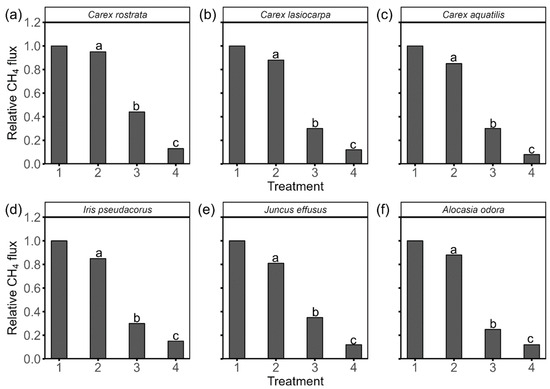
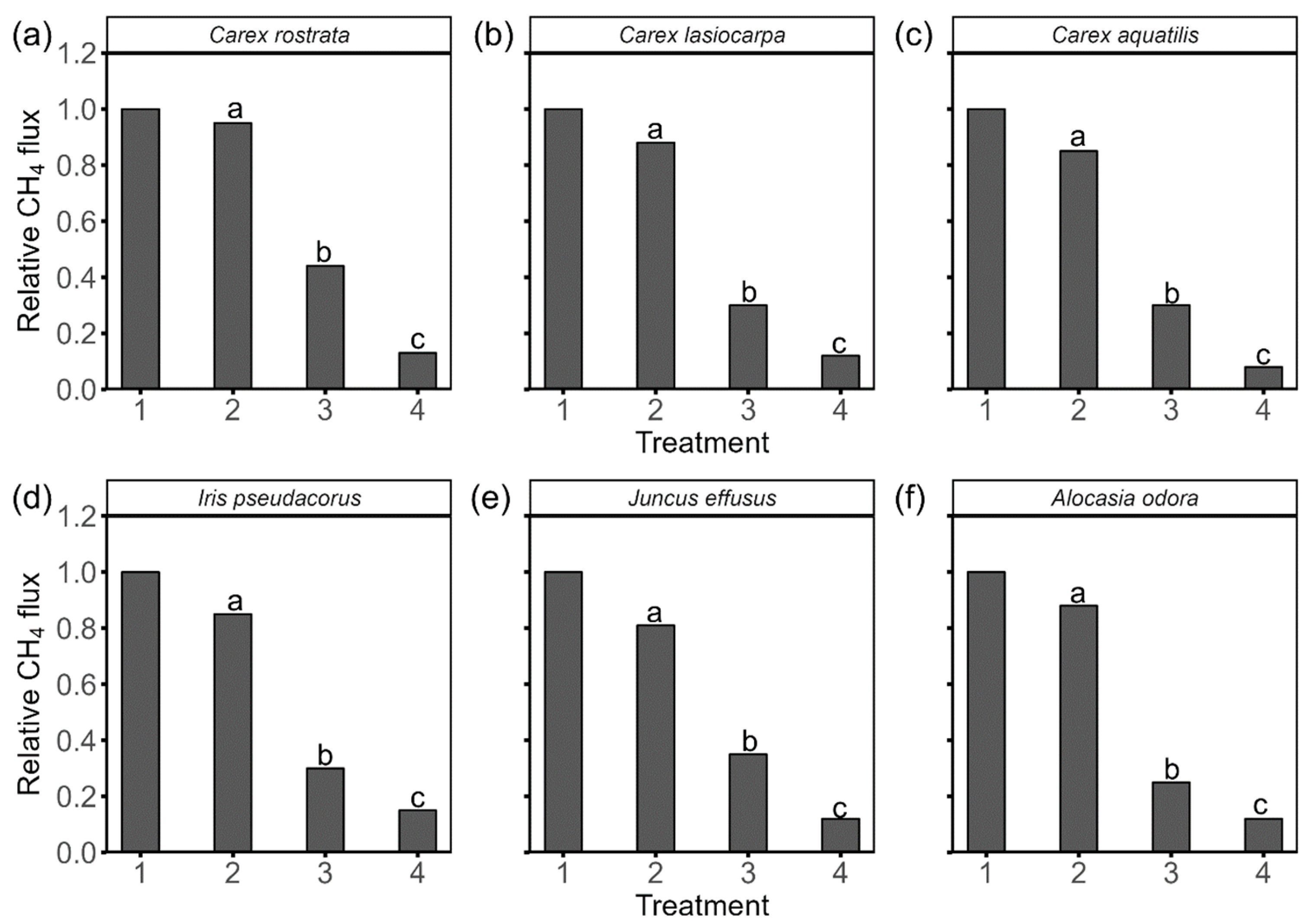
CH4 flux from C. rostrata dropped by only 5% after removing coarse roots, while it decreased by 12% and 15% in C. lasiocarpa and C. aquatilis, respectively. Removing fine roots had a greater impact on CH4 flux for all investigated Carex species. While removing the distal 30 mm of the fine roots did not affect CH4 flux, cutting fine roots to a maximum length of 150 mm significantly decreased CH4 flux (Figure 1). When fine roots were cut to a maximum length of 50 mm, CH4 flux from C. rostrata, C. lasiocarpa, and C. aquatilis decreased by 87%, 88%, and 92%, respectively.
Figure 1.
Relative CH4 flux from six plant species—Carex rostrata (a), Carex lasiocarpa (b), Carex aquatilis (c), Iris pseudacorus (d), Juncus effusus (e), and Alocasia odora (f)—under four different root treatments: 1, intact plant; 2, removal of all coarse roots; 3, cut fine roots at 150 mm; 4, cut fine roots at 50 mm. Letters denote statistically significant differences (p < 0.05) between the treatments.
Similarly, removing coarse roots did not significantly decrease CH4 flux from I. pseudacorus, A. odora, and J. effusus, with reductions of 15%, 12%, and 19%, respectively (Figure 1). As with the Carex species, CH4 flux from these three plants was more affected by removing fine roots than by removing coarse roots. After cutting fine roots to a maximum length of 150 mm, CH4 flux from I. pseudacorus, A. odora, and J. effusus decreased by 70%, 75%, and 65%, respectively. Further reductions of 15%, 13%, and 23% were observed when fine roots were cut to a maximum length of 50 mm.
2.3. Effects of Shoot Manipulation on CH4 Flux
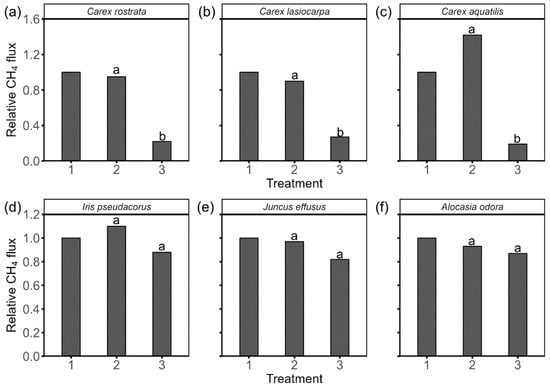
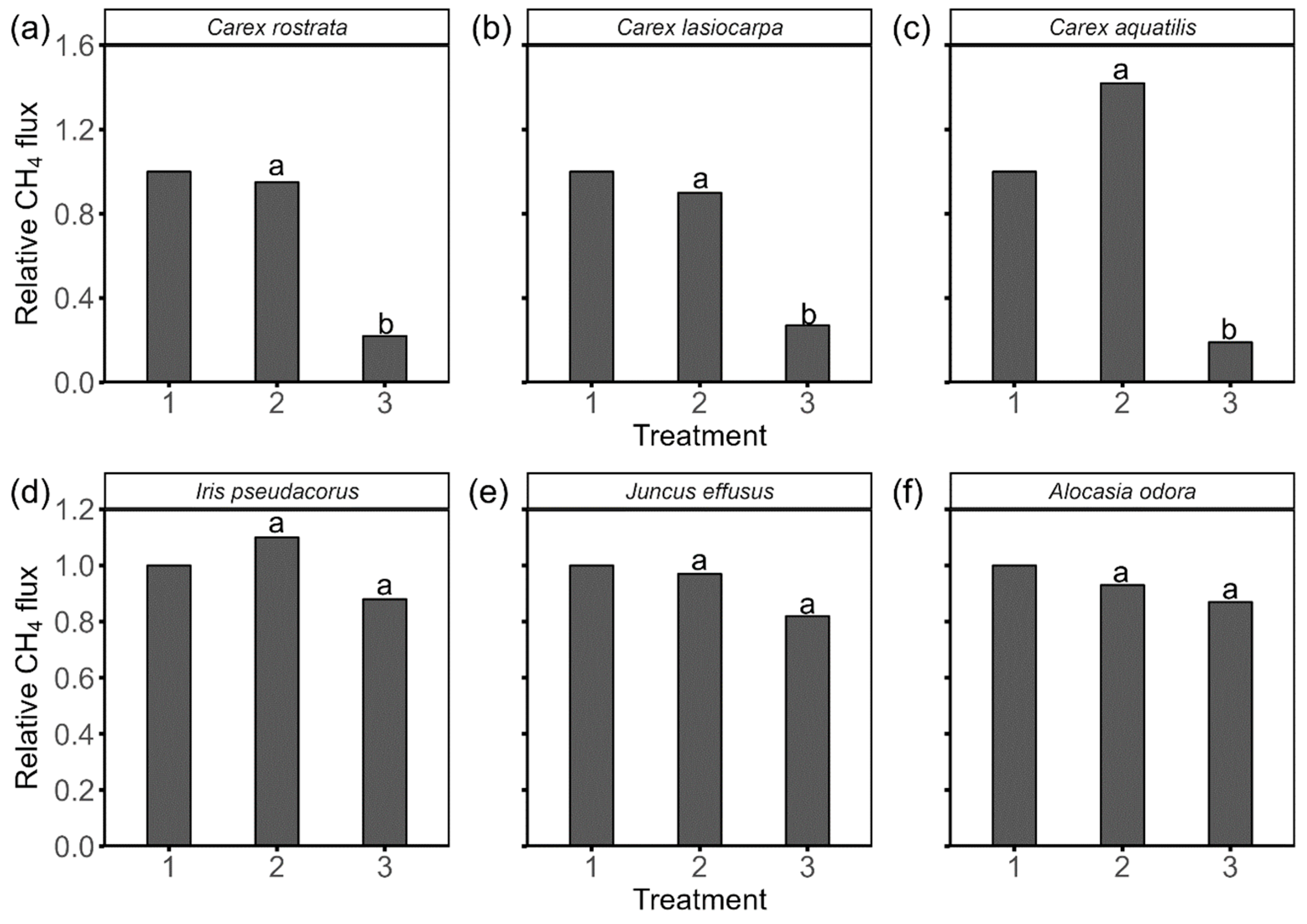
Shoot manipulations had different effects on C. rostrata, C. lasiocarpa, and C. aquatilis. After clipping the shoots (main stem and plant above 10 cm from root), CH4 flux from C. rostrata and C. lasiocarpa did not change significantly. However, CH4 flux from C. aquatilis increased significantly, with an increase of 42% (Figure 2). The subsequent sealing led to a significant decrease of CH4 from all investigated Carex, with a relative CH4 flux of 22%, 27%, and 19% for C. rostrata, C. lasiocarpa, and C. aquatilis, respectively. As for CH4 flux from I. pseudacorus, A. odora, and J. effusus, it did not change significantly after shoot clipping and the further sealing.
Figure 2.
Relative CH4 flux from six plant species—Carex rostrata (a), Carex lasiocarpa (b), Carex aquatilis (c), Iris pseudacorus (d), Juncus effusus (e), and Alocasia odora (f)—under three different shoot treatments: 1, intact plant; 2, all shoots cut at 50 mm height; 3, seal the cutting ends. Letters denote statistically significant differences (p < 0.05).
3. Discussion
3.1. Fine Roots Control CH4 Flux from All Investigated Species
CH4 flux from all investigated plant species dropped significantly after removing fine roots (Figure 1), suggesting the important role of fine roots in regulating CH4 flux. Fine roots, with numerous lateral branches and root hairs, provide a large contact area with rhizosphere, facilitating effective gas and nutrient uptake [32,33]. Their high permeability allows gases to diffuse readily into the plant [34], while the well-developed aerenchyma in fine roots creates low-resistance pathways for internal gas movement [35]. Consistent with our findings, Yadav et al. [36] emphasized in their review that fine root traits—particularly aerenchyma development, root porosity, and radial oxygen loss—are critical determinants of plant-mediated CH4 transport in wetland plants. Our findings are consistent with Henneberg et al. [28] who concluded that removing fine roots significantly reduces CH4 flux.
In contrast, removing coarse roots did not significantly affect CH4 flux in any of the investigated plant species (Figure 1), highlighting the minimal role of coarse roots in CH4 regulation. Coarse roots have a thicker outer layer, often suberized or lignified, which serves as a barrier to radial O2 loss (ROL) [28,37]. This adaptation preserves O2 for internal root processes and enhances the plant’s survival in low O2 conditions [38]. Consequently, the primary functions of coarse roots are structural support and nutrient transport, rather than gas exchange [39].
However, our results do not exclude the possibility that coarse roots may still influence internal CH4 transport capacity. Although removing coarse roots did not significantly reduce CH4 flux in this study, this manipulation mainly tested whether coarse roots acted as a major entry point or external resistance to CH4 inflow. It did not directly examine whether internal anatomical features of coarse roots, such as aerenchyma development or diaphragms at the nodes, might influence gas transport efficiency. We therefore propose this as a hypothesis that warrants further anatomical and physiological investigation.
3.2. CH4 Is Mainly Released from the Leaf Blades of the Investigated Carex Species
The significant drop in CH4 flux from Carex rostrata, Carex lasiocarpa, and Carex aquatilis after shoot clipping and cutting-end sealing (Figure 2) suggests that most of CH4 might be released from leaf blades, not the shoot base. No significant changes in CH4 flux from C. rostrata and C. lasiocarpa after shoot clipping, suggest that CH4 release is not restricted by leaves and stomata. This is supported by the positive correlation between CH4 flux and surface area and shoot dry biomass (Table 1), as these factors determine the total surface area available for gas exchange and the plant’s overall capacity for CH4 production and transport. Our results align with Ge et al. [40], who did not observe significant changes in CH4 flux from C. rostrata after clipping leaf blades, and match Hu et al. [41], who reported that shoot clipping did not significantly alter CH4 flux from a Carex cinerascens-dominated meadow. C. rostrata and C. lasiocarpa often grow in wetter environments such as marshes, fens, and bogs, where water availability is high and humidity levels are generally elevated [9,42]. In such wet environments, they can afford to have larger and more stomata as they do not face significant water loss risk, allowing them to maximize gas exchange and photosynthetic efficiency [43,44].
In contrast, CH4 flux from C. aquatilis increased significantly after shoot clipping (Figure 2), suggesting that leaves and stomata might offer strong resistance to CH4 release. This might explain the poor correlation between shoot biomass and CH4 flux (Table 1), as even if shoot biomass increases, CH4 emission could be restricted by stomatal conductance. Our results are in line with Morrissey et al. [28] and Schimel [10], who highlighted the importance of stomatal control on CH4 release from C. aquatilis under field conditions. C. aquatilis is more commonly found in slightly drier habitats compared to the other two Carex species [45,46], leading to different adaptations in water use efficiency and gas exchange. Ge et al. [47] also found species-specific CH4 transport mechanisms, with root exodermis limiting transport in some species and leaf anatomy limiting it in others. In slightly drier environments, plants like C. aquatilis might develop fewer and smaller stomata to reduce water loss through transpiration, optimizing their stomatal features to balance gas exchange and water conservation [48,49].
However, the alternative explanation for the observed flux increase after clipping could be a physical “pressure release” effect; severing the shoot may instantly disrupt the tension within the plant’s gas lacunae, allowing for CH4 that was previously held in the roots to be rapidly drawn up and released. Further studies combining clipping experiments with simultaneous measurements of stomatal behaviour and internal gas pressure are needed to confirm the underlying mechanism.
Additionally, CH4 flux from C. lasiocarpa showed a significant correlation with shoot cross-sectional area (CSA, Table 1). A larger CSA likely allows for more efficient internal gas movement, enhancing CH4 release. This correlation, not observed in C. rostrata and C. aquatilis, implies different internal anatomical structures that affect CH4 emissions even within the same family. These differences could be due to varying adaptations to specific environmental conditions, affecting how each species processes and releases CH4.
3.3. Micropores on the Stem Are Primary CH4 Release Sites for I. pseudacorus, A. odora, and J. effusus
We did not detect significant changes in CH4 flux from I. pseudacorus, A. odora, and J. effusus after shoot clipping and cutting-end unsealing (Figure 2). This finding indicates that the shoots likely provide minimal resistance to gas transport, similar to what has been reported for other wetland plants like Oryza sativa, Pontederia cordata and Sagittaria lancifolia [23,50]. The hollow stems of I. pseudacorus and J. effusus, along with the large, spongy petioles and leaves with extensive aerenchyma in A. odora [51,52,53], act as efficient conduits for internal gas movement. The shoot walls likely impose minimal resistance to CH4 escape. Consequently, the larger shoots with greater surface areas and cross-sectional dimensions can thus enhance gas exchange, leading to increased CH4 emissions (Table 1).
We did not observe a significant change in CH4 flux from I. pseudacorus, A. odora, and J. effusus after sealing the cutting ends (Figure 2), suggesting that most CH4 might be released from micropores in the shoot base or below. If most CH4 was released from the shoots, sealing the cutting ends would significantly decrease CH4, as observed in the species Carex (Figure 2). Our findings are consistent with Henneberg et al. [28], who reported that CH4 escaped from J. effusus at 5 cm from the shoot base or below, and other wetland plants, e.g., rice [54] and Scheuchzeria palustris [55].
Our results are consistent with the presence of well-developed aerenchyma tissues extending from the roots to the shoot base in I. pseudacorus, A. odora, and J. effusus, which provide efficient low-resistance pathways for gas transport from anaerobic soil environments to the atmosphere [56]. Micropores at the shoot base, closer to the soil, facilitate effective CH4 release by providing a constant, low-resistance pathway, independent of environmental factors that regulate stomatal opening and closing [37].
3.4. Modeling Implication
To improve process-based CH4 modelling performance, our results suggest several key improvements. First, it is crucial to integrate detailed fine root dynamics, including their extensive surface area, high permeability, and aerenchyma development, as these traits significantly influence CH4 uptake and transport. Models should also incorporate fine root growth, turnover, and spatial distribution in the rhizosphere to accurately simulate CH4 absorption conditions [3,57]. Second, the distinct functions of coarse roots should be modelled separately from fine roots, reflecting their limited role in gas exchange. This differentiation will enhance the model ability to predict methane emissions accurately in wetland ecosystems.
A practical pathway for implementing these improvements emerges from our finding that, for all investigated species, fine root dry biomass (DB) correlated strongly with shoot dry biomass (DB) and surface area (SA) (Table 1). Given the difficulty of obtaining fine root data due to their small size and complex underground structure [58,59], this correlation provides a valuable proxy. By using the more easily obtainable shoot DB and SA to estimate fine root DB, models can simplify data collection processes while still achieving accurate predictions of plant-mediated CH4 emissions.
Furthermore, current models typically consider only the bulk biomass or leaf area index of aerenchymatous plants when estimating ecosystem-scale CH4 emissions [60,61]. Our results highlight the importance of moving beyond bulk biomass to consider the distinct anatomical structures and release mechanisms influencing CH4 emissions across different plant species. Given the high plant diversity even within a single wetland site, incorporating all species individually is unrealistic. To address this issue, we propose classifying plants into functional groups based on their CH4 transport mechanisms and anatomical traits (e.g., “leaf-releasers” vs. “micropore-releasers”). By identifying key representative species within each functional group, models can more accurately capture the variability in CH4 emissions without needing to account for every individual species. This approach balances complexity and practicality, improving model performance while remaining feasible for large-scale ecosystem applications.
Taken together, our study demonstrates that incorporating these varied mechanisms—root, leaf, and micropore dynamics—into ecosystem CH4 modelling is crucial for enhancing the accuracy of CH4 flux predictions across different wetland plant species and environments. Integrating these plant-specific traits with environmental variables such as soil CH4 concentration, water table levels, and temperature [3,62] will allow for a more comprehensive and accurate representation of CH4 emissions in diverse wetland ecosystems.
4. Materials and Methods
4.1. Plant Material
Small seedlings of Carex rostrata, Carex lasiocarpa, Carex aquatilis, Iris pseudacorus, Juncus effusus, and Alocasia odora were acquired from commercial nurseries (Baihui Huamu, Nanjing, China). The seedlings, along with the surrounding soil, were transferred to the laboratory. The soil was carefully rinsed from the roots to avoid damage, and the seedlings were placed separately into 30 L plastic water tanks. We created a floating raft from polystyrene with holes to hold the plants, ensuring their roots hung freely into the water below. The water tank was filled with a nutrient solution formulated for hydroponic cultivation, containing 200 ppm of nitrogen, 50 ppm of phosphorus, 200 ppm of potassium, 50 ppm of calcium, and 25 ppm of magnesium, along with essential micronutrients such as iron (Fe), manganese (Mn), zinc (Zn), copper (Cu), and boron (B) in trace amounts. The pH level was maintained between 5.5 and 6.5, and the nutrient solution was renewed weekly.
The seedlings were placed in a growth chamber (Beiyin Technology Co., Ltd., Suzhou, China) under a 14:10 h light/dark cycle, a photosynthetic photon flux density of 150 µmol m−2 s−1, a constant relative humidity of 60%, and a day/night temperature regime of 18/16 °C, which reflects typical environmental conditions in temperate wetlands. The seedlings were grown in the growth chamber for around 3 months before the measurement to acclimate to the hydroponic conditions and nutrient solution, ensuring the development of aerenchyma and root systems that were crucial for accurate CH4 transport measurements. The seedlings were observed daily to track the growth process and health status. The dead roots were removed, and tussocks were divided as needed, resulting in individuals with 2 to 18 shoots per species.
4.2. CH4 Flux Measurements
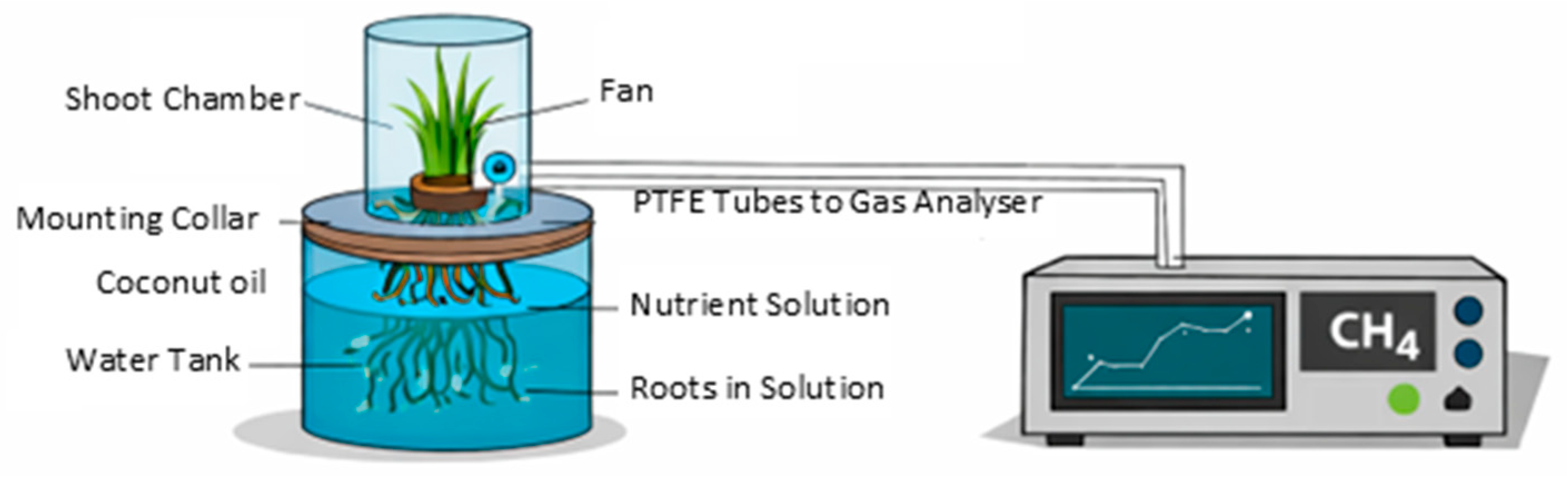
To identify which plant parts restrict CH4 flux, we conducted a series of manipulation experiments on individual tussocks, each with 4–14 shoots and 7–40 roots. The experimental setup consisted of a 30 L plastic water tank (Chahua Modern Housewares Co., Ltd., Fuzhou, China) filled with nutrient solution, sealed with a lid fitted with a rubber seal (Figure 3). The lid had a hole with 10 mm diameter mounting collars to secure the plants, allowing the roots to extend into the nutrient solution while the shoots were enclosed in 1 L shoot chambers. Each shoot chamber was equipped with an electronic fan to circulate the air and included two ports for connecting gas inlet and outlet tubes.
Figure 3.
Schematic illustration of the laboratory setup.
Before flux measurements, we infused the nutrient solution in the tank with CH4 (Shanghai Wechem Chemical Co., Ltd., Shanghai, China) until it reached a concentration of around 1.16 mmol L−1, corresponding to about 75% saturation, which is at the higher end of concentrations typically observed in natural wetland soil water [63]. To ensure gas could only diffuse through the roots into the shoots, we used coconut oil (Wenchang Jiahua Co., Ltd., Wenchang, China) as a sealant to prevent gas diffusion, sealing the tussocks to the mounting platforms and preventing leakage into the shoot chamber. After these preparations, the tank was placed back into the growth chamber under the same environmental settings.
All CH4 flux measurements were conducted at approximately 12:00, corresponding to the middle of the light period (4 h after lights on), to minimize the influence of diurnal variation in stomatal conductance. When the flux measurement started, the shoot chamber was mounted, and air was continuously circulated between the closed shoot chamber and a gas analyser (LGR-UGGA, Los Gatos Research, Mountain View, CA, USA) using polytetrafluoroethylene (PTFE) tubes. Each measurement lasted 5 min.
We first measured the CH4 flux from intact plants, then subjected the plants to a series of manipulations targeting either the roots or shoots (Table 2). It should be mentioned that the aboveground parts of all investigated species were divided into the shoot and base. The shoot was defined as the part of the plant above the ground up to 5 cm in height, consisting mainly of leaf blades and leaf sheaths. The section below 5 cm was considered the base. Therefore, when all shoots were cut at a height of 100 mm (shoot manipulation 2), the changes in CH4 flux could reveal the resistance of the leaf blades to CH4 transport throughout the plant. By sealing the cutting ends (shoot manipulation 3), CH4 was expected to be released only from the shoot base, and thus the changes in CH4 flux before and after sealing could reveal the role of the shoot base in CH4 release. Since the plants could not be returned to their original state after manipulation, each plant was used for only one specific type of manipulation (either shoot or root). For each species, three tussocks were used for shoot manipulations (replicate = 3), and three different tussocks were used for root manipulations (replicate = 3).
Table 2.
Summary of the sequential manipulation procedures used in the CH4 flux experiments. Root and shoot manipulations were conducted on different tussocks. Each step was performed sequentially on the same plant within each manipulation type.
After the flux measurements and manipulation experiments, all plant materials, including the tissues excised during the manipulations and the remaining plant parts, were retained for further morphological and biomass measurements. The materials were separated into shoots, coarse roots, and fine roots. Shoot surface area and cross-sectional area were determined using a digital scanner (PIXMA MG2580S, Canon Inc., Tokyo, Japan) and the IMAGEJ program (National Institutes of Health, Bethesda, MD, USA) [64]. The plant materials were then oven-dried at 60 °C until constant weight. Total dry biomass was calculated as the sum of the dry biomass of shoots, coarse roots, and fine roots, thereby representing the original total biomass of each intact plant prior to manipulation. For intact plants, CH4 flux was further normalized to total dry biomass and expressed on a biomass basis (µmol CH4 g−1 DW h−1). For the root and shoot manipulation experiments, relative CH4 flux was retained as the primary response variable because the treatments directly altered plant biomass and organ structure.
4.3. Statistical Analysis
The data analysis was conducted in R v3.6.1 (R Foundation for Statistical Computing, Vienna, Austria; https://www.r-project.org/) [65]. To ensure data quality, the dataset was initially examined through several steps: (i) outliers were detected using boxplots, (ii) the Shapiro–Wilk test was employed to assess normality, and (iii) Levene’s test was utilized to evaluate the homogeneity of variances among various subpopulations. For intact plants, CH4 flux was analysed both on a per-plant basis and on a biomass-normalized basis, with total dry biomass calculated as the sum of shoot, coarse root, and fine root dry biomass. Pearson correlation analysis was used to investigate the relationships between CH4 flux and plant morphological parameters, including shoot surface area, shoot cross-sectional area, shoot dry biomass, and fine and coarse root dry biomass. For the root and shoot manipulation experiments, differences in relative CH4 flux among sequential manipulations were analysed using analysis of variance (ANOVA) followed by Tukey’s post hoc test.
5. Conclusions
Our study highlights the importance of fine root dynamics, leaf blade involvement, and species-specific gas exchange mechanisms in plant-mediated CH4 transport. Through manipulative experiments, we show that fine roots are the predominant gateway for CH4 entry into plants, suggesting that root health, architecture, and soil–root interactions are critical for accurate CH4 flux estimates. In contrast, coarse roots appear to play a limited direct role in gas exchange due to their suberized or lignified barriers, serving primarily structural functions. For the Carex species, leaf blades were identified as the major CH4 release site, emphasizing the need to incorporate leaf dynamics and stomatal behaviour into models, especially for species growing in wetter environments with larger and more numerous stomata. Conversely, in Iris pseudacorus, Alocasia odora, and Juncus effusus, CH4 was primarily released through micropores at the shoot base, indicating a fundamentally different pathway that bypasses stomatal control. Together, these findings reveal distinct species-specific CH4 transport and release strategies. Further progress in understanding these mechanisms will require direct anatomical quantification, particularly of aerenchyma traits (e.g., fractional area) in roots and shoots, to provide stronger anatomical support for plant-mediated CH4 transport pathways.
Author Contributions
M.G.: Methodology, Software, Writing draft. Y.Q.: Methodology, Software, Writing draft. All authors have read and agreed to the published version of the manuscript.
Funding
The work was supported by the National Natural Science Foundation of China (32501480).
Data Availability Statement
Data used in this study are available on request from the corresponding author.
Conflicts of Interest
The authors declare no conflicts of interest.
References
- Intergovernmental Panel on Climate Change. Climate Change 2021—The Physical Science Basis: Working Group I Contribution to the Sixth Assessment Report of the Intergovernmental Panel on Climate Change; Cambridge University Press: Cambridge, UK, 2023. [Google Scholar]
- Prigent, C.; Papa, F.; Aires, F.; Rossow, W.B.; Matthews, E. Global inundation dynamics inferred from multiple satellite observations, 1993–2000. J. Geophys. Res. Atmos. 2007, 112, D12107. [Google Scholar] [CrossRef] [Scilit]
- Bridgham, S.D.; Megonigal, J.P.; Keller, J.K.; Bliss, N.B.; Trettin, C. The carbon balance of North American wetlands. Wetlands 2006, 26, 889–916. [Google Scholar] [CrossRef] [Scilit]
- Bao, T.; Jia, G.; Xu, X. Wetland heterogeneity determines methane emissions: A pan-arctic synthesis. Environ. Sci. Technol. 2021, 55, 10152–10163. [Google Scholar] [CrossRef] [Scilit] [PubMed]
- Zhu, D.; Wu, N.; Bhattarai, N.; Oli, K.P.; Chen, H.; Rawat, G.S.; Rashid, I.; Dhakal, M.; Joshi, S.; Tian, J.; et al. Methane emissions respond to soil temperature in convergent patterns but divergent sensitivities across wetlands along altitude. Glob. Change Biol. 2021, 27, 941–955. [Google Scholar] [CrossRef] [Scilit]
- Helfter, C.; Gondwe, M.; Murray-Hudson, M.; Makati, A.; Lunt, M.F.; Palmer, P.I.; Skiba, U. Phenology is the dominant control of methane emissions in a tropical non-forested wetland. Nat. Commun. 2022, 13, 133. [Google Scholar] [CrossRef] [Scilit]
- Laine, A.M.; Korrensalo, A.; Tuittila, E.-S. Plant functional traits play the second fiddle to plant functional types in explaining peatland CO2 and CH4 gas exchange. Sci. Total Environ. 2022, 834, 155352. [Google Scholar] [CrossRef] [Scilit]
- Peng, S.; Lin, X.; Thompson, R.L.; Xi, Y.; Liu, G.; Hauglustaine, D.; Lan, X.; Poulter, B.; Ramonet, M.; Saunois, M.; et al. Wetland emission and atmospheric sink changes explain methane growth in 2020. Nature 2022, 612, 477–482. [Google Scholar] [CrossRef] [Scilit]
- Ge, M.; Korrensalo, A.; Laiho, R.; Lohila, A.; Makiranta, P.; Pihlatie, M.; Tuittila, E.-S.; Kohl, L.; Putkinen, A.; Koskinen, M. Plant phenology and species-specific traits control plant CH4 emissions in a northern boreal fen. New Phytol. 2023, 238, 1019–1032. [Google Scholar] [CrossRef] [Scilit]
- Schimel, J.P. Plant transport and methane production as controls on methane flux from arctic wet meadow tundra. Biogeochemistry 1995, 28, 183–200. [Google Scholar] [CrossRef] [Scilit]
- Ström, L.; Ekberg, A.; Mastepanov, M.; Røjle Christensen, T. The effect of vascular plants on carbon turnover and methane emissions from a tundra wetland. Glob. Change Biol. 2003, 9, 1185–1192. [Google Scholar] [CrossRef] [Scilit]
- Findlay, A. Methane transport in plants. Nat. Clim. Change 2020, 10, 708. [Google Scholar] [CrossRef] [Scilit]
- Ström, L.; Mastepanov, M.; Christensen, T.R. Species-specific effects of vascular plants on carbon turnover and methane emissions from wetlands. Biogeochemistry 2005, 75, 65–82. [Google Scholar] [CrossRef] [Scilit]
- Korrensalo, A.; Mammarella, I.; Alekseychik, P.; Vesala, T.; Tuittila, E.-S. Plant mediated methane efflux from a boreal peatland complex. Plant Soil 2021, 471, 375–392. [Google Scholar] [CrossRef] [Scilit]
- Dise, D. Methane emission from Minnesota peatlands: Spatial and seasonal variability. Global Biogeochem. Cycles 1993, 7, 123–142. [Google Scholar] [CrossRef] [Scilit]
- King, J.Y.; Reeburgh, W.S.; Regli, S.K. Methane emission and transport by arctic sedges in Alaska: Results of a vegetation removal experiment. J. Geophys. Res. Atmos. 1998, 103, 29083–29092. [Google Scholar] [CrossRef] [Scilit]
- Greenup, A.; Bradford, M.; McNamara, N.; Ineson, P.; Lee, J. The role of Eriophorum vaginatum in CH4 flux from an ombrotrophic peatland. Plant Soil 2000, 227, 265–272. [Google Scholar] [CrossRef] [Scilit]
- Kelker, D.; Chanton, J. The effect of clipping on methane emissions from Carex. Biogeochemistry 1997, 39, 37–44. [Google Scholar] [CrossRef] [Scilit]
- Bhullar, G.S.; Edwards, P.J.; Olde Venterink, H. Influence of different plant species on methane emissions from soil in a restored Swiss wetland. PLoS ONE 2014, 9, e89588. [Google Scholar] [CrossRef] [Scilit]
- Den Van der Gon, H.; Van Breemen, N. Diffusion-controlled transport of methane from soil to atmosphere as mediated by rice plants. Biogeochemistry 1993, 21, 177–190. [Google Scholar] [CrossRef] [Scilit]
- Huttunen, J.T.; Alm, J.; Liikanen, A.; Juutinen, S.; Larmola, T.; Hammar, T.; Silvola, J.; Martikainen, P.J. Fluxes of methane, carbon dioxide and nitrous oxide in boreal lakes and potential anthropogenic effects on the aquatic greenhouse gas emissions. Chemosphere 2003, 52, 609–621. [Google Scholar] [CrossRef] [Scilit]
- Ge, M.; Korrensalo, A.; Laiho, R.; Kohl, L.; Lohila, A.; Pihlatie, M.; Li, X.; Laine, A.M.; Anttila, J.; Putkinen, A.; et al. Plant-mediated CH4 exchange in wetlands: A review of mechanisms and measurement methods with implications for modelling. Sci. Total Environ. 2024, 914, 169662. [Google Scholar] [CrossRef] [Scilit] [PubMed]
- Nouchi, I.; Mariko, S.; Aoki, K. Mechanism of methane transport from the rhizosphere to the atmosphere through rice plants. Plant Physiol. 1990, 94, 59–66. [Google Scholar] [CrossRef] [Scilit] [PubMed]
- Butterbach-Bahl, K.; Papen, H.; Rennenberg, H. Scanning electron microscopy analysis of the aerenchyma in two rice cultivars. Phyton 2000, 40, 43–55. [Google Scholar]
- Groot, T.; Van Bodegom, P.; Meijer, H.; Harren, F. Gas transport through the root–shoot transition zone of rice tillers. Plant Soil 2005, 277, 107–116. [Google Scholar] [CrossRef] [Scilit]
- Morrissey, L.A.; Zobel, D.B.; Livingston, G.P. Significance of stomatal control on methane release from Carex-dominated wetlands. Chemosphere 1993, 26, 339–355. [Google Scholar] [CrossRef] [Scilit]
- Kutzbach, L.; Wagner, D.; Pfeiffer, E.-M. Effect of microrelief and vegetation on methane emission from wet polygonal tundra, Lena Delta, Northern Siberia. Biogeochemistry 2004, 69, 341–362. [Google Scholar] [CrossRef] [Scilit]
- Henneberg, A.; Sorrell, B.K.; Brix, H. Internal methane transport through Juncus effusus: Experimental manipulation of morphological barriers to test above- and below-ground diffusion limitation. New Phytol. 2012, 196, 799–806. [Google Scholar] [CrossRef] [Scilit]
- Waldo, N.B.; Hunt, B.K.; Fadely, E.C.; Moran, J.J.; Neumann, R.B. Plant root exudates increase methane emissions through direct and indirect pathways. Biogeochemistry 2019, 145, 213–234. [Google Scholar] [CrossRef] [Scilit]
- Koelbener, A.; Strom, L.; Edwards, P.J.; Venterink, H.O. Plant species from mesotrophic wetlands cause relatively high methane emissions from peat soil. Plant Soil 2010, 326, 147–158. [Google Scholar] [CrossRef] [Scilit]
- Bhullar, G.S.; Edwards, P.J.; Olde Venterink, H. Variation in the plant-mediated methane transport and its importance for methane emission from intact wetland peat mesocosms. J. Plant Ecol. 2013, 6, 298–304. [Google Scholar] [CrossRef] [Scilit]
- Marin, M.; Feeney, D.; Brown, L.; Naveed, M.; Ruiz, S.; Koebernick, N.; Bengough, A.G.; Hallett, P.; Roose, T.; Puértolas, J. Significance of root hairs for plant performance under contrasting field conditions and water deficit. Ann. Bot. 2021, 128, 1–16. [Google Scholar] [CrossRef] [Scilit] [PubMed]
- Gao, Y.; Wang, H.; Yang, F.; Dai, X.; Meng, S.; Hu, M.; Kou, L.; Fu, X. Relationships between root exudation and root morphological and architectural traits vary with growing season. Tree Physiol. 2024, 44, 118. [Google Scholar] [CrossRef] [Scilit] [PubMed]
- McElrone, A.J.; Choat, B.; Gambetta, G.A.; Brodersen, C.R. Water uptake and transport in vascular plants. Nat. Educ. Knowl. 2013, 4, 6. [Google Scholar]
- Fagerstedt, K.V. Development of aerenchyma in roots and rhizomes of Carex rostrata (Cyperaceae). Nord. J. Bot. 1992, 12, 115–120. [Google Scholar] [CrossRef] [Scilit]
- Yadav, A.; Kumar, A.; Deuri, B.; Mohanty, S.; Sahu, A.K.; Patra, S.S.; Behera, B.; Biswal, R.; Mahapatra, A.; Raj, B. Methane emissions from paddy fields: A root-to-shoot perspective on rice plant traits. ORYZA-An. Int. J. Rice 2025, 62, 3. [Google Scholar] [CrossRef] [Scilit]
- Visser, E.J.W. Flooding tolerance of Carex species in relation to field distribution and aerenchyma formation. New Phytol. 2000, 148, 93–103. [Google Scholar] [CrossRef] [Scilit]
- Colmer, T. Long-distance transport of gases in plants: A perspective on internal aeration and radial oxygen loss from roots. Plant Cell Environ. 2003, 26, 17–36. [Google Scholar] [CrossRef] [Scilit]
- Clark, L.J.; Whalley, W.R.; Barraclough, P.B. How do roots penetrate strong soil? Plant Soil 2003, 255, 93–104. [Google Scholar] [CrossRef] [Scilit]
- Ge, M.; Korrensalo, A.; Putkinen, A.; Laiho, R.; Kohl, L.; Pihlatie, M.; Lohila, A.; Makiranta, P.; Siljanen, H.; Tuittila, E.-S.; et al. CH4 transport in wetland plants under controlled environmental conditions—Separating the impacts of phenology from environmental variables. Plant Soil 2024, 507, 671–691. [Google Scholar] [CrossRef] [Scilit]
- Hu, Q.; Cai, J.; Yao, B.; Wu, Q.; Wang, Y.; Xu, X. Plant-mediated methane and nitrous oxide fluxes from a Carex meadow in Poyang Lake during drawdown periods. Plant Soil 2016, 400, 367–380. [Google Scholar] [CrossRef] [Scilit]
- Ding, W.; Cai, Z.; Tsuruta, H. Plant species effects on methane emissions from freshwater marshes. Atmos. Environ. 2005, 39, 3199–3207. [Google Scholar] [CrossRef] [Scilit]
- Konings, H.; Koot, E.; Wolf, A.T.-d. Growth characteristics, nutrient allocation and photosynthesis of Carex species from floating fens. Oecologia 1989, 80, 111–121. [Google Scholar] [CrossRef] [Scilit] [PubMed]
- Konings, H.; Verhoeven, J.T.; de Groot, R. Growth characteristics and seasonal allocation patterns of biomass and nutrients in Carex species growing in floating fens. Plant Soil 1992, 147, 183–196. [Google Scholar] [CrossRef] [Scilit]
- Giurgevich, J.; Dunn, E. Seasonal patterns of CO2 and water vapor exchange of Juncus roemerianus Scheele in a Georgia salt marsh. Am. J. Bot. 1978, 65, 502–510. [Google Scholar] [CrossRef] [Scilit]
- Wieder, R.K.; Vitt, D.H. Boreal Peatland Ecosystems; Springer Science & Business Media: Berlin/Heidelberg, Germany, 2006. [Google Scholar]
- Ge, M.; Laiho, R.; Korrensalo, A.; Wang, J.; Niu, S.; Wang, W. Morphological constraints on plant-mediated methane release and oxidation under experimental warming in a peatland and meadow on the Qinghai-Tibetan Plateau. Funct. Ecol. 2025, 39, 3571–3585. [Google Scholar] [CrossRef] [Scilit]
- Bertolino, L.T.; Caine, R.S.; Gray, J.E. Impact of stomatal density and morphology on water-use efficiency in a changing world. Front. Plant Sci. 2019, 10, 225. [Google Scholar] [CrossRef] [Scilit]
- Hasanuzzaman, M.; Zhou, M.; Shabala, S. How does stomatal density and residual transpiration contribute to osmotic stress tolerance? Plants 2023, 12, 494. [Google Scholar] [CrossRef] [Scilit]
- Harden, H.S.; Chanton, J.P. Locus of methane release and mass-dependent fractionation from two wetland macrophytes. Limnol. Oceanogr. 1994, 39, 148–154. [Google Scholar] [CrossRef] [Scilit]
- Robert, M.M.C. Whole plant adaptations to fluctuating water tables. Folia Geobot. Phytotax. 1996, 31, 7–24. [Google Scholar]
- Schlüter, U.; Crawford, R.M.M. Long-term anoxia tolerance in leaves of Acorus calamus L. and Iris pseudacorus L. J. Exp. Bot. 2001, 52, 2213–2225. [Google Scholar] [CrossRef] [Scilit]
- Chen, Q.; Dijken, J.; Maniar, D.; Loos, K. Aerenchyma tissue of Juncus effusus L.: A novel resource for sustainable natural cellulose foams. Cellulose 2023, 30, 9647–9667. [Google Scholar] [CrossRef] [Scilit]
- Wang, B.; Neue, H.U.; Samonte, H.P. Role of rice in mediating methane emission. Plant Soil 1997, 189, 107–115. [Google Scholar] [CrossRef] [Scilit]
- Shannon, R.D.; White, J.R.; Lawson, J.E.; Gilmour, B.S. Methane efflux from emergent vegetation in peatlands. J. Ecol. 1996, 84, 239–246. [Google Scholar] [CrossRef] [Scilit]
- Armstrong, W.; Beckett, P. Internal aeration and the development of stelar anoxia in submerged roots: A multishelled mathematical model combining axial diffusion of oxygen in the cortex with radial losses to the stele, the wall layers and the rhizosphere. New Phytol. 1987, 105, 221–245. [Google Scholar] [CrossRef] [Scilit]
- Määttä, T.; Malhotra, A. The hidden roots of wetland methane emissions. Glob. Change Biol. 2024, 30, e17127. [Google Scholar] [CrossRef] [Scilit]
- Pregitzer, K.; King, J. Effects of soil temperature on nutrient uptake. In Nutrient Acquisition by Plants: An Ecological Perspective; Springer: Berlin/Heidelberg, Germany, 2005; pp. 277–310. [Google Scholar]
- Hendricks, J.J.; Hendrick, R.L.; Wilson, C.A.; Mitchell, R.J.; Pecot, S.D.; Guo, D. Assessing the patterns and controls of fine root dynamics: An empirical test and methodological review. J. Ecol. 2006, 94, 40–57. [Google Scholar] [CrossRef] [Scilit]
- Walter, B.P.; Heimann, M. A process-based, climate-sensitive model to derive methane emissions from natural wetlands: Application to five wetland sites, sensitivity to model parameters, and climate. Glob. Biogeochem. Cycles 2000, 14, 745–765. [Google Scholar] [CrossRef] [Scilit]
- Raivonen, M.; Smolander, S.; Backman, L.; Susiluoto, J.; Aalto, T.; Markkanen, T.; Mäkelä, J.; Rinne, J.; Peltola, O.; Aurela, M. HIMMELI v1.0, HelsinkI Model of MEthane buiLd-up and emIssion for peatlands. Geosci. Model Dev. 2017, 10, 4665–4691. [Google Scholar] [CrossRef] [Scilit]
- Turetsky, M.R.; Kotowska, A.; Bubier, J.; Dise, N.B.; Crill, P.; Hornibrook, E.R.C.; Minkkinen, K.; Moore, T.R.; Myers-Smith, I.H.; Nykanen, H.; et al. A synthesis of methane emissions from 71 northern, temperate, and subtropical wetlands. Glob. Change Biol. 2014, 20, 2183–2197. [Google Scholar] [CrossRef] [Scilit]
- Ferreira, T.; Rasband, W. ImageJ User Guide; National Institutes of Health: New York, NY, USA, 2011. [Google Scholar]
- Chanton, J.; Dacey, J. Effects of vegetation on methane flux, reservoirs, and carbon isotopic composition. In Trace Gas Emissions by Plants; Sharkey, T.D., Holland, E.A., Mooney, H.A., Eds.; Academic: San Diego, CA, USA, 1991. [Google Scholar]
- R Core Team. R: A Language and Environment for Statistical Computing; R Core Team: Vienna, Austria, 2019. [Google Scholar]

Disclaimer/Publisher’s Note: The statements, opinions and data contained in all publications are solely those of the individual author(s) and contributor(s) and not of MDPI and/or the editor(s). MDPI and/or the editor(s) disclaim responsibility for any injury to people or property resulting from any ideas, methods, instructions or products referred to in the content. |
© 2026 by the authors. Licensee MDPI, Basel, Switzerland. This article is an open access article distributed under the terms and conditions of the Creative Commons Attribution (CC BY) license.