


Abstract
The review summarizes experimental data on the effect of nanoparticles on the formation of essential oils in medicinal and aromatic plants. Eighty-five unique experimental publications were included in the tabulated evidence, and the data were summarized in three tables devoted to the effects of nanoparticles on essential oil content, yield, and component composition. Nanoparticles often increased essential oil content and yield, with the strength of the effect depending on species, chemotype, and growing conditions, as well as on nanoparticle chemical composition, size, concentration, and application method. The concentration–response relationship was almost always non-linear, and changes in essential oil content were not always proportional to changes in oil yield. The most pronounced effects were characteristic of nanoparticles that can simultaneously act as a source of a mineral element and as an abiotic elicitor. Combined use of different nanomaterials often produced additive effects. Nanoparticles of different chemical nature frequently produced similar shifts in the relative proportions of secondary metabolites, whereas closely related plant species could respond differently to the same nanoparticle preparation. Comparisons with ionic and bulk materials did not confirm a universal advantage of the nanoform. Therefore, the practical value should be demonstrated separately for each nanoparticle–plant system. The review outlines limitations and prospects for crop production.
1. Introduction
Essential oils are of particular importance among the products of secondary metabolism; they determine the characteristic aromatic properties of many plant species. Essential oils are multicomponent volatile products of natural origin, which are extracted from plant material mainly by steam distillation. In terms of their chemical composition, they are multicomponent mixtures that include monoterpene and sesquiterpene hydrocarbons, phenylpropanoids, and other volatile compounds [1]. The chemical diversity of essential oils determines the wide range of their practical applications. In perfumery and cosmetics, essential oils are primarily used as aromatic ingredients [2]. In the food industry, the antimicrobial and antioxidant properties of essential oils are used to extend shelf life, including in coatings and active packaging [3,4,5]. For agricultural needs, the insecticidal, repellent, and antifungal activity of certain essential oils and their derivatives is of great interest [6,7,8,9]. In medicine, biologically active components based on essential oils are used to manufacture pharmacological preparations. Thus, 1,8-cineole is used as an adjunct to standard therapy for bronchial asthma [10] and chronic obstructive pulmonary disease [11], while eugenol is used as part of zinc oxide–eugenol dental materials [12]. At the same time, the biological properties of essential oils are determined not only by the presence of individual active compounds but also by the overall composition of the oil, as well as the quantitative ratio of the components that make it up. The interaction between the main and minor components of essential oils can be additive, synergistic, or antagonistic in nature, and the observed effect depends on the composition of the mixture, the concentrations of individual substances, and the biological model used [13].
The content and component composition of essential oils often depend on the genetic characteristics of the plant, its stage of development, and growing conditions [14,15]. If we consider a broader range of factors, differences in the composition of essential oils may also be related to the variety and chemotype, the studied organ, the age of the plant, the developmental phase, light exposure, temperature, water availability, and mineral nutrition. Additional variability is introduced by the timing of harvesting and the conditions for processing the raw material. For Thymus hyemalis Lange and Thymus vulgaris L., for example, significant seasonal changes in the component composition of the essential oil have been demonstrated [16]. The dependence of essential oil accumulation on the phenological phase has been established for most essential oil crops, including Ocimum basilicum L. [17], Origanum vulgare L. [18], Thymus vulgaris L. [19], Lavandula angustifolia Mill. [20]. The most favorable time for harvesting raw materials for processing is usually the beginning of the flowering phase. Using L. angustifolia Mill. as an example, it was shown that the accumulation of essential oils depended not only on the stage of flower development but also on weather conditions [21]. Thus, even for a single species, the quantitative and qualitative characteristics of essential oils can vary significantly depending on the stage of plant development and the conditions under which they are grown and harvested. At the same time, the dependence of secondary metabolism on environmental factors should be considered not only as a source of natural variability in the composition of essential oils, but also as an opportunity for targeted regulation of their accumulation and component composition under artificial conditions. In particular, it has been shown that moderate exposure to abiotic stress factors can alter the biosynthesis of essential oils and the ratio of individual components [22].
The approach of elicitation is based on the use of stress responses of plants to stimuli—targeted exposure to biotic or abiotic factors that activate protective and signaling processes that can change the intensity of secondary metabolism [23,24]. Biotic elicitors, physical effects, including ultraviolet radiation, as well as exogenous signaling compounds, in particular salicylic acid and methyl jasmonate, are used for this purpose [25]. For medicinal and aromatic plants, it has been shown that such effects can alter both the accumulation of volatile compounds and the component composition of essential oils [26]. In recent years, various nanoparticles (NPs) have been actively used as abiotic elicitors. Today, the effects of nanoparticles with the chemical composition ZnO, CuO, various iron oxides, TiO2, SiO2, Se, and some other nanoparticles on plants have been studied [27,28,29,30]. The effectiveness of using nanoparticles is often determined by their chemical composition, size, concentration, surface properties, electrokinetic potential, and solubility in the medium. For example, with foliar application, it is important how well the nanoparticles adhere to the surface and whether they are capable of penetrating into the tissues. When nanoparticles are applied to the root zone, their entry into the plant depends on the interaction with the components of the medium and the root surface [31]. The schematic process of the influence of nanoparticles on the level of accumulation and composition of essential oils is presented in Figure 1. For materials containing nutrients essential for plants, such as zinc, iron, or copper, changes in the availability of these elements may occur, including due to the dissolution of particles. Another possible process is a change in the redox state of cells, caused by the additional generation of reactive oxygen species (ROS). ROS are involved in the transmission of stress signals and affect the calcium and hormonal regulation of secondary metabolism [24]. The generation of ROS when nanoparticles enter the plant organism is considered one of the proposed mechanisms underlying elicitation [32]. Data on transcriptional changes have been obtained for individual plants. Thus, after treating Mentha × piperita L. with TiO2 nanoparticles, an increase in the expression level of genes related to monoterpene metabolism was recorded [33]. The increase in essential oil yield caused by nanoparticles is often associated with changes in the growth rate and photosynthetic parameters of plants. For example, in Vetiveria zizanioides (L.) Nash, when treated with TiO2 nanoparticles at a concentration of 90 mg L−1, the essential oil content and yield increased by 22.6% and 55.1%, respectively, while the chlorophyll content and the maximum photochemical efficiency of photosystem II also increased [34]. In another study, in M. × piperita, the combination of methyl jasmonate at a concentration of 0.1 mM with TiO2 nanoparticles at a concentration of 150 mg L−1 increased the proportion of menthol in the essential oil by approximately 45% [35]. However, the stimulating effect of nanoparticles may be replaced by growth inhibition, reduced photosynthetic activity, and other signs of phytotoxicity as their concentration increases [27,28]. At the same time, the concentration that is optimal for plant growth does not necessarily ensure the maximum accumulation of essential oils. Thus, in Tanacetum parthenium (L.) Sch.Bip., treatment with ZnO NPs at a concentration of 1000 parts per million (ppm) increased the essential oil content from 0.56 to 0.90% (volume/weight, v/w), i.e., by approximately 61% compared to the control. At the same time, the maximum dry biomass of the plants was observed at a higher concentration—2000 ppm [36]. A similar dose-dependent effect was observed when plants were treated with TiO2 NPs: the maximum positive effect on the content and component composition of essential oils was observed at a concentration of 1500 ppm, and on biomass growth at 2000 ppm [37]. Therefore, for the practical cultivation of essential oil crops, it is necessary to take into account at least three independent indicators: essential oil content, essential oil yield, and the component composition of the essential oil. The yield of essential oil is a particularly important agronomic indicator, as it depends both on the oil concentration in the raw material and on the biomass.
Figure 1.
Schematic representation of the proposed mechanisms by which nanoparticles affect essential oil content, yield, and composition in plants. Arrows linking these responses represent hypothesized relationships rather than universally established causal mechanisms.
Today, there are quite a number of review articles devoted to the use of nanomaterials in crop production, including their impact on secondary metabolism [38,39,40,41,42,43,44,45], while information about the effect of nanoparticles on the content, yield, and qualitative composition of essential oils remains fragmented and rudimentary. The following key questions remain unanswered: does an increase in essential oil content due to the action of nanoparticles lead to an increase in the essential oil yield, and how does the component composition change in this process? Do nanoforms have advantages over ionic and bulk forms of the corresponding substances? In this review, these questions are considered together for various plant species and types of nanomaterials. This approach makes it possible to assess changes in the content, yield, and composition of essential oils, identify recurring patterns, and determine the limitations for the practical application of nanomaterials. In this regard, the aim of this review is to systematize experimental data on the effect of nanoparticles and nano-fertilizers on the content, yield, and component composition of essential oils of medicinal and aromatic plants. Special attention is paid to the type and size of nanoparticles, as well as their concentration and method of application.
2. Methodology for Searching and Selecting Publications
The search for scientific publications was carried out in the electronic databases Google Scholar, Scopus, Web of Science and PubMed. In addition, we used searches by DOI, the reference lists of the found articles, and the “cited by” and “related articles” functions. The last search was conducted on 10 July 2026. The following combinations of keywords in English were used for the search: nanoparticles; nanofertilizer; nano-fertilizer; metal nanoparticles; metal oxide nanoparticles; essential oil; volatile compounds; secondary metabolites; medicinal plants; aromatic plants; Lamiaceae; Mentha; Salvia; Lavandula; Origanum; Satureja; Dracocephalum; Nigella; Thymus; Rosmarinus. In some cases, the search was conducted using the names of individual nanomaterials: TiO2 nanoparticles; ZnO nanoparticles; Cu nanoparticles; Fe nanoparticles; Fe2O3 nanoparticles; CeO2 nanoparticles; Ag nanoparticles; chitosan nanoparticles.
The review included experimental studies that examined the effect of nanoparticles or nanofertilizers on medicinal and aromatic plants, and also presented data on the essential oil content, the essential oil yield, or changes in the composition of volatile components, which were primarily determined using gas chromatography–mass spectrometry (GC–MS). Additionally, we took into account studies where nanoparticles affected individual components of essential oil or terpene secondary metabolites, such as menthol, menthone, thymol, carvacrol, linalool, 1,8-cineole, geranial, neral, camphor, and other compounds.
Review articles, publications without experimental data, studies not related to plant objects, works that did not use nanoparticles or nanomaterials, as well as articles in which only growth or physiological indicators were assessed without determining the content, yield, or component composition of essential oil and other volatile secondary metabolites, were excluded from the analysis. In addition, studies devoted to clonal micropropagation, in vitro experiments, and biotechnological approaches were not taken into account. Review articles were used exclusively to search for additional primary literature sources and to clarify the presumed mechanisms of action of nanoparticles. The search was conducted sequentially, using various combinations of the listed keywords, plant names, and nanomaterials. Identical entries were identified and removed manually based on matching the DOI; if it was not available, they were identified by the publication title, authors, and year of publication. Each unique publication was counted once, with different experimental variants from the same publication listed as separate lines in the tables.
As a result, 85 unique experimental publications were included in Supplementary Tables S1–S3, comprising 193 rows: 69 on essential oil content, 53 on yield, and 71 on composition. These tables contain 64, 53, and 69 unique publications, respectively; some publications contribute to more than one table.
The influence of a wide variety of factors on the accumulation of essential oils makes a full comparison and analysis of the experimental publications difficult, so the interpretation of the data is provided with significant limitations and takes into account only the main and primary parameters (plant species, location of the experiment, elemental composition of the nanoparticles, nanoparticle size, and type of nanoparticle application). Due to the high heterogeneity of the experimental designs, types of nanoparticles, units of measurement for oil yield, and growing conditions, a -scale quantitative meta-analysis was not conducted; the results were summarized primarily at a qualitative level, with recurring patterns identified.
Since various units of measurement were used in the initial studies, the original values and units of measurement were, whenever possible, converted to a single format. The essential oil content was determined as the amount of oil per unit of mass of plant material and was expressed in % (by volume) or % (by mass), with the mass indicated as fresh (FW) or dry (DW). The essential oil yield was determined for each plant, pot, plot, square meter, or hectare. The values were not converted from fresh mass to dry mass or from units of measurement tied to the plant to units of measurement tied to the area, except in cases where the necessary data on moisture content, biomass, planting density, or plot size were available. Relative changes were calculated within each experiment using the corresponding control values.
Quantitative summary indicators were used only to assess the relative changes in essential oil yield, as presented in Figure 2. Figure 2 includes 190 treatment–control comparisons from 53 unique publications in Table S2. Each plotted comparison was treated as a separate descriptive observation, not as independent evidence. The relative change was calculated as the difference between the value after treatment and the value in the corresponding control, divided by the value in the control and multiplied by 100%. Within each nanomaterial group, the median relative change was first calculated for each contributing publication; the group summary is the median and interquartile range of these publication-specific medians. A publication may contribute to more than one group, so the group-specific publication counts are not additive. This analysis did not take into account weighting coefficients and was purely descriptive in nature. Results for which Δ > 0 were classified as positive, Δ < 0 as negative, and Δ = 0 as no change. Cases in which the original publication explicitly stated the absence of changes were also classified as “no change.” Statistical significance was not used as a classification criterion, as this indicator was not provided in all studies included in the review. Accordingly, the terms “positive” and “negative” describe the numerical direction of change relative to the control and do not imply statistical significance or reproducibility.
Figure 2.
The effect of various nanomaterials on the yield of essential oils: a summary of the literature data. Blue dots indicate individual comparisons (with NPs/control). Orange diamonds indicate the median of publication-specific medians; horizontal lines indicate the interquartile range (IQR) of these values (25th–75th percentiles). For each group, n denotes the number of comparisons and k denotes the number of contributing publications. The vertical dashed line indicates no change relative to the control. The figure presents an unweighted descriptive summary of 190 comparisons from 53 unique publications in Table S2. A publication may contribute to several groups.
2.1. Assessment of the Quality of the Studies Included
The methodological quality of the primary experimental studies was assessed using four groups of criteria: (1) characterization of nanomaterials and application methods; (2) experimental design and control treatments (ionic, bulk, positive controls, etc.); (3) methods for essential oil extraction and calculation of its content and yield; and (4) methods for determining the composition of essential oils.
2.1.1. Characterization of Nanomaterials and Application Methods
We examined whether the origin of the nanomaterial or its synthesis method was reported. We also checked for results from electron microscopy (TEM/HRTEM, SEM), X-ray diffraction (XRD), dynamic light scattering (DLS), ζ-potential measurements, and other methods. For concentrations expressed in mM, we determined the basis of the calculation. Molarity values for heterogeneous nanomaterials were noted as a limitation when the calculation method was not explained.
2.1.2. Experimental Design and Control Treatments
We checked whether the plant species, cultivar or chemotype, plant organ studied, developmental stage, growing conditions, and timing of material collection were reported. We also checked for the use of a randomized block design. Particular attention was paid to the inclusion of appropriate controls: where solvents, surfactants, stabilizers, or carriers were used, we checked whether controls containing the same additives were included. For experiments involving combined treatments, we assessed whether it was possible to distinguish the effects of the nanomaterial from those of fertilizers, growth regulators, microorganisms, and other components.
2.1.3. Methods for Essential Oil Extraction and Calculation of Its Content and Yield
We checked whether the source plant material, its condition (fresh or dried), and the method and duration of oil extraction were described. We also checked whether the oil content per unit mass of raw material and the total oil yield per plant or per unit area had been calculated, and whether these values were consistent.
2.1.4. Determination of Oil Composition
We assessed whether GC–MS or GC–FID data were available. We checked whether the criteria for compound identification and the methods used for quantitative calculation were reported. We also examined whether mass-spectrum library matches were corroborated by experimentally determined retention indices calculated relative to a series of n-alkanes. Identification based solely on mass-spectrum library matches, without additional confirmation, was recorded as a limitation. The use of reference standards, internal standards, and response correction factors was also considered.
2.1.5. Recording Limitations in the Selection of Literature Sources
For each group of criteria, we recorded whether there were no substantial concerns, insufficient methodological detail, or a substantial methodological deficiency. A complete absence of information for any criterion was considered a limitation. No overall quality score was calculated: decisions about the use of data were made in light of the nature of the deficiency and its effect on the specific conclusion. The absence of any single nanomaterial characterization method was not, in itself, grounds for excluding a study.
Studies with incomplete methodological descriptions were retained if the data allowed the relevant result to be interpreted, while taking the reported limitations into account. Results from the combined application of a nanomaterial and other components were included in the descriptive synthesis as effects of the treatment as a whole, without attributing the effect to the nanomaterial alone.
The identified limitations were recorded concisely in Table 1, Table 2 and Table 3 and in full in Tables S1–S3.
3. The Effect of Nanoparticles on Essential Oil Content
Growing essential -bearing and medicinal plants in controlled agriculture solves the problem of optimizing the use of arable land; however, the plants obtained in this way have significantly lower essential oil content (up to 10 times less) [46]. To increase the rate of essential oil accumulation, the spectral composition of the lighting is mainly selected [47], including the use of additional light treatments of plants with ultraviolet radiation [48], as well as the application of additional nutrients or -inducing substances [26,49] that can stimulate the production of secondary metabolites, which include essential oils. The use of nanomaterials as elicitors is a very promising direction for increasing the productivity of essential oil crops [28]. Table 1 (and Table S1) summarizes experimental data on the effect of metallic, metal oxide, -containing, carbon, and biopolymer nanomaterials, as well as complex nano fertilizers, on the essential oil content of medicinal and aromatic plants. In most of the studies under consideration, nanoparticles increased the concentration of essential oil in plant material; however, the magnitude of the effect varied significantly between plant species and depended on the chemical composition, size, and concentration of the nanomaterial, the method of its application, and the conditions under which the experiment was conducted.
Since the studies used different parts of the plants, extraction methods, measurement bases, and units of measurement, the initial indicators of essential oil content were presented as in the original publications. Cross-study comparison was based on the relative change from the corresponding control.
Table 1.
Effects of nanoparticle treatments on essential oil content in medicinal and aromatic plants.
Full dose-resolved data for all eligible studies are provided in Supplementary Table S1. Table 1 presents 20 representative experimental series selected to illustrate the major nanomaterial classes, dose–response patterns, application methods, matched ionic or bulk controls, and both stimulatory and inhibitory responses. The selection was not based solely on effect magnitude. Values denoted by the symbol «≈» are approximately determined from the graphs in the original publications; «=» indicates values provided in the publication. The relative change is calculated in comparison with the control of the corresponding experiment. NPs, nanoparticles; EO, essential oil; FW, fresh weight; DW, dry weight; NR, not reported; GO, graphene oxide; CS NPs, chitosan nanoparticles; DAP, days after planting; SSe, sodium selenite; DA6, diethylaminoethyl hexanoate; Arg, arginine; Gly, glycine; His, histidine; Fe-EDDHA, iron chelate of ethylenediamine-N,N′-bis(2-hydroxyphenylacetic acid); XRD, X-ray diffraction; DLS, dynamic light scattering; TEM, transmission electron microscopy; GC–FID, gas chromatography with flame ionization detection; w/w, mass/mass; v/w, volume/mass; w/v, mass/volume. Atonik is a sodium nitrophenolate-based plant growth regulator. Chelated Cu denotes copper supplied in chelated form. In Ref. [58], Si and Ti in treatment labels denote SiO2 NPs and TiO2 NPs, respectively; the numbers indicate their respective concentrations in mg L−1. In Ref. [62], the prefix n in n[Fe(Arg)3], n[Fe(Gly)3], and n[Fe(His)3] denotes the nano-complex form. In Ref. [66], zinc suspension refers to the conventional fertilizer Kingfol Zinc (Omex Agrifluid Limited, King’s Lynn, UK), abbreviated as ZnS in the original study. In Ref. [66], treatment concentrations are expressed as nominal Zn concentrations.
Based on the data presented in Table 1 and Table S1, several main patterns can be identified. The first pattern is that the most pronounced effect is characteristic of nanoparticles that can simultaneously act as a source of mineral elements and as an abiotic elicitor. It is likely that the combination of nutritive and signaling effects explains the strong effect of Fe2O3 NPs in M. × piperita, ZnO NPs in Matricaria chamomilla, and SiO2 NPs in V. zizanioides and Cymbopogon flexuosus (Nees ex Steud.) W.Watson [55,69,70,71].
In Pelargonium graveolens, foliar application of Fe3O4 nanoparticles without humic acid increased the reported essential oil content in both cuts during two growing seasons [51]. In the first cut of 2018, the content increased from 0.132% in the water-sprayed control to approximately 0.248% and 0.270% at 5 and 10 mg L−1, corresponding to increases of approximately 87.9% and 104.5%, respectively. However, the publication inconsistently specified fresh-weight and air-dry-weight bases for this indicator.
The second pattern is that an additive effect may be observed when two different nanomaterials are used in combination. The combined use of SiO2 and TiO2 NPs in Coleus aromaticus (Lour.) Spreng. and Ocimum tenuiflorum L. caused an additive increase in oil content [58,72].
In a field experiment with O. basilicum, the combined application of Fe2O3 NPs and ZnO NPs (50 nm in size) at concentrations of 100 mg L−1 and 25 mg L−1, respectively, increased the essential oil content to 1.80%, 80% higher than in the control treatment (1%). When applied separately, Fe2O3 NPs alone (100 mg L−1) increased the essential oil content to 1.41%, while ZnO NPs alone (25 mg L−1) increased it to 1.12% [50].
The combination of Si100 + Ti100 mg L−1 increases the oil content from 0.31% and 0.29% when used separately to 0.71% when used in combination [72]. In O. tenuiflorum, combined application of SiO2 NPs and TiO2 NPs at 100 mg L−1 each increased EO content from approximately 0.11% in the water control to 0.30% [58]. It is likely that studying the combined effect of nanoparticles of different chemical nature is a promising direction for further research.
The third pattern is that the method of applying nanoparticles affects the final result. Foliar treatments more often provided a more pronounced increase in essential oil content than soil application of the same nanoparticles [73]. Consequently, at the maximum dose, foliar treatment provided more than a twofold increase in oil content compared to soil application. Probably for oil accumulation, the delivery of nanoparticles directly to the metabolically active tissues of the leaf plays an important role.
The fourth pattern is that the design of most studies is as follows: low and moderate concentrations of nanomaterials stimulated the accumulation of essential oils, whereas as the concentration increased further, the strength of the effect decreased; in some publications, an increase in the concentration of nanoparticles even inhibited the accumulation of essential oils. This pattern was most consistently observed when TiO2-, SiO2-, ZnO-, Fe-, and Se-containing nanoparticles were used, as well as when mint, sage, dragonhead, chamomile, and vetiver plants were employed, and less frequently with a number of other crops [34,56,57]. For example, in Salvia officinalis L., the essential oil content increased from 0.16% in the control to 0.18%, 0.23%, 0.25%, and 0.28% at 10, 50, 100, and 200 mg L−1 of TiO2 NPs, respectively, but at 1000 mg L−1 it decreased to 0.22%. Thus, the optimal dose of 200 mg L−1 provided a 75% increase, whereas a fivefold increase in the optimal concentration reduced the effect by almost half relatively [57]. In Rosmarinus officinalis L. the maximum oil content was recorded at approximately 2.76% when 100 ppm of TiO2 NPs were added, compared to 1.70% in the control; when 200 and 400 ppm of TiO2 NPs were added, the oil content was approximately 2.70% and 2.60%, respectively [74].
The fifth pattern: in studies comparing several types of nanoparticles of similar size, it has been established that the effectiveness of nanoparticles with different chemical compositions varies significantly. These comparisons suggest that chemical composition can be an important determinant of the response. However, they do not allow the independent effect of particle size to be estimated when other physicochemical properties also differ. For V. zizanioides, at the same dose of 50 mg L−1, SiO2 NPs were the most effective, increasing the oil content by approximately 19.4%. TiO2- and ZnO NPs increased it only by 11.9% and 7.5%, respectively [71]. It should be noted that the positive effect was quite small for some nanomaterials. For example, chitosan nanoparticles increased the oil content in T. vulgaris only from 1.34% to 1.39%, which is approximately a 4% increase [75]. In Foeniculum vulgare Mill., the independent use of NanoMix at concentrations of 250–1000 mg L−1 altered the average oil content by only 1.3–4.0% [76]. At the same time, graphene oxide nanoparticles (GO NPs) in L. angustifolia Mill. provided a consistent increase in oil content by approximately 31.3% relative to the control [53]. Overall, nanoparticles can be considered an effective and practical tool for regulating the amount of essential oil. At the same time, it is important to remember that the effectiveness of nanoparticles depends on a very large number of factors (chemical composition, size, concentration, method of application, and so on).
4. The Effect of Nanoparticles on Essential Oil Yield
Essential oil content describes the amount of oil per unit mass of plant material, whereas total essential oil yield describes the amount obtained per plant, plot, or unit cultivated area. Total essential oil yield therefore depends on both the biomass of the harvested organ and its essential oil content. This relationship can be expressed as follows:
where YEO is essential oil yield, B is biomass, and CEO is essential oil content in plant material. An increase in the content of essential oil does not necessarily lead to an increase in the yield of essential oil, since against the background of an increase in the content of essential oils, there may be a general decrease in the biomass of the whole plant, its fruits, leaves, etc. Table 2 and Table S2 systematize data on the effect of nanoparticles on the yield of essential oil from one plant (units of area or sowing). Because the original yield units differed, total essential oil yields were recalculated, where possible. Cross-study comparison was based on the relative change from the corresponding control rather than on pooled absolute values.
Table 2 presents 20 representative experimental series selected to illustrate the major nanomaterial classes, dose–response patterns, application methods, matched ionic or bulk controls, and both stimulatory and inhibitory responses. The selection was not based solely on effect magnitude. Full dose-resolved data for all eligible studies are provided in Supplementary Table S2. The relative change is calculated compared to the control of the corresponding experiment. Notes indicate extraction material and, where reported, the biomass basis used for yield calculation. Values marked with the symbol «≈» are approximately determined from the graphs in the original publications; «=» indicates values provided by the authors. NR, not reported; NPs, nanoparticles; EO, essential oil; FW, fresh weight; DW, dry weight; GO, graphene oxide; CS NPs, chitosan nanoparticles; SSe, sodium selenite; DA6, diethylaminoethyl hexanoate; NCF, nano-chelated fertilizer; CF, chemical fertilizer; GC–FID, gas chromatography with flame ionization detection. Atonik is a sodium nitrophenolate-based plant growth regulator. Chelated Cu denotes copper supplied in chelated form. In Ref. [58], Si and Ti in treatment labels denote SiO2 NPs and TiO2 NPs, respectively; the numbers indicate their respective concentrations in mg L−1. In Ref. [66], zinc suspension refers to the conventional fertilizer Kingfol Zinc (Omex Agrifluid Limited, King’s Lynn, UK), abbreviated as ZnS in the original study. In Ref. [66], treatment concentrations are expressed as nominal Zn concentrations.
Among the 190 comparisons included in Figure 2, 97 (51.1%) showed an increase in essential oil yield of at least 20% but less than 100%, and 53 (27.9%) showed an increase of at least 100%. Dose-resolved series in Table S2 included both monotonic increases and responses that peaked at an intermediate or low tested dose. These patterns support selecting the concentration separately for each nanomaterial–plant combination; the highest tested concentration should not automatically be considered optimal.
The nonlinear relationship between the concentration of nanoparticles and essential oil yield was particularly evident when TiO2 NPs were used. In S. officinalis, essential oil yield increased by 36.9, 97.2, 167.4, and 174.5% at nanoparticle concentrations of 10, 50, 100, and 200 mg L−1, respectively, but at 1000 mg L−1, the increase was only 7.1% [57]. In M. × piperita, the maximum effect was observed at TiO2 NPs concentrations of 150 mg L−1 (+105.1%), whereas at concentrations of 200 and 250 mg L−1, the effect decreased to +73.1 and +57.1%, respectively [56]. For V. zizanioides, the optimal concentration of TiO2 NPs was 90 mg L−1, while for Dracocephalum moldavica L., the maximum concentrations in different studies were 10 or 100 mg L−1. Consequently, even within a single type of nanoparticle, the effective concentration significantly depends on the species and growing conditions.
Si-containing nanomaterials also predominantly increased essential oil yield. In C. flexuosus, the maximumessential oil yield was observed at an SiO2 NP concentration of 150 mg L−1 (+90.5%), after which the effect decreased to +69.9% at 200 mg L−1 [55]. For M. × piperita, the optimal concentration of Si NPs was 100 mg L−1 (+78.9%), while at 150 and 200 mg L−1 the increase was +56% and +41%, respectively. In the experiment with Satureja hortensis L., increasing the concentration of SiO2 NPs from 1.5 to 2.25 mM had little effect on the essential oil yield: the increase was 47.0% and 46.8%, respectively. This indicates the achievement of a plateau, at which further increase in concentration does not provide an additional production effect.
Table 2.
Effects of nanoparticle treatments on essential oil yield in medicinal and aromatic plants.
The essential oil yield is influenced not only by nanoparticles based on titanium oxide and silicon; other types of nanoparticles can also have a significant impact. In D. moldavica, ZnO NPs applied at a nominal Zn concentration of 160 mg L−1 increased essential oil yield from 0.82 to 7.43 kg ha−1, or by approximately 806%, whereas at a nominal Zn concentration of 400 mg L−1 the increase decreased to 394% [66]. CuO NPs in the same plant species provided the maximum effect at a concentration of 80 mg L−1 (+741%), but at a concentration of 400 mg L−1 they reduced the essential oil yield by 35% [81].
The combined use of ZnO NPs and CuO NPs at a concentration of 160 + 160 mg L−1 increased the essential oil yield by 823%, whereas at a concentration of 400 + 400 mg L−1 the increase was only 60% and was not statistically significant [67]. Thus, combined treatments can provide a strong effect, but an increase in the total concentration of nanoparticles can sharply reduce their effectiveness. A similar pattern was observed when using nanoparticles made of SiO2 and TiO2 [58].
In P. graveolens, the author-reported calculated essential oil yield increased following foliar application of Fe3O4 nanoparticles [51]. In the first cut of 2018, yield increased from 0.819 mL plant−1 in the control to approximately 2.92 and 3.41 mL per plant at 5 and 10 mg L−1, respectively, corresponding to increases of approximately 256.5% and 316.4%. Positive responses were also reported in the second cut and in the following season.
A similar dependence on dose combination was reported for O. basilicum. The highest reported essential oil yield was 0.03821 mL plant−1 at Fe2O3 NPs 100 mg L−1 plus ZnO NPs 25 mg L−1, compared with 0.01100 mL plant−1 in the untreated control (+247.4%). Increasing ZnO to 50 mg L−1 at the same Fe2O3 concentration reduced the yield to 0.03173 mL plant−1 [50].
It should be noted that in several studies, nanoparticles were compared with bulk, ionic, or chelated forms of the corresponding elements, and no advantage of the nanoform was demonstrated. In D. kotschyi, the maximum yield of essential oil in the experiment with CeO2 was also obtained using the bulk form [60]. In M. × piperita, nano-Zn at a concentration of 1000 mg L−1 was more effective than Zn chelate, but at 1500 mg L−1 the difference between the two forms decreased. These effects may reflect differences in the chemical form, the availability of nutrients, dissolution, aggregation, and the actual dose received. Consequently, the advantages of nanomaterials depend on specific conditions and cannot be considered a universal property of nanoparticles.
It is known that the use of commercial multicomponent nano-fertilizers also leads to changes in essential oil yield. The Magro NanoMix preparation increased essential oil yield in F. vulgare by only 9.5–14.6%, whereas the PHARMAX preparation in C. sativum provided an increase in essential oil yield by 84.8–189.8%. The use of M. × piperita nano-chelated fertilizer without conventional fertilizer increased the essential oil yield by only 5.1% in the first cut and by 30.8% in the second cut, whereas conventional fertilizer provided, respectively, +72.5% and +125.1%. The highest increases in essential oil yield are observed when combining 50% of the recommended conventional fertilizer dose with the nano-chelated fertilizer applied at the study’s stated dose [80]. Unfortunately, due to the lack of detailed physicochemical characteristics of a number of commercial products, these results cannot be unambiguously interpreted.
Thus, the analysis of essential oil yield confirms the potential ability of nanomaterials to increase the productivity of essential oil-producing plants, but it shows that this effect is generated simultaneously through changes in biomass and oil concentration. For practical application, the most significant options are those in which an increase in oil content is combined with the preservation or growth of biomass and is not accompanied by a phytotoxic effect. It is also worth paying attention to promising options for using several nanoparticles simultaneously to increase essential oil yield, as well as the combined use of conventional fertilizers with nano-fertilizers. Practical applications may include partial replacement of traditional fertilizers and the incorporation of nanomaterials into existing fertilizer application schemes. In a two-season field study on sweet basil, applying half the recommended dose of nitrogen, phosphorus, and potassium fertilizers (NPK) in combination with date palm pollen extract and ZnO nanoparticles increased the essential oil yield per plant by 113.2% and 110.3% compared to the full NPK dose [82]. Economic aspects were also assessed in a two-season field study on caraway. The combination of humic substances, nitrogen-enriched nanocerolite, and biofertilizers provided the highest estimated profit among the studied options [83]. Such studies confirm the practical and economic efficiency of specific treatment schemes, but broader commercial benefits require confirmation under specific production conditions.
5. The Effect of Nanoparticles on Essential Oil Composition
Unlike the indicators of essential oil content and essential oil yield, the component composition of essential oil cannot be interpreted as a single indicator with a clearly positive or negative direction of change. In most studies, the content of essential oil components was expressed as a percentage of the area of chromatographic peaks. Such data are compositionally dependent: an increase in the relative proportion of one component may be the result of both an increase in its absolute content and a decrease in the content of other compounds. Therefore, in Table 3 and Table S3, the results are interpreted as changes in the relative component profile unless absolute measurements were explicitly reported. Changes in relative GC–MS peak areas alone do not demonstrate an increase in the absolute amount of a component or activation of its biosynthesis. Absolute component contents or yields were distinguished only when they were directly reported in the original study. When such data were not available, the values calculated in this review were treated as estimated component yields.
Table 3.
Effects of nanoparticle treatments on the relative abundance of major essential oil constituents in medicinal and aromatic plants.
Table 3 presents 23 representative experimental series selected to illustrate major dose–response patterns, species-specific responses, and shifts in essential oil composition. The selection was not based solely on effect magnitude. Full dose-resolved data for all eligible studies are provided in Supplementary Table S3. Values marked with “≈” were estimated from figures in the original publications. Relative changes were calculated against the corresponding control. Unless otherwise stated, constituent percentages represent relative chromatographic peak areas obtained by GC-FID and/or GC-MS. NPK, nitrogen, phosphorus, and potassium; NR, not reported; NPs, nanoparticles; EO, essential oil; FW, fresh weight; CS NPs, chitosan nanoparticles; CS–Se NPs, chitosan–selenium nanoparticles; nGO, graphene oxide nanomaterial; Fe-His, iron–histidine nanocomplex; Fe-EDDHA, iron chelate of ethylenediamine-N,N′-bis(2-hydroxyphenylacetic acid); GC–FID, gas chromatography with flame ionization detection; GC–MS, gas chromatography–mass spectrometry; ppm, parts per million. In Ref. [66], zinc suspension refers to the conventional fertilizer Kingfol Zinc (Omex Agrifluid Limited, King’s Lynn, UK), abbreviated as ZnS in the original study. In Ref. [66], treatment concentrations are expressed as nominal Zn concentrations. The most general pattern of the effect of nanoparticles on the composition of essential oil is not a unidirectional accumulation of all main components, but a redistribution of their relative proportions. In S. hortensis plants, SiO2 NPs increased the relative proportions of carvacrol and thymol, while simultaneously reducing the proportion of γ-terpinene [85]. In C. flexuosus, treatment with 150 mg L−1 SiO2 NPs increased the relative proportion of citral from 68.15 to 87.80%, while geraniol decreased from 6.31 to 0.60%, and geranyl acetate decreased from 2.46 to 1.63% [55]. In experiments with D. moldavica, ZnO NPs, CuO NPs, and hybrid ZnO/CuO NPs altered the quantitative ratio of compounds such as geranyl acetate, geranial, neral, and geraniol. These results may be explained by the redistribution of metabolites between interconnected branches of biosynthesis; however, it should be remembered that changes in the relative proportions of individual secondary metabolites do not prove the activation of specific enzymes or metabolic pathways.
Nanoparticles of different chemical nature often produce similar increases in the relative proportions of some secondary metabolites. Thus, in thymol- and carvacrol-rich members of the Lamiaceae family, spraying with nanoparticles often shifts the relative oil profile toward phenolic monoterpenes. In Zataria multiflora Boiss. plants, pure Si NPs increased carvacrol from 30.80 to 38.40% and thymol from 20.60 to 29.50% at 3 mM [68]. For T. vulgaris Ag NPs at 50–100 mg L−1, the proportion of thymol increased from 30.94 to 40.69–42.08%, while simultaneously reducing γ-terpinene and 1,8-cineole [94]. In studies on M. × piperita plants, TiO2 NPs predominantly shifted the oil composition towards menthol and menthone. At 150 mg L−1, their proportions increased from approximately 34.6 to 38.0% and from 13.4 to 17.8%, respectively [56]. In another experiment, 100 mg L−1 TiO2 NPs increased menthol from 29.8 to 34.4% and menthone from 24.6 to 28.8%, but simultaneously reduced 1,8-cineole from 16.89 to 12.55% and increased menthofuran from 2.1 to 3.1% [95]. Nano-Zn also increased the relative proportions of menthol and menthone, but this was accompanied by an increase in the relative proportion of menthofuran and a decrease in β-caryophyllene and linalool [96]. Fe2O3 NPs increased menthone, and the combination of Fe2O3 NPs with high salinity sharply disrupted the original mint chemotype [69].
At the same time, it is important to note that the literature describes cases where closely related species react to the same nanoparticle preparation in different ways. For example, in one field study, Ag NPs and SiO2 NPs at a concentration of 60 ppm increased the thymol concentration in Thymus daenensis Celak. from 79.46 to 86.33 and 86.07%, respectively, but reduced the concentration of this secondary metabolite in T. vulgaris from 54.30 to 48.70 and 44.63% [84]. In Thymus fedtschenkoi Ronniger plants, low doses of SiO2 NPs increased the linalool content [84], whereas in the same species, SiO2 NPs at 100 ppm reduced the linalool proportion from 57.31 to 39.41% and increased 1,8-cineole and borneol. Therefore, belonging to the same genus or family does not guarantee a uniform response to the same nanoparticle preparation.
An analysis of the articles allows us to assert that the relationship between changes in the relative proportions of essential oil components and the concentration of nanoparticles is often not linear. For example, in the S. officinalis plant, an increase in the concentration of TiO2 NPs from 10 to 200 mg L−1 was accompanied by a consistent increase in 1,8-cineole from 9.5 to 21.2% and cis-thujone from 18.4 to 34.5%. At 1000 mg L−1, the content of cis-thujone decreased to 14.9%, camphor to 16.6%, and p-cymene to 2.3% [57]. When SiO2 and TiO2 NPs were used together in C. aromaticus and O. tenuiflorum plants, the most pronounced enrichment with target components was observed up to a concentration of 100 + 100 mg L−1, whereas a concentration of 200 + 200 mg L−1 led to a decrease in the proportion of these compounds below the control values [58,71]. In M. chamomilla L. plants, at ZnO NP concentrations up to 80 mg L−1, an increase in the relative proportion of α-bisabolol oxide A was observed, whereas at 160 mg L−1, a sharp decrease and enrichment of the essential oil with α-bisabolol oxide B was observed.
Changes in the relative proportions of different classes of volatile compounds under the influence of nanoparticles of varying chemical nature are not universal. In T. parthenium plants, Ag NPs dose-dependently increased the proportion of oxygenated monoterpenes from 61.8 to 83.7%, mainly due to increases in the relative proportions of camphor and trans-chrysanthenyl acetate. On the contrary, in Artemisia annua L., Se NPs decreased eucalyptol, artemisia ketone, and camphor, but increased germacrene D [64]. In Cannabis sativa L., 0.5 mM Si NPs decreased hydrocarbon monoterpenes from 74.23 to 61.29% and increased hydrocarbon sesquiterpenes from 17.92 to 28.48%, whereas at 1.5 mM the total proportion of monoterpenes returned to the control level, but the internal profile shifted from β-ocimene to β-myrcene.
A comparison of the strength of the effect exerted on the plant by nanoparticles compared to ionic and bulk materials did not confirm the universal advantage of the nanoform. Nano- and bulk-CeO2 caused a similar reduction in geranial and neral and an enrichment in 3-carene and geranyl acetate in D. kotschyi, and for some components, the bulk material had a more pronounced effect [60]. In Mentha × gracilis, conventional Ti altered the composition more significantly than TiO2 NPs, sharply reducing linalool and increasing trans-caryophyllene, germacrene D, and n-decane [97]. Se NPs and sodium selenate in Artemisia annua formed fundamentally different profiles [64]. Based on general considerations, nanoparticles may not be more effective compared to true solutions of the same chemical composition, while the effect of nanoparticles should be more prolonged. We have not found any direct evidence to support this assumption in the literature, which is why the study of the prolonged effect of nanoparticles on the component composition of essential oils in plants may have a notable level of novelty.
In most published original studies, the absolute yield of individual components of the essential oil is not provided. Instead, the relative proportion of the components in the oil is indicated, usually based on the peak areas obtained using gas chromatography–mass spectrometry. Therefore, in cases where the necessary data were available, the yield of an individual component was calculated based on the total yield of the essential oil and its relative proportion.
For practical assessment, it is necessary to jointly analyze the proportion of a specific secondary metabolite and the total yield of essential oil. The estimated yield of a specific secondary metabolite can be expressed as.
where Yi is the estimated yield of a specific secondary metabolite. YEO is the total essential oil yield. pi is the relative constituent abundance (%). When pᵢ is derived from relative chromatographic peak area, Yᵢ represents an approximate yield.
Equation (3) expresses the relative change in estimated component yield between a treatment and its corresponding control (for example, when comparing a new plant treatment method with the conventional one):
where ΔYi(%) is the required relative change in the yield of the i-th secondary metabolite (in percent). ΔYEO—change in the total essential oil yield (in percent). pp,T—the proportion of the secondary metabolite in the experimental/test sample. pp,C—the proportion of the secondary metabolite in the control sample.
For example, in P. graveolens Ag NPs at a concentration of 40 mg L−1, the proportion of citronellol decreased from 36.4 to 31.3% (−14.0% relative to the control), but the yield of essential oil increased by 48.4%. The calculation we performed shows that the estimated yield of citronellol could have increased by approximately 27.6%. At a concentration of 80 mg L−1, the proportion of citronellol, on the contrary, increased to 39.1%, but the total yield of essential oil decreased by 29%. The estimated citronellol yield calculated using Equation (3) decreased by approximately 23.7%. These estimates were obtained by combining compatible data from Table 2 and Table 3. They were not directly reported as absolute component yields in the primary publications and should not be interpreted as confirmed absolute quantitative measurements.
A similar difference is observed for S. officinalis plants. At a TiO2 NP concentration of 200 mg L−1, the total oil yield increased by 174.5%, and the proportion of cis-thujone increased from 18.4 to 34.5%; the estimated yield of cis-thujone increased by approximately 414.7%. At a concentration of 1000 mg L−1, the total oil yield was 7.1% higher than the control, but the proportion of cis-thujone decreased to 14.9%, as a result of which the estimated yield of cis-thujone decreased by approximately 13.3%. Thus, an increase in total essential oil yield may be accompanied by a decrease in estimated component yield, whereas a decrease in relative component abundance may coincide with an increase in estimated component yield.
Thus, the use of nanoparticles often led to coordinated changes in the relative proportions of metabolically linked components, and changes in the opposite direction in the content of antagonistic elements. In thymol- and carvacrol-containing essential oils, an increase in the relative proportions of these phenolic monoterpenes was often accompanied by a decrease in the proportion of γ-terpinene; in mint, the profile shifted towards menthol and menthone with a reduction in the content of 1,8-cineole and linalool; in basil, Fe-containing nanocomplexes reduced the proportion of methyl chavicol and increased the relative proportions of caryophyllene, germacrene D, and bisabolene. For practical agriculture, the following conclusion can be drawn: nanoparticles can be used to selectively enrich oil with specific groups of compounds and to form the required component profile.
6. Discussion
The set of publications reviewed shows that nanomaterials can increase the content and overall yield of essential oil, as well as alter its component composition. The effect of nanoparticles is better viewed as regulatory. Treating a plant with nanoparticles changes the balance between the processes responsible for plant growth and essential oil accumulation, as well as the efficiency of the synthesis processes of various secondary metabolites. However, changes in the relative composition of the oil alone do not establish changes in biosynthetic rates. The direction and intensity of these processes depend on the effective concentration achieved in the tissues, and the range of the stimulating effect is often relatively narrow.
In Figure 2, essential oil yield increased numerically in 177 of 190 treatment–control comparisons (93.2%) and decreased in 13 (6.8%); none had an exactly zero numerical change. These percentages refer to yield only. This descriptive percentage does not indicate the proportion of statistically significant or independently reproducible effects, and multiple comparisons from the same publication do not constitute independent evidence. The predominance of numerical increases may partly reflect selective reporting within studies and preferential publication of positive findings. The median of publication-specific medians was +54.0% for TiO2 NPs (10 publications), +48.5% for Si/SiO2 NPs (7 publications), +66.5% for Fe/iron oxide NPs (6 publications), and +51.1% for Zn/ZnO NPs (11 publications). The largest group median was +230.8% for Cu/CuO NPs, but it was based on only two publications. All group medians were positive, although individual comparisons included decreases. These unweighted summaries do not establish superiority of one nanomaterial over another.
Tables S1 and S2 include multiple examples in which increasing the nanoparticle concentration did not consistently increase essential oil content or yield. Figure 2 summarizes treatment–control changes and does not itself quantify the frequency or shape of dose–response relationships. In sage and peppermint, the maximum response to TiO2 NPs was achieved at an intermediate concentration investigated in the experiment, after which the stimulating effect diminished [56,57]. A similar pattern was observed when SiO2 NPs were used in lemongrass [55], ZnO [66] and CuO NPs [81] in Moldavian bugloss, and with combinations of SiO2 NPs and TiO2 NPs in coleus and fine-flowered basil [58,71]. These results are consistent with a hormetic type of response, but they do not in themselves establish its mechanism. The reduction in the strength of the effect at high concentrations of nanoparticles may be due not only to increased oxidative stress but also to disruption of the mineral balance, the toxicity of released ions, particle aggregation, and saturation of absorption pathways. Overall, a detailed study of these mechanisms could be a topic for future research.
The difference between the oil content in the plant material and its total yield is of great importance. These indicators did not coincide in direction in all studies. For example, in Dracocephalum kotschyi Boiss., Se NPs at high concentrations reduced the oil content but increased its yield due to an increase in biomass [54]. The opposite situation was observed in Pelargonium graveolens: Ag NPs increased the oil content in plant tissue but reduced its yield from the plant [59]; a similar effect was found for CeO2 NPs in D. kotschyi and MgO NPs in basil [60,63].
Nanomaterials redistributed the relative proportions of metabolically linked components. In thymol- and carvacrol-containing oils, an increase in the proportion of these phenolic monoterpenes was often accompanied by a decrease in the content of γ-terpinene [85,94]. In the case of Moldovan snakehead, the ratio of geranyl acetate, geranial, neral, and geraniol was altered by ZnO- and CuO NPs [66,67,81], while in lemongrass, the accumulation of citral was accompanied by a decrease in geraniol and geranyl acetate [55]. In basil, Fe-containing nanocomplexes reduced the proportion of methyl chavicol and shifted the profile towards caryophyllene, germacrene D, and other sesquiterpenes [62,88]. Therefore, a more likely result of treating plants with nanoparticles is a change in the distribution of metabolic flux between the branches of terpene and phenylpropanoid metabolism, rather than a proportional increase in all oil components.
An increase in the relative proportion of menthol, thymol, carvacrol, citral, or khusimol may be technologically desirable; however, in some experiments, the content of menthofuran, pulegone, thujone, camphor, estragole, or methyl eugenol also increased simultaneously. Furthermore, the biological properties of the oil may depend on the interaction of the main and minor compounds. Therefore, quality cannot be assessed by an increase in a single dominant component: it must be determined by the product’s purpose, compliance with the required profile, and the absolute content of both target and undesirable substances [13]. It is likely that one of the scientific and industrial challenges of the future will be to develop treatment schemes for plants that will increase the relative proportions of desired secondary metabolites or their absolute amounts when directly measured while inhibiting the synthesis of undesirable secondary metabolites.
Nanoparticles of different chemical nature often produce similar changes in the relative proportions of the same secondary metabolites. At the same time, the literature describes cases where closely related species respond to the same nanoparticle preparation in different ways. The most striking illustration of this idea is the results obtained on various species of the thyme plant. Ag NPs and SiO2 NPs increased the proportion of thymol in Thymus daenensis, but at the same concentration they reduced it in T. vulgaris [84]. In T. fedtschenkoi, SiO2 NPs at 30 ppm increased the relative proportion of linalool, whereas at 100 ppm they decreased linalool and increased the relative proportions of 1,8-cineole and borneol [84]. It is known that the biosynthesis of thymol and carvacrol involves the sequential participation of specialized terpene synthases, monooxygenases of cytochrome P450 subfamily 71D (CYP71D), and short-chain dehydrogenases/reductases [98]. Therefore, opposite changes in the profile can occur when a nanomaterial acts on different stages of a single metabolic sequence. For the same reason, changes in the percentage content of a specific secondary metabolite must be interpreted in conjunction with the total oil yield. In the plant P. graveolens, Ag NPs at one concentration reduced the relative proportion of citronellol, but due to an increase in the total oil yield, its calculated amount increased [59]. At a higher concentration of Ag NPs, the proportion of citronellol increased, but its estimated yield decreased along with the total essential oil yield [59]. A similar relationship has been identified in sage for cis-thujone. Consequently, an increase in the proportion of the target component does not necessarily increase the amount of the resulting substance, and a decrease in its proportion does not always mean a reduction in productivity. In further studies, the main indicator should be the absolute yield of the component per plant or per unit area, determined using an internal standard.
A comparison of nanoparticles with soluble, chelated, and bulk forms did not reveal a universal advantage of nanomaterials. In some studies, Se NPs, Fe2O3 NPs, and MgO NPs outperformed the corresponding comparative forms, while in others, a pronounced effect was provided by bulk CeO2 or conventional fertilizer. This means that the observed response cannot be automatically attributed to the particle size. It may be determined by the availability of the element, the composition of the coating or ligand, and differences in the actually delivered dose. Overall, this issue requires further study. Nanoparticles usually dissolve in water rather slowly, which means that the contents of the nanoparticle do not immediately enter the surrounding liquid; instead, they do so gradually. It can be assumed that the effect of nanoparticles on plants should be more prolonged compared to true solutions of the same chemical composition. In this regard, studying the prolonged effect of nanoparticles on the component composition of essential oils in plants may be promising.
It is also necessary to consider the additive effect observed when using combinations of nanoparticles. Today, it is known that the combined use of ZnO NPs + CuO NPs [67] or SiO2 NPs + TiO2 NPs [58] has an additive effect on the content and yield of essential oil. Investigating the mechanisms underlying this phenomenon can serve as the focus of future research.
Previously, an increase in the essential oil productivity of peppermint after treatment with TiO2 NPs was demonstrated. The increase in essential oil productivity was accompanied by an increase in photosynthetic efficiency, as well as in the density and diameter of peltate glandular trichomes [56]. In vetiver, exposure to nanomaterials simultaneously increased photosynthetic parameters and oil yield and changed the reported relative proportion of khusimol [34], while the combined use of SiO2 NPs and TiO2 NPs in O. tenuiflorum altered photosynthetic efficiency, the morphology of secretory structures, essential oil content, and eugenol concentration [58]. A distinctive feature of these studies is the increase in essential oil content and yield against the backdrop of increased photosynthetic efficiency and the development of glandular trichomes. The essence of this relationship and the possible molecular mechanisms remain to be elucidated in the future.
Direct evidence of the mechanisms exists only for a small number of nanoparticles. In peppermint, TiO2 nanoparticles altered the content of hydrogen peroxide and malondialdehyde, the activity of antioxidant enzymes, and the expression of genes encoding geranyl diphosphate synthase (GPPS), menthone reductase (MR), and menthofuran synthase (MS), which are involved in menthol-related monoterpene metabolism [33]. In lemongrass, silicon nanoparticles were studied together with photosynthetic gas exchange, chlorophyll fluorescence, the content of hydrogen peroxide and substances that react with thiobarbituric acid, the activity of antioxidant enzymes, and the activity of geraniol dehydrogenase [55,99]. Other studies directly measured hydrogen peroxide, superoxide, malondialdehyde, or the activity of antioxidant enzymes in Mentha arvensis L. [100]. Direct measurements of photosynthesis parameters and the characteristics of glandular trichomes were recorded for peppermint [56,101], O. tenuiflorum [58], and C. aromaticus [71]. These studies demonstrate the relationship between nanoparticle treatment, redox status, photosynthetic activity, glandular trichomes, and the properties of essential oils. However, the established facts do not allow us to establish a single cause-and-effect mechanism applicable to all combinations of plants and nanoparticles.
Accordingly, Figure 3 is presented more as a conceptual framework. The first level, associated with photosynthesis, biomass, and, in some studies, parameters related to mineral nutrition, is primarily confirmed by direct physiological measurements. The second level, associated with glandular trichomes, is confirmed by a limited number of morphological studies using microscopy. The third level, associated with the redistribution between biosynthetic pathways, remains more hypothetical, since most studies report relative areas of chromatographic peaks rather than direct measurements of metabolic flux or absolute metabolite production. Direct evidence of molecular or enzymatic changes is currently limited to individual measurements of GPPS, MR, and MS gene expression [33] and geraniol dehydrogenase activity [55,99].
Figure 3.
Conceptual framework illustrating possible levels through which nanomaterials may affect essential oil production. The depicted levels and arrows do not imply a universally established causal sequence.
The synthesis of results is hampered not only by the relatively small number of experimental publications but also by methodological shortcomings in many of them. The most common problems include incomplete characterization of nanomaterials, the absence of comparable ionic and bulk controls, insufficient detail on dosing, and inconsistencies in calculations of essential oil content and yield. Analyses of oil composition also often omit information needed to confirm compound identification and estimate relative proportions.
Future studies should therefore characterize the particles and working suspensions more clearly, describe treatment methods and actual applied doses in detail, use appropriate positive and negative controls for comparison, include independent biological replicates, and provide a transparent account of statistical analyses. Oil content and yield should be determined using the same plant material, with fresh or dry mass specified. Changes in composition should be supported by reliable compound identification and, where possible, by measurements of the absolute amounts of target constituents. Repeating such experiments across different crops and growing conditions will help establish which effects are reproducible and of practical significance.
7. Limitations
It is clear that nanomaterials can affect the quantitative and qualitative composition of essential oils. However, the available data are currently insufficient to reliably predict the effect of a specific treatment. The tabulated evidence comprises 85 unique experimental publications, but a significant portion of the data consists of concentration series from individual experiments, and direct independent replication of identical experiments was extremely rare. Experiments with plants of the Lamiaceae family account for 138 of the 193 rows in Tables S1–S3 (71.5%); foliar treatments and analysis of above-ground organs predominate. Overall, the evidence supporting the effectiveness of individual nanomaterials at the concentrations used is often lacking independent confirmation, and knowledge about the proposed mechanisms remains limited.
The comparability of the data obtained in the studies under analysis was further reduced by differences in the plant development stage, the parts and organs of the plants analyzed, the use of fresh or dry mass, the duration of treatment, growing conditions, and methods of oil extraction. The yield of essential oil is expressed in various units in the literature. Essential oil content was reported on different fresh- or dry-weight bases, whereas total essential oil yield was reported per plant, plot, or unit of cultivated area (most often per hectare). When analyzing the component composition of essential oil, only the relative areas of the selected chromatographic peaks are often provided, and statistical significance is often not reported. Articles do not always provide the necessary information about nanoparticles. Often, the average size, particle size distribution, ζ-potential, coating, crystalline phase, information about the tendency to aggregate, and the dissolution rate in the working medium are not provided. As a result, the same nominal concentration may correspond to different deposited and absorbed doses.
The methodology used to search for literature for the review also has its limitations. The search was conducted primarily using English-language terms, so works indexed only in other languages might have been missed. Due to the heterogeneity of the indicators, a meta-analysis was not conducted, and patterns were identified through qualitative comparison. Some values were determined from graphs, and a formalized assessment of the risk of systematic error in the primary studies was not performed.
Taken together, these limitations reduce the comparability of the available data and the ability to generalize the obtained results. It cannot be assumed that the positive effect observed in one species of the Lamiaceae family, when applied foliarly or at a certain nominal concentration of nanoparticles, will be maintained in another plant species, in a different growing system, with a different application method, or with a different form of nanomaterial. Therefore, the available data are more suitable for identifying patterns characteristic of specific systems and formulating testable hypotheses than for developing general recommendations.
Environmental consequences and safety issues require a separate assessment. Nanoparticles or released ions may remain on the surface of plants, enter the soil or rhizosphere through runoff and with plant residues, or accumulate in the biomass of medicinal plants. Their behavior and subsequent fate in the environment depend on the composition of the particles, coating, size, aggregation, dissolution, application rate, and method of application. Some studies have demonstrated the transfer of nanoparticles from leaves to the rhizosphere [31], but the significance of this process for essential oil crops remains uncertain. The studies included in this review primarily assessed short-term plant responses and rarely provided data on the residual content of nanoparticles, their environmental stability, their effect on soil microorganisms or non-target organisms, the impact of repeated application over several seasons, or their safety for consumers.
8. Conclusions
Overall, nanomaterials have significant potential for targeted regulation of essential oil productivity, but the outcome is determined by a combination of factors: on the one hand, the species, chemotype, and growing conditions of the plant, and on the other hand, the chemical structure, concentration, and method of delivery of the nanoparticles. The maximum effectiveness of using nanoparticles is observed within a narrow range of effective concentrations; beyond this range, the stimulating effect of nanoparticles weakens or gives way to phytotoxicity. The absence of a universal advantage of the nanoform over ionic and bulk analogues shows that practical value must be demonstrated for each system separately. It is not possible to limit oneself to the maximum percentage content of essential oil or an increase in the share of a single dominant component. A promising technology must simultaneously increase or preserve biomass and enhance the essential oil yield, as well as maintain the required chemotype and absolute yield of target compounds, while reducing the relative proportions or, where directly measured, the absolute amounts of undesirable components and without creating unacceptable residual/environmental risks. In practical terms, the results obtained can serve as the basis for technologies aimed at increasing the essential oil yield and deliberately shaping their component profile for the food, pharmaceutical, and perfumery and cosmetics industries, as well as for the production of plant protection products.
To improve comparability, future studies should adopt a standardized minimum experimental and reporting framework, specifying plant identity and chemotype, growing and harvesting conditions, nanoparticle characteristics, delivered doses, appropriate controls, and independent biological replicates. Essential oil content, yield, and composition should be measured using clearly documented methods, with the fresh- or dry-weight basis and units explicitly stated. Combined treatments should include single-component controls, and changes in biological activity should be tested directly when functional benefits are claimed.
Supplementary Materials
The following supporting information can be downloaded at https://www.mdpi.com/article/10.3390/plants15233740/s1: Excel containing three worksheets: Table S1: Effects of nanoparticle treatments on essential oil content in medicinal and aromatic plants; Table S2: Effects of nanoparticle treatments on essential oil yield in medicinal and aromatic plants; Table S3: Effects of nanoparticle treatments on essential oil composition in medicinal and aromatic plants. References [102,103,104,105,106,107,108,109,110,111,112,113,114,115,116,117,118,119,120,121,122,123,124,125,126,127,128,129,130,131,132,133] are cited in the Supplementary Materials.
Author Contributions
Conceptualization, D.A.Z., N.A.S. and A.P.G.; methodology, A.V.S., D.A.Z., A.S.D. and S.V.G.; formal analysis, D.A.Z., N.A.S., A.P.G., A.V.S., A.S.D. and S.V.G.; visualization, D.A.Z.; writing—original draft preparation, D.A.Z. and S.V.G.; writing—review and editing, N.A.S., A.P.G., A.V.S. and A.S.D.; supervision, S.V.G. All authors have read and agreed to the published version of the manuscript.
Funding
This research was funded by a grant from the Ministry of Science and Higher Education of the Russian Federation for large scientific projects in priority areas of scientific and technological development (subsidy identifier 075-15-2024-540).
Data Availability Statement
All data analyzed in this review were obtained from previously published studies cited in the manuscript. The extracted and synthesized data supporting this review are provided in the main tables and Supplementary Tables S1–S3. No new experimental data were generated in this study.
Acknowledgments
During the preparation of this manuscript, the authors used ChatGPT (OpenAI, San Francisco, CA, USA; GPT-5.6 Sol) for figure preparation. The authors reviewed and edited the output and take full responsibility for the content of this publication.
Conflicts of Interest
The authors declare no conflicts of interest.
Abbreviations
| Arg | Arginine |
| CF | Chemical fertilizer |
| CS NPs | Chitosan nanoparticles |
| CS–Se NPs | Chitosan–selenium nanoparticles |
| CYP71D | Cytochrome P450 subfamily 71D |
| DA6 | Diethyl aminoethyl hexanoate |
| DAP | Days after planting |
| DOXP | 1-Deoxy-D-xylulose 5-phosphate |
| DW | Dry weight |
| EO | Essential oil |
| Fe-EDDHA | Iron chelate of ethylenediamine-N,N′-bis(2-hydroxyphenylacetic acid) |
| Fe-His | Iron–histidine nanocomplex |
| FW | Fresh weight |
| GC–MS | Gas chromatography–mass spectrometry |
| GPPS | Geranyl diphosphate synthase |
| Gly | Glycine |
| GO NPs | Graphene oxide nanoparticles |
| His | Histidine |
| MEP | 2-C-Methyl-D-erythritol 4-phosphate |
| MR | Menthone reductase |
| MS | Menthofuran synthase |
| NCF | Nano-chelated fertilizer |
| nGO | Nano graphene oxide |
| NPK | Nitrogen, phosphorus, and potassium |
| NPs | Nanoparticles |
| NS | Nanoscale silver |
| NR | Not reported |
| nSi | Nanosilicon |
| ROS | Reactive oxygen species |
| SEM | Scanning electron microscopy |
| SSe | Sodium selenite |
| TEM | Transmission electron microscopy |
| IQR | Interquartile range |
| ppm | Parts per million |
| v/w | Volume/weight |
| w/w | Weight/weight |
| w/v | Weight/volume |
References
- de Sousa, D.P.; Damasceno, R.O.S.; Amorati, R.; Elshabrawy, H.A.; de Castro, R.D.; Bezerra, D.P.; Nunes, V.R.V.; Gomes, R.C.; Lima, T.C. Essential Oils: Chemistry and Pharmacological Activities. Biomolecules 2023, 13, 1144. [Google Scholar] [CrossRef] [Scilit] [PubMed]
- Bolouri, P.; Salami, R.; Kouhi, S.; Kordi, M.; Asgari Lajayer, B.; Hadian, J.; Astatkie, T. Applications of Essential Oils and Plant Extracts in Different Industries. Molecules 2022, 27, 8999. [Google Scholar] [CrossRef] [Scilit] [PubMed]
- Al-Maqtari, Q.A.; Rehman, A.; Mahdi, A.A.; Al-Ansi, W.; Wei, M.; Yanyu, Z.; Phyo, H.M.; Galeboe, O.; Yao, W. Application of essential oils as preservatives in food systems: Challenges and future prospectives—A review. Phytochem. Rev. 2022, 21, 1209–1246. [Google Scholar] [CrossRef] [Scilit]
- Carpena, M.; Nuñez-Estevez, B.; Soria-Lopez, A.; Garcia-Oliveira, P.; Prieto, M.A. Essential Oils and Their Application on Active Packaging Systems: A Review. Resources 2021, 10, 7. [Google Scholar] [CrossRef] [Scilit]
- Hyldgaard, M.; Mygind, T.; Meyer, R.L. Essential oils in food preservation: Mode of action, synergies, and interactions with food matrix components. Front. Microbiol. 2012, 3, 12. [Google Scholar] [CrossRef] [Scilit] [PubMed]
- Nerio, L.S.; Olivero-Verbel, J.; Stashenko, E. Repellent activity of essential oils: A review. Bioresour. Technol. 2010, 101, 372–378. [Google Scholar] [CrossRef] [Scilit] [PubMed]
- Regnault-Roger, C.; Vincent, C.; Arnason, J.T. Essential oils in insect control: Low-risk products in a high-stakes world. Annu. Rev. Entomol. 2012, 57, 405–424. [Google Scholar] [CrossRef] [Scilit] [PubMed]
- Kesraoui, S.; Andrés, M.F.; Berrocal-Lobo, M.; Soudani, S.; Gonzalez-Coloma, A. Direct and Indirect Effects of Essential Oils for Sustainable Crop Protection. Plants 2022, 11, 2144. [Google Scholar] [CrossRef] [Scilit] [PubMed]
- López, M.D.; Cantó-Tejero, M.; Pascual-Villalobos, M.J. New Insights into Biopesticides: Solid and Liquid Formulations of Essential Oils and Derivatives. Front. Agron. 2021, 3, 763530. [Google Scholar] [CrossRef] [Scilit]
- Juergens, U.R.; Dethlefsen, U.; Steinkamp, G.; Gillissen, A.; Repges, R.; Vetter, H. Anti-inflammatory activity of 1.8-cineol (eucalyptol) in bronchial asthma: A double-blind placebo-controlled trial. Respir. Med. 2003, 97, 250–256. [Google Scholar] [CrossRef] [Scilit] [PubMed]
- Worth, H.; Schacher, C.; Dethlefsen, U. Concomitant therapy with Cineole (Eucalyptole) reduces exacerbations in COPD: A placebo-controlled double-blind trial. Respir. Res. 2009, 10, 69. [Google Scholar] [CrossRef] [Scilit] [PubMed]
- Markowitz, K.; Moynihan, M.; Liu, M.; Kim, S. Biologic properties of eugenol and zinc oxide-eugenol. A clinically oriented review. Oral Surg. Oral Med. Oral Pathol. 1992, 73, 729–737. [Google Scholar] [CrossRef] [Scilit] [PubMed]
- Bassolé, I.H.N.; Juliani, H.R. Essential Oils in Combination and Their Antimicrobial Properties. Molecules 2012, 17, 3989–4006. [Google Scholar] [CrossRef] [Scilit] [PubMed]
- Figueiredo, A.; Barroso, J.; Pedro, L.; Scheffer, J. Factors affecting secondary metabolite production in plants: Volatile components and essential oils. Flavour Fragr. J. 2008, 23, 213–226. [Google Scholar] [CrossRef] [Scilit]
- Sangwan, N.S.; Farooqi, A.H.A.; Shabih, F.; Sangwan, R.S. Regulation of essential oil production in plants. Plant Growth Regul. 2001, 34, 3–21. [Google Scholar] [CrossRef] [Scilit]
- Jordán, M.J.; Martínez, R.M.; Goodner, K.L.; Baldwin, E.A.; Sotomayor, J.A. Seasonal variation of Thymus hyemalis Lange and Spanish Thymus vulgaris L. essential oils composition. Ind. Crops Prod. 2006, 24, 253–263. [Google Scholar] [CrossRef] [Scilit]
- Kholiya, S.; Punetha, A.; Uhan, A.C.; Kt, V.; Kumar, D.; Upadhyay, R.; Padalia, R. Essential oil yield and composition of Ocimum basilicum L. at different phenological stages, plant density and post-harvest drying methods. S. Afr. J. Bot. 2022, 151, 919–925. [Google Scholar] [CrossRef] [Scilit]
- Verma, R.S.; Padalia, R.C.; Chauhan, A. Volatile constituents of Origanum vulgare L., ‘thymol’ chemotype: Variability in North India during plant ontogeny. Nat. Prod. Res. 2012, 26, 1358–1362. [Google Scholar] [CrossRef] [Scilit] [PubMed]
- Pandur, E.; Micalizzi, G.; Mondello, L.; Horváth, A.; Sipos, K.; Horváth, G. Antioxidant and Anti-Inflammatory Effects of Thyme (Thymus vulgaris L.) Essential Oils Prepared at Different Plant Phenophases on Pseudomonas aeruginosa LPS-Activated THP-1 Macrophages. Antioxidants 2022, 11, 1330. [Google Scholar] [CrossRef] [Scilit] [PubMed]
- Pandur, E.; Balatinácz, A.; Micalizzi, G.; Mondello, L.; Horváth, A.; Sipos, K.; Horváth, G. Anti-inflammatory effect of lavender (Lavandula angustifolia Mill.) essential oil prepared during different plant phenophases on THP-1 macrophages. BMC Complement. Med. Ther. 2021, 21, 287. [Google Scholar] [CrossRef] [Scilit] [PubMed]
- Hassiotis, C.N.; Ntana, F.; Lazari, D.M.; Poulios, S.; Vlachonasios, K.E. Environmental and developmental factors affect essential oil production and quality of Lavandula angustifolia during flowering period. Ind. Crops Prod. 2014, 62, 359–366. [Google Scholar] [CrossRef] [Scilit]
- Formica, V.; Romano, D.; Verdeguer, M.; Zingale, S.; Leoni, F.; Carlesi, S.; Bàrberi, P.; Guarnaccia, P. Mild abiotic stresses improve essential oils yield and composition of Mediterranean medicinal and aromatic plants with minimal impact on plant growth: A systematic literature review. Ital. J. Agron. 2026, 21, 100079. [Google Scholar] [CrossRef] [Scilit]
- Isah, T. Stress and defense responses in plant secondary metabolites production. Biol. Res. 2019, 52, 39. [Google Scholar] [CrossRef] [Scilit] [PubMed]
- Akula, R.; Ravishankar, G.A. Influence of abiotic stress signals on secondary metabolites in plants. Plant Signal. Behav. 2011, 6, 1720–1731. [Google Scholar] [CrossRef] [Scilit] [PubMed]
- Hatami, M.; Malik, S. Light Spectrum, Intensity, and Photoperiod as Drivers of Redox Regulation in Primary and Secondary Plant Metabolism: Central Roles of LED Lighting Systems. Phytores. Technol. 2026, 1, 3. [Google Scholar] [CrossRef] [Scilit]
- Kandoudi, W.; Németh-Zámboriné, É. Stimulating secondary compound accumulation by elicitation: Is it a realistic tool in medicinal plants in vivo? Phytochem. Rev. 2022, 21, 2007–2025. [Google Scholar] [CrossRef] [Scilit]
- Vyavahare, G.D.; Patil, R.R.; Park, J.H. Nanoparticle-assisted elicitation of therapeutically important secondary metabolites in plants. Plant Growth Regul. 2025, 105, 1841–1868. [Google Scholar] [CrossRef] [Scilit]
- Anjum, S.; Anjum, I.; Hano, C.; Kousar, S. Advances in nanomaterials as novel elicitors of pharmacologically active plant specialized metabolites: Current status and future outlooks. RSC Adv. 2019, 9, 40404–40423. [Google Scholar] [CrossRef] [Scilit] [PubMed]
- Semenova, N.A.; Zakharov, D.A.; Serov, D.A.; Gudkov, S.V.; Dorokhov, A.S.; Izmailov, A.Y. Application of Nanoparticles in Plant In Vitro Culture for Micropropagation and Secondary Metabolite Production: A Review. Plants 2026, 15, 2071. [Google Scholar] [CrossRef] [Scilit] [PubMed]
- Hnatuszko-Konka, K.; Gerszberg, A.; Libik-Konieczny, M.; Tuleja, M.; Góralski, G.; Bojko, M.; Kędra, M.; Myśliwa-Kurdziel, B.; Kowalczyk, P.; Wiktorek-Smagur, A.; et al. The Convergence of Biotechnological Strategies in Medicinal Plants: From Individual Approaches Toward an Integrated Systems Framework. Int. J. Mol. Sci. 2026, 27, 7407. [Google Scholar] [CrossRef] [Scilit] [PubMed]
- Avellan, A.; Yun, J.; Zhang, Y.; Spielman-Sun, E.; Unrine, J.M.; Thieme, J.; Li, J.; Lombi, E.; Bland, G.; Lowry, G.V. Nanoparticle Size and Coating Chemistry Control Foliar Uptake Pathways, Translocation, and Leaf-to-Rhizosphere Transport in Wheat. ACS Nano 2019, 13, 5291–5305. [Google Scholar] [CrossRef] [Scilit] [PubMed]
- Marslin, G.; Sheeba, C.J.; Franklin, G. Nanoparticles Alter Secondary Metabolism in Plants via ROS Burst. Front. Plant Sci. 2017, 8, 832. [Google Scholar] [CrossRef] [Scilit] [PubMed]
- Ramzanpoor Veleshkolaii, F.; Gerami, M.; Younesi-Melerdi, E.; Rezaei Moshaei, M.; Ghanbari Hassan Kiadeh, S. Studying the impact of titanium dioxide nanoparticles on the expression of pivotal genes related to menthol biosynthesis and certain biochemical parameters in peppermint plants (Mentha piperita L.). BMC Plant Biol. 2024, 24, 531. [Google Scholar] [CrossRef] [Scilit] [PubMed]
- Shabbir, A.; Khan, M.M.A.; Ahmad, B.; Sadiq, Y.; Jaleel, H.; Uddin, M. Efficacy of nanoparticles in enhancing the photosynthesis, essential oil and khusimol biosynthesis in Vetiveria zizanioides L. Nash. Photosynthetica 2019, 57, 599–606. [Google Scholar] [CrossRef] [Scilit]
- Shenavaie Zare, A.; Ganjeali, A.; Vaezi Kakhki, M.R.; Cheniany, M.; Mashreghi, M. Plant elicitation and TiO2 nanoparticles application as an effective strategy for improving the growth, biochemical properties, and essential oil of peppermint. Physiol. Mol. Biol. Plants 2022, 28, 1391–1406. [Google Scholar] [CrossRef] [Scilit] [PubMed]
- Shahhoseini, R.; Azizi, M.; Asili, J.; Moshtaghi, N.; Samiei, L. Effects of zinc oxide nanoelicitors on yield, secondary metabolites, zinc and iron absorption of Feverfew (Tanacetum parthenium (L.) Schultz Bip.). Acta Physiol. Plant. 2020, 42, 52. [Google Scholar] [CrossRef] [Scilit]
- Shahhoseini, R.; Daneshvar, H. Phytochemical and physiological reactions of feverfew (Tanacetum parthenium (L.) Schultz Bip) to TiO2 nanoparticles. Plant Physiol. Biochem. 2023, 194, 674–684. [Google Scholar] [CrossRef] [Scilit] [PubMed]
- Gudkov, S.V.; Sarimov, R.M.; Astashev, M.E.; Pishchalnikov, R.Y.; Yanykin, D.V.; Simakin, A.V.; Shkirin, A.V.; Serov, D.A.; Konchekov, E.M.; Gusein-zade, N.G.O.; et al. Modern physical methods and technologies in agriculture. Phys. Usp. 2024, 67, 194–210. [Google Scholar] [CrossRef] [Scilit]
- Juárez-Maldonado, A.; Ortega-Ortíz, H.; Morales-Díaz, A.B.; González-Morales, S.; Morelos-Moreno, Á.; Cabrera-De la Fuente, M.; Sandoval-Rangel, A.; Cadenas-Pliego, G.; Benavides-Mendoza, A. Nanoparticles and Nanomaterials as Plant Biostimulants. Int. J. Mol. Sci. 2019, 20, 162. [Google Scholar] [CrossRef] [Scilit] [PubMed]
- Zulfiqar, F.; Navarro, M.; Ashraf, M.; Akram, N.A.; Munné-Bosch, S. Nanofertilizer use for sustainable agriculture: Advantages and limitations. Plant Sci. 2019, 289, 110270. [Google Scholar] [CrossRef] [Scilit] [PubMed]
- Youchret-Zallez, O.B.; Spigarelli, R.; Kouki, A.; Mbirki, L.; Ben-Attia, M.; Bernacchi, A.; Valerii, M.C.; Spisni, E. Essential Oil Quality in Medicinal and Aromatic Plants: Linking Plant Biosynthesis, Matrix Selection and Extraction Strategy. Plants 2026, 15, 2771. [Google Scholar] [CrossRef] [Scilit] [PubMed]
- Abdelmohsen, U.R.; Elmaidomy, A.H. Exploring the therapeutic potential of essential oils: A review of composition and influencing factors. Front. Nat. Prod. 2025, 4, 1490511. [Google Scholar] [CrossRef] [Scilit]
- Aqeel, U.; Aftab, T.; Khan, M.; Naeem, M. Regulation of essential oil in aromatic plants under changing environment. J. Appl. Res. Med. Aromat. Plants 2023, 32, 100441. [Google Scholar] [CrossRef] [Scilit]
- Omidian, H.; Cubeddu, L.X.; Gill, E.J. Harnessing Nanotechnology to Enhance Essential Oil Applications. Molecules 2025, 30, 520. [Google Scholar] [CrossRef] [Scilit] [PubMed]
- Lala, S. Nanoparticles as elicitors and harvesters of economically important secondary metabolites in higher plants: A review. IET Nanobiotechnol. 2021, 15, 28–57. [Google Scholar] [CrossRef] [Scilit] [PubMed]
- Semenova, N.A.; Zakharov, D.A.; Stepanova, E.V.; Sarimova, S.R. Application of magnesium oxide nanoparticles to improve sweet basil (Ocimum basilicum L.) productivity in total control environment agriculture. Veg. Crops Russ. 2025, 6, 176–184. [Google Scholar] [CrossRef] [Scilit]
- Chu, H.T.T.; Vu, T.N.; Dinh, T.T.T.; Do, P.T.; Chu, H.H.; Tien, T.Q.; Tong, Q.C.; Nguyen, M.H.; Ha, Q.T.; Setzer, W.N. Effects of Supplemental Light Spectra on the Composition, Production and Antimicrobial Activity of Ocimum basilicum L. Essential Oil. Molecules 2022, 27, 5599. [Google Scholar] [CrossRef] [Scilit] [PubMed]
- Johnson, C.B.; Kirby, J.; Naxakis, G.; Pearson, S. Substantial UV-B-mediated induction of essential oils in sweet basil (Ocimum basilicum L.). Phytochemistry 1999, 51, 507–510. [Google Scholar] [CrossRef] [Scilit]
- Kumar, D.; Punetha, A.; Verma, P.P.S.; Padalia, R.C. Micronutrient based approach to increase yield and quality of essential oil in aromatic crops. J. Appl. Res. Med. Aromat. Plants 2022, 26, 100361. [Google Scholar] [CrossRef] [Scilit]
- Al-Zyadi, Q.A.S. Effect of iron or zinc nanoparticles on growth and essential oil content of basil (Ocimum basilicum L.). Biochem. Cell. Arch. 2022, 22, 3751–3754. [Google Scholar] [CrossRef] [Scilit]
- El-Sonbaty, A.E.; Farouk, S.; Al-Yasi, H.M.; Ali, E.F.; Abdel-Kader, A.A.S.; El-Gamal, S.M.A. Enhancement of Rose Scented Geranium Plant Growth, Secondary Metabolites, and Essential Oil Components through Foliar Applications of Iron (Nano, Sulfur and Chelate) in Alkaline Soils. Agronomy 2022, 12, 2164. [Google Scholar] [CrossRef] [Scilit]
- Ahmed, A.M.A.; Khalid, K.A.; Zaki, F.S.A. Investigating foliar application of bulk and nanoparticles titanium dioxide on fennel productivity to mitigate the negative effects of saline irrigation water. BMC Plant Biol. 2024, 24, 317. [Google Scholar] [CrossRef] [Scilit] [PubMed]
- Asadi, M.; Nasiri, Y.; Rasouli, F.; Kakaei, K.; Morshedloo, M.R.; Ercisli, S.; Skrovankova, S.; Mlcek, J. Application of graphene oxide nanoparticles for improvement of growth parameters, photosynthetic pigments, and essential oil quality and yield of Lavandula angustifolia Mill. under green manure incorporation. BMC Plant Biol. 2025, 25, 1278. [Google Scholar] [CrossRef] [Scilit] [PubMed]
- Khanizadeh, P.; Mumivand, H.; Morshedloo, M.R. Superior effect of selenium nanoparticles over sodium selenite on growth, yield, antioxidant activity, and essential oil production in Dracocephalum kotschyi Boiss. BMC Plant Biol. 2025, 25, 1472. [Google Scholar] [CrossRef] [Scilit] [PubMed]
- Mukarram, M.; Khan, M.M.A.; Corpas, F.J. Silicon nanoparticles elicit an increase in lemongrass (Cymbopogon flexuosus (Steud.) Wats) agronomic parameters with a higher essential oil yield. J. Hazard. Mater. 2021, 412, 125254. [Google Scholar] [CrossRef] [Scilit] [PubMed]
- Ahmad, B.; Shabbir, A.; Jaleel, H.; Khan, M.M.A.; Sadiq, Y. Efficacy of titanium dioxide nanoparticles in modulating photosynthesis, peltate glandular trichomes and essential oil production and quality in Mentha piperita L. Curr. Plant Biol. 2018, 13, 6–15. [Google Scholar] [CrossRef] [Scilit]
- Ghorbanpour, M. Major essential oil constituents, total phenolics and flavonoids content and antioxidant activity of Salvia officinalis plant in response to nano-titanium dioxide. Indian J. Plant Physiol. 2015, 20, 249–256. [Google Scholar] [CrossRef] [Scilit]
- Bhat, U.H.; Uddin, M.; Chishti, A.S.; Singh, S.; Singh, S.; Khan, M.M.A.; Mukarram, M. Enhancing growth, vitality, and aromatic richness: Unveiling the dual magic of silicon dioxide and titanium dioxide nanoparticles in Ocimum tenuiflorum L. Front. Plant Sci. 2024, 15, 1335965. [Google Scholar] [CrossRef] [Scilit] [PubMed]
- Ghorbanpour, M.; Hatami, M. Changes in growth, antioxidant defense system and major essential oils constituents of Pelargonium graveolens plant exposed to nano-scale silver and thidiazuron. Indian J. Plant Physiol. 2015, 20, 116–123. [Google Scholar] [CrossRef] [Scilit]
- Khanizadeh, P.; Mumivand, H.; Morshedloo, M.R.; Di Bella, M.C. Nanoceria versus bulk cerium oxide: Differential effects on growth, antioxidants, pigments, and essential oil of Dracocephalum kotschyi Boiss. Chem. Biol. Technol. Agric. 2026, 13, 17. [Google Scholar] [CrossRef] [Scilit]
- Mazrou, R.; Ali, E.F.; Hassan, S.; Hassan, F.A.S. A Pivotal Role of Chitosan Nanoparticles in Enhancing the Essential Oil Productivity and Antioxidant Capacity in Matricaria chamomilla L. Horticulturae 2021, 7, 574. [Google Scholar] [CrossRef] [Scilit]
- Tavallali, V.; Kiani, M.; Hojati, S. Iron nano-complexes and iron chelate improve biological activities of sweet basil (Ocimum basilicum L.). Plant Physiol. Biochem. 2019, 144, 445–454. [Google Scholar] [CrossRef] [Scilit] [PubMed]
- Zakharov, D.A.; Semenova, N.A.; Stepanova, E.V.; Sarimova, S.R.; Yanykin, D.V.; Shumeyko, S.A.; Paskhin, M.O.; Baimler, I.V.; Gudkov, S.V.; Glinushkin, A.P. Evaluation of MgO Nanoparticle Foliar Treatment on the Early Stages of Sweet Basil (Ocimum basilicum L.) Vegetation. Plants 2026, 15, 1612. [Google Scholar] [CrossRef] [Scilit] [PubMed]
- Logvinenko, L.; Golubkina, N.; Fedotova, I.; Bogachuk, M.; Fedotov, M.; Kataev, V.; Alpatov, A.; Shevchuk, O.; Caruso, G. Effect of Foliar Sodium Selenate and Nano Selenium Supply on Biochemical Characteristics, Essential Oil Accumulation and Mineral Composition of Artemisia annua L. Molecules 2022, 27, 8246. [Google Scholar] [CrossRef] [Scilit] [PubMed]
- Rezghiyan, A.; Esmaeili, H.; Farzaneh, M. Nanosilicon application changes the morphological attributes and essential oil compositions of hemp (Cannabis sativa L.) under water deficit stress. Sci. Rep. 2025, 15, 3400. [Google Scholar] [CrossRef] [Scilit] [PubMed]
- Nekoukhou, M.; Fallah, S.; Abbasi-Surki, A.; Pokhrel, L.R.; Rostamnejadi, A. Improved efficacy of foliar application of zinc oxide nanoparticles on zinc biofortification, primary productivity and secondary metabolite production in dragonhead. J. Clean. Prod. 2022, 379, 134803. [Google Scholar] [CrossRef] [Scilit]
- Nekoukhou, M.; Fallah, S.; Pokhrel, L.R.; Abbasi-Surki, A.; Rostamnejadi, A. Foliar co-application of zinc oxide and copper oxide nanoparticles promotes phytochemicals and essential oil production in dragonhead (Dracocephalum moldavica). Sci. Total Environ. 2024, 906, 167519. [Google Scholar] [CrossRef] [Scilit] [PubMed]
- Mostafavi, S.; Asadi-Gharneh, H.A.; Tavallali, V.; Rowshan, V. Phytochemical and growth impacts of silicon-DA6 and silicon-atonik nanocomplexes in Zataria multiflora and their potential as Si fertilizers. S. Afr. J. Bot. 2024, 172, 242–253. [Google Scholar] [CrossRef] [Scilit]
- Askary, M.; Talebi, S.; Amini, F.; Bangan, A. Effect of NaCl and iron oxide nanoparticles on Mentha piperita essential oil composition. Environ. Exp. Biol. 2016, 14, 27–32. [Google Scholar] [CrossRef] [Scilit]
- Address, K.; Bagnazari, M.; Azizi, A. ZnO nanoparticles enhance growth and essential oil content and composition in German chamomile by modulating antioxidant activity. Plant Nano Biol. 2026, 15, 100246. [Google Scholar] [CrossRef] [Scilit]
- Ahmed, K.B.M.; Khan, M.M.A.; Shabbir, A.; Ahmad, B.; Uddin, M.; Azam, A. Comparative Effect of Foliar Application of Silicon, Titanium and Zinc Nanoparticles on the Performance of Vetiver- a Medicinal and Aromatic Plant. Silicon 2023, 15, 153–166. [Google Scholar] [CrossRef] [Scilit]
- Uddin, M.; Bhat, U.H.; Singh, S.; Singh, S.; Chishti, A.S.; Khan, M.M.A. Combined application of SiO2 and TiO2 nanoparticles enhances growth characters, physiological attributes and essential oil production of Coleus aromatics Benth. Heliyon 2023, 9, e21646. [Google Scholar] [CrossRef] [Scilit] [PubMed]
- Djanaguiraman, M.; Anbazhagan, V.; Dhankher, O.P.; Prasad, P.V.V. Uptake, Translocation, Toxicity, and Impact of Nanoparticles on Plant Physiological Processes. Plants 2024, 13, 3137. [Google Scholar] [CrossRef] [Scilit] [PubMed]
- Golami, A.; Abbaspour, H.; Hashemi-Moghaddam, H.; Gerami, M. Photocatalytic Effect of TiO2 Nanoparticles on Essential Oil of Rosmarinus Officinalis. J. Biochem. Technol. 2018, 9, 50–56. [Google Scholar] [CrossRef] [Scilit]
- Amani Machiani, M.; Javanmard, A.; Ostadi, A.; Alizadeh, K. Improvement in Essential Oil Quantity and Quality of Thyme (Thymus vulgaris L.) by Integrative Application of Chitosan Nanoparticles and Arbuscular Mycorrhizal Fungi under Water Stress Conditions. Plants 2023, 12, 1422. [Google Scholar] [CrossRef] [Scilit] [PubMed]
- Abdelkader, M.A.I.; Ibrahim, F.R.; Metwaly, E.E. Growth and Productivity of Fennel (Foeniculum vulgare, Mill) Plants as Affected by Phosphorus Rate and Nano-Micronutrients Concentration. J. Plant Prod. 2019, 10, 483–488. [Google Scholar] [CrossRef] [Scilit]
- Asghari, J.; Mahdavikia, H.; Rezaei-Chiyaneh, E.; Banaei-Asl, F.; Amani Machiani, M.; Harrison, M.T. Selenium Nanoparticles Improve Physiological and Phytochemical Properties of Basil (Ocimum basilicum L.) under Drought Stress Conditions. Land 2023, 12, 164. [Google Scholar] [CrossRef] [Scilit]
- Golubkina, N.; Logvinenko, L.; Konovalov, D.; Garsiya, E.; Fedotov, M.; Alpatov, A.; Shevchuk, O.; Skrypnik, L.; Sekara, A.; Caruso, G. Foliar Application of Selenium under Nano Silicon on Artemisia annua: Effects on Yield, Antioxidant Status, Essential Oil, Artemisinin Content and Mineral Composition. Horticulturae 2022, 8, 597. [Google Scholar] [CrossRef] [Scilit]
- Semenova, N.; Zakharov, D.; Stepanova, E.; Sarimova, S.; Baimler, I. The Impact of Magnesium Oxide Nanoparticles on the Growth Indicators, Pigment Content and Essential Oil Accumulation in Ocimum basilicum L. Russ. J. Plant Physiol. 2025, 72, 255. [Google Scholar] [CrossRef] [Scilit]
- Ostadi, A.; Javanmard, A.; Amani Machiani, M.; Morshedloo, M.R.; Nouraein, M.; Rasouli, F.; Maggi, F. Effect of different fertilizer sources and harvesting time on the growth characteristics, nutrient uptakes, essential oil productivity and composition of Mentha x piperita L. Ind. Crops Prod. 2020, 148, 112290. [Google Scholar] [CrossRef] [Scilit]
- Nekoukhou, M.; Fallah, S.; Pokhrel, L.R.; Abbasi-Surki, A.; Rostamnejadi, A. Foliar enrichment of copper oxide nanoparticles promotes biomass, photosynthetic pigments, and commercially valuable secondary metabolites and essential oils in dragonhead (Dracocephalum moldavica L.) under semi-arid conditions. Sci. Total Environ. 2023, 863, 160920. [Google Scholar] [CrossRef] [Scilit] [PubMed]
- El-Mahrouk, E.S.M.; Atef, E.A.M.; Gabr, M.K.; Aly, M.A.; Głowacka, A.; Ahmed, M.A.A. Application of ZnO NPs, SiO2 NPs and Date Pollen Extract as Partial Substitutes to Nitrogen, Phosphorus, and Potassium Fertilizers for Sweet Basil Production. Plants 2024, 13, 172. [Google Scholar] [CrossRef] [Scilit] [PubMed]
- Mahmoud, A.W.M.; El-Atar, A.B.; Mahmoud, A.A. Economic evaluation of nano and organic fertilisers as an alternative source to chemical fertilisers on Carum carvi L. plant yield and components. Agriculture 2017, 63, 33–49. [Google Scholar] [CrossRef] [Scilit]
- Shayganfar, A.; Akhzari, D. Essential Oil Profile Changes of Three Thymus Species under Nanoparticle Treatments. J. Med. Plants By-Prod. 2021, 10, 67–73. [Google Scholar] [CrossRef] [Scilit]
- Farajzadeh Memari-Tabrizi, E.; Yousefpour-Dokhanieh, A.; Babashpour-Asl, M. Foliar-applied silicon nanoparticles mitigate cadmium stress through physio-chemical changes to improve growth, antioxidant capacity, and essential oil profile of summer savory (Satureja hortensis L.). Plant Physiol. Biochem. 2021, 165, 71–79. [Google Scholar] [CrossRef] [Scilit] [PubMed]
- Haghaninia, M.; Mashhouri, S.M.; Molaei, B.; Aslereyhani, N.; Rasouli, F.; Radicetti, E.; Mancinelli, R.; Mahdavinia, G. Utilization of Chitosan Nanoparticles to Alleviate Chromium Stress and Improve Biochemical Properties and Essential Oil Profile in Thymus vulgaris. J. Soil Sci. Plant Nutr. 2025, 25, 6328–6343. [Google Scholar] [CrossRef] [Scilit]
- Heydarnajad Giglou, R.; Torabi Giglou, M.; Esmaeilpour, B.; Padash, A.; Ghahremanzadeh, S.; Sobhanizade, A.; Hatami, M. Exogenous melatonin differentially affects biomass, total carbohydrates, and essential oil production in peppermint upon simultaneous exposure to chitosan-coated Fe3O4 NPs. S. Afr. J. Bot. 2023, 163, 135–144. [Google Scholar] [CrossRef] [Scilit]
- Tavallali, V.; Rowshan, V.; Gholami, H.; Hojati, S. Iron-urea nano-complex improves bioactive compounds in essential oils of Ocimum basilicum L. Sci. Hortic. 2020, 265, 109222. [Google Scholar] [CrossRef] [Scilit]
- Özliman, S.; Yaldiz, G. Unveiling the biological activity of Ocimum basilicum through nano graphene oxide foliar application with chemical and organic fertilizers broadcasting. Sci. Rep. 2025, 15, 36908. [Google Scholar] [CrossRef] [Scilit] [PubMed]
- Azimi, F.; Oraei, M.; Gohari, G.; Panahirad, S.; Farmarzi, A. Chitosan-selenium nanoparticles (Cs-Se NPs) modulate the photosynthesis parameters, antioxidant enzymes activities and essential oils in Dracocephalum moldavica L. under cadmium toxicity stress. Plant Physiol. Biochem. 2021, 167, 257–268. [Google Scholar] [CrossRef] [Scilit] [PubMed]
- Shahhoseini, R. Silver nanoparticles: Elicitor of anticancer metabolite biosynthesis and growth-metabolites parameters in Tanacetum parthenium L. Environ. Technol. Innov. 2024, 35, 103725. [Google Scholar] [CrossRef] [Scilit]
- Babashpour-Asl, M.; Farajzadeh-Memari-Tabrizi, E.; Yousefpour-Dokhanieh, A. Foliar-applied selenium nanoparticles alleviate cadmium stress through changes in physio-biochemical status and essential oil profile of coriander (Coriandrum sativum L.) leaves. Environ. Sci. Pollut. Res. 2022, 29, 80021–80031. [Google Scholar] [CrossRef] [Scilit] [PubMed]
- Ojagh, S.E.; Moaveni, P. Foliar-applied magnesium nanoparticles modulate drought stress through changes in physio-biochemical attributes and essential oil profile of yarrow (Achillea millefolium L.). Environ. Sci. Pollut. Res. 2022, 29, 59374–59384. [Google Scholar] [CrossRef] [Scilit] [PubMed]
- Azadi, M.; Siavash Moghaddam, S.; Rahimi, A.; Pourakbar, L.; Popović-Djordjević, J. Biosynthesized silver nanoparticles ameliorate yield, leaf photosynthetic pigments, and essential oil composition of garden thyme (Thymus vulgaris L.) exposed to UV-B stress. J. Environ. Chem. Eng. 2021, 9, 105919. [Google Scholar] [CrossRef] [Scilit]
- Mohammadi, H.; Parviz, L.; Beyrami, A.; Anosheh-Bonab, F.; Ghorbanpour, M. Exposure to TiO2 nanoparticles (NPs) and zeolite stimulates growth, physiology, and phytochemical characteristics and elevates Mentha piperita L. tolerance to salinity stress. Ind. Crops Prod. 2024, 211, 118228. [Google Scholar] [CrossRef] [Scilit]
- Nemati Lafmejani, Z.; Jafari, A.A.; Moradi, P.; Ladan Moghadam, A. Application of Chelate and Nano-Chelate Zinc Micronutrient Onmorpho-physiological Traits and Essential Oil Compounds of Peppermint (Mentha piperita L.). J. Med. Plants By-Prod. 2021, 10, 21–28. [Google Scholar] [CrossRef] [Scilit]
- Morshedloo, M.R.; Jabbari, N.; Azizi, M.; Nazari, M.; Zahedi, S.M.; Viapiana, A. Enhancing salt tolerance in Mentha × gracilis through foliar applications of titanium and nano-titanium. BMC Plant Biol. 2025, 25, 1088. [Google Scholar] [CrossRef] [Scilit] [PubMed]
- Krause, S.T.; Liao, P.; Crocoll, C.; Boachon, B.; Förster, C.; Leidecker, F.; Wiese, N.; Zhao, D.; Wood, J.C.; Buell, C.R.; et al. The biosynthesis of thymol, carvacrol, and thymohydroquinone in Lamiaceae proceeds via cytochrome P450s and a short-chain dehydrogenase. Proc. Natl. Acad. Sci. USA 2021, 118, e2110092118. [Google Scholar] [CrossRef] [Scilit] [PubMed]
- Mukarram, M.; Khan, M.M.A.; Kurjak, D.; Lux, A.; Corpas, F.J. Silicon nanoparticles (SiNPs) restore photosynthesis and essential oil content by upgrading enzymatic antioxidant metabolism in lemongrass (Cymbopogon flexuosus) under salt stress. Front. Plant Sci. 2023, 14, 1116769. [Google Scholar] [CrossRef] [Scilit] [PubMed]
- Aqeel, U.; Parwez, R.; Aftab, T.; Khan, M.M.A.; Naeem, M. Silicon dioxide nanoparticles suppress copper toxicity in Mentha arvensis L. by adjusting ROS homeostasis and antioxidant defense system and improving essential oil production. Environ. Res. 2023, 236, 116851. [Google Scholar] [CrossRef] [Scilit] [PubMed]
- Ahmad, B.; Khan, M.M.A.; Jaleel, H.; Shabbir, A.; Sadiq, Y.; Uddin, M. Silicon Nanoparticles Mediated Increase in Glandular Trichomes and Regulation of Photosynthetic and Quality Attributes in Mentha piperita L. J. Plant Growth Regul. 2020, 39, 346–357. [Google Scholar] [CrossRef] [Scilit]
- Kamyab, A.; Samsampour, D.; Ahmadinasab, N.; Bagheri, A. The combination of nanoparticles and endophytes boosts Thyme (Thymus vulgaris L.) resistance to drought stress by elevating levels of phenolic compounds, flavonoids, and essential oils. Chem. Biol. Technol. Agric. 2024, 11, 163. [Google Scholar] [CrossRef] [Scilit]
- Sobatinasab, Z.; Rahimmalek, M.; Etemadi, N.; Szumny, A. Nano Silicon Modulates Chemical Composition and Antioxidant Capacities of Ajowan (Trachyspermum ammi) Under Water Deficit Condition. Foods 2025, 14, 124. [Google Scholar] [CrossRef] [Scilit] [PubMed]
- Gohari, G.; Mohammadi, A.; Akbari, A.; Panahirad, S.; Dadpour, M.R.; Fotopoulos, V.; Kimura, S. Titanium dioxide nanoparticles (TiO2 NPs) promote growth and ameliorate salinity stress effects on essential oil profile and biochemical attributes of Dracocephalum moldavica. Sci. Rep. 2020, 10, 912. [Google Scholar] [CrossRef] [Scilit] [PubMed]
- Ostadi, A.; Javanmard, A.; Amani Machiani, M.; Kakaei, K. Optimizing Antioxidant Activity and Phytochemical Properties of Peppermint (Mentha piperita L.) by Integrative Application of Biofertilizer and Stress-Modulating Nanoparticles under Drought Stress Conditions. Plants 2023, 12, 151. [Google Scholar] [CrossRef] [Scilit] [PubMed]
- El-Khateeb, M.A.; El-Attar, A.B.; Abo-Bakr, Z.A.M. Effect of nano-microelements on growth, yield and essential oil production of sweet marjoram (Origanum majorana) plants. Plant Arch. 2020, 20, 8315–8324. [Google Scholar]
- Marhoon, I.A. Nanofertilizer impact on growth, seed yield, and essential oil of black cumin (Nigella sativa L.). SABRAO J. Breed. Genet. 2024, 56, 392–398. [Google Scholar] [CrossRef] [Scilit]
- Mohammadi, H.; Esmailpour, M.; Gheranpaye, A. Effects of TiO2 nanoparticles and water-deficit stress on morpho-physiological characteristics of dragonhead (Dracocephalum moldavica L.) plants. Acta Agric. Slov. 2016, 107, 385–396. [Google Scholar] [CrossRef] [Scilit]
- Rezaei-Chiyaneh, E.; Rahimi, S.; Rahimi, A.; Hadi, H.; Mahdavikia, H. Response of seed yield and essential oil of black cumin (Nigella sativa L.) affected as foliar spraying of nano-fertilizers. J. Med. Plants By-Prod. 2018, 7, 33–40. [Google Scholar] [CrossRef] [Scilit]
- Elbanna, H.M.; Ahmed, O.K.; Fayed, S.A.K.; Hammam, K.A.M.; Yousef, R.S. Enhancing french basil growth through synergistic Foliar treatment with copper nanoparticles and Spirulina sp. BMC Plant Biol. 2024, 24, 512. [Google Scholar] [CrossRef] [Scilit] [PubMed]
- Khanizadeh, P.; Mumivand, H.; Morshedloo, M.R.; Maggi, F. Application of Fe2O3 nanoparticles improves the growth, antioxidant power, flavonoid content, and essential oil yield and composition of Dracocephalum kotschyi Boiss. Front. Plant Sci. 2024, 15, 1475284. [Google Scholar] [CrossRef] [Scilit] [PubMed]
- Najafian, S.; Zahedifar, M. Productivity, Essential Oil Components and Herbage Yield, of Sweet Basil as a Function of Biochar and Potassium-Nano Chelate. J. Essent. Oil-Bear. Plants 2018, 21, 886–894. [Google Scholar] [CrossRef] [Scilit]
- Alawamleh, H.S.K.; Jabbari, H.; Moradkhani, S.; Babashpour-Asl, M. Cold Plasma and Foliar-Applied Selenium Nanoparticles Modulated Cadmium Toxicity Through Changes in Physio-biochemical Properties and Essential Oil Profile of Sage (Salvia officinalis L.). J. Soil Sci. Plant Nutr. 2023, 23, 1981–1995, Correction in J. Soil Sci. Plant Nutr. 2023, 23, 4715. https://doi.org/10.1007/s42729-023-01210-w. [Google Scholar] [CrossRef] [Scilit]
- Farahani, F.; Shahhoseini, R.; Hatami, M. Phytochemical, physiological and morphological response of industrial-medicinal plant Melissa officinalis L. to drought stress, nanosilicon and superabsorbent polymer application. BMC Plant Biol. 2025, 25, 989. [Google Scholar] [CrossRef] [Scilit] [PubMed]
- Esmaili, S.; Tavallali, V.; Amiri, B. Nano-Silicon Complexes Enhance Growth, Yield, Water Relations and Mineral Composition in Tanacetum parthenium under Water Deficit Stress. Silicon 2021, 13, 2493–2508, Correction in Silicon 2022, 14, 763 https://doi.org/10.1007/s12633-021-01507-4. [Google Scholar] [CrossRef] [Scilit]
- Mohammadi, H.; Mousavi, Z.; Hazrati, S.; Aghaee, A.; Bovand, F.; Brestic, M. Foliar applied titanium dioxide nanoparticles (TiO2 NPs) modulate growth, physiological and phytochemical traits in Melissa officinalis L. under various light intensities. Ind. Crops Prod. 2023, 197, 116642. [Google Scholar] [CrossRef] [Scilit]
- Ostadi, A.; Javanmard, A.; Amani Machiani, M.; Sadeghpour, A.; Maggi, F.; Nouraein, M.; Morshedloo, M.R.; Hano, C.; Lorenzo, J.M. Co-Application of TiO2 Nanoparticles and Arbuscular Mycorrhizal Fungi Improves Essential Oil Quantity and Quality of Sage (Salvia officinalis L.) in Drought Stress Conditions. Plants 2022, 11, 1659. [Google Scholar] [CrossRef] [Scilit] [PubMed]
- Kalehjoee, S.K.; Jari, S.K.; Ebrahimi, R.; Jahromi, M.G. Cold Plasma Seed Priming Enhances the Efficacy of Zinc Oxide Nanoparticles in Improving yield, Essential Oil composition, and Fatty Acid Profile of Fennel (Foeniculum vulgare L.) Under Salinity Stress. BioNanoScience 2026, 16, 175. [Google Scholar] [CrossRef] [Scilit]
- El-Kereti, M.A.; El-Feky, S.A.; Khater, M.S.; Osman, Y.A.; El-Sherbini, E.A. ZnO nanofertilizer and He–Ne laser irradiation for promoting growth and yield of sweet basil plant. Recent Pat. Food Nutr. Agric. 2013, 5, 169–181. [Google Scholar] [CrossRef] [Scilit] [PubMed]
- Ghaffari Yaichi, Z.; Hassanpouraghdam, M.B.; Rasouli, F.; Aazami, M.A.; Vojodi Mehrabani, L.; Jabbari, S.F.; Asadi, M.; Esfandiari, E.; Jimenez-Becker, S. Zinc oxide nanoparticles foliar use and arbuscular mycorrhiza inoculation retrieved salinity tolerance in Dracocephalum moldavica L. by modulating growth responses and essential oil constituents. Sci. Rep. 2025, 15, 492. [Google Scholar] [CrossRef] [Scilit] [PubMed]
- Farnoosh, S.; Masoudian, N.; Safipour Afshar, A.; Nematpour, F.S.; Roudi, B. Foliar-applied iron and zinc nanoparticles improved plant growth, phenolic compounds, essential oil yield, and rosmarinic acid production of lemon balm (Melissa officinalis L.). Environ. Sci. Pollut. Res. 2024, 31, 36882–36893. [Google Scholar] [CrossRef] [Scilit] [PubMed]
- Nejatzadeh, F. Effect of foliar application frequency and different levels of nano fertilizer on growth and development of coriander (Coriandrum sativum L.). Heliyon 2024, 10, e31732. [Google Scholar] [CrossRef] [Scilit] [PubMed]
- Tavallali, V.; Rowshan, V.; Bahmanzadegan, A. Variations in sweet basil in response to Green synthesized Zinc-Amino nano complexes. J. Clean. Prod. 2018, 196, 452–459. [Google Scholar] [CrossRef] [Scilit]
- Kumar, S.; Kaur, V.; Dwivedi, A.; Dubey, A.; Vajpayee, P. Impact of copper oxide nanoparticles on uptake, cellular distribution, growth, ionome, antioxidant defense system and essential oil composition of Ocimum basilicum L. Environ. Sustain. 2025, 8, 513–531. [Google Scholar] [CrossRef] [Scilit]
- Afshari, M.; Pazoki, A.; Sadeghipour, O. Foliar-applied Silicon and its Nanoparticles Stimulate Physio-chemical Changes to Improve Growth, Yield and Active Constituents of Coriander (Coriandrum Sativum L.) Essential Oil Under Different Irrigation Regimes. Silicon 2021, 13, 4177–4188. [Google Scholar] [CrossRef] [Scilit]
- Danteswari, C.; Sarma, P.V.S.R.N.; Pant, H.; Shivannegowda, M.; Chennamsetty, D.K.; Kummari, V.S.; Chenna, V.R.; Nayaka, S.C.; Petnikota, S.; Subrahmanyam, C.; et al. Low-dosage foliar application of nanosized macro- and micro-nutrients for enhanced yield of high-quality Rosemary oil. Ind. Crops Prod. 2025, 237, 122138. [Google Scholar] [CrossRef] [Scilit]
- Baharmoghadam, M.; Keramat, B.; Nadernejad, N.; Mozafari, H.; Pourseyedi, S. Improving essential oil production and antioxidant properties of Carum copticum L. by titanium dioxide nanoparticles and light spectrum interaction under hydroponic conditions. Plant Cell Tissue Organ Cult. 2024, 159, 53. [Google Scholar] [CrossRef] [Scilit]
- Talebi, S.M.; Askary, M.; Amiri, R.; Sangi, M.R.; Matsyura, A. Effects of nanoparticles treatments and salinity stress on the genetic structure and physiological characteristics of Lavandula angustifolia Mill. Braz. J. Biol. 2022, 82, e261571. [Google Scholar] [CrossRef] [Scilit] [PubMed]
- Akhondi, M.; Amiri, M.S.; Beyk-Khormizi, A.; Mousavi-Kouhi, S.M.; Gautam, R.K.; Mottaghipisheh, J.; Badrolnojoum, M.; Taghavizadeh Yazdi, M.E. Zinc oxide nanoparticles as a way to improve physiology, photosynthesis, and anti-oxidative systems in Salvia leriifolia. Plant Nano Biol. 2025, 14, 100211. [Google Scholar] [CrossRef] [Scilit]
- Mahmoud, A.W.M.; Taha, S.S. Main Sulphur Content in Essential Oil of Eruca sativa as Affected by Nano Iron and Nano Zinc Mixed with Organic Manure. Agriculture 2018, 64, 65–79. [Google Scholar] [CrossRef] [Scilit]
- Torabi Giglou, M.; Heydarnajad Giglou, R.; Esmaeilpour, B.; Azarmi, R.; Padash, A.; Falakian, M.; Śliwka, J.; Gohari, G.; Maleki Lajayer, H. A new method in mitigation of drought stress by chitosan-coated iron oxide nanoparticles and growth stimulant in peppermint. Ind. Crops Prod. 2022, 187, 115286. [Google Scholar] [CrossRef] [Scilit]
- Haghmadad Milani, M.; Mohammadi, A.; Panahirad, S.; Farhadi, H.; Labib, P.; Kulak, M.; Gohari, G.; Fotopoulos, V.; Vita, F. Cerium Oxide Nanoparticles (CeO2 NPs) Enhance Salt Tolerance in Spearmint (Mentha spicata L.) by Boosting the Antioxidant System and Increasing Essential Oil Composition. Plants 2024, 13, 2934. [Google Scholar] [CrossRef] [Scilit] [PubMed]
- Tavallali, V.; Gholami, H.; Espargham, O. Biological and pharmacological activities of essential oils of Ocimum basilicum L. grown with Zn-salicylic acid nano-complex. J. Appl. Bot. Food Qual. 2020, 93, 26–33. [Google Scholar] [CrossRef]
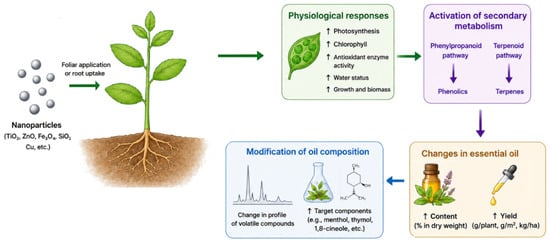
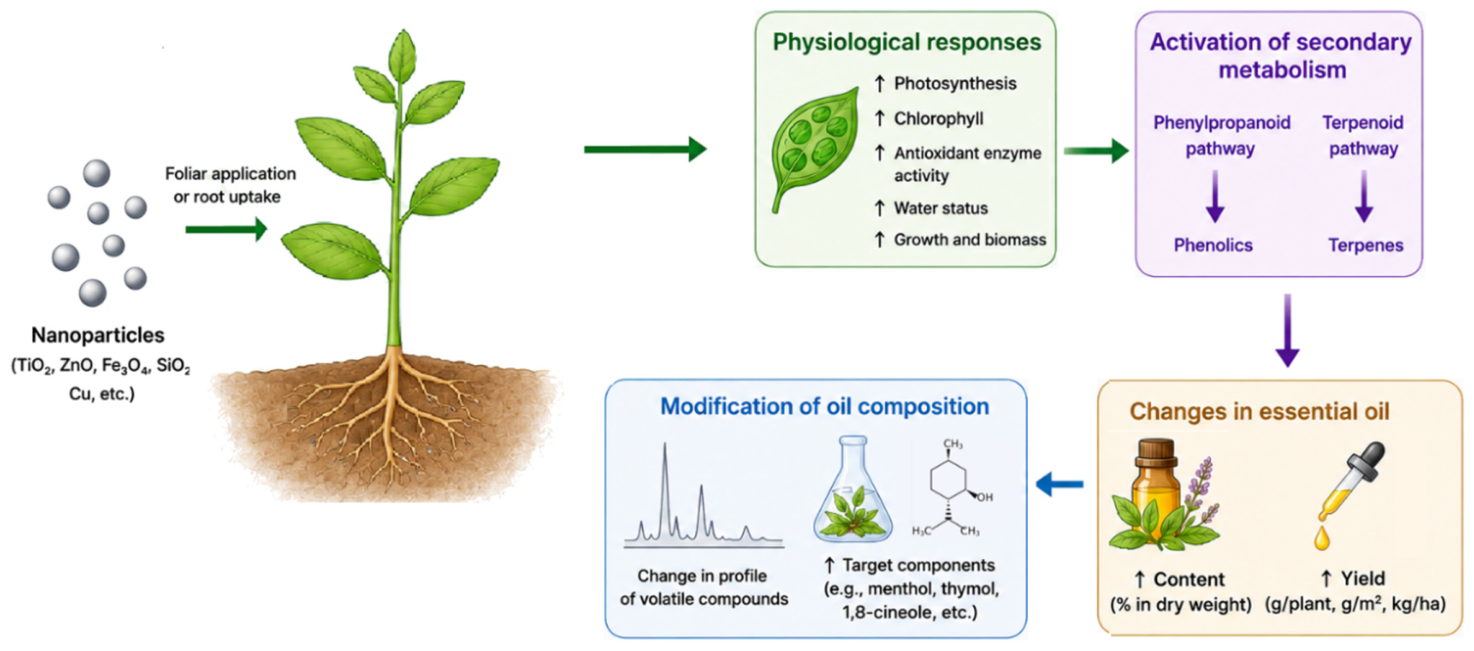
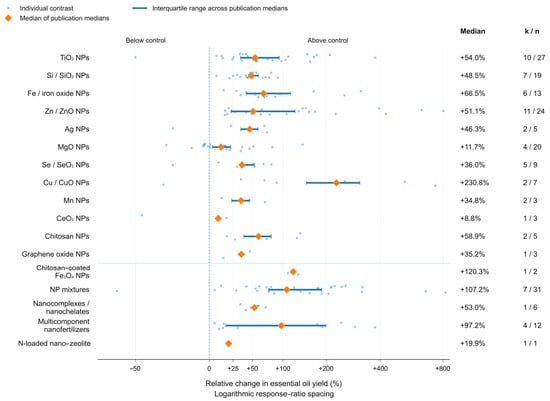
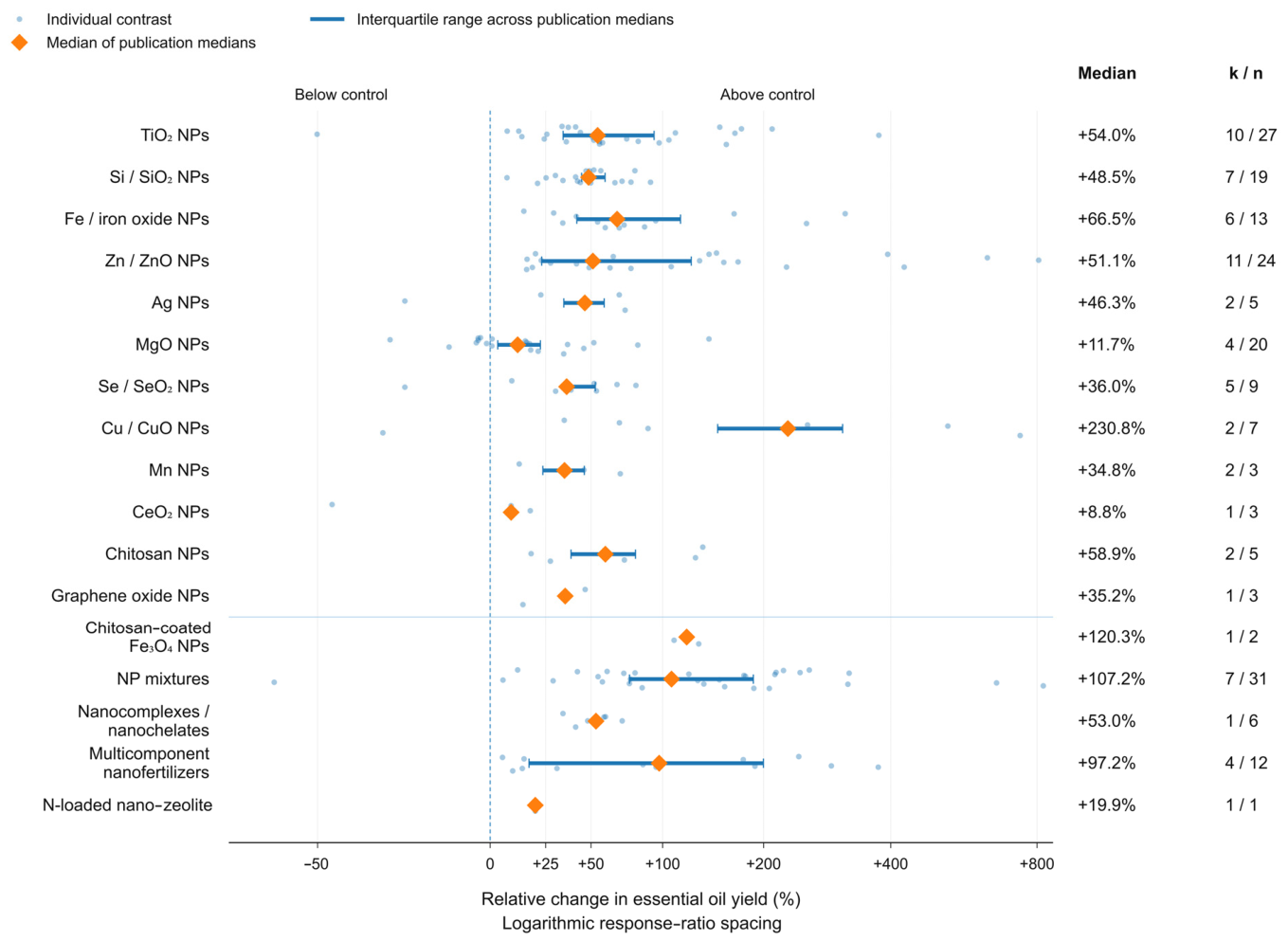
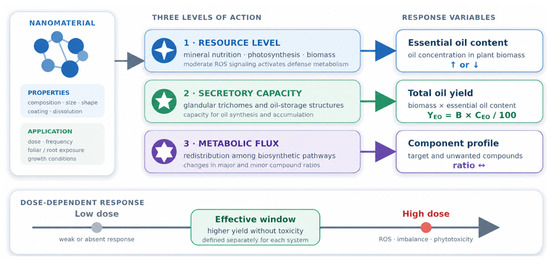
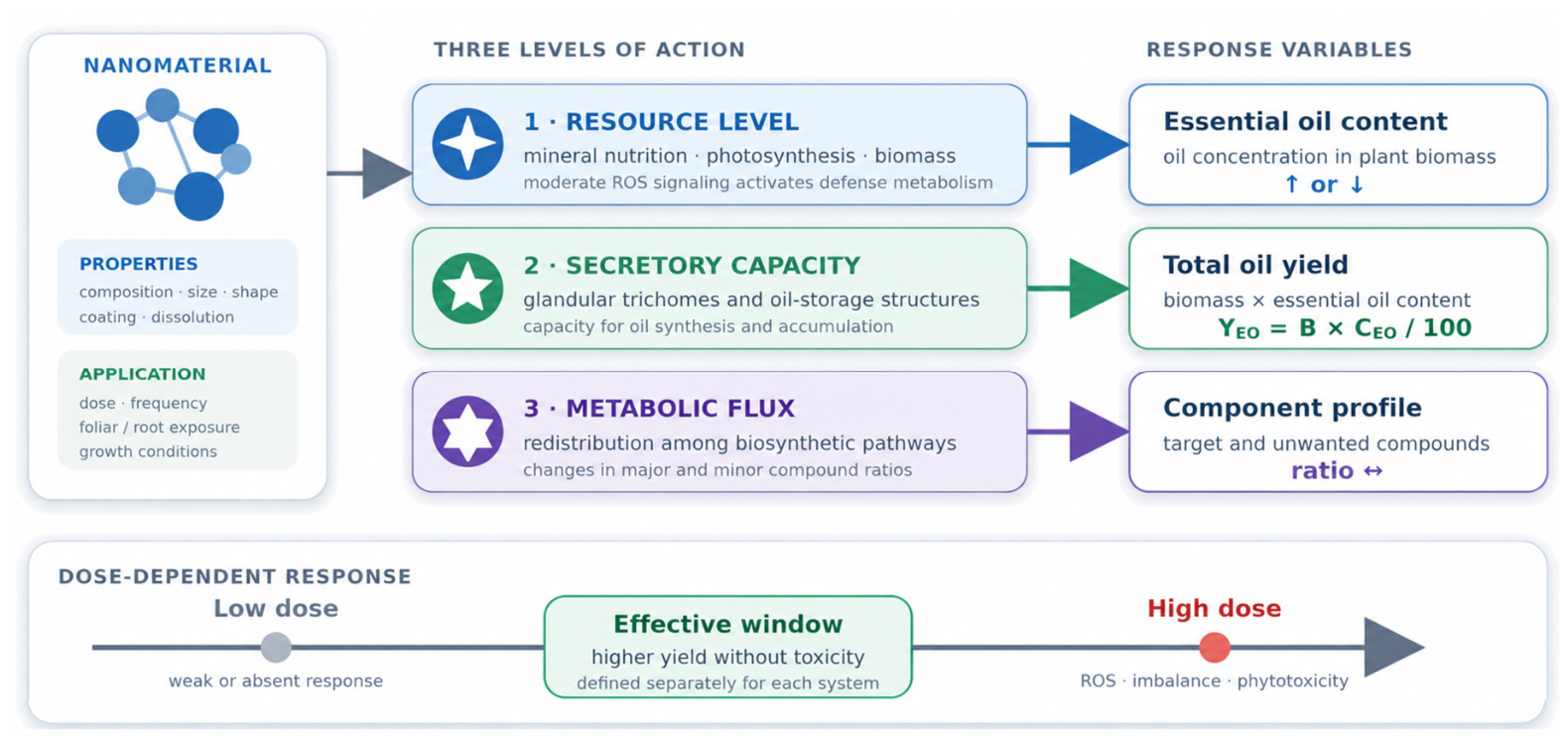
Disclaimer/Publisher’s Note: The statements, opinions and data contained in all publications are solely those of the individual author(s) and contributor(s) and not of MDPI and/or the editor(s). MDPI and/or the editor(s) disclaim responsibility for any injury to people or property resulting from any ideas, methods, instructions or products referred to in the content. |
© 2026 by the authors. Licensee MDPI, Basel, Switzerland. This article is an open access article distributed under the terms and conditions of the Creative Commons Attribution (CC BY) license.