


Abstract
A full-season soil-core experiment examined how carbon (C) and nitrogen (N) additions, alone and combined, affect δ13C and δ18O of soil-respired CO2 under forest and lawn, and how these isotopes relate to soil CH4 flux, non-substrate-derived CO2 emission, temperature, and moisture. Carbon addition alone (sucrose) enriched δ13C and depleted δ18O under both vegetation types, whereas N addition alone (ammonium chloride) had no detectable effect. The N + C treatment caused stronger isotopic changes than N alone but did not differ significantly from C alone, suggesting that N modulates C-induced isotopic fractionation rather than acting independently. Forest soils had lower mean δ13C and δ18O than lawn soils; both isotopes peaked in autumn and were lowest in summer. δ18O decreased nonlinearly with increasing CH4 uptake and non-substrate-derived CO2 emission, but these processes explained little of the variation in δ13C. Soil moisture dominated δ13C, where soil temperature dominated δ18O. Overall, δ13C mainly traces carbon sources and microbial decomposition, whereas δ18O is more sensitive to thermal–hydrological regimes and gas exchange. The two isotopes are therefore complementary for understanding soil respiration and improving terrestrial C-cycle models. Vegetation type and season were key regulators, and future work should include soil-water δ18O measurements, separation of root and microbial respiration, and longer-term observations across diverse climatic regions.
Keywords:
carbon dioxide; δ13C; δ18O; methane; nutrient addition; soil respiration; vegetation type; seasonal variation 1. Introduction
Soil respiration is one of the largest terrestrial fluxes of carbon dioxide (CO2) to the atmosphere, releasing roughly ten times the CO2 emitted annually by global fossil fuel combustion [1]. It comprises autotrophic respiration from plant roots and heterotrophic respiration driven by soil microorganisms decomposing organic matter. The two components respond differently to exogenous carbon (C) and nitrogen (N) inputs, and the direction and magnitude of these responses depend on ecosystem type, the duration and dose of N input, and soil C availability and pH [2,3,4,5,6,7]. Given the increasing global extent of N deposition, a central scientific issue in global change ecology is how exogenous C and N additions modulate both the rate and source partitioning of soil respiration [7,8,9].
Stable carbon (δ13C) and oxygen (δ18O) isotopes serve as powerful “natural fingerprint” tools for disentangling these sources [10,11,12,13,14] because photosynthesis and respiration exert opposing effects on the δ13C and δ18O signatures of atmospheric CO2 [15,16,17]. CO2 from distinct sources carries a characteristic isotopic imprint: in forest ecosystems, the δ13C of CO2 derived from soil organic matter decomposition (δ13C-CO2) is typically 2–4‰ higher than that of root and associated microbial respiration [12,18]. This difference has made δ13C a widely used tracer for partitioning soil respiration and ecosystem respiration [11,13,19]. Oxygen isotopes offer complementary insight. The δ18O of soil-respired CO2 (δ18O-CO2) primarily reflects full isotopic equilibrium with soil water at depths of 5–15 cm and is related to soil carbonic anhydrase activity [20,21,22]. Moreover, because soil-water δ18O varies seasonally with precipitation, evaporation, and plant water uptake, δ18O-CO2 can effectively trace soil moisture conditions and dynamic CO2 sources [10,14,17,22,23,24,25]. Since δ13C traces carbon source and microbial decomposition, whereas δ18O traces soil biophysical conditions and gas transport, comparing the two isotopes can reveal whether C and N additions act mainly on substrate use or on the soil biophysical environment.
Whether C and N additions leave detectable and mechanistically interpretable isotopic imprints, however, remains unresolved. Three issues persist in the literature. First, the direction of the isotopic response is uncertain because microbial responses are method-dependent. Nitrogen addition generally suppresses soil respiration and enhances soil organic C storage [26,27], but its effect on microbial C use efficiency (CUE) differs between approaches: the 13C-substrate method indicates an approximately 12% decrease, whereas the 18O-H2O method suggests an approximately 11% increase [28]. This discrepancy matters because CUE governs whether added C is respired or retained, and thus whether the δ13C of respired CO2 shifts. Consistent with this, long-term N addition experiments with δ13C-CO2 measurements show that microbes in fertilized soils shift their primary C source from native soil organic C to plant litter under warming [29]. Ground covers such as moss can further modify soil microenvironments and substrate utilization [30], and the response of soil respiration to N input also depends on soil C availability [7]. Second, the relative strength of vegetation type versus season as controls on these isotopic imprints is unclear. Grasslands release relatively “young” CO2 (14CO2 close to modern atmospheric values), whereas forest soils include contributions from decades-old organic matter [31]; C4 plants can further enrich the δ13C of respired CO2 in grasslands [32]. Soil texture, organic matter content, and carbonic anhydrase activity also affect C turnover and the isotopic composition of soil respiration [22,33,34]. Seasonally, δ13C-CO2 tends to be higher in summer and lower in winter and spring [13,35], while δ18O-CO2 shows 18O enrichment in winter when soils are water-saturated [20,36,37]. These patterns reflect shifts in root versus microbial contributions [18,38], respiratory substrates [35], and soil hydrothermal conditions [30,34,36,39]. Moisture-induced isotopic variation has been documented in forests and grasslands, including a negative correlation between soil δ13C-CO2 and moisture [40], a parabolic relationship between ecosystem respiration δ13C and mean annual precipitation [41], and more depleted δ18O of respired CO2 in wet than in dry seasons [42]. These studies, however, largely ignored C and N additions and rarely compared land-use types. Third, whether the C × N interaction is additive or non-additive relative to the single additions has not been tested. Direct investigations of C addition alone remain scarce; hence, the interactive regulation of C and N on δ13C-CO2 and δ18O-CO2 is poorly understood.
These three issues motivate three hypotheses. First, if the two isotopes are governed by different mechanisms, δ13C-CO2 should be mediated jointly by substrate availability, N-induced shifts in substrate use and pH, and CH4-derived CO2. In contrast, δ18O-CO2 should respond primarily to soil moisture and temperature conditions (H1). Methane uptake in the forest floor is constrained by N addition and the resulting low pH [6,43,44,45,46], and natural biogenic CH4 sources have an average δ13C value of approximately –63.0‰ [47]. Therefore, CO2 from CH4 oxidation may partly contribute to the δ13C of CO2 accumulated during opaque chamber closure. Consequently, C addition should shift the two isotopes in opposite directions, whereas N addition should exert a comparatively weak effect on both. Second, if vegetation type and season differ in their control strength, the δ13C-CO2 response should be stronger in forest than in lawn. This expectation reflects the larger pool of older, 13C-enriched organic matter in forest, whereas the δ18O-CO2 response should differ mainly through contrasts in soil texture, moisture, and gas transport. If season modulates treatment effects more strongly than vegetation type, δ13C-CO2 should respond most strongly in the warm, moist growing season, while δ18O-CO2 should track soil moisture and gas transport rather than treatment (H2). Third, if C and N act on different substrates or pathways, their combination should produce divergent effects on δ13C-CO2 and δ18O-CO2, and the C × N interaction may be non-additive relative to the single additions (H3).
To test hypotheses H1–H3, we conducted an in situ soil-core experiment under a temperate forest and adjacent lawn at the Changbai Mountain Forest Ecosystem National Research Station. The experiment included four treatments: C addition (sucrose), N addition (ammonium chloride), combined N + C addition, and a control. Across three seasons of the vegetation growing period, we measured δ13C and δ18O values of soil-respired CO2, together with associated non-substrate-derived CO2 emission and CH4 flux, soil moisture, and soil temperature. Our objectives were: (1) to elucidate how C addition, N addition, and their combination affect the isotope composition of soil-respired CO2 and to identify the key underlying mechanisms; (2) to compare the differential isotopic responses between forest and lawn ecosystems; and (3) to reveal the seasonal dynamics of these effects. By addressing these objectives, this study will deepen understanding of how C and N inputs regulate soil C cycling and provide isotope-based insights for predicting soil C dynamics in diverse terrestrial ecosystems under increasing N deposition and enhanced C input via rising atmospheric CO2 concentrations and litter management.
2. Materials and Methods
2.1. Study Site and Soil Properties
The experiment was conducted under a forest and an adjacent lawn at the National Research Station of Changbai Mountain Forest Ecosystems (42o24′ N and 128o6′ E), located at the foot of the Changbai Mountains in northeastern China. The forest stand is dominated by mountain poplar (Populus davidiana Dode) and Korean pine (Pinus koraiensis Sieb. et Zucc.). The dominated trees are over 40 years old, with sparse moss cover and few Korean pine seedlings on the forest floor. The stand has a 2–3 cm thick organic layer and an A horizon approximately 6 cm deep. The adjacent lawn is dominated by Trifolium repens L., Chelidonium majus L., Poa pratensis L., Capsella bursa-pastoris (L.) Medik., Ranunculus repens L., Eleusine indic (L.) Gaertn., and Digitaria sanguinalis (L.) Scop. Most lawn grasses are perennial grasses typical of cold-temperate regions. The lawn also has an A horizon approximately 6 cm depth and is fertilized and mowed annually.
Over the past two decades, mean annual temperature and precipitation have been approximately 4.1 °C and 770 mm, respectively, with more than 80% of the rainfall occurring from May to October. Both the temperate forest and lawn soils are classified as Andosols and were artificially mixed with sand during station construction. Total organic C and total N contents were 44.1 g C kg−1 and 2.2 g N kg−1 in the forest soil, and 63.8 g C kg−1 and 3.0 g N kg−1 in the lawn soil. For surface soil (0–10 cm depth), bulk density and alkaline-hydrolyzable N content were 1.0 g cm−3 and 186.1 µg N g−1 under forest, and 1.1 g cm−3 and 223.8 µg N g−1 under lawn. According to the official USDA Soil Texture Triangle (accessed at https://solvebility.com/soil_texture_classifier_professional_calculator/ accessed on 11 November 2026), the forest soil is loamy sand, whereas the lawn soil is sandy loam. Soil particle size was measured using a Mastersizer 2000 (Malvern, UK), with sandy, silt, and clay contents of 81.0%, 11.1%, and 7.9% in the forest soil and 73.8%, 12.6%, and 13.6% in the lawn soil, respectively.
2.2. Layout of the In Situ Soil-Core Experiment
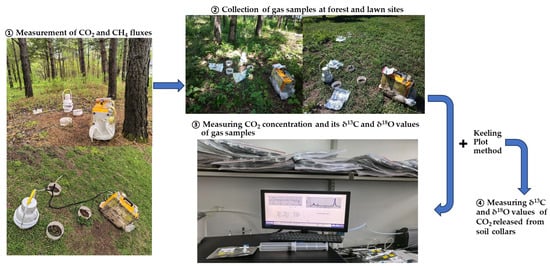
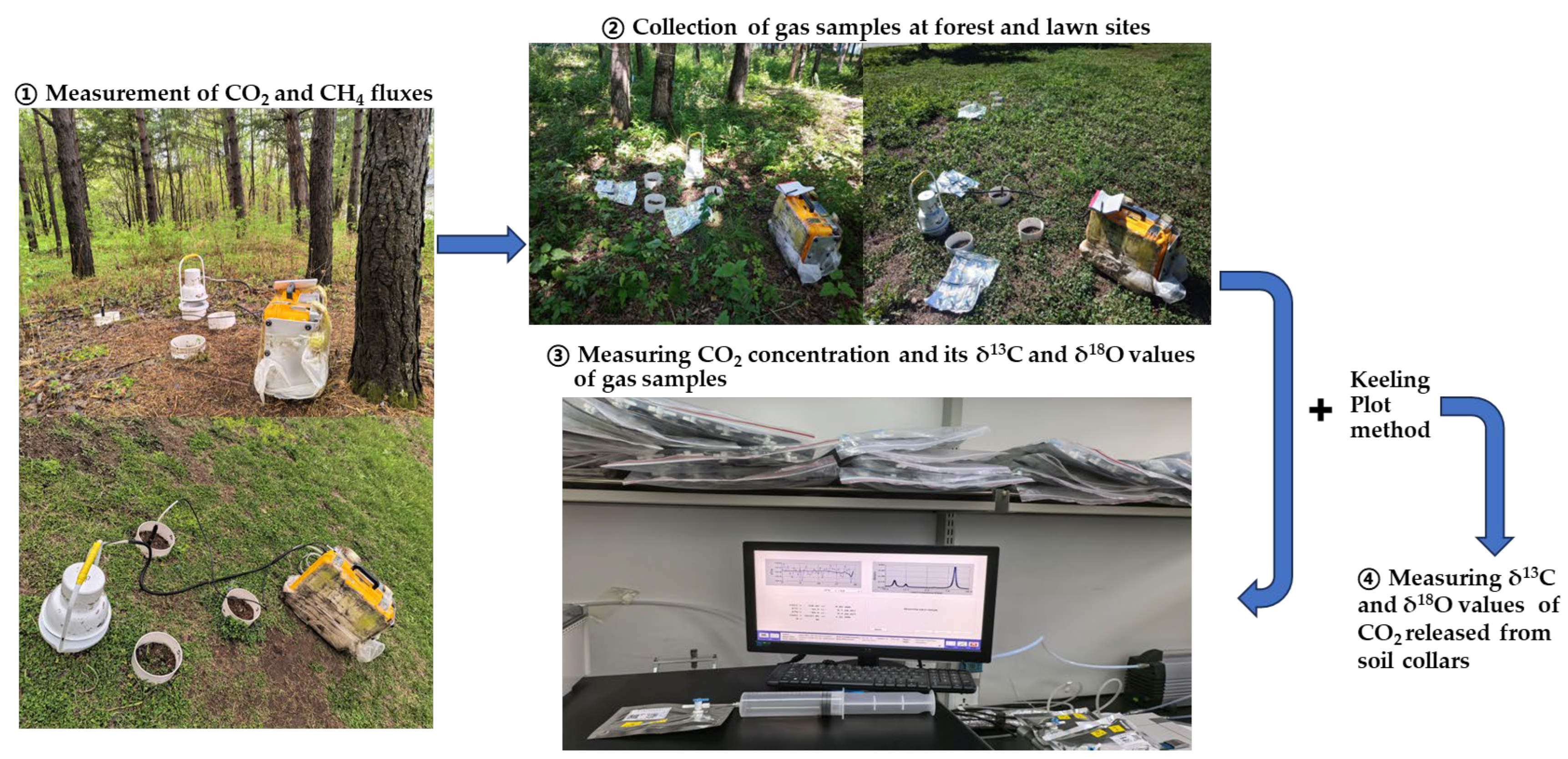
For each seasonal field measurement campaign, three independent study plots (approximately 4 m × 4 m each) were randomly established in the forest and lawn. Within each plot, four soil cores were randomly assigned to four treatments: control, carbon (C) addition, nitrogen (N) addition, and combined N + C addition. Each core was enclosed by a rigid UPVC (unplasticized polyvinyl chloride) collar (20 cm in diameter and 20 cm in height) inserted 10 cm into the soil. This setup allowed us to monitor the δ13C and δ18O values of CO2 released from soil respiration, together with soil CO2 and CH4 fluxes, temperature, and moisture (Figure 1). Positioning the collars to a depth of approximately 10 cm under forest and lawn reduced root damage and helped keep the cores in place. Field measurements were conducted in summer and autumn 2025 and spring 2026. Using these in situ soil-core experiments, we examined how the isotopic composition of soil-respired CO2 responded to exogenous C, N, and their combination under forest and lawn. By integrating soil moisture, temperature, and greenhouse gas flux data, we further explored the response patterns and underlying mechanisms driving isotopic variations across seasons and vegetation types.
Figure 1.
Apparatus for measuring CO2 and CH4 fluxes and the δ13C and δ18O values of CO2 released from soil collars under forest and lawn. Before each flux measurement, grasses and litter inside the collars were removed.
To better simulate realistic scenarios of multiple C and N inputs (e.g., root exudates, litter decomposition, and artificial N input) and their effects on the isotope signatures of soil-respired CO2 under field conditions, two successive rounds of C and/or N additions were performed during each seasonal measurement campaign. The second addition was applied only after soil CO2 emissions had nearly stabilized following the first addition. This stabilization corresponded to 30–50% and 10–40% of the flux peak under forest and lawn, respectively. After each addition, in situ measurements of δ13C and δ18O values in soil-respired CO2, CO2 and CH4 fluxes, and soil temperature and moisture were conducted at regular intervals. Nitrogen was applied as ammonium chloride at a rate of 4.5 g N m−2 per event, equivalent to twice the annual dissolved total N input via natural throughfall in the local forest. Carbon was supplied as sucrose at a rate of 6.4 g C m−2 per event, corresponding to twice the water-soluble C content in local forest floor litter [48]. Both C and N amendments were dissolved in pure water and sprayed evenly on the soil cores before each seasonal measurement campaign, while control plots received an equal amount (150 mL) of pure water only. Because the δ13C value of the added sucrose is –12‰, the CO2 emission derived from non-substrate decomposition in C-amended soils, with and without N co-addition, was calculated using the isotopic mixing models described in Section 2.4. This calculation allowed us to assess whether the observed seasonal isotopic values of soil-respired CO2 are linked to non-substrate-derived CO2 emission under forest and lawn.
2.3. Measurements of δ13C and δ18O Values in Soil-Respired CO2 and of CO2 and CH4 Fluxes
Frequent field observations of the isotopic composition of soil-respired CO2 and associated auxiliary variables were conducted under forest and lawn over three seasons (summer 2025, autumn 2025, and spring 2026). In each season, two successive rounds of C and N additions were applied. The first addition was followed by measurements at predetermined intervals. The second addition was performed only after intermittent measurements confirmed that soil CO2 emission had stabilized and corresponded to 30–50% and 10–40% of the flux peak under forest and lawn, respectively. The sampling schedules were as follows:
- Summer 2025: after the first addition, measurements at 0.5, 17, and 41 h; second addition at 71h, followed by measurements at 0.5, 4, 19, 43, and 72 h.
- Autumn 2025: after the first addition, measurements at 0.5, 3, 20, and 44 h; second addition at 139 h, followed by measurements at 0.5, 5, 29, and 53.5 h.
- Spring 2026: after the first addition, measurements at 0.5, 4, 20, and 44 h; second addition at 139 h, followed by measurements at 0.5, 4, 20, and 92 h.
Gas samples for isotopic analysis were collected using a static chamber method, with air-tight 100-mL syringes and 300-mL air-tight gas bags (NDEV41-0.3, Dalian Delin Gas Packing Co., Ltd., Dalian, China) at regular closure intervals (e.g., 0, 5, and 10 min, depending on CO2 flux intensity, to minimize disturbance of the soil-atmosphere system in the collars) (Figure 1) [49]. Before each isotopic measurement, CO2 and CH4 fluxes from the soil collars, together with soil temperature and moisture, were monitored using a portable greenhouse gas analyzer (915-0011, Los Research Inc., Fremont, CA, USA) coupled to an opaque smart respiratory chamber (SC-11, Beijing LICA United Technology Limited, Beijing, China) (Figure 1) [50].
Within one week of headspace sampling, CO2 concentration and its δ13C and δ18O values in each gas bag were determined using a CO2 isotope spectrum analyzer (CCIA-38d-EP, Los Research Inc., Fremont, CA, USA) with a manual injection model (Figure 1). The δ13C and δ18O values of CO2 were calculated relative to the Pee Dee Belemnite standard using Equation (1):
where δ13C and δ18O denote δ13C and δ18O values of CO2, respectively. Rstandard and Rsample denote the molar ratios of 13C/12C (or 18O/16O) in the standard and sample, respectively.
δ13C or δ18O (‰) = (Rsample/Rstandard − 1) × 1000
Before each analytical run, the CO2 isotope analyzer was calibrated using two certified CO2 standard mixtures of different concentrations, each containing 1% Argon (w/w) and balance air. The CO2 concentrations and their δ13C and δ18O values were: 398.60 µL L−1, −22.31‰, and −31.00‰; and 794.30 µL L−1, −22.34‰, and −31.20‰. The source of these standards, the measurement procedures, and the analytical precision of the CCIA-38d-EP analyzer have been detailed by Xu et al. [39]. For each measurement event, both δ13C and δ18O values of CO2 released from soil collars were derived using the Keeling plot method [51,52] (Figure 1), i.e., from the intercept of the linear regression of δ13C or δ18O values of CO2 against the inverse CO2 concentration over the closure period (n = 3). The coefficients of determination (R2) for these regressions were generally greater than 0.95 for δ13C-CO2 and greater than 0.80 for δ18O-CO2. Soil temperature and volumetric water content (%, v/v) at 7 cm depth within the collars were simultaneously recorded using a temperature-moisture combination probe attached to the portable gas analyzer (915-0011, Los Research Inc., Fremont, CA, USA) (Figure 1) [50]. These auxiliary measurements allowed us to explore the mechanisms underlying the observed variations in δ13C and δ18O values of soil-respired CO2.
2.4. Calculation and Statistical Analysis
Headspace CO2 and CH4 concentrations measured by the portable greenhouse gas analyzer (915-0011, Los Research Inc., Fremont, CA, USA) changed linearly over the closure period, and soil collar carbon fluxes were calculated from these changes [50]. Soil CO2 and CH4 fluxes were expressed as µmol CO2 m−2 s−1 and nmol CH4 m−2 s−1, respectively. To partition CO2 emitted from C-amended soils (with and without N co-addition), we applied a two-end-member isotopic mixing model [53]. The fraction of CO2 derived from the added sucrose (fsucrose) was calculated as:
and the non-substrate-derived CO2 emission was calculated as:
where Fnon-substrate and Ftotal denote the non-substrate-derived CO2 and total CO2 emissions (µmol CO2 m−2 s−1) from C-amended soils, respectively; δ13Ctreated is the δ13C value of CO2 released from C-amended soil (‰); δ13Cnon-treated is that from the control soil without C and N additions (‰); and δ13Csucrose is the δ13C value of the added sucrose (−12‰). This calculation assumes that the added sucrose and native soil organic matter are the two dominant respiratory C sources and that any priming effect is operationally included in the non-substrate fraction.
fsucrose = (δ13Ctreated − δ13Cnon-treated)/(δ13Csucrose − δ13Cnon-treated)
All measured variables were tested for normality using the Shapiro–Wilk test and for homogeneity of variance using Levene’s test, and log-transformation was applied where necessary. The δ13C and δ18O values of soil-respired CO2 were analyzed separately for forest and lawn using two-way repeated-measures ANOVA, with treatment and season as fixed effects. A separate two-way repeated-measures ANOVA, with treatment and the number of C and N additions as fixed factors, was used to assess their effects on δ13C and δ18O within each season for both vegetation types. A three-way repeated-measures ANOVA, with treatment, vegetation type, and season as fixed effects, were used to evaluate their influences across all three seasons. Pairwise comparisons were conducted using Tukey’s HSD post hoc tests (α = 0.05). Box plots of δ13C and δ18O values were generated using OriginPro 2021 (OriginLab Corporation, Northampton, MA, USA). The values were grouped by land cover (forest and lawn) and by treatment for each season (n = 24 per group) and across all three seasons (n = 72 per group). All statistical analyses were performed with SPSS (version 19.0, IBM Corp., New York, NY, USA).
To explore the combined effects of soil temperature and moisture at 7 cm depth, non-substrate-derived CO2 emission, and CH4 flux on the δ13C and δ18O values of soil-respired CO2, contour analyses were conducted for forest and lawn stands across all treatments and seasons. Multivariate regression curves were fitted using OriginPro 2021. Scatter plots were constructed to illustrate the influences of CH4 uptake, non-substrate-derived CO2 emission, soil moisture and temperature at 7 cm depth on δ13C and δ18O, categorized by treatment, season, and vegetation type. Linear and non-linear regressions were fitted as appropriate using OriginPro 2021. Based on preliminary principal component analyses, soil moisture, soil temperature, non-substrate-derived CO2 emission, and CH4 uptake were selected as predictors to construct an a priori structural equation model (SEM) to evaluate the direct and indirect pathways affecting δ13C and δ18O, using a dataset of 576 paired observations. Model fit was assessed using the comparative fit index (CFI), the chi-squared test, and the root-mean-square error of approximation (RMSEA). The SEM analysis was performed using AMOS 24 (SPSS Inc., Chicago, IL, USA).
3. Results
3.1. Effects of C and N Additions on δ13C and δ18O Values of Soil-Respired CO2
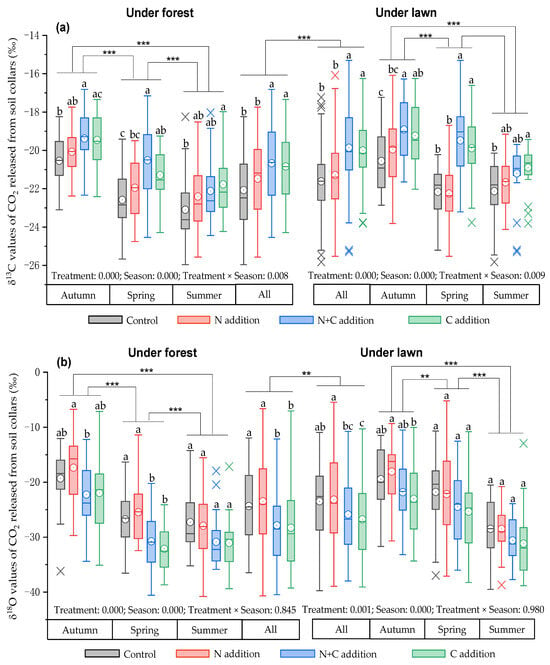
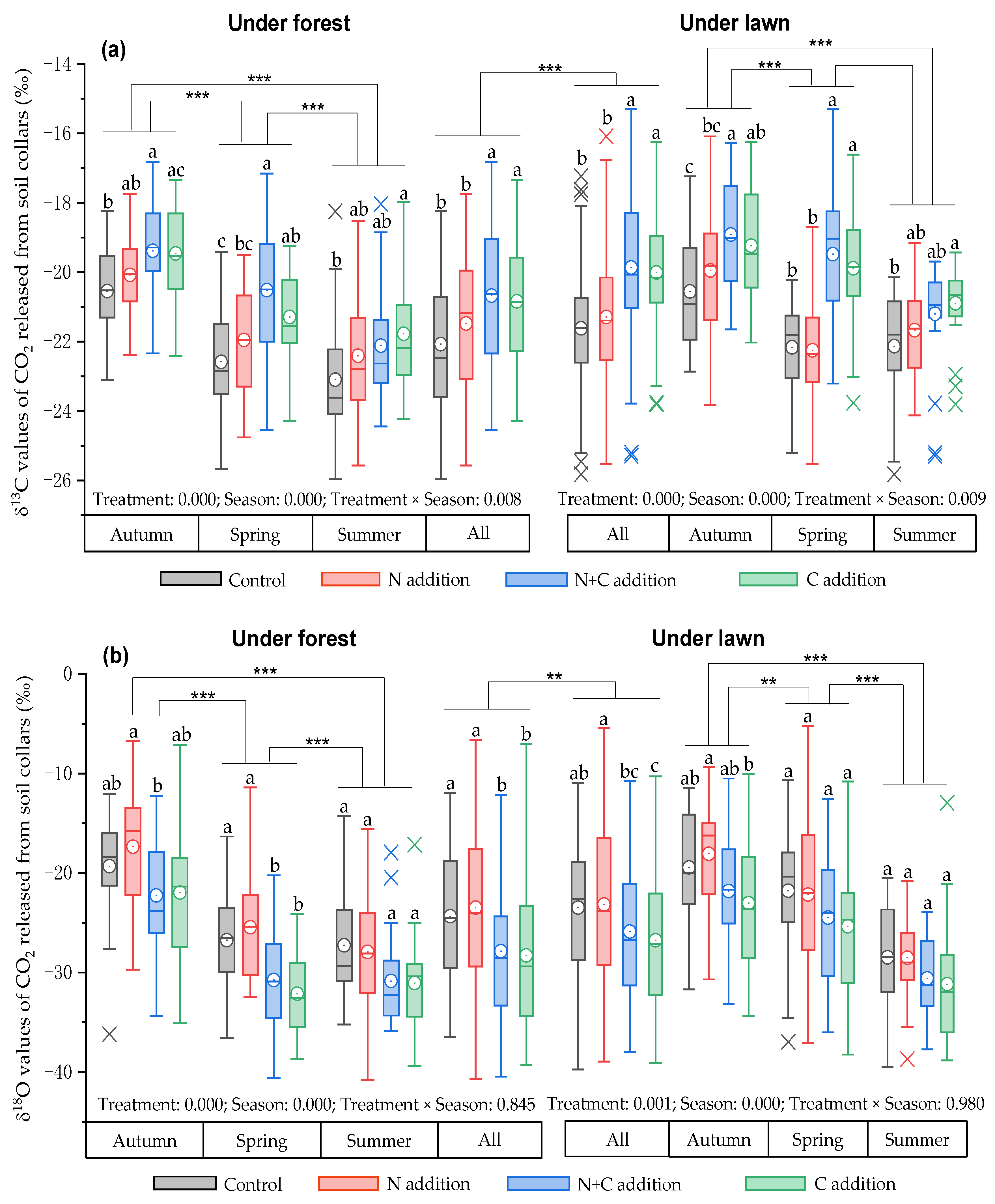
Across the three seasons, sucrose addition alone produced mean δ13C values of soil-respired CO2 ranging from –21.33‰ to –19.34‰ under forest and from –20.89‰ to –19.23‰ under lawn, with the lowest values consistently observed in summer (Tukey HSD, p < 0.001). These values were significantly higher than those of the control (Tukey HSD, p < 0.001), which ranged from –22.61‰ to –20.55‰ under forest and from –22.13‰ to –20.55‰ under lawn (Figure 2a). Notably, no significant differences in δ13C were detected between the N + C and C-alone treatments (Figure 2a). Nitrogen addition alone tended to increase δ13C, particularly under forest, but this effect did not differ significantly from the control within or across seasons (Figure 2a). Relative to both the control and N-alone treatments, N + C addition resulted in less 13C-depleted soil-respired CO2 under lawn in autumn, spring, and across the three seasons, and under forest in spring and across the three seasons (Tukey HSD, p < 0.05; Figure 2a). In summer, however, no significant treatment effects were detected, except that the C-alone treatment exhibited higher δ13C of soil-respired CO2 than the control (Tukey HSD, p < 0.05; Figure 2a). A significant treatment × season interaction was detected for δ13C of soil-respired CO2 under both forest and lawn (p < 0.01; Figure 2a).
Figure 2.
Box plots of δ13C (a) and δ18O (b) values of CO2 released from soil collars under forest and lawn in each season and across all three seasons during the two carbon and nitrogen addition experiments. Boxes represent interquartile ranges (IQRs), with circles and horizontal lines inside the boxes indicating mean and median values, respectively. The lower and upper whiskers extend to the 25th percentiles minus 1.5 × IQR and the 75th percentiles plus 1.5 × IQR, respectively. Diagonal crosses indicate outliers. Boxes labelled with different lowercase letters indicate significant differences (Tukey’s HSD post hoc test, p < 0.05) in mean δ13C and δ18O of soil-respired CO2 between treatments under forest and lawn, either within each season or across all three seasons. “All” refers to all three seasons combined. ANOVA results (p values) for treatment and season as fixed factors for forest and lawn are shown. Significant differences in mean δ13C and δ18O values among seasons under forest and lawn, and between vegetation types, are indicated by ** (p < 0.01) and *** (p < 0.001).
For δ18O values of soil-respired CO2, C addition alone yielded mean values ranging from –31.16‰ to –22.55‰ under forest and from –31.27‰ to –23.13‰ under lawn, again with summer minima (Tukey HSD, p < 0.001 for both; Figure 2b). On average, these values were significantly lower than those of the control across the three seasons, which ranged from –27.92‰ to –19.42‰ under forest and from –28.57‰ to –19.53‰ under lawn (Tukey HSD, p < 0.01; Figure 2b). As with δ13C, no significant differences in δ18O were observed between the N + C and C-alone treatments (Figure 2b). Nitrogen addition alone tended to elevate δ18O, especially under forest, but this effect was not statistically significant relative to the control (Figure 2b). Compared with N addition alone, the N + C treatment caused greater 18O depletion in soil-respired CO2 under forest in autumn and spring (Tukey HSD, p < 0.01) and across all three seasons (Tukey HSD, p < 0.001) (Figure 2b). Under lawn, the N + C treatment likewise resulted in greater 18O depletion across the three seasons than N alone (Tukey HSD, p < 0.05; Figure 2b). No significant treatment × season interaction was observed for δ18O of soil-respired CO2 under either forest or lawn (Figure 2b).
3.2. Effects of Vegetation Type and Season on δ13C and δ18O Values of Soil-Respired CO2
Regardless of C and N addition, soil-respired CO2 under forest exhibited significantly lower mean δ13C and δ18O values (–21.26 ± 0.11‰ and –26.09 ± 0.42‰, respectively) than under lawn (–20.69 ± 0.11‰ and –24.67 ± 0.43‰, respectively) (Tukey HSD, p < 0.01 for both; Figure 2a,b). Across all four treatments, both vegetation types showed pronounced seasonal variation in the isotopic composition of soil-respired CO2 (Tukey HSD, p < 0.01). Specifically, δ13C peaked in autumn (–19.76 ± 0.12‰) and reached a minimum in summer (–21.91 ± 0.12‰), whereas δ18O values were highest in autumn (–20.45 ± 0.45‰) and lowest in summer (–29.53 ± 0.39‰) (Figure 2a,b).
3.3. Relationships Between the Isotopic Composition of Soil-Respired CO2, Soil CH4 Flux, and Non-Substrate-Derived CO2 Emission
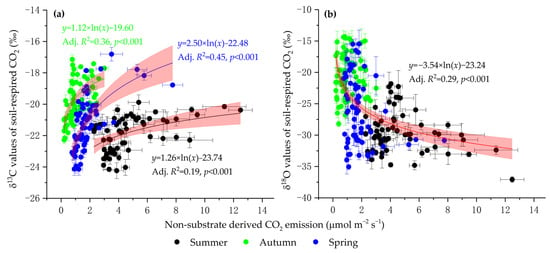
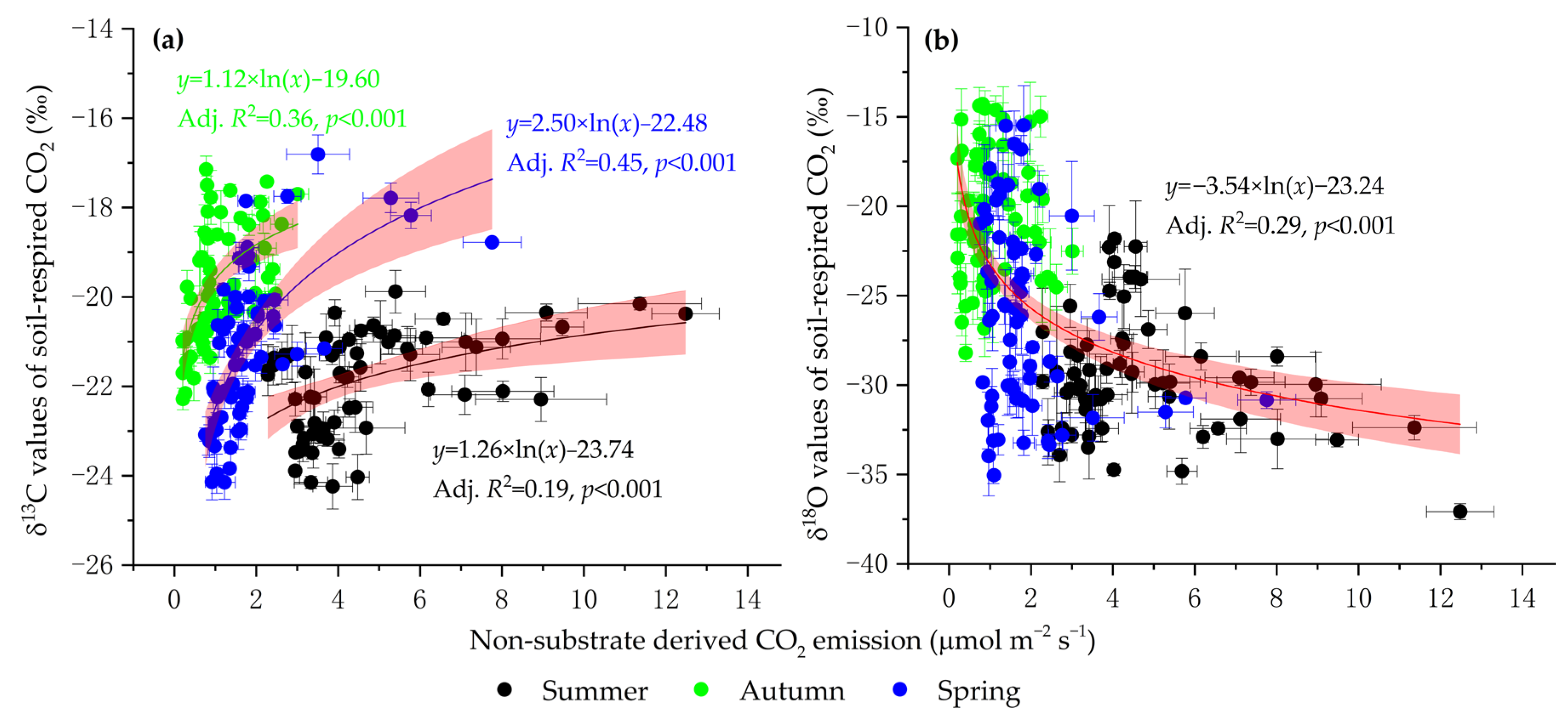
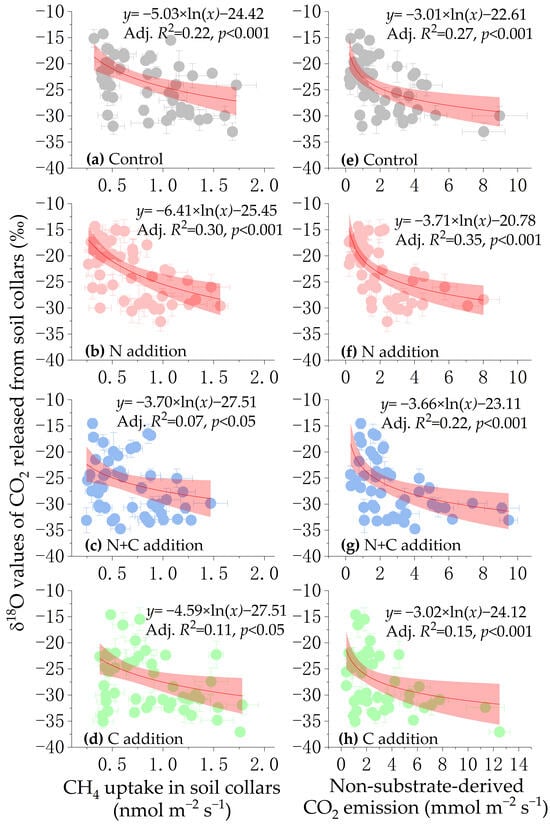
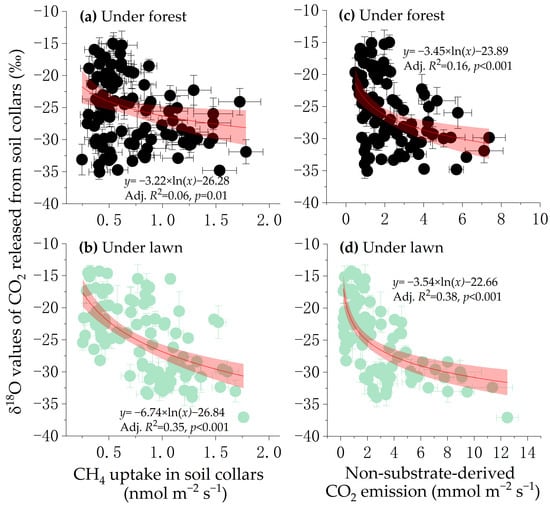
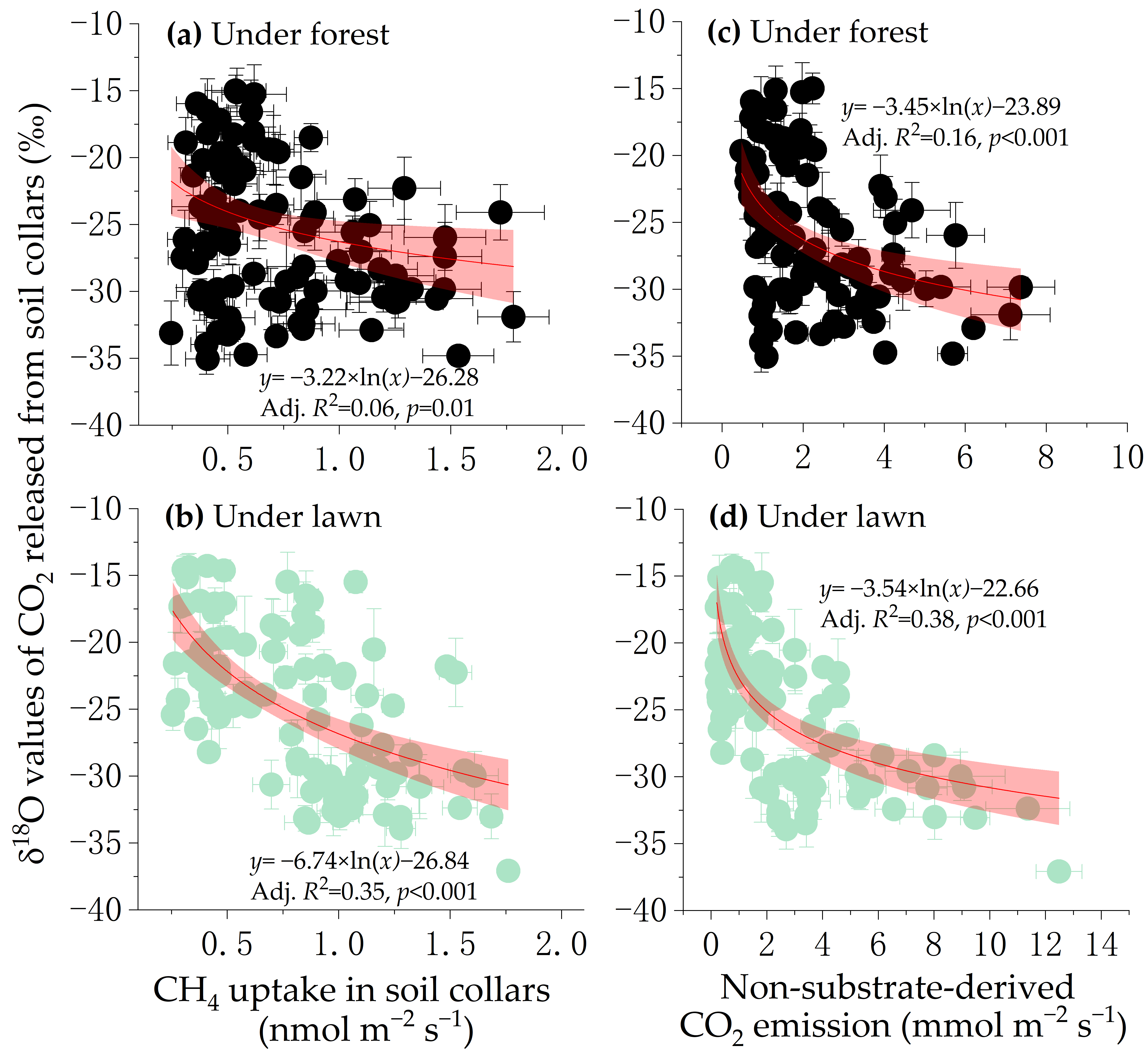
Across all four treatments, δ13C values of soil-respired CO2 increased significantly and non-linearly with rising non-substrate-derived CO2 emission under both forest and lawn (p < 0.001; Figure 3a). In parallel, δ18O values of soil-respired CO2 decreased significantly and non-linearly as non-substrate-derived CO2 emission increased across all treatments and seasons (p < 0.001; Figure 3b). When treatments and vegetation types were analyzed separately, δ18O-CO2 values within each treatment and in either vegetation type consistently decreased in a significant, non-linear manner with both greater soil CH4 uptake (p < 0.05; Figure 4a–d and Figure 5a,b) and enhanced non-substrate-derived CO2 emission (p < 0.001; Figure 4e–h and Figure 5c,d). Notably, the model fit improved from forest to lawn (Figure 5), with the best fit observed in the N-alone treatment among all four treatments (Figure 4).
Figure 3.
Relationships between non-substrate-derived CO2 emission from soil collars (x) and the δ13C (a) and δ18O (b) values of soil-respired CO2 (y) across all treatments and seasons under forest and lawn. Non-linear regressions were used to examine these relationships, with separate regressions fitted for δ13C in each season and a single regression fitted for δ18O using data pooled across all three seasons. Shaded areas indicate the 95% confidence bands of the non-linear regressions.
Figure 4.
Relationships between δ18O values of soil-respired CO2 (y) and soil CH4 uptake (a–d) or non-substrate-derived CO2 emission (e–h) (x) in each treatment across all three seasons under forest and lawn. Shaded areas indicate the 95% confidence bands of the non-linear regressions.
Figure 5.
Relationships between δ18O values of soil-respired CO2 (y) and soil CH4 uptake (a,b) or non-substrate-derived CO2 emission (c,d) (x) under forest and lawn across all three seasons. Shaded areas indicate the 95% confidence bands of the non-linear regressions.
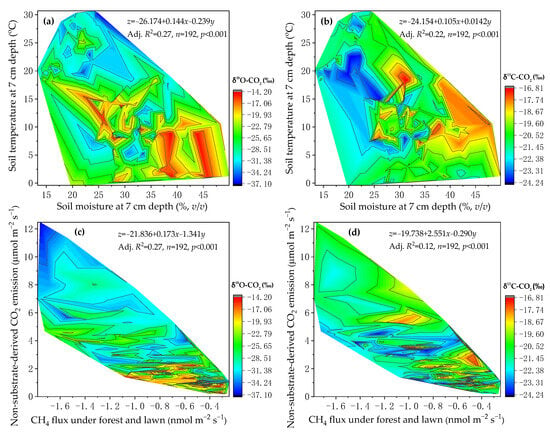
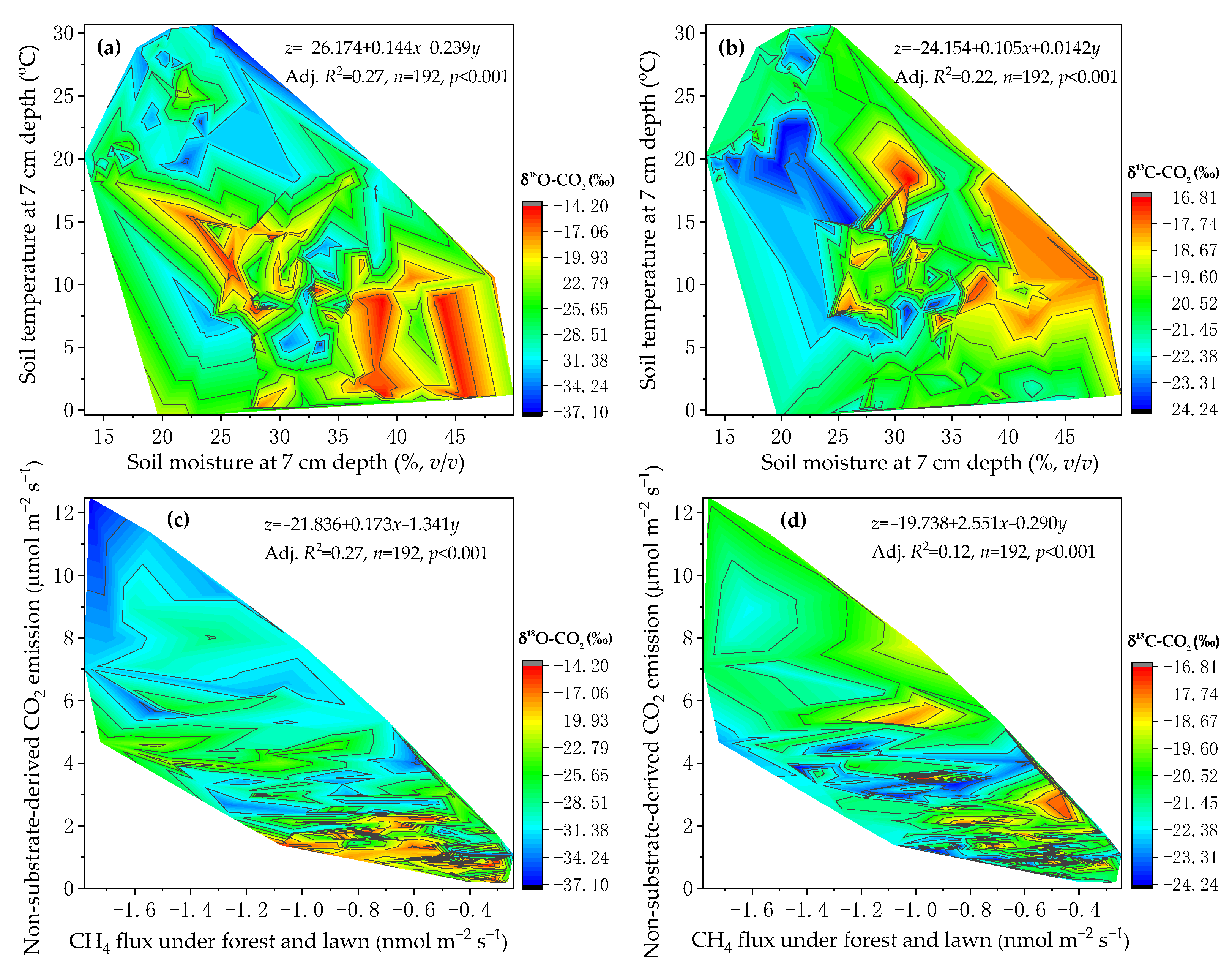
In contrast to δ18O-CO2, a significant negative relationship between δ13C-CO2 values and non-substrate-derived CO2 emissions was detected only in the control of both vegetation types (p < 0.05; Figures S1e–h and S2c,d). However, similar to the pattern observed for δ18O-CO2, δ13C-CO2 values decreased significantly with increasing soil CH4 uptake in both vegetation types and in the control and N-alone treatments (p < 0.05), with relatively stronger model fits under lawn and in the control (Figures S1a,b and S2a,b). Collectively, non-substrate-derived CO2 emission and soil CH4 uptake accounted for 12% and 27% of the observed variation in δ13C and δ18O of soil-respired CO2, respectively, under the experimental conditions (p < 0.001; Figure 6c,d).
Figure 6.
Combined effects of soil temperature and moisture at 7 cm depth (a,b) and of non-substrate-derived CO2 emission and CH4 flux (c,d) on the δ13C and δ18O values of soil-respired CO2 under forest and lawn across all treatments and seasons. Multivariate regression surfaces were fitted with soil moisture (x) and soil temperature (y), or CH4 flux (x) and non-substrate-derived CO2 emission (y), as predictors of δ13C and δ18O (z); x, y, and z are means of three replicates per measurement. Legend colors represent different ranges of δ13C and δ18O values.
3.4. Relationships Between the Isotopic Composition of Soil-Respired CO2, Temperature, and Moisture
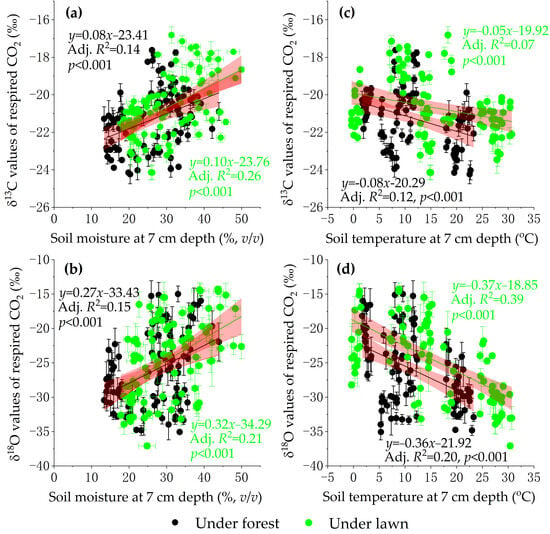
Under the experimental conditions, soil moisture and temperature at 7 cm depth jointly explained 22% and 27% of the variation in δ13C and δ18O of soil-respired CO2, respectively (p < 0.001; Figure 6a,b). When examined separately, both isotopic signatures increased significantly and linearly with rising soil moisture across the range of 10–50% (v/v) (p < 0.001), with the model fit improving from forest to lawn (Figure 7a,b). In contrast, both δ13C and δ18O declined significantly and linearly with increasing soil temperature over the range from near zero to 30 °C (p < 0.001), with notably stronger model fits for δ18O under both forest and lawn (Figure 7c,d).
Figure 7.
Relationships of δ13C and δ18O values of soil-respired CO2 (y) and soil moisture (a,b) or temperature (c,d) (x) at 7 cm depth across all seasons under forest and lawn. Shaded areas indicate the 95% confidence bands of the linear regressions (black for forest, green for lawn).
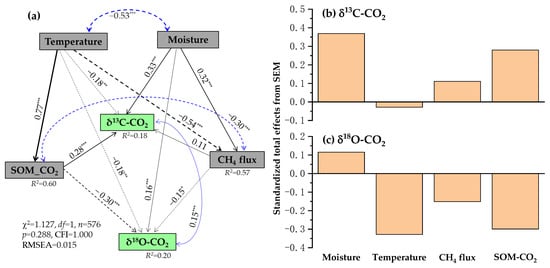
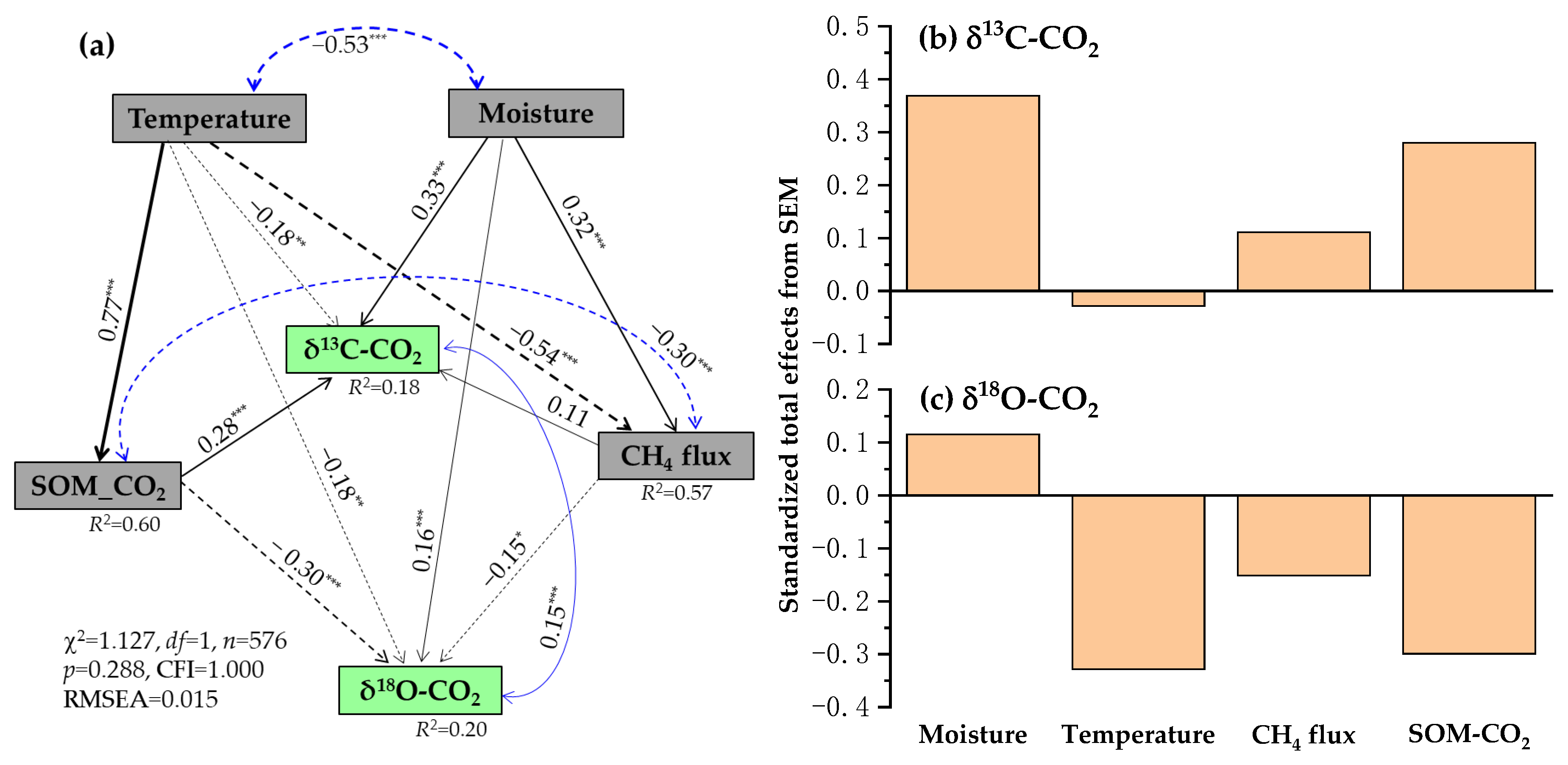
To further explore the underlying drivers, we performed a structural equation modelling (SEM) analysis using the paired observation dataset (n = 576), which included soil CH4 flux, non-substrate-derived CO2 emission, and soil moisture and temperature. These variables collectively accounted for 18% and 20% of the variation in δ13C and δ18O under both forest and lawn, respectively (Figure 8a). Soil moisture and temperature exerted similar directional effects on both isotopes, yet soil moisture had a relatively stronger influence on δ13C (Figure 8b), whereas soil temperature played a more prominent role in shaping δ18O (Figure 8c). Within the SEM framework, soil CH4 flux and non-substrate-derived CO2 emission showed opposing effects on δ13C and δ18O, respectively (Figure 8b,c).
Figure 8.
Structural equation modeling (SEM) analysis of causal relationships among temperature, moisture, CH4 flux, SOM_CO2, δ13C-CO2, and δ18O-CO2 under forest and lawn across all treatments and seasons (a), and their standardized total effects on δ13C-CO2 (b) and δ18O-CO2 (c). Temperature and moisture denote soil temperature and moisture at 7 cm depth, respectively; SOM_CO2 denotes non-substrate derived CO2 emission; and δ13C-CO2 and δ18O-CO2 denote the δ13C and δ18O values of soil-respired CO2, respectively. Single-headed arrows indicate the hypothesized direction of causation, whereas double-headed arrows represent correlations between covariances of variables. The width of arrows is proportional to the strength of the relationship. Numbers adjacent to arrows are standardized regression or correlation coefficients, and R2 values represent the proportion of variation explained by relationships with other variables. χ2, RMSEA, and CFI denote the Chi-square, root-mean-square error of approximation, and comparative fit index, respectively. n, p, and df represent the number of paired observations, the probability level, and the degrees of freedom, respectively. *, p < 0.05; **, p < 0.01; ***, p < 0.001.
4. Discussion
4.1. Divergent Regulation of the Isotopic Signature of Soil Respiration by C and N Additions
Carbon addition as sucrose significantly altered both δ13C and δ18O of soil-respired CO2 under forest and lawn, but in opposite directions: C addition alone enriched δ13C while depleting δ18O relative to the control (Figure 2a,b). This contrast is the central prediction of H1, namely that the two isotopes respond to distinct regulatory mechanisms and therefore carry different isotopic imprints of soil respiration [54,55]. It also frames H3, since the direction of each response differs between the single additions.
The δ13C enrichment can arise directly from mixing with the added sucrose, which has a δ13C value of −12‰ and is therefore 13C-enriched relative to native soil organic matter. Fresh organic C may additionally stimulate microbial decomposition of native soil organic matter, and shifts in substrate availability may alter microbial C-use patterns [7,56,57]. Because the carbon isotopic composition of soil-respired CO2 is closely tied to that of the respiratory substrate pool, any factor that changes substrate availability can systematically affect δ13C–CO2 [30,55,56]. Our design cannot separate direct substrate mixing from priming or from preferential microbial use of specific substrates; hence, the observed δ13C enrichment should not be attributed solely to a priming effect.
The marked δ18O depletion induced by C addition is mechanistically less direct and is consistent with the gas-transport control posited in H1. It may arise from altered CO2–H2O oxygen exchange, whose equilibrium fractionation depends strongly on temperature and moisture [22,30,58]. Carbon addition may change CO2 residence time and diffusion pathways by modifying microbial activity [20,22,58], thereby shifting the degree of oxygen isotopic exchange between CO2 and soil water. This interpretation is consistent with the high sensitivity of δ18O to non-substrate-derived CO2 emission and soil CH4 uptake observed here (Figure 4 and Figure 5). Specifically, C addition could lower δ18O by (1) accelerating CO2 production and shortening CO2 residence time in soil pores, thus weakening oxygen exchange equilibrium with soil water, which is less 18O-depleted than dissolved CO2 [59], and (2) altering soil pore structure or water distribution and thus CO2 diffusion and transport efficiency. Because the δ18O of soil-respired CO2 is highly sensitive to gas exchange and transport in soil [58], the opposite responses of δ13C and δ18O to C addition reflect their differing controls: δ13C is predominantly substrate-driven, whereas δ18O is more strongly influenced by gas transport and exchange. Because soil-water δ18O was not measured, these mechanisms remain inferred rather than directly demonstrated.
Nitrogen addition alone had no statistically significant effect on either δ13C or δ18O, except for a slight enrichment trend under forest, which is consistent with the weak N effect predicted in H1. This result may be attributable to several factors: (1) the studied ecosystems may be primarily C-limited rather than N-limited, resulting in a weak microbial response to N addition; (2) N addition may simultaneously stimulate microbial utilization of both 13C-enriched and 13C-depleted substrates, with their effects counterbalancing each other [26,29,60]; and (3) N-induced changes in soil pH or microbial community composition during a relatively short-term period may not have reached the threshold required to alter the respiratory isotopic signal [28,61]. These remain candidate explanations because soil pH and microbial community composition were not measured. The N + C treatment generally produced higher seasonal mean δ13C and lower δ18O than N addition alone (p < 0.05), but did not differ significantly from C addition alone. This pattern addresses H3: it suggests that C availability can modulate N-induced isotopic fractionation, or, more conservatively, that the isotopic effect of the combined treatment is dominated by C addition rather than by an independent N effect; hence, the interaction is closer to additive-with-C-dominance than to a strong non-additive C × N effect. This interpretation implies that, under increasing atmospheric N deposition, the isotopic response of soil respiration to exogenous N input may depend critically on soil C availability [30,62,63,64].
4.2. Vegetation Type and Season Dominate the Spatiotemporal Patterns of the Isotopic Composition of Soil-Respired CO2
Vegetation type significantly shaped the isotopic composition of soil-respired CO2 (Figure 2a,b), as predicted by H2. Across all treatments and seasons, mean δ13C and δ18O of soil-respired CO2 under forest were –21.26‰ and –26.09‰, respectively, both significantly lower than those under lawn (–20.69‰ and –24.67‰; p < 0.05). These values fall within the ranges previously reported for temperate forests and grasslands [12,21,59,65,66]. Several non-exclusive explanations are plausible. First, forest soil organic matter is generally more 13C-depleted than grassland soil organic matter, reflecting the dominance of C3 vegetation under forest versus possible presence of C4 species under lawn. Greater root respiration under forest may further lower the δ13C of forest soil respiration, because root-derived CO2 is typically 13C-depleted relative to δ13C values in aboveground tissues [12,18,38]. Second, forest soils often have thicker litter layers and older, more 13C-depleted organic matter, and decomposition of different organic matter fractions can shape the isotopic composition of released CO2 [67]. Third, the δ18O difference likely reflects contrasting hydrology and plant physiology. In forests, precipitation is a dominant water source with lower δ18O than leaf water, whereas transpiration can enrich lawn leaf water in 18O, potentially leading to higher δ18O in the CO2 released from lawn soil. In addition, moss cover on forest floors may further modify soil microclimate and has been linked to lower δ13C of soil-respired CO2 [30]. The forest–lawn isotopic contrast therefore appears to emerge from a cascade of processes spanning photosynthetic carbon assimilation, root respiration, organic matter turnover, soil hydrology, and gas exchange, rather than from a single dominant factor.
Seasonally, the mean δ13C and δ18O values of soil-respired CO2 across all treatments under forest and lawn reached their respective minima in summer and maxima in autumn (Tukey HSD, p ≤ 0.001; Figure 2a,b). The lowest δ13C values in summer may reflect enhanced root and rhizosphere respiration of fresh, recently assimilated photosynthates, which typically carry more negative δ13C signatures under high air humidity [18,40,68]. Because total soil respiration integrates autotrophic and heterotrophic sources, this signal may be further modified by temperature-driven shifts in microbial substrate use and by CO2 diffusion fractionation under non-steady-state transport [66,69]. In a northern Japanese deciduous needle-leaf forest, heterotrophic respiration δ13C was lower in warm than in cool seasons [66]. Werner et al. [55] similarly emphasized that the mixing of recent photosynthates with stored C reserves drives seasonal δ13C dynamics. The summer δ18O minimum may be linked to evaporative changes in soil-water δ18O, high non-substrate-derived CO2 emission (Figure S3b), and altered CO2–H2O oxygen exchange [22]. Previous studies have shown that the δ18O of soil-respired CO2 exhibits a significant nonlinear relationship with soil temperature and moisture [20,30,59], with warmer conditions intensifying diffusion and exchange rates and lowering δ18O. Collectively, seasonal environmental shifts influence forest and lawn soil-respired CO2 δ13C and δ18O through distinct pathways, supporting dual-isotope analysis as a means to comprehensively explore carbon–water relationships in the soil–plant continuum across temporospatial scales [55,70]. Consistent with H2, both vegetation type and season imposed stronger contrasts in soil-respired CO2 δ13C and δ18O values than the nutrient treatments themselves.
4.3. Contrasting Controls of Soil Temperature and Moisture on the Isotopic Signatures of Soil Respiration
Contour analysis showed that soil moisture and temperature jointly explained 22% and 27% of the variance in δ13C and δ18O, respectively (Figure 6a,b). Moisture exerted a stronger standardized total effect on δ13C, whereas temperature exerted a stronger standardized total effect on δ18O (Figure 8b,c). These standardized effects should not be read as evidence that moisture is the sole control of δ13C or that temperature is the sole control of δ18O. The two predictors were correlated, and the SEM explained only 18% and 20% of the variance in δ13C and δ18O, respectively (Figure 8a), leaving substantial variation attributable to unmeasured substrate, microbial, and soil-water properties. The contrasting effects are therefore better interpreted within a mechanistic framework of H1: δ13C is primarily propagated from the respiratory substrate pool, whereas δ18O is strongly influenced by CO2–H2O oxygen exchange and gas transport [22,30,55,59].
The stronger control of moisture on δ13C is consistent with the substrate-centered nature of carbon isotope fractionation. The soils in this study are sandy-textured and remain persistently below field moisture capacity. Under such conditions, moisture regulates the diffusion of soluble organic C and extracellular enzymes, the accessibility of organic matter to microbes, O2 availability, microbial carbon-use efficiency, and the relative contributions of root and microbial respiration [7,30,55,57]. Increased soil moisture can alleviate substrate diffusion limitation and enhance microbial access to soil organic matter, potentially shifting respiration toward older, 13C-enriched organic matter or altering the balance among respiratory substrate pools. Because diffusive fractionation of CO2 has only a minor effect on δ13C relative to the large isotopic differences among photosynthetic inputs, soil organic matter fractions, and microbial substrates, changes in substrate supply and microbial substrate use can be recorded as systematic shifts in δ13C–CO2 [30,55]. Soil moisture may also modify the balance between root and microbial contributions, which differ in their isotopic end-members, thereby further affecting the bulk δ13C signal [18,38]. Furthermore, high soil CH4 uptake under low moisture [71] would contribute to the lower δ13C of CO2 accumulated in the soil collars after closure, because biogenic CH4 has an average δ13C of approximately –63.0‰ [47]. Taken together, these mechanisms provide a biophysical basis for the positive δ13C–moisture relationship observed across the 10–50% (v/v) range (Figure 7a,b), although the present design cannot separate direct substrate mixing from priming or from microbial substrate preference.
The stronger control of temperature on δ18O is mechanistically expected, because oxygen isotope exchange between CO2 and soil water is controlled by both thermodynamics and kinetics. The equilibrium fractionation between CO2 and H2O depends on temperature, and the rate at which respiratory CO2 approaches isotopic equilibrium with soil water is accelerated by carbonic anhydrase and by higher temperatures [22,30,58,59]. Temperature therefore influences both the equilibrium end-member and the degree to which respiratory CO2 retains a kinetic or diffusive signature before diffusing out of the soil. Temperature also affects CO2 diffusion, soil evaporation, and the δ18O of soil water, all of which can propagate into δ18O–CO2 [20,34,72]. The observed negative δ18O–temperature relationship over the near 0–30 °C range (Figure 7c,d) is consistent with a shift toward less 18O-enriched CO2 relative to soil water as temperature rises, although soil-water δ18O was not measured and therefore cannot be used to close the isotope mass balance. The positive δ18O–moisture relationship across 10–50% (v/v) (Figure 7a,b) is likewise consistent with greater CO2–H2O exchange and altered gas transport under wetter conditions, but it may also reflect moisture effects on soil-water δ18O and on the degree of exchange equilibrium.
Temperature also influences δ13C through microbial metabolism, substrate preference, and diffusion, whereas moisture affects δ18O through exchange and transport. The SEM contrasts therefore indicate relative rather than exclusive control, which is itself the H2 prediction: season (the temperature–moisture regime) modulates treatment effects more strongly than vegetation type. Consistent with this, δ13C and δ18O responded in opposite directions to soil moisture and temperature, while non-substrate-derived CO2 emission increased exponentially with temperature (Figure S3b) and peaked at intermediate moisture (approximately 20–25%, v/v) (Figure S3a) [73]. These patterns suggest that temperature and moisture jointly modulate CO2 production and the isotopic composition of the emitted CO2 through distinct but coupled pathways. The opposing SEM effects of CH4 flux and non-substrate-derived CO2 emission on δ13C and δ18O (Figure 8b,c) should be interpreted cautiously, because these fluxes are correlational indicators of soil pore structure, gas transport, and substrate dynamics rather than direct isotopic controls. In particular, because non-substrate-derived CO2 was calculated from δ13C using Equations (2) and (3), its inclusion as a predictor of δ13C introduces part–whole coupling, and the corresponding SEM path should therefore be regarded as an accounting relationship rather than an independent causal pathway.
Overall, the SEM results are best understood as statistical summaries of a mechanistic hierarchy consistent with H1: moisture is a proximal control of substrate accessibility and microbial substrate use, which are the dominant determinants of δ13C–CO2, whereas temperature is a proximal control of CO2–H2O exchange thermodynamics and kinetics, which are the dominant determinants of δ18O–CO2. This hierarchy explains why δ18O responded more strongly than δ13C to temperature (Figure 7c,d) and why moisture exerted a stronger total effect on δ13C than on δ18O (Figure 8b,c). Because soil-water δ18O, carbonic anhydrase activity, microbial community composition, and substrate isotopic end-members were not measured, these mechanistic interpretations remain hypotheses. Future work should combine concurrent soil-water δ18O monitoring, microbial and enzyme measurements, characterization of substrate isotopic end-members, separation of root and microbial respiration, and factorial moisture–temperature manipulation to test the proposed pathways directly.
4.4. High Sensitivity of δ18O of Soil-Respired CO2 to Abiotic Processes and Its Indicative Significance
A key finding of this study is the strong nonlinear negative correlation of δ18O in soil-respired CO2 with both soil CH4 uptake and non-substrate-derived CO2 emission (p < 0.001; Figure 5b,d). Together, the two carbon fluxes explained 27% of the variance in δ18O (p < 0.001; Figure 6c). In contrast, δ13C was much more weakly related to the same variables, reaching significance only in the control (p < 0.05; Figure S1a,e) and explaining only 12% of the variance (Figure 6d). The SEM further indicated that the two carbon fluxes had contrasting effects on δ18O and δ13C (Figure 8b,c). This disparity directly expresses H1: the two isotopes track distinct ecological processes and provide different perspectives on soil carbon dynamics. These relationships are correlational and do not establish that CH4 oxidation or non-substrate CO2 emission directly controls δ18O.
The high sensitivity of δ18O-CO2 to gas transport arises from oxygen isotope fractionation during diffusion: the lighter isotopologue (C16O16O) diffuses slightly faster than the heavier one (C18O16O). Enhanced CH4 uptake or increased non-substrate-derived CO2 emission may therefore reflect changes in soil pore structure and diffusion conditions, which in turn could systematically alter the oxygen isotopic composition of soil CO2. Beyond diffusion, the δ18O of soil-respired CO2 is strongly modulated by oxygen exchange between CO2 and soil water. Processes that alter soil moisture or gas residence time, such as CH4 oxidation and biotic CO2 emissions, can shift the CO2–H2O exchange equilibrium and thus δ18O. The negative δ18O–CH4 uptake correlation observed here suggests that CH4 oxidation may modify gas composition and diffusion gradients in soil pores, indirectly affecting δ18O-CO2. Such indirect effects warrant further study, as they imply that δ18O integrates multiple concurrent physical and biological processes [22,30,34,59,72].
The much weaker relationships between δ13C of soil-respired CO2 and the two carbon flux variables support the prevailing view that δ13C primarily reflects carbon source processes, specifically the isotopic signature of organic matter decomposition, rather than transport or physical exchange [55]. Although soil CO2 diffusion causes fractionation, its effect on δ13C is minor relative to the large fractionations during photosynthetic carbon fixation and microbial decomposition. Consistent with this, the relatively small slopes of the linear regressions of δ13C-CO2 against soil moisture and temperature (Figure 7) indicated that δ18O-CO2, rather than δ13C-CO2, becomes more responsive to soil hydrothermal conditions. Thus, δ13C is better suited to tracing carbon sources and microbial metabolic pathways, whereas δ18O is more responsive to soil biophysical conditions such as temperature, moisture, and gas diffusion. This functional divergence is the practical value of the H1 framework: using both isotopes together provides a more complete picture of CO2 production, transport, and exchange in soil.
4.5. Limitations and Future Perspectives
Although this study provides valuable empirical insights into how carbon and nitrogen additions affect the isotopic composition of soil-respired CO2, several limitations should be considered when interpreting the results. First, soil-water δ18O was not measured concurrently. Because CO2–soil water oxygen exchange strongly governs the δ18O of soil-respired CO2 [20,22,74], the absence of these data prevents quantitative apportionment of exchange versus respiratory contributions to the observed isotopic signatures. Second, our experimental setup did not separate root-derived (autotrophic) from microbial (heterotrophic) respiration. These pathways differ in substrate sources and isotopic end-members, and their relative contributions can vary seasonally and with shifting environmental condition [4,38], potentially modulating the overall isotopic composition of soil respiration following C and N addition. Third, the relatively short duration of this study limits inference about longer-term trajectories, because priming intensity or even direction may change over time and our dataset cannot capture such temporal dynamics. Fourth, soil pH and microbial community composition were not measured, although both may mediate N effects on substrate use and isotopic fractionation. Finally, the non-substrate-derived CO2 calculation assumes a two-end-member mixing model and does not explicitly separate priming from native soil organic matter decomposition; this operational definition should be considered when comparing our results with those of other studies.
Future work could address these gaps in several ways. (1) Combined 13C–18O dual labeling would help partition CO2 sources within total soil respiration. (2) Concurrent monitoring of soil-water δ18O and soil-air CO2 δ18O would permit a more complete oxygen isotope mass balance and a quantitative separation of exchange and respiratory fluxes. (3) Process-based fractionation models, such as ISOLSM [21,75,76], could disentangle diffusion, isotopic exchange, and respiratory production, and may be adapted to assess C and N effects on δ13C and δ18O of soil and ecosystem respiration at the canopy scale. (4) Long-term field observations are needed to reveal cumulative effects and interannual variability of C and N additions on the isotopic composition of soil respiration, and to test whether the patterns observed here persist or shift over time [55]. Addressing these gaps would strengthen the mechanistic basis of our findings and improve predictions of soil carbon dynamics under changing environmental conditions.
5. Conclusions and Implications
This study demonstrates that exogenous carbon addition, applied as sucrose, exerts significant yet opposing effects on the δ13C and δ18O of soil-respired CO2: carbon addition enriches δ13C while depleting δ18O, whereas nitrogen addition has comparatively weak effects. Vegetation type and seasonal variation emerge as important spatiotemporal controls on the isotopic composition of soil respiration. Moreover, δ18O was more sensitive than δ13C to environmental factors such as soil CH4 uptake, non-substrate-derived CO2 emissions, and soil temperature. These findings indicate that δ13C and δ18O play complementary roles in reflecting soil carbon dynamics: δ13C is more suited to tracing carbon sources and microbial decomposition processes, whereas δ18O responds more strongly to soil biophysical conditions and gas transport dynamics. The combined use of both isotopic indices therefore supports a more comprehensive understanding of the ecological processes underlying soil respiration. Collectively, this study provides critical process parameters and isotopic constraints for soil carbon cycle models, with theoretical and practical implications for accurately assessing terrestrial carbon budgets. However, quantitative attribution requires concurrent soil-water δ18O measurements and separation of root and microbial respiration, particularly in comparative studies across different climatic regions and under both short- and long-term C and N inputs.
Supplementary Materials
The following supporting information can be downloaded at: https://www.mdpi.com/article/10.3390/plants15233737/s1, Figure S1. Relationships between δ13C values of soil-respired CO2 (y) and CH4 uptake (a–d) or non-substrate-derived CO2 emission (e–h) (x) for each treatment across all three seasons under forest and lawn. Shaded areas indicate the 95% confidence bands of the non-linear regressions. Figure S2. Relationships between δ13C values of soil-respired CO2 (y) and CH4 uptake (a,b) or non-substrate-derived CO2 emission (c,d) (x) under forest and lawn across all three seasons. Shaded areas indicate the 95% confidence bands of the non-linear regressions. Figure S3. Relationships between non-substrate-derived CO2 emission (y) and soil moisture (a) or temperature (b) (x) at 7 cm depth cross all three seasons under forest and lawn. Shaded areas indicate the 95% confidence bands of the non-linear regressions (black for forest, green for lawn).
Author Contributions
Conceptualization, methodology, software, validation, resources, writing—original draft preparation, X.X.; investigation, X.X., J.Y. and W.C.; formal analysis, X.X., W.C., and Y.K.; writing—reviewing and editing, X.X., Y.K., J.Y., W.C., D.K., V.S., and I.K.; data curation, X.X. and Y.K.; projection administration; X.X.; funding acquisition; X.X. and I.K. All authors have read and agreed to the published version of the manuscript.
Funding
This work was supported by the National Natural Science Foundation of China (Grant nos. 42275130 and 42675154), the Beijing Municipal Natural Science Foundation (no. 8262033), and the State assignment of the Ministry of Education and Science of Russia for the Federal Research Center of Biological Research of RAS (#126031118706-8).
Data Availability Statement
The original contributions presented in this study are included in the article/Supplementary Material. Further inquiries can be directed to the corresponding author.
Acknowledgments
The authors thank the National Research Station of Changbai Mountain Forest Ecosystems for support.
Conflicts of Interest
The authors declare no conflicts of interest.
References
- Bond-Lamberty, B.; Thomson, A. Temperature-associated increases in the global soil respiration record. Nature 2010, 464, 579–582. [Google Scholar] [CrossRef] [Scilit] [PubMed]
- Chen, C.; Chen, H.Y.H. Mapping global nitrogen deposition impacts on soil respiration. Sci. Total Environ. 2023, 871, 161986. [Google Scholar] [CrossRef] [Scilit] [PubMed]
- Zhou, J.J.; Chen, Z.F.; Jian, C.X.; Luo, Y.; Niu, F.R.; Palta, J.A.; Xu, B.C. Autotrophic respiration is more sensitive to nitrogen and phosphorus supply than heterotrophic respiration in semiarid grassland. J. Geophys. Res.-Biogeo. 2024, 129, e2024JG008230. [Google Scholar] [CrossRef] [Scilit]
- Lv, W.W.; Li, J.W.; Dong, L.B.; Liao, Y.; Bai, R.H.; Shangguan, Z.P.; Deng, L. Divergent responses of autotrophic and heterotrophic respiration to nitrogen application in a Pinus tabulaeformis plantation. Land Degrad. Dev. 2025, 36, 5109–5121. [Google Scholar] [CrossRef] [Scilit]
- Wu, X.Y.; Liu, Y.Y.; Zhang, H.J.; Dong, L.Z.; Zuo, Y.P.; Li, X.Y.; Wang, W. 12-year N addition enhances soil organic carbon decomposition by mediating microbial community composition in temperate plantations. Appl. Soil Ecol. 2025, 206, 105856. [Google Scholar] [CrossRef] [Scilit]
- Xu, X.K.; Yue, J.; Cheng, W.G.; Kong, Y.H.; Tang, S.R.; Khoroshaev, D.; Shanin, V. Inhibition by nitrogen addition of moss-mediated CH4 uptake and CO2 emission under a well-drained temperate forest, northeastern China. Plants 2026, 15, 166. [Google Scholar] [CrossRef] [Scilit] [PubMed]
- Xu, S.Q.; Chen, Z.M.; Zhang, N.; Li, Y.; Xu, Y.H.; Ding, W.X. Soil carbon quality determined the responses of respiration components to nitrogen fertilization and straw return. Soil Till. Res. 2026, 259, 107072. [Google Scholar] [CrossRef] [Scilit]
- He, Y.L.; Qi, Y.C.; Peng, Q.; Dong, Y.S.; Yan, Z.Q.; Li, Z.L. Effects of exogenous carbon and nitrogen addition on the key process of carbon cycle in grassland ecosystem: A review. China Environ. Sci. 2018, 38, 1133–1141. [Google Scholar]
- Cen, X.; Vitousek, P.; He, N.P.; Bond-lamberty, B.; Niu, S.L.; Du, E.Z.; Yu, K.L.; Zheng, M.H.; Sundert, K.V.; Paulus, E.L.; et al. A general framework for nitrogen deposition effects on soil respiration in global forests. Nat. Commun. 2025, 17, 506. [Google Scholar] [CrossRef] [Scilit] [PubMed]
- Yakir, D.; Sternberg, L.S.L. The use of stable isotopes to study ecosystem gas exchange. Oecologia 2000, 123, 297–311. [Google Scholar] [CrossRef] [Scilit] [PubMed]
- Kuzyakov, Y. Sources of CO2 efflux from soil and review of partitioning methods. Soil Biol. Biochem. 2006, 38, 425–448. [Google Scholar] [CrossRef] [Scilit]
- Millard, P.; Midwood, A.J.; Hunt, J.E.; Barbour, M.M.; Whitehead, D. Quantifying the contribution of soil organic matter turnover to forest soil respiration, using natural abundance δ13C. Soil Biol. Biochem. 2010, 42, 935–943. [Google Scholar] [CrossRef] [Scilit]
- Moyes, A.B.; Gaines, S.J.; Siegwolf, R.T.W.; Bowling, D.R. Diffusive fractionation complicates isotopic partitioning of autotrophic and heterotrophic sources of soil respiration. Plant Cell Environ. 2010, 33, 1804–1819. [Google Scholar] [CrossRef] [Scilit] [PubMed]
- Whitman, T.; Lehmann, J. A dual-isotope approach to allow conclusive partitioning between three sources. Nat. Commun. 2015, 6, 8708. [Google Scholar] [CrossRef] [Scilit] [PubMed]
- Farquhar, G.D.; Lloyd, J.; Taylor, J.A.; Flanagan, L.B.; Syversten, J.P.; Hubick, K.T.; Wong, S.C.; Ehleringer, J.R. Vegetation effects on the isotopic composition of oxygen in atmospheric CO2. Nature 1993, 363, 439–443. [Google Scholar] [CrossRef] [Scilit]
- Ciais, P.; Tans, P.P.; Trolier, M.; White, J.W.C.; Francey, R.J. A large northern hemisphere terrestrial CO2 sink indicated by the 13C/12C ratio of atmospheric CO2. Science 1995, 269, 1098–1102. [Google Scholar] [CrossRef] [Scilit] [PubMed]
- Ehleringer, J.R.; Bowling, D.R.; Flanagan, L.B.; Fessenden, J.; Helliker, B.; Martinelli, L.A.; Ometto, J.P. Stable isotopes and carbon cycle processes in forests and grasslands. Plant Biol. 2002, 4, 181–189. [Google Scholar] [CrossRef] [Scilit]
- Bowling, D.R.; Pataki, D.E.; Randerson, J.T. Carbon isotopes in terrestrial ecosystem pools and CO2 fluxes. New Phytol. 2008, 178, 24–40. [Google Scholar] [CrossRef] [Scilit] [PubMed]
- Barbour, M.M.; Hunt, J.E.; Kodama, N.; Laubach, J.; McSeveny, T.M.; Rogers, G.N.D.; Tcherkez, G.; Wingate, L. Rapid changes in δ13C of ecosystem-respired CO2 after sunset are consistent with transient 13C enrichment of leaf respired CO2. New Phytol. 2011, 190, 990–1002. [Google Scholar] [CrossRef] [Scilit] [PubMed]
- Miller, J.B.; Yakir, D.; White, J.W.C.; Tans, P.P. Measurement of 18O/16O in the soil-atmosphere CO2 flux. Glob. Biogeochem. Cycles 1999, 13, 761–774. [Google Scholar] [CrossRef] [Scilit]
- Riley, W.J.; Still, C.J.; Helliker, B.R.; Ribas-Carbo, M.; Berry, J.A. 18O composition of CO2 and H2O ecosystem pools and fluxes in a tallgrass prairie: Simulations and comparisons to measurements. Glob. Change Biol. 2003, 9, 1567–1581. [Google Scholar] [CrossRef] [Scilit]
- Wingate, L.; Ogée, J.; Cuntz, M.; Genty, B.; Reiter, L.; Seibt, U.; Yakir, D.; Maseyk, K.; Pendall, E.G.; Barbour, M.M.; et al. The impact of soil microorganisms on the global budget of δ18O in atmospheric CO2. Proc. Natl. Acad. Sci. USA 2009, 106, 22411–22415. [Google Scholar] [CrossRef] [Scilit] [PubMed]
- Flanagan, L.B.; Brooks, J.R.; Varney, G.T.; Ehleringer, J.R. Discrimination against C18O16O during photosynthesis and the oxygen isotope ratio of respired CO2 in boreal forest ecosystems. Glob. Biogeochem. Cycles 1997, 11, 83–98. [Google Scholar] [CrossRef] [Scilit]
- Flanagan, L.B.; Kubien, D.S.; Ehleringer, J.R. Spatial and temporal variation in the carbon and oxygen stable isotope ratio of respired CO2 in a boreal forest ecosystem. Tellus B Chem. Phys. Meteorol. 1999, 51, 367–384. [Google Scholar] [CrossRef] [Scilit]
- Wingate, L.; Ogée, J.; Burlett, R.; Bosc, A. Strong seasonal disequilibrium measured between the oxygen isotope signals of leaf and soil CO2 exchange. Glob. Change Biol. 2010, 16, 3048–3064. [Google Scholar] [CrossRef] [Scilit]
- Huang, X.M.; Terrer, C.; Dijkstra, F.A.; Hungate, B.A.; Zhang, W.J.; van Groenigen, K.J. New soil carbon sequestration with nitrogen enrichment: A meta-analysis. Plant Soil 2020, 454, 299–310. [Google Scholar] [CrossRef] [Scilit]
- Ngaba, M.J.Y.; Uwiragiye, Y.; Bol, R.; Vries, W.D.; Zhou, J.B. Low-level nitrogen and short-term addition increase soil carbon sequestration in Chinese forest ecosystems. Catena 2022, 215, 106333. [Google Scholar] [CrossRef] [Scilit]
- Hu, J.; Huang, C.; Zhou, S.; Kuzyakov, Y. Nitrogen deposition affects microbial carbon use efficiency: Meta-analysis of similarities and differences in 18O and 13C approaches. Glob. Change Biol. 2022, 28, 4977–4988. [Google Scholar] [CrossRef] [Scilit] [PubMed]
- Min, K.; Billings, S.A. Microbes alter substrate from mineral-associated carbon to litterfall with nitrogen additions and warming. Eur. J. Soil Sci. 2024, 75, e13487. [Google Scholar] [CrossRef] [Scilit]
- Xu, X.K.; Kong, Y.H.; Feng, E.P.; Yue, J.; Cheng, W.G.; Khoroshaev, D.; Kivalov, S. Effect of mosses and long-term N addition on δ13C and δ18O values of respired CO2 under a temperate forest floor. Plants 2025, 14, 2707. [Google Scholar] [CrossRef] [Scilit] [PubMed]
- Minich, L.I.; Geissbühler, D.; Tobler, S.; Udke, A.; Brunmayr, A.S.; Duborgel, M.M.; McMackin, C.; Wacker, L.; Gautschi, P.; Haghipour, N.; et al. Conceptualising carbon cycling pathways across different land-use types based on rates and ages of soil-respired CO2. Biogeosciences 2026, 23, 811–829. [Google Scholar] [CrossRef] [Scilit]
- Shim, J.H.; Pendall, E.; Morgan, J.A.; Ojima, D.S. Wetting and drying cycles drive variations in the stable carbon isotope ratio of respired carbon dioxide in semi-arid grassland. Oecologia 2009, 160, 321–333. [Google Scholar] [CrossRef] [Scilit] [PubMed]
- Wynn, J.G.; Bird, M.I.; Wong, V.N.L. Rayleigh distillation and the depth profile of 13C/12C ratios of soil organic carbon from soils of disparate texture in Iron Range National Park, Far North Queensland, Australia. Geochim. Cosmochim. Acta 2005, 69, 1961–1973. [Google Scholar] [CrossRef] [Scilit]
- Von Sperber, C.; Weiler, M.; Brüggemann, N. The effect of soil moisture, soil particle size, litter layer and carbonic anhydrase on the oxygen isotopic composition of soil-released CO2. Eur. J. Soil Sci. 2015, 66, 566–576. [Google Scholar] [CrossRef] [Scilit]
- Pries, C.H.; Angert, A.; Castanha, C.; Hilman, B.; Torn, M.S. Using respiration quotients to track changing sources of soil respiration seasonally and with experimental warming. Biogeosciences 2020, 17, 3045–3055. [Google Scholar] [CrossRef] [Scilit]
- Kato, T.; Nakazawa, T.; Aoki, S.; Sugawara, S.; Ishizawa, M. Seasonal variation of the oxygen isotopic ratio of atmospheric carbon dioxide in a temperate forest, Japan. Glob. Biogeochem. Cycles 2004, 18, GB2003. [Google Scholar] [CrossRef] [Scilit]
- Billings, S.A.; Brecheisen, Z.; Cherkinsky, A.; Lehmeier, C.; Cook, C.W.; Markewitz, D.; Souza, L.F.T.; Reuman, D.; Richter, D.D. Persistent biogeochemical signals of land use-driven, deep root losses illuminated by C and O isotopes of soil CO2 and O2. Biogeochemistry 2024, 167, 1469–1489. [Google Scholar] [CrossRef] [Scilit]
- Diao, H.Y.; Wang, A.Z.; Yuan, F.H.; Guan, D.X.; Wu, J.B. Autotrophic respiration modulates the carbon isotope composition of soil respiration in a mixed forest. Sci. Total Environ. 2022, 807, 150834. [Google Scholar] [CrossRef] [Scilit] [PubMed]
- Xu, X.K.; Wu, H.H.; Yue, J.; Tang, S.R.; Cheng, W.G. Effects of snow cover on carbon dioxide emissions and their δ13C values of temperate forest soils with and without litter. Forests 2023, 14, 1384. [Google Scholar] [CrossRef] [Scilit]
- Fessenden, J.E.; Ehleringer, J.R. Temporal variation in δ13C of ecosystem respiration in the Pacific Northwest: Links to moisture stress. Oecologia 2003, 136, 129–136. [Google Scholar] [CrossRef] [Scilit] [PubMed]
- Pataki, D.E.; Ehleringer, J.R.; Flanagan, L.B.; Yakir, D.; Bowling, D.R.; Still, C.J.; Buchmann, N.; Kaplan, J.O.; Berry, J.A. The application and interpretation of Keeling plots in terrestrial carbon cycle research. Glob. Biogeochem. Cycles 2003, 17, 1022. [Google Scholar] [CrossRef] [Scilit]
- Ometto, J.P.H.; Flanagan, L.B.; Martinelli, L.A.; Ehleringer, J.R. Oxygen isotope ratios of waters and respired CO2 in Amozonian forest and pasture ecosystems. Ecol. Appl. 2005, 15, 58–70. [Google Scholar] [CrossRef] [Scilit]
- Xu, X.K.; Han, L.; Luo, X.B.; Han, S.J. Synergistic effects of nitrogen amendments and ethylene on atmospheric methane uptake under a temperate old-growth forest. Adv. Atmos. Sci. 2011, 28, 843–854. [Google Scholar] [CrossRef] [Scilit]
- Xia, N.; Du, E.Z.; Wu, X.H.; Tang, Y.; Wang, Y.; de Vries, W. Effects of nitrogen addition on soil methane uptake in global forest biomes. Environ. Pollut. 2020, 264, 114751. [Google Scholar] [CrossRef] [Scilit] [PubMed]
- Xu, X.K.; Inubushi, K. Effects of N sources and methane concentrations on methane uptake potential of a typical coniferous forest and its adjacent orchard soil. Biol. Fertil. Soils 2004, 40, 215–221. [Google Scholar] [CrossRef] [Scilit]
- Xu, X.K.; Inubushi, K. Responses of ethylene and methane consumption to temperature and pH in temperate volcanic forest soils. Eur. J. Soil Sci. 2009, 60, 489–498. [Google Scholar] [CrossRef] [Scilit]
- Jordan, S.F.A.; Schloemer, S.; Krüger, M.; Heffner, T.; Horn, M.A.; Blumenberg, M. Interferences caused by the biogeochemical methane cycle in peats during the assessment of abandoned oil wells. Biogeosciences 2025, 22, 809–830. [Google Scholar] [CrossRef] [Scilit]
- Wu, H.H.; Xu, X.K.; Duan, C.T.; Li, T.S.; Cheng, W.G. Synergistic effects of dissolved organic carbon and inorganic nitrogen on methane uptake in forest soils without and with freezing treatment. Sci. Rep. 2016, 6, 32555. [Google Scholar] [CrossRef] [Scilit] [PubMed]
- Kammer, A.; Tuzson, B.; Emmenegger, L.; Knohl, A.; Mohn, J.; Hagedorn, F. Application of a quantum cascade laser-based spectrometer in a closed chamber system for real-time δ13C and δ18O measurements of soil-respired CO2. Agric. For. Meteorol. 2011, 151, 39–48. [Google Scholar] [CrossRef] [Scilit]
- Xu, X.K.; Xu, T.T.; Yue, J. Effect of in situ large soil column translocation on CO2 and CH4 fluxes under two temperate forests of northeastern China. Forests 2023, 14, 1531. [Google Scholar] [CrossRef] [Scilit]
- Keeling, C.D. The concentration and isotopic abundances of atmospheric carbon dioxide in rural areas. Geochim. Cosmochim. Acta 1958, 13, 322–334. [Google Scholar] [CrossRef] [Scilit]
- Keeling, C.D. The concentration and isotopic abundances of carbon dioxide in rural and marine air. Geochim. Cosmochim. Acta 1961, 24, 277–298. [Google Scholar] [CrossRef] [Scilit]
- Nottingham, A.T.; Turner, B.L.; Chamberlain, P.M.; Stott, A.W.; Tanner, E.V.J. Priming and microbial nutrient limitation in lowland tropical forest soils of contrasting fertility. Biogeochemistry 2012, 111, 219–237. [Google Scholar] [CrossRef] [Scilit]
- Gavrichkova, O.; Proietti, S.; Moscatello, S.; Portarena, S.; Battistelli, A.; Matteucci, G.; Brugnoli, E. Short-term natural δ13C and δ18O variations in pools and fluxes in a beech forest: The transfer of isotopic signal from recent photosynthates to soil respired CO2. Biogeosciences 2011, 8, 2833–2846. [Google Scholar] [CrossRef] [Scilit]
- Werner, C.; Schnyder, H.; Cuntz, M.; Keitel, C.; Zeeman, M.J.; Dawson, T.E.; Badeck, F.W.; Brugnoli, E.; Ghashghaie, J.; Grams, T.E.E.; et al. Progress and challenges in using stable isotopes to trace plant carbon and water relations across scales. Biogeosciences 2012, 9, 3083–3111. [Google Scholar] [CrossRef] [Scilit]
- Min, K.; Lehmeier, C.A.; Ballantyne, F.; Billings, S.A. Carbon availability modifies temperature responses of heterotrophic microbial respiration, carbon uptake affinity, and stable carbon isotope discrimination. Front. Microbiol. 2016, 7, 2083. [Google Scholar] [CrossRef] [Scilit] [PubMed]
- Hicks, L.C.; Meir, P.; Nottingham, A.; Reay, D.; Stott, A.W.; Salinas, N.; Whitaker, J. Carbon and nitrogen inputs differentially affect priming of soil organic matter in tropical lowland and montane soils. Soil Biol. Biochem. 2019, 129, 212–222. [Google Scholar] [CrossRef] [Scilit]
- Kapiluto, Y.; Yakir, D.; Tans, P.; Berkowitz, B. Experimental and numerical studies of the 18O exchange between CO2 and water in the atmosphere–soil invasion flux. Geochim. Cosmochim. Acta 2007, 71, 2657–2671. [Google Scholar] [CrossRef] [Scilit]
- Seibt, U.; Wingate, L.; Lloyd, J.; Berry, J.A. Diurnally variable δ18O signatures of soil CO2 fluxes indicate carbonic anhydrase activity in a forest soil. J. Geophys. Res. 2006, 111, G04005. [Google Scholar] [CrossRef] [Scilit]
- Volk, M.; Bassin, S.; Lehmann, M.F.; Johnson, M.G.; Andersen, C.P. 13C isotopic signature and C concentration of soil density fractions illustrate reduced C allocation to subalpine grassland soil under high atmospheric N deposition. Soil Biol. Biochem. 2018, 125, 178–184. [Google Scholar] [CrossRef] [Scilit] [PubMed]
- Li, Y.; Liu, Y.H.; Wu, S.M.; Nie, C.; Lorenz, N.; Lee, N.R.; Dick, R.P. Composition and carbon utilization of soil microbial communities subjected to long-term nitrogen fertilization in a temperate grassland in northern China. Appl. Soil Ecol. 2018, 124, 252–261. [Google Scholar] [CrossRef] [Scilit]
- Eberwein, J.R.; Oikawa, P.Y.; Allsman, L.A.; Jenerette, G.D. Carbon availability regulates soil respiration response to nitrogen and temperature. Soil Biol. Biochem. 2015, 88, 158–164. [Google Scholar] [CrossRef] [Scilit]
- Zakharova, A.; Beare, M.H.; Cieraad, E.; Curtin, D.; Turnbull, M.H.; Millard, P. Factors controlling labile soil organic matter vulnerability to loss following disturbance as assessed by measurement of soil-respired δ13CO2. Eur. J. Soil Sci. 2015, 66, 135–144. [Google Scholar] [CrossRef] [Scilit]
- Delancey, L.C.; Zhao, Q.; Keller, A.B.; Walter, C.A.; Hofmockel, K.S.; Mayes, M.A.; Seabloom, E.W.; Borer, E.T.; Leakey, A.D.B.; Hobbie, S.E. Carbon availability, soil pH, and microbial allocation to nitrogen acquisition shape grassland heterotrophic respiration in response to a decade of nitrogen addition. Soil Biol. Biochem. 2026, 212, 110000. [Google Scholar] [CrossRef] [Scilit]
- Lai, C.T.; Riley, W.; Owensby, C.; Ham, J.; Schauer, A.; Ehleringer, J.R. Seasonal and interannual variations of carbon and oxygen isotopes of respired CO2 in a tallgrass prairie: Measurements and modeling results from 3 years with contrasting water availability. J. Geophys. Res. 2006, 11, D08S06. [Google Scholar] [CrossRef] [Scilit]
- Takahashi, Y.; Liang, N.S.; Hirata, R.; Machida, T.; Fujinuma, Y. Variability in carbon stable isotope ratio of heterotrophic respiration in a deciduous needle-leaf forest. J. Geophys. Res. Biogeosci. 2008, 113, G01022. [Google Scholar] [CrossRef] [Scilit]
- Formánek, P.; Ambus, P. Assessing the use of δ13C natural abundance in separation of root and microbial respiration in a Danish beech (Fagus sylvatica L.) forest. Rapid Commun. Mass Spectrom. 2004, 18, 615–621. [Google Scholar] [CrossRef] [Scilit] [PubMed]
- Ekblad, A.; Högberg, P. Natural abundance of 13C in CO2 respired from forest soils reveals speed of link between tree photosynthesis and root respiration. Oecologia 2001, 127, 305–308. [Google Scholar] [CrossRef] [Scilit] [PubMed]
- Andrews, J.A.; Matamala, R.; Westover, K.M.; Schlesinger, W.H. Temperature effects on the diversity of soil heterotrophs and the δ13C of soil-respired CO2. Soil Biol. Biochem. 2000, 32, 699–706. [Google Scholar] [CrossRef] [Scilit]
- Siegwolf, R.T.W.; Lehmann, M.M.; Goldsmith, G.R.; Churakova, O.V.; Olga, V.; Mirande-Ney, C.; Timoveeva, G.; Weigt, R.B.; Saurer, M. Updating the dual C and O isotope-gas-exchange model: A concept to understand plant responses to the environment and its implications for tree rings. New Phytol. 2020, 226, 1550. [Google Scholar] [CrossRef] [Scilit] [PubMed]
- Xu, X.K.; Duan, C.T.; Wu, H.H.; Luo, X.B.; Han, L. Effects of changes in throughfall on soil GHG fluxes under a mature temperate forest, northeastern China. J. Environ. Manag. 2021, 294, 112950. [Google Scholar] [CrossRef] [Scilit] [PubMed]
- Stern, L.; Baisden, W.T.; Amundson, R. Processes controlling the oxygen isotope ratio of soil CO2: Analytic and numerical modeling. Geochim. Cosmochim. Acta 1999, 63, 799–814. [Google Scholar] [CrossRef] [Scilit]
- Wang, J.Y.; Wang, X.J.; Wang, J.P.; Lu, T.P. Dynamics of soil CO2 and CO2 efflux in arid soil. In Carbon Cycle in the Changing Arid Land of China; Wang, X.J., Yu, Z.T., Wang, J.P., Zhang, J., Eds.; Springer: Singapore, 2018; pp. 55–68. [Google Scholar] [CrossRef] [Scilit]
- Mortazavi, B.; Prater, J.L.; Chanton, J.P. A field-based method for simultaneous measurements of the δ18O and δ13C of soil CO2 efflux. Biogeosciences 2004, 1, 1–9. [Google Scholar] [CrossRef] [Scilit]
- Riley, W.J.; Still, C.J.; Torn, M.S.; Berry, J.A. A mechanistic model of H218O and C18OO fluxes between ecosystems and the atmosphere: Model description and sensitivity analyses. Glob. Biogeochem. Cycles 2002, 16, 1095. [Google Scholar] [CrossRef] [Scilit]
- Aranibar, J.N.; Berry, J.A.; Riley, W.J.; Pataki, D.E.; Law, B.E.; Ehleringer, J.R. Combining meteorology, eddy fluxes, isotope measurements, and modeling to understand environmental controls of carbon isotope discrimination at the canopy scale. Glob. Change Biol. 2006, 12, 710–730. [Google Scholar] [CrossRef] [Scilit]
Disclaimer/Publisher’s Note: The statements, opinions and data contained in all publications are solely those of the individual author(s) and contributor(s) and not of MDPI and/or the editor(s). MDPI and/or the editor(s) disclaim responsibility for any injury to people or property resulting from any ideas, methods, instructions or products referred to in the content. |
© 2026 by the authors. Licensee MDPI, Basel, Switzerland. This article is an open access article distributed under the terms and conditions of the Creative Commons Attribution (CC BY) license.