


Abstract
Amino acid-based biostimulants have been investigated as tools to improve crop performance under different environmental and production conditions. This study evaluated the morphophysiological responses and grain yield of four maize (Zea mays L.) varieties following foliar application of the amino acid-based biostimulant VIUSID Agro® under tropical environments and field conditions. A randomized complete block design with 4 × 3 factorial arrangement (four maize varieties × three foliar treatments) and three replicates was established using four maize varieties (P7928, Escambray, Canilla, and Criollo) and two biostimulant concentrations (0.50 and 0.75 mL L−1), resulting in 12 treatment combinations and 36 experimental plots. Plant growth, chlorophyll content, growth indices, membrane stability index (MSI), relative water content (RWC), and grain yield were evaluated. Foliar application significantly improved morphophysiological performance compared with the untreated control. The 0.50 mL L−1 treatment consistently produced the greatest response, increasing absolute growth rate by up to 33.4%, membrane stability by more than 12%, and grain yield by an average of 46.0%, with the Criollo variety showing a maximum yield increase of 73.3% relative to the untreated control. Correlation analysis revealed positive associations among membrane stability, relative water content, net assimilation rate, and grain yield. These relationships suggest that plant water status and membrane stability were associated with growth and productivity responses under the evaluated conditions; however, the underlying physiological mechanisms were not directly investigated. Increasing the concentration to 0.75 mL L−1 did not provide additional benefits over 0.50 mL L−1, indicating a non-linear, dose-dependent response. These findings indicate that foliar application, particularly at 0.50 mL L−1, was associated with improved morphophysiological traits and grain yield in the maize genotypes evaluated under the field conditions of this study. Although these results demonstrate favorable agronomic responses, further research is needed to determine whether such improvements translate into measurable gains in resource-use efficiency or environmental sustainability.
1. Introduction
In modern agriculture, in addition to fungicides, herbicides, and insecticides, a wide range of products classified as plant growth stimulants is increasingly used [1,2]. This relatively recent group of inputs aims to maximize crop yield and quality by optimizing plant physiological processes. Biostimulants have been investigated for their potential to influence plant growth, development, and responses to environmental conditions [3,4], enhancing nutrient use efficiency, and promoting vigorous plant development [5,6]. Depending on their composition, application rate, crop species, and environmental context, these products may promote changes in different morphophysiological traits. However, their effects on nutrient-use efficiency, input requirements, and environmental performance need to be assessed through specific experimental approaches. Moreover, they contribute to improved seed germination and stimulate overall biological activity in plants. These products are considered environmentally safe and support sustainable agricultural systems characterized by high yields and reduced input use [7]. Their application can also contribute to lowering the reliance on chemical products in crop production and plant protection [1].
Although plants are capable of synthesizing amino acids, this process involves a considerable expenditure of energy. Consequently, the exogenous application of readily assimilable amino acids reduces the energy consumption associated with their synthesis and promotes plant growth, particularly during critical stages of development characterized by high metabolic demand [8,9]. In the agricultural inputs industry, amino acids also play an important role in the chelation of metal ions, as micronutrients chelated with amino acids form small, electrically neutral complexes that facilitate their absorption and translocation within the plant [10,11]. These formulations are particularly beneficial in crops with high micronutrient requirements, such as maize grown in tropical regions, where plants are often exposed to transient environmental stress conditions, including heatwaves and temporary water deficits, even under conventional agricultural practices [12]. In these circumstances, the exogenous application of amino acids has been proposed as a strategy that may contribute to plants’ responses to environmental stress, through processes related to water balance and cellular metabolism [13,14]. However, the extent to which these responses depend on specific metabolic pathways may vary depending on the formulation used and the experimental conditions. In this context, the application of amino acid-based fertilizers and biostimulants has gained increasing importance worldwide across various agricultural crops [5,6], including cereals such as winter wheat and maize, as well as horticultural crops such as tomatoes, peppers and lettuce [10,11]. Although these products can also be applied to the soil, foliar spraying is the predominant and most effective method, as it promotes rapid uptake, facilitates the translocation of micronutrients and helps to overcome certain soil-related limitations, such as those associated with pH and soil sorption capacity [14]. Various studies have documented that the exogenous application of amino acids can significantly increase crop yield by improving key physiological parameters, including photosynthetic efficiency, the activity of antioxidant enzymes and the stability of cell membranes [7]. Recent research has also demonstrated that amino acid-based biostimulants can significantly improve maize growth, nutrient use efficiency, photosynthetic activity and grain yield, although the magnitude of these responses depends considerably on the applied dose, genotype and environmental conditions. In this regard, Tóth et al. [15] observed that the foliar application of fertilizers containing amino acids enhanced chlorophyll content, physiological performance and biomass accumulation in maize. Similarly, Tejada et al. [16] recorded significant increases in yield following the foliar application of protein hydrolysates, whilst other studies have shown that excessive concentrations can reduce biostimulant efficacy due to metabolic feedback mechanisms and alterations in nitrogen balance [17]. These results highlight that crop responses depend closely on both the formulation and the applied dose. However, the use of these biostimulants on a global scale still faces significant challenges, notably the need to optimize application rates and timing to avoid saturation effects, as well as the high variability in plant responses resulting from complex interactions between genotype and environment [12]. Consequently, it is essential to evaluate specific formulations and concentrations in different crop varieties under field conditions, which reinforces the scientific relevance and significance of this research. The foliar application of amino acids, as a complement to soil fertilization, is considered an effective agronomic strategy to enhance both yield and quality of harvested products [16]. This effect is associated with increased nutrient uptake and removal in crops such as maize [18], as free amino acids are directly involved in plant metabolism, contributing to key physiological and biochemical processes through their role in protein and enzyme synthesis [5]. Among the commercially available amino acid-based biostimulants, VIUSID Agro® was selected because it contains a mixture of free amino acids, including arginine, glycine, and aspartic acid, which have been associated in previous studies with different aspects of plant metabolism, such as nitrogen metabolism, photorespiration, and stress-related responses [19,20]. The exogenous application of this specific amino acid profile provides readily absorbable metabolic precursors that allow the maize plants to conserve energy, facilitate nutrient chelation, and accelerate growth and development without the need for the plant to synthesize them from scratch [21]. These compounds may participate in complementary metabolic processes; however, their individual physiological contributions cannot be inferred from experiments involving the complete commercial formulation. Furthermore, the effects of amino acid-based biostimulants may depend on the overall composition of the product, its application concentration, and the interactions among its components. Therefore, the potential mechanisms associated with VIUSID Agro® should be considered in the context of the available literature rather than as processes demonstrated in the present study. Beyond yield responses, relatively few studies have simultaneously evaluated physiological indicators associated with plant performance, including membrane stability index, relative water content and growth analysis parameters. These variables provide an integrated assessment of plant physiological status and may help explain the mechanisms underlying biostimulant-induced improvements in crop productivity. Although amino acid-based biostimulants have demonstrated beneficial effects in several crops, important knowledge gaps remain regarding their application in maize under open-field tropical conditions. In particular, limited information is available regarding the genotype × application concentration interaction across contrasting maize cultivars, and the underlying physiological mechanisms modulating plant water status, cellular membrane stability, and biomass partitioning under field environments. Addressing these specific gaps is essential for optimizing biostimulant use under tropical production systems. Therefore, the objective of the present study was to evaluate the morphophysiological and productive responses of four maize varieties to different concentrations of VIUSID Agro® under field conditions and to determine whether foliar application of this amino acid-based biostimulant improves plant performance and grain productivity across contrasting genotypes. The results are expected to provide agronomic information on genotype-dependent responses to the evaluated formulation under the specific field conditions studied.
2. Results
2.1. Plant Indicators Assessed at 35 and 60 Days After Germination (DAG)
2.1.1. Plant Indicators at 35 DAG
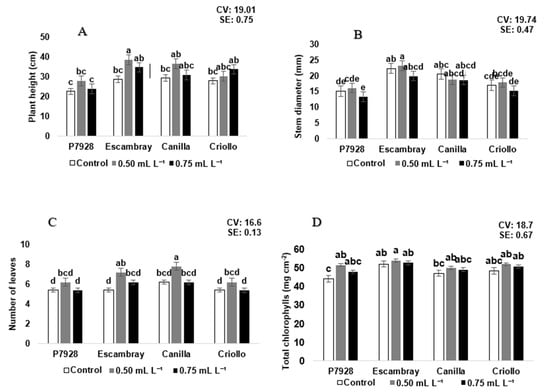
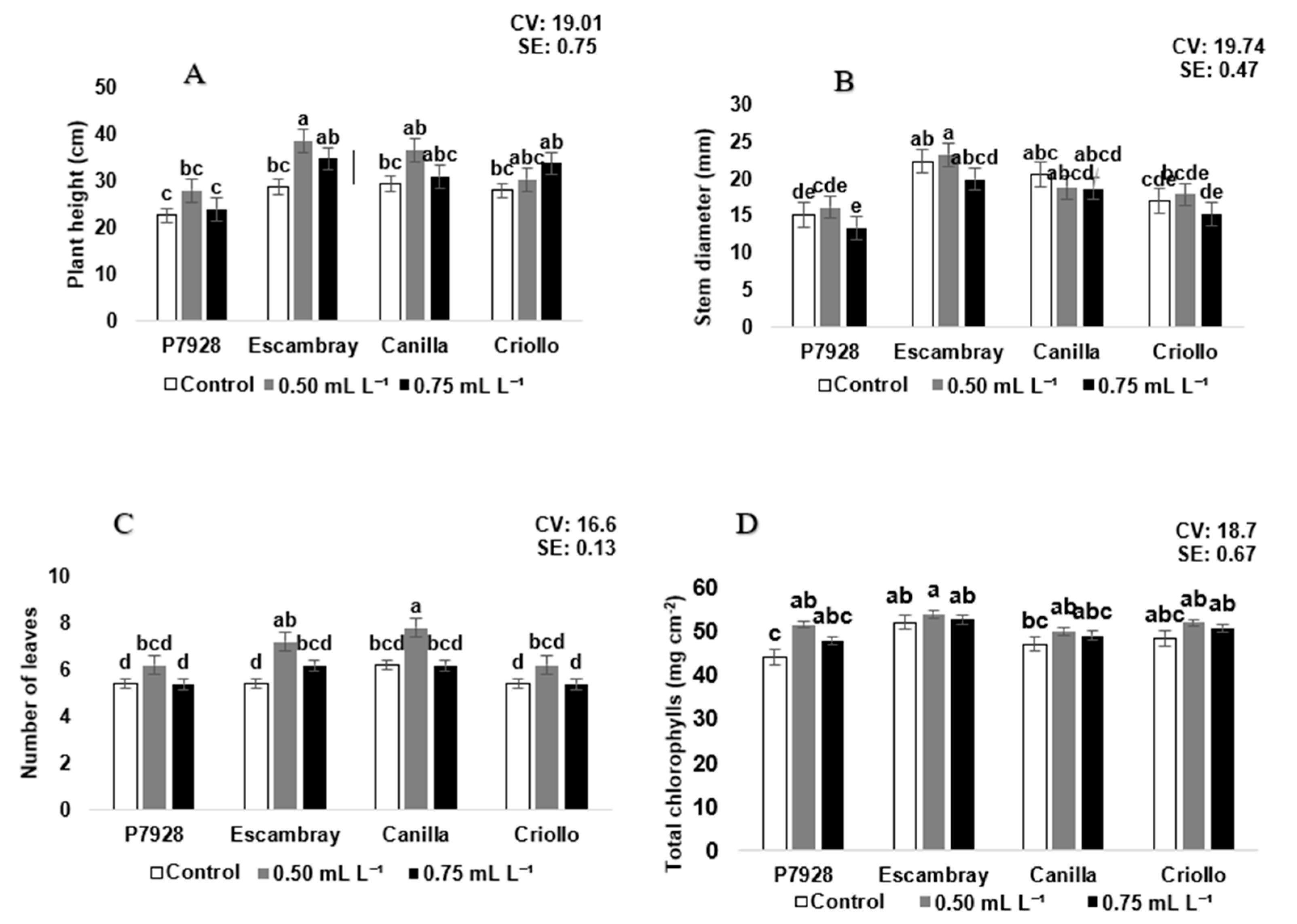
Analysis of the parameters presented in Figure 1 revealed a positive plant response to amino acid application. Plant height reached its maximum value at a concentration of 0.50 mL L−1, although no significant differences were observed compared to the 0.75 mL L−1 treatment. In contrast, the control treatment consistently showed lower plant height across all four evaluated varieties (Figure 1A).
Figure 1.
Morphological and physiological responses of four maize varieties at 35 days after germination (DAG) under three foliar treatments: untreated control, VIUSID Agro® at 0.50 mL L−1, and VIUSID Agro® at 0.75 mL L−1. (A) Plant height (cm). (B) Stem diameter (cm). (C) Number of leaves. (D) Total chlorophyll content (SPAD readings). Data are presented as means ± SE of three independent experimental plots per variety × treatment combination. Ten plants were sampled per plot, and their measurements were averaged before statistical analysis. Different letters indicate statistically significant differences according to Tukey’s multiple range test (p < 0.05) where applicable.
Stem diameter showed no significant differences among treatments within each variety; however, the 0.75 mL L−1 concentration consistently resulted in the lowest values (Figure 1B). Although at 35 days after germination (DAG) the stems had not yet reached full development, stem diameter did not differ significantly among treatments.
Regarding leaf number, the 0.50 mL L−1 treatment produced a higher number of leaves across all evaluated varieties, with significant differences compared to the other treatments, except in the Criollo variety, where no differences were observed (Figure 1C). Notably, the Canilla variety treated with 0.50 mL L−1 exhibited the highest leaf number at 35 DAG.
At 35 DAG, total chlorophyll content showed no significant differences among treatments within each variety, except for the control in P7928, which differed from the 0.50 mL L−1 treatment (Figure 1D). Overall, chlorophyll values were similar across all treatments and varieties. These results are consistent with the early developmental stage of the plants, as their foliar and root systems were not yet fully developed.
2.1.2. Plant Indicators at 60 DAG
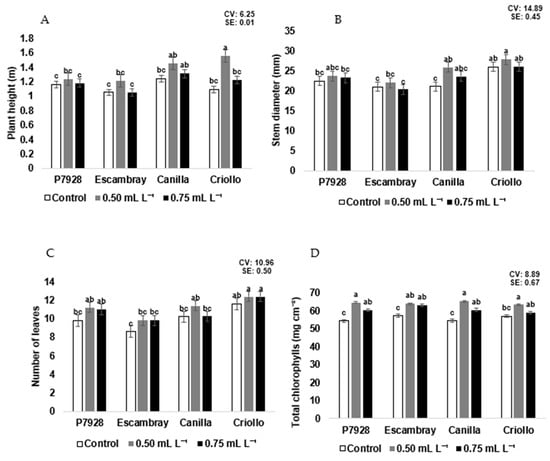
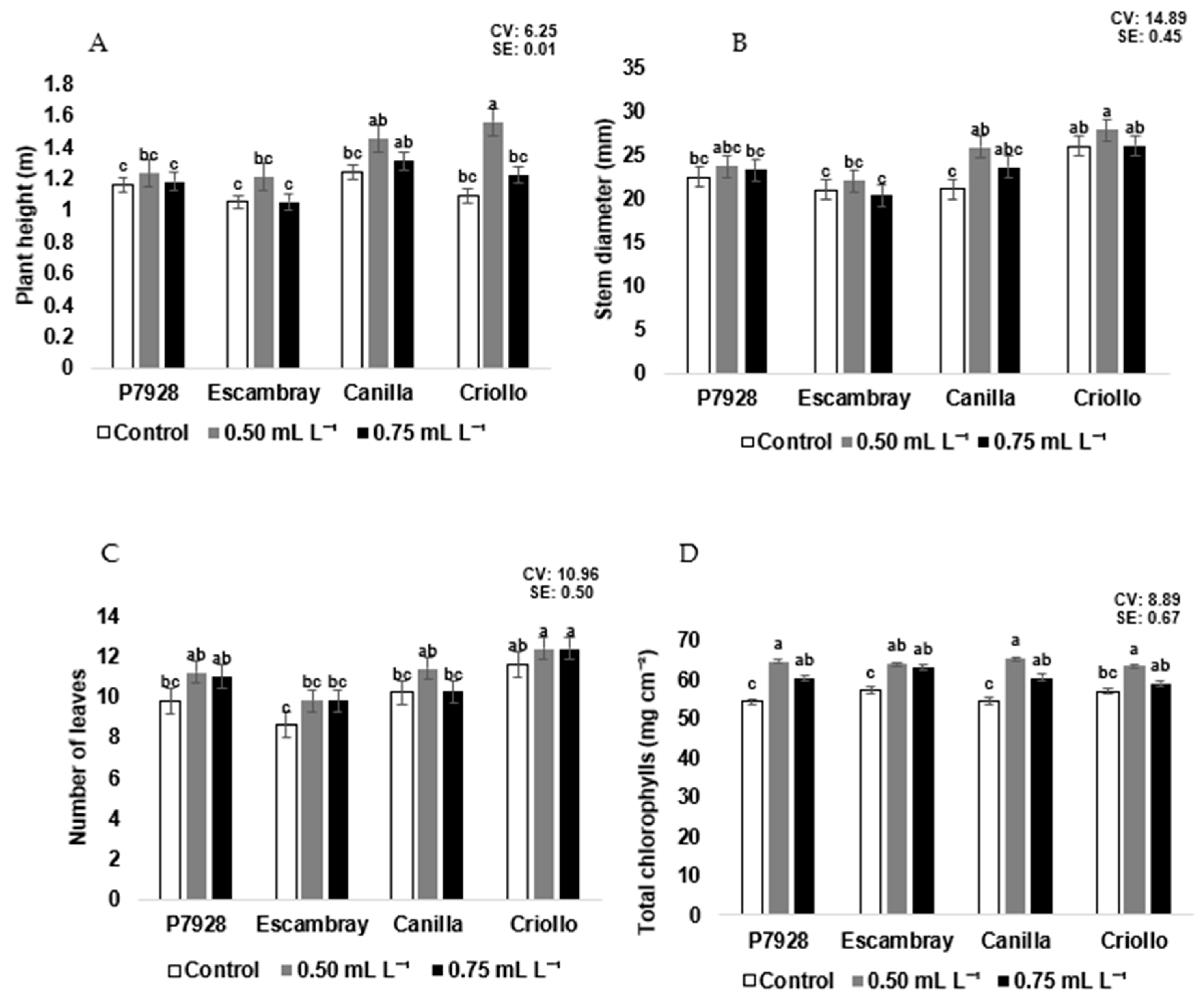
At 60 DAG, the morphophysiological response of the plants to amino acid application remained favorable, consistent with the results observed at 35 DAG. Plant height was greatest under the 0.50 mL L−1 treatment in all evaluated varieties; however, in P7928 and Escambray, these differences were not statistically significant compared to the other treatments (Figure 2A). In contrast, the Criollo and Canilla varieties showed marked increases, exceeding the control by 43% and 16%, respectively.
Figure 2.
Plant response at 60 DAG in the absence of biostimulant treatments (control), biostimulant at 0.50 mL L−1, and at 0.75 mL L−1. (A) Plant height (cm); (B) stem diameter (cm); (C) number of leaves; (D) total chlorophyll content (SPAD readings). Data are presented as means ± SE of three independent experimental plots per variety × treatment combination. Ten plants were sampled per plot, and their measurements were averaged before statistical analysis. Different letters indicate statistically significant differences according to Tukey’s multiple range test (p < 0.05), where applicable.
Stem diameter showed a response pattern similar to that observed at 35 DAG (Figure 2B), with no significant differences among treatments within each variety, except for the Canilla variety, where biostimulant treatments resulted in higher values compared to the untreated control. As observed for the previous parameter, the Canilla and Criollo varieties exhibited the most favorable responses. These results indicate that the biostimulant acted by enhancing the intrinsic growth potential of each variety rather than altering the relative ranking among genotypes.
The number of leaves showed a general trend in favor of biostimulant treatments; however, no significant differences were detected among treatments within each variety (Figure 2C). The Canilla variety recorded the highest leaf number, whereas Escambray showed the lowest values. It is important to note that leaf number in maize is a trait regulated by the interaction between genetic and environmental factors, which act synergistically.
At 60 DAG, SPAD readings were numerically higher in plants receiving VIUSID Agro® than in untreated plants across the evaluated varieties. However, these differences were not statistically significant for all variety × treatment combinations (Figure 2D).
2.2. Physiological Variables at 60 DAG
The growth indices were calculated from dry biomass and leaf area measurements obtained at 35 and 60 DAG. AGR represents the absolute rate of dry matter accumulation per plant, whereas RGR expresses biomass accumulation relative to the existing plant biomass. NAR represents dry matter accumulation per unit of leaf area and time. These parameters provide integrated estimates of plant growth performance but should not be interpreted as direct measurements of photosynthetic gas exchange or carbon assimilation rates.
2.2.1. Absolute Growth Rate
Throughout the crop growth cycle, the highest dry mass accumulation rates per unit of time were observed under the 0.50 mL L−1 treatment across all evaluated varieties, although no significant differences were found compared to the 0.75 mL L−1 treatment. In contrast, the control consistently exhibited the lowest rates and differed significantly from the biostimulant treatments (Table 1).
Table 1.
Absolute Growth Rate (AGR), Net Assimilation Rate (NAR) and Relative Growth Rate (RGR) of four maize varieties under untreated control conditions (Control), biostimulant at 0.5 mL L−1 of water and biostimulant at 0.75 mL L−1 of water. Growth indices were calculated from plant dry weight and leaf area measurements obtained at 35 and 60 days after germination (DAG). Values are presented as means ± SE. The experimental plot (four rows, 3 m in length) was considered the experimental unit. Means followed by different letters differ according to Tukey’s test (p < 0.05). Ten plants were sampled within each plot, and their measurements were averaged to obtain one value per plot. Therefore, n = 3 independent experimental plots per variety × foliar treatment combination. Statistical analyses were performed considering the 4 × 3 factorial arrangement within a randomized complete block design.
The increase in dry mass accumulation under the 0.50 mL L−1 treatment, relative to the control, ranged from 11.2% to 33.4% across the evaluated varieties. These results indicate that the 0.50 mL L−1 treatment was associated with a higher absolute rate of dry matter accumulation during the evaluated growth interval. However, the magnitude of the response varied among varieties, and differences between the two biostimulant concentrations were not statistically significant in all cases. The relatively high coefficients of variation observed for AGR (31.9%) and NAR (29.6%) indicate considerable variability in these indices under the experimental field conditions and should be considered when interpreting the results.
2.2.2. Net Assimilation Rate
At 60 DAG, the NAR values were generally higher in plants receiving the biostimulant than in untreated plants. The 0.50 mL L−1 treatment showed the highest values across the evaluated varieties, although the magnitude and statistical significance of the differences varied among genotypes (Table 1). As NAR was estimated from changes in dry biomass and leaf area between 35 and 60 DAG, these results indicate differences in dry matter accumulation per unit of leaf area and time. Therefore, NAR should be interpreted as an integrated growth index rather than as a direct measurement of photosynthetic activity or carbon assimilation. In general, untreated plants showed lower NAR values than biostimulant-treated plants, while the Canilla and Criollo varieties exhibited comparatively high values.
2.2.3. Relative Growth Rate
The Relative Growth Rate (RGR) represents the rate of biomass increase relative to the existing plant biomass over a given period. The results showed that plants receiving VIUSID Agro® at 0.50 mL L−1 generally exhibited higher RGR values than untreated plants, although in some varieties no significant differences were observed compared with the 0.75 mL L−1 treatment (Table 1). The highest RGR values under the 0.50 mL L−1 treatment ranged from 0.0846 to 0.0883 g g−1 day−1 across the evaluated varieties. These results indicate differences in relative biomass accumulation among treatments, with the magnitude of the response depending on the maize genotype.
2.3. Membrane Stability
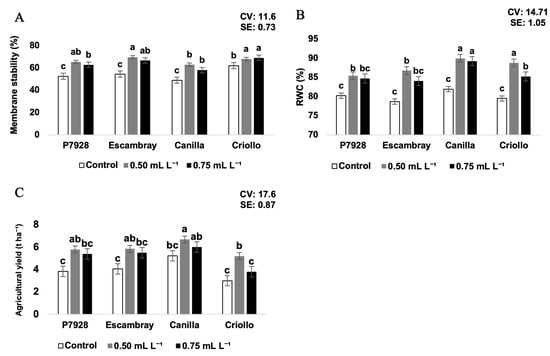
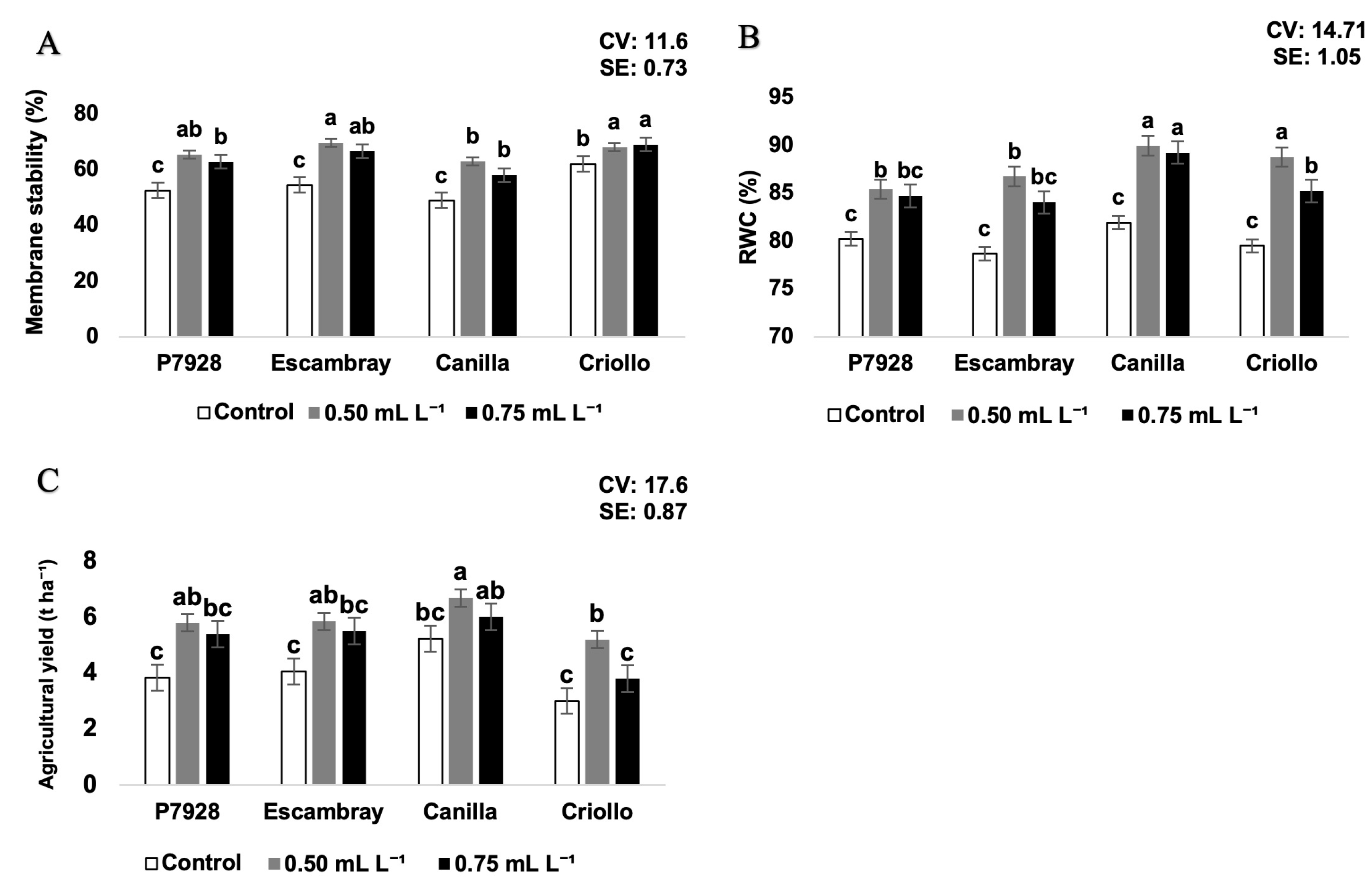
Membrane stability was significantly improved by biostimulant application. The 0.50 mL L−1 treatment produced the highest values, differing significantly (p < 0.05) from the control but not from the 0.75 mL L−1 treatment, with an increase of more than 12.0% relative to the control (Figure 3A).
Figure 3.
Membrane stability index (MSI) (A), relative water content (RWC) (B), and grain yield at physiological maturity (C) in maize plants receiving foliar applications of VIUSID Agro® at 0.50 and 0.75 mL L−1 or the untreated control. Data are presented as means ± SE of three independent experimental plots per variety × treatment combination. Different letters indicate statistically significant differences according to Tukey’s test (p < 0.05), where applicable.
2.4. Relative Water Content
All biostimulant treatments had a positive effect on relative water content (RWC), showing significantly higher values (p < 0.05) compared to the control across all of the evaluated varieties (Figure 3B). Biostimulant application was associated with higher RWC values, indicating improved leaf hydration relative to the untreated control under the experimental conditions. In contrast, the control treatment did not exceed 80% RWC in any of the varieties studied.
2.5. Agricultural Yield
Grain yield responses to VIUSID Agro® varied among maize varieties and foliar application rates (Figure 3C and Supplementary Table S2). At 0.50 mL L−1, yield increased by 28.1–73.3% compared with the untreated control, depending on the variety. The greatest relative increase was observed in Criollo (73.3%), followed by P7928 (51.0%), Escambray (44.1%), and Canilla (28.1%). When averaged across the four varieties, mean grain yield increased from 4.03 t ha−1 in the untreated control to 5.89 t ha−1 at 0.50 mL L−1, corresponding to an overall increase of 46.0%. At 0.75 mL L−1, mean grain yield reached 5.18 t ha−1, representing an increase of 28.4% relative to the untreated control. These results indicate that the magnitude of the yield response varied with the application rate and maize genotype. These yield responses were accompanied by differences in several morphophysiological traits; however, the present study does not establish a causal relationship between individual physiological indicators and grain yield. Statistical comparisons between the 12 variety × foliar treatment combinations (analyzed using a 4 × 3 factorial ANOVA followed by Tukey’s HSD test, p < 0.05) revealed significant interaction effects for grain yield, as well as for key physiological parameters (Table 1, Figure 3). The experimental uncertainty for all parameters is presented as Standard Errors (SE) of the mean across n = 3 independent plot replicates.
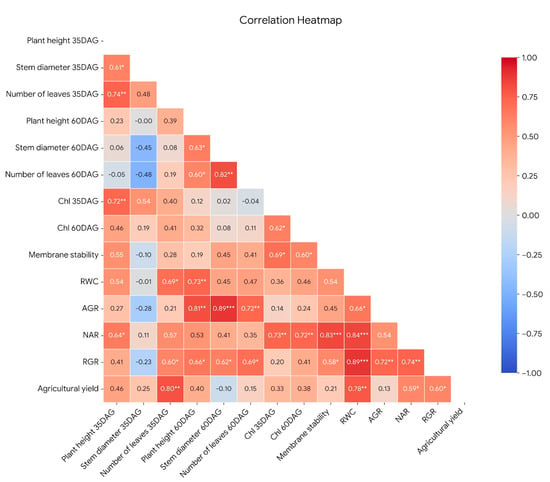
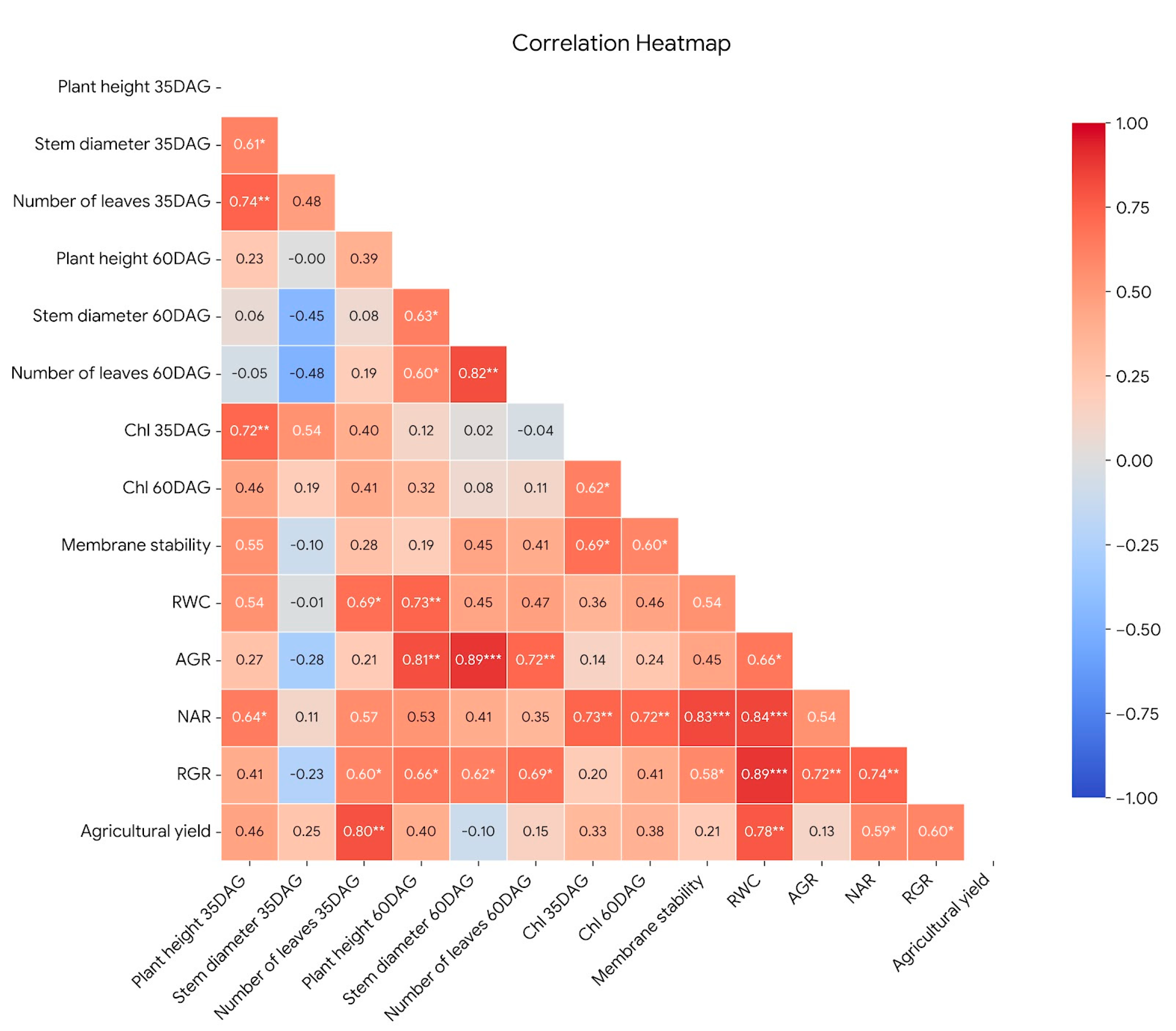
Pearson correlation analysis was performed to explore the associations among morphological, physiological, growth-related, and productivity variables across the four maize cultivars and three foliar treatments (Figure 4). Positive associations were observed among several physiological and growth-related parameters. In particular, relative water content (RWC) was positively correlated with grain yield (r = 0.78, p < 0.01), net assimilation rate (NAR; r = 0.84, p < 0.001), relative growth rate (RGR; r = 0.89, p < 0.001), and absolute growth rate (AGR; r = 0.66, p < 0.05). Membrane stability was also positively correlated with NAR (r = 0.83, p < 0.001) and RGR (r = 0.58, p < 0.05). Furthermore, chlorophyll content at 35 and 60 days after germination (DAG) was positively associated with NAR (r = 0.73 and r = 0.72, respectively; p < 0.01). These associations describe the coordinated variation in several plant traits under the evaluated experimental conditions. However, because the correlations were calculated using the mean values of the three experimental replicates for each cultivar–treatment combination, they may partly reflect differences among experimental groups. Therefore, these relationships should be interpreted as exploratory associations rather than evidence of independent physiological relationships or causal effects.
Figure 4.
Pearson correlation heatmap showing the relationships among morphological, physiological, growth, and productivity variables evaluated in maize plants treated with amino acid-based biostimulants. Correlations were calculated using the mean values of the three experimental replicates for each cultivar–treatment combination (n = 12). These associations are exploratory and should not be interpreted as evidence of causal relationships. Cell values represent Pearson correlation coefficients (r), with red colors indicating positive correlations and blue colors indicating negative correlations. Color intensity is proportional to the magnitude of the Pearson correlation coefficient. Asterisks indicate statistical significance (* p < 0.05, ** p < 0.01, and *** p < 0.001). DAG: Days after germination. Chl: Chlorophyll content. RWC: Relative water content. AGR: Absolute growth rate. NAR: Net assimilation rate. RGR: Relative growth rate.
3. Discussion
3.1. Non-Linear Dose-Dependent Responses and Carbon–Nitrogen Balance
The present study indicates that foliar application of the amino acid-based biostimulant VIUSID Agro® significantly improved maize growth, physiological performance, and grain yield, although the magnitude of the response depended on both the applied concentration and the genotype. Among the evaluated treatments, 0.50 mL L−1 consistently promoted the greatest improvements in vegetative growth, biomass accumulation, physiological traits, and productivity, indicating that the response to this amino acid-based formulation follows a dose-dependent pattern [17]. These findings are consistent with previous reports demonstrating that amino acid-based biostimulants are thought to enhance crop performance through interconnected metabolic pathways [3,15,22].
The coordinated increase in plant height, stem diameter, leaf area, and fresh and dry biomass indicates that VIUSID Agro® application was associated with an overall improvement in vegetative growth. These responses may be related to the combined composition of the formulation, which contains free amino acids and organic nitrogen. Previous studies have described potential physiological functions of individual amino acids, including their participation in nitrogen metabolism, protein synthesis, signaling, and stress-related responses [3,22]. Likewise, aspartic acid occupies a central position in nitrogen metabolism by serving as a precursor for the biosynthesis of several amino acids, whereas glycine contributes to photorespiration, one-carbon metabolism, and chlorophyll biosynthesis. The simultaneous availability of these amino acids probably reduced the metabolic cost associated with endogenous amino acid synthesis, allowing greater allocation of carbon and energy toward vegetative growth and biomass production. Although osmoprotectants such as proline and glycine betaine are frequently associated with improved membrane stability and osmotic adjustment under stress conditions [23,24], these compounds are not major constituents of VIUSID Agro®. Nevertheless, because the present study evaluated a complete commercial formulation rather than individual amino acid treatments, it is not possible to identify the contribution of specific compounds or establish which metabolic pathways were responsible for the observed responses. In particular, the involvement of polyamines, nitric oxide, antioxidant regulation, and chloroplast protection remains hypothetical, as these compounds and processes were not directly measured in the present experiment.
The superior performance of plants treated with VIUSID Agro® may be associated with the combined effects of its amino acid composition and other components of the formulation. Free amino acids have been described as compounds involved in primary metabolism, protein synthesis, and nutrient-related processes [25]. However, the formulation also contains 1.8% organic nitrogen, which may have contributed an additional nitrogen input to the treated plants. Although all experimental plots received the same basal nitrogen fertilization through urea, the experimental design did not include a nitrogen-matched control to distinguish the nutritional contribution of the nitrogen contained in VIUSID Agro® from the potential biostimulant effects of its amino acid components. Therefore, the observed increases in plant growth and biomass should be interpreted as responses to the complete formulation, and the relative contributions of additional nitrogen and amino acid-mediated physiological effects cannot be determined independently from the present experiment.
The increases observed in absolute growth rate (AGR), relative growth rate (RGR), and net assimilation rate (NAR) indicate differences in dry matter accumulation and growth performance among treatments. These indices provide integrated estimates of plant growth over the evaluated period, based on changes in biomass and, in the case of NAR, leaf area. However, they do not constitute direct measurements of photosynthetic gas exchange, carbon assimilation, or photosynthetic efficiency. Although previous studies have associated amino acid-based biostimulant application with changes in nitrogen metabolism and photosynthetic processes [25,26], the involvement of these mechanisms in the responses observed in the present study remains to be investigated.
The higher SPAD readings recorded in treated plants indicate an increase in relative leaf greenness or chlorophyll-related optical readings. However, SPAD measurements do not independently demonstrate increased chlorophyll biosynthesis or enhanced photosynthetic capacity. Although SPAD readings are commonly associated with leaf chlorophyll status and may provide indirect information related to plant nitrogen status, neither chlorophyll concentration nor photosynthetic gas exchange was directly quantified in the present study. Therefore, the observed differences in SPAD values should be interpreted as changes in relative chlorophyll-related readings rather than direct evidence of increased photosynthetic activity. Since nitrogen is an essential component of chlorophyll and photosynthetic proteins, both the organic nitrogen contained in the formulation and the potential metabolic effects of its amino acids may have contributed to the observed response [25,26]. Nevertheless, because nitrogen uptake and chlorophyll concentration were not independently quantified, the specific contribution of each mechanism cannot be established from the present results. This interpretation is consistent with the simultaneous increases in NAR and biomass accumulation. However, since NAR is derived from changes in dry biomass and leaf area rather than from direct measurements of gas exchange, these results indicate greater dry matter accumulation per unit of leaf area and time, but do not independently demonstrate an increase in photosynthetic efficiency [27].
Beyond promoting vegetative growth, VIUSID Agro® improved membrane stability index (MSI) and relative water content (RWC), suggesting improved membrane integrity and plant water status. MSI and RWC are widely used physiological indicators of plant responses to abiotic stress, as they provide information on membrane stability and tissue water status, respectively [20,21]. The simultaneous improvement in MSI, RWC, chlorophyll content and growth indices indicates that these variables should not be interpreted as isolated physiological responses but rather as components of an integrated regulatory network. Membrane stability is essential for maintaining selective ion transport, ATP synthesis and chloroplast organization, whereas adequate tissue hydration preserves cell turgor, stomatal conductance and carbon assimilation. Consequently, improvements in membrane integrity and plant water status may have contributed to maintaining favorable growth conditions, which is consistent with the higher NAR values and greater biomass accumulation recorded following application of VIUSID Agro®. Nevertheless, these growth indices do not provide direct evidence of increased photosynthetic efficiency, and further measurements of gas exchange would be required to establish such a relationship. Similar coordinated physiological responses have been described for amino acid-based biostimulants and protein hydrolysates, which improve stress resilience by simultaneously enhancing antioxidant metabolism, membrane stability and nutrient assimilation [3,22].
The correlation analysis revealed positive associations among relative water content (RWC), membrane stability, chlorophyll content, growth indices, and grain yield. In particular, the positive correlation between RWC and grain yield suggests that the maintenance of leaf water status was associated with greater productivity across the evaluated cultivar–treatment combinations. Similarly, the associations of RWC with NAR and RGR, together with the positive correlation between membrane stability and NAR, indicate that plants exhibiting better water status and membrane integrity also tended to show higher growth-related values. Nevertheless, these relationships should be interpreted cautiously. The correlation analysis was based on 12 observations corresponding to the four maize cultivars under the three foliar treatments, with each observation representing the mean of three experimental replicates. Consequently, the observed correlations may partly reflect differences among cultivars and treatments rather than independent relationships among physiological traits. Furthermore, correlation does not establish causality or demonstrate that changes in individual physiological variables directly mediated the yield responses. Additional analyses using plot-level observations and accounting for cultivar, treatment, and experimental block would be required to determine the robustness of these associations.
An important finding of the present study was that increasing the concentration of VIUSID Agro® from 0.50 to 0.75 mL L−1 did not result in additional improvements in growth or yield. On the contrary, although both concentrations generally outperformed the untreated control, the lower dose consistently produced superior responses across most morphophysiological and productive variables. This pattern indicates that the response of maize to amino acid-based biostimulants is not linear but follows a dose-dependent behavior, in which optimal physiological stimulation occurs within a relatively narrow concentration range. One possible explanation for the absence of additional benefits at 0.75 mL L−1 is a non-linear response to the applied concentration. Previous studies have discussed the possibility that excessive concentrations of biostimulant compounds may alter metabolic regulation or nutrient balance [3,22]. However, carbon–nitrogen balance and metabolic feedback were not measured in the present study, and these processes should therefore be regarded as hypotheses requiring experimental verification. The superior performance observed at 0.50 mL L−1 therefore appears to reflect an optimal balance between metabolic stimulation and maintenance of physiological equilibrium. At this concentration, the exogenous amino acid supply was apparently sufficient to enhance nitrogen metabolism, photosynthetic performance, membrane stability and water status without triggering the regulatory constraints frequently associated with excessive substrate availability. This interpretation agrees with the current concept that biostimulants act primarily by optimizing plant metabolism rather than by supplying large quantities of nutrients, emphasizing that identification of the appropriate application rate is essential for maximizing agronomic efficiency [3,5,22].
3.2. Genotype-Dependent Sensitivity and Agronomic Performance
Another significant finding of this study was the differential response of the four maize varieties to treatment with the biostimulant. Statistical evidence of this genotype-dependent effect is supported by Tukey’s post-hoc comparisons of means (p < 0.05) between the 4 × 3 factorial combinations (Table 1, Figure 1, Figure 2 and Figure 3) and by the marked percentage increases in grain yield specific to each variety compared with their controls (Supplementary Table S2). For example, under the 0.50 mL L−1 treatment, gains in grain yield ranged from 28.1 per cent in Canilla to 73.3 per cent in Criollo. These results indicate that the magnitude of the agronomic response to the biostimulant is strongly modulated by the crop’s genetic background under field conditions [28]. The correlation analysis provides additional support for this interpretation by demonstrating that grain yield was associated with a coordinated network of physiological traits rather than with any single variable. Particularly strong relationships between membrane stability, relative water content, chlorophyll content, assimilatory efficiency and biomass accumulation indicate that the beneficial effects of VIUSID Agro® emerged from simultaneous optimization of multiple physiological processes. These findings reinforce the concept that amino acid-based biostimulants improve crop performance through systemic regulation of plant metabolism rather than isolated effects on individual growth parameters.
3.3. Integrated Physiological Mechanisms and Conceptual Framework
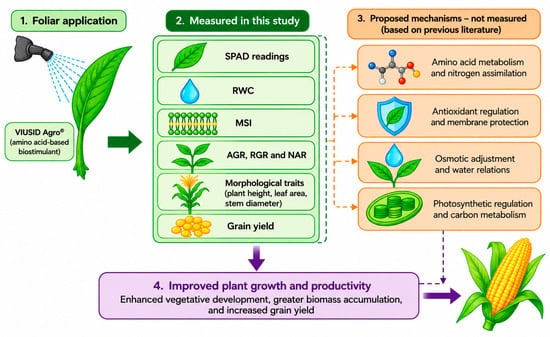
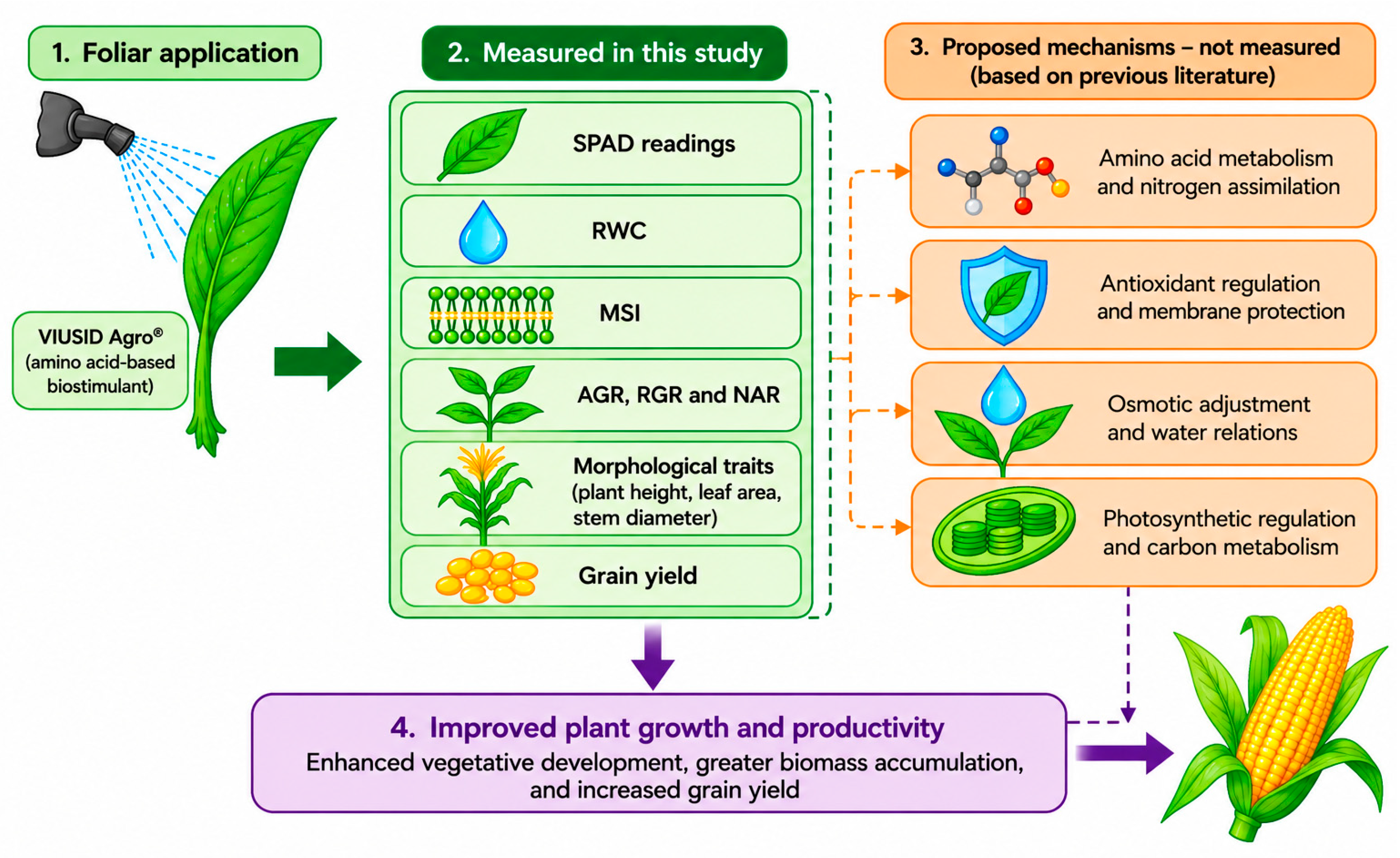
The conceptual model presented in Figure 5 summarizes the physiological mechanisms proposed to explain the effects of the evaluated biostimulant on maize performance. Rather than acting through a single metabolic pathway, the amino acid-based biostimulant appears to be associated with coordinated changes in plant physiological performance and response involving improvements in nitrogen metabolism, membrane stability, plant water status and photosynthetic efficiency. The amino acids supplied by the formulation, particularly arginine, glycine and aspartic acid, likely function as readily available metabolic precursors that may contribute to nitrogen assimilation while reducing the energetic costs associated with de novo amino acid biosynthesis. The observed increase in chlorophyll content, together with improved membrane integrity and tissue hydration, may create favorable physiological conditions for greater carbon assimilation and biomass accumulation, ultimately leading to increased grain yield. This conceptual interpretation is consistent with the positive associations observed among several measured variables, although the proposed biochemical pathways were not directly evaluated in this experiment. The close associations among SPAD values, MSI, RWC, growth indices and grain yield indicate that these variables constitute interconnected components of plant physiological performance rather than independent traits. The observed associations suggest that membrane stability, plant water status, and growth indices may provide complementary information for interpreting the variation in maize productivity under the evaluated conditions.
Figure 5.
Conceptual framework distinguishing the variables measured experimentally from the physiological mechanisms proposed based on the previous literature. Measured outcomes included SPAD readings, relative water content (RWC), membrane stability index (MSI), growth indices (AGR, RGR, and NAR), morphological traits, and grain yield. Proposed mechanisms, including amino acid metabolism, nitrogen assimilation, antioxidant regulation, osmotic adjustment, and photosynthetic regulation, are presented as literature-based hypotheses and were not directly measured in this study. Dashed arrows indicate proposed relationships rather than experimentally established causal pathways.
The present study also provides practical evidence that optimization of biostimulant concentration is as important as the selection of the biostimulant itself. Although amino acid-based formulations have consistently demonstrated positive effects on crop performance, their physiological activity depends on maintaining an appropriate balance between metabolic stimulation and cellular homeostasis. Consequently, the superior performance obtained with 0.50 mL L−1 highlights the importance of defining crop-specific application rates rather than assuming that higher doses necessarily produce greater responses. This information is particularly relevant for maize production systems in tropical environments, where high temperatures, irregular rainfall and variable soil fertility can constrain crop growth and productivity.
An additional contribution of this work is the evaluation of four contrasting maize genotypes under field conditions, allowing the identification of genotype-dependent responses to amino acid-based biostimulation. While previous studies have generally focused on single cultivars or controlled environments, the present results indicate that the effectiveness of the evaluated biostimulant is influenced by the genetic background of the crop. These findings emphasize that future recommendations for biostimulant use should consider genotype × environment × management interactions to maximize agronomic performance under diverse production systems. This approach aligns with recent strategies emphasizing synchronized water and nutrient supply to optimize crop physiological mechanisms under variable field environments [29].
Although the physiological mechanisms proposed here are supported by the coordinated responses observed in morphophysiological traits and by previous evidence describing the metabolic functions of amino acids, some limitations should be acknowledged. The present study did not directly quantify nitrate reductase activity, endogenous polyamine concentrations, antioxidant enzyme activities or gas exchange parameters. Consequently, the proposed mechanisms should be regarded as biologically plausible interpretations rather than direct experimental confirmation. Future studies integrating physiological, biochemical and molecular approaches—including measurements of photosynthetic gas exchange, chlorophyll fluorescence, nitrogen assimilation enzymes, polyamine metabolism and oxidative stress markers—would provide a more comprehensive understanding of the regulatory pathways through which amino acid-based biostimulants enhance maize productivity.
Overall, the present findings indicate that foliar application of the evaluated biostimulant at 0.50 mL L−1 was associated with improvements in several measured morphophysiological traits and grain yield across the maize genotypes evaluated under tropical field conditions. The results also indicate that the magnitude of the response depended on genotype and application concentration, highlighting the importance of considering genotype-dependent responses when evaluating biostimulant formulations. Nevertheless, the present experiment was not designed to quantify resource-use efficiency or environmental performance. Nitrogen-use efficiency, water-use efficiency, fertilizer replacement, energy balance, greenhouse gas emissions, and economic returns were not assessed. Therefore, although the observed yield responses are agronomically relevant, their implications for resource efficiency and agricultural sustainability remain to be established. Further studies involving multi-environment field trials, resource-use measurements, economic assessments, and environmental indicators are required to determine whether the application of VIUSID Agro® can provide measurable sustainability benefits at the cropping-system level.
4. Materials and Methods
The experiment was conducted under open-field conditions in the experimental area of José Martí Pérez University (21.932829084635333, −79.43423250746112), located in Sancti Spíritus, Cuba, from March to June 2025 (sowing in mid-March, emergence in late March/early April, and harvest in mid-June 2025). The soil type at the experimental site is classified as a Chromic Vertisol. Baseline soil chemical analyses (pH, organic matter, available N, P, K) were not conducted prior to establishing the experiment, which is explicitly acknowledged as a study limitation. Four maize varieties were used, provided by the Provincial Seed Laboratory of the Ministry of Agriculture in Sancti Spíritus. The varieties evaluated were P7928, Escambray, Canilla, and Criollo.
The amino acid source applied was the biostimulant VIUSID agro®, produced by the Spanish company Catalysis. According to the manufacturer, its composition includes aspartic acid (1.6%), arginine (2.5%), glycine (2.4%), tryptophan (0.5%), and organic nitrogen (1.8%), with a pH of 6.80 and a net mass of 1.14 kg [11]. Therefore, in addition to providing free amino acids, the formulation represents a potential source of nitrogen that should be considered when interpreting plant responses to its foliar application.
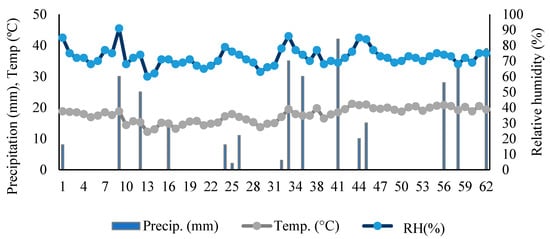
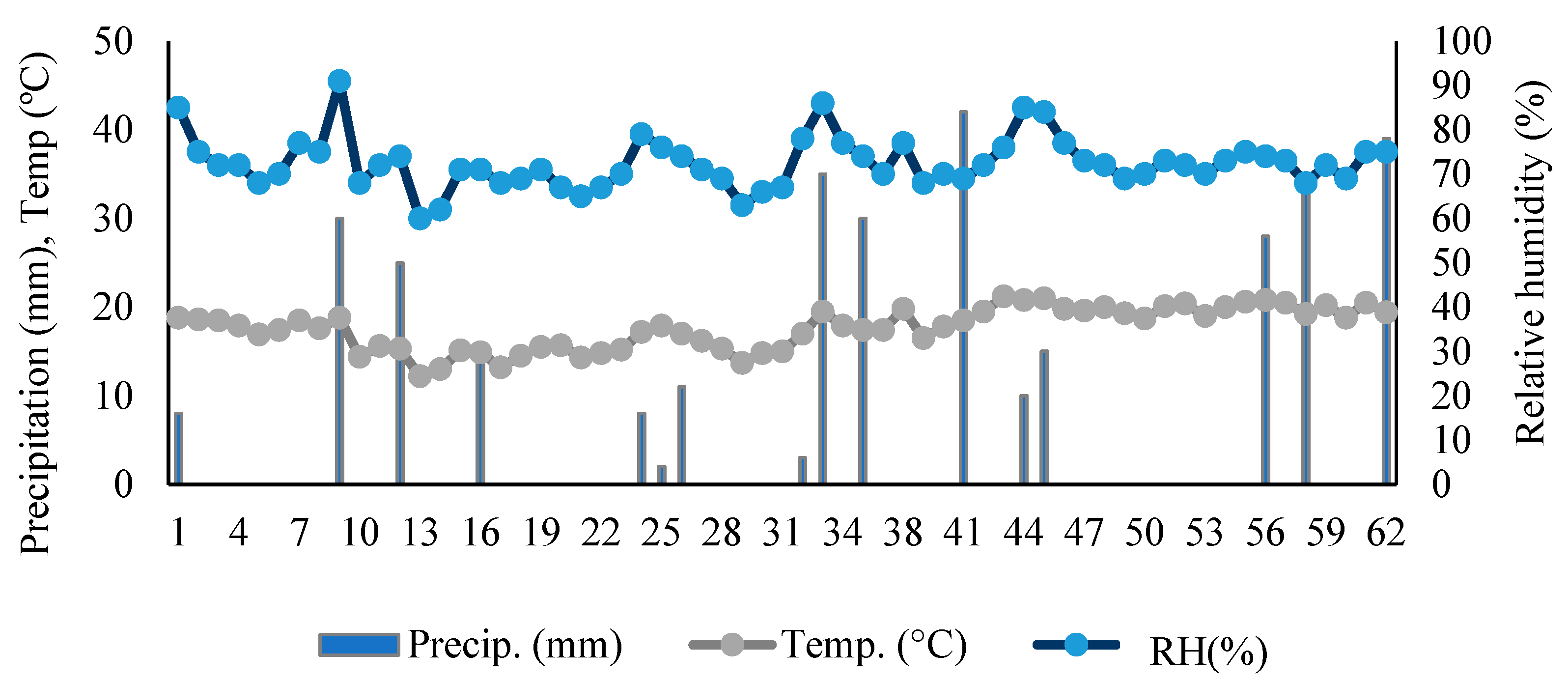
VIUSID Agro® was applied on six occasions during the vegetative growth period, beginning 7 days after germination (DAG) and continuing at weekly intervals. Based on the cumulative product volumes reported in Supplementary Table S1, the total amounts applied were 608 and 912 mL ha−1 for the 0.50 and 0.75 mL L−1 treatments, respectively. Assuming a product density of 1.0 g mL−1 and an organic nitrogen concentration of 1.8% (w/w), these volumes correspond to estimated nitrogen inputs of 10.94 and 16.42 g N ha−1, respectively. Nitrogen fertilization was performed using urea (46% N) at a rate of 129 kg ha−1, equivalent to approximately 59.3 kg N ha−1, applied 30 days after germination. This nitrogen fertilization was identical across treatments. Thus, the estimated nitrogen contribution from VIUSID Agro® was very small compared with the basal nitrogen input. However, the experimental design did not include a nitrogen-matched treatment to distinguish the nutritional contribution of the nitrogen contained in VIUSID Agro® from the potential biostimulant effects of its amino acid components. Climatic variables were recorded by the Sancti Spíritus Provincial Meteorological Station (Figure 6).
Figure 6.
Climate variables from Sancti Spíritus Provincial Meteorological Station, Cuba.
4.1. Experimental Design, Method of Application and Treatments
The experiment was established as a 4 × 3 factorial arrangement (four varieties × three foliar treatments) within a randomized complete block design with three replicates, resulting in a total of 36 experimental plots. Each block contained one replicate of each variety × foliar treatment combination. The experimental unit was the individual plot, and the three blocks represented the biological replicates of each treatment combination. The first factor consisted of four maize varieties (P7928, Escambray, Canilla, and Criollo), while the second factor corresponded to three foliar treatments: distilled water (control), VIUSID Agro® applied at 0.50 mL L−1, and VIUSID Agro® applied at 0.75 mL L−1. This factorial combination resulted in 12 treatment combinations randomly distributed within each block. The planting arrangement was 0.90 × 0.30 m, with one seed per planting hole. Each experimental plot consisted of four rows, each 3 m in length, with an inter-row spacing of 0.90 m. Thus, each plot contained 40 plants, corresponding to approximately 10 plants per row. For evaluations, 10 plants per treatment were randomly selected. The VIUSID Agro® concentrations evaluated in this study (0.50 and 0.75 mL L−1) were selected primarily based on the manufacturer’s recommendations for broadacre cereal crops. These concentrations were chosen as application rates for comparative field evaluation and should not be interpreted as previously established optimal doses, since no fully documented or statistically validated dose–response experiment was conducted prior to the present study. From an agronomic perspective, the 0.50 mL L−1 concentration represented a lower application rate, whereas the 0.75 mL L−1 concentration was included to evaluate whether increasing the concentration would provide additional benefits in maize under field conditions. The selection of these concentrations allowed the assessment of contrasting application rates within the range considered suitable for agricultural use. However, the experiment was not designed as a comprehensive dose–response study, and therefore the results should be interpreted as a comparison between two selected concentrations rather than as the determination of an absolute optimum application rate. Each experimental plot constituted one independent experimental unit. The ten plants sampled within each plot were treated as subsamples, and plot-level values were used for statistical analysis. The experiment therefore comprised 12 treatment combinations, three blocks, and 36 experimental plots.
Two concentrations of the biostimulant VIUSID agro® (produced by Catalysis) were applied:
- 0.50 mL L−1 of water;
- 0.75 mL L−1 of water.
The treatments were as follows:
- P7928 + water (control);
- P7928 + VIUSID agro® (0.50 mL L−1);
- P7928 + VIUSID agro® (0.75 mL L−1);
- Escambray + water (control);
- Escambray + VIUSID agro® (0.50 mL L−1);
- Escambray + VIUSID agro® (0.75 mL L−1);
- Canilla + water (control);
- Canilla + VIUSID agro® (0.50 mL L−1);
- Canilla + VIUSID agro® (0.75 mL L−1);
- Criollo + water (control);
- Criollo + VIUSID agro® (0.50 mL L−1);
- Criollo + VIUSID agro® (0.75 mL L−1).
VIUSID Agro® was applied on six occasions during the vegetative growth period, beginning at 7 days after germination (DAG). The application dates and corresponding product volumes per hectare are detailed in Supplementary Table S1. The spray solution was prepared at the respective concentrations of 0.50 and 0.75 mL L−1, with application volumes adjusted according to the spray volume used at each application. This repeated foliar application strategy was intended to evaluate the response of maize plants to biostimulant treatment during early and intermediate vegetative development. Applications were performed using a previously calibrated 10 L manual backpack sprayer Orework (Galicia, España). The spray solution was prepared by diluting the precise volume of the biostimulant (0.50 mL or 0.75 mL) per liter of water directly in the sprayer tank, followed by continuous agitation to ensure a homogeneous mixture. Spray volumes for each treatment are provided in Supplementary Table S1. Applications were carried out early in the morning (07:00–09:00 h) under calm weather conditions, ensuring full foliar wetting until runoff without immediate rainfall events after spraying.
4.2. Variables Evaluated at 35 and 60 DAG
Plant height: Plant height was measured on ten randomly selected plants per experimental plot at 35 and 60 days after germination (DAG). Measurements were taken from the soil surface at the base of the stem to the insertion point of the youngest fully expanded leaf using a graduated stainless-steel ruler (150 cm; precision ±1 mm). Measurements were performed between 08:00 and 10:00 h to minimize diurnal variation.
Leaf area: Leaf area was determined from digital images acquired under uniform illumination using a high-resolution digital camera positioned perpendicular to the leaf surface. Images were processed using ImageJ software v1.54p (National Institutes of Health, USA). Calibration was performed using a reference scale included in each image [30]. Leaf area was expressed as the total leaf area per plant (cm2 plant−1) and used together with individual plant dry weight to calculate the growth indices.
Growth indices: The indices were calculated as follows: Absolute Growth Rate (AGR), Relative Growth Rate (RGR), and Net Assimilation Rate (NAR) were calculated using plant dry weight and leaf area measurements at 35 and 60 DAG according to Abd El-Mageed et al. [31]. The indices were calculated as follows:
Absolute Growth Rate (AGR):
Relative Growth Rate (RGR):
Net Assimilation Rate (NAR):
where W1 and W2 are the plant dry weights (g plant−1) at 35 and 60 DAG, respectively; LA1 and LA2 are the corresponding leaf areas (cm2 plant−1); t1 and t2 represent the sampling times (days after germination, DAG); and ln denotes the natural logarithm. AGR was expressed as g plant−1 day−1, RGR as g g−1 day−1, and NAR as g cm−2 day−1.
Fresh and dry mass: Ten plants per treatment were harvested at each evaluation date. Fresh weight was determined immediately after sampling using a Sartorius BS124S analytical balance (±0.01 g). Subsequently, plant material was dried in a forced-air oven at 75 °C until constant weight (approximately 72 h), after which dry weight was recorded using the same analytical balance.
Stem diameter: Stem diameter was measured in the same ten plants using a digital Vernier caliper (precision ±0.01 mm). Measurements were taken approximately 2 cm above the soil surface. Each measurement was performed once per plant at 35 and 60 DAG.
Number of leaves: Fully expanded green leaves were counted on ten plants per treatment at each evaluation date. Senescent leaves showing more than 50% necrosis were not included.
Total chlorophyll content: Relative chlorophyll content was determined using a portable SPAD (Soil Plant Analysis Development) chlorophyll meter (TYS-B, Hinotek, Shanghai, China). Measurements were performed on the midpoint of the second fully expanded leaf from the apex (leaf +2), avoiding the central vein. Three readings were taken per leaf and averaged to obtain one value per plant. Ten plants per treatment were evaluated between 09:00 and 10:00 h under uniform light conditions. The instrument was calibrated according to the manufacturer’s instructions before each sampling day.
4.3. Physiological Variables Evaluated at 60 DAG
Relative Water Content (RWC): Fully expanded leaves were collected from ten randomly selected plants per treatment at 60 DAG. Leaf discs (approximately 1 cm in diameter) were immediately weighed to obtain fresh weight (FW). Samples were then floated on distilled water for 24 h at room temperature under low-light conditions to determine turgid weight (TW). Afterwards, samples were oven-dried at 75 °C until constant weight to determine dry weight (DW). Relative water content was calculated according to [30]:
Membrane Stability Index (MSI): Five leaf discs (approximately 1 cm diameter) were excised from the middle portion of the youngest fully expanded leaf of ten plants per treatment. Samples were rinsed with distilled water and transferred into test tubes containing 10 mL of deionized water. Electrical conductivity was first measured after incubating the tubes at 40 °C for 30 min (C1). The same samples were then boiled at 100 °C for 10 min to release total electrolytes and cooled to room temperature before recording the final conductivity (C2). Electrical conductivity was measured using a portable conductivity meter. Membrane Stability Index was calculated as [30]:
4.4. Agricultural Yield (t ha−1)
At physiological maturity, ten maize plants were harvested from the inner area of each experimental plot, excluding border plants to minimize border effects. Ears were manually collected from these plants and threshed, and the resulting grain mass was recorded. Grain yield (t ha−1) was estimated by multiplying the average grain mass per plant by the plant density established in the field experiment and converting the resulting value to tons per hectare. Grain moisture was not measured; therefore, yield values were not adjusted to a standard moisture content and represent grain yield at the moisture content at harvest.
4.5. Correlation Analysis
Pearson’s correlation coefficients (r) and their corresponding significance levels were calculated using InfoStat software version 2022 (Grupo InfoStat, Universidad Nacional de Córdoba, Argentina). Correlation matrices were visualized as heatmaps to explore associations among morphological traits, physiological indicators, growth indices, and grain yield. Statistical significance was assessed at p < 0.05, p < 0.01, and p < 0.001. Since the correlation analysis included observations from different maize varieties and foliar treatments, the resulting coefficients were considered exploratory and were interpreted with caution, as some associations may reflect differences among experimental groups. The analysis was not designed to establish causal relationships or to identify independent physiological determinants of grain yield.
The correlation matrix was visualized as a heatmap to facilitate the identification of positive and negative associations among the evaluated variables. The magnitude and statistical significance of the Pearson correlation coefficients were represented using a color scale and significance indicators, respectively. No additional interaction-network analysis was performed.
4.6. Statistical Analysis
The data were analyzed using an analysis of variance (ANOVA) appropriate for a completely randomized block design with a factorial structure of 4 × 3 (four maize varieties × three foliar treatments). The statistical model included the maize variety, the foliar treatment and their interaction (Variety × Foliar Treatment) as fixed effects, and the block as a random factor. Where main or interaction effects were statistically significant (p < 0.05), mean comparisons were carried out between the 12 treatment combinations using Tukey’s Honestly Significant Difference (HSD) test (p < 0.05). The Standard Error (SE) of the mean and the Coefficient of Variation (CV%) were calculated to estimate experimental uncertainty. The experimental plot was considered the experimental unit, with three replicate blocks, with measurements from individual plants averaged within each plot before statistical analysis. All statistical analyses were performed using InfoStat software (version 2022).
5. Conclusions
Foliar application of VIUSID Agro® enhanced growth indicators, plant water status, membrane stability, and grain yield in open-field maize under tropical conditions. The response followed a non-linear dose pattern, with the 0.50 mL L−1 concentration consistently demonstrating optimal biostimulant efficiency across all evaluated varieties. Furthermore, the magnitude of yield increase was strongly genotype-dependent, showing the highest relative gains in the traditional cultivar Criollo (73.3%). Future research should focus on multi-location field trials across contrasting soil moisture regimes and fertility levels to refine agronomic recommendation packages for sustainable maize production.
Supplementary Materials
The following supporting information can be downloaded at https://www.mdpi.com/article/10.3390/plants15233733/s1, Supplementary Table S1. Dosage of VIUSID Agro® used in this assay. The planting density was approximately 37,000 plants ha−1. Supplementary Table S2. Grain yield and percentage changes relative to the untreated control in four maize varieties following foliar applications of VIUSID Agro®. Yield values represent the means of three experimental plots per variety × treatment combination.
Author Contributions
Conceptualization, M.T.G.G. and K.P.C.; methodology, M.T.G.G.; validation, M.T.G.G., M.M.R.J. and K.P.C.; formal analysis, Y.M.S.M.; investigation, M.T.G.G.; resources, Y.M.S.M.; data curation, M.T.G.G.; writing—original draft preparation, M.T.G.G.; writing—review and editing, L.I.R.C., L.G., R.K.S. and G.D.; visualization, Z.G.U.; supervision, G.D., Z.G.U. and R.K.S.; project administration, K.P.C.; funding acquisition, K.P.C. All authors have read and agreed to the published version of the manuscript.
Funding
This research was funded by the project, University, urban agriculture and rural communities: an interdisciplinary approach to promote food sovereignty and gender equality (AgroFuturo), grant number: NA223SS500-035.
Data Availability Statement
The original contributions presented in this study are included in the article/Supplementary Materials. Further inquiries can be directed to the corresponding authors.
Acknowledgments
The authors thank the institutional project AgroFuturo, grant number NA223SS500-035, and the doctoral program Sustainable Agricultural and Industrial Processes (PAIS).
Conflicts of Interest
The authors declare no conflicts of interest.
References
- Pretty, J. Agricultural Sustainability: Concepts, Principles and Evidence. Philos. Trans. R. Soc. Lond. B Biol. Sci. 2007, 363, 447–465. [Google Scholar] [CrossRef] [Scilit] [PubMed]
- Rosset, P.M.; Altieri, M.A. Agroecología: Ciencia y Política; Icaria Editorial: Barcelona, Spain, 2018. [Google Scholar]
- Colla, G.; Rouphael, Y.; Canaguier, R.; Svecova, E.; Cardarelli, M. Biostimulant Action of a Plant-Derived Protein Hydrolysate Produced through Enzymatic Hydrolysis. Front. Plant Sci. 2014, 5, 448. [Google Scholar] [CrossRef] [Scilit] [PubMed]
- Parađiković, N.; Teklić, T.; Zeljković, S.; Lisjak, M.; Špoljarević, M. Biostimulants Research in Some Horticultural Plant Species—A Review. Food Energy Secur. 2019, 8, e00162. [Google Scholar] [CrossRef] [Scilit]
- du Jardin, P. Plant Biostimulants: Definition, Concept, Main Categories and Regulation. Sci. Hortic. 2015, 196, 3–14. [Google Scholar] [CrossRef] [Scilit]
- Bulgari, R.; Franzoni, G.; Ferrante, A. Biostimulants Application in Horticultural Crops under Abiotic Stress Conditions. Agronomy 2019, 9, 306. [Google Scholar] [CrossRef] [Scilit]
- Bourak, K.; Oulkhir, F.; Maghnia, F.; Massart, S.; Biskri, L.; Jijakli, M.; Allaoui, A. A Comprehensive Approach Combining Short-Chain Polyphosphate and Bacterial Biostimulants for Effective Nutrient Solubilization and Enhanced Wheat Growth. Microorganisms 2024, 12, 1423. [Google Scholar] [CrossRef] [Scilit] [PubMed]
- Bomle, D.V.; Kiran, A.; Kumar, J.K.; Nagaraj, L.S.; Pradeep, C.K.; Ansari, M.A.; Alghamdi, S.; Kabrah, A.; Assaggaf, H.; Dablool, A.S.; et al. Plants Saline Environment in Perception with Rhizosphere Bacteria Containing 1-Aminocyclopropane-1-Carboxylate Deaminase. Int. J. Mol. Sci. 2021, 22, 11461. [Google Scholar] [CrossRef] [Scilit] [PubMed]
- Ashouri, R.; Fallah, H.; Niknezhad, Y.; Tari, D. Grain Quality and Yield Response of Rice to Application of Plant Growth-Promoting Bacteria and Amino Acids. J. Plant Nutr. 2023, 46, 4698–4709. [Google Scholar] [CrossRef] [Scilit]
- Kolima, P.; Rodríguez, J.C.; León, N. Efecto de un promotor del crecimiento en características morfofisiológicas y productivas del rábano (Raphanus sativus L.). Av. Investig. Agropecu. 2018, 22, 28–46. [Google Scholar]
- Peña, R.J.H.; López, J.M.V.; Ahumada, G.A.L.; Félix, F.R.; Moreno, A.O.; Morales, C.B.; Córdova, J.P.L.; Rueda-Puente, E.O. Plant Growth Promoting Bacteria and Mycorrhizal on Varieties of Sorghum Spp. Germination under Stressing Abiotic Conditions. Trop. Subtrop. Agroecosyst. 2020, 23, 3070. [Google Scholar] [CrossRef] [Scilit]
- Ahlawat, O.P.; Gill, S.C.; Venkatesh, K.; Chhokar, R.S.; Khippal, A.; Singh, G. Impact of Long-Term Application of Organic Manure on Inceptisol Properties, Grain Protein Content and Yield of Wheat. Commun. Soil. Sci. Plant Anal. 2023, 54, 1848–1864. [Google Scholar] [CrossRef] [Scilit]
- Abdelkhalek, A.; El-Gendi, H.; Al-Askar, A.; Maresca, V.; Moawad, H.; Elsharkawy, M.; Younes, H.; Behiry, S. Enhancing Systemic Resistance in Faba Bean (Vicia Faba L.) to Bean Yellow Mosaic Virus via Soil Application and Foliar Spray of Nitrogen-Fixing Rhizobium Leguminosarum Bv. Viciae Strain 33504-Alex1. Front. Plant Sci. 2022, 13, 933498. [Google Scholar] [CrossRef] [Scilit] [PubMed]
- Amato, G.; Cardone, L.; Cicco, N.; Denora, M.; Perniola, M.; Casiello, D.; de Martino, L.; de Feo, V.; Candido, V. Morphological Traits, Yield, Antioxidant Activity and Essential Oil Composition of Oregano as Affected by Biostimulant Foliar Applications. Ind. Crops Prod. 2024, 222, 119702. [Google Scholar] [CrossRef] [Scilit]
- Tóth, B.; Moloi, M.J.; Mousavi, S.M.N.; Illés, Á.; Bojtor, C.; Szőke, L.; Nagy, J. The Evaluation of the Effects of Zn, and Amino Acid-Containing Foliar Fertilizers on the Physiological and Biochemical Responses of a Hungarian Fodder Corn Hybrid. Agronomy 2022, 12, 1523. [Google Scholar] [CrossRef] [Scilit]
- Tejada, M.; Rodríguez-Morgado, B.; Paneque, P.; Parrado, J. Effects of Foliar Fertilization of a Biostimulant Obtained from Chicken Feathers on Maize Yield. Eur. J. Agron. 2018, 96, 54–59. [Google Scholar] [CrossRef] [Scilit]
- Cheng, J.; Cheng, J.; Sun, R.; Cao, S.; Wang, X.; Yang, H. Foliar Application of Amino Acid Biostimulants Increased Growth and Antioxidant Activity of Epipremnum Aureum. Cogent Food Agric. 2024, 10, 2321680. [Google Scholar] [CrossRef] [Scilit]
- Bender, R.R.; Haegele, J.W.; Ruffo, M.L.; Below, F.E. Nutrient Uptake, Partitioning, and Remobilization in Modern, Transgenic Insect-Protected Maize Hybrids. Agron. J. 2013, 105, 161–170. [Google Scholar] [CrossRef] [Scilit]
- Alka, S.; Shahir, S.; Ibrahim, N.; Chai, T.; Bahari, Z.; Abd Manan, F. The Role of Plant Growth Promoting Bacteria on Arsenic Removal: A Review of Existing Perspectives. Environ. Technol. Innov. 2020, 17, 100602. [Google Scholar] [CrossRef] [Scilit]
- Maurya, N.; Sharma, A.; Sundaram, S. The Role of PGPB-Microalgae Interaction in Alleviating Salt Stress in Plants. Curr. Microbiol. 2024, 81, 1–14. [Google Scholar] [CrossRef] [Scilit] [PubMed]
- Almeida, O.; de Araujo, N.; Mulato, A.; Persinoti, G.; Sforça, M.; Calderan-Rodrigues, M.; Oliveira, J. Bacterial Volatile Organic Compounds (VOCs) Promote Growth and Induce Metabolic Changes in Rice. Front. Plant Sci. 2023, 13, 1056082. [Google Scholar] [CrossRef] [Scilit] [PubMed]
- Rouphael, Y.; Colla, G. Toward a Sustainable Agriculture Through Plant Biostimulants: From Experimental Data to Practical Applications. Agronomy 2020, 10, 1461. [Google Scholar] [CrossRef] [Scilit]
- Ashraf, M.; Foolad, M.R. Roles of Glycine Betaine and Proline in Improving Plant Abiotic Stress Resistance. Environ. Exp. Bot. 2007, 59, 206–216. [Google Scholar] [CrossRef] [Scilit]
- Szabados, L.; Savouré, A. Proline: A Multifunctional Amino Acid. Trends Plant Sci. 2010, 15, 89–97. [Google Scholar] [CrossRef] [Scilit] [PubMed]
- Jacomassi, L.M.; Pacola, M.; Momesso, L.; Viveiros, J.; Júnior, O.A.; de Siqueira, G.F.; Campos, M.d.; Crusciol, C.A.C. Foliar Application of Amino Acids and Nutrients as a Tool to Mitigate Water Stress and Stabilize Sugarcane Yield and Bioenergy Generation. Plants 2024, 13, 461. [Google Scholar] [CrossRef] [Scilit] [PubMed]
- Colla, G.; Hoagland, L.; Ruzzi, M.; Cardarelli, M.; Bonini, P.; Canaguier, R.; Rouphael, Y. Biostimulant Action of Protein Hydrolysates: Unraveling Their Effects on Plant Physiology and Microbiome. Front. Plant Sci. 2017, 8, 2202. [Google Scholar] [CrossRef] [Scilit] [PubMed]
- Yang, Z.; Tian, J.; Wang, Z.; Feng, K.; Ouyang, Z.; Zhang, L.; Yan, X. Coupled Soil Water Stress and Environmental Effects on Changing Photosynthetic Traits in Wheat and Maize. Agric. Water Manag. 2023, 282, 108246. [Google Scholar] [CrossRef] [Scilit]
- Kiniry, J.R.; Kim, S.; Tonnang, H.E.Z. Back to the Future: Revisiting the Application of an Enzyme Kinetic Equation to Maize Development Nearly Four Decades Later. Agronomy 2019, 9, 566. [Google Scholar] [CrossRef] [Scilit]
- Liu, Z.; Hu, X.; Chen, W.; Li, M.; Wang, Y.; Liu, T.; Xu, Q.; Chen, Y. Synchronizing Water and Nutrient Supply for Crop Production: Physiological Mechanisms, Technological Pathways, and the Case for Context-Specific Management. Plants 2026, 15, 3288. [Google Scholar] [CrossRef] [Scilit] [PubMed]
- Newton Martin, T.; Monçon Fipke, G.; Minussi Winck, J.E.; Marchese, J.A. Software ImageJ Como Método Alternativo Para Estimar Área Foliar En Avena. Acta Agronómica 2021, 69, 162–169. [Google Scholar] [CrossRef] [Scilit]
- Abd El-Mageed, T.A.; Abd El-Mageed, S.A.; El-Saadony, M.T.; Abdelaziz, S.; Abdou, N.M. Plant Growth-Promoting Rhizobacteria Improve Growth, Morph-Physiological Responses, Water Productivity, and Yield of Rice Plants Under Full and Deficit Drip Irrigation. Rice 2022, 15, 16. [Google Scholar] [CrossRef] [Scilit] [PubMed]

Disclaimer/Publisher’s Note: The statements, opinions and data contained in all publications are solely those of the individual author(s) and contributor(s) and not of MDPI and/or the editor(s). MDPI and/or the editor(s) disclaim responsibility for any injury to people or property resulting from any ideas, methods, instructions or products referred to in the content. |
© 2026 by the authors. Licensee MDPI, Basel, Switzerland. This article is an open access article distributed under the terms and conditions of the Creative Commons Attribution (CC BY) license.