


Abstract
Black spot on Yanbian pingguoli pears (Pyrus pyrifolia cv. ‘pingguoli’), caused by Alternaria alternata and A. tenuissima, severely compromises the yield and quality of pingguoli pears. At present, chemical fungicide application remains the dominant control measure for this disease. However, in consideration of the threats of environmental pollution and pathogen fungicide resistance, the development of biopesticides has emerged as a key research focus in the field. Although previous studies have documented that the essential oil of Artemisia sieversiana exhibits antifungal activity against the pathogens, its core active components have not been identified to date. In this study, we extracted essential oil from A. sieversiana in July 2025 and identified 41 constituent compounds via gas chromatography–mass spectrometry (GC-MS). In vitro antifungal bioassays confirmed that myrtenol is one of the primary active ingredients, with a minimum inhibitory concentration (MIC) of 0.06% (v/v) and a minimum fungicidal concentration (MFC) of 0.08% (v/v) against both Alternaria alternata and A. tenuissima. Scanning electron microscopy (SEM) observations revealed that myrtenol treatment induced obvious shrinkage and collapse of fungal spores. 86.2 ± 2.1% of A. alternata spores and 89.7 ± 1.8% of A. tenuissima spores exhibited severe shrinkage and collapse under 1/2 MIC myrtenol treatment. A significant increase in alkaline phosphatase activity and extracellular relative conductivity of the treated pathogens indicated that myrtenol treatment causes damage to cell wall integrity and increases cell membrane permeability. This dual-mode of action provides a theoretical foundation for the development of myrtenol as a natural botanical agent for the control of pingguoli pear black spot.
1. Introduction
Alternaria Nees belongs to Kingdom Fungi, Phylum Ascomycota, Class Dothideomycetes, Order Pleosporales, Family Pleosporaceae. It is a dematiaceous fungus with approximately 360 currently accepted valid species, which are divided into two morphological groups: large-spored and small-spored taxa [1]. Alternaria spp. represents one of the most widely distributed pathogenic fungal groups worldwide [2]. It has been documented that over 95% of Alternaria species are facultative parasites, capable of infecting a wide range of plants and causing various leaf spots, black spots and fruit rot diseases, which lead to severe economic losses during field growth and postharvest storage. Typical diseases include potato early blight [3], pepper leaf blight [4], fragrant pear black spot [5] and sweet cherry black spot [6] caused by Alternaria spp. These diseases damage the photosynthetic tissues of plants and result in significant crop yield reduction. In addition, Alternaria spp. can induce postharvest rot of many fruits and vegetables, with common hosts including apple [7], walnut [8], and tomato [9]. During host infection, Alternaria spp. can produce a variety of Alternaria toxins, such as alternariol (AOH), alternariol monomethyl ether (AME) and altenuene (ALT). These mycotoxins not only accelerate host cell necrosis and aggravate disease severity, but also accumulate continuously in diseased fruits and vegetables [10]. With cytotoxicity and genotoxicity, they pose potential risks to human and animal health through the food chain [11].
Yanbian pingguoli pear is a characteristic pillar crop of Yanbian Korean Autonomous Prefecture, boasting the largest cultivation area of pingguoli pear across Asia. Black spot disease remains one of the critical diseases restricting its high-quality industrial development. Our research group has confirmed that A. alternata and A. tenuissima are the primary pathogens responsible for black spot disease on Yanbian pingguoli pear [12]. When the disease occurs, dark brown lesions form on the fruit surface and subsequently cause flesh rot, with an incidence rate up to 37% in the late storage period [13]. Although traditional chemical fungicides exhibit rapid efficacy, problems arising from long-term reliance have become increasingly prominent: continuous development of pathogen resistance and concerns over environmental residues. Therefore, exploring efficient, low-toxicity and environmentally friendly natural fungicides has become an urgent practical task.
Plant essential oils are typical plant secondary metabolites that can be extracted from plant tissues and organs such as leaves, flowers, fruits, seeds, roots and stems. These substances not only possess intense characteristic aromas but also exhibit a variety of unique biological activities, attracting increasing attention in the field of green control of agricultural plant diseases in recent years [14]. As a promising alternative to synthetic fungicides, plant-derived essential oils represent a valuable resource for developing eco-friendly biopesticides to mitigate postharvest fungal decay.
Artemisia sieversiana, an annual or perennial herb of the Asteraceae family, widely grows in alpine regions of temperate and subtropical zones and is widely distributed across many areas in China [15]. In folk medicine, the aerial parts of A. sieversiana are decocted for oral administration to relieve ailments including diarrhea, colds and jaundice; pounded material or decocted liquid can be applied externally for the treatment of knife wounds, scabies and rheumatism-related disorders [16]. The major secondary metabolites of A. sieversiana include terpenoids and phenylpropanoids, which constitute the primary components of its essential oil. Modern studies have also confirmed that the essential oil of A. sieversiana (AsEO) obtained by hydrodistillation displays multiple activities including antioxidant, anti-inflammatory, broad-spectrum antibacterial and antifungal properties, showing great potential for the development of natural antimicrobial preparations [17,18,19]. Myrtenol is an important bicyclic monoterpene alcohol with a mild and unique composite aroma of sandalwood and cool mint [20]. It widely occurs in the essential oils of various aromatic plants, including Myrtus communis L., Artemisia L., Tanacetum L. and lavender in China [21]. Existing studies have verified that myrtenol possesses multiple biological activities such as antioxidant, antibacterial, antifungal and anti-inflammatory properties. In antifungal research, myrtenol not only exhibits remarkable inhibitory effects against Candida albicans [22], but also exerts synergistic effects with conventional antifungal agents. Its antifungal mechanism is closely associated with disrupting the structural integrity and altering the permeability of fungal cell membranes [23]. Myrtenol suppresses biofilm formation via pronounced downregulation of mrkA, FKS1, ERG11 and ALS5 gene expression. These target genes are associated with microbial motility, adhesion and biofilm biosynthesis, alongside elevated ROS production. MTT assays revealed that myrtenol exhibits no cytotoxicity toward human keratinocytes [24]. Our previous research confirmed that essential oil from Artemisia sieversiana collected in Yanji displays excellent antifungal activity against the pathogens causing pingguoli pear black spot disease, with the minimum inhibitory concentration (MIC) and minimum fungicidal concentration (MFC) of 0.10% (v/v) and 0.12% (v/v), respectively [25]. Although previous reports have described chemical profiles and antifungal performance of Yanbian-origin A. sieversiana essential oil, few studies have systematically validated the contribution and molecular action mode of its individual bioactive components. Considering the wide distribution and proven antifungal capacity of myrtenol within Artemisia species, we hypothesize that myrtenol functions as one of the core active substances contributing to the antifungal potency of A. sieversiana essential oil.
The objectives of this study were to (1) characterize the chemical profile of hydrodistilled essential oil from A. sieversiana harvested in Yanbian in July 2025; (2) isolate, purify and structurally validate myrtenol from AsEO; (3) evaluate the antifungal activity of myrtenol against A. alternata and A. tenuissima in vitro, causative agents of black spot on Yanbian pingguoli pears; and (4) preliminarily elucidate its antifungal mechanism by examining fungal cell-wall and cell-membrane permeability and integrity. We hypothesize that myrtenol is a key antifungal component of A. sieversiana essential oil, which inhibits pathogens by concurrently damaging their cell-wall and cell-membrane barriers. This study aims to improve our understanding of bioactive constituents in A. sieversiana and lay a theoretical foundation for developing eco-friendly natural fungicides for fruit and vegetable disease control.
2. Results
2.1. Chemical Composition of the AsEO
Essential oil was extracted from fresh A. sieversiana samples collected in July 2025 by hydrodistillation, and its chemical constituents were analyzed via GC-MS. The identified compounds and their relative contents are shown in Table 1. A total of 41 components were identified by matching against the NIST 20 mass spectral library, accounting for 72.35% of the total detected peak area. The remaining 27.65% of the total detected peak area corresponds to minor/unidentified constituents below the identification threshold. The major constituents of the essential oil were eucalyptol (19.65%), α-terpinene (6.12%), myrtenol (5.71%) and chamazulene (4.64%), followed by β-myrcene (4.33%), sabinene (3.95%) and l-borneol (3.63%). The compositional profile of the volatile oil obtained in this study differed from previous reports [17,18]. Such variation is presumed to be mainly governed by factors including geographical origin, climate, drought stress and harvesting season.
Table 1.
Chemical composition of the essential oil extracted from Artemisia sieversiana (July 2025), determined by GC-MS and listed in ascending order of retention index (RI).
2.2. Identification of Myrtenol
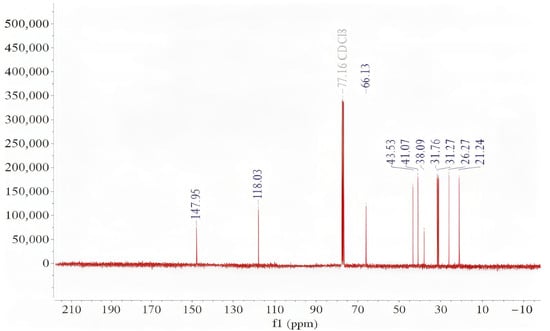
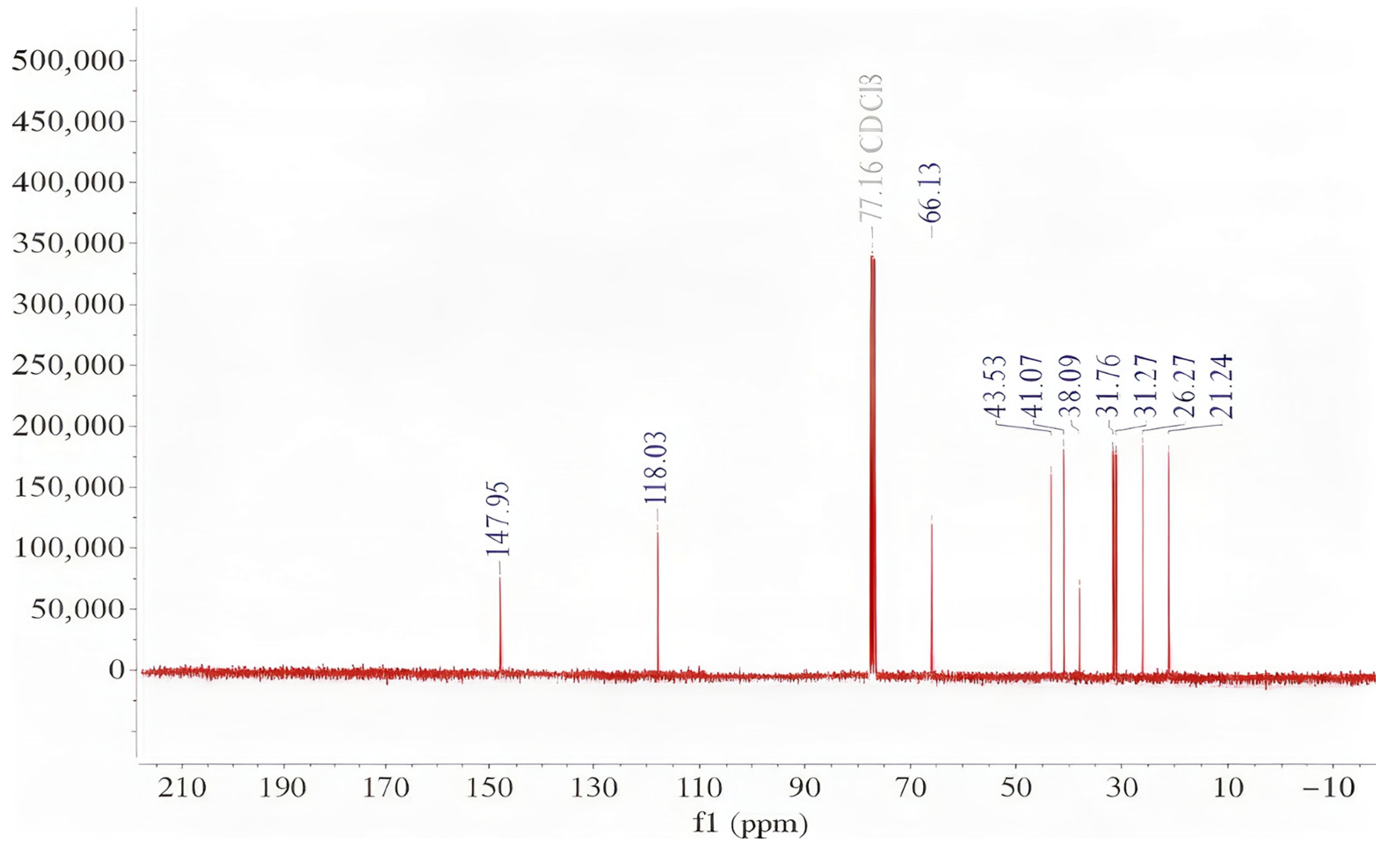
Myrtenol was identified in the essential oil of A. sieversiana by GC-MS, with a relative content of 5.71%. To further verify its structure, the target component was isolated and purified by silica gel column chromatography, followed by structural analysis using 13C NMR spectroscopy. 13C NMR (CDCl3): δ 148.37, 118.45, 66.55, 43.95, 41.50, 38.51, 32.18, 31.69, 26.70, and 21.67 ppm (Figure 1). These spectroscopic data are in full agreement with the chemical structure of myrtenol [26].
Figure 1.
13C NMR spectra of myrtenol.
2.3. Antifungal Activity of Myrtenol
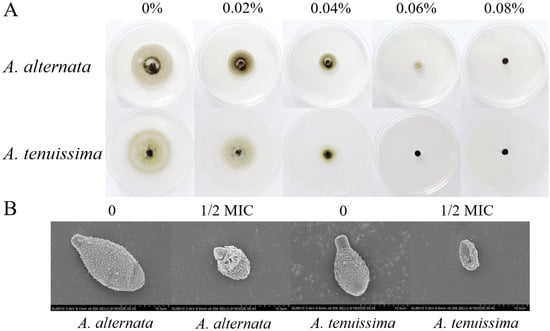
Figure 2A shows that the colony diameters of Alternaria alternata and A. tenuissima gradually decreased with increasing myrtenol concentration, and both pathogens exhibited comparable growth responses under identical treatment conditions. The colony diameters of the control group were 6.50 ± 0.02 cm for A. tenuissima and 7.63 ± 0.05 cm for A. alternata, respectively. Myrtenol markedly suppressed mycelial growth of both fungi across the concentration range of 0.02–0.08% (v/v). Full suppression of mycelial growth was achieved at 0.06% (v/v), which was defined as the minimum inhibitory concentration (MIC). Further assays determined a minimum fungicidal concentration (MFC) of 0.08% (v/v) for both pathogens. No significant inter-species differences in colony diameter were observed at any tested concentration, indicating that myrtenol exerted similar inhibitory potency against the two pathogens. The mycelial growth-inhibition rates calculated from colony-diameter measurements are summarized in Table 2. Consistent with the colony-diameter results, myrtenol exhibited concentration-dependent antifungal activity, yielding 100% growth inhibition at 0.06% (v/v) for both A. alternata and A. tenuissima. Pearson correlation analysis showed that the inhibitory effect on mycelial growth was strongly positively correlated with myrtenol concentration (r = 0.978, p < 0.001 for A. alternata; r = 0.981, p < 0.001 for A. tenuissima).
Figure 2.
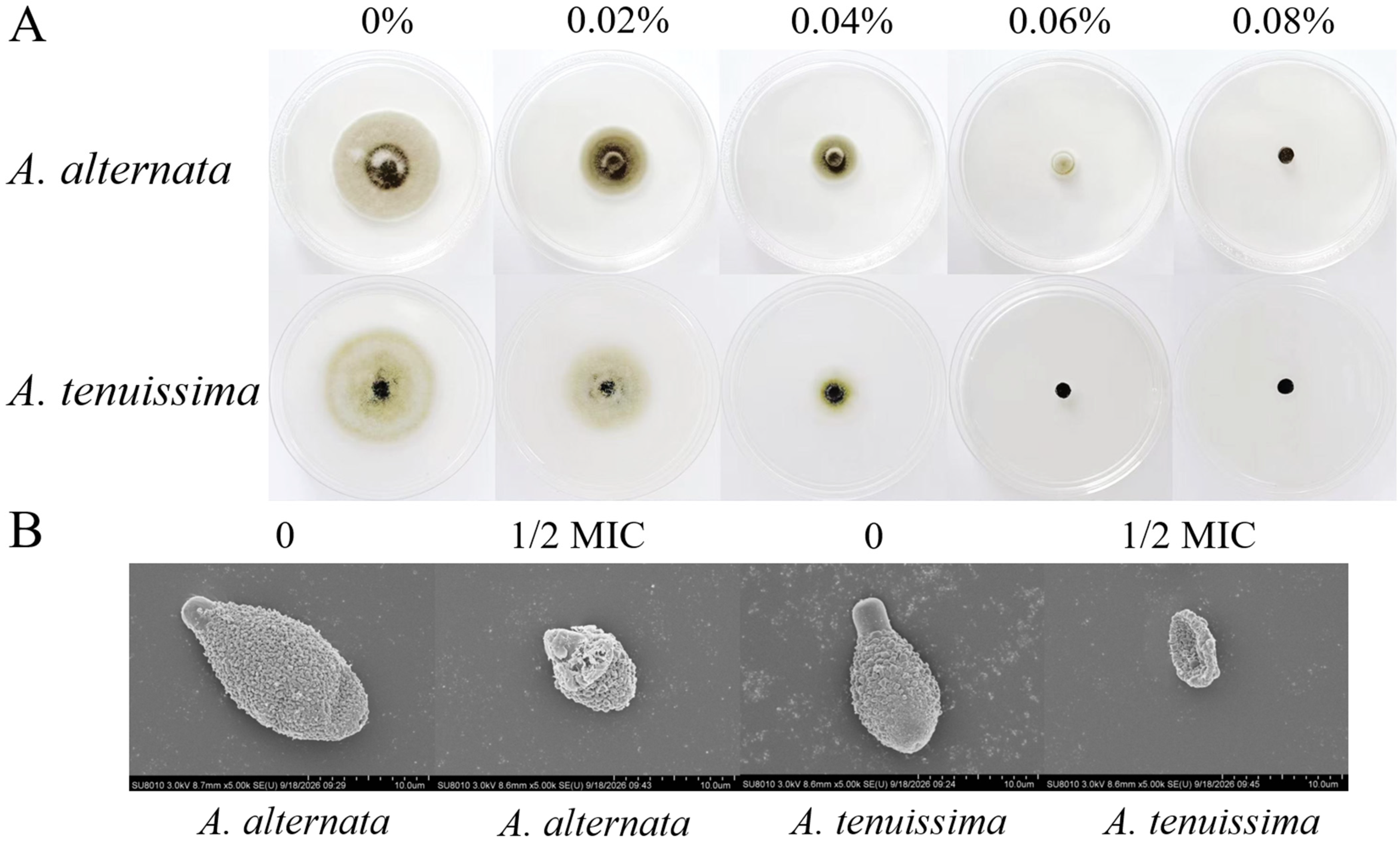
Antifungal activity of myrtenol against Alternaria alternata and A. tenuissima. (A) Colony morphology of the two fungi following treatment with different concentrations of myrtenol. (B) SEM images of spores after 48 h of treatment with the control (0) and 1/2 MIC (0.03%, v/v).
Table 2.
Mycelial growth-inhibition rates of myrtenol against Alternaria alternata and A. tenuissima.
SEM provided further visual evidence (Figure 2B). In the control group, the spores of both Alternaria species were plump and smooth-surfaced, which is consistent with the typical morphological characteristics of this genus. However, treatment with myrtenol at 1/2 MIC (0.03%) caused obvious shrinkage and collapse of the spores. Statistical counting showed that 86.2 ± 2.1% of A. alternata spores and 89.7 ± 1.8% of A. tenuissima spores displayed severe morphological damage. These findings indicate that myrtenol exerts a significant inhibitory effect on Alternaria species, and this effect is concentration-dependent.
2.4. Myrtenol Compromises Cell Wall Integrity
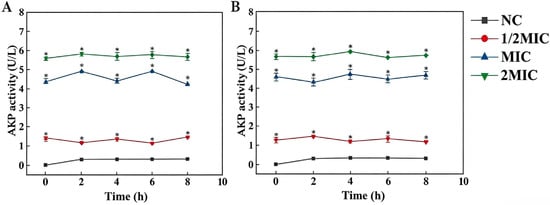
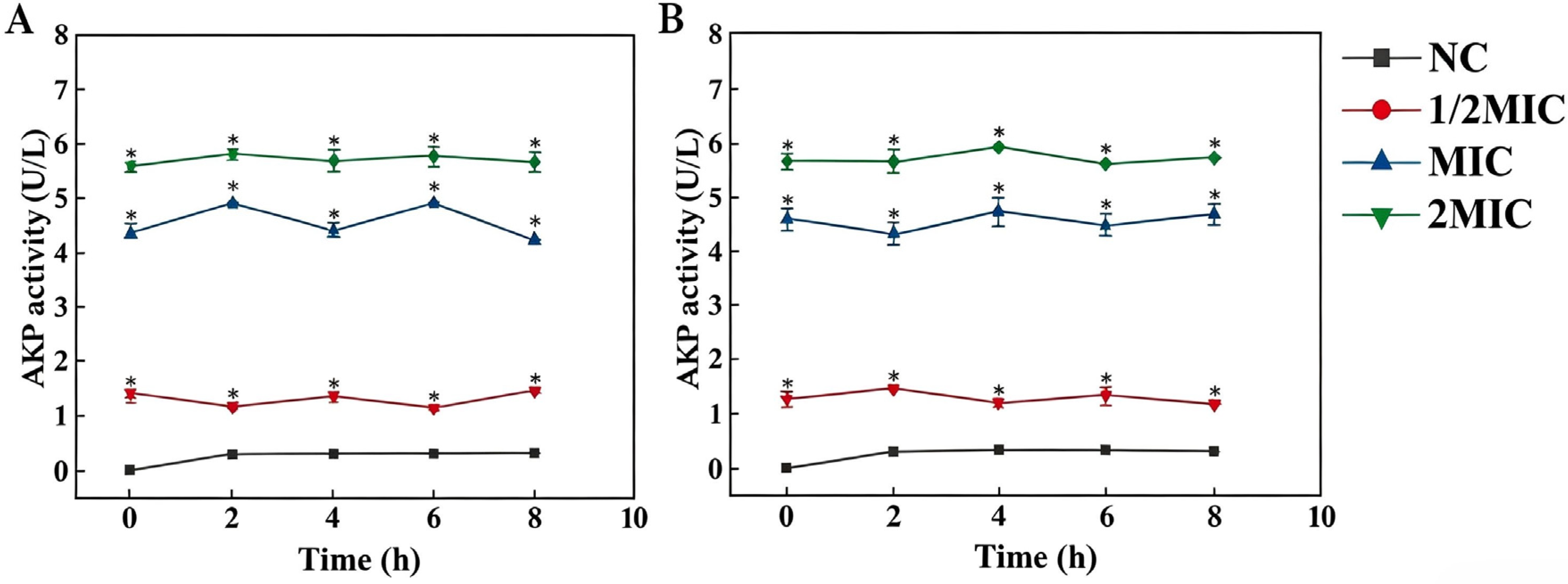
Alkaline phosphatase (AKP) is a marker enzyme located in the periplasmic space between the fungal cell wall and cell membrane. Under normal conditions, it is not released into the extracellular environment; however, when the integrity of the cell wall is compromised, AKP leaks into the culture medium. Therefore, extracellular AKP activity serves as an important indicator of cell wall integrity. As shown in Figure 3, the AKP activity of both untreated fungi (NC) remained at a consistently low level throughout the incubation period, indicating that the cell wall structure was intact. In contrast, after treatment with myrtenol, AKP activity increased significantly over time, with higher concentrations producing greater increases. After 8 h of treatment at 2 MIC, the AKP activity reached 5.582 U/L and 5.743 U/L for Alternaria alternata and A. tenuissima, respectively. These results clearly indicate that myrtenol causes substantial damage to the cell walls of both fungi. AKP activity exhibited a significant positive correlation with myrtenol concentration (r = 0.965, p < 0.001 for A. alternata; r = 0.969, p < 0.001 for A. tenuissima).
Figure 3.
Effects of myrtenol on the cell wall integrity of Alternaria alternata (A) and A. tenuissima (B), as determined by AKP activity. NC, negative control; 1/2 MIC, one-half minimum inhibitory concentration; MIC, minimum inhibitory concentration; 2 MIC, twice the minimum inhibitory concentration. Error bars represent standard deviation (SD), n = 3. * indicate statistically significant differences at the same time point (one-way ANOVA, p < 0.05).
2.5. Myrtenol Disrupts Cell Membrane Permeability
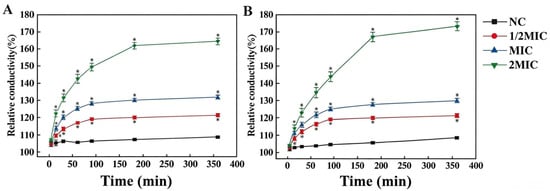
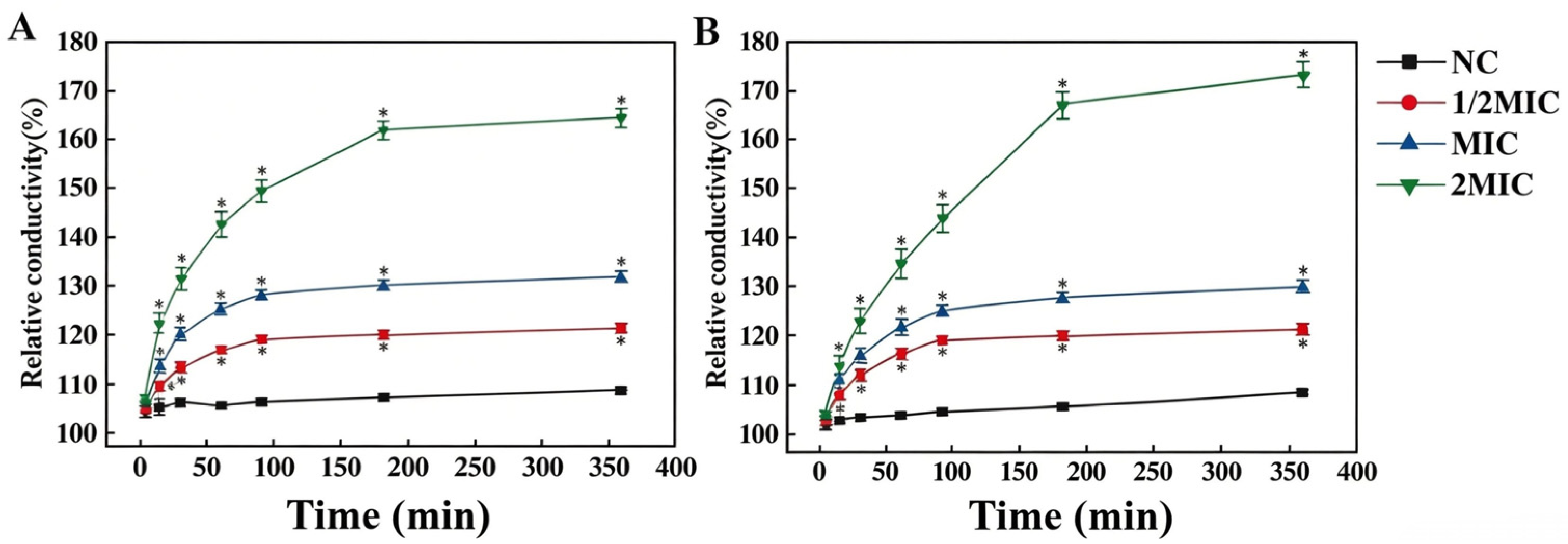
The cell membrane serves as an essential barrier for maintaining intracellular homeostasis in fungi. Once damaged, intracellular electrolytes such as K+, Na+, and Ca2+ leak out, leading to an increase in the electrical conductivity of the culture medium. Therefore, changes in electrical conductivity can be used as an indirect indicator of cell membrane damage. Figure 4 illustrates the relative electrical conductivity of the two Alternaria species following treatment with different concentrations of myrtenol. Overall, the relative conductivity continuously increased with increasing myrtenol concentration and prolonged exposure time, and the values at all time points were significantly higher than those of NC. After 360 min of treatment at the MIC, the relative conductivity reached 127.85% for Alternaria tenuissima and 130.35% for A. alternata, whereas the NC group showed minimal fluctuation and remained nearly unchanged from the initial value. These results indicate that myrtenol markedly increases the permeability of the Alternaria cell membrane, resulting in substantial electrolyte leakage. Moreover, this effect is positively correlated with the concentration of myrtenol. Relative electrical conductivity was also significantly positively correlated with myrtenol concentration (r = 0.972, p < 0.001 for A. alternata; r = 0.975, p < 0.001 for A. tenuissima), confirming that these effects are positively correlated with the concentration of myrtenol.
Figure 4.
Effects of myrtenol on the relative electrical conductivity of Alternaria alternata (A) and A. tenuissima (B). NC, negative control; 1/2 MIC, one-half minimum inhibitory concentration; MIC, minimum inhibitory concentration; 2 MIC, twice the minimum inhibitory concentration. Error bars represent standard deviation (SD), n = 3. * indicate statistically significant differences at the same time point (one-way ANOVA, p < 0.05).
3. Discussion
The present study characterized the chemical profile of hydrodistilled essential oil from Artemisia sieversiana collected in Yanbian. GC-MS analysis identified 41 constituents in AsEO, with eucalyptol (19.65%), α-terpinene (6.12%), myrtenol (5.71%), chamazulene (4.64%), β-myrcene (4.33%), sabinene (3.95%) and l-borneol (3.63%) as the dominant compounds. Notably, eucalyptol was the most abundant constituent (19.65%), while myrtenol accounted for only 5.71% of the total oil. Nevertheless, preliminary screening of several major isolated monomers (eucalyptol, α-terpinene, chamazulene and myrtenol) showed that only myrtenol exhibited strong antifungal activity against Alternaria alternata and A. tenuissima in vitro, whereas eucalyptol exerted negligible inhibitory effects on these pathogens (Supplementary Figure S1). Accordingly, myrtenol was selected for subsequent mechanistic investigation. These findings highlight that the relative peak area of a compound in GC-MS chromatograms cannot be directly equated to its biological contribution; components with moderate or low relative abundance may serve as the key bioactive substances responsible for the antifungal performance of whole essential oils.
The chemical profile of AsEO obtained in this study differed substantially from previously published profiles of A. sieversiana essential oil from other geographic locations. For instance, samples collected from Beijing were dominated by eucalyptol (9.2%), geranyl butyrate (9.1%), camphor (7.9%), borneol (7.9%) and germacrene D (5.5%) [17]. Tibetan AsEO was mainly composed of α-bisabolol (34.47%), chamazulene (23.00%) and α-phellandrene (5.22%) [27]. Ningxia samples were rich in chamazulene (29.61%), camphor (4.80%) and eucalyptol (4.32%) [28]. Xinjiang oil was dominated by α-thujone (64.46%) and eucalyptol (10.15%) [29]. And Hebei samples contained high levels of neryl propanoate (22.88%), β-nerol (11.01%) and β-cubebene (7.50%), while samples harvested in July 2017 were dominated by eucalyptol (32.62%) and 3,7-dimethyl-1,5,7-octatriene-3-ol (15.85%) [30]. By comparison, A. sieversiana harvested in Yanji in August 2023 was characterized by eucalyptol (34.03%), trans-caryophyllene (22.3%), (1R,4S)-1,7,7-trimethylbicyclo [2.2.1]heptan-2-yl acetate (8.39%), (±)-camphor (7.89%) and β-myrcene (3.90%) [25]. Such intraspecific variation in volatile composition is widely recognized and is primarily shaped by harvesting season, geographical location, soil properties, climate and abiotic stress such as drought, consistent with the environmental adaptation perspectives described by Suo et al. [31].
Myrtenol, a natural bicyclic monoterpene alcohol widely distributed in essential oils of medicinal plants, was first confirmed to be present in AsEO in the present work. Prior research has demonstrated that myrtenol inhibits pathogens including Candida albicans and Staphylococcus aureus [32,33], and also relieves intrahepatic and extrahepatic cholestasis in rats [34]. Our results further confirmed its potent antifungal activity against Alternaria pathogens. The MIC value was 0.06% (v/v) for both tested strains, at which concentration mycelial growth was completely inhibited. SEM observation revealed severe morphological damage to myrtenol-treated spores, including shrinkage and collapse. Consistent with existing antifungal research on monoterpenes, terpenoid alcohols generally exhibit strong inhibitory activity against phytopathogenic fungi [35,36,37]. Our data also align with earlier reports [24] stating that myrtenol suppresses fungal growth and biofilm formation by modulating the expression of membrane-associated genes such as FKS1 and ERG11.
To decipher its antifungal mode of action, we evaluated the integrity of the fungal cell wall and plasma membrane. AKP leakage assays indicated that myrtenol disrupted cell wall integrity. Under normal physiological conditions, AKP localizes within the periplasmic space; the marked increase in extracellular AKP activity after myrtenol exposure confirmed structural damage to the cell wall. Electrolyte leakage assays further showed that myrtenol elevated plasma membrane permeability in Alternaria spp., triggering continuous leakage of intracellular ions and increasing the conductivity of the surrounding medium. The cell wall and plasma membrane work synergistically to maintain cellular homeostasis. The dual damaging effects of myrtenol on these two barrier systems likely constitute the primary mechanism underlying its fungicidal activity against the causal agents of black spot in Yanbian pingguoli pear. From an application standpoint, myrtenol holds promise as a green biocontrol agent for postharvest black spot of Yanbian pingguoli pear. In line with the framework of green postharvest preservation strategies based on plant essential oils summarized by Zheng et al. [38], natural terpenoids such as myrtenol represent eco-friendly alternatives to synthetic fungicides. Nevertheless, all antifungal assays in this study were conducted in vitro. Further work is required to validate its protective and therapeutic efficacy on pingguoli pear fruit under simulated cold-storage conditions, optimize formulation protocols, and unravel its more detailed molecular mechanisms, including ROS accumulation and mycotoxin gene expression.
4. Materials and Methods
4.1. Plant Material and Essential Oil Extraction
Fresh A. sieversiana samples were collected in July 2025 from a pingguoli pear orchard near Maor Mountain National Forest Park (42°50′33″ N, 129°28′03″ E), Yanji City, Yanbian Korean Autonomous Prefecture, Jilin Province, China, during the full flowering stage. The plant material was identified as Artemisia sieversiana Ehrh. ex Willd. by professional Professor Dong Weiwei (College of Agriculture, Yanbian University, Yanji, China) based on morphological characteristics, and a voucher specimen has been deposited in the herbarium of Yanbian University under the accession number [2025F0701].
The essential oil was extracted from the fresh aerial parts of A. sieversiana by hydrodistillation using a Clevenger-type apparatus. Briefly, 500 g of fresh plant material was hydrodistilled for 4 h. The obtained essential oil was dried over anhydrous sodium sulfate, filtered, and stored at 4 °C in a dark glass vial until further analysis. The essential oil yield, calculated as (mass of oil/mass of fresh plant material) × 100%, was 43% (w/w).
4.2. Isolation and Purification of Myrtenol from AsEO
Initially, AsEO was dissolved in n-hexane at a concentration of 1.0 g/mL and loaded onto a silica gel column (200–300 mesh, Qingdao Haiyang Chemical Co., Ltd., Qingdao, China) at a stationary-to-sample ratio of 70:1 (w/w). Elution was initiated with 100% n-hexane until the eluate no longer exhibited any blue coloration. Thin-layer chromatography (TLC) was performed on silica gel GF254 plates (Sigma-Aldrich, St. Louis, MO, USA). Following development, plates were sprayed evenly with freshly prepared vanillin–sulfuric acid reagent (5 g vanillin dissolved in 95 mL absolute ethanol; 5 mL concentrated sulfuric acid was added slowly under ice cooling) and heated at 100 °C for 1–2 min. Myrtenol produced characteristic blue-purple to reddish-purple spots, allowing clear discrimination of terpenoid compounds. Fractions displaying similar TLC profiles were pooled, yielding a total of six fractions (F1–F6). GC–MS analysis revealed that Fraction 3 (F3) was particularly rich in myrtenol, which is consistent with its relatively high abundance in AsEO. Fraction F3 was concentrated under reduced pressure at 25 °C and further evaporated under a gentle stream of nitrogen to afford pure myrtenol (560 mg, purity 97% by GC-FID). The identity of the isolated compound was confirmed as myrtenol by nuclear magnetic resonance (NMR) spectroscopy, including 1H NMR, 13C NMR, and DEPT experiments, which were consistent with the reported data for this compound.
4.3. GC-MS Analysis and Compound Identification
The chemical composition of AsEO was analyzed by GC-MS on a Shimadzu QP 2010 Ultra system (Shimadzu Corp., Kyoto, Japan) equipped with a DB-5 column (30 m × 0.25 mm i.d., 0.25 μm film thickness, Restek, Bellefonte, PA, USA). The detailed experimental procedures were performed according to the method of de Feo et al. [39]. Helium was used as the carrier gas at a constant flow of 0.98 mL/min. The oven program started at 5 min isothermal at 40 °C, then increased at 2 °C/min up to 250 °C and finally held isothermally for 20 min. Mass spectra were recorded in electron-impact mode at 70 eV over the range 35–500 m/z. Full-scan acquisitions were acquired at 0.56 scans/s. Retention indices were determined in the same run by co-injecting a homologous series of n-alkanes (C8–C40) under identical chromatographic conditions, and calculating the Kovats index as RI = 100n + 100(tx − tn)/(tn+1 − tn), where tx is the retention time of the compound of interest, and tn and tn+1 are the retention times of the n-alkanes eluting immediately before and after it. Each constituent was identified by requiring the experimental retention index to agree with the value retrieved from the NIST WebBook for the same column and the same temperature program within ±10 index units. The structure of isolated myrtenol was further confirmed by NMR spectroscopy (1H, 13C, DEPT) recorded in CDCl3 on a Bruker AVANCE III 600 MHz spectrometer (Bruker BioSpin GmbH, Rheinstetten, Germany). The 13C NMR data were consistent with the reported structure of myrtenol [26], confirming its identity.
4.4. Fungal Strains and Culture Conditions
The fungal pathogens used in this study were Alternaria tenuissima (NCBI GenBank Accession No. OQ001067) and A. alternata (NCBI GenBank Accession No. OQ001055), previously isolated from black spot disease on Yanbian pingguoli pear [12]. Both strains were maintained on potato dextrose agar (PDA) supplemented with 100 mg/L streptomycin sulfate at 28 °C for 7 days. PDA medium contained 200 g/L potato extract, 20 g/L dextrose, and 15 g/L agar, autoclaved at 121 °C for 25 min. For liquid culture, fungi were grown in potato dextrose broth (PDB; 200 g/L potato extract, 20 g/L dextrose) autoclaved at 121 °C for 25 min to the logarithmic growth phase and used in subsequent assays.
4.5. Antifungal Activity Assay
Myrtenol was incorporated into molten PDA at final concentrations of 0 (control), 0.02%, 0.03%, 0.04%, 0.06%, and 0.08% (v/v). A 5 mm mycelial plug from the margin of a 7-day-old colony was placed in the center of each plate, and the plates were incubated at 28 °C for 7 days (three replicates per concentration). Colony diameter was measured using the cross method, and the inhibition rate was calculated as: Inhibition rate (%) = [(D_control − D_treatment)/D_control] × 100%. The MIC was defined as the lowest concentration that completely inhibited mycelial growth. For the MFC, mycelial plugs from the MIC and above were transferred to fresh PDA plates and incubated at 28 °C for 48–72 h; the MFC was recorded as the lowest concentration showing no fungal growth.
Freshly harvested spores were treated with myrtenol at 0 (control) and 1/2 MIC in PDB at 28 °C. After treatment, spores were collected by centrifugation, fixed with 2.5% (v/v) glutaraldehyde in 0.1 M phosphate buffer (pH 7.2) at 4 °C for 48 h, and dehydrated through a graded ethanol series following the method of Kou et al. [12]. The dried samples were mounted on stubs, sputter-coated with gold for 60 s, and observed under a SU-8010 scanning electron microscope (Hitachi, Tokyo, Japan). For SEM observation, three independent replicates were performed. For each replicate, a total of 300 spores were randomly counted across different visual fields to calculate the percentage of morphologically damaged spores.
4.6. Determination of Cell Wall Integrity (AKP Activity Assay)
Cell wall integrity was assessed by measuring extracellular AKP activity. Mycelial plugs (6 mm) from the margin of 7-day-old colonies were inoculated onto PDA and incubated at 28 °C in the dark. Spores were harvested by rinsing and scraping with sterile ddH2O, filtered through four layers of gauze, and adjusted to 1 × 10⁶–1 × 10⁷ spores/mL with a hemocytometer. Myrtenol was added to PDB at final concentrations of 1/2 MIC, MIC and 2MIC; an untreated group served as NC. Cultures were incubated at 28 °C and 120 rpm. Samples were taken at 0, 1, 2, 3, 4, 5, 6, 7, and 8 h, centrifuged at 10,000 rpm for 10 min at 4 °C, and AKP activity in the supernatant was measured at 510 nm using a commercial AKP assay kit (Nanjing Jiancheng Bioengineering Institute, Nanjing, China) following the manufacturer’s instructions. The principle of the assay is that AKP hydrolyzes disodium phenyl phosphate to release phenol, which then reacts with 4-aminoantipyrine under alkaline conditions in the presence of potassium ferricyanide to form a red-colored complex with maximum absorbance at 510 nm; the absorbance is proportional to the AKP activity in the sample. One unit (U/L) was defined as the amount of enzyme catalyzing the production of 1 μmol of phenol per minute per gram of tissue at 28 °C. All experiments were performed in triplicate.
AKP content was calculated as follows:
where A1 is the absorbance of the sample, A0 is the absorbance of the blank, A2 is the absorbance of the standard sample, a is the concentration of the phenol standard sample, and b is the dilution factor.
4.7. Determination of Cell Membrane Integrity (Electrical Conductivity Assay)
The effect of myrtenol on cell membrane integrity was assessed by measuring the relative electrical conductivity of the culture medium. Mycelial disks (5 mm diameter) of both fungi were cut from the margin of 7-day-old colonies and placed in 50 mL of PDB containing myrtenol at concentrations of 0 (control), 1/2 MIC, MIC, and 2 MIC. The cultures were incubated at 28 °C with shaking at 150 rpm. At predetermined time intervals (0, 30, 60, 120, 180, 240, 300, and 360 min), the electrical conductivity of the culture medium was measured using a conductivity meter (Mettler Toledo FE38, Columbus, OH, USA). For the final conductivity measurement (C2), the mycelial suspension was boiled in a water bath for 15 min to achieve complete cell rupture, followed by cooling to room temperature before conductivity detection. The relative electrical conductivity was calculated using the following formula:
where C is the relative conductivity (%), C1 is the electric conductivity at a certain sampling time, C0 is the initial electric conductivity, and C2 is the final electric conductivity after boiling to fully release intracellular electrolytes.
4.8. Statistical Analysis
All experiments were performed in triplicate, and data are expressed as the mean ± standard deviation (SD). Before analysis, the normality of the data was verified using the Shapiro–Wilk test and the homogeneity of variances was confirmed by Levene’s test; all datasets satisfied the assumptions for parametric analysis. Statistical analyses were performed using SPSS 26.0 (IBM Corp., Armonk, NY, USA). One-way analysis of variance (ANOVA) was used to evaluate differences among treatments; when a significant effect was detected, post hoc pairwise comparisons between each treatment group and the corresponding control at the same time point were performed using the least significant difference (LSD) test. Statistically significant differences were identified at p < 0.05 and marked with asterisks in the figures. Pearson correlation analysis was carried out to assess the linear correlations between myrtenol concentration and the measured physiological indicators.
5. Conclusions
Collectively, the major constituents of AsEO were eucalyptol (19.65%), α-terpinene (6.12%), myrtenol (5.71%), chamazulene (4.64%), β-myrcene (4.33%), sabinene (3.95%), and l-borneol (3.63%). This study demonstrated that myrtenol from Artemisia sieversiana essential oil exerts strong antifungal activity against Alternaria alternata and A. tenuissima via disruption of fungal cell wall and membrane integrity. Myrtenol is therefore a promising natural antifungal agent and a potential bioactive compound for agricultural and food postharvest use. Its practical application faces challenges including production cost, formulation stability, regulatory approval for food-related use, and possible phytotoxicity. Prioritized next steps include formulation optimization, phytotoxicity testing on pingguoli pear, fruit trials under cold storage in vivo, and safety evaluation to facilitate its translation into postharvest preservation practice.
Supplementary Materials
The following supporting information can be downloaded at: https://www.mdpi.com/article/10.3390/plants15233725/s1, Figure S1: Screening of the antifungal activity of the five major monomers of Artemisia sieversiana essential oil (AsEO)—eucalyptol, α-terpinene, β-myrcene, chamazulene, and myrtenol—against Alternaria alternata and A. tenuissima in a poisoned-medium plate assay.
Author Contributions
Conceptualization, C.-Y.H.; methodology, Z.-X.K.; resources writing—original draft preparation, R.Z.; writing—review and editing, Y.F.; supervision, Y.F. All authors have read and agreed to the published version of the manuscript.
Funding
This work was supported by the National Natural Science Foundation of China (No. 32360708).
Data Availability Statement
The data presented in this study are available on request from the corresponding author.
Conflicts of Interest
The authors declare no conflicts of interest.
References
- Vinogradova, S.A.; Kiselev, K.V.; Suprun, A.R. An overview of the Alternaria genus: Ecology, pathogenicity and importance for agriculture and human health. J. Fungi 2026, 12, 64. [Google Scholar] [CrossRef] [Scilit]
- Guo, H.L.; Qiao, B.X.; Ji, X.S.; Wang, X.X.; Zhu, E.L. Antifungal activity and possible mechanisms of submicron chitosan dispersions against Alternaria alternata. Postharvest Biol. Technol. 2020, 161, 110883. [Google Scholar] [CrossRef] [Scilit]
- Hermeziu, M.; Negruseri, N. Results regarding the re-emergence of early blight (Alternaria spp.) and risk management in potato growing areas. Rom. Agric. Res. 2024, 41, 47–54. [Google Scholar] [CrossRef] [Scilit]
- Roquyya, G.; Shoaib, A.; Perveen, S.; Rafiq, M. Evaluation of chili pepper varieties for resistance to Alternaria alternata: Growth, biochemical, and post-harvest responses. Microb. Pathog. 2025, 209, 108092. [Google Scholar] [CrossRef] [Scilit]
- Song, B.; Xu, B.Q.; Zhu, X.F.; He, T.M. Genomic analysis of Alternaria alternata, the causal agent of black spot disease in Korla fragrant pears (Pyrus sinkiangensis Yü) in China. Can. J. Plant Sci. 2025, 105, 1–14. [Google Scholar] [CrossRef] [Scilit]
- Zhang, S.Q.; Liu, W.Q.; Hu, W.L.; Ban, M.D.; Zhou, J.H.; Liang, L.Y.; Wang, B.G.; Xu, R.R. Multitarget antifungal mechanism of 5-aminolevulinic acid hydrochloride on black spot rot of sweet cherry fruit against Alternaria alternata. LWT-Food Sci. Technol. 2025, 232, 118405. [Google Scholar] [CrossRef] [Scilit]
- Shu, C.; Zhao, H.D.; Jiao, W.X.; Liu, B.D.; Cao, J.K.; Jiang, W.B. Antifungal efficacy of ursolic acid in control of Alternaria alternata causing black spot rot on apple fruit and possible mechanisms involved. Sci. Hortic. 2019, 256, 108636. [Google Scholar] [CrossRef] [Scilit]
- Liu, Z.J.; Zhang, R.; Sun, D.Y.; Tuerdi, M.; Zhu, T.S.; Chen, X.F. Alternaria alternata causing brown spot disease on walnut in Xinjiang, China. Plant Dis. 2023, 107, 7. [Google Scholar] [CrossRef] [Scilit]
- Du, H.F.; Sun, T.T.; Tong, X.Y.; Ren, J.; Zhang, Y.H.; Shaw, P.C.; Luo, D.Q.; Cao, F. Antifungal activity and mechanism of chaetoglobosin D against Alternaria alternata in tomato postharvest storage. Postharvest Biol. Technol. 2024, 214, 113014. [Google Scholar] [CrossRef] [Scilit]
- Bacha, S.A.S.; Li, Y.P.; Nie, J.Y.; Xu, G.F.; Han, L.X.; Farooq, S. Comprehensive review on patulin and Alternaria toxins in fruit and derived products. Front. Plant Sci. 2023, 14, 1139757. [Google Scholar] [CrossRef] [Scilit]
- Guo, X.Y.; Wang, S.Y.; Liang, J.; Xu, M.H. Mitochondrial damage and associated combined toxicity induced by deoxynivalenol and Alternaria toxins co-exposure. Food Chem. 2024, 465, 142064. [Google Scholar] [CrossRef] [Scilit]
- Kou, Z.X.; Dang, Y.; Liu, L.; Wu, X.H.; Fu, Y. Antifungal activity of Artemisia capillaris essential oil against Alternaria species causing black spot on Yanbian pingguoli pear in China. Plants 2025, 14, 3146. [Google Scholar] [CrossRef] [Scilit]
- Li, Y.C.; Bi, Y. Extraction, isolation and identification of preformed antifungal compounds from the peel of pingguoli pear. Sci. Technol. Food Ind. 2006, 2, 49–52. (In Chinese) [Google Scholar]
- Afassi, F.; Charki, A.; Youssfi, C.E.; Loukili, E.H.; Labhar, A.; Ahari, M.; Amhamdi, H.; Mourabit, F.; Zoubi, Y.E.; Salhi, A.; et al. Chemical composition and biological activities of essential oils from medicinal plants: A comprehensive review and bibliometric analysis. Results Eng. 2026, 32, 112439. [Google Scholar] [CrossRef] [Scilit]
- Liu, H.H.; Li, H.M.; Hai, X.X.; Shao, W. Optimization of extraction process of Artemisia sieversiana essential oil and its antioxidant activity in vitro. Chem. Biol. Eng. 2025, 42, 63–68. (In Chinese) [Google Scholar]
- Qu, J.C.; Bahaerguli, B.; Li, Y.N.; Murat, K.; Kamixibieke, N.; Didar, B.; Lazat, T. Study on quality standard of Artemisia sieversiana locally grown in Xinjiang. Chin. Tradit. Pat. Med. 2023, 45, 1551–1556. (In Chinese) [Google Scholar]
- Liu, Z.L.; Liu, Q.R.; Chu, S.S.; Jiang, G.H. Insecticidal activity and chemical composition of the essential oils of Artemisia lavandulaefolia and Artemisia sieversiana from China. Chem. Biodivers. 2010, 7, 2040–2045. [Google Scholar] [CrossRef] [Scilit]
- Nuermaimaiti, M.; Turak, A.; Yang, Q.; Tang, B.X.; Zang, Y.; Li, J.; Aisa, H.A. Sesquiterpenes from Artemisia sieversiana and their anti-inflammatory activities. Fitoterapia 2021, 154, 104996. [Google Scholar] [CrossRef] [Scilit]
- Ma, L.; Xu, J.Y.; Wang, W.C.; Lu, J.; Li, Y.H.; Yao, L. Thin layer chromatography-direct bioautography for investigation of antibacterial activities of Artemisia sieversiana Ehrhart ex Willd. Essential Oil. Nat. Prod. Res. 2023, 38, 3707–3712. [Google Scholar] [CrossRef] [Scilit]
- Mrabti, H.N.; Jaouadi, I.; Zeouk, I.; Ghchime, R.; El Menyiy, N.; El Omari, N.; Balahbib, A.; Al-Mijalli, S.H.; Abdallah, E.M.; El-Shazly, M.; et al. Biological and pharmacological properties of myrtenol: A review. Curr. Pharm. Des. 2023, 29, 407–414. [Google Scholar] [CrossRef] [Scilit]
- Jiang, T.; Xiang, L.; Qi, J.H. Myrtenol from lavender essential oil possesses neuroprotective effects and promotes neurite outgrowth by potentially targeting TrkA and IGF-1R in PC12 cells. Int. J. Mol. Sci. 2026, 27, 2615. [Google Scholar] [CrossRef] [Scilit]
- Mahmoud, R.Y.; Trizna, E.Y.; Sulaiman, R.K.; Pavelyev, R.S.; Gilfanov, I.R.; Lisovskaya, S.A.; Ostolopovskaya, O.V.; Frolova, L.L.; Kutchin, A.V.; Guseva, G.B. Increasing the efficacy of treatment of Staphylococcus aureus- Candida albicans mixed infections with myrtenol. Antibiotics 2022, 11, 1743. [Google Scholar] [CrossRef] [Scilit]
- Cordeiro, L.; Figueiredo, P.; Souza, H.; Sousa, A.; Andrade, F., Jr.; Barbosa, J.; Lima, E. Antibacterial and antibiofilm activity of myrtenol against Staphylococcus aureus. Pharmaceuticals 2020, 13, 133. [Google Scholar] [CrossRef] [Scilit]
- Maione, A.; La Pietra, A.; De Alteriis, E.; Mileo, A.; De Falco, M.; Guida, M.; Galdiero, E. Effect of myrtenol and its synergistic interactions with antimicrobial drugs in the inhibition of single and mixed biofilms of Candida auris and Klebsiella pneumoniae. Microorganisms 2022, 10, 1773. [Google Scholar] [CrossRef] [Scilit]
- Zhang, R.; Zheng, T.Y.; Fu, Y. Chemical composition and antifungal activity of Artemisia sieversiana essential oil growing in Jilin against black spot on Yanbian pingguoli pear in China. Plants 2026, 15, 207. [Google Scholar] [CrossRef] [Scilit]
- Holden, C.M.; Whittaker, D. Conformational studies of monoterpenes. II†–conformational studies of bicyclo[3.1.1]heptane derivatives by 13C NMR. Org. Magn. Reson. 1975, 7, 125–127. [Google Scholar] [CrossRef] [Scilit]
- Li, H.L.; Chen, H.Q.; Xu, F.L.; Wang, W.L.; Li, J.L. Chemical composition, antimicrobial and antioxidant activities of the essential oil of Artemisia sieversiana. Food Sci. 2016, 37, 63–68. [Google Scholar]
- Zhang, C.; Wang, W.C.; Bai, L.; Shi, S.L.; Yang, L. Chemical composition and antimicrobial activity of the essential oil of Artemisia sieversiana in Ningxia. Chin. Agric. Sci. Bull. 2020, 36, 62–68. [Google Scholar]
- Jiang, C.Y.; Zhou, S.X.; Toshmatov, Z.; Mei, Y.; Jin, G.Z.; Han, C.X.; Zhang, C.; Shao, H. Chemical composition and phytotoxic activity of the essential oil of Artemisia sieversiana growing in Xinjiang, China. Nat. Prod. Res. 2022, 36, 2434–2439. [Google Scholar] [CrossRef] [Scilit]
- Zhang, J.W.; Li, B.Y.; Lu, X.X.; Zheng, Y.; Wang, D.; Zhang, Z.; Zeng, D.; Du, S.S. Chemical diversity and anti-insect activity evaluation of essential oils extracted from five Artemisia species. Plants 2022, 11, 1627. [Google Scholar] [CrossRef] [Scilit]
- Suo, K.K.; Li, X.; Liu, X.; Zhu, J.Q.; Shi, Y.L.; Yi, J.J.; Lu, J.K. From environment to environmental adaptation: Environmental perspectives on the study of food and medicine homology. Food Med. Homol. 2026, 3, 9420082. [Google Scholar] [CrossRef] [Scilit]
- Wang, Y.W.; Feng, J.H.; Chang, W.D.; Ren, F.; Dou, G.M.; Wang, Z.Y.; Liang, L.Y.; Yan, D.H. Identification of the chestnut endophyte trichoderma nordicum FPYF2509 and the antifungal potential of interaction-induced myrtenol against fruit rot. Horticulturae 2026, 12, 140. [Google Scholar] [CrossRef] [Scilit]
- Hemmati, J.; Chiani, M.; Asghari, B.; Roshanaei, G.; Soleimani Asl, S.; Shafiei, M.; Arabestani, M.R. The inhibitory effect of niosome containing myrtenol as an innovative approach to combat methicillin-resistant Staphylococcus aureus (MRSA). Can. J. Infect. Dis. Med. Microbiol. 2025, 2025, 2742569. [Google Scholar] [CrossRef] [Scilit]
- Rajizadeh, A.M.; Ghasemi, M.; Bejeshk, A.M.; Akhbari, M.; Saberi, S.; Bagheri, F.; Amiresmaili, S. Evaluation of the modifying impact of myrtenol on intrahepatic cholestasis and extrahepatic cholestasis in male rats: Role of oxidative stress and inflammation. Adv. Tradit. Med. 2026, 26, 433–437. [Google Scholar] [CrossRef] [Scilit]
- Giménez-Santamarina, S.; Torres-Pagan, N.; Larran, S.; Roselló, J.; Santamarina, M.P. Clove essential oil and eugenol as natural antifungal agents to reduce postharvest losses in melon (Cucumis melo). Int. J. Mol. Sci. 2025, 26, 9603. [Google Scholar] [CrossRef] [Scilit]
- Gouda, S.A.; Hassanein, N.M.; Salah, M. Antifungal activity of boron/selenium nanoparticles irradiated via gamma rays against Alternaria alternata and Fusarium Equiseti. Curr. Microbiol. 2025, 82, 129. [Google Scholar] [CrossRef] [Scilit]
- Wang, Q.S.; Pang, S.; Tong, X.Y.; Luo, D.Q.; Wang, J.; Cao, F. Antifungal mechanism and mycotoxin control of Ligusticum jeholense essential oil against Alternaria alternata in postharvest tomato. Food Chem. 2026, 507, 148265. [Google Scholar] [CrossRef] [Scilit]
- Zheng, N.; Ma, Y.M.; Lei, H.Y.; Zhen, X.Y.; Wang, Y.; Zhang, Y.; Gou, D.X.; Liu, T. Progress of post-harvest preservation technology of edible mushroom. Food Med. Homol. 2025, 2, 9420028. [Google Scholar] [CrossRef] [Scilit]
- de Feo, V.; Porta, G.D.; Urrunaga Soria, E.; Urrunaga Soria, R.; Senatore, F. Composition of the essential oil of Tagetes filifolia Lag. Flavour Fragr. J. 1998, 13, 145–147. [Google Scholar] [CrossRef] [Scilit]

Disclaimer/Publisher’s Note: The statements, opinions and data contained in all publications are solely those of the individual author(s) and contributor(s) and not of MDPI and/or the editor(s). MDPI and/or the editor(s) disclaim responsibility for any injury to people or property resulting from any ideas, methods, instructions or products referred to in the content. |
© 2026 by the authors. Licensee MDPI, Basel, Switzerland. This article is an open access article distributed under the terms and conditions of the Creative Commons Attribution (CC BY) license.