


Abstract
Flavonoids are crucial secondary metabolites in plants, significantly contributing to plant physiology, environmental adaptation, and human health. DNA methylation serves as a key epigenetic mechanism that dynamically regulates gene expression and phenotypic characteristics. However, a systematic synthesis of how it modulates the flavonoid biosynthetic pathway across its various stages is still lacking. In this review, we synthesized current evidence on the interplay between DNA methylation and flavonoid biosynthesis in plants, organized according to the key stages of the pathway, from the initial phenylpropanoid precursors, through core skeleton formation, to branch-specific and end-product genes and their transcriptional regulators. We showed that the transcriptional consequence of methylation is not uniformly repressive but depends on genomic context, including sequence position relative to the transcription start site and gene body, and on the tissue and developmental stage examined. We also summarized the environmental and developmental cues associated with methylation remodeling at flavonoid loci, and the technologies and tools available for studying these interactions, with an emphasis on base-resolution and emerging single-cell approaches. Finally, we prospected the opportunities and current limitations of applying DNA methylation to plant breeding and outline directions for future research in the field.
1. Introduction
Flavonoids are one class of secondary metabolites widely distributed in plants. They have a variety of biological activities and play an important role in many biological processes such as plant growth and development, pollination and reproduction, and response to environmental stress. At the same time, flavonoids can also directly or indirectly provide nutrition for the human body [1]. The common structure of flavonoids is C6-C3-C6, which is formed by connecting two benzene rings (A ring and B ring) at both ends with three carbon atoms. The oxidation state and substitution pattern of the three-carbon bridge, and of the heterocyclic C ring it forms, distinguish the main flavonoid subclasses: anthocyanidins, flavones, flavonols, flavanols, flavanones, isoflavones and chalcones [2]. Anthocyanidins, belonging to flavonoid compounds, occur predominantly as glycosides and accumulate in a wide range of organs and tissues, and they are the principal pigments responsible for colors ranging from pale yellow and orange through red to violet in plants [3,4,5].
Previous researchers have carried out extensive research to explore the biosynthetic pathway and genetic regulation mechanisms of flavonoid metabolites. In recent years, as epigenetics has become a hot topic in life sciences and botany research, epigenetics has also been introduced into the molecular mechanism of flavonoid formation.
DNA methylation, one of the most extensively studied epigenetic modifications, plays crucial roles in regulating plant growth and development and responses to biotic and abiotic stresses [6,7,8,9]. Research results from numerous plants indicate that flavonoid synthesis is regulated by DNA methylation. For example, in apples (Malus × domestica), hypomethylation of flavonoid synthesis pathway genes (PAL, 4CL, CHS, F3′H) at the mCG/mCHG promotes transcriptional activation. Hypomethylation of mCHG upstream of MdMYB10 is positively correlated with anthocyanin accumulation, while hypermethylation of mCG upstream of bHLH74 indirectly promotes anthocyanin synthesis [10]. Using Malus ‘Royalty’ as the research material, it was found that under the stress of rust, demethylation occurred in some regions of McMYB10, which increased the expression of McMYB10, thus promoting the synthesis of anthocyanin in the lesion tissue and improving the resistance of plants to rust [11]. The DNA methylation modifications in Xanthoceras sorbifolium dynamically change during the process of flower color transition (flower development). The decrease in the transcription abundance of XsROS1 during the flower color transition of X. sorbifolium is correlated with the increase in whole-genome DNA methylation [12].
Although several reviews have addressed epigenetic regulation of plant secondary metabolism more broadly, few reviews have focused specifically on DNA methylation across the full flavonoid biosynthetic and regulatory pathway to date. This review aims to fill this gap, summarizing the current evidence linking DNA methylation to flavonoid biosynthesis and evaluating the strength of causal inference each study supports. Given that DNA methylation constitutes only one layer of a broader regulatory network, and that direct functional evidence remains limited to a small number of loci (discussed further below, in relation to methylation stability and heritability), we discuss potential breeding applications—such as epigenome editing for novel flower and fruit coloration or enhanced stress resistance—as a prospective research direction below, rather than as an established strategy. This review focuses specifically on DNA methylation as an epigenetic regulator of flavonoid biosynthesis in plants; other layers of epigenetic regulation, such as histone modifications and small RNA pathways beyond their direct role in RNA-directed DNA methylation, fall outside the scope of the present review.
2. DNA Methylation Mechanism in Plants
DNA methylation is a common and evolutionarily conserved epigenetic modification in higher plants and plays important roles in genome stability, gene expression, reproductive development, environmental adaptation and gene silencing [9,13]. Plant DNA methylation involves the transfer of a methyl group from S-adenosylmethionine (SAM) to DNA bases through DNA methyltransferases [14]. In eukaryotes, the predominant form is 5-methylcytosine (5mC), methylation at the carbon-5 position of the cytosine ring, which in plants occurs in CG, CHG, and CHH sequence contexts (where H denotes A, T, or C). Small amounts of other DNA base modifications, includingN6-methyladenine (6mA), N4-methylcytosine (4mC), and N7-methylguanine (7mG), have also been reported; among these, 4mC and 6mA occur predominantly in prokaryotes [15].
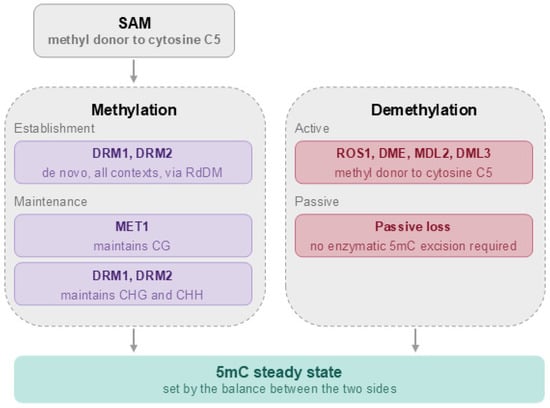
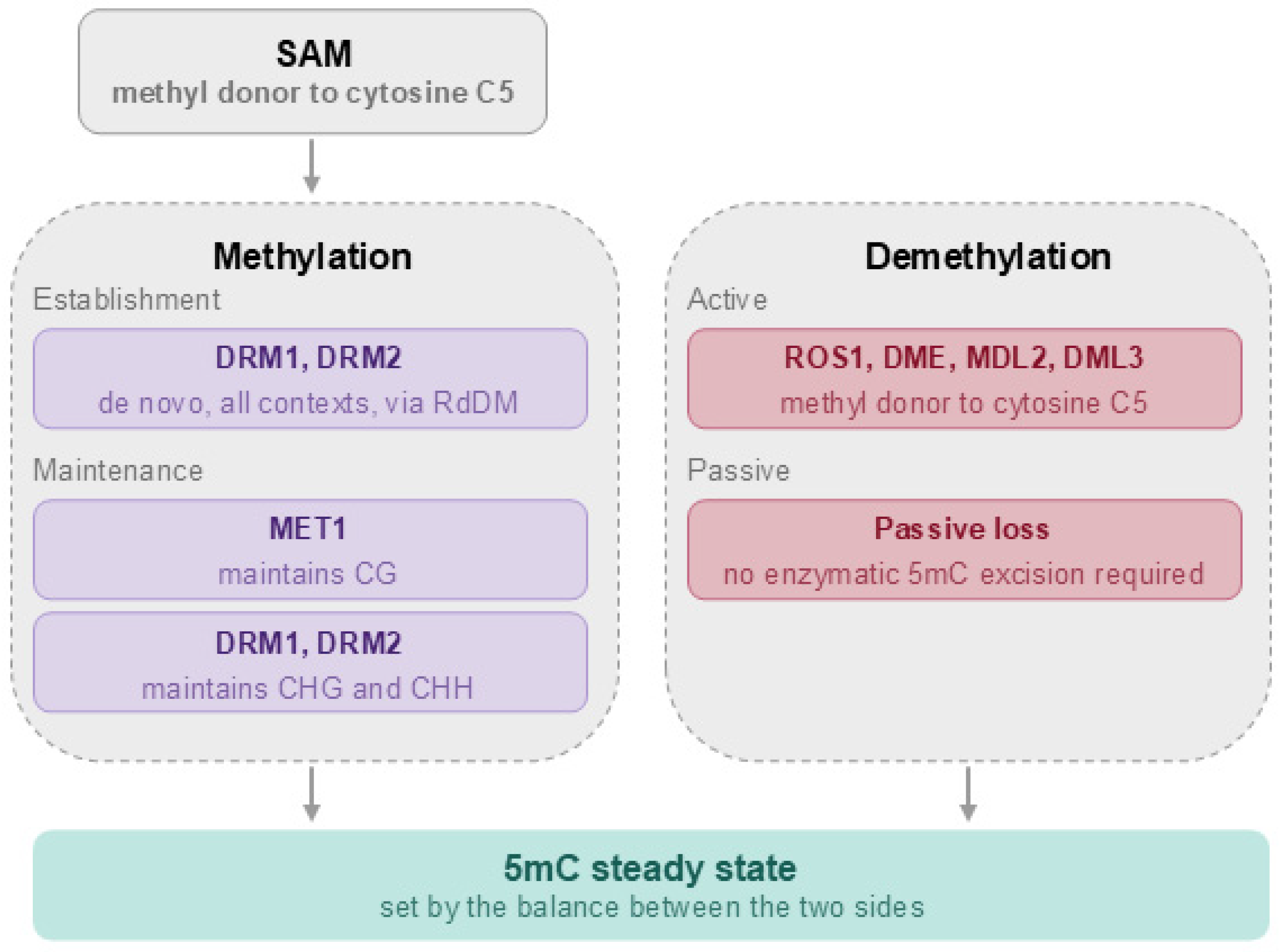
The steady-state DNA methylation level within plant cells is determined by the balance between methylation and demethylation [16]. Studies in the model plant Arabidopsis thaliana have established that maintenance and establishment of DNA methylation involve several major methyltransferases, including MET1, CMT2, CMT3, DRM1 and DRM2 [7], whereas active demethylation is mediated mainly by the DNA glycosylases DME, ROS1, DML2 and DML3 [17]. DRM2 is the major methyltransferase responsible for de novo methylation across sequence contexts, with RNA-directed DNA methylation (RdDM) representing the principal de novo methylation pathway in vascular plants [16]. CMT2, CMT3 and DRM proteins contribute to CHG and CHH methylation in association with repressive histone modifications such as H3K9me1 and H3K9me2, whereas CG methylation is maintained primarily byMET1 [9,18]. DNA methylation maintenance is also coupled to histone deacetylation. In Arabidopsis, HDA6 interacts with MET1, and the two cooperate in silencing transposable elements by regulating DNA methylation together with histone acetylation and methylation [19]; the crabapple homologs McHDA6 and McMET1 are considered in Section 5. DNA demethylation, which may occur passively or actively, contributes to methylation homeostasis and the establishment of methylation boundaries; ROS1, DME, DML2 and DML3 can excise 5mC from all cytosine sequence contexts [20,21].
DNA methylation can regulate gene expression by affecting transcription-factor binding, chromatin accessibility and RNA processing [16,22], but its transcriptional effect is strongly dependent on genomic context rather than being uniformly repressive. In A. thaliana, UVR8–DRM2-dependent changes in DNA methylation can influence nearby transposable elements and the expression of genes involved in UV-B responses [6]. Conversely, methylation of the MEMS element upstream of ROS1 is recognized by SUVH proteins and contributes to transcriptional activation of ROS1 [23]. Context dependence is also evident at the genome-wide level: in a SlDML2 functional-deletion mutant of tomato (Solanum lycopersicum), increased DNA methylation affected both genes whose expression normally increases and genes whose expression normally decreases during fruit ripening [13]. These observations show that the regulatory outcome of DNA methylation depends on genomic position, neighboring sequence features and the molecular machinery that interprets or modifies the methylated site. The same principle is important for flavonoid biosynthesis, in which methylation at structural genes, transcriptional regulators and TE-associated cis-regulatory regions can produce distinct transcriptional outcomes (Figure 1).
Figure 1.
DNA methylation dynamics in plants.
3. Flavonoid Biosynthesis and Its Transcriptional Regulation in Plants
The core pathway of flavonoid biosynthesis belongs to a branch of the phenylpropanoid pathway. Phenylalanine ammonia lyase (PAL), cinnamate 4-hydroxylase (C4H), 4-coumaric acid CoA ligase (4CL), phenol oxidase, and methylase are among the most important enzymes in flavonoid synthesis [24]. Flavonoids have two biosynthetic precursors: malonyl-CoA, produced via the polyketide pathway, and 4-coumaryl CoA, produced via the shikimate-phenylpropanoid pathway [25]. Chalcone synthase (CHS) is a characteristic enzyme in the biosynthetic pathway of flavonoids. CHS can not only catalyze the formation of naringenin chalcone from one molecule of 4-coumaroyl-CoA and three molecules of malonyl-CoA, but it can also catalyze the formation of pinocembrin chalcone from trans-cinnamoyl-CoA and malonyl-CoA [26,27]. Then, chalcones can be catalyzed by the stereoselective chalcone isomerase (CHI) to produce optically active (2S)-dihydroflavones. Dihydroflavones, as important intermediates in the biosynthesis of flavonoids, can produce different classes of flavonoids through a variety of branching reactions [25,28]. The flavonoid compounds formed by each branch can undergo post-modification reactions such as methylation, hydroxylation, glycosylation, and prenylation to produce various derivatives, including genkwanin, baicalein, puerarin and so on [29,30,31].
The biosynthesis of flavonoids is mainly controlled by structural genes and regulatory genes [32]. Taking anthocyanins, the most extensively studied branch of flavonoids, as an example, the structural genes in the anthocyanin synthesis pathway can directly regulate anthocyanin biosynthesis. The enzymes involved mainly include: CHS (chalcone synthase), CHI (chalcone isomerase), F3′5′H (flavonoid-3′5′-hydroxylase), F3′H (flavonoid-3′-hydroxylase), F3H (flavanone 3-hydroxylase), FLS (flavonol synthase), DFR(dihydroflavonol 4-reductase), ANS (anthocyanin synthase), ANR (anthocyanidin reductase), GT (glycosyltransferases), AT (acyltransferase), MT (methyltransferase) [33,34]. Among them, ANS—also referred to as leucoanthocyanidin dioxygenase, LDOX—warrants particular attention, as its promoter methylation is among the most extensively documented cases of epigenetic regulation in the flavonoid pathway, discussed in detail below. ANS catalyzes the conversion of colorless leucoanthocyanidins into colored anthocyanidins, which are subsequently glycosylated to form anthocyanins [28].
Regulatory genes indirectly regulate anthocyanin biosynthesis by controlling the expression of these structural genes; in most plants, this is achieved through the MYB–bHLH–WD40 (MBW) complex [35,36].
4. DNA Methylation Regulation Throughout the Flavonoid Biosynthetic Pathway
DNA methylation acts on both the structural and the regulatory genes of the flavonoid pathway, at promoter, gene-body and downstream sequences and across the CG, CHG and CHH contexts, and has been documented in this way in woody species such as peony [37] and grape [38] and in herbaceous species such as radish [39], among others. This regulation is not distributed evenly across the pathway: as the following sections show, its role differs at successive stages—from the initial phenylpropanoid precursors, through core skeleton formation, to the branch-specific and end-product genes—rather than acting uniformly throughout. In the flavonoid biosynthetic pathway, flavanones serve as central intermediates that are channeled into various branch pathways, including the flavone/flavonol, anthocyanin, proanthocyanidin, and isoflavonoid routes, to produce distinct end products such as anthocyanins and flavonols. DNA methylation plays a regulatory role by modulating key genes within these divergent branches.
4.1. Regulation of Structural Genes with Methylation Changes
Genetic background is controlled with particular rigor in some of the cases concerning the earliest, core skeleton-forming enzymes of the pathway. In Oncidium orchid, the anthocyanin-accumulating cultivar ‘Gower Ramsey’ and its non-pigmented natural somaclone ‘Honey Dollp’ show no difference in the expression of the MYB, bHLH or WD40 components of the MBW complex; the loss of anthocyanin instead tracks methylation of the OgCHS promoter, unmethylated in ‘Gower Ramsey’ and methylated in ‘Honey Dollp’, with transient re-expression of OgCHS sufficient to restore anthocyanin production in the silenced tissue [40]. A comparable role for promoter methylation at the same enzymatic step has been reported in Lithocarpus polystachyus, where three methylation states at the LpCHI promoter region were associated with correspondingly graded LpCHI transcription and flavonoid content, with methylation at individual CpG positions accounting for more of this variation than the overall promoter methylation level [41]. These cases indicate that methylation-based control is not confined to the branch-specific enzymes discussed below but also operates at the core skeleton-forming steps of the pathway.
Meyer et al. [42] found that hypermethylation of the 35S promoter driving the maize A1 transgene (encoding dihydroflavonol 4-reductase, DFR) was associated with the emergence of white-flowered individuals within an otherwise red-flowering transgenic population of Petunia hybrida. Methylation of the DFR-B promoter is similarly associated with flower pigmentation and can help explain the genetic variation underlying variegated flower patterns in morning glory (Ipomoea nil) [43]. Methylation of the promoter of the anthocyanidin synthase gene—also known as leucoanthocyanidin dioxygenase (ANS/LDOX)—has been associated with flower color variation in several species. In lotus (Nelumbo nucifera), the difference in flower color between the red cultivar ‘Yehonglian’ and the white cultivar ‘Baige’ may be attributable to differential methylation in the ANS promoter region of the petals; such differential methylation may alter the accessibility of the promoter to transcription factors, thereby affecting ANS expression, anthocyanin accumulation, and ultimately flower color [44]. Similarly, in Prunus persica ‘Sahong Tao’, Wu et al. [45] compared variegated flower buds (VF) and red flower buds (RF) and found methylation of the ANS/LDOX promoter was higher in VF than in RF at flowering stage 2 (FS2) using bisulfite sequencing PCR (BSP), consistent with a role for promoter methylation in the variegation phenotype. A comparable case occurs within a single petal rather than between cultivars or organs. In Xibei tree peony (Paeonia rockii ‘Shu Sheng Peng Mo’), the promoters of PrF3H, PrDFR and PrANS were heavily methylated in the non-blotch area of the petal but not in the blotch area, where these genes were expressed and activated by the PrMYBa1–PrMYBa2 and PrMYBa3–PrbHLH1/2 complexes; the sharply delimited blotch phenotype was thus associated with a spatially restricted loss of promoter methylation at structural genes [46]. Promoter methylation state and the availability of MYB–bHLH activators operate here as two conditions on the same activation event, a relationship returned to below in connection with the transcriptional regulators themselves.
Downstream of the core pathway, methylation also acts on genes governing anthocyanin transport rather than biosynthesis itself. In kiwifruit (Actinidia chinensis), a mutant accumulating anthocyanin in the outer as well as the inner pericarp showed significantly lower CHH methylation at the promoter of AcGST1, encoding an anthocyanin-transport-related glutathione S-transferase, together with reduced methyltransferase and increased demethylase expression; overexpression of AcGST1 enhanced anthocyanin accumulation in transgenic fruit flesh and leaves [47], indicating that methylation-mediated regulation in this pathway extends beyond biosynthetic enzymes to the transport machinery governing where pigment ultimately accumulates.
Under low-temperature conditions, bisulfite sequencing of anthocyanin biosynthetic genes in apple revealed reduced promoter methylation levels of MdF3′H and MdUFGT in both leaves and fruits following cold treatment. Transient silencing of the demethylase MdROS1 suppressed anthocyanin accumulation and downregulated the expression of anthocyanin biosynthetic genes, whereas overexpression of MdROS1 produced the opposite effect. Promoter binding assays demonstrated that the conserved RRD-DME domain of MdROS1 directly interacts with the promoters of MdF3′H and MdUFGT. These findings indicate that MdROS1 modulates methylation levels under cold stress by reducing promoter methylation of key anthocyanin structural genes, thereby enhancing the anthocyanin biosynthetic pathway and promoting anthocyanin accumulation [48].
4.2. Regulatory Functions of Transcription Factor Genes in Their Methylated States
A striking feature of the current literature is that the strongest mechanistic evidence for methylation-dependent flavonoid regulation is concentrated on R2R3-MYB regulators, whereas comparable evidence for bHLH or WD40 partners remains scarce. Because MYB proteins control multiple downstream structural genes, methylation at a single MYB locus can propagate through the transcriptional hierarchy and produce broader effects on flavonoid accumulation.
In Chrysanthemum morifolium, two clonally derived lines, YP-Y (yellow) and YP-P (pink), were found to have pronounced CHH hypermethylation in a defined region of the CmMYB6 promoter in YP-Y [49]. This difference was accompanied by reduced expression of the direct MYB targets CmF3H, CmDFR, CmANS and Cm3GT, whereas several upstream structural genes and the bHLH and WD40 partners were unaffected. Methylation at a single regulatory locus can therefore be amplified through the transcriptional cascade into selective repression of an anthocyanin branch. The importance of transcription-factor availability is also evident in Xibei tree peony, where the spatially restricted expression of structural genes discussed above coincides with activation by PrMYBa–PrbHLH complexes [46]. In this case, promoter methylation of the structural genes and the availability of their MYB–bHLH activators appear to constitute complementary regulatory conditions for the same pigmentation pattern.
The CmMYB6 locus has also provided direct insight into how such methylation states are established. Li et al. [50] targeted three chrysanthemum CHH methyltransferases, CmDRM2a, CmDRM2b and CmCMT2, to the CmMYB6 promoter using dCas9-based constructs. The resulting transcriptional effects depended on both the enzyme used and the targeted promoter position, rather than following a uniformly repressive relationship between methylation and expression. Thus, even at a single regulatory locus, the functional outcome of methylation cannot be inferred from methylation level alone.
A related regulatory principle occurs in Brassica juncea, where the MYB gene BjPur determines purple versus green leaf color [51]. Hypermethylation of the BjPur promoter is associated with transcriptional silencing and coordinated downregulation of anthocyanin structural genes. Importantly, this methylation state is induced in cis by a retrotransposon inserted within the same gene, linking transcription-factor regulation to the local genomic architecture discussed below in relation to transposable elements.
Apple provides a particularly instructive series of studies at the MdMYB1/MdMYB10 locus, two alternative designations for the same gene. It was found that there was no significant promoter methylation change following bag removal when methylation was assessed by McrBC-qPCR [52], whereas, using single-base bisulfite sequencing, promoter demethylation was detected, associated with increased MdMYB1 expression and anthocyanin accumulation; treatment with 5-aza-2′-deoxycytidine produced a similar response [53]. Jiang et al. [22] subsequently provided evidence that the locus is targeted by the RNA-directed DNA methylation pathway, based on 24-nt siRNA profiles and MdAGO4 binding, with promoter CHH methylation negatively correlated with MdMYB1 expression. Because the relevant RdDM components were not functionally perturbed, however, this mechanistic attribution remains based on binding and association rather than direct causal validation.
Promoter methylation of MYB10 has also been repeatedly associated with pigmentation variation across Rosaceae fruit. Such relationships have been reported in the green-skinned sport of European pear ‘Max Red Bartlett’ [54], red and green stripes of ‘Honeycrisp’ apple [55], the red-striped sport of ‘Zaosu’ pear [56], striped and blushed ‘Fuji’ apple sports [57], and the yellow-skinned apple mutant ‘Blondee’ and its red-skinned progenitor [58]. Collectively, these studies consistently associate MYB10 promoter methylation with differences in MYB expression and anthocyanin accumulation, but they do not establish that the methylation change is the primary causal event itself.
Methylation of MYB loci is not confined to direct anthocyanin activators. In the red-fleshed apple ‘Xiahongrou’ (Malus sieversii), methylation of the MsMYB1R1 promoter increased during fruit development as MsMYB1R1 expression and flesh pigmentation declined. MsMYB1R1 represses the anthocyanin inhibitor MsMYBL2; its reduced expression therefore releases MsMYBL2 from repression and strengthens inhibition of downstream anthocyanin biosynthesis [59]. Methylation at one regulatory locus can thus propagate through a repressor cascade as well as through a conventional activator pathway.
Regulatory control can extend further upstream of MYB genes. In crabapple, methylation of the McCOP1 promoter through the RdDM pathway was associated with altered anthocyanin accumulation [60], while phosphorus deficiency involved coordinated regulation by miR399d and methylation of the McMYB10 promoter region [61], as discussed below in relation to environmental regulation. Together, these studies show that DNA methylation can operate at several levels of the transcriptional hierarchy, from MYB activators and repressors to upstream signaling components. In some cases, however, as in the BjPur case above, the methylation state of these regulatory loci is itself imposed by local cis-regulatory architecture, particularly transposable elements, providing a further layer of control discussed below.
4.3. Transposable Elements, Epialleles, and Cis-Regulatory Remodeling
Silencing transposable elements is among the principal functions of DNA methylation in plant genomes. When an element is inserted near a flavonoid biosynthetic or regulatory gene, its methylation state can influence the neighboring gene and thereby alter flavonoid accumulation. In the ornamental tree Prunus mume ‘Danban Tiaozhi’, whose flowers are chimeric for color, single-base-resolution methylome detection combined with transcriptome sequencing associated the chimeric phenotype with methylation differences at both flavonoid pathway genes and transposable elements between the contrasting floral sectors [8]. Because the two tissues arise within a single plant, the comparison controls for genetic background by design, but the methylation state itself was not manipulated, and the transposable elements were not tested as the causal trigger.
Transposable elements constitute 50.36% of the Brassica juncea genome [62], and the BjPur locus provides one of the most completely dissected examples of TE-associated cis-regulatory methylation at a flavonoid-related gene [51]. A 1268-bp insertion at +177 bp within the first intron of BjPur was identified by TAIL-PCR and HiFi genome assembly as a non-autonomous SINE retrotransposon, designated Bjpur-SINE. Its presence in the green-leaved line is associated with strong repression of BjPur, an MYB regulator required for anthocyanin accumulation.
Establishing that the inserted element, rather than a linked sequence polymorphism, was responsible for silencing required experimentally excluding an alternative 35-bp promoter indel. The two promoter alleles showed comparable activity in transient assays, and either promoter fused to the BjPur cDNA restored purple pigmentation in the green-leaved background. By contrast, when the first intron from each allele was placed in GUS reporter constructs and transformed into Arabidopsis, only the insertion-bearing intron suppressed reporter activity under both the native and constitutive 35S promoters. These experiments localized the major silencing effect to the insertion-bearing intron rather than to the promoter polymorphism and showed that the effect can operate across species.
The methylation landscape associated with Bjpur-SINE is highly position-dependent rather than uniformly increased across the locus. Locus-specific bisulfite sequencing showed relatively modest methylation within the element-containing Region 3 in the green-leaved line (16.93%), whereas the core promoter Region 2 was strongly hypermethylated (81.43% versus 2.22% in the purple line). In contrast, the more distal Region 1 displayed the opposite pattern, with lower methylation in the silenced green line than in the expressing purple line (2.70% versus 36.34%). More broadly, the reversal of the methylation–expression relationship across regions of the same locus illustrates why methylation level cannot be interpreted independently of genomic position, an issue returned to below in relation to locus-specific regulation.
Bjpur-SINE may also act beyond transcriptional repression; 28.23% of full-length transcripts (types 2–4) arose from exon extension or intron retention associated with the element, suggesting that impaired RNA processing may also contribute to the reduction in functional BjPur mRNA. Population evidence further limits a simple insertion–phenotype interpretation: among 312 accessions, only four of 290 green-leaved lines carried the insertion, whereas all 22 purple-leaved lines lacked it. Thus, although Bjpur-SINE can contribute strongly to the green phenotype in the experimentally characterized background, it is not required for green coloration across B. juncea germplasm. Detection of a TE insertion associated with methylation and pigmentation should therefore not, by itself, be regarded as sufficient evidence for a broadly causal epiallele.
There is also a similar background related to transposons in chrysanthemum. The CmMYB6 promoter region analyzed by Tang et al. [49] contains eight annotated transposons, including several hAT elements, and the differentially methylated region lies within this TE-rich interval. The differential methylation is predominantly in the CHH context, a pattern compatible with RdDM activity at TE-rich loci, and Tang et al. [49] additionally detected differential 24-nt siRNA abundance across the promoter. The study did not, however, test whether the neighboring TEs initiate the methylation state, so the TE context here is suggestive rather than demonstrated.
Few researchers have focused on whether such methylation states can be stably inherited. In plants, DNA methylation reprogramming across generations appears relatively limited [63]. In chrysanthemum, the methylation and color differences of the CmMYB6 promoter between yellow and pink flower lines were maintained in three consecutive generations of asexual reproduction [49], indicating that the relevant methylation status has genetic stability in mitosis. In transgenic petunia, crosses involving the hypermethylated 17-W allele of the A1 transgene produced predominantly white or variegated progeny, and the altered pigmentation phenotype was transmitted through subsequent sexual reproduction [42]. In Brassica juncea, deletion of Bjpur-SINE in a homozygous edited plant did not significantly alter BjPur expression or promoter methylation [51], suggesting that the established silenced state may persist after removal of the initiating element. For the environmentally induced DNA methylation changes discussed in Section 5, most studies have not yet examined whether these changes can persist after the removal of environmental signals.
5. Environmental and Developmental Contexts of Methylation Remodeling at Flavonoid Biosynthetic Loci
Methylation states at flavonoid-related sites vary depending on the environment and developmental stage. Factors such as light, temperature, stress, and development can all affect DNA methylation of flavonoids at these sites in plants.
UV-B exposure has been linked to methylation changes at a flavonoid structural gene. In Artemisia annua, irradiation of in vitro-propagated plantlets with UV-B (2.8 W m−2, 3 h) increased total flavonoid and phenolic content and induced AaPAL1, C4H, CHS and CHI. Global cytosine methylation declined from 13% of total cytosine in control plants to 6.3% under UV-B, as assessed by methylation-sensitive Southern hybridization and two-dimensional thin-layer chromatography. At the locus level, bisulfite sequencing of a 218 bp CpG-rich window of the AaPAL1 promoter identified five cytosines demethylated after treatment. These positions fall within predicted binding sites for MYB-, MYC/bHLH- and ethylene/jasmonate-responsive factors; AaMYB1, AaMYC and AaWRKY transcripts were concurrently elevated, and AaMYB1 protein was shown to bind the AaPAL1 promoter in vitro [64]. Because the methylation state itself was not manipulated, the link between demethylation and AaPAL1 induction remains correlative, and the proposed increase in transcription-factor access rests on sequence-based prediction rather than demonstrated differential binding.
Cold is among the better-supported triggers in this field. In apple, low-temperature treatment mediates demethylation of the MdF3′H and MdUFGT promoters through the demethylase MdROS1, silencing and overexpression of MdROS1 inhibit and enhance anthocyanin accumulation, respectively (see Section 4.1 for details) [48]. A comparable pattern was reported in blood orange (Citrus sinensis): within the same cold-stored fruit, promoter methylation of Ruby and DFR declined sharply over 25 days of storage in highly pigmented segments while rising in adjacent low-pigmented segments, and expression of the demethylase gene DML1 increased specifically in the high-pigmented tissue, consistent with a role for DML1 in the associated demethylation [65]. Together, these represent two of the few cases in which the methylation machinery itself, rather than only its downstream targets, was examined in the context of a defined environmental cue.
Salt stress supplies another machinery-level case: heterologous overexpression of AtROS1 in tobacco (Nicotiana tabacum) mediates demethylation and altered expression of flavonoid biosynthetic and antioxidant-pathway genes under salt treatment, implicating active demethylation as part of the response rather than a passive consequence of it [66]. Evidence for pathogen-triggered methylation change at flavonoid loci is scarcer and less consistent. In Malus ‘Royalty’, rust infection was accompanied by a significant decrease in methylation levels in two regions of the MYB10 promoter, which was negatively correlated with MYB10 expression and anthocyanin accumulation in diseased tissue [11]. On the contrary, in blood orange fruit inoculated with Penicillium digitatum, the methylation of DFR and Ruby promoters remained high in the inoculated tissues, and there was no upregulation of citrus demethylase genes. DNA methylation is not an inhibitory marker of anthocyanin-related gene expression in sweet oranges under biological stress [67]. In grape (Vitis vinifera) berries, by contrast, exogenous melatonin was consistently associated with reduced mycelial growth of Botrytis cinerea and reduced berry decay and, separately, whole-genome bisulfite sequencing integrated with RNA-seq of melatonin-treated versus control berries identified 144 genes showing a negative correlation between promoter methylation and expression, enriched for biotic-stress-response and flavonoid functions; 5-azacytidine had effects similar to melatonin on mycelial growth, berry decay and flavonoid biosynthesis [68]. Because the direct treatment here was melatonin rather than the pathogen, this study is closer to a chemical intervention. These studies do not point in the same direction, and the relationship between pathogen challenge and flavonoid-locus methylation remains unresolved.
Among nutrient signals, phosphate limitation is currently the best-documented locus-level example. In crabapple (Malus ‘Royalty’), phosphate deficiency increased anthocyanin accumulation and induced miR399d, McPHT1;4, McMYB10 and anthocyanin biosynthetic genes. Silencing the histone deacetylase gene McHDA6 reduced McMET1 expression and decreased DNA methylation in a CpG-rich region 460–580 bp upstream of the McMYB10 transcription start site, as shown by bisulfite sequencing. These changes were accompanied by increased McMYB10 expression and anthocyanin accumulation. McHDA6 was also found to interact with McMET1 [61]. These results place McMYB10 promoter methylation within the phosphate-deficiency response, although the perturbation acted upstream through the McHDA6–McMET1 regulatory axis rather than directly on the methylated locus.
In addition to environmental factors, developmental transitions may be associated with DNA methylation and flavonoid biosynthesis, even without experimentally imposed stress. In the red-fleshed apple ‘Xiahongrou’ (Malus sieversii), flesh anthocyanin fell more than 100-fold between young fruit and ripening, while methylation of one region of the MsMYB1R1 promoter rose from none to complete [59]. The same pattern was found in the yellow somatic mutant ‘Blondee’, where methylation of the MdMYB10 promoter rose progressively over four stages of fruit development but stayed low and stable in its red-skinned parent ‘Kidd’s D-8’ [58]. In petals of herbaceous peony (Paeonia lactiflora) ‘Huangjinlun’, methylation at two CpG sites in the CHI core promoter was negatively correlated with CHI expression across four stages, from flower bud to withering [69].
Several studies examining environmental responses and developmental processes have reported a negative correlation between promoter methylation and the expression of key transcription factor genes or structural genes involved in flavonoid biosynthesis. However, findings from cold-response studies in apple and blood orange further suggest that methylation responses vary with the target gene and tissue context. The type of environmental cue alone is therefore insufficient to predict the direction of methylation changes or their consequences for flavonoid accumulation. The repeated involvement of promoter methylation at regulatory genes such as MYB10 across environmental and developmental contexts suggests that distinct signals may act through shared regulatory nodes to modulate flavonoid accumulation.
6. Technologies and Tools for Studying DNA Methylation–Flavonoid Interactions
To investigate the mechanism by which DNA methylation regulates flavonoid biosynthesis, it is necessary to simultaneously analyze the DNA methylation patterns of plants and the quantification of plant flavonoid metabolites. Subsequently, a joint analysis of the methylome, metabolome, and transcriptome should be conducted, followed by functional verification.
6.1. DNA Methylation Detection Technologies and Flavonoid Quantification Tools
DNA methylation is assayed by methods that trade off resolution, cost, and reference-genome dependence (Table 1). Two early approaches remain in occasional use where genomic resources are limited: HPLC-based quantification of global 5-methylcytosine content requires no reference genome but cannot localize methylation to specific loci [70], and methylation-sensitive amplified polymorphism (MSAP), an AFLP-based method, allows batch screening of methylation variation in non-model species but risks under- or over-estimating true methylation levels because it depends on restriction-enzyme accessibility rather than direct base identification [71]. Both have been largely superseded for flavonoid-pathway studies by bisulfite-based methods offering single-base resolution. Whole-genome bisulfite sequencing (WGBS) remains the most widely used reference method, but the bisulfite conversion step degrades a substantial fraction of input DNA and cannot distinguish 5-methylcytosine from 5-hydroxymethylcytosine [72]; enzymatic methyl sequencing (EM-seq), which replaces chemical deamination with a two-step enzymatic conversion, achieves comparable base-resolution coverage while preserving DNA integrity, including in plant genomes such as A. thaliana [73,74], and is increasingly displacing WGBS for this reason. Reduced representation bisulfite sequencing (RRBS) lowers cost by enriching CG-dense regions but at the expense of genome-wide coverage, and it remains applicable without a reference genome [75]. Methylated DNA immunoprecipitation sequencing (MeDIP-seq) enriches methylated fragments by antibody pulldown before sequencing, making it cost-effective for large sample sizes, but resolution is limited to the fragment level, and results are biased toward CG-dense regions [76]. Third-generation long-read platforms—Oxford Nanopore and single-molecule real-time (SMRT) sequencing—call methylation directly from raw electrical or optical signal without chemical or enzymatic conversion, avoiding conversion-related artifacts and enabling simultaneous detection of multiple base modifications, though at higher per-base cost [17]. Single-cell bisulfite and single-cell EM-seq protocols, still rarely applied in flavonoid research, are beginning to resolve methylation heterogeneity between the epidermal and subepidermal cell layers in which flavonoid biosynthesis is most active and represent the most promising direction for resolving the tissue-level averaging inherent to current bulk-tissue studies.
Table 1.
Technologies for DNA methylation detection and quantification.
The precise quantification of flavonoid components and content is crucial for correlating methylation patterns with metabolic phenotypes. Currently, the most commonly used methods are ultra-performance liquid chromatography–tandem mass spectrometry (UPLC-MS/MS) and ultra-performance liquid chromatography with a photodiode array detector (UPLC-PDA). Among them, UPLC-MS/MS has higher sensitivity but also higher cost (Table 2).
Table 2.
Technologies for flavonoid metabolite quantification.
6.2. Functional Validation Techniques
After identifying the correlation between DNA methylation and flavonoid content, functional validation is required to confirm the causal relationship. The main technologies include transcriptome sequencing, genetic modification techniques, and chemical interventions. The commonly used technical tools are shown in Table 3.
Table 3.
Common functional validation techniques.
6.3. Bioinformatics Tools
The integration of methylation data and flavonoid metabolism data requires the use of professional bioinformatics tools to establish a correlation. Among these, Bismark and methylKit are the most consistently applied across the flavonoid-methylation literature reviewed here, for read alignment/methylation calling and DMR screening, respectively, while pathway-level interpretation of the resulting gene lists most often relies on clusterProfiler (Table 4).
Table 4.
Common bioinformatics tools.
In summary, the commonly used method in current research is to achieve a full chain analysis of ‘methylation map—gene expression—metabolic phenotype’ through a series of technical combinations. In the future, with the development of single-cell methylation sequencing and high-throughput metabolomics technology, the efficiency and accuracy of analyzing the epigenetic regulatory network of flavonoid synthesis will be further improved.
7. Discussion and Prospects
DNA methylation serves as a critical epigenetic mechanism that exerts multi-layered regulatory control over the flavonoid biosynthetic pathway in plants. Previous studies have demonstrated its involvement at virtually every stage of flavonoid production, from the initial genes of the phenylpropanoid pathway (e.g., PAL), to the core skeleton-forming genes (e.g., CHS, CHI), and further to key enzymatic genes in branch pathways (e.g., DFR, ANS, UFGT) as well as their regulatory factors, particularly MYB transcription factors. By modulating the expression levels of these flavonoid-related genes, DNA methylation modulates the production of flavonoids in plants. Although significant progress has been made in this field, our understanding of how DNA methylation regulates flavonoid biosynthesis remains in a transitional phase, moving from observational phenomena to elucidating mechanisms.
7.1. Context Dependence: Tissue, Developmental Stage, and Locus Position
The evidence reviewed above differs not only in species and target gene but also in the tissue sampled, the developmental stage examined, and the position of the analyzed sequence within a locus. These variables should not be treated as incidental details of experimental design because the observed methylation–expression relationship can differ, and in some cases reverse, depending on the biological and genomic context in which it is measured.
For tissue dependence, the most informative evidence comes from comparisons within a single organ or plant. In Xibei tree peony, the promoters of PrF3H, PrDFR and PrANS were heavily methylated in the non-blotch area of a petal but not in the adjacent blotch area [46]. In cold-stored blood orange, methylation of the Ruby and DFR promoters decreased in highly pigmented segments but increased in low-pigmented segments of the same fruit, while DML1 expression was induced by cold only in the highly pigmented tissue [65]. In striped ‘Honeycrisp’ apple, green stripes showed consistently higher methylation across the MYB10 promoter than red stripes, with correspondingly lower MYB10 transcript levels and anthocyanin accumulation; no comparable difference was found between the red and green regions of blushed fruit of the same cultivar. A further case operates between cell layers rather than between surface sectors: in kiwifruit, a mutant accumulating anthocyanin in the outer as well as the inner pericarp showed reduced CHH methylation at the AcGST1 promoter [47]. These comparisons show that methylation state cannot always be assigned to an organ or genotype as a whole; it may instead characterize a spatially defined cell population within it.
Organizational heterogeneity may bring methodological issues. The locus-level studies surveyed here rely overwhelmingly on bulk tissue or dissected regions rather than cell-type-resolved measurements, so that pooling cells in different methylation states can dilute spatially opposed signals. The problem is not hypothetical. In apple, Telias et al. noted that manual separation of red and green stripes yielded samples enriched for, rather than composed purely of, the target tissue, and that the differences they measured may understate the true difference between the two stripe types [55]. A related situation arises in sweet orange, where highly and weakly pigmented segments of the same fruit were analyzed separately and showed opposite changes in DFR and Ruby promoter methylation during cold storage [65]. A pooled sample would have reported only a mixture of the two. If sampling is combined, the results of both may result in color mixing. Sampling boundaries also vary among studies, from whole organs to peel or selected sectors, so apparently discrepant results at homologous loci may partly reflect differences in the tissues represented in the sample. Cell-type-resolved and single-cell methylome approaches should therefore be particularly informative for future studies of spatially restricted flavonoid pigmentation.
Developmental stage imposes a second dependence. In red-fleshed apple, the assayed MsMYB1R1 promoter region was unmethylated in young fruit, partially methylated at an intermediate stage, and fully methylated at ripening [59]. In the yellow-skinned ‘Blondee’ mutant, methylation of one promoter region increased progressively across four developmental stages, from 38.1% to 82.5%, whereas methylation of the same region remained low and nearly constant in its red-skinned progenitor ‘Kidd’s D-8’, rising only from 8.3% to 14.7%; the difference between the two was already present at the earliest stage sampled, so that development amplified rather than created it [58]. In peach, higher ANS/LDOX promoter methylation in variegated than in red flower buds was detected at flowering stage 2 [45]. These observations show why a single-timepoint comparison can miss a stage-dependent difference, and conversely why developmental series provide stronger evidence for a dynamic association, although they do not by themselves establish that the methylation change is causal. The direction of the association is also not transferable between loci: at MsMYB1R1, increasing promoter methylation accompanied declining pigmentation because MsMYB1R1 represses the anthocyanin repressor MsMYBL2, so that silencing an activating factor produced a net repressive outcome through an intervening negative step. The regulatory outcome therefore depends on network architecture as well as on the methylation state itself.
Position within a locus imposes a third, and still less frequently documented, dependence. At BjPur, the silenced green-leaved line showed strong hypermethylation in the core promoter (81.43% versus 2.22% in the expressing purple-leaved line), relatively modest methylation over the inserted element itself, and lower methylation than the purple line in a more distal region (2.70% versus 36.34%). The association between regional methylation and the expressed or silenced state thus reverses across different parts of the same locus [51]. Targeted epigenome editing provides prospective evidence for the same principle: when the CHH-type methyltransferases CmDRM2a, CmDRM2b and CmCMT2 were directed to the CmMYB6 promoter, the transcriptional outcome depended on both the enzyme used and the position targeted, and one of them, CmDRM2b, activated transcription at one target site while repressing it at three others [50]. Gene-body methylation cannot simply be interpreted according to promoter rules either. During skin coloration in grape (‘Cabernet Franc’), gene-body methylation of a flavonoid 3′,5′-hydroxylase gene and of a chalcone isomerase gene increased in parallel with the expression of both, while a second chalcone isomerase copy in the same dataset showed the opposite relationship [38]. A statement that a gene is “hypermethylated” is therefore difficult to interpret unless the analyzed region is located relative to the transcription start site, the gene body, and any nearby or resident transposable element.
Taken together, tissue, developmental stage, and locus position define the context in which a methylation–flavonoid relationship is observed.
7.2. Opportunities and Limitations for Breeding
With the continuous development of biological research technology and the rise of population epigenetics in recent years, research on DNA methylation has expanded to the population level. Studies on DNA methylation in plant populations like cotton [77] and tomato [78] have shown that natural variations in flavonoid metabolism are not only genetically regulated but also closely related to methylation polymorphism at the whole-genome scale. DNA methylation variation can regulate metabolite diversity independently of SNPs, providing a new perspective on the explanation of flavonoid diversity and, in principle, a reservoir of heritable variation that breeding might exploit alongside sequence variation.
In terms of breeding, previous studies have found that environmental stresses such as light [79], low temperature [65], fungal infection [67], and ultraviolet radiation [64] can induce DNA methylation reprogramming related to flavonoid biosynthesis. Therefore, in breeding work, artificial stress can be applied to induce DNA methylation changes in crops and ornamental plants, resulting in trait changes. In previous studies, many studies based on genome-wide association analysis have often yielded inconsistent results in subsequent functional verification. Association signals may be affected by linkage disequilibrium, pleiotropy and complex causal variations [80]. This means that the differentially methylated regions associated with flavonoid content that we observed may be regulated by upstream genetic variation or other epigenetic markers, rather than direct causality. In order to further explore the regulatory mechanism of DNA methylation in the formation of plant flavonoids, epigenomic editing tools generated by the combination of the CRISPR-dCas9 system and DNA-modifying enzymes could be used more in the future [16]. Without altering the underlying DNA sequence, precise methylation or demethylation of specific CpG/CHH in gene promoters can be engineered to directly test whether the epigenetic status of these sites is sufficient to drive changes in gene expression and flavonoid accumulation. This approach provides a powerful strategy for achieving precision design breeding of crop flavonoid metabolism. Furthermore, integrating multi-omics data enables the clarification of causal relationships in DNA methylation-mediated regulation of flavonoid biosynthesis, facilitating the construction of a comprehensive methylome–transcriptome–metabolome network. Utilizing advanced bioinformatics tools such as MethylMix 2.0 [81], epidecodeR [82], LocusCompare2 [80] and DeepFDML [77] for integrated research enables the mitigation of false positives caused by linkage effects. This approach allows for the concentration of limited experimental resources on validating genuine functional epialleles, ultimately facilitating the development of novel plant varieties with enhanced coloration, improved nutritional value, and superior stress resistance.
7.3. Conclusions
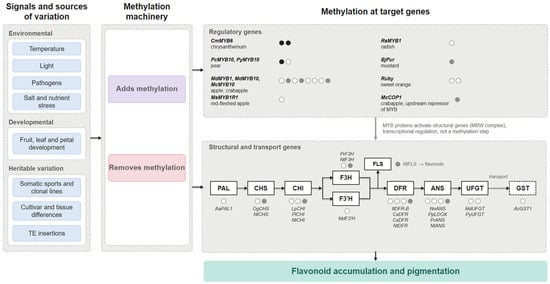
DNA methylation has been linked to the regulation of flavonoid-related genes in a wide range of species, and the evidence covers structural genes, MYB regulators, transposon-associated promoters and the methylation machinery itself (Table 5; Figure 2). In nearly three-quarters of the cases discussed here, studies have gone no further than showing a correlation between DNA methylation and the expression of flavonoid-related genes or pigmentation, without intervening on methylation. Among the studies included in this review, only three cases manipulated methylation at the locus itself: dCas9-based editing of the CmMYB6 promoter in chrysanthemum [49,50] and virus-induced silencing of the PcMYB10 promoter in pear [54]. Future studies could extend locus-specific manipulation of methylation to more species and to structural genes to further clarify how DNA methylation regulates flavonoid biosynthesis.
Table 5.
Cases of DNA methylation at flavonoid-related genes discussed in this review.
Figure 2.
Signals, methylation machinery and target genes in the regulation of flavonoid biosynthesis by DNA methylation. Environmental, developmental and heritable signals act on the DNA methylation machinery. Each dot represents one gene in one study and is shaded by the strength of evidence that methylation at the locus affects expression [11,22,39,40,41,43,44,45,46,47,48,49,50,51,52,53,54,55,56,57,58,59,60,64,65,66,67,68,69,79]: open, level I (association without intervention on methylation); grey, level II (non-targeted intervention); black, level III (locus-targeted manipulation of methylation).
Author Contributions
Z.X. collected the reference materials and wrote the original draft. X.Z. processed the visualization work. X.Z. and Y.L. revised the draft. K.M. presented the writing framework and project administration. All authors have read and agreed to the published version of the manuscript.
Funding
This research was funded by the National Natural Science Foundation of China (No. 32271949) and the National Key R&D Program of China (2020YFD1000500).
Data Availability Statement
No new data were created or analyzed in this study. Data sharing is not applicable to this article.
Acknowledgments
During the preparation of this manuscript, the authors used Claude Sonnet 5, Claude Opus 5 and GPT-5 for the purposes of language polishing and partial draft streamlining. The authors have reviewed and edited the output and take full responsibility for the content of this publication.
Conflicts of Interest
The authors declare no conflicts of interest.
References
- Zheng, X.; Zhang, X.; Zeng, F. Biological functions and health benefits of flavonoids in fruits and vegetables: A contemporary review. Foods 2025, 14, 155. [Google Scholar] [CrossRef] [Scilit]
- Shen, N.; Wang, T.; Gan, Q.; Liu, S.; Wang, L.; Jin, B. Plant flavonoids: Classification, distribution, biosynthesis, and antioxidant activity. Food Chem. 2022, 383, 132531. [Google Scholar] [CrossRef] [Scilit]
- Kroon, J.; Souer, E.; de Graaff, A.; Xue, Y.; Mol, J.; Koes, R. Cloning and structural analysis of the anthocyanin pigmentation locus Rt of Petunia hybrida: Characterization of insertion sequences in two mutant alleles. Plant J. 1994, 5, 69–80. [Google Scholar] [CrossRef] [Scilit]
- Yabuya, T.; Yamaguchi, M.A.; Fukui, Y.; Katoh, K.; Imayama, T.; Ino, I. Characterization of anthocyanin p-coumaroyltransferase in flowers of Iris ensata. Plant Sci. 2001, 160, 499–503. [Google Scholar] [CrossRef] [Scilit]
- Sasaki, N.; Nakayama, T. Achievements and perspectives in biochemistry concerning anthocyanin modification for blue flower coloration. Plant Cell Physiol. 2015, 56, 28–40. [Google Scholar] [CrossRef] [Scilit]
- Jiang, J.; Liu, J.; Sanders, D.; Qian, S.; Ren, W.; Song, J.; Liu, F.; Zhong, X. UVR8 interacts with de novo DNA methyltransferase and suppresses DNA methylation in Arabidopsis. Nat. Plants 2021, 7, 184–197. [Google Scholar] [CrossRef] [Scilit]
- Law, J.A.; Jacobsen, S.E. Establishing, maintaining and modifying DNA methylation patterns in plants and animals. Nat. Rev. Genet. 2010, 11, 204–220. [Google Scholar] [CrossRef] [Scilit]
- Ma, K.F.; Zhang, Q.X.; Cheng, T.R.; Yan, X.L.; Pan, H.T.; Wang, J. Substantial epigenetic variation causing flower color chimerism in the ornamental tree Prunus mume revealed by single base resolution methylome detection and transcriptome sequencing. Int. J. Mol. Sci. 2018, 19, 2315. [Google Scholar] [CrossRef] [Scilit]
- Zhang, H.; Lang, Z.; Zhu, J.K. Dynamics and function of DNA methylation in plants. Nat. Rev. Mol. Cell Biol. 2018, 19, 489–506. [Google Scholar] [CrossRef] [Scilit]
- Li, W.F.; Ning, G.X.; Mao, J.; Guo, Z.G.; Zhou, Q.; Chen, B.H. Whole-genome DNA methylation patterns and complex associations with gene expression associated with anthocyanin biosynthesis in apple fruit skin. Planta 2019, 250, 1833–1847. [Google Scholar] [CrossRef] [Scilit]
- Sun, X.W. The Effect of Rust Stress on Gene Expression in the Anthocyanin Biosynthesis Pathway and DNA Promoter Methylation of Malus spp. Leaves. Master’s Thesis, Northwest A&F University, Yangling, China, 2021. (In Chinese) [Google Scholar]
- Lu, Y.N. Molecular Mechanism of XsMYB113 Regulating Flower Color Gradation in Xanthoceras sorbifolium. Master’s Thesis, Northeast Forestry University, Harbin, China, 2023. (In Chinese) [Google Scholar]
- Lang, Z.; Wang, Y.; Tang, K.; Tang, D.; Datsenka, T.; Cheng, J.; Zhang, Y.; Handa, A.K.; Zhu, J.K. Critical roles of DNA demethylation in the activation of ripening-induced genes and inhibition of ripening-repressed genes in tomato fruit. Proc. Natl. Acad. Sci. USA 2017, 114, E4511–E4519. [Google Scholar] [CrossRef] [Scilit]
- Martienssen, R.A.; Colot, V. DNA methylation and epigenetic inheritance in plants and filamentous fungi. Science 2001, 293, 1070–1074. [Google Scholar] [CrossRef] [Scilit]
- Yi, S.V. Insights into epigenome evolution from animal and plant methylomes. Genome Biol. Evol. 2017, 9, 3189–3201. [Google Scholar] [CrossRef] [Scilit]
- Zhang, H.; Zhu, J.K. Epigenetic gene regulation in plants and its potential applications in crop improvement. Nat. Rev. Mol. Cell Biol. 2025, 26, 51–67. [Google Scholar] [CrossRef] [Scilit]
- Liu, J.; Zhong, X. Population epigenetics: DNA methylation in the plant omics era. Plant Physiol. 2024, 194, 2039–2048. [Google Scholar] [CrossRef] [Scilit]
- Holliday, R.; Pugh, J.E. DNA modification mechanisms and gene activity during development. Science 1975, 187, 226–232. [Google Scholar] [CrossRef] [Scilit]
- Liu, X.; Yu, C.W.; Duan, J.; Luo, M.; Wang, K.; Tian, G.; Cui, Y.; Wu, K. HDA6 directly interacts with DNA methyltransferase MET1 and maintains transposable element silencing in Arabidopsis. Plant Physiol. 2012, 158, 119–129. [Google Scholar] [CrossRef] [Scilit]
- Agius, F.; Kapoor, A.; Zhu, J.K. Role of the Arabidopsis DNA glycosylase/lyase ROS1 in active DNA demethylation. Proc. Natl. Acad. Sci. USA 2006, 103, 11796–11801. [Google Scholar] [CrossRef] [Scilit]
- Ortega-Galisteo, A.P.; Morales-Ruiz, T.; Ariza, R.R.; Roldán-Arjona, T. Arabidopsis DEMETER-LIKE proteins DML2 and DML3 are required for appropriate distribution of DNA methylation marks. Plant Mol. Biol. 2008, 67, 671–681. [Google Scholar] [CrossRef] [Scilit]
- Jiang, S.; Wang, N.; Chen, M.; Zhang, R.; Sun, Q.; Xu, H.; Zhang, Z.; Wang, Y.; Sui, X.; Wang, S.; et al. Methylation of MdMYB1 locus mediated by RdDM pathway regulates anthocyanin biosynthesis in apple. Plant Biotechnol. J. 2020, 18, 1736–1748. [Google Scholar] [CrossRef] [Scilit]
- Xiao, X.; Zhang, J.; Li, T.; Fu, X.; Satheesh, V.; Niu, Q.; Lang, Z.; Zhu, J.K.; Lei, M. A group of SUVH methyl-DNA binding proteins regulate expression of the DNA demethylase ROS1 in Arabidopsis. J. Integr. Plant Biol. 2019, 61, 110–119. [Google Scholar] [CrossRef] [Scilit]
- Liu, W.; Feng, Y.; Yu, S.; Fan, Z.; Li, X.; Li, J.; Yin, H. The flavonoid biosynthesis network in plants. Int. J. Mol. Sci. 2021, 22, 12824. [Google Scholar] [CrossRef] [Scilit]
- Lin, C.C.; Chen, D.W.; Dai, J.G. Advances in synthetic biology of flavonoids. Acta Pharm. Sin. 2022, 57, 1322–1335. (In Chinese) [Google Scholar] [CrossRef]
- Nakajima, O.; Akiyama, T.; Hakamatsuka, T.; Shibuya, M.; Noguchi, H.; Ebizuka, Y.; Sankawa, U. Isolation, sequence and bacterial expression of a cDNA for chalcone synthase from the cultured cells of Pueraria lobata. Chem. Pharm. Bull. 1991, 39, 1911–1913. [Google Scholar] [CrossRef] [Scilit]
- Leonard, E.; Lim, K.H.; Saw, P.N.; Koffas, M.A.G. Engineering central metabolic pathways for high-level flavonoid production in Escherichia coli. Appl. Environ. Microbiol. 2007, 73, 3877–3886. [Google Scholar] [CrossRef] [Scilit]
- Martens, S.; Preuß, A.; Matern, U. Multifunctional flavonoid dioxygenases: Flavonol and anthocyanin biosynthesis in Arabidopsis thaliana L. Phytochemistry 2010, 71, 1040–1049. [Google Scholar] [CrossRef] [Scilit]
- Zhao, Q.; Cui, M.Y.; Levsh, O.; Yang, D.; Liu, J.; Li, J.; Hill, L.; Yang, L.; Hu, Y.; Weng, J.K.; et al. Two CYP82D enzymes function as flavone hydroxylases in the biosynthesis of root-specific 4′-deoxyflavones in Scutellaria baicalensis. Mol. Plant 2018, 11, 135–148. [Google Scholar] [CrossRef] [Scilit]
- Kim, B.G.; Kim, H.; Hur, H.G.; Lim, Y.; Ahn, J.H. Regioselectivity of 7-O-methyltransferase of poplar to flavones. J. Biotechnol. 2006, 126, 241–247. [Google Scholar] [CrossRef] [Scilit]
- Wang, X.; Li, C.; Zhou, C.; Li, J.; Zhang, Y. Molecular characterization of the C-glucosylation for puerarin biosynthesis in Pueraria lobata. Plant J. 2017, 90, 535–546. [Google Scholar] [CrossRef] [Scilit]
- Xie, J.W.; Cao, X.Y.; Pan, W.Q.; Du, L.J. Research progress on the transport and accumulation mechanisms of plant flavonoids. Chin. Bull. Bot. 2024, 59, 463–480. (In Chinese) [Google Scholar]
- Koes, R.E.; Quattrocchio, F.; Mol, J.N.M. The flavonoid biosynthetic pathway in plants: Function and evolution. BioEssays 1994, 16, 123–132. [Google Scholar] [CrossRef] [Scilit]
- Dai, S.L.; Hong, Y. Molecular breeding for flower color modification of ornamental plants based on anthocyanin biosynthesis and coloration mechanisms. Sci. Agric. Sin. 2016, 49, 529–542. (In Chinese) [Google Scholar]
- Gonzalez, A.; Zhao, M.; Leavitt, J.M.; Lloyd, A.M. Regulation of the anthocyanin biosynthetic pathway by the TTG1/bHLH/Myb transcriptional complex in Arabidopsis seedlings. Plant J. 2008, 53, 814–827. [Google Scholar] [CrossRef] [Scilit]
- Ramsay, N.A.; Glover, B.J. MYB-bHLH-WD40 protein complex and the evolution of cellular diversity. Trends Plant Sci. 2005, 10, 63–70. [Google Scholar] [CrossRef] [Scilit]
- Wang, Y.; Zhao, M.; Xu, Z.; Qi, S.; Han, X. MSAP analysis of epigenetic changes reveals the mechanism of bicolor petal formation in Paeonia suffruticosa ‘Shima Nishiki’. 3 Biotech 2019, 9, 313. [Google Scholar] [CrossRef] [Scilit]
- Li, A.; Wang, F.; Ding, T.; Li, K.; Liu, H.; Zhang, Q.; Mu, Q.; Zhao, H.; Shan, S.; Wang, P. Genome-wide DNA methylation dynamics and RNA-seq analysis during grape (cv. ‘Cabernet Franc’) skin coloration. Genomics 2024, 116, 110810. [Google Scholar] [CrossRef] [Scilit]
- Wang, Q.; Wang, Y.; Sun, H.; Sun, L.; Zhang, L. Transposon-induced methylation of the RsMYB1 promoter disturbs anthocyanin accumulation in red-fleshed radish (Raphanus sativus L.). J. Exp. Bot. 2020, 71, 2537–2550. [Google Scholar] [CrossRef] [Scilit]
- Liu, X.; Chuang, Y.N.; Chiou, C.Y.; Chin, D.C.; Shen, F.Q.; Yeh, K.W. Methylation effect on chalcone synthase gene expression determines anthocyanin pigmentation in floral tissues of two Oncidium orchid cultivars. Planta 2012, 236, 401–409. [Google Scholar] [CrossRef] [Scilit]
- Lin, L.; Wang, S.; Zhang, J.; Song, X.; Zhang, D.; Cheng, W.; Cui, M.; Long, Y.; Xing, Z. Integrative analysis of transcriptome and metabolome reveals the effect of DNA methylation of chalcone isomerase gene in promoter region on Lithocarpus polystachyus Rehd flavonoids. Synth. Syst. Biotechnol. 2022, 7, 928–940. [Google Scholar] [CrossRef] [Scilit]
- Meyer, P.; Heidmann, I.; Niedenhof, I. Differences in DNA-methylation are associated with a paramutation phenomenon in transgenic petunia. Plant J. 1993, 4, 89–100. [Google Scholar] [CrossRef] [Scilit]
- Iida, S.; Morita, Y.; Choi, J.D.; Park, K.I.; Hoshino, A. Genetics and epigenetics in flower pigmentation associated with transposable elements in morning glories. Adv. Biophys. 2004, 38, 141–159. [Google Scholar] [CrossRef] [Scilit]
- Deng, J.; Fu, Z.; Chen, S.; Damaris, R.N.; Wang, K.; Li, T.; Yang, P. Proteomic and epigenetic analyses of lotus (Nelumbo nucifera) petals between red and white cultivars. Plant Cell Physiol. 2015, 56, 1546–1555. [Google Scholar] [CrossRef] [Scilit]
- Wu, X.; Zhou, Y.; Yao, D.; Iqbal, S.; Gao, Z.; Zhang, Z. DNA methylation of LDOX gene contributes to the floral color variegation in peach. J. Plant Physiol. 2020, 246–247, 153116. [Google Scholar] [CrossRef] [Scilit]
- Zhu, J.; Wang, Y.; Wang, Q.; Li, B.; Wang, X.; Zhou, X.; Zhang, H.; Xu, W.; Li, S.; Wang, L. The combination of DNA methylation and positive regulation of anthocyanin biosynthesis by MYB and bHLH transcription factors contributes to petal blotch formation in Xibei tree peony. Hortic. Res. 2023, 10, uhad100. [Google Scholar] [CrossRef] [Scilit]
- Zhang, X.; Zhang, K.; Guo, Y.; Lv, X.; Wu, M.; Deng, H.; Xie, Y.; Li, M.; Wang, J.; Lin, L.; et al. Methylation of AcGST1 is associated with anthocyanin accumulation in the kiwifruit outer pericarp. J. Agric. Food Chem. 2023, 71, 18865–18876. [Google Scholar] [CrossRef] [Scilit]
- Yu, L.; Sun, Y.; Zhang, X.; Chen, M.; Wu, T.; Zhang, J.; Xing, Y.; Tian, J.; Yao, Y. ROS1 promotes low temperature-induced anthocyanin accumulation in apple by demethylating the promoter of anthocyanin-associated genes. Hortic. Res. 2022, 9, uhac007. [Google Scholar] [CrossRef] [Scilit]
- Tang, M.; Xue, W.; Li, X.; Wang, L.; Wang, M.; Wang, W.; Yin, X.; Chen, B.; Qu, X.; Li, J.; et al. Mitotically heritable epigenetic modifications of CmMYB6 control anthocyanin biosynthesis in chrysanthemum. New Phytol. 2022, 236, 1075–1088. [Google Scholar] [CrossRef] [Scilit]
- Li, X.; Bu, F.; Zhang, M.; Li, Z.; Zhang, Y.; Chen, H.; Xue, W.; Guo, R.; Qi, J.; Kim, C.; et al. Enhancing nature’s palette through the epigenetic breeding of flower color in chrysanthemum. New Phytol. 2025, 245, 2117–2132. [Google Scholar] [CrossRef] [Scilit]
- Cheng, Q.; Dong, S.; Guo, L.; Jiang, S.; Yin, N.; Sun, D.; Cheng, F.; Yu, C.; Wan, Z. Intronic transposon insertion within the MYB transcription factor gene BjPur disturbs anthocyanin accumulation by inducing epigenetic modification in Brassica juncea. New Phytol. 2026, 249, 325–341. [Google Scholar] [CrossRef] [Scilit]
- Bai, S.; Tuan, P.A.; Saito, T.; Honda, C.; Hatsuyama, Y.; Ito, A.; Moriguchi, T. Epigenetic regulation of MdMYB1 is associated with paper bagging-induced red pigmentation of apples. Planta 2016, 244, 573–586. [Google Scholar] [CrossRef] [Scilit]
- Ma, C.; Jing, C.; Chang, B.; Yan, J.; Liang, B.; Liu, L.; Yang, Y.; Zhao, Z. The effect of promoter methylation on MdMYB1 expression determines the level of anthocyanin accumulation in skins of two non-red apple cultivars. BMC Plant Biol. 2018, 18, 108. [Google Scholar] [CrossRef] [Scilit]
- Wang, Z.; Meng, D.; Wang, A.; Li, T.; Jiang, S.; Cong, P.; Li, T. The methylation of the PcMYB10 promoter is associated with green-skinned sport in Max Red Bartlett pear. Plant Physiol. 2013, 162, 885–896. [Google Scholar] [CrossRef] [Scilit]
- Telias, A.; Wang, K.L.; Stevenson, D.E.; Cooney, J.M.; Hellens, R.P.; Allan, A.C.; Hoover, E.E.; Bradeen, J.M. Apple skin patterning is associated with differential expression of MYB10. BMC Plant Biol. 2011, 11, 93. [Google Scholar] [CrossRef] [Scilit]
- Qian, M.; Sun, Y.; Allan, A.C.; Teng, Y.; Zhang, D. The red sport of ‘Zaosu’ pear and its red-striped pigmentation pattern are associated with demethylation of the PyMYB10 promoter. Phytochemistry 2014, 107, 16–23. [Google Scholar] [CrossRef] [Scilit]
- Cho, H.J.; Kim, G.H.; Choi, C. Differential gene expression and epigenetic analyses between striped and blushed skinned sports of ‘Fuji’ apple. Sci. Hortic. 2020, 261, 108944. [Google Scholar] [CrossRef] [Scilit]
- El-Sharkawy, I.; Liang, D.; Xu, K. Transcriptome analysis of an apple (Malus × domestica) yellow fruit somatic mutation identifies a gene network module highly associated with anthocyanin and epigenetic regulation. J. Exp. Bot. 2015, 66, 7359–7376. [Google Scholar] [CrossRef] [Scilit]
- Xu, X.; Gui, R.; Zhu, J.; Zhang, X.; Fu, W.; Zhao, L.; Wang, S. Epigenetic silencing of MsMYB1R1 drives anthocyanin reduction in developing red-fleshed apple. J. Agric. Food Chem. 2025, 73, 15550–15560. [Google Scholar] [CrossRef] [Scilit]
- Xing, Y.; Xie, Z.; Sun, W.; Sun, Y.; Han, Z.; Zhang, S.; Tian, J.; Zhang, J.; Yao, Y. The RNA-directed DNA methylation (RdDM) pathway regulates anthocyanin biosynthesis in crabapple (Malus cv. spp.) leaves by methylating the McCOP1 promoter. Plants 2021, 10, 2466. [Google Scholar] [CrossRef] [Scilit]
- Peng, Z.; Tian, J.; Luo, R.; Kang, Y.; Lu, Y.; Hu, Y.; Liu, N.; Zhang, J.; Cheng, H.; Niu, S.; et al. MiR399d and epigenetic modification comodulate anthocyanin accumulation in Malus leaves suffering from phosphorus deficiency. Plant Cell Environ. 2020, 43, 1148–1159. [Google Scholar] [CrossRef] [Scilit]
- Kang, L.; Qian, L.; Zheng, M.; Chen, L.; Chen, H.; Yang, L.; You, L.; Yang, B.; Yan, M.; Gu, Y.; et al. Genomic insights into the origin, domestication and diversification of Brassica juncea. Nat. Genet. 2021, 53, 1392–1402. [Google Scholar] [CrossRef] [Scilit]
- Quadrana, L.; Colot, V. Plant transgenerational epigenetics. Annu. Rev. Genet. 2016, 50, 467–491. [Google Scholar] [CrossRef] [Scilit]
- Pandey, N.; Goswami, N.; Tripathi, D.; Rai, K.K.; Rai, S.K.; Singh, S.; Pandey-Rai, S. Epigenetic control of UV-B-induced flavonoid accumulation in Artemisia annua L. Planta 2019, 249, 497–514. [Google Scholar] [CrossRef] [Scilit]
- Sicilia, A.; Scialò, E.; Puglisi, I.; Lo Piero, A.R. Anthocyanin biosynthesis and DNA methylation dynamics in sweet orange fruit [Citrus sinensis L. (Osbeck)] under cold stress. J. Agric. Food Chem. 2020, 68, 7024–7031. [Google Scholar] [CrossRef] [Scilit]
- Bharti, P.; Mahajan, M.; Vishwakarma, A.K.; Bhardwaj, J.; Yadav, S.K. AtROS1 overexpression provides evidence for epigenetic regulation of genes encoding enzymes of flavonoid biosynthesis and antioxidant pathways during salt stress in transgenic tobacco. J. Exp. Bot. 2015, 66, 5959–5969. [Google Scholar] [CrossRef] [Scilit]
- Sicilia, A.; Catara, V.; Scialò, E.; Lo Piero, A.R. Fungal infection induces anthocyanin biosynthesis and changes in DNA methylation configuration of blood orange [Citrus sinensis L. (Osbeck)]. Plants 2021, 10, 244. [Google Scholar] [CrossRef] [Scilit]
- Gao, S.; Ma, W.; Lyu, X.; Cao, X.; Yao, Y. Melatonin may increase disease resistance and flavonoid biosynthesis through effects on DNA methylation and gene expression in grape berries. BMC Plant Biol. 2020, 20, 231. [Google Scholar] [CrossRef] [Scilit]
- Wu, Y.; Liu, L.; Zhao, D.; Tao, J. Age-associated methylation change of CHI promoter in herbaceous peony (Paeonia lactiflora Pall). Biosci. Rep. 2018, 38, BSR20180482. [Google Scholar] [CrossRef] [Scilit]
- Finke, A.; Rozhon, W.; Pecinka, A. Analysis of DNA methylation content and patterns in plants. Methods Mol. Biol. 2018, 1694, 277–298. [Google Scholar] [CrossRef] [Scilit]
- Chen, Z.H.; Ren, J.G.; Wang, J.L. Research advances on plant DNA methylation. J. Agric. 2021, 11, 88–97. (In Chinese) [Google Scholar] [CrossRef]
- Baubec, T.; Akalin, A. Genome-wide analysis of DNA methylation patterns by high-throughput sequencing. In Field guidelines for Genetic Experimental Designs in High-Throughput Sequencing; Aransay, A.M., Lavín Trueba, J.L., Eds.; Springer International Publishing: Cham, Switzerland, 2016; pp. 197–221. [Google Scholar] [CrossRef] [Scilit]
- Feng, S.; Zhong, Z.; Wang, M.; Jacobsen, S.E. Efficient and accurate determination of genome-wide DNA methylation patterns in Arabidopsis thaliana with enzymatic methyl sequencing. Epigenet. Chromatin 2020, 13, 42. [Google Scholar] [CrossRef] [Scilit]
- Vaisvila, R.; Ponnaluri, V.K.C.; Sun, Z.; Langhorst, B.W.; Saleh, L.; Guan, S.; Dai, N.; Campbell, M.A.; Sexton, B.S.; Marks, K.; et al. Enzymatic methyl sequencing detects DNA methylation at single-base resolution from picograms of DNA. Genome Res. 2021, 31, 1280–1289. [Google Scholar] [CrossRef] [Scilit]
- Schmidt, M.; Van Bel, M.; Woloszynska, M.; Slabbinck, B.; Martens, C.; De Block, M.; Coppens, F.; Van Lijsebettens, M. Plant-RRBS, a bisulfite and next-generation sequencing-based methylome profiling method enriching for coverage of cytosine positions. BMC Plant Biol. 2017, 17, 115. [Google Scholar] [CrossRef] [Scilit]
- Xing, X.; Zhang, B.; Li, D.; Wang, T. Comprehensive whole DNA methylome analysis by integrating MeDIP-seq and MRE-seq. Methods Mol. Biol. 2018, 1708, 209–246. [Google Scholar] [CrossRef] [Scilit]
- Zhao, T.; Guan, X.; Hu, Y.; Zhang, Z.; Yang, H.; Shi, X.; Han, J.; Mei, H.; Wang, L.; Shao, L.; et al. Population-wide DNA methylation polymorphisms at single-nucleotide resolution in 207 cotton accessions reveal epigenomic contributions to complex traits. Cell Res. 2024, 34, 859–872. [Google Scholar] [CrossRef] [Scilit]
- Guo, H.; Cao, P.; Wang, C.; Lai, J.; Deng, Y.; Li, C.; Hao, Y.; Wu, Z.; Chen, R.; Qiang, Q.; et al. Population analysis reveals the roles of DNA methylation in tomato domestication and metabolic diversity. Sci. China Life Sci. 2023, 66, 1888–1902. [Google Scholar] [CrossRef] [Scilit]
- Liu, H.N.; Shu, Q.; Wang, K.L.; Espley, R.V.; Allan, A.C.; Pei, M.S.; Li, X.L.; Su, J.; Wu, J. DNA methylation reprogramming provides insights into light-induced anthocyanin biosynthesis in red pear. Plant Sci. 2023, 326, 111499. [Google Scholar] [CrossRef] [Scilit]
- Liu, F.; Gao, J.; Lin, Y.; Meng, H.; Wang, W.; Luo, Y.; Cao, Y.; Wang, W.; Guan, F.; Wang, P.; et al. Mitigating inconsistencies in GWAS follow-up analyses with LocusCompare2. Nat. Genet. 2025, 57, 2606–2613. [Google Scholar] [CrossRef] [Scilit]
- Cedoz, P.L.; Prunello, M.; Brennan, K.; Gevaert, O. MethylMix 2.0: An R package for identifying DNA methylation genes. Bioinformatics 2018, 34, 3044–3046. [Google Scholar] [CrossRef] [Scilit]
- Joshi, K.; Wang, D.O. EpidecodeR: A functional exploration tool for epigenetic and epitranscriptomic regulation. Brief. Bioinform. 2024, 25, bbad521. [Google Scholar] [CrossRef] [Scilit]

Disclaimer/Publisher’s Note: The statements, opinions and data contained in all publications are solely those of the individual author(s) and contributor(s) and not of MDPI and/or the editor(s). MDPI and/or the editor(s) disclaim responsibility for any injury to people or property resulting from any ideas, methods, instructions or products referred to in the content. |
© 2026 by the authors. Licensee MDPI, Basel, Switzerland. This article is an open access article distributed under the terms and conditions of the Creative Commons Attribution (CC BY) license.