


Abstract
AREB (ABA-responsive element binding protein)/ABF (ABRE-binding factor) transcription factors play crucial roles in ABA signal transduction and plant adaptation to diverse abiotic stresses. Nevertheless, a systematic genome-wide investigation of the AREB/ABF gene family has not yet been reported in taro. In the present study, nine AREB/ABF genes were identified in the taro genome and named CeABF1–CeABF9 based on their chromosomal locations. Phylogenetic analysis grouped these CeABF genes into five distinct subgroups, and members within the same clade exhibited highly conserved domain architectures and motif compositions. Transcriptome profiling revealed that CeABF1 and CeABF5 were significantly induced by drought and salt, with CeABF5 transcripts showing stronger induction. Functional overexpression assays in both Arabidopsis and taro demonstrated that CeABF5 functions as a positive regulator of drought and salt tolerance, as evidenced by reduced ROS and MDA accumulation, and enhanced activities of antioxidant enzymes (SOD and CAT) under stress. Yeast one-hybrid (Y1H) assays further indicated that CeABF5 can bind to the CeSAPK3 promoter, suggesting a potential CeABF5-CeSAPK3 regulatory link. Collectively, our results provide comprehensive genomic insights into the taro AREB/ABF subfamily and identify CeABF5 as a promising candidate for breeding stress-resistant crops.
1. Introduction
Taro (Colocasia esculenta (L.) Schott), an important underground corm crop belonging to the Araceae family, represents one of the earliest domesticated crops worldwide [1]. As a versatile crop, taro is widely utilized as a staple food, fresh vegetable, livestock forage, and industrial raw material. In addition to its diverse uses, taro has high nutritional and medicinal value, being rich in proteins, vitamins, carbohydrates, and various phytochemicals with strong antioxidant activities [2,3]. It has a unique flavor and balanced nutritional profile and is gluten-free, which makes it a favorable alternative to wheat-derived products. Accordingly, consumer demand for taro has increased in recent years. However, taro growth and productivity are severely constrained by various abiotic stresses, which reduce corm yield, impair corm quality, and hinder its large-scale commercial cultivation.
Drought and salinity are major abiotic stresses that disrupt cellular homeostasis, suppress plant growth, and cause severe crop yield losses [4,5]. To adapt to these adverse conditions, plants have evolved elaborate physiological and molecular regulatory networks, within which abscisic acid (ABA) functions as a core signaling molecule that orchestrates drought- and salt-stress responses [6]. Consistently, drought and salinity induce endogenous ABA accumulation in plant tissues [7,8]. Exogenous ABA application further enhances plant tolerance to these two stresses [7,9]. In addition, ABA-deficient mutants exhibit more severe wilting and show reduced tolerance to water deficit, confirming the indispensable role of ABA in basal stress adaptation [10,11].
ABA modulates plant growth and stress responses via a highly complex regulatory network [12]. Over the past two decades, the core model of the ABA signaling cascade has been well characterized in Arabidopsis. In this cascade, ABA binds to PYR/PYL/RCAR receptors, and the resulting ligand–receptor complex inhibits the activity of PP2C phosphatases. Under non-stress conditions, PP2Cs maintain SnRK2 kinases in an inactive state. Once PP2C activity is inhibited, SnRK2s are released and activated. Active SnRK2s phosphorylate downstream AREB/ABF transcription factors, thereby triggering the expression of ABA-responsive genes [13,14]. As key downstream transcriptional regulators of ABA signaling, AREB/ABF transcription factors govern the transcriptional reprogramming that underpins plant ABA-dependent stress responses.
AREB/ABF transcription factors belong to the subfamily A of the basic leucine zipper (bZIP) family and specifically bind to ABA-responsive element (ABRE) cis-elements [15]. To date, nine AREB/ABF members (AtABF1, AtABF2, AtABF3, AtABF4, AtABI5, AtDPBF2, AtDPBF3, AtDPBF4, and At5G42910) within this group have been characterized in Arabidopsis [16,17]. Accumulating evidence has demonstrated the functional conservation of ABF-mediated stress tolerance across diverse plant species. Overexpression of SlAREB1 in tomato (Solanum lycopersicum) can improve salt and drought tolerance by modulating stress-related genes, including CHI3, β-1,3-glucanases, and TSI-1 [18]. In rapeseed (Brassica napus), BnaABF2 confers drought and salt tolerance in transgenic Arabidopsis by decreasing leaf water loss and inducing stress marker genes such as RD29B, RAB18, and KIN2 [19]. Heterologous overexpression of GhABF3 in Arabidopsis and homologous overexpression in cotton (Gossypium hirsutum) alleviate cellular oxidative damage to improve salt tolerance and reduce leaf water loss to enhance drought tolerance [20]. In jujube (Ziziphus jujuba), ZjABF1 promotes sugar accumulation and stress tolerance through direct activation of ZjSWEET11 and ZjSWEET18 [21]. Collectively, these findings highlight that AREB/ABF transcription factors from different plant species participate in ABA-dependent stress adaptation, though they regulate distinct sets of downstream genes.
Recent advances in genome sequencing have facilitated the comprehensive identification of AREB/ABF members in various plants [22,23]. Nevertheless, genome-wide identification and expression profiling of the AREB/ABF subfamily under abiotic stresses have not yet been reported in taro. To elucidate the potential functions of the AREB/ABF subfamily in taro, the present study systematically identified and characterized taro AREB/ABF genes. We performed multiple bioinformatic analyses, including chromosomal localization, gene structure prediction, conserved motif identification, cis-acting element analysis, phylogenetic tree construction, and subcellular localization prediction. Additionally, we investigated the transcript expression patterns of taro AREB/ABF members under drought and salt stresses and further explored the potential regulatory function of the CeABF5 gene. This study lays a foundation for deciphering the regulatory roles of AREB/ABF genes in taro and provides novel insights into future research on plant stress adaptation mechanisms.
2. Materials and Methods
2.1. Identification of AREB/ABF Subfamily Members
Protein sequences of nine Arabidopsis AREB/ABF subfamily members were retrieved from The Arabidopsis Information Resource (TAIR, https://www.arabidopsis.org/) and used as reference queries. Genomic sequences and corresponding annotation files of rice (Oryza sativa) were downloaded from RAP-DB (https://rapdb.dna.naro.go.jp/). For tomato, genomic assemblies and annotation datasets were obtained from Ensembl Plants database (https://plants.ensembl.org, accessed on 9 January 2025). Taro genomic sequences and their associated annotation files were retrieved from the FTP server of the China National GeneBank (https://ftp.cngb.org, accessed on 10 January 2025).
To identify taro AREB/ABF candidates, BLASTP searches were performed against the taro genome using the Arabidopsis AREB/ABF protein sequences as queries via the BLAST plugin in TBtools-II, with an E-value cutoff of 1 × 10⁻²⁰ to minimize false-positive hits. Meanwhile, the hidden Markov model (HMM) profile of the bZIP domain (PF00170) was retrieved from the Pfam database (https://pfam.xfam.org/, accessed on 12 January 2025). Sequences detected by both BLASTP and HMM searches were retained as preliminary candidates. All candidate proteins were further validated against the NCBI Conserved Domain Database (CDD, https://www.ncbi.nlm.nih.gov/Structure/bwrpsb/bwrpsb.cgi, accessed on 12 January 2025) and SMART (https://smart.embl-heidelberg.de/). Sequences lacking the AREB/ABF-specific conserved domain cd14707 were manually discarded, and proteins annotated as G-box binding factors (GBFs) were removed from the candidate list. The same screening workflow was applied to rice and tomato to obtain putative AREB/ABF homologs for subsequent phylogenetic reconstruction.
2.2. Protein Characterization and Chromosomal Distribution of CeABF Genes
The amino acid sequence length, molecular weight (MW), and isoelectric point (pI) of all identified CeABF proteins were calculated using the ExPASy ProtParam tool (https://web.expasy.org/protparam/, accessed on 9 January 2025). Subcellular localization of CeABFs was predicted using WoLF PSORT (https://wolfpsort.hgc.jp/, accessed on 15 January 2025). Chromosomal position information for CeABF genes of Colocasia esculenta was extracted from the GFF3 annotation file of the taro genome. TBtools-II was used to construct the chromosomal distribution map. The CeABF genes were named sequentially according to their physical positions on the chromosomes.
2.3. Phylogenetic Analysis, Gene Structure, Conserved Motifs, Cis-Acting Elements, and Synteny Analysis
Multiple sequence alignment was performed using ClustalW for nine CeABF proteins, together with homologous AREB/ABF proteins from rice, tomato, and Arabidopsis. A neighbor-joining (NJ) phylogenetic tree was constructed using MEGA 11 with 1000 bootstrap replicates to evaluate tree reliability. The resulting phylogenetic tree was further optimized and visualized using the online tool iTOL v7 (https://itol.embl.de/).
Exon–intron structures of all CeABF genes were determined based on the GFF3 annotation file of the taro genome. Conserved protein motifs were identified using the MEME Suite (https://meme-suite.org/, accessed on 21 March 2025), with a maximum of eight predicted motifs and motif lengths ranging from 15 to 100 amino acids. TBtools was used to simultaneously visualize the exon–intron organization and conserved motif distribution of CeABF genes [24].
For cis-acting element analysis, the 2000 bp sequences upstream of the transcription start site of each CeABF gene were extracted using TBtools. These promoter sequences were subsequently scanned against the PlantCARE database (https://bioinformatics.psb.ugent.be/webtools/plantcare/html/, accessed on 9 January 2025) to predict putative cis-regulatory elements, and the results were visualized using TBtools.
Synteny analysis was performed using the One Step MCScanX module of TBtools II to identify tandem and segmental duplication events of CeABF genes within the taro genome [25]. Additionally, interspecific syntenic relationships of CeABF genes between taro and three model plant species, including Arabidopsis, Solanum lycopersicum, and Oryza sativa, were systematically investigated. Both intragenomic and interspecific syntenic relationships were visualized using the Circos plugin embedded in TBtools.
2.4. Growth and Stress Treatment of Plant Materials
The taro cultivar ‘Ganyu 2’ used in this study was maintained in the Jiangxi Provincial Key Laboratory of Vegetable Cultivation and Utilization, Jiangxi Agricultural University. Cormels of ‘Ganyu 2’ were germinated in a mixed substrate composed of nutrient soil, vermiculite, and perlite (5:3:2, v/v/v). Germination conditions were set to 23 °C with a 16 h light/8 h dark photoperiod, a light intensity of 80–100 μmol m−2 s−1, and a relative humidity of 40–60% [26]. Uniform two-leaf stage seedlings were selected and pre-cultured hydroponically in Hoagland’s solution for seven days and then randomly allocated to three experimental groups: control, drought stress, and salinity stress. Each group was cultured in a separate container to avoid cross-contamination. The drought stress group was subjected to 20% (w/v) PEG 6000 to simulate drought conditions [27], while the salinity stress group was treated with 200 mM NaCl [28]. Taro leaf samples were collected at 0, 6, 12, 24, 48, and 120 h after stress initiation [29]. For exogenous ABA treatment, seedling leaves were sprayed with 50 μM abscisic acid solution, and spraying deionized water served as the corresponding control [30]. Each treatment included three independent biological replicates. All collected samples were immediately snap-frozen in liquid nitrogen and stored at −80 °C for subsequent RNA-seq and gene expression analyses.
Seeds of Arabidopsis thaliana ecotype Columbia-0 (Col-0) were surface-sterilized with 75% (v/v) ethanol for 1 min, followed by treatment with 2% (v/v) sodium hypochlorite (NaClO) solution for 10 min. The sterilized seeds were rinsed three times with sterile distilled water under aseptic conditions and sown on half-strength Murashige and Skoog (1/2 MS) medium [31]. Seeds were stratified at 4 °C in darkness for 2 d. Subsequently, the plates were transferred to a growth chamber and incubated at 23 °C under a 16 h light/8 h dark photoperiod, with a light intensity of 80–100 μmol m−2 s−1 and a relative humidity of 40–60% [32]. Seven-day-old seedlings were transplanted into soil and grown under identical environmental conditions until flowering.
2.5. RNA-Seq and Quantitative Real-Time PCR (qRT-PCR)
Total RNA was isolated from taro leaves sampled at 0, 6, 12, 24, 48, and 120 h following separate drought and salt stress treatments using the FastPure Universal Plant Total RNA Isolation Kit (Vazyme, Nanjing, China). RNA integrity and purity were assessed by agarose gel electrophoresis, NanoDrop spectrophotometry, and the Agilent 2100 Bioanalyzer. Qualified RNA samples were subjected to cDNA library construction and subsequent high-throughput sequencing on the Illumina platform. Raw sequencing reads were filtered with fastp v0.19.3 and then mapped to the taro reference genome [25]. Gene expression levels were quantified as Transcripts Per Million (TPM). Genes with |log2(Fold Change)| ≥ 1 and a false discovery rate (FDR) < 0.05 were considered significantly differentially expressed [33].
For qRT-PCR validation, first-strand cDNA was synthesized from purified RNA using the HiScript II 1st Strand cDNA Synthesis Kit (+gDNA wiper) (Vazyme, Nanjing, China). qRT-PCR was performed on a Bio-Rad CFX96 system using Hieff SYBR Master Mix (Yeasen, Shanghai, China). Relative expression levels were calculated by the 2−ΔΔCT method using CeActin as the reference [34]. All qRT-PCR experiments were performed with three independent biological replicates, and all primer sequences used in this study are listed in Table S1.
2.6. GUS Histochemical Staining and Generation of CeABF5-Overexpressing Transgenic Arabidopsis
The CeABF5 promoter was cloned from genomic DNA extracted from leaves of taro cultivar ‘Ganyu 2’. A specific primer pair was designed according to the taro genome sequence [25], and a 1729 bp promoter fragment upstream of the CeABF5 start codon was amplified. The obtained fragment was inserted into the pCAMBIA2300 vector to generate the proCeABF5::GUS reporter construct, in which the GUS reporter gene was driven by the native CeABF5 promoter. The recombinant vector was stably transformed into Arabidopsis ecotype Columbia plants (Col-0) via Agrobacterium tumefaciens-mediated floral dip transformation [31]. Transgenic plants were screened on culture medium containing kanamycin (30 mg/L) and validated by PCR and qRT–PCR as described above [35]. T3 homozygous positive Arabidopsis seedlings were transferred to suitable test tubes, immersed in 1 mL of GUS staining solution, and incubated overnight at 37 °C. For chlorophyll decolorization, the seedlings were decolorized 2–3 times in 70% (v/v) ethanol for 2 h each time [36]. After staining and clearance, tissues were observed under a stereomicroscope (SZX16, Olympus, Tokyo, Japan), and GUS staining patterns were documented. To investigate whether CeABF5 promoter activity was modulated by drought and salt stresses, surface-sterilized seeds of positive transgenic plants were sown on standard MS medium (control), as well as on MS medium supplemented with 100 mM mannitol [37] or 150 mM NaCl [38]. Seedlings were grown until the cotyledon stage before GUS histochemical staining was performed.
For the construction of the CeABF5 overexpression vector, the coding sequence (CDS) of CeABF5 was amplified by RT-PCR from cDNA of ‘Ganyu 2’ and inserted into the modified pBI121 vector at the XbaI and KpnI restriction sites, with the CeABF5 CDS driven by the constitutive CaMV 35S promoter. The recombinant vector was transformed into Arabidopsis Col-0 using the floral-dip method [39], and T3 homozygous lines were isolated and used for phenotypic characterization.
2.7. Subcellular Localization and Transient Overexpression Assay of CeABF5
The full-length CeABF5 coding sequence was amplified and cloned into the pCAMBIA1300-GFP vector to generate the 35S::CeABF5-GFP fusion construct. The recombinant vector 35S::CeABF5-GFP and the empty pCAMBIA1300-GFP (negative control) were separately transformed into Agrobacterium tumefaciens strain GV3101. To determine the subcellular distribution of CeABF5, the GV3101 strain carrying 35S::CeABF5-GFP was cultured overnight in liquid LB medium. Bacterial pellets were harvested via centrifugation at 3000× g for 10 min at 24 °C, then resuspended in infiltration buffer (10 mM MgCl2, 200 μM acetosyringone, and 10 mM MES, pH 5.6) to a final OD600 = 1.0 [32]. The bacterial suspensions carrying 35S::CeABF5-GFP and the empty pCAMBIA1300-GFP were separately infiltrated into leaves of N. benthamiana. The infiltrated plants were incubated for 72 h to allow protein expression. Approximately 30 min before fluorescence observation, the infiltrated leaves were injected with DAPI solution for nuclear staining. Fluorescence signals were visualized using an Olympus FV3000 laser scanning confocal microscope (Tokyo, Japan). GFP and DAPI fluorescence signals were excited by 488 nm and 405 nm lasers, respectively, and bright-field images were simultaneously captured for morphological reference.
For the transient overexpression assay in taro, the constructs 35S::CeABF5-GFP and empty pCAMBIA1300-GFP were introduced into Agrobacterium tumefaciens EHA105. Bacterial cultures adjusted to OD600 = 0.5 were incubated for 1 h at room temperature and infiltrated into leaves of uniform ‘Ganyu 2’ seedlings bearing two fully expanded leaves [40]. Two days after infiltration, the transiently transformed taro leaves were preliminarily validated by PCR, and the transcript abundance of CeABF5 was further quantified using qRT-PCR. Three independent transient overexpression samples with relatively high CeABF5 expression levels were selected for subsequent stress treatments. All experiments were performed with three independent biological replicates.
2.8. Stress Treatment of Transgenic Plants and Physiological Characterization
For transgenic Arabidopsis stress assays, seeds from CeABF5-overexpressing (OE) lines were first germinated on 1/2 MS medium for one week. The germinated seedlings were then transplanted into soil and grown for an additional two weeks under routine watering. Subsequently, drought and salt stresses were imposed using 20% (w/v) PEG6000 and 150 mM NaCl solution, respectively. Physiological parameters were determined when stressed plants exhibited obvious wilting and yellowing symptoms. Transgenic taro leaves were subjected to the same stress conditions. All stress assays were performed in three independent biological replicates, and plant phenotypes were photographed before and after stress treatment.
Key physiological parameters related to stress tolerance, including leaf relative water content (RWC), hydrogen peroxide (H2O2) concentration, and the activities of superoxide dismutase (SOD) and catalase (CAT), were quantified using commercial assay kits (Solarbio, Beijing, China) following the manufacturer’s instructions. MDA content was determined via the thiobarbituric acid (TBA) method using a modified protocol as previously described [36]. All physiological measurements were performed in three independent biological replicates to ensure experimental reliability and reproducibility.
2.9. Yeast One-Hybrid (Y1H) Assay
To characterize the physical interaction between CeABF5 and its target promoters, Y1H assays were performed [41]. We hypothesized that stress-induced CeABF5 positively regulates stress tolerance by binding to the promoters of ABA signaling-related genes. Candidate target genes, including CeSAPK3 (EVM0007378), CeNCED (EVM0019984), CeWRKY7 (EVM0006301), and CeBZIP6 (EVM0005754), were identified from our stress transcriptome dataset based on their high expression levels under stress conditions. Approximately 2000 bp sequences upstream of the transcription start site of each target gene were retrieved from the taro genome database. Each promoter fragment was inserted into the pAbAi bait vector. The recombinant plasmids were linearized using BstBI and transformed into Y1HGold yeast cells. Positive bait strains were screened on SD/-Ura medium. Auto-activation assays were performed to determine the minimal inhibitory concentration of aureobasidin A (AbA), and a concentration of 300 ng/mL AbA was used for subsequent screening. For prey construction, the coding sequence of CeABF5 was ligated into the pGADT7 vector. The recombinant pGADT7-CeABF5 plasmid and empty pGADT7 (negative control) were separately transformed into the verified bait strains. Yeast cells were cultured on SD/-Leu medium supplemented with 300 ng/mL AbA at 30 °C for 3–5 days. Protein-DNA interactions were assessed based on yeast colony growth.
2.10. Statistical Analyses
All experiments were performed in three independent biological replicates, with data expressed as means ± standard deviation (SD). SPSS v25.0 and GraphPad Prism 8.0.1 were used for statistical analyses. Two-way ANOVA was applied to evaluate differences among groups and treatments, followed by Tukey’s multiple comparison test, with statistical significance defined at p < 0.05.
3. Results
3.1. Identification, Characterization and Phylogenetic Classification of Taro AREB/ABF Genes
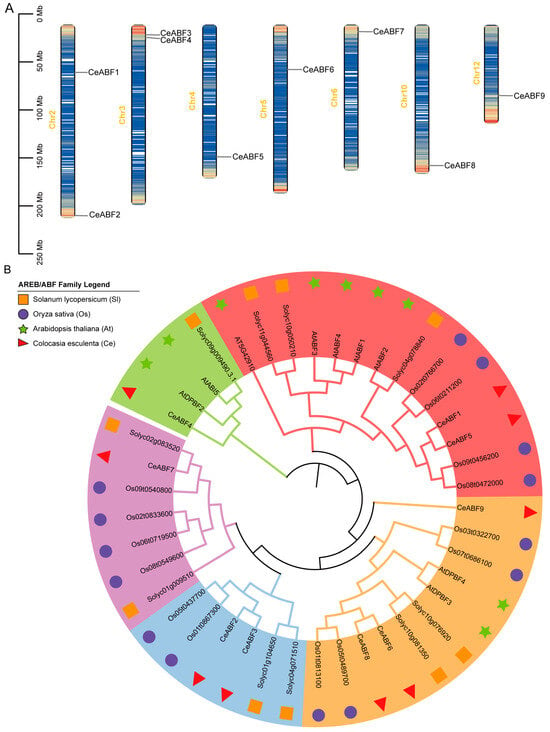
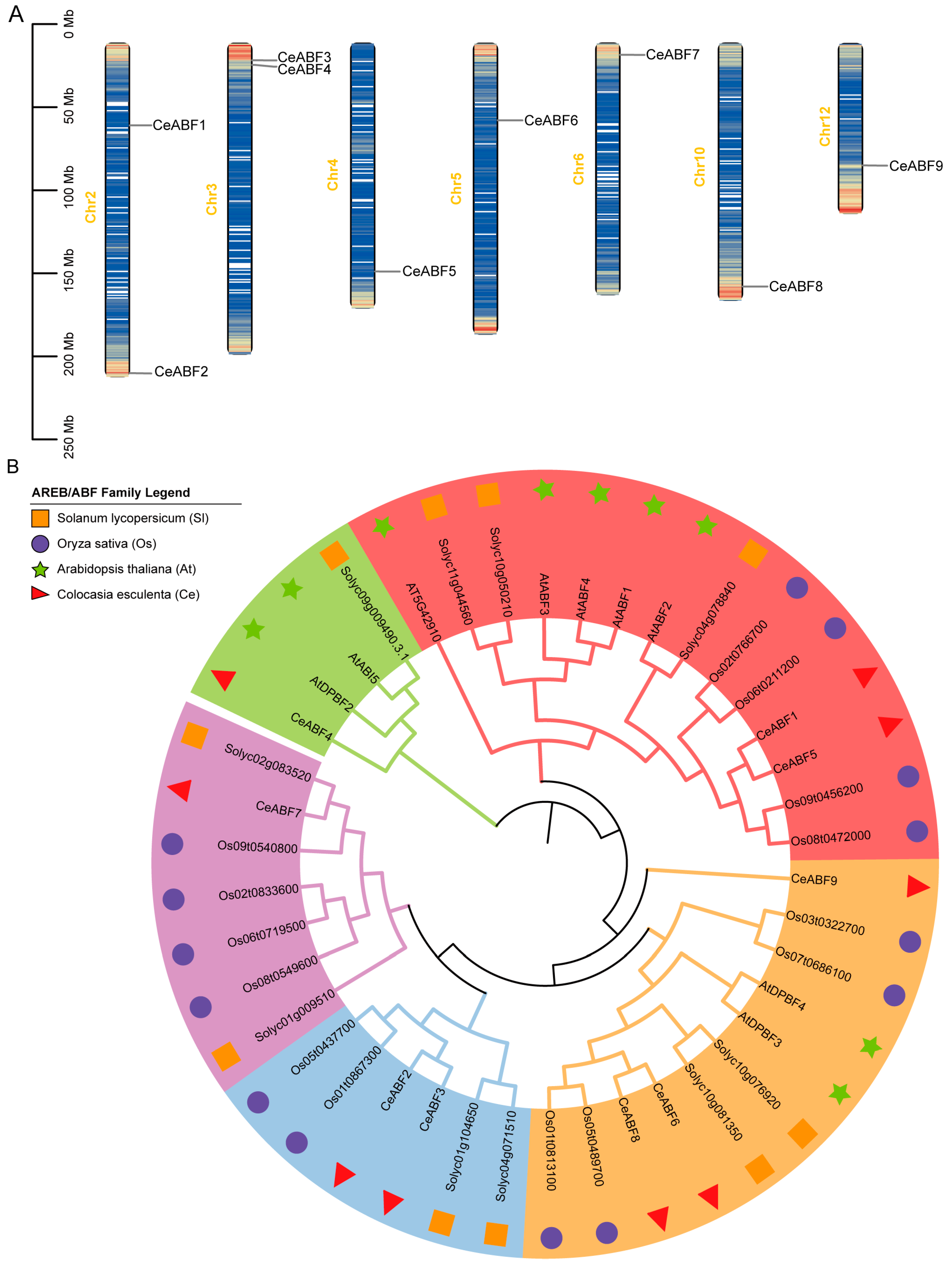
AREB/ABF genes were identified from the taro genome via combined BLAST (v.2.12.0) searches (using homologous AREB/ABF protein sequences from Arabidopsis) and Pfam screening. Conserved domain integrity of the retrieved candidates was further verified using SMART and NCBI-CDD. After screening, nine AREB/ABF members were retained and systematically designated CeABF1 to CeABF9 based on their chromosomal locations (Figure 1A). These genes were unevenly distributed across seven taro chromosomes. Chromosomes 2 and 3 each harbored two genes (CeABF1/CeABF2 and CeABF3/CeABF4), whereas chromosomes 4, 5, 6, 10, and 12 each contained a single CeABF locus. Notably, no tandem duplication events were detected within the AREB/ABF subfamily. Physicochemical property analysis of the nine CeABF proteins showed that their amino acid lengths ranged from 283 residues (CeABF3) to 529 residues (CeABF4). The molecular weights varied from 30,359.61 Da (CeABF3) to 57,420.52 Da (CeABF4). The isoelectric points (pI) ranged from 5.03 (CeABF3) to 10.05 (CeABF7). The protein instability indices varied from 40.63 (CeABF1) to 73.83 (CeABF7). Subcellular localization prediction indicated that all CeABF proteins localized to the nucleus (Table S2).
Figure 1.
Chromosomal distribution and phylogenetic analysis of taro AREB/ABF proteins. (A) Chromosomal distribution of CeABF genes. Chromosome numbers are labeled in yellow font to the left of each chromosome, and chromosome lengths are shown in megabases (Mb). Red regions on chromosomes indicate the highest gene density, while blue regions represent the lowest gene density. (B) Phylogenetic analysis of the AREB/ABF proteins. Distinct clades are highlighted with different colors. Proteins from taro, tomato, rice, and Arabidopsis are marked with red triangles, yellow squares, purple circles, and green stars, respectively. The phylogenetic tree was constructed in MEGA 11 using the neighbor-joining (NJ) method with 1000 bootstrap replicates, based on AREB/ABF sequences from taro (9 members), Arabidopsis (9 members), tomato (10 members), and rice (14 members).
To investigate the phylogenetic relationships of CeABF proteins, a neighbor-joining (NJ) tree was constructed based on 42 AREB/ABF amino acid sequences from taro, rice, tomato, and Arabidopsis (Figure 1B). All AREB/ABF proteins were classified into five distinct subgroups in the phylogenetic tree. Specifically, CeABF4 clustered closely with AtDPBF2 and AtABI5, belonging to Group 1; CeABF1 and CeABF5 formed a monophyletic clade with AtABF1, AtABF2, AtABF3, AtABF4 and At5G42910, which were collectively assigned to Group 2; CeABF6, CeABF8 and CeABF9 clustered with AtDPBF4 and were classified into Group 3; the remaining CeABF2 and CeABF3 belonged to Group 4, while CeABF7 was classified into Group 5. Notably, CeABF7 formed an independent clade with no close orthologs in Arabidopsis, which may indicate lineage-specific evolutionary divergence in taro.
3.2. Structural Characterization and Cis-Acting Element Prediction of Taro CeABF Genes
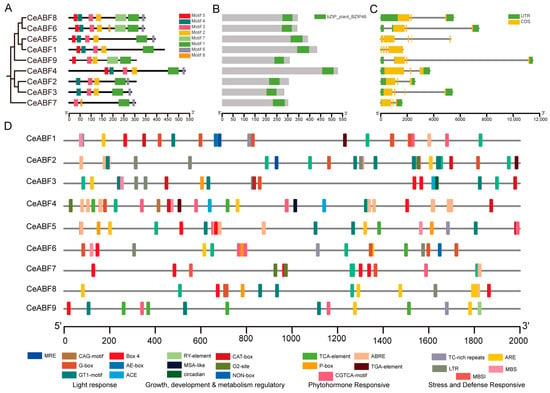
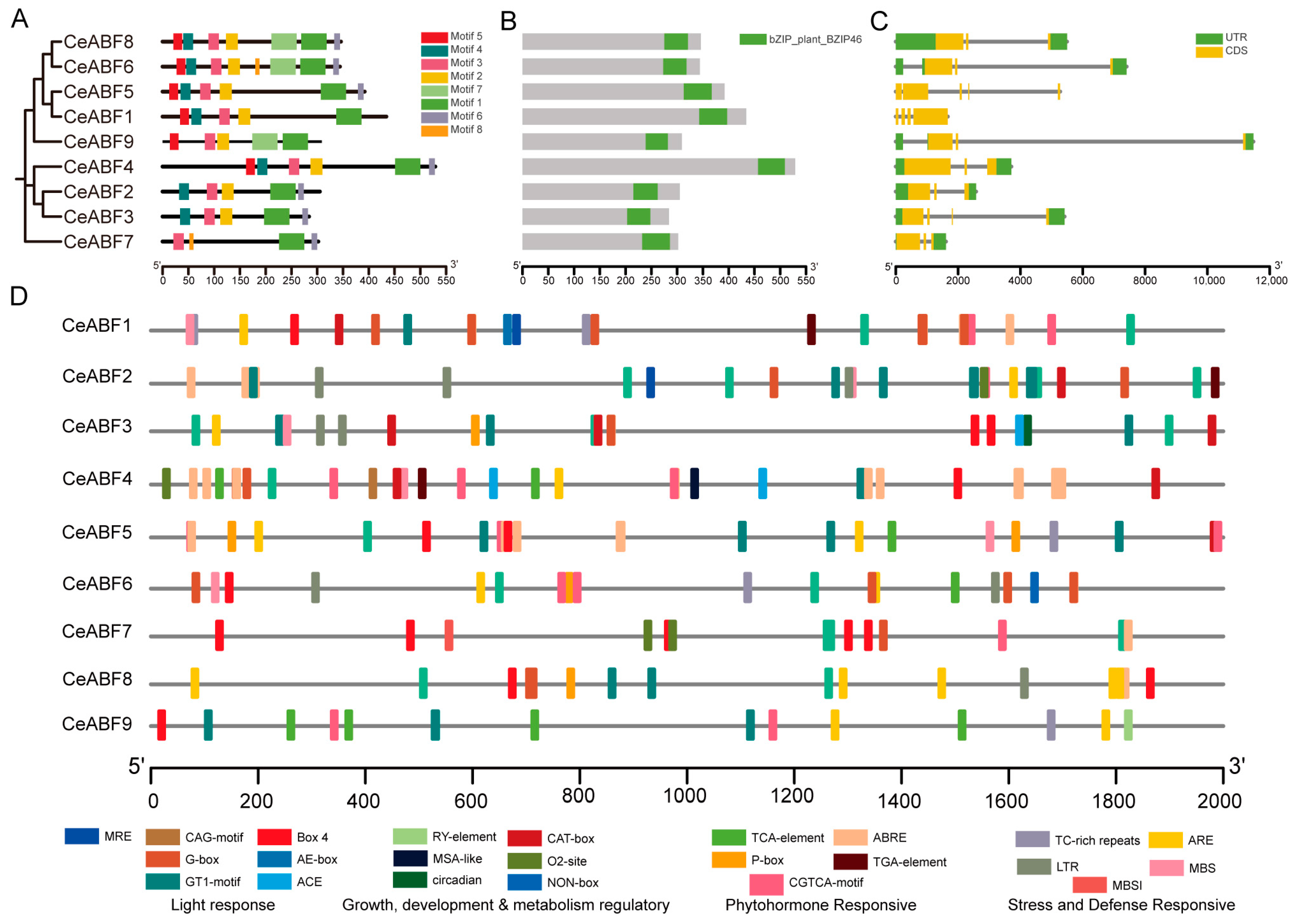
To better characterize the nine CeABF proteins, TBtools software was used to analyze and visualize their phylogenetic relationships, conserved motifs, functional domains, and gene structures (Figure 2). A total of eight conserved motifs (motif 1 to motif 8) were identified among CeABF proteins (Figure 2A). The types and quantities of conserved motifs varied among different subfamilies, while members within the same subgroup shared highly consistent motif compositions. Conserved domain analysis performed via the NCBI Batch CD-search tool confirmed that all CeABF proteins harbored the typical bZIP conserved domain (Figure 2B). Notably, Motif 1 constituted the fundamental core of the bZIP domain and was conserved across all CeABF proteins. Gene structure analysis revealed a simple exon–intron organization across CeABF genes (Figure 2C). Most CeABF genes possessed two to three introns, and CeABF9 contained the longest intron sequence. CeABF5 exhibited the most complex gene structure with five exons and four introns. In addition, both CeABF1 and CeABF5 lacked untranslated regions (UTRs), whereas CeABF8 harbored the longest 5′ UTR among all family members.
Figure 2.
Conserved motif, domain, gene structure and cis-element analysis of taro CeABF genes. (A) Left: Neighbor-joining phylogenetic tree illustrating the evolutionary relationships among taro CeABF proteins. Right: Conserved motifs of CeABF proteins predicted using the MEME Suite. Eight conserved motifs (motifs 1–8) are represented by colored boxes. (B) Conserved bZIP domains predicted using the CDD database and marked with green boxes. (C) Gene-structure analysis of taro CeABF genes. Yellow boxes represent coding sequences (CDSs), green boxes indicate untranslated regions (UTRs), and black horizontal lines correspond to introns. (D) Distribution of cis-acting regulatory elements in the 2 kb upstream promoter regions of CeABF genes. Colored boxes represent different types of predicted cis-elements, which are classified into four functional categories as indicated in the bottom legend.
Cis-acting elements located in gene promoters are pivotal regulators of gene transcription. To elucidate the transcriptional regulatory patterns of CeABF genes, we predicted cis-acting elements in the 2 kb upstream promoter sequences of nine CeABF subfamily members using the PlantCARE database. All identified elements were further categorized into four major functional groups: light-responsive, growth, development, and metabolism regulatory, phytohormone-responsive, and stress and defense-responsive elements (Figure 2D). Further analysis showed that the G-box, the most abundant light-responsive motif, existed in all CeABF members except CeABF9. Box 4 was absent exclusively in CeABF5 and showed the highest enrichment in CeABF7. Numerous cis-elements associated with plant growth and development were also unevenly distributed across these gene promoters, suggesting potential functional divergence among family members in regulating plant developmental processes. In terms of stress- and hormone-related cis-elements, the ARE element was specifically absent in CeABF7, and the ABRE motif was undetected only in CeABF9. In contrast, the MBSI element was uniquely present in CeABF7 but absent in all other family members. Collectively, these results indicated that CeABF genes were extensively involved in the regulation of plant growth, development, and stress adaptation.
3.3. Synteny Analysis of CeABF Genes
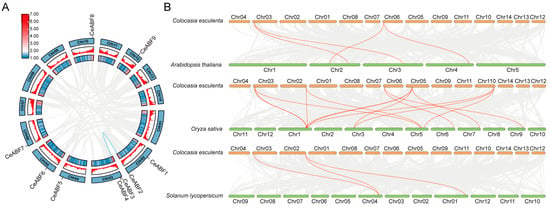
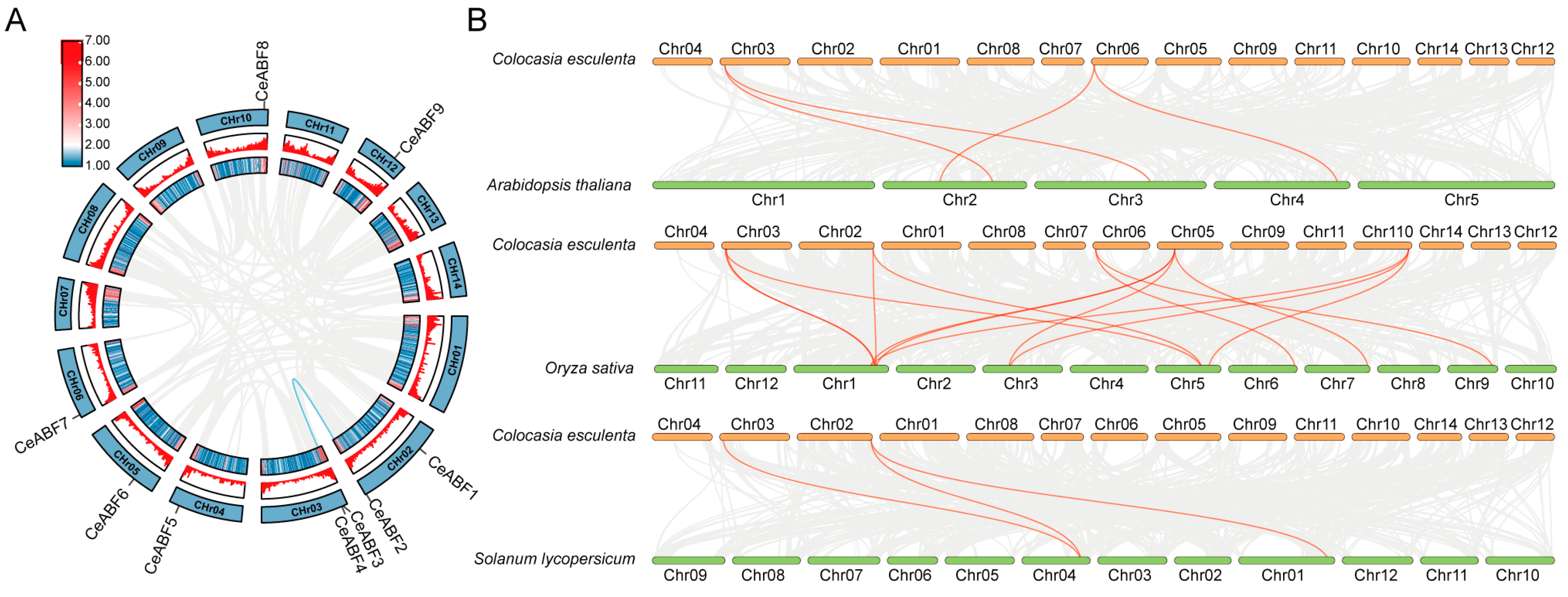
Gene duplication is widespread during the evolution of plant gene families and substantially contributes to adaptive diversification [42]. To unravel the evolutionary origin and trajectory of the AREB/ABF subfamily, we performed both intraspecific and interspecific synteny analyses, focusing on two major duplication modes: segmental duplication and tandem duplication, which are key drivers of gene family expansion. The intraspecific collinearity results were visualized in a circular plot (Figure 3A), in which gray lines represented genome-wide collinear blocks, and the blue line marked the single collinear CeABF gene pair. Intraspecific synteny analysis identified only one segmentally duplicated CeABF gene pair, whereas no tandem duplication events were detected, indicating a relatively conserved evolutionary pattern for the AREB/ABF subfamily. We further explored the evolutionary conservation of CeABF genes by conducting cross-species synteny comparisons with three representative plant species, Arabidopsis, rice, and tomato (Figure 3B). In total, 12 collinear orthologous AREB/ABF gene pairs were identified between taro and rice, distributed on taro chromosomes 2, 3, 5, 6, and 10, indicating high syntenic conservation between taro and rice. By contrast, fewer collinear orthologous pairs were found between taro and Arabidopsis and between taro and tomato, reflecting lineage-specific divergence and extensive genomic rearrangement following species divergence. Collectively, these findings suggest that the taro AREB/ABF subfamily shares a closer evolutionary relationship with rice AREB/ABF genes than with those of Arabidopsis and tomato. These conserved syntenic AREB/ABF orthologs likely retain analogous biological functions and descend from a common ancestral gene set.
Figure 3.
Chromosomal distribution and synteny analysis of CeABF genes. (A) Intraspecific synteny analysis and chromosomal localization of taro CeABF genes. Chromosomes are shown as dark-blue blocks, and the color bar indicates gene density. Gray lines link genome-wide collinear gene pairs, and the blue line indicates the collinear paralogous CeABF gene pair in taro. (B) Interspecific synteny analysis of AREB/ABF genes across multiple plant species. The upper, middle, and lower panels separately display syntenic gene pairs between taro and Arabidopsis, taro and rice, and taro and tomato. Gray lines represent all genomic collinear pairs, whereas red lines highlight collinear AREB/ABF orthologous gene pairs.
3.4. Transcriptome Analysis and Screening of Differentially Expressed Genes (DEGs)
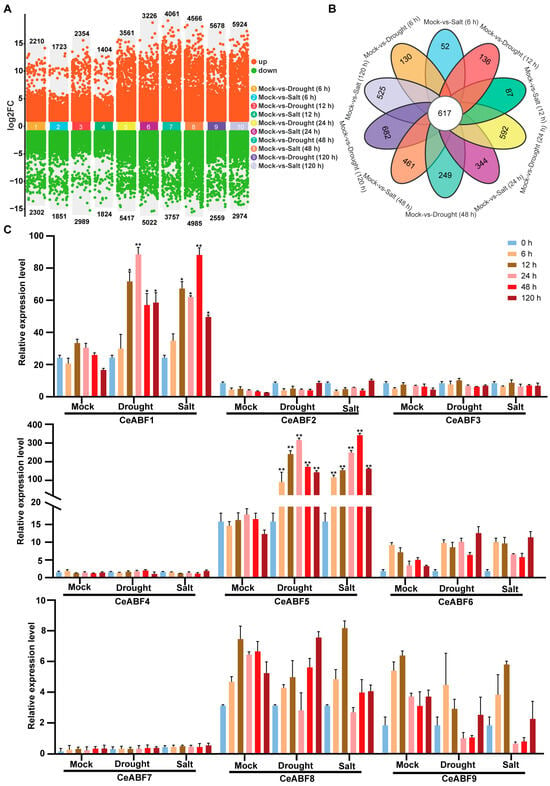
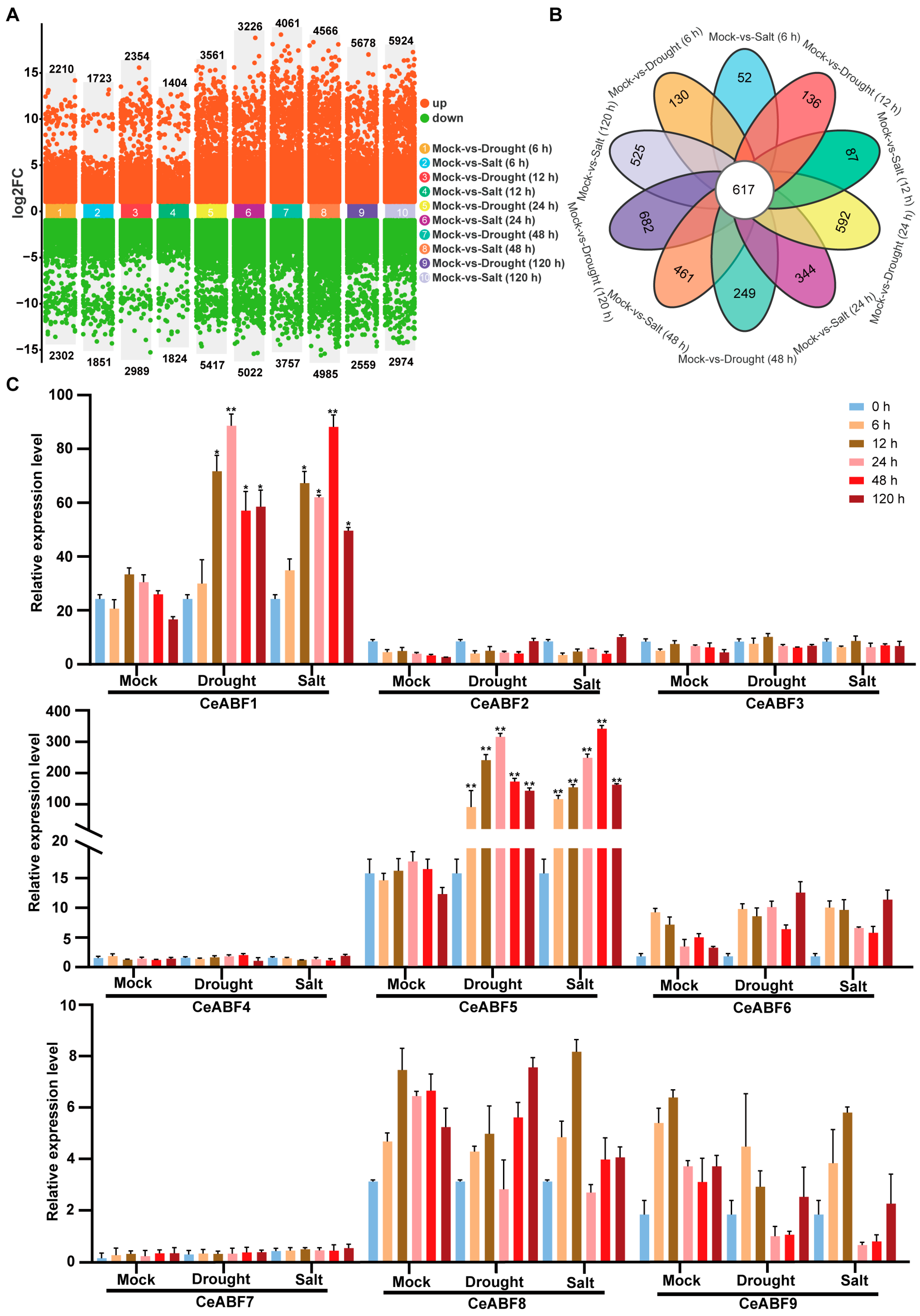
To explore the transcriptional regulatory networks underlying drought and salt tolerance in taro, we performed RNA-seq analysis on taro seedlings exposed to 20% PEG6000-induced drought stress and 200 mM NaCl-induced salt stress; seedlings sprayed with deionized water served as the mock control. Transcriptomic comparisons against the mock control revealed widespread gene expression changes under both drought and salt stress across the sampled time series (Figure 4A). A total of 617 DEGs exhibited significant differential expression at multiple time points and were commonly responsive to both drought and salt stress (Figure 4B, Table S3), indicating extensive transcriptional crosstalk between drought and salt stress signaling pathways in taro.
Figure 4.
Transcriptome profiling and expression patterns of CeABF genes under drought and salt stress. (A) Volcano plots illustrating DEGs identified at multiple time points under drought and salt stress treatments. Each vertical panel corresponds to one comparison group. Orange dots represent significantly upregulated genes, and green dots represent significantly downregulated genes. Numbers above and below each panel indicate the counts of upregulated and downregulated genes, respectively. (B) Venn diagram showing the overlap of DEGs across all stress comparisons. The number in the central circle indicates DEGs commonly responsive to both drought and salt stress. (C) Expression profiles of nine CeABF genes under mock, drought, and salt treatments across six different time points. Gene expression abundance was quantified using TPM values. Error bars represent standard deviation (SD) across biological replicates. * indicates adjusted p < 0.05, and ** indicates adjusted p < 0.01, compared with the mock control.
We further characterized the expression patterns of the taro AREB/ABF gene family based on TPM values. According to the expression profiles (Figure 4C), seven CeABF genes showed little change in expression under drought and salt stress compared with the control, suggesting that these seven CeABF genes are not involved in taro responses to either stress. To screen functional CeABF genes conferring drought and salt tolerance in taro, we focused on two candidate genes, CeABF1 and CeABF5. Both genes exhibited marked stress-triggered expression alterations, whereas CeABF5 displayed the most pronounced transcriptional induction under drought and salt treatments and was therefore selected as the core target gene for subsequent functional verification and mechanistic investigation.
3.5. Expression and Promoter Characterization, and Subcellular Localization of CeABF5
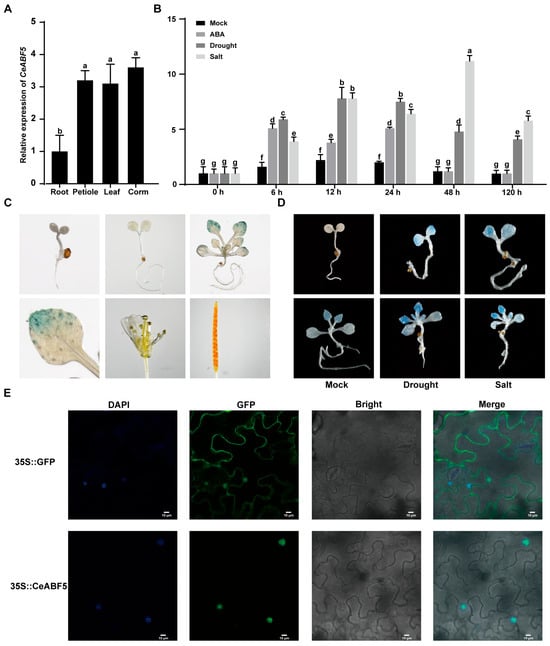
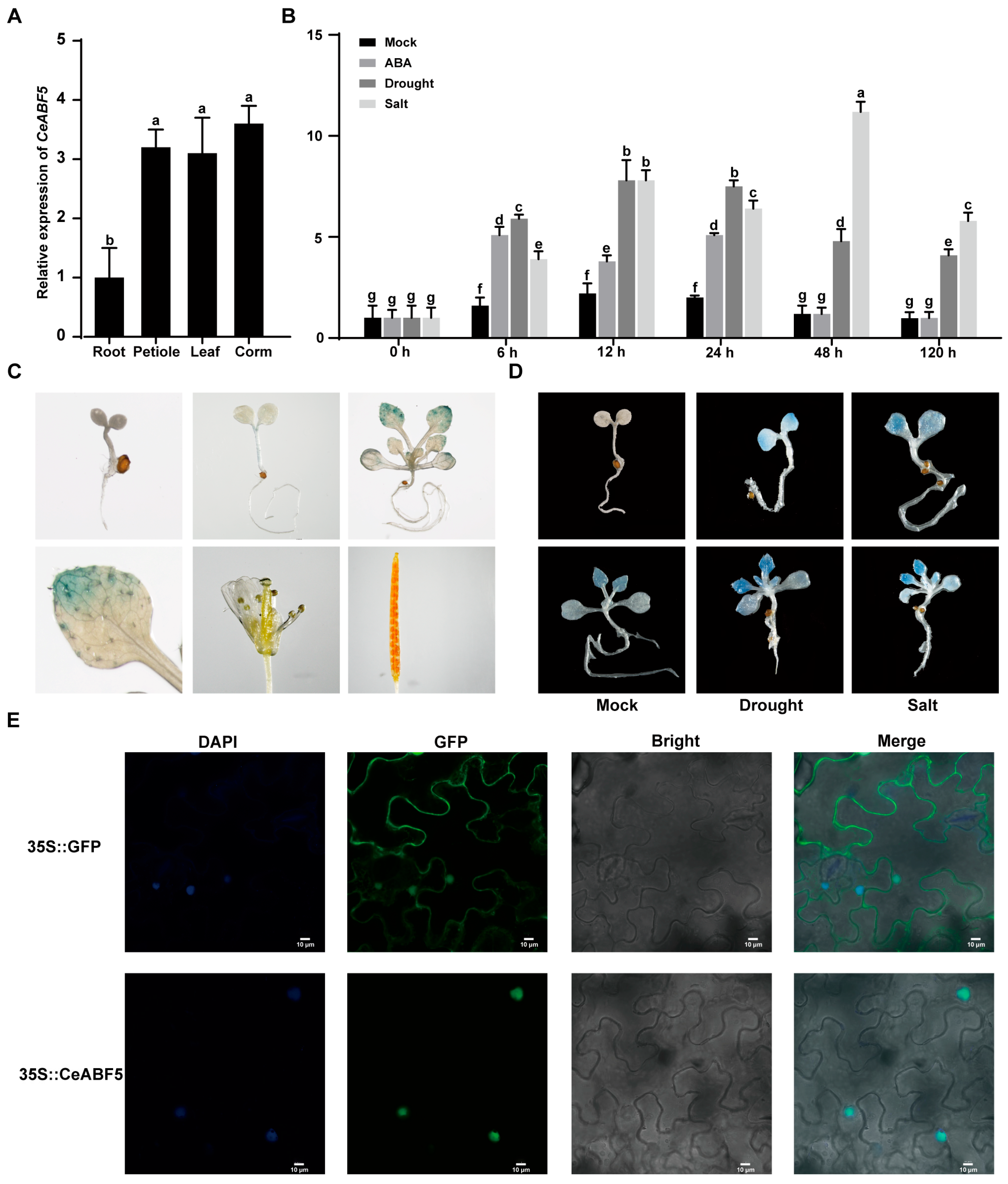
To determine the transcript levels of CeABF5 in different taro organs, qRT-PCR analysis was performed using roots, petioles, leaves, and corms of cultivar ‘Ganyu 2’. CeABF5 exhibited the lowest expression in roots, and its transcript abundance was relatively high in corms, petioles, and leaves (Figure 5A). Based on the preceding transcriptome results showing that CeABF5 was induced by drought and salt stress, we performed qRT-PCR to validate these expression changes and further investigated its response to exogenous ABA. Consistent with the transcriptome data, CeABF5 was significantly upregulated at multiple time points under drought and salt stress. In addition, CeABF5 was markedly upregulated in leaves following 6 h of ABA treatment (Figure 5B). Collectively, these results indicate that CeABF5 may participate in ABA-dependent signaling for drought and salt stress responses in taro.
Figure 5.
Expression profiles, promoter characterization, and protein subcellular localization of CeABF5. (A) Tissue-specific expression patterns of CeABF5 in different taro organs. (B) Expression profiles of CeABF5 under drought, salt, and exogenous ABA treatments. Data are means ± SD of three independent biological replicates. Statistically significant differences (p < 0.05) are indicated by different lowercase letters. (C) Tissue-specific activity of the CeABF5 promoter in transgenic Arabidopsis. GUS staining was performed in seedlings at 3 and 7 days after germination, rosette leaves, flowers, and siliques. (D) GUS activity analysis of the CeABF5 promoter under salt and osmotic stress in transgenic Arabidopsis seedlings. Upper and lower panels represent seedlings at different developmental stages. Left, mock treatment; middle, drought stress; right, salt stress. (E) Subcellular localization of the CeABF5 protein in N. benthamiana mesophyll cells. The 35S::CeABF5-GFP fusion construct and empty 35S::GFP control were transiently expressed in tobacco leaves. DAPI staining was used to label the nucleus. Scale bars = 10 μm.
To further characterize its promoter activity and tissue expression profile in a heterologous system, we generated transgenic Arabidopsis plants carrying the ‘proCeABF5::GUS’ reporter construct and performed histochemical GUS staining. GUS signals were predominantly detected in 7-day-old seedlings, whereas only weak GUS signals were observed in 3-day-old seedlings. Moreover, no obvious GUS activity was observed in siliques or flowers (Figure 5C). To explore the stress responsiveness of the CeABF5 promoter, proCeABF5::GUS transgenic Arabidopsis seedlings were treated with 100 mM mannitol and 150 mM NaCl for 12 h, followed by histochemical GUS staining. Enhanced GUS signals were observed in the leaves of transgenic lines upon NaCl and mannitol treatments, indicating that the CeABF5 promoter contains cis-regulatory elements responsive to salt and osmotic stress (Figure 5D). For subcellular localization of CeABF5 protein, the recombinant 35S::CeABF5-GFP plasmid was transiently expressed in N. benthamiana leaves, with 35S::GFP serving as the control. CeABF5 localized to the nucleus, suggesting that this protein acts as a transcriptional regulator (Figure 5E).
3.6. Ectopic Expression of CeABF5 in Arabidopsis Enhances Tolerance to Drought and Salt
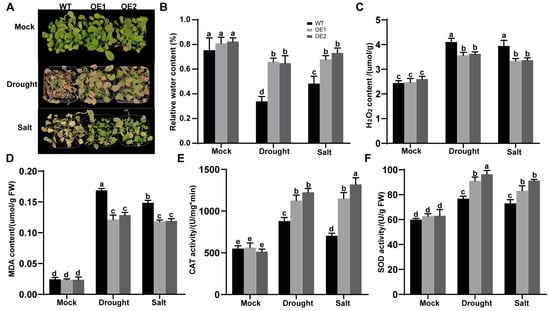
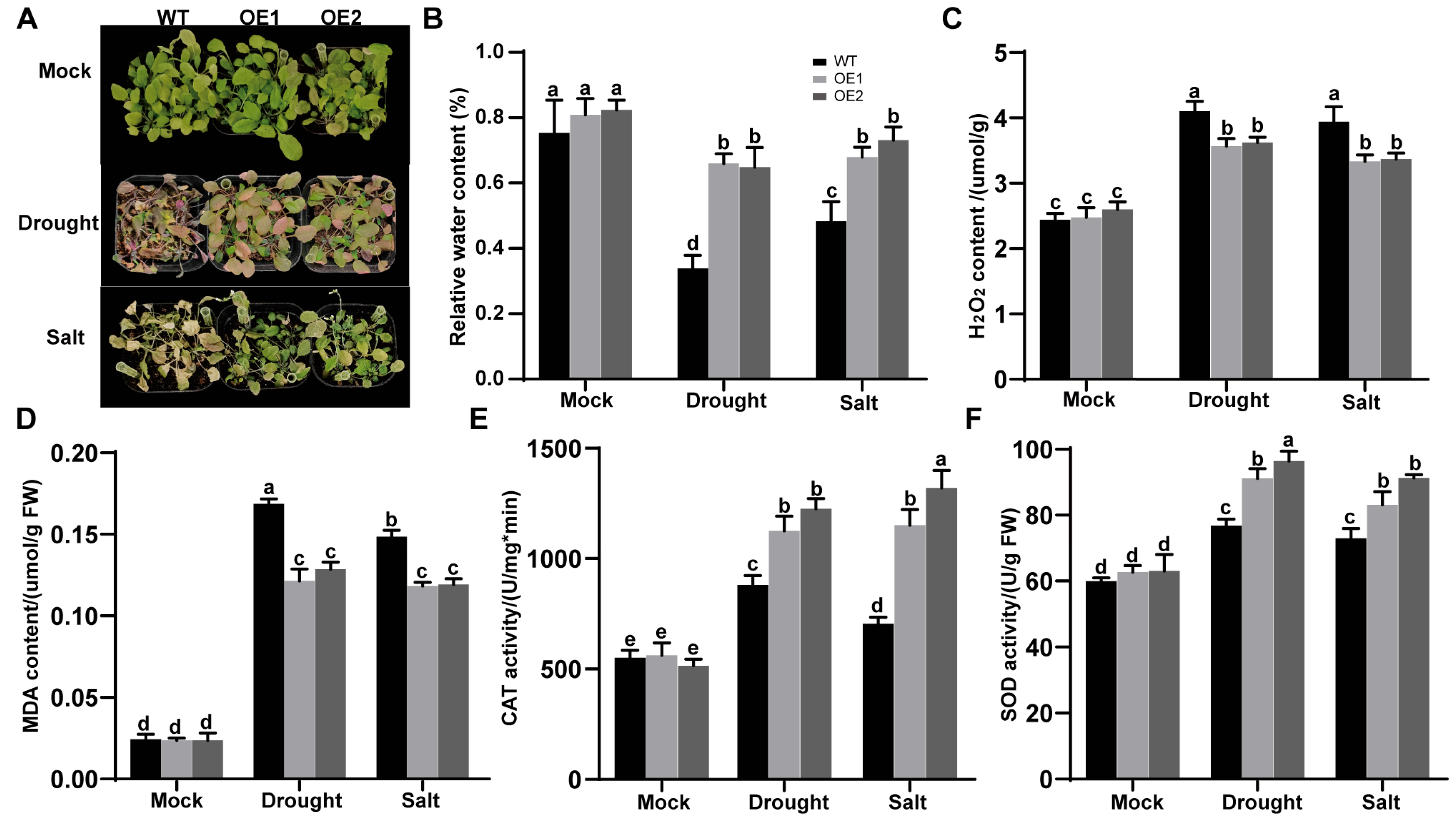
To further characterize the biological function of CeABF5, we heterologously overexpressed CeABF5 in Arabidopsis via Agrobacterium tumefaciens-mediated transformation. After antibiotic screening and successive selfing, homozygous T3 CeABF5-overexpressing (OE) lines were obtained. Wild-type (Col-0) and transgenic seeds were germinated and cultivated under normal conditions, followed by treatment with 20% PEG-6000 and 150 mM NaCl. Under normal growth conditions, no obvious phenotypic differences were observed between OE lines and Col-0 seedlings (Figure 6A). After 7 d of drought or salt stress, wild-type plants displayed severe growth inhibition and leaf chlorosis, whereas CeABF5-OE lines maintained better growth status and greener leaves. Leaf relative water content serves as a key physiological indicator for evaluating plant stress tolerance [43]. Following stress treatment, the leaf relative water content of OE lines was significantly higher than that of WT plants (Figure 6B).
Figure 6.
CeABF5 positively promotes salt and drought stress tolerance in Arabidopsis. (A) Phenotypes of CeABF5-OE and WT plants grown in growth boxes under mock conditions, drought treatment, and salt treatment. (B) Relative water content of leaves. (C,D) The contents of H2O2 and MDA in WT and CeABF5-OE plants, respectively. (E,F) Antioxidant enzyme activities of CAT and SOD in different lines, respectively. Data are presented as means ± SD (n = 3). Different lowercase letters indicate significant differences at p < 0.05, based on two-way ANOVA followed by Tukey’s test.
To further elucidate the molecular mechanism by which CeABF5 improves plant stress tolerance, we detected endogenous H2O2 accumulation in transgenic and WT plants under stress conditions. Under both drought and salt stress, transgenic lines accumulated markedly lower levels of H2O2 than WT plants (Figure 6C). Consistent with this finding, MDA content was also significantly reduced in CeABF5-OE lines relative to WT controls (Figure 6D). These results demonstrated that CeABF5 overexpression alleviates stress-induced oxidative damage by scavenging excess ROS in Arabidopsis. Furthermore, we measured the activities of two core antioxidant enzymes, CAT and SOD, in all plant materials. Under drought and salt stress, the activities of CAT and SOD were substantially higher in CeABF5-OE lines than in WT plants, while no significant differences were detected under normal growth conditions (Figure 6E,F). Collectively, these findings indicated that improved antioxidant capacity contributes to the enhanced drought and salt tolerance of CeABF5-overexpressing Arabidopsis plants.
3.7. CeABF5 Regulates Plant Drought and Salt Tolerance in Taro Through Stress-Activated Protein Kinase 3 (CeSAPK3)
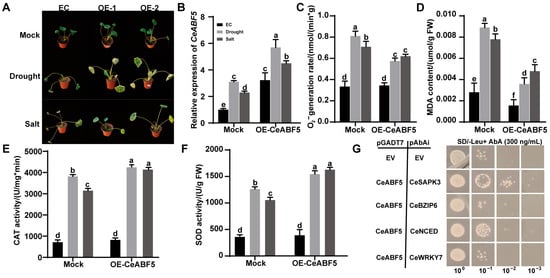
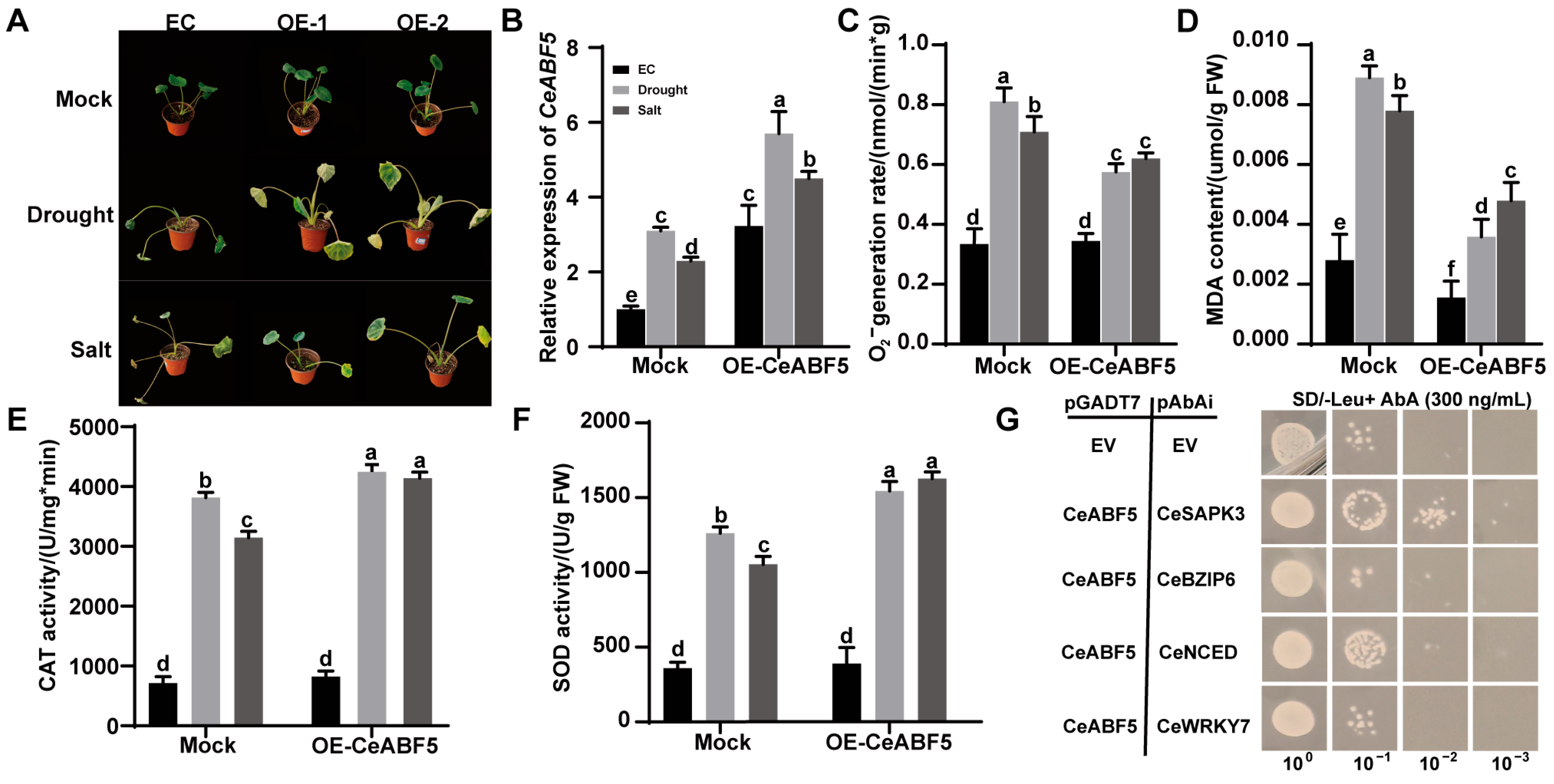
To further explore the endogenous function of CeABF5 in taro, we conducted transient overexpression assays via Agrobacterium-mediated leaf infiltration, followed by drought and salt stress treatments. Phenotypic observation showed that taro leaves infiltrated with the empty vector control (EC) displayed severe stress damage under drought conditions, whereas CeABF5-overexpressing (OE) leaves showed markedly alleviated stress symptoms. qRT-PCR detection verified successful transient overexpression of CeABF5 in infiltrated leaves, with its transcript abundance reaching 3.1-fold that in control samples (Figure 7A,B). To evaluate the effect of CeABF5 on drought-induced oxidative injury, we further determined the in vivo accumulation of superoxide anion (O2−) in taro leaves. The results revealed that O2− production was distinctly suppressed in OE leaves compared with EC. Consistently, the MDA content in OE leaves was notably reduced by 59% compared with controls, demonstrating that CeABF5 overexpression effectively relieves ROS burst under drought stress (Figure 7C,D).
Figure 7.
Overexpression of CeABF5 enhances tolerance to drought and salinity stress in taro. (A) Phenotypes of the EC and CeABF5-overexpressing (OE) taro leaves under drought and salt treatments. (B) Relative expression levels of CeABF5 in control and OE leaves under drought and salt stress. (C–F) Quantification of O2− content (C), MDA content (D), CAT activity (E), and SOD activity (F) in EC and OE leaves under drought and salt stress. Data are means ± SD of three independent replicates. Statistically significant differences (p < 0.05) are denoted by different lowercase letters. (G) Y1H assay showing that CeABF5 binds to the CeSAPK3 promoter. EV indicates empty vector; SD/-Leu indicates medium lacking leucine; the AbA concentration used was 300 ng/mL.
We further assessed the activities of two key antioxidant enzymes (SOD and CAT) under normal and drought conditions. Enzyme activity analysis showed that SOD and CAT levels were comparable between EC and OE leaves under non-stressed conditions. Upon drought exposure, the antioxidant enzyme activities of all tested leaves were significantly induced, and such induction was far more prominent in CeABF5-overexpressing taro leaves (Figure 7E,F). Notably, similar phenotypic and physiological alterations were observed under salt stress. Collectively, these results indicated that CeABF5 improves drought and salt tolerance in taro by enhancing the antioxidant defense system.
To dissect the molecular mechanism by which CeABF5 mediates plant tolerance to drought and salt stresses, we screened its potential downstream target genes using transcriptome data from drought- and salt-treated taro samples. Cis-element prediction was performed on the promoters of overlapping drought- and salt-responsive DEGs to identify genes containing ABRE motifs. Among these genes, three significantly up-regulated genes, CeSAPK3, CeNCED, and CeWRKY7, and one markedly down-regulated gene, CeBZIP6, were selected as candidate targets (Table S4). Subsequent Y1H assays suggested that CeABF5 could bind to the promoter of CeSAPK3, whereas no binding interaction was detected for the other three candidate promoters (Figure 7G).
4. Discussion
AREB/ABF transcription factors are key transcriptional regulators in the ABA signaling pathway and mediate plant responses to drought and salt stress [44,45,46]. Our genome-wide characterization of the AREB/ABF subfamily in taro provides a basis for exploring the molecular mechanisms underlying stress adaptation in this important corm crop. In this study, nine AREB/ABF subfamily genes were identified in taro based on sequence homology and conserved domain alignment with Arabidopsis AREB/ABF proteins [17]. These taro AREB/ABF genes were unevenly distributed across seven chromosomes (Figure 1). Cross-species comparisons revealed differences in copy number and chromosomal distribution patterns of the AREB/ABF subfamily among different plant species. Specifically, eight AREB/ABF members were located on six chromosomes in cucumber (Cucumis sativus) [47], ten on five chromosomes in tomato [48], and 14 on nine chromosomes in Populus trichocarpa [49]. The copy number variations in AREB/ABF genes across plant species are primarily attributed to whole-genome duplication (WGD) and tandem duplication events [50]. Consistent with previous findings in other plant species, phylogenetically closely related AREB/ABF members exhibited highly conserved motif compositions, suggesting conserved protein functions within the same subfamily. A total of eight conserved motifs were predicted in taro AREB/ABF proteins (Figure 2A). Among them, motif 1 was highly conserved across all taro AREB/ABF members. As the most canonical domain of bZIP transcription factors, motif 1 corresponds to the conserved bZIP functional domain, indicating that these taro AREB/ABF proteins share the canonical structural features of the AREB/ABF subfamily. Cis-acting elements in gene promoters are critical for transcriptional regulation and participate in plant responses to biotic and abiotic stresses [15]. In this study, abundant cis-elements associated with phytohormone responses and abiotic stress adaptation were identified in the promoter regions of taro AREB/ABF genes (Figure 2D). Collectively, these results suggest that taro AREB/ABF genes may play essential roles in plant abiotic stress tolerance and phytohormone signaling pathways.
The roles of AREB/ABFs in stress response, growth, and development have been extensively studied and characterized in plants. In Arabidopsis, three AREB/ABF transcription factors (AREB1, AREB2 and ABF3) function synergistically to control ABRE-dependent ABA signaling, conferring drought tolerance, and their full activation relies on ABA [51]. In rice, OsABF2 positively modulates tolerance to drought, salinity, and oxidative stress via ABA-dependent transcriptional cascades [22], whereas OsABF1 contributes to drought tolerance by directly activating COR413-TM1 [52]. In tomato, SlABF family genes are responsive to ABA and diverse abiotic stresses, and tissue expression profiles suggest that certain members contribute to fruit ripening, pointing to their dual functions in stress adaptation and developmental regulation [48]. In the woody perennial poplar, most AREB/ABF members are transcriptionally responsive to exogenous ABA, implying conserved functions in abiotic stress adaptation [49]. Heterologous expression of wheat TaABF3 in Arabidopsis confers enhanced drought and salt tolerance, further demonstrating the functional conservation of AREB/ABF across different plant species [16].
Despite the well-documented functions of AREB/ABFs in model plants and crops, their biological roles in taro remain unclear. To elucidate the biological function of CeABF5 in stress responses, we generated CeABF5-overexpressing plants in Arabidopsis (heterologous expression) and performed homologous transient overexpression in taro leaves and evaluated their tolerance to drought and salinity stress. We further quantified the contents of O2− and MDA, as well as the activities of the antioxidant enzymes SOD and CAT in EC and OE leaves. After stress treatment, the accumulation of ROS and MDA was significantly elevated in all materials, reflecting severe stress-triggered oxidative damage. In contrast, OE leaves exhibited lower MDA accumulation and higher antioxidant enzyme activities under stress conditions (Figure 6 and Figure 7). Consistent with the functional characteristics of AREB/ABF subfamily genes reported in multiple plant species [53,54], these results further indicate that CeABF5 positively regulates plant tolerance to abiotic stress by alleviating oxidative damage.
Plant-specific SnRK2 family kinases act as core regulators of plant adaptive responses to adverse environmental stresses [55,56]. As a member of the SnRK2-II subfamily, OsSAPK3 participates in osmotic stress responses by modulating the expression of ABA-dependent genes in rice. Moreover, OsSAPK3 alleviates drought-induced oxidative damage by regulating ROS-scavenging genes and modulating cellular ROS accumulation [57]. Our present results demonstrate that CeABF5 binds to the CeSAPK3 promoter (Figure 7G). Nevertheless, whether activated CeSAPK3 can mediate the post-translational modification of CeABF5 remains unclear. It is well established that kinases belonging to the SnRK2-III subfamily can directly phosphorylate AREB/ABF transcription factors [58], whereas biochemical evidence for SnRK2-II-mediated ABF phosphorylation, particularly by OsSAPK3, is still lacking. We therefore hypothesize that CeABF5 and CeSAPK3 form a potential regulatory loop that synergistically amplifies ABA-dependent stress signaling in taro. Transcriptionally activated CeABF5 further strengthens ROS-scavenging capacity to alleviate oxidative injury, ultimately improving taro tolerance to abiotic stress. Although the present study reveals a novel molecular mechanism underlying CeABF5-mediated drought tolerance, the CeABF5-associated regulatory network remains largely uncharacterized. Further investigations are required to dissect the upstream and downstream signaling cascades coordinated by CeABF5 during plant stress adaptation.
5. Conclusions
Nine AREB/ABF genes were identified in the taro genome and classified into five phylogenetic clades, with conserved motifs and domain architectures among members of each clade. Within this gene family, CeABF5 is strongly transcriptionally induced by drought, salinity, and exogenous ABA, implying its central role in ABA-dependent stress signaling. Functional assays using stable overexpression in Arabidopsis and transient overexpression in taro demonstrated that CeABF5 enhances drought and salt tolerance by restraining the accumulation of ROS and MDA while promoting the activities of the antioxidant enzymes SOD and CAT. Yeast one-hybrid assays confirmed that CeABF5 directly binds to the promoter of CeSAPK3, establishing a novel transcriptional regulatory module in taro. These findings enrich our understanding of AREB/ABF-mediated abiotic stress responses in taro and highlight CeABF5 as a valuable gene resource for stress-resilient taro breeding.
Supplementary Materials
The following supporting information can be downloaded at https://www.mdpi.com/article/10.3390/plants15233675/s1. Table S1: List of primers used in this study; Table S2: Characteristics of AREB/ABF subfamily members in the taro genome; Table S3: Expression profiles of shared DEGs across time points under drought and salt stress; Table S4: ABRE-related cis-elements in the promoters.
Author Contributions
Conceptualization, H.R., Y.Z., J.C., Y.G. and Y.X.; Methodology, H.R., Y.Z., Y.H., J.C. and Y.G.; Software, H.R. and J.C.; Validation, Y.Z., Y.H. and Y.W.; Formal analysis, Y.Z., Y.H., J.C. and Y.X.; Investigation, Y.Z., Y.W. and J.C.; Resources, Y.H. and Y.W.; Data curation, Y.Z. and Q.Z.; Writing—original draft, H.R., Q.Z. and Y.X.; Writing—review & editing, H.R., Q.Z. and Y.X.; Visualization, Q.Z. and Y.X.; Supervision, Q.Z. and Y.X.; Project administration, Q.Z. and Y.X.; Funding acquisition, H.R., Q.Z. and Y.X. All authors have read and agreed to the published version of the manuscript.
Funding
This work was supported by the National Natural Science Foundation of China (Grants Nos. 32260779 and 32660853), the Jiangxi Provincial Natural Science Foundation (Grant No. 20232ACB205017), and the Jiangxi Early Career Young Talent Training Project (Grant No. 9019113009).
Data Availability Statement
All data produced and analyzed in this work are included in the main text and Supplementary Materials. Raw sequence data are accessible at CNGBdb with the accession number CNP0009795.
Conflicts of Interest
The authors declare no conflicts of interest.
References
- Ferdaus, M.J.; Chukwu-Munsen, E.; Foguel, A.; da Silva, R.C. Taro roots: An underexploited root crop. Nutrients 2023, 15, 3337. [Google Scholar] [CrossRef] [Scilit] [PubMed]
- Zubair, M.W.; Imran, A.; Islam, F.; Afzaal, M.; Saeed, F.; Zahra, S.M.; Akhtar, M.N.; Noman, M.; Ateeq, H.; Aslam, M.A.; et al. Functional profile and encapsulating properties of Colocasia esculenta (Taro). Food Sci. Nutr. 2023, 11, 2440–2449. [Google Scholar] [CrossRef] [Scilit] [PubMed]
- Mitharwal, S.; Kumar, A.; Chauhan, K.; Taneja, N.K. Nutritional, phytochemical composition and potential health benefits of taro (Colocasia esculenta L.) leaves: A review. Food Chem. 2022, 383, 132406. [Google Scholar] [CrossRef] [Scilit] [PubMed]
- Chen, C.; Zhang, Z.; Lei, Y.Y.; Chen, W.; Zhang, Z.; Li, X.; Dai, H. MdMYB44-like positively regulates salt and drought tolerance via the MdPYL8-MdPP2CA module in apple. Plant J. 2024, 118, 24–41. [Google Scholar] [CrossRef] [Scilit] [PubMed]
- Ren, H.; Yang, W.; Jing, W.; Shahid, M.O.; Liu, Y.; Qiu, X.; Choisy, P.; Xu, T.; Ma, N.; Gao, J.; et al. Multi-omics analysis reveals key regulatory defense pathways and genes involved in salt tolerance of rose plants. Hortic. Res. 2024, 11, uhae068. [Google Scholar] [CrossRef] [Scilit] [PubMed]
- Dong, B.; Wang, Q.; Zhou, D.; Wang, Y.; Miao, Y.; Zhong, S.; Fang, Q.; Yang, L.; Xiao, Z.; Zhao, H. Abiotic stress treatment reveals expansin like A gene OfEXLA1 improving salt and drought tolerance of Osmanthus fragrans by responding to abscisic acid. Hortic. Plant J. 2024, 10, 573–585. [Google Scholar] [CrossRef] [Scilit]
- Wang, X.; Wang, H.; Wei, H.; Jiang, Y.; Wang, Y.; Li, F.; Zhang, Y.; Zhou, L.; Li, S.; Wang, Z.; et al. Abscisic acid-regulated stability of CmABF1 and CmBRM modulates salt tolerance in chrysanthemum via epigenetic regulation of CmHSFA4. Sci. Adv. 2026, 12, aed2521. [Google Scholar] [CrossRef] [Scilit] [PubMed]
- He, L.; Xi, M.; Qu, J.; Li, Y.; Yun, C.; Zhang, X.; Li, H.; Jiang, H.; Wang, C. BolMYB28-BolMAM1 confers salt and drought tolerance via regulating specific aliphatic glucosinolate biosynthesis and affecting ABA accumulation in Broccoli. Plant Cell Environ. 2026, 49, 430–446. [Google Scholar] [CrossRef] [Scilit] [PubMed]
- Ren, Y.; Liu, L.; Zhao, W.; Guo, W.; Li, J.; Guo, R.; Wang, D.; Tang, L.; Zhang, L.; Guo, C. MsCDPK29-MsbZIP14 modulates ABA accumulation in response to saline-alkali stress in alfalfa. New Phytol. 2026, 250, 332–346. [Google Scholar] [CrossRef] [Scilit] [PubMed]
- Brookbank, B.P.; Patel, J.; Gazzarrini, S.; Nambara, E. Role of basal ABA in plant growth and development. Genes 2021, 12, 1936. [Google Scholar] [CrossRef] [Scilit] [PubMed]
- Barrero, J.M.; Piqueras, P.; González-Guzmán, M.; Serrano, R.; Rodríguez, P.L.; Ponce, M.R.; Micol, J.L. A mutational analysis of the ABA1 gene of Arabidopsis thaliana highlights the involvement of ABA in vegetative development. J. Exp. Bot. 2005, 56, 2071–2083. [Google Scholar] [CrossRef] [Scilit] [PubMed]
- Wang, L.; Zhou, Y.; Ding, Y.; Chen, C.; Chen, X.; Su, N.; Zhang, X.; Pan, Y.; Li, J. Novel flavin-containing monooxygenase protein FMO1 interacts with CAT2 to negatively regulate drought tolerance through ROS homeostasis and ABA signaling pathway in tomato. Hortic. Res. 2023, 10, uhad037. [Google Scholar] [CrossRef] [Scilit] [PubMed]
- Li, N.; Lu, F.; Kuai, B. SlERF.D2-mediated antagonism between ethylene and ABA signaling pathways modulates osmotic stress adaptation in tomato. Hortic. Res. 2026, 13, uhaf267. [Google Scholar] [CrossRef] [Scilit] [PubMed]
- Gao, Z.; Gao, Y.; Jia, H.; Wang, W.; Xue, B.; Su, Y.; Guo, X.; Wang, C. The GhMPK7-GhSDIRIP1 module enhances drought tolerance in cotton by regulating ABA signaling. New Phytol. 2025, 248, 1351–1367. [Google Scholar] [CrossRef] [Scilit] [PubMed]
- Xie, X.; Lin, M.; Xiao, G.; Wang, Q.; Li, Z. Identification and characterization of the AREB/ABF gene family in three orchid species and functional analysis of DcaABI5 in Arabidopsis. Plants 2024, 13, 774. [Google Scholar] [CrossRef] [Scilit] [PubMed]
- Li, F.; Mei, F.; Zhang, Y.; Li, S.; Kang, Z.; Mao, H. Genome-wide analysis of the AREB/ABF gene lineage in land plants and functional analysis of TaABF3 in Arabidopsis. BMC Plant Biol. 2020, 20, 558. [Google Scholar] [CrossRef] [Scilit] [PubMed]
- Dröge-Laser, W.; Snoek, B.L.; Snel, B.; Weiste, C. The Arabidopsis bZIP transcription factor family—An update. Curr. Opin. Plant Biol. 2018, 45, 36–49. [Google Scholar] [CrossRef] [Scilit] [PubMed]
- Orellana, S.; Yañez, M.; Espinoza, A.; Verdugo, I.; González, E.; Ruiz-Lara, S.; Casaretto, J.A. The transcription factor SlAREB1 confers drought, salt stress tolerance and regulates biotic and abiotic stress-related genes in tomato. Plant Cell Environ. 2010, 33, 2191–2208. [Google Scholar] [CrossRef] [Scilit] [PubMed]
- Zhao, B.-Y.; Hu, Y.-F.; Li, J.-J.; Yao, X.; Liu, K.-D. BnaABF2, a bZIP transcription factor from rapeseed (Brassica napus L.), enhances drought and salt tolerance in transgenic Arabidopsis. Bot. Stud. 2016, 57, 12. [Google Scholar] [CrossRef] [Scilit] [PubMed]
- Zhang, H.; Mao, L.; Xin, M.; Xing, H.; Zhang, Y.; Wu, J.; Xu, D.; Wang, Y.; Shang, Y.; Wei, L.; et al. Overexpression of GhABF3 increases cotton (Gossypium hirsutum L.) tolerance to salt and drought. BMC Plant Biol. 2022, 22, 313. [Google Scholar] [CrossRef] [Scilit] [PubMed]
- Yang, C.; Zhao, X.; Ai, C.; Luo, Z.; Liu, M. Transcription factor ZjABF1 promotes sugar accumulation and abiotic resistance by positively regulating the expression of sugar transport protein ZjSWEET11 and ZjSWEET18 in Chinese jujube. Int. J. Biol. Macromol. 2025, 291, 138799. [Google Scholar] [CrossRef] [Scilit] [PubMed]
- Hossain, M.A.; Cho, J.-I.; Han, M.; Ahn, C.-H.; Jeon, J.-S.; An, G.; Park, P.B. The ABRE-binding bZIP transcription factor OsABF2 is a positive regulator of abiotic stress and ABA signaling in rice. J. Plant Physiol. 2010, 167, 1512–1520. [Google Scholar] [CrossRef] [Scilit] [PubMed]
- Liu, T.; Zhou, T.; Lian, M.; Liu, T.; Hou, J.; Ijaz, R.; Song, B. Genome-wide identification and characterization of the AREB/ABF/ABI5 subfamily members from Solanum tuberosum. Int. J. Mol. Sci. 2019, 20, 311. [Google Scholar] [CrossRef] [Scilit] [PubMed]
- Chen, C.; Chen, H.; Zhang, Y.; Thomas, H.R.; Frank, M.H.; He, Y.; Xia, R. TBtools: An integrative toolkit developed for interactive analyses of big biological data. Mol. Plant 2020, 13, 1194–1202. [Google Scholar] [CrossRef] [Scilit] [PubMed]
- Yin, J.; Jiang, L.; Wang, L.; Han, X.; Guo, W.; Li, C.; Zhou, Y.; Denton, M.; Zhang, P. A high-quality genome of taro (Colocasia esculenta (L.) Schott), one of the world’s oldest crops. Mol. Ecol. Resour. 2021, 21, 68–77. [Google Scholar] [CrossRef] [Scilit] [PubMed]
- Wang, S.; Xiao, Y.; Li, Z.; Liu, T.; Cui, J.; Li, B.; Zhu, Q.; Luo, S.; Shan, N.; Sun, J.; et al. Virus-free micro-corm induction and the mechanism of corm development in taro. Int. J. Mol. Sci. 2025, 26, 3740. [Google Scholar] [CrossRef] [Scilit] [PubMed]
- Jian, H.; Sun, H.; Liu, R.; Zhang, W.; Shang, L.; Wang, J.; Khassanov, V.; Lyu, D. Construction of drought stress regulation networks in potato based on SMRT and RNA sequencing data. BMC Plant Biol. 2022, 22, 381. [Google Scholar] [CrossRef] [Scilit] [PubMed]
- Fang, X.; Mo, J.; Zhou, H.; Shen, X.; Xie, Y.; Xu, J.; Yang, S. Comparative transcriptome analysis of gene responses of salt-tolerant and salt-sensitive rice cultivars to salt stress. Sci. Rep. 2023, 13, 19065. [Google Scholar] [CrossRef] [Scilit] [PubMed]
- Liu, A.; Xiao, Z.; Li, M.W.; Wong, F.; Yung, W.; Ku, Y.; Wang, Q.; Wang, X.; Xie, M.; Yim, A.K.; et al. Transcriptomic reprogramming in soybean seedlings under salt stress. Plant Cell Environ. 2019, 42, 98–114. [Google Scholar] [CrossRef] [Scilit] [PubMed]
- Dias, M.C.; Oliveira, H.; Costa, A.; Santos, C. Improving elms performance under drought stress: The pretreatment with abscisic acid. Environ. Exp. Bot. 2014, 100, 64–73. [Google Scholar] [CrossRef] [Scilit]
- Zhou, Q.; Priyadarshani, S.V.G.N.; Qin, R.; Cheng, H.; Luo, T.; Wai, M.H.; Mohammadi, M.A.; Liu, Y.; Liu, C.; Cai, H.; et al. AcWRKY28 mediated activation of AcCPK genes confers salt tolerance in pineapple (Ananas comosus). Hortic. Plant J. 2024, 10, 398–412. [Google Scholar] [CrossRef] [Scilit]
- Ren, H.; Liu, Y.; Tian, J.; Liu, Y.; Qiu, X.; Shahid, M.O.; Ma, N.; Gao, J.; Zhou, X. The RhEIN3-RhARGOS-RhHYD1 module connects ethylene and sterol signaling to regulate flower opening in rose. Plant J. 2025, 122, e70201. [Google Scholar] [CrossRef] [Scilit] [PubMed]
- Ren, H.; Liu, Y.; Shahid, M.O.; Qiu, X.; Yang, W.; Choisy, P.; Xu, T.; Wang, D.; Yan, H.; Zhang, H.; et al. Integrated metabolomic and transcriptomic profiling reveals the key role of UDP-glycosyltransferase 73D1 (UGT73D1) in rose under UV-B irradiation. Hortic. Plant J. 2026, 12, 2148–2165. [Google Scholar] [CrossRef] [Scilit]
- Ren, H.; Bai, M.; Sun, J.; Liu, J.; Ren, M.; Dong, Y.; Wang, N.; Ning, G.; Wang, C. RcMYB84 and RcMYB123 mediate jasmonate-induced defense responses against Botrytis cinerea in rose (Rosa chinensis). Plant J. 2020, 103, 1839–1849. [Google Scholar] [CrossRef] [Scilit] [PubMed]
- Niu, C.; Wei, W.; Zhou, Q.; Tian, A.; Hao, Y.; Zhang, W.; Ma, B.; Lin, Q.; Zhang, Z.; Zhang, J.; et al. Wheat WRKY genes TaWRKY2 and TaWRKY19 regulate abiotic stress tolerance in transgenic Arabidopsis plants. Plant Cell Environ. 2012, 35, 1156–1170. [Google Scholar] [CrossRef] [Scilit] [PubMed]
- Ma, X.; Li, Y.; Gai, W.-X.; Li, C.; Gong, Z.-H. The CaCIPK3 gene positively regulates drought tolerance in pepper. Hortic. Res. 2021, 8, 216. [Google Scholar] [CrossRef] [Scilit] [PubMed]
- Mehari, T.G.; Hou, Y.; Xu, Y.; Umer, M.J.; Shiraku, M.L.; Wang, Y.; Wang, H.; Peng, R.; Wei, Y.; Cai, X.; et al. Overexpression of cotton GhNAC072 gene enhances drought and salt stress tolerance in transgenic Arabidopsis. BMC Genom. 2022, 23, 648. [Google Scholar] [CrossRef] [Scilit] [PubMed]
- Jing, X.; Wang, D.; Liu, X.; Chen, G.; Guo, X.; Wang, X.; Zhang, Z.; You, C. SBP transcription factor MdSPL13B positively regulates salt tolerance in apple. Hortic. Plant J. 2026, 12, 1539–1553. [Google Scholar] [CrossRef] [Scilit]
- Clough, S.J.; Bent, A.F. Floral dip: A simplified method for Agrobacterium-mediated transformation of Arabidopsis thaliana. Plant J. 1998, 16, 735–743. [Google Scholar] [CrossRef] [Scilit] [PubMed]
- Li, B.; Zhu, Q.; Xiao, Y.; Wang, S.; Sun, J.; Shan, N.; Huang, Y.; Zhou, Q. Integrated physiological characters and transcriptome analyses reveal the expansion mechanism of lateral cormels of Colocasia esculenta. Veg. Res. 2025, 5, e15. [Google Scholar] [CrossRef] [Scilit]
- Zhou, M.; Wang, Y.; Thi, K.L.P.; Chi, Y.; Li, X.; Li, Y.; Wang, C. PtrbZIP12 improves drought resistance in Populus trichocarpa by directly targeting PtrDHN and PtrPOD. Hortic. Res. 2026, 13, uhag034. [Google Scholar] [CrossRef] [Scilit] [PubMed]
- Li, H.-L.; Wu, X.; Gong, M.; Xia, M.; Zhang, W.; Chen, Z.; Xing, H.-T. Genome-wide investigation of the nuclear factor Y gene family in Ginger (Zingiber officinale Roscoe): Evolution and expression profiling during development and abiotic stresses. BMC Genom. 2024, 25, 820. [Google Scholar] [CrossRef] [Scilit] [PubMed]
- Xu, C.; Shan, J.; Liu, T.; Wang, Q.; Ji, Y.; Zhang, Y.; Wang, M.; Xia, N.; Zhao, L. CONSTANS-LIKE 1a positively regulates salt and drought tolerance in soybean. Plant Physiol. 2023, 191, 2427–2446. [Google Scholar] [CrossRef] [Scilit] [PubMed]
- Fujita, Y.; Yoshida, T.; Yamaguchi-Shinozaki, K. Pivotal role of the AREB/ABF-SnRK2 pathway in ABRE-mediated transcription in response to osmotic stress in plants. Physiol. Plant 2013, 147, 15–27. [Google Scholar] [CrossRef] [Scilit] [PubMed]
- Yoshida, T.; Fujita, Y.; Maruyama, K.; Mogami, J.; Todaka, D.; Shinozaki, K.; Yamaguchi-Shinozaki, K. Four Arabidopsis AREB/ABF transcription factors function predominantly in gene expression downstream of SnRK2 kinases in abscisic acid signalling in response to osmotic stress. Plant Cell Environ. 2015, 38, 35–49. [Google Scholar] [CrossRef] [Scilit] [PubMed]
- Nakashima, K.; Yamaguchi-Shinozaki, K. ABA signaling in stress-response and seed development. Plant Cell Rep. 2013, 32, 959–970. [Google Scholar] [CrossRef] [Scilit] [PubMed]
- Lu, S.; Qiao, Y.; Pan, X.; Chen, X.; Su, W.; Li, A.; Li, X.; Liao, W. Genome-wide identification and expression analysis of CsABF/AREB gene family in cucumber (Cucumis sativus L.) and in response to phytohormonal and abiotic stresses. Sci. Rep. 2025, 15, 15757. [Google Scholar] [CrossRef] [Scilit] [PubMed]
- Pan, X.; Wang, C.; Liu, Z.; Gao, R.; Feng, L.; Li, A.; Yao, K.; Liao, W. Identification of ABF/AREB gene family in tomato (Solanum lycopersicum L.) and functional analysis of ABF/AREB in response to ABA and abiotic stresses. PeerJ 2023, 11, e15310. [Google Scholar] [CrossRef] [Scilit] [PubMed]
- Ji, L.; Wang, J.; Ye, M.; Li, Y.; Guo, B.; Chen, Z.; Li, H.; An, X. Identification and characterization of the Populus AREB/ABF subfamily. J. Integr. Plant Biol. 2013, 55, 177–186. [Google Scholar] [CrossRef] [Scilit] [PubMed]
- Cannon, S.B.; Mitra, A.; Baumgarten, A.; Young, N.D.; May, G. The roles of segmental and tandem gene duplication in the evolution of large gene families in Arabidopsis thaliana. BMC Plant Biol. 2004, 4, 10. [Google Scholar] [CrossRef] [Scilit] [PubMed]
- Yoshida, T.; Fujita, Y.; Sayama, H.; Kidokoro, S.; Maruyama, K.; Mizoi, J.; Shinozaki, K.; Yamaguchi-Shinozaki, K. AREB1, AREB2, and ABF3 are master transcription factors that cooperatively regulate ABRE-dependent ABA signaling involved in drought stress tolerance and require ABA for full activation. Plant J. 2010, 61, 672–685. [Google Scholar] [CrossRef] [Scilit] [PubMed]
- Zhang, C.; Li, C.; Liu, J.; Lv, Y.; Yu, C.; Li, H.; Zhao, T.; Liu, B. The OsABF1 transcription factor improves drought tolerance by activating the transcription of COR413-TM1 in rice. J. Exp. Bot. 2017, 68, 4695–4707. [Google Scholar] [CrossRef] [Scilit] [PubMed]
- Wang, W.; Qiu, X.; Yang, Y.; Kim, H.S.; Jia, X.; Yu, H.; Kwak, S.-S. Sweetpotato bZIP transcription factor IbABF4 confers tolerance to multiple abiotic stresses. Front Plant Sci. 2019, 10, 630. [Google Scholar] [CrossRef] [Scilit] [PubMed]
- Pruthvi, V.; Narasimhan, R.; Nataraja, K.N. Simultaneous expression of abiotic stress responsive transcription factors, AtDREB2A, AtHB7 and AtABF3 improves salinity and drought tolerance in Peanut (Arachis hypogaea L.). PLoS ONE 2014, 9, e111152. [Google Scholar] [CrossRef] [Scilit] [PubMed]
- Liu, J.; Wei, L.; Wu, Y.; Wang, Z.; Wang, H.; Xiao, J.; Wang, X.; Sun, L. Characterization of sucrose nonfermenting-1-related protein kinase 2 (SnRK2) gene family in Haynaldia villosa demonstrated SnRK2.9-V enhances drought and salt stress tolerance of common wheat. BMC Genom. 2024, 25, 209. [Google Scholar] [CrossRef] [Scilit] [PubMed]
- Liu, H.; Wang, X.; Zhu, X.; Zhang, D.; Wang, Y.; Wang, T.; Chen, L.; Wang, B.; Wei, X. Meta-analysis of SnRK2 gene overexpression in response to drought and salt stress. Physiol. Plant 2024, 176, e14578. [Google Scholar] [CrossRef] [Scilit] [PubMed]
- Lou, D.; Lu, S.; Chen, Z.; Lin, Y.; Yu, D.; Yang, X. Molecular characterization reveals that OsSAPK3 improves drought tolerance and grain yield in rice. BMC Plant Biol. 2023, 23, 53. [Google Scholar] [CrossRef] [Scilit] [PubMed]
- Furihata, T.; Maruyama, K.; Fujita, Y.; Umezawa, T.; Yoshida, R.; Shinozaki, K.; Yamaguchi-Shinozaki, K. Abscisic acid-dependent multisite phosphorylation regulates the activity of a transcription activator AREB1. Proc. Natl. Acad. Sci. USA 2006, 103, 1988–1993. [Google Scholar] [CrossRef] [Scilit] [PubMed]
Disclaimer/Publisher’s Note: The statements, opinions and data contained in all publications are solely those of the individual author(s) and contributor(s) and not of MDPI and/or the editor(s). MDPI and/or the editor(s) disclaim responsibility for any injury to people or property resulting from any ideas, methods, instructions or products referred to in the content. |
© 2026 by the authors. Licensee MDPI, Basel, Switzerland. This article is an open access article distributed under the terms and conditions of the Creative Commons Attribution (CC BY) license.