


Abstract
Glucosinolates (GSLs) are sulfur- and nitrogen-containing specialized metabolites characteristic of the Brassicales, especially Brassicaceae crops. The agricultural and nutritional significance of GSLs is not determined by total content alone. Rather, it reflects the combined effects of chemical diversity, organ-specific accumulation, and hydrolytic conversion. Biosynthesis shapes the classes and side-chain structures of GSLs, transport regulates their allocation to different tissues, and myrosinase-mediated hydrolysis generates bioactive products. These coordinated processes ultimately affect plant defense, crop flavor, nutritional quality, and potential toxicity. In this review, we systematically summarize the biosynthetic pathways, hydrolysis mechanisms, and transport regulation of GSLs, emphasizing how these mechanisms jointly determine their biological functions and application potential. We further discuss the roles of GSLs in crop defense, rapeseed feed quality, vegetable flavor formation, functional food development, and food safety evaluation. Rather than pursuing a simple increase or decrease in total GSL levels, future GSL regulation should focus on crop-, tissue-, compound-, and product-specific strategies. Multi-gene regulatory networks, tissue-specific allocation, and product-specific safety assessment will be essential for balancing plant defense, agricultural productivity, food quality, and human health benefits.
1. Introduction: Why GSL Regulation Matters
Plants produce a wide range of specialized metabolites to navigate complex environments. These compounds function as a chemical language that enables plants to communicate with other organisms, defend against herbivores and pathogens, tolerate environmental challenges, and coordinate growth and development [1,2]. GSLs are a major group of sulfur- and nitrogen-containing specialized metabolites mainly found in Brassicales, especially in Brassicaceae plants [3]. They are widely present in model and crop species such as Arabidopsis thaliana, Brassica napus, Brassica rapa, Brassica oleracea, mustard, radish, broccoli, cabbage, and related cruciferous vegetables [4,5]. The biological and applied significance of GSLs is inherently context-dependent. In plants, GSLs and their hydrolysis products contribute to defense against herbivores, pathogens, and certain environmental stresses, thereby supporting the adaptation and survival of Brassicaceae species [6]. However, the same metabolic system may have contrasting effects in agricultural and food systems. For example, high GSL accumulation in rapeseed seeds and meal can reduce feed quality and limit the safe utilization of rapeseed by-products, whereas specific GSLs and their hydrolysis products in vegetables contribute to characteristic flavor, pungency, antimicrobial activity, and potential health-promoting properties [7]. Therefore, the key question in GSL research is not simply how to increase or decrease total GSL content but how to regulate which GSL compounds accumulate, where and when they accumulate, and into which hydrolysis products they are converted.
This review focuses on the mechanistic basis and application trade-offs of GSL regulation. We first summarize the structural diversity and biosynthetic logic of GSLs, then discuss myrosinase-mediated hydrolysis and transport-mediated allocation, and finally evaluate application trade-offs in breeding, food processing, functional food development, and safety assessment. The overall aim is to provide a decision framework for precise GSL regulation in Brassicaceae crops rather than a simple recommendation to increase or decrease total GSL content [8].
2. Chemical Diversity and Biosynthesis of GSLs
2.1. Structural Features and Classification of GSLs
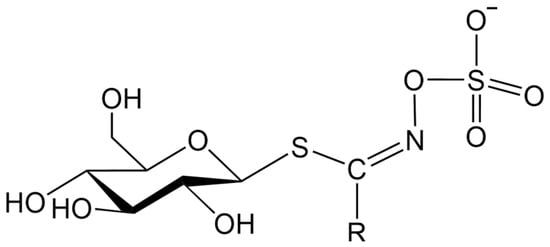
Glucosinolates (GSLs) represent a chemically diverse family of sulfur- and nitrogen-containing specialized metabolites derived from amino acid precursors rather than a single uniform compound class. All GSLs contain a conserved core structure consisting of a β-D-thioglucose group, a sulfonated oxime moiety, and a variable side chain (R group), whereas differences in side-chain composition largely determine their chemical properties, metabolic fate, and biological functions [9].
Based on precursor amino acids and side-chain characteristics, GSLs are generally divided into three major groups: aliphatic, indole, and aromatic GSLs (Figure 1). Aliphatic GSLs are mainly derived from methionine and related chain-elongated amino acid intermediates through the methionine chain elongation pathway; indole GSLs originate from tryptophan metabolism; and aromatic GSLs are mainly derived from phenylalanine or tyrosine [6]. This precursor-based classification provides a biochemical framework for understanding the diversity of GSL profiles among different Brassicaceae species.
Figure 1.
General chemical structure of glucosinolates (GSLs). The conserved core consists of a β-D-thioglucose moiety linked via a thio-glycosidic bond to a sulfonated oxime, which carries a variable side chain (R). According to the amino acid precursor of the side chain, GSLs are classified into three classes: aliphatic GSLs (R derived from methionine, alanine, leucine, isoleucine, or valine), indole GSLs (R derived from tryptophan), and aromatic GSLs (R derived from phenylalanine or tyrosine).
Beyond precursor diversity, extensive secondary modifications, including oxidation, hydroxylation, methoxylation, desaturation, and side-chain extension, further expand the structural complexity of GSLs. These modifications influence not only GSL accumulation patterns but also their conversion into distinct hydrolysis products, thereby affecting plant defense responses, flavor characteristics, nutritional properties, and potential toxicity. Therefore, GSL diversity should be evaluated not simply by total content but by compound composition, spatial distribution, and metabolic function [10].
2.2. Biosynthesis Pathway of GSLs in Plants
The synthesis of glucosinolates is a complex process that requires the participation of multiple raw materials, enzymes, and genes [11,12]. Currently, more than 200 types of glucosinolates have been discovered, and their core structures are all similar; only the side-chain modifications are different. Different types of glucosinolates have different genes and enzymes that regulate synthesis.
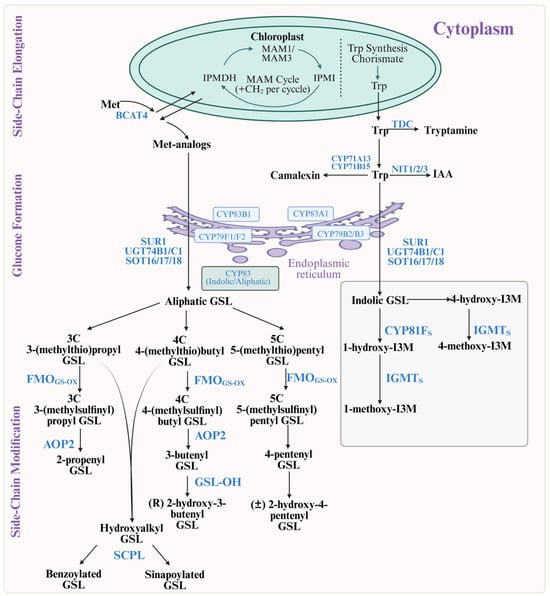
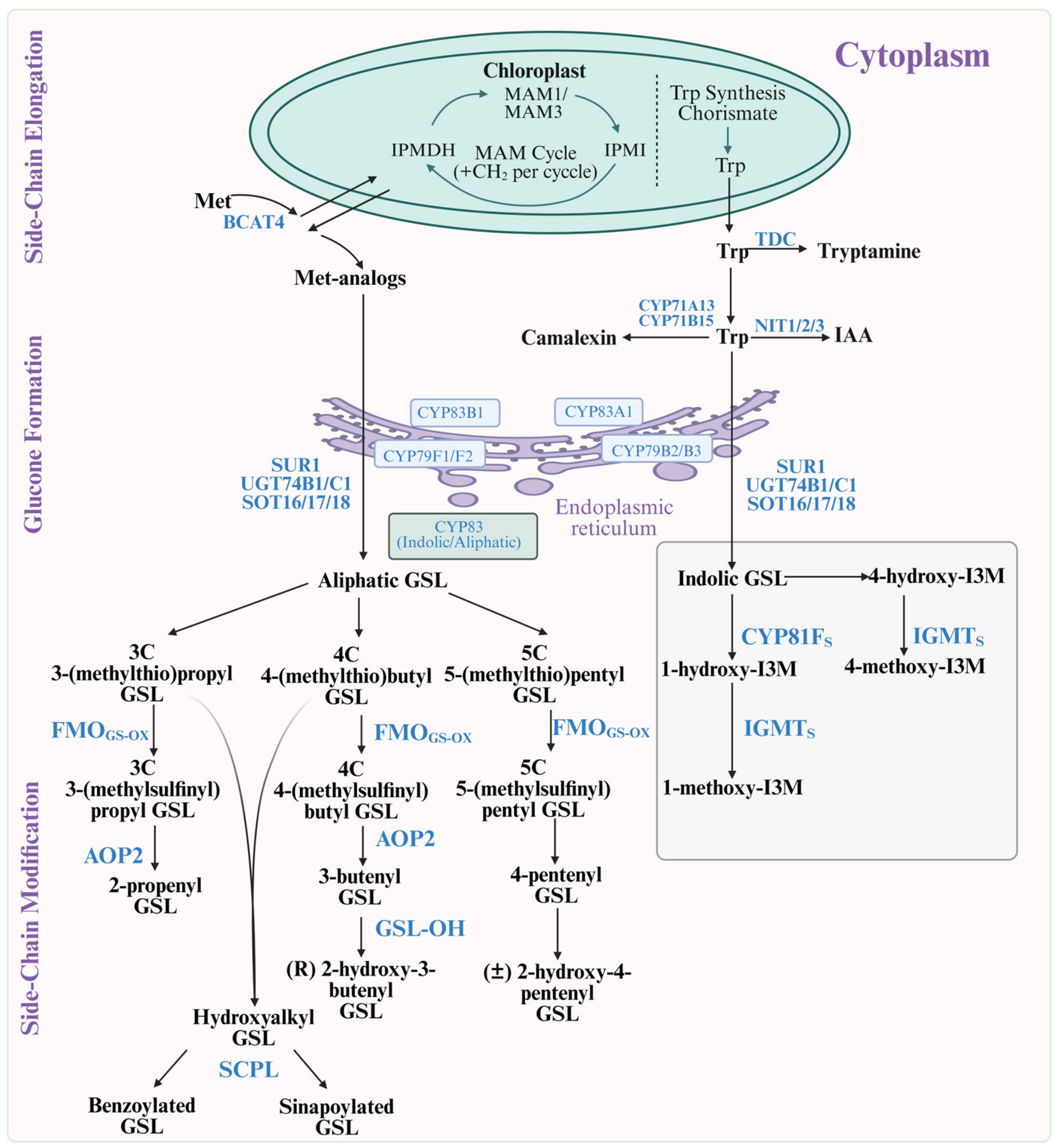
In the classical glucosinolate biosynthetic model, the pathway can be divided into three conserved stages: precursor modification, core structure formation, and side-chain diversification. Among them, methionine-derived aliphatic glucosinolate biosynthesis involves an upstream chain elongation process, in which enzymes such as branched-chain amino acid aminotransferases (BCATs) and methylthioalkylmalate synthases (MAMs) generate precursors with different carbon chain lengths. This process provides the basis for the structural diversity of aliphatic glucosinolates. Aromatic glucosinolates are derived primarily from phenylalanine and tyrosine. Unlike methionine-derived aliphatic glucosinolates, phenylalanine-derived aromatic glucosinolates do not generally follow the well-characterized methionine-derived MAM cycle, although side-chain elongation occurs in some aromatic GSL pathways. In the phenylalanine-derived pathway, CYP79A2 catalyzes the conversion of phenylalanine to phenylacetaldoxime, which enters the downstream core structure biosynthetic pathway. Subsequent reactions involve CYP83-mediated oxidation and glutathione-dependent processing, followed by thiohydroximate formation, glycosylation, and sulfation. However, the enzymes responsible for phenylalanine side-chain elongation and several subsequent modifications of aromatic GSLs remain incompletely characterized, and the corresponding pathways are less well resolved than those of aliphatic and indole GSLs. After precursor formation, the conserved core structure is synthesized through a series of enzymatic reactions involving cytochrome P450 enzymes (CYP79 and CYP83), followed by reactions catalyzed by SUR1, UGT74 family proteins, and sulfotransferases. These reactions generate the characteristic glucosinolate backbone shared by different GSL classes [13]. Subsequent side-chain modifications, including oxidation, hydroxylation, methoxylation, and other chemical modifications, further increase glucosinolate diversity and determine compound-specific biological functions. Subsequent modifications mediated by specialized enzymes, such as flavin monooxygenases (FMOs), 2-oxoglutarate-dependent dioxygenases (AOPs), and SCPL-dependent transferases, generate diverse glucosinolate profiles among different species and tissues [14]. Figure 2 provides a schematic overview of the methionine-derived aliphatic and tryptophan-derived indole GSL biosynthetic pathways, highlighting precursor chain elongation, core structure formation, and side-chain diversification. Although aromatic GSLs are included in the precursor-based classification, their biosynthetic routes are not comprehensively illustrated in this figure and are therefore discussed in the main text [15].
Figure 2.
Three-stage biosynthesis of glucosinolates. In the chloroplast, precursor amino acids undergo chain elongation and are converted to oximes by CYP79 family enzymes. At the endoplasmic reticulum, CYP83, SUR1, UGT74B1, and SOT sequentially form the core structure. Subsequent side-chain modifications, catalyzed by FMOGS-OX, AOP2, GSL-OH, SCPL, CYP81Fs, and IGMTs, generate the diversity of aliphatic and indole glucosinolates.
2.3. Regulation of GSL Biosynthesis
Glucosinolate (GSL) biosynthesis is controlled by transcriptional networks and genetic variation. In Arabidopsis thaliana, MYB28, MYB29, and MYB76 primarily regulate aliphatic GSL biosynthesis, whereas MYB34, MYB51, and MYB122 regulate indole GSL biosynthesis [16,17]. These transcription factors have overlapping but distinct functions, allowing GSL composition to respond to specific regulatory inputs. Their effects also extend beyond the immediate biosynthetic pathway, linking GSL production with broader metabolic processes [18,19].
Genetic variation and tissue-specific regulation further shape GSL profiles in Brassicaceae crops. Fine mapping of qGSL-C2 in Brassica napus identified a genomic region associated with seed GSL content, while CRISPR-Cas9-mediated editing of MYB28 in Brassica oleracea demonstrated its contribution to glucoraphanin accumulation under field conditions [20]. Organ-dependent differences in MYB expression and GSL composition have also been observed in Chinese cabbage [21]. However, GSL accumulation reflects the combined effects of biosynthesis, transport, and turnover rather than biosynthetic activity alone. Crop improvement should therefore evaluate individual GSLs and their tissue distribution alongside the agronomic consequences of regulatory interventions.
3. Hydrolysis and Degradation of GSLs
3.1. The Glucosinolate–Myrosinase System
Glucosinolates and myrosinases together constitute the classical glucosinolate–myrosinase defense system, commonly known as the “mustard oil bomb”. Under normal physiological conditions, glucosinolates and myrosinases are spatially separated within plant tissues. Glucosinolates are primarily stored in the vacuoles of specialized S-cells and other storage cells, whereas myrosinases (β-thioglucosidases, EC 3.2.1.147), mainly encoded by TGG1 and TGG2 in Arabidopsis thaliana, accumulate in specialized myrosin cells, guard cells, and certain phloem-associated tissues [22]. This compartmentalization prevents premature hydrolysis while allowing rapid activation following tissue disruption.
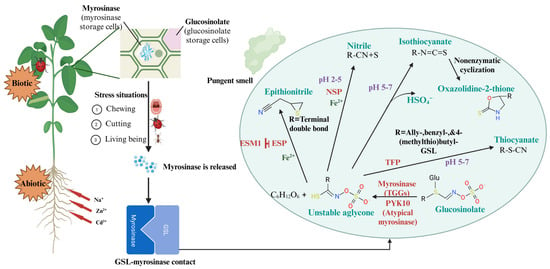
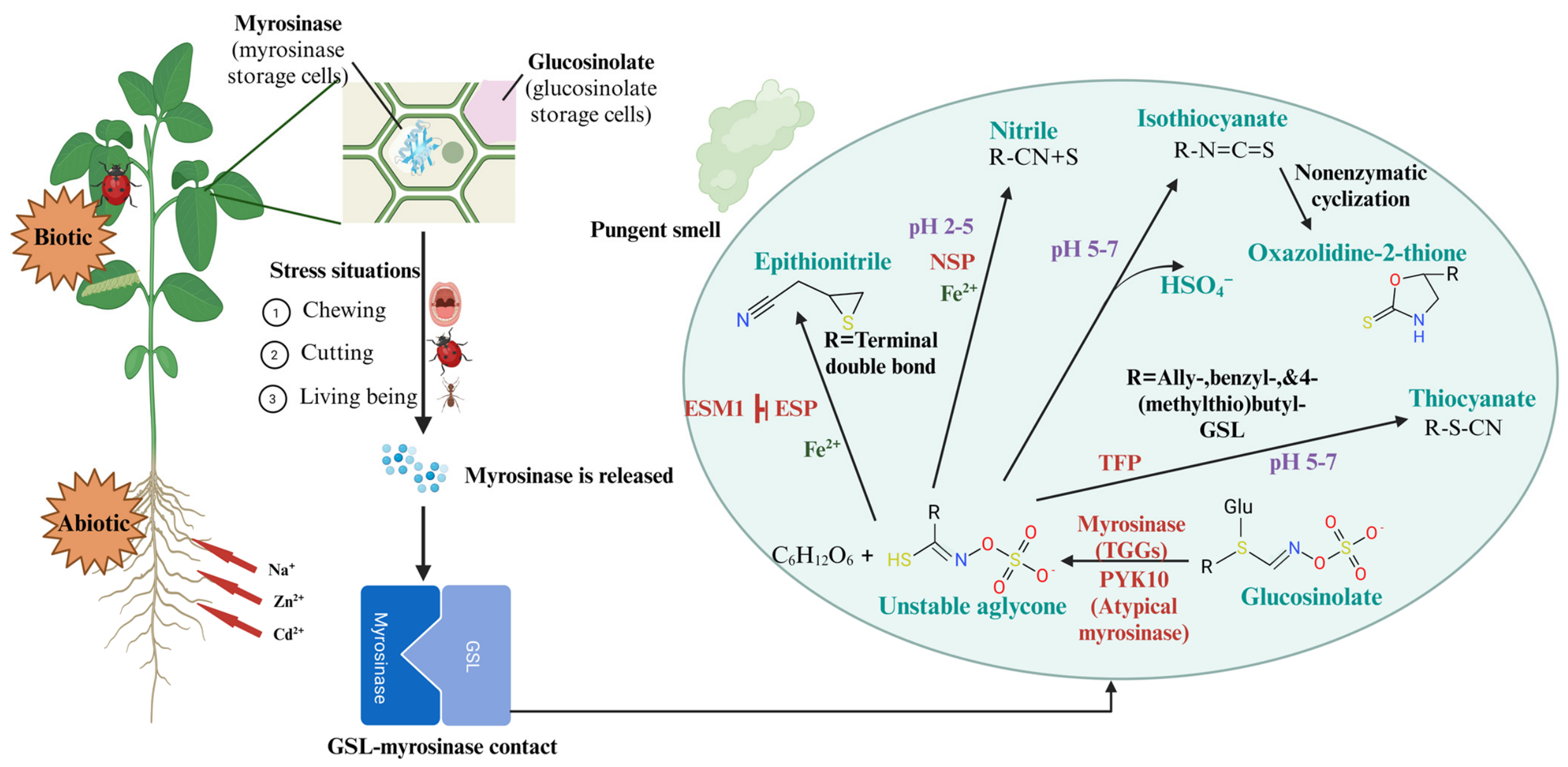
Mechanical damage caused by herbivore feeding, pathogen infection, postharvest processing, or other environmental stresses breaks cellular compartmentalization, enabling glucosinolates to encounter myrosinases. Myrosinases hydrolyze the thioglucosidic bond, producing unstable aglycones that spontaneously rearrange into various biologically active compounds [23]. Myrosinase therefore initiates GSL activation, while substrate structure and the reaction environment influence the subsequent product profile (Figure 3). The initial enzymatic cleavage should be distinguished from the downstream reactions responsible for product diversification.
Figure 3.
Myrosinase-mediated glucosinolate hydrolysis. In intact tissue, glucosinolates (GSLs) and myrosinases are spatially separated. Tissue disruption allows myrosinase to cleave the thioglucosidic bond, yielding an unstable aglycone that rearranges to an isothiocyanate (ITC). Epithiospecifier proteins (ESPs), nitrile-specifier proteins (NSPs), thiocyanate-forming proteins (TFPs), and epithiospecifier modifier 1 (ESM1) redirect this aglycone toward nitriles, epithionitriles, or thiocyanates depending on GSL substrate, pH, and ferrous-ion [Fe(II)] availability. Non-enzymatic cyclization of hydroxyalkenyl ITC, such as that from progoitrin, yields goitrin. Product profiles are therefore conditional outcomes rather than fixed products of every GSL.
GSL activation also involves intracellular systems that differ from the classical tissue-disruption model. The atypical myrosinase PYK10 is associated with endoplasmic reticulum bodies and participates in indole GSL metabolism. Research on ER-body-resident myrosinases and tryptophan-specialized metabolism has further demonstrated their involvement in root microbiota assembly. These findings highlight the diversity of GSL activation systems and indicate that their functions cannot be explained solely by the mixing of previously separated substrates and enzymes after extensive tissue damage [24,25].
3.2. Hydrolysis and Degradation Process of GSLs
The fate of the unstable aglycone depends on the structure of the parent GSL and the physicochemical conditions during hydrolysis. In many cases, the aglycone spontaneously rearranges to an isothiocyanate (ITC), whereas alternative products form only when the substrate and reaction conditions permit. Simple nitriles, epithionitriles, and organic thiocyanates therefore represent conditional outcomes rather than equivalent products of a universal pathway. In particular, epithionitrile formation requires a suitable GSL side chain containing a terminal double bond, while thiocyanate formation depends on substrate specificity and the presence of an appropriate thiocyanate-forming activity [26].
Specifier proteins can redirect aglycone breakdown toward particular non-ITC products. Epithiospecifier proteins (ESPs) are associated with epithionitrile formation from suitable alkenyl GSL substrates, whereas nitrile-specifier proteins (NSPs) promote nitrile formation under appropriate conditions. Thiocyanate-forming proteins (TFPs) are associated with thiocyanate production from specific substrates. The activities and product outcomes of these proteins depend on the GSL substrate and may be influenced by pH and ferrous-ion [Fe(II)] availability; these effects are not identical across all proteins or experimental systems. Epithiospecifier modifier 1 (ESM1) is functionally distinct from ESP, NSP, and TFP and has been reported to suppress nitrile formation and favor ITC production in specific contexts. Thus, the final product profile reflects the interaction of substrate structure, specifier-protein activity, and reaction conditions rather than a fixed set of parallel reactions [27,28,29].
Further reactions can modify the initial products of GSL activation. For example, the unstable hydroxyalkenyl ITC generated from progoitrin can cyclize to form goitrin, an oxazolidine-2-thione. This secondary conversion should be distinguished from both the enzymatic cleavage of the intact GSL and the formation of a stable ITC. Importantly, the cyclization of hydroxyalkenyl ITC to oxazolidine-2-thione represents a secondary non-enzymatic chemical transformation, which occurs independently of specifier-protein activity. Consequently, identifying the precursor does not necessarily establish the final product profile, which also depends on the conditions and timing of analysis [30].
Differences in product formation have important implications for biological function. The effects of GSL activation depend on the identity and concentration of the products formed and the sensitivity of the target organism. ITCs should therefore not be described as universally more antimicrobial or insecticidal than other product classes, and increased precursor accumulation should not automatically be interpreted as enhanced defense. Functional assessment should connect individual GSL profiles with the products generated and the biological responses observed under defined experimental conditions.
4. Transport Regulation, Tissue-Specific Allocation of GSLs
4.1. Transport Regulation of GSLs
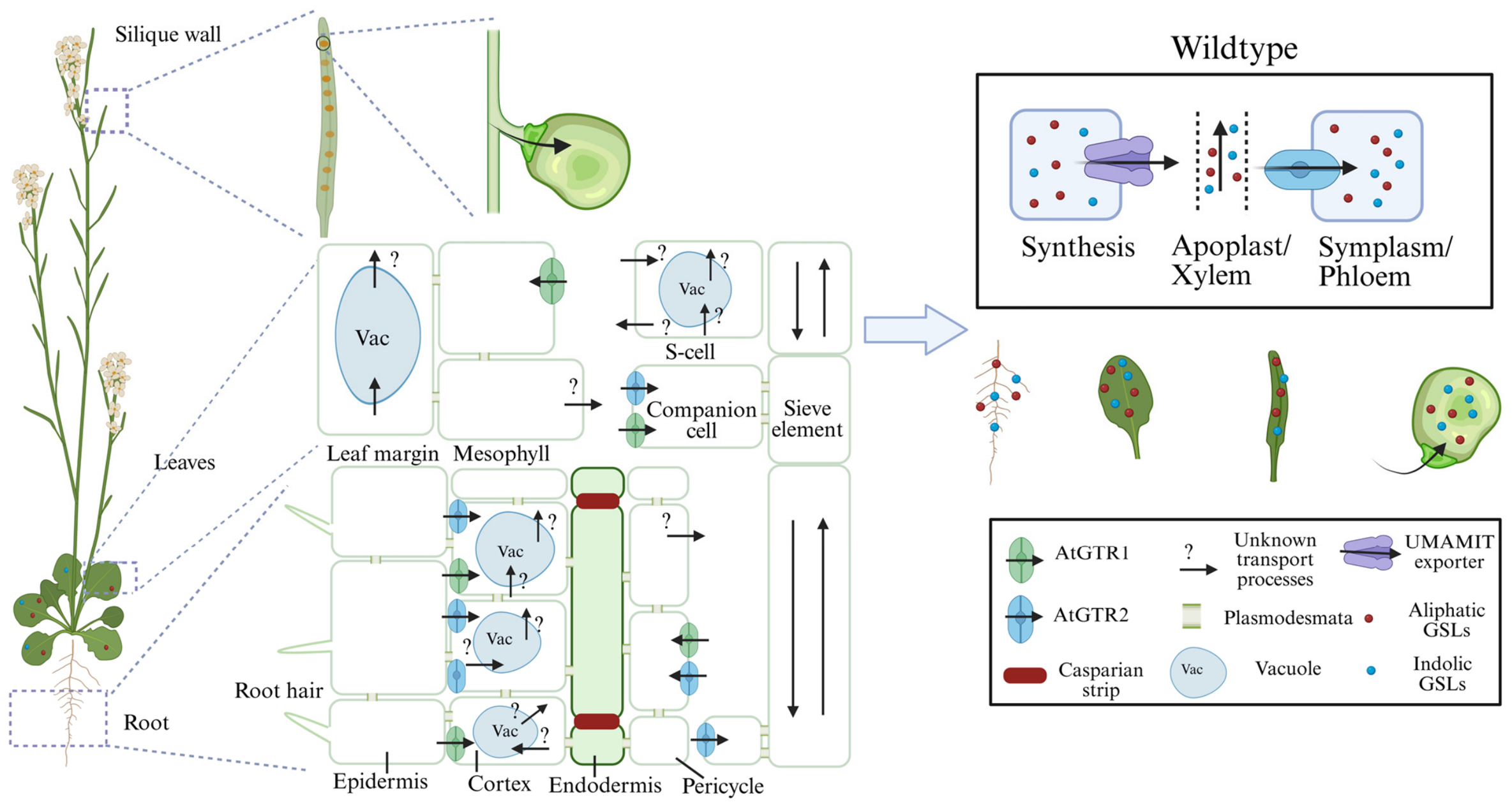
Unlike primary metabolites, glucosinolates are synthesized mainly in specific tissues but accumulate in different organs, indicating the existence of tightly regulated transport systems [31]. Early genetic studies identified GTR1 and GTR2, two members of the NRT/PTR transporter family, as essential glucosinolate transporters in Arabidopsis [32]. Loss-of-function analysis demonstrated that gtr1/gtr2 mutants exhibited altered glucosinolate distribution patterns, characterized by increased accumulation in leaves but reduced levels in seeds, indicating that GTR proteins mediate the allocation of GSLs from source tissues to sink organs [32]. GTR3 (NPF2.9) preferentially transports indole GSLs and contributes to their retention in roots [33]. These transporters regulate membrane crossing at specific sites; organ-to-organ movement additionally depends on vascular transport and the spatial arrangement of source and recipient tissues (Figure 4).
UMAMIT29, UMAMIT30, and UMAMIT31 were identified as glucosinolate exporters that facilitate glucosinolate efflux from biosynthetic tissues into the apoplast, where GSLs can subsequently be taken up by GTR transporters for long-distance translocation [34]. This model was further refined by demonstrating that UMAMIT exporters and GTR importers form a coordinated transporter cascade across multiple plasma membrane barriers during seed loading, enabling GSL movement from biosynthetic tissues to the embryo [35]. UMAMITs export GSLs into the apoplast, whereas GTRs mediate subsequent uptake into the phloem and embryo, establishing the seed-specific GSL profile [35] (Figure 4). Recent cryo-EM studies have provided complementary insights into glucosinolate (GSL) recognition and transport by GTR1. Structural analyses of substrate-bound GTR1 have revealed how the transporter recognizes the conserved GSL scaffold while accommodating variation in substrate side chains, providing a structural explanation for its polyspecificity [36]. Complementary structural and functional analyses have characterized distinct conformational states of GTR1 and identified residues involved in substrate recognition and proton-coupled transport, thereby advancing our understanding of its transport mechanism [37]. However, the precise proton-coupling mechanism remains incompletely resolved [37]. These structural findings provide a basis for future efforts to investigate transporter selectivity and its potential manipulation for crop improvement [36]. Residue-function analyses have also identified amino acids important for AtUMAMIT29 transport activity [38]. In broccoli, a recent study showed that BolGTR1.2, BolGTR2.2, BolGTR2.3, and BolGTR3.3 transport the tested aliphatic and indolic GSLs in Xenopus oocytes [2]. The broader activity of BolGTR3.3 compared with the reported indole preference of AtGTR3 highlights functional variation among GTR homologues [2]. GSL allocation is also regulated at the level of transporter expression. In Brassica napus, population and chromatin analyses linked an enhancer-containing structural variant to altered BnaC02.GTR2 expression and seed GSL content [39]. Together, these findings identify transporter activity, substrate recognition, and expression patterns as complementary determinants of GSL distribution.
Figure 4.
Model of transporter-mediated glucosinolate transport, cellular compartmentation, and organ allocation. Schematic representation of the cellular, tissue-level, and long-distance transport routes of glucosinolates (GSLs) in Arabidopsis thaliana. AtGTR1 (GLUCOSINOLATE TRANSPORTER 1) and AtGTR2 (GLUCOSINOLATE TRANSPORTER 2) function as major high-affinity importers responsible for long-distance phloem- and xylem-mediated translocation from source organs to sink tissues such as roots and developing seeds [40]. The coordinated action of UMAMIT (Usually Multiple Amino acids Move In and Out Transporters) exporters, GTR (Glucosinolate Transporter) importers, and plasmodesmatal symplasmic pathways facilitates subcellular compartmentation, vacuolar storage, and intercellular movement across diverse tissue layers, ultimately determining the organ-specific allocation patterns of aliphatic and indolic GSLs.
4.2. Tissue-Specific Allocation of GSLs
The relationship between GSL sources and sinks changes with compound class and development. Feeding and grafting experiments in vegetative Arabidopsis showed that both roots and rosettes contribute to GSL biosynthesis and that their distinct profiles involve transport through phloem- and xylem-associated routes [41]. After bolting, tracer experiments identified the inflorescence as a stronger sink than the roots for leaf-supplied GSLs [31]. These observations reveal developmentally changing source–sink relationships. Organ GSL concentrations integrate synthesis, import, export, turnover, and growth dilution, rather than directly reporting transport flux.
Within organs, biosynthesis and accumulation are also spatially differentiated. Localization of biosynthetic enzymes revealed distinct but partly overlapping cellular domains for aliphatic and indole GSL production [42]. In leaves, GTR1/2-mediated uptake contributes to allocation of apoplastic GSLs, alongside other processes involved in leaf-margin accumulation [43]. In inflorescence stems, sulfur-rich S-cells receive GSLs through routes that depend on their position and the GSL class. Evidence supports both GTR-mediated uptake into a connected symplastic domain and movement from neighboring biosynthetic cells [44]. Photoactivation experiments independently demonstrated symplastic connectivity between S-cells and adjacent cells [33]. These findings distinguish cellular uptake from subsequent cell-to-cell transfer and from final vacuolar storage.
GSLs may also influence intercellular communication. Fernandez et al. reported that manipulation of GSL-associated metabolism and exogenous GSL application altered plasmodesmal trafficking and callose accumulation. Exogenous sinigrin increased intercellular trafficking at the tested low concentrations, whereas glucobrassicin reduced it; these responses were associated with changes in plasmodesmal callose [45]. This suggests that GSL composition can affect symplastic connectivity but does not yet establish how these responses quantitatively regulate endogenous GSL redistribution. At the root–soil interface, GTR-dependent import within roots is required for efficient rhizosecretion of some stele-derived GSLs and their catabolites; this requirement does not mean that GTRs themselves function as exporters into the rhizosphere [46].
The functional consequences of allocation depend on the receiving tissue and the interacting organism. Mutant analyses and feeding assays linked age-dependent leaf GSL distribution with the feeding preference of a generalist herbivore [47]. However, a powdery mildew study found that local indol-3-ylmethyl GSL biosynthesis, rather than GTR-dependent long-distance supply, supported the investigated Arabidopsis defense response [48]. Thus, spatial supply and local synthesis make distinct, context-dependent contributions to GSL function.
4.3. Vacuolar Sequestration and Intracellular Storage
Delivery to a storage cell and uptake across its tonoplast are separate steps. The experimentally characterized GTR and UMAMIT steps described above mediate transport across the plasma membrane and are mechanistically distinct from vacuolar uptake. Cell-level studies establish the importance of compartmentation and the connectivity of GSL storage tissues, while leaving additional questions about the transport machinery responsible for intracellular sequestration [33,43,44].
Emerging evidence suggests that MATE family transporters may contribute to vacuolar indolic glucosinolate (GSL) accumulation. A 2026 preprint by Yamada et al. reported that DTX38 and DTX39 localize to the tonoplast and exhibit indolic GSL transport activity in a yeast expression system in a vacuolar H+-ATPase-dependent manner, consistent with a proposed proton–GSL antiport mechanism [49]. However, the genetic evidence differed between the two transporters: dtx39 mutants showed reduced indolic GSL accumulation in leaves and roots, whereas dtx38 mutants did not show the same phenotype. These findings suggest a potential role for DTX39 in vacuolar indolic GSL accumulation, but the proposed transport mechanism and the physiological contribution of DTX38 require further investigation. Because these results are currently available as a preprint and have not yet undergone peer review, they should be considered preliminary pending independent validation.
5. Application Trade-Offs of GSLs in Agriculture and Food Science
The practical value of GSLs depends on their chemical composition, tissue distribution, and conversion into hydrolysis products. Agricultural and food applications therefore require different targets: limiting antinutritional exposure from oilseed meals, retaining effective crop defense, or promoting the formation of selected flavor and bioactive compounds. Recent research supports evaluating these outcomes separately rather than treating total GSL concentration as a universal indicator of quality.
5.1. Food Safety and Toxicity: Low Seed GSLs for Feed Quality
Low seed GSL content remains an important objective in Brassica oilseed improvement. Modern “double-low” (00) cultivars combine low erucic acid with low seed glucosinolate content, substantially improving the nutritional value and utilization efficiency of rapeseed meal [50], supported by recent progress in the functional genomics of Brassica napus [51]. However, seed composition alone does not determine the feeding value of the resulting meal. Processing changes both residual GSLs and their degradation products. In pilot-scale rapeseed protein extraction, myrosinase activity and extraction conditions altered the compounds recovered in the final products, including goitrin [30]. Thus, a decline in intact GSLs should not be equated with complete detoxification. Assessment should include the relevant hydrolysis products, dietary inclusion level, and nutritional characteristics of the processed material.
Fermentation can improve rapeseed meal utilization, although its effects extend beyond GSL degradation. In a feeding study involving 30 growing pigs, fermented rapeseed meal improved growth performance, nutrient digestibility, and several intestinal health indicators relative to unfermented meal [52]. Because fermentation also modifies protein, fiber, and microbial metabolites, these benefits cannot be attributed exclusively to lower GSL exposure. Process optimization should therefore consider digestible nutrient supply and animal performance alongside residual antinutritional compounds.
Transporter editing provides a complementary strategy for reducing seed GSL accumulation while retaining GSLs in vegetative tissues. In Brassica juncea, multiplex editing of BjuGTR1 and BjuGTR2 homologues produced lines with low seed and high leaf GSL contents. Selected lines retained defense against Sclerotinia sclerotiorum and Spodoptera litura in detached-leaf assays and showed comparable seed weight and oil content under the tested conditions [53]. These results demonstrate a feasible separation of seed quality and leaf defense, while broader agronomic performance still requires evaluation across environments.
5.2. Plant Defense: Not Simply Low GSLs
The defensive functions of GSLs explain why indiscriminate reduction across plant tissues may be undesirable. Defense depends on the GSL profile, its spatial availability, and the formation of active hydrolysis products, rather than on total concentration alone. In GTR-edited Brassica juncea, selected lines with low seed and high leaf GSL contents retained resistance to Sclerotinia sclerotiorum and Spodoptera litura in detached-leaf assays [53]. These results demonstrate that seed-quality improvement can coexist with effective defense against particular attackers; they do not establish a general relationship in which higher GSL concentrations invariably confer greater resistance.
Recent research has also connected specific GSL pathways with abiotic stress responses. The BolMYB28–BolMAM1 module can enhance salt and drought tolerance in broccoli through changes in specific aliphatic GSLs and abscisic acid accumulation. Progoitrin treatment promoted abscisic acid accumulation in vitro, while exogenous sulforaphane induced stomatal closure [54]. These findings implicate GSL metabolism and its products in stress-related signaling. They provide a more precise mechanistic interpretation than describing GSLs collectively as direct scavengers of reactive oxygen species.
The desirability of GSL retention also varies with the intended food product. Certain hydrolysis products contribute characteristic pungency and aroma to Brassicaceae vegetables, so reducing all GSLs may alter valued sensory attributes. A comparison of mustard cultivars found that fresh ‘Chuanjie No. 2’ contained 50.09% more total GSLs than ‘Chuanjie No. 1’. The cultivars differed during fermentation in microbial counts, acidity, and volatile metabolites, including allyl and 3-butenyl isothiocyanates [55]. These associations connect GSL metabolism with fermentation characteristics, but cultivar comparisons do not establish GSL differences as the sole cause of the observed changes. Selection for fermented products should therefore consider precursor composition, fermentation performance, and sensory quality together.
Retention of selected GSL precursors may also support nutritional applications, provided that biological activity is distinguished from demonstrated human efficacy. In a placebo-controlled trial in individuals with prediabetes, broccoli sprout extract reduced fasting blood glucose by approximately 0.2 mmol/L relative to placebo, below the prespecified target of 0.3 mmol/L [56]. Associations between baseline gut microbiota and response were exploratory. Such findings support further investigation of defined preparations and variation in individual responses, while avoiding broad claims that GSL-containing foods prevent or treat cancer or other diseases. The appropriate improvement target is therefore a composition suited to plant function and product use, rather than uniformly low or high total GSL content.
5.3. Precision Regulation Strategies: Balancing Defense, Quality, and Safety
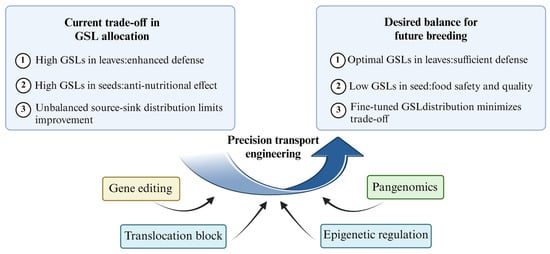
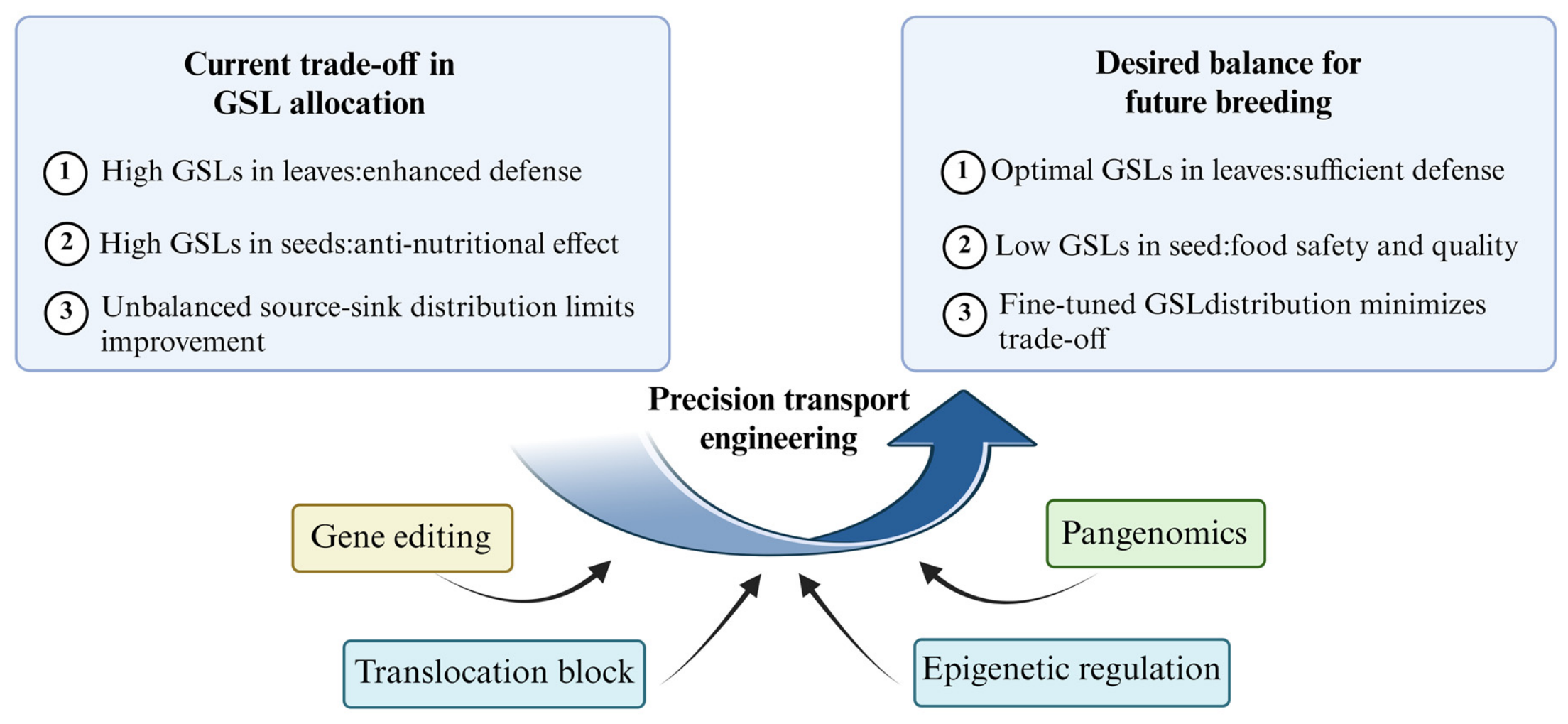
Transport engineering provides a direct means of addressing the spatial conflict between seed quality and vegetative defense (Figure 5). Multiplex editing of BjuGTR1 and BjuGTR2 homologues generated B. juncea lines with low seed and high leaf GSL contents. In addition to retaining defense in the assays described above, selected lines showed thousand-seed weight and seed oil content comparable to the wild type under containment net-house conditions. This represents an advance from broadly reducing GSL accumulation toward modifying its allocation, although agronomic performance across environments still requires validation [53].
Figure 5.
Strategies for precision glucosinolate regulation. The schematic illustrates the trade-off between crop defense and seed quality, with tissue-specific GSL allocation as a means of balancing both. Transporter editing in Brassica juncea provides experimental evidence for altered seed–leaf GSL distribution under the tested conditions, whereas pangenomic analysis, epigenetic regulation, and other proposed strategies remain approaches for target discovery or future investigation. Yellow boxes denote experimentally demonstrated strategies, green boxes target discovery, and blue boxes prospective strategies.
Biosynthetic regulation and natural allelic variation offer complementary breeding routes. Combined mutations in MYB28/HAG1 and MYC3 reduced seed GSL content by approximately 75%, and reduced-GSL traits were incorporated with other domestication traits through genome editing [57]. In rapeseed, a splice-site variant in BnaC02.VTE4 caused alternative splicing and premature translation termination. The haplotypes differed in vitamin E and seed GSL accumulation, providing a genetic basis for considering oil and meal quality together. These approaches expand improvement beyond a single low-GSL phenotype to combinations of allocation, composition, and nutritional traits [58].
Field management applies a different principle: GSL-rich residues are retained and incorporated to generate biologically active products for soil treatment. Recent biofumigation research emphasizes that residue chemistry must be matched with treatment conditions. A 2026 greenhouse mesocosm study compared five Brassicaceae residues in naturally infested soil under uncovered biofumigation and plastic-covered biosolarization. Covered treatments more consistently reduced lettuce Fusarium wilt, with the covered soil environment acting as the main driver and residues modifying the response. Thus, practical disease management requires coordination of residue selection and soil conditions, rather than reliance on high residue GSL content alone [59].
Postharvest regulation further determines whether GSL conversion serves feed safety or food functionality. For glucoraphanin-rich products, a 2026 randomized crossover study in 16 participants showed that adding myrosinase-containing mustard seed powder to broccoli seed extract increased estimated sulforaphane bioavailability from 18.6% to 39.8%, based on urinary recovery. Both preparations contained ascorbic acid. This provides human evidence that precursor utilization can be improved through enzyme provision, without increasing precursor content [60]. Together, targeted allocation, coordinated breeding, appropriate field treatment, and controlled hydrolysis allow GSL management to follow the requirements of the crop and final product.
Nevertheless, the demonstrated effects of transporter editing should be distinguished from broader proposed strategies for precision GSL regulation. The current evidence from Brassica juncea supports altered seed–leaf GSL allocation under the tested conditions, but it does not yet establish stable agronomic benefits across environments or genetic backgrounds. Transporter specificity, functional redundancy among homologues, and environmental responses may affect glucosinolate allocation, and thus the application of findings from Arabidopsis thaliana to economically important Brassica crops requires further validation. Pangenomic and epigenetic approaches may help identify regulatory variation or candidate targets, but their potential to improve tissue-specific GSL allocation requires direct experimental validation. Future studies should therefore evaluate GSL profiles in multiple organs alongside defense, yield, seed quality, and related traits under field conditions.
6. Conclusions and Future Perspectives
The biological and practical value of glucosinolates depends on the coordination of their chemical diversity, spatial allocation, and controlled hydrolysis, rather than total abundance alone. Advances in transport biology and genome editing indicate that seed quality and vegetative defense can be partially uncoupled, while processing studies highlight conversion efficiency as a determinant of the compounds ultimately delivered in food and feed. The central challenge is therefore to connect molecular regulation with predictable outcomes across plant development, environmental conditions, and processing. Future research should resolve how local biosynthesis, transport, storage, and turnover jointly determine metabolic fluxes and validate targeted interventions in crops through integrated assessment of resistance, yield, nutritional quality, and safety. Progress will depend on defining which compounds are needed, where and when they should accumulate, and how they are converted, enabling application-specific improvement without assuming that either uniformly high or low glucosinolate content is desirable.
Author Contributions
Y.-L.L. and J.-Y.C. contributed to the writing of the review. Q.Y. supervised the review process. M.Y. and Q.Y. were involved in refining the manuscript. All authors have read and agreed to the published version of the manuscript.
Funding
This work was supported by the State Key Laboratory of Tree Genetics and Breeding (SKLTGB-NJ2024-004), the China Scholarship Council funding, and the Advanced Talent Foundation of Jiangsu University (Grant No. 5501330014).
Institutional Review Board Statement
Not applicable.
Informed Consent Statement
Not applicable.
Data Availability Statement
No new data were created or analyzed in this study. Data supporting the findings of this review are available from the corresponding author upon reasonable request.
Conflicts of Interest
The authors declare that they have no known competing financial interests or personal relationships that could have appeared to influence the work reported in this paper.
References
- Katz, E.; Bagchi, R.; Jeschke, V.; Rasmussen, A.R.M.; Hopper, A.; Burow, M.; Estelle, M.; Kliebenstein, D.J. Diverse Allyl Glucosinolate Catabolites Independently Influence Root Growth and Development. Plant Physiol. 2020, 183, 1376–1390. [Google Scholar] [CrossRef] [Scilit]
- Albaladejo-Marico, L.; Kanstrup, C.; Crocoll, C.; Carvajal, M.; Tomas, J.; Schuler, M.; Tatibouet, A.; Nour-Eldin, H.H.; Yepes-Molina, L. Beyond defense: GTR-mediated uptake of glucosinolates drives growth and structural reprogramming in broccoli seedlings. Plant Physiol. 2026, 201, kiag556. [Google Scholar] [CrossRef] [Scilit]
- Blazevic, I.; Montaut, S.; Burčul, F.; Olsen, C.E.; Burow, M.; Rollin, P.; Agerbirk, N. Glucosinolate structural diversity, identification, chemical synthesis and metabolism in plants. Phytochemistry 2020, 169, 112100. [Google Scholar] [CrossRef] [Scilit]
- Dulovic, A.; Koch, M.A.; Thongyoo, P.; Pattison, D.I.; Blažević, I.; Rollin, P.; Agerbirk, N. Glucosinolates in non-Brassicales plant species: Critical literature evaluation and testing of two high chemical quality reports. Biochem. Syst. Ecol. 2024, 116, 104864–104880. [Google Scholar] [CrossRef] [Scilit]
- Tufail, T.; Khan, T.; Ain, H.B.U.; Morya, S.; Shah, M.A. Garden cress seeds: A review on nutritional composition, therapeutic potential, and industrial utilization. Food Sci. Nutr. 2024, 12, 3834–3848. [Google Scholar] [CrossRef] [Scilit]
- Abdel-Massih, R.M.; Debs, E.; Othman, L.; Attieh, J.; Cabrerizo, F.M. Glucosinolates, a natural chemical arsenal: More to tell than the myrosinase story. Front. Microbiol. 2023, 14, 1130208. [Google Scholar] [CrossRef] [Scilit]
- Narra, F.; Galgani, G.; Harris, C.B.; Moreno, D.A.; Núñez-Gómez, V. Bioavailability, Human Metabolism, and Dietary Interventions of Glucosinolates and Isothiocyanates: Critical Insights and Future Perspectives. Foods 2025, 14, 2876. [Google Scholar] [CrossRef] [Scilit]
- Abdelshafeek, K.A.; El-Shamy, A.M. Review on glucosinolates: Unveiling their potential applications as drug discovery leads in extraction, isolation, biosynthesis, biological activity, and corrosion protection. Food Biosci. 2023, 56, 103071. [Google Scholar] [CrossRef] [Scilit]
- Nguyen, V.P.T.; Stewart, J.; Lopez, M.; Ioannou, I.; Allais, F. Glucosinolates: Natural Occurrence, Biosynthesis, Accessibility, Isolation, Structures, and Biological Activities. Molecules 2020, 25, 4537. [Google Scholar] [CrossRef] [Scilit]
- Luo, S.F.; An, R.; Zhou, H.; Zhang, Y.; Ling, J.; Hu, H.; Li, P. The glucosinolate profiles of Brassicaceae vegetables responded differently to quick-freezing and drying methods. Food Chem. 2022, 383, 132624. [Google Scholar] [CrossRef] [Scilit]
- Sharma, S.; Rani, H.; Kaur, G.; Kumar, S.; Sheikh, S.; Samota, M.K. Comprehensive overview of glucosinolates in crucifers: Occurrence, roles, metabolism, and transport mechanisms-a review. Phytochem. Rev. 2025, 24, 2417–2444. [Google Scholar] [CrossRef] [Scilit]
- Ullah, M.; Batool, M.; El-Badri, A.M.; Ikram, M.; Zheng, L.; Khalid, B.; Mohamed, I.A.E.K.A.E.M.; Chang, L.; Wang, B.; Kuai, J.; et al. A comprehensive report on glucosinolate involvement in abiotic stress responses in Brassicaceae family. Hortic. Plant J. 2026, 12, 764–780. [Google Scholar] [CrossRef] [Scilit]
- Ji, R.; Lei, J.; Chen, I.W.; Sang, W.; Yang, S.; Fang, J.; Zhu-Salzman, K. Cytochrome P450s CYP380C6 and CYP380C9 in green peach aphid facilitate its adaptation to indole glucosinolate-mediated plant defense. Pest Manag. Sci. 2021, 77, 148–158. [Google Scholar] [CrossRef] [Scilit]
- Choi, P.; Nugroho, A.B.D.; Moon, H.; Kim, D.-H. A 2-oxoglutarate-dependent dioxygenase, GLUCORAPHASATIN SYNTHASE 1 (GRS1) is a major determinant for different aliphatic glucosinolates between radish and Chinese cabbage. Plant Mol. Biol. 2024, 115, 1. [Google Scholar] [CrossRef] [Scilit]
- Zhao, S.S.; Wu, M.; Chen, Y.; Xiong, Y.; Wang, L.; Wang, H.; Li, M. Glucosinolates in Brassica Species: Biosynthesis, Regulation, and Molecular Breeding. Int. J. Mol. Sci. 2026, 27, 3725. [Google Scholar] [CrossRef] [Scilit]
- Li, Y.; Sawada, Y.; Hirai, A.; Sato, M.; Kuwahara, A.; Yan, X.; Hirai, M.Y. Novel insights into the function of Arabidopsis R2R3-MYB transcription factors regulating aliphatic glucosinolate biosynthesis. Plant Cell Physiol. 2013, 54, 1335–1344. [Google Scholar] [CrossRef] [Scilit]
- Sønderby, I.E.; Burow, M.; Rowe, H.C.; Kliebenstein, D.J.; Halkier, B.A. A complex interplay of three R2R3 MYB transcription factors determines the profile of aliphatic glucosinolates in Arabidopsis. Plant Physiol. 2010, 153, 348–363. [Google Scholar] [CrossRef] [Scilit]
- Frerigmann, H.; Gigolashvili, T. MYB34, MYB51, and MYB122 distinctly regulate indolic glucosinolate biosynthesis in Arabidopsis thaliana. Mol. Plant 2014, 7, 814–828. [Google Scholar] [CrossRef] [Scilit]
- Malitsky, S.; Blum, E.; Less, H.; Venger, I.; Elbaz, M.; Morin, S.; Eshed, Y.; Aharoni, A. The transcript and metabolite networks affected by the two clades of arabidopsis glucosinolate biosynthesis regulators. Plant Physiol. 2008, 148, 2021–2049. [Google Scholar] [CrossRef] [Scilit]
- Neequaye, M.; Stavnstrup, S.; Harwood, W.; Lawrenson, T.; Hundleby, P.; Irwin, J.; Troncoso-Rey, P.; Saha, S.; Traka, M.H.; Mithen, R.; et al. CRISPR-Cas9-mediated gene editing of MYB28 genes impair glucoraphanin accumulation of Brassica oleracea in the field. CRISPR J. 2021, 4, 416–426. [Google Scholar] [CrossRef] [Scilit]
- Yi, G.-E.; Robin, A.H.K.; Yang, K.; Park, J.-I.; Hwang, B.H.; Nou, I.-S. Exogenous methyl jasmonate and salicylic acid induce subspecies-specific patterns of glucosinolate accumulation and gene expression in Brassica oleracea L. Molecules 2016, 21, 1417. [Google Scholar] [CrossRef] [Scilit]
- Wittstock, U.; Burow, M. Glucosinolate breakdown in arabidopsis: Mechanism, regulation and biological signifi-cance. In The Arabidopsis Book; American Society of Plant Biologists: Rockville, MD, USA, 2010; Volume 8, p. e0134. [Google Scholar]
- Arora, R. Glucosinolates and Their Hydrolytic Products—A Love Story of Environmental, Biological, and Chemical Conditions. J. AOAC Int. 2024, 107, 867–875. [Google Scholar] [CrossRef] [Scilit]
- Nakano, R.T.; Piślewska-Bednarek, M.; Yamada, K.; Edger, P.P.; Miyahara, M.; Kondo, M.; Böttcher, C.; Mori, M.; Nishimura, M.; Schulze-Lefert, P.; et al. PYK10 myrosinase reveals a functional coordination between endoplasmic reticulum bodies and glucosinolates in Arabidopsis thaliana. Plant J. 2017, 89, 204–220. [Google Scholar] [CrossRef] [Scilit]
- Basak, A.K.; Piasecka, A.; Hucklenbroich, J.; Türksoy, G.M.; Guan, R.; Zhang, P.; Getzke, F.; Garrido-Oter, R.; Hacquard, S.; Strzałka, K.; et al. ER body-resident myrosinases and tryptophan specialized metabolism modulate root microbiota assembly. New Phytol. 2024, 241, 329–342. [Google Scholar] [CrossRef] [Scilit]
- Eisenschmidt-Bönn, D.; Schneegans, N.; Backenköhler, A.; Wittstock, U.; Brandt, W. Structural diversification during glucosinolate breakdown: Mechanisms of thiocyanate, epithionitrile and simple nitrile formation. Plant J. 2019, 99, 329–343. [Google Scholar] [CrossRef] [Scilit]
- Kong, X.Y.; Kissen, R.; Bones, A.M. Characterization of recombinant nitrile-specifier proteins (NSPs) of Arabidopsis thaliana: Dependency on Fe(II) ions and the effect of glucosinolate substrate and reaction conditions. Phytochemistry 2012, 84, 7–17. [Google Scholar] [CrossRef] [Scilit]
- Zhang, Z.; Ober, J.A.; Kliebenstein, D.J. The gene controlling the quantitative trait locus EPITHIOSPECIFIER MODIFIER1 alters glucosinolate hydrolysis and insect resistance in arabidopsis. Plant Cell 2006, 18, 1524–1536. [Google Scholar] [CrossRef] [Scilit]
- Mbudu, K.G.; Witzel, K.; Börnke, F.; Hanschen, F.S. Glucosinolate profile and specifier protein activity determine the glucosinolate hydrolysis product formation in kohlrabi (Brassica oleracea var. gongylodes) in a tissue-specific way. Food Chem. 2025, 465, 142032. [Google Scholar] [CrossRef] [Scilit]
- Višnjevec, A.M.; Tenorio, A.T.; Hastrup, A.C.S.; Hansen, N.M.L.; Peeters, K.; Schwarzkopf, M. Glucosinolates and isothiocyantes in processed rapeseed determined by HPLC-DAD-qTOF. Plants 2021, 10, 2548. [Google Scholar] [CrossRef] [Scilit]
- Andersen, T.G.; Halkier, B.A. Upon bolting the GTR1 and GTR2 transporters mediate transport of glucosinolates to the inflorescence rather than roots. Plant Signal. Behav. 2014, 9, e27740. [Google Scholar] [CrossRef] [Scilit]
- Nour-Eldin, H.H.; Andersen, T.G.; Burow, M.; Madsen, S.R.; Jørgensen, M.E.; Olsen, C.E.; Dreyer, I.; Hedrich, R.; Geiger, D.; Halkier, B.A. NRT/PTR transporters are essential for translocation of glucosinolate defence compounds to seeds. Nature 2012, 488, 531–534. [Google Scholar] [CrossRef] [Scilit]
- Hunziker, P.; Halkier, B.A.; Schulz, A. Arabidopsis glucosinolate storage cells transform into phloem fibres at late stages of development. J. Exp. Bot. 2019, 70, 4305–4317. [Google Scholar] [CrossRef] [Scilit]
- Xu, D.Y.; Sanden, N.C.H.; Hansen, L.L.; Belew, Z.M.; Madsen, S.R.; Meyer, L.; Jørgensen, M.E.; Hunziker, P.; Veres, D.; Crocoll, C.; et al. Export of defensive glucosinolates is key for their accumulation in seeds. Nature 2023, 617, 132–138. [Google Scholar] [CrossRef] [Scilit]
- Sanden, N.C.H.; Kanstrup, C.; Crocoll, C.; Schulz, A.; Nour-Eldin, H.H.; Halkier, B.A.; Xu, D. An UMAMIT-GTR transporter cascade controls glucosinolate seed loading in Arabidopsis. Nat. Plants 2024, 10, 172–179. [Google Scholar] [CrossRef] [Scilit]
- Nan, J.; Xu, H.; Kang, S.; Xie, G.; Zhao, J.; Li, S. Structural basis of glucosinolate recognition and polyspecific transport by the glucosinolate transporter GTR1. J. Biol. Chem. 2026, 302, 113190. [Google Scholar] [CrossRef] [Scilit]
- Yan, R.; Fan, J.; Chi, C.; Zhang, B.; Wu, D.; Chen, H.; Gong, J.; Lei, X.; Jiang, D. Structural basis of glucosinolate recognition and transport by plant GTR1. Cell Discov. 2026, 12, 26. [Google Scholar] [CrossRef] [Scilit]
- Meyer, L.; Crocoll, C.; Halkier, B.A.; Mirza, O.A.; Xu, D. Identification of key amino acid residues in AtUMAMIT29 for transport of glucosinolates. Front. Plant Sci. 2023, 14, 1219783. [Google Scholar] [CrossRef] [Scilit]
- Zhang, Y.Y.; Yang, Z.; He, Y.; Liu, D.; Liu, Y.; Liang, C.; Xie, M.; Jia, Y.; Ke, Q.; Zhou, Y.; et al. Structural variation reshapes population gene expression and trait variation in 2,105 Brassica napus accessions. Nat. Genet. 2024, 56, 2538–2550. [Google Scholar] [CrossRef] [Scilit]
- Kanstrup, C.; Jimidar, C.C.; Tomas, J.; Cutolo, G.; Crocoll, C.; Schuler, M.; Klahn, P.; Tatibouët, A.; Nour-Eldin, H.H. Artificial Fluorescent Glucosinolates (F-GSLs) Are Transported by the Glucosinolate Transporters GTR1/2/3. Int. J. Mol. Sci. 2023, 24, 920. [Google Scholar] [CrossRef] [Scilit]
- Andersen, T.G.; Nour-Eldin, H.H.; Fuller, V.L.; Olsen, C.E.; Burow, M.; Halkier, B.A. Integration of Biosynthesis and Long-Distance Transport Establish Organ-Specific Glucosinolate Profiles in Vegetative Arabidopsis. Plant Cell 2013, 25, 3133–3145. [Google Scholar] [CrossRef] [Scilit]
- Nintemann, S.J.; Hunziker, P.; Andersen, T.G.; Schulz, A.; Burow, M.; Halkier, B.A. Localization of the glucosinolate biosynthetic enzymes reveals distinct spatial patterns for the biosynthesis of indole and aliphatic glucosinolates. Physiol. Plant. 2018, 163, 138–154. [Google Scholar] [CrossRef] [Scilit]
- Madsen, S.R.; Olsen, C.E.; Nour-Eldin, H.H.; Halkier, B.A. Elucidating the role of transport processes in leaf glucosinolate distribution. Plant Physiol. 2014, 166, 1450–1462. [Google Scholar] [CrossRef] [Scilit]
- Xu, D.; Hunziker, P.; Koroleva, O.; Blennow, A.; Crocoll, C.; Schulz, A.; Nour-Eldin, H.H.; Halkier, B.A. GTR-mediated radial import directs accumulation of defensive glucosinolates to sulfur-rich cells in the phloem cap of arabidopsis inflorescence stem. Mol. Plant 2019, 12, 1474–1484. [Google Scholar] [CrossRef] [Scilit]
- Fernandez, J.C.; Azim, M.F.; Adams, N.; Strong, M.; Piya, S.; Xu, M.; Brunkard, J.O.; Hewezi, T.; Sams, C.E.; Burch-Smith, T.M. Glucosinolates can act as signals to modulate intercellular trafficking via plasmodesmata. New Phytol. 2025, 246, 1163–1182. [Google Scholar] [CrossRef] [Scilit]
- Xu, D.; Hanschen, F.S.; Witzel, K.; Nintemann, S.J.; Nour-Eldin, H.H.; Schreiner, M.; Halkier, B.A. Rhizosecretion of stele-synthesized glucosinolates and their catabolites requires GTR-mediated import in Arabidopsis. J. Exp. Bot. 2017, 68, 3205–3214. [Google Scholar] [CrossRef] [Scilit]
- Hunziker, P.; Lambertz, S.K.; Weber, K.; Crocoll, C.; Halkier, B.A.; Schulz, A. Herbivore feeding preference corroborates optimal defense theory for specialized metabolites within plants. Proc. Natl. Acad. Sci. USA 2021, 118, e2111977118. [Google Scholar] [CrossRef] [Scilit]
- Hunziker, P.; Ghareeb, H.; Wagenknecht, L.; Crocoll, C.; Halkier, B.A.; Lipka, V.; Schulz, A. De novo indol-3-ylmethyl glucosinolate biosynthesis, and not long-distance transport, contributes to defence of Arabidopsis against powdery mildew. Plant Cell Environ. 2020, 43, 1571–1583. [Google Scholar] [CrossRef] [Scilit]
- Yamada, K.; Endo, K.; Piasecka, A.; Bednarek, P. Proton-anion exchange by a MATE transporter mediates high glucosinolate accumulation in Arabidopsis vacuoles. Res. Sq. 2026. [Google Scholar] [CrossRef] [Scilit]
- Tan, Z.D.; Xie, Z.; Dai, L.; Zhang, Y.; Zhao, H.; Tang, S.; Wan, L.; Yao, X.; Guo, L.; Hong, D. Genome- and transcriptome-wide association studies reveal the genetic basis and the breeding history of seed glucosinolate content in Brassica napus. Plant Biotechnol. J. 2022, 20, 211–225. [Google Scholar] [CrossRef] [Scilit]
- Tan, Z.D.; Han, X.; Dai, C.; Lu, S.; He, H.; Yao, X.; Chen, P.; Yang, C.; Zhao, L.; Yang, Q.; et al. Functional genomics of Brassica napus: Progress, challenges, and perspectives. J. Integr. Plant Biol. 2024, 66, 484–509. [Google Scholar] [CrossRef] [Scilit]
- Shuai, C.; Chen, D.; Yu, B.; Luo, Y.; Zheng, P.; Huang, Z.; Yu, J.; Mao, X.; Yan, H.; He, J. Effect of fermented rapeseed meal on growth performance, nutrient digestibility, and intestinal health in growing pigs. Anim. Nutr. 2023, 15, 420–429. [Google Scholar] [CrossRef] [Scilit]
- Mann, A.; Kumari, J.; Kumar, R.; Kumar, P.; Pradhan, A.K.; Pental, D.; Bisht, N.C. Targeted editing of multiple homologues of GTR1 and GTR2 genes provides the ideal low-seed, high-leaf glucosinolate oilseed mustard with uncompromised defence and yield. Plant Biotechnol. J. 2023, 21, 2182–2195. [Google Scholar] [CrossRef] [Scilit]
- He, L.X.; Xi, M.; Qu, J.; Li, Y.; Yun, C.; Zhang, X.; Li, H.; Jiang, H.; Wang, C. BolMYB28-BolMAM1 Confers Salt and Drought Tolerance via Regulating Specific Aliphatic Glucosinolate Biosynthesis and Affecting ABA Accumulation in Broccoli. Plant Cell Environ. 2026, 49, 430–446. [Google Scholar] [CrossRef] [Scilit]
- Liu, M.-T.; Liu, D.; Liu, J.; Wang, B.; Zhang, M.; Zhao, N.; Ge, L.; Mei, Y. Differential Analysis of Glucosinolates and their Volatile Metabolites during Fermentation of Different Mustard Varieties. Sci. Technol. Food Ind. 2026, 47, 327–336, (In Chinese with English abstract). [Google Scholar]
- Dwibedi, C.; Axelsson, A.S.; Abrahamsson, B.; Fahey, J.W.; Asplund, O.; Hansson, O.; Ahlqvist, E.; Tremaroli, V.; Bäckhed, F.; Rosengren, A.H. Effect of broccoli sprout extract and baseline gut microbiota on fasting blood glucose in prediabetes: A randomized, placebo-controlled trial. Nat. Microbiol. 2025, 10, 681–693. [Google Scholar] [CrossRef] [Scilit]
- Gautam, B.; Jarvis, B.A.; Esfahanian, M.; McGinn, M.; Williams, D.; Liu, S.; Phippen, M.E.; Heller, N.J.; Wesley, T.L.; Phippen, W.B.; et al. Creating a new oilseed crop, pennycress, by combining key domestication traits using CRISPR genome editing. Nat. Plants 2026, 12, 74–87. [Google Scholar] [CrossRef] [Scilit]
- Wang, F.R.; Kuang, L.; Xiao, Z.; Tian, Z.; Wang, X.; Wang, H.; Dun, X. An alternative splicing caused by a natural variation in BnaC02.VTE4 gene affects vitamin E and glucosinolate content in rapeseed (Brassica napus L.). Plant Biotechnol. J. 2025, 23, 1535–1547. [Google Scholar] [CrossRef] [Scilit]
- Arroyo, J.M.; Badiali, L.; Palmero, D. Brassicaceae-Based Biosolarization Reduces Lettuce Fusarium Wilt (FOLac) in Naturally Infested Soils. Pathogens 2026, 15, 810. [Google Scholar] [CrossRef] [Scilit]
- Mastaloudis, A.; Holcomb, L.; Fahey, J.W.; Olson, C.; Nieman, D.C.; Kay, C.; O’DOnnell, R.; Pecorelli, A.; Kinney, M.; Li, Y.; et al. Exogenous myrosinase from mustard seed increases bioavailability of sulforaphane from a glucoraphanin-rich broccoli seed extract in a randomized clinical study. Sci. Rep. 2026, 16, 9162. [Google Scholar] [CrossRef] [Scilit]
Disclaimer/Publisher’s Note: The statements, opinions and data contained in all publications are solely those of the individual author(s) and contributor(s) and not of MDPI and/or the editor(s). MDPI and/or the editor(s) disclaim responsibility for any injury to people or property resulting from any ideas, methods, instructions or products referred to in the content. |
© 2026 by the authors. Licensee MDPI, Basel, Switzerland. This article is an open access article distributed under the terms and conditions of the Creative Commons Attribution (CC BY) license.