


Abstract
Climate change is intensifying environmental stresses, including drought, high temperature, and salinity, posing increasing challenges to plant growth and development. In addition to genetic variation, DNA methylation is an important epigenetic mechanism that regulates gene expression without altering the underlying DNA sequence through the addition of methyl groups to the fifth carbon of cytosine. Genome-wide dynamic changes in DNA methylation and demethylation at CG, CHG, and CHH sites contribute to the regulation of stress-responsive transcriptional networks, thereby shaping plant phenotypes and facilitating the establishment of stress memory. In recent years, advances in methylome profiling and molecular validation have shifted research from describing DNA methylation changes to elucidating their regulatory mechanisms. In this review, we summarize the molecular mechanisms underlying the establishment, maintenance, and removal of DNA methylation, with a particular focus on its dynamic changes and regulatory roles in plant responses to cold, heat, drought, and salt stresses. It also compares the characteristics of DNA methylation responses across different types of stress and discusses their potential molecular mechanisms. Overall, DNA methylation represents an important regulatory layer in plant responses to abiotic challenges, and its dynamic changes are closely associated with plant adaptation, providing new insights into the mechanisms underlying stress adaptation.
1. Introduction
Plant adaptation to environmental stresses is a gradual process that involves a transition from short-term phenotypic plasticity to long-term adaptation. In the short term, plants rapidly respond to and mitigate environmental stresses through morphological, physiological, and biochemical adjustments. As stress persists, some beneficial changes may be maintained and eventually contribute to the formation of stable adaptive traits [1,2,3]. In this process, epigenetic modifications serve as important regulatory mechanisms linking environmental signals to genomic responses. Epigenetic mechanisms, including DNA methylation and histone modifications, can respond to environmental changes and dynamically regulate gene expression without altering the underlying DNA sequence, thereby contributing to plant stress responses and adaptation [4,5]. The emerging concept of “epigenetic memory” further suggests that some stress-induced epigenetic changes can persist after the removal of stress and may be transmitted to subsequent generations, thereby conferring more sustained adaptive capacity to plants [6,7,8].
DNA methylation is one of the earliest discovered and most extensively studied epigenetic modifications. It refers to the addition of a methyl group to the fifth carbon atom of cytosine and represents a highly conserved epigenetic mark in eukaryotes [9,10]. DNA methylation plays critical roles in maintaining genome stability, mediating transposable element (TE) silencing, and regulating gene expression [11,12]. Unlike mammals, in which DNA methylation predominantly occurs in the CG sequence context, plants exhibit a more complex sequence-dependent methylation pattern, mainly comprising three contexts: CG, CHG, and CHH (H = A, T, or C) [10]. In addition, DNA methylation has distinct functions depending on its genomic location. High methylation levels in promoter regions are generally associated with transcriptional repression, whereas CG methylation within gene bodies has been shown to be associated with transcriptional elongation and alternative mRNA splicing [13,14,15]. In contrast, high methylation levels in transposable elements and repetitive sequences contribute to the maintenance of condensed chromatin states and suppression of transposable element activity, thereby helping to preserve genome stability [12].
Numerous studies have demonstrated that DNA methylation is involved in plant responses to various abiotic stresses, with its establishment, maintenance, and removal being precisely regulated by multiple DNA methyltransferases, demethylases, and associated regulatory factors [12,16]. Under stress conditions, the plant methylome undergoes dynamic reprogramming, with specific promoter, gene body, and transposable element regions exhibiting hypermethylation or hypomethylation. These changes can regulate stress-responsive gene expression networks, transposable element activity, and chromatin states, thereby influencing plant stress phenotypes and stress memory [17,18]. Although the importance of DNA methylation in plant stress responses has been widely recognized, the patterns of methylation changes under different stress conditions remain unclear, and the molecular mechanisms by which DNA methylation regulates the expression of stress-responsive genes require further investigation. In this review, we primarily focus on recent studies, with an emphasis on representative studies that elucidate the specific molecular mechanisms underlying the involvement of DNA methylation in plant stress responses, while also retaining earlier studies that provide foundational or mechanistic insights. Priority is given to studies that provide evidence linking changes in DNA methylation with target gene expression and functional validation, thereby highlighting the recent shift in this field from descriptive observations toward mechanistic understanding. We introduce the molecular mechanisms underlying the establishment, maintenance, and removal of DNA methylation, with particular emphasis on its dynamic patterns and regulatory roles in plant responses to heat, cold, drought, and salt stresses. The characteristics of DNA methylation responses under different stresses are further summarized, together with their potential molecular mechanisms. Thus, DNA methylation represents an important regulatory layer in plant responses to abiotic stresses, and its dynamic patterns are closely associated with plant adaptation and stress tolerance, providing new insights into the molecular mechanisms underlying stress adaptation.
2. Regulation of Plant DNA Methylation
2.1. Key Regulatory Factors of Plant DNA Methylation
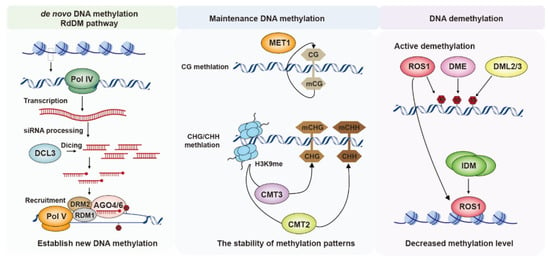
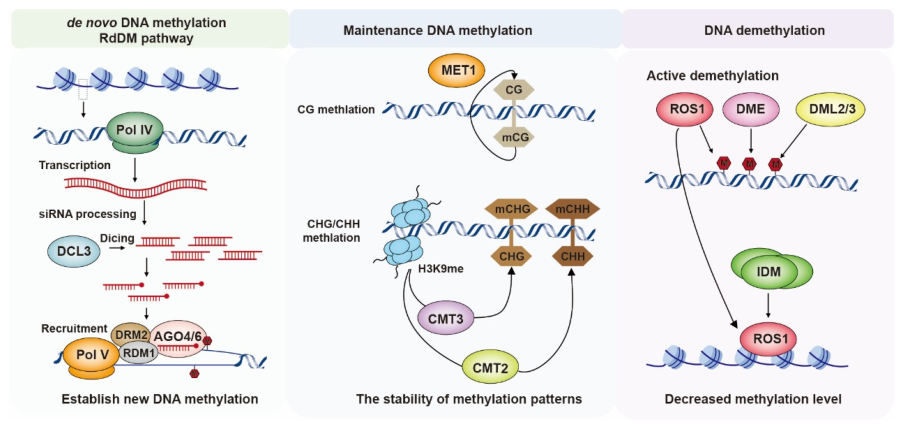
DNA methylation primarily occurs at the 5′ position of cytosine, with 5-methylcytosine (5mC) being the most common form. Across plant genomes, methylated cytosines generally account for approximately 5–50% of all cytosines [19,20]. Plant DNA methylation is not static but is dynamically regulated through processes of establishment, maintenance, and removal, thereby maintaining relatively stable methylation levels and enabling plants to adapt to different developmental stages and environmental conditions [21,22,23]. This dynamic balance is primarily regulated by the coordinated actions of DNA methyltransferases and DNA demethylases (Figure 1) [9,17].
Figure 1.
Molecular mechanisms of DNA methylation establishment, maintenance, and demethylation in plants. The de novo DNA methylation pathway is mediated by RNA-directed DNA methylation (RdDM), in which RNA polymerase IV (Pol IV) and RNA polymerase V (Pol V), together with DCL3, AGO4/6, RDM1, and DRM2, establish new DNA methylation. Maintenance of DNA methylation involves MET1-mediated CG methylation and CMT3/CMT2-mediated CHG/CHH methylation, which is associated with H3K9me. DNA demethylation occurs through active demethylation mediated by ROS1, DME, and DML2/3, with IDM facilitating ROS1 recruitment and subsequent removal of methylated cytosines.
Major plant DNA methyltransferases include DNA methyltransferase 1 (MET1), domain-rearranged methyltransferases (DRMs), and chromomethylases (CMTs) [24,25]. MET1 is mainly responsible for the maintenance of CG methylation [26], whereas DRMs primarily mediate de novo DNA methylation through the RNA-directed DNA methylation (RdDM) pathway, establishing new DNA methylation in different sequence contexts and playing a particularly important role in the establishment of CHH methylation [27]. CMTs are mainly involved in the establishment and maintenance of non-CG methylation, with CMT3 primarily responsible for the maintenance of CHG methylation and CMT2 mainly involved in the maintenance of CHH methylation [28]. In contrast to the establishment and maintenance of DNA methylation, active DNA demethylation in plants is primarily mediated by DNA demethylases, including REPRESSOR OF SILENCING 1 (ROS1), DEMETER (DME), DEMETER-like 2 (DML2), and DML3, which collectively regulate DNA methylation levels in plants [29].
2.2. Establishment, Maintenance, and Removal of DNA Methylation
The formation and stability of plant DNA methylation are primarily governed by three interconnected processes: establishment, maintenance, and removal (Figure 1) [22,20]. First, de novo DNA methylation is mainly mediated by the RdDM pathway. In this process, RNA polymerase IV (Pol IV) transcribes RNA precursors, which are processed into 24-nt small interfering RNAs (siRNAs). These siRNAs are subsequently loaded onto ARGONAUTE (AGO) proteins and participate in target recognition, ultimately recruiting the DRM2 methyltransferase to establish new DNA methylation at target sites [30].
Once established, DNA methylation must be maintained through distinct mechanisms to ensure the stability of methylation patterns [22]. The maintenance of CG methylation primarily depends on MET1, which recognizes hemimethylated DNA generated during DNA replication and restores methylation on the newly synthesized strand, thereby maintaining the CG methylation pattern. In contrast, the maintenance of non-CG methylation mainly depends on CMT2 and CMT3, which interact with histone modifications such as H3K9me to form mutually reinforcing feedback loops, thereby maintaining CHG and CHH methylation states [31,32].
Accordingly, plants can also reduce DNA methylation levels in specific genomic regions through passive and active demethylation. Passive DNA demethylation occurs during DNA replication, when impaired or inhibited maintenance methylation mechanisms, such as those mediated by MET1, prevent 5mC from being effectively maintained on the newly synthesized DNA strand, leading to its gradual dilution through successive rounds of replication [33]. In contrast, active DNA demethylation directly removes 5mC from DNA through enzymatic processes and is mainly mediated by DNA demethylases, including ROS1, DME, DML2, and DML3, which specifically recognize and remove 5mC [34,35,36]. Among these enzymes, ROS1 is an important mediator of active DNA demethylation in plants. Its targeting is coordinated by IDM protein complexes and associated chromatin modifications, enabling DNA demethylation to occur precisely at specific genomic regions [35].
3. DNA Methylation-Mediated Regulation of Plant Responses to Abiotic Stress
3.1. Temperature Stress
DNA methylation changes in response to high temperature are not simply manifested as a global increase or decrease in genome-wide methylation levels. Recent studies have shown that high temperature does not necessarily induce extensive genome-wide DNA methylation changes, but rather causes dynamic remodeling at specific loci and genomic regions (Table 1). For example, increased temperatures (28 °C) induce genome-wide hypermethylation in broccoli (Brassica oleracea) compared with the control temperature of 16 °C, whereas strawberry (Fragaria vesca) exhibits a slight reduction in DNA methylation, and rapeseed (Brassica napus) exhibits an overall reduction in DNA methylation under high-temperature stress [37,38,39]. In Arabidopsis thaliana, overall DNA methylation changes during heat stress are relatively limited, whereas site-specific active demethylation at CG, CHG, and CHH sites occurs predominantly during the recovery phase after heat stress removal. These changes are mainly distributed within gene-coding regions and are enriched in stress-related genes involved in heat shock response, oxidative stress, and drought response [40]. Similarly, heat stress in diploid woodland strawberry (Fragaria vesca) causes only minor changes in genome-wide DNA methylation, with mCG levels decreasing by approximately 3.2%, but induces numerous DMRs, predominantly characterized by CHH hypomethylation and enriched in centromeric/pericentromeric regions and promoters. Notably, pronounced CHH demethylation occurs in MITE transposable elements and in the promoters of heat-responsive transcription factors, including AP2/EREBP, HSF, and WRKY [38]. In A. thaliana, heat stress also activates the LTR retrotransposon ONSEN (ATCOPIA78), accompanied by reduced CHH methylation and enhanced transcription. Meanwhile, heat-induced 24-nt siRNAs and RdDM-associated factors, including the DDR complex and SUVH2, are associated with the restriction of ONSEN transposition, suggesting a dual-layer “transcriptional activation–transposition suppression” defense mechanism [41,42]. In addition, HD2B/HD2C-mediated histone deacetylation acts cooperatively with the AGO4-RdDM pathway to maintain heterochromatin stability. Disruption of this regulatory network by heat stress reduces siRNA abundance and CHH methylation, and is accompanied by heterochromatin relaxation and reduced heat tolerance [43]. Under long-term cyclical heat stress, MET1-, CMT3-, and DRM2-mediated DNA methylation-dependent silencing also cooperates with MOM1-dependent non-methylation-mediated silencing. These pathways may contribute to restricting aberrant transposon activation and maintain genome stability [44].
Methylation remodeling under different genetic backgrounds further determines plant heat tolerance and plays an important role in reproductive development. In cotton (Gossypium hirsutum), heat stress suppresses the expression of core RdDM genes, including RDR2, DCL3, AGO4, and DRM2, in heat-sensitive genotypes, resulting in an abnormal reduction in CHH methylation in anthers, which is accompanied by disruptions in sugar metabolism and ROS production, as well as microspore abortion and anther indehiscence. In contrast, heat-tolerant genotypes maintain relatively high levels of CHH methylation, which is associated with greater heat tolerance [45]. Studies in different maize (Zea mays) inbred lines have shown that transposon responses to heat stress are highly genotype-dependent, with their transcriptional potential closely associated with pre-existing unmethylated regions (UMRs). Transposons retaining UMRs are more readily induced by heat stress, whereas highly methylated transposons remain transcriptionally silenced [46]. Recent studies in rice (Oryza sativa L.) further revealed that tetraploid rice exhibits more pronounced genome-wide and stress-responsive locus-specific DNA demethylation than diploid rice, accompanied by enhanced expression of genes involved in hormone signaling, ROS scavenging, and heat shock responses. These methylation and transcriptional changes were associated with reduced ROS accumulation, improved water retention, and stress recovery. [47]. Heat tolerance does not simply depend on the overall level of DNA methylation, but rather may be associated with the precise remodeling of specific methylation sites and their coordinated association with stress-responsive genes, ROS homeostasis, and reproductive development. In particular, RdDM-mediated CHH methylation reprogramming and its spatiotemporal specificity may represent an important epigenetic hub linking heat stress signals to plant heat-tolerance phenotypes.
Additionally, DNA methylation is one of the most extensively studied epigenetic modifications in plant responses to cold stress, and its dynamic changes are closely associated with the transcription of cold-responsive genes, plant growth and development, and cold tolerance [18,48,49]. DNA methylation responses vary among plant species. Global DNA methylation levels decrease following cold treatment in sugar beet (Beta vulgaris) [50] and poplar (Populus L.) [51], whereas no significant overall changes are observed in apple (Malus × domestica Borkh.) [52] between field sites at different altitudes, where temperature conditions differed but were not experimentally controlled. In rubber tree (Hevea brasiliensis) [53], Brassica rapa [54], tomato (Solanum lycopersicum) [55], and sweet orange (Citrus sinensis L.) [56], promoter demethylation of cold-responsive genes is associated with increased transcription of these genes. Genotype-dependent differences in DNA methylation are also evident. The cold-tolerant rice cultivar P427 exhibits more pronounced CHH demethylation under low-temperature conditions, with reduced methylation in the Os03g0610900 promoter accompanied by increased expression of Os03g0610900, an OST1 homolog encoding a SnRK2 family protein kinase involved in ABA signaling and stress responses. These changes are associated with the activation of the ICE-CBF-COR cold-response pathway and enhanced antioxidant and ABA responses [57]. In sugarcane, cold stress increases CpG island methylation in the ScMYB7 promoter, which is associated with reduced expression of this negative regulator of cold tolerance, along with changes in the CBF/DREB pathway and downstream COR gene expression [58]. In tea plants, transposon-mediated methylation changes are associated with changes in the local methylation status and expression of duplicated genes, which may contribute to gene divergence and adaptation to cold stress [59].
More importantly, some cold-induced DNA methylation changes can persist after stress removal and may contribute to stress memory and even heritable epigenetic states, although their persistence across generations is variable. In cucumber, cold treatment increases genome-wide DNA methylation, which largely returns to basal levels after rewarming, while methylation at certain loci persists and is accompanied by incomplete recovery of radicle growth, suggesting an association between residual methylation and cold stress memory [60]. In rice, repeated exposure to low temperature during meiosis is associated with downregulation of MET1b, CG/CHG demethylation at the ACT1 promoter of the cold-sensitive rice cultivar KD8, and sustained ACT1 expression under cold conditions. These changes are associated with improved panicle fertility and seed-setting rate, and this process ultimately generates a stably inherited epiallele associated with cold tolerance [61]. However, not all stress-induced methylation changes are stably inherited across generations, as some may be reset during germline development, and distinguishing true epimutations from changes associated with underlying genetic variation remains challenging.
Table 1.
DNA methylation and epigenetic regulation in plants under temperature stress.
3.2. Drought Stress
Recent studies have shown that CHH methylation is often among the most responsive methylation contexts to drought stress and genotypic differences, although its relatively low baseline level may affect the detection of methylation changes. These differentially methylated regions (DMRs) are widely distributed across promoters, gene bodies, and transposable elements and may contribute to drought adaptation through their association with the expression of stress-responsive genes (Table 2). For example, drought stress in mulberry (Morus alba) causes an overall increase in genome-wide DNA methylation, primarily attributable to increased mCG levels, with differentially methylated genes mainly involved in autophagy, MAPK, AMPK, carbon metabolism, and amino acid biosynthesis [62]. In linseed (Linum usitatissimum L.), drought and repeated drought stress induce dynamic changes in CG, CHG, and CHH methylation, with the drought-tolerant cultivar Z141 exhibiting more hypermethylated regions. The associated genes are mainly involved in carbohydrate and lipid metabolism, ABA signaling, osmotic regulation, and antioxidant responses [63]. In contrast, drought-stressed white poplar (Populus tomentosa) shows an overall decrease in 5mC levels, with the most pronounced changes occurring in the CHH context, despite its relatively low basal methylation level. The identified DMRs are predominantly concentrated in transposable element regions and are associated with genes such as PtoGATA9 and LECRK-VIII.2, which are involved in the regulation of stomatal morphology and chlorophyll content [64].
Table 2.
DNA methylation and epigenetic regulation in plants under drought stress.
Moreover, differences in DNA methylation patterns are associated with the differentiation of drought-tolerant genotypes. In rice (Oryza sativa L.), the drought-tolerant cultivar Nagina 22 exhibits extensive CHH demethylation under dehydration stress, accompanied by the enhanced expression of drought-responsive genes, including bZIP, NAC, AP2, ZEP, and cysteine protease inhibitors, whereas the drought-sensitive cultivar IR64 shows relatively limited methylation changes [65]. These differences in methylation and gene expression patterns are associated with the contrasting drought responses of the two cultivars. Similarly, drought induces an increase in CHH methylation and an enrichment of hypermethylated DMRs in the drought-tolerant wild type mungbean 61 (Vigna radiata L.), whereas the drought-sensitive cultivator 70 predominantly exhibits decreased CHH methylation and hypomethylated DMRs, with differentially methylated genes mainly involved in carbohydrate metabolism, signal transduction, and RNA metabolism [66]. In maize (Zea mays L.), drought stress generally increases genome-wide DNA methylation, but drought-sensitive genotypes produce substantially more hypermethylated DMRs than drought-tolerant genotypes, with promoter methylation changes associated with genes involved in osmotic stress, oxidative stress, water and salt responses, and RNA silencing [67]. In wheat (Triticum aestivum L.), both the drought-tolerant cultivar Bolani and the drought-sensitive cultivar Sistan exhibit genome-wide demethylation. However, Bolani shows demethylation at stress-responsive genes such as PEPC, BGlu, GST, and LSD, which is associated with increased expression of these genes and changes in ABA signaling, antioxidant defense, and photosynthetic protection. In contrast, Sistan shows persistent demethylation, while the two genotypes differ in their ABA-mediated defense responses [68]. Taken together, these observations suggest that drought-tolerant genotypes is not simply associated with either “higher” or “lower” DNA methylation, but rather with distinct and dynamic methylation patterns that coincide with changes in multiple drought-response pathways to establish epigenetic regulatory networks distinct from those of drought-sensitive genotypes.
Beyond genome-wide changes in DNA methylation, recent studies have further revealed locus-specific associations between DNA methylation and the expression of key drought-responsive genes. ZmNAC111 in maize and MdRFNR1 in apple (Malus domestica) are representative examples of transposon-mediated methylation regulation associated with natural variation in drought tolerance [69,70]. An 82-bp MITE insertion in the promoter of ZmNAC111 is linked to the generation of 24-nt siRNAs and RdDM pathway activity, alongside increased CG and CHH methylation and enrichment of H3K9me2 at the insertion site. These epigenetic changes coincide with reduced ZmNAC111 expression and altered ABA-associated drought responses [69]. In contrast, a 430-bp MITE insertion in the promoter of MdRFNR1-1 in apple is linked to CG, CHG, and CHH hypermethylation and 24-nt siRNA-mediated RdDM activity under drought stress, alongside increased MdRFNR1 expression, higher POD and CAT activities, and greater ROS scavenging [70]. In addition, drought could promote ZmEXPB2 expression in maize through CG/CHG demethylation and CHH hypermethylation in the middle region of its promoter, which may facilitate primary root elongation and root architectural remodeling [71]. The HvDME promoter in barley also exhibits region-specific methylation patterns, with drought-induced increases in CG and CHG methylation and a decrease in CHH methylation occurring specifically in the distal regulatory region, where these cis-acting methylation changes may regulate HvDME expression and contribute to a feedback regulatory mechanis [72].
DNA methylation dynamics also contribute to drought stress memory and adaptation to recurrent stress. Drought priming can alter the balance between DNA methyltransferases and demethylases, which may be accompanied by persistent epigenetic changes. For example, drought priming in wheat is accompanied by increased TaDME expression and decreased expression of TaMET2a/2b/3. CG/CHG demethylation also occurs in specific regions of the TaP5CS and TaBADH promoters, alongside enhanced osmolyte biosynthesis, which may contribute to improved tolerance to recurrent drought. Moreover, the optimal priming intensity varies among cultivars [73]. In perennial fruit trees, prolonged mild drought is also accompanied by reduced expression of demethylases such as CsDME and CsDML in Citrus plants. In Satsuma mandarin, this response coincides with genome-wide hypermethylation dominated by CHH methylation, as well as silencing of the flowering-repressor genes FLC and BFT and increased flowering branch formation [74]. Thus, DNA methylation not only participates in the immediate response of plants to drought signals but may also contribute to long-term adaptation through stress memory and developmental regulation.
3.3. Salt Stress
During salt stress responses, DNA methylation not only is linked to changes in the expression of salt-responsive genes, but may also contribute to plant adaptation by affecting transposon activity and genome stability. In Arabidopsis, salt stress induces relatively limited methylation changes, with approximately 0.1% of cytosine sites showing differential methylation [75]. About one-third of these sites are located in transposable element (TE) regions, and although some salt-induced methylation changes can be maintained in subsequent generations, their inheritance may not be stable in all cases [76]. Plants with different genetic backgrounds exhibit distinct DNA methylation responses during salt adaptation. For example, cultivated beet (B. vulgaris) and its salt-tolerant wild ancestor sea beet (B. vulgaris subsp. maritima) display different CpG methylation patterns under salt treatment. Cultivated beet mainly shows reduced CpG methylation at salt-responsive gene loci, whereas wild sea beet exhibits predominantly hypermethylation, reflecting distinct epigenetic regulatory features associated with salt tolerance divergence [77]. In addition to genetic background, the expression patterns of DNA methylation regulators also show tissue specificity. In Pyrus betulaefolia, most DNA methyltransferase (PbeMTase) family members are highly expressed in roots and induced by salt stress, whereas their responses in stems and leaves are different [78]. In cotton, salt stress mainly coincides with increased expression of DNA methyltransferase C5-MTase genes in the leaves of diploid materials, whereas tetraploid upland cotton shows a predominant increase in expression in roots and stems [79].
Beyond these differences in methylation patterns, recent studies have further elucidated the specific mechanisms underlying DNA methylation-mediated responses to salt stress. In Citrus, polyploidization-enhanced salt tolerance is closely associated with methylation changes in the gene body region of ACO1. Tetraploid citrus and trifoliate orange promote ACO1 expression and ethylene biosynthesis through CG demethylation in the ACO1 gene body region and increased chromatin accessibility, which are linked to root development, maintaining K+/Na+ homeostasis, enhancing ROS scavenging, and improving salt tolerance in polyploids [80]. In the mangrove plant Bruguiera gymnorhiza, high-salt environments are accompanied by CHG and CHH non-CG hypermethylation in transposable element regions. The upregulation of methylation-related factors such as CMT2, CMT3, and DRM2 may suppress abnormal transposon activation and maintains genome stability under high salinity conditions [81]. In addition, RdDM-mediated non-CG methylation remodeling represents an important regulatory mechanism in plant salt adaptation. In maize (Zea mays), ZmKTF1 regulates CHH methylation levels in gene flanking regions through the RdDM pathway, suppressing excessive transcription of RBOH-related oxidative stress genes; loss of ZmKTF1 reduces CHH methylation and weakens salt tolerance [82]. Under salt stress, rice enhances non-CG methylation of the MITE transposon near the OsHKT1;5 promoter, accompanied by the presence of the methylation reader protein OsSUVH7 and its cooperation with OsBAG4-OsMYB106 in the activation of OsHKT1;5 expression, Na+ retrieval, ion homeostasis, and salt tolerance [83]. Other epigenetic modifications also participate in salt stress responses and interact with DNA methylation regulation. In wheat, salt stress is accompanied by reduced global DNA methylation levels; demethylation of the TaFLS1 promoter promotes its expression, while histone acetylation mediated by TaGCN5, including increased H3K9 and H3K14 acetylation, may jointly activate salt-responsive genes and enhances salt tolerance [84].
4. Perspectives and Conclusions
Previously reported DNA methylation responses vary among species and experimental conditions, including tissue type, developmental stage, stress intensity and duration, and methylation profiling methods (Table 1, Table 2 and Table 3), which limits direct comparisons of specific methylation responses across species. Nevertheless, these findings still provide an overall view of DNA methylation responses to different types of abiotic stress.
Table 3.
DNA methylation and epigenetic regulation in plants under salt stress.
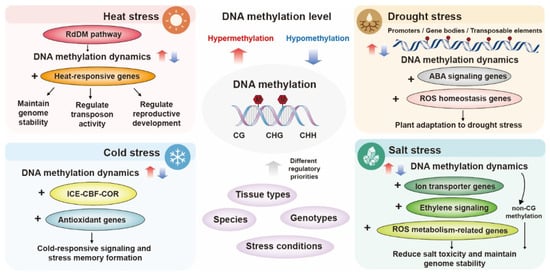
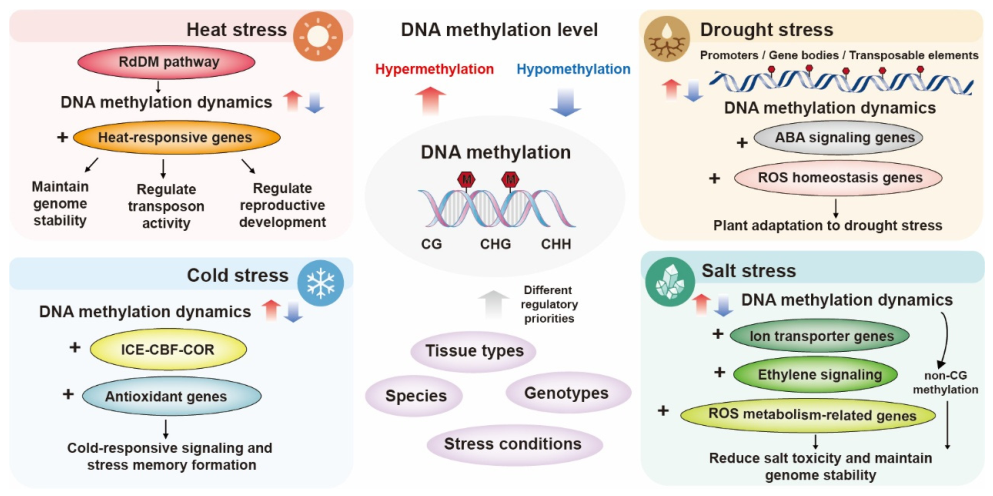
In response to high-temperature, low-temperature, drought, and salt stresses, plants utilize DNA methylation-mediated epigenetic regulation to convert environmental signals into specific transcriptional responses; however, different stress types exhibit distinct regulatory priorities (Figure 2). Under high-temperature stress, DNA methylation may be primarily involved in maintaining genome stability and regulating reproductive development, through methylation remodeling at specific sites and genomic regions, particularly RdDM-mediated CHH methylation, which regulates transposon activity and the expression of heat-responsive genes [37,38,39,40,41,42,43,44]. Epigenetic variation occurs predominantly in reproductive organs, where methylation remodeling is closely associated with anther development, changes in fertility, and differences in heat tolerance [46]. In contrast, cold stress may involve the regulation of cold-responsive signaling and stress memory formation, with DNA methylation dynamics closely linked to the regulation of the ICE-CBF-COR pathway and antioxidant-related genes, and exhibiting marked differences among species and genotypes [50,51,52,53,54,55,56,57,58,59]. Some methylation marks could also persist beyond the stress period and contribute to stress memory [60,61]. Under drought stress, DNA methylation exhibits broad and dynamic regulatory patterns, with methylation remodeling distributed across promoters, gene bodies, and transposable elements and closely linked to drought-responsive processes such as ABA signaling, osmotic regulation, ROS homeostasis, metabolism, and root development, contributing to plant adaptation to drought stress through modulation of the methylation status of relevant genes [62,63,64,65,66,67,68,69,70,71,72,73,74]. In contrast, under salt stress, methylation regulation is more focused on ion homeostasis, ROS metabolism, and genome stability, reducing salt toxicity through the regulation of ion transporter genes, ethylene signaling, and ROS metabolism-related processes, while maintaining transposon silencing and genome stability through non-CG methylation [75,76,77,78,79,80,81,82,83,84].
Figure 2.
DNA methylation-mediated regulation of plant responses to abiotic stress. DNA methylation dynamics contribute to plant responses to heat, cold, drought, and salt stress, with distinct regulatory priorities under different stresses. Heat stress mainly involves RdDM-mediated methylation, genome stability, and reproductive development; cold stress is associated with ICE-CBF-COR signaling and stress memory; drought stress involves ABA signaling, ROS homeostasis, and root development; and salt stress is related to ion homeostasis, ROS metabolism, and genome stability.
It is noteworthy that, even under the same stress conditions, different species or genotypes may exhibit markedly different DNA methylation responses, or even opposite directions of methylation change. For example, beet and poplar show genome-wide demethylation after cold treatment, whereas apple shows no significant overall methylation change; cultivated beet shows CpG demethylation at salt-responsive gene loci under salt stress, whereas sea beet shows predominantly CpG hypermethylation [50,51,52,77]. These interspecific differences may be related to differences in the expression levels and stress responses of key DNA methylation regulators. Therefore, the stress responses of different species could not be assessed solely based on increases or decreases in DNA methylation, but should instead be evaluated by considering species, genotype, tissue, stress conditions, and specific genomic regions.
In addition to DNA methylation, RNA and histone modifications also participate in plant stress responses, indicating that epigenetic regulation in plants is not limited to a single type of modification. DNA methylation may act together with histone modifications in plant stress responses [85,86], whereas the RNA methylation modification m6A primarily affects post-transcriptional RNA stability, translation, and metabolism. For example, in Arabidopsis thaliana [49], apple [87], and rice [88,89], changes in m6A modifications and their associated regulatory factors have been linked to processes such as the CBF-COR cold-response pathway, ROS scavenging, and chloroplast function. Therefore, future studies could further examine plant stress adaptation from multiple epigenetic regulatory layers, including DNA methylation, histone modifications, and RNA methylation, to clarify the specific roles of different modifications under different stress types and physiological processes and thereby develop a more comprehensive understanding of the mechanisms underlying plant stress adaptation.
With the advancement of CRISPR technology, the CRISPR/dCas9 system has emerged as a powerful tool for epigenetic regulation. Since the dCas9 protein lacks DNA cleavage activity, it can be specifically targeted to genomic regions under the guidance of sgRNA and fused with DNA methyltransferases, demethylases, histone-modifying enzymes, or transcriptional regulators to achieve targeted remodeling of epigenetic states, providing new approaches for elucidating DNA methylation functions and generating novel epigenetic materials [90,91,92]. For example, in Arabidopsis, CRISPR/dCas9-mediated targeted methylation or demethylation of the FWA promoter, FT distal enhancer, and SDC promoter altered gene expression and resulted in changes in flowering time and leaf development phenotypes [93]. However, current applications of this technology are still limited by relatively low editing efficiency, insufficient stability of epigenetic modifications, and potential off-target effects, particularly in perennial crops and plants with complex genomes. In the future, DNA methylation-based precision epigenetic breeding is expected to enable the targeted improvement of key agronomic traits. By establishing stable and heritable epigenetic germplasm resources, this approach may facilitate the connection between environmental responses, gene expression regulation, and desirable trait formation, promoting the transition of epigenetic breeding from an auxiliary strategy in conventional breeding toward a precision strategy for germplasm innovation.
Author Contributions
Z.J. organized and prepared the original draft; G.L. wrote the manuscript and drew figures; H.W., Y.T. and H.G. drew figures and revised the manuscript; Y.W. and Y.S. revised the manuscript, and S.Y. and D.Z. provided opinions. All authors have read and agreed to the published version of the manuscript.
Funding
This research was funded by the Basic Research Found for Heilongjiang Provincial Undergraduate Universities, grant number 2025-KYYWF-ZR0360, Heilongjiang Provincial Natural Science Foundation Joint Guidance Project, grant number LH2024C093; and the 2026 Youth Science and Technology Fund of the Heilongjiang Plant Protection Society, grant number H7-2026-01-018.
Data Availability Statement
No new data were created or analyzed in this study. Data sharing is not applicable to this article.
Acknowledgments
We gratefully acknowledge the financial support from Basic Research Found for Heilongjiang Provincial Undergraduate Universities, grant number 2025-KYYWF-ZR0360, the Heilongjiang Provincial Natural Science Foundation Joint Guidance Project (LH2024C093) and the 2026 Youth Science and Technology Fund of the Heilongjiang Plant Protection Society (H7-2026-01-018). We thank DeepSeek V3 and ChatGPT5 for their assistance with language translation and polishing to improve the readability and clarity of this manuscript. All AI-generated suggestions were manually reviewed and verified by the authors. We also thank Xiangyang Xu for the valuable technical assistance and constructive discussions.
Conflicts of Interest
The authors declare no conflicts of interest.
References
- Sun, C.; Ali, K.; Yan, K.; Fiaz, S.; Dormatey, R.; Bi, Z.; Bai, J. Exploration of Epigenetics for Improvement of Drought and Other Stress Resistance in Crops: A Review. Plants 2021, 10, 1226. [Google Scholar] [CrossRef] [Scilit] [PubMed]
- Aswathi, K.P.R.; Ul-Allah, S.; Puthur, J.T.; Siddique, K.H.M.; Frei, M.; Farooq, M. The Plant Mind: Unraveling Abiotic Stress Priming, Memory, and Adaptation. Physiol. Plant. 2025, 177, e70372. [Google Scholar] [CrossRef] [Scilit] [PubMed]
- Lande, R. Adaptation to an extraordinary environment by evolution of phenotypic plasticity and genetic assimilation. J. Evol. Biol. 2009, 22, 1435–1446. [Google Scholar] [CrossRef] [Scilit] [PubMed]
- Abdulraheem, M.I.; Xiong, Y.; Moshood, A.Y.; Cadenas-Pliego, G.; Zhang, H.; Hu, J. Mechanisms of Plant Epigenetic Regulation in Response to Plant Stress: Recent Discoveries and Implications. Plants 2024, 13, 163. [Google Scholar] [CrossRef] [Scilit] [PubMed]
- Qadir, M.; Kaur, N.; Rahman, F.U.; Nabi, F.; Ahmed, Z.F.R.; Wu, J. Epigenetic modifications in plant abiotic stress adaptation: Towards climate-resilient and sustainable crop improvement. Front. Plant Sci. 2026, 17, 1738299. [Google Scholar] [CrossRef] [Scilit] [PubMed]
- Ganie, S.A.; McMulkin, N.; Devoto, A. The role of priming and memory in rice environmental stress adaptation: Current knowledge and perspectives. Plant Cell Environ. 2024, 47, 1895–1915. [Google Scholar] [CrossRef] [Scilit] [PubMed]
- Bäurle, I.; Trindade, I.; Parry, G. Chromatin regulation of somatic abiotic stress memory. J. Exp. Bot. 2020, 71, 5269–5279. [Google Scholar] [CrossRef] [Scilit] [PubMed]
- Liu, H.; Able, A.J.; Able, J.A. Priming crops for the future: Rewiring stress memory. Trends Plant Sci. 2022, 27, 699–716. [Google Scholar] [CrossRef] [Scilit] [PubMed]
- Law, J.A.; Jacobsen, S.E. Establishing, maintaining and modifying DNA methylation patterns in plants and animals. Nat. Rev. Genet. 2010, 11, 204–220. [Google Scholar] [CrossRef] [Scilit] [PubMed]
- Zhang, H.; Lang, Z.; Zhu, J.-K. Dynamics and function of DNA methylation in plants. Nat. Rev. Mol. Cell Biol. 2018, 19, 489–506. [Google Scholar] [CrossRef] [Scilit] [PubMed]
- Niederhuth, C.E.; Bewick, A.J.; Ji, L.; Alabady, M.S.; Kim, K.D.; Li, Q.; Rohr, N.A.; Rambani, A.; Burke, J.M.; Udall, J.A.; et al. Widespread natural variation of DNA methylation within angiosperms. Genome Biol. 2016, 17, 194. [Google Scholar] [CrossRef] [Scilit] [PubMed]
- Qiao, S.; Song, W.; Hu, W.; Wang, F.; Liao, A.; Tan, W.; Yang, S. The Role of Plant DNA Methylation in Development, Stress Response, and Crop Breeding. Agronomy 2024, 15, 94. [Google Scholar] [CrossRef] [Scilit]
- Shahzad, Z.; Hollwey, E.; Moore, J.D.; Choi, J.; Cassin-Ross, G.; Rouached, H.; Robinson, M.R.; Zilberman, D. Gene body methylation regulates gene expression and mediates phenotypic diversity in natural Arabidopsis populations. Nat. Plants 2025, 11, 2084–2099. [Google Scholar] [CrossRef] [Scilit] [PubMed]
- Zhang, X.; Yazaki, J.; Sundaresan, A.; Cokus, S.; Chan, S.W.L.; Chen, H.; Henderson, I.R.; Shinn, P.; Pellegrini, M.; Jacobsen, S.E.; et al. Genome-wide High-Resolution Mapping and Functional Analysis of DNA Methylation in Arabidopsis. Cell 2006, 126, 1189–1201. [Google Scholar] [CrossRef] [Scilit] [PubMed]
- Wang, X.; Hu, L.; Wang, X.; Li, N.; Xu, C.; Gong, L.; Liu, B. DNA Methylation Affects Gene Alternative Splicing in Plants: An Example from Rice. Mol. Plant 2016, 9, 305–307. [Google Scholar] [CrossRef] [Scilit] [PubMed]
- Liu, P.; Liu, R.; Xu, Y.; Zhang, C.; Niu, Q.; Lang, Z. DNA cytosine methylation dynamics and functional roles in horticultural crops. Hortic. Res. 2023, 10, uhad170. [Google Scholar] [CrossRef] [Scilit] [PubMed]
- Huang, H.; Guo, C.; Cheng, S.; Wang, Z. DNA Methylation Dynamics in Plant Abiotic Stress Response: Mechanisms, Memory, and Breeding Applications. Genes 2026, 17, 301. [Google Scholar] [CrossRef] [Scilit] [PubMed]
- Lu, X.; Liu, Y.; Xu, J.; Liu, X.; Chi, Y.; Li, R.; Mo, L.; Shi, L.; Liang, S.; Yu, W.; et al. Recent progress of molecular mechanisms of DNA methylation in plant response to abiotic stress. Environ. Exp. Bot. 2024, 218, 105599. [Google Scholar] [CrossRef] [Scilit]
- Vidalis, A.; Živković, D.; Wardenaar, R.; Roquis, D.; Tellier, A.; Johannes, F. Methylome evolution in plants. Genome Biol. 2016, 17, 264. [Google Scholar] [CrossRef] [Scilit] [PubMed]
- Zhang, H.; Zhu, J.-K. Epigenetic gene regulation in plants and its potential applications in crop improvement. Nat. Rev. Mol. Cell Biol. 2025, 26, 51–67. [Google Scholar] [CrossRef] [Scilit] [PubMed]
- Lei, M.; Zhang, H.; Julian, R.; Tang, K.; Xie, S.; Zhu, J.-K. Regulatory link between DNA methylation and active demethylation in Arabidopsis. Proc. Natl. Acad. Sci. USA 2015, 112, 3553–3557. [Google Scholar] [CrossRef] [Scilit] [PubMed]
- Xie, G.; Du, X.; Hu, H.; Du, J. Molecular Mechanisms Underlying the Establishment, Maintenance, and Removal of DNA Methylation in Plants. Annu. Rev. Plant Biol. 2025, 76, 143–170. [Google Scholar] [CrossRef] [Scilit] [PubMed]
- Gwee, J.; Tian, W.; Qian, S.; Zhong, X. DNA methylation dynamics: Patterns, regulation, and function. Curr. Opin. Plant Biol. 2025, 88, 102787. [Google Scholar] [CrossRef] [Scilit] [PubMed]
- Finnegan, E.; Kovac, K. Plant DNA methyltransferases. Plant Mol. Biol. 2000, 43, 189–201. [Google Scholar] [CrossRef] [Scilit] [PubMed]
- Leichter, S.M.; Du, J.; Zhong, X. Structure and Mechanism of Plant DNA Methyltransferases. In DNA Methyltransferases-Role and Function; Jeltsch, A., Jurkowska, R.Z., Eds.; Springer International Publishing: Cham, Switzerland, 2022; pp. 137–157. [Google Scholar]
- Lu, J.; Chen, X.; Fang, J.; Li, D.; Le, H.; Zhong, X.; Song, J. Structure and autoinhibitory regulation of MET1 in the maintenance of plant CG methylation. Plant Cell 2025, 37, koaf246. [Google Scholar] [CrossRef] [Scilit] [PubMed]
- Zhong, X.; Du, J.; Hale, C.J.; Gallego-Bartolome, J.; Feng, S.; Vashisht, A.A.; Chory, J.; Wohlschlegel, J.A.; Patel, D.J.; Jacobsen, S.E. Molecular Mechanism of Action of Plant DRM De Novo DNA Methyltransferases. Cell 2014, 157, 1050–1060. [Google Scholar] [CrossRef] [Scilit] [PubMed]
- Fang, J.; Jiang, J.; Leichter, S.M.; Liu, J.; Biswal, M.; Khudaverdyan, N.; Zhong, X.; Song, J. Mechanistic basis for maintenance of CHG DNA methylation in plants. Nat. Commun. 2022, 13, 3877. [Google Scholar] [CrossRef] [Scilit] [PubMed]
- Penterman, J.; Zilberman, D.; Huh, J.H.; Ballinger, T.; Henikoff, S.; Fischer, R.L. DNA demethylation in the Arabidopsis genome. Proc. Natl. Acad. Sci. USA 2007, 104, 6752–6757. [Google Scholar] [CrossRef] [Scilit] [PubMed]
- Matzke, M.A.; Mosher, R.A.J.N.R.G. RNA-directed DNA methylation: An epigenetic pathway of increasing complexity. Nat. Rev. Genet. 2014, 15, 394–408. [Google Scholar] [CrossRef] [Scilit] [PubMed]
- Du, J.; Zhong, X.; Bernatavichute, Y.V.; Stroud, H.; Feng, S.; Caro, E.; Vashisht, A.A.; Terragni, J.; Chin, H.G.; Tu, A.; et al. Dual Binding of Chromomethylase Domains to H3K9me2-Containing Nucleosomes Directs DNA Methylation in Plants. Cell 2012, 151, 167–180. [Google Scholar] [CrossRef] [Scilit] [PubMed]
- Dilkes, B.P.; Bernatavichute, Y.V.; Zhang, X.; Cokus, S.; Pellegrini, M.; Jacobsen, S.E. Genome-Wide Association of Histone H3 Lysine Nine Methylation with CHG DNA Methylation in Arabidopsis thaliana. PLoS ONE 2008, 3, e3156. [Google Scholar] [CrossRef] [Scilit] [PubMed]
- Zhu, J.-K. Active DNA Demethylation Mediated by DNA Glycosylases. Annu. Rev. Genet. 2009, 43, 143–166. [Google Scholar] [CrossRef] [Scilit] [PubMed]
- Wu, X.; Zhang, Y. TET-mediated active DNA demethylation: Mechanism, function and beyond. Nat. Rev. Genet. 2017, 18, 517–534. [Google Scholar] [CrossRef] [Scilit] [PubMed]
- Liu, R.; Lang, Z. The mechanism and function of active DNA demethylation in plants. J. Integr. Plant Biol. 2019, 62, 148–159. [Google Scholar] [CrossRef] [Scilit] [PubMed]
- Zhang, H.; Gong, Z.; Zhu, J.K. Active DNA demethylation in plants: 20 years of discovery and beyond. J. Integr. Plant Biol. 2022, 64, 2217–2239. [Google Scholar] [CrossRef] [Scilit] [PubMed]
- Li, J.; Huang, Q.; Sun, M.; Zhang, T.; Li, H.; Chen, B.; Xu, K.; Gao, G.; Li, F.; Yan, G.; et al. Global DNA methylation variations after short-term heat shock treatment in cultured microspores of Brassica napus cv. Topas. Sci. Rep. 2016, 6, 38401. [Google Scholar] [CrossRef] [Scilit] [PubMed]
- López, M.-E.; Roquis, D.; Becker, C.; Denoyes, B.; Bucher, E. DNA methylation dynamics during stress response in woodland strawberry (Fragaria vesca). Hortic. Res. 2022, 9, uhac174. [Google Scholar] [CrossRef] [Scilit] [PubMed]
- Yao, Z.; Yuan, L.; Liu, K.; Wang, T.; Liu, B.; Zhao, Y.; Gan, S.; Chen, L. Warming-induced changes of broccoli head to cauliflower-like curd in Brassica oleracea are regulated by DNA methylation as revealed by methylome and transcriptome co-profiling. Mol. Hortic. 2022, 2, 26. [Google Scholar] [CrossRef] [Scilit] [PubMed]
- Korotko, U.; Chwiałkowska, K.; Sańko-Sawczenko, I.; Kwasniewski, M. DNA Demethylation in Response to Heat Stress in Arabidopsis thaliana. Int. J. Mol. Sci. 2021, 22, 1555. [Google Scholar] [CrossRef] [Scilit] [PubMed]
- Niu, X.; Chen, L.; Kato, A.; Ito, H. Regulatory mechanism of a heat-activated retrotransposon by DDR complex in Arabidopsis thaliana. Front. Plant Sci. 2022, 13, 1048957. [Google Scholar] [CrossRef] [Scilit] [PubMed]
- Niu, X.; Ge, Z.; Ito, H. Regulatory mechanism of heat-active retrotransposons by the SET domain protein SUVH2. Front. Plant Sci. 2024, 15, 1355626. [Google Scholar] [CrossRef] [Scilit] [PubMed]
- Yang, F.; Sun, Y.; Du, X.; Chu, Z.; Zhong, X.; Chen, X. Plant-specific histone deacetylases associate with ARGONAUTE4 to promote heterochromatin stabilization and plant heat tolerance. New Phytol. 2023, 238, 252–269. [Google Scholar] [CrossRef] [Scilit] [PubMed]
- Torres, J.R.; Botto, J.F.; Sanchez, D.H. Canonical transcriptional gene silencing may contribute to long-term heat response and recovery through MOM1. Plant Cell Environ. 2023, 47, 372–382. [Google Scholar] [CrossRef] [Scilit] [PubMed]
- Ma, Y.; Min, L.; Wang, M.; Wang, C.; Zhao, Y.; Li, Y.; Fang, Q.; Wu, Y.; Xie, S.; Ding, Y.; et al. Disrupted Genome Methylation in Response to High Temperature Has Distinct Affects on Microspore Abortion and Anther Indehiscence. Plant Cell 2018, 30, 1387–1403. [Google Scholar] [CrossRef] [Scilit] [PubMed]
- Liang, Z.; Anderson, S.N.; Noshay, J.M.; A Crisp, P.; A Enders, T.; Springer, N.M. Genetic and epigenetic variation in transposable element expression responses to abiotic stress in maize. Plant Physiol. 2021, 186, 420–433. [Google Scholar] [CrossRef] [Scilit] [PubMed]
- Zhang, C.; Wang, Y.; Meng, W.; Yu, X.; Xu, M.; Wang, Y.; Xiong, L.; Qi, X.; Ma, X.; Ma, J.; et al. Transcriptomic and DNA methylation insights into polyploidy-enhanced heat tolerance in rice (Oryza sativa L.). Plant Physiol. 2026, 200, kiag135. [Google Scholar] [CrossRef] [Scilit] [PubMed]
- Bartels, A.; Han, Q.; Nair, P.; Stacey, L.; Gaynier, H.; Mosley, M.; Huang, Q.Q.; Pearson, J.K.; Hsieh, T.-F.; An, Y.-Q.C.; et al. Dynamic DNA Methylation in Plant Growth and Development. Int. J. Mol. Sci. 2018, 19, 2144. [Google Scholar] [CrossRef] [Scilit] [PubMed]
- Govindan, G.; Sharma, B.; Li, Y.F.; Armstrong, C.D.; Merum, P.; Rohila, J.S.; Gregory, B.D.; Sunkar, R. mRNA N6-methyladenosine is critical for cold tolerance in Arabidopsis. Plant J. 2022, 111, 1052–1068. [Google Scholar] [CrossRef] [Scilit] [PubMed]
- Gutschker, S.; Corral, J.M.; Schmiedl, A.; Ludewig, F.; Koch, W.; Fiedler-Wiechers, K.; Czarnecki, O.; Harms, K.; Keller, I.; Martins Rodrigues, C.; et al. Multi-omics data integration reveals link between epigenetic modifications and gene expression in sugar beet (Beta vulgaris subsp. vulgaris) in response to cold. BMC Genom. 2022, 23, 144. [Google Scholar] [CrossRef] [Scilit] [PubMed]
- Conde, D.; Le Gac, A.L.; Perales, M.; Dervinis, C.; Kirst, M.; Maury, S.; González-Melendi, P.; Allona, I. Chilling-responsive DEMETER-LIKE DNA demethylase mediates in poplar bud break. Plant Cell Environ. 2017, 40, 2236–2249. [Google Scholar] [CrossRef] [Scilit] [PubMed]
- Parida, S.K.; Kumar, G.; Rattan, U.K.; Singh, A.K. Chilling-Mediated DNA Methylation Changes during Dormancy and Its Release Reveal the Importance of Epigenetic Regulation during Winter Dormancy in Apple (Malus x domestica Borkh.). PLoS ONE 2016, 11, e0149934. [Google Scholar] [CrossRef] [Scilit] [PubMed]
- Tang, X.; Wang, Q.; Yuan, H.; Huang, X. Chilling-induced DNA Demethylation is associated with the cold tolerance of Hevea brasiliensis. BMC Plant Biol. 2018, 18, 70. [Google Scholar] [CrossRef] [Scilit] [PubMed]
- Liu, T.; Li, Y.; Duan, W.; Huang, F.; Hou, X. Cold acclimation alters DNA methylation patterns and confers tolerance to heat and increases growth rate in Brassica rapa. J. Exp. Bot. 2017, 68, 1213–1224. [Google Scholar] [CrossRef] [Scilit] [PubMed]
- Zhang, B.; Tieman, D.M.; Jiao, C.; Xu, Y.; Chen, K.; Fei, Z.; Giovannoni, J.J.; Klee, H.J. Chilling-induced tomato flavor loss is associated with altered volatile synthesis and transient changes in DNA methylation. Proc. Natl. Acad. Sci. USA 2016, 113, 12580–12585. [Google Scholar] [CrossRef] [Scilit] [PubMed]
- Sicilia, A.; Scialò, E.; Puglisi, I.; Lo Piero, A.R. Anthocyanin Biosynthesis and DNA Methylation Dynamics in Sweet Orange Fruit [Citrus sinensis L. (Osbeck)] under Cold Stress. J. Agric. Food Chem. 2020, 68, 7024–7031. [Google Scholar] [CrossRef] [Scilit] [PubMed]
- Guo, H.; Wu, T.; Li, S.; He, Q.; Yang, Z.; Zhang, W.; Gan, Y.; Sun, P.; Xiang, G.; Zhang, H.; et al. The Methylation Patterns and Transcriptional Responses to Chilling Stress at the Seedling Stage in Rice. Int. J. Mol. Sci. 2019, 20, 5089. [Google Scholar] [CrossRef] [Scilit] [PubMed]
- Liu, W.; Ou, Q.; Feng, M.; Li, Y.; Huang, L.; Peng, X.; Zhong, X.; Huang, G.; Wang, H.; Guo, J. Cold-Induced Promoter Methylation Attenuates ScMYB7-Mediated Repression of the CBF Pathway: A Proposed Mechanism for Sugarcane Cold Adaptation. Plant Cell Environ. 2025, 48, 8973–8984. [Google Scholar] [CrossRef] [Scilit] [PubMed]
- Tong, W.; Li, R.; Huang, J.; Zhao, H.; Ge, R.; Wu, Q.; Mallano, A.I.; Wang, Y.; Li, F.; Deng, W.; et al. Divergent DNA methylation contributes to duplicated gene evolution and chilling response in tea plants. Plant J. 2021, 106, 1312–1327. [Google Scholar] [CrossRef] [Scilit] [PubMed]
- Chen, B.; Saltveit, M.E.; Beckles, D.M. Chilling-stress modifies DNA methylation level in cucumber (Cucumis sativus L.) seedling radicle to regulate elongation rate. Sci. Hortic. 2019, 252, 14–19. [Google Scholar] [CrossRef] [Scilit]
- Song, X.; Tang, S.; Liu, H.; Meng, Y.; Luo, H.; Wang, B.; Hou, X.-L.; Yan, B.; Yang, C.; Guo, Z.; et al. Inheritance of acquired adaptive cold tolerance in rice through DNA methylation. Cell 2025, 188, 4213–4224.e4212. [Google Scholar] [CrossRef] [Scilit] [PubMed]
- Li, R.; Hu, F.; Li, B.; Zhang, Y.; Chen, M.; Fan, T.; Wang, T. Whole genome bisulfite sequencing methylome analysis of mulberry (Morus alba) reveals epigenome modifications in response to drought stress. Sci. Rep. 2020, 10, 8013. [Google Scholar] [CrossRef] [Scilit] [PubMed]
- Wang, L.; Wang, L.; Tan, M.; Wang, L.; Zhao, W.; You, J.; Wang, L.; Yan, X.; Wang, W. The pattern of alternative splicing and DNA methylation alteration and their interaction in linseed (Linum usitatissimum L.) response to repeated drought stresses. Biol. Res. 2023, 56, 12. [Google Scholar] [CrossRef] [Scilit] [PubMed]
- Zhou, J.; Xiao, L.; Huang, R.; Song, F.; Li, L.; Li, P.; Fang, Y.; Lu, W.; Lv, C.; Quan, M.; et al. Local diversity of drought resistance and resilience in Populus tomentosa correlates with the variation of DNA methylation. Plant Cell Environ. 2022, 46, 479–497. [Google Scholar] [CrossRef] [Scilit] [PubMed]
- Rajkumar, M.S.; Shankar, R.; Garg, R.; Jain, M. Bisulphite sequencing reveals dynamic DNA methylation under desiccation and salinity stresses in rice cultivars. Genomics 2020, 112, 3537–3548. [Google Scholar] [CrossRef] [Scilit] [PubMed]
- Zhao, P.; Ma, B.; Cai, C.; Xu, J. Transcriptome and methylome changes in two contrasting mungbean genotypes in response to drought stress. BMC Genom. 2022, 23, 80. [Google Scholar] [CrossRef] [Scilit] [PubMed]
- Wang, Q.; Xu, J.; Pu, X.; Lv, H.; Liu, Y.; Ma, H.; Wu, F.; Wang, Q.; Feng, X.; Liu, T.; et al. Maize DNA Methylation in Response to Drought Stress Is Involved in Target Gene Expression and Alternative Splicing. Int. J. Mol. Sci. 2021, 22, 8285. [Google Scholar] [CrossRef] [Scilit] [PubMed]
- Naderi, S.; Maali-Amiri, R.; Sadeghi, L.; Hamidi, A. Physio-biochemical and DNA methylation analysis of the defense response network of wheat to drought stress. Plant Physiol. Biochem. 2024, 209, 108516. [Google Scholar] [CrossRef] [Scilit] [PubMed]
- Mao, H.D.; Wang, H.W.; Liu, S.X.; Li, Z.; Yang, X.H.; Yan, J.B.; Li, J.S.; Tran, L.-S.P.; Qin, F. A transposable element in a NAC gene is associated with drought tolerance in maize seedlings. Nat. Commun. 2015, 6, 8326. [Google Scholar] [CrossRef] [Scilit] [PubMed]
- Niu, C.; Jiang, L.; Cao, F.; Liu, C.; Guo, J.; Zhang, Z.; Yue, Q.; Hou, N.; Liu, Z.; Li, X.; et al. Methylation of a MITE insertion in the MdRFNR1-1 promoter is positively associated with its allelic expression in apple in response to drought stress. Plant Cell 2022, 34, 3983–4006. [Google Scholar] [CrossRef] [Scilit] [PubMed]
- Rehman, Z.; Baig, A.; Shabir, G.; Aslam, K.; Shahzad, M.; Rehman, S.; Shah, S.M.; Khan, A.R. Drought Stress Induces Differential DNA Methylation Shift at Symmetric and Asymmetric Cytosine Sites in the Promoter Region of ZmEXPB2 Gene in Maize. Int. J. Agric. Biol. 2020, 25, 319–326. [Google Scholar] [CrossRef] [Scilit]
- Drosou, V.; Kapazoglou, A.; Letsiou, S.; Tsaftaris, A.S.; Argiriou, A. Drought induces variation in the DNA methylation status of the barley HvDME promoter. J. Plant Res. 2021, 134, 1351–1362. [Google Scholar] [CrossRef] [Scilit] [PubMed]
- Li, Q.; Wang, X.; Sun, Z.; Wu, Y.; Malkodslo, M.M.; Ge, J.; Jing, Z.; Zhou, Q.; Cai, J.; Zhong, Y.; et al. DNA methylation levels of TaP5CS and TaBADH are associated with enhanced tolerance to PEG-induced drought stress triggered by drought priming in wheat. Plant Physiol. Biochem. 2023, 200, 107769. [Google Scholar] [CrossRef] [Scilit] [PubMed]
- Huang, B.; Wang, P.; Jin, L.; Yv, X.; Wen, M.; Wu, S.; Liu, F.; Xu, J. Methylome and transcriptome analysis of flowering branches building of Citrus plants induced by drought stress. Gene 2023, 880, 147595. [Google Scholar] [CrossRef] [Scilit] [PubMed]
- Lin, X.; Zhou, M.; Yao, J.; Li, Q.Q.; Zhang, Y.-Y. Phenotypic and Methylome Responses to Salt Stress in Arabidopsis thaliana Natural Accessions. Front. Plant Sci. 2022, 13, 841154. [Google Scholar] [CrossRef] [Scilit] [PubMed]
- Jiang, C.; Mithani, A.; Belfield, E.J.; Mott, R.; Hurst, L.D.; Harberd, N.P. Environmentally responsive genome-wide accumulation of de novoArabidopsis thalianamutations and epimutations. Genome Res. 2014, 24, 1821–1829. [Google Scholar] [CrossRef] [Scilit] [PubMed]
- Gahlaut, V.; Skorupa, M.; Szczepanek, J.; Mazur, J.; Domagalski, K.; Tretyn, A.; Tyburski, J. Salt stress and salt shock differently affect DNA methylation in salt-responsive genes in sugar beet and its wild, halophytic ancestor. PLoS ONE 2021, 16, e0251675. [Google Scholar] [CrossRef] [Scilit] [PubMed]
- Zhang, Y.; Liu, C.; Xu, X.; Kan, J.; Li, H.; Lin, J.; Cheng, Z.; Chang, Y. Comprehensive Analysis of the DNA Methyltransferase Genes and Their Association with Salt Response in Pyrus betulaefolia. Forests 2023, 14, 1751. [Google Scholar] [CrossRef] [Scilit]
- Yang, X.; Bai, Z.; He, Y.; Wang, N.; Sun, L.; Li, Y.; Yin, Z.; Wang, X.; Zhang, B.; Han, M.; et al. Genome-wide characterization of DNA methyltransferase family genes implies GhDMT6 improving tolerance of salt and drought on cotton. BMC Plant Biol. 2024, 24, 312. [Google Scholar] [CrossRef] [Scilit] [PubMed]
- Song, X.; Zhang, M.; Wang, T.T.; Duan, Y.Y.; Ren, J.; Gao, H.; Fan, Y.J.; Xia, Q.M.; Cao, H.X.; Xie, K.D.; et al. Polyploidization leads to salt stress resilience via ethylene signaling in citrus plants. New Phytol. 2025, 246, 176–191. [Google Scholar] [CrossRef] [Scilit] [PubMed]
- Miryeganeh, M.; Marlétaz, F.; Gavriouchkina, D.; Saze, H. De novo genome assembly and in natura epigenomics reveal salinity-induced DNA methylation in the mangrove tree Bruguiera gymnorhiza. New Phytol. 2021, 233, 2094–2110. [Google Scholar] [CrossRef] [Scilit] [PubMed]
- Wang, J.; Zheng, L.; Peng, Y.; Lu, Z.; Zheng, M.; Wang, Z.; Liu, J.; He, Y.; Luo, J. ZmKTF1 promotes salt tolerance by mediating RNA-directed DNA methylation in maize. New Phytol. 2024, 245, 200–214. [Google Scholar] [CrossRef] [Scilit] [PubMed]
- Wang, J.; Nan, N.; Li, N.; Liu, Y.; Wang, T.-J.; Hwang, I.; Liu, B.; Xu, Z.-Y. A DNA Methylation Reader–Chaperone Regulator–Transcription Factor Complex Activates OsHKT1;5 Expression during Salinity Stress. Plant Cell 2020, 32, 3535–3558. [Google Scholar] [CrossRef] [Scilit] [PubMed]
- Kong, L.; Liu, Y.; Wang, X.; Chang, C. Insight into the Role of Epigenetic Processes in Abiotic and Biotic Stress Response in Wheat and Barley. Int. J. Mol. Sci. 2020, 21, 1480. [Google Scholar] [CrossRef] [Scilit] [PubMed]
- Shi, L.; Cui, X.; Shen, Y. The roles of histone methylation in the regulation of abiotic stress responses in plants. Plant Stress 2024, 11, 100303. [Google Scholar] [CrossRef] [Scilit]
- Yu, M.-H.; Liao, W.-C.; Wu, K.; Dietz, K.-J. Histone methylation in plant responses to abiotic stresses. J. Exp. Bot. 2025, 76, 4771–4786. [Google Scholar] [CrossRef] [Scilit] [PubMed]
- Hou, N.; He, J.; Bao, C.; Zhi, F.; Shen, X.; Liu, Y.; Li, C.; Fan, T.; Yang, X.; Chu, B.; et al. MdDSK2a-Like-MdMTA Module Functions in Apple Cold Response via Regulating ROS Detoxification and Cell Wall Deposition. Adv. Sci. 2025, 12, e2504405. [Google Scholar] [CrossRef] [Scilit] [PubMed]
- Vicente, A.M.; Manavski, N.; Rohn, P.T.; Schmid, L.-M.; Garcia-Molina, A.; Leister, D.; Seydel, C.; Bellin, L.; Möhlmann, T.; Ammann, G.; et al. The plant cytosolic m6A RNA methylome stabilizes photosynthesis in the cold. Plant Commun. 2023, 4, 100634. [Google Scholar] [CrossRef] [Scilit] [PubMed]
- Ma, N.; Song, P.; Liu, Z.; Li, Y.; Cai, Z.; Ding, M.; Ma, X.; Xu, Q.; Yue, Y.; Luo, T.J.N.P. Regulation of m6A RNA reader protein OsECT3 activity by lysine acetylation in the cold stress response in rice. Nat. Plants 2025, 11, 1165–1180. [Google Scholar] [CrossRef] [Scilit] [PubMed]
- Moradpour, M.; Abdulah, S.N.A. CRISPR/dCas9 platforms in plants: Strategies and applications beyond genome editing. Plant Biotechnol. J. 2019, 18, 32–44. [Google Scholar] [CrossRef] [Scilit] [PubMed]
- Pan, C.; Sretenovic, S.; Qi, Y. CRISPR/dCas-mediated transcriptional and epigenetic regulation in plants. Curr. Opin. Plant Biol. 2021, 60, 101980. [Google Scholar] [CrossRef] [Scilit] [PubMed]
- He, L.; Yao, Y.; You, Y.; Wei, X.; Ma, Y.; Yuan, W.; Lang, Z.; Zhu, J.-K. Versatile molecular tools enabling customizable DNA methylation editing in Arabidopsis. Nat. Commun. 2025, 17, 251. [Google Scholar] [CrossRef] [Scilit] [PubMed]
- Papikian, A.; Liu, W.; Gallego-Bartolomé, J.; Jacobsen, S.E. Site-specific manipulation of Arabidopsis loci using CRISPR-Cas9 SunTag systems. Nat. Commun. 2019, 10, 729. [Google Scholar] [CrossRef] [Scilit] [PubMed]

Disclaimer/Publisher’s Note: The statements, opinions and data contained in all publications are solely those of the individual author(s) and contributor(s) and not of MDPI and/or the editor(s). MDPI and/or the editor(s) disclaim responsibility for any injury to people or property resulting from any ideas, methods, instructions or products referred to in the content. |
© 2026 by the authors. Licensee MDPI, Basel, Switzerland. This article is an open access article distributed under the terms and conditions of the Creative Commons Attribution (CC BY) license.