


Abstract
Anthocyanins are highly valued water-soluble pigments that play pleiotropic roles in plant growth and development, contributing to various physiological and ecological functions. Although multiple Brassica rapa varieties have been reported to accumulate anthocyanins in different tissues, the genes controlling this trait remain largely elusive. In this study, we characterized the B. rapa inbred line 7A01, which exhibits purple coloration in leaf veins, petioles, and flowering stalks, a trait later confirmed to be associated with high anthocyanin content. Genetic analysis indicates that this trait behaves as a monogenic trait, possibly controlled by a single incompletely dominant nuclear locus, which was mapped to a 5.1 cM region on chromosome A10 using a Brassica 50K SNP array combined with bulked segregant analysis. Five simple sequence repeat markers linked to the purple coloration trait were developed. Transcriptome profiling of shoot apices and flowering stalks identified 3953 and 5922 differentially expressed genes (DEGs) involved in anthocyanin biosynthesis, respectively. These DEGs included both structural genes and transcription factors, and their expression was validated by RT-qPCR. Our findings provide a genetic and molecular framework for the purple coloration trait in B. rapa and offer candidate genes for future breeding efforts.
1. Introduction
Anthocyanins are water-soluble pigments that belong to the flavonoid class of secondary metabolites, contributing red, purple, and blue pigmentation that attracts pollinators and seed dispersers in various plant organs including flowers, leaves, seeds, and fruits [1,2]. Anthocyanins are also widely used as natural food colorants [1,3]. The biosynthesis of anthocyanins is influenced by environmental cues, such as ultraviolet radiation [4], temperature [5,6], cold, salt, and drought stresses [7], nutrient deficiency [8], and pathogens [9], and anthocyanin accumulation is increasingly recognized as part of broader stress-responsive metabolic reprogramming and defense adaptation networks in plants [6,10,11,12]. Moreover, anthocyanins have been reported to be beneficial in the prevention of oxidative stress-related cardiovascular and neurodegenerative diseases [3,13]. Therefore, it is of both scientific and economic importance to elucidate the mechanisms that modulate anthocyanin biosynthesis.
Anthocyanins are flavonoid derivatives produced through the phenylpropanoid pathway and require sequential action of a list of structural enzymes, including phenylalanine ammonium lyase (PAL), cinnamate 4-hydroxylase (C4H), 4-coumarate: CoA ligase (4CL), naringenin-chalcone synthase (CHS), chalcone isomerase (CHI), flavanone 3-hydroxylase (F3H), dihydroflavonol 4-reductase (DFR), anthocyanidin synthase (ANS), anthocyanin-related glutathione S-transferase (arGST), and UDP-dependent flavonoid-3-O-glycosyltransferase (UFGT) [1,2,14]. Flavonoid 3′-hydroxylase (F3′H) and flavonoid 3′,5′-hydroxylase (F3′5′H) are responsible for adding additional hydroxyl groups on the B-ring to generate different anthocyanin species, including pelargonidin, cyanidin, and delphinidin derivatives [15], that determine the color ranging from orange-red to blue [2,3].
The expression of these anthocyanin biosynthesis genes is subjected to sophisticated spatiotemporal regulation. This includes members of MYB transcription factors (TFs) such as TRANSPARENT TESTA2 (TT2) and PRODUCTION OF ANTHOCYANIN PIGMENT1 (PAP1/MYB75), basic helix-loop-helix (bHLH) TFs such as TT8 and GLABRA3, as well as WD40 TFs such as TRANSPARENT TESTA GLABRA1 (TTG1), which form an MBW protein complex [2,16,17,18,19]. The regulation of MBW complex in anthocyanin biosynthesis was reported to be conserved in pigment model plants such as Zea mays, Antirrhinum majus, and Petunia hybrida [17,20,21]. Moreover, the expression of WRKY TF TTG2 is directly activated by MBW complex TT2-TT8-TTG1, and TTG2 physically interacts with TTG1 to enhance their upregulation of anthocyanin biosynthesis genes, including vacuolar transport-associated MATE-type transporter TT12 and P-type ATPase proton pump TT13 [22,23]. In contrast to the highly conserved activation complex, a wide variety of anthocyanin biosynthesis repressors, including MYB, SQUAMOSA PROMOTER BINDING PROTEIN-LIKE, HOMEODOMAIN-LEUCINE ZIPPER, NAC, and TCP TFs, Skp1/Cullin/F-box (SCF) E3 ubiquitin ligase complex, as well as small RNA families, were also reported to mediate anthocyanin accumulation in different tissues and in response to various developmental and environmental cues (reviewed in LaFountain and Yuan, 2021 [24]).
Brassica rapa has formed diverse morphological types during domestication and environmental selection, including oil-type rapeseed, root-type, and leaf-type vegetables [25]. Among these, various varieties with anthocyanin accumulation in different tissues were reported, including but not limited to purple leaf vein, petiole, and stalk (B. campestris L. var. purpurea Bailey) [26], purple edible leaves in bok choy (B. rapa var chinensis) [27], swollen roots in ‘Tsuda’ turnip (B. rapa subsp. rapa) [28], purple sprout in Pak Choi (B. rapa L. ssp. chinensis) [29], hypocotyl-tuber in turnip (B. rapa ssp. rapa) [30,31], midribs and leaves in seedlings of purple head Chinese cabbage [32,33], non-heading Chinese cabbage [34], and purple cabbage ‘Zicaitai’ (B. rapa var. purpuraria) [35].
Genome-wide studies have been conducted to identify anthocyanin biosynthesis genes in B. rapa. Using homologous genes in A. thaliana as queries, a total of 73 anthocyanin biosynthesis genes in B. rapa were identified, representing 39 out of the 41 homologs in A. thaliana, and most genes exist in more than one copy [36]. By RNA sequencing (RNA-seq) and Weighted Gene Co-expression Network Analysis (WGCNA) using sprouts of purple pak choi (B. rapa L. ssp. chinensis), a recent study unveiled that BraPAP2.A03, BraTT8.A09, BraMYBL2.A07, and their potential target BraDFR.A09 are key hub genes in anthocyanin biosynthesis [29]. Recently, more hub genes were identified to be responsible for anthocyanin biosynthesis in B. rapa, e.g., homologs of CHI (BraA03g059660.3C) in non-heading Chinese cabbage [34], arGST (BraA10g022830.3.5C) in ‘Zicaitai’ (B. rapa var. purpuraria)) [37], MYB32 (Genbank XM_009109115) in Chinese cabbage [38], bHLH (BraA05g014086E), and WRKY (BraA05g014093E) in turnip (B. rapa ssp. rapa) [30]. However, our understanding of key genes determining anthocyanin accumulation in B. rapa, particularly in different tissues and at various developmental stages, remains far from complete.
In this study, we focused on an inbred line, 7A01, which shows purple leaf veins, petioles, and flowering stalks. To identify the genetic basis of this trait, we generated a recombinant inbred line (RIL) population derived from a cross between 7A01 and the green cultivar ‘Jinqiu 66’. Genetic analysis indicated that this trait behaves as a single incompletely dominant nuclear locus. By applying bulked segregant analysis (BSA), this locus was mapped to a 5.1 cM region on chromosome A10, and five simple sequence repeat (SSR) markers were developed. Moreover, by performing transcriptome analyses with the shoot apices and flowering stalks of 7A01 and ‘Jinqiu 66’, multiple differentially expressed genes (DEGs) related to anthocyanin biosynthesis were identified. Our study provides new insight into the genetic and molecular basis of the purple leaf vein, petiole, and flowering stalk trait in B. rapa.
2. Results
2.1. The Purple Coloration Trait in B. rapa Inbred Line 7A01 Is Associated with Increased Anthocyanin Accumulation
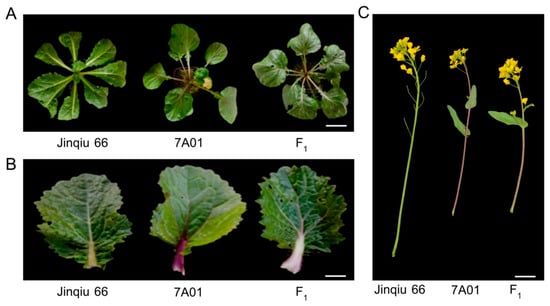
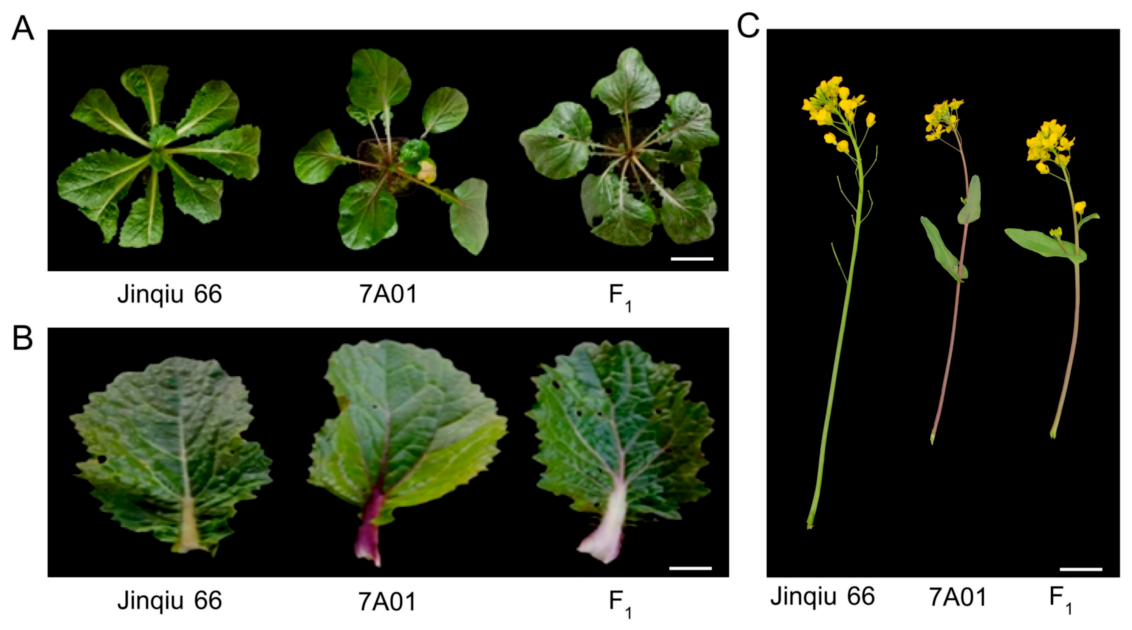
In this study, the B. rapa purple flowering stalk inbred line 7A01 and the green cultivar ‘Jinqiu 66’ were used as parental materials to explore the potential candidate genes associated with the purple flowering stalk trait (Figure S1). A closer phenotypic analysis indicated that 7A01 showed purple coloration in petioles and leaf veins at the five-leaf stage (Figure 1A,B) and in the flowering stalk at the bolting stage (Figure 1C and Figure S1). 7A01 and ‘Jinqiu 66’ were crossed, and the offspring, i.e., the generated F1 population, also showed similar purple coloration in the petioles, leaf veins, and flowering stalks, with the color being lighter than that of the parental line 7A01 (Figure 1 and Figure S1).
Figure 1.
Color characteristics of Jinqiu 66, 7A01, and their F1 hybrid offspring during the seedling stage and flowering stage. (A) Representative images of indicated lines at the five-leaf stage. Scale bars = 2 cm. (B) Color characteristics of petioles and leaf veins from the fifth true leaf of the indicated lines. Scale bars = 1 cm. (C) Color characteristics of stems at the flowering stage of the indicated lines. Scale bars = 5 cm.
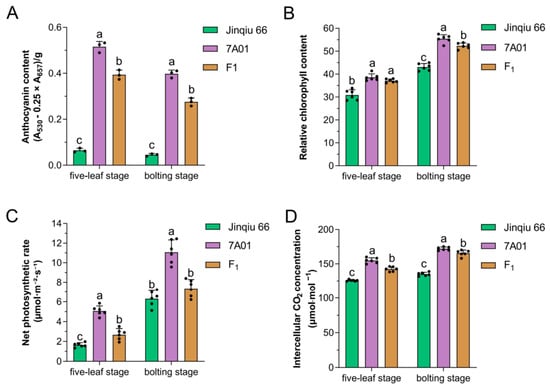
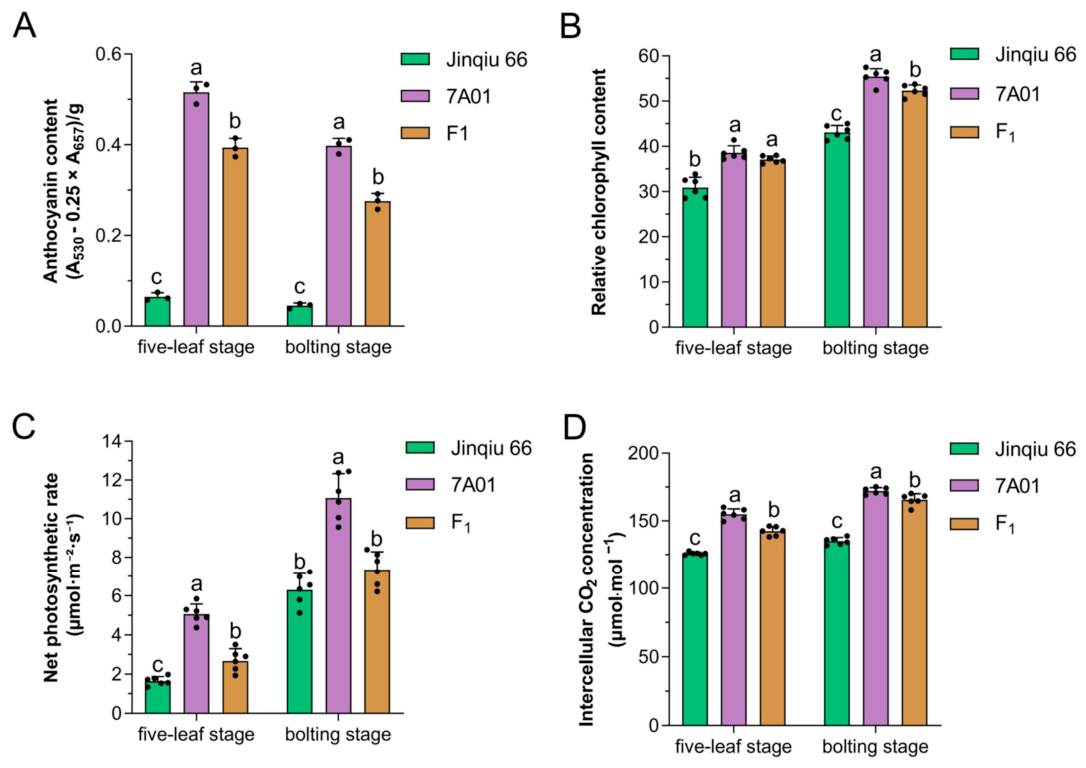
We then analyzed whether the purple coloration in 7A01 was related to anthocyanin accumulation. Quantitative analyses revealed that anthocyanin contents in the petioles at the five-leaf stage and the flowering stalks at the bolting stage were substantially higher in 7A01 than in ‘Jinqiu 66’, which showed only basal levels of anthocyanin contents (Figure 2A). This pattern aligns with the purple and green phenotypes of 7A01 and ‘Jinqiu 66’, respectively (Figure 1 and Figure S1). Consistently, their F1 hybrid exhibited intermediate anthocyanin levels at both stages (Figure 2A). These results suggested that the purple coloration in 7A01 was likely caused by the accumulation of anthocyanins. Additionally, the relative chlorophyll contents of 7A01 at both stages were moderately but significantly higher than ‘Jinqiu 66’ and the F1 hybrid, while ‘Jinqiu 66’ showed the lowest relative chlorophyll content (Figure 2B).
Figure 2.
Physiological characteristics of Jinqiu 66, 7A01, and their F1 hybrid offspring. Anthocyanin contents (A), relative chlorophyll contents (B), net photosynthetic rate (C), and intercellular CO2 concentration (D) of the indicated lines at the five-leaf stage and bolting stage. Values are means ± SD. Different letters indicate significant differences (one-way ANOVA with Tukey’s test, p < 0.05).
Previous studies indicated that light-induced anthocyanins play a protective role in photosynthetically active plant organs against excessive light intensities and oxidative stress [2,39,40,41,42]. We further explored the differences in photosynthetic efficiency between 7A01 and Jinqiu 66. The results showed that net photosynthetic rate (Pn) and intercellular CO2 concentration (Ci) in the petioles at the five-leaf stage and the flowering stalks at the bolting stage were significantly higher in 7A01 than those of ‘Jinqiu 66’, while the F1 hybrid exhibited intermediate levels (Figure 2C,D). These results suggest that, besides the accumulation of anthocyanins, 7A01 also showed higher photosynthetic efficiency than Jinqiu 66. Further studies are needed to rule out the influences of genetic background differences between these two lines.
2.2. Genetic Inheritance of the Purple Coloration Trait of B. rapa Inbred Line 7A01
To investigate the genetic inheritance of the purple coloration trait, using 7A01 (purple) and ‘Jinqiu 66’ (green) as parental lines, F1, F2, and BC1 segregating populations were constructed. During the two consecutive years of field phenotypic observations in 2024 and 2025, it was found that the purple, light purple, and green coloration traits on the leaf veins, petioles, and flowering stalks consistently appeared simultaneously in the obtained populations. Subsequently, we analyzed the phenotypic segregation of the purple, light purple, and green coloration traits in the F2 and BC1 populations (Table 1). The chi-square tests indicated that the ratio of green plants to purple (including light purple) plants in the F2 population followed a 1:3 segregation ratio, while the ratio in the BC1 population followed a 1:1 segregation ratio. In conclusion, these results suggest that the purple coloration trait of 7A01 is a single Mendelian genetic trait, possibly controlled by a single nuclear locus, without cytoplasmic effects, and this purple coloration trait is incompletely dominant (Table 1).
Table 1.
Genetic analysis of the purple coloration trait.
2.3. Mapping of the Genomic Locus Linked to the Purple Coloration Trait
We then proceeded to localize the genomic locus linked to the purple coloration trait of 7A01. A high-density Brassica 50K Illumina Infinium™ SNP array was employed, in combination with the bulked segregant analysis (BSA) and collinearity analysis, to screen for SNP markers and preliminarily map the purple coloration trait in 7A01. SNP array analysis identified four polymorphic SNP loci between 7A01 and ‘Jinqiu 66’ from genome-wide distributed SNP markers, among which one is located on the A01 chromosome of B. napus, and three are located on the A10 chromosome of B. napus (Supplementary Table S1). Through collinearity comparison, the 4.43–4.46 Mb region on the A10 chromosome of B. napus was mapped to the 28.15–29.26 Mb region on the A10 chromosome of B. rapa (Supplementary Tables S1 and S2).
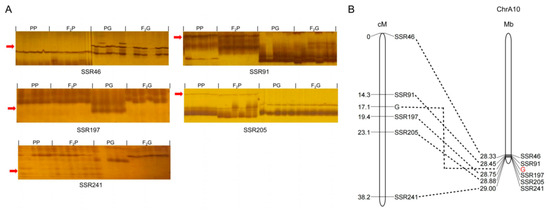
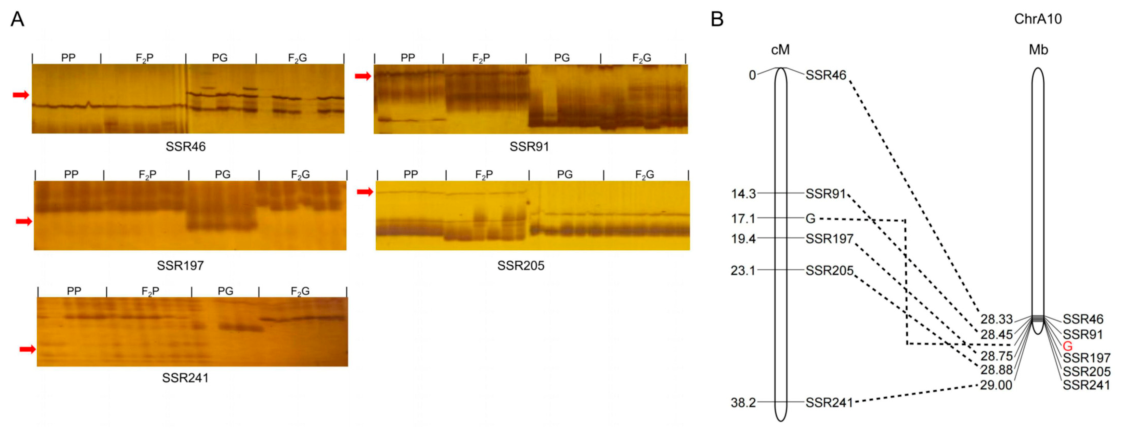
Within the target interval, 109 pairs of SSR primers aiming for the 28.15–29.26 Mb region on the A10 chromosome of B. rapa genome were designed. Meanwhile, 3 pairs of intron polymorphism (IP) primers were designed aiming for the 5.21–5.23 Mb region on the A01 chromosome of B. rapa genome. Among these, five SSR primers (SSR46, SSR91, SSR197, SSR205, and SSR241) exhibited stable polymorphism in a small population (Figure 3A), while 3 pairs of IP primers showed no polymorphism. These five stable SSR markers were used to genotype 611 individuals from the F2 population, and the genetic distances between the markers and the target genomic region were calculated based on the number of recombinant individuals detected. Ultimately, the target genomic region was confined to a 5.1 cM interval on chromosome A10 of B. rapa genome (Figure 3B). The closest flanking markers, SSR91 and SSR197, were located at physical distances of 28,453,405 bp and 28,749,597 bp, respectively, with a physical distance of 296 kb between them (Figure 3B). Within this region, a total of 46 genes were identified based on the functional descriptions of their A. thaliana homologs in TAIR (https://www.arabidopsis.org/) (Supplementary Table S3). Notably, none of the identified genes are previously reported to be involved in anthocyanin biosynthesis.
Figure 3.
Localization of the genomic region that co-segregates with the purple coloration trait. (A) Verification results of SSR markers in parental plants and F2 plants with green stalk and purple stalk traits. PP: DNA from 5 individual parental plants with purple coloration; PG: DNA from 5 individual parental plants with green coloration; F2P: DNA from 6 individual plants with purple coloration in the F2 generation; F2G: DNA from 6 individual plants with green coloration in the F2 generation. Arrows indicate the target bands. (B) Genetic map and physical map of candidate genes related to the purple coloration trait.
2.4. Identification of Candidate Genes Associated with Anthocyanin Accumulation in Petioles and Leaf Veins from B. rapa Inbred Line 7A01
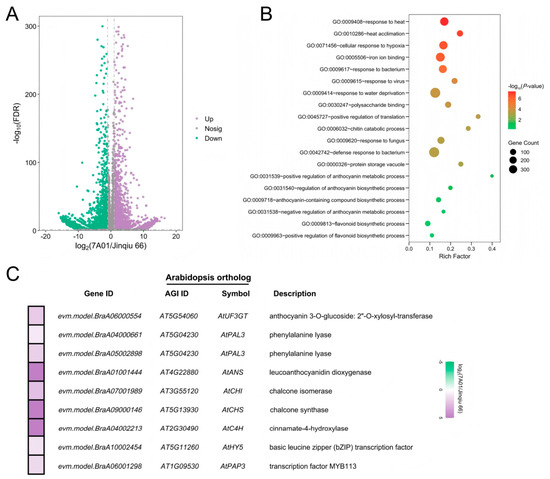
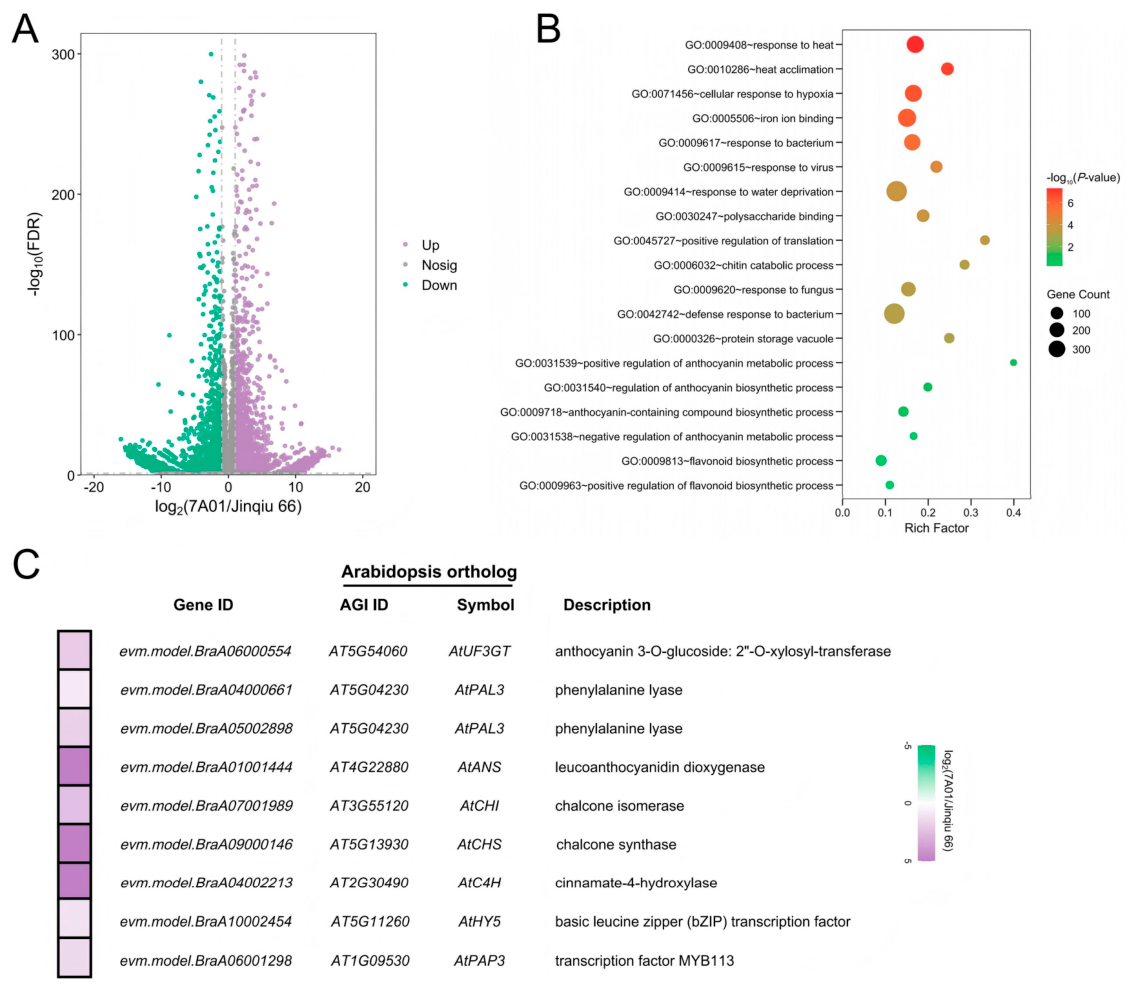
To identify the candidate genes associated with the purple coloration in petioles and leaf veins of 7A01, a transcriptome analysis was performed first with shoot apices from 7A01 and ‘Jinqiu 66’ at the five-leaf stage. A total of 3953 DEGs were identified when comparing 7A01 with ‘Jinqiu 66’, among which 2393 DEGs were upregulated, and 1560 DEGs were downregulated (Figure 4A). Gene ontology (GO) analysis was conducted to elucidate the biological processes involved in this process (Figure 4B). The result revealed significant enrichment of multiple anthocyanin accumulation-related GO entries, including positive regulation of anthocyanin metabolic process (GO:0031539), regulation of anthocyanin biosynthetic process (GO:0031540), and anthocyanin-containing compound biosynthetic process (GO:0009718) (Figure 4B). Interestingly, negative regulation of anthocyanin metabolic process (GO:0031538) was also enriched. Furthermore, GO entries related to flavonoid biosynthesis, such as flavonoid biosynthetic process (GO:0009813) and positive regulation of flavonoid biosynthetic process (GO:0009963), were also significantly enriched (Figure 4B). Additionally, GO entries related to abiotic stress responses, such as response to heat (GO:0009408), heat acclimation (GO:0010286), cellular response to hypoxia (GO:0071456), and response to water deprivation (GO:0009414), as well as GO entries related to biotic stress responses, including response to bacterium (GO:0009617), defense response to bacterium (GO:0042742), response to virus (GO:0009615), and response to fungus (GO:0009620), were also significantly enriched (Figure 4B).
Figure 4.
Transcriptome analysis of shoot apices from Jinqiu 66 and 7A01 at the five-leaf stage. (A) Volcano plot showing total gene profiles comparing Jinqiu 66 and 7A01. Purple points represent upregulated genes, green points represent downregulated genes, and grey points represent non-differentially expressed genes. (B) GO functional enrichment analysis of DEGs in shoot apices from Jinqiu 66 and 7A01 at the five-leaf stage. The rich factor for the X-axis represents the ratio of DEGs to the total number of annotated genes in a given pathway; the Y-axis represents the name of the enriched pathway; the color scale indicates different thresholds of the p-value; the size of the dots represents the number of genes corresponding to each pathway. (C) Heatmap of DEGs related to anthocyanin biosynthesis in shoot apices of 7A01 at the five-leaf stage based on transcriptome analysis. The purple-to-green gradient bars indicate |log2(7A01/Jinqiu 66)| of each gene. FDR, false discovery rate; DEGs, differentially expressed genes; GO, gene ontology.
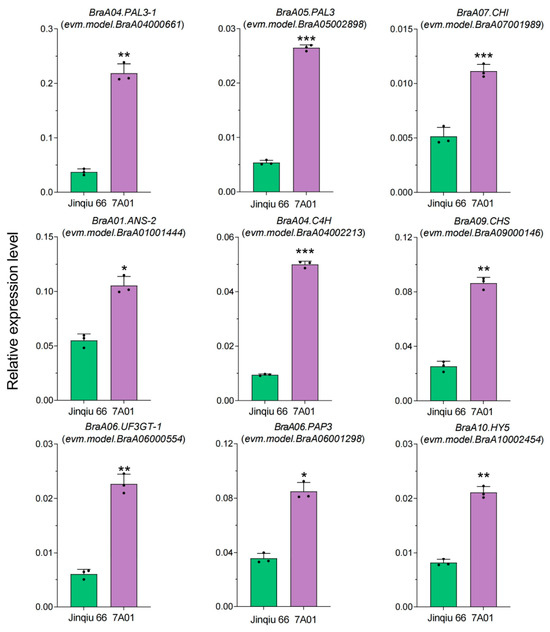
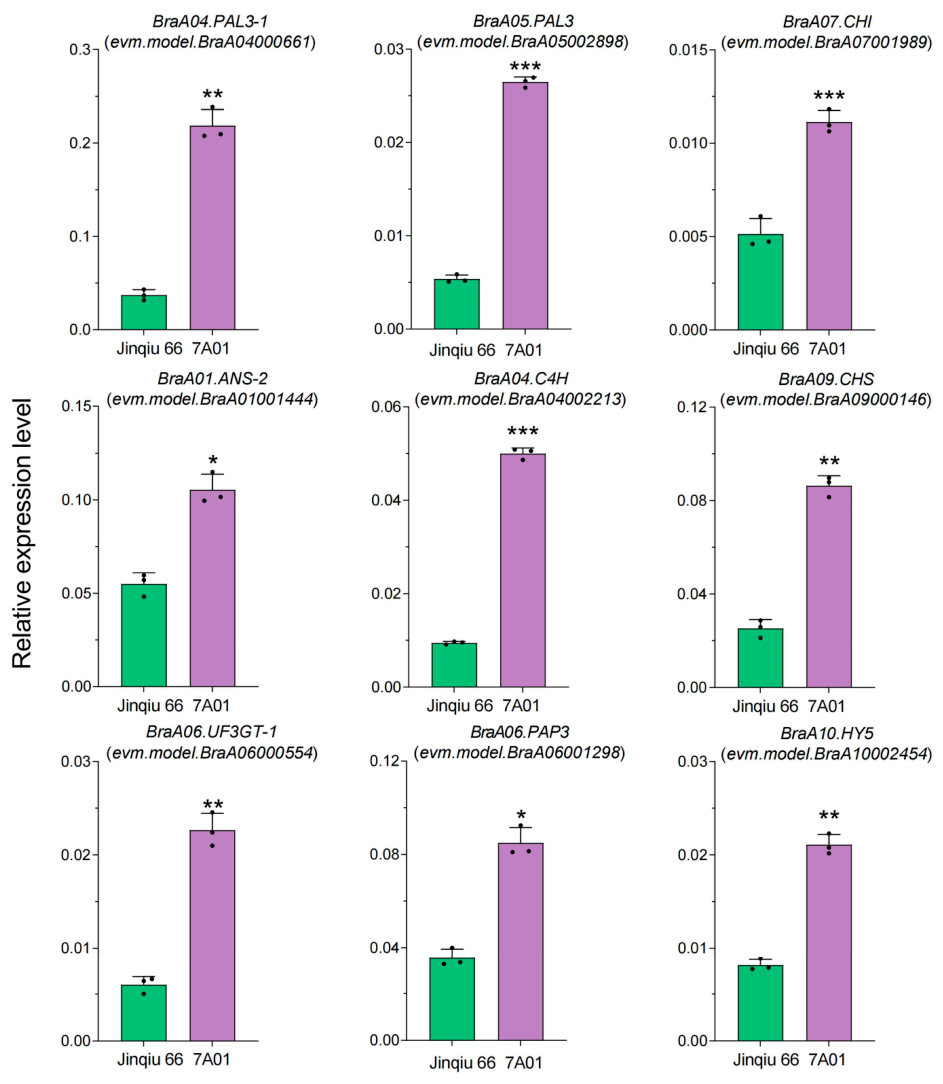
Based on the results of GO analysis, combined with the previously reported functions of homologous genes in A. thaliana, genes related to the anthocyanin biosynthesis pathway were identified (Figure 4C), including structural genes homologous to AtUF3GT, AtPAL3, AtANS, AtCHI, AtCHS, and AtC4H, as well as TFs homologous to ELONGATED HYPOCOTYL 5 (AtHY5) and AtPAP3, which positively regulate anthocyanin biosynthesis (Figure 4C). Real-time quantitative PCR (RT-qPCR) analyses were then performed to verify the upregulation of these genes. The results showed that all nine tested B. rapa genes were significantly upregulated in the shoot apices of 7A01 (Figure 5). These results imply that upregulation of these genes might be associated with the accumulation of anthocyanin in petioles and leaf veins of 7A01.
Figure 5.
Verification of DEGs related to anthocyanin accumulation in shoot apices of 7A01 at the five-leaf stage. RT-qPCR validation of selected differentially expressed genes in shoot apices of Jinqiu 66 and 7A01 at the five-leaf stage. Results were normalized to BraGAPDH as an internal control. Values are means ± SD (n = 3). Asterisks indicate significant differences compared with Jinqiu 66 (two-tailed Student’s t-test, * p < 0.05, ** p < 0.01, *** p < 0.001). DEGs, differentially expressed genes.
2.5. Identification of Candidate Genes Associated with Anthocyanin Accumulation in Flowering Stalks from B. rapa Inbred Line 7A01
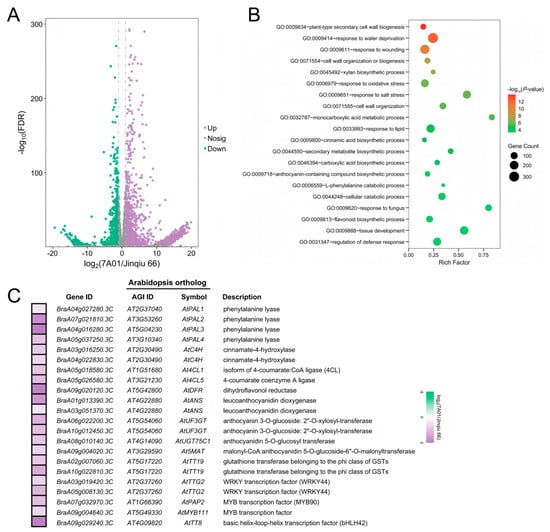
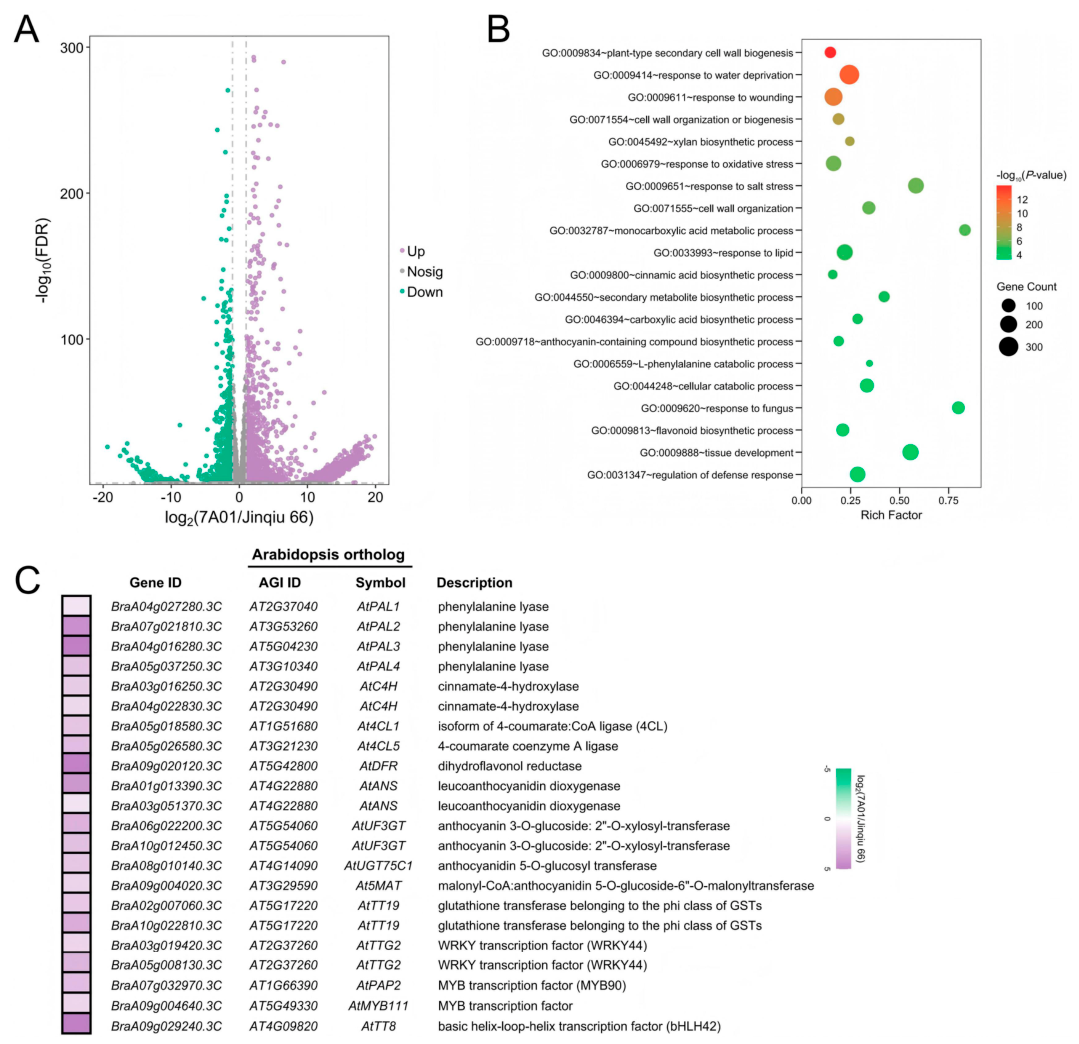
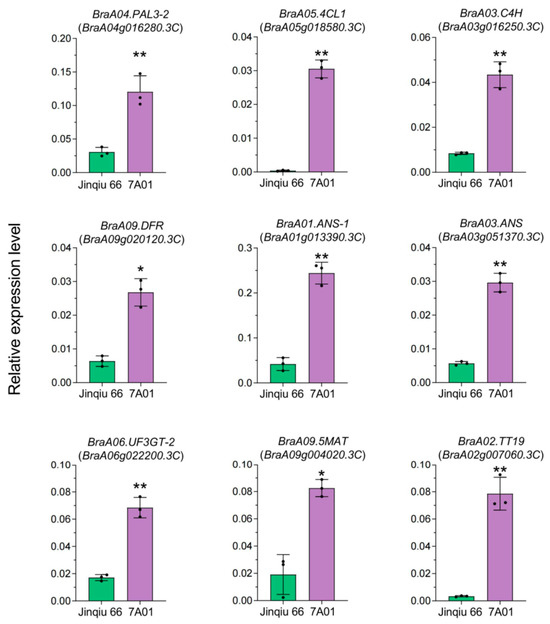
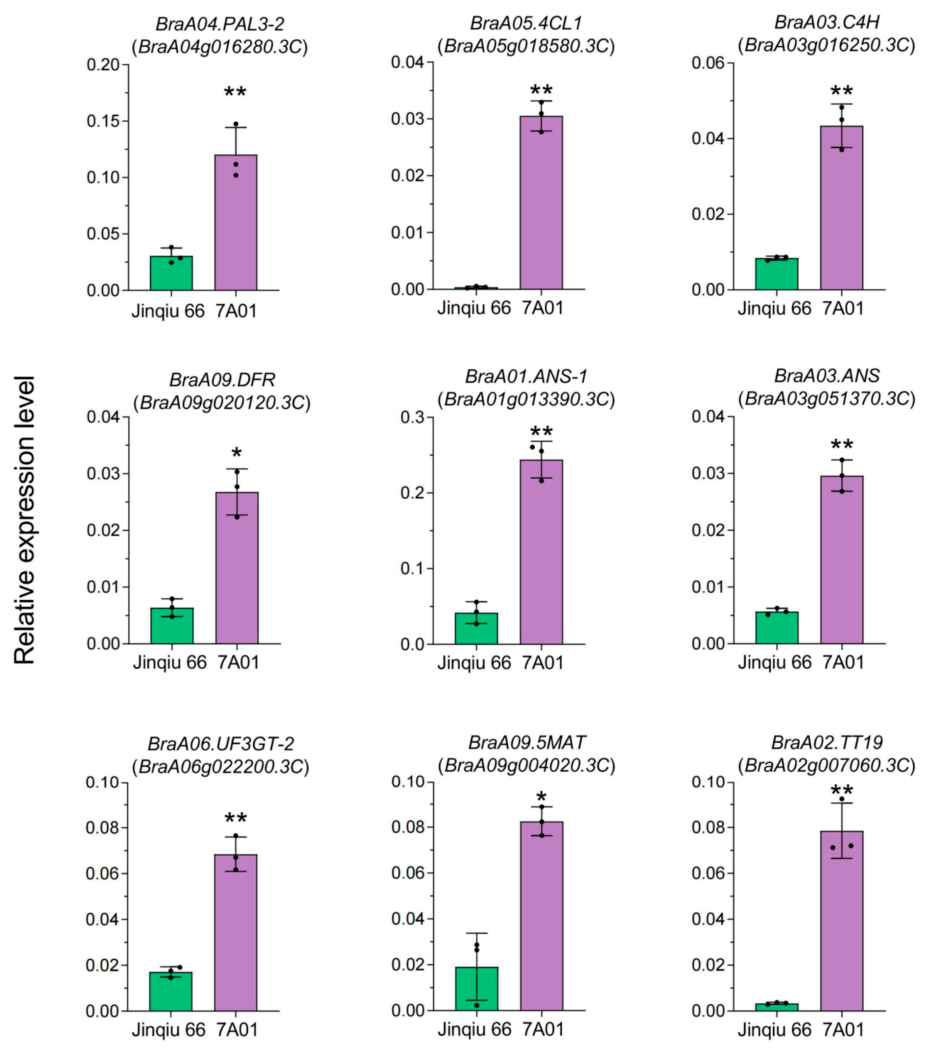
Next, a transcriptome analysis was performed with flowering stalks from 7A01 and ‘Jinqiu 66’ to identify the candidate genes associated with the purple coloration in flowering stalks of 7A01. A total of 5922 DEGs were identified when comparing 7A01 with ‘Jinqiu 66’, among which 2949 DEGs were upregulated, and 2973 DEGs were downregulated (Figure 6A). Resembling the results with shoot apices (Figure 4B), GO analysis revealed significant enrichment of anthocyanin-containing compound biosynthetic process (GO:0009718) and GO entries related to biosynthesis of flavonoid and other anthocyanin precursors, including cinnamic acid biosynthetic process (GO:0009800), L-phenylalanine catabolic process (GO:0006559), and flavonoid biosynthetic process (GO:0009813) (Figure 6B). Furthermore, GO entries related to abiotic and biotic stress responses, such as response to water deprivation (GO:0009414), response to wounding (GO:0009611), response to oxidative stress (GO:0006979), response to salt stress (GO:0009651), regulation of defense response (GO:0031347), and response to fungus (GO:0009620), were also significantly enriched (Figure 6B). Screening of genes related to the anthocyanin biosynthesis pathway identified structural genes homologous to AtPAL1, AtPAL2, AtPAL3, AtPAL4, AtC4H, At4CL1, At4CL5, AtDFR, AtANS, AtUF3GT, AtUGT75C1, At5MAT, and AtTT19, as well as TFs homologous to AtTTG2, AtPAP2, AtMYB111, and AtTT8 (Figure 6C). Using flowering stalks of 7A01 and ‘Jinqiu 66’, we then selected nine DEGs for verification with RT-qPCR (Figure 7), including four B. rapa genes that are homologous to AtPAL3, AtC4H, AtANS, and AtUF3GT, which were previously verified in petioles and leaf veins (Figure 5). The results showed that, consistent with the RNA-seq result (Figure 6), all selected genes were significantly upregulated in 7A01 (Figure 7). Similarly, our results imply that the promoted expression of these genes might be associated with the purple flowering stalk trait in B. rapa inbred line 7A01.
Figure 6.
Transcriptome analysis of flowering stalks from Jinqiu 66 and 7A01 at the bolting stage. (A) Volcano plot showing total gene profiles comparing Jinqiu 66 and 7A01. Purple points represent upregulated genes, green points represent downregulated genes, and grey points represent non-differentially expressed genes. (B) GO functional enrichment analysis of DEGs in flowering stalks from Jinqiu 66 and 7A01. The rich factor for the X-axis represents the ratio of DEGs to the total number of annotated genes in a given pathway; the Y-axis represents the name of the enriched pathway; the color scale indicates different thresholds of the p-value; the size of the dots represents the number of genes corresponding to each pathway. (C) Heatmap of DEGs related to anthocyanin biosynthesis in flowering stalks of 7A01 based on transcriptome analysis. The purple-to-green gradient bars indicate |log2(7A01/Jinqiu 66)| of each gene. FDR, false discovery rate; DEGs, differentially expressed genes; GO, gene ontology.
Figure 7.
Verification of DEGs related to anthocyanin accumulation in flowering stalks of 7A01 at the bolting stage. RT-qPCR validation of selected differentially expressed genes in flowering stalks of Jinqiu 66 and 7A01. Results were normalized to BraGAPDH as an internal control. Values are means ± SD (n = 3). Asterisks indicate significant differences compared with Jinqiu 66 (two-tailed Student’s t-test, * p < 0.05, ** p < 0.01). DEGs, differentially expressed genes.
3. Discussion
The biosynthesis of anthocyanins is widely studied in many organisms due to its pleiotropic role in plant growth and development, as well as its nutritional, medical, and economic value [1,2,3]. Although plenty of studies regarding the biosynthesis and applications of anthocyanins in Brassica crops have been reported [13,30,34,37,38,43], the complete picture of anthocyanin biosynthesis in B. rapa is still far from fully understood. In this study, we identified that anthocyanin accumulation in the leaf veins, petioles, and flowering stalks of B. rapa inbred line 7A01 is possibly controlled by a single incompletely dominant nuclear locus, which was mapped to a 5.1 cM region on chromosome A10 (Figure 1, Figure 2 and Figure 3). Moreover, multiple anthocyanin biosynthesis-related genes that might contribute to the purple coloration trait in 7A01 were identified by transcriptomic analyses (Figure 4, Figure 5, Figure 6 and Figure 7). In addition, we found that 7A01 also exhibits higher relative chlorophyll content and photosynthetic efficiency than Jinqiu 66, with the F1 hybrid exhibiting intermediate levels (Figure 2B–D). Further analysis is required to determine the relationship between anthocyanin accumulation and these physiological characteristics in these lines in future studies.
Previous studies reported the endeavors of localizing the causal loci for anthocyanin accumulation in B. rapa, and varying results were obtained. For example, the anl locus responsible for the anthocyaninless trait in stems of rapid-cycling B. rapa is associated with linkage group R9 of B. rapa reference map [44]. Another study showed that the red-skinned swollen root and petiole trait in a doubled haploid turnip line (B. rapa cv. ‘Iyo-hikabu’) associates with a monogenic locus Anp in linkage group R07 of the B. rapa [45]. A later study indicated that the purple leaf color trait of Chinese cabbage is associated with a single dominant gene, BrPur, on linkage group A03 of B. rapa [46]. The application of whole genome sequencing helped fine-mapping of the causal genes, e.g., sequencing of two bulked pools of anthocyanin-defective turnip (Brassica rapa subsp. rapa) mutant w68 mapped R2R3 MYB TF BrPAP1a on chromosome A07 to be responsible for the purple peel of swollen root trait [28]. A recent study with BSA-sequencing of recombinant inbred line (RIL) population fine-mapped BraP2, a locus on chromosome A03 associated with purple leaf coloration of non-heading Chinese cabbage (B. rapa), and the causal gene BraCHI (BraA03g059660.3C) locates within the 65.31 kb candidate region [34]. In this study, we showed that the anthocyanin accumulation trait in leaf veins, petioles, and flowering stalks of the B. rapa inbred line 7A01 is controlled by a single incompletely dominant nuclear locus (Figure 1 and Figure 2A, Table 1). Using a Brassica 50K SNP array combined with BSA, the locus was mapped to a 5.1 cM region on chromosome A10 (Figure 3, Supplementary Tables S1 and S2). Five linked SSR markers were developed, and the closest flanking markers defined a physical interval of 296 kb containing 46 genes annotated based on their A. thaliana homologs in TAIR (Figure 3, Supplementary Table S3). Notably, none of these are homologous to known anthocyanin biosynthesis genes. Although a high number of predicted anthocyanin biosynthesis-related genes were reported in the previous genome-wide studies in B. rapa [29,36], the overall regulatory mechanisms underlying anthocyanin accumulation in this species remain far from complete. It is therefore likely that additional loci/genes contributing to this process in B. rapa remain to be discovered. Further studies would be needed to pin down the potential causal gene within the identified interval.
The similar GO enrichment patterns between comparative transcriptomes of shoot apices at the five-leaf stage and flowering stalks at the bolting stage suggest that the purple coloration in these two stages involves comparable biological processes, including GO entries related to anthocyanin biosynthesis and flavonoid biosynthesis (Figure 4A,B and Figure 6A,B), consistent with the previous consensus that anthocyanin biosynthesis is a branch in the flavonoid biosynthesis [1,2,13,47]. Moreover, both GO analyses revealed enrichment of biological processes related to biotic and abiotic stress responses (Figure 4A,B and Figure 6A,B), aligning with the previously reported correlation between anthocyanin accumulation and stress responses in previous reports [1,2,5,6,7,9,10,11,13,47,48]. Further analysis is needed to verify whether increased anthocyanin accumulation in 7A01 affects its stress responses in future studies.
Furthermore, transcriptome results of shoot apices and flowering stalks identified multiple anthocyanin biosynthesis-related genes, among which nine B. rapa genes that are homologous to AtPAL3 (evm.model.BraA04000661, evm.model.BraA05002898, and BraA04g016280.3C), AtC4H (evm.model.BraA04002213 and BraA03g016250.3C), AtANS (evm.model.BraA01001444 and BraA01g013390.3C), and AtUF3GT (evm.model.BraA06000554 and BraA06g022200.3C) were upregulated in both transcriptome and RT-qPCR analyses (Figure 4C, Figure 5, Figure 6C and Figure 7), suggesting that anthocyanin accumulation in shoot apices and flowering stalks in 7A01 might be achieved via upregulation of a set of similar but not identical anthocyanin biosynthesis structural genes.
On the other hand, BraA10.HY5 (evm.model.BraA10002454) and BraA06.PAP3 (evm.model.BraA06001298) were upregulated exclusively in shoot apices of 7A01 (Figure 4 and Figure 5). These two genes are homologous to previously reported AtHY5 [5,43,48,49] and AtPAP3/MYB113 [50,51], which were shown to promote anthocyanin biosynthesis. In comparison, in addition to more upregulated anthocyanin biosynthetic genes exclusively upregulated in flowering stalks (e.g., genes homologous to AtPAL1, AtPAL2, AtPAL4, At4CL1, At4CL5, and AtDFR), genes involved in anthocyanin decoration and transport, including homologs of AtUGT75C1 (encoding anthocyanidin 5-O-glucosyl transferase [16,52]), At5MAT (encoding anthocyanin 5-glucoside malonyltransferase [53]), and AtTT19 (encoding glutathione S-transferase that functions in both anthocyanin biosynthesis [14] and transport [54]), were also upregulated only in flowering stalks (Figure 4C, Figure 5, Figure 6C and Figure 7). Moreover, genes homologous to TFs that were previously reported to promote anthocyanin biosynthesis, such as AtTTG2 [22,23], AtPAP2 [50,51], AtMYB111 [50,55], and AtTT8 [18,22,23,28], were exclusively upregulated in flowering stalks (Figure 4C and Figure 6C).
The differences in upregulated anthocyanin biosynthetic genes, particularly in TFs (Figure 4C and Figure 6C), align with the previous reports that transcriptional control of pigmentation might show tissue-specific patterns. For instance, AtTT8, AtTT2, and AtTTG1 were shown to specifically control proanthocyanidin accumulation in the seed coat [18]. Similarly, the ttg2 mutant pigment phenotype is restricted to the seed coat, with no loss of anthocyanins in the plant body [17,23]. In Petunia, the PH4 (MYB)–AN1 (ANTHOCYANIN1, bHLH)–AN11 (WD40) complex and its direct downstream target PH3 (a homolog of AtTTG2) function specifically in the control of flower color [20]. Since our mapping results revealed no known anthocyanin biosynthesis-related gene within the confined 296 kb region (Figure 3, Supplementary Table S3), it is possible that the purple coloration in 7A01 is potentially associated with a new candidate gene that specifically controls anthocyanin accumulation in leaf veins, petioles, and flowering stalks. For example, three among the 46 genes encode TFs (Supplementary Table S3): BraA10g029490 (Nuclear Factor Y TF), BraA10g030030 (zinc finger TF), and BraA10g029770 (PHR1-LIKE TF), which might play a regulatory role associated with the purple coloration trait in 7A01. On the other hand, other mechanisms cannot be excluded, such as post-translational modification (BraA10g029710, encoding a protein phosphatase 2C family protein) and signal transduction (BraA10g029790 and BraA10g029880, both encoding receptor-like kinase family proteins). Future work should focus on narrowing down the candidate interval and functionally validating the candidate genes through approaches such as genetic complementation, overexpression, or gene editing. Our study thus lays a foundation for future fine mapping of the candidate gene within the identified interval on chromosome A10, and provides new insights into the molecular basis of the purple coloration in leaf veins, petioles, and flowering stalks in B. rapa.
4. Materials and Methods
4.1. Plant Materials and Growth Conditions
The B. rapa inbred line 7A01 and cultivar ‘Jinqiu 66’, as well as the F1, F2, and BC1 segregation population, were planted at the experimental farm of Northwest A&F University (Yangling, Shaanxi, China) in late September of 2024 and 2025. At the five-leaf stage and the bolting stage, the purple coloration trait was recorded, and DNA was extracted for gene mapping.
4.2. Photometric Determination of Anthocyanin Contents
The measurement of anthocyanin contents was carried out as previously reported, with minor modifications [56]. For each genotype, three biological replicates were sampled from the third true leaf at the five-leaf stage and from the fifth true leaf at the bolting stage. The sample to be analyzed was thoroughly ground in liquid nitrogen. Then, 0.3 mL of the extraction solution (methanol solution containing 1% hydrochloric acid) was added, and the mixture was mixed evenly and incubated in the dark at 4 °C overnight. Subsequently, 0.2 mL of distilled water and 0.5 mL of chloroform were added, and the sample was thoroughly vortexed for 40 s and centrifuged at 10,000 rpm for 4 min at room temperature. The absorption at wavelengths of 530 nm and 657 nm in the aqueous phase was measured using a spectrophotometer (V-1200, Mapada, Shanghai, China). The calculation formula for the relative content of anthocyanins is as follows: relative anthocyanin content = (A530 − 0.25 × A657)/Sample fresh weight (g).
4.3. Chlorophyll Measurement
Chlorophyll content was determined using a portable chlorophyll meter (SPAD-502, Konica Minolta, Osaka, Japan). The measurement is based on the differential transmittance of light at 650 nm (red) and 940 nm (infrared), from which the SPAD value is calculated as a relative indicator of leaf chlorophyll content. Measurements were conducted on clear sunny days between 9:00 and 11:00 a.m. For each genotype, six biological replicates were sampled from the third true leaf at the five-leaf stage and from the fifth true leaf at the bolting stage. SPAD readings were recorded from the middle portion of each leaf blade, avoiding the main vein.
4.4. Measurement of Net Photosynthesis Rate and Intercellular CO2 Concentration
Photosynthetic parameters were measured using a portable photosynthesis system (LI-6400/XT, LI-COR, Lincoln, NE, USA). Measurements were conducted on clear sunny days between 9:00 and 11:00 a.m. For each genotype, six biological replicates were sampled from the third true leaf at the five-leaf stage and from the fifth true leaf at the bolting stage. During the measurements, the leaf chamber CO2 concentration was maintained at 400 μmol·mol−1 using a high-pressure CO2 cylinder, the system pressure was set to 101 kPa, and the flow rate was controlled at 500 μmol·s−1. The net photosynthetic rate (Pn) and intercellular CO2 concentration (Ci) were recorded for each leaf. All measurements were performed on the middle portion of the leaf blade, avoiding the main vein.
4.5. DNA Extraction and SNP Genotyping
Single-nucleotide polymorphism (SNP) genotyping was performed with a Brassica 50 K Illumina Infinium™ SNP array (Greenfafa, Wuhan, China). Total genomic DNA was extracted from fresh leaves of the two parents (15 individual plants each for 7A01 and ‘Jinqiu 66’) and the F2 population (30 individual plants with purple flowering stalk and 30 with green flowering stalk) with a plant genomic DNA extraction kit (Tiangen Biotech, Beijing, China) following the manufacturer’s protocol. Bulk DNA samples were constructed with an equivalent amount of DNA from 10 individuals of each parent and 30 individuals from the F2 population. Consequently, four bulk DNA samples, representing two parents, F2 plants with purple flowering stalks, and F2 plants with green flowering stalks, were used for SNP genotyping with a Brassica 50 K Illumina Infinium™ SNP array as previously described [57]. Meanwhile, the gene sequences were subjected to BLAST alignment (https://blast.ncbi.nlm.nih.gov/Blast.cgi, accessed on 20 June 2025), and the resulting data were analyzed for synteny using TBtools software (Version 2.301).
4.6. Molecular Marker Development, Linkage Analysis, and Locus Mapping
Based on the genome assemblies of the Brassica database (BRAD: http://brassicadb.cn/#/, accessed on 25 June 2025) [58,59], SSR and IP molecular markers were developed. The SSR primers were designed using the SSRHunter software V1.3.0 (Nanjing Agricultural University, Nanjing, China). Meanwhile, the IP primers were designed using Primer Premier 5.0 software (PREMIER Biosoft, San Francisco, CA, USA). The resulting primer sequences were synthesized by Sangon Biotech (Shanghai, China). The primers are listed in Supplementary Table S4.
4.7. RNA-Seq and Data Analysis
For RNA-seq, shoot apices at the five-leaf stage and flowering stalks at the bolting stage were harvested, each with three biological replicates, with each biological replicate composed of five randomly selected individual plants. For shoot apices, RNA library construction, sequencing, and data analysis were performed by LC-Bio Technologies (Hangzhou, China) (https://www.omicstudio.cn/home?slide=3, accessed on 10 December 2025). The quality of transcriptome data was checked, and principal components analysis and Pearson correlation analysis were performed to evaluate sample clustering and overall data reliability (Supplementary Figure S2 and Table S5). The reference genome was B. rapa Chiifu V2.5 (http://brassicadb.cn/#/Download/, accessed on 10 December 2025). DEGs were identified using a threshold of |log2(fold change)| ≥ 1 and false discovery rate (FDR) < 0.05. Identified DEGs were submitted to the Bioinformatics Online Tool (https://www.bioinformatics.com.cn/, accessed on 11 December 2025) for Gene Ontology (GO) enrichment analysis, and significantly enriched GO terms were retrieved.
For flowering stalks, RNA library construction, sequencing, and data analysis were carried out by GENE DENOVO (Guangzhou, China) (https://www.omicsmart.com/#/platform?id=4, accessed on 12 March 2024). Similarly, the quality of transcriptome data was checked, and principal components analysis and Pearson correlation analysis were performed to evaluate sample clustering and overall data reliability (Supplementary Figure S3 and Table S6). The reference genome was B. rapa Chiifu V3.0 (http://brassicadb.cn/#/Download/, accessed on 12 March 2024). DEGs were filtered with the same criteria of |log2(fold change)| ≥ 1 and false discovery rate (FDR) < 0.05. Homologous A. thaliana genes corresponding to each B. rapa DEG were obtained using local BLASTP searches. GO enrichment analysis was subsequently performed using the DAVID database (https://davidbioinformatics.nih.gov/, accessed on 14 March 2024).
4.8. RT-qPCR Analysis
Total RNA was extracted from shoot apices at the five-leaf stage and flowering stalks at the bolting stage using the MiniBEST Plant RNA Extraction Kit (TaKaRa Bio, Dalian, China). RNA integrity was assessed by agarose gel electrophoresis, and RNA concentration and purity were determined using a NanoDrop One spectrophotometer (Thermo Fisher Scientific, Waltham, MA, USA). First-strand cDNA was synthesized with the PrimeScript RT Mix (TaKaRa Bio, Dalian, China). RT-qPCR was performed using the TB Green Premix Ex Taq II (TaKaRa Bio, Dalian, China). BraGAPDH was used as the internal reference gene. Each reaction was performed with three biological replicates and three technical replicates. Primers used for RT-qPCR are listed in Supplementary Table S4.
4.9. Statistical Analysis
Student’s t-tests and ANOVA were performed using GraphPad Prism 8.0.
Supplementary Materials
The following supporting information can be downloaded at: https://www.mdpi.com/article/10.3390/plants15142192/s1: Figure S1. The stalk color characteristics of Jinqiu 66 (green stalk), 7A01 (purple stalk), and their F1 hybrid offspring. Scale bars = 2 cm. Figure S2. Principal components analysis (A) and Pearson correlation analysis (B) of transcriptome data of shoot apices from Jinqiu 66 and 7A01 at the five-leaf stage. Figure S3. Principal components analysis (A) and Pearson correlation analysis (B) of transcriptome data of flowering stalks from Jinqiu 66 and 7A01 at the bolting stage. Table S1. Polymorphism SNPS between the green color samples and purple color samples obtained by Brassica 50K Illumina Infinium™. Table S2. Collinearity analysis results. Table S3. List of 46 genes on chromosome A10 within the localized interval. Table S4. Primers used in this study. Table S5. Summary of transcriptome data of shoot apices from Jinqiu 66 and 7A01 at the five-leaf stage. Table S6. Summary of transcriptome data of flowering stalks from Jinqiu 66 and 7A01 at the bolting stage.
Author Contributions
Y.G. and S.Y. conceived and designed the experiments; B.Z., X.C., S.M., and Z.Z. performed the experiments and analyzed the data; Z.L., and M.C. helped with the data interpretation; S.Y. and Y.G. wrote the manuscript with contributions from all the authors. All authors have read and agreed to the published version of the manuscript.
Funding
This work was supported by the Key Laboratory Project of the Shaanxi Natural Science Basic Research Plan (2025SYS-SYSZD-008), the Key Research and Development Program of Shaanxi Province (grant No. 2025NC-YBXM-012), the PhD Start-up Fund of Northwest A&F University (grant No. Z1090124103), and the Scientific and Technological Innovation Team of Shaanxi Province (grant No. 2024RS-CXTD-69).
Data Availability Statement
The original contributions presented in this study are included in the article/Supplementary Materials. Further inquiries can be directed to the corresponding authors.
Conflicts of Interest
The authors declare no conflicts of interest.
References
- Lu, Z.; Wang, X.; Lin, X.; Mostafa, S.; Zou, H.; Wang, L.; Jin, B. Plant anthocyanins: Classification, biosynthesis, regulation, bioactivity, and health benefits. Plant Physiol. Biochem. 2024, 217, 109268. [Google Scholar] [CrossRef] [Scilit] [PubMed]
- Grünig, N.; Horz, J.M.; Pucker, B. Diversity and ecological functions of anthocyanins. BMC Plant Biol. 2026, 26, 146. [Google Scholar] [CrossRef] [Scilit] [PubMed]
- Mattioli, R.; Francioso, A.; Mosca, L.; Silva, P. Anthocyanins: A Comprehensive Review of Their Chemical Properties and Health Effects on Cardiovascular and Neurodegenerative Diseases. Molecules 2020, 25, 3809. [Google Scholar] [CrossRef] [Scilit] [PubMed]
- Zoratti, L.; Sarala, M.; Carvalho, E.; Karppinen, K.; Martens, S.; Giongo, L.; Haggman, H.; Jaakola, L. Monochromatic light increases anthocyanin content during fruit development in bilberry. BMC Plant Biol. 2014, 14, 377. [Google Scholar] [CrossRef] [Scilit] [PubMed]
- Kim, S.; Hwang, G.; Lee, S.; Zhu, J.Y.; Paik, I.; Nguyen, T.T.; Kim, J.; Oh, E. High Ambient Temperature Represses Anthocyanin Biosynthesis through Degradation of HY5. Front. Plant Sci. 2017, 8, 1787. [Google Scholar] [CrossRef] [Scilit] [PubMed]
- Sun, Y.; Zheng, Y.; Wang, W.; Yao, H.; Ali, Z.; Xiao, M.; Ma, Z.; Li, J.; Zhou, W.; Cui, J.; et al. VvFHY3 links auxin and endoplasmic reticulum stress to regulate grape anthocyanin biosynthesis at high temperatures. Plant Cell 2024, 37, koae303. [Google Scholar] [CrossRef] [Scilit] [PubMed]
- Li, P.; Li, Y.J.; Zhang, F.J.; Zhang, G.Z.; Jiang, X.Y.; Yu, H.M.; Hou, B.K. The Arabidopsis UDP-glycosyltransferases UGT79B2 and UGT79B3, contribute to cold, salt and drought stress tolerance via modulating anthocyanin accumulation. Plant J. 2017, 89, 85–103. [Google Scholar] [CrossRef] [Scilit] [PubMed]
- Zeng, Z.; Liao, Y.; Wang, J.; Liang, X.; Duan, L.; Huang, Y.; Han, Z.; Lin, K.; Hu, H.; Ye, K.; et al. Combined transcriptomic, metabolomic and physiological analysis reveals the key role of nitrogen, but not phosphate and potassium in regulating anthocyanin biosynthesis induced by nutrient deficiency in Eucalyptus. Int. J. Biol. Macromol. 2024, 283, 137564. [Google Scholar] [CrossRef] [Scilit] [PubMed]
- Gutha, L.R.; Casassa, L.F.; Harbertson, J.F.; Naidu, R.A. Modulation of flavonoid biosynthetic pathway genes and anthocyanins due to virus infection in grapevine (Vitis vinifera L.) leaves. BMC Plant Biol. 2010, 10, 187. [Google Scholar] [CrossRef] [Scilit] [PubMed]
- Buitrago, S.; Yang, X.; Wang, L.; Pan, R.; Zhang, W. Evolutionary analysis of anthocyanin biosynthetic genes: Insights into abiotic stress adaptation. Plant Mol. Biol. 2024, 115, 6. [Google Scholar] [CrossRef] [Scilit] [PubMed]
- Li, Z.; Ahammed, G.J. Plant stress response and adaptation via anthocyanins: A review. Plant Stress 2023, 10, 100230. [Google Scholar] [CrossRef] [Scilit]
- Ren, S.; Cui, J.; Wang, L.; Lu, Z.; Jin, B. Plant Flavonoids: Biosynthesis, Regulation, and Roles in Biotic and Abiotic Stresses. Plant Cell Environ. 2026, 49, 5664–5684. [Google Scholar] [CrossRef] [Scilit] [PubMed]
- Li, X.; Wang, F.; Ta, N.; Huang, J. The compositions, characteristics, health benefits and applications of anthocyanins in Brassica crops. Front. Plant Sci. 2025, 16, 1544099. [Google Scholar] [CrossRef] [Scilit] [PubMed]
- Eichenberger, M.; Schwander, T.; Huppi, S.; Kreuzer, J.; Mittl, P.R.E.; Peccati, F.; Jimenez-Oses, G.; Naesby, M.; Buller, R.M. The catalytic role of glutathione transferases in heterologous anthocyanin biosynthesis. Nat. Catal. 2023, 6, 927–938. [Google Scholar] [CrossRef] [Scilit] [PubMed]
- Seitz, C.; Ameres, S.; Forkmann, G. Identification of the molecular basis for the functional difference between flavonoid 3′-hydroxylase and flavonoid 3′,5′-hydroxylase. FEBS Lett. 2007, 581, 3429–3434. [Google Scholar] [CrossRef] [Scilit] [PubMed]
- Gonzalez, A.; Zhao, M.; Leavitt, J.M.; Lloyd, A.M. Regulation of the anthocyanin biosynthetic pathway by the TTG1/bHLH/Myb transcriptional complex in Arabidopsis seedlings. Plant J. 2008, 53, 814–827. [Google Scholar] [CrossRef] [Scilit] [PubMed]
- Lloyd, A.; Brockman, A.; Aguirre, L.; Campbell, A.; Bean, A.; Cantero, A.; Gonzalez, A. Advances in the MYB-bHLH-WD Repeat (MBW) Pigment Regulatory Model: Addition of a WRKY Factor and Co-option of an Anthocyanin MYB for Betalain Regulation. Plant Cell Physiol. 2017, 58, 1431–1441. [Google Scholar] [CrossRef] [Scilit] [PubMed]
- Baudry, A.; Heim, M.A.; Dubreucq, B.; Caboche, M.; Weisshaar, B.; Lepiniec, L. TT2, TT8, and TTG1 synergistically specify the expression of BANYULS and proanthocyanidin biosynthesis in Arabidopsis thaliana. Plant J. 2004, 39, 366–380. [Google Scholar] [CrossRef] [Scilit] [PubMed]
- Guo, Y.; Li, D.; Liu, T.; Li, Y.; Liu, J.; He, M.; Cui, X.; Liu, Z.; Chen, M. Genome-Wide Identification of PAP1 Direct Targets in Regulating Seed Anthocyanin Biosynthesis in Arabidopsis. Int. J. Mol. Sci. 2023, 24, 16049. [Google Scholar] [CrossRef] [Scilit] [PubMed]
- Cna’ani, A.; Spitzer-Rimon, B.; Ravid, J.; Farhi, M.; Masci, T.; Aravena-Calvo, J.; Ovadis, M.; Vainstein, A. Two showy traits, scent emission and pigmentation, are finely coregulated by the MYB transcription factor PH4 in petunia flowers. New Phytol. 2015, 208, 708–714. [Google Scholar] [CrossRef] [Scilit] [PubMed]
- Carey, C.C.; Strahle, J.T.; Selinger, D.A.; Chandler, V.L. Mutations in the pale aleurone color1 regulatory gene of the Zea mays anthocyanin pathway have distinct phenotypes relative to the functionally similar TRANSPARENT TESTA GLABRA1 gene in Arabidopsis thaliana. Plant Cell 2004, 16, 450–464. [Google Scholar] [CrossRef] [Scilit] [PubMed]
- Gonzalez, A.; Mendenhall, J.; Huo, Y.; Lloyd, A. TTG1 complex MYBs, MYB5 and TT2, control outer seed coat differentiation. Dev. Biol. 2009, 325, 412–421. [Google Scholar] [CrossRef] [Scilit] [PubMed]
- Gonzalez, A.; Brown, M.; Hatlestad, G.; Akhavan, N.; Smith, T.; Hembd, A.; Moore, J.; Montes, D.; Mosley, T.; Resendez, J.; et al. TTG2 controls the developmental regulation of seed coat tannins in Arabidopsis by regulating vacuolar transport steps in the proanthocyanidin pathway. Dev. Biol. 2016, 419, 54–63. [Google Scholar] [CrossRef] [Scilit] [PubMed]
- LaFountain, A.M.; Yuan, Y.W. Repressors of anthocyanin biosynthesis. New Phytol. 2021, 231, 933–949. [Google Scholar] [CrossRef] [Scilit] [PubMed]
- Lu, X.; Zhang, T.; Ma, Y.; Han, C.; Yang, W.; Pu, Y.; Ma, L.; Wu, J.; Yang, G.; Wang, W.; et al. Advances in Genetic Diversity of Germplasm Resources, Origin and Evolution of Turnip Rape (Brassica rapa L.). Plants 2025, 14, 2311. [Google Scholar] [CrossRef] [Scilit] [PubMed]
- Guo, P.; Zhang, B.; Hu, Z.; Zhou, S.; Wang, Y.; Xie, Q.; Chen, G. Anthocyanin accumulation and transcriptional regulation in purple flowering stalk (Brassica campestris L. var. purpurea Bailey). Plant Mol. Biol. 2023, 111, 57–72. [Google Scholar] [CrossRef] [Scilit] [PubMed]
- Zhang, Y.; Chen, G.; Dong, T.; Pan, Y.; Zhao, Z.; Tian, S.; Hu, Z. Anthocyanin accumulation and transcriptional regulation of anthocyanin biosynthesis in purple bok choy (Brassica rapa var. chinensis). J. Agric. Food Chem. 2014, 62, 12366–12376. [Google Scholar] [CrossRef] [Scilit] [PubMed]
- Yang, J.; Song, H.D.; Chen, Y.; Chen, B.; Kim, M.; Kim, P.; Kawabata, S.; Li, Y.; Wang, Y. A single amino acid substitution in the R2R3 conserved domain of the BrPAP1a transcription factor impairs anthocyanin production in turnip (Brassica rapa subsp. rapa). Plant Physiol. Biochem. 2021, 162, 124–136. [Google Scholar] [CrossRef] [Scilit] [PubMed]
- Xu, C.; Huang, H.; Tan, C.; Gao, L.; Wan, S.; Zhu, B.; Chen, D.; Zhu, B. Transcriptome and WGCNA Analyses Reveal Key Genes Regulating Anthocyanin Biosynthesis in Purple Sprout of Pak Choi (Brassica rapa L. ssp. chinensis). Int. J. Mol. Sci. 2024, 25, 11736. [Google Scholar] [CrossRef] [Scilit] [PubMed]
- Shui, D.J.; Wang, Y.C.; Wang, J.Y.; Li, Y.Q.; Sun, J.; Li, S.H.; Zhang, S.M.; Feng, X.B.; Xu, H.W. Characterization and fine mapping of locus regulating anthocyanin accumulation in turnip (Brassica rapa ssp. rapa). Euphytica 2025, 222, 10. [Google Scholar] [CrossRef] [Scilit]
- Zhou, B.; Li, Y.; Xu, Z.; Yan, H.; Homma, S.; Kawabata, S. Ultraviolet A-specific induction of anthocyanin biosynthesis in the swollen hypocotyls of turnip (Brassica rapa). J. Exp. Bot. 2007, 58, 1771–1781. [Google Scholar] [CrossRef] [Scilit] [PubMed]
- He, Q.; Zhang, Z.; Zhang, L. Anthocyanin Accumulation, Antioxidant Ability and Stability, and a Transcriptional Analysis of Anthocyanin Biosynthesis in Purple Heading Chinese Cabbage (Brassica rapa L. ssp. pekinensis). J. Agric. Food Chem. 2016, 64, 132–145. [Google Scholar] [CrossRef] [Scilit] [PubMed]
- He, Q.; Ren, Y.; Zhao, W.; Li, R.; Zhang, L. Low Temperature Promotes Anthocyanin Biosynthesis and Related Gene Expression in the Seedlings of Purple Head Chinese Cabbage (Brassica rapa L.). Genes 2020, 11, 81. [Google Scholar] [CrossRef] [Scilit] [PubMed]
- Si, J.; Zhou, X.; Chen, X.; Ming, H.; Liu, H.; Hui, M. Identification and characterization of a key gene controlling purple leaf coloration in non-heading Chinese cabbage (Brassica rapa). Planta 2025, 261, 80. [Google Scholar] [CrossRef] [Scilit] [PubMed]
- Yu, J.; Gao, L.; Liu, W.; Song, L.; Xiao, D.; Liu, T.; Hou, X.; Zhang, C. Transcription Coactivator ANGUSTIFOLIA3 (AN3) Regulates Leafy Head Formation in Chinese Cabbage. Front. Plant Sci. 2019, 10, 520. [Google Scholar] [CrossRef] [Scilit] [PubMed]
- Guo, N.; Cheng, F.; Wu, J.; Liu, B.; Zheng, S.; Liang, J.; Wang, X. Anthocyanin biosynthetic genes in Brassica rapa. BMC Genom. 2014, 15, 426. [Google Scholar] [CrossRef] [Scilit] [PubMed]
- Fu, M.; Li, G.; Lu, M.; Jiang, S.; Karamat, U.; Khan, I.; Guo, J. BrGSTF12, an anthocyanin-related glutathione S-transferase gene, is essential for light-induced anthocyanin accumulation in zicaitai (Brassica rapa Var. purpuraria). BMC Plant Biol. 2025, 25, 468. [Google Scholar] [CrossRef] [Scilit] [PubMed]
- Lim, S.H.; Kim, D.H.; Lee, J.Y. R2R3-MYB repressor, BrMYB32, regulates anthocyanin biosynthesis in Chinese cabbage. Physiol. Plant 2024, 176, e14591. [Google Scholar] [CrossRef] [Scilit] [PubMed]
- Hughes, N.M.; Morley, C.B.; Smith, W.K. Coordination of anthocyanin decline and photosynthetic maturation in juvenile leaves of three deciduous tree species. New Phytol. 2007, 175, 675–685. [Google Scholar] [CrossRef] [Scilit] [PubMed]
- Agati, G.; Guidi, L.; Landi, M.; Tattini, M. Anthocyanins in photoprotection: Knowing the actors in play to solve this complex ecophysiological issue. New Phytol. 2021, 232, 2228–2235. [Google Scholar] [CrossRef] [Scilit] [PubMed]
- Landi, M.; Agati, G.; Fini, A.; Guidi, L.; Sebastiani, F.; Tattini, M. Unveiling the shade nature of cyanic leaves: A view from the “blue absorbing side” of anthocyanins. Plant Cell Environ. 2021, 44, 1119–1129. [Google Scholar] [CrossRef] [Scilit] [PubMed]
- Albert, N.W.; Lewis, D.H.; Zhang, H.; Irving, L.J.; Jameson, P.E.; Davies, K.M. Light-induced vegetative anthocyanin pigmentation in Petunia. J. Exp. Bot. 2009, 60, 2191–2202. [Google Scholar] [CrossRef] [Scilit] [PubMed]
- Fu, M.; Lu, M.; Guo, J.; Jiang, S.; Khan, I.; Karamat, U.; Li, G. Molecular Functional and Transcriptome Analysis of Arabidopsis thaliana Overexpression BrBBX21 from Zicaitai (Brassica rapa var. purpuraria). Plants 2024, 13, 3306. [Google Scholar] [CrossRef] [Scilit] [PubMed]
- Burdzinski, C.; Wendell, D.L. Mapping the Anthocyaninless (anl) locus in rapid-cycling Brassica rapa (RBr) to linkage group R9. BMC Genet. 2007, 8, 64. [Google Scholar] [CrossRef] [Scilit] [PubMed]
- Hayashi, K.; Matsumoto, S.; Tsukazaki, H.; Kondo, T.; Kubo, N.; Hirai, M. Mapping of a novel locus regulating anthocyanin pigmentation in Brassica rapa. Breed. Sci. 2010, 60, 76–80. [Google Scholar] [CrossRef] [Scilit]
- Wang, W.H.; Zhang, D.S.; Yu, S.C.; Liu, J.; Wang, D.; Zhang, F.L.; Yu, Y.J.; Zhao, X.Y.; Lu, G.X.; Su, T.B. Mapping the BrPur gene for purple leaf color on linkage group A03 of Brassica rapa. Euphytica 2014, 199, 293–302. [Google Scholar] [CrossRef] [Scilit]
- Grotewold, E. The genetics and biochemistry of floral pigments. Annu. Rev. Plant Biol. 2006, 57, 761–780. [Google Scholar] [CrossRef] [Scilit] [PubMed]
- Liu, X.; Wei, J.; Li, S.; Li, J.; Cao, H.; Huang, D.; Zhang, D.; Zhang, Z.; Gao, T.; Zhang, Y.; et al. MdHY5 positively regulates cold tolerance in apple by integrating the auxin and abscisic acid pathways. New Phytol. 2025, 246, 2155–2173. [Google Scholar] [CrossRef] [Scilit] [PubMed]
- Shin, D.H.; Choi, M.; Kim, K.; Bang, G.; Cho, M.; Choi, S.B.; Choi, G.; Park, Y.I. HY5 regulates anthocyanin biosynthesis by inducing the transcriptional activation of the MYB75/PAP1 transcription factor in Arabidopsis. FEBS Lett. 2013, 587, 1543–1547. [Google Scholar] [CrossRef] [Scilit] [PubMed]
- Zhang, D.; Zhou, H.; Zhang, Y.; Zhao, Y.; Zhang, Y.; Feng, X.; Lin, H. Diverse roles of MYB transcription factors in plants. J. Integr. Plant Biol. 2025, 67, 539–562. [Google Scholar] [CrossRef] [Scilit] [PubMed]
- Borevitz, J.O.; Xia, Y.J.; Blount, J.; Dixon, R.A.; Lamb, C. Activation tagging identifies a conserved MYB regulator of phenylpropanoid biosynthesis. Plant Cell 2000, 12, 2383–2393. [Google Scholar] [CrossRef] [Scilit] [PubMed]
- Zhao, Y.; Qi, X.; Liu, Z.; Zheng, W.; Guan, J.; Liu, Z.; Ren, J.; Feng, H.; Zhang, Y. Transcriptome and Metabolome Profiling to Explore the Causes of Purple Leaves Formation in Non-Heading Chinese Cabbage (Brassica rapa L. ssp. chinensis Makino var. mutliceps Hort.). Foods 2022, 11, 1787. [Google Scholar] [CrossRef] [Scilit] [PubMed]
- Luo, J.; Nishiyama, Y.; Fuell, C.; Taguchi, G.; Elliott, K.; Hill, L.; Tanaka, Y.; Kitayama, M.; Yamazaki, M.; Bailey, P.; et al. Convergent evolution in the BAHD family of acyl transferases: Identification and characterization of anthocyanin acyl transferases from Arabidopsis thaliana. Plant J. 2007, 50, 678–695. [Google Scholar] [CrossRef] [Scilit] [PubMed]
- Sun, Y.; Li, H.; Huang, J.R. Arabidopsis TT19 functions as a carrier to transport anthocyanin from the cytosol to tonoplasts. Mol. Plant 2012, 5, 387–400. [Google Scholar] [CrossRef] [Scilit] [PubMed]
- Lotkowska, M.E.; Tohge, T.; Fernie, A.R.; Xue, G.P.; Balazadeh, S.; Mueller-Roeber, B. The Arabidopsis Transcription Factor MYB112 Promotes Anthocyanin Formation During Salinity and Under High Light Stress. Plant Physiol. 2015, 169, 1862–1880. [Google Scholar] [CrossRef] [Scilit] [PubMed]
- Mehrtens, F.; Kranz, H.; Bednarek, P.; Weisshaar, B. The Arabidopsis transcription factor MYB12 is a flavonol-specific regulator of phenylpropanoid biosynthesis. Plant Physiol. 2005, 138, 1083–1096. [Google Scholar] [CrossRef] [Scilit] [PubMed]
- Xiao, Q.; Wang, H.; Song, N.; Yu, Z.; Imran, K.; Xie, W.; Qiu, S.; Zhou, F.; Wen, J.; Dai, C.; et al. The Bnapus50K array: A quick and versatile genotyping tool for Brassica napus genomic breeding and research. G3 2021, 11, jkab241. [Google Scholar] [CrossRef] [Scilit] [PubMed]
- Wang, X.; Wang, H.; Wang, J.; Sun, R.; Wu, J.; Liu, S.; Bai, Y.; Mun, J.H.; Bancroft, I.; Cheng, F.; et al. The genome of the mesopolyploid crop species Brassica rapa. Nat. Genet. 2011, 43, 1035–1039. [Google Scholar] [CrossRef] [Scilit] [PubMed]
- Chen, H.; Wang, T.; He, X.; Cai, X.; Lin, R.; Liang, J.; Wu, J.; King, G.; Wang, X. BRAD V3.0: An upgraded Brassicaceae database. Nucleic Acids Res. 2022, 50, D1432–D1441. [Google Scholar] [CrossRef] [Scilit] [PubMed]

Disclaimer/Publisher’s Note: The statements, opinions and data contained in all publications are solely those of the individual author(s) and contributor(s) and not of MDPI and/or the editor(s). MDPI and/or the editor(s) disclaim responsibility for any injury to people or property resulting from any ideas, methods, instructions or products referred to in the content. |
© 2026 by the authors. Licensee MDPI, Basel, Switzerland. This article is an open access article distributed under the terms and conditions of the Creative Commons Attribution (CC BY) license.