


Abstract
Plants have developed several dormancy mechanisms essential for resilience in adverse environments. Understanding these mechanisms allows for the development of weed control strategies and enhances seedling production. This study aimed to investigate the anatomical and ecophysiological mechanisms associated with seed coat impermeability and physical dormancy in Mimosa camporum Benth. and other Amazonian Mimosa L. species, emphasizing their effects on water uptake, germination behavior, and ecological adaptation. For M. camporum, the imbibition curve, seed coat anatomy through scanning electron microscopy, and germination tests of seeds subjected to chemical scarification (H2SO4) were determined. Data from 25 Amazonian Mimosa species were compiled for ecological and physiological characterization, with subsequent Multiple Correspondence Analysis. Immersion in H2SO4 for 5 min is adequate to break dormancy in Mimosa camporum Benth. seeds. In Mimosa camporum Benth., sulfuric acid scarification effectively promoted water uptake and germination, demonstrating the close relationship between seed anatomy, imbibition behavior, and dormancy regulation. Physical dormancy in Amazonian Mimosa L. species is directly associated with seed coat impermeability, especially the presence of macrosclereids in the palisade layer. In the Amazon, the reproductive success and resilience of Mimosa L. species are related to the physical dormancy and desiccation tolerance of their seeds.
1. Introduction
Several factors are crucial for successful germination, which can be endogenous (hormonal balance, maturation, and health) and exogenous (substrate, water availability, and temperature) [1,2,3]. One of the main endogenous factors is dormancy, in which viable seeds do not germinate even under ideal conditions due to physical, morphological, physiological, or morphophysiological barriers, or a combination of these mechanisms [2,4].
Among dormancy classes, physical dormancy stands out as the second most common type, characterized mainly by seed coat impermeability caused by the palisade layer and the presence of hydrophobic substances, limiting water uptake and gas exchange [2,5,6]. This increases the species’ chances of survival, as the impermeable seed coat protects the embryo against adverse conditions (unfavorable climate, pathogen action, and others), allowing the seed to remain viable for long periods until a biotic or abiotic factor overcomes this dormancy [1,2,5,7].
Physical dormancy is notably observed in the Fabaceae family, the third largest family among angiosperms, with more than 20,000 recorded species [8,9]. One of the most notable genera of this family is Mimosa L. (Caesalpinioideae; Mimosoid Clade), whose more than 500 species are natively distributed mainly throughout the Americas and, to a lesser extent, in Africa and Asia [10,11,12].
Mimosa species are mainly used for ornamental purposes and in the timber, textile, and food industries, in addition to being widely studied for their great cosmetic and pharmacological potential [13]. Furthermore, they exhibit characteristics that make them effective for ecological restoration, such as symbiosis with nitrogen-fixing bacteria and leaf-litter production, which promote nutrient cycling [14,15]. One example is Mimosa camporum Benth., a pioneer herbaceous species native to the Neotropical region (especially the Amazon), very present in vegetation transition zones or areas subjected to anthropogenic intervention [16,17].
Despite their advantages, the adaptive characteristics of this genus favor its adaptation to different environments beyond its native habitat. Mimosa diplotricha C.Wright ex Sauvalle, Mimosa pudica L., and Mimosa pigra L. are classified as some of the worst invasive species in the world [18,19]. Their rapid spread forms a dense vegetation cover that prevents the regeneration of native plants, reducing local biodiversity [20,21,22,23]. In addition, they also cause negative impacts on agriculture, such as the blockage of irrigation systems, reduced productivity in crops such as cassava, and the poisoning/death of livestock due to nephrotoxicity [21,23,24].
Like most Fabaceae species, M. camporum seeds exhibit physical dormancy and require some type of scarification to germinate [17]. Chemical scarification with sulfuric acid (H2SO4) is one of the most common methods used for this genus because it promotes increased, accelerated, and/or standardized germination of impermeable seeds [6,25,26,27]. The acid acts mainly on seed coat areas that may function as water gaps, such as the lens, micropyle, hilar fissure, and/or, in many Mimosa species, the pleurogram [6]. Therefore, the exposure time must be determined for each species to avoid embryo damage [25].
Considering the economic and ecological importance of these species, especially in the Amazon region with the increasing extent of degraded areas, the objective of this study was to investigate the anatomical and ecophysiological mechanisms associated with seed coat impermeability and physical dormancy in Mimosa camporum Benth. and other Amazonian Mimosa L. species, emphasizing their effects on water uptake, germination behavior, and ecological adaptation.
2. Results
2.1. Dormancy in Mimosa camporum Benth. Seeds
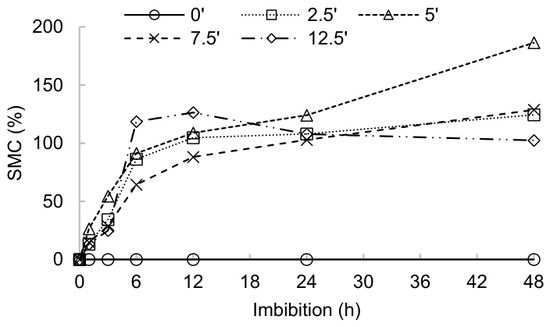
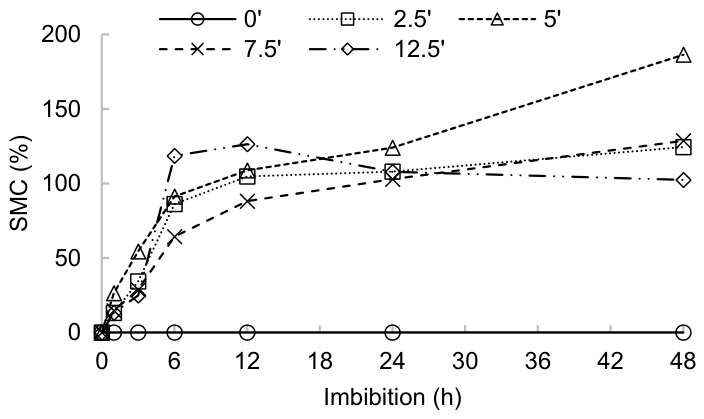
Intact seeds of M. camporum did not absorb water after 48 h of imbibition (Figure 1). Water uptake was evaluated in seeds scarified by immersion in H2SO4 for 2.5, 5.0, 7.5, and 12.5 min, and gradually stabilized after 12 h (Figure 1). Water absorption occurred freely, exhibiting a three-phase pattern according to Bewley and Black [28], with rapid water uptake (Phase I) during the first 12 h, limited water uptake (Phase II) between 12 and 24 h, and restarted water uptake (Phase III) during the final hours (Figure 1).
Figure 1.
Imbibition curve of Mimosa camporum Benth. seeds chemically scarified with H2SO4. Legend: (′) minute, (SMC) seed moisture content, (h) hour.
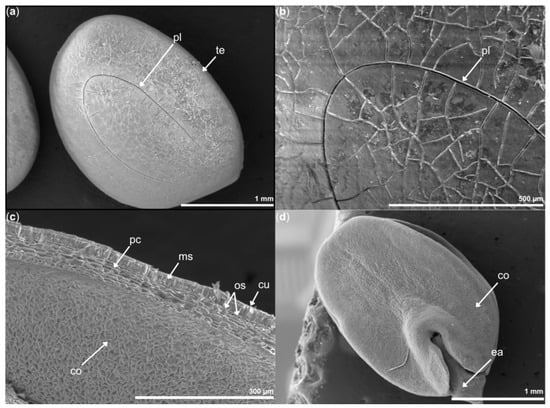
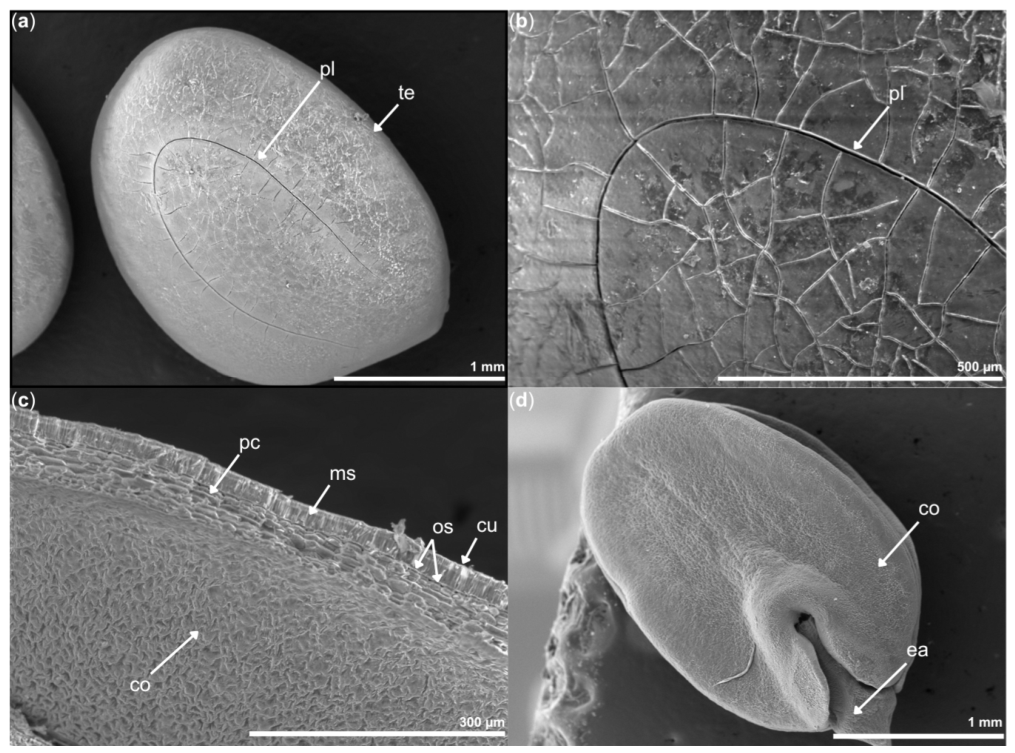
Seeds of M. camporum are stenospemic, bitegmic, exalbuminous and elliptical (Figure 2a), with minimum, average and maximum dimensions of 2.1, 2.6 and 3.8 mm in length, 1.5, 2.0 and 3.0 mm in width, and 0.8, 1.2 and 2.2 mm in thickness, and a dry mass of 0.003, 0.004 and 0.004 g seed−1.
Figure 2.
Scanning electron micrographs of Mimosa camporum Benth. seeds. (a) External view. (b) Details of the pleurogram. (c) Cross-section of the seed (seed coat and cotyledon). (d) Embryo. Legend: (co) cotyledon, (cu) cuticle, (ea) embryonic axis, (ms) macrosclereids, (os) osteosclereids, (pc) parenchymatic cells, (pl) pleurogram, (te) testa.
The seed coat of M. camporum is glabrous, smooth, glossy, and brown, with an elliptical pleurogram; a small, homochromous hilum; a small, homochromic micropyle in relation to the seed, presenting a lateral protuberance indicating the presence of the embryonic axis (Figure 2). The seed coat consists of distinct layers: cuticle (a coating of hydrophobic substances), epidermis (with a compact palisade layer consisting of radially elongated macrosclereids with densely thickened cell walls), hypodermis (hourglass-shaped cells or osteosclereids), and parenchymatic cells (Figure 2c).
The embryo of M. camporum is invaginated, with free, opposite, flat, elliptical, foliaceous cotyledons with entire margins, glabrous, with smooth surfaces, and pale-yellow coloration (Figure 2d). The embryonic axis is differentiated into a short, cylindrical hypocotyl-radicle axis and a plumule with a paripinnate leaf primordium (Figure 2d).
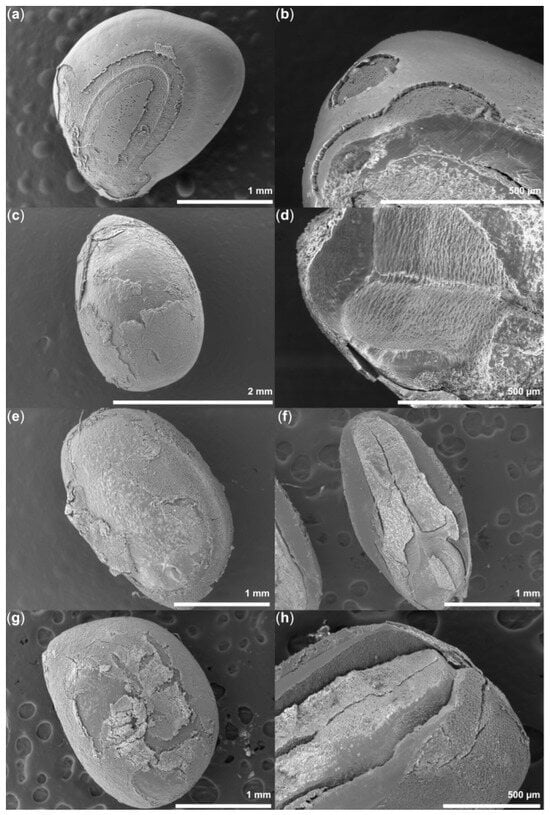
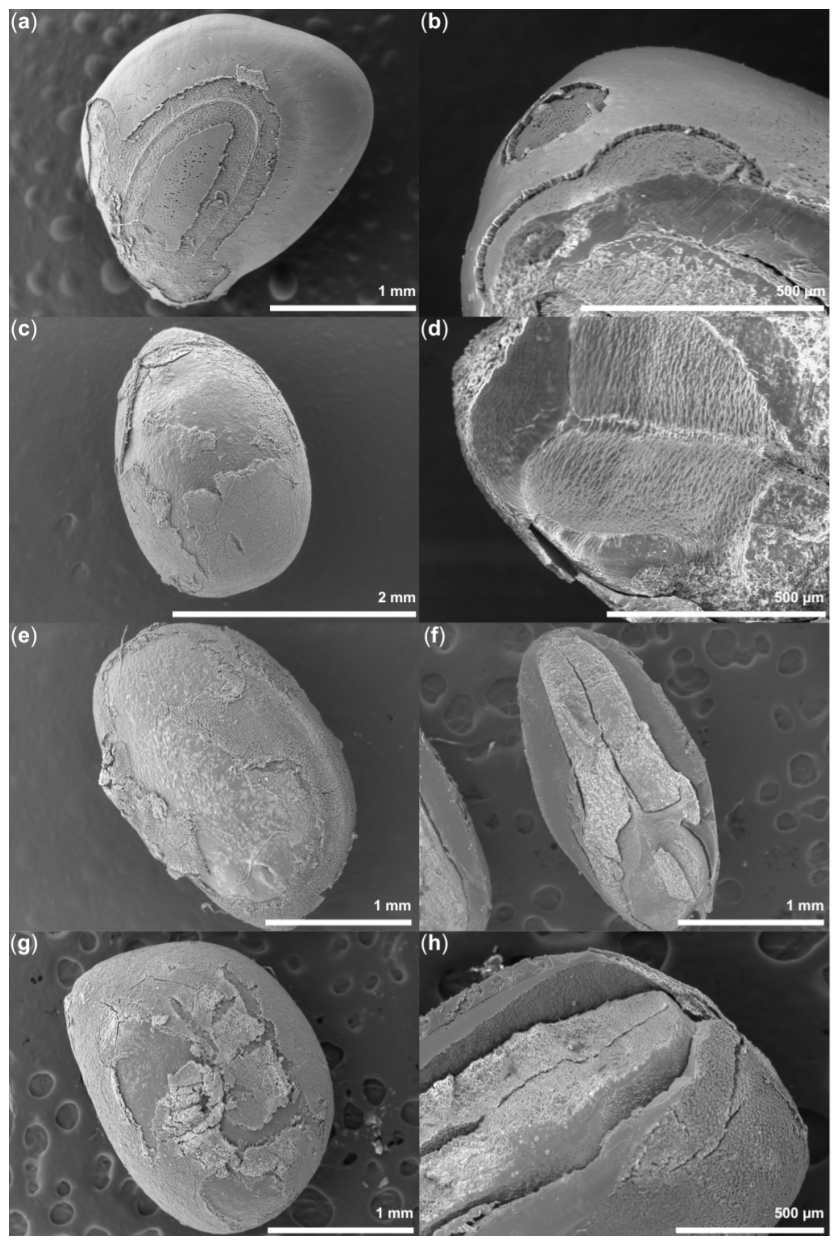
In M. camporum seeds scarified with H2SO4 for 2.5 min, generalized cuticle corrosion (rupture) and the beginning of superficial and localized corrosion of the macrosclereids in the palisade layer of the seed coat epidermis were observed (Figure 3a,b). At 5.0 min, in addition to generalized cuticle corrosion, generalized epidermal corrosion occurred, mainly near the pleurogram, together with a slight hypodermal corrosion (Figure 3c,d). At 7.5 min, besides the rupture of the cuticle and epidermis, generalized hypodermal corrosion and corrosion of the parenchymatic cells of the seed coat and cotyledons were observed (Figure 3e,f). Finally, after 12.5 min, besides the complete degradation of the seed coat, the embryo integrity was compromised (Figure 3g,h).
Figure 3.
Scanning electron micrographs of Mimosa camporum Benth. seeds chemically scarified with H2SO4. (a) External view and (b) cross-section and after 2.5 min, showing rupture of the cuticle and epidermal corrosion; (c) external view and (d) cross-section after 5 min, showing rupture of the cuticle and epidermis; (e) external view and (f) cross-section after 7.5 min, showing rupture of the cuticle, epidermis, and hypodermis and corrosion of the parenchymatic cells of the testa; and (g) external view and (h) cross-section after 12.5 min, showing rupture of the cuticle, epidermis, and hypodermis, with subsequent rupture and corrosion of the embryo (embryonic axis and cotyledon parenchymatic cells).
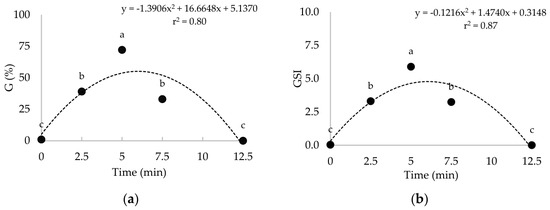
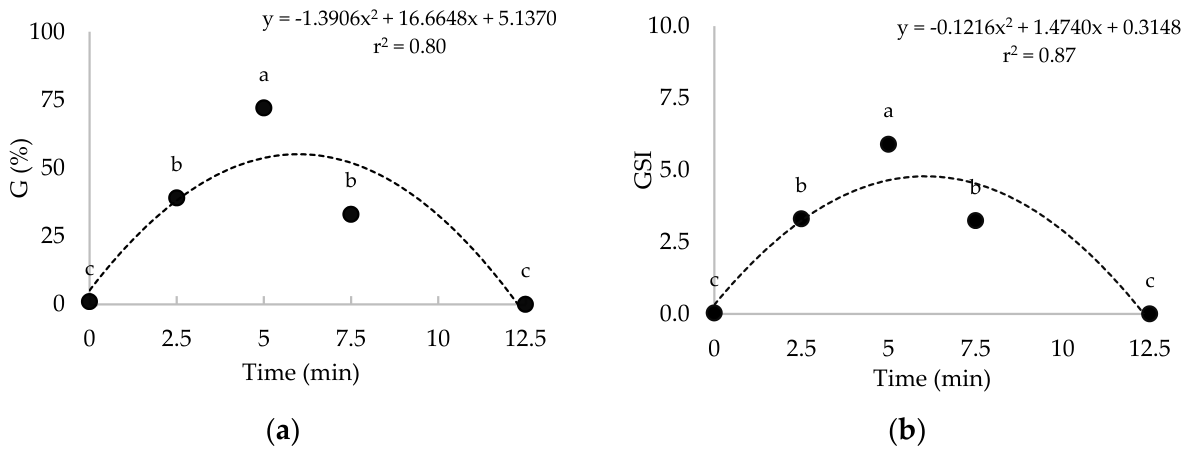
Seeds of M. camporum without scarification and those immersed in H2SO4 for 12.5 min exhibited null or nearly null germination percentage and Germination Speed Index (GSI) (Figure 4a,b). The highest germination percentage and GSI were observed at 5.0 min of immersion in H2SO4, with maximum estimated values occurring at 5.99 and 6.06 min of immersion for germination percentage and GSI, respectively (Figure 4a,b).
Figure 4.
(a) Germination percentage (G) and (b) germination speed index (GSI) of Mimosa camporum Benth. seeds chemically scarified with H2SO4 at different exposure times (0.0, 2.5, 5.0, 7.5 and 12.5 min). Means followed by the same letter do not differ from each other by Tukey’s test (p < 0.05).
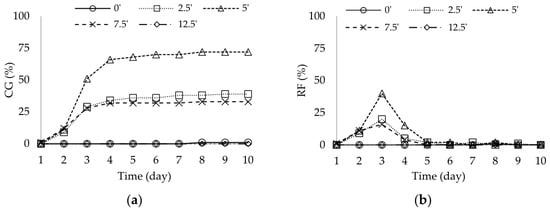
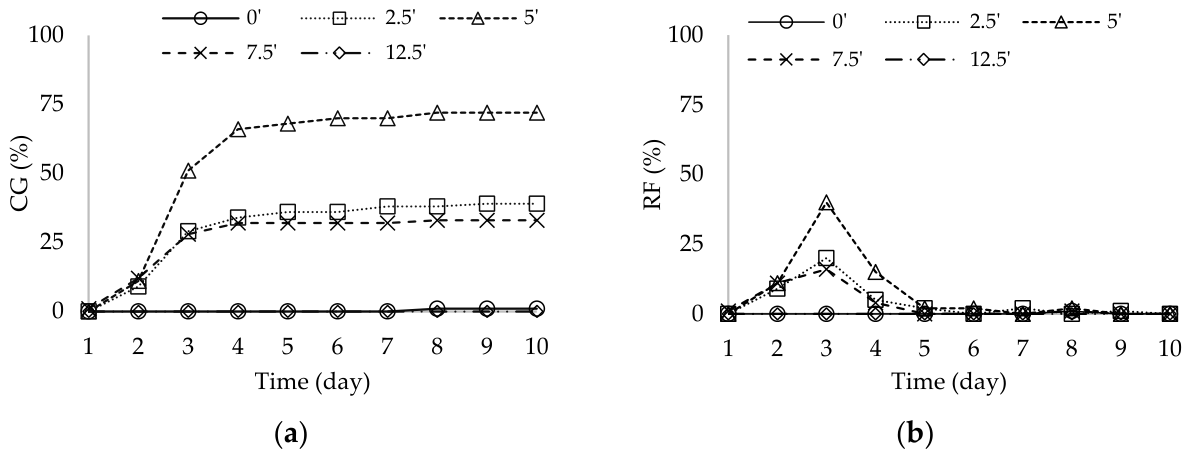
The greatest increase in cumulative germination percentage and the highest peak in germination frequency of M. camporum were observed in seeds immersed in H2SO4 for 5.0 min (Figure 5).
Figure 5.
(a) Cumulative germination frequency (CG) and (b) relative germination frequency (RF) of Mimosa camporum Benth. seeds chemically scarified with H2SO4 at different exposure times (0.0, 2.5, 5.0, 7.5 and 12.5 min).
2.2. Dormancy in Amazonian Mimosa L. Seeds
In the Amazon region, most Mimosa species are shrubs exhibiting epigeal phanerocotylar germination with foliaceous cotyledons, craspedium-type fruits, and orthodox and impermeable seeds associated with the presence of pleurogram and/or palisade layer and/or hardness, occurring in dry environments with savanna vegetation and savanna phytophysiognomy (Table 1).
Table 1.
Morphology, anatomy, water uptake, dormancy types, and ecology of Amazonian Mimosa L. seeds.
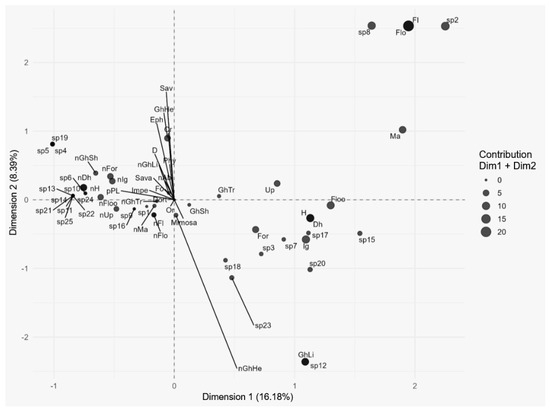
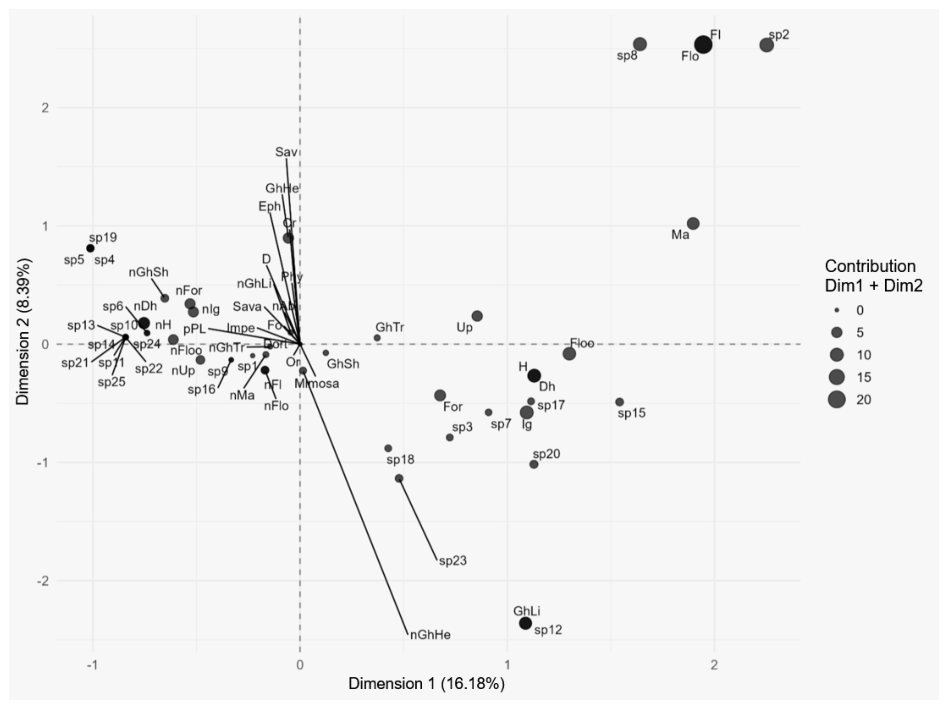
An intersection was observed among the parameters Mimosa genus, dormancy presence, and physical dormancy with craspedium-type fruits, epigeal phanerocotylar germination, presence of pleurogram and/or palisade layer, impermeable seed coats, orthodox seeds, dry environment, savanna vegetation, and savanna phytophysiognomy (Figure 6).
Figure 6.
Multiple correspondence analysis between parameters and classes for Amazonian Mimosa L. Legend: (Dim1) Dimension 1; (Dim2) Dimension 2; Mimosa species: [(sp1) M. acutistipula var. ferrea); (sp2) M. bimucronata; (sp3) M. caesalpiniifolia; (sp4) M. camporum; (sp5) M. carajarum; (sp6) M. claussenii; (sp7) M. daleoides; (sp8) M. diplotricha; (sp9) M. dolens; (sp10) M. echinocaula; (sp11) M. foliolosa; (sp12) M. invisa; (sp13) M. leiocephala; (sp14) M. orthacantha; (sp15) M. pigra; (sp16) M. pteridifolia; (sp17) M. pudica; (sp18) M. schomburgkii; (sp19) M. skinneri; (sp20) M. somnians; (sp21) M. somnians var. viscida; (sp22) M. spixiana; (sp23) M. strobiliflora; (sp24) M. tenuiflora; (sp25) M. verrucosa]; Seed [Desiccation tolerance: (Or) Orthodox, (UnOr) Unorthodox; Dormancy: (Dort) Dormant, (nDort) Non dormant; Pleurogram/Palisade Layer: (pPL) Presence, (abPL) Absence; Seed coat: (Pe) Permeable, (Impe) Impermeable; Type of dormancy: (Phy) Physical; Type of fruit: (Cr) Craspedium; Water absorption: (Ab) Absorbs, (nAb) Does not absorb]; Seedling [Cotyledon: (Fo) Foliaceous, (nFo) Non foliaceous; Seedling type: (Eph) Epigeal phanerocotylar, (nEph) Non epigeal phanerocotylar]; Growth habit [Herbaceous: (GhHe) Yes, (nGhHe) No; Liana: (GhLi) Yes, (nGhLi) No; Shrub: (GhSh) Yes, (nGhSh) No; Tree: (GhTr) Yes, (nGhTr) No]; Environment [Dry: (D) Yes, (nD) No; Dry-humid: (Dh) Yes, (nDh) No; Humid: (H) Yes, (nH) No]; Type of vegetation [Floodplain: (Fl) Yes, (nFl) No; Forest: (For) Yes; (nFor) No; Savanna: (Sav) Yes, (nSa) No]; Phytophysiognomy [Floodplain field: (Flo) Yes, (nFlo) No; Floodplain forest: (Floo) Yes, (nFloo) No; Igapó forest: (Ig) Yes, (nIg) No; Mangrove: (Ma) Yes, (nMa) No; Savanna: (Sava) Yes, (nSava) No; Upland forest: (Up) Yes, (nUp) No].
3. Discussion
3.1. Dormancy in Mimosa camporum Benth. Seeds
Intact seeds of M. camporum did not absorb water freely (Figure 1). Literature data for other Amazonian species of the genus indicate that this is the standard pattern (Table 1), in which impermeability is attributed to the presence of macrosclereids in the palisade layer of the seed coat epidermis [6,24,67,68], as observed in M. camporum (Figure 2). Not only Mimosa species, but also the Fabaceae family, are characterized by physical dormancy conditioned by seed coat impermeability to water and/or gases [2,69,70].
In addition to anatomy, the chemical composition of the seed coat directly influences seed permeability. Lignin contributes to the formation of physical and chemical barriers, protecting the embryo against mechanical damage and pathogens, while also modulating permeability to water and gases [5,71,72]. Furthermore, the cell wall is composed of cellulose, hemicellulose, and hydrophobic substances such as suberin, waxes, and tannins [73,74,75]. Thus, the composition and concentration of these components modulate the physical and physiological properties of plants [76,77].
Immersion of M. camporum seeds in H2SO4 caused disruption of the seed coat barrier (Figure 3), enabling water uptake within the first hour (Figure 1). The effectiveness of scarification in overcoming physical dormancy has been documented for several Mimosa species, including M. bimucronata [78], M. flocculosa Burkart [79], M. scabrella Benth. [80], M. caesalpiniifolia [27,81,82], M. tenuiflora [83], M. ophthalmocentra Mart. ex Benth. [84], and M. verrucosa [66].
In M. camporum seeds scarified with H2SO4 for 5 min, imbibition occurred freely, following the triphasic pattern described by Bewley and Black [28]. Phase I (rapid uptake) extended through the first 12 h, followed by Phase II (limited uptake) between 12 and 24 h, while Phase III (rapid uptake again) occurred after 24 h (Figure 1). For scarified seeds of M. ophthalmocentra, M. flocculosa, M. caesalpiniifolia, and M. verrucosa, Phases I, II, and III began, respectively, at intervals of 1, 7, and 19 h; 1, 6, and 11 h; 2, 12, and 36 h; and 1, 8, and 16 h [66,79,82,84].
Morphologically, the seed coat of M. camporum is glabrous, smooth, glossy, and brown. The pleurogram is elliptical, with small hilum and micropyle homochromous with the seed. Anatomically, the seed coat consists of four distinct layers: cuticle (a coating of hydrophobic substances), epidermis (a compact palisade layer composed of radially elongated macrosclereids with densely thickened cell walls), hypodermis (osteosclereids), and parenchymatic cells (Figure 2c).
This anatomical structure resembles that described for other species of the genus, such as M. flocculosa and M. pudica [6,68]. The presence of a lipidic cuticle and macrosclereids with a lipidic matrix in the palisade layer has also been reported in other Fabaceae species [85,86]. The anatomy and chemistry of the seed coat, especially the cuticle and palisade layer of the seed coat epidermis, determine impermeability and regulate water uptake [1,2,85,86].
During the 48 h water uptake period, seeds subjected to scarification for 2.5, 7.5, and 12.5 min had lower water content than those treated for 5.0 min (Figure 1). In M. camporum seeds scarified with H2SO4 for 2.5 min, generalized cuticle rupture and the beginning of superficial erosion of macrosclereids in the palisade layer were observed (Figure 3a,b). At 5.0 min, in addition to cuticle removal, generalized epidermal rupture occurred, especially near the pleurogram, reaching the hypodermis (Figure 3c,d). At 7.5 min, degradation advanced into the hypodermis, parenchymatic cells, and cotyledonary tissues (Figure 3e,f). Finally, at 12.5 min, total seed coat degradation resulted in loss of embryo integrity (Figure 3g,h).
Sulfuric acid is widely used to overcome physical dormancy in Fabaceae seeds, and immersion time is the determining factor for the success of the technique. Insufficient exposure periods do not adequately disrupt the seed coat, whereas prolonged immersion may compromise embryo integrity, rendering the seeds nonviable. Therefore, the efficiency of the technique is directly associated with the definition of an optimal exposure time that maximizes germination while preserving embryonic tissues [2,5,87].
In this sense, the highest germination percentage and GSI of M. camporum seeds were observed after 5.0 min of immersion in H2SO4. Maximum values for germination percentage and GSI were estimated at 5.99 and 6.06 min, respectively (Figure 4). Beyond these points, both variables decreased quadratically until reaching a minimum at 12.28 min, when embryo integrity was compromised (Figure 4). Several studies have demonstrated that the optimal immersion time for breaking dormancy in Mimosa seeds ranges from 1 to 60 min [35,36,66,68,79,88,89,90,91,92,93,94,95,96,97], reflecting differences in seed coat thickness, cell types, and lipidic matrices among Fabaceae species [5,6,68,86].
Immersion of M. camporum seeds in H2SO4 for 5.0 min promoted the highest germination percentage (72%) (Figure 3a). Similar results were reported for M. bimucronata, in which immersion in H2SO4 for 5 and 10 min produced the most satisfactory results among several scarification methods tested [35]. Similarly, M. verrucosa showed 81% germination after 10 min of acid exposure [66]. In contrast, for M. pudica, the treatment efficiency extended over longer intervals, where times of 1, 5, 15, and 20 min were statistically similar, exceeding 80% germination [97].
Montaño-Arias et al. [98] recommended mechanical scarification for Mimosa species to achieve high germination rates. However, for M. camporum, the present study demonstrated statistically superior performance of chemical scarification (72%) compared with the mechanical abrasion reported by Maciel et al. [17] (62 ± 7.48%). In addition, manual handling of the seeds is difficult and uniform mechanical abrasion is limited due to their small size, making sulfuric acid treatment a more efficient and consistent alternative. Regardless of the method, both processes promote seed coat rupture, favoring imbibition and gas exchange essential for germination [99].
The distribution of relative germination frequency showed a unimodal configuration (Figure 5b), consistent with patterns observed in M. caesalpiniifolia germinated on paper regardless of temperature [100]. Germination intensified on the third day after experiment establishment, reaching stability from the fifth day onward (Figure 5a), especially in the treatment involving immersion in H2SO4 for 5 min.
These results reflect the increase in GSI following immersion in H2SO4. GSI is one of the most important concepts related to seed vigor, as seeds with identical final germination percentages may differ significantly in their rate of establishment [101]. In the context of chemical scarification, GSI may also reflect the extent of damage caused by the chemical agent to the embryo and its nutrient reserves [5].
This phenomenon became evident after 7.5 min of exposure (3.24 ± 0.78), when a marked reduction in GSI was observed compared with the 5 min treatment (5.89 ± 0.62), the most effective. After 12.5 min of exposure, no germination occurred, indicating toxicity (Figure 3g,h). In contrast, Maciel et al. [17] reported a GSI of 14.6 ± 2.98 for the same species using mechanical abrasion, a higher value than that obtained in this study with chemical scarification.
Seed coat deterioration by scarification increases permeability, allowing water diffusion through parenchymatic cells toward the cotyledon periphery and embryo hydration [17,102]. However, rapid water uptake does not always imply a positive response, since it may cause cellular damage, electrolyte leakage, and other conditions that negatively affect germination [102].
This latter behavior was observed in the 12.5 min treatment, in which greater seed coat degradation resulted in higher water content than in the other treatments between 6 and 12 h of imbibition (Figure 1). After this period, this was the only group showing a decline in water content. This decrease is related to embryo damage caused by scarification. Furthermore, this stress started enzymatic degradation, altering the consistency of the embryonic structure from firm to gelatinous, with subsequent fungal and bacterial proliferation. This explains the apparent reduction in water content due to the loss of embryo content and/or parts, rather than an actual loss of water.
Unlike M. luisana, in which intact and scarified seeds absorbed 80% of their total water uptake capacity within 3 h [103], the optimized treatment for M. camporum required approximately 6 h to reach the same hydration level (Figure 1). No water uptake was observed in intact seeds of M. camporum, confirming the effectiveness of chemical scarification in overcoming seed coat impermeability (Figure 1).
3.2. Dormancy in Amazonian Mimosa L. Seeds
In the Amazon region, Mimosa species are predominantly shrubs occurring in dry environments, savanna vegetation, and savanna phytophysiognomy (Table 1). Germination is typically epigeal phanerocotylar with foliaceous cotyledons; fruits are predominantly craspedium-type, and seeds are orthodox and impermeable, associated with the presence of a pleurogram and/or palisade layer (Table 1). According to Flora e Funga do Brasil [29] and speciesLink [49], most Amazonian Mimosa species are savanna shrubs with seeds tolerant to desiccation and physical dormancy associated with seed coat impermeability [6,104,105].
In the Multiple Correspondence Analysis (MCA), the spatial distribution, particularly in the central intersection, associated the genus Mimosa with physical dormancy (seed coat permeability and anatomy) and savanna phytophysiognomy (dry and savanna environments) (Figure 6). This reflects a set of functionally integrated traits favoring persistence, colonization, and responses to recurrent environmental disturbances in savannas, such as fire, smoke, and drought [44,51,106,107,108,109].
Leguminous species characteristic of seasonally dry environments frequently exhibit physical dormancy resulting from the layer of lignified palisade cells and deposition of hydrophobic substances [2,85,110]. The high incidence of this characteristic represents an evolutionary response to the climatic unpredictability of these environments, in which persistence depends on soil seed banks and germination conditioned by environmental triggers such as temperature fluctuations, water availability, and fire, among others [2,106,107,109].
For Mimosa, physical dormancy is an essential adaptive mechanism for survival in seasonal environments because it regulates germination and prevents seedling emergence under unfavorable conditions, such as water deficit [6,44,111,112]. Furthermore, the relationship between savanna phytophysiognomies and physical dormancy in Fabaceae species is common, reinforcing the pattern observed in the MCA (Figure 6) as a reflection of evolutionarily conserved ecological strategies [2,44].
In savannas, the integration among physical dormancy, fruit morphology, and seedling characteristics constitutes a functional axis in plant community structuring, influencing regeneration, establishment, and persistence strategies under seasonal water limitation [108,113,114]. In this context, the craspedium-type fruit, characteristic of several Mimosa species, favors protection and gradual release of seeds and, when associated with physical dormancy, optimizes establishment when environmental conditions are favorable [6,44,115].
Simultaneously, the orthodox nature of Mimosa seeds confers high desiccation tolerance, allowing seeds to remain viable even under low water content and high temperatures, thus ensuring the persistence of the soil seed bank [108]. Within the genus Mimosa, such characteristics are frequent because many species occupy seasonally dry environments and possess hard, impermeable seed coats associated with physical dormancy and high desiccation tolerance. This set of attributes regulates germination in response to moisture pulses, such as the onset of rainfall, ensuring persistence during adverse periods [116].
4. Materials and Methods
4.1. Collection of Plant Material
Fruits and seeds of M. camporum were collected in a savanna area in Macapá, Amapá, Amazon, Brazil (0°03′33.5″ N 51°05′15.5″ W). The species survey, literature review, and both descriptive and statistical seed analyses were conducted at the Laboratory of Seeds and Seedlings, State University of Amapá (UEAP), Macapá, Brazil, and the Laboratory of Drug Research, Federal University of Amapá (UNIFAP), Macapá, Brazil. For the biometric characterization, four replicates of 25 seeds were measured using calipers (0.05 mm precision). Additionally, to determine seed weight, 100 seeds were weighed individually using an analytical balance (0.0001 g precision).
According to the Köppen–Geiger climate classification, the climate in Macapá is classified as Aw, corresponding to a tropical climate characterized by two distinct seasons: winter (“Inverno Amazônico”) (December to August), with peak rainfall occurring in March, and summer (“Verão Amazônico”) (September to November), characterized by high temperatures and low precipitation [117,118]. The phytophysiognomy of the urban area of Macapá consists predominantly of cerrado vegetation (savanna), with dispersed woody flora adapted to adverse environmental conditions and resistant to seasonal fires [119]. The soils in the region are predominantly classified as Yellow Latosol (Oxisol), characterized by low natural fertility [119].
4.2. Dormancy in Mimosa camporum Benth. Seeds
The fruits were dried in the shade for 24 h and manually processed by twisting the legumes. Only intact seeds were selected, excluding those visibly predated. To overcome physical dormancy, groups of 100 seeds per treatment were immersed in sulfuric acid (H2SO4, ACS grade, 98% purity, Impex® Analytical Reagents, São Paulo, Brazil) at a ratio of 10 mL of acid per group to ensure full submersion. The exposure periods evaluated were 0, 2.5, 5, 7.5, and 12.5 min. Immediately after each period, the acid was drained, and the seeds were rinsed three times in 50 mL of distilled and deionized water (5 min per rinse) under constant agitation to ensure the complete removal of chemical residues.
The imbibition curve was determined using three replicates of 10 seeds per treatment. Seeds were placed in Petri dishes (10 cm) on two sheets of germination paper moistened with distilled and deionized water (2.5 times the dry weight of the paper) and maintained at 30 °C [120,121]. Seed mass measurements were obtained using an analytical balance (0.0001 g precision) at intervals of 0, 1, 3, 6, 12, 24, and 48 h. The SMC was calculated according to the following equation [122]:
where SMC is the seed moisture content (water absorption percentage), Fm is the fresh mass of the seeds after immersion and Pi is the initial fresh mass of the seeds before immersion.
SMC = [(Fm − Pi)/Pi] × 100
For the description of seed morphology and seed coat anatomy before and after chemical scarification, whole seeds and seeds transversely sectioned using a steel blade were utilized [123]. The samples were subsequently analyzed using a tabletop scanning electron microscope (HITACHI® TM3030Plus, São Paulo, Brazil) [123].
The germination test was conducted using four replicates of 25 seeds placed in Petri dishes (10 cm) on two sheets of germination paper moistened with distilled and deionized water (2.5 times the dry weight of the paper) and maintained at 30 °C under a 12 h photoperiod [121].
Daily counts were performed at the same hour for 10 days. Germination percentage was calculated according to the following equation [124]:
where G is the germination percentage, ni is the total number of germinated seeds on day i, and N is the total number of seeds placed to germinate. GSI was calculated according to the following equation [125]:
where GSI is germination speed index, ni is the number of seeds germinated at time i, and ti is the time passed from the beginning of the test. The relative germination frequency was calculated according to the following equation [126]:
where RF is the relative germination frequency, ni is the total number of germinated seeds on day i, and Σni is the total number of germinated seeds. The cumulative germination frequency is the sum of the relative frequencies over the period of the experiment.
G = (Σni/N) × 100
GSI = Σ(ni/ti)
RF = ni/Σni
The experimental design was completely randomized. Data were subjected to analysis of variance (ANOVA), and when significant according to the F test, means were compared using Tukey’s test (p < 0.05). Regression equations were fitted for the seed immersion times in H2SO4. Statistical analyses were performed using the vegan package in R software (version 4.5.3) [127,128].
4.3. Dormancy in Amazonian Mimosa L. Seeds
According to Checklist of the Plants of the Guianas [39,40], Plants of the World Online [33], Flora e Funga do Brazil [29], speciesLink [49], Atlas of Living Australia [32], and C. V. Starr Virtual Herbarium [31], 118 species of Mimosa have been recorded in the Amazon region. Following a review of online herbarium databases, including speciesLink [49] and C. V. Starr Virtual Herbarium [31], as well as exsiccates available from HAMAB, an herbarium belonging to the Institute of Scientific and Technological Research of the State of Amapá (IEPA), 25 species presenting 100% of the required information were selected.
The 13 qualitative characters were defined by the authors and comprised environmental, phytophysiognomic, ecological, morphological, and physiological information related to the seeds/seedlings. The following parameters and classifications were evaluated: 1. Fruit type (Fabaceae): legume, moniliform, follicle, nucoid, bacaceous, craspedium, loment, samara, samaroid, drupaceous, cryptoloment, and cryptosamara [129]; 2. Pleurogram: presence or absence [130]; 3. Water uptake: yes or no [1]; 4. Seed coat: permeable or impermeable [1]; 5. Desiccation tolerance: orthodox and unorthodox (intermediate or recalcitrant) [1]; 6. Dormancy: presence or absence [2]; 7. Dormancy type: non-dormant, physiological dormancy, physical dormancy, morphological dormancy, morphophysiological dormancy, and combined dormancy [2]; 8. Seedling type: epigeal phanerocotylar or non-epigeal phanerocotylar (epigeal cryptocotylar, hypogeal cryptocotylar, or hypogeal phanerocotylar) [131]; 9. Cotyledon type: foliaceous or storage cotyledons [132]; 10. Growth habit: tree, shrub, herbaceous and liana [131]; 11. Environment: dry, humid or humid-dry [133]; 12. Vegetation type (homogeneity): floodplain, forest or savanna [133]; and 13. Phytophysiognomy: savanna, floodplain field, upland forest, transition forest, floodplain forest, igapó forest and mangrove [133,134].
Initially, percentages were calculated for the parameters described above. Subsequently, the joint relationship between dormancy occurrence and the qualitative characters was explored through MCA, aiming to understand the relationships among qualitative variables based on spatial proximity [135,136,137]. In MCA, analyses are performed using multidimensional tables in which rows represent observations (species) and columns represent the different categories of distinct variables [138,139]. This method was selected due to the nature of the data (categorical) and the large number of variables (qualitative characters), and analyses were performed in R software using the FactoMineR and factoextra 2.0.0 packages [128,140,141].
5. Conclusions
Immersion in H2SO4 for 5 min is adequate to break dormancy in Mimosa camporum Benth. seeds.
In Mimosa camporum Benth., sulfuric acid scarification effectively promoted water uptake and germination, demonstrating the close relationship between seed anatomy, imbibition behavior, and dormancy regulation.
Physical dormancy in Amazonian Mimosa L. species is directly associated with seed coat impermeability, especially the presence of macrosclereids in the palisade layer.
In the Amazon, the reproductive success and resilience of Mimosa L. species are related to the physical dormancy and desiccation tolerance of their seeds.
Author Contributions
Conceptualization, M.M.d.S. and B.M.d.S.e.S.; methodology, M.M.d.S. and B.M.d.S.e.S.; software, V.F.G.d.S., J.V.T.A.C. and B.M.d.S.e.S.; validation, M.M.d.S. and B.M.d.S.e.S.; formal analysis, V.F.G.d.S., J.V.T.A.C. and B.M.d.S.e.S.; investigation, M.M.d.S. and A.G.d.N.M.; data curation, M.M.d.S. and B.M.d.S.e.S.; writing—original draft preparation, M.M.d.S., J.V.T.A.C. and B.M.d.S.e.S.; writing—review and editing, M.M.d.S. and B.M.d.S.e.S.; visualization, M.M.d.S. and B.M.d.S.e.S.; supervision, M.M.d.S. and B.M.d.S.e.S.; project administration, M.M.d.S. and B.M.d.S.e.S.; resources, B.M.d.S.e.S., funding acquisition, M.M.d.S. All authors have read and agreed to the published version of the manuscript.
Funding
This study was financed in part by the Coordenação de Aperfeiçoamento de Pessoal de Nível Superior—Brasil (CAPES)—Finance Code 001.
Data Availability Statement
The original contributions presented in this study are included in the article. Further inquiries can be directed to the corresponding author.
Acknowledgments
This article is part of the first author’s doctoral dissertation. The authors express their gratitude to the Postgraduate Program in Biodiversity and Biotechnology (Rede BIONORTE), through the Federal University of Amapá (UNIFAP), for the opportunity to develop this research. We are also grateful to the Laboratory of Drug Research at UNIFAP for the technical assistance with the Scanning Electron Microscopy analyses. We also thank the State University of Amapá (UEAP) for providing the laboratory facilities, reagents, financial resources, and the support of the technical staff for the development of this research.
Conflicts of Interest
The authors declare no conflicts of interest.
References
- Carvalho, N.M.; Nakagawa, J. Sementes: Ciência, Tecnologia e Produção, 5th ed.; Funep: Jaboticabal, Brazil, 2012. [Google Scholar]
- Baskin, C.C.; Baskin, J.M. Seeds: Ecology, Biogeography, and Evolution of Dormancy and Germination, 2nd ed.; Elsevier/AP: San Diego, CA, USA, 2014. [Google Scholar]
- Marcos Filho, J. Fisiologia de Sementes de Plantas Cultivadas; Abrates: Londrina, Brazil, 2015. [Google Scholar]
- Sajeev, N.; Koornneef, M.; Bentsink, L. A Commitment for Life: Decades of Unraveling the Molecular Mechanisms behind Seed Dormancy and Germination. Plant Cell 2024, 36, 1358–1376. [Google Scholar] [CrossRef] [Scilit] [PubMed]
- Silva, B.M.S.; Silva, C.O.; Môro, F.V.; Vieira, R.D. Seed Anatomy and Water Uptake and Their Relation to Seed Dormancy of Ormosia paraensis Ducke. J. Seed Sci. 2018, 40, 237–245. [Google Scholar] [CrossRef] [Scilit]
- Tang, L.; Baskin, C.; Baskin, J.; Luo, K.; Yu, X.; Huang, W.; Zhang, R.; Chen, Y. Methods of Breaking Physical Dormancy in Seeds of the Invasive Weed Mimosa pudica (Fabaceae) and a Comparison with 36 Other Species in the Genus. PeerJ 2022, 10, e13567. [Google Scholar] [CrossRef] [Scilit] [PubMed]
- Daibes, L.F.; Pausas, J.G.; Bonani, N.; Nunes, J.; Silveira, F.A.O.; Fidelis, A. Fire and Legume Germination in a Tropical Savanna: Ecological and Historical Factors. Ann. Bot. 2019, 123, 1219–1229. [Google Scholar] [CrossRef] [Scilit] [PubMed]
- Jaganathan, G.K.; Biddick, M. Experimental Warming Hastens Physical Dormancy Break and Germination in Tropical Fabaceae. Front. Plant Sci. 2021, 12, 782706. [Google Scholar] [CrossRef] [Scilit] [PubMed]
- Saini, H.P.; Meena, M.; Sahoo, A.; Mehta, T. A Review on Fungal Endophytes of the Family Fabaceae, Their Metabolic Diversity and Biological Applications. Heliyon 2025, 11, e42153. [Google Scholar] [CrossRef] [Scilit] [PubMed]
- Simon, M.F.; Grether, R.; Queiroz, L.P.; Särkinen, T.E.; Dutra, V.F.; Hughes, C.E. The Evolutionary History of Mimosa (Leguminosae): Toward a Phylogeny of the Sensitive Plants. Am. J. Bot. 2011, 98, 1201–1221. [Google Scholar] [CrossRef] [Scilit] [PubMed]
- Azani, N.; Babineau, M.; Bailey, C.D.; Banks, H.; Barbosa, A.R.; Pinto, R.B.; Boatwright, J.S.; Borges, L.M.; Brown, G.K.; Bruneau, A.; et al. A New Subfamily Classification of the Leguminosae Based on a Taxonomically Comprehensive Phylogeny: The Legume Phylogeny Working Group (LPWG). Taxon 2017, 66, 44–77. [Google Scholar] [CrossRef] [Scilit]
- Majeed, I.; Rizwan, K.; Ashar, A.; Rasheed, T.; Amarowicz, R.; Kausar, H.; Zia-Ul-Haq, M.; Marceanu, L.G. A Comprehensive Review of the Ethnotraditional Uses and Biological and Pharmacological Potential of the Genus Mimosa. Int. J. Mol. Sci. 2021, 22, 7463. [Google Scholar] [CrossRef] [Scilit] [PubMed]
- Rizwan, K.; Majeed, I.; Bilal, M.; Rasheed, T.; Shakeel, A.; Iqbal, S. Phytochemistry and Diverse Pharmacology of Genus Mimosa: A Review. Biomolecules 2022, 12, 83. [Google Scholar] [CrossRef] [Scilit] [PubMed]
- Citadini-Zanette, V.; Negrelle, R.R.B.; Leal-Filho, L.S.; Remor, R.; Elias, G.A.; Santos, R. Mimosa scabrella Benth. (Fabaceae) Enhances the Restoration in Coal Mining Areas in the Atlantic Rainforest. Cerne 2017, 23, 103–114. [Google Scholar] [CrossRef] [Scilit]
- Montaño-Arias, S.A.; Camargo-Ricalde, S.L.; Grether, R.; Díaz-Pontones, D. Seed Morphology, Anatomy and Histochemistry in Two Mexican Species of Mimosa (Leguminosae, Mimosoid Clade). Flora 2022, 286, 151970. [Google Scholar] [CrossRef] [Scilit]
- Mattos, C.M.J.; Silva, W.L.S.; Carvalho, C.S.; Lima, A.N.; Faria, S.M.; Lima, H.C. Flora das Cangas da Serra dos Carajás, Pará, Brasil: Leguminosae. Rodriguésia 2018, 69, 1147–1220. [Google Scholar] [CrossRef] [Scilit]
- Maciel, G.P.; Caldeira, C.F.; Gastauer, M.; Ribeiro, P.G.; Silva, G.M.; Ramos, S.J. Morphological Characteristics and Germination of Native Species Seeds for Mineland Rehabilitation in the Eastern Amazon. New For. 2023, 54, 769–787. [Google Scholar] [CrossRef] [Scilit]
- Lowe, S.; Browne, M.; Boudjelas, S.; De Poorter, M. 100 of the World’s Worst Invasive Alien Species: A Selection from the Global Invasive Species Database; The Invasive Species Specialist Group (ISSG): Auckland, New Zealand, 2000. [Google Scholar]
- Global Invasive Species Database (GISD). Available online: https://www.iucngisd.org/gisd/ (accessed on 4 May 2026).
- Walden, D.; van Dam, R.; Finlayson, C.; Storrs, M.; Lowry, J.; Kriticos, D. A Risk Assessment of the Tropical Wetland Weed Mimosa pigra in Northern Australia. In Research and Management of Mimosa pigra; Julien, M., Flanagan, G., Heard, T., Hennecke, B., Paynter, Q., Wilson, C., Eds.; CSIRO Entomology: Canberra, ACT, Australia, 2004; pp. 11–21. [Google Scholar]
- Kato-Noguchi, H. Invasive Mechanisms of One of the World’s Worst Alien Plant Species Mimosa pigra and Its Management. Plants 2023, 12, 1960. [Google Scholar] [CrossRef] [Scilit] [PubMed]
- Wang, Q.; Zhang, C.-H.; Wang, C.-J.; Wan, J.-Z. Complete Chloroplast Genome Data for Mimosa diplotricha and Mimosa diplotricha var. inermis from China. Data Brief 2023, 48, 109045. [Google Scholar] [CrossRef] [Scilit] [PubMed]
- Uyi, O. Mimosa diplotricha: A Review and Synthesis of Its Problems and Control Options. In Invasive Species Reviews: 2018–2024; Hemming, D., Ed.; CABI: Wallingford, UK, 2025; pp. 115–125. [Google Scholar]
- Kharel, N.; Dangol, A.; Shrestha, A.; Airi, H.; Devkota, A.; Thapa, L.B.; Shrestha, B.B. Germination Patterns and Seedling Growth of Congeneric Native and Invasive Mimosa Species: Implications for Risk Assessment. Ecol. Evol. 2024, 14, e11312. [Google Scholar] [CrossRef] [Scilit] [PubMed]
- Cruz, E.D.; Carvalho, J.E.U.; Queiroz, R.J.B. Scarification with Sulphuric Acid of Schizolobium amazonicum Huber Ex Ducke Seeds—Fabaceae. Sci. Agric. 2007, 64, 308–313. [Google Scholar] [CrossRef] [Scilit]
- Giasson, C.; Baretta, C.R.D.M.; Sobral, L.S.; Baldissera, R. Dormancy Breaking, Germination, and Production of Mimosa bimucronata (DC.) Kuntze Seedlings. Cerne 2019, 25, 68–75. [Google Scholar] [CrossRef] [Scilit]
- Medeiros, H.L.S.; Benedito, C.P.; Dantas, N.B.L.; Couto Júnior, J.R.S.; Ramalho, L.B. Dormancy Overcoming and Preconditioning in Mimosa caesalpiniifolia Benth. Seeds. Rev. Caatinga 2020, 33, 720–727. [Google Scholar] [CrossRef] [Scilit]
- Bewley, J.D.; Black, M. Seeds: Physiology of Development and Germination; Springer: Boston, MA, USA, 1994. [Google Scholar]
- Flora e Funga do Brasil. Available online: https://floradobrasil.jbrj.gov.br/consulta/#CondicaoTaxonCP (accessed on 15 December 2025).
- Ramos, S.J.; Caldeira, C.F.; Gastauer, M.; Costa, D.L.P.; Furtini Neto, A.E.; Souza, F.B.M.; Souza Filho, P.W.M.; Siqueira, J.O. Native Leguminous Plants for Mineland Revegetation in the Eastern Amazon: Seed Characteristics and Germination. New For. 2019, 50, 859–872. [Google Scholar] [CrossRef] [Scilit]
- C. V. Starr Virtual Herbarium. Available online: https://sweetgum.nybg.org/science/vh/ (accessed on 18 December 2025).
- Atlas of Living Australia. Available online: http://www.ala.org.au (accessed on 20 December 2025).
- Plants of the World Online. Available online: https://powo.science.kew.org (accessed on 15 December 2025).
- Carvalho, P.E.R. Maricá—Mimosa Bimucronata; Embrapa Florestas. Circular Técnica, 94; Embrapa Florestas: Colombo, Brazil, 2004. [Google Scholar]
- Santos, J.C.C.; Lima, A.N.S.; Silva, D.M.R.; Costa, R.N.; Amorim, D.J.; Silva, J.V.; Neto, A.L.S. Análise Biométrica Multidimensional Com Tratamentos Pré-Germinativos Em Sementes E Caracterização Morfológica De Plântulas De Mimosa bimucronata (De Candolle) Otto Kuntze. Rev. Ciênc. Agrár. 2019, 42, 418–429. [Google Scholar] [CrossRef]
- Silva, M.L.; Freitas, R.M.O.; Neto, J.A.R.; Dallabona, J.L.; Farias, R.M. Emergência E Desenvolvimento Inicial De Plântulas De Mimosa caesalpiniifolia Benth. Rev. Verde Agroecol. Desenvolv. Sustent. 2012, 7, 199–204. [Google Scholar]
- Vasconcelos, A.D.M.; Santos, M.L.; Rosa, R.C.; Araújo, E.A.A.; Martins, W.B.R.; Raddatz, D.D.; Oliveira, R.J. Que-bra De Dormência, Ermergência E Vigor Em Sementes De Mimosa caesalpiniifolia Benth (Fabaceae). In Engenharia Florestal: Contribuições, Análises E Práticas Em Pesquisa; Oliveira, R.J., Ed.; Editora Científica Digital: São Paulo, Brazil, 2022; pp. 203–212. [Google Scholar]
- Carvalho, P.E.R. Sabiá—Mimosa caesalpiniifolia; Embrapa Florestas. Circular Técnica, 135; Embrapa Florestas: Colombo, Brazil, 2007. [Google Scholar]
- Boggan, J.; Funk, V.; Kelloff, C.; Hoff, M.; Cremers, G.; Feuillet, C. Checklist of the Plants of the Guianas (Guyana, Surinam, French Guiana), 1st ed.; Smithsonian Institution: Washington, DC, USA, 1992. [Google Scholar]
- Boggan, J.; Funk, V.; Kelloff, C.; Hoff, M.; Cremers, G.; Feuillet, C. Checklist of the Plants of the Guianas (Guyana, Surinam, French Guiana), 2nd ed.; Smithsonian Institution: Washington, DC, USA, 1997. [Google Scholar]
- Parra, P. Estudio De La Morfología Externa De Plántulas De Calliandra gracilis, Mimosa albida, Mimosa arenosa, Mimosa camporum y Mimosa tenuiflora. Rev. Fac. Agron. 1984, 13, 311–350. [Google Scholar]
- Zanetti, M.; Dayrell, R.L.C.; Wardil, M.V.; Damasceno, A.; Fernandes, T.; Castilho, A.; Santos, F.M.G.; Silveira, F.A.O. Seed Functional Traits Provide Support for Ecological Restoration and Ex Situ Conservation in the Threatened Amazon Ironstone Outcrop Flora. Front. Plant Sci. 2020, 11, 599496. [Google Scholar] [CrossRef] [Scilit] [PubMed]
- Lima, M.P.M. Morfología Dos Frutos e Sementes Dos Gêneros Da Tribo Mimoseae (Leguminosae-Mimosoideae) Aplicada à Sistemática. Rodriguésia 1985, 37, 53–78. [Google Scholar] [CrossRef] [Scilit]
- Daibes, L.F.; Martins, A.R.; Silveira, F.A.O.; Fidelis, A. Seed Tolerance to Post-Fire Temperature Fluctuation of Cerrado Legume Shrubs with Micromorphological Implications. Flora 2021, 275, 151761. [Google Scholar] [CrossRef] [Scilit]
- Iwazaki, M.C. Frutos, Sementes E Plântulas De Três Espécies De Mimosa Linnaeus (Fabaceae: Mimosoideae): Aspectos Morfoanatômicos E Considerações Ecológico-Filogenéticas. Master’s Dissertation, Universidade Es-tadual Paulista, São Paulo, Brazil, 2008. [Google Scholar]
- Voltz, R.R.; Carpanezzi, A.A. Quebra de Dormência de Sementes de Mimosa Daleoides; Embrapa Florestas. Comunicado Técnico, 362; Embrapa Florestas: Colombo, Brazil, 2015. [Google Scholar]
- Dutra, V.F. Diversidade de Mimosa L. (Leguminosae) Nos Campos Rupestres De Minas Gerais: Taxonomia, Distribuição Geográfica E Filogeografia. Ph.D. Thesis, Universidade Federal de Viçosa, Viçosa, Brazil, 2009. [Google Scholar]
- Tanimola, O.O.; Awodoyin, R.O. Germination of Mimosa diplotricha C. Wright and Its Critical Period of Interference with Maize (Zea mays L.) in Ibadan, Nigeria. Afr. J. Agric. Technol. Environ. 2020, 9, 62–72. [Google Scholar]
- SpeciesLink. Available online: https://specieslink.net (accessed on 18 December 2025).
- Leal, L.; Biondi, D. Comportamento Germinativo De Sementes De Mimosa dolens Vell. Publ. UEPG Ci. Exatas Terra Ci. Agr. Eng. 2007, 13, 37–43. [Google Scholar]
- Zirondi, H.L.; Silveira, F.A.O.; Fidelis, A. Fire Effects on Seed Germination: Heat Shock and Smoke on Permeable vs. Impermeable Seed Coats. Flora 2019, 253, 98–106. [Google Scholar] [CrossRef] [Scilit]
- Silveira, F.A.O.; Fernandes, G.W. Effect of Light, Temperature and Scarification on the Germination of Mimosa foliolosa (Leguminosae) Seeds. Seed Sci. Technol. 2006, 34, 585–592. [Google Scholar] [CrossRef] [Scilit]
- Nkumah, O.C.; Chisom, I.F.; Clement, O.U.; Maureen, C.O. The Effect of Heat Treatment at Different Time Intervals on the Invitro Germination of Mimosa invisa. Res. J. Agric. Environ. Sci. 2015, 2, 18–22. [Google Scholar]
- Uko, I.; Ekeleme, F.; Amadioha, A.C.; Chukwu, L.I. Effect of Residue Management Practices and Weed Control Methods on the Emergence Pattern and Density of Mimosa invisa Mart. in Cassava Farm. Int. J. Agric. Environ. Biores. 2025, 10, 120–138. [Google Scholar] [CrossRef] [Scilit]
- Jayasuriya, K.M.G.G.; Wijetunga, A.S.T.B.; Baskin, J.M.; Baskin, C.C. Seed Dormancy and Storage Behaviour in Tropical Fabaceae: A Study of 100 Species from Sri Lanka. Seed Sci. Res. 2013, 23, 257–269. [Google Scholar] [CrossRef] [Scilit]
- Marambe, B.; Amarasinghe, L.; Silva, K.; Gamage, G.; Dissanayake, S.; Seneviratne, A. Distribution, Biology And Management of Mimosa pigra in Sri Lanka. In Research and Management of Mimosa pigra; Julien, M., Flanagan, G., Heard, T., Hennecke, B., Paynter, Q., Wilson, C., Eds.; CSIRO Entomology: Canberra, ACT, Australia, 2004; pp. 85–90. [Google Scholar]
- Souza, L.A.G. Guia da Biodiversidade de Fabaceae Do Alto Rio Negro; Instituto Nacional de Pesquisas da Amazônia: Manaus, Brazil, 2012. [Google Scholar]
- Sperandio, H.V.; Lopes, J.C.; Matheus, M.T. Superação de Dormência Em Sementes de Mimosa setosa Benth. Comun. Sci. 2013, 4, 385–390. [Google Scholar]
- Salomão, A.N. Tropical Seed Species’ Responses to Liquid Nitrogen Exposure. Braz. J. Plant Physiol. 2002, 14, 133–138. [Google Scholar] [CrossRef] [Scilit]
- Gurski, E.M. Distribuição Geográfica, Fenologia E Germinação De Mimosa strobiliflora Burkart, Espécie Criticamente Ameaçada De Extinção. Master’s Dissertation, Universidade Federal do Paraná, Curitiba, Brazil, 2023. [Google Scholar]
- Biondi, D.; Leal, L. Tratamentos pré-germinativos em sementes de Mimosa strobiliflora Burkart. Sci. Agrar. 2008, 9, 245–248. [Google Scholar] [CrossRef] [Scilit]
- Medeiros, T.D.S.; Ferreira, C.D.; Freire, A.L.D.O.; Arriel, E.F.; Bakke, I.A. Aspectos Dendrológicos de Espécies Arbóreas Da Caatinga. Conjecturas 2022, 22, 338–357. [Google Scholar] [CrossRef] [Scilit]
- Santos, C.S.; Lima, A.T.; Meiado, M.V. Efeito Da Hidratação Descontínua Em Sementes de Mimosa tenuiflora (Willd.) Poir. (Fabaceae) Submetidas a Déficit Hídrico Durante a Germinação. Inf. ABRATES 2018, 28, 71–75. [Google Scholar]
- Walter, L.S.; Gabira, M.M.; Nogueira, A.C. Envelhecimento Acelerado Em Sementes de Mimosa tenuiflora (Willd.) Poir. seeds. Rev. For. Mesoam. Kurú 2019, 16, 51–57. [Google Scholar] [CrossRef] [Scilit]
- Azevedo, S.M.A.; Bakke, I.A.; Bakke, O.A.; Freire, A.L.d.O. Crescimento de Plântulas de Jurema Preta (Mimosa tenuiflora (Wild) Poiret) Em Solos de Áreas Degradadas Da Caatinga. Eng. Ambient. 2012, 9, 150–160. [Google Scholar]
- Silva, J.C.; Gomes, R.A.; Silva, P.P.; Pelacani, C.R.; Dantas, B.F. Germinação E Armazenamento De Sementes De Mimosa verrucosa Benth. Rev. DELOS 2024, 17, e1317. [Google Scholar] [CrossRef] [Scilit]
- Souza, T.V.; Torres, I.C.; Steiner, N.; Paulilo, M.T.S. Seed Dormancy in Tree Species of the Tropical Brazilian Atlantic Forest and Its Relationships with Seed Traits and Environmental Conditions. Braz. J. Bot. 2015, 38, 243–264. [Google Scholar] [CrossRef] [Scilit]
- Ribeiro, M.I.; Rodrigues, G.A.G.; Mathias, G.L.; Silva, S.M.; Corsato, J.M.; Fortes, A.M.T. Effect of Seed Coat Rupture on the Germination of Mimosa flocculosa Burkart (Leguminosae) Seeds. Hoehnea 2020, 47, e072020. [Google Scholar] [CrossRef] [Scilit]
- Geisler, G.E.; Pinto, T.T.; Santos, M.; Paulilo, M.T.S. Seed Structures in Water Uptake, Dormancy Release, and Germination of Two Tropical Forest Fabaceae Species with Physically Dormant Seeds. Braz. J. Bot. 2017, 40, 67–77. [Google Scholar] [CrossRef] [Scilit]
- Soltani, E.; Baskin, J.M.; Baskin, C.C.; Benakashani, F. A Meta-Analysis of the Effects of Treatments Used to Break Dormancy in Seeds of the Megagenus Astragalus (Fabaceae). Seed Sci. Res. 2020, 30, 224–233. [Google Scholar] [CrossRef] [Scilit]
- Cavallaro, V.; Maucieri, C.; Patanè, C.; Fascella, G.; Pellegrino, A.; Barbera, A.C. Polyphenols Leaching and Seed Dormancy in Carob (Ceratonia siliqua L.) in Relation to Hot Water Treatment. Acta Physiol. Plant. 2021, 43, 141. [Google Scholar] [CrossRef] [Scilit]
- Hyvärinen, L.; Fuchs, C.; Utz-Pugin, A.; Gully, K.; Megies, C.; Holbein, J.; Iwasaki, M.; Demonsais, L.; Capitão, M.B.; Barberon, M.; et al. Temperature-Dependent Polar Lignification of a Seed Coat Suberin Layer Promoting Dormancy in Arabidopsis thaliana. Proc. Natl. Acad. Sci. USA 2025, 122, e2413627122. [Google Scholar] [CrossRef] [Scilit] [PubMed]
- Woolfson, K.N.; Esfandiari, M.; Bernards, M.A. Suberin Biosynthesis, Assembly, and Regulation. Plants 2022, 11, 555. [Google Scholar] [CrossRef] [Scilit] [PubMed]
- Souza, W.R.; Mitchell, R.A.C.; Cesarino, I. Editorial: The Plant Cell Wall: Advances and Current Perspectives. Front. Plant Sci. 2023, 14, 1235749. [Google Scholar] [CrossRef] [Scilit] [PubMed]
- Zhang, L.; Gao, C.; Gao, Y.; Yang, H.; Jia, M.; Wang, X.; Zhang, B.; Zhou, Y. New Insights into Plant Cell Wall Functions. J. Genet. Genom. 2025, 52, 1308–1324. [Google Scholar] [CrossRef] [Scilit] [PubMed]
- Cosgrove, D.J. Plant Cell Wall Extensibility: Connecting Plant Cell Growth with Cell Wall Structure, Mechanics, and the Action of Wall-Modifying Enzymes. J. Exp. Bot. 2016, 67, 463–476. [Google Scholar] [CrossRef] [Scilit] [PubMed]
- Höfte, H.; Voxeur, A. Plant Cell Walls. Curr. Biol. 2017, 27, R865–R870. [Google Scholar] [CrossRef] [Scilit] [PubMed]
- Kestring, D.; Klein, J.; Menezes, L.C.C.R.; Rossi, M.N. Imbibition Phases and Germination Response of Mimosa bimucronata (Fabaceae: Mimosoideae) to Water Submersion. Aquat. Bot. 2009, 91, 105–109. [Google Scholar] [CrossRef] [Scilit]
- Ribeiro, M.I.; Rodrigues, G.D.A.G.; Bazzanella, A.P.; Martins, S.; Corsato, J.M.; Fortes, A.M.T. Curva de Embebição, Anatomia e Mobilização de Reservas Em Sementes de Mimosa flocculosa Submetidas à Superação de Dormência. Iheringia Sér. Bot. 2021, 76, e2021016. [Google Scholar] [CrossRef] [Scilit]
- Guollo, K.; Menegatti, R.D.; Debastiani, A.B.; Possenti, J.; Navroski, M.C. Biometria de Frutos e Sementes e Determinação Da Curva de Embebição Em Sementes de Mimosa scabrella Benth. Rev. Cultiv. Saber 2016, 9, 11–22. [Google Scholar]
- Verdolin-Benedito, P.; Curiel, A.C.; Moraes, C.P. Influência Do Período De Pré-Embebição E De Diferentes Concentrações De Ácido Giberélico Na Germinação E Crescimento De Mimosa caesalpiniaefolia Benth. Rev. Agronegócio Meio Ambiente 2012, 5, 593–604. [Google Scholar]
- Avelino, M.C.S.; Felix, F.C.; Silva, K.R.G.; Araújo, F.S.; Pacheco, M.V. Testes Bioquímicos De Integridade De Membranas Na Avaliação Do Vigor De Sementes De Mimosa caesalpiniifolia Benth. Rev. Ciênc. Agrár. 2019, 41, 100–108. [Google Scholar] [CrossRef] [Scilit]
- Benedito, C.P.; Ribeiro, M.C.C.; Torres, S.B.; Guimarães, I.P.; Oliveira, K.J.B.D. Dormancy Overcoming, Temperatures and Substrates on Germination of Mimosa tenuiflora Willd Seeds. Semin. Ciênc. Agrár. 2017, 38, 125. [Google Scholar] [CrossRef] [Scilit]
- Nogueira, N.W.; Torres, S.B.; Freitas, R.M.O.D.; Leite, M.S.; Paiva, E.P. Aspectos físicos e fisiológicos em sementes de Mimosa ophthalmocentra Mart. ex Benth. Rev. Ciênc. Agrár. 2019, 42, 666–675. [Google Scholar] [CrossRef]
- Souza, F.H.D.D.; Marcos Filho, J. The Seed Coat as a Modulator of Seed-Environment Relationships in Fabaceae. Rev. Bras. Bot. 2001, 24, 365–375. [Google Scholar] [CrossRef] [Scilit]
- Silva, B.M.S.; Silva, C.O.; Môro, F.V.; Vieira, R.D. Morphoanatomy of Fruit, Seed and Seedling of Ormosia paraensis Ducke. J. Seed Sci. 2015, 37, 192–198. [Google Scholar] [CrossRef] [Scilit]
- Smýkal, P.; Vernoud, V.; Blair, M.W.; Soukup, A.; Thompson, R.D. The Role of the Testa during Development and in Establishment of Dormancy of the Legume Seed. Front. Plant Sci. 2014, 5, 351. [Google Scholar] [CrossRef] [Scilit] [PubMed]
- Heit, C.E. Laboratory Germination Testing of Mimosa pudica (Sensitive Plant) Seed. Proc. Assoc. Off. Seed Anal. 1962, 52, 140–142. [Google Scholar]
- Ribas, L.L.F.; Fossati, L.C.; Nogueira, A.C. Superação Da Dormência De Sementes De Mimosa bimucronata (DC.) O. Kuntze (Maricá). Rev. Bras. Sementes 1996, 18, 98–101. [Google Scholar] [CrossRef] [Scilit]
- Camargo-Ricalde, S.L.; Grether, R. Germinación, Dispersión y Establecimiento de Plántulas de Mimosa tenuiflora (Leguminosae) En México. Rev. Biol. Trop. 1998, 46, 543–554. [Google Scholar] [CrossRef] [Scilit]
- Bruno, R.L.A.; Alves, E.U.; Oliveira, A.P.; Paula, R.C. Tratamentos Pré-Germinativos Para Superar A Dormência De Sementes De Mimosa caesalpiniaefolia Benth. Rev. Bras. Sementes 2001, 23, 136–143. [Google Scholar] [CrossRef] [Scilit]
- Garcia, J.; Duarte, J.B.; Frasseto, E.G. Superação De Dormência Em Sementes De Sansão-Do-Campo (Mimosa caesalpiniaefolia L.). Pesq. Agrop. Trop. 2002, 32, 29–31. [Google Scholar]
- Passos, M.A.; Tavares, K.M.P.; Alves, A.R. Germinação de Sementes de Sabiá (Mimosa caesalpiniifolia Benth.). Rev. Bras. Ciênc. Agrár. 2007, 2, 51–56. [Google Scholar] [CrossRef] [Scilit]
- Chauhan, B.S.; Johnson, D.E. Germination, Emergence, And Dormancy of Mimosa pudica. Weed Biol. Manag. 2009, 9, 38–45. [Google Scholar] [CrossRef] [Scilit]
- Shibata, M.; Oliveira, L.M.; Pavelski, L.G. Evaluation of Physiological Quality Seeds of Mimosa flocculosa of Different Colors Submitted to Pre-Germinative Treatments. Rev. Ciênc. Agrovet. 2014, 13, 40–46. [Google Scholar]
- Costa, R.N.; Santos, W.J.; Lima, J.L.; Acchile, S.; Santos Neto, A.L.; Silva, J.V. Avaliação De Diferentes Métodos Pré-Germinativos Para Três Espécies Arbóreas Da Família Fabaceae Em Diferentes Ambientes. Sci. Electr. Arch. 2018, 11, 35–43. [Google Scholar]
- Bandeira, S.B.; Oliveira, A.S.D.; Ramos, N.D.S.; Dotto, M.C.; Erasmo, E.A.L. Influência de fatores abióticos na resposta de sementes de Mimosa pudica à germinação. Rev. Bras. Agropecu. Sustent. 2019, 9, 78–86. [Google Scholar] [CrossRef] [Scilit]
- Montaño-Arias, S.A.; Camargo-Ricalde, S.L.; Grether, R.; Díaz-Pontones, D. Effect of Scarification And Temperature On Seed Germination of Two Mexican Species of Mimosa (Leguminosae-Mimosoideae). Bot. Sci. 2015, 93, 649–659. [Google Scholar] [CrossRef] [Scilit]
- Cipriani, V.B.; Garlet, J.; Lima, B.M.D. Quebra De Dormência Em Sementes De Chloroleucon acacioides e Senna macranthera. Rev. Ciênc. Agrár. 2019, 42, 49–54. [Google Scholar] [CrossRef]
- Alves, E.U.; Paula, R.C.; Oliveira, A.P.; Bruno, R.L.A.; Diniz, A.A. Germinação De Sementes De Mimosa caesalpiniaefolia Benth. Em Diferentes Substratos E Temperaturas. Rev. Bras. Sementes 2002, 24, 169–178. [Google Scholar] [CrossRef] [Scilit]
- Maguire, J.D. Speed of Germination—Aid In Selection And Evaluation For Seedling Emergence And Vigor. Crop Sci. 1962, 2, 176–177. [Google Scholar] [CrossRef] [Scilit]
- Vidak, M.; Lazarević, B.; Javornik, T.; Šatović, Z.; Carović-Stanko, K. Seed Water Absorption, Germination, Emergence And Seedling Phenotypic Characterization of The Common Bean Landraces Differing In Seed Size And Color. Seeds 2022, 1, 324–339. [Google Scholar] [CrossRef] [Scilit]
- Montaño-Arias, S.A.; Zavaleta-Mancera, H.A.; Camargo-Ricalde, S.L.; Grether, R. Effect of Seed Age On Germination, Seedling Survival And Growth of Mimosa luisana (Leguminosae). Trees 2021, 35, 231–239. [Google Scholar] [CrossRef] [Scilit]
- Fowler, J.A.P.; Bianchetti, A. Dormência em Sementes Florestais; Embrapa Florestas. Documento 40; Embrapa Florestas: Colombo, Brazil, 2000. [Google Scholar]
- Souza, L.P. Dormência de Sementes em Espécies Florestais: Uma Revisão. Master’s Dissertation, Universidade Federal do Recôncavo da Bahia, Cruz das Almas, Brazil, 2022. [Google Scholar]
- Menezes, L.C.C.R.; Rossi, M.N. Seed Germination after Fire: A Study with a Plant Inhabiting Non-Fire-Prone Areas. Phyton 2011, 80, 153–160. [Google Scholar] [CrossRef] [Scilit]
- Ooi, M.K.J.; Denham, A.J.; Santana, V.M.; Auld, T.D. Temperature Thresholds of Physically Dormant Seeds and Plant Functional Response to Fire: Variation among Species and Relative Impact of Climate Change. Ecol. Evol. 2014, 4, 656–671. [Google Scholar] [CrossRef] [Scilit] [PubMed]
- Saatkamp, A.; Cochrane, A.; Commander, L.; Guja, L.K.; Jimenez-Alfaro, B.; Larson, J.; Nicotra, A.; Poschlod, P.; Silveira, F.A.O.; Cross, A.T.; et al. A Research Agenda for Seed-trait Functional Ecology. New Phytol. 2019, 221, 1764–1775. [Google Scholar] [CrossRef] [Scilit] [PubMed]
- Zirondi, H.L.; Ooi, M.K.J.; Fidelis, A. Short-term Fire Exclusion Affects Germination and Seed Traits in Tropical Savannas. Plant Biol. 2024, 26, 944–954. [Google Scholar] [CrossRef] [Scilit] [PubMed]
- Finch-Savage, W.E.; Leubner-Metzger, G. Seed Dormancy and the Control of Germination. New Phytol. 2006, 171, 501–523. [Google Scholar] [CrossRef] [Scilit] [PubMed]
- Casas, R.R.; Willis, C.G.; Pearse, W.D.; Baskin, C.C.; Baskin, J.M.; Cavender-Bares, J. Global Biogeography of Seed Dormancy Is Determined by Seasonality and Seed Size: A Case Study in the Legumes. New Phytol. 2017, 214, 1527–1536. [Google Scholar] [CrossRef] [Scilit] [PubMed]
- Wen, Z.; Lu, X.; Wen, J.; Wang, Z.; Chai, M. Physical Seed Dormancy in Legumes: Molecular Advances and Perspectives. Plants 2024, 13, 1473. [Google Scholar] [CrossRef] [Scilit] [PubMed]
- Westoby, M.; Falster, D.S.; Moles, A.T.; Vesk, P.A.; Wright, I.J. Plant Ecological Strategies: Some Leading Dimensions of Variation Between Species. Annu. Rev. Ecol. Syst. 2002, 33, 125–159. [Google Scholar] [CrossRef] [Scilit]
- Cornelissen, J.H.C.; Lavorel, S.; Garnier, E.; Díaz, S.; Buchmann, N.; Gurvich, D.E.; Reich, P.B.; Steege, H.T.; Morgan, H.D.; Heijden, M.G.A.V.D.; et al. A Handbook of Protocols For Standardised And Easy Measurement of Plant Functional Traits Worldwide. Aust. J. Bot. 2003, 51, 335–380. [Google Scholar] [CrossRef] [Scilit]
- Borges, L.M.; Simon, M.F.; Pirani, J.R. Less Is More. Adjusting the Taxonomy of the Polytypic Mimosa setosa (Leguminosae, Mimosoid). Rodriguésia 2017, 68, 515–540. [Google Scholar] [CrossRef] [Scilit]
- Escobar, D.F.E.; Silveira, F.A.O.; Morellato, L.P.C. Timing of Seed Dispersal and Seed Dormancy in Brazilian Savanna: Two Solutions to Face Seasonality. Ann. Bot. 2018, 121, 1197–1209. [Google Scholar] [CrossRef] [Scilit] [PubMed]
- Peel, M.C.; Finlayson, B.L.; McMahon, T.A. Updated World Map of the Köppen-Geiger Climate Classification. Hydrol. Earth Syst. Sci. 2007, 11, 1633–1644. [Google Scholar] [CrossRef] [Scilit]
- Vilhena, J.E.S.; Silva, R.B.L.; Freitas, J.L. Climatologia do Amapá: Quase um Século de História; Gramma: Rio de Janeiro, Brazil, 2018. [Google Scholar]
- Silva Junior, O.M.; Silva, E.A.C.; Brito, D.M.C.; Amaral, C.F.A.C.; Melém, T.M.F.; Silva, P.S.F.; Silva, W.S.; Magalhães, C.D. Atlas Geográfico Escolar do Estado do Amapá, 2nd ed.; Temática Editora E Cursos: Porto Velho, Brazil, 2025. [Google Scholar]
- Lima, J.D.; Almeida, C.C.; Dantas, V.A.V.; Silva, B.M.S.; Moraes, W.S. Efeito Da Temperatura e Do Substrato Na Germinação de Sementes de Caesalpinia ferrea Mart. Ex Tul. (Leguminosae, Caesalpinoideae). Rev. Árvore 2006, 30, 513–518. [Google Scholar] [CrossRef] [Scilit]
- Brasil, Ministério da Agricultura, Pecuária e Abastecimento. Regras Para Análise De Sementes; Mapa/ACS: Brasília, Brazil, 2009. [Google Scholar]
- Baskin, J.M.; Baskin, C.C.; Dixon, K.W. Physical Dormancy in the Endemic Australian Genus Stylobasium, a First Report for the Family Surianaceae (Fabales). Seed Sci. Res. 2006, 16, 229–232. [Google Scholar] [CrossRef] [Scilit]
- Santos, J.M. Scanning Electron Microscopy Applied to Biological Sciences; FUNEP: Jaboticabal, Brazil, 1996. [Google Scholar]
- Labouriau, L.G. A Germinação das Sementes; Monografia Serie de Biologia; Organization of American States: Washington, DC, USA, 1983. [Google Scholar]
- Hong, T.D.; Ellis, R.H.; Astley, D.; Pinnegar, A.E.; Groot, S.P.C.; Kraak, H.L. Survival and Vigour of Ultra-Dry Seeds after Ten Years of Hermetic Storage. Seed Sci. Technol. 2005, 33, 449–460. [Google Scholar] [CrossRef] [Scilit]
- Labouriau, L.G.; Valadares, M.E.B. On the germination of seeds of Calotropis procera (Ait.) Ait.f. An. Acad. Bras. Ciências 1976, 48, 263–284. [Google Scholar]
- Oksanen, J.; Blanchet, F.G.; Kindt, R.; Legendre, P.; Minchin, P.R.; O’Hara, R.B.; Simpson, G.L.; Solymos, P.; Stevens, M.H.H.; Wagner, H. Vegan: Community Ecology Package. R Package Version 2.7-3. 2026. Available online: http://CRAN.R-project.org/package=vegan (accessed on 14 April 2026).
- R Core Team. R: A Language and Environment for Statistical Computing; R Foundation for Statistical Computing: Vienna, Austria, 2026; Available online: https://www.R-project.org/ (accessed on 14 April 2026).
- Barroso, G.M. Frutos e Sementes: Morfologia Aplicada à Sistemática de Dicotiledôneas; Editora UFV: Viçosa, Brazil, 2004. [Google Scholar]
- Corner, E.J.H. The Leguminous Seed. Phytomorphology 1951, 1, 117–150. [Google Scholar]
- Damião Filho, C.F.; Môro, F.V. Morfologia Vegetal; Funep: Sao Paulo, Brazil, 2005. [Google Scholar]
- Garwood, N.C. Functional Morphology of Tropical Tree Seedlings. In The Ecology of Tropical Forest Tree Seedlings; Swaine, M.D., Ed.; MAB Series; UNESCO: Paris, France, 1996; Volume 17, pp. 59–129. [Google Scholar]
- Instituto de Pesquisas Científicas e Tecnológicas do Estado do Amapá (IEPA). Macrodiagnóstico do Estado do Amapá: Primeira Aproximação do ZEE, 3rd ed.; IEPA: Macapá, Brazil, 2008. [Google Scholar]
- Wittmann, F.; Schöngart, J.; Junk, W.J. Phytogeography, Species Diversity, Community Structure and Dynamics of Central Amazonian Floodplain Forests. In Amazonian Floodplain Forests; Junk, W.J., Piedade, M.T.F., Wittmann, F., Schöngart, J., Parolin, P., Eds.; Ecological Studies; Springer: Dordrecht, The Netherlands, 2010; Volume 210, pp. 61–102. [Google Scholar]
- Clausen, S.E. Applied Correspondence Analysis: An Introduction; Quantitative Applications in the Social Sciences; Sage Publications: Thousand Oaks, CA, USA, 1998. [Google Scholar]
- Mota, J.C.; Vasconcelos, A.G.G.; Assis, S.G. Análise de Correspondência Como Estratégia Para Descrição Do Perfil Da Mulher Vítima Do Parceiro Atendida Em Serviço Especializado. Ciênc. Saúde Colet. 2007, 12, 799–809. [Google Scholar] [CrossRef] [Scilit] [PubMed]
- Greenacre, M. Correspondence Analysis. Wiley Interdiscip. Rev. Comput. Stat. 2010, 2, 613–619. [Google Scholar] [CrossRef] [Scilit]
- Le Roux, B.; Rouanet, H. Multiple Correspondence Analysis; SAGE Publications, Inc.: Thousand Oaks, CA, USA, 2010. [Google Scholar]
- Greenacre, M. Correspondence Analysis in Practice, 3rd ed; Interdisciplinary Statistics Series; CRC Press: Boca Raton, FL, USA, 2017. [Google Scholar]
- Lê, S.; Josse, J.; Husson, F. FactoMineR: An R Package for Multivariate Analysis. J. Stat. Soft. 2008, 25, 1–18. [Google Scholar] [CrossRef] [Scilit]
- Kassambara, A.; Mundt, F. Factoextra: Extract and Visualize the Results of multivariate Data Analyses, Version 2.0.0; Comprehensive R Archive Network: Vienna, Austria, 2026; Available online: https://CRAN.R-project.org/package=factoextra (accessed on 20 April 2026).

Disclaimer/Publisher’s Note: The statements, opinions and data contained in all publications are solely those of the individual author(s) and contributor(s) and not of MDPI and/or the editor(s). MDPI and/or the editor(s) disclaim responsibility for any injury to people or property resulting from any ideas, methods, instructions or products referred to in the content. |
© 2026 by the authors. Licensee MDPI, Basel, Switzerland. This article is an open access article distributed under the terms and conditions of the Creative Commons Attribution (CC BY) license.