
Photobiont Relationships and Phylogenetic History of Dermatocarpon luridum var. luridum and Related Dermatocarpon Species


Abstract
1. Introduction
2. Results
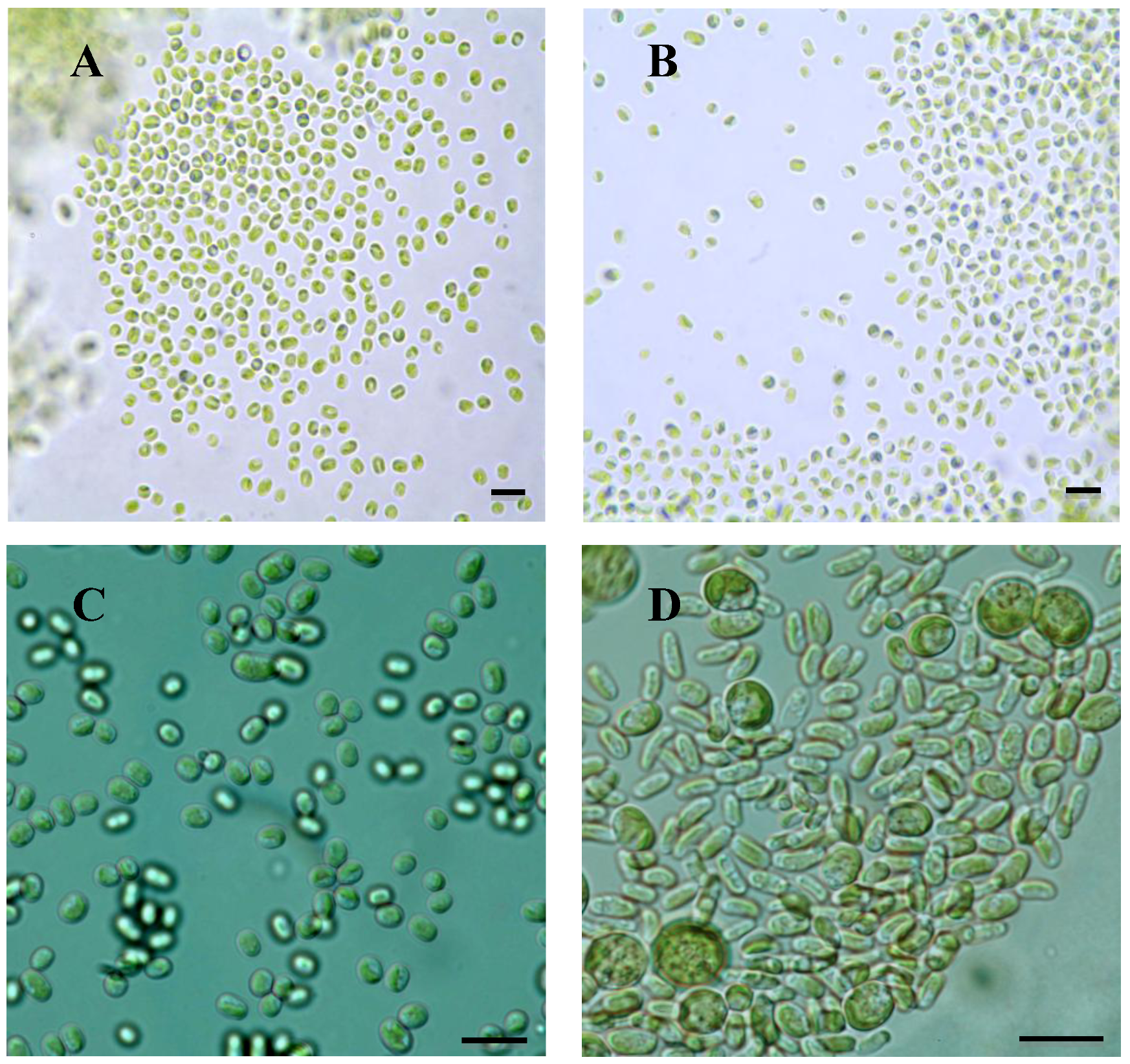
2.1. Microscopy
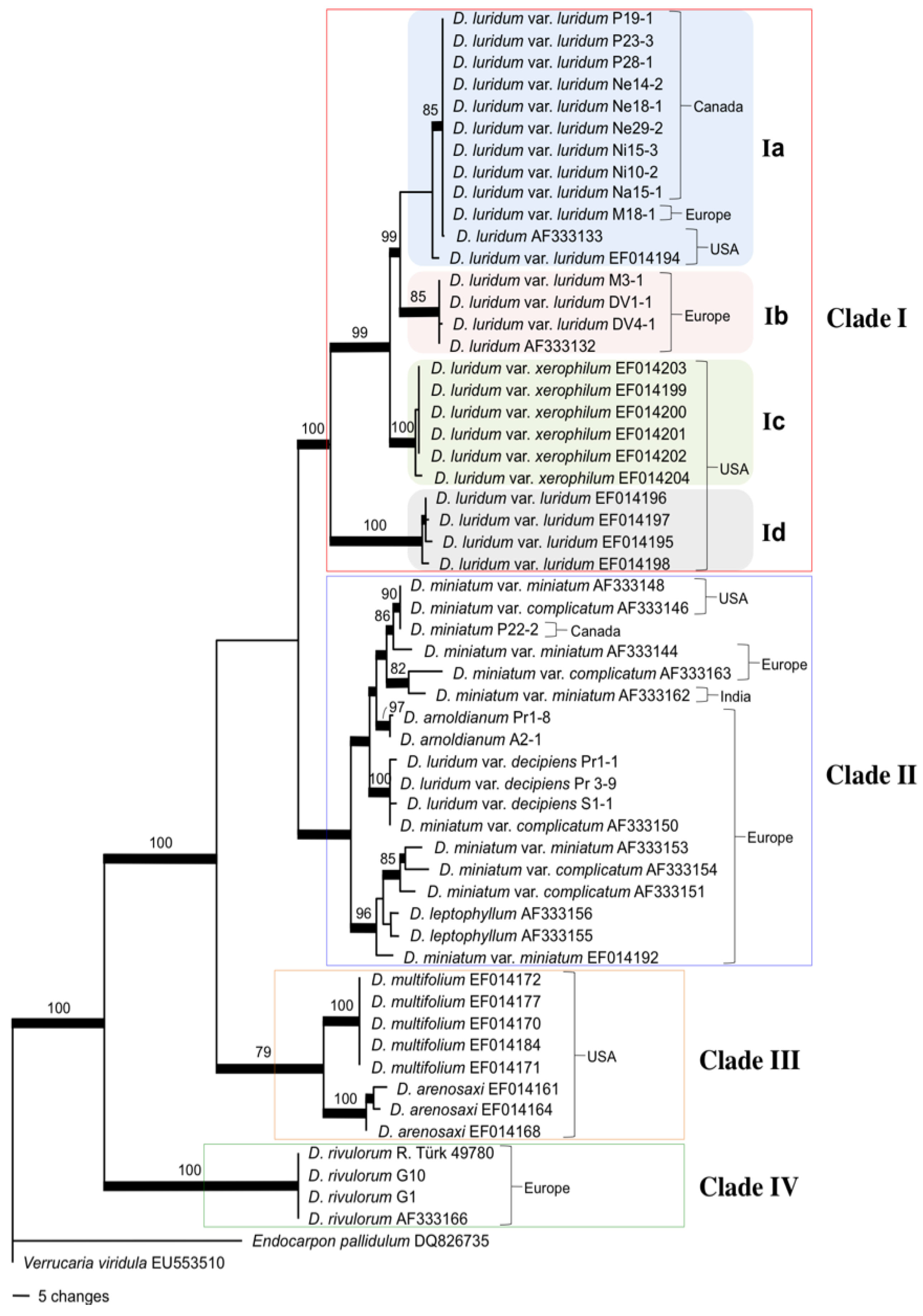
2.2. Mycobiont Internal Transcribed Spacer (ITS) Phylogeny
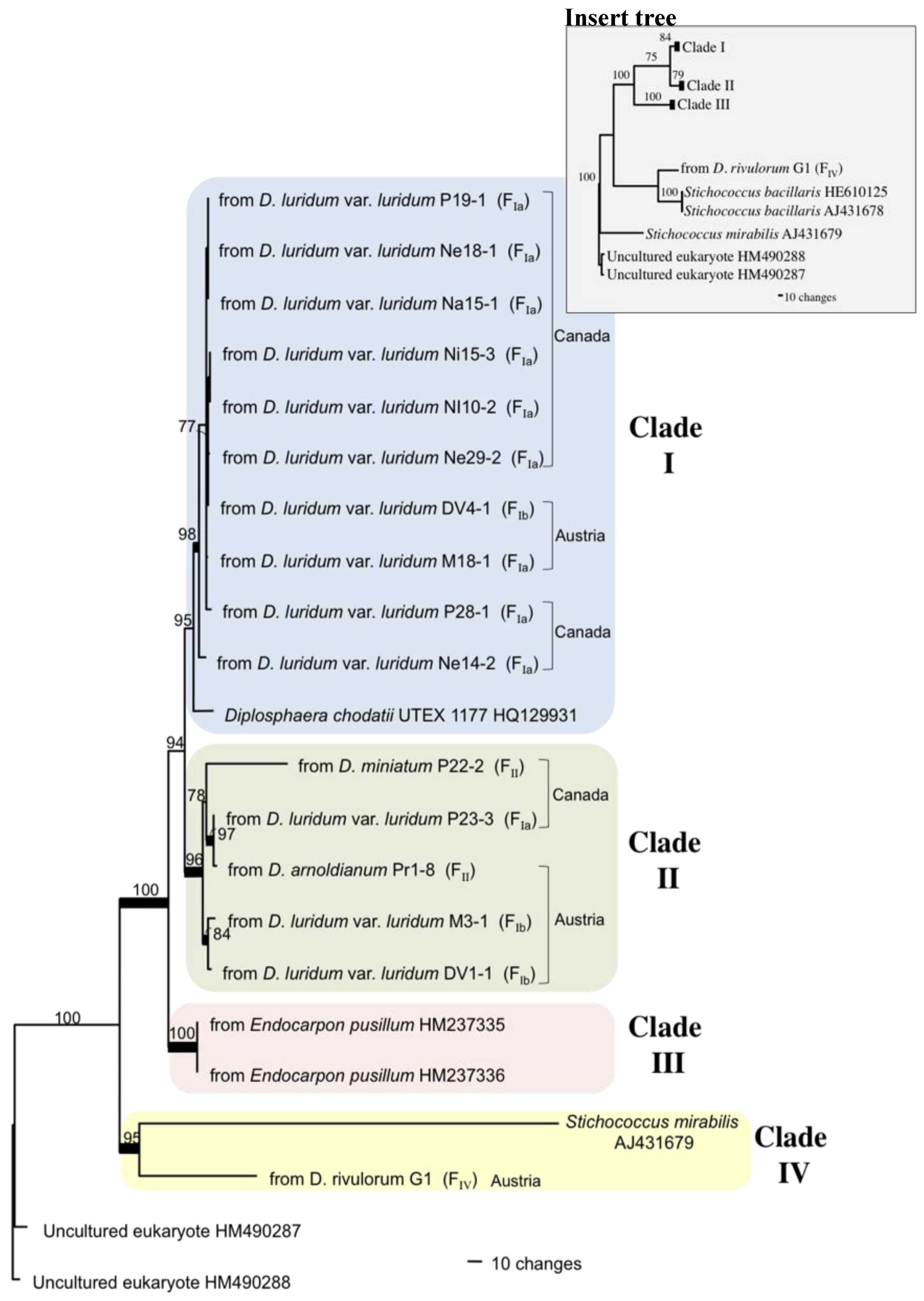
2.3. Photobiont ITS Phylogeny
3. Discussion
3.1. Intercontinental Gene Flow
3.2. Fungal Evolution: D. luridum and D. miniatum Are Paraphyletic
3.3. Algal Identity
3.4. Photobiont Evolution and Algal Selection
4. Experimental Section
4.1. Lichen Material

| Taxon identification | Sample collection number or source | Collection site | Fungal ITS Acc. | Algal ITS Acc. |
|---|---|---|---|---|
| Dermatocarpon arenosaxi | Amtoft et al. [10] | USA, Missouri | EF014161 | NS |
| Dermatocarpon arenosaxi | Amtoft et al. [10] | USA, Missouri | EF014164 | NS |
| Dermatocarpon arenosaxi | Amtoft et al. [10] | USA, Arkansas | EF014168 | NS |
| Dermatocarpon arnoldianum | Fontaine A2-1 | Austria, Salzburg, Preberkessel, 2011; 47°12'47"N; 13°51'10"E | JX645038 | NS |
| Dermatocarpon arnoldianum | Fontaine Pr1-8 | Austria, Salzburg, Preberkessel, 2011; 47°12'37''N; 13°51'05''W | JX645037 | JX645019 |
| Dermatocarpon leptophyllum | Heiđmarsson [12] | Sweden | AF333155 | NS |
| Dermatocarpon leptophyllum | Heiđmarsson [12] | Sweden | AF333156 | NS |
| Dermatocarpon luridum | Heiđmarsson [12] | USA, Minnesota | AF333133 | NS |
| Dermatocarpon luridum | Heiđmarsson [12] | Sweden | AF333132 | NS |
| Dermatocarpon luridum var. decipiens * | Fontaine Pr1-1 | Austria, Salzburg, Preberkessel, 2011; 47°12'37''N; 13°51'05''W | JX645039 | NS |
| Dermatocarpon luridum var. decipiens | Fontaine Pr3-9 | Austria, Salzburg, Preberkessel, 2011; 47°13'16"N; 13°51'13"E | JX645040 | NS |
| Dermatocarpon luridum var. decipiens | Fontaine S1-1 | Austria, Styria, Schladminger Tauern, 2011; 47°16'17''N; 13°43'47"E | JX645041 | NS |
| Dermatocarpon luridum var. luriudm | Amtoft et al. [10] | USA, North Carolina | EF014194 | NS |
| Dermatocarpon luridum var. luridum | Amtoft et al. [10] | USA, Arkansas | EF014195 | NS |
| Dermatocarpon luridum var. luridum | Amtoft et al. [10] | USA, Missouri | EF014196 | NS |
| Dermatocarpon luridum var. luridum | Amtoft et al. [10] | USA, Alabama | EF014197 | NS |
| Dermatocarpon luridum var. luridum | Amtoft et al. [10] | USA, Missouri | EF014198 | NS |
| Dermatocarpon luridum var. luridum | Fontaine P19-1 | Canada, Manitoba, Payuk Lake, 2010; 54°38'31''N; 101°31'40''W | JX645023 | JX645008 |
| Dermatocarpon luridum var. luridum | Fontaine P23-3 | Canada, Manitoba, Payuk Lake, 2010; 54°38'31''N; 101° 31'40''W | JX645024 | JX645018 |
| Dermatocarpon luridum var. luridum * | Fontaine P28-1 | Canada, Manitoba, Payuk Lake, 2010; 54°38'31''N; 101°31'40''W | JX645025 | JX645015 |
| Dermatocarpon luridum var. luridum | Fontaine Ne14-2 | Canada, Manitoba, Neso Lake, 2010; 54°39'51''N; 101°32'44''W | JX645026 | JX645016 |
| Dermatocarpon luridum var. luridum* | Fontaine Ne18-1 | Canada, Manitoba, Neso Lake, 2010; 54°39'51''N; 101°32'44''W | JX645027 | JX645009 |
| Dermatocarpon luridum var. luridum | Fontaine Ne29-2 | Canada, Manitoba, Neso Lake, 2010; 54°39'51''N; 101°32'44''W | JX645028 | JX645013 |
| Dermatocarpon luridum var. luridum * | Fontaine Ni15-3 | Canada, Manitoba, Nisto Lake, 2010; 54°42'02''N; 101°30'17''W | JX645029 | JX645011 |
| Dermatocarpon luridum var. luridum | Fontaine Ni10-2 | Canada, Manitoba, Nisto Lake, 2010; 54°42'02''N; 101°30'17''W | JX645030 | JX645012 |
| Dermatocarpon luridum var. luridum | Fontaine Na15-1 | Canada, Manitoba, Naosap Lake, 2010; 54°50'38''N; 101°26'12''W | JX645031 | JX645010 |
| Dermatocarpon luridum var. luridum * | Fontaine M3-1 | Austria, Waldaist, 2011; 48°19'44''N; 13°52'28''E | JX645033 | JX645020 |
| Dermatocarpon luridum var. luridum * | Fontaine M18-1 | Austria, Waldaist, 2011; 48°23'49''N; 13°35'93''E | JX645032 | JX645045 |
| Dermatocarpon luridum var. luridum | Fontaine DV1-1 | Austria, Schlogener Schlinge, 2011; 48°25'59''N; 13°52'28''E | JX645034 | JX645021 |
| Dermatocarpon luridum var. luridum * | Fontaine DV4-1 | Austria, Schlogener Schlinge, 2011; 48°25'59''N; 13°52'28''E | JX645035 | JX645014 |
| Dermatocarpon luridum var. xerophilum | Amtoft et al. [10] | USA, Missouri | EF014199 | NS |
| Dermatocarpon luridum var. xerophilum | Amtoft et al. [10] | USA, Oklahoma | EF014200 | NS |
| Dermatocarpon luridum var. xerophilum | Amtoft et al. [10] | USA, Arkansas | EF014201 | NS |
| Dermatocarpon luridum var. xerophilum | Amtoft et al. [10] | USA, Arkansas | EF014202 | NS |
| Dermatocarpon luridum var. xerophilum | Amtoft et al. [10] | USA, Arkansas | EF014203 | NS |
| Dermatocarpon luridum var. xerophilum | Amtoft et al. [10] | USA, Arkansas | EF014204 | NS |
| Dermatocarpon miniatum | Fontaine P22-2 | Canada, Manitoba, Payuk Lake, 2010; 54°38'31''N; 101°31'40''W | JX645036 | JX645017 |
| Dermatocarpon miniatum var. complicatum | Heiđmarsson [12] | USA, Minnesota | AF333146 | NS |
| Dermatocarpon miniatum var. complicatum | Heiđmarsson [12] | Sweden | AF333150 | NS |
| Dermatocarpon miniatum var. complicatum | Heiđmarsson [12] | Iceland | AF333151 | NS |
| Dermatocarpon miniatum var. complicatum | Heiđmarsson [12] | Austria | AF333154 | NS |
| Dermatocarpon miniatum var. complicatum | Heiđmarsson [12] | Norway | AF333163 | NS |
| Dermatocarpon miniatum var. miniatum | Heiđmarsson [12] | Sweden | AF333144 | NS |
| Dermatocarpon miniatum var. miniatum | Heiđmarsson [12] | USA, Minnesota | AF333148 | NS |
| Dermatocarpon miniatum var. miniatum | Heiđmarsson [12] | Iceland | AF333153 | NS |
| Dermatocarpon miniatum var. miniatum | Heiđmarsson [12] | India | AF333162 | NS |
| Dermatocarpon miniatum var. miniatum | Amtoft et al. [10] | Wales | EF014192 | NS |
| Dermatocarpon multifolium | Amtoft et al. [10] | USA, Missouri | EF014170 | NS |
| Dermatocarpon multifolium | Amtoft et al. [10] | USA, Missouri | EF014171 | NS |
| Dermatocarpon multifolium | Amtoft et al. [10] | USA, Missouri | EF014172 | NS |
| Dermatocarpon multifolium | Amtoft et al. [10] | USA, Virginia | EF014177 | NS |
| Dermatocarpon multifolium | Amtoft et al. [10] | USA, North Carolina | EF014184 | NS |
| Dermatocarpon rivulorum | Heiđmarsson [12] | Sweden | AF333166 | NS |
| Dermatocarpon rivulorum | Türk 49780 | Austria, Carinthia, Hohe Tauern, 2011; 46°59'18''N; 13°15'28''E | JX645042 | NS |
| Dermatocarpon rivulorum | Fontaine G1 | Austria, Carinthia, Hohe Tauern, 2011; 46°56'13''N; 13°00'25''E | JX645044 | JX645022 |
| Dermatocarpon rivulorum | Fontaine G10 | Austria, Carinthia, Hohe Tauern, 2010; 46°56'13''N; 13°00'25''E | JX645043 | NS |
| Diplosphaera chodatii | Zhang and Wei [37] | China | NS | HM237335 |
| Diplosphaera chodatii | Zhang and Wei [37] | China | NS | HM237336 |
| Diplosphaera chodatii | Zhang and Wei [37] | UTEX culture collection #1177 | NS | HQ129931 |
| Stichococcus bacillaris | Marin [53] | Unknown | NS | HE610125 |
| Stichococcus bacillaris | Unpublished | Unknown | NS | AJ431678 |
| Stichococcus mirabilis | Unpublished | Unknown | NS | AJ431679 |
| Uncultured eukaryote | Khan et al. [54] | Antarctica | NS | HM490287 |
| Uncultured eukaryote | Khan et al. [54] | Antarctica | NS | HM490288 |
4.2. Photobiont Isolation for Culturing
4.3. Microscopic Examination
4.4. DNA Extraction, Amplification, and Purification
4.5. DNA Sequencing
4.6. Data Analysis
5. Conclusions
Acknowledgments
References
- Nash, T.H., III. Lichen Biology, 2nd ed.; Cambridge University Press: Cambridge, UK, 1996; p. 303. [Google Scholar]
- Thüs, H. Taxonomie, Verbreitung ond Ökologie silicoler Süßwasserflechten im außeralpinen Mitteleuropa. Bibliotheca Lichenologica 2002, 83, 1–214. [Google Scholar]
- Nascimbene, J.; Thüs, H.; Marini, L.; Nimis, P.L. Freshwater lichens in springs of the eastern Italian Alps: Floristics, ecology and potential for bioindication. Ann. Limnol. Int. J. Lim. 2007, 43, 285–292. [Google Scholar] [CrossRef]
- Gueidan, C.; Roux, C.; Lutzoni, F. Using a multigene analysis to assess generic delineation and character evolution in Verrucariaceae (Verrucariales, Ascomycota). Mycol. Res. 2007, 111, 1147–1170. [Google Scholar]
- Gueidan, C.; Savić, S.; Thüs, H.; Roux, C.; Keller, C.; Tibell, L.; Prieto, M.; Heiđmarsson, S.; Breuss, O.; Orange, A.; et al. Generic classification of the Verrucariaceae (Ascomycota) based on molecular and morphological evidence: Recent progress and remaining challenges. Taxon 2009, 58, 184–208. [Google Scholar]
- Esslinger, T.L. A cumulative checklist for the lichen-forming, lichenicolous and allied fungi of the continental United States and Canada. North Dakota State University. (First Posted on 1 December 1997, Most Recent Version (#17) on 16 May 2011). Fargo, North Dakota, USA, 2011. Available online: http://www.ndsu.edu/pubweb/~esslinge/chcklst/chcklst7.htm/ (accessed on 11 September 2011).
- Türk, R.; Hafellner, J. Nachtrag zur Bibliographie der Flechten in Österreich. In Biosystematics and Ecology Series Nr. 27; Ehrendorfer, F., Ed.; Österreichische Akademie der Wissenschaften: Wien, Austria, 2010; p. 381. [Google Scholar]
- Santesson, R. Amphibious pyrenolichens I. Arkiv Botanik 1939, 29, 1–67. [Google Scholar]
- Aptroot, A.; Seaward, M.R.D. Freshwater lichens. Fungal Divers. Res. Ser. 2003, 10, 101–110. [Google Scholar]
- Amtoft, A.; Lutzoni, F.; Miadlikowska, J. Dermatocarpon (Verrucariaceae) in the Ozark Highlands, North America. Bryologist 2008, 111, 1–40. [Google Scholar] [CrossRef]
- Heiđmarsson, S. The genus Dermatocarpon (Verrucariales, lichenized Ascomycotina) in the Nordic countries. Nord. J. Bot. 2000, 20, 605–639. [Google Scholar] [CrossRef]
- Heiđmarsson, S. Molecular study of Dermatocarpon miniatum (Verrucariales) and allied taxa. Mycol. Res. 2003, 107, 459–468. [Google Scholar] [CrossRef]
- Beck, A.; Kasalicky, T.; Rambold, G. Myco-photobiontal selection in a Mediterranean cryptogam community with Fulgensia fulgida. New Phytol. 2002, 153, 317–326. [Google Scholar] [CrossRef]
- Yahr, R.; Vilgalys, R.; DePriest, P.T. Geographic variation in algal partners of Cladonia subtenuis (Cladoniaceae) highlights the dynamic nature of a lichen symbiosis. New Phytol. 2006, 171, 847–860. [Google Scholar] [CrossRef]
- Galun, M.; Bubrick, P. Physiological interactions between partners of the lichen symbiosis. In Encyclopedia of Plant Physiology, New Series; Linskens, H.F., Heslop, H.J., Eds.; Springer-Verlag: Berlin, Germany, 1984; Volume 17, pp. 362–401. [Google Scholar]
- Piercey-Normore, M.D. The lichen-forming ascomycete Evernia mesomorpha associates with multiple genotypes of Trebouxia jamesii. New Phytol. 2006, 169, 331–344. [Google Scholar] [CrossRef]
- 17. Casano, L.M.; del Campo, E.M.; García-Breijo, F.J.; Reig-Armiñana, J.; Gasulla, F.; del Hoyo, A.; Guéra, A.; Barreno, E. Two Trebouxia algae with different physiological performances are ever-present in lichen thalli of Ramalina farinacea. Coexistence versus Competition? Environ. Microbiol. 2011, 13, 806–818. [Google Scholar] [CrossRef]
- Thüs, H.; Muggia, L; Pérez-Ortega, S.; Favero-Longo, S.; Joneson, S.; O’Brien, H.; Nelsen, M.P.; Duque-Thüs, R.; Grube, M.; Friedl, T.; et al. Revisiting photobiont diversity in the lichen family Verrucariaceae (Ascomycota). Eur. J. Phycol. 2011, 46, 399–415. [Google Scholar] [CrossRef]
- Yahr, R.; Vilgalys, R.; DePriest, P.T. Strong fungal specificity and selectivity for algal symbionts in Florida scrub Cladonia lichens. Mol. Ecol. 2004, 13, 3367–3378. [Google Scholar] [CrossRef]
- Beck, A.; Peršoh, D. Flechten und ihre Stellung in Reich der Pilze. In Rundgespräche der Kommission für Ökologie. Ökologische Rolle der Flechten; der Wissenschaften, B.A., Ed.; Verlag Dr. Friedrich Pfeil: München, Germany, 2009; Issue 36, pp. 13–24. [Google Scholar]
- Honegger, R. Lichen-forming fungi and their photobionts. In Plant relationships V, The Mycota; Deising, H.B., Ed.; Springer-Verlag: Berlin, Germany, 2009; pp. 307–333. [Google Scholar]
- Thüs, H.; Schultz, M. Freshwater Flora of Central Europe, Vol. 21/1, Fungi, Part 1: Lichens; Spektrum: Heidelberg, Germany, 2008; p. 229. [Google Scholar]
- Ahmadjian, V.; Heikkilä, H. The culture and synthesis of Endocarpon pusillum and Staurothele clopima. Lichenologist 1970, 4, 259–267. [Google Scholar] [CrossRef]
- Stocker-Wörgötter, E.; Türk, R. The Resynthesis of Thalli of Dermatocarpon miniatum under Laboratory Conditions. Symbiosis 1989, 7, 37–50. [Google Scholar]
- Stocker-Wörgötter, E.; Türk, R. Die Resynthese der Flechte Verrucaria macrostoma unter Laborbedingungen. Nova Hedwigia 1987, 44, 55–68. [Google Scholar]
- Stocker-Wörgötter, E. Stress and Developmental Strategies of Lichens. In Symbioses and Stress: Joint ventures in Biology. Cellular Origins, Life in Extreme Habitats and Astrobiology; Seckbach, J., Grube, M., Eds.; Springer Science + Business Media B.V.: Dordrecht, The Netherlands, 2010; Version 17; pp. 525–546. [Google Scholar]
- Buschbom, J. Migration between continents: Geographical structure and long-distance gene flow in Porpidia flavicunda (lichen-forming Ascomycota). Mol. Ecol. 2007, 16, 1835–1846. [Google Scholar] [CrossRef]
- Walser, J.C.; Holderegger, R.; Gugerli, F.; Hoebee, S.E.; Scheidegger, C. Microsatellites reveal regional population differentiation and isolation in Lobaria pulmonaria, an epiphytic lichen. Mol. Ecol. 2005, 14, 457–467. [Google Scholar]
- Högberg, N.; Kroken, S.; Thor, G.; Taylor, J.W. Reproductive mode and genetic variation suggest a North American origin of European Letharia vulpina. Mol. Ecol. 2002, 11, 1191–1196. [Google Scholar] [CrossRef]
- Printzen, C.; Ekman, S.; Tønsberg, T. Phylogeography of Cavernularia hultenii: Evidence for slow genetic drift in a widely disjunct lichen. Mol. Ecol. 2003, 12, 1473–1486. [Google Scholar] [CrossRef]
- Fernández-Mendoza, F.; Domaschke, S.; García, M.A.; Jordan, P.; Martín, M.P.; Printzen, C. Population structure of mycobionts and photobionts of the widespread lichen Cetraria aculeata. Mol. Ecol. 2011, 20, 1208–1232. [Google Scholar] [CrossRef]
- Degelius, G. Über Dermatocarpon rivulorum (Arn.) DT. et Sarnth. und D. arnoldianum Degel. n. sp. Nytt Mag. Naturvidensk 1934, 75, 151–163. [Google Scholar]
- Begerow, D.; Nilsson, H.; Unterseher, M.; Maier, W. Current state and perspectives of fungal DNA barcoding and rapid identification procedures. Appl. Microbiol. Biot. 2010, 87, 99–108. [Google Scholar] [CrossRef]
- Schoch, C.L.; Seifert, K.A.; Huhndorf, S.; Robert, V.; Spouge, J.L.; Levesque, C.A.; Chen, W.; Fungal Barcoding Consortium. Nuclear ribosomal internal transcribed spacer (ITS) region as a universal DNA barcode marker for Fungi. Proc. Natl. Acad. Sci. USA 2012, 109, 6241–6246. [Google Scholar]
- Lindner, D.L.; Banik, M.T. Intragenomic variation in the ITS rDNA region obscures phylogenetic relationships and inflates estimates of operational taxonomic units in genus Laetiporus. Mycologia 2011, 103, 731–740. [Google Scholar] [CrossRef]
- Goward, T.; McCune, B.; Meidinger, D. The lichens of British Columbia, illustrated keys. Part 1, Foliose and Squamulose species. Brtish Columbia Ministry of Forests Special Report Series 1994, 8, 181. [Google Scholar]
- Zhang, T.; Wei, J.C. Survival analysis of symbionts isolated from Endocarpon pusillum Hedwig to desiccation and starvation stress. Sci. China Life Sci. 2011, 54, 480–489. [Google Scholar] [CrossRef]
- Reháková, H. Lisejníkoví rasy z rodu Trebouxia, Diplosphaeraa Myrmecia (Flechtenalgen der Gattungen Trebouxia, Diplosphaera und Myrmecia). Ph.D. Dissertation, Katedra Bot., University of Karlova, Praha, Czech Republic, 1968. [Google Scholar]
- Grube, M.; Muggia, L. Identifying algal symbionts in lichen symbioses. In Tools for Identifying Biodiversity: Progress and Problems; Nimis, P.L., Lebbe, R.V., Eds.; Edizioni Universitàdi di Trieste: Trieste, Italy, 2010; pp. 295–299. [Google Scholar]
- Ohmura, Y.; Kawachi, M.; Kasaie, F.; Watanabe, M.M.; Takeshita, S. Genetic combinations of symbionts in a vegetatively reproducing lichen, Parmotrema tinctorum, based on ITS rDNA sequences. Bryologist 2006, 109, 43–59. [Google Scholar] [CrossRef]
- Guzow-Krzeminska, B. Photobiont flexibility in the lichen Protoparmeliopsis muralis as revealed by ITS rDNA analyses. Lichenologist 2006, 38, 469–476. [Google Scholar] [CrossRef]
- Bates, S.T.; Berg-Lyons, D.; Lauber, C.L.; Walters, W.A.; Knight, R.; Fierer, N. A preliminary survey of lichen associated eukaryotes using pyrosequencing. Lichenologist 2012, 44, 137–146. [Google Scholar] [CrossRef]
- Beck, A.; Friedl, T.; Rambold, G. Selectivity of photobiont choice in a defined lichen community: Inferences from cultural and molecular studies. New Phytol. 1998, 139, 709–720. [Google Scholar]
- Lukešová, A.; Hoffmann, L. Soil algae from acid rain impacted forest areas of the Krušné hory Mts. 1. Algal communities. Vegetatio 1996, 125, 123–136. [Google Scholar] [CrossRef]
- Flechtner, V.R. Enigmatic desert soil algae. In Enigmatic Microorganisms and Life in Extreme Environments; Seckbach, J., Ed.; Kluwer Academic Publishers: Dordecht, The Netherlands, 1998; pp. 233–241. [Google Scholar]
- Handa, S.; Nakahara, M.; Nakano, T.; Itskovich, V.B.; Masuda, Y. Aerial algae from southwestern area of Lake Baikal. Hikobia 2001, 13, 463–472. [Google Scholar]
- Flechtner, V.R.; Johansen, J.R.; Belnap, J. The biological soil crusts of the San Nicolas Island: Enigmatic algae from a geographically isolated ecosystem. West. N. Am. Nat. 2008, 68, 405–436. [Google Scholar] [CrossRef]
- Hill, D.J. Asymmetric co-evolution in the lichen symbiosis caused by a limited capacity for adaptation in the photobiont. Bot. Rev. 2009, 75, 326–338. [Google Scholar] [CrossRef]
- Voytsekhovich, A.; Dymytrova, L.; Nadyeina, O. Photobiont composition of some taxa of the genera Micarea and Placynthiella (Lecanoromycetes, lichenized Ascomycota) from Ukraine. Folia Cryptog. Estonica Fasc. 2011, 48, 135–148. [Google Scholar]
- Gilbert, O.; Giavarini, V. The lichen vegetation of lake margins in Britain. Lichenologist 2000, 32, 365–386. [Google Scholar] [CrossRef]
- Ettl, H.; Gärtner. Syllabus der Boden-, Luft- und Flechtenalgen; Gustav Fischer Verlag: Stuttgart, Germany, 1995; p. 722. [Google Scholar]
- Bergsten, J. A review of long-branch attraction. Cladistics 2005, 21, 163–193. [Google Scholar] [CrossRef]
- Marin, B. Nested in the Chlorellales or independent class? Phylogeny and classificationof the Pedinophyceae (Viridiplantae) revealed by molecular phylogenetic analyses of complete nuclear and plastid-encoded rRNA operons. Protist 2012, 163, 778–805. [Google Scholar] [CrossRef]
- Khan, N.; Tuffin, I.M.; Carey, S.C.; Cowan, D.A. Hypolithic microbial communities of quartz rocks from Miers Valley, McMurdo Dry Valleys, Antarctica. Polar Biol. 2011, 34, 1657–1668. [Google Scholar] [CrossRef]
- Yamamoto, Y. Studies of cell aggregates and the production of natural pigments in plant cell culture. Ph.D. Dissertation, Kyoto University, Kyoto, Japan, 1990. [Google Scholar]
- Stocker-Wörgötter, E. Resynthesis of Photosymbiodemes. In Protocols in Lichenology: Culturing, Biochemistry, Ecophysiology and Use in Biomonitoring; Springer Lab Manual; Kramer, I., Beckett, R.P., Varma, A.K., Eds.; Springer-Verlag: Berlin, Germany, 2002; pp. 47–60. [Google Scholar]
- Stocker-Wörgötter, E.; Hager, A. Culture methods for lichens and lichen symbionts. In Lichen Biology; Nash, T.H., III, Ed.; Cambridge University Press: Cambridge, UK, 2008; pp. 353–363. [Google Scholar]
- Nichols, H.W. Growth media, Freshwater. In Handbook of Phycological Methods, Culture Methods and Growth Measurements; Stein, J.R., Ed.; Cambridge University Press: Cambridge, UK, 1973; pp. 8–23. [Google Scholar]
- Grube, M.; DePriest, P.T.; Gargas, A.; Hafellner, J. DNA isolation from lichen ascomata. Mycol. Res. 1995, 99, 1321–1324. [Google Scholar] [CrossRef]
- Gardes, M.; Bruns, T.D. ITS primers with enhanced specificity for basidiomycetes—Application to the identification of mycorrhizae and rusts. Mol. Ecol. 1993, 2, 113–118. [Google Scholar] [CrossRef]
- White, T.J.; Bruns, T.; Lee, S.; Taylor, J. Amplification and direct sequencing of fungal ribosomal RNA genes for phylogenetics. In PCR Protocols: A Guide to Methods and Applications; Innis, M.A., Gelfand, D.H., Sninsky, J.J., White, T.J., Eds.; Academic Press, Inc.: New York, NY, USA, 1990; pp. 315–322. [Google Scholar]
- Altschul, S.F.; Madden, T.L.; Schäffer, A.A.; Zhang, J.; Zhang, Z.; Miller, W.; Lipman, D.J. Gapped BLAST and PSI-BLAST: A new generation of protein database search programs. Nucleic Acids Res. 1997, 25, 3389–3402. [Google Scholar] [CrossRef]
- O’Rourke, J.A.; Nelson, R.T.; Grant, D.; Schmutz, J.; Grimwood, J.; Cannon, S.; Vance, C.P.; Graham, M.A.; Shoemaker, R.C. Integrating microarray analysis and the soybean genome to understand the soybeans iron deficiency response. BMC Genomics 2009, 10, 376. [Google Scholar] [CrossRef]
- Rambaut, A. Se-Al (Sequence Alignment Editor Version 1); Department of Zoology, University of Oxford: Oxford, UK, 2001. [Google Scholar]
- Swofford, D.L. PAUP*. Phylogenetic Analysis Using Parsimony (*and Other Methods); Version 4; Sinauer Associates: Sunderland, MA, USA, 2003. [Google Scholar]
- Huelsenbeck, J.P.; Ronquist, F.; Nielsen, R.; Bollback, J.P. Bayesian inference of phylogeny and its impact on evolutionary biology. Science 2001, 294, 2310–2314. [Google Scholar] [CrossRef]
- Ronquist, F.; Huelsenbeck, J.P. MRBAYES 3: Bayesian phylogenetic inference under mixed models. Bioinformatics 2003, 19, 1572–1574. [Google Scholar] [CrossRef]
- Felsenstein, J. Confidence limits on phylogenies: An approach using the bootstrap. Evolution 1985, 39, 783–791. [Google Scholar] [CrossRef]
- Posada, D.; Crandall, K.A. Modeltest: Testing the model of DNA substitution. Bioinformatics 1998, 14, 817–818. [Google Scholar] [CrossRef]
- Guindon, S.; Gascuel, O. A simple, fast, and accurate algorithm to estimate large phylogenies by maximum likelihood. Syst. Biol. 2003, 52, 696–704. [Google Scholar] [CrossRef]
- Posada, D. jModelTest: Phylogenetic Model Averaging. Mol. Biol. Evol. 2008, 25, 1253–1256. [Google Scholar] [CrossRef]
© 2012 by the authors; licensee MDPI, Basel, Switzerland. This article is an open access article distributed under the terms and conditions of the Creative Commons Attribution license (http://creativecommons.org/licenses/by/3.0/).
Share and Cite
Fontaine, K.M.; Beck, A.; Stocker-Wörgötter, E.; Piercey-Normore, M.D. Photobiont Relationships and Phylogenetic History of Dermatocarpon luridum var. luridum and Related Dermatocarpon Species. Plants 2012, 1, 39-60. https://doi.org/10.3390/plants1020039
Fontaine KM, Beck A, Stocker-Wörgötter E, Piercey-Normore MD. Photobiont Relationships and Phylogenetic History of Dermatocarpon luridum var. luridum and Related Dermatocarpon Species. Plants. 2012; 1(2):39-60. https://doi.org/10.3390/plants1020039
Chicago/Turabian StyleFontaine, Kyle M., Andreas Beck, Elfie Stocker-Wörgötter, and Michele D. Piercey-Normore. 2012. "Photobiont Relationships and Phylogenetic History of Dermatocarpon luridum var. luridum and Related Dermatocarpon Species" Plants 1, no. 2: 39-60. https://doi.org/10.3390/plants1020039
APA StyleFontaine, K. M., Beck, A., Stocker-Wörgötter, E., & Piercey-Normore, M. D. (2012). Photobiont Relationships and Phylogenetic History of Dermatocarpon luridum var. luridum and Related Dermatocarpon Species. Plants, 1(2), 39-60. https://doi.org/10.3390/plants1020039