Skip Content
You are currently on the new version of our website. Access the old version .

Plants

Plants is an international, scientific, peer-reviewed, open access journal on plant science published semimonthly online by MDPI. 
The Spanish Phytopathological Society (SEF), the Spanish Society of Plant Biology (SEBP), the Spanish Society of Horticultural Sciences (SECH) and the Italian Society of Phytotherapy (S.I.Fit.) are affiliated with Plants and their members receive a discount on the article processing charges.
Indexed in PubMed | Quartile Ranking JCR - Q1 (Plant Sciences)

All Articles (21,381)

LC-MS Profiling and Biological Activity of Unexplored Leucas nubica Benth. (Lamiaceae)

  • Dimitrina Zheleva-Dimitrova,
  • Gokhan Zengin and
  • Reneta Gevrenova
  • + 2 authors

Leucas nubica Benth. (Lamiaceae) is an annual herbaceous plant, native to east and northeast tropical Africa. The whole plant is renowned for the treatment of jaundice. The present study aimed at an in-depth phytochemical profiling and evaluation of in vitro antioxidant and enzyme inhibitory potential of methanol–aqueous extract from L. nubica aerial parts. The liquid chromatography–high-resolution mass spectrometry (LC-HRMS) experiment revealed more than 70 secondary metabolites, including carboxylic and phenolic acids, phenylethanoid, iridoid, and lignan glycosides, and flavonoids. The L. nubica extract profile was dominated by the phenylethanoid glycoside verbascoside. All annotated compounds are reported for the first time in the species. The extract actively scavenged DPPH and ABTS radicals (38.8 ± 0.1 and 36.8 ± 0.4 mg TE/g) and showed high CUPRAC (71.1 ± 1.1 mg TE/g) and moderate FRAP (44.9 ± 2.6 mg TE/g) reducing power. The L. nubica extract exhibited high inhibition towards acetylcholinesterase (2.23 ± 0.02 mg GALAE/g), butyrylcholinesterase (2.38 ± 0.04 mg GALAE/g), and tyrosinase (60.7 ± 0.6 mg KAE/g). The obtained results highlight L. nubica extract as a rich source of phenylethanoid glycosides and flavonoids with significant bioactivity and shed light into the phytochemical composition and pharmacological potential of the plant.

7 February 2026
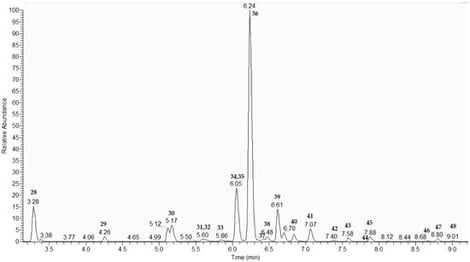
Extracted ion chromatogram (EIC) of phenylethanoids. EIC was conducted with a mass tolerance of 5 ppm (for numbers and fragmentation patterns, see Table 1).

The thioredoxin h-type (Trxh) proteins play a crucial role as convergence points within plants’ responses to abiotic and biotic stresses. Previously, we demonstrated that the protein TdTrxh2 of durum wheat (Triticum durum Desf.) has a chaperone function and it promotes tolerance to abiotic stress. The aim of this study was to evaluate the antimicrobial effect of TdTrxh2 and its role in the response of durum wheat to Fusarium graminearum attack. First, we demonstrated the involvement of TdTrxh2 in the response of durum wheat to this fungus via the analysis of its expression profile under this fungus attack. In fact, the outcomes showed that the induction of TdTrxh2 expression is spatiotemporal in leaves and roots of durum wheat under F. graminearum infection. Interestingly, this induction was accompanied by H2O2 accumulation under short- and long-term stress in roots and leaves, respectively. Besides, the cis elements related to the two phytohormones ET and MeJA, and those implicated in defense and wound stress, were identified in the TdTrxh2 promoter’s sequence. Second, the purified TdTrxh2 protein possessed antimicrobial effects against a diverse range of bacteria and fungi in vitro. Finally, the expression of TdTrxh2 in transgenic Arabidopsis plants enhanced their tolerance to F. graminearum attack through the activation of the two H2O2-scavenging enzymes, CAT and POD, and via the induction of a subset of SA- and ABA-related genes. Moreover, the exogenous SA and ABA applications improved the growth of the transgenic lines compared to the non-transformed plants. Taken together, the results highlighted that TdTrxh2 generates tolerance of durum wheat’s response to F. graminearum attack, via the regulation of H2O2 homeostasis and the induction of hormone-associated genes. Thus, the TdTrxh2 gene could be considered as an interesting candidate gene to improve wheat tolerance to F. graminearum attack.

7 February 2026

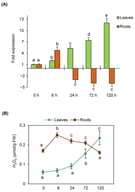
The induction of TdTrxh2 gene expression under F. graminearum infection is associated with H2O2 accumulation. (A) Expression profile of TdTrxh2 in leaves and roots of durum wheat infected by F. graminearum during 6, 24, 72, and 120 h. The expression of TdTrxh2 in leaves and roots under the control condition (without F. graminearum) was adjusted to 1. The reference gene used in the qRT-PCR reactions was TdActin. Each qRT-PCR reaction was repeated three times, and each sample was the amount of three plants per treatment. Error bars indicate standard deviation of three biological replicates. Different letters indicate significant differences (p < 0.05) between control and stressed plants. (B) Determination of H2O2 levels in leaves and roots of the inoculated durum wheat seedlings with F. graminearum during 6, 24, 72, and 120 h. Error bars indicate standard deviation of three biological replicates. Different letters in each plant tissue (leaves or roots) indicate the significant differences (p < 0.05).

VviAMT4;1 Is a High-Affinity Ammonium Transporter in Table Grape

  • Huilin Xiao,
  • Matthew Shi and
  • Meiling Tang
  • + 3 authors

Ammonium transporters (AMTs) are a class of membrane-associated proteins that play crucial roles in the uptake and transport of ammonium (NH4+ or NH3). In this study, an ammonium transporter-encoding gene VviAMT4;1 was isolated and identified from table grape ‘Yanpu No.2’. Notably, the expression level of VviAMT4;1 varied significantly across different organs or tissues of ‘Yanpu No.2’, and the highest expression level was detected in the roots of both tissue-cultured seedlings and 5-year-old mature trees. Expression of VviAMT4;1 was significantly up-regulated under NH4+ depletion throughout the whole of tissue-cultured seedlings. Yeast mutant functional complementation indicates that the recombinant strain pYES2-VviAMT4;1/31019b restored growth under different pH conditions. 15N isotope-labeled uptake kinetics analysis demonstrated that VviAMT4;1 is a typical high-affinity ammonium transporter, with a Kₘ value of 49.58 ± 4.66 μmol·L−1 and a Vₘₐₓ value of 3.29 μmoles·min−1·μg−1 cells. Moreover, VviAMT4;1 can mediate the weak uptake and utilization of methyl amine (MeA+) in yeast cells. The VviAMT4;1-mediated NH4+ uptake process may suffer from feedback inhibition by endogenous NH4+ enrichment. This study provides insights into understanding the molecular mechanisms of N transport and utilization in fruit trees.

6 February 2026

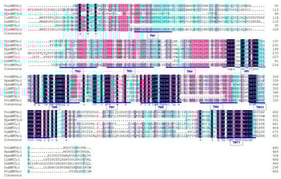
Amino acid alignment of plant AMT homologues. AMT proteins were chosen from table grape VviAMT4;1, P. persica PpeAMT3;4 and PpeAMT4;1, L. japonicus LjAMT2;1, P. trichocarpa PtrAMT4;1, O. sativa OsAMT2;1 and OsAMT4;1, and A. thaliana AtAMT2;1. The colors of black, pink, and dark green indicate identities of 100%, 85%, and the range between 45% and 70%, respectively, at the same amino acid residue. Note: TM means transmembrane region, underlined by blue lines.

Agricultural productivity currently faces challenges such as soil fertility issues, climatic instability, pests and diseases, and anthropization. This drives a shift towards sustainable agricultural practices, including biopreparations—products derived from living organisms or their metabolites that serve as biofertilizers, biopesticides, biostimulants, or biodegradation agents. Among these, the genus Bacillus is a primary candidate for sustainable agriculture; however, this review primarily covers rhizosphere-isolated organisms referred to as plant growth-promoting rhizobacteria. Bacillus strains possess a suite of direct and indirect mechanisms to promote plant development and biocontrol, as well as to tolerate various abiotic stresses. This review aims to describe all the mechanisms attributed to strains of this genus and their impact on different crops to promote plant growth, hormonal regulation (indole-3-acetic acid (IAA), abscisic acid (ABA), and ethylene), tolerance to abiotic stresses such as drought, heavy metals, salinity and heat stress, as well as resistance to pests and diseases. Furthermore, this work analyzes quantitative data regarding yield improvements and the environmental variables that influence the consistency of Bacillus performance in the field. Finally, to provide a balanced perspective, the review incorporates future directions in research on biosafety and risk assessment frameworks.

6 February 2026

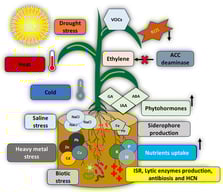
On the left are some of the biotic and abiotic stresses that affect plant development. On the right are the direct and indirect mechanisms that promote plant growth, abiotic stress tolerance and biocontrol: phytohormones, P solubilization, K solubilization and nitrogen fixation, siderophore production, lytic enzyme production, induced resistance system, biocontrol of pathogens and diseases, and control of abiotic stresses. Exists an improvement in nutrition uptake and phytohormone production. The arrows shows that increase. On the other hand, ROS are decreased.

News & Conferences

Issues

Open for Submission

Editor's Choice

Reprints of Collections

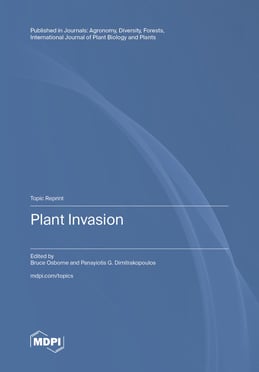
Plant Invasion
Reprint

Plant Invasion

Editors: Bruce Osborne, Panayiotis G. Dimitrakopoulos
Recent Advances in Horticultural Plant Genomics
Reprint

Recent Advances in Horticultural Plant Genomics

Editors: Zhongxiong Lai, Yuling Lin, Yuqiong Guo

Get Alerted

Add your email address to receive forthcoming issues of this journal.

XFacebookLinkedIn
Plants - ISSN 2223-7747