Article

VviAMT4;1 Is a High-Affinity Ammonium Transporter in Table Grape

1
Yantai Academy of Agricultural Sciences, Yantai 264000, China
2
College of Horticulture, Ludong University, No. 186 Hongqizhong Road, Yantai 264025, China
3
Wolfson College, University of Cambridge, Cambridge CB3 9BB, UK
4
Department of Plant Science, University of Cambridge, Cambridge CB2 3EA, UK
*
Authors to whom correspondence should be addressed.
These authors contributed equally to this work.
Plants 2026, 15(3), 519; https://doi.org/10.3390/plants15030519
Submission received: 24 December 2025 / Revised: 3 February 2026 / Accepted: 5 February 2026 / Published: 6 February 2026
(This article belongs to the Special Issue Insights and Regulation of Plant Growth and Metabolism)

Abstract

Ammonium transporters (AMTs) are a class of membrane-associated proteins that play crucial roles in the uptake and transport of ammonium (NH4+ or NH3). In this study, an ammonium transporter-encoding gene VviAMT4;1 was isolated and identified from table grape ‘Yanpu No.2’. Notably, the expression level of VviAMT4;1 varied significantly across different organs or tissues of ‘Yanpu No.2’, and the highest expression level was detected in the roots of both tissue-cultured seedlings and 5-year-old mature trees. Expression of VviAMT4;1 was significantly up-regulated under NH4+ depletion throughout the whole of tissue-cultured seedlings. Yeast mutant functional complementation indicates that the recombinant strain pYES2-VviAMT4;1/31019b restored growth under different pH conditions. 15N isotope-labeled uptake kinetics analysis demonstrated that VviAMT4;1 is a typical high-affinity ammonium transporter, with a Kₘ value of 49.58 ± 4.66 μmol·L−1 and a Vₘₐₓ value of 3.29 μmoles·min−1·μg−1 cells. Moreover, VviAMT4;1 can mediate the weak uptake and utilization of methyl amine (MeA+) in yeast cells. The VviAMT4;1-mediated NH4+ uptake process may suffer from feedback inhibition by endogenous NH4+ enrichment. This study provides insights into understanding the molecular mechanisms of N transport and utilization in fruit trees.

1. Introduction

Ammonium serves as a primary nitrogen source for plants and exhibits significant absorption advantages under low-nitrogen conditions (soil NH4+ concentration < 1 mmol·L−1), with its transmembrane transport efficiency exceeding that of nitrate by 3–5 times. However, when the intracellular ammonium concentration exceeds a critical threshold (typically >5 mmol·L−1), it triggers harmful effects such as proton imbalance and membrane potential disorder [1,2]. The precise regulation of this “dual effect” relies on the functional synergy of the ammonium transporter (AMT) family [3,4,5].
In plants, AMT transporters are mainly located on the plasma membrane, containing 10 or 11 typical conserved transmembrane regions, and transport ammonium via a high- or low-affinity transport system [3,4,5,6]. Plant AMTs are divided into two major sub-groups, AMT1 and AMT2, which share similar topological structures and mediate ammonium absorption and transport functions in the form of trimers [3,5]. Since the cloning of AtAMT1;1 in Arabidopsis thaliana [7], dozens of AMT1 subgroup homologous genes have been identified in annual plants such as tomato (Solanum lycopersicum) [8,9], rice (Oryza sativa) [10,11,12], alligatorweed (Alternanthera philoxeroides) [13], and wheat (Triticum aestivum) [14].
Common methods for functional research include T-DNA insertion gene mutation, electrophysiological technology, and yeast heterologous expression systems [3,9,11,12,13,14,15]. Research shows that OsAMT1;1 in rice exhibits a constitutive expression pattern, with expression in both the aerial parts and roots. In contrast, OsAMT1;3 displays root-specific expression characteristics. The expression of both OsAMT1;1 and OsAMT1;3 is induced by nitrogen starvation but repressed via glutamine-mediated feedback [10]. Using electrophysiological technology and complementation of functional yeast mutant, Yang et al. [11] verified that OsAMT1;1 is an ammonium transporter with relatively low affinity for ammonium, with a affinity constant (Km) of 110–129 μmol·L−1. Hao et al. [12] demonstrated that OsAMT1;3 is a typical high-affinity ammonium transporter, with a Km of approximately 32 μmol·L−1 and weak permeability to methylammonium (MeA+).
The AMT transporters play a key role in regulating ammonium uptake and maintaining nitrogen homeostasis in plants. Research on the agronomic traits of plant AMT transporters is primarily focused on the AMT1 subgroup, while studies on AMT2 agronomic traits and their regulation of ammonium uptake and metabolism remain relatively scarce. Studies using Arabidopsis T-DNA insertion or transposon mutants indicate that AtAMT1;1 and AtAMT1;3 play a dominant role in high-affinity ammonium absorption. The AtAMT1;1 single mutant results in a 30% reduction in high-affinity ammonium absorption in plants [16], while the transposon insertion mutant of AtAMT1;2 leads to a 28% reduction in high-affinity ammonium absorption in roots. The double mutant of AtAMT1;1 and AtAMT1;3 significantly inhibits plant growth, with a 70% decline in ammonium absorption capacity [15,17]. Nonetheless, AtAMT1.1, AtAMT1.2, and AtAMT1.3 together contribute approximately 95% of ammonium uptake. Homologs of these AMT proteins in rice have been reported to mediate ammonium uptake in roots and are highly expressed under conditions of excess ammonium supply [18].
Currently, plant AMT2 transporters are characterized as NH3 transporters [19,20]. In Arabidopsis, AtAMT2 functions as a channel-like NH3 flux transporter [19]. In maize, ZmAMT3;1 mediated high-affinity ammonium transport, with the substrate NH4+ being accessed, but actually transporting NH3 [20]. However, the biological functions of AMT2 transporters in fruit trees are essentially unexplored. In peach, PpeAMT3;4 is primarily expressed in roots and significantly down-regulated by ammonium toxicity. A 15N-labeled ammonium uptake assay in yeast cells revealed that PpeAMT3;4 is a typical high-affinity ammonium transporter [6]. In pear, PbAMT2 is expressed in all tested organs with the highest level detected in roots, whereas PbAMT3 is primarily expressed in leaves [21].
As a globally important perennial vine crop, grape (Vitis vinifera L.) exhibits significant cultivar-specific characteristics in nitrogen metabolism. Fruit quality parameters (e.g., soluble solids, anthocyanin content) show a strong positive correlation with nitrogen supply, and over 60% of flavor precursor compounds in wine are regulated by nitrogen nutrition [22,23]. In this study, VviAMT4;1 was isolated from ‘Yanpu No.2’ and proved to be a typical high-affinity AMT2 subgroup ammonium transporter. Favorably, this work provides a theoretical foundation for elucidating the biological functions of AMT2 transporters in fruit trees.

2. Materials and Methods

2.1. Plant Material and Growth Conditions

The table grape cultivar ‘Yanpu No.2’ was used as experimental material. The tested vines were 5-year-old mature ‘Yanpu No.2’ trees provided by Yantai Academy of Agricultural Sciences, Shandong Province, and were cultivated under consistent management conditions.
Referring to the grape developmental stage classification methods [24,25], fruit samples were collected at the young fruit stage (35 days post-anthesis, DPA) and maturity (120 DPA). Flowers at the inflorescence visible stage and full bloom, as well as new leaves (fully expanded leaves at the 4th–6th internodes of new shoots) and roots (new white absorbing roots, diameter < 2 mm), were collected at different fruit developmental stages. For each sample, 3 biological replicates were selected, with 4 clusters randomly harvested from each plant. For each cluster, 30 fruits of uniform maturity, free from mechanical damage or disease, were randomly selected.
Tissue-cultured ‘Yanpu No.2’ seedlings were germinated on half-strength MS solid medium (pH 5.8) for 1 month before being transferred to half-strength MS liquid solution in plastic incubators within a growth chamber [26,27]. For ammonium depletion (–NH4+) treatment, NH4Cl was omitted from the MS medium. The nutrient solution was changed every other day.
All collected samples were immediately frozen in liquid nitrogen and stored at −80 °C for subsequent analysis.

2.2. Isolation and Cloning of VviAMT4;1

Using the coding protein sequences of the peach PpeAMT3;4 and PpeAMT4;1 genes as the reference sequences [6], a potential grape AMT gene was retrieved from the Phytozome grape genome database and named VviAMT4;1. The following primers were designed: forward primer 5′-ATGGCGTCCCTGGACTGCTC-3′ (20 bp sequence starting from the initiation codon) and reverse primer 5′-TTAACAATGACGGCACATGG-3′ (20 bp sequence preceding the termination codon). Total RNA was extracted from the roots of ‘Yanpu No.2’ tissue-cultured seedlings, and first-strand cDNA was synthesized using the PrimeScript™ RT Reagent Kit (TaKaRa, Dalian, China) as the template. The VviAMT4;1 gene was amplified using PrimeSTAR™ HS DNA Polymerase (TaKaRa, Dalian, China) and sent to Sangon Biotech (Shanghai, China) Co., Ltd. for sequencing verification.

2.3. Phylogenetic Tree Construction of Plant AMT Homologues

Amino acid sequence alignment of AMT homologous proteins, including table grape VviAMT4;1, Prunus persica PpeAMT3;4 and PpeAMT4;1, Lotus japonicus LjAMT2;1, Populus trichocarpa PtrAMT4;1, Oryza sativa OsAMT2;1 and OsAMT4;1, and Arabidopsis thaliana AtAMT2;1, was conducted using ClustalX_2.0.13 software. Amino acid sequences of AMT homologues were collected from table grape, S. lycopersicum, P. persica, L. japonicus, P. trichocarpa, O. sativa, and A. thaliana. A phylogenetic tree of plant AMT homologues was constructed using the maximum likelihood method in MEGA 15.0, with a bootstrap test performed using 1000 replicates to assess the confidence of the tree.

2.4. Quantitative Real Time PCR (qRT-PCR)

Using the online NCBI/Primer-BLAST server, sequence-specific primers for VviAMT4;1 were designed (forward primer: 5′-CACCGTATGGACCAGGCTTAT-3′; reverse primer: 5′-GGCATACGCTTCCTCTCCAT-3′). Grape Ubiquitin (GenBank No. MH114011) and Tubulin (GenBank gene ID: 100246164) were used as internal reference genes [24,25,26,27,28,29,30]. The expression patterns of VviAMT4;1 in different tissues at various developmental stages were analyzed using SYBR Green (TaKaRa, Dalian, China) on an ABI 7500 Real-Time PCR System (ABI, New York, NY, USA). The PCR reaction was performed under the following conditions: 95 °C for 2 min, 1 cycle; 95 °C for 30 s, 60 °C for 30 s and 72 °C for 30 s, 28 cycles; 72 °C for 10 min, 1 cycle. Each reaction was performed with four biological replicates. The Ct values obtained from the ABI 7500 PCR system were normalized using the internal reference genes, and relative expression levels were calculated using the 2−ΔΔCt method [6,13,24,25,26,27,28,29,30].

2.5. Functional Complemention of VviAMT4;1 in Yeast Mutant

The recombinant plasmid pYES2-AMT4;1 was constructed by cloning the CDS of the VviAMT4;1 gene into the pYES2 vector [11,12,13,26]. This process utilized the forward primer 5′-GAGAGGTACCATGGCGTCCCTGGACTGCTC-3′ (Kpn I underlined) and reverse primer 5′- GAGAGTCGACTTAACAATGACGGCACATGG -3′ (Sal I underlined). The resulting recombinant plasmid was subcloned into the triple-mutant yeast strain 31019b (MATa mepl△ mep2△::LEU2 mep3△::KanMX2 ura3) [11,12,13,26]. The empty vector pYES2 and the recombinant vector pYES2-AMT4;1 were separately transformed into 31019b via electroporation. Then, 1 mL of pre-chilled 1 mol·L−1 sorbitol solution was immediately added, and the cells were allowed to recover at 30 °C for 2 h before being plated onto yeast selection medium (0.17% YNB + 2 mmol·L−1 arginine + 2% D-galactose + 2% agar, pH 5.8). The plates were incubated at 30 °C in the dark for 72 h. Single colonies were picked and inoculated into liquid selection medium, followed by incubation at 30 °C with shaking at 200 rpm for 36 h. Positive recombinant yeast clones were confirmed by PCR. The positive strains were cultured in YNB liquid selection medium until the OD600 reached 1.0. Tenfold serial dilutions (100, 10−1, 10−2, 10−3) were prepared, and 5 μL of each dilution was spotted onto solid test plates containing either 2 mmol·L−1 arginine or 2 mmol·L−1 NH4Cl as the sole nitrogen source (other components were the same as the screening medium).
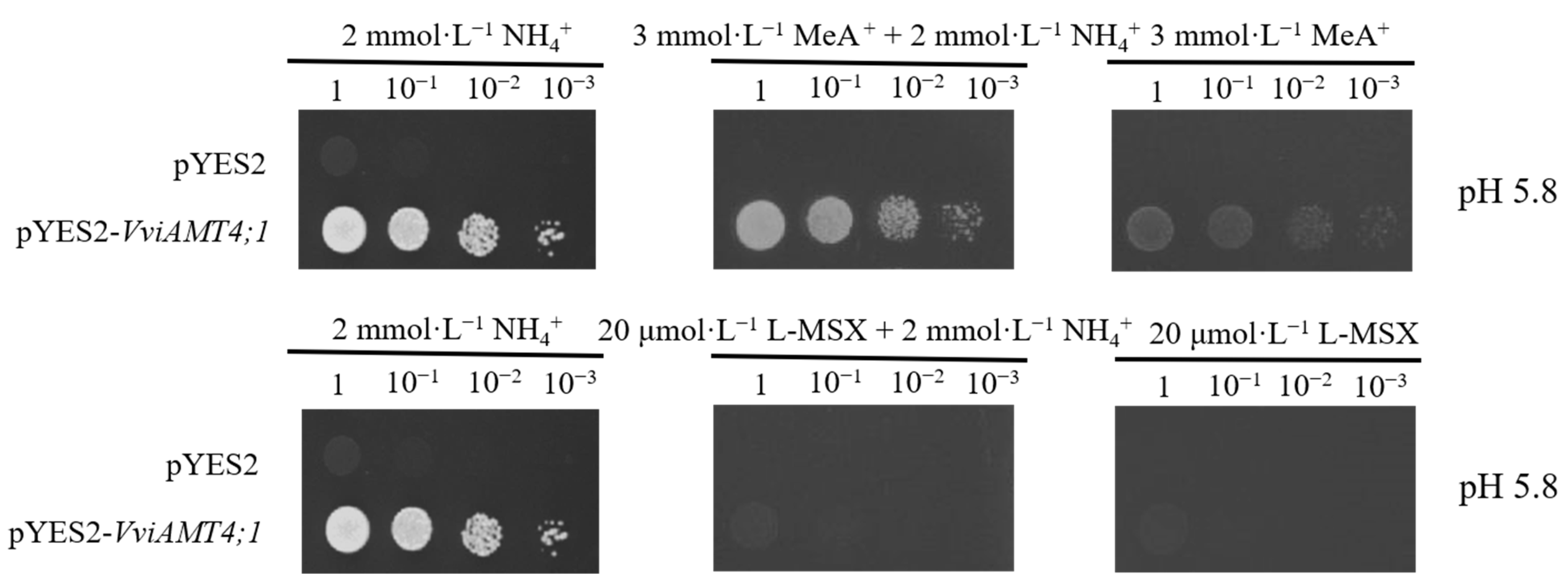
To examine the effects of methyl amine (MeA+) or L-methionine sulfoximine (L-MSX) on the ammonium uptake activity of VviAMT4;1, 3 mmol·L−1 MeA+ or 20 μmol·L−1 L-MSX was added to the solid medium with 2 mmol·L−1 NH4Cl as the sole nitrogen source [11,12,13]. The plates were incubated at 30 °C in the dark for 72 h, and colony growth was recorded using a gel imaging system. Parallel control experiments were performed with the empty vector-transformed strain (pYES2/31019b).

2.6. Kinetic Analysis of 15N Isotope Tracer-Labeled Ammonium Uptake

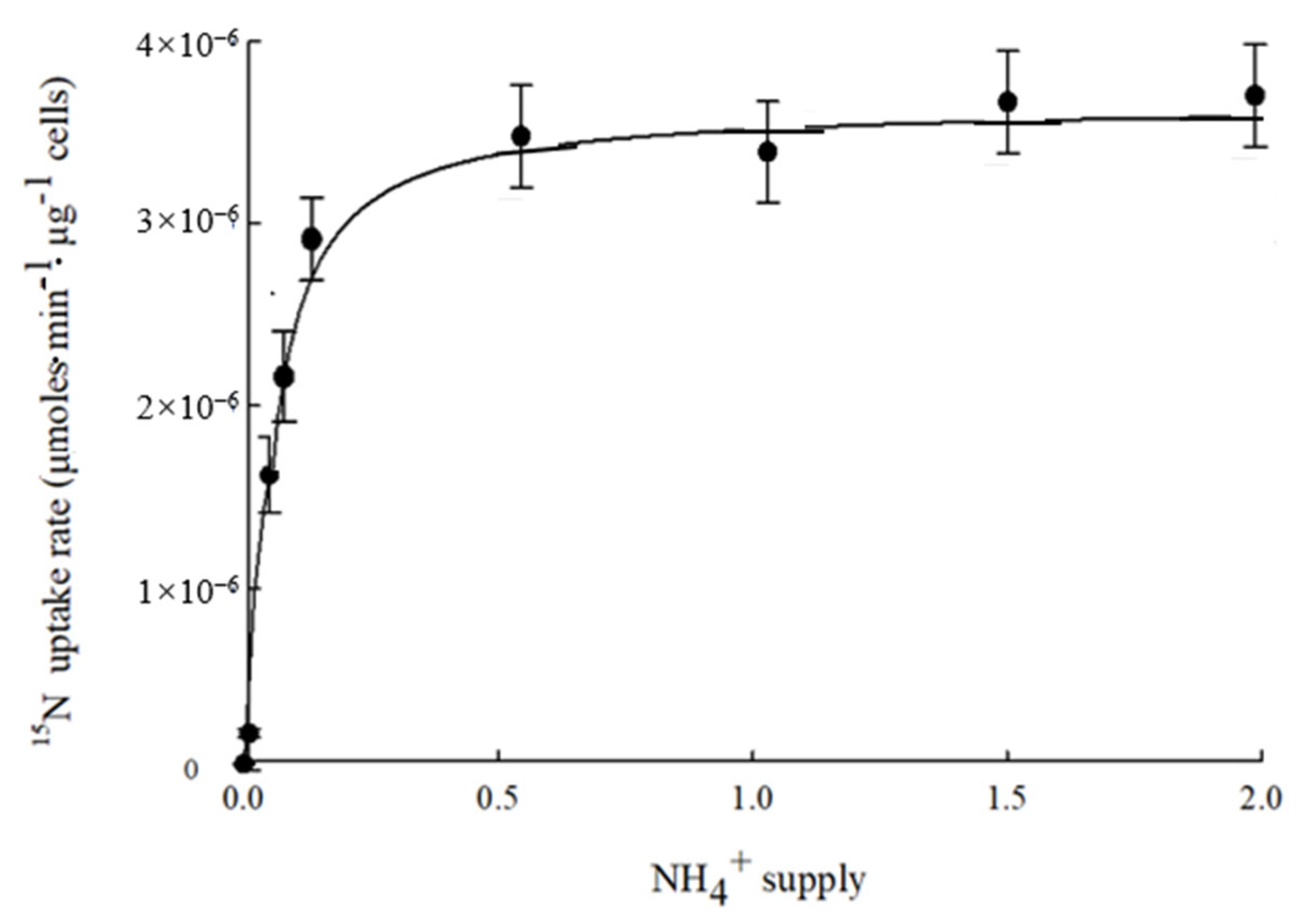
Following the methods previously reported by Yang et al. [11] and Guo et al. [13], the ammonium uptake kinetics of VviAMT4;1 were analyzed. Yeast cells were cultured in YNB liquid medium containing 15N isotope-labeled 15NH4Cl, with NH4+ concentrations set at 0, 0.01, 0.025, 0.05, 0.1, 0.25, 0.5, 1, and 2 mmol·L−1. The 15N-labeled 15NH4+ content was measured using a FLASH EA-DELTA V Elemental Analyzer-Mass Spectrometer (Flash-2000 Delta V ADVADTAGE, Thermo Fisher Scientific, Norristown, PA, USA), and the kinetic parameters Km (affinity constant) and Vmax (maximum uptake rate) were derived from curve fitting [11,12,13].

2.7. Statistical Analysis

Graphs were generated using Origin 12.0 software, and significant differences were analyzed using Student’s t-test in SPSS 13.0 software (SPSS Chicago, IL, USA), with details provided in the legends.

3. Results

3.1. Isolation of VviAMT4;1 from Table Grape

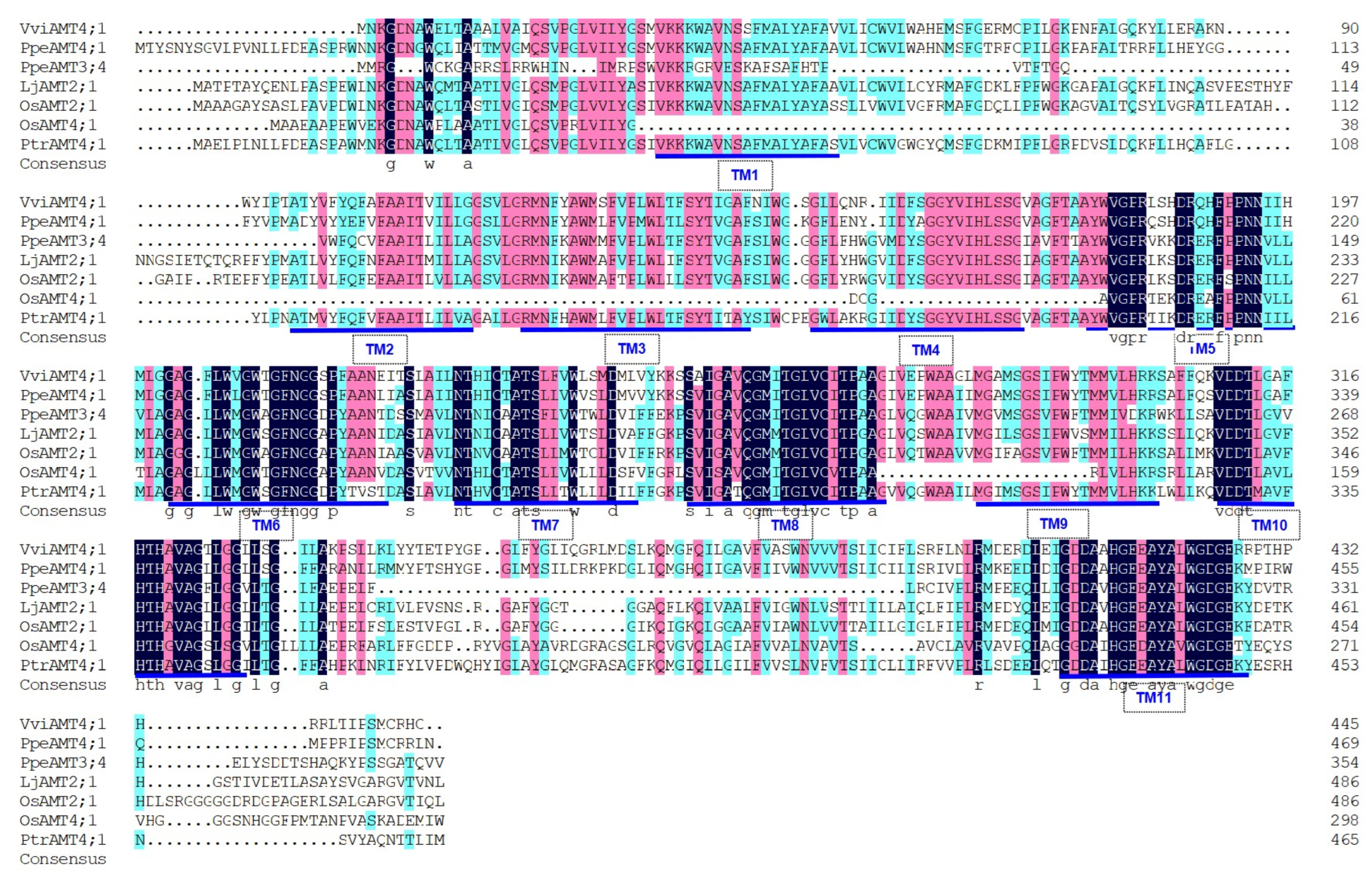
Using the peach AMT3;4 protein sequence as a reference [6], a homologous protein (VIT_200s1818g00010) was identified in the Phytozome grape genome, which was named VviAMT4;1. InterProScan prediction revealed the presence of an ammonium transporter functional domain, suggesting it might be a potential ammonium transporter protein. The VviAMT4;1 gene was further amplified from ‘Yanpu No.2’ roots, with a coding sequence (CDS) of 1338 bp encoding 445 amino acids (Figure 1). Gene structure analysis indicated that VviAMT4;1 has two introns, with lengths of 168 bp and 95 bp, respectively. Amino acid sequence alignment showed 64.39% identity between VviAMT4;1 and plant AMT homologues from P. persica, L. japonicus, P. trichocarpa, O. sativa, and A. thaliana. In addition, these plant AMT homologues contain 11 typical transmembrane domains (Figure 1).

3.2. Phylogenetic Tree Construction and Analysis

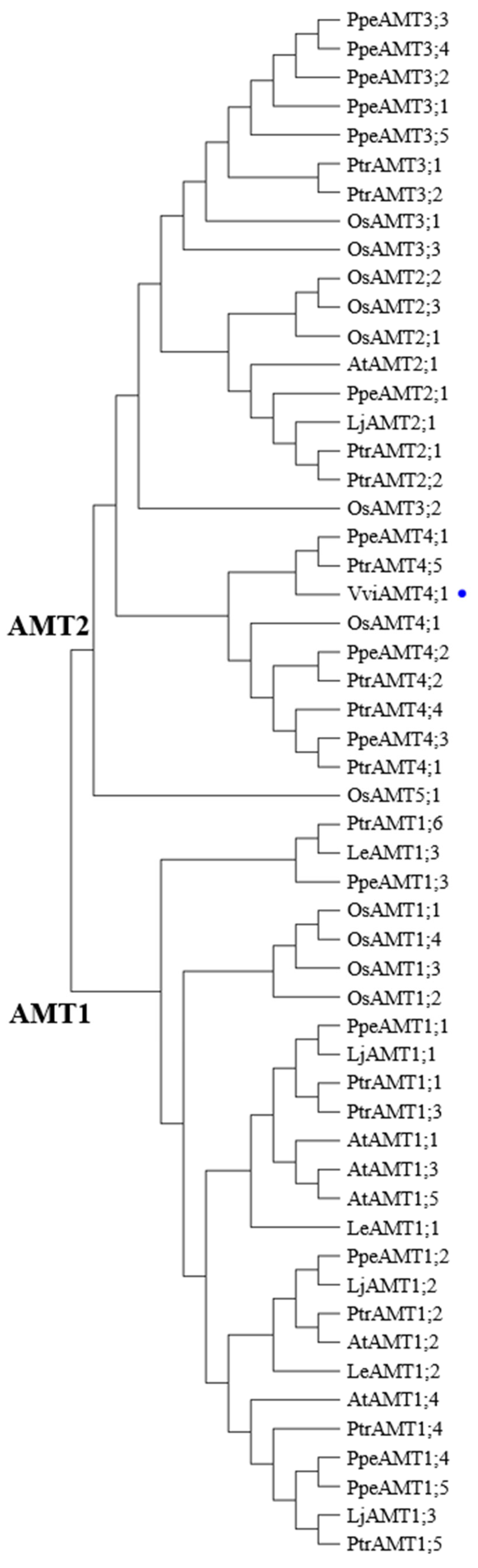
Phylogenetic tree analysis revealed that plant AMT transporters are classified into two major subgroups: AMT1 and AMT2. Notably, VviAMT4;1 was tightly clustered with peach PpeAMT4;1 and poplar PtrANT4;5, which belong to the AMT2 subgroup. The clustering pattern suggests that AMT2 subgroup transporters, particularly those of perennial tree species, share a relatively close evolutionary distance (Figure 2).

3.3. Expression Profiles of VviAMT4;1

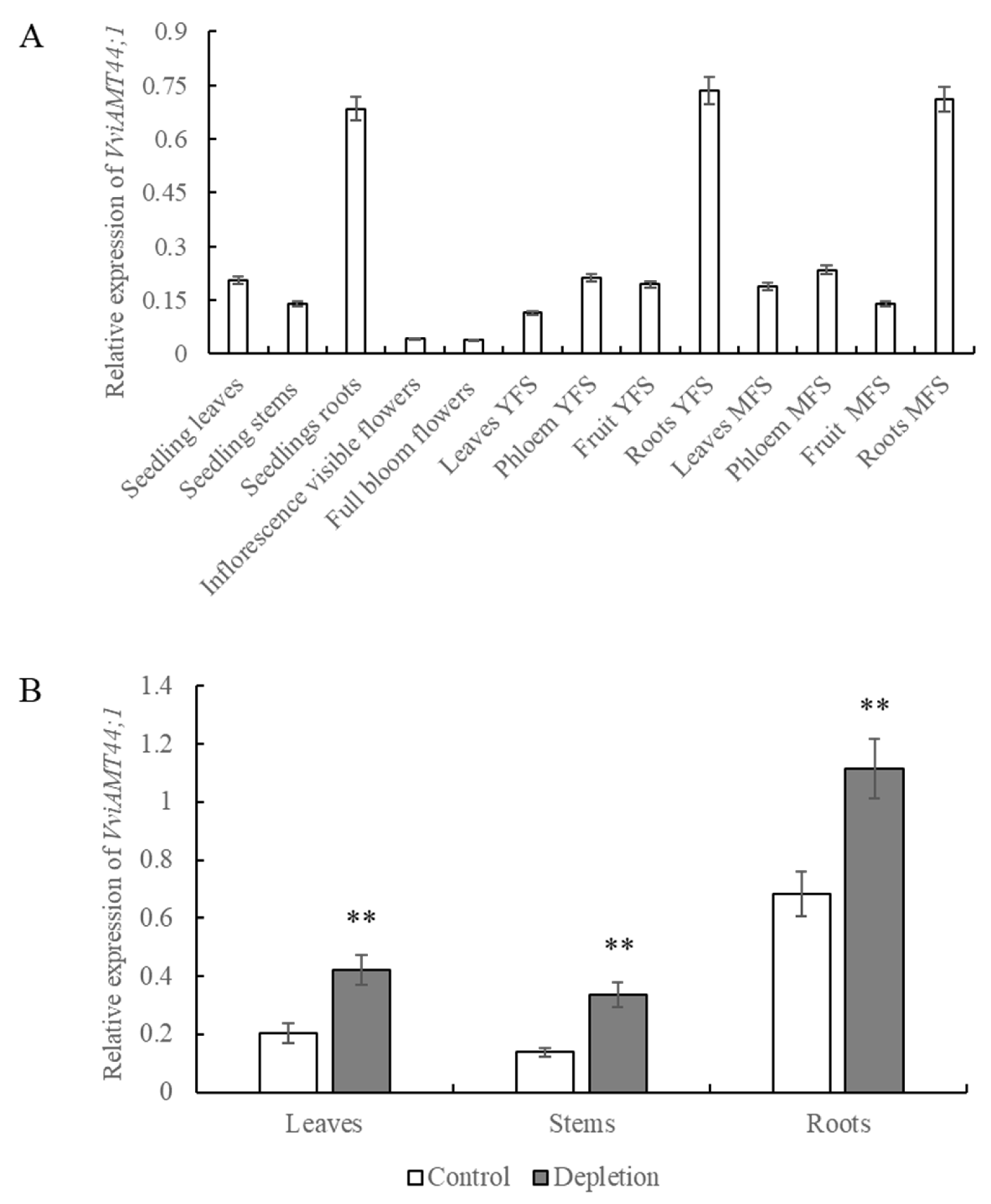
Both grape Ubiquitin (GenBank No. MH114011) and Tubulin (GenBank gene ID: 100246164) were evaluated as internal reference genes, and similar expression trends were obtained. In this study, results are presented using Ubiquitin as the internal reference gene (Figure 3). Tissue-specific expression analysis revealed that the VviAMT4;1 gene was most highly expressed in the roots of both mature ‘Yanpu No.2’ grapevines and tissue-cultured seedlings. In contrast, its expression levels were relatively low in other tissues or organs, including leaves and stems of seedlings, as well as flowers, leaves, phloem, and fruits of mature vines (Figure 3A).
Moreover, expression of VviAMT4;1 was strongly induced by NH4+ depletion. After 48 h of NH4+ starvation, the transcript levels of VviAMT4;1 increased in all tested tissues or organs (leaves, stems, and roots) of the tissue-cultured seedlings (Figure 3B).

3.4. Functional Determination of VviAMT4;1 in Yeast Mutant

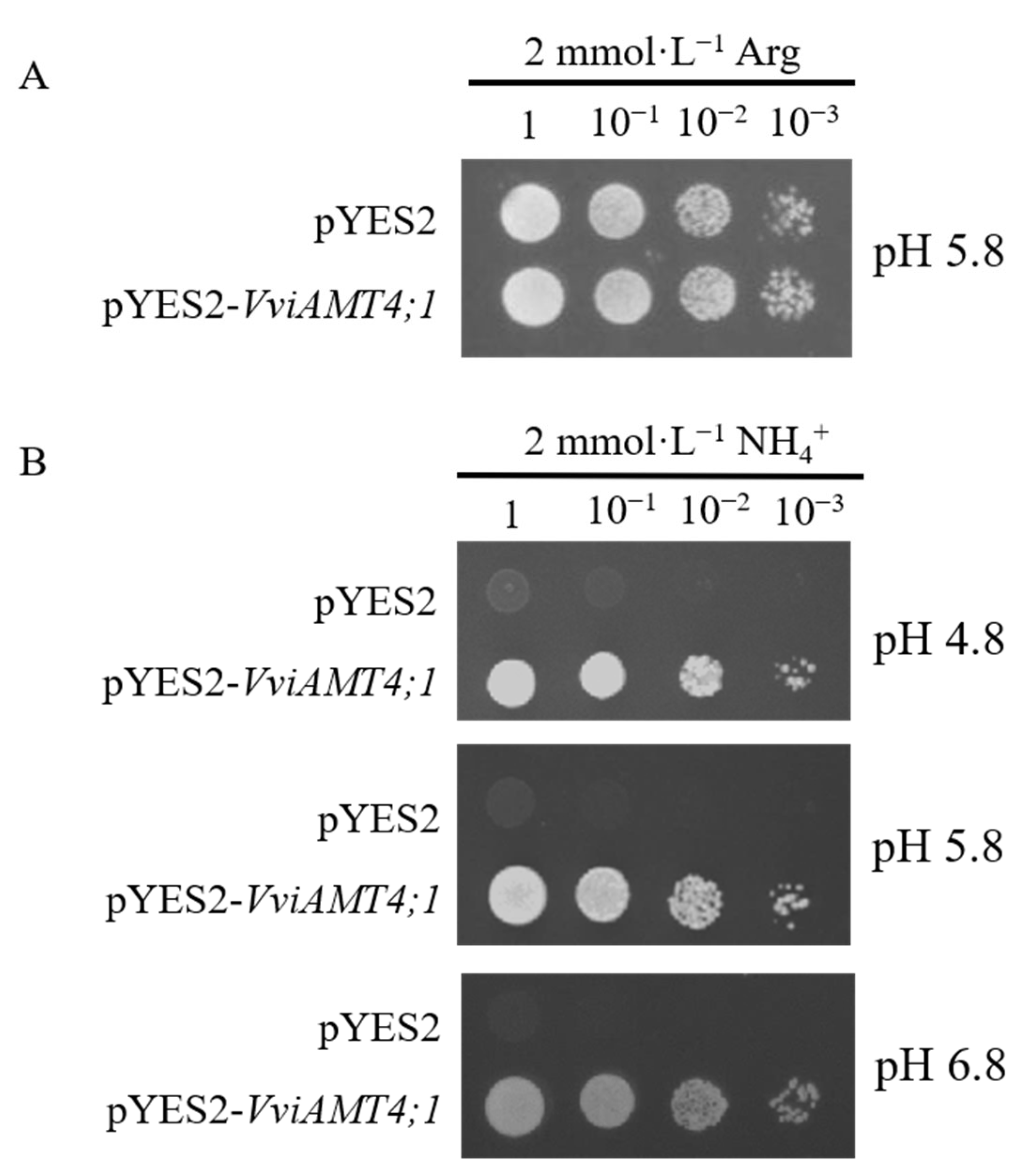
The yeast strain 31019b failed to grow normally in a medium containing less than 5 mmol·L−1 NH4+ as the sole nitrogen source [11,12,13]. On yeast-selective medium with 2 mmol·L−1 arginine (Arg) as the sole nitrogen source (pH 5.8), both the recombinant strain (pYES2-VviAMT4;1/31019b) and the empty vector-transformed strain (pYES2/31019b) exhibited normal growth. However, on the screening medium containing 2 mmol·L−1 NH4Cl as the sole nitrogen source, the empty vector-transformed strain pYES2/31019b could not grow, whereas the recombinant strain pYES2-VviAMT4;1/31019b restored growth under varying pH conditions (Figure 4). These findings suggest that VviAMT4;1 can mediate ammonium uptake in yeast cells. Meanwhile, we speculate that VviAMT4;1 may recognize NH4+ but could be implicated in NH3 transport.
MeA+ is an analog of NH4+ and significantly affects NH4+ uptake [11,12,13]. On the screening medium supplemented with both 3 mmol·L−1 MeA+ and 2 mmol·L−1 NH4Cl, the empty vector-transformed strain (pYES2/31019b) failed to grow, whereas the recombinant vector-transformed strain (pYES2-VviAMT4;1/31019b was able to grow but exhibited weakened growth compared to the control screening medium containing 2 mmol·L−1 NH4Cl as the sole nitrogen source. On yeast screening medium containing 3 mmol·L−1 MeA+ as the sole nitrogen source, the empty vector-transformed strain pYES2/31019b failed to grow, whereas the recombinant strain pYES2-VviAMT4;1/31019b exhibited weak growth (Figure 5). L-MSX is a glutamine analog that inhibits NH4+ assimilation [12,13]. On yeast screening medium containing 2 mmol·L−1 NH4Cl plus 20 μmol·L−1 L-MSX, or containing 20 μmol·L−1 L-MSX as the sole nitrogen source, neither the recombinant strain pYES2-VviAMT4;1/31019b nor the empty vector-transformed strain pYES2/31019b could grow (Figure 5).

3.5. 15N-Labeled Ammonium Uptake Kinetics Analysis

Km reflects the affinity between the AMT transporter and its substrate and Vmax reflects the catalytic efficiency of AMT transporters [11,12,13]. The 15N isotope tracer analysis revealed that VviAMT4;1-mediated ammonium uptake exhibited a Km of 49.58 ± 4.66 μmol·L−1 and a Vmax of 3.29 μmoles·min−1·μg−1 cells (Figure 6), indicating that VviAMT4;1 is a typical high-affinity ammonium transporter.

4. Discussion

Ammonium is one of the primary forms of nitrogen utilized by plants. When soil nitrogen is deficient, ammonium becomes the preferred absorption form for most plant species [1,2,3,5]. In particular, AMT transporters mediate the uptake and intracellular transport of ammonium (NH4+ or NH3), playing a critical role in plant growth and development. The AMT family comprises over a dozen members divided into two major subgroups, AMT1 and AMT2, with the majority of their gene functions remaining uncharacterized. Current research primarily focuses on functional analyses of the AMT1 subgroup in annual model plants, like Arabidopsis and rice [3,4,5,6,7,8,9,10,11,12]. Due to their perennial growth habit and specific lignified stems, woody and liana plants exhibit distinct nitrogen absorption and transport mechanisms compared to herbaceous species, suggesting differences in the physiological functions and regulatory mechanisms of their AMT homologs [31,32]. Nevertheless, the biological functions of AMT2 transporters in perennial woody and liana fruit crops remain largely unclear.
In model plants, multiple AMT1 subgroup homologues, such as Arabidopsis AtAMT1;3 [33], rice OsAMT1;1 [10,11], OsAMT1;3 [10,12], and Alternanthera philoxeroides ApAMT1;1 [13], are predominantly highly expressed in roots, mediating ammonium uptake or transport in root cells [10,11,12,32]. Interestingly, an AMT2 subgroup-encoding gene, VviAMT4;1, was cloned from ‘Yanpu No.2’. This gene was highly expressed in roots of both tissue-cultured seedlings and 5-year-old mature trees, suggesting its potential role in ammonium uptake and transport in cells of table grape roots. Similarly, PpeAMT4;3 was also highly expressed in peach roots [6] and PbAMT2 was highly expressed in pear roots [21]. Simultaneously, VviAMT4;1 shares the closest evolutionary relationship with peach PpeAMT4;1 and poplar PtrAMT4;5, implying that AMT2 subgroup transporters of perennial trees may possess similar biological functions, which requires further validation. Furthermore, VviAMT4;1 exhibits lower expression in leaves, stems, and fruits, indicating its comprehensive involvement in NH4+ allocation and transport in above-ground tissues or organs.
In plants, AMT2 family members are functionally recognized as NH3 transporters [19,20]. In this study, yeast functional complementation and 15N isotope tracer kinetic assays revealed that VviAMT4;1 is a high-affinity ammonium transporter that may be involved in NH3 transport, which needs further biological verification. These findings are in accordance with Arabidopsis AtAMT2 [19] and maize ZmAMT3;1 [20]. Together, these findings support the proposition that NH4+ is firstly recruited by the binding site and then transported across the membrane in the form of uncharged NH3 by dehydrogenation in AMT2 transporters.
Notably, MeA+ impacts ammonium uptake [11,12,13]. This study demonstrates that MeA+ as a substrate analog inhibits ammonium uptake and utilization in yeast cells, consistent with findings in rice OsAMT1;1 [11] and OsAMT1;3 [12] and A. philoxeroides ApAMT1;1 [13]. These findings suggest that VviAMT4;1 may play a role in nitrogen nutrition dynamics and efficient utilization in table grape roots. In addition, when ammonium and MeA+ coexist, VviAMT4;1 mediates preferential ammonium utilization, ensuring weak growth of yeast mutants. However, when MeA+ is the sole nitrogen source, VviAMT4;1 can also facilitate trace MeA+ uptake. The addition of L-MSX abolished VviAMT4;1-mediated ammonium uptake, aligning with results from rice OsAMT1;3 [12] and alligatorweed ApAMT1;1 [13]. Since L-MSX is a glutamine analog primarily inhibiting glutamine synthetase [12,13], it is speculated that ammonium absorbed by plant AMTs may participate in glutamine synthesis. L-MSX blocks this pathway, limiting ammonium assimilation and thereby suppressing VviAMT4;1 function. These findings indicate that VviAMT4;1 may be subject to feedback inhibition by intracellular ammonium accumulation.
Favorably, this study provides genetic resources for elucidating the biological functions of AMT2 transporters in table grapes and lays a theoretical foundation for exploring the molecular mechanisms of VviAMT4;1 in efficient nitrogen utilization.

5. Conclusions

VviAMT4;1 was isolated from table grape ‘Yanpu No.2’. It was highly expressed in roots and showed up-regulated expression under NH4+ depletion. VviAMT4;1 is a typical high-affinity ammonium transporter that may recognize NH4+ but actually transports NH3. Both MeA+ and L-MSX reduced the growth of yeast mutants transformed with pYES2-VviAMT4;1. The VviAMT4;1-mediated ammonium uptake process may be subject to feedback inhibition by endogenous NH4+ enrichment.

Author Contributions

Conceptualization, Z.S. and M.T.; methodology, H.X., M.S. and Z.S.; validation, H.X. and Y.T.; investigation, H.X., M.S. and Y.T.; data curation, M.S. and R.Y.; writing—original draft preparation, H.X. and Z.S.; writing—review and editing, M.T.; project administration, M.T.; funding acquisition, Z.S. and M.T. All authors have read and agreed to the published version of the manuscript.

Funding

This research was funded by the Key R&D Program of Shandong Province—Innovation Capability Enhancement Project for Technology-based Small- and Medium-sized Enterprises (2024TSGC0718), the Major Project of Science and Technology of Shandong Province (2022CXGC010605), the China Agriculture Research System of MOF and MARA (CARS-29-17), and the China Scholarship Council Fund (202208370080).

Informed Consent Statement

Not applicable.

Data Availability Statement

The data are contained within the present article.

Conflicts of Interest

The authors declare no conflict of interest.

References

  1. Cruz, C.; Bio, A.F.M.; Dominguez-Valdivia, M.D.; Aparicio-Tejo, P.M.; Lamsfus, C.; Martins-Loução, M.A. How does glutamine synthetase activity determine plant tolerance to ammonium? Planta 2006, 223, 1068–1080. [Google Scholar] [CrossRef] [PubMed]
  2. Liu, Y.; von Wirén, N. Ammonium as a signal for physiological and morphological responses in plants. J. Exp. Bot. 2017, 68, 2581–2592. [Google Scholar] [CrossRef]
  3. Ludewig, U.; Neuhäuser, B.; Dynowski, M. Molecular mechanisms of ammonium transporter and accumulation in plants. FEBS Lett. 2007, 581, 2301–2308. [Google Scholar] [CrossRef]
  4. McDonald, T.R.; Ward, J.M. Evolution of electrogenic ammonium transporters (AMTs). Front. Plant Sci. 2016, 7, 352. [Google Scholar] [CrossRef]
  5. Straub, T.; Ludewig, U.; Neuhäuser, B. The kinase CIPK23 inhibits ammonium transport in Arabidopsis thaliana. Plant Cell 2017, 29, 409–422. [Google Scholar] [CrossRef] [PubMed]
  6. You, S.H.; Wang, Y.Q.; Li, Y.J.; Li, Y.H.; Tan, P.; Wu, Z.; Shi, W.J.; Song, Z.Z. Cloning and functional determination of ammonium transporter PpeAMT3; 4 in peach. Biomed. Res. Int. 2020, 2147367, 1–7. [Google Scholar]
  7. Ninnemann, O.; Jauniaux, J.C.; Frommer, W.B. Identification of a high affinity NH4+ transporter from plants. EMBO J. 1994, 13, 3464–3471. [Google Scholar] [CrossRef]
  8. Ludewig, U.; von Wiren, N.; Frommer, W.B. Uniport of NH4+ by the root hair plasma membrane ammonium transporter LeAMT1; 1. J. Biol. Chem. 2002, 277, 13548–13555. [Google Scholar] [CrossRef]
  9. Ludewig, U.; Wilken, S.; Wu, B.H.; Jost, W.; Obrdlik, P.; Bakkoury, M.E.; Marini, A.; André, B.; Hamacher, T.; Boles, E.; et al. Homo- and hetero-oligomerization of ammonium transporter-1 NH4+ uniporters. J. Biol. Chem. 2019, 278, 45603–45610. [Google Scholar] [CrossRef]
  10. Sonoda, Y.; Ikeda, A.; Saiki, S.; von Wirén, N.; Yamaya, T.; Yamaguchi, J. Distinct expression and function of three ammonium transporter genes (OsAMT1;1-1;3) in rice. Plant Cell Physiol. 2003, 44, 726–734. [Google Scholar] [CrossRef]
  11. Yang, S.; Hao, D.; Cong, Y.; Jin, M.; Su, Y.H. The rice OsAMT1; 1 is a proton-independent feedback regulated ammonium transporter. Plant Cell Rep. 2015, 34, 321–330. [Google Scholar] [CrossRef]
  12. Hao, D.; Yang, S.; Huang, Y.; Su, Y.H. Identification of structural elements involved in fine-tuning of the transport activity of the rice ammonium transporter OsAMT1; 3. Plant Physiol. Biochem. 2016, 108, 99–108. [Google Scholar] [CrossRef]
  13. Guo, X.T.; Sheng, Y.T.; Yang, S.Y.; Han, L.; Gao, Y.C.; Zhang, K.; Cheng, J.S.; Zhang, H.X.; Su, Y.H. Isolation and characterization of a high-affinity ammonium transporter ApAMT1; 1 in alligatorweed. Plant Growth Regul. 2019, 89, 32–330. [Google Scholar] [CrossRef]
  14. Li, T.; Liao, K.; Xu, X.; Gao, Y.; Wang, Z.Y.; Zhu, X.F.; Jia, B.L.; Xuan, Y.H. Wheat ammonium transporter (AMT) gene family: Diversity and possible role in host–pathogen interaction with stem rust. Front. Plant Sci. 2017, 8, 1637. [Google Scholar] [CrossRef]
  15. Yuan, L.; Loqué, D.; Kojima, S.; Rauch, S.; Ishiyama, K.; Inoue, E.; Takahashi, H.; von Wirén, N. The organization of high-affinity ammonium uptake in Arabidopsis roots depends on the spatial arrangement and biochemical properties of AMT1-type transporters. Plant Cell 2007, 19, 2636–2652. [Google Scholar] [CrossRef] [PubMed]
  16. Kaiser, B.N.; Rawat, S.R.; Siddiqi, M.Y.; Masle, J.; Glass, A.D.M. Functional analysis of an Arabidopsis T-DNA “knockout” of the high-affinity NH4+ transporter AtAMT1.1. Plant Physiol. 2002, 130, 1263–1275. [Google Scholar] [CrossRef] [PubMed]
  17. Loqué, D.; Yuan, L.; Kojima, S.; Gojon, A.; Wirth, J.; Gazzarrini, S.; Ishiyama, K.; Takahashi, H.; von Wirén, N. Additive contribution of AtAMT1.1 and AtAMT1.3 to high-affinity ammonium uptake across the plasma membrane of nitrogen-deficient Arabidopsis roots. Plant J. 2006, 48, 522–534. [Google Scholar] [CrossRef]
  18. Ninkuu, V.; Liu, Z.X.; Sun, X.W. Genetic regulation of nitrogen use efficiency in Gossypium spp. Plant Cell Environ. 2023, 46, 1749–1773. [Google Scholar] [CrossRef]
  19. Neuhäuser, B.; Dynowski, M.; Ludewig, U. Channel-like NH3 flux by ammonium transporter AtAMT2. FEBS Lett. 2009, 583, 2833–2838. [Google Scholar] [CrossRef]
  20. Hui, J.; An, X.; Li, Z.B.; Neuhäuser, B.; Ludewig, U.; Wu, X.N.; Schulze, W.X.; Chen, F.J.; Feng, G.; Lambers, H.; et al. The mycorrhiza-specific ammonium transporter ZmAMT3; 1 mediates mycorrhiza-dependent nitrogen uptake in maize roots. Plant Cell 2022, 34, 4066–4087. [Google Scholar] [CrossRef]
  21. Li, H.; Cong, Y.; Chang, Y.H.; Lin, J. Two AMT2-Type ammonium transporters from Pyrus betulaefolia demonstrate distinct expression characteristics. Plant Mol. Biol. Rep. 2016, 34, 707–719. [Google Scholar] [CrossRef]
  22. Shi, X.B. Nitrogen Requirement Regularity of Kyoho Grapevines and Absorption, Utilization Features of the Different Rootstocks. Master’s Thesis, Shandong Agricultural University, Tai’an, China, 2012. (In Chinese) [Google Scholar]
  23. Wang, J. The Effect of Exogenous Nitrogen on Wine Grape Physiology and Wine Quality. Master’s Thesis, Ningxia University, Yinchuan, China, 2021. (In Chinese) [Google Scholar]
  24. Zhang, L.; Zong, Y.Q.; Yu, W.H.; Han, L.; Sun, Y.Z.; Chen, C.H.; Chen, S.L.; Zhang, K.; Cheng, J.S.; Tang, M.L.; et al. Identification, cloning, and expression characteristics analysis of Fe-S cluster assembly genes in grape. Sci. Agric. Sin. 2021, 54, 5068–5082. (In Chinese) [Google Scholar]
  25. Sun, X.J.; Tao, Y.F.; Chi, L.J.; Tang, M.L.; Guan, X.Q.; Shi, M.; Song, Z.Z. Cloning and function determination of cytochrome P450 encoding gene CYP76F14 from three different flavor-type table grape varieties. Sino-Overseas Grapevine Wine 2025, 1, 1–8. (In Chinese) [Google Scholar]
  26. Tang, M.L.; Li, Y.H.; Chen, Y.H.; Han, L.; Zhang, H.X.; Song, Z.Z. Characterization and expression of ammonium transporter in peach (Prunus persica) and regulation analysis in response to external ammonium supply. Phyton-Int. J. Exp. Bot. 2020, 89, 925–941. [Google Scholar] [CrossRef]
  27. Yang, Y.; Zhang, J.J.; Li, M.Y.; Ning, Y.Z.; Tao, Y.F.; Shi, S.P.; Dark, A.; Song, Z.Z. Heterologous expression of a Ferritin homologue gene PpFer1 from Prunus persica enhances plant tolerance to iron toxicity and H2O2 stress in Arabidopsis thaliana. Plants 2023, 12, 4093. [Google Scholar] [CrossRef] [PubMed]
  28. Xia, G.; Shi, M.; Xu, W.; Dark, A.; Song, Z. Cytochrome P450 VvCYP76F14 dominates the production of wine bouquet precursors in wine grapes. Front. Plant Sci. 2024, 15, 1450251. [Google Scholar] [CrossRef]
  29. Peng, B.; Ran, J.G.; Li, Y.Y.; Tang, M.L.; Xiao, H.L.; Shi, S.P.; Ning, Y.Z.; Dark, A.; Guan, X.Q.; Song, Z.Z. Site-directed mutagenesis of VvCYP76F14 (cytochrome P450) unveils its potential for selection in wine grape varieties linked to the development of wine bouquet. J. Agric. Food Chem. 2024, 72, 3683–3694. [Google Scholar] [CrossRef]
  30. Song, Z.Z.; Tang, M.L.; Xiao, H.L.; Xu, H.H.; Shi, M.; Dark, A.; Xie, Z.Q.; Peng, B. Unraveling the trisubstrate-triproduct reaction mechanisms of wine grape VvCYP76F14 to improve wine bouquet. Food Chem. 2025, 474, 143077. [Google Scholar] [CrossRef]
  31. Selle, A.; Willmann, M.; Grunze, N.; Gessler, A.; Weiss, M.; Nehls, U. The high-affinity polar ammonium importer PttAMT1.2 and its role in ectomycorrhizal symbiosis. New Phytol. 2005, 168, 697–706. [Google Scholar] [CrossRef] [PubMed]
  32. Couturier, J.; Montanini, B.; Martin, F.; Brun, A.; Blaudez, D.; Chalot, M. The expanded family of ammonium transporters in the perennial poplar plant. New Phytol. 2017, 174, 137–150. [Google Scholar] [CrossRef]
  33. Lima, J.E.; Kojima, S.; Takahashi, H.; von Wirén, N. Ammonium triggers lateral root branching in Arabidopsis in an AMMONIUM TRANSPORTER1;3-dependent manner. Plant Cell 2010, 22, 3621–3633. [Google Scholar] [CrossRef] [PubMed]
Figure 1. Amino acid alignment of plant AMT homologues. AMT proteins were chosen from table grape VviAMT4;1, P. persica PpeAMT3;4 and PpeAMT4;1, L. japonicus LjAMT2;1, P. trichocarpa PtrAMT4;1, O. sativa OsAMT2;1 and OsAMT4;1, and A. thaliana AtAMT2;1. The colors of black, pink, and dark green indicate identities of 100%, 85%, and the range between 45% and 70%, respectively, at the same amino acid residue. Note: TM means transmembrane region, underlined by blue lines.
Plants 15 00519 g001
Figure 2. Phylogenetic tree of plant AMT homologues. The tree was constructed using the maximum likelihood method in MEGA 15.0. Amino acid sequences of AMT homologues were collected from table grape, S. lycopersicum, P. persica, L. japonicus, P. trichocarpa, O. sativa, and A. thaliana. Table grape VviAMT4;1 is labelled with a blue dot.
Plants 15 00519 g002
Figure 3. Tissue-specific expression analysis of VviAMT4;1. (A) Relative expression of VviAMT4;1 in 5-year-old mature ‘Yanpu No.2’ trees. (B) Relative expression of VviAMT4;1 in tissue-cultured ‘Yanpu No.2’ seedlings. Tissue samples were collected and frozen immediately in liquid nitrogen before qRT-PCR analysis. YFS, young fruit state; MFS, mature fruit stage. Asterisks indicate statistical difference found between the control and NH4+ depletion (** p < 0.01).
Plants 15 00519 g003
Figure 4. Yeast functional complementation test of VviAMT4;1. Yeast strain 31019b was transformed with pYES2 or pYES2-VviAMT4;1. (A) Growth assays of yeast 31019b on YNB medium supplemented with different concentrations of NH4Cl. Yeast cells grown on YNB medium supplemented with 2 mM arginine (Arg, pH 5.8) as the sole N source were used as positive control. (B) Growth assays of yeast 31019b on YNB medium under different pH conditions (pH 4.8, 5.8, and 6.8), supplemented with different concentrations of NH4Cl. Final diluted concentrations are indicated by 1, 10−1, 10−2, and 10−3, respectively.
Plants 15 00519 g004
Figure 5. Feedback regulation analyses of VviAMT4;1-mediated ammonium uptake. Yeast cells were grown on YNB medium (pH 5.8) containing 3 mmol·L−1 MeA+ or 20 μmol·L−1 L-MSX as the sole N source, supplemented with 0 or 2 mmol·L−1 NH4Cl. Final diluted concentrations are indicated by 1, 10−1, 10−2, and 10−3.
Plants 15 00519 g005
Figure 6. 15N-labeled ammonium uptake analyses of VviAMT4;1 in yeast. Yeast cells transformed with pYES2 or pYES2-VviAMT4;1 were grown in YNB liquid medium supplemented with different concentrations of 15N labeled 15NH4Cl. Values are presented as means ± SE, n = 6. Error bars within the plot symbols are not visible.
Plants 15 00519 g006
Disclaimer/Publisher’s Note: The statements, opinions and data contained in all publications are solely those of the individual author(s) and contributor(s) and not of MDPI and/or the editor(s). MDPI and/or the editor(s) disclaim responsibility for any injury to people or property resulting from any ideas, methods, instructions or products referred to in the content.