


Abstract
Temporal knowledge graphs aim to enhance the dynamic and evolutionary representation of knowledge while enabling time-based reasoning. However, the reasoning based on temporal knowledge graphs in real geographic environments suffers from low accuracy due to the difficulty in effectively utilizing complex spatio-temporal information. Spatial attributes within entities typically encompass both relative and absolute spatial information types. However, during spatio-temporal reasoning, the deep coupling between the quadruple and these two spatial information types is frequently overlooked, as they remain unintegrated in inference predictions. This paper proposes a novel Multi-Task Spatial Recurrent Evolution Graph Convolutional Network (MTS-RE-GCN) framework to enable temporal knowledge graph methods to better reason about spatial entities under time-varying conditions. Experiments on the spatio-temporal dataset and the benchmark dataset (i.e., ICEWS14s, ICEWS18) with spatio-temporal features demonstrate that MTS-RE-GCN significantly outperforms the baseline models (e.g., RE-GCN, TiRGN). For entity prediction tasks, MTS-RE-GCN achieves mean reciprocal rank (MRR) scores of 0.848, 0.739, 0.566, representing improvements of 9.00%, 6.03%, 3.28%, correspondingly. This provides a comprehensive and efficient solution for spatio-temporal entity prediction in temporal knowledge graphs, holding significant implications for spatio-temporal data analysis, event prediction, and related fields.
1. Introduction
With the explosive growth of artificial intelligence and big data, it has become crucial to organize and represent massive amounts of knowledge appropriately [1]. As a type of graph data structure, knowledge graphs can effectively represent complex information [2], where the nodes represent entities (e.g., people, places, events) and the edges represent potentially different relations (e.g., “born”, “belonging”, “located”) between these entities [3]. The knowledge can be expressed in a factual triple in the form of or [4]. With this approach, knowledge graphs can enable efficient integration and semantic search of data [5] and promote the improvement of model training and reasoning abilities [6].
Most existing knowledge graph methods focus on static knowledge graphs, which cannot get the temporal information in the knowledge graph [7]. The effective utilization of embedding technologies to represent a knowledge graph that integrates temporal data has gained significant scholarly interest [8]. The temporal knowledge graph introduces a temporal dimension, expanding information into a quadruple . Temporal knowledge graphs can construct the evolution of entities with spatial information and their relationships (defined as spatial entities and spatial relationships) over the temporal dimension to effectively capture semantic associations between spatial entities [9]. This method grants temporal knowledge graphs a distinct advantage in addressing spatio-temporal problems, enabling more precise responses to complex queries, such as “When and where did the event occur?”, via describing the changes in entities and their relationships in time and space.
The temporal knowledge graph plays a significant role in scenarios where spatio-temporal information is enriched [10], such as in the fields of intelligent transportation and urban planning and management. For example, by using historical vehicle trajectory data and environmental information data [11], the temporal knowledge graph can be used to predict future traffic flow and vehicle trajectories under similar conditions [12]. Another critical scenario is to analyze spatio-temporal dynamics, such as population mobility and land-use changes, prediction of urban changes, and providing support for urban planning and decision-making [9].
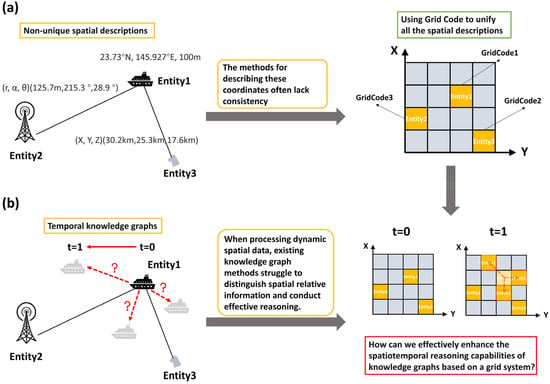
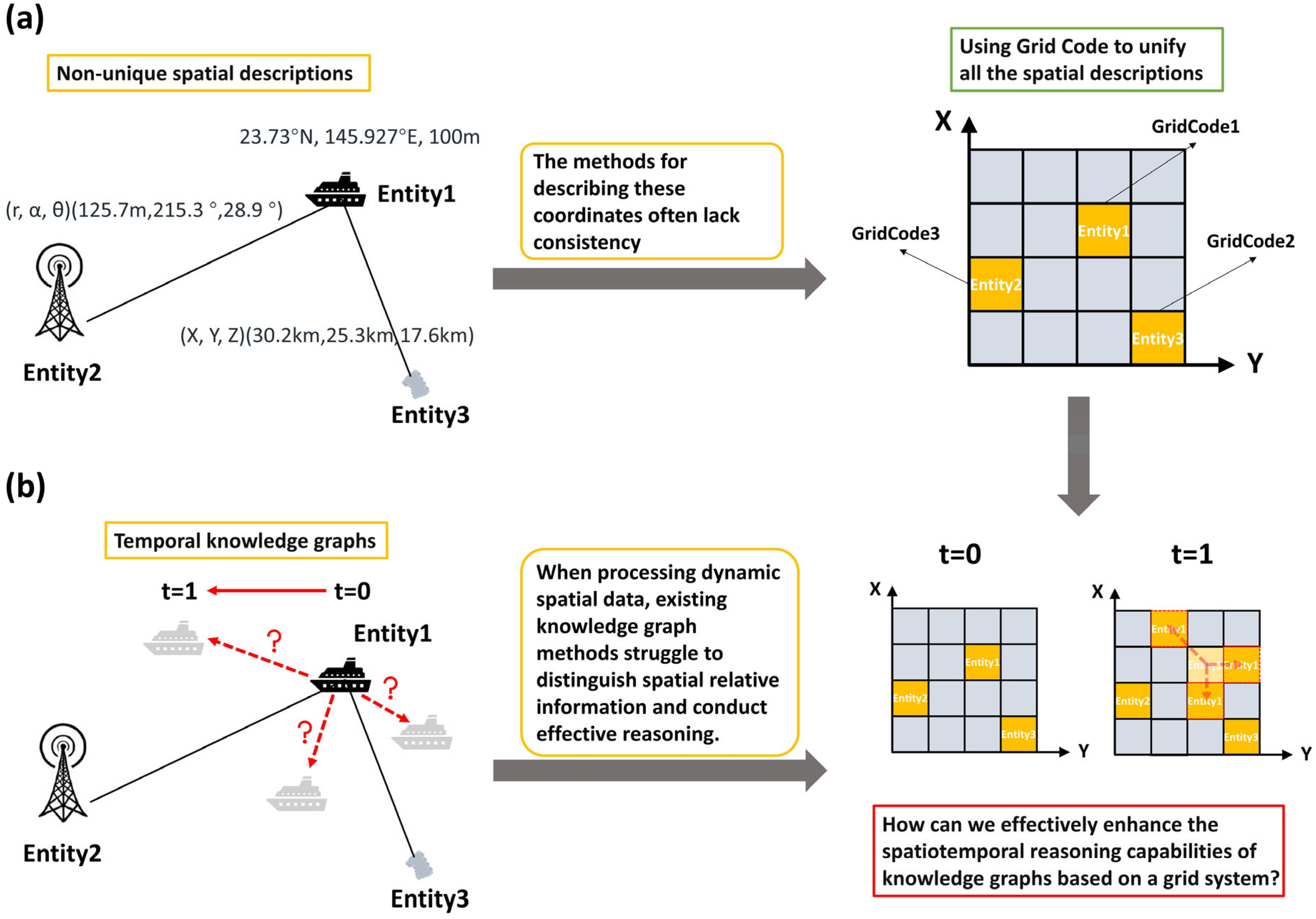
Despite the remarkable success of traditional temporal knowledge graph methods in knowledge representation and reasoning [13], they still exhibit notable limitations when handling spatial data under time-varying conditions. These limitations manifest primarily in two aspects, as follows. First, during the modeling process, spatial information is typically represented through coordinate systems (e.g., latitude/longitude, polar coordinates, 3D coordinates), and the methods for describing these coordinates often lack consistency, as illustrated in Figure 1a. Second, at the spatial representation level, when temporal knowledge graphs integrate spatial information, they lack an understanding of spatial dynamic relationships under time-varying conditions. Spatial information under time-varying conditions can be categorized into absolute position information (spatial location) and relative position information (spatial relationships). Absolute position information refers to the precise location of an entity within a global coordinate system (e.g., coordinates). Relative position information denotes the spatial relationships of an entity at different points in time, as illustrated in Figure 1b, such as a vessel moving 14 nautical miles east-northeast. This limitation becomes more pronounced when the temporal dimension is combined with the spatial dimension. For instance, an entity’s “absolute position” may change irregularly at different time points, while its relative position may change regularly (e.g., a uniformly moving object). Existing knowledge graph methods cannot distinguish and reason about such differences when processing this type of spatio-temporal information, resulting in their struggle to differentiate and utilize different types of spatial information for spatio-temporal reasoning when facing dynamic spatial data.
Figure 1.
The two types of challenges encountered in current knowledge graph modeling within real-world geographic environments. (a) Inconsistent coordinate representation methods; (b) Insufficient modeling of absolute and relative spatial information over time.
Multi-task learning approaches achieve feature reuse and joint loss optimization by sharing portions of the model architecture and parameters [14], enabling the related tasks to mutually assist each other to reduce information loss across tasks and enhance prediction accuracy [15]. Multi-task learning enables models to learn more general feature representations by training multiple related tasks in parallel, making it suitable for scenarios where tasks are interrelated [16]. Further, during the knowledge graph construction, multi-task learning models can learn richer knowledge from limited datasets, thereby improving data efficiency [17].
Based on the above, the method proposed in this paper aims to address these challenges by introducing richer spatio-temporal dimensions and corresponding multi-task learning mechanisms, thereby unlocking the extensive potential of temporal knowledge graphs. The main novel contribution of this paper is that we propose a multi-task learning neural network model, Multi-Task Spatial Recurrent Evolution Graph Convolutional Network (MTS-RE-GCN), for jointly learning absolute spatial information and relative spatial information, achieving improved reasoning effects for temporal knowledge graphs in scenarios with rich spatio-temporal knowledge.
2. Related Work
Knowledge graph completion methods for knowledge graph reasoning can be primarily categorized into two types: static knowledge graph reasoning and dynamic temporal knowledge graph reasoning. Static knowledge graph models focus on completing missing entities or relations in static knowledge graphs. They employ embedding models (such as TransE [18] and related methods) to learn embedded representations. This learning process, based on distributed representation theory, maps semantic information of entities or relations into a vector space, ensuring that semantically similar objects maintain close distances. Here, h, r, and t denote the representation vectors for head entities, tail entities, and relations, respectively. Distributed representations map diverse heterogeneous information into a unified semantic space, enabling cross-modal information interaction across multiple sources. However, these methods exhibit significant limitations in modeling complex relational patterns. TransE, while simple and efficient, struggles to model one-to-many, many-to-one, and many-to-many relations due to its translation assumption (). To mitigate these issues, TransH [19] was introduced, which allows each relation to have its own specific hyperplane, where entity embeddings are projected onto these hyperplanes before the translation operation, enabling entities to have different representations depending on the context of the relation. Further advancing this concept, TransR [20] proposes that entities and relations may belong to different semantic spaces. It models entities in an entity space and relations in a relation space , utilizing a relation-specific projection matrix to map entities from the entity space to the relation space for translation. Similarly, DistMult [21] simplifies the relation matrix to a diagonal form, which restricts it to capturing only symmetric relations, making it incapable of modeling the asymmetric relationships prevalent in real-world data. While excelling in static semantic knowledge graphs, the above methods cannot perform tasks predicting future facts.
In terms of dynamic temporal knowledge graph reasoning models, temporal knowledge graphs can be categorized into two scenarios, interpolation and extrapolation. The primary challenge in interpolation scenarios is filling in missing facts within historical timestamps. This paper focuses on extrapolation scenarios, achieving predictions for future timestamps by modeling past facts through knowledge graphs. However, existing methods face challenges in accurately capturing spatio-temporal evolution. One of the critical methods is TANGO, which introduces Neural Ordinary Differential Equations for continuous-time modeling. However, its variants have specific flaws, such that TANGO-DistMult [22] inherits the symmetry limitation of DistMult, which fails to model directed temporal flows, while TANGO-Tucker [22] suffers from high computational complexity and overfitting risks due to the cubic growth of its core tensor. Among these, TANGO-DistMult and TANGO-Tucker repeatedly demonstrate limitations in handling asymmetric dynamic flows and computational efficiency, respectively. CyGNet [23] employs a copy-generation mechanism that relies heavily on historical recurrence, leading to poor performance when predicting new entities or events that have not appeared in history. RE-NET [24] proposes an autoregressive framework that uses a recurrent event encoder to process past facts and a neighborhood aggregator to model concurrent interactions at each timestamp, effectively treating the temporal KG as a sequence of discrete events. Another representative method, TiRGN [25], emphasizes the importance of local and global historical patterns. TiRGN utilizes a dual-encoder architecture where a local recurrent network captures short-term dependencies and a global history encoder collects repeated historical facts, allowing the model to account for sequential, repetitive, and cyclical behaviors. CEN [26] addresses the variability in length–diversity and time–variability of evolutionary patterns. By employing a length-aware Convolutional Neural Network (CNN) and an easy-to-difficult curriculum learning strategy, CEN can handle historical sequences of diverse lengths and adapt to shifting patterns through an online learning mechanism. Further, RE-GCN [27] typically treats spatial information as static attributes, failing to explicitly distinguish between evolving “absolute” and “relative” spatial semantics.
Multi-task learning is a machine learning paradigm centered on simultaneously learning multiple related tasks. By sharing model representations, such as layers within a neural network, these tasks mutually reinforce each other during training, thereby enhancing the generalization capabilities and efficiency of each task. In the context of deep learning, this is often implemented via Hard Parameter Sharing, where hidden layers are shared to learn common features, or Soft Parameter Sharing, where separate models are constrained to be similar [28]. To address the aforementioned limitations of baseline models, the proposed MTS-RE-GCN framework adopts a multi-task strategy. Unlike previous models that conflate spatial data, MTS-RE-GCN explicitly disentangles spatial reasoning into absolute positioning and relative semantic tasks. By jointly optimizing these through shared representations, the model leverages implicit knowledge transfer, allowing relative spatial dynamics to inform absolute position predictions, thereby achieving superior performance in complex spatio-temporal extrapolation tasks.
3. Methodology
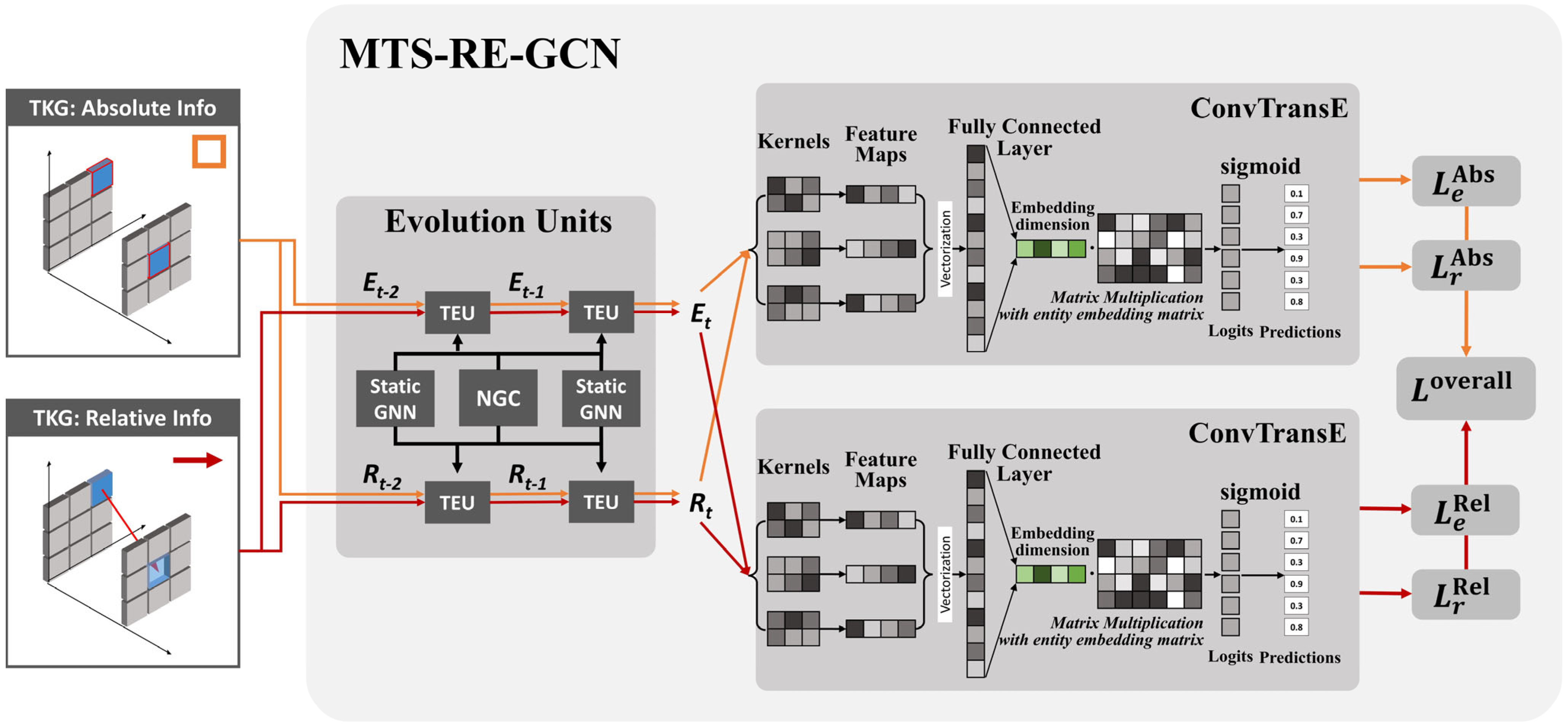
MTS-RE-GCN primarily learns relative and absolute spatial information based on grid modeling to achieve Extrapo-temporal entity prediction. Figure 2 illustrates the overall architecture of MTS-RE-GCN for temporal knowledge graph reasoning. Table 1 lists symbols used in MTS-RE-GCN with their descriptions. As shown in Figure 2, MTS-RE-GCN comprises three components: Evolution Units (encoding layer, Task-Shared Layer), a decoder module (Task-Specific Layer), and a joint loss function. The core component of MTS-RE-GCN is the Task-Specific Layer, which captures two types of spatio-temporal information within the knowledge graph. By integrating embeddings learned from the encoding layer, it connects and generates predictions for both tasks and within the current timestamp. The final module is the joint loss function module, which receives gradient signals from all decoders and computes the joint loss gradient. Ultimately, the MTS-RE-GCN performs joint computations across these three modules to predict the optimal knowledge graph model structure while simultaneously outputting candidate spatio-temporal entity predictions. We jointly model absolute and relative spatial information as a grid tensor. The proposed MTS-RE-GCN method leverages multi-task learning theory to jointly learn two types of spatio-temporal information with identical modeling approaches. Absolute and relative spatial information, as two perspectives of the same temporal knowledge graph, are integrated under a unified spatial mapping. Building upon this foundation, we employ the MTS-RE-GCN model to jointly learn both absolute and relative spatial information, thereby gaining a more precise understanding of their changing patterns.
Figure 2.
The MTS-RE-GCN overall architecture for temporal knowledge graph reasoning. Integration of the inputs from relative and absolute spatial information to achieve the prediction of spatio-temporal entities. MTS-RE-GCN comprises Evolution Units (encoding layer), ConvTransE modules (task-specific layer), and a joint loss function.
Table 1.
Notations and their descriptions in the MTS-RE-GCN.
3.1. Construction and Representation of the Temporal Knowledge Graph
The introduction analyzes two issues that arise during spatial information modeling in knowledge graphs:
(1) Non-unique spatio-temporal descriptions result in limited associations, leading to loss of valuable information during complex spatial analysis.
(2) Expressing complex spatio-temporal relationships: representing spatio-temporal relationships, particularly the unified expression of relative and absolute positional relationships.
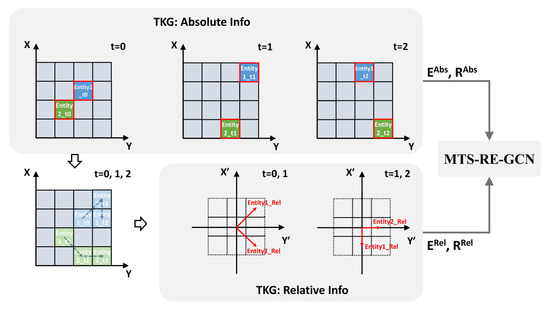
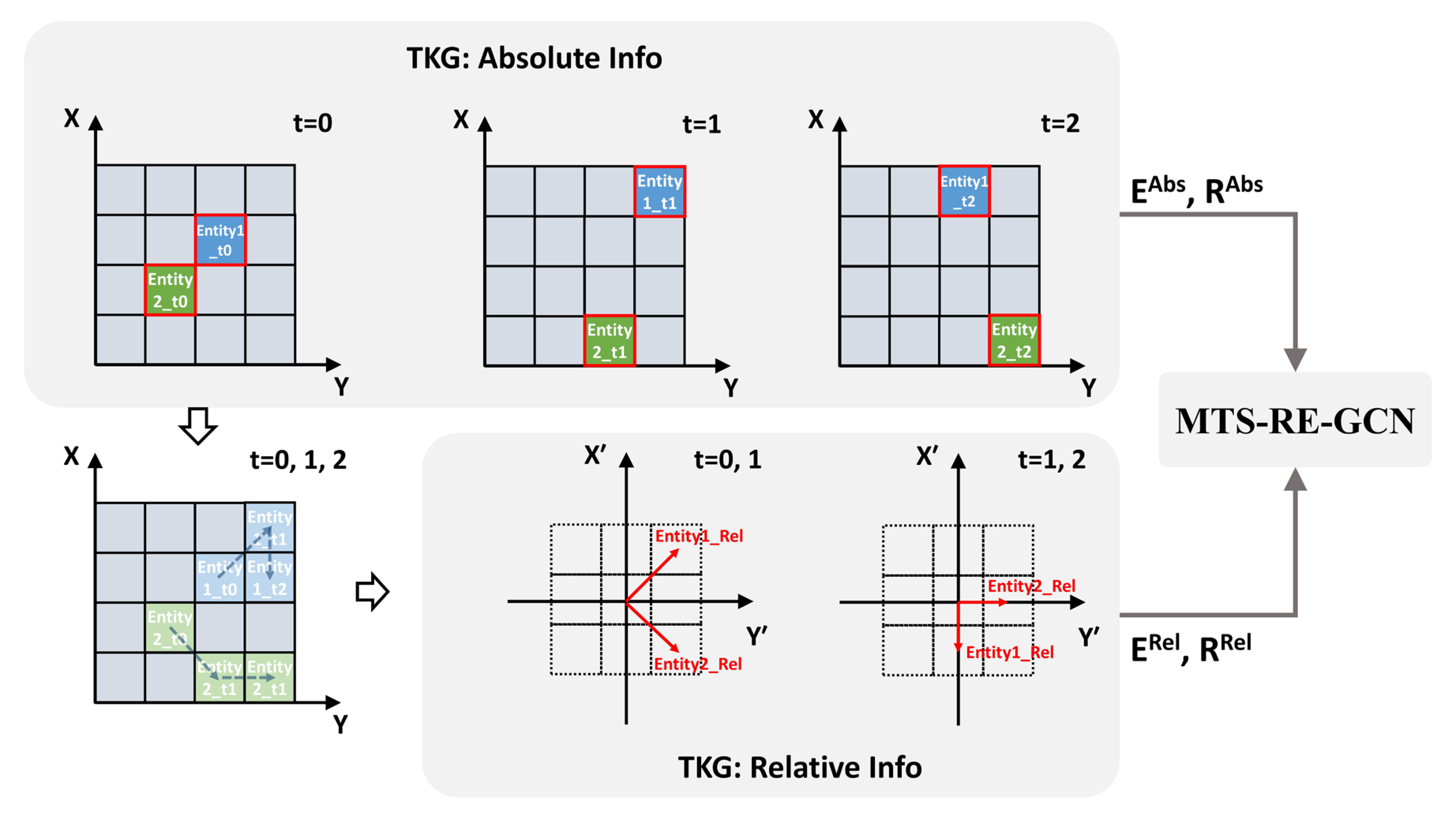
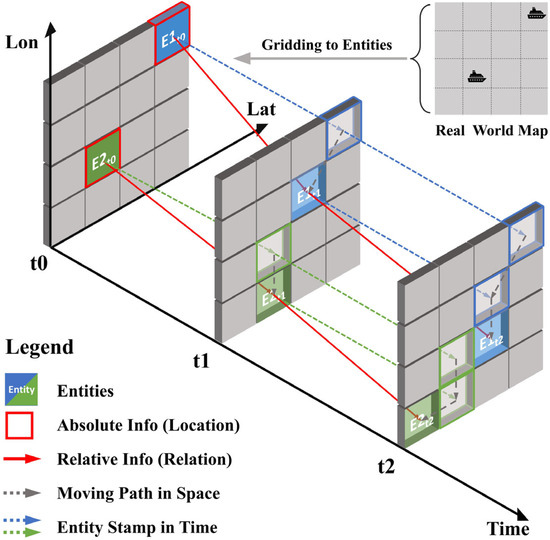
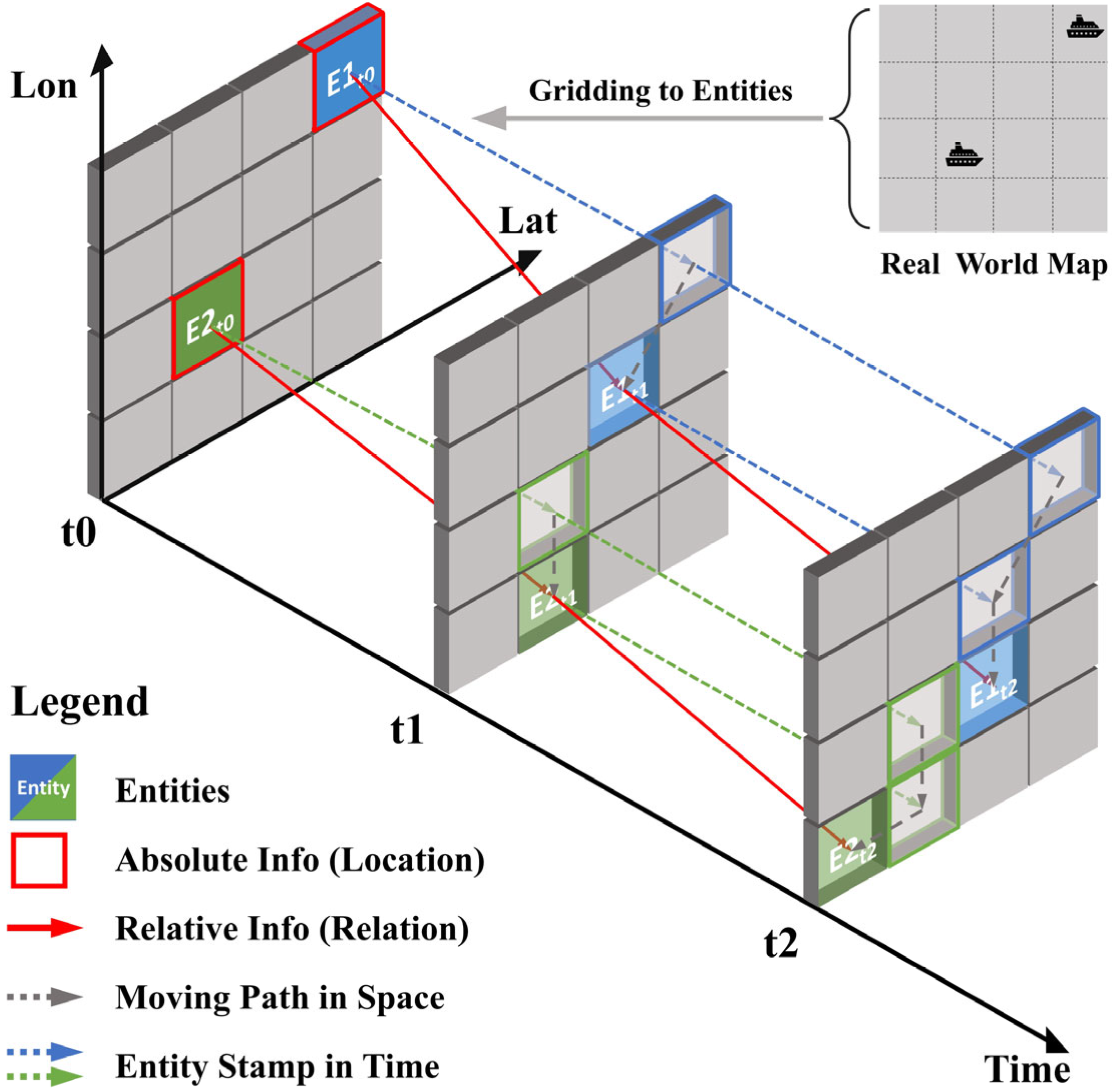
Therefore, this paper employs GeoSOT (Geographic coordinate subdivision grid with one dimension integer coding on 2n Tree) grid-based modeling [29] for spatio-temporal data. Absolute and relative spatial information is modeled as a grid, generating corresponding entities and relationships. The resulting quadruplets serve as input data for the MTS-RE-GCN, as shown in Figure 3. For entities describing absolute spatio-temporal information, coordinates at the current timestamp are directly converted into corresponding grid codes. Absolute spatio-temporal entities for all timestamps are then sequentially generated as shown in Equations (1) and (2). Entities describing relative spatio-temporal information first require calculating the difference vector between two adjacent timestamps. This difference vector is then converted into grid codes, and absolute spatio-temporal information entities are sequentially generated for all timestamps , as shown in Equations (3)–(5).
Figure 3.
Joint grid modeling scheme for absolute and relative spatial information.
This method enables unified modeling of entities under conditions of temporal and spatial variation. Through a consistent grid encoding scheme, it uniformly represents the absolute positions of entities across different temporal partitions and their spatial relationships over time. This method ultimately forms a temporal knowledge graph architecture, as illustrated in Figure 4, providing the data foundation for joint reasoning on complex spatio-temporal relationships.
Figure 4.
Temporal knowledge graph architecture.
3.2. Encoder—Task-Shared Layer
As the initial segment of the entire neural network model, the encoder extracts low-dimensional, universal latent representations (Shared Latent Representations) from raw input data that are useful for all downstream tasks. It learns cross-task commonality patterns, global relationships among different entity types, and the universality of general semantic knowledge and spatio-temporal knowledge. In the specific context of the MTS-RE-GCN architecture shown in Figure 2, this encoding process is particularly sophisticated as it ingests distinct streams of information—specifically “Absolute Info” and “Relative Info”—to handle different aspects of the temporal knowledge graph simultaneously, setting the stage for a dual-track analysis that respects both the inherent identity of entities and their shifting contextual roles within the timeline.
The method, Evolution Units based on RE-GCN, consists of an evolution unit comprising a relation-aware GCN, two gated recurrent components, and a static graph constraint component. As illustrated in Figure 2, the unit functions as the core processing engine where the temporal evolution of entities () and relations () is modeled in parallel sequences (shown from time steps t-2 to t). The internal mechanism relies on the synergy between the R-GCN blocks, which capture structural dependencies within a single snapshot, and the GRU layers, which propagate these features sequentially to preserve historical context. Through recurrent computation, it maps the latest quadruple knowledge graph sequence into sequences of entity embedding matrices and relation embedding matrices, generating a batch of shared latent representations.
The most typical form involves generating a low-dimensional, dense embedding vector for each node (or entity) in the graph. These embedding vectors form the foundation shared across all tasks. As depicted in Figure 2, the final evolved states, denoted as and , encapsulate the comprehensive history of the graph and are seamlessly forwarded to downstream components, such as the ConvTransE blocks, to compute specific loss functions ( and ). This ensures that the generated representations are structurally sound and optimized for precise temporal reasoning tasks.
3.3. Decoder—Task-Specific Layer
As the independent terminal (backend) of the network model, it receives the shared latent representations output by Evolution Unite and decodes them into the outputs required for the specific task. It focuses on learning patterns, rules, and mapping relationships unique to each task (spatial absolute information and spatial relative information).
We selected ConvTransE [26] as the decoder, which incorporates one-dimensional convolutional layers and fully connected layers, as shown in Figure 2. Each type of spatio-temporal information corresponds to an independent ConvTransE decoder with fully distinct parameters (e.g., convolutional kernels, linear projection matrices, relation embedding matrices). These parameters serve only the current spatio-temporal task and are not shared with other tasks. Building upon a general representation, we extract task-specific local patterns and interaction features, applying convolutional operations to capture local dependencies. As shown in Equations (6)–(9), we denote the two task architectures using ConvTransE. At this point, the probability vectors for all entities and relations are:
where σ denotes the sigmoid function, and st, rt, ot represent the embedding vectors for in and , respectively.
This model extracts features through convolution while actively learning embedding vectors for two types of spatio-temporal tasks. It then combines these with the convolutional features to ultimately generate task outputs.
Therefore, the multi-task learning model architecture achieves the ability to reason by combining absolute spatial semantics with relative spatial semantics, enabling the model to learn more refined and semantically rich spatio-temporal relationships. This forms a richer spatio-temporal representation where absolute positions aid in identifying spatio-temporal trends at the macro level, while relative positions reveal spatio-temporal dependencies at the micro level. By integrating these multi-level patterns, the model is able to uncover more complex and sophisticated spatio-temporal patterns.
3.4. Loss Functions and Optimization Strategies
Following each ConvTransE decoder, a task-specific output layer is connected. For the two spatio-temporal tasks, their respective task losses are computed independently, and the total loss is calculated as follows:
where T is the number of timestamps in the training set and and respectively represent the label vectors of all relationships and entities associated with the ith element at time for entities containing spatial absolute information. Similarly, and represent the label vectors for all relationships and entities associated with the ith element at time for entities containing absolute spatial information.
and are the probability score of entity i and relation i containing spatial absolute information. and are the probability score of entity i and relation i containing spatial relative information.
These two sets of temporal reasoning tasks are conducted within a multi-task learning framework. Therefore, the final loss function is given by Equation (14). Here, and are the parameters of the loss terms for absolute information and relative information in the control space, respectively.
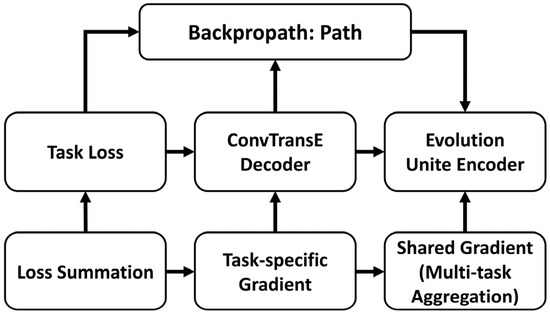
The gradient of the total loss propagates backward through the entire network, with the loss propagation process illustrated in Figure 5.
Figure 5.
Backpropagation path flowchart.
Evolution Unite (Encoder) Parameter Update: Since the encoder is shared, it receives gradient signals (accumulated) from all decoders. This drives the encoder to learn a universal representation that minimizes the total loss across all tasks.
ConvTransE (Decoder) Parameter Updates: Each decoder receives only gradient signals from its corresponding spatio-temporal task. This enables it to optimize two classes of spatio-temporal task-specific parameters to minimize its own task loss.
4. Experimental Process and Results
4.1. Experimental and Parameter Setup
This paper employs a spatio-temporal (ST) dataset of vessel trajectories and a general temporal reference knowledge graph dataset (e.g., ICEWS14s [30], ICEWS18 [24]) enriched with spatio-temporal information (ICEWS14s+ST, ICEWS18+ST) for entity completion research in spatio-temporal reasoning. The experiment incorporates a spatio-temporal information-enhanced general temporal reference knowledge graph dataset, aiming to demonstrate that this method can be applied to spatio-temporal entities and enhance spatio-temporal entity completion performance in multi-type complex data. These experiments validate the method’s generalization capability across diverse data types. Statistical information for both spatio-temporal datasets is presented in Table 2.
Table 2.
Statistics of the spatio-temporal datasets.
The ST dataset is based on real-world geospatial vessel trajectory data, sampled every 20 min. It comprises 400 time slices from 400 vessels. We introduced two distinct relationship types within the ST dataset, location and displacement. The location relationship for spatio-temporal entities corresponds to the positional information of an entity at the current timestamp. The displacement relationship for spatio-temporal entities corresponds to the positional change vector information of the same entity at the current timestamp relative to the previous timestamp. These two types of information are represented as attribute entities based on the GeoSOT grid modeling method. ICEWS14s+ST and ICEWS18+ST are obtained by adding two types of relationships and corresponding vessel entities and grid entities to the ICEWS14s and ICEWS18 datasets, as shown in Table 2.
This paper employs Mean Reciprocal Rank (MRR) and Hits@K metrics to evaluate the accuracy of graph prediction results. As a universal evaluation mechanism for prediction algorithms, MRR measures the ranking quality of a model when predicting correct answers. It specifically focuses on the position of correct answers within the ranked list, with higher scores awarded for earlier positions. Specifically, the first accurate match scores 1, the second scores 0.5, and so on, with the nth accurate match scoring 1/n. The final MRR score is the sum of all individual scores. Hits@K is a commonly used evaluation metric in fields such as knowledge graph completion, measuring a model’s ability to hit the correct answer within the top K predictions. We employ Hits@{1, 3, 10} (i.e., the proportion of correct predictions within the top 1/3/10 rankings) to assess spatio-temporal entity prediction results.
For the MTS-RE-GCN model configuration, this paper sets the hidden layer feature dimension to 200 and specifies that the model should consider three historical timesteps during training and testing. The loss control parameters and for both types of tasks are set to 1. The learning rate is set to 0.001, and both training and testing historical lengths are set to 3. No static knowledge graph is utilized. The grid hierarchy determines the resolution of spatio-temporal trajectory learning, requiring modeling at a level capable of discerning trends in vessel trajectories. The vessel trajectory data used in this experiment comprises 400 time slices from 400 vessels. The selected 12-level grid corresponds to 8′ at the latitude–longitude scale, translating to approximately 16 km near the equator. This resolution enables discernible trajectory trend changes.
4.2. Entity Completion Comparison Experiment in Spatio-Temporal KG
Three types of experiments are conducted by using the ST, ICEWS14s+ST and ICEWS18+ST datasets to demonstrate the effectiveness and accuracy of MTS-RE-GCN across different scenarios. The comparison experiments are summarized in Table 3.
Table 3.
Results of the spatio-temporal entity prediction experiments conducted on the datasets.
The performance of MTS-RE-GCN was compared against six knowledge reasoning models developed in recent years, they are TransE, DistMult, TANGO-Tucker, TANGO-DistMult, RE-NET, Cygnet, CEN, TiRGN and RE-GCN. We use the recommended configuration of these baseline models for comparison. The methods utilize equivalent spatial inputs, comprising both absolute position features and relative position features encoded from the same grid. The model inputs consist of identical quadruple data. Note that other knowledge graph reasoning models typically focus solely on general semantic knowledge graph completion and are not optimized for spatio-temporal knowledge completion. Therefore, this section’s experiments primarily describe the entity prediction performance of MTS-RE-GCN, comparing it against traditional reasoning models that perform spatio-temporal inference directly on spatio-temporal datasets and those trained on general datasets augmented with spatio-temporal information.
Table 3 indicates that MTS-RE-GCN consistently outperforms the comparison methods on the ST, ICEWS14s+ST, and ICEWS18+ST datasets. Static models such as TransE and DistMult employ embedding models to learn representation embeddings. Due to the complexity of entity relationships, TransE and DistMult may struggle to effectively understand these semantic entity relationships and spatio-temporal entity relationships. Consequently, they fail to produce satisfactory entity completion inference results on datasets where temporal information is masked. This may stem from DistMult’s focus on symmetric relationships, whereas spatio-temporal entity relationships are often unidirectional, leading to poor completion performance. Similarly, Tango-DistMult combines features of TANGO and DistMult models, modeling relationships in a more structured form. Compared to TANGO-Tucker, it captures more complex relationship patterns and possesses stronger representational capabilities than bilinear models (e.g., DistMult). However, both models remain weak in spatio-temporal data inference. TANGO-Tucker performs the best among them, but TANGO-Tucker still lags significantly behind other models in terms of evaluation metrics.
For sequence and history-aware models (RE-NET, TiRGN, CEN), though these models outperform static baselines via explicit temporal sequence and historical pattern modeling, they all suffer from insufficient modeling of spatial evolution and dynamic spatio-temporal co-evolution, leading to suboptimal performance. TiRGN performs the best among them; MTS-RE-GCN outperforms TiRGN by 9.00%, 6.03%, 3.28% in MRR on the ST, ICEWS14s+ST and ICEWS18+ST datasets.
As for CyGNet and RE-GCN—models based on graph neural networks (GNNs)—CyGNet incorporates a message-passing mechanism, while RE-GCN embeds relationships into graph convolution operations. Both enhance performance but still fail to fully leverage spatio-temporal information, RE-GCN is the better-performing model; MTS-RE-GCN outperforms RE-GCN by 14.6%, 7.47%, 4.43% in MRR on the three datasets.
Overall, compared to the baseline model RE-GCN, MTS-RE-GCN achieves an average temporal-spatial reasoning improvement of 14.6%, 7.47%, and 4.43% in MRR results. Regarding the Hits@K metric, Hits@1 improved by 14.1%, 6.5%, and 3.1%, Hits@3 improved by 9.4%, 4.7%, and 2.2%, and Hits@10 also showed an improvement of 2.2%, 0.7%, and −0.1%. Compared to the best-performing baseline model TiRGN, MTS-RE-GCN achieves an average temporal-spatial reasoning improvement of 9.00%, 6.03%, and 3.28% in MRR results. Regarding the Hits@K metric, Hits@1 improved by 7.00%, 4.2%, and 1.8%, Hits@3 improved by 5.5%, 3.5%, and 1.1%, and Hits@10 also showed an improvement of 1.4%, 0.3%, and −0.9%.
Through experimental results, we observe that MTS-RE-GC demonstrates more pronounced improvements in spatio-temporal entity prediction for scenarios with higher spatio-temporal attribute proportions. For instance, the most significant enhancement occurs when all entities and relations in the ST dataset possess spatio-temporal attributes. Even in the ICEWS18+ST dataset, where spatio-temporal attribute tuples constitute a smaller proportion, our method still yields noticeable improvements across the entire test set. This validates the versatility of our proposed approach in scenarios with less enriched spatio-temporal data. Regarding the Hit@K metric, the most pronounced improvement is observed in Hit@1, indicating that our proposed method significantly enhances the accuracy of predicting the spatio-temporal entity with the highest probability.
These significant improvements stem from the efficient learning process of the MTS-RE-GCN model in spatio-temporal information and its multi-task learning training strategy, enabling the model to capture more precise spatio-temporal information. Spatio-temporal entity prediction experiments validate the high accuracy performance of MTS-RE-GCN.
Table 4 reports the performance of our MTS-RE-GCN model on extrapolative spatio-temporal entity completion tasks, where T denotes the timestamp, covering both short-term (T = 1–5) and long-term (T = 11–15) scenarios. The model is evaluated using MRR, Hits@1, Hits@3, and Hits@10. For short-term timestamps, the average performance is 0.845 (MRR), 0.746 (Hits@1), 0.943 (Hits@3), and 0.993 (Hits@10). For long-term timestamps, the average results are 0.843 (MRR), 0.744 (Hits@1), 0.941 (Hits@3), and 0.992 (Hits@10).
Table 4.
Performance comparison of MTS RE-GCN spatio-temporal entity prediction tasks across different timestamps.
A certain degree of performance degradation is observed when extending the task from short-term to long-term timestamps. The average MRR and Hits@1 decrease by 0.002, respectively, while Hits@3 and Hits@10 drop by 0.002 and 0.001. This level of decline indicates that the performance of MTS-RE-GCN remains relatively stable with the extension of the timestamp horizon, and the performance decay is well-controlled. These results demonstrate that MTS-RE-GCN can maintain robust completion capability across both short and long temporal ranges, showing its effectiveness and stability in spatio-temporal entity prediction tasks.
4.2.1. Analysis of Ablation Studies and Model Consumption
As shown in the ablation study results for the spatio-temporal entity prediction task in Table 5, our proposed MTS-RE-GCN model consistently outperforms its ablated variant MTS-RE-GCN-MTS across all evaluation metrics. Specifically, MTS-RE-GCN achieves an MRR of 0.849, Hits@1 of 0.753, Hits@3 of 0.941, and Hits@10 of 0.991, while MTS-RE-GCN-MTS only obtains 0.752, 0.629, 0.855, and 0.967 respectively. The notable performance gaps—with absolute improvements of 12.8% in MRR, 12.4% in Hits@1, 8.6% in Hits@3, and 2.4% in Hits@10—clearly demonstrate that the joint multi-task learning mechanism of absolute and relative information effectively enhances the model’s ability to capture comprehensive spatio-temporal dependencies and structural patterns. By jointly learning the absolute and relative position information of spatio-temporal entities, MTS-RE-GCN achieves more accurate spatio-temporal entity prediction results. These results verify the critical role of the proposed multi-task learning method that jointly models absolute and relative information in boosting the overall performance of our model for spatio-temporal entity prediction.
Table 5.
Results of ablation studies involving spatio-temporal entity prediction tasks conducted on ST dataset.
Table 6 presents the model size (in kilobytes, kb) and GPU memory usage (in mebibytes, MiB) of different well-performing models on the ST dataset. The RE-GCN model has the smallest size of 23,958 KB, while the TiRGN model reaches the largest size of 41,261 KB. Our proposed MTS-RE-GCN model has a model size of 39,661 KB, which is slightly smaller than TiRGN but larger than RE-GCN.
Table 6.
Well-performing models’ consumptions on the ST dataset.
In terms of GPU memory usage, the RE-GCN model also exhibits the lowest memory footprint at 1308 MiB, whereas TiRGN consumes the most GPU memory at 2986 MiB. The MTS-RE-GCN model has a GPU memory usage of 1660 MiB, which is 26.9% higher than RE-GCN but 44.4% lower than TiRGN.
Despite the moderate increase in model size and GPU memory consumption compared to RE-GCN, MTS-RE-GCN achieves superior spatio-temporal entity prediction performance (as verified in previous ablation studies), demonstrating that it strikes a favorable trade-off between model capacity and computational complexity. This indicates that the additional multi-task learning mechanism introduced in MTS-RE-GCN brings only a manageable increment in model size and memory overhead, while significantly boosting the prediction accuracy for spatio-temporal entities, making it practical for real-world deployment.
We further evaluated the inference latency of the three models on the ST test set using an NVIDIA RTX A6000 GPU. The results show that RE-GCN and MTS-RE-GCN both completed the test in approximately 8 s, whereas TiRGN required 35 s. This significant difference in inference time further confirms the practical feasibility of our proposed method in real-world applications, as it maintains high efficiency while delivering enhanced predictive performance.
4.2.2. Map Visualization of Spatio-Temporal Entity Completion
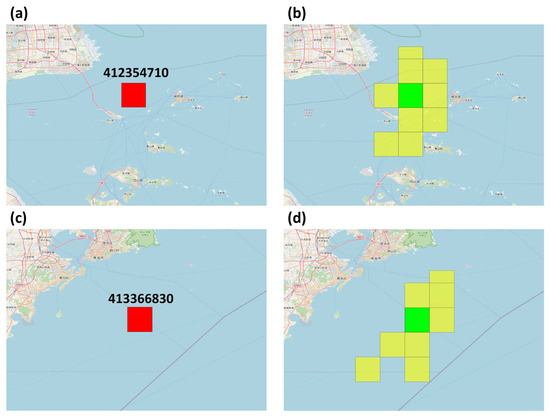
Two vessel cases are applied to validate the model’s predictive performance, as shown in Figure 6, enabling geospatial grid-based confidence interval analysis. This grid-based representation directly maps predictive confidence to real-world geographic coordinates, allowing stakeholders to intuitively assess the reliability of vessel position predictions within a defined spatial scope.
Figure 6.
Two examples of spatio-temporal entities and their predicted locations on grid maps. (a,b) present the case for Vessel ID 412343710, while (c,d) correspond to Vessel ID 413366830. The red cell marks the vessel’s true location, and the yellow or green cells indicate the predicted locations from the proposed model. Specifically, the green cell denotes the position with the highest predicted probability.
Meanwhile, the GeoSOT grid partitioning provides a quantifiable spatial scale for error representation and calculation. Since each cell corresponds to a fixed geographic area at a given level, the discrepancy between the true position (red cell) and the predicted region (yellow/green cells) can be measured in terms of grid units (e.g., number of cell offsets, Euclidean distance between cell centroids). This enables a standardized, quantitative evaluation of prediction error (e.g., mean distance error, hit rate within a certain grid radius, or spatial coverage probability). Such grid-scale error metrics can provide deterministic grid spatial resolution indicators for further applications in practical maritime monitoring, navigation analysis, and related fields. Note that due to the virtual expansion structure of the GeoSOT grid, cells at certain levels may not appear as perfect squares of equal longitude and latitude in the visualization [29]. This characteristic does not, however, affect the performance or practical application of the proposed method.
5. Conclusions
To address the low accuracy of current temporal knowledge graphs in spatio-temporal reasoning tasks, this study proposes an MTS-RE-GCN model to perform spatio-temporal knowledge completion reasoning. The novel contributions of MTS-RE-GCN lie in two aspects: (1) it introduces a classification method for spatio-temporal data within temporal knowledge graphs, categorizing spatio-temporal data into absolute and relative position information and (2) based on the GeoSOT grid modeling approach, it unifies the modeling of these two types of information, forming richer spatio-temporal representations. It implements a multi-task learning approach based on RE-GCN to learn these two knowledge graphs. By integrating the spatio-temporal trends and dependencies represented by both types of information, the method achieves superior entity completion results for spatio-temporal knowledge. The model demonstrates improved spatio-temporal inference accuracy on dedicated datasets and enhanced spatio-temporal entity prediction accuracy on general datasets augmented with spatio-temporal information.
This study has certain limitations that also point to valuable extended work. The applicable premise of this method is to clarify the grid modeling granularity, and the modeling granularity cannot be excessively sparse. It also needs to match the motion patterns under study, otherwise, it is unable to capture the key kinematic details. Further, its advantages are most evident for complex, nonlinear trajectories, while offering diminishing returns for simple, near-linear motion patterns. These limitations will be focused on in future work by developing more adaptive and robust algorithmic frameworks capable of generalizing across diverse data densities and motion regimes.
Author Contributions
Conceptualization, Yuhao Huo and Guangyuan Zhang; methodology, Yuhao Huo; software, Yuhao Huo; validation, Bing Han and Xiaochong Tong; formal analysis, Guangyuan Zhang and Xiaochong Tong; investigation, Guangyuan Zhang; resources, Guangyuan Zhang and Chengqi Cheng; data curation, Bing Han; writing—original draft preparation, Yuhao Huo; writing—review and editing, Guangyuan Zhang; visualization, Guangyuan Zhang; supervision, Guangyuan Zhang; project administration, Guangyuan Zhang; and funding acquisition, Guangyuan Zhang and Chengqi Cheng All authors have read and agreed to the published version of the manuscript.
Funding
This research was funded by the National Overseas Postdoctoral Talent Recruitment Program of China and Tianjin University.
Data Availability Statement
The datasets presented in this article are not available because the data are part of an ongoing study or due to technical limitations, but the part of original data presented in the study (i.e., ICEWS14s) are openly available in https://github.com/Lee-zix/RE-GCN (accessed on 23 February 2026) at https://doi.org/10.48550/arXiv.2104.10353.
Conflicts of Interest
The funders had no role in the design of the study; in the collection, analyses, or interpretation of data; in the writing of the manuscript, or in the decision to publish the results.
References
- Peng, C.; Xia, F.; Naseriparsa, M.; Osborne, F. Knowledge Graphs: Opportunities and Challenges. Artif. Intell. Rev. 2023, 56, 13071–13102. [Google Scholar] [CrossRef] [Scilit]
- Yan, J.; Wang, C.; Cheng, W.; Gao, M.; Zhou, A. A Retrospective of Knowledge Graphs. Front. Comput. Sci. 2018, 12, 55–74. [Google Scholar] [CrossRef] [Scilit]
- Hogan, A.; Blomqvist, E.; Cochez, M.; D’amato, C.; Melo, G.D.; Gutierrez, C.; Kirrane, S.; Gayo, J.E.L.; Navigli, R.; Neumaier, S.; et al. Knowledge Graphs. ACM Comput. Surv. 2021, 54, 1–37. [Google Scholar] [CrossRef] [Scilit]
- Ji, S.; Pan, S.; Cambria, E.; Marttinen, P.; Yu, P.S. A Survey on Knowledge Graphs: Representation, Acquisition, and Applications. IEEE Trans. Neural Netw. Learn. Syst. 2022, 33, 494–514. [Google Scholar] [CrossRef] [Scilit] [PubMed]
- Grangel-González, I.; Lösch, F.; ul Mehdi, A. Knowledge Graphs for Efficient Integration and Access of Manufacturing Data. In Proceedings of the 2020 25th IEEE International Conference on Emerging Technologies and Factory Automation (ETFA), 8–11 September 2020; Volume 1, pp. 93–100. [Google Scholar]
- Nickel, M.; Murphy, K.; Tresp, V.; Gabrilovich, E. A Review of Relational Machine Learning for Knowledge Graphs. Proc. IEEE 2016, 104, 11–33. [Google Scholar] [CrossRef] [Scilit]
- Jiang, T.; Liu, T.; Ge, T.; Sha, L.; Chang, B.; Li, S.; Sui, Z. Towards Time-Aware Knowledge Graph Completion. In Proceedings of the COLING 2016, the 26th International Conference on Computational Linguistics: Technical Paper, Osaka, Japan, 11–17 December 2016; Matsumoto, Y., Prasad, R., Eds.; The COLING 2016 Organizing Committee: Osaka, Japan, 2016; pp. 1715–1724. [Google Scholar]
- Zhang, Y.; Kong, X.; Shen, Z.; Li, J.; Yi, Q.; Shen, G.; Dong, B. A Survey on Temporal Knowledge Graph Embedding: Models and Applications. Knowl.-Based Syst. 2024, 304, 112454. [Google Scholar] [CrossRef] [Scilit]
- Wang, H.; Yu, Q.; Liu, Y.; Jin, D.; Li, Y. Spatio-Temporal Urban Knowledge Graph Enabled Mobility Prediction. Proc. ACM Interact. Mob. Wearable Ubiquitous Technol. 2022, 5, 1–24. [Google Scholar] [CrossRef] [Scilit]
- Zhao, X.; Cao, Y.; Wang, J.; Fan, X.; Chen, M. A hierarchical spatio-temporal object knowledge graph model for dynamic scene representation. Trans. GIS 2023, 27, 1992–2016. [Google Scholar] [CrossRef] [Scilit]
- Liu, Y.; Ding, J.; Fu, Y.; Li, Y. UrbanKG: An Urban Knowledge Graph System. ACM Trans. Intell. Syst. Technol. 2023, 14, 1–25. [Google Scholar] [CrossRef] [Scilit]
- Wang, S.; Lv, Y.; Peng, Y.; Piao, X.; Zhang, Y. Metro Traffic Flow Prediction via Knowledge Graph and Spatiotemporal Graph Neural Network. J. Adv. Transp. 2022, 2022, 2348375. [Google Scholar] [CrossRef] [Scilit]
- Cai, L.; Mao, X.; Zhou, Y.; Long, Z.; Wu, C.; Lan, M. A Survey on Temporal Knowledge Graph: Representation Learning and Applications. arXiv 2024, arXiv:2403.04782. [Google Scholar] [CrossRef] [Scilit]
- Argyriou, A.; Evgeniou, T.; Pontil, M. Multi-Task Feature Learning. Adv. Neural Inf. Process. Syst. 2006, 19. [Google Scholar]
- Vandenhende, S.; Georgoulis, S.; Van Gansbeke, W.; Proesmans, M.; Dai, D.; Van Gool, L. Multi-Task Learning for Dense Prediction Tasks: A Survey. IEEE Trans. Pattern Anal. Mach. Intell. 2021, 44, 3614–3633. [Google Scholar] [CrossRef] [Scilit]
- Caruana, R. Multitask Learning. Mach. Learn. 1997, 28, 41–75. [Google Scholar] [CrossRef] [Scilit]
- Yu, T.; Kumar, S.; Gupta, A.; Levine, S.; Hausman, K.; Finn, C. Gradient Surgery for Multi-Task Learning. Adv. Neural Inf. Process. Syst. 2020, 33, 5824–5836. [Google Scholar]
- Bordes, A.; Usunier, N.; Garcia-Duran, A.; Weston, J.; Yakhnenko, O. Translating Embeddings for Modeling Multi-Relational Data. Adv. Neural Inf. Process. Syst. 2013, 26. [Google Scholar]
- Wang, Z.; Zhang, J.; Feng, J.; Chen, Z. Knowledge Graph Embedding by Translating on Hyperplanes. In Proceedings of the AAAI Conference on Artificial Intelligence, Quebéc, QC, Canada, 27–31 July 2014; Volume 28. [Google Scholar]
- Lin, Y.; Liu, Z.; Sun, M.; Liu, Y.; Zhu, X. Learning Entity and Relation Embeddings for Knowledge Graph Completion. In Proceedings of the AAAI Conference on Artificial Intelligence, Austin, TX, USA, 25–30 January 2015; Volume 29. [Google Scholar] [CrossRef] [Scilit]
- Yang, B.; Yih, W.; He, X.; Gao, J.; Deng, L. Embedding Entities and Relations for Learning and Inference in Knowledge Bases. arXiv 2015, arXiv:1412.6575. [Google Scholar] [CrossRef] [Scilit]
- Han, Z.; Ding, Z.; Ma, Y.; Gu, Y.; Tresp, V. Learning Neural Ordinary Equations for Forecasting Future Links on Temporal Knowledge Graphs. In Proceedings of the 2021 Conference on Empirical Methods in Natural Language Processing, Virtual, Punta Cana, Dominican Republic, 7-11 November 2021; Association for Computational Linguistics: Stroudsburg, PA, USA, 2021; pp. 8352–8364. [Google Scholar]
- Zhu, C.; Chen, M.; Fan, C.; Cheng, G.; Zhang, Y. Learning from History: Modeling Temporal Knowledge Graphs with Sequential Copy-Generation Networks. Proc. AAAI Conf. Artif. Intell. 2021, 35, 4732–4740. [Google Scholar] [CrossRef] [Scilit]
- Jin, W.; Jiang, H.; Qu, M.; Chen, T.; Zhang, C.; Szekely, P.; Ren, X. Recurrent Event Network: Global Structure Inference over Temporal Knowledge Graph 2019. arXiv 2019, arXiv:1904.05530. [Google Scholar]
- Li, Y.; Sun, S.; Zhao, J. TiRGN: Time-Guided Recurrent Graph Network with Local-Global Historical Patterns for Temporal Knowledge Graph Reasoning. In Proceedings of the 31th International Joint Conference on Artificial Intelligence (IJCAI-22), Vienna, Austria, 23–29 July 2022; Volume 3, pp. 2152–2158. [Google Scholar]
- Li, Z.; Guan, S.; Jin, X.; Peng, W.; Lyu, Y.; Zhu, Y.; Bai, L.; Li, W.; Guo, J.; Cheng, X. Complex Evolutional Pattern Learning for Temporal Knowledge Graph Reasoning. In Proceedings of the 60th Annual Meeting of the Association for Computational Linguistics (Volume 2: Short Papers), Dublin, Ireland, 22–27 May 2022; Muresan, S., Nakov, P., Villavicencio, A., Eds.; Association for Computational Linguistics: Stroudsburg, PA, USA, 2022; pp. 290–296. [Google Scholar]
- Li, Z.; Jin, X.; Li, W.; Guan, S.; Guo, J.; Shen, H.; Wang, Y.; Cheng, X. Temporal Knowledge Graph Reasoning Based on Evolutional Representation Learning. In Proceedings of the 44th International ACM SIGIR Conference on Research and Development in Information Retrieval, Virtual, 11 July 2021; ACM: New York, NY, USA, 2021; pp. 408–417. [Google Scholar]
- Ruder, S. An Overview of Multi-Task Learning in Deep Neural Networks. arXiv 2017, arXiv:1706.05098. [Google Scholar] [CrossRef] [Scilit]
- Qian, C.; Yi, C.; Cheng, C.; Pu, G.; Wei, X.; Zhang, H. GeoSOT-Based Spatiotemporal Index of Massive Trajectory Data. ISPRS Int. J. Geo-Inf. 2019, 8, 284. [Google Scholar] [CrossRef] [Scilit]
- Trivedi, R.; Dai, H.; Wang, Y.; Song, L. Know-Evolve: Deep Temporal Reasoning for Dynamic Knowledge Graphs. In Proceedings of the 34th International Conference on Machine Learning, PMLR, Sydney, Australia, 6–11 August 2017; pp. 3462–3471. [Google Scholar]

Disclaimer/Publisher’s Note: The statements, opinions and data contained in all publications are solely those of the individual author(s) and contributor(s) and not of MDPI and/or the editor(s). MDPI and/or the editor(s) disclaim responsibility for any injury to people or property resulting from any ideas, methods, instructions or products referred to in the content. |
© 2026 by the authors. Published by MDPI on behalf of the International Society for Photogrammetry and Remote Sensing. Licensee MDPI, Basel, Switzerland. This article is an open access article distributed under the terms and conditions of the Creative Commons Attribution (CC BY) license.