


Abstract
Geospatial imagery used as evidence passes through handovers that copy, tile, re-encode or crop the file and strip its metadata. This paper presents a registration-locked dual-watermarking scheme that verifies a delivered file against the object fixed at registration and lets an independent party reproduce the result. A robust payload watermark carries a 53-byte evidence tag embedded by registration-locked quantization index modulation (QIM) with Bose–Chaudhuri–Hocquenghem (BCH) coding, while an authentication watermark writes a four-bit code into every block and band; the two use separate keys and disjoint coefficient sets. The reading step size is frozen and certified at registration, so verification reuses the parameter that defined the object. A split commitment keeps the full image, georeferencing and identifier digests in an external certificate while truncated tags travel in the image, so any certificate holder repeats the same extraction. A four-layer state machine returns consistent, anomalous or unverifiable, distinguishing an unreadable payload from a lack of tamper evidence, and compiles the certificate, verification record and localization map into a hash-bound report with quantities traceable to their artifacts. On 84 windows of a 0.3 m benchmark, marked imagery reaches 43.57 dB PSNR and 0.980 SSIM; clean windows verify as consistent, and splices, copy–move and removal are localized block-wise in map coordinates. The scheme supports key custody via separate keys and a digest over verification inputs.
1. Introduction
Geospatial imagery provides spatially explicit observations for land management, environmental monitoring, disaster assessment and resource protection. In geo-information practice, it circulates as a georeferenced raster—a grid with a stated coordinate reference system, a pixel size in map units and a product or tile identifier—and reaches its users through spatial data infrastructures rather than as a standalone file. A verification result that names only pixel indices does not say where on the ground it applies. Whether a delivered product still represents the registered object is therefore a question of spatial data quality as much as one of cryptography, and the answer is expected in the units in which the product is mapped.
Such imagery enters evidence through a sequence of handovers. A case turns on the surface state of a parcel at a past date: an extraction boundary that has since been backfilled, a forest stand since cleared, a building or a road that appeared between two acquisitions. That state no longer exists on the ground, so a site visit cannot settle the question, and the image acquired over that parcel is the only remaining record of it. It is retrieved from an archive or a provider, delivered to an examiner, relied on in an investigation report, a prosecution file or a civil action over the land, and contested at a hearing. Along that path, the file is copied, tiled, re-encoded or cropped, and its metadata may be rewritten or stripped. Technical verification must therefore establish whether a presented file is consistent with the registered object, whether its metadata and provenance records belong to that same object, and whether local content has been altered. The resulting record has to state what can and cannot be concluded about the file before it is used further. These are questions about the record, not about admissibility, relevance or probative value, which remain matters of legal assessment.
Digital watermarking and distributed ledgers offer complementary mechanisms. Watermarking maintains an association between verification information and image content, whereas a ledger supplies an external anchor for commitments and time-related records [1,2]. Protection of remote sensing imagery has been studied through wavelet-based copyright protection, zero watermarking and blockchain-anchored verification [3,4,5,6]; one line stores a perceptual hash on a permissioned ledger and distributes the reference value outside the image [6]. Watermark design trades imperceptibility against payload and robustness under an explicit attack model [7], a trade-off that remote sensing products sharpen because radiometric and geometric processing is routine and often legitimate. Content-provenance standards entering deployment, notably C2PA Content Credentials, sign assertions about origin and edit history and bind them to the content they describe [8]. These mechanisms establish a value, an agreement or an assertion; whether a submitted file is the object so described, and whether a second party can re-execute that identification from the record, are questions they leave open.
Recent remote sensing watermarking has pursued desynchronization resistance through normalized feature domains and DWT–SVD [9], dual robust–fragile authentication through DWT–SVD/QIM [10], learned robustness through attention-guided models [11], and hybrid wavelet–DCT–SVD embedding [12], with a keyed DFT barcode for geometric synchronization [13]. Other lines address copyright records through template-based synchronization and ledger-registered zero watermarks [14,15], integrity through subject-sensitive hashing [16] and fragile marks [17], and multispectral products through vector-quantized semi-fragile embedding [18].
The tamper-localization strand has since moved from transform-domain detection toward maps that survive benign processing: quantization-based DCT embedding returns a block-level tamper map rather than a single verdict [19], reversible block-wise authentication reports tamper localization together with recovery [20], entropy-weighted random walks and Swin-transformer features select embedded positions [21], and QDFT embedding with tamper ranking orders flagged regions by severity [22]; a survey classifies this line along the same axis [23]. A separate forensic line reaches the block from the reporting side, since a block is the smallest region a report can name: structure-based frameworks authenticate block by block for transmission [24], AMBTC and vector quantization provide compact per-block descriptors for localization and self-recovery [25], dual robust–fragile embedding combines copyright protection with tamper proofing [26], and hybrid fragile schemes recover two independent regions after a local attack [27]. These lines return a map, but a block whose mark cannot be read is still transcribed as intact, and the threshold applied at extraction is in many schemes re-estimated from the file under examination.
Perceptual hashing approaches tamper localization from the content side rather than from the watermark side. Hashing-based detection has been applied to remote sensing imagery directly [28], hash and blind-watermark combinations authenticate without a stored original [29], and retrieval-side hashing shows how much similarity a compact code can carry at scale [30]. As a forensic scheme for high-resolution remote sensing imagery, it uses entropy-adaptive grid partitioning and edge-chain features to form a PCA-compressed hash that localizes tampered cells [31]. The same line was later extended to subject-sensitive hashing, which responds to a specified region rather than to the whole content: a MultiRes-RCF network for an HRRS blockchain [32], a stepwise-drop transformer U-Net balancing robustness against tamper sensitivity [33], and a Multi-PatchDrop Swin-U-Net reinforcing the same trade-off [34]. An earlier forensic scheme in this journal combined global and local perceptual features for integrity authentication and tamper localization [35]. Hashing localizes without modifying the image, yet its output is a set of cells whose distance from an externally held signature exceeds a threshold; it carries no identifier of the registered object and compiles no record that a second party could regenerate.
Reporting is the least examined link in the chain. Passive forensics offers a broad tamper detection-and-localization literature [36], including provenance analysis that reconstructs transformation graphs and evidence chains from manipulation cues [37]. Watermarking studies typically stop at bit-error rate, distortion metrics and tamper-localization scores, leaving their conversion into a documented record to manual writing. Two recent lines approach the problem from opposite directions: dual robust–fragile watermarking protects image evidence along the chain of custody [38], and detection-oriented forensics generates structured explanatory reports from learned evidence [39]. Neither binds the quantitative statements of the report by hash to the artifacts of the same verification run, so the document cannot be regenerated and checked against the data that produced it.
Along these lines, three requirements remain unmet at the point where a technical finding has to become a record. First, no method places the pixels of a submitted file in a relation to a registered object that a report can cite: anchoring a hash or asserting provenance leaves that relation implicit. Second, the parameter used to read the mark is commonly re-estimated from the file under examination, so a second party applying the same named rule is in fact applying a different rule and cannot reproduce the verdict from the record. Third, the localization verdict is binary—a block whose mark cannot be read is reported as intact rather than as undecided—and no report binds its quantitative statements by hash to the artifacts of the same run, so the document cannot be regenerated. This paper addresses the three together with a registration-locked dual-watermarking scheme.
Viewed as a mechanism rather than as an assembly of mature primitives, the design rests on one substitution and one separation, and the novelty lies in the constraint they impose rather than in the primitives they use. The substitution is that the step size applied at extraction is the very one fixed and certified when the image was registered, rather than a value re-estimated from the file under examination; a verification parameter therefore becomes evidence, because a verifier who recomputed it from the submitted image would be applying a different rule under the same name. The separation is that the coefficient positions carrying the payload, those carrying the authentication features and those read as those features are three disjoint sets, so neither watermark can overwrite the quantity that authenticates it. DCT–QIM, bounded-distance decoding, Merkle hashing and Ed25519 signatures are all mature; what is new is the registration lock that makes their output auditable. Two watermarks are written in one pass under this constraint—a robust payload watermark carrying the evidence tag and an authentication watermark carrying a four-bit short code in every block and band, using separate keys and disjoint coefficient sets. The first says which object the file is, the second where it departs from that object, and both are read under the same registered map. Three coupled properties follow:
- (1)
- Evidence binding. An evidence-commitment structure binds the encoded image, the canonical metadata that carries the product’s georeferencing, the evidence identifier, the algorithm version, and the block-authentication root, so that a re-projected, resampled or re-tiled derivative produces a different commitment and cannot inherit the certificate of its source. The 53-byte robust payload carries truncated 128-bit commitment and authentication-root tags, while complete 256-bit values remain in the external certificate for exact verification, so that in-image capacity and external exactness are traded deliberately rather than inadvertently. The relation between the submitted file and the registered object is therefore carried in the record itself and can be re-derived from it.
- (2)
- Deterministic extraction. A registration-locked DCT–QIM method stores the complete block–band step map at registration and reuses it at extraction, while low-frequency robust, reserved-feature, and authentication positions are mutually exclusive by construction. Bose–Chaudhuri–Hocquenghem (BCH) bounded-distance decoding of the (15,7) code and a keyed global interleaver sit inside this deterministic frame: they add correction and dispersion without introducing extraction-time adaptation, which keeps every verification parameter auditable. Because the step map is certified rather than estimated, a second party holding the certificate reproduces the same bits and the same verdict.
- (3)
- Deliverable reporting. A four-layer verification state machine separates certificate, payload, metadata-and-feature, and localization outcomes into three reportable states—consistent, anomalous, and unverifiable—and a report generator compiles the certificate, machine-readable verification record, and localization map of the same run into an evidence-assistance report. Every quantitative statement is traceable to a hashed artifact.
These properties define the criterion against which the scheme should be read: its contribution is evidential rather than a claim of higher detection accuracy or geometric robustness, and it makes no statement about the positional accuracy of the registered object.
The paper follows that chain from design to evidence. Section 2 specifies the system model, the evidence commitment, the registration-locked embedding and the verification state machine with its report generator. Section 3 reports the measurements; Section 4 discusses what they support and where the design stops; Section 5 concludes.
2. Materials and Methods
2.1. Scheme Overview
Figure 1 gives the structure of the scheme before its components are specified, and the rest of the paper follows that architecture. (A) Registration fixes the commitment, truncates it into a 53-byte tag and issues the certificate that keeps the complete tags outside the image (Section 2.4). (B) Embedding writes both watermarks into 8 × 8-pixel blocks under a step map that is frozen at registration and reused at verification, the coded tag as the robust payload watermark and the four-bit short code as the authentication watermark (Section 2.5, Section 2.6 and Section 2.7). (C) Verification re-reads both watermarks with that map, compares it with the certificate, marks the blocks that differ from the registration and compiles the examination report (Section 2.7 and Section 2.8).
Figure 1.
Structure of the proposed dual-watermarking scheme. (A) Registration fixes the commitment, truncates it into the 53-byte tag and issues the certificate that keeps the complete tags outside the image; (B) embedding writes the robust payload and the four-bit authentication watermarks into 8 × 8 blocks under the step map frozen at registration; (C) verification re-reads both watermarks with that map, compares them with the certificate and compiles the examination report.
2.2. System Model and Trust Boundary
The system comprises a registration endpoint, an anchoring service, and a verification endpoint. Registration receives an image I, metadata M, and two independent keys: Kr for coefficient positions and robust dithering, and Ka for authentication tags and authentication dithering. The anchoring service stores a commitment and signature reference, while large image data, complete tags, and reference features remain off-chain. The verifier receives a candidate image I′, a verification certificate, the authorized evidence package, and the required keys.
Metadata are canonically serialized by fixing field order, timestamp representation, coordinate reference system, numeric precision, and character encoding. Volatile fields such as local file paths and access times are excluded. The resulting representation is denoted Canon(M). Canonicalization is necessary because semantically equivalent metadata can otherwise produce different byte-level hashes.
The georeferencing of the product is committed as part of the object rather than carried as accompanying text. The metadata profile records the EPSG code of the coordinate reference system, the six coefficients of the affine geotransform that maps pixel coordinates to map coordinates, the pixel size in map units, the product and tile identifiers, the acquisition time, and the footprint; Canon(M) fixes their order, numeric precision, and axis convention, because a record in projected meters and a record in geographic degrees are not interchangeable. Three consequences follow for verification. A re-projection, a resampling to a different grid, or a re-tiling produces a different canonical record and therefore a different commitment, so a derived product cannot inherit the certificate of its source. An edit to the georeferencing of a presented file, among the commonest silent changes in map production, alters hM and is reported at the metadata layer instead of passing as a consistent image. And because the affine terms are committed but their accuracy is never assessed, verification establishes consistency with the registered object and makes no statement about the positional accuracy of that object against ground control.
The adversary may alter pixels, replace files, copy visible metadata, permute watermark bits, or replay processing records. Two cases are treated as measured attacks rather than as assumptions: an adversary holding the authentication key, the complete registration key, or the signing key, and an adversary able to rewrite the authorized evidence package while holding no key at all. Both are examined in Section 3.6. Failure of the complete trust anchor and compromise of the verifier remain outside the model, as Section 2.3 states.
Three properties of the problem are specific to remote sensing rather than to photography in general. First, remote sensing data are delivered as products that pass through radiometric calibration, orthorectification, pansharpening, re-projection and tiling before lossy distribution, so a fragile mark has to survive a documented processing chain rather than an unknown one. Second, the natural decision unit is a spatial block crossed with a spectral band, because digital numbers carry physical meaning per band and a replacement taken from another acquisition date usually departs in some bands before others. Third, the number of usable carriers is governed by radiometry: saturated water, specular roofs and deep canopy shadow clip the low-frequency residual, so capacity is a property of the scene rather than of the code. These three properties define what is transferred in the remainder of this section and what is not. The assumptions under which these three properties are handled, together with the adversary classes they license, are collected in Section 2.3.
2.3. Threat Model and Security Assumptions
The model is stated before the mechanisms because several of its consequences are negative, and a reader who meets them first as results will read them as failures. The adversary is an actor in the custody chain: a holder of a delivered file, a party able to rewrite the authorized evidence package, or an insider holding one of the keys. The goal of an attack is either a verification that returns consistent for content the registration did not cover, or a localization that points away from content it did. A1 fixes the registration-time trust: the registration key is intact at the moment of registration, so the experiments measure what a lost key buys rather than how it was lost. A2 fixes what a verifier must hold, namely the certificate, the authorized evidence package and the corresponding keys, and records that localization is semi-blind, so a verifier without the certificate can neither extract nor localize. A3 fixes the independence of the register: the signed manifest and the anchor are obtained from a custody domain the adversary does not control.
A4 states the limit that the scheme does not remove. Re-registration carried out by an adversary holding the complete registration key is not detectable by the algorithm: the re-issued certificate is self-consistent, and the corresponding control returns consistent in 21 of 21 runs (K5, Section 3.6). The only separation available at that level is the signed register, in which the re-issued certificate matches no entry (K6, not listed in 21 of 21), so protection there rests on registration custody and on indexing the register by the digest of the whole certificate rather than by the evidence identifier. A5 states that the framework does not aim at geometric robustness, because the mark is written and read on a fixed 8 × 8 grid and grid alignment is a precondition of extraction rather than a property the mark is designed to survive. A6 states that anchoring is simulated locally and therefore certifies no time. A7 states that technical consistency is not legal admissibility, which is why the report is an examination record rather than a legal conclusion. Three things are left outside the model: failure of the complete trust anchor, compromise of the verifier itself, and the lawful acquisition or semantic truth of the content, each institutional rather than algorithmic.
Legitimate re-projection and tiling are placed by the same assumptions rather than left to be inferred from a table row. A re-projection, a resampling to a different grid or a re-tiling changes the canonical metadata record and therefore the commitment, so the metadata layer fails before any block is compared. Section 3.7 measures exactly this: a 0.5-pixel resampling returns anomalous in all twelve windows under the scaled setting, while a 448 × 448 center crop and a 0.3° warp with a 1.003 scale factor return unverifiable in all twelve. Such a derivative is a different registered object rather than a damaged copy of the original, and the correct output for it is a refusal rather than a tamper conclusion. An operational rule for such derivatives is given in Section 4 as a three-tier re-registration policy.
2.4. Evidence Commitment and Minimal Anchoring
Let B(I) denote the documented image-byte representation and Canon(M) the canonical metadata serialization. The image digest, metadata digest, and evidence identifier are defined using SHA-256 [40] in Equation (1). Trunc128 denotes retaining the first 128 bits, and ‖ denotes concatenation with domain separation. The complete commitment C is then computed from the evidence identifier, both digests, and the algorithm-version context V as shown in Equation (2).
Here, hI and hM are 256-bit digests, B(I) includes the array dtype, shape, and decoded sample bytes, and Canon(M) fixes field order, timestamp representation, coordinate reference, numeric precision, and character encoding.
As shown in Equation (3), the payload P contains a one-byte version v, a 16-byte eid, a 16-byte commitment tag, a 16-byte authentication-root tag, and a four-byte CRC32, for a total of 53 bytes. C1:16 and R1:16 denote the first 16 bytes of the complete commitment and root, which remain in the external certificate. The truncated tags bind the recovered payload to that certificate and are not represented as full 256-bit hashes. A transaction pointer is stored externally. If confidentiality is required, authenticated encryption such as Advanced Encryption Standard–Galois/Counter Mode should be used with eid and version as associated data [41,42].
The payload length is |P| = 1 + 16 + 16 + 16 + 4 = 53 bytes. CRC32 is an error-detection check, not a cryptographic authentication primitive; origin binding relies on the keyed authentication material and external certificate.
The 53 bytes are not a round number but the sum of five fields, each of which is the smallest that still carries its function. The version field takes one byte because a byte is the smallest addressable unit and because the certificate, not the payload, is what fixes the format: the field exists so that a verifier running a different format version can refuse the file rather than misread it. The evidence identifier takes 16 bytes because it is the index under which the certificate and the register entry are found, and it is the truncation of a SHA-256 digest discussed below. The two tags take 16 bytes each, one for the complete commitment C and one for the Merkle root R; they are carried as truncations rather than as full digests because the payload has to fit inside the carrier budget of the weakest admissible window, whereas the complete values live in the certificate, where no such budget applies. The CRC32 takes four bytes and is an error-detection check rather than a cryptographic primitive, so its length follows from the standard polynomial rather than from a security argument. The total is therefore fixed by three constraints that pull in opposite directions: the tag length is bounded above by carrier availability, the identifier length is bounded below by the need to index the register without collision at corpus scale, and the CRC length is fixed by the chosen polynomial. The sum also rules out the arrangement the original design used, an 85-byte payload that needed threefold repetition and 2040 carrier slots, which is the configuration whose payload is lost on the clipped windows of Section 3.1.
Truncation is applied twice in the scheme, and the two cases carry different arguments. The 128-bit truncation of the image and metadata digests does not weaken collision resistance in the sense that matters here, because the value that binds the delivered file is not the truncated digest alone: C is computed over the evidence identifier, both full digests and the algorithm-version context, the complete C is signed and kept in the certificate, and the payload carries only C1:16 so that a recovered payload can be matched against that certificate. A substitution would require a second image whose 128-bit truncated digest collides and whose certificate still matches a signature over the complete commitment, so the effective target of the attack is the 256-bit value and the signature over it, not the 128-bit field inside the pixels. The 4-bit short code of Section 2.7 is a different case and is not claimed as a security primitive: it is a localization index with 16 values per block and band, whose function is to say where a departure occurred rather than whether one did, while the complete local digest and the chained tag remain in the authorized package. Section 3.6 measures what an adversary holding the authentication key obtains under that arrangement, which is concealment rather than forgery. The truncation is used within the limits set out for approved hash algorithms [43].
Complete block tags form a domain-separated Merkle tree following the leaf–node separation principle of RFC 9162 [44]. Leaves use a 0x00 prefix and internal nodes use 0 × 01. Only the fixed-length root and commitment require anchoring. The current demonstration uses a local simulated anchor rather than confirmation on an operational blockchain. The signed artifact manifest introduced in Section 2.8 is not a substitute for that anchor: a signature fixes who produced a set of artifacts, whereas the anchor is what fixes when the commitment existed. Operational anchoring would follow the timestamp protocol of RFC 3161 [45].
2.5. Registration-Locked Coefficient Allocation and Perceptual QIM
Each single-band or three-band image is divided into 8 × 8 blocks, and the orthonormal two-dimensional DCT in Equation (4) is applied independently to each band b. In the proposed low-frequency profile, four coefficients—(0,1), (1,0), (0,2), and (2,0)—form the candidate pool of the payload watermark. A keyed pseudorandom function of eid, band index, and block index selects two positions per block. Four other coefficients—(0,3), (3,0), (1,2), and (2,1)—are reserved for the features of the authentication watermark, while its four bits use a disjoint higher-frequency candidate set. The DC coefficient is never modified.
In Equation (4), xi,b(y,x) is a spatial sample and Xi,b(u,v) is its DCT coefficient. For an orthonormal one-dimensional eight-point transform, α(0) = 1/√8 and α(k) = 1/2 for k = 1, …, 7; u,v = 0,…,7.
For block i and band b, spatial standard deviation and mean intensity define the texture term Ti,b and luminance term Li,b, respectively. Equation (5) defines the registration step Δi,b and the extraction step. With Δ0 = 14, aT = 0.55, and aL = 0.15 for the adaptive configuration, the certificate stores the complete registration map and reuses it at extraction instead of recomputing it from the presented image. This removes step-map drift but makes the step map part of the authorized verification material.
The operator clip(z,Δmin,Δmax) limits z to the registered step range, with Δmin = 0.65Δ0 and Δmax = 1.8Δ0. The superscripts reg and ext denote registration and extraction, respectively.
Robust bits are embedded and recovered using the dithered QIM rules in Equations (6) and (7) [46,47]. The keyed dither d is reproducible at extraction, and qb selects the nearest integer whose parity equals payload bit b. The extractor uses the registered step rather than a newly estimated step. Authentication bits use the same codebook principle with a step of 0.60Δi,b. The fixed-step V1 ablation retains aT = aL = 0 and is used only to assess the original perceptual rule. Modulating embedding strength by local activity follows the perceptual-watermark formulation of [48], with the registered block map replacing its global masking model.
Here, X and Xw denote the original and watermarked coefficients, d ∈ [−0.5, 0.5) is the keyed dither, and the parity constraint k mod 2 = b separates the two QIM codebooks.
X′ is the coefficient observed at verification. Equation (7) chooses the bit whose shifted reconstruction lattice is closest to the received value; it does not estimate a new Δ from I′.
Authentication bits occupy their separate coefficient pool with a step of 0.60Δi,b. Only one inverse DCT is performed. Robust embedding, authentication embedding, and feature extraction therefore have disjoint coefficient roles. This separation is essential because overlapping positions could otherwise alter the features being authenticated or overwrite the other watermark.
2.6. Compact Evidence Payload, BCH Correction, and Keyed Interleaving
The payload watermark carries the 53-byte tag and produces 424 source bits. Equation (8) gives the systematic BCH(15,7) encoding and coded length. After padding, 61 codewords produce 915 embedded bits, compared with 2040 bits for the original 85-byte payload with threefold repetition. Equation (9) defines bounded-distance decoding using the complete 128-word codebook [49]. The decoder accepts correction only within the designed radius t = 2; CRC32 and certificate-tag comparison remain final integrity checks. The choice of coding for localization and its decoding cost remain active concerns in semi-fragile forensics [50], while QIM itself continues to be developed as a watermark carrier [51].
In Equation (8), is a seven-bit message word, is its systematic codeword, g(x) = x8 + x7 + x6 + x4 + 1 is the generator polynomial, and all polynomial operations are over F2. The coded length is Nc = 15 ⌈424/7⌉ = 915 bits, which includes padding of the final message word.
Here, r is the received 15-bit word and dH is the Hamming distance. Words whose nearest codeword lies beyond radius two are marked as failed; final payload acceptance additionally requires CRC and certificate-tag consistency. A word beyond that radius therefore yields no decision at all: the payload layer fails at the CRC or at the certificate-tag comparison, and the run is reported as unverifiable rather than as anomalous or consistent. This is the property that makes bounded-distance decoding the appropriate rule for an evidence record: a decoder of this kind declares a decoding failure when no codeword lies within the fixed radius, rather than forcing a nearest-codeword decision [52]. It produces abstention, never a verdict—it can decline to read a payload, and it cannot fabricate one. A majority vote over repeated copies has no equivalent refusal, because it always returns a symbol and the returned symbol depends on the very copies carried by the file under examination. The same rule is what makes a sufficiently degraded input unverifiable rather than anomalous—a distinction that becomes visible in the results below.
Equation (10) defines the keyed global permutation of robust coefficient slots. The permutation seed is derived from the robust key and eid, dispersing consecutive coded bits across blocks and bands so that localized coefficient errors are less concentrated. The authorized verifier reproduces the same permutation. The certificate records the payload format, code, coefficient profile, interleaver, and registered step map to prevent silent parameter substitution.
The sequence (s1, …, sNslots) contains all robust candidate slots across blocks and bands. With NB denoting the number of block–band units, Nslots = 2NB; only the first 915 permuted slots carry the coded stream in the present 512 × 512 three-band experiments.
2.7. Hierarchical Block Authentication and Localization
The authentication watermark carries a four-bit short code in every block and band. Its features are computed from the unmodified DC coefficient and four reserved coefficients that the watermark does not modify. Equation (11) defines the quantized DC and log-energy features. In the mid-frequency ablation, the robust and reserved-feature pools are swapped to isolate the effect of the robust coefficient location. Feature quantization absorbs integer rounding but also controls the minimum detectable manipulation, so the tolerances are reported explicitly.
For the proposed profile, = {(0,3),(3,0),(1,2),(2,1)}. The round operation maps to the nearest integer, and the energy expression is evaluated before either watermark is embedded.
Equation (12) defines the full local digest ℓi,b, its embedded four-bit truncation ai,b, and the separate chained tag Ai,b. The local digest binds eid, block coordinates, band, and quantized features. Complete chained tags are used for Merkle-root verification off-chain. Localization compares the extracted short code with the registered code and compares current quantized features with the authorized reference features; it does not recompute a chain sequentially across all preceding blocks, thereby avoiding error propagation far beyond the manipulated region.
The chain is initialized independently for each band with a domain-separated SHA-256 value of Ka and eid. The short code supports localization, while the complete ℓi,b and Ai,b values remain in the authorized external package.
The four-bit short code deserves one qualification, since it is the smallest quantity in the scheme. It is a localization index rather than an authentication tag: with 16 values per block and band it says where a departure lies, and the verdict rests on the comparison against the registered code together with the quantized features and the complete tags held off-chain. An adversary who guesses a code has therefore displaced a marker, not forged a record, and the consequences are measured rather than assumed in Section 3.6: holding the authentication key degrades the reported state without producing a consistent file that the scheme cannot distinguish.
Equation (13) defines the block–band anomaly indicator Mi,b with τDC = 1 and τE = 2. The indicator is computed per block–band unit from the authentication watermark alone, so it is available whether or not the payload watermark was recovered, and the image-level decision is a rule on two aggregates: the number of flagged units and the size of the largest connected flagged region. Both parameters are selected on a calibration partition and frozen before the test partition is opened (Section 2.9), so that a reported false-alarm rate is a property of the rule rather than of a threshold chosen after the results were seen.
The indicator 𝟙[·] equals one when any listed condition holds and zero otherwise. Hats denote values recovered from the presented image, and the superscript reg denotes the authorized registration baseline.
2.8. Verification State Machine and Evidence-Assistance Reporting
Verification proceeds through four layers: certificate and anchor inspection; robust-payload extraction with CRC and commitment-tag comparison; metadata, short-code, and feature-baseline comparison; and diagnostic-map generation. Each layer writes its own machine-readable record, and no layer overwrites the outcome of another. The aggregated result is deliberately three-valued rather than binary. A run is reported as consistent when all four layers pass; as anomalous when the payload is recovered and the certificate is valid but at least one block–band indicator of Equation (13) is raised, in which case localization is reported at block level; and as unverifiable when the certificate, the payload CRC, or the grid alignment fails, in which case the localization map is retained as a diagnostic but not offered as a conclusion. Collapsing these states into a statement that an image is ‘true’ or ‘false’ would misrepresent what the scheme establishes: a failed CRC shows that the payload watermark could not be read, not that the content is authentic, and a raised block indicator shows inconsistency with the registered baseline, not proof of manipulation. An unverifiable outcome is therefore an intended result rather than a failure: it is returned when the certificate, the payload or the grid alignment no longer supports a conclusion, and the report states that limit explicitly. The three states are the complete response to the handover operations described in the Introduction—consistent while the file still matches the registered object, anomalous when it departs from it, and unverifiable when no conclusion can be drawn—so that addressing an operation means reporting its state, not returning a passing verdict.
The first layer also compares a digest over the four fields of the authorized evidence package that decide the Layer 3 outcome: the registered short codes, the two feature baselines, and the block-validity map. Those fields are bound into the Merkle root at registration, but verification does not recompute the root from the presented image, because rounding to eight bits perturbs it globally; the binding is therefore carried by an explicit digest, recorded in the certificate and compared before any block is compared. Section 3.6 measures both attacks with and without this comparison.
The generator reads a single run directory—the certificate, the machine-readable verification record, and the block-level localization map—and writes a technical examination report whose section order follows an examination record rather than a paper: case and submission; materials and digests; basis and standards; environment and parameters; the four layers in order; results with the localization figure; analysis; opinion; limitations; and reproduction, followed by a binding appendix and an artifact inventory. Two decisions carry most of the forensic weight. The opinion is written from the three-valued state through three formulations that are not interchangeable, and each carries an explicit list of statements the report is not permitted to make; the unverifiable formulation, for example, forbids ‘the image was not modified’ and ‘the image is trustworthy’, because the commonest failure of this class of report is to read an inability to verify as an absence of finding. The unfavorable findings form a mandatory section that is never empty: a consistent outcome still reports the fraction of block–band units carrying no authentication feature, since that fraction bounds what the conclusion covers. No field in the materials, environment, results, or opinion sections is entered by an operator.
The spatial unit of the claim is therefore part of the result rather than a presentational detail. A block index is meaningful only against the grid on which it was defined, so a localization is read in two units at once: the block, given by row, column, and band, and the ground it covers, which follows from the pixel size of the presented product as eight times that size in each direction and is 2.4 m on the 0.3 m corpus against 80 m on the 10 m product of Section 3.7. The block map is retained as a raster mask aligned to the product grid, so a verifier can convert flagged blocks to polygons in the coordinate reference system of the image and overlay them on other layers without re-registering it. Two readings are kept out of the record for the same reason: a flagged cell is not a mapped feature, and the area it covers is the footprint of a detection unit rather than the extent of an observed change, which may be smaller than one block and is rarely aligned to a parcel boundary.
Each quantitative statement is bound to its source. The generator keeps a binding record that maps every such statement to a named field of the certificate or of the verification record and to the SHA-256 digest of the artifact that carries it, and emits this record both as an appendix and as a machine-readable sidecar. A statement whose artifact was not retained is marked as unbound rather than left blank, so that a missing artifact cannot be read as a verified one. The deterministic core of the report excludes the generation timestamp and the report identifier, so that a party holding the same run directory can recompute it and compare a content digest; comparing whole-file hashes would fail on the cover metadata alone. The manifest of inputs carries a detached Ed25519 signature over its SHA-256 list [53], and verification compares the signer’s public-key fingerprint with a value obtained out of band. The signature is what distinguishes a binding from a consistency check: a party able to alter an artifact is equally able to recompute the list, and only the key makes the recomputation detectable. The report is therefore a verifiable artifact rather than a narrative: a value that does not resolve to the manifest is a defect of the report, not an opinion to be weighed. The binding constrains how technical results are transcribed into the record.
The document structure follows forensic-examination reporting practice and the layout requirements for examination documents [54], and the handling of digital objects follows the guidance of ISO/IEC 27037 [55]. The report cites GB/T 29361-2023 [56] on electronic-data file-consistency examination and SF/Z JD0400001-2014 [57] on general practice for digital-evidence examination for its section order and wording. The result is a technical examination record in a form that an examiner can review, that an opposing party can re-execute, and that a court can read alongside the machine-readable evidence.
2.9. Reproducible Experimental Design
The evaluation corpus is built from LoveDA, a public land-cover benchmark of 0.3 m geospatial imagery, distributed under a non-commercial share-alike license [58]. From 48 parent tiles, we extracted 84 windows of 512 × 512 pixels with three 8-bit bands, stratified into seven land-cover classes (agriculture, background, barren, building, forest, road, water) with 12 windows per class and at most two windows per parent tile and class. The corpus is uneven in radiometry by construction: the share of samples at the zero level ranges from 0% to 80% across windows, and this turns out to govern part of the failure structure reported in Section 3. Calibration and test partitions are disjoint at parent-tile level, with 47 and 37 windows, respectively, and six or seven windows per class on each side, so that geographically overlapping windows never straddle the split. Figure 2 illustrates the class-stratified evaluation corpus. Each window inherits the pixel size of its source product—0.3 m here and 10 m for the two satellite products of Section 3.7—so every block count converts to a ground area by a fixed factor.
Figure 2.
The evaluation corpus: three 512 × 512 windows per land-cover class at 0.3 m; the scale bar is 50 m.
Each window is processed under 13 conditions: clean; JPEG at quality 90, 70, and 50; additive Gaussian noise with σ = 1; 32 × 32 splicing, copy–move, and region removal; 8 × 8 and 128 × 128 splicing; a 32 × 32 splice placed on a three-pixel block-grid offset; an irregular blob-shaped replacement; and a one-pixel horizontal translation. Four configurations are compared: the proposed low-frequency profile with BCH and registration locking (V2 low), a mid-frequency ablation that swaps the robust and reserved-feature pools (V2 mid), and the original adaptive and fixed-step variants with threefold repetition (V1 adaptive, V1 fixed). All four carry the same 53-byte payload, so that the comparison isolates the coding rule and the coefficient profile rather than payload length. The full matrix is 84 windows × 13 conditions × 4 configurations, that is, 4368 base runs, and 7308 runs in total once the 2940 placement runs of the next paragraph are included.
Placement sensitivity was evaluated under the proposed V2 low configuration. Five placement seeds (2026, 1337, 2718, 3141, and 4747) were applied to the seven manipulation conditions on all 84 windows, yielding 588 runs per seed and 2940 in total. Only the placement seed changed; donor assignment, manipulation operators, ground-truth construction, frozen decision thresholds, and certificate procedures were held fixed.
Satellite transfer used six windows from the 8-bit mosaic and twelve windows from the 16-bit Sentinel-2 Collection-1 L2A STAC item S2A_T50SPA_20251029T025800_L2A, accessed through Earth Search. For the latter, the red, green, and blue assets (B04, B03, and B02) were read at native 10 m resolution, and the central 512 × 512 pixels of each 1024 × 1024 internal Cloud-Optimized GeoTIFF tile were extracted without resampling. The unscaled setting retained Δ0 = 14, τDC = 1, and τE = 2. With R = 65,535, the scaled setting multiplied the step and tolerances by R/255 = 257, giving Δ0 = 3598, τDC = 257, and τE = 514; Δmin and Δmax scaled with Δ0. Relative-noise runs used σ = 257 DN, and sixteen-bit PSNR and SSIM used a full-scale value of 65,535.
Sub-pixel resampling and the affine warp used bilinear interpolation. The remaining geometric operations were a one-pixel horizontal translation, a center rotation of 0.3° combined with a scale factor of 1.003, and a center crop to 448 × 448 pixels. The report chain was tested with eight adversarial cases, one re-registration control using a newly generated certificate, and two positive controls. For the semi-fragile baseline counterfactual, the same 37 test-window embeddings and manipulations were scored with the 3 × 3 majority filter enabled and disabled, with every other detection parameter unchanged. The key-custody attacks of Section 3.6 were run on one window per land-cover class and on the three illustrative cases used for the report examples, and they are reported separately because they vary the adversary rather than the imagery.
Equations (14)–(17) define payload BER, false-alarm rate, block-level precision/recall/F1, PSNR, and SAM; SSIM follows the standard Gaussian-window formulation [59], and block–band mismatch rate, detection rate, intersection over union, and verification time are retained as well. Table 1 summarizes the core experimental matrix and run accounting.
Table 1.
Reproducible four-configuration experiment matrix.
Uncertainty is expressed by a cluster bootstrap over parent tiles rather than over windows: 2000 resamples are drawn with replacement from the 48 tile identifiers, and each resample carries every window of the selected tiles, so spatially correlated windows cannot narrow the interval. Configuration differences are tested by a paired Wilcoxon signed-rank test on per-window values with Holm correction across the tested family. The block-admission criterion contains no data-fitted threshold: only blocks whose reconstruction remains within the valid sample range are admitted. The image-level decision rule is fixed before the test partition is used: on the calibration windows we enumerate block-count and connected-component thresholds and select the pair that maximizes tamper detection subject to a false-alarm rate no larger than 0.10 on clean windows, then freeze it and apply it unchanged to every test run. False alarm is defined narrowly, as a clean watermarked window reported anomalous. A clean window that returns unverifiable is reported separately and is not counted as an anomalous false alarm. A re-encoded or re-noised window reported anomalous is not a false alarm: its bytes differ from the registered object, and saying so is the intended output.
For BER, L = 424 is the decoded payload length, and pj and are the corresponding registered and recovered bits. For the false-alarm rate, a clean watermarked window is counted as flagged when its flagged-unit count reaches k_count and its largest connected flagged region reaches k_component blocks, both frozen on the calibration partition.
TP, FP, and FN are computed after projecting pixel-level manipulation masks to 8 × 8 blocks. A block is positive in the reference mask if it contains at least one manipulated pixel.
In Equation (16), H, W, and B are image height, width, and band count; x and denote reference and watermarked samples; and Imax is the peak sample value, equal to 255 in the reported eight-bit demonstrations.
For SAM, xp,: and ,: are the spectral vectors at pixel p, ⟨·,·⟩ denotes the inner product, and ‖·‖2 is the Euclidean norm. The implementation averages valid pixel angles and reports them in degrees.
3. Results
3.1. Embedding Quality and Clean Verification
Embedding both watermarks into a 512 × 512 three-band window—the 53-byte payload over 915 carrier slots, the four-bit short code in every block and band—gives a mean PSNR of 43.57 dB (95% CI 43.31–43.93) and a mean SSIM of 0.980 over the 84 windows, with per-window PSNR between 42.85 and 50.10 dB; one window takes 195 ms to embed and 93 ms to verify in single-threaded NumPy, so the 4368-run base matrix completes in about 26 min. The fixed-step ablation is 1.12 dB cleaner because it quantizes every block at one coarse step, but it spends 1272 slots on the same payload and, as Section 3.4 shows, converts neither advantage into robustness. The spectral angle averages 3.88° and is dominated by near-zero samples in masked regions, so it is treated as diagnostic, and the fidelity claim rests on PSNR and SSIM.
On the test partition, 34 of 37 clean windows return the consistent state, with the payload passing CRC, both truncated tags matching the certificate, and no block–band unit flagged. The three exceptions return unverifiable rather than anomalous. Across the full corpus, the five windows whose payload fails CRC are exactly the five with the largest share of samples at the zero level (43%, 46%, 46%, 64%, and 80%), and the same five account for every 8 × 8 splice that goes undetected in Section 3.2. Where the residual is clipped at the sample floor, a quantized low-frequency coefficient cannot be reconstructed, so the block yields neither a reliable robust bit nor a readable authentication code. Admitting only blocks whose reconstruction stays inside the sample range addresses both consequences at once: over the 84 clean windows the admission test sets aside 4.4% of block–band units on average and up to 79% in the most saturated window, and it reduces the flagged share from 20,219 of 1,032,192 block–band units (2.0%) to zero.
3.2. Tamper Localization at Block Level
Under the V2 low-frequency profile, the frozen image-level rule on the authentication watermark fires for all seven manipulation conditions of Table 2, five in every test run and the other two at 91.9% and 94.6%.
Table 2.
V2 low-frequency results: payload BER over all 84 windows, block-level localization over the 37-window test partition, with 95% bootstrap intervals.
Here, diagnostic flagging means that the authentication watermark’s indicator is raised on the localization map; it does not imply that every run licenses an anomalous conclusion, because payload or certificate failure can instead produce unverifiable. For 32 × 32 pixel splicing (9.6 m at the 0.3 m ground sampling distance of the corpus), copy–move, and region removal, every test run is flagged at block-level F1 of 1.00; the flagged share of block–band units is 0.42% against a tampered share of 0.39% (16 of 4096 blocks), which says more than F1 alone: the anomaly map contains almost nothing besides the manipulation. Figure 3 shows such a case: a removal inside a dense building scene in which the replacement is invisible at display scale, the amplified difference isolates it, and the sixteen affected blocks are recovered exactly, with pixel-level F1 of 1.000 at 43.26 dB embedding PSNR. Across land-cover classes, the same rule holds, with block-level F1 between 0.92 and 1.00 for 32 × 32 splices; it falls to 0.75 for forest under 8 × 8 splices, where the clipped windows concentrate (Figure 4). The ordering is radiometric rather than semantic: canopy shadow and roof specularity push low-frequency coefficients into the clipping region that removes carrier capacity, so what orders that figure is the zero-sample share of a window, not its class label.
Figure 3.
Region removal in a 32 × 32 pixel area. (A) Reference; (B) presented image; (C) amplified difference; (D) block-level localization, where the colored box marks the tampered block.
Figure 4.
Block-level localization F1 by land-cover class for 32 × 32 and 8 × 8 splices.
Scale and alignment are the two boundaries. A 128 × 128 splice triggers diagnostic flagging in every test run, with F1 of 0.96; however, across the full 84-window corpus, 60 runs become unverifiable rather than anomalous because the replacement severs the payload as well. At 8 × 8 a single block is affected; diagnostic flagging falls to 91.9%, or 34 of the 37 test windows, with F1 at 0.92. The misses are exactly the clipped windows of Section 3.1—five across the full corpus, the three test-partition misses among them—where the affected block was never admitted as an authentication carrier. All five return unverifiable rather than consistent, so the miss is reported as a question the examination cannot answer rather than as an image free of inconsistency. A three-pixel grid offset costs 5.4 percentage points of diagnostic flagging and eight points of F1, and a blob-shaped replacement is localized at F1 0.95. Fragile watermarking has been applied to tamper localization in satellite images [60]; that scheme produces a pixel-level tamper map without a robust payload watermark, so it is included in the qualitative comparison in Section 4 rather than scored here.
To test whether the localization result depends on the predominance of rectangular content replacement, four further operators were applied to the same 37 test windows under the V2 low profile with the calibration-frozen rule (Table 3). An annotation overlay (a solid 64 × 24 px rectangle with a one-pixel feathered edge), an object insertion (a 32 × 32 px patch blended at α = 0.85 from a donor of the same land-cover class), a double-region replacement (two disjoint 32 × 32 px patches at least 128 px apart) and a local radiometric change (γ = 0.8 over 64 × 64 px, with no geometric operation) were generated with programmatic ground truth. Figure 5 shows one window under all four operators. All 148 runs triggered the diagnostic rule; 135 returned anomalous and the remaining thirteen unverifiable, largely on the saturated windows that are unverifiable under the base conditions. Block-level F1 ranges from 0.924 for the annotation overlay to 0.999 for the object insertion. These operators form a supplementary set and do not enter the 4368-run base matrix.
Figure 5.
One 0.3 m window under the four supplementary operators of Table 3. (A) Reference; (B) presented image; (C) amplified difference (×20); (D) block-level flags, with the programmatic ground truth in cyan. Rows from top to bottom: annotation overlay (64 × 24 px), object insertion (32 × 32 px, α = 0.85), double-region replacement (two 32 × 32 px patches), and local radiometric change (γ = 0.8 over 64 × 64 px). The panels are rendered from the four verification runs of that window under V2 low; the flagged cells are the output of the frozen rule and the ground-truth rectangles are the masks used by those runs.
Counted by outcome rather than by score, the same runs give Table 4, and two separations in it carry the weight of the state machine. The first separates diagnostic flagging from the anomalous state: across the seven manipulation conditions of Table 2, the frozen rule fires on 579 of 588 runs (98.5%), yet only 497 of them satisfy both the certificate layer and the payload layer and therefore return anomalous. The remaining 82 are unverifiable, and their maps reach the report as diagnostics rather than as conclusions. Unverifiable outcomes also have a distinct interpretation. Under every condition except JPEG 70, JPEG 50, the 128 × 128 splice, the offset splice and the one-pixel translation, the unverifiable runs are exactly the five clipped windows of Section 3.1, and they recur in the same rows whether the image was re-encoded, spliced or left untouched. Those five therefore count neither as successes nor as clean-image false alarms (Section 2.9), and they account for the entire gap between flagging and conclusion in every other row of the table.
Table 3.
Supplementary manipulation operators on the 37-window test partition under the proposed configuration.
Table 4.
Verification states by condition for the proposed configuration.
Placement is the one degree of freedom that Table 4 does not average over, since each window–condition pair draws its tamper box once. The seven manipulation conditions were therefore evaluated over the same 84 windows using five placement seeds under the proposed configuration (Section 2.9), yielding 588 verifications per seed and 2940 in total. Across the five placements, no spread between per-placement means exceeded 0.049. Detection and F1 ranges were 0.94–0.99 for the 8 × 8 splice; for 32 × 32 splicing, the corresponding intervals were 0.98–1.00 for detection and 0.95–1.00 for F1. F1 ranges were 0.94–0.98 for copy–move, 0.95–0.99 for removal, and 0.93–0.96 for the irregular blob. The original-seed full-corpus values lie within their respective five-placement intervals and differ from the five-placement means by at most 0.031. These results show that the reported outcomes are not dominated by one randomly selected placement. The published-method comparison remains paired through pixel-identical tampering and common ground-truth masks, but was evaluated at the original placement only.
3.3. Compression, Noise, and Synchronization Failures
Figure 6 and Figure 7 show both quantities across the thirteen conditions, and they split into two regimes that the three-state scheme keeps apart: the payload watermark survives where the authentication watermark does not, and that divergence is what makes the anomalous state informative. At JPEG 90 the payload watermark still decodes in 79 of 84 windows (BER 0.27%, CI 0.00–0.73) while the authentication watermark raises 6.99% of block–band units through their short code or quantized feature; those 79 runs are reported anomalous and the remaining five unverifiable. At JPEG 70 the payload survives in 74 windows at 1.91% BER while 67.06% of units mismatch; these 74 runs are anomalous and the other ten unverifiable. At JPEG 50 the payload collapses to 22.97% BER, and all 84 runs become unverifiable. In anomalous re-encoding cases, the presented file is not the registered object, and the report says exactly that. Gaussian noise with σ = 1 produces 1.26% BER and raises 6.37% of units, an order of magnitude below compression at comparable fidelity. One-pixel translation is the sharpest boundary: block-grid alignment is lost, BER rises to 43.79%, 93.34% of units mismatch, and all 84 runs are reported unverifiable. Registration locking does not repair desynchronization, and the optional shift search was left out of the reported configuration because enabling it would replace a decision rule frozen at registration with one that depends on an estimate made from the presented image; what the configuration buys at this boundary is not robustness but the refusal to localize a translated file as though it were aligned.
Figure 6.
Bit-error rate of the payload watermark across the thirteen conditions, as means over the 84 windows.
Figure 7.
Block–band mismatch of the authentication watermark under the same conditions.
3.4. Controlled Method Comparison and Frequency-Profile Ablation
Table 5 holds the payload fixed at 53 bytes and compares the four configurations; Figure 8 plots the same comparison against quality. Threefold repetition is at least as robust as BCH at every compression level: at JPEG 70 the difference is not significant (1.48% versus 1.83%, p = 0.71), at JPEG 50 repetition is better by 14.3 percentage points (8.57% versus 22.90%, p < 0.0001), and at JPEG 90 the difference is small but significant in the opposite direction (0.14% versus 0.28%, p = 0.043). The mid-frequency ablation is worse still at JPEG 50 (31.40%), although it is the only configuration that never loses the payload on a clean window (0.00% BER in all 84). The frequency profile therefore governs two competing failure modes rather than a single robustness axis: low-frequency carriers resist compression but are clipped by the sample floor on masked imagery, while mid-frequency carriers survive clipping but are quantized away by compression. What BCH buys is then stated in the same terms the comparison uses: 915 carrier slots instead of 1272 for the same 424-bit payload, a reduction of 28%; a per-codeword failure count that the report can cite and that a majority vote cannot supply; and no extraction-time adaptation, because the decoder is a fixed bounded-distance rule over a 128-word codebook. What it does not buy is a lower bit-error rate, and Section 5 states the choice in that form rather than as a robustness gain.
Table 5.
Controlled comparison of the four configurations over all 84 windows.
Figure 8.
Payload bit-error rate against JPEG quality for the four configurations.
What channel coding contributes is measurable and is specific to an evidence-bearing payload. First, it keeps the decision rule fixed: decoding is a bounded-distance rule over a 128-word codebook defined at registration [49,52], whereas a majority vote would make the recovered bit a function of the received copies and therefore of the file under examination. Second, it supplies a refusal: a word outside the correction radius yields no decision and is reported as unverifiable, whereas a majority vote always returns a symbol. Third, it produces an audit statistic: the per-codeword failure count is recorded and can be cited by the report, while a majority vote supplies only the winning bit. The 915 slots against 1272 for the same payload are a further economy, though at 512 × 512 neither variant is close to the 24,576 available slots. None of these is a robustness gain, and the table does not claim one; they are the reasons a deterministic, auditable verification record uses bounded-distance decoding rather than repetition.
Two features of Table 5 are invisible in the means. First, the clean-window payload failures are a property of the imagery rather than of the configuration: the same five windows fail under V1 adaptive, V1 fixed, and V2 low, and none fail under V2 mid, which is what the carrier-clipping mechanism predicts. Second, the per-window spread at JPEG 50 is wide in every configuration, with an interquartile range of 19.3–24.9% for V2 low and 6.8–9.4% for V1 adaptive, so the ranking is stable in the mean but not in any single window. Reporting per-window distributions alongside pooled means is therefore necessary for this class of method, and the per-run records behind Table 5 are retained so that the spread of any single window can be recovered.
3.5. Evidence-Assistance Report: Content, Traceability, and State Coverage
Figure 9 traces the artifacts of one examination across four custody stages and shows the three anchors that bind them.
Figure 9.
The evidence chain of one examination: four custody stages and the three anchors that fix them.
Three reports from the same window illustrate the three frames (Figure 10). The untreated image returns consistently. A 32 × 32 splice returns anomalous, flags 16 of 4096 blocks (0.39%), and carries the localization figure. A one-pixel translation returns unverifiable and states, before any quantity, that the report cannot answer the question asked. The three documents share one template and differ in the state, in the quantities, and in the list of statements each is forbidden to make: ‘the image is forged’ and ‘the flagged region is the tampered region’ in the anomalous report, ‘the image was not modified’ in the unverifiable one. No performance value in any of them is entered manually. The generator writes those fields from the run artifacts, so every quantitative statement in the evidence, integrity, and localization sections resolves to a named field in the certificate or verification record and to a digest in the artifact manifest. Human input is confined to the case description and the analysis section, and the report marks both as examiner-authored, so a reader can tell which statements are machine-derived and which are interpretive. The same window is shown as imagery in Figure 11, where the amplified difference and the flagged cells are read against the ground-truth boundary.
Figure 10.
Three reports from three runs of the same window, one per verification state.
Figure 11.
One window, three runs. (A) Registered baseline; (B) presented image; (C) amplified difference, where the white patch denotes the residual difference signal of tampered pixels; (D) block-level flags.
The three documents differ only in what their state licenses. Each carries a report number, a state block, the four layer outcomes on one line, and the list of statements the report may not support; the field identifiers S01–S23 and the layout are shared. The consistent report states that no inconsistency was found, the anomalous one names the flagged blocks against the reference boundary, and the unverifiable one opens with the fact that the payload could not be recovered. Every quantity is written by the generator from the run artifacts, and the prohibited-statement list is selected by state rather than by the examiner. The anomalous report for the control case of Table 6 is reproduced in full in Appendix A.
Table 6.
Key-custody and package-integrity attacks: what each level of key compromise yields, and where the defense sits.
The plate is read against numbers rather than by eye. Each row gives the cells flagged, the largest channel difference and the share of pixels that depart, all computed from the same arrays that are drawn. The 32 × 32 replacement changes 0.4% of pixels and is invisible in panel (B); the amplified difference isolates it, and 16 of 4096 cells are flagged exactly where the ground truth lies. Under the one-pixel translation, the whole frame departs, yet the payload is not recovered and the run returns unverifiable, so the gray marks in panel (D) are shown for completeness and support no localization claim. Panel (D) marks a cell when its authentication code fails, not when its pixels differ, which is why the flagged set follows the 8 × 8 grid rather than the visible edge of the replacement.
Mapped onto the three-state scheme, the 1092 runs of the proposed configuration instantiate all three states: 79 consistent, 729 anomalous, and 284 unverifiable, reported per condition in Table 4. Clean windows account for all 79 consistent outcomes and for none of the anomalous ones, which is the false-alarm result of Section 3.1 expressed as a state distribution. Re-encoding accounts for 79 anomalous outcomes at JPEG 90 and 74 at JPEG 70, and for every unverifiable outcome at JPEG 50.
The large manipulations are the instructive case: at 128 × 128, 24 runs remain anomalous with a localization map while 60 are unverifiable because the replacement destroyed the payload as well. Localization is still computed in those 60 runs—253 of 4096 cells are marked at block F1 of 0.99—and is reported as a diagnostic, but it is not offered as a conclusion, which is the distinction the state machine exists to enforce. One-pixel translation produces 84 unverifiable outcomes and no anomalous one, so a grid-desynchronized file cannot be mistaken for a localized tamper. Figure 4 stratifies localization by land-cover class: at 32 × 32, F1 is 1.00 for agriculture, barren, road, and water and 0.93 for building and forest; at 8 × 8 the forest class falls to 0.75 while the remaining classes stay at or above 0.92. The class gradient follows the clipped-carrier mechanism of Section 3.1 rather than any property of the manipulation itself. Figure 12 repeats the comparison across three replacement sizes on one embedding: the 8 × 8 and 32 × 32 cases localize exactly, while the 128 × 128 case keeps a usable-looking map yet returns unverifiable, and the map is not reported.
Figure 12.
The same embedding under three replacement sizes. (A) Presented image; (B) amplified difference, where the white patch shows the residual difference signal of the replaced region; (C) flagged cells: red boxes denote flagged cells, the cyan outline is the ground-truth tamper boundary. At 8 × 8 and 32 × 32 px replacement, the result is anomalous and localizes the tamper; at 128 × 128 px replacement, the payload is destroyed and the run becomes unverifiable, so the localization output cannot serve as evidence.
The three runs differ only in the replacement size: 8 × 8, 32 × 32 and 128 × 128 pixels, which are 2.4, 9.6 and 38.4 m at the sampling distance of the corpus. The 8 × 8 case flags one cell and the 32 × 32 case sixteen, both exactly on the ground truth. The 128 × 128 case is the unverifiable run discussed above; its map is reproduced only to make that outcome legible, and the statements it licenses are correspondingly narrower.
Two properties make the report defensible against an adversary rather than merely complete. The artifact manifest carries a detached Ed25519 signature over its SHA-256 list, and the check was exercised adversarially: after altering one artifact and recomputing the list, the digest comparison still passes while signature verification fails, so manifest tampering that recomputation alone absorbs becomes detectable. Second, the document is a function of its inputs rather than of its session: re-running the generator in a separate process on the same directory reproduces the content digest exactly for every one of the 4368 base runs. Both hold within one trust domain, and extending them to separated key custody and an externally published fingerprint is the step that Section 4 places next.
A report chain exercised only on successful runs leaves its failure paths untested, so the chain was attacked in eight ways on purpose-built cases. Substituting another scene’s certificate and step map returns unverifiable, because the Merkle root and the commitment tag no longer agree with the payload carried in the image; so does keeping every artifact and verifying with another key. Editing one field of the canonical metadata while leaving every pixel untouched returns anomalous through the Layer 3 binding, which is the intended outcome: the report records a disagreement rather than accepting an unknown provenance statement. Re-running registration on a tampered image does not restore consistency under the original certificate. Pairing that re-registered image with its newly generated certificate instead returns consistent; trusted anchoring and custody history are therefore required to detect re-baselining. At the report level, replacing the localization map behind a published report breaks the artifact hash recorded for the quantitative statements it carries, and altering a single quantitative value in the report is detected by field-wise comparison against the core regenerated from the artifacts. At the package level, substituting another line in the signed manifest fails Ed25519 verification, and verifying against the wrong public key fails it too and additionally disagrees with the reference fingerprint b7:aa:f6:cf:…:1b:bc. Two positive controls bound these readings: an untouched run returns consistent, and a published report recomputed from its own eight recorded artifacts reproduces its content digest exactly.
3.6. Key Custody and Package Integrity
Section 2.3 leaves key compromise open, so the chain was attacked at the level of custody rather than of files. Three levels were separated: the authentication key Ka, which fixes the short codes of the authentication watermark and the chain labels; the complete registration key Km, from which Ka and the coefficient key Kr are derived; and the signing key Ks, which covers the artifact manifest. Each level was given only the material an adversary at that level would hold, and the question asked of every run was whether verification could be made to return consistent. Seven land-cover classes were attacked under three operators (32 × 32 splice, copy–move, and removal), giving 21 runs per level, together with three re-registration controls on those cases. Table 6 collects the results.
Holding Ka alone does not yield a forgery, but it does cost the adversary concealment. Rewriting the feature baselines to the values measured on the presented image leaves the flagged count unchanged at 16 of 4096 blocks, identical to that of the tampered control K1 and far above the zero of the untampered controls K0 and K0F, because the indicator is carried by the registered short codes rather than by baseline drift. Recomputing those codes from the presented image raises the count to a median of 953: a short code is a commitment to the features at registration, so an image altered afterward yields different values, and the more thoroughly the package is repaired, the more visible the departure becomes. Recomputing the chain labels and the root as well returns unverifiable in all 21 runs, because the root no longer matches the 16-byte tag carried inside the image. The 53-byte split is what closes this route: the root tag in the payload makes a fully recomputed package detectable without the verifier holding any key.
Holding the complete registration key is a different matter. Re-registering the altered image and publishing it with its own fresh certificate returns consistent in 21 of 21 runs, and no property of the verification algorithm separates that record from an honest one. What separates them is the register: that certificate matches no entry of the signed manifest, in 21 of 21 comparisons, which makes registration custody rather than the verification algorithm the operative defense at this level. The manifest therefore has to be indexed by the digest of the whole certificate and not by the evidence identifier, since an adversary who re-registers can keep the original identifier. Holding the signing key is sufficient to edit a certificate, rebuild the list, and have the signature accepted, in 3 of 3 cases; without the key the same edit is rejected in 3 of 3. Signature custody consequently has to be separated from registration custody.
Two further attacks require no key at all, and both exploit what the commitment covers. The Layer 3 indicator is decided by four fields of the authorized evidence package, and although the chain labels bind them into the Merkle root at registration, verification does not recompute that root, so the binding is not exercised. Keeping the chain labels intact and rewriting only those four fields returns consistent for a 32 × 32 splice in 21 of 21 runs against a verifier that omits the digest comparison of Section 2.8: the baselines can be computed from the presented image and the validity map can be cleared in a single step. The certificate records a digest over the four fields, and Layer 1 compares it before any block is compared, which converts both attacks to unverifiable in 21 of 21 runs while leaving the clean control consistent in 7 of 7. The digest adds 32 bytes to the certificate and leaves embedding unchanged; what it makes explicit is that a commitment has to cover the inputs that decide a verdict, not only the evidence the verdict is about.
3.7. Transfer to a 10 m Satellite Product
To test whether the operating point depends on the 0.3 m corpus, one embedder and the same frozen rule were applied to six 512 × 512 windows at 10 m ground sampling distance, cut from a Sentinel-2 cloud-free mosaic over Nanjing and resampled so that one pixel is exactly 10 m; the six sites cover urban core, river floodplain, forest, cropland, industrial land and suburban fringe. Fidelity is unchanged: PSNR ranges from 43.15 to 43.68 dB (mean 43.33), within 0.25 dB of the 0.3 m corpus. Every clean window returns consistent with no flagged cells, and none is unverifiable, which matches the radiometric account of carrier availability: the mosaic is a smooth eight-bit composite whose saturated pixels stay below 0.02%, so the clipping that removes carriers from the 0.3 m windows is almost absent. Replacements of 8 × 8 and 32 × 32 pixels are anomalous in all six windows, with one and sixteen cells flagged at block F1 of 1.00, and the one-pixel translation returns unverifiable in all six.
What does not transfer is the unit of the claim. The block is fixed at 8 × 8 pixels, so the reportable localization unit is 2.4 m on the 0.3 m corpus but 80 m on a 10 m product, a factor of 33 in length and of 1111 in area, 5.76 m2 against 0.64 ha. The same 32 × 32-pixel replacement measures 9.6 m across at 0.3 m and 320 m at 10 m; its sixteen flagged cells cover 92 m2 against 10.24 ha, and the window itself covers 0.024 km2 against 26.2 km2. On a 10 m product, a single flagged block is larger than a building footprint and comparable to a small cadastral parcel, so the report has to state the unit in meters and hectares rather than leave the reader with a block index. Two caveats bound this check: the mosaic is a multi-date composite rather than a single acquisition, so acquisition-time semantics are not exercised, and it is an 8-bit rendered product rather than 16-bit surface reflectance, which the following paragraphs test directly. Figure 13 illustrates this difference in ground-unit interpretation for the same sixteen-block tamper.
Figure 13.
The same sixteen-block tamper at two ground sampling distances. (A) Presented image; (B) amplified difference, where the white patch denotes the residual difference signal of the tampered region; (C) flagged cells, where the red boxes denote flagged cells and the cyan outline represents the ground-truth tamper boundary. Both rows produce sixteen flagged cells with block-level F1 of 1.00. The technical detection performance remains unchanged; only the real-world ground area covered by each 8 × 8-pixel block varies with the ground sampling distance of the imagery.
Read against the scale bar, the two rows carry the same 16 of 4096 flags at block F1 of 1.00, so the technical outcome does not change with the product; only the ground each flag covers does. That is why the unit of the claim is fixed by the product and stated in meters in the report rather than left to the pixel grid.
The mosaic above is an eight-bit rendered composite, so it cannot speak for the radiometry of an operational product. Twelve further windows were read from one Sentinel-2 Collection-1 L2A STAC item (S2A_T50SPA_20251029T025800_L2A, 29 October 2025) in its native sixteen-bit surface-reflectance encoding. The red, green, and blue assets (B04, B03, and B02) were stacked as the three channels. Each window is the central 512 × 512 pixels of one 1024 × 1024 internal Cloud-Optimized GeoTIFF tile read at native resolution, so no resampling intervenes, and every pixel remains a product sample at 10 m. The twelve windows span about 30 km of the acquisition, and their first and ninety-ninth percentiles run from 1248 to 1580 DN and from 2450 to 3370 DN, so bright built-up and darker peri-urban radiometry are both represented. All twelve admit embedding; under the scaled setting, authentication coverage is between 0.892 and 1.000 (mean 0.960).
Two parameter settings were run, because the step in Equation (5) is expressed in digital numbers and the values carried through from Section 2.5 were set on an eight-bit range. Applied unchanged to sixteen-bit data, they leave the product essentially untouched: mean PSNR 92.8 dB with SSIM 1.0000 and SAM 0.03°. That is too weak an operating point to license any statement about behavior—additive noise at the same relative level as σ = 1 DN at eight bits already returns unverifiable—so the second setting multiplies the step and the two comparison thresholds by 257, as specified in Section 2.9. This brings distortion within 1.3 dB of the 0.3 m corpus (mean PSNR 44.8 dB against 43.57 dB there, SSIM 0.966, SAM 7.0°) at the cost of authentication coverage falling from 1.000 to 0.960. Table 7 reports both, and the readings below concern the scaled setting unless stated otherwise.
Table 7.
Verification states on twelve 16-bit Sentinel-2 L2A windows under unscaled and range-scaled settings.
Read as geometry, the table separates two kinds of operation. Applied to a single frame, no geometric operation returns consistent in any of the 96 runs across both settings. Under the unscaled setting, all 48 geometric-operation runs are unverifiable. Under the scaled setting, sub-pixel resampling returns anomalous in all 12 windows; one-pixel translation returns anomalous in three and unverifiable in nine; and the affine warp and center crop return unverifiable in all 12. Cropping fails because the certificate states the shape and the presented window no longer matches it. The experiment therefore establishes anomaly reporting or refusal under these operations, not geometric robustness.
The four conditions at the foot of the table ask a different question, namely which transformations a product may undergo and still be verified against the certificate it was registered with. Lossless tiling is the one operation that survives: cutting each product into four tiles and reassembling them without re-encoding returns consistent in all 12 windows with no cell flagged, because every sample and the grid are unchanged and only the file container differs. A single tile cut from that partition is refused in all 12 windows, since its shape no longer matches the certificate, and that refusal is unverifiable rather than anomalous. Re-projection onto the same grid returns anomalous in ten windows and unverifiable in the other two: the resampling displaces the coefficient grid, so between 3415 and 3802 of the 4096 block–band units depart from registration while the payload still decodes, and where the payload is lost as well, the outcome falls to unverifiable. A half-pixel offset after re-projection flags between 4066 and 4096 units and loses the payload in all 12 windows, so every run returns unverifiable. The line the measurements draw is therefore not between geometric and non-geometric operations but between operations that leave the samples and the grid intact and operations that resample them; the first can be verified against the existing certificate, and the second calls for re-registration, as Section 4 sets out.
Rotation was tested on the same twelve windows at 5°, 15°, 45° and 90°, one run per window and angle, giving 48 runs under the scaled setting. All 48 returned unverifiable —with between 4062 and 4096 of the 4096 block–band units departing from registration and the payload failing to decode in every run. The 90° case is the informative one, because it was produced by an exact array rotation with no interpolation and therefore adds no resampling error of its own: the failure persists, which places it in the geometry of the block grid rather than in the resampling stage. Once the array is rotated the registered step map addresses a different set of coefficients, so there is no tolerance at which a rotated copy would pass, and the outcome is a property of registration locking rather than of a threshold. These runs are kept in the per-run records supplied with the submission rather than summarized as a further table row, because the outcome does not vary with the angle.
Where a conclusion is licensed, it stays exact: block F1 is 1.00 for every 8 × 8, 32 × 32 and copy–move window under both settings, and the 128 × 128 replacement—1.28 km on the ground—remains the one condition that sometimes loses the payload, exactly as it does at 0.3 m. This item covers one acquisition date, so seasonal and per-band radiometric variety remain outside the twelve windows.
3.8. Comparison with Published Methods
Direct comparison with the studies reviewed in Section 4 is constrained by what those studies release. Several report a normalized-correlation detection score without any spatial localization output [9,11,12,13], while others do not specify the key parameters or authentication-bit construction needed to execute their localization schemes [18,60]. We therefore compare against the three protocols that can actually be executed. The first is the semi-fragile scheme of [10], ported to Python 3.13.5 (NumPy 2.1.3) from the authors’ public MATLAB repository; its three-level Haar decomposition, its Chebyshev-derived expected bits, its quantization index modulation of the third-level diagonal subband, and its 3 × 3 majority filter are reproduced as published, and the port yields an embedding PSNR of 49.66 dB against the 45 dB reported by its authors. The second is a grid-hashing baseline that follows the protocol of [6]: each 8 × 8 cell is represented by a low-frequency perceptual signature, and a cell is flagged when its normalized Hamming distance to the registered signature exceeds the published threshold T = 0.05.
The third is the perceptual-hash scheme of [35], published in this journal, which divides an image into grid units and summarizes each unit by twelve fifth-order Zernike moments and ten FAST-16 corner points: a unit whose Zernike distance from its registered counterpart stays below T1 = 1.75 is taken as consistent, a distance at or above T2 = 6.50 marks the unit wholly replaced, and the interval between the two is resolved by matching the corner points and taking the bounding rectangle of those that no longer match. Every threshold of that scheme is taken from its source, and it reads without modifying the image, so it places no distortion on the content and no PSNR is defined for it. All three baselines run on the same 84 windows, the same thirteen conditions, and the same seed as this study. Because tamper positions are drawn from a keyed random plan rather than from image content, all four methods face pixel-identical manipulations and are scored against the same ground-truth masks, and all four report at the same 8 × 8 granularity, so block-level F1 is commensurable. Table 8 summarizes the comparison under these paired conditions.
Table 8.
Controlled comparison against the three protocols that could be executed on this corpus.
On the mean, the grid-hashing protocol sits highest at 8 × 8 and 128 × 128: it reaches block F1 of 1.00, 0.97 and 0.99 at the three splice sizes, against 1.00, 0.92 and 0.96 here for 32 × 32, 8 × 8 and 128 × 128 pixels. However, the cluster-bootstrap intervals overlap at every scale, so the two are not distinguishable in localization at this sample size; what the gap reflects is tolerance rather than a better detector. The hashing baseline admits no reconstruction error at all, whereas the present authentication watermark must leave quantization tolerances of τDC = 1 and τE = 2 so that the same blocks can simultaneously carry a robust payload; the sensitivity given up is what the payload costs. The semi-fragile scheme of [10] reaches block F1 of 0.26 at 32 × 32 and 0.00 at 8 × 8 here. Switching its 3 × 3 majority filter off increases the flagged area on clean windows from 154 to 420 of 4096 cells. The effect on F1 is condition-dependent: it decreases by 0.21 at 32 × 32, 0.17 at 128 × 128, 0.21 for the offset splice, 0.22 for removal, and 0.25 for the irregular blob, whereas the 8 × 8 and copy–move values remain near zero and increase slightly, from 0.000 to 0.004 and from 0.000 to 0.007, respectively. The published filter therefore improves this baseline for the larger and shaped manipulations and is retained in the main comparison. These results are consistent with the single-cell difficulty arising from the 8 × 8 DWT cell and expectation-bit construction, but the counterfactual does not isolate those components separately. Its clean-image false-alarm rate is 3.8% of cells, and its embedding PSNR is 6.1 dB above the present scheme, so it is the cleaner of the two embedding schemes and the weaker localizer.
The perceptual scheme of [35] is the quietest of the three baselines and the weakest localizer. It flags no cell at all on clean, compressed, or noised windows at either grid size, so its shortfall is not a false-alarm trade-off but a granularity one. At the 256-pixel unit the Zernike distance of a unit carrying a 32 × 32 manipulation stays below the consistency threshold, because that manipulation covers 1.6% of the unit, so the unit is assigned to the consistent group and never localized; the block F1 values are consequently 0.01, 0.00 and 0.15. At the 64-pixel unit the same manipulation covers the quarter of the unit that the source’s own tamper templates occupy, and the three values rise to 0.38, 0.03 and 0.65 while the clean false-alarm rate stays at zero. The residual is a matter of what a unit can support: at 64 pixels, 98.4% of units remain in the consistent group under a 32 × 32 splice and 86.3% under a 128 × 128 splice, and the units that leave it are almost all assigned to the wholly replaced group, because a unit of that size holds too few corner points for the matching rule to localize inside it, so the whole unit is marked instead. What the scheme returns is therefore a verdict per grid unit and, where it localizes, a rectangle around the unmatched corner points; it does not return a per-block evidence map.
Figure 14 gives the same comparison with 95% cluster-bootstrap intervals over parent tiles, and those intervals bound what the figure can claim. At 32 × 32 this study and the grid-hashing protocol both reach 1.00 with intervals degenerate at the ceiling, so this sample cannot separate them, whereas the semi-fragile scheme reaches 0.26 with an interval of 17.2–35.7. At 8 × 8 the intervals for this study, 77.8–100.0, and for the grid-hashing protocol, 91.2–100.0, overlap, so the 5.4-point difference between the point estimates is not resolved at this sample size, while the semi-fragile scheme returns 0.0 in every window of that scale. At 128 × 128 its interval, 49.2–63.2, again lies below both. The perceptual scheme of [35] lies below them at every scale: 37.8 with an interval of 34.1–40.0 at 32 × 32, 3.3 with an interval of 0.4–9.3 at 8 × 8, and 65.3 with an interval of 64.0–66.6 at 128 × 128, which stays clear of the interval of this study and of the grid-hashing protocol. Read at the level of intervals rather than means, the figure shows a payload-free protocol that localizes as well as this one at every scale; what it does not show is what the four can return, which the next paragraph takes up.
Figure 14.
Block-level F1 of this study and the three published protocols—Xu et al. [6], Zhang et al. [10] and the perceptual scheme of [35] shown at its 64-pixel grid, the configuration most favorable to it; whiskers are 95% cluster-bootstrap intervals.
What separates the four is therefore not the localization score but what each can return. Table 8 states those capabilities as separate columns so that the comparison does not fold them into a single score. The hashing baseline embeds nothing, so it places no distortion on the image, and that same absence bounds what it can assert: its output is a set of cells whose distance from an externally held signature exceeds a threshold, which cannot distinguish a registered object that was altered from a different object altogether, carries no evidence identifier and no commitment, and is compiled into no record. The perceptual scheme of [35] also reads without modifying the image, and it discriminates more finely than either of the other two, assigning each grid unit to a consistent, suspected or wholly replaced group; those groups discriminate content rather than the status of a registered object, the middle one is closed by a geometric matching rule rather than by evidence, and the scheme offers no state in which the available information is insufficient to decide, so its image-level verdict is binary in the same sense as the other two. The semi-fragile scheme does embed, but what it embeds is a chaotically derived parity rather than a commitment to metadata, and its verdict is binary. The present scheme is the only one of the four that carries a 53-byte payload bound to an external certificate, that separates consistent, anomalous and unverifiable outcomes, and that emits a report in which every quantitative statement resolves to a hashed artifact. The comparison does not establish a localization advantage; it distinguishes the verification outputs and reporting capabilities.
4. Discussion
Two of the three design decisions alter the failure structure, and one does not. Extraction-time step estimation, an over-long payload, and overlapping coefficient roles were separate defects, and locking the step map, shortening the payload to 53 bytes, and separating the three coefficient pools remove them. With the payload held fixed, threefold repetition still matches or beats BCH at every compression level, so the choice is not made for error-rate performance. It is made because bounded-distance decoding keeps the decision rule fixed at registration, admits an abstention when no codeword is within radius, and yields a per-codeword failure count that the record can cite—the three properties on which a reproducible three-state verdict depends. What the design buys is deterministic extraction, an auditable decision rule, and a hash-bound record, and those three properties organize the rest of this section.
The second result is that the binding constraint is carrier availability, not coding. Where the sample floor clips the residual, a block loses both watermarks together, its robust bit and its authentication code, and that single mechanism explains the five unverifiable clean windows, the five missed 8 × 8 splices, and the class-wise pattern in which forest and building windows localize least accurately. A verifier that counted those blocks as anomalies would report a 2.0% false-alarm rate on clean imagery; admitting only reconstructible blocks reduces it to zero without touching the threshold.
The ledger-anchored perceptual-hash line [6] addresses a different setting rather than the same one twice. That line serves provenance and copyright, where a binary verdict reached inside the system is the intended output: a released image is checked against a value recorded when it was released, and the check either agrees or it does not. The present setting produces something else, a document that an examiner signs and an opposing party re-executes, and three requirements follow that the provenance setting does not impose. The commitment must travel with the pixels, because the party examining a submitted file may not hold the ledger. The outcome must admit a third value, because ‘not determined’ and ‘no inconsistency found’ cannot be written as the same sentence in a record that may be read in court. And every quantity in the record must resolve to a hashed artifact, since the report is the deliverable rather than a view onto a system. None of these requirements is a detection score.
Relative to that line, the change is therefore not the anchor but what is anchored and where it travels: a 53-byte payload inside the image, carrying a truncated commitment to the registered object and an authentication root over the block tags. What the anchor certifies therefore shifts from ‘a value existed at this time’ to ‘these pixels belong to that registered object’, which is what lets a record name the cells that departed and lets a second party recompute the same value. The distinction is not rhetorical, and Section 3.7 makes it concrete. A ledger that holds the digest of an image certifies that this digest existed at a given time, but it does not make the pair inseparable: a party able to write to the same ledger replaces the digest as readily as the image, and a party acting without that access leaves image and digest out of step in a way no ledger can arbitrate, because the ledger is not wrong about what it recorded. Neither failure is repaired by a more sensitive hash. The six decibels of fidelity given up against the semi-fragile scheme of [10] come with block-level F1 of 1.00 against 0.26 at 32 × 32, and the 0.05 of F1 given up against the grid-hashing protocol of [6] at 8 × 8 comes with the payload, the third state and the report. Both are spent on placing the commitment inside the pixels rather than beside them. Table 9 extends the positioning to the reporting dimension, comparing recent schemes not only by embedding strategy but by whether verification output is compiled into a structured examination record.
Table 9.
Qualitative positioning against recent remote sensing watermarking research.
Several limits are structural rather than incidental. JPEG at quality 70 and below overwhelms the authentication watermark, and no threshold recovers a code that is no longer there; the correct output is the unverifiable state, and that is what the system returns. BCH corrects at most two errors per 15-bit codeword and cannot restore a desynchronized payload, while CRC rejects damaged payloads rather than accepting them, which converts errors into abstentions instead of wrong answers. The four-bit local code and the quantized-feature comparison still raise 6.99% of block–band units at JPEG 90 and 6.37% under σ = 1 noise, so a re-encoded file is reported anomalous; that is the intended semantics for evidence work, but it is not a tamper alarm, and the report must say so. The authorized feature baseline and step map make localization semi-blind: a verifier without the certificate can neither extract nor localize. The admission rule is also a trade-off rather than a free correction, because it removes carriers along with the false alarms, and in the most saturated window it removes 79% of them.
Recent studies suggest complementary directions rather than interchangeable replacements. Normalized feature domains and DWT–SVD address desynchronization [9], dual DWT–SVD authentication uses spatial post-processing to reduce false alarms [10], and attention-guided learning targets robust representations [11]. The learning method is explicitly non-blind and requires the host image, so it is not a direct substitute for the present extraction and evidence-binding assumptions. Hybrid DCT–SVD in a three-dimensional wavelet domain confirms that DCT remains an active component of recent remote sensing watermarking [12]. Radial spectral barcodes provide explicit scale and rotation synchronization [13], which could complement the present fixed-grid forensic watermark in future work.
The custody attacks change what a commitment has to cover. Holding the authentication key, an adversary can recompute short codes, chain labels, and the root, and every route fails; holding the complete registration key, re-registration returns a self-consistent record whose only trace is the signed register, which makes registration custody, not the verification algorithm, the operative defense at that level. The instructive results come from the attacks that used no key at all: the four package fields that decide the Layer 3 outcome were bound into the root at registration and never re-derived at verification, so rewriting them left every layer intact. Covering the payload is not the same requirement as covering the inputs that decide the verdict, and only the second survives an adversary who is allowed to rewrite the package.
The corpus covers one 0.3 m product and two Sentinel-2 products at two ground sampling distances and two radiometries, and three directions lie beyond it: further acquisitions carrying seasonal and per-band variety; products whose residual statistics have been altered by pansharpening, atmospheric correction or further orthorectification, since the admission rule depends on those statistics; and additional sensors. Legitimate radiometric correction, resampling, re-projection, and cropping will return anomalous or unverifiable rather than consistent under the present rule, and the derived-product policy these cases require is set out and measured in the following paragraph. A newly registered altered image can also be consistent with its new certificate (Section 3.6); trusted anchoring and custody history are therefore required to detect re-baselining. Artifact signing is implemented, but anchoring is not: trusted time-stamping, separated key custody, and transaction receipts must replace the local simulated anchor, and independent regeneration by a third party remains open. Multispectral and hyperspectral products additionally require band-wise distortion budgets and downstream-task evaluation.
Two boundaries follow from the admission rule, and both were measured. On legitimate processing, the operation that survives is the one that leaves the samples and the grid unchanged: on the twelve 16-bit Sentinel-2 L2A windows, tiling the product into four blocks and reassembling them losslessly returns consistent in all twelve; a single tile cut from a 2 × 2 partition is rejected because its shape no longer matches the certificate; a re-projection shifts the product into anomalous in ten windows and unverifiable in the other two; and a half-pixel offset after re-projection returns unverifiable in all twelve. The operational consequence is narrow but workable. A derived product may be verified as the original object only while its samples and grid are unchanged, and a resampled or re-projected derivative has to be re-registered against a new certificate rather than verified against the old one. On geometric robustness the answer is the same in the negative: rotations of 5, 15, 45 and 90 degrees were applied to those twelve windows, and all 48 runs returned unverifiable, including the 90-degree case produced by an exact array rotation with no interpolation. That is a consequence of registration locking rather than of a threshold, because once the block grid changes orientation, the registered step map no longer addresses the same coefficients. Robust remote-sensing watermarking pursues the opposite objective; the present scheme instead makes the loss of alignment an explicit outcome that a report can state.
The re-registration policy follows from those two boundaries and is stated in three tiers, because a single rule leaves the decision to whoever happens to hold the file. Tier 1 covers derivation that leaves every sample and the grid unchanged: lossless tiling and reassembly, and container changes that preserve the decoded array. Such a derivative is verified against the existing certificate and returns consistent, as the twelve reassembled windows do, and no new certificate is issued; the derivation is recorded against the parent entry so that the register still accounts for every file in circulation. Tier 2 covers declared processing that changes samples or grid—orthorectification against a stated DEM and control, pansharpening with a stated algorithm, re-projection to a stated EPSG code and grid. Such a derivative cannot be verified as the parent object: measured, re-projection returns anomalous in ten windows and unverifiable in two, and a half-pixel offset returns unverifiable in all twelve. It is registered as a new object whose certificate carries the digest of the parent certificate as a lineage field, so that the register stays monotone and the parent is never re-issued. Tier 3 covers processing that is undeclared or unknown—a crop, an affine warp, a rotation off the stated grid. It returns unverifiable in every measured case, twelve of twelve for the crop and the warp and forty-eight of forty-eight for rotations from 5° to 90°, and licenses no conclusion; if such a product has to be certified, it is registered from scratch, and the earlier record is closed rather than amended. What separates the tiers is therefore not the transform but whether the decoded array and its grid survive it, and that is a property a report can state.
Two institutional constraints hold the tiers in place. Re-registration has to be a different act from verification, performed in a custody separated from that of the verifier, because Section 3.6 shows that re-registration carried out with the complete registration key produces a self-consistent record (K5). And the register has to be indexed by the digest of the whole certificate rather than by the evidence identifier, because an adversary who re-registers can keep the identifier (K6). Without the first, Tier 2 becomes a way of laundering a modified product into the register; without the second, the register cannot tell a re-issued certificate from the one it replaced.
Anchoring has a transition path, and it is worth stating which stage the present implementation occupies. Stage 0 is the current state: an Ed25519 signature over the artifact manifest, a package digest over the four inputs that decide the third layer, and a local simulated anchor that fixes no time. Stage 1 adds time without a ledger, by having an RFC 3161 timestamp authority sign the fixed-length Merkle root, with key custody separated for the registration and signing keys and the public fingerprint of the signing key distributed out of band; nothing in the embedding changes, because only the root is time-stamped. Stage 2 replaces the local anchor with a permissioned ledger, on which the root and the commitment are written with a transaction receipt while image data and complete tags stay off-chain, so that the verifier’s check becomes a comparison of a receipt rather than a lookup in a local store. Stage 3 makes registration an institutional service with a versioned product register, which is the body able to enforce the re-registration policy above, because the tiers require a custodian separate from the verifier. Multi-temporal and multi-sensor workflows follow from the same register rather than from a new mechanism: each acquisition is registered as its own object, and a time series assembled from them is a Tier 2 derivation of the objects it stacks, so its certificate names its parents and its pixels are never verified against a single acquisition.
One aspect of the comparison in Section 3.8 governs how Table 8 should be read: the baselines are evaluated as published rather than tuned to this corpus. The grid-hashing protocol runs at its stated threshold T = 0.05 and without a neighborhood sweep, the semi-fragile protocol keeps the 3 × 3 majority filter its authors specify, and the perceptual protocol runs at the thresholds and the point-matching rule of its source, with its grid unit reported at two sizes because that size is the one parameter its authors leave to the user. Section 3.8 shows that this filter has a condition-dependent effect rather than uniformly suppressing useful responses: removing it raises the clean flagged area from 154 to 420 cells, lowers F1 for the larger and shaped manipulations, and leaves the 8 × 8 and copy–move values near zero with slight increases. The comparison is paired with respect to the original placement, since all four protocols face pixel-identical manipulations and are scored against identical ground-truth masks.
Reporting is treated here as a design object rather than a documentation step, because it is where the three properties are most easily lost. A numerical result and its transcription are not the same artifact: an operator can copy a favorable bit-error rate, omit a pooled false-positive rate, and still produce a document that looks complete, and no level of embedding quality prevents this. The generator removes that discretion for the fields it controls, which is a narrow but real gain, and it exposes the remaining discretion in dedicated analysis and limitation sections that a reviewer can contest. Two consequences follow. First, the value of the report depends on the artifact set being complete and immutable, so the manifest and the hashed sidecar are not optional attachments but part of the claim itself. Second, automation cannot supply qualification: the document states what one verification run produced, and certification, review, signature, and seal remain human and institutional acts [54]. Against dual-watermarking custody schemes [38] and against report generation driven by learned evidence [39], the contribution is therefore not the document format but the coupling: the report is regenerable from the same hashed artifacts that produced the numbers, so a discrepancy between report and record becomes detectable by a third party.
Finally, technical consistency is not equivalent to legal admissibility. A ledger record may establish that a commitment was recorded, but it cannot prove lawful acquisition or semantic truth. Automated reports should therefore distinguish file consistency, integrity anomalies, provenance continuity, and legal assessment. The current report is a technical examination artifact and not a judicial appraisal opinion; qualified institutions, examiners, review, signatures, and seals remain outside the software workflow [54].
Read as a geo-information contribution, the scheme speaks to the logical consistency of a delivered product and not to its positional accuracy, and both halves of that distinction matter. Integrity authentication of high-resolution imagery has been pursued in this journal through combined global and local perceptual features [35], which returns tamper localization but still a single decision about the image; executed on this corpus it attains block F1 of 0.38 at the most favorable grid against 1.00 here for the same manipulation, the gap being the size of the authentication unit relative to the manipulation it certifies; the design here keeps the localization and adds the third state and the external record, so that an unreadable payload cannot be reported as an absence of finding. Standard geographic-metadata records carry lineage, accuracy, and distribution fields that a raster header does not [61], and the data-quality vocabulary keeps logical consistency apart from positional and temporal accuracy [62]; the commitment covers a fixed subset of the first and, by construction, makes no statement about the others. Because the certified object is a product instance rather than a place, a re-projected or re-tiled derivative falls outside the certificate, and the resulting re-registration policy is an institutional decision of the kind spatial data infrastructures already take for versioned products [63]. Anchoring follows the same division of labor: commitments over spatio-temporal objects have been realized as on-chain and off-chain pairs with explicit consistency proofs [64], and the local anchor simulated here occupies the off-chain role only.
Across 4368 base runs on 84 windows of a public 0.3 m benchmark (7308 in total with the placement study), the low-frequency profile reached 43.57 dB PSNR. Of the 84 clean windows, 79 returned consistent, five unverifiable, and none anomalous under the calibration-frozen rule. On the 37-window test partition, every 32 × 32 splice, copy–move, and removal run triggered diagnostic flagging, at block-level F1 of 1.00 for the reported placement; across five placements, F1 for these three operators ranged from 0.94 to 1.00. Across the tested manipulation conditions in the reported placement, F1 ranged from 0.92 to 1.00. At 128 × 128 pixels, 60 of 84 runs returned unverifiable, and their localization maps remained diagnostic. The protocol comparisons and ablations show how the scheme combines block-level localization with a 53-byte in-image evidence payload, deterministic extraction, three-state verification, and hash-bound reporting; the comparison is drawn on those differences in output rather than on a single accuracy axis. Carrier availability at clipped samples, sixteen-bit radiometry beyond the one acquisition tested here, operational trust anchors, and manipulation operators beyond the eleven types used in this study remain open; the three-state report makes these limits explicit rather than converting them into unsupported conclusions. Attacks on key custody further locate the trust boundary of that record: compromise of the authentication key degrades the reported state without enabling forgery, compromise of the complete registration key is caught by the signed register rather than by the algorithm, and a digest over the verdict inputs closes a package-level path for which no key had to be held. Five clean windows return unverifiable because clipped samples remove the carriers needed to reconstruct the mark; this is a benign radiometric limit rather than tampering, and the three-state output records it as an abstention instead of forcing a ‘normal’ verdict.
5. Conclusions
This study asked whether a delivered geospatial image can be verified as the object it was registered as, rather than how accurately tampering can be detected. Under a registration-locked QIM step map, a compact evidence tag and per-block authentication codes are written in one pass with disjoint coefficient roles, making extraction deterministic and auditable. A four-layer state machine returns consistent, anomalous, or unverifiable, and the report binds each quantity by hash to the artifact that produced it; verification parameters become evidence, and limits are stated rather than hidden. The takeaway is that watermarking for geospatial evidence rests on reproducible audit rules and explicit limitation reporting, not on maximizing detection scores. Further work should extend the operators and radiometric range and connect the register to operational provenance infrastructures.
Author Contributions
Conceptualization, Dingjie Xu and Nianxu Xu; methodology, Dingjie Xu; software, Dingjie Xu and Dong Cai; validation, Nianxu Xu and Dong Cai; formal analysis, Dingjie Xu; investigation, Dingjie Xu and Nianxu Xu; data curation, Nianxu Xu; writing—original draft preparation, Dingjie Xu; writing—review and editing, Nianxu Xu and Dong Cai; visualization, Dong Cai; supervision, Dingjie Xu; project administration, Dingjie Xu; funding acquisition, Dingjie Xu. All authors have read and agreed to the published version of the manuscript.
Funding
This work was supported by the National Natural Science Foundation of China (grant number 42601749) and **the Natural Science Foundation of the Jiangsu Higher Education Institutions of China**.
Data Availability Statement
The LoveDA source imagery is publicly available under CC BY-NC-SA 4.0 and is not redistributed here. The window index, metadata, extraction scripts, source code, parameters, and the derived records behind every table and figure of Section 3—the 4368-run base matrix, the 2940-run placement table, the 240-run sixteen-bit Sentinel-2 L2A table, the 244-run protocol checks (148 supplementary operators, 48 tiling and re-projection runs, 48 rotations), the published-protocol and filter-counterfactual records, the report-chain control records, the key-custody attack records, and the calibrated threshold record—were supplied with the submission for review and recomputation and are available from the corresponding author on reasonable request, so that every number reported in Section 3 can be checked. The Sentinel-2 L2A source is the Earth Search collection sentinel-2-c1-l2a, item S2A_T50SPA_20251029T025800_L2A.
Acknowledgments
The authors thank the LoveDA team for releasing the land-cover benchmark used in this study.
Conflicts of Interest
The authors declare no conflicts of interest.
Appendix A
Figure A1.
The complete technical examination report as it is generated: five A4 pages from one run directory. (p. 1) Cover sheet, state banner and summary statement; (p. 2) basis, environment and procedure; (p. 3) results, with the metric table and the localization figure; (p. 4) analysis, opinion, the statements the report may not support, and the scope; (p. 5) reproduction command, binding record and artifact inventory. Pages 2, 3 and 5 correspond to Table A1, Table A2, Table A3, Table A4 and Table A5; the wording of page 4 is fixed by the state (Appendix A.4).

Figure A2.
Page 3 of the same report, set at a size at which the metric table and the localization figure can be read. The eight quantities are those tabulated in Table A4, in the order the page gives them, and the identifiers in the last column are the statements bound in Table A5. The three panels show the registration baseline, the submitted image, and the block-level inconsistency flags of the same run, at 8 × 8 pixel granularity. No value on the page was retyped for this figure.

This appendix reproduces, in the section order specified in Section 2.8, the complete technical examination report generated for the anomalous control case of Table 6, the 32 × 32 block splice with object identifier L2_building_1086_q10__V2_low__splice32, which is also the anomalous run of Figure 11. Figure A1 shows the five pages as they are typeset; Figure A2 enlarges page 3, where the metric table and the localization figure are read; Appendix A.1, Appendix A.2, Appendix A.3, Appendix A.4 and Appendix A.5 reproduce their fields in the same order. Every field below was emitted by the generator from the certificate, the verification record, and the block map of that run; none was transcribed by an operator. The report carries number EAR-9D956F0392 and schema ear/1.0, and it shares its layout and its field identifiers with the consistent and unverifiable reports. Digests are truncated here to 16 hexadecimal characters; the full values are carried by the certificate and by the machine-readable sidecar.
Appendix A.1. Case and Submitted Material
Table A1.
Submitted object and registration fields as written in the report.
The report states its basis before its parameters. GB/T 29361-2023 [56] on the consistency examination of electronic-data files, SF/Z JD0400001-2014 [57] on general practice for electronic-data examination and ISO/IEC 27037:2012 on the handling of digital objects are cited as references for section order and wording, not as the basis of an appraisal: the report issues a technical finding and not an expert opinion. Every parameter in Table A2 is read from the certificate, and the examination adjusts none of them.
Appendix A.2. Environment and Decision Parameters
Table A2.
Parameters used by the examination, read from the registration certificate.
Appendix A.3. The Four Layers and Their Records
Table A3.
Layer outcomes and the record field each is bound to.
Taken together the four records give ANOMALOUS. Layers 1 and 2 pass, so the payload carried by the submitted object was issued under this certificate; its 53-byte string was recovered within the correction capability of the code, and the commitment is trustworthy. Layer 3 fails on the authentication features while the metadata fingerprint still matches, and layer 4 supplies locations only. The state is therefore bounded twice: by the block, as the unit at which the decision is taken, and by carrier consistency, as the only question the examination answers.
Appendix A.4. Results, Unfavorable Findings and Opinion
Table A4.
Quantities that determine the state, with the meaning assigned to each.
The unfavorable findings form a mandatory section rather than a caveat: authentication features cover 99.02% of block–band cells, and the remaining cells, clamped by coefficient saturation or rounding, appear in the map as not examined rather than as consistent, which narrows the scope of the opinion; the decision is taken at block level, so alterations smaller than one block may be averaged away and isolated cells below the threshold are neither flagged nor reported as anomalous, which limits the localization resolution; and the examination answers only whether the submitted object is consistent with its registered baseline, not whether its content is semantically authentic, which defines the question that can be answered. The last excludes an image altered before registration.
The opinion is written from the state and not from the metric. Its wording is fixed: authentication features inconsistent with the registration baseline were detected in 16 of the 4096 8 × 8 pixel blocks, that is 0.39% of all block-level cells; the largest connected region spans 16 blocks and meets the decision threshold frozen on the calibration partition before the test partition was opened; the payload CRC check passed, and the certificate is consistent; the submitted image carries technical features inconsistent with its registration baseline, and the locations are given in the localization figure. The same block also carries four statements that the report may not support, printed so that a reader can see the boundary of the conclusion: that the image is forged; that the flagged region is the tampered region; that the alteration was performed by a particular party at a particular time; and that the inconsistency necessarily arises from human editing. The conditions attached to the opinion state the alternative causes—re-encoding, cropping, a geometric transformation or a metadata rewrite—and require other evidence before the nature of an alteration is established.
The section on limitations and scope closes the body of the report. It records that localization accuracy is limited to 8 × 8 pixel blocks, with no pixel-level boundary; that the method examines carrier consistency, not the semantic authenticity of the content; that the corpus is single-source 8-bit imagery at 0.3 m ground sample distance, and applicability to 16-bit satellite products is not verified in this report; that the report carries no examiner signature or institutional seal and therefore lacks the formal elements of an expert opinion; that the registration anchor is a local simulated anchor and is not connected to a trusted time-stamping service, so the report establishes consistency with the registration baseline and not when registration occurred; and that the finding presumes that the registration key has not been disclosed, since after disclosure any image can be re-registered.
Appendix A.5. Reproduction, Binding Record and Artifact Inventory
The report is reproduced from the run directory by one command, python tools/report.py verify runs/cases/L2_building_1086_q10__V2_low__splice32, which reads six inputs—baseline.npy, block_map.npz, certificate.json, input.npy, meta.json and record.json—and writes the document together with its machine-readable sidecar. The deterministic core excludes the generation timestamp and the report identifier, so a second party compares the content digest of the recomputed report, 0b0f011d…8fafca, rather than the SHA-256 of the file, which the cover metadata would also change. The inventory closes the document with the SHA-256 of each of the eight artifacts.
Table A5.
Binding record for the twenty-three statements of the report.
The identifiers in Table A5 are the ones the report prints beside each quantity, and they are shared by the three states. Reading a row therefore means locating its identifier in the report page reproduced in Figure A2; the semantics of an unbound statement and of the signed input manifest are specified in Section 2.8 and Section 3.6 and are not repeated here.
References
- Nakamoto, S. Bitcoin: A Peer-to-Peer Electronic Cash System. 2008. Available online: https://bitcoin.org/bitcoin.pdf (accessed on 4 November 2026).
- Androulaki, E.; Barger, A.; Bortnikov, V.; Cachin, C.; Christidis, K.; De Caro, A.; Enyeart, D.; Ferris, C.; Laventman, G.; Manevich, Y.; et al. Hyperledger Fabric: A Distributed Operating System for Permissioned Blockchains. In Proceedings of the Thirteenth EuroSys Conference, Porto, Portugal, 23–25 April 2018; pp. 1–15. [Google Scholar] [CrossRef] [Scilit]
- Barni, M.; Bartolini, F.; Cappellini, V.; Magli, E.; Olmo, G. Watermarking-Based Protection of Remote Sensing Images: Requirements and Possible Solutions. Proc. SPIE 2001, 4475, 191–202. [Google Scholar] [CrossRef] [Scilit]
- Zhu, P.; Jia, F.; Zhang, J. A Copyright Protection Watermarking Algorithm for Remote Sensing Image Based on Binary Image Watermark. Optik 2013, 124, 4177–4181. [Google Scholar] [CrossRef] [Scilit]
- Yuan, G.; Hao, Q. Digital Watermarking Secure Scheme for Remote Sensing Image Protection. China Commun. 2020, 17, 88–98. [Google Scholar] [CrossRef] [Scilit]
- Xu, D.; Ren, N.; Zhu, C. Integrity Authentication Based on Blockchain and Perceptual Hash for Remote-Sensing Imagery. Remote Sens. 2023, 15, 4860. [Google Scholar] [CrossRef] [Scilit]
- Cox, I.J.; Miller, M.L.; Bloom, J.A.; Fridrich, J.; Kalker, T. Digital Watermarking and Steganography, 2nd ed.; Morgan Kaufmann: Burlington, MA, USA, 2008. [Google Scholar]
- Coalition for Content Provenance and Authenticity (C2PA). Content Credentials: C2PA Technical Specification, Version 2.0; C2PA: Wilmington, DE, USA, 2024. Available online: https://spec.c2pa.org/specifications/specifications/2.0/specs/C2PA_Specification.html (accessed on 4 November 2026).
- Xi, X.; Zhang, J.; Du, J.; Yang, Z. Desynchronization Attacks Resistant Watermarking for Remote Sensing Images Based on DWT-SVD and Normalized Feature Domain. Trans. GIS 2024, 28, 2705–2721. [Google Scholar] [CrossRef] [Scilit]
- Zhang, J.; Du, J.; Xi, X.; Yang, Z. Chebyshev Chaotic Mapping and DWT-SVD-Based Dual Watermarking Scheme for Copyright and Integrity Authentication of Remote Sensing Images. Symmetry 2024, 16, 969. [Google Scholar] [CrossRef] [Scilit]
- Pan, S.; Yin, X.; Ding, M.; Liu, P. SIR-DCGAN: An Attention-Guided Robust Watermarking Method for Remote Sensing Image Protection Using Deep Convolutional Generative Adversarial Networks. Electronics 2025, 14, 1853. [Google Scholar] [CrossRef] [Scilit]
- Zhang, J.; Xi, X.; Du, J.; Qu, C. DCT-SVD Based Hybrid Frequency Domain Watermarking for Remote Sensing Images in the 3D Wavelet Domain. Circuits Syst. Signal Process. 2026, 45, 2000–2029. [Google Scholar] [CrossRef] [Scilit]
- Zhou, Q.; Zhou, X.; Zhu, H.; Wang, X.; Jiao, J.; Hu, Q.; Yang, L.; Ren, N.; Zhu, C. Radial Spectral Barcode Watermarking for Remote Sensing Images: Extending the Detectable Scale Limits. Remote Sens. 2026, 18, 3569. [Google Scholar] [CrossRef] [Scilit]
- Cao, X.; Zhang, W.; Zhou, Q.; Zhu, C.; Ren, N. Template Watermarking Algorithm for Remote Sensing Images Based on Semantic Segmentation and Ellipse-Fitting. Remote Sens. 2025, 17, 502. [Google Scholar] [CrossRef] [Scilit]
- Hou, Z.; Yan, H.; Zhang, L.; Ren, N.; Ma, R.; Qu, R. Zero-Watermark Method Based on Multichannel PCNN and Blockchain for Remote Sensing Image Transaction Certificate and Copyright Protection. IEEE Trans. Geosci. Remote Sens. 2025, 63, 4704415. [Google Scholar] [CrossRef] [Scilit]
- Xu, D.; Chen, S.; Zhu, C.; Li, H.; Hu, L.; Ren, N. Deep Subject-Sensitive Hashing Network for High-Resolution Remote Sensing Image Integrity Authentication. IEEE Geosci. Remote Sens. Lett. 2024, 21, 6010705. [Google Scholar] [CrossRef] [Scilit]
- Xu, X.; Wang, Z.; Chen, W.; Tang, W.; Ren, N.; Zhu, C. Sensitive Object Trigger-Based Fragile Watermarking for Integrity Verification of Remote Sensing Object Detection Models. Remote Sens. 2025, 17, 2379. [Google Scholar] [CrossRef] [Scilit]
- Serra-Ruiz, J.; Megías, D. Semi-Fragile Watermarking of Remote Sensing Images Using DWT, Vector Quantization and Automatic Tiling. arXiv 2025, arXiv:2507.07250. [Google Scholar] [CrossRef] [Scilit]
- Amrullah, A.; Ernawan, F. Semi-Fragile Image Watermarking Using Quantization-Based DCT for Tamper Localization. Comput. Mater. Contin. 2026, 86, 1–16. [Google Scholar] [CrossRef] [Scilit]
- Peñuelas-Angulo, A.; Feregrino-Uribe, C.; Cumplido, R.; Moreno-Ramírez, E. Reversible Image Authentication with Efficient Block-Wise Tamper Localization. J. Inf. Secur. Appl. 2026, 100, 104463. [Google Scholar] [CrossRef] [Scilit]
- Aberna, P.; Agilandeeswari, L. Optimal Semi-Fragile Watermarking Based on Maximum Entropy Random Walk and Swin Transformer for Tamper Localization. IEEE Access 2024, 12, 37757–37781. [Google Scholar] [CrossRef] [Scilit]
- Ouyang, J.; Huang, J.; Wen, X. A Semi-Fragile Reversible Watermarking Method Based on QDFT and Tamper Ranking. Multimed. Tools Appl. 2023, 83, 41555–41578. [Google Scholar] [CrossRef] [Scilit]
- Melman, A.; Evsutin, O. Semi-Fragile Image Watermarking: A Comprehensive Survey, Classification, and Research Directions. Comput. Sci. Rev. 2027, 63, 101066. [Google Scholar] [CrossRef] [Scilit]
- Bhargav, R.; Singh, P. A Structure Based Block-Wise Image Authentication Framework for Secure Transmission and Tamper Localisation. Results Eng. 2026, 31, 111483. [Google Scholar] [CrossRef] [Scilit]
- Lin, C.-C.; Lee, T.-L.; Chang, Y.-F.; Shiu, P.-F.; Zhang, B. Fragile Watermarking for Tamper Localization and Self-Recovery Based on AMBTC and VQ. Electronics 2023, 12, 415. [Google Scholar] [CrossRef] [Scilit]
- Fan, M. Blind Dual Image Watermarking for Copyright Protection, Tamper Proofing and Self-Recovery. Multimed. Tools Appl. 2023, 82, 45503–45518. [Google Scholar] [CrossRef] [Scilit]
- Sahu, A.K.; Sahu, M. Hybrid Fragile Image Watermarking for Tamper Detection, Localization and Dual Self-Recovery. Eng. Sci. Technol. Int. J. 2026, 73, 102266. [Google Scholar] [CrossRef] [Scilit]
- Wang, K.; Xia, X.; Zhang, Z.; Gao, T. Hashing-Based Remote Sensing Image Tamper Detection System. Digit. Signal Process. 2023, 140, 104101. [Google Scholar] [CrossRef] [Scilit]
- Roy, M.; Thounaojam, D.M.; Pal, S. A Perceptual Hash Based Blind-Watermarking Scheme for Image Authentication. Expert Syst. Appl. 2023, 227, 120237. [Google Scholar] [CrossRef] [Scilit]
- Han, L.; Paoletti, M.E.; Tao, X.; Wu, Z.; Haut, J.M. Hash-Based Remote Sensing Image Retrieval. IEEE Trans. Geosci. Remote Sens. 2024, 62, 4411123. [Google Scholar] [CrossRef] [Scilit]
- Ding, K.; Meng, F.; Liu, Y.; Xu, N.; Chen, W. Perceptual Hashing Based Forensics Scheme for the Integrity Authentication of High Resolution Remote Sensing Image. Information 2018, 9, 229. [Google Scholar] [CrossRef] [Scilit]
- Ding, K.; Chen, S.; Yu, J.; Liu, Y.; Zhu, J. A New Subject-Sensitive Hashing Algorithm Based on MultiRes-RCF for Blockchains of HRRS Images. Algorithms 2022, 15, 213. [Google Scholar] [CrossRef] [Scilit]
- Ding, K.; Chen, S.; Zeng, Y.; Liu, Y.; Xu, B.; Wang, Y. SDTU-Net: Stepwise-Drop and Transformer-Based U-Net for Subject-Sensitive Hashing of HRRS Images. IEEE J. Sel. Top. Appl. Earth Obs. Remote Sens. 2024, 17, 3836–3849. [Google Scholar] [CrossRef] [Scilit]
- Ding, K.; Wang, Y.; Wang, C.; Ma, J. A New Subject-Sensitive Hashing Algorithm Based on Multi-PatchDrop and Swin-Unet for the Integrity Authentication of HRRS Image. ISPRS Int. J. Geo-Inf. 2024, 13, 336. [Google Scholar] [CrossRef] [Scilit]
- Zhang, X.; Yan, H.; Zhang, L.; Wang, H. High-Resolution Remote Sensing Image Integrity Authentication Method Considering Both Global and Local Features. ISPRS Int. J. Geo-Inf. 2020, 9, 254. [Google Scholar] [CrossRef] [Scilit]
- Kadha, V.; Bakshi, S.; Das, S.K. Unravelling Digital Forgeries: A Systematic Survey on Image Manipulation Detection and Localization. ACM Comput. Surv. 2025, 57, 323. [Google Scholar] [CrossRef] [Scilit]
- Zhang, K.; Kong, C.; Wang, S.; Rocha, A.; Li, H. Image Provenance Analysis via Graph Encoding with Vision Transformer. IEEE Trans. Inf. Forensics Secur. 2025, 20, 4422–4437. [Google Scholar] [CrossRef] [Scilit]
- Sandilya, S.; Nayak, M.R.; Basu, A. An Intelligent Dual Watermarking Framework for Securing the Chain of Custody of Digital Forensic Image Evidence. In Proceedings of the 2026 International Conference on Advancements in Smart, Secure and Intelligent Computing (ASSIC), Bhubaneswar, India, 8–10 August 2026; pp. 1–10. [Google Scholar] [CrossRef] [Scilit]
- Liu, P.; Li, B.; Zhang, Q.; Yu, Y.; Chen, L.; Qiu, X. Evidence-Guided Detection, Localization and Explanation for Text-Centric Image Forensics. arXiv 2026, arXiv:2609.02097. [Google Scholar] [CrossRef] [Scilit]
- FIPS PUB 180-4; Secure Hash Standard (SHS). NIST: Gaithersburg, MD, USA, 2015.
- FIPS PUB 197-upd1; Advanced Encryption Standard (AES). NIST: Gaithersburg, MD, USA, 2023.
- NIST SP 800-38D; Recommendation for Block Cipher Modes of Operation: Galois/Counter Mode (GCM) and GMAC. NIST: Gaithersburg, MD, USA, 2007.
- NIST SP 800-107 Rev. 1; Recommendation for Applications Using Approved Hash Algorithms. NIST: Gaithersburg, MD, USA, 2012. [Google Scholar] [CrossRef] [Scilit]
- Laurie, B.; Messeri, E.; Stradling, R. Certificate Transparency Version 2.0; RFC 9162; Internet Engineering Task Force: Fremont, CA, USA, 2021. [Google Scholar] [CrossRef] [Scilit]
- Adams, C.; Cain, P.; Pinkas, D.; Zuccherato, R. Internet X.509 Public Key Infrastructure Time-Stamp Protocol (TSP); RFC 3161; Internet Engineering Task Force: Fremont, CA, USA, 2001. [Google Scholar] [CrossRef] [Scilit]
- Chen, B.; Wornell, G.W. Quantization Index Modulation: A Class of Provably Good Methods for Digital Watermarking and Information Embedding. IEEE Trans. Inf. Theory 2001, 47, 1423–1443. [Google Scholar] [CrossRef] [Scilit]
- Li, Q.; Cox, I.J. Using Perceptual Models to Improve Fidelity and Provide Resistance to Volumetric Scaling for Quantization Index Modulation Watermarking. IEEE Trans. Inf. Forensics Secur. 2007, 2, 127–139. [Google Scholar] [CrossRef] [Scilit]
- Wolfgang, R.B.; Podilchuk, C.I.; Delp, E.J. Perceptual Watermarks for Digital Images and Video. Proc. IEEE 1999, 87, 1108–1126. [Google Scholar] [CrossRef]
- Chien, R.T. Cyclic Decoding Procedures for Bose–Chaudhuri–Hocquenghem Codes. IEEE Trans. Inf. Theory 1964, 10, 357–363. [Google Scholar] [CrossRef] [Scilit]
- Lefèvre, P.; Carré, P.; Fontaine, C.; Gaborit, P.; Huang, J. Efficient Image Tampering Localization Using Semi-Fragile Watermarking and Error Control Codes. Signal Process. 2022, 190, 108342. [Google Scholar] [CrossRef] [Scilit]
- Mao, J.; Tang, H.; Lyu, S.; Zhou, Z.; Cao, X. Content-Aware Quantization Index Modulation: Leveraging Data Statistics for Enhanced Image Watermarking. IEEE Trans. Inf. Forensics Secur. 2024, 19, 1935–1947. [Google Scholar] [CrossRef] [Scilit]
- Blahut, R.E. Algebraic Codes for Data Transmission; Cambridge University Press: Cambridge, UK, 2003. [Google Scholar] [CrossRef] [Scilit]
- Josefsson, S.; Langley, A. Edwards-Curve Digital Signature Algorithm (EdDSA); RFC 8032; Internet Engineering Task Force: Fremont, CA, USA, 2017. [Google Scholar] [CrossRef] [Scilit]
- Ministry of Justice of the People’s Republic of China. Specifications for Judicial Appraisal Documents; Si Fa Tong [2007] No. 71; Ministry of Justice: Beijing, China, 2007. Available online: https://www.moj.gov.cn/pub/sfbgw/zwxxgk/fdzdgknr/fdzdgknrtzwj/201806/t20180604_207518.html (accessed on 4 November 2026). (In Chinese)
- ISO/IEC 27037:2012; Information Technology—Security Techniques—Guidelines for Identification, Collection, Acquisition and Preservation of Digital Evidence. ISO: Geneva, Switzerland, 2012.
- GB/T 29361-2023; Forensic Scienc-es—Code of Practice for Identification of Electronic Data File Consistency. Standards Press of China: Beijing, China, 2023.
- SF/Z JD0400001-2014; General Specification for the Implementation of Judicial Appraisal of Electronic Data. Ministry of Justice: Beijing, China, 2014.
- Wang, J.; Zheng, Z.; Ma, A.; Lu, X.; Zhong, Y. LoveDA: A Remote Sensing Land-Cover Dataset for Domain Adaptive Semantic Segmentation. In Proceedings of the Thirty-Fifth Conference on Neural Information Processing Systems (NeurIPS), Datasets and Benchmarks Track, Virtual, 6–14 December 2021. [Google Scholar]
- Wang, Z.; Bovik, A.C.; Sheikh, H.R.; Simoncelli, E.P. Image Quality Assessment: From Error Visibility to Structural Similarity. IEEE Trans. Image Process. 2004, 13, 600–612. [Google Scholar] [CrossRef] [Scilit] [PubMed]
- Sharma, S.; Shivani, S.; Saxena, N. An Efficient Fragile Watermarking Scheme for Tamper Localization in Satellite Images. Comput. Electr. Eng. 2023, 109, 108783. [Google Scholar] [CrossRef] [Scilit]
- ISO 19115-1:2014; Geographic Information—Metadata—Part 1: Fundamentals. ISO: Geneva, Switzerland, 2014.
- ISO 19157-1:2023; Geographic Information—Data Quality—Part 1: General Requirements. ISO: Geneva, Switzerland, 2023.
- Verdu-Candela, A.; Femenia-Ribera, C.; Mora-Navarro, G.; Sierra-Requena, R. Implementation of Web Map Services for Old Cadastral Maps. ISPRS Int. J. Geo-Inf. 2023, 12, 413. [Google Scholar] [CrossRef] [Scilit]
- Han, M.; Yang, X.; Su, H.; Zhao, Y.; Huang, D.; Ren, Y. Spatio-Temporal Big Data Collaborative Storage Mechanism Based on Incremental Aggregation Subvector Commitment in On-Chain and Off-Chain Systems. ISPRS Int. J. Geo-Inf. 2024, 13, 280. [Google Scholar] [CrossRef] [Scilit]
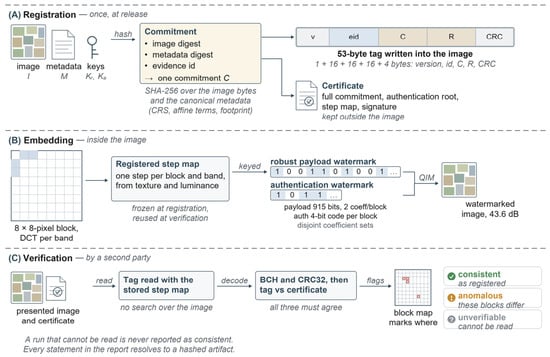
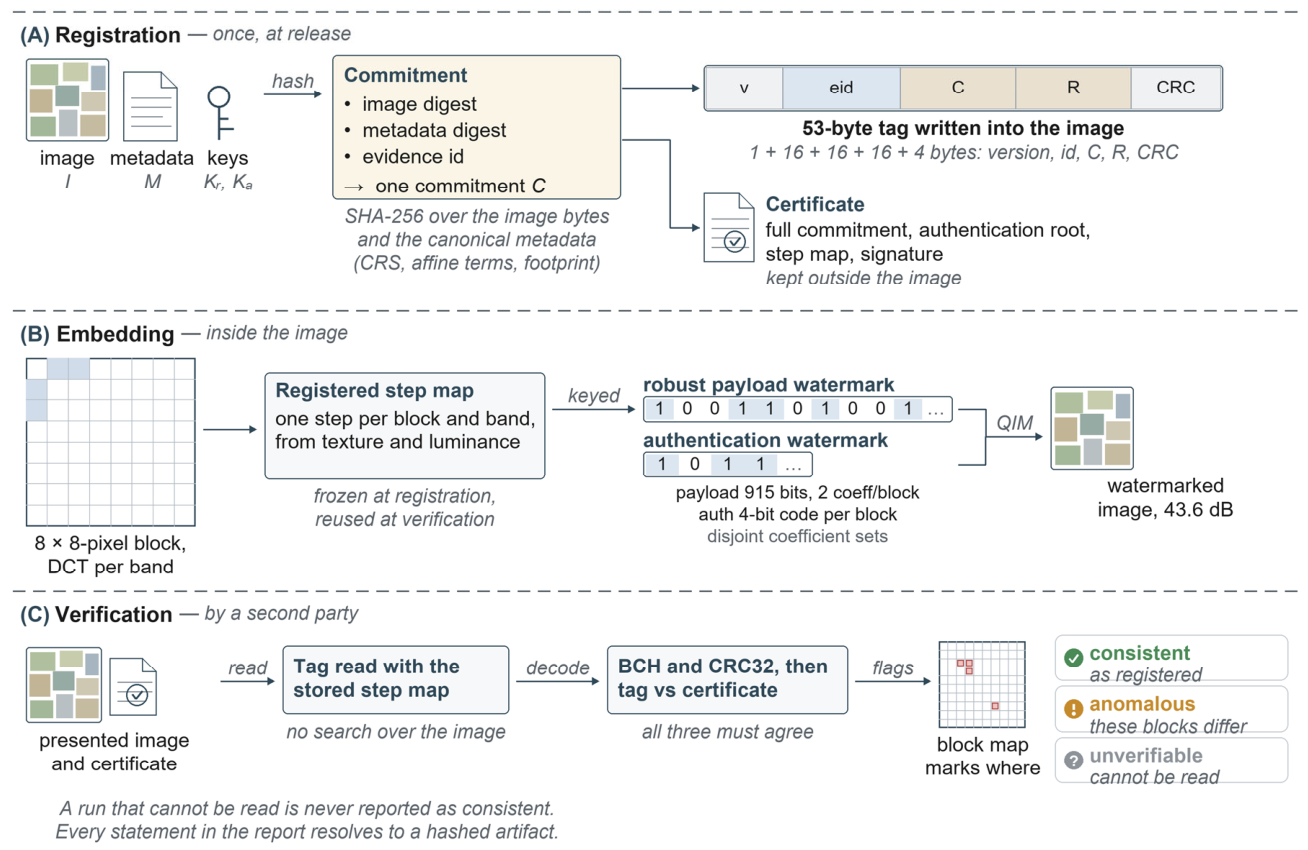
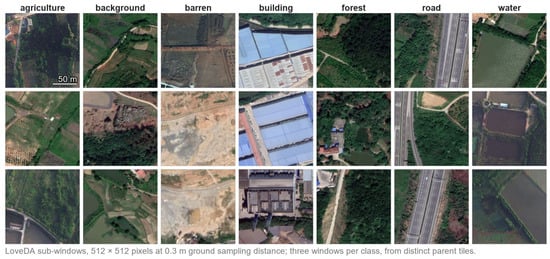
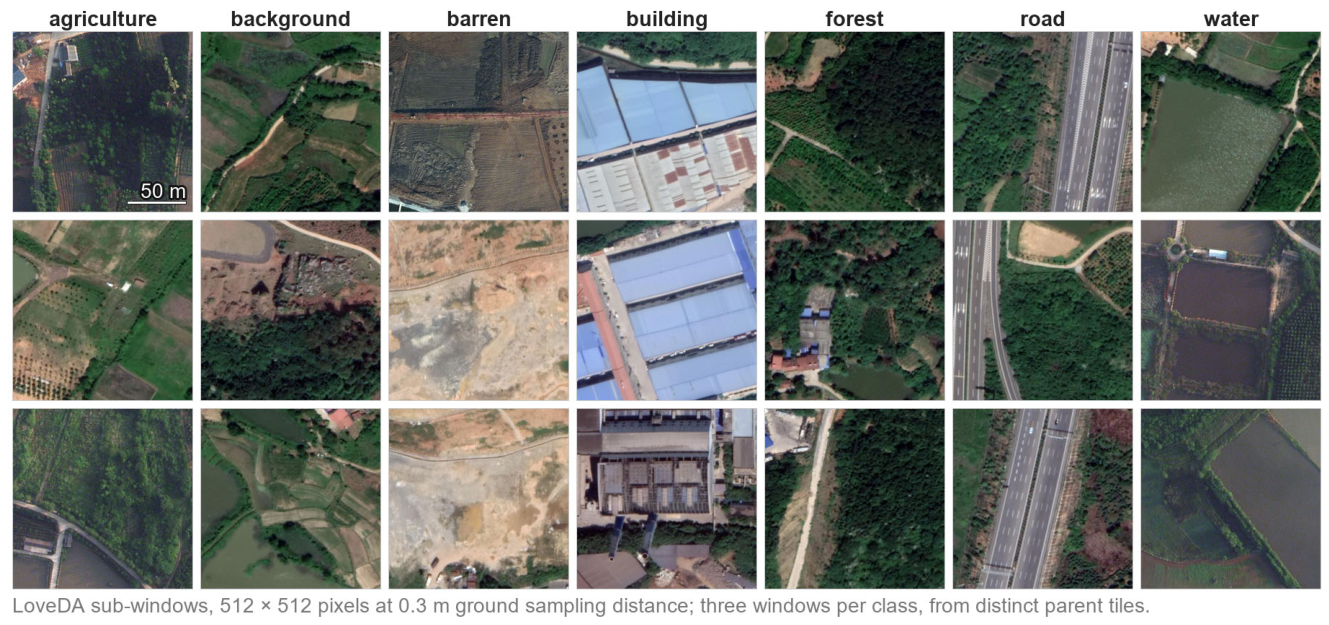
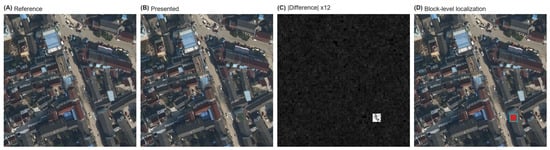
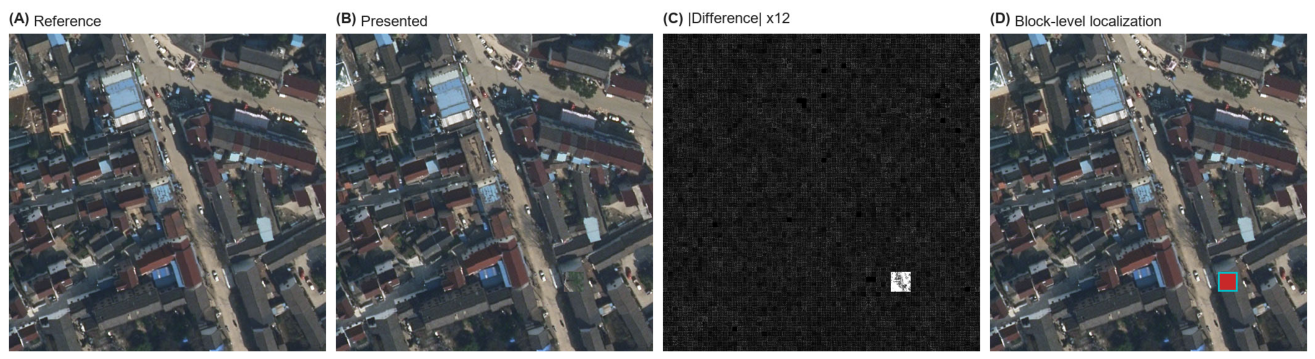
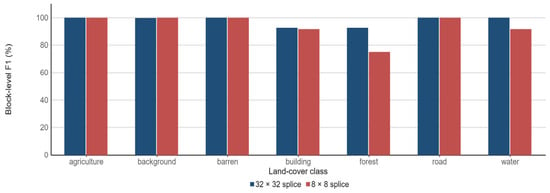
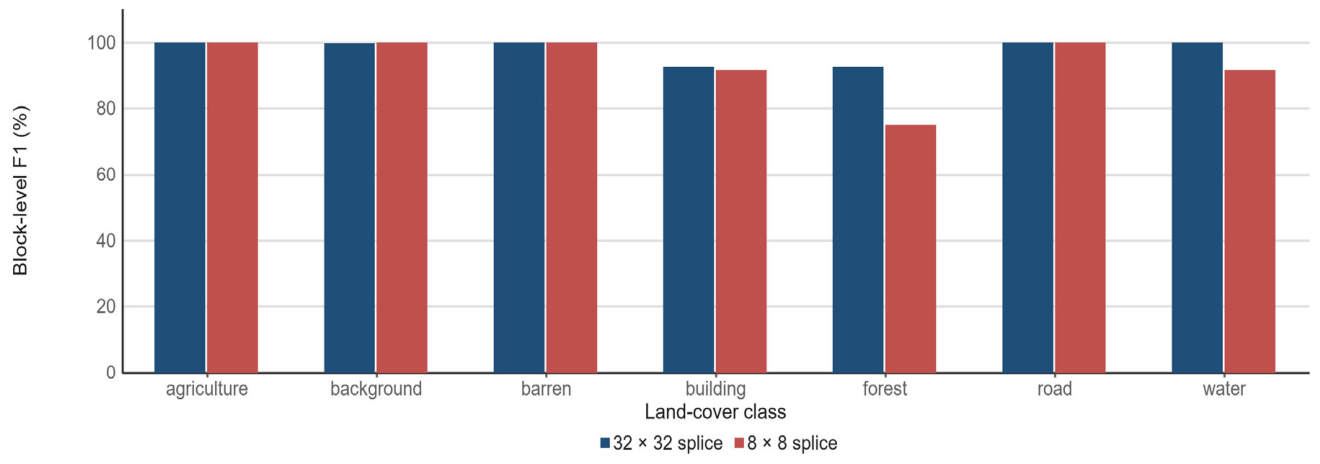
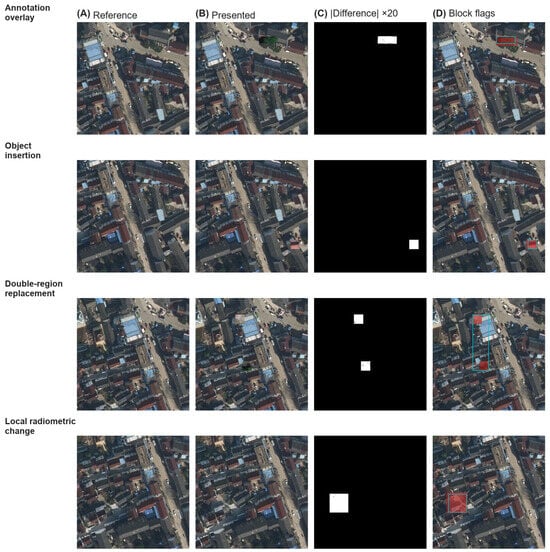
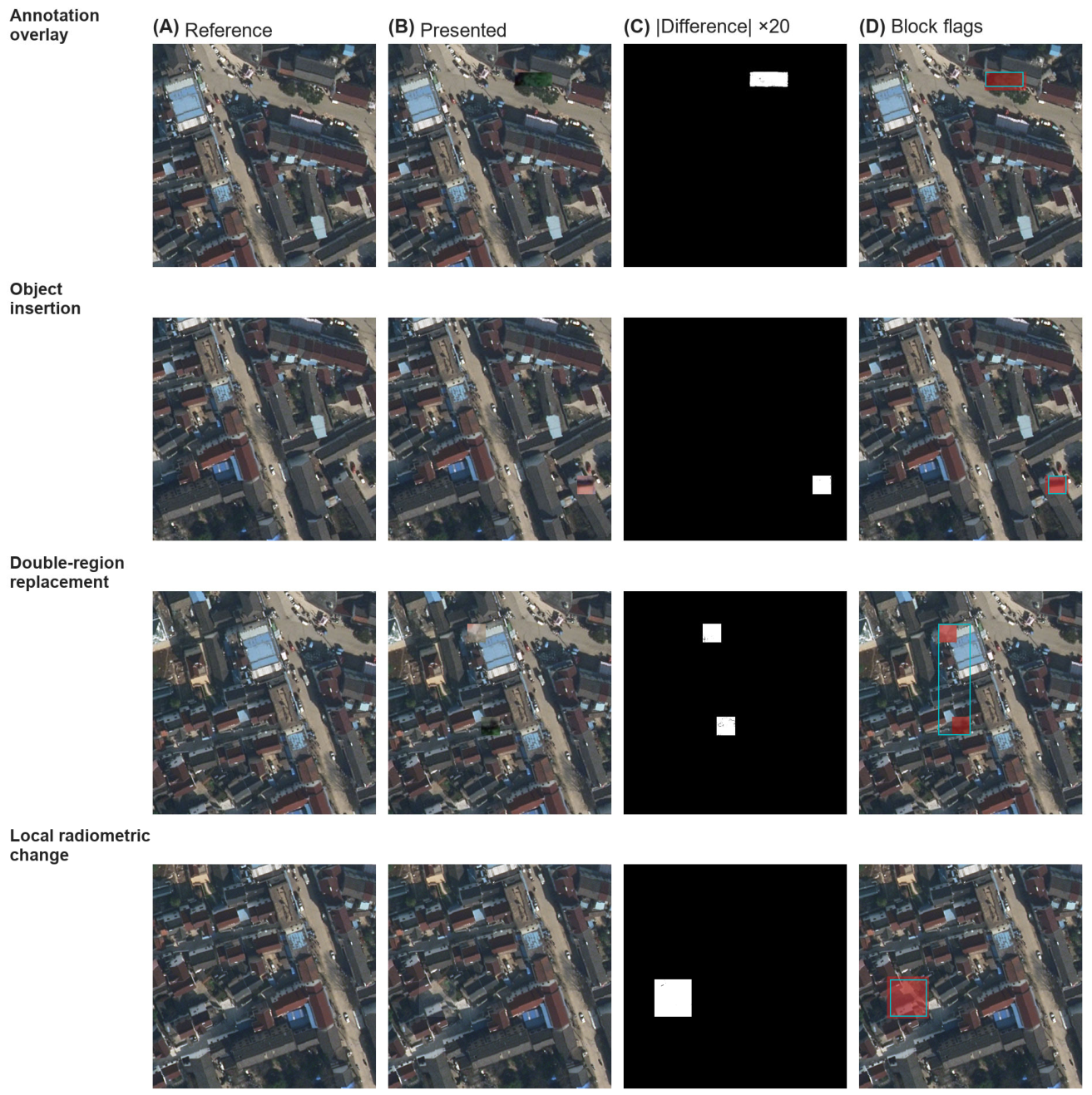
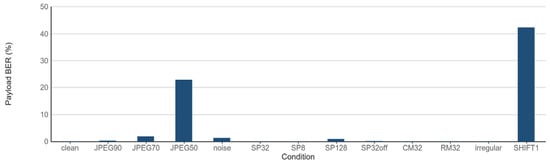
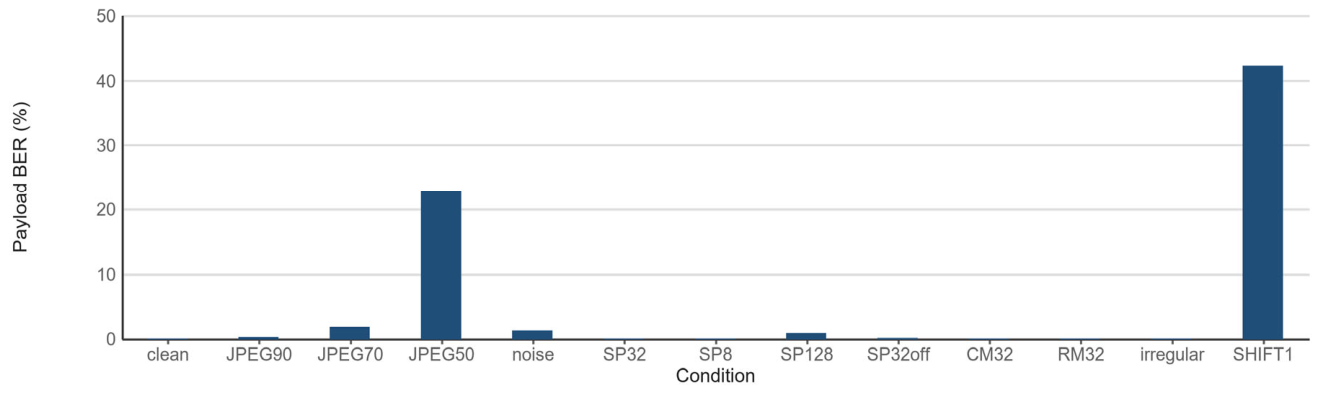
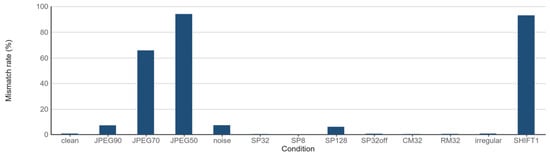
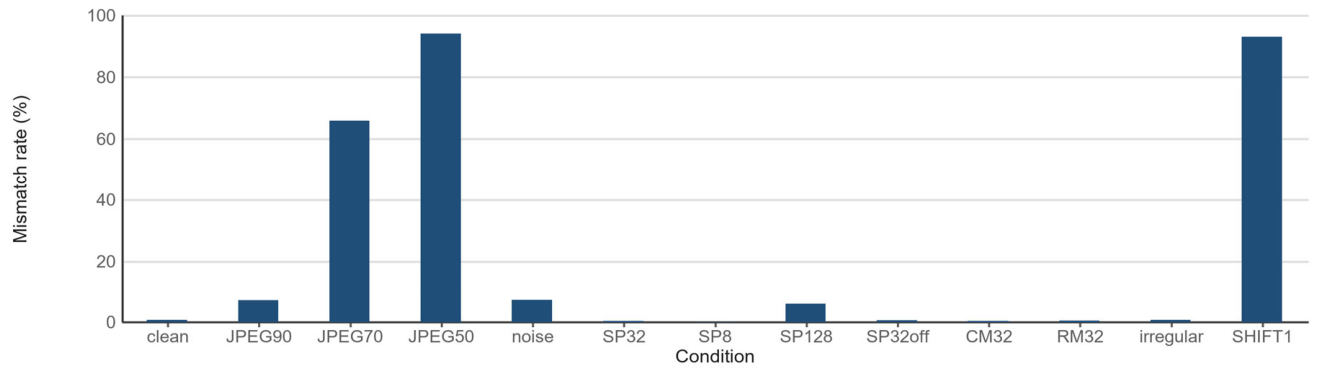
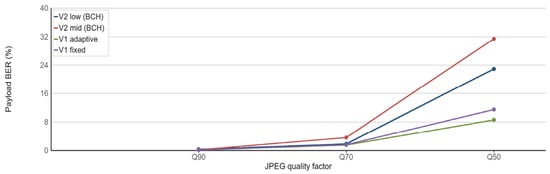
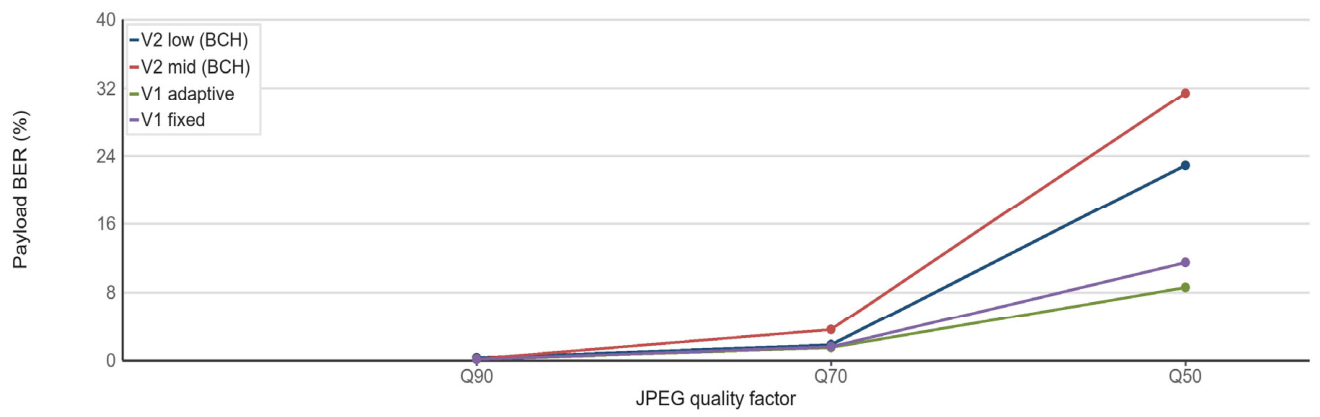
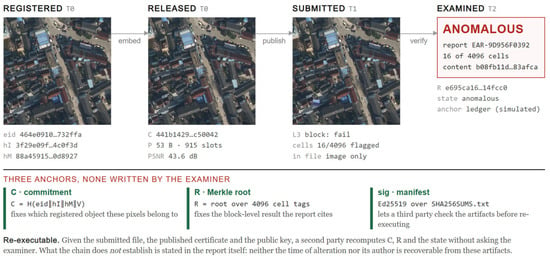
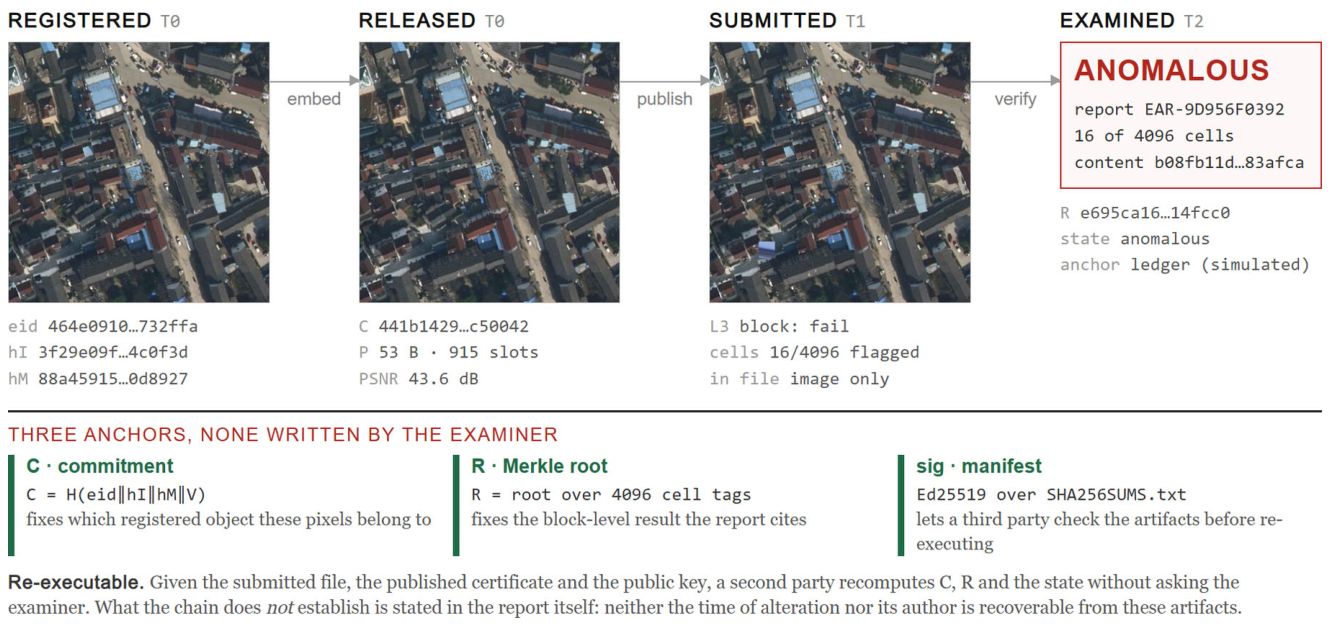
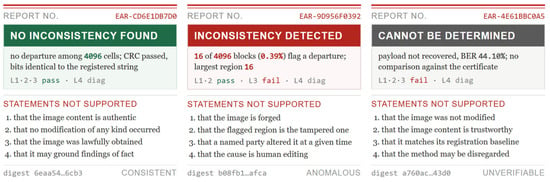
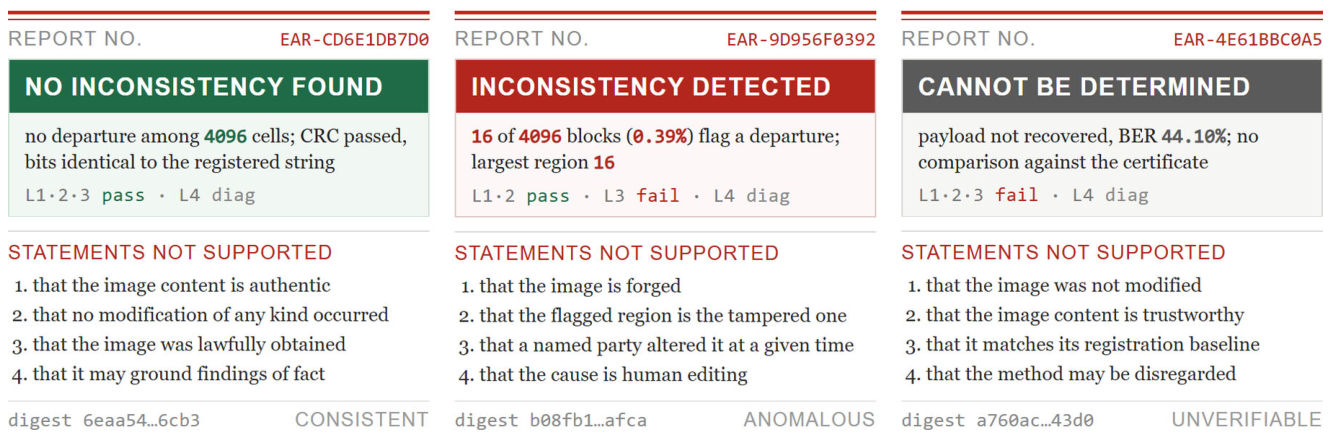
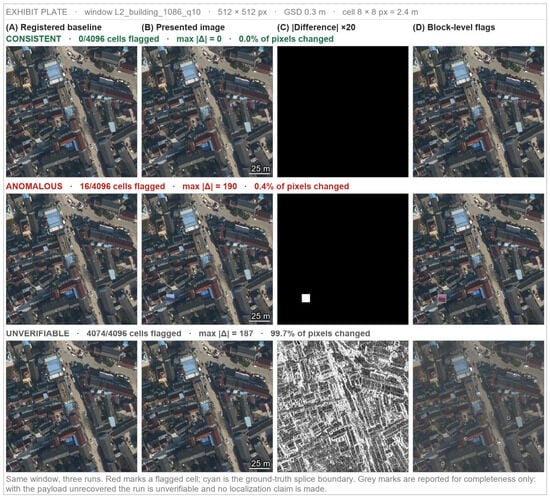
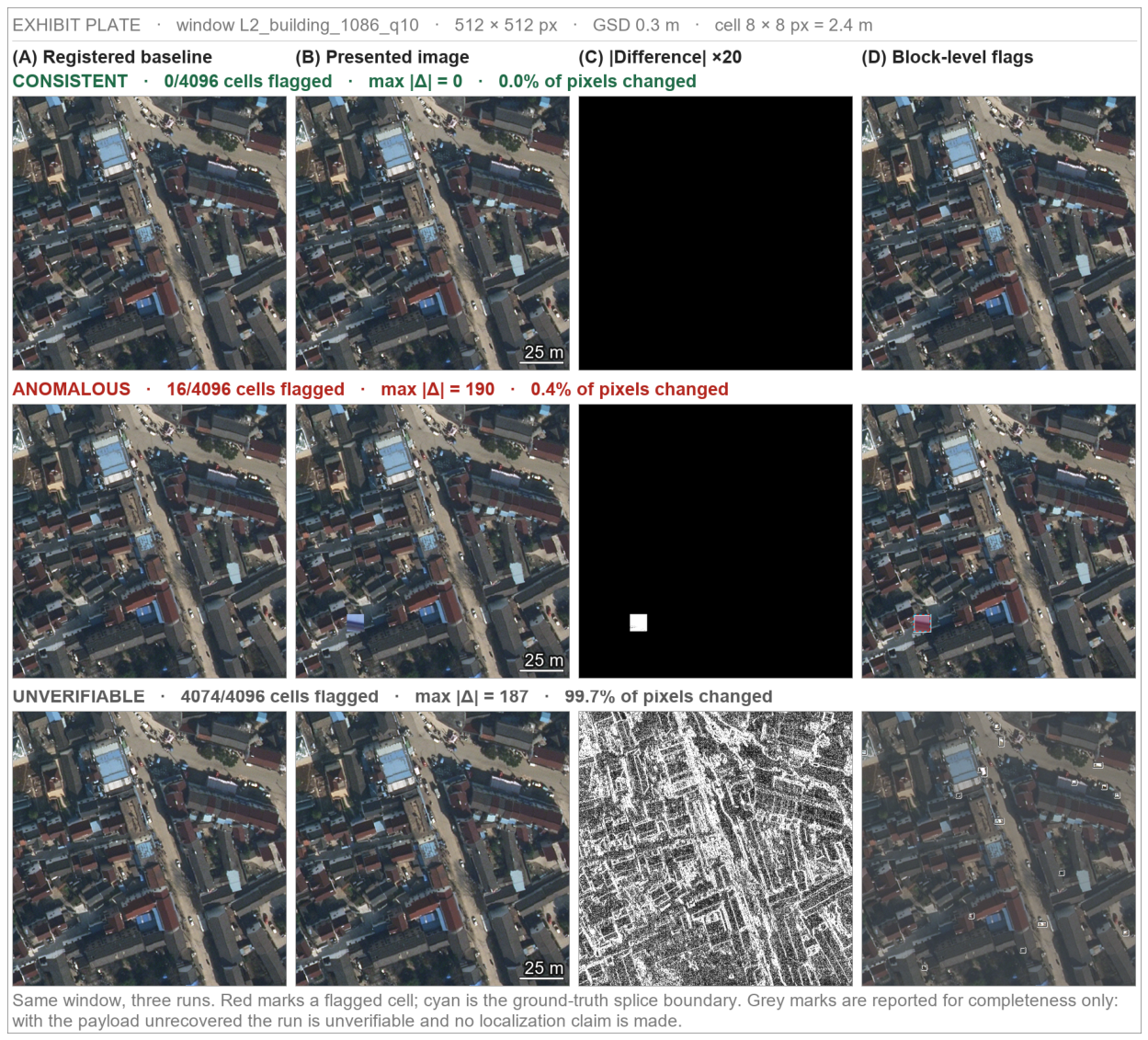
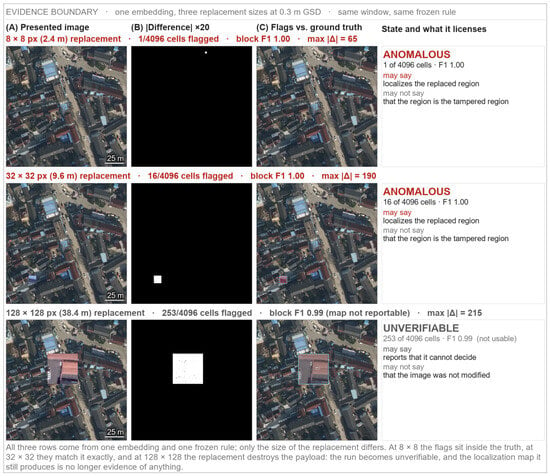
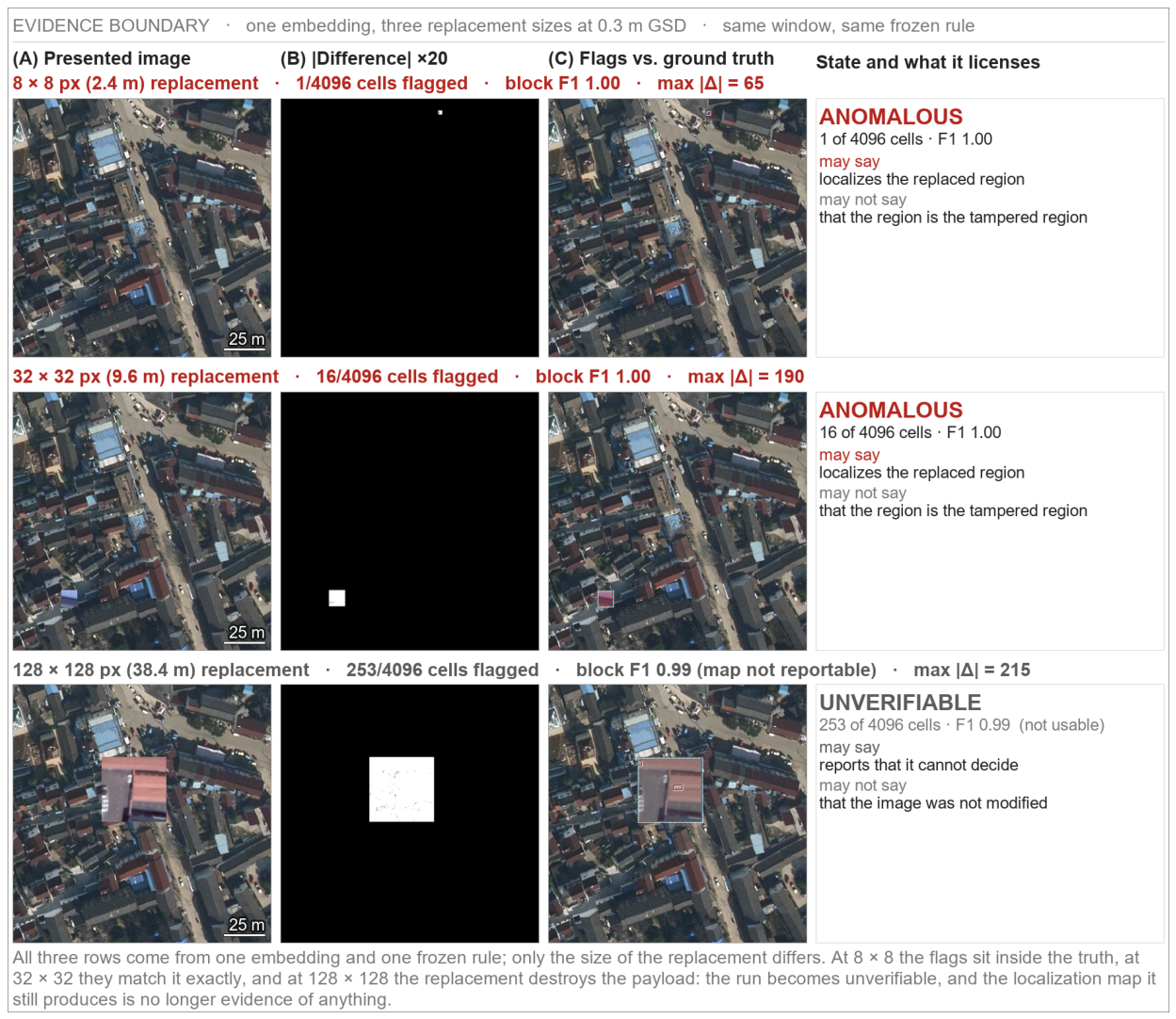
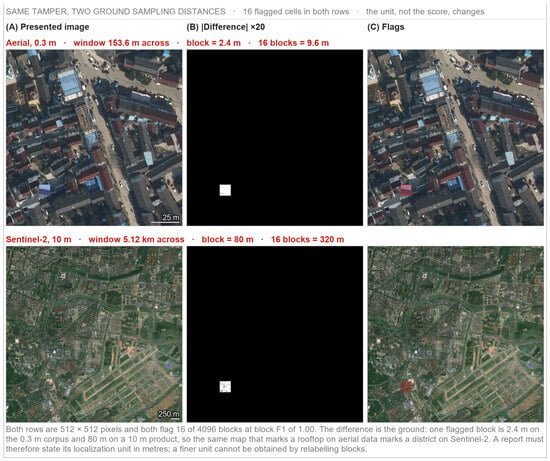
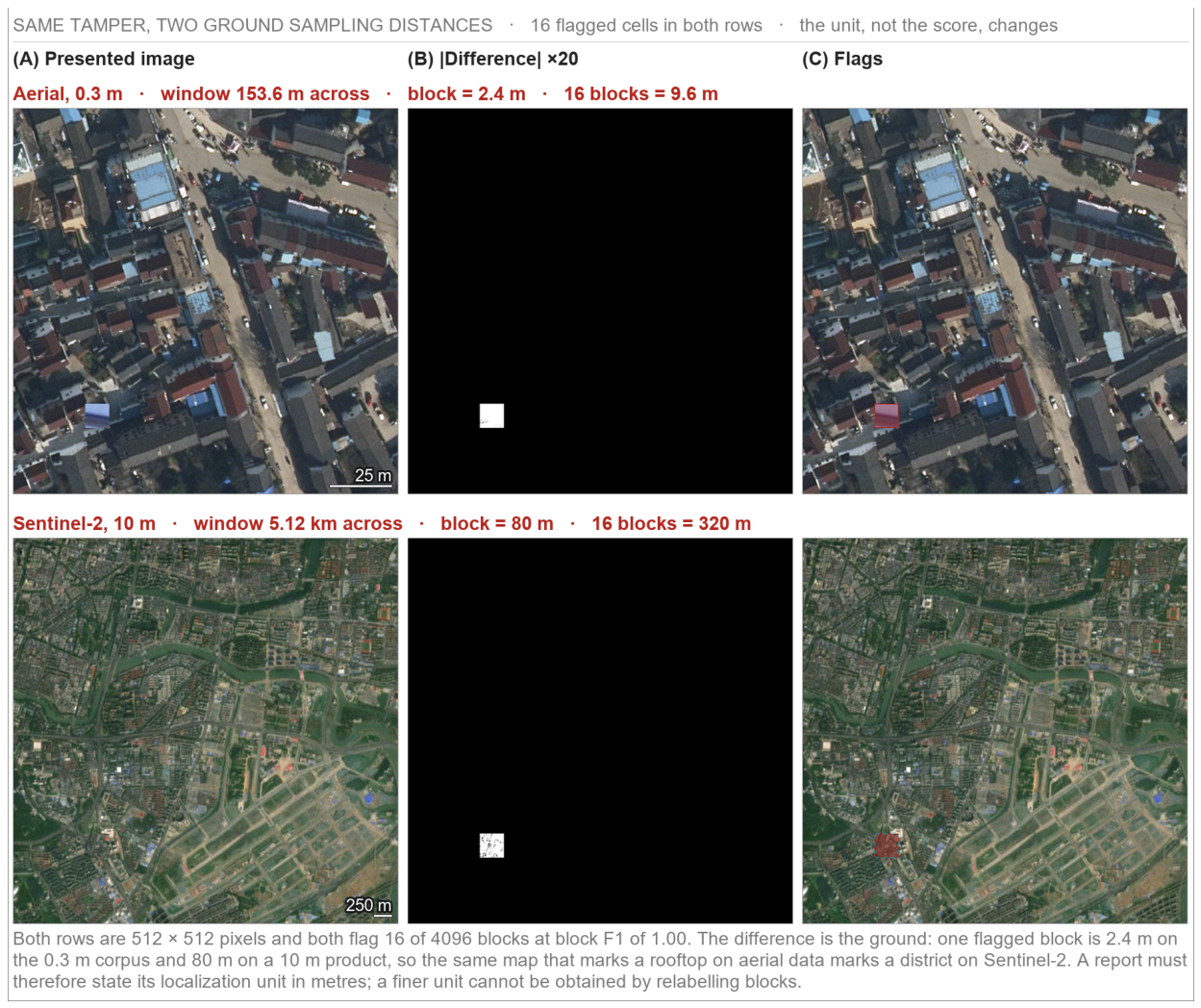
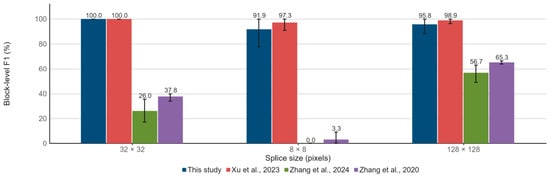
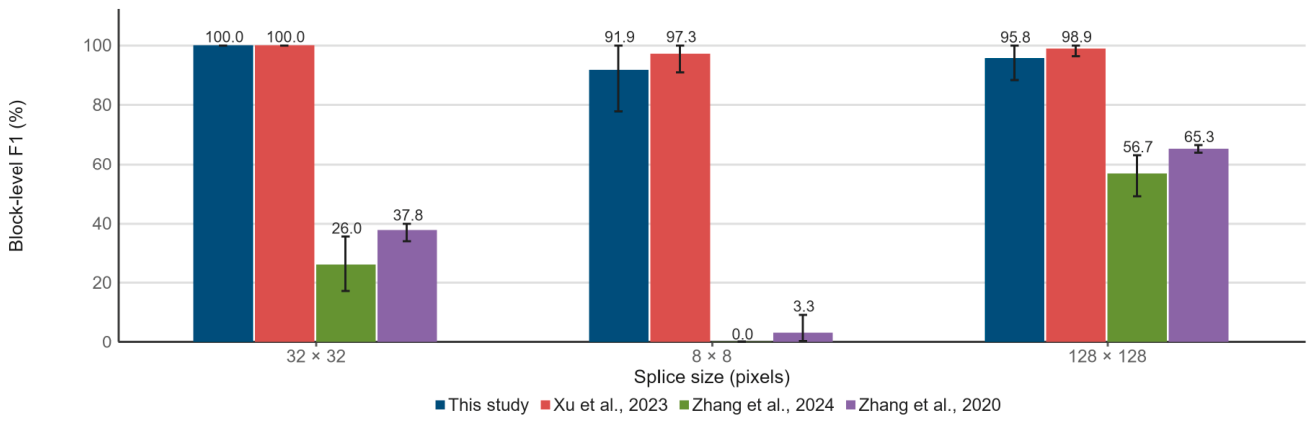

Disclaimer/Publisher’s Note: The statements, opinions and data contained in all publications are solely those of the individual author(s) and contributor(s) and not of MDPI and/or the editor(s). MDPI and/or the editor(s) disclaim responsibility for any injury to people or property resulting from any ideas, methods, instructions or products referred to in the content. |
© 2026 by the authors. Published by MDPI on behalf of the International Society for Photogrammetry and Remote Sensing. Licensee MDPI, Basel, Switzerland. This article is an open access article distributed under the terms and conditions of the Creative Commons Attribution (CC BY) license.