


Abstract
Despite decades of research, autonomous forklifts remain deployed at a small scale (2–50 vehicles), while industrial warehouses require coordinating hundreds of vehicles in environments shared with human workers. This systematic review analyzes forklift-specific autonomous technologies published between 2010 and 2025 across major robotics databases (including IEEE Xplore, ACM, Elsevier, and related venues) to identify deployment barriers. Following the PRISMA guidelines, we systematically selected 122 peer-reviewed papers addressing forklift-specific challenges across eight subsystems: vehicle modeling, localization, planning, control, vision-based manipulation, multi-vehicle coordination, and safety. We synthesized 80 methods through 8 standardized comparison tables with quality assessment based on validation rigor. State-of-the-art approaches demonstrate strong laboratory performance: localization achieving ±1.4 mm accuracy, control enabling sub-centimeter manipulation, planning reducing mission times by 2–55%, vision reaching 98%+ recognition, and safety frameworks cutting rollover risk by 53–59%. However, validation predominantly occurs at laboratory scale, revealing a critical deployment gap. These achievements do not scale to industrial environments due to fleet coordination complexity, payload variability, and unpredictable human behavior. Our contributions include the following: (1) performance rankings with technology selection guidance, (2) systematic gap characterization, and (3) research priorities addressing mixed-fleet coordination, learning-enhanced control, and human-aware safety. This review was not prospectively registered.
1. Introduction
The logistics and warehousing industry faces converging challenges that autonomous forklift technology is uniquely positioned to address. Global labor shortages in warehouse operations have reached critical levels, while demand for operational efficiency, precision, and continuous availability strain traditional manual operations has increased [1]. Industrial accidents involving material handling equipment—particularly forklift-related incidents—underscore the urgent need for safer automated alternatives [2]. Autonomous forklifts are intelligent material-handling systems capable of continuous operation with consistent precision while reducing human exposure to hazardous environments. Moreover, unlike traditional industrial automation which requires complete facility redesign, autonomous forklifts can integrate into existing warehouse infrastructures. This enables gradual automation pathways that preserve capital investments while delivering immediate operational benefits [3,4].
Despite extensive research attention on general mobile robotics and warehouse automation, autonomous forklifts present a distinct set of technical challenges warranting dedicated examination. Existing surveys focus on broader autonomous mobile robots, missing out on forklift-specific needs such as precise pallet handling, payload-dependent vehicle behavior, and strict safety requirements for working closely with humans. This gap has resulted in fragmented research where critical integration challenges remain inadequately characterized, particularly the transition from laboratory validation to industrial-scale deployment.
Autonomous forklifts differ fundamentally from general mobile robots across multiple dimensions that necessitate specialized analysis. Rear-wheel steering configurations create non-minimum phase behavior and complex tracking dynamics absent in conventional vehicles [5]. Variable payload conditions dramatically affect vehicle stability and control performance, with shifts in the center of gravity requiring adaptive strategies across the entire operational envelope [6]. Terminal precision requirements, such as lateral accuracy of 1–2 cm and sub-degree angular precision for pallet manipulation, far exceed typical mobile robot specifications [7,8]. Furthermore, operations in shared workspaces require safety frameworks that offer formal guarantees without compromising productivity [9].
These forklift-specific constraints create inter-dependencies across subsystems that cannot be understood through isolated subsystem analysis. Localization precision requirements stem from manipulation demands. Control strategies must account for payload-dependent dynamics. Forklift path planning must handle large vehicle footprints and kinematic constraints. Safety systems must balance rollover prevention with collision avoidance. Existing surveys examining individual aspects such as mobile robot navigation, manipulation system and warehouse coordination fail to capture these critical interactions. Understanding these inter-dependencies is essential because advances in sensor technologies, artificial intelligence, and modern control theory have made autonomous forklift deployment increasingly viable. Commercial SLAM systems now achieve millimeter-level accuracy. Deep learning enables robust perception under variable lighting and pallet conditions. Model predictive control provides frameworks for constraint-aware optimization with formal safety guarantees [7,10]. The proliferation of advanced perception systems including LiDAR, Time-of-Flight cameras, and computer vision algorithms has further enhanced environmental understanding capabilities for industrial automation [11]. Cloud computing and edge processing support real-time decision-making for complex multi-vehicle coordination [12,13,14]. Yet, despite these technological advances, industrial deployment remains limited.
This systematic review analyzes autonomous forklift technologies published between 2015 and 2025, a period encompassing the transition from early automation concepts to modern learning-based and multi-agent systems. The 2015 starting point captures the emergence of evolutionary technologies: commercial SLAM systems enabling centimeter-level localization, deep learning revolutionizing perception, and sophisticated multi-robot coordination frameworks. While our primary focus is on recent advances, we include seminal foundational works published before 2015 when they establish key methodological approaches or remain widely cited—such as fundamental path planning algorithms, core control theory, and foundational computer vision techniques. This temporal scope ensures comprehensive coverage of the field’s evolution while maintaining focus on technologies relevant to current industrial deployment challenges.
This comprehensive review systematically analyzes 122 papers spanning the full spectrum of autonomous forklift technologies. Our systematic analysis across eight critical subsystems—forklift modeling, localization, global planning, local planning, control, vision-based manipulation, multi-forklift coordination, and safety—and yields three primary contributions. First, we provide quantitative performance hierarchies through 8 detailed comparison tables synthesizing approximately 80 methods, enabling objective assessment of competing approaches within each subsystem. Second, we identify the validation-to-deployment transition as the central barrier to industrial adoption, revealing that most validation occurs at the laboratory scale (2–50 vehicles) despite operational requirements for hundreds of coordinated forklifts. Third, we synthesize cross-subsystem integration challenges and prioritize research directions addressing heterogeneous fleet coordination, learning-enhanced payload-adaptive control, and safety frameworks incorporating realistic human behavioral models.
Our systematic analysis reveals clear technological patterns and performance hierarchies. Model predictive control dominates control approaches, achieving sub-centimeter precision through explicit constraint handling. Vision systems demonstrate systematic performance scaling, with deep learning architectures achieving 98%+ recognition rates, while multi-modal sensor fusion delivers millimeter level localization accuracy. Coordination strategies reduce mission completion times by up to 45% through hierarchical conflict resolution, though validation remains limited to small fleets. Planning methods achieve 15–55% performance improvements through hierarchical frameworks, yet most lack dynamic re-planning essential for operational warehouses. These patterns, detailed in our comparison tables, reveal a critical gap: impressive laboratory performance that does not translate to the industrial scale due to fleet coordination complexity, payload variability, and unpredictable human behavior.
This review is structured to guide readers systematically through autonomous forklift technologies, progressing from foundational vehicle capabilities to advanced fleet-level deployment considerations. Accordingly, we organize the review into three tiers: mathematical foundations, autonomous subsystem stacks, and fleet-level coordination and safety.
- Foundational modeling and mathematical frameworks: Section 4 establishes the mathematical foundations through kinematic and dynamic modeling approaches specific to forklifts. Section 5 presents canonical mathematical formulations that enforce constraints across planning, control, manipulation, and safety subsystems. These formulations serve as unified frameworks for the analyses that follow.
- Autonomous forklift subsystems: Section 6 examines localization strategies from infrastructure-dependent to vehicle-mounted solutions. Section 7 and Section 8 analyze hierarchical path planning, progressing from warehouse-scale routing to real-time trajectory generation under kinematic constraints. Section 9 reviews control methodologies, emphasizing model predictive control’s constraint-handling advantages. Section 10 covers vision-based pallet detection and manipulation systems.
- Fleet-Level Coordination and Safety: Section 11 addresses multi-vehicle coordination and fleet management for industrial-scale deployment. Section 12 examines safety-constrained control and human–robot interaction frameworks for shared workspace operations.
Each technical section (Section 6, Section 7, Section 8, Section 9, Section 10, Section 11 and Section 12) follows a consistent structure: comparative analysis tables with performance metrics, critical analysis identifying validation gaps and deployment barriers, and practical guidance for technology selection based on application requirements. This organization enables readers to either focus on specific subsystems of interest or follow the complete progression from system modeling to fleet-level industrial deployment considerations.
2. Survey Methodology
This systematic review follows the Preferred Reporting Items for Systematic Reviews and Meta-Analyses (PRISMA) 2020 guidelines [15]. The PRISMA checklist (Supplementary Materials) and flow diagram are included to ensure transparent and complete reporting. This review was not prospectively registered as registration is not common practice for engineering and robotics systematic reviews.
Note that the search and selection process was documented retrospectively, and the numbers reported in the PRISMA flow diagram represent best estimates based on available records. While exact counts for all screening stages were not prospectively logged, the reported values accurately reflect the systematic process followed.
2.1. Search Strategy
2.1.1. Databases and Sources
The literature search was conducted across multiple academic databases and conference proceedings to ensure comprehensive coverage. The final search was completed in July 2025:
- IEEE Xplore Digital Library: primary source for robotics, automation, and control systems research.
- ACM Digital Library: computer science and artificial intelligence publications.
- Major robotics conferences:
- –
- IEEE International Conference on Robotics and Automation (ICRA).
- –
- IEEE/RSJ International Conference on Intelligent Robots and Systems (IROS).
- –
- IEEE Conference on Automation Science and Engineering (CASE).
- –
- Robotics: Science and Systems (RSS).
- Key robotics journals:
- –
- The International Journal of Robotics Research (IJRR).
- –
- Robotics and Computer-Integrated Manufacturing.
- –
- Robotics and Autonomous Systems.
- ScienceDirect for supplementary coverage
2.1.2. Search Terms and Keywords
The search strategy employed a combination of primary and secondary keywords using Boolean operators:
The search used the following primary keywords:
- “autonomous forklift*”;
- “automated guided forklift*” OR “AGV”;
- “robotic forklift*”;
- “unmanned forklift*”.
The following secondary keywords were combined using the AND operator:
- “path planning” OR “trajectory planning” OR “motion planning”.
- “localization” OR “navigation” OR “SLAM”.
- “control” OR “tracking” OR “MPC”.
- “vision” OR “perception” OR “pallet detection”.
- “coordination” OR “fleet management” OR “multi-robot”.
- “safety” OR “collision avoidance” OR “human-robot interaction”.
- “warehouse” OR “logistics” OR “material handling”.
2.2. Study Selection Process
2.2.1. Screening Procedure
The study selection followed a two-stage systematic process. In Stage 1 (title and abstract screening), all titles and abstracts identified through database searches were screened against the inclusion criteria. Initial screening focused on identifying papers with potential forklift-specific relevance based on title and abstract content.
In Stage 2 (full-text review), papers passing initial screening underwent full-text assessment to confirm eligibility against the detailed inclusion criteria. Reasons for exclusion at this stage were documented by category.
2.2.2. Inclusion Criteria
Papers were included if they met the following requirements:
- Published in peer-reviewed venues, with a primary focus on papers published between 2015 and 2025 to capture recent advances; foundational papers published before 2015 were included if they established key methodological approach.
- Explicitly address forklift-specific challenges, including the following:
- Rear-wheel steering kinematics and dynamics.
- Payload-dependent control and stability.
- Precision pallet manipulation.
- Warehouse-scale coordination and fleet management.
- Present novel algorithmic contributions, experimental validation, or comprehensive system integration.
- Available in the English language.
- Focus on indoor warehouse/industrial applications rather than general outdoor mobile robots.
2.2.3. Exclusion Criteria
Papers were excluded based on the following criteria:
- General mobile robot papers lacking forklift-relevant constraints.
- Theoretical work without consideration of forklift-specific operational requirements.
- Papers that focus only on mechanical design and do not address autonomous control.
- Papers without sufficient technical detail.
- Duplicate publications or earlier versions of the same work.
- Non-peer-reviewed sources (e.g., technical reports, theses, patents).
- Studies published before 2015 unless they represent foundational work.
2.3. Data Collection and Extraction
2.3.1. Data Extraction Process
Data extraction was performed systematically from each included study. When methodological details were unclear or not reported, the information was marked as “not reported” in the comparison tables rather than making assumptions.
2.3.2. Data Items Extracted
From each selected paper, the following information was systematically extracted:
- Study characteristics: authors, publication year, venue, study design.
- Methodological approach: algorithmic contributions, mathematical formulations.
- Performance metrics: accuracy, computation time, success rates, validation scale.
- Forklift-specific constraints: kinematic limits, payload considerations, precision requirements.
- Validation details: environment type (simulation/real-world), fleet size.
- Integration aspects: connections to other subsystems (localization, planning, control, vision, safety).
2.4. Data Synthesis and Analysis Methods
2.4.1. Synthesis Approach
Given the heterogeneity of methods, validation environments, and performance metrics across autonomous forklift research, quantitative meta-analysis was not appropriate. Instead, we employed narrative synthesis with structured comparative tables as the primary synthesis method.
2.4.2. Comparative Table Construction
The extracted data were organized into eight comparative analysis tables covering critical subsystems: localization, global planning (Parts I and II), local planning, control, vision-based manipulation, multi-forklift coordination, and safety. Each table standardizes reporting across:
- Method/algorithm classification.
- Constraints and requirements addressed.
- Performance metrics and validation details.
- Key characteristics and operational considerations.
Where appropriate, validation context tags ([RW] = Real-World, [SIM] = Simulation, [HYB] = Hybrid) are included to distinguish between different testing environments and their implications for deployment readiness.
2.4.3. Handling Heterogeneous Metrics
Where studies reported different performance metrics for similar objectives, we:
- Extracted all reported metrics without conversion.
- Clearly indicated measurement units and test conditions.
- Noted when direct comparison was not possible due to different baselines.
- Provided qualitative assessments when quantitative comparison was infeasible.
2.5. Quality Assessment
Each included study was evaluated based on the following aspects:
- Technical rigor: algorithmic novelty, mathematical formulation, theoretical soundness.
- Experimental validation: real-world testing, simulation testing, performance metrics reporting.
- Forklift relevance: direct applicability to autonomous forklift operations.
- Reproducibility: sufficient methodological detail for replication and comparison.
Studies with superior validation (real-world deployment > hybrid > simulation-only) were weighted more heavily in synthesizing practical recommendations.
2.6. Study Selection and PRISMA Flow
Figure 1 presents the PRISMA flow diagram documenting the systematic search and selection process from initial database searches through to final study inclusion.
Figure 1.
PRISMA 2020 flow diagram showing the systematic search and selection process for studies on autonomous forklift technologies. The diagram illustrates the progression from initial database searches through screening and eligibility assessment to final inclusion of 122 studies across eight subsystems.
3. Problem-Space, Taxonomy, and Reference Architecture
3.1. Problem-Space Taxonomy
The problem-space taxonomy for autonomous forklift systems organizes the domain across three primary dimensions: vehicle platform characteristics, operational environment specifications, and task requirements. Each dimension imposes distinct constraints that cascade through system design, from sensor selection through control strategies.
3.1.1. Vehicle Platform Taxonomy
Figure 2 categorizes forklift platforms across three critical attributes that fundamentally determine kinematic and dynamic behavior. Vehicle class differentiates counterbalance forklifts (front-loaded payload with rear counterweight), reach trucks (extendable forks for narrow-aisle operation), and pallet trucks (ground-level transport). Steering type encompasses rear-steer configurations (Ackermann geometry with rear pivot, creating non-minimum phase dynamics), tricycle arrangements (single steered front wheel), differential drive (independent wheel control), and omnidirectional platforms (mecanum or omni-wheels enabling holonomic motion). Payload capacity spans light (<1 ton), medium (1–3 tons), and heavy (>3 tons) classifications, with significant implications for control complexity as payload variations shift the center of gravity and alter vehicle stability characteristics.
Figure 2.
Vehicle platform taxonomy showing class, steering configuration, and payload capacity. These characteristics impose fundamental kinematic constraints (rear-steer vs. differential drive) and dynamic constraints (payload-dependent center of gravity shifts) that propagate through planning and control subsystems.
3.1.2. Operational Environment Taxonomy
Figure 3 characterizes the operational contexts that determine localization precision requirements and safety framework complexity. Facility type distinguishes fixed-rack warehouses (structured storage with defined aisles and rack positions), cross-docking facilities (rapid transfer with minimal storage, emphasizing throughput over density), and production floor intralogistics (manufacturing environments with dynamic layouts and mixed material flows). Aisle geometry categorizes operational space as wide (>3 m, permitting two-way traffic and relaxed positioning accuracy), narrow (2–3 m, requiring single-direction flow and centimeter-level precision), or very narrow (<2 m, demanding specialized reach trucks and millimeter positioning). Human presence modes range from segregated operations (physical barriers between automated and manual zones), through shared workspace (concurrent human–robot operation with safety monitoring), to dense mixed environments (high-density human activity requiring sophisticated prediction and collision avoidance).
Figure 3.
Operational environment taxonomy characterizing facility type, aisle geometry, and human presence modes. Environment structure determines localization requirements and safety complexity.
3.1.3. Task Requirements Taxonomy
Figure 4 organizes operational requirements that establish performance specifications across perception, planning, and control subsystems. Manipulation complexity ranges from transport-only operations (no terminal precision required, path following sufficient), through pickup/drop tasks (centimeter-level accuracy for pallet engagement), to block stacking (millimeter precision, load stability management, and multi-stage motion sequences). Navigation modes encompass aisle following (corridor tracking with collision avoidance), aisle changes (perpendicular transitions requiring multi-point turns respecting kinematic constraints), and dock approach (precise alignment for loading/unloading). Precision requirements span coarse (±5 cm, adequate for open-space navigation), standard (±2 cm, typical for most pallet operations), and high (±1 cm, necessary for very narrow aisles and dense storage).
Figure 4.
Task requirements taxonomy covering manipulation complexity, navigation modes, and precision demands. These requirements establish performance specifications: block stacking demands millimeter precision requiring vision-based servoing, while aisle changes impose kinematic constraints requiring multi-stage motion planning.
3.2. System Architecture
Figure 5 illustrates the reference architecture connecting these taxonomic dimensions into an integrated autonomous forklift system. The architecture follows a hierarchical organization reflecting the flow from sensing through decision-making to actuation. At the top level, the perception module processes multi-modal sensor data (LiDAR, cameras, IMU, UWB/RFID) to extract environmental features, while fleet coordination manages high-level task allocation across multiple vehicles. Perception feeds the localization module, which fuses sensor information to maintain continuous pose estimates with accuracy requirements determined by operational environment constraints (narrow aisles demanding sub-centimeter precision).
Figure 5.
Reference system architecture for autonomous forklifts showing vertical hierarchical organization. Perception processes raw sensor data, feeding into localization for state estimation and directly to local planning and vision-based manipulation. Planning proceeds hierarchically through global and local layers. The nominal controller generates performance-optimizing commands filtered by a safety supervisor before vehicle actuation.
Localization provides state estimates to global planning, which generates warehouse-scale routes respecting vehicle kinematic constraints and traffic rules established by fleet coordination. The hierarchical planning structure continues through local planning, which transforms global waypoints into dynamically feasible trajectories accounting for real-time obstacle avoidance. Notably, perception maintains direct connections to both local planning (for reactive collision avoidance) and vision-based manipulation (for terminal precision guidance during pallet engagement), enabling rapid response to dynamic changes without waiting for full planning hierarchy updates.
The nominal controller integrates reference trajectories from local planning with terminal corrections from vision-based manipulation, generating performance-optimizing commands that account for vehicle dynamics and payload state. However, these commands pass through a safety supervisor controller before reaching vehicle actuators, ensuring that all commands maintain safety constraints even under model uncertainties or unexpected disturbances. This layered architecture enables systematic integration of the diverse requirements identified in the problem-space taxonomy, from vehicle platform constraints (steering type, payload dynamics) through environmental considerations (aisle geometry, human presence) to task specifications (manipulation precision, navigation complexity).
4. Forklift Kinematics and Dynamics
Before autonomous forklifts can perform path planning or localize within warehouse environments, their motion characteristics must be rigorously characterized. This section develops the mathematical foundations that underpin subsequent analyses of planning, control, and manipulation. Building on the systematic review of autonomous forklift research presented in Section 2 and the taxonomy established in Section 3, we now examine the fundamental motion models that govern and constrain forklift motion.
Understanding these models is essential because treating forklifts like simple point robots or holonomic vehicles leads to plans that are physically impossible to execute. The use of rear-wheel steering, which is uncommon in mobile robotics yet prevalent in industrial forklifts, imposes fundamental constraints on both planning and control. We begin with these motion models because they define what is feasible before we consider how to achieve it.
Modeling forklifts for autonomous operation requires a careful balance between computational efficiency and fidelity to physical behavior. For the majority of warehouse tasks, such as aisle navigation, corridor following, and precision pallet manipulation, kinematic models offer sufficient accuracy while maintaining real-time computational feasibility. Dynamic models, however, become necessary in specific operating conditions, including the handling of elevated loads, traversal of inclined surfaces, execution of emergency maneuvers, and stability analysis during high-speed operation [16,17,18,19,20].
This section reviews the kinematic and dynamic modeling frameworks commonly employed in the planning and control literature. The models introduced here provide the theoretical basis for the path-planning and control methodologies developed in subsequent sections. Most reported applications adopt continuous-time kinematic formulations, together with their discrete-time realizations to accommodate implementation in digital control systems.
4.1. Continuous-Time Kinematic Models
The autonomous forklift literature employs three primary kinematic configurations. Each has specific advantages for different operational requirements and vehicle architectures.
4.1.1. Bicycle Model (Rear-Wheel Steering)
The most commonly adopted model in the forklift control literature idealizes the vehicle as a rear-wheel steered bicycle with a wheelbase L, shown in Figure 6. This abstraction provides an accurate representation for the majority of industrial forklift platforms and extends to many tricycle configurations, such as those with two front caster wheels and a single rear drive/steer wheel. Under the assumption that the drive/steer wheel is aligned with the vehicle centerline, these platforms can be equivalently reduced to the same bicycle model formulation [7,10,21,22,23,24,25,26,27,28,29,30,31].
Figure 6.
Rear–steer bicycle (forklift) kinematic model in the world frame . The vehicle pose is at point , taken at the midpoint of the fixed front axle, and the steered rear wheel center is with wheelbase L. Under pure rolling and no lateral slip, the wheel velocities align with their wheel planes and define the instantaneous center of rotation . The resulting curvature and turning radius satisfy and , with yaw rate .
Standard practice employs a world frame and body frame attached to the rear axle center. The chassis pose is with yaw angle , longitudinal speed v, and steering angle (counter-clockwise positive). The kinematic equations are as follows:
where with as the steering wheel velocity and L is the wheelbase. The general inputs to the model are and . The minimum turning radius determines geometric feasibility in warehouse aisles. Rate bounds and are often incorporated to enhance actuator tracking performance [32,33].
4.1.2. Offset Tricycle Model
Some industrial forklift platforms employ asymmetric geometries in which the drive/steer wheel is offset from the vehicle’s longitudinal centerline. Such configurations cannot be accurately reduced to the standard bicycle model abstraction, since the lateral offset induces a coupling between the steering angle and the instantaneous center of rotation. A dedicated kinematic formulation that explicitly accounts for this offset has been proposed in the literature [25]. Equation (1) takes the following form:
where a is the lateral offset of the driving/steering wheel from the vehicle centerline.
4.1.3. Differential Drive Model
Some industrial forklift platforms adopt differential-drive architectures to maximize maneuverability in constrained environments. In this case, the kinematic relationship between the left and right wheel velocities and the forklift’s planar motion is given below [3,34]:
where and are left and right wheel velocities, and is the wheelbase. This configuration enables in-place rotation. However, it typically requires specialized wheel designs to handle the lateral forces imposed by heavy payloads while performing in-place rotation.
4.2. Discrete-Time Formulations
Digital implementation of motion control typically necessitates discrete-time representations of the continuous-time kinematic models. Accordingly, the literature reports a range of discretization strategies for this purpose. Among these, the Forward Euler scheme is most frequently adopted in real-time control applications.
4.2.1. Discrete Bicycle Model
The discrete-time bicycle model uses Forward Euler discretization with sampling period [7]:
This formulation applies directly to both traditional rear-wheel steered forklifts and symmetric tricycle configurations that can be reduced to bicycle models.
For applications requiring higher accuracy, alternative discretization methods account for the circular arc motion during each sampling interval [3]:
where is the angular velocity at time step k. This arc-based discretization provides improved accuracy for larger sampling periods or higher speed maneuvers.
4.2.2. Discrete Offset Tricycle Model
For asymmetric tricycle configurations with a laterally offset drive/steer wheel, the discrete-time model is commonly obtained via Forward Euler discretization:
This discrete-time formulation facilitates the implementation of optimization-based control strategies for industrial forklifts with asymmetric drive configurations. Importantly, it preserves the key coupling effects induced by the offset geometry.
4.3. Dynamic Models
Although kinematic models are adequate for most planning oriented tasks, dynamic modeling becomes necessary under particular operating conditions. Representative cases include stability assessment, load-dependent effects, hydraulic actuator constraints, and high-performance maneuvering regimes.
4.3.1. Lateral-Yaw Dynamics
For moderate speeds on clean floors, a two degree-of-freedom lateral-yaw model captures essential dynamics for stability analysis. With body sideslip angle and yaw rate , the slip angles at the front and rear axles are given below [5,32,35]:
where is the distance from the vehicle center of gravity to the front axle, is the distance from the center of gravity to the rear axle, v is the longitudinal velocity, and is the steering angle applied at the rear axle for rear-wheel steered forklifts.
The dynamic equations use linear cornering stiffness and :
where M is the total vehicle mass (including payload), is the yaw moment of inertia about the center of gravity, is the lateral velocity, and are the cornering stiffness of the front and rear tires respectively, and r is the yaw rate. The composite center of mass and inertial properties vary significantly with payload mass, mast height, and load position. This directly impacts stability margins and control performance. This model explains why yaw response slows and lateral margins decrease with elevated payloads.
4.3.2. Non-Minimum Phase Behavior
Rear-wheel steered forklifts exhibit non-minimum phase behavior when the measurement point lies behind the center of gravity. The lateral error initially increases when initiating a turn. This creates control challenges. The full three degree-of-freedom dynamic model incorporating this effect is as follows [5]:
where is yaw rate, is sideslip angle, V is vehicle speed, and and are lateral tire forces. Understanding this behavior is crucial for designing controllers that can handle the inherent characteristics of rear-steer configurations.
4.4. Model Selection and Application Guidelines
The choice between different modeling approaches depends on specific application requirements and computational constraints.
Continuous-time kinematic models are typically used for the following tasks:
- Path planning algorithms and trajectory generation.
- Control law design and stability analysis.
- Motion primitive libraries and feasibility checking.
Discrete-time formulations are commonly adopted for the following tasks:
- Digital control implementation and model predictive control.
- Real-time trajectory tracking and collision avoidance.
- Integration with discrete sensor updates and actuator commands.
Dynamic models are most appropriate when the following considerations are important:
- Stability analysis with elevated or off-center loads.
- High-speed maneuvering or emergency braking scenarios.
- Systems with significant actuator dynamics (e.g., hydraulic steering).
- Model predictive control with explicit stability constraints.
The bicycle kinematic model remains the most widely used formulation. This is due to its computational efficiency and adequate representation of non-holonomic constraints for typical warehouse operations. This predominance reflects a pragmatic trade-off between model fidelity and real-time computational constraints. Nevertheless, such models may be insufficient to represent the more complex dynamics that arise for heavily loaded forklifts operating on grades or executing aggressive maneuvers.
The literature reveals a notable gap in systematic model validation under varying payload conditions. Most studies assume ideal low-slip conditions that may not hold in industrial environments with worn floors or aggressive maneuvering. Dynamic effects are typically addressed through conservative trajectory design, gain scheduling based on load conditions, or explicit stability monitoring. This approach avoids full dynamic modeling in the control loop. The discrete-time versions of these models provide the computational foundation for modern digital control systems.
Having established how forklifts move and the mathematical frameworks for representing this motion, we can now formalize the constraints and objectives that govern autonomous operation. The next section develops canonical problem formulations and standard mathematical representations that translate real-world warehouse tasks into optimization problems that the planning and control algorithms of Section 7, Section 8 and Section 9 can solve. These formulations build directly on the kinematic constraints established here, particularly the minimum turning radius and non-holonomic behavior inherent to rear-wheel steering.
5. Canonical Equations Linking Planning, Control, Manipulation, and Safety
The kinematic and dynamic models established in Section 4 describe how forklifts move. However, autonomous operation requires more than motion models, it demands explicit mathematical bridges between subsystems. Autonomous forklifts must simultaneously enforce diverse operational constraints. These span geometric corridor limits, lateral acceleration bounds, pallet manipulation tolerances, and human proximity requirements. Unlike general mobile robots that can treat these concerns independently, autonomous forklifts demand integrated constraint enforcement. This is due to their unique combination of precision manipulation requirements, payload-dependent dynamics, and shared workspace operation.
This section establishes canonical mathematical formulations that provide explicit bridges between subsystems. These equations enable unified constraint enforcement across all operational modes. They interface directly with the kinematic models (Equations (1)–(6)) and Frenet-frame error dynamics (Equations (21) and (22)). They also establish the mathematical vocabulary that will be referenced throughout the subsystem analysis in Section 8, Section 9, Section 10, Section 11 and Section 12.
The formulations presented here are not isolated mathematical constructs. Rather, they are working equations actively enforced by the planning, control, manipulation, and safety systems discussed in subsequent sections. Each equation captures a physical or operational constraint that must be satisfied continuously during warehouse operations.
5.1. Curvature–Speed Interface for Planners and Controllers
5.2. Footprint-in-Corridor Constraints for MPC
Warehouse aisle navigation requires explicit geometric constraint enforcement to prevent collisions with rack structures and maintain safe clearances. For each prediction step k and each vehicle corner , model predictive control formulations (Section 9) enforce the following:
5.3. Lateral Acceleration and Roll Safety
Counterbalance forklift stability constraints (Section 12) utilize Zero-Moment-Point formulations for rollover prevention. These account for elevated loads and dynamic cargo handling:
The closed-form lateral acceleration bound for operational safety becomes:
with track width T, center of gravity height h, and floor grade .
5.4. Speed and Separation Monitoring (SSM) Gating
Human–robot interaction safety (Section 12) requires dynamic velocity constraints that adapt to human proximity in shared workspaces, with separation distance z to the nearest person, maximum braking capability , human reaction time , and system actuation delay :
where represents the minimum safety margin that accounts for human movement uncertainty.
5.5. Docking Geometry Tolerances
Precision pallet manipulation (Section 10) demands strict geometric constraints to ensure successful fork insertion without contact damage. For insertion length ℓ and pallet pocket half-width :
with clearance margin m ensuring collision-free insertion under pose estimation uncertainties.
5.6. Visual-Servo Micro Control Laws
Terminal approach precision (Section 10) employs dual visual servoing paradigms to achieve sub-centimeter accuracy requirements. Image-based Visual Servo (IBVS) operates directly on image features to maintain robustness under lighting variations:
Position-based Visual Servo (PBVS) utilizes reconstructed a 3D pose for direct geometric control:
5.7. Safety-Critical Control via Control Barrier Functions
Formal safety guarantees (Section 12) employ control barrier functions to ensure forward invariance in safe sets under all operational conditions. For safety function , continuous-time safety constraints require the following:
with discrete-time implementations enforcing the following:
A minimal safety preserving quadratic program filters nominal control commands while maintaining performance:
These canonical formulations establish the mathematical foundation that enables autonomous forklifts to operate as integrated systems rather than collections of independent subsystems. Each equation captures constraints that must be satisfied continuously during operation. Violations lead to collision, rollover, manipulation failure, or human safety hazards. The explicit mathematical relationships provided here are directly implemented and referenced throughout the subsystem analysis in Section 7, Section 8, Section 9, Section 10, Section 11 and Section 12. They demonstrate how theoretical constraints translate into practical autonomous forklift operation.
With motion models established (Section 4) and operational constraints formalized, we can now examine how autonomous forklifts determine their position within the warehouse. The constraints in Equations (15)–(17) reveal why localization for autonomous forklifts demands exceptional precision. Successful pallet manipulation requires positioning accuracy of ±1–2 cm. This is an order of magnitude more stringent than typical mobile robot navigation. The next section examines how this extreme accuracy requirement shapes localization system design, sensor selection, and algorithmic approaches in autonomous forklift research.
6. Localization for Autonomous Forklifts
Building on the motion models (Section 4) and operational constraints (Section 5) that govern autonomous forklift operation, this section considers a key enabling capability: localization, i.e., establishing the forklift’s pose within the warehouse environment. Localization is a prerequisite for planning and control, since even nominally optimal trajectories cannot be executed reliably without an accurate state estimate. The precision requirements for autonomous forklifts are particularly stringent, and meeting them in Global Positioning System (GPS)-denied indoor settings remains challenging. This is due to warehouse-specific conditions such as metallic racking, electromagnetic interference, and continuously changing obstacles that degrade sensor observability and introduce ambiguities. Accordingly, the discussion organizes localization methods along two complementary paradigms: approaches that rely on warehouse infrastructure augmentation to deliver high accuracy, and approaches based primarily on forklift-mounted sensing that improve deployment flexibility but often at the expense of achievable precision. The relative trade-offs in accuracy, cost, and deployment complexity across these paradigms are analyzed in this section.
6.1. Warehouse-Dependent Approaches
Traditional warehouse automation relies on infrastructure modifications to provide reliable positioning references for autonomous forklifts. These approaches offer high accuracy and proven reliability. However, they require significant upfront investment and limit operational flexibility through permanent installations.
Magnetic sensor based systems provide robust localization solutions for extreme environments where conventional sensors fail. Jung et al. [36] developed a localization system for unmanned forklifts operating in refrigerated warehouses at −30 °C. At this temperature, traditional laser rangefinders cannot function due to temperature constraints. The system employs dual magnetic sensors detecting predefined magnetic lines embedded in warehouse floors. It achieves an angular resolution of 0.11 degrees and a detection range of ±17.74 degrees using a particle-filter for localization with constant-velocity motion models. While requiring infrastructure installation that limits navigation flexibility compared to free-ranging systems, this approach offers cost-effective reliability. It is particularly valuable where alternative sensing modalities are expensive or technically infeasible.
RFID-based infrastructure can support both robot localization and inventory tracking by leveraging tagging systems that are already common in warehouses. A recent approach, termed RF-SLAM, introduced an RFID-based simultaneous localization and mapping method using commercial off-the-shelf ultra-high-frequency (UHF) hardware operating at 920 MHz [37]. It does not require reference tags or external sensors. The two-stage algorithm combines multi-antenna 3D tag localization with graph-based batch optimization. It processes phase measurements from multiple antennas to establish spatial relationships. Testing in warehouse configurations covering 35–72 square meters with 32–42 RFID tags achieved robot localization accuracy of 3.7–11.9 cm mean error. This represents an improvement of 3.1–3.2 times over methods that use odometry while providing simultaneous inventory tracking capabilities.
Ultra-Wideband (UWB) technology offers high-precision indoor positioning through time-based ranging measurements. These measurements resist multipath effects common in warehouse environments with metallic shelving. Sun and Ma [38] implemented UWB-based positioning using Time Difference of Arrival (TDOA) methodology. Base stations were positioned at 30–50 m intervals throughout warehouse channels. The system operates in the 3.1–10.6 GHz frequency range utilizing non-sinusoidal narrow pulses for data transmission. It achieves 10–15 cm positioning accuracy with 99.9% reliability in range mode. Beyond basic localization, the system provides comprehensive safety monitoring. This includes real-time tracking, automated alerts for unauthorized area entry, and historical trajectory analysis. However, active tag battery requirements and two-dimensional visualization constraints limit long-term operational sustainability.
6.2. Forklift-Based Approaches
Forklift-mounted localization approaches avoid the need for warehouse infrastructure modifications by relying exclusively on onboard sensing and computation. This paradigm supports flexible deployment and retrofitting across existing fleets. However, in the absence of external reference features, maintaining high-accuracy pose estimates remains challenging, particularly under perceptual degradation, environmental symmetry, or longer operations where estimation drift can accumulate.
Vision-based localization exploits the rich visual structure of warehouse environments using camera sensors without requiring infrastructure changes. Time-of-flight (ToF) cameras, in particular, provide a lower-cost alternative to laser rangefinders and can offer accuracy that is sufficient for many warehouse tasks. One reported system uses an industrial 3D ToF camera and converts the resulting point clouds into 2D range scans to reduce computational load [39]. Localization is then performed using Adaptive Monte Carlo Localization (AMCL), implemented via particle filtering within a pre-built occupancy-grid map. Testing in warehouse-like environments achieved 100% success in pallet pickup tasks and 75% success in orientation variation tests. These results were obtained despite the ToF sensor having a narrower field of view (about 85°) than many laser systems (often 180°+). The ToF sensor also had a shorter effective range (approximately 13 m) when compared to typical industrial lidar (30 m+). The system accepts positioning errors up to 0.5 m while maintaining operational capability through relative positioning for final approach phases.
Semantic feature extraction addresses computational complexity limitations of conventional probabilistic localization methods. It also improves matching accuracy for structured warehouse environments. Choi et al [40] developed multi-map architectures. These utilize grid maps, node maps, and semantic feature maps for comprehensive navigation. The system extracts line segments and corners from Light Detection and Ranging (LiDAR) data using Evolving Principal Component Clustering (EPCC). It identifies corners with angles within 90° ± 10° and incorporates shape characteristics for enhanced feature representation. Extended Kalman Filter (EKF) frameworks use odometry prediction and semantic feature observation. They demonstrated successful navigation in warehouse-like settings while reducing computational requirements suitable for deployment on single board computers.
WiFi fingerprinting estimates position by using spatial variations in wireless signal strength across an indoor environment. It can reuse existing WiFi infrastructure and typically does not require additional hardware. One reported implementation applies Received Signal Strength Indicator (RSSI) fingerprinting with a K-Nearest Neighbors (KNN) estimator [41]. The method constructs a fingerprint database by sampling RSSI measurements at approximately 1.5 m intervals. Each fingerprint stores RSSI values collected from multiple access points. The system achieves 90% overall system accuracy with 86% location accuracy in precision tests and a 1.5 m average positioning error. While offering cost effectiveness through existing WiFi infrastructure utilization, the approach faces challenges in dynamic environments. Moving obstacles alter signal landscapes. This necessitates frequent database updates and adaptive algorithms.
Inertial measurement approaches can provide self-contained localization without external infrastructure, but they require careful mitigation of drift and mounting-related errors. One IMU-only dead-reckoning method applies Kalman filtering with two key corrections: pseudo-acceleration removal and Turn Velocity Update (TVU) compensation [42]. The pseudo-acceleration removal accounts for IMU placement away from the vehicle’s center of percussion by correcting Coriolis-induced components in the measured acceleration. TVU then estimates forward velocity during turning maneuvers using relationships between centripetal acceleration and vehicle motion. Experimental evaluation on rear-steering electric forklifts reports meter-level position accuracy and an endpoint error that scales proportionally with distance traveled, indicating improved robustness compared with uncorrected inertial integration [42]. Overall, the results show that IMU-only localization can be viable for coarse positioning when supported by model-based error correction and filtering.
Vibration-based dead-reckoning estimates forklift speed from platform-specific vibration patterns without requiring access to internal forklift signals. This property makes the approach well suited for retrofitting existing forklift fleets. One reported method combines short-term acceleration integration with longer-term analysis of vibration signatures, and performs state estimation within an Extended Kalman Filter (EKF) framework using smartphone inertial measurement units (IMUs) [43]. The method fits an empirical relationship between vibration features and the squared forklift speed. Reported validation indicates that the resulting dead-reckoning achieves low relative drift over distance traveled. When supplemented with Bluetooth Low-Energy (BLE) beacons, the system also attains improved absolute positioning performance. Overall, this provides a cost-effective tracking option that can be retrofitted without modifying the forklift.
6.3. Sensor Fusion and Integration
Integrating multiple sensing modalities helps overcome the limitations of any single sensor. It improves robustness and localization accuracy. This is achieved by fusing complementary information from different sources. Such hybrid approaches also align with practical deployment needs for autonomous forklifts. They provide better reliability under changing warehouse conditions and greater tolerance to sensor occlusion or degradation.
Semi-automated map creation methods address a major deployment bottleneck in industrial AGV installations, where conventional commissioning can require prolonged on-site mapping and manual roadmap design by specialized technicians. One integrated workflow combines rapid 3D environment scanning with automated generation of a 2D localization map using dual laser scanners mounted on a manually operated forklift [44]. In this approach, a Reflector Feature Graph SLAM pipeline produces a consistent map representation, and a 2D occupancy grid is obtained by projecting the 3D scan data into the plane. Online localization is then performed using AMCL with an additional point-to-line ICP refinement stage. Reported warehouse experiments indicate localization performance comparable to traditional 2D mapping pipelines while substantially reducing commissioning effort and deployment time [44].
Multi-layer mapping architectures exploit sensors mounted at different heights to improve localization accuracy without requiring environmental modifications. One representative system uses multiple laser range scanners positioned at both ground level and an elevated navigation layer to increase coverage and reduce occlusion sensitivity [45]. Separate localization processes operate on layer-specific maps, typically using particle-filter methods on maps generated through standard SLAM toolchains. The resulting pose estimates are then fused using uncertainty-aware weighting so that the more reliable layer dominates when its covariance is lower. Reported industrial evaluations show that this multi-layer fusion reduces localization error relative to any single layer and supports marker-free operation suitable for warehouse automation.
Algorithmic fusion pipelines can achieve very high localization precision by refining a pose estimate through multiple sequential processing stages applied to the same sensor data. One representative three-stage stack combines a particle-filter localization method for robust coarse initialization, a point-to-line ICP stage to improve orientation alignment, and a frequency-domain refinement that stabilizes position by exploiting structured patterns in range-measurement residuals [46]. Experimental validation on an industrial forklift in an operational facility shows that each stage contributes a meaningful reduction in error, and that the full pipeline can meet stringent docking-level accuracy requirements in the vast majority of trials. Overall, these results indicate that algorithmic fusion can approach infrastructure-grade precision while retaining the deployment flexibility of onboard sensing [46].
Comprehensive comparative evaluations are valuable for selecting localization systems for autonomous forklift fleets. One study conducted an experimental comparison of multiple localization solutions on an industrial forklift platform in a representative factory setting [47]. The evaluation included an open-source SLAM framework, a commercial SLAM product, and a landmark-based localization system. Performance was assessed using repeatability-focused testing over repeated docking and parking maneuvers. The commercial SLAM solution exhibited the strongest repeatability in the reported experiments, but it entails higher acquisition and integration costs. The open-source SLAM alternative demonstrated slightly lower precision while remaining suitable for many operational requirements, and it offers a more cost-effective option. Overall, the results provide practical guidance for selecting a localization stack based on accuracy needs and budget constraints.
Integrated routing and localization frameworks are often used to support multi-robot coordination in warehouse fleet operations. One reported architecture follows a hierarchical structure in which each forklift executes local navigation autonomously while exchanging state information with a central routing layer that performs global coordination and safety checks [1]. Localization is performed using an Extended Kalman Filter that fuses odometry with landmark observations within a topological warehouse map. In experimental demonstrations, the system achieved low localization error and enabled collision-free operation of a fleet of six robotic forklifts under integrated routing, localization, and navigation. These results illustrate practical design principles for scaling autonomous forklift deployments in structured warehouse environments.
6.4. Critical Assessment and Future Research Directions for Localization
Table 1 provides a comprehensive comparison of localization approaches across key performance dimensions. It reveals distinct trade-offs between accuracy, cost, infrastructure requirements, and operational flexibility.
Table 1.
Comparative analysis of localization approaches for autonomous forklifts.
The surveyed results indicate a consistent accuracy–cost hierarchy in localization performance across several technology classes. High-end commercial SLAM systems generally deliver the strongest precision and repeatability, but this performance is accompanied by substantial acquisition and integration cost. In contrast, open-source SLAM solutions typically achieve slightly lower precision while remaining suitable for many warehouse use cases, and they offer a markedly more favorable cost profile.
Multi-sensor fusion architectures occupy an intermediate position. They tend to outperform single-sensor configurations by exploiting redundancy and complementary observability, thereby improving robustness and reducing error without necessarily requiring full infrastructure deployment. Recent advances in algorithmic fusion demonstrate that carefully designed multi-stage processing can achieve sub-centimeter precision using standard sensors, while semi-automated map creation approaches address the deployment bottleneck by reducing installation time from months to hours. These developments suggest that software innovation can partially substitute for hardware investment or infrastructure modification in achieving industrial-grade localization performance.
Infrastructure-based methods (e.g., RFID- or UWB-enabled localization) commonly provide stable, high-accuracy operation in structured environments and can offer additional operational value, such as simultaneous asset identification or inventory tracking. However, they impose non-trivial upfront installation and maintenance burdens, including environmental modification and periodic calibration.
Forklift-mounted approaches provide the greatest deployment flexibility and retrofit potential, but they generally exhibit lower absolute accuracy and can be more sensitive to environmental changes, occlusions, and drift. Among these, vibration-based dead-reckoning stands out as a low-barrier option because it can be implemented with commodity inertial sensors and without direct forklift modifications, making it attractive for legacy fleets and incremental deployment. Overall, the evidence supports a practical selection principle: higher absolute accuracy typically requires either greater infrastructure commitment or higher-cost sensing and software stacks, whereas lower-cost and retrofit-friendly solutions often trade precision for flexibility and ease of deployment.
The surveyed results highlight a tradeoff between infrastructure dependence and environmental robustness. Warehouse-dependent approaches necessitate permanent installations that can limit operational flexibility; however, they often provide consistent accuracy. In contrast, forklift-based approaches offer greater deployment freedom but can face accuracy challenges in difficult environments. Vision-based systems achieve 0.5 m operational tolerance. Inertial systems demonstrate 1–2 m errors. Sensor fusion systems present varying needs. Multi-layer laser and SLAM require no infrastructure modifications (marker-free). Landmark-based systems need reflector installation with line-of-sight constraints. Environmental resilience varies significantly. Magnetic sensors function at −30 °C where laser rangefinders fail. UWB systems resist multipath effects achieving 99.9% reliability. RF-SLAM provides resilience without reference tags. WiFi fingerprinting proves vulnerable to dynamic obstacles requiring frequent database updates. ToF cameras demonstrate robustness with reduced field-of-view but with a shorter range compared to industrial lidars.
The surveyed literature reveals clear research gaps and future directions, most notably the lack of standardized benchmarking protocols, which limits direct comparability across studies. This is reflected in the wide variation in experimental settings and evaluation procedures, ranging from highly specialized environments to small-scale indoor test areas and larger factory-like facilities. In addition, no single localization paradigm consistently satisfies three requirements that are often simultaneously desired in practice: sub-decimeter accuracy, zero reliance on added infrastructure, and robust performance under diverse warehouse conditions. Even among the strongest-performing systems, many approaches depend on prior mapping or pre-built environment representations, which introduces additional deployment effort and reduces portability. Another persistent gap is the limited reporting on long-term error behavior. In particular, drift accumulation over extended operation, changing loads, and evolving warehouse layouts is not systematically characterized across most sensing modalities. Multi-robot coordination architectures have demonstrated feasibility in small fleets and structured maps, but the scalability of these designs to larger fleets, denser traffic, and more dynamic operational constraints remains insufficiently validated.
Future research should prioritize adaptive algorithms maintaining accuracy under varying environmental conditions. Standardized evaluation frameworks are needed to enable objective comparison across deployment scenarios. Hybrid approaches should combine infrastructure-based precision with forklift-mounted flexibility. These could potentially leverage sparse infrastructure for absolute positioning while maintaining forklift-based sensors for continuous tracking. Finally, multi-purpose infrastructure that supports both localization and warehouse operations offers a compelling path to improving cost-effectiveness by distributing installation effort across multiple functions.
6.5. Practical Guidelines for Localization System Selection
- For standard warehouse operations with moderate accuracy requirements, open-source SLAM (Cartographer) provides infrastructure-free localization with repeatable, high-precision performance at substantially lower cost than commercial systems. This makes it appropriate for many routine warehouse applications.
- In settings that require cost-effective implementations with existing infrastructure, WiFi fingerprinting leverages existing wireless networks for 1.5 m average localization accuracy. RF-SLAM can use RFID tag deployments to achieve substantially higher accuracy while also supporting inventory tracking.
- In the case of extreme environmental conditions, magnetic sensor systems operate reliably at −30 °C where conventional laser rangefinders fail. These are therefore well suited to refrigerated warehouse operations where alternative sensing is impractical.
- For applications with the highest accuracy requirements, commercial SLAM achieves millimeter-level precision for demanding applications requiring sub-centimeter positioning. Three-stage algorithmic fusion (AMCL+ICP+DFT) provides comparable sub-centimeter accuracy using standard sensors at substantially lower cost, suitable when precision cannot be compromised but commercial system investment is prohibitive.
- Where infrastructure-free deployment and flexibility are priorities, Multi-layer laser fusion (error < 10 cm) and open-source SLAM eliminate infrastructure modifications while maintaining marker-free operation. Semi-automated map creation reduces deployment time from months to hours. This enables rapid deployment and operational adaptability without permanent installations.
Having established how autonomous forklifts determine their position within the warehouse, we can now examine how they decide where to go and which paths to follow. Localization provides the “where am I?” answer. The next section addresses the “how do I get there?” question through global path planning algorithms. Global planning operates at the warehouse scale to generate high-level routes between pickup and delivery locations. These routes must respect the kinematic constraints established in Section 4, particularly the minimum turning radius and rear-wheel steering limitations. The localization accuracy discussed here directly impacts planning performance. Centimeter-level positioning enables confident navigation through narrow aisles, while meter-level errors may require conservative planning with larger safety margins.
7. Global Planning for Autonomous Forklifts
With localization established (Section 6), autonomous forklifts are able to estimate their pose within the warehouse. This capability provides the state information required to address the next fundamental problem: determining a feasible route from the current pose to a specified goal. In practice, forklift navigation is commonly formulated as a hierarchical planning problem with two distinct levels, each responsible for different aspects of route generation and execution.
Global planning is performed at the warehouse scale and produces high-level routes that traverse aisle networks, satisfy turning constraints, and adhere to site-specific traffic regulations. Its output can be interpreted as a navigation corridor, represented as an ordered sequence of aisle segments together with prescribed end-cap turns and intersection or crossing rules [1,3,4]. Local planning (Section 8) subsequently refines this corridor into a temporally parameterized trajectory that can be tracked by the control system. This hierarchical decomposition promotes computational efficiency by separating discrete route selection—often among a large number of candidate paths— from continuous trajectory generation and optimization within the selected corridor.
This section examines global planning approaches across four categories of increasing sophistication. Foundational planning approaches establish basic path-finding capabilities using classical graph search. Advanced search-based methods incorporate forklift-specific constraints through specialized state spaces and adaptive heuristics. Alternative planning paradigms address uncertainty and multi-objective optimization. Hierarchical frameworks decompose complex planning problems into manageable layers while maintaining solution quality. Throughout, we analyze how these approaches handle the kinematic constraints established in Section 4 and operational constraints formalized in Section 5.
7.1. Problem Statement and Forklift Constraints
The global path planning problem for autonomous forklifts involves finding optimal collision-free paths from start to goal configurations. These paths must satisfy operational and kinematic constraints [48]. Given an occupancy grid map M, current location , and destination , the system must generate a feasible configuration sequence . Each includes position and orientation [3].
Key constraint categories distinguish forklift planning from general mobile robot navigation:
- Kinematic constraints: Non-holonomic motion prevents instantaneous lateral movement. It imposes minimum turning radius requirements based on wheelbase geometry and steering limitations [48].
- Operational constraints: Forklift operation typically involves predominantly forward motion during transport, but frequent reverse maneuvering during pickup and unloading due to the rear-mounted fork assembly. In addition, the effective collision geometry changes between loaded and unloaded configurations, which must be accounted for in planning and collision checking.
- Precision requirements: Warehouse automation demands centimeter-level position accuracy and degree-level angular precision. This is necessary for proper alignment with pallets, chargers, and parking spaces while maintaining safety clearances [3].
7.2. Foundational Planning Approaches
Classical graph-based search algorithms establish the basic principles for forklift global planning. They provide efficient path-finding in discrete state spaces. These are later enhanced by more sophisticated methods.
Hierarchical mapping architectures effectively separate high-level routing from low-level trajectory generation. They combine grid maps with weighted directed node graphs. This enables Dijkstra’s algorithm to generate global paths as node sequences for subsequent local planning [40]. This separation allows for efficient global optimization. It delegates detailed trajectory generation to specialized algorithms.
Structured warehouse environments with well-defined lane networks are well-suited for breadth-first search on directed graphs. Vertices represent operational positions connected by directional edges [4]. This approach incorporates gear state estimation and path refinement. It combines straight lines with circular segments. The method emphasizes reverse gear operation for enhanced sensor visibility while minimizing maneuvers.
Baseline A* formulations provide an optimal graph-search framework that balances computational efficiency with solution optimality. As a result, they are widely used as a core component upon which more advanced planning enhancements are built [49]. Grid-based greedy approaches offer computational simplicity. However, they sacrifice optimality and are limited to simple scenarios without complex constraints [50].
7.3. Advanced Search-Based Methods
Enhanced A* variants address vehicle-specific constraints through specialized state space modifications. They employ adaptive exploration strategies and improved heuristic functions. These build upon foundational search principles while incorporating forklift domain knowledge.
7.3.1. State Space and Constraint Integration Methods
Real-time computational constraints have motivated state space reductions that maintain kinematic feasibility while improving efficiency. Modified Hybrid A* reduces the traditional four-dimensional state space to three dimensions . It achieves this by eliminating explicit forward/reverse direction tracking [51]. Key modifications include replacing Reeds–Shepp curves with Dubins curves for analytic expansion. The system implements dual heuristic systems combining holonomic with obstacles and non holonomic without obstacles estimates. It enforces straight-line approach segments near goals.
Grid representation challenges for curved forklift turning requirements have been addressed through geometric structure conversion. This transforms curved paths into discrete representations using predefined patterns [52]. L-structures handle basic turns. T-structures manage 180-degree reversals. Plus-structures address complex intersections. Forklift state representation uses front and back positions on adjacent grid cells. This implicitly encodes position and orientation information.
Dynamic collision-volume handling during cargo operations can be formulated using a three-level hierarchical decomposition. The structure separates vehicle motion planning, cargo manipulation, and multi-object task sequencing [53]. At each layer, the planner delegates subproblems to the next lower level. The higher level specifies virtual scenes and target states that serve as inputs to the invoked lower-level algorithms.
7.3.2. Adaptive Exploration and Environment-Responsive Planning
Environment-responsive planning addresses varying obstacle densities through adaptive motion step approaches. These dynamically adjust exploration step sizes based on local obstacle density [48]. Map environment evaluation indices quantify obstacle density around exploration nodes. The system then adjusts motion step lengths using density-based zones. Larger steps are used in open areas. Smaller steps are employed in cluttered regions.
A guidance-based enhancement of Hybrid A* integrates route-level information to improve search efficiency in narrow passages. It replaces purely distance-based heuristics with cost functions motivated by motion-control principles [3]. The objective combines tracking terms that penalize deviation from the desired route with distance terms that approximate the remaining travel cost. The method also introduces adaptive motion-primitive generation. In this step, the turning radius is selected based on the local route geometry to better match feasible vehicle motion.
7.3.3. Operational Constraint Optimization
Turn- and Orientation-Sensitive (TOS) A* addresses specific constraints of large autonomous mobile robots. It modifies heuristic functions to account for vehicle kinematics, execution time, and safety requirements [54]. The approach replaces Euclidean distance heuristics with weighted combinations. These incorporate obstacle detection, heading consistency, and goal distance. The system restricts exploration to cardinal directions reflecting warehouse aisle constraints.
Graph-augmentation methods convert an original connectivity graph into a virtual graph that explicitly encodes steering constraints and vehicle orientation. This representation allows standard shortest-path algorithms to compute orientation-dependent routes [54]. The construction typically introduces multiple virtual vertices for each original vertex. Each virtual vertex corresponds to a distinct, feasible vehicle orientation at that location.
7.4. Alternative Planning Paradigms
Beyond classical graph-search techniques, several alternative planning paradigms have been proposed to address forklift-specific challenges. These challenges include uncertainty management, multi-objective decision making, and behavioral or mode-based state handling. Such methods provide complementary capabilities and can be combined with search-based planners within integrated planning architectures.
7.4.1. Sampling-Based Planning Methods
Sampling-based planning methods explore continuous state spaces using probabilistic sampling strategies. They are particularly useful in high-dimensional configuration spaces, where explicit discretization can become computationally intractable.
Enhanced RRT algorithms integrate Soft Actor-Critic (SAC) reinforcement learning to address traditional sampling inefficiencies. They use SAC to guide tree expansion and dynamically adjust sampling step sizes based on obstacle area ratios [55]. The approach incorporates safety constraint modules. These consider forklift-specific operational constraints including turning angle, turning radius, and speed limitations. Dynamic sampling step size calculation adapts exploration behavior. It uses smaller steps in cluttered areas and larger steps in open spaces. This achieves 91% path finding success rate compared to 84% for SAC and 67% for greedy algorithms.
7.4.2. Dynamic Re-Planning Methods
The D* Lite algorithm addresses the limitation of traditional A* methods that cannot replan routes in real-time. It provides efficient dynamic re-planning capabilities for changing environments [56]. Unlike A*, which recalculates the entire path when obstacles are detected, D* Lite incrementally repairs existing solutions. It maintains consistency values and updates only affected path segments. The integration of Manhattan distance calculations with D* Lite’s dynamic re-planning creates an efficient system for warehouse-scale coordination. Forklifts can change destinations mid-route without complete path recalculation. Experimental validation with up to three forklifts shows significant time reductions, demonstrating statistically significant improvements in navigation efficiency.
7.4.3. Motion Primitive-Based Planning
Bézier curve motion primitives provide an alternative to conventional grid-based planning. They generate smooth paths with continuous curvature, and the resulting trajectories can be constructed to satisfy kinematic constraints by design [57]. In one approach, third-order Bézier curves are used as the primitive set. Each primitive is parameterized by the endpoint position, orientation, and curvature, which supports intuitive geometric interpretation. Computational efficiency is retained through closed-form expressions for the curve representation and associated costs. The experimental results indicate that this formulation can achieve travel-time performance comparable to that of more complex optimization-based planners while offering substantially lower computational overhead [57].
7.4.4. Optimization-Based Planning with Uncertainty Handling
Fuzzy optimization addresses inherent uncertainty and conflicting objectives in warehouse environments. It transforms mathematical programming problems into fuzzy optimization frameworks. These allow for an approximate satisfaction of requirements [58]. This approach represents objectives and constraints as fuzzy sets with membership functions. It enables graceful degradation when strict constraint satisfaction is impossible. Validation demonstrates effectiveness for both single forklift navigation with intermediate waypoints and multi-forklift collision avoidance problems.
7.4.5. Behavioral Planning Integration
Finite state machine approaches manage discrete behavioral modes through states. These include track speed, reduce speed, stop, and change gear. Transitions are determined by look-ahead distance variables and physical constraints [4]. The behavioral planner coordinates gear transitions. It maximizes reverse operation for improved sensor visibility while minimizing overall maneuvers. This demonstrates effective coordination between behavioral states and global path execution.
7.5. Hierarchical Planning Frameworks
Hierarchical planning provides a comprehensive framework for addressing complex forklift motion-planning problems. It decomposes the overall task into smaller, structured subproblems. This decomposition supports computational tractability while preserving solution quality.
7.5.1. Motivation for Hierarchical Approaches
Single-layer planning methods often have difficulty scaling to the complexity of warehouse operation. Forklifts must traverse narrow aisles, manage loads that change the effective collision geometry, and satisfy multiple constraints at once [53]. This creates a persistent trade-off in conventional approaches. Methods that prioritize adherence to motion models may simplify obstacle interactions or represent them incompletely. Conversely, methods that pursue optimality can be challenging to deploy in practice when non-holonomic constraints must be enforced throughout the maneuver [59]. Trajectory optimization frameworks face related limitations. They may not provide hard guarantees on feasibility and can violate kinematic or collision-avoidance constraints under tight operating margins [49].
7.5.2. Hierarchical Planning Architectures
Three-level decomposition systems address complete forklift operations through specialized layers. These include free forklift movement using Hybrid A* with kinematic constraints, joint forklift-cargo movement via discrete state-action optimization, and multiple cargo handling through scene decomposition [53]. Each level invokes lower-level algorithms. It provides virtual scenes and targets as inputs.
Two-stage topological planning combines generalized Voronoi diagrams for route map inference with heuristic search. This incorporates novel heuristic functions and forklift-specific motion primitives [3]. The method includes multi-disk collision detection for non-convex forklift shapes.
Constraint-guaranteed hierarchical systems ensure strict constraint satisfaction through barrier function-based optimization. They use Hybrid A* for coarse path planning followed by trajectory optimization with discrete-time bicycle models [49]. Key innovation involves generating strictly feasible initial trajectories that precisely follow Hybrid A* paths. This enables barrier functions to guaranty constraint satisfaction.
Reeds–Shepp based hierarchical systems combine A* based global planning with preprocessing and local curve generation to better accommodate non-holonomic forklift constraints [59]. The method introduces waypoint cost formulations to guide waypoint selection. These costs incorporate measures such as Euclidean separation, the frequency of direction changes, path-length efficiency, and heading and orientation consistency. In combination, these terms encourage waypoint sequences that admit feasible Reeds–Shepp connections while improving overall path quality for non-holonomic forklifts.
7.5.3. Performance Validation
Experimental validation demonstrates significant improvements over traditional methods. Three-level decomposition systems successfully handled both single and multiple cargo transportation tasks. These operated in complex warehouse environments containing up to 48 dynamic elements [53]. Real-world validation on industrial forklifts achieved 15% reduction in path length compared to conventional planners. Planning times ranged from 3.2 ms in obstacle-free environments to 300 ms in cluttered conditions [59]. Constraint-guaranteed methods achieved a substantial reduction in overall execution time relative to baseline approaches. They also produced lower jerk costs, indicating smoother motion profiles. Importantly, feasibility was preserved throughout, with all relevant constraints enforced by construction [49].
7.6. Critical Review and Research Outlook for Global Planning
Table 2 and Table 3 provide a comprehensive comparison of global planning approaches across key dimensions. They reveal distinct trade-offs between computational efficiency, constraint handling capabilities, solution quality, and practical deployability in warehouse environments.
Table 2.
Comparative analysis of global planning approaches for autonomous forklifts—Part I: foundational and advanced search-based methods.
Table 3.
Comparative analysis of global planning approaches for autonomous forklifts—Part II: alternative paradigms and hierarchical frameworks.
The surveyed methods show a clear progression in algorithmic sophistication and in the range of constraints they can address. Classical graph-search techniques (e.g., Dijkstra, BFS, and basic A*) provide efficient baseline principles for shortest-path computation. However, they typically account for only a limited set of constraints, such as obstacle avoidance, edge weights, and directed connectivity. More advanced search-based planners extend these capabilities by better representing vehicle feasibility and operational structure. Hybrid A* variants improve kinematic realism while controlling computational growth, and guidance-based formulations further improve efficiency by using heuristics informed by motion-tracking objectives. Orientation- and turn-sensitive search methods similarly enhance path quality by promoting heading consistency and anticipating near-term obstacle interactions. Hierarchical frameworks represent the most comprehensive developments in this literature. They structure the planning problem into levels that separately address route selection, feasible maneuver generation, and task-level sequencing. Constraint-guaranteed variants strengthen this trend by enforcing feasibility through construction and improving execution efficiency relative to baseline approaches. Nonetheless, no single method simultaneously captures the full set of operational requirements (such as kinematic limits, load-dependent effects, multi-robot coordination, and energy-aware objectives) within a unified planning framework. Moreover, many advanced methods remain primarily within offline or quasi-static search-based paradigms, with limited emphasis on dynamic re-planning under rapidly changing warehouse conditions.
A key limitation across the surveyed literature is the limited treatment of dynamic re-planning. Within the reviewed set, only D* Lite explicitly supports incremental re-planning by maintaining search consistency values and repairing only the affected portion of the path. In contrast, most other approaches, including more sophisticated hierarchical frameworks, implicitly assume static environments. When unexpected obstacles appear, these methods typically require recomputing a complete plan rather than updating it locally. This is a material gap for warehouse settings, where obstacle configurations can change frequently due to moving vehicles, relocated pallets, and shifting operational zones. The reported performance evidence is also difficult to compare directly. Baseline methods tend to emphasize computational simplicity and algorithmic clarity, sometimes at the expense of optimality or motion feasibility. Hierarchical methods often present more comprehensive validation, but timing and efficiency results are not reported in a consistent manner. Several studies focus on relative improvements or qualitative descriptions instead of providing standardized computational metrics. As a result, cross-method assessment of runtime performance and scalability remains limited by heterogeneous reporting practices.
Most advanced search-based and hierarchical methods include some form of real-world validation, which supports their practical deployability. However, the evaluation settings are not standardized. Reported test environments range from minimally described layouts to well-characterized industrial facilities, and the stated complexity spans from obstacle-free cases to scenarios with many dynamic elements. As a result, performance claims are difficult to compare across studies. The maturity of alternative paradigms is also uneven. D* Lite and Bézier primitives have been demonstrated on physical platforms, whereas Enhanced RRT-SAC and Fuzzy Optimization are typically evaluated only in simulation. Moreover, most methods are validated in isolation. Head-to-head comparison on shared benchmarks is rare, which limits objective assessment of trade-offs.
Multi-robot coordination remains underexplored. D* Lite is one of the few approaches that explicitly considers multi-forklift operation, but evaluations are limited to small fleets. Three-level decomposition introduces substantial environmental complexity through dynamic elements, yet it primarily targets single-vehicle cargo manipulation. Overall, the literature provides limited evidence on distributed planning, communication requirements, or scalability beyond small fleet sizes. This gap is significant because modern warehouse automation often requires coordination across much larger fleets operating concurrently.
The surveyed methods expose several persistent gaps in the current literature. First, dynamic re-planning remains limited, with D* Lite standing out as one of the few approaches that explicitly supports real-time adaptation. This highlights a need for more effective incremental repair strategies, online optimization methods, and planning techniques that anticipate uncertainty. Second, there is no computationally tractable framework that simultaneously addresses kinematic limits, cargo-related effects, multi-robot coordination, and energy efficiency in an integrated manner. Third, evaluation practices remain difficult to reconcile across studies. Test environments, reporting conventions, and metrics vary substantially, which prevents objective cross-method comparison. Fourth, the use of machine learning is still largely exploratory and often requires extensive training effort, as in Enhanced RRT-SAC. This suggests near-term opportunities for learning-based heuristic shaping, parameter adaptation, and data-driven tuning rather than complete replacement of model-based planners. Fifth, energy-aware planning receives limited attention, despite increasing operational and sustainability pressures. In particular, power consumption is rarely treated as a first-class objective alongside safety and path quality.
Future research should therefore emphasize dynamic re-planning methods that meet real-time operational needs and can update plans within tight latency budgets. Integrated hierarchical frameworks should also be developed to combine complementary paradigms, including search-based efficiency, uncertainty-aware decision making, and selective learning-based adaptation. Standardized benchmark suites and shared evaluation protocols would materially improve comparability and support clearer design trade-offs. At the fleet level, distributed planning and coordination algorithms should incorporate traffic management, deadlock avoidance, and communication-aware strategies. Energy-aware objectives should be incorporated explicitly, including power use and charging constraints, rather than treated as secondary considerations. Finally, increasing warehouse complexity motivates planners that can handle heterogeneous vehicle fleets, dynamic task allocation, and human–robot interaction while preserving safety guarantees and computational tractability for deployment.
7.7. Practical Recommendations for Global Planning Method Selection
- For structured warehouses with fixed routes and minimal constraints, foundational graph-based methods (Dijkstra, BFS) offer computational efficiency and proven reliability with straightforward implementation.
- When satisfying kinematic constraints and precise maneuvering are the key requirements, advanced search-based methods (Modified Hybrid A*, Guidance Hybrid A*, TOS A*) improve constraint handling relative to classical graph search while preserving practical computational complexity. The reported results indicate shorter planned paths compared with baseline approaches, with only moderate additional computational overhead.
- In Dynamic environments that require real-time replanning, D* Lite remains the only validated option for incremental path repair. It demonstrates significant improvements in multi-forklift coordination scenarios.
- For applications demanding strict constraint satisfaction and optimal performance, hierarchical frameworks (constraint-guaranteed CBF, Reeds–Shepp) justify computational complexity through substantial performance gains. Reported implementations achieve planning times that remain compatible with practical deployment, spanning from very fast solutions in simple settings to longer runtimes in more cluttered environments.
- In the case of cargo handling with varying collision volumes, three-level decomposition explicitly addresses vehicle-cargo dynamics across operation phases. It is validated in complex environments with dynamic elements.
- For uncertain environments with conflicting objectives, Fuzzy optimization enables graceful constraint degradation when strict satisfaction is impossible. It is suitable for multi-forklift collision avoidance scenarios.
Global planning establishes warehouse-scale routes that define which aisles to follow and where to execute turns. However, these high-level corridor specifications remain insufficient for direct execution by the control system. The next section examines local planning and trajectory generation, which is the process of refining global routes into precise, time-parameterized trajectories that satisfy the velocity bounds from Equation (10), maintain corridor constraints from Equation (11), and generate smooth reference paths that tracking controllers can follow. While global planning operates on discrete graphs with meter-scale resolution, local planning must generate continuous trajectories with centimeter-level precision, explicitly accounting for the kinematic constraints and dynamics established in Section 4. This hierarchical refinement enables computational efficiency: global planning searches among thousands of possible warehouse-scale routes in milliseconds, while local planning optimizes detailed motion within the selected corridor in real-time as the forklift executes its mission.
8. Local Planning and Trajectory Generation for Autonomous Forklifts
Global planning (Section 7) generates warehouse-scale routes specifying which aisles to traverse and where to execute turns. However, these discrete corridor specifications remain insufficient for control system execution. They provide waypoint sequences and aisle centerlines but lack the continuous, curvature-smooth trajectories that tracking controllers require. Local planning bridges this gap by refining global corridors into precise, dynamically feasible trajectories.
This refinement process operates within the constraints handed over by the global layer: centerline specifications, turn arc geometries, speed limits, and risk annotations. Local planning must react at higher rates to perception updates. It resolves conflicts at rack ends, negotiates narrow crossings, and shapes the final approach for docking operations. In dynamic warehouse environments, this layer is pivotal. It transforms global intent into motion that remains safe around humans and other vehicles. Simultaneously, it respects aisle rules and load-dependent turning radii established in Section 4.
This section examines four key paradigms that address different aspects of the local planning problem. Discrete path planning methods leverage graph-based algorithms for efficient obstacle navigation. Smooth trajectory generation techniques ensure curvature continuity for comfortable motion. Optimal trajectory planning approaches balance multiple objectives including energy and time. Real-time planning considerations address computational efficiency and adaptive constraint handling. Each paradigm offers distinct advantages depending on operational requirements and environmental complexity.
8.1. Discrete Path Planning
Discrete path planning methods form the foundation of forklift local planning. They provide computationally efficient solutions for complex obstacle environments. These graph-based approaches excel in handling irregular obstacle configurations. They can be enhanced with domain-specific knowledge to address forklift-specific operational requirements.
Cluttered factory environments present significant challenges for forklift navigation. They require algorithms that can efficiently explore large solution spaces while respecting vehicle constraints. A* algorithms have proven particularly effective for these scenarios. Specialized implementations incorporate directional exploration bias toward targets, diagonal movement for smoother paths, and cost threshold restrictions to prevent traversing high-risk areas [60]. The method adaptively selects intermediate sub-targets within reachable corridor regions when the nominal waypoint cannot be attained directly. The resulting path is then refined using box-blur smoothing. The experimental results indicate improved performance relative to Timed Elastic Band (TEB) planning with respect to travel distance, energy use, and cumulative yaw variation. The approach has also been demonstrated in real-world corridor navigation at operational speeds while maintaining safety constraints.
The integration of semantic information with traditional graph-based planning has emerged as a powerful enhancement for structured warehouse environments. Semantic feature extraction leverages the geometric regularity of warehouse layouts. It improves both navigation robustness and localization reliability [40]. The system extracts line segments and corners from LiDAR data using Evolving Principal Component Clustering (EPCC). It identifies corners when two consecutive lines meet at angles within 90° ± 10°. These semantic features are stored in dedicated map layers. They are used for position recognition. This addresses uncertainty issues of conventional probabilistic localization methods while providing more robust navigation solutions in structured environments.
Multi-robot warehouse operations have motivated planning implementations that translate global topological routes into locally executable paths while preserving collision-free navigation. In this setting, the planner must balance the distance already traveled with an estimate of the remaining distance to the goal. The use of non-negative arc weights supports efficient search toward near-optimal solutions with low computational burden [1]. In virtual warehouse simulations using a topological graph, a fleet of six robotic forklifts successfully executed their planned routes without collisions. These results illustrate how classical planning concepts can be adapted to warehouse-specific coordination constraints.
8.2. Smooth Trajectory Generation
Although discrete path planners can produce collision-free routes, forklift operation typically requires smooth, curvature-continuous trajectories for execution. Such trajectories reduce abrupt steering commands and promote stable, gentle motion for transported loads. Geometric trajectory generation methods address these needs by enforcing mathematical continuity and feasibility properties that support both kinematic constraints and ride quality.
Spline-based trajectory generation addresses the fundamental requirement for geometrically continuous paths in forklift operations. Quintic G2 splines provide an effective framework for generating trajectories. These prevent abrupt steering changes while maintaining feasibility across multiple objectives [51]. It selects optimal solutions based on curvature–speed constraints (Equation (10)), obstacle avoidance, trajectory length minimization, and curvature derivative minimization. This multi-objective optimization ensures both feasibility and comfort. It maintains essential G2 continuity properties. Experimental validation demonstrates high precision targeting. Mean errors are approximately 10 cm in position and 10 degrees in orientation. The method achieves computational efficiency with average processing times of 14 ms. This enables seamless integration with global planning.
Reeds–Shepp curves provide an alternative geometric approach. They explicitly address the non-holonomic constraints of forklifts. They also consider practical operational limitations. The fundamental limitation of conventional methods has motivated waypoint cost optimization approaches. These methods either consider motion models but ignore obstacles or are optimal but difficult to implement [59]. Traditional planners either prioritize safety at the expense of path length or focus solely on geometric optimality. Unlike these, this approach considers practical limitations. These include the risk of tipping during turns with heavy loads. The system selects waypoints by iterating through the global path. It finds options with acceptable cost thresholds. Then, it generates collision-free Reeds–Shepp curves. Modified path selection avoids obstacles. The results demonstrate 15% shorter path lengths compared to conventional planners. Real-time feasibility is confirmed through planning times of 300 ms near obstacles and 3.2 ms in open areas.
8.3. Optimal Trajectory Planning
Optimal trajectory planning methods integrate multiple objectives and constraints into unified optimization frameworks. These can handle the complex trade-offs inherent in forklift operations. These approaches move beyond geometric feasibility. They consider energy consumption, travel time, and dynamic constraints simultaneously.
Energy-optimal trajectory planning has received increased attention due to growing emphasis on operational efficiency and sustainability in warehouse automation. A key development is the direct inclusion of dynamic vehicle models within the trajectory-optimization objective, rather than treating dynamics as an external feasibility check or a post-processing step [61]. Optimal Timed Elastic Band (OTEB) formulations follow this philosophy by embedding dynamics derived from Euler–Lagrange modeling. The resulting model captures effects such as mass distribution, moments of inertia, and actuator and physical constraints. The optimizer then favors motion profiles that avoid energy-intensive behaviors, such as aggressive acceleration and high torque demand. The reported results indicate reduced overall energy use while preserving comparable route length and improving mission efficiency.
Minimum-time trajectory planning in cluttered environments addresses a persistent practical challenge. Initial trajectories produced by many path planners may not satisfy kinematic constraints. This can lead to infeasible plans or require extensive parameter tuning to balance optimality with constraint compliance. To mitigate this issue, discrete-time modeling formulations have been proposed that more closely reproduce the underlying continuous-time behavior. One approach derives an analytic discrete-time update that matches the continuous solution under constant steering and then introduces correction terms to retain accuracy when the steering angle varies [49]. In contrast, standard Euler or Runge–Kutta discretization can accumulate non-negligible error when larger sampling intervals are used. By improving discrete-time fidelity, the method supports accurate trajectory tracking across different sampling times while enforcing feasibility constraints, including curvature–speed relationships (Equation (10)). The reported results indicate shorter mission completion times than baseline methods, along with smoother motion profiles and reduced computational effort in cluttered scenarios where constraint violations otherwise occur [49].
8.4. Real-Time Planning Considerations
Real-time planning is essential for forklift operation in dynamic warehouse environments. It requires a careful balance between computational efficiency, adaptive constraint enforcement, and the generation of smooth, executable motion. These requirements become more stringent as operational conditions vary, such as changes in aisle availability, traffic density, or load characteristics. Maintaining this balance is also necessary to ensure safe load transport and to reduce the risk of damage during handling and motion execution.
Jerk minimization and smooth acceleration profiles are fundamental requirements for forklift operations. This is particularly true when transporting delicate or unstable loads. Modified Linear Segments with Parabolic Blends (LSPB) algorithms address these requirements through trajectory generation divided into three phases. These are acceleration, constant velocity, and deceleration [62]. S-curve spline modifications can remove jerk discontinuities in trajectory generation. The formulation enforces maximum velocity and acceleration limits. It adapts the velocity profile based on the distance between successive waypoints. Minimum-distance criteria determine when additional profile shaping is required. Variants developed for omnidirectional Mecanum-wheel robots apply the same principle to reduce jerk while accounting for platform-specific effects such as wheel slip. Reported simulations under realistic slip conditions indicate accurate tracking and smooth motion, with low jerk levels.
Variable safety constraints along a planned route pose a key difficulty for real-time trajectory generation. Many conventional planners assume constant velocity limits, even though safety requirements often impose speed bounds that change with position. Online velocity-planning methods address this mismatch by enforcing position-dependent speed constraints while also respecting acceleration and jerk limits during real-time operation [63]. In contrast to planners that can only accommodate constant bounds, these approaches explicitly represent spatially varying safety requirements that better reflect the changing conditions in warehouse environments. The reported results indicate improved operational efficiency while maintaining collision avoidance, and they demonstrate successful handling of constraint profiles that are not supported by standard real-time planners.
8.5. Challenges and Future Directions in Local Planning and Trajectory Generation
Table 4 provides a comprehensive comparison of local planning and trajectory generation approaches across key dimensions. It reveals distinct trade-offs between trajectory smoothness, computational efficiency, constraint handling, and optimization objectives.
Table 4.
Comparative analysis of local planning and trajectory generation approaches for autonomous forklifts.
The surveyed methods indicate a clear progression in trajectory smoothness and in the objectives emphasized during planning. Discrete path-planning approaches typically rely on graph-based routing and then apply post-processing smoothing (e.g., box-blur filtering). Their primary focus is often on distance reduction, computational efficiency, or energy-related metrics. Multi-robot coordination extends this paradigm to fleet settings by supporting coordinated execution over large topological graphs with limited computational overhead. These methods can be effective in cluttered environments, but they may not directly ensure high-quality smooth trajectories required for execution.
Smooth-trajectory generation methods place stronger emphasis on continuity properties. Quintic G2 spline formulations produce curvature-continuous trajectories that are more compatible with non-holonomic execution and stable load transport. Reeds–Shepp curves provide curvature-bounded paths that explicitly respect non-holonomic constraints and can improve path efficiency relative to conventional planners. In contrast, optimal planning methods integrate multiple objectives within a single optimization problem. Energy-Optimal OTEB incorporates vehicle dynamics within the cost structure to reduce energy-intensive behaviors while maintaining mission efficiency. Minimum-time formulations emphasize time optimality while enforcing feasibility constraints and improving smoothness through reduced jerk. Real-time methods often prioritize execution quality directly. S-curve modifications, for example, target jerk reduction and smoother actuation. Online velocity planning further extends real-time capability by enforcing position-dependent safety constraints that standard constant-bound planners cannot represent.
Despite these advances, no single approach simultaneously provides G2 continuity, explicit jerk minimization, real-time responsiveness, and multi-objective optimality within a unified framework. Moreover, the diversity of optimization goals and reporting practices across studies complicates direct comparison of performance and practical trade-offs.
Discrete methods handle basic obstacles, directional biases, and multi-robot coordination. They are suitable for structured environments. However, they lack dynamic or load-dependent considerations. Smooth trajectory generation incorporates kinematic limits (maximum curvature, non-holonomic motion) and load stability factors (tipping risk mitigation in Reeds–Shepp paths). This addresses vehicle-specific constraints without explicit dynamic models. Optimal planning achieves complete constraint integration. Energy-Optimal OTEB incorporates mass distribution, moments of inertia, and torque limits through Euler-Lagrange formulations. Minimum-time guarantees constraint satisfaction via barrier functions with discrete-time bicycle models. These maintain accuracy across varying steering angles. Real-time approaches handle velocity, acceleration, and jerk limits with position-dependent safety constraints. Critically, only minimum-time methods provide explicit feasibility guarantees through barrier functions. Others rely on constraint penalties or post-processing validation. These potentially produce infeasible trajectories requiring iterative refinement.
Real-time performance varies substantially across the surveyed methods, and quantitative timing is reported only in a small subset of studies. Explicit runtimes are provided for Quintic G2 splines (reported at 14 ms) and for Reeds–Shepp curve generation (reported from 3.2 ms in simple settings up to 300 ms in cluttered cases). The minimum-time approach is described as faster than competing methods, but absolute timing values are not consistently reported. Most other contributions rely on qualitative statements about computational efficiency without providing reproducible runtime measurements. This limits the ability to assess practical deployability under real-time constraints.
Many approaches include some form of real-world validation (e.g., A*, Quintic G2, Reeds–Shepp, Energy-Optimal OTEB, minimum-time, and online velocity). This supports feasibility for industrial deployment. However, evaluation scales differ markedly. Reported experiments range from single-vehicle trials to fleet-style studies and longer-duration mission-level demonstrations. At the same time, several methods remain simulation-only (e.g., Modified LSPB and some multi-robot coordination evaluations), which weakens evidence of real-world robustness.
Comparative evaluation remains limited across the literature. Most studies report improvements relative to a selected baseline (e.g., TEB or conventional planners) rather than against shared benchmark suites. The absence of standardized test environments, obstacle configurations, payload conditions, and consistent performance metrics prevents objective cross-method comparison and constrains reproducibility.
Several critical gaps emerge. First, no unified framework simultaneously achieves high-order continuity (G2), jerk minimization, multi-objective optimization, and explicit feasibility guarantees within real-time budgets. Second, constraint handling remains fragmented. Discrete methods address obstacles. Smooth methods handle kinematics. Optimal methods incorporate dynamics. Real-time methods manage variable safety. Yet, no approach integrates load-dependent dynamics, cargo stability, multi-robot coordination, and energy efficiency. Third, only 30% of methods provide quantitative timing data. This prevents objective real-time feasibility assessment. Fourth, validation heterogeneity complicates generalization. Fifth, machine learning integration remains absent despite potential for constraint prediction, adaptive tuning, and context-aware optimization.
Future research should emphasize unified planning frameworks that integrate discrete obstacle-aware routing, smooth trajectory generation, optimization-based refinement to satisfy multiple objectives, and real-time adaptation to environmental changes. These capabilities should be organized within hierarchical architectures that preserve computational efficiency while retaining near-optimal performance. Standardized benchmark suites, built around shared test environments and reporting conventions, are also needed to support objective cross-method comparison. Machine learning can contribute in targeted roles, such as predictive constraint handling, learned cost shaping, and adaptive parameter selection. Energy-aware objectives should be incorporated explicitly, alongside jerk reduction and load-stability considerations. These objectives must be enforced within real-time computational limits to support sustainable warehouse automation without compromising safety or motion quality.
8.6. Practical Guidelines for Selecting Local Planning and Trajectory Generation Methods
- For applications with tight computational budgets, quintic G2 spline generation has been reported to run fast enough for integration within closed-loop control cycles. Reeds–Shepp curve planning can also be computationally efficient, although its runtime increases noticeably in cluttered regions and near obstacles. Online velocity planning supports real-time operation while improving travel efficiency, which is beneficial for responsive deployment on resource-constrained hardware.
- In highly cluttered or narrow environments, discrete A* methods excel. They demonstrate superior performance versus TEB planner. Minimum-time methods generate feasible trajectories in cluttered scenarios where existing planners fail due to constraint violations. Semantic feature extraction leverages geometric regularity for robust navigation in structured warehouse layouts.
- In the presence of dynamic obstacles and applications requiring variable safety zones, online velocity planning handles position-dependent velocity constraints that traditional planners cannot accommodate. It reduces travel time while guaranteeing collision avoidance. Multi-robot coordination manages collision-free navigation for multiple forklifts with minimal computational cost. This enables scalable fleet operations in shared workspaces.
- When cargo transport requires delicate handling, modified LSPB with S-curve modifications removes jerk discontinuities and produces smoother acceleration profiles for execution. Reeds–Shepp curves can incorporate load-related safety considerations, such as turn-induced tipping risk, while still generating efficient paths that preserve safety margins. Energy-Optimal OTEB embeds vehicle dynamics within the optimization objective to discourage aggressive acceleration and high torque demand. The reported results indicate meaningful reductions in energy consumption.
- In high-precision tasks, such as docking and pallet manipulation, quintic G2 splines provide curvature-continuous trajectories with ∼10 cm mean position accuracy and ∼10° orientation accuracy. They prevent abrupt steering changes critical for final approach phases in narrow aisles. Reeds–Shepp curves address non-holonomic constraints with waypoint cost optimization for precise positioning.
- For safety-critical applications requiring guaranteed feasibility, minimum-time methods that incorporate barrier-function formulations provide explicit guarantees of constraint satisfaction. They improve time efficiency while producing smoother motion profiles with reduced jerk. Kinematic feasibility and collision-avoidance constraints are enforced throughout the trajectory generation process. Online velocity planning similarly maintains collision avoidance by adapting in real time to position-dependent velocity limits.
Local planning generates reference trajectories that specify desired positions, velocities, and curvatures as functions of time or arc length. However, these reference trajectories remain abstract specifications until a control system translates them into actual steering and throttle commands that account for real-world disturbances, model uncertainties, and actuator dynamics. The next section examines control methods for autonomous forklifts: the algorithms that track these planned trajectories while handling the challenges established throughout previous sections. While local planning determines where the forklift should be and when, control systems determine what commands achieve that objective, ensuring the smooth trajectories generated here translate into actual vehicle motion with acceptable tracking accuracy.
9. Forklift Controls and Path Tracking
Once a feasible path has been generated by the planning layer (Section 7 and Section 8), the control system must ensure accurate tracking. It must respect vehicle constraints, safety margins, and operational requirements. Forklift control presents unique challenges compared to conventional wheeled robots. These arise from rear-steer geometry, payload-dependent dynamics, and tight operational constraints in warehouse environments. This section reviews path tracking and motion control strategies specifically developed for autonomous forklifts. It examines how different control paradigms address the fundamental challenges inherent to forklift operations.
9.1. Problem Formulation and Control Objectives
The fundamental control problem for autonomous forklifts can be formulated as follows: Given a reference trajectory from the planning layer and the current vehicle state, determine control inputs that minimize tracking errors. These must satisfy constraints and maintain stability.
Let denote the vehicle pose, v the longitudinal speed, and the steering angle. For path tracking applications, the error dynamics are typically expressed in a Frenet frame moving along the reference path:
where is the lateral (cross-track) error, is the heading error, L is the effective wheelbase, is the path curvature, and s is the arc length parameter along the reference path.
The control objective is to design a feedback law that:
- Asymptotically stabilizes the error dynamics: .
- Respects actuator constraints: , .
- Maintains vehicle stability under varying payloads and operating conditions.
- Provides smooth, comfortable motion suitable for transported goods.
9.2. Forklift-Specific Control Challenges
Understanding the unique characteristics of forklifts is essential for developing effective control strategies. Autonomous forklift control differs fundamentally from passenger vehicle control in several critical aspects. These differences have shaped the development of specialized control approaches.
Rear-steer geometry and non-holonomic constraints: Unlike front-steered vehicles, forklifts typically employ rear-wheel steering. This creates different dynamic responses and tracking behavior. The rear-steer configuration leads to pronounced off-tracking effects in curves. It requires careful consideration during reverse maneuvers, which are common in warehouse operations.
Payload-dependent parameter variations: The center of gravity (CoG) and vehicle dynamics change significantly with payload mass and mast height. A fully loaded forklift with an elevated mast exhibits markedly different stability characteristics compared to an unloaded vehicle. This requires adaptive control strategies or robust designs that maintain performance across the entire operational envelope.
Stability and safety constraints: Counterbalance forklifts face inherent stability challenges due to high centers of gravity and narrow wheelbases. The stability envelope shrinks dramatically under load. This occurs particularly with elevated forks. This necessitates explicit consideration of rollover prevention in the control design.
Tight operational constraints: Warehouse aisles impose strict spatial constraints. They require precise tracking with minimal overshoot. Additionally, the frequent start–stop nature of warehouse operations demands controllers that can handle rapid transients. These must not destabilize the vehicle or the load that its carrying.
These challenges have motivated researchers to develop specialized control approaches. These can be broadly categorized into several paradigms: fuzzy-logic-based adaptive controllers, robust control methods, active disturbance rejection techniques, and model predictive control frameworks. Each approach offers distinct advantages in addressing specific aspects of the forklift control problem.
9.3. Fuzzy Logic and Adaptive Control Approaches
The inherent uncertainty and variability in forklift operations have made fuzzy logic controllers particularly attractive. They address parameter variations and environmental disturbances. These approaches leverage the ability of fuzzy systems to handle vague information. They adapt to changing conditions without requiring precise mathematical models.
Recognizing the limitations of fixed-parameter controllers in varying environmental conditions, researchers have developed fuzzy adaptive PID controllers. These dynamically adjust proportional, integral, and derivative gains in real-time through fuzzy inference rules [22]. The hierarchical control structure employs fuzzy logic modules. These continuously modify PID parameters according to current tracking errors. This enables an adaptive response to environmental changes that significantly affect path tracking accuracy. The fuzzy adaptation mechanism uses lateral deviation and heading angle errors as inputs. It determines optimal gain adjustments, thus providing faster response times and reduced overshoot during unexpected environmental disturbances.
While adaptive approaches address parameter variations, the critical issue of stability assurance in fuzzy controller design has been tackled through the Lyapunov–Conjugate Gradient Method (LCGM) [21]. This mathematical framework uniquely combines Lyapunov stability theory with conjugate gradient optimization. It systematically designs stable fuzzy rule bases and optimizes membership function parameters. Unlike conventional fuzzy controllers that rely on heuristic rule design, LCGM provides theoretical guarantees for both stability and optimal performance. The method’s practical effectiveness is evidenced by its deployment in numerous automated industrial plants. This demonstrates reliable real-world performance where stability under load is critical.
9.4. Robust Control Strategies
While fuzzy approaches excel at handling uncertainty through adaptation, robust control methods take a different approach. They design controllers that maintain performance guarantees despite bounded uncertainties and disturbances. This paradigm has proven particularly valuable for forklift applications where safety and reliability are paramount.
Sliding mode control has emerged as a prominent robust control technique for forklifts. This is due to its inherent robustness against uncertainties and model variations. However, traditional sliding mode control suffers from chattering phenomena. This can damage actuators and degrade system performance. To address this fundamental limitation, a robust sliding mode controller with fuzzy chattering suppression has been developed for three-wheeled forklift path tracking [33]. The approach uniquely combines sliding mode control’s inherent robustness with fuzzy logic to suppress chattering. It maintains tracking accuracy. The sliding surface design uses fuzzy logic to adaptively adjust the switching gain. Triangular membership functions map steering wheel angular velocity and its derivatives to appropriate gain values. This demonstrates particular effectiveness in handling external disturbances and model uncertainties common in forklift operations.
Dynamic loading conditions present additional challenges for robust control design. This is particularly true when considering the lateral stability effects of cargo movement during forklift operations. A specialized sliding mode controller addresses these challenges. It incorporates real-time cargo position changes into the control design through uncertain parameter modeling [64]. Unlike traditional controllers that assume static loading conditions, this method uniquely considers the dynamic changes in the synthetic center of gravity. These are caused by cargo lifting and lowering. This significantly affects forklift stability during turning maneuvers. The controller effectively tracks ideal yaw rate and sideslip angle references while maintaining stability during cargo lifting operations. This addresses a critical gap in existing control strategies that neglect the dynamic nature of cargo handling.
9.5. Active Disturbance Rejection Control
Active Disturbance Rejection Control (ADRC) represents a paradigm shift from traditional model-based control. It treats model uncertainties and external disturbances as a unified “total disturbance.” This can be estimated and compensated in real-time. This approach has shown particular promise for forklift applications.
Hydraulic steering systems in forklifts introduce substantial uncertainties. These arise from oil leakage and pressure variations that can severely degrade control performance. A composite control strategy combining cascaded ADRC with geometry-based feedforward control specifically addresses these hydraulic steering uncertainties [65]. The approach treats model inaccuracies and hydraulic oil leakage effects as total disturbance. Extended State Observers (ESOs) estimate this disturbance. It is actively compensated in real-time. The cascaded structure employs an outer loop for lateral error regulation. An inner loop handles heading angle tracking. Pure pursuit-based feedforward enhances this to improve transient response. This composite approach demonstrates superior performance under hydraulic system degradation. It effectively maintains precise control when traditional model-based methods fail due to actuator uncertainties.
Rear-wheel steered forklifts present an additional control challenge due to non-minimum-phase (NMP) behavior. This arises when the controlled or measured point is located behind the vehicle’s center of gravity. In practice, the effect appears as a transient increase in lateral deviation at the onset of a turn. This response can complicate feedback design and degrade stability margins under conventional control strategies. One reported solution combines cascade ADRC with a coordinate-reconstruction technique [5]. The reconstruction maps the measured rearward position to a virtual point located ahead of the center of gravity, which mitigates the NMP effect. This formulation supports stable tracking for rear-wheel steering forklifts while maintaining high path-following accuracy.
9.6. Model Predictive Control: The Dominant Paradigm
Model predictive control (MPC) has emerged as the dominant approach for high-performance forklift control. This is due to its unique ability to handle constraints explicitly while optimizing over future predictions. The explicit constraint handling capability of MPC is particularly valuable for forklift applications. Stability limits, actuator constraints, and spatial boundaries must be rigorously enforced. This section examines the evolution of MPC techniques tailored to forklift-specific requirements. These range from basic implementations to advanced adaptive and safety-critical variants.
9.6.1. Foundational MPC Approaches and Velocity Adaptation
Early MPC implementations for forklifts focused on establishing the basic framework for constraint-aware path tracking. Path curvature variations present significant challenges for maintaining consistent control performance. This is particularly true when heavy-duty forklifts must navigate between straight warehouse aisles and tight turning sections. To address this challenge, velocity-adaptive MPC (VA-MPC) extends standard MPC by incorporating path curvature-based velocity adaptation [23]. The key innovation lies in segmenting the reference path into straight and curved sections. This is based on curvature analysis. The system implements curvature–speed constraints (Equation (10)) with different target speeds (faster speeds for straight lines and slower on curves). Asymmetric acceleration profiles address high inertia and prevent cargo slippage. The method dynamically adjusts control parameters. These include prediction horizon (), control horizon (), and sampling time (T) based on path characteristics. Straight segments use shorter horizons for efficiency. Curved sections employ longer horizons for stability.
Cluttered factory environments introduce additional constraints beyond simple path tracking. They require controllers that can handle complex geometric constraints while navigating narrow passages. Constrained linear model predictive control (CLMPC) addresses this challenge through comprehensive constraint formulation. It implements corridor constraints (Equation (11)). This ensures all four corners of the forklift’s footprint remain within lateral tolerances from corridor boundaries for each prediction step [60]. This geometric constraint approach prevents the vehicle from violating spatial boundaries during the entire predicted trajectory. This addresses a critical limitation of point-mass approximations used in conventional path tracking controllers.
9.6.2. Advanced MPC Formulations for Industrial Deployment
As MPC techniques matured, the need for more sophisticated mathematical formulations became apparent. These must handle the complex dynamics and constraints inherent in forklift operations. Traditional MPC approaches that linearize around fixed equilibrium points often fail to capture the nonlinear behavior during curved path tracking. This is particularly true for forklifts with rear-wheel steering configurations.
A unified linear parameter varying model predictive control (LPV-MPC) approach addresses these limitations. It linearizes around trajectories rather than fixed points [66]. The approach computes time-varying system matrices at each prediction step. It formulates optimization in a moving coordinate frame that transforms between successive desired vehicle poses. This enables accurate tracking along curved paths. It maintains computational efficiency through coordinate transformations that account for path geometry. This represents a significant advancement in the mathematical sophistication of forklift MPC implementations.
9.6.3. Safety-Critical MPC Extensions
The critical safety requirements of forklift operations have driven the development of MPC variants. These explicitly address stability and rollover prevention. Counterbalance forklifts face inherent rollover risks due to high centers of gravity and narrow wheelbases. This is particularly true when carrying elevated loads. A hierarchical adaptive model predictive control (AMPC) system specifically targets these roll stability challenges. It integrates a comprehensive rollover index (RI) that accounts for both steering and obstacle traversal scenarios [6]. The AMPC formulation divides the rollover index into distinct regions based on roll severity. It switches between different control strategies accordingly. This provides adaptive responses that prioritize stability as the vehicle approaches its operational limits.
Incomplete kinematic modeling and inadequate stability constraints have limited the effectiveness of many existing MPC implementations in real industrial environments. Enhanced Stability and Safety MPC (ESS-MPC) addresses these limitations. It constructs a comprehensive state-quantity kinematic model for single front steering-wheel forklifts [10]. The approach incorporates front-wheel steering angle as a state variable: . This results in more accurate trajectory prediction compared to traditional approaches that neglect this critical state component. The method also introduces enhanced body stability constraints and spatial safety boundaries. These are specifically designed for unstructured factory environments. This demonstrates substantial improvements in both tracking precision and stability margins.
9.6.4. Computational Efficiency and Real-Time Implementation
The computational burden of MPC optimization can be a limiting factor for real-time forklift control. This challenge becomes more pronounced as prediction horizons are extended to improve tracking and anticipative behavior. In conventional MPC formulations, longer horizons increase problem dimension and lead to larger quadratic programs that must be solved at each control update. The resulting computational load can introduce control latency, which is particularly detrimental in time-critical warehouse operations and can ultimately degrade tracking performance.
A chunked matrix strategy addresses this computational bottleneck. It reduces the dimensionality of the optimization problem through strategic parameterization of future control actions [24]. The key innovation introduces a transformation matrix that constrains future control actions. This reduces the number of optimization variables while maintaining control performance. For an eight-step control horizon, the method systematically reduces control sequence dimensionality. It sets certain control increments equal to previous values (e.g., , ). This effectively “chunks” the control horizon into segments with identical control actions. This approach achieves substantial computational savings. It preserves the fundamental MPC advantages of constraint handling and predictive optimization.
Nonlinear MPC formulations face even greater computational challenges. This is due to the iterative nature of nonlinear optimization algorithms. The Real-Time Iteration (RTI) approach addresses this challenge. It performs only a single Sequential Quadratic Programming (SQP) iteration at each control step. It linearizes around the previous solution rather than solving the full nonlinear problem to convergence [7]. This strategy significantly reduces computational cost while maintaining control performance. This makes nonlinear MPC feasible for real-time forklift applications where precise control is required but computational resources are limited.
9.6.5. AI-Enhanced and Adaptive MPC Systems
The challenge of deploying consistent control performance across heterogeneous forklift fleets has motivated the integration of artificial intelligence and adaptive techniques into MPC frameworks. Industrial environments typically deploy multiple forklift variants with different kinematics. Traditional MPC designs optimized for specific vehicle variants often exhibit degraded performance when applied across different types of forklifts.
An AI-enhanced model predictive control approach addresses this fleet heterogeneity through real-time model selection. It uses an Artificial Neural Network (ANN) that analyzes vehicle dynamics [67]. The ANN examines side-slip angle (), yaw rate (), and steering angle () to automatically identify the current forklift variant. The method selects the appropriate plant model for subsequent control computations. A fully connected feed-forward neural network is trained offline on synthetically generated data derived from the candidate plant models. In reported evaluations, the network provides reliable variant identification while preserving computational efficiency. During online operation, predictions are obtained only from the selected model, which limits runtime overhead.
Variable curvature trajectories present another significant challenge for maintaining consistent tracking precision. Fixed weighting coefficients in traditional MPC cannot adequately handle the varying demands of different trajectory segments. Fuzzy model predictive control addresses this limitation. It incorporates fuzzy logic to adaptively adjust weighting coefficients in response to changing trajectory conditions and tracking performance [26]. The fuzzy controller dynamically modifies the MPC cost function parameters. It performs real-time adaptation of weighting matrices based on three critical system parameters: heading error, lateral deviation, and trajectory curvature. This enables optimal performance across diverse operating conditions.
9.6.6. Specialized MPC Applications
The diverse operational requirements of forklift applications have motivated the development of MPC variants tailored to specific scenarios. These range from precision pallet manipulation to dynamic obstacle avoidance. These specialized approaches demonstrate the flexibility of the MPC framework. They address unique operational challenges while maintaining the fundamental advantages of constraint-aware optimization.
Geometric path following while simultaneously optimizing speed presents a unique challenge. This differs from traditional trajectory tracking approaches. Model predictive motion control (MPMC) addresses this by extending traditional MPC to integrate dynamic balance constraints and automatic speed optimization [19]. Unlike conventional trajectory tracking approaches, this method focuses on geometric path following. It simultaneously optimizes both steering and velocity commands. Dynamic stability is ensured by incorporating Zero Moment Point (ZMP) theory to prevent forklift tipping. It includes automatic speed adjustment capability. The controller determines optimal traversal speed while respecting dynamic balance limits.
Narrow corridor navigation with dynamic obstacles requires specialized approaches. These must balance safety with operational efficiency. Dynamic obstacle-avoidance MPC addresses this challenge through adaptive velocity constraints. These respond to the proximity of vision-obstructing obstacles [25]. The system reduces vehicle speed automatically when approaching corners or tall obstacles that may limit visibility and increase the risk of human occlusion. It formulates the trajectory using a multiple-shooting scheme with parameterized polynomial segments, rather than spline-based parameterizations. This design yields an order of magnitude reduction in computation time. A further advantage is that constraints are enforced over the full continuous trajectory, rather than only at a finite set of discretization nodes. As a result, the approach provides stronger safety assurances during execution.
The dual requirements of general transportation and precision pallet loading have led to task-specific MPC formulations. These can adapt their optimization priorities based on operational context. Nonlinear model predictive control (NMPC) frameworks address this challenge. They explicitly incorporate orientation error minimization. This is critical for successful pallet manipulation operations [7]. For general transportation, the controller emphasizes speed and allows for reasonable path deviations. For pallet loading, it prioritizes achieving sub-centimeter position accuracy and sub-degree orientation precision.
Lateral stability during obstacle-avoidance maneuvers is a critical concern for autonomous forklifts. Excessive centripetal acceleration can induce rollover, particularly when conventional collision-avoidance planners generate high-curvature trajectories. An MPC framework augmented with an Optimal Avoidance Safety Boundary (OASB) strategy has been proposed to mitigate this risk [35]. The OASB component performs a pre-optimization step that determines suitable avoidance boundaries prior to trajectory generation. This shifts the maneuver earlier and promotes smoother, lower-curvature avoidance actions. By accounting for vehicle dynamic limitations when computing the avoidance region, the method reduces steering demand and helps maintain centripetal acceleration within safe limits.
9.7. Critical Review and Research Outlook for Forklift Control Methods
Table 5 provides a comprehensive comparison of the reviewed control approaches. It highlights their performance metrics, validation platforms, and key technical characteristics. This comparison reveals the evolution of forklift control from basic adaptive methods to sophisticated model predictive frameworks. These show increasing precision and robustness.
Table 5.
Comprehensive comparison of forklift control methods.
The evolution of forklift control strategies reveals a clear progression from simple adaptive approaches to sophisticated model-based frameworks. These can handle the complex constraints and safety requirements of industrial operations. Fuzzy logic and adaptive controllers have proven effective for handling uncertainty and parameter variations. Robust control methods provide strong performance guarantees despite disturbances. Active disturbance rejection control offers a compelling middle ground. It estimates and compensates for uncertainties without requiring detailed models.
However, model predictive control has emerged as the dominant paradigm. This is due to its unique ability to handle multiple constraints simultaneously while optimizing performance over future horizons. The extensive development of MPC variants for forklifts demonstrates both the versatility of the approach and the complexity of forklift control requirements. These range from basic implementations to AI-enhanced adaptive systems.
Hierarchical safety architectures appear well suited for industrial deployment. In these designs, nominal tracking controllers operate under supervisory safety monitors that intervene only when needed. This structure preserves performance during routine operation while providing stronger safety guarantees as the system approaches operational limits. Future work is likely to emphasize learning-enhanced components that adapt to changing vehicle characteristics and environmental conditions. These capabilities will also need to integrate with higher-level fleet coordination layers. In addition, they should generalize to emerging forklift platforms, including forklifts with omnidirectional mobility.
9.8. Deployment-Focused Guidance for Control Method Selection
- When rapid deployment with limited modeling resources is the main focus, Fuzzy Adaptive PID provides quick commissioning without detailed vehicle models. This is suitable for initial autonomous deployments or retrofit applications where system identification time is limited. Tuning burden: Moderate (membership functions, fuzzy rules). Compute budget: Low (<1 ms typical).
- In high-throughput warehouse operations requiring speed optimization, Velocity-Adaptive MPC (99% improvement over Pure Pursuit) optimizes velocity profiles through curved warehouse aisles while respecting lateral constraints. It achieves 1.5 m/s straight-line speeds with automatic deceleration to 0.3 m/s in curves. This is essential for distribution centers prioritizing cycle time reduction. Tuning burden: High (prediction/control horizons, cost function weights). Compute budget: Moderate with chunking optimization.
- In operations that require precision pallet manipulation, NMPC provides sub-centimeter accuracy essential for autonomous pallet insertion and docking operations. It outperforms sampling-based methods through explicit orientation error minimization. This is critical for high-value goods or operations where pallet damage costs are significant. Tuning burden: Very High (nonlinear model, constraint formulation). Compute budget: High.
- When dealing with safety-critical operations, Hierarchical AMPC incorporates rollover index constraints for counterbalance forklifts carrying elevated loads. This is critical for facilities handling tall pallet stacks, multi-level racking operations, or facilities with inclined loading docks where stability margins are reduced. Tuning burden: High (rollover index regions, switching logic). Compute budget: Moderate-High (<50 ms with hierarchical structure).
- For dynamic cargo handling tasks with frequent load changes, Cargo Movement SMC maintains stability during real-time cargo lifting/lowering. It incorporates synthetic center of gravity changes into sliding surface design. This is essential for cross-docking facilities and manufacturing environments with frequent mid-transit cargo manipulation. Load-dependent dynamics significantly affect forklift behavior. Tuning burden: Moderate (sliding surface, switching gain). Compute budget: Low (algebraic control law).
- In the case of multi-shift operations with heterogeneous fleet, AI-Enhanced MPC automatically selects plant models via ANN analysis of vehicle dynamics. This eliminates per-forklift controller tuning for large facilities operating mixed forklift types with different kinematics, load capacities, and steering configurations. Tuning burden: High initially (ANN training, model library), Low operationally. Compute budget: Moderate (ANN inference + MPC optimization).
- In narrow aisle warehouses with mixed human–robot operations, Dynamic Obstacle MPC is the best candidate as it adapts velocity constraints near vision-obstructing corners. It implements adaptive safety boundaries. This is critical for high-density storage facilities and shared workspaces. Collision avoidance must balance pedestrian safety with operational throughput. Tuning burden: High (safety boundary parameterization). Compute budget: Moderate (multiple shooting with parameterized polynomials).
- For cluttered factory environments with tight spatial constraints, CLMPC ensures all four vehicle corners remain within lateral tolerances through explicit geometric constraints in optimization. This prevents collisions in manufacturing facilities with equipment protrusions, support columns, irregular aisle geometry, and temporary obstacles. Tuning burden: Moderate (constraint formulation). Compute budget: Moderate (quadratic programming).
- Inside variable curvature warehouse layouts, Fuzzy MPC is used since it adaptively adjusts cost function weights based on trajectory curvature and tracking performance. This is suitable for facilities with mixed aisle geometries. These include U-turns, S-curves, and transition zones between storage and shipping areas. Tuning burden: High (fuzzy rules + MPC parameters). Compute budget: Moderate-High (fuzzy inference + MPC optimization).
Tracking controllers ensure that autonomous forklifts follow planned trajectories with acceptable accuracy. However, warehouse operations demand more than navigation: the forklift must precisely manipulate pallets at the millimeter scale. Achieving sub-centimeter docking accuracy requires vision-based perception and specialized control strategies that operate during the final approach phase. The next section examines vision-based pallet detection and visual servoing, which are the techniques that enable autonomous forklifts to transition from trajectory tracking to precision manipulation. While the control methods discussed here maintain vehicle stability and path following at the navigation level, visual servoing operates in the final meters of approach, using real-time camera feedback to guide the forks into pallet pockets with the precision necessary for successful autonomous cargo handling.
10. Vision-Based Pallet Detection and Visual Servo Control
Vision-based pallet detection and manipulation are key enabling capabilities for autonomous forklift operation. Terminal alignment demands very high precision, often requiring centimeter-level lateral accuracy and sub-degree orientation accuracy. These requirements are substantially more stringent than those of many general mobile-robot navigation tasks. This section reviews the progression from classical geometry-driven methods to contemporary learning-based systems. It also examines how tighter integration between perception and control has been used to meet the practical challenges of high-precision pallet handling in industrial environments [2,8,34,68,69,70,71,72,73,74].
10.1. Problem Characteristics and Performance Requirements
Forklift vision systems are subject to constraints that differ fundamentally from those of general mobile robots, largely because success depends on precise physical engagement between the forks and the pallet pockets. Even modest misalignment can lead to insertion failure or impact events. In practice, lateral deviations beyond 2–3 cm or yaw errors exceeding 1–2 degrees can cause catastrophic docking failure. These limits motivate the docking geometry tolerances (Equation (15)) that define the required precision for pallet manipulation. The perception problem is further complicated by large pallet pose variations (up to 15° skew), frequent partial occlusions from overhanging loads, and limited visual texture caused by industrial shrink-wrap. Additional sensing artifacts are introduced by reflective flooring, which can degrade depth measurements and produce spurious returns [68,72,75].
Accordingly, core performance requirements are stringent. Pose estimation accuracy must typically reach 1–2 cm laterally and 0.5–1.0° in orientation at approach distances of 2–3 m. End-to-end processing latency must remain below 150 ms to preserve adequate control margin during terminal maneuvers. Throughout the approach, the system must also maintain sufficient feature observability to prevent estimator degradation as viewpoint and occlusion conditions change [68,76]. These combined constraints explain why the terminal docking phase is almost universally implemented with visual servoing, even when LiDAR is used for global navigation and localization.
10.2. Detection Technology Evolution and Performance Analysis
10.2.1. Classical to Learning-Based Progression
The literature has advanced through several technological phases, each motivated by limitations observed in earlier approaches. Initial deterministic methods leveraged the highly structured geometry of pallets using techniques such as edge detection, Hough transforms, and template matching. These pipelines could be reliable in controlled settings, particularly under stable illumination. However, their performance often deteriorated in the presence of shrink-wrap, low-texture regions, and reflective flooring that introduce spurious edges and unreliable features [2,77,78]. Subsequent work introduced color-based segmentation to reduce computational load and simplify feature extraction. While these methods can be efficient and achieve accurate lateral localization under favorable conditions, they remain sensitive to illumination changes and color inconsistencies across pallet types and warehouse environments [79].
Monocular geometric methods based on Perspective-n-Point formulations offer a practical alternative in high-illumination environments where depth sensors can degrade due to infrared interference. Robust estimation is typically achieved through RANSAC-based outlier rejection followed by Gauss–Newton refinement, which enables high-precision pose recovery under favorable visual conditions [79,80]. Nevertheless, performance can degrade under partial occlusion and on low-texture surfaces, which has motivated the development of multi-modal sensing and fusion approaches.
10.2.2. Multi-Modal and Active Sensing Integration
Structured-light sensing and LiDAR–vision fusion have been adopted to improve robustness under environmental conditions that challenge purely vision-based pipelines. These methods exploit complementary sensing characteristics. LiDAR can provide a stable coarse initialization by fitting planar surfaces and estimating the pallet pose at a lower spatial resolution. High-resolution imagery can then refine the estimate by resolving fine pocket geometry and other distinctive visual features [81,82]. RGB-D systems offer a related capability by enabling direct geometric reconstruction of the pallet structure. When combined with carefully designed fusion and filtering strategies, reported systems achieve high-precision pose estimation at operational approach distances [68,69,83,84]. In outdoor or otherwise visually degraded environments, LiDAR-only solutions provide an alternative to camera-centric methods. Multi-LiDAR configurations have been shown to support reliable relative pose estimation and low cross-track error in less structured settings [85].
Marker-assisted perception provides a controlled-environment approach to pallet localization, in which artificial fiducials improve observability and reduce ambiguity. In factory evaluations, such systems have been reported to achieve approximately 0.10 m position accuracy and 0.17 rad orientation accuracy [75,86]. Hybrid ArUco–YOLO pipelines further improve distance estimation by combining fiducial-based pose constraints with learned detection. With systematic calibration, reported implementations reduce distance estimation error from 38.6 cm to 2.28 cm.
10.2.3. Learning-Based Revolution and Performance Scaling
Modern CNN-based detectors have substantially improved pallet-detection robustness in cluttered warehouse scenes. Architectures such as YOLO and SSD are widely adopted because they can operate in real time while maintaining strong detection performance [82,87]. Reported comparisons also suggest a consistent trend: larger model variants typically deliver higher detection accuracy, reflecting the expected trade-off between computational cost and performance.
Other architectures target different deployment constraints. For resource-limited platforms, lightweight segmentation and detection networks such as ESPNet and NanoDet-Plus have been reported to provide competitive performance while reducing compute and memory requirements [88,89]. Pose-oriented variants of YOLOv8 further extend this capability by estimating pallet pose directly through keypoint detection, with high reported recognition performance in controlled evaluations [90]. Across the literature, there is also a clear shift toward hybrid pipelines that combine markers, classical geometric reasoning, and learning-based detection to improve robustness under occlusion, lighting variation, and low-texture conditions.
10.3. Visual Servo Control Integration and Architectural Patterns
10.3.1. Position-Based vs. Image-Based Visual Servo Trade-Offs
The control literature shows a strong preference for Position-Based Visual Servoing (PBVS) formulated in the pallet coordinate frame. This choice is supported by the structured and repeatable geometry of industrial pallets, which simplifies pose definition and constraint specification. PBVS also supports delay compensation through pose prediction, which is important for preserving closed-loop stability in the presence of non-negligible perception latency, as discussed in [8,76]. Image-Based Visual Servoing (IBVS) provides a complementary capability through feature-space control laws (Equation (16)). It is particularly useful when depth estimates degrade or when partial pallet views make direct feature regulation more reliable. As shown in [73], careful feature selection can preserve geometric conditioning throughout the approach trajectory and improve convergence behavior.
The interaction matrix formulation in IBVS implies that computational cost increases with the number of regulated features. In contrast, PBVS typically operates on a lower-dimensional pose state, which can reduce online computation. However, PBVS is sensitive to failures in pose estimation, particularly under occlusion or poor observability. These trade-offs motivate hybrid visual-servo architectures that switch between PBVS and IBVS based on feature visibility and estimation confidence.
10.3.2. Macro–Micro Architecture Dominance
Macro–Micro control architectures have become a dominant pattern in the literature because they address the key transition from global navigation to high-precision pallet engagement without undue productivity loss, as described in [72]. The architecture is designed to satisfy three core requirements. First, it maintains pallet visibility with sufficient geometric spread to support reliable pose estimation. Second, it produces collision-free approach trajectories that preserve safety margins. Third, it ensures that the micro-controller converges within the defined operating envelope for terminal alignment and insertion.
The supervisory transition mechanism typically introduces hysteresis around gate poses to prevent mode chattering during short perception dropouts. When observations are temporarily unavailable, dead-reckoning can sustain operation by propagating the state estimate using odometry, often with controller gains that are reduced gradually to preserve stability. Learning-based detectors can improve visibility scoring and target detection reliability, but they generally retain the same supervisory logic and mode structure, as described in [91,92]. In addition, when the forklift is already near the target pallet and direct path planning becomes unreliable, constraint-based strategies can reshape the local costmap. As shown in [93], introducing artificial obstacles can channel the vehicle into favorable alignment configurations, reduce unnecessary maneuvering, and achieve approximately 0.1 m position accuracy with about 1° orientation accuracy.
10.3.3. Advanced Control Integration
Model predictive control is widely regarded as one of the most advanced formulations for docking optimization. It enables simultaneous improvement of docking efficiency while explicitly enforcing geometric constraints imposed by aisle boundaries, fork envelopes, and insertion corridors, as formulated in [34]. The controller can operate on predicted-to-now pose estimates to compensate for sensing and processing delays. It can also apply constraint tightening to account for pose uncertainty and preserve robustness. This design illustrates how optimization-based control can leverage high-precision visual perception while maintaining explicit safety and feasibility guarantees.
10.4. Specialized Manipulation Capabilities and Safety Integration
The literature shows recurring design patterns in how vision-based systems address operational challenges in pallet handling. Slope compensation targets the common problem of inclined loading surfaces. Front-face plane estimation supports direct inference of the fork pitch and the height adjustments needed for insertion alignment. ICP-based tracking can then maintain pose consistency during mast motion and other dynamic handling phases, as demonstrated in [74,88,94].
Guarded insertion protocols provide an important layer of safety integration during pallet engagement. They combine visual feature tracking with kinematic consistency checks and contact detection to prevent excessive interaction forces that can damage the pallet, load, or forks, as described in [74,95]. Operations in confined spaces introduce additional sensing challenges and often require alternative camera placements, such as side-mounted or angled configurations. In such cases, pose estimation is commonly fused with aisle-geometry constraints to preserve observability and maintain reliable alignment in narrow corridors [96,97,98].
10.5. Critical Analysis and Future Directions for Vision-Based Detection and Manipulation
Table 6 provides a comprehensive comparison of vision-based pallet detection and pose estimation approaches across key dimensions. It reveals distinct trade-offs between detection accuracy, computational efficiency, sensor requirements, and operational robustness.
Table 6.
Comparative analysis of vision-based pallet detection and pose estimation approaches.
The surveyed methods show a clear progression across technology generations. Classical geometric pipelines can achieve adequate performance in controlled environments, but their reliability degrades under shrink-wrap, low-texture surfaces, and reflective flooring. Color-based segmentation improves computational efficiency and can provide useful lateral alignment accuracy under favorable lighting, yet it remains sensitive to illumination changes. Multi-modal systems generally deliver the strongest geometric performance because they exploit complementary sensing. RGB-D approaches support direct 3D reconstruction and can achieve high-precision pose estimates at operational approach distances. LiDAR–vision fusion improves robustness by combining coarse geometric initialization with fine visual detail, which is particularly helpful for pocket-level alignment. LiDAR-only solutions provide a viable alternative when vision is degraded, especially in outdoor or lighting-variable conditions, although sparse pallet geometry can still limit performance at longer ranges. Learning-based detectors show a consistent trend of improved robustness in cluttered scenes, with performance typically improving as model complexity increases. Domain-specific architectures provide additional options for deployment trade-offs. For example, ESPNet targets resource-constrained platforms, NanoDet-Plus emphasizes lightweight detection, and YOLOv8-Pose supports direct pose inference through keypoint-based representations.
Sensor choice reflects fundamental trade-offs among cost, deployment constraints, and operational robustness. RGB monocular systems are attractive for learning-based pipelines due to low hardware cost and broad availability, but they depend on adequate lighting and visual texture. RGB-D sensors provide explicit depth and can simplify geometric estimation, yet they remain vulnerable to specular reflections and may require controlled illumination to preserve depth quality. LiDAR-based sensing is largely lighting independent and is therefore advantageous in visually challenging or outdoor settings, but it can struggle to capture fine pallet structure at distance. Multi-modal fusion is a recurring strategy because it mitigates these weaknesses through complementary observability. LiDAR can provide coarse planar or structural cues, while RGB imagery resolves pocket geometry and other fine features. Marker-assisted and hybrid pipelines (e.g., ArUco–YOLO) further illustrate how calibration and engineered observability can materially improve reliability in controlled deployments. Across learning-based approaches, however, systematic characterization of failure modes under domain shift remains limited. Reported metrics often summarize average performance, but they provide less insight into worst-case degradation under conditions that are most relevant for safety-critical manipulation.
The literature consistently favors Position-Based Visual Servo (PBVS) in pallet coordinate frames, reflecting the benefits of structured pallet geometry and interpretable pose constraints. Macro–micro control architectures are also widely adopted because they formalize the transition from global navigation to terminal precision manipulation through consistent pose interfaces and staged control objectives. More advanced integration strategies further exploit perception outputs. For example, model predictive control formulations can incorporate pose uncertainty through constraint tightening. Specialized capabilities such as slope compensation and guarded insertion appear as common extensions that improve robustness during final engagement and reduce the risk of load or pallet damage.
Computational latency remains a central concern because perception delay directly affects control stability and terminal accuracy. However, the surveyed studies provide limited and inconsistent reporting of end-to-end timing, particularly for learning-based pipelines. Many works describe performance as “real-time” without specifying processing latency, pipeline delay, or control-relevant timing metrics. This heterogeneity complicates practical assessment and makes it difficult to compare architectures on a control-centric basis. Frame-rate reporting alone is insufficient, since frames-per-second does not directly correspond to current-output latency and can vary significantly with preprocessing, tracking, fusion, and post-processing stages. Without consistent timing disclosure, practitioners have limited quantitative guidance for selecting perception stacks that balance precision, robustness, and real-time constraints.
Several persistent gaps are evident across the surveyed methods. No single approach provides a unified solution that simultaneously delivers very high geometric accuracy, low-latency real-time processing, robust operation across diverse warehouse conditions, and marker-free deployment. RGB-D pipelines come close to meeting these goals, but they often face practical deployment constraints related to lighting, reflections, and sensor placement. Reporting on computational performance is also limited, which restricts control-relevant evaluation and makes it difficult to assess end-to-end latency under realistic workloads. Learning-based approaches show strong potential and improved robustness in clutter, yet key elements are underdeveloped. In particular, systematic failure-mode analysis is uncommon, uncertainty quantification is rarely provided in a form usable for confidence-based control switching. Also, evidence of generalization across different facilities and operating conditions remains limited. In addition, the vision–control interface is not standardized. Implementations vary widely, with inconsistent treatment of temporal synchronization, delay compensation, and uncertainty propagation.
Future research should therefore prioritize several directions. First, self-monitoring perception stacks should estimate calibration drift, processing delay, and pose uncertainty online so that control policies can adapt to changing conditions. Second, uncertainty-aware learning models should provide actionable confidence measures, failure detection, and mechanisms for domain adaptation. Third, standardized vision–control interfaces are needed. These should define temporal metadata, uncertainty representations, and geometric primitives to ensure consistent integration across systems. Fourth, manipulation strategies should better address contact-rich interaction by integrating vision with force/torque sensing to handle damaged pallets and recover from insertion failures. Fifth, benchmarking suites should be developed to support objective comparison across methods, including both detection accuracy and control-relevant timing and reliability metrics. Progress in these areas, integrated within established architectural patterns such as macro–micro control, will be central to enabling the next generation of autonomous forklift systems while preserving the precision requirements needed for safe industrial deployment.
10.6. Selection Criteria for Vision-Based Detection and Control Architectures
- For standard indoor warehouse operations, learning-based approaches combined with monocular RGB cameras provide robust detection in cluttered environments with low sensor costs. This is suitable for typical operations with adequate lighting and moderate occlusion levels from stored inventory.
- For handling high-value goods with maximum precision, RGB-D systems are preferred as they achieve sub-centimeter position and 0.4° orientation accuracy through direct 3D geometric reconstruction. This is ideal for high-throughput distribution centers. Terminal precision prevents product damage and minimizes cycle time.
- When dealing with shrink-wrapped and low-texture pallets, multi-modal LiDAR-vision fusion is deployed since it combines complementary sensing strengths. It maintains sub-centimeter performance despite featureless shrink-wrap surfaces, reflective floors, and partial occlusions. Monocular vision or RGB-D alone degrade significantly under these conditions.
- In controlled manufacturing facilities with consistent operations, hybrid ArUco–YOLO systems reduce distance errors through systematic calibration. This justifies marker installation costs in structured factory settings. These have standardized pallet types and predictable handling sequences.
- For multi-shift operations with varying lighting conditions, LiDAR–vision fusion provides lighting-adaptive operation across day/night shifts. It handles bright outdoor-to-dark indoor transitions. This maintains consistent accuracy. Single-modality approaches require environmental controls or sacrifice performance during suboptimal conditions.
- In case of confined space operations in narrow aisle, specialized camera configurations with side-mounted RGB-D systems or angled sensor placement are required. This maintains sub-centimeter accuracy in tight corridors. Pose fusion with aisle constraints preserves observability. Standard front-facing configurations lack geometric spread in these scenarios.
- When operating with mixed pallet types and damaged inventory, YOLOv8-Pose keypoint detection provides robust operation across Euro, block, and custom pallet geometries. Learning-based adaptability handles broken boards and non-standard configurations. Classical geometric methods fail under these conditions.
Vision-based pallet detection and visual servoing enable individual autonomous forklifts to achieve the millimeter-precision manipulation required for successful cargo handling. However, modern warehouse operations typically deploy multiple autonomous forklifts operating simultaneously within shared workspaces. The subsystems discussed until now—localization, path planning, trajectory tracking, and terminal manipulation— provide the foundation for individual vehicle autonomy. The next section examines how these individual capabilities scale to fleet operations through multi-forklift planning and coordination. While this section focused on single-vehicle perception and control for manipulation tasks, the multi-vehicle problem introduces additional challenges: collision-free trajectory coordination, deadlock prevention in narrow aisles, task allocation across heterogeneous fleets, and communication protocols that enable cooperative behavior while maintaining the individual precision requirements established throughout Section 4, Section 5, Section 6, Section 7, Section 8, Section 9 and Section 10.
11. Multi-Forklift Planning and Coordination
Multi-forklift coordination represents one of the most challenging aspects of warehouse automation. The benefits of autonomous operation must be balanced against the complexity of coordinating multiple large, non-holonomic vehicles in confined spaces. The literature reveals a clear evolution from simple reservation-based systems to sophisticated multi-objective optimization frameworks. These consider vehicle health, fault tolerance, and dynamic task allocation. This section analyzes the major coordination paradigms, examines their trade-offs, and identifies emerging trends in fleet-level intelligence.
11.1. Coordination Architectures and Scalability
The development of coordination architectures reflects a persistent trade-off between computational tractability and system-level robustness. Centralized coordination can, in principle, produce globally optimal fleet behavior because it reasons over all agents and conflicts simultaneously. In practice, however, centralized schemes are vulnerable to single-point failures and can become computationally prohibitive as fleet size grows, with additional burden imposed by communication bandwidth and synchronization requirements. As a result, early centralized formulations, while theoretically appealing, have generally been difficult to scale to large warehouse fleets.
Decentralized coordination strategies emerged to address these scalability constraints by distributing decision making across vehicles. A notable advance within this paradigm is the private-zone mechanism, which allocates local regions around each vehicle for conflict resolution and embeds kinematic feasibility within the coordination logic [12]. This achieves O(KN) computational complexity (where K represents the number of nodes on the path and N the number of vehicles), in contrast to the exponential scaling that often arises in centralized formulations. The structure supports real-time operation and deadlock avoidance, but it typically does so through conservative space allocation, which can reduce space utilization and throughput in dense traffic.
Orchestrated architectures aim to combine the benefits of centralized and decentralized approaches by introducing a hierarchical coordination layer. In this design, higher-level routing and global conflict reasoning are handled at an orchestration level, while individual vehicles retain autonomy for local motion generation and reactive avoidance [99]. Such two-layer structures often pair a globally informed planner with a local collision-avoidance module, thereby improving scalability relative to fully centralized schemes while preserving stronger coordination than purely decentralized methods. Reported implementations indicate that these architectures can maintain positioning performance consistent with industrial requirements.
Within discrete multi-agent pathfinding, enhanced WHCA* variants mitigate limitations of time-discretized reservation schemes. They do so by using continuous-time reservations and turn-aware cost shaping [100]. These extensions reduce unnecessary turning. They also improve planning efficiency, especially in structured warehouse layouts. However, windowed planning still introduces trade-offs. Short planning windows improve responsiveness, but they can reduce global optimality. In highly dynamic settings, this can trigger frequent re-planning. It can also cause premature commitment to suboptimal routes. These issues indicate a need for coordination methods that better balance scalability and robustness under rapid environmental change.
11.2. Conflict Resolution and Path Planning
Conflict resolution strategies in multi-robot warehousing have progressed from basic spatial reservation toward more structured priority-driven and geometry-aware mechanisms. Early reservation-based approaches typically rely on tabular occupancy schemes in which robots reserve discrete spatial cells to prevent collisions [101]. Although conceptually simple, these methods can be overly conservative in their use of space and are prone to deadlock under dense traffic. As fleet interactions increase, waiting time and congestion effects tend to compound, and head-to-head encounters often require ad hoc movement rules to break persistent stalemates.
To address these limitations, priority-based conflict resolution has become a prominent alternative. A representative paradigm assigns precedence according to vehicle capability, such as load capacity, so that higher-capacity units are favored during conflicts [102]. Reported studies indicate that this can improve throughput and preserve task completion under fault conditions. However, such prioritization can introduce secondary inefficiencies, including reduced utilization of smaller vehicles and localized bottlenecks around high-priority agents.
More structured variants extend these ideas within search-based multi-agent planning. Conflict Priority-Based Search (CPBS), for example, augments conventional CBS by incorporating explicit priority rules to prune the constraint tree and reduce computational effort [103]. Priorities can be assigned using task-mode hierarchies and path-cost considerations, which supports collision-free coordination while improving solution efficiency relative to non-prioritized CBS formulations.
A further line of work focuses on conflict modeling that reflects the physical footprint of forklifts. In dense environments, point-robot abstractions can be inadequate, and realistic coordination requires reasoning over contour overlap and time-dependent segment conflicts [104]. Discrete-edge time-window schemes, combined with precomputed conflict representations, enable more accurate collision detection for large platforms and have been demonstrated in operational deployments. Nonetheless, the added geometric fidelity increases computational load, which can constrain scalability as fleet size and task throughput grow.
11.3. Deadlock Scenarios and Resolution Policies
Deadlock situations constitute a critical failure mode in multi-forklift coordination. They arise when circular dependencies among vehicles prevent any agent from making forward progress. Figure 7 summarizes three common deadlock patterns discussed in the surveyed literature, together with representative resolution policies.
Figure 7.
Common deadlock scenarios in multi-forklift coordination and their resolution policies: (a) head-to-head conflicts in narrow aisles where two forklifts face each other in the same lane, the cross denotes the potential collision point, and the conflict is resolved through a priority-based decision [101,102]; (b) circular wait conditions at intersections addressed through constraint tree pruning [103]; (c) private zone conflict resolution where high-priority FL1 reserves zones through along its path, causing lower-priority FL2 to deflect from its original blocked path to an alternative route going behind FL1, preventing deadlocks through priority-based spatial pre-allocation [12].
A head-to-head conflict (Figure 7a) occurs when two forklifts enter a narrow aisle from opposite directions and passing is not feasible. Priority-based coordination resolves this case deterministically by assigning right-of-way according to a predefined priority rule, such as load capacity or task urgency. The higher-priority vehicle proceeds, while the lower-priority vehicle reverses to clear the aisle [102]. In contrast, basic reservation-based systems often rely on heuristic retreat behaviors once a deadlock condition is detected. While this can restore motion, it introduces inefficiencies and requires explicit deadlock detection logic [101].
Priority-based waiting strategies, as implemented in CPBS (Figure 7b), address conflicts through a different mechanism. Rather than forcing detours, CPBS assigns priorities and permits lower-priority vehicles to wait while higher-priority vehicles continue along their preferred routes. Priority assignment can reflect task-mode hierarchies and path-cost considerations, which reduces unnecessary rerouting and supports collision-free execution [103]. The associated constraint-tree pruning, further improves computational efficiency while maintaining deterministic conflict resolution.
The private-zone mechanism (Figure 7c) prevents deadlock through spatial pre-allocation governed by priority. A higher-priority forklift reserves a sequence of exclusive regions along its intended trajectory, thereby ensuring sufficient clearance for feasible motion. When a lower-priority forklift’s planned route intersects these reserved regions, it is redirected to an alternative path that avoids the reserved corridor [12]. This strategy embeds kinematic feasibility within the reserved zones and resolves conflicts through explicit priority rules. While it provides deadlock-free operation, it can reduce throughput in dense traffic because the reserved regions are inherently conservative.
11.4. Task Allocation and Fleet Optimization
Task allocation strategies in warehouse automation have progressed from rule-based heuristics toward optimization-driven formulations that explicitly trade off multiple objectives. Within this evolution, the Hungarian algorithm has been widely adopted for task-to-vehicle assignment because it provides a polynomial-time solution that minimizes aggregate assignment cost while enforcing one-to-one matching between vehicles and tasks [103]. When integrated with downstream conflict-resolution mechanisms, such assignment-based formulations have been reported to outperform market- or auction-based approaches in both computational efficiency and route quality.
More recent work has moved beyond sequential pipelines and instead considers joint dispatching and trajectory planning. In this paradigm, task selection and motion generation are optimized together, rather than treating allocation as a separate pre-processing step [105]. Representative implementations combine learned goal-scoring models with velocity-aware Hybrid A* planning to select dispatch targets that better reflect execution difficulty and expected travel cost. Although reported improvements can be measurable, the gains are sometimes modest relative to the added algorithmic and integration complexity, which motivates continued exploration of more scalable architectural designs [105].
Robotic Mobile Fulfillment Systems introduce further complexity because tasks are coupled across orders and inventory pods. Order-to-robot conversion methods therefore often aim to maximize “pile-on” value by batching and sequencing tasks so that a single robot can satisfy multiple order requirements during one pod interaction [106]. Adaptive selection policies balance spatial considerations (e.g., robot-to-pod distance), temporal urgency (e.g., task age), and completion potential across totes. While such centralized coordination can improve throughput and order completion efficiency, it may face scalability limitations as facility size, robot count, and order volume increase.
Distribution-warehouse settings pose additional requirements because vehicles interact repeatedly in shared aisles and congestion becomes a first-order constraint. Task allocation frameworks for these environments often use staged decompositions—such as allocation, assignment, and sequencing— to maintain computational tractability [107]. Congestion effects can be incorporated through corrective terms that approximate interaction delays and aisle contention. These approaches have been reported to be practical for operational use, but performance can degrade as fleet size grows and task coupling intensifies, reinforcing the need for allocation methods that explicitly account for multi-vehicle interference at scale.
11.5. Fault Tolerance and Operational Robustness
Modern coordination systems increasingly incorporate fault-tolerant mechanisms to reflect operational realities and to sustain performance under degraded conditions. Health-aware coordination is an emerging paradigm in this direction. As discussed in [108], fleet management decisions can incorporate vehicle degradation indicators rather than assuming uniform availability. In particular, integrating battery Remaining Useful Life (RUL) predictions into task allocation supports a balance between near-term throughput and long-term asset preservation by preferentially assigning more demanding tasks to healthier vehicles while maintaining overall production efficiency.
Fault tolerance is also relevant in mixed autonomous–manual settings, where human operator variability introduces additional uncertainty. As presented in [109], fuzzy-logic-based coordination can model this variability explicitly. Takagi–Sugeno fuzzy models combined with Max-Plus Algebra capture uncertainty associated with operator experience and fatigue effects, while real-time monitoring supports responsive rescheduling. This structure enables coordination policies to remain effective under stochastic human-induced delays, where conventional MPC-based scheduling formulations can exhibit pronounced sensitivity.
Beyond explicit fault modeling, adaptive task management offers a practical way to respond to changing system conditions. It typically relies on priority-driven heuristics. As described in [106], these policies balance objectives such as battery state, resource utilization, and workstation capacity. They operate within a centralized Warehouse Execution System that provides global visibility. Continuous monitoring supports online updates to task priorities and assignments. This helps preserve workload balance. It also supports stable performance under changing demand and resource availability.
Orchestrated architectures provide a complementary route to fault tolerance at the coordination level. As discussed in [99], these systems use hierarchical coordination layers. When a robot fails, tasks can be reassigned to other vehicles. This helps maintain system operation even under partial fleet degradation. The same architecture also supports structured conflict resolution. It often relies on priority-based waiting to manage interactions. In addition, it can fuse sensor information to improve navigation reliability. Overall, these developments reflect a shift toward coordination designs that treat uncertainty, failures, and recovery as core deployment requirements.
11.6. Fair-Throughput vs. Priority-Throughput Trade-Offs
The coordination literature highlights a persistent tension between egalitarian fair-sharing policies and hierarchical priority-based strategies. This choice has direct implications for both throughput and system stability. Fair-throughput schemes treat all vehicles symmetrically. They offer an intuitive notion of fairness and can simplify coordination logic. However, as discussed in [101], symmetric conflict handling can lead to disproportionate growth in waiting time as fleet interactions increase. Performance degradation can therefore become non-linear as the number of vehicles and encounters rises.
Priority-throughput schemes address this limitation by introducing explicit hierarchy. Priorities may be assigned based on load capacity, cargo value, task urgency, or operational mode. As shown in [102], capability-based prioritization can improve overall working efficiency and maintain higher task completion under fault conditions compared with fair-sharing approaches. Similarly, CPBS extends CBS by incorporating priority rules derived from task-mode hierarchy and path-cost considerations. As reported in [103], this structure can reduce overall path cost while preserving collision-free coordination.
The performance benefits of priority-based coordination can be explained through several mechanisms. High-priority vehicles experience less waiting and can follow more direct routes. This accelerates time-critical tasks and improves service levels for important cargo. Deterministic priority rules can also reduce deadlock susceptibility. They resolve conflicts without arbitrary tie-breaking. Finally, preferential treatment of high-capacity vehicles can improve fleet-level throughput. Delays on these vehicles often impose larger productivity penalties than delays on lower-capability units.
These advantages come with important trade-offs. Lower-priority vehicles may become underutilized, especially in shared aisles and high-congestion zones [102]. Repeated yielding can concentrate traffic around high-priority units and create localized bottlenecks. Priority schemes therefore require careful design. They must align with operational objectives and fleet composition.
In practice, priority-based coordination is most effective in settings with heterogeneous fleets, strong capability differences, or time-sensitive tasks. It is also attractive when deadlock risk is high and deterministic resolution is valued. Fair-sharing remains appropriate in other contexts. It fits homogeneous fleets performing comparable work. It can also be preferred when predictable utilization and perceived fairness are important for operational acceptance.
Health-aware coordination provides a promising hybrid direction. As discussed in [108], priorities can be adjusted dynamically based on vehicle condition and degradation indicators. This supports a balance between throughput and asset preservation. It also suggests that adaptive prioritization may mitigate the limitations of both purely egalitarian and static hierarchical schemes.
11.7. Scalability, Robustness, and Future Directions in Multi-Forklift Coordination
Table 7 provides a comprehensive comparison of multi-forklift planning and coordination approaches across key dimensions. It reveals distinct trade-offs between coordination architecture, scalability, computational complexity, and operational robustness.
Table 7.
Comparative analysis of multi-forklift planning and coordination approaches.
The surveyed methods show clear stratification in validated fleet size and reported performance. Enhanced WHCA* is evaluated at one of the largest reported scales and demonstrates fewer unnecessary turns along planned routes. It also reports improved planning efficiency. Path segment conflict modeling provides the strongest evidence of sustained operation over extended periods and under high task throughput. Priority-based coordination consistently outperforms fair-sharing baselines in the reported studies. Capability-aware prioritization reduces overall working time and maintains higher task completion under failure conditions. CPBS similarly reports lower aggregate path costs than standard CBS by using priority rules during conflict resolution. Task allocation methods exhibit more variable benefits. Robotic mobile fulfillment strategies report substantial reductions in completion time through multi-order batching. In contrast, joint dispatching approaches tend to yield smaller incremental gains, which suggests diminishing returns as algorithmic complexity increases. Despite these advances, most empirical validation remains limited to small-to-moderate fleets. This leaves an evidence gap for large distribution centers that may operate substantially larger numbers of autonomous vehicles.
Coordination architectures reflect a persistent trade-off between optimality and robustness. Decentralized methods, such as private-zone mechanisms, provide deadlock-free coordination with O(KN) computational complexity. They also reduce reliance on a single centralized decision maker. Orchestrated hierarchical designs attempt to balance global coordination with local autonomy. They can improve consistency and maintain fault tolerance, but evidence of scalability to larger fleets remains limited. Centralized approaches can achieve near-optimal coordination and can be effective in structured settings, such as distribution-warehouse dispatching. Nevertheless, they introduce single point-of-failure risk and can become computationally expensive as fleet sizes grow. Conflict resolution methods show a similar progression. Early reservation-based schemes rely on discrete spatial occupancy to prevent collisions. These approaches can degrade rapidly as fleet density increases because interactions and waiting times compound. More recent methods incorporate vehicle geometry explicitly and use structured conflict representations, such as pre-computed conflict matrices, to enable more realistic collision reasoning for large vehicles.
Modern coordination systems increasingly incorporate mechanisms that reflect practical operational realities. Health-aware coordination integrates battery Remaining Useful Life (RUL) predictions to balance short-term production efficiency with long-term asset preservation. Fuzzy-logic coordination can accommodate human-induced variability in mixed autonomous–manual operations. Adaptive task management further supports stable fleet operation by using centralized Warehouse Execution Systems with real-time tracking to balance workload and manage energy use. Despite these advances, fault-tolerant coordination remains under-validated at scale, particularly for heterogeneous fleets operating in highly dynamic environments. Most reported demonstrations are conducted under controlled conditions rather than in continuously changing operational settings.
Several gaps are evident from Table 7. Validation at scale remains limited. The largest reported fleet evaluations are still well below the scale implied by modern distribution centers. As a result, scalability is often argued theoretically rather than demonstrated empirically. Computational burden also remains a persistent constraint. In addition, the performance improvements reported for more sophisticated methods are often incremental, which raises practical cost–benefit concerns when added implementation complexity is considered. Another limitation is the frequent assumption of homogeneous fleets. Real facilities often operate mixed vehicle types, which requires coordination policies that explicitly handle heterogeneity. Validation is also commonly performed in static layouts, whereas operational warehouses undergo continual change due to temporary obstacles, reconfigured zones, and fluctuating traffic patterns. Finally, integration with warehouse management systems is rarely treated as a first-class design requirement, despite its importance for deployment.
Future research should therefore emphasize hybrid coordination architectures that combine the robustness of decentralized mechanisms with the global efficiency of centralized reasoning. Learning-based components can contribute by adapting coordination policies from operational data and by improving decision making under uncertainty. Coordination frameworks should also be extended to heterogeneous fleets, including mixed autonomy and diverse vehicle capabilities. Standardized benchmarking methodologies are needed to support objective comparison across fleet sizes, layout complexity, and operational variability. More explicit characterization of computational complexity under realistic constraints would further clarify deployability limits and design trade-offs. Finally, tighter integration with warehouse management systems is essential for industrial-scale adoption. The modest gains from incremental algorithmic refinements suggest that progress may require more fundamental architectural innovations rather than additional tuning of existing approaches.
11.8. Practical Guidance for Selecting Multi-Forklift Planning Methods
- In small warehouse operations with limited fleet sizes, private zone mechanism provides decentralized coordination with deadlock-free guarantees. This is suitable for initial autonomous deployments in facilities with 5–15 forklifts. Distributed control avoids central infrastructure costs and single-point failures.
- For high-density distribution centers with narrow aisles, path segment conflict modeling is employed as it enables realistic collision detection for large vehicles in confined spaces through pre-computed conflict matrices. This is essential for facilities where tight corridors and frequent encounters require sophisticated contour overlap analysis.
- When dealing with time-sensitive operations with mixed cargo priorities, priority-based load capacity coordination is used as it achieves 100% task completion under failures. This is ideal for pharmaceutical distribution, perishable goods handling, or automotive just-in-time manufacturing. Cargo value and delivery deadlines justify hierarchical coordination despite potential smaller-vehicle underutilization.
- In E-commerce fulfillment centers with high order volumes, the Robotic Mobile Fulfillment System is suitable for processing hundreds of diverse orders simultaneously. Spatial/temporal priority optimization outweighs centralized coordination complexity.
- For transitional facilities with both manual and autonomous operations, fuzzy logic fault-tolerant coordination is suitable as it accommodates human operator delays through dynamic rescheduling. This is critical for warehouses gradually adopting automation or maintaining human operators for specialized material handling tasks.
- For large facilities with shared traffic zones, three-phase decomposition frameworks work best. It can achieve practical solution times while explicitly accounting for congestion effects in shared aisles. This capability is well aligned with the needs of regional distribution centers, where multiple vehicles must coordinate through common pathways and loading zones while minimizing queuing and excessive waiting.
- In case of operations prioritizing fleet longevity and maintenance costs, health-aware coordination is chosen as it integrates battery RUL predictions balancing production efficiency with asset preservation through preferential healthier vehicle assignment. This is justified for facilities with expensive specialized forklifts. Extended vehicle life and reduced unplanned downtime outweigh minor throughput impacts.
- To cater the needs of peak season and variable demand operations, adaptive task management paradigm is deployed. It maintains energy consumption variance <1% while balancing battery levels, workstation capacity, and dynamic priorities. This is essential for facilities experiencing seasonal surges (holiday shipping, harvest seasons). Flexible coordination adapts to changing workload patterns without manual reconfiguration.
- For 24/7 multi-shift manufacturing facilities, orchestrated hierarchical architecture achieves 5% performance and 25% consistency improvements with fault tolerance through task redistribution. This is suitable for continuous operations. Shift transitions, vehicle maintenance windows, and gradual performance degradation require adaptive coordination maintaining throughput across varying operational conditions.
Multi-forklift coordination enables multiple autonomous vehicles to operate efficiently within shared warehouse environments through sophisticated conflict resolution, task allocation, and fault tolerance mechanisms. However, coordination alone cannot guarantee safe operation in human-shared workspaces. The safety constraints referenced throughout previous sections, from lateral acceleration bounds in Equation (13) to speed-and-separation monitoring in Equation (14), must be actively enforced to prevent collisions with humans, prevent vehicle rollover under dynamic loading, and maintain safe operations. The next section examines safety-constrained control and human–robot interaction, which are the mechanisms that ensure autonomous forklifts can operate safely alongside human workers while maintaining the productivity. While this section focused on vehicle-to-vehicle coordination, the safety section addresses the equally critical challenge of ensuring that individual vehicles and coordinated fleets maintain safety guarantees in dynamic, human-populated environments.
12. Safety-Constrained Control and Human–Robot Interaction
The integration of autonomous forklifts into human-occupied workspaces presents fundamental safety challenges. These extend beyond traditional industrial automation. Unlike manufacturing robots operating in caged environments, autonomous forklifts must navigate dynamic warehouse spaces. Human workers, manually-operated vehicles, and autonomous systems coexist. This shared operational paradigm demands safety approaches that can provide formal guarantees while maintaining operational efficiency. They must adapt to unpredictable human behavior. They must handle the unique stability characteristics of forklift vehicles.
12.1. Formal Safety Guarantees and Mathematical Frameworks
Control barrier functions (CBFs) provide a unified framework for enforcing safety in control design. They embed safety constraints directly within the online control optimization. This addresses a common limitation of classical pipelines, where safety is treated as a post-hoc constraint that can conflict with performance objectives. In the CBF formulation, unsafe states are rendered unreachable from any safe initial condition. This is achieved by continuously enforcing barrier constraints (Equation (18)), which guarantee forward invariance in the safe set. CBF-based intersection management has been shown to maintain collision-free operation at high traffic rates [9]. CBFs have also been extended to heavy-vehicle rollover prevention by encoding refined Load Transfer Ratio constraints as barrier conditions, which improves computational efficiency relative to optimization-heavy baselines [110].
Standard MPC can face limitations in safety-critical scenarios. Safety constraints may become active only when predicted trajectories approach obstacles. This can make safety enforcement appear reactive under tight margins. MPC–CBF formulations address this issue by encoding safety requirements across the entire prediction horizon. They enforce safety proactively rather than only at imminent constraint activation. Reported implementations reduce computational burden while preserving strong safety performance [111]. For multi-vehicle coordination, High-Order CBFs (HOCBFs) extend this concept to higher-relative-degree constraints. They are commonly implemented through quadratic programming. They can handle both static obstacle avoidance and inter-vehicle collision avoidance within a unified constraint structure [112].
Black-box controllers introduce additional challenges for safety verification. This is particularly relevant for AI and learning-based policies, where outputs can be difficult to certify. Safe Control Architectures address this gap by placing a supervisory safety layer around the nominal controller. The supervisor distinguishes routine operating conditions from safety-critical events. When the online optimization becomes infeasible, the system switches to pre-computed backup control actions. Robust variants further incorporate tube MPC concepts and disturbance-invariant sets. This improves tolerance to modeling errors and bounded disturbances while retaining formal safety guarantees [113].
Figure 8 illustrates the hierarchical safety architecture pattern that has emerged across multiple implementations. The nominal controller at the top generates performance-optimizing commands . These are based on trajectory tracking, energy efficiency, and productivity objectives. These commands pass through a safety supervisor that acts as a filter. It continuously monitors vehicle state and evaluates barrier functions to ensure safety constraints are maintained. The supervisory layer modifies the nominal control to produce safe commands . This occurs through graduated responses based on operational mode. Normal operation () passes nominal commands unmodified. Intervention mode () applies minimal safety-preserving corrections. Safe-stop mode () overrides nominal commands with emergency braking or degraded operation. This prevents constraint violations. This architectural separation enables deployment of sophisticated performance-optimizing controllers. The safety supervisor is positioned as an explicit filter between nominal control and vehicle actuation. This maintains formal safety assurances through CBF-based quadratic programming. This guarantees unsafe states remain mathematically unreachable.
Figure 8.
Hierarchical safety architecture for autonomous forklifts. The nominal controller generates performance-optimizing commands , which are filtered by the safety supervisor based on current operational mode and vehicle state. The CBF-based QP filter ensures safety constraints are maintained while allowing for maximum performance within safe regions.
12.2. Dynamic Human Detection and Adaptive Safety Zones
Human workers are among the most challenging dynamic obstacles in warehouse environments. Their motion can be difficult to predict, and the consequences of a collision are severe. Conventional static safety zones create an inherent trade-off between safety and productivity. Conservative zones trigger frequent unnecessary slowdowns. Aggressive zones may not provide sufficient reaction time. A three-layer adaptive warning-field strategy addresses this limitation by generating convex-hull safety regions along the planned trajectory rather than using fixed shapes [114]. The warning field is adjusted based on estimated collision risk and current vehicle motion. The approach also distinguishes common pedestrian behaviors, such as lane takeover, step-in, and step-out events. Field dimensions are modified online to reduce false positives while preserving safety margins. Reported evaluations indicate improved efficiency with fewer unnecessary speed reductions, especially on curved path segments [114].
Multi-modal sensing is often proposed to mitigate the weaknesses of any single sensor. These systems fuse complementary modalities to improve detection reliability. One example combines ultrasonic sensing with LoRa RSSI-based ranging to infer separation distance [115]. The reported results show improved collision detection performance relative to either modality alone, but residual miss rates remain a concern in safety-critical operation. Vision-based approaches provide richer semantic context and can support classification and intent inference. However, they must also meet strict latency and robustness requirements. Lightweight detection models have been proposed for edge deployment, with reported accuracy and inference times that approach real-time operation [116]. Even so, high-speed scenarios may require tighter timing margins than those achieved by many current implementations.
Dynamic safety-zone methods replace static corridors with pedestrian-centered exclusion regions that move with detected humans. This formulation allows the vehicle to maintain higher speed when humans are absent or distant, and to slow down only when approaching personal boundaries [117]. The approach is therefore efficient in low-density settings. Its effectiveness can deteriorate as human density rises, because overlapping zones constrain available free space and increase conservative behavior. Probabilistic variants further extend this concept by enlarging zones when sensing is uncertain or positioning data are missing.
12.3. Virtual Boundaries and Access Control
Software-based safety mechanisms offer several advantages over physical barriers. They can adapt to changing layouts and can be reconfigured remotely. Virtual wall systems provide a representative example. They use point cloud data to define restricted regions within the navigation stack [118]. User-defined boundary coordinates are mapped into high-cost cells in the planning representation. The path planner then treats these regions as effectively non-traversable and generates avoidance trajectories. However, their effectiveness depends entirely on correct robot behavior and compliance. Humans can still enter the restricted area because no physical barrier exists.
12.4. Vehicle Stability and Rollover Prevention
Forklift rollovers are relatively rare events, but they can have severe or fatal consequences. This risk is driven by characteristic stability properties of forklift platforms, including a high center of gravity, strong dependence on load configuration, and, in some designs, articulation effects. A hierarchical rollover control framework has been proposed to capture the multi-stage dynamics observed in counterbalance forklifts [6]. The method uses rollover indices that incorporate lateral acceleration bounds (Equation (13)) and are designed to remain informative during wheel lift-off, where standard Load Transfer Ratio (LTR) measures can become less reliable. The controller then applies region-dependent actions within an adaptive MPC structure, with control behavior scheduled by the rollover-index magnitude. Reported experiments indicate improved roll stabilization and computational feasibility for real-time execution relative to conventional baselines [6].
Other rollover prevention methods use different control paradigms. Sliding-mode control has been applied by adjusting rear-wheel steering. The simulation results show a trade-off. Stronger stabilization can reduce the available margin for collision avoidance in tight spaces [119]. Optimal-control approaches have also been studied using LQR and MPC. These designs explicitly account for load-dependent changes in the center of gravity [120]. The reported results indicate that MPC can respond more quickly than LQR in the tested scenarios. However, most evidence is still limited to simulation. Experimental validation is scarce.
Emergency maneuvers create a difficult multi-objective problem. The controller must avoid collisions and preserve stability at the same time. These goals can conflict. ZMP prediction has been used as a fast check for whether a lane-change maneuver may cause wheel lift and increase rollover risk [18]. This supports the use of precomputed evasive maneuvers with low online computation. The reported results also show an important implication. Stability-aware avoidance often needs earlier and more conservative intervention than collision-only planning. Steering actions that avoid an obstacle can also increase rollover risk.
12.5. Human–Robot Collaboration and Shared Control
Collaborative operation requires safety systems that fit within existing warehouse workflows. They must also preserve formal safety guarantees. One approach uses Ultra-Wide-Band (UWB) localization for real-time worker tracking and achieves high positional accuracy [121]. Continuous tracking allows forklifts to maintain a safe behavior around nearby workers by monitoring their locations online. However, this capability depends on consistent tag usage by personnel. Missed tags, forgotten devices, or hardware failures therefore introduce practical failure modes.
Shared-control systems offer a different paradigm. Control authority is distributed between the human operator and the autonomous controller. This can combine human judgment with automated safety enforcement. The key requirement is to prevent unsafe commands while preserving meaningful operator agency in complex situations. A representative formulation uses control barrier functions with convex blending laws. Control authority is adjusted continuously based on inferred human intent [122]. Reported experiments show safe navigation in constrained spaces while maintaining separation distances. At the same time, these methods often rely on assumptions about the passivity or boundedness of the human–joystick interface.
Velocity planning for operation near humans introduces additional requirements. The controller must guarantee collision avoidance while maintaining acceptable productivity under unpredictable pedestrian motion. Online velocity planners have been proposed that implement speed an separationmonitoring constraints (Equation (14)) and incorporate limits such as lateral acceleration and minimum separation distance [63]. The optimization computes a maximum safe speed that ensures full stopping within the allowed distance. The reported results show improved travel efficiency while maintaining collision avoidance. Performance, however, remains sensitive to the accuracy of human-state estimation and motion prediction.
12.6. Implementation and Standard Compliance
Practical deployment requires safety assurance that connects theoretical guarantees to regulatory compliance. One systematic framework is developed around the European Machinery Directive 2006/42/EC [123]. It follows a structured seven-step procedure. The steps cover risk assessment, safety-function specification, implementation, and verification. The framework identifies multiple safety requirements and implements them through a small set of safety functions. These include emergency stopping, personnel detection with a 250 mm minimum separation distance, progressive reduction in protective fields, secure mode transitions, and prevention of human transport. Reported testing shows that the procedure reduces assessed risk levels and supports a Performance Level D classification for industrial deployment.
12.7. Autonomous Forklift Safety Challenges and Future Directions
Table 8 provides a comprehensive comparison of safety approaches for autonomous forklifts across key dimensions. It reveals distinct trade-offs between theoretical guarantees, practical implementation, sensor requirements, and validation maturity.
Table 8.
Comparative analysis of safety approaches for autonomous forklifts.
Mathematical frameworks (CBF, MPC-CBF) provide the strongest theoretical safety assurances. They employ formal barrier function monitoring. They maintain collision-free operation up to 2004 vehicles/hour with real-time computation (0.028 ± 0.010 s). These methods guarantee that unsafe states are mathematically unreachable from safe initial conditions. This addresses the fundamental limitation that traditional approaches treat safety as post-hoc constraints. However, critical validation gaps emerge. All CBF-based approaches remain simulation-validated without real-world safety verification. The core assumptions—perfect state information, exact model knowledge, and negligible computational delays— are rarely satisfied in industrial environments. Sensor noise, model uncertainties, and processing latencies are inevitable. This gap between theoretical elegance and practical deployment represents a fundamental challenge for formal methods.
Dynamic human detection systems demonstrate clear performance scaling through sensor fusion. Multi-modal approaches achieve 96.0% detection accuracy. This compares to 84.4% (ultrasonic alone) or 87.9% (LoRa alone). Yet the 4% failure rate for the best-performing system remains concerning for safety-critical applications. Even rare failures can result in catastrophic consequences. Vision-based methods achieve 92.7% mAP with 108.2 ms inference time. However, this performance may be insufficient for high-speed collision scenarios. These require sub-100 ms response times. More critically, most performance evaluations occur under controlled laboratory conditions. These may not represent the full complexity of industrial environments. These include dust, vibration, electromagnetic interference, extreme lighting variations, and occlusions from pallets and equipment. Adaptive zone approaches improve efficiency by reducing false positives. However, safety degrades exponentially beyond approximately 25 concurrent pedestrians. This threshold is easily exceeded in busy distribution centers during shift changes or peak operations.
Rollover prevention methods achieve substantial roll angle reductions with real-time computation. However, nearly all stability approaches lack experimental validation on real vehicles. Dynamic effects, payload variations, and ground surface irregularities may significantly affect performance. Critically, sliding mode implementations reveal trade-offs between rollover prevention and collision avoidance. Optimizing one safety objective may degrade another. ZMP-based approaches demonstrate that rollover prevention requires significantly larger intervention distances than collision avoidance alone. These findings suggest that multi-objective safety optimization requires careful balancing of competing constraints. Safety should not be treated as a singular objective.
Current approaches make strong assumptions about human behavior. These may not hold in operational practice. Virtual boundary systems rely entirely on robot compliance. They lack physical barriers. They assume humans will not enter restricted zones despite invisibility of software-defined boundaries. UWB worker tracking achieves sub-20 cm accuracy. However, it creates potential failure modes if workers forget to carry tracking devices or if devices malfunction. Shared control architectures assume human-joystick system passivity. This may not hold under all operating conditions. Real human behavior exhibits risk compensation (reducing caution when safety systems are present), habituation effects (ignoring warnings after repeated false alarms), and deliberate safety system circumvention for productivity or convenience. The psychological impact of safety automation on worker situational awareness remains under-investigated. Reduced vigilance due to over-reliance on automated systems could paradoxically increase accident risk.
The EU Machinery Directive framework demonstrates practical deployment achieving Performance Level D classification. Risk reduction occurs from extreme/high to medium/low levels through systematic seven-step procedures. This standards-driven approach addresses 15 critical requirements. These include emergency stops and 250 mm minimum detection distances. It provides regulatory compliance essential for commercial deployment. However, the conservative nature of standards-based approaches may limit performance compared to advanced mathematical frameworks. This highlights tension between regulatory compliance and optimal efficiency.
Several fundamental gaps emerge from the surveyed literature. First, the validation maturity gap exists. Most advanced mathematical frameworks remain simulation-only without real-world safety verification. Human detection systems lack long-term operational validation. This shows how performance degrades with sensor aging, calibration drift, and environmental fouling. Second, the uncertainty modeling gap exists. No framework simultaneously handles sensor noise, model uncertainties, computational delays, and environmental variability. Formal safety guarantees are not maintained. Third, the human factors gap exists. Explicit models of human behavior, risk perception, and adaptation to automation are absent. These are critically important for shared workspace safety. Fourth, the failure mode analysis gap exists. Systematic characterization of degradation modes, failure rates under realistic conditions, and graceful degradation strategies remains sparse.
Future research should prioritize several areas. First, robust safety frameworks should maintain guarantees under realistic uncertainty models. These include sensor degradation, environmental variability, and computational delays. Second, hierarchical safety architectures (Figure 8) should resolve conflicts between competing safety objectives (rollover vs. collision, efficiency vs. conservatism). They should provide graceful degradation when constraints cannot be simultaneously satisfied. Third, human-aware safety systems should incorporate explicit models of human behavior, risk compensation, habituation effects, and psychological factors affecting situational awareness. Fourth, comprehensive validation methodologies should evaluate safety performance under realistic operational conditions over extended time horizons. These include sensor degradation, environmental extremes, and edge cases. Fifth, standardized safety benchmarks should enable objective cross-method comparison of detection accuracy, failure rates, and response times under common test scenarios. Achieving this objective will require interdisciplinary approaches. These should integrate control theory, human-factors psychology, and industrial safety engineering. The goal is to design safety systems that reflect the real complexity of human–robot interaction in dynamic warehouse environments. At the same time, the systems must preserve the formal assurances required for safety-critical deployment.
This section has addressed the final critical capability for autonomous forklift deployment: safe operation in human-shared workspaces. The discussion considered formal safety guarantees, adaptive human detection, rollover prevention, and collaborative control mechanisms. From the kinematic foundations in Section 4 through localization, planning, control, manipulation, coordination, and now safety, we have traced the complete technical stack required for autonomous forklift systems. These capabilities are tightly coupled. Safety constraints draw on vehicle-dynamics limits such as lateral acceleration bounds. Speed and separation monitoring depends on localization performance. Rollover prevention must interface with trajectory tracking control. Human-aware planning requires integrated perception and multi-vehicle coordination. The concluding section synthesizes these dependencies, highlights research gaps that span multiple subsystems, and outlines directions for advancing autonomous forklift technology from laboratory prototypes to robust industrial deployment at scale.
13. Conclusions
This systematic review has analyzed autonomous forklift technology across eight interdependent subsystems: vehicle kinematics and dynamics, localization, global and local planning, control, vision-based manipulation, multi-forklift coordination, and safety. The main message is that deployability depends on integration. In real warehouses, subsystem interactions determine whether performance is maintained under load variability, perception uncertainty, dense traffic, and human co-working. Accordingly, this review provides technology selection guidance that links representative warehouse scenarios to appropriate methodological choices while highlighting the implementation and validation maturity of each class of approaches. A key finding is the persistence of a deployment gap. Many methods show strong results in controlled studies, yet reported deployments remain limited in scale (2–50 vehicles), while modern warehouses require safe operation at much larger fleet sizes. The dominant barriers are system-level. Coordination complexity increases rapidly with fleet density. Operational variability and human behavior further stress assumptions that appear acceptable in short demonstrations.
A persistent barrier to progress in autonomous forklift research is the absence of public datasets and standardized benchmarks, which limits reproducibility and prevents fair cross-method comparison. Unlike autonomous driving and general mobile robotics, the field has no forklift-specific open datasets that provide multi-sensor logs with ground truth across localization, planning, and manipulation. Public data for pallet perception is typically small and insufficiently diverse, and fleet-level coordination datasets remain proprietary. Moreover, papers rarely release trajectories, controller settings, or time-series performance logs, further constraining replication. Most data are produced within proprietary industrial systems, controlled laboratory testbeds, simulation-only studies, or restricted industry–academia collaborations. Reproducibility is additionally hindered by high hardware cost, the difficulty of recreating realistic warehouse infrastructure, safety certification overhead, reliance on closed-source components, heterogeneous evaluation metrics, and incomplete reporting of implementation details. To close this validation-to-deployment gap, the community should prioritize open benchmark datasets, standardize subsystem metrics, share simulation environments and robot models, establish shared testbeds or data-collection services, and develop competition-style challenges.
These observations motivate research directions that cut across subsystem boundaries. Validation should move toward long-horizon operational studies. Integration should be treated as a primary research objective. Coordination should explicitly support heterogeneous fleets and graceful degradation. Learning-based components should emphasize adaptation and uncertainty handling within formally safe architectures. Human-aware safety should move beyond static assumptions and adopt interaction-aware policies suited to real operations. As this technology matures, autonomous forklifts have the potential to transform warehouse operations and broader industrial material handling practices, enabling more resilient supply chains essential for modern commerce.
Supplementary Materials
The following supporting information can be downloaded at: https://www.mdpi.com/article/10.3390/robotics15020030/s1, Supplementary Materials: PRISMA checklist [15].
Author Contributions
Conceptualization, A.D.P. and S.F.; investigation and data curation, A.D.P.; writing—original draft preparation, A.D.P. and S.F.; writing—review and editing, A.D.P. and S.F.; supervision, S.F. All authors have read and agreed to the published version of the manuscript.
Funding
This research received no external funding.
Data Availability Statement
No new data were created or analyzed in this study.
Acknowledgments
During the preparation of this manuscript, the authors used ChatGPT (version GPT-5) for the purposes of improving English language clarity and text editing. The authors have reviewed and edited the output and take full responsibility for the content of this publication.
Conflicts of Interest
Aditya Dilip Patil is employed as a Robotics Engineer at ArcBest Technologies. This research was conducted independently with no funding, resources, or involvement from ArcBest Technologies. The remaining authors declare that this research was conducted in the absence of any commercial or financial relationships that could be construed as potential conflicts of interest.
References
- Vivaldini, K.C.T.; Galdames, J.P.M.; Bueno, T.S.; Araujo, R.C.; Sobral, R.M.; Becker, M.; Caurin, G.A.P. Robotic forklifts for intelligent warehouses: Routing, path planning, and auto-localization. In Proceedings of the 2010 IEEE International Conference on Industrial Technology, Vina del Mar, Chile, 14–17 March 2010; pp. 1463–1468. [Google Scholar] [CrossRef] [Scilit]
- Garibotto, G.; Masciangelo, S.; Bassino, P.; Coelho, C.; Pavan, A.; Marson, M. Industrial exploitation of computer vision in logistic automation: Autonomous control of an intelligent forklift truck. In Proceedings of the 1998 IEEE International Conference on Robotics and Automation (Cat. No.98CH36146), Leuven, Belgium, 20–20 May 1998; Volume 2, pp. 1459–1464. [Google Scholar] [CrossRef] [Scilit]
- Wang, Z.; Lin, C.; Ren, Q. Hierarchical path planning for autonomous forklifts in complex industrial environments. In Proceedings of the 2022 IEEE 17th Conference on Industrial Electronics and Applications (ICIEA), Chengdu, China, 16–19 December 2022; pp. 792–797. [Google Scholar] [CrossRef] [Scilit]
- Matute, J.A.; Diaz, S.; Zubizarreta, A.; Karimoddini, A.; Perez, J. An Approach to Global and Behavioral Planning for Automated Forklifts in Structured Environments. In Proceedings of the 2022 IEEE 25th International Conference on Intelligent Transportation Systems (ITSC), Macau, China, 8–12 October 2022; pp. 3423–3428. [Google Scholar] [CrossRef] [Scilit]
- Li, L.; Song, K.; Xie, H. Path-Following Control for Self-driving Forklifts based on Cascade Disturbance Rejection with Coordinates Reconstruction. In Proceedings of the 2020 39th Chinese Control Conference (CCC), Shenyang, China, 27–29 July 2020; pp. 5540–5547. [Google Scholar] [CrossRef] [Scilit]
- Zhang, Y.; Lu, J.; Xia, G.; Khajepour, A. Enhancing Roll Stability of Counterbalance Forklift Trucks With a Novel Rollover Index and Hierarchical Adaptive Model Predictive Control. IEEE Trans. Veh. Technol. 2024, 73, 7925–7938. [Google Scholar] [CrossRef] [Scilit]
- Zhang, H.; Lan, B.; Dong, Y.; Tian, G.; Lam, K.M.; Shi, L. Path Following of Autonomous Forklifts via Nonlinear Model Predictive Control. IEEE/ASME Trans. Mechatronics 2025, 30, 3180–3187. [Google Scholar] [CrossRef] [Scilit]
- Aref, M.M.; Ghabcheloo, R.; Kolu, A.; Hyvonen, M.; Huhtala, K.; Mattila, J. Position-based visual servoing for pallet picking by an articulated-frame-steering hydraulic mobile machine. In Proceedings of the 2013 6th IEEE Conference on Robotics, Automation and Mechatronics (RAM), Manila, Philippines, 12–15 November 2013; pp. 218–224. [Google Scholar] [CrossRef] [Scilit]
- Khaled, S.; Shehata, O.M.; Morgan, E.I. Intersection Control for Autonomous Vehicles Using Control Barrier Function Approach. In Proceedings of the 2020 2nd Novel Intelligent and Leading Emerging Sciences Conference (NILES), Giza, Egypt, 24–26 October 2020; pp. 479–485. [Google Scholar] [CrossRef] [Scilit]
- Sun, Y.; Yang, J.; Zhao, D.; Okonkwo, M.C.; Zhang, J.; Wang, S.; Liu, Y. Enhancing stability and safety: A novel multi-constraint model predictive control approach for forklift trajectory. IET Cyber-Syst. Robot. 2024, 6, e70004. [Google Scholar] [CrossRef] [Scilit]
- Fraifer, M.A.; Coleman, J.; Maguire, J.; Trslić, P.; Dooly, G.; Toal, D. Autonomous Forklifts: State of the Art—Exploring Perception, Scanning Technologies and Functional Systems—A Comprehensive Review. Electronics 2025, 14, 153. [Google Scholar] [CrossRef] [Scilit]
- Draganjac, I.; Miklic, D.; Kovacic, Z.; Vasiljevic, G.; Bogdan, S. Decentralized Control of Multi-AGV Systems in Autonomous Warehousing Applications. IEEE Trans. Autom. Sci. Eng. 2016, 13, 1433–1447. [Google Scholar] [CrossRef] [Scilit]
- Lackner, T.; Hermann, J.; Kuhn, C.; Palm, D. Review of autonomous mobile robots in intralogistics: State-of-the-art, limitations and research gaps. Procedia CIRP 2024, 130, 930–935. [Google Scholar] [CrossRef] [Scilit]
- Cardarelli, E.; Sabattini, L.; Secchi, C.; Fantuzzi, C. Cloud robotics paradigm for enhanced navigation of autonomous vehicles in real world industrial applications. In Proceedings of the 2015 IEEE/RSJ International Conference on Intelligent Robots and Systems (IROS), Hamburg, Germany, 28 September–2 October 2015; pp. 4518–4523. [Google Scholar] [CrossRef] [Scilit]
- Page, M.J.; McKenzie, J.E.; Bossuyt, P.M.; Boutron, I.; Hoffmann, T.C.; Mulrow, C.D.; Shamseer, L.; Tetzlaff, J.M.; Akl, E.A.; Brennan, S.E.; et al. The PRISMA 2020 statement: An updated guideline for reporting systematic reviews. BMJ 2021, 372, n71. [Google Scholar] [CrossRef] [Scilit]
- Sarker, A.; Amin, S.A.; Tamzid, S.M.T.H.; Chisty, N.A. Design and implementation of a forklift with dynamic stability. In Proceedings of the 2017 IEEE Region 10 Humanitarian Technology Conference (R10-HTC), Dhaka, Bangladesh, 21–23 December 2017; pp. 658–663. [Google Scholar] [CrossRef] [Scilit]
- Kasahara, M.; Mori, Y. Relation between overturn and the center of gravity of a forklift truck. In Proceedings of the 2017 56th Annual Conference of the Society of Instrument and Control Engineers of Japan (SICE), Kanazawa, Japan, 19–22 September 2017; pp. 135–140. [Google Scholar] [CrossRef] [Scilit]
- Stankiewicz, P.; Brown, A.; Brennan, S. Open-loop vehicle collision avoidance and rollover prevention using previewed Zero-Moment Point. In Proceedings of the 2014 American Control Conference, Portland, OR, USA, 4–6 June 2014; pp. 3207–3212. [Google Scholar] [CrossRef] [Scilit]
- Mohammadi, A.; Mareels, I.; Oetomo, D. Model predictive motion control of autonomous forklift vehicles with dynamics balance constraint. In Proceedings of the 2016 14th International Conference on Control, Automation, Robotics and Vision (ICARCV), Phuket, Thailand, 13–15 November 2016; pp. 1–6. [Google Scholar] [CrossRef] [Scilit]
- Imani, M.R.; Nasyir Tamara, M.; Pramujati, B.; Nurahmi, L.; Maulana, H.S.; Aldinola Faranka, M.; Azzuri, M.S.; Hadi Wijaya, C. Dynamic Analysis of Forklift AGV based on Center of Gravity. In Proceedings of the 2024 International Electronics Symposium (IES), Denpasar, Indonesia, 6–8 August 2024; pp. 322–328. [Google Scholar] [CrossRef] [Scilit]
- Li, G.; Wang, X.; Yang, J.; Wang, B. A new method to design fuzzy controller for unmanned autonomous forklift. In Proceedings of the 2015 IEEE International Conference on Robotics and Biomimetics (ROBIO), Zhuhai, China, 6–9 December 2015; pp. 946–951. [Google Scholar] [CrossRef] [Scilit]
- Wang, Q.; Xiang, Z.; Liu, J.; Zhang, D.; Wu, S. Path Tracking Method of Forklift AGV Based on Fuzzy Adaptive PID. In Proceedings of the 2024 4th International Conference on Industrial Automation, Robotics and Control Engineering (IARCE), Chengdu, China, 15–17 November 2024; pp. 127–132. [Google Scholar] [CrossRef] [Scilit]
- Wang, Y.; Sun, K.; Zhang, W.; Jin, X. A Velocity-Adaptive MPC-Based Path Tracking Method for Heavy-Duty Forklift AGVs. Machines 2024, 12, 558. [Google Scholar] [CrossRef] [Scilit]
- Li, J.; Ma, Z.; Zhang, G.; Li, H.; Peng, K. Improved Automatic Forklift Path Tracking Control of MPC Based on Chunked Matrix. In Proceedings of the 2023 42nd Chinese Control Conference (CCC), Tianjin, China, 24–26 July 2023; pp. 2735–2742. [Google Scholar] [CrossRef] [Scilit]
- Weckx, S.; Vandewal, B.; Rademakers, E.; Janssen, K.; Geebelen, K.; Wan, J.; De Geest, R.; Perik, H.; Gillis, J.; Swevers, J.; et al. Open Experimental AGV Platform for Dynamic Obstacle Avoidance in Narrow Corridors. In Proceedings of the 2020 IEEE Intelligent Vehicles Symposium (IV), Las Vegas, NV, USA, 19 October–13 November 2020; pp. 844–851. [Google Scholar] [CrossRef] [Scilit]
- Liu, Y.; Zhu, X.; Wang, Y. Research on Trajectory Tracking Control of Forklift-Type AGV Based on Fuzzy MPC. In Proceedings of the 2024 3rd International Conference on Service Robotics (ICoSR), Hangzhou, China, 26–28 July 2024; pp. 177–182. [Google Scholar] [CrossRef] [Scilit]
- Ilangasinghe, D.; Parnichkun, M. Navigation Control of an Automatic Guided Forklift. In Proceedings of the 2019 First International Symposium on Instrumentation, Control, Artificial Intelligence, and Robotics (ICA-SYMP), Bangkok, Thailand, 16–18 January 2019; pp. 123–126. [Google Scholar] [CrossRef] [Scilit]
- Tamba, T.A.; Hong, K.S.; Tjokronegoro, H.A. Time-Varying Feedback Control of an Unmanned Autonomous Industrial Forklift. IFAC Proc. Vol. 2008, 41, 8582–8587. [Google Scholar] [CrossRef] [Scilit]
- Tu, K.Y.; Hung, C.P.; Lin, H.Y.; Lin, K.Y. Simulation and Implementation of the Modeling of Forklift with Tricycle in Warehouse Systems for ROS. Sensors 2025, 25, 5206. [Google Scholar] [CrossRef] [Scilit]
- Ardi, H.; Rusmin, P.H.; Abrari, M.G. Circular Arc Based Path Smoothing for Precise Forklift Navigation and Orientation Alignment. In Proceedings of the 2025 International Conference on Computer Sciences, Engineering, and Technology Innovation (ICoCSETI), Jakarta, Indonesia, 21–21 January 2025; pp. 176–181. [Google Scholar] [CrossRef] [Scilit]
- Ma, Z.; Li, N.; Hou, C.; Xiao, Y.; Liu, Z.; Zhang, Y.; Li, H.; Qin, C. Customized Flat Paper Pallet Picking Path Planning of Intelligent Forklift Based on GPOPS. In Proceedings of the 2025 8th International Conference on Advanced Algorithms and Control Engineering (ICAACE), Shanghai, China, 21–23 March 2025; pp. 505–509. [Google Scholar] [CrossRef] [Scilit]
- Feng, C. Research on steering control performance of electric forklift with steer by wire. Int. J. Metrol. Qual. Eng. 2021, 12, 1. [Google Scholar] [CrossRef] [Scilit]
- Liu, Y.; Xiao, B.; Jiang, Z.; He, Y. Optimal control of three-wheel steering forklift with steer-by-wire. In Proceedings of the 2017 36th Chinese Control Conference (CCC), Dalian, China, 26–28 July 2017; pp. 4719–4723. [Google Scholar] [CrossRef] [Scilit]
- Lin, C.; Wang, Z.; Ren, Q. Quasi-Time-Optimal Model Predictive Control Technology for Autonomous Pallet Picking. In Proceedings of the 2023 IEEE 18th Conference on Industrial Electronics and Applications (ICIEA), Ningbo, China, 18–22 August 2023; pp. 78–83. [Google Scholar] [CrossRef] [Scilit]
- Li, Q.; Wang, H.; Liang, H.; Lu, X.; Zhang, H.; Zhang, Z.; Li, X. Research on Dynamic Trajectory Planning Algorithm for Safe Obstacle Avoidance of Automatic Forklift. In Proceedings of the 2022 41st Chinese Control Conference (CCC), Hefei, China, 25–27 July 2022; pp. 3749–3754. [Google Scholar] [CrossRef] [Scilit]
- Jung, E.J.; Choi, J.Y.; Hong, S.H.; Chung, G. Localization for an unmanned forklift in a refrigerated warehouse. In Proceedings of the 2016 13th International Conference on Ubiquitous Robots and Ambient Intelligence (URAI), Xian, China, 19–22 August 2016; pp. 53–55. [Google Scholar] [CrossRef] [Scilit]
- Wu, C.; Gong, Z.; Tao, B.; Tan, K.; Gu, Z.; Yin, Z.P. RF-SLAM: UHF-RFID Based Simultaneous Tags Mapping and Robot Localization Algorithm for Smart Warehouse Position Service. IEEE Trans. Ind. Inform. 2023, 19, 11765–11775. [Google Scholar] [CrossRef] [Scilit]
- Sun, E.; Ma, R. The UWB based forklift trucks indoor positioning and safety management system. In Proceedings of the 2017 IEEE 2nd Advanced Information Technology, Electronic and Automation Control Conference (IAEAC), Chongqing, China, 25–26 March 2017; pp. 86–90. [Google Scholar] [CrossRef] [Scilit]
- Behrje, U.; Himstedt, M.; Maehle, E. An Autonomous Forklift with 3D Time-of-Flight Camera-Based Localization and Navigation. In Proceedings of the 2018 15th International Conference on Control, Automation, Robotics and Vision (ICARCV), Singapore, 18–21 November 2018; pp. 1739–1746. [Google Scholar] [CrossRef] [Scilit]
- Choi, J.H.; Bae, S.H.; An, Y.C.; Kuc, T.Y. Development of an Advanced Navigation System for Autonomous Mobile Robots for Logistics Environments. In Proceedings of the 2023 23rd International Conference on Control, Automation and Systems (ICCAS), Yeosu, Republic of Korea, 17–20 October 2023; pp. 1286–1291. [Google Scholar] [CrossRef] [Scilit]
- Zuhairi, M.F.; Jikaraji, A.; Dao, H.; Sulong, A. Analysis of an Indoor Positioning System for Forklifts Using WiFi Fingerprinting. In Proceedings of the 2024 International Visualization, Informatics and Technology Conference (IVIT), Kuala Lumpur, Malaysia, 7–8 August 2024; pp. 134–137. [Google Scholar] [CrossRef] [Scilit]
- Mikov, A.; Moschevikin, A.; Voronov, R. Vehicle Dead-Reckoning Autonomous Algorithm Based on Turn Velocity Updates in Kalman Filter. In Proceedings of the 2020 27th Saint Petersburg International Conference on Integrated Navigation Systems (ICINS), Saint Petersburg, Russia, 25–27 May 2020; pp. 1–5. [Google Scholar] [CrossRef] [Scilit]
- Kourogi, M.; Ichikari, R.; Miura, T.; Ogiso, S.; Okuma, T. Vibration-Based Dead-Reckoning for Vehicle Localization. In Proceedings of the 2023 IEEE/ION Position, Location and Navigation Symposium (PLANS), Monterey, CA, USA, 24–27 April 2023; pp. 1054–1059. [Google Scholar] [CrossRef] [Scilit]
- Beinschob, P.; Meyer, M.; Reinke, C.; Digani, V.; Secchi, C.; Sabattini, L. Semi-automated map creation for fast deployment of AGV fleets in modern logistics. Robot. Auton. Syst. 2017, 87, 281–295. [Google Scholar] [CrossRef] [Scilit]
- Vasiljevic, G.; Petric, F.; Kovacic, Z. Multi-layer mapping-based autonomous forklift localization in an industrial environment. In Proceedings of the 22nd Mediterranean Conference on Control and Automation, Palermo, Italy, 16–19 June 2014; pp. 1134–1139. [Google Scholar] [CrossRef] [Scilit]
- Vasiljević, G.; Miklić, D.; Draganjac, I.; Kovačić, Z.; Lista, P. High-accuracy vehicle localization for autonomous warehousing. Robot. -Comput.-Integr. Manuf. 2016, 42, 1–16. [Google Scholar] [CrossRef] [Scilit]
- Meng, W.; Lu, Z.; Weng, J.; Huang, Z.; Li, Y.; Xu, S.; Zhou, X.; Zhong, S.; Zhu, B.; Mao, F.; et al. Localization Performance of an Autonomous Forklift in a Warehouse Environment. In Proceedings of the 2024 IEEE International Conference on Cybernetics and Intelligent Systems (CIS) and IEEE International Conference on Robotics, Automation and Mechatronics (RAM), Hangzhou, China, 8–11 August 2024; pp. 124–131. [Google Scholar] [CrossRef] [Scilit]
- Li, W.; Song, Q.; Li, M.; Zhu, Y. Unmanned Forklift Path Planning Method Based on Improved Hybrid A* Algorithm. In Proceedings of the 2024 China Automation Congress (CAC), Qingdao, China, 1–3 November 2024; pp. 3257–3262. [Google Scholar] [CrossRef] [Scilit]
- Iwanaga, Y.; Fujimoto, Y. Minimum-time-trajectory planning in cluttered environment via highly accurate discrete-time modeling for wheeled mobile systems. IFAC J. Syst. Control 2025, 32, 100316. [Google Scholar] [CrossRef] [Scilit]
- Kumar, N.V.; Kumar, C.S. Development of collision free path planning algorithm for warehouse mobile robot. Procedia Comput. Sci. 2018, 133, 456–463. [Google Scholar] [CrossRef] [Scilit]
- Signifredi, A.; Luca, B.; Coati, A.; Medina, J.S.; Molinari, D. A General Purpose Approach for Global and Local Path Planning Combination. In Proceedings of the 2015 IEEE 18th International Conference on Intelligent Transportation Systems, Gran Canaria, Spain, 15–18 September 2015; pp. 996–1001. [Google Scholar] [CrossRef] [Scilit]
- Huang, X.; Zhang, N.; Fan, K.; Zhong, X.; Wu, Q. Improved A* Method for High Efficiency Forklift Path Planning. In Proceedings of the 2022 IEEE International Conference on e-Business Engineering (ICEBE), Bournemouth, UK, 14–16 October 2022; pp. 136–140. [Google Scholar] [CrossRef] [Scilit]
- Hu, J.; Li, Z.; Guo, S.; Yao, W. A Hierarchical Graph Search Method for Path Planning of Unmanned Ground Vehicle for Freight Transportation. In Proceedings of the 2024 IEEE International Conference on Unmanned Systems (ICUS), Nanjing, China, 18–20 October 2024; pp. 1266–1271. [Google Scholar] [CrossRef] [Scilit]
- Ballamajalu, R.; Li, M.; Sahin, F.; Hochgraf, C.; Ptucha, R.; Kuhl, M.E. Turn and orientation Sensitive A* for Autonomous Vehicles in Intelligent Material Handling Systems. In Proceedings of the 2020 IEEE 16th International Conference on Automation Science and Engineering (CASE), Hong Kong, China, 20–21 August 2020; pp. 606–611. [Google Scholar] [CrossRef] [Scilit]
- Zhao, X.; Li, M.; Zong, J.; Guo, Y. Safe Path Planning in Unmanned Warehousing Scenarios. In Proceedings of the 2025 4th International Symposium on Computer Applications and Information Technology (ISCAIT), Xi’an, China, 21–23 March 2025; pp. 1057–1060. [Google Scholar] [CrossRef] [Scilit]
- Yumang, A.; Magwili, G.; Ruben, P.C.; Sy, M.L.M.; Siapoc, D.R.P. Route Optimization for Multiple Forklifts Using D* Lite Algorithm. In Proceedings of the 2020 IEEE 12th International Conference on Humanoid, Nanotechnology, Information Technology, Communication and Control, Environment, and Management (HNICEM), Manila, Philippines, 3–7 December 2020; pp. 1–5. [Google Scholar] [CrossRef] [Scilit]
- Blažič, S.; Klančar, G.; Loknar, M.B.; Škrjanc, I. Warehouse Path Planning Using Low-order Bézier Curves with Minimum-Time Optimization*. IFAC-PapersOnLine 2023, 56, 11815–11820. [Google Scholar] [CrossRef] [Scilit]
- Rogachev, G.; Patkin, M.; Rogachev, N. Fuzzy Optimization in the Problem of Forklifts Path Planning. In Proceedings of the 2018 International Multi-Conference on Industrial Engineering and Modern Technologies (FarEastCon), Vladivostok, Russia, 3–4 October 2018; pp. 1–5. [Google Scholar] [CrossRef] [Scilit]
- Bhat, A.; Kai, N.; Suzuki, T.; Shiroshima, T.; Yoshida, H. Safe, efficient waypoint manipulation for path planning of non-holonomic robots. In Proceedings of the 2022 27th International Conference on Automation and Computing (ICAC), Bristol, UK, 1–3 September 2022; pp. 1–6. [Google Scholar] [CrossRef] [Scilit]
- Lucet, E.; Lucazeau, A.; Chemin, J. Autonomous Forklift Navigation Inside a Cluttered Logistics Factory. In Proceedings of the Proceedings of the 21st International Conference on Informatics in Control, Automation and Robotics, Porto, Portugal, 18–20 November 2024; pp. 327–335. [Google Scholar] [CrossRef] [Scilit]
- Mohammadpour, M.; Kelouwani, S. Energy-Optimal Trajectory Planning with Vehicle’s Dynamic Model Considerations. In Proceedings of the 2025 IEEE International Conference on Mechatronics (ICM), Wollongong, Australia, 28 February–2 March 2025; pp. 1–6. [Google Scholar] [CrossRef] [Scilit]
- Vorasawad, K.; Park, M.; Kim, C. Efficient Navigation and Motion Control for Autonomous Forklifts in Smart Warehouses: LSPB Trajectory Planning and MPC Implementation. Machines 2023, 11, 1050. [Google Scholar] [CrossRef] [Scilit]
- Raineri, M.; Perri, S.; Lo Bianco, C.G. Online velocity planner for Laser Guided Vehicles subject to safety constraints. In Proceedings of the 2017 IEEE/RSJ International Conference on Intelligent Robots and Systems (IROS), Vancouver, BC, Canada, 24–28 September 2017; pp. 6178–6184. [Google Scholar] [CrossRef] [Scilit]
- Zhang, Z.; Xiao, B. The Influence of Cargo Moving and Sliding Mode Control Strategy for Forklift. IEEE Access 2020, 8, 16637–16646. [Google Scholar] [CrossRef] [Scilit]
- Li, L.; Song, K.; Xie, H. Active Disturbance Rejection Path-following Control for Self- driving Forklift Trucks with Geometry based Feedforward. In Proceedings of the 2020 4th CAA International Conference on Vehicular Control and Intelligence (CVCI), Hangzhou, China, 18–20 December 2020; pp. 187–192. [Google Scholar] [CrossRef] [Scilit]
- Kokot, M.; Miklić, D.; Petrović, T. A unified MPC design approach for AGV path following. In Proceedings of the 2022 IEEE/RSJ International Conference on Intelligent Robots and Systems (IROS), Kyoto, Japan, 23–27 October 2022; pp. 4789–4796. [Google Scholar] [CrossRef] [Scilit]
- Sauer, T.; Spielmann, L.; Gorks, M.; Zindler, K.; Jumar, U. Model Predictive Control of Industrial Trucks with AI-based Plant Model Selection. In Proceedings of the 2023 9th International Conference on Control, Decision and Information Technologies (CoDIT), Rome, Italy, 3–6 July 2023; pp. 263–268. [Google Scholar] [CrossRef] [Scilit]
- Molter, B.; Fottner, J. Real-time Pallet Localization with 3D Camera Technology for Forklifts in Logistic Environments. In Proceedings of the 2018 IEEE International Conference on Service Operations and Logistics, and Informatics (SOLI), Singapore, 31 July–2 August 2018; pp. 297–302. [Google Scholar] [CrossRef] [Scilit]
- Rocha, E.D.S.; Chevtchenko, S.F.; Cambuim, L.F.S.; Macieira, R.M. Optimized Pallet Localization Using RGB-D Camera and Deep Learning Models. In Proceedings of the 2023 IEEE 19th International Conference on Intelligent Computer Communication and Processing (ICCP), Cluj-Napoca, Romania, 26–28 October 2023; pp. 155–162. [Google Scholar] [CrossRef] [Scilit]
- Lv, S.; Wang, S.; Liu, J. RGB-Image-Based Forklift Pallet Recognition and Localization. In Proceedings of the 2023 6th International Conference on Software Engineering and Computer Science (CSECS), Chengdu, China, 22–24 December 2023; pp. 1–5. [Google Scholar] [CrossRef] [Scilit]
- Beleznai, C.; Zeilinger, M.; Huemer, J.; Pointner, W.; Wimmer, S.; Zips, P. Automated pallet handling via occlusion-robust recognition learned from synthetic data*. In Proceedings of the 2023 IEEE Conference on Artificial Intelligence (CAI), Santa Clara, CA, USA, 5–6 June 2023; pp. 74–75. [Google Scholar] [CrossRef] [Scilit]
- Aref, M.M.; Ghabcheloo, R.; Mattila, J. A macro-micro controller for pallet picking by an articulated-frame-steering hydraulic mobile machine. In Proceedings of the 2014 IEEE International Conference on Robotics and Automation (ICRA), Hong Kong, China, 31 May–7 June 2014; pp. 6816–6822. [Google Scholar] [CrossRef] [Scilit]
- Irawan, A.; Yaacob, M.A.; Azman, F.A.; Daud, M.R.; Razali, A.R.; Sheikh Ali, S.N. Vision-based Alignment Control for Mini Forklift System in Confine Area Operation. In Proceedings of the 2018 International Symposium on Agent, Multi-Agent Systems and Robotics (ISAMSR), Putrajaya, Malaysia, 27–28 August 2018; pp. 1–6. [Google Scholar] [CrossRef] [Scilit]
- Kita, N.; Kato, T. Image Measurement Method for Automatic Insertion of Forks into Inclined Pallet. In Proceedings of the 2022 17th International Conference on Control, Automation, Robotics and Vision (ICARCV), Singapore, Singapore, 11–13 December 2022; pp. 441–448. [Google Scholar] [CrossRef] [Scilit]
- Li, L.; Liu, Y.H.; Fang, M.; Zheng, Z.; Tang, H. Vision-based intelligent forklift Automatic Guided Vehicle (AGV). In Proceedings of the 2015 IEEE International Conference on Automation Science and Engineering (CASE), Gothenburg, Sweden, 24–28 August 2015; pp. 264–265. [Google Scholar] [CrossRef] [Scilit]
- Hadwiger, S.; Kube, D.; Lavrik, V.; Meisen, T. Towards Precision in Motion: Investigating the Influences of Curriculum Learning based on a Multi-Purpose Performance Metric for Vision-Based Forklift Navigation. In Proceedings of the 2024 IEEE 20th International Conference on Automation Science and Engineering (CASE), Bari, Italy, 28 August–1 September 2024; pp. 796–803. [Google Scholar] [CrossRef] [Scilit]
- Chen, G.; Peng, R.; Wang, Z.; Zhao, W. Pallet Recognition and Localization Method for Vision Guided Forklift. In Proceedings of the 2012 8th International Conference on Wireless Communications, Networking and Mobile Computing, Shanghai, China, 21–23 September 2012; pp. 1–4, ISSN 2161-9654. [Google Scholar] [CrossRef] [Scilit]
- Jia, F.; Tao, Z.; Wang, F. Pallet Detection Based on Halcon and AlexNet Network for Autonomous Forklifts. In Proceedings of the 2021 International Conference on Internet, Education and Information Technology (IEIT), Suzhou, China, 16–18 April 2021; pp. 86–89. [Google Scholar] [CrossRef] [Scilit]
- Cui, G.z.; Lu, L.s.; He, Z.d.; Yao, L.n.; Yang, C.x.; Huang, B.y.; Hu, Z.h. A robust autonomous mobile forklift pallet recognition. In Proceedings of the 2010 2nd International Asia Conference on Informatics in Control, Automation and Robotics (CAR 2010), Wuhan, China, 6–7 March 2010; Volume 3, pp. 286–290. [Google Scholar] [CrossRef] [Scilit]
- Kai, N.; Yoshida, H.; Shibata, T. Pallet Pose Estimation Based on Front Face Shot. IEEE Access 2025, 13, 37624–37631. [Google Scholar] [CrossRef] [Scilit]
- Bellomo, N.; Marcuzzi, E.; Baglivo, L.; Pertile, M.; Bertolazzi, E.; De Cecco, M. Pallet Pose Estimation with LIDAR and Vision for Autonomous Forklifts. IFAC Proc. Vol. 2009, 42, 612–617. [Google Scholar] [CrossRef] [Scilit]
- Raharja, K.A.W.; Rusmin, P.H. Detection and Measurement of Object Distances Using the Combination Function of 2D LiDAR Sensor and Camera. In Proceedings of the 2023 International Conference on Electrical Engineering and Informatics (ICEEI), Bandung, Indonesia, 10–11 October 2023; pp. 1–5. [Google Scholar] [CrossRef] [Scilit]
- Fang, D.; Han, J.; Shao, J.; Zhao, C. Pallet Detection and Localization Based on RGB Image and Point Cloud Data for Automated Forklift. In Proceedings of the 2024 7th International Conference on Advanced Algorithms and Control Engineering (ICAACE), Shanghai, China, 1–3 March 2024; pp. 642–647. [Google Scholar] [CrossRef] [Scilit]
- Li, Y.Y.; Chen, X.H.; Ding, G.Y.; Wang, S.; Xu, W.C.; Sun, B.B.; Song, Q. Pallet detection and localization with RGB image and depth data using deep learning techniques. In Proceedings of the 2021 6th International Conference on Automation, Control and Robotics Engineering (CACRE), Dalian, China, 15–17 July 2021; pp. 306–310. [Google Scholar] [CrossRef] [Scilit]
- Walter, M.R.; Karaman, S.; Frazzoli, E.; Teller, S. Closed-loop pallet manipulation in unstructured environments. In Proceedings of the 2010 IEEE/RSJ International Conference on Intelligent Robots and Systems, Taipei, Taiwan, 18–22 October 2010; pp. 5119–5126, ISSN 2153-0866. [Google Scholar] [CrossRef] [Scilit]
- Aswad, M.F.; Rusmin, P.H.; Fatimah, R.N. Marker-based Detection and Pose Estimation of Custom Pallet using Camera and Laser Rangefinder. In Proceedings of the 2023 International Seminar on Intelligent Technology and Its Applications (ISITIA), Surabaya, Indonesia, 26–27 July 2023; pp. 186–191. [Google Scholar] [CrossRef] [Scilit]
- Kesuma, E.S.; Rusmin, P.H.; Maharani, D.A. Pallet Detection and Distance Estimation with YOLO and Fiducial Marker Algorithm in Industrial Forklift Robot. In Proceedings of the 2023 International Conference on Artificial Intelligence in Information and Communication (ICAIIC), Bali, Indonesia, 20-23 February 2023; pp. 270–275. [Google Scholar] [CrossRef] [Scilit]
- Iinuma, R.; Hori, Y.; Onoyama, H.; Fukao, T.; Kubo, Y. Pallet Detection and Estimation for Fork Insertion with RGB-D Camera. In Proceedings of the 2021 IEEE International Conference on Mechatronics and Automation (ICMA), Takamatsu, Japan, 8–11 August 2021; pp. 854–859. [Google Scholar] [CrossRef] [Scilit]
- Wang, H.; Cui, B.; Wen, X.; Jiang, Y.; Gao, C.; Tian, Y. Pallet Detection and Estimation with RGB-D Salient Feature Learning. In Proceedings of the 2023 China Automation Congress (CAC), Chongqing, China, 17–19 November 2023; pp. 8914–8919. [Google Scholar] [CrossRef] [Scilit]
- Gu, J.; Song, H.; Li, C.; Zhu, S. Research on the Method of Universal Forklift Pallet Detection and Pose Estimation Based on Visual and 3D Point Cloud Fusion. In Proceedings of the 2024 5th International Conference on Mechatronics Technology and Intelligent Manufacturing (ICMTIM), Nanjing, China, 26–28 April 2024; pp. 388–394. [Google Scholar] [CrossRef] [Scilit]
- Manurung, P.; Rusmin, P.H.; Yusuf, R. Custom Pallet Detection Using YOLOv5 Deep Learning Architecture. In Proceedings of the 2022 International Symposium on Electronics and Smart Devices (ISESD), Bandung, Indonesia, 8–9 November 2022; pp. 1–6. [Google Scholar] [CrossRef] [Scilit]
- Latini, I.P.; Barioni, W.E.; Teixeira, M.; Neves, F.; Arruda, L.V.R.D. A CNN pallet detection model for an autonomous forklift. In Proceedings of the 2023 Latin American Robotics Symposium (LARS), 2023 Brazilian Symposium on Robotics (SBR), and 2023 Workshop on Robotics in Education (WRE), Salvador, Brazil, 9–11 October 2023; pp. 490–495. [Google Scholar] [CrossRef] [Scilit]
- Bhat, A.; Kai, N.; Suzuki, T.; Shiroshima, T.; Yoshida, H. Fake Obstacle Generation-based Pallet Alignment for Forklifts. In Proceedings of the 2024 16th International Conference on Computer and Automation Engineering (ICCAE), Melbourne, Australia, 14–16 March 2024; pp. 676–680. [Google Scholar] [CrossRef] [Scilit]
- Kato, T.; Morisawa, M. ICP-Based Pallet Tracking for Unloading on Inclined Surfaces by Autonomous Forklifts. In Proceedings of the 2024 IEEE/SICE International Symposium on System Integration (SII), Ha Long, Vietnam, 8–11 January 2024; pp. 1504–1510. [Google Scholar] [CrossRef] [Scilit]
- Molter, B.; Fottner, J. Semi-Automatic Pallet Pick-up as an Advanced Driver Assistance System for Forklifts. In Proceedings of the 2019 IEEE Intelligent Transportation Systems Conference (ITSC), Auckland, New Zealand, 27–30 October 2019; pp. 4464–4469. [Google Scholar] [CrossRef] [Scilit]
- Sun, P.; Ding, W.; Lian, M.; Chen, H. Localization of Pallets in Narrow Aisles for Unmanned Forklifts. In Proceedings of the 2023 3rd International Symposium on Computer Technology and Information Science (ISCTIS), Chengdu, China, 7–9 July 2023; pp. 786–790. [Google Scholar] [CrossRef] [Scilit]
- Keser, A.; Ekim, P.O. Otonom Forklift ile Palet Tespiti ve Hassas Yanaşma Pallet Detection and Docking with Autonomous Forklift. In Proceedings of the 2024 Innovations in Intelligent Systems and Applications Conference (ASYU), Ankara, Turkiye, 16–18 October 2024; pp. 1–5. [Google Scholar] [CrossRef] [Scilit]
- Varga, R.; Costea, A.; Nedevschi, S. Improved autonomous load handling with stereo cameras. In Proceedings of the 2015 IEEE International Conference on Intelligent Computer Communication and Processing (ICCP), Cluj-Napoca, Romania, 3–5 September 2015; pp. 251–256. [Google Scholar] [CrossRef] [Scilit]
- Chowdhary, R.R.; Chattopadhyay, M.K. Orchestration of Automated Guided Mobile Robots for Transportation Task in a Warehouse like Environment. In Proceedings of the 2021 Emerging Trends in Industry 4.0 (ETI 4.0), Raigarh, India, 19–21 May 2021; pp. 1–7. [Google Scholar] [CrossRef] [Scilit]
- Chen, X.; Li, Y.; Liu, L. A Coordinated Path Planning Algorithm for Multi-Robot in Intelligent Warehouse. In Proceedings of the 2019 IEEE International Conference on Robotics and Biomimetics (ROBIO), Dali, China, 6–8 December 2019; pp. 2945–2950. [Google Scholar] [CrossRef] [Scilit]
- Bolu, A.; Korcak, O. Path Planning for Multiple Mobile Robots in Smart Warehouse. In Proceedings of the 2019 7th International Conference on Control, Mechatronics and Automation (ICCMA), Delft, Netherlands, 6–8 November 2019; pp. 144–150. [Google Scholar] [CrossRef] [Scilit]
- Li, M.; Yan, X.; Luo, Q. Dynamic path planning for multi-handling robots in warehousing system. In Proceedings of the 2020 Global Reliability and Prognostics and Health Management (PHM-Shanghai), Shanghai, China, 16–18 October 2020; pp. 1–7. [Google Scholar] [CrossRef] [Scilit]
- Kurnianto, H.; Rusmin, P.H. Task Allocation and Path Planning Method For Multi-Autonomous Forklift Navigation. In Proceedings of the 2022 5th International Seminar on Research of Information Technology and Intelligent Systems (ISRITI), Yogyakarta, Indonesia, 8–9 December 2022; pp. 631–636. [Google Scholar] [CrossRef] [Scilit]
- Zheng, F.; Lu, Y.; Fang, M.; Li, L. Conflict Model and Time Window Based Multi AGF Path Finding and Coordination. In Proceedings of the 2023 IEEE International Conference on Real-time Computing and Robotics (RCAR), Datong, China, 17–20 July 2023; pp. 408–413. [Google Scholar] [CrossRef] [Scilit]
- Zhang, T.; Li, H.; Fang, Y.; Luo, M.; Cao, K. Joint Dispatching and Cooperative Trajectory Planning for Multiple Autonomous Forklifts in a Warehouse: A Search-and-Learning-Based Approach. Electronics 2023, 12, 3820. [Google Scholar] [CrossRef] [Scilit]
- Bolu, A.; Korcak, O. Adaptive Task Planning for Multi-Robot Smart Warehouse. IEEE Access 2021, 9, 27346–27358. [Google Scholar] [CrossRef] [Scilit]
- Giglio, D. Task scheduling for multiple forklift AGVs in distribution warehouses. In Proceedings of the 2014 IEEE Emerging Technology and Factory Automation (ETFA), Barcelona, Spain, 16–19 September 2014; pp. 1–6. [Google Scholar] [CrossRef] [Scilit]
- Lipiec, B.; Mrugalski, M.; Witczak, M. Health-aware fault-tolerant control of multiple cooperating autonoumous vehicles. In Proceedings of the 2021 IEEE International Conference on Fuzzy Systems (FUZZ-IEEE), Luxembourg, Luxembourg, 11–14 July 2021; pp. 1–7. [Google Scholar] [CrossRef] [Scilit]
- Witczak, M.; Lipiec, B.; Mrugalski, M.; Seybold, L.; Banaszak, Z. Fuzzy modelling and robust fault-tolerant scheduling of cooperating forklifts. In Proceedings of the 2020 IEEE International Conference on Fuzzy Systems (FUZZ-IEEE), Glasgow, United Kingdom, 19–24 July 2020; pp. 1–10. [Google Scholar] [CrossRef] [Scilit]
- Cao, K.; Pan, Y.; Gu, J. Rollover Prevention Control of Heavy Vehicles Based on Control Barrier Functions. In Proceedings of the 2024 8th CAA International Conference on Vehicular Control and Intelligence (CVCI), Chongqing, China, 25–27 October 2024; pp. 1–6. [Google Scholar] [CrossRef] [Scilit]
- Zeng, J.; Zhang, B.; Sreenath, K. Safety-Critical Model Predictive Control with Discrete-Time Control Barrier Function. In Proceedings of the 2021 American Control Conference (ACC), New Orleans, LA, USA, 25–28 May 2021; pp. 3882–3889. [Google Scholar] [CrossRef] [Scilit]
- Xu, Y.; Liu, L.; Peng, Z.; Wang, D.; Wang, H.; Wang, A. Safe Motion Planning for Goal Reaching of Multiple Autonomous Surface Vehicles Based on High-order Control Barrier Functions. In Proceedings of the 2022 IEEE 17th International Conference on Control & Automation (ICCA), Naples, Italy, 27–30 June 2022; pp. 660–664. [Google Scholar] [CrossRef] [Scilit]
- Nezami, M.; Thinh Nguyen, N.; Männel, G.; Kensbock, R.; Seddik Abbas, H.; Schildbach, G. Safe Control Architecture via Model Predictive Control. IEEE Trans. Control Syst. Technol. 2025, 33, 1207–1220. [Google Scholar] [CrossRef] [Scilit]
- Muhammad, N.; Hedenberg, K.; Astrand, B. Adaptive warning fields for warehouse AGVs. In Proceedings of the 2021 26th IEEE International Conference on Emerging Technologies and Factory Automation (ETFA ), Vasteras, Sweden, 7–10 September 2021; pp. 1–8. [Google Scholar] [CrossRef] [Scilit]
- Gurumoorthy K, B.; Karthikeyan, A.; Jeromesurya, T.; Sunmathi J, S. An Adaptive LoRa based Forklift Tracking and Collision Avoidance System for Smart Warehouses. In Proceedings of the 2025 Fourth International Conference on Smart Technologies, Communication and Robotics (STCR), Sathyamangalam, India, 9–10 May 2025; pp. 1–8. [Google Scholar] [CrossRef] [Scilit]
- Ye, L.; Chen, S. GBForkDet: A Lightweight Object Detector for Forklift Safety Driving. IEEE Access 2023, 11, 86509–86521. [Google Scholar] [CrossRef] [Scilit]
- Saffre, F.; Hildmann, H.; Heikkila, E.; Malm, T.; Pakkala, D. Dynamic and probabilistic safety zones for autonomous mobile robots operating near humans. Results Eng. 2024, 23, 102731. [Google Scholar] [CrossRef] [Scilit]
- Omer, K.; Monteriú, A. An Effective Method for Creating Virtual Doors and Borders to Prevent Autonomous Mobile Robots from Entering Restricted Areas. In Proceedings of the 2023 9th International Conference on Automation, Robotics and Applications (ICARA), Abu Dhabi, United Arab Emirates, 10–12 February 2023; pp. 192–196. [Google Scholar] [CrossRef] [Scilit]
- Kasahara, M.; Mori, Y. The proposal of the forklift fall accidents prevention method using sliding mode control. In Proceedings of the 2015 54th Annual Conference of the Society of Instrument and Control Engineers of Japan (SICE), Hangzhou, China, 28–30 July 2015; pp. 1326–1331. [Google Scholar] [CrossRef] [Scilit]
- Hutauruk, A.R.; Rohman, A.S.; Rusmin, P.H. Rollover Stability Control of Autonomous Forklift Using Optimal Control Approach. In Proceedings of the 2023 IEEE 13th International Conference on System Engineering and Technology (ICSET), Shah Alam, Malaysia, 2 October 2023; pp. 334–339. [Google Scholar] [CrossRef] [Scilit]
- Rey, R.; Corzetto, M.; Cobano, J.A.; Merino, L.; Caballero, F. Human-robot co-working system for warehouse automation. In Proceedings of the 2019 24th IEEE International Conference on Emerging Technologies and Factory Automation (ETFA), Zaragoza, Spain, 10–13 September 2019; pp. 578–585. [Google Scholar] [CrossRef] [Scilit]
- El Bou, C.M.; Beck, F.; Von Ellenrieder, K.D.; Gupta, S.K. Shared Control With Obstacle Avoidance for UGVs. IEEE Trans. Autom. Sci. Eng. 2025, 22, 17109–17126. [Google Scholar] [CrossRef] [Scilit]
- Trigo, A.M.; Machado, T.; Malheiro, T.; Louro, L.; Fonseca, A.; Monteiro, S.; Bicho, E. Autonomous Vehicles on the Factory Floor: An Approach to Safety. In Proceedings of the 2021 IEEE 30th International Symposium on Industrial Electronics (ISIE), Kyoto, Japan, 20–23 June 2021; pp. 1–8. [Google Scholar] [CrossRef] [Scilit]
- ISO 13849-1:2015; Safety of machinery—Safety-related parts of control systems—Part 1: General principles for design. International Organization for Standardization (ISO): Geneva, Switzerland, 2015.
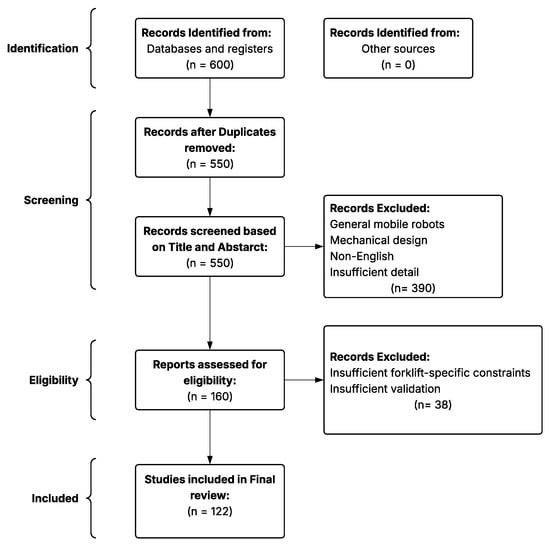
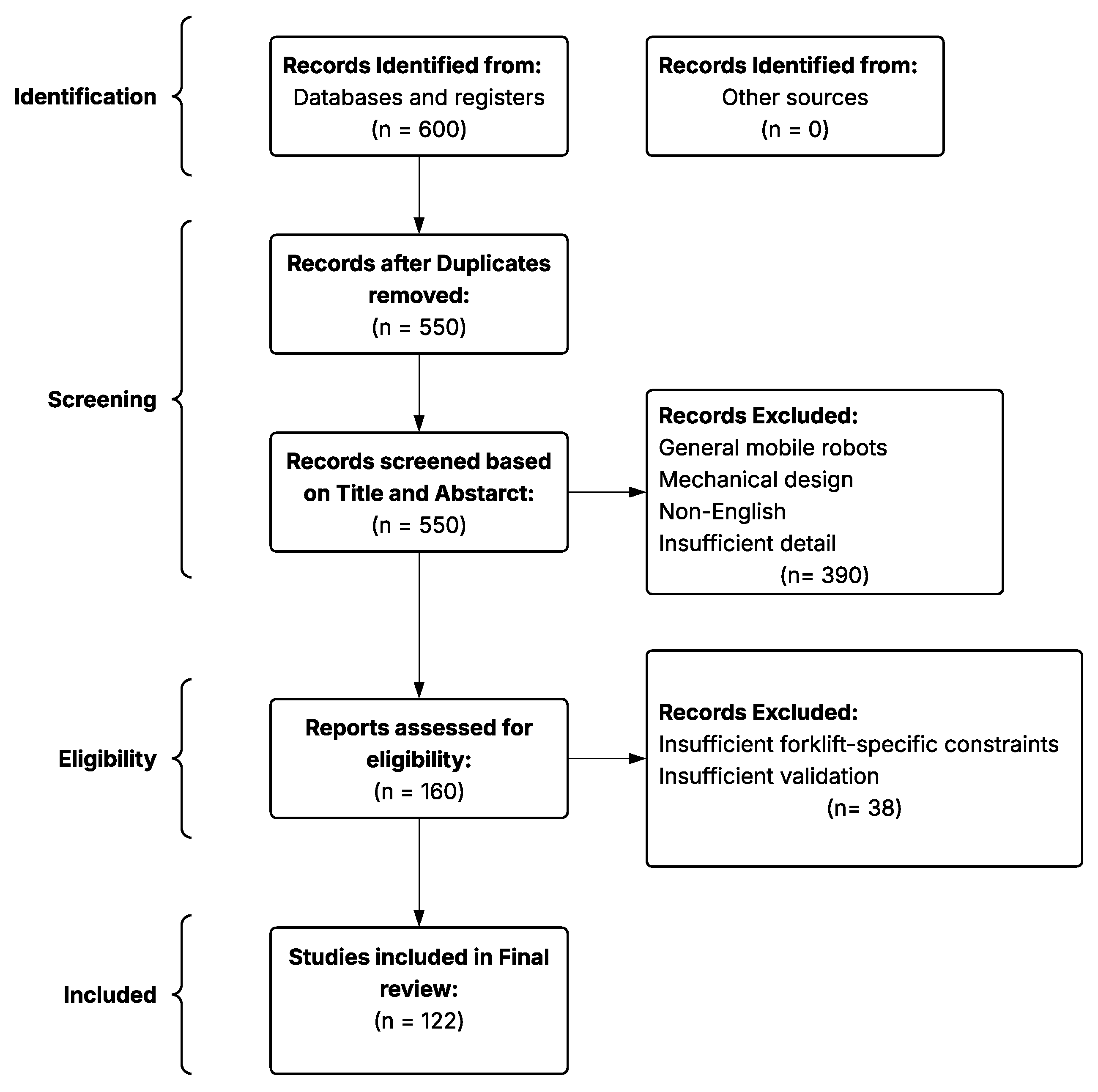
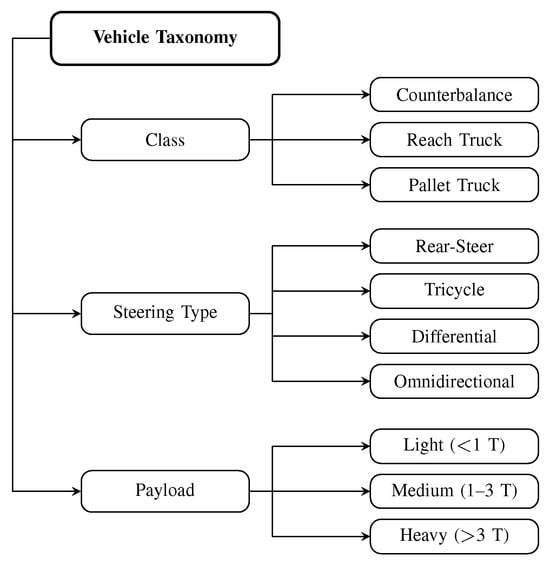
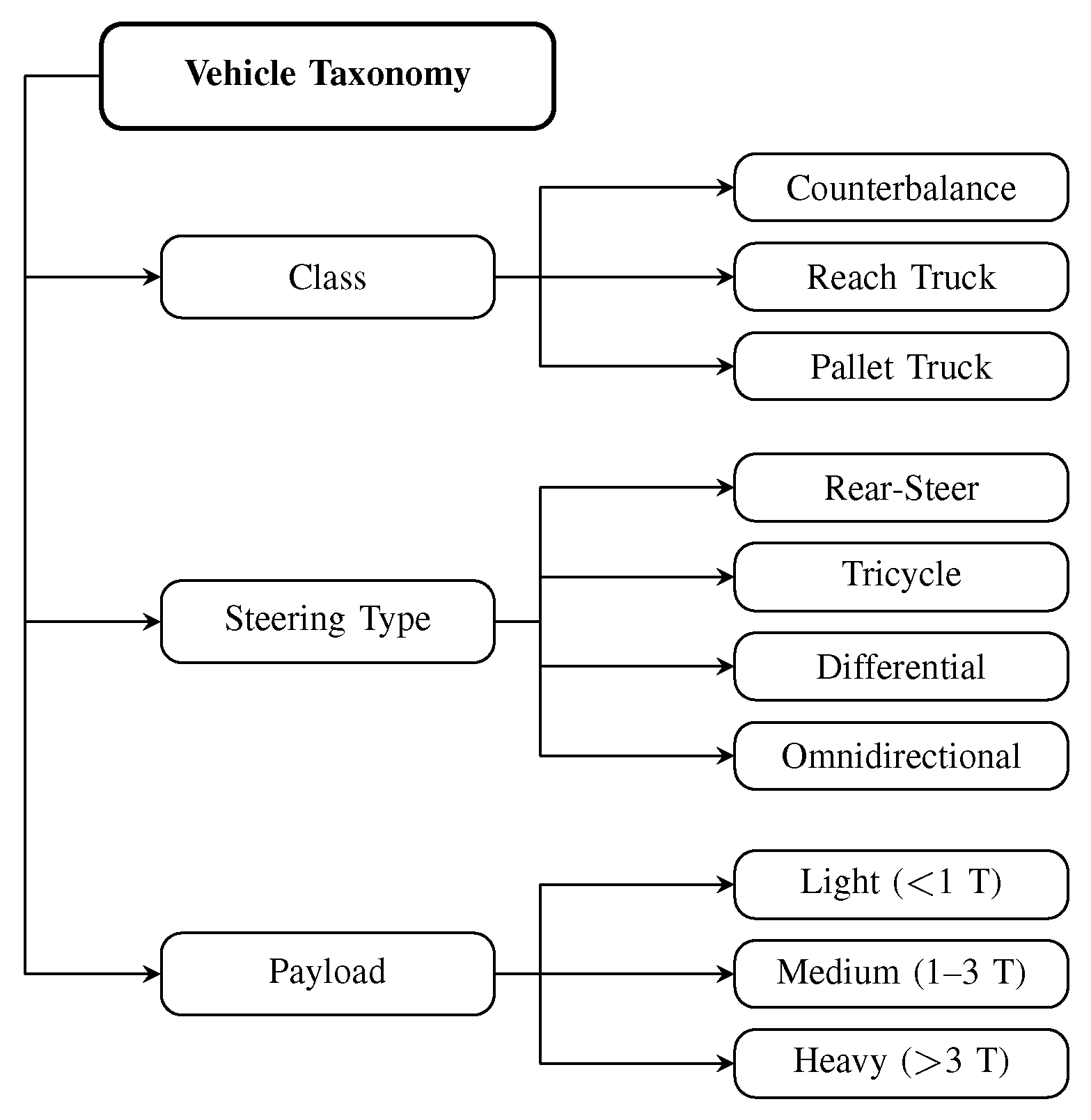
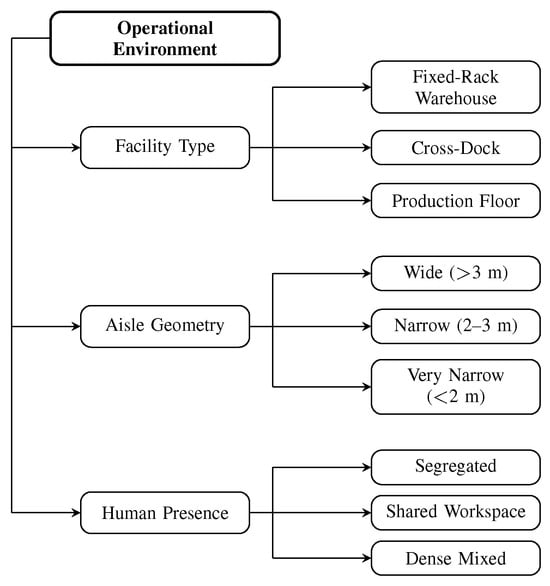
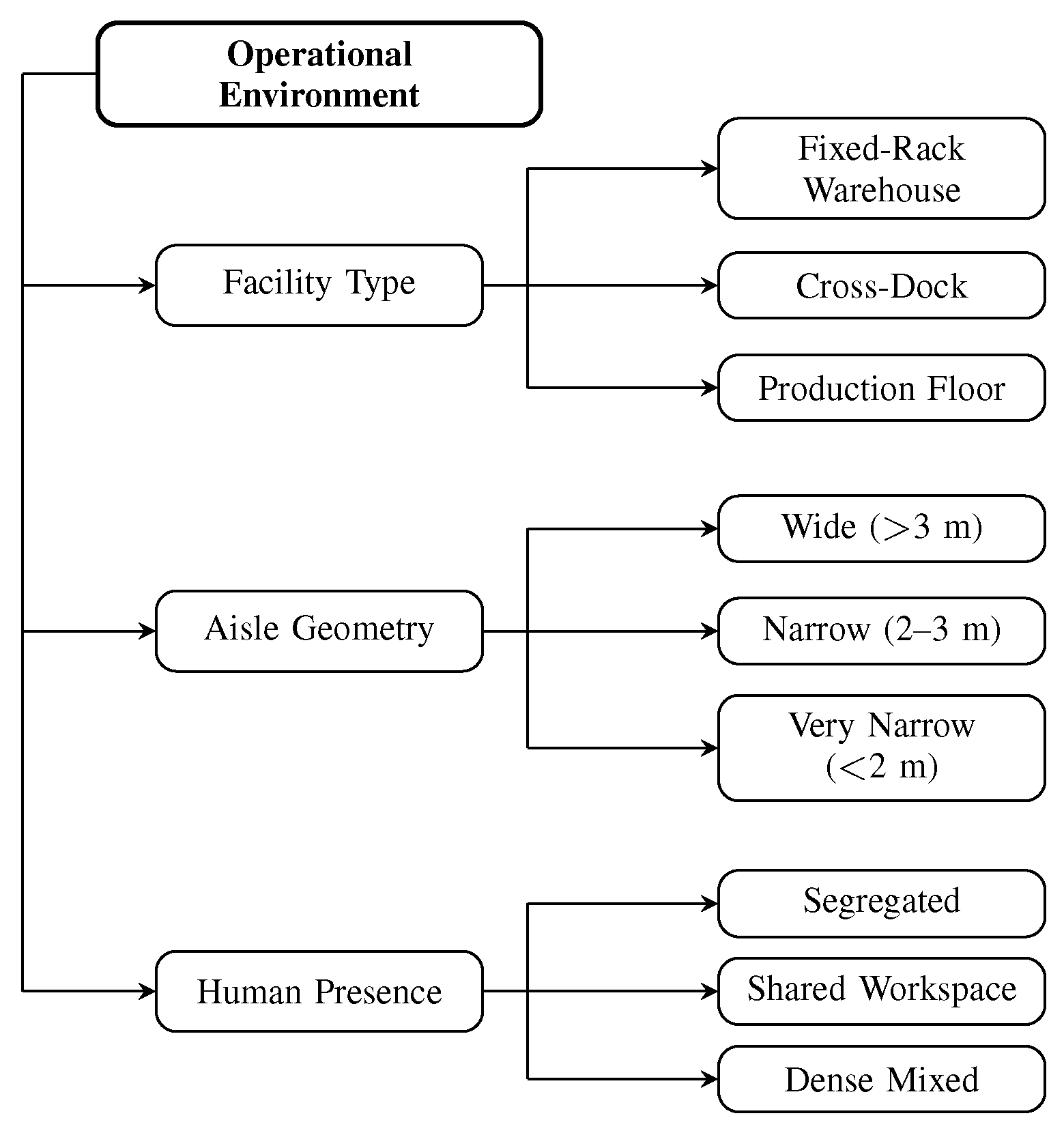
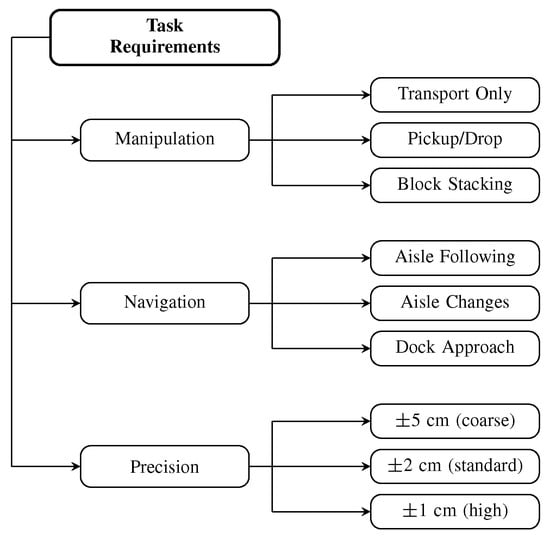
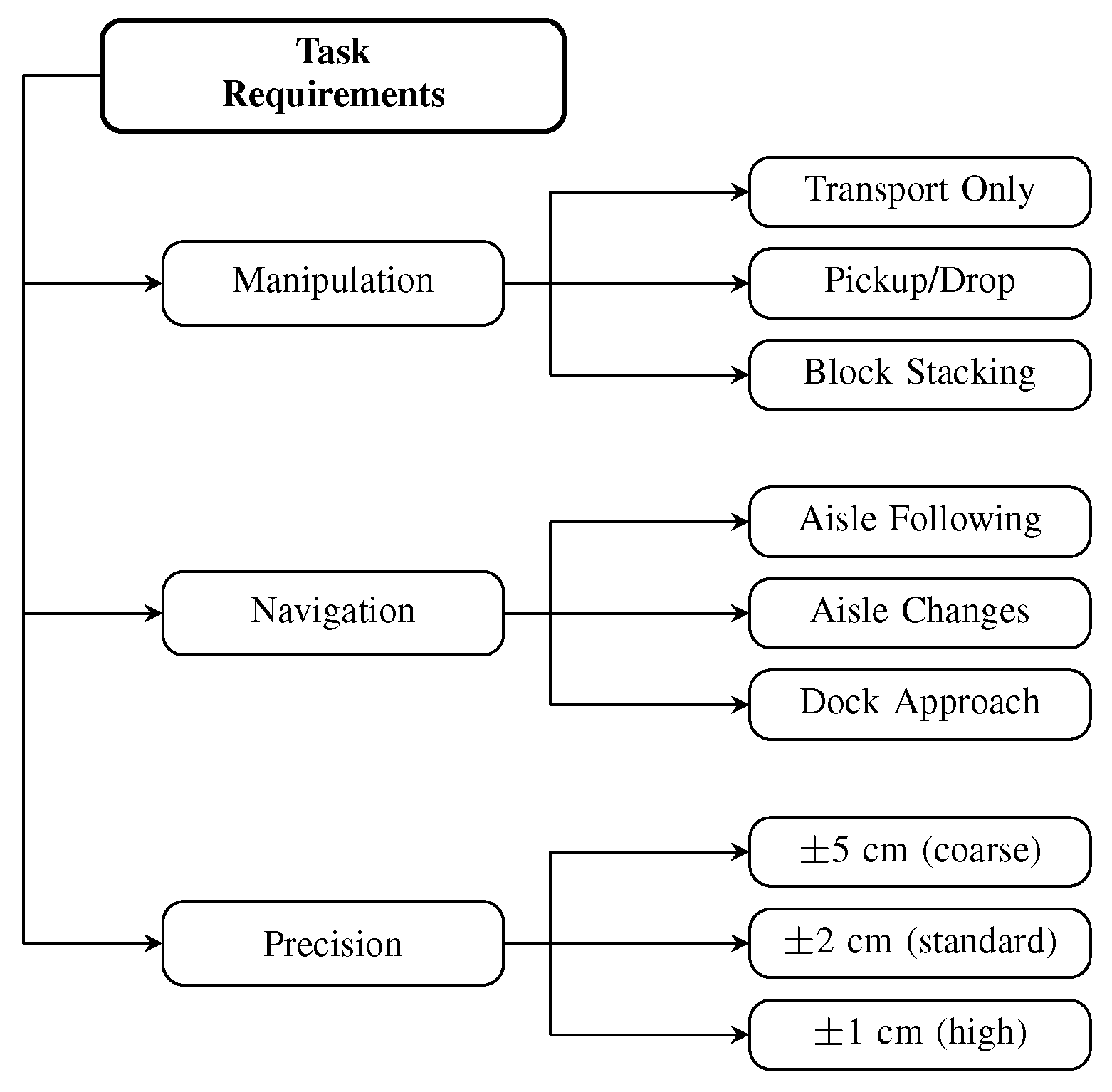
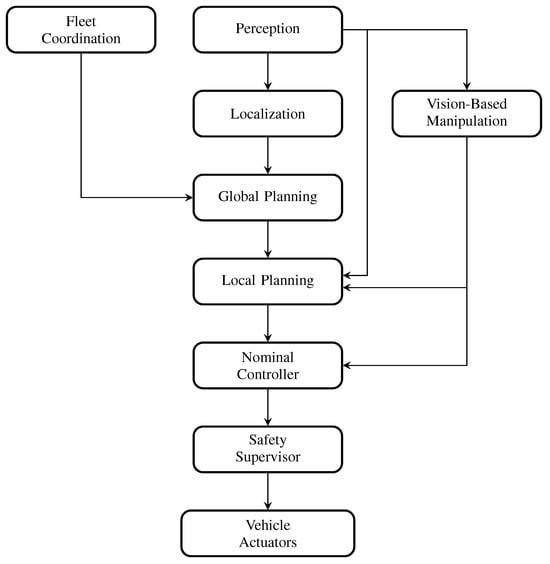
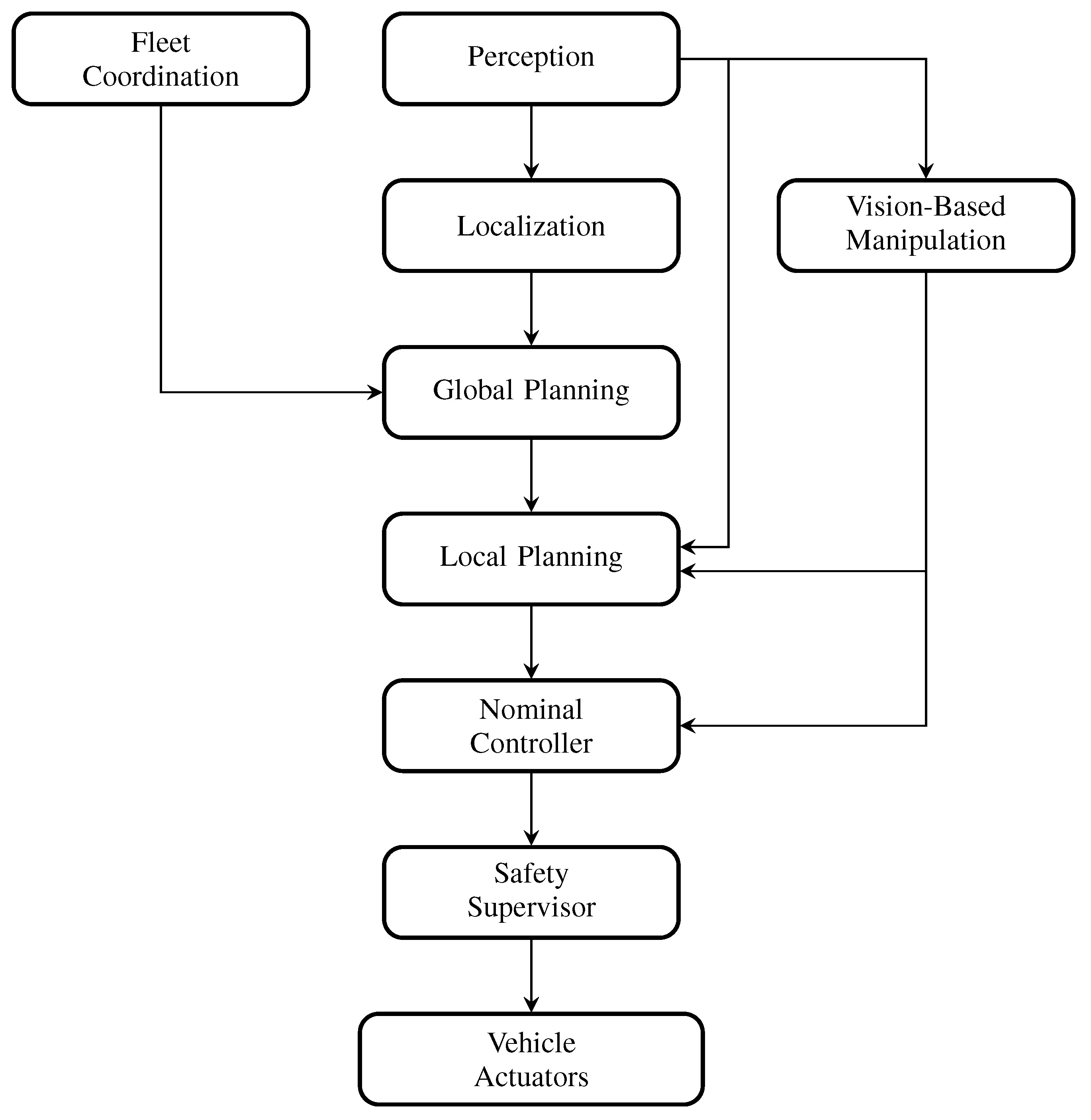
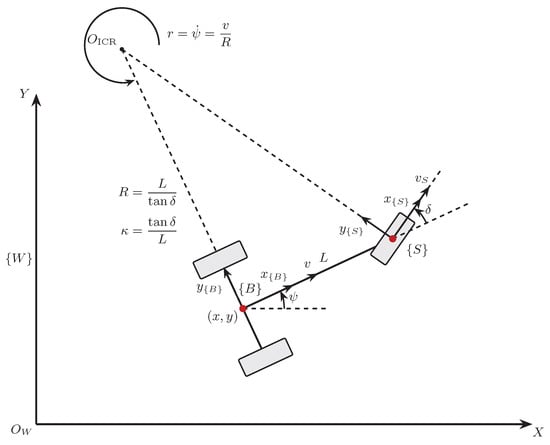
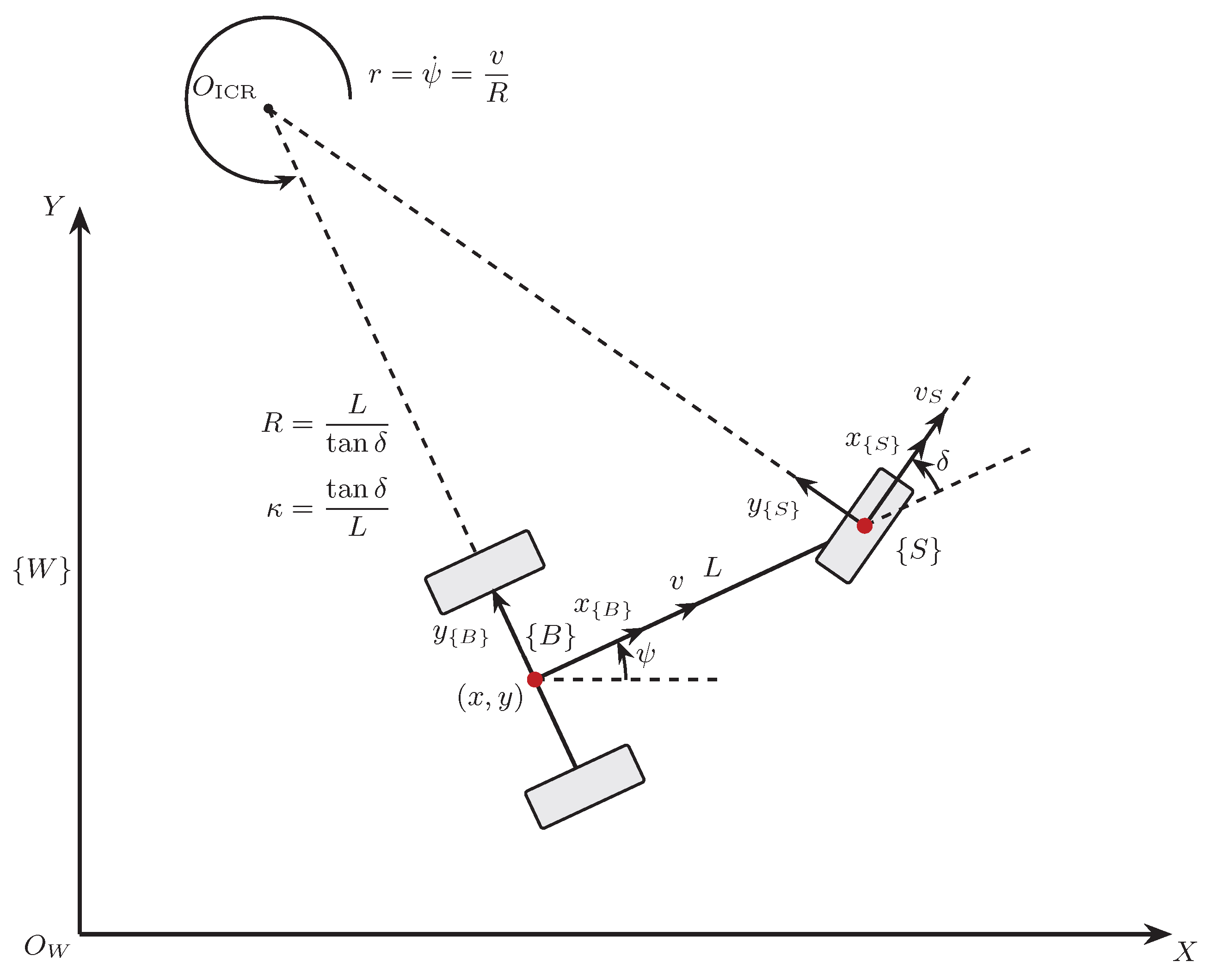
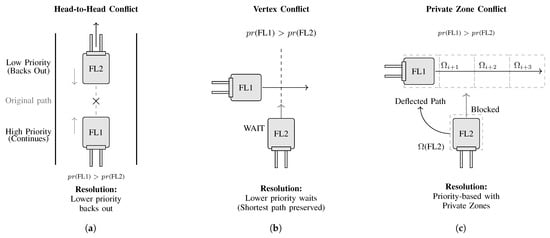
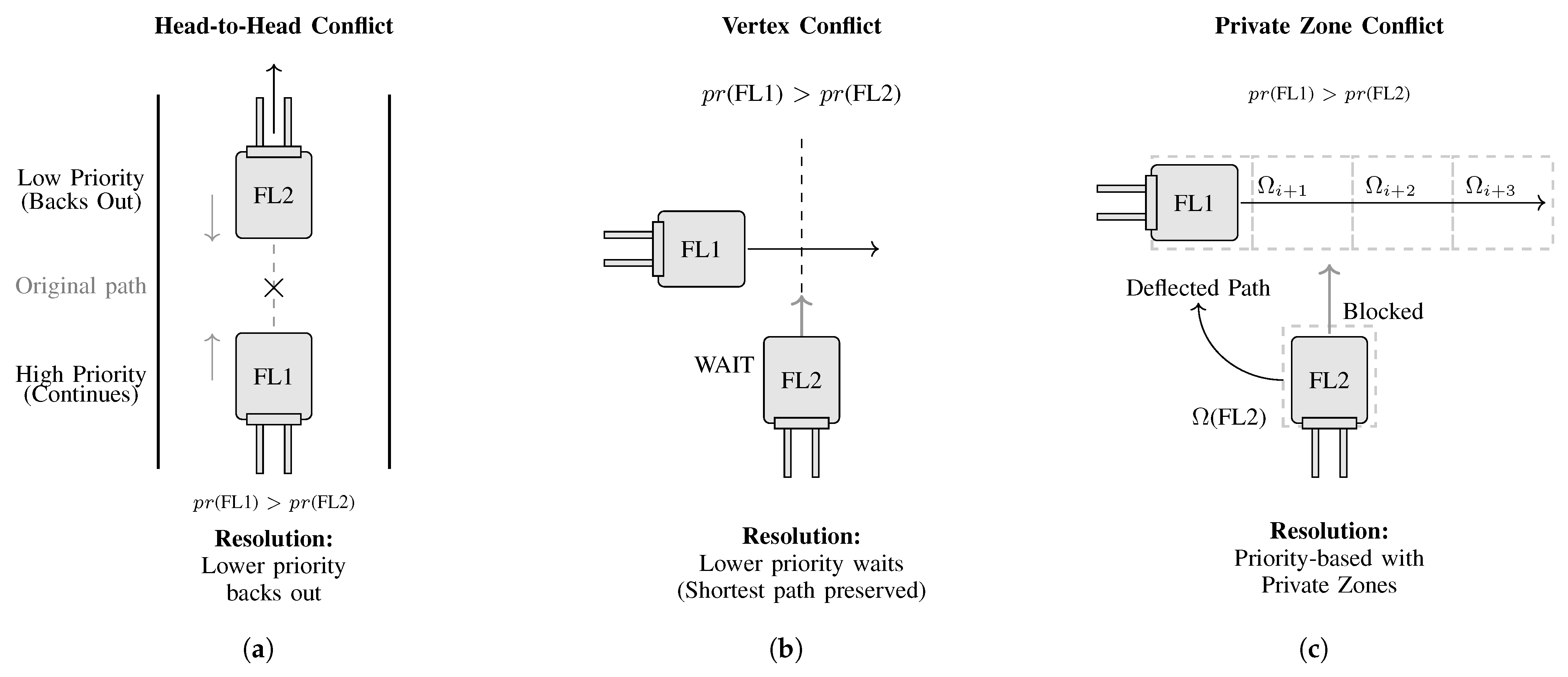
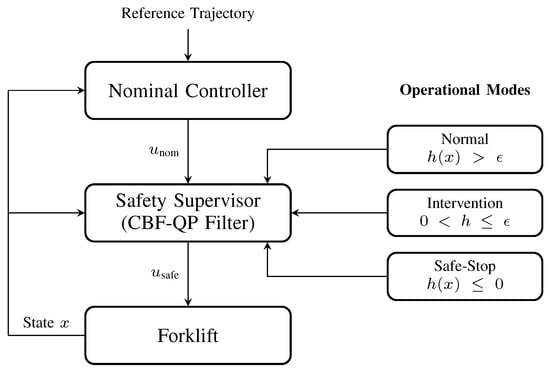
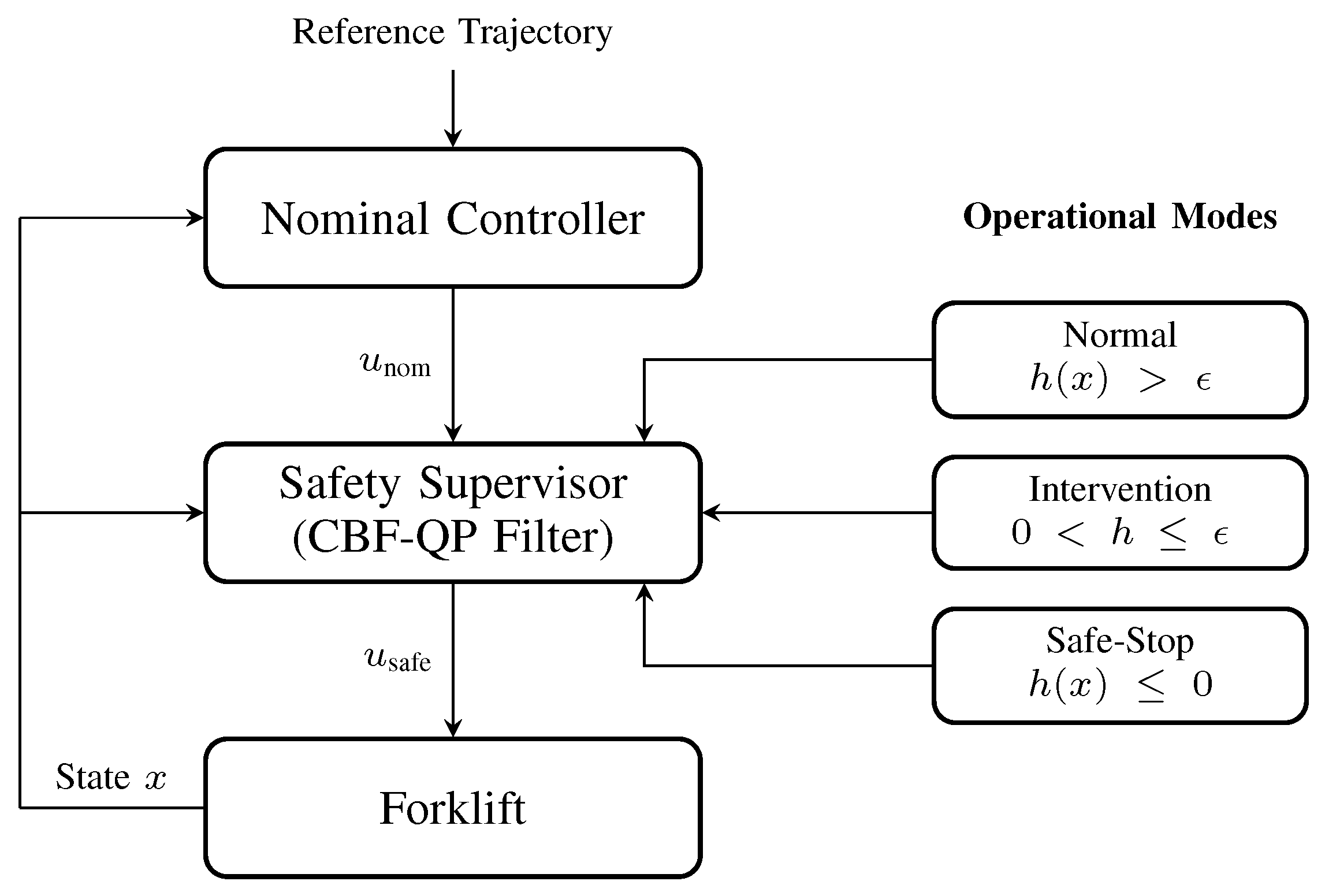

Disclaimer/Publisher’s Note: The statements, opinions and data contained in all publications are solely those of the individual author(s) and contributor(s) and not of MDPI and/or the editor(s). MDPI and/or the editor(s) disclaim responsibility for any injury to people or property resulting from any ideas, methods, instructions or products referred to in the content. |
© 2026 by the authors. Licensee MDPI, Basel, Switzerland. This article is an open access article distributed under the terms and conditions of the Creative Commons Attribution (CC BY) license.