


Abstract
This case-control study investigated the association between polymorphisms in the dedicator of cytokinesis 2 (DOCK2) gene and susceptibility to COVID-19 in a Mexican population. Methods: Genotyping of five single-nucleotide polymorphisms (SNPs) in the DOCK2 gene (rs9307 A/G, rs1045176 G/T, rs1045168 C/T, rs2112703 A/C, and rs2287727 A/C) was performed using TaqMan assays in 248 COVID-19 patients and 288 healthy controls. Results: No significant differences were observed in the allelic or genotypic distributions of rs1045176 G/T and rs2287727 A/C between cases and controls. However, under multiple genetic inheritance models (co-dominant, dominant, recessive, heterozygous, and additive), the rs9307 A, rs1045168 C, and rs2112703 A alleles were significantly associated with a reduced risk of COVID-19 (p < 0.05). Furthermore, sub-analyses stratified by genotype in COVID-19 patients revealed that the rs9307 AA, rs1045168 CC, and rs2112703 AA genotypes correlated with altered plasma concentrations of lactic acid dehydrogenase (LDH), alanine aminotransferase (ALT), aspartate aminotransferase (AST), and ferritin. Conclusions: The DOCK2 SNPs rs9307 A/G, rs1045168 C/T, and rs2112703 A/C are associated with decreased susceptibility to COVID-19 in this population and influence plasma levels of LDH, ALT, AST, and ferritin, suggesting a potential role in disease pathogenesis and severity.
1. Introduction
Coronavirus disease 2019 (COVID-19) is caused by severe acute respiratory syndrome coronavirus 2 (SARS-CoV-2). As of 23 March 2024, a total of 777,684,506 confirmed cases and 7,092,720 deaths have been reported worldwide [1]. Genome-wide association studies (GWASs) and case-control studies have identified polymorphisms in various genes that encode molecules [2,3,4]—including transmembrane serine protease 2 (TMPRSS2), neutrophil-expressed protease (ELANE), angiotensin-converting enzyme 2 (ACE2), tolloid-like 1 (TLL1), ABO blood group antigens, cytokines, chemokines, major histocompatibility complex (MHC) classes I and II, tyrosine kinases, Toll-like receptors, and cathepsins B and L—that may play a significant role in SARS-CoV-2 infection susceptibility and severity [5,6,7,8,9]. However, most of these studies have focused primarily on Caucasian populations, underscoring the need for further research in non-European populations to better elucidate the genetic factors influencing COVID-19 outcomes.
Dedicator of cytokinesis 2 (DOCK2) is a guanine nucleotide exchange factor (GEF) that activates the small GTPase Rac1, facilitating GTP-GDP exchange [10]. DOCK2 plays a crucial role in immune regulation, particularly in lymphocyte activation and migration [11,12]. Mutations in the DOCK2 gene have been linked to combined immunodeficiency, predisposing individuals to early-onset invasive bacterial and viral infections, including those caused by varicella-zoster virus, cytomegalovirus, mumps, adenovirus, and Pneumocystis jirovecii [13,14]. A recent large-scale GWAS in Japanese COVID-19 patients identified a DOCK2 risk allele associated with severe disease in individuals under 65 years of age [15]. Furthermore, Namkoong et al. demonstrated, using an animal model, that DOCK2 suppression exacerbates COVID-19 severity and that its regulatory function modulates immune responses against SARS-CoV-2 infection [15]. Similarly, Dobbs et al. reported that autosomal recessive DOCK2 deficiency is associated with severe invasive pneumonia and combined immunodeficiency [13].
Given these findings, the objective of this study was to evaluate the association between DOCK2 polymorphisms and COVID-19 susceptibility, as well as biochemical markers of SARS-CoV-2-related tissue damage, in the Mexican population.
2. Materials and Methods
2.1. Characteristics of the Study Population
This case-control study enrolled a total of 536 Mexican mestizo adults, comprising 248 RT-PCR-confirmed COVID-19 patients and 288 healthy controls, all of whom provided written informed consent. The patient cohort was prospectively recruited from three tertiary care centers (Instituto Nacional de Rehabilitación Luis Guillermo Ibarra Ibarra, Hospital Juárez de México, and Instituto Nacional de Cardiología Ignacio Chávez) between April 2020 and February 2021, capturing the initial pandemic wave in Mexico. All 248 COVID-19 patients were hospitalized at the time of enrollment.
COVID-19 diagnosis was established through both molecular confirmation (positive SARS-CoV-2 RT-PCR from nasopharyngeal swabs) and characteristic clinical presentation, including the pathognomonic symptoms of anosmia and ageusia, along with respiratory manifestations (dry cough, nasal congestion), systemic symptoms (fever, fatigue), and various other indicators of infection (diarrhea, chills, headache, musculoskeletal pain) [16,17].
The control group consisted of 288 healthcare professionals (59% male, 40.9% female; mean age 33.2 ± 7.6 years) actively working in COVID-19 intensive care units, including resident physicians, nursing staff, and laboratory personnel. To ensure appropriate negative controls, all participants in this group underwent rigorous screening using the Elecsys® Anti-SARS-CoV-2 immunoassay (Roche Diagnostics, Roche, Rotkreuz, Switzerland), with seronegative results required for inclusion. This population represented an ideal comparison group due to their high exposure risk yet confirmed lack of infection. Although this group was selected to minimize misclassification and confounding, we recognize that it may represent a population with enriched resistance rather than a strictly general-population control.
2.2. Laboratory Analyses
All blood samples were processed in compliance with Mexican regulatory standards (NOR-007-SSA3-2011, NOM-087-SEMARNAT-SSA1-2002, NOM-010-SSA2-2010, NMX-EC-15189-IMNC-2015) using Class II biological safety cabinets under institutional biosafety protocols.
We assessed multi-organ damage through standardized biomarkers: The measurement of biochemical markers was performed at the time of patient admission.
- Renal/Hepatic Function: Creatinine (>1.3 mg/dL), ALT/AST (>35 U/L), total bilirubin (>1.2 mg/dL)
- Inflammatory/Hematologic Markers: Ferritin (>300 ng/dL), LDH (>160 U/L), C Reactive Protein (CRP) (>10 mg/dL), hemoglobin (>17 g/dL), platelets (>350 × 103/μL)
Diagnostic thresholds followed the MSD Manual Professional Version 2018 [https://www.msdmanuals.com/professional/SearchResults?query=Normal+laboratory+values (accessed on 2 January 2025)].
Comorbidity definitions included:
- Type 2 Diabetes mellitus (T2DM): Fasting glucose ≥ 126 mg/dL, physician diagnosis, or active antidiabetic treatment [https://www.msdmanuals.com/professional/endocrine-and-metabolic-disorders/diabetes-mellitus-and-disorders-of-carbohydrate-metabolism/diabetes-mellitus-dm#v29299021 (accessed on 2 January 2025)];
- Hypertension: Systolic Blood Pressure (SBP) ≥ 130 mmHg, diastolic Blood Pressure (DBP) ≥ 80 mmHg, or antihypertensive medication use.
2.3. Genetic Analysis
Genomic DNA was isolated from peripheral blood samples using standardized methods [18]. We genotyped five DOCK2 SNPs (rs9307 A/G, rs1045176 G/T, rs1045168 C/T, rs2112703 A/C, and rs2287727 A/C) in both COVID-19 patients and controls using TaqMan allelic discrimination assays on a QuantStudio 12K Flex Real-Time PCR system (Applied Biosystems, Foster City, CA, USA). Complete SNP characteristics, including chromosomal positions (GRCh38), nucleotide substitutions, minor allele frequencies, and genomic position, are provided in Supplementary Table S1.
2.4. In Silico Functional Characterization of SNPs
The regulatory potential of selected SNPs was investigated through comprehensive in silico analyses utilizing established bioinformatics platforms (SNPinfo [19], RegulomeDB v2.2 [20], and HaploReg v4.2 [21]). These computational tools enabled systematic evaluation of putative functional consequences, including alterations to transcription factor binding motifs and modifications to histone marks. Evolutionary conservation patterns were quantitatively assessed using SiPhy algorithms, with positive conservation scores identifying phylogenetically constrained genomic regions.
Subsequent functional characterization employed protein-protein interaction (PPI) network analysis via STRING v12.0 [22]. Network construction incorporated genes associated with SNP-modified transcription factor binding sites, applying a stringent interaction confidence threshold (score ≥ 0.7) to integrate multiple evidence streams: experimentally validated interactions, curated database annotations, co-expression patterns, and literature-derived associations.
Gene Ontology (GO) enrichment analysis was performed within the STRING environment to elucidate affected biological pathways. The analysis systematically evaluated three ontological domains: Biological Processes (BPs), Molecular Functions (MFs), and Cellular Components (CCs). Statistically significant functional terms (FDR-adjusted p-value < 0.05) were identified and organized into functional clusters, with particular emphasis on immune response pathways, inflammatory signaling cascades, and metabolic regulation networks.
2.5. Statistical Analysis
The Hardy-Weinberg equilibrium was assessed using chi-square tests. Data distribution normality was evaluated with the Shapiro-Francia test. Continuous variables were compared between COVID-19 patients and controls using Student’s t-test (presented as mean ± SD) for normally distributed data or the Mann-Whitney U test (presented as median [interquartile range]) for non-normally distributed data. Categorical variables were analyzed using Fisher’s exact test or chi-square tests as appropriate. Associations between DOCK2 SNPs and COVID-19 susceptibility were evaluated under five genetic models: additive, codominant, dominant, heterozygous, and recessive [23,24]. These analyses were performed using logistic regression adjusted for age and gender as confounding variables. p-values were corrected for multiple testing using the Bonferroni method based on the number of tests performed for each SNP across inheritance models. Results are presented as odds ratios (ORs) with 95% confidence intervals. The study power was set at 0.80 (calculated using OpenEpi; http://www.openepi.com/SampleSize/SSCC.htm, (accessed on 15 January 2026)), with statistical significance defined as p < 0.05.
To examine potential associations between DOCK2 genotypes and biochemical markers of SARS-CoV-2-induced tissue damage, COVID-19 patients were stratified by genotype. Between-group comparisons were performed using ANOVA after logarithmic transformation of non-normally distributed variables. Variance homogeneity was verified using Levene’s test and confirmed by the F-test.
Haplotype analysis and linkage disequilibrium (LD) estimation were performed using Haploview version 4.1 (Broad Institute of MIT and Harvard, Cambridge, MA, USA). This software utilizes the HapMap project database and the expectation-maximization (EM) algorithm to reconstruct haplotypes by determining the most likely combination of alleles that co-segregate due to physical proximity. The analysis generated maximum-likelihood estimates of LD measures, including D′, logarithm of odds (LOD) scores, and r2 [25].
2.6. Ethical Statement
The study strictly adhered to the ethical principles of the Declaration of Helsinki and received formal approval from the Ethics, Biosecurity, and Research Committees of the Instituto Nacional de Cardiología Ignacio Chávez (Project No. 20-1202, approved 8 January 2021), Hospital Juárez de México (Project No. HJM 024/22-I, approved 6 October 2022), and Instituto Nacional de Rehabilitación Luis Guillermo Ibarra Ibarra (Project No. 17/20 AC, approved 1 June 2020). All study participants provided written informed consent in full compliance with institutional ethical guidelines.
3. Results
3.1. Characteristics of the Study Sample
Table 1 presents the demographic profile, clinical symptoms, comorbidities, and biochemical markers of the COVID-19 patients. The data demonstrate significantly elevated levels of acute-phase reactants, including ferritin, LDH, and CRP, along with increased ALT and AST enzymes. The most frequent clinical manifestations included cough (68.9%), dyspnea (61.6%), headache (25%), myalgia (26.2%), and fatigue (26.2%), with characteristic fever presentation (mean 37 ± 1.1 °C) and reduced oxygen saturation (87 ± 12%). These clinical and laboratory findings align with established COVID-19 diagnostic criteria as outlined in the MSD Manual Professional Version [https://www.msdmanuals.com/professional/SearchResults?query=Normal+laboratory+values (accessed on 2 January 2025)].
Table 1.
Demographic, biochemical, and clinical parameters of the COVID-19 patients.
3.2. Association of DOCK2 Polymorphisms with COVID-19
The distribution of DOCK2 genotypes in both study groups (COVID-19 patients and controls) was in Hardy-Weinberg equilibrium (p > 0.05). With the exception of rs1045176 and rs2287727 SNPs, significant differences in allele and genotype frequencies were observed for rs9307 A/G, rs1045168 C/T, and rs2112703 A/C polymorphisms when comparing COVID-19 patients with controls (p < 0.05; Supplementary Table S2). Analysis of these COVID-19-associated SNPs under various inheritance models (Table 2) revealed: for rs9307 A/G, individuals carrying one or two copies of the A allele demonstrated reduced risk of COVID-19 under codominant 2 (OR = 0.37, p = 0.015), dominant (OR = 0.67, p = 0.023), recessive (OR = 0.42, p = 0.018), and additive (OR = 0.67, p = 0.005) models; for rs1045168 C/T, carriers of one or two C allele copies showed protective effects under codominant 1 (OR = 0.58, p = 0.005), dominant (OR = 0.55, p = 0.002), heterozygous (OR = 0.61, p = 0.011), and additive (OR = 0.59, p = 0.001) models; and for rs2112703 A/C, possession of one or two A allele copies was associated with decreased COVID-19 susceptibility under codominant 1 (OR = 0.54, p = 0.018), dominant (OR = 0.52, p = 0.012), heterozygous (OR = 0.55, p = 0.022) and additive (OR = 0.51, p = 0.007) models.
Table 2.
Association of DOCK2 SNPs with COVID-19.
3.3. Haplotype Analysis
The haplotype analysis is shown in Table 3. This analysis was carried out according to chromosomal position. Based on this analysis, the rs2112703 A/C, rs2287727 A/C, rs1045168 C/T, rs1045176 G/T, and rs9307 A/G SNPs of the DOCK2 gene were not in linkage disequilibrium (D′ < 0.40). Nonetheless, the results showed that the “CATTG” haplotype was more frequent in COVID-19 patients (31.6%) than in controls (21.7%), suggesting that this haplotype may increase the risk of developing COVID-19 (OR = 1.66, p < 0.001). In contrast, the “AATTA” haplotype was more frequent in controls (2.4%) than in COVID-19 patients (0.9%), suggesting that this haplotype may decrease the risk of COVID-19 (OR = 0.32, p = 0.019) (Table 3).
Table 3.
Distribution of DOCK2 haplotypes in COVID-19 patients and healthy controls.
3.4. Association of DOCK2 Polymorphisms with Biochemical Markers of Damage
Data in the literature have shown that biochemical markers such as creatinine, ferritin, LDH, CRP, total bilirubin, ALT, AST, hemoglobin, and platelets may be altered by SARS-CoV-2 infection [19,20]. In this context: carriers of the rs9307 AA genotype had high ferritin levels (p < 0.05) and low LDH levels (p < 0.05) (Table 4); the rs1045168 CC genotype was associated with higher concentrations of ferritin, LDH, and total bilirubin (p < 0.05) (Table 4); and the rs2112703 CA genotype was associated with decreased ALT and AST levels (p < 0.05) (Table 4).
Table 4.
Association of the DOCK2 gene SNPs with damage biochemical markers in the COVID-19 patients.
3.5. Bioinformatics Analysis for Functional Prediction
In silico analysis identified regulatory motif alterations in two of the three significant SNPs. The rs9307 variant, located in the 3′UTR region of DOCK2, was found to disrupt a binding motif for SETDB1, a key epigenetic regulator involved in chromatin remodeling processes. Similarly, the synonymous variant rs2112703 demonstrated the capacity to alter binding motifs for three critical transcription factors: CTCF (essential for chromatin organization), NRSF (a neuronal gene regulator), and Pax-5 (crucial for B-cell development), as detailed in Supplementary Table S3.
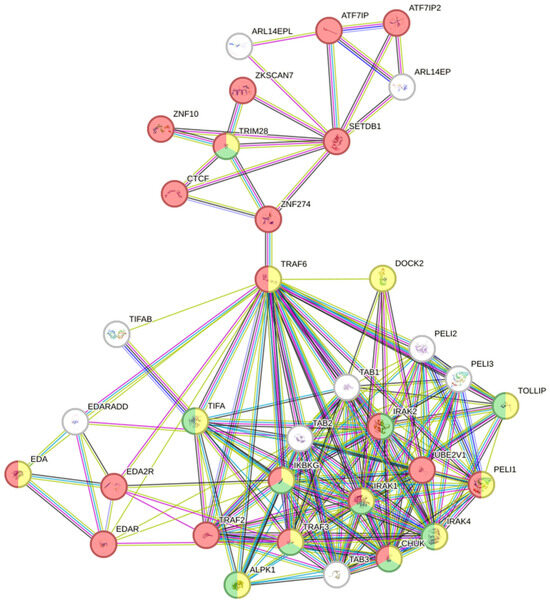
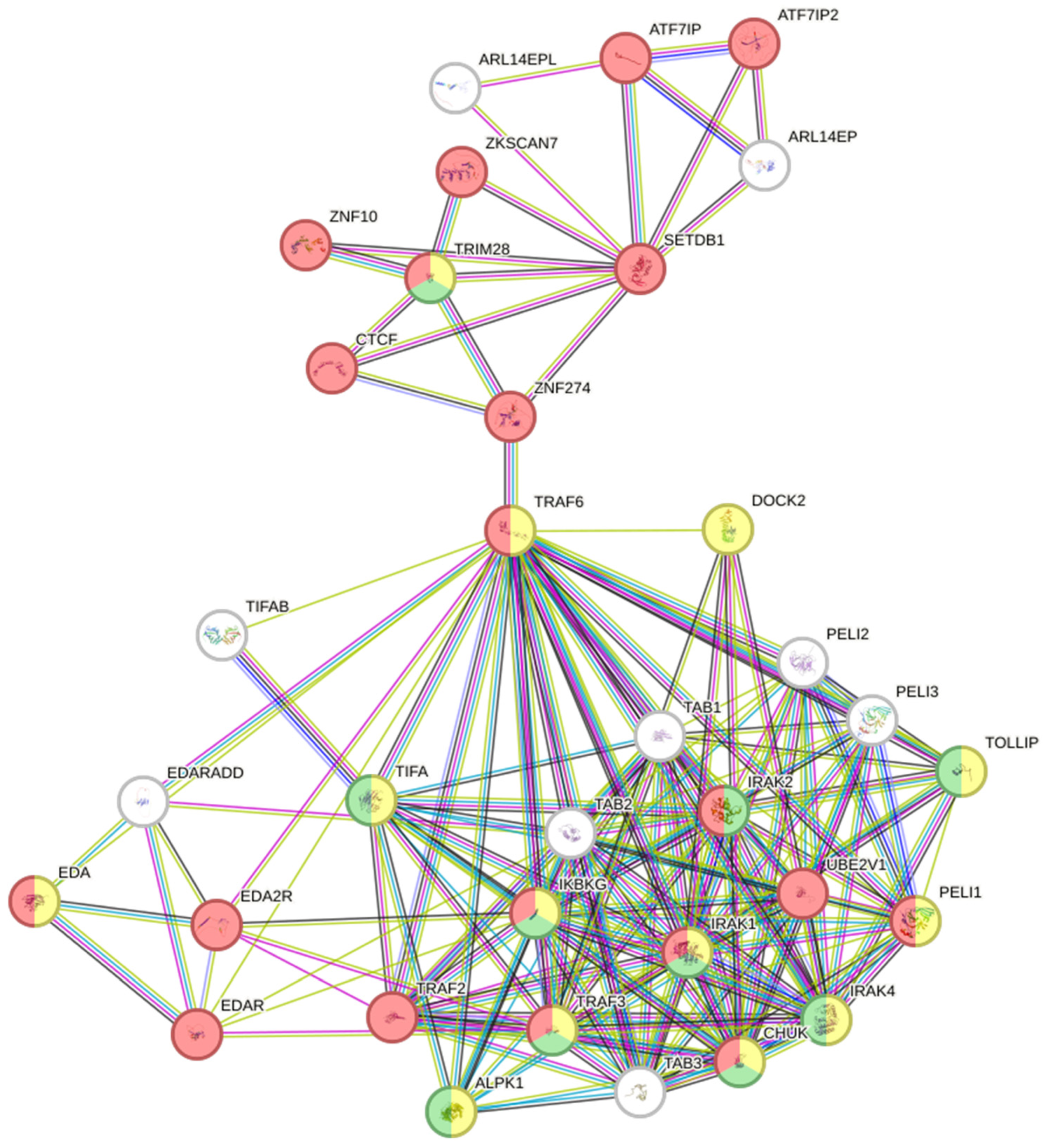
Figure 1 presents the protein-protein interaction (PPI) network constructed using STRING, revealing significant interactions among genes associated with the identified SNPs (DOCK2, SETDB1, CTCF, NRSF, and Pax-5). In this network, protein nodes are connected by edges representing functional or physical interactions, with color-coding indicating biological functions: red nodes denote transcription factors involved in gene expression control, yellow marks immune system-related genes, and green identifies genes associated with defense responses. The clustering pattern reveals strong functional relationships between DOCK2 and immune signaling pathways, with additional regulatory influence from SETDB1 through its chromatin accessibility modifications.
Figure 1.
Protein-protein interaction network and functional enrichment analysis of DOCK2 and associated genes. The STRING-generated network illustrates interactions between DOCK2 and immune-related or transcriptional regulators. Colored edges represent different types of interaction evidence, including co-expression, physical interactions, and computational predictions. Node colors indicate functional relevance: red denotes transcriptional regulators, yellow indicates immune system process, green represents defense response. The analysis underscores the involvement of DOCK2 in immune signaling, inflammation, and metabolic regulation, suggesting its potential impact on disease outcomes.
Functional enrichment analysis of the PPI network genes (Supplementary Figure S1) showed significant representation in biological processes related to immune activation, inflammatory responses, and transcriptional regulation. Notably enriched pathways included immune system processes and cytokine signaling, both strongly associated with DOCK2’s established role in immune cell migration and activation. The analysis also highlighted epigenetic regulation and chromatin remodeling pathways linked to SETDB1’s histone methylation activity, along with transcriptional regulation of immune-related genes corresponding to CTCF, NRSF, and Pax-5 functions.
4. Discussion
Under multiple genetic inheritance models (co-dominant, dominant, recessive, heterozygous, and additive), the rs9307 A, rs1045168 C, and rs2112703 A alleles were significantly associated with a reduced risk of COVID-19. When COVID-19 patients were grouped by genotype, our data demonstrated that the rs9307 AA, rs1045168 CC, and rs2112703 CA genotypes significantly influence plasma levels of LDH, ALT, AST, and ferritin. While no prior experimental studies have examined the effects of these specific SNPs on these biochemical markers [26,27] our findings align with established evidence that SARS-CoV-2 infection alters multiple biochemical parameters.
The rs9307 variant is located in the 3′UTR region of DOCK2, which is crucial for microRNA (miRNA) binding, influencing mRNA stability and translation efficiency. SNPs in this region can modify miRNA binding sites, leading to either increased degradation or enhanced transcript stability [28,29]. Specifically, the rs9307 AA genotype may interfere with miRNA binding, potentially altering DOCK2 expression patterns. As a guanine nucleotide exchange factor essential for immune cell activation and cytoskeletal regulation [30], altered DOCK2 expression could significantly impact COVID-19 progression by either exacerbating hyperinflammation (through overexpression) [31] or impairing viral clearance (through underexpression) [32].
Furthermore, the results show that rs9307 is associated with the alteration of a binding motif for SETDB1, an epigenetic regulator that modulates chromatin states and gene expression [33]. Disruption of SETDB1 binding could affect the transcriptional repression of immune-related genes [34], further influencing DOCK2 expression and immune response dynamics. Although rs9307 does not localize within a CpG island or directly alter a CpG dinucleotide, its regulatory impact appears to be mediated through other epigenetic mechanisms. Additionally, the observed association between the rs9307 AA genotype and increased ferritin levels suggests a link between altered DOCK2 expression and systemic inflammation. Ferritin is an acute-phase reactant elevated in severe COVID-19 cases, reflecting heightened inflammatory activity [35]. In contrast, the same genotype was associated with lower LDH levels, a marker of cellular damage and hypoxia. This divergent pattern of high ferritin with low LDH suggests that rs9307 may modulate the balance between inflammation and tissue injury, contributing to the observed protective effect against severe COVID-19 [36]. These findings align with previous reports highlighting the role of DOCK2 in immune regulation and viral response [37]. Altered DOCK2 signaling, potentially due to changes in miRNA binding and SETDB1 regulatory function, may contribute to a more severe immune response in COVID-19.
The rs1045168 C/T SNP, although not located in a regulatory region, was also associated with biochemical markers. The rs1045168 CC genotype was associated with significantly elevated ferritin, LDH, and total bilirubin levels. In COVID-19, the concurrent elevation of these three markers is clinically relevant: ferritin reflects systemic inflammation and macrophage activation, LDH indicates cellular damage and hypoxia, and bilirubin points to hepatic involvement or hemolysis. The clustering of these alterations in CC carriers suggests a coordinated inflammatory and multi-organ stress response [38]. While rs1045168 is a synonymous variant, recent studies indicate that such a mutation can affect mRNA stability, splicing, or translation efficiency, potentially altering protein expression [39]. This SNP may influence DOCK2 protein folding or translation speed, subtly modulating its activity. The positive SiPhy score for rs1045168 suggests that this site is highly conserved, reinforcing its potential functional relevance [40]. The association of the CC genotype with increased markers of cellular damage and inflammation suggests a possible impact on disease progression by modifying the immune response. Similar associations between DOCK2 variants and inflammatory markers have been reported in other infectious and inflammatory diseases, further supporting our findings. Such alterations may contribute to a stronger or prolonged inflammatory response, exacerbating the cytokine storm syndrome that worsens COVID-19 prognosis [41].
The rs2112703 A/C SNP was also significantly associated with biochemical markers in COVID-19 patients. Our data showed that the rs2112703 CA genotype was associated with decreased ALT and AST levels, indicating a potential attenuation of liver damage. Elevated transaminases are common in COVID-19 and are associated with hepatic injury, as a direct effect of either viral infection, systemic inflammation, or drug-induced hepatotoxicity [42]. Notably, the CA genotype, which carries the protective A allele, was associated with lower transaminase levels, suggesting that this variant may confer a protective effect against COVID-19-related hepatic dysfunction [43].
Importantly, rs2112703 is associated with alterations in binding motifs for CTCF, NRSF, and Pax-5. CTCF is a key insulator protein involved in chromatin organization and gene regulation [44], while NRSF regulates neuronal gene expression and may play a role in immune signaling [45]. Pax-5 is crucial for B cell development and immune function [46]. The positive SiPhy score for rs2112703 indicates high conservation, supporting its functional importance. Disruption of these motifs suggests that rs2112703 could modulate immune and inflammatory responses at the transcriptional level, potentially affecting DOCK2 expression and function.
These findings align with the STRING network analysis, highlighting key interactions between DOCK2, immune-related genes, and transcriptional regulators. Additionally, gene ontology enrichment analysis reinforces the involvement of DOCK2 in immune system processes, cellular stress responses, and defense mechanisms. The presence of SNPs in DOCK2 may disrupt these pathways, contributing to the variability in COVID-19 susceptibility and severity, supporting further investigation of DOCK2 as a potential genetic marker for disease outcomes. Collectively, the associations between DOCK2 SNPs and plasma levels of ferritin, LDH, bilirubin, ALT, and AST support a model in which genetic variation in this immune-related gene influences the host inflammatory response to SARS-CoV-2 infection. Although causal relationships cannot be established from association data alone, the consistency of these genotype-biomarker correlations across multiple markers—reflecting different aspects of COVID-19 pathophysiology (inflammation, tissue damage, hepatic involvement)—strengthens the hypothesis that DOCK2 variants contribute to disease susceptibility and severity through modulation of immune activation and inflammatory cascades. Although our in-silico analyses and genotype-biomarker associations provide mechanistic insights, experimental functional studies are required to definitively establish the causal links between these DOCK2 SNPs and the observed immune response phenotypes.
Beyond these functional considerations, it is also important to note that allele frequencies differed significantly between Mexican mestizos and other populations (Supplementary Table S4), particularly for: rs2112703 A, rs2287727 A, rs1045168 C (lower in Mexicans vs. Caucasians), rs1045176 G (lower in Mexicans and Caucasians vs. Asians/Africans) and rs9307 A (similar across Mexicans, Caucasians, and Asians). These ethnic variations highlight the need for multicenter studies to clarify population-specific genetic effects.
This study has some limitations. Although we identified significant associations between DOCK2 SNPs and biochemical markers and performed in silico analyses suggesting potential regulatory effects, we did not conduct experimental functional assays to validate these predicted mechanisms. Additionally, we did not quantify circulating cytokine levels, which would have provided a more direct link between genotypes and the inflammatory response. Although the statistical power for the main analyses was set at 0.80, the sample size warrants replication in larger cohorts to confirm these findings. Finally, the models were adjusted only for age and gender.
5. Conclusions
In conclusion, our study identifies: protective associations of rs9307 A/G, rs1045168 C/T, and rs2112703 A/C (individually and as the AATTA haplotype) to COVID-19; significant genotype-biomarker correlations (rs9307 AA, rs1045168 CC, and rs21112703 AC genotypes with LDH, transaminases, and ferritin levels); and Mexican population-specific allele distributions warranting further investigation in other ethnic groups.
Supplementary Materials
The following supporting information can be downloaded at https://www.mdpi.com/article/10.3390/biom16050643/s1, Supplementary Table S1. Information on the studied polymorphism tested; Supplementary Table S2. Allele and genotype frequencies of DOCK2 gene polymorphisms in COVID-19 patients and healthy controls; Supplementary Table S3. In Silico Functional Prediction for Variants DOCK2; Supplementary Table S4. Allele frequencies (af) of the DOCK2 SNPs in different populations; Supplementary Figure S1. Biological Process enrichment.
Author Contributions
Data curation: R.P.-S., A.L.-R., J.R.-B. and G.V.-A.; Methodology: A.L.-R., L.E.M.-G. and J.R.-B.; Investigation: J.R.-B., R.P.-S. and A.L.-R.; Conceptualization: J.M.F., G.V.-A. and R.P.-S.; Data analysis: G.F.-A., R.P.-S., L.E.M.-G. and J.M.F.; Supervision: G.V.-A.; Validation J.M.F. and G.F.-A.; Funding acquisition: G.V.-A. and R.P.-S.; Project administration: J.M.F., R.P.-S. and G.V.-A.; Writing original draft: J.M.F., R.P.-S., G.V.-A. and G.F.-A.; Writing—review & editing: All authors participated. All authors have read and agreed to the published version of the manuscript.
Funding
Open Access funding for this article was supported by the Instituto Nacional de Cardiología Ignacio Chávez.
Institutional Review Board Statement
Participants provided written informed consent. The study complied with the Declaration of Helsinki. The Research Committee of the National Institute of Cardiology Ignacio Chavez (Project No. 20-1202, approved 8 January 2021), Hospital Juárez de México (Project No. HJM 024/22-I, approved 6 October 2022), and Instituto Nacional de Rehabilitación Luis Guillermo Ibarra Ibarra (Project No. 17/20 AC, approved 1 June 2020) approved the project.
Informed Consent Statement
Written informed consent was obtained from the patient(s) to publish this paper.
Data Availability Statement
Due to confidentiality agreements, the data underlying this study are not publicly available. Access to the data can be requested through gilberto.vargas@cardiologia.org.mx, following their confidentiality protocols.
Acknowledgments
The authors are grateful to Marva Arellano-González for her participation in this work, as well as to the CORE-Lab personnel of our institution for their technical assistance in the determination of the genotypes.
Conflicts of Interest
The authors declare no competing interests.
References
- Coronavirus Disease (COVID-19) Epidemiological Updates and Monthly Operational Updates. Available online: https://www.who.int/emergencies/diseases/novel-coronavirus-2019/situation-reports (accessed on 8 April 2025).
- Niemi, M.E.K.; Karjalainen, J.; Liao, R.G.; Neale, B.M.; Daly, M.; Ganna, A. Mapping the human genetic architecture of COVID-19. Nature 2021, 600, 472–4777. [Google Scholar] [CrossRef] [Scilit] [PubMed]
- Severe Covid-19 GWAS Group. Genomewide Association Study of Severe Covid-19 with Respiratory Failure. N. Engl. J. Med. 2020, 383, 1522–1534. [Google Scholar] [CrossRef] [Scilit]
- Maiti, A.K. The African-American population with a low allele frequency of SNP rs1990760 (T allele) in IFIH1 predicts less IFN-beta expression and potential vulnerability to COVID-19 infection. Immunogenetics 2020, 72, 387–391. [Google Scholar] [CrossRef] [Scilit]
- Zepeda-Cervantes, J.; Martínez-Flores, D.; Ramírez-Jarquín, J.O.; Tecalco-Cruz, Á.C.; Alavez-Pérez, N.S.; Vaca, L.; Sarmiento-Silva, R.E. Implications of the Immune Polymorphisms of the Host and the Genetic Variability of SARS-CoV-2 in the Development of COVID-19. Viruses 2022, 14, 94. [Google Scholar] [CrossRef] [Scilit]
- Posadas-Sánchez, R.; Fragoso, J.M.; Sánchez-Muñoz, F.; Rojas-Velasco, G.; Ramírez-Bello, J.; López-Reyes, A.; Martínez-Gómez, L.E.; Sierra-Fernández, C.; Rodríguez-Reyna, T.; Regino-Zamarripa, N.E.; et al. Association of the Transmembrane Serine Protease-2 (TMPRSS2) Polymorphisms with COVID-19. Viruses 2022, 14, 1976. [Google Scholar] [CrossRef] [Scilit]
- Fragoso, J.M.; Vargas-Alarcón, G.; Martínez-Flores, Á.E.; Montufar-Robles, I.; Barbosa-Cobos, R.E.; Rojas-Velasco, G.; Ramírez-Bello, J. ELANE rs17223045C/T and rs3761007G/A variants: Protective factors against COVID-19. Biomol. Biomed. 2024, 24, 665–672. [Google Scholar] [CrossRef] [Scilit] [PubMed]
- Martínez-Gómez, L.E.; Martinez-Armenta, C.; Tusie-Luna, T.; Vázquez-Cárdenas, P.; Vidal-Vázquez, R.P.; Ramírez-Hinojosa, J.P.; Gómez-Martín, D.; Vargas-Alarcón, G.; Posadas-Sánchez, R.; Fragoso, J.M.; et al. The fatal contribution of serine protease-related genetic variants to COVID-19 outcomes. Front. Immunol. 2024, 15, 1335963. [Google Scholar] [CrossRef] [Scilit] [PubMed]
- Vargas-Alarcón, G.; Ramírez-Bello, J.; Posadas-Sánchez, R.; Rojas-Velasco, G.; López-Reyes, A.; Martínez-Gómez, L.; Ortega-Peña, S.; Montúfar-Robles, I.; Barbosa-Cobos, R.E.; Arellano-González, M.; et al. The rs8176740 T/A and rs512770 T/C Genetic Variants of the ABO Gene Increased the Risk of COVID-19, as well as the Plasma Concentration Platelets. Biomolecules 2022, 12, 486. [Google Scholar] [CrossRef] [Scilit]
- Miyamoto, Y.; Yamauchi, J. Cellular signaling of Dock family proteins in neural function. Cell. Signal. 2010, 22, 175–182. [Google Scholar] [CrossRef] [Scilit]
- Fukui, Y.; Hashimoto, O.; Sanui, T.; Oono, T.; Koga, H.; Abe, M.; Inayoshi, A.; Noda, M.; Oike, M.; Shirai, T.; et al. Haematopoietic cell-specific CDM family protein DOCK2 is essential for lymphocyte migration. Nature 2001, 412, 826–831. [Google Scholar] [CrossRef] [Scilit]
- Jiang, H.; Pan, F.; Erickson, L.M.; Jang, M.-S.; Sanui, T.; Kunisaki, Y.; Sasazuki, T.; Kobayashi, M.; Fukui, Y. Deletion of DOCK2, a regulator of the actin cytoskeleton in lymphocytes, suppresses cardiac allograft rejection. J. Exp. Med. 2005, 202, 1121–1130. [Google Scholar] [CrossRef] [Scilit] [PubMed]
- Dobbs, K.; Conde, C.D.; Zhang, S.-Y.; Parolini, S.; Audry, M.; Chou, J.; Haapaniemi, E.; Keles, S.; Bilic, I.; Okada, S.; et al. Inherited DOCK2 deficiency in patients with early-onset invasive infections. N. Engl. J. Med. 2015, 372, 2409–2422. [Google Scholar] [CrossRef] [Scilit]
- Alizadeh, Z.; Mazinani, M.; Shakerian, L.; Nabavi, M.; Fazlollahi, M.R. DOCK2 Deficiency in a Patient with Hyper IgM Phenotype. J. Clin. Immunol. 2018, 38, 10–12. [Google Scholar] [CrossRef] [Scilit]
- Namkoong, H.; Edahiro, R.; Takano, T.; Nishihara, H.; Shirai, Y.; Sonehara, K.; Tanaka, H.; Azekawa, S.; Mikami, Y.; Lee, H.; et al. DOCK2 is involved in the host genetics and biology of severe COVID-19. Nature 2022, 609, 754–760. [Google Scholar] [CrossRef] [Scilit]
- Larsen, J.R.; Martin, M.R.; Martin, J.D.; Kuhn, P.; Hicks, J.B. Modeling the Onset of Symptoms of COVID-19. Front. Public Health 2020, 8, 473. [Google Scholar] [CrossRef] [Scilit]
- Sharma, A.; Ahmad Farouk, I.; Lal, S.K. COVID-19: A Review on the Novel Coronavirus Disease Evolution, Transmission, Detection, Control and Prevention. Viruses 2021, 13, 202. [Google Scholar] [CrossRef] [Scilit] [PubMed]
- Lahiri, D.K.; Numberger, J.I. A rapid non-enzymatic method for the preparation of HMW DNA from blood for RFLP studies. Nucleic Acids Res. 1991, 19, 5444. [Google Scholar] [CrossRef] [Scilit]
- Xu, Z.; Taylor, J.A. SNPinfo: Integrating GWAS and candidate gene information into functional SNP selection for genetic association studies. Nucleic Acids Res. 2009, 37, W600–W605. [Google Scholar] [CrossRef] [Scilit] [PubMed]
- Boyle, A.P.; Hong, E.L.; Hariharan, M.; Cheng, Y.; Schaub, M.A.; Kasowski, M.; Karczewski, K.J.; Park, J.; Hitz, B.C.; Weng, S.; et al. Annotation of functional variation in personal genomes using RegulomeDB. Genome Res. 2012, 22, 1790–1797. [Google Scholar] [CrossRef] [Scilit]
- Ward, L.D.; Kellis, M. HaploReg: A resource for exploring chromatin states, conservation, and regulatory motif alterations within sets of genetically linked variants. Nucleic Acids Res. 2012, 40, D930–D934. [Google Scholar] [CrossRef] [Scilit]
- Szklarczyk, D.; Kirsch, R.; Koutrouli, M.; Nastou, K.; Mehryary, F.; Hachilif, R.; Gable, A.L.; Fang, T.; Doncheva, N.T.; Pyysalo, S.; et al. The STRING database in 2023: Protein-protein association networks and functional enrichment analyses for any sequenced genome of interest. Nucleic Acids Res. 2023, 51, D638–D646. [Google Scholar] [CrossRef] [Scilit] [PubMed]
- Elston, R.C.; Olson, J.M.; Lyle, P. Biostatistical Genetics and Genetic Epidemiology; John Wiley & Sons, Ltd.: Chichester, UK, 2002; 831p. [Google Scholar]
- Balding, D.J.; Bishop, M.; Cannings, C. Handbook of Statistical Genetics, 3rd ed.; John Wiley & Sons, Ltc.: Hoboken, NJ, USA, 2008; Volume 1, pp. 1–1476. [Google Scholar] [CrossRef] [Scilit]
- Barrett, J.C.; Fry, B.; Maller, J.; Daly, M.J. Haploview: Analysis and visualization of LD and haplotype maps. Bioinformatics 2005, 21, 263–265. [Google Scholar] [CrossRef] [Scilit]
- Delorey, T.M.; Ziegler, C.G.K.; Heimberg, G.; Normand, R.; Yang, Y.; Segerstolpe, Å.; Abbondanza, D.; Fleming, S.J.; Subramanian, A.; Montoro, D.T.; et al. COVID-19 tissue atlases reveal SARS-CoV-2 pathology and cellular targets. Nature 2021, 595, 107–113. [Google Scholar] [CrossRef] [Scilit]
- Dushianthan, A.; Abdul, N.; Dmochowski, J.; James, I.; Heesom, L.; Westwood, J.; Effney, J.; Bruty, S.; Saeed, K.; Rangarajan, S.; et al. Predictive Role of Haematological Determinants on Outcomes of Critically Ill COVID-19 Patients Admitted to Intensive Care Unit. Cureus 2021, 13, e16764. [Google Scholar] [CrossRef] [Scilit]
- Rykova, E.; Ershov, N.; Damarov, I.; Merkulova, T. NPs in 3′UTR miRNA Target Sequences Associated with Individual Drug Susceptibility. Int. J. Mol. Sci. 2022, 23, 13725. [Google Scholar] [CrossRef] [Scilit]
- Steri, M.; Idda, M.L.; Whalen, M.B.; Orrù, V. Genetic Variants in mRNA Untranslated Regions. Wiley Interdiscip. Rev. RNA 2018, 9, e1474. [Google Scholar] [CrossRef] [Scilit]
- Xu, L.; Shen, W.; Chen, J.; Lv, H.; He, W.; He, T.-S.; Guo, T.; Liu, Z. Dock2 deficiency reveals abnormal activation and differentiation of T cells under the physiological condition. Mol. Immunol. 2025, 181, 75–83. [Google Scholar] [CrossRef] [Scilit]
- Ji, L.; Xu, S.; Luo, H.; Zeng, F. Insights from DOCK2 in cell function and pathophysiology. Front. Mol. Biosci. 2022, 9, 997659. [Google Scholar] [CrossRef] [Scilit] [PubMed]
- Randall, K.L.; Flesch, I.E.A.; Mei, Y.; Miosge, L.A.; Aye, R.; Yu, Z.; Domaschenz, H.; Hollett, N.A.; Russell, T.A.; Stefanovic, T.; et al. DOCK2 Deficiency Causes Defects in Antiviral T-Cell Responses and Impaired Control of Herpes Simplex Virus Infection. J. Infect. Dis. 2024, 230, e712. [Google Scholar] [CrossRef] [Scilit]
- Batham, J.; Lim, P.S.; Rao, S. SETDB-1: A Potential Epigenetic Regulator in Breast Cancer Metastasis. Cancers 2019, 11, 1143. [Google Scholar] [CrossRef] [Scilit] [PubMed]
- Mcgeary, M.K.; Damsky, W.; Daniels, A.; Song, E.; Micevic, G.; Huet-Calderwood, C.; Lou, H.J.; Paradkar, S.; Kaech, S.; Calderwood, A.; et al. SetdbI-loss induces type-I interferons and immune clearance of melanoma. Cancer Immunol. Res. 2023. [Google Scholar] [CrossRef] [Scilit]
- Biglari, S.; Youssefian, L.; Tabatabaiefar, M.A.; Saeidian, A.H.; Abtahi-Naeini, B.; Khorram, E.; Sherkat, R.; Moghaddam, A.S.; Mohaghegh, F.; Rahimi, M.; et al. DOCK2 Deficiency and GATA2 Haploinsufficiency Can Underlie Critical Coronavirus Disease 2019 (COVID-19) Pneumonia. J. Clin. Immunol. 2025, 45, 85. [Google Scholar] [CrossRef] [Scilit] [PubMed]
- Vidal-Cevallos, P.; Higuera-De-La-Tijera, F.; Chávez-Tapia, N.C.; Sanchez-Giron, F.; Cerda-Reyes, E.; Rosales-Salyano, V.H.; Servin-Caamaño, A.; Vázquez-Medina, M.U.; Méndez-Sánchez, N. Lactate-dehydrogenase associated with mortality in hospitalized patients with COVID-19 in Mexico: A multi-centre retrospective cohort study. Ann. Hepatol. 2021, 24, 100338. [Google Scholar] [CrossRef] [Scilit]
- Li, W.; Sun, Y.; Yu, L.; Chen, R.; Gan, R.; Qiu, L.; Sun, G.; Chen, J.; Zhou, L.; Ding, Y.; et al. Multiple Immune Defects in Two Patients with Novel DOCK2 Mutations Result in Recurrent Multiple Infection Including Live Attenuated Virus Vaccine. J. Clin. Immunol. 2023, 43, 1193–1207. [Google Scholar] [CrossRef] [Scilit]
- Kumar, A.; Yendamuri, S.; Ahmad, F.; Mukherjee, P.B.; Kumar, R.; Manrai, M.; Muthukrishnan, J.; Dawra, S. Inflammatory biomarkers and adverse outcome in COVID-19: Prelude for future viral pandemics. J. Fam. Med. Prim. Care 2025, 14, 720. [Google Scholar] [CrossRef] [Scilit]
- Gaither, J.B.S.; Lammi, G.E.; Li, J.L.; Gordon, D.M.; Kuck, H.C.; Kelly, B.J.; Fitch, J.R.; White, P. Synonymous variants that disrupt messenger RNA structure are significantly constrained in the human population. Gigascience 2021, 10, giab023. [Google Scholar] [CrossRef] [Scilit]
- Gudkov, M.; Thibaut, L.; Giannoulatou, E. Quantifying negative selection on synonymous variants. Hum. Genet. Genom. Adv. 2024, 5, 100262. [Google Scholar] [CrossRef] [Scilit]
- Ye, Q.; Wang, B.; Mao, J. The pathogenesis and treatment of the ‘Cytokine Storm’ in COVID-19. J. Infect. 2020, 80, 607–613. [Google Scholar] [CrossRef] [Scilit]
- Thakur, S.; Kumar, V.; Das, R.; Sharma, V.; Mehta, D.K. Biomarkers of Hepatic Toxicity: An Overview. Curr. Ther. Res. 2024, 100, 100737. [Google Scholar] [CrossRef] [Scilit]
- Medetalibeyoglu, A.; Catma, Y.; Senkal, N.; Ormeci, A.; Cavus, B.; Kose, M.; Bayramlar, O.F.; Yildiz, G.; Akyuz, F.; Kaymakoglu, S.; et al. The effect of liver test abnormalities on the prognosis of COVID-19. Ann. Hepatol. 2020, 19, 614–621. [Google Scholar] [CrossRef] [Scilit] [PubMed]
- Kim, S.; Yu, N.K.; Kaang, B.K. CTCF as a multifunctional protein in genome regulation and gene expression. Exp. Mol. Med. 2015, 47, e166. [Google Scholar] [CrossRef] [Scilit] [PubMed]
- Su, X.-J.; Shen, B.-D.; Wang, K.; Song, Q.-X.; Yang, X.; Wu, D.-S.; Shen, H.-X.; Zhu, C. Roles of the Neuron-Restrictive Silencer Factor in the Pathophysiological Process of the Central Nervous System. Front. Cell Dev. Biol. 2022, 10, 834620. [Google Scholar] [CrossRef] [Scilit] [PubMed]
- Li, L.; Zhang, D.; Cao, X. EBF1, PAX5, and MYC: Regulation on B cell development and association with hematologic neoplasms. Front. Immunol. 2024, 15, 1320689. [Google Scholar] [CrossRef] [Scilit] [PubMed]

Disclaimer/Publisher’s Note: The statements, opinions and data contained in all publications are solely those of the individual author(s) and contributor(s) and not of MDPI and/or the editor(s). MDPI and/or the editor(s) disclaim responsibility for any injury to people or property resulting from any ideas, methods, instructions or products referred to in the content. |
© 2026 by the authors. Licensee MDPI, Basel, Switzerland. This article is an open access article distributed under the terms and conditions of the Creative Commons Attribution (CC BY) license.