


Abstract
Idiopathic pulmonary fibrosis (IPF) shows striking phenotypic convergence despite heterogeneous genetic susceptibility across ancestral populations. Although risk-variant frequencies and effect sizes differ between populations, many implicated loci and pathways are shared, suggesting that, in the populations studied to date, ancestry modifies the relative contribution of upstream susceptibility mechanisms rather than defining distinct forms of IPF. In this review, we propose an ancestry-aware framework in which recurrent susceptibility programmes—mucociliary dysfunction, telomere dysfunction, and endoplasmic reticulum stress/surfactant dysfunction—converge on a common state of distal epithelial dysfunction and failed alveolar repair, in which alveolar type 2 (AT2) cell dysfunction is the predominant but not the exclusive node. Persistent epithelial injury may then promote fibroblast activation, immune and endothelial remodelling, and extracellular matrix deposition, generating a self-sustaining fibrotic ecosystem that contributes to the usual interstitial pneumonia phenotype. Evidence from human genetics, epithelial biology, and single-cell and spatial transcriptomics shows that downstream cellular programmes are reproducible across independent cohorts, although direct cross-ancestry validation using harmonised molecular platforms remains limited and the genetic evidence is largely confined to European and East Asian populations. This framework is therefore a testable synthesis rather than evidence for ancestry-specific mechanisms. Defining and validating measurable molecular disease states may provide a more robust basis than isolated susceptibility variants for biomarker development, trial enrichment, and endotype-guided precision medicine in IPF.
1. The Paradox of IPF Genetics: Heterogeneous Susceptibility and Convergent Fibrotic Biology
A central question in idiopathic pulmonary fibrosis (IPF) genetics is how heterogeneous inherited susceptibility can converge on a relatively consistent clinical, radiological, and histopathological phenotype, most notably usual interstitial pneumonia (UIP) [1,2]. The MUC5B promoter variant (rs35705950) provides the clearest example: in the original European-ancestry report the risk allele was present in 38% of patients and 9% of controls, with an allelic odds ratio of 8.3 (95% CI 5.8–11.9) [3], and it is the strongest common genetic risk factor identified in European-ancestry populations but is substantially less frequent in East Asian populations [4,5,6,7,8,9]. Rare variants affecting telomere maintenance, including TERT, TERC, RTEL1, and PARN, and surfactant biology, including SFTPA1, SFTPA2, SFTPC, and ABCA3, provide additional genetic routes to fibrotic interstitial lung disease [10,11,12,13,14]. Telomere-related variants are identified in approximately one-quarter of familial pulmonary fibrosis kindreds, but in only a few per cent of sporadic IPF [12]. Ancestry therefore influences the distribution of susceptibility variants without necessarily determining the final pathological phenotype.
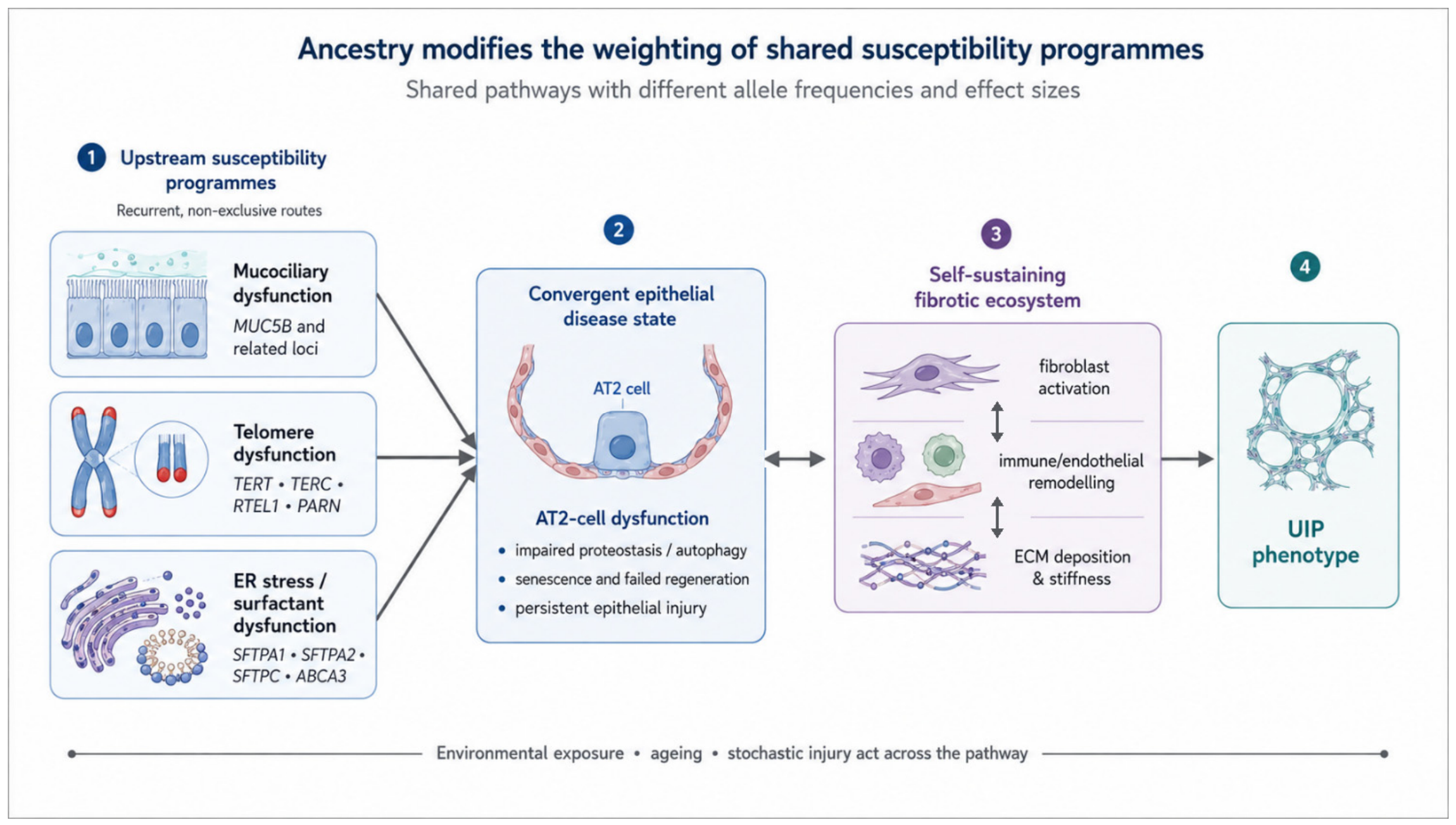
A direct genotype-to-phenotype model does not fully account for this pattern. Polygenic risk scores developed predominantly in European populations show reduced transferability across ancestries because of differences in allele frequency, linkage disequilibrium, and effect-size estimation [4,5,6,7,15], whereas recent multi-ancestry studies indicate that many IPF risk loci and implicated pathways are shared across populations [9,16]. We therefore propose an intermediate biological layer—a convergent fibrotic disease state—linking heterogeneous upstream susceptibility to conserved downstream epithelial and stromal programmes, in which ancestry modifies the relative weighting of susceptibility programmes while progression reflects shared epithelial dysfunction and multicellular remodelling (Figure 1) [17,18,19,20,21,22,23].
Figure 1.
An ancestry-aware framework linking heterogeneous genetic susceptibility to convergent fibrotic progression in idiopathic pulmonary fibrosis (IPF). Mucociliary dysfunction, telomere dysfunction, and endoplasmic reticulum stress/surfactant dysfunction represent recurrent, non-exclusive routes to impaired alveolar epithelial homeostasis. Double-headed arrows denote reciprocal interactions between the epithelial disease state and the fibroblast, immune, endothelial and matrix compartments. AT2-cell dysfunction is shown as the predominant, but not the exclusive, node, and the convergence depicted is a proposed model. Environmental exposures, ageing, and stochastic injury may influence multiple stages of this pathway. This figure was generated with the assistance of an AI tool (ChatGPT-5.4, OpenAI) and reviewed and approved by the authors for scientific accuracy.
In this review, we develop an ancestry-aware framework for IPF and evaluate the evidence for biological convergence. We first examine recurrent genetic and epithelial susceptibility programmes, then assess evidence from human genetics, epithelial biology, single-cell transcriptomics, and spatial transcriptomics. Finally, we consider the testable implications of this framework for biomarker development, clinical-trial design, and precision medicine, and state the observations that would falsify it.
- What This Review Adds
Repetitive epithelial injury followed by aberrant repair is an established model of IPF pathogenesis, and we do not propose a new mechanism. Its contribution is threefold. First, we state explicitly that ancestry modifies the weighting of upstream susceptibility programmes rather than downstream disease biology, and we report both the strength and the limits of the supporting evidence (Section 2). Second, we separate data-driven molecular subgroups from mechanistically defined disease states and define each operationally (Section 1.2). Third, we specify the observations that would refute the proposed framework (Section 6).
1.1. Search Strategy and Selection Criteria
We searched PubMed, Embase and the Cochrane Library for English-language articles published between 1 January 2000 and 9 August 2026, using combinations of the terms “idiopathic pulmonary fibrosis”, “genetic ancestry”, “MUC5B”, “telomere”, “surfactant”, “genome-wide association study”, “single-cell RNA sequencing”, “spatial transcriptomics”, “molecular endotype”, and “biomarker”. We prioritised large genetic studies, multi-ancestry cohorts, human mechanistic studies, single-cell and spatial transcriptomic analyses, and systematic reviews or meta-analyses. Reference lists of key articles were also screened for additional relevant studies. Because this is a conceptual narrative review rather than a systematic review, study selection was guided by relevance to the proposed framework and was not based on a prospectively registered or fully reproducible protocol. Titles and abstracts were screened by one author (Y.-C.T.), and inclusion was agreed by consensus with P.-K.F. Where studies conflicted, both are cited and the discrepancy is stated in the text. The complete search strings are provided in Supplementary File S1. The English-language restriction may have excluded reports published only in Japanese, Korean or Chinese (Section 7). During the preparation of this review, generative artificial intelligence (GenAI) tools were used to assist with the visual refinement and presentation of Figure 1, Figure 2 and Figure 3, which were conceived and designed by the authors; all scientific content of the figures was specified, reviewed, and verified by the authors. GenAI was not used to search, select, analyse, or interpret the literature.
1.2. Terminology: Ancestry and Endotype
Ancestry here denotes genetically inferred ancestry rather than self-identified race, ethnicity or nationality, following the National Academies framework for population descriptors [24]. Where a cited study reported only self-identified race or country of recruitment, we use that descriptor and indicate that it is a proxy [18,19,20,21,22,23]. Endotype denotes a disease subtype defined by a distinct, measurable biological mechanism, as distinct from a phenotype defined by clinical, physiological or radiological features. We apply three criteria: an endotype must be anchored to a specified mechanism, measurable by a reproducible assay with a stated threshold, and informative beyond clinical phenotyping. By these criteria, no molecular endotype of IPF is currently validated for clinical use.
2. Divergent Susceptibility Programmes and Convergence on Epithelial Dysfunction
Genetic studies of IPF repeatedly implicate several biological programmes that compromise alveolar epithelial homeostasis: mucociliary dysfunction, telomere dysfunction, and endoplasmic reticulum (ER) stress/surfactant dysfunction [3,10,11,13,14] (Table 1). These categories are neither exhaustive nor mutually exclusive, but complementary routes by which abnormalities in mucociliary defence, telomere maintenance, proteostasis and surfactant processing impair epithelial resilience [17,25]. Ageing-related and environmental stressors act on many of the same pathways.
2.1. Common Susceptibility Variants, Rare Pathogenic Variants, and Familial Pulmonary Fibrosis
Three categories of genetic variation must be distinguished [26]. Common susceptibility variants, of which MUC5B rs35705950 is the paradigm, are frequent in the population, confer moderate-to-large relative risk with low individual penetrance, and are reported as allele frequencies and odds ratios [3,6,8,16]. Rare pathogenic variants in telomere-related genes (TERT, TERC, RTEL1, PARN) and surfactant-related genes (SFTPA1, SFTPA2, SFTPC, ABCA3) are uncommon but highly penetrant. They segregate within families and are reported as carrier frequencies rather than odds ratios [10,11,12,13,14]. Syndromic short-telomere disease constitutes a third category, in which pulmonary fibrosis is one feature of a systemic disorder [12]. These categories map imperfectly onto the clinical distinction between sporadic IPF and familial pulmonary fibrosis (FPF). Telomere-related variants occur in approximately one-quarter of FPF kindreds and surfactant-related variants in 1–3%, yet the same variants occur in patients without a documented family history, and the MUC5B risk allele is enriched in both [3,12]. Accordingly, we state throughout whether evidence derives from sporadic IPF, from FPF kindreds or from sequenced cohorts, and note that downstream cell-state data derive from advanced-disease tissue of mostly unreported ancestry [18,19,20,21,22,23,27,28,29,30].
Table 1.
Quantitative genetic evidence underlying the framework: representative loci, sentinel variants, variant class, ancestry studied, reported frequency and effect estimate, and cohort size.
The relative contribution of these programmes varies across populations, but current evidence does not support categorically distinct ancestry-specific forms of IPF. The MUC5B risk allele is far more frequent in European than in East Asian populations, whereas rare telomere and surfactant variants occur across ancestries [3,4,5,6,7,10,11,13,14].
Recent genetic data bear directly on this interpretation, although to our knowledge a single study has tested the proposition directly. In a genome-wide association study of 1026 East Asian patients and 1723 controls, four loci reached genome-wide significance [9]: FAM13A (rs7690839; OR 1.64, 95% CI 1.45–1.85), TERT (rs7734992; OR 1.59, 1.39–1.82), DSP (rs2076295; OR 1.46, 1.30–1.67) and MUC5B (rs35705950). The sentinel variants were identical to, or in strong linkage disequilibrium with, those identified in European-ancestry populations. The MUC5B risk allele was present in 3.20% of Japanese cases and 0.16% of controls, with an adjusted odds ratio of 14.36 (4.84–42.58). This exceeds the European estimate of 5.06 (4.69–5.47), although the general-population frequency is approximately 0.8% in East Asian and 11.3% in European ancestry. Furthermore, local ancestry analysis showed the haplotype carrying rs35705950 to be 99.9% East Asian-like, which excludes admixture as the explanation [9]. Differences between populations were therefore driven by allele frequency and effect size rather than by the identity of the implicated genes or pathways. A multi-ancestry meta-analysis nevertheless identified loci that would not have been detected in a European-only analysis [16], and ancestry-specific effects in populations not yet studied at adequate scale cannot be excluded (Section 7).
2.2. Gene–Environment Interaction and Ageing
Genetic ancestry is only one source of heterogeneity in IPF susceptibility. Smoking, occupational and inhalational exposures, air pollution, metabolic factors and ageing interact with inherited susceptibility, and are not captured by genetic architecture alone [33,34]. Several plausibly act on the same distal epithelial programmes as the susceptibility variants, since particulate retention, oxidative stress and accelerated telomere attrition converge on the same compartment [34]. The evidence for statistical interaction is nevertheless mixed. Prospective cohort data suggest synergy between polygenic risk and air-pollution exposure, whereas an analysis designed to test effect modification found no interaction with MUC5B genotype or telomere length [33,34]. We therefore regard gene–environment interaction as plausible and partly supported rather than demonstrated. Ageing provides the substrate on which both act, through loss of progenitor capacity, senescence and declining proteostatic reserve [17,25].
2.3. Convergence on Distal Epithelial Dysfunction
Despite heterogeneous upstream susceptibility, multiple mechanisms appear to converge on dysfunction of the distal lung epithelium and failure of effective alveolar repair, in which AT2 cells are the predominant node. AT2 cells are essential for alveolar maintenance and regeneration, and abnormalities in proteostasis, telomere integrity, mitochondrial homeostasis, autophagy, cellular senescence, and surfactant processing can each compromise their capacity to respond to injury [17,23,25]. Persistent epithelial dysfunction can subsequently engage shared downstream programmes of fibroblast activation, extracellular matrix remodelling, and multicellular signalling, thereby establishing a self-sustaining fibrotic ecosystem that contributes to the emergence and progression of UIP pathology [18,19,20,21,22,23,35,36,37]. This proposed sequence is summarised in Figure 1.
An AT2-only model does not readily accommodate the strongest common risk variant. MUC5B is expressed by distal airway secretory cells and by the epithelium lining honeycomb cysts, rather than being a primary AT2 product. The rs35705950 risk allele increases distal-airway MUC5B and impairs mucociliary clearance [31]. In experimental models, ectopic distal Muc5b expression does not itself produce fibrosis, but enhances fibrosis after injury. This is consistent with a vulnerable bronchoalveolar epithelium reprogrammed by a second insult [31,32]. The mucociliary route therefore reaches the same endpoint, namely failed alveolar repair with bronchiolisation, without a primary AT2 lesion. Telomere-related and surfactant-related variants, by contrast, act directly on AT2 maintenance [10,11,12,13,14,17]. Accordingly, we regard AT2 dysfunction as the predominant but not the exclusive node, and the convergence itself as a proposed model.
3. Evidence Supporting Biological Convergence
The proposed framework predicts that heterogeneous susceptibility programmes converge on a limited set of downstream cellular and tissue states. This prediction has not been tested in harmonised cross-ancestry cohorts, so the evidence below is consistent with the framework without establishing it (Figure 2). The levels of evidence differ in what they can support. Human genetics can establish that loci and pathways are shared, but not that downstream biology is. Mechanistic studies can establish that distinct upstream lesions produce overlapping epithelial responses, but they carry no ancestry information. Single-cell and spatial studies can establish that disease-associated states recur across independent cohorts, which concerns reproducibility rather than ancestry. Only a single molecular platform applied to ancestrally distinct but clinically comparable cohorts could establish cross-ancestry convergence, and no such study has been reported.
Figure 2.
Multilevel evidence supporting biological convergence in idiopathic pulmonary fibrosis (IPF). Human genetics, epithelial biology, single-cell transcriptomics, and spatial transcriptomics provide complementary and increasingly resolved evidence, labelled by the type of inference each supports. Direct harmonised cross-ancestry validation remains limited, so the synthesis shown is testable rather than established. Section 3 states what each level can and cannot support. This figure was generated with the assistance of an AI tool (ChatGPT-5.4, OpenAI) and reviewed and approved by the authors for scientific accuracy.
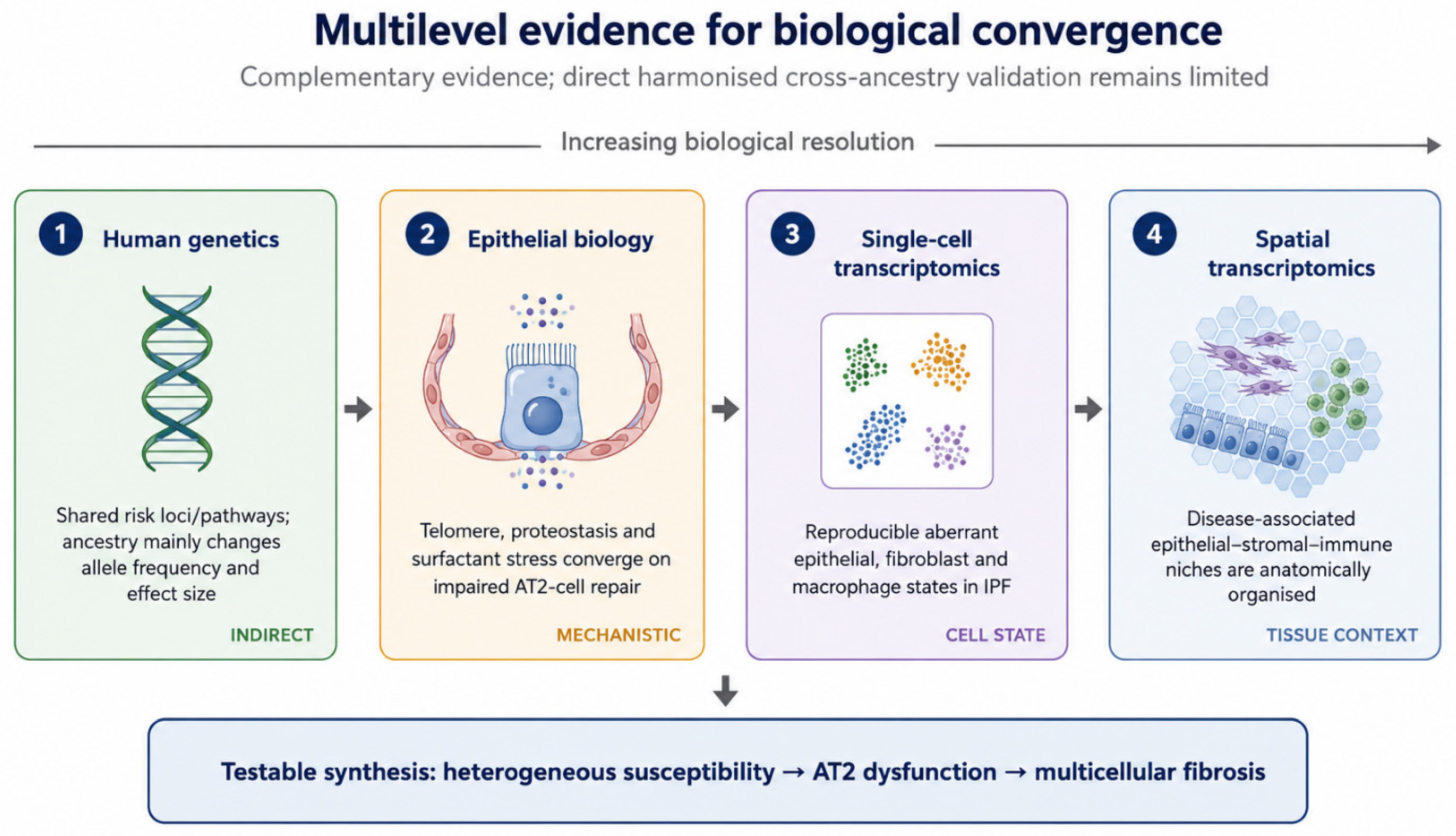
Human genetic studies provide the strongest evidence for shared susceptibility and indirect support for convergence. Allele frequencies and effect estimates vary across populations, yet susceptibility loci and implicated pathways overlap substantially [3,4,5,6,7,9]. Furthermore, a systematic review has catalogued 88 variants in more than 50 genes, with odds ratios between 0.27 and 7.82, few of which were studied outside European-ancestry populations [8]. In parallel, rare pathogenic variants affecting telomere biology or surfactant metabolism can result in fibrotic interstitial lung disease with UIP morphology despite different upstream defects [10,11,12,13,14]. These observations suggest that genetically heterogeneous perturbations feed into a restricted set of epithelial stress and repair programmes. They do not show that the resulting biology is quantitatively equivalent across populations. These are genetic studies that report no molecular or cellular data. They therefore support shared upstream susceptibility loci rather than equivalent downstream biology.
At the cellular level, distal epithelial dysfunction provides a plausible point of convergence. Human and experimental studies of pulmonary fibrosis identify recurring epithelial stress responses, including ER stress, mitochondrial dysfunction, impaired autophagy, senescence, and defective regeneration [17,23,25]. Single-cell transcriptomic studies across independent IPF cohorts reveal reproducible abnormal epithelial states—including KRT8/KRT17-positive transitional or aberrant basaloid populations—together with activated fibroblast and macrophage states [18,19,20,21,22,23]. The appropriate inference is that the same disease-associated populations recur in independently collected cohorts, not that these processes are conserved across genetic ancestries. These datasets are small, were not designed for ancestry comparison, and in most cases do not report donor ancestry. Cross-cohort reproducibility would be expected even if ancestry modified downstream biology, provided that each cohort was itself ancestrally homogeneous.
A complementary literature has used unsupervised clustering of blood, bronchoalveolar lavage, or lung transcriptomic and proteomic data to identify empirical molecular subgroups associated with prognosis or treatment response [38,39,40,41,42]. By the criteria set out in Section 1.2, these are reproducible statistical partitions rather than validated endotypes. Specifically, they lack a mechanistic anchor, a thresholded assay, and prospective evidence of added value over clinical phenotyping. They should be distinguished from the mechanistic construct proposed here, in which distal epithelial dysfunction is an upstream disease state that may contribute to several such subgroups. The overlap of markers such as WFDC2 across single-cell epithelial states and cohort-level endotyping analyses is suggestive, but does not establish equivalence between these levels of classification [40]. Testing whether clustering-derived subgroups differ in the epithelial programmes that the model specifies is a tractable research priority.
Spatially resolved studies extend the concept of convergence from cell states to organised tissue niches. Spatial transcriptomic analyses of human pulmonary fibrosis identify reproducible disease-associated neighbourhoods in which aberrant epithelial cells, activated fibroblasts, macrophages, endothelial cells and lymphoid aggregates occupy anatomically restricted microenvironments [27,28,29,30], indicating that profibrotic signalling is organised spatially and becomes locally self-reinforcing. These datasets were likewise not ancestry-comparative and derive from small numbers of advanced-disease specimens.
4. From Epithelial Dysfunction to the UIP Phenotype
Convergence on epithelial dysfunction alone does not explain the progressive and irreversible behaviour of IPF. Progression requires translation of persistent epithelial injury into coordinated multicellular remodelling and extracellular matrix reinforcement. This transition provides the proposed biological link between heterogeneous susceptibility and the characteristic UIP phenotype, and the interactions involved are reciprocal rather than unidirectional (Figure 1).
4.1. Fibroblast Activation Transforms Epithelial Injury into Fibrosis
Persistent epithelial dysfunction can activate profibrotic signalling through transforming growth factor-β (TGF-β), platelet-derived growth factor, connective tissue growth factor and WNT ligands, promoting fibroblast recruitment, myofibroblast differentiation and extracellular matrix (ECM) production. Single-cell studies consistently identify disease-associated mesenchymal states, including CTHRC1-expressing fibroblast populations, across independent fibrotic-lung datasets [19,20,21,22,23,35,36]. Fibroblasts therefore translate persistent epithelial injury into structural remodelling, while the stiffened matrix they deposit in turn impairs epithelial regeneration [36,37].
4.2. Multicellular Interactions Establish the Fibrotic Ecosystem
Fibrosis is sustained through interactions among epithelial cells, fibroblasts, immune cells, endothelial cells, and the extracellular matrix. Single-cell and spatial studies identify recurrent profibrotic neighbourhoods involving TGF-β, WNT, CXCL12–CXCR4, NOTCH and osteopontin signalling [19,20,21,22,23,,,27,28,29,30,35,36]. Their common feature is reciprocal signalling that reinforces fibroblast activation while limiting epithelial regeneration. Once established, this circuitry may become progressively less dependent on the original susceptibility factor.
4.3. ECM Remodelling Stabilises the UIP Phenotype
The ECM is not merely a consequence of fibrosis but an active component of disease propagation. Collagen accumulation and increasing matrix stiffness engage integrins, YAP/TAZ signalling, and activation of latent TGF-β, generating positive-feedback loops that promote fibroblast activation and inhibit epithelial regeneration [36,37]. Over time these processes contribute to the defining features of UIP, including fibroblastic foci, temporal heterogeneity, honeycombing, and architectural distortion.
4.4. From Endotype to Phenotype
Taken together, these findings support a hierarchical, testable model. Susceptibility perturbs epithelial homeostasis, recurrent epithelial stress engages a conserved multicellular fibrotic programme, and ECM-dependent feedback stabilises remodelling. Ancestry is expected to influence upstream susceptibility more strongly than the downstream architecture of established fibrosis [1,2,3,4,5,6,7,8,16,17,18,19,20,21,22,23,35,36,37].
5. Translational Implications: From Susceptibility to Disease-State Stratification
The distinction between upstream susceptibility and downstream disease-state biology has practical implications for IPF precision medicine. Current diagnosis and monitoring rely on clinical context, physiology, imaging and, when required, histopathology. These say little about which molecular programmes are active in an individual patient. An endotype-oriented strategy would complement rather than replace established phenotyping (Table 2).
Table 2.
Translational implications and validation priorities for endotype-guided precision medicine in idiopathic pulmonary fibrosis, with disease-specific examples and current validation status.
Polygenic risk scores illustrate both the potential and the limitations of genetics-based stratification. Scores developed predominantly in European-ancestry cohorts may transfer imperfectly across populations because of differences in allele frequency, linkage disequilibrium, and effect-size estimation [4,5,6,7,15], and variants contributing appreciably to risk in non-European populations may be absent from European-derived scores altogether [16]. Recent work integrating common polygenic risk, rare damaging variants, and genetically determined telomere length indicates that these layers jointly define heterogeneous genetic liability and may identify genetically informed IPF subgroups [43]. These constructs are most useful for susceptibility and aetiological inference; they should not be assumed to measure the active biology that drives progression in an individual patient.
Biomarker development should therefore move from isolated markers towards panels that report disease-state activity. The three-tier distinction of Section 1.2 clarifies what is available. KL-6 and surfactant protein-D report that epithelial injury is occurring, but not which mechanism is active. MMP7 and the 52-gene peripheral blood signature are replicated predictors of outcome, but do not identify a specific biological programme [44,45]. The epithelial markers KRT8, KRT17 and WFDC2 map to defined cell states, but have not been translated into thresholded assays in accessible samples [18,19,20,21,22,23,40]. Their value will depend on demonstrating that they map reproducibly to defined biological states, change with disease activity, and predict clinically relevant outcomes or treatment response. Until then, they remain research tools.
The therapeutic implication is not that ancestry-related susceptibility should be ignored, but that established fibrosis may be more tractable through shared downstream mechanisms. Three tiers of evidence should be separated. The first is established clinical evidence. Pirfenidone and nintedanib slow the decline in forced vital capacity in adequately powered randomised trials [50,51], and nintedanib shows comparable relative benefit in other progressive fibrosing phenotypes [52]. The second is observational and pharmacogenetic evidence. The TOLLIP–MUC5B interaction with N-acetylcysteine derives from a post hoc analysis of a trial that was negative overall. It has not been replicated prospectively and should be regarded as hypothesis-generating [46]. The third comprises experimental approaches, such as senolytic therapy, which has reached only a randomised placebo-controlled pilot trial in twelve patients that was not powered for efficacy [53]. The efficacy of nintedanib across fibrotic interstitial lung diseases is consistent with shared downstream mechanisms, but does not prove a common molecular endotype. A therapy may act on a final common effector pathway reached by mechanistically distinct routes.
6. Research Agenda and Validation Priorities
The proposed framework is useful only if it generates falsifiable predictions. The most important next step is to determine whether heterogeneous upstream risk converges on reproducible, clinically informative disease states across ancestries, which will require prospective cohorts that deliberately recruit ancestrally diverse populations and apply harmonised molecular and imaging platforms (Figure 3). Three observations would refute the proposed framework: (i) a demonstration, using one harmonised platform in ancestrally distinct but clinically comparable cohorts, that the dominant epithelial and stromal programmes differ systematically by ancestry rather than by disease stage; (ii) a demonstration that MUC5B-associated and telomere-associated disease give rise to non-overlapping downstream cell states; and (iii) a demonstration that clustering-derived molecular subgroups are better explained by exposure history or disease stage than by any upstream epithelial programme.
Figure 3.
Roadmap for prospective validation of endotype-guided precision medicine in idiopathic pulmonary fibrosis. Key steps include ancestry-diverse longitudinal cohorts, reproducible definition of molecular disease states, and biomarker-guided trials. The benchmark at each step is stated in Section 6. Arrows indicate the direction of workflow, and circular arrows denote iterative processes. Band colours distinguish the five stages; the group colours are used to distinguish groups within each stage and do not correspond across stages. This figure was generated with the assistance of an AI tool (ChatGPT-5.4, OpenAI) and reviewed and approved by the authors for scientific accuracy.
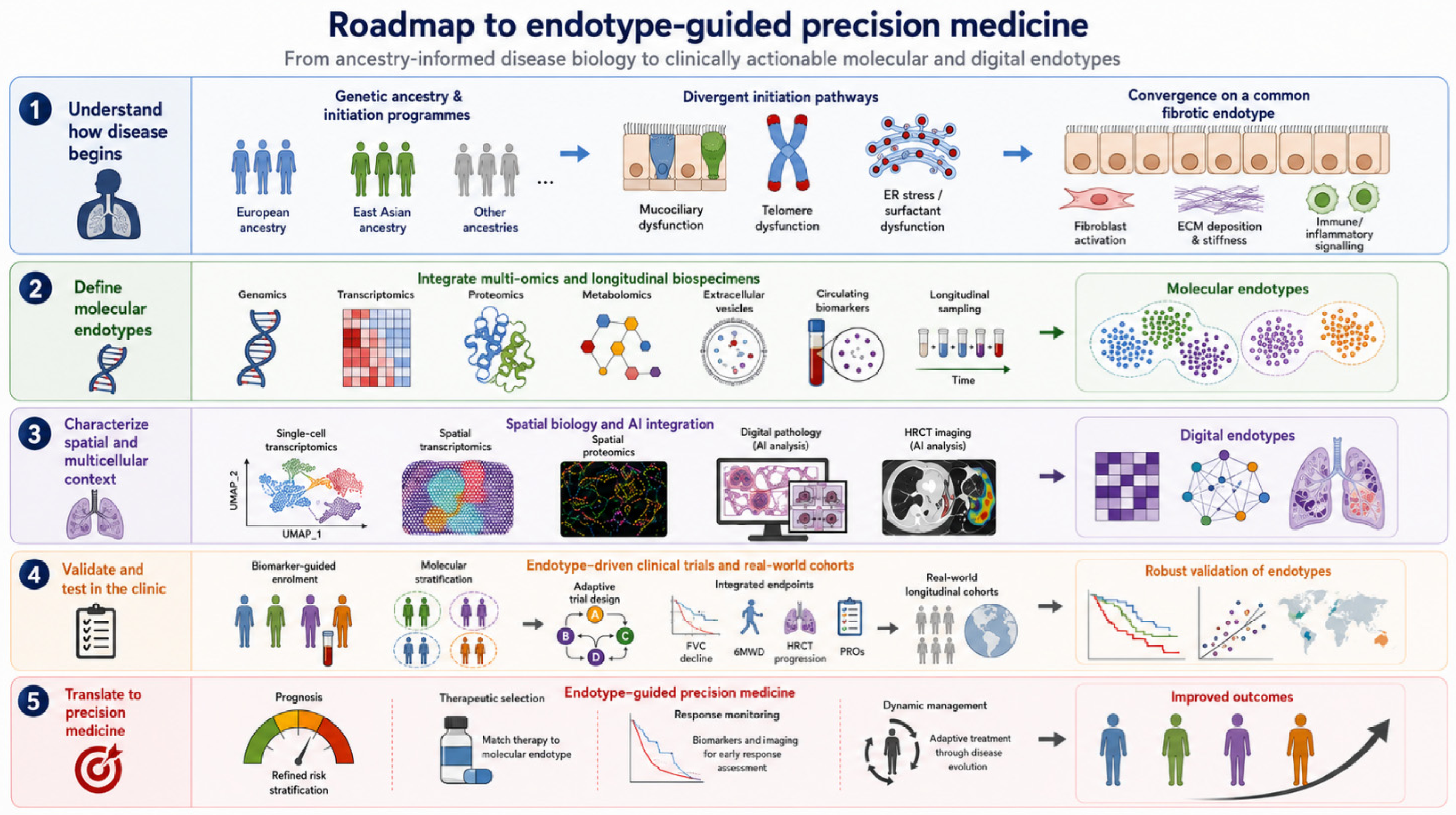
The corresponding research priorities are threefold. First, integrated multi-omics studies should connect germline susceptibility to longitudinal disease-state measurements, analysing genomics alongside serial transcriptomics, proteomics, circulating biomarkers and clinical trajectories [40,41,42,43,45,47]. The objective is compact, reproducible signatures that are robust across ancestry groups.
Second, spatial biology should be integrated with quantitative imaging and digital pathology. Linking anatomically restricted tissue states [19,20,21,22,23,27,28,29,30] to quantitative HRCT features may enable minimally invasive “digital endotypes” [48,49]. Such models would require external validation across scanners, centres, ancestries and disease stages.
Third, candidate endotypes must be prospectively tested for clinical utility through biomarker-guided enrolment and pre-specified molecular stratification [40,46]. Without evidence of incremental and predictive value beyond validated clinical models, endotype-guided precision medicine should remain a research framework rather than a clinical classification system.
7. Limitations
This review has several limitations. First, the convergence model is a conceptual synthesis of evidence generated largely in separate genetic, mechanistic, single-cell, and spatial studies; direct cross-ancestry validation in the same individuals has not been performed. The framework should therefore be read as a hypothesis, with the falsification criteria stated in Section 6.
Second, the direct evidence for the ancestry component of the framework rests on a single genome-wide association study with no independent validation cohort, which did not replicate other European IPF risk loci. Its authors attribute this to sample size and genotyping coverage rather than to the absence of those loci in East Asian populations [9].
Third, the population coverage of the underlying evidence is narrow. The genetic evidence derives overwhelmingly from European-ancestry populations, with a smaller contribution from East Asian populations. African, Latin American, South Asian and admixed populations are substantially under-represented, and for several of these groups no adequately powered IPF genome-wide association study has been reported [8,15,16,26]. Polygenic risk scores therefore cannot be assumed to transfer. Reported disparities, such as the younger age at diagnosis and death among patients of African ancestry, cannot be interpreted genetically while the underlying data are absent [54]. Accordingly, any extension of this framework beyond European and East Asian populations is an untested extrapolation. Population descriptors are also applied inconsistently across the primary literature, which further limits the precision of any ancestry-related claim [24].
Fourth, the search was restricted to English-language publications and may have missed reports published only in Japanese, Korean or Chinese. The single-cell and spatial datasets were not designed for ancestry comparison and derive from advanced disease. The model is epithelial-centred and does not fully incorporate immune, vascular or stochastic processes. Proposed endotypes have not been prospectively validated in randomised trials. Finally, as a narrative review, study selection reflects the authors’ judgement and no formal risk-of-bias assessment was performed.
8. Conclusions
Idiopathic pulmonary fibrosis illustrates how heterogeneous inherited and environmental susceptibility can converge on a relatively stereotyped pathological phenotype. We propose that this paradox is best understood by separating upstream susceptibility from downstream progression biology. Ancestry-associated variation may alter the distribution of susceptibility pathways, whereas persistent epithelial dysfunction and multicellular remodelling appear to be more conserved features of established disease.
Evidence from human genetics, epithelial biology, single-cell transcriptomics, and spatial transcriptomics is consistent with a hierarchical model in which diverse upstream perturbations converge on distal epithelial dysfunction, with AT2 cells as the predominant node, and subsequently engage a self-reinforcing fibrotic ecosystem. The proposed convergence remains to be demonstrated directly in ancestry-diverse cohorts using harmonised molecular platforms, and the genetic evidence supporting its ancestry component is at present confined to European and East Asian populations.
The translational opportunity is to define endotypes that are biologically interpretable, reproducible across populations, measurable in accessible samples or images, and predictive of outcome or treatment response. Genetic ancestry may shape the routes by which susceptibility is expressed, but the actionable target may lie in the shared biological programmes that sustain fibrosis.
Supplementary Materials
The following supporting information can be downloaded at: https://www.mdpi.com/article/10.3390/biom16121740/s1, Supplementary File S1, complete search strategy and study-selection criteria, is available at the journal website.
Author Contributions
Conceptualization, P.-K.F.; methodology, P.-K.F.; investigation, Y.-C.T.; visualization, Y.-C.T. and P.-K.F.; writing—original draft preparation, Y.-C.T.; writing—review and editing, P.-K.F. and J.W.S.; supervision, P.-K.F., P.-K.F. and J.W.S. contributed equally to this work as senior authors. All authors contributed to the interpretation of the literature. All authors have read and agreed to the published version of the manuscript.
Funding
This study was supported by Taichung Veterans General Hospital (TCVGH-1153908D), the National Science and Technology Council, Taiwan (NSTC 115-2314-B-075A-020-MY3). JWS was supported by grants from the Bio & Medical Technology Development Program (NRF-2022M3A9E4082647) of the National Research Foundation of Korea funded by the Ministry of Science and ICT, Republic of Korea; the Korea Environment Industry & Technology Institute through the Core Technology Development Project for Environmental Diseases Prevention and Management Program funded by the Ministry of Environment, Republic of Korea (RS-2022-KE002197); National Institute of Health research project (2024ER090500); and the Korea Health Industry Development Institute (KHIDI), funded by the Ministry of Health & Welfare, Republic of Korea (RS-2026-25517592).
Institutional Review Board Statement
Not applicable.
Informed Consent Statement
Not applicable.
Data Availability Statement
No new data were created or analyzed in this study. Data sharing is not applicable to this article.
Acknowledgments
During the preparation of this manuscript, the authors used generative AI tools, including ChatGPT-5.4 (OpenAI) and Claude (Anthropic), solely for English-language editing, grammatical refinement, and improvements in readability and clarity. These tools were also used to assist in the visual refinement and presentation of Figure 1, Figure 2 and Figure 3. All AI-assisted outputs were critically reviewed, revised, and verified by the authors. The authors take full responsibility for the accuracy, integrity, and final content of the manuscript and figures. Generative AI was not used to generate, analyze, or interpret the study data, nor was it used to make scientific conclusions or decisions.
Conflicts of Interest
The authors declare no conflicts of interest. The funders had no role in the design of the study; in the collection, analyses, or interpretation of data; in the writing of the manuscript; or in the decision to publish the results.
Abbreviations
The following abbreviations are used in this manuscript:
| AT2 | Alveolar type 2 |
| CI | Confidence interval |
| CTHRC1 | Collagen triple helix repeat containing 1 |
| ECM | Extracellular matrix |
| ER | Endoplasmic reticulum |
| FPF | Familial pulmonary fibrosis |
| GenAI | Generative artificial intelligence |
| HRCT | High-resolution computed tomography |
| IPF | Idiopathic pulmonary fibrosis |
| KL-6 | Krebs von den Lungen-6 |
| LD | Linkage disequilibrium |
| MMP7 | Matrix metalloproteinase-7 |
| OR | Odds ratio |
| SNP | Single nucleotide polymorphism |
| TGF-β | Transforming growth factor-β |
| UIP | Usual interstitial pneumonia |
| WFDC2 | WAP four-disulfide core domain 2 |
| YAP/TAZ | Yes-associated protein/transcriptional coactivator with PDZ-binding motif |
References
- Raghu, G.; Remy-Jardin, M.; Richeldi, L.; Thomson, C.C.; Inoue, Y.; Johkoh, T.; Kreuter, M.; Lynch, D.A.; Maher, T.M.; Martinez, F.J.; et al. Idiopathic Pulmonary Fibrosis (an Update) and Progressive Pulmonary Fibrosis in Adults: An Official ATS/ERS/JRS/ALAT Clinical Practice Guideline. Am. J. Respir. Crit. Care Med. 2022, 205, e18–e47. [Google Scholar] [CrossRef] [Scilit] [PubMed]
- Lederer, D.J.; Martinez, F.J. Idiopathic Pulmonary Fibrosis. N. Engl. J. Med. 2018, 378, 1811–1823. [Google Scholar] [CrossRef] [Scilit] [PubMed]
- Seibold, M.A.; Wise, A.L.; Speer, M.C.; Steele, M.P.; Brown, K.K.; Loyd, J.E.; Fingerlin, T.E.; Zhang, W.; Gudmundsson, G.; Groshong, S.D.; et al. A common MUC5B promoter polymorphism and pulmonary fibrosis. N. Engl. J. Med. 2011, 364, 1503–1512. [Google Scholar] [CrossRef] [Scilit] [PubMed]
- Fingerlin, T.E.; Murphy, E.; Zhang, W.; Peljto, A.L.; Brown, K.K.; Steele, M.P.; Loyd, J.E.; Cosgrove, G.P.; Lynch, D.; Groshong, S.; et al. Genome-wide association study identifies multiple susceptibility loci for pulmonary fibrosis. Nat. Genet. 2013, 45, 613–620. [Google Scholar] [CrossRef] [Scilit] [PubMed]
- Noth, I.; Zhang, Y.; Ma, S.F.; Flores, C.; Barber, M.; Huang, Y.; Broderick, S.M.; Wade, M.S.; Hysi, P.; Scuirba, J.; et al. Genetic variants associated with idiopathic pulmonary fibrosis susceptibility and mortality: A genome-wide association study. Lancet Respir. Med. 2013, 1, 309–317. [Google Scholar] [CrossRef] [Scilit] [PubMed]
- Allen, R.J.; Guillen-Guio, B.; Oldham, J.M.; Ma, S.F.; Dressen, A.; Paynton, M.L.; Kraven, L.M.; Obeidat, M.; Li, X.; Ng, M.; et al. Genome-Wide Association Study of Susceptibility to Idiopathic Pulmonary Fibrosis. Am. J. Respir. Crit. Care Med. 2020, 201, 564–574. [Google Scholar] [CrossRef] [Scilit] [PubMed]
- Fang, C.; Huang, H.; Feng, Y.; Zhang, Q.; Wang, N.; Jing, X.; Guo, J.; Ferianc, M.; Xu, Z. Whole-exome sequencing identifies susceptibility genes and pathways for idiopathic pulmonary fibrosis in the Chinese population. Sci. Rep. 2021, 11, 1443. [Google Scholar] [CrossRef] [Scilit] [PubMed]
- Dhooria, S.; Sharma, R.; Bal, A.; Sehgal, I.S.; Kashyap, D.; Muthu, V.; Prasad, K.T.; Agarwal, R.; Aggarwal, A.N. Common single nucleotide polymorphisms associated with idiopathic pulmonary fibrosis: A systematic review. Eur. Respir. Rev. 2024, 33, 240018. [Google Scholar] [CrossRef] [Scilit] [PubMed]
- Peljto, A.L.; Furusawa, H.; Puthenvedu, D.; Lee, J.S.; Steele, M.P.; Brancato, J.; Cardwell, J.; Blumhagen, R.Z.; de Andrade, J.; Bendstrup, E.; et al. Idiopathic pulmonary fibrosis risk loci in East Asian populations mirror those of European populations. Am. J. Respir. Crit. Care Med. 2026, 212, 1522–1532. [Google Scholar] [CrossRef] [Scilit] [PubMed]
- Armanios, M.Y.; Chen, J.J.; Cogan, J.D.; Alder, J.K.; Ingersoll, R.G.; Markin, C.; Lawson, W.E.; Xie, M.; Vulto, I.; Phillips, J.A., 3rd; et al. Telomerase mutations in families with idiopathic pulmonary fibrosis. N. Engl. J. Med. 2007, 356, 1317–1326. [Google Scholar] [CrossRef] [Scilit] [PubMed]
- Stuart, B.D.; Choi, J.; Zaidi, S.; Xing, C.; Holohan, B.; Chen, R.; Choi, M.; Dharwadkar, P.; Torres, F.; Girod, C.E.; et al. Exome sequencing links mutations in PARN and RTEL1 with familial pulmonary fibrosis and telomere shortening. Nat. Genet. 2015, 47, 512–517. [Google Scholar] [CrossRef] [Scilit] [PubMed]
- Hernández Cristancho, A.P.; Planas-Cerezales, L.; Molina-Molina, M.; Borie, R.; Wuyts, W.A.; Jodar, M.; Sellares, J.; Hernandez-Gonzalez, F. Familial interstitial lung disease: Emerging insights into screening and genetic risk. Front. Med. 2026, 13, 1747200. [Google Scholar] [CrossRef] [Scilit] [PubMed]
- Wang, Y.; Kuan, P.J.; Xing, C.; Cronkhite, J.T.; Torres, F.; Rosenblatt, R.L.; DiMaio, J.M.; Kinch, L.N.; Grishin, N.V.; Garcia, C.K. Genetic defects in surfactant protein A2 are associated with pulmonary fibrosis and lung cancer. Am. J. Hum. Genet. 2009, 84, 52–59. [Google Scholar] [CrossRef] [Scilit] [PubMed]
- Nogee, L.M.; Dunbar, A.E., 3rd; Wert, S.E.; Askin, F.; Hamvas, A.; Whitsett, J.A. A mutation in the surfactant protein C gene associated with familial interstitial lung disease. N. Engl. J. Med. 2001, 344, 573–579. [Google Scholar] [CrossRef] [Scilit] [PubMed]
- Martin, A.R.; Kanai, M.; Kamatani, Y.; Okada, Y.; Neale, B.M.; Daly, M.J. Clinical use of current polygenic risk scores may exacerbate health disparities. Nat. Genet. 2019, 51, 584–591. [Google Scholar] [CrossRef] [Scilit] [PubMed]
- Partanen, J.J.; Häppölä, P.; Zhou, W.; Lehisto, A.A.; Ainola, M.; Sutinen, E.; Allen, R.J.; Stockwell, A.D.; Leavy, O.C.; Oldham, J.M.; et al. Leveraging global multi-ancestry meta-analysis in the study of idiopathic pulmonary fibrosis genetics. Cell Genom. 2022, 2, 100181. [Google Scholar] [CrossRef] [Scilit] [PubMed]
- Katzen, J.; Beers, M.F. Contributions of alveolar epithelial cell quality control to pulmonary fibrosis. J. Clin. Investig. 2020, 130, 5088–5099. [Google Scholar] [CrossRef] [Scilit] [PubMed]
- Reyfman, P.A.; Walter, J.M.; Joshi, N.; Anekalla, K.R.; McQuattie-Pimentel, A.C.; Chiu, S.; Fernandez, R.; Akbarpour, M.; Chen, C.I.; Ren, Z.; et al. Single-Cell Transcriptomic Analysis of Human Lung Provides Insights into the Pathobiology of Pulmonary Fibrosis. Am. J. Respir. Crit. Care Med. 2019, 199, 1517–1536. [Google Scholar] [CrossRef] [Scilit] [PubMed]
- Adams, T.S.; Schupp, J.C.; Poli, S.; Ayaub, E.A.; Neumark, N.; Ahangari, F.; Chu, S.G.; Raby, B.A.; DeIuliis, G.; Januszyk, M.; et al. Single-cell RNA-seq reveals ectopic and aberrant lung-resident cell populations in idiopathic pulmonary fibrosis. Sci. Adv. 2020, 6, eaba1983. [Google Scholar] [CrossRef] [Scilit] [PubMed]
- Habermann, A.C.; Gutierrez, A.J.; Bui, L.T.; Yahn, S.L.; Winters, N.I.; Calvi, C.L.; Peter, L.; Chung, M.I.; Taylor, C.J.; Jetter, C.; et al. Single-cell RNA sequencing reveals profibrotic roles of distinct epithelial and mesenchymal lineages in pulmonary fibrosis. Sci. Adv. 2020, 6, eaba1972. [Google Scholar] [CrossRef] [Scilit] [PubMed]
- Morse, C.; Tabib, T.; Sembrat, J.; Buschur, K.L.; Bittar, H.T.; Valenzi, E.; Jiang, Y.; Kass, D.J.; Gibson, K.; Chen, W.; et al. Proliferating SPP1/MERTK-expressing macrophages in idiopathic pulmonary fibrosis. Eur. Respir. J. 2019, 54, 1802441. [Google Scholar] [CrossRef] [Scilit] [PubMed]
- Tsukui, T.; Sun, K.H.; Wetter, J.B.; Wilson-Kanamori, J.R.; Hazelwood, L.A.; Henderson, N.C.; Adams, T.S.; Schupp, J.C.; Poli, S.D.; Rosas, I.O.; et al. Collagen-producing lung cell atlas identifies multiple subsets with distinct localization and relevance to fibrosis. Nat. Commun. 2020, 11, 1920. [Google Scholar] [CrossRef] [Scilit] [PubMed]
- Katzen, J.; Rodriguez, L.; Tomer, Y.; Babu, A.; Zhao, M.; Murthy, A.; Carson, P.; Barrett, M.; Basil, M.C.; Carl, J.; et al. Disruption of proteostasis causes IRE1 mediated reprogramming of alveolar epithelial cells. Proc. Natl. Acad. Sci. USA 2022, 119, e2123187119. [Google Scholar] [CrossRef] [Scilit] [PubMed]
- National Academies of Sciences, Engineering, and Medicine. Using Population Descriptors in Genetics and Genomics Research: A New Framework for an Evolving Field; The National Academies Press: Washington, DC, USA, 2023. [Google Scholar] [CrossRef] [Scilit] [PubMed]
- Yao, C.; Guan, X.; Carraro, G.; Parimon, T.; Liu, X.; Huang, G.; Mulay, A.; Soukiasian, H.J.; David, G.; Weigt, S.S.; et al. Senescence of Alveolar Type 2 Cells Drives Progressive Pulmonary Fibrosis. Am. J. Respir. Crit. Care Med. 2021, 203, 707–717. [Google Scholar] [CrossRef] [Scilit] [PubMed]
- Adegunsoye, A.; Kropski, J.A.; Behr, J.; Blackwell, T.S.; Corte, T.J.; Cottin, V.; Glanville, A.R.; Glassberg, M.K.; Griese, M.; Hunninghake, G.M.; et al. Genetics and Genomics of Pulmonary Fibrosis: Charting the Molecular Landscape and Shaping Precision Medicine. Am. J. Respir. Crit. Care Med. 2024, 210, 401–423. [Google Scholar] [CrossRef] [Scilit] [PubMed]
- Franzén, L.; Olsson Lindvall, M.; Hühn, M.; Ptasinski, V.; Setyo, L.; Keith, B.P.; Collin, A.; Oag, S.; Volckaert, T.; Borde, A.; et al. Mapping spatially resolved transcriptomes in human and mouse pulmonary fibrosis. Nat. Genet. 2024, 56, 1725–1736. [Google Scholar] [CrossRef] [Scilit] [PubMed]
- Mayr, C.H.; Santacruz, D.; Jarosch, S.; Bleck, M.; Dalton, J.; McNabola, A.; Lempp, C.; Neubert, L.; Rath, B.; Kamp, J.C.; et al. Spatial transcriptomic characterization of pathologic niches in IPF. Sci. Adv. 2024, 10, eadl5473. [Google Scholar] [CrossRef] [Scilit] [PubMed]
- Vannan, A.; Lyu, R.; Williams, A.L.; Negretti, N.M.; Mee, E.D.; Hirsh, J.; Hirsh, S.; Hadad, N.; Nichols, D.S.; Calvi, C.L.; et al. Spatial transcriptomics identifies molecular niche dysregulation associated with distal lung remodeling in pulmonary fibrosis. Nat. Genet. 2025, 57, 647–658. [Google Scholar] [CrossRef] [Scilit] [PubMed]
- Song, L.; Yang, Y.; Fu, Y.; Liu, Y.; Li, Q.; Zheng, M.; Yao, C.; Song, D.; Su, R.; Chen, W.; et al. Microenvironmental niches dictate divergent fibroblast fates in reversible versus progressive lung fibrosis. eBioMedicine 2026, 124, 106142. [Google Scholar] [CrossRef] [Scilit] [PubMed]
- Hancock, L.A.; Hennessy, C.E.; Solomon, G.M.; Dobrinskikh, E.; Estrella, A.; Hara, N.; Hill, D.B.; Kissner, W.J.; Markovetz, M.R.; Grove Villalon, D.E.; et al. Muc5b overexpression causes mucociliary dysfunction and enhances lung fibrosis in mice. Nat. Commun. 2018, 9, 5363. [Google Scholar] [CrossRef] [Scilit] [PubMed]
- Bridges, J.P.; Vladar, E.K.; Kurche, J.S.; Krivoi, A.; Stancil, I.T.; Dobrinskikh, E.; Hu, Y.; Sasse, S.K.; Lee, J.S.; Blumhagen, R.Z.; et al. Progressive lung fibrosis: Reprogramming a genetically vulnerable bronchoalveolar epithelium. J. Clin. Investig. 2025, 135, e183836. [Google Scholar] [CrossRef] [Scilit] [PubMed]
- Ma, Y.; Cui, F.; Li, D.; Wang, J.; Tang, L.; Xie, J.; Hu, Y.; Tian, Y. Lifestyle, Genetic Susceptibility, and the Risk of Idiopathic Pulmonary Fibrosis: A Large Prospective Cohort Study. Chest 2023, 164, 929–938. [Google Scholar] [CrossRef] [Scilit] [PubMed]
- Sofia, C.; Parkin, J.G.H.; Bell, J.A.; Dean, L.S.N.; Edgeway, L.J.; Sayer, L.; Easton, N.H.C.; Davies, D.E.; Marshall, B.G.; Holgate, S.T.; et al. Air pollution and alveolar health. Eur. Respir. Rev. 2025, 34, 240280. [Google Scholar] [CrossRef] [Scilit] [PubMed]
- El Agha, E.; Kramann, R.; Schneider, R.K.; Li, X.; Seeger, W.; Humphreys, B.D.; Bellusci, S. Mesenchymal Stem Cells in Fibrotic Disease. Cell Stem Cell 2017, 21, 166–177. [Google Scholar] [CrossRef] [Scilit] [PubMed]
- Henderson, N.C.; Rieder, F.; Wynn, T.A. Fibrosis: From mechanisms to medicines. Nature 2020, 587, 555–566. [Google Scholar] [CrossRef] [Scilit] [PubMed]
- Ganzleben, I.; Medoff, B.D. Mechanobiology and the extracellular matrix in pulmonary fibrosis. iScience 2025, 28, 113993. [Google Scholar] [CrossRef] [Scilit] [PubMed]
- Kraven, L.M.; Taylor, A.R.; Molyneaux, P.L.; Maher, T.M.; McDonough, J.E.; Mura, M.; Yang, I.V.; Schwartz, D.A.; Huang, Y.; Noth, I.; et al. Cluster analysis of transcriptomic datasets to identify endotypes of idiopathic pulmonary fibrosis. Thorax 2023, 78, 551–558. [Google Scholar] [CrossRef] [Scilit] [PubMed]
- De Sadeleer, L.J.; Verleden, S.E.; Schupp, J.C.; McDonough, J.E.; Goos, T.; Yserbyt, J.; Bargagli, E.; Rottoli, P.; Kaminski, N.; Prasse, A.; et al. BAL Transcriptomes Characterize Idiopathic Pulmonary Fibrosis Endotypes with Prognostic Impact. Chest 2022, 161, 1576–1588. [Google Scholar] [CrossRef] [Scilit] [PubMed]
- Maddali, M.V.; Moore, A.R.; Sinha, P.; Newton, C.A.; Kim, J.S.; Adegunsoye, A.; Ma, S.F.; Strek, M.E.; Chen, C.H.; Linderholm, A.L.; et al. Molecular Endotypes of Idiopathic Pulmonary Fibrosis: A Latent Class Analysis of Two Multicenter Observational Cohorts. Am. J. Respir. Crit. Care Med. 2024, 210, 455–464. [Google Scholar] [CrossRef] [Scilit] [PubMed]
- Ruan, P.; Todd, J.L.; Zhao, H.; Liu, Y.; Vinisko, R.; Soellner, J.F.; Schmid, R.; Kaner, R.J.; Luckhardt, T.R.; Neely, M.L.; et al. Integrative multi-omics analysis reveals novel idiopathic pulmonary fibrosis endotypes associated with disease progression. Respir. Res. 2023, 24, 141. [Google Scholar] [CrossRef] [Scilit] [PubMed]
- He, D.; Guler, S.A.; Shannon, C.P.; Ryerson, C.J.; Tebbutt, S.J. Transcriptomics of interstitial lung disease: A systematic review and meta-analysis. Eur. Respir. J. 2025, 65, 2401070. [Google Scholar] [CrossRef] [Scilit] [PubMed]
- Duckworth, A.; Jackson, L.; Green, H.; Khan, A.; Wang, C.; Condescu, A.; Hawkes, G.; Noth, I.; Martinez, F.J.; Raghu, G.; et al. Polygenic risk and rare variants in endotypes of idiopathic pulmonary fibrosis: A genetic analysis of population-based and case-control cohorts. Lancet Respir. Med. 2026, 14, 305–316. [Google Scholar] [CrossRef] [Scilit] [PubMed]
- Rosas, I.O.; Richards, T.J.; Konishi, K.; Zhang, Y.; Gibson, K.; Lokshin, A.E.; Lindell, K.O.; Cisneros, J.; Macdonald, S.D.; Pardo, A.; et al. MMP1 and MMP7 as potential peripheral blood biomarkers in idiopathic pulmonary fibrosis. PLoS Med. 2008, 5, e93. [Google Scholar] [CrossRef] [Scilit] [PubMed]
- Herazo-Maya, J.D.; Sun, J.; Molyneaux, P.L.; Li, Q.; Villalba, J.A.; Tzouvelekis, A.; Lynn, H.; Juan-Guardela, B.M.; Risquez, C.; Osorio, J.C.; et al. Validation of a 52-gene risk profile for outcome prediction in patients with idiopathic pulmonary fibrosis: An international, multicentre, cohort study. Lancet Respir. Med. 2017, 5, 857–868. [Google Scholar] [CrossRef] [Scilit] [PubMed]
- Oldham, J.M.; Ma, S.F.; Martinez, F.J.; Anstrom, K.J.; Raghu, G.; Schwartz, D.A.; Valenzi, E.; Witt, L.; Lee, C.; Vij, R.; et al. TOLLIP, MUC5B, and the Response to N-Acetylcysteine among Individuals with Idiopathic Pulmonary Fibrosis. Am. J. Respir. Crit. Care Med. 2015, 192, 1475–1482. [Google Scholar] [CrossRef] [Scilit] [PubMed]
- Bauer, Y.; White, E.S.; de Bernard, S.; Cornelisse, P.; Leconte, I.; Morganti, A.; Roux, S.; Nayler, O. MMP-7 is a predictive biomarker of disease progression in patients with idiopathic pulmonary fibrosis. ERJ Open Res. 2017, 3, 00074–2016. [Google Scholar] [CrossRef] [Scilit] [PubMed]
- Jacob, J.; Bartholmai, B.J.; Rajagopalan, S.; Kokosi, M.; Nair, A.; Karwoski, R.; Walsh, S.L.; Wells, A.U.; Hansell, D.M. Mortality prediction in idiopathic pulmonary fibrosis: Evaluation of computer-based CT analysis with conventional severity measures. Eur. Respir. J. 2017, 49, 1601011. [Google Scholar] [CrossRef] [Scilit] [PubMed]
- Walsh, S.L.F.; Calandriello, L.; Silva, M.; Sverzellati, N. Deep learning for classifying fibrotic lung disease on high-resolution computed tomography: A case-cohort study. Lancet Respir. Med. 2018, 6, 837–845. [Google Scholar] [CrossRef] [Scilit] [PubMed]
- King, T.E., Jr.; Bradford, W.Z.; Castro-Bernardini, S.; Fagan, E.A.; Glaspole, I.; Glassberg, M.K.; Gorina, E.; Hopkins, P.M.; Kardatzke, D.; Lancaster, L.; et al. A phase 3 trial of pirfenidone in patients with idiopathic pulmonary fibrosis. N. Engl. J. Med. 2014, 370, 2083–2092. [Google Scholar] [CrossRef] [Scilit] [PubMed]
- Richeldi, L.; du Bois, R.M.; Raghu, G.; Azuma, A.; Brown, K.K.; Costabel, U.; Cottin, V.; Flaherty, K.R.; Hansell, D.M.; Inoue, Y.; et al. Efficacy and safety of nintedanib in idiopathic pulmonary fibrosis. N. Engl. J. Med. 2014, 370, 2071–2082. [Google Scholar] [CrossRef] [Scilit] [PubMed]
- Flaherty, K.R.; Wells, A.U.; Cottin, V.; Devaraj, A.; Walsh, S.L.F.; Inoue, Y.; Richeldi, L.; Kolb, M.; Tetzlaff, K.; Stowasser, S.; et al. Nintedanib in Progressive Fibrosing Interstitial Lung Diseases. N. Engl. J. Med. 2019, 381, 1718–1727. [Google Scholar] [CrossRef] [Scilit] [PubMed]
- Nambiar, A.; Kellogg, D., 3rd; Justice, J.; Goros, M.; Gelfond, J.; Pascual, R.; Hashmi, S.; Masternak, M.; Prata, L.; LeBrasseur, N.; et al. Senolytics dasatinib and quercetin in idiopathic pulmonary fibrosis: Results of a phase I, single-blind, single-center, randomized, placebo-controlled pilot trial on feasibility and tolerability. eBioMedicine 2023, 90, 104481. [Google Scholar] [CrossRef] [Scilit] [PubMed]
- Liu, J.; Yi, Z.; Chen, T.; Ying, Y.; Hu, Y. An Overview of the Role of Genetic Factors in Idiopathic Pulmonary Fibrosis: Insights from Epidemiology to Prognosis. Int. J. Med. Sci. 2025, 22, 2992–3006. [Google Scholar] [CrossRef] [Scilit] [PubMed]
Disclaimer/Publisher’s Note: The statements, opinions and data contained in all publications are solely those of the individual author(s) and contributor(s) and not of MDPI and/or the editor(s). MDPI and/or the editor(s) disclaim responsibility for any injury to people or property resulting from any ideas, methods, instructions or products referred to in the content. |
© 2026 by the authors. Licensee MDPI, Basel, Switzerland. This article is an open access article distributed under the terms and conditions of the Creative Commons Attribution (CC BY) license.