


Abstract
Biomolecular condensation driven by liquid–liquid phase separation (LLPS) has emerged as an important mechanism for plant stress sensing and adaptation. Although the structural mechanisms of individual thermosensors have been characterized, the extent to which phase-separation capacity varies within a single protein family remains largely unexplored. Here, we synthesize the thermodynamic principles of plant thermosensing, focusing on intrinsically disordered regions (IDRs) and prion-like domains (PrLDs) as candidate drivers of condensation. We propose that phase separation is not a uniform family-wide trait, and that structural divergence within core stress-responsive families (e.g., HSFs and sHSPs) may underlie their distinct functional fates as putative phase-separating scaffolds or primarily folded chaperones. To explore this hypothesis, we present a transcriptomic and bioinformatic case study of tomato (Solanum lycopersicum) under heat stress, which predicts structural divergence among heat-responsive chaperones. Because these analyses are purely predictive, we outline an experimental roadmap to test phase behavior and validate agronomic function. Together, this review provides a framework for translating intra-family structural divergence into crop-improvement strategies, pending orthogonal experimental validation.
1. Introduction
As sessile organisms, plants are constantly challenged by fluctuating environmental temperatures, which severely impact their growth, development, and reproductive success. To cope with heat stress, plants have evolved sophisticated defense mechanisms, prominently involving the massive induction of heat shock proteins (HSPs) and heat shock transcription factors (HSFs) to maintain proteostasis [1,2,3]. The classical chaperone network operates through a tightly regulated ATP-dependent cycle. HSP70, in coordination with J-domain co-chaperones (HSP40/DnaJ), recognizes exposed hydrophobic patches on misfolded proteins. Subsequently, ATP hydrolysis and nucleotide exchange drive conformational changes in HSP70 that facilitate substrate folding or targeting for degradation. For severe aggregates, the HSP100/ClpB disaggregase collaborates with the HSP70 system to forcibly extract and disentangle polypeptide chains [4,5]. Traditionally, the functions of these stress-responsive proteins have been largely attributed to their structural stability and specific enzymatic or chaperone activities. Recent breakthroughs in cell biology have unveiled a paradigm-shifting mechanism: liquid–liquid phase separation (LLPS) and the formation of biomolecular condensates, which allow cells to rapidly and reversibly compartmentalize biochemical reactions in response to environmental cues [6,7,8,9].
The structural basis of LLPS relies heavily on intrinsically disordered regions (IDRs) and prion-like domains (PrLDs) within proteins. These low-complexity sequences lack a fixed three-dimensional structure, granting proteins the multivalency and conformational flexibility required to drive condensation [10,11]. In plants, several key thermosensors utilize this mechanism to translate physical temperature changes into biological outputs. For instance, the PrLD of the evening complex component ELF3 undergoes temperature-dependent phase separation, thereby regulating thermomorphogenesis [12]. More recently, the thermosensor FUST1 was shown to undergo a “lock-to-open” conformational change driven by its PrLD, priming the assembly of stress granules under heat stress [13]. Similarly, the transcriptional co-regulator TWA1 undergoes IDR-mediated condensation at elevated temperatures to activate thermotolerance pathways [14]. In addition to these dedicated thermosensors, core light-signaling components such as phytochrome B (phyB) also form photobodies via LLPS, which are rapidly dissolved by elevated temperatures to integrate light and thermal signals [15].
Despite these illuminating discoveries, the current understanding of structural disorder in plant stress responses is heavily biased toward a few individual model proteins. A critical gap remains in understanding how structural divergence within a single protein family may shape their distinct functional fates under stress. For example, while the PrLDs of certain HSFA1 transcription factors have been demonstrated to drive phase separation and are essential for heat stress memory [16], it remains largely unknown whether all members of the HSF or small HSP (sHSP) families share this structural propensity, or if IDR variations among family members result in a “division of labor” (e.g., scaffold versus client roles) within stress-induced condensates. This gap is particularly acute in crop species, where the majority of phase-separation studies have been conducted in Arabidopsis thaliana, leaving the structural logic of condensate formation in agronomically important plants largely unexplored [17].
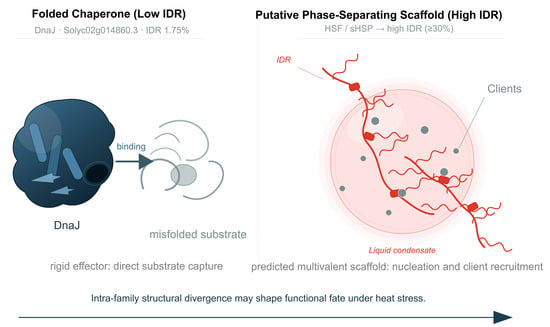
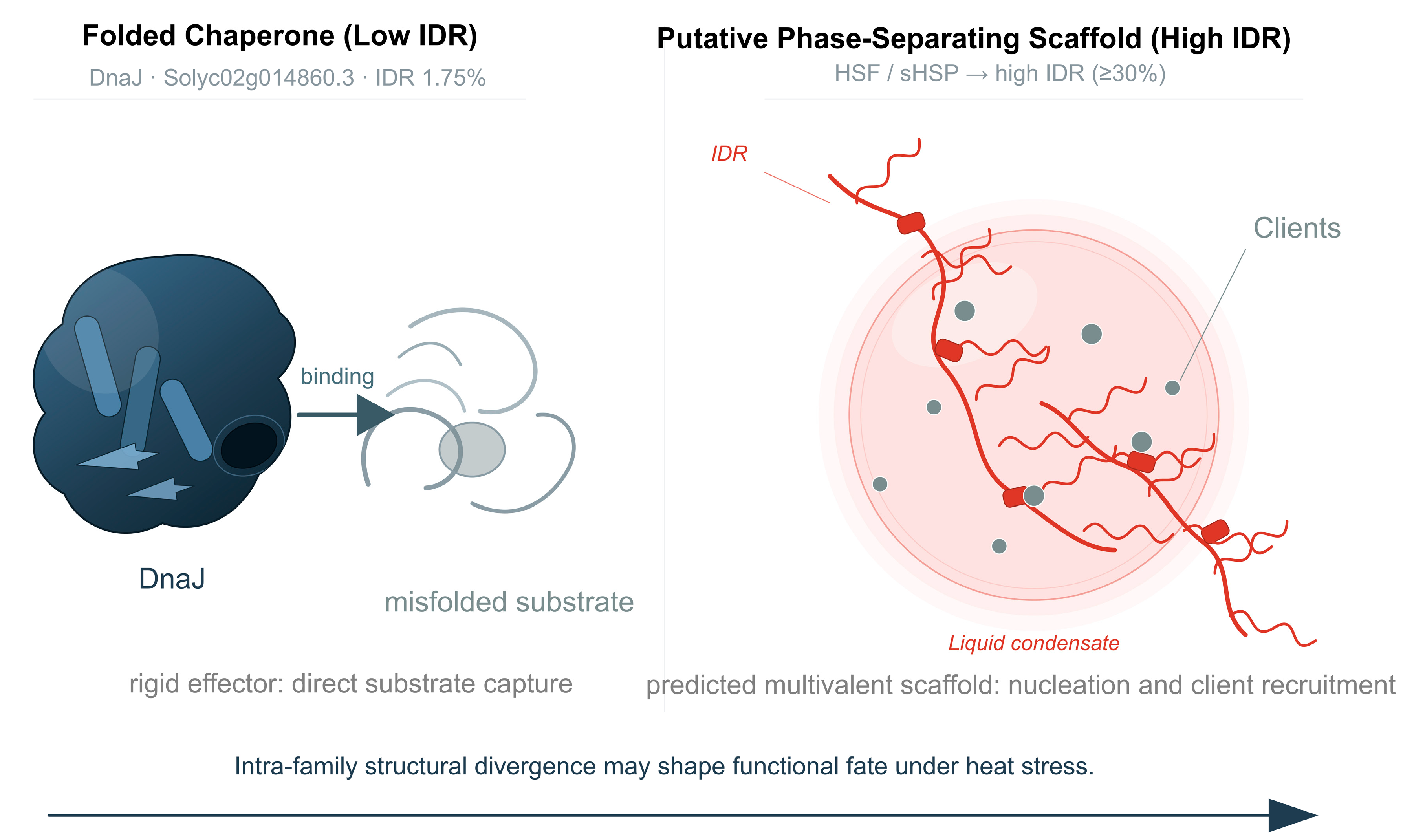
This review synthesizes the current mechanistic understanding of how IDRs and PrLDs mediate temperature sensing and stress granule formation in plants (Figure 1). It then surveys the growing body of evidence demonstrating intra-family structural and functional divergence across multiple plant protein families, ranging from RNA-binding proteins to dehydrins and transcription factors. By integrating these literature-derived principles with a bioinformatic case study of tomato (S. lycopersicum) under heat stress, we illustrate how members of the HSF and sHSP families exhibit variations in structural disorder. This review proposes that this structural divergence is a fundamental mechanism that may determine whether a stress-induced protein functions as a folded molecular chaperone or a phase-separating scaffold.
Figure 1.
A conceptual model of intra-family structural divergence in plant heat stress response. The schematic illustrates two predicted structural strategies within chaperone families. Left panel: Folded proteins with low IDR (e.g., DnaJ) are proposed to function as classical effectors, directly binding to misfolded substrates. Right panel: Highly disordered proteins with high IDR are predicted to act as phase-separating scaffolds (e.g., HSF) or as shell-associated modulators of condensate material properties (e.g., sHSP), forming liquid condensates to recruit client proteins. The pre-existing divergence in IDR content is proposed to underlie the divergent functional fates of family members. These scaffold/client assignments are hypotheses that require experimental validation, and no causal relationship between predicted disorder and phase separation is implied.
2. Thermodynamic Switches and the Dual Nature of Condensates
Recent structural studies have revealed that intrinsically disordered regions (IDRs) and prion-like domains (PrLDs) do not merely act as passive flexible tethers, but function as thermodynamic switches in plant thermosensing [6,10]. Temperature fluctuations alter solvent quality or intramolecular interaction balances, driving reversible conformational shifts within these domains (e.g., from a “locked” to an “open” state). This transition modulates the multivalency of intermolecular interactions, thereby influencing the phase state (diffuse versus condensed) [12,13]. A critical comparative analysis of these systems demonstrates that condensation itself is not inherently activating; its functional output is strongly influenced by the protein’s modular architecture and its upstream signaling context [7,18].
2.1. Condensation as a Repressive Switch
The foundational example of ELF3 illustrates negative regulation. At lower temperatures, ELF3 exists in a dilute state. Elevated temperatures drive its PrLD into LLPS, forming inactive condensates. This structural transition relieves the repression of thermomorphogenic growth [12]. In the ELF3 case, the condensed phase acts as a sequestration compartment, and relief of repression depends on condensate disassembly [11]. This paradigm of condensates acting as repressive hubs extends to other signaling pathways. For instance, in cereals, the accumulation of Green Revolution-associated DELLA proteins enhances salt tolerance by disrupting the biomolecular condensates formed by INDETERMINATE SPIKELET1 (IDS1), thereby modulating transcriptional output under environmental stress [19]. The dynamic remodeling of the plant condensatome is driven by competing protein–protein interactions. This provides a generalizable mechanism for stress adaptation [20].
2.2. Condensation as a Priming Scaffold
In contrast, the temperature-sensing co-regulator TWA1 undergoes a conformational change at elevated temperatures and accumulates in nuclear subdomains through phase separation. It then recruits JAM transcription factors and TPL/TPR corepressors to form a repressor complex, ultimately activating the heat shock response (HSR) [14]. Similarly, the thermosensor FUST1 utilizes PrLD-mediated condensation as an activating event. A “lock-to-open” conformational switch at high temperatures promotes FUST1 to form liquid-like granules. This condensation is autonomous and precedes the assembly of known stress granule (SG) markers, acting as a priming factor for the stress response [13]. This establishes a functional hierarchy where FUST1 acts as a scaffold, creating a localized, high-concentration environment necessary for recruiting downstream client proteins [6,21].
2.3. Boundary Conditions: Sensor Versus Responder
This apparent divergence between repressive and activating condensates highlights a crucial semantic and mechanistic boundary. A recent critical assessment emphasized the necessity of distinguishing between bona fide “sensors” and “temperature-sensitive responders” [22]. Phytochrome B (phyB) illustrates this distinction through two separable processes: the direct, temperature-dependent thermal reversion of its active Pfr form to the inactive Pr form, which represents an IDR-independent thermosensing mechanism, and the subsequent reorganization of phyB photobodies, which reflects a downstream condensation response [15]. Thus, thermosensing can arise through multiple distinct mechanisms, including PrLD/IDR-driven condensation (as proposed for ELF3 and FUST1) and chromophore/photochemistry-driven sensing (as for phyB); possession of an IDR is therefore not a universal requirement for a temperature sensor. Representative plant phase-separating proteins and their proposed scaffold/client assignments are summarized in Table 1.
Table 1.
Published examples of plant phase-separating proteins and their scaffold/client assignments.
3. Intra-Family Structural Divergence: Evolution of the Phase Separation Code
The previous examples of ELF3, TWA1, and FUST1 highlight the role of structural switches in individual proteins. Proteins do not function in isolation; they belong to gene families that have evolved through gene duplication and functional divergence. A critical question emerges: Within a single stress-responsive family, why do some members possess the structural capacity to undergo phase separation while others remain strictly folded? Recent evidence suggests that the phase separation code is not a family-wide invariant, but rather a modular trait subject to intra-family structural divergence [8,9].
3.1. Modularity and Divergence Within the HSF Family
The heat shock transcription factor (HSF) family provides a compelling case for structural modularity. Unlike yeast and mammalian HSFs, which often harbor large IDRs, plant HSFA1 proteins possess shorter PrLDs [16]. Notably, these domains exhibit a division of labor: PrD1 is implicated in binding repressive HSP70 chaperones, whereas PrD2 is specifically required for temperature-dependent phase separation, transcriptional activation, and heat stress memory [16]. The specific amino acid composition within PrD2—particularly the balance of polar uncharged residues (such as glutamine and asparagine) and charged residues—plays a decisive role in determining the saturation concentration required for droplet formation [10,33]. Phosphorylation within these disordered domains further introduces negative charges, disrupting intramolecular electrostatic interactions and acting as a rapid molecular switch to dissolve or remodel the condensates during the recovery phase [34]. During the acute heat shock response, HSF1 forms transcriptional condensates at target gene loci, a process dynamically coupled to the stepwise recruitment of Mediator and RNA Polymerase II [35,36]. Intriguingly, the IDRs of Mediator subunits (such as the tail module triad) are essential for stabilizing these transcriptional condensates. The hierarchical assembly implies that the physical properties of the HSF condensate are not solely dictated by the HSF protein itself, but are influenced by the co-condensation of transcriptional machinery [37]. The chaperone machinery directly modulates this transcriptional memory. A recent study revealed that the HSFA1B-HSP70-3 module regulates transgenerational thermomemory by modulating the stability of SGS3 within specific cellular condensates, highlighting the intricate crosstalk between molecular chaperones and transcriptional condensates in establishing stress memory [38]. The specific sequence variations within the PrLDs of different plant HSF family members (e.g., Class A versus Class B HSFs) and how these variations shape their distinct capacities to form condensates remain largely unexplored.
3.2. The Dual Role of Chaperones: HSP70 and sHSPs as Condensate Modulators
The functional divergence is also evident in the chaperone machinery. HSP70 is traditionally viewed as a folded, ATP-dependent machine. Recent studies position HSP70 as a key “remodeler” of biomolecular condensates. Rather than acting as a structural scaffold, HSP70 functions as an active disaggregase at the periphery of the condensates. Its chaperone cycle, powered by ATP hydrolysis, applies mechanical force to extract misfolded client proteins from the liquid droplets, thereby preventing the transition from a dynamic liquid state to a pathological, solid-like aggregate [4,34,39]. It can actively disperse HSF1 condensates in an ATP-dependent manner, ensuring the reversibility of the stress response [34]. Conversely, small heat shock proteins (sHSPs) function in an ATP-independent manner. Their structural propensity to form condensates is sensitive to their oligomeric state and stoichiometry; changes in subunit composition can shift a protein from forming dynamic liquid droplets to solid aggregates [7,40]. sHSPs predominantly localize to the shell or periphery of stress granules, where they act as molecular “shields” to bind exposed hydrophobic regions of client proteins, thereby maintaining the solubility and fluidity of the condensate core [41,42]. This suggests that members of the sHSP family are not simply passive clients but active modulators of the material properties (fluidity vs. solidity) of stress granules. Nevertheless, their intrinsic disorder enables them to act as peripheral scaffolds within the condensate network.
3.3. Direct Evidence of Family-Level Differentiation in Plants
Beyond the HSF and chaperone families, recent studies in plants have provided direct evidence of intra-family functional specialization in phase separation. The RNA-binding protein families are particularly instructive. Within the glycine-rich RNA-binding protein family, RBGD2 and RBGD4 are both upregulated by heat stress and undergo heat-induced LLPS, but their condensation mechanisms differ in detail: the IDRs of RBGD2 and RBGD4 contain 22 and 25 tyrosine residues, respectively, and domain-mapping experiments demonstrated that the two N-terminal RNA recognition motifs (RRMs) together with the C-terminal low-complexity domain are jointly required for phase separation [23]. In vivo, RBGD2/4 form cytoplasmic granules within 30 min of heat stress onset, and approximately 68% of their associated transcripts are shared between ambient and heat stress conditions, with the heat-specific fraction enriched for stress-responsive mRNAs including HSFA2 and HSP70. These two RNA-binding proteins function redundantly to improve heat resistance in Arabidopsis [23].
The GRP7 system offers a counterpoint to RBGD2/4. GRP7 also contains an N-terminal RRM and a C-terminal glycine-rich IDR sufficient for LLPS, but its condensation is gated by phosphorylation: the receptor-like kinase FERONIA phosphorylates residues within the GRP7 IDR, and this phosphorylation is essential for condensate formation both in vitro and in vivo [24]. Crucially, natural variations in GRP7 affecting the phosphorylated residue alter its capacity to undergo LLPS and correlate with the adaptation of some Arabidopsis accessions to a wider temperature range [24]. This establishes a recurring principle: natural sequence variation at phase-separation-determining residues directly modulates ecological thermal adaptation in plants [12,24].
The m6A reader ECT9–ECT1 pair provides an example of a conditional scaffold–client relationship that may shift with context. ECT9 autonomously forms liquid-like condensates in vitro and in vivo, requiring cooperation between its N-terminal IDR and C-terminal YTH domain, neither of which is sufficient alone. ECT1, by contrast, cannot form condensates alone and requires recruitment by ECT9 to co-condense [25]. Interestingly, salicylic acid (SA) treatment reduces ECT9 condensates in vivo [25]. We interpret this reduction as a dynamic regulatory mechanism, where stress signals might promote the disassembly of these co-condensates to release specific transcripts. The ECT9–ECT1 relationship may therefore represent a conditional scaffold–client interaction rather than an absolute one, in which ECT9 lowers the condensation threshold for ECT1 under non-stress conditions, while stress signals independently promote ECT1 phase separation.
Beyond the RNA-binding proteins, the ALBA family provides another compelling example of functional specialization. ALBA4, ALBA5, and ALBA6 phase separate into stress granules and processing bodies under heat stress, where they directly stabilize HSF mRNAs and facilitate cytoplasmic m6A reading by interacting with YTHDF proteins, conferring thermotolerance [43,44]. The chemical modification of mRNA itself acts as a critical driver for condensate recruitment. It has been demonstrated that NAT10-catalyzed ac4C modification of mRNAs promotes their selective recruitment into stress granules via poly(A)-binding proteins, thereby enhancing mRNA stability and plant heat stress tolerance [45]. These findings underscore that the composition and material properties of biomolecular condensates are heavily influenced by RNA modifications and specific client-recognition modules, extending the structural divergence concept beyond protein–protein interactions.
3.4. Dehydrins and LEA Proteins: Disorder as a Dual-Purpose Stress Adaptation
The LEA (late embryogenesis abundant) and dehydrin families offer a distinct perspective on intra-family structural divergence, because their disordered nature is both a prerequisite for LLPS and the basis of a chaperone activity in the absence of condensate formation. The Arabidopsis dehydrin ERD14 is upregulated during drought stress and undergoes LLPS. Based on a recent conference report [26], this process is governed by a combination of protein concentration, molecular crowding, pH, ionic strength, and RNA interactions. ERD14 condensates have been reported to co-localize with stress granules under oxidative stress [26], suggesting a potential link to autophagy. Not all LEA/dehydrin family members rely on condensation for function. The Arabidopsis LEA protein COR15A, a group 3 LEA, has been structurally characterized as an intrinsically disordered protein whose conformational repertoire responds to solution osmolarity, and it functions in membrane stabilization without a demonstrated requirement for LLPS under the conditions tested [27]. ERD10 and ERD14 themselves possess chaperone activity that can be dissected from their condensation behavior. This indicates that disorder can serve both as a driver of phase separation and as a direct chaperone mechanism depending on the family member and context [46]. This duality is precisely what the scaffold-versus-client framework must accommodate: within the same LEA/dehydrin family, some members may operate primarily as phase-separating scaffolds, while others may function as disordered chaperones that suppress aggregation without forming a distinct condensate phase.
While these studies offer compelling evidence from model species like Arabidopsis, a comprehensive evaluation of whether such intra-family structural divergence acts as a general strategy for stress adaptation in major crops remains lacking. This gap motivates our subsequent case study on the core heat-responsive chaperone families in tomato.
4. Case Study: Intra-Family Structural Divergence in Tomato Heat-Responsive Chaperones
4.1. Case Study Overview
To investigate whether the intra-family structural divergence observed in model species is a broader phenomenon in crops, we analyzed public transcriptomic data from tomato (Solanum lycopersicum) during the heat-sensitive tetrad stage [47]. Through HMMER (v3.3.2) profiling using --cut_ga thresholds, we identified 40 heat-responsive DEGs and 199 genome-wide family members across five core heat-stress-associated protein families (HSF transcription factors; sHSP and HSP70 chaperones; DnaJ and BAG co-chaperones). The full bioinformatic pipeline (data retrieval, differential expression, cultivar-specific analyses, family identification, and structural prediction) is documented in Supplementary Methods S1; detailed information on the 199 genome-wide family members is provided in Table S1, and cultivar-specific fold changes are provided in Table S3.
4.2. A Structural Divergence: Folded Versus Disordered
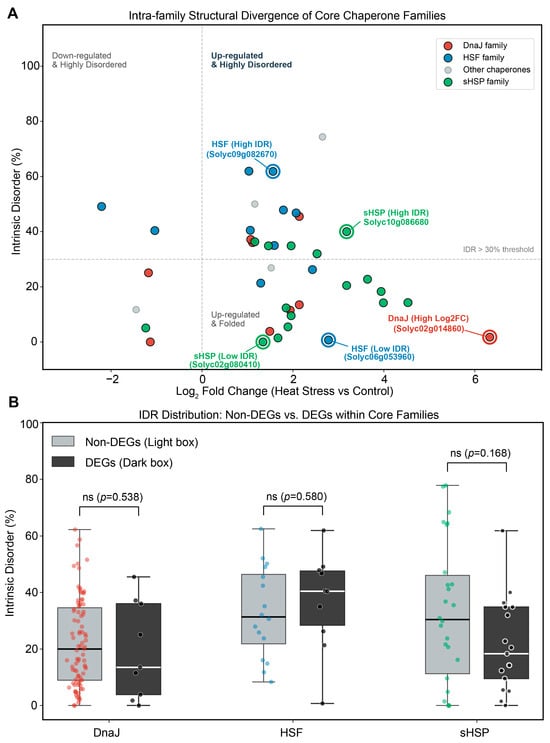
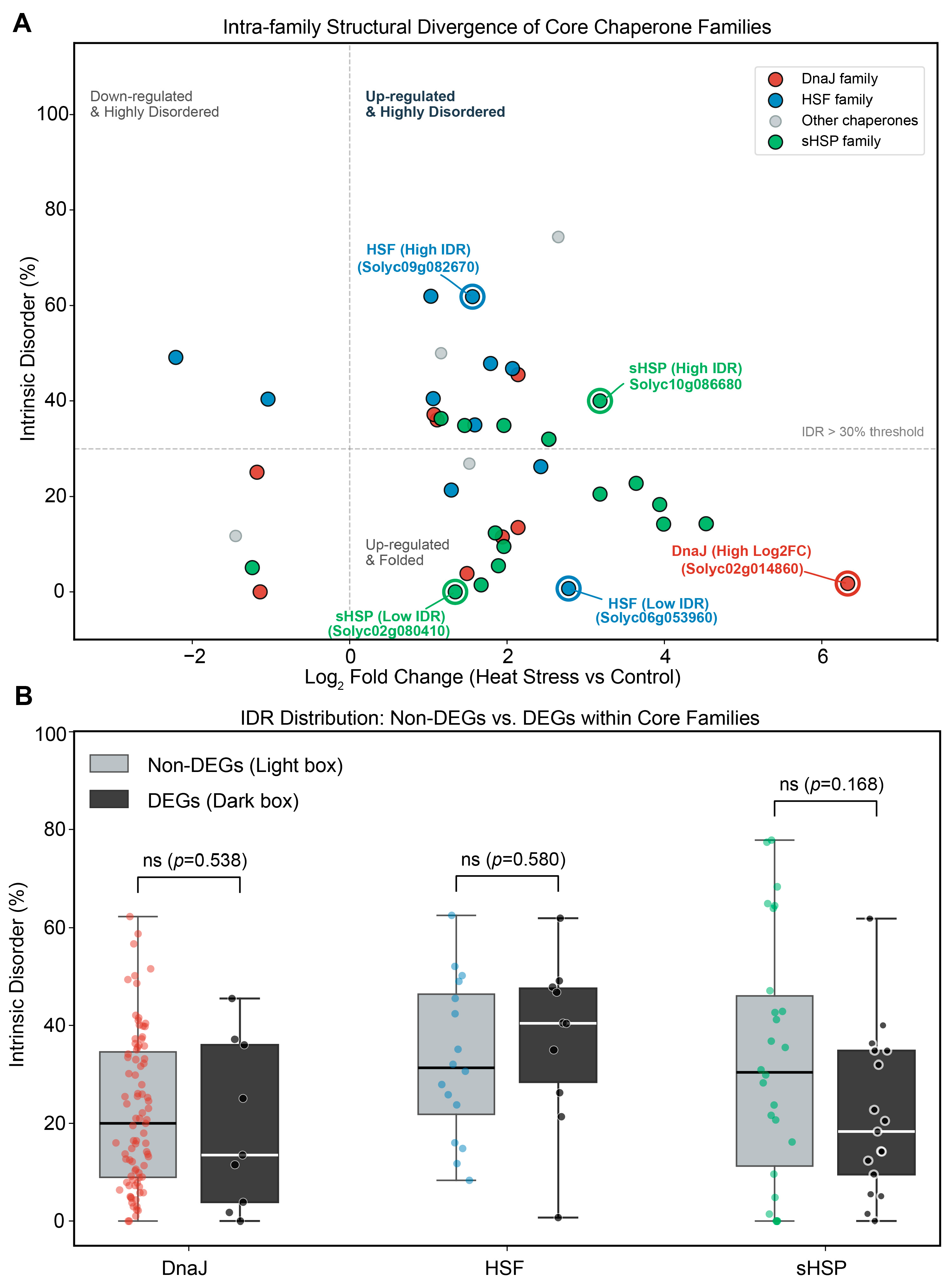
Our integrative analysis suggested an intra-family structural divergence among the 40 heat-responsive candidates (Figure 2A). Within the DnaJ family, Solyc02g014860 exhibited the highest transcriptional induction (log2FC = 6.33) but possessed a folded structure (IDR = 1.75%), consistent with its canonical role as a rigid effector. In contrast, another DnaJ family member (Solyc09g092260) showed extensive predicted intrinsic disorder (IDR = 45.5%). Similarly, within the HSF and sHSP families, members ranged from nearly completely folded (<5% IDR) to highly disordered (>60% IDR).
Figure 2.
Intra-family structural divergence in core chaperone families. (A) Scatter plot showing the relationship between transcriptional fold change (log2FC) and intrinsic disorder (IDR%) for the 40 heat-responsive DEGs. Colored dots represent different chaperone families (DnaJ in red, HSF in blue, sHSP in green); the dashed line marks the 30% IDR threshold used to operationally define disorder-rich proteins. Hollow circles highlight representative members of each family, illustrating the coexistence of folded effectors and disordered scaffolds (gene identifiers are indicated). (B) Boxplots comparing IDR% between non-DEGs (light boxes) and heat-responsive DEGs (dark boxes) within each of the three major families (DnaJ, HSF, sHSP). The overlaid circles show individual genes: gray circles indicate non-DEG genes and black circles indicate heat-responsive DEG genes. Mann–Whitney U tests revealed no significant difference between groups in any family (all p > 0.05), and the 95% confidence intervals for the effect sizes (Cliff’s delta) included zero in every family. HSP70 and BAG are provided in Table S1 but are omitted from the boxplot because they contain too few heat-responsive DEGs for a meaningful comparison.
To rule out the possibility of stress-induced selection bias, we compared the IDR distribution between heat-responsive DEGs and non-DEG members of the same family that were eligible for differential-expression testing, so that the two groups do not overlap (Figure 2B). In DnaJ, the DEGs (n = 9) and non-DEGs (n = 87) showed median IDR values of 13.5% and 20.0%, respectively (Mann–Whitney U test, p = 0.53; Cliff’s delta = −0.13, 95% CI −0.57 to 0.33). For HSF, these values were 40.4% versus 31.4% (n = 10 versus 16; p = 0.56; delta = 0.14, 95% CI −0.31 to 0.60), and for sHSP, 18.3% versus 30.4% (n = 17 versus 26; p = 0.16; delta = −0.25, 95% CI −0.58 to 0.10). None of these comparisons was significant (all p > 0.05), and every confidence interval included zero, indicating that the DEGs were not preferentially drawn from disordered members.
The coexistence of these two structural strategies in the same stress condition is consistent with the literature-derived framework developed above. Folded DnaJ proteins are known to function processively at the periphery of condensates or on misfolded clients, and their extensive induction may reflect a stoichiometric requirement for disaggregase activity that precedes or operates alongside condensate maturation. HSP70 chaperones have been shown to modulate condensate fluidity and reversibility in plant systems [4,29]. The strong upregulation of high-IDR HSF and sHSP members is likewise consistent with the established roles of these families in forming transcriptional condensates and stress granules [16,41,42]. These parallels do not validate the tomato predictions experimentally. However, they provide a mechanistically grounded rationale for prioritizing these candidates in future validation.
4.3. Implications for Functional Fate: Scaffold Versus Client
While these are predictive bioinformatic observations requiring experimental validation, the structural divergence is consistent with the functional framework discussed in Section 3. The folded DnaJ members are predicted to function as classical effectors, relying on rigid structural domains to interact directly with misfolded proteins. Conversely, the disordered upregulated HSF and sHSP members are hypothesized to act as candidate scaffolds for phase separation. Driven by their extensive IDRs, these proteins may form the core of transcriptional condensates or stress granules to rapidly compartmentalize stress signals. The simultaneous upregulation of highly folded effectors and disordered, putatively scaffolding members suggests a coordinated, two-pronged defense strategy, although direct experimental support is still required.
The structural divergence is not merely between different protein families, but is pronounced within the responsive HSF and sHSP members themselves. While some upregulated family members rely on massive IDRs for their predicted multivalency, others may utilize folded domains or distinct sequence motifs. This case study provides a transcriptomic and structural snapshot suggesting that the functional fate of heat-responsive proteins in tomato may be associated with their intra-family structural divergence. However, moving from these predictions to functional proof remains a significant challenge for the field.
5. Challenges and Perspectives: From Sequence Prediction to Functional Validation
The bioinformatic case study on tomato chaperones illustrates the potential of intra-family structural divergence, but it also highlights the substantial gap between in silico prediction and biological reality. Bridging this gap requires a critical evaluation of current predictive limitations and a coordinated experimental roadmap.
5.1. Limitations of Current Predictive Models in Plants
The bioinformatic case study presented here is not intended to establish causality, but rather to serve as a conceptual framework and a preliminary screening to guide future experimental validations. A critical constraint in our analysis is the inherent bias of sequence-based prediction tools. For instance, although several upregulated tomato chaperones (e.g., high-IDR HSF and sHSP members) showed high intrinsic disorder (>30% IDR), their PLAAC (https://plaac.wi.mit.edu/, accessed on 15 November 2026) scores were near zero. This is because PLAAC is specifically trained to detect canonical yeast-like prion domains heavily enriched in glutamine (Q) and asparagine (N) [48]. Plant phase-separating proteins frequently utilize non-canonical low-complexity domains (e.g., enriched in aromatic or charged residues) to drive condensation [23,49]. While PLAAC serves as a stringent filter for canonical PrLDs, relying exclusively on it may severely underestimate the phase separation potential of plant proteins. Consequently, IUPred3 (https://iupred3.elte.hu/, accessed on 15 November 2026) was used here as a more inclusive metric to capture the overall structural flexibility of these chaperones.
The “disorder-to-phase separation” inference itself is an oversimplification. The prevailing “sticker-and-spacer” model of LLPS posits that phase separation is driven not merely by structural disorder (spacers), but requires specific multivalent interaction modules (stickers), such as aromatic or charged residues, to establish a dynamic network [33,50]. A protein may possess 100% IDR (like some LEA proteins) but fail to undergo LLPS if it lacks multivalent sticker interactions. Therefore, future bioinformatic screens must integrate predictions of both structural disorder (e.g., IUPred3) and multivalent interaction motifs (e.g., pi-pi stacking propensity, cation-pi interactions) to accurately prioritize candidates for wet-lab validation. Transient overexpression artifacts and the lack of physiological concentration data mean that in silico predictions can only establish “potential,” not causality [51].
5.2. A Roadmap for Experimental Validation
To transition from predicted potential to verified mechanism, researchers must employ advanced methodologies to monitor the dynamic and reversible nature of these assemblies. Beyond traditional fluorescence microscopy, the application of quantitative live-cell imaging and biomolecular condensate isolation techniques is crucial. Recent frameworks emphasize that sensing and filtering environmental fluctuations via condensates require high spatiotemporal resolution to distinguish between functional liquid-like droplets and pathological solid aggregates [52]. The plant community has also established an orthogonal validation pipeline [51,53]. For the tomato candidates proposed in this review, we suggest a step-wise validation strategy:
- Cellular condensation: Tag high-IDR candidates (e.g., HSF or sHSP members) at, or close to, endogenous expression levels and examine their assembly into puncta under heat stress. Use compartment-specific markers to distinguish nuclear HSF assemblies from cytoplasmic stress granules (e.g., UBP1b), thereby avoiding overexpression artifacts.
- Material property assessment: Use fluorescence recovery after photobleaching (FRAP) to measure molecular mobility and exchange within the puncta. Because FRAP reports on mobility/exchange dynamics rather than on LLPS itself, rapid recovery alone is not sufficient to establish a liquid-like condensate; FRAP should be interpreted together with the reconstitution and reversibility assays described below.
- In vitro reconstitution: Purify the recombinant proteins and quantitatively assess droplet formation across a range of protein concentrations and temperatures, determining the saturation concentration (Csat), testing reversibility upon cooling, and including controls for aggregation. Domain-truncation assays (e.g., removing the IDR) can test whether the disordered region contributes to condensation.
- Genetic and phenotypic validation: To establish causality, complement a loss-of-function allele with the wild-type allele and with a variant designed to impair condensation, including controls for protein abundance, subcellular localization, and the protein’s established activity. Connect these molecular readouts to reproductive outcomes by measuring pollen germination, fruit set, and seed number under control and heat treatments, and distinguish acute heat shock (with recovery) from the chronic heat regime used in the transcriptomic case study.
5.3. Future Perspectives: Integrating Structural Biology and Crop Breeding
Understanding the phase separation code within protein families offers a new dimension for molecular breeding. Instead of simply overexpressing a stress-responsive transcription factor, breeders could engineer the IDR or PrLD of a key scaffold protein to optimize its condensation dynamics [9]. This requires a deeper integration of structural biology, quantitative live-cell imaging, and field-based phenomics. The “functional fate” map of chaperone families is only beginning to emerge; deciphering this structural code will be essential for engineering climate-resilient crops.
6. Conclusions
In this review, we propose that the capacity for phase separation is not a uniform family-wide trait. Experimental studies in model plants (e.g., ELF3, FUST1, TWA1) have shown that IDR length and composition can drive divergent functional fates. However, extending this paradigm to crop species remains a major challenge. Our tomato transcriptomic case study provides preliminary, purely computational evidence that this structural divergence is detectable in crops. While our descriptive analysis did not reveal a significant selection bias between genome-wide and heat-responsive members, this comparison is limited by the small number of heat-responsive members per family. Nevertheless, the observed structural divergence hints at a pre-existing structural pool within these families. Because predicted disorder alone cannot establish LLPS, scaffold activity, or a contribution to thermotolerance, deciphering this “phase separation code” will require orthogonal experimental validation (e.g., FRAP, in vitro reconstitution) before these structural insights can be translated into climate-resilient crops.
Supplementary Materials
The following supporting information can be downloaded at: https://www.mdpi.com/article/10.3390/biom16121729/s1, Methods S1, detailed bioinformatic methods including data retrieval, differential expression (pooled and cultivar-specific models), protein family identification, and structural prediction; Table S1, IDR and PrLD profiles and differential-expression status of the 199 genome-wide tomato chaperone family members; Table S2, the gene-level count matrix (featureCounts) for the tetrad-stage samples; Table S3, cultivar-specific and pooled heat-versus-control log2 fold changes and adjusted p-values for the 40 heat-responsive candidates; and Supplementary Data, the SRA run accession list and all analysis scripts (preprocessing, DESeq2, cultivar-specific analysis, HMMER, disorder/PrLD prediction, and figure generation).
Author Contributions
J.L. wrote the main manuscript text, prepared all the figures, and collected the literature. C.H. and L.X. downloaded the public data and performed the bioinformatic analysis. Y.C. and J.L. collected and organized the literature. X.Z. designed the study, supervised the bioinformatics analysis, and revised the manuscript. All authors have read and agreed to the published version of the manuscript.
Funding
This work was supported by grants from the Yunnan Fundamental Research Projects (grant number 202601CI070008 and 202601CI070009) and the Special Basic Cooperative Research Innovation Programs of Qujing Science and Technology Bureau & Qujing Normal University (grant numbers KJLH2024YB08 and KJLH2025YB05).
Institutional Review Board Statement
Not applicable.
Informed Consent Statement
Not applicable.
Data Availability Statement
The public RNA-seq data from tomato floral buds re-analyzed in this study are available from the NCBI Sequence Read Archive (SRA) under accession number PRJNA1032617. The genome and protein sequences (ITAG4.0) were obtained from the Sol Genomics Network (SGN). All detailed structural prediction data for the 199 family members are provided in Supplementary Table S1. The custom Python (v3.13.13) scripts used for data processing and visualization in this study are available from the corresponding author upon reasonable request.
Acknowledgments
During the preparation of this manuscript, the authors used DeepSeek (web version) for language polishing, grammatical correction and assistance in writing the analysis scripts. The authors have reviewed and edited the output and take full responsibility for the content of this publication.
Conflicts of Interest
The authors declare no conflicts of interest.
References
- Mittler, R. Abiotic stress, the field environment and stress combination. Trends Plant Sci. 2006, 11, 15–19. [Google Scholar] [CrossRef] [Scilit]
- Peng, J.; Yu, Y.; Fang, X. Stress sensing and response through biomolecular condensates in plants. Plant Commun. 2025, 6, 101225. [Google Scholar] [CrossRef] [Scilit]
- Finka, A.; Mattoo, R.U.; Goloubinoff, P. Meta-analysis of heat- and chemically upregulated chaperone genes in plant and human cells. Cell Stress Chaperones 2011, 16, 15–31. [Google Scholar] [CrossRef] [Scilit]
- Vélez, V.L.; Alquraish, F.; Tarbiyyah, I.; Rafique, F.; Mao, D.; Chodasiewicz, M. Landscape of biomolecular condensates in heat stress responses. Front. Plant Sci. 2022, 13, 1032045. [Google Scholar] [CrossRef] [Scilit]
- Mogk, A.; Bukau, B.; Kampinga, H.H. Cellular Handling of Protein Aggregates by Disaggregation Machines. Mol. Cell 2018, 69, 214–226. [Google Scholar] [CrossRef] [Scilit]
- Banani, S.F.; Lee, H.O.; Hyman, A.A.; Rosen, M.K. Biomolecular condensates: Organizers of cellular biochemistry. Nat. Rev. Mol. Cell Biol. 2017, 18, 285–298. [Google Scholar] [CrossRef] [Scilit]
- Alberti, S.; Hyman, A.A. Biomolecular condensates at the nexus of cellular stress, protein aggregation disease and ageing. Nat. Rev. Mol. Cell Biol. 2021, 22, 196–213. [Google Scholar] [CrossRef] [Scilit]
- Maruri-López, I.; E Hernández-Sánchez, I.; Muraleedharan, M.; Chodasiewicz, M. Biomolecular condensates in plant stress and development: Recent advances and emerging concepts. J. Exp. Bot. 2026, 77, 5430–5446. [Google Scholar] [CrossRef] [Scilit]
- Emenecker, R.J.; Holehouse, A.S.; Strader, L.C. Biological Phase Separation and Biomolecular Condensates in Plants. Annu. Rev. Plant Biol. 2021, 72, 17–46. [Google Scholar] [CrossRef] [Scilit]
- Martin, E.W.; Mittag, T. Relationship of Sequence and Phase Separation in Protein Low-Complexity Regions. Biochemistry 2018, 57, 2478–2487. [Google Scholar] [CrossRef] [Scilit]
- Fonin, A.V.; Antifeeva, I.A.; Kuznetsova, I.M.; Turoverov, K.K.; Zaslavsky, B.Y.; Kulkarni, P.; Uversky, V.N. Biological soft matter: Intrinsically disordered proteins in liquid-liquid phase separation and biomolecular condensates. Essays Biochem. 2022, 66, 831–847. [Google Scholar] [CrossRef] [Scilit]
- Jung, J.-H.; Barbosa, A.D.; Hutin, S.; Kumita, J.R.; Gao, M.; Derwort, D.; Silva, C.S.; Lai, X.; Pierre, E.; Geng, F.; et al. A prion-like domain in ELF3 functions as a thermosensor in Arabidopsis. Nature 2020, 585, 256–260. [Google Scholar] [CrossRef] [Scilit]
- Geng, P.; Li, C.; Quan, X.; Peng, J.; Yao, Z.; Wang, Y.; Yang, M.; Wang, Y.; Jin, Y.; Xiong, Y.; et al. A thermosensor FUST1 primes heat-induced stress granule formation via biomolecular condensation in Arabidopsis. Cell Res. 2025, 35, 483–496. [Google Scholar] [CrossRef] [Scilit]
- Bohn, L.; Huang, J.; Weidig, S.; Yang, Z.; Heidersberger, C.; Genty, B.; Falter-Braun, P.; Christmann, A.; Grill, E. The temperature sensor TWA1 is required for thermotolerance in Arabidopsis. Nature 2024, 629, 1126–1132. [Google Scholar] [CrossRef] [Scilit]
- Chen, D.; Lyu, M.; Kou, X.; Li, J.; Yang, Z.; Gao, L.; Li, Y.; Fan, L.-M.; Shi, H.; Zhong, S. Integration of light and temperature sensing by liquid-liquid phase separation of phytochrome B. Mol. Cell 2022, 82, 3015–3029.e3016. [Google Scholar] [CrossRef] [Scilit]
- Peng, M.; Jaeger, K.E.; Lu, Y.; Fan, Z.; Zeng, W.; Sampathkumar, A.; Wigge, P.A. Activation and memory of the heat shock response is mediated by prion-like domains of sensory HSFs in Arabidopsis. Mol. Plant 2025, 18, 457–467. [Google Scholar] [CrossRef] [Scilit]
- Wu, P.; Li, Y. Prion-like Proteins in Plants: Key Regulators of Development and Environmental Adaptation via Phase Separation. Plants 2024, 13, 2666. [Google Scholar] [CrossRef] [Scilit]
- Lyon, A.S.; Peeples, W.B.; Rosen, M.K. A framework for understanding the functions of biomolecular condensates across scales. Nat. Rev. Mol. Cell Biol. 2021, 22, 215–235. [Google Scholar] [CrossRef] [Scilit]
- Cheng, X.; Wang, H.; Lyu, M.; Gao, M.; Zhang, G.; Gong, Y.; Chen, Y.; Sun, X.; Ma, X.; Qiao, W.; et al. Green Revolution-associated DELLA accumulation enhances salt tolerance in cereals by disrupting INDETERMINATE SPIKELET1 biomolecular condensates. Mol. Plant 2026, 19, 1059–1079. [Google Scholar] [CrossRef] [Scilit]
- Chen, Y.; Kou, B.; Fan, D.; Zhang, J.; Wang, Z.; He, Y.; Zhang, K.; Fernie, A.R.; Zhou, M. Environmental stress drives dynamic remodeling of the plant condensatome. Biotechnol. Adv. 2026, 94, 109051. [Google Scholar] [CrossRef] [Scilit]
- Powers, S.K.; Holehouse, A.S.; Korasick, D.A.; Schreiber, K.H.; Clark, N.M.; Jing, H.; Emenecker, R.; Han, S.; Tycksen, E.; Hwang, I.; et al. Nucleo-cytoplasmic Partitioning of ARF Proteins Controls Auxin Responses in Arabidopsis thaliana. Mol. Cell 2019, 76, 177–190.e175. [Google Scholar] [CrossRef] [Scilit]
- Yadav, A.S.; Sureshkumar, S.; Sinha, A.K.; Balasubramanian, S. Dispersed components drive temperature sensing and response in plants. Science 2025, 388, 1161–1166. [Google Scholar] [CrossRef] [Scilit]
- Zhu, S.; Gu, J.; Yao, J.; Li, Y.; Zhang, Z.; Xia, W.; Wang, Z.; Gui, X.; Li, L.; Li, D.; et al. Liquid-liquid phase separation of RBGD2/4 is required for heat stress resistance in Arabidopsis. Dev. Cell 2022, 57, 583–597.e586. [Google Scholar] [CrossRef] [Scilit]
- Xu, F.; Wang, L.; Li, Y.; Shi, J.; Staiger, D.; Yu, F. Phase separation of GRP7 facilitated by FERONIA-mediated phosphorylation inhibits mRNA translation to modulate plant temperature resilience. Mol. Plant 2024, 17, 460–477. [Google Scholar] [CrossRef] [Scilit]
- Wang, H.; Niu, R.; Zhou, Y.; Tang, Z.; Xu, G.; Zhou, G. ECT9 condensates with ECT1 and regulates plant immunity. Front. Plant Sci. 2023, 14, 1140840. [Google Scholar] [CrossRef] [Scilit]
- O’NEill, H.M.; Hicks, A.C.; Zhang, Q.; Leite, W.C. Molecular mechanism of ERD14 liquid-liquid phase separation under stress-mimicking conditions. Biophys. J. 2026, 125, 167a. [Google Scholar] [CrossRef] [Scilit]
- Thalhammer, A.; Bryant, G.; Sulpice, R.; Hincha, D.K. Disordered cold regulated15 proteins protect chloroplast membranes during freezing through binding and folding, but do not stabilize chloroplast enzymes in vivo. Plant Physiol. 2014, 166, 190–201. [Google Scholar] [CrossRef] [Scilit]
- Dorone, Y.; Boeynaems, S.; Flores, E.; Jin, B.; Hateley, S.; Bossi, F.; Lazarus, E.; Pennington, J.G.; Michiels, E.; De Decker, M.; et al. A prion-like protein regulator of seed germination undergoes hydration-dependent phase separation. Cell 2021, 184, 4284–4298.e4227. [Google Scholar] [CrossRef] [Scilit]
- Manishankar, P.; Fernandez, A.; Rohr, L.; Yigit, Y.I.; Reuter, L.; Schmidt, T.; Droste-Borel, I.; Keicher, J.; Bock, A.; Oecking, C. Molecular determinants underlying NPH3 condensation and function in phototropism: An integrative approach. Plant Cell 2026, 38, koag028. [Google Scholar] [CrossRef] [Scilit]
- Wang, J.; Pei, G.; Wang, Y.; Wu, D.; Liu, X.; Li, G.; He, J.; Zhang, X.; Shan, X.; Li, P.; et al. Phase separation of the nuclear pore complex facilitates selective nuclear transport to regulate plant defense against pathogen and pest invasion. Mol. Plant 2023, 16, 1016–1030. [Google Scholar] [CrossRef] [Scilit]
- Wang, Y.; Li, S.; Mokbel, M.; May, A.I.; Liang, Z.; Zeng, Y.; Wang, W.; Zhang, H.; Yu, F.; Sporbeck, K.; et al. Biomolecular condensates mediate bending and scission of endosome membranes. Nature 2024, 634, 1204–1210. [Google Scholar] [CrossRef] [Scilit]
- Huang, X.; Chen, S.; Li, W.; Tang, L.; Zhang, Y.; Yang, N.; Zou, Y.; Zhai, X.; Xiao, N.; Liu, W.; et al. ROS regulated reversible protein phase separation synchronizes plant flowering. Nat. Chem. Biol. 2021, 17, 549–557. [Google Scholar] [CrossRef] [Scilit]
- Wang, J.; Choi, J.-M.; Holehouse, A.S.; Lee, H.O.; Zhang, X.; Jahnel, M.; Maharana, S.; Lemaitre, R.; Pozniakovsky, A.; Drechsel, D.; et al. A Molecular Grammar Governing the Driving Forces for Phase Separation of Prion-like RNA Binding Proteins. Cell 2018, 174, 688–699.e616. [Google Scholar] [CrossRef] [Scilit]
- Zhang, H.; Shao, S.; Zeng, Y.; Wang, X.; Qin, Y.; Ren, Q.; Xiang, S.; Wang, Y.; Xiao, J.; Sun, Y. Reversible phase separation of HSF1 is required for an acute transcriptional response during heat shock. Nat. Cell Biol. 2022, 24, 340–352. [Google Scholar] [CrossRef] [Scilit]
- Boija, A.; Klein, I.A.; Sabari, B.R.; Dall’AGnese, A.; Coffey, E.L.; Zamudio, A.V.; Li, C.H.; Shrinivas, K.; Manteiga, J.C.; Hannett, N.M.; et al. Transcription Factors Activate Genes through the Phase-Separation Capacity of Their Activation Domains. Cell 2018, 175, 1842–1855.e1816. [Google Scholar] [CrossRef] [Scilit]
- Chowdhary, S.; Paracha, S.; Dyer, L.; Pincus, D. Emergent 3D genome reorganization and graded gene control from the stepwise assembly of transcriptional condensates. Cell Rep. 2026, 45, 117888. [Google Scholar] [CrossRef] [Scilit]
- Sabari, B.R.; Dall’Agnese, A.; Boija, A.; Klein, I.A.; Coffey, E.L.; Shrinivas, K.; Abraham, B.J.; Hannett, N.M.; Zamudio, A.V.; Manteiga, J.C.; et al. Coactivator condensation at super-enhancers links phase separation and gene control. Science 2018, 361, 6400. [Google Scholar] [CrossRef] [Scilit]
- Wen, X.; Du, M.; Li, T.; Cheng, F.; Li, S.; Zhu, Z.; Liu, W.; Gu, X.; Feng, L.; Geng, Y.; et al. The HSFA1B-HSP70-3 module regulates transgenerational thermomemory by modulating SGS3 stability in Arabidopsis. Plant Physiol. 2025, 199, kiaf456. [Google Scholar] [CrossRef] [Scilit]
- Mateju, D.; Franzmann, T.M.; Patel, A.; Kopach, A.; Boczek, E.E.; Maharana, S.; Lee, H.O.; Carra, S.; Hyman, A.A.; Alberti, S. An aberrant phase transition of stress granules triggered by misfolded protein and prevented by chaperone function. EMBO J. 2017, 36, 1669–1687. [Google Scholar] [CrossRef] [Scilit]
- Vos, M.J.; Hageman, J.; Carra, S.; Kampinga, H.H. Structural and functional diversities between members of the human HSPB, HSPH, HSPA, and DNAJ chaperone families. Biochemistry 2008, 47, 7001–7011. [Google Scholar] [CrossRef] [Scilit]
- Mogk, A.; Ruger-Herreros, C.; Bukau, B. Cellular Functions and Mechanisms of Action of Small Heat Shock Proteins. Annu. Rev. Microbiol. 2019, 73, 89–110. [Google Scholar] [CrossRef] [Scilit]
- Wallace, E.W.; Kear-Scott, J.L.; Pilipenko, E.V.; Schwartz, M.H.; Laskowski, P.R.; Rojek, A.E.; Katanski, C.D.; Riback, J.A.; Dion, M.F.; Franks, A.M.; et al. Reversible, Specific, Active Aggregates of Endogenous Proteins Assemble upon Heat Stress. Cell 2015, 162, 1286–1298. [Google Scholar] [CrossRef] [Scilit]
- Reichel, M.; Tankmar, M.D.; Rennie, S.; Arribas-Hernández, L.; Lewinski, M.; Köster, T.; Wang, N.; Millar, A.A.; Staiger, D.; Brodersen, P. ALBA proteins facilitate cytoplasmic YTHDF-mediated reading of m6A in Arabidopsis. EMBO J. 2024, 43, 6626–6655. [Google Scholar] [CrossRef] [Scilit]
- Tong, J.; Ren, Z.; Sun, L.; Zhou, S.; Yuan, W.; Hui, Y.; Ci, D.; Wang, W.; Fan, L.-M.; Wu, Z.; et al. ALBA proteins confer thermotolerance through stabilizing HSF messenger RNAs in cytoplasmic granules. Nat. Plants 2022, 8, 778–791. [Google Scholar] [CrossRef] [Scilit]
- Zhang, W.; Bu, Y.; Jiao, Y.; Wang, Y.; Shen, L.; Li, Y.; Lv, B.; Ho, T.-C.; Liou, Y.-C.; Chen, C.-K.; et al. Selective recruitment of NAT10-catalyzed ac4C-modified mRNAs into stress granules by poly(A)-binding protein promotes mRNA stability and plant heat-stress tolerance. Mol. Plant 2026, 19, 2122–2139. [Google Scholar] [CrossRef] [Scilit]
- Kovacs, D.; Kalmár, É.; Torok, Z.; Tompa, P. Chaperone activity of ERD10 and ERD14, two disordered stress-related plant proteins. Plant Physiol. 2008, 147, 381–390. [Google Scholar] [CrossRef] [Scilit]
- Bollier, N.; Micol-Ponce, R.; Dakdaki, A.; Maza, E.; Zouine, M.; Djari, A.; Bouzayen, M.; Chevalier, C.; Delmas, F.; Gonzalez, N.; et al. Various tomato cultivars display contrasting morphological and molecular responses to a chronic heat stress. Front. Plant Sci. 2023, 14, 1278608. [Google Scholar] [CrossRef] [Scilit]
- Lancaster, A.K.; Nutter-Upham, A.; Lindquist, S.; King, O.D. PLAAC: A web and command-line application to identify proteins with prion-like amino acid composition. Bioinformatics 2014, 30, 2501–2502. [Google Scholar] [CrossRef] [Scilit]
- Rodríguez-García, S.; Castillo, M.-C.; León, J. The intrinsically disordered VQ27 protein links VQ protein interaction networks to stress granule condensation. Plant Stress 2026, 22, 101469. [Google Scholar] [CrossRef] [Scilit]
- Choi, J.M.; Holehouse, A.S.; Pappu, R.V. Physical Principles Underlying the Complex Biology of Intracellular Phase Transitions. Annu. Rev. Biophys. 2020, 49, 107–133. [Google Scholar] [CrossRef] [Scilit]
- Alberti, S.; Gladfelter, A.; Mittag, T. Considerations and Challenges in Studying Liquid-Liquid Phase Separation and Biomolecular Condensates. Cell 2019, 176, 419–434. [Google Scholar] [CrossRef] [Scilit]
- Moschou, P.N.; Staiger, D. Sensing and Filtering Environmental Fluctuations: The Case of Biomolecular Condensates in Plants. Adv. Sci. 2026, 13, e75297. [Google Scholar] [CrossRef] [Scilit]
- Peng, J.; Agudo-Canalejo, J.; Chodasiewicz, M.; Van Damme, D.; Daskalakis, V.; González-Fuente, M.; Gao, R.; Filippidi, E.; Guo, H.; He, S.; et al. A practical guide to investigating biomolecular condensates: A comment from the plant community. Sci. China Life Sci. 2026, 69, 3786–3820. [Google Scholar] [CrossRef] [Scilit]

Disclaimer/Publisher’s Note: The statements, opinions and data contained in all publications are solely those of the individual author(s) and contributor(s) and not of MDPI and/or the editor(s). MDPI and/or the editor(s) disclaim responsibility for any injury to people or property resulting from any ideas, methods, instructions or products referred to in the content. |
© 2026 by the authors. Licensee MDPI, Basel, Switzerland. This article is an open access article distributed under the terms and conditions of the Creative Commons Attribution (CC BY) license.