


Abstract
Cryopolymerization creates interconnected macroporous networks by polymerizing a concentrated unfrozen phase while solvent crystals act as a transient porogen. Water is effective because ice crystallization templates the pores and concentrates reactive species, but this mechanism also imposes a solubility filter on monomer selection. This limitation matters for natural-product-derived materials: phenolics, terpenes, lignin-derived aromatics, and other bio-based scaffolds can be functionalized with polymerizable groups, yet many derivatives remain poorly soluble in water. Extending cryopolymerization beyond pure water is therefore a materials-design challenge, not simple solvent substitution. Candidate media may be neat solvents or mixtures, including aqueous–organic blends; each must dissolve the formulation and generate a crystalline phase at a temperature and timescale compatible with polymerization. A water/DMSO study shows that composition can shift a formulation from cryogelation to nonporous or phase-separated networks. We define this coupled solvation–crystallization constraint as the solvent–porogen bottleneck and outline a screening workflow based on phase behavior, polymerization kinetics, pore architecture, and solvent removal. Mapping this window could broaden the range of natural-product-derived monomers accessible to cryogels without assuming that one solvent will suit every chemistry or application.
1. Introduction
Cryogels are macroporous polymer networks formed when a precursor formulation is partially frozen and polymerization or crosslinking proceeds in the remaining unfrozen microphase. On thawing, removal of the crystalline phase leaves interconnected pores [1,2]. Unlike pores generated solely by polymerization-induced phase separation or by a preformed particulate template, cryogel pores are linked to the spatial distribution of the frozen solvent phase during synthesis [3]. This architecture supports high permeability and rapid mass transport, underpinning applications in drug delivery, tissue engineering, cell culture, separation, and biosensing [4,5,6]. Recent reviews have surveyed cryogel structure–property relationships and their use in separation, environmental, and energy applications [7,8,9]. The central feature is therefore not simply low temperature, but the use of a phase transition to organize the network as it forms.
During freezing, solvent crystals exclude much of the dissolved material, concentrating monomers, crosslinkers, and initiators in liquid microdomains where reaction and gelation occur. These microdomains become the pore walls after the crystalline phase is removed. Pore size and connectivity reflect coupled crystallization and network formation, rather than either process alone [10]. Cooling rate, thermal gradients, formulation composition, nucleation density, crystal growth, and the time at which gelation arrests the unfrozen phase can all alter the final structure [11,12,13]. For agarose cryogels, for example, the external operating temperature sets the cooling and freezing rates and, through them, the pore size [14]. The direction and magnitude of a cooling-rate effect are system-dependent: faster cooling may increase nucleation and refine the template, whereas slower cooling may permit larger crystals, but composition and thermal gradients can change this relationship. Sample geometry also matters because it governs heat transfer and can create pore anisotropy. The relative timing matters too: early gelation can arrest crystal growth, while prolonged liquid-phase mobility may permit coarsening or phase separation.
Water is widely used because it readily forms an ice template while leaving a concentrated liquid phase under common cryopolymerization conditions [15]. It therefore performs two linked functions: it is the reaction medium before freezing and the pore-forming phase during freezing. A successful formulation must retain enough liquid to support polymerization while generating enough crystalline solvent to define the pores [16]. Water’s role is thus mechanistic, not merely economic or a matter of compatibility with biomedical formulations. This coupling makes aqueous cryopolymerization robust, but also places water compatibility among the first criteria a monomer must satisfy. The same medium determines both whether a precursor can be processed and how the architecture emerges.
Natural products are attractive building blocks because they offer chemical diversity and functions such as antioxidant activity, metal coordination, or antimicrobial effects [17,18]. Most low-molecular-weight natural compounds, however, cannot form covalently crosslinked networks without chemical modification. Installing acrylate, methacrylate, or styrenyl groups can make a scaffold amenable to radical polymerization, but does not necessarily improve its aqueous solubility; some modifications may even increase hydrophobicity [19]. This Perspective concerns these natural-product-derived monomers, rather than natural polymers such as collagen or gelatin that can themselves be used as cryogel precursors [20,21]. The distinction is important: the bottleneck discussed here concerns the compatibility of a chemically defined small-molecule building block with the medium required for cryostructuring.
Examples of relevant chemistry include eugenol-derived methacrylates, monoterpene-based (meth)acrylates, and vanillin-derived polymerizable structures [22,23,24,25]. Their functionality and reactivity vary, and not every derivative will be hydrophobic or unsuitable for water. The issue is the range of derivatives that remain soluble at concentrations suitable for network formation. A candidate may carry an attractive functional group and undergo radical copolymerization in bulk or in an organic medium yet fail the concentration threshold needed for an aqueous cryopolymerization formulation. The result is an upstream filter: monomers are screened not only for reactivity and function, but also for compatibility with water, before their incorporation into a network or their material performance can be assessed.
Cryopolymerization in selected organic solvents and in mixed aqueous–organic media has already been demonstrated [2,26,27]. The unresolved problem is not whether water can ever be replaced, but how to choose a medium for a specific precursor without losing the crystallization mechanism that creates the pores [28]. Nor is the aim to establish a universal solvent that accepts every natural-product-derived monomer. It is to replace an implicit water-solubility gate with an explicit solvent-selection process in which solvation, crystallization, reaction kinetics, and work-up are evaluated together.
This Perspective defines this coupled constraint as the solvent–porogen bottleneck and proposes a practical screening framework guided by the desired monomer chemistry. A key consideration is that macroporosity alone does not establish a cryogelation mechanism. In conventional cryogelation, solvent crystals act as sacrificial porogens, while polymerization proceeds in the surrounding unfrozen phase. By contrast, polymerization-induced phase separation generates porosity through demixing during the reaction, without requiring solvent crystals to template the structure. Distinguishing these mechanisms is essential when selecting alternative solvents and interpreting the resulting pore architecture.
2. The Hidden Monomer Filter
The practical cost of the solubility filter is not limited to excluding a monomer that is completely insoluble [29]. A formulation may dissolve a hydrophobic derivative only at low loading, after adding a cosolvent, or by changing the crosslinker or initiator system. Each adjustment can affect more than appearance: lower monomer loading can constrain network composition, while a cosolvent can change the amount and identity of the crystalline phase and the concentration reached in the unfrozen microphase [30]. Apparent solubility at room temperature is also not sufficient if the precursor precipitates, separates, or becomes highly viscous during cooling. The relevant question is whether the full precursor formulation can be kept sufficiently homogeneous before freezing and retain the intended phase behavior during cooling [26,31].
Conventional radical polymerization can accommodate poorly water-soluble monomers through bulk, organic-solvent, or dispersed approaches [32]. These options do not transfer directly to cryopolymerization, because the medium must also generate a sacrificial solid phase. A solvent that is ideal for dissolution but remains liquid at the processing temperature cannot template conventional cryogel pores; a solvent that crystallizes readily but rejects the monomer or initiator may give an inhomogeneous material [11,33]. Solubilizing a hydrophobic monomer is therefore not an independent formulation step: it can alter the porogen, the local reaction environment, and the balance between phase separation and gelation [27,34]. The design problem is to find a composition range in which those requirements overlap, not to maximize solubility without regard to structure.
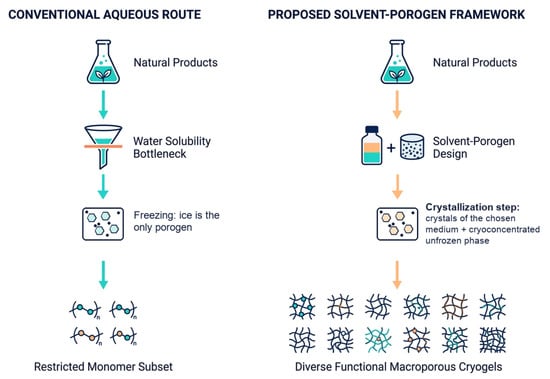
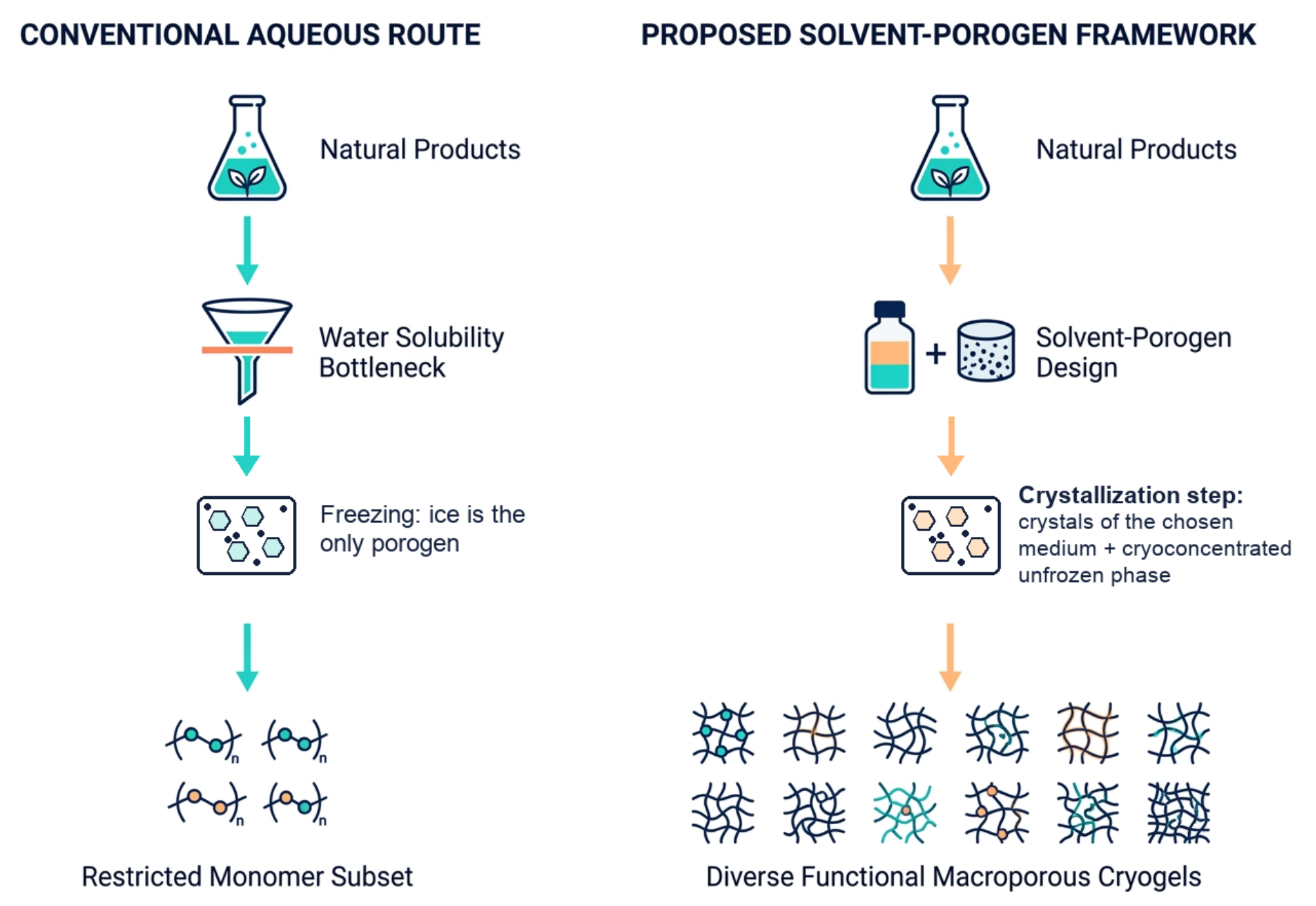
Figure 1 summarizes the design consequence. In the conventional route, the monomer library is filtered by water solubility before cryogelation; in the proposed route, solvent identity and composition are chosen to balance precursor solvation with crystallization. This changes the order of design decisions: rather than starting from the solvent-compatible subset of monomers, one starts from the molecular function sought and asks which medium can make it accessible while preserving the template-forming mechanism. The expanded space is not every conceivable natural-product derivative, but the set of formulations in which useful solubility and a pore-forming crystalline phase can coexist.
Figure 1.
The aqueous-solubility filter and the proposed solvent–porogen framework. In the conventional route (left), only natural-product-derived monomers that dissolve at a useful concentration enter aqueous cryopolymerization. In the proposed route (right), solvent identity and composition are selected to balance precursor solubility with a crystallizable porogenic phase: the chosen medium crystallizes and the precursors concentrate in the unfrozen phase, where the pore walls form. This design space includes both neat solvents and mixed-solvent formulations; mixtures require explicit mapping of phase behavior. Light blue denotes the conventional aqueous route and ice crystals; orange denotes the proposed solvent–porogen route and crystals of the chosen medium.
Mixed media should be considered a first-line strategy, not an afterthought. A water-miscible cosolvent may increase the solubility of a hydrophobic derivative while retaining some ice formation, but only within a formulation-specific composition window [35,36]. The blend’s behavior can be non-linear: its liquidus may shift, one component may crystallize preferentially, and the residual liquid may acquire a composition very different from the starting mixture. A blend may also remain partly liquid, vitrify, or change the dominant pore-forming mechanism. The practical target is therefore not a nominal freezing point, but the region of composition and temperature in which the precursor stays sufficiently soluble and the crystalline phase develops into a useful template. This window should be mapped at more than one temperature and at realistic monomer and crosslinker loadings. It may be narrow, and it may shift when an initiator, salt, or second monomer is added. Mixed-solvent design thus means treating the ratio of the components as an experimental variable, not assuming that the blend behaves as a weighted average of the neat solvents. The frozen fraction is itself a design variable: increasing it enlarges the macropores but shrinks the unfrozen microphase in which the walls are built, so an excessive ice or solvent-crystal content can leave thin, discontinuous walls and a mechanically fragile network [11]. In mixed solvents, this balance is harder to anticipate, because the fraction and identity of the crystalline phase shift with composition; the usable window is therefore the one in which a connected porogen and walls thick enough to survive thawing and work-up coexist.
3. Beyond Water: The Solvent–Porogen Bottleneck
Direct evidence shows that the crystalline porogen need not be ice. Zhang and Chu polymerized and crosslinked N-isopropylacrylamide in neat dimethyl sulfoxide (DMSO; m.p. 18.5 °C) at 0.5 and −20 °C, below the melting point of the solvent, and obtained gels with more regular, oriented interior structures and faster swelling–deswelling than conventionally prepared networks [37]. Frozen DMSO also supports physical cryotropic gelation: poly(vinyl alcohol) cryogels formed in DMSO are softer and melt at lower temperature than their aqueous counterparts [38], their properties change again when DMSO is exchanged for water [39], and hydrophobically modified agarose cryogels have likewise been fabricated in DMSO [40]. Chen and co-workers replaced ice with acetic acid crystals (m.p. 16.6 °C): at 60–90 vol% acetic acid, polymerization at ambient temperature gave particulate polymer, whereas polymerization at 4 °C gave supermacroporous, cryogel-like monoliths, an outcome the authors attributed to cryoconcentration [41]. Takase and co-workers extended the approach to hydrophobic trimethylolpropane trimethacrylate cryogels carrying a hydroxyoxime extractant, comparing 1,4-dioxane, acetic acid, and DMSO at 0, −5, and −15 °C [27]. In acetic acid, continuous large pores and layered walls formed at −5 and −15 °C but not at 0 °C; in DMSO, cryogels formed over the whole 0 to −15 °C range; dioxane gave brittle, fragile materials [27]. At 0 °C, the acetic acid formulation did solidify, but without separating into crystalline and unfrozen phases, and no pores formed [27]: solidification of the medium is therefore not sufficient, and the decisive event is crystallization that leaves a concentrated liquid phase in which the network can grow. The same group has since shaped pTRIM cryogels into monolithic supermacroporous particles for the separation of surfactant-stabilized oil-in-water emulsions [42]. Together, these studies show that crystallizable non-aqueous media can act as porogens rather than merely as dissolving agents, and that one medium can give particulate, nonporous, or supermacroporous products depending on temperature. They establish feasibility for particular formulations, not a universal ranking of solvents. Earlier work on trimethacrylate gels prepared in organic solvents at ambient temperature remains relevant to solvent-dependent morphology, but there porosity arises by phase separation rather than by crystal templating [43]. Temperature acts on this outcome through two coupled channels: it sets solvation and crystallization, but it also governs the polymerization rate. At higher temperatures, a medium such as water/DMSO or acetic acid may react too quickly, so that the network locks before a crystalline template can develop, which contributes to the nonporous products observed near ambient temperature [27,41]; lowering the temperature both promotes crystallization and slows propagation enough for the porogen to form. Reported morphologies should therefore be read as the result of temperature acting simultaneously on phase behaviour and on reaction rate, not on either alone.
A candidate medium must meet several potentially conflicting requirements (Table 1). It must dissolve the monomer, crosslinker, and initiator at useful concentrations; crystallize within the accessible cooling window; leave a reactive unfrozen phase; and permit crystal growth before gelation arrests the structure. Initiation and propagation must remain effective at the chosen temperature, viscosity must allow adequate mixing and mass transport, and the final solvent must be removable without damaging the network. Other useful screening attributes include solvent polarity and hydrogen-bonding behavior, volatility, chemical stability, and any possibility of solvent–monomer reactions. Protic solvents can alter radical efficiency through chain transfer, as reported for acrylamide polymerization in alcohols [44]; the magnitude of this effect must be established for the specific cryogenic formulation rather than assumed. Similarly, a solvent’s compatibility with one initiator system does not guarantee compatibility with another. Neat-solvent melting points are only an initial filter. The decisive measurement is the phase behavior of the complete monomer–crosslinker–initiator–solvent formulation, including the effect of loading and cooling history [45].
We use solvent–porogen coupling to describe the interdependence of these requirements. A medium that dissolves a monomer well may remain liquid at the reaction temperature; a readily crystallizing medium may reject the monomer or initiator; and a cosolvent may improve solubility while depressing crystallization or producing a different morphology [46,47]. In a mixture, the components need not crystallize together: one may crystallize preferentially, enriching the remaining liquid in the other and changing local polarity and solute concentration as polymerization proceeds. The effective porogen may therefore be an ice-rich or solvent-rich crystalline phase rather than the mixture as a whole [48]. This selective crystallization can produce a local reaction medium quite different from the formulation prepared at room temperature, which is why precursor homogeneity should be evaluated both before cooling and during solidification where feasible. Other variables can reinforce the coupling: viscosity affects mixing and diffusion, surface tension and wetting influence crystal interfaces, and the initiation system sets the timescale over which the concentrated liquid phase can gel. Furthermore, the kinetics of crystallization and polymerization can compete: a rapid reaction may lock the concentrated phase before a useful template grows, whereas slow network formation may leave growing crystals insufficiently supported. This is why neat-solvent melting points and ideal freezing-point calculations alone cannot predict pore formation in a real formulation [27]. Cryoconcentration also shapes the network itself: as crystals grow, monomer, crosslinker, and initiator are concentrated unevenly in the residual liquid, so local crosslinking density and conversion can differ between microdomains. Better solubility in an organic-containing medium does not by itself guarantee a homogeneous network, because the same selective crystallization that templates the pores also sets up concentration gradients; a more soluble precursor can still gel into regions of differing crosslink density if those gradients are steep. The decisive comparison is between three timescales—nucleation, crystal growth, and gelation: if the gel point is reached before crystals have grown, macropore development is restricted, whereas if network formation lags too far behind freezing, the structure can coarsen or collapse on thawing. A usable formulation is one in which gelation follows, but does not long outlast, the growth of the crystalline template.
Table 1.
Practical screening questions for the solvent–porogen bottleneck, with the failure mode each screen is designed to catch. The variables are listed in the order in which they become decisive; the go/no-go rule in Section 4 follows the same sequence.
4. A Practical Screening Framework
The clearest illustration of why the medium must be screened as a phase system, and not as a solvent label, comes from water/DMSO mixtures. Ozmen and Okay carried out acrylamide/N,N′-methylenebis(acrylamide) crosslinking copolymerization in water/DMSO at −18 °C [26]. Below about 25 vol% DMSO, the hydrogels had the irregular large pores typical of cryogelation; at 25 vol% DMSO, they were non-porous; at higher DMSO contents, the network consisted of aggregated microspheres with a cauliflower-like morphology, typical of reaction-induced phase separation [26]. Conversion of monomer to crosslinked polymer remained almost complete up to about 25 vol% DMSO and decreased only slightly beyond it [26], so the loss of porosity at the threshold was not a failure of polymerization. A single composition variable thus moved one formulation through three regimes: ice templating, a nonporous gel, and phase-separation porosity. The threshold belongs to that monomer system and temperature, but the lesson is general: porosity in a mixed medium must be attributed to a mechanism, and a screen that records only ‘porous’ or ‘nonporous’ cannot tell these regimes apart. The framework below therefore follows the sequence that this example makes explicit: solvation of the complete formulation, then crystallization of the medium, then cryogelation in the unfrozen phase.
The screening sequence should start from the target monomer and the function it is meant to carry, rather than from a familiar solvent and whichever monomers happen to dissolve in it. First, define the minimum monomer and crosslinker concentrations needed to obtain the intended network and identify any constraints imposed by initiator solubility or sensitivity. Where a library is available, it is more efficient to select a small representative set—such as one readily water-soluble derivative and one hydrophobic target—than to optimize every monomer at once. Next, shortlist neat solvents and mixtures that satisfy these requirements, taking into account solvent safety and removal as early filters rather than as final checks. Then screen the full formulation for crystallization under the intended cooling programme. A useful first-pass matrix varies solvent identity, mixture ratio, and temperature while holding monomer loading and the initiator system constant; only after a viable phase window is found should loading and network composition be optimized. This reversal makes the medium a design variable selected alongside the monomer, not a late-stage formulation fix, and avoids spending time optimizing polymerization conditions for systems that cannot generate a useful porogenic phase.
The first decisive screen is crystallization of the complete formulation. Differential scanning calorimetry (DSC) is a convenient first screen for whether the complete formulation undergoes a crystallization transition at all, and over what temperature range; measurements should cover relevant solvent compositions, precursor loadings, and cooling/heating histories. Where feasible, optical or cryogenic microscopy can complement DSC by showing whether crystals form, how they grow, and whether the mixture separates macroscopically. It is useful to report both onset temperatures and transition enthalpies: a detectable crystallization event does not by itself show that enough solvent freezes to generate an interconnected pore template. Repeat scans can also reveal hysteresis or a dependence on thermal history. For comparisons between formulations, report the sample mass, pan type, scan programme, end temperature, and number of cycles, since these details affect interpretation. A candidate should not advance merely because the neat solvent freezes above the target temperature: dissolved components can shift transitions, broaden them, suppress crystallization, or promote glass formation. For mixtures, the analysis should determine whether the crystalline phase is ice, an organic solvent, or a combination of distinct phases. A water-only formulation and a non-polymerizing solvent mixture can be useful controls for interpreting the thermal signal. Only after this behavior is mapped should the researcher assess whether reactive species remain concentrated in the unfrozen phase rather than precipitating or partitioning away from the polymerization domain. In multicomponent mixtures, however, overlapping thermal transitions, selective crystallization, and changes in the composition of the residual liquid phase can complicate the interpretation of DSC thermograms and enthalpies. Accordingly, the identity of the crystallizing phase should be established using complementary in situ or cryogenic characterization methods, rather than inferred from DSC data alone.
The next stage couples reaction and structure. Measure conversion and gelation time under the selected temperature profile, then compare them with the timescale of solvent crystallization. If practical, record temperature within or near the reaction volume because the programmed cooling temperature may differ from the evolving temperature of a reacting sample. Characterize pore size, distribution, connectivity, and wall morphology after thawing; also record swelling, permeability, and mechanical integrity where these are relevant to the intended use. Include controls that distinguish crystallization-templated cryogelation from polymerization-induced phase separation, and report negative results such as formulations that remain liquid, vitrify, precipitate the monomer, or produce non-interconnected structures. A suitable control series could compare an identical reaction mixture held above the freezing transition, one cooled through the crystallization window, and one with a composition beyond the observed transition window. Where a mixture is used, reporting only the total solvent ratio is insufficient if selective crystallization is suspected; temperature history and evidence for the solid and liquid phases should also be documented. Where possible, compare a water-compatible reference monomer and a hydrophobic target derivative under the same cooling profile, so that solvent limitations can be distinguished from monomer-specific polymerization problems. A useful screening result is not only a single successful recipe, but a reproducible region of composition and temperature with defined phase behavior, network formation, and pore morphology. Finally, assess washing, solvent exchange, drying, and residual solvent. Reproducible reporting of solvent identity and ratio, complete precursor composition, sample geometry, cooling rate, temperature history, and polymerization time will make results transferable between laboratories. In aqueous–organic mixtures the two mechanisms can act together, and scanning electron microscopy of a dried specimen is not sufficient to tell them apart, because both can leave superficially similar pores and drying can itself distort the structure. Crystallization-templated cryogels are expected to show high, continuous permeability, rapid convective flow, and extensive, interconnected porosity on three-dimensional imaging (for example, X-ray micro-computed tomography), whereas phase-separated networks more often—though not always—give aggregated, bead-like domains, as reported for water/DMSO mixtures [26]. Because connectivity alone is not decisive, the strongest evidence comes from comparing a formulation processed through the crystallization window with one held above it, so that a change in morphology can be attributed to the templating mechanism rather than to porosity as such.
A practical sequence of go/no-go criteria can keep the screening process interpretable. A candidate advances beyond solvation screening only if the precursor remains homogeneous at the required component loadings. It passes thermal screening only if the complete formulation reproducibly develops a crystalline phase under the planned cooling programme while retaining a sufficiently mobile unfrozen fraction compatible with network formation. Polymerization is then assessed in terms of monomer conversion and gel formation, and pore characterization proceeds only if a network forms. Final selection requires an interconnected pore structure that remains sufficiently stable after the washing, solvent exchange, or drying procedures relevant to the intended application. These criteria should not be collapsed into a single solvent score: adequate solubility cannot compensate for the absence of crystallization, and a clear thermal transition does not guarantee useful pore connectivity. Reporting failures at each stage will make negative results more comparable and help reduce repeated trial-and-error.
As a concrete illustration, consider a hydrophobic eugenol-derived methacrylate [22,23] that dissolves in water well below the loading needed for a robust network. The screen would start from a short water–DMSO series (for example 0, 10, 20, and 30 vol% DMSO) at the target monomer loading, checking precursor homogeneity at each composition. Homogeneous formulations are then examined by DSC under the intended cooling programme to identify those that still develop a crystalline phase and to estimate the frozen fraction. A plausible pattern, consistent with the water/DMSO behavior reported by Ozmen and Okay [26], is an intermediate window: at low DMSO the medium crystallizes but does not dissolve the monomer, while at high DMSO it dissolves the monomer but vitrifies or loses the ice template. Only formulations within this window proceed to polymerization and pore characterization, with a water-soluble reference monomer run in parallel to separate solvent effects from monomer-specific behavior. The outcome is a compact solubility-versus-frozen-fraction map that locates the viable region without exhaustive trial-and-error, and it requires no new experiments here.
5. Implications for Biomaterials and Outlook
Binary solvent mixtures deserve priority because composition is a direct handle on solvation and crystallization between neat-solvent extremes, and, as the water/DMSO case in Section 4 shows, also a handle on mechanism [26]. For hydrophobic natural-product-derived acrylated monomers, the challenge often arises before polymerization: insufficient solubility in conventional aqueous precursors can prevent the preparation of a homogeneous formulation at the target functional-monomer loading. The experimental target is therefore a composition–temperature window in which the monomer remains dissolved and a connected crystalline phase still forms, while the residual liquid phase remains suitable for polymerization and network formation. A practical screen starts from a short series of compositions bracketing the minimum cosolvent fraction needed for useful solubility; the same formulations are then assessed for crystallization and, only if they pass, for polymerization and pore connectivity. The result is a simple design map with monomer solubility on one axis and crystallized solvent fraction on the other, while monomer conversion and pore connectivity provide additional criteria for identifying viable formulations. Water–organic blends are a pragmatic starting point when the monomer tolerates some water, because the ice fraction can be tuned incrementally. Neat crystallizable organic media such as DMSO or acetic acid become relevant when even a small water fraction is unsuitable [27,37,41], although a formulation that solidifies without separating into crystalline and unfrozen phases gives no pores, as acetic acid at 0 °C illustrates [27]. Deep eutectic solvents are a further, adjacent class of polymerization media [50,51], but macroporosity obtained in them should not be presented as cryogelation unless crystallization of the medium is shown to template the pores. The immediate opportunity is thus to identify and map composition–temperature windows for representative natural-product-derived monomers, rather than to declare one solvent class universally preferable.
The opportunity is particularly relevant to biomedical materials. Cryogels already provide interconnected macroporosity, high permeability, and rapid transport, which support applications in drug delivery, tissue engineering, wound healing, and cell culture [4,13,15]. In our work, cyclodextrin-based cryogels obtained by aqueous cryopolymerization with 2-hydroxyethyl methacrylate (HEMA) have hosted and released poorly water-soluble drugs, including lomefloxacin, piroxicam, and fluconazole [52], while β-cyclodextrin cryogels from another group have improved the solubilization and delivery of aripiprazole [53]. In further work from our group, a γ-cyclodextrin cryogel loaded with trimethoprim has been evaluated for topical antibacterial treatment [54], and a poly(HEMA) cryogel embedding thymol-loaded halloysite nanotubes has been developed as a portable wound dressing that released about 62% of its thymol load within one week [55]. Other groups have used poly(HEMA) cryogels in a similar way, as quercetin release matrices [56], quercetin–boronate-loaded membranes against methicillin-resistant Staphylococcus aureus [57], and aripiprazole-imprinted patches [58]. These systems use host–guest inclusion or nanocontainer entrapment to accommodate hydrophobic compounds within a water-compatible network. Covalently incorporating a natural-product-derived scaffold instead makes its chemistry part of the pore wall, as in a macroporous polymer prepared from an acrylated kojic-acid derivative for metal chelation and photo-Fenton catalysis [59]. Other macroporous networks from our group address solvent-free CO2-to-carbonate catalysis [60], CO2 capture [61], palladium-catalysed cross-coupling [62], removal of emerging pollutants [63], and drug delivery combined with iron-depleting antibacterial activity [64]; in three of these, the function is carried by a polymerizable unit built into the network [60,62,64], whereas the other two rely on HEMA or comparable commercial monomers [61,63]. Comparable functional cryogels have been built by other groups: supermacroporous chelating cryogels that remove heavy metals from water effluents [65], a poly(itaconic acid) cryogel used for continuous dye removal from complex emulsions [66], and cryogel–metal nanoparticle composites used as hydrogen-generation catalysts [67]. The two strategies address different needs: loading suits a compound that should be released, whereas a polymerizable building block is preferable when its function must remain in the network. This distinction is central to the present discussion: loading a poorly soluble compound into an existing network does not solve the problem of incorporating a hydrophobic functional monomer during network formation. It is this second strategy that the aqueous solubility filter constrains the most.
The behavior of HEMA-based cryogels under different post-synthesis functionalization strategies also illustrates how chemical modification and solvent-controlled pore formation contribute separately to performance. Poly(HEMA) cryogels bearing reactive epoxide groups have been used to immobilize catalase covalently, giving a biocatalyst with markedly improved storage and operational stability relative to the free enzyme [68,69], while metal-chelated affinity cryogels bind the same enzyme through coordination to immobilized metal ions [70]. In these systems, the interconnected macroporosity set by the freezing step governs enzyme accessibility and mass transport, whereas the surface chemistry (covalent attachment versus metal-ion coordination) governs retention and activity; the two effects are, in principle, independent. Notably, the same epoxide comonomer does not act in a fixed way: depending on its content, it can either lower or raise equilibrium swelling and specific surface area, and in one case, an unmodified poly(HEMA) that looked more porous by electron microscopy in fact had the lower surface area [68,69]. Swelling, accessibility, and stability therefore depend on how the functional comonomer and the freezing step act together, and should be reported separately rather than inferred from micrographs alone. This reinforces the argument of the present Perspective: solvent-controlled pore formation and chemical functionalization are complementary design levers, and a broader solvent window would widen the first without constraining the second.
In our own work, the limited aqueous solubility of functional monomers has been a recurring practical constraint. In the cyclodextrin cryogels described in [52], HEMA was added as a comonomer for two reasons: the acrylated cyclodextrins were poorly soluble in the aqueous precursor, and their steric bulk hindered network formation without a smaller comonomer. Limited solubility of the functional monomer also constrained the formulations in [59,62], and most markedly in [64], whereas in [60], the functional monomer was polymerized without HEMA. HEMA is a convenient partner because it forms well-characterized cryogels whose pore size, swelling, and adsorption can be tuned through the crosslinker content [71]. The price is dilution: the functional unit becomes a minor component of a HEMA-rich network, and its loading is set by what the aqueous precursor can dissolve rather than by what the application requires. HEMA-dominated compositions are also common in functional cryogels from other groups: N-methacryloyl-L-phenylalanine was fed at about 1 mol% relative to HEMA in a hydrophobic dye-adsorbing cryogel [72], and in a semi-hydrophobic HEMA–butyl methacrylate cryogel, the charged ligand was grafted onto the network after cryopolymerization [73]. Neither study was designed to examine monomer solubility, so neither shows that solubility dictated the composition; both show, however, that the functional unit is often either a minor comonomer or introduced after the network has formed. The working hypothesis of this Perspective is that a broader solvent-composition window could relax this solubility–loading trade-off by allowing higher functional-monomer concentrations without sacrificing the crystallization required for cryogel formation. However, improved solubility alone would not establish the suitability of a formulation; monomer conversion, retention of function, cytocompatibility, leachables, degradation, behavior on sterilization, and mechanical performance would still need to be assessed. Relaxing the solubility constraint is therefore necessary but not sufficient: the goal is to lift the loading above the level the aqueous filter imposes, not to maximize it. A higher functional-monomer content is not automatically advantageous, because raising the loading can lower the crosslink density needed for mechanical stability, alter swelling, and—if the functional groups become buried in dense walls—reduce rather than increase the fraction accessible to a substrate or guest. The relevant target is the loading at which function is both present and accessible while the network remains mechanically sound.
Residual solvent is a central constraint, especially when materials are intended for biomedical use. A porous network can retain solvent within its pore walls and internal liquid domains, so work-up may require repeated washing, solvent exchange, extraction, drying, or a combination of these steps. The appropriate approach depends on solvent volatility, polymer swelling, pore-wall chemistry, and the intended route and duration of exposure. A solvent that crystallizes well is not necessarily a good practical choice if it is difficult to remove, toxic, or likely to alter the network during extraction. Work-up can also change pore walls or collapse fragile networks, so architecture should be checked again after the final drying or exchange step rather than only immediately after thawing. Solvent removal and residual-solvent analysis should therefore be included in the initial screening criteria; a formulation that creates attractive pores but cannot be purified reproducibly is unlikely to be useful in practice. For the crystallizable organic media discussed above, the regulatory starting points differ markedly. Under ICH Q3C(R9), DMSO and acetic acid are Class 3 solvents, for which residual amounts of up to 50 mg/day are generally considered acceptable without further justification under the guideline, whereas 1,4-dioxane is a Class 2 solvent with a permitted daily exposure of 3.8 mg/day (380 ppm), and tert-butyl alcohol, which melts near 26 °C, is listed in Class 2 at 35 mg/day [49]. These limits were established for pharmaceutical products and should not be interpreted as directly applicable acceptance criteria for topical materials or implants. Nevertheless, they provide a useful preliminary benchmark when comparing crystallizable media, provided that residual-solvent levels are assessed in the context of the intended application and route of exposure. Solvent exchange can itself reshape the network. Washing in a medium of different solvent quality alters how much the pore walls are solvated: a poor solvent can make the network contract and the pores partly collapse, and later re-swelling may not restore the original architecture. Consistent with this, poly(vinyl alcohol) cryogels formed in frozen DMSO contract, stiffen, and develop smaller pores when the organic medium is replaced by water [39]. For cryogels formed in DMSO or acetic acid and then transferred to water, usability therefore depends on pore preservation and swelling recovery, not on successful gelation alone, and both should be measured on the washed, dried product.
The same design principle extends beyond biomedicine. Several of the networks listed above were built for non-biomedical functions—CO2 conversion and capture, cross-coupling catalysis, pollutant removal—and cryopolymerization has likewise been used to build superelastic nanofibrous aerogels for thermal regulation [74]. These examples show the range of functions a macroporous network can carry, from molecular recognition and antimicrobial activity to catalysis and gas capture. They do not, by themselves, show that such chemistries require non-aqueous cryopolymerization; rather, they motivate a broader question about matching precursor chemistry to a medium that can generate the desired architecture. That question is relevant wherever the functional group is intended to be covalently built into the polymer rather than simply loaded into its pores. Although the framework is discussed here using natural-product-derived monomers, the same principles are expected to apply to other poorly water-soluble polymerizable building blocks, where the same solvent–porogen coupling governs whether a functional unit can be incorporated at a useful loading.
6. Conclusions
The central opportunity is to regard water as one effective cryogenic medium, not as the definition of cryopolymerization. For natural-product-derived monomers, the aqueous route can exclude useful chemistry before polymerization is tested. A broader platform will require more than replacing water with an arbitrary organic solvent: it requires mapping the coupled effects of solvent identity, mixture composition, temperature, cooling rate, crystallization, and polymerization kinetics. The practical priority is to build solvent, composition, and temperature maps that identify where a target monomer remains soluble, a suitable crystalline porogen forms, and the unfrozen phase supports network formation. Such maps would turn solvent choice from an empirical constraint into a reproducible design parameter and clarify when a mixed medium preserves cryogelation or instead produces a different porous material. The aim is not to abandon water, but to make the cryogenic medium fit the chemistry rather than make the chemistry fit water.
Funding
This research received no external funding.
Institutional Review Board Statement
Not applicable.
Informed Consent Statement
Not applicable.
Data Availability Statement
No new data were created or analyzed in this study. Data sharing is not applicable to this article.
Conflicts of Interest
The author declares no conflicts of interest.
References
- Okay, O. Polymeric Cryogels: Macroporous Gels with Remarkable Properties; Springer: Berlin/Heidelberg, Germany, 2014. [Google Scholar]
- Lozinsky, V.I. Cryogels on the Basis of Natural and Synthetic Polymers: Preparation, Properties and Application. Russ. Chem. Rev. 2002, 71, 489–511. [Google Scholar] [CrossRef] [Scilit]
- Lozinsky, V.I. Cryostructuring of Polymeric Systems. 50.† Cryogels and Cryotropic Gel-Formation: Terms and Definitions. Gels 2018, 4, 77. [Google Scholar] [CrossRef] [Scilit]
- Razavi, M.; Qiao, Y.; Thakor, A.S. Three-Dimensional Cryogels for Biomedical Applications. J. Biomed. Mater. Res. A 2019, 107, 2736–2755. [Google Scholar] [CrossRef] [Scilit]
- Lozinsky, V.I. Polymeric Cryogels as a New Family of Macroporous and Supermacroporous Materials for Biotechnological Purposes. Russ. Chem. Bull. 2008, 57, 1015–1032. [Google Scholar] [CrossRef] [Scilit]
- Plieva, F.M.; Galaev, I.Y.; Mattiasson, B. Macroporous Gels Prepared at Subzero Temperatures as Novel Materials for Chromatography of Particulate-containing Fluids and Cell Culture Applications. J. Sep. Sci. 2007, 30, 1657–1671. [Google Scholar] [CrossRef] [Scilit]
- Jain, E.; Zhang, K.; Mishra Tiwari, R. Properties and Characterization of Cryogels: Structural, Mechanical, and Functional Insights. ACS Omega 2025, 10, 36771–36787. [Google Scholar] [CrossRef] [Scilit]
- Izadpanah, A.; Nemati, S.; Nojavan, S. A Comprehensive Review on Synthesis and Applications of Cryogel-Based Sorbents in Solid-Phase Extraction Techniques. TrAC Trends Anal. Chem. 2024, 180, 117899. [Google Scholar] [CrossRef] [Scilit]
- Haleem, A.; Pan, J.-M.; Shah, A.; Hussain, H.; He, W. A Systematic Review on New Advancement and Assessment of Emerging Polymeric Cryogels for Environmental Sustainability and Energy Production. Sep. Purif. Technol. 2023, 316, 123678. [Google Scholar] [CrossRef] [Scilit]
- Hwang, Y.; Zhang, C.; Varghese, S. Poly(Ethylene Glycol) Cryogels as Potential Cell Scaffolds: Effect of Polymerization Conditions on Cryogel Microstructure and Properties. J. Mater. Chem. 2010, 20, 345–351. [Google Scholar] [CrossRef] [Scilit]
- Okay, O. Cryogelation Reactions and Cryogels: Principles and Challenges. Turk. J. Chem. 2023, 47, 910–926. [Google Scholar] [CrossRef] [Scilit]
- Gun’ko, V.M.; Savina, I.N.; Mikhalovsky, S.V. Cryogels: Morphological, Structural and Adsorption Characterisation. Adv. Colloid Interface Sci. 2013, 187–188, 1–46. [Google Scholar] [CrossRef] [Scilit]
- Carriero, V.C.; Di Muzio, L.; Petralito, S.; Casadei, M.A.; Paolicelli, P. Cryogel Scaffolds for Tissue-Engineering: Advances and Challenges for Effective Bone and Cartilage Regeneration. Gels 2023, 9, 979. [Google Scholar] [CrossRef] [Scilit]
- Mancino, R.; Caccavo, D.; Barba, A.A.; Lamberti, G.; Biasin, A.; Cortesi, A.; Grassi, G.; Grassi, M.; Abrami, M. Agarose Cryogels: Production Process Modeling and Structural Characterization. Gels 2023, 9, 765. [Google Scholar] [CrossRef] [Scilit]
- Henderson, T.M.A.; Ladewig, K.; Haylock, D.N.; McLean, K.M.; O’Connor, A.J. Cryogels for Biomedical Applications. J. Mater. Chem. B 2013, 1, 2682–2695. [Google Scholar] [CrossRef] [Scilit]
- An, L.-Y.; Dai, Z.; Di, B.; Xu, L.-L. Advances in Cryochemistry: Mechanisms, Reactions and Applications. Molecules 2021, 26, 750. [Google Scholar] [CrossRef] [Scilit]
- Birajdar, M.S.; Joo, H.; Koh, W.-G.; Park, H. Natural Bio-Based Monomers for Biomedical Applications: A Review. Biomater. Res. 2021, 25, 8. [Google Scholar] [CrossRef] [Scilit]
- Kristufek, S.L.; Wacker, K.T.; Tsao, Y.-Y.T.; Su, L.; Wooley, K.L. Monomer Design Strategies to Create Natural Product-Based Polymer Materials. Nat. Prod. Rep. 2017, 34, 433–459. [Google Scholar] [CrossRef] [Scilit]
- Rigo, E.; Ladmiral, V.; Caillol, S.; Lacroix-Desmazes, P. Recent Advances in Radical Polymerization of Bio-Based Monomers in Aqueous Dispersed Media. RSC Sustain. 2023, 1, 788–813. [Google Scholar] [CrossRef] [Scilit]
- Han, M.-E.; Kang, B.J.; Kim, S.-H.; Kim, H.D.; Hwang, N.S. Gelatin-Based Extracellular Matrix Cryogels for Cartilage Tissue Engineering. J. Ind. Eng. Chem. 2017, 45, 421–429. [Google Scholar] [CrossRef] [Scilit]
- He, Y.; Wang, C.; Wang, C.; Xiao, Y.; Lin, W. An Overview on Collagen and Gelatin-Based Cryogels: Fabrication, Classification, Properties and Biomedical Applications. Polymers 2021, 13, 2299. [Google Scholar] [CrossRef] [Scilit]
- Rojo, L.; Vazquez, B.; Parra, J.; López Bravo, A.; Deb, S.; San Roman, J. From Natural Products to Polymeric Derivatives of “Eugenol”: A New Approach for Preparation of Dental Composites and Orthopedic Bone Cements. Biomacromolecules 2006, 7, 2751–2761. [Google Scholar] [CrossRef] [Scilit]
- Zhang, Y.; Li, Y.; Wang, L.; Gao, Z.; Kessler, M.R. Synthesis and Characterization of Methacrylated Eugenol as a Sustainable Reactive Diluent for a Maleinated Acrylated Epoxidized Soybean Oil Resin. ACS Sustain. Chem. Eng. 2017, 5, 8876–8883. [Google Scholar] [CrossRef] [Scilit]
- Obermeier, F.; Stockmann, P.N.; Strube, O.I. Green Chemistry in Coatings: Terpene Based Acrylates as Substitutes for Petrochemical Compounds. Eur. Polym. J. 2025, 231, 113913. [Google Scholar] [CrossRef] [Scilit]
- Yasar, M.; Oktay, B.; Dal Yontem, F.; Haciosmanoglu Aldogan, E.; Kayaman Apohan, N. Development of Self-Healing Vanillin/PEI Hydrogels for Tissue Engineering. Eur. Polym. J. 2023, 188, 111933. [Google Scholar] [CrossRef] [Scilit]
- Murat Ozmen, M.; Okay, O. Formation of Macroporous Poly(Acrylamide) Hydrogels in DMSO/Water Mixture: Transition from Cryogelation to Phase Separation Copolymerization. React. Funct. Polym. 2008, 68, 1467–1475. [Google Scholar] [CrossRef] [Scilit]
- Takase, H.; Goya, N.; Kiyoyama, S.; Shiomori, K.; Matsune, H. Preparation of Hydrophobic Cryogel Containing Hydroxyoxime Extractant and Its Extraction Properties of Cu(II). Gels 2023, 10, 9. [Google Scholar] [CrossRef] [Scilit]
- Okay, O.; Lozinsky, V.I. Synthesis and Structure–Property Relationships of Cryogels. In Polymeric Cryogels; Okay, O., Ed.; Advances in Polymer Science; Springer International Publishing: Cham, Switzerland, 2014; Volume 263, pp. 103–157. [Google Scholar]
- Reichelt, S. Introduction to Macroporous Cryogels. In Affinity Chromatography; Reichelt, S., Ed.; Methods in Molecular Biology; Springer: New York, NY, USA, 2015; Volume 1286, pp. 173–181. [Google Scholar]
- Lafleur, R.P.M.; Lou, X.; Pavan, G.M.; Palmans, A.R.A.; Meijer, E.W. Consequences of a Cosolvent on the Structure and Molecular Dynamics of Supramolecular Polymers in Water. Chem. Sci. 2018, 9, 6199–6209. [Google Scholar] [CrossRef] [Scilit]
- Memic, A.; Colombani, T.; Eggermont, L.J.; Rezaeeyazdi, M.; Steingold, J.; Rogers, Z.J.; Navare, K.J.; Mohammed, H.S.; Bencherif, S.A. Latest Advances in Cryogel Technology for Biomedical Applications. Adv. Ther. 2019, 2, 1800114. [Google Scholar] [CrossRef] [Scilit]
- Rajabalinia, N.; Salarhosseini, F.; Hutchinson, R.A. Acrylate–Methacrylate Radical Copolymerization Kinetics of Sparingly Water-Soluble Monomers in Polar and Nonpolar Solvents. Polym. Chem. 2024, 15, 4542–4553. [Google Scholar] [CrossRef] [Scilit]
- Li, M.; Wei, X.; You, J.; Feng, J.; Liu, X.; Zhou, J.; Wu, Q.; Zhang, Y.; Zhou, Y. Cryogels with Controllable Physico-Chemical Properties as Advanced Delivery Systems for Biomedical Applications. Mater. Today Bio 2025, 32, 101815. [Google Scholar] [CrossRef] [Scilit]
- Liu, C.; Wang, D.; Wang, Z.; Zhang, H.; Chen, L.; Wei, Z. Sulfolane Crystal Templating: A One-Step and Tunable Polarity Approach for Self-Assembled Super-Macroporous Hydrophobic Monoliths. ACS Appl. Mater. Interfaces 2022, 14, 45810–45821. [Google Scholar] [CrossRef] [Scilit]
- Holkar, K.; Zhang, K.; Mishra Tiwari, R.; Jain, E. Emerging Trends in Cryogelation: Key Factors Influencing Cryotropic Gelation Processes. J. Polym. Eng. 2025, 45, 576–596. [Google Scholar] [CrossRef] [Scilit]
- Ertürk, G.; Mattiasson, B. Cryogels-Versatile Tools in Bioseparation. J. Chromatogr. A 2014, 1357, 24–35. [Google Scholar] [CrossRef] [Scilit]
- Zhang, X.-Z.; Chu, C.-C. Synthesis of Temperature Sensitive PNIPAAm Cryogels in Organic Solvent with Improved Properties. J. Mater. Chem. 2003, 13, 2457. [Google Scholar] [CrossRef] [Scilit]
- Fufaeva, M.S.; Manzhai, V.N. Effect of Dimethyl Sulfoxide and Glycerol on the Properties of Cryogels. ChemChemTech 2025, 68, 6–11. [Google Scholar] [CrossRef] [Scilit]
- Michurov, D.A.; Kolosova, O.Y.; Lozinsky, V.I. Study of Cryostructuring of Polymer System. 66. Properties and Microstructure of Poly(Vinyl Alcohol) Cryogels Formed in Frozen Dimethyl Sulfoxide with Additives of Urea and Then Hydrated by Replacing Organic Medium with Water. Colloid J. 2023, 85, 949–960. [Google Scholar] [CrossRef] [Scilit]
- Evans, C.; Morimitsu, Y.; Nishi, R.; Yoshida, M.; Takei, T. Novel Hydrophobically Modified Agarose Cryogels Fabricated Using Dimethyl Sulfoxide. J. Biosci. Bioeng. 2022, 133, 390–395. [Google Scholar] [CrossRef] [Scilit]
- Chen, X.; Sui, W.; Ren, D.; Ding, Y.; Zhu, X.; Chen, Z. Synthesis of Hydrophobic Polymeric Cryogels with Supermacroporous Structure. Macromol. Mater. Eng. 2016, 301, 659–664. [Google Scholar] [CrossRef] [Scilit]
- Takase, H.; Watanabe, N.; Shiomori, K.; Okamoto, Y.; Ciptawati, E.; Matsune, H.; Umakoshi, H. Preparation of Hydrophobic Monolithic Supermacroporous Cryogel Particles for the Separation of Stabilized Oil-in-Water Emulsion. Colloids Interfaces 2023, 7, 9. [Google Scholar] [CrossRef] [Scilit]
- Rosenberg, J.E.; Flodin, P. Macroporous Gels. 2. Polymerization of Trimethylolpropane Trimethacrylate in Various Solvents. Macromolecules 1987, 20, 1518–1522. [Google Scholar] [CrossRef] [Scilit]
- Magee, C.; Sugihara, Y.; Zetterlund, P.B.; Aldabbagh, F. Chain Transfer to Solvent in the Radical Polymerization of Structurally Diverse Acrylamide Monomers Using Straight-Chain and Branched Alcohols as Solvents. Polym. Chem. 2014, 5, 2259. [Google Scholar] [CrossRef] [Scilit]
- Ulrich, N.G.; Louf, J.-F. Interfacial Mechanisms in the Freezing of Polymer Solutions. Nanoscale 2026, 18, 3453–3471. [Google Scholar] [CrossRef] [Scilit]
- Lloyd, D.R.; Kinzer, K.E.; Tseng, H.S. Microporous Membrane Formation via Thermally Induced Phase Separation. I. Solid-Liquid Phase Separation. J. Membr. Sci. 1990, 52, 239–261. [Google Scholar] [CrossRef] [Scilit]
- Lloyd, D.R.; Kim, S.S.; Kinzer, K.E. Microporous Membrane Formation via Thermally-Induced Phase Separation. II. Liquid—Liquid Phase Separation. J. Membr. Sci. 1991, 64, 1–11. [Google Scholar] [CrossRef] [Scilit]
- Ho, M.-H.; Kuo, P.-Y.; Hsieh, H.-J.; Hsien, T.-Y.; Hou, L.-T.; Lai, J.-Y.; Wang, D.-M. Preparation of Porous Scaffolds by Using Freeze-Extraction and Freeze-Gelation Methods. Biomaterials 2004, 25, 129–138. [Google Scholar] [CrossRef] [Scilit]
- International Council for Harmonisation of Technical Requirements for Pharmaceuticals for Human Use. ICH Q3C(R9) Impurities: Guideline for Residual Solvents; International Council for Harmonisation of Technical Requirements for Pharmaceuticals for Human Use: Geneva, Switzerland, 2024. [Google Scholar]
- Bednarz, S.; Wesołowska, A.; Trątnowiecka, M.; Bogdał, D. Polymers from Biobased-Monomers: Macroporous Itaconic Xerogels Prepared in Deep Eutectic Solvents. J. Renew. Mater. 2016, 4, 18–23. [Google Scholar] [CrossRef] [Scilit]
- Bednarz, S.; Półćwiartek, K.; Wityk, J.; Strachota, B.; Kredatusová, J.; Beneš, H.; Wesołowska-Piętak, A.; Kowalski, G. Polymerization-Crosslinking of Renewable Itaconic Acid in Water and in Deep Eutectic Solvents. Eur. Polym. J. 2017, 95, 241–254. [Google Scholar] [CrossRef] [Scilit]
- Zagni, C.; Coco, A.; Mecca, T.; Curcuruto, G.; Patamia, V.; Mangano, K.; Rescifina, A.; Carroccio, S.C. Sponge-like Macroporous Cyclodextrin-Based Cryogels for Controlled Drug Delivery. Mater. Chem. Front. 2023, 7, 2693–2705. [Google Scholar] [CrossRef] [Scilit]
- Danov, Y.; Georgieva, D.; Mihaylova, R.; Kostova, B.; Petrov, P.D. Cryogel Carriers Comprising β-Cyclodextrin Moieties for Improved Solubilization and Delivery of Aripiprazole. Macromol. Chem. Phys. 2021, 222, 2100004. [Google Scholar] [CrossRef] [Scilit]
- Tomarchio, E.G.; Giglio, V.; Fuochi, V.; Furnari, S.; Furneri, P.M.; Mecca, T.; Dattilo, S.; Zagni, C.; Rescifina, A. Development of a γ-Cyclodextrin-Based Cryogel Loaded with Trimethoprim for Acne Treatment: Design, Synthesis, and In Vitro Evaluation. Int. J. Mol. Sci. 2025, 26, 6319. [Google Scholar] [CrossRef] [Scilit]
- Zagni, C.; Scamporrino, A.A.; Riccobene, P.M.; Floresta, G.; Patamia, V.; Rescifina, A.; Carroccio, S.C. Portable Nanocomposite System for Wound Healing in Space. Nanomaterials 2023, 13, 741. [Google Scholar] [CrossRef] [Scilit]
- Özbilenler, C.; Yilmaz, E.; Altundağ, E.M. Evaluation of Poly(2-Hydroxyethyl Methacrylate) and Poly(N-Hydroxyethyl Acrylamide) Cryogels as Potential Quercetin Release Matrices. Int. J. Polym. Anal. Charact. 2024, 29, 189–212. [Google Scholar] [CrossRef] [Scilit]
- Yildirim, M.; Cimentepe, M.; Yarlılar, Ş.G.; Kilic, A. “One Stone, Two Birds” Strategy: Quercetin-Boronate-Loaded pHEMA Cryogel Membranes for Targeted Action against Methicillin-Resistant Staphylococcus Aureus and Multidrug-Resistant Escherichia Coli with Molecular Docking Insights. Colloid Polym. Sci. 2025, 303, 2319–2330. [Google Scholar] [CrossRef] [Scilit]
- Çalışır, M.; Erkek, M.; Denizli, A.; Bereli, N. Aripiprazole-Imprinted Poly(Hydroxyethyl Methacrylate) Cryogel Patches for Enhanced Drug Release. Polym. Bull. 2025, 82, 7247–7264. [Google Scholar] [CrossRef] [Scilit]
- Tomarchio, E.G.; Giglio, V.; Zagni, C.; Carroccio, S.C.; Paratore, V.; Condorelli, G.G.; Floresta, G.; Dattilo, S.; Rescifina, A. Designing a Monolithic Photo-Fenton Catalyst Using a Fungal Hydroxypyrone Metabolic Derivative. Mater. Today Chem. 2025, 44, 102539. [Google Scholar] [CrossRef] [Scilit]
- Dattilo, S.; Zagni, C.; Mecca, T.; Patamia, V.; Floresta, G.; Nicotra, P.; Carroccio, S.C.; Rescifina, A. Solvent-Free Conversion of CO2 in Carbonates through a Sustainable Macroporous Catalyst. Giant 2024, 18, 100258. [Google Scholar] [CrossRef] [Scilit]
- Zagni, C.; Coco, A.; Dattilo, S.; Patamia, V.; Floresta, G.; Fiorenza, R.; Curcuruto, G.; Mecca, T.; Rescifina, A. HEMA-Based Macro and Microporous Materials for CO2 Capture. Mater. Today Chem. 2023, 33, 101715. [Google Scholar] [CrossRef] [Scilit]
- Tomarchio, E.G.; Zagni, C.; Paratore, V.; Condorelli, G.G.; Carroccio, S.C.; Rescifina, A. Bio-Based Palladium Catalyst in Cryogel for Cross-Coupling Reactions. Mater. Chem. Front. 2024, 8, 3558–3568. [Google Scholar] [CrossRef] [Scilit]
- Zagni, C.; Dattilo, S.; Mecca, T.; Gugliuzzo, C.; Scamporrino, A.A.; Privitera, V.; Puglisi, R.; Carroccio, S.C. Single and Dual Polymeric Sponges for Emerging Pollutants Removal. Eur. Polym. J. 2022, 179, 111556. [Google Scholar] [CrossRef] [Scilit]
- Zagni, C.; Patamia, V.; Dattilo, S.; Fuochi, V.; Furnari, S.; Furneri, P.M.; Carroccio, S.C.; Floresta, G.; Rescifina, A. Supramolecular Biomaterials as Drug Nanocontainers with Iron Depletion Properties for Antimicrobial Applications. Mater. Adv. 2024, 5, 3675–3682. [Google Scholar] [CrossRef] [Scilit]
- Önnby, L.; Giorgi, C.; Plieva, F.M.; Mattiasson, B. Removal of Heavy Metals from Water Effluents Using Supermacroporous Metal Chelating Cryogels. Biotechnol. Prog. 2010, 26, 1295–1302. [Google Scholar] [CrossRef] [Scilit]
- Huang, X.; Wang, S.; Wang, X.; Shi, J.; Bao, L.; Wang, Y.; Chen, Z. Reverse Wood Mimetic Cryogel Based on Poly(Itaconic Acid) for Continuous Removal of Methylene Blue from Complex Water Emulsion. Sep. Purif. Technol. 2024, 339, 126533. [Google Scholar] [CrossRef] [Scilit]
- Sahiner, N.; Yildiz, S.; Sahiner, M.; Issa, Z.A.; Al-Lohedan, H. Macroporous Cryogel Metal Nanoparticle Composites for H2 Generation from NaBH4 Hydrolysis in Seawater. Appl. Surf. Sci. 2015, 354, 388–396. [Google Scholar] [CrossRef] [Scilit]
- Altunbaş, C.; Aslan, A.; Kuşat, K.; Sahiner, M.; Akgöl, S.; Sahiner, N. Synthesis and Characterization of a New Cryogel Matrix for Covalent Immobilization of Catalase. Gels 2022, 8, 501. [Google Scholar] [CrossRef] [Scilit]
- Erol, K.; Alkan, M.H.; Alacabey, İ. Cryogel-Immobilized Catalase as a Biocatalyst with Enhanced Stability Against Microplastics. Gels 2025, 11, 634. [Google Scholar] [CrossRef] [Scilit]
- Tüzmen, N.; Kalburcu, T.; Denizli, A. Immobilization of Catalase via Adsorption onto Metal-Chelated Affinity Cryogels. Process Biochem. 2012, 47, 26–33. [Google Scholar] [CrossRef] [Scilit]
- Proietto Salanitri, G.; Luzzi, E.; Caretti, D.; Mecca, T.; Carroccio, S.C.; Scamporrino, A.A. How the Crosslinker Amount Influences the Final Properties of Hydroxyethyl Methacrylate Cryogels. Gels 2024, 10, 163. [Google Scholar] [CrossRef] [Scilit]
- Sofuoğlu, M.; Kuyucu, A.E.; Erol, K.; Gökmeşe, F. Amino Acid-Based Hydrophobic Cryogels for Efficient Methylene Blue Removal: A Reusable and Eco-Friendly Approach to Dye-Contaminated Wastewater Treatment. Gels 2025, 11, 411. [Google Scholar] [CrossRef] [Scilit]
- Chen, Z.; Xu, J.; Tong, S.; Qu, Y.; Liu, B.; Wang, C.; Zhang, W.; Zhang, W.; Lou, X.; Yun, J. Semi-Hydrophobic Composite Cryogels Embedded with Bacterial Cellulose as Adsorbents for Separation of Phenyllactic Acid from Crude Fermentation Broth: Preparation and Molecular Simulation. J. Chromatogr. A 2026, 1773, 466813. [Google Scholar] [CrossRef] [Scilit]
- Sun, J.; Zhang, Y.; Wang, Y.; Peng, Y.; Long, J.; Liu, H.; Fan, W.; Miao, Y.; Willenbacher, N.; Zhang, C.; et al. Cryopolymerization-Enabled Superelastic and Thermomechanically Robust Silica-Sheathing Nanofibrous Aerogels for Solar-Thermal Regulatory Cooling. Adv. Funct. Mater. 2025, 35, 2425527. [Google Scholar] [CrossRef] [Scilit]
Disclaimer/Publisher’s Note: The statements, opinions and data contained in all publications are solely those of the individual author(s) and contributor(s) and not of MDPI and/or the editor(s). MDPI and/or the editor(s) disclaim responsibility for any injury to people or property resulting from any ideas, methods, instructions or products referred to in the content. |
© 2026 by the author. Licensee MDPI, Basel, Switzerland. This article is an open access article distributed under the terms and conditions of the Creative Commons Attribution (CC BY) license.