


Abstract
Long-distance migratory birds have only recently been found to undergo striking diel cycles in flight altitude, ascending by approximately 1.2–3.0 km around dawn and descending near dusk during prolonged flights. These movements expose birds to coordinated changes in atmospheric pressure, oxygen partial pressure, air density, temperature, humidity and light. Thermoregulation, wind conditions, predator avoidance, visual orientation and barrier crossing provide plausible explanations for high daytime flight but may not fully account for its close timing to sunrise and sunset. Here, we consider an additional possibility arising from the combined effects of light and oxygen on cryptochrome photochemistry. Dawn ascent coincides with rapidly increasing daylight and decreasing oxygen partial pressure, potentially affecting light-driven flavin photoreduction and the oxygen-dependent recovery of reduced flavin states. At dusk, descent reverses this combination. We propose that the resulting diel contrast could alter cryptochrome redox-state occupancy and photocycle turnover, thereby modifying the conditions under which a radical-pair-based magnetic compass operates. Such a sensory contribution could act alongside thermoregulatory and ecological benefits. Experiments combining physiologically realistic changes in light intensity, spectral composition and oxygen availability could test whether diel altitude cycles influence cryptochrome photochemistry and magnetic sensitivity in migratory birds.
1. Introduction
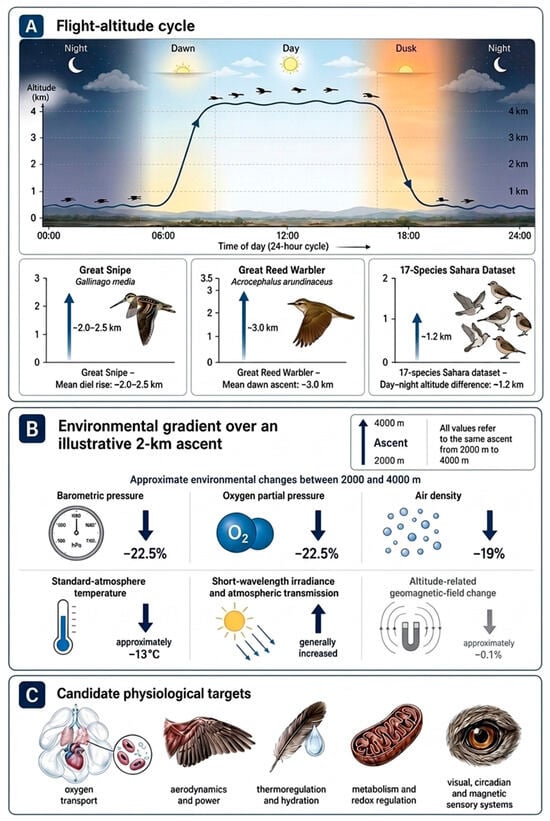
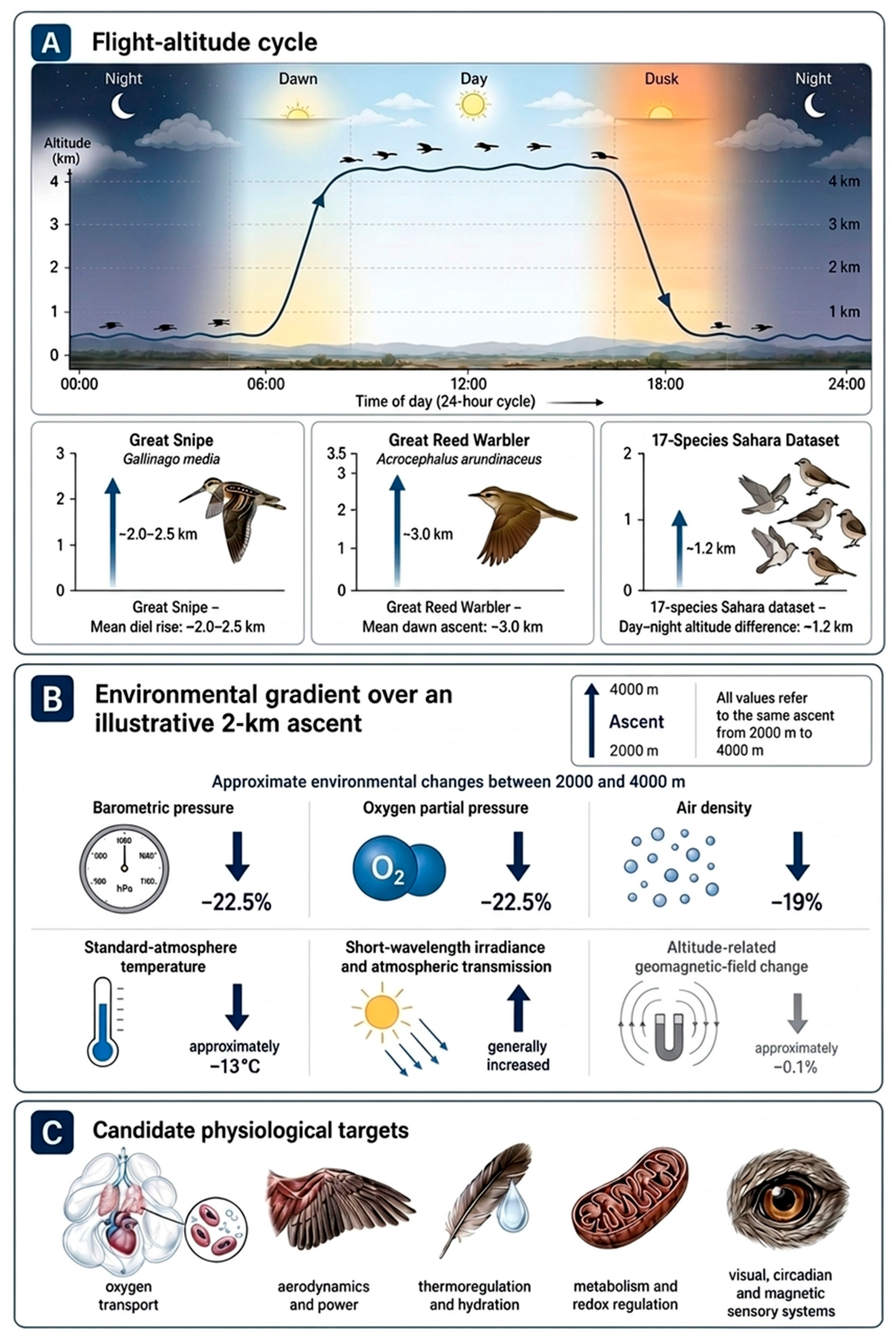
Long-distance migratory birds may remain in continuous flight for many hours or even days, during which a remarkable pattern has only recently been documented: diel shifts in flight altitude involving an average ascent of approximately 2 km around dawn and a corresponding descent near dusk. Among the cases documented to date, Great Snipes (Gallinago media) undertaking multi-day nonstop migrations repeatedly ascended by approximately 2.0–2.5 km around dawn, remained at higher altitude during the day and descended again near dusk. Great Reed Warblers (Acrocephalus arundinaceus) showed dawn ascents of approximately 3 km when their normally nocturnal flights continued into daylight, while tracking data from 17 species of small landbirds crossing the Sahara revealed a pooled day–night altitude difference of approximately 1.2 km [1,2,3]. Together, these observations indicate that diel altitude changes are not restricted to a single species or migratory system, although their taxonomic distribution, consistency and functional significance remain insufficiently resolved.
Changes in flight altitude of this magnitude expose birds to simultaneous changes in several physical variables. Over an illustrative ascent of 2 km, barometric and oxygen partial pressure decrease by approximately 23% and air density by about 19%. Temperature, wind, humidity and the intensity and spectral composition of light may also change substantially. Flight-layer selection may therefore reflect benefits related to wind assistance, thermoregulation, visibility and predator avoidance, balanced against constraints imposed by reduced oxygen availability, lower air density and altered water balance. These factors may contribute in different combinations, and the available evidence does not support reducing diel altitude changes to a single general explanation.
Here, we bring together the available tracking evidence with established atmospheric relationships and the physical and physiological consequences of these vertical movements. We further consider whether the coupled changes in light and oxygen could modify flavin photochemistry in retinal cryptochromes and thereby alter the conditions under which a light-dependent magnetic sensor operates. Because the available studies differ substantially in species composition, tracking resolution, geographical setting and reporting of altitude metrics, we use a structured descriptive synthesis rather than formal meta-analysis or multivariable modelling to characterize the phenomenon, evaluate established explanations and develop an additional mechanistic hypothesis.
2. Evidence for Diel Changes in Migratory Flight Altitude
Vertical changes during prolonged nonstop migratory flights have only recently been recognized as a distinct diel pattern, with birds flying substantially higher during the day than at night. An early indication came from Great Reed Warblers (Acrocephalus arundinaceus), which showed dawn ascents of approximately 3 km during prolonged flights extending into the day, reaching average daytime flight altitudes of approximately 5.4 km compared with 2.4 km at night [2,3,4]. This pattern was subsequently demonstrated more clearly in another long-distance migrant. Great Snipes (Gallinago media) undertaking multi-day nonstop migrations repeatedly ascended by approximately 2.0–2.5 km around dawn, remained at higher altitude during the day and descended again near dusk. More recent multispecies tracking indicates that this behaviour extends beyond these two species but is neither taxonomically universal nor independent of the environment being crossed. Across 67 recovered multisensor loggers representing 17 species of small migratory landbirds, flights crossing the Sahara averaged approximately 1.6 km a.s.l. at night and 2.8 km during prolonged daytime migration, although not all tracked species continued flying during daylight [1]. The only directly documented inverse pattern so far comes from the European Nightjar (Caprimulgus europaeus), a highly specialized aerial insectivore with an unusually energy-efficient flap-gliding flight style. During prolonged sea crossings, nightjars descended at dawn, continued close to the water surface during daylight and returned to higher altitudes after dusk, probably exploiting aerodynamic benefits available near the sea surface [5]. Thus, the limited evidence currently available predominantly supports ascent during prolonged daytime migration over land, whereas the nightjar represents an ecologically specialized exception associated with marine barrier crossing (Table 1).
Table 1.
Evidence for diel changes in flight altitude during avian migration. Values are reported as presented in the source studies and are not necessarily directly comparable across datasets. In Great Snipes, the reported night- and daytime ranges represent mean values from different migration stages, whereas the approximate maximum of 8700 m was estimated after correction for prevailing atmospheric conditions. The 17-species dataset provides a pooled comparison of Sahara-crossing flights; it does not establish the day-high, night-low pattern separately for every included species and includes the Great Reed Warbler already represented by species-specific evidence. The Black-tailed Godwit result derives from a preprint and is excluded from the peer-reviewed quantitative range discussed in the text. Historical radar studies document dawn-associated ascents and reorientation at the population level, particularly over water, but not necessarily sustained high-altitude daytime flight followed by dusk descent. a.s.l., above sea level.
3. Environmental Changes Across an Illustrative 2 km Ascent
A vertical ascent of approximately 2 km, for example, from 2000 to 4000 m above sea level, reduces barometric pressure and oxygen partial pressure by about 22.5% and air density by approximately 19%. Under standard atmospheric conditions, air temperature decreases by about 13 °C and the overlying molecular air column by approximately 23%. Because Rayleigh optical depth scales approximately with atmospheric pressure, it decreases by a similar proportion [10]. Under clear-sky conditions, global UV irradiance may increase by approximately 15–25% across the same altitude interval. Changes in total solar irradiance depend strongly on solar elevation, aerosols, water vapour and cloud cover, whereas the radiative heat load experienced by the bird additionally depends on its orientation, exposed surface area and plumage properties [11,12]. By contrast, gravitational acceleration and geomagnetic-field strength change by only approximately 0.06% and 0.1%, respectively. Actual temperature, humidity, wind and light conditions, however, depend strongly on location, season, weather and time of day.
A 2 km dawn ascent could therefore simultaneously alter oxygen availability, aerodynamic loading, temperature, humidity and light exposure (Figure 1), with potential effects on several interacting physiological systems. Even during nonstop migrations lasting several days, responses to an individual ascent or descent would be expected to consist primarily of rapid functional adjustments. Repeated exposure over successive diel cycles could additionally engage early hypoxia-responsive or acclimatization-related signalling, but would not itself produce structural or evolved high-altitude adaptations such as increased capillary density or modified haemoglobin composition.
Figure 1.
Diel changes in migratory flight altitude and associated environmental and physiological effects. (A) Schematic 24 h altitude cycle with dawn ascent, sustained high-altitude daytime flight and dusk descent. Lower panels show reported mean altitude increases in Great Snipes (Gallinago media; 2.0–2.5 km), Great Reed Warblers (Acrocephalus arundinaceus; 3.0 km) and a pooled 17-species Sahara dataset (1.2 km). (B) Approximate changes during an illustrative ascent from 2000 to 4000 m: barometric pressure and pO2 decrease by 22.5%, air density by 19% and standard-atmosphere temperature by 13 °C; short-wavelength irradiance generally increases, whereas geomagnetic-field strength changes by only approximately 0.1%. (C) Candidate physiological targets of these combined environmental changes. This figure was created using FigureLabs (https://figurelabs.ai; accessed on 28 October 2026).
4. Physiological Consequences of Diel Changes in Flight Altitude
Sustained migratory flight is among the most metabolically demanding forms of vertebrate locomotion. Migratory birds support this performance through an efficient respiratory system, substantial cardiac capacity, high blood O2-carrying capacity, dense capillarization of flight muscles, abundant mitochondria and a pronounced capacity to oxidize lipid stores [13,14]. Although these adaptations support sustained aerobic performance, a rapid ascent of approximately 2 km exposes birds to simultaneous changes in oxygen availability, air density, temperature, humidity and radiation, with potential effects on several physiological systems beyond flight energetics alone (Table 2).
Table 2.
Potential acute physiological consequences of environmental changes associated with diel variation in migratory flight altitude. The listed effects are plausible acute functional responses to the combined environmental changes accompanying ascent and descent; they have not all been demonstrated directly in migratory birds performing diel altitude changes. Their magnitude and direction will depend on baseline elevation, vertical displacement, flight duration and workload, species, and prevailing weather. O2, oxygen; ROS, reactive oxygen species.
4.1. Oxygen Transport and Aerobic Metabolism
During an illustrative ascent from 2000 to 4000 m above sea level, the fractional concentration of oxygen remains unchanged, but the approximately 22.5% decline in barometric and oxygen partial pressure reduces the driving gradients for oxygen transfer from the parabronchial lungs to the blood and ultimately the flight muscles. Unidirectional airflow, cross-current gas exchange and an exceptionally thin pulmonary blood–gas barrier enable efficient oxygen extraction, while increased ventilation and cardiac output may partially compensate for the lower environmental oxygen pressure [13,15,16].
Oxygen delivery additionally depends on haemoglobin–oxygen affinity, blood oxygen-carrying capacity, muscle capillary density and diffusion distance to the mitochondria. Extreme high-altitude migrants such as the Bar-headed Goose (Anser indicus) possess specialized haemoglobin, ventilatory and muscle phenotypes, but whether the songbirds and shorebirds displaying diel altitude changes possess comparable specializations is unknown [15,16]. Nevertheless, the generally high capacity of the avian O2-transport cascade and the aerobic phenotype associated with migratory endurance may support temporary flights at altitudes of 4–6 km [13,33].
If oxygen delivery begins to constrain mitochondrial respiration, rapid energy-sensing and hypoxia-responsive pathways, including AMPK and HIF-α, could adjust cellular metabolism. A transient increase in glycolytic ATP production is possible, but prolonged reliance on anaerobic metabolism would be incompatible with sustained migratory flight [14,34]. Although such responses cannot explain the initiation of the first dawn ascent, repeated ascent and descent during multi-day nonstop migration could provide an intermittent hypoxic stimulus. Responses initiated during one altitude cycle might modify ventilatory, metabolic or cytoprotective responses during subsequent cycles, thereby providing short-term conditioning without requiring structural acclimatization. Whether the altitude and duration of exposure are sufficient to produce tissue hypoxia and such conditioning remains unknown [35,36,37,38].
4.2. Flight Muscles and Aerodynamic Performance
Under standard atmospheric conditions, air density is approximately 19% lower at 4000 than at 2000 m above sea level. Because aerodynamic forces scale with air density, both lift and drag decrease at a given true airspeed. Maintaining sufficient lift may therefore require increased airspeed or adjustments in wingbeat amplitude, frequency or posture, depending on species and flight mode, thereby altering the power generated by the flight muscles [17,18,19]. The net energetic effect is not necessarily negative, because reduced drag may be offset by the costs of increased airspeed or altered wing kinematics, while the ascent itself requires work against gravity and reduced oxygen partial pressure may constrain aerobic ATP supply. Wind assistance, turbulence and temperature further modify these costs, and radar studies show that nocturnal migrants select flight altitudes partly in response to vertical wind profiles [20,21]. The energetic value of a given altitude therefore cannot be inferred from air density alone. The observed dawn ascents may instead reflect a trade-off among mechanical power requirements, wind support and temperature.
4.3. Temperature Regulation and Water Balance
Under the mean environmental lapse rate of approximately 6.5 °C km−1, a 2 km ascent would correspond to a temperature decrease of about 13 °C, although the actual difference may vary substantially with weather systems, thermal inversions, regional temperature profiles and the timing of ascent [2,25]. Cooler air can facilitate non-evaporative dissipation of the considerable metabolic heat generated during flight, much of which is transferred by forced convection across exposed wing surfaces [22,39]. After sunrise, solar radiation adds an external heat load, and logger measurements in Great Reed Warblers and Great Snipes showed higher temperatures during daytime than during night-time flight at comparable altitude [25]. Ascent into colder air may therefore provide a thermoregulatory benefit, although its magnitude also depends on air density, flight speed, plumage insulation and exposed surface area, and the evidence does not establish heat load as the sole cause of the behaviour.
Water balance introduces a partly opposing constraint. Higher and colder flight layers often contain less water vapour, although actual humidity profiles vary with weather and may include moist layers or inversions. High ventilation combined with dry inspired air can increase respiratory water loss, whereas cooler conditions may reduce the requirement for evaporative cooling [22,23]. Birds can limit excretory water loss through renal water reabsorption, although glomerular filtration rate does not necessarily decrease during flight [24]. Under dry wind-tunnel conditions, migratory birds catabolized more lean tissue, consistent with the release of tissue-associated water and production of metabolic water during protein oxidation [23,40]. Altitude selection could therefore affect heat dissipation, hydration and fuel use, although these effects have not been measured during natural diel altitude cycles and remain plausible consequences rather than demonstrated drivers.
4.4. Mitochondrial Redox Regulation
Endurance flight requires exceptionally high rates of oxidative metabolism and is associated with measurable systemic oxidative stress in free-flying migrants, including increased protein oxidation and glutathione peroxidase activity [41,42]. High oxidative capacity, however, does not necessarily entail increased mitochondrial emission of reactive oxygen species (ROS). In migratory Yellow-rumped Warblers (Setophaga coronata), seasonal increases in flight-muscle mitochondrial abundance and oxidative capacity occurred without a corresponding increase in hydrogen peroxide release [43]. Experimental flight under simulated high-altitude conditions reduced plasma antioxidant capacity without increasing reactive oxygen metabolites, indicating altered oxidative balance rather than a demonstrated increase in ROS production [28].
During a dawn ascent, reduced inspired oxygen partial pressure could alter substrate oxidation, electron-transport-chain redox state and mitochondrial superoxide or hydrogen peroxide formation. The direction of this response cannot be inferred from oxygen availability alone, because mitochondrial ROS production also depends on substrate supply, membrane potential, electron flux and the respiratory-chain sites involved; reduced oxygen can suppress some oxygen-dependent reactions while promoting ROS signalling at particular sites [26,27]. Repeated altitude cycles therefore constitute intermittent hypobaric exposure at the environmental level, but it remains unknown whether they produce tissue hypoxia. Evening descent should consequently not be described as reoxygenation, and there is no evidence that a diel ascent of approximately 2 km causes tissue hypoxia or that descent elicits a mitochondrial ROS burst in migratory birds [33]. Over repeated cycles, changes in cellular redox balance and NRF2-linked antioxidant responses could contribute to short-term physiological conditioning and modify the costs of multi-day endurance flight without necessarily producing overt oxidative damage [36].
4.5. Sensory and Photoreceptive Systems
The dawn ascent also changes the visual environment. Under clear-sky conditions, the shorter atmospheric path and generally lower aerosol and water-vapour loads at higher altitude increase direct solar irradiance, with the strongest altitude effect in the ultraviolet range; changes in the blue spectral range relevant to cryptochrome excitation are likely to be more moderate and dependent on solar elevation, clouds and atmospheric composition [29,30]. Around dawn, however, the rapid temporal increase in sunlight is likely to exceed the effect of altitude alone. Avian light sensing involves retinal rods and cones, non-visual retinal photoreceptors, the photosensitive pineal organ and deep-brain photoreceptors, which contribute to vision, circadian entrainment, melatonin regulation and photoperiodic timing; deep-brain photoreceptors are primarily associated with seasonal rather than acute visual responses [31,44]. At the molecular level, cryptochromes provide one possible connection among light sensing, circadian timing and magnetic orientation, even if circadian and magnetosensory functions involve different isoforms.
5. Ecological Explanations and Temporal Control
5.1. Potential Drivers and Benefits of Ascent
Diel changes in flight altitude need not have a single function. Migrants commonly adjust flight altitude in relation to wind, and climbing can provide access to layers with greater wind assistance or less adverse winds, thereby reducing travel time or energetic expenditure [20]. Temperature, humidity and air density further alter the energetic, thermoregulatory and hydric consequences of remaining aloft. For the recently described diel altitude cycles, solar heat load currently has the strongest direct physiological support: Great Reed Warblers and Great Snipes were warmer during daytime than during night-time flight when compared at similar altitudes, suggesting that ascent into colder air may help reduce solar heat gain [25]. However, this evidence does not establish thermoregulation as the sole cause of the behaviour.
Prolonged flight into daylight may be required to complete crossings of deserts or seas, while the high daytime flight layer itself could additionally extend visual range or reduce exposure to diurnal predators. These possibilities were proposed in the original tracking studies but remain largely untested [2,3]. Importantly, a condition that makes a higher flight layer beneficial need not be the signal that initiates ascent. Favourable winds, cooler temperatures, improved visibility or reduced predation risk encountered after climbing could favour continued flight at altitude without explaining its close timing to dawn. Conversely, twilight-related environmental cues could initiate ascent without identifying its principal functional benefit. The repeated timing of ascent and descent may therefore reflect an interaction among environmental cues, internal diel timing and the physiological state of the bird, although a circadian contribution has not yet been demonstrated.
5.2. Diel Timing and Possible Circadian Control
Migratory activity has long been linked to biological timekeeping. Early work described pronounced annual and daily rhythms in migratory birds, while later experiments demonstrated endogenous circadian regulation of migratory restlessness and nocturnal flight schedules [45,46,47,48,49]. This temporal connection is particularly intriguing because cryptochromes link circadian timing and magnetoreception at the protein-family level: avian CRY1 and CRY2 show daily variation in retinal expression, whereas CRY4 is a leading candidate for light-dependent magnetoreception [32].
The connection may extend beyond cryptochrome isoform identity. Circadian clocks are sensitive to oxygen availability and cellular redox state [50,51]. Moreover, both transient hypoxia and exposure to weak magnetic fields have been shown to alter circadian oscillations in a time-of-day-dependent manner [52]. Whether these shared sensitivities provide any functional coupling between circadian timing and radical-pair-based magnetoreception in birds remains unknown.
The recurring ascent around dawn and descent near dusk may therefore reflect more than an immediate response to changing atmospheric conditions. An internal diel programme could prepare birds for predictable transitions between nocturnal and daytime flight, while the rapidly changing light environment at twilight provides a powerful external timing cue. Consistent with such external synchronization, free-living nocturnal songbirds initiate migratory flights within a relatively narrow interval following civil dusk [53]. The regularity of the vertical cycle is consequently compatible with an interaction between endogenous timing and environmental signals. It does not, however, demonstrate an autonomous circadian rhythm, because the documented vertical movements occurred under natural light–dark cycles and changing meteorological conditions [2,3].
6. A Light- and Oxygen-Dependent Radical-Pair Hypothesis
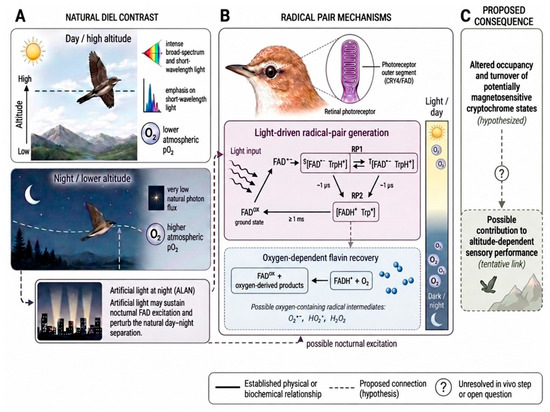
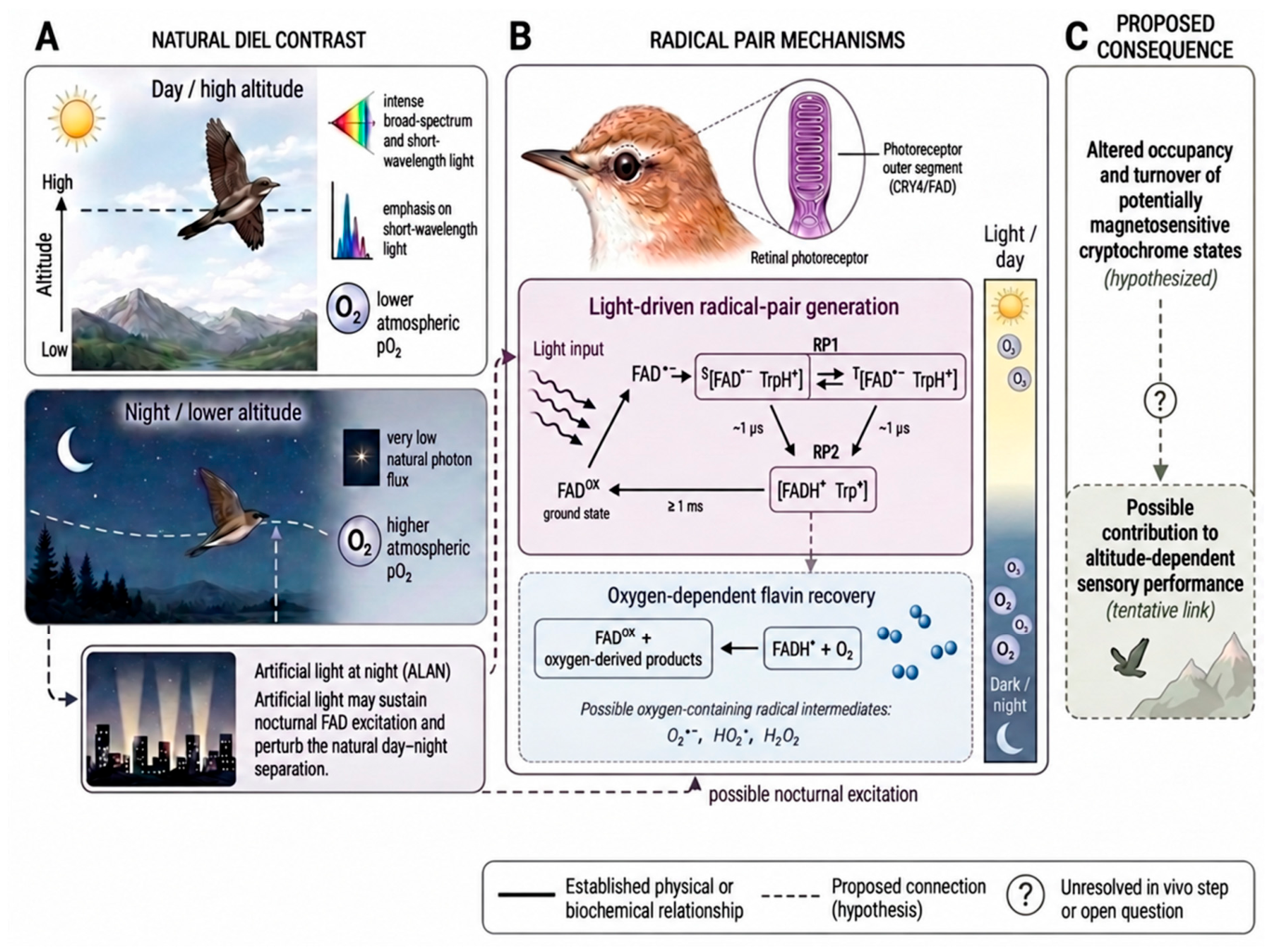
Dawn ascent and dusk descent expose migratory birds to coordinated changes in light and atmospheric oxygen partial pressure. These variables could act on different stages and timescales of flavin photochemistry: light initiates cryptochrome excitation and primary radical-pair formation, whereas molecular oxygen participates in the slower recovery of reduced flavin states. We therefore do not assume that changes in pO2 directly alter the coherent lifetime of the primary spin-correlated radical pair. Instead, they could rebalance the overall photocycle, affect secondary radical chemistry or influence downstream signalling. We propose that the recurring light–oxygen contrast may thereby alter the occupancy and turnover of cryptochrome states over the diel cycle, although the direction and functional significance of this effect remain unknown (Figure 2).
Figure 2.
Proposed coupling of diel flight-altitude changes to cryptochrome photochemistry. (A) Daytime flight at higher altitude combines natural illumination with lower atmospheric oxygen partial pressure, whereas nocturnal flight at lower altitude combines very low photon flux with higher oxygen partial pressure. Artificial light at night (ALAN) may partially sustain nocturnal FAD excitation. (B) During daytime flight at altitude, higher light may promote radical-pair generation and favour photoreduced flavin states, while lower oxygen availability may alter their recovery. After descent near dusk, decreasing light and higher oxygen availability may shift the balance towards flavin recovery. (C) The combined light–oxygen contrast may alter the occupancy and turnover of cryptochrome redox states and thereby modulate magnetosensory signalling over the diel cycle. The illustrated diel variation is schematic and does not predict the direction or magnitude of the effect or imply direct oxygen-dependent modulation of the coherent lifetime of the primary radical pair. Solid lines indicate established relationships, dashed lines proposed connections, and question marks unresolved in vivo steps. This figure was created using FigureLabs (https://figurelabs.ai; accessed on 19 August 2026).
6.1. Retinal Cryptochromes as Possible Molecular Targets
The radical-pair mechanism provides a plausible molecular framework for the light-dependent magnetic compass of birds. In flavin-containing cryptochromes, photon absorption can initiate electron transfer and produce spin-correlated radical pairs whose reaction yields may be influenced by the geomagnetic field [54]. FAD binding is therefore a necessary molecular prerequisite for the canonical flavin–tryptophan radical-pair mechanism. Direct FAD binding is well established for avian CRY4a: pigeon CRY4 has been purified with near-stoichiometric FAD and structurally characterized with bound FAD, while European robin CRY4a binds FAD and undergoes FAD–tryptophan electron transfer [55,56,57]. In contrast, European robin CRY4b did not bind FAD in vitro [58]. Evidence for type II cryptochromes is mixed and isoform-specific: recombinant garden warbler CRY1a was reported to contain FAD and form light-induced radicals, whereas purified pigeon CRY1 contained no detectable FAD and European robin CRY1b showed no measurable FAD binding at physiological concentrations [55,59,60]. Among the cryptochromes expressed in the avian retina, CRY4a currently has the strongest direct molecular support as a magnetoreceptor candidate [32,56]. Experiments with European robin CRY4a demonstrated magnetically sensitive photochemistry associated with sequential electron transfer along a tetrad of tryptophan residues, while ultrafast spectroscopy of CRY4a mutants resolved the contribution of individual residues to this electron-transfer cascade [61]. Expression of European robin CRY4 in a heterologous Drosophila system also supported light-dependent magnetic-field responses, including at 50 µT, extending the evidence beyond isolated protein [62]. More recently, European robin CRY4a was shown to associate with lipid bilayers in an ordered manner, fulfilling an additional molecular requirement for a directional magnetosensor [63]. Together, these findings provide strong molecular evidence for CRY4a, but they do not yet demonstrate that it is required for magnetic compass orientation in intact birds or that it contributes to vertical flight behaviour. The present hypothesis is therefore compatible with CRY4a as the primary molecular sensor but does not depend on a particular cryptochrome isoform or a single radical-pair pathway.
6.2. Light-Driven Reduction and Oxygen-Dependent Flavin Recovery
Light absorption can drive flavin excitation, electron transfer and photoreduction. Molecular oxygen participates in the subsequent reoxidation of reduced flavin states towards oxidized FAD in several experimentally studied cryptochromes [64,65,66,67]. This recovery is sometimes described as the dark reaction because it does not require absorption of another photon. Environmental darkness is not itself chemically necessary: reduction and reoxidation may proceed concurrently under illumination. The distribution of cryptochrome redox states therefore depends on the balance between light-driven reduction and oxygen-dependent recovery rather than on a simple alternation between a light reaction during the day and a dark reaction at night [68]. This mechanistic evidence derives predominantly from studies of purified plant cryptochromes in vitro. Avian CRY4 can bind FAD and undergo light-driven redox chemistry, but whether comparable oxygen-dependent recovery occurs under physiological conditions in the retina remains unknown [57]. Extrapolation to a magnetic receptor in a flying bird must therefore remain explicitly hypothetical. CRY4 has been localized to the outer segments of avian double cones and long-wavelength-sensitive single cones, but oxygen availability within these photoreceptor compartments is unknown [69]. Alternative electron acceptors or enzymatically mediated recovery pathways that do not directly involve molecular oxygen cannot currently be excluded. If oxygen-independent recovery predominates in vivo, the oxygen-dependent component of the present hypothesis would be substantially weakened. However, reoxidation of reduced flavin is not the only route by which the cryptochrome system could regain a functional state. De novo synthesis and turnover of cryptochrome proteins, together with cellular FAD replenishment and incorporation, could renew the pool of FAD-containing holoprotein, although these processes would be expected to act more slowly than photochemical redox cycling. They may therefore contribute to baseline maintenance or longer-term adaptation, whereas the present hypothesis primarily concerns redox-state redistribution within an existing cryptochrome pool across dawn and dusk transitions.
The best-characterized candidate radical pairs for the avian compass are flavin–tryptophan pairs generated during photoreduction. Because oxygen-dependent reoxidation occurs on a much slower timescale, changes in oxygen availability would not be expected to affect these primary spin-correlated radical pairs within their coherent time window. Over longer timescales, however, oxygen-dependent recovery could rebalance the photocycle, influence repeated radical-pair formation by restoring oxidized FAD for subsequent excitation, and alter the availability or lifetime of non-coherent secondary radicals involved in signalling. Flavin-superoxide chemistry during reoxidation remains an additional but unresolved possibility. For freely tumbling superoxide, spin-rotational relaxation is expected to be too rapid to preserve the spin correlation required for sensitivity to the Earth’s weak magnetic field [70]. Theoretical work nevertheless indicates that magnetosensitivity may be possible under restrictive conditions, for example, if superoxide is sufficiently constrained within cryptochrome and recombination is strongly asymmetric, or if it participates in a radical-triad/scavenging mechanism; whether such conditions occur in avian cryptochrome in vivo remains unknown [71,72,73]. Thus, the proposed effect of oxygen does not require superoxide itself to form part of the magnetosensitive pair.
At a fixed wavelength, light intensity changes the rate of photon absorption and flavin excitation rather than the energy delivered by each photon, whereas oxygen availability may influence flavin reoxidation because molecular oxygen is a reactant. The approximately 23% decline in atmospheric oxygen partial pressure during an illustrative ascent from 2000 to 4000 m would be expected to exert only a small direct thermodynamic effect on this reaction, even if it were transmitted proportionally to the reaction site. Effects on reaction kinetics, photocycle turnover and the relative occupancy of flavin redox states would therefore be more plausible than a substantial change in the free energy of an individual radical-pair reaction.
6.3. The Diel Altitude Cycle as a Combined Light–Oxygen Perturbation
After dawn, the rapid increase in natural illumination dominates the change in photon exposure. Under clear-sky conditions, ascent can additionally increase direct irradiance because less atmosphere, aerosol and water vapour remain above the bird, although the magnitude and spectral distribution of this effect depend on solar elevation, clouds, weather and geographical setting [29]. Increased photon input could raise the rate of radical-pair generation and favour photoreduced flavin states, while lower oxygen availability could modify their rate of recovery. At dusk, descent into air with a higher oxygen partial pressure coincides with the rapid decline of natural illumination. Together, these conditions could shift the balance away from continued photoreduction and towards flavin recovery. Repeated ascent and descent could therefore modulate the occupancy and turnover of potentially magnetosensitive cryptochrome states over the diel cycle.
An additional possibility is that intense daylight combined with reduced oxygen availability at altitude allows a pool of reduced flavin to accumulate during daytime flight. After descent near dusk, increased oxygen availability could react with this pool and generate potentially magnetosensitive flavin–superoxide radical pairs during nocturnal flight, partially decoupling magnetosensitive chemistry from concurrent photon absorption. Whether such a reduced-flavin pool forms and persists in avian retinal cryptochromes remains unknown.
The central hypothesis is therefore that altitude-dependent light and oxygen conditions may redistribute flavin redox states and alter cryptochrome photocycle turnover across the diel cycle, with possible consequences for magnetosensory signalling. This hypothesis does not require the light-dependent magnetic compass to operate identically during daytime and nocturnal flight. The documented altitude cycles occur during multi-day nonstop flights or normally nocturnal flights that extend into daylight, rather than representing a comparison between strictly diurnal and nocturnal migrants. In meadow pipits, activity in a visual forebrain region implicated in magnetic-compass processing was greater under dim nighttime than under bright daytime conditions. However, the birds were tested outside the migratory season and magnetic orientation itself was not examined; the study therefore does not establish the absence of daytime magnetic-compass use [74]. The proposed coupling instead concerns changes in cryptochrome redox-state occupancy and photocycle turnover across successive light and oxygen environments, whose possible magnetosensory consequences need not be identical during daytime and nocturnal flight. It does not predict that greater illumination must always increase magnetic sensitivity. Stronger light could enhance radical-pair formation, saturate part of the photocycle, alter visual adaptation or increase retinal oxidative load. A major uncertainty is that atmospheric oxygen partial pressure cannot be translated directly into oxygen availability at a retinal protein. Pulmonary oxygen uptake, blood oxygen transport, retinal perfusion, local metabolism and diffusion will buffer and spatially shape the oxygen environment of photoreceptors [33]. The hypothesis therefore concerns a possible physiological coupling between altitude-dependent oxygen availability and cryptochrome photochemistry, not a one-to-one relationship between altitude and retinal oxygen tension. Demonstrating such coupling will require measurements or defensible estimates of retinal oxygenation under flight-relevant conditions. Nor does the hypothesis depend on a meaningful altitude-dependent change in the geomagnetic field itself. Over an ascent of approximately 2 km, the expected change in geomagnetic-field magnitude is only about 0.1%. Any influence of altitude would instead arise from altered cryptochrome-state occupancy, photocycle turnover or secondary radical chemistry: the magnetic field provides essentially the same directional information, but the molecular system detecting it may function differently under the altered light and redox environment.
6.4. Artificial Light at Night
Nocturnal migrants show heterogeneous responses to artificial illumination, including attraction, disorientation, altered flight altitude and increased stopover density; some tracked birds also select dark-connected airspace, although artificial light and urbanization are difficult to separate in such analyses [75,76,77,78]. These observations demonstrate that the nocturnal light environment is biologically relevant but do not provide specific evidence for a cryptochrome radical-pair mechanism. If artificial light contains wavelengths absorbed by the relevant cryptochrome and reaches the retina at sufficient intensity, it could sustain flavin excitation during a period in which natural photon input is normally strongly reduced. This could diminish the natural diel contrast in cryptochrome redox-state occupancy and recovery. Any such effect would depend on spectrum, intensity, exposure duration and the local oxygen environment and would have to be distinguished from visual attraction, disruption of celestial navigation and circadian effects. Artificial light at night is therefore not evidence for the proposed mechanism, but it illustrates how the light component of the natural diel contrast can be perturbed. A direct test of the proposed interaction would require independent manipulation of light intensity or spectrum and oxygen partial pressure, followed by measurements of cryptochrome photochemistry or magnetic orientation.
7. Scope and Outlook
Diel changes in migratory flight altitude may serve several functions, and the available evidence does not yet resolve their relative importance. Importantly, the cue initiating ascent need not be identical to the benefit that favours continued flight at altitude.
We propose that ascent after dawn and descent near dusk could reinforce the natural diel contrast between light-driven flavin photoreduction and oxygen-dependent recovery of reduced flavin states in retinal cryptochromes. If the combined changes in light and oxygen alter cryptochrome-state occupancy, photocycle turnover or the formation of secondary radical intermediates, radical-pair-based magnetoreception could be affected over the diel cycle. Whether magnetic sensitivity is enhanced, which cryptochrome and flavin states are involved, and whether oxygen-containing radical intermediates contribute remain open questions. Experiments combining physiologically realistic changes in light and oxygen could test whether the conditions associated with diel altitude transitions alter cryptochrome photochemistry and magnetic sensitivity in long-distance migratory birds. However, the physiological relevance of such in vitro measurements will remain difficult to establish because the local molecular environment and interaction partners of CRY4 in the avian retina are still incompletely characterized; observations in purified proteins cannot by themselves demonstrate that the same effects occur in vivo.
8. Conclusions
Diel altitude changes expose long-distance migratory birds to a recurring sequence of light and oxygen conditions. We propose that this sequence could redistribute cryptochrome flavin redox states across dawn and dusk and thereby alter the biochemical context in which magnetoreception operates. This mechanism neither replaces established physiological and ecological explanations for vertical flight nor requires oxygen to modify the coherent lifetime of the primary radical pair. It identifies cryptochrome photocycle turnover as a specific and experimentally testable link between flight altitude and magnetosensory physiology.
Author Contributions
Conceptualization, M.E.; visualization, V.T.; writing—original draft preparation, M.E.; review and editing, M.E. and V.T. All authors have read and agreed to the published version of the manuscript.
Funding
This research received no external funding.
Institutional Review Board Statement
Not applicable.
Informed Consent Statement
Not applicable.
Data Availability Statement
No new data were created or analyzed in this study.
Acknowledgments
During the preparation of this manuscript, the authors used ChatGPT (OpenAI, GPT-5, accessed on 30 September 2026) solely for language polishing and editing, and FigureLabs (web version, accessed in September 2026) to create Figure 1 and Figure 2. The authors reviewed and edited all outputs and take full responsibility for the content of this publication.
Conflicts of Interest
The authors declare no conflicts of interest. The funders had no role in the design of study; in the collection, analyses, or interpretation of data; in the writing of the manuscript; or in the decision to publish the results.
References
- Dufour, P.; Nussbaumer, R.; Briedis, M.; Bocher, P.; Conway, G.; Coulomb, Y.; Delacroix, R.; Dagonet, T.; de Franceschi, C.; de Grissac, S.; et al. Ecological barrier crossing strategies in small migratory birds depend on wing morphology and plumage color. iScience 2025, 29, 114466. [Google Scholar] [CrossRef] [Scilit] [PubMed]
- Lindström, Å.; Alerstam, T.; Andersson, A.; Bäckman, J.; Bahlenberg, P.; Bom, R.; Ekblom, R.; Klaassen, R.H.; Korniluk, M.; Sjöberg, S.; et al. Extreme altitude changes between night and day during marathon flights of great snipes. Curr. Biol. 2021, 31, 3433–3439.e3. [Google Scholar] [CrossRef] [Scilit] [PubMed]
- Sjöberg, S.; Malmiga, G.; Nord, A.; Andersson, A.; Bäckman, J.; Tarka, M.; Willemoes, M.; Thorup, K.; Hansson, B.; Alerstam, T.; et al. Extreme altitudes during diurnal flights in a nocturnal songbird migrant. Science 2021, 372, 646–648. [Google Scholar] [CrossRef] [Scilit] [PubMed]
- Liechti, F.; Bauer, S.; Dhanjal-Adams, K.L.; Emmenegger, T.; Zehtindjiev, P.; Hahn, S. Miniaturized multi-sensor loggers provide new insight into year-round flight behaviour of small trans-Sahara avian migrants. Mov. Ecol. 2018, 6, 19. [Google Scholar] [CrossRef] [Scilit] [PubMed]
- Norevik, G.; Åkesson, S.; Hedenström, A. Extremely low daylight sea-crossing flights of a nocturnal migrant. PNAS Nexus 2023, 2, pgad225. [Google Scholar] [CrossRef] [Scilit] [PubMed]
- Das, D.K.; Piersma, T.; Smit, D.; Henriques, M.; Vansteelant, W.M.G. Black-Tailed Godwits Crossing the Tibetan Plateau Adjust Flight Altitudes in Response to Topography Rather than Temperature Variations. Authorea Prepr. 2025. [Google Scholar] [CrossRef] [Scilit] [PubMed]
- Myres, M.T. Dawn ascent and re-orientation of scandinavian thrushes (Turdus spp.) migrating at night over the northeastern atlantic ocean in autumn. Ibis 1964, 106, 7–51. [Google Scholar] [CrossRef] [Scilit]
- Bourne, W.R.P. The midnight descent, dawn ascent and re-orientation of land birds migrating across the north sea in autumn. Ibis 1980, 122, 536–540. [Google Scholar] [CrossRef] [Scilit]
- Diehl, R.H.; Larkin, R.P. Radar Observations of Bird Migration over the Great Lakes. Ornithology 2003, 120, 278–290. [Google Scholar] [CrossRef] [Scilit]
- Bodhaine, B.A.; Wood, N.B.; Dutton, E.G.; Slusser, J.R. On Rayleigh Optical Depth Calculations. J. Atmos. Ocean. Technol. 1999, 16, 1854–1861. [Google Scholar] [CrossRef] [Scilit]
- Piazena, H. The effect of altitude upon the solar UV-B and UV-A irradiance in the tropical Chilean Andes. Sol. Energy 1996, 57, 133–140. [Google Scholar] [CrossRef] [Scilit]
- Schmucki, D.A.; Philipona, R. Ultraviolet radiation in the Alps: The altitude effect. Opt. Eng. 2002, 41, 3090–3095. [Google Scholar] [CrossRef] [Scilit]
- Butler, P.J. The physiological basis of bird flight. Philos. Trans. R. Soc. B Biol. Sci. 2016, 371, 20150384. [Google Scholar] [CrossRef] [Scilit] [PubMed]
- McWilliams, S.R.; Guglielmo, C.; Pierce, B.; Klaassen, M. Flying, fasting, and feeding in birds during migration: A nutritional and physiological ecology perspective. J. Avian Biol. 2004, 35, 377–393. [Google Scholar] [CrossRef] [Scilit]
- Laguë, S.L. High-altitude champions: Birds that live and migrate at altitude. J. Appl. Physiol. 2017, 123, 942–950. [Google Scholar] [CrossRef] [Scilit] [PubMed]
- Scott, G.R. Elevated performance: The unique physiology of birds that fly at high altitudes. J. Exp. Biol. 2011, 214, 2455–2462. [Google Scholar] [CrossRef] [Scilit] [PubMed]
- Altshuler, D.L.; Dudley, R. The physiology and biomechanics of avian flight at high altitude. Integr. Comp. Biol. 2006, 46, 62–71. [Google Scholar] [CrossRef] [Scilit] [PubMed]
- Biewener, A.A. Muscle function in avian flight: Achieving power and control. Philos. Trans. R. Soc. B Biol. Sci. 2011, 366, 1496–1506. [Google Scholar] [CrossRef] [Scilit] [PubMed]
- Biewener, A.A. Biomechanics of avian flight. Curr. Biol. 2022, 32, R1110–R1114. [Google Scholar] [CrossRef] [Scilit] [PubMed]
- Dokter, A.M.; Shamoun-Baranes, J.; Kemp, M.U.; Tijm, S.; Holleman, I. High Altitude Bird Migration at Temperate Latitudes: A Synoptic Perspective on Wind Assistance. PLoS ONE 2013, 8, e52300. [Google Scholar] [CrossRef] [Scilit] [PubMed]
- Kemp, M.; Shamoun-Baranes, J.; Dokter, A.; Van Loon, E.; Bouten, W. The influence of weather on the flight altitude of nocturnal migrants in mid-latitudes. Ibis 2013, 155, 734–749. [Google Scholar] [CrossRef] [Scilit]
- Engel, S.; Biebach, H.; Visser, G.H. Water and Heat Balance during Flight in the Rose-Colored Starling (Sturnus roseus). Physiol. Biochem. Zool. 2006, 79, 763–774. [Google Scholar] [CrossRef] [Scilit] [PubMed]
- Gerson, A.R.; Guglielmo, C.G. Flight at Low Ambient Humidity Increases Protein Catabolism in Migratory Birds. Science 2011, 333, 1434–1436. [Google Scholar] [CrossRef] [Scilit] [PubMed]
- Gerson, A.R.; Guglielmo, C.G. Measurement of glomerular filtration rate during flight in a migratory bird using a single bolus injection of FITC-inulin. Am. J. Physiol.-Ren. Physiol. 2013, 305, F823–F829. [Google Scholar] [CrossRef] [Scilit] [PubMed][Green Version]
- Sjöberg, S.; Andersson, A.; Bäckman, J.; Hansson, B.; Malmiga, G.; Tarka, M.; Hasselquist, D.; Lindström, Å.; Alerstam, T. Solar heating may explain extreme diel flight altitude changes in migrating birds. Curr. Biol. 2023, 33, 4232–4237.e2. [Google Scholar] [CrossRef] [Scilit] [PubMed]
- Bell, E.L.; Klimova, T.A.; Eisenbart, J.; Moraes, C.T.; Murphy, M.P.; Budinger, G.S.; Chandel, N.S. The Qo site of the mitochondrial complex III is required for the transduction of hypoxic signaling via reactive oxygen species production. J. Cell Biol. 2007, 177, 1029–1036. [Google Scholar] [CrossRef] [Scilit] [PubMed]
- Murphy, M.P. How mitochondria produce reactive oxygen species. Biochem. J. 2009, 417, 1–13. [Google Scholar] [CrossRef] [Scilit] [PubMed]
- Yap, K.N.; Dick, M.F.; Guglielmo, C.G.; Williams, T.D. Effects of experimental manipulation of hematocrit on avian flight performance in high and low altitude conditions. J. Exp. Biol. 2018, 221, jeb191056. [Google Scholar] [CrossRef] [Scilit] [PubMed]
- Pfeifer, M.T.; Koepke, P.; Reuder, J. Effects of altitude and aerosol on UV radiation. J. Geophys. Res. Atmos. 2006, 111, D01203. [Google Scholar] [CrossRef] [Scilit]
- Sola, Y.; Lorente, J.; Campmany, E.; de Cabo, X.; Bech, J.; Redaño, A.; Martínez-Lozano, J.A.; Utrillas, M.P.; Alados-Arboledas, L.; Olmo, F.J.; et al. Altitude effect in UV radiation during the Evaluation of the Effects of Elevation and Aerosols on the Ultraviolet Radiation 2002 (VELETA-2002) field campaign. J. Geophys. Res. Atmos. 2008, 113, D23202. [Google Scholar] [CrossRef] [Scilit]
- Kuenzel, W.J.; Kang, S.W.; Zhou, Z.J. Exploring avian deep-brain photoreceptors and their role in activating the neuroendocrine regulation of gonadal development. Poult. Sci. 2015, 94, 786–798. [Google Scholar] [CrossRef] [Scilit]
- Pinzon-Rodriguez, A.; Bensch, S.; Muheim, R. Expression patterns of cryptochrome genes in avian retina suggest involvement of Cry4 in light-dependent magnetoreception. J. R. Soc. Interface 2018, 15, 20180058. [Google Scholar] [CrossRef] [Scilit] [PubMed]
- Ivy, C.M.; Williamson, J.L. On the Physiology of High-altitude Flight and Altitudinal Migration in Birds. Integr. Comp. Biol. 2024, 64, 1766–1779. [Google Scholar] [CrossRef] [Scilit] [PubMed]
- Hardie, D.G.; Ross, F.A.; Hawley, S.A. AMPK: A nutrient and energy sensor that maintains energy homeostasis. Nat. Rev. Mol. Cell Biol. 2012, 13, 251–262. [Google Scholar] [CrossRef] [Scilit] [PubMed]
- Burtscher, J.; Hohenauer, E.; Burtscher, M.; Millet, G.P.; Egg, M. Environmental and behavioral regulation of HIF-mitochondria crosstalk. Free Radic. Biol. Med. 2023, 206, 63–73. [Google Scholar] [CrossRef] [Scilit] [PubMed]
- Burtscher, J.; Citherlet, T.; Camacho-Cardenosa, A.; Camacho-Cardenosa, M.; Raberin, A.; Krumm, B.; Hohenauer, E.; Egg, M.; Lichtblau, M.; Müller, J.; et al. Mechanisms underlying the health benefits of intermittent hypoxia conditioning. J. Physiol. 2023, 602, 5757–5783. [Google Scholar] [CrossRef] [Scilit] [PubMed]
- Powell, F.L.; Fu, Z. HIF-1 and ventilatory acclimatization to chronic hypoxia. Respir. Physiol. Neurobiol. 2008, 164, 282–287. [Google Scholar] [CrossRef] [Scilit] [PubMed]
- Semenza, G.L. Hypoxia-Inducible Factors in Physiology and Medicine. Cell 2012, 148, 399–408. [Google Scholar] [CrossRef] [Scilit] [PubMed]
- Lewden, A.; Bishop, C.M.; Askew, G.N. How birds dissipate heat before, during and after flight. J. R. Soc. Interface 2023, 20, 20230442. [Google Scholar] [CrossRef] [Scilit] [PubMed]
- Groom, D.J.E.; Deakin, J.E.; Lauzau, M.C.; Gerson, A.R. The role of humidity and metabolic status on lean mass catabolism in migratory Swainson’s thrushes (Catharus ustulatus). Proc. R. Soc. B-Biol. Sci. 2019, 286, 20190859. [Google Scholar] [CrossRef] [Scilit] [PubMed]
- Jenni-Eiermann, S.; Jenni, L.; Smith, S.; Costantini, D. Oxidative Stress in Endurance Flight: An Unconsidered Factor in Bird Migration. PLoS ONE 2014, 9, e97650. [Google Scholar] [CrossRef] [Scilit] [PubMed]
- McWilliams, S.; Carter, W.; Cooper-Mullin, C.; DeMoranville, K.; Frawley, A.; Pierce, B.; Skrip, M. How Birds During Migration Maintain (Oxidative) Balance. Front. Ecol. Evol. 2021, 9, 742642. [Google Scholar] [CrossRef] [Scilit]
- Coulson, S.Z.; Guglielmo, C.G.; Staples, J.F. Migration increases mitochondrial oxidative capacity without increasing reactive oxygen species emission in a songbird. J. Exp. Biol. 2024, 227, jeb246849. [Google Scholar] [CrossRef] [Scilit] [PubMed]
- Kumar, V.; Singh, B.P.; Rani, S. The Bird Clock: A Complex, Multi-Oscillatory and Highly Diversified System. Biol. Rhythm Res. 2004, 35, 121–144. [Google Scholar] [CrossRef] [Scilit]
- Bartell, P.A.; Gwinner, E. A Separate Circadian Oscillator Controls Nocturnal Migratory Restlessness in the Songbird Sylvia borin. J. Biol. Rhythm. 2005, 20, 538–549. [Google Scholar] [CrossRef] [Scilit] [PubMed]
- Coppack, T.; Becker, S.F.; Becker, P.J. Circadian flight schedules in night-migrating birds caught on migration. Biol. Lett. 2008, 4, 619–622. [Google Scholar] [CrossRef] [Scilit] [PubMed]
- Coverdill, A.J.; Bentley, G.E.; Ramenofsky, M. Circadian and Masking Control of Migratory Restlessness in Gambel’s White-Crowned Sparrow (Zonotrichia leucophrys gambelii). J. Biol. Rhythm. 2008, 23, 59–68. [Google Scholar] [CrossRef] [Scilit] [PubMed]
- Phol, H. Circadian control of migratory restlessness and the effects of exogenous melatonin in the brambling, Fringilla montifringilla. Chronobiol. Int. 2000, 17, 471–488. [Google Scholar] [CrossRef] [Scilit] [PubMed]
- Wagner, H.O. Über Jahres- und Tagesrhythmus bei Zugvögeln. J. Comp. Physiol. A 1930, 12, 703–724. [Google Scholar] [CrossRef] [Scilit]
- Adamovich, Y.; Ladeuix, B.; Golik, M.; Koeners, M.P.; Asher, G. Rhythmic Oxygen Levels Reset Circadian Clocks through HIF1α. Cell Metab. 2017, 25, 93–101. [Google Scholar] [CrossRef] [Scilit] [PubMed]
- Egg, M.; Köblitz, L.; Hirayama, J.; Schwerte, T.; Folterbauer, C.; Kurz, A.; Fiechtner, B.; Möst, M.; Salvenmoser, W.; Sassone-Corsi, P.; et al. Linking Oxygen to Time: The Bidirectional Interaction Between the Hypoxic Signaling Pathway and the Circadian Clock. Chronobiol. Int. 2013, 30, 510–529. [Google Scholar] [CrossRef] [Scilit] [PubMed]
- Thoeni, V.; Dimova, E.Y.; Kietzmann, T.; Usselman, R.J.; Egg, M. Therapeutic nuclear magnetic resonance and intermittent hypoxia trigger time dependent on/off effects in circadian clocks and confirm a central role of superoxide in cellular magnetic field effects. Redox Biol. 2024, 72, 103152. [Google Scholar] [CrossRef] [Scilit] [PubMed]
- Cooper, N.W.; Dossman, B.C.; Berrigan, L.E.; Brown, J.M.; Brunner, A.R.; Chmura, H.E.; Cormier, D.A.; Bégin-Marchand, C.; Rodewald, A.D.; Taylor, P.D.; et al. Songbirds initiate migratory flights synchronously relative to civil dusk. Mov. Ecol. 2023, 11, 24. [Google Scholar] [CrossRef] [Scilit] [PubMed]
- Hore, P.J.; Mouritsen, H. The Radical-Pair Mechanism of Magnetoreception. Annu. Rev. Biophys. 2016, 45, 299–344. [Google Scholar] [CrossRef] [Scilit] [PubMed]
- Wang, X.; Jing, C.; Selby, C.P.; Chiou, Y.-Y.; Yang, Y.; Wu, W.; Sancar, A.; Wang, J. Comparative properties and functions of type 2 and type 4 pigeon cryptochromes. Cell. Mol. Life Sci. 2018, 75, 4629–4641. [Google Scholar] [CrossRef] [Scilit] [PubMed]
- Xu, J.; Jarocha, L.E.; Zollitsch, T.; Konowalczyk, M.; Henbest, K.B.; Richert, S.; Golesworthy, M.J.; Schmidt, J.; Déjean, V.; Sowood, D.J.C.; et al. Magnetic sensitivity of cryptochrome 4 from a migratory songbird. Nature 2021, 594, 535–540. [Google Scholar] [CrossRef] [Scilit] [PubMed]
- Zoltowski, B.D.; Chelliah, Y.; Wickramaratne, A.; Jarocha, L.; Karki, N.; Xu, W.; Mouritsen, H.; Hore, P.J.; Hibbs, R.E.; Green, C.B.; et al. Chemical and structural analysis of a photoactive vertebrate cryptochrome from pigeon. Proc. Natl. Acad. Sci. USA 2019, 116, 19449–19457. [Google Scholar] [CrossRef] [Scilit] [PubMed]
- Xu, J.; Ameerjan, A.B.P.; Hungerland, J.; Langebrake, G.; Ravnsborg, T.; Jensen, O.N.; Schmidt, J.; Bartölke, R.; Kasahara, T.; Satish, B.; et al. Cryptochrome 4b protein is probably irrelevant for radical pair-based magnetoreception in the European robin. J. R. Soc. Interface 2025, 22, 20250176. [Google Scholar] [CrossRef] [Scilit] [PubMed]
- Liedvogel, M.; Maeda, K.; Henbest, K.; Schleicher, E.; Simon, T.; Timmel, C.R.; Hore, P.J.; Mouritsen, H. Chemical Magnetoreception: Bird Cryptochrome 1a Is Excited by Blue Light and Forms Long-Lived Radical-Pairs. PLoS ONE 2007, 2, e1106. [Google Scholar] [CrossRef] [Scilit] [PubMed]
- Wickramaratne, A.C.; Rasmussen, E.S.; Chelliah, Y.; Schuhmann, F.; Solov’YOv, I.A.; Mouritsen, H.; Green, C.B.; Zoltowski, B.D.; Takahashi, J.S. Structure of European robin cryptochrome 1 reveals a role in circadian rhythms, not magnetoreception. iScience 2025, 28, 114015. [Google Scholar] [CrossRef] [Scilit] [PubMed]
- Timmer, D.; Frederiksen, A.; Lünemann, D.C.; Thomas, A.R.; Xu, J.; Bartölke, R.; Schmidt, J.; Kubař, T.; De Sio, A.; Solov’yOv, I.A.; et al. Tracking the Electron Transfer Cascade in European Robin Cryptochrome 4 Mutants. J. Am. Chem. Soc. 2023, 145, 11566–11578. [Google Scholar] [CrossRef] [Scilit] [PubMed]
- Bradlaugh, A.A.; Fedele, G.; Munro, A.L.; Hansen, C.N.; Hares, J.M.; Patel, S.; Kyriacou, C.P.; Jones, A.R.; Rosato, E.; Baines, R.A. Essential elements of radical pair magnetosensitivity in Drosophila. Nature 2023, 615, 111–116, Correction in Nature 2023, 615, E27. [Google Scholar] [CrossRef] [Scilit] [PubMed]
- Majewska, M.; Hanić, M.; Bartölke, R.; Schmidt, J.; Bożek, J.; Gerhards, L.; Mouritsen, H.; Koch, K.-W.; Solov’yOv, I.A.; Brand, I. European Robin Cryptochrome-4a Associates with Lipid Bilayers in an Ordered Manner, Fulfilling a Molecular-Level Condition for Magnetoreception. ACS Chem. Biol. 2025, 20, 592–606. [Google Scholar] [CrossRef] [Scilit] [PubMed]
- Müller, P.; Ahmad, M. Light-activated Cryptochrome Reacts with Molecular Oxygen to Form a Flavin–Superoxide Radical Pair Consistent with Magnetoreception. J. Biol. Chem. 2011, 286, 21033–21040. [Google Scholar] [CrossRef] [Scilit] [PubMed]
- Ozturk, N.; Selby, C.P.; Song, S.-H.; Ye, R.; Tan, C.; Kao, Y.-T.; Zhong, D.; Sancar, A. Comparative Photochemistry of Animal Type 1 and Type 4 Cryptochromes. Biochemistry 2009, 48, 8585–8593. [Google Scholar] [CrossRef] [Scilit] [PubMed]
- Vaidya, A.T.; Top, D.; Manahan, C.C.; Tokuda, J.M.; Zhang, S.; Pollack, L.; Young, M.W.; Crane, B.R. Flavin reduction activates Drosophila cryptochrome. Proc. Natl. Acad. Sci. USA 2013, 110, 20455–20460. [Google Scholar] [CrossRef] [Scilit] [PubMed]
- van Wilderen, L.J.; Silkstone, G.; Mason, M.; van Thor, J.J.; Wilson, M.T. Kinetic studies on the oxidation of semiquinone and hydroquinone forms of Arabidopsis cryptochrome by molecular oxygen. FEBS Open Bio 2015, 5, 885–892. [Google Scholar] [CrossRef] [Scilit] [PubMed][Green Version]
- Procopio, M.; Link, J.; Engle, D.; Witczak, J.; Ritz, T.; Ahmad, M. Kinetic Modeling of the Arabidopsis Cryptochrome Photocycle: FADHo Accumulation Correlates with Biological Activity. Front. Plant Sci. 2016, 7, 888. [Google Scholar] [CrossRef] [Scilit] [PubMed]
- Günther, A.; Einwich, A.; Sjulstok, E.; Feederle, R.; Bolte, P.; Koch, K.-W.; Solov’yOv, I.A.; Mouritsen, H. Double-Cone Localization and Seasonal Expression Pattern Suggest a Role in Magnetoreception for European Robin Cryptochrome 4. Curr. Biol. 2018, 28, 211–223.e4. [Google Scholar] [CrossRef] [Scilit] [PubMed]
- Player, T.C.; Hore, P.J. Viability of superoxide-containing radical pairs as magnetoreceptors. J. Chem. Phys. 2019, 151, 225101. [Google Scholar] [CrossRef] [Scilit] [PubMed]
- Denton, M.C.J.; Smith, L.D.; Xu, W.; Pugsley, J.; Toghill, A.; Kattnig, D.R. Magnetosensitivity of tightly bound radical pairs in cryptochrome is enabled by the quantum Zeno effect. Nat. Commun. 2024, 15, 10823. [Google Scholar] [CrossRef] [Scilit] [PubMed]
- Deviers, J.; Cailliez, F.; de la Lande, A.; Kattnig, D.R. Avian cryptochrome 4 binds superoxide. Comput. Struct. Biotechnol. J. 2023, 26, 11–21. [Google Scholar] [CrossRef] [Scilit] [PubMed]
- Kattnig, D.R. Radical-Pair-Based Magnetoreception Amplified by Radical Scavenging: Resilience to Spin Relaxation. J. Phys. Chem. B 2017, 121, 10215–10227. [Google Scholar] [CrossRef] [Scilit] [PubMed]
- Zapka, M.; Heyers, D.; Liedvogel, M.; Jarvis, E.D.; Mouritsen, H. Night-time neuronal activation of Cluster N in a day- and night-migrating songbird. Eur. J. Neurosci. 2010, 32, 619–624. [Google Scholar] [CrossRef] [Scilit] [PubMed]
- A Cabrera-Cruz, S.; A Smolinsky, J.; McCarthy, K.P.; Buler, J.J. Urban areas affect flight altitudes of nocturnally migrating birds. J. Anim. Ecol. 2019, 88, 1873–1887. [Google Scholar] [CrossRef] [Scilit] [PubMed]
- Van Doren, B.M.; Horton, K.G.; Dokter, A.M.; Klinck, H.; Elbin, S.B.; Farnsworth, A. High-intensity urban light installation dramatically alters nocturnal bird migration. Proc. Natl. Acad. Sci. USA 2017, 114, 11175–11180. [Google Scholar] [CrossRef] [Scilit] [PubMed]
- Horton, K.G.; Buler, J.J.; Anderson, S.J.; Burt, C.S.; Collins, A.C.; Dokter, A.M.; Guo, F.; Sheldon, D.; Tomaszewska, M.A.; Henebry, G.M. Artificial light at night is a top predictor of bird migration stopover density. Nat. Commun. 2023, 14, 7446. [Google Scholar] [CrossRef] [Scilit] [PubMed]
- Korpach, A.M.; Garroway, C.J.; Mills, A.M.; von Zuben, V.; Davy, C.M.; Fraser, K.C. Urbanization and artificial light at night reduce the functional connectivity of migratory aerial habitat. Ecography 2022, 2022, e05581. [Google Scholar] [CrossRef] [Scilit]

Disclaimer/Publisher’s Note: The statements, opinions and data contained in all publications are solely those of the individual author(s) and contributor(s) and not of MDPI and/or the editor(s). MDPI and/or the editor(s) disclaim responsibility for any injury to people or property resulting from any ideas, methods, instructions or products referred to in the content. |
© 2026 by the authors. Licensee MDPI, Basel, Switzerland. This article is an open access article distributed under the terms and conditions of the Creative Commons Attribution (CC BY) license.