


Abstract
We present an ab initio quadrupole-invariant study of neutron-rich nuclei around . Effective Hamiltonians and consistently evolved operators are obtained from chiral NN+3N interactions using the ab initio valence-space in-medium similarity renormalization group, and the resulting matrix elements are used to extract the deformation parameters. Along the even–even isotonic chain, the values increase systematically from 48Ca to 40Mg, providing a direct deformation signature of the weakening of the shell closure. The extracted and values show a prolate–oblate–triaxial evolution of the states from 40Mg to 42Si and 44S, while the states remain mainly in the prolate-to-triaxial region. Extending the analysis to the neighboring and 29 isotones, we find a systematic evolution from strongly prolate Mg isotopes, to oblate-side Si isotopes, and to prolate-to-triaxial S isotopes. These results provide a unified picture of quadrupole deformation, triaxiality, and configuration coexistence around .
1. Introduction
Understanding how shell structure evolves far from stability is one of the central goals of modern nuclear structure physics. The traditional magic numbers, which are well established near the valley of stability [1,2], can be strongly modified in neutron-rich systems because of changes in the single-particle spectrum and the enhanced role of correlations [3,4,5,6,7,8]. Quadrupole collectivity is a particularly sensitive probe of such shell evolution: reduced low-lying excitation energies, enhanced electric-quadrupole transition strengths, and the appearance of deformed or coexisting structures all signal the weakening of spherical shell closures.
The neutron number offers a particularly important example. It is robust in the doubly magic nucleus 48Ca, while below calcium the rapid lowering of the excitation energies, the enhancement of transition strengths, and the appearance of low-lying coexisting structures indicate a strong reduction in the spherical shell gap [9,10,11,12,13,14,15,16,17,18,19,20,21]. The erosion of the gap between the neutron and orbitals favors quadrupole correlations, and the active proton degrees of freedom in the shell further amplify collectivity through quasi-SU(3), pseudo-SU(3), and the Jahn–Teller effect [22,23,24,25,26,27,28]. As a consequence, the neutron-rich nuclei around display a rich interplay between shell erosion, deformation, and shape coexistence.
A number of theoretical studies have investigated the neutron-rich region, including shell-model (SM) calculations [22,23,24,25,26,27,29,30], beyond-mean-field (BMF) approaches [31,32,33,34], antisymmetrized molecular dynamics (AMD) calculations [28,35,36], and ab initio approaches [20,21,37]. These studies have suggested a rapid shape evolution in the even–even isotones, including well-developed deformation in 40Mg and 42Si, shape coexistence in 44S, and a prolate–oblate–prolate evolution of the ground-state-associated structures from 40Mg through 42Si to 44S [11,14,15,28,38,39,40]. Furthermore, previous SM analyses based on quadrupole rotational invariants have shown that the triaxial degree of freedom plays an important role in 43,44S [30]. The low-lying structures in the sulfur isotopes have been interpreted in terms of shape and configuration coexistence, including the coexistence of the ground state with the isomer in 43,45S and the appearance of low-lying deformed and triaxial structures in 44S [21,30]. These interpretations are also connected to the rich experimental spectroscopy of sulfur isotopes in this mass region [41,42,43,44,45,46,47,48]. AMD and BMF calculations have also emphasized triaxiality, large shape fluctuations, and competing configurations, especially in 44S [28,33,34].
Recent ab initio valence-space in-medium similarity renormalization group (VS-IMSRG) calculations have provided a microscopic description of this region using consistently evolved Hamiltonians and electromagnetic operators [20,21,37]. Those studies used spectra, values, and spectroscopic quadrupole moments to identify rotational sequences and configuration-coexisting structures in neutron-rich nuclei around . These results showed that ab initio calculations can describe the emergence of quadrupole collectivity and provide microscopic insight into shape coexistence and isomeric structures in this mass region. However, values and transition maps by themselves do not provide a direct state-by-state representation of deformation in the – plane. In particular, a small or vanishing does not necessarily imply a spherical shape; it may also reflect triaxiality, K mixing, or fluctuations between prolate and oblate components. A complementary analysis is therefore useful to convert the ab initio -transition matrix elements into quadrupole invariants. Quadrupole invariants provide such a bridge between matrix elements and intrinsic-shape language. Following the quadrupole-sum-rule approach of Kumar and Cline [49,50], the second- and third-order quadrupole invariants allow one to extract the magnitude of quadrupole collectivity and the triaxiality indicator from matrix elements, while higher-order invariants further provide estimates of the fluctuations in these deformation parameters [30,51,52].
In this work, we perform an ab initio quadrupole-invariant analysis of neutron-rich nuclei around . Starting from chiral NN+3N interactions, we use the VS-IMSRG to consistently derive effective Hamiltonians and operators, and then construct quadrupole invariants and extract deformation parameters and for the low-lying states. We first examine the even–even isotones from 48Ca to 40Mg, focusing on the evolution of the and states. We then analyze the detailed low-lying structures of 40Mg, 42Si, and 44S by combining , , , and -transition maps. Finally, we extend the analysis to the neighboring and Mg, Si, and S isotopes to obtain a systematic - picture of shape evolution around .
2. Materials and Methods
2.1. Valence-Space In-Medium Similarity Renormalization Group
We start from the intrinsic A-body Hamiltonian
where is the nucleon momentum, m is the nucleon mass, and and denote the NN and 3N interactions, respectively. In this work we employ the chiral NN+3N interaction EM1.8/2.0 [53,54,55,56], which is composed of a next-to-next-to-next-to-leading order NN interaction softened by the similarity renormalization group (SRG) evolution with momentum resolution scale 1.8 fm−1 and a next-to-next-to-leading order 3N force with momentum cutoff 2.0 fm−1. The calculation is performed in a harmonic-oscillator basis at MeV with and . This model space was adopted in the previous VS-IMSRG calculations for neutron-rich nuclei around [20,21,57], which is sufficient for convergence.
In practical calculations, Hamiltonian (1) is transformed to a Hartree–Fock basis and rewritten in normal-ordered form,
where the residual normal-ordered three-body term is neglected, while the dominant effects of the 3N interaction are retained through ensemble normal ordering. The VS-IMSRG aims to decouple the Hamiltonian from the large Hilbert space into a small valence space. This decoupling is achieved by solving the flow equation
with the anti-Hermitian generator . In the present work, the Magnus formalism is employed with all operators truncated at the two-body level [58,59,60,61,62,63,64],
where denotes an observable operator. In practical calculations, we take protons in the shell and neutrons in the shell above the 28O core as the valence space. The effective Hamiltonians and operators for this valence space are derived consistently by VS-IMSRG. The valence-space Hamiltonian is subsequently diagonalized with the large-scale shell-model code KSHELL [65]. transition matrix elements calculated with the effective operator are then used for the quadrupole-invariant analysis.
2.2. Quadrupole Invariants and Fluctuation Ranges
In the classical geometrical description, the nuclear shape is parametrized by the quadrupole deformation variables and , where specifies the overall deformation magnitude and describes the axial asymmetry [66]. In the usual convention, and correspond to axially symmetric prolate and oblate shapes, respectively, while intermediate values describe triaxial shapes. In the principal-axis frame, the nonzero components of the electric quadrupole tensor are , and . Scalar combinations constructed from this tensor are rotationally invariant, with the second- and third-order invariants being proportional to and , respectively. In the rigid-rotor limit, these invariants recover the conventional geometrical deformation parameters. For soft or configuration-mixed nuclei, however, they characterize moments of the deformation distribution rather than a unique static shape, while the higher-order quadrupole invariants determine the corresponding fluctuations in and .
In this work, the deformation parameters are extracted from the quadrupole-invariant method of Kumar and Cline [49,50], using the large-scale shell-model implementation of ref. [52]. Higher-order rotational invariants beyond the third order can be constructed through different J couplings, where J denotes the coupling of a pair of operators [52]. In the present work we use the couplings [52]. For a state , the required scalar invariants are written as
The quantity entering the definition of is estimated by the even-order invariants as
The invariant deformation parameters are defined as
with . The fluctuations of and are defined by the higher-order invariants as
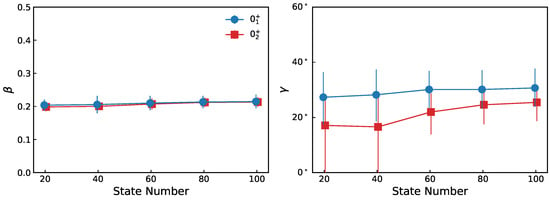
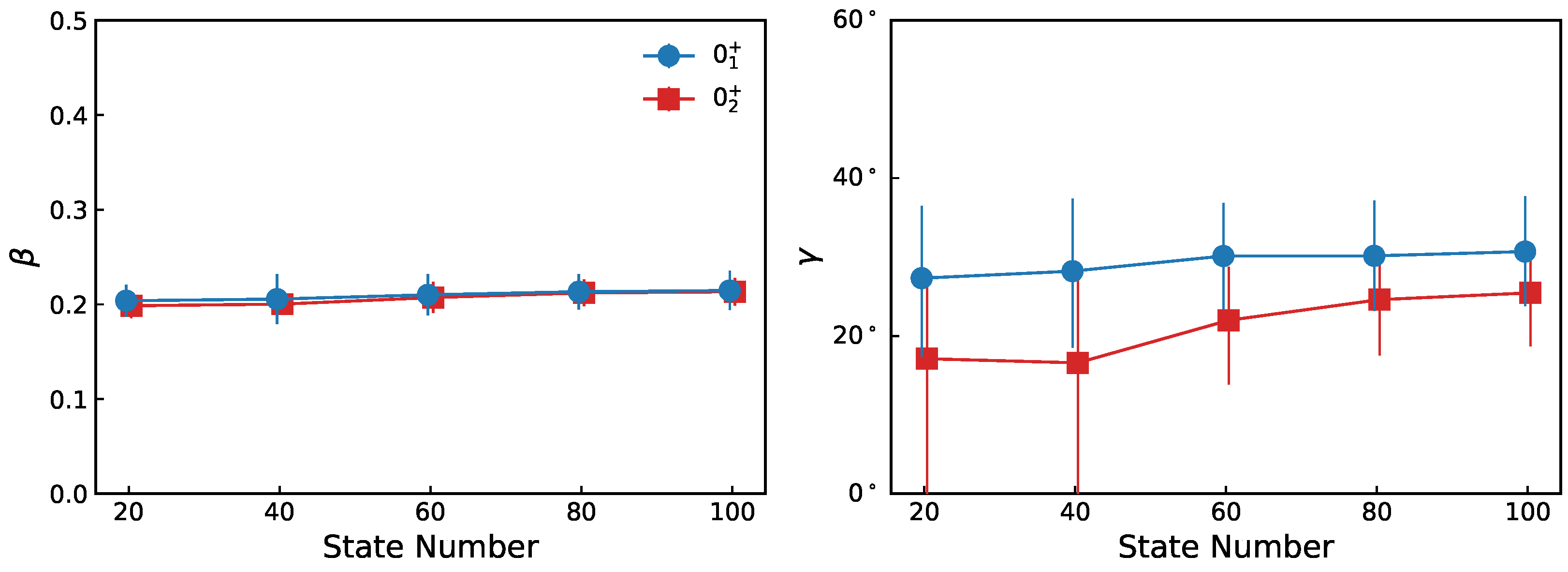
Figure 1 shows the convergence of the quadrupole-invariant deformation parameters with respect to the number of intermediate states. For the and states in 44S, the calculated , , , and are well converged with 100 states. The deformation parameters for the other nuclei studied in this work are also calculated using 100 states, with convergence checked in the same manner.
Figure 1.
Convergence of the quadrupole-invariant deformation parameters for the and states in 44S as a function of the number of intermediate states. The vertical ranges denote the corresponding fluctuation estimates.
3. Results
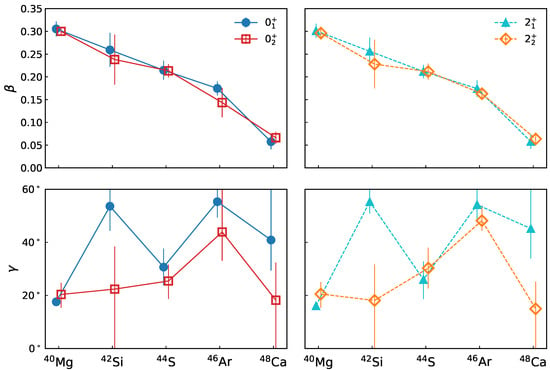
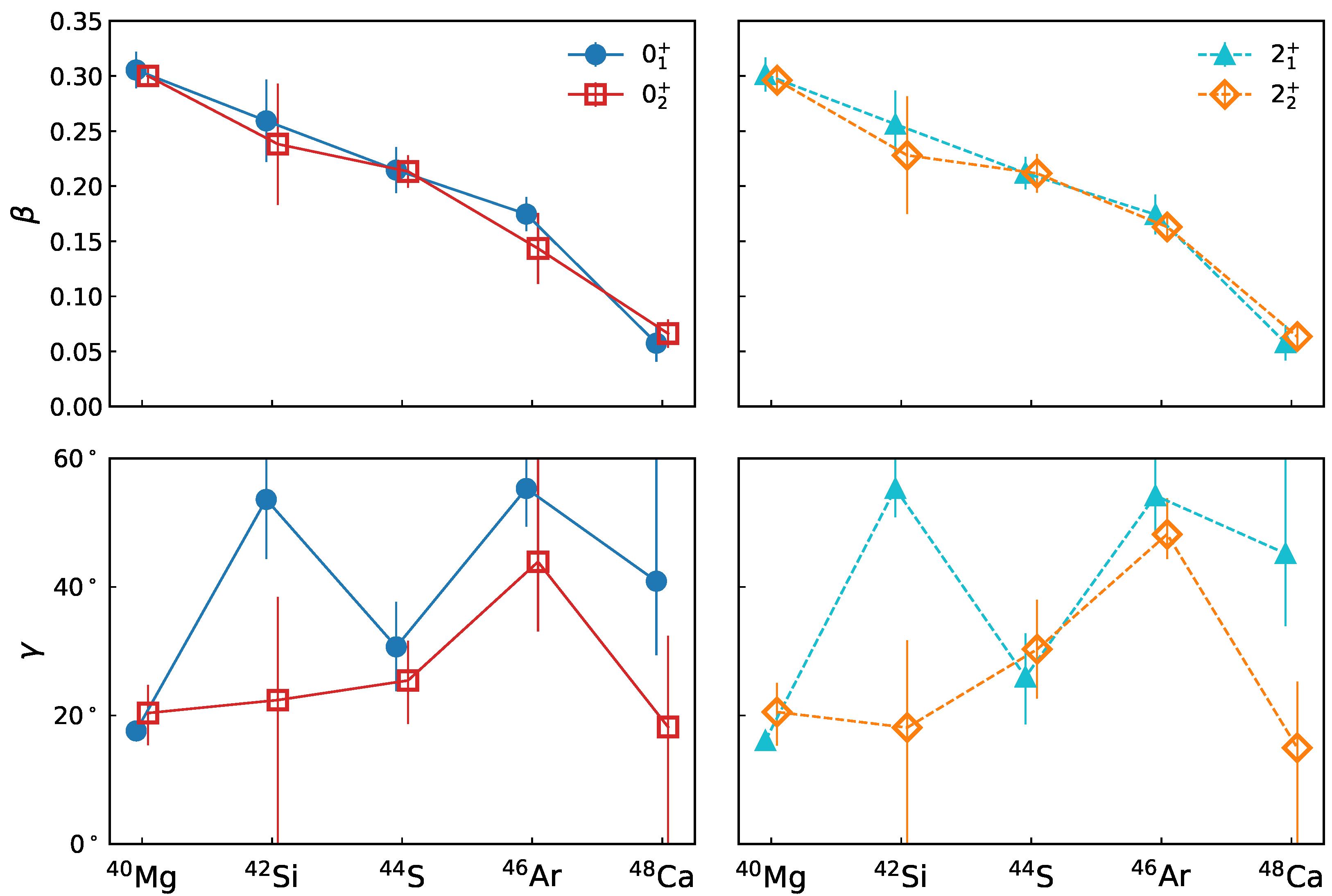
Extensive experimental and theoretical studies have shown that the robust shell closure in 48Ca is strongly eroded toward the neutron-rich Mg, Si, and S isotopes, where quadrupole collectivity and deformation emerge [4,6,20,21]. Figure 2 provides an invariant-based visualization of this evolution. From 48Ca to 40Mg, the values of the states increase systematically. The very small value of the 48Ca ground state reflects its nearly spherical doubly magic character, whereas the low-lying states in 40Mg reach , indicating well-developed quadrupole collectivity. This trend gives a direct deformation signature of the weakening of the shell closure toward the neutron-rich region.
Figure 2.
Calculated and of the low-lying and states along the isotonic chain.
The low-lying spectra and strengths of 40Mg, 42Si, and 44S, calculated using the same VS-IMSRG framework and EM1.8/2.0 interaction as in the present study, were compared in detail with the available experimental data in our previous work [20]. The low-lying spectra were reasonably reproduced, whereas the absolute strengths exhibited the systematic underestimation commonly found in VS-IMSRG calculations [67]. For example, the calculated excitation energy of the state in 44S, 1.39 MeV, is close to the experimental value of 1.329 MeV, whereas the calculated is below the experimental value of [68]. Consequently, the absolute values extracted here may also be underestimated. In contrast, is determined from ratios of quadrupole invariants and is therefore expected to be less sensitive to an approximately common rescaling of the matrix elements. Nevertheless, nonuniform truncation effects among different matrix elements cannot be excluded, and their quantitative impact on the extracted and values requires further investigation.
Beyond the overall deformation magnitude, the evolution of reveals a pronounced state dependence of the low-lying quadrupole structures. In the usual axial-rotor convention, the sign change of from negative in 40Mg, to positive in 42Si, and back to negative in 44S suggests a prolate–oblate–prolate evolution of the ground-state-associated structures, as shown in Table 1. The invariant-derived and values refine this picture. For 40Mg, the state is characterized by a relatively small , indicating a prolate deformation. In contrast, the state of 42Si moves toward the oblate deformation, while the state of 44S lies close to , suggesting a more non-axial or triaxial character. The states exhibit a similar trend to the states, with increasing quadrupole collectivity from 48Ca toward 40Mg. Their evolution, however, is not identical to that of the ground states. In 40Mg, 42Si, and 44S, the values of the states mostly lie in the – region, corresponding to prolate or triaxial deformation. In contrast, the AMD results suggest that the state of 40Mg is prolate, while the state is oblate [28].
Table 1.
Calculated excitation energies , spectroscopic quadrupole moments , and deformation parameters and for 40Mg, 42Si, and 44S.
In 42Si, the and states have comparable values but clearly different values. This indicates that the two states represent competing quadrupole structures with comparable collectivity and distinct triaxiality. In particular, the large -fluctuation range of the state in 42Si indicates a broad distribution in the triaxial degree of freedom, suggesting a -soft character. However, the AMD results suggest that the state of 42Si is mainly distributed in the small- spherical region [28]. Furthermore, our calculations show that the and values of the and states in these nuclei closely follow those of the and states, respectively, supporting the interpretation of the – and – pairs as two correlated low-lying quadrupole structures.
It is also instructive to compare our results with the simple SU(3) description of the -shell valence protons. Assuming an neutron shell closure, the ground-state bands of 40Mg, 42Si, and 44S are expected to be described by the highest-weight SU(3) irreducible representations , , and , respectively, while the first excited bands, starting from the states, are associated with the next-highest-weight irreducible representations , , and , respectively [69,70,71,72]. This simple picture is qualitatively consistent with our results for the prolate-side ground state of 40Mg and the prolate-side state of 44S. For 42Si, it also predicts comparable deformation magnitudes but distinct shapes for the two states, although their prolate–oblate ordering differs from our calculations. These differences may arise from the erosion of the shell closure and correlations beyond this simplified proton-only SU(3) description.
In the Mg, Si, and S isotopes, the low-lying structures differ not only in the magnitude of quadrupole collectivity, but also in their triaxiality indicators. Table 1 lists the detailed values of , , , and for 40Mg, 42Si, and 44S. In 40Mg, the , , and states have similar large values, small values, and negative values for the and states, supporting a coherent prolate band. In contrast, the , , and states in 40Mg have comparable values and also prolate-side values, while the values of the and states are positive. The positive values of the and states indicate that the -associated structure is distinct from the ground-state band. However, the invariant-derived values of the , , and states in 40Mg lie in the prolate-side to triaxial region, showing that this structure should not be interpreted as a simple rigid oblate band. Similar and values are observed for the , , and states in 42Si, but their values lie close to the oblate side and the corresponding values are positive.
For 44S, the -transition pattern discussed below associates the , , and states with a common quadrupole-connected sequence, in agreement with the SM calculations [30]. This assignment is consistent with the signs of the spectroscopic quadrupole moments, since and are both negative, whereas is positive. However, the value of the state differs from those of the and states, indicating that this sequence is a band-like structure with non-rigid collectivity. Therefore, the and values provide state-resolved deformation information, while the -transition maps are required to identify the quadrupole-connected structures directly.
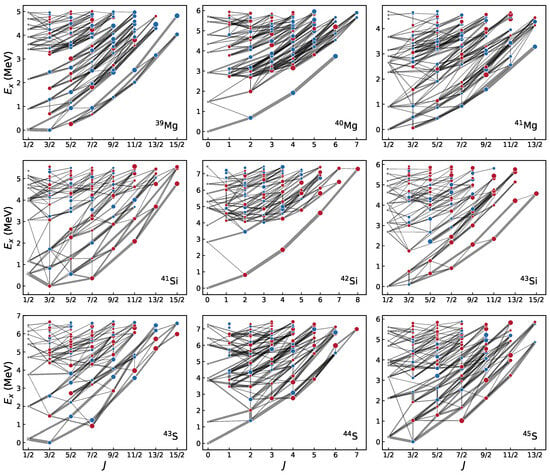
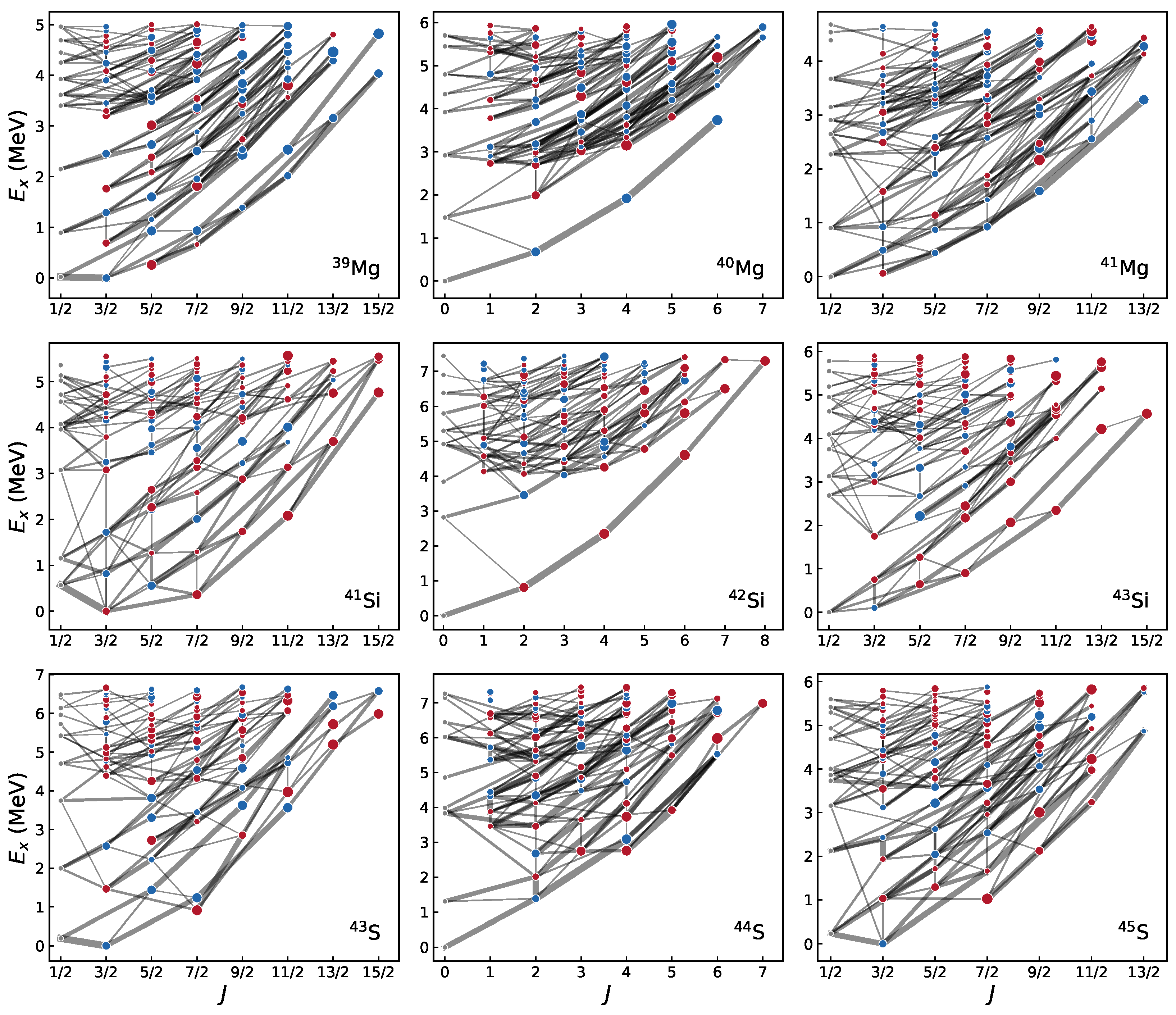
Figure 3 displays the -transition maps for the , 28, and 29 Mg, Si, and S isotopes. The connectivity clearly identifies the main band-like sequences. In 40Mg and 42Si, the strong links among the , , and states support their assignment to the ground-state band. In 44S, however, the corresponding sequence is formed by the , , and states, while the state has weak downward transitions and is interpreted as an isomeric bandhead, as discussed in Ref. [20]. Similarly, in 43S and 45S, the states can be regarded as candidate isomeric states, coexisting with the ground-state [21].
Figure 3.
Calculated -transition maps for Mg, Si, and S isotopes around . The size of each dot indicates the magnitude of the and the color denotes its sign, with blue (red) corresponding to negative (positive) values. Line widths indicate downward strengths.
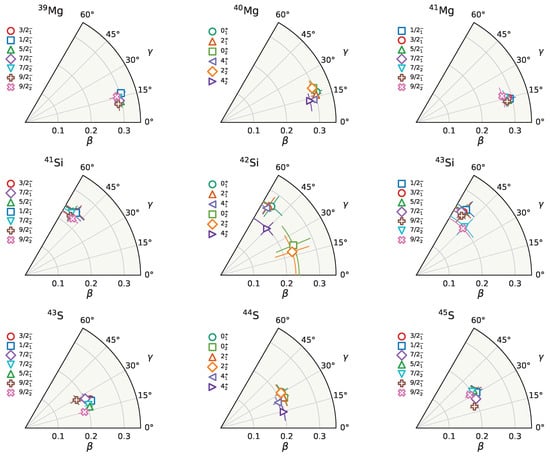
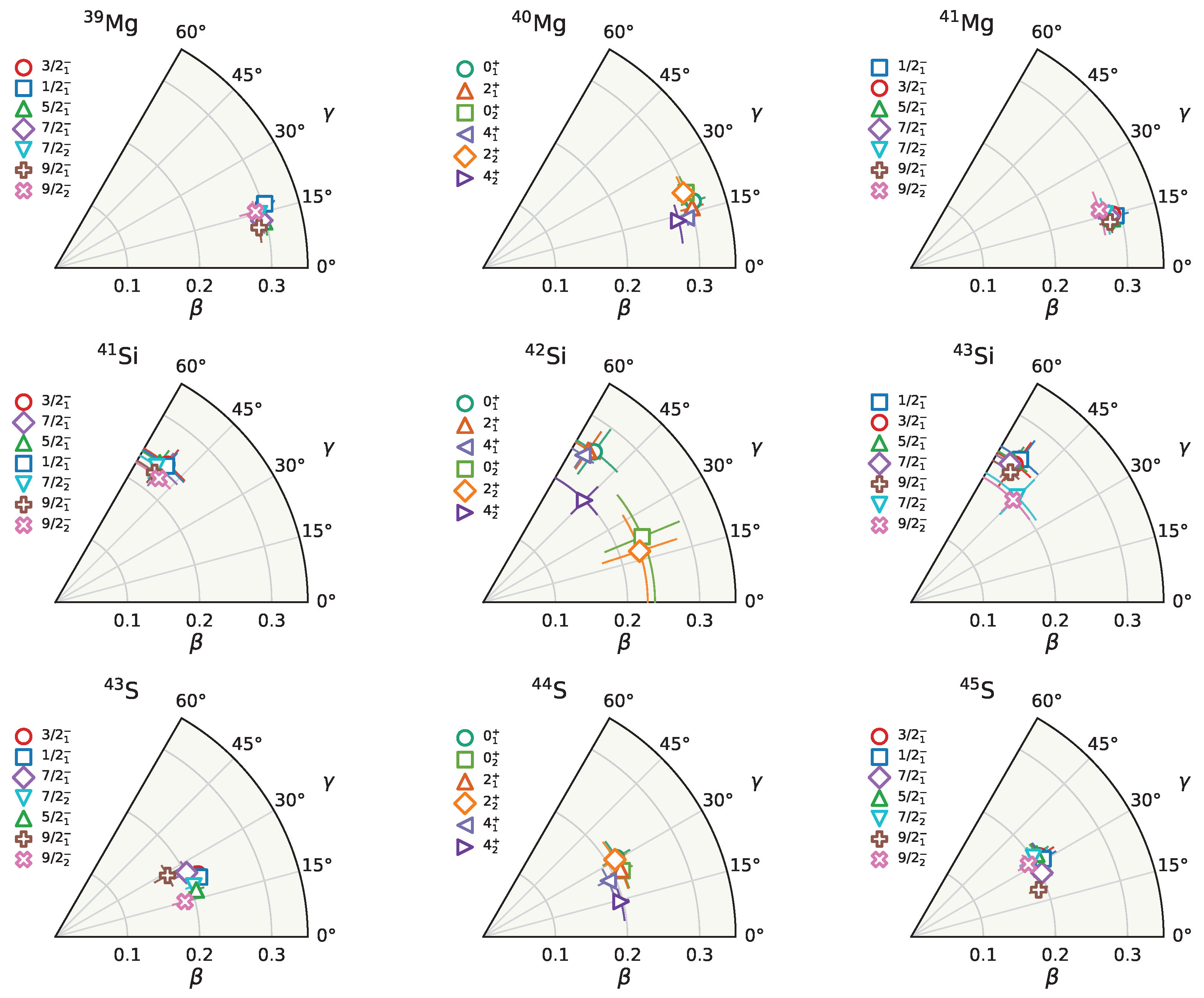
To show the shape evolution more clearly, Figure 4 presents the - plane for the , 28, and 29 Mg, Si, and S isotopes. The low-lying states in the Mg isotopes are located around – and –, indicating a common strong prolate deformation across the , 28, and 29 Mg systems. The Si isotopes show a markedly different pattern. The low-lying negative-parity states in 41,43Si appear on the oblate side, and the , , and states in 42Si are also located near large values, around . In contrast, the and states of 42Si move to the smaller region, with a large fluctuation range, indicating a -soft structure. Furthermore, the low-lying states in 43,44,45S mainly lie at – and –, indicating prolate-side to triaxial deformation.
Figure 4.
State-resolved - fan plot for Mg, Si, and S isotopes. The radial coordinate denotes and the angular coordinate denotes .
4. Conclusions
We have applied the quadrupole-invariant method to ab initio VS-IMSRG calculations of neutron-rich nuclei around . Starting from chiral NN+3N interactions, effective valence-space Hamiltonians and consistently evolved operators are obtained and used to extract deformation parameters and . Along the even–even isotonic chain, the systematic increase of from 48Ca to 40Mg provides a direct deformation signature of the weakening of the shell closure and the growth of quadrupole collectivity. The extracted and values further indicate a prolate–oblate–triaxial evolution of the states from 40Mg to 42Si and 44S. In contrast, the states show comparable quadrupole collectivity but follow a different evolution, mainly lying in the prolate-to-triaxial region. In particular, the large -fluctuation range of the state in 42Si suggests a -soft structure. By combining the extracted and values with systematics and the calculated -transition maps, we analyzed the state-by-state organization of the low-lying quadrupole structures. For 44S, although the , , and states form a quadrupole-connected band-like sequence, the value of the state differs from those of the and states, indicating non-rigid collectivity. Thus, the and values provide state-resolved deformation information, while the -transition maps are needed to identify the quadrupole-connected structures directly. Extending the analysis to the neighboring and isotopes, we find a systematic shape evolution across the Mg, Si, and S chains: strong prolate deformation in Mg, oblate structures in Si, and prolate-to-triaxial deformation in S. These results demonstrate that quadrupole invariants built from ab initio matrix elements offer a useful probe of shape evolution and shape coexistence in the neutron-rich region.
Author Contributions
Conceptualization, L.-Y.S., X.-P.W., H.-H.L., H.-Y.Z., W.Z. and Q.Y.; methodology, L.-Y.S., X.-P.W. and Q.Y.; software, X.-P.W. and Q.Y.; validation, L.-Y.S., X.-P.W. and Q.Y.; formal analysis, L.-Y.S., X.-P.W., H.-H.L., H.-Y.Z., W.Z. and Q.Y.; investigation, L.-Y.S., X.-P.W., H.-H.L., H.-Y.Z., W.Z. and Q.Y.; resources, L.-Y.S. and Q.Y.; data curation, L.-Y.S. and Q.Y.; writing—original draft preparation, L.-Y.S. and Q.Y.; writing—review and editing, L.-Y.S. and Q.Y.; visualization, L.-Y.S. and Q.Y.; supervision, Q.Y.; project administration, Q.Y.; funding acquisition, W.Z. and Q.Y. All authors have read and agreed to the published version of the manuscript.
Funding
This work has been supported by the National Key R&D Program of China under Grant Nos. 2024YFE0109800, 2024YFE0109802, and 2023YFA1606403; the National Natural Science Foundation of China under Grant Nos. 12347106, 12405141, 12205340, 12175281, 12475128, 12322507, and 12121005.
Data Availability Statement
The original contributions presented in this study are included in the article. Further inquiries can be directed to the corresponding author.
Acknowledgments
We thank Takayuki Miyagi for the NuHamil code [73] used to generate matrix elements of the chiral three-body interaction, and Ragnar Stroberg for the imsrg++ code [74] used to perform VS-IMSRG calculations. The numerical calculations in this work were performed at the Hefei Advanced Computing Center.
Conflicts of Interest
The authors declare no conflicts of interest.
Abbreviations
The following abbreviations are used in this manuscript:
| SM | shell-model |
| BMF | beyond-mean-field |
| AMD | antisymmetrized molecular dynamics |
| VS-IMSRG | valence-space in-medium similarity renormalization group |
References
- Goeppert-Mayer, M. On Closed Shells in Nuclei. II. Phys. Rev. 1949, 75, 1969–1970. [Google Scholar] [CrossRef] [Scilit]
- Haxel, O.; Jensen, J.H.D.; Suess, H.E. On the “Magic Numbers” in Nuclear Structure. Phys. Rev. 1949, 75, 1766. [Google Scholar] [CrossRef] [Scilit]
- Warburton, E.K.; Becker, J.A.; Brown, B.A. Mass systematics for A = 29–44 nuclei: The deformed A ∼ 32 region. Phys. Rev. C 1990, 41, 1147–1166. [Google Scholar] [CrossRef] [Scilit] [PubMed]
- Sorlin, O.; Porquet, M.G. Nuclear magic numbers: New features far from stability. Prog. Part. Nucl. Phys. 2008, 61, 602–673. [Google Scholar] [CrossRef] [Scilit]
- Caurier, E.; Martinez-Pinedo, G.; Nowacki, F.; Poves, A.; Zuker, A.P. The shell model as a unified view of nuclear structure. Rev. Mod. Phys. 2005, 77, 427–488. [Google Scholar] [CrossRef] [Scilit]
- Otsuka, T.; Gade, A.; Sorlin, O.; Suzuki, T.; Utsuno, Y. Evolution of shell structure in exotic nuclei. Rev. Mod. Phys. 2020, 92, 015002. [Google Scholar] [CrossRef] [Scilit]
- Tsunoda, N.; Otsuka, T.; Takayanagi, K.; Shimizu, N.; Suzuki, T.; Utsuno, Y.; Yoshida, S.; Ueno, H. The impact of nuclear shape on the emergence of the neutron dripline. Nature 2020, 587, 66–71. [Google Scholar] [CrossRef] [Scilit] [PubMed]
- Shen, L.Y.; Yuan, Q.; Li, H.H.; Xie, M.R.; Li, J.G.; Zuo, W. Study of shell evolution in neutron-rich boron, carbon, and nitrogen isotopes with in-medium similarity renormalization group calculations. Nucl. Sci. Tech. 2025, 36, 220. [Google Scholar] [CrossRef] [Scilit]
- Iwasaki, H.; Dewald, A.; Fransen, C.; Gelberg, A.; Hackstein, M.; Jolie, J.; Zell, K.O. Low-lying neutron intruder state in 13B and the fading of the N = 8 shell closure. Phys. Rev. Lett. 2009, 102, 202502. [Google Scholar] [CrossRef] [Scilit] [PubMed]
- Bastin, B.; Grévy, S.; Sohler, D.; Sorlin, O.; Dombrádi, Z.; Achouri, N.L.; Poves, A. Collapse of the N = 28 shell closure in 42Si. Phys. Rev. Lett. 2007, 99, 022503. [Google Scholar] [CrossRef] [Scilit] [PubMed]
- Force, C.; Grévy, S.; Gaudefroy, L.; Sorlin, O.; Cáceres, L.; Rotaru, F.; Nowacki, F. Prolate-spherical shape coexistence at N = 28 in 44S. Phys. Rev. Lett. 2010, 105, 102501. [Google Scholar] [CrossRef] [Scilit] [PubMed]
- Takeuchi, S.; Matsushita, M.; Aoi, N.; Doornenbal, P.; Li, K.; Motobayashi, T.; Yoneda, K. Well developed deformation in 42Si. Phys. Rev. Lett. 2012, 109, 182501. [Google Scholar] [CrossRef] [Scilit] [PubMed]
- Steppenbeck, D.; Takeuchi, S.; Aoi, N.; Doornenbal, P.; Matsushita, M.; Wang, H.; Yoneda, K. Evidence for a new nuclear ‘magic number’ from the level structure of 54Ca. Nature 2013, 502, 207–211. [Google Scholar] [CrossRef] [Scilit] [PubMed]
- Doornenbal, P.; Sheit, H. In-beam γ-ray spectroscopy of 34,36,38Mg: Merging the N = 20 and N = 28 shell quenching. Phys. Rev. Lett. 2013, 111, 212502. [Google Scholar] [CrossRef] [Scilit] [PubMed]
- Crawford, H.L.; Clark, R.M.; Fallon, P.; Macchiavelli, A.O.; Baugher, T.; Bazin, D.; Winkler, R. Quadrupole Collectivity in Neutron-Rich Fe and Cr Isotopes. Phys. Rev. Lett. 2013, 110, 242701. [Google Scholar] [CrossRef] [Scilit] [PubMed]
- Crawford, H.L.; Fallon, P.; Macchiavélli, A.O.; Clark, R.M.; Brown, B.A.; Tostevin, J.A.; Yoneda, K. Shell and shape evolution at N = 28: The 40Mg ground state. Phys. Rev. C 2014, 89, 041303(R). [Google Scholar] [CrossRef] [Scilit]
- Gade, A.; Brown, B.A.; Tostevin, J.A.; Bazin, D.; Bender, P.C.; Campbell, C.M.; Weisshaar, D. Is the structure of 42Si understood? Phys. Rev. Lett. 2019, 122, 222501. [Google Scholar] [CrossRef] [Scilit] [PubMed]
- Crawford, H.L.; Fallon, P.; Macchiavelli, A.O.; Doornenbal, P.; Aoi, N.; Browne, F.; Wimmer, K. First spectroscopy of the near drip-line nucleus 40Mg. Phys. Rev. Lett. 2019, 122, 052501. [Google Scholar] [CrossRef] [Scilit] [PubMed]
- Longfellow, B.; Weisshaar, D.; Gade, A.; Brown, B.A.; Bazin, D.; Brown, K.W.; Spieker, M. Shape changes in the N = 28 island of inversion: Collective structures built on configuration-coexisting states in 43S. Phys. Rev. Lett. 2020, 125, 232501. [Google Scholar] [CrossRef] [Scilit] [PubMed]
- Yuan, Q.; Li, J.G.; Li, H.H. Ab initio calculations for well deformed nuclei: 40Mg and 42Si. Phys. Lett. B 2024, 848, 138331. [Google Scholar] [CrossRef] [Scilit]
- Yuan, Q.; Li, J.G.; Zuo, W. Ab initio calculations for configuration-coexisting states in 45S: An extension from 43S. Phys. Rev. C 2024, 109, L041301. [Google Scholar] [CrossRef] [Scilit]
- Caurier, E.; Nowacki, F.; Poves, A. The shell closure; from N = Z to the neutron drip line. Nucl. Phys. A 2004, 742, 14–26. [Google Scholar] [CrossRef] [Scilit]
- Nowacki, F.; Poves, A. New effective interaction for 0ℏω shell-model calculations in the sd-pf valence space. Phys. Rev. C 2009, 79, 014310. [Google Scholar] [CrossRef] [Scilit]
- Utsuno, Y.; Otsuka, T.; Brown, B.A.; Honma, M.; Mizusaki, T.; Shimizu, N. Shape transitions in exotic Si and S isotopes and tensor-force-driven Jahn-Teller effect. Phys. Rev. C 2012, 86, 051301(R). [Google Scholar] [CrossRef] [Scilit]
- Utsuno, Y.; Shimizu, N.; Otsuka, T.; Yoshida, T.; Tsunoda, Y. Nature of Isomerism in Exotic Sulfur Isotopes. Phys. Rev. Lett. 2015, 114, 032501. [Google Scholar] [CrossRef] [Scilit] [PubMed]
- Gaudefroy, L. Shell model study of N ≃ 28 neutron-rich nuclei. Phys. Rev. C 2010, 81, 064329. [Google Scholar] [CrossRef] [Scilit]
- Kaneko, K.; Sun, Y.; Mizusaki, T.; Hasegawa, M. Shell-model study for neutron-rich sd-shell nuclei. Phys. Rev. C 2011, 83, 014320. [Google Scholar] [CrossRef] [Scilit]
- Suzuki, Y.; Horiuchi, W.; Kimura, M. Erosion of N = 28 shell closure: Shape coexistence and monopole transition. Prog. Theor. Exp. Phys. 2022, 2022, 063D02. [Google Scholar] [CrossRef] [Scilit]
- Caurier, E.; Nowacki, F.; Poves, A. Merging of the islands of inversion at N = 20 and N = 28. Phys. Rev. C 2014, 90, 014302. [Google Scholar] [CrossRef] [Scilit]
- Chevrier, R.; Gaudefroy, L. Shell model structure of 43S and 44S re-examined. Phys. Rev. C 2014, 89, 051301(R). [Google Scholar] [CrossRef] [Scilit]
- Tarpanov, D.; Liang, H.; Giai, N.V.; Stoyanov, C. Mean-field study of single-particle spectra evolution in Z = 14 and N = 28 chains. Phys. Rev. C 2008, 77, 054316. [Google Scholar] [CrossRef] [Scilit]
- Rodríguez-Guzmán, R.; Egido, J.L.; Robledo, L.M. Quadrupole collectivity in N ≈ 28 nuclei with the angular momentum projected generator coordinate method. Phys. Rev. C 2002, 65, 024304. [Google Scholar] [CrossRef] [Scilit]
- Rodríguez, T.R.; Egido, J.L. Configuration mixing description of the nucleus 44S. Phys. Rev. C 2011, 84, 051307(R). [Google Scholar] [CrossRef] [Scilit]
- Egido, J.L.; Borrajo, M.; Rodríguez, T.R. Collective and Single-Particle Motion in Beyond Mean Field Approaches. Phys. Rev. Lett. 2016, 116, 052502. [Google Scholar] [CrossRef] [Scilit] [PubMed]
- Kimura, M.; Taniguchi, Y.; Kanada-En’yo, Y.; Horiuchi, H.; Ikeda, K. Prolate, oblate, and triaxial shape coexistence, and the lost magicity of N = 28 in 43S. Phys. Rev. C 2013, 87, 011301(R). [Google Scholar] [CrossRef] [Scilit]
- Suzuki, Y.; Kimura, M. Triaxial deformation and the disappearance of the N = 28 shell gap. Phys. Rev. C 2021, 104, 024327. [Google Scholar] [CrossRef] [Scilit]
- Yuan, Q.; Fan, S.Q.; Hu, B.S.; Li, J.G.; Zhang, S.; Wang, S.M.; Sun, Z.H.; Ma, Y.Z.; Xu, F.R. Deformed in-medium similarity renormalization group. Phys. Rev. C 2022, 105, L061303. [Google Scholar] [CrossRef] [Scilit]
- Heyde, K.; Wood, J.L. Shape coexistence in atomic nuclei. Rev. Mod. Phys. 2011, 83, 1467–1521. [Google Scholar] [CrossRef] [Scilit]
- Garrett, P.E.; Zielińska, M.; Clément, E. An experimental view on shape coexistence in nuclei. Prog. Part. Nucl. Phys. 2022, 124, 103931. [Google Scholar] [CrossRef] [Scilit]
- Macchiavelli, A.O.; Crawford, H.L.; Campbell, C.M.; Clark, R.M.; Cromaz, M.; Fallon, P.; Rice, E. Structure of 43P and 42Si in a two-level shape-coexistence model. Phys. Rev. C 2022, 105, 014309. [Google Scholar] [CrossRef] [Scilit]
- Sarazin, F.; Savajols, H.; Mittig, W.; Nowacki, F.; Orr, N.A.; Ren, Z.; De Vismes, A. Shape coexistence and the N = 28 shell closure far from stability. Phys. Rev. Lett. 2000, 84, 5062. [Google Scholar] [CrossRef] [Scilit] [PubMed]
- Becheva, E.; Blumenfeld, Y.; Khan, E.; Beaumel, D.; Daugas, J.M.; Delaunay, F.; Than, H.S. N = 14 shell closure in 22O viewed through a neutron sensitive probe. Phys. Rev. Lett. 2006, 96, 012501. [Google Scholar] [CrossRef] [Scilit] [PubMed]
- Gaudefroy, L.; Sorlin, O.; Beaumel, D.; Blumenfeld, Y.; Dombrádi, Z.; Fortier, S.; Verney, D. Reduction of the spin-orbit splittings at the N = 28 shell closure. Phys. Rev. Lett. 2006, 97, 092501. [Google Scholar] [CrossRef] [Scilit] [PubMed]
- Gaudefroy, L.; Daugas, J.M.; Hass, M.; Grévy, S.; Stodel, C.; Thomas, J.C.; Simpson, G. Shell erosion and shape coexistence in . Phys. Rev. Lett. 2009, 102, 092501. [Google Scholar] [CrossRef] [Scilit] [PubMed]
- Santiago-Gonzalez, D.; Wiedenhöver, I.; Abramkina, V.; Avila, M.L.; Baugher, T.; Bazin, D.; Weisshaar, D. Triple configuration coexistence in 44S. Phys. Rev. C 2011, 83, 061305(R). [Google Scholar] [CrossRef] [Scilit]
- Cáceres, L.; Sohler, D.; Grévy, S.; Sorlin, O.; Dombradi, Z.; Bastin, B.; Stefan, I. In-beam spectroscopic studies of the 44S nucleus. Phys. Rev. C 2012, 85, 024311. [Google Scholar] [CrossRef] [Scilit]
- Chevrier, R.; Daugas, J.M. Is the isomer state of 43S spherical? Phys. Rev. Lett. 2012, 108, 162501. [Google Scholar] [CrossRef] [Scilit] [PubMed]
- Parker, J.J.; Wiedenhöver, I.; Cottle, P.D.; Baker, J.; McPherson, D.; Riley, M.A.; Wimmer, K. Isomeric character of the lowest observed 4+ state in 44S. Phys. Rev. Lett. 2017, 118, 052501. [Google Scholar] [CrossRef] [Scilit] [PubMed]
- Kumar, K. Intrinsic Quadrupole Moments and Shapes of Nuclear Ground States and Excited States. Phys. Rev. Lett. 1972, 28, 249–253. [Google Scholar] [CrossRef] [Scilit]
- Srebrny, J.; Cline, D. Model independent determination of quadrupole deformation parameters from Coulomb excitation measurements. Int. J. Mod. Phys. E 2011, 20, 422–430. [Google Scholar] [CrossRef] [Scilit]
- Hadyńska-Klęk, K.; Napiorkowski, P.J.; Zielińska, M.; Srebrny, J.; Maj, A. Quadrupole collectivity in 42Ca from low-energy Coulomb excitation with AGATA. Phys. Rev. C 2018, 97, 024326. [Google Scholar] [CrossRef] [Scilit]
- Henderson, J. Convergence of electric quadrupole rotational invariants from the nuclear shell model. Phys. Rev. C 2020, 102, 054306. [Google Scholar] [CrossRef] [Scilit]
- Epelbaum, E.; Hammer, H.W.; Meißner, U.G. Modern theory of nuclear forces. Rev. Mod. Phys. 2009, 81, 1773–1825. [Google Scholar] [CrossRef] [Scilit]
- Machleidt, R.; Entem, D.R. Chiral effective field theory and nuclear forces. Phys. Rep. 2011, 503, 1–75. [Google Scholar] [CrossRef] [Scilit]
- Hebeler, K.; Bogner, S.K.; Furnstahl, R.J.; Nogga, A.; Schwenk, A. Improved nuclear matter calculations from chiral low-momentum interactions. Phys. Rev. C 2011, 83, 031301(R). [Google Scholar] [CrossRef] [Scilit]
- Simonis, J.; Hebeler, K.; Holt, J.D.; Menendez, J.; Schwenk, A. Exploring sd-shell nuclei from two- and three-nucleon interactions with realistic saturation properties. Phys. Rev. C 2016, 93, 011302(R). [Google Scholar] [CrossRef] [Scilit]
- Miyagi, T.; Stroberg, S.R.; Navrátil, P.; Hebeler, K.; Holt, J.D. Converged ab initio calculations of heavy nuclei. Phys. Rev. C 2022, 105, 014302. [Google Scholar] [CrossRef] [Scilit]
- Roth, R.; Binder, S.; Vobig, K.; Calci, A.; Langhammer, J.; Navrátil, P. Medium-mass nuclei with normal-ordered chiral NN+3N interactions. Phys. Rev. Lett. 2012, 109, 052501. [Google Scholar] [CrossRef] [Scilit] [PubMed]
- Morris, T.D.; Parzuchowski, N.M.; Bogner, S.K. Magnus expansion and in-medium similarity renormalization group. Phys. Rev. C 2015, 92, 034331. [Google Scholar] [CrossRef] [Scilit]
- Tsukiyama, K.; Bogner, S.K.; Schwenk, A. In-medium similarity renormalization group for nuclei. Phys. Rev. C 2012, 85, 061304(R). [Google Scholar] [CrossRef] [Scilit]
- Hergert, H.; Bogner, S.K.; Morris, T.D.; Schwenk, A.; Tsukiyama, K. The in-medium similarity renormalization group: A novel ab initio method for nuclei. Phys. Rep. 2016, 621, 165–222. [Google Scholar] [CrossRef] [Scilit]
- Stroberg, S.R.; Calci, A.; Hergert, H.; Holt, J.D.; Bogner, S.K.; Roth, R.; Schwenk, A. Nucleus-dependent valence-space approach to nuclear structure. Phys. Rev. Lett. 2017, 118, 032502. [Google Scholar] [CrossRef] [Scilit] [PubMed]
- Somà, V.; Navrátil, P.; Raimondi, F.; Barbieri, C.; Duguet, T. Novel chiral Hamiltonian and observables in light and medium-mass nuclei. Phys. Rev. C 2020, 101, 014318. [Google Scholar] [CrossRef] [Scilit]
- Stroberg, S.R.; Holt, J.D.; Schwenk, A.; Simonis, J. Ab initio limits of atomic nuclei. Phys. Rev. Lett. 2021, 126, 022501. [Google Scholar] [CrossRef] [Scilit] [PubMed]
- Shimizu, N.; Mizusaki, T.; Utsuno, Y.; Tsunoda, Y. Thick-restart block Lanczos method for large-scale shell-model calculations. Comput. Phys. Commun. 2019, 244, 372–384. [Google Scholar] [CrossRef] [Scilit]
- Ring, P.; Schuck, P. The Nuclear Many-Body Problem; Springer: Berlin, Germany, 1980. [Google Scholar] [CrossRef] [Scilit]
- Stroberg, S.R.; Henderson, J.; Hackman, G.; Ruotsalainen, P.; Hagen, G.; Holt, J.D. Systematics of E2 Strength in the sd Shell with the Valence-Space In-Medium Similarity Renormalization Group. Phys. Rev. C 2022, 105, 034333. [Google Scholar] [CrossRef] [Scilit]
- Longfellow, B.; Weisshaar, D.; Gade, A.; Brown, B.A.; Bazin, D.; Brown, K.W.; Elman, B.; Pereira, J.; Rhodes, D.; Spieker, M. Quadrupole Collectivity in the Neutron-Rich Sulfur Isotopes 38,40,42,44S. Phys. Rev. C 2021, 103, 054309. [Google Scholar] [CrossRef] [Scilit]
- Elliott, J.P. Collective Motion in the Nuclear Shell Model. I. Classification Schemes for States of Mixed Configurations. Proc. R. Soc. Lond. A 1958, 245, 128–145. [Google Scholar] [CrossRef] [Scilit]
- Elliott, J.P. Collective Motion in the Nuclear Shell Model. II. The Introduction of Intrinsic Wave-Functions. Proc. R. Soc. Lond. A 1958, 245, 562–581. [Google Scholar] [CrossRef] [Scilit]
- Elliott, J.P.; Harvey, M. Collective Motion in the Nuclear Shell Model. III. The Calculation of Spectra. Proc. R. Soc. Lond. A 1963, 272, 557–577. [Google Scholar] [CrossRef] [Scilit]
- Bonatsos, D.; Kota, V.K.B.; Martinou, A.; Peroulis, S.K.; Petrellis, D.; Vasileiou, P.; Mertzimekis, T.J.; Minkov, N. Parameter-Free Deformation Variables of the Proxy-SU(3) Symmetry in Even–Even Atomic Nuclei with Z = 28–82, N = 28–126. Symmetry 2026, 18, 683. [Google Scholar] [CrossRef] [Scilit]
- Miyagi, T. NuHamil: A numerical code to generate nuclear two- and three-body matrix elements from chiral effective field theory. Eur. Phys. J. A 2023, 59, 150. [Google Scholar] [CrossRef] [Scilit] [PubMed]
- Stroberg, S.R. Imsrg++ Code. Available online: https://github.com/ragnarstroberg/imsrg (accessed on 1 September 2019).

Disclaimer/Publisher’s Note: The statements, opinions and data contained in all publications are solely those of the individual author(s) and contributor(s) and not of MDPI and/or the editor(s). MDPI and/or the editor(s) disclaim responsibility for any injury to people or property resulting from any ideas, methods, instructions or products referred to in the content. |
© 2026 by the authors. Licensee MDPI, Basel, Switzerland. This article is an open access article distributed under the terms and conditions of the Creative Commons Attribution (CC BY) license.