


Abstract
Mass measurements of isotopes around the region near stability were performed at the KEK Isotope Separation System within the RIKEN Nishina Center, Japan. The isotopes were produced via multi-nucleon transfer reactions with a 136Xe beam of 7.2 MeV/u impinging on a natural tungsten target. We report the first direct mass measurement of 184Ta, showing a 62(27) keV deviation compared to previous indirect measurements.
1. Introduction
The nuclear mass is a fundamental property of atomic nuclei, enabling the study of nuclear structure and nucleosynthesis in astrophysics. Systematic studies of nuclear masses can reveal nuclear deformations and shell evolution from separation energy calculations [1,2]. These masses are also crucial inputs for nucleosynthesis calculations, elucidating the origins and abundance of naturally occurring isotopes [3].
Nuclear mass measurements are broadly categorized into direct and indirect methods. Indirect methods determine masses based on the reaction or decay Q-value, requiring prior knowledge of the nuclear transformation, including energy levels and decay modes. In comparison, direct methods are generally considered to be more accurate as mass determinations based on measurements of the orbital or cyclotron frequency, or the time-of-flight, do not require a priori knowledge about the nuclear reaction and decay schemes. For example, mass measurements of 184Ir from measurements [4,5] were shown to have a large discrepancy (>600 keV) against newer storage ring mass measurements [6,7], of which the latter is accepted in the Atomic Mass Evaluation [8].
Direct mass spectroscopy methods such as Penning traps, storage rings and TOF- spectrometry have tradeoffs between precision and measurement duration [9,10]. As mass measurements extend into more exotic regions, short life-times and low production yields have motivated the development of the multi-reflection time-of-flight mass spectrographs (MRTOF-MS) [11,12].
In this work we present the mass measurements of five isotopes, 178,180Re, 183,184Ir, and 184Ta, complementing the investigation of K-isomers in this region [13,14]. The production of isotopes of interest in this work was done using multi-nucleon transfer (MNT) reactions which are characterized by the exchange of many nucleons between the target and projectile nuclei and have been gaining popularity in radioactive beam facilities such as GANIL [15], JAEA [16], GSI [17], ANL [18], and NEXT [19]. The KEK Isotope Separation System (KISS) was commissioned at the RIKEN Nishina Center [20,21,22] to produce a high-purity radioactive isotope beam of otherwise difficult-to-produce nuclides via MNT reactions for nuclear studies. The MNT products are captured and neutralized by a gas cell, and then selectively re-ionized in a two-photon resonant laser method. To perform high-precision mass measurements, an MRTOF-MS has been installed [23,24,25] downstream of a mass-selective dipole magnet. Mass measurements were performed using the KISS MRTOF-MS, alongside an evaluation of these new measurements’ effect on the AME2020 mass surface.
2. Materials and Methods
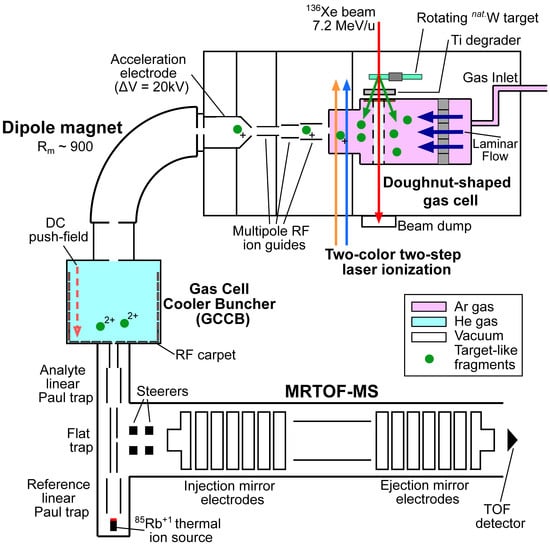
Figure 1 shows the experimental setup at KISS. A primary beam of 136Xe with an energy of 7.2 MeV/u and an intensity of 50 pnA was accelerated by the RIKEN Ring Cyclotron (RRC). The primary beam impinges on a rotating natural tungsten target (28% 186W) with a thickness of 9.627 mg/cm2. The isotopes of interest were produced as target-like fragments (TLFs) in the MNT reactions and exited the target at a large grazing angle.
Figure 1.
Schematic of the KISS setup modified from [24]. A 136Xe beam impinges on a rotating tungsten target. Target-like fragments from the resulting MNT reactions are captured in the argon-filled doughnut-shaped gas cell (pink) and transported to the helium-filled GCCB (cyan) before mass measurement at the MRTOF-MS.
An 88 kPa argon-filled “doughnut-shaped” gas cell is positioned downstream from the target. The gas cell is designed such that the unreacted primary beam is allowed to pass through a 15 mm diameter central aperture without entering the gas cell. The target-side of the gas cell is constructed with a 5 μm thick Polyimide window. This allows the MNT products, which are emitted from the target at a large angle, to be captured by the gas cell while minimizing ionization of the argon gas. The MNT products are neutralized in the gas cell and subsequently transported to a two-step, two-color resonant laser ionization zone to selectively ionize nuclei with proton number, Z, of interest [26].
The atoms of the isotope of interest were first excited using an excimer-pumped dye laser (XeCl, = 308 nm, Lambda Physik, LPX240i). The laser wavelength, , was tuned such that it corresponded to the energy of the excited state of the element of interest. The six elements of primary interest—Pt, Ir, Os, Re, W, and Ta—were each excited at their known values. The excited atoms were then exposed to laser radiation from a second excimer laser of the same make and model, but with a fixed wavelength of = 308 nm, which ionizes them to the singly charged state.
The ions were extracted through a small exit nozzle and transported to high-vacuum by a set of multipole radio-frequency (RF) ion guides through two differential vacuum pumping sections; the gas cell and differentially pumped chamber were on a 20 kV high-voltage platform. Upon reaching the end of the differentially pumped chamber, the ions were accelerated to 20 keV and sent through a dipole magnet mass separator section with a mass-resolving power of . The mass-separated ions are then guided into a 120 Pa helium-filled, windowless Gas Cell Cooler Buncher (GCCB) to be re-thermalized [23]. Vacuum pressure upstream of the windowless GCCB is maintained by a differential pumping system [27]. Initial energetic collisions with helium atoms in the GCCB strip additional electrons from the ions; subsequent low-energy interactions with the helium atoms result in doubly charged ions [28] being dominant. These ions are guided by a DC field onto an RF carpet that guides them to a small extraction hole. The ions are transported sequentially via a quadrupole RF ion guide (QPIG) and a linear Paul trap to a flat trap [29], which cools the ions with <0.1 Pa He gas.
The TOF was measured starting with the injection of ions into the MRTOF-MS from the flat trap. The ions were then reflected between electrostatic mirrors of the MRTOF-MS for about 600 laps, and ejected onto an ion detector to complete a single measurement. The TOF of 85Rb+ ions from a thermal alkali ion source, installed on the opposite end of the flat trap, was measured concomitantly with the ions of interest (analyte ions) [30]. The absolute mass values of the isotopes of interest ( ≈ 184/2) was determined by the single-reference method [31],
where and t are the atomic mass, charge, and TOF of the analyte and reference ions denoted by the subscripts a and r respectively. The flat trap ejection delay, , was empirically determined from the measurement of from 85Rb+ and 184W2+ ions.
3. Results and Discussion
The TOF spectra centered on mass numbers and 184 were analyzed. The TOF of observed ions was extracted after peak fitting using the hyper-EMG function [32] with identical shape parameters for all isobars. We were able to identify ions of eight nuclides, of which mass values of five isotopes (178,180Re2+, 183,184Ir2+, 184Ta2+) were determined as shown in Table 1. The remaining three (178Hf2+, 183,184W2+) were used as isobaric references, except in the case of 180Re2+ as it was the only nuclide which could be clearly identified; instead it was measured with the reference ion 85Rb+ and determined using 184W2+.
Table 1.
Masses of five isotopes were experimentally determined in this work. Ion species are listed with the reference ion used, the square of the time-of-flight ratio subtracted by one, (), experimental mass excess (MEexp), mass excess from AME2020 (MEAME), and the difference (ΔME = MEexp − MEAME).
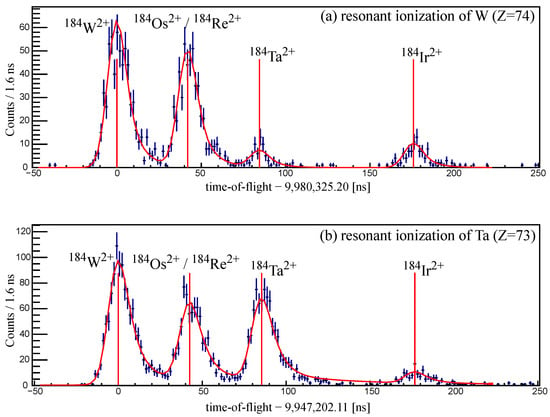
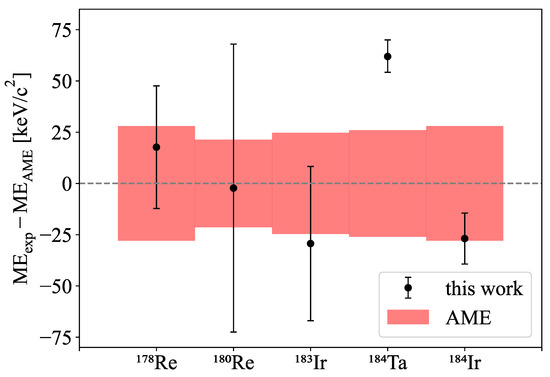
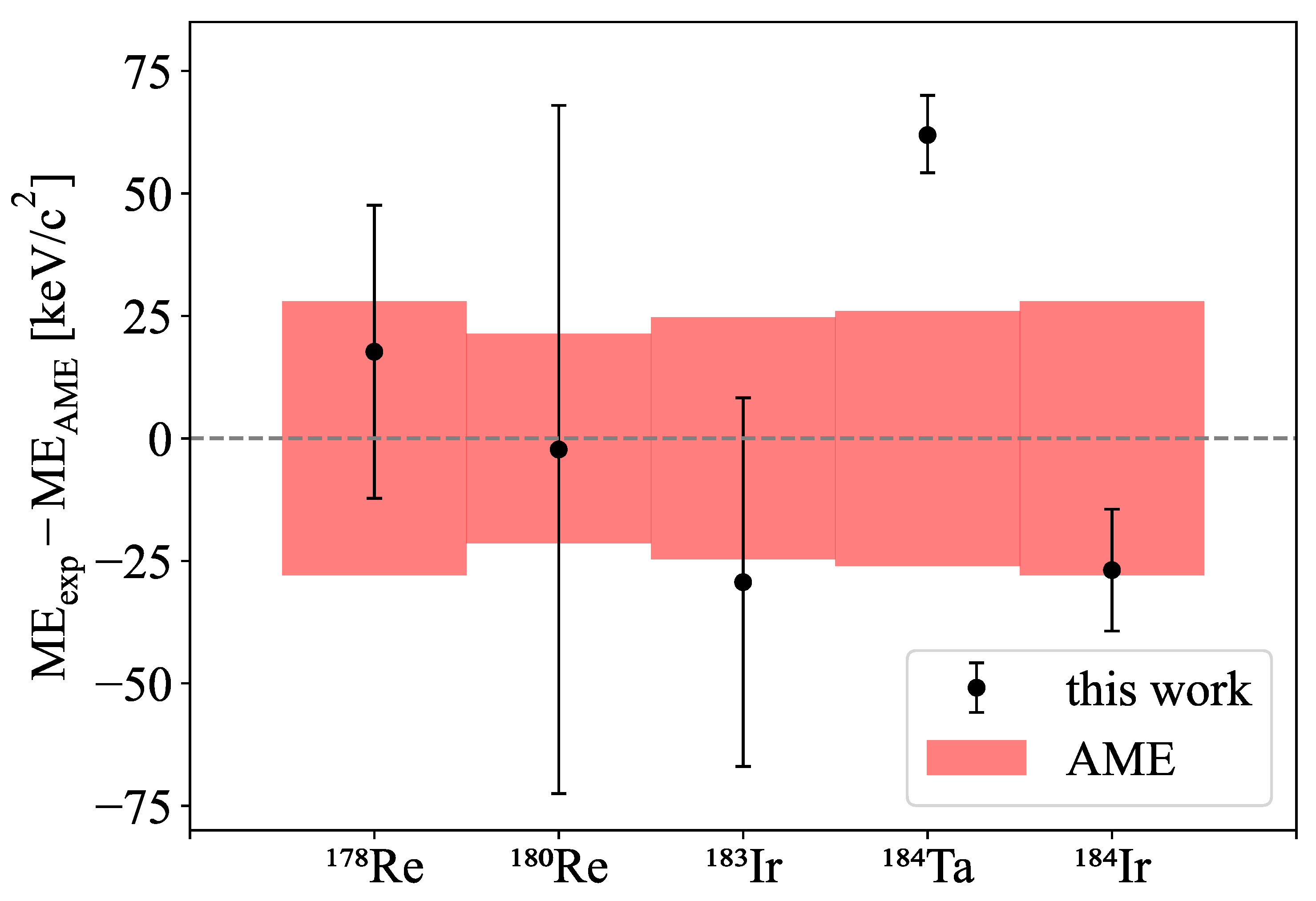
All measured masses are in agreement with AME2020 values within 1- except for 184Ta, which was previously determined only indirectly via the decay endpoint energy [33]. Resonant laser ionization was used as a confirmation of the 184Ta2+ peak as shown in Figure 2. By comparing the TOF spectra of isobars with resonant ionization targets of tungsten and tantalum, a large increase in 184Ta2+ ions was observed in the latter spectrum. On the other hand, the remaining peaks show no significant difference between resonant ionization targets as they originate from non-resonant excitations, which have lower cross-sections. Thus, we report here the first direct measurement of 184Ta with a mass deviation from AME2020 of keV/c2. We also report improved precision of 184Ir compared to both direct and indirect measurements from the literature [4,5,34]. A comparison of mass excesses from this work against AME2020 [8,35] is shown in Figure 3.
Figure 2.
TOF spectra of A = 184 isobars with (a) laser resonant ionization of tungsten at 601 laps and (b) laser resonant ionization of tantalum at 599 laps. Four peaks are fitted as shown in red. A large increase in 184Ta2+ ions is observed in (b), confirming the tantalum peak. 184Re and 184Os cannot be distinguished due to a small mass excess difference of ∼30 keV/c2.
Figure 3.
Mass excess differences between this work and those listed in AME2020 [35]. The sections shaded in red indicate the AME2020 mass uncertainties.
After extracting the mass values from our experimental data, we incorporated them into the Atomic Mass Evaluation (AME) network. Many of the masses we measured had already been determined using other methods. However, due to the high precision of our data, they had a significant impact on the network. In the AME network, nuclides are categorized as primary data if they are checked by other data; otherwise, they are considered secondary data.
In Table 2, we illustrate how our data influenced the primary dataset. With the exception of 184Ta, which is classified as secondary data, all our measurements contribute to the AME primary data. Notably, in AME2020, only 183Ir was considered a primary nucleus. However, after integrating our data, additional primary nuclei—178,180Re and 184Ir—were introduced into the network.
Table 2.
Influences of the isotopes measured in this work on the AME dataset, with the largest two influences (Infl.) and equations (Eq.) in the mass evaluation. Mass excesses (MEs) shown here are obtained from AME calculations after incorporating experimental values from this work.
Most of our measured masses align with previous measurements, except for 184Ta. The mass of 184Ta was previously determined through the decay chain Hf-Ta-W, with a precision of 26 keV/c2 [33]. However, since our new measurement has a higher precision of 8 keV/c2, it now serves as the dominant data for determining the mass of 184Ta. Additionally, our data influences the mass of 184Hf, as it remains linked to 184Ta through decay. This adjustment resulted in a shift of approximately 60 keV/c2 for 184Hf, from −41,500(40) keV/c2 to −41,440(30) keV/c2, with slightly improved precision.
Two-neutron separation energy values, , were calculated to determine the impact of the updated mass values on the mass surface with
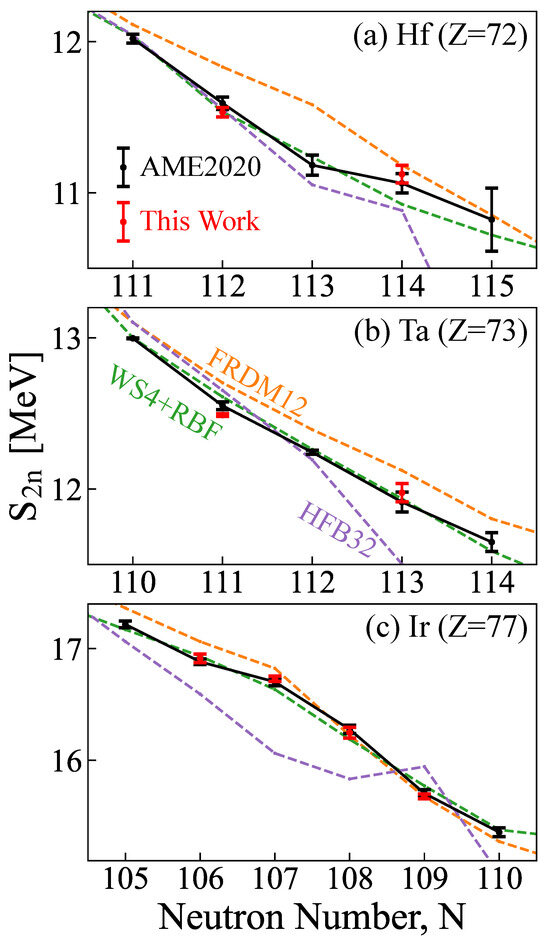
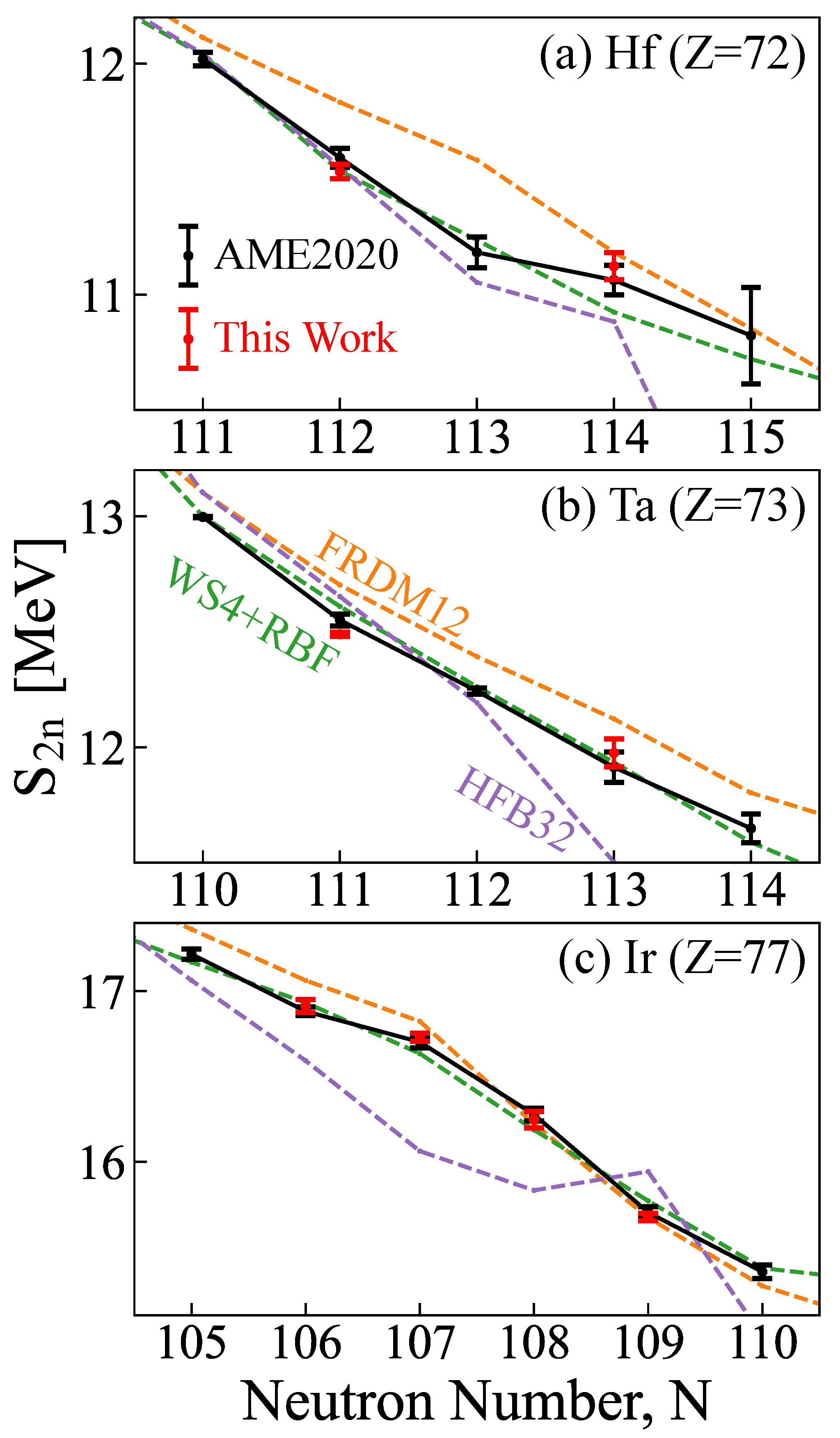
where is the neutron mass and is the mass of a nuclide with Z protons and N neutrons. Figure 4 shows the of Hf, Ta and Ir isotope chains compared against several theoretical mass models, namely the microscopic mass model, HFB32 [36], as well as macroscopic–microscopic models FRDM12 [37] and WS4-RBF [38]. The along the Ta isotope chains were reproduced by the WS4-RBF model, though it should be noted that the updated of 184Ta (N = 111) moved away from the predicted values of all mass models. The Ir isotope chain is well described by both WS4-RBF and FRDM12 as opposed to the HFB32 model; however, updated values of 183,184Ir (N = 106, 107) suggest a trend towards FRDM12. The remaining Hf isotope chain is inconclusive as the trend is largely reproduced by the WS4-RBF model with the exception of 186Hf (N = 114). This inconsistency may be due to the lack of direct mass measurements such as 184Hf which was measured via the decay endpoint energy [39]. Thus, more work is needed to evaluate the masses in this region with higher precision.
Figure 4.
Two-neutron separation energy values of the (a) Hf, (b) Ta and (c) Ir isotope chains. The black line indicates values taken from AME2020, while the red markers indicate values with newly evaluated masses of 184Hf, 184Ta, and 183,184Ir. Colored dashed lines represent theoretical mass models listed in panel (b).
4. Conclusions
In conclusion, the masses of several isotopes spanning through were measured with high precision by MRTOF-MS as summarized in Table 1. The mass of 184Ta is directly measured for the first time in this work, shifting the evaluated mass by approximately 60 keV/c2 against AME2020. This shift is also reflected in the mass of 184Hf. Additionally, the resulting shift in value of 186Hf away from WS4+RBF towards FRDM12 highlights the importance of further precise mass measurements with direct methods for isotopes in this region.
Author Contributions
Conceptualization, P.W. and Y.X.W.; methodology, P.W., Z.P., Y.X.W., Y.H. and P.S.; formal analysis, J.M.Y., P.S. and S.N.; investigation, J.M.Y., P.S., G.B., N.C., J.C., J.G.C., S.D. (Siddharth Doshi), S.D. (Sunil Dutt), J.G., S.G., G.H.-C., S.K., F.G.K., G.L. (Gregory Lane), G.L. (Guangshun Li), Y.L., P.M., S.P., A.T. and H.W.; data curation, P.S.; writing—original draft preparation, J.M.Y. and S.N.; writing—review and editing, P.S.; visualization, J.M.Y.; supervision, M.W., Y.X.W., P.S., P.W., J.L., Z.L., A.M.B. and S.N. All authors have read and agreed to the published version of the manuscript.
Funding
This work was supported by the Japan Society for the Promotion of Science KAKENHI (Grants No. 23244060, No. 24740180, No. 26247044, No. 15H02096, No. 17H01132, No. 17H06090, No. 18H03711, No. 20H00169, No. 21H04479, No. 22H04946) and UK STFC (Grants No. ST/V001108/1, No. ST/Y000358/1, No. ST/Z000645/1). Z. Liu was supported by the National Natural Science Foundation of China (Grant No. 12135004). Work at ANL was supported by the U.S. Department of Energy, Office of Nuclear Physics, under Contract No. DE-AC02-06CH11357. A.M. Bruce and S. Doshi acknowledge support from the UK STFC Grant No. ST/V001078/1.
Data Availability Statement
Dataset available on request from the authors.
Acknowledgments
We express our gratitude to the RIKEN Nishina Center for Accelerator-based Science and the Center for Nuclear Study at the University of Tokyo for their support of the online measurements, and to Wako Nuclear Science Center, Institute of Particle and Nuclear Studies, High Energy Accelerator Research Organization, for their support during online experiments.
Conflicts of Interest
The authors declare no conflicts of interest.
References
- Bentley, I.; Rodríguez, Y.C.; Cunningham, S.; Aprahamian, A. Shell structure from nuclear observables. Phys. Rev. C 2016, 93, 044337. [Google Scholar] [CrossRef] [Scilit]
- Buskirk, L.; Godbey, K.; Nazarewicz, W.; Satuła, W. Nucleonic shells and nuclear masses. Phys. Rev. C 2024, 109, 044311. [Google Scholar] [CrossRef] [Scilit]
- Kajino, T.; Aoki, W.; Balantekin, A.B.; Diehl, R.; Famiano, M.A.; Mathews, G.J. Current status of r-process nucleosynthesis. Prog. Part. Nucl. Phys. 2019, 107, 109–166. [Google Scholar] [CrossRef] [Scilit]
- Hochel, R.; Daly, P.J.; Hofstetter, K.J. The Level Structure of 184Os from 184Ir Decay and 185Re(p, 2nγ) in-Beam Spectroscopy. Nucl. Phys. A 1973, 211, 165–188. [Google Scholar] [CrossRef] [Scilit]
- Porquet, M.G.; Bourgeois, C.; Kilcher, P.; Roussière, B.; Sauvage, J.; Dautet, H.; Lee, J.K.P. Decay of Doubly-Odd Nucleus 184Ir. Nucl. Phys. A 1989, 499, 495–516. [Google Scholar] [CrossRef] [Scilit]
- Radon, T.; Geissel, H.; Münzenberg, G.; Franzke, B.; Kerscher, T.; Nolden, F.; Novikov, Y.N.; Patyk, Z.; Scheidenberger, C.; Attallah, F.; et al. Schottky Mass Measurements of Stored and Cooled Neutron-Deficient Projectile Fragments in the Element Range of 57≤Z≤84. Nucl. Phys. A 2000, 677, 75–99. [Google Scholar] [CrossRef] [Scilit]
- Litvinov, Y.A.; Geissel, H.; Radon, T.; Attallah, F.; Audi, G.; Beckert, K.; Bosch, F.; Falch, M.; Franzke, B.; Hausmann, M.; et al. Mass Measurement of Cooled Neutron-Deficient Bismuth Projectile Fragments with Time-Resolved Schottky Mass Spectrometry at the FRS-ESR Facility. Nucl. Phys. A 2005, 756, 3–38. [Google Scholar] [CrossRef] [Scilit]
- Huang, W.J.; Wang, M.; Kondev, F.G.; Audi, G.; Naimi, S. The AME 2020 Atomic Mass Evaluation (I). Evaluation of Input Data, and Adjustment Procedures*. Chin. Phys. C 2021, 45, 030002. [Google Scholar] [CrossRef] [Scilit]
- Lunney, D.; Pearson, J.M.; Thibault, C. Recent trends in the determination of nuclear masses. Rev. Mod. Phys. 2003, 75, 1021–1082. [Google Scholar] [CrossRef] [Scilit]
- Yamaguchi, T.; Koura, H.; Litvinov, Y.A.; Wang, M. Masses of Exotic Nuclei. Prog. Part. Nucl. Phys. 2021, 120, 103882. [Google Scholar] [CrossRef] [Scilit]
- Schury, P.; Wada, M.; Ito, Y.; Arai, F.; Naimi, S.; Sonoda, T.; Wollnik, H.; Shchepunov, V.A.; Smorra, C.; Yuan, C. A high-resolution multi-reflection time-of-flight mass spectrograph for precision mass measurements at RIKEN/SLOWRI. Nucl. Instrum. Methods Phys. Res. Sect. B 2014, 335, 39–53. [Google Scholar] [CrossRef] [Scilit]
- Rosenbusch, M.; Wada, M.; Chen, S.; Takamine, A.; Iimura, S.; Hou, D.; Xian, W.; Yan, S.; Schury, P.; Hirayama, Y.; et al. The new MRTOF mass spectrograph following the ZeroDegree spectrometer at RIKEN’s RIBF facility. Nucl. Instrum. Methods Phys. Res. Sect. A 2023, 1047, 167824. [Google Scholar] [CrossRef] [Scilit]
- Chen, J.L.; Watanabe, H.; Walker, P.M.; Hirayama, Y.; Watanabe, Y.X.; Mukai, M.; Jiao, C.F.; Ahmed, M.; Brunet, M.; Hashimoto, T.; et al. Direct Observation of β and γ Decay from a High-Spin Long-Lived Isomer in 187Ta. Phys. Rev. C 2025, 111, 014304. [Google Scholar] [CrossRef] [Scilit]
- Doshi, S.; Walker, P.M.; Bruce, A.M.; Pascu, S.; Podolyák, Z.; Bartram, G.; Chandrakumar, N.; Chen, J.; Cubiss, J.G.; Dutt, S.; et al. Evidence for an Isomeric π+[411] state in 183Ta. Eur. Phys. J. A 2026, 62, 17. [Google Scholar] [CrossRef] [Scilit]
- Rodríguez-Tajes, C.; Farget, F.; Derkx, X.; Caamaño, M.; Delaune, O.; Schmidt, K.H.; Clément, E.; Dijon, A.; Heinz, A.; Roger, T.; et al. Transfer Reactions in Inverse Kinematics: An Experimental Approach for Fission Investigations. Phys. Rev. C 2014, 89, 024614. [Google Scholar] [CrossRef] [Scilit]
- Hirose, K.; Nishio, K.; Tanaka, S.; Léguillon, R.; Makii, H.; Nishinaka, I.; Orlandi, R.; Tsukada, K.; Smallcombe, J.; Vermeulen, M.J.; et al. Role of Multichance Fission in the Description of Fission-Fragment Mass Distributions at High Energies. Phys. Rev. Lett. 2017, 119, 222501. [Google Scholar] [CrossRef] [Scilit] [PubMed]
- Devaraja, H.M.; Heinz, S.; Ackermann, D.; Göbel, T.; Heßberger, F.P.; Hofmann, S.; Maurer, J.; Münzenberg, G.; Popeko, A.G.; Yeremin, A.V. New Studies and a Short Review of Heavy Neutron-Rich Transfer Products. Eur. Phys. J. A 2020, 56, 224. [Google Scholar] [CrossRef] [Scilit]
- Savard, G.; Brodeur, M.; Clark, J.A.; Knaack, R.A.; Valverde, A.A. The N = 126 Factory: A New Facility to Produce Very Heavy Neutron-Rich Isotopes. Nucl. Instrum. Methods Phys. Res. Sect. B 2020, 463, 258–261. [Google Scholar] [CrossRef] [Scilit]
- Even, J.; Chen, X.; Soylu, A.; Fischer, P.; Karpov, A.; Saiko, V.; Saren, J.; Schlaich, M.; Schlathölter, T.; Schweikhard, L.; et al. The NEXT Project: Towards Production and Investigation of Neutron-Rich Heavy Nuclides. Atoms 2022, 10, 59. [Google Scholar] [CrossRef] [Scilit]
- Hirayama, Y.; Watanabe, Y.X.; Imai, N.; Ishiyama, H.; Jeong, S.C.; Jung, H.S.; Miyatake, H.; Oyaizu, M.; Kimura, S.; Mukai, M.; et al. On-Line Experimental Results of an Argon Gas Cell-Based Laser Ion Source (KEK Isotope Separation System). Nucl. Instrum. Methods Phys. Res. Sect. B 2016, 376, 52–56. [Google Scholar] [CrossRef] [Scilit]
- Hirayama, Y.; Watanabe, Y.X.; Imai, N.; Ishiyama, H.; Jeong, S.C.; Miyatake, H.; Oyaizu, M.; Kimura, S.; Mukai, M.; Kim, Y.H.; et al. Laser Ion Source for Multi-Nucleon Transfer Reaction Products. Nucl. Instrum. Methods Phys. Res. Sect. B 2015, 353, 4–15. [Google Scholar] [CrossRef] [Scilit]
- Hirayama, Y.; Watanabe, Y.X.; Mukai, M.; Oyaizu, M.; Ahmed, M.; Ishiyama, H.; Jeong, S.C.; Kakiguchi, Y.; Kimura, S.; Moon, J.Y.; et al. Doughnut-Shaped Gas Cell for KEK Isotope Separation System. Nucl. Instrum. Methods Phys. Res. Sect. B 2017, 412, 11–18. [Google Scholar] [CrossRef] [Scilit]
- Moon, J.Y.; Jeong, S.C.; Wada, M.; Schury, P.; Watanabe, Y.X.; Hirayama, Y.; Ito, Y.; Rosenbusch, M.; Kimura, S.; Ishizawa, S.; et al. Development of multiple reflection time of flight mass spectrograph at KISS. RIKEN Accel. Prog. Rep. 2019, 52, 138. [Google Scholar]
- Niwase, T.; Watanabe, Y.X.; Hirayama, Y.; Mukai, M.; Schury, P.; Andreyev, A.N.; Hashimoto, T.; Iimura, S.; Ishiyama, H.; Ito, Y.; et al. Discovery of New Isotope 241U and Systematic High-Precision Atomic Mass Measurements of Neutron-Rich Pa-Pu Nuclei Produced via Multinucleon Transfer Reactions. Phys. Rev. Lett. 2023, 130, 132502. [Google Scholar] [CrossRef] [Scilit] [PubMed]
- Mukai, M.; Hirayama, Y.; Schury, P.; Watanabe, Y.X.; Hashimoto, T.; Hinohara, N.; Jeong, S.C.; Miyatake, H.; Moon, J.Y.; Niwase, T.; et al. Evidence for shape transitions near 189W through direct mass measurements. Phys. Rev. C 2025, 111, 014322. [Google Scholar] [CrossRef] [Scilit]
- Hirayama, Y.; Mukai, M.; Watanabe, Y.X.; Schury, P.; Niwase, T.; Choi, H.; Hashimoto, T.; Iimura, S.; Jeong, S.C.; Miyatake, H.; et al. In-Gas-Cell Laser Ionization Spectroscopy at KISS. Interactions 2024, 245, 41. [Google Scholar] [CrossRef] [Scilit]
- Moon, J.Y.; Wada, M.; Schury, P.; Ito, Y.; Watanabe, Y.X.; Hirayama, Y.; Jeong, S.C.; Miyatake, H.; Rosenbusch, M.; Takamine, A.; et al. A New “Gas Cell Style” Ion Cooler for Trapped Ion Experiments at the KEK Isotope Separation System. Nucl. Instrum. Methods Phys. Res. B 2026, 576, 166155. [Google Scholar] [CrossRef] [Scilit]
- Schury, P.; Wada, M.; Ito, Y.; Kaji, D.; Haba, H.; Hirayama, Y.; Kimura, S.; Koura, H.; MacCormick, M.; Miyatake, H.; et al. Observation of Doubly-Charged Ions of Francium Isotopes Extracted from a Gas Cell. Nucl. Instrum. Methods Phys. Res. Sect. B 2017, 407, 160–165. [Google Scholar] [CrossRef] [Scilit]
- Ito, Y.; Schury, P.; Wada, M.; Naimi, S.; Smorra, C.; Sonoda, T.; Mita, H.; Takamine, A.; Okada, K.; Ozawa, A.; et al. A novel ion cooling trap for multi-reflection time-of-flight mass spectrograph. Nucl. Instrum. Methods Phys. Res. Sect. B 2013, 317, 544–549. [Google Scholar] [CrossRef] [Scilit]
- Schury, P.; Ito, Y.; Rosenbusch, M.; Miyatake, H.; Wada, M.; Wollnik, H. Improving Wide-Band Mass Measurements in a Multi-Reflection Time-of-Flight Mass Spectrograph by Usage of a Concomitant Measurement Scheme. Int. J. Mass Spectrom. 2018, 433, 40–46. [Google Scholar] [CrossRef] [Scilit]
- Ito, Y.; Schury, P.; Wada, M.; Naimi, S.; Sonoda, T.; Mita, H.; Arai, F.; Takamine, A.; Okada, K.; Ozawa, A.; et al. Single-Reference High-Precision Mass Measurement with a Multireflection Time-of-Flight Mass Spectrograph. Phys. Rev. C 2013, 88, 011306. [Google Scholar] [CrossRef] [Scilit]
- Purushothaman, S.; Ayet San Andrés, S.; Bergmann, J.; Dickel, T.; Ebert, J.; Geissel, H.; Hornung, C.; Plaß, W.; Rappold, C.; Scheidenberger, C.; et al. Hyper-EMG: A New Probability Distribution Function Composed of Exponentially Modified Gaussian Distributions to Analyze Asymmetric Peak Shapes in High-Resolution Time-of-Flight Mass Spectrometry. Int. J. Mass Spectrom. 2017, 421, 245–254. [Google Scholar] [CrossRef] [Scilit]
- Yates, S.W.; Daly, P.J.; Johnson, N.R.; Aras, N.K. The Level Structure of 184W from the β− Decay of 184Ta. Nucl. Phys. A 1973, 204, 33–52. [Google Scholar] [CrossRef] [Scilit]
- Hausmann, M.; Attallah, F.; Beckert, K.; Bosch, F.; Dolinskiy, A.; Eickhoff, H.; Falch, M.; Franczak, B.; Franzke, B.; Geissel, H.; et al. First Isochronous Mass Spectrometry at the Experimental Storage Ring ESR. Nucl. Instrum. Methods Phys. Res. A 2000, 446, 569–580. [Google Scholar] [CrossRef] [Scilit]
- Wang, M.; Huang, W.J.; Kondev, F.G.; Audi, G.; Naimi, S. The AME 2020 Atomic Mass Evaluation (II). Tables, Graphs and References. Chin. Phys. C 2021, 45, 030003. [Google Scholar] [CrossRef] [Scilit]
- Goriely, S.; Chamel, N.; Pearson, J.M. Further Explorations of Skyrme-Hartree-Fock-Bogoliubov Mass Formulas. XVI. Inclusion of Self-Energy Effects in Pairing. Phys. Rev. C 2016, 93, 034337. [Google Scholar] [CrossRef] [Scilit]
- Möller, P.; Sierk, A.; Ichikawa, T.; Sagawa, H. Nuclear Ground-State Masses and Deformations: FRDM(2012). At. Data Nucl. Data Tables 2016, 109–110, 1–204. [Google Scholar] [CrossRef] [Scilit]
- Wang, N.; Liu, M. Nuclear Mass Predictions with a Radial Basis Function Approach. Phys. Rev. C 2011, 84, 051303. [Google Scholar] [CrossRef] [Scilit]
- Ward, T.E.; Chu, Y.Y.; Cumming, J.B. Identification of 184Hf. Phys. Rev. C 1973, 8, 340–346. [Google Scholar] [CrossRef] [Scilit]

Disclaimer/Publisher’s Note: The statements, opinions and data contained in all publications are solely those of the individual author(s) and contributor(s) and not of MDPI and/or the editor(s). MDPI and/or the editor(s) disclaim responsibility for any injury to people or property resulting from any ideas, methods, instructions or products referred to in the content. |
© 2026 by the authors. Licensee MDPI, Basel, Switzerland. This article is an open access article distributed under the terms and conditions of the Creative Commons Attribution (CC BY) license.