


Abstract
We study exotic orbits in the photoassociation process by considering both the vibrational and rotational motions in a classical model. In the presence of rotational motion, the exotic orbits possess regular bound segments even when the total energy exceeds the threshold energy of the interaction potential. Such features of the exotic orbits are interpreted by introducing an effective potential. We employ Lagrangian descriptors and escape time to characterize the phase-space structure and show that exotic orbits are distributed around the stable region in the short-range phase space. We further calculate the photoassociation probability. Our work provides new insights into the dynamical mechanisms of photoassociation processes.
1. Introduction
Photoassociation (PA) has long attracted significant attention, as it enables the formation of ultracold molecules [1,2,3,4,5,6,7,8] and serves as a powerful probe for the properties of ultracold gases confined in optical lattices [9,10]. PA is a laser-induced process in which a pair of colliding atoms absorbs a photon to form a bound molecule [11,12]. In recent years, this approach has been extended to realize atom–molecule [13,14] and molecule–molecule [15] association processes.
Classical theories provide a valuable framework for investigating laser-induced photoassociation, as they describe the complex nonlinear dynamics of colliding atomic pairs [16,17,18,19,20,21,22], and allow one to study classical-quantum correspondence [23,24,25,26,27,28,29,30,31]. In the classical framework, the orbits of an unperturbed atomic pair are partitioned into two distinct regular classes: closed orbits corresponding to bound molecular states and open orbits corresponding to unbound scattering states. When an external laser field is applied, these regular orbits deform and break up, giving rise to chaotic orbits that enable transitions between bound and unbound states [32,33,34,35,36].
Recently, Forlevesi et al. reported a phenomenon termed intermittent photoassociation that leads to the formation of metastable molecules [37]. Using classical nonlinear dynamics analysis, they demonstrated that this phenomenon corresponds to exotic orbits in phase space. Exotic orbits differ from the known chaotic orbits, as they consist of locally regular bound segments and locally regular unbound segments which are bridged by locally chaotic segments. The regular bound segments within exotic orbits are attributed to the formation of metastable molecules [37]. This discovery provides new insights into the dynamical mechanisms underlying photoassociation processes.
However, current investigations on the dynamics of exotic orbits have been limited to the one-dimensional (1D) relative vibrational motion of colliding atomic pairs, while the influence of rotational degree of freedom has not been addressed. In this work, we extend the study of exotic orbits to two-dimensional (2D) systems by incorporating the rotational degree of freedom. When rotational motion is present, exotic orbits retain regular bound segments even if the total energy surpasses the interaction potential’s threshold. This behavior is accounted for by introducing an effective potential. Additionally, we employ the Lagrangian descriptor (LD) [38,39] and escape time (ET) [40] to characterize the phase-space structures of high-dimensional Hamiltonian systems. We find that the introduction of rotational degree of freedom modifies the phase-space structure and thus alters the transition probabilities between bound and unbound states.
2. Hamiltonian
We consider the motion of a colliding atomic pair in a linearly polarized laser field. A suitable dimensionless Hamiltonian for this system is provided in refs. [41,42]:
where , and denote the internuclear distance, its conjugate relative radial momentum, the angle between the internuclear axis and the laser polarization axis, and the conjugate relative angular momentum, respectively. is the evolution time. The interaction potential between the colliding atoms is described by the Morse potential, whose dimensionless expression is given by
It is noted that the threshold energy of the interaction potential is set to be zero. is the dipole moment function of the atomic pair, with the following form [37]:
where , , and are dimensionless parameters. This exponentially damped sinusoidal dipole moment function can be tuned via its parameters to fit the oscillatory dipole characteristics of different real molecules, making it an important model for related dynamics studies. The parameter governs the oscillatory behavior of the dipole moment function, and increasing introduces oscillations into the function [43]. corresponds to the equilibrium distance between the nuclei. The parameter determines the decay rate of the dipole moment function as increases. A larger leads to a faster decay and results in a short-range dipole moment function. Forlevesi et al. [37] demonstrated that short-range dipole moment functions yield overall higher photoassociation probabilities compared to their long-range and intermediate-range counterparts. The parameters adopted for the dipole moment function in this work are , , and . The laser field is a continuous-wave field:
where and are the amplitude and frequency of the laser, respectively. In this work, and are used unless stated otherwise. The equations of motion are derived from the Hamiltonian in Equation (1):
In this work, we investigate the motion of colliding atomic pairs with initial energy and initial angle . For given initial values and , the corresponding is determined by
The equations of motion are solved using the fourth-order Runge–Kutta method [44] to obtain the time evolution of , and the total energy of the system.
3. Results and Discussion
3.1. Dynamical Analysis of Exotic Orbits
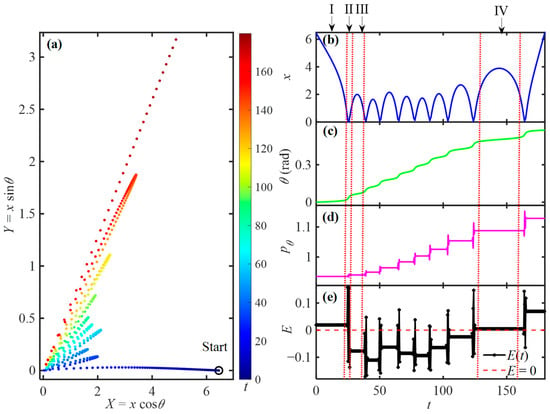
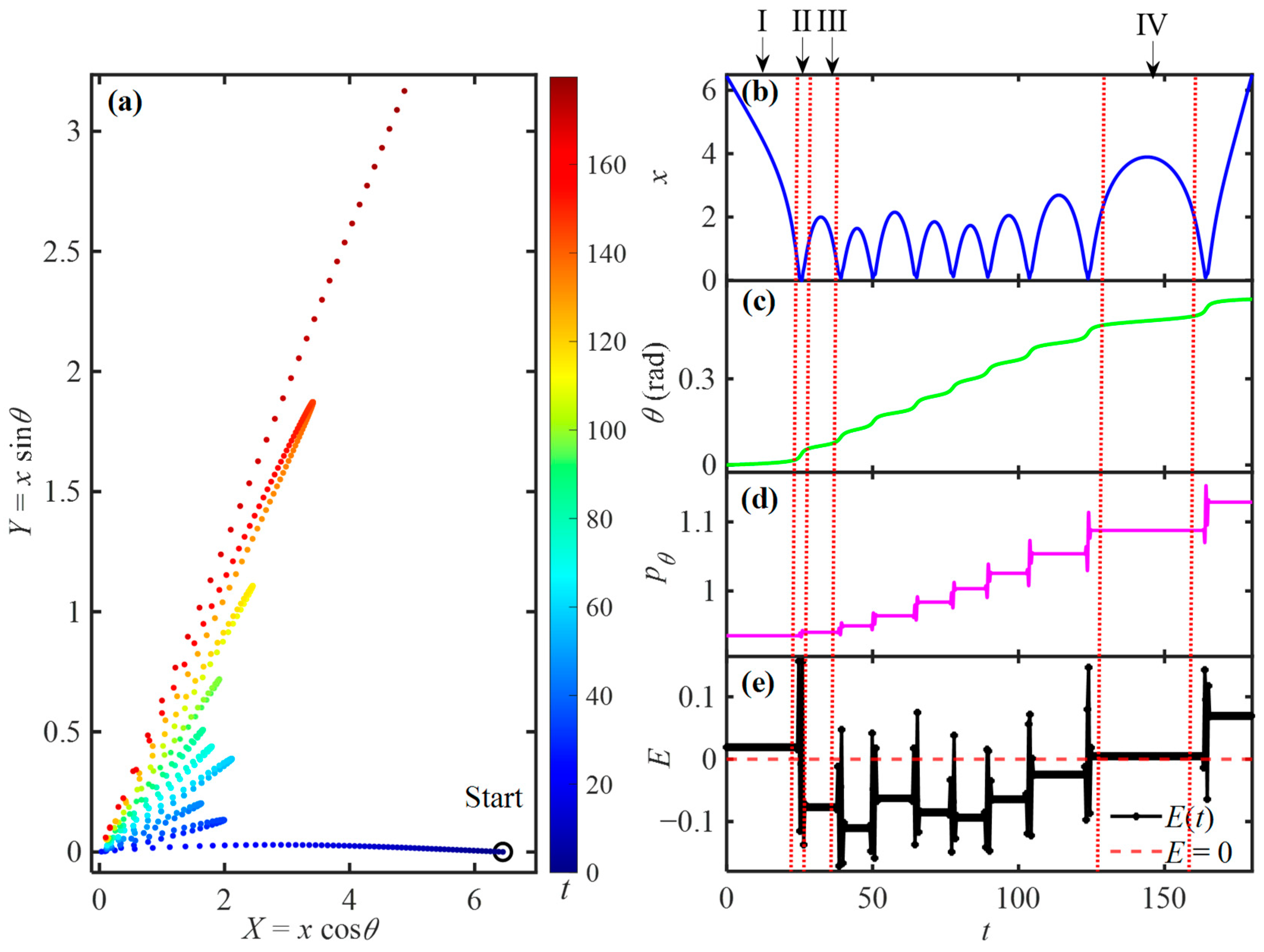
Figure 1a presents an exotic orbit in 2D coordinate space, where and . Panels (b), (c), (d), and (e) of Figure 1 show the time evolution curves of , and respectively. The calculations are performed with , , and . The color of the points in Figure 1a encodes the evolution time. The red dashed line in Figure 1e indicates the threshold energy of the interaction potential .
Figure 1.
(a) Exotic orbit in 2D coordinate space. The black circle marks the initial relative position of the atomic pair. (b–e) show the time evolution of , and , respectively. The vertical red dotted lines divide the time evolution into different stages. The horizontal red dashed line in (e) indicates . In the calculation, , , .
In our dimensionless scheme, the initial energy corresponds to approximately 122 K for the SrLi molecule taken as the reference system [37]. At this temperature, quantum effects are negligible and classical mechanics are valid. With the same SrLi molecular parameters, a dimensionless time of corresponds to approximately 0.2 ns. The typical spontaneous decay lifetimes of molecular excited states are on the order of 10–100 ns, but our simulation time scale 0.2 ns is two to three orders of magnitude shorter than the spontaneous emission time scale. Hence, we can neglect spontaneous decay in our classical simulations.
The exotic orbit revealed above can be broken down into several stages. In stage I , the atomic pair starts with the initial condition marked by the black circle in Figure 1a and approaches each other along the axis (the laser polarization axis). In this stage, decreases with time as shown in Figure 1b. According to Equation (7), varies slowly with time due to the large value of . Meanwhile, as depicted in Figure 1d,e, both and are conserved. This is attributed to the fact that the dipole moment function of the system tends to zero in the long-range region with , and the laser–atom pair coupling term in Hamiltonian (1) vanishes.
In stage II , the atomic pair enters the short-range region . The dipole moment function is no longer negligible, and the laser–atom pair coupling term in Hamiltonian (1) comes into play. Energy exchange occurs between the colliding atomic pair and the laser field. The atomic pair approaches the inner turning point and rebounds there. As shown in Figure 1a, the atomic pair recedes from the inner turning point along a different direction. This is due to the increase of in this stage (see Figure 1c). Meanwhile, and oscillate with time as shown in Figure 1d,e.
In stage III , the atomic pair moves back to the long-range region. The increase of with time becomes gradual as can be seen in Figure 1c. Meanwhile, and become conserved again (see Figure 1d,e). As shown in Figure 1e, is less than 0. The atomic pair is rebounded by the long-range potential at , and then moves toward the short-range region again (see Figure 1b). The above process is then repeated until the atomic pair acquires sufficient energy to dissociate.
In stage IV , is conserved and is larger than 0, as shown in Figure 1e. In the 1D system, the atomic pair dissociates at . In contrast, the orbit of the atomic pair is still bound as observed in Figure 1b. This implies that the atomic pair does not dissociate after escaping the short-range interaction region with an energy exceeding the threshold energy of the interaction potential. Such behavior differs remarkably from the exotic orbits predicted by the 1D vibrational model. To clarify the origin of such behavior, we treat the rotational kinetic energy of the atomic pair as an equivalent centrifugal potential term and introduce the effective potential to analyze the influence of relative rotation between the atoms on the dynamics. The expression for the effective potential reads
where denotes the centrifugal potential term.
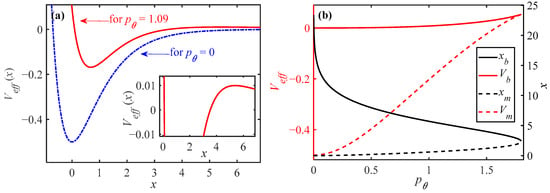
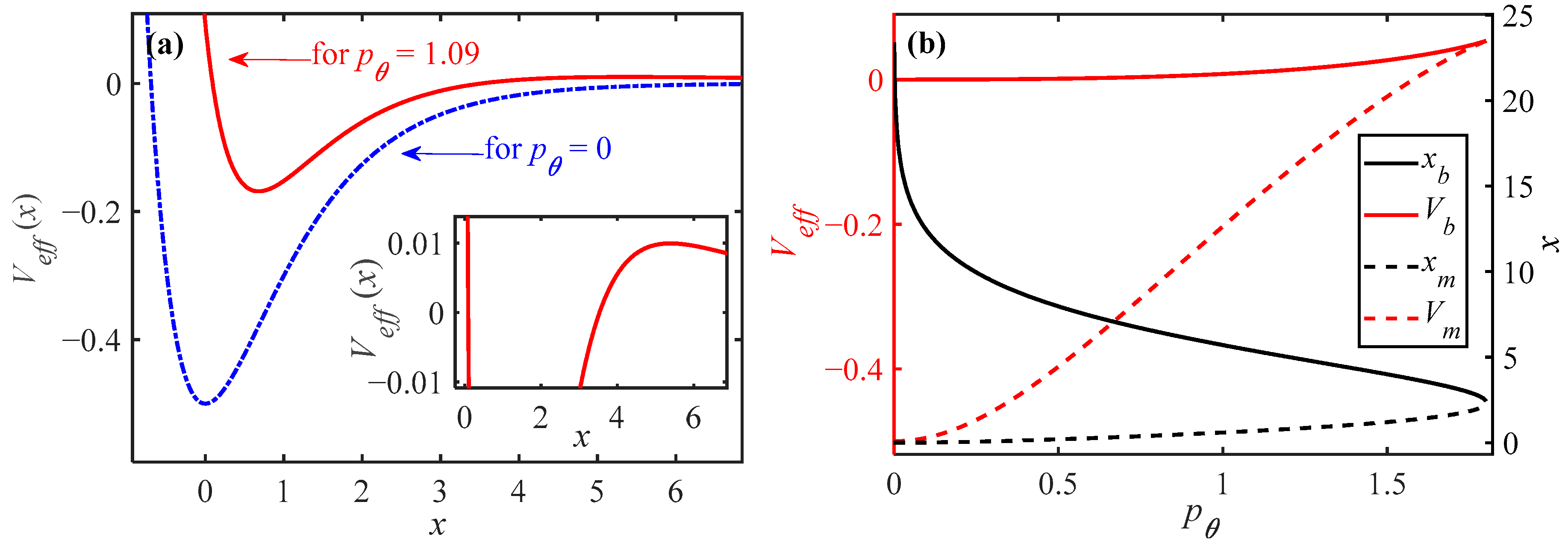
As can be seen from Figure 1d, is approximately 1.09 in the interval . The effective potential curve for is plotted as a red solid line in Figure 2a. For comparison, we also show the Morse potential in a blue dash-dotted line in Figure 2a. As shown in the inset of Figure 2a, has a barrier whose height is defined as . When the total energy is larger than the threshold energy of interaction potential, but lower than the barrier height , the atomic pair is reflected by the barrier. Therefore, in 2D systems, the exotic orbits can have bound regular segments with . For atomic pairs undergoing intermittent photoassociation, the effective dissociation threshold is no longer but .
Figure 2.
(a) The red solid line shows the effective potential curve for , and the blue dash-dotted line denotes the Morse potential curve , which corresponds to for . The potential barrier of for is clearly shown in the inset. (b) The black and red solid lines represent the variations in the position and the height of the potential barrier with , respectively. The black and red dashed lines represent the variations in the position and the potential energy at the potential minimum with , respectively.
We calculate the variations of the position and the height of the barrier as increases from 0 to 1.801, and the results are shown by the black and red solid lines in Figure 2b, respectively. As increases, shifts to smaller , and increases. As shown in Figure 2a, the introduction of the centrifugal potential also shifts the equilibrium position of the potential. We calculate the equilibrium position together with the potential energy at and show the results by the dashed lines in Figure 2b. As increases, shifts to larger , and increases. When reaches the critical value of 1.801, the equilibrium position and the position of the barrier coalesce. When exceeds this critical value, the effective potential becomes a repulsive potential.
3.2. Exotic Orbit Distribution in Phase Space
We further investigate the influence of the rotational degree of freedom on the nonlinear dynamics of exotic orbits by analyzing the phase-space structure of the system. The and are adopted to characterize the phase-space structure. The is a dynamical metric constructed by integrating the velocity field along trajectory arc lengths, enabling efficient identification of phase space structures with low computational cost. It is defined as
where ) denotes the initial values, is the initial evolution time, is the integration time, and is a constant parameter [40]. In this work, we set and . The characterizes the evolution time required for a trajectory to dissociate, which is defined by , and . The combination of and can effectively distinguish phase-space structures such as stable regions and stickiness regions, thereby fully depicting the intricate dynamical features of high-dimensional phase spaces [40].
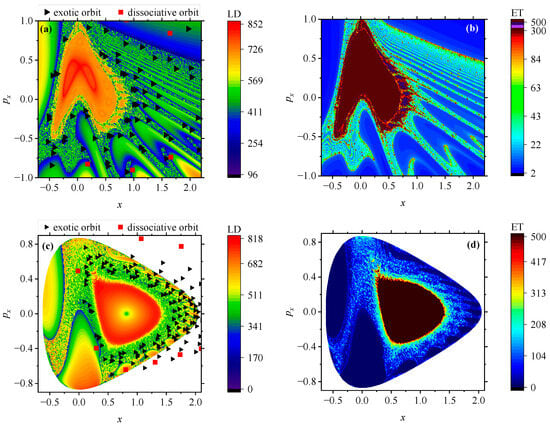
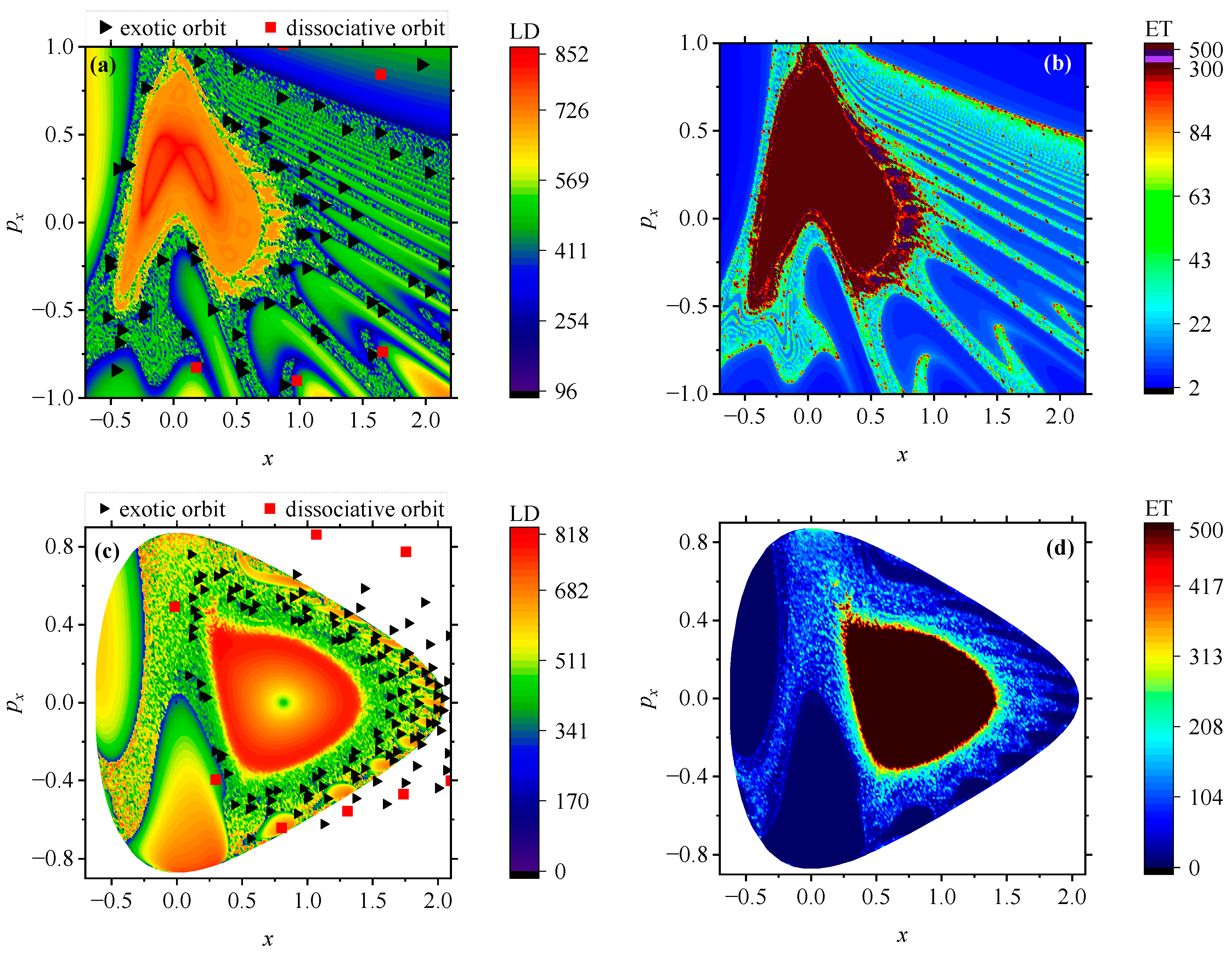
First, we investigate the short-range phase space of the system with initial conditions sampled on a grid of and with a step size of . For the 1D system, the in Figure 3a shows an inverted V-shaped region. in this region is larger than 500 as shown in Figure 3b. This indicates that the atomic pairs with and taken in this region cannot dissociate. Their orbits are periodic or quasiperiodic [45,46,47]. Surrounding this stable region is a stickiness region corresponding to [48], where atomic pairs are temporarily trapped and undergo long-time bound motion before dissociation. The black triangles in Figure 3a depict an exotic orbit. We find that exotic orbits are always distributed around the stable region in the short-range phase space. In contrast, the red squares in Figure 3a depict a dissociative orbit, which is a bit far from the stable region.
Figure 3.
Lagrangian descriptor (a,c) and escape time (b,d) in the short-range region. (a,b) correspond to the 1D system, while (c,d) correspond to the 2D system. In panels (a,c), black triangles mark exotic orbit, and red squares mark dissociative orbit.
For the 2D system, the phase-space structure changes significantly. The calculations for the 2D system are performed with . As shown in Figure 3c,d, the stable region in the phase space of the 2D system shifts noticeably to larger . This is because the stable region in the phase space is located around the equilibrium position of the potential, and the equilibrium position of the effective potential shifts to larger compared to that of the Morse potential. Meanwhile, the stable region in the 2D system is more regular. This arises from the fact that the laser–atom pair interaction strength is strongly suppressed in the region , so the bound orbits in the stable regions in 2D exhibit nearly regular motion. Moreover, the stable region in the 2D system is relatively less affected by variations in laser amplitude. In comparison, the stable region of the 1D system shrinks significantly as the laser amplitude increases [40]. Exotic orbits in the 2D system remain distributed around the stable region in the short-range phase space, as indicated by the black triangles in Figure 3c. Dissociative orbit in the 2D system is shown by red squares in Figure 3c.
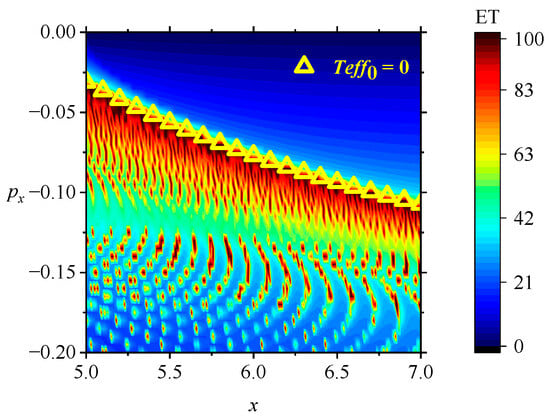
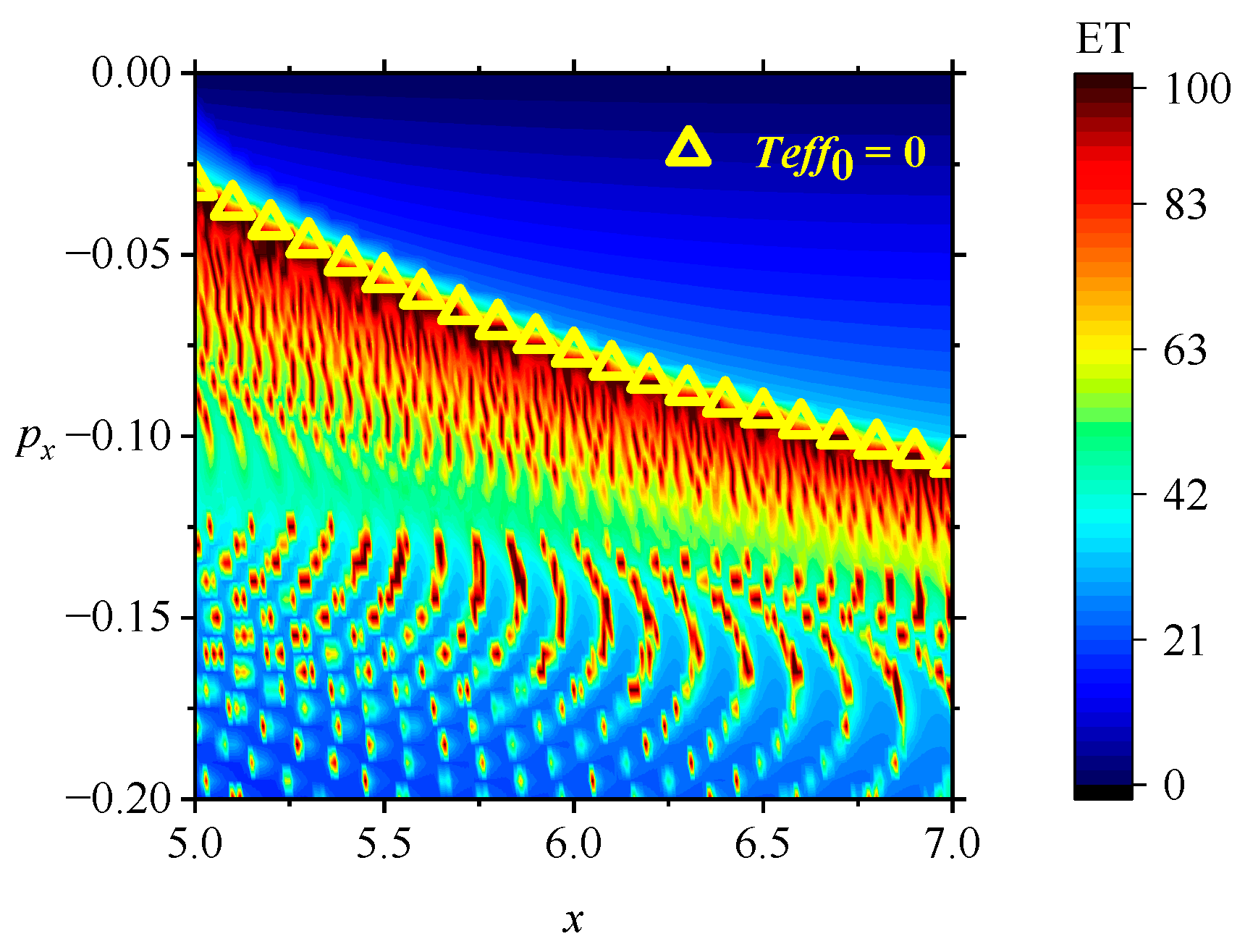
Furthermore, we calculate the in the long-range phase space of the 2D system. The initial conditions are sampled on a grid of and with step sizes and , and the initial energy is fixed at . The result is shown in Figure 4.
Figure 4.
Escape time in the long-range region. The yellow triangles mark the distribution of and corresponding to .
There is a boundary in Figure 4 between phase space with larger and small . The boundary can be estimated as follows. An atomic pair cannot cross the centrifugal barrier to enter the short-range region if the system energy is lower than the barrier height . In this case, the atomic pair is rebounded by the centrifugal barrier and dissociates rapidly, leading to an extremely small . We define and calculate for the two sets of laser parameters used in Figure 4. The yellow triangles in Figure 4 indicate the initial condition corresponding , which provide an excellent description of the ET boundary.
3.3. Photoassociation Probability
We further calculate the photoassociation probabilities of the 1D and 2D systems, using
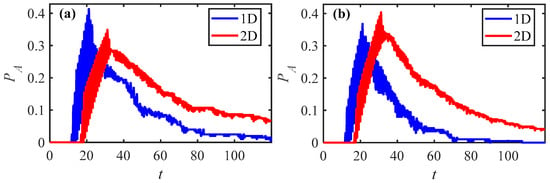
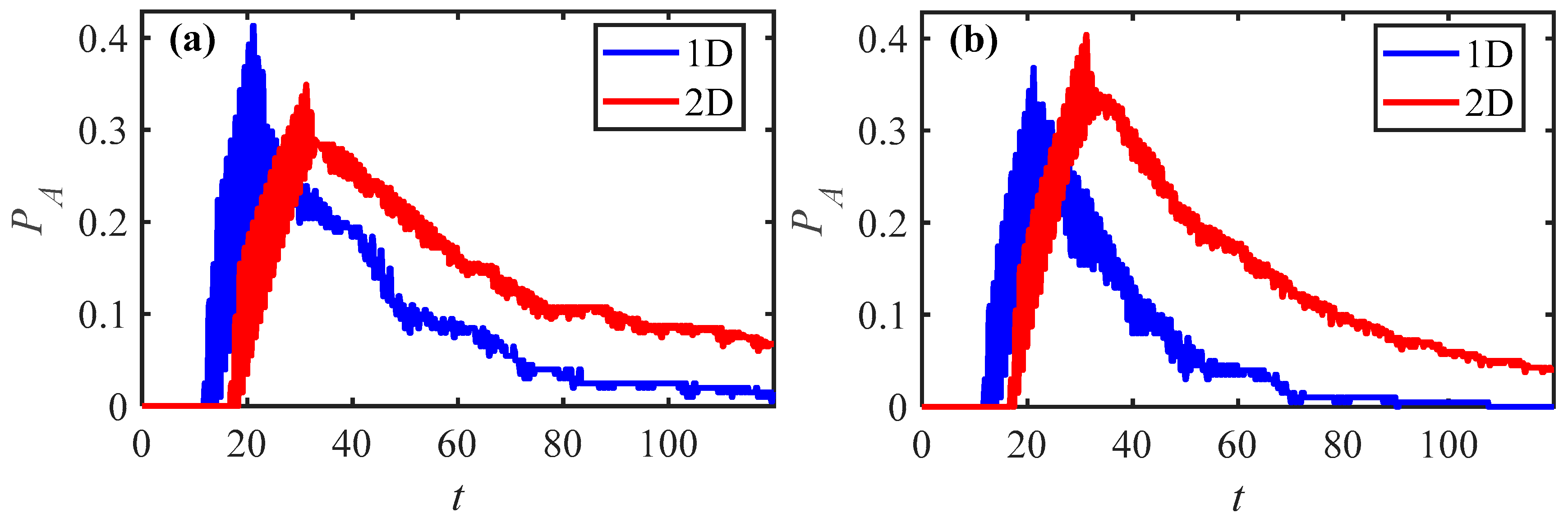
where is the number of orbits remaining bound at time , and is the total number of orbits. Results with and are shown in Figure 5a,b. In these calculations, is fixed to be 7.5. The blue and red curves correspond to the time evolution of for the 1D and 2D systems, respectively. All orbits are initialized with ; is sampled within with a step size . For the 1D system, is uniquely determined by at a given :
For the 2D system, we fix and compute using Equation (9).
Figure 5.
Time evolution curves of the photoassociation probability for the 1D (blue curves) and 2D (red curves) systems. (a) and (b) are obtained with and , respectively.
As shown by the blue curve in Figure 5a, for the 1D system at , reaches its peak at and then decreases with time. This behavior indicates that the associated atomic pairs gradually gain sufficient energy from the laser field and dissociate. Eventually, drops to nearly zero at , meaning that almost no bound atomic pairs remain in the 1D system. Compared with the 1D system, the overall trend of for the 2D system (red curve in Figure 5a) is similar. However, the peak of appears later at in the 2D system. This delay arises because a portion of the total energy in 2D is distributed in the motion of rotational degree of freedom, leading to a generally lower radial kinetic energy than that in the 1D system at the same . As a result, colliding atomic pairs in the 2D system require a longer time to reach the short-range region, which accounts for the delayed peak in the evolution.
Meanwhile, the peak value of the red curve is slightly lower than that of the blue curve in Figure 5a. In contrast, under the high-amplitude laser field with (Figure 5b), the blue curve is overall lower than that in Figure 5a. This is because the stable region of the 1D system is significantly reduced by the high-amplitude laser field, leading to an overall decrease in . For the 2D system, however, the stable region is located in the phase-space region with a small dipole moment due to the effective potential, so its shrinkage with increasing laser amplitude is much weaker than that in the 1D system. Such a difference in stable region between 1D and 2D systems under high laser amplitudes has been observed in ref. [40]. This results in a higher in the 2D system compared with the non-rotating 1D system. Furthermore, after the peak, decreases more slowly for the red curve, indicating that the associated atomic pairs are more robust against dissociation in the 2D system.
4. Conclusions
In this work, we studied exotic orbits in 2D PA by incorporating the rotational degrees of freedom, which was neglected in previous 1D studies. We characterize the phase-space structures with LD and ET. An effective potential that includes a centrifugal term is introduced to analyze the role of relative rotation. We find that the rotational degree of freedom shifts the equilibrium position of the effective potential to larger internuclear distances and creates a barrier, raising the effective dissociation threshold above zero. This modifies the stable region in phase space and alters the exotic orbits and the PA probability. Compared to the 1D case, the 2D system exhibits a delayed PA peak and a higher PA probability at long times. Our results extend the understanding of exotic orbits to higher dimensions and provide insights into controlling PA via rotational degrees of freedom.
Future work could extend these findings in several important directions, including investigating the influence of different laser polarizations on the dynamics of exotic orbits, extending the model to realistic alkali-metal dimers, and incorporating dissipation effects, thereby further exploring the dynamical properties of exotic orbits.
Author Contributions
Conceptualization, X.L. and G.W.; Investigation, X.L., X.B., Y.Z. (Yanpei Zhang) and C.J.; Formal Analysis, X.L. and X.B.; Data Curation, X.L. and C.J.; Writing—Original Draft Preparation, X.L.; Writing—Review and Editing, G.W., A.K.M., J.C. and Z.J.; Supervision, G.W.; Resources, G.W.; Funding Acquisition, G.W., Y.H. and Y.Z. (Yanting Zhao); Discussion and Insights, J.C., A.K.M., Y.Z. (Yanting Zhao), Z.J. and Y.H. All authors have read and agreed to the published version of the manuscript.
Funding
This work has been supported by National Natural Science Foundation of China (Grants No. 12241409, No. 12104082 and No. 12274272), the Research Fund of National Key Laboratory of Aerospace Physics in Fluids (Grant No. 2025-APF-KFZD-11). Liaoning Provincial Natural Science Foundation (Grant No. 2024-MSBA-18), the Fundamental Research Funds for the Central Universities (Grant No. 82231146), and the Program of the State Key Laboratory of Quantum Optics and Quantum Optics Devices (Grant No. KF201814).
Data Availability Statement
The data presented in this study are available from the corresponding authors upon reasonable request.
Conflicts of Interest
The authors declare no conflicts of interest.
Abbreviations
The following abbreviations are used in this manuscript:
| PA | Photoassociation |
| LD | Lagrangian descriptors |
| ET | Escape time |
| 1D | One-dimensional |
| 2D | Two-dimensional |
References
- Ulmanis, J.; Deiglmayr, J.; Repp, M.; Wester, R.; Weidemüller, M. Ultracold Molecules Formed by Photoassociation: Heteronuclear Dimers, Inelastic Collisions, and Interactions with Ultrashort Laser Pulses. Chem. Rev. 2012, 112, 4890–4927. [Google Scholar] [CrossRef] [Scilit] [PubMed]
- Koch, C.P.; Shapiro, M. Coherent Control of Ultracold Photoassociation. Chem. Rev. 2012, 112, 4928–4948. [Google Scholar] [CrossRef] [Scilit]
- Zhang, Q.; Beck, M.; Bornhauser, P.; Knopp, G.; Marquardt, R.; Radi, P.P. Observation and Modeling of Bound–Bound and Bound-Free Transitions in Cu2. J. Chem. Phys. 2026, 164, 104309. [Google Scholar] [CrossRef] [Scilit]
- Tiesinga, E.; Kłos, J.; Li, H.; Kotochigova, S.; DeMille, D. Ultracold Silver-Atom Collisions and the Formation of Silver Dimers by Photo- and Magneto-Association. Phys. Rev. A 2025, 111, 062814. [Google Scholar] [CrossRef] [Scilit]
- Cao, J.; Wang, B.-Y.; Yang, H.; Fan, Z.-J.; Su, Z.; Rui, J.; Zhao, B.; Pan, J.-W. Observation of Photoassociation Resonances in Ultracold Atom-Molecule Collisions. Phys. Rev. Lett. 2024, 132, 093403. [Google Scholar] [CrossRef] [Scilit]
- Yuan, X.; Liu, Y. Forming Ultracold YbAg Molecules via Photoassociation Predicted from Ab Initio Calculations. Phys. Rev. A 2024, 110, 062813. [Google Scholar] [CrossRef] [Scilit]
- Zhao, B.; Pan, J.-W. Quantum Control of Reactions and Collisions at Ultralow Temperatures. Chem. Soc. Rev. 2022, 51, 1685–1701. [Google Scholar] [CrossRef] [Scilit]
- Farjallah, M.; Sardar, D.; Deb, B.; Berriche, H. Electronic Structure, Spectroscopy, Cold Ion–Atom Elastic Collision Properties, and Photoassociation Formation Prediction of the (MgCs)+ Molecular Ion. Atoms 2023, 11, 121. [Google Scholar] [CrossRef] [Scilit]
- Konishi, H.; Roux, K.; Helson, V.; Brantut, J.-P. Universal Pair Polaritons in a Strongly Interacting Fermi Gas. Nature 2021, 596, 509–513. [Google Scholar] [CrossRef] [Scilit] [PubMed]
- Yang, B.; Sun, H.; Huang, C.J.; Wang, H.Y.; Deng, Y.J.; Dai, H.N.; Yuan, Z.S.; Pan, J.W. Cooling and Entangling Ultracold Atoms in Optical Lattices. Science 2020, 369, 550–553. [Google Scholar] [CrossRef] [Scilit]
- Stwalley, W.C.; Wang, H. Photoassociation of Ultracold Atoms: A New Spectroscopic Technique. J. Mol. Spectrosc. 1999, 195, 194–228. [Google Scholar] [CrossRef] [Scilit] [PubMed]
- Jones, K.M.; Tiesinga, E.; Lett, P.D.; Julienne, P.S. Ultracold Photoassociation Spectroscopy: Long-Range Molecules and Atomic Scattering. Rev. Mod. Phys. 2006, 78, 483–535. [Google Scholar] [CrossRef] [Scilit]
- Shammout, B.; Karpa, L.; Ospelkaus, S.; Tiemann, E.; Dulieu, O. Modeling Photoassociative Spectra of Ultracold NaK plus K. J. Phys. Chem. A 2023, 127, 7872–7883. [Google Scholar] [CrossRef] [Scilit]
- Yang, H.; Wang, X.-Y.; Su, Z.; Cao, J.; Zhang, D.-C.; Rui, J.; Zhao, B.; Bai, C.-L.; Pan, J.-W. Evidence for the Association of Triatomic Molecules in Ultracold 23Na40K + 40K Mixtures. Nature 2022, 602, 229–233. [Google Scholar] [CrossRef] [Scilit]
- Mukherjee, B.; Tomza, M. Optical Excitation and Stabilization of Ultracold Field-Linked Tetratomic Molecules. Phys. Rev. Lett. 2026, 136, 013401. [Google Scholar] [CrossRef] [Scilit]
- Amici, G.A.; Guzmán, A.; de Lima, E.F. Optimal Control of the Classical Dynamics of an Electron in the Morse-Soft-Coulomb Potential. Phys. Rev. E 2025, 112, 014211. [Google Scholar] [CrossRef] [Scilit] [PubMed]
- Chandre, C.; Salas, J.P. Nonlinear Dynamics of Molecular Superrotors. Phys. Rev. A 2023, 107, 063105. [Google Scholar] [CrossRef] [Scilit]
- Chandre, C.; Salas, J.P. Formation of RbCs Dimers Using an Elliptically Polarized Laser Pulse. Phys. Rev. A 2019, 99, 023402. [Google Scholar] [CrossRef] [Scilit]
- Chandre, C.; Mahecha, J.; Salas, J.P. Driving the Formation of the RbCs Dimer by a Laser Pulse: A Nonlinear-Dynamics Approach. Phys. Rev. A 2017, 95, 033424. [Google Scholar] [CrossRef] [Scilit]
- Itin, A.P.; Watanabe, S. Integrability, Stability, and Adiabaticity in Nonlinear Stimulated Raman Adiabatic Passage. Phys. Rev. Lett. 2007, 99, 223903. [Google Scholar] [CrossRef] [Scilit] [PubMed]
- Duan, Y.; Liu, W.-K.; Yuan, J.-M. Classical Dynamics of Ionization, Dissociation, and Harmonic Generation of a Hydrogen Molecular Ion in Intense Laser Fields: A Collinear Model. Phys. Rev. A 2000, 61, 053403. [Google Scholar] [CrossRef] [Scilit]
- Liu, W.-K.; Yuan, J.-M.; Lin, S.H. Classical Dynamics of Multiphoton Excitation and Dissociation of Diatomic Molecules by Infrared Laser Pulses. Phys. Rev. A 1999, 60, 1363–1370. [Google Scholar] [CrossRef] [Scilit]
- Cai, Z.-T.; Li, H.-D.; Chen, W. Quantum-Classical Correspondence of Non-Hermitian Symmetry Breaking. Phys. Rev. Lett. 2025, 134, 240201. [Google Scholar] [CrossRef] [Scilit]
- Varma, A.V.; Vardi, A.; Cohen, D. Many-Body Adiabatic Passage: Instability, Chaos, and Quantum Classical Correspondence. Phys. Rev. Lett. 2025, 134, 053201. [Google Scholar] [CrossRef] [Scilit] [PubMed]
- Park, K.-W.; Lee, S.; Jeong, K. Hidden Quantum-Classical Correspondence in Chaotic Billiards Revealed by Mutual Information. Phys. Rev. E 2025, 112, 024209. [Google Scholar] [CrossRef] [Scilit]
- Li, K.; Liu, Y.-X.; Li, S.-C. Quantum-Classical Correspondence of Chaotic Dynamics in a Continuously Driven System. Phys. Rev. A 2024, 110, 052402. [Google Scholar] [CrossRef] [Scilit]
- Li, M.; Geng, J.-W.; Liu, H.; Deng, Y.; Wu, C.; Peng, L.-Y.; Gong, Q.; Liu, Y. Classical-Quantum Correspondence for Above-Threshold Ionization. Phys. Rev. Lett. 2014, 112, 113002. [Google Scholar] [CrossRef] [Scilit]
- Kumari, M.; Ghose, S. Quantum-Classical Correspondence in the Vicinity of Periodic Orbits. Phys. Rev. E 2018, 97, 052209. [Google Scholar] [CrossRef] [Scilit] [PubMed]
- Vijaywargia, B.; Lakshminarayan, A. Quantum-Classical Correspondence in Quantum Channels. Phys. Rev. E 2025, 111, 014210. [Google Scholar] [CrossRef] [Scilit]
- Yan, X.; Wu, H.; Fan, C.; Yang, B.; Guo, Y.; Luo, X.; Xiao, J.; Zeng, Z.-Y. Quantum-Classical Correspondence of Non-Hermitian Spin-Orbit Coupled Bosonic Junction. Phys. Scr. 2025, 100, 055406. [Google Scholar] [CrossRef] [Scilit]
- Wang, Q.; Robnik, M. Quantum-Classical Correspondence between Quantum Chaos and Finite-Time Classical Dynamics. Phys. Rev. E 2025, 111, 054211. [Google Scholar] [CrossRef] [Scilit]
- Krajňák, V.; Wiggins, S. Dynamics of the Morse Oscillator: Analytical Expressions for Trajectories, Action-Angle Variables, and Chaotic Dynamics. Int. J. Bifurc. Chaos 2019, 29, 1950157. [Google Scholar] [CrossRef] [Scilit]
- Koch, F.R.N.; Lenz, F.; Petri, C.; Diakonos, F.K.; Schmelcher, P. Dynamical Trapping and Chaotic Scattering of the Harmonically Driven Barrier. Phys. Rev. E 2008, 78, 056204. [Google Scholar] [CrossRef] [Scilit] [PubMed]
- Dimitriou, K.I.; Constantoudis, V.; Mercouris, T.; Komninos, Y.; Nicolaides, C.A. Quantum and Classical Dynamics of a Diatomic Molecule in Laser Fields with Frequency in the Region Producing Maximum Dissociation. Phys. Rev. A 2007, 76, 033406. [Google Scholar] [CrossRef] [Scilit]
- Borges, E.P.; Tirnakli, U. Two-Dimensional Dissipative Maps at Chaos Threshold: Sensitivity to Initial Conditions and Relaxation Dynamics. Phys. A Stat. Mech. Its Appl. 2004, 340, 227–233. [Google Scholar] [CrossRef] [Scilit]
- Constantoudis, V.; Nicolaides, C.A. Nonhyperbolic Escape and Changes in Phase-Space Stability Structures in Laser-Induced Multiphoton Dissociation of a Diatomic Molecule. Phys. Rev. E 2001, 64, 056211. [Google Scholar] [CrossRef] [Scilit]
- Forlevesi, M.D.; De Carvalho, R.E.; De Lima, E.F. Nonlinear Photoassociation through Exotic Orbits. Phys. Rev. E 2021, 104, 014206. [Google Scholar] [CrossRef] [Scilit] [PubMed]
- Revuelta, F.; Benito, R.M.; Borondo, F. Unveiling the Chaotic Structure in Phase Space of Molecular Systems Using Lagrangian Descriptors. Phys. Rev. E 2019, 99, 032221. [Google Scholar] [CrossRef] [Scilit]
- Revuelta, F.; Benito, R.M.; Borondo, F. Identification of the Invariant Manifolds of the LiCN Molecule Using Lagrangian Descriptors. Phys. Rev. E 2021, 104, 044210. [Google Scholar] [CrossRef] [Scilit]
- Forlevesi, M.D.; De Carvalho, R.E.; De Lima, E.F. Lagrangian Descriptor and Escape Time as Tools to Investigate the Dynamics of Laser-Driven Polar Molecules. Phys. Rev. E 2023, 107, 024209. [Google Scholar] [CrossRef] [Scilit]
- Gu, Y.; Yuan, J.-M. Classical Dynamics and Resonance Structures in Laser-Induced Dissociation of a Morse Oscillator. Phys. Rev. A 1987, 36, 3788–3795. [Google Scholar] [CrossRef] [Scilit]
- Heagy, J.; Yuan, J.M. Dynamics of an Impulsively Driven Morse Oscillator. Phys. Rev. A 1990, 41, 571–581. [Google Scholar] [CrossRef] [Scilit] [PubMed]
- De Lima, E.F.; De Carvalho, R.E. Effects of Oscillatory Behavior of the Dipole Function on the Dissociation Dynamics of the Classical Driven Morse Oscillator. Phys. D 2012, 241, 1753–1757. [Google Scholar] [CrossRef] [Scilit]
- Press, W.H.; Teukolsky, S.A.; Vetterling, W.T.; Flannery, B.P. Numerical Recipes: The Art of Scientific Computing, 3rd ed.; Cambridge University Press: Cambridge, UK, 2007. [Google Scholar]
- Guantes, R.; Borondo, F.; Miret-Artés, S. Periodic Orbits and the Homoclinic Tangle in Atom-Surface Chaotic Scattering. Phys. Rev. E 1997, 56, 378–389. [Google Scholar] [CrossRef] [Scilit]
- Goggin, M.E.; Milonni, P.W. Driven Morse Oscillator: Classical Chaos, Quantum Theory, and Photodissociation. Phys. Rev. A 1988, 37, 796–806. [Google Scholar] [CrossRef] [Scilit] [PubMed]
- Baroni, R.S.; De Carvalho, R.E. Destruction and Resurgence of the Quasiperiodic Shearless Attractor. Phys. Rev. E 2021, 104, 014207. [Google Scholar] [CrossRef] [Scilit]
- Contopoulos, G.; Harsoula, M. Stickiness in Chaos. Int. J. Bifurc. Chaos 2008, 18, 2921–2950. [Google Scholar] [CrossRef] [Scilit]
Disclaimer/Publisher’s Note: The statements, opinions and data contained in all publications are solely those of the individual author(s) and contributor(s) and not of MDPI and/or the editor(s). MDPI and/or the editor(s) disclaim responsibility for any injury to people or property resulting from any ideas, methods, instructions or products referred to in the content. |
© 2026 by the authors. Licensee MDPI, Basel, Switzerland. This article is an open access article distributed under the terms and conditions of the Creative Commons Attribution (CC BY) license.