


Abstract
State-selective single-electron capture in He+ + Ne collisions was studied at laboratory He+ projectile kinetic energies of 30–100 keV (corresponding to 7.5–25 keV/u) using a reaction microscope. Q-value spectra were obtained through recoil-ion momentum reconstruction, enabling the decomposition of the capture yield into three distinct contributions: (i) capture into excited states of the projectile without target excitation, (ii) capture into the projectile ground state accompanied by excitation of the residual Ne+ ion, and (iii) capture involving simultaneous excitation of both He and Ne+. Across the studied energy range, capture into the projectile ground state accompanied by target excitation is the dominant pathway. With increasing impact energy, the fraction of joint projectile–target excitation increases markedly, whereas the target-excitation-only contribution decreases; the projectile-excitation-only fraction remains at a low, nearly constant level. These findings underscore the significance of multi-electron dynamics in intermediate-energy collisions involving many-electron targets.
1. Introduction
Charge transfer in ion–atom collisions is a fundamental process in atomic collision physics and plays key roles in laboratory and astrophysical plasmas and in fusion-related environments [1,2,3,4]. In laboratory and astrophysical plasmas, charge exchange influences charge-state balance [2,5], radiation emission [6], and energy transport [7,8]. In fusion environments, it contributes to the behavior of impurities near plasma-facing materials [9,10] and therefore affects diagnostics and modeling [11,12].
One of the most studied benchmark systems for understanding electron-transfer mechanisms is the collision of charged projectiles with helium targets [13,14,15]. As the simplest many-electron atom, helium provides a unique opportunity to probe electron–electron correlation effects in capture and related few-body processes [16]. However, many practical environments involve collisions between dressed projectiles (ions carrying bound electrons) and many-electron targets, where additional degrees of freedom open competing pathways, such as target excitation and coupled multi-electron processes [17,18].
Despite their relevance to real-world applications, systematic, state-resolved studies of dressed-projectile collisions with many-electron targets remain scarce. The increased complexity of these systems poses significant experimental and theoretical challenges. As a result, the role of projectile excitation, target excitation, and the interplay between these effects in electron-capture processes is still not well characterized, limiting our ability to fully understand these interactions.
In this work, we address this gap by investigating the single-electron capture process in He+ + Ne collisions at intermediate energies. The He+ + Ne system represents a key benchmark for exploring electron-transfer dynamics in collisions with a more complex, many-electron target. Previous work on this system has focused mainly on lower-energy regimes. Eisele and Nagy measured charge-exchange cross sections for He+ + Ne in the low-energy regime (0.5–5 keV), providing valuable experimental data that inform our approach to collision dynamics at higher energies [19]. Kirchner and Horbatsch further advanced our theoretical understanding by developing a non-perturbative model to address electron–electron interactions in collisions involving dressed projectiles and many-electron targets, a critical factor in understanding the complexity of multi-electron systems [20]. Additionally, Martinez et al. provided key cross-section measurements for direct charge transfer in He+ + Ne collisions, which serve as a valuable comparison point for understanding charge transfer dynamics in this system [21]. More recently, Liu et al. performed ab initio calculations of the charge-transfer cross sections in He+ + Ne collisions, revealing the significance of rotational coupling for energies above 0.6 keV and the dominant role of excited-state capture below 0.8 keV [22]. Their findings contribute to the development of a more complete theoretical framework for understanding the energy dependence of charge transfer in this system.
In this study, using recoil-ion momentum spectroscopy, we obtained Q-value spectra that allow channel-resolved yields to be extracted and their energy dependence to be quantified. We found that capture into He (1s2) accompanied by excitation of Ne+ dominates in this intermediate-energy range, while simultaneous excitation of both collision partners becomes increasingly important with an increasing impact energy. This study offers new insights into charge exchange mechanisms involving many-electron targets.
2. Experimental Setup
The experiment was performed using a reaction microscope at the 320 kV platform for multidisciplinary research on highly charged ions at the Institute of Modern Physics, Lanzhou [23,24,25,26]. A He+ beam was produced by a 14.5-GHz electron cyclotron resonance ion source and accelerated to the desired energy. Two sets of adjustable slits upstream of the target chamber collimated the beam to approximately in the interaction region. Electrostatic deflectors located behind the target region were used to remove charge-state contaminants and steer the beam.
A supersonic Ne gas jet generated by a two-stage differentially pumped nozzle intersected the He+ beam inside the target chamber. Typical target areal density was about at a driving pressure of . A homogeneous extraction field of 1.4 V/cm, oriented perpendicular to the projectile-beam axis, guided recoil ions toward a position-sensitive detector. A field-free drift region lay past the extraction region. To reduce the influence of the finite size of the interaction area on the momentum resolution, a one-dimensional time-focusing geometry was implemented [25,26], with a drift length of and an acceleration length of .
Downstream of the interaction region, an electrostatic deflector separated the primary projectile beam from the neutralized projectiles produced by capture. The primary beam was collected in a Faraday cup, while neutral He projectiles were detected by a position-sensitive detector placed approximately 1.5 m downstream.
In this measurement, Ne+ recoil ions were detected in coincidence with scattered neutral He projectiles. The three-dimensional recoil-ion momentum vector was reconstructed from its time of flight and impact position. The longitudinal component enabled state-selective analysis through the Q-value:
where is the projectile velocity and n is the number of captured electrons (here ). Because the electronic binding energies are quantized, the Q-value—which reflects the difference between initial and final electronic binding energies—exhibits discrete structures, enabling separation of capture channels. The absolute momentum scale was calibrated using a well-defined single-capture process in He+ + He collisions [27].
In this work, we focus on state-selective relative yields (branching ratios) extracted from the Q-value spectra. This technique is optimized for coincidence momentum spectroscopy and therefore provides robust, channel-resolved relative populations. In contrast, determining absolute (or total) cross sections would require an independent absolute normalization of the interaction volume (target areal density), projectile flux, and detection efficiencies for all relevant fragments, together with corresponding correction procedures. Such absolute cross-sections measurements are typically performed with dedicated setups (e.g., attenuation gas-cell setups [28]), which are beyond the scope of the present COLTRIMS experiment. Moreover, for the He+ + Ne system in the present intermediate-energy regime, there is no established total cross-sections dataset that could be used as a reliable normalization standard. For this reason, we report branching ratios rather than absolute cross sections.
3. Results and Discussion
We consider single-electron capture both without and with excitation of the residual target ion. Capture without target excitation can be written as
while transfer excitation denotes capture accompanied by excitation of Ne+:
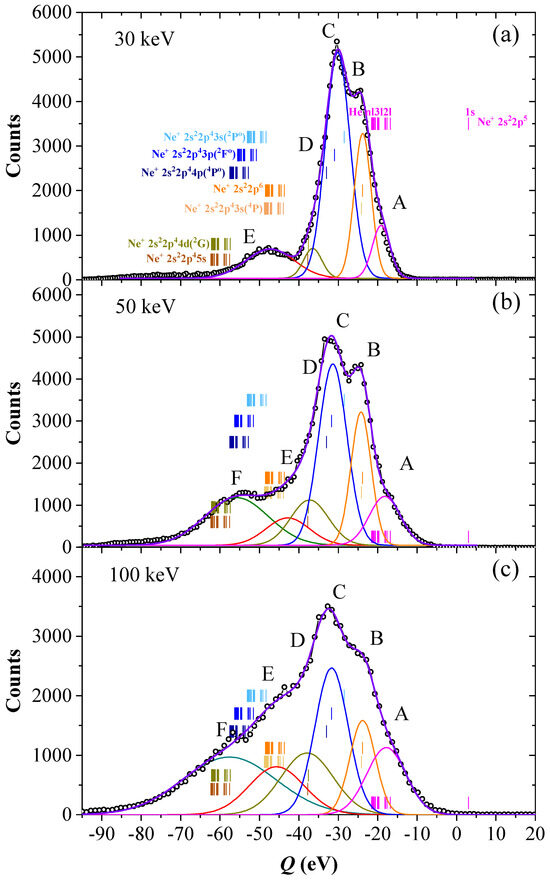
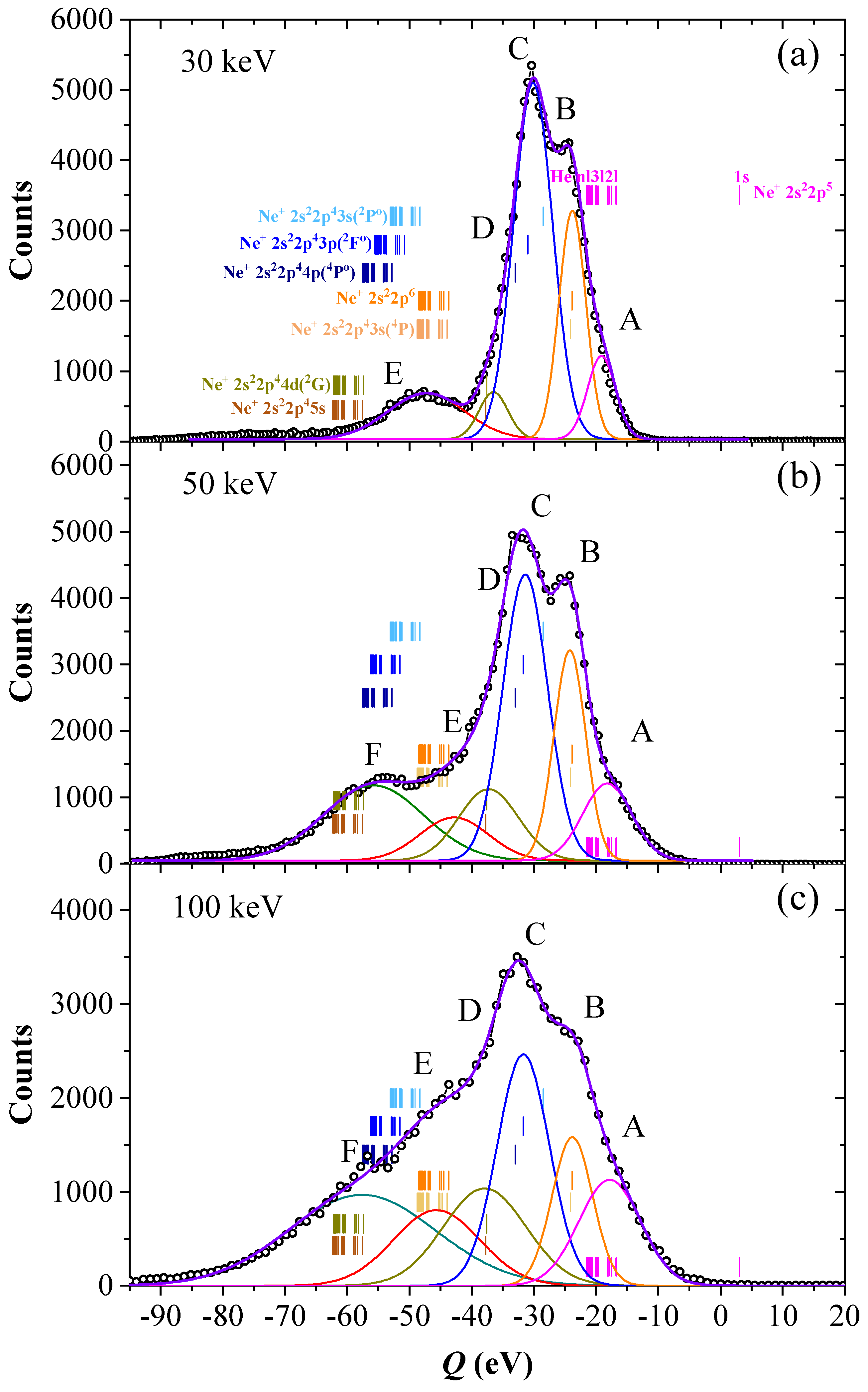
The measured Q-value spectra for three projectile impact energies are presented in Figure 1. The distributions have a similar overall structure across all the investigated collision energies. Notably, each distribution displays a prominent main peak with distinct shoulders. Additionally, a side peak can be observed at lower-Q, which gradually merges into the main peak and becomes less distinguishable at higher energies. In practice, the experimental Q-spectra contain contributions from multiple final states that cannot be individually resolved due to instrumental resolution. Therefore, we group states by characteristic Q-regions and extract relative yields via Gaussian decomposition.
Figure 1.
Q-value spectra for single-electron capture in He+ + Ne collisions. The experimental spectrum is decomposed into multiple Gaussian peaks (labeled A–F—see text and Table 1), each representing a specific contribution. The open circles denote the experimental data. The same states are indicated by vertical lines, and they are shown in the same order and color in panels (a–c). The short vertical lines represent the theoretically predicted Q-values for specific product final states, serving as reference markers for peak assignment.
The fitted components were labeled A–F (Figure 1), and their assignments are summarized in Table 1. To quantify contributions from unresolved final states, each measured Q-value spectrum is represented by a superposition of Gaussian components plus a smooth background term,
where , , and denote the amplitude, centroid, and width of the ith component, and accounts for the slowly varying background. The initial centroid positions are guided by characteristic Q-values calculated from tabulated binding energies (NIST) [29] and indicated by the vertical bars in Figure 1. During fitting, was allowed to vary within a narrow window around the reference value indicated by the vertical bars in Figure 1, because each Gaussian represents a group of unresolved final states and changes in their relative weights can shift the effective centroid. The amount of variation allowed was kept small to preserve a physically meaningful assignment. For the same reason, the fitted widths can differ significantly: broader components reflect a higher density of contributing states and/or stronger overlap among nearby channels, whereas narrower components indicate more localized Q regions with fewer dominant contributions. The amplitudes are treated as free parameters. The fitted Gaussian peaks show significant variations in width, primarily reflecting the complexity of the states they represent. As the impact energy increases, additional excitation states become accessible. Consequently, at the higher energies of 50 and 100 keV, we employed two Gaussian peaks to account for contributions from the projectile–target joint excitation channels.
Table 1.
Assignment of groups of final states and their corresponding Q values.
To ensure clarity and connect the spectral decomposition directly to electron capture mechanisms, we classify these components into three contributions: (i) projectile excited-state transfer, which refers to capture into excited He states without target excitation (peak A); (ii) target excitation, corresponding to capture into He (1s2) with target excitation (peaks B–D); and (iii) joint excitation, indicating capture into excited He states with simultaneous excitation of Ne+ (peaks E and F). This classification will be consistently applied throughout the analysis to quantify the energy dependence of the capture channels. Note that the direct, no-excitation channel (He+ + Ne → He + Ne+) corresponds to the Q-value marked by the vertical pink line labeled “1s” in Figure 1. In our measured spectra, no statistically significant peak can be observed at this Q value. This implies that the yield of the no-excitation channel is very small in the intermediate-energy range studied. Since it cannot be quantified reliably, we did not extract a separate contribution for this channel and therefore do not include it in the branching analysis.
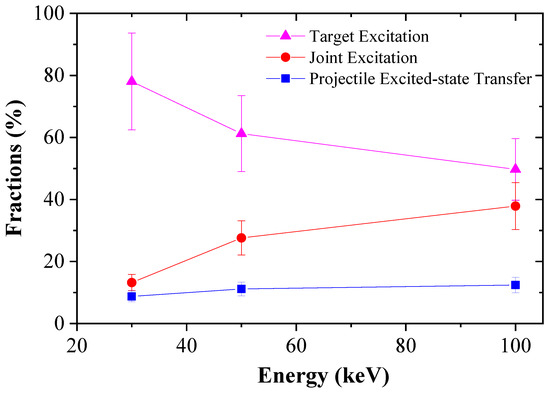
The branching ratios for the different groups of contributions, determined through integration of the fitted Gaussian peaks, are presented as a function of impact energy in Figure 2. In the current data analysis, uncertainties arising from instrumental measurements, curve fitting, and counting statistics were considered and are shown as error bars in the figures. In practice, the dominant contribution to the total uncertainty arises from the fitting procedure itself, i.e., from the limited separation of partially overlapping components and the choice of background representation. We evaluated this fit-related uncertainty by repeating the decomposition with different reasonable initial parameters, fit ranges, and background forms and by monitoring the stability of the extracted integrated areas. The variations obtained from these tests were taken as the systematic fit uncertainty and combined with the (smaller) counting–statistical error to produce the error bars shown in Figure 2. Other potential experimental uncertainties were found to only contribute weakly.
Figure 2.
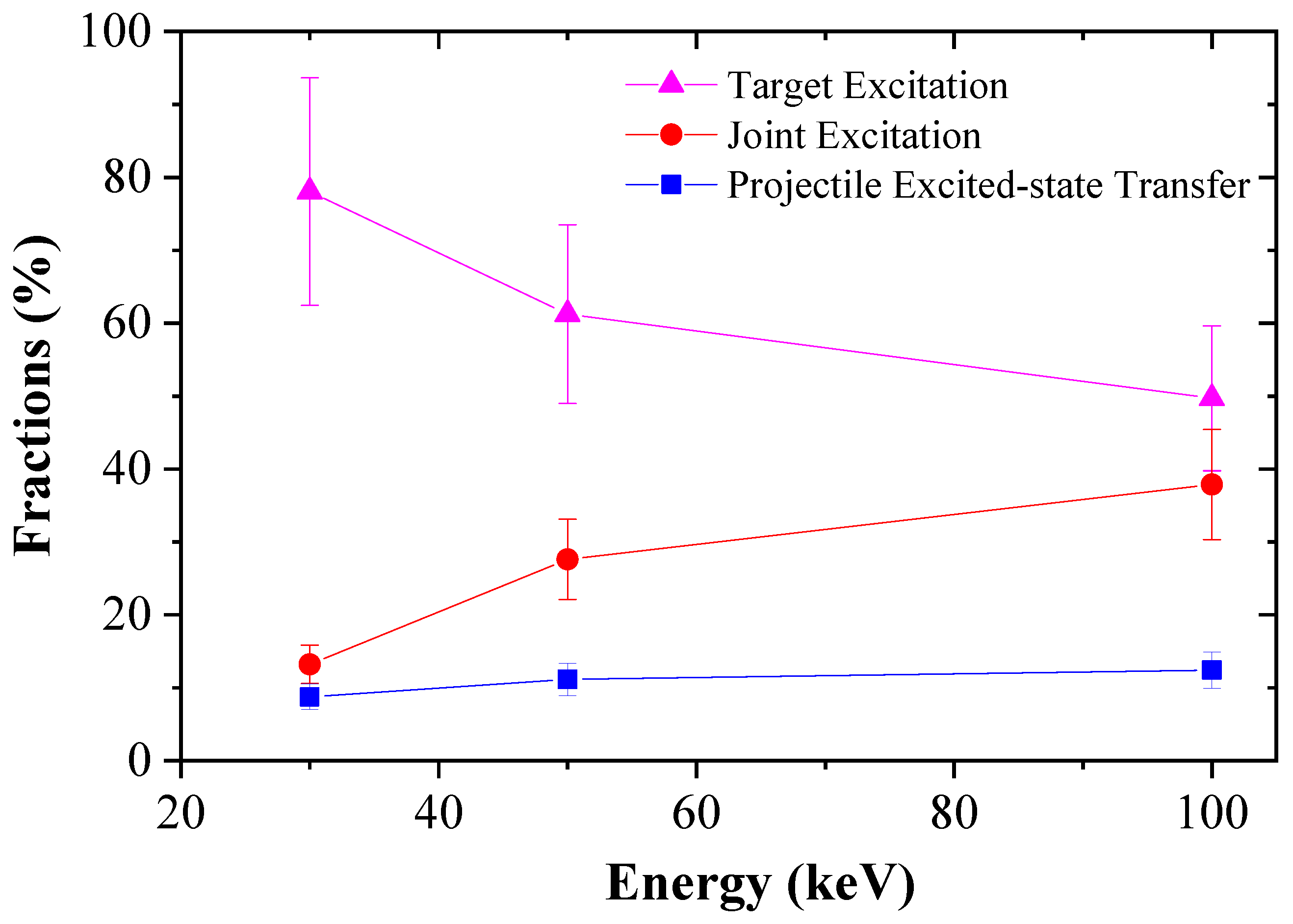
Energy dependence of the branching fractions for three groups of single-electron capture contributions in He+ + Ne collisions: projectile excited-state transfer (blue squares), target excitation only (purple triangles), and joint excitation (red circles). The lines connecting the symbols are provided to guide the eye.
Figure 2 clearly demonstrates the energy dependence of the branching ratios for different groups of contributions. At the lowest energy (30 keV), the target-excitation-only channel (purple triangles) is clearly dominant, contributing about 80% of the total yield. As the impact energy increases, its contribution decreases monotonically, reaching roughly 50% at 100 keV. In contrast, the joint excitation channel (red circles) increases steadily with energy, rising from a relatively small fraction (∼10%) at 30 keV to about 40% at 100 keV. This opposing evolution highlights a strong competition between these two channels. Meanwhile, the projectile excited-state transfer channel (blue squares) remains minor and nearly energy independent, staying close to 10%, with only small fluctuations across the energy range.
It is well established that, as impact energy increases, additional capture pathways become accessible, including capture into higher excited states and capture accompanied by excitation of one or both collision partners. In state-selective charge-exchange studies on He targets, the appearance of extra n components at higher energies is commonly interpreted as evidence that more reaction channels have been opened [30,31,32]. In our He+ + Ne spectra, this general tendency is reflected by a broadening of the accessible Q-value window. A key difference from He targets is the many-electron character of Ne: the residual recoil ion typically has a dense manifold of low-lying excited configurations that can be readily involved during the collision, providing numerous pathways for capture accompanied by target excitation [13]. Moreover, in the intermediate-velocity regime, electron transfer is governed by strong coupling among many reaction channels [13]. As the energy increases, newly accessible joint-excitation pathways can compete increasingly effectively with the target-excitation-only manifold, leading to the observed monotonic decrease in the latter and the marked increase in the former. The projectile-excitation-only contribution remains small because excited-projectile capture is typically accompanied by readily accessible target excitation. A quantitative description of this redistribution will require future theoretical treatments that explicitly include the dense target-excitation manifold and the coupled excitation–capture dynamics.
Although comparable state-resolved measurements are not available in the same intermediate-energy range, it would be informative to contrast our findings with low-energy close-coupling calculations (20–5 keV) [22], for which it has been reported that ground- and excited-state capture without target excitation dominate and that transfer excitation is negligible in this regime. In the present intermediate-energy measurements, transfer-excitation-related channels contribute strongly, and joint excitation becomes increasingly important with an increase in energy. This qualitative shift shows that collision dynamics in He+ + Ne cannot be extrapolated directly from low-energy behavior and highlights the need for theoretical descriptions that explicitly treat target excitation manifolds and coupled excitation-capture dynamics.
This behavior also differs from few-electron targets (e.g., He) for He+ projectiles at the same projectile kinetic energies (keV) (and thus the same projectile velocity), where single-electron capture is typically dominated by ground-state transfer and transfer excitation only makes a minor contribution [33]. The strong enhancement of target- and joint-excitation channels observed here emphasizes that many-electron targets provide dense excitation pathways and underscores the distinctive role of many-electron effects in charge-exchange processes involving many-electron targets. The dense spectrum of excited electronic configurations and the possibility of multi-electron correlation effects increase the likelihood that capture is accompanied by excitation. While the present data do not isolate specific correlation mechanisms, the observed energy-dependent behavior among the three channel groups provides direct experimental constraints for theoretical models designed to describe excitation-capture coupling involving many-electron targets.
4. Conclusions and Outlook
We investigated state-selective single-electron capture in He+ + Ne collisions at projectile energies of 30–100 keV using a reaction microscope. From Q-value spectra and Gaussian decomposition, the capture yield was separated into capture into excited He without target excitation, capture into He (1s2) with target excitation, and capture into excited He states with simultaneous excitation of Ne+. Capture into He (1s2) with target excitation dominates across the studied energy range, while the simultaneous-excitation contribution increases strongly with energy and becomes a major pathway at the highest energy. Capture without target excitation remains a minor and weakly energy-dependent contribution. These results differ qualitatively from the low-energy regime, where capture without significant target excitation is typically dominant, underscoring the growing importance of multi-electron effects in intermediate-energy collisions.
Future theoretical work that explicitly includes target-excitation manifolds and coupled excitation-capture dynamics will be essential for quantitatively describing He+ + Ne in this regime. On the experimental side of things, extending measurements to additional energies and other targets would provide further insights into the underlying mechanisms.
Author Contributions
Conceptualization, experiment, data analysis, writing—review and editing, X.M. and D.G.; writing—original draft preparation, H.Y., D.G., X.P., K.L. and J.Y.; experiment, D.Z., D.G., Y.G., X.Z. and S.Z.; review, S.Z. and X.M. All authors have read and agreed to the published version of the manuscript.
Funding
This work was supported by the National Key Research and Development Program of China (Grant No. 2022YFA1602500) and the National Natural Science Foundation of China (Grant No. 11874365). D.L.G. is grateful for the support provided by the Youth Innovation Promotion Association of the Chinese Academy of Sciences (Grant No. 2022420) and the “Longyuan Youth Talent Program” of Gansu Province.
Data Availability Statement
All data needed to evaluate the conclusions in this work are present in the paper.
Acknowledgments
The authors are grateful for the support provided by the national laboratory of the Heavy Ion Research Facility in Lanzhou (HIRFL). The authors acknowledge the staff overseeing the 320-kV platform at the Institute of Modern Physics, Chinese Academy of Sciences, for their technical support.
Conflicts of Interest
The authors declare no conflicts of interest.
References
- Post, D.E. The Role of Atomic Collisions in Fusion. In Physics of Ion-Ion and Electron-Ion Collisions; Springer: Boston, MA, USA, 1983; pp. 37–99. [Google Scholar] [CrossRef] [Scilit]
- Sciortino, F.; Odstrčil, T.; Cavallaro, A.; Smith, S.P.; Meneghini, O.; Reksoatmodjo, R.; Linder, O.; Lore, J.D.; Howard, N.T.; Marmar, E.S.; et al. Modeling of particle transport, neutrals and radiation in magnetically-confined plasmas with Aurora. Plasma Phys. Control. Fusion 2021, 63, 112001. [Google Scholar] [CrossRef] [Scilit]
- Dennerl, K. Charge Transfer Reactions. Space Sci. Rev. 2010, 157, 57–91. [Google Scholar] [CrossRef] [Scilit]
- Hill, C.; Dipti; Heinola, K.; Dubois, A.; Sisourat, N.; Taoutioui, A.; Agueny, H.; Tőkési, K.; Ziaeian, I.; Illescas, C.; et al. Atomic collisional data for neutral beam modeling in fusion plasmas. Nucl. Fusion 2023, 63, 125001. [Google Scholar] [CrossRef] [Scilit]
- Ortner, A.; Frank, A.; Blažević, A.; Roth, M. Role of charge transfer in heavy-ion-beam–plasma interactions at intermediate energies. Phys. Rev. E 2015, 91, 023104. [Google Scholar] [CrossRef] [Scilit]
- Bhardwaj, A.; Elsner, R.F.; Randall Gladstone, G.; Cravens, T.E.; Lisse, C.M.; Dennerl, K.; Branduardi-Raymont, G.; Wargelin, B.J.; Hunter Waite, J.; Robertson, I.; et al. X-rays from solar system objects. Planet. Space Sci. 2007, 55, 1135–1189. [Google Scholar] [CrossRef] [Scilit]
- Horwitz, J.; Banks, P.M. Ion momentum and energy transfer rates for charge exchange collisions. Planet. Space Sci. 1973, 21, 1975–1981. [Google Scholar] [CrossRef] [Scilit]
- Versloot, T.W.; de Vries, P.C.; Giroud, C.; Brix, M.; von Hellermann, M.G.; Lomas, P.J.; Moulton, D.; Mullane, M.O.; Nunes, I.M.; Salmi, A.; et al. Momentum losses by charge exchange with neutral particles in H-mode discharges at JET. Plasma Phys. Control. Fusion 2011, 53, 065017. [Google Scholar] [CrossRef] [Scilit]
- Ralchenko, Y.; Schultz, D.R. Charge exchange recombination spectra for 100 keV/u and 500 keV/u atomic hydrogen beam colliding with W64+. Plasma Phys. Control. Fusion 2019, 61, 125007. [Google Scholar] [CrossRef] [Scilit]
- Swee, C.; Geiger, B.; Ford, O.; Nornberg, M.; O’Mullane, M.; Poloskei, P.; Reimold, F.; Romba, T.; Wegner, T.; The W7-X Team. Impurity transport study based on measurement of visible wavelength high-n charge exchange transitions at W7-X. Nucl. Fusion 2024, 64, 086062. [Google Scholar] [CrossRef] [Scilit]
- Isler, R.C. An overview of charge-exchange spectroscopy as a plasma diagnostic. Plasma Phys. Control. Fusion 1994, 36, 171. [Google Scholar] [CrossRef] [Scilit]
- Fonck, R.J.; Darrow, D.S.; Jaehnig, K.P. Determination of plasma-ion velocity distribution via charge-exchange recombination spectroscopy. Phys. Rev. A 1984, 29, 3288–3309. [Google Scholar] [CrossRef] [Scilit]
- Janev, R.K.; Winter, H. State-selective electron capture in atom-highly charged ion collisions. Phys. Rep. 1985, 117, 265–387. [Google Scholar] [CrossRef] [Scilit]
- Fritsch, W.; Lin, C.D. The semiclassical close-coupling description of atomic collisions: Recent developments and results. Phys. Rep. 1991, 202, 1–97. [Google Scholar] [CrossRef] [Scilit]
- Bransden, B.H.; McDowell, M.R.C. Charge Exchange and the Theory of Ion-Atom Collisions; Clarendon Press: Oxford, UK, 1992. [Google Scholar] [CrossRef] [Scilit]
- Belkić, D.; Mančev, I.; Hanssen, J. Four-body methods for high-energy ion-atom collisions. Rev. Mod. Phys. 2008, 80, 249–314. [Google Scholar] [CrossRef] [Scilit]
- Shevelko, V.P.; Kato, D.; Song, M.Y.; Tawara, H.; Tolstikhina, I.Y.; Yoon, J.S. One-electron capture and target-ionization in He+-neutral-atom collisions. Nucl. Instruments Methods Phys. Res. Sect. B Beam Interact. Mater. Atoms 2009, 267, 3395–3402. [Google Scholar] [CrossRef] [Scilit]
- Antonio, N.W.; Plowman, C.T.; Abdurakhmanov, I.B.; Kadyrov, A.S. Calculations of the integrated cross sections in dressed carbon-ion collisions with atomic hydrogen. Phys. Rev. A 2024, 109, 012817. [Google Scholar] [CrossRef] [Scilit]
- Eisele, F.L.; Nagy, S.W. Attenuation and single electron charge-exchange cross sections of He+ on Ne and Ar in the 500–5000 eV energy range. J. Chem. Phys. 1977, 66, 883–885. [Google Scholar] [CrossRef] [Scilit]
- Kirchner, T.; Horbatsch, M. Nonperturbative calculation of projectile-electron loss, target ionization, and capture in He+ + Ne collisions. Phys. Rev. A 2001, 63, 062718. [Google Scholar] [CrossRef] [Scilit]
- Martínez, H.; Alvarez, I.; Cisneros, C.; de Urquijo, J. Single electron capture of Ne+ in He in the energy range 0.5 to 5 keV. In Proceedings of the Atomic Physics of Highly Charged Ions, Giessen, Germany, 10–14 September 1990; Salzborn, E., Mokler, P.H., Müller, A., Eds.; Springer: Berlin/Heidelberg, Germany, 1991; pp. 253–254. [Google Scholar] [CrossRef] [Scilit]
- Liu, X.J.; Qu, Y.Z.; Xiao, B.J.; Liu, C.H.; Zhou, Y.; Wang, J.G.; Buenker, R.J. Ab initio calculations of charge transfer in He+ colliding with Ne. J. Phys. B: At. Mol. Opt. Phys. 2010, 43, 085207. [Google Scholar] [CrossRef] [Scilit]
- Ma, X.; Zhu, X.; Liu, H.; Li, B.; Zhang, S.; Cao, S.; Feng, W.; Xu, S. Investigation of ion-atom collision dynamics through imaging techniques. Sci. China Ser. G: Physics, Mech. Astron. 2008, 51, 755–764. [Google Scholar] [CrossRef] [Scilit]
- Ma, X.; Zhang, R.T.; Zhang, S.F.; Zhu, X.L.; Feng, W.T.; Guo, D.L.; Li, B.; Liu, H.P.; Li, C.Y.; Wang, J.G.; et al. Electron emission from single-electron capture with simultaneous single-ionization reactions in 30-keV/u He2+-on-argon collisions. Phys. Rev. A 2011, 83, 052707. [Google Scholar] [CrossRef] [Scilit]
- Guo, D.L.; Ma, X.; Feng, W.T.; Zhang, S.F.; Zhu, X.L. Analysis of momentum and energy resolutions of the reaction microscope. Acta Phys. Sin. 2011, 60, 113401. [Google Scholar] [CrossRef] [Scilit]
- Guo, D.L.; Ma, X.; Zhang, S.F.; Zhu, X.L.; Feng, W.T.; Zhang, R.T.; Li, B.; Liu, H.P.; Yan, S.C.; Zhang, P.J.; et al. Angular- and state-selective differential cross sections for single-electron capture in p-He collisions at intermediate energies. Phys. Rev. A 2012, 86, 052707. [Google Scholar] [CrossRef] [Scilit]
- Guo, D.L.; Ma, X.; Zhang, R.T.; Zhang, S.F.; Zhu, X.L.; Feng, W.T.; Gao, Y.; Hai, B.; Zhang, M.; Wang, H.B.; et al. State-selective electron capture in 30- and 100-keV He+ + He collisions. Phys. Rev. A 2017, 95, 012707. [Google Scholar] [CrossRef] [Scilit]
- TAWARA, H.; RUSSEK, A. Charge Changing Processes in Hydrogen Beams. Rev. Mod. Phys. 1973, 45, 178–229. [Google Scholar] [CrossRef] [Scilit]
- Kramida, A.; Ralchenko, Y.; NIST ASD Team. NIST Atomic Spectra Database (Ver. 5.12). Available online: https://www.nist.gov/pml/atomic-spectra-database (accessed on 10 January 2026).
- Cao, T.; Meng, T.; Gao, Y.; Zhang, S.F.; Zhang, R.T.; Yan, S.; Zhu, X.L.; Wang, J.; Ma, P.; Ren, B.; et al. State-selective Charge Exchange in 19.5–100 keV amu−1 O6+ Collision with He and H2. Astrophys. J. Suppl. Ser. 2023, 266, 20. [Google Scholar] [CrossRef] [Scilit]
- Yin, H.; Meng, T.; Ma, P.; Ren, B.; Tan, X.; Wu, Y.; Tu, B.; Zhang, R.; Yao, K.; Xiao, J.; et al. State-selective single- and double-electron capture in intermediate-energy in C4+ + He Collisions. Phys. Lett. A 2025, 546, 130527. [Google Scholar] [CrossRef] [Scilit]
- Xia, Z.; Ren, B.; Zhang, R.; Wei, L.; Han, J.; Meng, T.; Wang, J.; Ma, P.; Zhang, Y.; Tu, B.; et al. Measurement of n- and l-resolved State-selective Charge Exchange in Ar8+ Collision with He. Astrophys. J. 2022, 933, 207. [Google Scholar] [CrossRef] [Scilit]
- Guo, D.L.; Gao, J.W.; Zhang, S.F.; Zhu, X.L.; Gao, Y.; Zhao, D.M.; Zhang, R.T.; Wu, Y.; Wang, J.G.; Dubois, A.; et al. State-selective single-electron capture in intermediate-energy C4++ He collisions. Phys. Rev. A 2021, 103, 032827. [Google Scholar] [CrossRef] [Scilit]

Disclaimer/Publisher’s Note: The statements, opinions and data contained in all publications are solely those of the individual author(s) and contributor(s) and not of MDPI and/or the editor(s). MDPI and/or the editor(s) disclaim responsibility for any injury to people or property resulting from any ideas, methods, instructions or products referred to in the content. |
© 2026 by the authors. Licensee MDPI, Basel, Switzerland. This article is an open access article distributed under the terms and conditions of the Creative Commons Attribution (CC BY) license.